1. Introduction
Robotics has been one of the most prevalent applications for power management implementing power electronic devices since its inception. The power electronic devices utilized by the robotics industry includes, but is not limited to, AC/DC converters for supplying power to the battery or logic controller, DC/AC converters for supplying power to actuation and locomotion subsystems, AC/AC converters for precise adjustment and actuation of AC motors, and DC/DC converters, which are the most common type throughout robotic platforms for power management and actuation [
1]. Additionally, much of the actuation on a robot is performed by motors. These often consist of brushed DC motors, brushless DC motors, induction motors, and switched reluctance motors [
2]. Other common types of power electronics used in robotic platforms include current-mode actuators, voltage-mode actuators, and piezoelectric transformers [
3,
4]. The use of power electronics is applied comprehensively across the robotics industry, and has allowed for impactful utilization of these robotic devices for applications such as wearable biomechatronic devices, service robots, rescue robots, etc.
1.1. Example Robotic Applications
Wearable biomechatronic devices aid individuals whose mobility and quality of life are impacted by physical impairment. For example, walking deficits associated with neuromuscular impairment related to cerebral palsy (CP) are often life-long and greatly impact quality of life. In [
5], a novel battery-powered wearable ankle exoskeleton is proposed to reduce the severity of the gait imparity. Further, about 43% of individuals who have suffered from a stroke, in the US, lose functionality in an arm, impacting their quality of life. In [
6], the authors provide an assistive wearable device to directly augment hand function, as opposed to a therapeutic device which serves to indirectly enhance hand function. The proposed device is a battery-powered hand exoskeleton for individuals with chronic upper extremity hemiparesis caused by stroke. An assistive device is intended to be utilized during activities of daily living (ADLs) such as removing a lid from a bottle or slicing food, thus, requiring the device to meet certain size, weight, and power criteria [
6]. Controlling the various electronics within the prototype such as A/D converters, motor drives, and Hall Effect sensors, is done with an embedded system. The embedded system provides the sensing and control by regulating voltage from the Li-Ion battery pack, driving the multiple exoskeleton motors with brushless motor drives, current sensing of each motor, a microcontroller for determining position and velocity, and communicating with an external computer using a Controller Area Network (CAN) communication bus [
6].
Wearable biomechatronic devices have a multitude of constraints and factors to consider for appropriate assistance of human locomotion. One of these lies in the design of effective control systems. In [
7], the focus is on supporting the predictive control of lower-limb robotic assistance devices, prostheses, and exoskeletons, by applying machine vision and deep convolutional neural networks (CNNs) for environment and position recognition.
Robotic systems have also found a foothold in various industries due to their abilities to complete a vast range of tasks. Yet, there is still a demand for a wider performance scope. Some custom and unique applications desire robotic systems to continuously perform changing actions for their specific needs. Ref. [
8] provides a robotic system meant to be integrated into various control systems that need high-accuracy actuation, object grabbing, and pick-and-place capabilities such as biomedical processes and small-part manufacturing. The device, EZ3micro, is shown to integrate seamlessly with a B&R Acopos 6D Shuttle, a high-precision rapid mm-scale control system. The EZ3micro uses a closed-loop control system, allows for six degrees of freedom, utilizes an integrated chip for an integrated stepper motor driver, three actuators, a Raspberry Pi, and other electronic devices [
8].
Service robots can be placed in public spaces such as airports, museums, and galleries to provide guidance and relevant information. Humanoid welcome robots provide these services in a more human-like form which enables more natural human–robot interaction (HRI) [
9]. These HRIs such as gestures, upper-body movements, and posture lead to high-power demand of the actuation system within these robots and the high-performance computing components. The focus of [
9] is on a specific humanoid welcome robot, AI Meets You (AIMY). AIMY is designed to conduct communication and guidance by utilizing several devices, including motors and actuators for six degrees of freedom in both of its robotic hands, computing and control units, sensors, and display and auxiliary components [
9].
Miniature visually guided robot vehicles have various potential applications such as traffic monitoring, autonomous driving research, security and surveillance, etc., as they provide an avenue for which jointly optimizing size, weight, performance, and cost is necessary. The proposed method of [
10] is a device, CORTEX-II, that potentially meets the needs of such applications with slight alterations for specific use. The design consideration included the design of power and battery circuitry, modification of available relevant components, and the constraint of cost and performance.
The immediate supervision needed by some undersea robots result in a potentially dangerous and difficult position for human operators such as the detection and classification of underwater objects [
11]. For example, a battery-powered robotic crawler for mine countermeasures purposes is being developed by the US Navy’s Coastal Systems Station (CSS) for very shallow water [
11]. The robotic crawler allows for a limited level of supervision while providing sensor data to the observer.
Robots provide an advantageous and effective method of rescue during natural catastrophes and in rescue environments deemed dangerous for direct human rescue efforts [
12]. There are several parameters or objectives that “rescue robots” need to meet to be constructed adequately for their use. The robots need to be well constructed with respect to the environment they would be deployed in, capable of maneuvering through the intricate terrain, quickly locate the victim (s), and effectively communicate with rescuers [
12]. In the event of a coal mining disaster in China, Jingchao and co. utilized various sensors, cameras, a three degrees of freedom robotic arm assembly, waterproof construction, and protective countermeasures for explosions to construct a functional search and rescue mobile robot [
12].
Proposed in [
13] is a two-wheeled robotic vehicle for navigating crowded environments such as indoors and urban areas for research purposes. The two-wheeled robot provides high mobility while boasting a compact structure that uses transformations between a bicycle and a self-balancing vehicle mode to achieve these qualities.
1.2. Untethered Battery-Powered Robots
Untethered robots operate with a built-in energy source and computational system so that they are not bound to a stationary power source while carrying out their wide array of potential functions. However, as robotic capabilities have become more advanced, their power needs have grown substantially. This growth in robotic systems has created the need for improvements in power efficiency, especially for untethered battery-powered robots that are not physically connected to stationary power sources, which is the power management focus of this paper. One of the primary needs for increased robotic power efficiency research is due to the increased computing ability. This has led to the current power demands of battery-powered robots in the range of 10–20 watt-hours per kilogram of the robot’s total weight [
14,
15]. The devices that cause this increase in computing power and ability are often continuously enabled and operate on robotic platforms regardless of the current needs or environment [
16,
17].
Several implementations and studies of types of mobile battery-powered robots highlight a recurring need for mitigation of increasing power consumption and computational load. Different approaches have been proposed for more specific use cases to address the ways in which robotic power needs become apparent regardless of application.
Mobile robots employ components and systems that demand efficient computing and power to run such as sensors, powertrains, integrated circuits (ICs), etc. Autonomous mobile robots are dependent on the various sensors integrated into the platform to perceive its environment. The focus of [
18] is on visual sensors and the processing power and power consumption of these devices due to the high data volume from use. To address the impact of these sensors, dedicated ICs that can be implemented on mobile robots with algorithms often used in computer vision are provided as an appropriate method. The application-specific integrated circuits (ASIC) use a Gaussian Pyramid algorithm; an algorithm used in many computer vision algorithms [
18].
Mobile robots can also benefit from addressing the drain of processing power, energy, and storage of robots with cloud integration for cloud computing [
19]. Executing a computationally intensive task, such as local image processing can be very demanding on battery power consumption. The potential efficiency trade-off comes with balancing the power consumption of performing tasks on a mobile device and the network bandwidth usage of sending and receiving data from the cloud via the transmitter device onboard [
19].
Energy consumption minimization is necessary to extend the operation time of battery-powered wheeled mobile robots (WMRs) [
20]. The focus of [
20] is on motors’ practical energy consumption in relation to motor dynamics, velocity profile, and motor control input. Proposed is an efficient iterative search algorithm which produces a velocity profile that is energy efficient to extend the run-times of WMRs. The focus of [
21] is on optimizing the way power loss is measured in electric powertrains, as this can provide valuable data for electric utility vehicles with powertrain architecture that resembles those explored within the paper. The term “electric vehicle powertrain” is defined within [
21] as a system utilizing electric motors, electric vehicle control unit (EVCU), single-speed transmission, DC-DC converter, and a battery.
An area of the power management system that is also explored to minimize impact to long term performance of actuators and battery capacity is the current overloading system [
22,
23]. The method of minimizing this impact in [
22] is focused on battery-powered micro-actuator systems for miniaturized drug delivery systems by proposing a programmable soft starter and a dynamic DC-DC converter to manage current overloading.
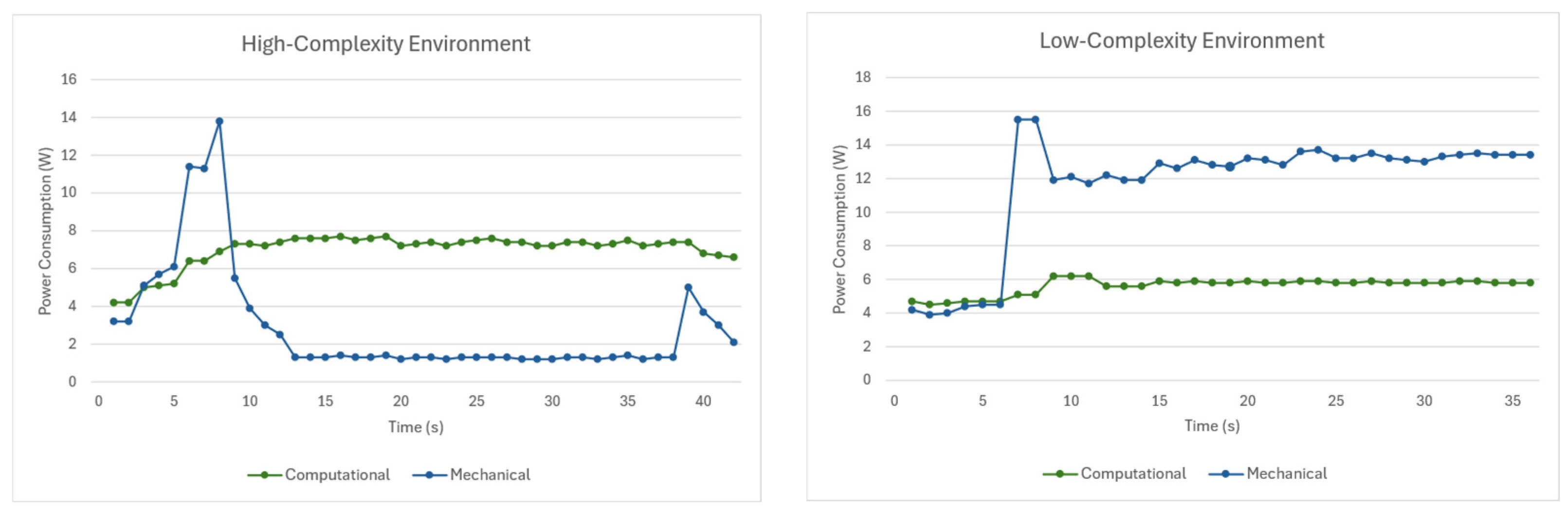
Many robotic platforms do not simultaneously consider the power demands of mechanical components, such as motors and servos, and of the computing components, such as the CPU and GPU [
24]. This oversight often leads to both systems operating at full power simultaneously regardless of the robot’s current task, which can lead to maximum power consumption. Often designers have regulated the power consumption of the mechanical and computational components in a robot platform independently of each other to improve power efficiency [
25]. However, this often causes a notable drop in the robot’s performance, especially if the tasks that the robot completes have irregular mechanical and computational needs.
This dependency on battery power constrains a robotic platform’s functionality into an often relatively small operating window. Improvements to battery capacity technology in recent years have been helpful in mitigating this power constraint [
26]. However, recent advancements in computational technology aboard many robotic devices possess continuously growing power requirements as well. Additionally, size and weight constraints for robotic platforms incentivize advancements in power efficiency. The increased computational ability in many modern robotic platforms that often constrict power budgets can be leveraged to conserve power by implementing intelligent power management protocols and energy-efficient adaptive and predictive control systems. These power efficiency methods allow robotic platforms to reduce unnecessary power expenditure during various stages of operation by adjusting power consumption to the needs of a specific operation or environment. Some prevailing power management methods of improving energy efficiency are dynamic power management (DPM), dynamic voltage and frequency scaling (DVFS) AI-enhanced dynamic programming (DP) control systems, and AI-enhanced model predictive control (MPC) systems [
27,
28,
29,
30,
31,
32,
33,
34,
35,
36,
37,
38,
39,
40,
41].
DPM consists of several methods including timeout, predictive, stochastic, and machine learning [
27,
28,
34,
35,
42,
43,
44]. These power efficiency methods are the most applicable to a large array of platforms when compared to alternate methods, but they have effects on performance in many systems [
27,
28,
29,
35,
44,
45]. DVFS is well suited for robotic applications when it is integrated into a controller that establishes a dependent relationship with the mechanical components in a robotic platform [
24,
30,
46]. AI-enhanced power efficiency systems operate by accurately predicting a robotic platform’s upcoming behavior based on training and sensory input to rapidly adjust the power output to optimal levels at a given instant [
38,
40,
47,
48]. AI-enhancement appears to be well suited for integration into dynamic programming (DP) and model predictive control (MPC) systems due to the ability to dynamically manage several optimization assets in an adaptive and predictive manner, respectively [
32,
38,
39,
40,
41,
47,
48,
49,
50,
51,
52,
53,
54]. Complex robotic systems such as hybrid energy storage systems (HESSs) and legged robotic platforms experience large power efficiency improvements when coupled with AI-enhanced controllers, such as MPC systems [
55,
56,
57,
58,
59,
60]. Robotic neural networks and AI-enhancement are promising directions for advanced research. The need to improve training power efficiency calls for further research if these aspects of AI-enhancement are to be integrated onboard robotic platforms. The power saved increases functionality and operating times, and while the implementation of these methods results in relatively small power savings per robot, the power savings scale immensely when applied to the rapidly growing field of robotics and can significantly increase individual and overall operating times.
1.3. Practical Considerations for Robotic Implementation
The operating conditions for robotic platforms are restricted by the real-time constraints and available onboard power that needs to be considered. Energy efficiency techniques cannot be evaluated or implemented without consideration of these restrictions in robotic systems, especially for mobile and aerial systems. Energy-efficient method implementation on robotic systems needs to integrate with the hierarchical control architecture and complementary hardware carefully in order to blend in and contribute to the performance of the system. Methods such as DP and DVFS are better suited for the consideration of the computational overhead and can be integrated at the firmware and operating system level. AI-assisted methods are more computationally demanding as their complexities require more robustness from the potential integrating system. Regardless of methodology, the potential energy efficiency benefits offered by these methods could be negated if implementation is not completed with consideration of real-time demand and onboard computation limits.
The real-world application aspect of energy optimization requires energy-efficient control methods to keep safety considerations as an important factor in implementation. Different energy-efficient methods present an impact on different areas of safety and highlight unique safety constraints. For example, a model predictive control principled framework allows for a more formal guide providing dependability during standard system operation. In contrast, learning-based control addresses safety through training leading to potential violations during unexpected events. The focus of optimization from energy-efficient control methods does not excuse ignorance of safety constraints and the resulting controllers often include additional explicit safety measures.
The layered and intricate interconnections of a system needed for a functional robotic system presents a potential cascading or ripple effect of failures through the system. The need for verification and validation of complex systems such as energy-efficient robotic control systems is an important demand for these methods. The challenge that remains is the actual action of performing formal verification and validation while balancing constraints such as non-linearity, continuous dynamics, adaptive components, etc., for full robotic systems. Approaches such as simulation, hardware-in-the-loop testing, scaled-down testbeds, and run-time monitoring can be utilized for a layered validation process to assure practical strategies for testing. In addition, fallback controllers can also be implemented to provide support and maintenance of safety during unexpected operating events.
The metric for performance of robotic systems must also consider the dynamic potential of the application environment. Controllers are subject to the challenges of environmental diversity as it poses an unavoidable concern to various parts of the robot, directly or indirectly. Energy-efficient control methods face the significant struggle of this issue as it can play a role in the aging of batteries, hardware wear, payload variation, and particularly emphasize the weakness of learning-based control by induced dataset shift as policies learned are deviated from due to unexpected behavior. Though control methods such as model predictive control avoid this issue and offer more robustness, this control method faces its own vulnerability of modeling errors. Energy-efficient control methods provide an avenue for elevated performance of robotic systems and present promising potential, but they are still subject to the general well documented concerns of robotic systems.
1.4. Novel Contribution of This Review
This review is novel due to the focus of the analytical framework on the integration considerations and application potential of intelligent mobile robotic platforms. Furthermore, this review goes beyond the analysis of solely control and gate planning algorithms [
17,
49,
61], energy storage and generation hardware [
16,
62], and qualitative discussion of emerging control strategies [
63,
64,
65]. This review considers and evaluates the robustness of validation methods for intelligent energy efficiency platforms and controllers and further analyzes their potential effectiveness and technological feasibility on their intended platform. This analysis is applied to strategies of energy-efficient robotic control and emergent methods of reducing integration cost for increasingly advanced controller methods. The strategies that are examined span across low-level processor manipulation, software process management, and high-level robotic controllers with multi-objective physical parameters. Additionally, the robotic platforms considered for this review are solely mobile robotic platforms due to their tighter energy efficiency constraints and reliance on mobile power sources that do not limit a robot’s area of action. Many reviews for mobile robotic power efficiency focus on path planning methods such as changes in the mobile robot’s navigation and task scheduling to limit SOC depletion rates.
Table 1 summarizes prior literature reviewing robotic energy efficiency methods. However, this review is concerned with internal control processes and devices for the sake of energy conservation rather than the mobile robot’s external behavior.
Based on this stated concern for internal control processes, this review will focus on the advancements and implementations of onboard AI-assisted controllers. Offboard AI controllers abstract the consideration for improving the energy efficiency of intelligent control systems limited to a draining mobile power source onboard a robotic platform. Robotic platforms that are equipped with transmitters and receivers to communicate with offboard AI controllers are not considered intelligent without external control. They are instead controlled by a remote intelligent controller not bound to the same energy constraints as a mobile intelligent controller.
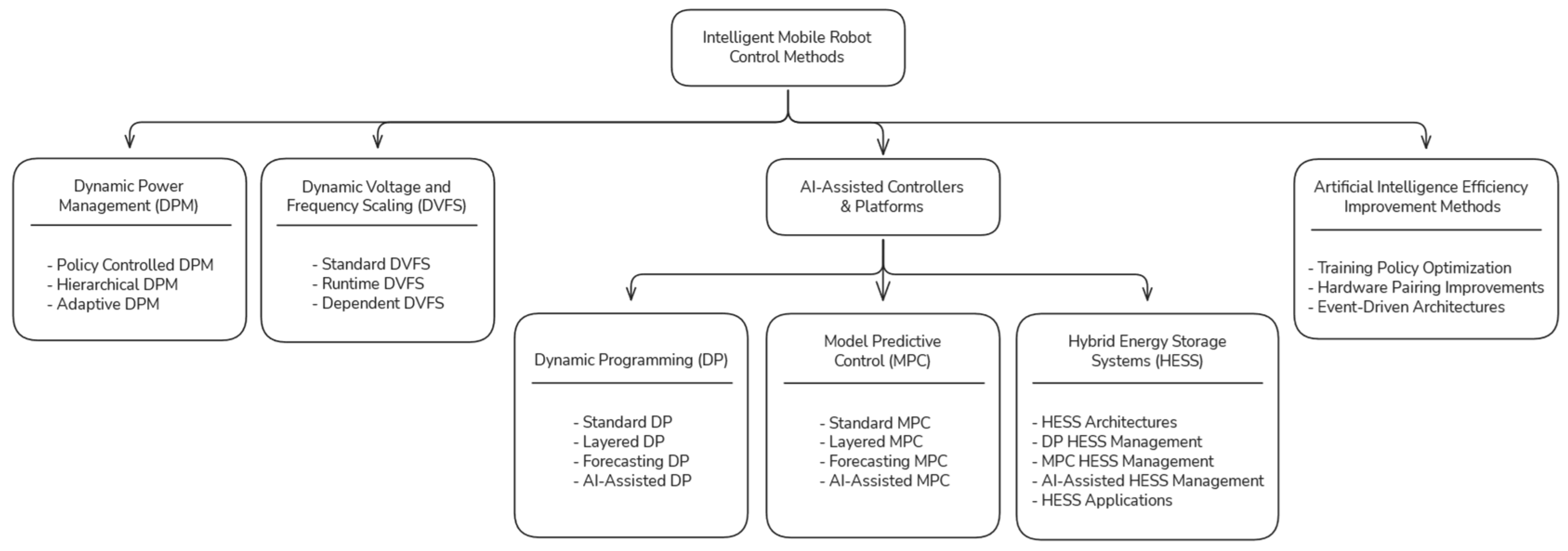
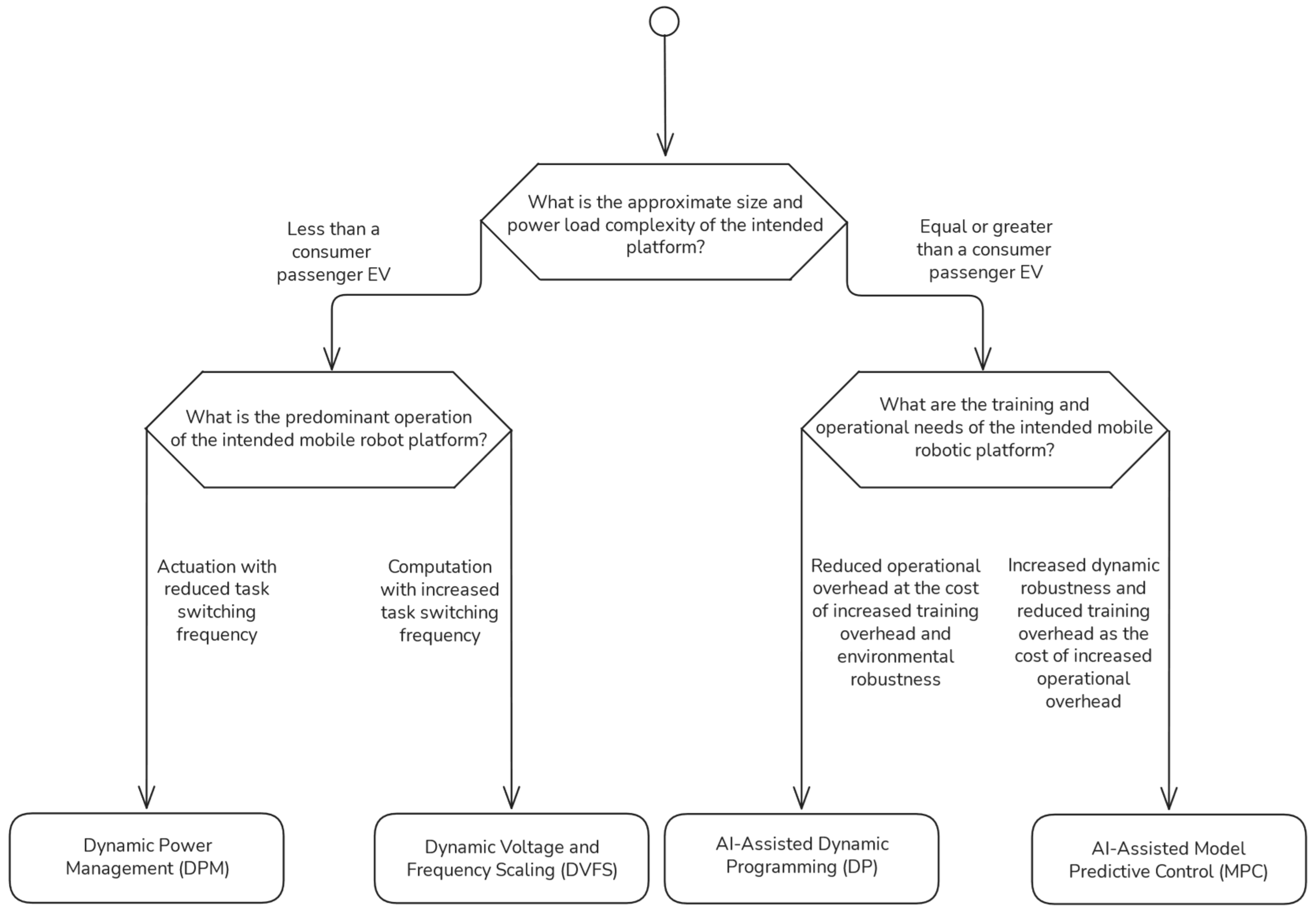
This paper reviews the background and implementation of robotic power efficiency methods to illustrate the current intelligent power management capabilities of robotic platforms. A taxonomy depicting the conceptual framework of the reviewed fields of study is depicted in
Figure 1. The framework of this review is structured around implementable energy-efficient means of controlling untethered mobile robot platforms through both hardware and software research developments. As stated before, this taxonomy focuses on onboard intelligent robotic energy management. This includes onboard sensing, computation and actuation based on the onboard computation. This taxonomy includes consumer EVs as robotic platforms within this review. Consumer EVs provide a large scale for meaningful advancement in terms of both industry size and absolute energy in each robotic platform. It is that industrial and energy scale that drives continued advancement of EV control methods that can be reviewed and comparatively analyzed. Additionally, AI-training energy is central to this review due to it being a pronounced cost of implementing increasingly utilized AI functionality. The improvement of AI-training efficiency is directly linked to the feasibility of continued implementation of AI controllers at all scales. This review highlights areas of research-advancement techniques that can be applied to onboard networks, local small scale training networks, or data centers for the sake of increased energy efficiency.
The authors’ systematic literature search methodology employed keywords such as “energy efficient mobile robotics”, “intelligent mobile robot control”, and “energy efficient control” across Scopus, IEEE Xplore, Elsevier, and MDPI. Nearly 54% of the reviewed literature is published from 2020 onward, highlighting the recent advancements in intelligent mobile robotic control. As specified already, this review excludes robotic platforms without mobile energy storage devices. Furthermore, intelligent run-time decision control methods are emphasized in this review, so predetermined mobile robotic control schemes such as path planning are excluded also. The platforms highlighted in this review include indoor mobile robots, wheeled outdoor terrain mobile robots, legged mobile robots, EVs, HEVs, and PHEVs. Reviewed experimental testing setups include numerical and modeled simulations, HIL testbeds, and real-world implementations. The implications of these various testing and validation methods are comparatively discussed. The reviewed implementations of intelligent mobile robotic control methods are categorized by DPM, DVFS, AI-assisted DP, AI-assisted MPC, and AI-assisted HESS, as shown in
Figure 1.
In addition, this review paper also shows where further research is needed as robotic industries continue to integrate autonomous control and AI-assisted platforms that possess increasingly large power requirements. Thus, the significant contributions of this paper include providing a comprehensive review of intelligent power management protocols and energy-efficient control in robotics while highlighting the opportunities for advancements with robotic neural networks and AI-enhancement for integration onboard robotic platforms. These intelligent energy efficiency methods are comparatively analyzed for implementation limitations and considerations. The review of these methods serves to provide material for considering if platforms in need of increased energy efficiency performance would be well suited for implementing the discussed methods of intelligent energy-efficient control. The range in scope from low-level process management to high-level controllers aims to provide a range of compared options to consider along with their unique implementation requirements.
This paper is organized as follows:
Section 2,
Section 3 and
Section 4 present the background and implementation of primary intelligent power management methods including DPM, DVFS and AI-enhanced adaptive and predictive control, respectively.
Section 5 presents innovation opportunities made possible by AI-enhanced control systems and
Section 6 considers the different aptitudes and limitations each intelligent energy-efficient control method poses.
Section 7 then details conclusions reached through this in-depth review and calls for additional research into ongoing efforts to make the training process for neural networks less computationally and energy intense. This review paper is needed considering the rapid increase in battery-powered robotics applications and the associated power demands.
2. Dynamic Power Management Background and Types
The primary principle of dynamic power management (DPM) is to be able to sense excess power consumption and minimize it whenever possible. This method primarily activates idle states. To extend system run-time, energy consumption must be minimized as much as possible with minimum loss in performance [
27,
28]. For DPM systems to meaningfully conserve energy they need to be able to accurately sense excess energy consumption and rapidly restrict the idle resources that were causing it. Due to the rudimentary nature of the logic involved in DPM, it is widely applicable in various software driven devices and serves as the foundation of many more complex power efficiency methods [
45,
66,
67]. The four primary types of DPM control that can be implemented are timeout, predictive, stochastic, and machine learning [
27,
28,
34,
35,
42,
43,
44].
Timeout DPM is a common method of power conservation, it is even common in many devices outside robotics applications. It operates by first sensing when the entire system or a system component is in an idle state. At this point an internal timer begins. If that system stays in the idle state long enough to reach a predetermined cutoff time, that system will enter a low power consumption state. When that system is required to exit idle, the low power consumption state will cease, and the system will resume normal operation [
27,
34]. Due to its simplistic operational approach, timeout DPM is the least effective at reducing power losses, but the most applicable [
27]. The simplicity of this method is due to the time-out period being fixed. Many computational tasks have variability in duration under multiple instances of operation. The control latency of this type of DPM is relatively low, which serves as an additional propulsion for its adoption. Determining the optimal sleep duration for a computational system governed by the time-out method is the primary threshold of optimizing its energy efficiency [
34].
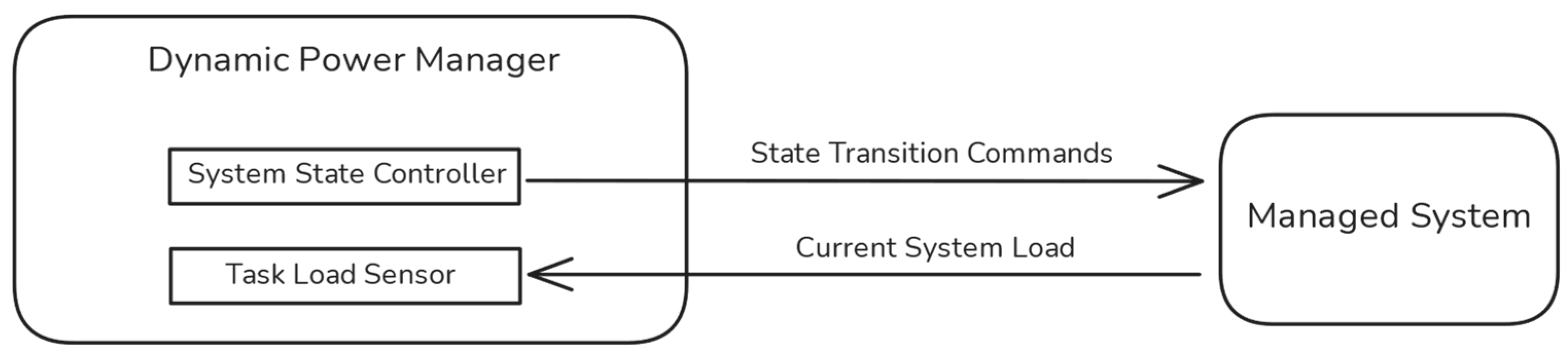
Figure 2 illustrates a model for a standard DPM configuration adapted from [
27]. As the other types of DPM increase in their dynamic operation relative to timeout, there is still an acknowledgement of a lower control latency with DPM during standard operation. However, complexity and irregularity during system operation impact this factor and others such as the algorithmic overhead and stability, thereby potentially weakening the energy efficiency performance of DPM.
Predictive DPM operates as a more advanced form of timeout DPM. It will send a system into a low power consumption mode as soon as the system idles long enough for the low power state to compensate for the power cost of switching states. It then remains in the low power cost state for a predetermined amount of time [
27]. This time is typically based on the estimated average behavior of that system. Other forms of predictive DPM generate the estimated idle time as it is running. The power manager (PM) will continuously generate the accumulative average of the running periods during operation [
35]. Once that time is reached it will switch back to the normal state even if it is still idling. This leads to greater power loss if the system’s behavior is not as expected, but at a reduced performance cost by often not needing to transfer out of a low power consumption mode when the system exits the idle state [
27,
35].
Stochastic DPM is often implemented in systems where the idle state behavior has a high degree of uncertainty. This approach is different from the previous two where it was assumed that the idle state behavior was deterministic. Stochastic DPM is often implemented with a time-discrete Markov chain model where the state transitions are applied to the chain with an associated set of performance measures and probabilities [
42,
44]. This results in a hierarchical DPM method better suited for complex computational systems [
28].
Machine learning DPM is often implemented with a Q-learning reinforcement algorithm. In this algorithm a digital agent is trained by allowing it to interact with an environment such as a robotic power system. The digital agent receives a reward for predetermined positive metrics such as saving power that will reinforce desired behavior for the model during training [
29]. This DPM method is well suited for a power dependent system that relies on a large amount of irregularly occurring input conditions. Additionally, this method of DPM is best suited for more complex energy storage and distribution schemes [
43]. The DPM method in this instance can dynamically set the threshold time in the idle state for the system to enter the low power consumption mode based on the history of task duration and frequency for a given module. This allows system designers to generate sets of trained weights for various operating conditions that can be more accurate even with increasingly variable durations of run-times [
29,
43].
In addition to the four primary methods of DPM control, there are also several key variations in DPM operation and actuation. This variation is caused by the operation method of the managed modules. One such method is OS-level computational management. This method is seen most commonly implemented commercially in PCs in order to reduce the idling load of a software application. This OS-level management can be achieved by forcing the application into a sleep state, or by sleeping partitioned processing cores and resources. Additionally, there is actuator power gating and duty cycling. This is often implemented on mechanical components on robotic platforms. This method involves disconnecting current from the external components during idle. These external components can also be activated intermittently by duty cycling the components at a frequency that does not impede operation. Sensor scheduling and perception pipeline throttling manage the power consumption of input devices. This is achieved by selectively reducing either the sampling rate or sensing precision of the input devices. Each of these DPM operation and actuation methods provide a means of reducing the power consumption of various components present on a robotic platform when not in use.
DPM Implementation
An experiment was conducted in [
27] to determine the effects of implementing the various DPM control methods and actuation previously discussed. A personal assistant robot was given tasks of navigating to a point, then by using its audio and display features, announce that it had ended the navigation, then navigate back to the starting point. The robot had several modules that were used during the experiment, including the base, sound, laser, and screen. Each of these modules’ power consumption was monitored throughout the duration of the experiment and used as the control for a DPM simulation of that task.
The DPM simulation included four methods. The methods are an ideal DPM implementation, timeout (2 s of idle activates low power consumption transition), one predictive mode that is set up to exit low power immediately when its predicts its influenced module will become active, and another predictive mode that is set up to exit low power earlier than when it predicts its influenced module will become active. The results of the simulation based on the real test run are shown below in
Table 2.
The results of this simulation show that the implementation of even the most rudimentary DPM method across multiple robotic platform systems outperforms a robotic platform without such methods. Timeout DPM caused a 37.0% simulated reduction in monitored system overall mission energy consumption from the actual unmanaged energy consumption of the indoor personal assistance robot performing a navigational movement task. Additionally, the more advanced forms of DPM, including predictive and predictive with pre-restart, resulted in larger simulated reductions in power consumption from the actual unmanaged run of 40.9% and 42.3%, respectively. The predictive with pre-restart resulted in simulated power consumption that was only 0.96% greater than the calculated ideal power consumption for this test run [
27].
This shows that DPM is a scalable method of energy efficiency that could be implemented widely across robotic platforms. The different methods of DPM allow users to suit the DPM method to a wide range of potential platforms with unique functions and behaviors.
Section 2 described the principles of DPM operation. Its functionality is based on a power manager sensing an idle state of one of its managed systems and rapidly sending it into a low power consumption state. DPM in its simplest timeout form is low level; however, there are increasingly complex configurations that are better suited for irregular operating conditions, such as predictive, stochastic, and deep learning. One implementation of several DPM methods performed by [
27] demonstrated the effectiveness of these methods in a consumer mobile robot. DPM is considered the least specialized form of the energy efficiency methods highlighted in this review. It is widely applicable enough to be utilized in many consumer PCs. Other methods of energy-efficient robotic control will be highlighted that have greater specialization for mobile robotic platforms and their intended uses, such as dependent DVFS controllers described in
Section 3.
4. AI-Assisted Robotic Platform Controllers
AI-assisted controllers have been seen more frequently in robotic platforms for power optimization. They allow for highly complex robotic controller optimizations to be conducted. The usage of dual-layer and deep neural nets is well suited for the multi-objective nature of mobile robot controllers. Specifically, there are several controller schemes that based on review appear to often be paired with AI capabilities. These controller methods that can be characterized as adaptive and predictive are dynamic programming (DP) and model predictive control (MPC), respectively. Several experiments have been conducted where AI assistance has been incorporated into both types of controller methods. Many of these tests were performed on electric buses operating on known routes. This highlights the optimal use cases for AI integration, involving finite operating conditions that can be used to generate deterministic control states and performance outcomes.
There are some characteristic differences, such as control, stability, algorithmic overhead, etc., between MPC and DP controllers that are worth considering for perspective methodological evaluation. In terms of optimality, the DP controller is often considered the highest standard, especially when considering testing by simulation. In many of the reviewed AI-assisted controller implementations, a conventional DP approach was included in testing to serve as the numerically optimal control. When considering stability, MPC controllers are most often implemented practically to achieve this, due to the effective integration with the system constraints. Alternatively, approximation present in conventional DP controllers could cascade into unstable characterization or control. When considering convergence in performance, MPC controllers have shown excellent performance in application, whereas DP applications rely upon approximated convergence, due to limited environmental robustness. Overall, the characteristics of these two commonly implemented forms of mobile robotic control distinguish themselves from the other. DP control can achieve highly optimal control particularly in environments with limited variability. However, MPC controllers provide less numerical optimality in control with the benefit of increased stability and robustness in varied performance environments. These unique control schemes pose themselves as advantageous platforms for AI-assistance suited for methodological evaluation.
4.1. Fuzzy Logic
The operation of AI-assisted controllers has shown to be increasingly useful as operation scope and environment have increased in complexity. In operation conditions where there is a more efficient operating state than simply Stop, Go, On, or Off, a control method that is capable of non-binary conditions is essential for power efficiency. AI assistance is the advanced form of this style of controller. Additionally, studies have shown that even the rudimentary form of this style of controller can lead to increased power efficiency in mobile robotic platforms. This is a fuzzy logic controller. It operates by providing an algorithmic framework for gradient or fuzzy concepts that can be acted upon by a controller. This expansion of input parameters into fuzzy multidimensional states is one of the primary principles that AI-assisted controllers are built on that makes them so effective in increasingly complex operations and environments. The implementation of fuzzy logic controllers has shown notable efficiency in biped robots [
71], gated modular snake robots [
72], autonomous EV robots [
73], and differential-drive wheeled robots [
74]. The efficiency gained in these fuzzy logic controllers is the basis for greater energy efficiency in more advanced AI-assisted controllers.
4.2. Dynamic Programming
Controllers that operate using dynamic programming operate on the premise that the robot’s operation states can be broken down into a matrix of sequential, often recursive, decisions spanning the run-time and being chosen based on sensor input. The adaptive nature of dynamic programming (DP) robotic controllers is based on the controller making these decisions in the operating state matrix live, during run-time. AI is well suited for operating cases like this due to its ability to make rapid decisions based on adequate input. Even with a relatively small neural network, the environments where DP controllers are often deployed such as electrified bus routes are well suited for AI training and assistance [
75]. The energy savings produced by these controllers are often created by determining the optimal time and intensity of varying power distributions to the robotic systems actuators [
76].
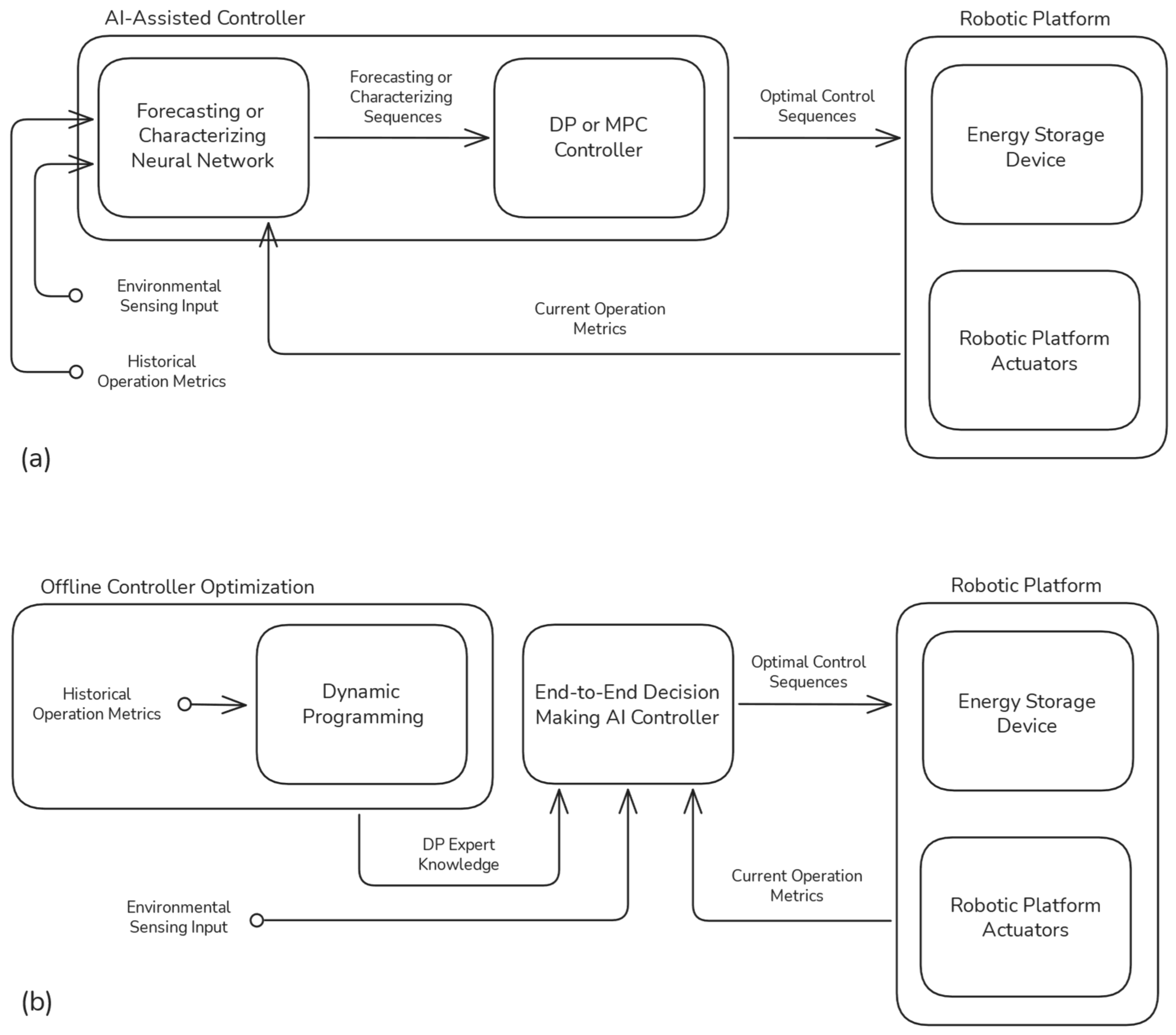
Based on the review that was conducted, one of the common ways of implementing AI assistance into DP controllers is by incorporating neural networks to receive the robotic sensor input. This input is fed into neural networks often in the first layer of a two-layer style controller in order to better characterize the bot behavior and operation patterns. These results from the neural networks are what the DP models use as their input for live adjustments [
38]. The AI assistance in this method effectively improves the controller’s perception of its behavior, providing clearer or better characterized conditions for the DP controller to act upon. This method of AI assistance provides system identification and prediction by performing driving pattern recognition. An instance of this method of DP AI assistance implemented in a drive cycle simulation resulted in a 12.40%, 9.46%, and 8.30% reduction in battery, superconductor, and DC-DC energy losses, compared to the conventional rule-based method at 10 °C, 25 °C, and 40 °C, respectively [
38]. This improved perception is especially beneficial when the controller is designed to achieve multiple performance objectives concurrently [
47].
Another method of AI assistance paired with DP controllers has been shown to operate differently. Deep reinforcement networks that act as a controller for a mobile robot have been shown using DP models produced for the robot’s intended operating environment as training data for improved performance and reduced training overhead [
39]. This method of AI assistance provides end-to-end decision-making aided by prior DP data. The DP behavior is well suited to serve as the neural network expert knowledge training data due to its decisive quantization of parameters and reactionary behaviors that the optimization methods can rapidly incorporate. Additionally, this method of AI incorporation allows previous established models to further support the development of novel models of control. The implementation of AI controllers with DP training data resulted in a 42.60% faster convergence speed and a 15.79% reward value improvement achieved during the training process, when compared to traditional reinforcement learning [
39]. This reduces the need to gather new data to train these networks and ultimately saves resources by reusing already existing data for the AI controller support systems.
4.3. Model Predictive Controllers (MPCs)
Robotics platforms are frequently used with MPCs. They operate by dynamically adjusting the output of a robotic platform while satisfying a predetermined set of operating conditions [
77]. In mobile robotics the set of predetermined operating conditions is usually the kinematic equations of the locomotion method for the robot and relative power distribution equations [
78]. This allows for precise control that fully utilizes the known capabilities of robotic hardware without surpassing their performance abilities [
79]. The performance of standard MPC controllers has already shown improved energy efficiency when compared to other control systems such as PIDs [
80]. Thus, there have been many efforts made to integrate them into consumer robotic systems such as plug-in hybrid electric vehicle (PHEV) and HEV platforms where energy efficiency is highly important [
81,
82,
83,
84].
As more robotic platforms have integrated AI assistance into their MPCs, it has shown utility and further need for this integration. As robotic platforms have become more advanced, the integration of the numerous types of highly efficient energy-saving AI systems into already existing and industry-utilized control schemes is pivotal [
41,
49].
Upon review, there appears to be a few common configurations of AI assistance integrated into MPC robotic platforms for the sake of energy savings. Many of the MPCs have neural networks integrated into the top/front end of their controllers upon training them on preferred robotic behavior in the platform’s designated operating environment [
51,
52]. One such method of AI assistance provides system identification and prediction by forecasting the velocity of the leading vehicle over each preview horizon. This method resulted in a 17.9% and 36.1% reduction in the combined fuel and electricity cost of a modeled PHEV bus drivetrain on a simulated drive cycle when compared to a conventional DP and Charge-Depleting–Charge-Sustaining controller, respectively [
51]. These networks can forecast the short-term upcoming expected velocity based on the current input data for a given instance [
40,
48]. This velocity forecast output from the neural network serves as a highly accurate means of inputting this data into the MPC model when compared to the conventional methods [
53,
54]. One method of AI-assisted velocity forecasting, implemented on a HIL vehicle model and energy management system simulating Urban Dynamometer Driving Schedule (UDDS) cycle data, resulted in a 5.4% increase in forecasted velocity accuracy and a 14.9% reduction in equivalent fuel consumption, when compared to the state-of-the-art methods [
54]. Similarly, this method of AI assistance provides system identification and prediction by forecasting the vehicle’s short-term upcoming velocity with a stacked LSTM. Other methods of AI integration have been shown to perform well at increasing energy efficiency. One such method is by integrating a neural network into an MPC that controls the output of a HESS on a robotic system. This neural network achieves increased energy efficiency by forecasting and distributing maximum discharge current from the power sources [
50].
MPCs have been shown to be highly effective, particularly in conditions where mobile robots traverse extreme, unpredictable terrain. These operating conditions often call for rapid precise actuation at the upper limits of the robot’s hardware capabilities. AI networks with adequate training data focused on the topography of the robot’s operating area and the necessary responses to the topography have shown greatly improved performance and power efficiency [
32]. A schematic illustrating simplified configurations of AI-assisted controllers, corresponding to the previously mentioned implementations, and their various AI-integration points is shown below in
Figure 6.
4.4. Hybrid Energy Storage System Controller Pairing
The integration of AI assistance is a trend that has been shown to be well suited for new advancements in mobile robot hardware and locomotion methods. One such hardware configuration that has been shown to be well suited for AI-assisted controllers is a hybrid energy storage system (HESS). The most common configuration of HESSs is a lithium-ion battery bank for high-duration/low-intensity loads paired with a supercapacitor bank for low-duration/high-intensity loads [
56,
57,
58]. A HESS contains both batteries for their high energy density and super capacitors for their high-power density [
32,
59,
60]. With reasonable training resources AI-assisted controllers have been shown to dynamically optimize power output for robotic systems by controlling the relative power output of the batteries and capacitors in a HESS. Additionally, other configurations of hybrid energy storage have shown performance benefits with the integration of AI assistance [
85,
86].
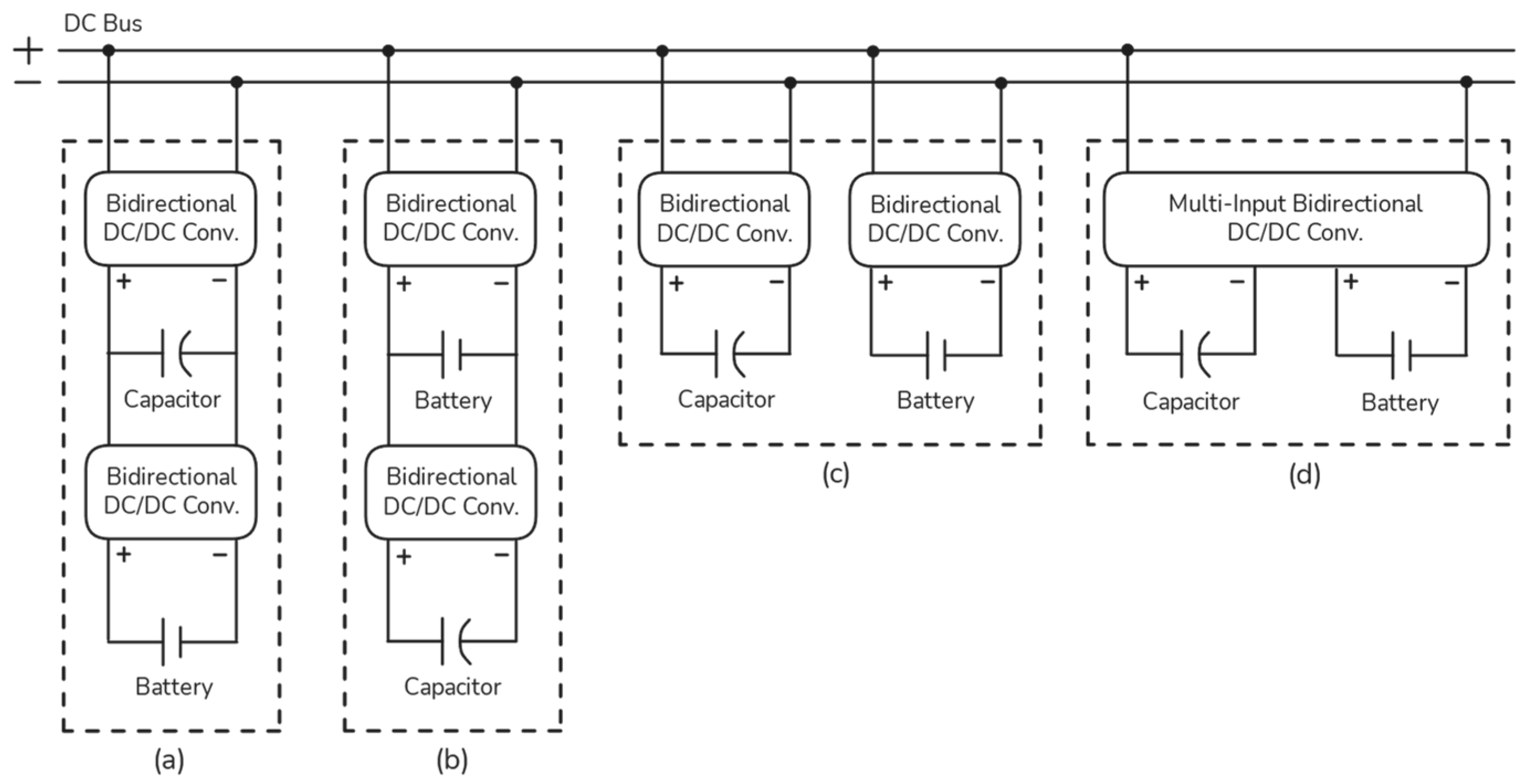
Figure 7 Illustrates common configurations of full-active topology HESSs. Full-active topologies provide the most control for a controller paired with it by containing power converters that can control the batteries and capacitors [
55].
The performance of a robotic platform has been shown to particularly excel when the abilities of an AI-assisted controller are paired with a HESS. MPC stands out due to its ability to be implemented online and handle multi-objective optimization [
32]. The ability for a controller to effectively implement multi-objective optimization is becoming increasingly incentivized due to the advancement of increasingly complex mobile energy storage systems such as HESSs [
55,
87].
Though there is considerable synergy between HESSs and AI-assisted controllers, there are practical engineering challenges that arise from pairing the two. One notable challenge is caused by the non-linear time-variant characteristics of the HESS power sources and converters. This makes state recognition and classification difficult for AI-assisted controllers [
55]. Another challenge is due to the increased computational load of AI-assisted controllers. Often these intensive computational tasks make it difficult to meet real-time constraints unless implemented on hardware with high computational throughput [
58]. HESS’s often have tight real-time control restrictions to make meaningful improvements to the performance that the AI-assisted controller must meet. If these real-time constraints are not met, causing delays to be implemented, it could cause instable behavior in HESS topologies [
58]. Additionally, there is the challenge that many AI integrations face of providing relevant and effective data to train the AI-assisted controller for the intended operation [
59]. However, even with these practical challenges considered, this review has observed effective integration of HESS topologies with AI-assisted controllers that result in increased capability through energy-efficient control.
HESSs are often implemented in legged robotic platforms due to the benefit of having both batteries and supercapacitors. They allow for rapid spikes or prolonged periods of load to be endured by a legged system that is often designed for highly demanding terrain and operating conditions. Legged robotic systems themselves have increased power demands when compared to conventional methods of robot movement such as DC motors.
The combination of HESS and legged robot platforms emphasizes the need for AI integration into intelligent controllers. Both HESS and robotic legs have multiple complex components and power needs that are compounded when used together. Standard MPCs meet the current operational requirements, but robotic demands are continuously growing. Additionally, the legged platform exposes the robot to complex environments where dynamic power efficiency adjustments are necessary to continue to operate effectively.
The authors would like to recognize additional opportunities for advancements in the areas of power supplies and batteries suitable for autonomous robots. A timely example of these efforts can be found in [
88] where the authors seek to advance the development of low-order models for innovative devices in power and energy-saving applications including power supply modeling in the area of batteries suitable for autonomous robots. Implementation is through a system control engineering approach that enhances the structural precision and reliability of the reduced order models. Models like these are capable of being directly integrated into MPC designs. These research opportunities allow for accurate models of electrical characteristics that enable precise control of increasingly energy-efficient systems.
4.5. AI-Assisted Robotic Implementation
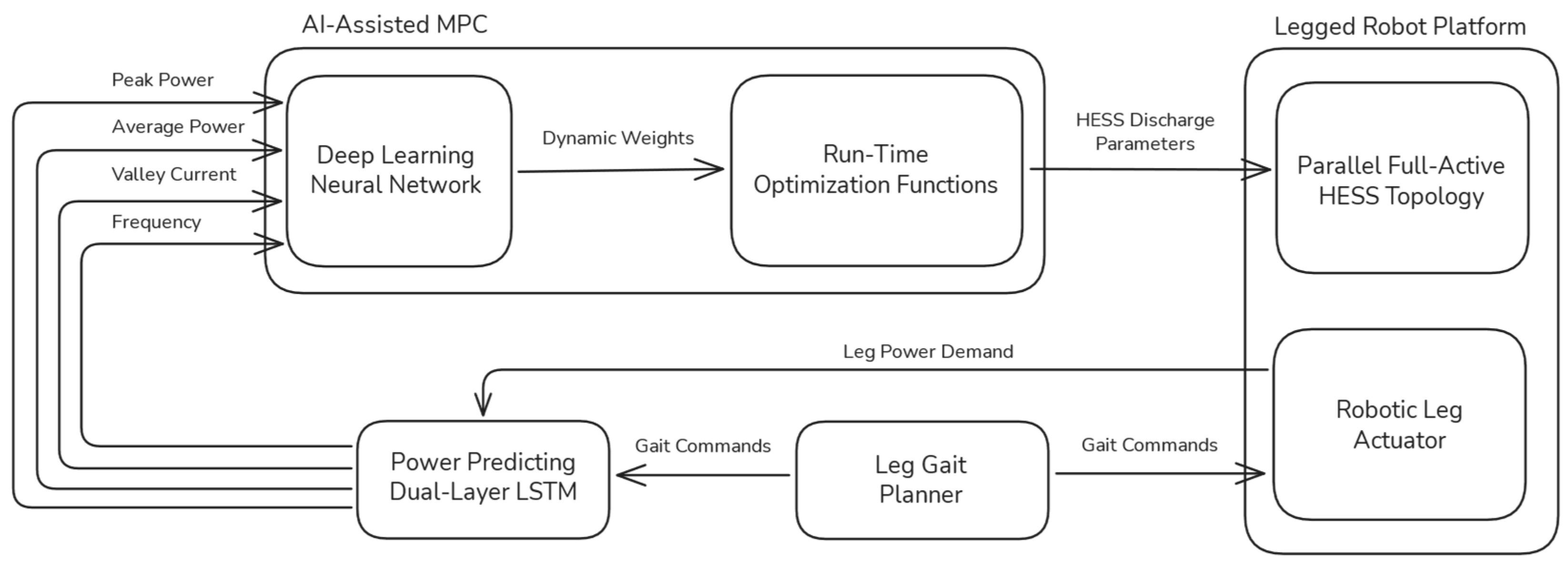
The need for adaptive dynamic adjustments on increasingly complex systems is what calls for AI integration. Learning-based MPC systems are being developed that integrate long short-term memory (LSTM) neural networks and deep learning algorithms in order to predict future power demand and adjust weight factors for energy management respectively [
32,
33]. The dual-layer LSTM network specializes in highly volatile data gradients that are implemented to predict future power demand in a system based on the current power demand and the modeled behavior of the robotic movement platform.
The deep learning algorithm directly receives the output of the dual-layer LSTM, predicting the future power demands of the system. The benefit of a deep neural network is that the input data supplied to it can be various power metrics such as, frequency, peak power, valley power, and average power. With proper training for various environments, the deep neural network outputs a set of weights for an MPC continuously during run-time to dynamically allocate the proper amount of power to the numerous robotic systems on the platform.
Figure 8 provides a visual description of how an MPC assisted by AI operates to dynamically optimize power consumption for a legged robot [
32].
Figure 8 depicts the combination of MPC, deep learning, LSTM, HESS, and legged components on a single robotic platform. Each of these components play a role in improving energy efficiency and performance for a robot intending to operate in complex environments. Many of the benefits of these components would be diminished without the others also present on this platform.
Figure 8 shows the capabilities of a mobile robot when enabled by a well-coordinated set of AI-integrated components. An experiment was conducted in [
32] to test an MPC like the one described above, which has real-time parameter tuning provided by AI assistance, with a HESS powering a robotic leg. For the same test cycle performed on a HIL platform including the HESS, a mechanical leg, and a NI PXI 1082 (NI, Austin, TX, USA) performing the energy management strategy, the AI-enhanced MPC had a battery capacity loss of 2.0183 × 10
−7 while a standard MPC with static weights had a battery percentage loss of 2.3124 × 10
−7. The AI-enhanced system caused a reduction in battery capacity by 12.72%.
Power efficiency improvements due to AI integration are likely going to vastly improve robotic systems like these in the coming years due to the monumental amount of development AI is experiencing currently [
33]. New neural network configurations that enable highly effective optimizations in strictly power budgeted systems are an active field of innovation.
Based on the results of these implementations of DP controllers it appears that the method of AI integration that shows the most potential for energy savings is in network training enhancement. The structure of the DP decision machines is quantized effectively by observed training methods. DP controllers often produce an operating procedure for an ideal run that many of these implementations set as their baseline, so their integration into new advancements in training efficiency, like the ones discussed in
Section 6, would potentially enhance robotic platform applicability.
Alternatively, the results of implementations that integrate AI assistance into MPC controllers have shown effectiveness in run-time control for robotic platforms. MPC controllers have already established themselves in the robotic industry as highly effective forms of robotic control. Researchers’ novel setups often include the neural networks in the top/front portion of MPC controllers that deal with rapid sensing and classification of input. The effectiveness of these MPC controllers can be seen across various platforms ranging from relatively small legged mobile robots to large EV buses. The reviewed implementations have shown AI-assisted MPC effectiveness on various energy strategies including EV, HEV, and HESS. Further improvement and understanding of optimal AI policies will continue to advance the energy effectiveness of MPC controllers.
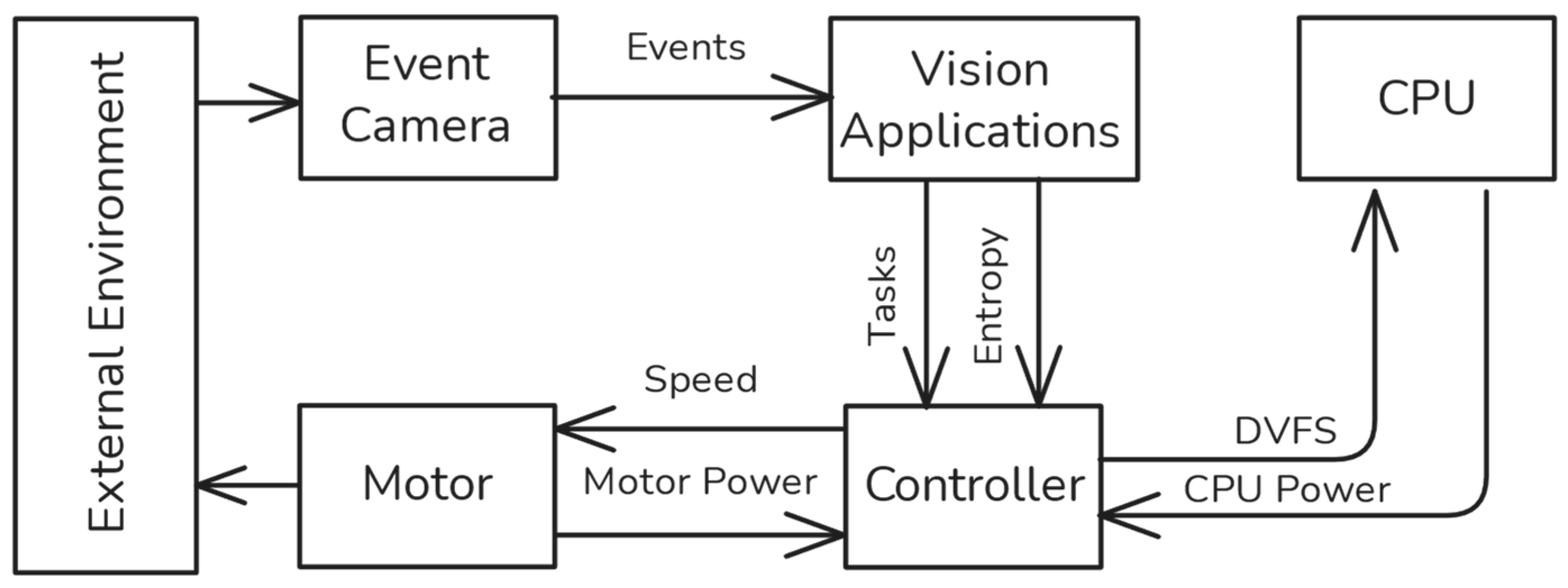
There are two neural networks that were seen most often in the reviewed methods of AI assistance. First are deep learning neural networks. These often functioned as the classifiers that were implemented onto the front/top end of MPC controllers. They are highly effective in classifying robotic environmental and operational data due to their ability to process multiple data inputs such as, event camera input, battery and capacitor SoC, servo position, and peak current draw. They often output rapid changes to dynamic parameters for the MPCs they are assisting in order to optimize the motion models for sudden changes to environmental conditions. Additionally, LSTM networks have shown to be highly effective at forecasting short-term model or environmental behavior on AI-enhanced systems. The cell state operation of LSTM’s allows for the memory of the incoming behavior to be conserved, improving the accuracy of the output forecasts. These forecasts are crucial in order to properly adjust real-time parameters on intelligent controllers in order to maximize energy conservation. These two types of neural networks have shown to be affected when implemented on their own, but they also have been observed operating effectively together in a single robotic platform, such as [
32].
Section 4 described the principles of the reviewed forms of AI integration into energy-efficient controllers. The prevailing need for AI assistance is due to the increasing amount of complex multi-objective performance metrics and operational methods. In many applications for robotic platforms such as EV buses, speed is not the only performance metric that is desired at the cost of passenger safety or reduced mechanical integrity from operation methods. AI assistance was shown to enhance the abilities of adaptive and predictive energy-efficient control, DP and MPC, respectively. Both of these controllers often implement neural networks in the front/top layer of the controller to enhance operational environment sensing and behavior categorization for performance need forecasting. DP has also been shown to be an effective source of expert knowledge in the training process for AI robotic controllers by reducing overhead, as shown in [
39]. Additionally, AI-assisted MPC controllers in this review have been observed operating on platforms with HESS for increased operational ability by regulating the HESS output. An implementation of an AI-assisted MPC controller that enables a HESS performed by [
32] demonstrated the coordination between AI-assisted components and a HESS in a robotic platform resulting in increased energy efficiency within a complex operating environment. These methods of AI assistance into robotic controllers highlight the limitations present in the energy efficiency of the training process and operating circumstances for AI robotic controllers that call for needed innovation.
Table 3 summarizes the benefits and trade-offs of the reviewed intelligent energy efficiency control methods. As seen in this table, there are considerable limitations in the applicability of DPM and dependent DVFS approaches, when compared to other intelligent control methods. Their practical impact is limited due to the scheme in which they operate to increase energy efficiency. They typically operate by managing devices and alternate them between a low power/reduced operation mode and a full power/standard operation mode. This scheme of alternating between two distinct modes limits the practical impact due to the frequency required of such system to achieve meaningful power efficiency on large complex robotic platforms. Complex, rapidly dynamic platforms require energy efficiency schemes with dynamic adaptability that can keep up with their intended operating conditions, rather than binary alternation. This greatly limits the scalability of DPM and DVFS to robotic platforms with lower complexity operation and power loads. Also, consider that dependent DVFS implementations require prior environmental configuration data for optimal effectiveness. Furthermore, various DPM configurations, such as actuator power gating and sensor scheduling require specialized power electronic converter hardware for independently managing various actuators and sensors. These additional components introduce their own energy losses that scale with the amount of managed systems. Additionally, dependent DVFS has a strong hardware requirement on processors that can perform voltage and frequency scaling. Coordination between heterogeneous configurations of simultaneously scaling processors is often difficult to implement. Furthermore, dependent DVFS serves to limit primarily computational energy consumption. Effectively limiting energy consumption from actuator consumption on larger and more complex platforms with dependent DVFS would call for supplementary energy efficiency strategies. These considerations of their applicability, scalability, hardware dependence, and practical impact are further analyzed and compared to other intelligent energy efficiency methods in
Section 6.
5. Innovation Needs and Opportunities in AI-Enhanced Predictive Controllers
AI-assisted power controllers offer much promise for research and industrial applications and is the area where the most research is needed [
33]. AI functionality may serve as a method of enhancing power efficiencies in robotic platforms, but the current setup and training methods these neural networks use need large amounts of energy. If the industry is planning to integrate these processes onboard more advanced robotic platforms, more research in optimizing the efficiency of the high-energy demand aspects of the AI integration is necessary. There is a clear connection between the energy cost of training and the energy savings achieved during the operational phase of a platform implementing that trained network. A budgeted project is going to have a limit to allocated resources for training networks. As of now, the power to train these networks is a significant driving factor in consuming these resources. If the energy cost of training these networks is decreased, more time and thorough methods of training can be implemented for the same amount of energy. This increase in network training duration and quality leads to an AI-assisted robotic controller that can more effectively traverse and operate within its designated environment. This improved operation allows for shorter mission durations and reduced SOC depletions per task. The ability to increase the quality and duration of network training while adhering to power budgets allows for more controllers with more efficient operation enabled by more accurate and thoroughly trained AI-assisted controllers.
Upon review there appears to be an ideal set of circumstances that allows AI-assisted controllers to operate with efficiency that warrants the cost of their implementation. Many of the controllers that integrated some form of AI assistance that were observed in this review were implemented onto electric buses [
40,
51,
54,
56,
75,
81,
83]. This illustrates the current limitation of the operation stage of these AI-assisted controllers. They lack the ability to achieve highly efficient performance optimization without extensive additional information on expected operating environments. For example, an AI-assisted controller implemented on a consumer EV could result in high energy efficiency for the driver’s daily commute if the commute did not vary, and the AI was able to collect sensor data each time it completed the route. However, if the commuter took the EV on a route different from the daily commute, the AI-assisted controller would be unable to adequately predict the EV’s behavior in that environment, given that it would lack prior experience for it to act upon. This illustrative example shows that at present, AI-assisted robotic controllers should only be implemented on highly controlled and repeated operation cycles; i.e., the cost of training will only be recovered if the system repeats the same operation several times.
One promising experiment highlighted a method of reducing the training costs needed to be overcome for AI assistance. This is the controller presented by [
39] that implements deep reinforcement networks as the controller on HESS-enabled EVs. This same controller setup was used by [
89], but it operates a fuel cell HEV rather than a HESS-enabled EV. This controller improves the cost of training overhead by utilizing already existing DP controller operating data for the intended environment to generate the training data for the controller’s neural networks.
This AI configuration operates based on a concept called imitation learning. This concept focuses on incorporating desirable example behavior, referred to as expert knowledge, for the agent to train upon in order to enhance the training process. Incorporation of expert knowledge prevents the training agent from falling into local minima when optimizing performance. It also allows for guidance in procedural performance based on the expert knowledge examples, rather than only being able to enforce a certain output condition with little influence on the intermediate steps to achieve said output [
90]. Imitation RL and predictive RL are both common imitation algorithms that benefit from expert knowledge training data [
91]. However, they both suffer from performance limitations from overreliance on the expert knowledge and model data, respectively. One such trade-off is the imitation RL algorithm being unable to exceed the performance of the expert knowledge example.
Use of the expert knowledge overcomes a significant source of energy and computational overhead referred to as a cold start. A cold start is the initial lengthy and inefficient stage of training with the most variation in behavior before the training agent eventually settles into an optimized performance method [
92]. A reinforcement learning training method has been adapted that utilizes expert knowledge to avoid a cold start, but also reduces the dependency on expert knowledge, to avoid the performance limitations of over dependence on it. This method is referred to as a warm start. It operates like other reinforcement learning training algorithms. However, it incorporates variable weights that reduce the influence of the expert knowledge as the training continues. This method has been implemented in setups by [
39,
91,
92] to avoid the large efficiency costs from a cold start while reducing expert knowledge dependency to allow for heightened performance. A wide array of platforms have been shown to benefit from imitation learning controllers that use expert knowledge. These include a robotic arm [
93], a laparoscopic training robot [
94], and HEV platforms [
95].
The usage of pre-existing DP data as the expert knowledge greatly reduces the overhead of training an AI-assisted controller meant to operate in the same environment. Additionally, future adaptation of other previously implemented controller schemes into expert data for training would only broaden the applicability and reduction in overhead. Developing methods to incorporate new controllers that can benefit from the prior operation and development costs of controller methods that have already been implemented can greatly reduce one of the greatest energy costs associated with AI-assisted controllers. Additionally, similar methods enable increased applicability for AI-assisted controllers by providing easier access to large amounts of operating data from previously implemented controllers to train new AI-assisted controllers in various operating environments.
Additional avenues of innovation have been reported to improve the energy efficiency of neural network training. Although not all are specifically intended for robotics, they all have potential applicability to neural networks that could be integrated into AI-assisted controllers. The first is a method that operates much like the controllers discussed in
Section 2 and
Section 3. This method is dynamic run-time training modification. This method involves a predictive model that stops at key training epochs to forecast the upcoming accuracy of future epochs for various training methods and implements the optimal training method until stopping at the next training epoch to forecast the accuracy again. This allows for dynamic implementation of early stopping, layer freezing, and data quantization. The authors in [
96] implemented a training model based on this method that was able to achieve a maximum of 56.5% energy reduction than a conventional training method at 50 epochs while maintaining an improved validation accuracy of 2.38%. Advancements into this method of training efficiency improvements are corroborated by researchers, such as in [
97], describing similar methods of training.
Another research avenue being pursued is energy-aware training data selection. Often, when training networks, large datasets are used in an effort to be thorough in training. This method aims to reduce the number of samples from a dataset without incurring costly computations while maintaining target accuracy. Authors in [
98] implemented active learning dataset reduction algorithms to incrementally refine training data into effective subsets that meet accuracy and energy consumption restrictions while training. Such approaches could potentially be used to refine pre-existing DP data used in training, such as in [
39,
89], to further enhance performance for mobile robotic applications. Similar implementations of adaptive energy-aware data modification have been created, such as in [
99]. Researchers, again in [
97], support that intelligent subset selection and training have a substantial impact on energy consumption.
Both methods of power efficiency enhancement for training fall under scheduling and data optimization. This avenue for improvement is beneficial due to it not being hardware specific, so these methods can be applied to a wide array of network types as long as they meet the software’s computational requirements. Additionally, the improvement strategies tend to reduce the likelihood of reduced accuracy due to overtraining [
96]. However, they increase the risk of potentially undertraining models, so if that is a concern for perspective designs it is a trade-off worth considering. Additionally, due to the lack of hardware limitations, these methods are more costly on the training software due to the inclusion of monitoring systems and training schedulers in the training iterations. Also, if the data is too abstract for the predictive models, there is limited potential for performance improvement.
Other lightweight alternatives of energy-efficient network training have been observed. One such observed alternative is onboard analog network training efficiency improvement methods. This avenue is based on eliminating unnecessary data transmission between the memory and the processor for weight iteration. Instead, memory is updated directly on analog hardware devices acting in a neuromorphic fashion that utilizes the natural behavior of these devices, rather than implementing the same training procedure in software. Implementations of this avenue have been performed on devices such as memristors [
100,
101], ferroelectric photosensors [
102], and RRAM crossbars [
103]. One strength of this method is the energy efficiency gained by removing a significant portion of data movement, often needing ADC/DAC operations. Additionally, weight iterations require limited computational complexity when implemented on these devices, when compared to traditional methods such as back propagation. These strengths come with trade-offs such as strict hardware restrictions due to this being a hardware-based training method. Additionally, many of these analog devices that store memory have variation in characteristics across devices that introduce noise which requires tuning for each component. Another trade-off of on-board analog network training is the limited data precision of the non-digitally stored weights reducing high-precision applications.
Further complex implementations of neuromorphic training methods have been observed, such as spiking event-driven energy-efficient training in [
104,
105]. Spiking neural networks allow for sparse computation when compared to traditional continuous activations by operating on timestamped discrete pulses that are characterized as events observed for training. One strength of these spiking training methods is their high compatibility with energy-efficient sensor hardware such as event cameras due to the similarity between sensor data and sparse spiking events, and the sparsity of the data allows for reduced computational load that scales with the spike rate. Another benefit is that spiking networks have little reduction in detection accuracy when properly paired with neuromorphic architecture design methods. However, a trade-off to this is that without these methods and hardware supporting spiking networks, there is reduced additional energy efficiency when compared to traditional methods. Additionally, though the training has the potential for increased efficiency, the addition of temporal dimensionality adds further complexity and increases opportunities for instability in the training process if not properly monitored.
Though the research directions discussed are based on the performance of training carried out in contexts beyond robotics applications, the applicability of these concepts to training intended for robotic platforms is readily apparent. For the sake of better informing comparative analysis of these energy-efficient network training methods,
Table 4 summarizes the perceived trade-offs in these approaches. Though all of these methods produce meaningful improvements in energy efficiency, each have specific cases which reduce the costs to other metrics such as computational load and accuracy.
Furthermore, a depiction of critical quantitative comparisons of research avenues aimed at addressing the energy cost of training are shown in
Table 5. This depiction shows key results from implementations of data training methods including scheduling and data optimization, onboard analog memory, and spiking event-driven network training. Each of the results shown demonstrates notable improvements in energy consumption while preserving accuracy for their intended tasks. Cross comparison with
Table 4 allows for further analysis of the applicability of these energy efficiency improvements for perspective applications. Based on these observations, the scheduling and data optimization methods appear to have the broadest potential for robotic industry energy conservation. The spiking event-driven methods show promise for reducing computational load on mobile robotic platforms with neuromorphic image sensing capabilities. The onboard analog memory training results show potential in improving energy efficiency in systems with strict hardware restrictions and peripheral analog robotic systems. Each of these methods have shown quantitative measures that can lead to meaningful energy savings in mobile robotics, as neural networks continue to become increasingly integrated into controller methods.
6. Comparative Analysis
There have been several methods of intelligent energy-efficient control discussed thus far in this review. These methods include DPM, dependent DVFS, AI-assisted DP, and AI-assisted MPC. Each of these methods delineate from each other to various degrees, resulting in trade-offs in application and operation that make them better suited for various design intentions. Consideration of their differences and limited intensive standardization spanning these control methods is represented by the accumulation and transparency of the discussion points and comparison metrics. The resulting comparative analysis provides an adequate base line analysis that highlights relevant considerations for implementation of each control method. The comparisons in implementation can be considered with the comparison of the implementation effectiveness for design development.
The primary limiting factor in initial implementation is often hardware restrictions. From the implementations of DPM that have been reviewed, many of them operate on consumer laptop or PC hardware. The authors in [
28,
44] implement DPM in order to manage the efficiency of disk drives, while in [
27,
66] the authors implement DPM control on mobile robots; however, they utilize consumer computers for robotic control. Based on these observations there appears to be little hardware limitation for implementations of OS-level computational management DPM. In many cases it can be implemented within an OS that is capable of monitoring active tasks, which is highly standard. The use of DPM to control tasks outside a computer’s OS does require additional hardware for sensing and actuation of power; however, the management and control is still seen operating on the computer integrated into the mobile robot, as seen in [
27,
66]. This supports the idea that OS-level DPM implementation has little overhead for implementation in terms of installation or cost. However, energy conservation methods operating in consumer software such as this have lower potential energy savings on a small indoor robot platform, when compared to full size EVs that have many more advanced control methods such as AI-assisted DP and MPC. Other distinct versions of DPM that have been previously mentioned such as actuator power gating and sensor scheduling have a greater dependance on hardware due to the need for devices that support sleep states, circuit-level power management, and variable sensing resolution and frequency. Since this method of power management exists distinctly from the robot platform’s operational controller, additional hardware resources are necessary for effective power management that does not impede operation. Additionally, DPM implementation on robotic platform modules existing in hardware often have an equally restrictive dependency on specialty OS and drivers that can properly interface with these components. The limiting factor of scalability of DPM is caused by the number of monitored modules and the rate at which they are sampled. Since the sampling rate of DPM must remain high to achieve meaningful memory savings, increased amounts of distinct devices leads latency and inability to meet real-time constraints.
From the reviewed implementation of DVFS robotic controllers, the primary hardware limitation is the processor used on these systems. For any DVFS control, a processor capable of performing frequency/voltage scaling is necessary. These processor schemes are somewhat specialized, especially when considering embedded mobile platforms. The authors in [
36,
37,
68,
69] describe the processor configurations that are often utilized for DVFS. These processors, though becoming more common, still remain expensive even as their capabilities improve. The authors in [
24,
30,
46] describe implementations of dependent DVFS on mobile robot platforms. In order for the dependent relationship to influence the DVFS, external controllers are used to monitor and control the computational and mechanical systems. When compared to DPM, DVFS controller methods are more restrictive in implementation. This is due to the DVFS method’s strong reliance on specialized processors, the complimentary OS to effectively operate these processors, and additional controller hardware to manage the mechanical and computational systems. Alternatively, DPM variations can be implemented solely in software on consumer PC hardware if necessary. DVFS experiences limitations in scaling when attempting to control different variations in processing devices. Coordination between such devices becomes increasingly difficult when performing scaling simultaneously.
It is evident that the difficulty in implementing AI-based controllers is significantly greater than the previously discussed measures due to the nature of neural network training. This is not only due to the power requirements, but also the required training data needed to achieve meaningful energy savings for a designated operating environment. The authors in [
40,
51,
54,
56,
75,
81,
83] conduct their experiments with the intent of implementing them on buses due to that application adhering to the ideal operating conditions for repeatedly used network integration, such as predetermined routes and traffic flows. Additionally, depending on the AI configuration, further resources for training could be needed. Implementations, such as in [
39] have three separate actor, critic, and discriminator neural networks that all call for training to operate. The hardware requirements of these setups are increased when compared to the other energy efficiency controller methods. Many of the AI controllers reviewed relied on simulation results such as [
38,
39,
51] due to the inaccessibility of the hardware required to support results in a physical platform. Some implementations were able to perform simulation with hardware-in-the-loop such as [
32,
54]. Methods being performed attempting to overcome the training restrictions that cause this are discussed in
Section 5. The hardware restrictions to implement AI-assistant controllers are limited to the usage of advanced GPUs and specialized accelerators to achieve real-time constraints. Open-source software does exist to implement these AI agents, but they are often paired with particular GPUs and accelerator hardware. Both DP and MPC controllers with AI assistance have their scalability limited by the curse of dimensionality. Due to this, thoughtful design is required to maintain a form of AI implementation that does not counteract the energy efficiency it produces in controlled components. Though AI integration poses the most significant implementation overhead, it is the only intelligent control method of this review that has shown to be consistently implemented on EVs which include high power and large fleets. Whereas the other methods such as DPM and DVFS operating on relatively small robotic platforms operate in lower power systems that provide less energy per platform to potentially conserve. They show the most capability for preserving large amounts of energy based on their robustness once properly set up. Of the robot platforms observed, consumer EVs would be the largest market available for potential energy conservation.
The distinct characteristics of each of these controller methods call for a discussion of the thresholds for effective energy-efficient control and their technology readiness level (TRL). The primary energy feasibility threshold for meaningful savings is the minimum idle time required to overcome the energy cost of implementing a DPM module monitoring system. Submodules with more frequent task or state switching will lead to a larger power cost to overcome, and factors such as this need to be considered when developing a robotic DPM system. The TRL, a metric observed by entities such as NASA and the EU, of DPM is 8. This TRL categorization of DPM is justified by the observation of this controller scheme implemented in various robotic platforms. These implementations are not limited exclusively to research and testing in order to validate the methods of energy-efficient control. The ongoing development of DPM is comprised largely of pairing optimization with emerging robotic topologies and platforms. Similarly to DPM, dependent DVFS systems have a power cost due to switching the scaling level that reduces energy savings.
Additionally, a noteworthy energy feasibility threshold is the confirmation that the processor still meets real-time computational constraints when in the reduced scaling DVFS mode. The TRL of dependent DVFS robotics is a 7. This TRL score is justified due to the standard form of DVFS already being established and validated. The variation in DVFS with a dependent relationship to the mechanical performance and components still features ongoing development with demonstrations on prototype devices. The largest energy feasibility threshold for AI-assisted DP controllers is the potential for the improved operational efficiency to overcome the large cost of model training. The TRL of AI-assisted DP controllers is a 4. This TRL score is justified due to implementations of this controller scheme being implemented effectively in research testing and simulation. However, AI-assisted DP robotic controllers have yet to be thoroughly validated through on-platform operating environment performance testing. For AI-assisted MPC controllers, the most significant energy efficiency threshold is ensuring the computational operation of the controller consistently meets real-time constraints while maintaining control stability. The TRL of AI-assisted MPC robotics is 5. This TRL score is justified due to the implementations of AI-assisted MPC being implemented in component testing, such as HIL validation testbeds. This controller scheme is yet to be thoroughly validated through complete on-robot platform testing in relevant operating environments.
A summary of the energy-saving quantitative metrics in robotic control is shown in
Table 6. It depicts the optimal performance configurations observed for these intelligent energy-efficient control methods that have been implemented in robotic platforms discussed in this review.
Table 6 includes the metric of the intended platform savings per charge cycle where the intended platforms are consumer mobile robots and consumer EVs. The estimated charge capacity used to determine the savings per charge cycle is 5 kWh for consumer mobile robots and 70 kWh for consumer EVs, based on [
14] and [
106], respectively. This table serves to enhance quantitative data visibility and better inform comparative analysis of these intelligent energy-efficient control methods.
Furthermore, a depiction of a normalized benchmark scoring system is shown below in
Table 7. This table aims to aid in academic consideration of essential variables that would further the applicability and validity of the reviewed experimental results. The benchmark score is based on a normalization of the reduction in power consumption of each reviewed experimental result, shown in
Table 6. Then a score is summated based on these testing implementations including desirable variables in implementation in testing for validating the advancement of intelligent energy-efficient control methods that would benefit consumers on a large industry scale. The role of this normalized benchmark presented in
Table 7 is to base the foundation of comparison on the achieved reduction in energy consumption across heterogeneous platforms. The criteria that comprise the scores added to the normalized reduction in energy consumption is applied to emphasize the significance of the results when considering the variation in testing validation methods and advantages in implementation methods across these different platforms. This focuses the energy efficiency results into a form that allows prospective designers and researchers to consider the results along with the necessary considerations for design and implementation of platforms based on these methods. There are also limitations in using a benchmarking tool across heterogeneous platforms. There are only five different types of criteria implemented in this benchmark, and that amount is unable to account for all the nuanced differences across these testing platforms in order to provide highly accurate results-based metrics. The summated scores aid in critical comparison between the techniques implemented and their testing results. This benchmark should be limited to guiding the initial critical comparison between these techniques to inform further direct analysis into the methods considered. Heterogeneous testing platforms seen in this review, such as simulation, HIL, and on-robot, have little consistency in testing to compare direct results. It is these differences that call for the normalized benchmark to guide further research based on critical analysis.
The scoring criteria present in
Table 7 aims to provide a normalized benchmark where each desirable testing condition can be quantized as a “1” for achieved or “0” for not achieved. The criteria is a metric for robustness and desirable advancement. The consumer EV sized intended platform criterion is considered due to the scale of a robotic testing platform requiring more robust power control due to that larger scale of power components and mission duration. The onboard power source criterion is considered due to the observations in
Section 4 that point to HESS-enabled platforms providing increased mission capability for increasingly computationally advanced controller methods. Other Energy storage topologies such as PHEVs are scored partially due to them possessing a more advanced form of energy distribution to interface with intelligent control. The mobile robot testing platform criterion is considered to further validate the feasibility of each novel control method. On-robot testing platforms encountered integration, mechanical, and environmental restrictions. The HIL testing platforms methods partially encounter these restrictions. Similarly, the variation in testing operation criterion is considered to validate the robustness of the efficiency results. Achieving this criterion constitutes variation in robot mission tasks, environmental conditions, and power distribution parameters. Limited instances of achieving this criterion slightly varied these operating conditions beyond control parameters. The summation of the scores associated with achieving these criteria serve as a benchmark for considering utilization of the methods of energy-efficient control.
The mobile robot testing platform criterion in
Table 7 is particularly worth noting. Ideally, each of these testing platforms would be on-robot so that the comparison and analysis between them can have the most consistency and onboard implementation effects. This criterion addresses this variance and emphasizes the optimal validation testing platform. As emphasized by
Table 7, software simulation results are the least rigorously validated, HIL testing platforms that integrate key hardware components for control and actuation have greater testing validity, and on-robot testing delivers the most rigorous validation through integration with the intended platform and testing environment. The analysis and comparisons between the results of these testing methods should be interpreted with this in mind. The key consideration of this benchmark is focused on the validation certainty of these results when implemented onto full mobile robotic platforms. Results supported by on-robot validation provide the greatest result certainty, HIL validation provides less than on-robot validation, and simulation validation provides less than HIL validation.
A flowchart illustrating a series of design choices for the presented energy-efficient controller methods is shown in
Figure 9. The design choices of this figure are based on the results of the comparative analysis, as well as the benefits and trade-offs of each method.
An acknowledgement of potential degree of uncertainty and robustness of these presented results is necessary. The degree of testing variation has been stated and considered in
Table 7. Since this is an emergent field of study in robotics, there is a limited degree of available standardization in performance benchmarking and platform testing, specifically focusing on mobile energy cost reduction across mobile robotic platforms. Though differences in testing are present, the experimental results are reviewed effectively by this focused comparison of energy efficiency improvement, with considerations for these differences present. Reviewed experiments include numerical simulations, HIL testbeds, and on-robot testing.
Table 6 shows the average intended platform savings per charge cycle of simulated being 2.0× and 4.3× greater than HIL and on-robot results, respectively. It also shows the intended platform savings per charge cycle of the HIL being 2.2× greater than on-robot results. These differences in the testing platforms likely contribute to the differences in intended operating platform savings. Other variations in testing could also contribute to these differences. This uncertainty is considered and addressed in
Table 7 by normalizing these scores and adding criteria that highlights the differences in the testing conditions in the benchmark. This consideration validates the comparison between these experimental results while acknowledging the differences in this emergent field of mobile robotic intelligent control energy efficiency research. This review is conducted in the hopes of it contributing to the continued development and standardization of evaluating improved mobile robotic intelligent control across various operating platforms.
7. Conclusions
This paper reviews intelligent power management methods and energy-efficient controls in untethered battery-powered robotics. The contributions of this paper go beyond highlighting the development of novel control algorithms. This paper provides a structured analytical framework for the evaluation and integration of energy-efficient control strategies.
Section 5 and
Section 6 compare and analyze novel methods for energy-efficient control, emerging research avenues of reducing the integration costs of these control methods, and the validation testing methods developed to showcase the technological feasibility on intended platforms of these intelligent control methods. Consideration is focused on application potential and integration considerations within the untethered battery-powered robotics. DPM, DVFS, and AI-enhanced adaptive and predictive controllers all seek to address the needed advancements in power efficiency in robotic platforms. As robots continue to become more capable and complex, their applications grow substantially leading to greater power consumption and exacerbating the need for higher-efficiency control systems. The implementations of these systems can be seen scaling broadly with lower potential energy savings to highly specialized platforms with robust constraints that allow for the intelligent controllers to conserve large amounts of energy in consumer markets.
The types of power management methods described in this paper are alternatives that are suited to different aspects and scales of robotics applications. The several types of dynamic power management (DPM), including timeout, predictive, stochastic, and machine learning are widely applicable due to their simple configuration and minimal hardware dependencies. However, this simplicity is what makes them the category with the largest performance trade-offs. Even so, the implementation case study presented shows that the system without any DPM had a total power consumption that was 58.8% greater than a simulated instance of timeout DPM on a recorded version of the same mission data. Dynamic voltage and frequency scaling (DVFS) controllers that integrate mechanical component dependency are well suited for robotic platforms that prioritize throughput metrics. However, they require considerable setting up for a given environment or task. Still, case studies showed that implementing a dependent mechanical and computational controller leads to notable energy efficiency improvements. On a wheeled mobile robot with a DAVIS-346 interfacing with a Jetson TX2 the DVFS approach saves on average 50.5%, 41%, and 31% of total energy in low, medium, and high-complexity environments, respectively.
AI-enabled controllers allow for the greatest amount of dynamic run-time adaptation, but have the least applicability to general, low-level platforms. Already existing frameworks for intelligent controllers have been shown to be well suited for AI assistance. One such AI-assisted DP framework implemented in a drive cycle simulation by Wang et al. that integrated a LVQ neural network into the top layer of a two-layer controller strategy for enhanced driver pattern recognition resulted in a 12.40%, 9.46%, and 8.30% improvement in efficiency, compared to the conventional rule-based method at 10 °C, 25 °C, and 40 °C, respectively. Another case study performed on a HIL platform, including a HESS, a mechanical leg, and a NI PXI 1082 performing the energy management strategy, by Shu et al. showed that an AI-enhanced model predictive controller (MPC) that implemented a dual-layer LSTM network and a deep learning network to predict immediate power requirements and dynamically adjust MPC model weights for rapid power adjustment on a HESS-powered legged robotic platform had a battery capacity loss of 2.0183 × 10⁻⁷ while a standard MPC had a battery percentage loss of 2.3124 × 10⁻⁷. Overall, the AI-enhanced system enabled a reduction in battery capacity of 12.72%. Other AI-assisted MPC controllers highlighted the advancements in perception and forecasting of the operating environment and bot behavior. One of these case studies presented by Zhang et al., on a HIL vehicle model and energy management system simulating Urban Dynamometer Driving Schedule (UDDS) cycle data, that implements a multi-feature trained velocity prediction neural network into an MPC onboard a PHEV bus resulted in a 5.4% increase in forecasted velocity accuracy and a 14.9% reduction in equivalent fuel consumption. Another case study presented by Xie et al. implementing an artificial neural network to forecast short-term power requirements of a hybrid electric bus by predicting the speed of a leading vehicle resulted in a 17.9% and 36.1% reduction in total energy cost of a modeled PHEV bus drivetrain on a simulated drive cycle when compared to a conventional DP and Charge-Depleting–Charge-Sustaining controller, respectively.
AI-assisted power controllers offer much promise for research and industrial applications and is the area where the most research is needed. AI functionality may serve as a method of enhancing power efficiencies in robotic platforms; however, the current setup and training methods these neural networks use need large amounts of energy. If the industry is planning to integrate these processes onboard more advanced battery-powered robotic platforms, more research in optimizing the efficiency of the high-energy demand aspects of AI integration is necessary. One process that was observed involves potentially adapting pre-existing controller models into expert knowledge for warm-start imitation reinforcement learning controllers. A dynamic programming (DP) approach presented by Liu et al. implementing an adversarial neural network controller for HESS-powered EVs that uses DP data as the expert knowledge fed into a discriminator network for embedded imitation learning is one such configuration that could be a viable solution for overcoming training data costs and scarcity, which resulted in a 42.60% faster convergence speed and a 15.79% reward value improvement achieved during the training process, when compared to traditional reinforcement learning. The direction of necessary research needed to make up for the energy investment of neural network setup and training has been highlighted by the setbacks of AI-assisted controllers and the research avenues currently being pursued to improve the energy efficiency of training current neural networks. Based on these gaps in the field, this review calls for additional research to create sustainable AI training and data sourcing methods focusing on robotic platforms. Researchers such as Reguero et al. are able to achieve a maximum of 56.5% more energy reduction than a conventional training method at 50 epochs while maintaining an improved validation accuracy of 2.38%. Other AI efficiency improvement efforts such as energy-aware training data selection, onboard analog in-memory training, and spiking event-driven training exist to address these gaps in neural network development. These research innovations act as a guide for further research applications that will likely culminate in robotic platforms with an improved capability to apply these energy-saving controller methods with reduced energy costs.
The most immediate research direction is addressing and improving the power cost of training neural networks for robotic platforms. The novelty of these neural work training methods and algorithms presented the need to iteratively improve their efficiency to make their application more justifiable. Methods of doing so have been discussed and comparatively analyzed in
Section 5. A medium-term research direction includes pairing and considering potential hardware pairings with new intelligent control methods. Hardware such as legged actuators, event cameras, or HESSs have shown to pair well with more complex intelligent control systems to further enhance their energy efficiency in their intended operating environment. Long-term research directions include utilizing the data and methods developed from pre-existing intelligent energy efficiency control methods to improve efficiency further on novel control methods. As additional research is contributed to this area more methods of improving efficient control and perception can be integrated into new devices to reduce training and implementation overhead, as seen in
Section 4.
The research involved in developing these intelligent power management methods and predictive controls enable robotics platforms across industries to improve power efficiencies and thus increase their functionality and operating times. Though the power saved from a single robot through the implementation of these methods is relatively small, the power savings scale immensely when applied to the rapidly growing field of robotics and can significantly increase individual and overall operating times. When power consumption is no longer a limiting factor in robotics applications, battery-powered robots become a much more powerful method of leveraging technology to fulfill societal needs.