Article

Towards the Development of Large-Scale, Technically Viable and Sustainable Hydrogen Production: Multicriteria Assessment for Technological Readiness

by
Jorge Omar Gil Posada
1,2,*,
Juan Carlos Quintero-Díaz
3 and
Andrés A. Amell
2
1
Grupo de Investigación en Ingeniería de Procesos Integrados (GIPI), Departamento de Ingeniería Química, Universidad de Antioquia, Calle 70 No. 52-21, Medellín 050010, Antioquia, Colombia
2
Grupo de Ciencia y Tecnología del Gas y Uso Eficiente y Racional de la Energía, Facultad de Ingeniería, Universidad de Antioquia, Calle 67 No. 53-108, Bloque 19-000, Medellín 050010, Antioquia, Colombia
3
Grupo de Bioprocesos, Departamento de Ingeniería Química, Universidad de Antioquia, Calle 70 No. 52-21, Medellín 050010, Antioquia, Colombia
*
Author to whom correspondence should be addressed.
Energies 2026, 19(3), 729; https://doi.org/10.3390/en19030729
Submission received: 2 October 2025 / Revised: 4 November 2025 / Accepted: 4 November 2025 / Published: 29 January 2026
(This article belongs to the Section A5: Hydrogen Energy)

Abstract

In addressing the increasing global energy demand, this manuscript compares four distinct processes for hydrogen production from natural gas (NG): steam methane reforming (SMR), dry methane reforming (DMR), autothermal reforming (ATR), and catalytic methane decomposition (CMD). The comparison emphasizes their respective efficiencies and environmental impacts. Simulations were conducted using the Peng–Robinson model, implemented in the DWSIM 8.8.3 software package, considering commercially available Colombian natural gas. Technical and environmental impacts were taken into account for the evaluation of the most practical hydrogen production plant by employing, for the first time, the TOPSIS method of comparison. Reaching 0.36 kg H2 per kg of NG, ATR stands out as the top TOPSIS solution. However, SMR is not far behind, producing more hydrogen than any of its competing alternatives (0.56 kg H2 per kg of NG) but at a significantly larger environmental cost. DMR demonstrates promising potential for utilizing CO2. Finally, CMD proves to be advantageous in terms of cleanliness and reduced CO emissions but is limited by the high temperature requirements and the constant need for catalyst regeneration. This paper aims to raise awareness about Colombia’s abundant natural resources and its potential to play a significant role in the future hydrogen economy.

1. Introduction

Hydrogen, the most abundant known element in the entire universe, accounts for up to 75% of normal matter by mass and more than 90% by number of atoms. It is believed, however, that most of the mass within the known universe, almost 96% of the total, is not in the form of the chemical element type of matter, but rather, it has been postulated to exist in more exotic forms such as dark matter and dark energy; the nature of dark matter and energy still remains unknown [1,2].
Under ordinary conditions here on Earth, elemental hydrogen exists as the diatomic gas. However, hydrogen gas is very rare in the Earth’s atmosphere (in the order of 1 ppm by volume) because of its light weight, which enables it to escape from Earth’s gravity more easily than heavier gases. However, hydrogen is the third most abundant element on the Earth’s surface, mostly in the form of chemical compounds such as hydrocarbons and water.
Molecular hydrogen is essential for clean energy applications, yet it naturally occurs in the Earth’s crust as compounds that are not directly usable. Therefore, production of molecular hydrogen from those compounds is necessary. Steam methane reforming (SMR) [3,4], autothermal reforming (ATR) [5,6], dry methane reforming (DMR) [7,8], and catalytic methane decomposition (CMD) [9,10] can be used to convert abundant natural gas into hydrogen.
With an area of 1,141,748 km2, Colombia, the twenty-seventh most populated country in the world, is located in the northwestern part of South America. Due to its natural and energy resources, the Colombian government is currently looking at developing its blue hydrogen production potential. By investing in blue hydrogen, this country can foster innovation and position itself as a worldwide leader in the emerging hydrogen economy while addressing environmental challenges and ensuring long-term energy and economic security for its citizens [11,12].
Strategically located bordering the Caribbean sea on the northwest of the country, and with an approximate area of 63,612 km2, Antioquia, the sixth largest department of Colombia, has long been recognized for its huge energy and water resources, which make this department an ideal place for implementing large-scale hydrogen production facilities. Despite its abundance of water and energy resources, Antioquia, like many regions around the world, currently faces challenges related to natural gas production. This can be seen as a minor drawback when considering that Antioquia is well connected to the main hydrocarbon fields from Colombia. It is important, therefore, to investigate the different hydrogen production strategies that can help this region to lead the Colombian blue hydrogen revolution.
With this in mind, this manuscript looks at evaluating the performance of four technologically viable hydrogen production plants via simulation with the DWSIM 8.8.3 software package. By so doing, different hydrogen production metrics were estimated and the most technologically viable plant configuration was selected. However, the basic problem in developing hydrogen production plants is that their performance is impacted by numerous criteria, and one must recognize that the desired solution will not necessarily perform uniformly well on all criteria, for otherwise, the selection of the ideal solution would be a rather trivial exercise [13,14]. The manuscript, therefore, concludes by illustrating how to use the TOPSIS method to select the best practical hydrogen production plant from those considered here.
To the best of the authors’ knowledge, this manuscript illustrates, for the very first time, the usefulness of TOPSIS, a multicriteria decision analysis method, in further developing and selecting viable hydrogen production plants for large-scale processing of natural gas.

2. Methods

2.1. Overview

The use of chemical plant simulation tools such as ASPEN HYSYS or DWSIM helps us to model complex real-life scenarios so as to analyze potential outcomes, which will in turn help us to make informed decisions which would enable process optimization and cost reduction [15,16]. Chemical plant simulation simplifies complex calculations while still providing an accurate representation of a real-world plant under stable conditions. The use of this approach for hydrogen production would allow one to focus on predicting how changes in specific variables will impact the hydrogen production metrics after any given interaction. Chemical plant simulation is very useful when modeling large and complex systems where a detailed account of every component’s behavior would be computationally demanding or impractical [17,18]. In essence, this approximation to the real problem allows efficient analysis of very complex systems by reducing their complexity without sacrificing accuracy.

2.2. Development

In a developing country like Colombia, choosing the most suitable hydrogen production technology is vital. Each technology (SMR, ATR, CMD, and DMR) has unique advantages and disadvantages in terms of efficiency, capital investment, operational costs and environmental impact; selecting the optimal technology will help Colombia maximize its hydrogen production potential while minimizing costs and environmental damage, ultimately fostering a cleaner and more sustainable energy future.
Before committing to constructing and implementing a large-scale hydrogen production facility, the involved companies must make data-driven decisions in order to reduce operating costs and minimize risks before investing. This is where well-managed simulation tools such as DWSIM can significantly contribute. The development of a large-scale hydrogen production facility suitable for a developing country is an extensive endeavor involving numerous operating and environmental parameters that must be considered. Selecting the optimal solution among competing technologies can prove challenging, as each technology may not perform uniformly well on all criteria. In such situations, the use of a multicriteria decision method becomes essential to identify the best solution.
The Technique for Order Preference by Similarity to Ideal Solution (TOPSIS) is a multicriteria decision method that ranks alternatives based on their closeness to an “ideal solution” and their distance from a “negative-ideal solution”. Due to its simplicity and efficiency, TOPSIS can transform multiple hydrogen production plant criteria into a single performance score, thereby streamlining the identification of the optimal solution.

2.3. Software

DWSIM 8.8.3 is a chemical process simulator capable of running on different platforms including Windows, Linux, macOS, Android and iOS. Due to its large number of thermodynamic models, this software has already been successfully used in modeling hydrogen production via steam methane reforming [16,19,20]. Aiming to produce blue hydrogen by using commercially available Colombian natural gas, the DWSIM software package was used to conduct thermodynamic analysis of four different hydrogen production plants as described in the sections to follow.

2.4. Thermodynamic Model

The Peng–Robinson equation of state is commonly used in thermodynamics and chemical engineering to model the behavior of gases and liquids, particularly those involving non-ideal behavior. Due to its high accuracy in depicting gas behavior across a wide range of temperatures and pressures, the Peng–Robinson equation of state is well suited for predicting the behavior of gas phase species during the reforming process; moreover, the simplicity and flexibility of the Peng–Robinson model enable computational modeling in related hydrogen production scenarios such as the reforming, catalytic decomposition, dry reforming and autothermal reforming of natural gas [21,22]. The Peng–Robinson equation is versatile in calculating not only Pressure–Volume–Temperature (PVT) properties but also energy properties like internal energy, enthalpy, and heat capacity. Its broad applications make it a valuable tool in thermodynamics for phase behavior analysis [23].

2.5. Hydrogen

The chemical energy per mass of hydrogen (120 MJ kg−1) is at least three times larger than that of other chemical fuels (the equivalent value for liquid hydrocarbons is 45 MJ kg−1). Hydrogen is a clean fuel: when burnt with oxygen, the only exhaust gas is water vapor, so it can help decarbonize the heavy-duty sector [24,25]. The importance of hydrogen as an energy vector hinges on its ability to combust without CO or CO2 emissions as indicated by Equation (1).
2 H 2 ( g ) + O 2 ( g ) H 2 O ( v ) Δ H o = 242 kJ mol 1
Note that unwanted reactions other than Equation (1) can take place, such as the reaction of nitrogen with oxygen at high temperatures, for example, Equation (2).
N 2 ( g ) + O 2 ( g ) 2 NO ( g ) Δ H o = 90.3 kJ mol 1
There are four main sources for the commercial production of hydrogen—natural gas, oil, coal and electrolysis of water—which account for 48%, 30%, 18% and 4% of the world’s hydrogen production, respectively. There are other strategies that are less common such as photoelectrochemical, fermentative, and biomass-related [26,27].
The production of molecular hydrogen, however, is energy-intensive, with a significant carbon footprint. Because of that, hydrogen can be classified according to the way it has been produced as indicated in Table 1 [28,29].
Hydrogen production from methane can be achieved through several methods, each with its own advantages and challenges [19,20]. The four most important techniques explored within this manuscript are Steam Methane Reforming (SMR), Dry Methane Reforming (DMR), Autothermal Reforming (ATR), and Catalytic Methane Decomposition (CMD).

2.6. Colombian Natural Gas

Colombian natural gas is regarded as a national key asset, not only to generate revenue for infrastructure, education, and healthcare, but also to help balance the electric grid [30,31]. This has motivated Colombian scientists to understand its properties and to explore different ways to take advantage of this important resource [32,33].
The main gas fields in Colombia are located in the departments of Casanare, La Guajira and Córdoba. A good part of the natural gas network that covers the entire country originates from there. With this in mind, four hydrogen production plants were designed to process 64 million cubic feet standard per day of Cusiana natural gas. The composition of the natural gas used with each plant can be found in Table 2.

2.7. TOPSIS

By providing a structured and systematic approach to decision making [34,35], multicriteria decision analysis helps us to determine the best practical alternative by considering more than one criterion in the selection process [36,37]. Due to its usefulness, this manuscript uses the Technique for Order of Preference by Similarity to Ideal Solution (TOPSIS) to contrast the hydrogen production plants under consideration.

3. Results and Discussion

By considering the compositions of the Cusiana natural gas given in Table 2, a comprehensive set of chemical reactions were considered for each plant design.

3.1. Steam Methane Reforming (SMR)

Steam methane reforming is is the most widely used method for hydrogen production due to its efficiency and maturity [3,4]. In this process, methane reacts with steam at high temperatures in the presence of a catalyst, forming hydrogen and carbon dioxide. Despite being energy-intensive, SMR can be coupled with Carbon Capture and Storage (CCS) technology to reduce greenhouse gas emissions [38,39]. The production of syngas by steam reforming is described by Equation (3).
2 C m H n + 2 mH 2 O ( 2 m + n ) H 2 + 2 mCO
However, under SMR conditions, the following reaction would also usually occur:
2 C m H n + 4 mH 2 O 2 mCO 2 + ( n + 4 m ) H 2
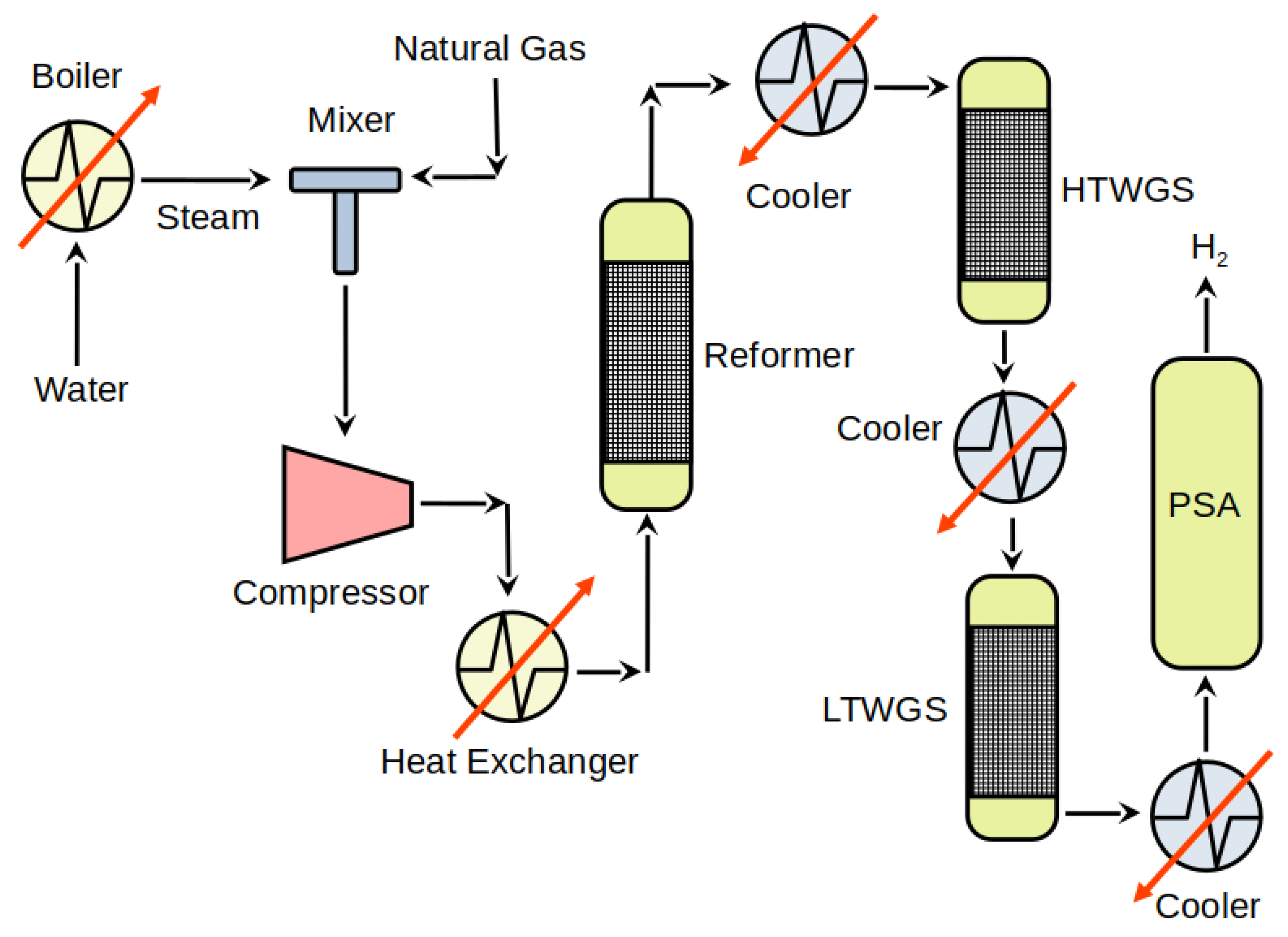
The reforming plant consisted of a reformer; dual-stage water–gas displacement reactors, one at high temperature (HTWGS) and the other at low temperature (LTWGS); and a PSA hydrogen separation stage. When considering Equations (3) and (4), and the compositions of the Cusiana natural gas, the set of equations Equation (5) to Equation (15) is established.
CH 4 + H 2 O CO + 3 H 2 Δ H o = 205.8 kJ mol 1
CH 4 + 2 H 2 O CO 2 + 4 H 2 Δ H o = 164.6 kJ mol 1
C 2 H 6 + 4 H 2 O 2 CO 2 + 7 H 2 Δ H o = 264.1 kJ mol 1
C 2 H 6 + 2 H 2 O 2 CO + 5 H 2 Δ H o = 345.3 kJ mol 1
2 C 3 H 8 + 6 H 2 O 6 CO + 14 H 2 Δ H o = 498.5 kJ mol 1
C 3 H 8 + 6 H 2 O 3 CO 2 + 10 H 2 Δ H o = 375.0 kJ mol 1
C 3 H 8 C 3 H 6 + H 2 Δ H o = 125.1 kJ mol 1
n C 4 H 10 + 4 H 2 O 4 CO + 9 H 2 Δ H o = 650.9 kJ mol 1
n C 4 H 10 + 8 H 2 O 4 CO 2 + 13 H 2 Δ H o = 486.2 kJ mol 1
i C 4 H 10 + 4 H 2 O 4 CO + 9 H 2 Δ H o = 660.1 kJ mol 1
i C 4 H 10 + 8 H 2 O 4 CO 2 + 13 H 2 Δ H o = 495.5 kJ mol 1
The water–gas shift reaction (WGSR) is an additional route that permits additional hydrogen to be released by the reaction of water with the carbon monoxide generated as indicated by Equation (16) [40,41]. In the single stage, the water–gas shift reaction takes place at high temperature (HTWGSR), which is generally between 350 and 450 °C.
CO + H 2 O CO 2 + H 2 Δ H o = 41.2 kJ mol 1
Because it is normally assumed that water is constantly supplied and is in excess, the reactions are, from a practical point of view, irreversible. Likewise, it is assumed that natural gas is highly purified and no early purification is required. Normally, Equation (3) would occur at high temperatures in the order of 700 to 900 °C. The WGSR, Equation (16), takes place at lower temperatures and is usually accomplished by using either a single or a dual stage. In this case, magnesium ferrite MgFe2O4 is used as a catalyst. The dual stage implements a low-temperature second stage, where the water–gas shift reaction (LTWGSR) also takes place; this is generally conducted at temperatures in the order of 190 to 250 °C and by using Fe2O3/MgO as a catalyst. Finally, the products after the WGS stages will be subjected to oxidation or whatever separation method is needed to achieve purification.
The reactions that would take place during the production of hydrogen via the steam reforming of methane are highly endothermic, which implies that large amounts of energy are required to produce significant amounts of hydrogen. The optimal operating conditions for steam reforming are reported to be close to 900 °C and 30 bar. A schematic illustration of the reforming plant for hydrogen production is depicted in Figure 1.

3.2. Dry Methane Reforming (DMR)

During dry reforming, methane is combined with carbon dioxide at high temperatures and pressures in the presence of a catalyst. The resultant product is a mixture of hydrogen and carbon monoxide, which can then be used for further processes such as the water–gas shift reaction to produce more hydrogen [7,8]. Dry reforming has the advantage of utilizing waste carbon dioxide but may face challenges related to catalyst stability and high energy requirements [42,43]. This process can be represented by the following reaction model.
2 C m H n + 2 mCO 2 4 mCO + nH 2
Basically, natural gas is combined with carbon dioxide at high temperatures between 700 and 900 °C and moderate pressures (up to 20–25 bar) in the presence of a catalyst usually based on iridium and cerium oxides, which allows conversions to hydrogen in the order of 80%. The reactions considered by the model are given below:
CH 4 + CO 2 2 CO + 2 H 2 Δ H o = 247.0 kJ mol 1
C 2 H 6 + 2 CO 2 4 CO + 3 H 2 Δ H o = 428.7 kJ mol 1
C 3 H 8 + 3 CO 2 6 CO + 4 H 2 Δ H o = 622.0 kJ mol 1
n C 4 H 10 + 4 CO 2 8 CO + 5 H 2 Δ H o = 815.6 kJ mol 1
i C 4 H 10 + 4 CO 2 8 CO + 5 H 2 Δ H o = 824.8 kJ mol 1
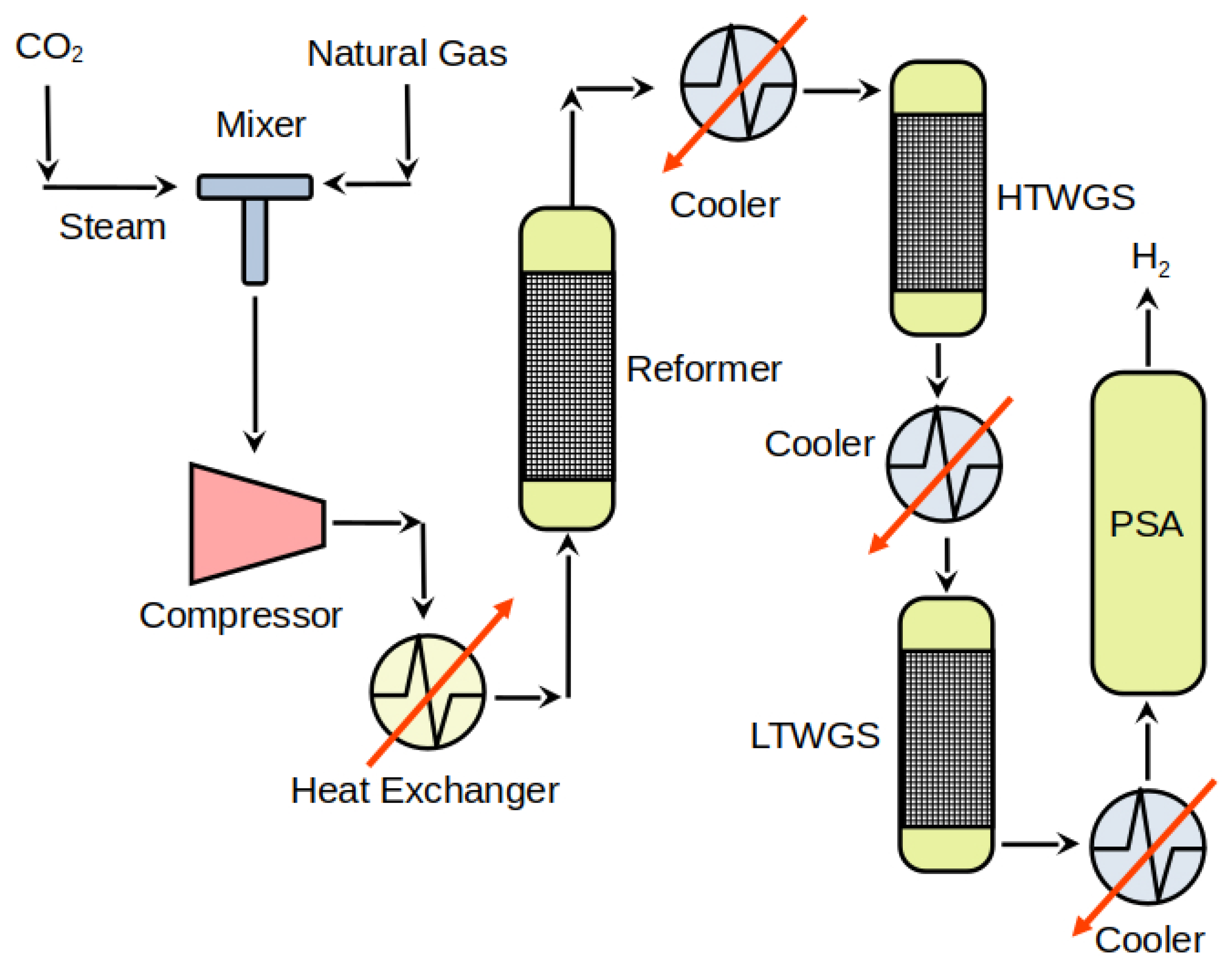
Figure 2 illustrates the DMR plant considered here.

3.3. Autothermal Reforming (ATR)

This process combines both reforming reactions and partial oxidation within a single reactor [5,6]. By doing so, it allows for heat integration between the two processes, making it more energy-efficient than traditional separate-reactor systems. However, ATR may face challenges related to catalyst stability and optimal operating conditions due to the simultaneous occurrence of multiple reactions [31,44]. This process can be represented by the following reaction model.
2 C m H n + mO 2 2 mCO + nH 2
ATR uses Ni catalysts as well as noble metal catalysts, and the reactions usually take place at temperatures in the order of 700 to 800 °C. Autothermal reforming offers an integrated heat-management approach but has lower hydrogen yields when compared with steam methane reforming. The reforming reactions were already indicated by Equations (5) to (15) plus the following reactions:
2 CH 4 + O 2 2 CO + 4 H 2 Δ H o = 36.0 kJ mol 1
C 2 H 6 + O 2 2 CO + 3 H 2 Δ H o = 137.2 kJ mol 1
2 C 3 H 8 + 3 O 2 6 CO + 8 H 2 Δ H o = 226.9 kJ mol 1
n C 4 H 10 + 2 O 2 4 CO + 5 H 2 Δ H o = 316.3 kJ mol 1
i C 4 H 10 + 2 O 2 4 CO + 5 H 2 Δ H o = 307.1 kJ mol 1
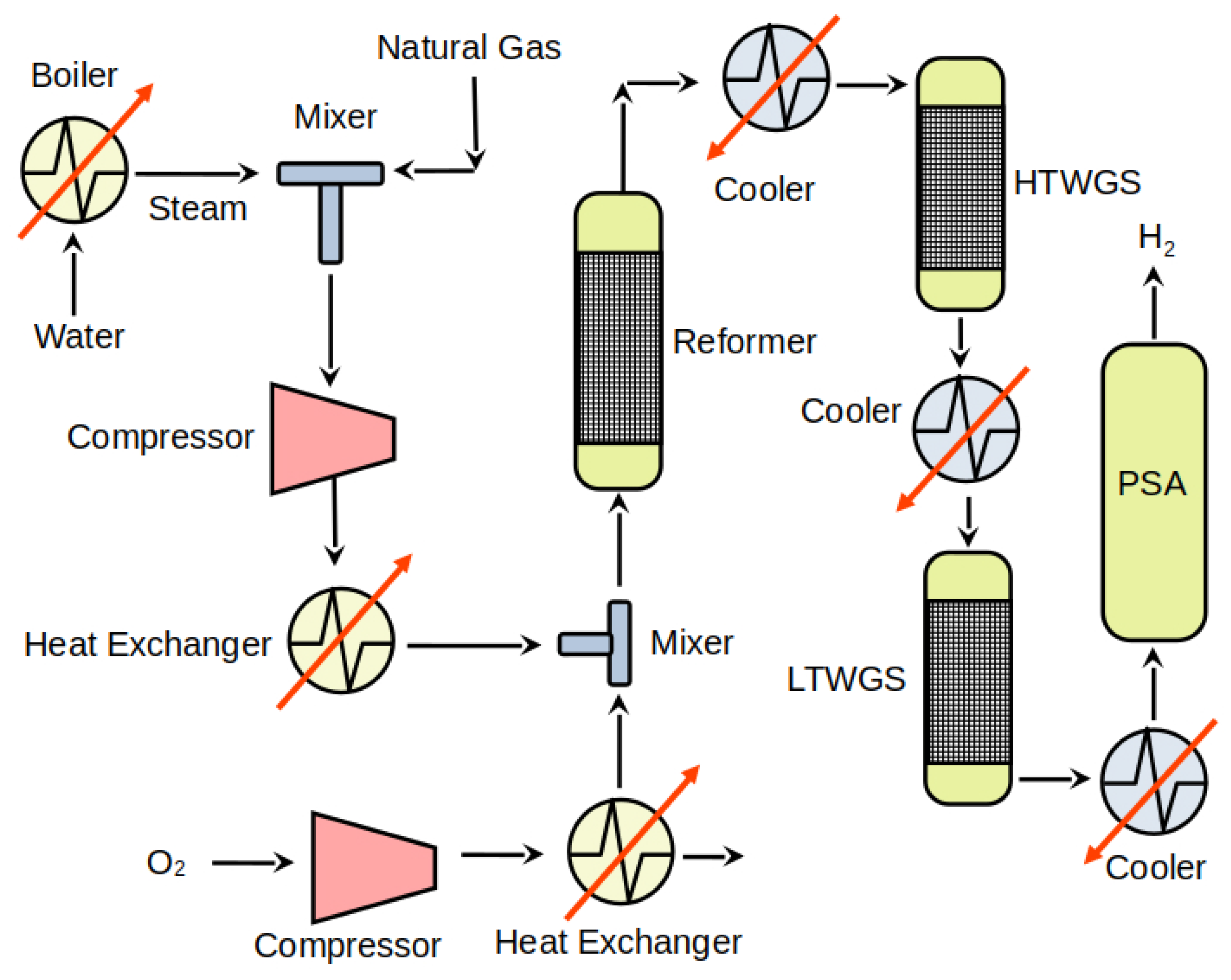
Figure 3 illustrates the ATR plant considered here.

3.4. Catalytic Methane Decomposition (CMD)

This process involves heating methane to extremely high temperatures, causing it to decompose into its constitutive elements—carbon and hydrogen [9,10]. The resulting hydrogen can then be collected for use in various applications. While this process requires significant energy input, recent advancements in catalyst development have shown promise in increasing efficiency and reducing the required temperature [45,46]. This process can be represented by the following reaction model.
2 C m H n 2 mC + nH 2
The reactions considered by the model are given below:
CH 4 C + 2 H 2 Δ H o = 74.5 kJ mol 1
C 2 H 6 2 C + 3 H 2 Δ H o = 83.8 kJ mol 1
C 3 H 8 3 C + 4 H 2 Δ H o = 104.6 kJ mol 1
n C 4 H 10 4 C + 5 H 2 Δ H o = 125.8 kJ mol 1
i C 4 H 10 4 C + 5 H 2 Δ H o = 135.0 kJ mol 1
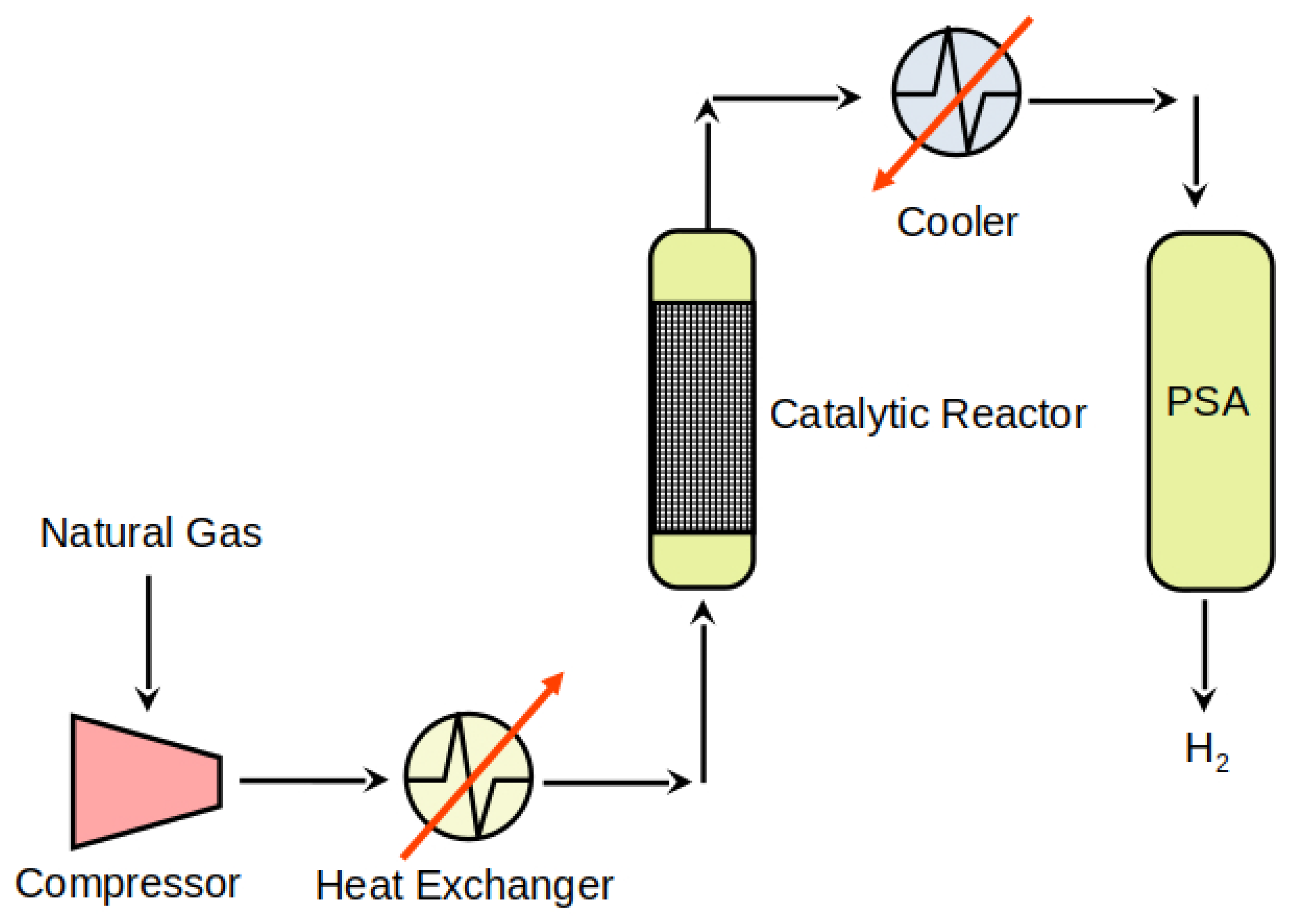
Figure 4 illustrates the CMD plant considered here.

3.5. Hydrogen Plant Selection

As has been established, the major issue when developing blue hydrogen production facilities is that their market suitability is not only impacted by their hydrogen throughput but also by other factors such as energy efficiency, water consumption, carbon footprint and technological readiness. Table 3 lists different metrics for each of the proposed hydrogen production plants.
As indicated by Table 3, hydrogen production from methane is notably energy-intensive and comes with a significant environmental impact due to its relatively large carbon footprint. At first glance, the catalytic methane decomposition plant seems rather interesting as it produces almost no carbon dioxide without any need for water as a reactant. However, this type of process is well known for the rapid deactivation of the catalyst due to carbon deposition (coking) and sintering. This results in a shortened catalyst lifetime, which increases operating costs and requires frequent replacements or regenerations (to account for this, a technological readiness index from 1 to 5 was assigned based on current literature). Moreover, the hydrogen yield from this process was relatively low (in the order of 0.23 kg H2 per kg of natural gas).
As has been established, the major issue when developing technologically viable hydrogen production plants is that their technological suitability is not only impacted by their hydrogen production capacity but also by other factors such as energy efficiency, carbon footprint, water consumption, hydrogen production yield, selectivity and so on. It is worth mentioning that the desired plant will not necessarily perform uniformly well on all criteria; otherwise, the selection would be a rather trivial exercise.
It has been shown that different hydrogen production methodologies will result in plants with different sets of performance metrics, making the problem of selecting the most appropriate hydrogen production plant a multiple-attribute decision-making problem. This manuscript uses the Technique for Order of Preference by Similarity to Ideal Solution (TOPSIS) to decide which hydrogen production plant would provide the optimal solution for the processing of Colombian natural gas from Cusiana. In general terms, TOPSIS ranks geometric distances between ideal and anti-ideal solutions versus any potential non-dominant solutions [47,48]. In this case, the usefulness of any multiple attribute decision-making method, such as TOPSIS, hinges on its ability to help decide which hydrogen production plant should be selected, considering that none of the proposed plants would score high on all of the chosen criteria (i.e., technical and environmental factors).
The optimal hydrogen production plant, if it exists, should outperform its competing counterparts, but there will be trade-offs governed by the priorities of weightings to different criteria. The best practical solution should be found by considering the distances to the optimal and anti-optimal solutions (closest and furthest, respectively). In this manuscript, such priorities or weights to the different criteria, as well as the technological readiness index, were obtained through mutual consultation and opinion polls, and by establishing a hierarchy of hydrogen production plant performance figures of merit.
As has been suggested, the development of hydrogen production plants will benefit from utilizing environmentally friendly methodologies (reduced water consumption and carbon footprint), while reducing energy consumption and rendering lower amounts of byproducts.
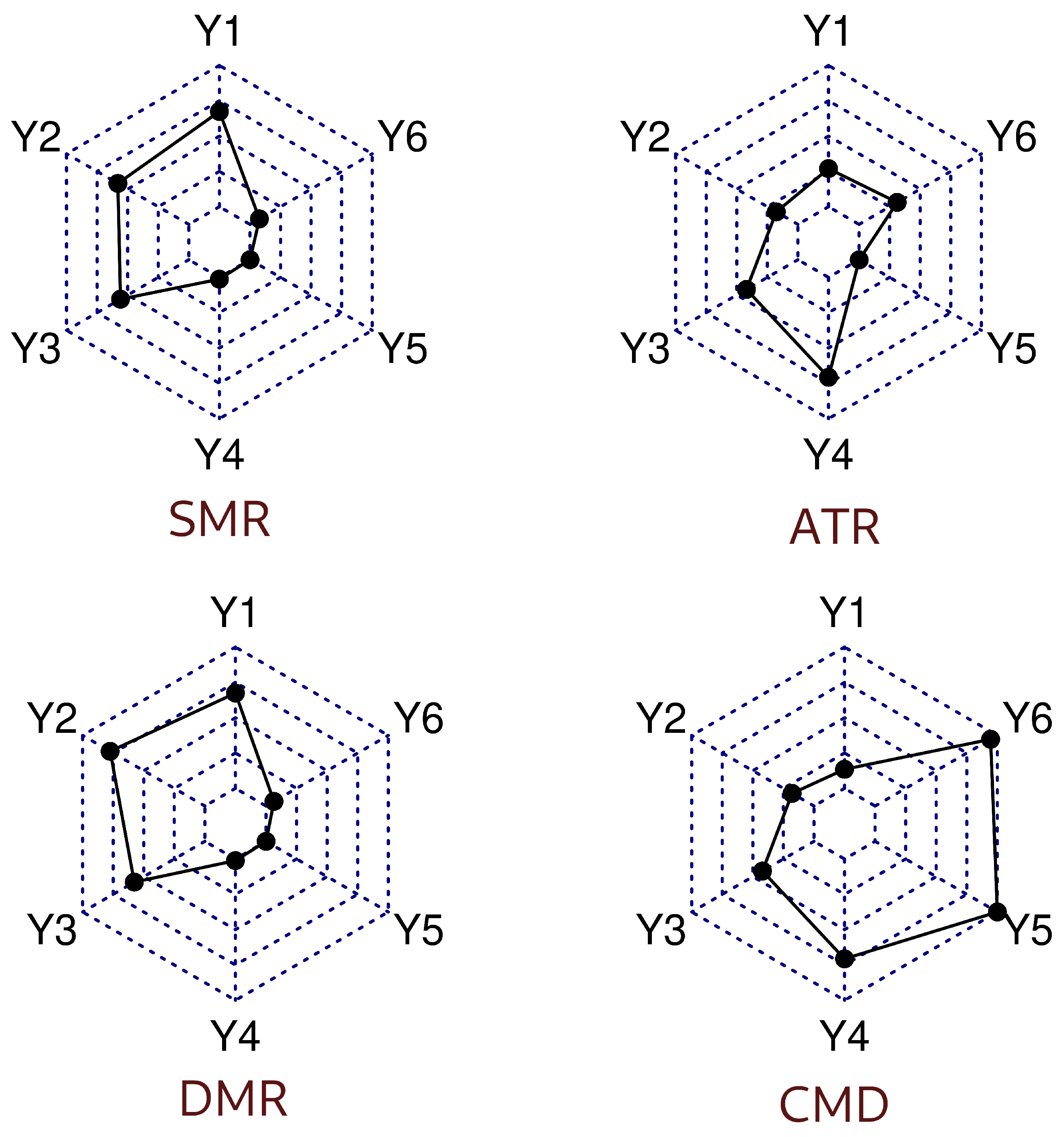
Table 3 reveals that there are three desirable attributes that should be maximized: technological readiness ( X 1 ), yield ( X 2 ) and fractional conversion ( X 3 ). Likewise, there are three undesirable attributes that should be minimized: water use ( X 4 ), carbon footprint ( X 5 ) and energy demand ( X 6 ). The process of minimizing any variable X i will be accomplished by maximizing its inverse. Once the inverse of any cost variable is calculated, all variables will be normalized by using Equation (35) [49,50].
Y i j = X i j j X i j 2
Figure 5 provides a graphical representation of the normalized variables. However, it is difficult to graphically select the best technical solution based on Table 4 and Figure 5 due to the numerous parameters to consider. Therefore, a more sophisticated approach such as TOPSIS is required.
The implementation of a large-scale hydrogen production facility in a developing country, such as Colombia, necessitates, first and foremost, the selection of a mature technology that can be implemented and operated using available resources. Secondly, the plant should meet both yield and fractional conversion requirements. Thirdly, the plant should demonstrate high water efficiency, have a minimal carbon footprint, and be energy-efficient. Finally, weights should be normalized to prevent one score from overshadowing others. Based on these considerations, the respective weights were chosen as follows: technological maturity 0.3, yield 0.2, fractional conversion 0.2, water efficiency 0.1, carbon footprint 0.1, and energy efficiency 0.1. This information was utilized to generate the weights vector W T and the weighted decision matrix ( Z ) :
W T = 0.3 , 0.2 , 0.2 , 0.1 , 0.1 , 0.1
Z = W × Y
Using the weighted decision matrix and weights vector, the ideal positive solution P ( + ) and ideal negative solution P ( ) can be found, as shown in Table 5.
The weighted decision matrix allows computing the separation measured from the ideal positive solution S i ( + ) and ideal negative solution S i ( ) for all formulations using Equations (38) and (39). Finally, for each alternative solution, determine the relative closeness C i ( + ) to the ideal solution using Equation (40). Note that the closeness rating is a number between 0 and 1, where 0 represents the worst possible solution and 1 represents the best possible solution. The results can be found in Table 6.
S i ( + ) = j Z i P i ( + ) 2
S i ( ) = j Z i P i ( ) 2
C i ( + ) = S i ( ) S i ( + ) + S i ( )
The TOPSIS algorithm revealed that autothermal reforming is the dominant solution as it outperforms all of its counterparts, and it should be selected even over more environmentally friendly or less energy intensive alternatives. Steam methane reforming, however, seems to be a suitable competing technology as it also scores very high. Bear in mind that this conclusion can be made under the assumptions that Cusiana natural gas from Colombia is used and the weighting factors given in Equation (36) would hold.

4. Conclusions

By seeking a technologically viable means to produce blue hydrogen from Colombian Natural Gas, four hydrogen production plants based on steam methane reforming, dry reforming, autothermal reforming and catalytic decomposition were simulated by using the DWSIM software package and then compared by means of the TOPSIS method.
The simulation results have proven that hydrogen production from natural gas via SMR and ATR is not only more energy demanding but also less environmentally friendly (larger carbon footprint) than hydrogen production via DMR and CMD.
Each plant was designed to process 64 million cubic feet standard per day of natural gas to produce in the order of 19 tons per hour of hydrogen while emitting of 5.4 kg of carbon dioxide per kilogram of hydrogen and requiring 94.5 tons of water and 299.6 MW of power.
In relation to the global production of hydrogen by methane reforming, it was found that this process has a considerable carbon footprint which currently varies from 10 to 13 kg of carbon dioxide per kilogram of hydrogen produced; these emissions, however, can be mitigated by means of carbon capture technologies with amine solvents, such as Cansolv and MDEA, which allow carbon dioxide to be captured pre- and post-combustion respectively, thus reducing emissions to something between 1.5 and 6.2 kg of carbon dioxide per kilogram of hydrogen produced.
The TOPSIS method reveals that, among the four hydrogen production methodologies, autothermal reformation emerges as the dominant choice due to its shortest route to the “positive ideal” solution. Steam methane reforming follows closely in terms of efficiency, practicality, and environmental friendliness. Unfortunately, dry methane reforming and catalytic methane decomposition are still in a developmental stage, making them currently uncompetitive options in the hydrogen production landscape due to their technological immaturity.
Although the TOPSIS method is powerful and useful, its disadvantage lies in the subjective nature of parameter weight assignments [51,52]. In this manuscript, these weight assignments were carried out considering the typical needs of a developing country like Colombia. However, it is possible that different assignments could alter the response. It is therefore proposed, as future work, to carry out a sensitivity analysis on the assignment of such parameters in order to explore potential variations in the results.

Author Contributions

Conceptualization, J.O.G.P. and A.A.A.; methodology, J.O.G.P.; software, J.O.G.P. and J.C.Q.-D.; validation, J.O.G.P., J.C.Q.-D. and A.A.A.; formal analysis, J.O.G.P.; investigation, J.O.G.P.; resources, J.O.G.P., J.C.Q.-D. and A.A.A.; data curation, J.O.G.P., J.C.Q.-D. and A.A.A.; writing—original draft preparation, J.O.G.P., J.C.Q.-D. and A.A.A.; writing—review and editing, J.O.G.P., J.C.Q.-D. and A.A.A.; visualization, J.O.G.P.; supervision, J.O.G.P.; project administration, J.O.G.P.; funding acquisition, J.O.G.P. All authors have read and agreed to the published version of the manuscript.

Funding

The authors like to acknowledge funding from the Comité para el Desarrollo de la Ciencia y la Tecnología, CODI de la Universidad de Antioquia (Colombia), Grant Number PVR2019-25910. The authors gratefully acknowledge the financial support provided by the ICETEX, Ministerio de Educación Nacional and Ministerio de Ciencia, Tecnología e Innovación within the framework of the project “Prospectiva y desarrollo tecnológico en la producción, en las complementariedades con otros energéticos y en los usos del hidrógeno en Antioquia” (Contract No. RC-2021-1093).

Data Availability Statement

The original contributions presented in this study are included in the article. Further inquiries can be directed to the corresponding author.

Conflicts of Interest

The authors declare no conflicts of interest.

Abbreviations

The following abbreviations are used in this manuscript:
ATRAutothermal Reforming
CMDCatalytic Methane Decomposition
DMRDry Methane Reforming
SMRSteam Methane Reforming
TOPSISTechnique for Order of Preference by Similarity to Ideal Solution
WGSRWater–Gas Shift Reaction

References

  1. Yang, Q.; Dong, S. Probing dark matter axions using the hyperfine structure splitting of hydrogen atoms. Phys. Lett. B 2023, 843, 138004. [Google Scholar] [CrossRef]
  2. Pospelov, M. Rare species of dark matter. Nucl. Phys. B 2024, 1003, 116476. [Google Scholar] [CrossRef]
  3. Han, Y.; Zhang, Z.; Wang, Z.; Zhang, G. Numerical Investigation of Hydrogen Production via Methane Steam Reforming in Tubular Packed Bed Reactors Integrated with Annular Metal Foam Gas Channels. Energies 2025, 18, 4758. [Google Scholar] [CrossRef]
  4. Wang, B.; Shao, Y.; Yang, L.; Guo, K.; Li, X.; Sun, M.; Hao, Y. Sustainable Hydrogen Production with Negative Carbon Emission Through Thermochemical Conversion of Biogas/Biomethane. Energies 2025, 18, 1804. [Google Scholar] [CrossRef]
  5. Sajjadi, M.; Ibrahim, H. Case Study of a Greenfield Blue Hydrogen Plant: A Comparative Analysis of Production Methods. Energies 2025, 18, 3272. [Google Scholar] [CrossRef]
  6. Singh, D.; Sirini, P.; Lombardi, L. Review of Reforming Processes for the Production of Green Hydrogen from Landfill Gas. Energies 2024, 18, 15. [Google Scholar] [CrossRef]
  7. Devasahayam, S.; Thella, J.S.; Mohanty, M.K. Predicting Methane Dry Reforming Performance via Multi-Output Machine Learning: A Comparative Study of Regression Models. Energies 2025, 18, 4807. [Google Scholar] [CrossRef]
  8. Fang, R.; Zhou, T.; Xu, Z.; Hu, X.; Zhang, M.; Yang, H. Energy-Efficient Prediction of Carbon Deposition in DRM Processes Through Optimized Neural Network Modeling. Energies 2025, 18, 3172. [Google Scholar] [CrossRef]
  9. Mirkarimi, S.M.R.; Salimbeni, A.; Bensaid, S.; Negro, V.; Chiaramonti, D. Hydrogen Production Through Methane Decomposition over Waste-Derived Carbon-Based Catalysts. Energies 2025, 18, 5162. [Google Scholar] [CrossRef]
  10. Boscherini, M.; Storione, A.; Minelli, M.; Miccio, F.; Doghieri, F. New perspectives on catalytic hydrogen production by the reforming, partial oxidation and decomposition of methane and biogas. Energies 2023, 16, 6375. [Google Scholar] [CrossRef]
  11. De-Leon Almaraz, S.; Kocsis, T.; Azzaro-Pantel, C.; Szanto, Z.O. Identifying social aspects related to the hydrogen economy: Review, synthesis, and research perspectives. Int. J. Hydrogen Energy 2024, 49, 601–618. [Google Scholar] [CrossRef]
  12. Kannaiyan, K.; Lekshmi, G.S.; Ramakrishna, S.; Kang, M.; Kumaravel, V. Perspectives for the green hydrogen energy-based economy. Energy 2023, 284, 129358. [Google Scholar] [CrossRef]
  13. Rincon-Montenegro, A.; Carmona, M.; Sanjuan, M.; Ramirez, A.; Portnoy, I. Multi-criteria assessment of transition scenarios for a novel hybrid power and hydrogen generation system. Energy Convers. Manag. 2024, 313, 118552. [Google Scholar] [CrossRef]
  14. Zhang, H.; Fan, F.; Huang, D.; Han, D. Multi-objective optimization of steam methane reformer in micro chemically recuperated gas turbine. Int. J. Hydrogen Energy 2024, 62, 307–320. [Google Scholar] [CrossRef]
  15. Bento, C.; Lopes, T.F.; Rodrigues, P.; Girio, F.; Silva, C. Biogas reforming as a sustainable solution for hydrogen production: Comparative environmental metrics with steam-methane reforming and water electrolysis in the Portuguese context. Int. J. Hydrogen Energy 2024, 66, 661–675. [Google Scholar] [CrossRef]
  16. Ramyashree, M.S.; Nandy, A.; Bohari, Y.R.; Pramodh, M.; Kumar, S.H.; Shanmuga Priya, S.; Sudhakar, K. Modeling and simulation of reactors for methanol production by CO2 reduction: A comparative study. Results Eng. 2024, 23, 102306. [Google Scholar] [CrossRef]
  17. Ishaq, M.; Dincer, I. Modeling and simulation of a novel chemical process for clean hydrogen and power generation. Comput. Chem. Eng. 2024, 1, 108767. [Google Scholar] [CrossRef]
  18. Fleitmann, L.; Pyschik, J.; Wolff, L.; Schilling, J.; Bardow, A. Optimal experimental design of physical property measurements for optimal chemical process simulations. Fluid Phase Equilibria 2024, 557, 113420. [Google Scholar] [CrossRef]
  19. Li, Y.; Ren, J.; Ma, H.; Campbell, A.N. Technical and economic performance assessment of blue hydrogen production using new configuration through modelling and simulation. Int. J. Greenh. Gas Control 2024, 134, 104112. [Google Scholar] [CrossRef]
  20. Scovell, M.; Walton, A. Blue or Green? Exploring Australian acceptance and beliefs about hydrogen production methods. J. Clean. Prod. 2024, 444, 141151. [Google Scholar] [CrossRef]
  21. Liu, X.; Michal, G.; Godbole, A.; Lu, C. Decompression modelling of natural gas-hydrogen mixtures using the Peng-Robinson equation of state. Int. J. Hydrogen Energy 2021, 46, 15793–15806. [Google Scholar] [CrossRef]
  22. Qian, J.-W.; Jaubert, J.-N.; Privat, R. Phase equilibria in hydrogen-containing binary systems modeled with the Peng–Robinson equation of state and temperature-dependent binary interaction parameters calculated through a group-contribution method. J. Supercrit. Fluids 2013, 75, 58–71. [Google Scholar] [CrossRef]
  23. Groniewsky, A.; Illés, D.; Hégely, L. Estimation of internal energy, enthalpy, and entropy, based on group contribution method and cubic equation of states. Mater. Chem. Phys. 2025, 348, 131605. [Google Scholar] [CrossRef]
  24. Brancaleoni, P.P.; Corti, E.; Ravaglioli, V.; Moro, D.; Silvagni, G. Innovative torque-based control strategy for hydrogen internal combustion engine. Int. J. Hydrogen Energy 2024, 73, 203–220. [Google Scholar] [CrossRef]
  25. Balmelli, M.; Merotto, L.; Wright, Y.; Bleiner, D.; Biela, J.; Soltic, P. Optical and thermodynamic investigation of jet-guided spark ignited hydrogen combustion. Int. J. Hydrogen Energy 2024, 78, 1316–1331. [Google Scholar] [CrossRef]
  26. Fanasev, P.; Askarova, A.; Alekhina, T.; Popov, E.; Markovic, S.; Mukhametdinova, A.; Cheremisin, A.; Mukhina, E. An overview of hydrogen production methods: Focus on hydrocarbon feedstock. Int. J. Hydrogen Energy 2024, 78, 805–828. [Google Scholar] [CrossRef]
  27. Jeje, S.O.; Marazani, T.; Obiko, J.O.; Shongwe, M.B. Advancing the hydrogen production economy: A comprehensive review of technologies, sustainability, and future prospects. Int. J. Hydrogen Energy 2024, 78, 642–661. [Google Scholar] [CrossRef]
  28. Ajanovic, A.; Sayer, M.; Haas, R. The economics and the environmental benignity of different colors of hydrogen. Int. J. Hydrogen Energy 2022, 47, 24136–24154. [Google Scholar] [CrossRef]
  29. Incer-Valverde, J.; Korayem, A.; Tsatsaronis, G.; Morosuk, T. Colors of hydrogen: Definitions and carbon intensity. Energy Convers. Manag. 2023, 291, 117294. [Google Scholar] [CrossRef]
  30. Arrieta, C.E.; Garcia, A.M.; Amell, A.A. Experimental study of the combustion of natural gas and high-hydrogen content syngases in a radiant porous media burner. Int. J. Hydrogen Energy 2017, 42, 12669–12680. [Google Scholar] [CrossRef]
  31. Wu, W.; Tungpanututh, C. Optimization of a methane autothermal reforming-based hydrogen production system with low CO2 emissions. Ifac Proc. Vol. 2012, 45, 661–666. [Google Scholar] [CrossRef]
  32. Yepes, H.A.; Obando, J.E.; Amell, A.A. The effect of syngas addition on flameless natural gas combustion in a regenerative furnace. Energy 2022, 252, 124008. [Google Scholar] [CrossRef]
  33. Otero Meza, D.D.; Sagastume Gutierrez, A.; Cabello Eras, J.J.; Salcedo Mendoza, J.; Hernandez Ruydiaz, J. Techno-economic and environmental assessment of the landfill gas to energy potential of major Colombian cities. Energy Convers. Manag. 2023, 293, 117522. [Google Scholar] [CrossRef]
  34. Koutsandreas, D.; Trachanas, G.P.; Pappis, I.; Nikas, A.; Doukas, H.; Psarras, J. A multicriteria modeling approach for evaluating power generation scenarios under uncertainty: The case of green hydrogen in Greece. Energy Strategy Rev. 2023, 50, 101233. [Google Scholar] [CrossRef]
  35. da Ponte, G.P.; Calili, R.F.; Souza, R.C. Energy generation in Brazilian isolated systems: Challenges and proposals for increasing the share of renewables based on a multicriteria analysis. Energy Sustain. Dev. 2021, 61, 74–88. [Google Scholar] [CrossRef]
  36. Taherdoost, H.; Madanchian, M. Multi-criteria decision making (MCDM) methods and concepts. Encyclopedia 2023, 3, 77–87. [Google Scholar] [CrossRef]
  37. Aruldoss, M.; Lakshmi, T.M.; Venkatesan, V.P. A survey on multi criteria decision making methods and its applications. Am. J. Inf. Syst. 2013, 1, 31–43. [Google Scholar] [CrossRef]
  38. de Cataldo, A.; Astolfi, M.; Chiesa, P.; Campanari, S.; Romano, M.C. Ultra-low emission flexible plants for blue hydrogen and power production, with electrically assisted reformers. Int. J. Hydrogen Energy 2024, 49, 978–993. [Google Scholar] [CrossRef]
  39. Pravin, P.S.; Gudi, R.D.; Bhartiya, S. Dynamic modeling of an integrated reformer membrane fuel cell system. IFAC-PapersOnLine 2017, 50, 10790–10795. [Google Scholar] [CrossRef]
  40. Chianese, S.; Loipersböck, J.; Malits, M.; Rauch, R.; Hofbauer, H.; Molino, A.; Musmarra, D. Hydrogen from the high temperature water gas shift reaction with an industrial Fe/Cr catalyst using biomass gasification tar rich synthesis gas. Fuel Process. Technol. 2025, 132, 39–48. [Google Scholar] [CrossRef]
  41. Baraj, E.; Ciahotnỳ, K.; Hlinčík, T. The water gas shift reaction: Catalysts and reaction mechanism. Fuel 2021, 288, 119817. [Google Scholar] [CrossRef]
  42. Wittich, K.; Kramer, M.; Bottke, N.; Schunk, S.A. Catalytic Dry Reforming of Methane: Insights from Model Systems. ChemCatChem 2020, 12, 2130–2147. [Google Scholar] [CrossRef]
  43. Er-Rbib, H.; Bouallou, C.; Werkoff, F. Dry reforming of methane—Review of feasibility studies. Chem. Eng. 2012, 29, 163–168. [Google Scholar] [CrossRef]
  44. Cavalcante, M.H.S.; Maccari Zelioli, Í.A.; Guimarães Filho, E.É.X.; dos Santos Júnior, J.M.; Souza Vidotti, A.D.; Daltro de Freitas, A.C.; Guirardello, R. Autothermal Reforming of Methane: A Thermodynamic Study on the Use of Air and Pure Oxygen as Oxidizing Agents in Isothermal and Adiabatic Systems. Methane 2023, 2, 389–403. [Google Scholar] [CrossRef]
  45. Habib, M.A.; Abdulrahman, G.A.Q.; Alquaity, A.B.S.; Qasem, N.A.A. Hydrogen combustion, production, and applications: A review. Alex. Eng. J. 2024, 100, 182–207. [Google Scholar] [CrossRef]
  46. Oni, A.O.; Anaya, K.; Giwa, T.; Di Lullo, G.; Kumar, A. Comparative assessment of blue hydrogen from steam methane reforming, autothermal reforming, and natural gas decomposition technologies for natural gas-producing regions. Energy Convers. Manag. 2022, 254, 115245. [Google Scholar] [CrossRef]
  47. Huang, I.B.; Keisler, J.; Linkov, I. Multi-criteria decision analysis in environmental sciences: Ten years of applications and trends. Sci. Total Environ. 2011, 409, 3578–3594. [Google Scholar] [CrossRef]
  48. Lai, Y.-J.; Liu, T.-Y.; Hwang, C.-L. Topsis for MODM. Eur. J. Oper. Res. 1994, 76, 486–500. [Google Scholar] [CrossRef]
  49. Jin, L.; Liu, P.; Yao, W.; Wei, J.; Li, Z. Safety assessment of existing subgrade retaining wall based on a combined Weighting-TOPSIS evaluation method. Dev. Built Environ. 2024, 18, 100420. [Google Scholar] [CrossRef]
  50. Varchandi, S.; Memari, A.; Jokar, M.R.A. An integrated best-worst method and fuzzy TOPSIS for resilient-sustainable supplier selection. Decis. Anal. J. 2024, 1, 100488. [Google Scholar] [CrossRef]
  51. Paradowski, B.; Więckowski, J.; Dobryakova, L. Why TOPSIS does not always give correct results? Procedia Comput. Sci. 2020, 176, 3591–3600. [Google Scholar] [CrossRef]
  52. Corrente, S.; Tasiou, M. A robust TOPSIS method for decision making problems with hierarchical and non-monotonic criteria. Expert Syst. Appl. 2023, 214, 119045. [Google Scholar] [CrossRef]
Figure 1. Hydrogen production by steam methane reforming (SMR).
Energies 19 00729 g001
Figure 2. Hydrogen production by dry methane reforming (DMR).
Energies 19 00729 g002
Figure 3. Hydrogen production by autothermal reforming (ATR).
Energies 19 00729 g003
Figure 4. Hydrogen production by catalytic methane decomposition (CMD).
Energies 19 00729 g004
Figure 5. Normalized hydrogen production plant descriptor variables as listed in Table 4.
Energies 19 00729 g005
Table 1. Classification of hydrogen according to its production process.
Hydrogen TypeDescription
BrownCreated through coal classification.
GrayMade using fossil fuels like oil and coal, which emit into the air as they combust.
BlueSame process as gray hydrogen, along with carbon capture and storage.
GreenProduced by using renewable sources.
TurquoiseProduced when natural gas is broken down with the help of methane pyrolysis.
Purple or PinkProduced by electrolysis using nuclear power.
YellowProduced by electrolysis from various sources (using solar energy).
WhiteProduced as a byproduct. It also refers to natural occurring hydrogen.
Table 2. Properties and compositions of Colombian natural gas (Guajira and Cusiana).
PropertyGuajiraCusiana
CH4 %mol97.7682.19
C2H6 %mol0.3810.43
C3H8 %mol0.23.59
i-C4H10 %mol00.48
n-C4H10 %mol00.54
i-C5H12 %mol00.07
n-C5H12 %mol00.05
n-C6H14 % mol00.02
N2 %mol1.290.65
CO2 %mol0.371.97
PCs (MJ/m3)37.442.8
Relative Density0.570.68
Woobe Index (MJ/m3)49.651.9
Table 3. Figures of merit of selected hydrogen production plants using Cusiana natural gas.
ParameterLabelSMRATRDMRCMD
Technological Readiness X 1 5.00005.00003.00002.0000
Yield (kg H2/kg NG) X 2 0.56000.36000.22000.2300
Fractional Conversion X 3 0.93000.96000.71000.6900
Water Use (kg H2O/kg H2) X 4 0.25640.13890.00100.0010
Carbon Footprint (kg CO2/kg H2) X 5 0.35970.21320.41840.0010
Energy Demand (MJ/Nm3 H2) X 6 0.31850.18550.13020.5348
Table 4. Normalized decision matrix.
ItemY1Y2Y3Y4Y5Y6
SMR0.67420.58020.55890.01280.00070.0776
ATR0.67420.77470.57710.01150.00060.0652
DMR0.26970.17690.42100.70700.00140.3115
CMD0.13480.17880.42110.70701.00000.9448
Table 5. Weighted decision matrix and ideal solutions.
ItemZ1Z2Z3Z4Z5Z6
SMR0.2023(+)0.11600.11180.00130.0001(−)0.0078
ATR0.20230.1549(+)0.1154(+)0.0012(−)0.00010.0065(−)
DMR0.08090.0354(−)0.0842(−)0.0707(+)0.00010.0312
CMD0.0405(−)0.03580.08420.07070.1000(+)0.0945(+)
P(+)0.20230.15490.11540.07070.10000.0945
P(−)0.04050.03540.08420.00120.00010.0065
Table 6. Separations and closeness matrix.
ItemATRSMRCMDDMR
S(+)0.15020.15440.20340.2097
S(−)0.20360.18290.15020.0841
C(+)0.57540.54120.42480.2863
Disclaimer/Publisher’s Note: The statements, opinions and data contained in all publications are solely those of the individual author(s) and contributor(s) and not of MDPI and/or the editor(s). MDPI and/or the editor(s) disclaim responsibility for any injury to people or property resulting from any ideas, methods, instructions or products referred to in the content.