1. Introduction
With the advancement of China’s “dual-carbon” strategy, the integration of renewable energy has rapidly expanded, leading to increasingly complex and frequent power quality disturbances. Such disturbances can compromise the secure and stable operation of the power system and may result in severe social and economic consequences [
1,
2,
3]. Therefore, it is imperative to develop reliable and fast power quality disturbance (PQD) monitoring and identification models to ensure the safe and stable operation of the grid under the new energy landscape [
4].
Traditional PQD classification methods typically involve two stages: feature extraction and pattern recognition. In the first stage, signal processing techniques such as Fourier transform (FT) [
5], Wavelet transform (WT) [
6], S-transform [
7], and Ensemble Empirical Mode Decomposition (EEMD) [
8] are employed to extract features from disturbance signals. In the second stage, the extracted features are fed into machine learning-based classifiers to identify the disturbance types. For example, [
9] extended the original time-domain signals into the frequency domain using WT to uncover latent fault features that are difficult to observe directly in the time domain, followed by Support Vector Machine (SVM) for effective classification. Similarly, ref. [
10] employed the S-transform to extract time–frequency features of power quality disturbances and combined them with decision trees (DT) to achieve high-accuracy classification of noisy signals. However, these approaches require researchers to preselect feature extraction methods and their parameters based on prior knowledge, relying heavily on manually designed feature engineering and fixed paradigms [
11]. Such processes not only demand substantial domain expertise but also often suffer from limited generalization and classification performance when faced with increasingly complex and diverse disturbances in modern power systems. Consequently, traditional methods are becoming inadequate for meeting the high accuracy and robustness requirements of power quality disturbance identification in contemporary grids [
12].
In recent years, deep learning (DL) [
13,
14] technologies have advanced rapidly, attracting significant attention from the research community toward DL-based power quality disturbance (PQD) classification methods. The existing DL-based approaches for PQD classification can be broadly categorized into two types. The first type transforms the original disturbance signals into two-dimensional images and performs disturbance identification using image classification models. However, such methods not only increase the complexity of the training process and computational cost, but may also destroy the point-wise correlation structure of the original one-dimensional time-series signals, leading to potential feature distortion or information loss. The second type treats disturbance signals directly as a one-dimensional time series and adopts end-to-end architectures for PQD monitoring and identification. In [
15], an ensemble convolutional neural network-based automatic recognition framework for complex PQDs was proposed, in which multi-level temporal feature fusion was employed to effectively improve classification accuracy and noise robustness. In [
16], a multi-fusion convolutional neural network framework was developed for complex PQD detection by integrating time-domain and frequency-domain information, where one-dimensional composite convolution and batch normalization were introduced to enhance feature diversity, training efficiency, and noise immunity. In [
17], a sequence-to-sequence deep learning framework based on bidirectional gated recurrent units was proposed for the joint identification of PQD types and their start–end time localization, achieving precise disturbance classification at each time instant and maintaining high recognition and temporal localization accuracy even under strong noise conditions.
Despite the advantages of these end-to-end methods, relying solely on time-domain features is insufficient to fully capture the complexity of disturbance patterns in PQD. Time-domain signals alone may fail to reflect critical nuances that are essential for distinguishing between different disturbance types. This approach often overlooks crucial frequency-domain information, which is vital for characterizing disturbances that exhibit high-frequency components or periodic behaviors. Additionally, time-domain analysis tends to miss long-term temporal dependencies, which are essential for understanding the evolution of disturbances over extended periods. Moreover, existing DL models still face significant challenges in effectively extracting and utilizing features for PQD classification tasks. Traditional DL models typically struggle to capture the rich, multidimensional relationships embedded within the disturbance data. For instance, they often fail to simultaneously capture both the intricate temporal dependencies and the complex correlations between time-domain and frequency-domain features. This limitation makes it difficult for current models to fully characterize the complex dynamics of disturbances, which in turn hinders their ability to achieve high classification accuracy and generalization. Consequently, this results in suboptimal performance, particularly in real-world scenarios where disturbances may exhibit highly nonlinear, time-varying behaviors. The lack of a unified approach that can adequately capture and integrate these diverse feature sets restricts further advancements in disturbance recognition and system stability assessment.
To address the aforementioned limitations, this paper proposes a novel multi-level ensemble method for power quality disturbance identification (MLEM-PQD), which combines and extends existing techniques to enable a more accurate and efficient identification of power quality disturbance types. While the method incorporates established components, its key innovation lies in the integration and enhancement of these techniques to better capture the complex characteristics of disturbance signals in both time and frequency domains. The main contributions of this study are summarized as follows:
To address the complex dynamic characteristics of raw disturbance signals, this study designed a Time–Frequency Dual-Branch Feature Extraction (TF-DBFE) module, which distinguishes itself from traditional models by using ResNet to independently model both time-domain signals and their frequency-domain representations, obtained via Fast Fourier Transform (FFT). This dual-branch approach allows for a more comprehensive extraction of complementary time–frequency features. The subsequent introduction of multi-layer bidirectional temporal convolutional networks (BiTCN) for fine-grained temporal modeling further strengthens the ability to capture long-range temporal dependencies in both domains. Unlike existing methods that only process time-domain or frequency-domain features individually, the proposed method effectively captures the dynamic evolution patterns of disturbances, significantly enhancing its performance in real-world disturbance scenarios.
To improve the interaction between time-domain and frequency-domain features, this paper constructed a novel cross-attention mechanism, which is not commonly found in current approaches. In this mechanism, frequency-domain features act as query vectors and time-domain features as key and value vectors. This innovative approach adaptively learns attention weights, enabling the model to focus on the most relevant features for each disturbance type. The introduction of cross-attention significantly enhances the model’s ability to dynamically focus on the most informative features, improving the separation between different disturbance types and yielding more precise classifications compared to traditional methods that typically use either time-domain or frequency-domain features alone.
Finally, the fused deep time–frequency features are processed through fully connected layers, followed by a Softmax classifier for multi-class power quality disturbance identification. Experimental results demonstrate that the proposed method significantly outperforms traditional approaches and single deep learning models in terms of classification accuracy, robustness, and generalization capability, validating the effectiveness and superiority of the proposed approach.
The remainder of this paper is organized as follows:
Section 2 provides a detailed exposition of the proposed MLEM-PQD.
Section 3 presents comprehensive case studies and the discussion. Finally,
Section 4 concludes the whole paper.
2. A Multi-Level Ensemble Model-Based Method for Power Quality Disturbance Identification (MLEM-PQD)
Traditional machine learning methods in PQD identification rely on manually selected features based on domain knowledge, which often fail to capture all critical information, limiting their accuracy in dynamic environments. In contrast, deep learning approaches can process raw disturbance signals directly, enabling automatic feature extraction and better modeling of complex nonlinear relationships in power quality data.
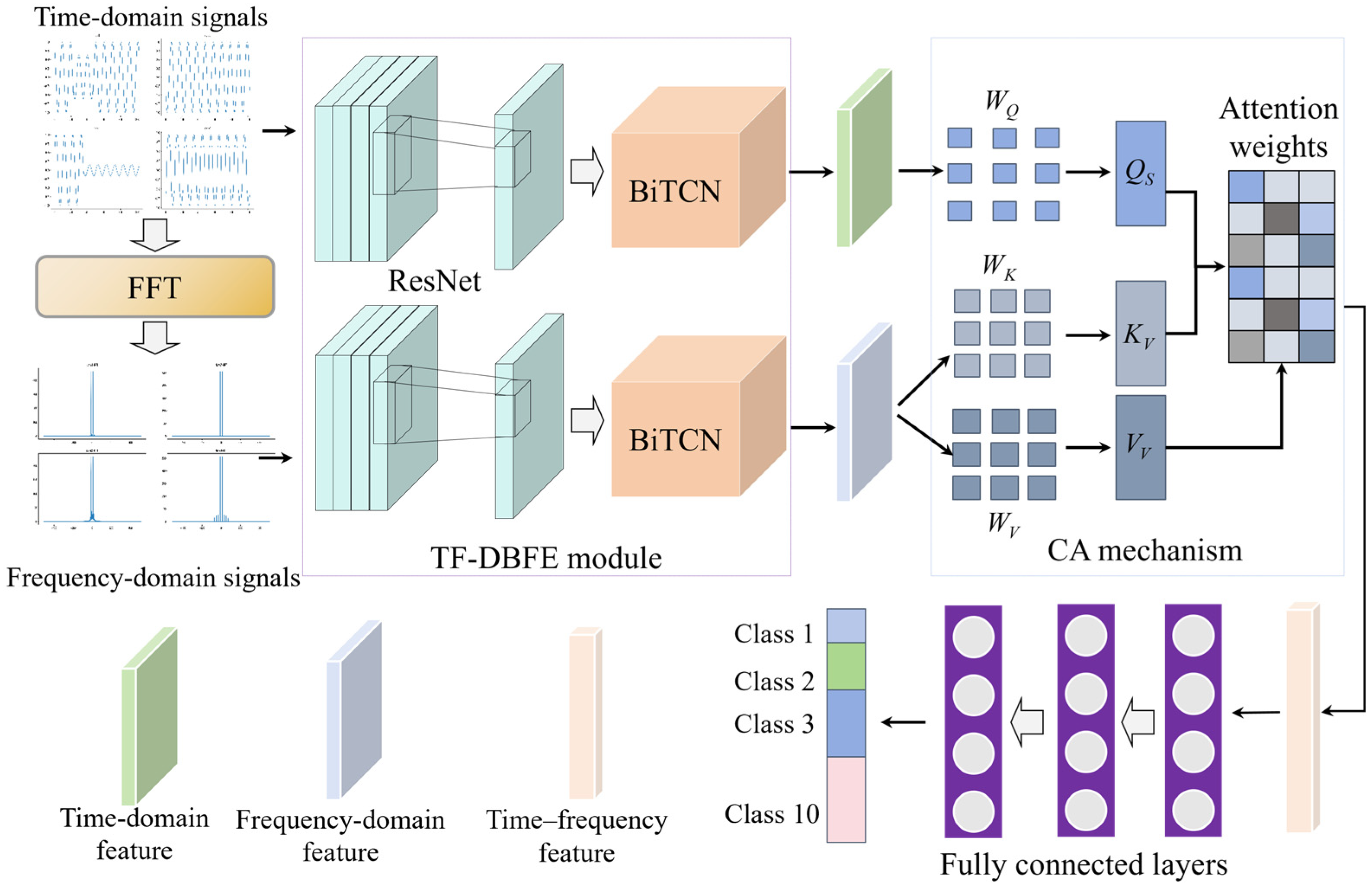
Motivated by this, we propose a multi-level ensemble model under a deep learning framework, utilizing joint time–frequency features and a cross-attention mechanism to capture disturbance information in both the time and frequency domains. As shown in
Figure 1, the model architecture includes Fast Fourier Transform (FFT) [
18], a Time–Frequency Dual-Branch Feature Extraction (TF-DBFE) module, and a cross-attention (CA) [
19] mechanism. First, raw time-domain disturbance signals are transformed to the frequency domain via FFT. Both time- and frequency-domain signals are then processed by the TF-DBFE module, where ResNet-based residual learning extracts local features, and Bi-directional Temporal Convolutional Networks (BiTCN) [
20] capture bidirectional dependencies across time. The CA mechanism enhances the fusion of time–frequency features by establishing adaptive correlations between them. The fused features are then passed through fully connected layers and a Softmax classifier for accurate multi-class PQD identification. In the following sections, we detail the principles behind FFT, ResNet, BiTCN, and the CA mechanism
2.1. The Working Mechanism of FFT
FFT is a computationally efficient algorithm for calculating the frequency components of discrete signals, which significantly reduces the computational complexity of the Discrete Fourier Transform (DFT). The DFT of a discrete signal is expressed as:
where
denotes the input sampling sequence in the time domain,
represents the output classification in the frequency domain, and
denotes the total number of sampling points.
The sampling sequence is split into two sub-sequences of length
, denoted as
and
, corresponding to the even- and odd-indexed samples, respectively.
where
.
and
both have a period of
. Hence, the FFT can be defined as:
2.2. The Working Mechanism of TF-DBFE
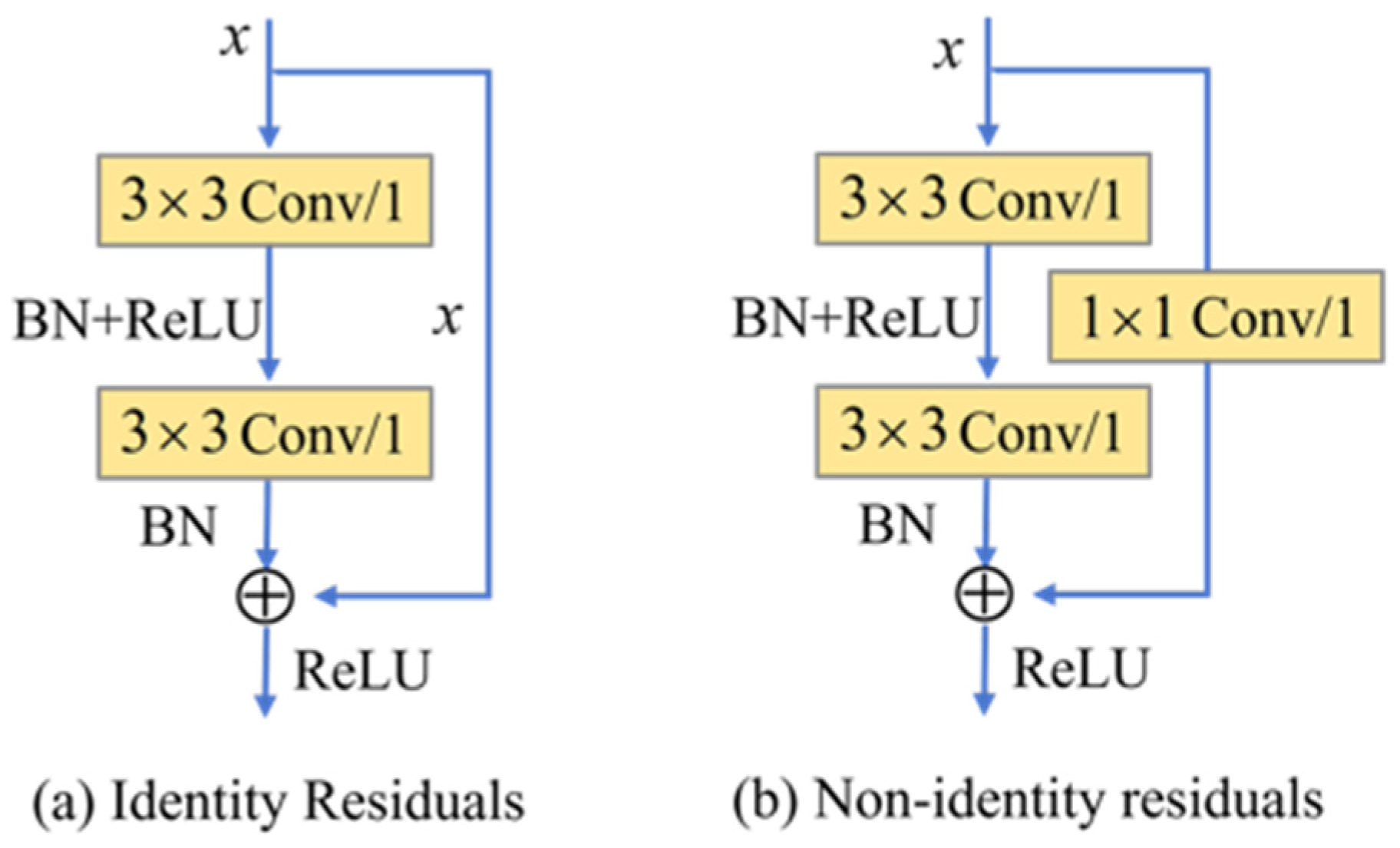
In traditional CNN, increasing the depth improves feature representation but can cause gradient vanishing or exploding, which harms performance. ResNet solves this by introducing shortcut connections that allow the output of one layer to bypass intermediate layers and be directly passed to the next. ResNet has two types of residuals: identity and non-identity. Identity residuals are used when output dimensions match, allowing direct addition. Non-identity residuals use a 1 × 1 convolution to match dimensions when they differ.
Figure 2 illustrates the identity and non-identity residual blocks.
ResNet employs Batch Normalization (BN) layers to mitigate gradient vanishing and exploding issues. The specific process is as follows:
where
and
denote the input and output of the batch-normalization layer, respectively;
denotes the batch size;
and
represent the mini-batch mean and variance;
is the
standardized input;
is a small constant for numerical stability; and
and
are learnable scale and shift parameters.
The ReLU activation function was adopted in this study due to its computational simplicity and efficiency, as it only requires a comparison and maximum selection operation. In addition, ReLU effectively mitigates the gradient vanishing problem, facilitating the training of deep networks. Moreover, it promotes the sparse activation of neurons, which further improves training efficiency and enhances overall model performance.
The Temporal Convolutional Network (TCN) uses dilated causal convolutions and includes three key components: causal convolution, dilated convolution, and residual connections. In this work, the designed TCN framework consists of three stacked residual blocks with exponentially increasing dilation factors, expanding the receptive field without significant computational cost. In PQD identification, disturbances vary across multiple time scales, and the TCN’s architecture effectively captures both local patterns and long-range dependencies, making it ideal for multi-scale temporal feature aggregation.
Causal Convolution: Causal convolution is a temporal variant of standard 1D convolution that enforces the “cause-preceding-effect” constraint, ensuring the output at any time depends only on the current and past inputs. This aligns with the physical evolution of power system disturbances, preventing future information leakage and spurious feature extraction. For PQD signal processing, sudden voltage changes, oscillations, and harmonic distributions follow a clear causal temporal order. By incorporating causal convolution, the TCN can perform convolutional operations on time- and frequency-domain inputs
while strictly preserving the underlying temporal structure, ensuring that the output at time
is solely determined by the signal history up to time
, as formulated in (6).
where
denotes a one-dimensional causal convolution kernel. Compared with other network structures lacking explicit temporal constraints, the causal convolution can more effectively extract the intrinsic sequential characteristics of PQD patterns, thereby enhancing identification accuracy in practical scenarios.
Dilated Convolution: In PQD identification, disturbance patterns span multiple temporal scales, from instantaneous voltage sags to slowly varying harmonics. Dilated convolutions allow the TCN to adjust its receptive field, capturing both local changes and long-range dependencies, improving its ability to resolve complex disturbance behaviors. When processing one-dimensional time-domain or frequency-domain data
, dilated convolutions allow the output at time
in a hidden layer to depend on multiple historical samples spaced according to the dilation factor. The computation is expressed in (8).
where
is the output at time
;
denotes the
-th filter;
is the input at time
;
is the dilation rate; and
is the kernel size.
Residual Connection: In PQD identification tasks, many critical disturbance patterns—such as abrupt transitions, sudden waveform rises or drops, and harmonic components—play a decisive role in determining classification performance. Residual connections help ensure that these key details are not overshadowed during deep feature extraction, enabling the model to preserve essential structural information of the original waveform while learning higher-level disturbance features. The output form of the residual connection is given in (8).
where
denotes the input data and
represents the linear transformation.
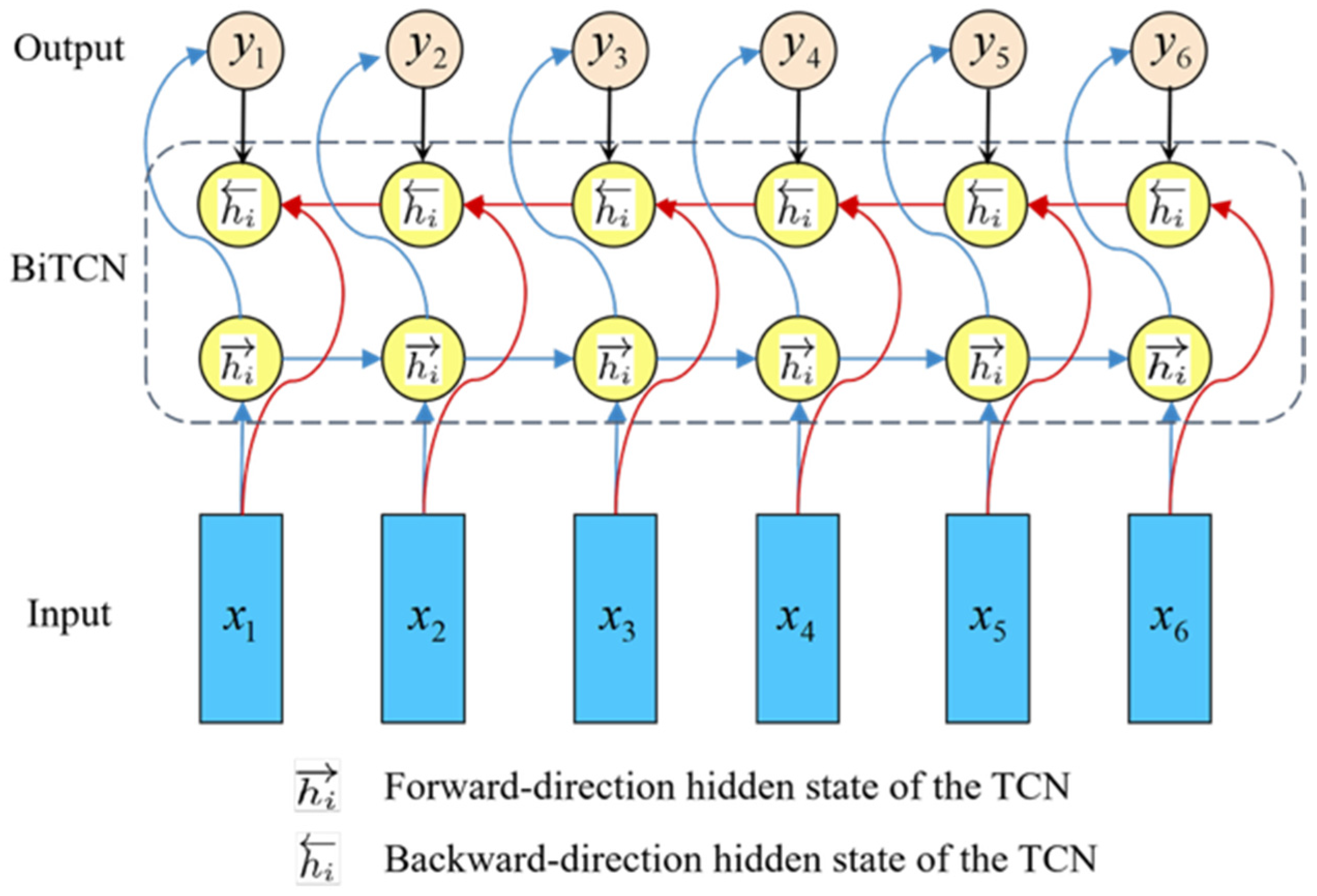
The BiTCN consists of two TCN layers in opposite directions, as shown in
Figure 3. It offers two main advantages: bidirectional modeling and reduced gradient vanishing. By utilizing both past and future voltage data, BiTCN captures the voltage time-series more comprehensively, improving stability and reliability compared to unidirectional TCN.
2.3. The Working Mechanism of CA
To effectively fuse the time-domain and frequency-domain features extracted by the TF-DBFE module, a CA mechanism is introduced. The mathematical formulation of the cross-attention mechanism for time- and frequency-domain features can be described in the following four steps.
Feature-matrix preparation. The inputs to the CA mechanism are the time-domain feature matrix and the frequency-domain feature matrix , both produced by the TF-DBFE module.
Generation of Query, Key, and Value Matrices. The input features are first projected through linear transformations to generate the Query, Key, and Value matrices. The corresponding expressions are given as:
where
denotes the query matrix,
is the key matrix, and
is the value matrix;
,
,
are learnable parameter matrices.
where
denotes the dimensionality of the query vectors, which is introduced to prevent the dot-product values from becoming excessively large.
The output feature effectively characterizes the deep interactive fusion between the two modalities.
2.4. The Working Mechanism of the Output Layer
The output layer consists of a fully connected layer followed by a Softmax layer, where the ReLU function is adopted as the activation function. The Softmax layer maps the hidden representations into the interval [0, 1], yielding a probability distribution over all candidate classes. Based on these posterior probabilities, the PQD categories can be reliably identified.
3. Case Studies and Discussion
To explicitly clarify the applicability of the proposed methodology to the power quality analysis, we emphasize the specific characteristics of the disturbances investigated in this case study. Power quality disturbances exhibit strong non-stationary and time-varying behaviors. Traditional time-domain or frequency-domain methods often fail to simultaneously capture the transient location and spectral details of these signals.
The proposed methodology connects directly to these physical challenges: the time-frequency analysis module is specifically designed to resolve the multi-scale features of transient disturbances, while the ensemble architecture addresses the complexity of distinguishing morphologically similar signals. This case study was therefore constructed to validate how the methodology leverages these mechanisms to solve the power quality disturbance identification problem.
3.1. Dataset and Training Configuration
The dataset was generated in MATLAB R2023b following the mathematical models and generation methods for power quality disturbances as stipulated in the IEEE Std 1159-2019 standard [
21]. It comprises 10 types of single disturbance signals, including the normal signal, as shown in
Table 1. For brevity, these classes are denoted as C1 to C10 hereafter. The fundamental frequency was set to 50 Hz, and the sampling frequency was 5120 Hz. Each data sample consisted of a 0.2-s disturbance signal sequence, resulting in 1024 data points per sample. The dataset contained 500 samples for each disturbance type, totaling 5000 samples. These samples were partitioned into training, validation, and test sets in a ratio of 7:2:1.
Through comparative experimentation and tuning, the time-domain and frequency-domain feature extraction networks of the proposed model were configured with three residual stages each. Every stage was composed of two basic 1D residual blocks (BasicBlock1D). The output channel dimensions for the time-domain branch across its three stages were set to 32, 64, and 128, respectively, while those for the frequency-domain branch were 16, 32, and 64. The sequential feature extraction module employs a BiTCN with 2 layers, replacing traditional LSTM architectures. The hidden feature dimensions for these layers were set to 128 and 64, respectively, with a uniform convolutional kernel size of 3 and a Dropout rate of 0.2. The final classification layer had an output dimension of 10, corresponding to the 10 disturbance classes.
The training, validation, and testing environments were consistent. The batch size was set to 64, the Adam optimizer was used with an initial learning rate of 1 × 10
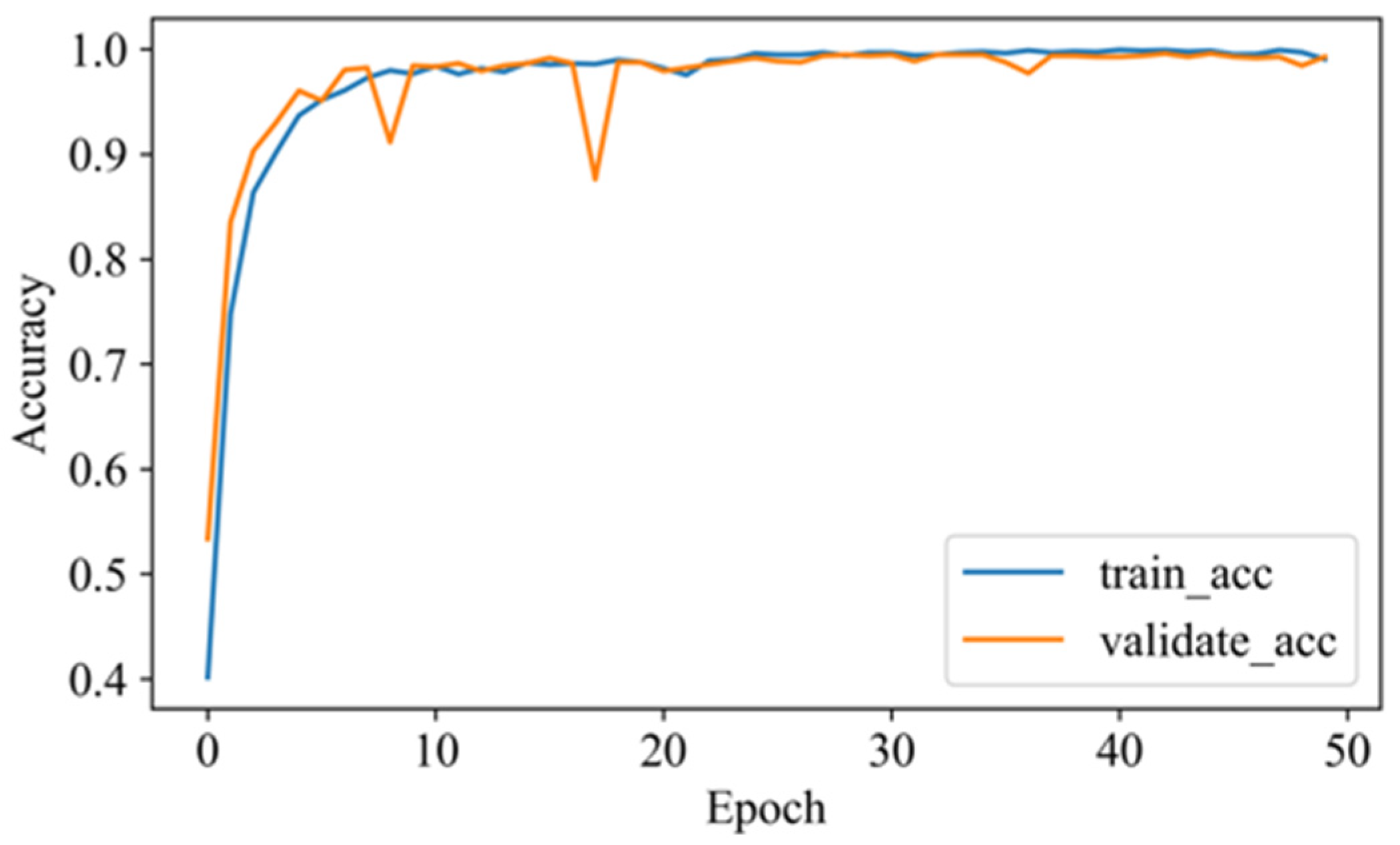
−4, and the loss function was the standard cross-entropy loss. The maximum number of training epochs was 50. An optimal model checkpointing strategy was adopted: the model’s performance on the validation set was monitored in real-time, and the model parameters were updated and saved whenever the validation accuracy surpassed the historical best.
Figure 4 shows the classification accuracy curves of the model on the training and validation sets during the training process. The model from epoch 43, which achieved the highest validation accuracy of 99.8%, was selected as the final model for evaluation.
3.2. Performance Analysis of the MLEM-PQD Model
The final MLEM-PQD model was comprehensively evaluated on a test set containing all 10 typical power quality disturbance types. Model performance was evaluated using two metrics: Recall and F1-score. Recall reflects the false negative rate (i.e., the rate of missed detections), which is particularly critical in power quality analysis. The F1-score provides a balanced measure that jointly accounts for both missed detections (false negatives) and false alarms (false positives). Their mathematical formulations are as follows:
where TP, FP, and FN denote the number of true positives, false positives, and false negatives, respectively. Specific performance data are shown in
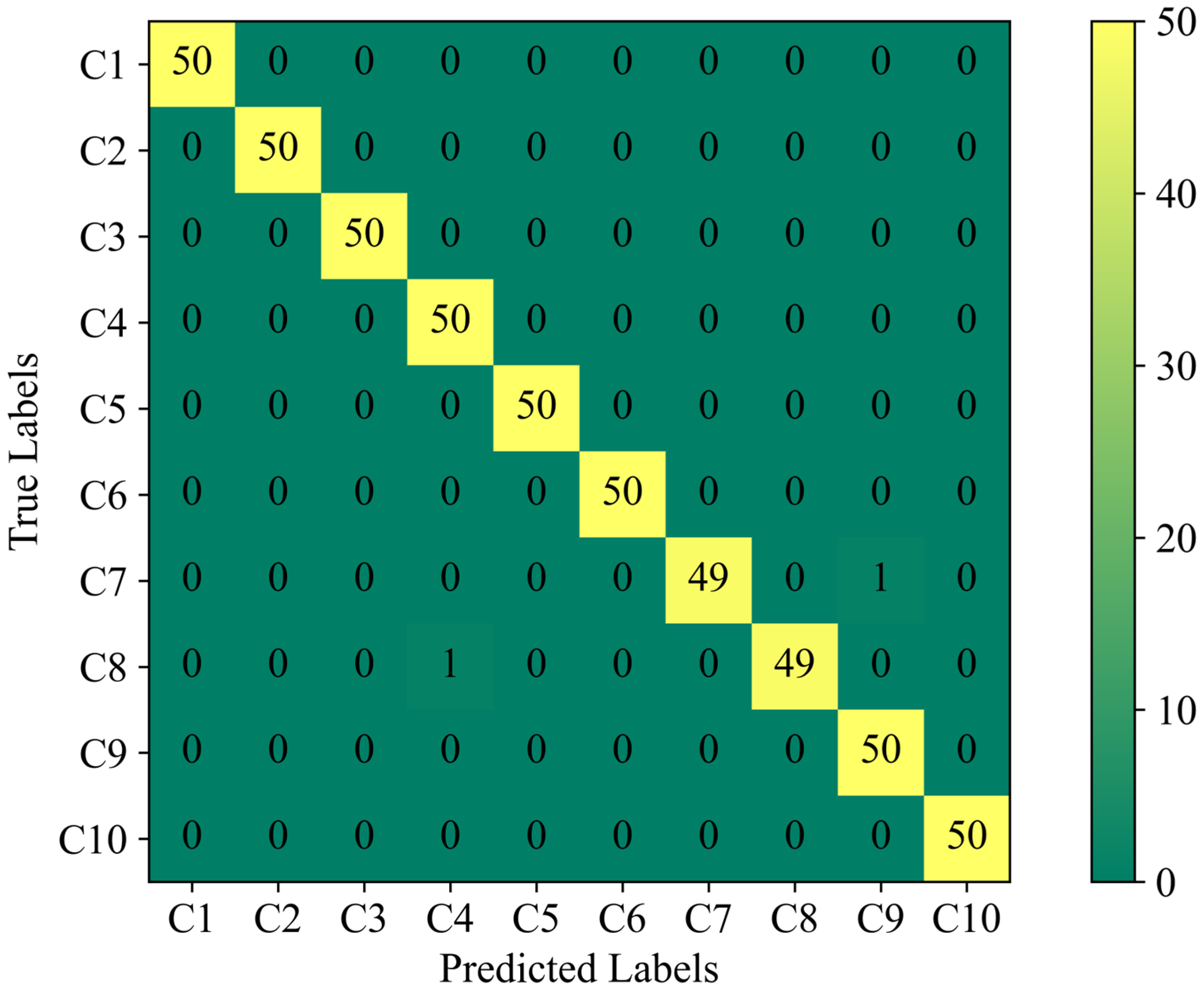
Table 2, where the model achieved a high recall rate across all classes, demonstrating its sensitivity and coverage for various disturbance events. Specifically, all classes except Voltage pulse (C7) and Voltage oscillation (C8) achieved a perfect 100% recall rate, as illustrated by the confusion matrix in
Figure 5. This indicates that the model can identify most disturbance types without omission. Notably, although the Voltage pulse and Voltage oscillation classes exhibited minor missed detections (one misclassified sample each), detailed analysis of the off-diagonal elements revealed that the misclassifications were confined to a single instance of C7 being confused with Voltage gap (C9), and one instance of C8 misclassified as Voltage harmonics (C4).
Crucially, this result effectively addresses the concern regarding potential correlations between physically similar disturbances. For instance, despite the spectral overlap between Voltage harmonics (C4) and Voltage pulse (C7), or the amplitude anomalies characterizing both Voltage surge (C2) and Voltage gap (C9), the confusion matrix exhibited zero misclassification between these specific pairs. This empirical evidence confirms that the proposed method effectively decouples these correlated features in the high-dimensional space, ensuring distinct decision boundaries even for signal types with overlapping parametric characteristics. Consequently, the overall false negative rate was extremely low, meeting the core requirement of high reliability in power system monitoring. From a macro perspective, the model achieved a Macro-average Recall of 99.60%, signifying its excellent and stable fault capture capability under balanced class conditions. Furthermore, its F1-score was also 99.60%, confirming that the model maintained a low false positive rate in addition to its minimal missed detection. These results demonstrate that the proposed multi-level ensemble architecture not only effectively enhances the detection sensitivity for minority disturbance classes, but also achieves near-perfect classification performance at the global level, showcasing significant potential for practical engineering applications.
To validate the contributions of BiTCN, Cross-Attention, and the Dual-Branch architecture, we conducted an ablation study, as shown in
Table 3, using the F1-score as the primary metric. The full model achieved the highest average F1-score of 99.6%, while removing any component degraded performance. The Dual-Branch architecture proved most critical; its removal caused the average F1-score to drop significantly to 94.24%. Specifically, frequency-sensitive classes like voltage flicker (C5) suffered the most (falling to 88.24%), demonstrating that time-domain features alone are insufficient for capturing spectral characteristics. Removing Cross-Attention lowered the score to 98.16%, with noticeable declines in complex disturbances (e.g., voltage pulse, C7; voltage oscillation, C8), indicating the necessity of attention for effectively aligning multi-modal features. Finally, removing BiTCN resulted in a slight drop to 98.80%, confirming its value in capturing global temporal dependencies. These results confirm that the synergistic integration of all three components is essential for optimal PQD classification.
3.3. Comparative Evaluation of Model Performance
To comprehensively assess the effectiveness of the proposed method, MLEM-PQD was benchmarked against four representative baseline models—Support Vector Machine (SVM), one-dimensional Convolutional Neural Network (CNN-1D), Simple Transformer, and ResNet-1D—on the same power quality disturbance dataset. The evaluation focused on Macro-average Recall and overall Accuracy to reflect the model’s balanced detection capability across all disturbance types and its global discriminative precision.
As presented in
Table 4, the experimental results show that the proposed MLEM-PQD significantly outperformed all baseline methods, achieving a Macro-average Recall of 99.60% and a Macro-average F1-score of 99.60%, which demonstrates near-perfect fault capture ability and classification consistency. In contrast, the performance of the baseline models was notably inferior. ResNet-1D performed the best among them, with a Macro-average Recall of 96.00% and an F1-score of 96.07%. CNN-1D followed with a Macro-average Recall of 94.60% and an F1-score of 94.57%. The Simple Transformer achieved only 78.80% Macro-average Recall and 78.12% F1-score, indicating its inability to effectively model the disturbance features in this task. Most strikingly, the traditional machine learning method, SVM, exhibited severe performance deficiency, with a Macro-average Recall of merely 46.40% and an F1-score of 48.52%, far below that of deep learning models. This is likely because in scenarios like power quality where feature distributions between classes are highly overlapping, the kernel function of an SVM struggles to construct an effective discriminative hyperplane, hindering its classification accuracy for most categories.
In summary, deep learning models, with their powerful capabilities for automatic feature extraction and nonlinear modeling, significantly outperform traditional methods in the task of power quality disturbance classification. The proposed multi-level ensemble strategy, by fusing the strengths of multiple models, further elevates the Macro-average Recall and accuracy to 99.60%, effectively addressing the issue of class missed detection that may plague single models. This validates its superiority and robustness in high-reliability power monitoring scenarios.
3.4. Model Robustness Evaluation
To systematically evaluate the robustness of the proposed MLEM-PQD under noise interference, Gaussian white noise with Signal-to-Noise Ratios (SNRs) of 50 dB, 40 dB, and 30 dB was introduced during the testing phase. The model’s Macro-average Recall and Macro-average F1-score were then compared across these noise levels. As a reference, the model achieved a Macro-average Recall and F1-score of 99.6% under noise-free conditions, demonstrating excellent baseline performance.
The results in
Table 5 indicate that the model maintained exceptionally high classification stability even under strong noise interference. At an SNR of 50 dB (representing a near-ideal measurement environment), the Macro-average Recall and F1-score remained at 99.60%, virtually identical to the noise-free scenario, confirming the model’s complete immunity to weak noise. As the noise intensity increased to 40 dB (a typical industrial field level), the performance only slightly degraded to 99.40%. The recall rates for all individual classes remained above 96%, with only the Voltage pulse and Voltage spikes categories exhibiting isolated misclassifications, indicating that the overall robustness was not significantly compromised. When the SNR was further reduced to 30 dB (a high-interference scenario where the noise power is one-thousandth of the signal power), the model’s Macro-average Recall and F1-score still reached an impressive 99.00%. Seven of the ten classes maintained a 100% recall rate, and the worst-performing classes (voltage pulse and voltage spikes) had recall rates of at least 94%.
Notably, as the SNR decreased from 50 dB to 30 dB—a 100-fold increase in noise power—the model’s Macro-average Recall declined by only 0.6 percentage points, with the F1-score showing a similarly minimal change. This fully demonstrates the strong adaptive capacity of the proposed Multi-level Ensemble Model to severe noise pollution. In conclusion, the MLEM-PQD exhibits outstanding and stable performance across varying noise intensities, maintaining a 99.00% Macro-average Recall even under the challenging 30 dB strong noise condition. This validates its feasibility and reliability for deployment in the complex electromagnetic environments of real-world power systems, highlighting its significant practical engineering value.
4. Conclusions
This paper addresses the challenges posed by the strong nonlinearity and complex dynamic behavior of power quality disturbances in the context of high-penetration renewable energy integration. We propose a MLEM-PQD. The core of this method is a TF-DBFE module, which leverages Residual Networks to extract deep discriminative features from both the raw time-domain signal and its FFT spectrum, and employs a BiTCN to capture long-range temporal dependencies effectively. Furthermore, a novel Cross-Attention mechanism is introduced to enable adaptive, deep fusion of time–frequency features, significantly enhancing the model’s ability to focus on critical disturbance information and improving the discriminative power of its feature representations.
To thoroughly validate the proposed model, systematic experiments were conducted on a dataset comprising 10 typical disturbance types, generated strictly in accordance with the IEEE Std 1159-2019 standard. The results demonstrate the superior comprehensive performance of the MLEM-PQD model. Under noise-free conditions, it achieved a Macro-average Recall and F1-score of 99.60%, significantly outperforming traditional machine learning methods (e.g., SVM) and various mainstream deep learning baselines (e.g., CNN-1D, ResNet-1D, and Simple Transformer). Furthermore, ablation studies explicitly validated the contribution of each key component: the removal of the Dual-Branch architecture resulted in the most significant performance drop, with the Average F1-score falling to 94.24%, underscoring the necessity of joint time–frequency analysis. Similarly, omitting the Cross-Attention mechanism and BiTCN module reduced the Average F1-score to 98.16% and 98.80%, respectively, confirming their vital roles in multi-modal feature fusion and temporal dependency modeling. More importantly, the model exhibited exceptional noise robustness. Even under strong Gaussian white noise interference with an SNR as low as 30 dB, its Macro-average Recall remained stable at a high level of 99.00%, with negligible performance degradation. This characteristic stems directly from its multi-level ensemble architecture and the optimized internal modules, which enable it to effectively suppress noise interference and accurately capture the essential patterns of disturbances, thus meeting the stringent requirements of modern power systems for high reliability and strong environmental adaptability in monitoring equipment.
Despite the significant achievements of this study, there are directions for future exploration. First, the current model is primarily designed for single disturbance type identification; future work could extend it to the joint detection and decoupling analysis of composite disturbances. Second, the computational complexity of the model is relatively high; for resource-constrained edge-side online monitoring scenarios, model compression or lightweight strategies could be investigated to improve deployment efficiency.
Author Contributions
Conceptualization, H.B., R.Y., S.J. and Y.H.; Methodology, R.Y. and S.J.; Software, H.B. and C.L.; Validation, R.Y.; Formal analysis, C.L.; Investigation, H.B. and T.L.; Resources, C.L., Y.L. and T.L.; Writing—original draft, Y.H.; Writing—review & editing, T.L. and Y.H.; Visualization, H.B.; Supervision, C.L., Y.L. and Y.H.; Project administration, S.J. All authors have read and agreed to the published version of the manuscript.
Funding
The Science and Technology Project of China Southern Power Grid Co., Ltd. (No. ZBKJXM20232295).
Data Availability Statement
Conflicts of Interest
The authors Hao Bai, Ruotian Yao, Tong Liu, and Shiqi Jiang are employed by the CSG Electric Power Research Institute. Chang Liu and Yuchen Huang are students at the College of Electrical and Information Engineering, Hunan University, Changsha 410082, China. Yiyong Lei was employed by China Southern Power Grid Co., Ltd., Guangzhou 510663, China. All authors declare that the research was conducted in the absence of any commercial or financial relationships that could be construed as potential conflicts of interest. The authors declare that this study received funding from China Southern Power Grid Co., Ltd. The funder was not involved in the study design, collection, analysis, interpretation of data, the writing of this article or the decision to submit it for publication.
References
- Zhu, L.; Wen, W.; Qu, Y.; Shen, F.; Li, J.; Song, Y.; Liu, T. Robust representation learning for power system short-term voltage stability assessment under diverse data loss conditions. IEEE Trans. Neural Netw. Learn. Syst. 2024, 35, 6035–6047. [Google Scholar]
- Zhuo, Y.; Zhou, B.; Yao, W.; Wang, J.Y.; Lu, S.Y. Prediction of energy and electricity consumption and load characteristics in the southern region under the carbon peak and carbon neutrality target. South. Power Syst. Technol. 2023, 17, 132–140. [Google Scholar]
- Zhu, L.; Wen, W.; Li, J.; Zhang, C.; Shen, Y.; Hou, Y.; Liu, T. Structure-aware recurrent learning machine for short-term voltage trajectory sensitivity prediction. IEEE Internet Things J. 2024, 11, 15128–15139. [Google Scholar] [CrossRef]
- Xi, X.; Xing, C.; Qin, R.; Guo, C.; Zhou, X. Power quality disturbance identification method based on deep convolutional denoising network. South. Power Syst. Technol. 2022, 16, 118–125. [Google Scholar]
- Anggriawan, D.O.; Wahjono, E.; Sudiharto, I.; Firdaus, A.A.; Putri, D.N.N.; Budikarso, A. Identification of short duration voltage variations based on short time Fourier transform and artificial neural network. In Proceedings of the 2020 International Electronics Symposium (IES), Surabaya, Indonesia, 29–30 September 2020; pp. 43–47. [Google Scholar]
- Hong, W.; Liu, Z.; Wu, X. Power quality disturbance recognition based on wavelet transform and convolutional neural network. In Proceedings of the 2021 IEEE International Conference on Artificial Intelligence and Computer Applications (ICAICA), Dalian, China, 28–30 June 2021; pp. 193–197. [Google Scholar]
- Liang, C.; Teng, Z.; Li, J.; Yao, W.; Wang, L.; He, Q.; Hu, S. Improved S-transform for time-frequency analysis for power quality disturbances. IEEE Trans. Power Deliv. 2022, 37, 2942–2952. [Google Scholar] [CrossRef]
- Liu, Z.; Cui, Y.; Li, W. A classification method for complex power quality disturbances using EEMD and rank wavelet SVM. IEEE Trans. Smart Grid 2015, 6, 1678–1685. [Google Scholar] [CrossRef]
- Lin, W.-M.; Wu, C.-H.; Lin, C.-H.; Cheng, F.-S. Detection and classification of multiple power-quality disturbances with wavelet multiclass SVM. IEEE Trans. Power Deliv. 2008, 23, 2575–2582. [Google Scholar] [CrossRef]
- Zhong, T.; Zhang, S.; Cai, G.; Li, Y.; Yang, B.; Chen, Y. Power quality disturbance recognition based on multiresolution S-transform and decision tree. IEEE Access 2019, 7, 88380–88392. [Google Scholar] [CrossRef]
- Wright, P.S. Short-time Fourier transforms and Wigner–Ville distributions applied to the calibration of power frequency harmonic analyzers. IEEE Trans. Instrum. Meas. 1999, 48, 475–478. [Google Scholar] [CrossRef]
- Huang, J.; Jiang, Z.; Negnevitsky, M. Recognition of power quality disturbances. IEEE Trans. Ind. Appl. 2025, 61, 8811–8819. [Google Scholar] [CrossRef]
- Zhu, L.; Wen, W.; Li, J.; Hu, Y. Integrated data-driven power system transient stability monitoring and enhancement. IEEE Trans. Power Syst. 2024, 39, 1797–1809. [Google Scholar] [CrossRef]
- Zhao, C.; Peng, Y.; Cao, Y.; Wang, Q.; Shuai, Z.; Zhu, L. A novel push–pull-based circuit for crosstalk oscillation suppression of SiC-MOSFETs. IEEE Trans. Ind. Electron. 2026. early access. [Google Scholar] [CrossRef]
- Wang, M.; Deng, Z.; Zhang, Y.; Zhu, Z. An automatic identification framework for complex power quality disturbances based on ensemble CNN. IEEE Access 2023, 11, 56550–56560. [Google Scholar] [CrossRef]
- Caicedo, J.E.; Agudelo-Martínez, D.; Rivas-Trujillo, E.; Meyer, J. A systematic review of real-time detection and classification of power quality disturbances. Prot. Control. Mod. Power Syst. 2023, 8, 1–37. [Google Scholar] [CrossRef]
- Deng, Y.; Wang, L.; Jia, H.; Tong, X.; Li, F. A sequence-to-sequence deep learning architecture based on bidirectional GRU for type recognition and time location of combined power quality disturbance. IEEE Trans. Ind. Inform. 2019, 15, 4481–4493. [Google Scholar] [CrossRef]
- Liu, S.; Wang, Q.; Liu, G. A versatile method of discrete convolution and FFT (DC-FFT) for contact analyses. Wear 2000, 243, 101–111. [Google Scholar] [CrossRef]
- Li, H.; Wu, X.J. CrossFuse: A novel cross attention mechanism–based infrared and visible image fusion approach. Inf. Fusion 2024, 103, 102147. [Google Scholar] [CrossRef]
- Song, J.; Li, W.; Zhu, S.; Zhou, C.; Xue, G.; Wu, X. Predicting hourly heating load in district heating systems based on a hybrid bidirectional long short-term memory and temporal convolutional network model. J. Clean. Prod. 2024, 463, 142769. [Google Scholar] [CrossRef]
- Khetarpal, P.; Nagpal, N.; Al-Numay, M.S.; Siano, P.; Arya, Y.; Kassarwani, N. Power quality disturbances detection and classification based on deep convolution auto-encoder networks. IEEE Access 2023, 11, 46026–46038. [Google Scholar] [CrossRef]
| Disclaimer/Publisher’s Note: The statements, opinions and data contained in all publications are solely those of the individual author(s) and contributor(s) and not of MDPI and/or the editor(s). MDPI and/or the editor(s) disclaim responsibility for any injury to people or property resulting from any ideas, methods, instructions or products referred to in the content. |




 ,
,