Article

Reactive Energy Management in Multimodal Mass Transportation Networks: Metro de Medellín Case Study


by
Andrés Emiro Díez-Restrepo
1,*,
Jhon Fredy Fernandez-Corrales
2,
Mauricio Restrepo
3,
Edison Manrique
2 and
Tomás Porras-Naranjo
1
1
Department of Electrical and Electronics Engineering, Universidad Pontificia Bolivariana, Circular 1 70-01, Medellín 050031, Colombia
2
Metro de Medellin, Medellin 051051, Colombia
3
Department of Electrical and Electronics Engineering, Universidad del Norte, km 5 Vía Puerto Colombia, Barranquilla 081007, Colombia
*
Author to whom correspondence should be addressed.
Energies 2026, 19(3), 578; https://doi.org/10.3390/en19030578
Submission received: 28 November 2025 / Revised: 16 December 2025 / Accepted: 26 December 2025 / Published: 23 January 2026
(This article belongs to the Section F: Electrical Engineering)

Abstract

Multimodal electric transport systems demand substantial active and reactive energy, making power-quality management essential for ensuring efficient and reliable operation. This paper analyses reactive-energy transport in mass-transit networks and introduces a unified current-based framework that enables a consistent interpretation of the conventional power factor under harmonic distortion, fundamental unbalance, and short-term load fluctuation, without modifying its original definition. The framework enables a consistent assessment of compensation needs, independent of billing schemes, and is aligned with the way modern compensation equipment is specified and controlled. Applied to the Metro de Medellín system, field measurements and digital simulations show that traditional reactive-energy limits fail to distinguish between harmful and beneficial operating conditions, leading to disproportionate charges under the former Colombian regulation. Beyond this case, the proposed framework is directly applicable to other electric-mobility systems—including railways, trams, trolleybuses, and electric-bus networks—providing clearer technical signals for compensation planning and offering a comprehensive basis for future regulatory approaches that integrate multiple power-quality phenomena.

1. Introduction

1.1. Motivation

As modern power grids become increasingly constrained, regulators seek mechanisms that allocate network costs according to users’ technical impact. In fully electrified transport systems, where nearly all energy is supplied electrically, managing reactive and non-active power flows is essential for ensuring reliable and cost-efficient operation.
Between 2018 and 2024, CREG Resolution 015 [1] established one of the strictest approaches to reactive energy transport worldwide, making its cost, in some cases, several times higher than that of active energy. The regulation penalized both inductive and capacitive reactive energy, independently of their net effect and regardless of whether the injections were beneficial to the grid. The supply network of Metro de Medellín, a representative multimodal electric transport system integrating heavy rail, trams, cable cars, and electric buses that mobilizes over one million passengers daily, exhibits naturally capacitive behavior during low-demand hours. This is a result of extensive underground cable runs, redundant feeder configurations, and the partially reversible nature of traction converters. Although this behavior is technically benign, it resulted in significant reactive energy transport penalties under Resolution 015 [1].
This experience revealed a fundamental mismatch between technical behavior and tariff design, highlighting the need for analytical tools and regulatory criteria capable of distinguishing detrimental from compensatory electrical behaviors. To address this gap, this study introduces a Unified Power Quality Compensation Framework based on dimensionless, current-based indices that extend the conventional definition of power factor. The framework consistently incorporates reactive energy transport, harmonic distortion, unbalance, and short-term load fluctuation as coexisting compensable phenomena. Expressing these indices entirely in terms of current ensures compatibility with modern compensation equipment, typically specified and controlled in current, and enables a transparent assessment of both demand and injection effects at the point of connection. The proposed framework is applied to the Metro de Medellín system, integrating field measurements, digital simulations, and practical mitigation actions. Beyond this case, the approach is applicable to other electric mobility systems such as railways, trams, trolleybuses, and electric bus networks, providing a coherent basis for compensation planning and supporting future regulatory schemes aligned with real technical performance.

1.2. International Regulations on Reactive Energy Charges

In most countries, reactive energy compensation is handled indirectly through minimum power factor requirements rather than explicit tariffs. However, the strictness of these limits and the treatment of capacitive operation vary significantly across jurisdictions. In Brazil, capacitive reactive energy transport is permitted below 69 kV if the power factor remains between 0.92 and 1 leading [2]. In Chile, capacitive injection is restricted only above 200 kV [3]. In the United States, NERC recommends minimizing reactive energy injections [4], whereas in Canada, the IESO allows leading operation up to 0.9 [5]. In Spain, excess capacitive reactive energy is prohibited during the low-demand period 6, and a charge applies when the power factor drops below 0.98 [6]. Similarly, the United Kingdom enforces a minimum power factor of 0.95 [7]. In Australia, capacitive injection is prohibited above 50 kV [8], while in South Africa it is allowed only under prior agreement with the operator [9].
A particularly strict scheme exists in Latvia, where inductive reactive energy is limited through a minimum power-factor requirement of cos(ϕ) ≥ 0.929, and any capacitive injection incurs an additional charge. This approach resembles Colombia’s former scheme from Resolution 015 [1], which simultaneously penalized inductive excess and beneficial capacitive injections. One of the few academic works aimed at influencing regulation [10] proposes user-specific optimal tan(δ) values to minimize distribution losses in Poland; however, it recommends prohibiting capacitive injections, diverging from current Polish regulations [11] and failing to address other PQ aspects such as unbalance, harmonics, or short-term fluctuations. A later extension described in [12] incorporates AMI data to dynamically adjust permissible reactive limits, though it remains focused solely on loss minimization and assumes a strict capacitive criterion.
In Colombia, Resolutions 015 of 2018 [1] and 199 of 2019 [13] established a framework where the cost of reactive energy transport acted as a penalty, even if formally referred to as an incentive. The regulation defined the hourly charge as:
T C E R = E R × M × U C R
where TCER is the cost of excess reactive energy, ER corresponds to the excess reactive energy, M represents a monthly penalty factor, and UCR is the use charge for reactive energy transportation. The factor M increased from 1 to 12 if the user failed to correct excesses for consecutive months. Inductive excess was charged when it surpassed 50% of active energy consumption, whereas any capacitive excess was fully billed, independent of active energy. Reactive energy was evaluated on an hourly basis, with inductive and capacitive components measured separately, without netting.
Although the resolution states that the cost applies to the total reactive energy recorded during the period, two interpretations emerged. In practice, most operators adopted the strictest approach, charging inductive and capacitive excesses independently. This led to higher penalties and inconsistent treatment of operating conditions that were not necessarily detrimental to the grid.
Given its significant economic impact, CREG revised the framework through Resolution 101 035 of 2024 [14]. The update modified reactive energy transport limits and aligned part of the scheme with the operational regulations of the National Interconnected System [15], although the increasing penalty factor M remained unchanged. Key modifications include: (i) eliminating the prohibition of operating with a leading power factor, (ii) requiring an inductive power factor ≥ 0.90 on an hourly or billing-period basis, and (iii) defining voltage-level–dependent limits for capacitive reactive energy transport, as summarized in Table 1.
To determine whether the capacitive power factor complies with the above limits, the ratio of the arithmetic sum of the reactive energy over a billing period (monthly, bimonthly, or quarterly) to the amount of active energy in the same period must be calculated, regardless of the type of meter used.
Table 2 presents an updated summary of the reactive power transport limits in Colombia, as established in [14]. Notably, the limits for capacitive reactive energy have been modified, and the requirements now vary depending on the voltage level. Additionally, the M factor mechanism for repeated excesses of reactive energy remains in effect. According to the regulation, if inductive excesses occur on more than 11 days within a billing month, the penalty is triggered, and the reactive energy is billed using an increasing multiplier. Under these new thresholds, the main and electric bus lines of Metro de Medellín would not have incurred charges for capacitive reactive energy, even without implementing corrective actions. However, the asymmetry in the time aggregation criteria introduces a regulatory inconsistency that may influence how excess reactive energy is detected and billed.

Compensation Solutions for Reactive Energy in Transportation Systems

Several studies address PQ challenges in railway and metro networks. In [16], phenomena associated with traction power supply are analyzed, and improvements in power factor are linked to the adoption of advanced AC/DC conversion topologies. In the Novosibirsk metro system, power factors between 0.79 and 0.95 were reported, with some auxiliary loads (e.g., escalators) falling as low as 0.18 [17]. Subsequent work proposed corrective actions combining automatic capacitor banks and active power factor correction using IGBTs [18], noting that IGBT-based solutions offer superior performance but at higher cost. For the Bucharest Metro, ref. [19] describes an active traction substation that enables reversible operation and harmonic filtering, although it can only perform one of these functions at a time.
Other systems face simultaneous penalties for harmonics and reactive power, such as the Turkish passenger network described in [20], which employs thyristor-switched reactors and active filtering. A different alternative is the use of synchronous condensers, capable of absorbing or supplying reactive power depending on excitation. Their implementation in a metro system in [21] achieved a 51% reduction in electricity costs.
Modern STATCOM architectures integrate ultra-fast active filters capable of compensating reactive power, harmonics, and unbalance simultaneously. Their performance depends largely on control robustness. For instance, the STATCOM installed at the 63 kV Mesnay traction substation in France mitigates the severe unbalance caused by the single-phase catenary–rail supply of high-speed trains, ensuring compliance with national grid codes [22].
Despite the availability of multifunctional equipment, regulatory frameworks focused solely on reactive energy make it difficult to justify their adoption. Most commercial active filters and static VAR compensators are specified by rated current rather than power, meaning their apparent power capability depends on the local voltage. These devices typically allow prioritizing compensation functions (reactive power, harmonics, or unbalance). This reinforces one advantage of the current-based power-factor indices proposed in this work: they provide a consistent way to characterize and compare multifunctional compensation systems independently of voltage-dependent power ratings.

1.3. Emerging Tariff Schemes for Harmonic Distortion and Other Power Quality Phenomena

Although most existing regulations focus primarily on reactive power, several countries and research initiatives have begun exploring mechanisms to account for harmonic distortion as an additional compensable phenomenon. Harmonics, caused mainly by nonlinear loads and converters, produce effects analogous to reactive energy transport, including increased losses and voltage distortion. Consequently, some authors have proposed harmonic pricing frameworks based on users’ quantified contributions to distortion. Harmonics in electrical systems have a behavior similar to that of reactive energy, since they constitute energy flows between a source and a load, increasing the demands on electricity transport equipment, with an aggravating factor: the circulation of currents with harmonic distortion produces distortions in the voltage at the point of connection of other equipment and eventually causes resonance phenomena with destructive effects. In general, harmonics increase equipment losses and reduce their useful life. As with reactive power, the circulation of harmonic currents must be limited by means of compensation systems, which are often also responsible for reactive power compensation. In the same way that reactive transport is charged, the injection of harmonics is susceptible to be penalized in tariffs, and harmonic compensation is susceptible to remuneration schemes [23].
For instance, the techno-economic framework proposed in [23] integrates harmonic emission and network losses into a unified cost allocation model using Shapley values. Similarly, refs. [24,25] propose tariff schemes that assign charges proportionally to the harmonic content injected by each customer, encouraging distortion mitigation through economic incentives. Although no country currently enforces national-level harmonic tariffs, these studies illustrate a growing trend toward expanding PQ regulation beyond the reactive component.
Authors in [26] present a bi-level optimization model that coordinates active and reactive power between distribution networks and microgrid clusters through time-of-use price signals, promoting reactive compensation in weak LV networks where phase imbalance is critical. The approach effectively mitigates three-phase unbalance using existing PV inverters, highlighting the growing interest in economically driven coordination for PQ improvement. However, it focuses solely on reactive and imbalance compensation, without integrating harmonic distortion, negative-sequence effects, or voltage fluctuation, thus lacking a unified treatment of non-active phenomena. The problem of costing the harmonics injected into the grid has been approached from different perspectives such as determining the harmonic comprehensive contribution [24], along with proposing harmonic metering price and the harmonic penalty price. Reference [24] also recognizes the need of a comprehensive pricing strategy combining harmonics, power factor, and reactive power as further investigation. Similarly, ref. [25] proposes a payment fee to the user based in harmonic contribution calculations, which would produce a response action to control the harmonic propagation.

1.4. Toward Comprehensive Power Quality Compensation

The diversity of regulatory practices highlights a fundamental issue: tariff schemes based solely on power factor fail to capture the multidimensional interactions between loads and networks in modern, converter-dominated electrical systems. As electric mobility, distributed generation, and power electronic equipment proliferate, analytical frameworks must evaluate and compensate a broader set of PQ impacts.
In [27], the authors introduce cost-effectiveness indicators for reactive and harmonic compensation such as the harmonic rate, voltage fluctuation rate, and equipment utilization ratio, and propose an optimization framework for coordinated deployment of VDAPF and SVG. Their approach establishes a foundation for integrated evaluation of compensation effectiveness, which our work expands by incorporating unbalance and broader PQ interactions. The terminology adopted by [27] underscores the importance of simple yet rigorous formulations to ensure comparability across compensation schemes.
A device-oriented perspective is presented in [28], where a deep-learning-based controller for parallel DSTATCOMs achieves improved voltage regulation and harmonic suppression under dynamic events. While this reinforces the relevance of intelligent control in real-time compensation, it also highlights the absence of a unified framework to determine overall compensation requirements, as the study focuses primarily on harmonics and transient behavior.
Recent work, therefore, calls for incorporating additional phenomena, such as unbalance and flicker, into comprehensive compensation schemes. These variables influence efficiency, stability, and users’ perception of PQ, yet current billing systems rarely recognize their compensatory potential or penalize their harmful contributions.
This regulatory and conceptual gap motivates the development of a Unified Power Quality Compensation Framework capable of integrating reactive power, harmonics, unbalance, and fluctuation within a single analytical structure, offering consistent guidance for users, system operators, and equipment designers.

1.5. Contributions

Building on the previous discussion, this study examines the limitations of the Colombian regulatory framework for reactive energy transport in force between 2018 and 2024, providing a critical assessment of its tariff design and its effects on multimodal electric transport systems such as Metro de Medellín. Beyond this analysis, the paper contributes a methodology for addressing reactive energy compensation in converter-dominated transportation networks, emphasizing the need for a comprehensive approach that incorporates additional PQ phenomena, including harmonic distortion and unbalance. This integrated perspective forms the basis for the Unified Power Quality Compensation Framework proposed in this work, which is applicable to similar systems and regulatory contexts.
The primary objective of the paper is to address reactive-energy compensation in energy-supply systems that are fluctuating, nonlinear, unbalanced, and characterized by significant reactive exchange. To support this aim, the study introduces a current-based formulation for analyzing reactive-energy transport under such conditions, providing the analytical basis for the proposed compensation approach.

1.6. Content

The remainder of this paper is organized as follows. Section 2 reviews the state of the art on indices for reactive energy transport and PQ phenomena. Then, Section 3 describes the methodology that was followed in this work. Section 4 introduces the proposed extended power factor definition and the Unified Power Quality Compensation Framework. Section 5 presents the Metro de Medellín case study, including modeling, simulation results, and field verification. Finally, Section 6 summarizes the main conclusions and provides recommendations for future regulatory approaches.

2. State of the Art for the Proposed Framework

The definition of indices for electrical phenomena such as power, energy, and RMS values of voltage and current remains an active research topic, especially under nonlinear and unbalanced conditions. The theoretical foundation of this work follows IEEE Standard 1459-2000 [29], which extends classical concepts for power and energy measurement. Building upon this framework, several authors have proposed complementary indicators. For example, ref. [30] introduced the total power factor and alternative interpretations of the displacement power factor, while [31] proposed expressions for effective apparent power and harmonic unbalance factors to improve diagnostics in distorted and unbalanced systems. These contributions stress the need for indices that support compensation decisions following PQ assessments.
In contrast to these monitoring-oriented approaches, the present work focuses on indices that are simple to estimate and are directly linked to the concept of power factor. These indices are designed to support planning, regulation, and tariff design in contexts where users may generate phenomena affecting PQ. Since commercially available instruments cannot fully quantify effective apparent power or nonfundamental components according to IEEE 1459 [29], we propose current-based indices that can be readily derived from existing PQ analyzers and smart meters. This enables practical assessment and connection criteria for loads in multimodal transport systems, where four phenomena dominate: reactive energy transport, nonlinear demand, fluctuating demand, and unbalance.

2.1. Reactive Energy Transport

Reactive power flows occur at both fundamental and harmonic frequencies. As nonlinear demand became more significant, the traditional concept of power factor, focused on fundamental reactive power, was expanded to include the harmonic power factor. Because reactive energy transport at each frequency depends on the voltage–current phase shift at that frequency, we define the displacement component PFD using the phase difference θ 1 + of the positive-sequence fundamental voltage and current:
P F D = cos ( θ 1 + )
For single-phase systems, the positive-sequence fundamental power P 1 + and apparent power S 1 + are estimated as:
P 1 + = V 1 + I 1 + cos ( θ 1 + )
S 1 + = V 1 + I 1 +

Reactive Energy Limits

Reactive energy transport can be constrained using two main approaches:
(1)
Power-factor limits: These limits, typically defined by voltage level, historically range from 0.9 (50% reactive share) to 0.995 (10%). As angles become small, differentiation through cos(ϕ) becomes less intuitive; therefore, limits are often expressed using tan(δ), proportional to the reactive–active ratio.
(2)
Absolute reactive power limits: Some tariff schemes set fixed limits on reactive power absorption or injection, independent of the transformer rating or voltage level. In Colombia, Resolution 015 of 2018 [1] billed any capacitive reactive power sent to the grid, regardless of system conditions. Operating with slightly leading power factor can, however, improve long- and short-term voltage stability, as shown in [32,33], reducing sags, mitigating fluctuations, and potentially deferring infrastructure upgrades in radial networks or regions with significant distributed generation.

2.2. Harmonic Distortion

AC power systems are intended to operate with sinusoidal voltages and currents at a defined frequency (50 or 60 Hz). However, equipment with nonlinear volt–ampere characteristics introduces waveform distortion, and when this distortion is periodic, harmonic analysis becomes an effective tool for characterizing its impact.
Excessive harmonic current flow can lead to more severe issues than those associated with fundamental reactive power, including reduced equipment capacity, accelerated aging, and potentially destructive resonance effects. Because both reactive and harmonic components influence the apparent power drawn by a load, the general power factor is commonly expressed as the product of the displacement and harmonic components:
G P F = P F D × P F H
When voltage THD is below 5% and current THD exceeds 40%, the approximation
P F H = 1 1 + T H D I 2
is recommended, as noted in [34]. As clarified in [35], these conditions correspond to systems with low source impedance and negligible voltage distortion relative to current distortion.
The reference standard for evaluating distorting loads connected to MV networks is IEC 61000-3-6 [36], which establishes emission limits and compatibility levels for MV, HV, and EHV systems. Traction substations fall within this category and should therefore be assessed according to its criteria.

2.3. Voltage Fluctuation

Variable-demand loads produce voltage fluctuations and, in severe cases, visible flicker in lighting systems. The IEC addresses this phenomenon by defining limits on the depth and rate of voltage variations, relating them to the capability of the power system to absorb changes in apparent power. It also establishes perception-based indicators derived from the lamp–eye–brain response, forming the basis of flicker assessment as specified in IEC 61000-4-15 [37].
In this study, traction substations are treated as fluctuating loads connected to the MV network and are evaluated according to IEC 61000-3-7 [38], which provides emission limits and compatibility criteria for fluctuating installations in MV, HV, and EHV systems.

2.4. Voltage Unbalance

Voltage unbalance negatively affects the efficiency and thermal behavior of three-phase motor-driven equipment. On the supply side, it may arise from improperly transposed lines, uneven phase loading, or asymmetric high-impedance faults. On the demand side, unbalanced single-phase loads or poor phase distribution can produce asymmetrical voltage drops across the system impedance.
In Metro de Medellín’s railway system, traction substations operate with three-phase rectifier configurations that draw symmetrical currents under normal conditions. Consequently, potential unbalance in the MV network is more likely associated with auxiliary services and commercial loads connected at passenger stations.
Voltage unbalance compatibility limits are defined in IEC 61000-2-12:2018 [39] for MV public networks, which recommends a maximum negative-sequence component of 2%. For LV systems, IEC 61000-2-2:2018 [40] establishes equivalent thresholds, providing complementary guidance depending on the voltage level.

3. Methodology

The proposed methodology identifies, characterizes, and mitigates reactive energy transport in multimodal electric transit systems, ensuring consistency with the Colombian regulatory framework and its recent updates. It integrates regulatory analysis, field measurements, equipment inspection, digital modeling, and validation. The main stages are as follows:
  • Regulatory framework review: A review of national and international regulations on reactive energy transport and PQ limits was conducted to contextualize CREG Resolutions 015 of 2018 [1] and 101 035 of 2024 [14], identify technical inconsistencies, and define the basis for a broader compensation framework.
  • Detailed field measurements: Class A analyzers were installed at the main traction substations to record high-resolution voltage, current, and power data at ten minute intervals. These measurements quantified active and reactive power flows, harmonic distortion, unbalance, and load fluctuation under different operating conditions.
  • Inspection and equipment characterization: Electrical equipment and MV feeders were inspected to determine the contribution of cables, transformers, and compensation devices to reactive power generation or absorption, as well as to harmonic distortion.
  • Rapid mitigation plan design: Based on initial findings, low-cost corrective actions were proposed, including the temporary disconnection of redundant MV feeders and operational reconfiguration to reduce capacitive behavior during valley-load periods while maintaining reliability.
  • Digital modeling and validation: A detailed OpenDSS model of the Metro de Medellín MV network was developed and calibrated using measured data. The model was used to simulate compensation alternatives and evaluate power-factor indices under the proposed framework.
  • Implementation and effect verification: The selected rapid mitigation actions were implemented and verified through new measurement campaigns. Comparative analysis of pre- and post-intervention data confirmed reduced capacitive reactive energy and validated the simulation results.
  • Planning of definitive solutions: Medium- and long-term solutions were evaluated, including electronic VAR compensators, harmonic filters, and rectification-scheme upgrades to ensure regulatory compliance and improved PQ.
  • Development of an extended conceptual framework: The results from the measurement, modeling, and regulatory analysis stages were consolidated into a unified framework integrating reactive energy, harmonics, unbalance, and fluctuation as coexisting compensable phenomena.

4. Power Factor Extended Definition

Although the standards discussed above provide robust methods for evaluating fluctuating, distorting, and unbalanced loads, a simplified perspective based on the widely recognized concept of power factor can be valuable. Because the power factor is familiar even outside electrical engineering, extending it to incorporate additional PQ phenomena can help bridge technical assessment and regulatory frameworks that use incentives or penalties to control user-side emissions.
Since reactive energy transport charges are typically based on the displacement power factor, PFD, it is reasonable to expect that future schemes incorporating harmonic-related penalties will rely on the general or total power factor. This motivates the development of extended power factor indicators that consistently integrate reactive power, harmonic distortion, unbalance, and fluctuation under a unified formulation.

4.1. PFD

Similar to the case of harmonic distortion, we consider convenient an alternative definition of the displacement power factor in terms of the characteristics of the current demanded or injected by a given load or equipment. A perfectly compensated load, in terms of PFD, would demand or inject current in phase with the voltage of the source.
I 1 d + = I 1 + cos ( θ 1 + )
If we define I 1 d + as the fundamental-positive sequence current component which is in phase with the fundamental-positive sequence voltage:
P F D = I 1 d + I 1 +
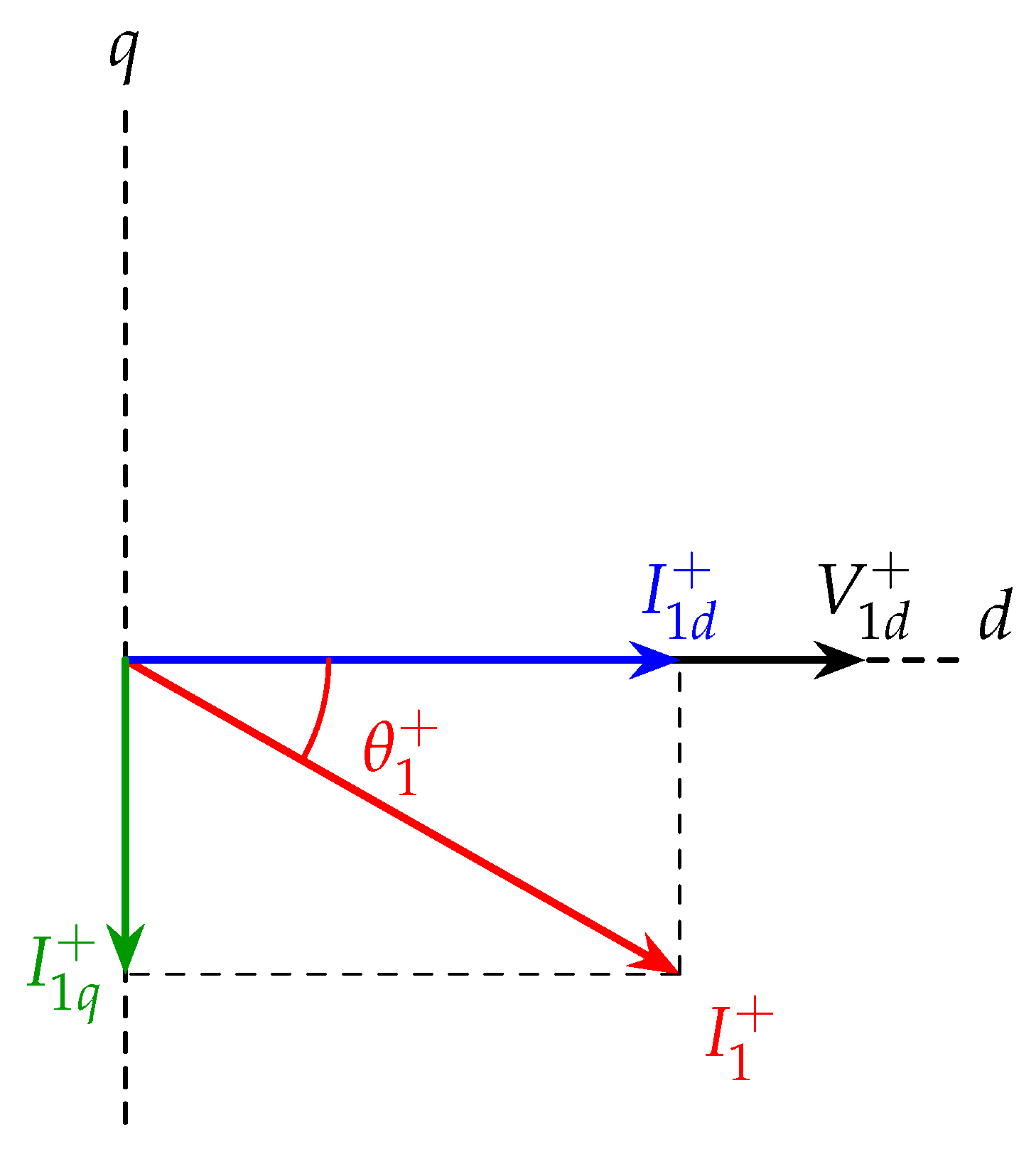
Then, we can propose the PFD as the ratio between the in-phase current and the total current, that contains the in-phase and the orthogonal components of the demand. For a polyphase system, the displacement power factor would be the ratio between I 1 d + and I 1 + , as shown in Figure 1.
Similarly, for single-phase systems, and considering only the fundamental direct and total components of the current, i.e., I 1 d and I 1 , the P F D can be calculated as:
P F D = I 1 d I 1
This definition is coherent with the line utilization indicator P F 1 + given in [29]:
P F 1 + = P 1 + S 1 +
It is also worth noting that the component of the current orthogonal to the reference voltage, denoted as I 1 q , or equivalently expressed through the equivalent quadrature current I e q , corresponds to the fundamental reactive demand or injection. This quadrature component is directly linked to the exchange of reactive power at the fundamental frequency and becomes the key quantity for sizing compensation devices such as active power filters or STATCOM-type systems.

4.2. PFU

As previously noted, in addition to the displacement component of reactive power at the fundamental frequency (PFD), a harmonic component (PFH) is already recognized. Likewise, fluctuability and unbalance in polyphase systems represent additional demand defects that require compensation.
To ensure a consistent treatment of these phenomena, we propose defining unbalance and fluctuation power factors in analogy with the existing reactive and harmonic components. In this context, the unbalance power factor, PFU, is defined as the ratio between the rms value of the positive-sequence fundamental current and the rms value of the combined positive-, negative-, and zero-sequence fundamental components.
P F U = I 1 + ( I 1 + ) 2 + ( I 1 ) 2 + 4 ( I 1 0 ) 2
Similar to the effective current defined in [34], the effective first-order three-phase current (excluding harmonic components) can be expressed as
I e 1 = ( I 1 + ) 2 + ( I 1 ) 2 + 4 ( I 1 0 ) 2
The unbalance power factor is then defined as
P F U = I 1 + I e 1
IEEE Std. 1459-2000 [29] proposes a related index, the Load Unbalance Factor (LU), defined as the ratio between the unbalanced fundamental apparent power and the positive-sequence apparent power:
L U = S 1 U S 1 + .
This index is conceptually the inverse of the proposed PFU.
Voltage unbalance is a harmful phenomenon that increases losses and heating in electric machines, which is why compatibility limits are strict. IEC 61000-2-2 [40] and IEC 61000-2-12 [39] specify maximum negative-sequence voltage components of 2% for LV and MV systems, and 1% for HV networks. Since current unbalance is one of the main causes of voltage unbalance, placing this defect on the same level as PFD and PFH through the proposed PFU provides a consistent basis for compensation analysis. Although novel, the definition of PFU becomes clearer when applied to representative use cases, as discussed in the following example. Let us first consider a synchronous generator supplying a purely single-phase load. As in the case of a phase-to-ground fault, the three sequence currents become equal because the sequence networks are effectively in series. Under this condition, the unbalance power factor PFU equals 0.58. Such severe unbalance produces major operational problems for the generator due to strong negative-sequence fluxes and circulating homopolar currents.
From the standpoint of PFU, a single-phase load connected to a three-phase system clearly signals the need for demand balancing. In AC railway systems, traction units must be supplied in single-phase mode due to pantograph limitations, despite early attempts with three-phase pantographs, which were abandoned because of practical constraints. Since harmonics exhibit a sequential nature in polyphase systems (i.e., 1 ( + ) , 2 ( ) , 3 ( 0 ) , …), the defined unbalance refers exclusively to the fundamental-frequency component. In other words, it represents the fundamental unbalance, as it does not include the additional distortion-driven unbalance introduced by harmonic components.

4.3. PFF

To quantify the level of current fluctuation produced by a load or system, we propose the Fluctuation Power Factor, PFF, defined as the ratio between the average demand current and the maximum current over a selected time interval:
P F F = I average I max
The assessment interval may follow billing practices or be chosen according to user-specific interests. This index does not seek to characterize flicker directly; rather, it evaluates the magnitude of current fluctuations that drive rapid voltage changes.
Loads requiring disproportionately high installed capacity to satisfy short-duration peaks reduce grid efficiency and negatively affect PQ due to voltage variations and flicker. Such behavior can be mitigated using dynamic VAR compensators, active filters with flicker-control capabilities, or regenerative-energy solutions such as reversible substations or storage-based systems in railway applications.
The value of PFF is illustrated by the following example. A large induction motor started across the line may draw inrush currents five times its nominal value, resulting in a PFF near 0.2. If the same motor is started using a vector-controlled VFD, the inrush current can be reduced to roughly 1.3 times the average value, increasing PFF to about 0.7. Similar to operating with a low displacement power factor, the first case implies oversized installations and higher network losses.
The proposed index is fully compatible with the IEC framework for evaluating fluctuating loads. By limiting the amplitude of current fluctuations, the corresponding voltage variations, one of the main contributors to flicker, are inherently constrained. The second determinant of flicker severity is the frequency content of the fluctuations, governed by the lamp–eye–brain response defined in IEC 61000-4-15 [37]. In traction systems, fluctuation frequencies are typically inertia-driven and lie far from the critical sensitivity region near 8.8 Hz. Nevertheless, a comprehensive assessment should combine PFF with the short- and long-term flicker severity indicators Pst and Plt defined in the IEC standard.

4.4. PFH

Following the criteria introduced for demand and injection, the harmonic power factor is defined in terms of current as
P F H = I 1 I r m s ,
where I1 is the fundamental current and Irms is the total rms current, including harmonics.

4.5. Total Power Factor (PFDH)

The total power factor, which incorporates both displacement and distortion effects, is given by
P F D H = P F D   P F H = P F D 1 1 + T H D I 2 .
Expressed explicitly in terms of demanded or injected current:
P F D H = I 1 d I 1 1 1 + T H D I 2 ,
and equivalently:
P F D H = I 1 d I 1   I 1 I r m s = I 1 d I r m s .
For three-phase systems, the equivalent system current Ie introduced in [34] should be used:
P F D H = I 1 d + I e ,
where the equivalent rms current for a three-phase, four-wire system is
I e = I a 2 + I b 2 + I c 2 + I n 2 4 .

4.6. GPF

From the aforementioned definitions, the GPF can be calculated from all the previously mentioned power factors. In the case of poly-phase systems, the expression is:
G P F = P F D × P F H × P F U × P F F
and for single-phase systems, GPF is calculated as:
G P F = P F D × P F H × P F F
If currents are used in the calculation, the expression for single-phase systems becomes:
G P F = I 1 d + I e × I a v e r a g e I m a x
and in the case of polyphase systems, GPF is computed as:
G P F = I 1 d + I e × I 1 + I e 1 × I a v e r a g e I m a x
From this perspective, a perfectly compensated load or system is one that behaves as a balanced, linear, and purely resistive three-phase load. The GPF vector provides a practical basis for setting differentiated technically justified limits for non-active behavior. A global criterion of GPF > 0.9 can serve as an initial benchmark, consistent with traditional LV/MV power factor requirements. This threshold is meaningful for displacement, harmonic, and unbalance components, which can be addressed with conventional compensation. However, applying the same limit to the fluctuation component is unrealistic in traction systems, where short-term variability is inherent. Therefore, PFF should be used as a guidance indicator for compensation planning, as active filters, regenerative drives, and storage increasingly mitigate current fluctuation. For compatibility, users must still comply with IEC 61000 PST and PLT limits.
It is important to clarify that the orthogonality attributed to the components of the proposed GPF is not intended in a strict mathematical sense, but rather in a physical and analytical sense, consistent with established power theories. Each index represents a distinct and independent physical phenomenon: fundamental displacement, harmonic distortion, fundamental unbalance, and short-term fluctuation, which are defined over non-overlapping frequency, sequence, or temporal domains. This interpretation is aligned with the physical decomposition of current proposed by Czarnecki [41] in the Currents’ Physical Components (CPC) theory, where non-active current is separated into physically meaningful components associated with different energy exchange mechanisms and loss processes. Within this framework, orthogonality reflects the fact that compensating one phenomenon does not inherently mitigate the others, thereby justifying their independent representation within the GPF vector. This physics-based interpretation is consistent with the current-domain formulations underlying IEEE 1459 and provides a transparent basis for identifying dominant non-active behaviors and prioritizing compensation strategies.
From a regulatory perspective, the GPF formulation enables the definition of tariff or compliance structures based on transparent, technically grounded thresholds, analogous to conventional power factor limits but extended to multiple phenomena. Rather than prescribing a specific tariff equation, the GPF vector allows regulators to set admissible ranges for each component (e.g., displacement, distortion, unbalance, fluctuation), distinguishing benign operating conditions from those that impose measurable stress on the network. Regarding practical implementation, legacy billing meters are generally unable to compute all GPF components, particularly those related to unbalance and short-term fluctuation. However, this limitation is rapidly diminishing with the deployment of smart meters, advanced power quality analyzers, and substation-level monitoring systems capable of recording time-synchronized current waveforms. Since the proposed indices are entirely current-based and aligned with IEC measurement practices, they are naturally compatible with ongoing smart grid and digitalization initiatives, making large scale implementation technically feasible without requiring fundamental changes to measurement principle.

4.7. Conceptual Flow of the Proposed Framework

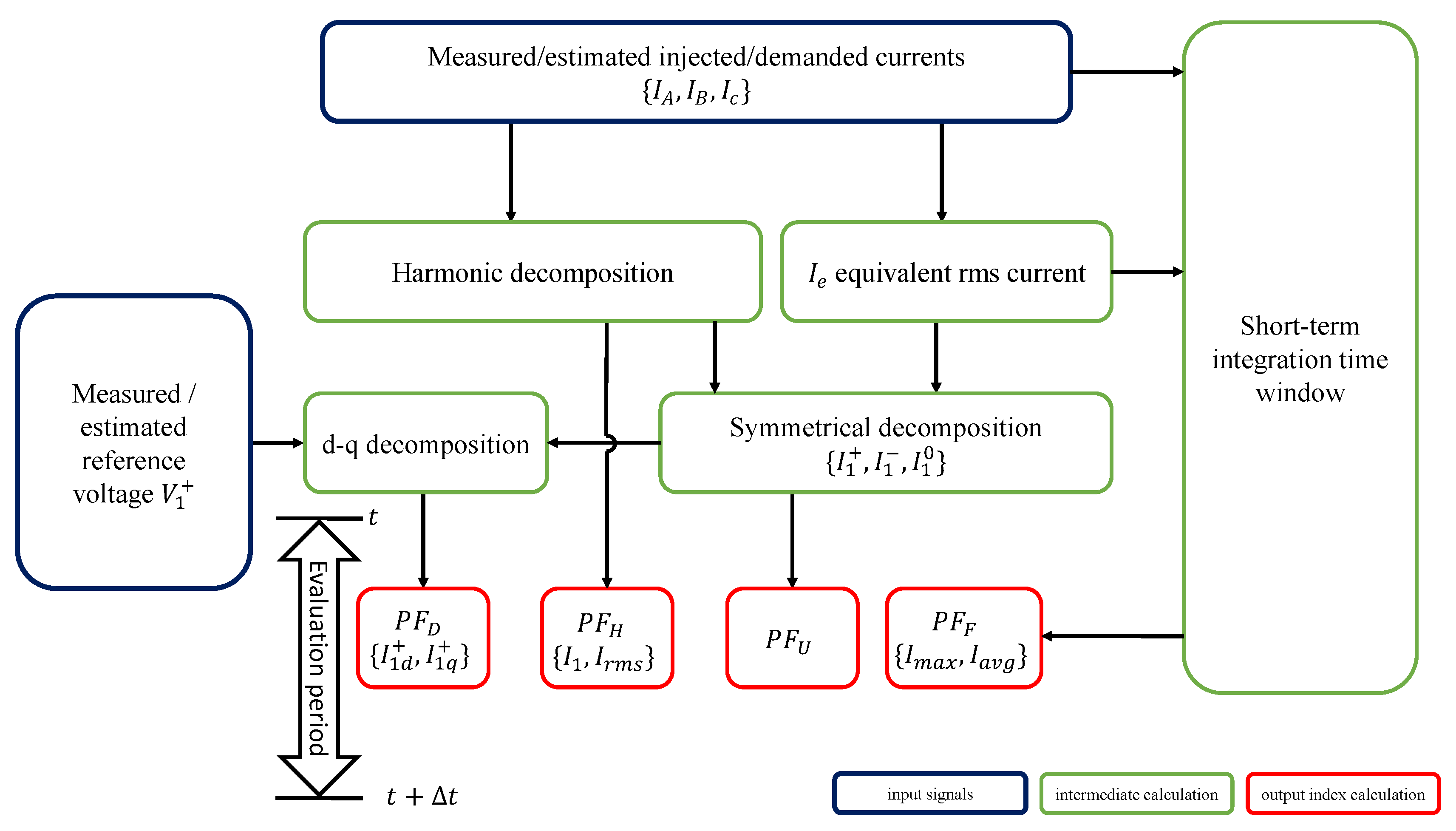
The analytical procedure for obtaining the proposed power factor indices is based entirely on measurable current quantities, following the notation of Section 4, and it is presented in Figure 2. Starting from the measured or estimated three–phase currents { I a , I b , I c } at the PCC, the process proceeds as follows:
1.
Fundamental extraction: The three–phase currents are decomposed into harmonic components, retaining the fundamental components { I 1 a , I 1 b , I 1 c } for subsequent analysis. Harmonic components are used to compute the harmonic power factor PFH.
2.
Sequence component transformation: The fundamental currents are transformed into symmetrical components { I 1 + , I 1 , I 1 0 } to identify the positive-, negative-, and zero-sequence contributions.
3.
Reference alignment: The positive-sequence fundamental voltage V 1 + is taken as the reference phasor, allowing identification of the in-phase current component I 1 d + responsible for active power transfer.
4.
Partial power factor indices: Using the relations presented earlier, three indices are computed:
  • the displacement power factor P F D = I 1 d + / I 1 + ,
  • the harmonic power factor P F H = I 1 / I r m s ,
  • the unbalance power factor P F U = I 1 + / I e 1 , where I e 1 is the effective first-order current.
5.
Fluctuation power factor: To quantify short-term variability, the maximum current over a selected integration interval (e.g., one second for railway systems) and an evaluation window Δ t (typically ten minutes) are defined. The fluctuation power factor is then obtained as the ratio between the average and maximum current over Δ t . This index complements, rather than replaces, IEC flicker-severity metrics.
6.
Global power factor: The generalized power factor GPF is constructed by combining all partial indices, i.e., PFD, PFH, PFU, and PFF. A fully compensated load satisfies GPF = 1, representing a balanced, resistive, and non-fluctuating current demand.
The framework yields three strictly orthogonal indicators PFD, PFU, and PFH each associated with a distinct physical mechanism: displacement, unbalance, and harmonic distortion, respectively. The fluctuation indicator PFF is independent of the others but not strictly orthogonal in an instantaneous sense, as it is defined over a temporal window Δ t . Together, these four indices form the generalized power factor vector:
G P F = [   P F D ,   P F U ,   P F H ,   P F F   ] .
7.
Time window for analysis: Except for the fluctuation index PFF, the components PFD, PFU, and PFH can be interpreted as instantaneous technical signals derived directly from current measurements. However, regulatory applications typically require time-integrated evaluations, usually over the minimum billing interval (e.g., ten minutes). Under the proposed current-based formulation, all indices should therefore be evaluated over a consistent temporal window Δ t . The same interval used to determine the average and maximum currents for PFF should also be used for averaging the remaining indices. Aligning the evaluation windows ensures coherent comparison among indices and enables straightforward regulatory interpretation under a unified temporal basis. Consistent with IEC PQ assessment methodologies, compliance with prescribed compatibility limits should be verified over at least 95% of the evaluation period, typically using weekly observation intervals.

5. Case Study

5.1. Metro de Medellín System Description

The Metro de Medellín multimodal transport network operates its own MV grid, composed of long runs of shielded and insulated MV cables interconnecting the main substations with multiple traction substations. This configuration provides several load–transfer paths between substations to ensure high reliability. The MV cables are routed through underground ducts, viaduct structures, and surface-covered sections. Under low-load conditions, the extent of these cable runs causes the system to exhibit predominantly capacitive behavior.
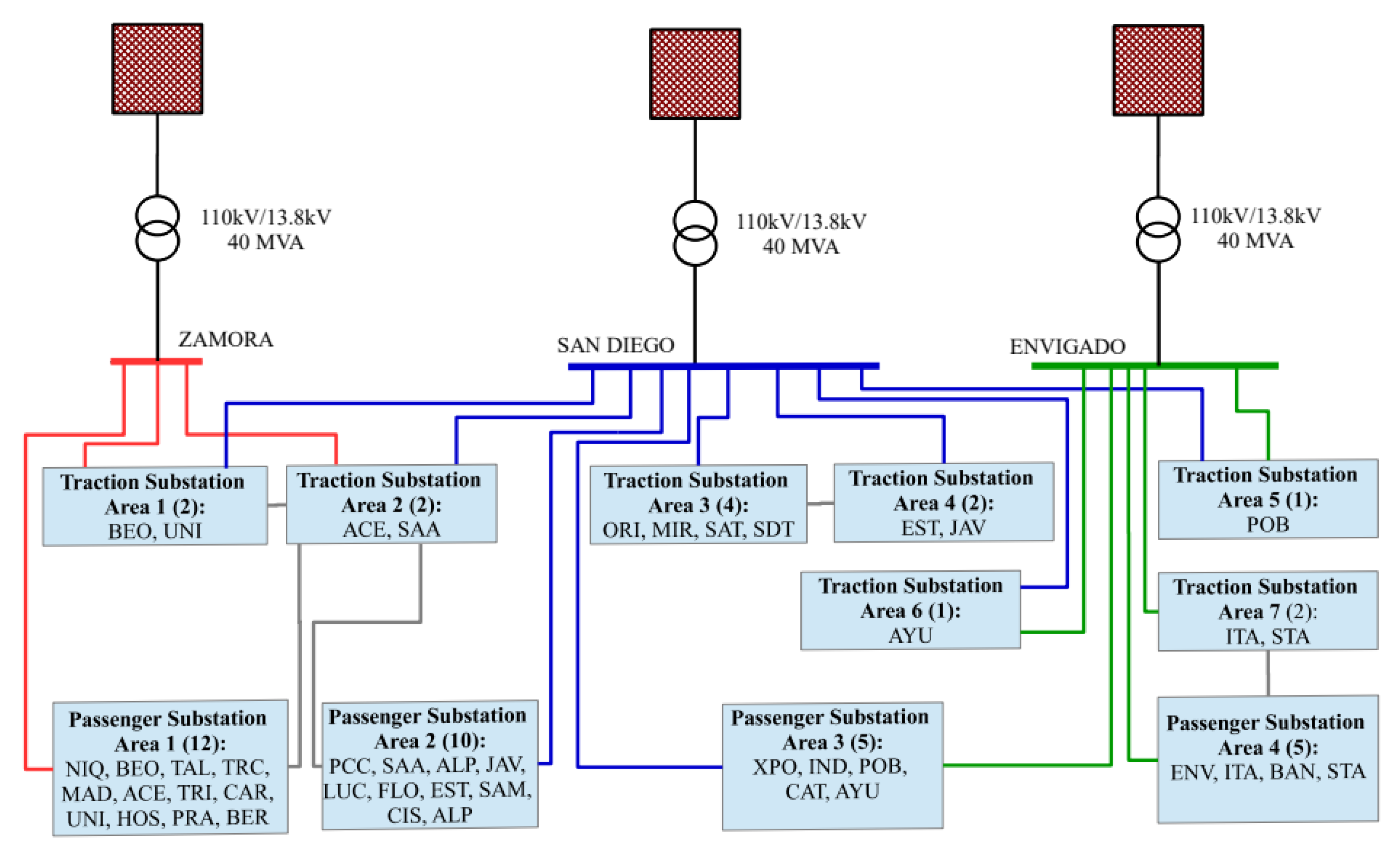
Since the start of operations in 1995, the system has expanded steadily, incorporating various modes of electric transportation. A simplified diagram of the current power system is shown in Figure 3, and Table 3 summarizes the evolution of the Metro de Medellín network.

5.2. Modeling

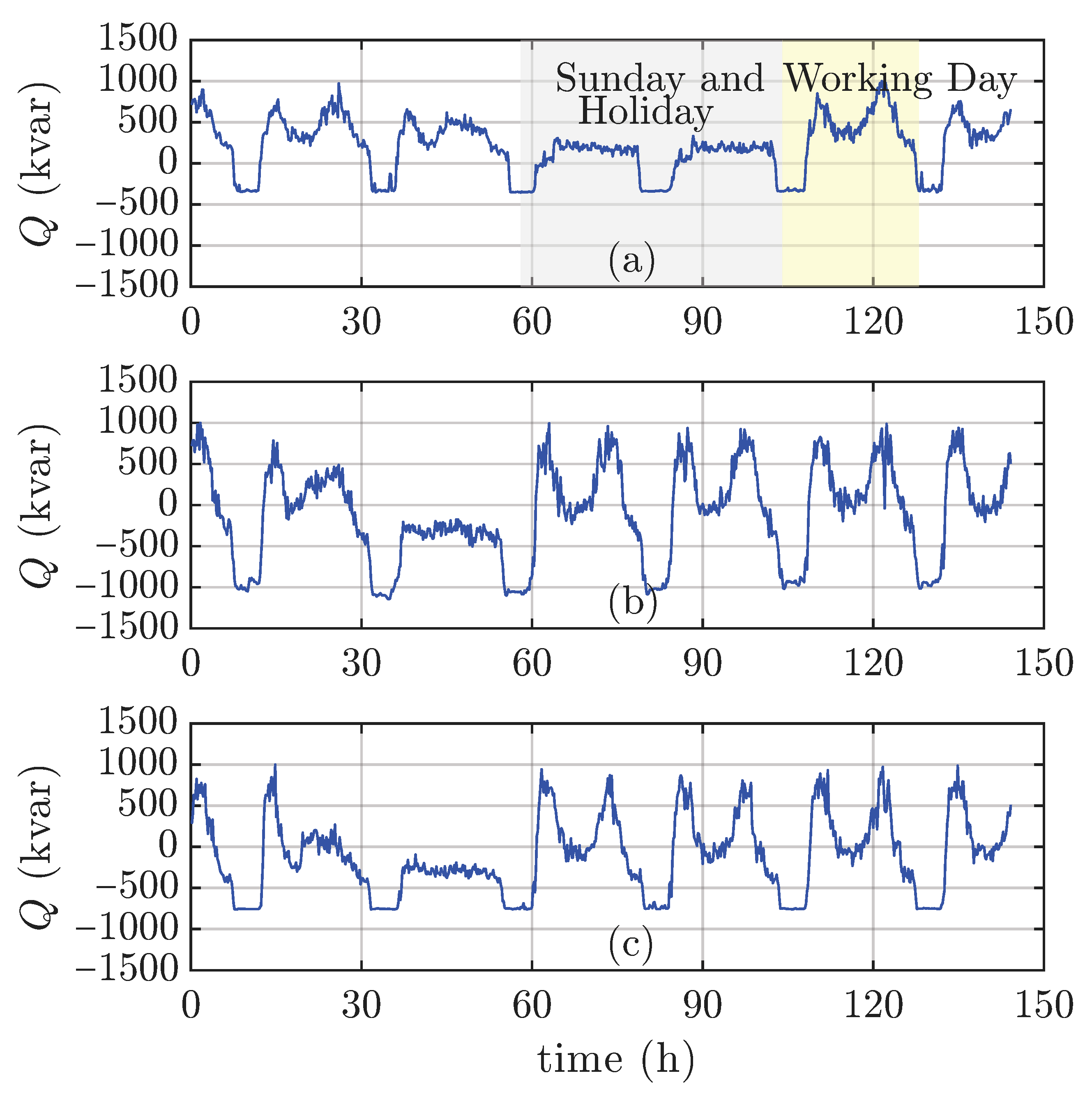
To evaluate the impact of reactive power mitigation measures, active and reactive power were continuously monitored at 10-min intervals at the three supply substations, i.e., Zamora, Envigado, and San Diego, using Class-A power quality analyzers. Measurements were collected between 14 October and 5 November 2021, and the corresponding reactive power profiles are shown in Figure 4.
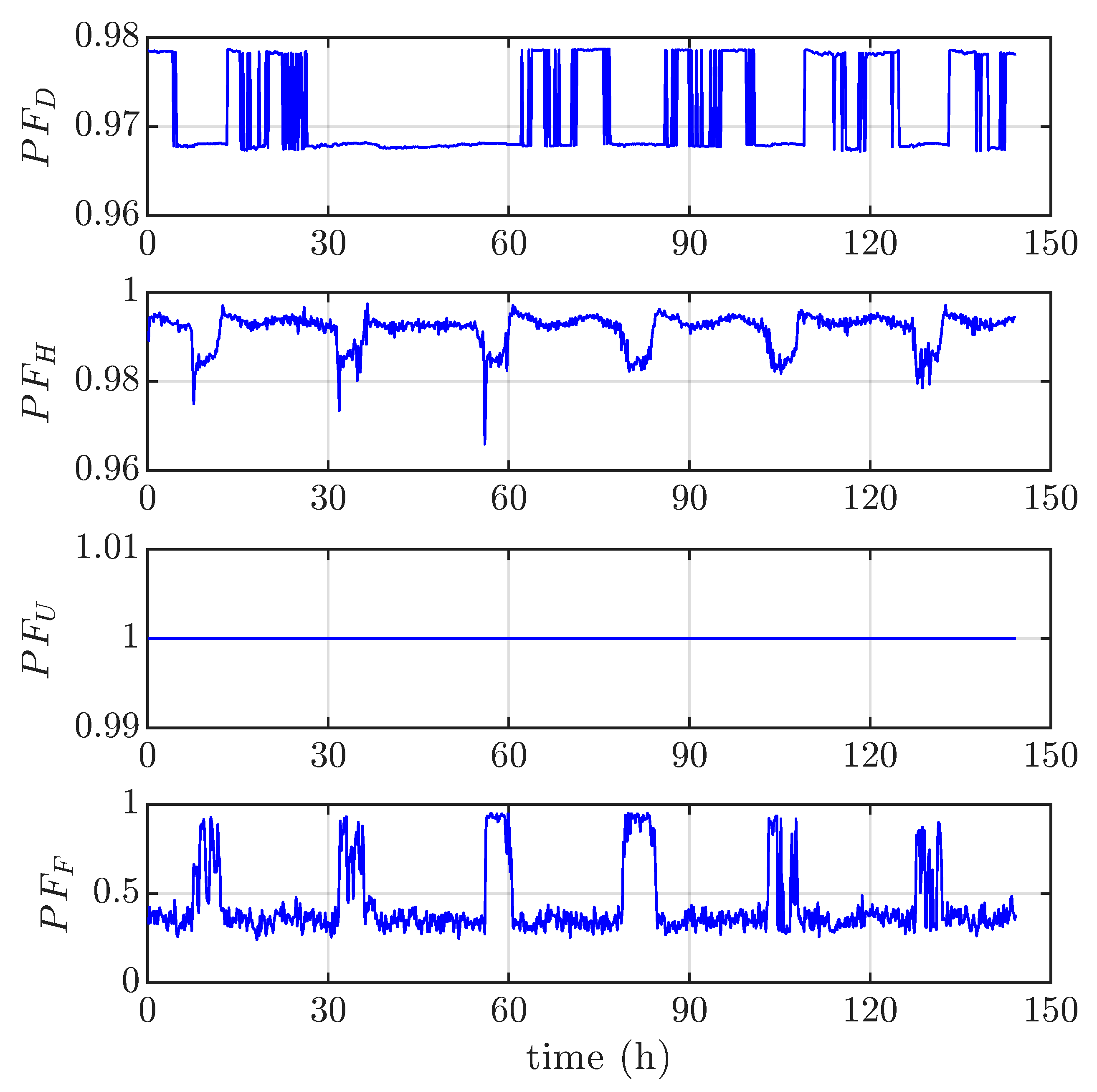
To estimate currents and voltages throughout the traction substations, passenger substations, and MV distribution lines, a detailed simulation model of the Metro de Medellín network (Figure 3) was developed in OpenDSS [42]. The measured data were used to construct time-varying load profiles for each substation. From the resulting power flow simulations, current and voltage values were obtained for every time interval, and the power factor indicators defined in Section 4 were computed using MATLAB 2023b. Results for the Zamora substation are presented in Figure 5.
Inductive and capacitive reactive energy at the PCC is continuously monitored under CREG Resolution 015 (2018) [1], and any excess is billed monthly. Capacitive injections increase during low–demand periods (typically 23:00–04:00 and on Sundays or holidays) and are highest when the system operates in N–1 mode, i.e., when one of the three feeder substations is out of service.

5.2.1. Reactive Power Profile

Figure 4a shows the average reactive power profile of the Zamora substation during the measurement period. The most significant variations appear between 04:00 and 23:00, coinciding with the operating hours of trains, cable cars, and auxiliary station loads (buildings, maintenance areas, and offices).
Between 00:00 and 04:00, the reactive power remains consistently below 0 kvar, indicating that the 110 kV-side reactive flow is entirely capacitive. This behavior is observed across weekdays, Saturdays, Sundays, and the public holiday included in the measurement interval.
Figure 4b shows the reactive power profile at the San Diego substation, whose load composition is similar to Zamora but also includes the tram system, two train lines, two cable car lines, and several passenger stations. Lastly, Figure 4c presents the average profile for the Envigado substation during both commercial service hours and nighttime, using the same set of days considered in the previous cases. At night, the reactive power becomes fully capacitive, reflecting the absence of traction demand. This substation primarily supplies the southern train corridor and nearby stations, and unlike Zamora and San Diego, does not feed additional transport modes under normal operating conditions.

5.2.2. Proposed Unified Power Quality Compensation Framework Applied to Metro de Medellín

Figure 5 illustrates the temporal behavior of the extended power factor components, obtained from measurements and OpenDSS simulations at the Zamora substation. The displacement factor PFD remains high (0.96–0.98), reflecting the fact that the fundamental positive-sequence reactive demand or injection is small relative to the corresponding active power. The harmonic power factor PFH also remains close to unity (0.96–1), consistent with the use of 12-pulse rectification, which cancels the dominant 5th and 7th harmonic components and results in inherently balanced harmonic performance.
In contrast, the fluctuation power factor PFF is the lowest among the four indices, frequently dropping below 0.4 due to the highly variable nature of train traction demand. Values in this range indicate that compensation systems should include capabilities to mitigate flicker or rapid current variations. They also emphasize the need to verify compliance with the flicker-severity indicators Pst and Plt defined in IEC 61000-3-7 [38]. Part of this mitigation can be achieved on the DC side through reversible substations or DC/DC compensation devices. Metro de Medellín already operates such a system at the Niquía station [43], whose performance is analyzed later in this paper.
The concept of PFF is also relevant for the sizing of traction transformers and converter service classes according to EN 50328 [44] and EN 50329 [45]. For example, a Class VI transformer, rated to withstand 300% load for 1 min, 150% for 2 h, and 100% continuously, implicitly requires P F F -1   min = 0.333 , P F F -2   h = 0.666 , and P F F = 1 in steady state, assuming that the average demand equals the nominal rating of the equipment. With the emergence of BESS, the PFF indicator becomes essential for assessing the suitability and appropriate sizing of a given battery chemistry for a specific application. Battery cells are typically characterized by their capability to sustain short-duration current pulses. For instance, an LFP battery capable of delivering a peak current of 3C for 60 s is only suitable for loads whose fluctuation factor does not demand a short-term current exceeding three times of the nominal value. In this sense, PFF provides a direct and technically grounded link between the short-term loading requirements of the application and the admissible pulse-current capability of the storage technology.

5.2.3. Implemented Solution

Under the initial Colombian regulatory scheme, no reactive power transport from the MV system toward the upstream grid was permitted, despite the typical 2–3% uncertainty of reactive-energy meters. The first step was therefore to identify the source of the reactive flow and evaluate simple corrective measures. The analysis confirmed that the XLPE-insulated MV cables were the primary source of capacitive reactive power injected into the HV grid.
As an immediate action, the redundant MV cables used for load transfer between substations were disconnected at both ends. This measure reduced the capacitive reactive energy injected into the HV grid by up to 30%, lowering the associated monthly charges. Operating procedures were updated to ensure that the disconnected cables could be rapidly reclosed in contingency conditions.
To mitigate the remaining capacitive reactive power, installing SVCs at the 110 kV level was initially considered but discarded due to cost and limited impact on the MV-side phenomenon. Instead, three EVC were selected as the most cost-effective alternative. These devices inject controlled reactive current through lightly loaded auxiliary transformers, maintaining a near-unity power factor at the commercial boundary. EVCs can operate in manual, semi-automatic, or automatic modes, compensating selected harmonics and providing variable reactive support based on a predefined schedule or a real-time power-factor reference measured by the SCADA system.
The compensation units installed at each substation operate under a master–slave control scheme, ensuring proportional sharing of the compensation current and preventing individual units from approaching their thermal or electrical limits. The architecture also incorporates centralized temperature monitoring to ensure safe operation.
Notably, the commissioning of these systems coincided with a major revision of Colombia’s reactive power regulation through Resolution 101 035 of 2024 [14], which relaxed several limits and conditions for capacitive reactive energy injection.
Within the broader framework proposed in this work, the compensation equipment, originally designed solely for reactive power mitigation, could have been specified with multifunctional capabilities, including voltage-fluctuation and harmonic compensation for 12-pulse rectifiers. This would have allowed the devices to be reconfigured, after the regulatory change, to address the most relevant PQ phenomena in the Metro de Medellín network. A potential solution for compensating the reactive power generated by the insulated cables would have been to install a network of chargers providing overnight charging services, leveraging the MV infrastructure. Such chargers could, in principle, use their DC-link to provide reactive power control. However, at the time, no suitable commercial equipment was available, and, as previously mentioned, the devices currently operated by the company work with a leading power factor. Nevertheless, this remains a promising possibility for future developments in other systems.
Demand and PQ measurements were carried out using Class A power quality analyzers compliant with the IEC 61000 family of standards. The proposed power factor indices were calculated directly from measured quantities, while simulation outputs were post-processed using the same IEC-consistent formulations. Model validation was performed by comparing simulated and measured currents, voltages, and power factor indicators at the main substations, with a third validation provided by consistency with the utility measurements used for billing and reactive energy transport charges.

5.3. Discussion on the Consequences of CREG 015 of 2018 [1] vs. Proposed Framework

The simulation results show that the requirements imposed by CREG Resolution 015 of 2018 [1] generated significant cost burdens even under operating conditions that technically benefited the grid. During low-demand periods, the system naturally injected capacitive reactive energy due to its extensive MV cable infrastructure, yet this behavior was penalized with the maximum multiplier ( M = 12 ). As a result, reactive energy transport charges reached 4.5% of the traction energy cost, and would have risen to 7.1% without the contingency action of disconnecting redundant MV cables.
A similar situation occurred on the electric bus network, which operates on a different supply system. Chargers typically operate at a leading power factor of 0.98, producing capacitive reactive energy that, under CREG 015 and the maximum multiplier ( M = 12 ), resulted in charges equivalent to 11.3% of the total energy cost for bus charging. These injections did not cause operational problems or overvoltage. No technical compensation was installed; instead, the regulatory change introduced by CREG 101 035 of [14] eliminated the charge entirely by redefining capacitive reactive limits. It is also important to emphasize that regulatory schemes aiming to restrict capacitive reactive power injection to zero must recognize the inherent measurement uncertainty of commercial metering equipment. Near the zero-crossing of reactive power, the relative error of class-0.5 s and class-1 m increases significantly, often reaching values comparable to, or even exceeding, the measured quantity itself. As a result, enforcing strict zero-injection limits may lead to penalties driven by metering noise rather than by any technically meaningful behavior of the user. Therefore, any regulation that sets a lower capacitive limit should incorporate explicit tolerance margins consistent with meter accuracy classes, to avoid unintended and unjustified charges.
Under the proposed framework, the dominant compensation challenge in Metro de Medellín is associated with demand fluctuation. Although flicker levels in the MV grid are acceptable under normal conditions, simulations and field data indicate that degraded scenarios, such as N–1 operation, could bring the system close to the IEC 61000-3-7 [38] compatibility thresholds. This highlights the need for continuous monitoring and possible reinforcement of fluctuation-mitigation strategies using dynamic reactive compensation, reversible substations, or DC-side storage.
As expected in DC traction systems with balanced three-phase rectification, network unbalance is not a critical issue. However, the unbalance indicator introduced in this work becomes essential when evaluating AC-fed long-distance railways, where large single-phase loads are present and technologies such as Scott transformers may be required to maintain system stability and compliance with PQ standards.
In this context, the proposed framework offers a normalized view of the different components of non-active demand, highlighting which phenomenon represents the dominant compensation need under each operating scenario. While reactive energy charges were central under CREG 015, the unified indices reveal that fluctuation is the main technical driver in Metro de Medellín. This perspective generalizes to other regulatory environments, as regulators may set specific limits for each component of the global factor, analogous to existing total and individual harmonic distortion thresholds, thereby supporting proportionate and technically grounded compensation policies.
A brief economic comparison highlights differences between the former reactive-only regulation and the proposed multi-phenomenon framework. Previously, penalties targeted mainly capacitive quadrature current, so large compensation investments often seemed profitable because the M factor inflated the assigned cost of transporting reactive power, not because they delivered physical benefits such as energy savings, longer equipment life, or capacity gains from reduced harmonics, reactive flows, and phase balance. The proposed approach uses MV current measurements and jointly treats harmonics, unbalance, and short-term fluctuations, enabling more transparent investment prioritization. High-speed active filters typically cost only about 10% more than fundamental reactive compensators yet provide broader system-level benefits, including harmonic and fluctuation mitigation. Alternatively, around USD 1 million could fund multiple stationary regenerative energy compensation systems (e.g., Niquía), covering the rail network with a proven positive benefit–cost ratio via direct energy savings and reduced overvoltage stress. DC side regeneration also reduces AC filter dynamic demands overall.

5.4. Regenerative Energy Compensation

Metro de Medellín operates a DC-side compensation system based on ultracapacitors, with a storage capacity of 2 kWh and a 400 kW power rating. This device provides fluctuation-mitigating current during train acceleration, reducing the peak demand seen from the upstream MV substation by approximately 9%, consistent with the results reported in [46].
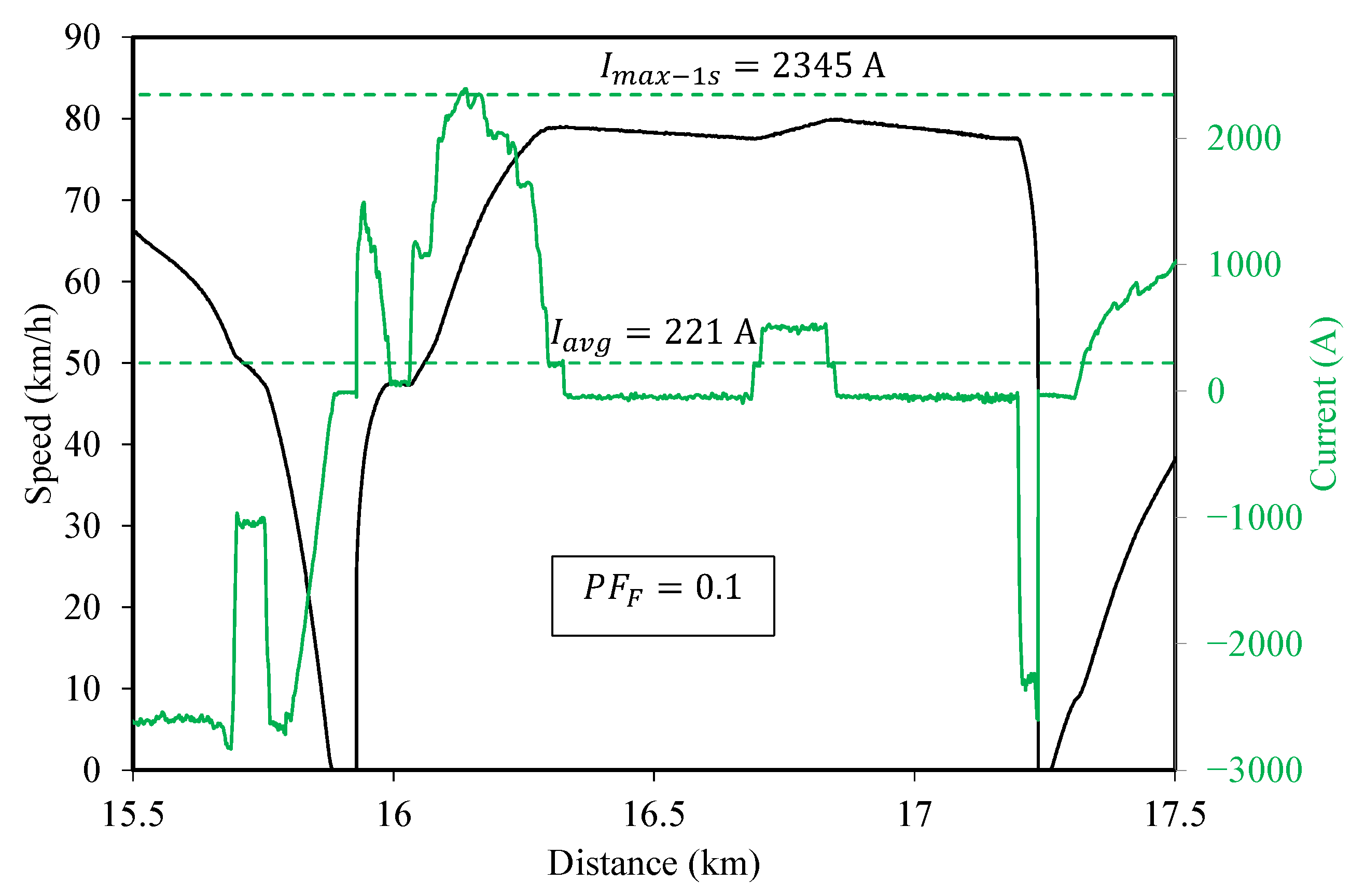
A train is a canonical example of a highly fluctuating and partially regenerative load. Figure 6 shows a representative run profile between two stations. The one–second maximum traction current reaches I max = 2345 A, while the average current during the interval is only I average = 221 A, yielding a very low fluctuation power factor of P F F 0.1 for an individual vehicle.
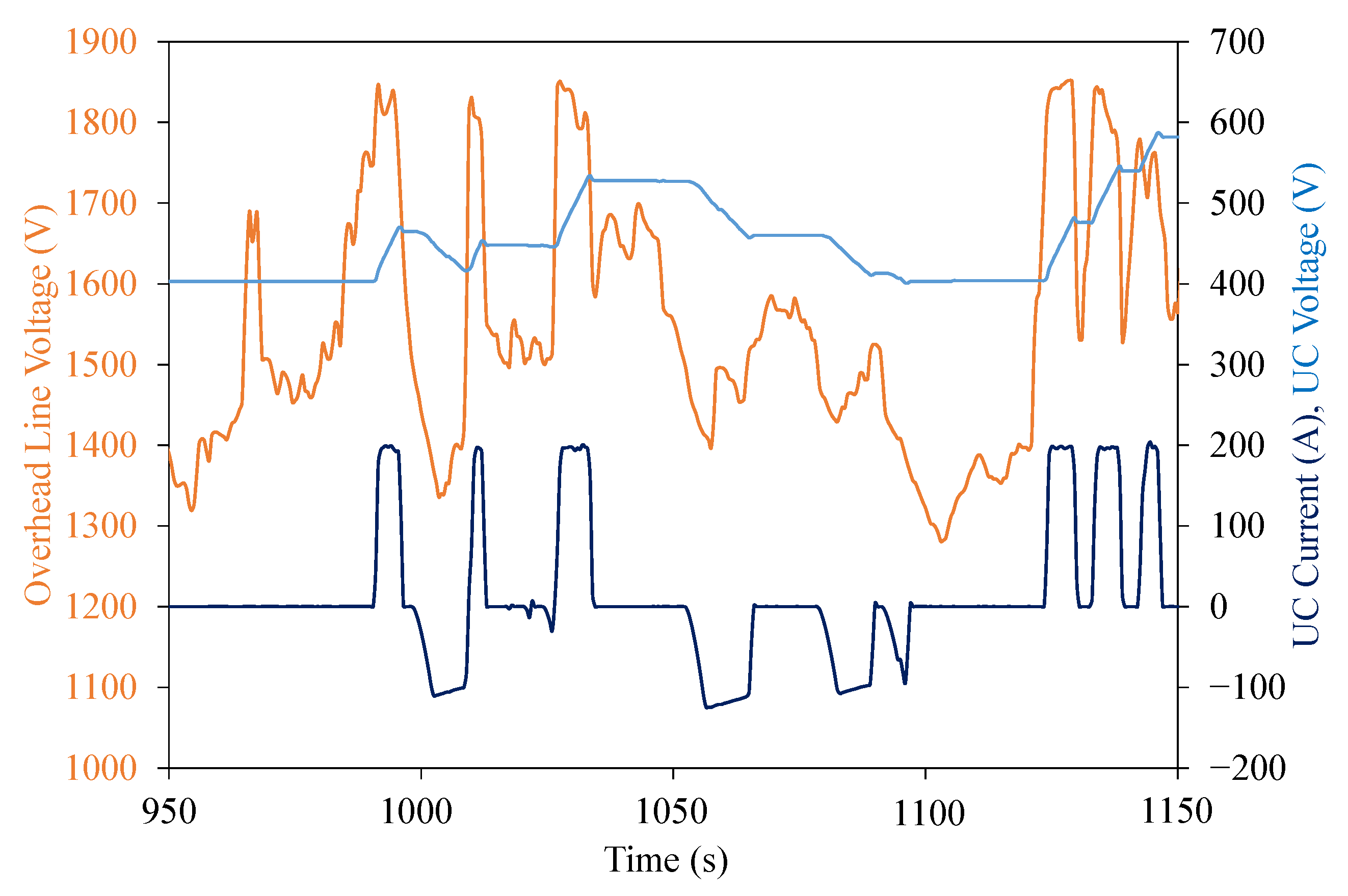
Figure 7 shows real operating data from the ultracapacitor-based system installed at the Niquía station. Similar to AC reactive-energy compensation, regenerative energy compensation on the DC side serves to stabilize the DC voltage, clip peak traction demand, reduce energy transport losses, and improve utilization of existing infrastructure. The compensator becomes active precisely during high-demand intervals, identified by the drop in overhead-line DC voltage (orange curve). At these moments, it injects current to reduce the fluctuating component drawn from the upstream grid and to support DC-voltage regulation. The ultracapacitor voltage (light blue) evolves similarly to the kinetic energy of a flywheel: energy is extracted during traction demands and restored when the system voltage recovers. This inertial-like behavior plays a central role in attenuating short-term fluctuations.
When multiple trains operate simultaneously, natural diversity arises because traction and regeneration intervals partially overlap and trains rarely accelerate at the same instant. As a result, the aggregated PFF at a traction substation typically improves to values around 0.25. The aggregation of several traction substations feeding a common MV supply further increases the effective PFF to approximately 0.4, consistent with the values obtained in Section 4.
During traction intervals, the compensator injects current to limit the demand seen from the MV grid. During regenerative braking, it absorbs current and stores energy. When the DC bus voltage reaches its upper limit of 1800 V, at which point the train’s braking resistor would otherwise activate, the device transitions into storage mode, capturing regenerative energy rather than dissipating it. Conversely, once the DC voltage drops below 1400 V, the stored energy is reinjected into the DC network.
In Metro de Medellín’s operating strategy, DC-side phenomena associated with train acceleration and regenerative braking are intentionally confined within the traction DC network. However, in systems with lower traction intensity or longer headways, reversible substations become particularly attractive because they enable controlled bidirectional power transfer, allowing regenerative energy to be injected into the MV grid. Even in systems like Metro de Medellín, reversible substations could provide added value when considered within a broader compensation framework such as the one proposed in this study. Beyond energy recovery, these devices can operate in controlled rectification modes, using the DC traction network to inject displacement-reactive compensation, harmonic compensation, and even fluctuation compensation into the MV grid [47,48]. This multifunctional capability aligns naturally with the current-based criteria and extended power-factor formulation developed in this work.
Within the proposed framework, the motivation for implementing these devices becomes more technically grounded. Their justification extends beyond avoiding reactive-energy penalties and encompasses broader objectives such as improving infrastructure utilization, enhancing equipment longevity, reducing losses, and capturing substantial energy-saving potential. This perspective recognizes reversible substations as strategic assets that enhance overall system performance rather than as devices installed solely to comply with specific tariff schemes.

6. Conclusions

An adequate regulation of reactive transport, incorporating a broad scope of compensation for harmonics, imbalance, and fluctuability, is essential for sending technical signals that promote energy efficiency, good infrastructure practices, rational energy use, and equipment care. As demonstrated throughout this work, the Colombian regulatory scheme implemented through CREG Resolution 015 of 2018 [1] proved inconvenient from both an energy efficiency and operational safety standpoint. By penalizing technically benign behaviors and overlooking the broader set of PQ phenomena, it generated inadequate technical and economic signals, including increased operating costs for electric mobility systems.
To avoid similar outcomes in future regulations and to enable users to make informed decisions regarding equipment selection and corrective actions suited to their actual PQ issues, this paper introduced an analytical framework grounded in an extended notion of power factor. This framework evaluates a user’s or device’s contribution to distortion, unbalance, and voltage instability using a common, measurable, current-based basis. Such an approach is consistent with the way modern compensation equipment is specified, controlled, and prioritized, providing a transparent and technology-neutral method for assessing compensation needs.
The case of Metro de Medellín exemplifies how the former reactive energy transport scheme could misalign technical incentives. The analysis showed that an extended power factor framework would have offered clearer and more technically accurate guidance for implementing corrective actions, distinguishing effectively between fluctuation, distortion, and unbalance. This would have enabled proportionate, targeted interventions rather than costly or unnecessary measures driven solely by regulatory pressure.
Furthermore, expressing the indices as current ratios introduces additional benefits: it ensures compatibility with real-time monitoring and control systems, supports the integration of multifunctional compensation devices (e.g., STATCOMs, active filters, reversible substations), and aligns with time-integrated assessment windows commonly used in billing and IEC PQ evaluations. As a result, the proposed framework strengthens the connection between regulation, system planning, and daily operation, offering a coherent foundation for future PQ policies that better reflect the technical realities of converter dominated and mobility intensive electrical networks.

Author Contributions

Conceptualization, A.E.D.-R. and M.R.; methodology, A.E.D.-R. and M.R.; investigation, A.E.D.-R., J.F.F.-C. and T.P.-N.; data curation, J.F.F.-C. and T.P.-N.; formal analysis, A.E.D.-R., J.F.F.-C., M.R., E.M. and T.P.-N.; validation, J.F.F.-C. and E.M.; writing—original draft, A.E.D.-R. and J.F.F.-C.; writing—review & editing, M.R. and T.P.-N. All authors have read and agreed to the published version of the manuscript.

Funding

This research received no external funding.

Institutional Review Board Statement

Not applicable.

Informed Consent Statement

Not applicable.

Data Availability Statement

The data presented in this study are available on request from the corresponding author. The data are not publicly available due to privacy restrictions.

Acknowledgments

In memoriam–Emiro Díez Saldarriaga (1945–2025). Electrical engineer, teacher, scientist, and writer. Much of the scientific rigor and conceptual insight reflected in this work was inspired by his teachings. The authors would like to acknowledge the support of Metro de Medellín, Universidad Pontificia Bolivariana, and Universidad del Norte.

Conflicts of Interest

Jhon Fredy Fernandez-Corrales and Edison Manrique are employed by the company Metro de Medellín. The remaining authors declare that the research was conducted in the absence of any commercial or financial relationships that could be construed as a potential conflict of interest.

Abbreviations and Nomenclature

CREGColombian Regulatory Commission of Energy and Gas
EHVExtra High Voltage
EVCElectronic Var Compensator
GPFGlobal Power Factor
HVHigh Voltage
LVLow Voltage
MVMedium Voltage
PCCPoint of Common Coupling
PQPower Quality
SVCStatic Var Compensator
VFDVariable Frequency Drive
Variables
ERExcess reactive energy
GPFGlobal power factor
LULoad unbalance factor
ICurrent (A)
PActive power (W)
PFPower factor
QReactive power (var)
SApparent power (VA)
TCERTotal cost of excess reactive (COP)
THDTotal harmonic distortion
VVoltage (V)
Parameters
MScaling factor for excess reactive energy charge
UCRUse charge for reactive energy transportation (COP)
Subscripts
a,b,c,nPhase and neutral labels in a three-phase system
1Fundamental component
dDirect component in a dq frame
DDisplacement
DHTotal
eEffective value
FFluctuation
HHarmonic
UUnbalance
Superscripts
+Positive sequence
Negative sequence
0Zero sequence

References

  1. Comisión de Regulación de Energía y Gas. Resolución 015 de 2018: Por la cual se Establecen Reglas Generales de Comportamiento de Mercado para los Agentes que Desarrollen las Actividades de los Servicios Públicos Domiciliarios de Energía Eléctrica y gas Combustible. 2018. Available online: https://gestornormativo.creg.gov.co/Publicac.nsf/1c09d18d2d5ffb5b05256eee00709c02/65f1aaf1d57726a90525822900064dac/$FILE/Creg015-2018.pdf (accessed on 25 December 2025).
  2. Operador Nacional do Sistema Elétrico (ONS). Submódulo 3.6—Requisitos Técnicos Mínimos para a Conexão à rede Básica. 2019. Available online: https://www.ons.org.br/%2FProcedimentosDeRede%2FM%C3%B3dulo%203%2FSubm%C3%B3dulo%203.6%2FSubm%C3%B3dulo%203.6.pdf (accessed on 25 December 2025).
  3. Comisión Nacional de Energía (CNE). Norma Técnica de Seguridad y Calidad de Servicio. 2019. Available online: https://www.cne.cl/wp-content/uploads/2025/01/NTSyCS-Ene-2025.pdf (accessed on 25 December 2025).
  4. North American Electric Reliability Corporation (NERC). Reactive Power Planning. 2016. Available online: https://www.nerc.com/globalassets/who-we-are/standing-committees/rstc/sams/reliability-guideline---reactive-power-planning.pdf (accessed on 25 December 2025).
  5. Independent Electricity System Operator (IESO). Market Rules, Chapter 4, Apependix 4.3 December 1, 2021 Requirements for Connected Wholesale Customers and Distributors Connected to the IESO-Controlled Grid. Available online: https://www.ieso.ca/-/media/files/ieso/document-library/market-rules-and-manuals-library/market-rules/mr-chapter4appx.pdf (accessed on 25 December 2025).
  6. Comisión Nacional de los Mercados y la Competencia (CNMC). Resolución de 18 de Marzo de 2021 de la Comisión Nacional de los Mercados y la Competencia por la que se Establecen los Valores de los Peajes de Acceso a las Redes de Transporte y Distribución de Electricidad de Aplicación a Partir del 1 de Junio de 2021. 2021. Available online: https://www.boe.es/diario_boe/txt.php?id=BOE-A-2021-4565 (accessed on 25 December 2025).
  7. National Grid Electricity System Operator Limited, (ESO). National Grid Eso. The Grid Code Issue 6 Revision 9 (29 December) 2021. Available online: https://www.neso.energy/document/227996/download (accessed on 25 December 2025).
  8. The Australian Energy Market Commission (AEMC). Chapter 11 Network Connection, Planning and Expansion, Version 179; National Electricity Rules: Sydney, Australia, 2022; Volume 2022, p. 72.
  9. National Energy Regulator of South Africa (NERSA). The South African Grid Code, The Network Code; Version 10.0; NERSA: Pretoria, South Africa, 2019. [Google Scholar]
  10. Andruszkiewicz, J.; Lorenc, J.; Weychan, A. Determination of the optimal level of reactive power compensation that minimizes the costs of losses in distribution networks. Energies 2023, 17, 150. [Google Scholar] [CrossRef]
  11. Ministry of Economy, Republic of Poland. Regulation of the Minister of Economy of 18 August 2011 on the Detailed Rules for Preparing and Calculating Tariffs and Settlements in Electricity Trading. Dziennik Ustaw Rzeczypospolitej Polskiej, Dz.U. 2011, No. 189, Item 1126, 2011. (In Polish). Available online: https://isap.sejm.gov.pl/isap.nsf/download.xsp/WDU20111891126/O/D20111126.pdf (accessed on 25 December 2025).
  12. Andruszkiewicz, J.; Lorenc, J.; Weychan, A. Using Advanced Metering Infrastructure Data from MV/LV Substations to Minimize Reactive Energy Supply Cost to Final Consumers. Energies 2024, 17, 4116. [Google Scholar] [CrossRef]
  13. Comisión de Regulación de Energía y Gas. Resolución 199 de 2019: Por la Cual se Modifican Algunas Disposiciones de la Resolución CREG 015 de 2018. 2019. Available online: https://gestornormativo.creg.gov.co/gestor/entorno/docs/resolucion_creg_0199_2019.htm (accessed on 25 December 2025).
  14. Comisión de Regulación de Energía y Gas. Resolución 101 035 de 2024: Por la Cual se Modifica el Numeral 4.2.4 del Anexo General de la Resolución CREG 070 de 1998. 2024. Available online: https://gestornormativo.creg.gov.co/gestor/entorno/docs/originales/Resoluci%C3%B3n_CREG_101_035_2024/ (accessed on 25 December 2025).
  15. Comisión de Regulación de Energía y Gas. Resolución 070 de 1998: Por la cual se Establece el Reglamento de Distribución de Energía Eléctrica, Como Parte del Reglamento de Operación del Sistema Interconectado Nacional. 1998. Available online: https://gestornormativo.creg.gov.co/gestor/entorno/docs/resolucion_creg_0070_1998.htm (accessed on 25 December 2025).
  16. Kaleybar, H.J.; Brenna, M.; Foiadelli, F.; Fazel, S.S.; Zaninelli, D. Power quality phenomena in electric railway power supply systems: An exhaustive framework and classification. Energies 2020, 13, 6662. [Google Scholar] [CrossRef]
  17. Petrov, A.; Logutenko, N. The analysis of reactive power in metro. In Proceedings of the 2016 11th International Forum on Strategic Technology (IFOST), Novosibirsk, Russia, 1–3 June 2016; IEEE: Piscataway, NJ, USA, 2016; pp. 121–123. [Google Scholar]
  18. Petrov, A.A.; Schurov, N.I. Comparative analysis of measures to improve the quality of electricity in metro. In Proceedings of the 2018 19th International Conference of Young Specialists on Micro/Nanotechnologies and Electron Devices (EDM), Erlagol, Russia, 29 June–3 July 2018; IEEE: Piscataway, NJ, USA, 2018; pp. 690–693. [Google Scholar]
  19. Popescu, M.; Bitoleanu, A.; Deaconu, I.; Dobriceanu, M. Improvement of power quality and energy efficiency in Bucharest metro traction substations. In Proceedings of the 2016 IEEE International Power Electronics and Motion Control Conference (PEMC), Varna, Bulgaria, 25–28 September 2016; IEEE: Piscataway, NJ, USA, 2016; pp. 906–911. [Google Scholar]
  20. Terciyanli, A.; Acik, A.; Cetin, A.; Ermis, M.; Cadirci, I.; Ermis, C.; Demirci, T.; Bilgin, H.F. Power quality solutions for light rail public transportation systems fed by medium-voltage underground cables. IEEE Trans. Ind. Appl. 2012, 48, 1017–1029. [Google Scholar] [CrossRef]
  21. Popov, A.; Fratu, M. Reactive power compensation in the railway electrical traction system, using synchronous machines controlled by SCADA. In Proceedings of the IOP Conference Series: Materials Science and Engineering; IOP Publishing: Bristol, UK, 2021; Volume 1138, p. 012038. [Google Scholar] [CrossRef]
  22. Grunbaum, R.; Hasler, J.P.; Larsson, T.; Meslay, M. STATCOM to enhance power quality and security of rail traction supply. In Proceedings of the 2009 8th International Symposium on Advanced Electromechanical Motion Systems & Electric Drives Joint Symposium, Lille, France, 1–3 July 2009; IEEE: Piscataway, NJ, USA, 2009; pp. 1–6. [Google Scholar]
  23. Nazari, M.H.; Hosseinian, S.H.; Azad-Farsani, E. Shapley value-based techno-economic framework for harmonic and loss mitigation. IEEE Access 2019, 7, 119576–119592. [Google Scholar] [CrossRef]
  24. Chen, H.; Ding, T.; Chen, L.; Shi, J. A modified harmonic pricing scheme for customers based on quantifying the harmonic comprehensive contribution. Int. J. Electr. Power Energy Syst. 2021, 130, 106905. [Google Scholar] [CrossRef]
  25. Saadat, A.; Hooshmand, R.A.; Kiyoumarsi, A.; Tadayon, M. Harmonic pricing in power systems based on identifying the appropriate contribution of customers. IET Gener. Transm. Distrib. 2019, 13, 73–80. [Google Scholar] [CrossRef]
  26. Ouyang, Z.; Zhong, H.; Wang, Y.; Li, X.; Du, T. Active and Reactive Power Coordinated Optimization of Distribution Network–Microgrid Clusters Considering Three-Phase Imbalance Mitigation. Energies 2025, 18, 5514. [Google Scholar] [CrossRef]
  27. Zhou, X.; Ma, Z.; Zhao, H.; Zou, H. Research on Distribution Network Harmonic Mitigation and Optimization Control Strategy Oriented by Source Tracing. Processes 2025, 13, 3268. [Google Scholar] [CrossRef]
  28. Vali, A.K.; Varma, P.S.; Reddy, C.R.; Alanazi, A.; Elrashidi, A. Deep-Learning-Based Controller for Parallel DSTATCOM to Improve Power Quality in Distribution System. Energies 2025, 18, 4902. [Google Scholar] [CrossRef]
  29. IEEE Std 1459-2000; IEEE Standard Definitions for the Measurement of Electric Power Quantities under Sinusoidal, Non-Sinusoidal, Balanced, or Unbalanced Conditions. IEEE: Piscataway, NJ, USA, 2000; pp. 1–52. [CrossRef]
  30. Zobaa, A. Comparing power factor and displacement factor corrections based on IEEE Std. 18-2002. In Proceedings of the 2004 11th International Conference on Harmonics and Quality of Power (IEEE Cat. No. 04EX951), Lake Placid, NY, USA, 12–15 September 2004; IEEE: Piscataway, NJ, USA, 2004; pp. 1–5. [Google Scholar]
  31. Boudebbouz, O.; Boukadoum, A.; Leulmi, S. Effective apparent power definition based on sequence components for non-sinusoidal electric power quantities. Electr. Power Syst. Res. 2014, 117, 210–218. [Google Scholar] [CrossRef]
  32. Niranjan, N.; Sujata, M. “Voltage collapse: Causes and prevention”. Int. J. Eng. Res. Technol. 2016, 4, 1–4. [Google Scholar]
  33. Hosseinzadeh, N.; Aziz, A.; Mahmud, A.; Gargoom, A.; Rabbani, M. Voltage stability of power systems with renewable-energy inverter-based generators: A review. Electronics 2021, 10, 115. [Google Scholar] [CrossRef]
  34. Arseneau, R.; Baghzouz, Y.; Belanger, J.; Bowes, K.; Braun, A.; Chiaravallo, A.; Cox, M.; Crampton, S.; Emanuel, A.; Filipski, P.; et al. Practical definitions for powers in systems with nonsinusoidal waveforms and unbalanced loads: A discussion. IEEE Trans. Power Deliv. 1996, 11, 79–101. [Google Scholar] [CrossRef]
  35. Sychev, Y.A.; Aladin, M.E.; Abramovich, B.N. The method of power factor calculation under non-sinusoidal conditions. In Proceedings of the 2020 IEEE Conference of Russian Young Researchers in Electrical and Electronic Engineering (EIConRus), St. Petersburg and Moscow, Russia, 27–30 January 2020; IEEE: Piscataway, NJ, USA, 2020; pp. 904–908. [Google Scholar]
  36. IEC 61000-3-6; Electromagnetic Compatibility (EMC)—Part 3-6: Limits—Assessment of Emission Limits for the Connection of Distorting Installations to MV, HV and EHV Power Systems. IEC: Geneva, Switzerland, 2008.
  37. IEC 61000-4-15; Electromagnetic Compatibility (EMC)—Part 4-15: Testing and Measurement Techniques—Flickermeter—Functional and Design Specifications. IEC: Geneva, Switzerland, 2010.
  38. IEC 61000-3-7; Electromagnetic Compatibility (EMC)—Part 3-7: Limits–Assessment of Emission Limits for the Connection of Fluctuating Loads to MV, HV and EHV Power Systems. IEC: Geneva, Switzerland, 2008.
  39. IEC 61000-2-12; Electromagnetic Compatibility (EMC)—Part 2-12: Environment—Compatibility Levels for Low-Frequency Conducted Disturbances and Signaling in Public Medium-Voltage Power Supply Systems. IEC: Geneva, Switzerland, 2018.
  40. IEC 61000-2-2; Electromagnetic Compatibility (EMC)—Part 2-2: Environment—Compatibility Levels for Low-Frequency Conducted Disturbances and Signaling in Public Low-Voltage Power Supply Systems. IEC: Geneva, Switzerland, 2018.
  41. Czarnecki, L.S. Currents’ Physical Components (CPC) concept: A fundamental of power theory. In Proceedings of the 2008 International School on Nonsinusoidal Currents and Compensation, Lagow, Poland, 10–13 June 2008; pp. 1–11. [Google Scholar] [CrossRef]
  42. EPRI. Introduction to Opendss. Available online: https://opendss.epri.com/IntroductiontoOpenDSS.html (accessed on 25 December 2025).
  43. Killer, A.; Armstorfer, A.; Diez, A.E.; Biechl, H. Ultracapacitor assisted regenerative braking in metropolitan railway systems. In Proceedings of the 2012 IEEE Colombian Intelligent Transportation Systems Symposium (CITSS), Bogota, Colombia, 30 August 2012; IEEE: Piscataway, NJ, USA, 2012; pp. 1–6. [Google Scholar]
  44. UNE-EN 50328:2004; Railway Applications—Fixed Installations—Electronic Power Converters for Substations. UNE: Madrid, Spain, 2004.
  45. UNE-EN 50329:2004; Railway Applications—Fixed Installations—Traction Transformers. UNE: Madrid, Spain, 2004.
  46. Díez, A.E.; Restrepo, J.V.; Múnera, D.A.; Bohórquez, A.; Arroyave, D.A.; Manrique, E. A Theory and a Case Study on Regenerative Energy Compensation in Railway Systems. In Proceedings of the 2019 FISE-IEEE/CIGRE Conference-Living the energy Transition (FISE/CIGRE), Medellin, Colombia, 4–6 December 2019; IEEE: Piscataway, NJ, USA, 2019; pp. 1–6. [Google Scholar]
  47. Popescu, M.; Bitoleanu, A. A review of the energy efficiency improvement in DC railway systems. Energies 2019, 12, 1092. [Google Scholar] [CrossRef]
  48. Zhang, X.; Liu, W.; Xu, Q.; Yang, Z.; Xia, D.; Liu, H. Two-Stage Integrated Optimization Design of Reversible Traction Power Supply System. Energies 2025, 18, 703. [Google Scholar] [CrossRef]
Figure 1. Positive-sequence current decomposition in the dq frame.
Energies 19 00578 g001
Figure 2. Flowchart of the proposed framework.
Energies 19 00578 g002
Figure 3. Simplified model of Metro de Medellin MV network.
Energies 19 00578 g003
Figure 4. Average reactive power profile (kvar) during the day and at night: (a) Zamora, (b) San Diego and (c) Envigado.
Energies 19 00578 g004
Figure 5. Zamora substation Global Power Factor.
Energies 19 00578 g005
Figure 6. Single train demand and PFF.
Energies 19 00578 g006
Figure 7. Regenerative energy compensation in DC-side.
Energies 19 00578 g007
Table 1. Minimum Power Factor Requirements in Colombia (Resolution 101 035 of 2024 [14]).
Voltage LevelMinimum Power Factor (Leading)
Level I and II≥0.90
Level III≥0.95
Level IV≥0.98
Table 2. Typical reactive energy limits according to voltage levels [14].
Type of Reactive EnergyMinimum Power Factor (PF)Max Reactive Energy (% of Active Energy)Applicable Voltage RangeExceeding Limit Triggers
Inductive (lagging)≥0.90≤50% (per hour or billing period)All voltage levelsReactive transport charge
Capacitive (leading)≥0.90≤50% (per billing period)Level I: up to 1 kV and Level II: 1–57.5 kVReactive transport charge
Capacitive (leading)≥0.95≤33% (per billing period)Level III: 57.5–220 kVReactive transport charge
Capacitive (leading)≥0.98≤20% (per billing period)Level IV: above 220 kVReactive transport charge
Table 3. Growth of Metro de Medellin mass transportation system.
YearLine IdentifierTransportation ModeType of load
1995ARailwayDC motor trains
1996BRailwayDC motor trains
2004KCable carDC motors with
var. speed drives
2008JCable carDC motors with
var. speed drives
2012 *ARailwayAC motor trains
2016TTramwayDC motor tramways
H and MCable carDC motors with
var.speed drives
2021PCable carAC motors with
var. speed drives
* Second-generation trains with AC motors come into operation to increase the fleet of vehicles that circulate on line A.
Disclaimer/Publisher’s Note: The statements, opinions and data contained in all publications are solely those of the individual author(s) and contributor(s) and not of MDPI and/or the editor(s). MDPI and/or the editor(s) disclaim responsibility for any injury to people or property resulting from any ideas, methods, instructions or products referred to in the content.