


Abstract
The misallocation of renewable (RE) and non-renewable energy (NRE) resources may lead to the inefficiency of economic development, thereby hindering the achievement of sustainable development goals. Basing data on 282 Chinese cities during 2005–2021, a relative factor price distortion coefficient was employed to estimate the degree and direction of resource misallocation (RM) for RE, NRE, capital, and labor at both the aggregate city level and across four disaggregated city categories. Output gaps and efficiency losses are further quantified by incorporating RM analysis into the economic growth accounting framework, revealing significant heterogeneity in RM across cities. Findings show that (1) RE and labor misallocation exceed those of NRE and capital at the city level. RE misallocation is dominant in energy misallocation. There exists an underallocation of RE, NRE, and labor, while capital is overallocated. (2) Renewable energy input and output (RE-IO) cities exhibit the highest overall RM (32.1%), whereas renewable energy input (RE-Input) cities possess the lowest ones (21.2%). Four city types demonstrate an underallocation of RE and an overallocation of capital. (3) Both output gaps and efficiency losses are on the rise. Output changes sources are transferred from the variations in factor inputs to those in total factor productivity (TFP). The contribution from the RM changes is limited. The results provide a reference for reducing RM and achieving energy transition.
1. Introduction
In recent decades, China has experienced rapid economic growth and urbanization, accompanied by substantial consumption of energy, capital, and labor resources [1]. In 2024 (https://www.stats.gov.cn/sj/zxfb/202502/t20250228_1958817.html, accessed on 12 December 2025), China’s total investment in fixed assets amounted to CNY 52,091.6 billion, marking a growth rate of 3.1% compared with the previous year. The employment figure reached 734.39 million individuals. The total energy consumption reached 5.96 billion tons of standard coal, which represents an increment of 4.3% relative to the preceding year. Resources, as the fundamental material for economic development, are distributed in a manner that directly impacts the efficiency and quality of economic expansion.
Optimal resource allocation enhances production efficiency and drives sustained economic development. In contrast, the resource misallocation (RM) can pose a significant obstacle to the progress of the economy [2]. From an environmental standpoint, RM can result in the overexploitation and inefficient use of resources and exacerbate ecological degradation [3]. With accelerating urbanization, cities’ dependence on various resources has increased significantly. Capital and labor, the two core factors of economic development, have a rational allocation that is crucial to optimizing economic structure and ensuring healthy economic growth. Beyond capital and labor, energy serves as a key driver for urban economic development. Renewable energy (RE) is gaining growing prominence due to its sustainable supply and environmental friendliness [4]. An energy mix tilted toward RE is spurring cities to develop and expand emerging green industries, which not only promotes urban industrial restructuring but also lays a solid foundation for sustainable urban economic development. However, energy issues are not only reflected in energy structure but also closely linked to energy allocation efficiency [5]. Efficient energy allocation directly determines urban economic sustainability, energy supply stability, and environmental quality [6]. Against this backdrop, quantifying the misallocation of resource elements like RE and non-renewable energy (NRE) in cities is the core issue addressed in this study.
China spans a vast territory with numerous cities and significant disparities in energy endowments. These marked differences have led to diverse energy structures and demand across cities [7]. Cities rich in RE can not only meet local demand but also export surpluses, while those lacking RE resources rely on external imports to fulfill their clean energy needs [8]. Due to differences in cities’ resource endowments and economic development levels, there are variations in RE supply and demand and the allocation of RE and other resource elements among different cities. Therefore, categorizing cities according to RE endowment and supply–demand, and exploring the misallocation of various resources in different city types, is another key issue this paper intends to solve.
Optimal resource allocation empowers the city to utilize production factors comprehensively, attaining the potential output level. However, in the presence of resource allocation distortions, production factors fail to operate in the most efficient domains and segments, leading to actual output falling short of potential output and generating an output gap. Furthermore, the misdirected flow and allocation of resources can lead to a waste of human, material, and financial resources during the production process. Such resource waste gives rise to partial efficiency losses and adverse economic consequences. Following the Cobb–Douglas (C-D) production function, economic output is predominantly influenced by alterations in factor inputs and productivity. Notably, resource allocation can impact economic output via changes in productivity. What are the magnitudes of city output gaps and efficiency losses caused by the misallocation of diverse resource factors? Are factor-input changes or productivity changes the principal drivers of alterations in economic output? And what is the role of resource allocation therein? These questions also constitute significant considerations of this study.
Based on the influence of rational resource allocation on sustainable economic development, this research segments energy into RE and NRE and categorizes cities under the RE endowment characteristics and supply–demand conditions. Subsequently, the degree and direction of the misallocation of RE, NRE, capital, and labor in different types of cities are estimated. The output gaps and efficiency losses resulting from RM are further examined, and the sources of output changes are decomposed. This study makes contributions in the following aspects.
Firstly, this study divided energy into RE and NRE and independently gauged the misallocation of city RE based on estimating the misallocation of city NRE, capital, and labor. This facilitates cities in optimizing RE allocation and enhancing energy efficiency. Secondly, this study innovatively categorized cities in line with the RE supply–demand situations and evaluated and comparatively analyzed the misallocation of resource factors among different city types. It offers a benchmark for diverse cities to formulate location-specific resource allocation optimization policies. Finally, the article quantified the output gaps and efficiency losses attributed to RM and further decomposed the output change to investigate its sources. This constitutes a valuable supplement to research on the economic consequences of RM in cities.
The ensuing chapters are structured as follows: Section 2 presents a review of the relevant literature; Section 3 details the methodology and data employed; Section 4 reports the findings obtained based on the constructed model; Section 5 shows the discussion; and finally, Section 6 offers the conclusions and recommendations drawn from the paper.
2. Literature Review
With the gradual emergence of the contradiction between environmental protection and economic development, resource efficiency has been attracting increasing attention [9]. The effectiveness of resource allocation, as one of the crucial factors of resource efficiency, has garnered extensive attention from the academic community. The measurement of capital and labor misallocation at the regional level has been intensively researched [10,11]. Most scholars believe that varying degrees of capital and labor misallocation are present [12]. For example, Hsieh and Klenow found that if China and India reached the United States’ level of resource allocation, total factor productivity (TFP) would grow significantly [13]. Caggese et al. investigated the misallocation effect on Swedish employees. It has also been argued that land, as an important input, is also one of the production costs in the development process [14]. Land RM has a greater impact on pollution emissions and energy efficiency [15]. Finance as an expression of capital was also highlighted. Qi et al. analyzed the misallocation of financial resources and its impact on labor demand [16]. Although much research has been performed on the misallocation of capital, labor, land, and financial resources, the research on energy misallocation is still relatively scarce. The discussion on the misallocation of RE, a crucial resource for balanced environmental and economic development, is even scarcer.
Some scholars examined the misallocation of a specific RE resource, such as photovoltaic, from the perspective of the gap between its generation and consumption [8,17]. However, such research ignores the possible substitution between RE and other resources [18,19]. Articles that analyze the misallocation degrees of multiple resource elements simultaneously tend to focus on overall energy consumption and explore the general situation of energy misallocation. For instance, Wei and Li estimated the energy misallocation of manufacturing firms in China and found that energy misallocation varied widely across sectors [20]. Cao et al. studied the spatial and temporal traits of city energy misallocation from the vantage point of the imbalance between population and energy consumption [21]. Lai and He found that urban green development attention can improve this inefficient energy allocation situation [22].
Moreover, several studies have further categorized cities to investigate the disparities in energy misallocation among different city types. Wang et al. revealed that the most severe misallocation in energy elements occurs at the city level. Further analysis by categorizing cities showed that resource-based cities exhibited more pronounced element misallocation issues compared with non-resource-based cities [23]. Qiu and Zhang subdivided resource-based cities into four types: growth, maturity, decline, and regeneration, and comparatively analyzed the misallocation of electricity resources in different city types [24]. Other scholars have considered provincial differences in China to explore the disparities in energy misallocation among the eastern, central, western, and northeastern regions [25]. Thus, the existing studies on energy misallocation all focus on energy as an aggregate category and do not distinguish between RE and NRE sources. It is worth noting that significant heterogeneity may exist between the misallocation of RE and NRE because of the varying resource endowments and RE supply–demand situations in each region. Such heterogeneity cannot be ignored in relevant studies and analyses.
The economic impact of RM is mainly reflected in changes in the level of output and efficiency resulting from resource allocation distortions. Mills found that irrational intra-regional resource distribution among cities could lead to uncoordinated development among them, thus affecting the overall output level of the region [26]. Brandt and Zhu examined RM among Chinese provinces from 1985 to 2007 and found that RM led to an average decline in TFP of 33% [27]. Li and Si [28] measured the degree of RM among manufacturing firms and analyzed the efficiency losses caused by RM. It was found that overall productivity increased by 115–156% when the industry’s resource allocation reached the theoretically optimal level. Wang and Niu estimated the degree of RM in different ownership systems, regions, and industries, and calculated the TFP loss caused by RM at different levels. According to the resource allocation standard, the overall TFP of China’s industrial listed companies will increase by 0.35–0.9 times on the existing level [29]. It can be seen that there is a large difference in the economic losses finally quantified by the scholars.
There are two potential reasons for the calculation discrepancy. On the one hand, disparities in research scopes and sample interval selections may induce measurement discrepancies owing to the variability in model applicability and data characteristics [30]. On the other hand, the resource elements incorporated within the research framework are not invariable. For instance, certain scholars only take into account capital or labor [31,32], while others further include intermediate inputs on this basis and deem them to be of great significance [33]. Others factor in energy within their considerations [34]. Nevertheless, with the growing emphasis on RE, it becomes imperative to conduct a separate analysis of RE as distinct from total energy. Quantifying the economic losses from the misallocation of various resources, including RE, can help rationalize RE allocation. This ensures RE supply stability and promotes sustainable economic growth.
Previous studies have predominantly focused on aggregate energy misallocation at the city level, with insufficient research evaluating energy misallocation by distinguishing between RE and NRE sources. Additionally, conventional classifications of cities into resource-based and non-resource-based categories overlook the nuanced characteristics of RE endowment and supply–demand conditions, which are critical for understanding urban energy structure and allocation. This study intends to fill this gap by incorporating urban RE characteristics for urban categorization. Through introducing a novel categorization of cities based on the RE endowment and supply–demand conditions, the output gaps and efficiency losses resulting from RM were quantified. This framework yields a more nuanced understanding of the economic consequences associated with such misallocations.
3. Methodology and Data
3.1. Basis for City Grouping
China has abundant RE resources, but the availability varies among cities, resulting in differences in energy structures and heterogeneous RE supply and demand. Thus, it is imperative to classify cities based on their specific circumstances before analyzing RM.
The article centers around Hou’s concept of categorizing cities as either being oriented towards RE supply or demand [35]. On the one hand, wind energy and solar energy are the main investment directions for RE. Corresponding wind speeds and sunshine duration can be used to characterize their development levels in a region. Regions with well-developed RE are typically RE supply-oriented, meaning they generate surplus RE that can be exported to other regions. On the other hand, RE-demand regions need to import RE from other regions. This suggests that the region’s energy system is primarily dominated by NRE. CO2 and PM2.5, as air pollutants generated by fossil fuel consumption, can be used to indicate a region’s demand for RE.
If both the sunshine duration and wind speed within a particular city exceed the average values recorded across all cities, then the city is regarded as having a high supply of RE; otherwise, it is deemed a city with a low supply. Similarly, if both CO2 emissions and PM2.5 concentrations in a city surpass the average levels of all cities, it is thus classified as a city with high demand for RE; otherwise, it is deemed a city with low demand (the detailed city classification process is outlined in the Supplementary Materials). This is to take into account the urgent need to increase the proportion of RE use in cities with high pollutant discharge. Based on the aforementioned city categorization criteria, in the case where a city exhibits both a high supply of RE and a low demand of RE, it is designated as a renewable energy output (RE-Output) city; conversely, it is defined as a renewable energy input (RE-Input) city. If a city displays both a high supply and a high demand for RE, it is classified as a renewable energy input and output (RE-IO) city. In contrast, if a city demonstrates both a low supply and a low demand for RE, it is regarded as a renewable energy self-sufficient (RE-SS) city. Cities were therefore divided into four categories based on the supply and demand of RE in each city.
3.2. Methodology for Measuring RM
By drawing inspiration from the methodologies proposed by Hsieh and Klenow [13] and Aoki [36], a novel measurement framework for RM is established. This is achieved by concurrently taking into account four production factors, namely capital, labor, RE, and NRE, within the C-D production function. The distortionary rates of capital (), labor (), RE (), and NRE () are used to express the distortions of the various types of resources within the region, with specific absolute distortion coefficients as shown in Equation (1).
, , , and are the absolute distortion coefficients for each resource element. The relative distortion coefficients are more commonly used in practice, as shown in Equation (2).
Among them, denotes the share of the city i’s output in the overall output of all cities, and denotes the value of the output-weighted capital contribution. denotes the actual proportion of capital used by city i to the total amount of capital, while is the theoretical proportion of capital used by city i when capital is efficiently allocated. The ratio of the two indicates the degree of deviation between the actual and efficient capital amounts in the city i, representing the degree of capital misallocation. If the ratio is greater than 1, it means the capital cost in the city i is relatively low, resulting in overallocation; if less than 1, it shows the actual allocation is below the efficient level, indicating underallocation.
The output elasticity of each factor for each city needs to be estimated first, i.e., , , , and . The production function is assumed to be a C-D production function with constant returns to scale [37,38], in the form of Equation (3):
. Simultaneously, taking the natural logarithm on both sides, the rearrangement yields Equation (4):
The output variable is expressed in terms of the GDP of each city and deflated from the GDP of other years to the real GDP in 2005 constant prices. The capital input () is expressed in terms of the fixed capital stock of each city and is calculated mainly by the perpetual inventory method. Using 2005 as the base year, a fixed asset depreciation rate of 9.6% was set, and the fixed asset price investment index was used for deflation. The labor input () is expressed as the number of people employed in each city. The RE input () is expressed as the sum of hydropower, solar power, and wind power in each city. This is because wind power, solar energy, and hydropower constitute the principal RE sources in China. The NRE input () is expressed as fossil energy consumption by the city.
Based on this, the article measured the factor output elasticities of capital, labor, RE, and NRE in each city by regressing Equation (4) using panel data at the level of 282 cities in China during 2005–2021. And the RM of each city is further estimated based on Equations (1) and (2). To ensure comparability of the RM, the RM value is usually treated as an absolute value, with larger values indicating a more serious RM.
3.3. Evaluation of Economic Consequences and Decomposition of Output Change Sources (See the Supplementary Materials for the Exact Derivation Process)
In a specific production function, the gap between actual and efficient output (with no distortions) can be shown as a function of resource distortion coefficients per industry. Specifically, the economy’s production function is assumed to be the C-D type, like Equation (5).
A simple calculation leads to Equation (6):
where represents the total economic output under the presumption of no distortions within the economy, and is the ratio of the actual output to the most efficient output in period t. As evident from Equation (6), given the presumption that the production function is of the C-D type, the ratio of the actual output to the potential output hinges upon the relative distortion coefficients , , , and of the factors within each city, as well as the proportion of each city’s output in the overall economy.
Disaggregating the total output shows the efficiency loss from RM. The efficiency losses due to city distortion differences are
According to the decomposition model of output change [39], it is assumed that the city as a whole achieves a perfectly competitive equilibrium in each period of the observation period. Then, the change in the city’s gross output from period t to period t + 1 can be defined as
Combining the multivariate first-order Taylor equation and input factor changes , the output change is decomposed into
Particularly, A represents the contribution stemming from the alterations in TFP across cities. B denotes the contribution arising from the changes in the output share, which reflects the influence of resource rebalancing in conjunction with aggregate technology. C signifies the contribution to output resulting from the changes in RM. When C shows a tendency to decline, it indicates that the resource allocation is becoming more rationalized, thereby enhancing the TFP and overall output of the economy. In the context of the C-D production function, the term C can be construed as a variation in the output gap. Term D pertains to the contribution of changes in factor inputs.
3.4. Data
This article primarily utilizes the panel data of 282 cities in China during 2005–2021 for the research. Among these, data regarding capital, labor, and output indicators, used to estimate the degree of misallocation of various resource factors in cities, are mainly from the China City Statistical Yearbooks. Meanwhile, RE and NRE consumption data are from the city-level energy dataset published by Yang et al. [40] in their paper. Thus, the study period is confined to 2021 and cannot be extended to the most recent year. The descriptive statistics are presented in Table 1.
Table 1.
Descriptive statistics of variables.
4. Results
4.1. Analysis of City Groupings and Output Elasticity Result
4.1.1. Grouping Result
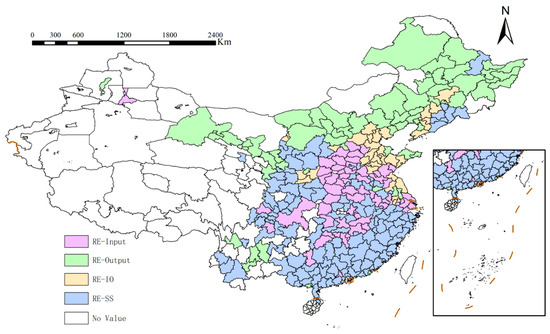
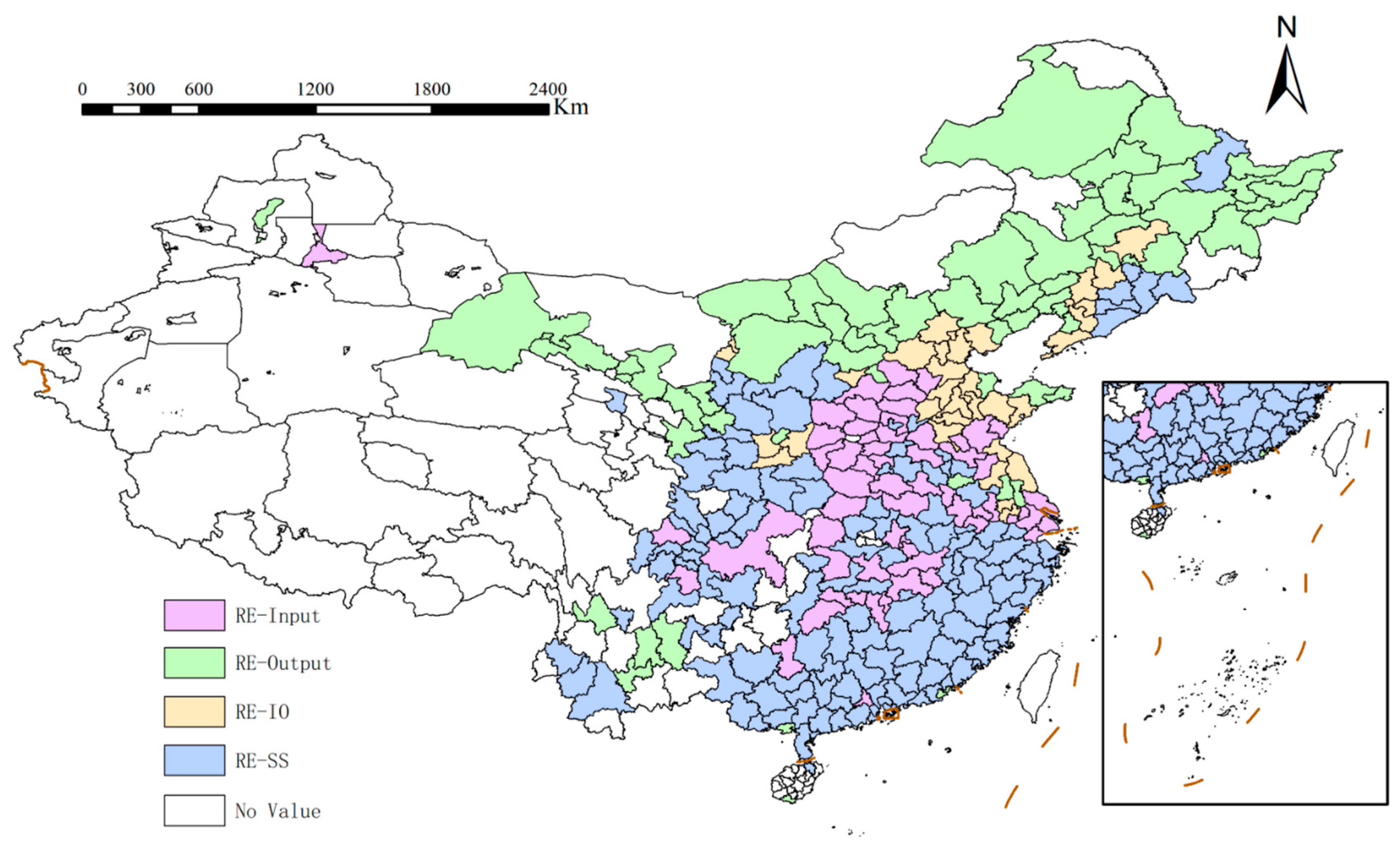
The sample cities are grouped into four groups based on RE endowment and supply–demand conditions. RE-Input cities, mostly inland, often lack solar and wind resources, relying on external RE. They are developed, densely populated, and energy-hungry, thus prone to supply instability. Therefore, these cities should emphasize energy efficiency and conservation technology, optimize smart grids and storage, and diversify energy supply. RE-Output cities are mainly in the northern regions and regions rich in natural resources like Yunnan, Guizhou, and Guangxi, serving as major providers of RE. Their ample RE ensures a stable energy supply. Their RE production and related equipment manufacturing industries are thriving, attracting numerous green enterprises to cluster and augment the added value of the RE sector. RE-IO cities are mainly coastal ones. They possess a certain RE generation capacity, yet still require external energy imports, striving to balance production and demand. Their industrial structures are diverse, encompassing both RE production and energy efficiency and conservation technologies. RE-SS cities are the most widely distributed and relatively dispersed. They possess rich RE and efficient energy utilization technologies, achieving near self-sufficiency without heavy reliance on external RE. These cities typically enjoy a highly stable energy supply, are less affected by external market fluctuations, and have a relatively comprehensive RE industry chain.
The specific grouping results are shown in Figure 1. To further verify the robustness of the grouping, we additionally adopt the median as an alternative threshold. The resulting classification is presented in Figure S1 in Supplementary Materials. Only 28 cities experienced minor changes in their classification. This indicates that the main patterns of RM across city groups remain qualitatively consistent regardless of the threshold used, suggesting that our grouping strategy is robust.
Figure 1.
One of the grouping results of 282 cities based on the RE supply–demand.
4.1.2. Output Elasticity Result
The measured mean output elasticities of production factors are presented in Table 2. The average output elasticities of capital, labor, and NRE are high, signifying their significance as drivers of economic growth. The relatively low average output elasticity of RE indicates its modest contribution to economic growth, underscoring the inadequacy of the energy transition.
Table 2.
Estimated results of output elasticities for production factors (mean values).
4.2. Analysis of the City RM Degree Result
4.2.1. Degree of RM at the City Level
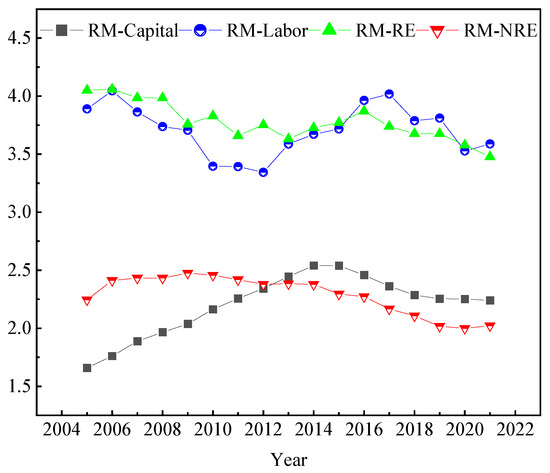
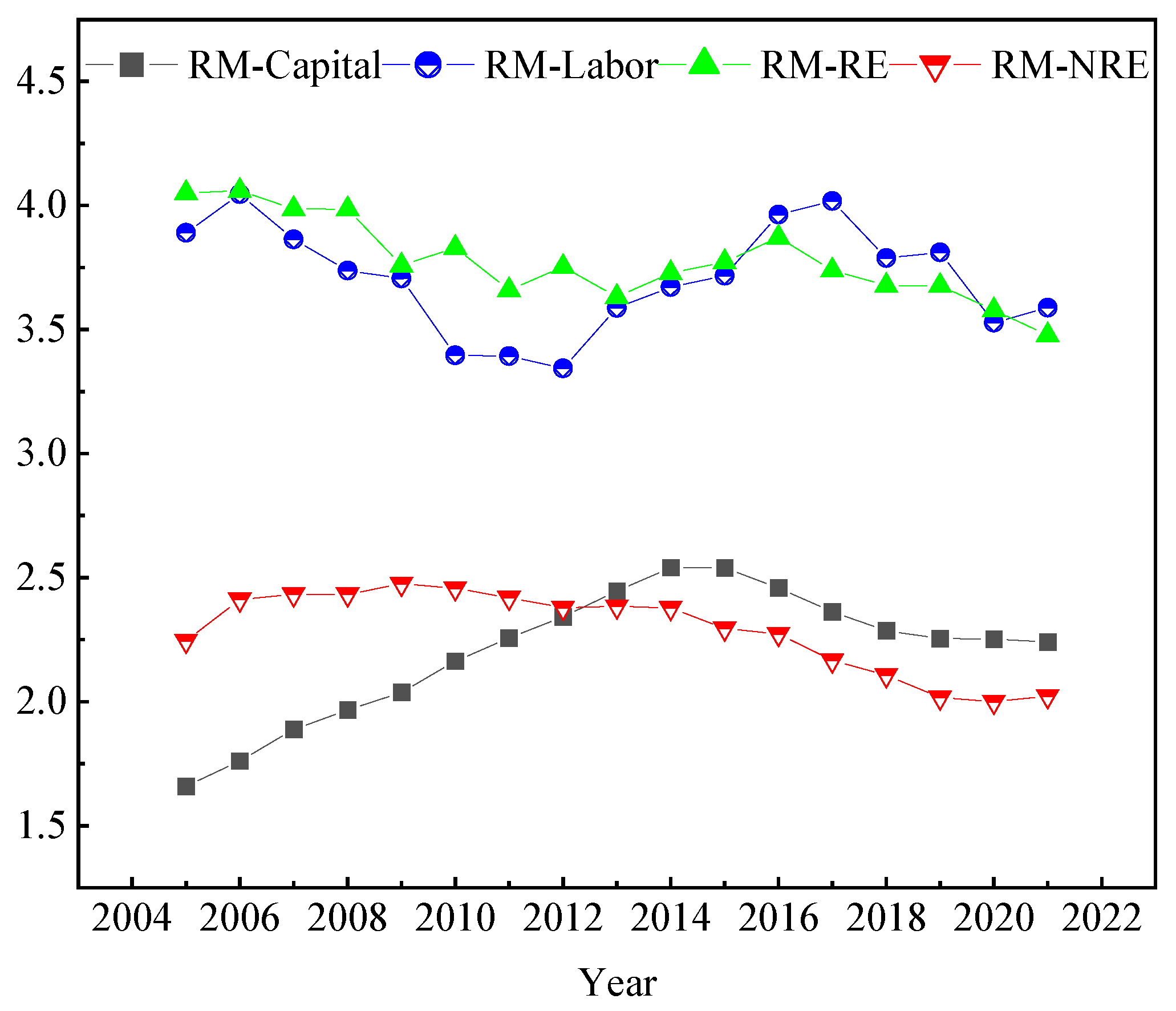
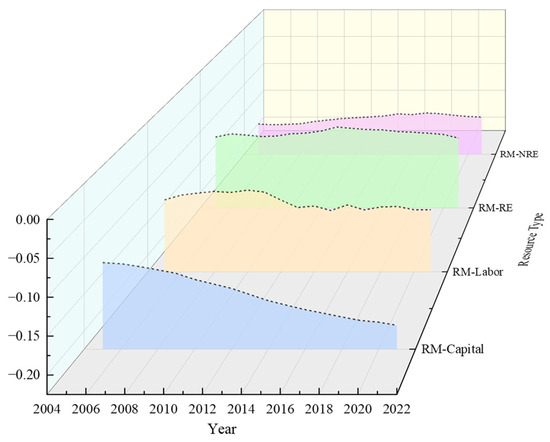
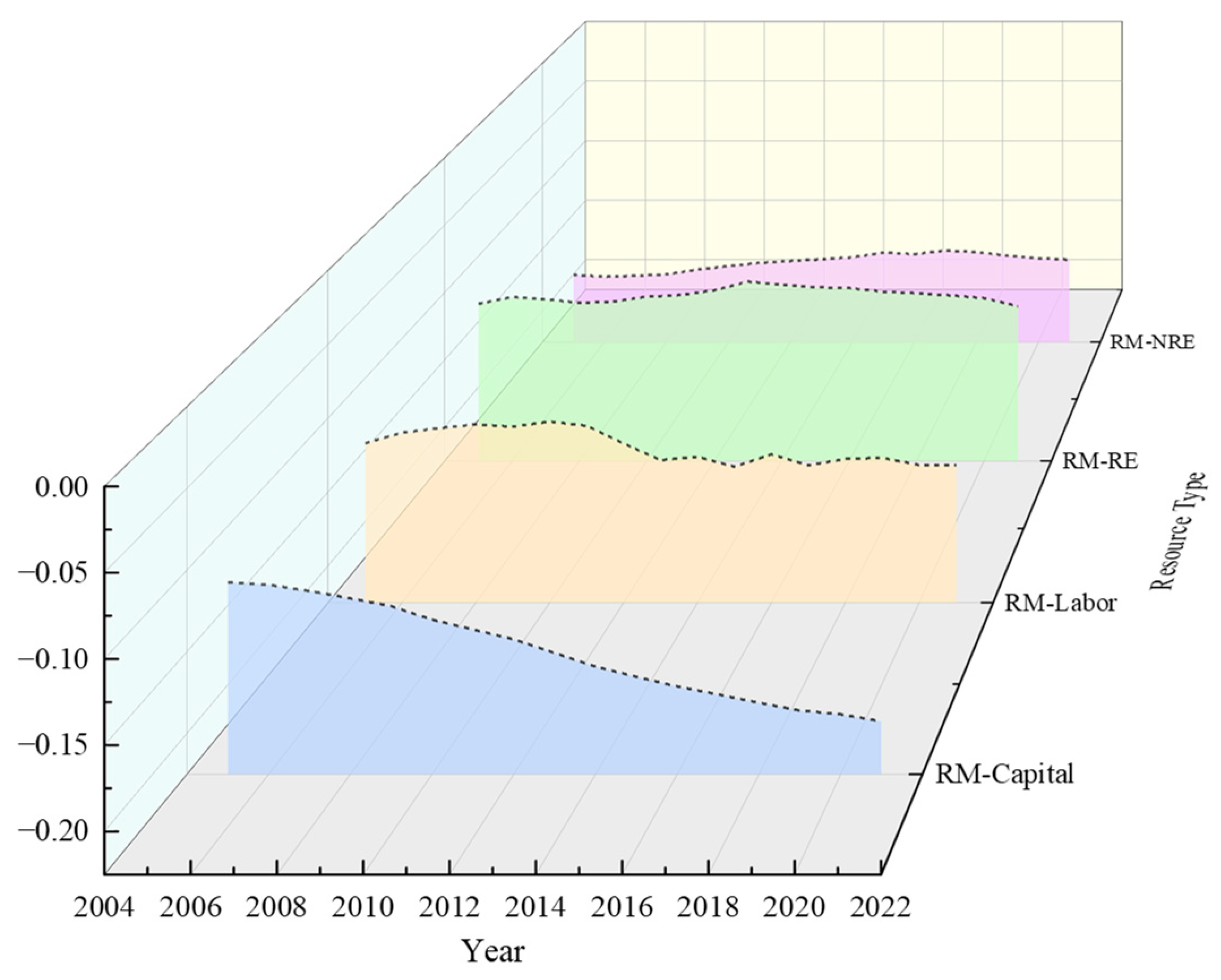
Figure 2 shows the trend of the average misallocation degree of four production factors at the city level in China during 2005–2021. The average misallocation of RE and labor is significantly higher than that of NRE and capital. This accords with the fact that China’s development is mainly propelled by NRE and capital. The RE industry remains underdeveloped. And there is a labor supply–demand gap in emerging industries. The misallocation degree of RE is high yet declining, suggesting that with China’s strong push for ecological and green development, RE is increasingly significant. However, there is still ample room for optimization. The average NRE misallocation is similar to that of RE and is decreasing annually, which is associated with the substitution of clean energy. The average capital misallocation degree exhibits a trend of first increasing, then decreasing, and finally leveling off. It reflects China’s economic transition from high-speed to high-quality development. The average misallocation degree of labor is relatively high and fluctuates, remaining stable at around 3.75, mirroring the cyclical nature of economic development. During the transition from traditional to emerging industries, the adaptation of labor skills takes time. From the initial mismatch of labor skills to the gradual development of maturity, the labor misallocation degree first rises and then falls.
Figure 2.
Trends of average RM degree in Chinese cities during 2005–2021.
4.2.2. Degree of RM in Segmented City Level
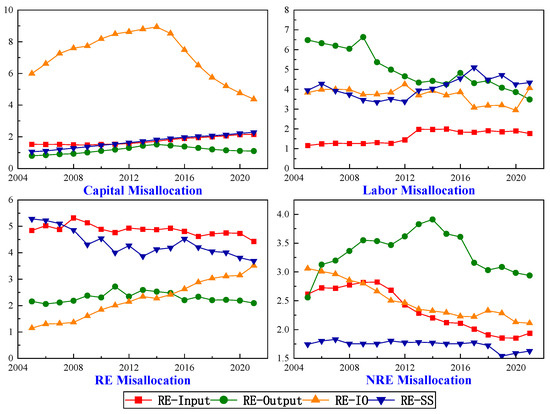
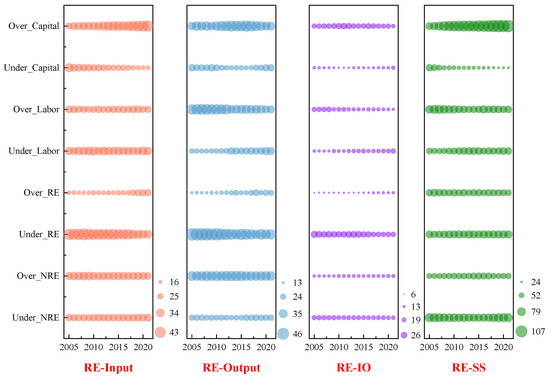
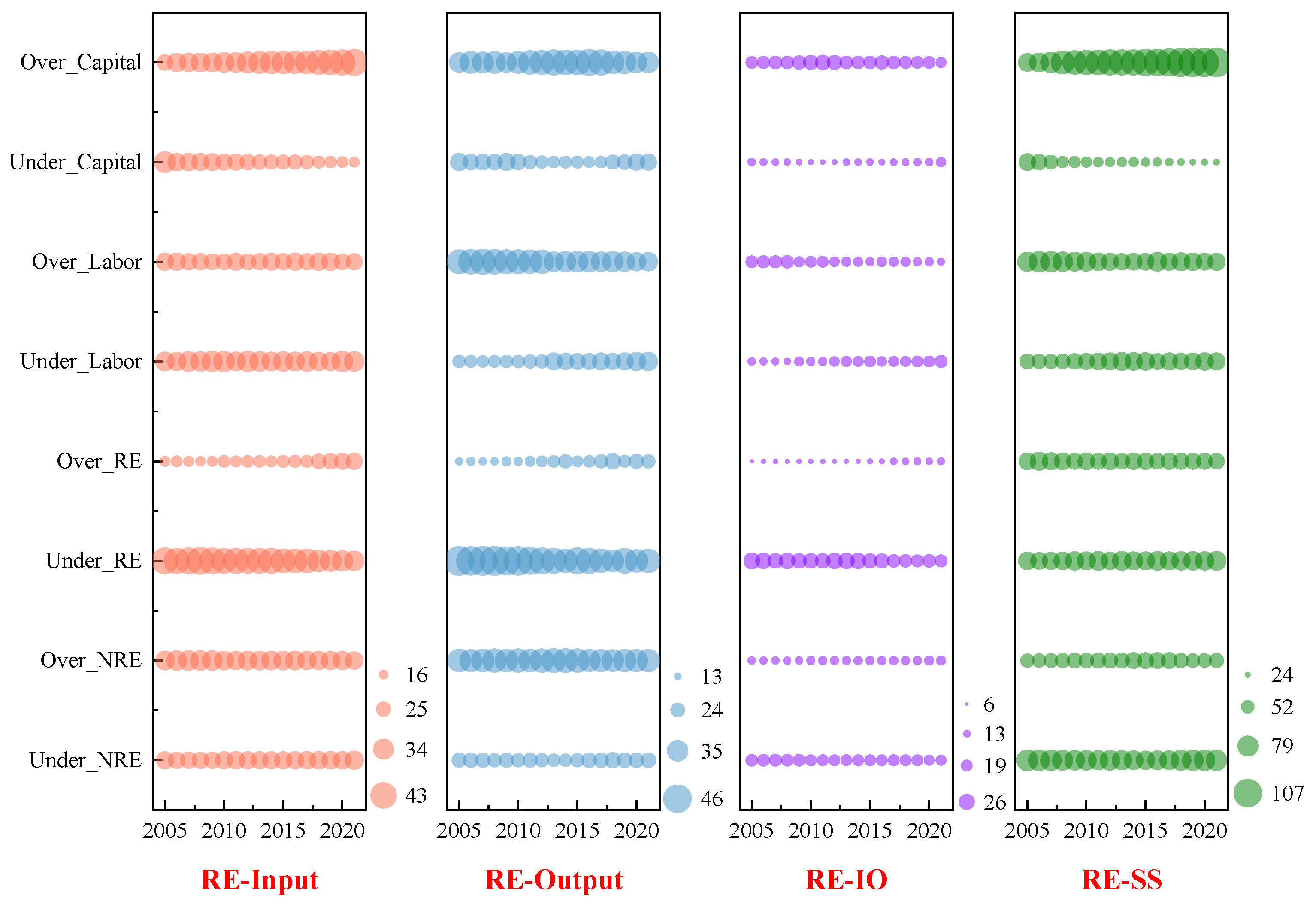
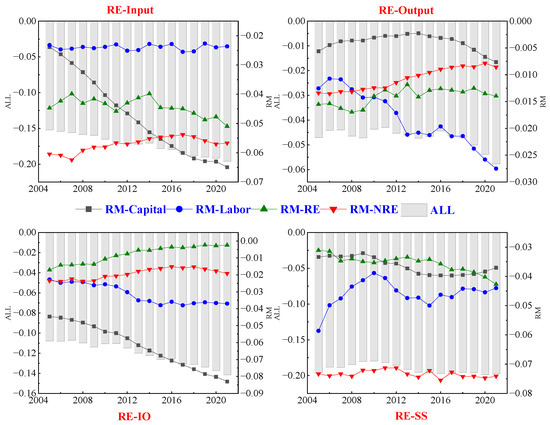
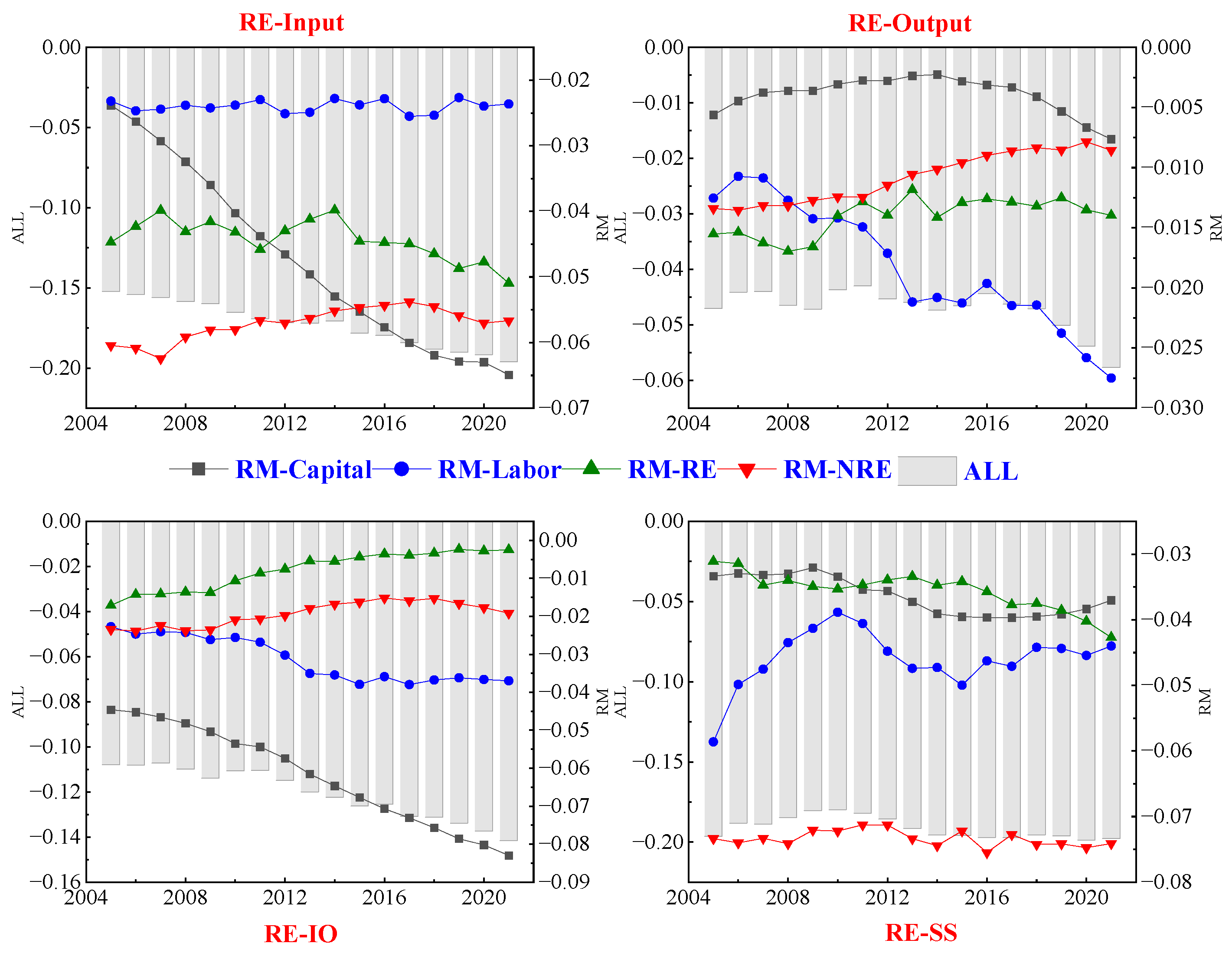
The RM situations of diverse city types are presented in Figure 3 and Figure 4. It is evident that the misallocation of various resource factors varies among the four city types in Figure 3. In RE-Input and RE-SS cities, the misallocation of RE and NRE is declining, capital misallocation is rising, and labor misallocation first increases and then stabilizes. In RE-Output cities, labor misallocation follows an inverted “U” shape, while those of RE, NRE, and capital are decreasing. In RE-IO cities, RE misallocation gradually rises, NRE and labor misallocation decline, and capital misallocation, similar to that in RE-Output cities, displays an inverted “U” shape.
Figure 3.
Trends of average RM degree in four city types.
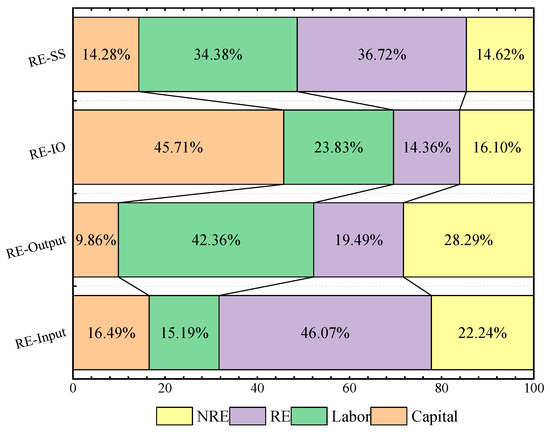
Figure 4.
Share of average RM degree in four city types.
With the continuous progress of sustainable economic development and the cleaner transformation of the energy structure, RE development is drawing more attention. In RE-Input and RE-SS cities, the former is constantly introducing RE, and the latter is intensifying its own RE exploitation. Without proper planning and guidance, blind capital investment may occur. A large number of RE projects will also sharply increase labor demand, but it will stabilize with labor market adjustments. Therefore, the development of RE should not only focus on increasing quantity but also on technological innovation to improve energy efficiency. Policy guidance should be combined to optimize the energy structure and rationalize energy resource allocation.
RE-Output cities possess rich RE and a relatively complete, yet single, labor base. The rise in new industries has driven these cities to adjust employment patterns and optimize structures, enhancing job suitability for the labor force. However, the national push for RE has also spurred RE industrial expansion in these cities. The initial impulse attracted a large influx of resources in a disorderly manner. Subsequently, with the improvement in market mechanisms and strengthened energy industry regulations, resource allocation has gradually become more rational. RE-IO cities are characterized by complex energy trade flows. They place greater emphasis on labor quality enhancement and integrated energy management during frequent RE input and output. However, these cities might also experience capital and RE misallocation. This is due to the inability of management mechanisms to promptly adapt to early industry expansion, or because of energy price fluctuations, technological convergence, and storage and transportation issues.
Figure 4 shows the share of RM for each of the four types of cities. It is calculated that the average percentage of overall misallocation of the four production factors in RE-Input cities, RE-Output cities, RE-IO cities, and RE-SS cities reaches 21.2%, 23.7%, 32.1%, and 23.0%, respectively. It can be seen that RE-IO cities have the most serious overall RM, and RE-Input cities have the least overall RM. RE-Input cities and RE-SS cities have the most pronounced RE misallocation (35.3% and 31.7%), RE-Output cities have severe NRE misallocation (33.6%) and labor misallocation (34.7%), and RE-IO cities have severe capital misallocation (60.8%).
The overall low RM in RE-Input cities stems from their reliance on resource inputs with a relatively simple and stable pattern. However, constrained by source limits, transport costs, and technological adaptation, RE-Input cities often face a supply–demand misfit, leading to significant RE misallocation. RE-Output cities are prone to industrial fluctuations or upgrades as their industries mainly center around resource export, being labor-intensive with limited skill demands. Meanwhile, the overemphasis on RE output in these cities causes an imbalance between local energy consumption and reserves, unable to be adjusted flexibly according to demand, thus resulting in an NRE misallocation. The essence of labor misallocation in RE-Output cities lies in the systematic contradiction between the large-scale, technology-intensive nature of energy production and the underdeveloped local economy, coupled with low-skilled labor forces. RE-IO cities exhibit the highest overall RM and severe capital misallocation, chiefly due to their frequent energy trade activities. Capital chases profits blindly across numerous complex input–output links and related sectors without effective regulation, leading to misallocated or idle capital. Concurrently, the incessant resource flow renders it exceedingly challenging to coordinate diverse elements, prone to triggering overall RM. RE-SS cities, despite having some RE, might not develop and utilize them fully and efficiently because of inadequate technological R&D application. Moreover, these cities fail to integrate RE with other industries in their industrial layout, leading to an irrational distribution of RE across various industries and production segments. This exacerbates the misallocation issue.
4.3. Analysis of the City RM Direction Result
4.3.1. Direction of RM in the Whole City
According to the measured results of the RM direction, the statistics of the allocation of the four production factors at the city level in China from 2005 to 2021 are presented in Table 3. The underallocation of RE, NRE, and labor, along with the overallocation of capital, is prevalent in cities. Most cities experience an initial underallocation of energy, which gradually transitions to overallocation, especially in the case of RE. The underallocation of RE is strongly associated with economic development patterns and national policies. The promotion of clean energy development and industrial green transformation sends positive signals to investors, spurring significant investments in clean energy [41]. However, RE is characterized as unstable. Substantial efforts are still required for the development of RE. The underallocation of NRE can also be attributed to the impact of national concepts regarding energy conservation, environmental protection, and sustainable development. The overallocation of capital in most cities and growing number of such cities are associated with extensive economic development patterns. The labor allocation has shifted from overallocation to underallocation, with the latter becoming dominant. This is due to the overall labor shortage caused by accelerated urbanization and population aging.
Table 3.
Number of Cities in the RM direction in the whole city.
4.3.2. Direction of RM in Segmented Cities
Apart from the differences in the misallocation degree of various resources among different types of cities, the misallocation directions may also vary. Hence, it is essential to further investigate the misallocation directions of resources in each type of city. As Figure 5 illustrates, RE-Input cities present an underallocation of RE and labor, along with an overallocation of NRE and capital. RE-Output cities have overallocations of NRE, capital, and labor, in addition to an underallocation of RE. RE-IO cities mainly show the underallocation of RE and NRE, overallocation of capital, and a gradual shift from the overallocation to underallocation of labor. RE-SS cities experience underallocations of RE and NRE and overallocations of capital and labor.
Figure 5.
Number of cities in the RM direction at the segmented cities.
In RE-Input cities, the traditional energy industry is highly developed, possessing a complete industrial chain and stable returns. This leads enterprises and investors to develop strong industrial inertia and path dependence. Meanwhile, imported RE demands substantial investment in supporting infrastructure at the outset, like the construction of transmission lines and energy storage facilities. As a result, capital becomes overly concentrated in these areas, causing overallocations of NRE and capital. The inadequate allocations of RE and labor stem from an obsolete industrial structure, where traditional energy prevails and fails to fulfill the requirements of the RE sector. Moreover, RE is constrained by natural conditions and is highly intermittent, unable to guarantee a stable supply. It is also challenging to align the spatial and temporal distribution of RE with city demands, preventing its full utilization. In RE-Output cities, the national “green” initiative has drawn significant investment to the RE industry. However, overly optimistic expectations of industrial expansion have caused a surfeit of capital influx, leading to capital overallocation. Labor overallocation results from the energy industry’s labor-intensive nature and employment concentration in a single channel. The overallocation of NRE is attributable to its dominant position and the absence of strict usage restrictions. The underallocation of RE is because the industry lags technologically and has an irrational energy output structure, leading to the neglect of local RE utilization.
In RE-IO cities, the frequent energy trade has triggered a large influx of capital into energy-related sectors and industrial chains. Speculative activities are further driven by profit motive. Meanwhile, the energy trade process suffers from high energy flow losses and low efficiency, prone to resulting in energy underallocation. Labor is initially overallocated because of manpower reliance at the start of the energy trade. Then, it gradually turns into underallocation as it becomes difficult to align the labor skill structure with the new demands brought about by industrial upgrading. RE-SS cities possess a relatively abundant RE, which serves as a foundation for the local energy industry’s development. These cities hold great potential for the RE industry and are accompanied by a robust industrial chain impetus. Moreover, they enjoy policy incentives such as tax exemptions, land concessions, and capital subsidies, attracting substantial capital investment and consequently resulting in capital overallocation. The overallocation of labor stems from the labor-intensive nature of certain segments in the RE industry, like the production and installation of photovoltaic panels. The underallocation of energy is due to technological factors, such as the backwardness of RE conversion and storage technologies and the low investment in NRE development and utilization technologies. Additionally, energy demand rises with urban development, yet the development pace is constrained by complex approval procedures and time-consuming, costly infrastructure construction, leading to a supply–demand imbalance.
4.4. Economic Efficiency Loss Due to RM in Urban Areas
4.4.1. Output Gap
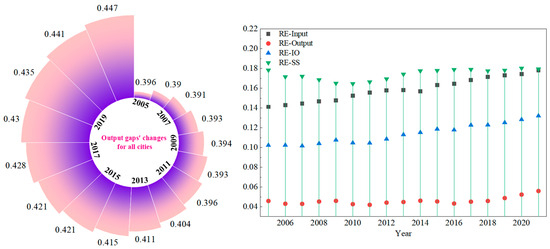
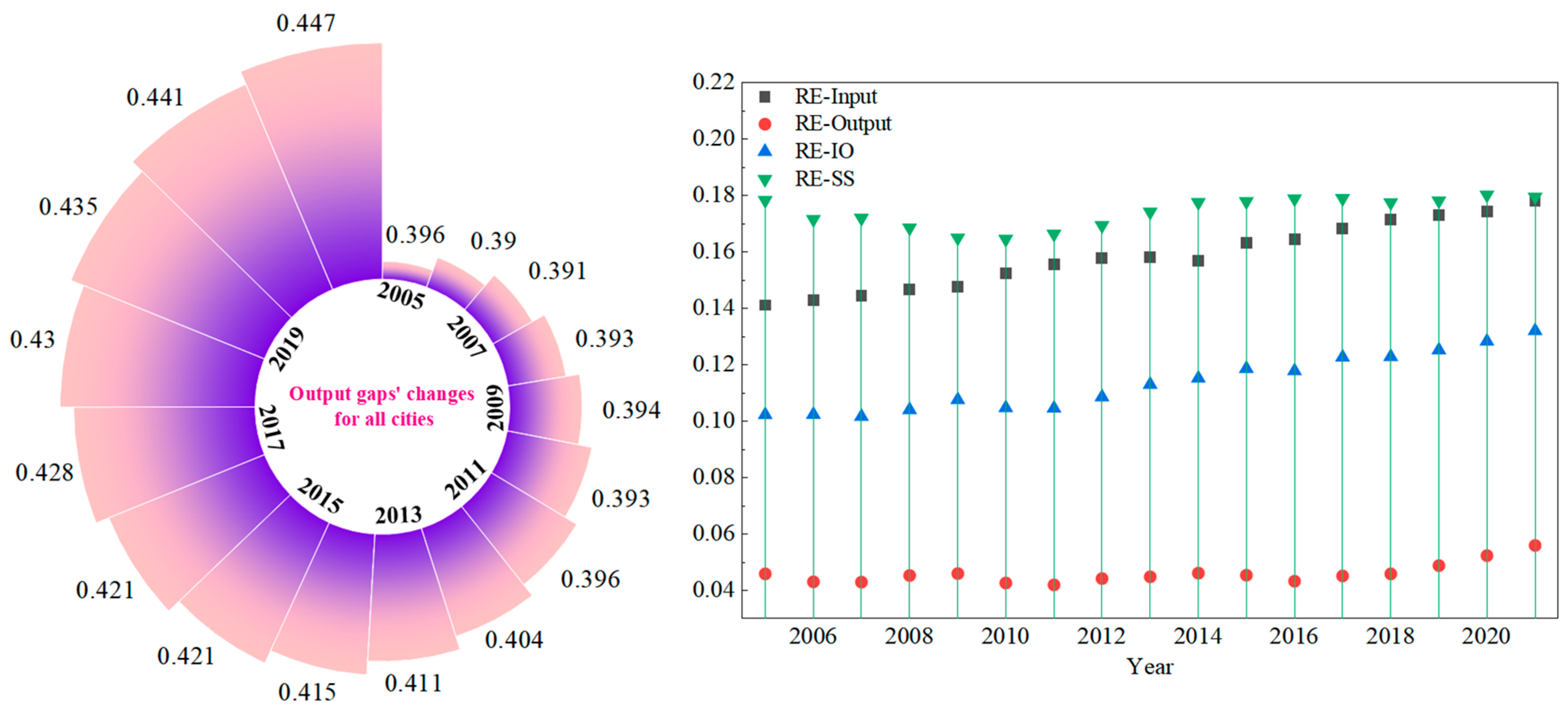
According to the calculation, the output gap expands with time for all city types. Figure 6 presents the alterations in the ratio of actual to potential output for each city type over the years. As shown in Figure 6, the output gap for all types of cities is nearly 45% in 2021. Notably, the estimated output gap of nearly 45% represents a theoretical upper bound of potential output losses under extreme misallocation scenarios. This implies that city output could be substantially enhanced by optimizing resource allocation across all city types. RE-Input, RE-Output, RE-IO, and RE-SS cities possess output gaps of around 16%, 5%, 12%, and 17%, respectively. Among them, RE-Output cities exhibit the narrowest output gaps, while RE-SS cities display the widest. RE-Output cities have established an efficient industrial chain centered on energy output, featuring relatively mature exploitation, conversion, and transportation processes. These cities also place greater emphasis on market connectivity and information management, enabling them to adjust production flexibly in response to demand, thus resulting in a smaller output gap due to RM. Despite possessing a certain foundation of RE resources, RE-SS cities lag in energy development and utilization technologies. This leads to the ineffective conversion of substantial potential RE into practical usable energy, causing the actual output to be significantly lower than the potential output and generating a large output gap.
Figure 6.
Annual variations in output gaps in cities.
4.4.2. Efficiency Loss
The changes in efficiency losses caused by resource allocation distortions are presented in Figure 7 and Figure 8. Figure 7 shows the trend of efficiency losses due to RM for the whole city. The efficiency loss resulting from RM is increasing, highlighting the urgent need to focus more on the rationality of resource allocation. The efficiency losses attributed to the misallocations of NRE and capital are more pronounced, with average values reaching 16.1% and 15.0%, respectively. This indicates that the region’s economic growth predominantly relies on NRE and capital drives. The intensive economic growth model has not yet made significant progress. The efficiency losses from the misallocations of RE and labor are relatively minor, yet their average values stand at 10.2% and 12.0%, respectively. In conjunction with the findings regarding the misallocations of various resources in the whole city in Section 4.2.1, it is observed that although NRE and capital exhibit low misallocation degrees, the resultant efficiency loss is more severe. The opposite is true for RE and labor. This further corroborates that NRE and capital constitute the central drivers of economic development and emphasizes the need for further advancement of the intensive economic growth model. There is a long way to go to achieve energy transition and sustainable economic development.
Figure 7.
Trends of efficiency losses at the city level.
Figure 8.
Trends of efficiency losses in the segmented cities.
Figure 8 presents the variation in efficiency losses resulting from resource allocation distortions in the segmented cities. Among them, RE-Input cities display the least efficiency losses (4.7%), while RE-SS cities suffer the most severe ones (19.1%). In RE-Input and RE-SS cities, the efficiency losses are primarily attributed to NRE misallocation. In RE-Output cities, labor misallocation leads to efficiency losses. For RE-IO cities, the efficiency losses are mainly caused by capital misallocation. This closely correlates with the misallocation of various resource factors in each city type. It reveals that RE-Input and RE-SS cities remain dominated by fossil energy, RE-Output cities are labor-intensive with a single and stable labor pattern, and RE-IO cities tend to attract investment. Moreover, the efficiency loss from RE misallocation is relatively low in all but RE-Output cities. This suggests that RE-Input, RE-IO, and RE-SS cities have a small share of RE, and it has not fully contributed to their economic development. The efficiency loss due to RE misallocation in RE-Output cities is decreasing, reflecting improvement in the RE industry system in the local region.
4.4.3. Decomposition of the Output Changes Sources
We further investigated the reasons for output changes and determined the sources of such changes. The variation in total output is dissected into four constituents: the contribution of efficiency alterations, the contribution of output share fluctuations, the contribution of resource allocation distortion changes, and the contribution of factor input changes. Specific results are displayed in Table 4 and Tables S1–S4 in Supplementary Materials. The analysis reveals that both the city as a whole and the segmented cities have similar trends in the sources of output change and the contribution of each type of resource element. Therefore, the city as a whole (Table 4) is taken as an example for the analysis, and the decomposition results of the sources of output changes in other segmented cities are displayed in Tables S1–S4 in Supplementary Materials. Beginning in 2011, the origin of urban output variation progressively shifted from initial factor input changes to alterations in total TFP. This implies that China’s economic growth pattern has gradually transitioned to an intensive mode, which can be attributed to the detailed guidance of China’s 12th Five-Year Plan. Regarding the source of the contribution to the change in total TFP, it is found that the contribution is mainly negative. The principal cause of the total TFP decline is the reduction in TFP in each city, while the allocation effect has limited influence. The negativity of both total output and total TFP changes indicates significant intracity industrial competition and the potential existence of technological bottlenecks to be overcome and government policies to be enhanced.
Table 4.
Decomposition of output change source at the city level.
Regarding the allocation effects alone, the contribution of changes in allocation distortions prevails, whereas the contribution of changes in output shares is negligible. The minimal contribution of changes in output shares is due to the enhanced national policies in support of small enterprises. For example, financial institutions are encouraged to offer loans to small and microenterprises, preventing significant changes in output shares caused by the closure of some inefficient firms or by mergers. The contribution of allocation distortion changes is the dominant allocation effect for three possible reasons. Firstly, policy orientation bias frequently causes a lot of resources to flow towards specific popular regions or large enterprises, impeding the efficient allocation of resources. Secondly, an imbalance exists in the city’s industrial structure. Traditional sunset industries still consume excessive resources due to historical inertia and policy support, while emerging sunrise industries suffer from insufficient resources, thus distorting resource allocation. Thirdly, information asymmetry prevails. It is challenging for enterprises to accurately gauge market demand and resource distribution, leading to a significant waste of resources on ineffective production.
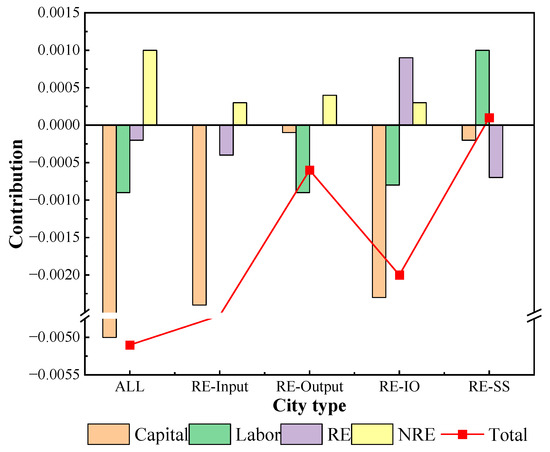
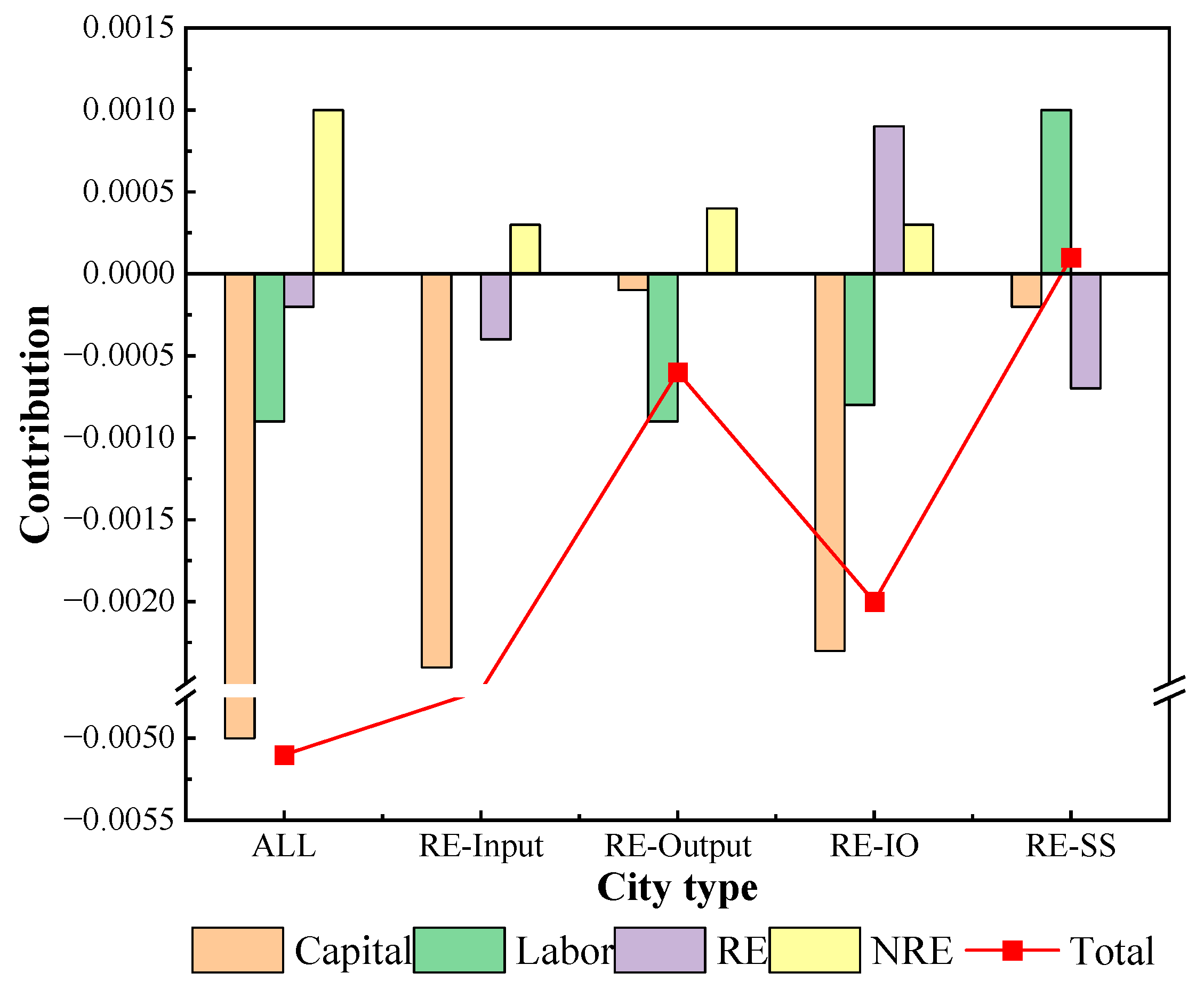
Further exploration is conducted on the contribution of changes in various types of resource allocation distortions to output changes (Table 4 and Figure 9). In terms of the contribution trends shown in Table 4, only the contribution of changes in capital misallocation remains consistently negative. The contributions of changes in RE, NRE, and labor misallocations are highly volatile, exhibiting both positive and negative values. In combination with the conclusion of predominantly negative changes in total output, it can be determined that the significance of capital in economic development remains unaltered over time. This also validates the fact that the contribution of city capital misallocation, as depicted in Figure 9, closely approximates the overall allocation effect. It can be observed that the contribution of capital misallocation changes predominates in RE-Input and RE-IO cities, as presented in Figure 9. In contrast, in RE-Output and RE-SS cities, the contribution of labor misallocation changes is dominant. This finding is highly associated with the characteristics of the factor inputs specific to each type of city.
Figure 9.
Contributions from allocation distortion changes in various resources in the city.
Notably, Figure 9 indicates that the contribution of NRE misallocation changes is positive across all city types, meaning that NRE misallocation surprisingly leads to an output increase. This is because tight energy supply or cost hikes, driven by environmentally friendly policies, compel economic development to seek alternative energy sources or more efficient energy utilization, thus ensuring stable or even enhanced output. However, even if output rises under irrational resource allocation, this is not recommended. This is because it is not Pareto Optimality, and the resource waste due to misallocation persists. Greater output could be achieved by optimizing the allocation of these resources.
5. Discussion
While existing studies suggest the positive correlations between the economic efficiency improvement and urbanization, our results reveal a possible threshold effect on this relationship. For Chinese urban areas, the allocative efficiency gains driven by urbanization and policy interventions begin to stagnate when economic development surpasses a critical level. It can be observed that output gaps are widening (approaching nearly 45% by 2021) and efficiency losses are rising (e.g., 19.1% in RE-SS cities), even amid sustained urban growth. This divergence stems from structural bottlenecks such as diminishing returns to scale in infrastructure investment, rigid labor market segmentation, and entrenched capital misallocation exacerbated by policy inertia [5]. These results align with recent critiques of “policy fatigue” in top-down urban governance models, where traditional stimuli fail to address emerging complexities like energy-transition coordination or TFP-driven growth [23]. The gradual shift in output-change sources from factor inputs to TFP variations (Table 4) further underscores the need for institutional innovation rather than incremental reforms.
Among the subdivided city types, significant disparities in various RM are observed across the four categories, largely attributed to their distinct RE consumption patterns. For RE-Input cities, external dependence and local absorption dominate RE usage. Fluctuations in RE imports and inadequate infrastructure (e.g., energy storage) lead to RE misallocation, which is further exacerbated by the low adaptability of capital and labor. RE-Output cities primarily adopt RE usage patterns centered on resource extraction and external export. This results in excessive concentrations of capital and labor in primary sectors, with insufficient local conversion triggering total factor misallocation. RE-IO cities feature RE consumption patterns dominated by hub transit and bidirectional flow. As energy trading hubs, their factor allocation must adapt to cross-regional circulation needs, greatly increasing the difficulty of factor regulation and causing various RM. In RE-SS cities, the closed-circuit RE usage pattern restricts technological conversion. Coupled with inadequate capital and labor transformation and imbalanced NRE allocation, this further highlights the rigidity in their resource allocations. The variations in RE utilization patterns across different types of cities also underscore the importance of institutional innovation at local levels.
The higher misallocations of RE and labor compared with NRE and capital at the city level reflects China’s transitional economic landscape. While NRE and capital remain entrenched as primary drivers of growth due to decades of policy prioritization and industrial inertia, RE misallocation highlights systemic challenges in integrating nascent renewable technologies. Labor market inefficiencies likely stem from skill mismatches during the shift toward higher-value industries, exacerbated by rapid urbanization and aging demographics. This aligns with Aoki’s [36] observations of structural imbalances during China’s growth but extends their framework by isolating RE-specific distortions. In addition, NRE misallocation contributed positively to output across all city types, likely reflecting short-term adaptations to stringent environmental policies. For instance, rising NRE costs may force efficiency gains, but such reactive measures are unsustainable and mask underlying waste. This aligns with Wang and Cao’s [33] observations of temporary efficiency boosts in energy-intensive sectors but diverges by framing it as a suboptimal, non-Pareto outcome.
6. Conclusions and Suggestions
The article estimated the degree and direction of the misallocations of RE, NRE, capital, and labor for cities as a whole and for the four subcategories of RE-Input, RE-Output, RE-IO, and RE-SS based on panel data of 282 cities in China during 2005–2021. On this basis, the article further quantified the output gap and efficiency loss caused by resource allocation distortions and decomposed the sources of output changes. The main findings of the article are presented below.
- (1)
- At the city level, the misallocation degree of RE and labor is higher than that of NRE and capital. The misallocation degree of RE and NRE shows a decreasing trend, the misallocation degree of capital shows an inverted “U” shape, and labor continues to fluctuate but is stable overall. RE, NRE, and labor are underallocated, while capital is overallocated.
- (2)
- At the segmented city level, the RM of the four types of cities is highly heterogeneous. RE-IO cities have the highest overall RM, and RE-Input cities have the lowest overall RM. RE-Input and RE-SS cities have the most pronounced RE misallocation, RE-Output cities have severe NRE misallocation and labor misallocation, and RE-IO cities have severe capital misallocation. In the direction of misallocation, RE-Input cities have overallocations of NRE and capital and underallocations of RE and labor. RE-Output cities have overallocations of NRE, capital, and labor, except for an underallocation of RE. RE-IO cities mainly show an underallocation of energy, overallocation of capital and a gradual shift from overallocation to underallocation of labor. RE-SS cities show an underallocation of energy and overallocations of capital and labor.
- (3)
- Output gaps and efficiency losses due to resource allocation distortions are gradually widening, both for the whole city and the segmented city. Specifically, RE-Output cities have the smallest output gaps and efficiency losses, while RE-SS cities have the largest ones. In the decomposition of the sources of output change, the trends in the contribution of individual resource changes are similar for the whole city and the segmented city. In both cases, total output changes are negative, and their sources gradually shift from changes in factor inputs to changes in total TFP. The contribution of changes in capital and labor misallocations is key to the contribution of the city’s allocation effect.
The following policy recommendations are made in response to the above findings.
First, governments should take the lead in forecasting market sizes in specific sectors to alleviate capital overallocation. Additionally, intelligent labor information exchange platforms and industry–university–research cooperation platforms should be established to conduct talent supply–demand supervision and skill training. In the energy sector, differentiated energy monitoring platforms should be built based on energy types to facilitate cross-regional energy flow and precise supply–demand matching. Second, different types of cities require targeted measures. RE-Input cities should prioritize the introduction of clean and efficient energy while establishing talent incentive mechanisms. RE-Output cities ought to promote local economic diversification and resource protection and establish resource development compensation mechanisms. When necessary, an energy allocation coordination group led by the National Energy Administration may be set up. As cities with the most severe misallocations, RE-IO cities should establish an urban resource coordination committee to comprehensively analyze resource flows and misallocation statuses, thereby determining the reasonable allocation ratio of various resources across different industries and development stages. RE-SS cities can formulate refined allocation plans while moderately opening their markets to introduce external advanced factors, driving innovative development and industrial upgrading. Finally, the integration and liberalization of factor markets should be advanced. To address economic issues arising from distorted urban resource allocation, there is an urgent need to establish a precision-oriented evaluation and guidance mechanism.
This paper has conducted an in-depth study of RM and the resulting efficiency losses in various types of cities in China. However, there are still research limitations and future research directions. In terms of data dimension, this study does not distinguish energy by its use as fuel or raw material but only examines the overall urban energy misallocation at the aggregate energy level. This study also does not consider substitutions between RE sources, focusing solely on the mutual substitution among the four factors: capital, labor, RE, and NRE. It even assumes that these four types of resource factors are perfectly substitutable. Regarding the time span, due to the lack of official data on urban RE, this study only assesses urban energy misallocation up to 2021 and cannot update it to the latest year. Concerning economic heterogeneity, insufficient attention is paid to the impact of economic policies. Policies related to artificial intelligence and green finance may affect RM, and RM may exhibit variations across cities under different policy environments. Future research could conduct an in-depth exploration of the policy impact on RM accordingly. For variable selection, this study only considers three core input factors and one desirable output, without incorporating environment-related undesirable outputs such as carbon emissions. Subsequent studies may explore environmental factors as an input for in-depth analysis. Additionally, other input factors like land and finance are not included, as their proportions are less significant than those of capital, labor, and energy.
The above research contributes to the Chinese government’s accurate identification of regional energy allocation shortcomings and provides other countries with directly applicable analytical frameworks and empirical insights. Drawing on these findings, other nations can formulate energy policies tailored to their national contexts, steadily improving resource use efficiency while reducing transition costs and ultimately injecting practical momentum into the achievement of global sustainable development goals.
Supplementary Materials
The following supporting information can be downloaded at https://www.mdpi.com/article/10.3390/en19030586/s1, Figure S1: Results of grouping cities by the median; Table S1: Decomposition of output change source in RE-Input cities; Table S2: Decomposition of output change source in RE-Output cities; Table S3: Decomposition of output change source in RE-IO cities; Table S4: Decomposition of output change source in RE-SS cities.
Author Contributions
Conceptualization, M.L. and X.M.; Methodology, M.L.; Software, M.L.; Validation, X.M.; Investigation, M.L.; Resources, X.M.; Data curation, M.L.; Writing—original draft, M.L.; Writing—review & editing, M.L. and X.M.; Visualization, X.M.; Project administration, X.M.; Funding acquisition, X.M. All authors have read and agreed to the published version of the manuscript.
Funding
This research received no external funding.
Data Availability Statement
The data presented in this study are available on request from the corresponding author.
Conflicts of Interest
The authors declare no conflict of interest.
References
- Kong, L.; Hu, G.; Mu, X.; Li, G.; Zhang, Z. The energy rebound effect in households: Evidence from urban and rural areas in Beijing. Appl. Energy 2023, 343, 121151. [Google Scholar] [CrossRef] [Scilit]
- Long, H.; Tu, S.; Ge, D.; Li, T.; Liu, Y. The allocation and management of critical resources in rural China under restructuring: Problems and prospects. J. Rural Stud. 2016, 47, 392–412. [Google Scholar]
- Imran, M.; Alam, M.S.; Jijian, Z.; Ozturk, I.; Wahab, S.; Doğan, M. From resource curse to green growth: Exploring the role of energy utilization and natural resource abundance in economic development. Nat. Resour. Forum 2024, 49, 2025–2047. [Google Scholar] [CrossRef] [Scilit]
- Panwar, N.L.; Kaushik, S.C.; Kothari, S. Role of renewable energy sources in environmental protection: A review. Renew. Sustain. Energy Rev. 2011, 15, 1513–1524. [Google Scholar] [CrossRef] [Scilit]
- Li, Y.; Ji, Q.; Wang, Z.; Xiong, Z.; Zhan, S.; Yang, Y.; Hao, Y. Green energy mismatch, industrial intelligence and economics growth: Theory and empirical evidence from China. Environ. Dev. Sustain. 2021, 24, 11785–11816. [Google Scholar] [CrossRef] [Scilit]
- Omer, A.M. Energy, environment and sustainable development. Renew. Sustain. Energy Rev. 2008, 12, 2265–2300. [Google Scholar] [CrossRef] [Scilit]
- Lin, B.; Zhu, J. Impact of China’s new-type urbanization on energy intensity: A city-level analysis. Energy Econ. 2021, 99, 105292. [Google Scholar] [CrossRef] [Scilit]
- Chen, Q.; Kuang, Z.; Liu, X.; Zhang, T. Transforming a solar-rich county to an electricity producer: Solutions to the mismatch between demand and generation. J. Clean. Prod. 2022, 336, 130418. [Google Scholar] [CrossRef] [Scilit]
- Chang, I.; Wu, J.; Yang, Y.; Shi, M.; Li, X. Ecological compensation for natural resource utilisation in China. J. Environ. Plan. Manag. 2013, 57, 273–296. [Google Scholar] [CrossRef] [Scilit]
- Dower, P.C.; Markevich, A. Labor Misallocation and Mass Mobilization: Russian Agriculture During the Great War. Rev. Econ. Stat. 2018, 100, 245–259. [Google Scholar] [CrossRef] [Scilit]
- David, J.M.; Venkateswaran, V. The Sources of Capital Misallocation. Am. Econ. Rev. 2019, 109, 2531–2567. [Google Scholar] [CrossRef] [Scilit]
- Wu, G.L. Capital misallocation in China: Financial frictions or policy distortions? J. Dev. Econ. 2018, 130, 203–223. [Google Scholar] [CrossRef] [Scilit]
- Hsieh, C.; Klenow, P.J. Misallocation and Manufacturing TFP in China and India. Q. J. Econ. 2009, 124, 1403–1448. [Google Scholar] [CrossRef] [Scilit]
- Caggese, A.; Cuñat, V.; Metzger, D. Firing the wrong workers: Financing constraints and labor misallocation. J. Financ. Econ. 2019, 133, 589–607. [Google Scholar] [CrossRef] [Scilit]
- Du, W.; Li, M. The impact of land resource mismatch and land marketization on pollution emissions of industrial enterprises in China. J. Environ. Manag. 2021, 299, 113565. [Google Scholar] [CrossRef] [Scilit]
- Qi, W.; Li, B.; Liu, Q.; Lv, J. Low-skill lock-in? Financial resource mismatch and low-skilled labor demand. Financ. Res. Lett. 2023, 55, 104003. [Google Scholar] [CrossRef] [Scilit]
- Orioli, A.; Di Gangi, A. Load mismatch of grid-connected photovoltaic systems: Review of the effects and analysis in an urban context. Renew. Sustain. Energy Rev. 2013, 21, 13–28. [Google Scholar] [CrossRef] [Scilit]
- Wang, S.; Zhao, D.; Chen, H. Government corruption, resource misallocation, and ecological efficiency. Energy Econ. 2020, 85, 104573. [Google Scholar] [CrossRef] [Scilit]
- Li, X.; Lu, T. Capital, labor, and derived demand for information: Evidence from China. Manag. Decis. Econ. 2020, 41, 339–353. [Google Scholar] [CrossRef] [Scilit]
- Wei, C.; Li, C. Resource misallocation in Chinese manufacturing enterprises: Evidence from firm-level data. J. Clean. Prod. 2017, 142, 837–845. [Google Scholar] [CrossRef] [Scilit]
- Cao, Z.; Gao, F.; Wu, Z.; Zhang, Q.; Zheng, Z.; Li, Z.; Hai, X. Quantifying the spatiotemporal mismatches between energy consumption and population: A comparative study in Guangzhou and Shenzhen, China. Cities 2025, 156, 105522. [Google Scholar]
- Lai, Y.; He, X. Does urban green development attention improve energy resource misallocation? Environ. Res. Commun. 2025, 7, 015036. [Google Scholar] [CrossRef] [Scilit]
- Wang, Y.; Sun, X.; Liu, T.; Yu, R. Is the Problem of Factor Misallocation in Resource-Based Cities More Serious? Stat. Res. 2023, 40, 58–72. [Google Scholar]
- Qiu, Y.; Zhang, W. Research on the spatiotemporal evolution of factor misallocation in China. J. Stat. Inf. 2024, 39, 12–28. [Google Scholar]
- Jiang, T.; Cao, C.; Lei, L.; Hou, J.; Yu, Y.; Jahanger, A. Temporal and spatial patterns, efficiency losses and impact factors of energy mismatch in China under environmental constraints. Energy 2023, 282, 128875. [Google Scholar] [CrossRef] [Scilit]
- Mills, E. An aggregative model of resource allocation in a metropolitan area. Am. Econ. Rev. 1967, 57, 197–210. [Google Scholar]
- Brandt, L.; Zhu, X. Accounting for China’s Growth. J. Comp. Econ. 2010, 31, 1–41. [Google Scholar] [CrossRef] [Scilit]
- Li, X.; Si, H. Resource misallocation and economic efficiency loss in China: Trend and decomposition. Mod. Econ. Sci. 2019, 41, 1–12. [Google Scholar]
- Wang, W.; Niu, Z. Resources misallocation and multi-dimensional industrial TFP in China. J. Quant. Technol. Econ. 2019, 36, 20–37. [Google Scholar]
- Kalaitzidakis, P.; Mamuneas, T.P.; Stengos, T. Specification and sensitivity analysis of cross-country growth regressions. Empir. Econ. 2002, 27, 645–656. [Google Scholar] [CrossRef] [Scilit]
- Asker, J.; Collard-Wexler, A.; De Loecker, J. Dynamic Inputs and Resource (Mis)Allocation. J. Political Econ. 2014, 122, 1013–1063. [Google Scholar] [CrossRef] [Scilit]
- Zhang, S.; Luo, J.; Huang, D.; Xu, J. Market distortion, factor misallocation, and efficiency loss in manufacturing enterprises. J. Bus. Res. 2023, 154, 113290. [Google Scholar] [CrossRef] [Scilit]
- Wang, Q.; Cao, P. Evaluation and prediction on resource misallocation of energy industry in China. Environ. Dev. Sustain. 2023, 27, 9003–9020. [Google Scholar] [CrossRef] [Scilit]
- Choi, B. Productivity and misallocation of energy resources: Evidence from Korea’s manufacturing Sector. Resour. Energy Econ. 2020, 61, 101184. [Google Scholar] [CrossRef] [Scilit]
- Hou, Y.; Yang, M.; Ma, Y.; Zhang, H. Study on city’s energy transition: Evidence from the establishment of the new energy demonstration cities in China. Energy 2024, 292, 130549. [Google Scholar] [CrossRef] [Scilit]
- Aoki, S. A simple accounting framework for the effect of resource misallocation on aggregate productivity. J. Jpn. Int. Econ. 2012, 26, 473–494. [Google Scholar] [CrossRef] [Scilit]
- Chen, Y.; Hu, W. Distortions, Misallocation and Losses: Theory and Application. China Econ. Q. 2011, 10, 1404–1422. [Google Scholar]
- Luo, X.; Liu, Y.; Liao, B.; Wang, J. Impact of digital economy development on energy mismatch: Empirical data from prefecture-level and above cities in China. Resour. Sci. 2023, 45, 524–535. [Google Scholar]
- Syrquin, M. Resource Reallocation and Productivity Growth. In Economic Structure and Performance; Academic Press: Cambridge, MA, USA, 1984; pp. 75–101. [Google Scholar]
- Yang, G.; Zhang, G.; Cao, D.; Gao, X.; Wang, X.; Yang, S.; Jiang, P.; Zha, D.; Shan, Y. A comprehensive city-level final energy consumption dataset including renewable energy for China, 2005–2021. Sci. Data 2024, 11, 738. [Google Scholar] [CrossRef] [Scilit]
- Wang, B.; Zhao, W. Interplay of renewable energy investment efficiency, shareholder control and green financial development in China. Renew. Energy 2022, 199, 192–203. [Google Scholar] [CrossRef] [Scilit]

Disclaimer/Publisher’s Note: The statements, opinions and data contained in all publications are solely those of the individual author(s) and contributor(s) and not of MDPI and/or the editor(s). MDPI and/or the editor(s) disclaim responsibility for any injury to people or property resulting from any ideas, methods, instructions or products referred to in the content. |
© 2026 by the authors. Licensee MDPI, Basel, Switzerland. This article is an open access article distributed under the terms and conditions of the Creative Commons Attribution (CC BY) license.