Agrivoltaics Across Crops and Technologies: A Systematic Review of Experimental Tests on Yield, Microclimate, and Energy Performance



Abstract
1. Introduction
2. Materials and Methods
2.1. Objective of the Review
2.2. Bibliographic Search Strategy
2.3. Inclusion and Exclusion Criteria
2.4. Classification of Selected Studies
3. Results
3.1. Overview of Selected Studies
3.2. Energy, Agronomic, and Microclimatic Effects by PV Technology in Agrivoltaics Systems
3.2.1. Conventional Monofacial Crystalline Silicon Modules (Opaque Modules)
3.2.2. Bifacial Modules
3.2.3. Semi-Transparent and Transparent Photovoltaic Systems
3.2.4. Concentrated Photovoltaic Systems
4. Discussion
5. Conclusions
- -
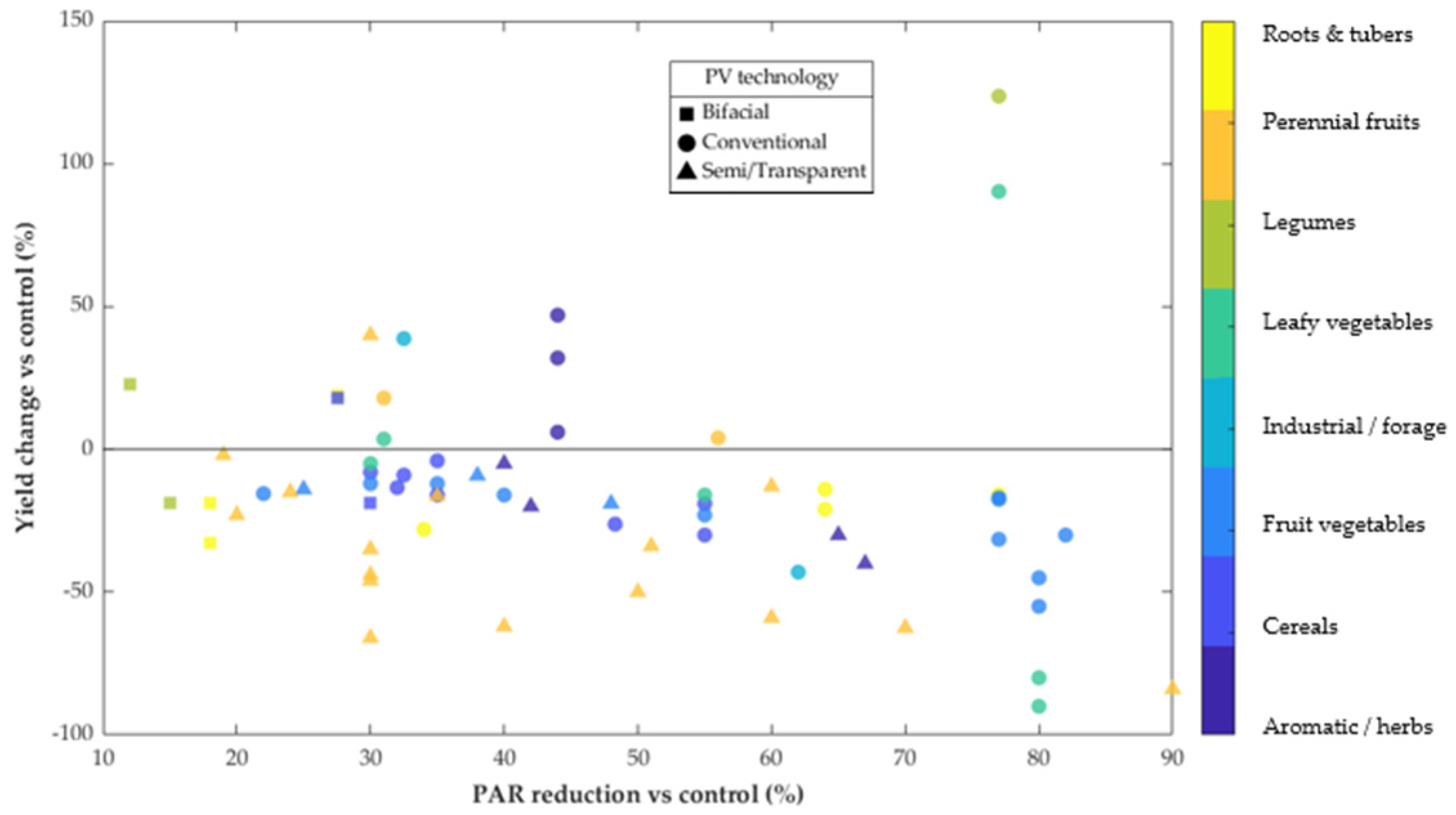
- Leafy crops (lettuce, spinach, chicory, Swiss chard, cabbage, leafy brassicas) generally show higher tolerance to moderate shading and, under hot conditions, can benefit from the associated microclimate buffering. They can perform well under conventional modules in Mediterranean settings, whereas in warmer climates they often favour semi-transparent solutions to better preserve PAR availability.
- -
- Fruit crops (fruit trees (apple, pear, peach, kiwi, grapevine)), on the other hand, prefer bifacial and semi-transparent systems that optimise the microclimate and reduce sunburn without compromising yield.
- -
- Fruit vegetables (tomatoes, peppers, aubergines, cucumbers, courgettes), being highly dependent on light, prefer semi-transparent and CPV modules in dry and sunny climates, which optimise light transmission.
- -
- Cereals C3 (wheat, barley, rice), which are the crops most sensitive to PAR reduction, require shading of no more than 20–30%.
Supplementary Materials
Author Contributions
Funding
Data Availability Statement
Conflicts of Interest
Abbreviations
| a-Si | Amorphous silicon |
| Bi-Si | Bifacial |
| C | Control |
| c-Si | Monocrystalline photovoltaic |
| CdTe | Cadmium telluride |
| CPV | Concentrated photovoltaic system |
| DF | Dicroic film |
| ET | Evapotranspiration |
| HD | Head weight |
| HWS | Hight water savings |
| HWL | High water dispersion |
| I | Increase |
| NV | No Variation |
| NR | Net radiation |
| OPS-CB | Opaque plastic sheets (checkerboard pattern) |
| OPV | Organic photovoltaics |
| Poly-si | Polycrystalline photovoltaic |
| PVc | Coloured photovoltaics |
| PVs | Opaque photovoltaics |
| RH | Relative Humidity |
| SS | Spectral splitting |
| SPV | Semi-transparent photovoltaic |
| TPV | Transparent photovoltaic |
| VWC | Volumetric water |
| D | Decrease |
Appendix A

| Crop | Tec | Light vs. Control | Parameter | Change vs. Control | Location and Year | Refs. |
|---|---|---|---|---|---|---|
| Wheat | c-Si | 45% PAR | Yield | −19% | Montpellier, France (2010) | [30] |
| Biomass | −29% | |||||
| 70% PAR | Yield | −8% | ||||
| Biomass | −11% | |||||
| Lettuce | c-Si | 45% PAR | Yield | −16% | Montpellier, France (2011) | [31,32] |
| 70% PAR | −5% | |||||
| Cucumber | 45% PAR | −23% | ||||
| 70% PAR | −12% | |||||
| Kale | c-Si | 45% PAR | Biomass | NV | California, USA (2021) | [33] |
| 7% PAR | D | |||||
| Swiss chard | 85% PAR | NV | ||||
| 55–62% PAR | D | |||||
| Peppers | 85% PAR | Fruit weight | I | |||
| Tomatoes | 55% PAR | NV | ||||
| 7% PAR | D. | |||||
| Chicory | c-Si | 6% of full sunlight | Biomass | +69% (HWS) and +26% (HWL) | Lecce, Italy (2021) | [37] |
| Chlorophyll | −20/30% | |||||
| ET | −45% | |||||
| Native flora | c-Si | - | Soil temperature | D | Chisago City, MN, USA (2019) | [38] |
| Soil moisture | I | |||||
| Soil nutrients | I | |||||
| Thyme | c-Si | 56% PAR | Height | +8.6% | Kourtesi, Greece (2024) | [39] |
| Fresh weight | +6% | |||||
| Oregano | Height | +9% | ||||
| Fresh weight | +32% | |||||
| Tea | Height | −5% | ||||
| Fresh weight | +47% | |||||
| LN | NV | |||||
| Thyme, Oregano, Tea | ET | −29% | ||||
| Rice | c-Si | 30–40% shading | Yield | −4 to −9% | Kakegawa (Shizuoka) and Katori (Chiba), Japan (2014–2019) | [40] |
| Plant height | −5 to −10% | |||||
| Plant number | −2 to −8% | |||||
| Rice | c-Si | 32% of shading | Plant height | −4.8% | Yamagata Prefecture, Tohoku Region, Japan (2021–2023) | [41] |
| Tiller number | −10.8% | |||||
| Panicle number | −11.2% | |||||
| Yield | −13.4% | |||||
| Protein content | +6.4% | |||||
| c-Si | 21–30% light reduction | Plant height | +7–10% | Chikusei (Ibaraki, Japan) (2018–2023) | [44] | |
| Panicle density | −10–20% | |||||
| Filled grains | −7–20% | |||||
| Protein content | +11–16% | |||||
| Amylose content | +4–6% | |||||
| Cabbage | c-Si | - | Yield | −57 to −9% | Jiangshan, China (2022) | [45] |
| Forage grasses | c-Si | 38% light reduction | ET | −1.3% | Colorado, USA (2023) | [46] |
| Tomato | c-Si | - | RH | −1.09–+4.75% | Corvallis, USA (2021) | [47] |
| Yield | −39–68% | |||||
| Celery | c-Si | - | Yield | −40% | France (2017) | [48] |
| Turnip | −40% | |||||
| Potato | −5 to −25% | |||||
| Wheat | −5% to −25% | |||||
| Vite | a-Si | 95% Light | RH | +6.1% | Puglia, Italy (2023) | [50,51] |
| 5% Light | NV | |||||
| 95% Light | VWC | +79.9% | ||||
| 5% Light | +172.4% | |||||
| 95% Light | Chlorophyll | +15–17% | ||||
| 5% Light | +18–20% | |||||
| Soil moisture | +16% | |||||
| Tomato | c-Si | 65% PAR | Yield | −12% | Puglia, Italy (2022) | [52] |
| Brix degree | +8% | |||||
| Dry matter | +5% | |||||
| Ph | −0.8% | |||||
| c-Si | 60% PAR | Yield | −16% | |||
| °Brix | −10% | |||||
| Tomato | a-Si | −2–8% lux | Mean fruit weight | −4%/−6% | Almeria Spagna (2010) | [53] |
| Tomato | OPS-CB | −25% PAR | Fresh yield | −15% | Almeria, Spain (2023–2024) | [54] |
| Dry yield | −14% | |||||
| °Brix | −3% | |||||
| −48% PAR | Fresh yield | −26% | ||||
| Dry yield | −19% | |||||
| °Brix | −11% | |||||
| Permanent grassland | c-Si | 38% PAR | Yield | −43% | Ravenna, Italy (2023) | [56] |
| Tomato | c-Si | −82% | Yield | −30% | Sardinia, Italy (2011–2012) | [57] |
| Sugarcane | Poly-si | 65–70% PAR | Yield | +38.8% | Santa Clotide Mill, Brazil (2022–2023) | [58] |
| Wheat | Poly-si | −28–68.6% PAR | Yield | −26.2% | Anand, Gujarat India (2017–2019) | [59] |
| −72.8–89.8% PAR | −62.8% | |||||
| −28–68.6% PAR | Biological yield | −21.9% | ||||
| −72.8–89.8% PAR | −54.8% | |||||
| Tomato | Poly-si | 50% shading | Yield | NS | Nagpur, India (2022) | [60] |
| Maize | c-Si | 35% shading | Yield | −16% | France (2019–2021) | [61] |
| 30–35% shading | −9% | |||||
| 54–56% shading | −30% | |||||
| Okra | Simulated PV | −70–90% PAR | Plant height | −18% | Malaysia (2023) | [62] |
| Leaf number | −27% | |||||
| Fresh weight | −55% | |||||
| Dry weight | −45% | |||||
| Chlorophyll | −17% | |||||
| Leaf water content | +3% | |||||
| Green spinach | Plant height | −54% | ||||
| Leaf number | −43% | |||||
| Fresh weight | −90% | |||||
| Dry weight | −80% | |||||
| Chlorophyll | −14% | |||||
| Leaf water content | +6% | |||||
| Bean | c-Si | −77% PAR | Yield | +123.7% | Tanzania (2022–2023) | [64] |
| Pod length | +20% | |||||
| Pod weight | +23% | |||||
| Swiss chard | Yield | +90.3% | ||||
| Leaf width | +25% | |||||
| Leaf fresh mass | +31% | |||||
| Maize | Yield | Ns | ||||
| Ear length | −10% | |||||
| Onion | Yield | −15.9% | ||||
| Pepper | Yield | −31–5% | ||||
| Fruiting rate | −31% | |||||
| Eggplant | Yield | −17.5% | ||||
| Fruit weight | −17% | |||||
| Nettarine | c-Si | - | Flowe damage | −60–80% | France (2022–2023) | [65] |
| Frost | −50–70% | |||||
| Sage | c-Si | −96% PAR | Height | +47 | Italy (2022) | [67]. |
| Width | +58 | |||||
| Dry matter | +2.3 | |||||
| Essential oil | +29 | |||||
| Mint | Dry matter | +5 | ||||
| Essential oil | +28 | |||||
| Oregano | Dry matter | +5 | ||||
| Essential oil | +14 | |||||
| Lavander | Dry matter | +3–5 | ||||
| Essential oil | +17 | |||||
| Rosemary | Dry matter | +2% | ||||
| Essential oil | +17 | |||||
| Welsh onion | PVs | 36% transmission | Fresh weight | −14% | Japan (2012) | [68] |
| Dry weight | −21% | |||||
| PVc | 66% lux transmission | Fresh weight | −28 | |||
| Dry Weight | −35 | |||||
| Apple | Bi-si | −40–50% PAR | Air temperature | −11%/−13% | Lavalette, France (2021) | [72] |
| RH | +10%/+14% | |||||
| Productive trees | +31% | |||||
| Mean fruit yield | −5–10% | |||||
| Apple | Bi-si | −10–50% lux | Yield | NS | Mallemort France (2022–2023) | [73] |
| Wheat | Bi-Si | - | Dry matter | +6% | (2023) | [74] |
| Common bean | Bi-si | - | Air temperature | −6–6% | Chachapoyas Peru (2024) | [75] |
| Relative humidity | +4% | |||||
| Number of flowers | +17.9% | |||||
| Number of pods | +15.8% | |||||
| Pod length | +10.9% | |||||
| Grain yield | +15.3% | |||||
| SPV | Air temperature | −3.5% | ||||
| Relative humidity | +2% | |||||
| Plant height | +5.5% | |||||
| Number of flowers | +5.1% | |||||
| Number of pods | +4.1% | |||||
| Pod length | +3.2% | |||||
| Grain yield | +3.9% | |||||
| Wheat | Bi-si | −30% PAR | Grain yield | −18.7% | Germany (2017–2018) | [76] |
| Tuber yield | −18.2% | |||||
| Cover glass | Bi-si | 70–75% PAR | Yield | −5–8% | Heggelbach, Germany (2017–2018) | [77] |
| Celeriac | −18% (2017)/+12% (2018) | |||||
| Potato | −19% (2017)/+11% (2018) | |||||
| Winter wheat | −18% (2017)/+3% (2018) | |||||
| Sugar beet (Beta bulgaris) | Bi-si | 82% PAR | Yield | −19% | Grembergen Belgium (2021–2022) | [79] |
| Sucrose content | −1.7% | |||||
| Density (kg/m3) | −2.4% | |||||
| α-amino N | −3.5% | |||||
| Yield | −33–46% | Lovenjoel, Belgium (2024) | ||||
| Grain protein | −4.2% | |||||
| Test weight | +1.8% | |||||
| Moisture | +0.9% | |||||
| Barbatietola | Bi-si | 79% PAR | Quality | NV | Belgio Grembergen (2021–2022) | [80,81] |
| Biomass | −22–26 | |||||
| Winter wheat | Bi-si | - | Grain yield | −0.9% | Foulum, Denmark (2023) | [83] |
| Clover-grass | Biomass | +9.8% | ||||
| Cabbage | Bi-si | - | Yield | −17–21 | Naju-si, Korea (2023) | [84] |
| Garlic | −7–21 | |||||
| Mungbean | Bi-si | −12% PAR | Seed yield | +23% | Nsukka, Nigeria (2022–2023) | [85] |
| −15% PAR | −19% | |||||
| −12% PAR | Pod number | +8.4% | ||||
| −15% PAR | −6.3% | |||||
| −12% PAR | Plant height | +9.5% | ||||
| −15% PAR | −3.8% | |||||
| Rice | Bi-Si | Sunshine 68.1% | Plant height | −14.5% | Qizhou, China (2023–2024) | [86] |
| Sunshine 15.0% | −22% | |||||
| 2.4% sunshine | −26.8% | |||||
| Sunshine 68.1% | Tillers | −14% | ||||
| Sunshine 15.0% | −22–25% | |||||
| 2.4% sunshine | −38–40% | |||||
| Salad | SPV | “Low” and “High” shading levels | Number of leaves | I | Mantova, Italy (2024) | [88] |
| NV | ||||||
| Strawberry | Cd-Te thin-film | 10% radiation | Fresh weight | −84% | Canada (2025) | [90] |
| 30% radiation | −62.5% | |||||
| 40% radiation | −59% | |||||
| 50% radiation | −50% | |||||
| 60% radiation | −62% | |||||
| 70% radiation | +40% | |||||
| 80% radiation | −23% | |||||
| Strawberry | CdTe thin-film | 40% radiation | Yield | −13 | Canada (2025) | [91] |
| 70% radiation | −44 | |||||
| 70% radiation | −35 | |||||
| 70% radiation | −66 | |||||
| c-Si | 44% radiation | +4 | ||||
| 69% radiation | +18 | |||||
| Tomato | OPV | 38% shading | Yield | −9–15% | (2023) | [92] |
| Basil | TPV | 91% PAR | Fresh weight | NV | Michigan, USA (2024) | [94] |
| 60% PAR | −5% | |||||
| 35% PAR | −30% | |||||
| 58% PAR | −20% | |||||
| 33% PAR | −40% | |||||
| 60% PAR | flowers | −10% | ||||
| 60–65% PAR | −15% | |||||
| 58% PAR | −30% | |||||
| Kiwi | SPV | 19% shading | ET | −17% | China (2022) | [95] |
| 30.4% shading | −28% | |||||
| 38% shading | −31% | |||||
| 19% shading | Yield | −2.6–6.5% | ||||
| 30.4% shading | −46% | |||||
| Pear | SPV | 65% PAR | Yield | −16.4% | Belgium (2021) | [96] |
| Quality | NV | |||||
| Pear | SPV | −24% PAR | Yield | −15% | Flanders, Belgium (2021–2023) | [97] |
| Basil | a-Si (SPV) | –43–57% solar radiation | Total biomass | −30 | Melegnano, Italy (2016) | [98] |
| Spinach | Biomass | −28% | ||||
| Soybean | CdTe | –64.5% solar radiation | Biomass | −28% | Beijing, China (2023) | [99] |
| Soluble sugars | −5.1% | |||||
| Starch | −1.3% | |||||
| Cucumber | c-Si glass | −22% PAR | Yield | −15.5% | Kfar Qara, Israel (2022) | [100] |
| Fuit number | −6.8% | |||||
| c-Si plastic | −24% PAR | yield | −26% | |||
| Fuit number | −11.4% | |||||
| OPV | −34% PAR | yield | −10% | |||
| Fruit number | −8.3% | |||||
| Lettuce | c-Si ST-PV | 69% transmittance | Fresh weight | +3.6% | London, Ontario, Canada (2025) | [103] |
| CdTe | 70% transmittance | −6% | ||||
| Strawberry | SPV | 49% PAR | Number of leaves | +1.14% | Patraas, Greece (2022–2023) | [105] |
| flowers | −6.63% | |||||
| Red fruits number | −9.88% | |||||
| Fruit weight | −33.91% | |||||
| Lettuce | SS-DF-CPV | Height | +36.4% | - | [111] | |
| Weight | +27.5% | |||||
| Soluble sugar | +230% | |||||
| Cucumber | Height plant | +3.3% | ||||
| Weight plant | +26.2% | |||||
| Soluble sugar | +28.7% | |||||
| Spinach | Height plant | 13.5% | ||||
| Weight plant | 11.3% | |||||
| Soluble sugar | 75.8% | |||||
| Tomato | CPV (Fresnel lenses) | Fruit weight | I | Tehran, Iran (2023) | [112] | |
| Fruit diameter | I | |||||
| Colour plant | I |
References
- World Population Prospects 2022: Summary of Results; United Nations: New York, NY, USA, 2022.
- Ragab, R.; Water, T. Food and Energy Security: The Global Challenges and Possible Solutions for a Holistic Vision of Sustainability. Irrig. Drain. 2025, ird.70061. [Google Scholar] [CrossRef]
- Obiora, S.C.; Bamisile, O.; Hu, Y.; Ozsahin, D.U.; Adun, H. Assessing the decarbonization of electricity generation in major emitting countries by 2030 and 2050: Transition to a high share renewable energy mix. Heliyon 2024, 10, e28770. [Google Scholar] [CrossRef]
- Mehta, K.; Shah, M.J.; Zörner, W. Agri-PV (Agrivoltaics) in Developing Countries: Advancing Sustainable Farming to Address the Water–Energy–Food Nexus. Energies 2024, 17, 4440. [Google Scholar] [CrossRef]
- Mai, E.N.Z.; Inoue, N.; Uenishi, Y. The Food Water Energy Nexus in Agriculture: Understanding Regional Challenges and Practices to Sustainability. Sustainability 2025, 17, 4428. [Google Scholar] [CrossRef]
- Salman, A.K.; Alhadeethi, I.K.; Mohammed, A.M.; Sut-Lohmann, M. Assessing irrigation system efficiency within the Water-Energy-Food Nexus: Introducing energy performance metrics. Agric. Water Manag. 2025, 317, 109665. [Google Scholar] [CrossRef]
- Rossetto, R.; Vescovo, G.; Bahnassy, M.; El-Kawy, O.A.; El-Din, R.B.; El-Sayed, H.M.; Nardi, F. Achieving United Nations Sustainable Development Goal 6 through sustainable groundwater use in the Water-Energy-Food Nexus perspective in arid areas. Sustain. Horiz. 2025, 15, 100154. [Google Scholar] [CrossRef]
- Chen, Z.; Gu, B.; Yu, D.; Wang, C. Quantifying the accelerated diffusion and cost savings of global solar photovoltaic supply chains. iScience 2025, 28, 111610. [Google Scholar] [CrossRef]
- Shen, W.; Zhao, Y.; Liu, F. Highlights of mainstream solar cell efficiencies in 2024. Front. Energy 2025, 19, 8–17. [Google Scholar] [CrossRef]
- Snapshot of Global PV Markets—2025. Available online: https://iea-pvps.org/wp-content/uploads/2025/04/Snapshot-of-Global-PV-Markets_2025.pdf (accessed on 27 October 2025).
- Renno, C. Energy and economic comparison of three optical systems adopted in a point-focus CPV system. J. Braz. Soc. Mech. Sci. Eng. 2022, 44, 99. [Google Scholar] [CrossRef]
- Trommsdorff, M.; Campana, P.E.; Macknick, J.; Solas, A.F.; Gorjian, S.; Tsanakas, I. Dual Land Use for Agriculture and Solar Power Production: Overview and Performance of Agrivoltaic Systems; International Energy Agency Photovoltaic Power Systems Programme: Paris, France, 2025. [CrossRef]
- Toledo, C.; Scognamiglio, A. Agrivoltaic Systems Design and Assessment: A Critical Review, and a Descriptive Model towards a Sustainable Landscape Vision (Three-Dimensional Agrivoltaic Patterns). Sustainability 2021, 13, 6871. [Google Scholar] [CrossRef]
- Goetzberger, A.; Zastrow, A. On the Coexistence of Solar-Energy Conversion and Plant Cultivation. Int. J. Sol. Energy 1982, 1, 55–69. [Google Scholar] [CrossRef]
- Schindele, S.; Trommsdorff, M.; Schlaak, A.; Obergfell, T.; Bopp, G.; Reise, C.; Braun, C.; Weselek, A.; Bauerle, A.; Högy, P.; et al. Implementation of agrophotovoltaics: Techno-economic analysis of the price-performance ratio and its policy implications. Appl. Energy 2020, 265, 114737. [Google Scholar] [CrossRef]
- Willockx, B.; Herteleer, B.; Ronsijn, B.; Uytterhaegen, B.; Cappelle, J. A standardized classification and performance indicators of agrivoltaic systems. In Proceedings of the EU PVSEC Proceedings, Virtual, 7–11 September 2020. [Google Scholar]
- Williams, H.J.; Wang, Y.; Yuan, B.; Gómez, M.I.; Heuvel, J.V.; Zhang, K.M. Bringing solar to agriculture: An interdisciplinary design and analysis of a Concord grape agrivoltaic system. Appl. Energy 2025, 393, 126021. [Google Scholar] [CrossRef]
- Zahrawi, A.A.; Aly, A.M. A Review of Agrivoltaic Systems: Addressing Challenges and Enhancing Sustainability. Sustainability 2024, 16, 8271. [Google Scholar] [CrossRef]
- Joshi, S.; Mittal, S.; Holloway, P.; Shukla, P.R.; Gallachóir, B.Ó.; Glynn, J. High resolution global spatiotemporal assessment of rooftop solar photovoltaics potential for renewable electricity generation. Nat. Commun. 2021, 12, 5738. [Google Scholar] [CrossRef]
- Barron-Gafford, G.A.; Pavao-Zuckerman, M.A.; Minor, R.L.; Sutter, L.F.; Barnett-Moreno, I.; Blackett, D.T.; Thompson, M.; Dimond, K.; Gerlak, A.K.; Nabhan, G.P.; et al. Agrivoltaics provide mutual benefits across the food–energy–water nexus in drylands. Nat. Sustain. 2019, 2, 848–855. [Google Scholar] [CrossRef]
- Renno, C.; Di Marino, O. Energy and Economic Optimization of APV and APV-CPV Agrivoltaic Systems Using Python: Study of a Tomato Farm. In Proceedings of the 2025 IEEE International Conference on Environment and Electrical Engineering and 2025 IEEE Industrial and Commercial Power Systems Europe (EEEIC/I&CPS Europe), Chania, Crete, Greece, 15–18 July 2025; IEEE: New York, NY, USA, 2025; pp. 1–6. [Google Scholar] [CrossRef]
- Adeh, E.H.; Selker, J.S.; Higgins, C.W. Remarkable agrivoltaic influence on soil moisture, micrometeorology and water-use efficiency. PLoS ONE 2018, 13, e0203256. [Google Scholar] [CrossRef]
- Di Marino, O.; Romero, J.M.; Cruz-Escabías, A.; Renno, C.; Fernández, E.F.; Cruz, F.A. ANN-based prediction of photosynthetically active radiation (PAR) in an agrivoltaic greenhouse system. Sol. Energy 2026, 305, 114257. [Google Scholar] [CrossRef]
- Barron-Gafford, G.A.; Minor, R.L.; Allen, N.A.; Cronin, A.D.; Brooks, A.E.; Pavao-Zuckerman, M.A. The Photovoltaic Heat Island Effect: Larger solar power plants increase local temperatures. Sci. Rep. 2016, 6, 35070. [Google Scholar] [CrossRef]
- Marino, O.D.; Renno, C. Energy and Economic Comparison Between Traditional APV and Concentrating APV-CPV Agrivoltaic Systems. In Proceedings of the 10th World Congress on New Technologies, Barcelona, Spain, 27–29 August 2024. [Google Scholar] [CrossRef]
- Livera, A.; Lodolini, E.M.; Saraginovski, N.; Crescenzi, S.; Neri, D.; Manganaris, G.A. Current trends and challenges of agrivoltaic systems towards sustainable production of temperate fruit crops under intensive orchard setups. Sci. Hortic. 2025, 348, 114210. [Google Scholar] [CrossRef]
- Pandey, G.; Lyden, S.; Franklin, E.; Millar, B.; Harrison, M.T. A systematic review of agrivoltaics: Productivity, profitability, and environmental co-benefits. Sustain. Prod. Consum. 2025, 56, 13–36. [Google Scholar] [CrossRef]
- Omer, A.A.A.; Li, M.; Zhang, F.; Hassaan, M.M.E.; El Kolaly, W.; Zhang, X.; Lan, H.; Liu, J.; Liu, W. Impacts of agrivoltaic systems on microclimate, water use efficiency, and crop yield: A systematic review. Renew. Sustain. Energy Rev. 2025, 221, 115930. [Google Scholar] [CrossRef]
- Page, M.J.; McKenzie, J.E.; Bossuyt, P.M.; Boutron, I.; Hoffmann, T.C.; Mulrow, C.D.; Shamseer, L.; Tetzlaff, J.M.; Akl, E.A.; Brennan, S.E.; et al. The PRISMA 2020 statement: An updated guideline for reporting systematic reviews. BMJ 2021, 372, n71. [Google Scholar] [CrossRef]
- Dupraz, C.; Marrou, H.; Talbot, G.; Dufour, L.; Nogier, A.; Ferard, Y. Combining solar photovoltaic panels and food crops for optimising land use: Towards new agrivoltaic schemes. Renew. Energy 2011, 36, 2725–2732. [Google Scholar] [CrossRef]
- Marrou, H.; Guilioni, L.; Dufour, L.; Dupraz, C.; Wery, J. Microclimate under agrivoltaic systems: Is crop growth rate affected in the partial shade of solar panels? Agric. For. Meteorol. 2013, 177, 117–132. [Google Scholar] [CrossRef]
- Marrou, H.; Wery, J.; Dufour, L.; Dupraz, C. Productivity and radiation use efficiency of lettuces grown in the partial shade of photovoltaic panels. Eur. J. Agron. 2013, 44, 54–66. [Google Scholar] [CrossRef]
- Hudelson, T.; Lieth, J.H. Crop production in partial shade of solar photovoltaic panels on trackers. AIP Conf. Proc. 2021, 2361, 080001. [Google Scholar] [CrossRef]
- Şentürk, B.; Oylek, Y.; Kanar, Z.; Çelik, R.; Kurtuluş, G.; Ozden, T. The Impact of Photovoltaic Panels on the Environment and Yield Parameters in an Open Field Agrivoltaic System: A Case Study in Ayaş, Ankara. Renew. Energy 2025, 253, 123553. [Google Scholar] [CrossRef]
- Chowdhury, R.; Shufian, A.; Nusrat, S.; Mohammad, N. Design of an Agro-photovoltaic system to find shade tolerant crops perspective to Bangladesh. Clean. Energy Syst. 2025, 10, 100174. [Google Scholar] [CrossRef]
- Ezzaeri, K.; Fatnassi, H.; Bouharroud, R.; Gourdo, L.; Bazgaou, A.; Wifaya, A.; Demrati, H.; Bekkaoui, A.; Aharoune, A.; Poncet, C.; et al. The effect of photovoltaic panels on the microclimate and on the tomato production under photovoltaic canarian greenhouses. Sol. Energy 2018, 173, 1126–1134. [Google Scholar] [CrossRef]
- Semeraro, T.; Scarano, A.; Curci, L.M.; Leggieri, A.; Lenucci, M.; Basset, A.; Santino, A.; Piro, G.; De Caroli, M. Shading effects in agrivoltaic systems can make the difference in boosting food security in climate change. Appl. Energy 2024, 358, 122565. [Google Scholar] [CrossRef]
- Choi, C.S.; Macknick, J.; Li, Y.; Bloom, D.; McCall, J.; Ravi, S. Environmental Co-Benefits of Maintaining Native Vegetation with Solar Photovoltaic Infrastructure. Earth’s Future 2023, 11, e2023EF003542. [Google Scholar] [CrossRef]
- Fagnano, M.; Fiorentino, N.; Visconti, D.; Baldi, G.M.; Falce, M.; Acutis, M.; Genovese, M.; Di Blasi, M. Effects of a Photovoltaic Plant on Microclimate and Crops’ Growth in a Mediterranean Area. Agronomy 2024, 14, 466. [Google Scholar] [CrossRef]
- Gonocruz, R.A.; Nakamura, R.; Yoshino, K.; Homma, M.; Doi, T.; Yoshida, Y.; Tani, A. Analysis of the Rice Yield under an Agrivoltaic System: A Case Study in Japan. Environments 2021, 8, 65. [Google Scholar] [CrossRef]
- Nasukawa, H.; Kuwabara, Y.; Tatsumi, K.; Tajima, R. Rice yield and energy balance in an agrivoltaic system established in Shonai plain, northern Japan. Sci. Total Environ. 2025, 959, 178315. [Google Scholar] [CrossRef]
- Lee, H.J.; Park, H.H.; Kim, Y.O.; Kuk, Y.I. Crop Cultivation Underneath Agro-Photovoltaic Systems and Its Effects on Crop Growth, Yield, and Photosynthetic Efficiency. Agronomy 2022, 12, 1842. [Google Scholar] [CrossRef]
- Jo, H.; Asekova, S.; Bayat, M.A.; Ali, L.; Song, J.T.; Ha, Y.-S.; Hong, D.-H.; Lee, J.-D. Comparison of Yield and Yield Components of Several Crops Grown under Agro-Photovoltaic System in Korea. Agriculture 2022, 12, 619. [Google Scholar] [CrossRef]
- Thum, C.H.; Okada, K.; Yamasaki, Y.; Kato, Y. Impacts of agrivoltaic systems on microclimate, grain yield, and quality of lowland rice under a temperate climate. Field Crop. Res. 2025, 326, 109877. [Google Scholar] [CrossRef]
- Xiao, Y.; Zhang, H.; Pan, S.; Wang, Q.; He, J.; Jia, X. An agrivoltaic park enhancing ecological, economic and social benefits on degraded land in Jiangshan, China. AIP Conf. Proc. 2022, 2635, 020002. [Google Scholar] [CrossRef]
- Kannenberg, S.A.; Sturchio, M.A.; Venturas, M.D.; Knapp, A.K. Grassland carbon-water cycling is minimally impacted by a photovoltaic array. Commun. Earth Environ. 2023, 4, 238. [Google Scholar] [CrossRef]
- AL-Agele, H.A.; Proctor, K.; Murthy, G.; Higgins, C. A Case Study of Tomato (Solanum lycopersicon var. Legend) Production and Water Productivity in Agrivoltaic Systems. Sustainability 2021, 13, 2850. [Google Scholar] [CrossRef]
- Valle, B.; Simonneau, T.; Sourd, F.; Pechier, P.; Hamard, P.; Frisson, T.; Ryckewaert, M.; Christophe, A. Increasing the total productivity of a land by combining mobile photovoltaic panels and food crops. Appl. Energy 2017, 206, 1495–1507. [Google Scholar] [CrossRef]
- Witwit, I.M.T.; Al-Agele, H.A.; Higgins, C.W. The effect of agrivoltaic system on nutrient content, yield, and water productivity of potatoes. Front. Hortic. 2025, 4, 1624013. [Google Scholar] [CrossRef]
- Magarelli, A.; Mazzeo, A.; Ferrara, G. Exploring the Grape Agrivoltaic System: Climate Modulation and Vine Benefits in the Puglia Region, Southeastern Italy. Horticulturae 2025, 11, 160. [Google Scholar] [CrossRef]
- Magarelli, A.; Mazzeo, A.; Ali, S.A.; Ferrara, G. Shading enhanced microclimate variability, photomorphogenesis and yield components in a grapevine agrivoltaic system in semi-arid Mediterranean conditions in Puglia region, southeastern Italy. Sci. Hortic. 2025, 350, 114311. [Google Scholar] [CrossRef]
- Mohammedi, S.; Dragonetti, G.; Admane, N.; Fouial, A. The Impact of Agrivoltaic Systems on Tomato Crop: A Case Study in Southern Italy. Processes 2023, 11, 3370. [Google Scholar] [CrossRef]
- Ureña-Sánchez, R.; Callejón-Ferre, Á.J.; Pérez-Alonso, J.; Carreño-Ortega, Á. Greenhouse tomato production with electricity generation by roof-mounted flexible solar panels. Agric. Eng. 2012, 69, 233–239. [Google Scholar] [CrossRef]
- Kujawa, A.; Kornas, J.; Hanrieder, N.; Rodríguez, S.G.; Hristov, L.; Solas, Á.F.; Wilbert, S.; Blanco, M.J.; Álvarez, L.B.; Gallardo, A.M.; et al. Tomato Yield Under Different Shading Levels in an Agrivoltaic Greenhouse in Southern Spain. AgriEngineering 2025, 7, 178. [Google Scholar] [CrossRef]
- Carreño-Ortega, A.; Paço, T.A.D.; Díaz-Pérez, M.; Gómez-Galán, M. Lettuce Production under Mini-PV Modules Arranged in Patterned Designs. Agronomy 2021, 11, 2554. [Google Scholar] [CrossRef]
- Moretta, M.; Rossi, R.; Padovan, G.; Staglianò, N.; Palchetti, E.; Bindi, M.; Campana, P.E.; Moriondo, M. The Impact of Photovoltaic on Permanent Grassland Composition and Productivity in Central Italy. AgriVoltaics Conf. Proc. 2025, 3. [Google Scholar] [CrossRef]
- Cossu, M.; Murgia, L.; Ledda, L.; Deligios, P.A.; Sirigu, A.; Chessa, F.; Pazzona, A. Solar radiation distribution inside a greenhouse with south-oriented photovoltaic roofs and effects on crop productivity. Appl. Energy 2014, 133, 89–100. [Google Scholar] [CrossRef]
- Junior, R.A.F.; Torres, I.C.; de Souza, L.F.L.; dos Santos, M.A.; Cavalcante, M.A.A.; Tiba, C.; de Souza, J.L. Agrophotovoltaic systems in sugarcane crop—A Brazilian case study. Energy Convers. Manag. 2025, 344, 120307. [Google Scholar] [CrossRef]
- Prakash, V.; Lunagaria, M.; Upadhyaya, A.; Das, A.; Gupta, A.; Kumar, Y.; Subash, N.; Ghasal, P.; Singh, A.; Trivedi, A.; et al. Influence of agrivoltaic system-induced microclimate modifications on wheat growth and yield. Agric. For. Meteorol. 2025, 373, 110775. [Google Scholar] [CrossRef]
- Waghmare, R.M.; Jilte, R.; Joshi, S. Performance analysis of Agrophotovoltaic systems with Solanum lycopersicum crops. Mater. Today Proc. 2023, 72, 1284–1289. [Google Scholar] [CrossRef]
- Ramos-Fuentes, I.A.; Elamri, Y.; Cheviron, B.; Dejean, C.; Belaud, G.; Fumey, D. Effects of shade and deficit irrigation on maize growth and development in fixed and dynamic AgriVoltaic systems. Agric. Water Manag. 2023, 280, 108187. [Google Scholar] [CrossRef]
- Reeza, A.A.; Noor, N.F.M.; Ahmed, O.H.; Masuri, M.A. Shading Effect of Photovoltaic Panels on Growth of Selected Tropical Vegetable Crops. Sci. Hortic. 2024, 324, 112574. [Google Scholar] [CrossRef]
- Sekiyama, T.; Nagashima, A. Solar Sharing for Both Food and Clean Energy Production: Performance of Agrivoltaic Systems for Corn, A Typical Shade-Intolerant Crop. Environments 2019, 6, 65. [Google Scholar] [CrossRef]
- Randle-Boggis, R.; Barron-Gafford, G.; Kimaro, A.; Lamanna, C.; Macharia, C.; Maro, J.; Mbele, A.; Hartley, S. Harvesting the sun twice: Energy, food and water benefits from agrivoltaics in East Africa. Renew. Sustain. Energy Rev. 2025, 208, 115066. [Google Scholar] [CrossRef]
- Lopez, G.; Juillion, P.; Hitte, V.; Elamri, Y.; Montrognon, Y.; Chopard, J.; Persello, S.; Fumey, D. Protecting Flowers of Fruit Trees from Frost with Dynamic Agrivoltaic Systems. AgriVoltaics Conf. Proc. 2024, 2. [Google Scholar] [CrossRef]
- Edouard, S.; Combes, D.; Van Iseghem, M.; Tin, M.N.W.; Escobar-Gutiérrez, A.J. Increasing land productivity with agriphotovoltaics: Application to an alfalfa field. Appl. Energy 2023, 329, 120207. [Google Scholar] [CrossRef]
- Disciglio, G.; Frabboni, L.; Tarantino, A.; Stasi, A. Association between Dynamic Agrivoltaic System and Cultivation: Viability, Yields and Qualitative Assessment of Medical Plants. Sustainability 2023, 15, 16252. [Google Scholar] [CrossRef]
- Kadowaki, M.; Yano, A.; Ishizu, F.; Tanaka, T.; Noda, S. Effects of greenhouse photovoltaic array shading on Welsh onion growth. Biosyst. Eng. 2012, 111, 290–297. [Google Scholar] [CrossRef]
- Zheng, J.; Meng, S.; Zhang, X.; Zhao, H.; Ning, X.; Chen, F.; Omer, A.A.A.; Ingenhoff, J.; Liu, W. Increasing the comprehensive economic benefits of farmland with Even-lighting Agrivoltaic Systems. PLoS ONE 2021, 16, e0254482. [Google Scholar] [CrossRef]
- Chae, S.-H.; Kim, H.J.; Moon, H.-W.; Kim, Y.H.; Ku, K.-M. Agrivoltaic Systems Enhance Farmers’ Profits through Broccoli Visual Quality and Electricity Production without Dramatic Changes in Yield, Antioxidant Capacity, and Glucosinolates. Agronomy 2022, 12, 1415. [Google Scholar] [CrossRef]
- Ferrara, G.; Boselli, M.; Palasciano, M.; Mazzeo, A. Effect of shading determined by photovoltaic panels installed above the vines on the performance of cv. Corvina (Vitis vinifera L.). Sci. Hortic. 2023, 308, 111595. [Google Scholar] [CrossRef]
- Juillion, P.; Lopez, G.; Fumey, D.; Lesniak, V.; Génard, M.; Vercambre, G. Shading apple trees with an agrivoltaic system: Impact on water relations, leaf morphophysiological characteristics and yield determinants. Sci. Hortic. 2022, 306, 111434. [Google Scholar] [CrossRef]
- Lopez, G.; Pasquali, A.; Hitte, V.; Lesniak, V.; Bregeon, M.; Persello, S.; Juillion, P.; Chopard, J.; Fumey, D. Sun Protection for Fruit: Dynamic Agrivoltaics Reduces Apple Temperature and Sunburn Damage. AgriVoltaics Conf. Proc. 2025, 3. [Google Scholar] [CrossRef]
- Pataczek, L.; Weselek, A.; Bauerle, A.; Högy, P.; Lewandowski, I.; Zikeli, S.; Schweiger, A. Agrivoltaics mitigate drought effects in winter wheat. Physiol. Plant. 2023, 175, e14081. [Google Scholar] [CrossRef]
- Angeles, W.G.; Martinez, D.B.; Gurbillón, M.Á.B.; Canaza, F.I.E.; Gomez, H.S.; Servan, D.C.M.; Chappa, M.Y.; Mariños, M.A.H.; Gamarra-Torres, O.A.; Oliva-Cruz, M. Productivity and Morphological Adaptation of Phaseolus vulgaris L. in Agrivoltaic Systems with Different Photovoltaic Technologies: A Case Study in Chachapoyas, Amazonas, Peru. Agronomy 2025, 15, 529. [Google Scholar] [CrossRef]
- Weselek, A.; Bauerle, A.; Hartung, J.; Zikeli, S.; Lewandowski, I.; Högy, P. Agrivoltaic system impacts on microclimate and yield of different crops within an organic crop rotation in a temperate climate. Agron. Sustain. Dev. 2021, 41, 59. [Google Scholar] [CrossRef]
- Trommsdorff, M.; Kang, J.; Reise, C.; Schindele, S.; Bopp, G.; Ehmann, A.; Weselek, A.; Högy, P.; Obergfell, T. Combining food and energy production: Design of an agrivoltaic system applied in arable and vegetable farming in Germany. Renew. Sustain. Energy Rev. 2021, 140, 110694. [Google Scholar] [CrossRef]
- Akbar, A.; Mahmood, F.I.; Alam, H.; Aziz, F.; Bashir, K.; Butt, N.Z. Field Assessment of Vertical Bifacial Agrivoltaics with Vegetable Production: A Case Study in Lahore, Pakistan. Renew. Energy 2024, 227, 120513. [Google Scholar] [CrossRef]
- Reher, T.; Lavaert, C.; Willockx, B.; Huyghe, Y.; Bisschop, J.; Martens, J.A.; Diels, J.; Cappelle, J.; Van de Poel, B. Potential of sugar beet (Beta vulgaris) and wheat (Triticum aestivum) production in vertical bifacial, tracked, or elevated agrivoltaic systems in Belgium. Appl. Energy 2024, 359, 122679. [Google Scholar] [CrossRef]
- Willockx, B.; Lavaert, C.; Cappelle, J. Performance evaluation of vertical bifacial and single-axis tracked agrivoltaic systems on arable land. Renew. Energy 2023, 217, 119181. [Google Scholar] [CrossRef]
- Willockx, B.; Herteleer, B.; Cappelle, J. Combining photovoltaic modules and food crops: First agrovoltaic prototype in Belgium. Renew. Energy Power Qual. J. 2024, 18, 266–271. [Google Scholar] [CrossRef]
- Inghels, C.; Noirot-Cosson, P.-E.; Leroy, V.; Kichey, T.; Guiller, A. An Approach to Assess the Impact of High Biaxial Photovoltaic Trackers on Crop Growth and Yield. AgriVoltaics Conf. Proc. 2024, 2. [Google Scholar] [CrossRef]
- Victoria, M.; Pullens, J.; Torma, G.; Lindhardt, M.; Niazi, K.; Jahangirlou, M.; El Khoury, Y.; Aschemann-Witzel, J.; Ottosen, C.-O.; Jørgensen, U. Vertical Agrivoltaics in a Temperate Climate: Exploring Technical, Agricultural, Meteorological, and Social Dimensions. Energy Nexus 2025, 19, 100526. [Google Scholar] [CrossRef]
- Ko, D.-Y.; Chae, S.-H.; Moon, H.-W.; Kim, H.J.; Seong, J.; Lee, M.-S.; Ku, K.-M. Agrivoltaic Farming Insights: A Case Study on the Cultivation and Quality of Kimchi Cabbage and Garlic. Agronomy 2023, 13, 2625. [Google Scholar] [CrossRef]
- Ukwu, U.N.; Muller, O.; Meier-Gruell, M.; Uguru, M.I. Yield Sensitivity of Mungbean (Vigna radiata L.) Genotypes to Different Agrivoltaic Environments in Tropical Nigeria. Plants 2025, 14, 1326. [Google Scholar] [CrossRef]
- Jia, Y.; Gao, X.; He, J.; Luo, J.; Sui, X.; Su, P. Variations in Solar Radiation and Their Effects on Rice Growth in Agro-Photovoltaics System. Agronomy 2025, 15, 1975. [Google Scholar] [CrossRef]
- Jo, H.; Song, J.T.; Cho, H.; Lee, S.; Choi, S.; Jung, H.-J.; Lee, H.-N.; Lee, J.-D. Evaluation of Yield and Yield Components of Rice in Vertical Agro-Photovoltaic System in South Korea. Agriculture 2024, 14, 920. [Google Scholar] [CrossRef]
- Prà, A.D.; Genesio, L.; Miglietta, F.; Carotenuto, F.; Baronti, S.; Moriondo, M.; Greco, A.; Morè, N.; Svanera, L.; Reboldi, A. Salad Yields Under Agrivoltaics: A Field Test. AgriVoltaics Conf. Proc. 2024, 2. [Google Scholar] [CrossRef]
- Vasiliev, M.; Rosenberg, V.; Goodfield, D.; Lyford, J.; Li, C. High-transparency clear window-based agrivoltaics. Sustain. Build. 2023, 6, 5. [Google Scholar] [CrossRef]
- Jamil, U.; Pearce, J.M. Experimental impacts of transparency on strawberry agrivoltaics using thin film photovoltaic modules under low light conditions. Sol. Energy 2025, 290, 113375. [Google Scholar] [CrossRef]
- Jamil, U.; Givans, J.; Pearce, J.M. Impacts of type of partial transparency on strawberry agrivoltaics: Uniform illumination thin film cadmium-telluride and non-uniform crystalline silicon solar photovoltaic modules. Renew. Energy 2025, 247, 122913. [Google Scholar] [CrossRef]
- Teitel, M.; Grimberg, R.; Ozer, S.; Vitoshkin, H.; Yehia, I.; Magadley, E.; Levi, A.; Ziffer, E.; Gantz, S.; Levy, A. Effects of organic photovoltaic modules installed inside greenhouses on microclimate and plants. Biosyst. Eng. 2023, 232, 81–96. [Google Scholar] [CrossRef]
- Hassanien, R.H.E.; Li, M.; Yin, F. The integration of semi-transparent photovoltaics on greenhouse roof for energy and plant production. Renew. Energy 2018, 121, 377–388. [Google Scholar] [CrossRef]
- Stallknecht, E.J.; Herrera, C.K.; Yang, C.; King, I.; Sharkey, T.D.; Lunt, R.R.; Runkle, E.S. Designing plant–transparent agrivoltaics. Sci. Rep. 2023, 13, 1903. [Google Scholar] [CrossRef]
- Jiang, S.; Tang, D.; Zhao, L.; Liang, C.; Cui, N.; Gong, D.; Wang, Y.; Feng, Y.; Hu, X.; Peng, Y. Effects of different photovoltaic shading levels on kiwifruit growth; yield; water productivity under “agrivoltaic” system in Southwest China. Agric. Water Manag. 2022, 269, 107675. [Google Scholar] [CrossRef]
- Willockx, B.; Reher, T.; Lavaert, C.; Herteleer, B.; Van De Poel, B.; Cappelle, J. Design and evaluation of an agrivoltaic system for a pear orchard. Appl. Energy 2024, 353, 122166. [Google Scholar] [CrossRef]
- Reher, T.; Willockx, B.; Schenk, A.; Bisschop, J.; Huyghe, Y.; Nicolaï, B.M.; Martens, J.A.; Diels, J.; Cappelle, J.; Van de Poel, B. Agrivoltaic cultivation of pears under semi-transparent panels reduces yield consistently and maintains fruit quality in Belgium. Agron. Sustain. Dev. 2025, 45, 25. [Google Scholar] [CrossRef]
- Thompson, E.P.; Bombelli, E.L.; Shubham, S.; Watson, H.; Everard, A.; D’aRdes, V.; Schievano, A.; Bocchi, S.; Zand, N.; Howe, C.J.; et al. Tinted Semi-Transparent Solar Panels Allow Concurrent Production of Crops and Electricity on the Same Cropland. Adv. Energy Mater. 2020, 10, 35. [Google Scholar] [CrossRef]
- Hu, Y.; Zhang, X.; Ma, X. Agrivoltaics with semitransparent panels can maintain yield and quality in soybean production. Sol. Energy 2024, 282, 112978. [Google Scholar] [CrossRef]
- Gnayem, N.; Magadley, E.; Haj-Yahya, A.; Masalha, S.; Kabha, R.; Abasi, A.; Barhom, H.; Matar, M.; Attrash, M.; Yehia, I. Examining the effect of different photovoltaic modules on cucumber crops in a greenhouse agrivoltaic system: A case study. Biosyst. Eng. 2024, 241, 83–94. [Google Scholar] [CrossRef]
- Waller, R.; Kacira, M.; Magadley, E.; Teitel, M.; Yehia, I. Semi-Transparent Organic Photovoltaics Applied as Greenhouse Shade for Spring and Summer Tomato Production in Arid Climate. Agronomy 2021, 11, 1152. [Google Scholar] [CrossRef]
- Friman-Peretz, M.; Ozer, S.; Geoola, F.; Magadley, E.; Yehia, I.; Levi, A.; Brikman, R.; Gantz, S.; Levy, A.; Kacira, M.; et al. Microclimate and crop performance in a tunnel greenhouse shaded by organic photovoltaic modules—Comparison with conventional shaded and unshaded tunnels. Biosyst. Eng. 2020, 197, 12–31. [Google Scholar] [CrossRef]
- Jamil, U.; Rahman, M.; Hayibo, K.S.; Alrayes, L.; Fordjour, E.; Thomas, R.; Pearce, J.M. Transparency effects in agrivoltaics lettuce cultivation using uniform/non-uniform semitransparent photovoltaic modules in controlled environments. Sol. Energy 2025, 302, 114006. [Google Scholar] [CrossRef]
- Villa-Ignacio, A.; Bousselot, J. Evaluating Leafy Green Production in a Colorado Rooftop Agrivoltaic System. In Proceedings of the 2023 IEEE 50th Photovoltaic Specialists Conference (PVSC), San Juan, PR, USA, 11–16 June 2023; IEEE: New York, NY, USA, 2023; pp. 1–3. [Google Scholar] [CrossRef]
- Petrakis, T.; Ioannou, P.; Kitsiou, F.; Kavga, A.; Grammatikopoulos, G.; Karamanos, N. Growth and Physiological Characteristics of Strawberry Plants Cultivated under Greenhouse-Integrated Semi-Transparent Photovoltaics. Plants 2024, 13, 768. [Google Scholar] [CrossRef]
- Hirai, D.; Okamoto, K.; Yamada, N. Fabrication of highly transparent concentrator photovoltaic module for efficient dual land use in middle DNI region. In Proceedings of the 2015 IEEE 42nd Photovoltaic Specialist Conference (PVSC), New Orleans, LA, USA, 14–19 June 2015; IEEE: New York, NY, USA, 2015; pp. 1–4. [Google Scholar] [CrossRef]
- Zhang, F.; Li, M.; Zhang, W.; Liu, W.; Omer, A.A.A.; Zhang, Z.; Zheng, J.; Liu, W.; Zhang, X. Large-scale and cost-efficient agrivoltaics system by spectral separation. iScience 2023, 26, 108129. [Google Scholar] [CrossRef]
- Fan, L.; Zhang, X.; Liu, W.; Omer, A.A.A.; Liu, W. Research on Evaluation Indicators of AgriVoltaics. AgriVoltaics Conf. Proc. 2024, 2. [Google Scholar] [CrossRef]
- Ma, Q.; Zhang, Y.; Wu, G.; Yang, Q.; Yuan, Y.; Cheng, R.; Tong, Y.; Fang, H. Photovoltaic/spectrum performance analysis of a multifunctional solid spectral splitting covering for passive solar greenhouse roof. Energy Convers. Manag. 2022, 251, 114955. [Google Scholar] [CrossRef]
- Sato, D.; Yamada, N. Design and testing of highly transparent concentrator photovoltaic modules for efficient dual-land-use applications. Energy Sci. Eng. 2020, 8, 779–788. [Google Scholar] [CrossRef]
- Liu, W.; Liu, L.; Guan, C.; Zhang, F.; Li, M.; Lv, H.; Yao, P.; Ingenhoff, J. A novel agricultural photovoltaic system based on solar spectrum separation. Sol. Energy 2018, 162, 84–94. [Google Scholar] [CrossRef]
- Aziznezhad, A.H.; Gorjian, S.; Mokhtarzadeh, H. Design, development and experimental evaluation of a concentrator agrivoltaic system with integrated spectrally splitting Fresnel lens. Results Eng. 2024, 24, 103119. [Google Scholar] [CrossRef]


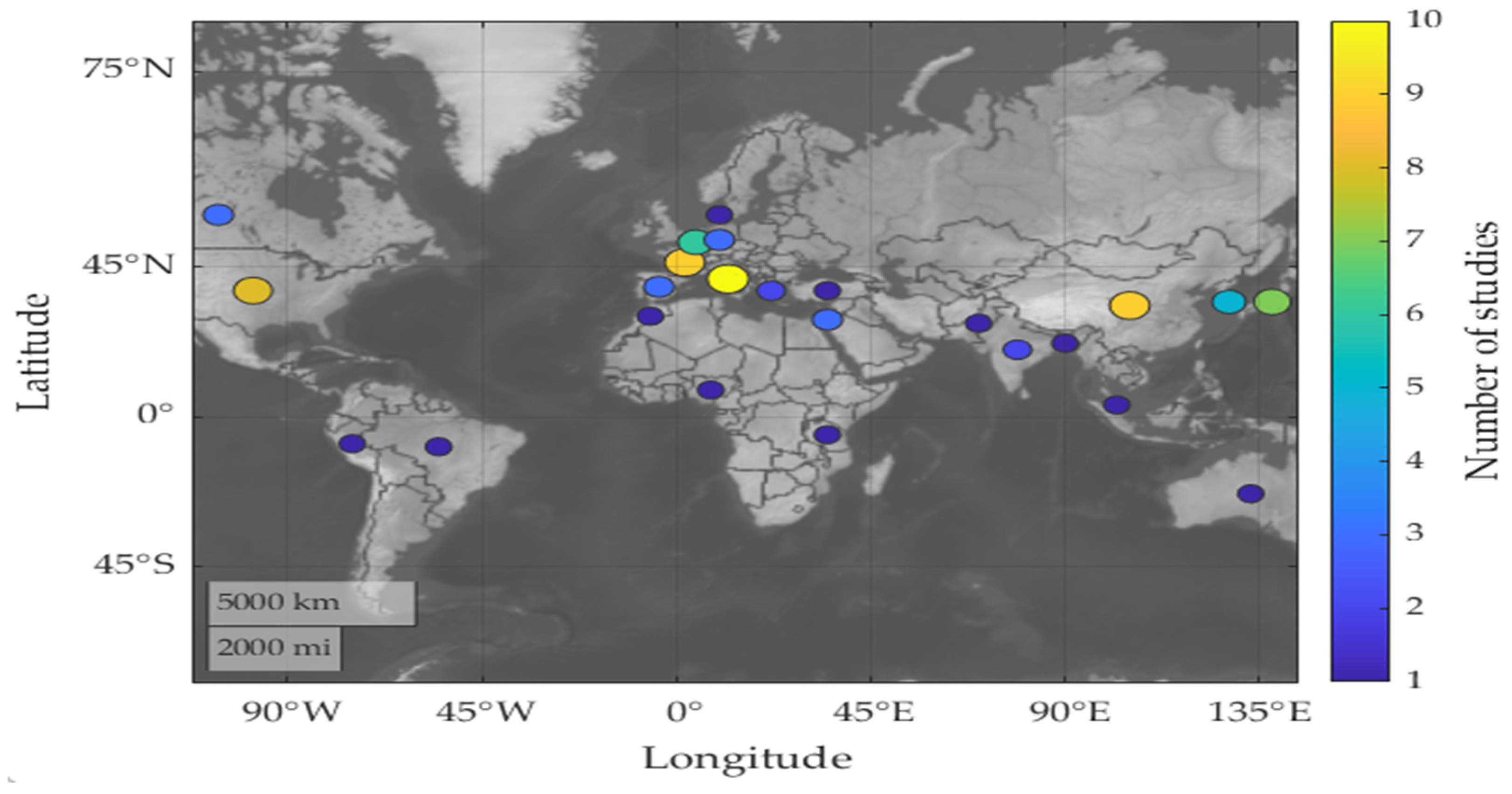
| Country | Number of Studies |
|---|---|
| Italy | 10 |
| France | 9 |
| China | 8 |
| USA | 7 |
| Belgium | 6 |
| Not specified | 6 |
| Japan | 5 |
| South Korea | 5 |
| Spain | 3 |
| Germany | 3 |
| Canada | 3 |
| Greece | 2 |
| India | 2 |
| Israel | 2 |
| Australia | 1 |
| Bangladesh | 1 |
| Brazil | 1 |
| Denmark | 1 |
| Malaysia | 1 |
| Morocco | 1 |
| Nigeria | 1 |
| Pakistan | 1 |
| Peru | 1 |
| Tanzania | 1 |
| Turkey | 1 |
| PV Technology | Number of Studies | Typical Shading/ PAR Reduction | Most Frequently Reported Variables |
|---|---|---|---|
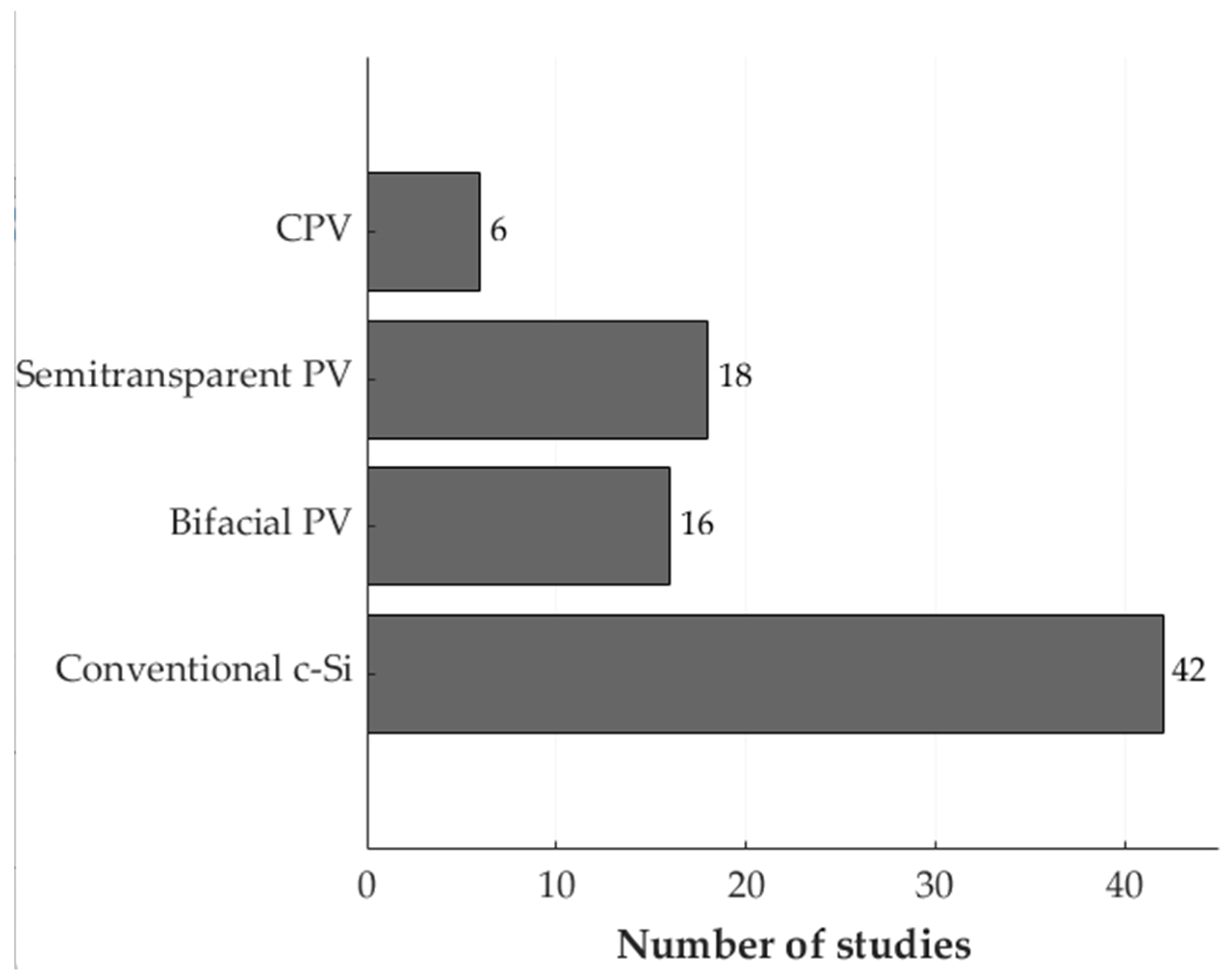
| Conventional opaque c-Si | 42 (51.2%) | Frequently moderate-to-high shading | Yield/biomass; PAR%; Ta/Ts; RH/VWC/ET |
| Bifacial PV | 16 (19.5%) | Often low-to-moderate shading in vertical/optimised layouts; can be moderate-to-high in conventional tilted configurations | Yield/biomass; PAR ratio; Ta/Ts; RH/VWC/ET |
| Semi-transparent and transparent PV | 18 (22.0%) | Typically low-to-moderate shading; can be moderate depending on transmittance and coverage ratio | Yield + quality; PAR transmittance; Ta/RH/leaf T |
| CPV/spectral splitting | 6 (7.3%) | Designed for low crop-light penalty (aim: preserve PAR while extracting non-PAR); however, field evidence remains limited | PAR transmittance + spectrum; growth/photosynthesis; (energy); limited field metrics |
| Crop Category | Climate Context | Recommended PV Technology | Shading/PAR Guidance |
|---|---|---|---|
| Leafy crops | Mediterranean | Conventional modules (opaque) | Moderate shading tolerated |
| Warmer climates | Semi-transparent PV systems | Prefer solutions that preserve PAR availability | |
| Fruit crops | General across climates; site dependent | Bifacial PV and semi-transparent PV systems | Moderate shading (avoid excessive PAR reduction) |
| Fruit vegetables | Dry and sunny climates | Semi-transparent PV and CPV systems | Prioritise light transmission |
| Cereals | General across climates; site dependent | Any technology only with strict shading control | Shading ≤ 20–30% |
Disclaimer/Publisher’s Note: The statements, opinions and data contained in all publications are solely those of the individual author(s) and contributor(s) and not of MDPI and/or the editor(s). MDPI and/or the editor(s) disclaim responsibility for any injury to people or property resulting from any ideas, methods, instructions or products referred to in the content. |
© 2026 by the authors. Licensee MDPI, Basel, Switzerland. This article is an open access article distributed under the terms and conditions of the Creative Commons Attribution (CC BY) license.
Share and Cite
Renno, C.; Di Marino, O. Agrivoltaics Across Crops and Technologies: A Systematic Review of Experimental Tests on Yield, Microclimate, and Energy Performance. Energies 2026, 19, 539. https://doi.org/10.3390/en19020539
Renno C, Di Marino O. Agrivoltaics Across Crops and Technologies: A Systematic Review of Experimental Tests on Yield, Microclimate, and Energy Performance. Energies. 2026; 19(2):539. https://doi.org/10.3390/en19020539
Chicago/Turabian StyleRenno, Carlo, and Olga Di Marino. 2026. "Agrivoltaics Across Crops and Technologies: A Systematic Review of Experimental Tests on Yield, Microclimate, and Energy Performance" Energies 19, no. 2: 539. https://doi.org/10.3390/en19020539
APA StyleRenno, C., & Di Marino, O. (2026). Agrivoltaics Across Crops and Technologies: A Systematic Review of Experimental Tests on Yield, Microclimate, and Energy Performance. Energies, 19(2), 539. https://doi.org/10.3390/en19020539