Article

Stage-Wise Simulation for Operational Stability Evaluation of Seasonal Heat Storage in Abandoned Coal Mines


1
State Key Laboratory of Water Resource Protection and Utilization in Coal Mining, National Institute of Low Carbon and Clean Energy, Beijing 102211, China
2
School of Energy and Power Engineering, Northeast Electric Power University, Jilin City 132012, China
3
School of Civil Engineering and Architecture, Northeast Electric Power University, Jilin City 132012, China
4
China Construction Second Engineering Bureau Co., Ltd., Beijing 100160, China
5
Sub-Institute of Agriculture and Food Standardization, China National Institute of Standardization, Beijing 100191, China
*
Authors to whom correspondence should be addressed.
Energies 2026, 19(2), 537; https://doi.org/10.3390/en19020537
Submission received: 12 December 2025 / Revised: 14 January 2026 / Accepted: 16 January 2026 / Published: 21 January 2026

Abstract

The development of coal resources has created a large number of underground mined-out spaces, which can be utilized for cross-seasonal thermal storage through underground reservoirs to achieve seasonal heat storage. However, there is currently limited research on the cross-seasonal thermal storage capabilities and thermal storage performance evaluation of coal mine underground reservoirs. This study aims to evaluate the operational stability and long-term performance of a Coal Mine Underground Reservoir Energy Storage System (CMUR-ESS) under realistic geological conditions of the Shendong Coalfield. A multi-physics coupling model, integrating thermal-fluid processes, was developed based on the actual structure of the No. 5-2 coal seam goaf in the Dalinta Mine. Numerical simulations were conducted over five annual cycles, each comprising injection, storage, production, and transition stages. Results demonstrate that the system achieves progressive thermal accumulation, with the volume fraction of water above 70 °C increasing from 75.0% in the first cycle to 88.9% by the fifth cycle at the end of the storage stage. Production temperatures also improved, with peak and final temperatures rising by 6.2% and 6.8%, respectively, after five cycles. The analysis confirms enhanced heat retention and reduced thermal loss over time, indicating robust long-term stability and sustainability of the CMUR-ESS for seasonal energy storage applications. The results of this study can provide a reference for the design and evaluation of CMUR-ESS.

1. Introduction

China possesses a vast number of abandoned coal mines. With the depletion of coal resources and industrial restructuring, a large number of mines have been closed, thereby creating extensive underground spaces [1]. These gob areas not only occupy land resources but also may trigger environmental issues such as land subsidence and groundwater pollution [2]. Traditional approaches to utilizing abandoned mines, such as backfilling or surface redevelopment, face significant technical challenges and high economic costs, which hinder progress in their reuse [3].
Existing research primarily focuses on utilizing the gob areas of coal mines to construct underground reservoirs for the containment and management of mine water [4]. This method involves transforming the gob areas into water storage facilities, which not only addresses the issue of mine water discharge but also promotes the recycling of water resources [5]. In some mining areas in China, such as the Shendong Coalfield, the construction of underground reservoirs in coal mines has been successfully implemented, offering new insights for regional water resource management [6].
Internationally, research on the secondary use of abandoned mines started earlier, but practical applications are still predominantly centered on water storage functions, such as the construction of pumped storage power stations [7,8]. While these projects achieve a certain level of energy storage, they do not extensively involve the field of thermal energy storage [9]. Thermal energy storage, as a potential utilization pathway, has been relatively underexplored in the context of abandoned coal mines, failing to fully exploit their geothermal potential. Research indicates that abandoned mine workings gradually become water-saturated over time. The inherent geothermal energy can heat this water, transforming it into a low-enthalpy geothermal fluid, which shows considerable potential for development [10].
Due to the geothermal gradient, the temperature of the rock mass in coal mine gob areas typically reaches 35–40 °C. Although this temperature is insufficient for producing geothermal hot water, it exhibits significant potential for thermal insulation and storage [11]. Utilizing the geothermal gradient in mines for thermal insulation and heat storage is an important direction, with decades of exploratory history internationally. Studies have shown that the stability of geothermal temperatures in the deep sections of mines can provide natural conditions for seasonal thermal energy storage [12]. Through simulations and experiments, researchers have validated the feasibility of using the insulating properties of rock strata for thermal storage, laying a theoretical foundation for the thermal utilization of abandoned mines [13,14,15].
Currently, several countries have initiated practices of using geothermal water from abandoned mines for building heating, such as Germany, the United Kingdom, and other European nations [16,17]. While these projects effectively achieve local energy supply, they face economic challenges like high initial investment and operational costs, which limit their large-scale promotion [18]. Therefore, how to reduce costs while ensuring efficiency has become a critical issue for future research.
While previous studies have laid important foundations for utilizing abandoned mines, several critical limitations remain unaddressed. First, existing research predominantly focuses on hydraulic aspects or short-term thermal performance, with limited investigation into the long-term operational stability of seasonal thermal energy storage systems across multiple cycles. Second, most models oversimplify the complex thermal-fluid coupling processes in goaf environments, failing to accurately capture the transitional flow behavior at reservoir-rock interfaces. Third, there is insufficient quantitative analysis of the cumulative thermal effects that are essential for evaluating system sustainability. Our work specifically addresses these gaps by employing a stage-wise simulation approach that incorporates Brinkman-equation-based interface treatment and multi-cycle performance analysis. This methodology enables a comprehensive assessment of the system’s progressive thermal performance enhancement, providing new insights into the long-term viability of mine-based thermal energy storage that previous studies have not adequately explored.
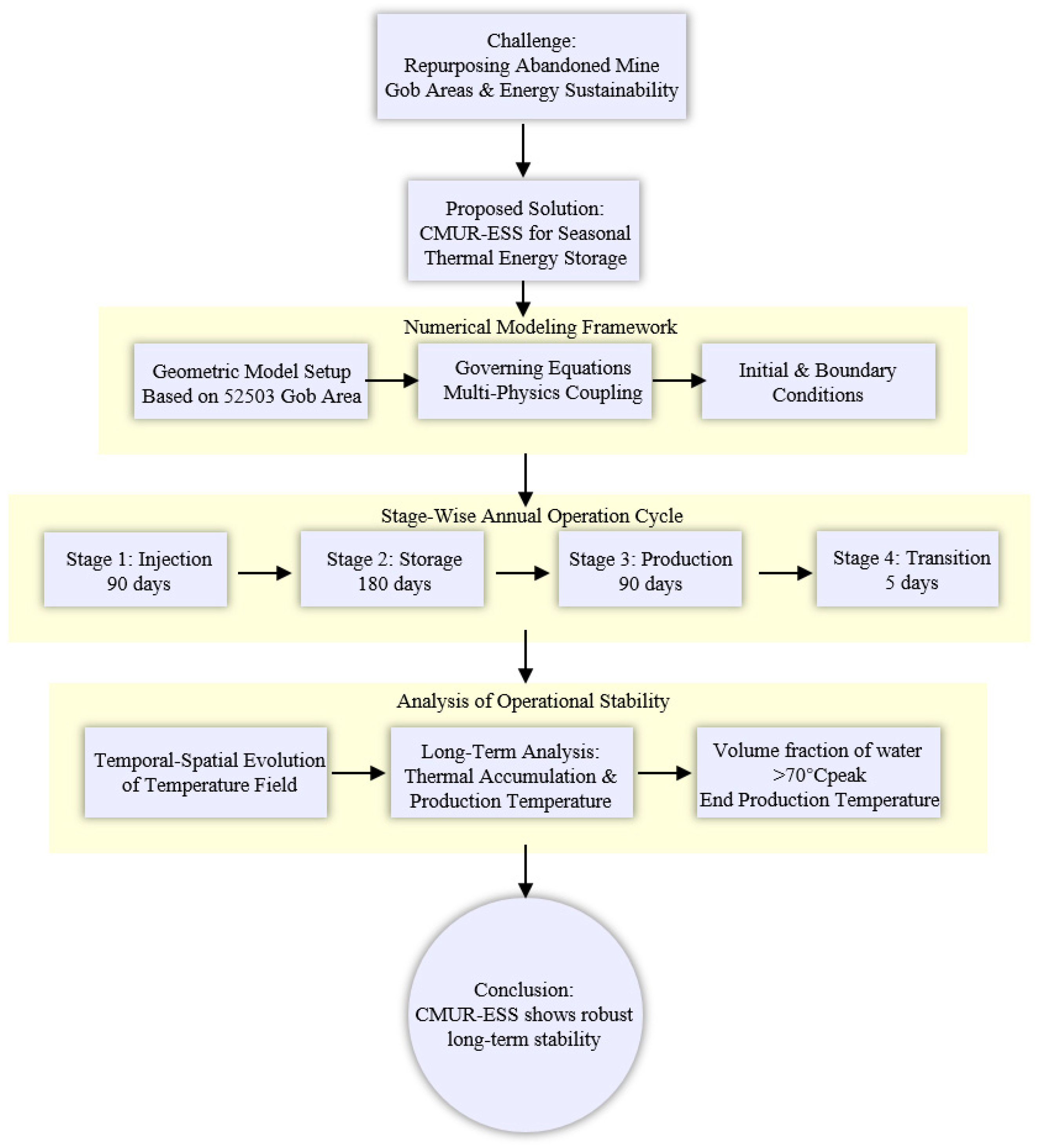
This study proposes a newly developed underground reservoir energy storage system based on coal mine goafs that integrates thermal-fluid coupling processes, exploring a systematic approach to repurposing post-mining subsurface spaces to harness the geothermal potential and thermal insulation properties of abandoned coal seams. Grounded in the actual geological and mining conditions of the No. 5-2 coal seam goaf, specifically the 52503 working face, in the Dalinta Mine of the Shendong Coalfield, a finite element model of the Coal Mine Underground Reservoir Energy Storage System (CMUR-ESS) was developed, incorporating coupled thermal-fluid processes. Simulation results were used to analyze the feasibility of utilizing the CMUR-ESS for seasonal thermal energy storage and to evaluate its long-term operational potential. The system’s thermal energy storage and utilization capabilities were assessed by examining the temperature evolution of the stored hot water within the reservoir and the thermal production performance during operation (Figure 1).

2. Numerical Method

2.1. Fluid Flow in the Reservoir Area

The Navier–Stokes equations are applied to the reservoir area to model free fluid flow, accounting for viscous effects and pressure gradients in the open water body [19], which take the following form:
ρ u t + ρ u u = p r I + K + ρ g
ρ u = 0
where ρ is the fluid density; u is the fluid velocity; g is the gravitational acceleration; and p r I is the fluid pressure tensor.
Equation (1) incorporates the influence of fluid viscosity on fluid pressure, represented through the viscous stress term K . This term is quantitatively determined using Equation (3) in this part.
K = μ u + u T
where μ is the fluid dynamic viscosity;

2.2. Fluid Flow in the Surrounding Rocks

In the periphery of the reservoir, leakage from the reservoir zone into the surrounding rock is taken into account. For the surrounding rock, which acts as a porous medium, Darcy’s law is employed to describe seepage flow driven by permeability and pressure differences, and the governing equation is expressed as:
K r p r + q s = μ s p r t
where p r is the pressure of the fluid inside the surrounding rocks; K r is the permeability; q s is the volumetric recharge source of seepage field; μ s is the comprehensive compressibility of rock, which represents the volume of liquid given by the elasticity of liquid and rock when the unit pressure changes in rock.
At the interface between the reservoir and surrounding rock, fluid motion is characterized by the Brinkman equation. This formulation seamlessly integrates the permeability-driven Darcy term for porous media with the viscous stress term from the Navier–Stokes equations, effectively combining the effects of permeability and fluid shear stresses. By bridging the Darcy-type seepage in the rock and the free flow in the reservoir, the Brinkman equation accurately models transitional zones where both flow regimes coexist, preventing physical discontinuities and avoiding oversimplifications that could arise from using a single uniform equation. Its use thus ensures a physically consistent and numerically stable representation of the coupled behavior at the interface. The Brinkman equation is given as:
1 ε p ρ u t = p r I + K μ K p 1 + Q m ε p 2 u + ρ g
K = μ ε p u + u T 2 μ 3 ε p u I
where ε p is the porosity of the rocks; K p is the permeability of anti-seepage layer; Q m is a mass source or sink.

2.3. Heat Transfer in Reservoir Area

Heat conduction within the reservoir involves thermal conduction in the fluid and heat convection resulting from fluid movement. This process is modeled using a convective heat transfer equation as follows:
ρ c f T t = λ f T ρ c f u T + Q h
where c f is the heat capacity of the fluid; T is the temperature; λ f is the thermal conductivity of the fluid; Q h is the additional heat sources in the reservoir.

2.4. Heat Transfer in Surrounding Rocks

Similarly, heat exchange in the surrounding rock comprises conductive heat transfer and convection driven by seepage flow. Unlike the reservoir region, the convection velocity here corresponds to the seepage velocity of fluid through the rock matrix. Moreover, certain parameters in the equation are defined differently owing to the porous nature of the rock. The governing equation for heat exchange in the surrounding rock is
ρ c e f f T t = λ e f f T ρ f c f u T + Q h
ρ c e f f = ε p ρ c f + 1 ε p ρ r c r
where ρ c e f f is the mass heat capacity of saturated rock, which can be calculated by Equation (9); λ e f f is thermal conductivity of saturated rock; ρ r and c r is the density and hear capacity of rock mass, respectively.

3. Model Setup

3.1. Conceptual Model

Based on the actual geological and mining conditions of the 52503 working face in the No. 5-2 coal seam goaf of the Dalinta Mine, Shendong Coalfield, this study developed a numerical model of the Coal Mine Underground Reservoir Energy Storage System (CMUR-ESS). The No. 5-2 coal seam, as one of the main mining seams, has completed all recovery operations at the 52503-working face. To alleviate regional industrial water shortages, the Dalinta Mine repurposed the 52503 goaf into an underground reservoir for storing mine water, achieving water resource reuse. The overlying and underlying strata of the working face are primarily composed of mudstone and sandy mudstone with low permeability. Such a low-permeability rock mass structure helps maintain hydro-thermal confinement of the reservoir area, providing favorable geological conditions for the construction of the underground reservoir [20,21].
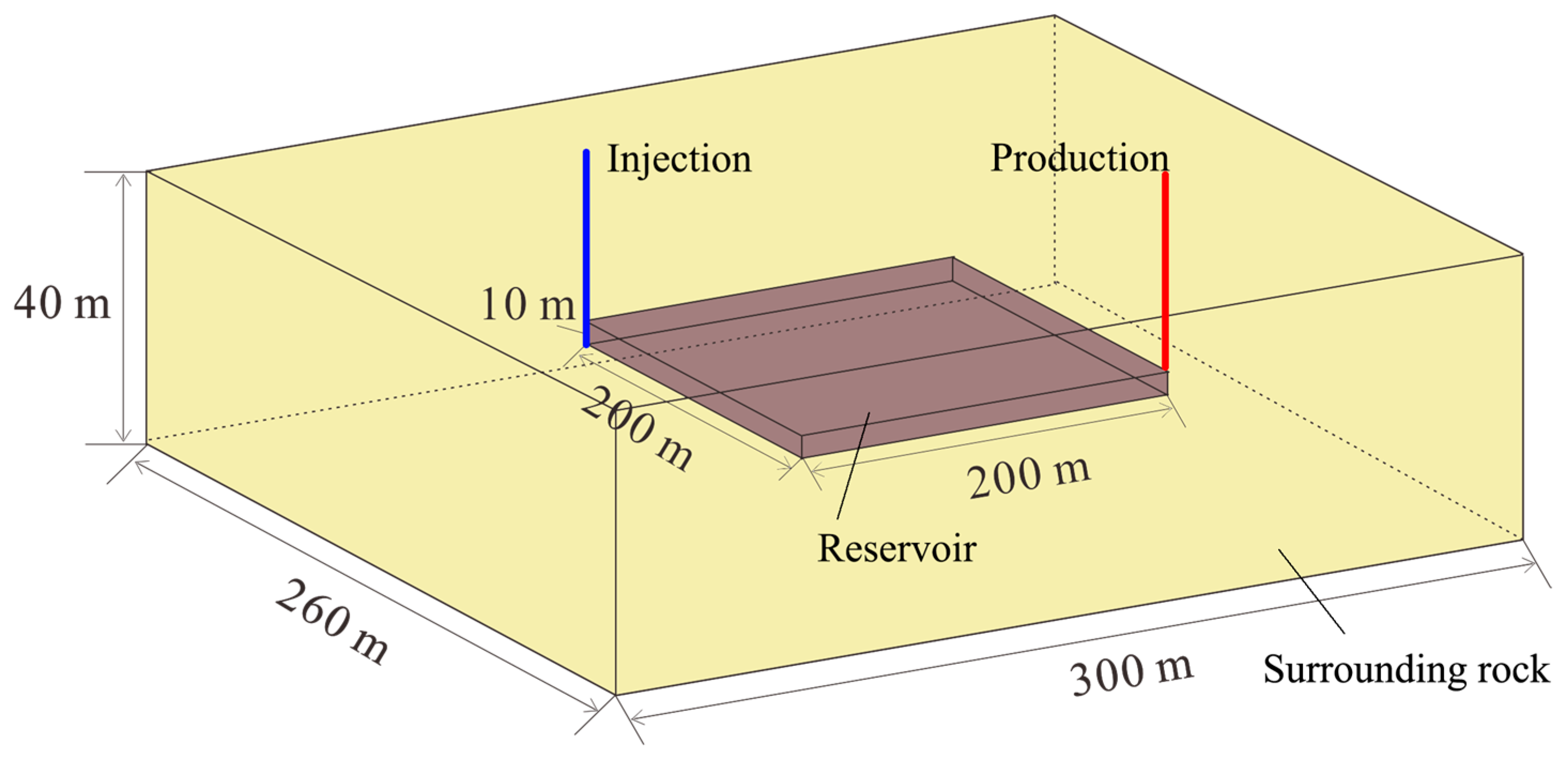
The CMUR-ESS structure is illustrated in Figure 2. The system mainly consists of the central goaf area and its surrounding rock mass. The floor elevation of the goaf is 420 m below the surface. Based on the actual geological characteristics of the goaf, the dimensions of the surrounding rock mass are set as 300 m × 260 m × 40 m, while the central reservoir zone measures 200 m × 200 m × 10 m. In the numerical model, the top boundary of the reservoir is 15 m below the upper model boundary, with the reservoir body located at the geometric center and fully encapsulated by the surrounding rock. A pair of injection and production wells are arranged diagonally within the reservoir for hot water injection and extraction. To minimize water leakage, a 1 m thick anti-seepage layer is installed on the reservoir walls to prevent water seepage into the surrounding rock.
System operation is divided into energy storage and energy extraction stages. During the energy storage stage, the reservoir stores hot water supplied by industrial tailwater, achieving seasonal thermal storage facilitated by the insulating properties of the surrounding rock. Owing to the low thermal conductivity of the surrounding rock, heat loss during storage is minimal. In the energy extraction stage, hot water is transported to the surface via production pipelines for utilization. To promote water recycling, the used tailwater is reinjected into the reservoir through injection wells, maintaining dynamic water balance and enhancing thermal convection within the reservoir. This operational mechanism not only enables seasonal allocation of thermal energy but also achieves the goal of “zero discharge” of mine water, offering an effective approach for sustainable water resource management in mining areas.

3.2. Initial and Boundary Conditions

Based on the actual structure of the CMUR-ESS, the model comprises the fluid domain within the reservoir zone and the surrounding rock zone externally. The interface between these two zones is defined as a seepage continuity boundary, where both temperature and seepage velocity remain equal on both sides. Since the surrounding rock in the model extends outward for over 100 m, its internal heat conduction and fluid flow exhibit negligible influence on the external boundaries. Consequently, the outer boundaries of the surrounding rock are set as zero-flux boundaries for both heat flow and seepage. This approach effectively reduces the computational load while ensuring model accuracy, thereby supporting the successful implementation of the numerical simulation.
Regarding the initial conditions, the temperature of the surrounding rock is uniformly set at 40 °C, and the fluid pressure is determined based on hydrostatic pressure. The top of the model is at a depth of 380 m, resulting in a top pressure of 3.025 MPa and a bottom pressure of 4.707 MPa; the initial temperature throughout the entire surrounding rock is 40 °C. Within the reservoir zone, the fluid pressure is configured according to the hydrostatic pressure of a continuous fluid, with the phreatic surface positioned at the top of the reservoir. Automatic equilibrium of the hydrostatic pressure is achieved over the reservoir’s 10 m height.

3.3. Model Parameters

In accordance with the reservoir zone and surrounding rock zone defined in the model, the key thermophysical parameters adopted in this simulation can be broadly categorized into two groups: parameters for the rock (mudstone) and parameters for the fluid (water), as summarized in Table 1.

3.4. Simulation Strategy

During the simulation process, the first stage is the water injection stage, in which hot water at 90 °C is injected into the water storage area at a rate of 140 kg/s for the initial 90 days. The second stage is the thermal energy storage stage, where no injection or production occurs for 180 days after the first stage concludes. The third stage is the heat production stage, a 90-day period of thermal fluid extraction. During this stage, the production well operates at a constant flow rate of 50 kg/s, with real-time monitoring of the production temperature. The fourth stage serves as a transition stage between different cycling periods. Similarly to the second stage, it lasts for 5 days.
These four stages collectively form one complete operational cycle of the underground coal mine reservoir energy storage system, with a total duration of 365 days. Based on this, the present study conducts simulations for a total of 5 cycles. Furthermore, during the production stage of the system, tail water at 40 °C is injected at the injection point under constant pressure to maintain the fluid pressure and production performance of the storage zone.

4. Results and Discussion

4.1. Evolution of Temperature Field at Different Operating Stages

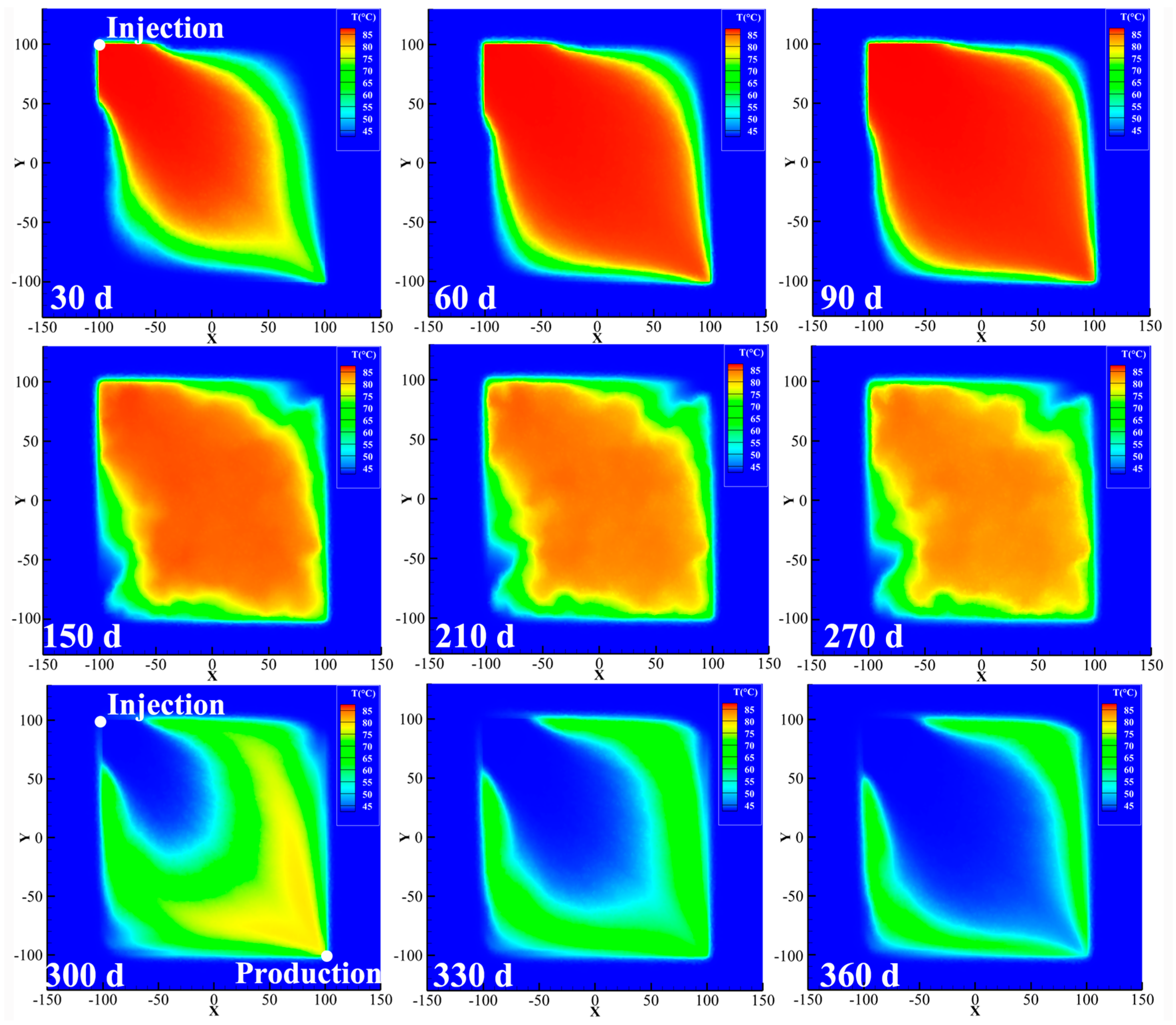
During the first operational cycle (1 year) of CMUR-ESS, the temporal and spatial evolution of the temperature field within the reservoir at different stages is shown in Figure 3.
In the injection stage (0–90 days), as hot water is continuously injected, a high-temperature zone (i.e., areas with water temperatures higher than the initial reservoir temperature) centered around the injection well and extending into the reservoir is formed. As injection proceeds, the volume of the high-temperature zone continuously increases; by day 30, the temperature change has reached the location of the production well. The expansion rate of the high-temperature zone gradually slows as injection continues. By day 90, its overall shape shows no significant change compared to day 60, with very limited outward expansion, but the proportion of hot water with temperatures above 85 °C within the zone increases notably.
During the injection stage, the high-temperature zone can be divided into two parts based on water temperature differences: one is the area with temperatures close to that of the injected fluid, and the other is the area with temperatures significantly lower than the injected fluid but still higher than the initial reservoir temperature (the latter is mainly located at the outer edge of the high-temperature zone, away from the injection well). The significant temperature rise in the former results from both heat convection and heat conduction processes, with heat convection contributing primarily to the temperature rise; whereas the temperature increase in the latter relies more on heat conduction.
During the thermal energy storage stage, due to the temperature difference between the reservoir fluid and the surrounding rock as well as the effect of thermal conduction, the overall temperature of the reservoir gradually decreases, but the rate of cooling slows down as the storage duration increases, approaching equilibrium by the later part of the storage stage. Specifically, compared with the conditions at the end of the injection stage on day 90, both the overall shape of the high-temperature zone and the internal fluid temperature undergo noticeable changes by day 150. Although there is no interference from injection or extraction activities during this stage, heat continues to transfer toward the periphery of the reservoir under the influence of thermal conduction within the reservoir fluid and between the fluid and the surrounding rock. The area experiencing temperature variation further expands, while the fluid temperature inside the region decreases overall.
This process leads to a gradual reduction in the volume proportion occupied by the zone near the reservoir center where the water temperature is significantly higher than the initial temperature, whereas the volume proportion of the zone closer to the reservoir edges, where the water temperature is close to the initial temperature, gradually increases. However, as the temperature of the fluid and the surrounding rock near the contact surface gradually rises, the temperature difference between the interior and exterior decreases, and given the relatively low thermal conductivity of water, the process of heat transfer toward the reservoir periphery gradually slows down. Between day 150 and day 210, certain changes in the shape of the high-temperature zone and the fluid temperature within it can still be observed, though they are far less significant than those in the early stage of thermal storage. From day 210 to day 270, changes in the reservoir temperature field become very slight, and the system as a whole approaches a steady state.
After the commencement of the production stage, as the hot fluid is extracted and cold fluid continues to be injected, the reservoir temperature decreases rapidly. By the 30th day, the high-temperature region formed during the heat storage stage has completely disappeared. Compared to the end of the heat storage stage, the most significant temperature change occurs in the vicinity of the diagonal line between the injection well and the production well. The fluid temperature in most areas between the injection well and the reservoir center has dropped to the initial reservoir temperature (which is the same as the injected fluid temperature in this simulation), with only the near-wellbore zone of the injection well maintaining a relatively high temperature. Overall, during this stage, the fluid temperature in the reservoir gradually increases with increasing distance from the injection well and decreasing distance from the production well.
Similarly to the injection and heat storage stage, the most pronounced temperature changes in this stage also occur in the early period. As production continues, the evolution of the temperature field in the reservoir is primarily characterized by the continuous shrinking of the high-temperature zone and the gradual decrease in its internal temperature. By the 360th day (i.e., the end of the production stage), regions with temperatures significantly higher than the initial temperature still exist within the reservoir. This indicates that the heat injected into the reservoir during the injection stage has not been completely dissipated within this cycle, a phenomenon that also suggests the potential for the entire system to achieve long-term sustainable operation.
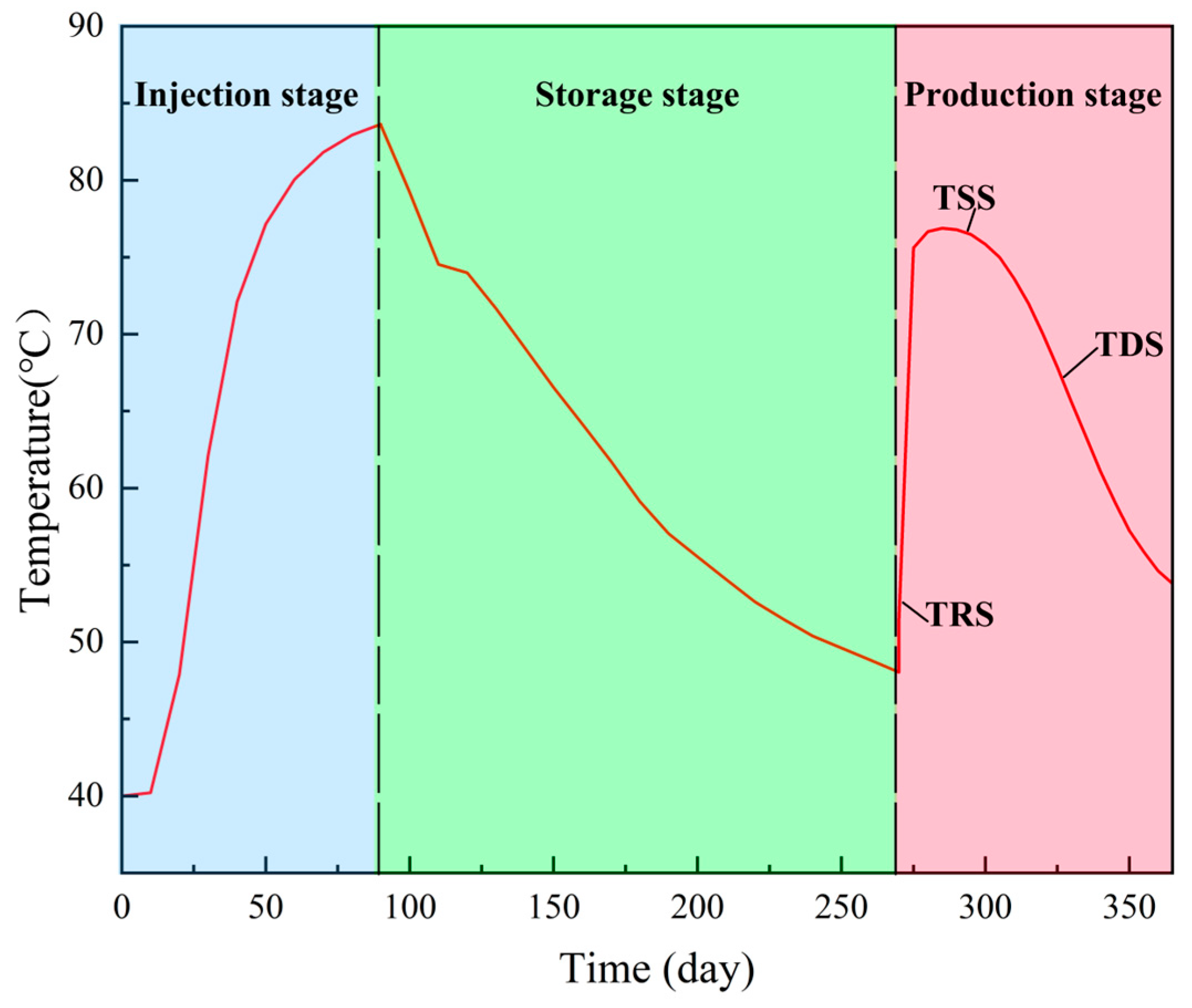
Within the first operational cycle, the variation in the pumping point temperature (i.e., the temperature of the produced fluid during the production stage) is shown in Figure 4. For about 10 days after the injection stage begins, the pumping point temperature remains unchanged because the heated zone has not yet expanded to the production well location. As the thermal front reaches this point, the temperature begins to rise gradually, but the rate of increase slows over time. By the end of the injection stage, the temperature rises to 83.6 °C and is still trending upward. Since the production well is located at the reservoir boundary, the pumping point temperature gradually declines after the heat storage stage begins. By the end of this stage, the temperature drops to 51.4 °C, a decrease of 38.5% compared to the beginning of the stage.
Based on the variation trend of production fluid temperature, the production process can be generally divided into three stages:
After production begins, driven by injection and production displacement, fluids within the reservoir migrate gradually away from the contact interface between the reservoir and surrounding rock. The fluids in the high-temperature zone (Figure 3) start flowing toward the production well location, resulting in a rapid increase in production fluid temperature during the initial production period, i.e., the Temperature Rise Stage (TRS).
As high-temperature fluids from the central area of the reservoir continue to migrate, while the influence of low-temperature injected fluid has not yet reached the production well, the production fluid temperature enters a relatively stable period, i.e., the Temperature Stable Stage (TSS).
With the ongoing injection-production process, the low-temperature influence gradually reaches the production well, and the production fluid temperature begins to decline, i.e., the Temperature Declining Stage (TDS). As shown in Figure 4, most of the production period is within the TDS. By the end of this stage, the production fluid temperature drops to 54.6 °C, which is 6.23% higher than the temperature at the end of the thermal storage stage, but 29% lower than the peak temperature of 76.9 °C in this stage.

4.2. Analysis of Long-Term Operational Stability in CMUR-ESS

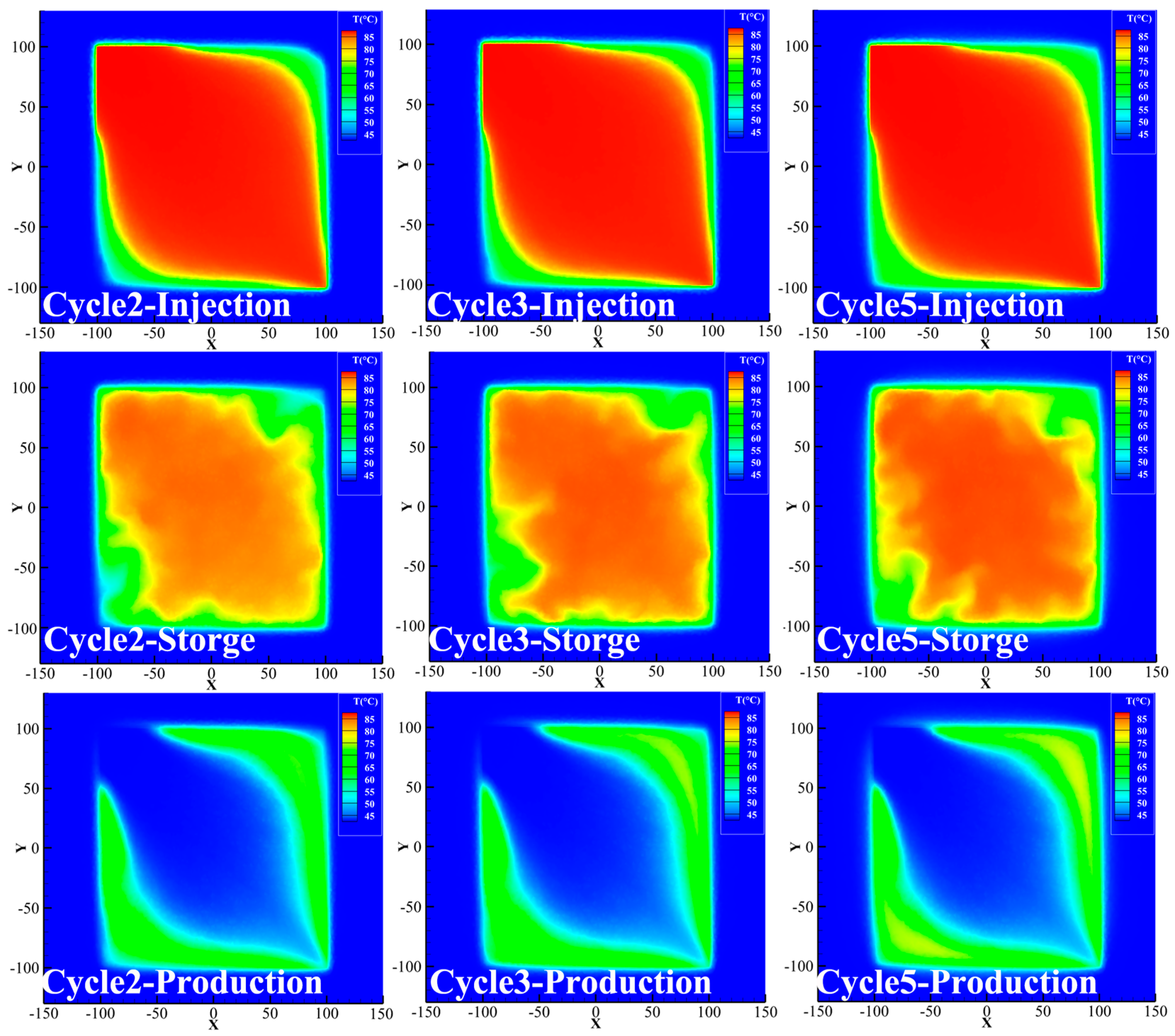
For the CMUR-ESS, its ability to operate in a long-term, stable, and sustainable manner is crucial for the practical engineering design and implementation. Based on the preceding analysis of the temperature variation within the reservoir during various stages of a single operational cycle, this section analyzes the long-term operational performance of the CMUR-ESS. The spatiotemporal evolution of the temperature field within the reservoir at the conclusion of each stage across different operational cycles is illustrated in Figure 5.
Figure 5 indicates that, compared to Cycle 1, the temperature field at the end of each stage in subsequent cycles undergoes changes to some extent, with the most pronounced differences observed during the thermal storage stage. As mentioned earlier, within a single cycle, the temperature increase caused by the injection stage is not entirely depleted during the subsequent thermal storage and production stages (Figure 3). Building upon this, by the end of the injection stage in Cycle 2, the fluid temperature throughout the entire reservoir has increased to varying degrees compared to Cycle 1.
Regarding the thermal storage stage, because the fluid and the surrounding rock near the reservoir boundary have been heated to different extents during previous system operations, the temperature difference between them and the fluid inside the reservoir diminishes. This reduction weakens the heat conduction effect, leading to less heat loss from the interior to the exterior. Consequently, the thermal containment capability of the reservoir is enhanced to a certain degree. As the system continues to operate, the area within the reservoir exhibiting temperatures significantly higher than the initial temperature gradually expands by the end of the thermal storage stage, thereby providing more favorable temperature conditions for the subsequent production stage. Compared to Cycle 1, the areal extent of the region with temperatures above the initial temperature at the end of the production stage in subsequent cycles does not show significant change. However, the temperature within this region exhibits a marked increase, implying a gradual accumulation of residual heat within the reservoir after each cycle concludes.
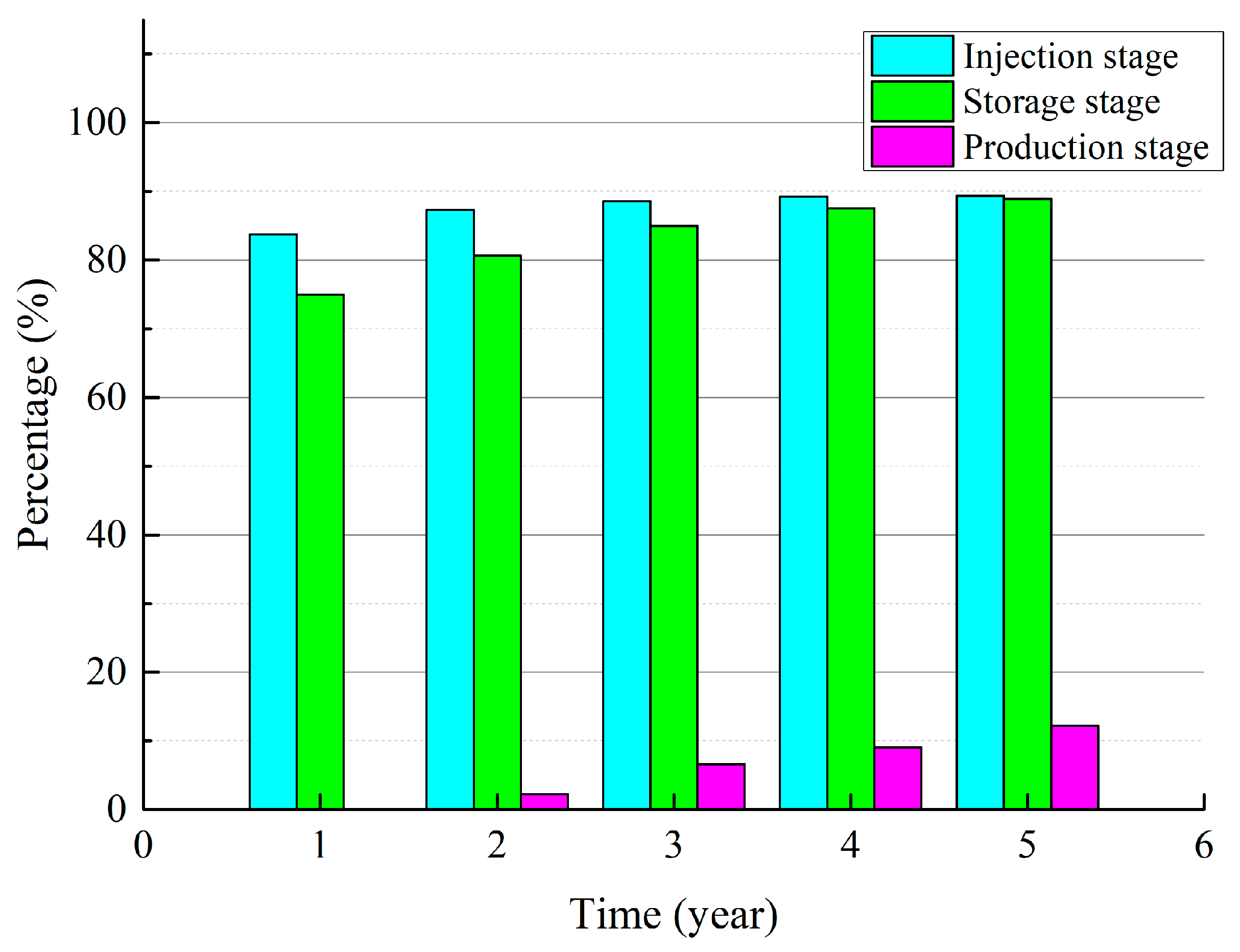
Based on Figure 5, to further clarify the distribution differences and evolution of fluid temperature inside the reservoir, the volume percentage of fluid above 70 °C in the reservoir at the end of each stage was calculated, and the results are shown in Figure 6. As the number of operating years increases, the proportion of high-temperature hot water in the reservoir at the end of each stage within a cycle gradually rises. For the injection and thermal storage stages, this growth trend gradually slows and stabilizes, which is consistent with the analysis of the temperature field evolution clouds presented earlier. In cycle 1, the proportions of hot water above 70 °C at the end of the injection and storage stages were 83.8% and 75.0%, respectively, and reached 89.2% and 87.5% by cycle 4. In cycle 5, the values were 89.3% and 88.9%, showing only a slight increase compared with cycle 4.
The most pronounced change is observed in the production stage. At the end of this stage in cycle 1, no hot water above 70 °C remained in the reservoir, while in cycle 2 the proportion reached 2.3% and continued to grow significantly as the operating years increased. By cycle 5, this proportion had reached 12.2%. This indicates that during the long-term stable operation of the CMUR-ESS, the thermal supply capacity in the production stage continuously increases, reflecting favorable sustainability.
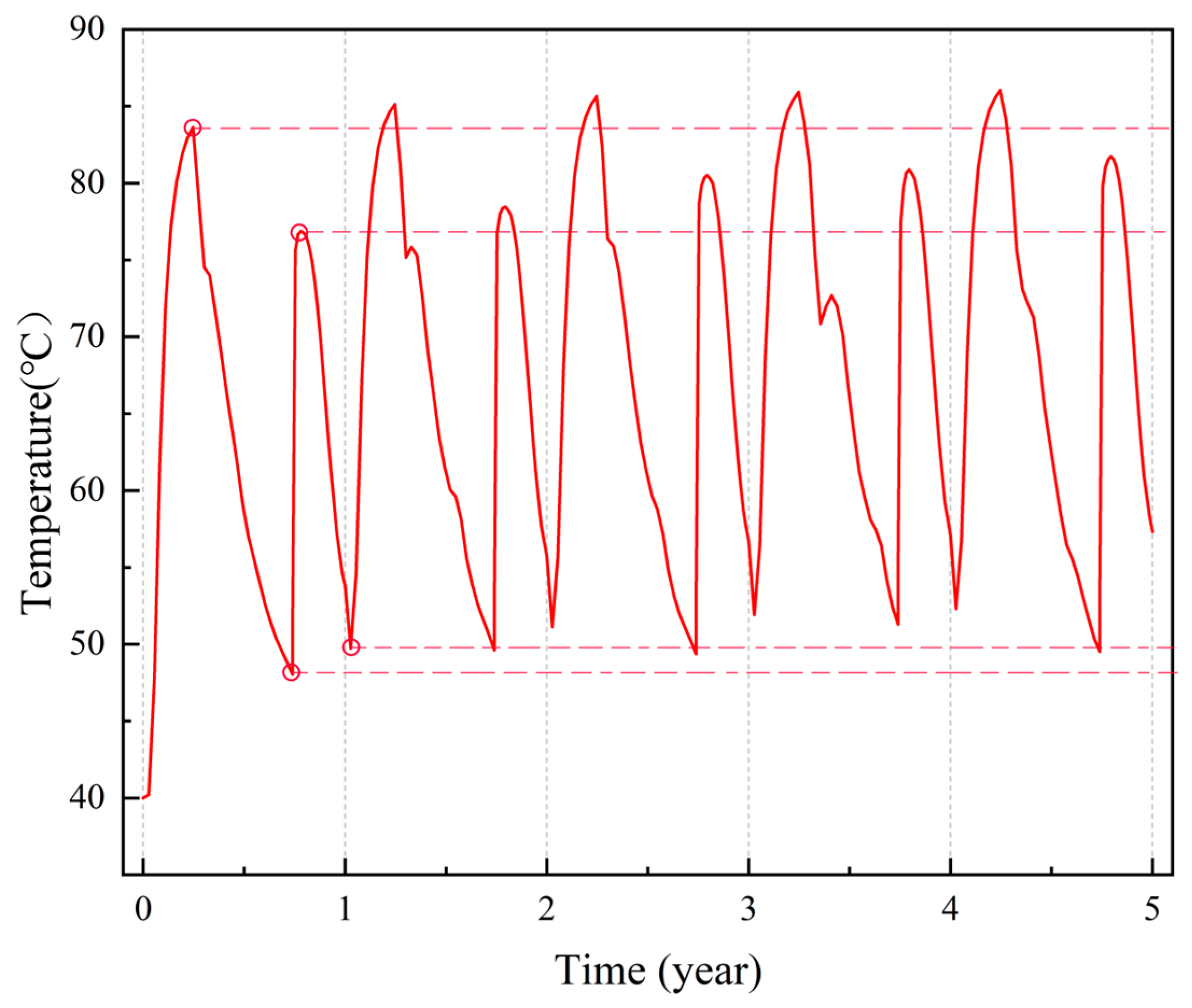
During the long-term operation of CMUR-ESS, the temperature variation curve at the pumping point is shown in Figure 7. Corresponding to the analysis results of the temperature field and the proportion of high-temperature hot water, the temperature at the pumping point—that is, the production fluid temperature during the production stage—also shows an overall increasing trend. In this analysis, the temperature values at four characteristic time points are considered: the beginning of the heat storage stage, the end of the heat storage stage, the moment when the temperature reaches its peak between TRS and TDS during the production stage (compared to the long-term operation, TSS is very brief), and the end of the production stage. The results are presented in Table 2.
As can be seen from Table 2, the temperatures at the pumping point at the beginning and end of the heat storage stage generally increase gradually over the long-term operation of the system. Among them, the temperature at the end of the injection stage no longer shows significant growth after 4 years. Correspondingly, during the production stage, the production fluid temperature increases noticeably at the same production flow rate. This trend is observed at the corresponding time points throughout the production stage in each cycle. Compared with Cycle 1, the peak temperature during the production stage and the production fluid temperature at the end of the stage in Cycle 5 increased by 6.2% and 6.8%, respectively.

5. Conclusions

This study proposes a systematic underground reservoir energy storage system based on coal mine goafs, demonstrating long-term operational stability through multi-cycle simulations, and exploring a practical approach to repurposing post-mining subsurface spaces to harness the geothermal potential and thermal insulation properties of abandoned coal seams. Grounded in the actual geological and mining conditions of the No. 5-2 coal seam goaf, specifically the 52503 working face, in the Dalinta Mine of the Shendong Coalfield, a finite element model of the Coal Mine Underground Reservoir Energy Storage System (CMUR-ESS) was developed, incorporating coupled thermal-fluid processes. Simulation results were used to analyze the feasibility of utilizing the CMUR-ESS for seasonal thermal energy storage and to evaluate its long-term operational potential. The system’s thermal energy storage and utilization capabilities were assessed by examining the temperature evolution of the stored hot water within the reservoir and the thermal production performance during operation.
According to simulation results, the temperature field within the reservoir during one operational year exhibits distinct spatiotemporal evolution, characterized by the formation of a high-temperature zone around the injection well during the injection stage. This zone expands primarily through thermal convection and conduction, with the growth rate decelerating over time due to reduced thermal gradients. Throughout the thermal storage stage, heat dissipation to the surrounding rock results in a gradual temperature decline that approaches equilibrium, highlighting the system’s thermal inertia. During production, low-temperature fluid injection rapidly degrades the temperature field, causing the high-temperature zone to contract; however, the persistence of residual heat at the cycle’s end indicates incomplete heat dissipation, underscoring the potential for cumulative thermal effects in long-term operation.
The production temperature demonstrates dynamic annual variations, beginning with an initial stable period before rising to 83.6 °C as the thermal front reaches the pumping point, then dropping to 51.4 °C by the end of thermal storage due to heat loss. The production stage can be divided into temperature rise (TRS), stable (TSS), and decline (TDS) phases, with TDS dominating the process. The final temperature of 54.6 °C, which is 29% below the peak, reflects the staged extraction characteristics and the impact of operational parameters on thermal recovery efficiency.
Long-term operation across multiple cycles reveals a progressive enhancement in thermal storage capacity, driven by cumulative heating from previous cycles that reduces heat loss to the surrounding rock. This effect expands the high-temperature zone and increases the volume fraction of water above 70 °C from 75.0% in cycle 1 to 88.9% in cycle 5, with growth stabilizing over time. This trend indicates improved thermal efficiency and system optimization, affirming the CMUR-ESS’s ability to sustain performance through repeated cycles.
The long-term production temperature trends upward, with significant increases in characteristic values at key points, such as the start and end of storage and the peak and end of production. By cycle 5, peak and end temperatures rise by 6.2% and 6.8%, respectively, compared to cycle 1, demonstrating a sustained improvement in heat output capability and reinforcing the system’s long-term sustainability. These findings highlight the role of cumulative thermal effects in enhancing operational stability, though further validation through pilot-scale monitoring is needed to address model limitations and refine predictive accuracy.
In conclusion, the CMUR-ESS system exhibits robust long-term operational stability, with progressive enhancements in thermal retention and production performance, underscoring the role of cumulative thermal effects in advancing geothermal energy storage technologies.
In future work, as the CMUR-ESS project progresses to pilot implementation, we plan to install temperature and pressure monitoring systems within the reservoir to collect operational data. These measurements will be used to calibrate and validate the model, improving its predictive accuracy. We will also explore comparisons with simplified analytical solutions or laboratory-scale analog experiments in follow-up studies.

Author Contributions

Methodology: W.T. and Z.H.; Conceptualization: Z.H. and H.Z.; Validation: W.T. and C.F.; Formal analysis: W.T. and Z.H.; Writing—original draft: W.T. and Z.H.; Software: W.T., C.F., X.H. and X.W.; Writing—review and editing: Q.G., J.T., H.Z., X.H. and X.W.; Project administration: J.T. and Q.G. All authors have read and agreed to the published version of the manuscript.

Funding

This work was jointly supported by the State Key Laboratory of Water Resources Protection and Utilization in Coal Mining Open Fund (NICE_RD_2023_156) and Scientific Research project of Jilin Provincial Department of Education (grant number: JJKH20240157KJ). APC was funded by State Key Laboratory of Water Resources Protection and Utilization in Coal Mining Open Fund.

Data Availability Statement

Data are contained within the article.

Conflicts of Interest

Author Xiaolin He was employed by the company China Construction Second Engineering Bureau Co., Ltd. The remaining authors declare that the research was conducted in the absence of any commercial or financial relationships that could be construed as a potential conflict of interest.

Nomenclature

Roman Symbols:
c f Specific heat capacity of fluid
c r Specific heat capacity of rock
g Gravitational acceleration
K Viscous stress tensor
K r Permeability of the surrounding rock
K p Permeability of anti-seepage layer
p r Fluid pressure
p r I Fluid pressure tensor
q s volumetric recharge source of seepage field
Q m Mass source of seepage field
Q h Heat source
T Temperature
u fluid velocity vector
Greek Symbols:
λ e f f Thermal conductivity of saturated rocks
λ f Thermal conductivity of fluid
ε p porosity of rocks
ρ density of fluid
ρ r density of rocks
ρ c e f f mass heat capacity of saturated rocks
μ s comprehensive compressibility of rocks
μ fluid dynamic viscosity
Abbreviations:
CMUR-ESSCoal Mine Underground Reservoir Energy Storage System
TDSTemperature Declining Stage
TRSTemperature Rise Stage
TSSTemperature Stable Stage

References

  1. Ji, L.; Dong, J.; Kienberger, T.; Huang, J.; Liu, F.; Wang, L.; Huang, Y.; Gao, H. Quantitative assessment and development utilization modes of space resources in closed and abandoned mines. Energy Sources Part A Recovery Util. Environ. Eff. 2023, 45, 10366–10380. [Google Scholar] [CrossRef]
  2. Guo, Q.; Meng, X.; Li, Y.; Lv, X.; Liu, C. A prediction model for the surface residual subsidence in an abandoned goaf for sustainable development of resource-exhausted cities. J. Clean. Prod. 2021, 279, 123803. [Google Scholar] [CrossRef]
  3. Singh, A.; Agarwal, S.; Prabhat, A. A multi-criteria decision framework to evaluate sustainable alternatives for repurposing of abandoned or closed surface coal mines. Front. Earth Sci. 2024, 12, 1330217. [Google Scholar] [CrossRef]
  4. Wang, W.; Yao, Q.; Xu, Q.; Chen, X.; Liu, H.; Li, X. Experimental Study on the Evolution Law of Coal Mine Underground Reservoir Water Storage Space under the Disturbance and Water—Rock Interaction Effect. Minerals 2022, 12, 1491. [Google Scholar] [CrossRef]
  5. Cao, Z.; Jing, S.; Wang, L.; Meng, F.; Han, Y. Influence of spatial structure migration of overlying strata on water storage of underground reservoir in coal mine. PLoS ONE 2024, 19, e0292357. [Google Scholar] [CrossRef] [PubMed]
  6. Li, P.; Ma, L.; Wu, Y.; Zhang, L.; Hao, Y. Concurrent Mining During Construction and Water-Filling of a Goaf Groundwater Reservoir in a Coal Mine. Mine Water Environ. 2018, 37, 763–773. [Google Scholar] [CrossRef]
  7. Menéndez, J.; Schmidt, F.; Konietzky, H.; Bernardo Sánchez, A.; Loredo, J. Empirical Analysis and Geomechanical Modelling of an Underground Water Reservoir for Hydroelectric Power Plants. Appl. Sci. 2020, 10, 5853. [Google Scholar] [CrossRef]
  8. Shang, D.; Pei, P. Analysis of Influencing Factors of Modification Potential of Abandoned Coal Mine Into Pumped Storage Power Station. J. Energy Resour. Technol. 2021, 143, 112003. [Google Scholar] [CrossRef]
  9. Wu, F.; Liu, Y.; Gao, R. Challenges and opportunities of energy storage technology in abandoned coal mines: A systematic review. J. Energy Storage 2024, 83, 110613. [Google Scholar] [CrossRef]
  10. Holmslykke, H.D.; Weibel, R.; Olsen, D.; Anthonsen, K.L. Geochemical Reactions upon Injection of Heated Formation Water in a Danish Geothermal Reservoir. ACS Earth Space Chem. 2023, 7, 1635–1647. [Google Scholar] [CrossRef]
  11. Wang, M.; Guo, P.; Fang, C.; Bu, M.; Jin, X.; Wang, J. Investigation of evaluation models for geothermal resources and intermittent operation/cycle thermal storage mode in closed coal mines. Geothermics 2025, 129, 103294. [Google Scholar] [CrossRef]
  12. Li, F.; Li, F.; Sun, R.; Zheng, J.; Li, X.; Shen, L.; Sun, Q.; Liu, Y.; Ji, Y.; Duan, Y. A Study on the Transient Response of Compressed Air Energy Storage in the Interaction between Gas Storage Chambers and Horseshoe-Shaped Tunnels in an Abandoned Coal Mine. Energies 2024, 17, 953. [Google Scholar] [CrossRef]
  13. Liu, Y.; Liang, Y.; Ma, Y.; Liu, J.; Elsworth, D.; Gan, Q. Dynamic evolution of reservoir permeability and deformation in geothermal battery energy storage using abandoned mines. Rock Mech. Bull. 2025, 4, 100155. [Google Scholar] [CrossRef]
  14. Qin, Y.; Hou, H.; Guo, M.; Liu, Q.; Tang, F. Simulated and experimental study on effect of thermal insulation layer on temperature field and heat dissipation of roadway surrounding rock. Case Stud. Therm. Eng. 2024, 53, 103960. [Google Scholar] [CrossRef]
  15. Khalaf, M.S.; Rezaei, A.; Soliman, M.Y.; Farouq Ali, S.M. Thermo-Poroelastic Analysis of Cold Fluid Injection in Geothermal Reservoirs for Heat Extraction Sustainability. In Proceedings of the 56th U.S. Rock Mechanics/Geomechanics Symposium, Santa Fe, NM, USA, 26–29 June 2022; p. ARMA–2022-0453. [Google Scholar]
  16. Oppelt, L.; Grab, T.; Ebel, T.; Wunderlich, T.; Storch, T.; Fieback, T. Mine Water as an Energy Source: Overview of Technical Basics, Existing Plants, and Monitoring Results. Mine Water Environ. 2025, 44, 519–543. [Google Scholar] [CrossRef]
  17. Verhoeven, R.; Willems, E.; Harcouët-Menou, V.; De Boever, E.; Hiddes, L.; Veld, P.O.t.; Demollin, E. Minewater 2.0 Project in Heerlen the Netherlands: Transformation of a Geothermal Mine Water Pilot Project into a Full Scale Hybrid Sustainable Energy Infrastructure for Heating and Cooling. Energy Procedia 2014, 46, 58–67. [Google Scholar] [CrossRef]
  18. Xu, Y.; Li, Z.; Chen, Y.; Jia, M.; Zhang, M.; Li, R. Synergetic mining of geothermal energy in deep mines: An innovative method for heat hazard control. Appl. Therm. Eng. 2022, 210, 118398. [Google Scholar] [CrossRef]
  19. Ahammad, J.M.; Rahman, M.A.; Butt, S.D.; Alam, J.M. Integrated wellbore-reservoir modeling based on 3D Navier–Stokes equations with a coupled CFD solver. J. Pet. Explor. Prod. Technol. 2024, 14, 2539–2554. [Google Scholar] [CrossRef]
  20. Smye, K.; Banerji, D.A.; Eastwood, R.; McDaid, G.; Hennings, P. Lithology and reservoir properties of the Delaware Mountain Group of the Delaware Basin and implications for saltwater disposal and induced seismicity. J. Sediment. Res. 2021, 91, 1113–1132. [Google Scholar] [CrossRef]
  21. Zhang, K.; Li, H.; Han, J.; Jiang, B.; Gao, J. Understanding of mineral change mechanisms in coal mine groundwater reservoir and their influences on effluent water quality: A experimental study. Int. J. Coal Sci. Technol. 2021, 8, 154–167. [Google Scholar] [CrossRef]
Figure 1. Workflow of the long-term operational stability analysis for CMUR-ESS.
Energies 19 00537 g001
Figure 2. Conceptual model of CMUR-ESS.
Energies 19 00537 g002
Figure 3. Evolution of the temperature field during different operational stages.
Energies 19 00537 g003
Figure 4. Temperature profile at the pumping point (1 year).
Energies 19 00537 g004
Figure 5. Evolution of the temperature field across different operational cycles.
Energies 19 00537 g005
Figure 6. Variation in the volume fraction of hot water (>70 °C).
Energies 19 00537 g006
Figure 7. Temperature profile at the pumping point (5 years).
Energies 19 00537 g007
Table 1. Model main input parameters.
Parameter Name (Unit)Parameter Value
Surrounding rock density (kg/ m 3 )1940
Permeability of surrounding rock ( m 2 )1 × 10⁻¹⁶
Permeability of anti-seepage layer ( m 2 )1 × 10⁻¹⁷
Porosity of surrounding rock0.05
Thermal conductivity of surrounding rock (W/K·m)1.8
Specific heat capacity of surrounding rock (J/kg·K)970
Density of water (kg/ m 3 )1000
Dynamic viscosity of water (Pa·s)1.01 × 10⁻³
Thermal conductivity of water (W/K·m)0.59
Specific heat capacity of water (J/kg·K)4185
Initial water temperature (K)313.15
Initial temperature of surrounding rock (K)313.15
Table 2. Characteristic temperature values for each cycle (°C).
Thermal Storage Stage StartThermal Storage Stage EndProduction Peak TemperatureProduction Stage End
Cycle 183.64876.954.6
Cycle 285.149.678.456.6
Cycle 385.649.480.557.7
Cycle 486.051.380.958.2
Cycle 586.053.181.758.3
Disclaimer/Publisher’s Note: The statements, opinions and data contained in all publications are solely those of the individual author(s) and contributor(s) and not of MDPI and/or the editor(s). MDPI and/or the editor(s) disclaim responsibility for any injury to people or property resulting from any ideas, methods, instructions or products referred to in the content.