Article

Fuzzy Analytical Hierarchy Process-Based Multi-Criteria Decision Framework for Risk-Informed Maintenance Prioritization of Distribution Transformers

by
Pannathon Rodkumnerd
1,2,
Thunpisit Pothinun
1,2,
Suwilai Phumpho
3,
Neville Watson
4,
Apirat Siritaratiwat
3,5,
Watcharin Srirattanawichaikul
1 and
Sirote Khunkitti
1,*
1
Department of Electrical Engineering, Faculty of Engineering, Chiang Mai University, Chiang Mai 50200, Thailand
2
Provincial Electricity Authority (PEA), 200 Ngamwongwan Rd, Ladyao, Chatuchak, Bangkok 10900, Thailand
3
Department of IoT and Information Engineering, School of Engineering, King Mongkut’s Institute of Technology Ladkrabang, Bangkok 10520, Thailand
4
Department of Electrical and Computer Engineering, University of Canterbury, Private Bag 4800, Christchurch 8140, New Zealand
5
Department of Electrical Engineering, Faculty of Engineering, Khon Kaen University, Khon Kaen 40002, Thailand
*
Author to whom correspondence should be addressed.
Energies 2026, 19(2), 460; https://doi.org/10.3390/en19020460
Submission received: 10 December 2025 / Revised: 7 January 2026 / Accepted: 15 January 2026 / Published: 17 January 2026
(This article belongs to the Section F: Electrical Engineering)

Abstract

Effective asset management is crucial for improving the reliability, resilience, and cost efficiency of distribution networks throughout the asset life cycle. Distribution transformers are among the most critical components, as their failures can cause extensive service interruptions and substantial economic impacts. Therefore, robust and transparent maintenance prioritization strategies are essential, particularly for utilities managing several transformers. Traditional time-based maintenance, while simple to implement, often results in inefficient resource allocation. Condition-based maintenance provides a more effective alternative; however, its performance depends strongly on the reliability of indicator selection and weighting. This study proposes a systematic weighting framework for distribution transformer maintenance prioritization using a multi-criteria decision-making (MCDM) approach. Each transformer is evaluated across two dimensions, including health condition and operational impact, based on indicators identified from the literature and expert judgment. To address uncertainty and judgmental inconsistency, particularly when the consistency ratio (CR) exceeds the conventional threshold of 0.10, the Fuzzy Analytic Hierarchy Process (FAHP) is employed. Seven condition parameters characterize transformer health, while impact is quantified using five indicators reflecting failure consequences. The proposed framework offers a transparent, repeatable, and defensible decision-support tool, enabling utilities to prioritize maintenance actions, optimize resource allocation, and mitigate operational risks in distribution networks.

1. Introduction

Asset management (AM) is a strategic process that optimizes the performance of assets throughout their lifespan by including planning, economics, engineering, and risk management methodologies [1]. AM strengthens maintenance strategy and planning to ensure the reliable operation of equipment and systems [2,3]. The Provincial Electricity Authority (PEA) is a state-owned business tasked with managing distribution systems in 74 provinces of Thailand, functioning under the Ministry of Interior; it operates over 400,000 distribution transformers throughout 74 regions in Thailand. Distribution transformers are essential in the power distribution system, transforming electrical energy from 22/33 kV to 0.416/0.24 kV, as a defective distribution transformer may result in power outages affecting many users [4]. As a result, several electrical utilities have initiated programs to assess various parameters of the transformer, including physical inspections, Health Index (HI) evaluations, oil quality testing, insulation testing, and winding resistance measurements. The evaluation of these reflects the condition of the distribution transformer, guiding decisions about its ongoing operation and need for maintenance or replacement. Thereby, ensuring effective and cost-efficient maintenance [5].
In order to improve the distribution system’s reliability, preventive maintenance (PM) and corrective maintenance (CM) are widely used to keep distribution transformers operable and extend service life; however, excessive or misdirected maintenance can incur significant costs [6]. Time-based maintenance (TBM) is a simple and transparent maintenance strategy in which interventions are scheduled based on the elapsed time since the last service, and it is commonly applied in conjunction with CM, particularly for assets with predictable service intervals or limited condition information. In practice, distribution transformers are typically serviced on an annual basis, which may result in avoidable expenditure, while additional unplanned maintenance may still be required if a transformer is damaged or fails before the scheduled service interval [7,8].
Generally, a maintenance strategy a utility adopts depends on operational requirements and budget. Certain approaches require the installation of sensors to monitor equipment and acquire real-time data. Widely adopted data-driven strategies include Condition-based maintenance (CBM) and reliability-centered maintenance (RCM), both of which aim to improve operational efficiency and reliability [9]. Although CBM and RCM have significantly improved system performance, they only rely on a single facet of data, highlighting the need for a more comprehensive approach. Moreover, rapid advances in sensing, communications, and analytics have reduced costs, enabling a shift toward predictive maintenance (PdM), which leverages large volumes of data and high-speed computational methods, offering greater effectiveness than traditional maintenance approaches [10].
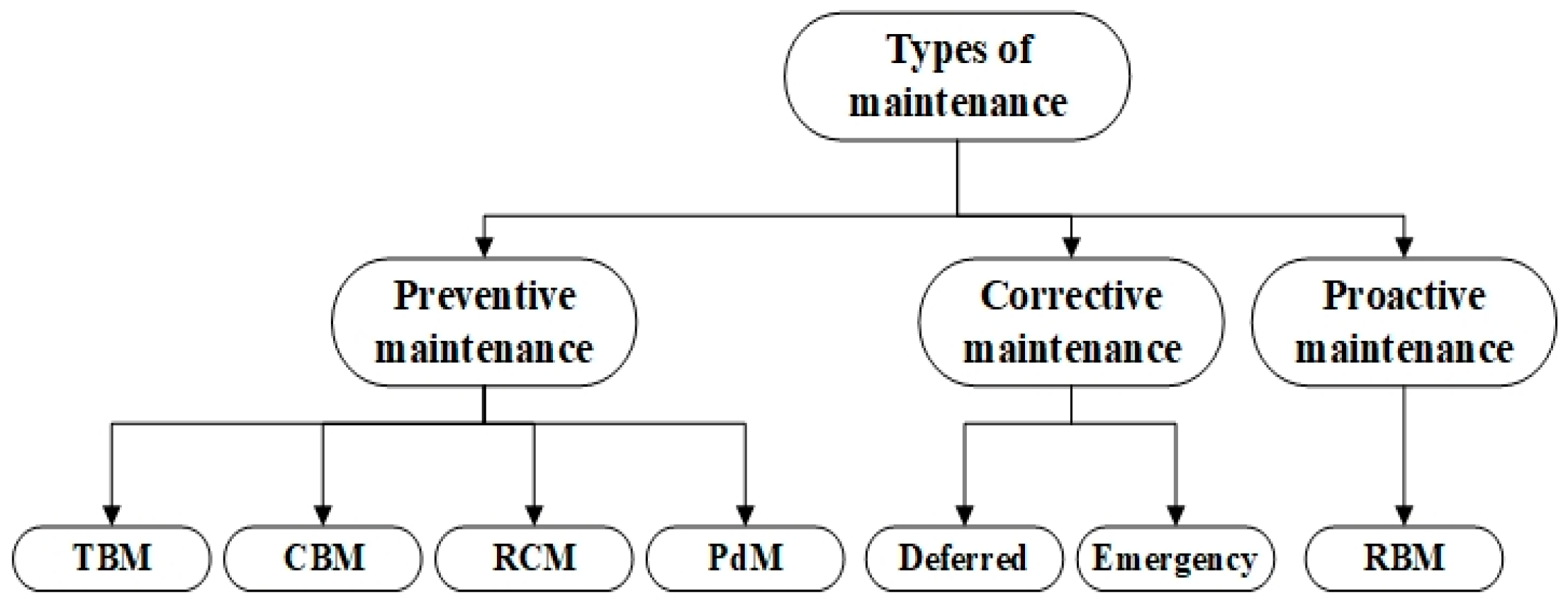
Recent advances in Machine Learning (ML) and Artificial Intelligence (AI) have made computational tools more capable, leading to higher accuracy and efficiency in maintenance practices. PdM differs from conventional approaches, as it uses historical data to train ML algorithms that then forecast potential failures, thereby enabling timely maintenance and more efficient maintenance scheduling [11]. However, PdM is essentially a predictive approach that focuses on forecasting when failures might occur; it does not provide recommendations or root-cause analysis, functioning more like a monitoring tool than a diagnostic system [12]. Consequently, utilities should strengthen maintenance strategies by addressing underlying causes through proactive maintenance (PaM). With sufficient and high-quality transformer data, researchers advocate Risk-Based Maintenance (RBM) [13], a form of PaM that not only flags emerging issues but also uses extensive data to assess condition, reduce failure risk, shorten repairs, and target the most appropriate maintenance actions [14]. Figure 1 illustrates the different types of maintenance approaches, and a detailed summary of previous studies related to transformer maintenance is presented in Table 1.
Despite several efforts to employ AI technology to analyze and evaluate the health of distribution transformers, the absence of precise expert assessments prior to AI training is likely to result in erroneous AI evaluations, even with substantial data sets [22]. Consequently, in the analysis and assessment of distribution transformers, professional consultation is necessary to establish and choose criteria for assessing a transformer’s condition. Recent transformer studies increasingly adopt the Fuzzy Analytic Hierarchy Process (FAHP) to derive criterion weights that better capture the linguistic and uncertain nature of expert pairwise judgments than the crisp Analytic Hierarchy Process (AHP). In a representative multi-criteria decision-making (MCDM) framework, FAHP-based weighting was combined with a modified weighted-averaging scheme to integrate multi-attribute condition evidence and reduce inter-indicator conflicts, yielding more interpretable condition grades for engineering decisions [23]. Moreover, an enhanced multi-attribute model that integrates FAHP with complementary weighting and fusion mechanisms to improve robustness under uncertain or partially conflicting information and to mitigate inconsistencies across experts and between subjective and objective weighting was proposed in [24]. Additional research stresses that credible prioritization also depends on a comprehensive indicator system and rigorous information fusion. In [25], fuzzy evidence fusion was applied to obtain consistent overall condition classifications from multiple indicators, while in [26], a multifactorial approach based on fuzzy sets and factor-space reasoning that additionally quantifies factor influence to strengthen interpretability for prioritization was developed. Extending these principles to distribution transformers, a comprehensive evaluation framework incorporating internal operation, external environment, and load operation, using data-informed weighting and uncertainty modeling, was proposed to enhance decision credibility under practical constraints [27]. Therefore, this work introduces a novel and comprehensive multi-criteria decision framework that systematically establishes robust weighting criteria for distribution transformer maintenance prioritization using the FAHP to reduce bias and confusion from expert assessment based on the AHP [28]. It not only identifies and validates a comprehensive set of health and impact criteria, based on expert knowledge and extensive data, but also effectively overcomes the inherent inconsistencies in expert judgments often observed in such assessments [29]. Ultimately, this transparent, systematic, and defensible methodology provides utilities with a practical decision-support tool to optimize resource allocation, reduce operational risks, and significantly enhance distribution network reliability, while simultaneously laying a crucial foundation for more precise and interpretable AI-driven maintenance strategies. Upon establishing the assessment criteria, a MCDM method training is employed to allocate consistent and rational weights to the evaluation.
The main contributions of this work are as follows:
  • A novel and comprehensive multi-criteria decision framework is proposed to systematically establish robust weighting criteria for distribution transformer maintenance prioritization using the FAHP, where the MCDM approach is adopted to select rational weights for assessing distribution transformers.
  • A comprehensive set of health and impact criteria was established by integrating expert knowledge elicited through AHP with large-scale PEA operational data, thereby reducing the inconsistencies typically associated with expert judgments in AHP.
  • A practical decision-support tool has been developed and demonstrated that optimizes resource allocation, reduces operational risks, and improves distribution network reliability. This has been demonstrated using actual data collected from the PEA system.
The remainder of this paper is organized as follows: Section 2 provides an overview of MCDM. The feature choices for evaluating distribution transformers are introduced in Section 3. Section 4 presents the results and discussions, and the conclusions from this work are given in Section 5.

2. Multi-Criteria Decision-Making (MCDM)

The MCDM framework derives weighting factors for distribution transformer evaluation using AHP-based parameters defined by PEA experts and transformer specialists. FAHP then assigns weights that reflect each parameter’s relative importance to the transformer’s condition [30,31].
MCDM is a systematic methodology designed to address practical decision-making challenges that involve many, often conflicting, criteria. The essential usefulness lies in transforming complex, subjective decision-making into a coherent, rational, and transparent decision-making, and therefore defensible analysis can be obtained. It allows utilities to rationally justify a decision, communicate the rationale to stakeholders, and navigate the inevitable trade-offs associated with modern problem-solving. Despite the potential influence of subjective inputs on its outcomes, this is mitigated by techniques like sensitivity analysis, making MCDM a crucial element in the decision-maker’s toolkit [30,32].
The MCDM is used when several alternatives must be ranked or selected based on multiple criteria. In MCDM-based service selection methodologies, the initial step involves identifying the significant attribute variables or criteria, followed by the assignment of appropriate weights based on stakeholder preferences or a weighting method, and finally, the evaluation and ranking of the alternatives with an MCDM procedure to identify the most suitable option [32].
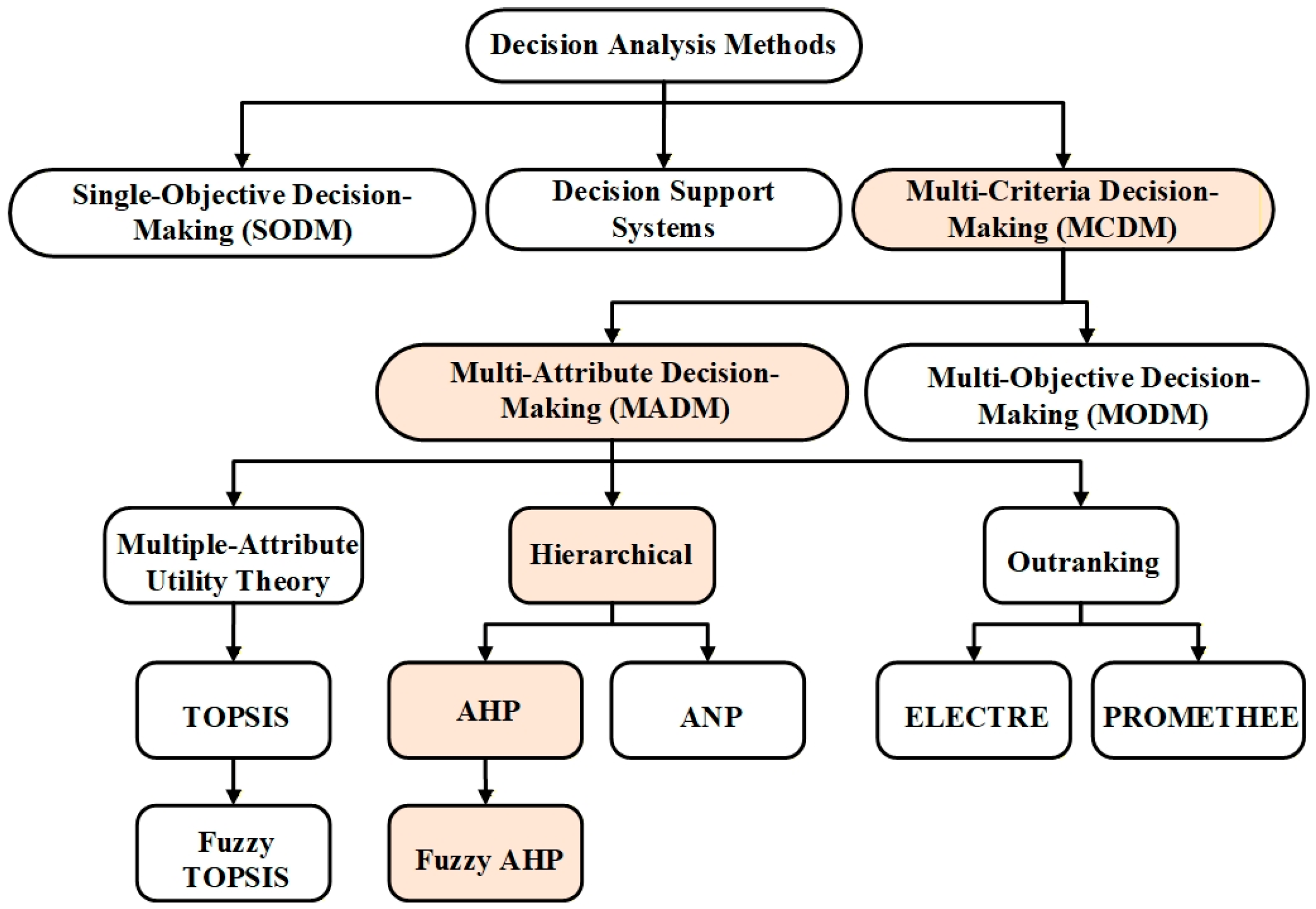
MCDM can be categorized into either Multi-Attribute Decision-Making (MADM) and Multi-Objective Decision-Making (MODM) methods, as illustrated in Figure 2. In this work, an MCDM approach is taken using a hierarchy-based method and fuzzy logic, so the FAHP is adopted to establish robust weighting criteria for distribution transformer maintenance prioritization as presented in color-coded root lines in Figure 2 [30,33].

2.1. Analytical Hierarchy Process (AHP)

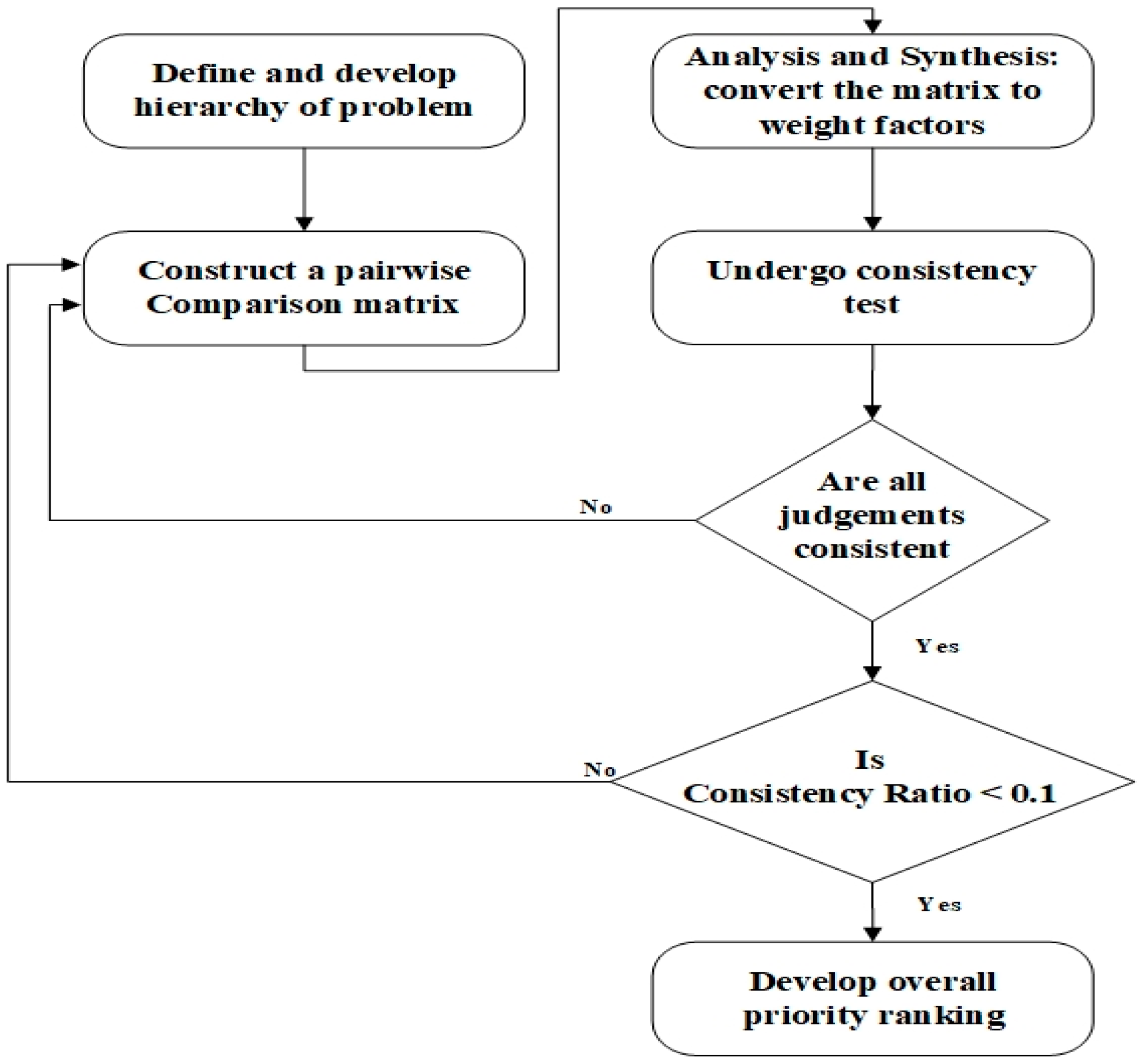
The AHP, developed by Saaty [22], is a multi-criteria decision-making method that decomposes the decision problem into a hierarchical structure of sub-problems. A decision-maker evaluates the relative importance of several factors through pairwise comparisons and converts them into numerical weights, which are employed to compute a score for each alternative. The AHP is a widely used and effective approach for explaining complex issues involving both tangible and intangible factors. In practice, the workflow involves defining the goal, constructing the hierarchy, eliciting pairwise comparisons, deriving priorities while checking consistency, and finally synthesizing the results to rank and select the best alternative [32]. At the final stage, the AHP verifies the internal consistency of the pairwise comparisons (e.g., via the consistency index and consistency ratio). A well-known limitation in multi-criteria decision-making is rank reversal, whereby adding or removing an alternative can inappropriately change the ordering of existing options. The classical AHP preserves rankings under the ideal mode of synthesis; however, in the more commonly used distributive mode, which normalizes priorities across the full set of alternatives, rank reversals may occur, particularly when close or duplicate alternatives are introduced. In addition, the AHP does not explicitly model uncertainty in pairwise comparisons or the ambiguity inherent in mapping human judgments to numerical scales. Figure 3 depicts the overall AHP procedure [35].
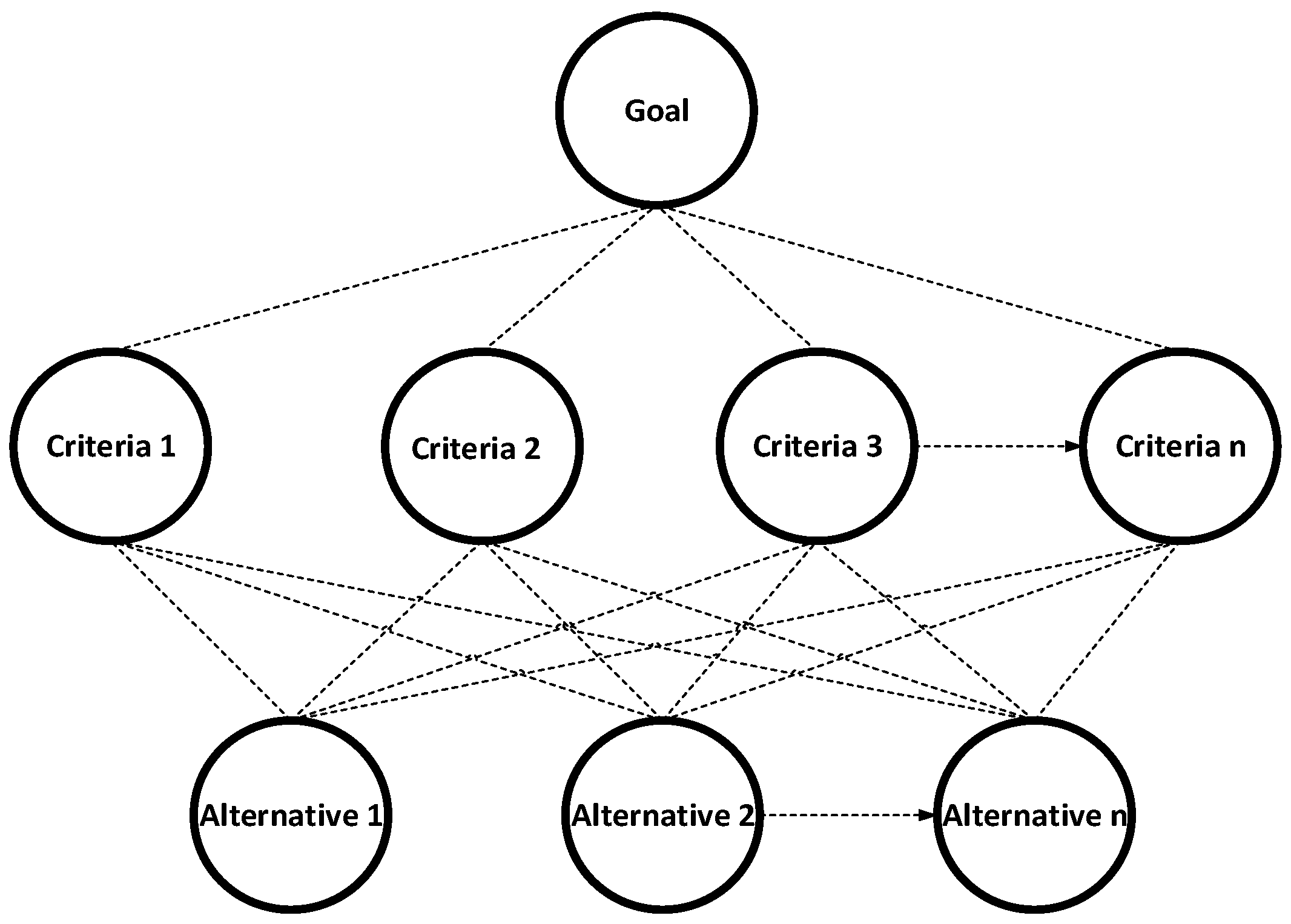
The AHP method (Figure 3) consists of the following steps: In the first step, the decision-maker decomposes the multi-criteria problem into its constituent elements and organizes them into a hierarchy (goal → criteria/sub-criteria → alternatives). Secondly, each element is evaluated through pairwise comparisons based on expert judgment, and priority weights are derived. Since these judgments are subjective, some level of inconsistency is expected; therefore, a consistency check (e.g., using the consistency ratio, CR) is performed [32]. If the ratio exceeds the acceptance threshold, the comparisons are repeated and revised. After all comparisons at each level are completed and found consistent, the priorities are synthesized across the hierarchy to obtain global weights and used to rank the alternatives. The hierarchy construction of the first step, consisting of defining the decision goal, criteria (and sub-criteria), and alternatives, is illustrated in Figure 4.
To calculate the relative priorities, the criteria are evaluated through pairwise comparisons. These judgments form the pairwise comparison matrix A [38], as defined in Equation (1), from which the relative priority weights are derived.
A = a 11 a 21 a n 1 a 12 1 1 a 1 n 1
For the consistency assessment, the reasonableness of the pairwise comparison data is verified. The CR must not exceed 0.10 (CR > 0.10 indicates unacceptable inconsistency, such as biased or noisy judgments); otherwise, it should serve as a criterion for reevaluation by an expert. The CR can be calculated by Equation (2).
C R = C I R I
where RI is the random index and CI is the consistency index, which can be computed from Equation (3).
C I = λ m a x n n 1
The random index (RI) represents the expected consistency of a randomly generated n × n pairwise comparison matrix. Its value varies with n, and the corresponding RI values are provided in Table 2.

2.2. Fuzzy Sets

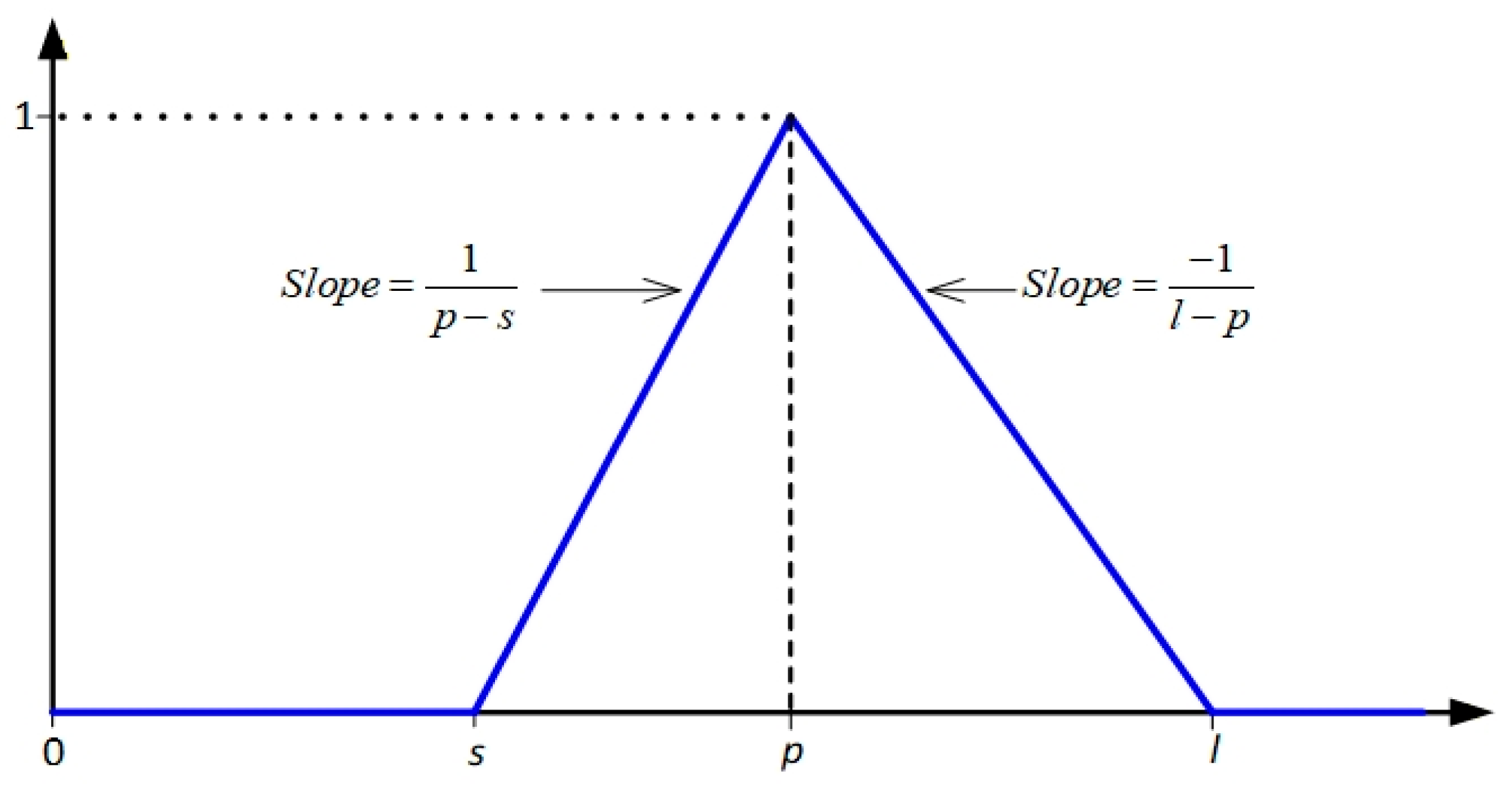
Fuzzy set theory has been established to address the notion of partial truth values that span from completely true to entirely incorrect. Fuzzy set theory has emerged as the primary instrument for addressing imprecision or vagueness, highlighting tractability, robustness, and cost-effective solutions for practical issues [39]. Moreover, the fuzzy set algebra, established by Zadeh [40,41], serves as the formal theoretical underpinning for managing imprecise and ambiguous assessments in uncertain environments. It is utilized to mathematically represent the ambiguous human perception of fuzzy states, employing a fuzzy triangle to indicate the minimum and maximum likely values. Fuzzy theory can be expressed mathematically as A ~ = (s, p, l), where s, l, and p represent the minimum value, the maximum value, and the most likely (modal) value, respectively, which together characterize the fuzzy set as per the following Equation (4).
A ~ x = x s p s , s x p l x l p , p x l 0 , o t h e r w i s e
To illustrate fuzzy theory and the role of its parameters, a triangular membership function is often used, as shown in Figure 5.
The primary operational procedures for triangular fuzzy numbers are as follows [32]:
Addition:
( s 1 + s 2 , p 1 + p 2 , l 1 + l 2 )
Multiplication:
( s 1 × s 2 , p 1 × p 2 , l 1 × l 2 )
Subtraction:
( s 1 s 2 , p 1 p 2 , l 1 l 2 )
Division:
s 1 l 2 , p 1 p 2 , l 1 s 2
Reciprocal:
A ~ 1 = 1 l 2 , 1 p 2 , 1 s 2
Fuzzy numbers differ from AHP judgments in that entries of a fuzzy pairwise comparison matrix are typically expressed as triangular fuzzy numbers (TFNs), whereas the AHP uses a predefined scale. However, when crisp AHP data are available, they can be converted into a fuzzy framework; for example, an AHP value a can be represented as a TFN in the form (a, a, a). Accordingly, fuzzy pairwise comparisons can be evaluated using TFNs while preserving the AHP priority structure. Table 3 presents the conversion method from conventional AHP values to fuzzy numbers, thereby enabling fuzzy computations and illustrating the correspondence between the two representations.

2.3. Fuzzy Analytical Hierarchy Process (FAHP)

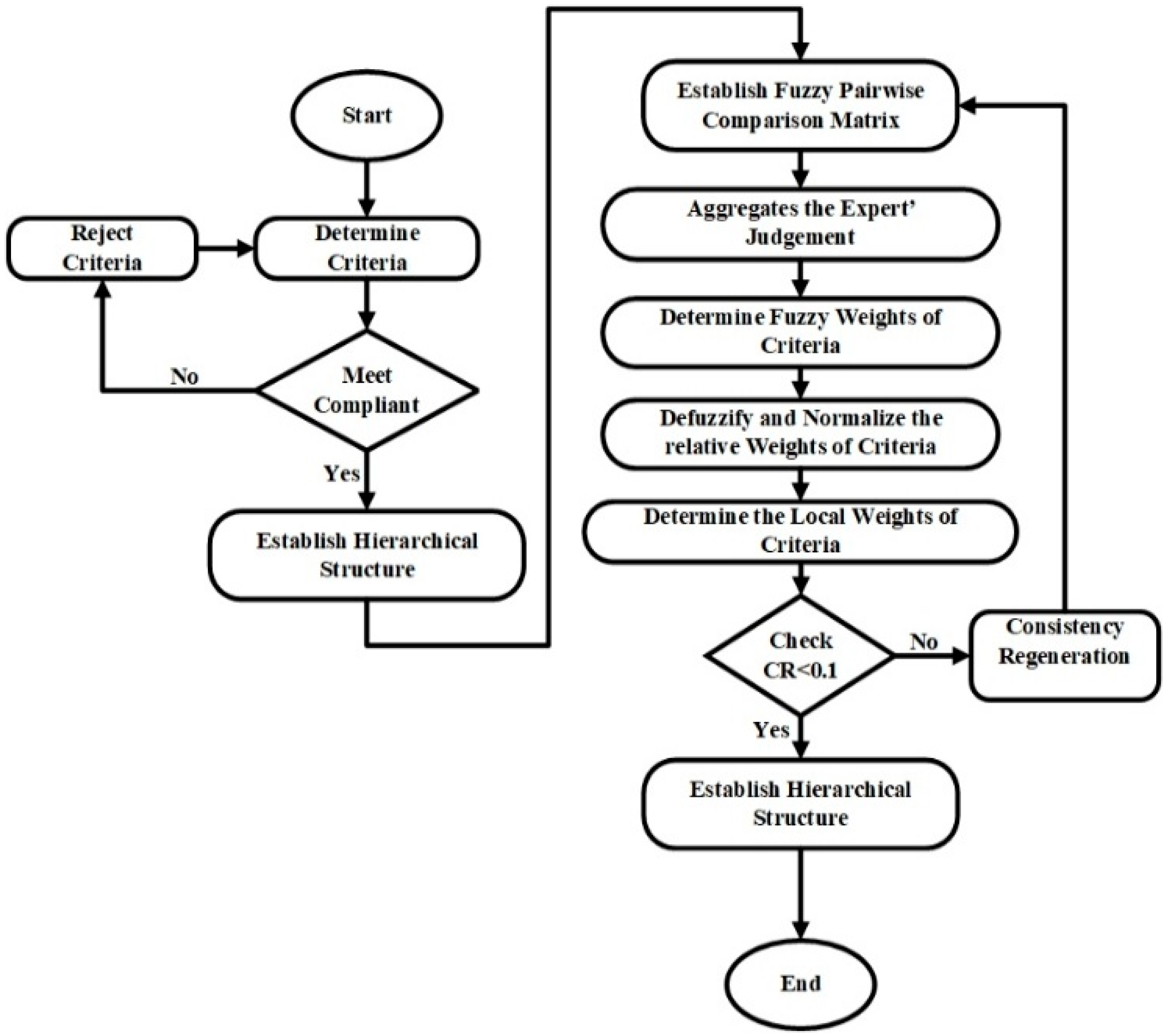
The Fuzzy Analytic Hierarchy Process (FAHP) extends the conventional AHP by incorporating fuzzy set theory to address uncertainty and vagueness in expert judgments. In this approach, pairwise comparison decisions are expressed as TFNs with corresponding membership functions, enabling the use of linguistic variables in place of exact numerical values. This representation allows subjective assessments to be quantified while preserving the imprecision inherent in human cognition. The FAHP subsequently derives weight vectors from these fuzzy pairwise comparisons, thereby refining the prioritization of decision criteria. By integrating fuzzy logic into the AHP framework, the method enhances robustness against inconsistency in expert evaluations and improves the reliability of multi-criteria decision-making outcomes [32]. The FAHP technique is shown in Figure 6, which depicts the primary steps. It is worth noting that after the defuzzification process, assessing the consistency of all pairwise comparison matrices is crucial, which is achieved by computing CI and CR via (2) and (3), respectively [32].

3. Assessment for Distribution Transformers Features

Assessment of distribution transformers can range from simple checklists to advanced analytics, depending on a utility’s data availability and operational constraints. Consequently, maintenance plans must be designed to identify and prioritize the assets that have the greatest impact on risk and performance. The HI is a widely used framework for assessing the overall condition of distribution transformers and other power system equipment. It integrates laboratory tests, field inspections, and operational data to produce an index that allows decisions to be made [42]. Moreover, HI serves as a decision-support tool for AM, informing maintenance planning and the prioritization of capital investments and work programs. Furthermore, although numerous studies have examined failure modes in distribution transformers using a variety of methodologies, direct extrapolation from power transformer models may yield misleading results, as the component configurations and operating environments differ substantially. Table 4 provides a comparative summary of the component configurations and predominant failure modes specific to distribution transformers.
Building on this framework, prior studies have estimated failure probability using indicators such as Dissolved-Gas Analysis (DGA), insulating oil quality, and thermal condition, and they have defined criteria for evaluating transformer condition and likelihood of failure. Accordingly, the quantification of failure consequences for end users can be determined [44]. However, to extend conventional transformer-centric analyses, impact variables, which are the number of customers, serviced area, nature of load, cost of maintenance, etc., derived from customer demographics and customer-level assessments, are incorporated, thereby capturing effects beyond equipment condition alone [20]. To implement the approach, an optimal set of criteria for assessing the health of distribution transformers is identified by drawing on literature, practitioner expertise, and relevant IEC/IEEE standards. By using MCDM, specifically the FAHP, the weights for each factor to support subsequent assessments of transformer health and customer impact are derived. Consequently, the evaluation framework comprises two dimensions: the HI and the Impact Index dimensions [45].

3.1. Likelihood Assessment

The probability of failure (PoF) is a key factor in assessing distribution transformer condition and planning the transitions toward condition-based or predictive maintenance. Accordingly, high-quality condition data are essential for assessing transformer performance and forecasting failures.
The literature indicates that distribution transformer failure modes align with those observed in the PEA; therefore, assessment factors were derived from PEA operational data. An analysis of more than 100,000 PEA distribution transformers identified seven parameters for condition evaluation. These parameters were extracted from the most recent maintenance and inspection records within a maximum look-back period of one year, consistent with PEA practice to ensure transformer availability. In accordance with PEA standards, distribution transformers are inspected and maintained at least annually. Although established using PEA data, the proposed parameter set can be readily tailored to other national contexts and can support data-driven decision-making based on each organization’s available information. This section summarizes the parameters used to assess the condition of distribution transformers in the PEA service area [46].

3.1.1. Load History

Load history represents the temporal variation in demand from customers connected to a distribution transformer. Transformer loading is generally expressed in terms of apparent power (S), as electrical losses, primarily I2R, increase with loading, resulting in higher internal heat generation and a corresponding increase in winding temperature [47]. To ensure reliable operation, the loading of a distribution transformer is typically restricted to 80% of its rated capacity; for example, a 100 kVA transformer should normally carry no more than 80 kVA. Nonetheless, transformers are designed to withstand short-term overloads of up to 120%, and field inspections occasionally reveal loading conditions exceeding 100% of rated capacity.
For this study, historical load data was compiled and categorized into peak and average values for HI evaluation of distribution transformers within the PEA network. At present, the PEA retains only peak and average apparent power statistics, though future initiatives aim to integrate real-time load monitoring. Approximately 600 devices capable of real-time measurement are currently operational; however, this is a very small sample of the fleet of transformers [45].

3.1.2. Temperature of Distribution Transformers

Distribution transformers are typically of the oil-immersed type and, under standard operating conditions, are designed to withstand temperatures of around 50 °C, with the capability to endure short-term thermal excursions up to 120 °C. Ambient temperatures generally range between 30 and 40 °C. However, excessive loading or winding defects can lead to internal overheating, which accelerates the degradation of paper and winding insulation, thereby reducing the transformer’s lifespan. This concern has motivated extensive research into estimating internal heat or hot-spot temperature using analytical formulas [48].
In practice, distribution transformers are often operated at more than 80% of their rated capacity, which accelerates the deterioration of insulation until eventual failure occurs [49]. Consequently, operating temperature is considered a critical factor in determining insulation aging and the remaining lifespan of distribution transformers. In accordance with IEC 60076-2, the corresponding reference temperature (thermal) limits are summarized in Table 5.

3.1.3. Insulation Resistance

Insulation resistance is a critical parameter in distribution transformers, representing the resistance between the high-voltage winding, low-voltage winding, and ground, thereby ensuring protection against internal short circuits in the main tank. It is typically evaluated using insulation resistance testing instruments that measure the resistance between windings. Standard practice for oil-immersed involves three measurements: (i) between the high-voltage and low-voltage windings, (ii) between the high-voltage winding and ground, and (iii) between the low-voltage winding and ground [51,52].
The test duration is usually one minute, with acceptable values specified of at least 250 MΩ at 40 °C [51,53]. Table 6 summarizes the minimum insulation resistance values for different voltage levels as a function of temperature level.

3.1.4. Dielectric Strength

Oil insulation plays a critical role in distribution transformers, serving both as an insulating medium and as a coolant by transferring heat from the windings to the transformer tank. The condition of transformer oil is commonly assessed through dielectric strength testing in accordance with ASTM D877 [57] or IEC 60156 [58], which ensures compliance with breakdown voltage requirements. Dielectric strength is widely regarded as an indicator of oil quality and its ability to provide effective insulation. According to ASTM D877 and IEC 60156, the breakdown voltage measured with spherical electrodes spaced 2.5 mm apart must exceed 26 kV/2.5 mm and 30 kV/2.5 mm, respectively, under test conditions of 40 °C and 50–60 Hz [59,60,61,62].

3.1.5. Grounding Resistance

Several standards define acceptable limits for grounding resistance. IEC 62305-3 [63] specifies a maximum resistance of 10 Ω for effective lightning protection, while IEEE 142 [64] (“The Green Book”) recommends a maximum of 5 Ω for industrial and electrical distribution systems. The National Electrical Code (NEC, NFPA 70) stipulates a maximum of 25 Ω for low-voltage systems. According to PEA standards, the ground resistance at distribution transformer installation sites must not exceed 5 Ω; however, if this requirement cannot be achieved, an upper limit of 25 Ω is permitted.
Ground resistance plays a critical role in determining transformer vulnerability to overvoltage caused by lightning or switching events. Excessive resistance reduces the effectiveness of fault dissipation, forcing the transformer to absorb the energy surge. This condition can lead to insulation degradation in paper and oil or, in severe cases, physical damage to the transformer [32]. Therefore, ground resistance at the installation site is a key parameter in assessing the distribution transformer condition [65].

3.1.6. Distribution Transformers Life Span

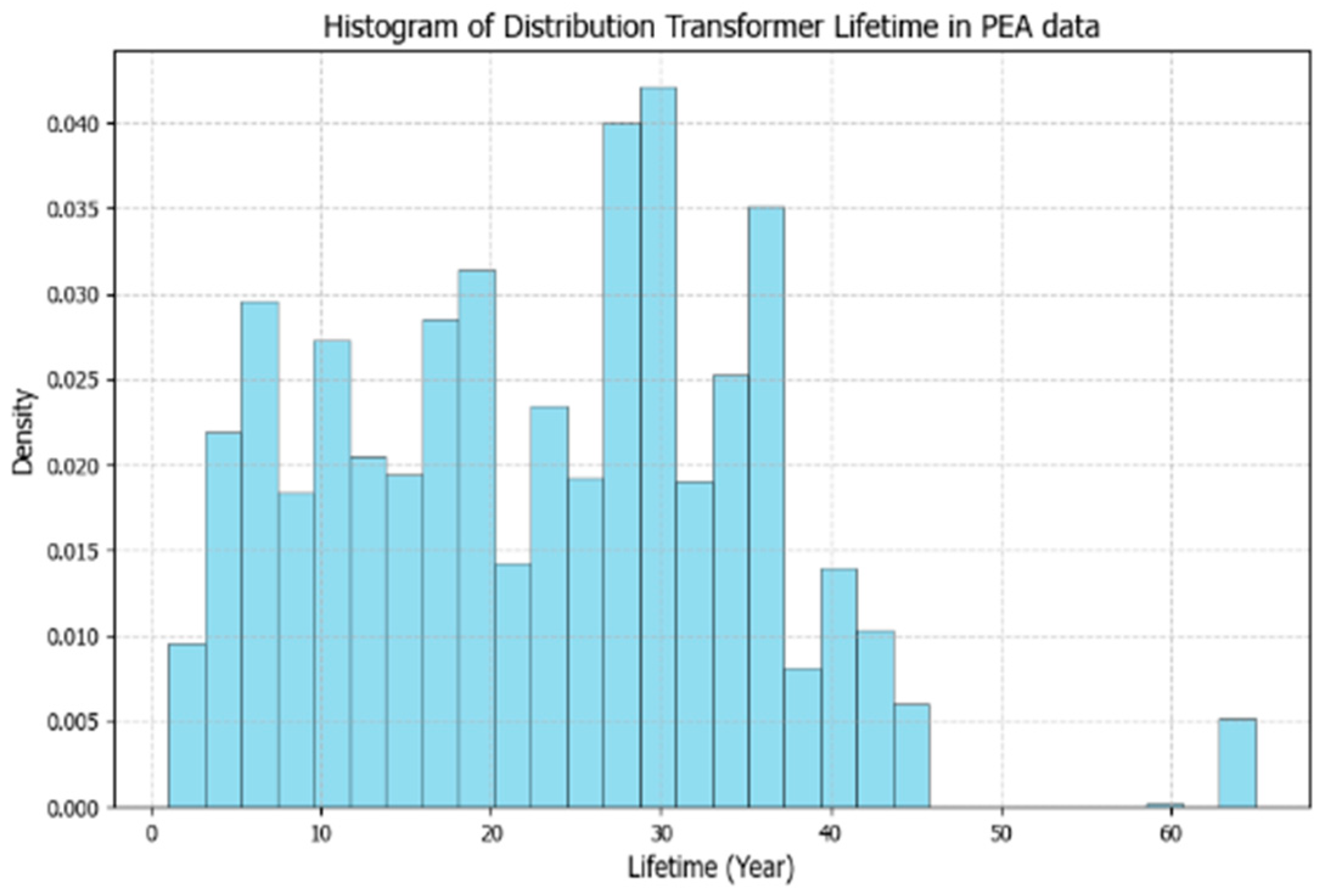
According to IEEE standards, a typical distribution transformer has an expected lifespan of approximately 180,000 h (20.5 years) under normal operating conditions. In comparison, the IEC standard specifies an operational lifespan of about 262,800 h (30 years). Actual service life, however, may vary depending on factors such as loading conditions, ambient temperature, and harmonics generated by nonlinear loads. The age of a transformer is defined as the number of years since its installation, with most distribution transformers exhibiting a reliable lifetime of around 25 years. With proper maintenance, service life can often be extended beyond 30 years. Figure 7 presents a histogram of transformer lifespans based on PEA data on 3096 distribution transformer failures collected for 5 years from 2020 to 2025 [66].
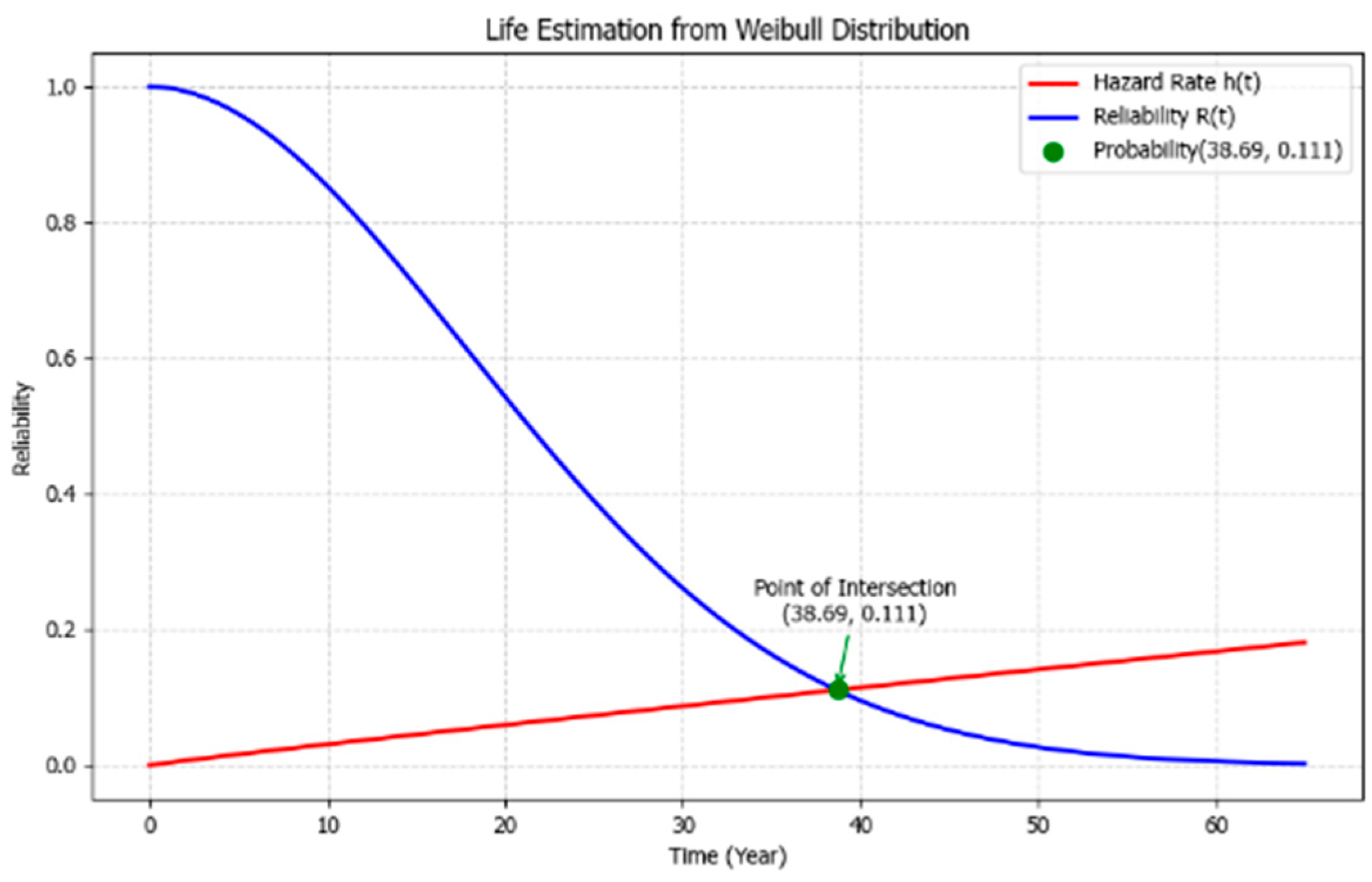
Analysis of failure age using the Weibull distribution [67] shows that the convergence point between reliability and failure rate occurs at an average transformer age of 39 years, representing the peak probability of failure. This result closely corresponds with the observed histogram values. As illustrated in Figure 8, the failure rate of distribution transformers increases significantly without adequate maintenance, with age-related degradation further accelerating this trend and causing a sharp decline in reliability [68].
Analysis shows that the reliability curve reaches 0.10 at approximately 38.7 years, indicating only a 10% probability of survival under continuous, unmaintained operation. This finding underscores the critical role of maintenance in sustaining the long-term reliability of the system [69]. Furthermore, the intersection of reliability and failure rate suggests that transformer age estimation is consistent with the IEC standard when evaluated from a reliability perspective [66].

3.1.7. Lightning Statistics

Overhead power distribution systems make up more than 90% of the network, making them highly vulnerable to overvoltage from lightning strikes and switching surges. Transformer windings and insulation are particularly at risk, as transient surges that coincide with the resonance frequency of the windings can amplify voltages and impose abnormal electrical stress [65]. Statistical analyses show that rural power systems experience significantly higher failure rates during adverse weather conditions [70], and geographically correlated lightning data reveal that some transformers fail at rates up to 45 times above average [65,71].
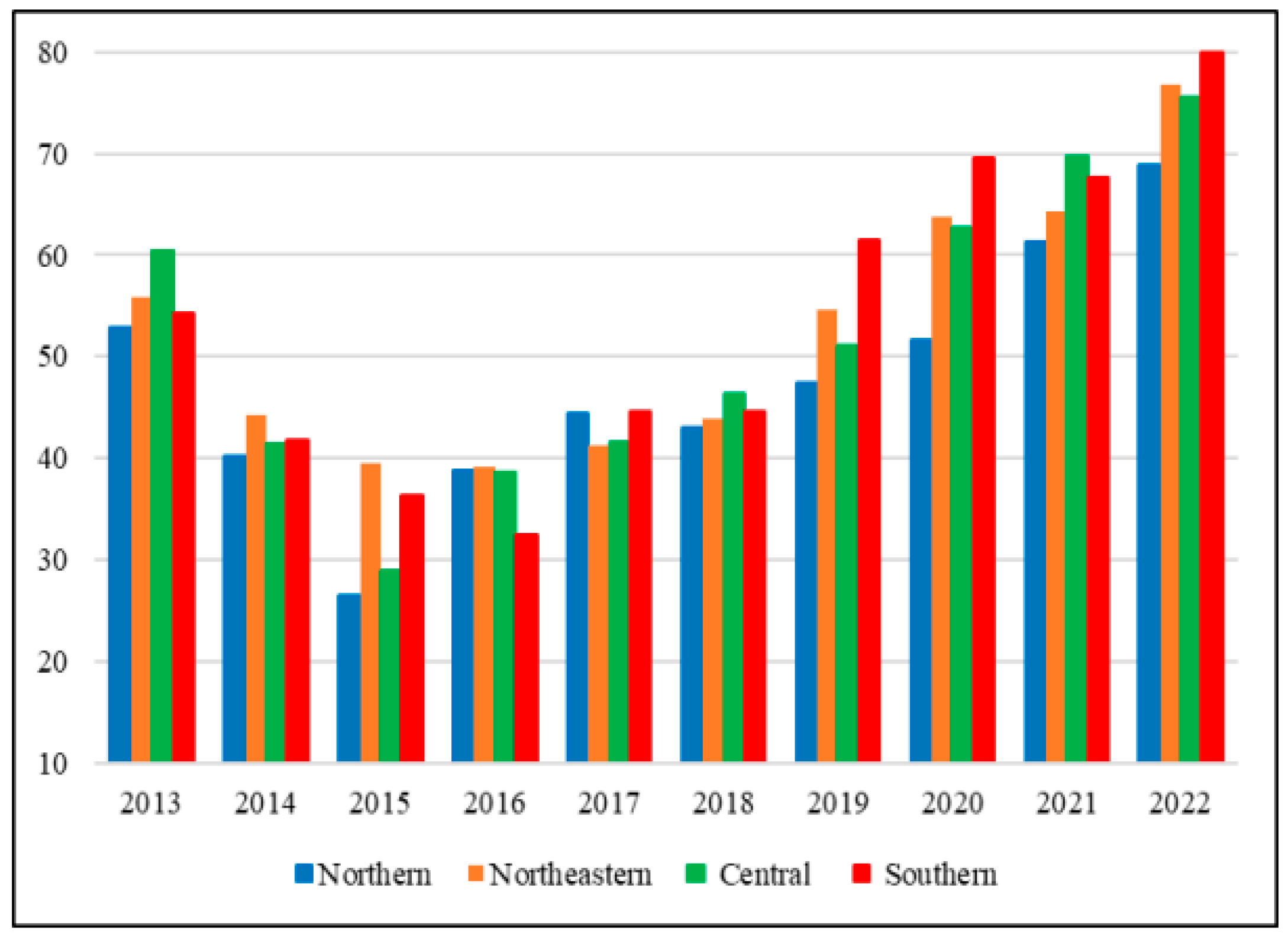
To mitigate these risks, IEC 62305 provides the principal international standard for lightning protection, addressing risk management, structural protection, internal system protection, and surge protective devices. Its application enhances safety, ensures regulatory compliance, and strengthens the long-term reliability of critical infrastructure [70]. In Thailand, thunderstorm statistics from 2013 to 2022 (shown in Figure 9) highlight the considerable regional variation in storm frequency, with pronounced extremes and a significant standard deviation [72,73].
The IEC 62305 aligned lightning-risk classification framework for medium-voltage (MV) distribution assets is summarized in Table 7.

3.2. Consequence Assessment

The probability of distribution transformer failure has a significant impact on both a company’s reputation and its customers. Numerous studies have focused on estimating the remaining lifespan of transformers and forecasting failures to support proactive maintenance planning. However, scheduling alone is insufficient; integrated engineering and economic decisions are needed to evaluate the risk impact on occurrence. Moreover, relatively few studies have addressed both the probability of failure and its broader consequences. From the literature review, five key indicators commonly used to evaluate the impact of transformer failures are identified. This section outlines the factors to assess the probability and potential consequences of distribution transformer failures [75].

3.2.1. Number of Customers

Distribution transformers serve a wide range of power consumers, including households and small commercial users. When a transformer fails, the impact on consumers is immediate. The number of customers connected is a key factor in evaluating the consequences of such failures. A larger customer base reflects higher electricity demand and directly correlates with PEA’s revenue. Prolonged transformer outages not only disrupt energy sales but also erode consumer confidence [76].

3.2.2. Distribution Transformers Service Areas

The service area of a distribution transformer reflects the local pattern of electricity consumption, which corresponds to the area of electricity consumption and is a critical factor in its assessment. The PEA provides electricity to diverse regions, including rural, industrial, urban, and metropolitan areas. Geographic context plays a decisive role, as consumer expectations and demand patterns vary significantly across locations. For instance, consumers in metropolitan areas or those near Bangkok, particularly in densely populated zones, generally have higher expectations for service reliability compared to rural users. Moreover, installation sites must account for environmental risks such as lightning because rural areas with open space and higher lightning incidence present an elevated likelihood of transformer damage compared to urban areas [77].

3.2.3. Customer Complaints

Customer complaints serve as an important indicator of service quality and the consequences of service deficiencies. These complaints are submitted through various channels, such as websites, mobile applications, call centers, and walk-in offices, and may address issues beyond power outages. However, a substantial share of interruptions arises from faults in distribution transformers, which often require removing the failed unit and installing a replacement. Limited inventory of spare transformers can significantly extend restoration times, leading to prolonged outages, operational disruptions, and economic losses for customers [78,79].

3.2.4. Maintenance Costs

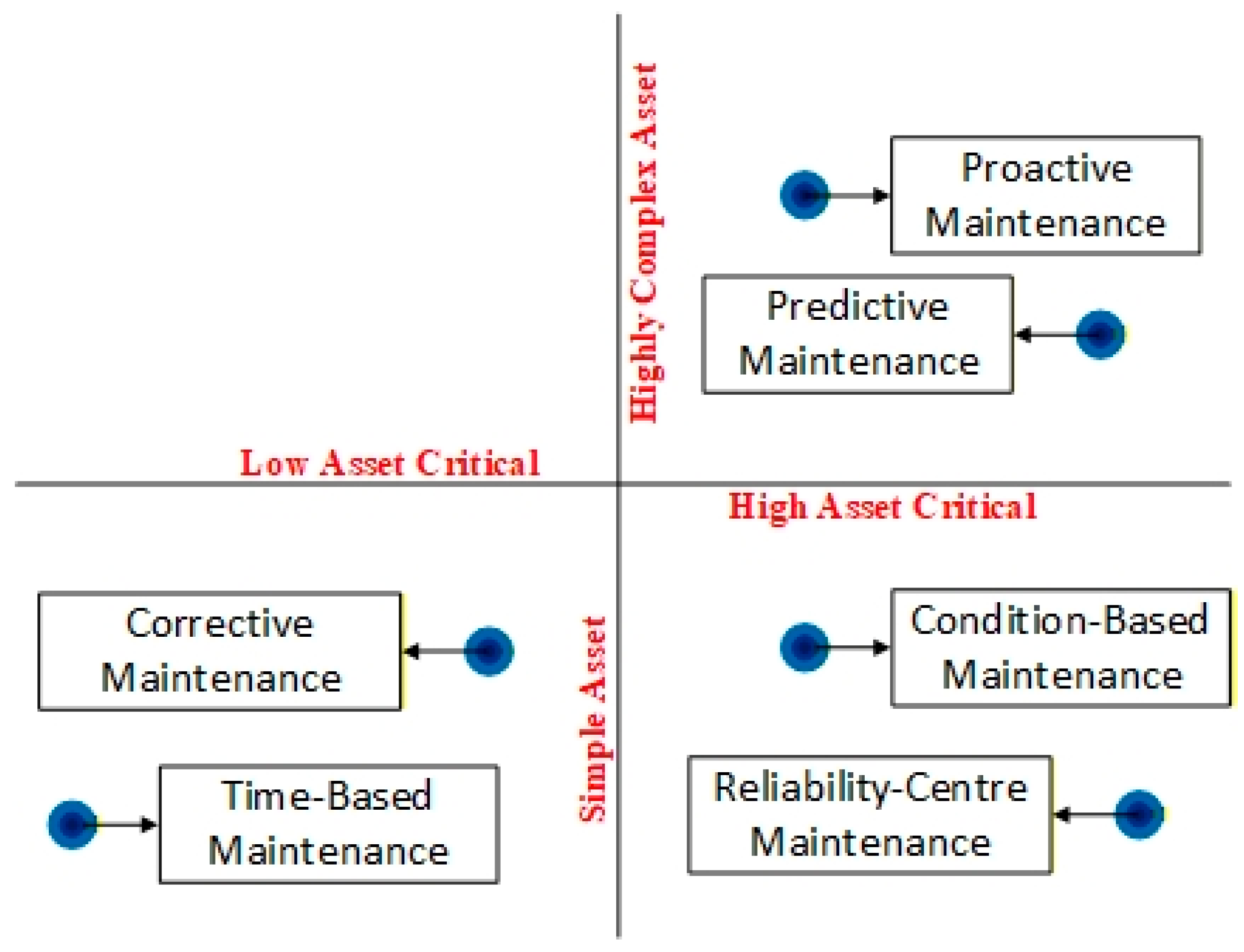
Maintenance costs stem from both the planning and execution of maintenance activities, encompassing direct expenditures and indirect or hidden costs [80]. The choice of maintenance strategy depends on an organization’s operational context, technical capabilities, and overall maintenance philosophy, with each approach carrying a distinct cost structure. Excessive analysis or frequent changes in maintenance strategy may introduce decision-making and coordination overhead, thereby inflating hidden costs. Commonly adopted strategies include time-based and condition-based maintenance. However, what proves optimal for one utility may not be suitable for another. Utilities must therefore evaluate, select, and optimize maintenance strategies in alignment with their specific objectives, constraints, and asset portfolios [1,81,82]. Figure 10 illustrates a maintenance strategy selection for each asset type.

3.2.5. Transformer Rated

The capacity of a distribution transformer, typically expressed as its kVA rating, serves as a proxy for local load intensity, reflecting both the number of connected customers and aggregate power demand. Larger-capacity units are therefore more common in urban areas, where customer density and demand are higher than in rural areas, Failures of high-capacity transformers generally have more severe consequences, including greater interrupted energy and wider service impacts. However, capacity is not perfectly correlated with customer count. Some feeders with few customers host energy-intensive facilities (e.g., industrial or commercial loads) that necessitate a large transformer despite a small number of connections [84].

4. Results and Discussion

This study derived evaluation factors for distribution transformers from experts through AHP-based judgments and subsequently enhanced them using the FAHP. Experts from the PEA and other relevant specialists in the distribution transformer field participated in selecting and weighing these factors, ensuring a diverse and multidimensional perspective. The methodology encompasses several factors, including literature analysis, local requirements, and pertinent data for the assessment of distribution transformers. FAHP inputs were derived from AHP pairwise reviews conducted by the PEA transformer experts and the field specialists. Each expert compared all variables in pairs. The aggregated AHP results were then converted to FAHP to obtain weighting factors.
Before the conversion, it is verified that each expert’s AHP CR met the required threshold (e.g., ≤0.10) to limit bias and reduce ambiguity. Examples of the unadjusted FAHP pairwise comparison matrices for the HI and Impact Index are shown in Table 5 and Table 6, respectively, where C1 is the load history, C2 is the temperature of distribution transformers, C3 is the insulation resistance, C4 is the dielectric strength, C5 is the grounding resistance, C6 is the distribution transformer lifespan, C7 is the lightning statistics, C8 is the number of customers, C9 is the distribution transformers service areas, C10 is the customer complaints, C11 is the maintenance activity cost, and C12 is the distribution transformer rated.
Depiction of a pairwise comparison matrix with FAHP. Prior to the execution of the CR correction, the initial pairwise evaluation values evaluated by the experts were meticulously scrutinized to verify the inaccuracy of the pre-adjustment results. A comparison table of this nature was created for each evaluated expert until the total number of examined experts was attained. Table 8 and Table 9 are examples of pairwise matrices converted from the AHP to FAHP before improving the CR [85].
It can be seen from Table 8 and Table 9 that many experts’ pairwise comparison matrices lack adequate consistency, and the consistency ratio for most assessors exceeded the commonly accepted threshold of 0.10, reflecting the uncertainty and potential bias inherent in human judgments. Additionally, only two CR values in Table 8 and four in Table 9 were at or close to the acceptable limit. These results indicate that the underlying judgments should be refined or recalibrated before finalizing the weights.
The preliminary data, prior to adjustment, produced results that were both inconsistent and unreasonable. Specifically, all CR values exceeded the accepted threshold of CR < 0.1 (10%), indicating insufficient reliability of the judgments. This might lead to potential errors in the evaluation if the weight values were utilized. Consequently, the CR values were assessed prior to the enhancement to verify that the findings were erroneous and prejudiced before the improvement. Table 10 summarizes the evaluation results of the HI parameters before the FAHP adjustment, while Table 11 presents the impact factors prior to FAHP modification.
When a pairwise comparison matrix fails to meet the consistency criterion, the underlying judgments must be iteratively revised and the weights recalculated. In this study, the procedure was implemented in Python version 3.14, and the weights were recomputed using the FAHP method. The transformer evaluation was further refined to ensure non-zero weights and to achieve a verified consistency ratio of ≤0.10. Following these adjustments, Table 12 presents the CR values for the health-index assessment, while Table 13 reports the CR values for the impact assessment.
As presented in Table 12 and Table 13, the refined judgments met the criteria of non-zero weights and a consistency ratio of ≤0.10, thereby ensuring methodological rigor and robustness. Consequently, the resulting weights are considered valid for subsequent evaluation and prioritization of distribution transformers.
The derived factor weights for evaluating distribution transformers using the FAHP method. Candidate factors were identified through a targeted literature review, prior studies, and expert consultations, and refined using PEA service-area data. Unlike many existing approaches, which often extrapolate from power-transformer models, rely solely on monitoring-based feature selection, or lack methodological transparency, this work explicitly discloses the weighting process. After iteratively verifying expert assessments until all CR values met the threshold (Table 12 and Table 13), the factor weights are finalized. These weights were then used to evaluate distribution transformers and construct the risk matrix using the HI-based assessment method. The resulting weights are reported in Table 14 (health factors) and Table 15 (impact factors).
The weights obtained from Table 14 and Table 15 were applied in assessing the distribution transformers by combining them with the parameter-level scores assigned under each DSO’s operational criteria. The results show that the optimized weights for grounding resistance and lightning exposure increased markedly relative to the expert-elicited AHP weights, whereas the remaining health-related factors decreased moderately. Similarly, customer complaints gained greater significance in the impact assessment, whereas transformer capacity exhibited a marked decrease in weight. All adjusted weights in Table 14 and Table 15 satisfied the consistency (conformity) requirements, with the CR not exceeding 0.10 and no parameter weight being zero, indicating acceptable consistency and mitigating bias associated with the initial expert judgments. In contrast, the original expert assessments assigned zero weight to some parameters, suggesting bias and/or uncertainty in judging the relative importance of individual factors.
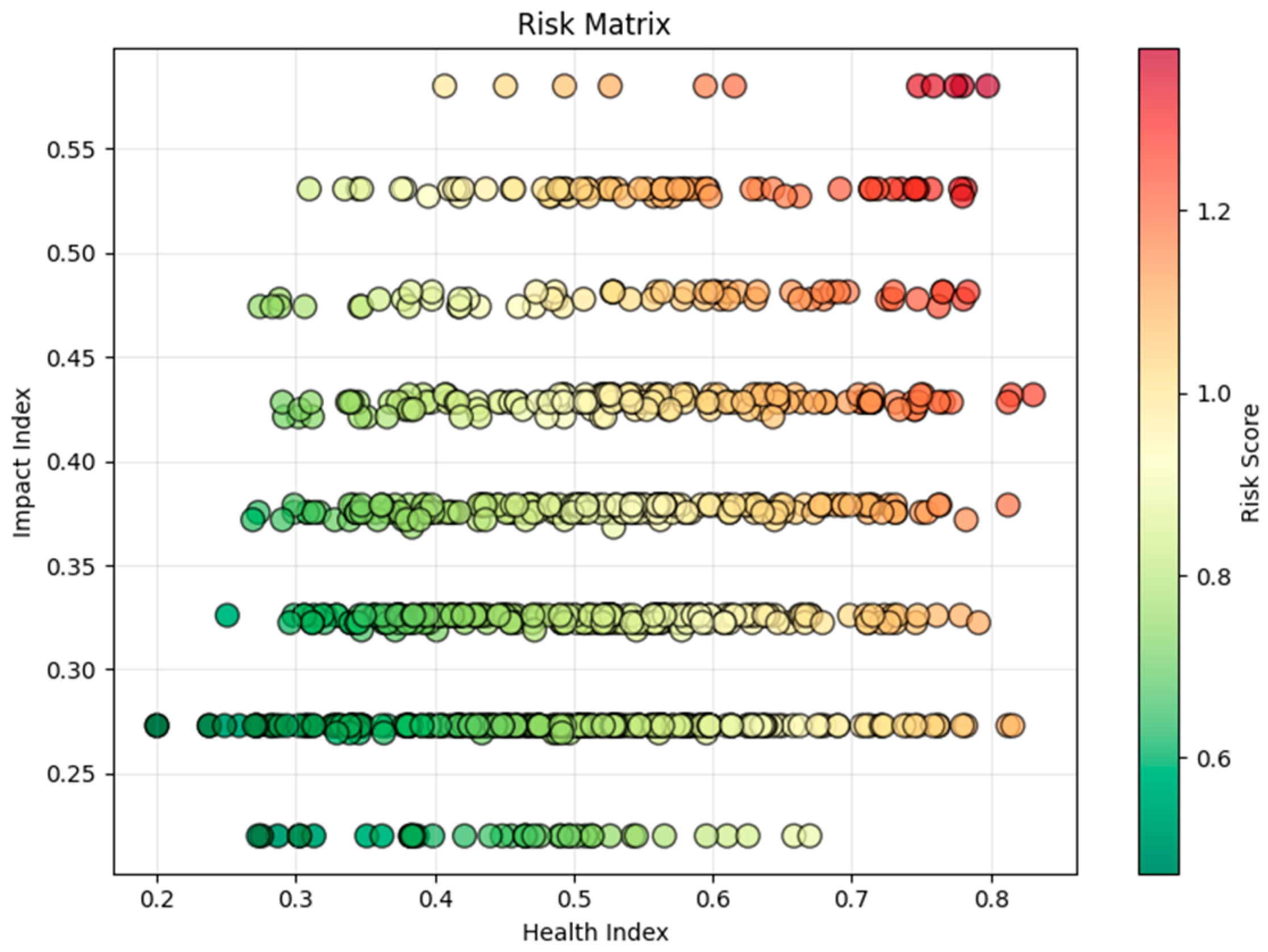
To validate the hypothesis that the derived weights can effectively assess distribution transformer risk, they were applied to construct evaluation criteria based on a risk metric. This metric quantifies the probability of transformer failure, thereby supporting condition-based maintenance scheduling and prioritization of repair activities. After completing the conditional risk assessment, the resulting scores are compared with the HI criteria, and risk-prioritized transformers that meet these thresholds are identified and assigned maintenance activity as expressed in Table 16. Figure 11 illustrates the proposed risk model developed using FAHP-based weighting and integrating the HI and Impact Index to quantify the risk level of distribution transformers. The model is validated using maintenance and operational data collected from 1000 transformers for hypothesis testing. The approach is scalable to much larger fleets when sufficient DSO data are available; however, a sample of 1000 units was selected to provide a clear and interpretable visual presentation. The model categorizes units into three tiers: 10 high risks, 640 medium risks, and 350 low risks. These classifications support a tiered maintenance strategy: high-risk (red-zone) transformers are prioritized for immediate intervention to reduce failure probability; medium-risk (yellow zone) units are scheduled for subsequent maintenance; and low-risk (green zone) units undergo routine visual inspections for obvious defects. Transformers located in the upper-right region of the matrix exhibit the highest risk, whereas those in the lower-left region represent assets in the best health condition. The remaining transformers are ordered according to gradually decreasing risk from the upper-right to the lower-left of the matrix.
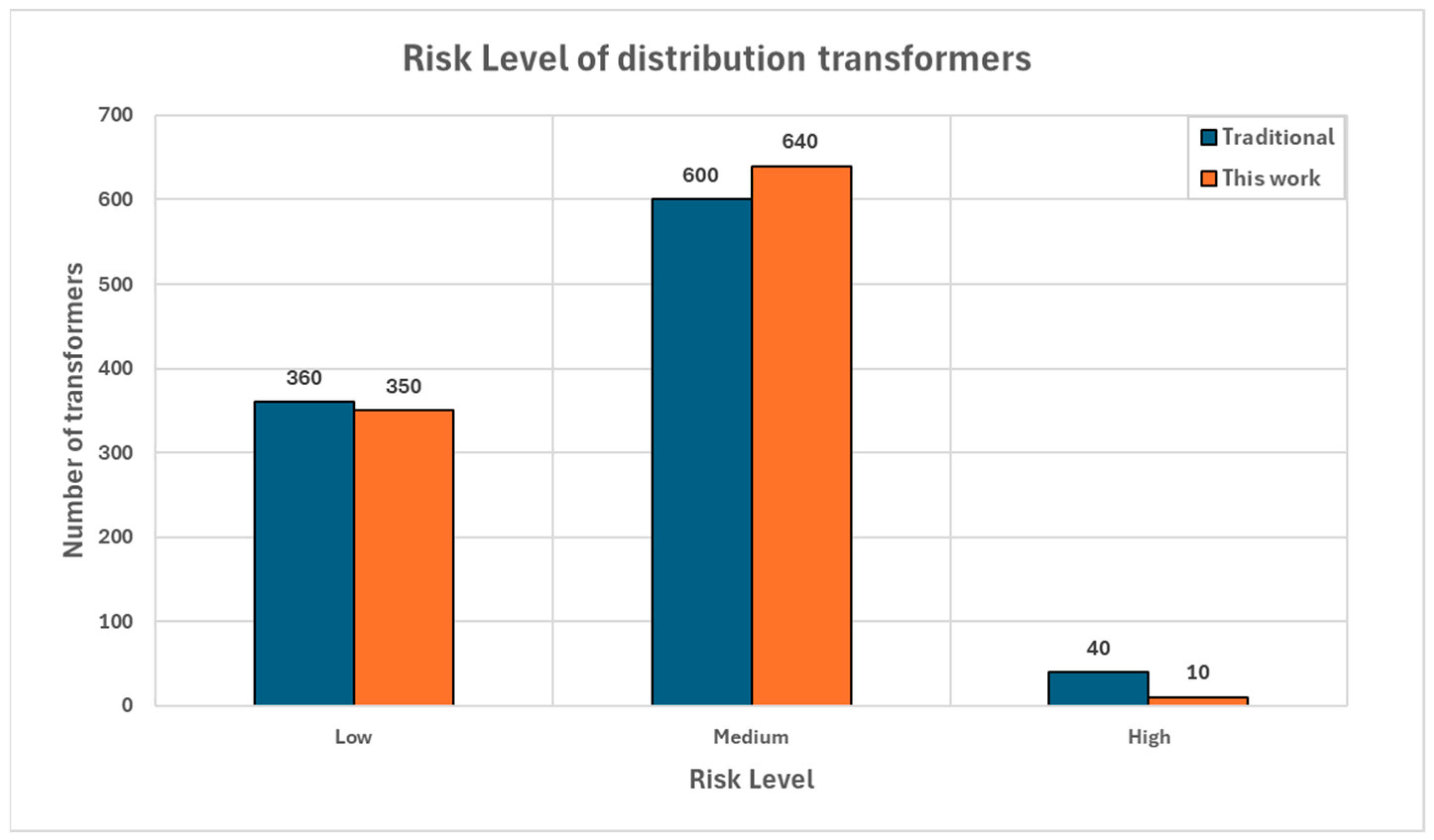
In order to validate the results provided by the proposed approach, a comparison of risk level between the traditional and proposed approaches is presented in Figure 12. It shows that, compared with the previous PEA maintenance-planning approach based on TBM, the number of transformers requiring immediate action decreased by 10 units (75%), the number placed under monitoring increased by 40 units (6.67%), and the number requiring no action decreased by 10 units (2.78%).
To further validate this effort, risk assessment frameworks may be applied to the data model to ensure ideas are correctly integrated as intended, while also identifying possible stress spots or failures. The data model is anticipated to perform effectively when subjected to risk assessment frameworks, as the technique employed in this work was designed to ensure comprehensiveness. It is worth noting that weighting variables should be established through expert judgment before applying AI to transformer evaluation. Since AI depends on the quality and scale of training data, its reliability diminishes when facing unfamiliar scenarios. Accordingly, large and comprehensive datasets are essential to enhance the accuracy and robustness of AI-based transformer assessments.
Although the proposed method reduces the risk of expert-induced bias, it also has practical limitations. The evaluation data must be as current as possible to minimize assessment errors. Moreover, the dataset used in this study was collected offline; for example, load measurements may not coincide with peak operating periods, and thermal information was obtained indirectly. If online monitoring data were available, assessment accuracy would likely improve substantially because the inputs would more closely reflect actual operating conditions. In order to use the proposed method as a practical tool, utilities should determine the particular conditions, such as ambient temperature, oil quality, and lightning statistics.

5. Conclusions

This study employed the FAHP within a robust MCDM framework to derive defensible criterion weights for prioritizing maintenance of distribution transformers. The proposed approach evaluates assets along two complementary dimensions, HI (likelihood of failure) and Impact Index (consequence of failure), thereby integrating technical condition with operational and customer-facing implications and advancing beyond single-dimension or experience-only prioritization practices. The assessment criteria were first identified through a systematic literature review and subsequently refined through extensive expert elicitation and service-area evidence from the PEA, ensuring both methodological grounding and practical relevance.
A key contribution of the FAHP in this context is its ability to reduce ambiguity and improve the consistency of expert pairwise judgments. In the initial, crisp AHP elicitation, expert comparison matrices repeatedly produced CR values above the accepted threshold (0.10), implying that substantial iterative revision would be required to achieve admissible consistency. By incorporating fuzzy set theory, the FAHP enabled experts to express preferences using linguistic uncertainty while providing a structured mechanism to consolidate and refine judgments. As a result, the finalized matrices achieved verified CR values of ≤0.10 across all assessments. Importantly, the FAHP-derived weights produced meaningful shifts in factor salience—most notably increasing the influence of grounding resistance and lightning exposure within the HI dimension, and customer complaints within the impact dimension—supporting the robustness of the resulting weighting scheme under realistic uncertainty.
The resulting weights provide utilities with a practical, systematic, transparent, and defensible decision-support mechanism to optimize resource allocation, mitigate operational risk, and improve distribution reliability. To demonstrate operational utility, the weights were applied to construct a risk assessment matrix that quantifies transformer failure probability and maps assets into three decision-oriented tiers: high (red), medium (yellow), and low (green). Each tier is linked to an actionable response (immediate intervention, scheduled preventive maintenance, and routine monitoring, respectively). The deliberate use of three tiers reduces boundary ambiguity, improves interpretability for field implementation, and supports consistent decision-making across operational units.
This work also reinforces the continuing importance of domain expertise in maintenance planning, particularly as utilities increasingly adopt ML and AI. Reliable AI outputs remain contingent on credible labels, well-defined criteria, and rigorously curated training datasets—inputs that, in practice, require structured expert judgment and strong alignment with established literature. Accordingly, the study positions expert-driven MCDM not as an alternative to AI, but as a necessary foundation for developing valid weighting variables and trustworthy supervisory signals prior to AI deployment.
Future research should develop AI-assisted, multi-criteria factor selection and weighting support tools and benchmark their performance, interpretability, and governance properties directly against expert-driven FAHP/MCDM baselines, and validation across additional service territories and operating conditions to further contextualize the framework relative to the broader literature can be expanded. In addition, the computational burden of fleet-scale deployment should be explicitly addressed: while expert elicitation and FAHP weight derivation are performed infrequently, the end-to-end assessment workload (data cleansing, feature extraction, HI/Impact scoring, and tier assignment) increases with the number of transformers and the number of criteria. For large fleets, computation time and data handling become non-trivial, motivating scalable implementations (vectorized computation, incremental re-scoring, and/or distributed processing) and clear update policies (e.g., periodic recalibration of weights versus continuous asset-level score updates) to ensure timely decision support as fleet size grows.


Author Contributions

Conceptualization, P.R. and S.K.; methodology, P.R.; software, P.R.; validation, P.R., T.P., S.P., N.W., A.S., W.S. and S.K.; formal analysis, P.R. and S.K.; investigation, P.R., N.W. and S.K.; resources, P.R. and S.P.; data curation, P.R. and S.P.; writing—original draft preparation, P.R., N.W. and S.K.; writing—review and editing, P.R., T.P., S.P., N.W., A.S., W.S. and S.K.; visualization, P.R., N.W. and S.K.; supervision, N.W. and S.K.; project administration, P.R.; funding acquisition, P.R. All authors have read and agreed to the published version of the manuscript.

Funding

This research was financially supported by the Provincial Electricity Authority-Graduate School program, Chiang Mai University.

Data Availability Statement

Data available on request due to restrictions. The data are owned by the Provincial Electricity Authority (PEA) and were used with official permission for research purposes only; therefore, they cannot be shared publicly.

Acknowledgments

The authors acknowledge Kumwell Corporation Public Company Limited and Ekarat Engineering Public Limited for their cooperation and for providing the data used in this study.

Conflicts of Interest

The authors declare no conflicts of interest.

References

  1. Yang, J.; Wu, H.; Yang, Y.; Zhao, X.; Xun, H.; Wei, X.; Guo, Z. A Transformer Maintenance Interval Optimization Method Considering Imperfect Maintenance and Dynamic Maintenance Costs. Appl. Sci. 2024, 14, 6845. [Google Scholar] [CrossRef]
  2. Jin, L.; Kim, D.; Abu-Siada, A. State-of-the-art review on asset management methodologies for oil-immersed power transformers. Electr. Power Syst. Res. 2023, 218, 109194. [Google Scholar] [CrossRef]
  3. Bjerkebæk, I.; Sperstad, I.B.; Toftaker, H.; Kjølle, G. Simulating the long term effect of asset management strategies on reliability of supply. Int. J. Electr. Power Energy Syst. 2025, 170, 110851. [Google Scholar] [CrossRef]
  4. Biçen, Y.; Aras, F. Smart asset management system for power transformers coupled with online and offline monitoring technologies. Eng. Fail. Anal. 2023, 154, 107674. [Google Scholar] [CrossRef]
  5. Soni, R.; Mehta, B. Review on asset management of power transformer by diagnosing incipient faults and faults identification using various testing methodologies. Eng. Fail. Anal. 2021, 128, 105634. [Google Scholar] [CrossRef]
  6. Yu, T.; Zhu, C.; Chang, Q.; Wang, J. Imperfect corrective maintenance scheduling for energy efficient manufacturing systems through online task allocation method. J. Manuf. Syst. 2019, 53, 282–290. [Google Scholar] [CrossRef]
  7. Erkoyuncu, J.A.; Khan, S.; Eiroa, A.L.; Butler, N.; Rushton, K.; Brocklebank, S. Perspectives on trading cost and availability for corrective maintenance at the equipment type level. Reliab. Eng. Syst. Saf. 2017, 168, 53–69. [Google Scholar] [CrossRef][Green Version]
  8. Hilber, P. Maintenance Optimization for Power Distribution Systems. Ph.D. Thesis, Department of Elect, Power Engineering, KTH, Stockholm, Sweden, 2008. [Google Scholar]
  9. Dong, E.; Zhan, X.; Yan, H.; Tan, S.; Bai, Y.; Wang, R.; Cheng, Z. A data-driven intelligent predictive maintenance decision framework for mechanical systems integrating transformer and kernel density estimation. Comput. Ind. Eng. 2025, 201, 110868. [Google Scholar] [CrossRef]
  10. Gao, G.; Zhou, D.; Tang, H.; Hu, X. An Intelligent Health diagnosis and Maintenance Decision-making approach in Smart Manufacturing. Reliab. Eng. Syst. Saf. 2021, 216, 107965. [Google Scholar] [CrossRef]
  11. Li, M.; Xu, Z.; Li, S.; Kikuchi, Y.; Dong, Y.; Gryllias, K.C.; Baraldi, P.; Zio, E.; Carroll, J. Health prognostics and maintenance decision-making for wind energy: A comprehensive overview. Renew. Sustain. Energy Rev. 2026, 226, 116269. [Google Scholar] [CrossRef]
  12. Tamakloe, E.; Kommey, B.; Kponyo, J.J.; Tchao, E.T.; Agbemenu, A.S.; Klogo, G.S. Predictive AI Maintenance of Distribution Oil-Immersed Transformer via Multimodal Data Fusion: A New Dynamic Multiscale Attention CNN-LSTM Anomaly Detection Model for Industrial Energy Management. IET Electr. Power Appl. 2025, 19, e70011. [Google Scholar] [CrossRef]
  13. Erbiyik, H. Definition of Maintenance and Maintenance Types with Due Care on Preventive Maintenance. In Maintenance Management—Current Challenges, New Developments, and Future Directions; Lambert-Torres, G., Bonaldi, E.L., Oliveira, L.E., Eds.; IntechOpen: London, UK, 2022. [Google Scholar]
  14. Bracale, A.; Carpinelli, G.; De Falco, P. Probabilistic risk-based management of distribution transformers by dynamic transformer rating. Int. J. Electr. Power Energy Syst. 2019, 113, 229–243. [Google Scholar] [CrossRef]
  15. Vita, V.; Fotis, G.; Chobanov, V.; Pavlatos, C.; Mladenov, V. Predictive Maintenance for Distribution System Operators in Increasing Transformers’ Reliability. Electronics 2023, 12, 1356. [Google Scholar] [CrossRef]
  16. Mogos, A.S.; Liang, X.; Chung, C.Y. Distribution Transformer Failure Prediction for Predictive Maintenance Using Hybrid One-Class Deep SVDD Classification and Lightning Strike Failures Data. IEEE Trans. Power Deliv. 2023, 38, 3250–3261. [Google Scholar] [CrossRef]
  17. Chen, J.; Sheng, W.; Gu, L.; Zheng, G.; Wu, Y.; Guan, S. Long-Term Comprehensive Risk Assessment of Distribution Transformers Based on Random Forests and Global Climate Models. IET Renew. Power Gener. 2025, 19, e70143. [Google Scholar] [CrossRef]
  18. Dong, M.; Zheng, H.; Zhang, Y.; Shi, K.; Yao, S.; Kou, X.; Ding, G.; Guo, L. A Novel Maintenance Decision Making Model of Power Transformers Based on Reliability and Economy Assessment. IEEE Access 2019, 7, 28778–28790. [Google Scholar] [CrossRef]
  19. Zhang, D.; Chu, Z.; Gui, Q.; Wu, F.; Yang, H.; Ma, Y.; Tao, W. Transformer maintenance decision based on condition monitoring and fuzzy probability hybrid reliability assessment. IET Gener. Transm. Distrib. 2023, 17, 976–992. [Google Scholar] [CrossRef]
  20. Singh, J.; Singh, S.; Singh, A. Distribution transformer failure modes, effects and criticality analysis (FMECA). Eng. Fail. Anal. 2019, 99, 180–191. [Google Scholar] [CrossRef]
  21. Du, M.; Zhao, Y.; Liu, C.; Zhu, Z. Lifecycle cost forecast of 110 kV power transformers based on support vector regression and gray wolf optimization. Alex. Eng. J. 2021, 60, 5393–5399. [Google Scholar] [CrossRef]
  22. Ciancio, V.; Homri, L.; Dantan, J.-Y.; Siadat, A.; Convain, P. Development of a flexible predictive maintenance system in the context of Industry 4.0. IFAC-Pap. 2022, 55, 1576–1581. [Google Scholar] [CrossRef]
  23. Sun, L.; Ma, Z.; Shang, Y.; Liu, Y.; Yuan, H.; Wu, G. Research on multi-attribute decision-making in condition evaluation for power transformer using fuzzy AHP and modified weighted averaging combination. IET Gener. Transm. Distrib. 2016, 10, 3855–3864. [Google Scholar] [CrossRef]
  24. Sun, L.; Liu, Y.; Zhang, B.; Shang, Y.; Yuan, H.; Ma, Z. An Integrated Decision-Making Model for Transformer Condition Assessment Using Game Theory and Modified Evidence Combination Extended by D Numbers. Energies 2016, 9, 697. [Google Scholar] [CrossRef]
  25. Tian, F.; Jing, Z.; Zhao, H.; Zhang, E.; Liu, J. A Synthetic Condition Assessment Model for Power Transformers Using the Fuzzy Evidence Fusion Method. Energies 2019, 12, 857. [Google Scholar] [CrossRef]
  26. Zhou, L.; Hu, T. Multifactorial condition assessment for power transformers. IET Gener. Transm. Distrib. 2020, 14, 1607–1615. [Google Scholar] [CrossRef]
  27. Xie, S.; Dai, D.; Dong, W.; He, Y. Comprehensive Condition Evaluation of Distribution Transformer Considering Internal Operation, External Environment, and Load Operation for Business Expansion. Energies 2025, 18, 2456. [Google Scholar] [CrossRef]
  28. Aziz, M.T.; Haque, A.; Islam, M.R.; Hosen, M.B.; Kader, Z.; Aziz, M.A.; Saha, O.R. Site suitability assessment for solar powered green hydrogen production plants: A GIS based AHP and Fuzzy AHP approach for Bangladesh. Renew. Energy 2025, 254, 123675. [Google Scholar] [CrossRef]
  29. Carnero, M.C. A modified IF-AHP intuitionistic fuzzy FMEA methodology to prioritize maintenance management deficiencies in a health care organization. Expert Syst. Appl. 2026, 297, 129370. [Google Scholar] [CrossRef]
  30. Mukherjee, P.; Pattnaik, P.K.; Al-Absi, A.A.; Kang, D.-K. Recommended System for Cluster Head Selection in a Remote Sensor Cloud Environment Using the Fuzzy-Based Multi-Criteria Decision-Making Technique. Sustainability 2021, 13, 10579. [Google Scholar] [CrossRef]
  31. Ngossaha, J.M.; Ngouna, R.H.; Archimède, B.; Negulescu, M.-H.; Petrişor, A.-I. Toward Sustainable Urban Mobility: A Multidimensional Ontology-Based Framework for Assessment and Consensus Decision-Making Using DS-AHP. Sustainability 2024, 16, 4458. [Google Scholar] [CrossRef]
  32. Moslem, S.; Farooq, D.; Jamal, A.; Almarhabi, Y.; Almoshaogeh, M.; Butt, F.M.; Tufail, R.F. An Integrated Fuzzy Analytic Hierarchy Process (AHP) Model for Studying Significant Factors Associated with Frequent Lane Changing. Entropy 2022, 24, 367. [Google Scholar] [CrossRef]
  33. Yao, K.-C.; Chen, D.-C.; Pan, C.-H.; Lin, C.-L. The Development Trends of Computer Numerical Control (CNC) Machine Tool Technology. Mathematics 2024, 12, 1923. [Google Scholar] [CrossRef]
  34. Hosseinzadeh, M.; Hama, H.K.; Ghafour, M.Y.; Masdari, M.; Ahmed, O.H.; Khezri, H. Service Selection Using Multi-criteria Decision Making: A Comprehensive Overview. J. Netw. Syst. Manag. 2020, 28, 1639–1693. [Google Scholar] [CrossRef]
  35. Vagiona, D.G. Comparative Multicriteria Analysis Methods for Ranking Sites for Solar Farm Deployment: A Case Study in Greece. Energies 2021, 14, 8371. [Google Scholar] [CrossRef]
  36. Ho, W.; Higson, H.E.; Dey, P.K. An integrated multiple criteria decision making approach for resource allocation in higher education. Int. J. Innov. Learn. 2007, 4, 471–486. [Google Scholar] [CrossRef]
  37. Pannathon Rodkumnerd, K.H. Criteria for Evaluating the Health Index of Distribution Transformer in PEA. In Proceedings of the GMSARN International Conference 2019 on Smart Energy, Environment, and Development for Sustainable in GMS, Luang Prabang, Laos, 27–29 November 2019; p. 23. [Google Scholar]
  38. Saaty, R.W. The analytic hierarchy process—What it is and how it is used. Math. Model. 1987, 9, 161–176. [Google Scholar] [CrossRef]
  39. Emrouznejad, A.; Tavana, M.; Hatami-Marbini, A. The State of the Art in Fuzzy Data Envelopment Analysis. In Performance Measurement with Fuzzy Data Envelopment Analysis; Emrouznejad, A., Tavana, M., Eds.; Springer: Berlin/Heidelberg, Germany, 2014; pp. 1–45. [Google Scholar]
  40. Hatami-Marbini, A.; Emrouznejad, A.; Tavana, M. A taxonomy and review of the fuzzy data envelopment analysis literature: Two decades in the making. Eur. J. Oper. Res. 2011, 214, 457–472. [Google Scholar] [CrossRef]
  41. Emrouznejad, A.; Tavana, M. Performance Measurement with Fuzzy Data Envelopment Analysis; Springer: Berlin/Heidelberg, Germany, 2014; Volume 309. [Google Scholar]
  42. Zahra, S.T.; Imdad, S.K.; Khan, S.; Khalid, S.; Baig, N.A. Power transformer health index and life span assessment: A comprehensive review of conventional and machine learning based approaches. Eng. Appl. Artif. Intell. 2025, 139, 109474. [Google Scholar] [CrossRef]
  43. Tran, Q.T.; Davies, K.; Roose, L.; Wiriyakitikun, P.; Janjampop, J.; Riva Sanseverino, E.; Zizzo, G. A Review of Health Assessment Techniques for Distribution Transformers in Smart Distribution Grids. Appl. Sci. 2020, 10, 8115. [Google Scholar] [CrossRef]
  44. Tenbohlen, S.; Jagers, J.; Vahidi, F. Standardized survey of transformer reliability: On behalf of CIGRE WG A2.37. In Proceedings of the 2017 International Symposium on Electrical Insulating Materials (ISEIM), Toyohashi City, Japan, 11–15 September 2017; pp. 593–596. [Google Scholar]
  45. Cai, D.; Wang, W.; Ma, X.; Xu, M.; He, Z.; Tang, Z.; Zhou, C.; Han, N.; Wang, Y. Analysis of Heavy Load and Overload Distribution Transformer in Regional Power Grid. In Proceedings of the 2018 2nd IEEE Conference on Energy Internet and Energy System Integration (EI2), Beijing, China, 20–22 October 2018; pp. 1–5. [Google Scholar]
  46. Rodkumnerd, P.; Hongesombut, K. The Evaluation of Distribution Transformer in PEA using CBRM. In Proceedings of the 2019 IEEE PES GTD Grand International Conference and Exposition Asia (GTD Asia), Bangkok, Thailand, 19–23 March 2019; pp. 18–22. [Google Scholar]
  47. Li, S.; Huang, W.; Zhou, Y.; Lu, X.; Yao, Z. Real-Time Early Warning Method of Distribution Transformer Load Considering Meteorological Factor Data. J. Circuits Syst. Comput. 2024, 33, 2450224. [Google Scholar] [CrossRef]
  48. Mharakurwa, E.T.; Gicheru, D.W. Transformer hot spot temperature estimation through adaptive neuro fuzzy inference system approach. Heliyon 2024, 10, e26338. [Google Scholar] [CrossRef]
  49. Rahman, M.T.; Jamal, A.; Al-Ahmadi, H.M. Examining Hotspots of Traffic Collisions and their Spatial Relationships with Land Use: A GIS-Based Geographically Weighted Regression Approach for Dammam, Saudi Arabia. ISPRS Int. J. Geo-Inf. 2020, 9, 540. [Google Scholar] [CrossRef]
  50. Staszewski, L.; Rebizant, W. Quantifying Overload Risk: A Parametric Comparison of IEC 60076-7 and IEEE C57.91 Standards for Power Transformers. Energies 2025, 18, 6469. [Google Scholar] [CrossRef]
  51. Chang, W.C.; Kuo, C.C.; Lin, W.C.; Hsieh, M.N. Simulation of Stray and Core Shielding Loss for Power Transformer Based on 2D/3D FEM. IEEE Access 2023, 11, 16943–16950. [Google Scholar] [CrossRef]
  52. Harlow, J.H.E. Electric Power Transformer Engineering, 2nd ed.; CRC Press: Boca Raton, FL, USA, 2007. [Google Scholar]
  53. Kulkarni, S.V.; Khaparde, S.A. Transformer Engineering: Design, Technology, and Diagnostics, 2nd ed.; CRC Press: Boca Raton, FL, USA, 2013; Volume 2. [Google Scholar]
  54. Thiviyanathan, V.A.; Ker, P.J.; Leong, Y.S.; Abdullah, F.; Ismail, A.; Jamaludin, M.Z. Power transformer insulation system: A review on the reactions, fault detection, challenges and future prospects. Alex. Eng. J. 2022, 61, 7697–7713. [Google Scholar] [CrossRef]
  55. Mwinisin, P.; Mingotti, A.; Peretto, L.; Tinarelli, R.; Tefferi, M. Electrical Diagnosis Techniques for Power Transformers: A Comprehensive Review of Methods, Instrumentation, and Research Challenges. Sensors 2025, 25, 1968. [Google Scholar] [CrossRef]
  56. Zhang, D.; Tian, W.; Li, X.; Lu, X.; Tian, J.; Mu, H.; Zhang, G. Temperature correction method for dielectric response of high moisture content and aging degree oil impregnated paper based on segmented activation energy. AIP Adv. 2023, 13, 045212. [Google Scholar] [CrossRef]
  57. ASTM D877/D877M-19e1; Standard Test Method for Dielectric Breakdown Voltage of Insulating Liquids Using Disk Electrodes. ASTM International: West Conshohocken, PA, USA, 2019.
  58. IEC 60156:2025; Insulating Liquids—Determination of the Breakdown Voltage at Power Frequency—Test Method. International Electrotechnical Commission (IEC): Geneva, Switzerland, 2025.
  59. Yang, L.; Zou, T.; Deng, B.; Zhang, H.; Mo, Y.; Peng, P. Assessment of Oil-Paper Insulation Aging Using Frequency Domain Spectroscopy and Moisture Equilibrium Curves. IEEE Access 2019, 7, 45670–45678. [Google Scholar] [CrossRef]
  60. Pradhan, A.K.; Tenbohlen, S. Oil Conductivity Estimation of Transformer Insulation by Switching Impulse Application. IEEE Trans. Dielectr. Electr. Insul. 2022, 29, 420–427. [Google Scholar] [CrossRef]
  61. Jin, L.; Kim, D.; Abu-Siada, A.; Kumar, S. Oil-Immersed Power Transformer Condition Monitoring Methodologies: A Review. Energies 2022, 15, 3379. [Google Scholar] [CrossRef]
  62. Amalanathan, A.J.; Sarathi, R.; Zdanowski, M.; Vinu, R.; Nadolny, Z. Review on Gassing Tendency of Different Insulating Fluids towards Transformer Applications. Energies 2023, 16, 488. [Google Scholar] [CrossRef]
  63. IEC 62305-3:2024; Protection Against Lightning—Part 3: Physical Damage to Structures and Life Hazard. International Electrotechnical Commission (IEC): Geneva, Switzerland, 2024.
  64. IEEE Std 142-2007; IEEE Recommended Practice for Grounding of Industrial and Commercial Power Systems (IEEE Green Book). Institute of Electrical and Electronics Engineers (IEEE): New York, NY, USA, 2007.
  65. Ahmad, A.; Javed, I.; Nazar, W.; Mukhtar, M.A. Short Circuit Stress Analysis Using FEM in Power Transformer on H-V Winding Displaced Vertically & Horizontally. Alex. Eng. J. 2018, 57, 147–157. [Google Scholar] [CrossRef]
  66. Rodkumnerd, S.P.P. Distribution Transformers Failure Rate Prediction in PEA using Weibull Distribution. In Proceedings of the GMSARN International Conference 2023 on Smart Energy, Environment, and Sustainable Development in GMS, Hanoi, Vietnam, 16–17 November 2023. [Google Scholar]
  67. Attanayake, A.M.S.R.H.; Ratnayake, R.M.C. Digitalization of Distribution Transformer Failure Probability Using Weibull Approach towards Digital Transformation of Power Distribution Systems. Future Internet 2023, 15, 45. [Google Scholar] [CrossRef]
  68. Pereira, F.H.; Melani, A.H.d.A.; Kashiwagi, F.N.; Rosa, T.G.d.; Santos, U.S.d.; Souza, G.F.M.d. Imperfect Preventive Maintenance Optimization with Variable Age Reduction Factor and Independent Intervention Level. Appl. Sci. 2023, 13, 10210. [Google Scholar] [CrossRef]
  69. Muriuki, J.; Muriithi, C.M.; Ngoo, L.; Nyakoe, G.N. Protection of Terminal Distribution Transformers: A Case Study of Kenya Power. In Proceedings of the 2018 IEEE PES/IAS PowerAfrica, Cape Town, South Africa, 28–29 June 2018; pp. 408–413. [Google Scholar]
  70. Arı, İ.; Mamiş, M.S. Voltage Distribution on Transformer Windings Subjected to Lightning Strike Using State-Space Method. Appl. Sci. 2025, 15, 1569. [Google Scholar] [CrossRef]
  71. Murthy, A.S.; Azis, N.; Jasni, J.; Othman, M.L.; Yousof, M.F.M.; Martin, D.; Talib, M.A. Investigation of the impact of a standard lightning impulse on the structure of an 11/0.415 kV distribution transformer. Electr. Power Syst. Res. 2022, 202, 107588. [Google Scholar] [CrossRef]
  72. Teera-achariyakul, N.; Kerdphol, T.; Rerkpreedapong, D. Trends and Variability of Thunderstorm Days in Thailand: Implications for Lightning Protection. In Proceedings of the 2024 IEEE International Smart Cities Conference (ISC2), Pattaya, Thailand, 29 October–1 November 2024; pp. 1–4. [Google Scholar]
  73. Teera-achariyakul, N.; Rerkpreedapong, D. Optimal Preventive Maintenance Planning for Electric Power Distribution Systems Using Failure Rates and Game Theory. Energies 2022, 15, 5172. [Google Scholar] [CrossRef]
  74. IEC 62305-2:2024; Protection Against Lightning—Part 2: Risk Management. International Electrotechnical Commission (IEC): Geneva, Switzerland, 2024.
  75. Jamal, A.; Umer, W. Exploring the Injury Severity Risk Factors in Fatal Crashes with Neural Network. Int. J. Environ. Res. Public Health 2020, 17, 7466. [Google Scholar] [CrossRef]
  76. Casado-Sanz, N.; Guirao, B.; Attard, M. Analysis of the Risk Factors Affecting the Severity of Traffic Accidents on Spanish Crosstown Roads: The Driver’s Perspective. Sustainability 2020, 12, 2237. [Google Scholar] [CrossRef]
  77. Chiang, J.-T.; Chiou, C.-C.; Doong, S.-C.; Chang, I.-F. Research on the Construction of Performance Indicators for the Marketing Alliance of Catering Industry and Credit Card Issuing Banks by Using the Balanced Scorecard and Fuzzy AHP. Sustainability 2020, 12, 9005. [Google Scholar] [CrossRef]
  78. El-Bassiouny, A.; El-Shimy, M.; Hammouda, R. Impact of power transformer failures on customer interruptions costs using customer damage functions. In Proceedings of the 2017 Nineteenth International Middle East Power Systems Conference (MEPCON), Cairo, Egypt, 19–21 December 2017; pp. 565–570. [Google Scholar]
  79. Xiao, S.; Wang, L. Analyzing problems of distribution transformer service areas based on customer-side data mining. IOP Conf. Ser. Mater. Sci. Eng. 2020, 768, 062033. [Google Scholar] [CrossRef]
  80. Gui, F.; Chen, H.; Zhao, X.; Pan, P.; Xin, C.; Jiang, X. Enhancing Economic Efficiency: Analyzing Transformer Life-Cycle Costs in Power Grids. Energies 2024, 17, 606. [Google Scholar] [CrossRef]
  81. Mostafa, S.; Lee, S.-H.; Dumrak, J.; Chileshe, N.; Soltan, H. Lean thinking for a maintenance process. Prod. Manuf. Res. 2015, 3, 236–272. [Google Scholar] [CrossRef]
  82. Hamasha, M.M.; Bani-Irshid, A.H.; Al Mashaqbeh, S.; Shwaheen, G.; Al Qadri, L.; Shbool, M.; Muathen, D.; Ababneh, M.; Harfoush, S.; Albedoor, Q.; et al. Strategical selection of maintenance type under different conditions. Sci. Rep. 2023, 13, 15560. [Google Scholar] [CrossRef]
  83. Molęda, M.; Małysiak-Mrozek, B.; Ding, W.; Sunderam, V.; Mrozek, D. From Corrective to Predictive Maintenance—A Review of Maintenance Approaches for the Power Industry. Sensors 2023, 23, 5970. [Google Scholar] [CrossRef]
  84. Jamal, A.; Rahman, M.T.; Al-Ahmadi, H.M.; Mansoor, U. The Dilemma of Road Safety in the Eastern Province of Saudi Arabia: Consequences and Prevention Strategies. Int. J. Environ. Res. Public Health 2020, 17, 157. [Google Scholar] [CrossRef]
  85. Qian, G.; Dai, W.; Zou, D.; Sun, H.; Zhang, H.; Hao, J. Risk Assessment Model for Converter Transformers Based on Entropy-Weight Analytic Hierarchy Process. Energies 2025, 18, 1757. [Google Scholar] [CrossRef]
Figure 1. The diagram of the maintenance types.
Energies 19 00460 g001
Figure 2. The categorization of decision analysis methods [34].
Energies 19 00460 g002
Figure 3. The flowchart of the analytic hierarchy process (AHP) [36].
Energies 19 00460 g003
Figure 4. A pairwise evaluation of criteria and options in the AHP method [37].
Energies 19 00460 g004
Figure 5. The membership function of triangular fuzzy numbers [32].
Energies 19 00460 g005
Figure 6. The flowchart of the FAHP.
Energies 19 00460 g006
Figure 7. The histogram of distribution transformer failure after installation in the PEA [66].
Energies 19 00460 g007
Figure 8. The failure rate of distribution transformers compared with the reliability [66].
Energies 19 00460 g008
Figure 9. The annual occurrence of thunderstorms in different locations in Thailand [72].
Energies 19 00460 g009
Figure 10. A maintenance strategy selection based on asset types [83].
Energies 19 00460 g010
Figure 11. Risk assessment matrix for distribution transformer evaluation.
Energies 19 00460 g011
Figure 12. A comparison of risk level between traditional and proposed approaches.
Energies 19 00460 g012
Table 1. Summary of previous works conducted on transformer maintenance.
Ref.Type TransformerMaintenance TypeStrengthsLimitations
[12]Distribution transformerPdM and RBMEnables proactive decisionsData standardization needed
[14]Distribution transformerRBMRisk-aligned replacement/maintenanceRequires consistent fleet data
[15]Power transformerRBM and PdMScalable at DSO levelSensitive to data quality
[16]Distribution transformerRBM and PdMSuitable for data with minimal corruption.Difficult to explain engineering rationale.
[17]Distribution transformerRBMSuitable for long-horizon planningThe risk matrix must be defined to reflect the actual situation.
[18]Power transformerRBMReduce ambiguity in decision-making.The criteria must be clearly defined.
[19]Power transformerRBMSuits incomplete dataInterpreting the results requires expert knowledge.
[20]Distribution transformerRBM and RCMClear failure modesNeeds rich incident logs
[21]Power transformerRBMLife-cycle cost planningOverfitting risk
This workDistribution transformerRBMReduces bias for expert assessmentDoes not use real-time data
Table 2. The selection of RI values according to the matrix size (N) [32].
n12345678910111213
RI000.580.901.121.241.321.411.461.491.521.541.56
Table 3. Membership function of linguistic scale between AHP and fuzzy number scale [32].
LinguisticAHP Number ScaleFuzzy Number Scale
Critically important9(8, 9, 9) or (9, 9, 9)
Highly important7(6, 7, 8)
Important5(4, 5, 6)
Moderately important3(2, 3, 4)
Equally important1(1,1,1)
Intermediate values2, 4, 6, 8(1, 2, 3), (3, 4, 5), (5, 6, 7), (7, 8, 9)
Table 4. Survey of failure modes in distribution transformers [43].
ElementFailure CategoryFailure ModesFrequencyEffects
InsulationChemicalWater accumulation in oil/paperHighHigh
Chemical/ThermalAging of oil/paper
ThermalThermal degradation of oil/paper
WindingElectricalShort circuit turn/groundMediumHigh
Open circuit
MechanicalConductor tilting, conductor bending,
lead deformation,
Winding bulk movement
BushingMechanical/ThermalBushing thermal expansionMediumHigh
MechanicalBushing flashing resulting from insulation degradation
ElectricalBushing failure flashover
TankMechanicalLeakageLowLow
Internal rupture
CoreElectricalUndergrounded core,LowLow
Short circuit core, laminations
MechanicalCore deformation
OthersUnknowOperation errors, etc.LowN/A
Table 5. Recommended temperature limits for oil-immersed transformers in accordance with IEC 60076-2 [50].
Requirements forTemperature Rise
Insulation ClassClass A
Ambient Temperature Max40 °C
Top Oil Temperature Rise60 °C
Average Winding Temperature Rise65 °C
Hot-Spot Temperature Rise78 °C
Total Permissible Hot-Spot Temp105 °C
Table 6. The minimum insulation resistance of oil-immersed transformers at different voltage levels [54,55,56].
Transformer Winding Voltage (kV)Winding Insulation (MΩ)
20 °C30 °C40 °C50 °C60 °C
6.64002001005025
6.6–1980040020010050
22–45100050025012565
≥66120060030010075
Table 7. Lightning-risk classification framework for MV distribution assets.
Component MVDominant Lightning Threat MechanismQuantitative Risk/Performance IndicatorsRisk Acceptance
Overhead Line(i) Nearby stroke → induced overvoltage; (ii) direct stroke → shielding failure/backflashover.Annual lightning-related flashover/outage rate; predicted induced overvoltage vs. insulation strength.Compute R2/R4 per IEC (service continuity/economic loss). Acceptable if Rn ≤ RT; not acceptable if Rn > RT. Mitigation: feeder-level arrester strategy; improved grounding (reduce Rf); shield/underbuilt wires; insulation coordination to raise effective margin to CFO/BIL.
Distribution Transformer (Pole-mounted/Pad-mounted)Lightning surges (induced/direct) transferred from line into transformer terminals; arrester duty/energy stress.Transferred lightning overvoltages through distribution transformers; arrester outage/failure rate driven by lightning overvoltages.Treat customer-facing continuity as R2 (and economics as R4) for critical feeders/areas. Apply Rn ≤ RT pass/fail rule. Mitigation: coordinated arrester placement and lead minimization; system-level arrester deployment (not isolated point fixes); grounding improvement affecting surge distribution.
where Rn denotes the calculated risk (dimensionless annual risk) for the selected loss type(s), Rf denotes the tower/pole footing (grounding) resistance, and RT denotes the tolerable (acceptable) risk specified in IEC 62305-2 [74]. IEC 62305-2 defines four primary risk categories: R1 (loss of human life), R2 (loss of service to the public), R3 (loss of cultural heritage), and R4 (economic loss). For practical MV distribution applications, R2 and R4 are most commonly adopted to represent service continuity and economic consequences, respectively.
Table 8. Pairwise assessments from experts for the Health Index before improvement.
CriteriaC1C2C3C4C5C6C7
C11, 1, 12, 3, 41/4, 1/3, 1/21/4, 1/3, 1/22, 3, 41/6, 1/5, 1/46, 7, 8
C21/4, 1/3, 1/21, 1, 11/4, 1/3, 1/22, 3, 42, 3, 41, 1, 12, 3, 4
C32, 3, 42, 3, 41, 1, 11, 1, 12, 3, 41, 1, 12, 3, 4
C42, 3, 41/4, 1/3, 1/21, 1, 11, 1, 16, 7, 82, 3, 41, 1, 1
C51/4, 1/3, 1/21/4, 1/3, 1/21/4, 1/3, 1/21/8, 1/7, 1/61, 1, 11, 1, 12, 3, 4
C64, 5, 61, 1, 11, 1, 11/4, 1/3, 1/21, 1, 11, 1, 14, 5, 6
C71/8, 1/7, 1/61/4, 1/3, 1/21/4, 1/3, 1/21, 1, 11/4, 1/3, 1/21/6, 1/5, 1/41, 1, 1
Table 9. Pairwise assessments from experts for the consequence before improvement.
CriteriaC8C9C10C11C12
C81, 1, 14, 5, 64, 5, 61/4, 1/3, 1/21, 1, 1
C91/6, 1/5, 1/41, 1, 11, 1, 11/4, 1/3, 1/21/4, 1/3, 1/2
C101/6, 1/5, 1/41, 1, 11, 1, 11/4, 1/3, 1/21/6, 1/5, 1/4
C112, 3, 42, 3, 42, 3, 41, 1, 11/8, 1/7, 1/6
C121, 1, 12, 3, 44, 5, 66, 7, 81, 1, 1
Table 10. Pairwise CI and CR assessments from expert judgments for the Health Index before improvement.
ExpertsCI.RI.CR.Criteria
Expert 10.50051.320.3792Not Pass
Expert 20.58481.320.4431Not Pass
Expert 30.42161.320.3194Not Pass
Expert 41.62641.321.2321Not Pass
Expert 50.68421.320.5184Not Pass
Expert 60.58661.320.4444Not Pass
Expert 70.22161.320.1679Not Pass
Expert 80.15791.320.1196Not Pass
Expert 90.97261.320.7368Not Pass
Expert 100.47831.320.3623Not Pass
Table 11. Pairwise CI and CR assessments from expert judgments for the consequence before improvement.
ExpertsCI.RI.CR.Criteria
Expert 10.85441.120.7628Not Pass
Expert 20.19271.120.1721Not Pass
Expert 30.70881.120.6329Not Pass
Expert 40.48731.120.4351Not Pass
Expert 50.21631.120.1931Not Pass
Expert 60.57291.120.5115Not Pass
Expert 70.36001.120.3215Not Pass
Expert 80.16121.120.1439Not Pass
Expert 90.33331.120.2976Not Pass
Expert 100.13401.120.1196Not Pass
Table 12. Improved CI and CR results from expert judgments for the Health Index (likelihood).
ExpertsCI.RI.CR.Criteria
Expert 10.10891.320.0825Pass
Expert 20.12811.320.0970Pass
Expert 30.10601.320.0803Pass
Expert 40.12301.320.0932Pass
Expert 50.10621.320.0804Pass
Expert 60.11321.320.0858Pass
Expert 70.07771.320.0588Pass
Expert 80.12571.320.0952Pass
Expert 90.12531.320.0949Pass
Expert 100.11871.320.0899Pass
Table 13. Improved CI and CR results from expert judgments for the consequence (severity).
ExpertsCI.RI.CR.Criteria
Expert 10.08791.120.0785Pass
Expert 20.10581.120.0945Pass
Expert 30.05881.120.0525Pass
Expert 40.10521.120.0939Pass
Expert 50.09371.120.0837Pass
Expert 60.03681.120.0329Pass
Expert 70.10651.120.0951Pass
Expert 80.08281.120.0739Pass
Expert 90.09101.120.0812Pass
Expert 100.06481.120.0579Pass
Table 14. Comparison of weighted factors before and after CR improvement for the Health Index (likelihood).
Criteria for Assessment%Weights
BeforeAfter
1. Percentage of Maximum Load, Average Load19.7217.11
2. Temperature12.2010.76
3. Insulation Resistance21.0218.74
4. Dielectric Strange20.7818.84
5. Grounding Resistance4.318.08
6. Age19.3318.25
7. Lightning Statistics2.648.22
Table 15. Comparison of weighted factors before and after CR improvement for the consequence (severity).
Criteria for Assessment%Weights
BeforeAfter
1. Number of Customers27.1626.46
2. Installation Area25.1424.69
3. Transformer Sizing20.6317.08
4. Cost of Maintenance21.3621.71
5. Customer Complaints5.7110.06
Table 16. Criteria for technical condition assessment based on Health Index values.
Health IndexTechnical StateActivity
61–100%RiskyImmediately Inspection
31–60%MediumTime-Based Maintenance
0–30%GoodMonitoring
Disclaimer/Publisher’s Note: The statements, opinions and data contained in all publications are solely those of the individual author(s) and contributor(s) and not of MDPI and/or the editor(s). MDPI and/or the editor(s) disclaim responsibility for any injury to people or property resulting from any ideas, methods, instructions or products referred to in the content.