
Article

Distributed Model Predictive Control-Based Power Management Scheme for Grid-Integrated Microgrids

by
Sergio Escareno
1,
Sijo Augustine
1,
Liang Sun
2,
Sathishkumar J. Ranade
1,
Olga Lavrova
1,*,
Enrico Pontelli
1 and
John Hedengren
3
1
Klipsch School of Electrical & Computer Engineering, College of Engineering, New Mexico State University, Las Cruces, NM 88001, USA
2
Department of Mechanical Engineering, School of Engineering and Computer Science, Baylor University, Waco, TX 76798, USA
3
Department of Chemical and Biological Engineering, College of Engineering, Brigham Young University, Provo, UT 84602, USA
*
Author to whom correspondence should be addressed.
Energies 2026, 19(2), 406; https://doi.org/10.3390/en19020406
Submission received: 14 November 2025 / Revised: 27 December 2025 / Accepted: 5 January 2026 / Published: 14 January 2026
(This article belongs to the Special Issue Advanced Control Strategies for Power Converters and Microgrids)

Abstract

Transitioning from traditional electrical grids to smart grids is currently an ongoing process that many nations are striving for due to their access to renewable resources. Energy management is one of the key parameters that decides the performance of such complex systems. Distributed Model Predictive Control (DMPC) is a promising technique that can be used to improve the energy management of grid-connected systems. This paper analyzes a grid-connected inverter system with DMPC that exchanges key operating parameters with the grid to optimize coordinated power sharing between its respective loads. The state-space model for the inverter is derived and verified to ensure controllability and observability. A state observer for an inverter system is then developed to estimate the nominal states in the derived state-space model. The system performance is evaluated with MATLAB simulation by implementing load disturbances, which validate the effectiveness of the proposed power management control algorithm.

1. Introduction

Many nations have made it a goal to reduce greenhouse gas emissions and are slowly transitioning from traditional electrical grids to smart grids [1]. The biggest concern with adding renewable sources to conventional power system networks is that the power output varies in nature [2]. Additionally, the majority of renewable sources solely generate direct current, making inverters a must. With modern technology, engineers are able to apply different control strategies to the electrical grids we have today.
Centralized and distributed control schemes are popular strategies used in power systems [3,4,5] to efficiently manage power. In distribution system operations, centralized control is a common method that facilitates optimized operation. However, centralized control relies on a complex communication network, which can create delays and scalability issues when there are many nodes. Therefore, with advanced research in smart grid systems, the conventional power system turns to a distributed-control-based infrastructure with millions of controllable nodes [3]. These distributed control-based power systems will be capable of (i) distributed optimization and control, (ii) real-time optimization and learning, and (iii) data-driven optimization and control with system dynamics, stability, energy management, etc.
The work in [3] focuses on distributed power system control. Figure 1 shows the architecture of a distributed multi-agent system for microgrid frequency control. In the primary control layer, local controllers control the voltage and frequency. The secondary control is responsible for restoring frequency and voltage to nominal values after the primary control has occurred. The tertiary control redispatches systems and changes unit commitment to restore the reserves that were expended during the operation of primary and secondary frequency control. Therefore, loss of communications between agents will not result in the collapse of the system if there is a single unit failure.
Ensuring effective communication between agents is a challenging task due to the necessity to analyze all kinds of different variables and communicate optimally between agents. Many different controllers have been researched [6,7,8,9] and one that is growing in popularity is model predictive control (MPC). This has been widely applied to distributed multi-agent systems in the form of distributed MPC (DMPC) [10,11]. DMPC has drawn the attention of researchers due to its effectiveness in problem setup and solution processes [12,13,14]. One of its applications in microgrid systems is load frequency control (LFC) [15,16,17]. DMPC can be applied to both linear and nonlinear state-space models, whereas the time to obtain a solution and result accuracy can vary depending on what model is used for the controller [18]. A DMPC control managing frequency deviations in an AC microgrid due to load disturbance is discussed in [19]. This work discusses solar PV, a battery energy storage system, and an inverter and does not consider synchronous generators/grid-connected systems. Ref. [20] discusses off-grid inverter-based microgrids with loads and energy storage. In this paper each agent uses local predictions and neighbor references. Microgrid frequency and energy state equations are linearized and cast into a prediction model for MPC optimization. This work also uses direct measurements and state propagation within MPC; no explicit observer is detailed. An inverter-based multilayer DMPC control is discussed in [21]. It includes operational constraints such as harmonic suppression; voltage and phase tracking with communication delay are included in DMPC cost and constraints. The proposed DMPC control uses local measurement and neighbor information; no explicit observer is discussed.
Controlling multiple grid-connected Distributed Energy Resource (DER) systems and their dynamics is challenging. Therefore, analysis using their mathematical models, which incorporate state-space system dynamics, is one of the promising approaches. However, the converted state-space form usually contains states that are not directly measurable. State observers are then needed to estimate these hidden states [22]. The major limitations observed in various DMPC papers are given in Table 1.
MPC problems have been implemented and solved using different platforms [23,24]. The APMonitor Optimization Suite [25] is a comprehensive optimization software designed for solving mixed-integer and differential algebraic equations, as well as MPC problems. It integrates with large-scale solvers, such as APOPT, and IPOPT, for linear (LP), quadratic (QP), nonlinear (NLP), and mixed-integer (MILP and MINLP) programming. The modeling language is compiled to byte-code for efficient function and derivative calculations through automatic differentiation. The modes of operation include data reconciliation, optimization, dynamic simulation, and nonlinear predictive control. APMonitor is accessible through MATLAB Simulink [14,26,27] and Python through the GEKKO package [28]. The APMonitor Optimization Suite is used in both academic research and industrial applications. There are many studies using Gekko and APMonitor, with applications including continuous-time optimal control frameworks for trajectory planning under uncertainty, advanced methodologies for model-based optimization and control of pharmaceutical processes, and quantization of large language models. This contribution is another example of solving a complex optimization problem with a gradient-based optimization method.
This paper advances distributed MPC for microgrid power management in three ways, each addressing a gap that is not explicitly covered by existing DMPC/LFC studies. The first way is a novel hybrid grid-connected formulation: Unlike most DMPC/LFC formulations that assume frequency-regulating generation only, we develop a two-area DMPC framework for a hybrid system that combines a droop-governed synchronous generator with a grid-following inverter that does not inherently provide frequency regulation. We further embed an LFC-inspired objective that drives the steady-state tie-line exchange toward zero while permitting power sharing only during transients, which is not typically enforced in existing DMPC microgrid formulations. The second way is a novel deployment-oriented modeling pipeline: Existing work often starts from simplified analytical state-space models and assumes readily available states; in contrast, we derive tractable subsystem state-space models directly from a detailed Simulink implementation via MATLAB linearization, explicitly interpret the resulting internal states, and verify subsystem controllability/observability to justify MPC applicability for the obtained models. The third way involves novel implementation and estimation elements: beyond reporting closed-loop tracking results, we implement the DMPC controllers in MATLAB/Simulink R2024b using a local APMonitor server and report solver timing to support real-time feasibility claims. Moreover, because key inverter states are not directly accessible from the Simulink inverter model, we introduce a state observer (pole placement) to estimate those states; this explicit state-accessibility-driven estimation add-on is not commonly included in existing DMPC/LFC microgrid implementations.
The remainder of this paper is organized as follows. Section 2 presents the detailed system modeling in the transferfunction format, the derivation of the state-space model, and the controllability and observability analysis. Section 3 presents the implementation of the proposed DMPC method, the state observer, and the configuration of the APMonitor platform. Section 4 focuses on the simulation results, and Section 5 concludes this paper.

2. System Modeling

2.1. Problem Description

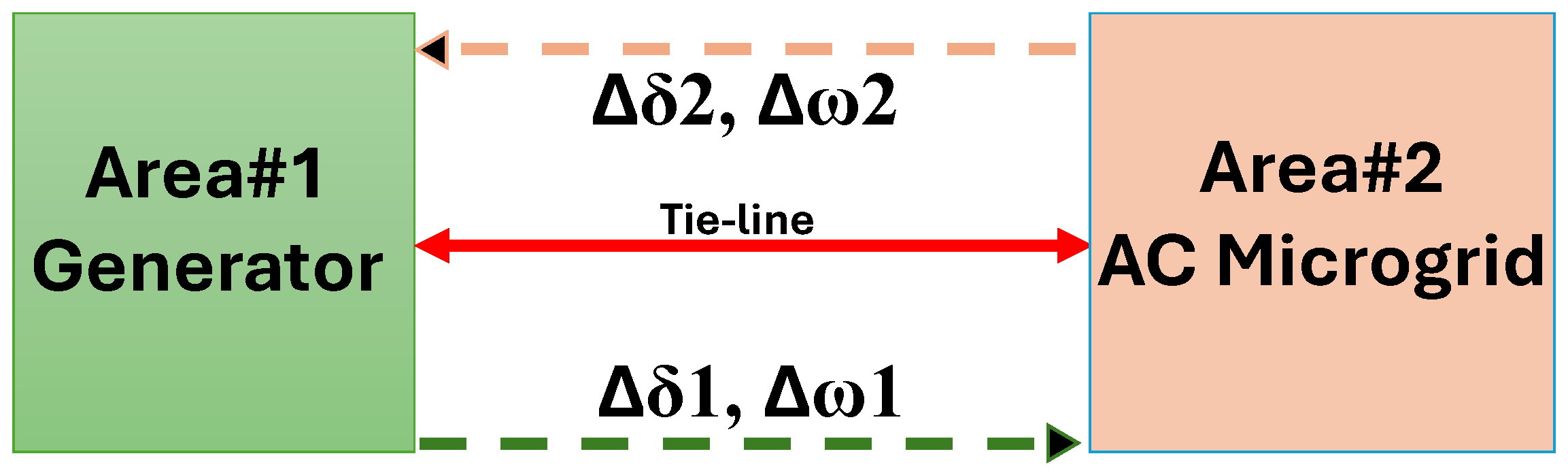
Most commercial and residential applications use inverters to connect renewable energy resources to the grid. These systems can be connected to the grid to improve reliability and power-sharing capabilities. The power-sharing feature can be designed with many optimization techniques. The proposed system consists of an AC microgrid connected to the grid, as shown in Figure 2. In other words, an AC grid with a synchronous generator and loads is considered as Area#1. A grid-following inverter (GF-I) is considered as an AC microgrid, and its loads are in Area#2. The complete system is considered as a smart grid with a grid-connected mode. It is assumed that during normal operation, both areas generate their own power, and the net tie-line power is zero. During transients due to deviation in the load power, each area can share the power as required. In other words, the objective function is formulated in such a way that both areas mimic load frequency control (LFC) to maintain the tie-line power equal to zero.
Therefore, the objective function [5] is designed to minimize the deviation in frequency, phase angle, and power generation and is formulated as follows:
J i ( t ) = t t + T j = 1 j i M p i j ( Δ δ i ( τ ) Δ δ j ( τ ) ) 2 + q i Δ f i 2 ( τ ) + r i Δ P g i 2 ( τ ) d τ
where p i j , q i j , and r i j are tunable weighting parameters. Δ δ i ( t ) is the continuous-time incremental change in the phase angle of the i-th generator bus in units of radians. Δ f i ( t ) is the continuous-time incremental change in the frequency of the i-th generator bus in units of Hz, and Δ P g i ( t ) is the continuous-time incremental change in the generator output of the i-th area in units per unit (p.u.). Variable M is the total number of areas in the system. Therefore, a DMPC controller can be designed to accomplish the objective. Although, to enable numerical solutions using APMonitor (APM MATLAB (version 0.7.2), https://apmonitor.com/wiki/index.php/Main/MATLAB, accessd on 13 November 2025) the continuous-time optimal control problem is transcribed into an equivalent discrete-time formulation over a finite prediction horizon. This discretization facilitates the implementation of MPC by converting the problem into a finite-dimensional optimization program. Following time discretization, the optimization problem is formulated as
min u i [ k + j ] = 0 N p 1 p i j Δ δ i [ k + | k ] Δ δ j ff [ k + ] 2 + q i Δ f i [ k + | k ] 2 + = 0 N c 1 r i u i [ k + | k ] 2 ,
s . t . x i [ k + j ] = A d , i x i [ k + j ] + B d , i u i [ k + j ] , j = 0 , , N p 1
y i [ k + j ] = C d , i x i [ k + j ] + D d , i u i [ k + j ] , j = 0 , , N p 1
u i m i n u i [ k + j ] u i m a x , j = 0 , , N c 1
| u i [ k + j ] u i [ k + j 1 ] | Δ u i m a x , j = 0 , , N c 1
where x i [ k ] is the local state, y i [ k ] collects the controlled outputs (frequency deviation, phase angle, and the defined coordination error). u i [ k ] is the local manipulated variable (active power adjustment). Δ δ j ff [ k + ] is the coupling between areas, which is handled through the neighbor feedforward trajectory, which is communicated between controllers. A d , i , B d , i , C d , i , D d , i denote discrete-time state transition matrices obtained by discretizing the continuous-time linearized model using a controller sampling period. N p and N c denote the prediction and control horizons, respectively, and the scalar weights. Only the first move is applied, u i [ k ] = u i [ k | k ] , using a zero-order hold until the next sampling instant k + 1 . Load disturbances are measured and supplied to the controller at each sampling instant but not forecast over the prediction horizon; therefore, they are not included as additive inputs in the prediction model. This paper assumes ideal synchronized communication without delay, consistent with the implementation setup.
The DMPC application is solved through MATLAB Simulink with a local instance of the APMonitor server. In the Simulink model, DMPC 1 governs the synchronous generator system, while DMPC 2 governs the grid-connected inverter system. They are implemented through an interpreted MATLAB Function block that sends the subsystem’s measurements states and feedforward information to the APMonitor solver and retrieves updated measurements and feedforward information from the other controller. A master scheduler in MATLAB initiates the solution and waits for a successful solution report from the server. Upon successful solution, the newly optimized values are implemented in the simulated system as a zero-order hold. When the next cycle time is reached, the process is repeated by recording measurements and feedforward information from the other controller, solving, and reporting the solution. The APMonitor local server runs with Apache 2 and PHP 8 on a computer equipped with a 12th Gen Intel(R) Core(TM) i7 CPU and 16 GB of RAM. The average solution time for DMPC 1 is 0.01995 s and for DMPC 2 is 0.0473 s. The average step size is 2.94 × 10⁻³ s and the total 4075-solution run time is 105.72 s.

2.2. Model Representation

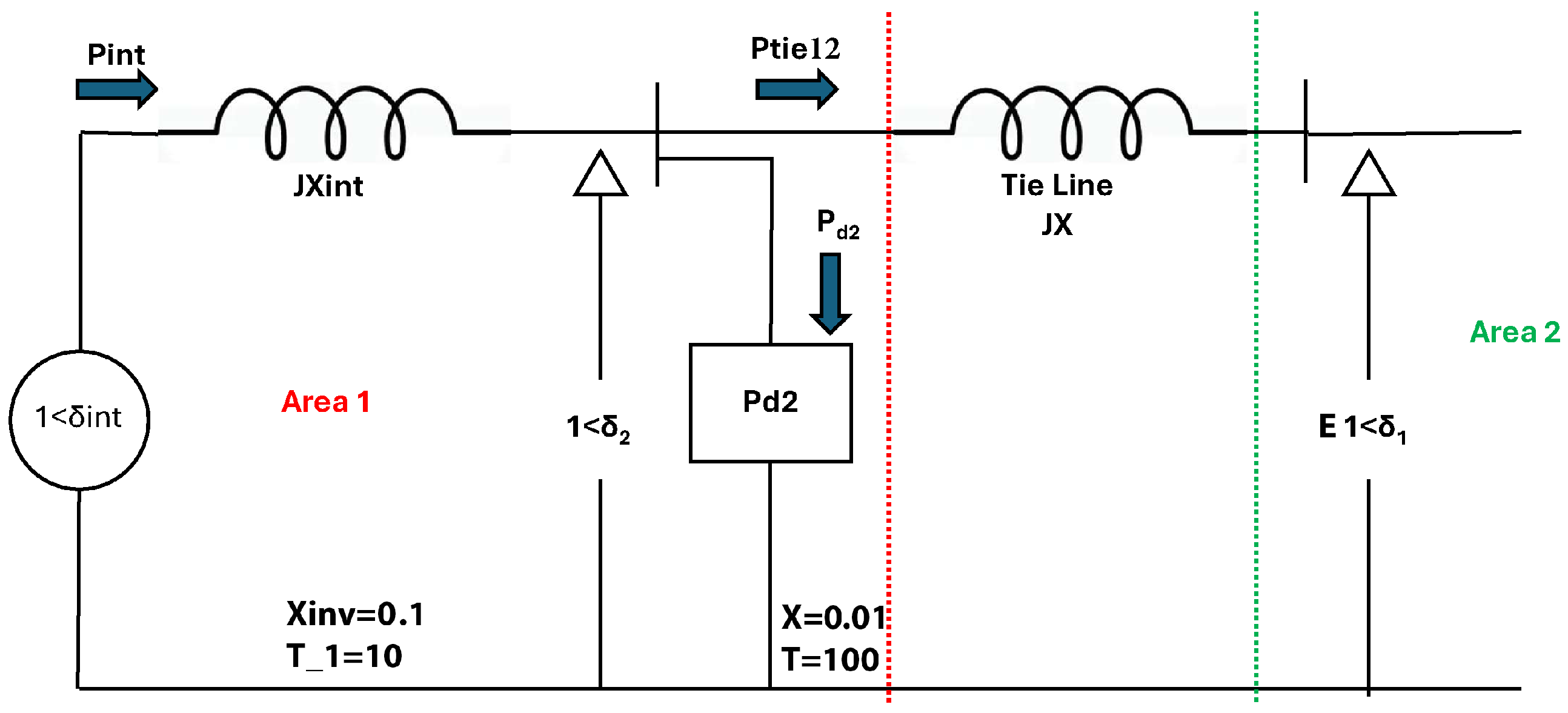
In the proposed system, an inverter and a synchronous generator regulate the power demand in their respective areas. During power fluctuations due to changes in load demand, both systems share the power accordingly. In the proposed algorithm, DMPC directly controls the power output. Therefore, each system can be described as one equivalent inverter and generator system with series impedance, as shown in Figure 3.
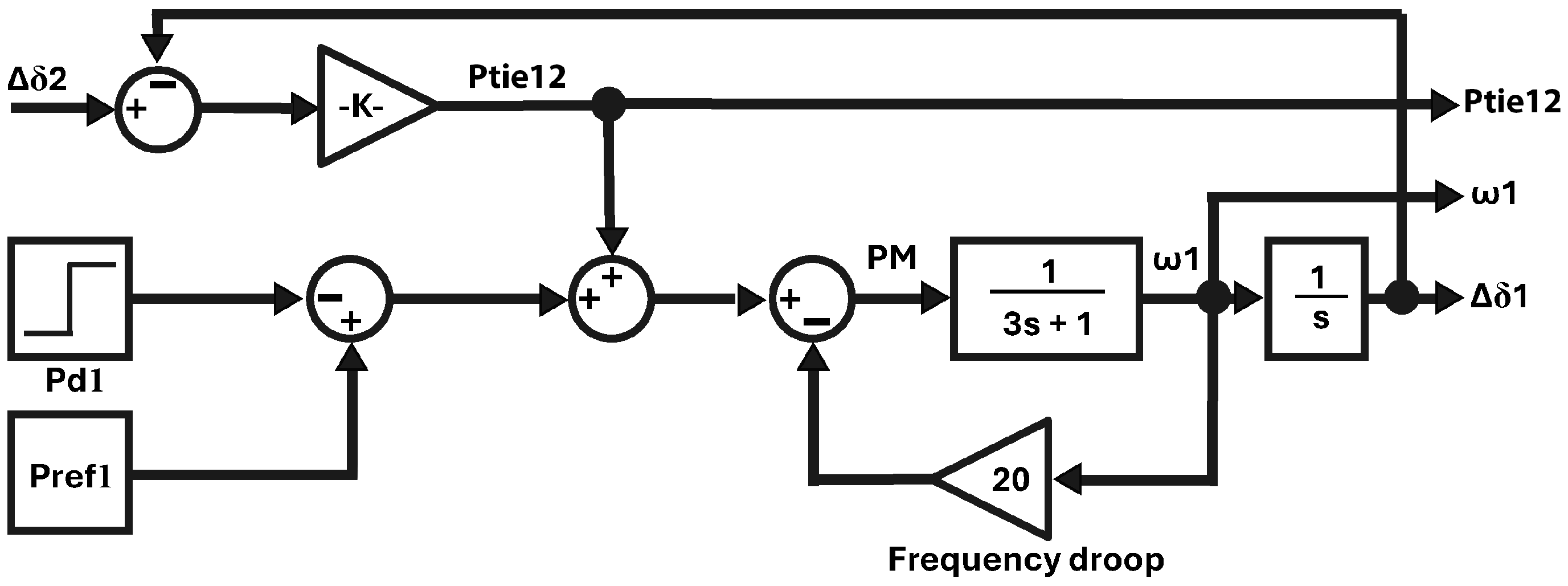
The simplified conventional synchronous machine is shown in Figure 4. It consists of a generator and a load, with the generator governor providing droop-based frequency regulation. The conventional generator is modeled using the standard linear model [29].
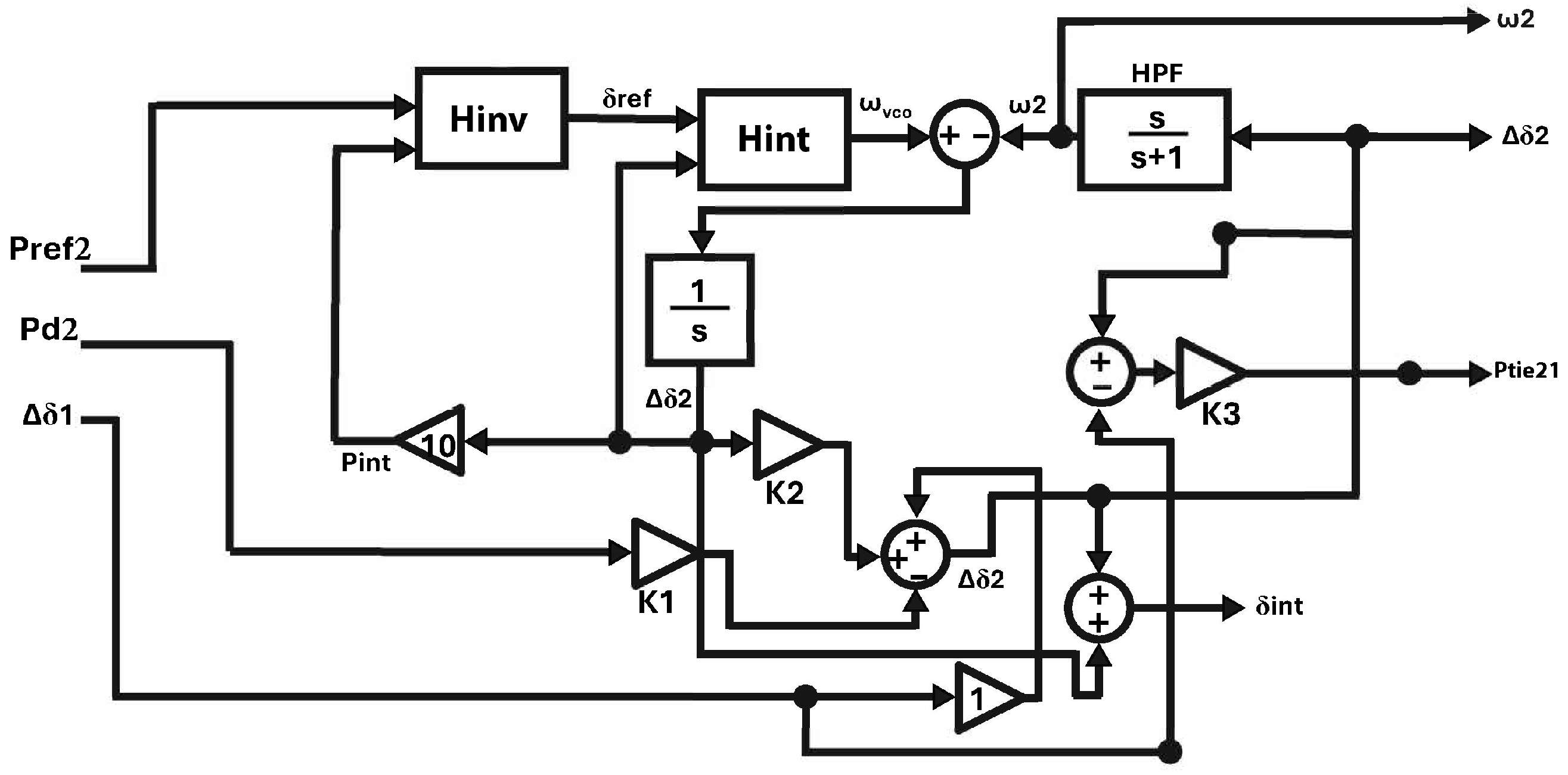
The AC microgrid system consists of a grid-following inverter (GF-I) and a load. Although the power supplied by the inverter can be changed according to a reference power setting, the grid-following inverter does not provide frequency regulation. In this system, the DC load flow approximation is used to model the network. Thus, voltage magnitudes are assumed to be 1 p.u., lines are modeled by their inductive series reactance, and power flow in lines is linearized in terms of voltage phase angular differences. The inverter is modeled as a power controller and a phase-locked loop (PLL) that generates a voltage phase angle corresponding to the desired power output, as shown in Figure 5. The PLL tracks the grid frequency.
A simulation model is implemented in MATLAB Simulink. Transfer functions and state-space models are derived for DMPC and validated using the Simulink model. The detailed system model analysis and corresponding nomenclature are given below.
  • P ref 1 : Power setting for the synchronous generator.
  • P ref 2 : Power scheduled at the inverter.
  • P d 1 , P d 2 : Loads in Area#1 and Area#2, respectively.
  • P g 1 : Power setting for the synchronous generator from a DMPC controller.
  • P g 2 : Power setting for the inverter from a DMPC controller.
  • P tie 12 : Tie-line power from Area#1 to Area#2.
  • P tie 21 : Tie-line power from Area#2 to Area#1.
  • P int : Actual power from the inverter.
  • δ ref : Desired internal angle for the inverter.
  • δ int : Actual internal angle for the inverter from the power controller (synchronous frame or absolute).
  • δ 1 : Terminal voltage angle for the synchronous generator (synchronous frame).
  • δ 2 : Terminal voltage angle for the inverter (synchronous frame).
  • δ ˜ = δ int δ 2 : Internal voltage angle of the inverter relative to the terminal voltage angle.
  • ω 1 , ω 2 , and ω inv : Area#1, Area#2, and inverter PLL frequencies (p.u.), respectively.
  • Tie-line inductive reactance, X t i e l i n e = 0.01 p.u.
  • Inverter output inductive reactance, X i n v = 0.1 p.u.
To analyze the system in detail, the complete modeling of each area is discussed below. The synchronous generator in Area#1 can be modeled as
s ω 2 = 1 M s + D P r e f 1 1 R ω 2 P d 1 P t i e 21 .
where M is the inertia constant, D is the damping constant, and R is the droop value, and the parameters are given in Table 2.
For Area#2, the inverter power controller is defined as
Δ δ i n v = H i n v ( Δ P g Δ P i n t ) ,
where H i n v controls the actual inverter power based on the references and is defined as
H i n v = K p i n v + K i i n v s .
The incremental deviation in the inverter’s internal frequency based on the deviation in the inverter’s power angle and internal power angle can be calculated as
Δ ω v c o = H i n t ( Δ δ i n v ( Δ δ i n t Δ δ 2 ) )
where
H int = K p _ i n t + K i _ i n t s ,
and
Δ δ i n t Δ δ 2 = 1 s ( Δ ω v c o Δ ω 2 ) .
Also, the deviation in the inverter terminal phase angle can be calculated as
Δ δ 2 = 1 T [ T 1 ( Δ δ i n t Δ δ 2 ) + T Δ δ 1 Δ P d 2 ]
where T 1 = 1 X i n v = 10 , T = 1 X t i e l i n e = 100 , X i n v is the inverter output inductive reactance, and X t i e l i n e is tie-line inductive reactance.
The incremental deviation in the inverter power can be calculated as
Δ P i n t = T 1 ( Δ δ i n t Δ δ 2 ) .
The deviation in Area#2’s frequency is given by
Δ ω 2 = H ω Δ δ 2 ,
where the transfer function of the inverter terminal frequency ω , H ω , is given by
H ω = s s + 1 .
Substituting (12) in (14) gives
Δ ω 2 = H w T 1 T 1 s ( Δ ω v c o Δ ω 2 ) + Δ δ 1 1 T Δ P d 2 .
Substituting and rearranging (9) gives
Δ ω v c o = α 1 γ Δ ω 2 + α 1 H i n v H i n t Δ P g
where
α = 1 + H i n t s H i n v T 1 + H i n t s ,
γ = H i n t s H i n v T 1 + H i n t s .
The inverter terminal frequency can be obtained by substituting (17) in (16),
Δ ω 2 = H ω T 1 T ( 1 s ( Δ ω v c o Δ ω 2 ) ) + Δ δ 1 1 T Δ P d 2 = H ω s T 1 T Δ ω v c o H ω s T 1 T Δ ω 2 + H ω Δ δ 1 H ω T Δ P d 2 .
Simplifying (20) gives
Δ ω 2 = β 1 H ω s T 1 T A 1 H i n t H i n v Δ P g + β 1 H ω Δ δ 1 β 1 H ω T Δ P d 2 ,
where
β = 1 H ω s T 1 T α 1 γ H ω s T 1 T
The tie-line power between the inverter and the synchronous machine is calculated as
P t i e 21 = P t i e 12 = T ( δ 2 δ 1 ) .

2.3. State-Space Models

Based on the mathematical equations, a detailed state-space model is derived using the Matlab Model Linearizer [30]. The physical meaning of the state vector produced by the MATLAB Model Linearizer depends on the structure of the underlying Simulink model. Each state in the linearized model corresponds to an internal state variable from blocks that maintain memory, such as integrators, state-space blocks, or discrete delays. Thus, the interpretation of these states is inherently tied to how the system is modeled. When the model uses physical integrators representing physical quantities—such as positions, velocities, or currents—these states reflect small perturbations around the operating point. Conversely, when the model consists of algorithmic or control-oriented blocks, such as the inverter and generator considered in this work, the states may represent internal computational states rather than directly physical variables.
The resulting state-space model for the inverter is given as
x ˙ i n v = A x i n v + B u i n v
y i n v = C x i n v + D u i n v
where x i n v [ x 1 x 2 , x 3 , x 4 ] T is the state vector, y i n v [ ω 2 , x 1 , x 2 , x 3 , x 4 ] T is the output vector, and u i n v [ Δ δ 1 , Δ P d 2 , Δ P g 1 ] T is the input vector. The inverter’s four states represent internal small-signal dynamics around the operating point and do not correspond directly to physical variables. The matrices of the inverter state-space model are given below.
A i n v = 0 0 0 0.625 1 0 0 1.938 0 2 0 4 0 0 8 12.1
B i n v = 0 0.00625 0.625 0.00625 0.01312 1.312 0.025 0.01375 1.375 0.1 0.011 1.1
C i n v = 0 0 0 1 1 0 0 0 0 1 0 0 0 0 1 0 0 0 0 1
D i n v = 0 0.01 1 0 0 0 0 0 0 0 0 0 0 0 0
Similarly, the Matlab Model Linearizer is applied to the synchronous generator model, yielding a state-space model representation where x g e n [ Δ δ 1 , Δ ω 1 ] T is the state vector, y g e n [ δ 1 , Δ ω 1 ] T is the output vector, and u g e n [ Δ δ 2 , Δ P d 1 , Δ P g 2 ] T is the input vector. Here, the second output for y g e n corresponds to frequency deviation, scaled by a constant factor defined in the C matrix. The state-space matrices for the synchronous generator are provided below.
A g e n = 0 0.333 100 7
B g e n = 0 0 0 100 1 1
C g e n = 1 0 1 0.333 1 0 0 1
D g e n = 0 0 0 0 0 0 0 0 0 0 0 0

2.4. Controllability and Observability of Subsystems

To determine whether the subsystems are controllable, a controllability test has been performed for the generator and inverter. The controllability matrix is given by
Z [ B , A B , A 2 B , A 3 B ] .
The rank of Z i n v for the inverter is 4. The rank of Z g e n for the generator is 2. Both ranks are equal to the number of states of their respective state-space models, implying that each subsystem is controllable and suitable for use in the MPC design.
The observability matrix is given by
O C C A C A 2 C A 3
The rank of O i n v for the inverter is 4. The rank of O g e n for the generator is 2. Both ranks are equal to the number of states of their respective state-space models, implying that each subsystem is observable and suitable for use in the MPC design.

3. Controller Design Using Distributed Model Predictive Control (DMPC)

3.1. DMPC Setup

The Distributed Model Predictive Control (DMPC) scheme is configured to maintain the tie-line power exchange at zero during steady-state operation. The setup parameters used in the APMonitor optimization framework are summarized in Table 3. These parameters define the prediction, control, and step horizons, as well as solver configuration settings, that determine how frequently control actions are updated and how the optimization problem is solved over time. The value for the prediction horizon is 10, for the control horizon is 6, and for the step horizon is 6, with a value of 200 max iterations allowed. Controlled variables are model variables that are included in the objective of a controller or optimizer. States are model variables that may be measured or are of special interest for observation. The variables set up in the AP Monitor are shown below.
DMPC employs the objective function in (1), along with a set of tuned parameters, to generate the system inputs and drive the tie-line power toward zero. The parameters in (1) ( p i j , q i , and r i ) were adjusted to achieve satisfactory performance, and their functions and values are listed in Table 4 and Table 5, respectively. With appropriate tuning, the objective function effectively minimizes the tie-line power flow, ensuring convergence to zero.
For parameter p i j , the higher the value, the more power Area 1 and Area 2 are allowed to generate. If the value is extremely low, it will cause an undershoot in the power generated and will be unable to optimally satisfy the desired load. If the value is extremely high, it will cause an overshoot and produce more power than what is needed for the load. For parameter q i , the higher the value, the more the system will try to keep the power generated as linear as possible. If the value is extremely low, it will cause the power generated to be nonlinear. If the value is extremely high, it will be very linear and unable to supply power to the load. For parameter r i , the higher the value, the less effort the controller puts into keeping the power via the tie-line close to 0 as much as possible. If this value is not tuned properly, the controller will not manipulate the variables needed to maintain a power flow through the tie-line of 0 in the most optimal way.

3.2. Observer Design for State Estimation

With the given Simulink inverter model, it is not possible to easily access the states due to how the structure is modeled. Therefore, a state observer has been created, which is given by
x ^ ˙ = A x ^ + B u + L ( y C x ^ ) ,
where x ^ is the estimation of state vector x . Defining the error state, x ˜ , as x ˜ x x ^ , we have
x ˜ ˙ = A L C x ˜ ,
where the observer gain vector, L, is selected such that the eigenvalues of the matrix ( A L C ) all have negative real parts, which guarantees that x ˜ converges to zero exponentially. A larger vector value of L enables faster convergence to the actual states; however, it also increases sensitivity to noise and raises the likelihood of oscillatory responses. Conversely, a smaller vector value of L enhances stability but results in slower convergence and reduced responsiveness to changes. In this work, L is tuned and selected as L = 600 260 80 33 T . The value of L was determined using pole placement. The observer poles were first selected by analyzing the eigenvalues of the linearized inverter model and placing eigenvalues approximately 5 to 10 times faster than the dominant system nodes. This ensures fast estimation of error convergence and maintains numerical robustness. This then led to the pole set [ 10 , 8 , 6 , 20 ] . The corresponding gain vector L was then computed using the pole placement method.

4. Results and Discussions

4.1. Power–Load Simulation Results

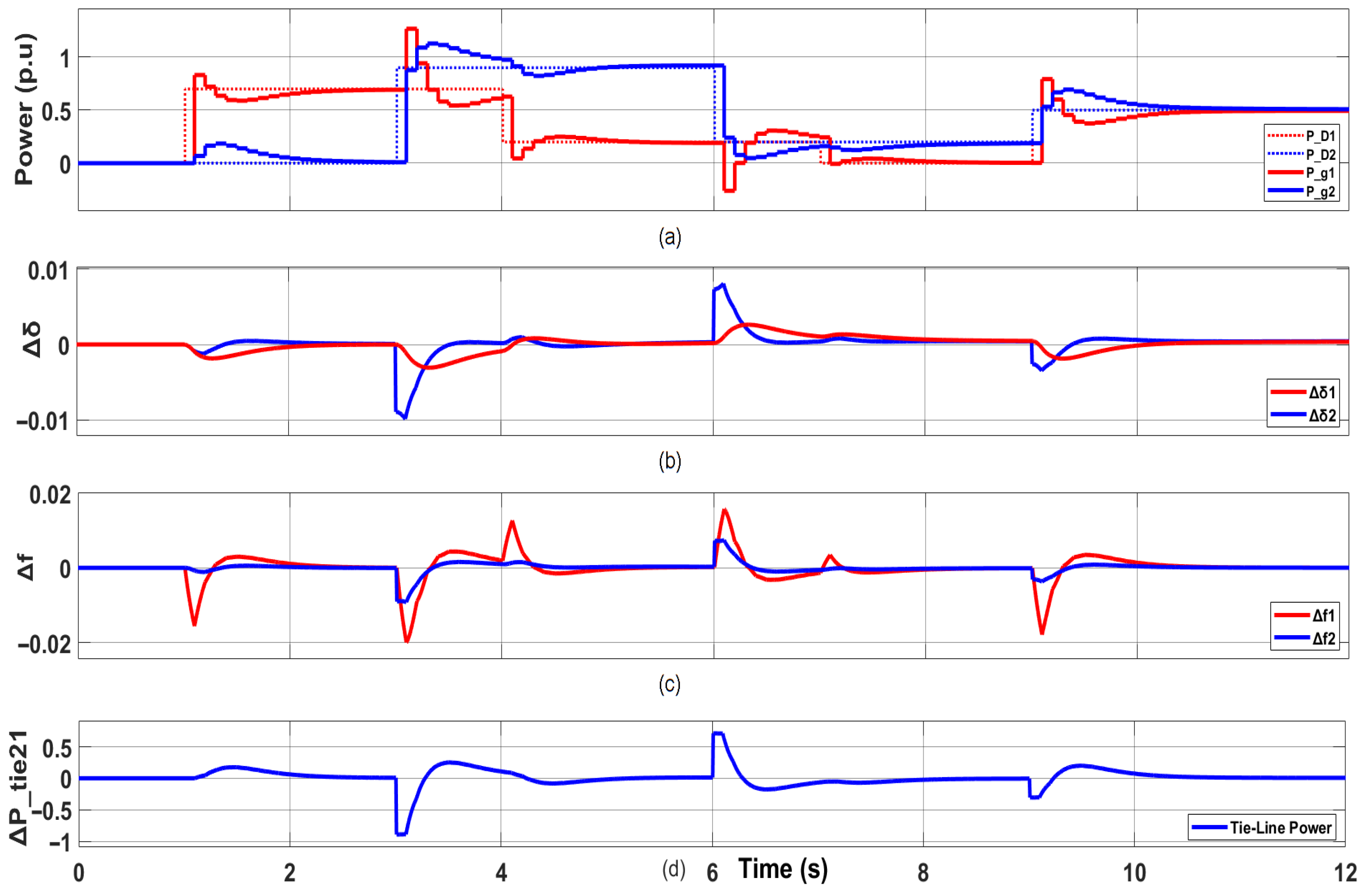
In the simulation analysis, the main objective of the controller, as shown in Figure 6, is to maintain the tie-line power at zero. As mentioned in Section II, both areas will only share power during load transients. During the transient, individual areas will respond to the fluctuation in power and ramp up their power generation. Therefore, in the simulation, the load demand in each area is changed during specific time intervals to test the performance of the proposed DMPC. In Figure 6a, the dotted lines represent the load demands and the solid lines represent the reference power generated from the DMPC controllers in each area. The detailed time interval and load changes are given in Table 6.
As shown in Figure 6a, from time t = 0 s to 1 s, the initial load demand is zero for both areas, and thus the DMPC controller is generating a zero reference power command. Therefore, there is no deviation in phase angle and frequency, as shown in Figure 6b,c. As stated in the main objective, Figure 6d validates that the tie-line power during this interval is zero. At time t = 1 s, the Area#1 load demand is changed to 0.7 p.u. It can be observed that the DMPC controller follows the reference load demand and generates the required power. During this transient, as shown in Figure 6b,c, there is a deviation in angle and frequency, which results in a change in tie-line power, as shown in Figure 6d. Similarly, during the same time interval, the Area#2 load demand changes from 0 to 0.9 p.u at t = 3 s. During this interval, DMPC responds to the load demand by changing Δ δ , as shown in Figure 6b,c. This results in a power flow from Area#1 to Area#2, as shown in Figure 6d. It can also be observed that both areas respond to the fluctuation in the load and achieve a steady state when each area meets its power demand. At t = 4 s, the Area#1 load demand is decreased from 0.7 to 0.2 p.u. This change in load results in deviations for delta and frequency, as shown in Figure 6b,c. Once power satisfies the new load demand, it can be shown that the steady state is achieved once again. This process is consistently observed to occur every time there is a change in load. At t = 6 s, the Area#2 load is changed to 0.2 p.u., at 7 s, the Area#1 load is set to zero, and at 9 s, both areas have an equal load demand of 0.5 p.u. During all these time intervals, the DMPC controller generates the power demand accordingly and strives to keep the power in the tie-line equal to 0. This validates the performance of the proposed DMPC controller with a synchronous generator and an inverter.

4.2. State Observer Results

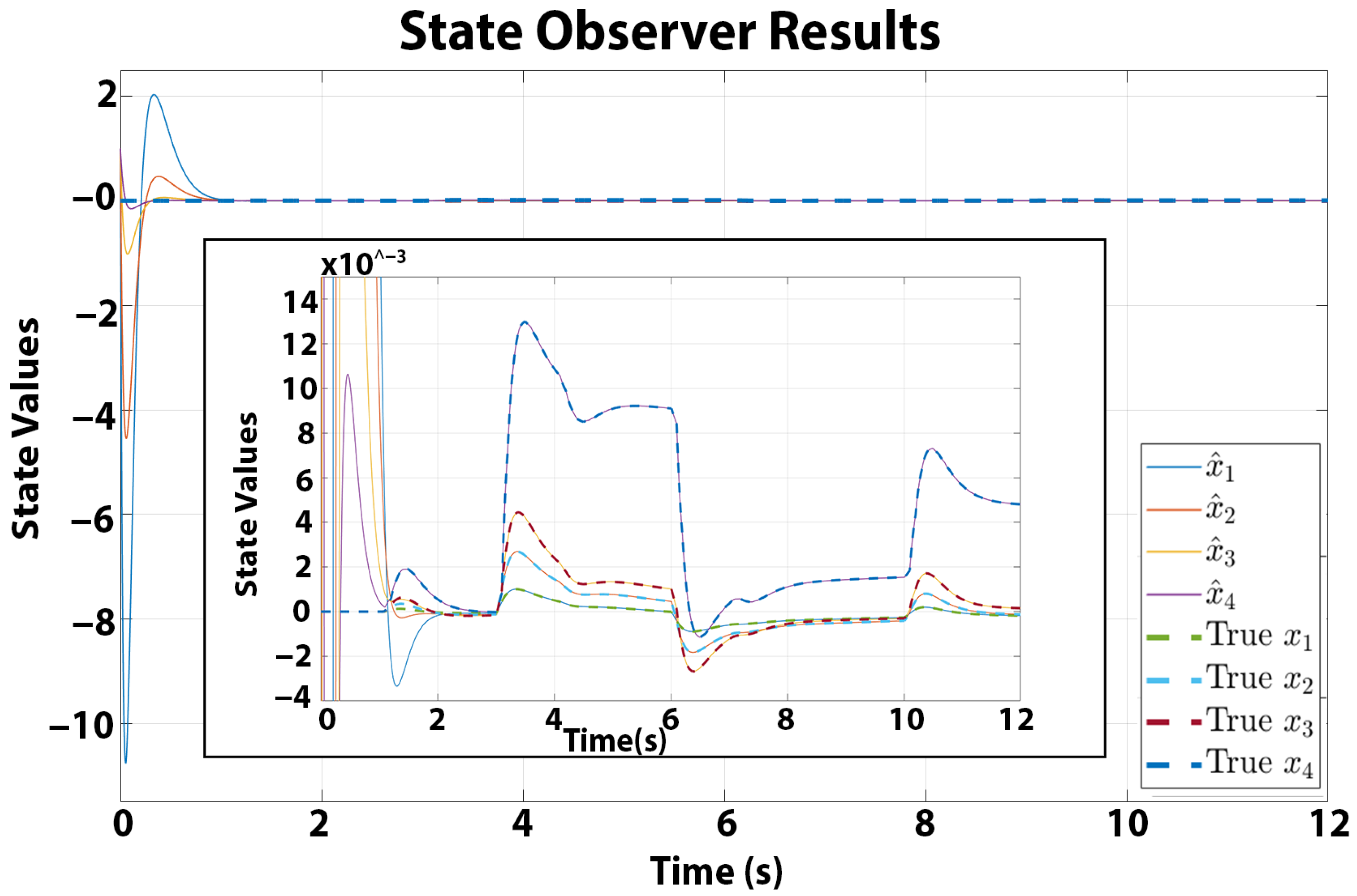
As discussed in Section 3.2, the state estimator is created, with inputs Δ δ 2 , Δ P d 2 , and Δ P g 1 given by the dynamic equations derived and Δ ω 2 given by the Simulink model of the inverter. The outputs of the observer are the four auxiliary states of the simulation model of the inverter. The comparison between the state estimates and the true state values is shown in Figure 7. It can be seen that all state estimates converge to their actual values in approximately 1 s and follow the actual state values accurately, which demonstrates the quality performance of the proposed state estimator.

5. Conclusions

This paper presents a distributed model predictive controller (DMPC)-based grid-connected inverter system. The DMPC is designed to maintain the frequency in each area, ensuring that the power flow between areas is zero in the steady state. It can be observed that each area controller shares limited parameters and works collaboratively to regulate the system without relying on a single centralized controller. This demonstrates that DMPC enables multiple grid-connected inverters to coordinate power sharing, maintain voltage and frequency stability, and enhance power quality by utilizing local predictive controllers that exchange minimal information, providing a scalable, robust, and efficient control solution for modern microgrids. Future work includes a multi-area system with real-time implementation in Opal-RT and testing the plug-and-play capability.

Author Contributions

Conceptualization, L.S., S.J.R., O.L., and E.P.; methodology, L.S. and S.J.R.; software, S.E. and S.A.; validation, S.E., S.A., L.S., and S.J.R.; formal analysis, L.S., S.J.R., O.L., and E.P.; methodology, L.S., S.J.R., and J.H.; investigation, L.S., S.J.R., O.L., S.E., and S.A.; methodology, L.S., S.J.R., S.E., and S.A.; writing—original draft preparation, L.S., S.E., and S.A.; writing—review and editing, L.S., S.J.R., O.L., E.P., and J.H. All authors have read and agreed to the published version of the manuscript.

Funding

This work was partially supported by the NSF Grants OIA-1757207 (NM EPSCoR), HRD-1345232, HRD-1914635, and funding from the Electric Utility Management Program (EUMP) at New Mexico State University.

Data Availability Statement

The original contributions presented in this study are included in the article. Further inquiries can be directed to the corresponding author.

Conflicts of Interest

The authors declare no conflicts of interest.

Abbreviations

The following abbreviations are used in this manuscript:
DMPCDistributed Model Predictive Control
MPCModel Predictive Control
LFCLoad Frequency Control
MGMicrogrid
DERDistributed Energy Resource
APOPTAdvanced Process OPTimizer
IPOPTInterior Point OPTimizer
GF-IGrid-Following Inverter
PLLPhase-Locked Loop
SVState Variable
CVControlled Variable

References

  1. Mutule, A.; Antoskova, I.; Papadimitriou, C.; Efthymiou, V.; Morch, A. Development of Smart Grid Standards in View of Energy System Functionalities. In Proceedings of the 2021 6th International Conference on Smart and Sustainable Technologies (SpliTech), Split and Bol, Croatia, 8–11 September 2021; pp. 1–6. [Google Scholar] [CrossRef]
  2. Loka, R.; Parimi, A.M.; Srinivas, S. Model Predictive Control Design for Fast Frequency Regulation in Hybrid Power System. In Proceedings of the 2022 2nd International Conference on Power Electronics & IoT Applications Renewable Energy and Its Control (PARC), Mathura, India, 21–22 January 2022; pp. 1–5. [Google Scholar] [CrossRef]
  3. Schneider, K.P.; Laval, S.; Hansen, J.; Melton, R.B.; Ponder, L.; Fox, L.; Hart, J.; Hambrick, J.; Buckner, M.; Baggu, M.; et al. A Distributed Power System Control Architecture for Improved Distribution System Resiliency. IEEE Access 2019, 7, 9957–9970. [Google Scholar] [CrossRef]
  4. Planas, E.; Gil-de-Muro, A.; Andreu, J.; Kortabarria, I.; Martínez de Alegría, I. General aspects, hierarchical controls and droop methods in microgrids: A review. Renew. Sustain. Energy Rev. 2013, 17, 147–159. [Google Scholar] [CrossRef]
  5. Camponogara, E.; Jia, D.; Krogh, B.; SN, T. Distributed model predictive control. IEEE Control Syst. 2002, 22, 44–52. [Google Scholar] [CrossRef]
  6. Christofides, P.D.; Scattolini, R.; Muñoz de la Peña, D.; Liu, J. Distributed model predictive control: A tutorial review and future research directions. Comput. Chem. Eng. 2013, 51, 21–41. [Google Scholar] [CrossRef]
  7. Alvarado, I.; Limon, D.; Muñoz de la Peña, D.; Maestre, J.M.; Ridao, M.A.; Scheu, H.; Marquardt, W.; Negenborn, R.R.; De Schutter, B.; Valencia, F.; et al. A Comparative Analysis of Distributed MPC Techniques Applied to the HD-MPC Four-Tank Benchmark. J. Process Control 2011, 21, 800–815. [Google Scholar] [CrossRef]
  8. Negenborn, R.R.; van Overloop, P.J.; Keviczky, T.; De Schutter, B. Distributed Model Predictive Control for Irrigation Canals. Netw. Heterog. Media 2009, 4, 359–380. [Google Scholar] [CrossRef]
  9. Wang, D.; Glavic, M.; Wehenkel, L. Comparison of centralized, distributed and hierarchical model predictive control schemes for electromechanical oscillations damping in large-scale power systems. Int. J. Electr. Power Energy Syst. 2014, 58, 32–41. [Google Scholar] [CrossRef]
  10. Negenborn, R.R.; Maestre, J.M. Distributed Model Predictive Control: An Overview and Roadmap of Future Research Opportunities. IEEE Control Syst. Mag. 2014, 34, 87–97. [Google Scholar] [CrossRef]
  11. John, T.; Wang, Y.; Tan, K.T.; So, P.L. Model Predictive Control of Distributed Generation Inverter in a Microgrid. In Proceedings of the 2014 IEEE Innovative Smart Grid Technologies-Asia (ISGT ASIA), Kuala Lumpur, Malaysia, 20–23 May 2014; pp. 657–662. [Google Scholar] [CrossRef]
  12. Arena, P.; Sueri, P.; Taffara, S.; Patanè, L. MPC-based control strategy of a neuro-inspired quadruped robot. In Proceedings of the 2021 International Joint Conference on Neural Networks (IJCNN), Shenzhen, China, 18–22 July 2021; pp. 1–8. [Google Scholar] [CrossRef]
  13. Qi, X.; Zhang, L.; Wang, P.; Han, Y.; Lin, W. Learning-Based Model Predictive Control for Vehicles with Modeling Bias. In Proceedings of the 2023 42nd Chinese Control Conference (CCC), Tianjin, China, 24–26 July 2023; pp. 1–6. [Google Scholar] [CrossRef]
  14. Sun, L.; Hedengren, J.D.; Beard, R.W. Optimal trajectory generation using model predictive control for aerially towed cable systems. J. Guid. Control Dyn. 2014, 37, 525–539. [Google Scholar] [CrossRef]
  15. Zhu, S.; Zhang, Y.; Chang, P. Load Frequency Control of Multi-area Interconnected Power System with Renewable Energy. In Proceedings of the 2021 IEEE Sustainable Power and Energy Conference (iSPEC), Nanjing, China, 23–25 December 2021; pp. 1814–1817. [Google Scholar] [CrossRef]
  16. Liao, X.; Liu, K.; Qin, L.; Wang, N.; Ma, Y.; Chen, Z.; Ding, K.; Zhou, Q. Cooperative DMPC-Based Load Frequency Control of AC/DC Interconnected Power System with Solar Thermal Power Plant. In Proceedings of the 2018 IEEE PES Asia-Pacific Power and Energy Engineering Conference (APPEEC), Kota Kinabalu, Malaysia, 7–10 October 2018; pp. 341–346. [Google Scholar] [CrossRef]
  17. Escamilla, L.; Shi, Y.; Wang, Z.; Augustine, S.; Lavrova, O.; Ranade, S.; Sun, L. Development of Distributed Model Predictive Control Tools for Power Generation Systems. In Proceedings of the 2021 North American Power Symposium (NAPS), College Station, TX, USA, 14–16 November 2021; pp. 1–6. [Google Scholar] [CrossRef]
  18. Aafia, H.M.; Zakhary, K.R.; Gheith, R.H.; Gomaa, A.M.; Saleh, A.A.; Guirgis, V.G.; Awaad, M.I.; Maged, S.A. A Comparison between Linear, Nonlinear, and Adaptive MPC Controllers for ABB IRB120 Robot in Collaborative Assembly. In Proceedings of the 2022 2nd International Mobile, Intelligent, and Ubiquitous Computing Conference (MIUCC), Cairo, Egypt, 8–9 May 2022; pp. 495–500. [Google Scholar] [CrossRef]
  19. Dangeti, L.; Marimuthu, R. Distributed model predictive control strategy for microgrid frequency regulation. Energy Rep. 2025, 13, 1158–1170. [Google Scholar] [CrossRef]
  20. Liu, K.; Yang, L.; Liu, T.; Hill, D.J. Distributed Model Predictive Frequency Control of Inverter-Based Networked Microgrids. IEEE Trans. Energy Convers. 2021, 36, 2623–2633. [Google Scholar] [CrossRef]
  21. Nguyen, D.T.; Nguyen, S.Q.; Vo, B.L.; Le, N.D.; Tran, M.K. Two-level distributed fully-predictive frequency control scheme for inverter-based AC Microgrid considering communication delay. Electr. Power Syst. Res. 2023, 222, 109471. [Google Scholar] [CrossRef]
  22. Qin, L. Control of Single-Phase LCL Photovoltaic Grid-Connected Inverter Based on State Observer. In Proceedings of the 2020 IEEE International Conference on Power, Intelligent Computing and Systems (ICPICS), Shenyang, China, 28–30 July 2020; pp. 762–765. [Google Scholar] [CrossRef]
  23. Tatulea-Codrean, A.; Haßkerl, D.; Urselmann, M.; Engell, S. Steady-state optimization and nonlinear model-predictive control of a reactive distillation process using the software platform do-mpc. In Proceedings of the 2016 IEEE Conference on Control Applications (CCA), Buenos Aires, Argentina, 19–22 September 2016; pp. 1513–1518. [Google Scholar] [CrossRef]
  24. Tao, R.; Cheng, S.; Wang, X.; Wang, S.; Hovakimyan, N. DiffTune-MPC: Closed-Loop Learning for Model Predictive Control. IEEE Robot. Autom. Lett. 2024, 9, 7294–7301. [Google Scholar] [CrossRef]
  25. Hedengren, J.D.; Shishavan, R.A.; Powell, K.M.; Edgar, T.F. Nonlinear modeling, estimation and predictive control in APMonitor. Comput. Chem. Eng. 2014, 70, 133–148. [Google Scholar] [CrossRef]
  26. Sun, L.; Castagno, J.D.; Hedengren, J.D.; Beard, R.W. Parameter estimation for towed cable systems using moving horizon estimation. IEEE Trans. Aerosp. Electron. Syst. 2015, 51, 1432–1446. [Google Scholar] [CrossRef]
  27. Estrada, C.; Sun, L. Trajectory tracking control of a drone-guided hose system for fluid delivery. In Proceedings of the AIAA SciTech 2021 Forum, Online, 11–15 & 19–21 January 2021; p. 1003. [Google Scholar]
  28. Beal, L.D.R.; Hill, D.C.; Martin, R.A.; Hedengren, J.D. GEKKO Optimization Suite. Processes 2018, 6, 106. [Google Scholar] [CrossRef]
  29. Das, D. Electrical Power Systems; New Age International: New Delhi, India, 2006; Available online: https://books.google.com/books?id=9CYS_krSvMUC (accessed on 13 November 2025).
  30. The MathWorks, Inc. Linearize Simulink Model at Model Operating Point. Available online: https://www.mathworks.com/help/slcontrol/ug/linearize-simulink-model.html (accessed on 2 September 2025).
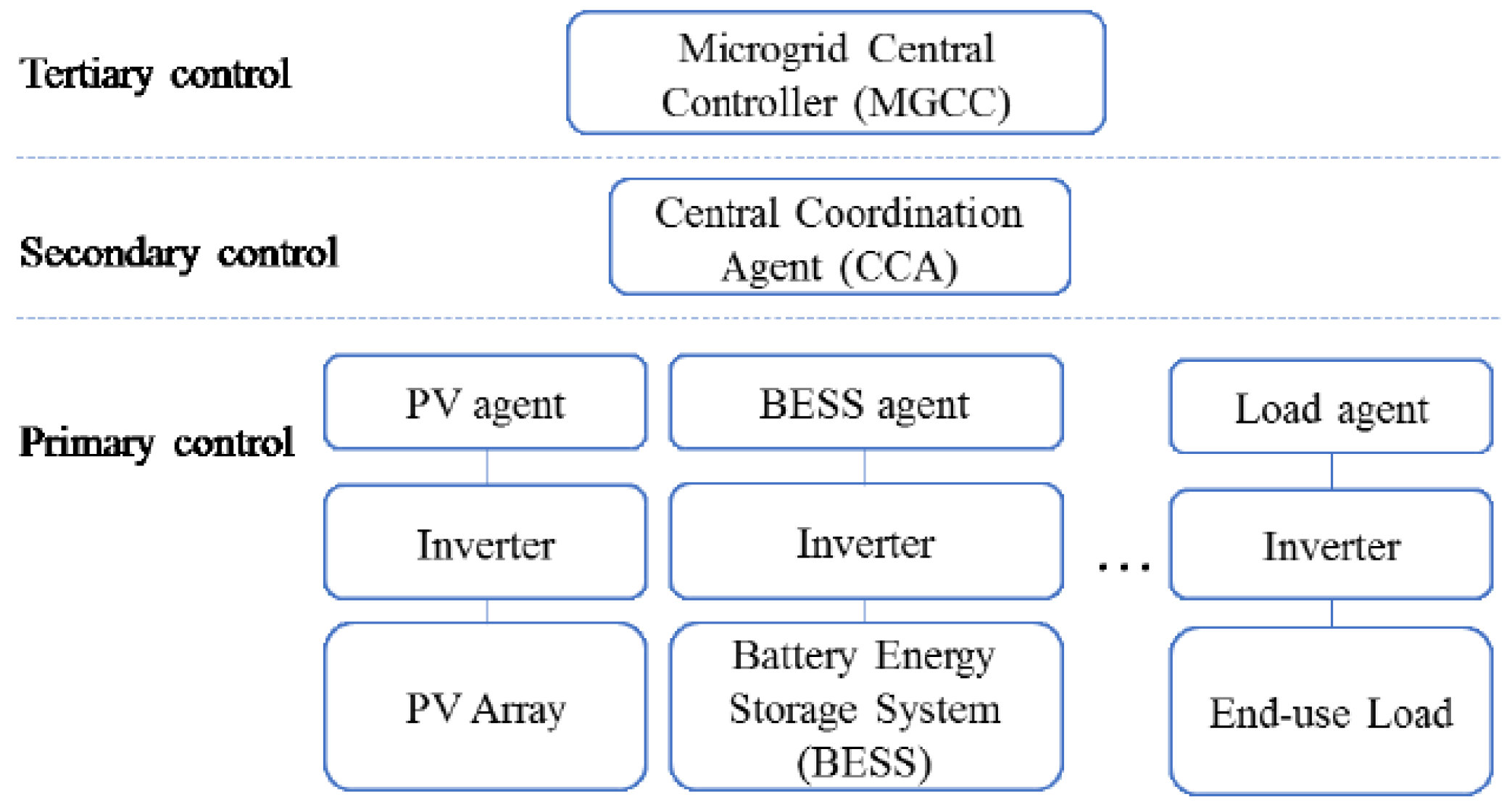
Figure 1. Architecture of a distributed multi-agent system for microgrid frequency control [3].
Energies 19 00406 g001
Figure 2. DMPC implementation in a two-area system.
Energies 19 00406 g002
Figure 3. Equivalent grid-connected inverter model.
Energies 19 00406 g003
Figure 4. Simplified synchronous generator model.
Energies 19 00406 g004
Figure 5. Simplified grid-connected single-inverter model.
Energies 19 00406 g005
Figure 6. Simulation results showing (a) power demand with actual power generation, (b) deviation in angle, (c) deviation in frequency, and (d) change in tie-line power.
Energies 19 00406 g006
Figure 7. State observer: Solid lines represent states generated by the observer, and dashed lines represent actual states of the system.
Energies 19 00406 g007
Table 1. Comparison of the prior DMPC literature versus the proposed grid-integrated microgrid DMPC scheme.
Ref.SystemControl StructureHybrid Generator/InverterExplicit ConstraintsState-Space & C/O AnalysisState EstimationImplemented in
MATLAB/Simulink
Validation/Evidence
[3]Multi-area power systemDistributed/hierarchical DMPC-inspired controlNoNoNoNoYesTime-domain simulations
[5]Multi-area power systemGeneric DMPC formulationNoNoYesNoYesAnalytical and numerical examples
[6]MG controlSurvey of DMPC architecturesNoNoNoNoNoLiterature review
[10]Multi-area power systemDMPC roadmapNoNoNoNoNoNo validation
[15]Multi-area power systemMPC-based load frequency controlNoNoNoNoYesNumerical simulations
[23]AC/DC interconnected systemCooperative DMPCNoNoNoNoYesSimulation studies
[16]Power generation systems (generic)DMPC tool developmentNoNoNoNoYesSimulation validation
ProposedGrid-integrated two-area microgrid.Two local DMPCs coordinating to regulate frequency/load and drive tie-line power exchange to zeroYesYes (generator/inverter constraints modeled in the DMPC setup)Yes (state-space modeling with controllability/observability verification)Yes (observer designed/tuned for inverter states)Yes, with APMonitor (local server; coordinated solve cycle)Time-varying load disturbance simulations; observer convergence shown
Table 2. Parameter values for inertia (M), damping (D), and droop (R) for the synchronous generator model.
ParameterValue
M 0.03 (pu·s/rad)
D 1.0 (pu/pu)
R 0.05 (pu/pu)
Table 3. APMonitor parameter setup.
CategoryArea 1-DMPCArea 2-DMPC
Manipulated VariableGenerator Active Power Adjustment Δ P g 1 Inverter Active Power Adjustment Δ P g 2
Controlled VariablesFrequency deviation Δ f 1 ; phase angle deviation Δ δ 1 ; coordination errorFrequency deviation Δ f 2 ; phase angle deviation Δ δ 2 ; coordination error
Power Constraints−10 Δ P g 1 10−10 Δ P g 2 10
Communication AssumptionsIdeal, synchronized; no delay modeledIdeal, synchronized; no delay modeled
Table 4. Description of optimization function weights.
TermWeight FactorActionEffect
p i j Deviation in angle between area i and area jAdjust the tie-line powerDetermines how strongly area i aligns its predicted angle with area j
q i Deviation in frequencyControl area i FrequencyMinimizes the frequency error
r i Generator power changeActuator smoothingRegulates generator power adjustment
Table 5. Value of objective function tunable parameters.
Area 1Area 2
p 12 : 9,750,000 p 21 : 1,750,000
q 1 : 1,250,000 q 2 : 1,250,000
r 1 : 0.001 r 2 : 0.001
Table 6. Simulation time interval with load demand.
TimeArea#1TimeArea#2
Interval (s) Load (p.u.) Interval (s) Load (p.u.)
0 t < 1 0 0 t < 3 0
1 t < 4 0.7 3 t < 6 0.9
4 t < 7 0.2 6 t < 9 0.2
7 t < 9 0 9 t < 12 0.5
9 t < 12 0.5Energies 19 00406 i001Energies 19 00406 i002
Disclaimer/Publisher’s Note: The statements, opinions and data contained in all publications are solely those of the individual author(s) and contributor(s) and not of MDPI and/or the editor(s). MDPI and/or the editor(s) disclaim responsibility for any injury to people or property resulting from any ideas, methods, instructions or products referred to in the content.