

Environmental Regulation and Clean Cooking Energy Use: Evidence from Rural China


Abstract
1. Introduction
2. Policy Background and Research Hypotheses
2.1. Policy Background
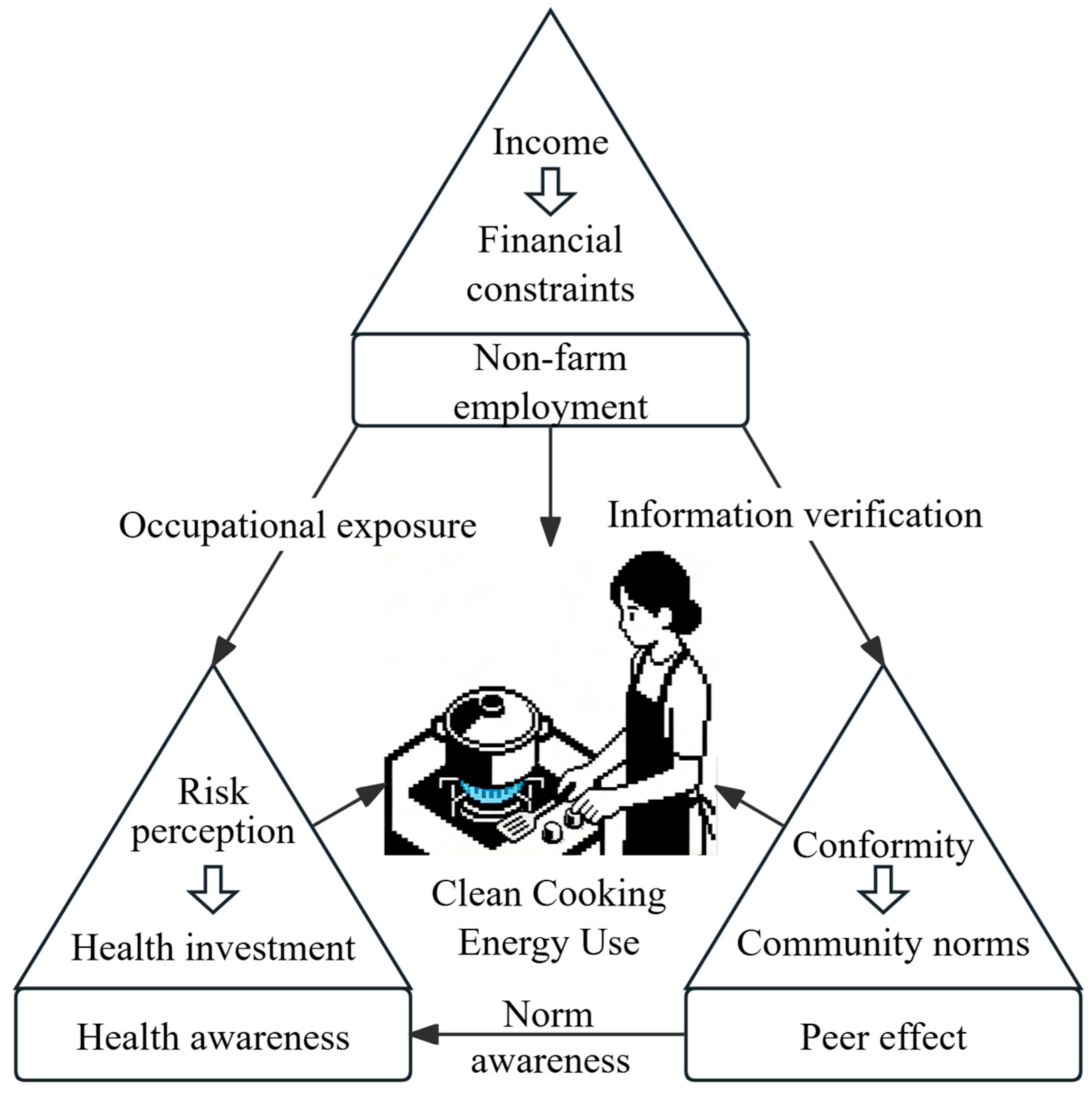
2.2. Research Hypotheses
3. Methods and Variables
3.1. DID Model
3.2. Data Source
3.3. Variable Descriptions
4. Results
4.1. Baseline Regression
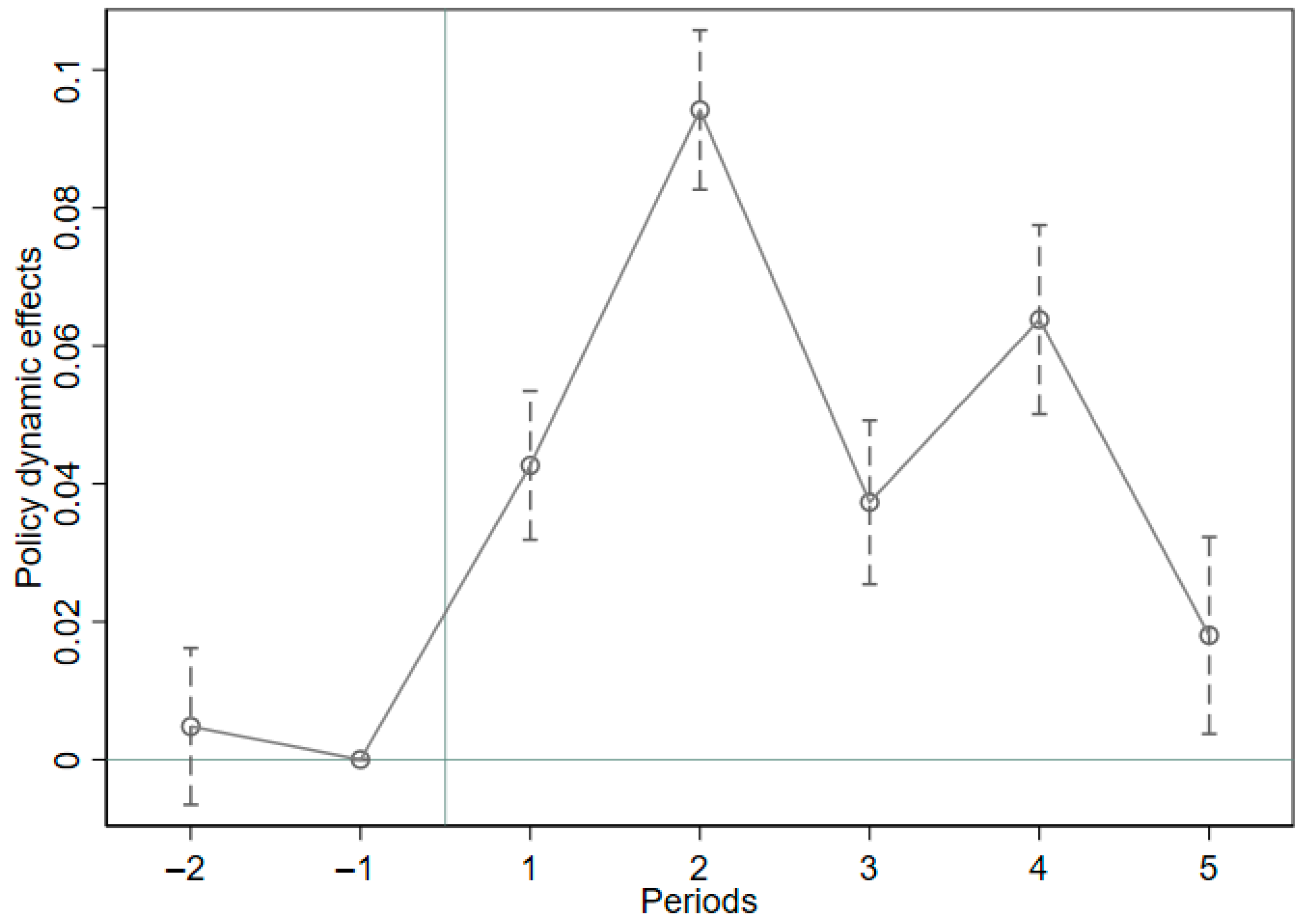
4.2. Parallel Trend Test
4.3. Robustness Tests
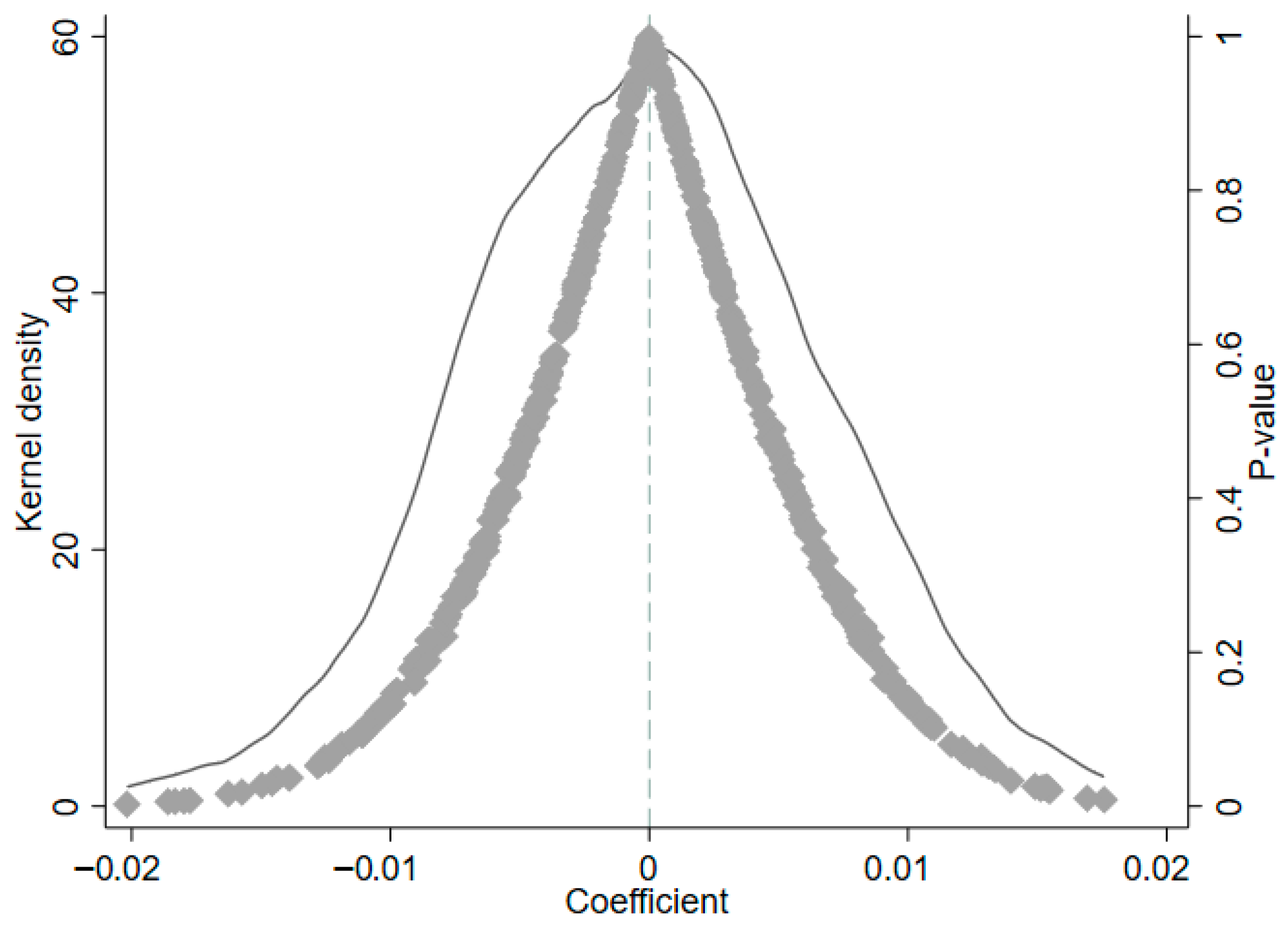
4.3.1. Placebo Test
4.3.2. Alternative Regression Models
4.3.3. Controlling for Interaction Fixed Effects
4.3.4. Sample Adjustments
4.3.5. Eliminate the Interference of Spillover Effect
5. Further Analysis
5.1. Mechanism Analysis
5.1.1. Non-Farm Employment
5.1.2. Health Awareness
5.1.3. Peer Effect
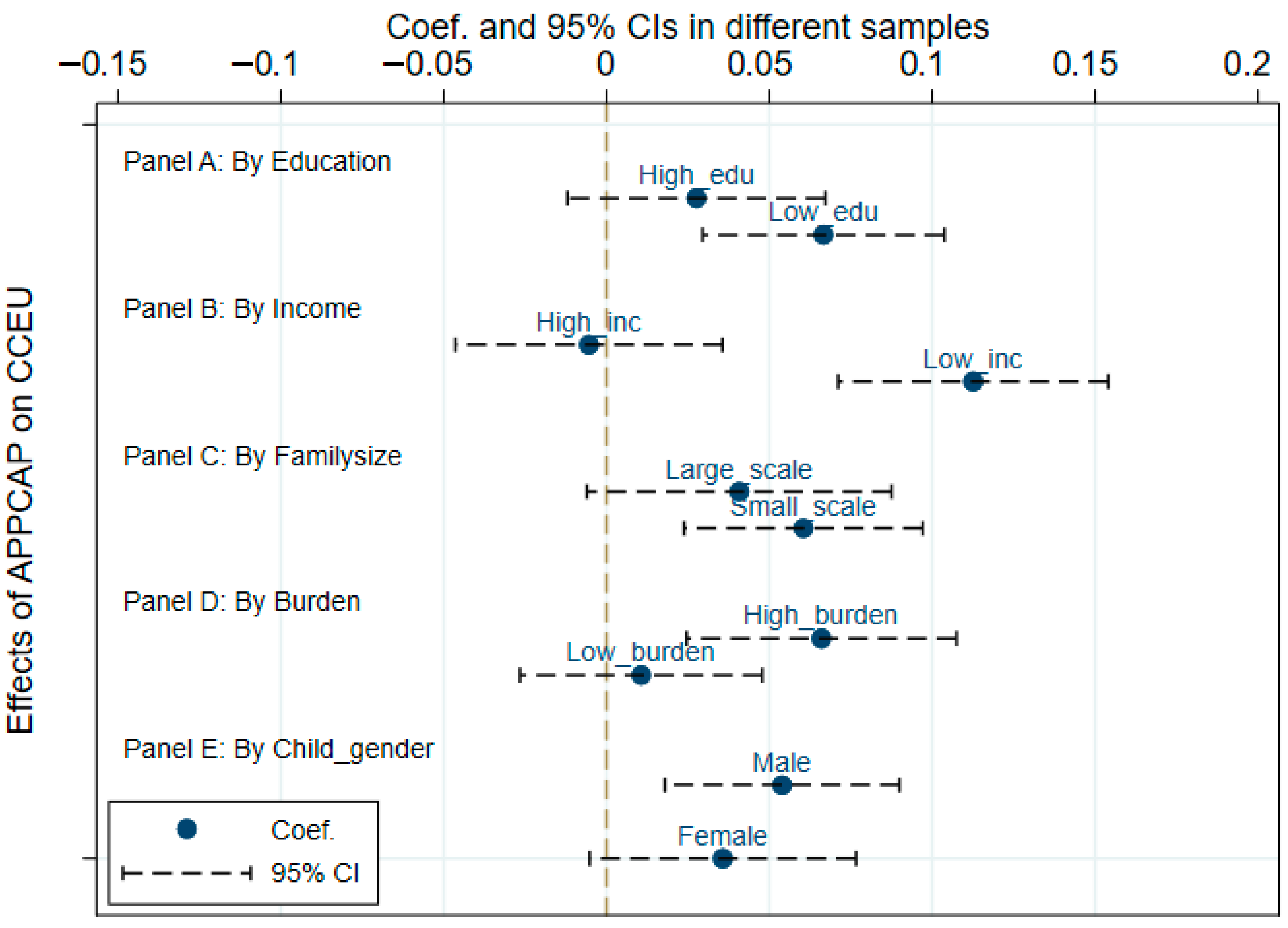
5.2. Heterogeneity Analysis
5.3. Sustainability of CCEU
6. Conclusions
Author Contributions
Funding
Data Availability Statement
Conflicts of Interest
Abbreviations
| CCEU | Clean cooking energy use |
| APPCAP | Air Pollution Prevention and Control Action Plan |
| LPG | Liquefied petroleum gas |
| DID | Difference-in-Differences |
| CFPS | China Family Panel Studies |
| ISSS | Institute of Social Science Survey |
| MDUGG | Municipality directly under the Central Government |
| EHH | Elderly household heads |
References
- United Nations. Sustainable Development Goals: 17 Goals to Transform Our World. 2015. Available online: http://www.un.org/sustainabledevelopment/ (accessed on 7 September 2025).
- World Bank. 2025 Tracking SDG7 Report. 2025. Available online: https://trackingsdg7.esmap.org/ (accessed on 7 September 2025).
- Malah-Kuete, F.Y. Understanding the clean cooking energy access gap among developing countries: Sub-Saharan Africa vs. other developing regions. Energy 2025, 319, 135052. [Google Scholar] [CrossRef]
- Cameron, C.; Pachauri, S.; Rao, N.D.; McCollum, D.; Rogelj, J.; Riahi, K. Policy trade-offs between climate mitigation and clean cook-stove access in South Asia. Nat. Energy 2016, 1, 15010. [Google Scholar] [CrossRef]
- Lacey, F.G.; Henze, D.K.; Lee, C.J.; Van Donkelaar, A.; Martin, R.V. Transient climate and ambient health impacts due to national solid fuel cookstove emissions. Proc. Natl. Acad. Sci. USA 2017, 114, 1269–1274. [Google Scholar] [CrossRef] [PubMed]
- Balmes, J.R. Household air pollution from domestic combustion of solid fuels and health. J. Allergy Clin. Immunol. 2019, 143, 1979–1987. [Google Scholar] [CrossRef] [PubMed]
- Rosenthal, J.; Quinn, A.; Grieshop, A.P.; Pillarisetti, A.; Glass, R.I. Clean cooking and the SDGs: Integrated analytical approaches to guide energy interventions for health and environment goals. Energy Sustain. Dev. 2018, 42, 152–159. [Google Scholar] [CrossRef]
- GBD 2015 Risk Factors Collaborators. Global, regional, and national comparative risk assessment of 79 behavioural, environmental and occupational, and metabolic risks or clusters of risks, 1990–2015: A systematic analysis for the Global Burden of Disease Study 2015. Lancet 2016, 388, 1659–1724. [Google Scholar] [CrossRef]
- Bensch, G.; Jeuland, M.; Peters, J. Efficient biomass cooking in Africa for climate change mitigation and development. One Earth 2021, 4, 879–890. [Google Scholar] [CrossRef]
- Goldemberg, J.; Martinez-Gomez, J.; Sagar, A.; Smith, K.R. Household air pollution, health, and climate change: Cleaning the air. Environ. Res. Lett. 2018, 13, 030201. [Google Scholar] [CrossRef]
- Rasel, S.M.; Siddique, A.B.; Nayon, M.F.S.; Suzon, M.S.M.; Amin, S.; Mim, S.S.; Hossain, M.S. Assessment of the association between health problems and cooking fuel type, and barriers towards clean cooking among rural household people in Bangladesh. BMC Public Health 2024, 24, 512. [Google Scholar] [CrossRef]
- Wright, C.; Sathre, R.; Buluswar, S. The global challenge of clean cooking systems. Food Secur. 2020, 12, 1219–1240. [Google Scholar] [CrossRef]
- Yasmin, N.; Grundmann, P. Home-cooked energy transitions: Women empowerment and biogas-based cooking technology in Pakistan. Energy Policy 2020, 137, 111074. [Google Scholar] [CrossRef]
- Kumar, P.; Igdalsky, L. Sustained uptake of clean cooking practices in poor communities: Role of social networks. Energy Res. Soc. Sci. 2019, 48, 189–193. [Google Scholar] [CrossRef]
- Alola, A.A. Global urbanization and ruralization lessons of clean energy access gap. Energy Policy 2024, 188, 114101. [Google Scholar] [CrossRef]
- Cook, P. Infrastructure, rural electrification and development. Energy Sustain. Dev. 2011, 15, 304–313. [Google Scholar] [CrossRef]
- Shen, J.; Zhang, Y.; Chen, X. Environmental regulation and energy consumption transition of rural residents: A case of China. Energy 2024, 310, 133195. [Google Scholar] [CrossRef]
- Yu, Y.; Dai, C.; Wei, Y.; Ren, H.; Zhou, J. Air pollution prevention and control action plan substantially reduced PM2.5 concentration in China. Energy Econ. 2022, 113, 106206. [Google Scholar] [CrossRef]
- Lu, Z.; Huang, L.; Liu, J.; Zhou, Y.; Chen, M.; Hu, J. Carbon dioxide mitigation co-benefit analysis of energy-related measures in the Air Pollution Prevention and Control Action Plan in the Jing-Jin-Ji region of China. Resour. Conserv. Recycl. X 2019, 1, 100006. [Google Scholar] [CrossRef]
- Wu, S.; Han, H. Energy transition, intensity growth, and policy evolution: Evidence from rural China. Energy Econ. 2022, 105, 105746. [Google Scholar] [CrossRef]
- National Bureau of Statistics of China. Communiqué on Major Data of the Third National Agricultural Census of China (No.4). 2017. Available online: https://www.stats.gov.cn/sj/tjgb/nypcgb/qgnypcgb/202302/t20230206_1902104.html (accessed on 7 September 2025).
- Zhou, M.; He, G.; Fan, M.; Wang, Z.; Liu, Y.; Ma, J.; Ma, Z.; Liu, J.; Liu, Y.; Wang, L.; et al. Smog episodes, fine particulate pollution and mortality in China. Environ. Res. 2015, 136, 396–404. [Google Scholar] [CrossRef]
- Li, J.; Xiao, Z.; Zhao, H.Q.; Meng, Z.P.; Zhang, K. Visual analytics of smogs in China. J. Vis. 2016, 19, 461–474. [Google Scholar] [CrossRef]
- Shi, H.; Wang, Y.; Chen, J.; Huisingh, D. Preventing smog crises in China and globally. J. Clean. Prod. 2016, 112, 1261–1271. [Google Scholar] [CrossRef]
- State Council of the People’s Republic of China. Air Pollution Prevention and Control Action Plan. 2013. Available online: https://www.gov.cn/zhengce/zhengceku/2013-09/13/content_4561.htm/ (accessed on 7 September 2025).
- Wang, W.; Zhao, C.; Dong, C.; Yu, H.; Wang, Y.; Yang, X. Is the key-treatment-in-key-areas approach in air pollution control policy effective? Evidence from the action plan for air pollution prevention and control in China. Sci. Total Environ. 2022, 843, 156850. [Google Scholar] [CrossRef]
- Feng, Y.; Ning, M.; Lei, Y.; Sun, Y.; Liu, W.; Wang, J. Defending blue sky in China: Effectiveness of the “Air Pollution Prevention and Control Action Plan” on air quality improvements from 2013 to 2017. J. Environ. Manag. 2019, 252, 109603. [Google Scholar] [CrossRef] [PubMed]
- Zhang, J.J.; Samet, J.M. Chinese haze versus Western smog: Lessons learned. J. Thorac. Dis. 2015, 7, 3–13. [Google Scholar] [CrossRef]
- Zhu, J.; Xu, J. Air pollution control and enterprise competitiveness—A re-examination based on China’s Clean Air Action. J. Environ. Manag. 2022, 312, 114968. [Google Scholar] [CrossRef]
- Fan, M.; He, G.; Zhou, M. The winter choke: Coal-fired heating, air pollution, and mortality in China. J. Health Econ. 2020, 71, 102316. [Google Scholar] [CrossRef]
- Jiang, K.; Chen, S.; He, C.; Liu, J.; Kuo, S.; Hong, L.; Zhu, S.; Xiang, P. Energy transition, CO2 mitigation, and air pollutant emission reduction: Scenario analysis from IPAC model. Nat. Hazards 2019, 99, 1277–1293. [Google Scholar] [CrossRef]
- Wen, H.X.; Nie, P.Y.; Liu, M.; Peng, R.; Guo, T.; Wang, C.; Xie, X.B. Multi-health effects of clean residential heating: Evidences from rural China’s coal-to-gas/electricity project. Energy Sustain. Dev. 2023, 73, 66–75. [Google Scholar] [CrossRef]
- Han, J.; Zhang, L.; Li, Y. Spatiotemporal analysis of rural energy transition and upgrading in developing countries: The case of China. Appl. Energy 2022, 307, 118225. [Google Scholar] [CrossRef]
- Huang, J.; Pan, X.; Guo, X.; Li, G. Health impact of China’s Air Pollution Prevention and Control Action Plan: An analysis of national air quality monitoring and mortality data. Lancet Planet. Health 2018, 2, e313–e323. [Google Scholar] [CrossRef] [PubMed]
- Brown, M.A.; Soni, A.; Lapsa, M.V.; Southworth, K.; Cox, M. High energy burden and low-income energy affordability: Conclusions from a literature review. Prog. Energy 2020, 2, 042003. [Google Scholar] [CrossRef]
- Wei, M.; Patadia, S.; Kammen, D.M. Putting renewables and energy efficiency to work: How many jobs can the clean energy industry generate in the US? Energy Policy 2010, 38, 919–931. [Google Scholar] [CrossRef]
- Huang, Z.; Cheng, X. Environmental regulation and rural migrant workers’ job quality: Evidence from China migrants dynamic surveys. Econ. Anal. Policy 2023, 78, 845–858. [Google Scholar] [CrossRef]
- Arezes, P.M.; Miguel, A.S. Risk perception and safety behaviour: A study in an occupational environment. Saf. Sci. 2008, 46, 900–907. [Google Scholar] [CrossRef]
- Guo, J.; Shi, D.; Yan, F. Labor mobility and clean energy use: Evidence from rural households in China. J. Clean. Prod. 2023, 432, 139818. [Google Scholar] [CrossRef]
- Haines, A.; Smith, K.R.; Anderson, D.; Epstein, P.R.; McMichael, A.J.; Roberts, I.; Wilkinson, P.; Woodcock, J.; Woods, J. Policies for accelerating access to clean energy, improving health, advancing development, and mitigating climate change. Lancet 2007, 370, 1264–1281. [Google Scholar] [CrossRef]
- Azhgaliyeva, D.; Kodama, W.; Holzhacker, H. Does awareness and prioritization of environment and health matter for household fuel choice? Empirical evidence from Central Asia. Energy Res. Soc. Sci. 2025, 120, 103898. [Google Scholar] [CrossRef]
- Zhang, S.; Zou, H.; Yao, Y.; Feng, K.; Tian, J.; Liu, D.; Du, H. From Demonstration to Diffusion: Community Dynamics and Incentives Analysis in Household Solar Photovoltaic Adoption. Energy 2025, 333, 137302. [Google Scholar] [CrossRef]
- Li, Y.; Qing, C.; Guo, S.; Deng, X.; Song, J.; Xu, D. When my friends and relatives go solar, should I go solar too?—Evidence from rural Sichuan province, China. Renew. Energy 2023, 203, 753–762. [Google Scholar] [CrossRef]
- Yin, S.; Fan, Y.; Gao, X. Transitioning to clean energy in rural China: The impact of environmental regulation and value perception on farmers’ clean energy adoption. J. Renew. Sustain. Energy 2024, 16, 055904. [Google Scholar] [CrossRef]
- Zhao, L.; Zhang, M.; Yang, H.; Zhang, H. Elderly care and clean cooking energy use in rural households: A financially supported perspective. Energy 2025, 322, 135317. [Google Scholar] [CrossRef]
- Ye, B.; Cao, Q. Environmental regulation and development of the tertiary industry. Appl. Econ. 2023, 55, 6025–6041. [Google Scholar] [CrossRef]
- Zhu, X.; Zhu, Z.; Zhu, B.; Wang, P. The determinants of energy choice for household cooking in China. Energy 2022, 260, 124987. [Google Scholar] [CrossRef]
- Jacobson, L.S.; LaLonde, R.J.; Sullivan, D.G. Earnings losses of displaced workers. Am. Econ. Rev. 1993, 83, 685–709. Available online: https://www.jstor.org/stable/2117574 (accessed on 7 September 2025).
- Eggers, A.C.; Tuñón, G.; Dafoe, A. Placebo tests for causal inference. Am. J. Political Sci. 2024, 68, 1106–1121. [Google Scholar] [CrossRef]
- Xu, W.; Zhao, Q.; Fan, S.; Zhu, C. Effects of direct grain subsidies on food consumption of rural residents in China. Agribusiness 2023, 39, 1382–1398. [Google Scholar] [CrossRef]
- Yang, J.; Wang, Y. Will the central-local disparity in public policy perceptions disappear? Evidence from 19 major cities in China. Gov. Inf. Q. 2020, 37, 101525. [Google Scholar] [CrossRef]
- Huang, W.; Li, S.; Yang, H.; Yang, H. Does family care promote clean cooking energy choices for older persons?—Analysis in light of home-based care in rural China. Energy Sustain. Dev. 2024, 79, 101402. [Google Scholar] [CrossRef]
- Zhang, L.; Dong, Y.; Liu, C.; Bai, Y. Off-farm employment over the past four decades in rural China. China Agric. Econ. Rev. 2018, 10, 190–214. [Google Scholar] [CrossRef]
- Liu, P.; Han, C.; Liu, X.; Teng, M. Assessing the effect of nonfarm income on the household cooking energy transition in rural China. Energy 2023, 267, 126559. [Google Scholar] [CrossRef]
- Bernstein, J.A.; Alexis, N.; Bacchus, H.; Bernstein, I.L.; Fritz, P.; Horner, E.; Li, N.; Mason, S.; Nel, A.; Oullette, J.; et al. The health effects of nonindustrial indoor air pollution. J. Allergy Clin. Immunol. 2008, 121, 585–591. [Google Scholar] [CrossRef]
- Bartczak, A.; Chilton, S.; Czajkowski, M.; Meyerhoff, J. Gain and loss of money in a choice experiment. The impact of financial loss aversion and risk preferences on willingness to pay to avoid renewable energy externalities. Energy Econ. 2017, 65, 326–334. [Google Scholar] [CrossRef]
- Urpelainen, J.; Yoon, S. Can product demonstrations create markets for sustainable energy technology? A randomized controlled trial in rural India. Energy Policy 2017, 109, 666–675. [Google Scholar] [CrossRef]
- Ahmar, M.; Ali, F.; Jiang, Y.; Alwetaishi, M.; Ghoneim, S.S. Households’ energy choices in rural Pakistan. Energies 2022, 15, 3149. [Google Scholar] [CrossRef]
- Kishore, A.; Spears, D. Having a son promotes clean cooking fuel use in urban India: Women’s status and son preference. Econ. Dev. Cult. Change 2014, 62, 673–699. [Google Scholar] [CrossRef]
- Liu, H.; Dong, Y.; Luo, C. Why do women bear more? The impact of energy poverty on son preference in Chinese rural households. Energy Policy 2024, 195, 114405. [Google Scholar] [CrossRef]
- Bensch, G.; Grimm, M.; Peters, J. Why do households forego high returns from technology adoption? Evidence from improved cooking stoves in Burkina Faso. J. Econ. Behav. Organ. 2015, 116, 187–205. [Google Scholar] [CrossRef]
- Cai, J.; Jiang, Z. Changing of energy consumption patterns from rural households to urban households in China: An example from Shaanxi Province, China. Renew. Sustain. Energy Rev. 2008, 12, 1667–1680. [Google Scholar] [CrossRef]



| Descriptions | Main Content |
|---|---|
| Source control | Integrated management to reduce pollutant emissions. |
| Industrial and energy restructuring | Promote the upgrading of industries; Increase the supply of clean energy. |
| Market regulation and legal supervision | Enhance the regulatory function of market mechanisms; Strengthen the legal and regulatory framework |
| Regional cooperation and monitoring | Established the regional collaboration mechanism and emergency response system |
| Government leadership and public participation | Clarify the leadership responsibilities held by local governments; Encourage active participation from society |
| Variables | Definitions | Mean | Std. Dev |
|---|---|---|---|
| CCEU | Clean cooking energy use in rural households: 1 = clean cooking energy (e.g., electricity, natural gas, coal gas, LPG, and solar energy); 0 = traditional cooking energy (e.g., firewood and coal) | 0.487 | 0.500 |
| APPCAP | , otherwise, it is 0 | 0.142 | 0.349 |
| Gender | Household head gender: 1 = Male; 0 = Female | 0.612 | 0.487 |
| Age | Head of household age (year) | 51.066 | 13.695 |
| Education | Education level of the household head: 0 = illiterate; 1 = primary; 2 = junior high; 3 = senior high; 4 = college or higher | 1.399 | 1.179 |
| Health | Health status of the household head: a value from 1 to 5, with higher values indicating better health. | 3.026 | 1.327 |
| Marriage | Marital status of the household head: 1 = married; 0 = unmarried | 0.867 | 0.339 |
| Size | Number of usual residents in the household (person) | 4.013 | 1.948 |
| Income | Per capita net household income (yuan), taking the logarithm | 8.921 | 1.214 |
| Burden | Household dependency burden: The proportion of household members under 16 and over 65 years of age relative to the total household population (%) | 0.517 | 0.633 |
| Variables | (1) CCEU | (2) CCEU | (3) CCEU |
|---|---|---|---|
| APPCAP | 0.051 *** (0.012) | 0.051 *** (0.012) | 0.045 *** (0.013) |
| Gender | 0.006 (0.073) | 0.022 (0.071) | |
| Age | 0.010 (0.009) | 0.008 (0.011) | |
| Education | 0.010 (0.011) | 0.011 (0.012) | |
| Health | 0.003 (0.002) | 0.003 (0.003) | |
| Marriage | −0.066 *** (0.016) | −0.030 (0.019) | |
| Size | −0.005 ** (0.003) | ||
| Income | 0.018 *** (0.003) | ||
| Burden | −0.005 (0.006) | ||
| Household FE | YES | YES | YES |
| Year FE | YES | YES | YES |
| N | 35,017 | 35,017 | 35,017 |
| Within R2 | 0.094 | 0.095 | 0.094 |
| Variables | Logit (1) CCEU | Probit (2) CCEU | Village-Year FE (3) CCEU | Excluding MDUCG (4) CCEU | Excluding EHH (Age > 60) (5) CCEU | Excluding EHH (Age > 65) (6) CCEU | Spillover Effect (7) CCEU |
|---|---|---|---|---|---|---|---|
| APPCAP | 0.155 *** (0.011) | 0.157 *** (0.011) | 0.033 ** (0.013) | 0.057 *** (0.014) | 0.043 *** (0.015) | 0.039 *** (0.014) | 0.068 *** (0.015) |
| Control variables | YES | YES | YES | YES | YES | YES | YES |
| Household FE | YES | YES | YES | YES | YES | YES | YES |
| Year FE | YES | YES | YES | YES | YES | YES | YES |
| Village-year FE | / | / | YES | / | / | / | / |
| N | 35,017 | 35,017 | 28,737 | 34,198 | 28,828 | 32,398 | 20,501 |
| R2 | 0.139 | 0.138 | 0.059 | 0.096 | 0.094 | 0.093 | 0.082 |
| Variables | Nonfarm Employment (1) CCEU | Health Awareness (2) CCEU | Peer Effect (3) CCEU |
|---|---|---|---|
| APPCAP | 0.132 *** (0.016) | −0.060 ** (0.024) | 0.127 *** (0.013) |
| Control variables | YES | YES | YES |
| Household FE | YES | YES | YES |
| Year FE | YES | YES | YES |
| N | 35,017 | 35,017 | 35,017 |
| R2 | 0.145 | 0.296 | 0.184 |
| Variables | FE (1) CCEU_sus | Logit (2) CCEU_sus | Probit (3) CCEU_sus |
|---|---|---|---|
| APPCAP | 0.050 *** (0.013) | 0.052 *** (0.013) | 0.053 *** (0.013) |
| Control variables | YES | YES | YES |
| Household FE | YES | YES | YES |
| Year FE | YES | YES | YES |
| N | 35,017 | 35,017 | 35,017 |
| R2 | 0.022 | 0.017 | 0.018 |
Disclaimer/Publisher’s Note: The statements, opinions and data contained in all publications are solely those of the individual author(s) and contributor(s) and not of MDPI and/or the editor(s). MDPI and/or the editor(s) disclaim responsibility for any injury to people or property resulting from any ideas, methods, instructions or products referred to in the content. |
© 2026 by the authors. Licensee MDPI, Basel, Switzerland. This article is an open access article distributed under the terms and conditions of the Creative Commons Attribution (CC BY) license.
Share and Cite
Deng, Y.; Zhang, L. Environmental Regulation and Clean Cooking Energy Use: Evidence from Rural China. Energies 2026, 19, 395. https://doi.org/10.3390/en19020395
Deng Y, Zhang L. Environmental Regulation and Clean Cooking Energy Use: Evidence from Rural China. Energies. 2026; 19(2):395. https://doi.org/10.3390/en19020395
Chicago/Turabian StyleDeng, Yi, and Lezhu Zhang. 2026. "Environmental Regulation and Clean Cooking Energy Use: Evidence from Rural China" Energies 19, no. 2: 395. https://doi.org/10.3390/en19020395
APA StyleDeng, Y., & Zhang, L. (2026). Environmental Regulation and Clean Cooking Energy Use: Evidence from Rural China. Energies, 19(2), 395. https://doi.org/10.3390/en19020395