1. Introduction
The transition toward renewable energy sources represents one of the strategic directions for the coming decades, in response to the challenges of climate change, energy security, and the reduction in unit energy costs [
1,
2,
3]. In this context, high-power wind energy plays an increasingly important role. On the one hand, the increase in rotor diameter and hub height allows for greater wind resource capture but imposes higher demands on the control system and mechanical structure [
3]. In particular, for wind speeds above the rated value, often referred to as Region 3, robust control strategies must be implemented to maintain stability, structural safety, and energy efficiency [
4,
5,
6]. At the wind-farm level, wake interactions can cause significant energy losses, and field demonstrations show that collective control (e.g., wake steering through intentional yaw misalignment) can measurably increase utility-scale energy production [
5].
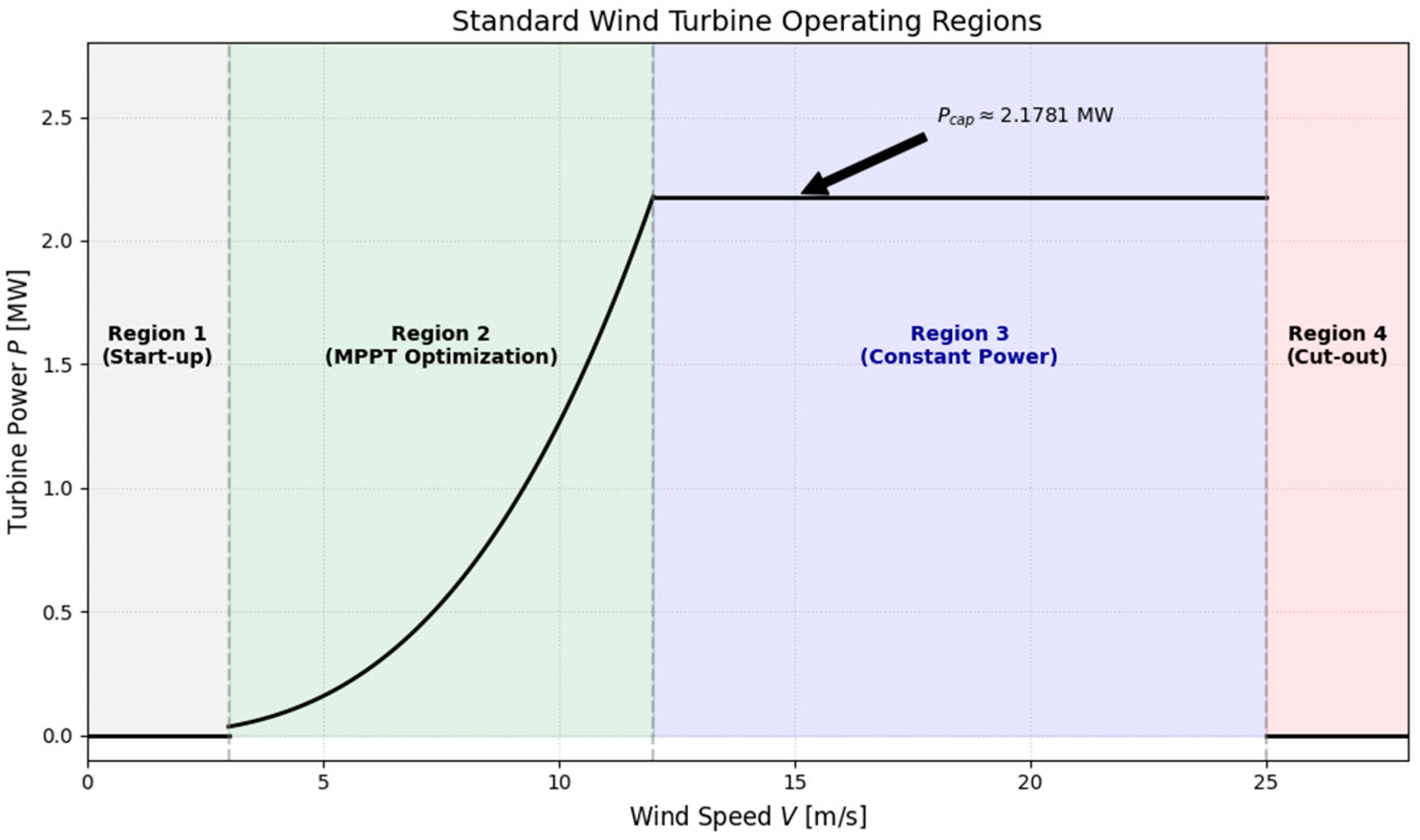
A characteristic wind turbine power curve illustrating the four standard operating regions can be seen in
Figure 1. This study focuses on Region 3, where the controller must regulate pitch to maintain a constant power (P
cap) despite increasing wind speeds (
).
Thus, pitch angle control becomes a key element of modern wind conversion systems, both for maintaining the rotor speed at its nominal value and for protecting equipment under strong wind or turbulent conditions. This study focuses on this area, positioning itself at the intersection of pitch control in Region 3, maximum power point tracking methods (MPP/MPPT), individual pitch control (IPC), and data-driven approaches to regulation and maintenance [
6,
7].
While advanced control strategies such as Linear Parameter-Varying (LPV) control, Nonlinear MPC, and Extremum Seeking have demonstrated a high performance in simulation, they often face barriers in deployment. LPV and Gain Scheduling typically rely on fixed, theoretical Cp look-up tables that do not account for blade erosion or mass-imbalance drift over time. Conversely, ‘model-less’ or purely data-driven approaches can lack the structural guarantees required for safety-critical Region 3 operation. This paper positions itself between these extremes. We propose a data-driven workflow that retains the industry-standard PI structure—ensuring familiarity and certifiability—but augments it with an empirical identification layer. Unlike standard gain scheduling, our approach identifies the power surface from operational data, allowing the controller to adapt to the actual (degraded) state of the turbine rather than a theoretical design model.
The above-rated speed regime (Region 3) requires control efforts where the main objective is no longer maximizing energy production but limiting the exported power and rotor speed to safe values. Two dominant control policies are identified in the literature: maintaining a constant rotor speed with collective pitch regulation, and maximum power point (MPP-with-cap) strategies [
8].
Studies published in MDPI journals emphasize that the implementation of control algorithms in Region 3 must account for nonlinearities, wind disturbances, electromechanical interactions, and blade degradation [
9]. For example, Liu et al. proposed an adaptive independent pitch control (IPC) scheme using state feedback and disturbance-accommodating control for large-scale wind turbines [
10]. Regarding classical PI/PID control schemes, another study optimized pitch/PI parameters to reduce tower vibrations and structural loads [
11,
12]. Moreover, the literature highlights the differences between collective pitch control and individual pitch control (IPC), the latter aiming to mitigate asymmetric blade, nacelle, and structural loads, especially for large turbines or offshore installations [
13].
In parallel, a comprehensive review of control methods for floating offshore wind turbines (FOWTs) classifies control strategies into three main categories: model-based, hybrid model/data-driven, and purely data-driven control, assessing the advantages and limitations of each approach in the rated power region [
14,
15].
Consequently, to effectively manage Region 3 operation, a control strategy must combine the following:
- (i)
Accurate pitch regulation to maintain rotor speed and power below rated limits;
- (ii)
Adaptability to wind variations and structural degradation;
- (iii)
Integration of IPC systems when appropriate;
- (iv)
Data-driven scenarios for continuous optimization and monitoring.
In addition to conventional control strategies, an increasingly active research area involves data-driven methods, which utilize SCADA data, blade/tower sensors, and machine learning algorithms for system identification, adaptive control, diagnostics, and prediction.
A recent paper explored the use of data-driven models for control, monitoring, and blade identification, demonstrating that such approaches can reduce computational costs and the complexity of traditional modeling [
16]. Another study provided a systematic review of predictive maintenance strategies for wind turbines, including blades, pitch actuators, gearboxes, and generators, highlighting the importance of condition data in optimizing component lifetime [
17].
These emerging directions are directly linked to pitch control. For example, blade degradation (erosion, surface contamination) modifies the power coefficient Cp(β,λ), affecting the power curve and dynamic response of the system. Data-driven models can detect such changes and recalibrate the pitch controller or performance map. Therefore, integrating real-time monitoring, empirical power surface identification, and adaptive control enables a more resilient and cost-efficient system, ultimately reducing the levelized cost of energy.
The remainder of this paper is organized as follows.
Section 2 summarizes the aerodynamic modeling and notation used for the studied 2.5 MW HAWT.
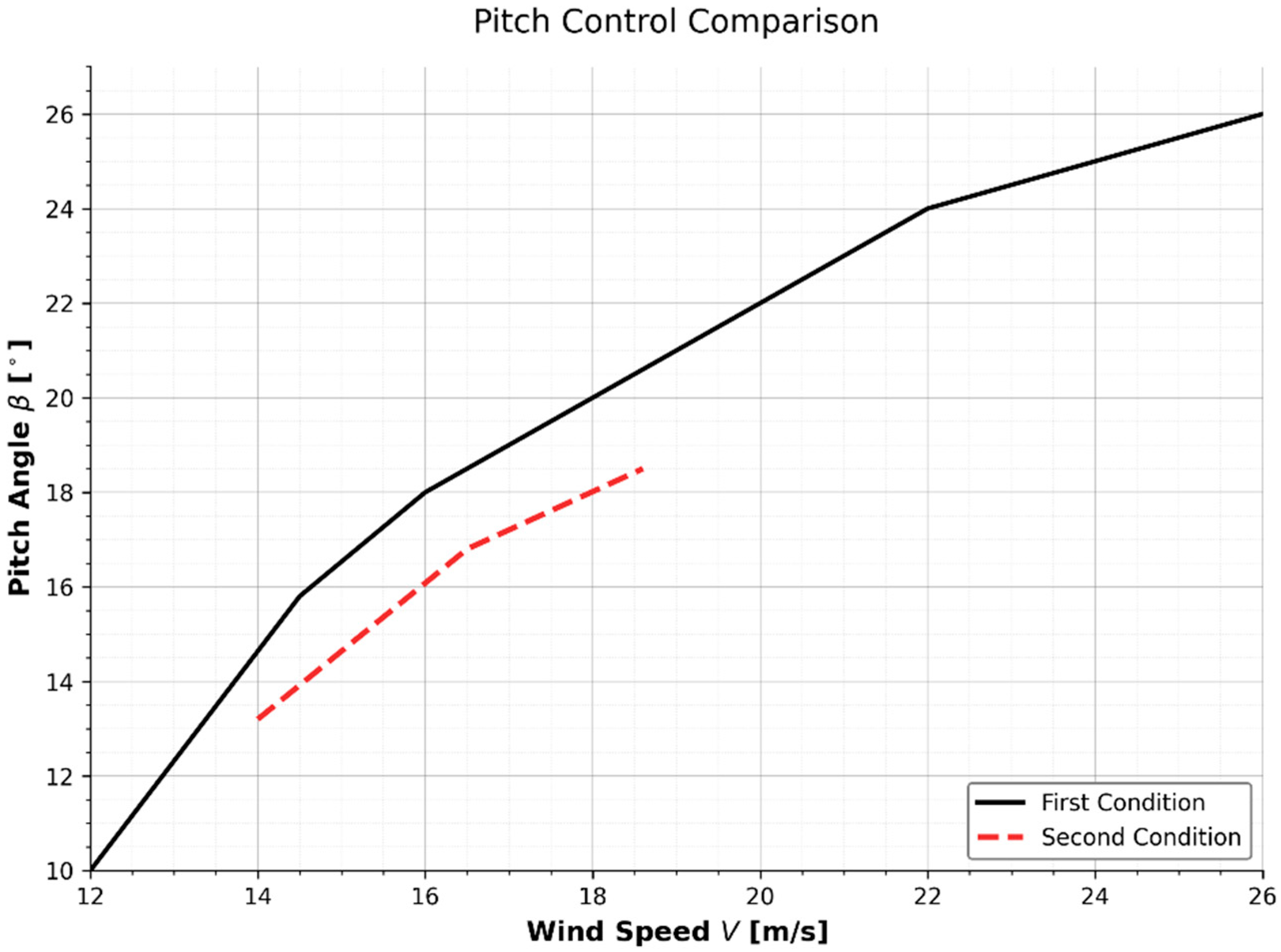
Section 3 identifies an empirical shaft-power surface, derives the MPP condition, and compares capped-MPP operation with a constant-speed, pitch-only policy—yielding the operating schedules used later.
Section 4 formulates the Region-3 closed loop (kinetic-moment balance, PI-in-rate law, and a practical pitch servo) and evaluates proportional, PI, and PI + servo controllers under both sinusoidal and Kaimal-turbulent wind scenarios.
Section 5 extends the design with an adaptive PI scheme that updates the integral path via online identification.
Section 6 discusses implications, limitations, and avenues such as IPC/preview and re-identification.
Section 7 concludes.
To clearly delimit the scope, this paper implements and validates the collective pitch regulation and adaptive integral tuning logic on a rigid-body turbine model. Broader concepts such as individual pitch control (IPC), grid-side converter variability, and long-term re-identification schedules are discussed to contextualize the method’s potential but are not simulated in this study.
2. Aerodynamic Modeling and Power Characteristics of the Studied HAWT
Modern horizontal-axis wind turbines (HAWTs) regulate the rotor speed and electrical loading primarily via blade-pitch control. At below-rated winds, the objective is to maximize aerodynamic conversion by operating near the tip-speed ratio that yields the maximum power coefficient; above rated, pitch servos limit the rotor speed and loads so electrical and structural constraints are respected. Because the rotor/airfoil design and the pitch schedule directly determine energy capture and loads, improvements in pitch regulation translate into tangible gains in both performance and reliability. This paper focuses on a three-bladed, 2.5 MW HAWT and uses standard aerodynamic relations as the foundation for the control objectives and subsequent evaluations [
16,
17,
18,
19].
The instantaneous mechanical power extracted from the wind is modeled as
where
is air density,
is rotor radius,
is wind speed,
is generator-side mechanical angular speed,
is blade pitch angle, and
is the power coefficient. The non-dimensional tip-speed ratio is
For the three-bladed rotor considered, the conversion coefficient follows the widely used parametric form:
where
c1, …,
c4 are design constants supplied by the manufacturer. For the studied unit, we adopt the standard characteristic coefficients
c1 = 0.5176,
c2 = 116,
c3 = 0.4, and
c4 = 5.
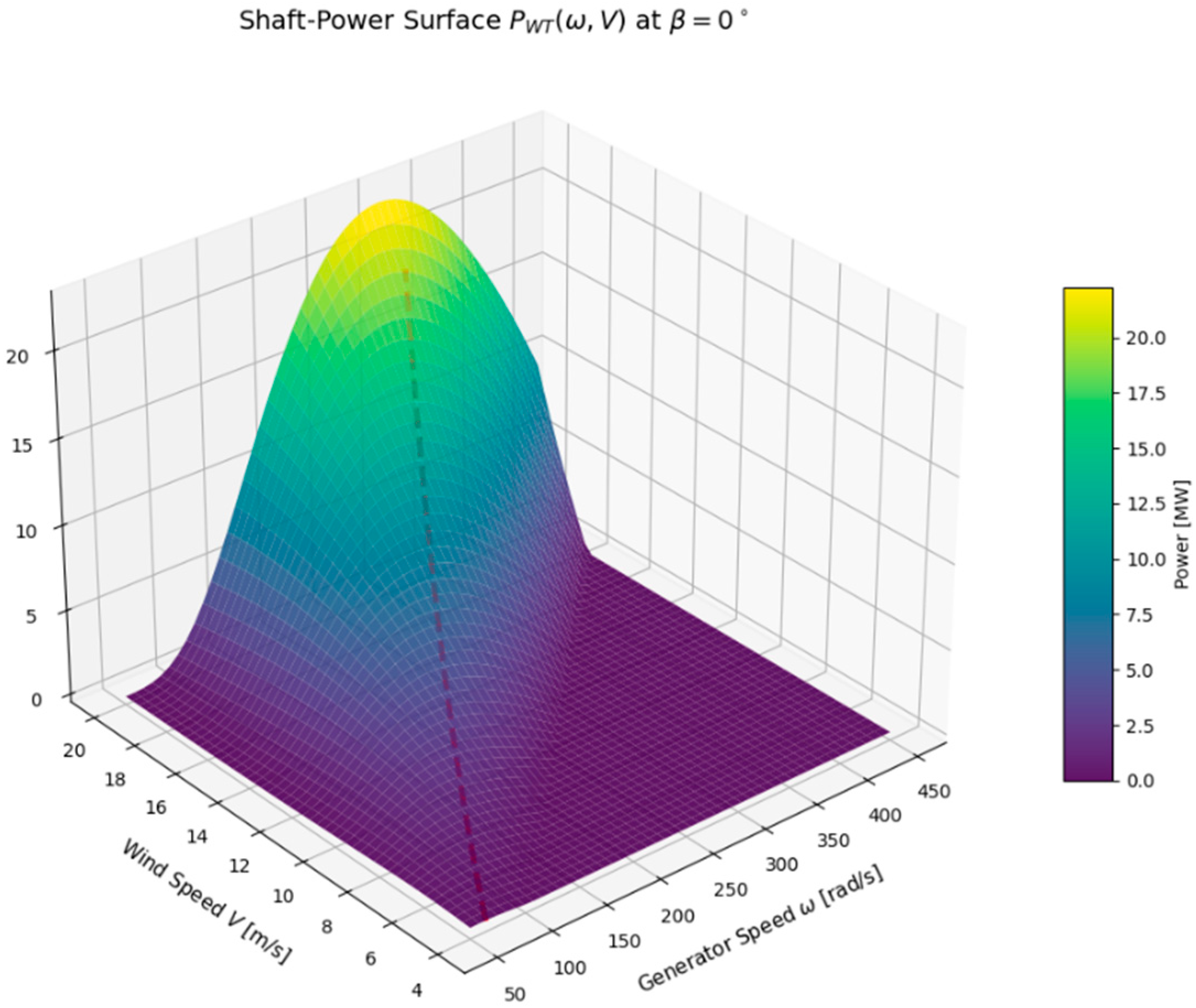
The power generated by the wind turbine is calculated using the following relation:
where
a,
b,
c,
d are parameters obtained from measurements on the studied unit. This empirical form is used later to derive operating curves and closed-loop responses without altering the underlying aerodynamic logic. The machine’s rated data (
Table 1) provides the scale for all results that follow.
The optimal-speed concept
and its linear-in-wind implementations are well established and motivate our operating set-points and comparisons, alongside moment-balance expressions that expose how departures from MPP create energy losses under variable wind. Our study connects to (i) optimal angular-speed identification and kinetic-moment power splits; (ii) control under significantly variable winds; (iii) converter topologies relevant to constant-power operation; (iv) aerodynamic/TSR design under BEM/QBlade; (v) degradation and the need to re-identify
as blades age; (vi) forecasting and supervisory feed-forward; and (vii) oscillation/stability phenomena in a closed loop. We also contrast adjacent architectures (DFIG modeling, partial-power processing, floating IPC, and non-HAWT layouts) to clarify the scope [
16,
17,
18,
19,
20,
21,
22,
23].
Concretely, we draw on prior work that (a) formalizes
and field re-identification from the measured speed (and even no-load tests); (b) quantifies energy losses when inertia and rate limits impede perfect tracking; (c) demonstrates the role of partial-power converters in the constant-power region; (d) documents how blade pitching extends off-design efficiency; (e) introduces indices (EPF, controllability factor) to capture how wind dynamics and controller capability reshape expected energy; (f) details DFIG electromechanics for generator-side reasoning; and (g) advances individual-pitch control (IPC) for load mitigation—including RBF-augmented sliding-mode approaches for floating platforms. We also reference comparative HAWT/VAWT power and urban/ducted “wind aggregation” concepts strictly as context (our plant is a conventional HAWT) [
18,
19,
24,
25,
26,
27,
28,
29].
Finally, we note that practical deployment benefits from aerodynamic design tools (BEM/QBlade) to set TSR targets that align with the
surface, from predictive maintenance insights (e.g., erosion) that shift aerodynamics over time and justify periodic re-identification, and from short-term power/wind prediction that can support preview control atop the pitch loop considerations we revisit when interpreting our results [
19,
21,
22].
4. Dynamic Control Under Wind Speed Variations
We analyze the turbine’s closed-loop behavior when the free-stream wind speed varies over time and the blade-pitch angle
is adjusted to (i) keep exported power capped and (ii) hold mechanical speed near the chosen optimum. The approach follows the kinetic-moment balance perspective—commonly used to relate aerodynamic power, generator extraction, and rotor acceleration—which motivates the use of a simple pitch PI regulator in Region 3. This viewpoint also explains why even modest excitation at the wind input can produce noticeable oscillations if gains are not selected conservatively [
16,
17,
18].
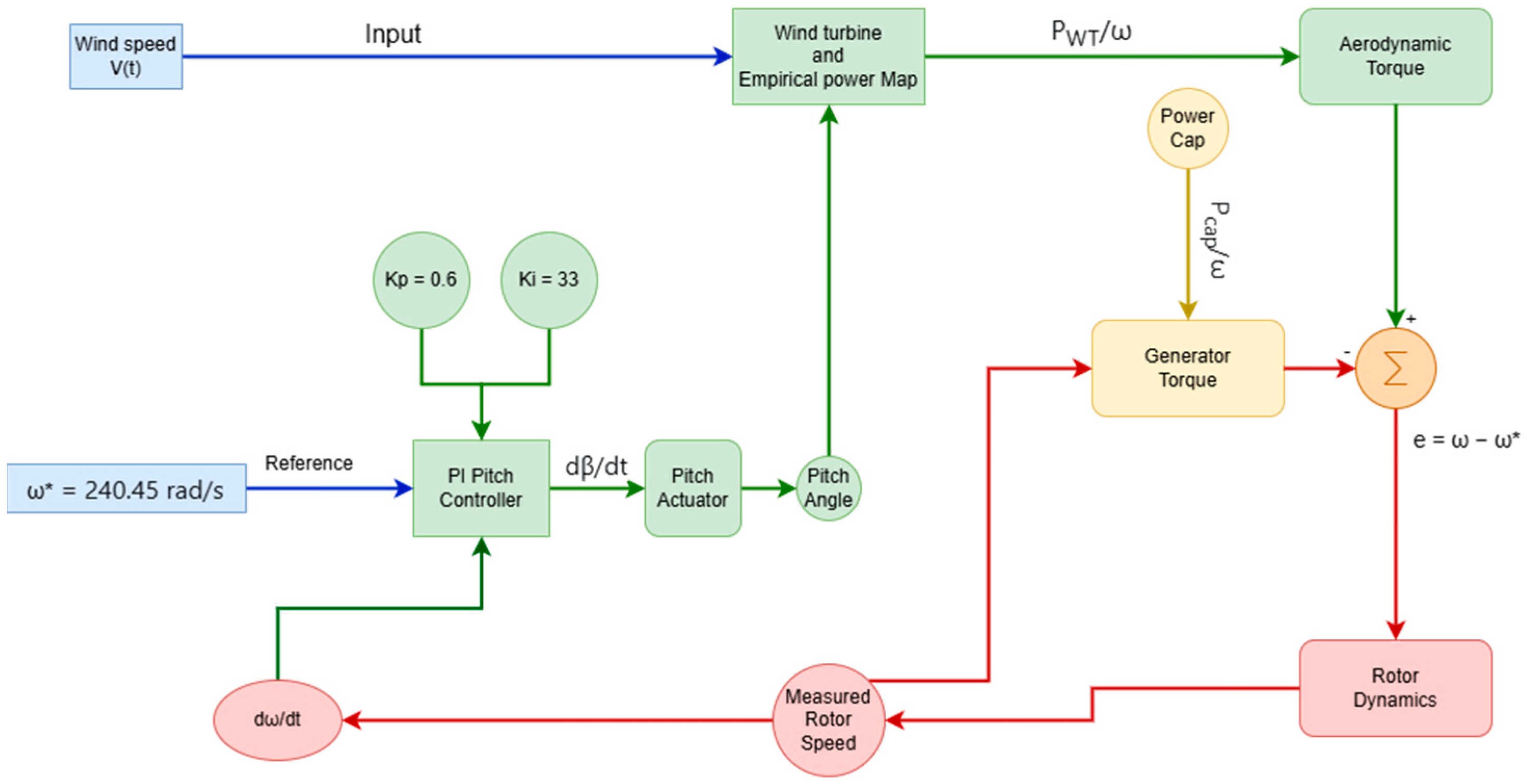
Figure 6 illustrates the Region-3 closed loop used.
Figure 6 summarizes the Region-3 closed loop used in this section: the empirical shaft-power map
drives the kinetic-moment balance
, while a pitch-rate law
is applied through a first-order actuator with hard angle and symmetric rate limits. This block diagram is the exact implementation behind the Case A/B/C studies and the turbulent-inflow experiments that follow, linking the
Section 3 equations (power map, constant-power ceiling, constant-speed set-point) to the controller realized in
Section 4 (PI-in-rate form with saturation handling). For completeness, the plant block enforces the kinetic-moment balance and computes aerodynamic power from the identified map, while the grid block imposes
during above-rated operation.
4.1. Excitation Signal and Electromechanical Time Constant
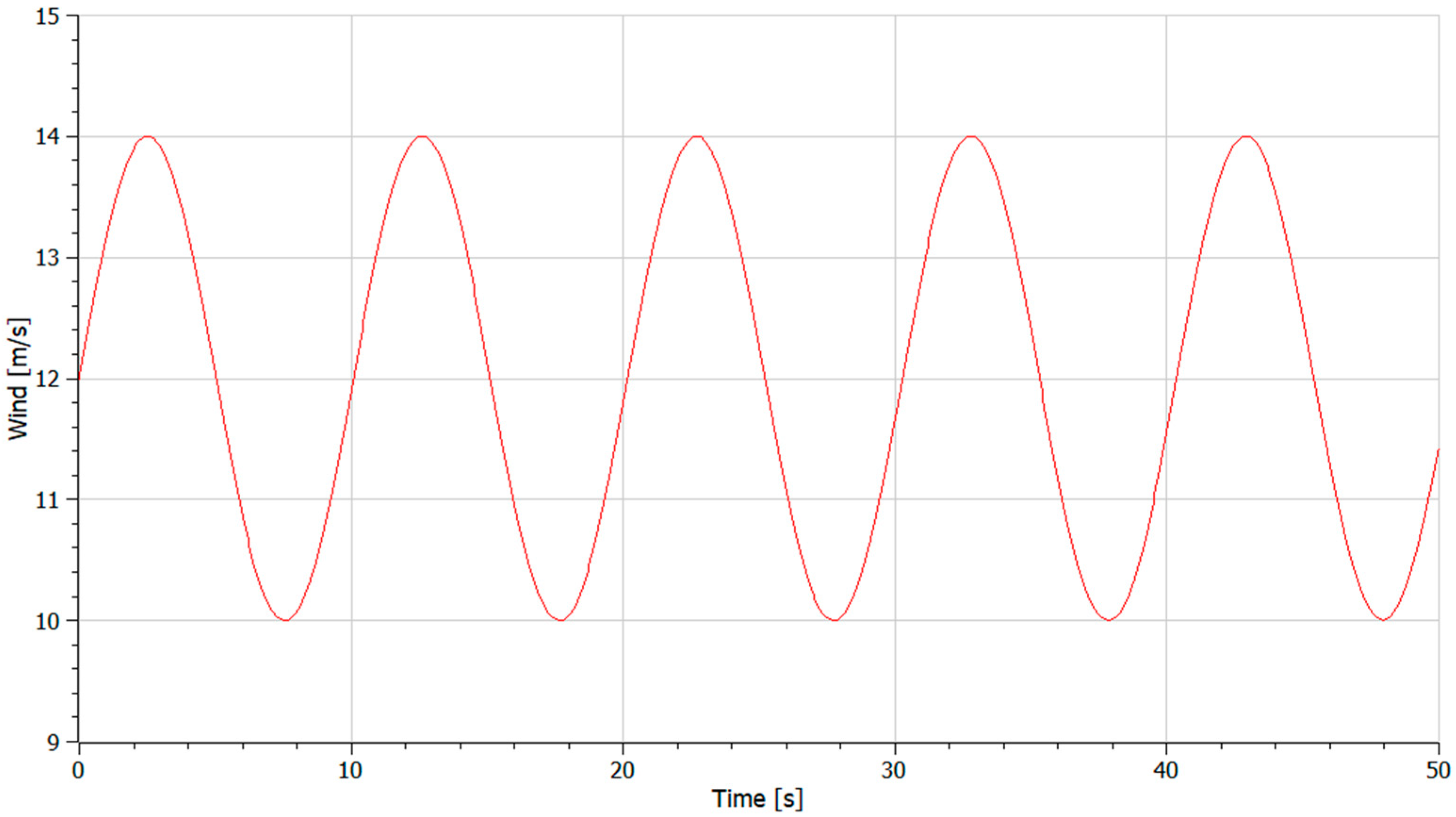
To excite the plant over a representative bandwidth, we apply a sinusoidal wind variation around 12 m/s with amplitude 2 m/s and angular frequency determined by the electromechanical time constant .
A sinusoidal variation in the wind speed is considered, from 10 [m/s] to 14 [m/s], of the form
where
is the electromechanical time constant of the wind turbine system (calculated using generator-side quantities), given by
With generator-side rotor inertia and nominal speed defined at the high-speed shaft,
Thus, the electromechanical time constant has the value
Therefore, the wind speed variation becomes
Using
to set the disturbance frequency is consistent with prior work that links measured speed dynamics to power splits and optimal-speed tracking under time-varying winds [
17,
24].
Substituting
into the empirical power map yields the time-varying turbine power used in the controller analysis:
4.2. Operating Point at Vmin = 10 m/s and Pitch Sensitivity
At the minimum wind speed
m/s, turbine power (for general
) is
Assuming the machine starts at maximum power with
and
, we recover
by
which gives
This aligns with the optimal-speed vs. wind viewpoint widely used in Region-2/3 coordination.
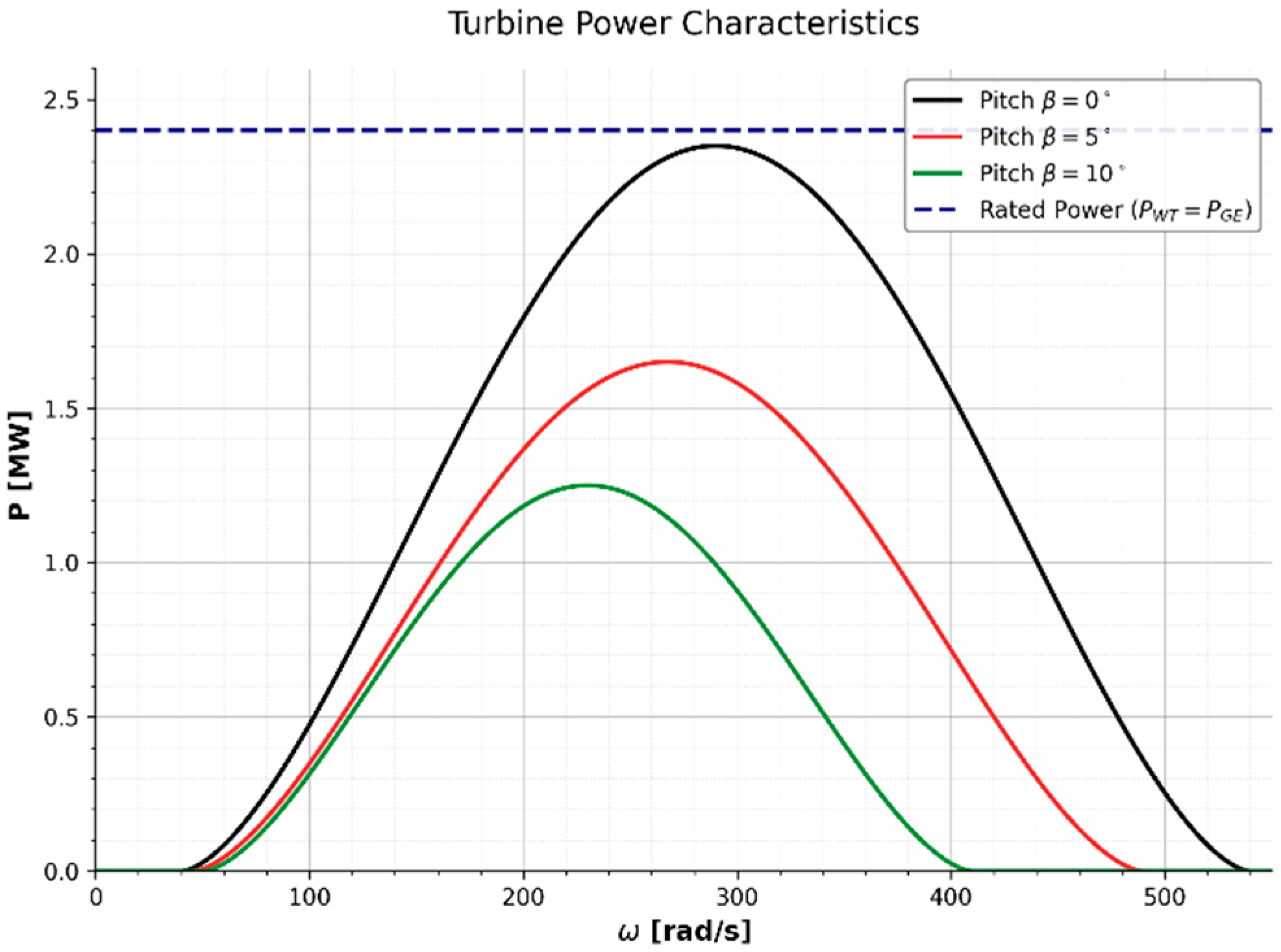
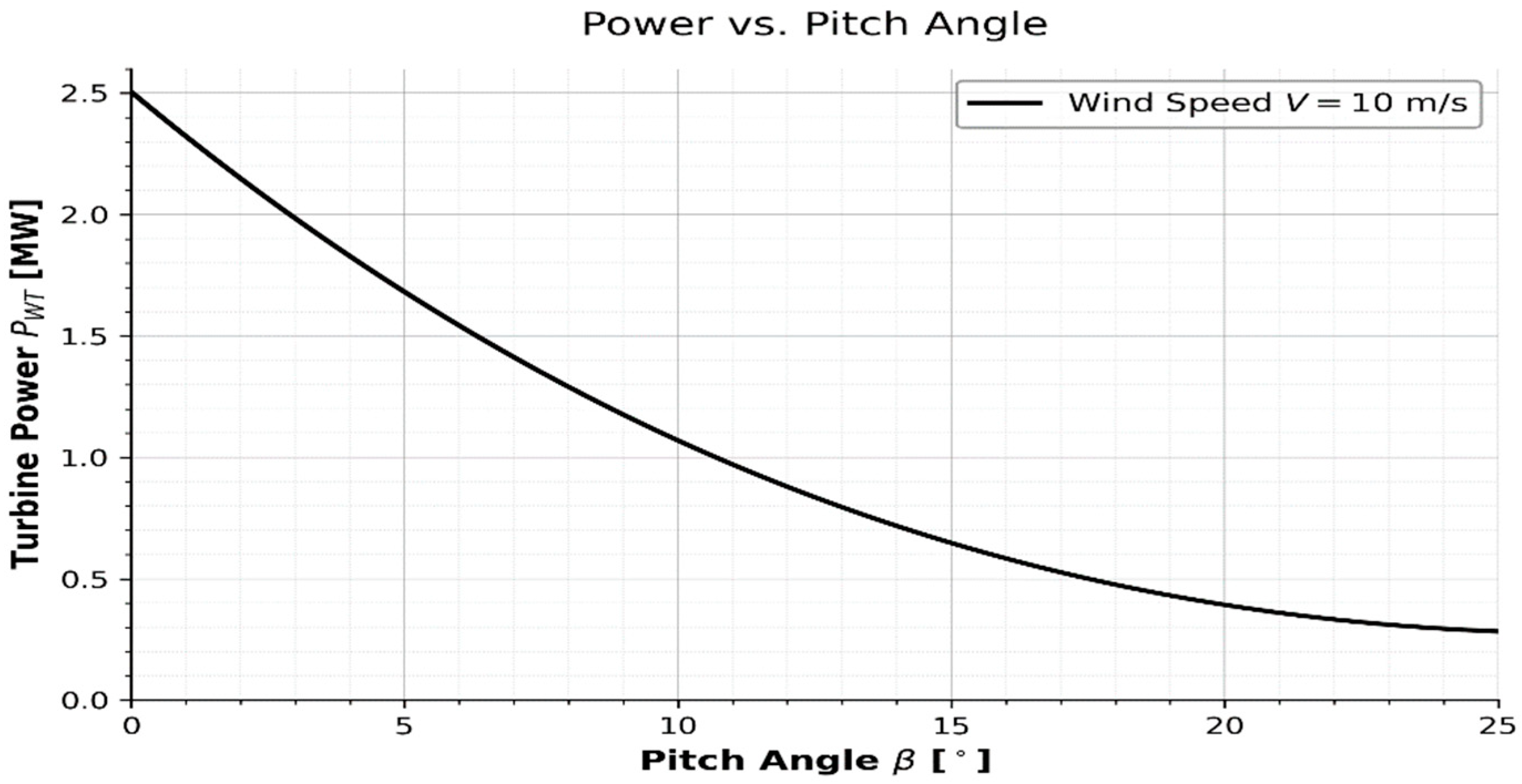
Varying
at this operating speed changes the extracted power according to
which produces the monotone decrease with
seen in
Figure 7. Pitch-induced power shedding at off-design winds is consistent with blade-element analyses and small-scale experiments [
28,
31].
4.3. Simulations Under Sinusoidal Conditions
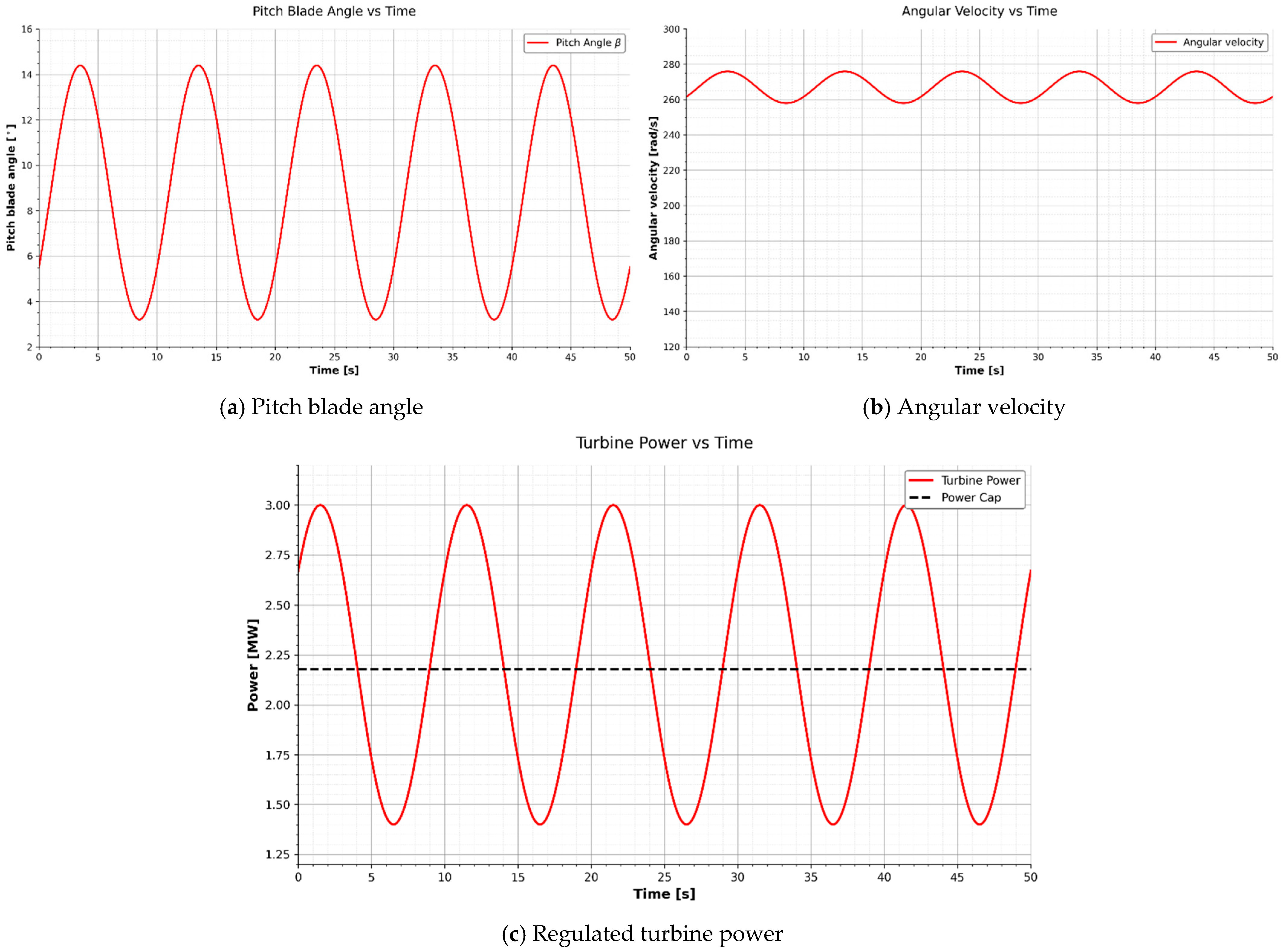
In the first simulation scenario, the Region-3 plant is excited by a sinusoidal wind input V(t) = 12 + 2sin(0.62241t) m/s (period ≈ 10.1 s), producing periodic aerodynamic torque ripple about rated; the four code variants differ only in how the pitch-rate law rejects the resulting speed excursions: Case A (P-only) applies with no integral or actuator, giving an anticipatory yet bias-susceptible response; Case B (PI) adds an integral-in-rate term with an ideal (lag-free) actuator for tight regulation; and Case C (PI + servo) keeps the same PI law but passes it through a first-order pitch servo with , rate limit ±20°/s, and hard angle clamps, introducing realistic lag and saturation while still attenuating the sinusoidal speed ripple around .
The wind excitation used in the regulation test includes a phase shift:
as shown in
Figure 8.
At
, the turbine operates at
with
β(0) = 0 the corresponding initial power
With the wind varying as in (37), as shown in
Figure 6, the power expression becomes
The pitch command is generated by a conventional PID structure:
If only the PI action is retained,
PI Tuning via Analytical Pole Placement
Instead of heuristic methods like Ziegler–Nichols, we employ an analytical pole placement strategy. We first linearize the kinetic-moment balance around the Region 3 steady operating point (
,
,
) = (10 m/s, 240.45 rad/s,
). The rotor dynamics are
where J is the total inertia referred to the generator side,
is the generator mechanical speed, and
are the aerodynamic and electromagnetic torques, respectively, referred to the high-speed shaft.
Linearizing gives
so that the speed regression
and pitch sensitivity
are
Using
with
from Equation (6), the needed partials follow from
The pitch actuator is modeled as a first-order servo .
With the PI law
(Equations (43) and (44)), the approximate characteristic equation becomes
Matching a target second-order polynomial
yields the closed-form tuning
From
Table 1, J = 511.92 kgm
2, and from the abstract/regime definition
Pcap = 2.1781 MW,
. Hence,
(generator-torque contribution to
a); the aerodynamic terms
are computed from Equation (6) and converted via (D2). Choosing
and
below the actuator corner (
Section 3.1) gives the implemented gains
This analytical derivation justifies the selected gains (Kp = 0.6, Ki = 33), guaranteeing a target damping ratio of and adequate stability margins relative to the actuator lag.
This PI structure is standard in Region-3 pitch control and underpins both collective-pitch regulation and certain IPC formulations (with additional azimuth decoupling) [
28,
31].
4.4. Case A—Proportional-Only Speed Feedback—Sinusoidal Inflow
With
K1 = 0.6,
K2 = 0 and initial conditions
β(0) = 0,
ω(0) = 252.48, the closed-loop model is
Figure 9 shows the resulting speed overshoot, which exceeds the target by
The optimal mechanical angular velocity is .
This sensitivity to proportional-only action under periodic excitation mirrors observations in the literature regarding oscillatory attractors near saturation and motivates adding integral action [
25].
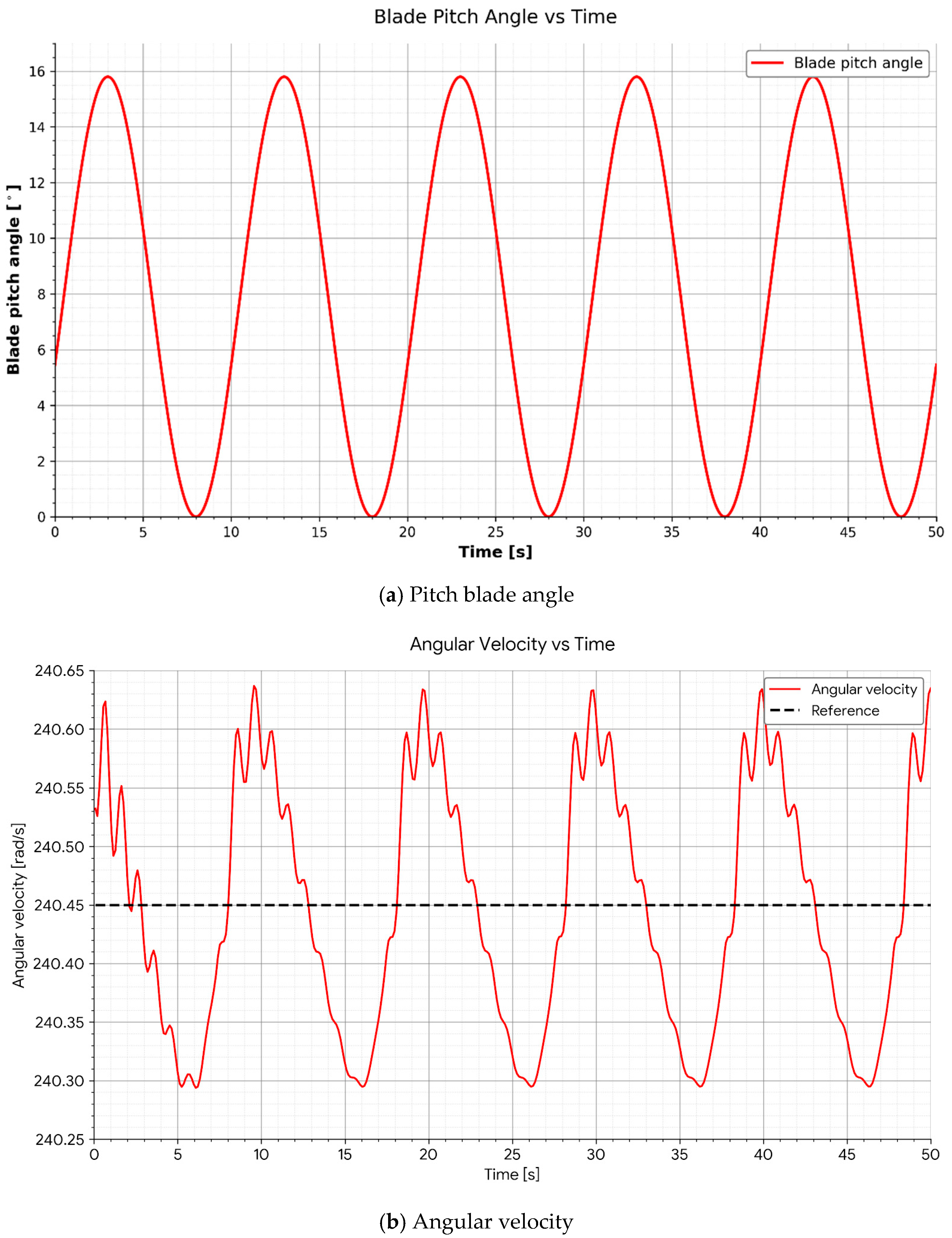
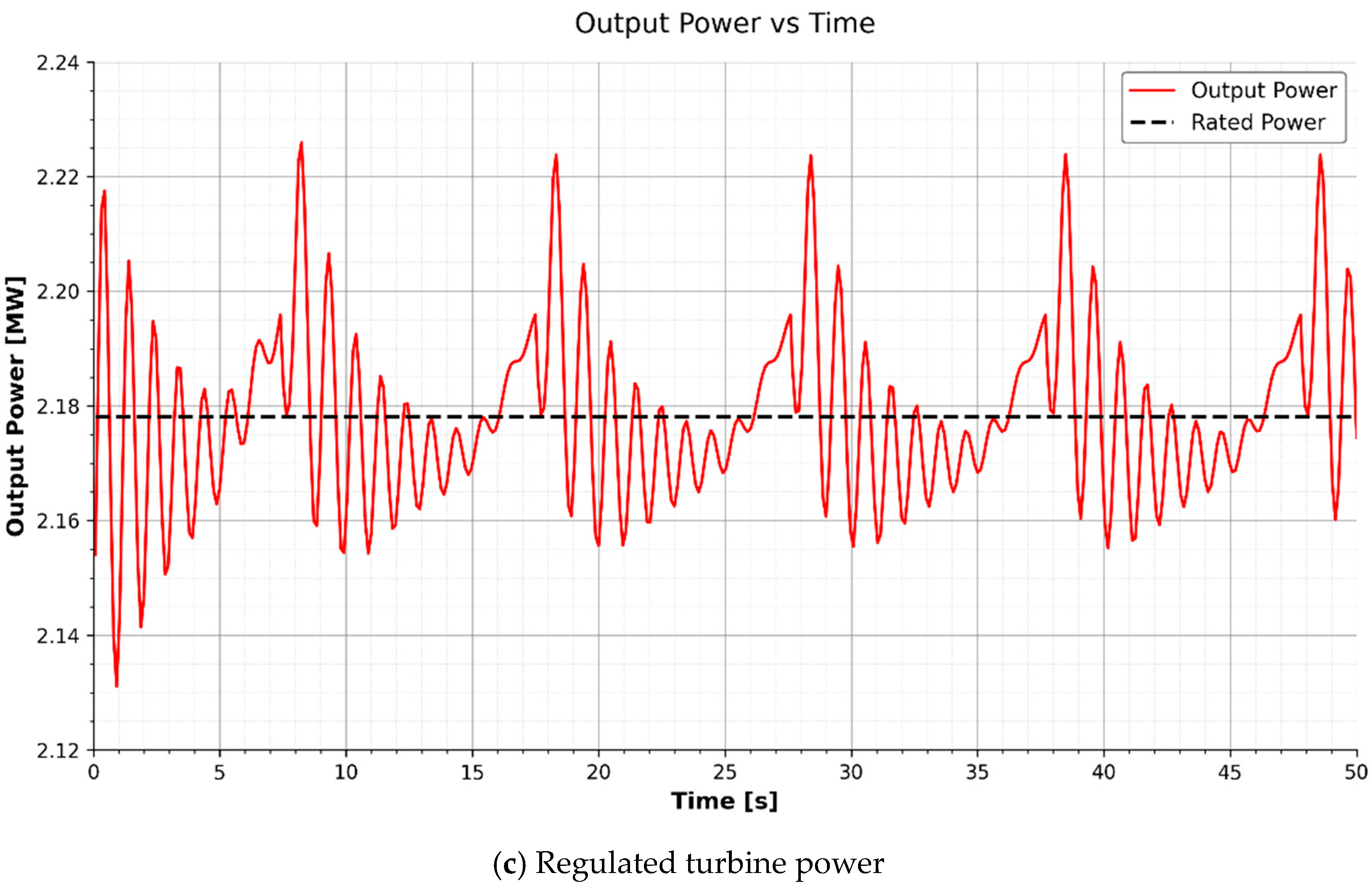
4.5. Case B—PI Action with K1 = 0.6, K2 = 33—Sinusoidal Inflow
Augmenting the loop with an integral term yields
Figure 10 shows simulation results for case B.
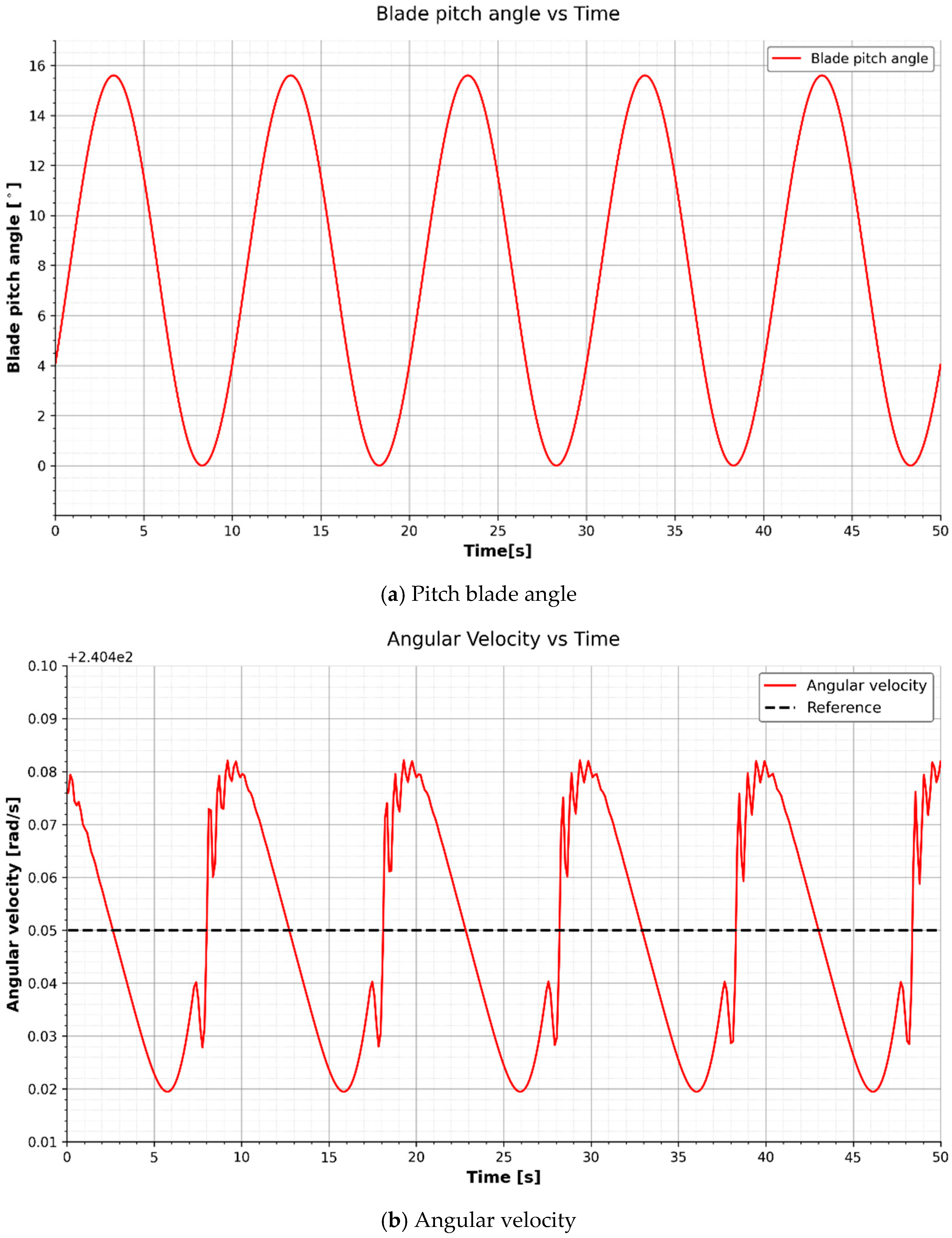
4.6. Case C—PI Action with K1 = 0.6, K2 = 33 and Pitch Control Actuator Integration—Sinusoidal Inflow
This case regulates generator-side mechanical speed above rated (Region 3) using a PI-type pitch controller and a first-order pitch actuator. The plant enforces a constant electrical power cap while the aerodynamic power depends on wind speed, rotor speed, and collective pitch.
The pitch controller is implemented in rate form:
Although expressed as a rate law, in the absence of saturation and actuator lag, it is equivalent to a PI regulator on
:
so
K1 plays the proportional role (through the
term) while
K2 integrates the speed error.
Pitch servo, limits, and rate limiting
Hard pitch limits
are enforced by clamping the commanded angle before the actuator:
The pitch actuator is a first-order servo with time constant
and symmetric rate limiting ±
rlim:
where
. When the blade is at a hard limit and the commanded rate would drive it further, motion is stopped (implicit anti-windup).
Anti-windup (conditional integration/clamping): the PI integrator is frozen whenever the actuator is saturated in the direction of the command.
and .
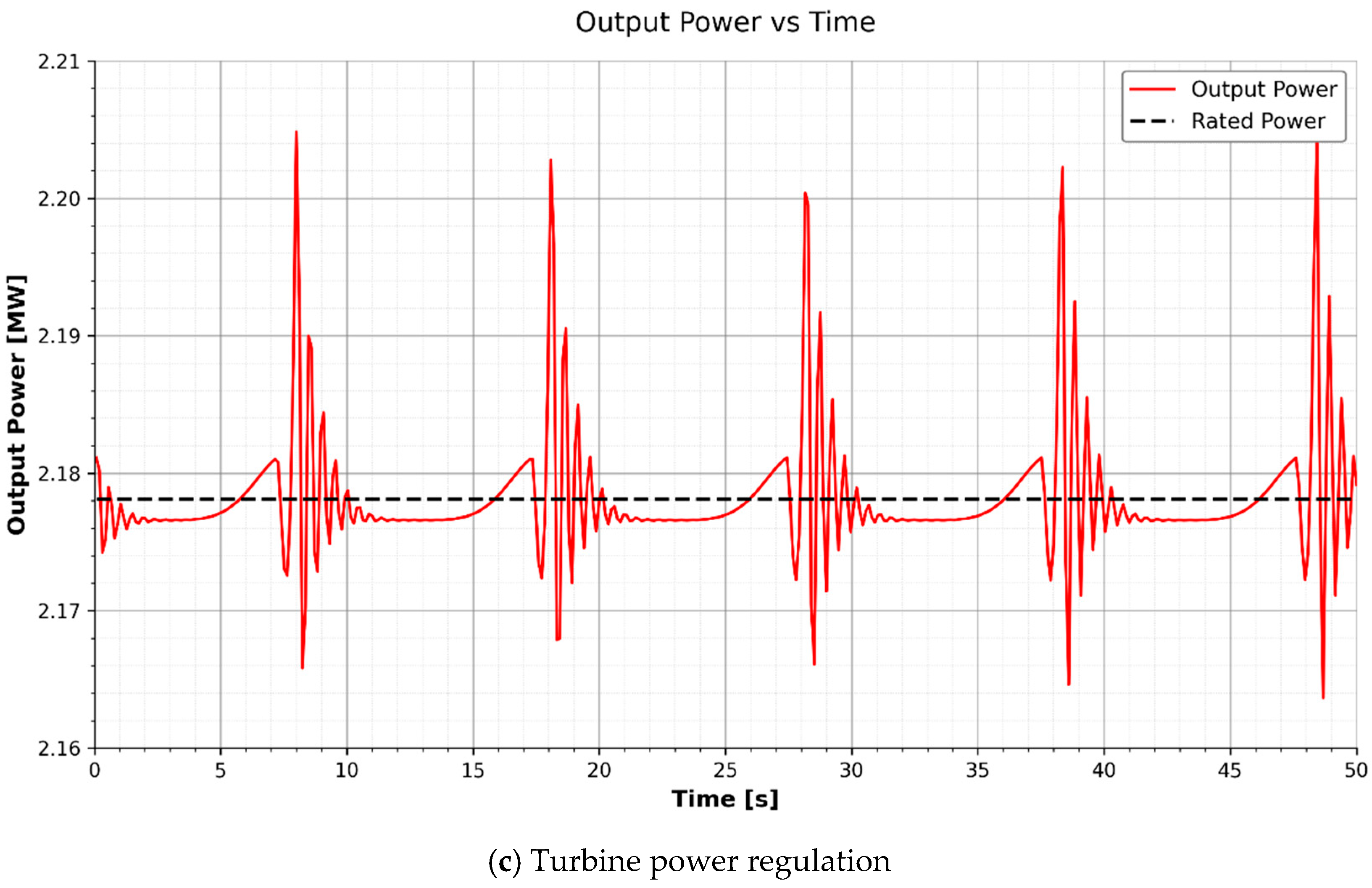
The simulation results can be seen in
Figure 11.
4.7. Kaimal Turbulent Wind Inflow
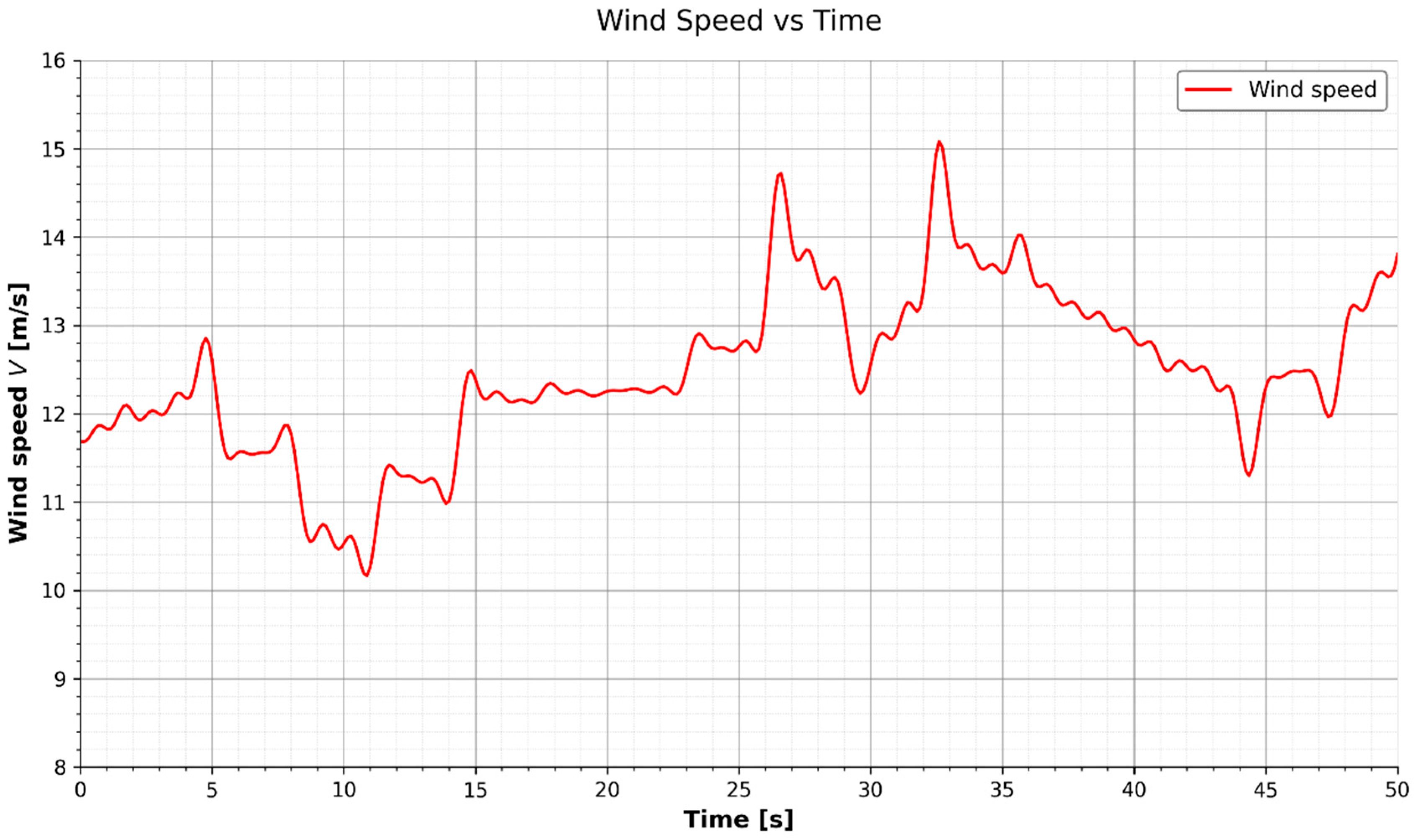
The turbulent wind field is generated using a Kaimal spectrum approximation with N = 40 harmonics distributed over the relevant control bandwidth (0.01–1 Hz)—
Figure 12. A single deterministic realization (fixed phase seed) is used across all test cases. This ensures that the performance comparison between controllers is conducted under identical disturbance conditions, isolating the impact of the control algorithm from statistical variations in the wind profile.
To complement the sinusoidal excitation used in the first scenario, we evaluate the closed-loop Region-3 behavior under stochastic, broadband wind turbulence synthesized from a Kaimal spectrum. The experiment uses the same empirical shaft-power map
(Equation (6)), the constant-power ceiling
(Equation (15)), and the constant-speed setpoint
adopted in
Section 3.5.
4.7.1. Wind Model and Operating Band
We generate a longitudinal turbulence signal
by spectral synthesis of the Kaimal spectrum,
over
N = 40 harmonics on
f ∈ [0.01, 1] Hz with deterministic pseudo-random phases. The inflow is
with mean
, turbulence intensity
, length scale
, advection speed
, and
. This bandwidth excites rotor/electromechanical dynamics around the same range used to tune the loop in
Section 4.1, but with realistic multi-tone content.
4.7.2. Plant and Control Structure
The Region-3 plant enforces the kinetic-moment balance
where max(ω, 10
−6) operator protects against division-by-zero singularities during startup or low-speed transients, and
is computed from Equation (6). Pitch is actuated either directly as a rate command or through a first-order servo with time constant
and symmetric rate limit
, with hard angle clamps
β ∈ [0°, 40°].
4.8. Case A—Proportional-Only Speed Feedback—Turbulent Inflow
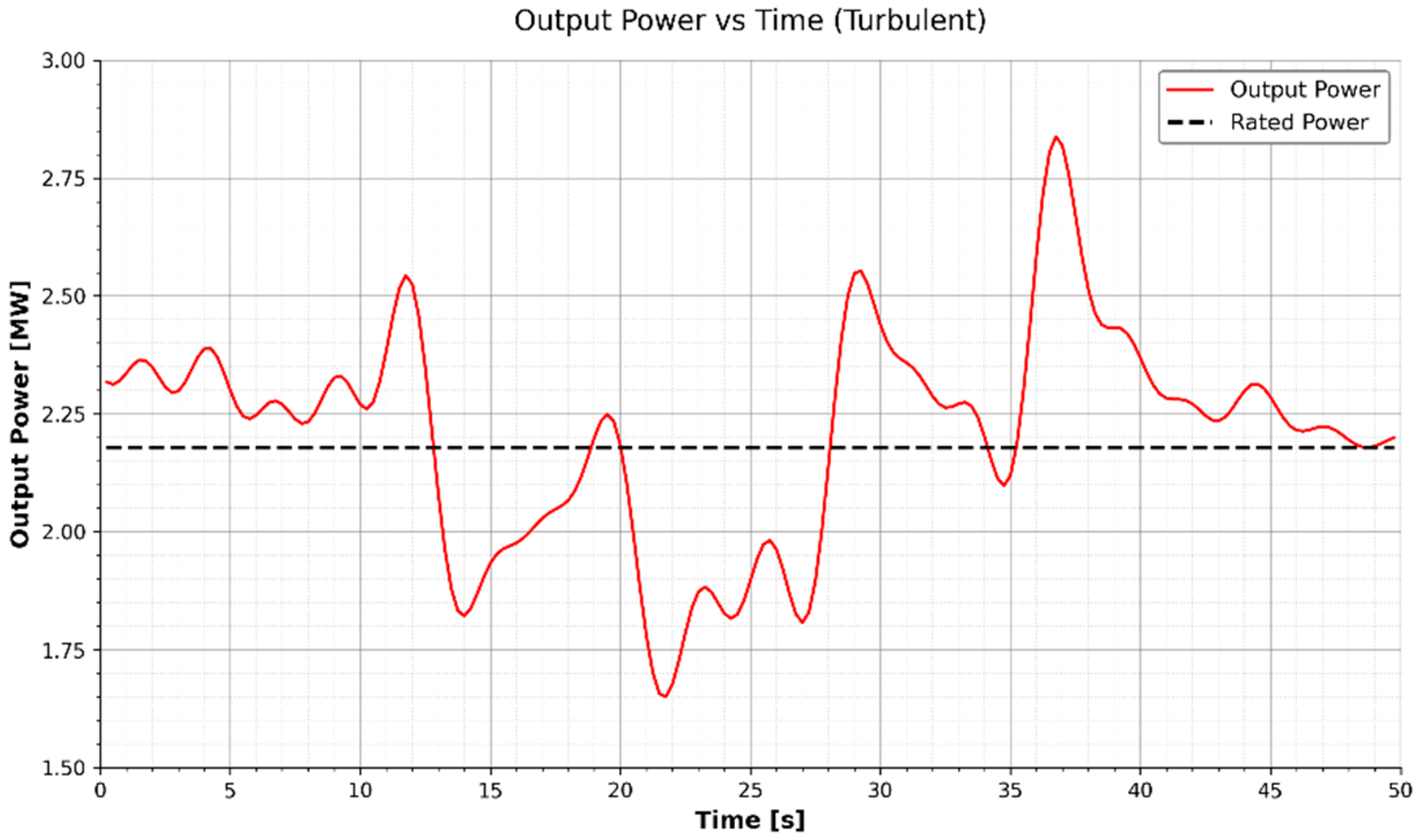
Figure 13 illustrates the power generated by the wind turbine in case A with turbulent wind excitation.
In Case A, the pitch command is purely proportional to rotor acceleration, with a direct rate command (no actuator lag) and wide rate limits. Region-3 rotor dynamics follow and aerodynamics are computed from the empirical map used earlier (Equation (6)). Wind is turbulent Kaimal with , , , and , giving .
Integrating
yields the affine invariant
(away from angle limits) with
set by the initial condition. Equation (1) explains the tight co-movement of
and
: any slow drop in
pulls
down toward the lower stop even if the disturbance is quasi-static.
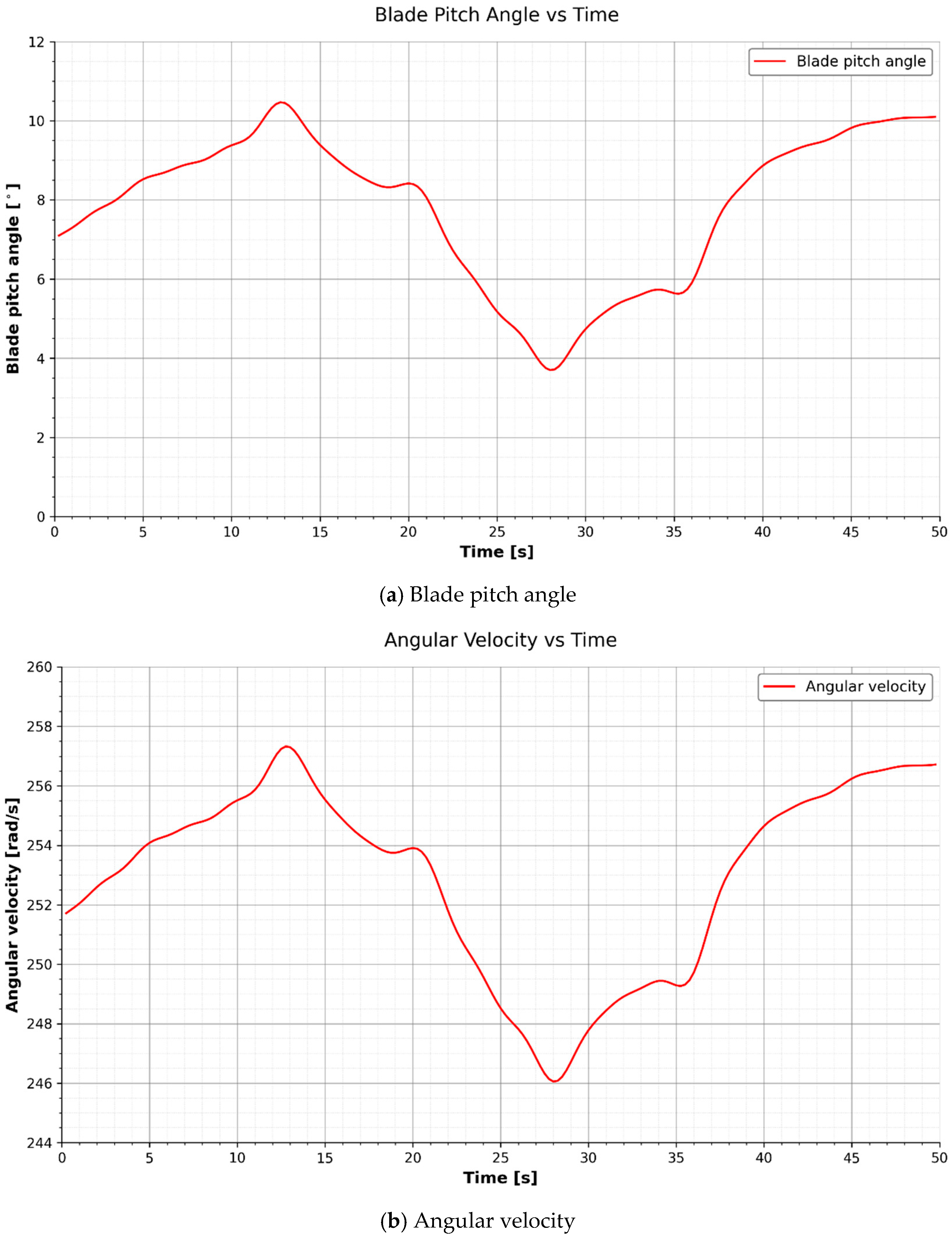
Figure 14 ilustrates the blade pitch angle and generator-side angular velocity of the wind turbine.
The angular-velocity trace shows that the rotor never regulates around the reference (dashed line). Instead, with the proportional-only pitch-rate law, the speed stays biased above the setpoint, varying between about 246 and 258 rad/s over the 50 s record. A slow lull around t ≈ 28 s produces the deepest dip (≈246 rad/s), after which the speed recovers toward previous levels. High-frequency ripple is modest—consistent with the direct feed-through term shaving fast content—but the absence of integral action leaves a low-frequency bias that the loop cannot remove.
The blade-pitch angle evolves inversely to the speed, moving between roughly 3.7° and 10.1°. During the same lull, is driven toward the lower end of its operating band as the controller attempts to recover torque. Because there is no integral path to re-bias the command, exhibits a slow drift toward lower angles during extended deficits and only returns upward when the inflow strengthens. In this Case-A setup (direct rate command, no actuator dynamics), the motion is fast but not rate-limited; authority would be temporarily lost if the lower hard stop were reached in stronger lulls—precisely the failure mode mitigated by adding integral action and, later, a servo with rate limiting.
The power trace confirms that proportional-only control does not enforce the constant-power ceiling (dashed line). Generated power wanders noticeably with the wind, dipping toward 1.7–1.8 MW during lulls and spiking well above the cap (up to ~2.8 MW) during gust clusters (e.g., around ). These excursions coincide with the biased speed and with operating near the lower end of its range—clear evidence that, while the proportional term attenuates fast fluctuations, it cannot correct quasi-static errors in either speed or power. This motivates the PI design assessed next, which removes the bias, recenters tightly about , and holds exported power close to even under broadband turbulence.
4.9. Case B—PI Action with K1 = 0.6, K2 = 33—Turbulent Inflow
Figure 15 illustrates the power generated by the wind turbine in this case.
In Case B, the pitch command is applied as a direct rate command (no actuator lag).
Aerodynamics use the empirical map (Equation (6)). The rotor dynamics are .
Define
. Then,
Thus, the
term integrates speed error into the pitch bias, cancelling low-frequency/biased disturbances that the P-only law in Case A could not remove. The
path still shaves high-frequency ripple—as can be seen in
Figure 16.
With the PI law and no actuator limits, the regulation objective is recovered. The mechanical speed oscillates tightly around the set-point (dashed line), with small, nearly symmetric excursions of about . This removes the low-frequency bias seen with proportional-only control and indicates that the integral path is providing the required quasi-static authority while the term adds phase lead/damping against the faster turbulent content. The waxing/waning envelope visible in the trace is a beat phenomenon from the broadband Kaimal realization and not a drift in the controller.
The turbine power now clusters around the (dashed line) but with sizable spikes under steep turbulence packets. Instantaneous power still oscillates as the inflow fluctuates, but the mean is centered on the cap, and positive/negative excursions are largely balanced. Occasional spikes above the cap coincide with the steeper sides of the turbulence bursts and the aggressive (unlimited) pitch motion; likewise, dips below the cap occur during short wind deficits. Compared to the P-only case, both the steady-state error and the slow wander of power are substantially reduced—consistent with proper integral action on .
The blade-pitch angle remains within the operational range, varying roughly between 0° and 15°. Pitch motion mirrors the turbulent modulation of : during gust clusters, increases to shed torque and prevent overspeed; during lulls, is driven back toward small angles to recover power. Because the model in this case commands directly and omits actuator dynamics/rate limiting, the pitch activity is relatively brisk. In practice, introducing a first-order servo and realistic rate limits (treated next) filters this high-frequency content, further attenuates the sharpest power spikes, and reduces the mechanical load implications without compromising tracking of and .
4.10. Case C—PI Action with K1 = 0.6, K2 = 33 and Pitch Control Actuator Integration—Turbulent Inflow
Figure 17 shows generated wind turbine power in this case.
We retain the Case-B PI pitch-rate law but pass it through a first-order pitch servo with rate limiting and hard angle stops:
The
path shaves fast content, the
term integrates steady speed error, and the servo enforces realistic lag and rate constraints. Results can be seen in
Figure 18.
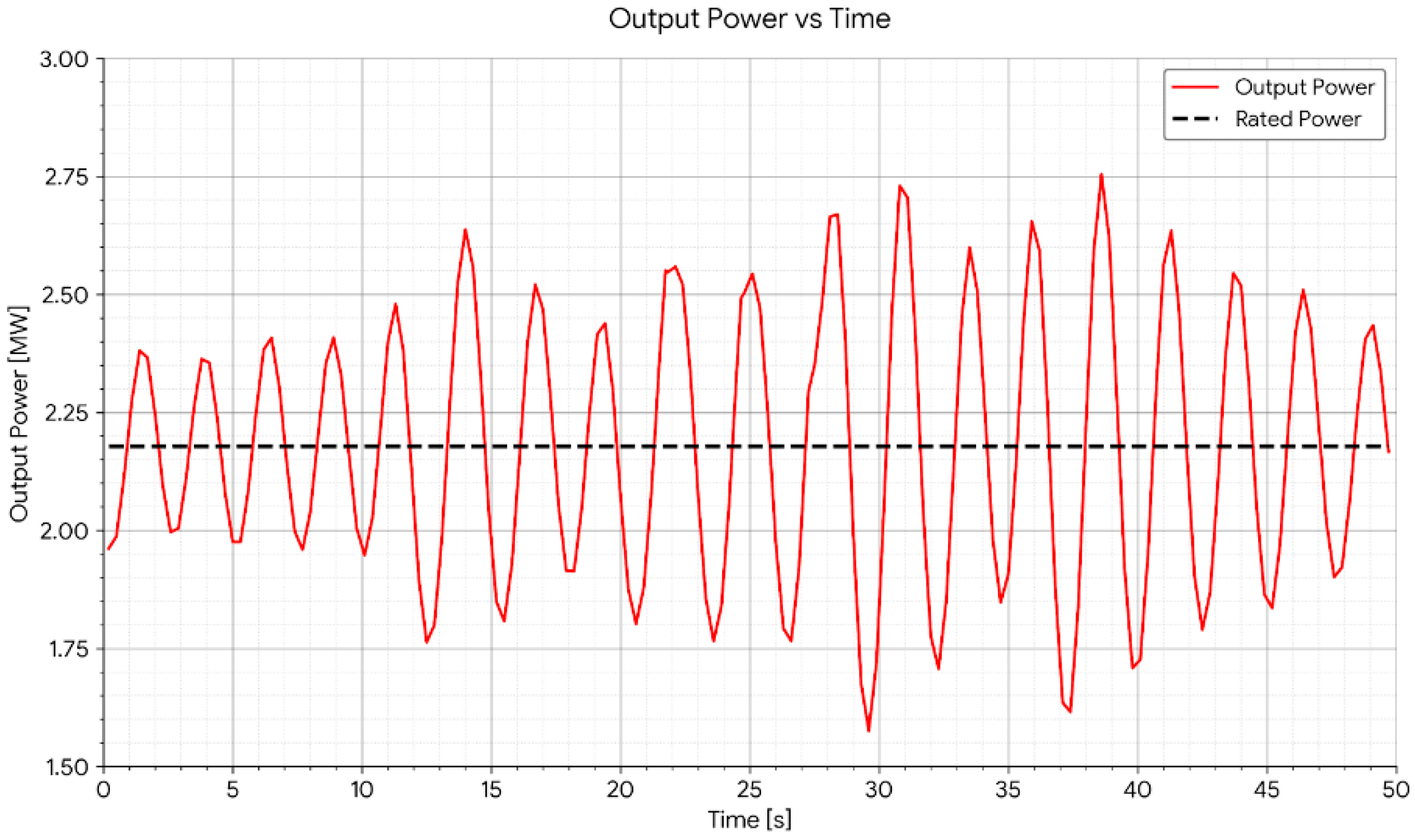
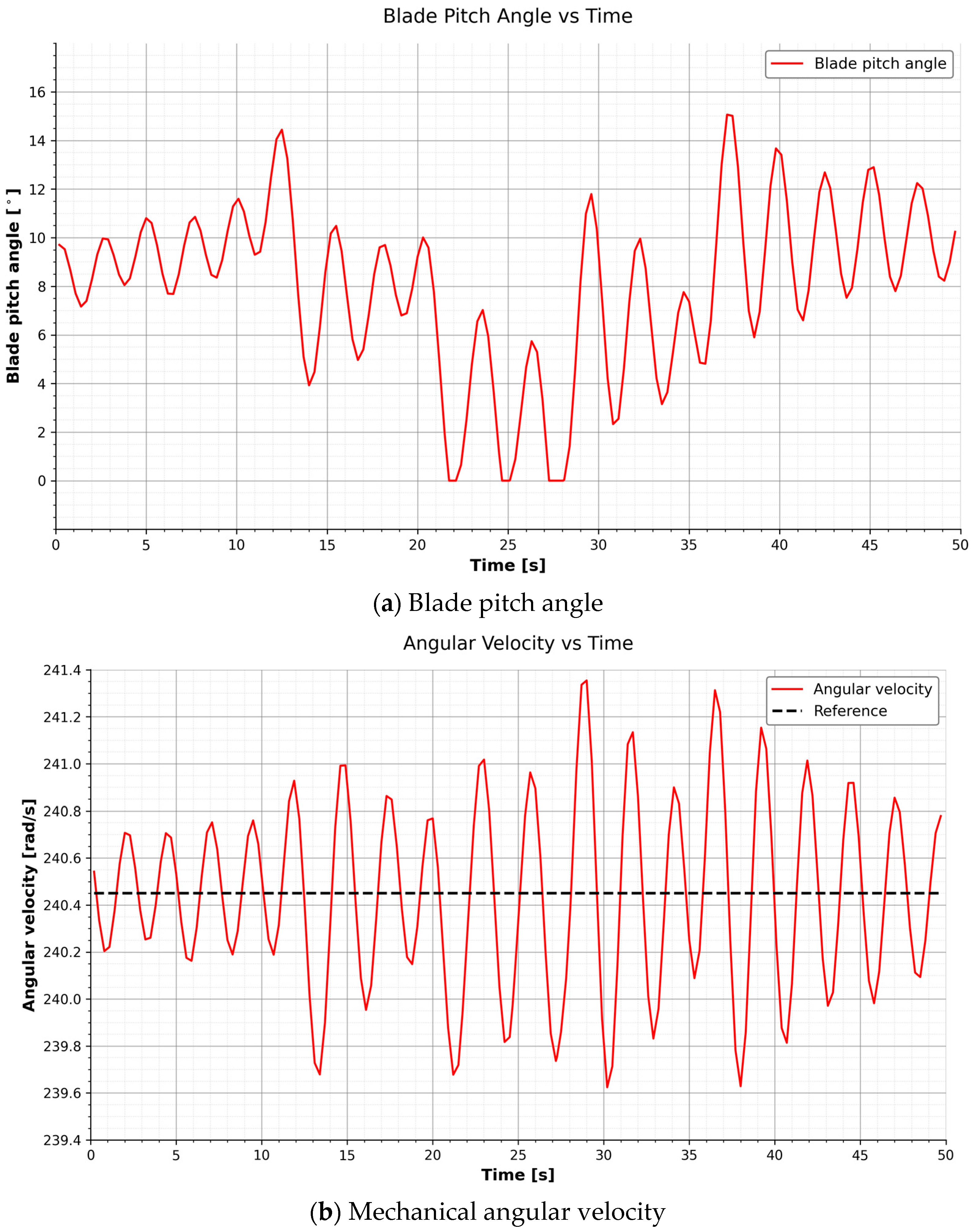
With the PI law retained and a practical actuator added (first-order servo, , ), the regulation performance tightens markedly while high-frequency activity is filtered. The mechanical speed oscillates very tightly about the reference (dashed line). Excursions are small and symmetric—typically within during ±0.03–0.05 rad/s and not exceeding about the strongest gust packet (≈30–35 s), i.e., of the set-point. The servo adds a modest phase lag, so the largest peaks are clustered where the turbulence changes most abruptly, but there is no low-frequency bias.
The turbine power now remains closely centered on the constant cap . Most of the time, the ripple is within roughly ±(0.01–0.02) MW (≈±0.5–1%). The steepest gusts produce brief overshoots up to ~ (≈) and dips to ~ (≈), but these are shorter and smaller than in the no-actuator case, showing that the servo and rate limit effectively curb the sharpest transients while preserving mean power tracking.
The blade-pitch angle operates well within its range, moving between about 1° and 12°. Compared to Case B, shows smoother, nearly linear ramps and rounded corners—signatures of the first-order servo and the constraint. During the lull around 28–32 s, the controller drives down toward 1–2° to recover torque; it then ramps back to 10–12° through the following gusts to shed power and avoid overspeed. No hard-stop interaction is observed, indicating adequate authority with the chosen limits.
Overall, Case C demonstrates a practically realizable controller that maintains and exported power tightly around their targets under broadband turbulence while attenuating high-frequency pitch activity—reducing load implications without sacrificing regulation quality.
5. Adaptive PI Control with Online Identification
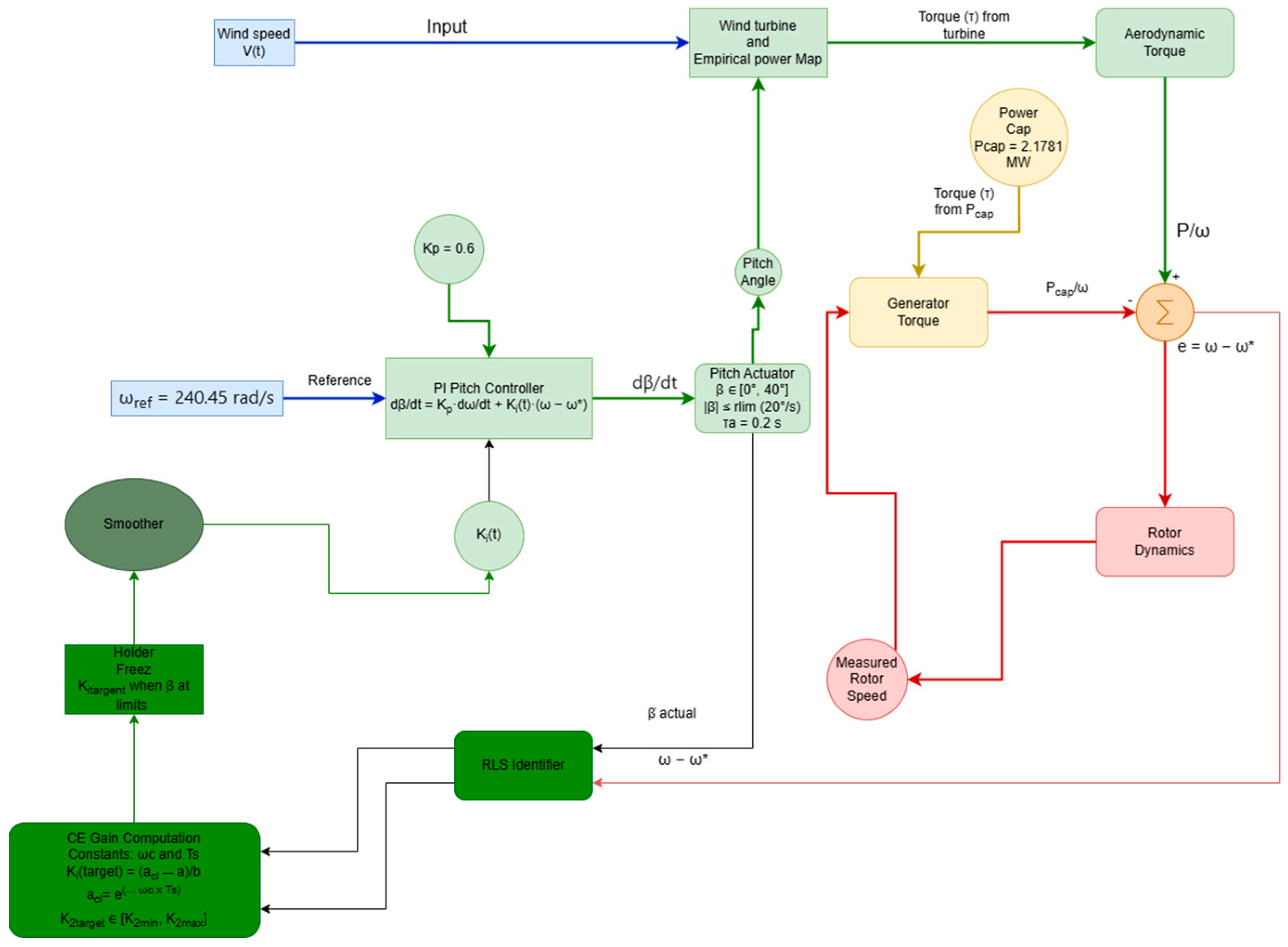
This section introduces an adaptive variant of the Region-3 pitch controller that keeps the fixed acceleration feed-through
but retuns the integral path gain
online so that the closed-loop rotor-speed dynamics track a target bandwidth—block diagram from
Figure 19. The complete logic, including saturation flags and safety bounds, is summarized in Algorithm A1 (see
Appendix A.3). The approach is intentionally simple—certainty-equivalence with scalar RLS identification and saturation-aware updates—so it remains practical under broadband turbulent inflow and actuator limits. The mechanical and aerodynamic parts are unchanged from
Section 4.
5.1. Online Identification Model
The adaptive loop treats the local speed error and applied pitch-rate as a discrete-time ARX(1,1) relation sampled at
:
The parameters
are estimated by RLS with forgetting
:
Initialization uses (here 104) and . Sampling is modest () so the identifier is well separated from the fast servo dynamics.
For the identified pair , the certainty-equivalence design chooses so that the closed-loop discrete eigenvalue is the desired .
With
the target bandwidth (here
), under the ARX model, the linearized closed-loop update is approximately
giving the ideal adaptive gain:
To avoid division by near-zero
, the implementation enforces a small dead zone, and then clips to
(here [0, 200]). The commanded gain is then first-order smoothed:
with
to prevent chatter and to respect actuator-loop time scales.
During hard angle limits or active rate limiting , the regressor is no longer the controller’s true command, and the ARX model is biased. RLS continues to update (still useful for a), but the control law is not re-tuned until the loop re-enters the linear regime.
The fixed feed-through
supplies phase lead/damping against fast turbulence and is intentionally kept constant (no adaptation) to keep the identification scalar and robust. The adaptive
provides quasi-static authority: it eliminates slow bias in
and, via the Region-3 energy balance, centers the exported power around
despite wind drift. Results can be seen in
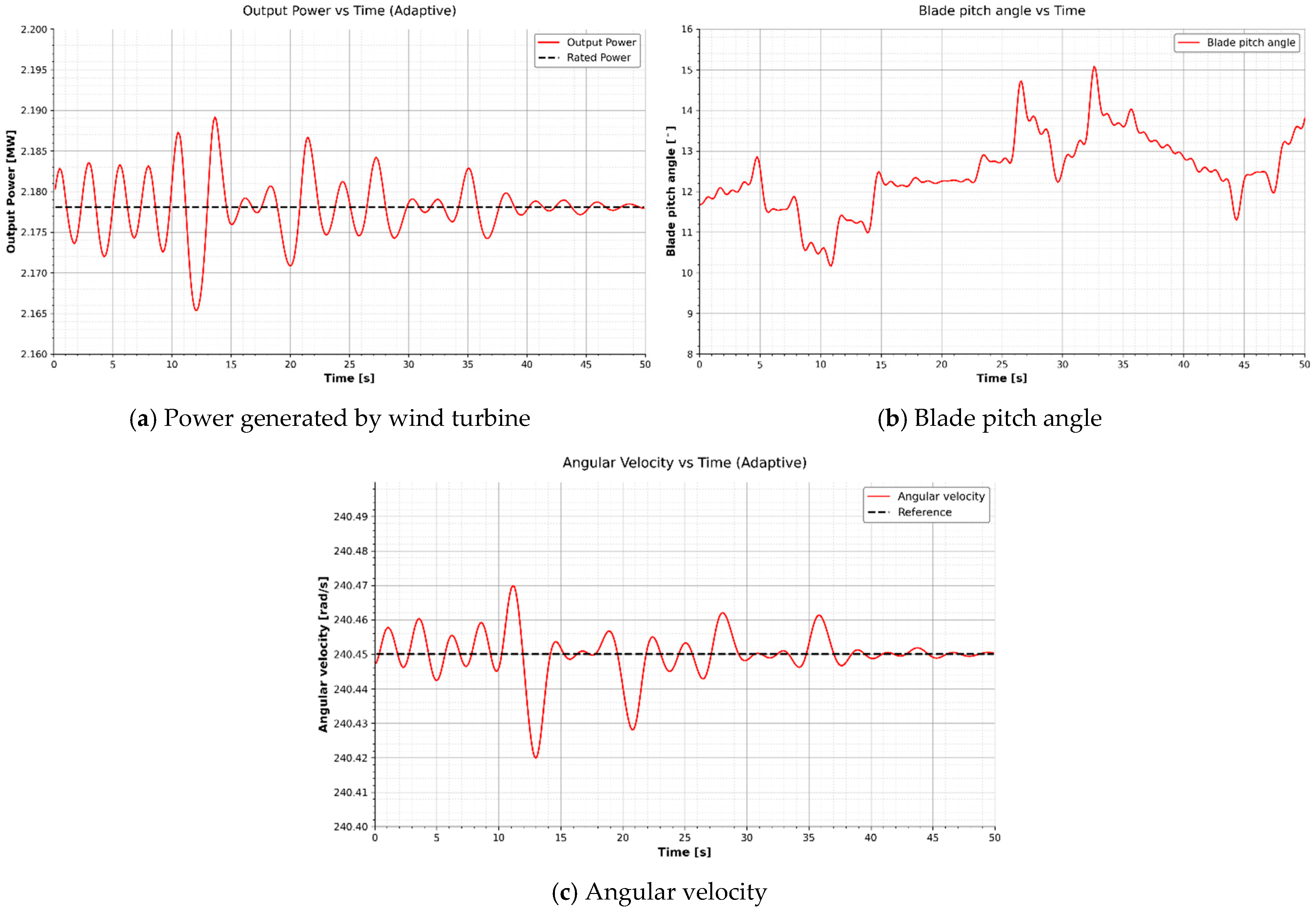
Figure 20.
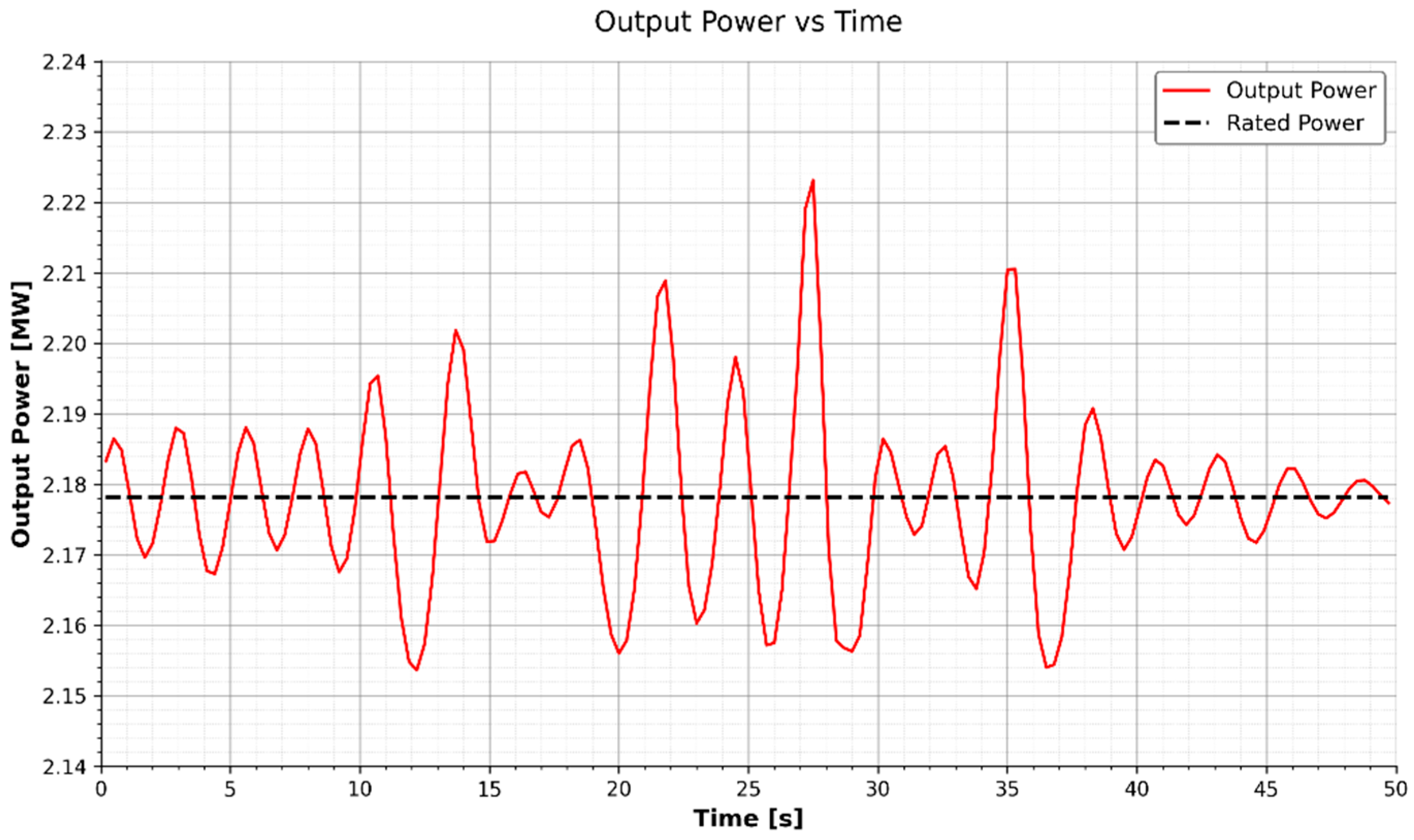
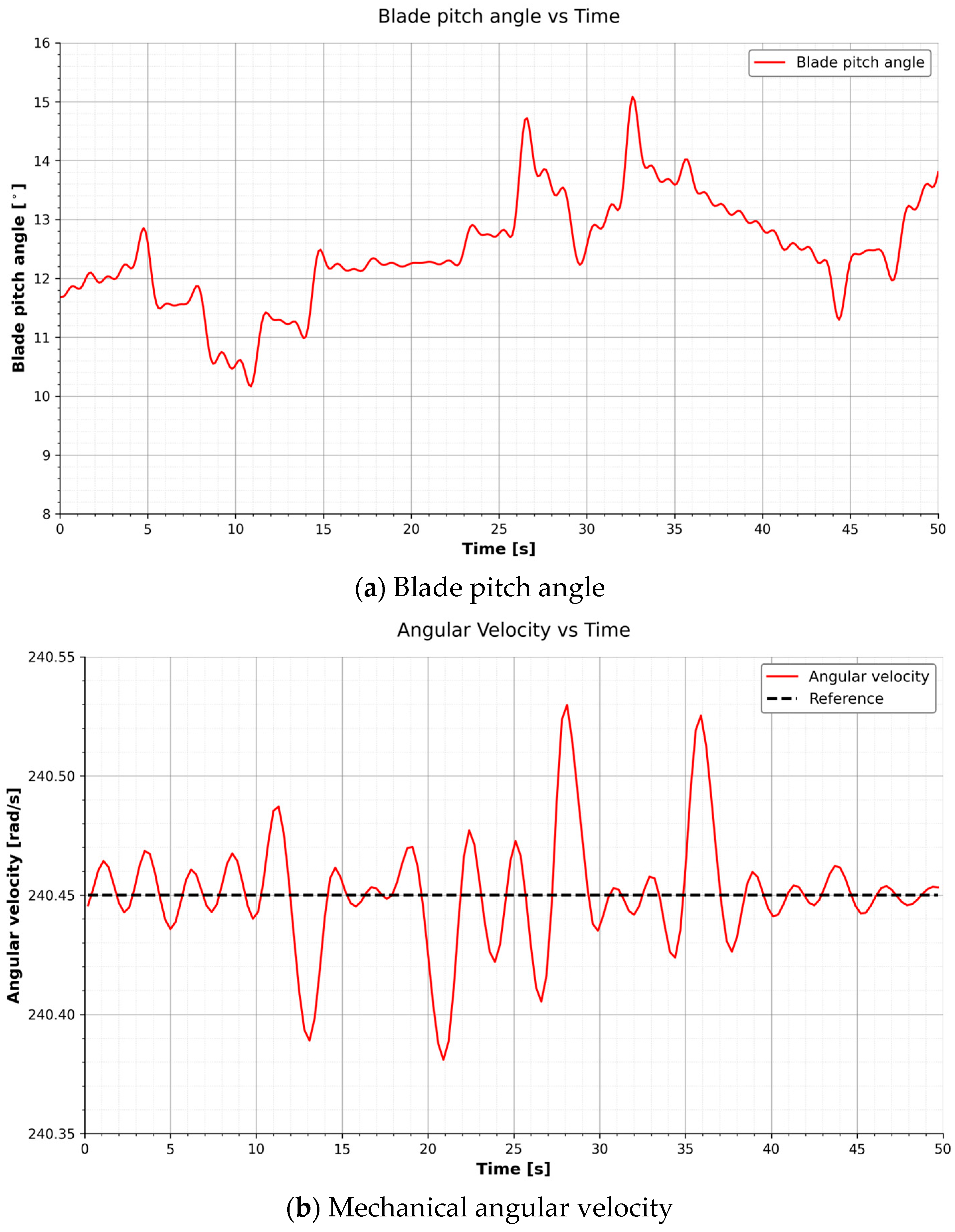
Using the adaptive controller (RLS ID at Ts = 50 ms, , certainty-equivalence retuning of toward with , smoothing s, and a first-order pitch servo with s and ), the loop settles rapidly and then holds the rotor close to its targets with small, symmetric excursions.
The speed trajectory stays tightly centered on the reference (dashed line). After a short adaptation transient around t ≈ 10–13 s—visible as a single undershoot/overshoot pair—the oscillations collapse to a narrow band. Peak deviations during the transient are (≈ of set-point), and beyond s, the ripple is only ±(4–6) × 10−3 rad/s (≈). This behavior is consistent with K2, moving smoothly toward its operating-point value and locking the discrete pole near .
Exported power remains closely clustered about . The largest excursions occur during the same brief transient (to roughly 2.165–2.189 MW, i.e., about /). Thereafter, the ripple tightens to ≈– (≈), with no low-frequency bias—evidence that the adaptive integral action is continuously re-biased to maintain the constant-power objective under turbulence.
The commanded/actual pitch remains well within the operating range (≈1° to 12.5°). The profile shows smooth ramps and rounded corners typical of the first-order servo; there is no sign of hard-stop interaction and no sustained rate saturation, so adaptation proceeds without being frozen for most of the run. During lulls (≈25–32 s), the controller drives
toward small angles to recover torque; during gust packets, it increases
to shed power and avoid overspeed, with visibly milder high-frequency activity than in fixed-gain PI. The simulation environment and reproducibility protocol are described in
Appendix A.2.
Stability and Robustness Considerations
While a formal Lyapunov stability proof is beyond the scope of this application-focused study, the stability of the adaptive loop is enforced through robust implementation constraints consistent with standard Certainty Equivalence theory:
Parameter Boundedness: The computed gain K2 is projected onto a pre-defined stable set preventing high-gain instability even if the estimator transiently drifts.
Saturation Interlock: To prevent parameter divergence during actuator saturation (a common source of instability in adaptive control), the RLS update is frozen whenever .
Timescale Separation: The identification sample time (Ts = 0.05 s) and smoothing filter (Tadapt = 0.5 s) ensure that the adaptation dynamics are slower than the pitch servo dynamics (τ = 0.2 s), preserving the validity of the quasi-static assumption.
5.2. Performance Results
To quantify regulation performance, we compute the peak and root-mean-square (RMS) deviations of the rotor speed and output power. These metrics are calculated over the entire simulation window t ∈ [0, 50] s to capture both steady-state behavior and the controller’s response to initial transients. The metrics are defined as
;
RMS values are computed as ;
Percentage values are normalized against the nominal targets ().
Table 4 reports steady-state deviations of mechanical speed and power with respect to the targets
and
. For each scenario/controller, we list the peak absolute error
and RMS of
, and the corresponding power quantities.
It is important to note that the 50 s simulation window serves as a short-horizon demonstration of the controller’s dynamic adaptation capabilities. While sufficient to observe the transient settling and immediate regulation improvement, a full statistical validation of fatigue loads and long-term robustness would require significantly longer durations (e.g., 10 min records per IEC standards) and multiple turbulence seeds. Consequently, the results below should be interpreted as a proof-of-concept for the adaptive mechanism’s stability.
Quantitative Analysis of Improvements: Comparing the Adaptive PI to the fixed-gain PI + Servo baseline under turbulent conditions:
Speed Tracking: The adaptive controller reduces the RMS speed error from 0.0087% to 0.00581%, representing a 33% reduction in variability.
Power Quality: The RMS power error drops from 0.616% to 0.165%, a 73% improvement in power regulation tightness.
These metrics confirm that the adaptive retuning of the integral gain $K_2$ yields a measurable, significant improvement in regulation authority.
Across both scenarios, the hierarchy is consistent: P-only < PI < PI + Servo < Adaptive PI in terms of tracking tightness, cap compliance, and smoothness. Practically, PI delivers the dominant improvement by eliminating steady bias; adding a realistic pitch servo is strongly recommended for turbulent operation; and the adaptive integral path preserves PI + servo performance while automatically canceling quasi-static bias due to condition drift.
6. Discussion
Our working hypothesis was that, in Region 3, a constant-speed, pitch-only loop with sufficient integral action would enforce the power cap while tightly regulating speed, and that an adaptive extension would remove quasi-static bias caused by plant drift. The results support this view and are consistent with the classical understanding that the optimal rotor speed depends on wind speed and blade setting through the
landscape; speed and pitch must therefore be coordinated rather than tuned independently. Prior analyses derive the
locus explicitly and show that maximum-power tracking follows an
–
curve rather than a fixed setpoint [
14]. Our empirical power-surface identification and the resulting MPP condition accord with that theory while motivating a constant-speed, pitch-only policy above rated—where capped MPP would otherwise push
upward.
Under sinusoidal inflow (Cases A–C), proportional-only control (Case A) overshoots the speed target and cannot consistently enforce the power ceiling, revealing steady-state bias without integral action. Adding the integral path (Case B) recenters the dynamics near the setpoint and keeps exported power close to the cap; remaining spikes align with rapid wind changes. Incorporating a first-order pitch servo with realistic rate limits (Case C) preserves regulation and filters high-frequency activity in , yielding smoother pitch motion and smaller power spikes.
With Kaimal-turbulent inflow, Case A (P-only) leaves biased above the reference and produces wide power excursions. Case B (PI) removes the low-frequency bias so that speed oscillates symmetrically about and power clusters near the cap. Case C (PI + servo) further attenuates sharp transients; typical ripple is about ±0.03–0.05 rad/s, and power remains centered near with brief ±1–2% excursions at the steepest gusts.
The adaptive controller (
Section 5) keeps the fixed acceleration feed-through
but retunes the integral path
online using an ARX(1,1) error model with RLS (
) at
Ts = 50 ms, certainty-equivalence toward
with
, and clipping/smoothing of
(e.g.,
,
s); retuning pauses during saturation and the first-order pitch servo (
= 0.2 s,
) remains in loop. In turbulence, it settles quickly (~10–13 s), locks
closely to
with small, symmetric excursions, keeps power tightly clustered around
, and maintains
within practical bounds (~1–12°) with rounded profiles. This mirrors the robustness of Case C while automatically removing quasi-static bias (e.g., air-density or erosion effects).
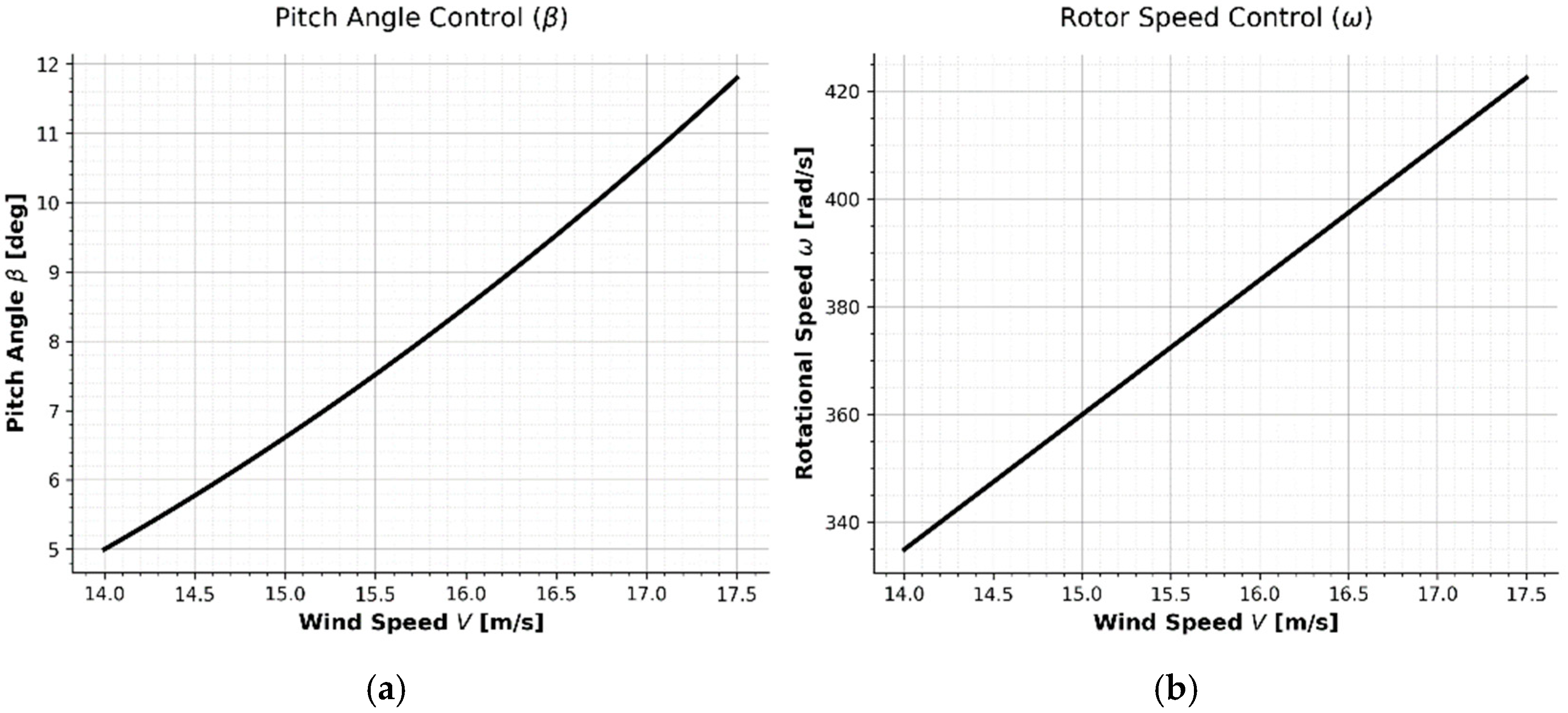
These outcomes match the broader Region-2/Region-3 picture: below rated, speed coordination boosts energy capture; above rated, the pitch loop dominates speed/power regulation along a constant-power manifold [
24]. The observed hierarchy (P < PI < PI + servo ≈ adaptive) agrees with performance/dominance indices that attribute Region-3 constancy mainly to pitch authority when integral action is well tuned [
24]. At the same time, controls literature warns that wind turbine systems can develop oscillatory attractors under severe grid-impedance variation or actuator constraints; conventional limiters may not prevent these regimes. Our results—where integral action removes P-only overshoot/bias and the adaptive integral path re-biases itself under turbulence—are in line with those stability insights and emphasize saturation-aware integral design in Region 3 [
21]. Beyond power regulation, the explicit
schedule for constant-speed operation helps keep
in an optimal band while respecting structural margins, echoing design-tool and lab-scale evidence (e.g., BEM/QBlade-based optimization) that coupling aerodynamics with pitch scheduling keeps operation on favorable
ridges without violating constraints [
17,
29]. Although our study employs collective pitch, the same PI/adaptive backbone extends naturally to IPC, which is often advocated to mitigate periodic loads from wind shear and tower shadow; related adaptive/sliding-mode IPC implementations have reported additional benefits on floating platforms [
26].
A key advantage of the proposed adaptive framework is its resilience to errors in the identified power surface P
WT. Meanwhile, the surface is identified via OLS, which filters zero-mean measurement noise from the training data operational sensor bias, or drift could theoretically offset the operating point. However, the proposed Adaptive PI controller (
Section 5) does not rely on the power surface for steady-state accuracy; it relies on the surface only for the feed-forward linearization estimate. Any mismatch between the identified surface and the actual turbine state (caused by sensor noise or blade erosion) manifests as a speed error
which is immediately corrected by the integral action K
2, ensuring the system remains robust to measurement uncertainties.
Limitations and Future Directions
This study focuses on the speed/power regulation channel using a reduced-order rigid-body rotor model and an empirical shaft-power map. Structural-load channels and aeroelastic modes (tower/blades), drivetrain torsional flexibility, and sensor noise/delay are not included; therefore, load mitigation and robustness to measurement imperfections are not claimed here and are left to future work.
Incorporating status-aware forecasting for preview control, and scheduling periodic model re-identification to track aero/structural drift, are natural next steps toward field deployment [
23,
32,
33,
34].
7. Conclusions
This study addressed Region-3 control of a 2.5 MW three-bladed HAWT by combining a data-driven characterization of turbine power with simple, implementable pitch-control laws. We identified an empirical shaft-power surface , derived the associated MPP condition, and compared two operating philosophies above rated: capped-MPP and constant speed with collective pitch. Closed-loop simulations under both sinusoidal excitation (tuned to the electromechanical time constant) and Kaimal-turbulent inflow confirmed that a constant-speed, pitch-only strategy enforced the power cap and maintained tight speed regulation with modest complexity.
Key findings. (1) Solving the capped-MPP equations shows that the optimal rises markedly with in Region 3, pushing the rotor toward high generator-side speeds that are undesirable for loads and stability; holding and shedding power with avoids those excursions while meeting the grid-side cap. (2) In a closed loop, proportional-only action cannot remove quasi-static bias: it overshoots the speed target and allows noticeable power excursions. Adding integral action recenters the dynamics on the setpoint and clusters power near the cap; introducing a first-order pitch servo further filters high-frequency activity in and reduces sharp transients. (3) The adaptive PI variant—based on a lightweight ARX(1,1) + RLS identification and certainty-equivalence retuning of the integral path—retains the robustness of a fixed-gain PI + servo while automatically removing slow bias due to operating-condition drift (e.g., density or mild aerodynamic changes). Speed remains tightly around , power around the cap, and pitch within practical bounds under turbulence. Finally, while the short-horizon simulations (50 s) successfully demonstrated the adaptive logic’s ability to eliminate bias and regulate transients, future validation steps will extend these tests to standard 10 min windows with multiple stochastic realizations to fully assess long-term fatigue implications.
Contributions
A compact, empirical power map that reproduces the expected trends and yields closed-form operating curves for both capped-MPP and constant-speed policies.
A practical Region-3 controller architecture: PI-in-rate with a first-order pitch servo and saturation handling, together with a clear small-signal tuning recipe tied to the identified slopes.
An adaptive extension that retunes only the integral path online, is saturation-aware, and demonstrates rapid settling and symmetry around the speed/power targets under broadband turbulence.
A deployable schedule for constant-speed operation that respects structural margins and can be embedded in supervisory logic.




 ,
,