
Article

Environmental Regulation and Clean Cooking Energy Use: Evidence from Rural China

College of Economics and Management, South China Agricultural University, Guangzhou 510642, China
*
Author to whom correspondence should be addressed.
Energies 2026, 19(2), 395; https://doi.org/10.3390/en19020395
Submission received: 4 December 2025 / Revised: 9 January 2026 / Accepted: 12 January 2026 / Published: 13 January 2026

Abstract

The promotion of clean cooking energy use (CCEU) in rural areas is a key part of energy transformation. At present, the understanding of the relationship between environmental regulation and household CCEU remains limited. We primarily focus on the “Air Pollution Prevention and Control Action Plan” (APPCAP), which is regarded as China’s strictest command-and-control environmental regulation. This provides us with a quasi-natural experimental setting in evaluating the impact of environmental regulation on rural households’ CCEU. Empirical results indicate that APPCAP has significantly promoted CCEU among rural households in China. The transmission of this effect occurs primarily through three channels, including non-farm employment, health awareness, and peer effects. A heterogeneity analysis reveals that the impact of APPCAP is more pronounced among vulnerable rural groups with lower education levels and lower income. Furthermore, households with smaller family sizes, heavier dependency burdens, and a male eldest child are more responsive to the APPCAP. Further analysis confirms the sustainability of the policy effects. These findings provide evidence for accelerating the energy transition in developing regions.

1. Introduction

Ensuring universal access to affordable, reliable, and sustainable modern energy is one of the United Nations Sustainable Development Goals [1]. Nevertheless, nearly 2.1 billion people worldwide still depend on highly polluting solid fuels for household cooking activities [2]. These populations are mainly distributed in rural areas of Africa and Asia [3,4]. Cooking activities that rely on traditional energy sources pose serious health threats and environmental burdens [5]. Long-term exposure to household air pollution resulting from solid fuel combustion poses a significant health risk [6]. It is associated with adverse pregnancy and delivery outcomes, cardiovascular and lung diseases, and increased mortality among children and adults [7]. It is estimated that this exposure risk causes more than 3 million premature deaths each year [8]. Dependence on solid fuels also has negative impacts on natural ecosystems, thereby contributing to climate change. This mainly results from deforestation and greenhouse gas emissions [9]. Transitioning to clean cooking fuels, such as liquefied petroleum gas (LPG) and electricity, can mitigate these problems [10]. Due to these concerns, the transition of cooking energy in rural households from traditional fuels to clean fuels has been receiving increasing attention.
Promoting clean cooking energy in rural areas faces multiple challenges. Household financial conditions are a major barrier to clean cooking energy use (CCEU) [11]. This challenge mainly stems from the high cost of clean fuels and stoves, particularly for low-income households [12]. Women’s participation in energy decision-making is also essential, as they are often the primary users and beneficiaries. However, cultural barriers frequently restrict their involvement [13]. Community-based awareness campaigns can help shift traditional perceptions and boost household demand for clean cooking solutions [14]. Moreover, in many rural areas, the supply and accessibility of clean energy sources such as LPG and electricity remain limited [15]. The lack of infrastructure makes it challenging for households to adopt cleaner cooking methods [16]. A series of barriers faced by CCEU highlights the necessity of policy intervention. Relying solely on economic growth is insufficient to drive the transition to clean cooking. Addressing these barriers requires a combination of policy support, community engagement, and infrastructure development. This helps create an inclusive environment tailored to local conditions, enabling the achievement of sustainable development goals.
Environmental regulation may offer an effective solution to these obstacles [17]. Our study focuses primarily on China’s “Air Pollution Prevention and Control Action Plan” (APPCAP), which is recognized as the most stringent environmental regulation in the country’s history. It aims to reduce air pollution resulting from energy consumption [18]. To achieve this goal, APPCAP has introduced a series of targeted measures to improve air quality [19]. The cooking and heating methods that rural households have long depended on are among APPCAP’s key areas of concern. Like most developing countries, rural households in China have not yet fully transitioned away from non-clean energy sources, such as firewood and scattered coal [20]. The proportions of households using firewood and scattered coal as their main sources of domestic energy are 44.2% and 23.9%, respectively. In the western and northeastern regions, more than 80% of rural households still rely on non-clean fuels as their primary source of energy [21]. Given its scale, representativeness, and the implementation of the APPCAP, China offers a highly valuable case for studying this issue.
This paper employs the difference-in-differences (DID) method to estimate the impact of the APPCAP on CCEU among rural households in China. Our estimation results validate the positive effect of the APPCAP on CCEU. This finding has passed a series of robustness tests. Subsequently, we primarily conducted mechanism analysis and heterogeneity analysis. The mechanism analysis confirms that non-farm employment, health awareness, and peer effects are effective channels through which the APPCAP promotes CCEU. The results of the heterogeneity analysis reveal the inclusive characteristics of the APPCAP, indicating that its impact is more pronounced among vulnerable rural groups with lower education levels and lower income. We also find that the policy effects vary across household characteristics. This is reflected in the fact that small households, households with a high dependency burden, and households whose first child is male are more sensitive to the APPCAP. In the further analysis, we focus on the long-term effects of the policy. The APPCAP not only promotes the initial adoption of clean cooking energy but also facilitates its sustainable use.
Our study makes three marginal contributions. First, a causal relationship between the APPCAP and the CCEU of rural households in China is empirically established for the first time. This finding fills the research gap concerning the link between environmental regulation and rural energy transition. The verification of the transmission mechanism further enhances understanding of this relationship. Second, the moderating role of household characteristics in shaping rural households’ responses to the implementation of the APPCAP in China is delineated. This provides a foundation for designing more effective interventions that take into account household backgrounds. Third, the long-term effects of environmental regulation are confirmed. In addition to promoting the CCEU among rural households in China, the APPCAP also encourages its continued use. This finding is essential for evaluating the long-term cost-effectiveness of environmental policies.
The remainder of this paper is organized as follows. Section 2 provides an introduction to APPCAP and presents several research hypotheses. Section 3 describes the empirical model along with all variables used in the analysis. Section 4 presents the empirical findings, with emphasis on the baseline regression and several essential robustness checks. Section 5 offers further analyses, including mechanism and heterogeneity analyses, and examines the relationship between APPCAP and the sustainability of CCEU. Finally, Section 6 summarizes the key results, proposes a series of targeted policy recommendations, and outlines possible directions for future research.

2. Policy Background and Research Hypotheses

2.1. Policy Background

In 2013, China experienced its most severe haze episode to date [22], which extended across 25 provinces and over 100 large and medium-sized cities [23]. This event significantly accelerated the country’s efforts to control haze pollution [24]. On September 10 of the same year, the State Council of the People’s Republic of China issued the “Notice on the Issuance of the Air Pollution Prevention and Control Action Plan” [25], designating the Beijing-Tianjin-Hebei region, the Yangtze River Delta, and the Pearl River Delta as key priority areas [26]. The APPCAP aimed for an overall improvement in national air quality by reducing severe pollution episodes within five years. Its long-term goal was to eliminate severe pollution [27]. To accomplish this, APPCAP established specific targets: relative to 2012, urban inhalable particulate matter was to be reduced by more than 10% by 2017, while key regions faced a target reduction of over 15% [18]. To meet these objectives, the APPCAP outlined 35 specific measures across 10 major sectors, summarized into five categories, and presented in Table 1.
Compared with China’s previous environmental governance policies, the APPCAP possesses distinct characteristics. It established a mechanism for decomposing targets from the central government to all levels of local government. Meanwhile, the effectiveness of environmental improvements has been incorporated into the appraisal system for local officials. As a result, economic growth is no longer the sole criterion for evaluating officials [28]. The APPCAP also demonstrates a pronounced goal-oriented nature. Rather than maintaining the earlier focus on controlling the total volume of pollutant emissions, it set specific pollutant reduction ratios for different regions. Through this results-oriented approach, the effective implementation of governance tasks at various stages was driven and reinforced [27]. In the comprehensive management of atmospheric pollution from industrial enterprises, the prevention and control of pollution caused by area sources and mobile sources have also been addressed by APPCAP [29]. Of particular concern is the direct focus of APPCAP on the highly polluting heating and cooking practices in rural areas.
The combustion of scattered coal has been identified as a major source of wintertime pollutants in rural China [30]. To improve air quality, the APPCAP prioritized the replacement of rural scattered coal. Large-scale “coal-to-electricity” and “coal-to-gas” projects were implemented in rural areas of key regions [31,32]. In the case of the “coal-to-electricity” project, supporting measures for power grid expansion were introduced, which improved the capacity of rural power supply systems and enabled the use of electric cooking appliances. For the “coal-to-gas” initiative, gas pipeline networks were extended, and the LPG supply system was upgraded. In areas where conditions permitted, pipeline natural gas was introduced, whereas in regions lacking pipeline infrastructure, LPG distribution centers were established. These infrastructure enhancements were a key prerequisite of CCEU [12,33]. Moreover, the APPCAP implemented education campaigns, which improved rural residents’ understanding of the benefits of clean cooking [34].

2.2. Research Hypotheses

By designating key areas and strengthening enforcement, APPCAP has significantly increased the cost of using traditional fuels [26]. To meet assessment requirements, the pressure of pollution control has been transmitted from higher administrative levels to the grassroots [28]. Consequently, rural households have shifted toward clean energy to mitigate policy-related risks. In parallel, the subsidies have lowered the costs of clean energy use, easing the budget constraints of low-income households [35]. Moreover, APPCAP has reshaped farmers’ perceptions of energy consumption through village-level publicity initiatives and demonstration projects. By harnessing neighborhood effects, traditional energy-use habits have been gradually dismantled, fostering the social legitimacy of green lifestyles [14]. Crucially, policy-driven investments in energy infrastructure have effectively removed accessibility barriers. In addition, sustained and effective implementation has reinforced the institutional framework for green development, strengthened rural households’ confidence in policy stability, and thereby encouraged long-term investment.
Hypothesis 1.
APPCAP promotes the CCEU among rural households.
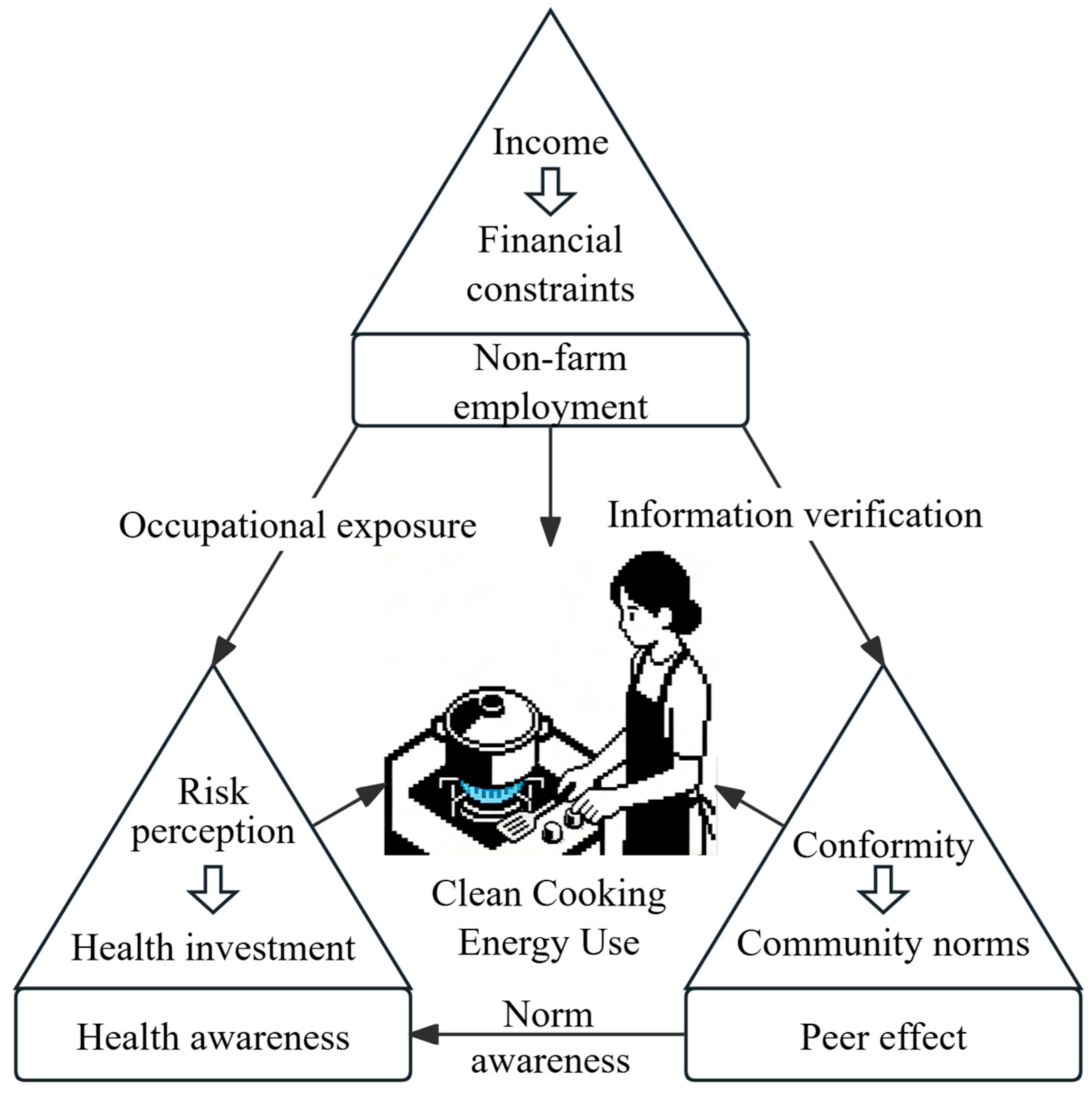
APPCAP has undermined a significant part of the traditional smallholder economy’s livelihood foundation. Highly polluting household workshops were forcibly closed, compelling rural laborers to seek alternative sources of income. The green industries accompanying the promotion of clean energy have generated new employment opportunities [36]. Rising environmental compliance costs have squeezed agricultural profits, prompting farmers to make a rational choice to increase their income through off-farm work. As a result, a regulation-driven push toward non-farm employment has emerged, facilitating the transfer of rural labor [37]. The resulting non-farm wage income has significantly enhanced households’ purchasing power, easing the financial constraints on acquiring clean energy equipment. Meanwhile, the longer commuting time of non-farm workers has reduced their willingness to engage in traditional fuel collection. Occupational exposure heightens awareness of health risks [38], motivating the active phase-out of solid fuels. The income earned by young migrant workers undermines the traditional decision-making authority of the elderly who remain in rural areas. Their return and demonstration effect further accelerate the transition toward clean energy use [39].
Hypothesis 2.
APPCAP promotes rural households’ CCEU through non-farm employment.
APPCAP imposes standards and bans as regulatory measures, supplemented by health education that highlights the health risks associated with indoor pollution caused by the use of solid fuels [34]. Under this influence, rural households make previously implicit health costs explicit and internalize them as a key factor in their energy decisions. Such policy interventions not only reshape the economic cost structure of energy use but also significantly heighten risk perception among groups with greater health vulnerability [40]. Once households fully recognize that traditional cooking practices pose a tangible health threat, they are more likely to view clean energy equipment as a necessary investment in their family’s health capital. This motivational transformation shifts energy decision-making from purely economic rationality to a dual framework that combines economic considerations with health risk avoidance. When family members are more vulnerable to health risks, the motivation to avoid such risks is more directly and strongly converted into actual demand for clean energy [41].
Hypothesis 3.
APPCAP promotes CCEU among rural households by enhancing health awareness.
In the early stage of APPCAP implementation, some households were inclined to be the first to adopt clean energy. These were usually families that were highly responsive to policies or possessed abundant social resources. The observable behaviors of these adopters, along with their positive outcomes, generated a strong demonstration effect among neighbors [42]. Such informal experiences became an important source of social learning for other farmers. Successful cases of CCEU effectively reduced the perceived uncertainty of surrounding households about new technologies [43]. At the same time, APPCAP was accompanied by community campaigns and public disclosure of behaviors. By linking CCEU with the village’s collective environmental goals, it reshaped community norms. Once clean energy reached a certain level of adoption within a local group, collective pressure began to emerge. This pressure compels non-adopting households to conform in order to avoid the loss of social capital [44]. Imitation and comparison among neighbors accelerate the diffusion of clean energy within the village, enabling the policy’s influence to extend beyond administrative boundaries.
Hypothesis 4.
APPCAP promotes rural households’ CCEU through peer effects.
At this point, we have theoretically demonstrated the positive impact of APPCAP on the CCEU of rural Chinese households. A series of related research hypotheses has also been proposed. Considering that this impact is indirectly transmitted through non-farm employment, health awareness, and peer effects, it is illustrated in Figure 1 for clarity.

3. Methods and Variables

3.1. DID Model

We use the DID model to examine the impact of APPCAP on the CCEU of rural households in China. The specific setup is as follows:
C C E U i t = α + β A P P C A P i t + γ C o n t r o l i t + θ i + μ t + ε i t
where i denotes rural households, and t denotes years. C C E U i t is the dependent variable, representing the CCEU status of rural household i in year t . A P P C A P i t is the independent variable, indicating whether rural household i in year t is affected by APPCAP. The estimated coefficient β represents the net effect brought by the implementation of APPCAP. C o n t r o l i t denotes the control variables. θ i and μ t represent household fixed effects and year fixed effects, respectively. ε i t is the random disturbance term.

3.2. Data Source

All data used in this study come from the China Family Panel Studies (CFPS), which is administered by the Institute of Social Science Survey (ISSS) at Peking University. Since 2000, the CFPS has conducted biennial surveys that continuously track and collect data at the individual, household, and community levels in China. It provides a comprehensive overview of changes in China across various sectors, including the economy, education, and health. To examine the impact of APPCAP on rural households’ CCEU, we focus on the individual and household data collected by the CFPS. These data provide detailed information on respondents’ personal characteristics, household attributes, and cooking energy use. The sample period covers seven waves of data from 2010 to 2022. We excluded urban households, outliers, and observations with missing values. Ultimately, we constructed an unbalanced panel dataset comprising 35,017 household observations.

3.3. Variable Descriptions

The dependent variable in this study is CCEU. The relevant question is drawn from the household economic questionnaire of the CFPS. This variable is defined based on respondents’ answers to the question, “What is the main type of fuel your household uses for cooking?” Although using sustainably sourced wood or agricultural residues in certain contexts—such as forest fire prevention or in remote areas lacking energy infrastructure—may help reduce pollution emissions, we primarily follow the conventional classification used in the literature on household energy transitions in developing countries [45]. In this framework, electricity, natural gas, coal gas, LPG, and solar energy are classified as clean cooking fuels, while firewood and coal are categorized as non-clean cooking fuels. If a respondent primarily uses clean cooking fuels, the variable is assigned a value of 1; if non-clean cooking fuels are used, the value is 0.
The independent variable in this study is APPCAP, which indicates whether the province where the rural household i is located and has implemented the policy in year t . We take 2013, the year when the APPCAP was officially implemented, as the time point of the policy shock. Following the designation of key regions, Beijing, Tianjin, Hebei, Shanghai, Zhejiang, Jiangsu, Anhui, and Guangdong are classified as the treatment group [46]. The remaining 22 provinces in the sample serve as the control group.
To mitigate potential bias from omitted variables, we include several control variables reflecting both household head and household characteristics. The individual characteristics of the household head, including gender, age, education level, health status, and marital status [45], help control for the influence of personal factors on household energy choices. Household characteristics include household size, per capita net household income, and the household dependency ratio. These household characteristics may significantly influence their energy use [47]. Definitions and descriptive statistics for all variables are presented in Table 2.

4. Results

4.1. Baseline Regression

Table 3 presents the baseline regression results derived from Equation (1). We estimate the results by sequentially adding control variables. Column (1) includes no control variables and contains only the independent variable, APPCAP. Column (2) adds controls for the household head’s individual characteristics, while Column (3) further includes household-level characteristics. The results show that the estimated coefficients of APPCAP are all positively significant at the 1% level. This indicates that the implementation of APPCAP has a significant positive effect on the CCEU of rural households in China. Specifically, compared with non-pilot provinces, the implementation of APPCAP increases the probability of rural households’ CCEU in pilot provinces by an average of 4.5 percentage points. These findings are broadly consistent with those of Shen et al. [17], suggesting that environmental regulation promotes a shift in farmers’ energy consumption. The above baseline regression results offer preliminary empirical evidence in support of Research Hypothesis 1.

4.2. Parallel Trend Test

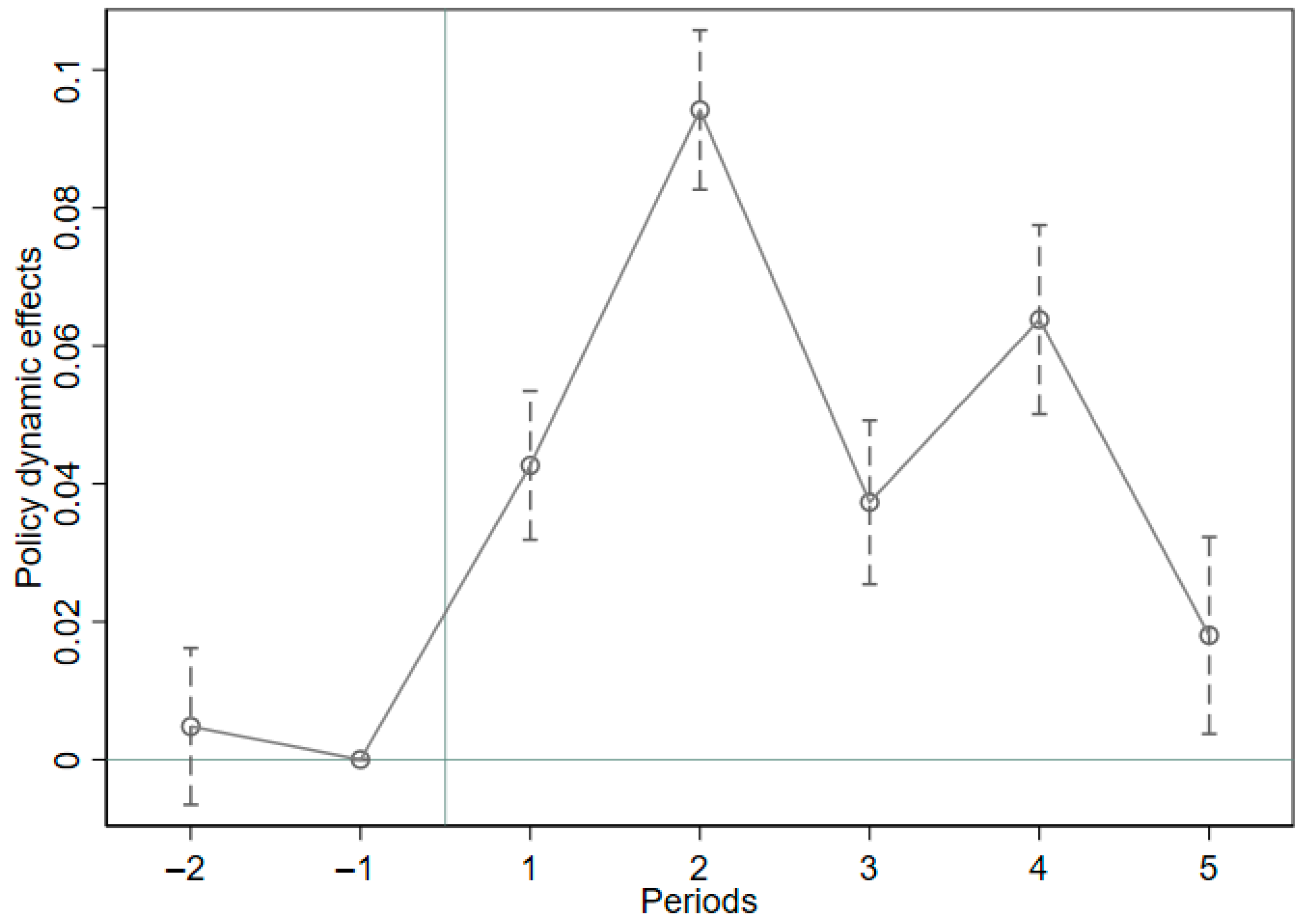
The validity of the DID method hinges on the fulfillment of the parallel trends assumption. Specifically, before the policy implementation, the CCEU of pilot and non-pilot provinces under the APPCAP should exhibit the same time trend. We employ an event study method to test this assumption [48]. To this end, we extend Equation (1):
C C E U i t = α + k = 2 5 β k A P P C A P i t k + γ C o n t r o l i t + θ i + μ t + ε i t
where k denotes the number of sample periods relative to the year of policy implementation. A P P C A P i t k represents the dynamic term of the policy dummy variable, while the remaining variables are consistent with the baseline model. Our primary focus is on the estimated coefficient β k , which captures the dynamic evolution of the policy effect. The key evidence supporting the parallel trends assumption is that, prior to the policy implementation, the coefficient β k should not be statistically different from zero.
Figure 2 reports the estimated values of β k along with their confidence intervals. Before the policy implementation, the estimated values of β k are not significantly different from zero. This suggests that prior to the implementation of APPCAP, there were no systematic differences in the CCEU of rural households between pilot and non-pilot provinces. These findings support the validity of the parallel trend assumption. After the implementation of APPCAP, all estimated β k values were significantly positive. Although the policy effects fluctuated, overall, APPCAP had a sustained and significant positive impact on the CCEU of rural households.

4.3. Robustness Tests

4.3.1. Placebo Test

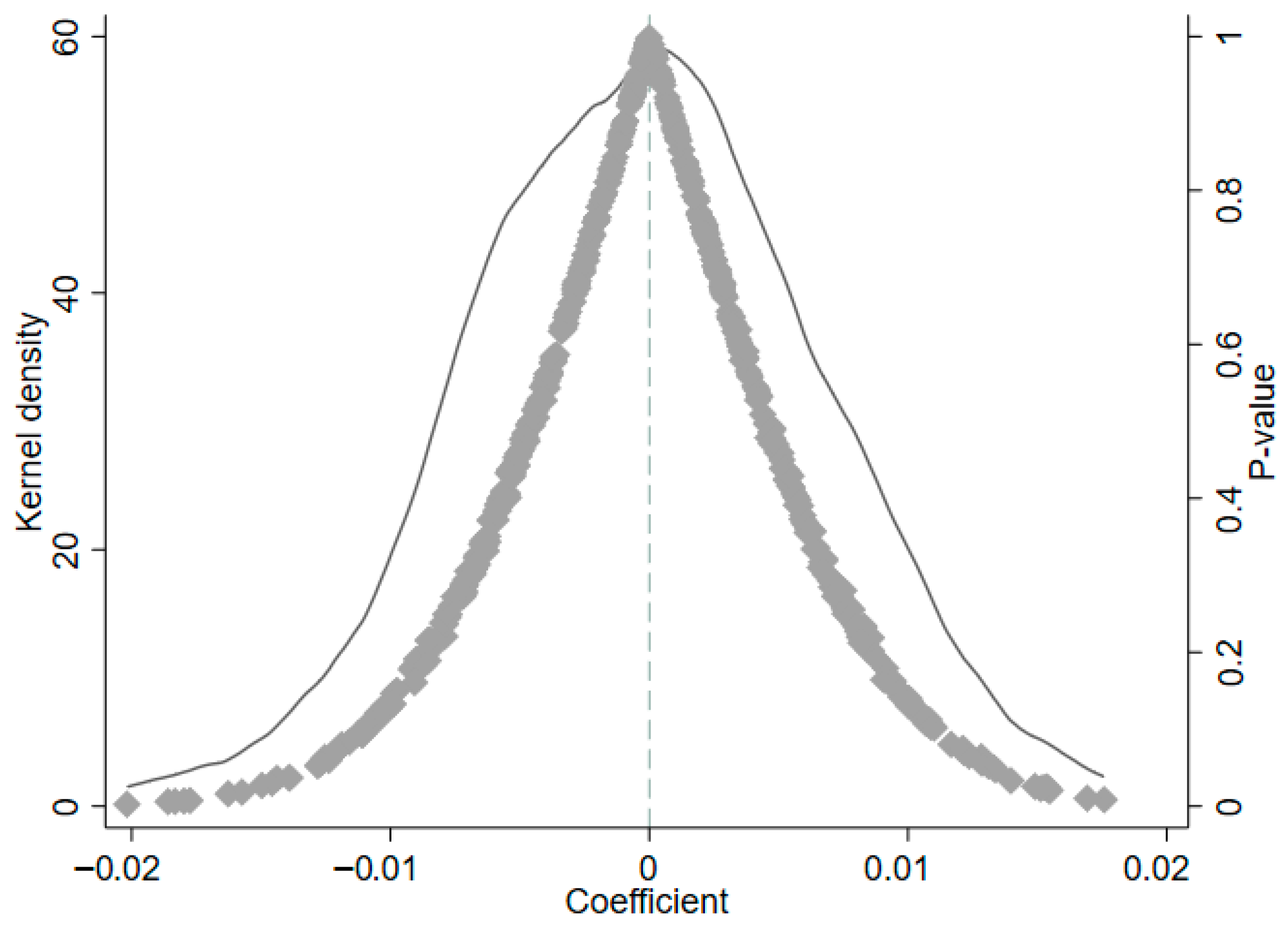
If omitted variables affecting both APPCAP implementation and CCEU exist, baseline regression estimates would be biased. To address this, we performed a placebo test [49]. We randomly assigned provinces to a fake treatment group and set a random policy implementation date during the sample period. Using these pseudo-treatment variables, we re-estimated the results with Equation (1). Figure 3 shows the distribution of the pseudo-policy coefficient β from 500 repeated regressions. This distribution is roughly normal and centered at zero, indicating that the mean pseudo-treatment effect is close to zero. Notably, the true policy effect from the baseline regression lies well outside this distribution. Thus, the placebo test suggests that APPCAP’s positive effect on rural households’ CCEU is not due to unobserved omitted variables, confirming the robustness of the baseline estimates.

4.3.2. Alternative Regression Models

The linearity assumed by the baseline regression model can produce predicted probabilities outside the [0, 1] range. Its underlying assumption of constant marginal effects may also contradict reality. In contrast, Logit and Probit models, as standard binary choice frameworks, are theoretically better suited to the dependent variable CCEU [45]. To evaluate how model specification influences empirical results, we re-estimate the model using nonlinear probability methods. Columns (1) and (2) of Table 4 present the Logit and Probit estimates, respectively. The findings show that the APPCAP coefficients are significantly positive at the 1% level in both models. The direction and significance of the effect mirror those of the baseline model. This supports that the baseline regression’s core conclusion is not dependent on a specific specification, further confirming its robustness.

4.3.3. Controlling for Interaction Fixed Effects

In the baseline regression, we controlled for household fixed effects and year fixed effects to capture household heterogeneity that does not vary over time as well as common time trends. However, the intensity and timing of APPCAP implementation may differ across regions, and the inherent socioeconomic characteristics of different villages may also influence CCEU. To more rigorously account for these potential village-level confounding factors [50], we introduced village-year interaction fixed effects. The regression results are reported in column (3) of Table 4, showing that the estimated coefficient of APPCAP is 0.033 and remains positively significant at the 5% level. It should be noted that the reduction occurs because the inclusion of village-year interaction fixed effects requires a balanced panel at the village-year level. This leads to the exclusion of villages with missing observations in certain years from the sample. Overall, after including more stringent fixed effects, both the coefficient and significance level of APPCAP remained largely unchanged, further confirming the reliability of the baseline regression results.

4.3.4. Sample Adjustments

To address potential interference from specific samples, we conducted a sensitivity analysis of sample interference. First, we excluded samples from municipalities directly under the Central Government (MDUGG), such as Beijing, Tianjin, and Shanghai, in the APPCAP treat group. These MDUGG often differ from ordinary provinces in resource endowments and policy implementation intensity [51]. To avoid their influence on the average treatment effect, we removed their data. Second, we excluded samples with elderly household heads (EHH) by constructing subsamples that excluded households whose heads were over 60 and 65 years old, respectively. Elderly heads may be less responsive to APPCAP incentives due to established habits or lower willingness to adopt new technologies [52]. Lastly, columns (4)–(6) in Table 4 present regression results after these exclusions. In all regressions with filtered subsamples, the APPCAP coefficients remain positive and significant at the 1% level, with magnitudes similar to those of the baseline estimates. These findings indicate our core conclusions are robust after excluding samples with special characteristics.

4.3.5. Eliminate the Interference of Spillover Effect

The design of the DID method relies on the assumption that the treatment and control provinces are not systematically affected by cross-regional spillover effects. However, policy effects may spread across borders through information networks, labor mobility, or interprovincial market linkages. To address this issue, we conducted a robustness test by excluding provinces adjacent to the treatment areas. The estimation results are presented in column (7) of Table 4. It can be seen that the estimated coefficient of APPCAP is 0.068 and remains positively significant at the 1% level. This indicates that even after largely eliminating potential spillovers through geographic proximity, the policy effect of APPCAP remains robust.

5. Further Analysis

5.1. Mechanism Analysis

The above results verify the positive effect of APPCAP on CCEU. According to the theoretical framework we proposed, its impact is transmitted through a series of potential mechanisms. To verify whether these transmission mechanisms exist, we establish the following model:
M e c h a n i s m i t = α + β A P P C A P i t + γ C o n t r o l i t + θ i + μ t + ε i t
where M e c h a n i s m i t represents the mechanism variable to be inspected, which in this paper, respectively, refers to non-farm employment ( N o n F a r m _ E m p l o y m e n t i t ), health awareness ( H e a l t h _ A w a r e n e s s i t ), and peer effects ( P e e r _ E f f e c t i t ). The remaining variables are defined consistently with the baseline model.

5.1.1. Non-Farm Employment

With the gradual relaxation of rural mobility restrictions in China, non-farm employment among rural residents has become more common [53]. Such employment directly raises household income, allowing families to afford equipment and fuel for CCEU [54]. Collecting traditional biomass energy is time-consuming, and non-farm employment reduces available household labor, increasing the opportunity cost of acquiring traditional biomass energy. Combined with higher income and greater labor opportunity costs, non-farm employment is expected to promote CCEU among rural households. To test this mechanism, we use the household head’s non-farm employment status as the dependent variable in our estimation. Column (1) of Table 5 reports the impact of APPCAP on household heads’ participation in non-farm employment. The results show that APPCAP significantly increased the likelihood of farmers in pilot areas engaging in non-farm work. This suggests that APPCAP promoted non-farm employment in these regions, thereby facilitating rural households’ CCEU and confirming Hypothesis 2.

5.1.2. Health Awareness

The use of traditional solid fuels by rural households causes severe indoor air pollution and health issues [5]. Greater health awareness enables them to clearly recognize this major risk factor, strengthening their motivation to seek alternative energy sources [55,56]. Improved health awareness also helps farmers realize the direct benefits of CCEU. Recognizing these benefits reinforces their motivation to adopt clean cooking energy [40]. To test if APPCAP affects CCEU via health awareness, we use model (3). The dependent variable is health awareness, measured by the household head’s smoking status. Column (2) of Table 5 shows the effect of APPCAP on health awareness. The results show APPCAP reduced the likelihood of respondents smoking by 6 percentage points. This suggests APPCAP has a positive and significant impact on farmers’ health awareness. Shen et al. [17] also support this conclusion. Health education under APPCAP has improved farmers’ health awareness and encouraged their CCEU. These results align with our research Hypothesis 3.

5.1.3. Peer Effect

Within villages, farmers’ CCEU behavior exerts a demonstration effect [42], helping to reduce the perceived risks of potential adopters. Such observable examples also provide farmers with credible experiential references, thereby enhancing their willingness to imitate [57]. Moreover, villagers naturally tend to compare themselves with their reference groups. When they see households with similar socioeconomic conditions using clean energy, it readily triggers a motivation to avoid falling behind. This sense of relative deprivation arising from comparison drives households to shift toward cleaner energy sources [44]. To test this mechanism, we use the modal type of cooking energy used within the village as the dependent variable in the regression analysis. Column (3) of Table 5 reports the effect of APPCAP on peer effects. The results show that the estimated coefficient of APPCAP is significantly positive at the 1% level, indicating that APPCAP strengthens peer effects at the village level. These findings suggest that APPCAP effectively promotes rural households’ CCEU through peer effects, thereby confirming Hypothesis 4.

5.2. Heterogeneity Analysis

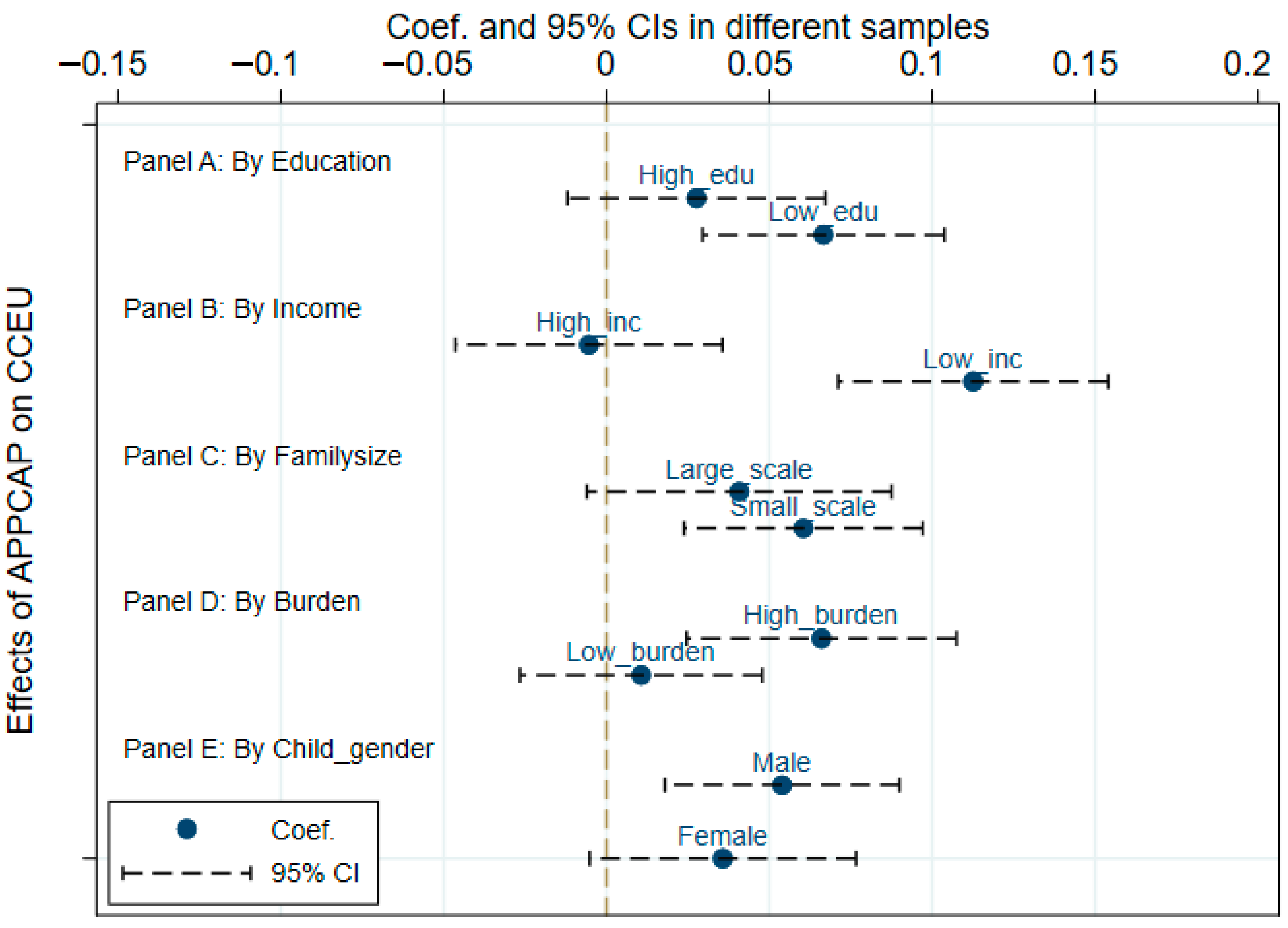
The baseline regression shows APPCAP increased rural households’ adoption of clean cooking energy by 4.5 percentage points on average. Since this effect may differ by group, we divided the sample by median education, income, household size, and dependency burden (each into high and low). We also coded the first child’s gender as 1 for male and 0 for female. Figure 4 presents these results.
The results of the heterogeneity analysis show that APPCAP has a stronger effect on CCEU among households with less-educated heads and low incomes. This means APPCAP has reached vulnerable rural groups and greatly changed their energy use [58]. For household structure, the effect is greater in smaller families and those with more people to support. One reason is that small households have less labor available, while collecting traditional fuels takes a lot of time and work. Also, non-farm jobs further reduce spare labor time in these families [54]. As a result, small households use clean energy to save time and spend more time on non-farm work. Although having more dependents brings economic stress, APPCAP subsidies make it easier to switch. Households with many dependents are often more at risk health-wise, so they are willing to pay for the change [56].
We also observe the influence of the first child’s gender. Households whose first child is a boy respond more actively, reflecting the prevailing son preference in China. A similar pattern has been found among urban households in India [59]. Farmers perceive investment in clean energy as a crucial measure to safeguard their children’s health and productivity. When household resources are constrained, this motivation encourages them to make more proactive use of policy support. This reflects that decision-making in rural households centers on long-term survival strategies and cultural norms [60]. Understanding these micro-level mechanisms is essential for designing fair and effective environmental health policies.

5.3. Sustainability of CCEU

During the household energy transition process, sustained use of clean cooking energy is crucial for realizing ecological improvement and protecting farmers’ health. However, due to constraints such as cost, availability, and preferences, clean energy often fails to completely replace traditional sources [61]. The simultaneous use of multiple energy sources within households is common [62], and the relative cost of clean energy may reduce motivation for continued use after initial adoption. Some households even revert to previous energy patterns. To investigate this, we replace the dependent variable in Equation (1) with C C E U _ s u s i t , which is 1 if a household continues to use clean energy after APPCAP implementation, and 0 otherwise. Table 6 presents three model estimation results. Column (1) employs the linear probability model and demonstrates that APPCAP significantly increases the likelihood that rural households will continue using clean cooking energy. Columns (2) and (3) use Logit and Probit models, with consistent direction, significance, and magnitude of the APPCAP coefficient. These findings indicate that, beyond facilitating the initial adoption of clean energy by rural households, APPCAP plays a more significant role in promoting its sustained use.
It should be noted that the R-squared values reported in Table 3,Table 4,Table 5 and Table 6 primarily represent the within R-squared. For linear probability models, these are pseudo R-squared values. The R-squared values range from about 0.02 to 0.30. Panel data models with household fixed effects typically have lower R-squared values than cross-sectional or pooled ordinary least squares models because fixed effects absorb much of the time-invariant variation across households. These R-squared values show the model explains a meaningful share of within-household CCEU variation over time. They do not challenge the estimated policy effects. The effects we report come from changes within households before and after policy implementation.

6. Conclusions

The relationship between environmental regulation and CCEU in China remains poorly understood. The APPCAP is the most stringent command-and-control environmental regulation in China’s history. We use its implementation as a quasi-natural experiment and employ a DID model to estimate its impact on CCEU. The results show that APPCAP has a significant positive impact on CCEU among rural households. Non-farm employment, health awareness, and peer effects are the main transmission mechanisms. The influence of APPCAP is stronger among vulnerable rural groups with less education and lower incomes. Smaller households, those with heavier dependency burdens, and those whose first child is male respond more strongly. In further analysis, we confirm the long-term effects of APPCAP. It not only promotes the adoption of clean cooking energy at first but also helps sustain long-term use.
Our findings have important policy implications. Firstly, to strengthen APPCAP mechanisms, implementation regions should provide vocational training for non-farm employment, deliver regular health education on indoor pollution, and organize visits to demonstration households to showcase the benefits of using clean cooking energy. Secondly, support vulnerable groups by providing higher equipment subsidies to low-income households or introducing rewards tied to standards met. For those with lower education, offer one-stop services to simplify policy application, installation, and maintenance. Thirdly, establish a long-term support system for CCEU. After APPCAP concludes, incorporate rural clean energy transition goals into annual government work plans at all levels of government.
This study has some limitations that need further attention. Due to data constraints, we were unable to obtain micro-level information on energy accessibility and energy infrastructure. As a result, we did not include these factors in the mechanism analysis, which may have left our discussion of APPCAP’s effects incomplete. This limitation also forced us to use only farmers’ smoking status as a health awareness indicator. Field research could resolve this issue by allowing researchers to design targeted questions that better capture respondents’ health awareness in the context of APPCAP. In our heterogeneity analysis, we found that households with a first-born boy responded more strongly to APPCAP. However, due to the research focus and limited space, we did not thoroughly explore the causes of this heterogeneity. Future studies could further examine the link and underlying mechanisms between first-child gender and households’ policy responses.

Author Contributions

Conceptualization, Y.D. and L.Z.; methodology, Y.D.; software, Y.D.; validation, Y.D. and L.Z.; formal analysis, Y.D.; investigation, Y.D.; resources, Y.D. and L.Z.; data curation, Y.D.; writing—original draft preparation, Y.D.; writing—review and editing, L.Z.; visualization, Y.D.; supervision, L.Z.; project administration, L.Z.; funding acquisition, L.Z. All authors have read and agreed to the published version of the manuscript.

Funding

This research was funded by the Project of Humanities and Social Sciences Research Planning Fund of the Ministry of Education (23YJA790101) and Basic Project of Guangdong Finance Society (CKT202412).

Data Availability Statement

All data were obtained from CFPS and are available from the https://cfpsdata.pku.edu.cn/ (accessed on 9 July 2025) with the permission of the ISSS of Peking University.

Conflicts of Interest

The authors declare no conflicts of interest.

Abbreviations

The following abbreviations are used in this manuscript:
CCEUClean cooking energy use
APPCAPAir Pollution Prevention and Control Action Plan
LPGLiquefied petroleum gas
DIDDifference-in-Differences
CFPSChina Family Panel Studies
ISSSInstitute of Social Science Survey
MDUGGMunicipality directly under the Central Government
EHHElderly household heads

References

  1. United Nations. Sustainable Development Goals: 17 Goals to Transform Our World. 2015. Available online: http://www.un.org/sustainabledevelopment/ (accessed on 7 September 2025).
  2. World Bank. 2025 Tracking SDG7 Report. 2025. Available online: https://trackingsdg7.esmap.org/ (accessed on 7 September 2025).
  3. Malah-Kuete, F.Y. Understanding the clean cooking energy access gap among developing countries: Sub-Saharan Africa vs. other developing regions. Energy 2025, 319, 135052. [Google Scholar] [CrossRef]
  4. Cameron, C.; Pachauri, S.; Rao, N.D.; McCollum, D.; Rogelj, J.; Riahi, K. Policy trade-offs between climate mitigation and clean cook-stove access in South Asia. Nat. Energy 2016, 1, 15010. [Google Scholar] [CrossRef]
  5. Lacey, F.G.; Henze, D.K.; Lee, C.J.; Van Donkelaar, A.; Martin, R.V. Transient climate and ambient health impacts due to national solid fuel cookstove emissions. Proc. Natl. Acad. Sci. USA 2017, 114, 1269–1274. [Google Scholar] [CrossRef] [PubMed]
  6. Balmes, J.R. Household air pollution from domestic combustion of solid fuels and health. J. Allergy Clin. Immunol. 2019, 143, 1979–1987. [Google Scholar] [CrossRef] [PubMed]
  7. Rosenthal, J.; Quinn, A.; Grieshop, A.P.; Pillarisetti, A.; Glass, R.I. Clean cooking and the SDGs: Integrated analytical approaches to guide energy interventions for health and environment goals. Energy Sustain. Dev. 2018, 42, 152–159. [Google Scholar] [CrossRef]
  8. GBD 2015 Risk Factors Collaborators. Global, regional, and national comparative risk assessment of 79 behavioural, environmental and occupational, and metabolic risks or clusters of risks, 1990–2015: A systematic analysis for the Global Burden of Disease Study 2015. Lancet 2016, 388, 1659–1724. [Google Scholar] [CrossRef]
  9. Bensch, G.; Jeuland, M.; Peters, J. Efficient biomass cooking in Africa for climate change mitigation and development. One Earth 2021, 4, 879–890. [Google Scholar] [CrossRef]
  10. Goldemberg, J.; Martinez-Gomez, J.; Sagar, A.; Smith, K.R. Household air pollution, health, and climate change: Cleaning the air. Environ. Res. Lett. 2018, 13, 030201. [Google Scholar] [CrossRef]
  11. Rasel, S.M.; Siddique, A.B.; Nayon, M.F.S.; Suzon, M.S.M.; Amin, S.; Mim, S.S.; Hossain, M.S. Assessment of the association between health problems and cooking fuel type, and barriers towards clean cooking among rural household people in Bangladesh. BMC Public Health 2024, 24, 512. [Google Scholar] [CrossRef]
  12. Wright, C.; Sathre, R.; Buluswar, S. The global challenge of clean cooking systems. Food Secur. 2020, 12, 1219–1240. [Google Scholar] [CrossRef]
  13. Yasmin, N.; Grundmann, P. Home-cooked energy transitions: Women empowerment and biogas-based cooking technology in Pakistan. Energy Policy 2020, 137, 111074. [Google Scholar] [CrossRef]
  14. Kumar, P.; Igdalsky, L. Sustained uptake of clean cooking practices in poor communities: Role of social networks. Energy Res. Soc. Sci. 2019, 48, 189–193. [Google Scholar] [CrossRef]
  15. Alola, A.A. Global urbanization and ruralization lessons of clean energy access gap. Energy Policy 2024, 188, 114101. [Google Scholar] [CrossRef]
  16. Cook, P. Infrastructure, rural electrification and development. Energy Sustain. Dev. 2011, 15, 304–313. [Google Scholar] [CrossRef]
  17. Shen, J.; Zhang, Y.; Chen, X. Environmental regulation and energy consumption transition of rural residents: A case of China. Energy 2024, 310, 133195. [Google Scholar] [CrossRef]
  18. Yu, Y.; Dai, C.; Wei, Y.; Ren, H.; Zhou, J. Air pollution prevention and control action plan substantially reduced PM2.5 concentration in China. Energy Econ. 2022, 113, 106206. [Google Scholar] [CrossRef]
  19. Lu, Z.; Huang, L.; Liu, J.; Zhou, Y.; Chen, M.; Hu, J. Carbon dioxide mitigation co-benefit analysis of energy-related measures in the Air Pollution Prevention and Control Action Plan in the Jing-Jin-Ji region of China. Resour. Conserv. Recycl. X 2019, 1, 100006. [Google Scholar] [CrossRef]
  20. Wu, S.; Han, H. Energy transition, intensity growth, and policy evolution: Evidence from rural China. Energy Econ. 2022, 105, 105746. [Google Scholar] [CrossRef]
  21. National Bureau of Statistics of China. Communiqué on Major Data of the Third National Agricultural Census of China (No.4). 2017. Available online: https://www.stats.gov.cn/sj/tjgb/nypcgb/qgnypcgb/202302/t20230206_1902104.html (accessed on 7 September 2025).
  22. Zhou, M.; He, G.; Fan, M.; Wang, Z.; Liu, Y.; Ma, J.; Ma, Z.; Liu, J.; Liu, Y.; Wang, L.; et al. Smog episodes, fine particulate pollution and mortality in China. Environ. Res. 2015, 136, 396–404. [Google Scholar] [CrossRef]
  23. Li, J.; Xiao, Z.; Zhao, H.Q.; Meng, Z.P.; Zhang, K. Visual analytics of smogs in China. J. Vis. 2016, 19, 461–474. [Google Scholar] [CrossRef]
  24. Shi, H.; Wang, Y.; Chen, J.; Huisingh, D. Preventing smog crises in China and globally. J. Clean. Prod. 2016, 112, 1261–1271. [Google Scholar] [CrossRef]
  25. State Council of the People’s Republic of China. Air Pollution Prevention and Control Action Plan. 2013. Available online: https://www.gov.cn/zhengce/zhengceku/2013-09/13/content_4561.htm/ (accessed on 7 September 2025).
  26. Wang, W.; Zhao, C.; Dong, C.; Yu, H.; Wang, Y.; Yang, X. Is the key-treatment-in-key-areas approach in air pollution control policy effective? Evidence from the action plan for air pollution prevention and control in China. Sci. Total Environ. 2022, 843, 156850. [Google Scholar] [CrossRef]
  27. Feng, Y.; Ning, M.; Lei, Y.; Sun, Y.; Liu, W.; Wang, J. Defending blue sky in China: Effectiveness of the “Air Pollution Prevention and Control Action Plan” on air quality improvements from 2013 to 2017. J. Environ. Manag. 2019, 252, 109603. [Google Scholar] [CrossRef] [PubMed]
  28. Zhang, J.J.; Samet, J.M. Chinese haze versus Western smog: Lessons learned. J. Thorac. Dis. 2015, 7, 3–13. [Google Scholar] [CrossRef]
  29. Zhu, J.; Xu, J. Air pollution control and enterprise competitiveness—A re-examination based on China’s Clean Air Action. J. Environ. Manag. 2022, 312, 114968. [Google Scholar] [CrossRef]
  30. Fan, M.; He, G.; Zhou, M. The winter choke: Coal-fired heating, air pollution, and mortality in China. J. Health Econ. 2020, 71, 102316. [Google Scholar] [CrossRef]
  31. Jiang, K.; Chen, S.; He, C.; Liu, J.; Kuo, S.; Hong, L.; Zhu, S.; Xiang, P. Energy transition, CO2 mitigation, and air pollutant emission reduction: Scenario analysis from IPAC model. Nat. Hazards 2019, 99, 1277–1293. [Google Scholar] [CrossRef]
  32. Wen, H.X.; Nie, P.Y.; Liu, M.; Peng, R.; Guo, T.; Wang, C.; Xie, X.B. Multi-health effects of clean residential heating: Evidences from rural China’s coal-to-gas/electricity project. Energy Sustain. Dev. 2023, 73, 66–75. [Google Scholar] [CrossRef]
  33. Han, J.; Zhang, L.; Li, Y. Spatiotemporal analysis of rural energy transition and upgrading in developing countries: The case of China. Appl. Energy 2022, 307, 118225. [Google Scholar] [CrossRef]
  34. Huang, J.; Pan, X.; Guo, X.; Li, G. Health impact of China’s Air Pollution Prevention and Control Action Plan: An analysis of national air quality monitoring and mortality data. Lancet Planet. Health 2018, 2, e313–e323. [Google Scholar] [CrossRef] [PubMed]
  35. Brown, M.A.; Soni, A.; Lapsa, M.V.; Southworth, K.; Cox, M. High energy burden and low-income energy affordability: Conclusions from a literature review. Prog. Energy 2020, 2, 042003. [Google Scholar] [CrossRef]
  36. Wei, M.; Patadia, S.; Kammen, D.M. Putting renewables and energy efficiency to work: How many jobs can the clean energy industry generate in the US? Energy Policy 2010, 38, 919–931. [Google Scholar] [CrossRef]
  37. Huang, Z.; Cheng, X. Environmental regulation and rural migrant workers’ job quality: Evidence from China migrants dynamic surveys. Econ. Anal. Policy 2023, 78, 845–858. [Google Scholar] [CrossRef]
  38. Arezes, P.M.; Miguel, A.S. Risk perception and safety behaviour: A study in an occupational environment. Saf. Sci. 2008, 46, 900–907. [Google Scholar] [CrossRef]
  39. Guo, J.; Shi, D.; Yan, F. Labor mobility and clean energy use: Evidence from rural households in China. J. Clean. Prod. 2023, 432, 139818. [Google Scholar] [CrossRef]
  40. Haines, A.; Smith, K.R.; Anderson, D.; Epstein, P.R.; McMichael, A.J.; Roberts, I.; Wilkinson, P.; Woodcock, J.; Woods, J. Policies for accelerating access to clean energy, improving health, advancing development, and mitigating climate change. Lancet 2007, 370, 1264–1281. [Google Scholar] [CrossRef]
  41. Azhgaliyeva, D.; Kodama, W.; Holzhacker, H. Does awareness and prioritization of environment and health matter for household fuel choice? Empirical evidence from Central Asia. Energy Res. Soc. Sci. 2025, 120, 103898. [Google Scholar] [CrossRef]
  42. Zhang, S.; Zou, H.; Yao, Y.; Feng, K.; Tian, J.; Liu, D.; Du, H. From Demonstration to Diffusion: Community Dynamics and Incentives Analysis in Household Solar Photovoltaic Adoption. Energy 2025, 333, 137302. [Google Scholar] [CrossRef]
  43. Li, Y.; Qing, C.; Guo, S.; Deng, X.; Song, J.; Xu, D. When my friends and relatives go solar, should I go solar too?—Evidence from rural Sichuan province, China. Renew. Energy 2023, 203, 753–762. [Google Scholar] [CrossRef]
  44. Yin, S.; Fan, Y.; Gao, X. Transitioning to clean energy in rural China: The impact of environmental regulation and value perception on farmers’ clean energy adoption. J. Renew. Sustain. Energy 2024, 16, 055904. [Google Scholar] [CrossRef]
  45. Zhao, L.; Zhang, M.; Yang, H.; Zhang, H. Elderly care and clean cooking energy use in rural households: A financially supported perspective. Energy 2025, 322, 135317. [Google Scholar] [CrossRef]
  46. Ye, B.; Cao, Q. Environmental regulation and development of the tertiary industry. Appl. Econ. 2023, 55, 6025–6041. [Google Scholar] [CrossRef]
  47. Zhu, X.; Zhu, Z.; Zhu, B.; Wang, P. The determinants of energy choice for household cooking in China. Energy 2022, 260, 124987. [Google Scholar] [CrossRef]
  48. Jacobson, L.S.; LaLonde, R.J.; Sullivan, D.G. Earnings losses of displaced workers. Am. Econ. Rev. 1993, 83, 685–709. Available online: https://www.jstor.org/stable/2117574 (accessed on 7 September 2025).
  49. Eggers, A.C.; Tuñón, G.; Dafoe, A. Placebo tests for causal inference. Am. J. Political Sci. 2024, 68, 1106–1121. [Google Scholar] [CrossRef]
  50. Xu, W.; Zhao, Q.; Fan, S.; Zhu, C. Effects of direct grain subsidies on food consumption of rural residents in China. Agribusiness 2023, 39, 1382–1398. [Google Scholar] [CrossRef]
  51. Yang, J.; Wang, Y. Will the central-local disparity in public policy perceptions disappear? Evidence from 19 major cities in China. Gov. Inf. Q. 2020, 37, 101525. [Google Scholar] [CrossRef]
  52. Huang, W.; Li, S.; Yang, H.; Yang, H. Does family care promote clean cooking energy choices for older persons?—Analysis in light of home-based care in rural China. Energy Sustain. Dev. 2024, 79, 101402. [Google Scholar] [CrossRef]
  53. Zhang, L.; Dong, Y.; Liu, C.; Bai, Y. Off-farm employment over the past four decades in rural China. China Agric. Econ. Rev. 2018, 10, 190–214. [Google Scholar] [CrossRef]
  54. Liu, P.; Han, C.; Liu, X.; Teng, M. Assessing the effect of nonfarm income on the household cooking energy transition in rural China. Energy 2023, 267, 126559. [Google Scholar] [CrossRef]
  55. Bernstein, J.A.; Alexis, N.; Bacchus, H.; Bernstein, I.L.; Fritz, P.; Horner, E.; Li, N.; Mason, S.; Nel, A.; Oullette, J.; et al. The health effects of nonindustrial indoor air pollution. J. Allergy Clin. Immunol. 2008, 121, 585–591. [Google Scholar] [CrossRef]
  56. Bartczak, A.; Chilton, S.; Czajkowski, M.; Meyerhoff, J. Gain and loss of money in a choice experiment. The impact of financial loss aversion and risk preferences on willingness to pay to avoid renewable energy externalities. Energy Econ. 2017, 65, 326–334. [Google Scholar] [CrossRef]
  57. Urpelainen, J.; Yoon, S. Can product demonstrations create markets for sustainable energy technology? A randomized controlled trial in rural India. Energy Policy 2017, 109, 666–675. [Google Scholar] [CrossRef]
  58. Ahmar, M.; Ali, F.; Jiang, Y.; Alwetaishi, M.; Ghoneim, S.S. Households’ energy choices in rural Pakistan. Energies 2022, 15, 3149. [Google Scholar] [CrossRef]
  59. Kishore, A.; Spears, D. Having a son promotes clean cooking fuel use in urban India: Women’s status and son preference. Econ. Dev. Cult. Change 2014, 62, 673–699. [Google Scholar] [CrossRef]
  60. Liu, H.; Dong, Y.; Luo, C. Why do women bear more? The impact of energy poverty on son preference in Chinese rural households. Energy Policy 2024, 195, 114405. [Google Scholar] [CrossRef]
  61. Bensch, G.; Grimm, M.; Peters, J. Why do households forego high returns from technology adoption? Evidence from improved cooking stoves in Burkina Faso. J. Econ. Behav. Organ. 2015, 116, 187–205. [Google Scholar] [CrossRef]
  62. Cai, J.; Jiang, Z. Changing of energy consumption patterns from rural households to urban households in China: An example from Shaanxi Province, China. Renew. Sustain. Energy Rev. 2008, 12, 1667–1680. [Google Scholar] [CrossRef]
Figure 1. Mechanism analysis.
Energies 19 00395 g001
Figure 2. Parallel trend test.
Energies 19 00395 g002
Figure 3. Placebo test results.
Energies 19 00395 g003
Figure 4. Heterogeneity analysis results.
Energies 19 00395 g004
Table 1. Main content of APPCAP.
DescriptionsMain Content
Source controlIntegrated management to reduce pollutant emissions.
Industrial and energy restructuringPromote the upgrading of industries;
Increase the supply of clean energy.
Market regulation and legal supervisionEnhance the regulatory function of market mechanisms;
Strengthen the legal and regulatory framework
Regional cooperation and monitoringEstablished the regional collaboration mechanism and emergency response system
Government leadership and public participationClarify the leadership responsibilities held by local governments; Encourage active participation from society
Table 2. Descriptive statistics of variables.
VariablesDefinitionsMeanStd. Dev
CCEUClean cooking energy use in rural households: 1 = clean cooking energy (e.g., electricity, natural gas, coal gas, LPG, and solar energy); 0 = traditional cooking energy (e.g., firewood and coal)0.4870.500
APPCAP Province   i   implements   the   APPCAP   allocation   with   a   value   of   1   in   year   t , otherwise, it is 00.1420.349
GenderHousehold head gender: 1 = Male; 0 = Female0.6120.487
AgeHead of household age (year)51.06613.695
EducationEducation level of the household head: 0 = illiterate; 1 = primary; 2 = junior high; 3 = senior high; 4 = college or higher1.3991.179
HealthHealth status of the household head: a value from 1 to 5, with higher values indicating better health.3.0261.327
MarriageMarital status of the household head: 1 = married; 0 = unmarried0.8670.339
SizeNumber of usual residents in the household (person)4.0131.948
IncomePer capita net household income (yuan), taking the logarithm8.9211.214
BurdenHousehold dependency burden: The proportion of household members under 16 and over 65 years of age relative to the total household population (%)0.5170.633
Table 3. Baseline regression results.
Variables(1)
CCEU
(2)
CCEU
(3)
CCEU
APPCAP0.051 ***
(0.012)
0.051 ***
(0.012)
0.045 ***
(0.013)
Gender 0.006
(0.073)
0.022
(0.071)
Age 0.010
(0.009)
0.008
(0.011)
Education 0.010
(0.011)
0.011
(0.012)
Health 0.003
(0.002)
0.003
(0.003)
Marriage −0.066 ***
(0.016)
−0.030
(0.019)
Size −0.005 **
(0.003)
Income 0.018 ***
(0.003)
Burden −0.005
(0.006)
Household FEYESYESYES
Year FEYESYESYES
N35,01735,01735,017
Within R20.0940.0950.094
Notes: The coefficient of APPCAP represents its average treatment effect on CCEU. Cluster-robust standard errors in parentheses, *** p < 0.01, ** p < 0.05.
Table 4. Robustness test results.
VariablesLogit
(1)
CCEU
Probit
(2)
CCEU
Village-Year FE
(3)
CCEU
Excluding MDUCG
(4)
CCEU
Excluding EHH (Age > 60)
(5)
CCEU
Excluding EHH (Age > 65)
(6)
CCEU
Spillover
Effect
(7)
CCEU
APPCAP0.155 ***
(0.011)
0.157 ***
(0.011)
0.033 **
(0.013)
0.057 ***
(0.014)
0.043 ***
(0.015)
0.039 ***
(0.014)
0.068 ***
(0.015)
Control variablesYESYESYESYESYESYESYES
Household FEYESYESYESYESYESYESYES
Year FEYESYESYESYESYESYESYES
Village-year FE//YES////
N35,01735,01728,73734,19828,82832,39820,501
R20.1390.1380.0590.0960.0940.0930.082
Notes: The coefficient of APPCAP represents its average treatment effect on CCEU. Cluster-robust standard errors in parentheses, *** p < 0.01, ** p < 0.05. The R2 values in columns (1) and (2) are pseudo R2, while the others represent within R2.
Table 5. Mechanism analysis results.
VariablesNonfarm Employment
(1)
CCEU
Health Awareness
(2)
CCEU
Peer Effect
(3)
CCEU
APPCAP0.132 ***
(0.016)
−0.060 **
(0.024)
0.127 ***
(0.013)
Control variablesYESYESYES
Household FEYESYESYES
Year FEYESYESYES
N35,01735,01735,017
R20.1450.2960.184
Notes: The coefficient of APPCAP represents its average treatment effect on CCEU. Cluster-robust standard errors in parentheses, *** p < 0.01, ** p < 0.05. Columns (1) and (3) show the within R2, while column (2) presents the pseudo R2.
Table 6. Sustainability of CCEU.
VariablesFE
(1)
CCEU_sus
Logit
(2)
CCEU_sus
Probit
(3)
CCEU_sus
APPCAP0.050 ***
(0.013)
0.052 ***
(0.013)
0.053 ***
(0.013)
Control variablesYESYESYES
Household FEYESYESYES
Year FEYESYESYES
N35,01735,01735,017
R20.0220.0170.018
Notes: The coefficient of APPCAP represents its average treatment effect on CCEU_sus. Cluster-robust standard errors in parentheses, *** p < 0.01. The R2 in column (1) is the within R2, while the others are pseudo R2.
Disclaimer/Publisher’s Note: The statements, opinions and data contained in all publications are solely those of the individual author(s) and contributor(s) and not of MDPI and/or the editor(s). MDPI and/or the editor(s) disclaim responsibility for any injury to people or property resulting from any ideas, methods, instructions or products referred to in the content.