Review

How Might Neural Networks Improve Micro-Combustion Systems?

by
Luis Enrique Muro
1,
Francisco A. Godínez
2,3,*,
Rogelio Valdés
4,* and
Rodrigo Montoya
5
1
Programa de Maestría y Doctorado en Ingeniería, Facultad de Ingeniería, Universidad Nacional Autónoma de México, Av. Universidad 3000, Ciudad Universitaria, Coyoacán, Ciudad de México 04510, Mexico
2
Instituto de Ingeniería, Sistemas Mecánicos, Energéticos y de Transporte, Universidad Nacional Autónoma de México, Av. Universidad 3000, Ciudad Universitaria, Coyoacán, Ciudad de México 04510, Mexico
3
Unidad de Investigación y Tecnología Aplicadas, Universidad Nacional Autónoma de México, Vía de la Innovación No. 410, Autopista Monterrey-Aeropuerto, km. 10 PIIT, Apodaca 66629, Nuevo León, Mexico
4
Departamento de Estudios en Ingeniería para la Innovación, Universidad Iberoamericana Ciudad de México, Prolongación Paseo de Reforma 880, Lomas de Santa Fe, Ciudad de México 01219, Mexico
5
Facultad de Química, Departamento de Ingeniería Metalúrgica, Universidad Nacional Autónoma de México, Av. Universidad 3000, Ciudad Universitaria, Coyoacán, Ciudad de México 04510, Mexico
*
Authors to whom correspondence should be addressed.
Energies 2026, 19(2), 326; https://doi.org/10.3390/en19020326
Submission received: 12 December 2025 / Revised: 30 December 2025 / Accepted: 6 January 2026 / Published: 8 January 2026
(This article belongs to the Section I2: Energy and Combustion Science)

Abstract

Micro-combustion for micro-thermophotovoltaic (MTPV) and micro-thermoelectric (MTE) systems is gaining renewed interest as a pathway toward compact power generation with high energy density. This review examines how emerging artificial intelligence (AI) methodologies can accelerate the development of such systems by addressing longstanding modeling, optimization, and design challenges. We analyze four major research areas: artificial neural network (ANN)-based design optimization, AI-driven prediction of micro-scale flow variables, Physics-Informed Neural Networks for combustion modeling, and surrogate models that approximate high-fidelity computational fluid dynamics (CFD) and detailed chemistry solvers. These approaches enable faster exploration of geometric and operating spaces, improved prediction of nonlinear flow and reaction dynamics, and efficient reconstructions of thermal and chemical fields. The review outlines a wide range of future research directions motivated by advances in high-fidelity modeling, AI-based optimization, and hybrid data-physics learning approaches, while also highlighting key challenges related to data availability, model robustness, validation, and manufacturability. Overall, the synthesis shows that overcoming these limitations will enable the development of micro-combustors with higher energy efficiency, lower emissions, more stable and controllable flames, and the practical realization of commercially viable MTPV and MTE systems.

1. Introduction

With the rapid advancement of diverse technological sectors, global energy demand has risen sharply in recent decades and is projected to continue increasing in the coming years [1]. This growing demand has introduced new challenges associated with emerging technologies and applications. In particular, the need for portable and long-lasting power sources has become a major concern, especially in aerospace and defense industries where access to energy in remote environments is critical. Because weight and limited available space are key constraints in these applications, minimizing device size is essential, an objective that has driven the development of micro-electromechanical systems (MEMS).
Currently, most portable electronic devices rely on lithium-ion batteries, whose implementation at MEMS scales presents several limitations. With an energy density of approximately 0.20 kWh/kg, miniaturizing lithium batteries to such small dimensions drastically reduces the amount of available energy. As a result, in many of these devices, the battery can account for nearly 90% of the total volume [2]. Moreover, the long charging times and short service life of lithium-ion batteries make them unsuitable for applications requiring continuous operation. Environmental issues associated with battery disposal further exacerbate these drawbacks [3]. These limitations have motivated research efforts aimed at developing alternative energy sources to replace lithium-ion batteries. With the growing popularity of wearable technologies and portable electronics, such efforts are expected to expand across broader industrial sectors in the coming years [4].
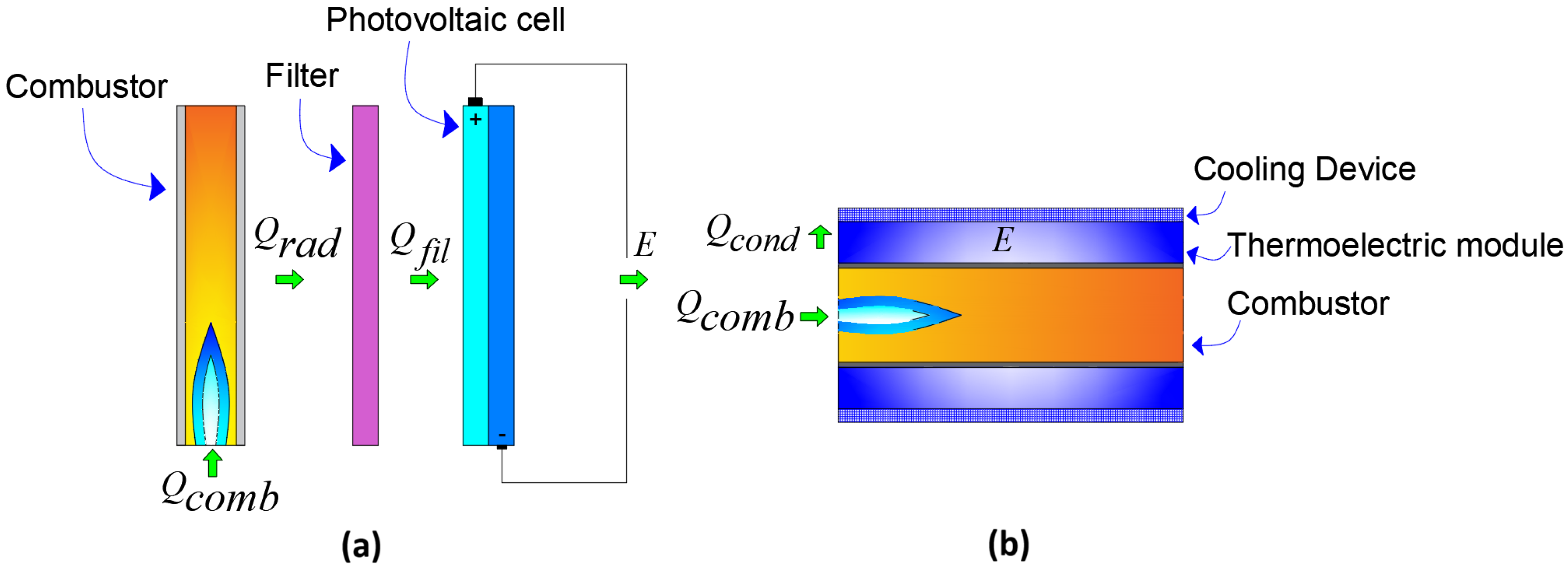
Fossil and synthetic fuels represent one of the most promising alternatives to lithium-ion batteries for portable power generation. Their energy densities are two to three orders of magnitude higher than those of conventional batteries [4]. Consequently, even if only 1% of the chemical energy contained in these fuels were converted into electricity, the resulting output would still exceed the total energy capacity of typical batteries by one to two orders of magnitude. Various systems have been developed to convert thermal energy from fuel combustion into electricity for portable applications, such as micro-thermophotovoltaic (MTPV) and micro-thermoelectric (MTE) devices, both illustrated in Figure 1. MTPV systems consist of a combustor, a filter, and a photovoltaic cell. The fuel oxidizes inside the combustor, releasing heat Q c o m b ; part of it ( Q r a d ) is radiated and absorbed by the filter, which then re-emits a fraction ( Q f i l ) toward the photovoltaic cell to generate electrical energy E [5]. Their simple, motion-free structure makes them highly attractive for compact applications. Similarly, MTE systems include a combustor, a thermoelectric module, and a cooling unit. Here, the heat Q c o m b is transferred by conduction ( Q c o n d ) from the combustor walls to the thermoelectric module, where a temperature gradient between the hot and cold ends induces a Seebeck effect, producing electrical energy E [5]. Hybrid approaches have also been explored. For instance, You et al. [6] combined both systems so that waste heat from an MTPV unit powers an MTE module, following the cascade-energy principle.
MTPV and MTE systems are distinguished by their simplicity and absence of moving parts, which simplifies both design and maintenance. However, their miniaturized scale introduces significant challenges. The combustion chambers, typically only a few millimeters or less in size, exhibit a high surface-to-volume ratio that leads to substantial heat losses through the walls, hindering flame stability and reducing overall energy conversion efficiency [7]. Moreover, at these scales, the Damköhler number (Da) approaches unity, meaning the residence time of the air–fuel mixture can be comparable to or shorter than its chemical reaction time, resulting in incomplete or even quenched combustion [7]. These factors make the combustor the most critical component of both MTPV and MTE devices. In response, extensive research has been devoted to improving combustion performance at the microscale, giving rise to the field of “micro-combustion”. The interest in this field has considerably increased in the last two decades, and many techniques have been proposed for enhancing flame stability and combustion efficiency in micro-combustors, such as heat recirculation, flow recirculation and catalytic combustion; these studies are comprehensively reviewed in other works [2,4,5,7,8,9,10,11,12,13,14].
Despite the significant progress achieved through experimental and numerical studies, modeling combustion phenomena at the microscale remains a complex task due to the strong nonlinear coupling between transport processes, reaction kinetics, and boundary effects. To address these challenges, recent years have witnessed a growing integration of data-driven approaches and Artificial Intelligence (AI) tools, particularly Machine Learning (ML), which offer new possibilities for analyzing and optimizing micro-combustion systems beyond the limitations of conventional methods. ML comprises a broad set of statistical and computational techniques aimed at predicting system behaviors that are difficult to describe through first-principles modeling. As a subfield of AI, ML enables machines to learn and recognize patterns from large dataset, a task that would otherwise be complex and time-consuming for humans. Its influence now extends across nearly all scientific domains, from fundamental sciences such as physics, chemistry, and biology, to applied fields including economics, sociology, and psychology.
ML is commonly classified into two main categories: Shallow Learning and Deep Learning (DL) [15]. Shallow Learning relies on algorithms such as linear and multiple linear regression, making it suitable for small to medium-sized datasets. In contrast, DL employs Artificial Neural Networks (ANNs), computational architectures inspired by biological neurons, that are capable of handling vast and complex datasets. Owing to this, DL methods have demonstrated significant potential for analyzing intricate physical phenomena such as fluid dynamics and heat transfer [16].
Although ANNs are not yet widely adopted in fluid dynamics, numerous studies have demonstrated their versatility in deriving empirical correlations, identifying flow patterns, and optimizing computational fluid dynamics (CFD) calculations [15]. This is particularly relevant in combustion modeling, where the iterative updating of chemical kinetics remains one of the most computationally demanding tasks. Structurally, ANNs consist of interconnected layers of “neurons” organized into input, hidden, and output layers. Each neuron processes incoming data through activation functions and weighted connections, propagating information forward, while errors are iteratively minimized through backpropagation until convergence is achieved. ANN-based combustion research typically relies on modern machine learning frameworks such as TensorFlow and PyTorch, which provide flexible tools for constructing, training, and deploying deep neural networks with automatic differentiation and efficient GPU acceleration. In recent literature, these frameworks have been noted as the implementation basis for data-driven combustion kinetics models and surrogate construction [17]. In practice, such machine learning frameworks are frequently coupled with CFD solvers and scientific computing libraries to enable surrogate modeling, optimization, and uncertainty quantification workflows. In addition, Mao et al. [18] introduced DeepFlame, an open-source, combustion-oriented C++ platform that integrates machine learning algorithms and offline-trained models for the prediction of reactive flow behavior, illustrating the emergence of specific AI infrastructure for combustion applications.
While micro-combustion research has traditionally relied on experimental investigations and CFD-based modeling, the integration of artificial neural networks (ANNs) represents a promising and rapidly emerging research direction. Their application to the analysis, optimization, and modeling of micro-combustion processes remains relatively underexplored in previous reviews. As summarized in Table 1, ANN-based approaches can be positioned alongside the two dominant modeling paradigms traditionally employed in this field: CFD simulations and regression-based models. CFD remains indispensable for fundamental analysis, as it provides detailed spatial and temporal resolution of flow, temperature, and chemical species fields. However, its computational cost increases dramatically when combustion is included, due to the need to resolve stiff chemical source terms, multi-species transport, radiation, and strong thermo–chemical coupling, particularly when detailed reaction mechanisms and fine meshes are required. To mitigate this burden, some studies employ simplified or reduced chemical reaction mechanisms that retain the dominant reaction pathways while significantly reducing the number of species and reactions to be solved [19].
Regression-based models partially address these limitations by enabling rapid predictions and straightforward interpretation, but their reliance on low-dimensional input spaces and smooth functional relationships restricts their applicability to strongly nonlinear, multi-physics micro-combustion problems. In contrast, ANN-based models are well suited to capturing complex interactions among numerous design and operating variables. This capability makes them attractive not only for parametric studies under varying operating conditions, but also, as discussed in later sections, for reproducing detailed CFD results at substantially lower computational cost by serving as surrogate models for computationally intensive physics, such as detailed chemical kinetics and radiative heat transfer. Although ANN training requires large and representative datasets, their negligible prediction cost once trained enables efficient parametric exploration and optimization. Collectively, these features underscore the growing relevance of ANN-based frameworks for overcoming the computational challenges inherent to reactive micro-combustion modeling.
Although direct applications of ANNs to micro-combustion remain limited, significant progress has been made in ANN-based studies of flow and heat transfer in mini- and micro-channels. The present review provides a concise overview of these efforts, highlighting methodologies and identifying research gaps relevant to micro-combustion and related microfluidic systems. This review is among the first to systematically examine how Artificial Neural Networks can support the modeling, analysis, and optimization of micro-combustion systems. Unlike previous reviews focused solely on experimental or CFD-based approaches, this work synthesizes emerging ANN methodologies in heat transfer and fluid dynamics and evaluates their relevance to micro-combustion. It highlights unresolved research gaps and outlines opportunities where data-driven models may overcome long-standing limitations at the microscale.

2. Design Optimization Through ANN-Based Models

2.1. Micro-Combustor Optimization

Design optimization is one of the most common applications of ANN-based models across engineering systems. These models can flexibly handle a large number of variables, which include both geometric and operational parameters, allowing the rapid identification of optimal configurations compared to conventional approaches, such as the Response Surface Methodology (RSM) [20,21,22]. Because temperature uniformity is essential for the efficient operation of many thermal systems, numerous studies have used ANN-based models for this purpose. Micro-combustion is no exception: several researchers have successfully applied artificial neural networks to optimize the design of micro-combustors to improve temperature uniformity.
Huang et al. [23] developed an ANN model to analyze how geometric parameters influence the flame shape and wall temperature distribution in a conical backward-facing step micro-combustor. Numerical simulations were first conducted to generate a dataset for training the network, which was then used to determine the configuration yielding maximum radiant power. An iterative process was applied, until the mean absolute error reached the target value. After 197 samples, the optimized design achieved a radiant power of 35 W. Similarly, Gond and Sengupta [24] combined a polynomial fit and an Artificial Neural Network to optimize premixed hydrogen combustion in a cylindrical combustor. From 92 numerically obtained samples, the models predicted maximum temperature and mean water production rate using inlet diameter, aspect ratio, and Reynolds number as input variables. Although the polynomial fit captured the general trend, it exhibited a maximum relative error of 8.33% and required high-degree terms to reproduce nonlinear dependencies. In contrast, the ANN, with 16 hidden layers, achieved a prediction accuracy of about 97.2%, identifying larger inlet diameters, intermediate aspect ratios, and lower Reynolds numbers as optimal for more complete combustion.

2.2. Heat Transfer Enhancement

Heat transfer plays a crucial role in the operation of most thermal systems, particularly those designed to exchange energy between two sources. Because it involves multiple coupled physical processes influenced by numerous variables, optimizing heat transfer using conventional methods can be challenging. Artificial Neural Networks have therefore been widely employed to optimize the geometric design of thermal systems, with heat transfer enhancement as the primary objective. These methodologies have been successfully applied, for example, to heat sinks used in electronic cooling, achieving improved temperature uniformity and the reduction of hot spots. Although such applications differ from micro-combustion, similar optimization goals apply: the combustor in MTPV and MTE systems must maintain uniform wall temperatures to ensure efficient energy conversion. Consequently, ANNs represent a promising tool for optimizing the thermal performance of micro-combustion devices.
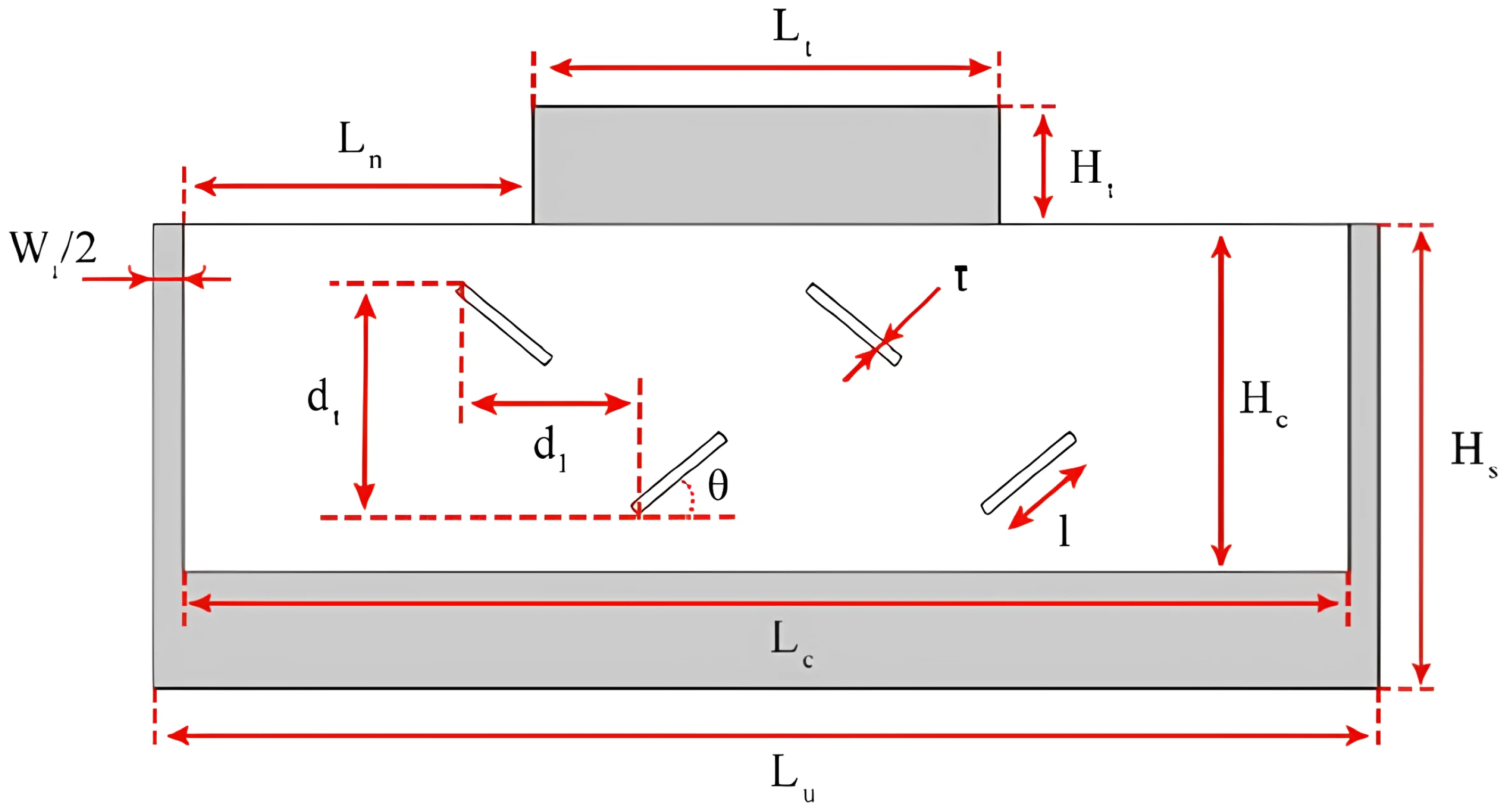
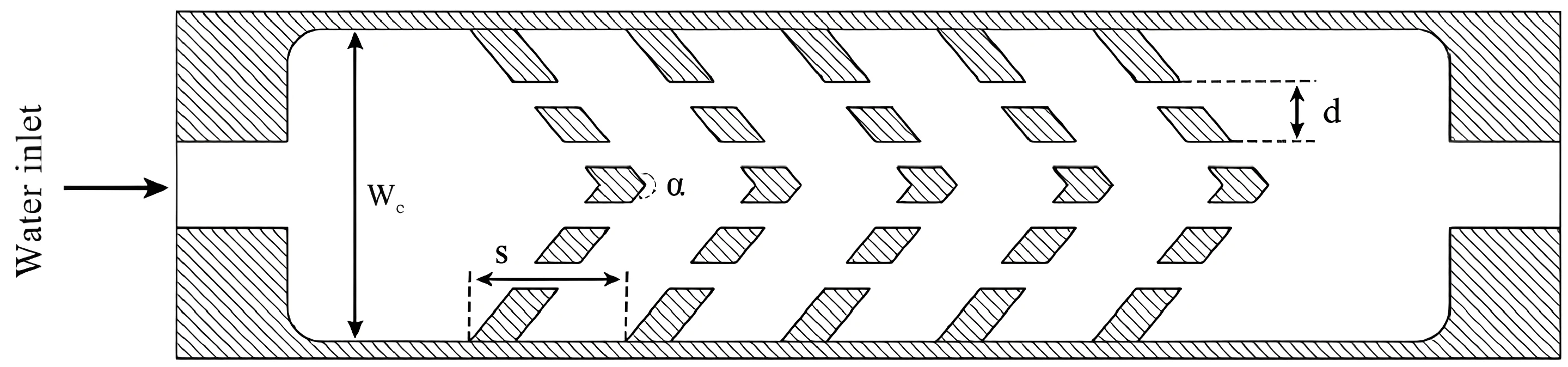
Liang et al. [25] employed both Response Surface Methodology (RSM) and an Artificial Neural Network to optimize the performance of a micro-channel heat sink equipped with rectangular vortex generators (VGs), as illustrated in Figure 2. The Nusselt number and pressure drop were selected as output variables, while the VG parameters, attack angle ( θ ), transverse spacing (dl), and longitudinal spacing (dt), served as input variables. A central composite design was adopted for the RSM analysis, and the ANN was trained using the Levenberg–Marquardt algorithm with a dataset of 15 numerically obtained samples. Although both methods performed well, the ANN provided higher prediction accuracy. The attack angle “ θ ” was identified as the most influential factor: increasing “ θ ” enhanced the Nusselt number but also led to greater pressure losses. The optimized configuration achieved an efficiency index of 1.392. Similarly, Shuqi et al. [26] developed an ANN to optimize the geometry of a micro-channel heat sink incorporating triangular oriented baffles, as shown in Figure 3. The target outputs were the Nusselt number and pressure difference, while the horizontal pitch (s), attack angle ( α ), and vertical pitch (d) were used as input variables. The network was trained with 27 numerically simulated samples using the Levenberg–Marquardt algorithm and consisted of two hidden layers with six neurons each. The ANN achieved excellent predictive accuracy, with a coefficient of determination of 0.98 and a mean absolute error close to zero. The parameter “d” had the strongest effect on both the Nusselt number and pressure drop. An increase in “d” led to higher values of both as a result of the more uniform baffle spacing along the micro-channel. Similarly, increasing “s” caused a rise in pressure drop. An optimal attack angle “ α ” was identified, yielding the best trade-off between heat transfer enhancement and flow resistance. The most efficient configuration corresponded to s = 8.496 mm, d = 5 mm, and α = 210.56, achieving an efficiency index of 1.46, a 46% improvement compared with a benchmark case.

2.3. Emitter Surface Optimization

Radiative heat transfer is highly dependent on the surface properties of the emitter. Enhancing radiative emission is particularly important in thermophotovoltaic (TPV) and micro-thermophotovoltaic (MTPV) systems. Common strategies to increase surface radiation include selecting materials with high emissivity or enlarging the radiating area, often through the addition of fins. This introduces the challenge of determining the optimal combination of material properties and geometric configuration. While several studies have used Artificial Neural Networks to optimize emitter designs for macro-scale TPV systems, their application to MTPV devices remains limited. Since the outer walls of the micro-combustor act as the emitter in MTPV systems, there is a clear opportunity to apply the aforementioned optimization techniques to improve radiative performance at the microscale.
Monte Carlo Tree Search (MTCS) algorithm was used by Hu et al. [27] to optimize both the metal and Distributed Bragg Reflector (DBR) sides of a Tamm emitter for thermophotovoltaic applications. Emissivity and cell performance were modeled mathematically, and system efficiency and power density were the output variables, with SiO2/TiO2 layer arrangements as inputs. MTCS achieved optimal results by evaluating fewer than 1.5% of candidates. The metal side reached 3.85 W/cm2 and 39.7% efficiency, while the DBR side attained 3.0 W/cm2 and 36.5%. Bohm et al. [28] integrated a surrogate model with metaheuristic optimization to enhance the performance of a tungsten emitter for thermophotovoltaic systems. Several surrogate approaches were evaluated, with the Fully Connected Neural Network (FCNN) achieving the highest accuracy in emissivity prediction. The FCNN architecture featured three hidden layers using Leaky ReLU activation functions and a sigmoid output layer. The optimized emitter achieved approximately a 3% improvement in efficiency compared with a reference case. Cai et al. [29] integrated a genetic algorithm with a deep learning-based inverse design to optimize the thermal emissivity of a W–Al2O3 meta-emitter featuring hybrid circular and square patterns. A forward ANN predicted emissivity from structural parameters, while an inverse ANN determined the geometry required for a target emissivity spectrum. The data produced by the deep learning model were used as input for the genetic algorithm. The optimized emitter achieved 90% in-band emission for a 0.56 eV InGaAs cell, enhancing emission efficiency by 56.77% and power output by 0.97 W/cm2 compared with a conventional W emitter.

2.4. Optimization of Thermoelectric Generators

Thermoelectric generators of conventional size have also been optimized through the use of ANNs.
Demeke et al. [30] integrated an Artificial Neural Network (ANN), a Genetic Algorithm (GA), and Active Learning (AL) to optimize a segmented thermoelectric generator. A dataset of 157,916 configurations, including temperature-dependent properties, segment lengths, and load resistances, was generated from finite element simulations. The ANN predicted power and efficiency, while GA and AL produced the optimal configuration, resulting in 1.91- and 1.5-fold increases in power output and efficiency, respectively. Likewise, Chen et al. [31] combined the Taguchi method with an ANN to optimize leg geometry, aiming to improve power, efficiency, and reduce thermal stress. Using the Resilient Propagation algorithm with sigmoid activation functions, the ANN revealed that power output was nearly unaffected by geometry, whereas thermal stress was highly sensitive. The optimized design achieved a power-to-stress ratio of 0.012552 W/MPa. Chen et al. [32] optimized the geometry and doping concentration of thermoelectric generator legs using a Multi-Objective Genetic Algorithm (MOGA) and an Artificial Neural Network (ANN). Both models were trained with numerical data generated through a central composite design, while the ANN architecture featured two hidden layers with double-sigmoid activation functions. Comparison between the two approaches showed that the ANN provided higher accuracy and faster convergence than MOGA. The optimized configuration achieved an output power of 1.279 W and an efficiency of 17.05%. Xu et al. [33] optimized the geometry of a twisted-fin thermoelectric generator by integrating a Neural Network model, a conditional Generative Adversarial Network (cGAN), and a Genetic Algorithm. The ANN model, employing a ReLU activation function, was trained with data from 3125 numerical simulations to predict the system’s power output and efficiency. Meanwhile, the cGAN was used to reconstruct the corresponding flow and temperature fields from the same dataset. The combined use of both networks improved computational efficiency by 99.97%, while enhancing the power output and overall efficiency by 22.07% and 59.11%, respectively.

2.5. Summary of ANN-Assisted Optimization

As demonstrated throughout this section, ANN-based optimization provides an effective framework for addressing the design-driven physical challenges inherent to micro-combustion systems, where strong heat losses, short residence times, and tight geometric constraints lead to highly nonlinear performance behavior. By learning complex mappings between geometric and operating parameters and system-level performance metrics, ANNs consistently outperform traditional regression approaches in capturing the coupled effects of flow, heat transfer, and combustion. Table 2 synthesizes the use of ANN-based optimization models across micro-combustion devices, thermophotovoltaic emitters, and thermoelectric generators, highlighting several consistent methodological patterns. Across all application domains, back-propagation and multilayer perceptron architectures remain the most widely adopted approaches, reflecting their effectiveness as flexible, data-driven surrogates for capturing highly nonlinear relationships between design variables and performance metrics. Reported accuracies are generally high, with most studies achieving coefficients of determination above 0.97, indicating that ANN surrogates can reliably reproduce CFD and finite-element simulation results, as well as experimental results. For problems in which a single component or a limited set of operating parameters are being optimized, relatively simple feedforward or back-propagation neural networks are typically sufficient. In contrast, TPV and Thermoelectric Generator (TEG) systems, being inherently multi-component and governed by coupled physical processes, more often employ ANNs embedded within hybrid optimization frameworks, in which the network serves as a surrogate model combined with global search algorithms such as genetic algorithms, Monte Carlo Tree Search, or hyper-heuristic optimization. These hybrid strategies enable efficient exploration of high-dimensional design spaces involving emitter geometry, material composition, or segmentation strategies that would otherwise be computationally prohibitive using direct numerical solvers.
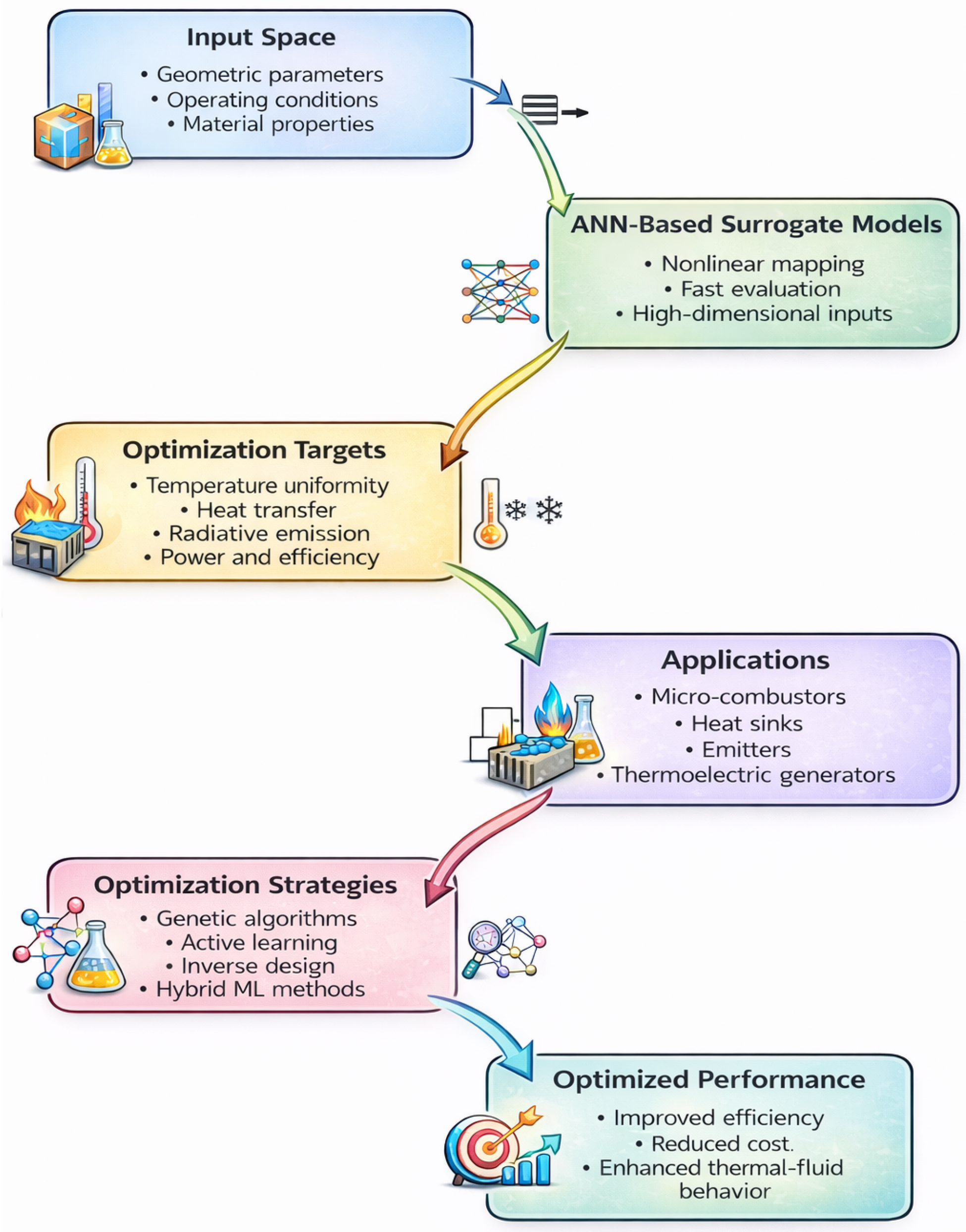
Overall, the comparison made in Table 2 indicates that no single ANN-based strategy is universally optimal. Instead, method selection should be guided by the dimensionality of the design space, the degree of physical coupling involved, and the availability of high-fidelity training data. Figure 4 shows a conceptual zigzag workflow of ANN-assisted design optimization in micro-scale thermal systems, where data-driven models map geometric and operational parameters to optimal performance metrics for micro-combustors, heat transfer devices, radiative emitters, and thermoelectric generators.

3. Prediction of Flow Variables

Fluid flow in mini- and micro-channels has attracted significant attention in recent years due to its broad range of applications extending beyond micro-combustion. These flows often display complex dynamics characterized by strong interdependence among operating parameters, an effect that becomes especially pronounced under multiphase flow conditions. Consequently, many conventional empirical correlations for resistance factors, heat transfer coefficients (HTCs), or pressure drops are not directly applicable to micro-channel systems. Since these relations are typically derived from narrow operating ranges, their use would require the development of numerous case-specific models, which is impractical. Moreover, the nonlinearities inherent in micro-scale flow phenomena are often poorly captured by conventional regression approaches. To overcome these limitations and enable more generalizable predictions across diverse operating conditions, geometries, and working fluids, many researchers have explored the use of ANNs to model key flow variables in mini- and micro-channel systems.
ANN-based models have been developed by some authors in order to determine condensation and boiling heat transfer coefficients in micro-channels, as well as pressure drops and multiphase-flow distribution. López-Belchí et al. [34] coupled ANNs with the Group Method Data Handling (GMDH) to predict pressure drop and condensation heat transfer coefficient inside mini-channels under a wide range of operating conditions. A dataset was constructed using experimental data obtained by the authors. GMDH was used to select the combination of input variables that maximized the performance of the ANNs. The resultant model used 8 input variables (many of which also appeared in empirical correlations), and was able to predict the pressure drop with an accuracy of 88.63%, and the condensation heat transfer coefficient with an accuracy of 98.70% (both values showed a maximum deviation of 20%). In their work, Zhou et al. [35] developed and compared four artificial intelligence models to predict the condensation heat transfer coefficient in mini- and micro-channels. The techniques employed to create the four models were: artificial neural networks (ANNs), adaptive boosting, random forest, and extreme gradient boosting. The dataset was constructed by gathering data from 37 sources, including various working fluids, Reynolds numbers, mass velocities, hydraulic diameters, reduced pressures, and flow qualities. ANNs and extreme gradient boosting showed better accuracy in their predictions (with mean absolute errors of 6.17% and 7.34%, respectively). Both models made poor predictions for fluids not included in the dataset. Qiu et al. [36] developed an ANN-based model to predict the boiling heat transfer coefficient in mini- and micro-channels. Information was gathered from 50 sources, which contained experimental and numerical data on evaporation heat transfer coefficients for various working fluids, Reynolds numbers, mass velocities, hydraulic diameters, reduced pressures, and flow qualities. Input variables of the final model consisted of dimensionless parameters only. The mean average error of the predictions was 14.3%, which showed better accuracy than the empirical relationship by Kim and Mudawar [37]. However, the model predicted poorly the boiling heat transfer coefficient for fluids that were not in the training set. Additionally, Gianetti et al. [38] employed ANN-based techniques to predict two-phase flow distribution inside a heat exchanger with micro-channels. The take-off ratio was selected as the predicted value; the ANNs were trained with experimental data from a different study. When compared with an empirical relation (expressed as the product of powers of dimensionless groups), the deviation between predicted and real values was reduced from 30% to 10%. The potential of ANNs to predict multiphase flows was recognized.
Heat sinks represent one of the primary applications of flow through micro-channels, where accurate prediction of convective heat transfer coefficients and entropy generation is essential for evaluating their performance. In light of this, Khosravi et al. [39] developed an Artificial Neural Network (ANN) to predict entropy generation, convective heat transfer coefficient, and Bejan number of a micro-channel heat sink that works with a hybrid nanofluid of graphene and platinum particles. The dataset was constructed from the results of numerical simulations, using the Reynolds number, particle concentration, and heat flux from the source as the input variables; the final dataset contained 48 samples, from which 43 were used for training, while the remaining five were used for validation. A simple hidden layer was used; the Levenberg–Marquardt algorithm was employed to train the ANN. The mean relative error and mean square error of the ANN were of 0.0026 and 6.041 × 10⁻¹¹, respectively, so the model reached a high degree of accuracy in predicting entropy generation. Maximum values for heat transfer coefficient, thermal entropy and friction entropy were 7653 W/m2K, 9.7 × 10⁻⁵ W/K, and 6.2 × 10⁻⁶ W/K, respectively; minimum values were 5860 W/m2K, 3 × 10⁻⁵ W/K, and 8.24 × 10⁻⁷ W/K. The Reynolds number was identified as the most influential variable affecting both heat transfer enhancement and entropy reduction. Higher Reynolds numbers lead to a decrease in total entropy generation, driven by less pronounced temperature gradients. Increasing particle concentration also enhanced heat transfer and reduced entropy generation.
Furthermore, neural network-based techniques were employed by Shen et al. [40] to model transient flow behavior inside a serpentine micro-channel using the transient Bernoulli equation. An ANN model was developed to estimate the resistance factor within the micro-channel and was trained using results from numerical simulations through a combination of genetic algorithms and particle swarm optimization. The results demonstrated that the model accurately predicted the resistance factor and confirmed that the transient behavior of flows can be effectively described by the Bernoulli equation.
The studies reviewed in this section demonstrate that ANN-based models are particularly well suited for predicting flow, thermal, and transport variables in regimes characterized by strong nonlinearity and scale-dependent behavior, which are hallmarks of micro-combustion systems. At the microscale, steep velocity, temperature, and species gradients arise from intense wall heat losses and short residence times, leading to strong coupling between transport processes and chemical reaction rates. These conditions often challenge empirical correlations, particularly near critical operating regimes where the balance between flow and chemistry governs flame stability and extinction.
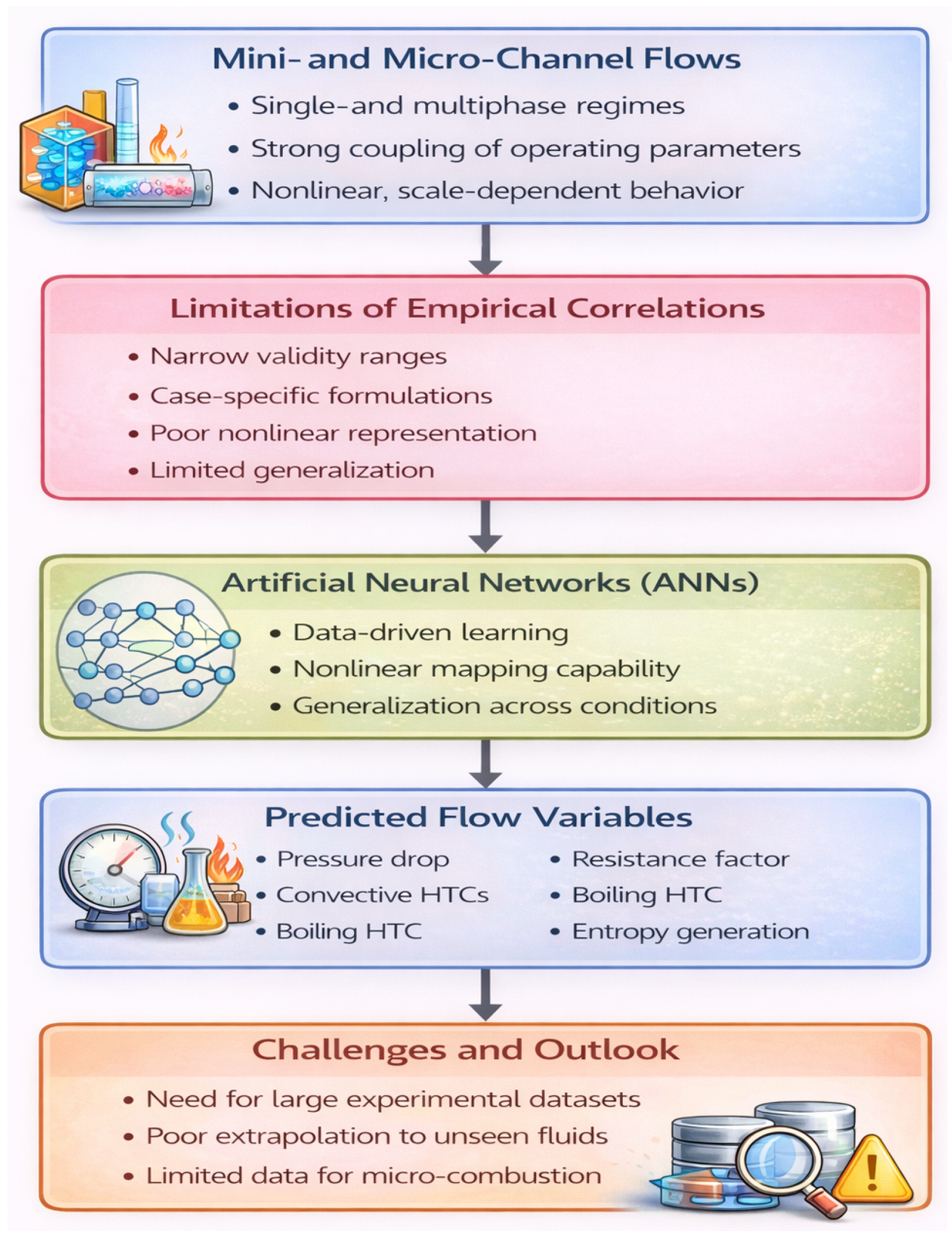
Within this context, ANNs provide a flexible, data-driven means of approximating the coupled behavior of velocity fields, heat transfer coefficients, and entropy generation without explicitly resolving all underlying physics through CFD simulations or experimental measurements at each evaluation. While most existing applications focus on mini and micro-channel flows without reactions, the reviewed studies indicate that ANN-based predictors can capture the nonlinear transport trends that ultimately control heat loss, residence time, and reaction rates in micro-combustors. Figure 5 illustrates a streamlined framework for ANN-based modeling of mini- and micro-channel flows. The diagram emphasizes the inherent nonlinear and scale-dependent behavior of microscale transport phenomena and the resulting limitations of empirical correlations. Artificial neural networks are introduced as a data-driven alternative capable of learning complex relationships from experimental data. Once trained, ANNs enable the prediction of key hydraulic and thermal variables, while the final block highlights ongoing challenges associated with data availability and limited extrapolation capability.

4. Physics Informed Neural Networks (PINNs) for Describing Combustion Phenomena

Conventional Neural Networks are typically trained using data-driven approaches, which provide them with substantial flexibility to model a wide range of phenomena. However, this strategy has notable drawbacks. It requires large and comprehensive datasets, whose construction can be both time-consuming and technically challenging, and such datasets are often affected by noise. Moreover, because ANN models rely solely on the data provided during training, their predictions represent empirical fits rather than physically grounded solutions. In combustion modeling, this may result in outcomes that violate fundamental conservation laws, such as mass or energy conservation.
Recently, the concept of Physics-Informed Neural Networks (PINNs) has emerged as an alternative to these limitations. Instead of relying solely on data points to train the network toward a fitted outcome, the PINN framework incorporates the fundamental governing equations of the physical phenomena. During training, these equations are numerically solved for various sets of input variables until convergence is achieved. This approach ensures that the predicted results remain consistent with physical laws while significantly reducing the need for extensive datasets. Nonetheless, some studies have proposed hybrid models that combine data-driven training with physical constraints. Both strategies have been successfully applied to combustion systems.

4.1. Prediction of Flow-Fields

Velocity, temperature, and species fields play a fundamental role in determining flame dynamics during combustion. Although conventional CFD methods can resolve these fields with high accuracy, the computational cost can be considerable for both laminar and turbulent flames. To address this issue, several researchers have proposed the use of PINN-based models to accelerate the prediction of flow fields. Liu et al. [41] developed a physics-informed neural network (PINN) surrogate model to predict the velocity, temperature, and species fields in one and two-dimensional laminar premixed flames. The network incorporated mass, momentum, energy, and species conservation equations, along with their boundary conditions, as physical constraints. These governing equations were enforced through automatic differentiation until the residuals of each equation approached zero, eliminating the need for any pre-existing training dataset. To mitigate spectral bias associated with combustion-induced fluctuations, a Fourier feature mapping was adopted. The predictions of the surrogate model showed excellent agreement with Direct Numerical Simulation (DNS) results, achieving coefficients of determination above 0.99 for both 1D and 2D cases, except in conditions involving flashback. Moreover, the PINN-based surrogate demonstrated superior numerical stability compared to the DNS solver.
Liu et al. [42] employed a Physics-Informed Neural Network (PINN) framework to reconstruct turbulent flames from sparse data. The network comprised seven hidden layers with 100 neurons each and used a sinusoidal activation function. It was trained by enforcing the governing conservation equations together with numerical data from Direct Numerical Simulations (DNS), representing an alternative to limited experimental measurements. The PINN accurately reproduced two-dimensional velocity, temperature, and species fields for freely propagating and slot-jet flames, maintaining robustness under Gaussian noise up to 15%, although small-scale turbulent structures were not fully captured. Subsequently, Liu et al. [43] extended this approach to three-dimensional reconstructions of velocity and temperature fields. The temperature field was inferred using an artificial neural network trained on 2D temperature snapshots from DNS, while a wavenumber-based PINN was developed to recover the velocity field from the reconstructed temperature, with the momentum equation imposed as a physical constraint. The velocity field was decomposed into low- and high-wavenumber components to enhance multiscale resolution. The proposed framework achieved highly accurate temperature reconstructions and successfully captured high-wavenumber flow features, whereas low-wavenumber structures exhibited slightly lower accuracy.
Wu et al. [44] propose a PINN-model to solve both the forward and inverse problem of 1D laminar premixed flames. The cases for freely propagating flames and counter-flow flames were examined. The model integrated physical constraints from the governing equations and boundary conditions, as well as experimental data. A hyperbolic tangent activation function was used in the network, with a multilayer perceptron architecture. The model accurately predicted temperature, velocity, and species profiles, achieving errors below 2% and inferring laminar flame speed within 0.1% of reference results. The framework proved robust, efficient, and easily extendable to detailed chemistry and higher-dimensional configurations. Cao et al. [45] investigated turbulent premixed flames by comparing a purely physics-informed neural network (PINN) with a hybrid model that combined physical constraints and data-assisted training. The purely physics-based approach exhibited poor convergence and large deviations in turbulent kinetic energy, with relative errors reaching approximately 95%, which in turn degraded the accuracy of the predicted velocity and temperature fields. In contrast, the hybrid PINN significantly improved stability and accuracy, achieving relative errors between 3–8% and notably faster convergence.

4.2. Prediction of Thermo-Acoustic Effects

Thermo-acoustic instabilities represent a major concern in combustion systems, as they can induce large pressure oscillations that compromise the structural integrity of the combustion chamber. These instabilities arise from the coupling between unsteady heat release and the oscillating pressure field generated during combustion. The absence of accurate predictive models for thermo-acoustic instabilities has led many researchers to rely on computationally expensive approaches such as Large Eddy Simulations (LES) or Direct Numerical Simulations (DNS). Recently, the concept of Physics-Informed Neural Networks (PINNs) has emerged as a promising alternative for studying these phenomena. Mariappan et al. [46] developed a PINN-based framework to predict thermo-acoustic instabilities in a bluff-body-stabilized combustor. Three separate networks were employed to reconstruct the velocity, pressure, and heat-release fields, each using a hyperbolic tangent activation function. The model training incorporated low-order representations of acoustic oscillations and heat-release dynamics, combined with experimental data. The proposed PINN achieved high predictive accuracy, with relative errors below 5%, and demonstrated strong robustness under ill-posed conditions. Other PINN-based frameworks have also been proposed to identify the key parameters governing thermo-acoustic instabilities. For example, Son and Lee [47] developed a physics-informed neural network approach to infer the linear growth rate, nonlinear saturation coefficient, and noise intensity by directly coupling stochastic measurements with the corresponding Fokker–Planck equation. Their framework achieved accurate parameter identification with substantially lower errors than conventional noise-induced dynamics methods, which are known to be affected by finite-time effects, discretization errors, and sensitivity to data sampling.
Other studies, such as the one by Xie et al. [48], have extended PINN frameworks toward learning reduced-order models capable of predicting nonlinear bifurcation in thermo-acoustic systems that occur during low emission combustion in gas turbines. The proposed PINN framework infers the parameters of an extended van der Pol oscillator from transient thermo-acoustic data obtained from theoretical Rijke-tube models and high-fidelity CFD simulations. Comparisons with coupled Rijke-tube models showed good agreement in bifurcation structure and AD boundaries, demonstrating that PINN-derived low-order oscillators can reliably capture key nonlinear dynamics while offering substantial computational savings.

4.3. Modeling of Radiation Heat Transfer in a Participating Media

Recent efforts have extended PINNs to the solution of the radiative transfer equation in complex participating media. For example, Zucker et al. [49] developed a PINN-based framework for atmospheric radiative transfer in plane-parallel configurations, embedding scattering, absorption, emission, and physically consistent boundary conditions directly into the learning process. Using Fourier decomposition, Gauss–Legendre quadrature, and a δ -M transformation to treat forward scattering, their model showed close agreement with DISORT and Monte Carlo solvers, achieving errors below 1% for aerosol cases and a few percent for cloud scenarios.
Radiative heat transfer plays a fundamental role in the overall energy balance of combustion systems. Accurate prediction of radiative fluxes requires reliable estimation of the global emissivity of the hot gas mixture. Numerous models have been developed to estimate gas emissivity, some offering high accuracy at significant computational cost, while others are computationally efficient but rely on oversimplified physics. To achieve both accuracy and computational efficiency, authors such as Chen et al. [50] have explored the use of Physics-Informed Neural Networks for predicting the emissivity of high-temperature gas mixtures. The Weighted-Sum-of-Gray-Gases model was adopted as the baseline framework. This model estimates the emissivity of a gas mixture as the sum of emissivities from several gray gases, whose weighting and absorption coefficients are typically fitted using polynomial correlations, an approach that struggles to capture nonlinear spectral behavior. To overcome this limitation, the authors proposed determining these parameters through a Physics-Informed Neural Network (PINN). Two separate networks were developed: one to predict absorption coefficients using an exponential activation function, and another to estimate weighting factors with a softmax output layer to enforce normalization. The resulting model achieved high accuracy in predicting radiative heat loss for the Sandia D × 4 flame, with deviations below 5%, and demonstrated robustness as well as ease of integration into commercial CFD solvers.
In other works, such as the one by Biswal et al. [51,52], a PINN framework was developed for solving one and two dimensional radiative transfer equation in absorbing and scattering media, typical of high-temperature furnace environments. Governing equations and boundary conditions were directly included in the loss function, and Legendre polynomials were combined with Gauss–Legendre quadrature to accurately evaluate the scattering integral. The model showed good agreement with analytical solutions and established numerical simulations for multiple benchmark cases, including non-absorbing, absorbing, and scattering configurations, as well as enclosures with internal radiation sources. Also, the PINN was able to capture the coupled effects of absorption and scattering on radiation heat flux.
Liu et al. [53] further developed a Fourier-feature-enhanced PINN framework to predict the radiative thermal environment in solid rocket motors. By augmenting the angular input space with Fourier features, the proposed method significantly improved the representation of anisotropic scattering and high-frequency radiation fields. Validation against analytical solutions, discrete ordinates method results, and experimental heat-flux measurements demonstrated substantial accuracy gains, reducing prediction errors under scattering conditions from over 40% to approximately 10%.

4.4. Summary of PINN Approaches to Combustion Systems

As discussed throughout this section, Physics-Informed Neural Networks (PINNs) represent a critical step toward explicitly linking data-driven learning with the governing physics of micro-combustion, where strong heat losses, short residence times, and reaction–diffusion imbalance dominate system behavior. In micro-scale combustors, flame stability and extinction are governed by a fine balance between transport and chemical time scales, and conventional data-driven models often struggle to generalize under such tightly constrained regimes. By embedding conservation laws of mass, momentum, energy, and species transport directly into the learning process, PINNs offer a principled framework for enforcing physical consistency while reducing dependence on dense training datasets. Within this context, PINN-based models can complement traditional CFD by reconstructing flow and temperature fields from sparse operating data, or by acting as computationally efficient surrogates for computational intensive physics, such as radiation heat transfer or detailed chemical kinetics. Hybrid approaches that combine data fitting with physical constraints have demonstrated superior accuracy and flexibility in several of the studies analyzed throughout this section, and should be explored for micro-combustion applications.
At the same time, a balanced assessment of these advances requires acknowledging the current methodological and practical limitations associated with PINN-based approaches. Despite their strong potential, the application of PINNs to micro-scale combustion systems presents several well-recognized limitations that warrant careful consideration. Training instability associated with competing physics-based constraints can affect convergence, particularly in stiff and highly nonlinear regimes [54,55]. Additionally, the presence of disparate temporal and spatial scales in detailed chemical kinetics and multi-physics coupling may degrade optimization efficiency and predictive accuracy [56]. While mitigation strategies such as adaptive loss weighting and hybrid PINN-reduced chemistry approaches have been proposed, these methods remain an active area of research and should be applied with caution in complex micro-combustion configurations [57].
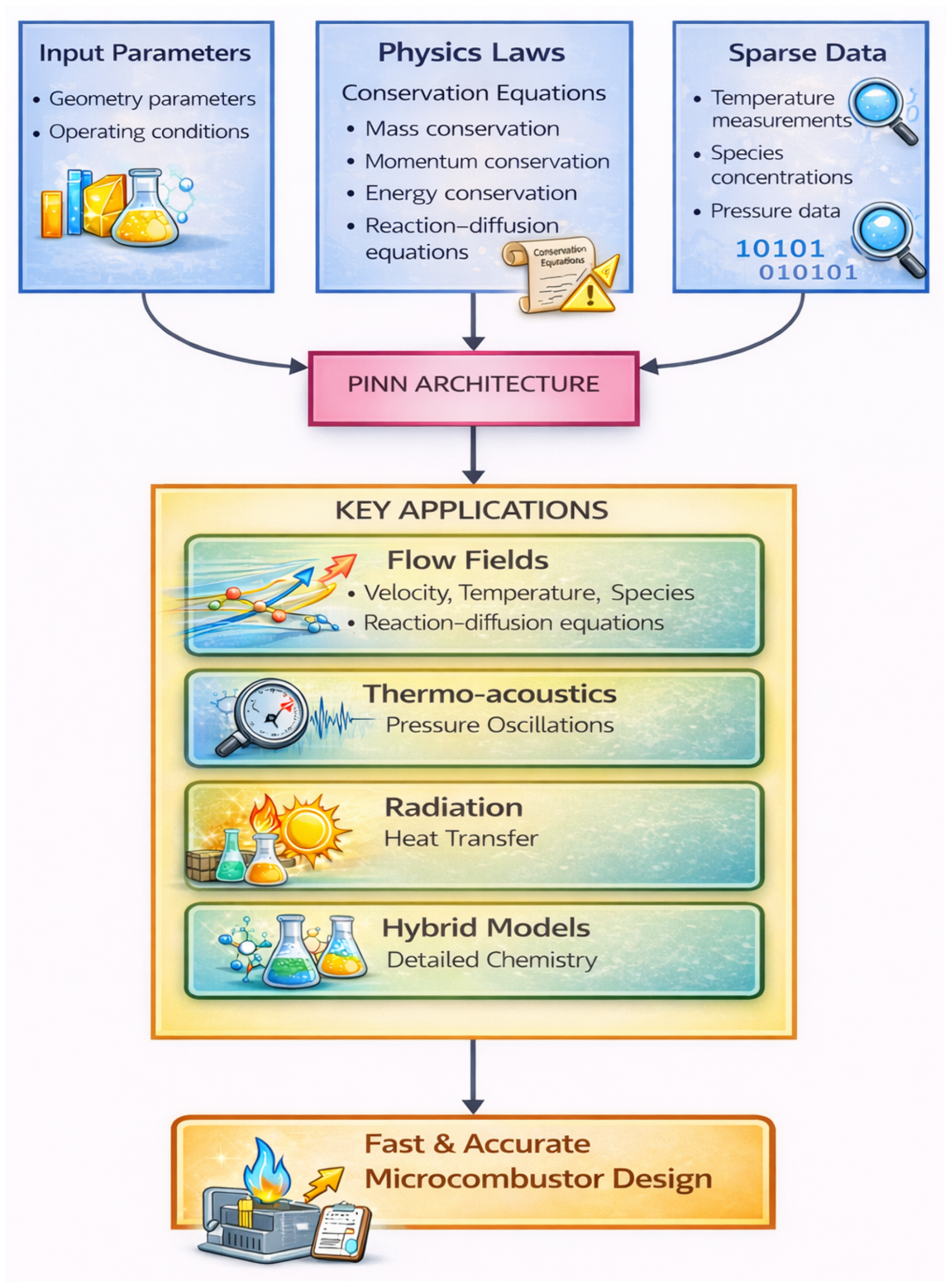
Figure 6 illustrates the workflow of a physics informed neural network (PINN), in which input parameters, governing conservation laws including mass, momentum, energy, and reaction diffusion formulations, and sparse experimental or high fidelity numerical data are integrated within the PINN architecture. Here, sparse data refer to limited measurements of temperature, species concentration, and pressure. By embedding physical constraints into the learning process, PINNs enable physically consistent predictions under data scarce conditions, supporting fast and accurate microcombustor design through applications such as flow field prediction, thermo acoustics, radiation heat transfer, and hybrid chemistry modeling.

5. Surrogate Models for Combustion Analysis

Computer-assisted engineering tools such as CFD have greatly advanced research across many scientific fields, including micro-combustion. However, detailed numerical models are often computationally expensive, leading to long simulation times and, in some cases, making certain analyses impractical. This obstacle has motivated researchers to develop approximate models that retain the dominant physical features of the phenomena while remaining computationally efficient. These simplified, fast-running approximations, commonly called surrogate models, are based on approaches such as random-sampling high-dimensional model representation [58], Gaussian process regression [59], random forests [60], and artificial neural networks [61]. Due to its flexibility, ANN-based surrogate models have gained relative success in combustion and thermal studies.

5.1. Surrogate Models for Chemical Kinetics

Chemistry integration is the primary bottleneck in detailed combustion simulations using CFD methods, due to the size of the chemical systems, which may comprise tens to thousands of chemical species and hundreds to thousands of reaction steps. Additionally, the resulting systems are often stiff, as there exists disparity between the timescales of different chemical reactions, so that traditional numerical methods may have convergence problems when handling these systems. Characteristic lengths of combustors for MTPV and MTE systems are often around a few millimeters or even lower; therefore, a detailed characterization of velocity and temperature profiles inside the combustor usually relies on CFD analysis. Considering the aforementioned, the optimization of chemistry integration could considerably boost micro-combustion studies. ANNs have been proposed as surrogate models for chemistry kinetics in recent years [62,63]. Döppel and Vostmeier [62] proposed an ANN-based surrogate model to improve the accuracy and convergence of logarithmic scaling surrogate models for catalytic oxidation of H2 and CO. A considerable degree of accuracy was obtained by employing a 30 layer network (with errors around 0.0058%). Wang et al. [63] compared two ANN-based surrogate models for chemical kinetics to enforce element conservation law: an ANN-soft model that employed a hyperparameter to correct the outputs, and an ANN-hard model that solved a linear system instead. The hard model approached showed higher accuracy and robustness.
In recent years, the concept of Neural Ordinary Differential Equation solvers (often abbreviated as NODE solvers) has gained increasing attention. These methods integrate artificial neural networks with traditional numerical techniques to solve systems of ordinary differential equations. NODE solvers have been applied across a variety of domains, including the modeling of chemical systems.
A series of studies have demonstrated the potential of Neural Ordinary Differential Equation (NODE) solvers as efficient surrogate models for modeling complex chemical kinetics. Owoyele and Pal [64] developed a NODE solver implementing a novel training algorithm that integrated training and validation within a unified framework, applied to an unsteady homogeneous hydrogen–air reactor at 1 atm. The network, composed of a single hidden layer with sigmoid activation, was trained using chemical source terms from different thermochemical states and time instants, successfully reproducing temperature and species profiles (H2, O2, OH, and H2O) with high accuracy, including ignition delay time, while achieving a computational speedup of 2.3 times compared to a standard ODE solver. Vijayarangan et al. [65] extended this approach by developing a Reduced-Order Model (ROM) for stiff chemistry that coupled an Auto-Encoder (AE) with a NODE solver. The AE reduced the system into a lower-dimensional latent space, while the NODE solver, trained via backpropagation with the adjoint sensitivity method and integrated using the Runge–Kutta scheme, advanced the reduced variables over time. Trained with Cantera data [66] for H2 and C2H4 auto-ignition, the model accurately predicted temperature and key species evolution; the end-to-end training strategy yielded the best performance, enabling time-steps up to three orders of magnitude larger than those required by Cantera. Similarly, Kumar et al. [67] proposed “Phy-ChemNODE,” a hybrid AE–NODE framework that enforced mass-conservation constraints within the loss function to maintain physical consistency during the integration of methane auto-ignition chemistry (32 species, 266 reactions). Both encoder and decoder comprised four hidden layers with 64 neurons each, as did the NODE solver, which used Exponential Linear Unit activations and Runge–Kutta integration. Trained on 99 Cantera samples, Phy-ChemNODE reproduced temperature and species evolution with good fidelity while achieving one-to-three-order-of-magnitude reductions in computational cost relative to detailed mechanisms. More recently, Su et al. [68] applied a NODE model for optimizing kinetic parameters of complex hydrocarbon mechanisms, employing an implicit second-order backward-difference scheme with trapezoidal rule for time integration and adjoint sensitivity for gradient computation. Using experimental datasets of ignition delay times and laminar burning velocities for JP-10 pyrolysis and n-heptane auto-ignition, the NODE model not only accurately estimated kinetic parameters but also demonstrated the capability to infer the kinetics of species not included in the training data.
So far, the use of NODE solvers to accelerate chemistry integration has shown promising results, and these tools may someday replace conventional methods for reducing the stiffness of chemical systems, such as in situ Adaptive Tabulation (ISAT). Still, there are challenges associated with using these methods for chemistry integration. The construction of large datasets for various types of fuel is necessary, as the accuracy of these tools strongly depends on the availability of information for the analyzed fuel. Also, with the aim of training these models, more research is required in order to develop accurate and detailed chemical mechanisms for different kinds of fuels, particularly those that consist of a complex combination of different hydrocarbons. Additionally, it should be remarked that NODE solvers rely on statistical techniques; therefore, physical laws are not necessarily enforced by them; further efforts should be pursued in order to ensure physical consistency in the results provided by NODE solvers, as suggested by Kumar et al. [67].

5.2. Uncertainty Quantification Using Surrogate Models

Uncertainty quantification has become a critical component in the validation of chemical mechanisms, as uncertainties in reaction parameters can lead to significant errors in reactive-flow predictions. However, performing uncertainty quantification is computationally demanding because it requires evaluating complex physical problems that couple hydrodynamics with chemical kinetics. To address this challenge, surrogate models have been increasingly adopted as an efficient means of conducting uncertainty quantification for chemical mechanisms.
Tao et al. [69] developed a meta-learning-assisted surrogate model to perform uncertainty quantification for an H2–NH3 combustion mechanism. Unlike conventional training methods, the meta-learning framework enables the network to learn from multiple related tasks, allowing the resulting model to generalize and rapidly adapt to new operating conditions without retraining separate networks for each case. This approach facilitated the construction of a single surrogate model that could be applied across diverse thermodynamic regimes. The proposed model achieved high accuracy in predicting ignition delay times and laminar burning velocities while requiring substantially fewer samples than traditional surrogate modeling techniques. Overall, the computational cost was reduced by approximately 29% for ignition delay time and 39% for laminar burning velocity.
Liu et al. [70] developed a multi-fidelity neural network surrogate model that utilized low-fidelity data, obtained from simplified chemical mechanisms, to train a high-fidelity neural network based on detailed reaction mechanisms, leveraging the concept of uncertainty similarity. The framework comprised two networks: the first mapped the correlation between low- and high-fidelity datasets, while the second generated high-fidelity predictions using the samples produced by the first network. The proposed model achieved accurate predictions of ignition delay times and laminar flame speeds, showing robustness to moderate errors in the low-fidelity data, and resulted in substantial computational savings of up to 90%.

5.3. Flame Behavior Using Surrogate Models

Jung et al. [71] developed two ANN-based surrogate models to predict both the transient and steady-state behavior of solid propellant combustion. The networks were trained using numerical simulation data from 100 cases, each generated by varying the mass fraction of the solid fuel and the initial pressure of the chamber. Both models used ReLU activation functions and the Adam optimizer. The surrogate models achieved prediction accuracies greater than 95% for the gas temperature, the burning rate and the mole fractions of the species, while offering computational speeds approximately 590 to 596 times faster than the full simulations. Fruzza et al. [72] employed a surrogate-informed sparse-grid strategy to predict critical flashback velocities and burner temperatures across four perforated burners, employing detailed three-dimensional CFD simulations as the input data. By adaptively refining the model in regions of high sensitivity, this approach dramatically reduced computational cost while preserving accuracy. The resulting surrogate model facilitated AI-assisted optimization, allowing geometry parameters such as slit spacing, width, and porosity to be systematically tuned to maximize flashback resistance under thermal constraints.

5.4. Surrogate Models for Radiative Heat Transfer in Combustion Simulations

Heat transfer by radiation plays a critical role in combustion simulations performed with CFD. However, accurately resolving radiative transport is computationally expensive, and radiation models often become a major performance bottleneck. To alleviate this cost, several studies have proposed surrogate models that replace the full radiation solver with a more efficient approximation. Lu et al. [73] developed a surrogate radiation model based on a deep neural operator network to predict radiative heat transfer. In their approach, absorption and emission coefficients served as input functions, while the spectral radiative intensity was the predicted output. The neural architecture consisted of two components: a branch network that encodes the input fields and a trunk network that encodes spatial locations and propagation directions. The outputs of both networks were combined through a tensor product (Hadamard) to approximate the solution operator of the radiative transfer equation. The resulting model accurately reproduced radiative intensities for non-gray, absorbing–emitting media within the range of the training data. However, as with most neural operator frameworks, extrapolation outside the training domain led to significant errors, exceeding 30% in some cases.
In order to accelerate non-gray gas radiative heat-transfer modeling in combustion systems, Sun et al. [74] developed data-driven frameworks based on U-Net convolutional networks and Fourier Neural Operators to predict the radiative heat source directly from temperature and major radiating species concentrations in a turbulent diffusion flame. Trained on high-fidelity CFD simulations using a weighted-sum of gray gas model, both architectures achieved high accuracy, with relative errors typically below 0.3%. Although the two models exhibited comparable predictive performance, the U-Net architecture provided substantially higher computational efficiency.
Some studies have employed AI-driven surrogate models to accelerate inverse radiative diagnostics in large-scale combustion systems. For example, Mosic et al. [75] developed a surrogate-assisted framework for three-dimensional temperature field reconstruction in coal-fired furnaces using spectrometric measurements, where repeated solutions of the radiative transfer equation would otherwise be computationally prohibitive. In their approach, a neural-network surrogate replaces backward Monte Carlo radiation calculations by mapping optical properties to effective photon path lengths, enabling rapid inversion within a regularized optimization framework. Numerical results demonstrated accurate temperature reconstruction with errors typically below a few percent and reconstruction times on the order of seconds.
Recent work has demonstrated the effectiveness of surrogate-assisted optimization frameworks for the lightweight design of thermal management systems in space nuclear applications, where thermal radiation is the primary mechanism for heat rejection. Zhang et al. [76] employed a combination of surrogate models coupled with a genetic algorithm to optimize the mass of a loop heat pipe radiation, due to the computational cost of using high-fidelity models. a dynamic surrogate modeling strategy was introduced, consisting of an adaptive sample enrichment and trust-region refinement, which improved local accuracy near optimal designs. The resulting framework achieved a 5–6% reduction in radiator mass while fully satisfying thermal performance requirements. Similarly, Xia et al. [77] developed a steady-state thermal–hydraulic surrogate model for a loop heat pipe radiation to analyze heat-transfer performance under different operating conditions. To further optimize system performance while satisfying constraints on maximum temperature and thermal stability, the authors employed a surrogate-based optimization framework coupled with a genetic algorithm, identifying an optimized radiator design with reduced mass and reliable thermal performance.

5.5. Summary of Combustion Surrogate Modeling

Surrogate modeling emerges as a key enabler for addressing the computational bottlenecks associated with micro-combustion studies, where detailed CFD simulations must resolve tightly coupled flow, heat transfer, radiation, and chemical kinetics across disparate spatial and temporal scales. In these systems, phenomena such as flame quenching, flame instabilities, and other transient effects, increase computational cost, limiting the feasibility of large parametric studies, uncertainty analysis, and optimization. Neural-network-based surrogates provide an effective means of alleviating these constraints by approximating the most computationally demanding components of the combustion problem while preserving sensitivity to the underlying physical behavior.
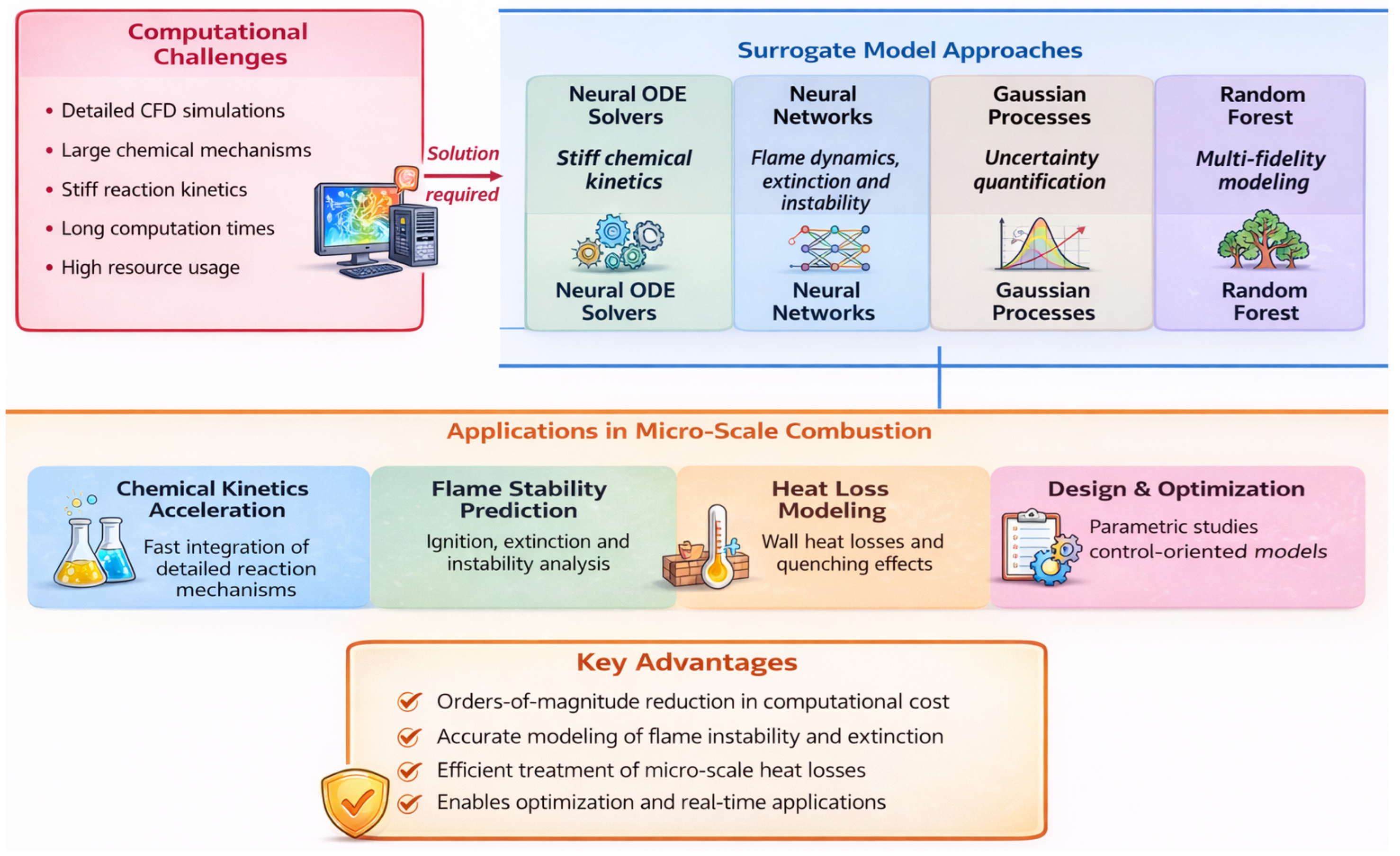
Significant advances have been reported in surrogate models for chemical kinetics, particularly through ANN and NODE-based formulations capable of capturing stiff reaction dynamics and transport chemistry interactions with considerable enhancement of computational efficiency. These approaches are especially relevant in micro-combustion regimes where reaction time scales compete with residence times and heat-loss effects, making direct integration of detailed mechanisms prohibitively expensive. Beyond kinetics, surrogate models have been successfully applied to flame dynamics, radiative heat transfer, and coupled thermal–fluid responses in related combustion and thermal systems. Their extension to micro-combustion remains largely unexplored, but these approaches could potentially enable rapid prediction of quantities governing stability, efficiency, and emissions, provided that scale effects, strong coupling, and non-linearities are carefully accounted for. In Figure 7, an overview of surrogate modeling strategies for micro scale combustion is presented, highlighting how data-driven and hybrid approaches can address the high computational cost of detailed simulations. The figure illustrates the role of surrogate models in enabling efficient prediction, analysis, and optimization of micro-combustor performance, supporting faster and more computationally efficient design workflows.

6. Challenges, Perspectives and Conclusions

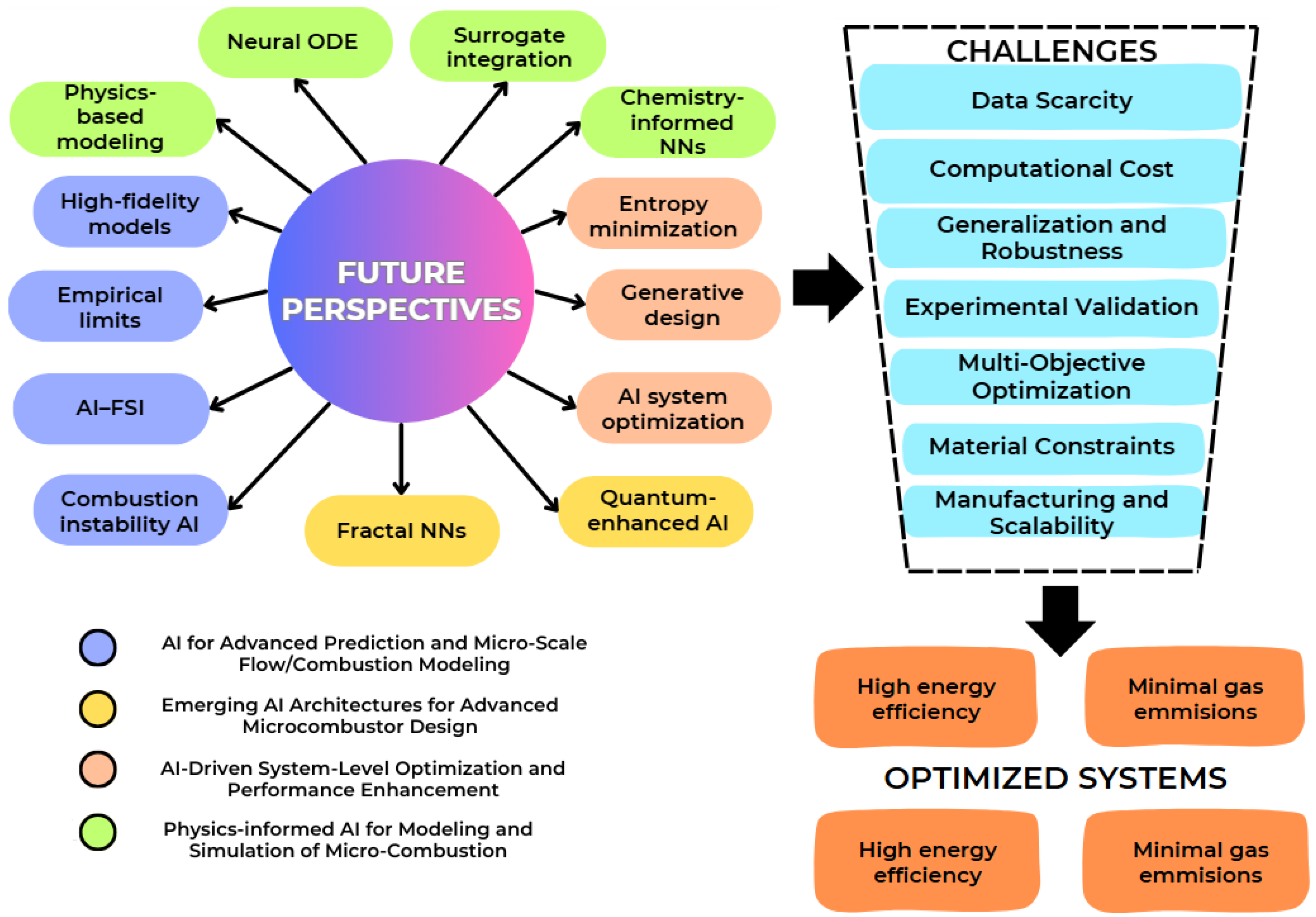
Artificial Intelligence holds significant potential to accelerate the development and optimization of micro-combustors as key components of Micro-Thermophotovoltaic and Micro-Thermoelectric systems. Recent advances, including surrogate modeling techniques and Physics-Informed Neural Networks, have demonstrated promising capabilities for capturing complex combustion phenomena and enabling ANN-based design optimization. Nevertheless, despite this progress, the application of AI to micro-combustion remains constrained by several fundamental limitations and research gaps. Identifying and addressing these challenges is therefore essential before AI-based methodologies can be reliably deployed in high-performance MTPV and MTE systems, and the most pressing issues are summarized below:
i
Lack of high-fidelity experimental data. The limited availability of comprehensive datasets on microcombustion (flame stability, heat transfer, emissions, and behavior in MTPV/MTE systems) restricts the training of AI models. Synthetic data generation using GANs and Physics-Informed GANs can partially mitigate this challenge, by expanding the datasets while reducing the risk of obtaining samples which lacks of physical meaning. However, continuous validation against high-fidelity CFD and experimental data is essential to ensure physical realism [78,79,80].
ii
Computational limitations in multi-physics simulations. Micro-combustion involves tightly coupled chemical, thermal, and fluid dynamics phenomena, making high-fidelity simulations extremely costly in terms of time and resources. A practical pathway is the adoption of multi-fidelity modeling architectures, where simulations of varying fidelity are strategically combined. Low-fidelity models, such as reduced chemical mechanism, are used for large-scale parametric sweeps, while high-fidelity CFD is selectively employed to correct and calibrate predictions in critical regions of the design space. Additionally, surrogates can be integrated into reduced-order solvers or optimization loops, enabling rapid evaluation of a coupled system. At the same time, Physics-Informed Neural Networks have been proposed as a promising approach to alleviate the computational cost associated with high-fidelity multi-physics simulations. However, caution is required, as their application to high-dimensional and stiff reactive systems often leads to increased training complexity and reduced robustness, particularly in fully three-dimensional configurations [55].
iii
Generalization of AI models and robust design. AI models trained on specific conditions or geometries may fail when applied to new designs, scales, or operating conditions. Incorporating physical laws via PINNs or constraint-regularized loss functions may represent a viable path towards generalizations of ANN-models by enforcing conservation of mass, momentum, and energy, as well as established combustion scaling relations and stability bounds. However, recent studies indicate that PINNs may face training instability, scalability limitations in fully three-dimensional and multi-physics reactive flows, and challenges associated with stiff chemical kinetics, which can affect convergence and predictive accuracy in realistic micro-combustion configurations, suggesting that PINNs should be regarded as a complementary rather than universal solution [54,55,56].
iv
Experimental validation and real-system transfer. Many advances are demonstrated only at the laboratory scale. Validation in functional prototypes or commercial MTPV/MTE systems is critical to ensure stability, efficiency, and low emissions under practical operating conditions. A critical pathway is the development and testing of integrated MTPV and MTE prototypes, where combustion, heat transfer, and power conversion are evaluated simultaneously under realistic operating conditions. Validation should include transient behavior, start-up and shut-down cycles, and long-duration operation to capture degradation, thermal stresses, and emission stability.
v
Concurrent optimization of efficiency, emissions, and system compatibility. Micro-combustors must balance thermal efficiency, low toxic emissions, and combustion stability while remaining compatible with MTPV/MTE systems. Multi-objective AI-driven optimization is required to achieve functional and commercially viable designs. ANN-based surrogates trained on CFD and experiment-derived data can replace expensive simulations within multi-objective optimization loops, enabling rapid evaluation of thousands of design candidates. Coupling these surrogates with evolutionary or gradient-based optimization algorithms may lead to rapid identification solutions.
vi
Material limitations and tolerance to extreme micro-scale conditions. Micro-combustors operate under high temperatures, steep thermal gradients, and reactive chemical environments. Selecting materials that maintain structural integrity, thermal conductivity, and chemical stability at the micro-scale is critical. Material degradation or failure can compromise efficiency, stability, and emission targets, limiting system integration and lifetime. Advanced material design, coatings, and AI-assisted material selection are essential to overcome this challenge. Databases of high-temperature alloys, ceramics, and composite materials can be combined with physics-based constraints, to rapidly identify candidate materials suitable for micro-scale operation. Additionally, advanced thermal barrier coatings and oxidation-resistant layers can be designed using data-driven approaches that optimize thickness and composition for durability.
vii
Manufacturing constraints and scalability. Micro-combustors require precise geometries to ensure stable combustion, optimal heat transfer, and low emissions. Fabrication at the micro-scale is challenging due to limitations in micro-machining, additive manufacturing, or micro-fabrication processes. Achieving reproducible designs, integrating complex geometries into system-level devices, and scaling up production for commercial applications are key challenges. Manufacturing limitations can constrain performance, increase costs, and delay translation from prototypes to functional MTPV/MTE systems. Integrating manufacturability and scalability considerations into AI-driven design optimization is essential. A primary pathway is to include manufacturing constraints directly into AI-driven optimization models, including minimum feature sizes, allowable aspect ratios, and alignment tolerances specific to micro-machining, additive manufacturing. This may help prevent the selection of non-manufacturable designs.
Addressing the challenges outlined above provides a clear framework for defining future research priorities in AI-assisted micro-combustion. In this context, the following perspectives highlight emerging directions that may help overcome current limitations by advancing high-fidelity modeling, multi-physics integration, and AI-driven design strategies.
Physics-informed AI for Modeling and Simulation of Micro-Combustion
  • Integrating physical laws into combustion modeling. Physics-Informed Neural Networks (PINNs) present a promising alternative to purely data-driven approaches in combustion modeling. By incorporating governing equations as constraints during training, PINNs aim to guide predictions in accordance with conservation laws while potentially reducing the need for extensive experimental datasets. This approach may be particularly beneficial in micro-combustion, where resolving velocity, temperature, and species fields accurately is critical for exploring flame stability and radiative heat transfer in confined systems.
  • Neural ODE and multi-fidelity methods for enhanced combustion simulation. Neural ODE solvers offer a promising route to accelerate chemical kinetics computation by embedding neural networks within differential equation solvers, potentially reducing the time required for species profile predictions. Multi-fidelity surrogate models can exploit correlations across mechanisms of different accuracy, enabling efficient uncertainty quantification and supporting the selection of chemical mechanisms for CFD simulations. Together, these approaches suggest opportunities to strengthen combustion simulation tools, while requiring substantial training data and careful validation to ensure physical reliability.
  • Towards integrated surrogate modeling for multi-physics combustion systems. The convergence of surrogate modeling methodologies across chemical kinetics, flame behavior, radiation, and uncertainty quantification has the potential to support comprehensive multi-physics analysis of micro-combustion systems. Neural ODE solvers may accelerate chemistry integration, ANN-based models can reproduce transient flame dynamics, neural operators provide efficient approximations of radiative transfer, and meta-learning frameworks support the treatment of parametric uncertainties. Collectively, these approaches suggest a pathway toward system-level optimization previously constrained by computational costs.
  • Chemistry Informed Neural Networks for micro-combustion optimization. The implementation of Chemistry-Informed Neural Networks (CINNs) offers a promising approach for optimizing micro-combustors in MTPV and MTE systems. The CINN framework proposed by Zhai et al. [81] integrates chemical principles directly into the network architecture to provide physically and chemically consistent predictions of parameters such as flame stability and temperature distribution. By incorporating reaction kinetics and species conservation, CINNs may enable more accurate exploration of the complex design space relevant to energy conversion efficiency in MTPV and MTE applications.
AI for Advanced Prediction and Micro-Scale Flow/Combustion Modeling
  • A paradigm shift towards high-fidelity modeling. Artificial Neural Networks are enabling digital twins for combustion and heat-transfer systems by learning high-dimensional relationships that conventional empirical models cannot capture. By encoding nonlinear interactions from data, ANNs may provide more accurate representations of temperature fields, reaction behavior, and radiative heat transfer. As noted in recent reviews [82], this capability can improve predictive reliability of metrics such as wall-temperature distribution and radiant power, opening pathways to micro-combustor designs beyond lower-fidelity modeling approaches.
  • Overcoming the limitations of empirical correlations in micro-scale flows. Traditional empirical correlations are limited to specific geometries, fluids, and operating ranges, while micro-scale flows often display nonlinearities that challenge these assumptions. ANN-based models offer a broader predictive scope and may generalize across channel dimensions, flow rates, and thermal boundary conditions when trained on diverse datasets. This flexibility enables prediction of heat-transfer coefficients and pressure drops beyond the range of conventional fitting methods, offering a versatile framework for modeling micro-scale phenomena.
  • AI for Fluid–Structure Interaction. Artificial intelligence is enabling new ways to analyze fluid–structure interaction (FSI) in micro-combustors for MTPV systems. By capturing the coupled behavior between flow-induced vibrations and structural response, AI models may reveal dynamics that conventional simulations address only partially. Insights from established FSI studies, such as Parameshwaran et al. [83], highlight the complexity of these interactions, indicating that data-driven approaches could support the design of more stable and efficient micro-scale energy devices.
  • AI for prediction and control of combustion instabilities. The extreme thermo-physical coupling in micro-combustors, where heat loss strongly influences combustion instabilities [84], positions AI as a powerful tool for their prediction and control. Following the physics-informed approach highlighted by Maldonado et al. [85] in spark-ignition engines, AI can proactively manage flow-induced and thermal fluctuations, revealing dynamics that conventional simulations may capture only partially. Such strategies hold potential to guide the design of more stable and efficient micro-combustor systems.
AI-Driven System-Level Optimization and Performance Enhancement
  • Generative design and multi-objective optimization for micro-combustors. AI-driven generative design [86,87] and multi-objective optimization are emerging approaches for exploring micro-combustor geometries while balancing objectives such as thermal efficiency, flame stability, and pressure drop [88]. By modeling heat transfer and reacting flows, these methods may help identify non-intuitive configurations. Although still evolving, they offer potential to guide the development of more efficient and robust designs for future micro-power systems.
  • A unified AI-driven optimization framework for system-level performance. Artificial Neural Networks enable holistic optimization of thermal systems by addressing multiple interconnected components. ANNs may facilitate concurrent optimization of combustion efficiency, heat transfer, radiative properties, and energy conversion in thermoelectric and photovoltaic cells. By capturing cross-component interactions, this approach allows system-level co-optimization and offers a pathway for navigating complex multi-domain design spaces to improve overall thermal system performance.
  • Entropy generation minimization via ANNs for MTPV systems. A forward-looking paradigm for optimizing MTPV micro-combustors integrates Artificial Neural Networks with Bejan’s entropy generation minimization (EGM) framework [89]. By capturing nonlinear interactions between geometric and operational parameters and thermodynamic irreversibilities, ANNs provide a tool for performance assessment. This approach aligns with emerging trends in renewable energy research, where machine learning is increasingly recognized for predicting and minimizing entropy [90]. Exploring the complex design space of micro-combustors using ANNs may enable future improvements in combustion stability, exergetic efficiency, and sustainable MTPV technologies.
Emerging AI Architectures for Advanced Micro-combustor Design
  • Quantum-enhanced ANNs for microcombustor optimization. The future application of Artificial Neural Networks for microcombustor performance in MTPV systems is linked to quantum computing. Current ANN models for reactive flow dynamics are constrained by the computational cost of optimizing complex, multi-parameter systems, which quantum computing is expected to help mitigate. As noted by Biamonte et al. [91], quantum algorithms may provide exponential speedup for optimization and sampling tasks underlying machine learning. This could enable more sophisticated ANN models to explore the design space of micro-combustors and improve combustion stability and wall-temperature uniformity. Furthermore, the integration of Quantum Machine Learning (QML) may lead to novel ANN architectures capable of identifying regimes and geometries intractable for classical computers [92].
  • The Potential of Fractal Neural Networks for Microcombustor Design. Optimizing micro-combustors requires capturing complex, multiscale physical phenomena across thermofluidic systems. Fractal Architecture Neural Networks (FANNs) could be well suited for this task, as their recursive, self-similar structure [93,94] may enable more natural modeling of hierarchical interactions. This approach might allow richer feature extraction from design and operational data, potentially improving the prediction of key performance metrics such as combustion stability and thermal efficiency. By aligning network architecture with problem multiscale characteristics, FANNs represent a promising pathway for microcombustor optimization.
Figure 8 schematically summarizes the thirteen identified perspectives, organized into four thematic categories, with each group represented by a distinct color to facilitate straightforward identification and comparison. The associated challenges are illustrated as a funnel-like bottleneck, highlighting the key limitations that must be progressively addressed to translate these perspectives into optimized designs at both the micro-combustor and system levels. Successfully overcoming these challenges is expected to enable systems characterized by high energy efficiency, minimal gas emissions, stable and controlled flames, and the realization of commercially viable MTPV and MTE technologies.
To summarize, this review examined more than ninety peer-reviewed studies to clarify how artificial intelligence can accelerate the design and optimization of micro-combustors for MTPV and MTE systems. The analysis identifies thirteen prospective research directions and seven key challenges that must be addressed to achieve optimally designed micro-combustors and fully integrated energy-conversion systems. Overall, the findings confirm that AI is evolving from an auxiliary tool into an increasingly central driver of progress in micro-combustion research. Based on what was identified in this review, the key conclusions can be highlighted as follows:
  • Physics-informed AI is emerging as a powerful path toward high-fidelity modeling by embedding physical laws, detailed chemistry, and multiphysics interactions into data-driven frameworks, thereby mitigating the limitations of empirical correlations.
  • AI-based predictive models show increasing promise for capturing microscale flow phenomena, fluid–structure interactions, and combustion instabilities, with predictive accuracy that in several cases approaches or exceeds what is attainable through conventional methods.
  • System-level optimization supported by neural networks is reshaping performance assessment, enabling integrated, multi-objective strategies that enhance efficiency, reduce entropy generation, and automate design exploration.
  • Emerging AI architectures, including quantum-enhanced networks and fractal models, are opening new avenues for accelerated computation and extreme-performance design, although their practical impact remains at an early stage.
  • Overcoming the seven persistent challenges related to data scarcity, multiphysics computational burdens, generalization and robustness issues, experimental validation requirements, and constraints associated with materials and manufacturability remains a prerequisite for transitioning from conceptual advances to deployable devices.
Considering these insights, next-generation micro-combustors and MTPV/MTE systems will need to achieve high energy efficiency, reduced emissions, stable and controllable flames, and a clear pathway toward commercial implementation. AI provides an enabling conceptual and computational framework to support the realization of these four defining attributes.
The improvements offered by ANN-based approaches over conventional methods are primarily reflected in computational efficiency and design-space exploration rather than in single-simulation accuracy. Once trained, ANN surrogates can evaluate thermo-fluid and combustion responses in milliseconds, yielding speedups of several orders of magnitude compared to high-fidelity CFD simulations, which may require hours or days per configuration. This computational advantage enables rapid parametric sweeps and large-scale optimization studies that are impractical using direct CFD-based approaches.
When compared with gradient-based [95] or adjoint optimization [96] methods, ANN-driven frameworks offer greater flexibility for handling highly nonlinear responses, discontinuities associated with flame stability, and multi-objective formulations involving efficiency, emissions, and system integration constraints. While adjoint methods remain highly efficient for problems with well-defined objectives and smooth sensitivities, ANN-based optimizations reduce the need for repeated gradient evaluations and enable broader, global exploration of complex design spaces, albeit at the cost of an upfront training phase.
Therefore, rather than replacing conventional CFD or adjoint techniques, ANN-based methods are best understood as complementary tools that shift the computational burden from repeated high-fidelity simulations to an offline training stage, enabling faster, more flexible, and system-level design optimization in micro-combustion applications.
Returning to the question posed in the title, How Might Neural Networks Improve Micro-Combustion Systems?, the evidence reviewed here indicates that neural networks contribute most effectively when aligned with the underlying physical challenges of micro-combustion, rather than when treated as standalone replacements for established modeling approaches. Their value lies in bridging scales, managing complexity, and enabling informed exploration of design spaces shaped by flame quenching, heat losses, and strong kinetic transport interactions. At the same time, this review makes clear that the benefits of ANN-based approaches are inherently problem-dependent. Their effectiveness varies with data availability, model formulation, and the degree of physical constraint imposed, and limitations related to generalization, robustness, and scalability, particularly in three-dimensional and stiff reactive regimes, remain significant.

Author Contributions

Conceptualization, L.E.M. and F.A.G.; methodology, L.E.M. and F.A.G.; formal analysis, L.E.M. and F.A.G.; investigation, L.E.M., F.A.G., R.V. and R.M.; resources, R.V. and F.A.G.; writing—original draft preparation, L.E.M., F.A.G., R.V. and R.M.; writing—review and editing, L.E.M., F.A.G., R.V. and R.M.; visualization, L.E.M. and F.A.G.; supervision, F.A.G.; project administration, L.E.M. and F.A.G.; funding acquisition, F.A.G. and R.V. All authors have read and agreed to the published version of the manuscript.

Funding

This research was funded by PAPIIT-DGAPA-UNAM grant number IN102126. The APC was funded by “Universidad Iberoamericana, Ciudad de México”.

Data Availability Statement

The original contributions presented in the study are included in the article; further inquiries can be directed to the corresponding authors.

Acknowledgments

During the preparation of this manuscript, the authors used ChatGPT 5.2 for the purposes of improving the writing and structuring the text. The authors have reviewed and edited the output and take full responsibility for the content of this publication. L.E Muro thanks the financial support of the Secretaría de Ciencias, Humanidades, Tecnología e Innovación (SECIHTI).

Conflicts of Interest

The authors declare no conflicts of interest. The funders had no role in the design of the study; in the collection, analyses, or interpretation of data; in the writing of the manuscript; or in the decision to publish the results.

Abbreviations

The following abbreviations are used in this manuscript:
AIArtificial intelligence
MLMachine learning
MTPVMicro-thermophotovoltaic
MTEMicro-thermoelectric
MEMSMicro-electromechanical systems
DLDeep learning
ANNArtificial neural network
CFDComputational fluid dynamics
RSMResponse surface methodology
TPVThermophotovoltaic
MTCSMonte Carlo tree search
DBRDistributed Bragg reflector
FCNNFully connected neural network
GAGenetic algorithm
ALActive learning
MOGAMulti-objective genetic algorithm
GANGenerative adversarial network
cGANConditional generative adversarial network
GMDHGroup method data handling
PINNPhysics-informed neural network
DNSDirect numerical simulation
LESLarge eddy simulations
HTCHeat transfer coefficient
NODENeural ordinary differential equation
ROMReduce-order model
AEAuto-encoder
CINNsChemistry-informed neural networks
FSIFluid–structure interaction
QMLQuantum machine learning
FANNsFractal architecture neural networks
VGsVortex generators

References

  1. Hosseini, S.H.; Tsolakis, A.; Alagumalai, A.; Mahian, O.; Lam, S.S.; Pan, J.; Peng, W.; Tabatabaei, M.; Aghbashlo, M. Use of hydrogen in dual-fuel diesel engines. Prog. Energy Combust. Sci. 2023, 98, 101100. [Google Scholar] [CrossRef]
  2. Ju, Y.; Maruta, K. Microscale combustion: Technology development and fundamental research. Prog. Energy Combust. Sci. 2011, 37, 669–715. [Google Scholar] [CrossRef]
  3. E, J.; Luo, B.; Han, D.; Chen, J.; Liao, G.; Zhang, F.; Ding, J. A comprehensive review on performance improvement of micro energy mechanical system: Heat transfer, micro combustion and energy conversion. Energy 2022, 239, 122509. [Google Scholar] [CrossRef]
  4. Kaisare, N.S.; Vlachos, D.G. A review on microcombustion: Fundamentals, devices and applications. Prog. Energy Combust. Sci. 2012, 38, 321–359. [Google Scholar] [CrossRef]
  5. Nauman, M.; Pan, J.; Wang, Y.; Li, F.; Oluwaleke Ojo, A.; Raza, A. A review of recent advancements in micro combustion techniques to enhance flame stability and fuel residence time. Int. J. Hydrogen Energy 2024, 49, 1165–1193. [Google Scholar] [CrossRef]
  6. You, J.; Wang, D.; Yan, Y.; He, Z.; Xue, Z. A novel two-stage thermophotovoltaic-thermoelectric system based on micro combustion. Appl. Therm. Eng. 2023, 232, 121018. [Google Scholar] [CrossRef]
  7. Dias, D.M.; Resende, P.R.; Afonso, A.M. A Review on Micro-Combustion Flame Dynamics and Micro-Propulsion Systems. Energies 2024, 17, 1327. [Google Scholar] [CrossRef]
  8. Li, G.; Fan, Y.; Li, Q.; Zheng, Y.; Zhao, D.; Wang, S.; Dong, S.; Guo, W.; Tang, Y. A review on micro combustion powered thermoelectric generator: History, state-of-the-art and challenges to commercialization. Renew. Sustain. Energy Rev. 2025, 207, 114897. [Google Scholar] [CrossRef]
  9. Kang, Z.; Shi, Z.; Ye, J.; Tian, X.; Huang, Z.; Wang, H.; Wei, D.; Peng, Q.; Tu, Y. A Review of Micro Power System and Micro Combustion: Present Situation, Techniques and Prospects. Energies 2023, 16, 3201. [Google Scholar] [CrossRef]
  10. Sankar, V.; Sudarsanan, S.; Mukhopadhyay, S.; Selvaraj, P.; Balakrishnan, A.; Velamati, R.K. Towards the Development of Miniature Scale Liquid Fuel Combustors for Power Generation Application—A Review. Energies 2023, 16, 4035. [Google Scholar] [CrossRef]
  11. Cai, L.; E, J.; Li, J.; Ding, J.; Luo, B. A comprehensive review on combustion stabilization technologies of micro/meso-scale combustors for micro thermophotovoltaic systems: Thermal, emission, and energy conversion. Fuel 2023, 335, 126660. [Google Scholar] [CrossRef]
  12. Dunn-Rankin, D.; Leal, E.M.; Walther, D.C. Personal power systems. Prog. Energy Combust. Sci. 2005, 31, 422–465. [Google Scholar] [CrossRef]
  13. Fernandez-Pello, A.C. Micropower generation using combustion: Issues and approaches. Proc. Combust. Inst. 2002, 29, 883–899. [Google Scholar] [CrossRef]
  14. Walther, D.C.; Ahn, J. Advances and challenges in the development of power-generation systems at small scales. Prog. Energy Combust. Sci. 2011, 37, 583–610. [Google Scholar] [CrossRef]
  15. Drikakis, D.; Sofos, F. Can Artificial Intelligence Accelerate Fluid Mechanics Research? Fluids 2023, 8, 212. [Google Scholar] [CrossRef]
  16. Etminan, A.; Pope, K.; Mashayekh, K. Artificial intelligence in fluid dynamics and thermal transport: A comprehensive review of methods, challenges, and emerging applications. AI Therm. Fluids 2025, 4, 100022. [Google Scholar] [CrossRef]
  17. Tao, C.; Liu, C.; Yang, B. Artificial intelligence in combustion reaction kinetics: Methods and applications. Appl. Energy Combust. Sci. 2025, 24, 100422. [Google Scholar] [CrossRef]
  18. Mao, R.; Lin, M.; Zhang, Y.; Zhang, T.; Xu, Z.Q.J.; Chen, Z.X. DeepFlame: A deep learning empowered open-source platform for reacting flow simulations. Comput. Phys. Commun. 2023, 291, 108842. [Google Scholar] [CrossRef]
  19. Zhao, H.; Zhao, D.; Sun, D.; Semlitsch, B. Electrical power, energy efficiency, NO and CO emissions investigations of an ammonia/methane-fueled micro-thermal photovoltaic system with a reduced chemical reaction mechanism. Energy 2024, 305, 132248. [Google Scholar] [CrossRef]
  20. Quaye, E.K.; Pan, J.; Fan, B.; Lu, Q.; Zhang, Y.; Jiang, C.; Nauman, M.; Ibeobi, S. Advancing sustainable combustion: A comprehensive review of response surface methodology driven optimization and applications in alternative fuel combustion systems. Int. J. Hydrogen Energy 2025, 170, 151190. [Google Scholar] [CrossRef]
  21. Veza, I.; Spraggon, M.; Fattah, I.R.; Idris, M. Response surface methodology (RSM) for optimizing engine performance and emissions fueled with biofuel: Review of RSM for sustainability energy transition. Results Eng. 2023, 18, 101213. [Google Scholar] [CrossRef]
  22. Hidayat, E.; Hannani Hamid, N.A.; Mohamad Sarbani, N.M.; Samitsu, S.; Aoyagi, M.; Harada, H.; Safari, M.A.M. Optimization and comparative modelling of RSM and ANN for the adsorptive removal of Remazol Brilliant Blue R dye using spent coffee ground biochar. Chemosphere 2025, 389, 144709. [Google Scholar] [CrossRef]
  23. Huang, Y.; Chen, Y. A novel technique to optimize combustor geometry for micro thermophotovoltaic system by combining numerical simulation and machine learning. Int. J. Hydrogen Energy 2022, 47, 38407–38426. [Google Scholar] [CrossRef]
  24. Gond, A.; Sengupta, A. Data-driven optimal design of premixed hydrogen-air combustion in a microcombustor. AI Therm. Fluids 2025, 1, 100007. [Google Scholar] [CrossRef]
  25. Liang, X.; Kumar, N.B.; Mansir, I.B.; Kumar Singh, P.; Abed, A.M.; Dahari, M.; Nasr, S.; Albalawi, H.; Cherif, A.; Wae-hayee, M. Management of heat transfer and hydraulic characteristics of a micro-channel heat sink with various arrangements of rectangular vortex generators utilizing artificial neural network and response surface methodology. Case Stud. Therm. Eng. 2023, 44, 102850. [Google Scholar] [CrossRef]
  26. Shuqi, Z.; Limei, Y.; Goyal, V.; Alghanmi, S.; Alkhalifah, T.; Alkhalaf, S.; Alturise, F.; Elhosiny Ali, H.; Deifalla, A. Artificial neural network-based optimization of baffle geometries for maximized heat transfer efficiency in microchannel heat sinks. Case Stud. Therm. Eng. 2023, 49, 103331. [Google Scholar] [CrossRef]
  27. Hu, R.; Song, J.; Liu, Y.; Xi, W.; Zhao, Y.; Yu, X.; Cheng, Q.; Tao, G.; Luo, X. Machine learning-optimized Tamm emitter for high-performance thermophotovoltaic system with detailed balance analysis. Nano Energy 2020, 72, 104687. [Google Scholar] [CrossRef]
  28. Bohm, P.; Yang, C.; Menon, A.K.; Zhang, Z.M. Thermophotovoltaic emitter design with a hyper-heuristic custom optimizer enabled by deep learning surrogates. Energy 2024, 291, 130424. [Google Scholar] [CrossRef]
  29. Cai, T.; Xu, Z.; Yi, Y.; Wang, C.; Zhou, B.; Chen, C.; Liu, Y.; Wang, Y.; Lu, H.; Tang, X. Advancing thermal radiation efficiency with hybrid-patterned metasurface emitters in thermophotovoltaic systems. Int. J. Therm. Sci. 2025, 213, 109790. [Google Scholar] [CrossRef]
  30. Demeke, W.; Ryu, B.; Ryu, S. Machine learning-based optimization of segmented thermoelectric power generators using temperature-dependent performance properties. Appl. Energy 2024, 355, 122216. [Google Scholar] [CrossRef]
  31. Chen, W.H.; Huang, T.H.; Luo, D.; Jin, L.; Maduabuchi, C.; Lamba, R.; Hoang, A.T. Optimization of a unileg thermoelectric generator by the combination of Taguchi method and evolutionary neural network for green power generation. Appl. Therm. Eng. 2024, 248, 123204. [Google Scholar] [CrossRef]
  32. Chen, W.H.; Lin, Y.K.; Luo, D.; Jin, L.; Bandala, A.A. Optimization of a segmented thermoelectric generator with various doping amounts using central composite design, multi-objective genetic algorithm, and artificial neural network. Energy 2025, 316, 134469. [Google Scholar] [CrossRef]
  33. Xu, A.; Xie, C.; Xie, L.; Zhu, W.; Xiong, B.; Gooi, H.B. Performance prediction and optimization of annular thermoelectric generators based on a comprehensive surrogate model. Energy 2024, 290, 130195. [Google Scholar] [CrossRef]
  34. López-Belchí, A.; Illán-Gómez, F.; Cano-Izquierdo, J.M.; García-Cascales, J.R. GMDH ANN to optimise model development: Prediction of the pressure drop and the heat transfer coefficient during condensation within mini-channels. Appl. Therm. Eng. 2018, 144, 321–330. [Google Scholar] [CrossRef]
  35. Zhou, L.; Garg, D.; Qiu, Y.; Kim, S.M.; Mudawar, I.; Kharangate, C.R. Machine learning algorithms to predict flow condensation heat transfer coefficient in mini/micro-channel utilizing universal data. Int. J. Heat Mass Transf. 2020, 162, 120351. [Google Scholar] [CrossRef]
  36. Qiu, Y.; Garg, D.; Zhou, L.; Kharangate, C.R.; Kim, S.M.; Mudawar, I. An artificial neural network model to predict mini/micro-channels saturated flow boiling heat transfer coefficient based on universal consolidated data. Int. J. Heat Mass Transf. 2020, 149, 119211. [Google Scholar] [CrossRef]
  37. Kim, S.M.; Mudawar, I. Universal approach to predicting saturated flow boiling heat transfer in mini/micro-channels—Part II. Two-phase heat transfer coefficient. Int. J. Heat Mass Transf. 2013, 64, 1239–1256. [Google Scholar] [CrossRef]
  38. Giannetti, N.; Redo, M.A.; Sholahudin; Jeong, J.; Yamaguchi, S.; Saito, K.; Kim, H. Prediction of two-phase flow distribution in microchannel heat exchangers using artificial neural network. Int. J. Refrig. 2020, 111, 53–62. [Google Scholar] [CrossRef]
  39. Khosravi, R.; Rabiei, S.; Bahiraei, M.; Teymourtash, A. Predicting entropy generation of a hybrid nanofluid containing graphene–platinum nanoparticles through a microchannel liquid block using neural networks. Int. Commun. Heat Mass Transf. 2019, 109, 104351. [Google Scholar] [CrossRef]
  40. Shen, T.; Zhu, Z.; Huang, L.; Chang, J. Transient flow behavior in serpentine curved microchannel of inertial microfluidic devices. J. Micromech. Microeng. 2020, 30, 025005. [Google Scholar] [CrossRef]
  41. Liu, K.; Luo, K.; Cheng, Y.; Liu, A.; Li, H.; Fan, J.; Balachandar, S. Surrogate modeling of parameterized multi-dimensional premixed combustion with physics-informed neural networks for rapid exploration of design space. Combust. Flame 2023, 258, 113094. [Google Scholar] [CrossRef]
  42. Liu, S.; Wang, H.; Chen, J.H.; Luo, K.; Fan, J. High-resolution reconstruction of turbulent flames from sparse data with physics-informed neural networks. Combust. Flame 2024, 260, 113275. [Google Scholar] [CrossRef]
  43. Liu, S.; Wang, H.; Luo, K.; Fan, J. Neural network-based 3D reconstruction of temperature and velocity for turbulent flames from 2D measurements. Combust. Flame 2025, 281, 114454. [Google Scholar] [CrossRef]
  44. Wu, J.; Zhang, S.; Wu, Y.; Zhang, G.; Li, X.; Zhang, H. FlamePINN-1D: Physics-informed neural networks to solve forward and inverse problems of 1D laminar flames. Combust. Flame 2025, 273, 113964. [Google Scholar] [CrossRef]
  45. Cao, Z.; Luo, K.; Liu, K.; Cheng, Y.; Xing, J.; Jiang, L.; Fan, J. Physics-informed neural networks for modeling turbulent combustion. Fuel 2026, 405, 136475. [Google Scholar] [CrossRef]
  46. Mariappan, S.; Nath, K.; Em Karniadakis, G. Learning thermoacoustic interactions in combustors using a physics-informed neural network. Eng. Appl. Artif. Intell. 2024, 138, 109388. [Google Scholar] [CrossRef]
  47. Son, H.; Lee, M. A PINN approach for identifying governing parameters of noisy thermoacoustic systems. J. Fluid Mech. 2024, 984, A21. [Google Scholar] [CrossRef]
  48. Xie, M.; Zhao, X.; Zhao, D.; Fu, J.; Shelton, C.; Semlitsch, B. Predicting bifurcation and amplitude death characteristics of thermoacoustic instabilities from PINNs-derived van der Pol oscillators. J. Fluid Mech. 2024, 998, A46. [Google Scholar] [CrossRef]
  49. Zucker, S.; Batenkov, D.; Rozenhaimer, M.S. Physics-informed neural networks for modeling atmospheric radiative transfer. J. Quant. Spectrosc. Radiat. Transf. 2025, 331, 109253. [Google Scholar] [CrossRef]
  50. Chen, W.; Yang, R.; Ren, T.; Zhao, C. Development and validation of a physics-informed neural network-based WSGG model for multi-species gas mixtures. Int. J. Heat Mass Transf. 2025, 251, 127328. [Google Scholar] [CrossRef]
  51. Biswal, P.; Avdijaj, J.; Parente, A.; Coussement, A. Physics informed neural networks to solve radiative transfer equation in absorbing-scattering media. J. Quant. Spectrosc. Radiat. Transf. 2025, 344, 109509. [Google Scholar] [CrossRef]
  52. Biswal, P.; Avdijaj, J.; Parente, A.; Coussement, A. Radiation transfer equation in participating media: Solution using physics informed neural networks. J. Fluid Flow, Heat Mass Transf. (JFFHMT) 2024, 11, 356–362. [Google Scholar] [CrossRef]
  53. Liu, S.; Liu, C.; Hou, X. Numerical simulation and experimental study of radiative thermal environment in solid rocket motors based on Fourier feature physics-informed neural networks. Appl. Therm. Eng. 2025, 280, 128001. [Google Scholar] [CrossRef]
  54. Raissi, M.; Perdikaris, P.; Karniadakis, G.E. Physics-informed neural networks: A deep learning framework for solving forward and inverse problems involving nonlinear partial differential equations. J. Comput. Phys. 2019, 378, 686–707. [Google Scholar] [CrossRef]
  55. Wang, S.; Yu, X.; Perdikaris, P. When and why PINNs fail to train: A neural tangent kernel perspective. J. Comput. Phys. 2022, 449, 110768. [Google Scholar] [CrossRef]
  56. Yang, L.; Meng, X.; Karniadakis, G.E. B-PINNs: Bayesian physics-informed neural networks for forward and inverse PDE problems with noisy data. J. Comput. Phys. 2021, 425, 109913. [Google Scholar] [CrossRef]
  57. Jagtap, A.D.; Kawaguchi, K.; Karniadakis, G.E. Adaptive activation functions accelerate convergence in deep and physics-informed neural networks. J. Comput. Phys. 2020, 404, 109136. [Google Scholar] [CrossRef]
  58. Ziehn, T.; Tomlin, A.S. A global sensitivity study of sulfur chemistry in a premixed methane flame model using HDMR. Int. J. Chem. Kinet. 2008, 40, 742–753. [Google Scholar] [CrossRef]
  59. Boussaidi, M.A.; Ren, O.; Voytsekhovsky, D.; Manzhos, S. Random Sampling High Dimensional Model Representation Gaussian Process Regression (RS-HDMR-GPR) for Multivariate Function Representation: Application to Molecular Potential Energy Surfaces. J. Phys. Chem. A 2020, 124, 7598–7607. [Google Scholar] [CrossRef] [PubMed]
  60. Ihme, M.; Chung, W.T.; Mishra, A.A. Combustion machine learning: Principles, progress and prospects. Prog. Energy Combust. Sci. 2022, 91, 101010. [Google Scholar] [CrossRef]
  61. Li, S.; Yang, B.; Qi, F. Accelerate global sensitivity analysis using artificial neural network algorithm: Case studies for combustion kinetic model. Combust. Flame 2016, 168, 53–64. [Google Scholar] [CrossRef]
  62. Döppel, F.A.; Votsmeier, M. Efficient machine learning based surrogate models for surface kinetics by approximating the rates of the rate-determining steps. Chem. Eng. Sci. 2022, 262, 117964. [Google Scholar] [CrossRef]
  63. Wang, T.; Yi, Y.; Yao, J.; Xu, Z.Q.J.; Zhang, T.; Chen, Z. Enforcing physical conservation in neural network surrogate models for complex chemical kinetics. Combust. Flame 2025, 275, 114105. [Google Scholar] [CrossRef]
  64. Owoyele, O.; Pal, P. ChemNODE: A neural ordinary differential equations framework for efficient chemical kinetic solvers. Energy AI 2022, 7, 100118. [Google Scholar] [CrossRef]
  65. Vijayarangan, V.; Uranakara, H.A.; Barwey, S.; Galassi, R.M.; Malik, M.R.; Valorani, M.; Raman, V.; Im, H.G. A data-driven reduced-order model for stiff chemical kinetics using dynamics-informed training. Energy AI 2024, 15, 100325. [Google Scholar] [CrossRef]
  66. Goodwin, D.G.; Speth, R.L.; Moffat, H.K.; Weber, B.W. Cantera: An Object-Oriented Software Toolkit for Chemical Kinetics, Thermodynamics, and Transport Processes. Available online: http://dx.doi.org/10.5281/zenodo.6387882 (accessed on 20 October 2025).
  67. Kumar, T.; Kumar, A.; Pal, P. A Physics-Informed Autoencoder-NeuralODE Framework (Phy-ChemNODE) for Learning Complex Fuel Combustion Kinetics. In Proceedings of the NeurIPS Machine Learning and the Physical Sciences Workshop, Vancouver, BC, Canada, 15 December 2024; p. 1. [Google Scholar]
  68. Su, X.; Ji, W.; An, J.; Ren, Z.; Deng, S.; Law, C.K. Kinetics parameter optimization of hydrocarbon fuels via neural ordinary differential equations. Combust. Flame 2023, 251, 112732. [Google Scholar] [CrossRef]
  69. Tao, C.; Liu, C.; Wang, Y.; Yang, B. Meta-learning innovates chemical kinetics: An efficient approach for surrogate model construction. Proc. Combust. Inst. 2025, 41, 105860. [Google Scholar] [CrossRef]
  70. Liu, C.; Lin, K.; Wang, Y.; Yang, B. Multi-fidelity neural network for uncertainty quantification of chemical reaction models. Combust. Flame 2023, 258, 113074. [Google Scholar] [CrossRef]
  71. Jung, M.Y.; Chang, J.H.; Oh, M.; Lee, C.H. Dynamic model and deep neural network-based surrogate model to predict dynamic behaviors and steady-state performance of solid propellant combustion. Combust. Flame 2023, 250, 112649. [Google Scholar] [CrossRef]
  72. Fruzza, F.; Lamioni, R.; Grenga, T.; Mariotti, A.; Salvetti, M.V.; Galletti, C. Mapping flashback velocity in hydrogen-fueled perforated burners over a broad geometric design space. Int. J. Hydrogen Energy 2026, 202, 152980. [Google Scholar] [CrossRef]
  73. Lu, X.; Wang, Y. Surrogate modeling for radiative heat transfer using physics-informed deep neural operator networks. Proc. Combust. Inst. 2024, 40, 105282. [Google Scholar] [CrossRef]
  74. Sun, Y.; Lin, C.; Zheng, S. Emulating non-gray gas radiative heat transfer in combustion scenarios by machine learning method. J. Quant. Spectrosc. Radiat. Transf. 2026, 349, 109735. [Google Scholar] [CrossRef]
  75. Mosic, M.; Dobardzic, E.; Pecic, S.; Miletic, K.; Belca, I. Numerical reconstruction of 3D temperature fields in coal-fired furnaces using Vis-NIR spectrometry and surrogate modeling. Results Eng. 2026, 29, 108622. [Google Scholar] [CrossRef]
  76. Zhang, Y.; Li, R.; Zhang, X.; Tao, Z.; Xia, G.; Du, X. Lightweight optimization of space reactor loop heat pipe radiation radiator based on surrogate models. Prog. Nucl. Energy 2024, 170, 105158. [Google Scholar] [CrossRef]
  77. Xia, G.; Zhou, T.; Zhang, Y.; Dai, S.; Jiao, G. Operating characteristics analysis and optimization of loop heat pipe radiation cooling system in space reactor. Nucl. Eng. Des. 2024, 420, 113043. [Google Scholar] [CrossRef]
  78. Carreon, A.; Barwey, S.; Raman, V. A generative adversarial network (GAN) approach to creating synthetic flame images from experimental data. Energy AI 2023, 13, 100238. [Google Scholar] [CrossRef]
  79. Jang, S.; Yoo, S.; Kang, N. Generative design by reinforcement learning: Enhancing the diversity of topology optimization designs. Comput.-Aided Des. 2022, 146, 103225. [Google Scholar] [CrossRef]
  80. Aliehyaei, M.A. Optimization of micro gas turbine by economic, exergy and environment analysis using genetic, bee colony and searching algorithms. J. Therm. Eng. 2020, 6, 117–140. [Google Scholar] [CrossRef]
  81. Zhai, C.; Zhang, S.; Jiang, N.; Yang, L. Kinetic parameter optimization for the bench-scale pyrolysis via chemistry informed neural network. J. Anal. Appl. Pyrolysis 2023, 172, 106030. [Google Scholar] [CrossRef]
  82. Devasenan, M.; Madhavan, S. Thermal intelligence: Exploring AI’s role in optimizing thermal systems—A review. Interactions 2024, 245, 282. [Google Scholar] [CrossRef]
  83. Parameshwaran, R.; Dhulipalla, S.J.; Yendluri, D.R. Fluid-structure interactions and flow induced vibrations: A review. Procedia Eng. 2016, 144, 1286–1293. [Google Scholar] [CrossRef]
  84. Wang, Y.; Zhou, Z.; Yang, W.; Zhou, J.; Liu, J.; Wang, Z.; Cen, K. Instability of flame in micro-combustor under different external thermal environment. Exp. Therm. Fluid Sci. 2011, 35, 1451–1457. [Google Scholar] [CrossRef]
  85. Maldonado, B.; Stefanopoulou, A.; Kaul, B. Artificial-intelligence-based prediction and control of combustion instabilities in spark-ignition engines. In Artificial Intelligence and Data Driven Optimization of Internal Combustion Engines; Elsevier: Amsterdam, The Netherlands, 2022; pp. 185–212. [Google Scholar]
  86. Oh, S.; Jung, Y.; Kim, S.; Lee, I.; Kang, N. Deep generative design: Integration of topology optimization and generative models. J. Mech. Des. 2019, 141, 111405. [Google Scholar] [CrossRef]
  87. Zhu, Z.; Wang, J.; Deng, T.; Dai, H. An artificial intelligence-based strategy for multi-objective optimization of internal combustion engine performance and emissions. Expert Syst. Appl. 2025, 270, 126472. [Google Scholar] [CrossRef]
  88. Ain, O.; Khalil, H.B.; El-Maraghy, M.; Marzouk, M. Generative Design and Multi-Objective Optimization for Enhanced Building Thermal Performance. Case Stud. Therm. Eng. 2025, 73, 106621. [Google Scholar] [CrossRef]
  89. Bejan, A. Entropy generation minimization: The new thermodynamics of finite-size devices and finite-time processes. J. Appl. Phys. 1996, 79, 1191–1218. [Google Scholar] [CrossRef]
  90. Nabwey, H.A.; Ashraf, M.; Nadeem, H.; Rashad, A.; Chamkha, A.J. Optimizing renewable energy systems: A comprehensive review of entropy generation minimization. AIP Adv. 2024, 14, 120702. [Google Scholar] [CrossRef]
  91. Biamonte, J.; Wittek, P.; Pancotti, N.; Rebentrost, P.; Wiebe, N.; Lloyd, S. Quantum machine learning. Nature 2017, 549, 195–202. [Google Scholar] [CrossRef]
  92. Dunjko, V.; Briegel, H.J. Machine learning & artificial intelligence in the quantum domain: A review of recent progress. Rep. Prog. Phys. 2018, 81, 074001. [Google Scholar] [CrossRef]
  93. Golmankhaneh, A.K.; Jorgensen, P.E.T. Fractal Architecture Neural Networks. Preprint 2025. [Google Scholar] [CrossRef]
  94. Shymanskyi, V.; Ratinskiy, O.; Shakhovska, N. Fractal Neural Network Approach for Analyzing Satellite Images. Appl. Artif. Intell. 2025, 39, 2440839. [Google Scholar] [CrossRef]
  95. Ji, W.; Su, X.; Pang, B.; Li, Y.; Ren, Z.; Deng, S. SGD-based optimization in modeling combustion kinetics: Case studies in tuning mechanistic and hybrid kinetic models. Fuel 2022, 324, 124560. [Google Scholar] [CrossRef]
  96. Mayer, D.; Beishuizen, N.; Pitsch, H.; Economon, T.D.; Carrigan, T. Automatic adjoint-based design optimization for laminar combustion applications. Fuel 2024, 370, 131751. [Google Scholar] [CrossRef]
Figure 1. (a) Micro-Thermophotovoltaic System. (b) Micro-Thermoelectric System.
Energies 19 00326 g001
Figure 2. Schematic representation of a micro-channel heat sink with rectangular baffles that work as vortex generators [25].
Energies 19 00326 g002
Figure 3. Schematic representation of a micro-channel heat sink with triangular oriented baffles [26].
Energies 19 00326 g003
Figure 4. ANN-based optimization framework for micro-scale thermal and energy systems, illustrating a zigzag workflow from design parameters to optimized performance.
Energies 19 00326 g004
Figure 5. Conceptual framework of ANN-based prediction of flow variables in mini- and micro-channel systems.
Energies 19 00326 g005
Figure 6. Conceptual framework of a physics informed neural network (PINN) applied to microcombustor modeling and design.
Energies 19 00326 g006
Figure 7. Schematic overview of surrogate modeling approaches for micro-scale combustion.
Energies 19 00326 g007
Figure 8. Diagram illustrating the key perspectives, associated challenges, and desired characteristics for optimized micro-combustors, as well as for Micro-Thermophotovoltaic (MTPV) and Micro-Thermoelectric (MTE) systems.
Energies 19 00326 g008
Table 1. Comparison of CFD, regression, and ANN modeling approaches for micro-combustion studies.
AspectCFD ModelsRegression ModelsANN Models
Model typePhysics-basedStatisticalData-driven
Computational costHigh for combustion simulationsLow to moderateHigh during training, but negligible once trained
Input dataPhysical models and boundary conditionsSmall to large datasets are requiredLarge representative datasets are required
AccuracyHigh if mesh resolution is adequateLimited to smooth trendsHigh within trained domain
Handling of non-linearitiesNon-linearities increase computational costDifficult to capture non-linearities for large numbers of input variablesNon-linearities are easily captured
Handling of multi-physicsPossible, but often prohibitiveLimited, resulting in oversimplified modelsMultiple physics can be integrated in the model, resulting in accurate predictions
Suitability for parametric studiesImpractical when dealing with large number of input variablesImpractical when the number of variables becomes largeCapable of dealing with multiple input variables
Speed of predictionSlowFast, once fittedFast once trained
ApplicationsSuitable for fundamental analysis and obtaining physical insight of micro-combustion phenomenaSuitable for parametric studies with few input variables, for preliminary design and trend identificationANN models are suitable for parametric studies that involve many input variables and many complex non-linear physical relationships between the variables
Table 2. Summary of artificial neural network (ANN) architectures and training strategies employed for optimization in micro-combustion, thermophotovoltaic, and thermoelectric energy systems. When architectural or training details were not explicitly reported in the original studies, they are indicated as “not specified” to avoid inference.
AuthorOptimization GoalANN ArchitectureTraining DataTraining AlgorithmAccuracy
Huang et al. [23]Radiation power of a micro-combustorBack Propagation Neural-Network, employing one hidden layer with eight neuronsCFD simulations; 197 samplesBack-propagation R 2 0.99
Gond & Sengupta [24]Maximum gas temperature, and mean water production rate in a micro-combustorBack Propagation Neural-Network, employing 16 hidden layers with varying number of neurons (from 8 to 64)CFD simulations; 92 samplesBack-propagationAccuracy in the range of 90.1–97.2%
Liang et al. [25]Nusselt number and pressure drop in a micro heat-exchangerMultilayer perceptron, employing one hidden layers with four neuronsCFD simulations, 15 samplesLevenberg–Marquardt R 2 = 0.995 (Nu), R 2 = 0.992 ( Δ P )
Shuqi et al. [26]Nusselt number and pressure drop in a micro heat-exchangerMultilayer perceptron, employing two hidden layers with six neurons eachCFD simulations, 27 samplesLevenberg–Marquardt R 2 = 0.986 (Nu), R 2 = 0.988 ( Δ P )
Hu et al. [27]Power density and efficiency of a TPV emitterANN embedded in Monte Carlo Tree Search frameworkTransfer-matrix modelingANN combined with Monte Carlo Tree SearchNot specified
Bohm et al. [28]Power output and efficiency of a TPV emitterFully connected neural network, employing 3 hidden layers with 512 or 1024 neuronsRigorous-coupled wave analysis calculations, 100 samplesANN combined with hyper-heuristic optimizationRoot-mean-squared error of 0.0045
Cai et al. [29]In-band emission and efficiency of a TPV emitterForward and Inverse Neural Networks coupled with a genetic algorithm. Three hidden layers were used in the inverse model, with 731, 664 and 295 neurons. Four hidden layers were used in the forward model, with 598, 332, 897 and 500 neurons.Finite-difference time domain simulations, 1602 samplesANN combined with genetic algorithmMean-squared error of 0.0013 and 0.0046 in forward and inverse models, respectively
Demeke et al. [30]Power and efficiency of a segmented thermoelectric generatorDeep neural networks, employing two hidden layersFinite element simulations, 157,916 samplesDNN combined with genetic algorithm and active learning R 2 0.97
Chen et al. [31]Power-to-thermal stress ratio of a unileg TEGEvolutionary neural network, employing two hidden layers with 70 and 20 neuronsFinite element simulations, 4000 samplesANN with evolutionary optimization R 2 0.99
Chen et al. [32]Power and efficiency of a TEGMultilayer Perceptron, employing two input layers with 10 neurons each.Finite element simulations, 9 samplesANN combined with a multiobjective genetic algorithm R 2 0.9788
Xu et al. [33]Power output and efficiency of a TEGBack Propagation Neural NetworkFinite element simulation, 3125 samplesANN, combined with a conditional generative adversarial network and a genetic algorithm R 2 0.9992 for power output, R 2 0.9992 for efficiency
Disclaimer/Publisher’s Note: The statements, opinions and data contained in all publications are solely those of the individual author(s) and contributor(s) and not of MDPI and/or the editor(s). MDPI and/or the editor(s) disclaim responsibility for any injury to people or property resulting from any ideas, methods, instructions or products referred to in the content.