Article

Biogas Potential of Tuna-Processing Byproducts and Wastewater Sludges: Batch and Semi-Continuous Studies


1
Department of Energy System Engineering, Gyeongsang National University, 501 Jinjudae-ro, Jinju, Gyeongnam 52828, Republic of Korea
2
Future Convergence Technology Research Institute, Gyeongsang National University, 501 Jinjudae-ro, Jinju, Gyeongnam 52828, Republic of Korea
*
Authors to whom correspondence should be addressed.
Energies 2026, 19(2), 313; https://doi.org/10.3390/en19020313
Submission received: 30 November 2025 / Revised: 21 December 2025 / Accepted: 3 January 2026 / Published: 7 January 2026

Abstract

Tuna-processing facilities produce substantial amounts of concentrated organic residues and sludges containing high levels of proteins, lipids, and nitrogen, which are not easily handled by conventional waste treatment methods. In this work, the anaerobic digestion (AD) performance of tuna-processing by-products (TPB1–2) and associated wastewater sludges (TWS1–3) was investigated using a combination of biochemical methane potential (BMP) tests, theoretical methane yield calculations based on the Buswell–Boyle equation, semi-continuous mono-digestion experiments, and 16S rRNA gene-based microbial analyses. Among the evaluated materials, TWS2 produced the highest methane yield (554.6 N mL CH4/g VS) and, when its annual production volume was taken into account, showed the greatest estimated energy recovery (approximately 1.88 × 10⁶ kWh per year). By contrast, TWS3 exhibited the lowest methane yield (239.8 N mL CH4/g VS), which was attributed to the presence of lignocellulosic sawdust and its limited biodegradability. TWS1 showed a moderate level of performance, with an estimated biodegradability of 62.3%, which may have been influenced by the addition of ferric salts and polymeric coagulants during sludge conditioning. In the semi-continuous digestion experiments, reactors that were initiated under relatively high total ammonia nitrogen (TAN) concentrations achieved stable operation within a shorter period, with the acclimation phase reduced by approximately one hydraulic retention time. These trends were supported by the microbial community data, where an increase in Bacillota-associated families, such as Tissierellaceae and Streptococcaceae, was detected along with a clear shift in dominant methanogens from Methanothrix to the more ammonia-tolerant Methanosarcina. Taken together, it is suggested that, when ammonia levels are appropriately managed, mono-digestion of tuna-processing sludges can be operated at a moderate organic loading rate. The process stabilization and energy recovery in nitrogen-rich industrial wastes are closely linked to gradual microbial adaptation rather than immediate improvements in methane yield.

1. Introduction

The global tuna processing industry produces considerable amounts of organic residues and wastewater sludge characterized by high protein and lipid contents [1]. These materials, including fish viscera, bones, fins, and sludge generated during wastewater treatment, can impose significant environmental pressure due to their high nutrient level. At the same time, traditional disposal practices for these wastes, such as landfilling and incineration, are becoming more constrained due to tightened environmental regulations. Therefore, alternative treatment options with resource and energy recovery are receiving greater attention [2].
Anaerobic digestion (AD) has been used to reduce waste volume and produce biogas from organic wastes [3]. Tuna-derived residues, however, are not easily degraded compared with wastes from livestock or poultry. This behavior is mainly due to their specific composition, such as high protein-to-fat ratios, elevated nitrogen and salinity, and the carryover of flocculants from wastewater treatment steps [4,5,6]. Protein-to-fat ratios of tuna byproducts have been reported between 4:1 and 7:1 [7], whereas much lower values of 0.3:1–0.6:1 are observed for poultry wastes [8]. The dominance of protein in tuna residues leads to enhanced ammonia release during digestion, which can suppress methanogenic activity. In addition, fish bones and skin contain minerals and collagen-rich structures that are known to degrade slowly under anaerobic conditions. For these reasons, effective use of tuna-processing sludge depends on a clear understanding of substrate composition, degradation behavior, and microbial responses under high total ammonia nitrogen (TAN) levels.
While the basic steps involved in canned tuna production are broadly similar worldwide, wastewater treatment and sludge conditioning practices differ according to regional regulations and technological capacity [9]. In East Asia, for example, wastewater is often treated through multi-stage coagulation followed by biological processes. The resulting sludge frequently contains iron-based or polymeric coagulants and may be mixed with sawdust prior to dewatering. Such site-dependent practices produce tuna-processing wastewater sludge (TWS) with variable physicochemical properties, which can strongly affect its anaerobic digestibility.
Despite the high organic content and theoretical energy potential of tuna-processing residues, information on their biodegradability, digestion kinetics, and microbial behavior under different ammonia conditions is still limited [10]. Many previous studies have focused on single substrates, short-term biochemical methane potential (BMP) tests, or co-digestion with carbon-rich materials. Consequently, studies that connect substrate characteristics with process performance and microbial adaptation in an integrated manner remain scarce. Approaches that combine physicochemical characterization, methane potential estimation, semi-continuous digestion, and microbial community analysis are therefore needed to better describe the behavior of protein- and nitrogen-rich tuna wastes during anaerobic digestion. In this respect, 16S rRNA gene sequencing provides a useful means of tracking microbial responses to ammonia stress and exploring possible links between community shifts, process stability, and biogas production [11].
On this basis, the present study set out to: (i) examine the physicochemical characteristics of tuna-processing by-products (TPB) and wastewater sludges (TWS); (ii) evaluate methane potential and kinetic behavior using BMP tests and theoretical calculations; (iii) test the feasibility of semi-continuous mono-digestion under different TAN conditions; and (iv) analyze changes in microbial community structure associated with ammonia adaptation. The outcomes of this work offer practical information for the design and operation of anaerobic digestion systems treating nitrogen-rich industrial wastes and contribute to a more realistic understanding of energy recovery from tuna-processing residues.

2. Materials and Methods

2.1. Inoculum and Substrates

The inoculum used for the BMP assays and semi-continuous reactor experiments was collected from a full-scale biogas plant in Yangsan city, South Korea. It was sieved through a 0.85 mm mesh to remove coarse impurities, yielding 2.73 g/kg total solids (TS) and 1.59 g/kg volatile solids (VS).
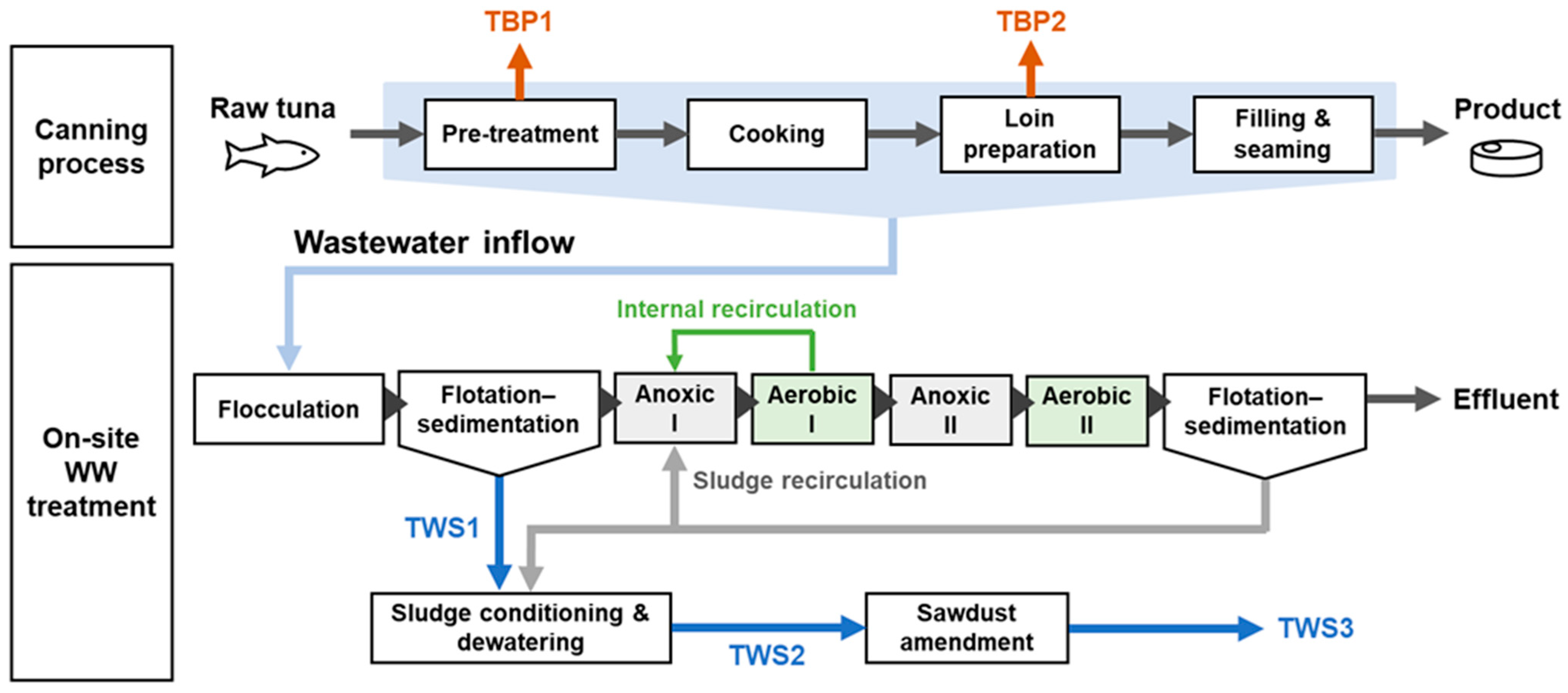
Substrates were obtained from a tuna canning industry in South Korea (Figure 1) and categorized into tuna processing byproducts (TPB1 and TPB2) and tuna wastewater sludges (TWS1, TWS2, and TWS3). TPB1 represented gastrointestinal residues generated during the pre-treatment stage, while TPB2 consisted of bones, heads, and fins discharged after cooking (steam-treated at 100 °C for 2 h) in the loin preparation stage. TPB1 was directly ground to <1 mm without water addition, whereas TPB2 was diluted with water at a 1:1 (w/w) ratio prior to grinding. TWS1 was the sludge settled after flocculation with an anionic polymer. TWS2 was produced by combining TWS1 with recirculated sludge from the sedimentation tank of the anoxic–aerobic (denitrification–nitrification) line, followed by a second flocculation step using a cationic polymer flocculant and subsequent dewatering. TWS3 was prepared by adding sawdust to TWS2 at 150 g/kg. All substrates were stored at −20 °C to preserve their physicochemical properties and ensure uniform initial conditions.

2.2. Analytical Methods

Samples were filtered through a 1.2 µm membrane filter, and pH was measured using a pH meter (Seven Compact S220, Mettler Toledo, Greifensee, Switzerland). TS, VS, and COD were determined according to standard methods. TAN and TN were analyzed using commercial test kits (NH3-N(NW)-H and HS-TN-H) with an HS-1000 analyzer (Humas, Daejeon, Korea). Cation concentrations in TWS were determined by ion chromatography (930 Compact IC Flex, Metrohm, Herisau, Switzerland). The elemental composition (C, H, N, and S) of the 105 °C–dried samples was analyzed using an elemental analyzer (TruSpec Micro, LECO Corporation, St. Joseph, MI, USA), and the oxygen content was determined by difference. Carbohydrates and lipids were quantified using the phenol–sulfuric acid method and gravimetric extraction with chloroform–methanol, respectively. Crude protein was calculated from organic nitrogen determined by elemental analysis using a conversion factor of 6.25. Ethanol and volatile fatty acids (acetic, propionic, iso-butyric, n-butyric, iso-valeric, n-valeric, iso-caproic, and n-caproic acids) were analyzed by gas chromatography (Nexis GC-2030, Shimadzu, Kyoto, Japan) equipped with a flame ionization detector and a CP-FFAP CB column (25 m × 0.32 mm × 0.30 µm, Agilent Technologies, Santa Clara, CA, USA).

2.3. Theoretical BMP Calculation

Theoretical biomethane potentials were determined using the Buswell–Boyle equations (Equations (1) and (2)) based on elemental analysis of the 105 °C–dried volatile solids and GC analysis of the soluble ethanol and volatile fatty acid (VFA) fractions. The Buswell–Boyle equations were applied to estimate theoretical BMP (TBMP) as an upper bound theoretical methane potential based on elemental composition (C, H, O, N, S), providing a consistent benchmark for comparison with experimental BMP results [12].
C a H b O C N d S e + a b 4 c 2 + 3 d 4 + e 2 H 2 O
a 2 + b 8 c 4 3 d 8 e 4 C H 4 + a 2 b 8 + c 4 + 3 d 8 + e 4 C O 2 + d N H 3 + e H 2 S
T B M P m L   C H 4 / g   V S = 22,400 × a 2 + b 8 c 4 3 d 8 e 4 12 a + b + 16 c + 14 d + 32 e

2.4. BMP Batch Assay and Kinetic Modeling

BMP assays were conducted following the VDI method in 100 mL glass reactors at 35 ± 1 °C (triplicate) [13]. Reactors contained inoculum and substrate at an inoculum-to-substrate ratio (ISR) of 3, combined to a 40 mL working volume. The 40 mL working volume was selected to ensure sufficient headspace for pressure-based biogas measurement while maintaining stable anaerobic conditions, and similar small-scale BMP assays using 100 mL serum bottles with comparable working volumes have been widely reported in recent studies [14,15]. An inoculum-only control and a microcrystalline cellulose control were included. Prior to incubation, reactors were purged with N2.
Biogas volume was measured daily at the start and then every 2–4 days. Headspace pressure was recorded with a digital manometer (LEO2, Keller, Winterthur, Switzerland) and released to ambient pressure using a syringe, with sampling time and released volume noted before mixing. CH4 and CO2 concentrations were determined by gas chromatography (GC-2030, Shimadzu, Kyoto, Japan) equipped with a CP7485 gas separation column (Agilent, Santa Clara, CA, USA) and a thermal conductivity detector.
Cumulative methane production was fitted with the modified Gompertz model (Equation (3)) [12] using SigmaPlot v12.0.
B = B 0 × e x p e x p R m × e B 0 λ t + 1
where B0 is the maximum cumulative CH4 yield (mL CH4/g VS), Rm is the maximum CH4 production rate (mL CH4/g VS·day), and λ is the lag-phase duration (day).

2.5. Semi-Continuous Bioreactor Operation

The semi-continuous bioreactors were operated under mesophilic conditions (35 °C) in Pyrex glass bottles with an effective volume of 2.3 L and a working volume of 1.0 L. Mixing was maintained at 120 rpm using an orbital shaker. Reactor 1 (R1) was fed with TWS1, while Reactor 2 (R2) was fed with TWS2. Every two days, 67 mL of digestate was first withdrawn and then replaced with an equal volume of fresh substrate, corresponding to a hydraulic retention time (HRT) of 30 days. To maintain identical organic loading rates (OLR) of 2 g VS/L·day, dilution factors of 1.04 for TWS1 and 2.49 for TWS2 were applied. For R2, TAN concentration was adjusted by NH4Cl spiking on days 0, 26, 44, and 52 during feeding, resulting in concentrations ranging from 8 to 11 g/L. The withdrawn digestate was analyzed for pH, alkalinity, total solids, volatile solids, TAN, total nitrogen (TN), and VFAs. Biogas production was measured at each feeding, and methane content was determined using gas chromatography.

2.6. 16S rRNA Sequencing and Microbial Community Analysis

Samples were collected from R1 on days 0, 14, 28, 48, and 60, and from R2 at the end of each phase (phases 1–4). Digestates were pelleted and stored at –20 °C. DNA extraction, amplicon sequencing, and microbial community analysis were performed as previously described [16].
Bacterial 16S rRNA genes were amplified with primers 518F (5′-CCAGCAGCCGCGGTAATACG-3′) and 805R (5′-GACTACCAGGGTATCTAATCC-3′), and archaeal 16S rRNA genes with primers 787F (5′-ATTAGATACCCSBGTAGTCC-3′) and 1059R (5′-GCCATGCACCWCCTCT-3′) [17]. Amplicons were indexed with the Nextera XT kit (Illumina), quantified, pooled, and sequenced on the Illumina iSeq 100 platform with 2 × 150 bp paired-end reads.
After sequence processing, paired-end reads were merged and subjected to quality filtering and chimera screening. As a result, each sample retained no fewer than approximately 4500 archaeal reads and 28,000 bacterial reads for downstream analysis. The filtered sequences were clustered de novo into operational taxonomic units (OTUs) at a 97% similarity threshold using VSEARCH [18]. Taxonomic classification was performed using the Ribosomal Database Project (RDP) Classifier (version 2.14), executed locally via a Java command-line interface [19], and sequences with confidence scores below 0.8 were not resolved beyond higher taxonomic levels. To explore relationships between microbial communities and process parameters, non-metric multidimensional scaling (NMDS) based on generalized UniFrac distances was applied. In parallel, Spearman rank correlations (p < 0.2) were calculated in R and used to examine associations between community composition and reactor performance indicators.

3. Results and Discussion

3.1. Characteristics of Substrates

The physicochemical characteristics of TWS and TPB are summarized in Table 1. TWS1, collected after the primary wastewater’s first flocculation, had a pH of 6.05. TWS2, produced through the second flocculation and dewatering of the mixed sludge from TWS1 and the final sediment of the anoxic–aerobic line, showed a pH of 5.75. Both were acidic, while TWS3 (pH 7.76), obtained by mixing TWS2 with sawdust and an alkaline compound during sludge conditioning, exhibited a neutral-to-basic pH. TPB1 (gastrointestinal residues) and TPB2 (bones, heads, and fins after cooking) were near neutral (pH 6.45–6.92).
Total solids (TS) in TWS increased from 8% (TWS1) to 22% (TWS2) and 65% (TWS3) due to concentration and partial drying during conditioning. TPB1 and TPB2 had TS of 28% and 25%, respectively. All samples except TPB2 contained high volatile solids (VS/TS > 77%), reflecting abundant organic matter. TPB2 showed the lowest VS/TS (59%) and COD (260 g/L) because of its mineral-rich composition, whereas TWS3 had the highest COD (731 g/L) as a result of water removal and solids concentration during sludge conditioning with sawdust [20].
The C/N ratio ranged from 3.5 to 21.6, with TWS1 and TWS3 exhibiting higher values than the other nitrogen-rich substrates (TWS2, TPB1, TPB2; C/N 3.5–4.5). Alkalinity was greater in TPB (2100–2800 mg CaCO3/L) than in TWS (400–1300 mg CaCO3/L), and TAN exceeded 3 g/L only in TWS3 (7.6 g/L). Ethanol and total VFAs (EtOH and TVFAs) were much higher in TWS (15.8–22.8 g/kg) than in TPB (3.6–9.0 g/kg). TWS2 showed the highest concentrations of acetic (11.9 g/kg), propanoic (4.2 g/kg), and butyric (2.3 g/kg) acids, indicating active acidogenesis, whereas VFAs in TPB consisted mainly of acetate (>90%) [20,21]. Accordingly, the elevated VFA concentration in TWS2 can be explained by the accumulation of acidogenic intermediates during successive anoxic–aerobic treatments combined with sludge mixing and dewatering (Figure 1), which concentrated VFAs on a mass basis compared to TWS1.

3.2. Methane Yield and Kinetic Characteristics of TWS and TPB

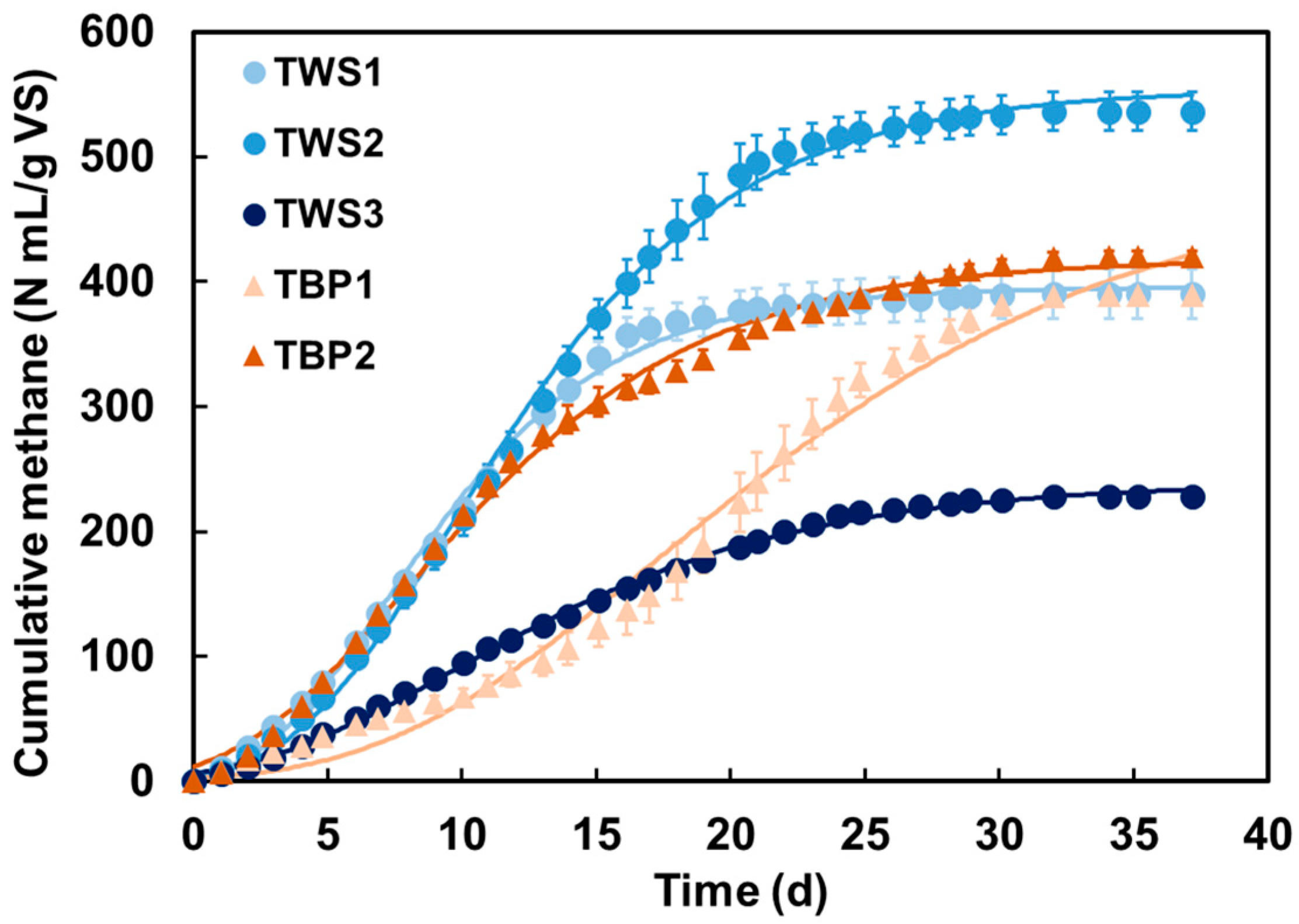
BMP tests were conducted for five samples, and the cumulative methane production profiles are shown in Figure 2. The experimental data were well fitted to the modified Gompertz model (R2 ≥ 0.981), and the resulting kinetic parameters are summarized in Table 2. Methane yields (N mL CH4/g VS) derived from the fitted Gompertz curves ranged from 239.8 (TWS3) to 554.6 (TWS2), with intermediate values of 395.8–419.0 for TWS1, TPB1, and TPB2. The low yield of TWS3 was attributed to its high lignocellulosic fraction derived from sawdust, which limits biodegradation under anaerobic conditions.
The lag phase was longer in the gastrointestinal-residue–rich byproducts (7.86 d), whereas the sludge-type samples (TWS1–TWS3, 2.11–3.66 d) and the cooked byproduct TPB2 (1.60 d) exhibited shorter delays. However, despite its short lag phase, TWS3 showed the lowest maximum methane production rate (Rm, 11.76 N mL CH4/g VS·d), reflecting limited methanogenic activity due to its recalcitrant lignocellulosic content.
The biodegradability (BD) was determined by comparing the Gompertz-fitted methane potential (B0) with the theoretical BMP (Bth) values (Table 2), which were estimated by combining the elemental (C, H, O, N, and S-based) and VFA-derived potentials on a corrected (VScorr) basis. Among all samples, TWS1 exhibited the lowest BD (62.3%), likely due to the lowered biodegradability resulting from coagulation with Fe2(SO4)3 and polymer flocculants used in the sludge treatment process. TPB2 showed the highest BD (124.4%), followed by TWS2 (100.5%), TPB1 (79.6%), and TWS3 (71.7%) [22]. The BD values exceeding 100% observed in TPB2 and TWS2 may be attributed to the presence of unquantified soluble organics beyond the ethanol and eight VFAs considered. In particular, TWS2 had the highest total VFA concentration (22.8 g/kg), suggesting that additional short-chain acids (e.g., lactic and formic acids) likely contributed to its measured methane yield [12,23]. In TPB2, the excess BD could also result from other protein-derived metabolites (e.g., pyruvic or glycolic acids) [24,25]. In addition, the inorganic fraction originating from fish bones in TPB2 may have led to an underestimation of its theoretical BMP, further contributing to the apparent BD > 100% [12].

3.3. Energy and Electricity Production Potential of TWS and TPB

To evaluate the energy and electricity generation potential of all wastes and byproducts from the tuna canning process, methane yields obtained from the BMP tests were converted to equivalent energy and electricity values per wet ton (Table 3). The annual production volume was available only for the TWS samples, with an estimated ratio of 1:10:2 for TWS1, TWS2, and TWS3, respectively, indicating that TWS2 was generated in the largest amount. Considering both methane yield and annual generation, TWS2 exhibited the highest energy recovery, producing approximately 1.88 × 10⁶ kWh/year, while the total electricity potential from TWS1–3 was estimated at 2.42 × 10⁶ kWh/year.
Although TWS2 exhibited a high energy potential, its C/N ratio was relatively low (4.47, Table 1), indicating that further optimization of nitrogen management or feed composition is required to maintain process stability and sustainable methane production.

3.4. Semi-Continuous Operation of Bioreactors Fed with TWS1 and TWS2

To evaluate the feasibility of mono-digestion of wastewater sludges of high methane potential, semi-continuous bioreactor tests were conducted under mesophilic conditions (35 °C) using TWS1 and TWS2, hereafter referred to as Reactor 1 (R1) and Reactor 2 (R2), respectively. The reactors were operated for 60 days (2 HRTs) at an HRT of 30 days, with feeding performed every two days. Operating semi-continuous digesters for approximately two HRT cycles has been used in several studies as a practical timeframe to observe early-to-mid acclimation and to assess whether key process indicators begin to approach a pseudo-steady state [26,27]. TWS3, which contained sawdust, was excluded from the tests due to its lignocellulosic composition.
For R2 fed with TWS2 (8.28 g TN/L, Table 1), TAN was initially adjusted to ~8 g/L by NH4Cl spiking, assuming complete TN-to-TAN conversion. In practice, dilution (to adjust OLR to 2 g VS/L·day) reduced the theoretical TAN level to approximately 3.33 g/L; nevertheless, the reactor was intentionally started under higher ammonia conditions to test ammonia tolerance. TAN was increased four times during the operation in pulse mode, reaching 8.1 g/L (D2), 10.6 g/L (D28), 8.7 g/L (D46), and 8.4 g/L (D54). The second spike (>10 g/L) represented an excessive ammonia shock. In contrast, R1 fed with TWS1 (3.91 g TN/L, Table 1) was operated without additional TAN supplementation while maintaining the same OLR.
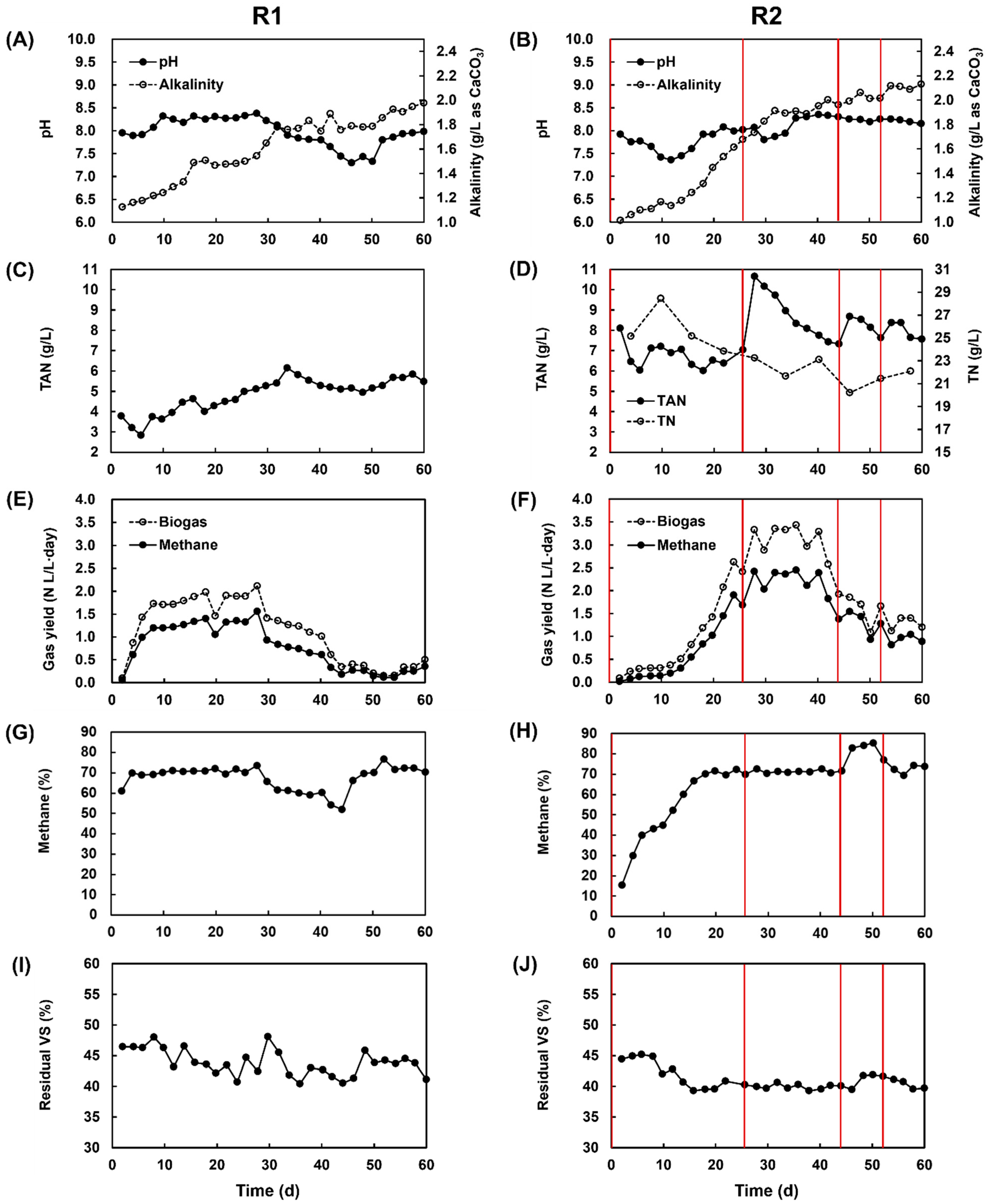
In R1, pH rose from 7.9 to 8.3 during the first 10 days and remained stable until around D28, then declined sharply after 1.0 HRT and recovered near D60 (Figure 3A). Alkalinity increased gradually from 1.1 to 2.0 g/L (Figure 3A). The TAN concentration increased from 3.05 g/L in the seed to ~5.5 g/L and remained stably higher than the influent TN (~3.76 g/L) throughout operation (Figure 3C). This sustained elevation was likely due to the mineralization of organic nitrogen within the settled sludge layer, while the bottom-positioned outlet and sampling port may have slightly reflected locally higher TAN levels.
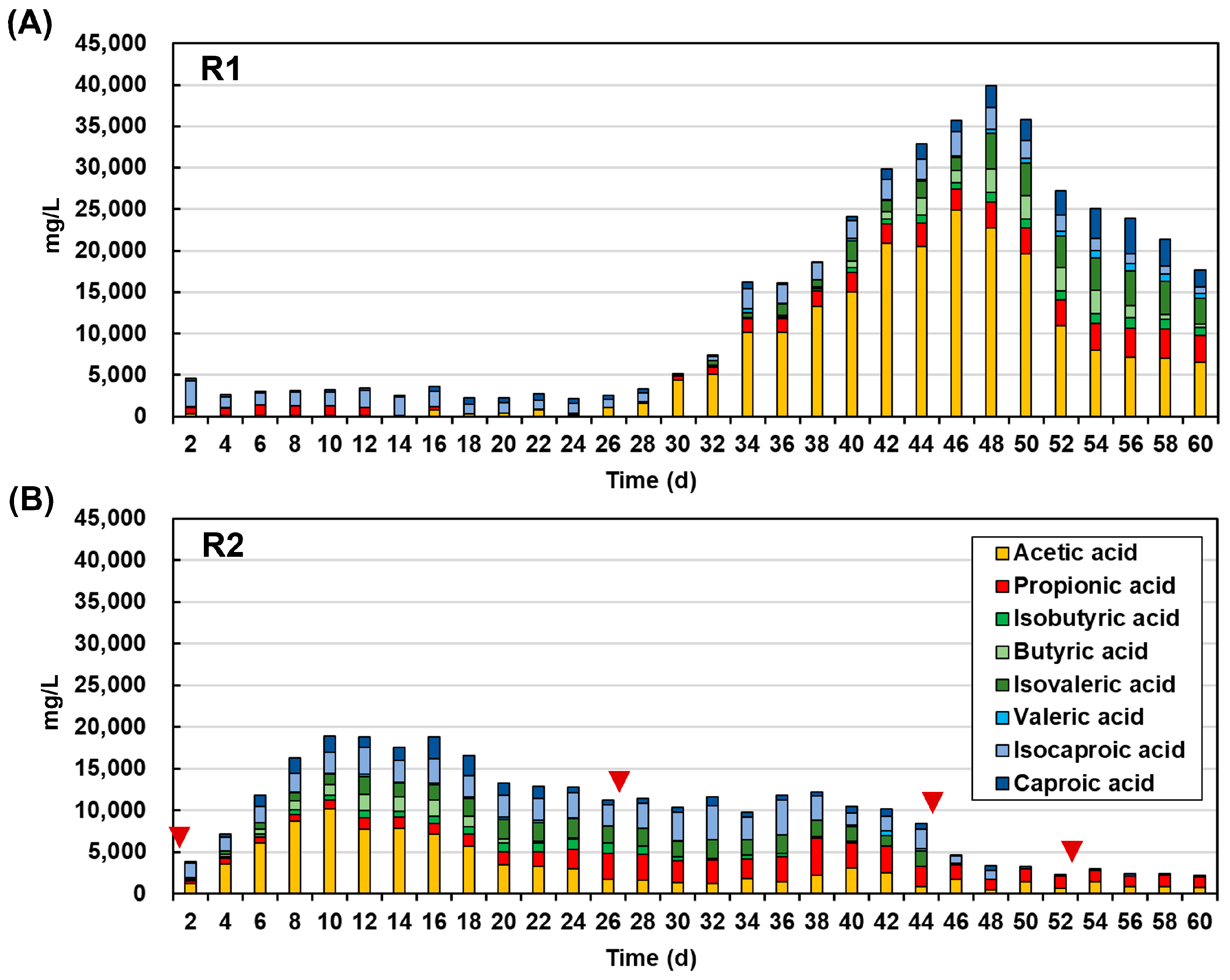
Methane production increased rapidly during the first week, stabilized at 1.1–1.6 N L/L·day through 1.0 HRT, and then declined below 1.0 N L/L·day at D30, reaching its minimum of 0.11 N L/L·day at D54 before partially recovering toward the end (Figure 3E). Methane content in biogas remained ~66% during the first HRT, declined temporarily to ~55–60%, and recovered to 70% by D60 (Figure 3G). Total VFAs stayed below 5 g/L until 1.0 HRT but increased sharply afterward, peaking at ~40 g/L with acetate dominance (Figure 4A).
Stable reactor performance was observed during operation at 0.5–1.0 HRT. When the HRT was shortened beyond 1.0; however, volatile fatty acids accumulated rapidly and pH dropped, which occurred at the same time as a decrease in methane production. Because only a limited number of data points were available, this trend cannot be confirmed quantitatively. Even so, the partial recovery of biogas output together with a reduction in VFA concentrations around 2.0 HRT suggests that the microbial community was in the process of adapting, leading to a gradual improvement in reactor behavior. Similar patterns have been described for ammonia-inhibited systems, where adaptation tends to manifest as improved process stability rather than a sustained increase in methane yield [28].
For R2 subjected to NH4Cl spiking, effluent TAN ranged between 6.0 and 10.6 g/L (Figure 3D). The pH dropped from 7.9 to 7.4 during the initial phase but recovered and stabilized at 8.1–8.3 after 1.0 HRT (Figure 3B). Alkalinity increased from 1.0 to 2.1 g/L, showing a rapid rise during the early period (Figure 3B). Daily methane production was initially low (<0.2 N L/L·day), then peaked near 2.4 N L/L·day around 1.0 HRT and remained >2.0 N L/L·day until mid-operation before gradually decreasing (Figure 3F). Methane content increased from 15% at startup to ~70% during stable operation and up to ~85% near 1.5 HRT (Figure 3H).
Total VFAs reached 19 g/L during the early phase but declined below 5 g/L after 1.5 HRT (Figure 4B). Propionate persisted at 1–2 g/L, suggesting partial inhibition of syntrophic propionate oxidizers and methanogens under high TAN/free ammonia [29].
Collectively, R2 exhibited an initial lag (0–0.5 HRT), rapid adaptation and peak gas production during 0.5–1.0 HRT. Methane yield declined after D40 and partially recovered near 2.0 HRT, but the limited data make this uncertain. Nonetheless, the low VFA levels and high methane composition after 1.5 HRT, with TAN concentrations ranging from 7.6 to 8.7 g/L, suggest that the reactor approached steady-state conditions by 2.0 HRT.

3.5. Microbial Community Structure

Microbial community analyses were performed to elucidate the mechanisms underlying the distinct process behaviors observed in R1 and R2. Sampling points were selected to represent key operational phases rather than to coincide with time points. For R1, samples were taken at D0 (start-up), D14 (onset of the low-VFA phase), D28 (prior to VFA surge), D48 (VFA peak), and D60 (end of operation). For R2, samples corresponded to effluents immediately before TAN spiking (D0, D26, D44, D52, and D60), reflecting progressive ammonia loading.
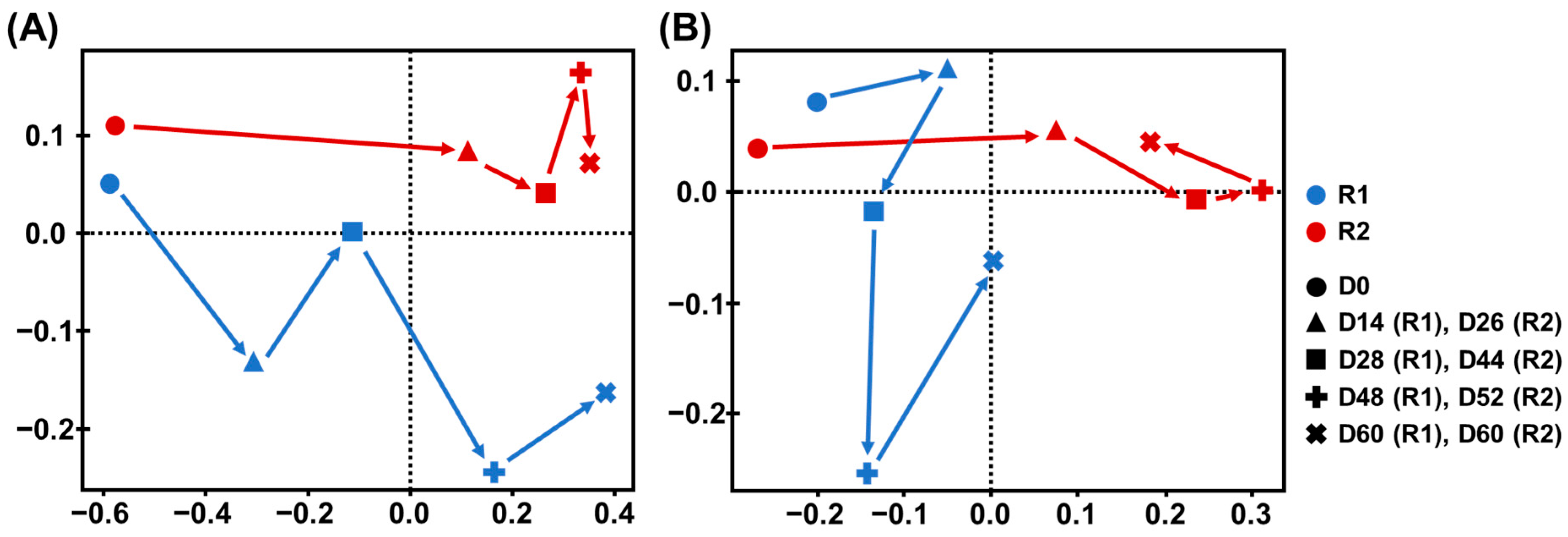
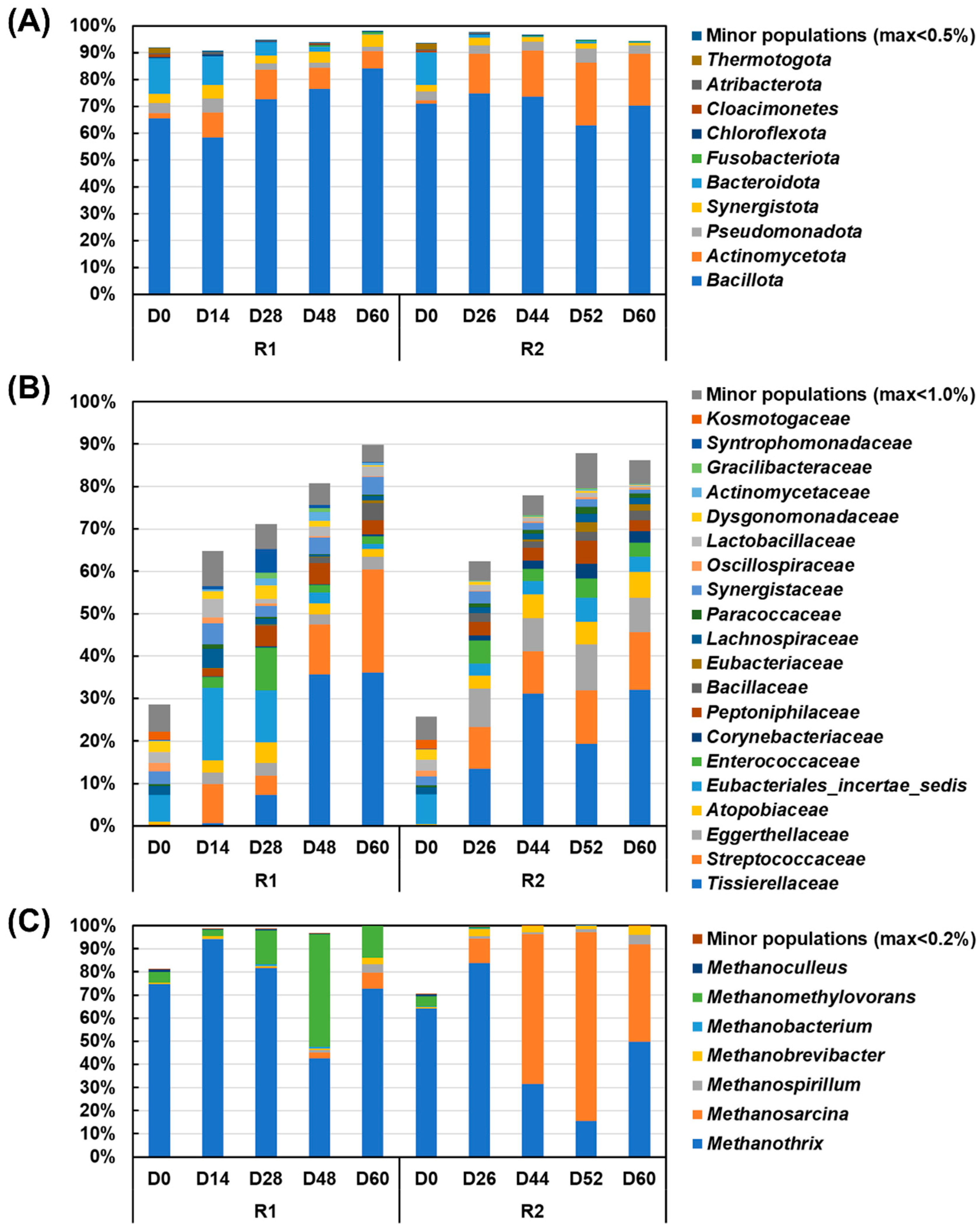
NMDS analysis indicated that microbial communities changed in a phase-dependent manner (Figure 5). In R1, the bacterial population showed the most significant shift between D28 and D48, which coincided with a sharp increase in VFAs (Figure 4A). During this interval, Bacillota remained the dominant phylum, with its relative abundance rising from 65.6% to 76.4%. Actinomycetota also showed a moderate increase, from 2.0% to 7.9%. At the family level, Tissierellaceae, a major lineage within Firmicutes, expanded markedly from 0.07% to 35.7%. Increases were also observed in Streptococcaceae and Lachnospiraceae, suggesting the emergence of a more active fermentative and syntrophic microbial network [30,31]. Additionally, members of Synergistota, typically involved in syntrophic VFA oxidation [30], became more abundant during this period. In archaeal communities, Methanothrix, an acetoclastic methanogen, was dominant up to D48, but its proportion declined from 0.82% to 0.43%. Archaeal community analysis showed that Methanothrix, an acetoclastic methanogen, remained dominant until D48 but then decreased markedly (from 0.82 to 0.43%), while Methanosarcina and Methanobrevibacter increased at the same time. This shift suggests that acetoclastic methanogenesis was partially suppressed under elevated TAN conditions [32]. From D48 to D60, changes in the bacterial community became relatively small, coinciding with the reduction in VFAs and indicating partial functional stabilization. In contrast, archaeal NMDS trajectories continued to display large and directionally distinct shifts, pointing to a second phase of community restructuring. Overall, bacterial succession was most pronounced up to approximately 1.5 HRT, whereas archaeal adaptation extended until around 2.0 HRT (Figure 6).
In reactor R2, the strongest compositional changes in both bacterial and archaeal communities occurred early, between D0 and D26 (Figure 5). This period corresponded to a rapid increase in TAN from 3.0 to approximately 8 g/L (Figure 3D). During this phase, the bacterial community showed a sharp increase in Actinomycetota (1.3 to 14.7%) and Tissierellaceae (0.02 to 13.4%), together with a slight reduction in Synergistota. These trends indicate that Actinomycetota-related fermentative populations partially replaced Firmicutes under ammonia stress. After D26, NMDS movements became much smaller, consistent with a more stable community structure. At the family level, Tissierellaceae, Streptococcaceae, and Eggerthellaceae continued to increase gradually toward D60, suggesting the persistence of ammonia-tolerant fermentative groups [30]. Archaeal dynamics followed a similar early adaptation pattern: the relative abundance of Methanothrix declined steadily (from 0.84 to 0.15% by D52), whereas Methanosarcina rapidly became dominant (>80%), indicating a transition toward methanogenic pathways better suited to high-ammonia conditions, including methylotrophic and hydrogenotrophic routes [33] (Figure 6).
Taken together, these observations show clear differences between the two reactors. In R1, where TAN increased more gradually (3–6 g/L), bacterial and archaeal communities continued to reorganize over a longer period, extending to 2.0 HRT. In contrast, R2 exhibited a rapid but earlier stabilization, largely driven by the enrichment of ammonia-tolerant Actinomycetota and Methanosarcina.
To examine possible links between microbial populations and operational conditions, including digestion time, VFA accumulation, TAN concentration, methane content, and methane yield, Spearman rank correlations were calculated (Table 4). Several taxa, mainly affiliated with Bacillota and the archaeon Methanosarcina, showed positive correlations (p < 0.2) with operation time in both R1 and R2. This pattern implies that these organisms became more prevalent as digestion progressed and were likely involved in longer-term acclimation of the systems.
Relationships with total VFA concentrations were less uniform and were largely confined to Bacillota-related groups. In contrast, no microbial taxa exhibited a consistent correlation with TAN across both reactors. Actinomycetota and associated families, however, displayed a positive relationship with methane content in R1 and R2, suggesting a potential link to improved gas quality rather than overall gas quantity.
Taken together, these results indicate that while some microbial groups followed similar temporal trajectories, their associations with TAN, VFAs, and methane production differed between the two systems. The observed community shifts therefore appear to reflect the combined chemical complexity of the tuna-processing substrates—such as high protein and lipid contents, mineral components, and residual coagulants—rather than being driven by any single operational parameter alone.

4. Conclusions

This study comprehensively assessed the anaerobic digestion potential of tuna-processing byproducts and wastewater sludges using BMP assays, Buswell–Boyle-based theoretical estimations, semi-continuous mono-digestion, and microbial community analyses. Among the tested substrates, the mixed and conditioned wastewater sludge showed the highest methane yield (554.6 N mL CH4/g VS) and the greatest annual energy potential (≈1.88 × 10⁶ kWh/yr), while the lignocellulosic sludge exhibited the lowest yield due to its recalcitrant composition. Biodegradability values exceeding 100% in some samples were attributed to unquantified soluble organics and, in the case of bone-rich residues, potential underestimation of theoretical methane potential.
Results from the semi-continuous runs suggest that starting digestion at relatively high TAN levels shortened the acclimation phase and allowed methane production to stabilize earlier, with the adaptation period reduced by roughly one HRT. Compared with the low-TAN condition, the reactor exposed to higher ammonia showed less VFA build-up and a higher methane fraction toward the end of operation, pointing to improved tolerance to ammonia stress. Microbial data were consistent with this behavior, showing enrichment of Bacillota-related fermentative groups and a replacement of Methanothrix by Methanosarcina as the dominant methanogen, reflecting a shift toward metabolic pathways better suited to nitrogen-rich conditions.
All experiments were conducted at a constant organic loading rate of 2 g VS/L·day. Despite the relatively short operation period, limited to two hydraulic retention times, the reactors maintained stable performance throughout the test. The data obtained here can therefore serve as a preliminary reference for the design and operation of anaerobic digestion systems treating protein-rich industrial wastes. With proper management of ammonia levels and operating conditions, tuna-processing residues appear to be a viable substrate for energy recovery. Longer-term operation extending beyond two HRTs, however, would be required to more firmly evaluate sustained stability and microbial community development under prolonged ammonia stress.

Author Contributions

Conceptualization, J.M.T. and S.G.S.; methodology, J.W.J. and J.S.; formal analysis, J.W.J., I.B. and J.S.; investigation, J.W.J., I.B., C.P., W.K. and J.S.; writing—original draft preparation, J.W.J.; writing—review and editing, all authors; supervision, J.M.T. and S.G.S.; funding acquisition, S.G.S. All authors have read and agreed to the published version of the manuscript.

Funding

This work was supported by the Research Resurgence under the Glocal University 30 Project at Gyeongsang National University in 2024.

Data Availability Statement

The raw data supporting the conclusions of this article will be made available by the authors on request.

Conflicts of Interest

The authors declare no conflicts of interest.

References

  1. Food and Agriculture Organization of the United Nations (FAO). FAO Report: Global Fisheries and Aquaculture Production Reaches a New Record High. Available online: https://www.fao.org/newsroom/detail/fao-report-global-fisheries-and-aquaculture-production-reaches-a-new-record-high/en (accessed on 21 October 2025).
  2. Almeida, C.; Sapatinha, M.; Pires, C.; Nunes, M.L.; Marques, A. Seafood by-products from canning industry: A review on the environmental assessment of valorisation pathways and future trends. Clean. Waste Syst. 2025, 12, 100371. [Google Scholar] [CrossRef]
  3. Bücker, F.; Marder, M.; Peiter, M.R.; Lehn, D.N.; Esquerdo, V.M.; de Almeida Pinto, L.A.; Konrad, O. Fish waste: An efficient alternative to biogas and methane production in an anaerobic mono-digestion system. Renew. Energy 2020, 147, 798–805. [Google Scholar] [CrossRef]
  4. Bermúdez-Penabad, N.; Rodríguez-Montes, A.; Alves, M.; Kennes, C.; Veiga, M.C. Optimization of methane production from solid tuna waste: Thermal pretreatment and co-digestion. Waste Manag. 2024, 177, 203–210. [Google Scholar] [CrossRef]
  5. Hinsui, J.; Krasae, K.; Jantaratch, N.; Mahae, N. Protein and water recovery from tuna defrosting wastewater. Heliyon 2024, 10, e26669. [Google Scholar] [CrossRef]
  6. Hernández-Fydrych, V.C.; Benítez-Olivares, G.; Meraz-Rodríguez, M.A.; Salazar-Peláez, M.L.; Fajardo-Ortiz, M.C. Methane production kinetics of pretreated slaughterhouse wastewater. Biomass Bioenergy 2019, 130, 105385. [Google Scholar] [CrossRef]
  7. Kim, J.; Baek, S.I.; Cho, S.H.; Kim, T. Evaluating the efficacy of partially substituting fish meal with unfermented tuna by-product meal in diets on the growth, feed utilization, chemical composition and non-specific immune responses of olive flounder (Paralichthys olivaceus). Aquac. Rep. 2022, 24, 101150. [Google Scholar] [CrossRef]
  8. Shanmugam, S.R.; Farahmanzdad, N.; Drabold, E.T.; Rudar, M.; Bourassa, D.; Higgins, B. Upcycling nutrients from poultry slaughterhouse solid waste into value-added bioproducts using black soldier fly larvae cultivation. J. Environ. Manag. 2025, 379, 124856. [Google Scholar] [CrossRef] [PubMed]
  9. Zheng, Z.; Liao, C.; Chen, Y.; Ming, T.; Jiao, L.; Kong, F.; Su, X.; Xu, J. Revealing the functional potential of microbial community of activated sludge for treating tuna processing wastewater through metagenomic analysis. Front. Microbiol. 2024, 15, 1430199. [Google Scholar] [CrossRef]
  10. Estevez, M.M.; Tomczak-Wandzel, R.; Kvamme, K. Fish sludge as a co-substrate in the anaerobic digestion of municipal sewage sludge-maximizing the utilization of available organic resources. EFB Bioeconomy J. 2022, 2, 100027. [Google Scholar] [CrossRef]
  11. Xu, J.; Shi, Z.; Xu, L.; Zheng, X.; Zong, Y.; Luo, G.; Zhang, C.; Liu, M.; Xie, L. Recovery capability of anaerobic digestion from ammonia stress: Metabolic activity, energy generation, and genome-centric metagenomics. Bioresour. Technol. 2024, 394, 130203. [Google Scholar] [CrossRef]
  12. Koch, K.; Hafner, S.D.; Weinrich, S.; Astals, S.; Holliger, C. Power and limitations of biochemical methane potential (BMP) tests. Front. Energy Res. 2020, 8, 63. [Google Scholar] [CrossRef]
  13. Holliger, C.; Alves, M.; Andrade, D.; Angelidaki, I.; Astals, S.; Baier, U.; Bougrier, C.; Buffière, P.; Carballa, M.; De Wilde, V. Towards a standardization of biomethane potential tests. Water Sci. Technol. 2016, 74, 2515–2522. [Google Scholar] [CrossRef] [PubMed]
  14. Bae, I.; Park, S.; Shin, J.; Triolo, J.M.; Shin, S.G. Country-Specific Modeling of Methane Production and Emission Reduction Utilizing Pig Manure. Energies 2024, 18, 95. [Google Scholar] [CrossRef]
  15. Serna-García, R.; Tsapekos, P.; Treu, L.; Bouzas, A.; Seco, A.; Campanaro, S.; Angelidaki, I. Unraveling prevalence of homoacetogenesis and methanogenesis pathways due to inhibitors addition. Bioresour. Technol. 2023, 376, 128922. [Google Scholar] [CrossRef]
  16. Dalantai, T.; Rhee, C.; Kim, D.W.; Yu, S.I.; Shin, J.; Triolo, J.M.; Shin, S.G. Complex network analysis of slaughterhouse waste anaerobic digestion: From failure to success of long-term operation. Bioresour. Technol. 2022, 361, 127673. [Google Scholar] [CrossRef]
  17. Bae, I.; Rhee, C.; Shin, J.; Cho, K.; Triolo, J.M.; Shin, S.G. Insights into high ammonia-resistant syntrophic microbiomes and metabolic pathways during continuous anaerobic digestion of cow manure. Bioresour. Technol. 2025, 422, 132235. [Google Scholar] [CrossRef]
  18. Rognes, T.; Flouri, T.; Nichols, B.; Quince, C.; Mahé, F. VSEARCH: A versatile open source tool for metagenomics. PeerJ 2016, 4, e2584. [Google Scholar] [CrossRef]
  19. Wang, Q.; Garrity, G.M.; Tiedje, J.M.; Cole, J.R. Naive Bayesian classifier for rapid assignment of rRNA sequences into the new bacterial taxonomy. Appl. Environ. Microbiol. 2007, 73, 5261–5267. [Google Scholar] [CrossRef]
  20. Triolo, J.M.; Sommer, S.G.; Møller, H.B.; Weisbjerg, M.R.; Jiang, X.Y. A new algorithm to characterize biodegradability of biomass during anaerobic digestion: Influence of lignin concentration on methane production potential. Bioresour. Technol. 2011, 102, 9395–9402. [Google Scholar] [CrossRef]
  21. Hendriks, A.; Zeeman, G. Pretreatments to enhance the digestibility of lignocellulosic biomass. Bioresour. Technol. 2009, 100, 10–18. [Google Scholar] [CrossRef] [PubMed]
  22. Wu, Y.; Lu, M.; Liu, X.; Chen, H.; Deng, Z.; Fu, Q.; Wang, D.; Chen, Y.; Zhong, Y. Insights into how poly aluminum chloride and poly ferric sulfate affect methane production from anaerobic digestion of waste activated sludge. Sci. Total Environ. 2022, 811, 151413. [Google Scholar] [CrossRef]
  23. Kreuger, E.; Nges, I.A.; Björnsson, L. Ensiling of crops for biogas production: Effects on methane yield and total solids determination. Biotechnol. Biofuels 2011, 4, 44. [Google Scholar] [CrossRef] [PubMed]
  24. García-Depraect, O.; Martínez-Mendoza, L.J.; Diaz, I.; Muñoz, R. Two-stage anaerobic digestion of food waste: Enhanced bioenergy production rate by steering lactate-type fermentation during hydrolysis-acidogenesis. Bioresour. Technol. 2022, 358, 127358. [Google Scholar] [CrossRef] [PubMed]
  25. Brew, D.W.; Black, M.C.; Santos, M.; Rodgers, J.; Henderson, W.M. Metabolomic investigations of the temporal effects of exposure to pharmaceuticals and personal care products and their mixture in the eastern oyster (Crassostrea virginica). Environ. Toxicol. Chem. 2020, 39, 419–436. [Google Scholar] [CrossRef]
  26. Mahieux, M.; Aemig, Q.; Richard, C.; Delgenès, J.-P.; Juge, M.; Trably, E.; Escudié, R. Improved organic matter biodegradation through pulsed H2 injections during in situ biomethanation. Bioresour. Technol. 2024, 407, 131101. [Google Scholar] [CrossRef]
  27. Adams, M. Ammonia-stressed anaerobic digestion: Sensitivity dynamics of key syntrophic interactions and methanogenic pathways-A review. J. Environ. Manag. 2024, 371, 123183. [Google Scholar] [CrossRef] [PubMed]
  28. Anantharaman, A.; Chun, Y.; Hua, T.; Chew, J.W.; Wang, R. Pre-deposited dynamic membrane filtration–a review. Water Res. 2020, 173, 115558. [Google Scholar] [CrossRef]
  29. Singh, A.; Schnürer, A.; Dolfing, J.; Westerholm, M. Syntrophic entanglements for propionate and acetate oxidation under thermophilic and high-ammonia conditions. ISME J. 2023, 17, 1966–1978. [Google Scholar] [CrossRef]
  30. Dueholm, M.K.D.; Andersen, K.S.; Korntved, A.-K.C.; Rudkjøbing, V.; Alves, M.; Bajón-Fernández, Y.; Batstone, D.; Butler, C.; Cruz, M.C.; Davidsson, Å. MiDAS 5: Global diversity of bacteria and archaea in anaerobic digesters. Nat. Commun. 2024, 15, 5361. [Google Scholar] [CrossRef]
  31. Chen, S.; Dong, B.; Dai, X.; Wang, H.; Li, N.; Yang, D. Effects of thermal hydrolysis on the metabolism of amino acids in sewage sludge in anaerobic digestion. Waste Manag. 2019, 88, 309–318. [Google Scholar] [CrossRef]
  32. Yi, Y.; Dolfing, J.; Jin, G.; Fang, X.; Han, W.; Liu, L.; Tang, Y.; Cheng, L. Thermodynamic restrictions determine ammonia tolerance of methanogenic pathways in Methanosarcina barkeri. Water Res. 2023, 232, 119664. [Google Scholar] [CrossRef] [PubMed]
  33. Jo, Y.; Cayetano, R.D.A.; Kim, G.-B.; Park, J.; Kim, S.-H. The effects of ammonia acclimation on biogas recovery and the microbial population in continuous anaerobic digestion of swine manure. Environ. Res 2022, 212, 113483. [Google Scholar] [CrossRef] [PubMed]
Figure 1. Schematic diagram of the tuna canning process and on-site wastewater (WW) treatment flow. TBP1–2: tuna-processing byproducts; TWS1–3: wastewater sludge stages. Anoxic I/II and Aerobic I/II represent sequential biological treatment reactors operated in series.
Energies 19 00313 g001
Figure 2. Cumulative methane production fitted to the modified Gompertz model. Symbols indicate experimental data, and lines indicate model simulations.
Energies 19 00313 g002
Figure 3. Temporal variations in key process parameters in R1 and R2 during semi-continuous operation. Profiles of (A,B) pH and alkalinity, (C,D) TAN and TN, (E,F) daily gas yield (biogas and methane), (G,H) methane content in biogas, and (I,J) residual VS. Residual vs. (%) = (effluent VS/influent VS) × 100. All parameters were measured in the effluent. Vertical red lines in R2 indicate NH4Cl additions during feeding (days 0, 26, 44, and 52).
Energies 19 00313 g003
Figure 4. Temporal variations in total and individual volatile fatty acid (VFA) concentrations in (A) R1 and (B) R2 effluents during semi-continuous operation. Each stacked bar indicates the composition of major VFAs: acetic, propionic, butyric, isobutyric, valeric, isovaleric, caproic, and isocaproic acids. Red arrowheads in R2 indicate NH4Cl additions during feeding (days 0, 26, 44, and 52).
Energies 19 00313 g004
Figure 5. Non-metric multidimensional scaling (NMDS) plots based on generalized UniFrac distances illustrating temporal shifts in (A) bacterial and (B) archaeal community structures in reactors R1 and R2.
Energies 19 00313 g005
Figure 6. Temporal dynamics of microbial community structures in reactors R1 and R2 during semi-continuous operation. Stacked bar plots present the relative abundances of major microbial taxa at different sampling days: (A) bacterial phyla, (B) bacterial families, and (C) archaeal genera. Microbial groups are ordered from the bottom of each bar according to their relative dominance in the D60 sample of R2, from highest to lowest.
Energies 19 00313 g006
Table 1. Physicochemical characteristics of TWS and TPB.
ParameterTWS1TWS2TWS3TPB1TPB2
pH (at 25 °C)6.055.757.766.456.92
Alkalinity (mg/L as CaCO3)396.0675.71336.62097.82807.8
TS (g/kg)80.5 ± 0.8221.7 ± 18.0650.0 ± 7.0277.9 ± 0.1252.2 ± 0.5
VS (g/kg)62.6 ± 0.7173.4 ± 1.4556.0 ± 4.8252.2 ± 0.4149.2 ± 0.2
VS/TS (%)77.7678.2185.5490.7559.16
COD (g/L)117.7 ± 1.7314.1 ± 3.7731.2 ± 3.5440.0 ± 3.8259.9 ± 5.8
TAN (g/L)2.13 ± 0.091.33 ± 0.047.64 ± 0.212.18 ± 0.011.04 ± 0.03
TN (g/L)3.91 ± 0.108.28 ± 0.1811.26 ± 0.3417.03 ± 0.0617.30 ± 0.05
Crude carbohydrate (g/kg)2.916.2915.615.453.10
Crude protein (g/kg)24.4451.7570.38106.44108.13
Crude lipids (g/kg)3.3411.4433.015.273.67
Protein-to-lipid ratio7.324.522.1320.1929.47
C (%)43.3744.2437.3450.4638.23
H (%)6.877.805.957.076.43
O (%)47.1637.3953.7829.0843.83
N (%)2.019.892.3912.0310.84
S (%)0.590.680.541.350.68
C/N ratio21.574.4715.614.193.53
Ethanol and TVFAs (g/kg)15.822.818.99.03.6
Ethanol (mg/kg)58.2NDND679.4202.7
Acetic acid (mg/kg)7960.511,907.89053.68037.03293.5
Propionic acid (mg/kg)4137.04205.02361.264.459.2
Isobutyric acid (mg/kg)419.3814.71162.1NDND
Butyric acid (mg/kg)1184.72277.0582.8NDND
Isovaleric acid (mg/kg)1079.81836.84226.5103.8ND
Valeric acid (mg/kg)892.4847.1527.320.6ND
Isocaproic acid (mg/kg)24.1447.5516.756.830.9
SCaproic acid (mg/kg)26.6513.5435.311.726.7
Na+ (mg/kg)245.9108.8237.0NMNM
NH4+ (mg/kg)743.2526.51332.6NMNM
K+ (mg/kg)106.166.7175.8NMNM
Ca2+ (mg/kg)94.894.6221.1NMNM
Mg2+ (mg/kg)195.1123.9312.3NMNM
TS, total solids; VS, volatile solids; COD, chemical oxygen demand; TAN, total ammonium nitrogen; TN, total nitrogen; C, carbon; H, hydrogen; O, oxygen; N, nitrogen; S, sulfur; TVFAs, total volatile fatty acids; NM, not measured; ND, not detected (<10 mg/kg).
Table 2. Kinetic parameters and biodegradability indices derived from the modified Gompertz model for methane production from TWS and TPB.
CategoryParameterTWS1TWS2TWS3TPB1TPB2
Experimental methane yieldBexp390.6536.2228.1389.6420.5
Modified Gompertz model parametersB0 (N mL CH4/g VS)395.8554.6239.8419.0419.0
λ (day)2.513.662.117.861.60
Rm (N mL CH4/g VS/day)31.0234.5611.7619.4924.45
T80D14.2D18.4D20.9D28.2D17.4
Biodegradability indicesBth,VS (N mL CH4/g VS)419.0439.9311.6492.6317.2
Bth,VFAs (N mL CH4/kg)5143.68266.96601.03880.71740.1
Bth,corr (N mL CH4/g VScorr)501.1487.6323.5508.0328.9
B0,corr (N mL CH4/g VScorr)312.1490.1231.9404.6409.1
BD (%)62.3100.571.779.6124.4
Bexp, experimental methane yield (N mL CH4/g VS) at day (D) 37; B0, model-predicted maximum methane production potential (N mL CH4/g VS); λ, lag phase (day); Rm, maximum methane production rate (N mL CH4/g VS·day); T80, time at which the cumulative methane production equals 80% of B0. Bth,VS, theoretical methane potential estimated from elemental composition (CHONS-based); Bth,VFAs, methane potential derived from soluble VFAs (C2–C6, including n- and isoforms) and ethanol concentrations; Bth,tot, total theoretical methane potential combining CHONS- and VFA-based values; VScorr, corrected volatile solids including both dried vs. and soluble VFAs; BD, biodegradability, calculated as (B0,corr/Bth,corr) × 100 (%).
Table 3. Energy and electricity production potential of TWS and TPB based on methane yield.
CH4 YieldEnergy PotentialElectricity
Potential
Annual
Production
Annual Electricity Potential
UnitN m3 CH4/tonMJ/tonkWh/tonton/year106 kWh/year
TWS124.2962.793.65000.047
TWS292.53682.5358.052501.88
TWS3126.65001.1486.210000.49
TPB196.13859.4375.2--
TPB262.42488.1241.9--
Total (TWS1–3)---67502.42
Energy potential was calculated from methane yield using the higher heating value of CH4 (39.8 MJ/m3). Electricity potential was calculated using an electrical efficiency of 35% (0.278 kWh/MJ). Annual electricity potential was estimated based on the annual generation of each sludge type at the tuna canning factory.
Table 4. Spearman’s rank correlation coefficients (ρ) are shown between the bacterial (BAC) and archaeal (ARC) taxa identified in Figure 6 and process indicators (operation days, TVFAs, TAN, CH4 content, and methane yield). Only correlations with p < 0.2 are displayed. The bracket-like symbol (└─) indicates that the listed taxa belong to the higher-level taxonomic group indicated above.
Operation
Days
TVFAs
(g/L)
TAN
(g/L)
CH4
Content
(%)
Methane Yield
(L/L·Day)
R1R2R1R2R1R2R1R2R1R2
BACBacillota0.90 0.800.900.80−0.70 −0.70
 └─ Tissierellaceae1.000.90 0.90 0.70
 └─ Streptococcaceae0.901.00 −0.700.70 0.90
 └─ Enterococcaceae 1.00 1.000.70
 └─ Peptoniphilaceae0.70 0.70
 └─ Bacillaceae1.000.90 0.90 0.80
 └─ Eubacteriaceae1.000.90 0.90 1.00
 └─ Lachnospiraceae−0.80 −0.90−0.70 0.90 −0.70
 └─ Oscillospiraceae−1.00 −0.901.00 −0.90
 └─ Lactobacillaceae −0.90 −0.70
 └─ Syntrophomonadaceae 0.90−0.700.90
 └─ Gracilibacteraceae 0.70 0.70
Actinomycetota 0.90 0.901.000.90
 └─ Eggerthellaceae 0.80 0.900.700.90
 └─ Atopobiaceae 0.90 0.900.700.90
 └─ Corynebacteriaceae0.700.90 1.00
 └─ Actinomycetaceae0.70 0.70
Pseudomonadota−0.90 −0.80 −0.800.80
 └─ Paracoccaceae−0.800.90−0.90 1.00
Synergistota −0.80 0.70
 └─ Synergistaceae −0.80 0.70
Bacteroidota−1.00−0.90 −0.90 −0.70
 └─ Dysgonomonadaceae−0.70−0.90 −0.70
Fusobacteriota 0.800.80−0.80 0.90
Chloroflexota−0.90−0.90−0.800.90−0.80 −0.80
Cloacimonetes −0.700.70 −0.90
Atribacterota−0.70−0.90−0.90 −1.00
Thermotogota−0.90 −1.00
 └─ Kosmotogaceae−0.90 −1.00
ARCMethanothrix −1.00 −0.80
Methanosarcina0.700.700.90 0.90
Methanospirillum0.900.90 0.70 0.80
Methanobrevibacter0.70 −0.70
Methanobacterium −0.90 −1.00
Methanomethylovorans 0.70 −0.82
Methanoculleus−0.90−0.97 −0.70 −0.97
Disclaimer/Publisher’s Note: The statements, opinions and data contained in all publications are solely those of the individual author(s) and contributor(s) and not of MDPI and/or the editor(s). MDPI and/or the editor(s) disclaim responsibility for any injury to people or property resulting from any ideas, methods, instructions or products referred to in the content.