Article

Grid-Forming Battery Energy Storage Operation in Photovoltaic-Rich Radial Distribution Networks

by
Daniel Sanin-Villa
1,*,
Vanessa Botero-Gómez
2 and
Adrián Felipe Martínez Pérez
2
1
Área de Industria, Materiales y Energía, Universidad EAFIT, Medellín 050022, Colombia
2
Facultad de Ingenierías, Institución Universitaria ITM, Medellín 050036, Colombia
*
Author to whom correspondence should be addressed.
Energies 2026, 19(18), 4418; https://doi.org/10.3390/en19184418 (registering DOI)
Submission received: 28 August 2026 / Revised: 11 September 2026 / Accepted: 15 September 2026 / Published: 18 September 2026

Abstract

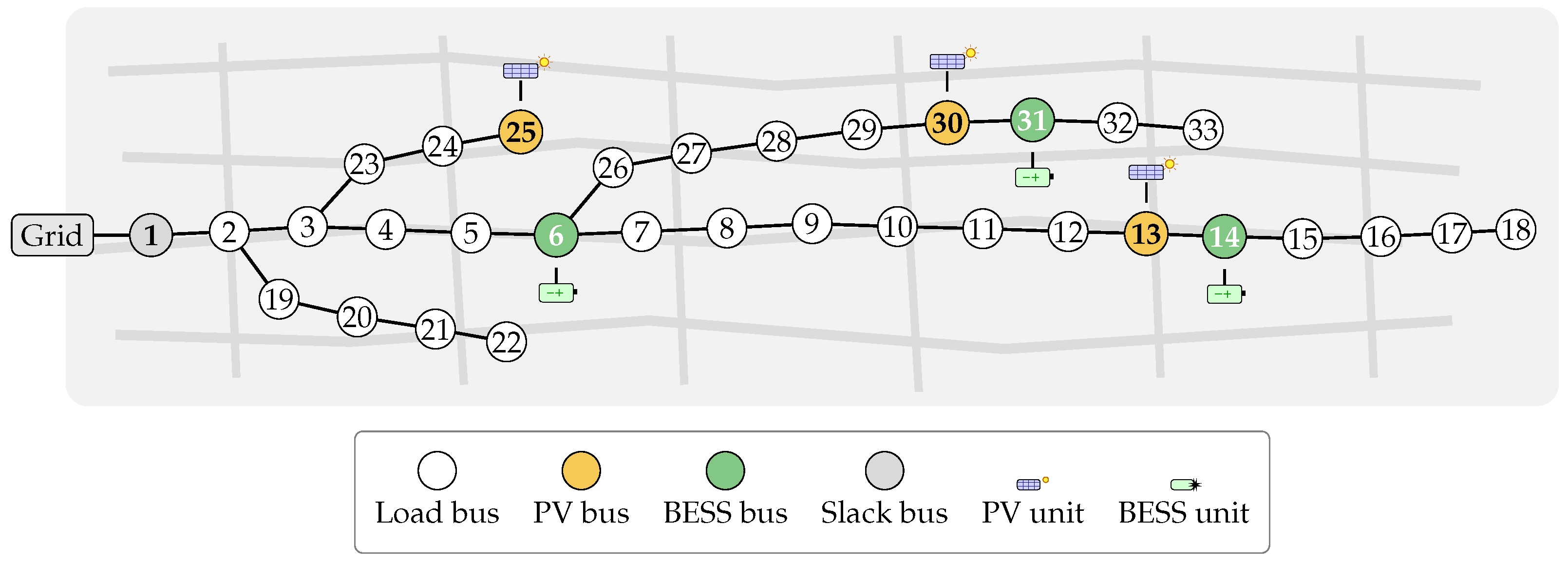
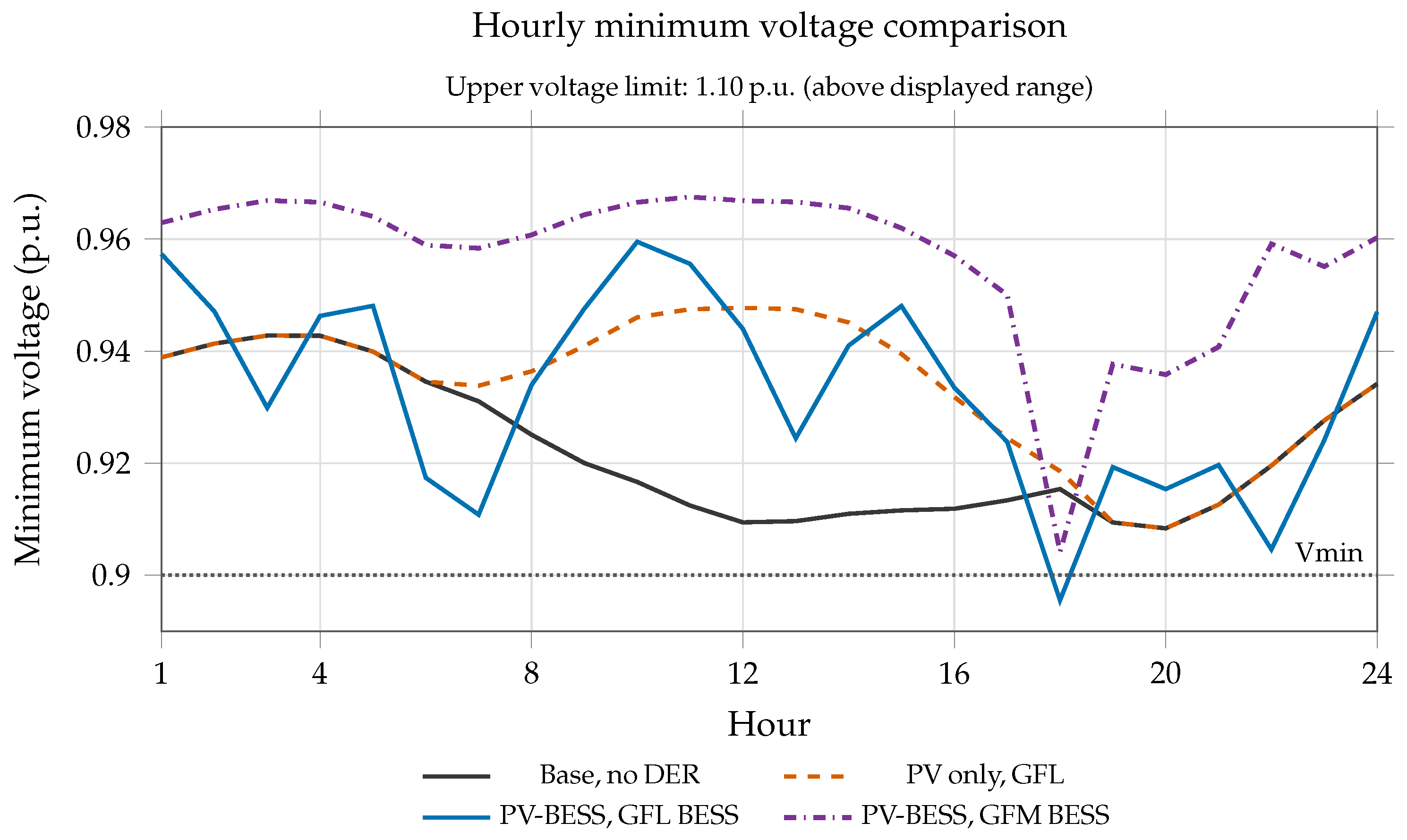
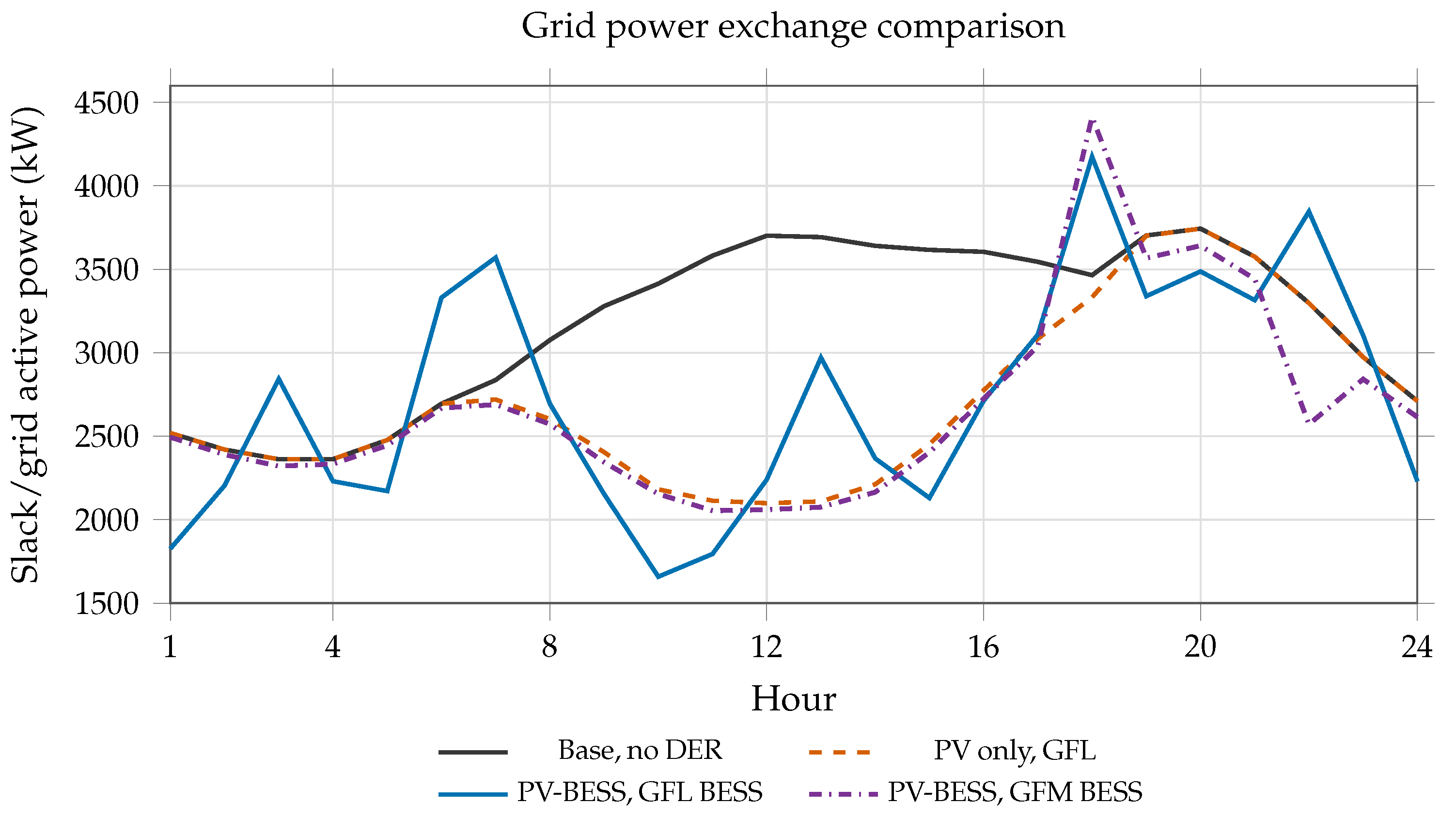
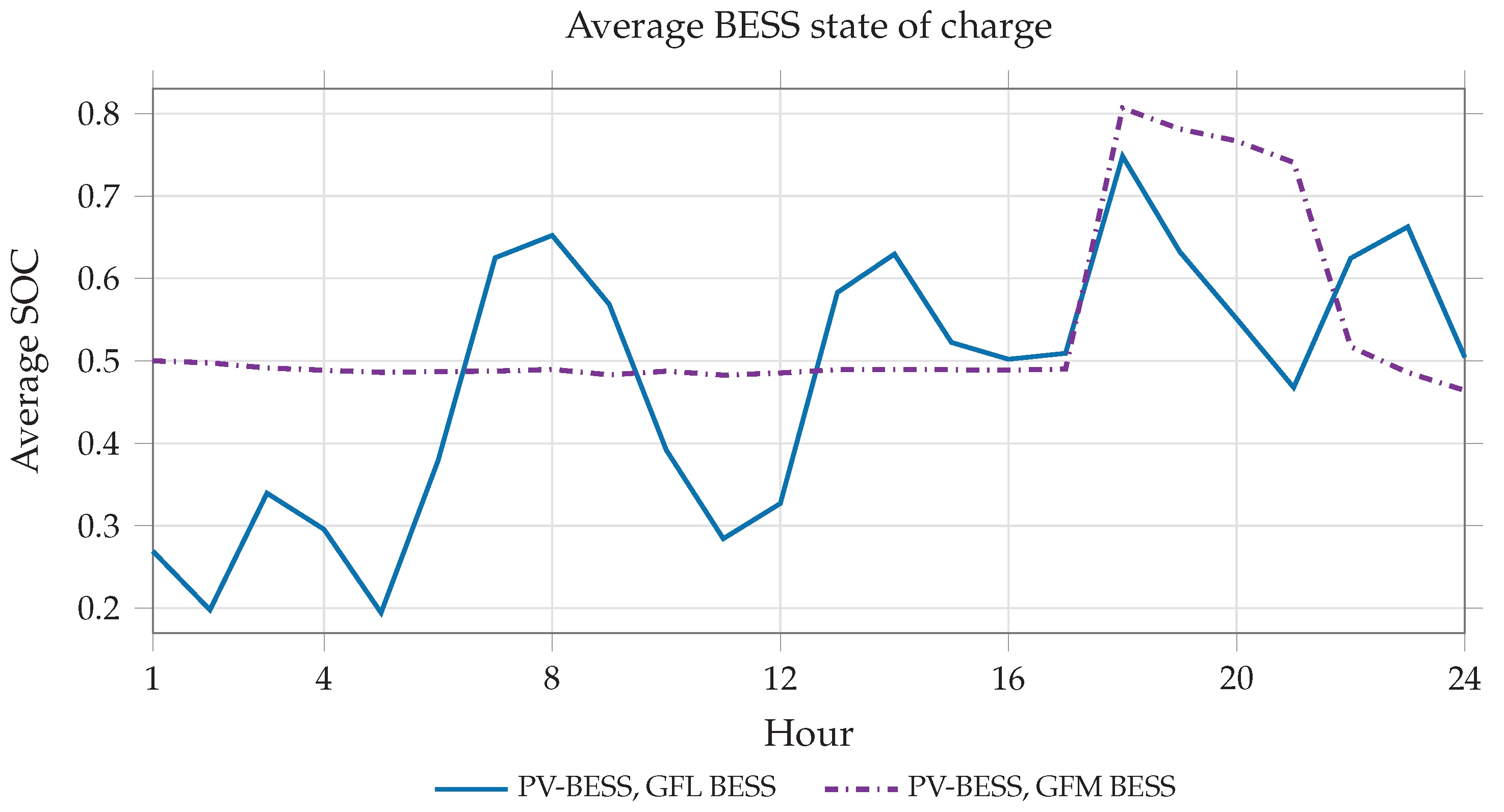
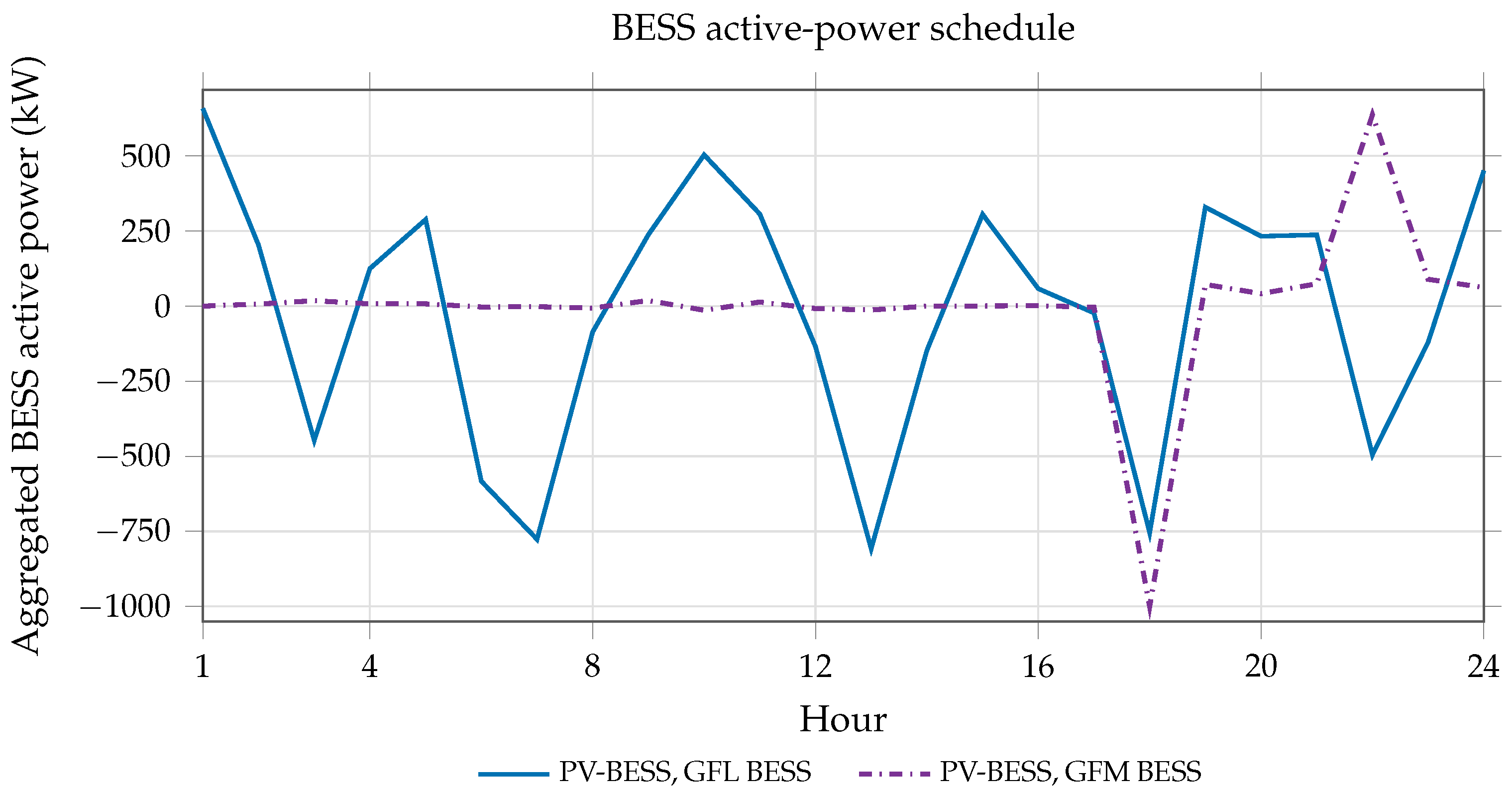
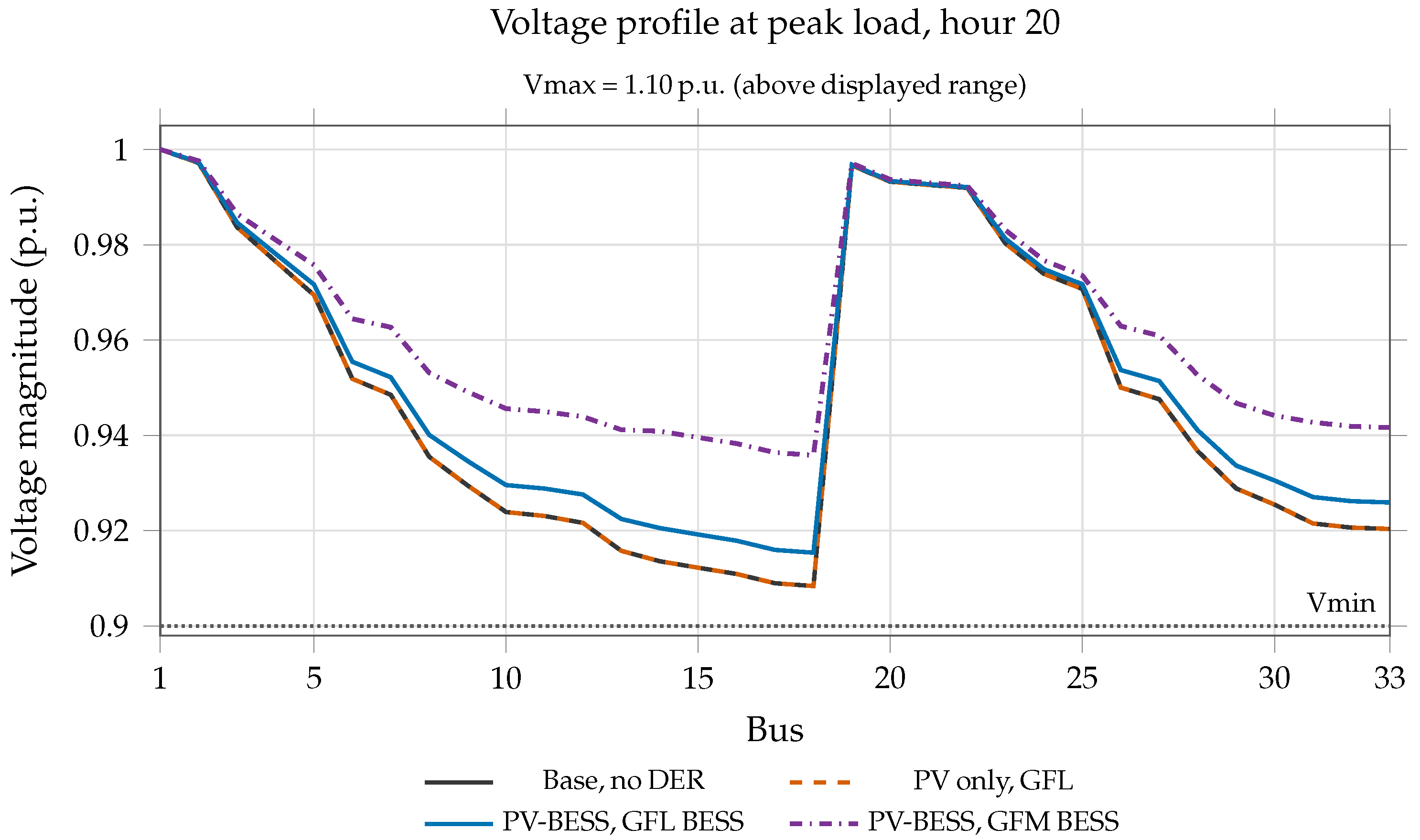
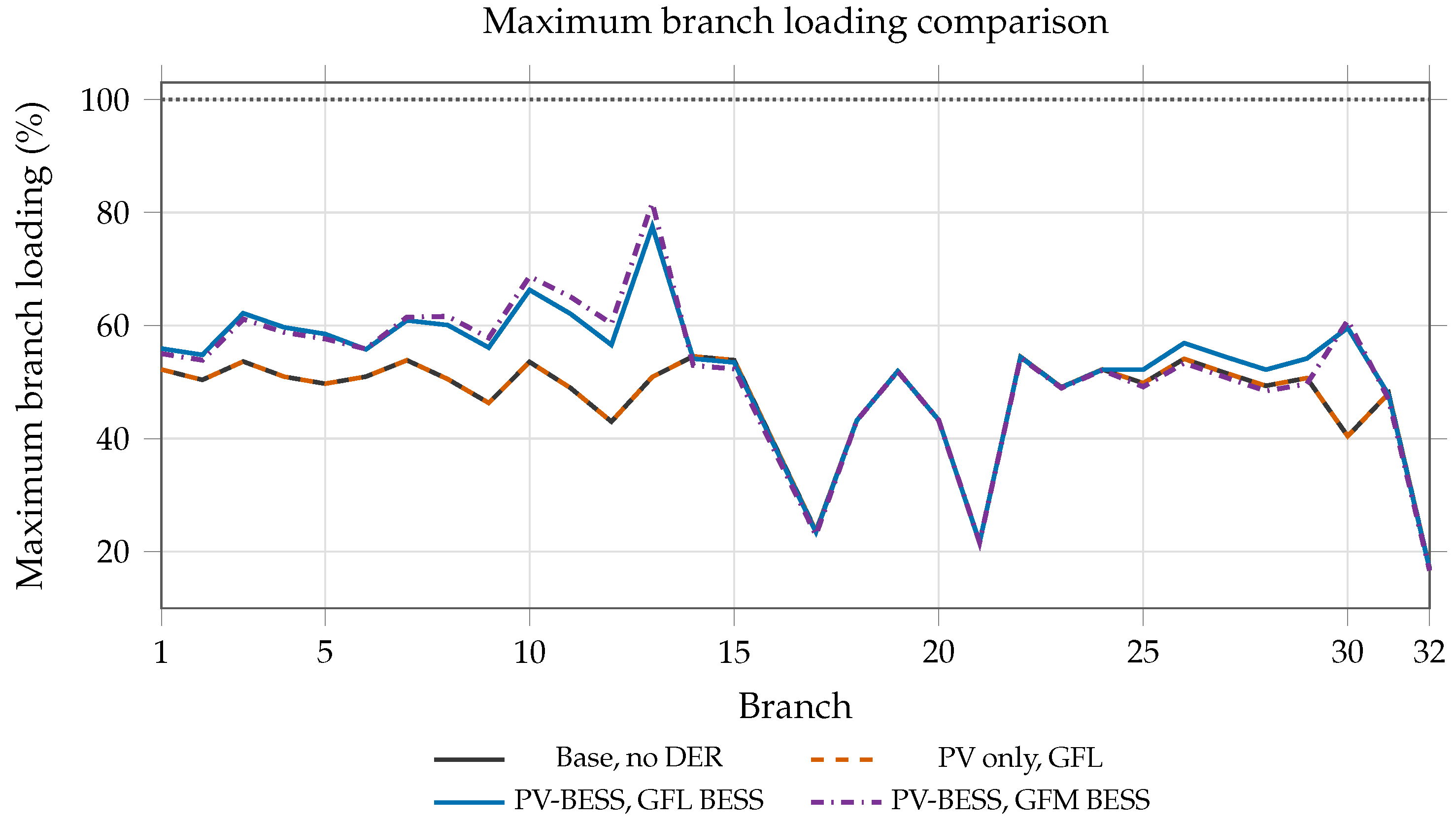
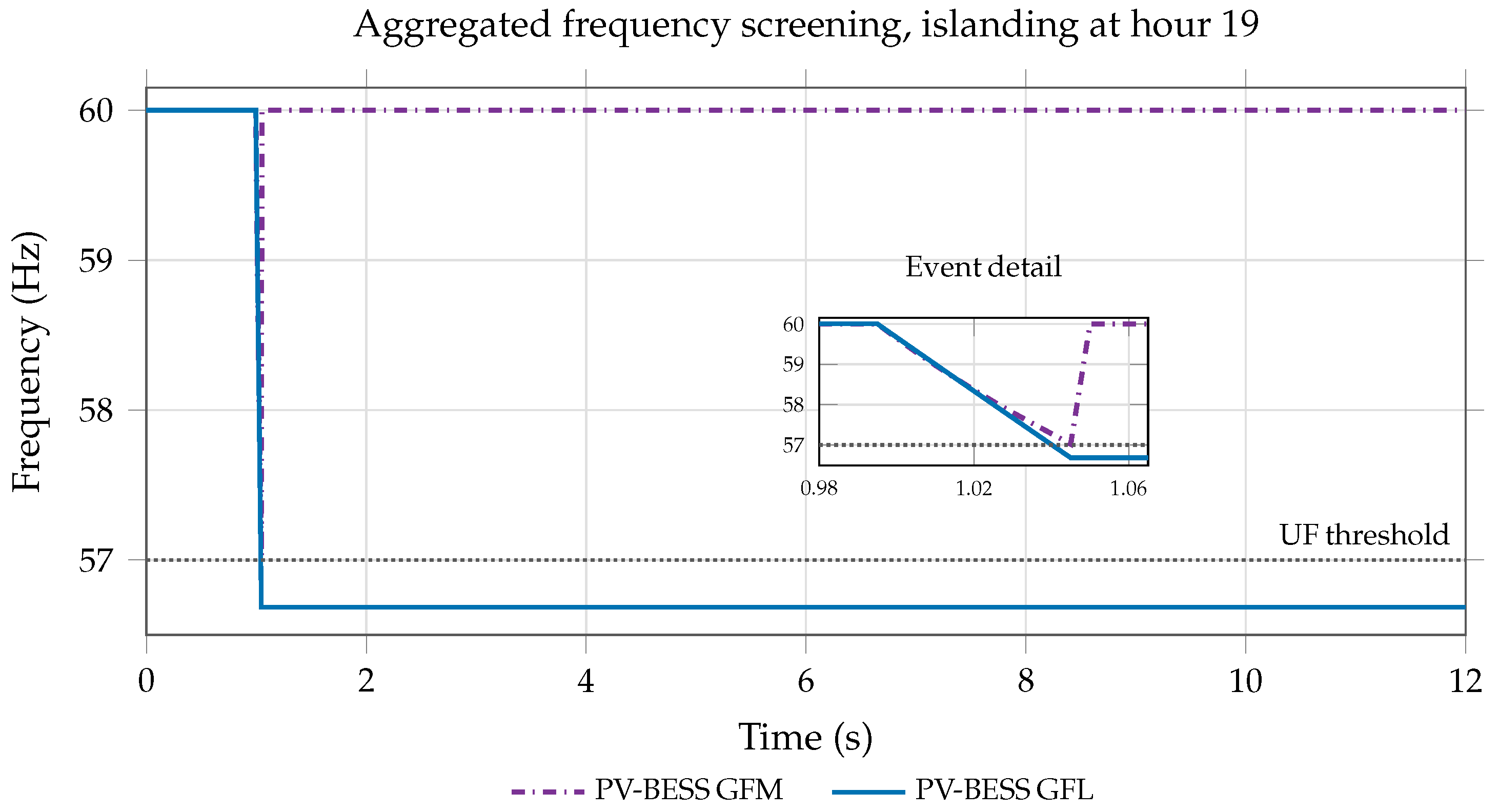
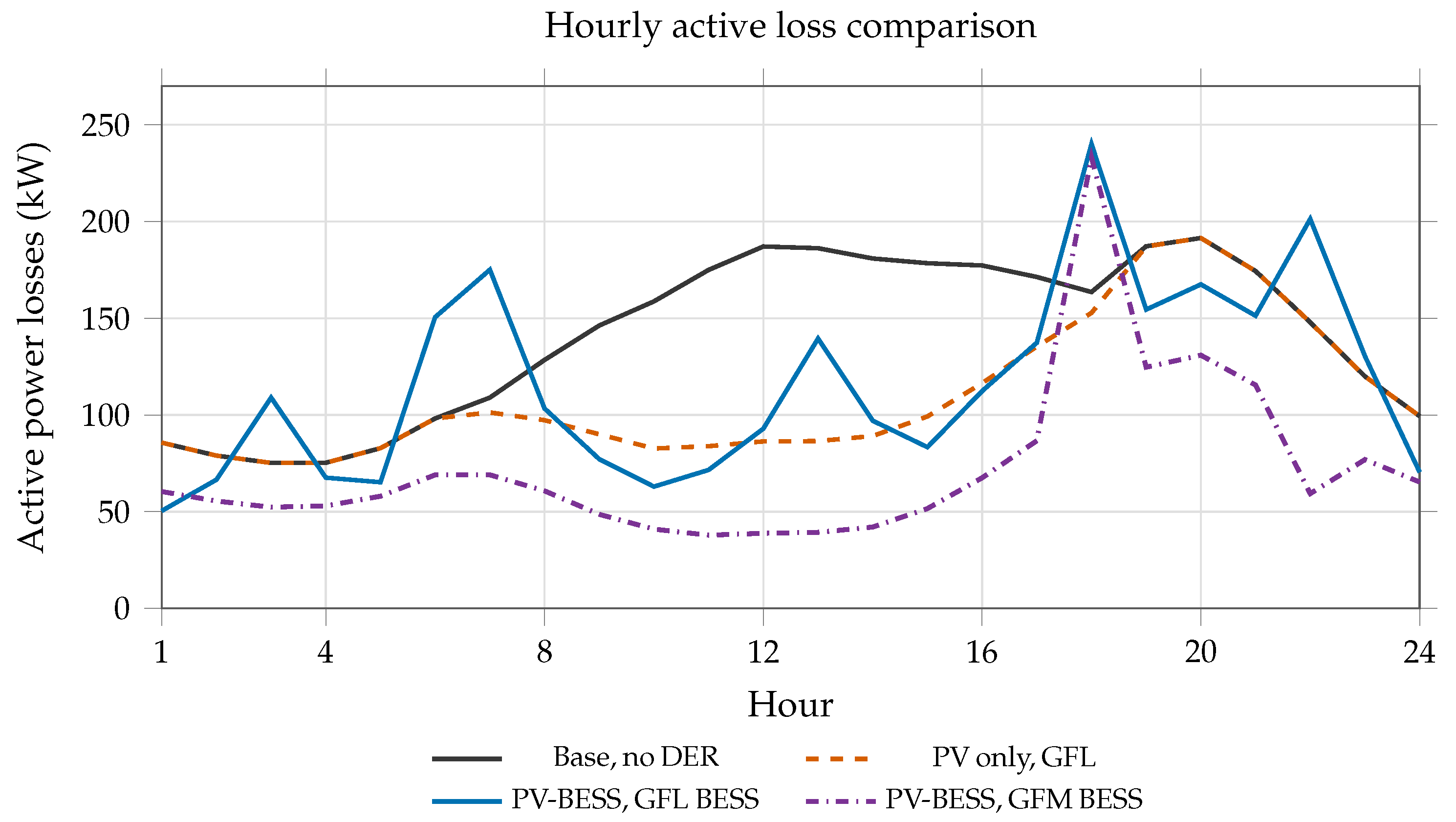
This paper evaluates the operation of battery energy storage systems under grid-following and grid-forming representations in a photovoltaic-rich 33-bus radial distribution network. The study combines a 24-h scheduling model, an AC radial power flow, converter apparent power limits, battery state-of-charge constraints, and a voltage-dependent reactive power model for the grid-forming mode. Photovoltaic units are installed at buses 13, 25, and 30, while battery energy storage systems are installed at buses 6, 14, and 31. Four operating cases are assessed: the base feeder without distributed energy resources, photovoltaic generation under grid-following operation, photovoltaic generation with a grid-following battery system, and photovoltaic generation with a grid-forming battery system. The grid-forming representation reduces daily losses by 48.58%, raises the minimum voltage from 0.8955 p.u. in the grid-following BESS case to 0.9042 p.u., and lowers daily grid imports to 64.026 MWh. Its lower-loss and lower-cost ordering relative to the grid-following BESS is preserved under high-load/low-PV and low-load/high-PV conditions, although it produces higher maximum branch loading. Islanding screening at hours 12, 18, 19, and 20 shows that the available grid-forming reserve is insufficient in every case; both BESS modes cross the 57-Hz threshold. The proposed formulation shows that battery energy storage systems should not be represented solely as active-power scheduling devices when their inverter control mode can modify voltage support, feeder loading, and islanded operation.
Keywords: battery energy storage systems; grid-forming control; grid-following control; PV-rich distribution networks battery energy storage systems; grid-forming control; grid-following control; PV-rich distribution networks