Article

Collaborative Scheduling Optimization of Logistics–Multi-Energy Coupled Port Shore-to-Ship Power System Under Demand Response Incentives

1
Fangchenggang Power Supply Bureau, Guangxi Power Grid Co., Ltd., Fangchenggang 538001, China
2
Power Planning Research Center, Guangxi Power Grid Co., Ltd., Nanning 530023, China
3
China Southern Power Grid Research Institute Co., Ltd., Guangzhou 510663, China
4
School of Electrical and Electronic Engineering, North China Electric Power University, Beijing 102206, China
*
Author to whom correspondence should be addressed.
Energies 2026, 19(18), 4419; https://doi.org/10.3390/en19184419 (registering DOI)
Submission received: 29 July 2026 / Revised: 11 September 2026 / Accepted: 14 September 2026 / Published: 18 September 2026

Abstract

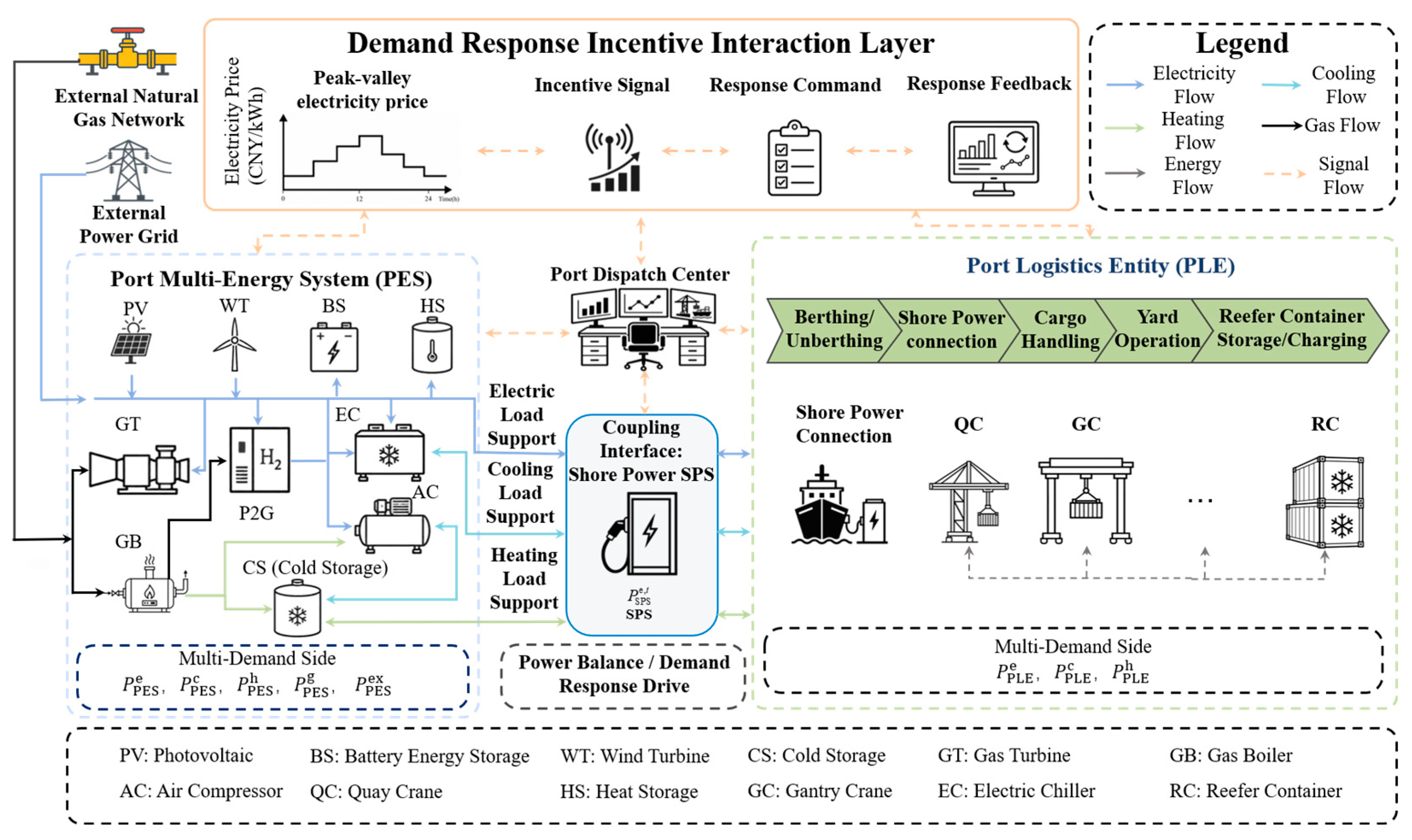
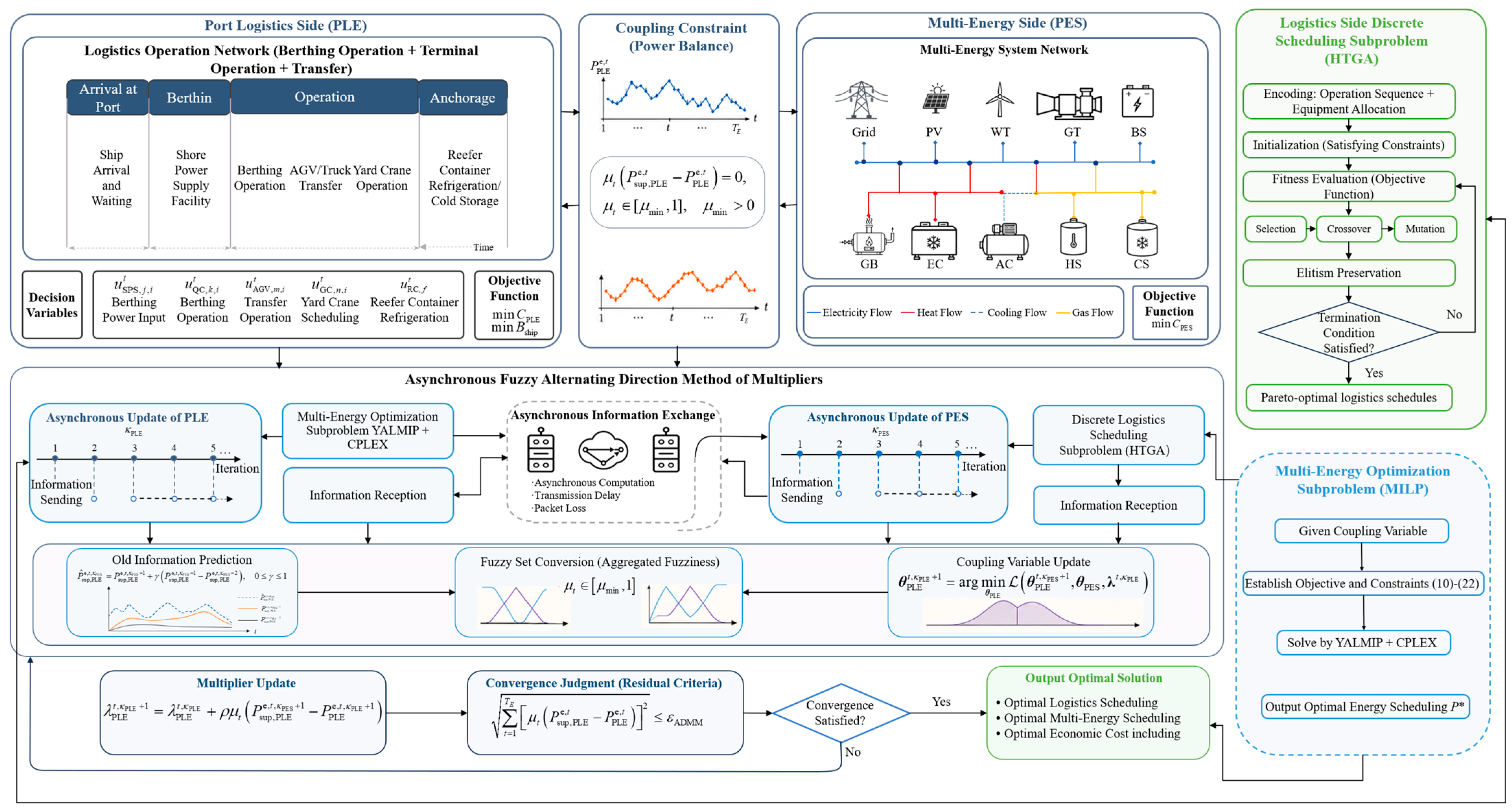
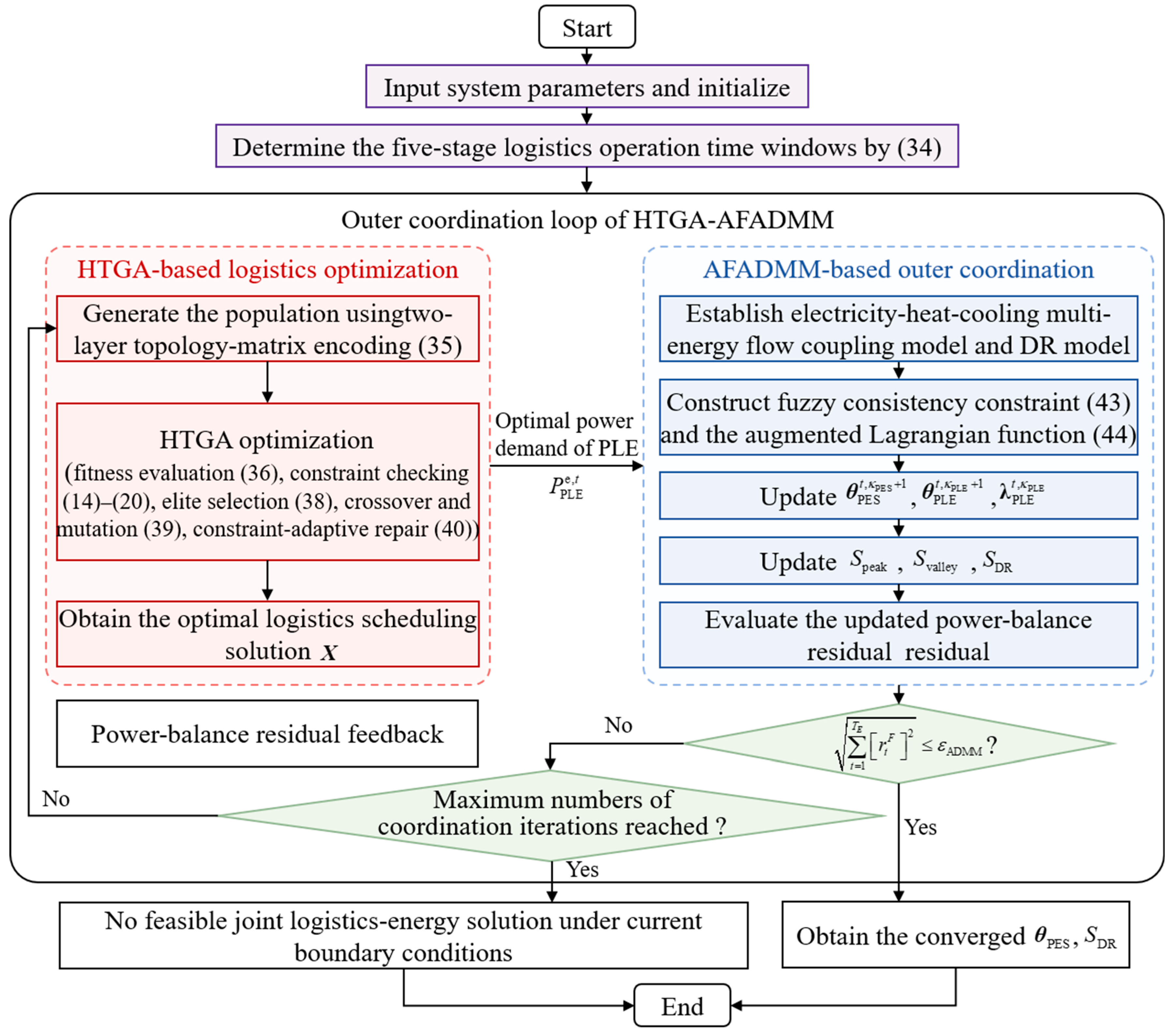
Traditional ports adopt separate scheduling modes for logistics and multi-energy subsystems without deep bidirectional coupling, which leads to low demand response (DR) participation, severe mismatch between the logistics power demand and multi-energy supply, and failure to fully exploit the thermal flexibility of port facilities. Single-link logistics optimization cannot generate complete time-varying load curves, making it impossible to coordinate vessel operation efficiency with port economic operation. To tackle the above limitations, this paper proposes HTGA-AFADMM, namely a hybrid topology genetic algorithm associated asynchronous fuzzy alternating direction method of multipliers (ADMM), as an integrated two-layer collaborative solver. HTGA-AFADMM presents four progressive core innovations. First, it establishes a DR-driven coupled architecture with shore power (SPS) as the core hub, building bidirectional information interaction channels to guide proactive logistics load shifting via thermal flexibility. This breaks passive energy matching under separate scheduling. Second, it embeds a customized hybrid topology genetic solver to solve the NP-hard five-stage flexible flow shop scheduling problem, coordinating vessels, SPS, and all handling equipment to strengthen constraint adaptability and convergence performance. Third, it constructs a heterogeneous-unit oriented distributed robust framework, eliminating idle waiting via asynchronous iteration and quantifying uncertainties with fuzzy membership factors. Fourth, it realizes nested closed-loop iteration between two layers, which takes logistics power curves as coupling signals and iteratively updates consensus variables to obtain optimal scheduling schemes. The proposed HTGA-AFADMM collaborative framework effectively coordinates port logistics scheduling and multi-energy optimal dispatch. It achieves satisfactory economic performance while suppressing power-balance deviations under communication delay and load uncertainty and exhibits good convergence and adaptability for practical port cross-domain scheduling scenarios.
Keywords: port shore power system; logistics–multi-energy coupling; demand response incentive; hybrid topology genetic algorithm; asynchronous fuzzy ADMM port shore power system; logistics–multi-energy coupling; demand response incentive; hybrid topology genetic algorithm; asynchronous fuzzy ADMM