Article

Digital Transformation and Sustainable Business Model Innovation in Renewable Energy Transitions: A Comparative Study of Poland and Selected European Countries

Faculty of Management and Quality Science, Gdynia Maritime University, Morska Street 81-87, 81-225 Gdynia, Poland
Energies 2026, 19(18), 4417; https://doi.org/10.3390/en19184417 (registering DOI)
Submission received: 22 June 2026 / Revised: 31 August 2026 / Accepted: 9 September 2026 / Published: 18 September 2026
(This article belongs to the Section B1: Energy and Climate Change)

Abstract

Renewable energy transition management increasingly depends on the integration of digital technologies, organizational capabilities, and innovative forms of value creation. This study examines how digital transformation, organizational learning, and Sustainable Business Model Innovation jointly support renewable energy transition management. A convergent mixed-methods design was adopted, integrating comparative quantitative analysis of secondary data with qualitative evidence derived from strategic documents and complementary evidence obtained through structured expert assessments conducted in Poland, Germany, Denmark, and Spain. The comparative evidence suggests that higher levels of digital maturity are generally associated with stronger renewable energy performance, greater innovation intensity, and more advanced forms of Sustainable Business Model Innovation. Digitally advanced energy systems appear to exhibit stronger capacities for decentralized coordination, participatory governance, and adaptive learning processes, while less mature systems rely more heavily on localized experimentation and fragmented institutional arrangements. The comparative analysis also highlights differences in renewable energy transition pathways across the analyzed European countries, emphasizing the importance of organizational and institutional conditions in shaping transition processes. The study contributes to the literature by proposing an integrated analytical framework integrating digital transformation, organizational learning, and Sustainable Business Model Innovation within renewable energy transition research. The findings underline the importance of digitally enabled coordination and learning-based adaptation for supporting resilient renewable energy transition pathways and provide practical implications for policymakers, energy companies, and other stakeholders involved in sustainability-oriented energy transitions.

1. Introduction

The transition toward renewable and low-carbon energy systems has become one of the defining challenges for contemporary economies. Growing climate commitments, energy security concerns, and the increasing electrification of economic activities require energy systems to become more flexible, resilient, and capable of integrating distributed renewable energy sources. In this context, digital technologies are increasingly recognized as critical enablers of renewable energy deployment, smart grid development, and adaptive energy management [1].
The rapid diffusion of digital technologies, including artificial intelligence (AI), the Internet of Things (IoT), advanced analytics, cloud computing, and digital platforms, is transforming the way energy systems are managed and coordinated. These technologies support real-time monitoring, predictive maintenance, demand-side management, and decentralized decision-making, thereby improving the efficiency and flexibility of renewable energy systems [2] (pp. 1001–1002). Recent studies suggest that digitalization may facilitate renewable energy integration by improving the coordination of distributed energy resources and enhancing system responsiveness under increasingly dynamic operating conditions [3].
At the same time, the transition toward sustainable energy systems extends beyond technological modernization. It requires new forms of value creation, stakeholder engagement, and organizational adaptation capable of supporting long-term sustainability objectives. Sustainable Business Model Innovation (SBMI) provides an important perspective for understanding how organizations redesign value creation, delivery, and capture mechanisms to simultaneously achieve economic, environmental, and social goals ([4] (p. 11) and [5]). In the energy sector, these developments are reflected in the growing importance of prosumer systems, energy communities, platform-based coordination mechanisms, and energy-as-a-service models.
Despite growing interest in renewable energy transitions, existing research has predominantly examined technological, regulatory, and policy-related dimensions in isolation. Comparatively less attention has been devoted to understanding how digital transformation, organizational learning, and Sustainable Business Model Innovation jointly shape adaptive renewable energy transition processes across different institutional contexts ([6] (pp. 199–200) and [7] (p. 5176)). As a result, current knowledge remains fragmented, limiting a comprehensive understanding of how these dimensions interact within renewable energy transition management.
This research gap is particularly visible in Poland and institutionally comparable European contexts, where renewable energy transitions occur under conditions of uneven digitalization, institutional fragmentation, and evolving governance arrangements. Many institutionally developing renewable energy transition environments continue to combine relatively high dependence on conventional energy sources with accelerating renewable energy deployment and digital modernization efforts. Recent evidence indicates that these institutional conditions appear to shape the pace and effectiveness of renewable energy transitions across these transition environments [8] and ([9] (pp. 42–43)).
Poland represents a particularly relevant case for examining these dynamics. The country faces the dual challenge of decarbonizing a historically coal-dependent energy sector while simultaneously advancing the digitalization of energy infrastructure. At the same time, Poland has experienced rapid growth in distributed photovoltaic generation and prosumer participation, creating new opportunities for decentralized energy management and innovative business model development. These developments provide a valuable context for exploring how digital transformation supports renewable energy transition processes through organizational adaptation and business model innovation.
Against this background, this study examines how digital transformation, organizational learning, and Sustainable Business Model Innovation jointly contribute to renewable energy transition management. Using Poland as a focal case and Germany, Denmark, and Spain as comparative benchmark countries, the study explores how different institutional contexts and levels of digital maturity shape adaptive renewable energy transition pathways.
The study contributes to the growing literature on digitalized renewable energy transition management in three principal ways. First, it proposes an integrated analytical framework that combines digital transformation, organizational learning, dynamic capabilities, and Sustainable Business Model Innovation within a unified perspective on renewable energy transition management. Second, it applies convergent triangulation to integrate comparative quantitative evidence with qualitative evidence derived from strategic documents and complementary evidence obtained through structured expert assessments across four European countries characterized by different levels of digital maturity, renewable energy development, and institutional capacity. Third, it provides context-sensitive insights into Poland’s hybrid renewable energy transition pathway and discusses its broader relevance for institutionally comparable European countries undergoing similar institutional and technological transformations.

2. Literature Review

2.1. Digital Transformation and Renewable Energy Transitions

The transition toward renewable energy systems increasingly depends on the ability to integrate digital technologies into energy production, distribution, and consumption processes. The growing complexity of contemporary energy systems, driven by decentralization, electrification, and increasing shares of renewable energy sources, requires new mechanisms for coordination, monitoring, and decision-making. Consequently, digital transformation has emerged as a critical enabler of renewable energy transitions, supporting greater system flexibility, resilience, and operational efficiency [10,11].
Recent research highlights the growing role of digital technologies such as artificial intelligence (AI), Internet of Things (IoT) systems, advanced analytics, digital platforms, and smart energy management tools in facilitating renewable energy integration. These technologies support real-time monitoring, predictive maintenance, demand-side management, and decentralized coordination across increasingly complex energy networks [2] (p. 1013). As a result, digitalization increasingly supports not only technological modernization but also new forms of energy governance, stakeholder coordination, and organizational adaptation.
At the same time, renewable energy transitions involve significant organizational and institutional challenges. The deployment of renewable energy technologies requires the coordination of multiple stakeholders, including energy producers, regulators, technology providers, local communities, and prosumers. Consequently, the effectiveness of energy transition processes appears to depend not only on technological capabilities but also on organizational adaptation and institutional capacity.
A parallel stream of research focuses on Sustainable Business Model Innovation (SBMI), which examines how organizations redesign value creation, delivery, and capture mechanisms to incorporate sustainability objectives ([4] (p. 17) and [6] (p. 213)). Within renewable energy systems, Sustainable Business Model Innovation is increasingly reflected in the emergence of energy communities, prosumer networks, platform-based coordination mechanisms, and service-oriented energy solutions. Digital technologies facilitate these developments by reducing coordination costs, improving information exchange, and enabling greater stakeholder participation.
Another important perspective emphasizes the role of organizational learning in supporting adaptation to technological and institutional change. In rapidly evolving energy systems, organizations must continuously acquire, interpret, and apply new knowledge related to emerging technologies, market developments, and regulatory requirements. Organizational learning therefore functions as an important mechanism supporting the implementation of digital technologies and the development of innovative business models under conditions of uncertainty [7] (pp. 5180–5181).
Despite growing interest in digital transformation, renewable energy transitions, and Sustainable Business Model Innovation, the literature remains fragmented. Existing studies frequently focus on technological, regulatory, or business model dimensions separately, providing limited understanding of how these processes interact within evolving energy systems. In particular, insufficient attention has been devoted to understanding how digital transformation, organizational learning, and Sustainable Business Model Innovation jointly contribute to adaptive renewable energy transition pathways. Moreover, relatively few studies have attempted to integrate these perspectives within a single analytical framework supported by comparative quantitative evidence, qualitative documentary evidence, and complementary evidence obtained through structured expert assessments.
This limitation is particularly relevant in Poland and institutionally comparable European contexts, where renewable energy transitions occur under conditions of uneven digitalization, institutional fragmentation, and evolving governance arrangements. Compared with more digitally mature European economies, Poland continues to experience higher levels of regulatory uncertainty and stronger dependence on legacy energy infrastructures. As a result, organizations operating within this institutional environment face additional challenges associated with coordinating digital transformation and renewable energy development.
Poland provides a particularly relevant context for examining these dynamics. As one of the largest coal-dependent economies in Europe, Poland simultaneously experiences accelerating renewable energy deployment, growing prosumer participation, and increasing digitalization of energy infrastructure. These developments create opportunities to explore how digital transformation interacts with organizational learning and Sustainable Business Model Innovation within renewable energy transition processes.
To address the identified research gap, this study develops an integrative analytical perspective linking digital transformation, organizational learning, and Sustainable Business Model Innovation within renewable energy transition systems. Table 1 summarizes the main theoretical perspectives underpinning the analysis and identifies the key gaps addressed by the proposed framework.
As shown in Table 1, existing research provides valuable insights into individual dimensions of renewable energy transitions, including digital transformation, Sustainable Business Model Innovation, organizational learning, and energy system transformation. However, these perspectives are typically examined in isolation, providing limited understanding of how digitalization, organizational adaptation, and business model innovation jointly influence renewable energy transition outcomes. This gap is particularly relevant in Poland and institutionally comparable European contexts, where energy transitions occur under conditions of uneven digitalization and institutional complexity. Consequently, there is a need for an integrated analytical framework capable of explaining how digital transformation, organizational learning, and Sustainable Business Model Innovation jointly shape renewable energy transition management across different institutional contexts. The proposed framework addresses this gap by integrating comparative quantitative evidence, qualitative documentary evidence, and complementary evidence from structured expert assessments within a convergent triangulation framework.

2.2. An Integrative Framework of Digital Transformation, Organizational Learning, and Sustainable Business Model Innovation in Renewable Energy Transitions

Building on the identified research gap, this study proposes an integrated analytical framework explaining how digital transformation supports renewable energy transition management through organizational learning and Sustainable Business Model Innovation (SBMI). Rather than treating these dimensions as separate processes, the framework views them as interdependent mechanisms embedded within broader energy transition dynamics.
From this perspective, renewable energy transitions require not only technological deployment but also the capacity of organizations and institutions to coordinate adaptation processes under conditions of uncertainty. The increasing penetration of renewable energy sources, distributed energy resources, and digital infrastructures creates growing demands for flexibility, coordination, and continuous learning across energy systems. Consequently, renewable energy transition management increasingly depends on the interaction between technological capabilities, organizational adaptation, and institutional arrangements [3].
Digital transformation provides the technological infrastructure enabling such adaptation. Technologies including artificial intelligence (AI), Internet of Things (IoT), digital platforms, smart energy management systems, and advanced analytics support real-time coordination, decentralized decision-making, and new forms of interaction between producers, consumers, and institutional actors ([1] and [15] (pp. 348–358)). These technologies also facilitate faster information flows and continuous feedback processes, increasing the capacity of energy systems to respond to changing environmental, technological, and market conditions.
Sustainable Business Model Innovation (SBMI), in turn, represents the organizational dimension through which sustainability objectives are translated into new forms of value creation and stakeholder engagement ([4] (p. 17) and [5]). Within renewable energy systems, SBMI increasingly manifests through prosumer models, energy communities, platform-based energy services, and collaborative value creation mechanisms. Digital technologies facilitate these developments by reducing coordination costs, improving transparency, and enabling greater participation of diverse stakeholders in energy markets.
Within the proposed framework, organizational learning functions as the central integrative mechanism linking digital transformation and Sustainable Business Model Innovation. Organizational learning enables organizations to interpret technological change, transfer knowledge across institutional boundaries, and continuously adapt operational and managerial practices. In this sense, organizational learning supports the development of adaptive capabilities necessary for managing renewable energy transitions under conditions of institutional complexity and uncertainty ([7] (p. 5189) and [16] (p. 41)).
The proposed framework conceptualizes renewable energy transition as an adaptive and path-dependent process shaped by interactions between technological infrastructures, organizational capabilities, and institutional arrangements.
To improve conceptual clarity and ensure analytical consistency, Table 2 presents the operationalization of the key constructs used in the study and their roles within the proposed analytical framework.
The operationalization presented in Table 2 guided the comparative quantitative analysis, the qualitative documentary analysis, and the structured expert assessment, providing a common analytical framework for integrating multiple sources of evidence through convergent triangulation.
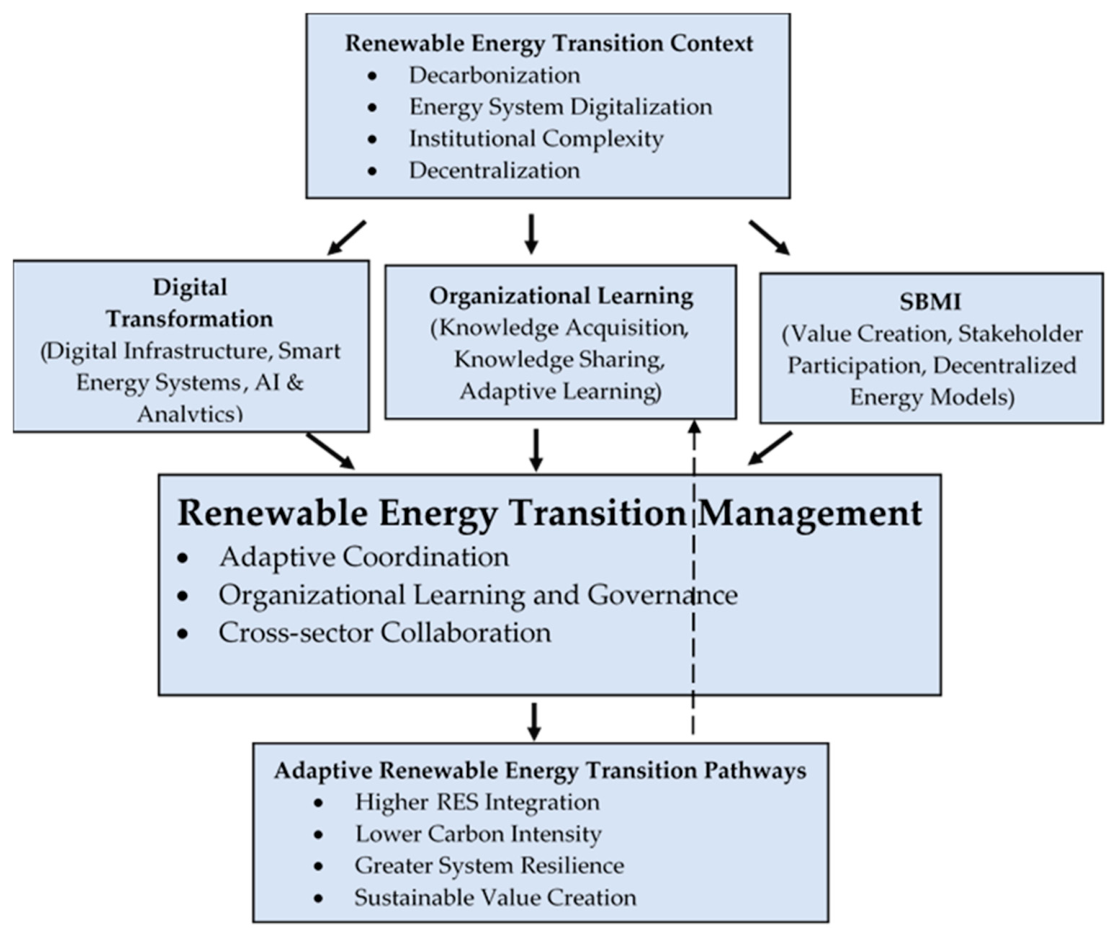
Consequently, transition outcomes depend not only on the availability of digital technologies but also on the capacity of organizations and governance systems to coordinate learning, experimentation, and adaptation over time. Figure 1 presents the conceptual structure of the proposed framework and illustrates the relationships between digital transformation, organizational learning, Sustainable Business Model Innovation, and renewable energy transition outcomes.
Figure 1 presents the proposed analytical framework integrating digital transformation, organizational learning, Sustainable Business Model Innovation, and renewable energy transition management. The framework conceptualizes renewable energy transition as a dynamic and adaptive process shaped by interactions among technological infrastructures, organizational capabilities, and institutional conditions. Through adaptive coordination processes, these mechanisms are expected to support renewable energy integration, lower-emission development pathways, greater system resilience, and sustainable value creation.

3. Comparative Mixed-Methods Research Design

3.1. Research Design and Analytical Propositions

This study adopts a comparative mixed-methods research design to examine how digital transformation reshapes renewable energy transition management processes and Sustainable Business Model Innovation (SBMI) within renewable energy systems. The methodological approach combines comparative quantitative evidence, qualitative documentary evidence, and complementary evidence obtained through structured expert assessments to capture both structural transition patterns and organizational mechanisms of adaptation. Such an approach is particularly suitable for analyzing sustainability transitions, where technological, institutional, and strategic dimensions evolve simultaneously across multiple levels of analysis.
The study is grounded in the theoretical perspectives of digital transformation, organizational learning, dynamic capabilities [16] (p. 45), and Sustainable Business Model Innovation [4] (p. 13). Building on the conceptual framework developed in the previous section, the analysis focuses on the interaction of digital transformation, organizational learning, and sustainability-oriented business model adaptation within renewable energy transition systems. A convergent mixed-methods approach was applied, combining comparative quantitative analysis of secondary data, qualitative analysis of strategic documents, and complementary evidence obtained through structured expert assessments [17] (pp. 45–51). The integration of comparative quantitative evidence, qualitative documentary evidence, and complementary evidence obtained through structured expert assessments provides the basis for convergent triangulation, supporting the interpretation of renewable energy transition processes across different analytical levels.
The quantitative component of the study should therefore be interpreted as exploratory and descriptive rather than explanatory. Owing to the limited number of country cases and the comparative character of the research design, the study does not seek to establish causal relationships but rather to identify patterns and associations that may inform further research on renewable energy transition processes.
Based on the integrated analytical framework presented above, the empirical analysis is guided by the following three analytical propositions:
  • P1. Higher levels of digital maturity are generally associated with more adaptive renewable energy transition processes through enhanced coordination and organizational learning mechanisms.
  • P2. Sustainable Business Model Innovation appears to be reinforced when digital transformation facilitates decentralized and participatory forms of value creation within renewable energy systems.
  • P3. The alignment of digital transformation, organizational learning, and Sustainable Business Model Innovation is associated with more adaptive and resilient renewable energy transition pathways.
The research process was conducted in three complementary stages corresponding to the analytical dimensions of the study (Table 3).

3.2. Quantitative Component

The quantitative analysis covered 2015–2024 and examined comparative patterns in digital maturity, innovation intensity, renewable energy deployment, and carbon intensity across the analyzed countries. The indicators were used to identify comparative patterns and potential associations rather than to develop predictive models or establish causal relationships. The quantitative findings subsequently informed the documentary analysis, structured expert assessment, and integrative triangulation process.
The quantitative stage examines cross-country differences in renewable energy transition trajectories using comparative secondary data obtained from Eurostat, the International Energy Agency, the World Bank, and national statistical sources. Table 4 presents the quantitative indicators used in the study, their definitions, units of measurement, and data sources.
The selected indicators capture complementary dimensions of renewable energy transition, including digital maturity, innovation capacity, renewable energy deployment, and environmental performance. The analysis focused on the share of renewable energy in the energy mix, R&D expenditure, the Digital Economy and Society Index (DESI), and CO2 emissions intensity associated with electricity generation. R&D expenditure is operationalized as gross domestic expenditure on research and development expressed as a percentage of GDP, using harmonized national-level data reported by the World Bank. Descriptive comparative trend analysis and cross-country assessment were applied to identify similarities and differences across the selected countries; accordingly, the quantitative component is interpreted as exploratory rather than causally explanatory or statistically generalizable.

3.3. Structured Expert Assessment

To complement the comparative analysis of secondary data and documentary evidence, a structured expert assessment was conducted in January 2025 among specialists from Poland, Germany, Denmark, and Spain. The assessment was based on a standardized questionnaire consisting of twelve closed statements evaluated on a five-point Likert scale. The assessment provided structured expert judgments that were subsequently integrated with documentary and quantitative evidence through the convergent triangulation procedure.
A purposive sampling strategy was applied to ensure the participation of respondents representing key stakeholder groups involved in renewable energy transition processes in Poland, Germany, Denmark, and Spain. Participants were selected based on their professional experience in renewable energy systems, digital transformation, energy policy, or related organizational and managerial functions to ensure the inclusion of diverse perspectives relevant to the research objectives. The final expert assessment comprised 22 participants. The initial count of 15 respondents did not include seven completed questionnaires that had been returned by e-mail and were subsequently identified during verification of the collected responses. These seven responses were included in the final dataset because they met the same eligibility criteria and were obtained using the same standardized questionnaire and assessment procedure. No changes were made to the questionnaire, eligibility criteria, or assessment procedure in connection with their inclusion.
The structured expert assessment was conducted using a standardized questionnaire composed of twelve statements organized into four analytical dimensions: regulatory, technological, social, and strategic. Respondents assessed each statement using a five-point Likert scale ranging from 1 (“strongly disagree”) to 5 (“strongly agree”). The questionnaire was administered in English using an online survey format and required approximately 15–20 min to complete. Before distribution, the instrument was reviewed to ensure clarity and consistency of wording across all analytical dimensions.
The questionnaire was designed to capture expert perceptions regarding the institutional, technological, and organizational conditions influencing renewable energy transition processes and the role of integrated governance mechanisms in supporting long-term sustainability transitions (Table 5). The statements were developed on the basis of the conceptual framework presented in Section 2 and were directly aligned with the analytical propositions guiding the study.
The study involved twenty-two experts representing energy companies, renewable energy project managers, energy researchers, and representatives of electricity network operators across the four analyzed countries (Table 6).
The expert assessment sample represented a diverse group of respondents with direct professional experience in renewable energy projects, digital infrastructure, energy system modernization, and public energy governance. The distribution of participants across countries and stakeholder groups enabled the inclusion of multiple professional perspectives and facilitated the comparative interpretation of renewable energy transition experiences in different institutional contexts. Participation was voluntary and anonymous. No personal identifiers were collected, and all responses were analyzed exclusively in aggregated form. To minimize the risk of indirect identification, the findings are reported only at the overall sample level and are not presented separately for individual countries or stakeholder groups. Informed consent was obtained from all participants prior to data collection.
The expert assessment data were organized according to the four predefined analytical dimensions (regulatory, technological, social, and strategic), with three Likert-scale statements assigned to each dimension. The responses were analyzed descriptively at the item level using response distributions and mean scores and were subsequently synthesized within each analytical dimension to identify patterns of convergence and divergence. The dimension-level findings were then integrated with documentary evidence and comparative quantitative results through the convergent triangulation procedure.
The documentary component was based on purposively selected strategic, policy, and institutional reports relevant to renewable energy transition, digital transformation, governance, and sustainability. The selected documents included European-level policy documents and international institutional and industry reports, which were used as comparative contextual evidence across the four selected country cases. Documents were selected according to their relevance to the analytical dimensions of the study and their ability to provide evidence on institutional, governance, technological, and organizational aspects of renewable energy transition. The documentary evidence was examined comparatively to identify recurring patterns, country-specific characteristics, and evidence relevant to the three analytical propositions. The resulting observations were subsequently integrated with the quantitative and structured expert assessment evidence within the triangulation framework.

3.4. Integration and Convergent Triangulation

The final stage of the study integrated quantitative and qualitative findings using a convergent triangulation strategy. The purpose of this stage was not to statistically verify the analytical propositions but to examine the extent to which different sources of evidence converged, complemented one another, or revealed context-specific differences. This integrative approach supported the interpretive assessment of renewable energy transition processes across the analyzed countries. Accordingly, P1–P3 were treated as analytical propositions guiding the interpretation of convergent and complementary evidence rather than as formally testable hypotheses.
To enhance methodological transparency, Table 7 demonstrates how evidence from quantitative analysis, documentary analysis, and structured expert assessment was integrated to assess each analytical proposition. Convergence was interpreted as the consistency of evidence obtained from these complementary sources rather than as a formal statistical measure of agreement. The convergence assessment therefore reflects the extent to which the three sources of evidence supported similar analytical conclusions.
Convergence was interpreted as consistency in the direction of analytical findings across distinct evidence streams, whereas complementary evidence was considered to provide additional contextual or interpretive insights without requiring identical empirical observations. The assessment of convergence was therefore proposition-specific and did not imply that all evidence streams provided equivalent empirical tests of each proposition.
The triangulation process enabled the integration of macro-level comparative patterns with documentary and expert assessment evidence concerning organizational adaptation, governance mechanisms, and institutional learning. Rather than seeking statistical confirmation of the analytical propositions, the study aimed to identify convergent and complementary patterns across multiple sources of evidence. The resulting interpretations therefore represent analytically informed rather than statistically generalizable conclusions regarding the role of digital transformation and Sustainable Business Model Innovation in renewable energy transition processes.
The Supplementary Materials provide the underlying expert questionnaire (Supplementary Materials File S1), the analytical framework (Supplementary Materials File S2), documentary evidence traceability (Supplementary Materials File S3), the triangulation procedure (Supplementary Materials File S4), the datasets underlying the comparative figures (Supplementary Dataset S1), and the definitions, units, analytical roles, and sources of the principal variables (Supplementary Table S1).

3.5. Case Selection and Study Limitations

The comparative case selection follows a theoretical replication logic [23] (pp. 31–49), to capture variation across countries in terms of digital maturity, renewable energy development, and governance coordination. Germany and Denmark represent more digitally advanced and institutionally coordinated transition models, while Poland represents a hybrid transition pathway characterized by the coexistence of conventional energy structures with rapidly developing renewable energy initiatives and ongoing digital transformation efforts. Spain represents an intermediate case combining strong policy-driven renewable energy expansion with progressive digital integration and evolving governance arrangements.
Several limitations of the study should be acknowledged. First, the comparative analysis is based on a limited number of countries, which restricts the generalizability of findings. Nevertheless, the inclusion of countries representing different institutional and digital maturity profiles enhances the analytical transferability of the findings to comparable renewable energy transition contexts.
Second, the quantitative analysis is exploratory in nature and therefore does not allow for causal inference, predictive modelling, or statistical generalization.
Third, differences in national reporting systems and data availability may affect the comparability of selected indicators.
Fourth, the number of participants in the structured expert assessment (n = 22) reflects the exploratory and comparative design of the study rather than an attempt to achieve statistical representativeness; therefore, the findings are not intended for statistical generalization but rather to provide exploratory and analytically informed insights into the examined phenomena.
Taken together, these limitations reflect the exploratory character of the study and should be considered when interpreting the findings.
Despite these limitations, the mixed-methods design enabled the integration of complementary sources of evidence, providing a broader understanding of renewable energy transition processes than could be achieved through a single methodological approach. The convergent triangulation strategy strengthened the interpretive robustness of the findings by allowing quantitative patterns to be examined alongside documentary evidence and expert perspectives. Consequently, the study offers analytically grounded insights into the organizational and institutional dimensions of renewable energy transitions while acknowledging the contextual nature of its conclusions.

4. Results and Discussion

4.1. Digitalization and Renewable Energy Transition Pathways

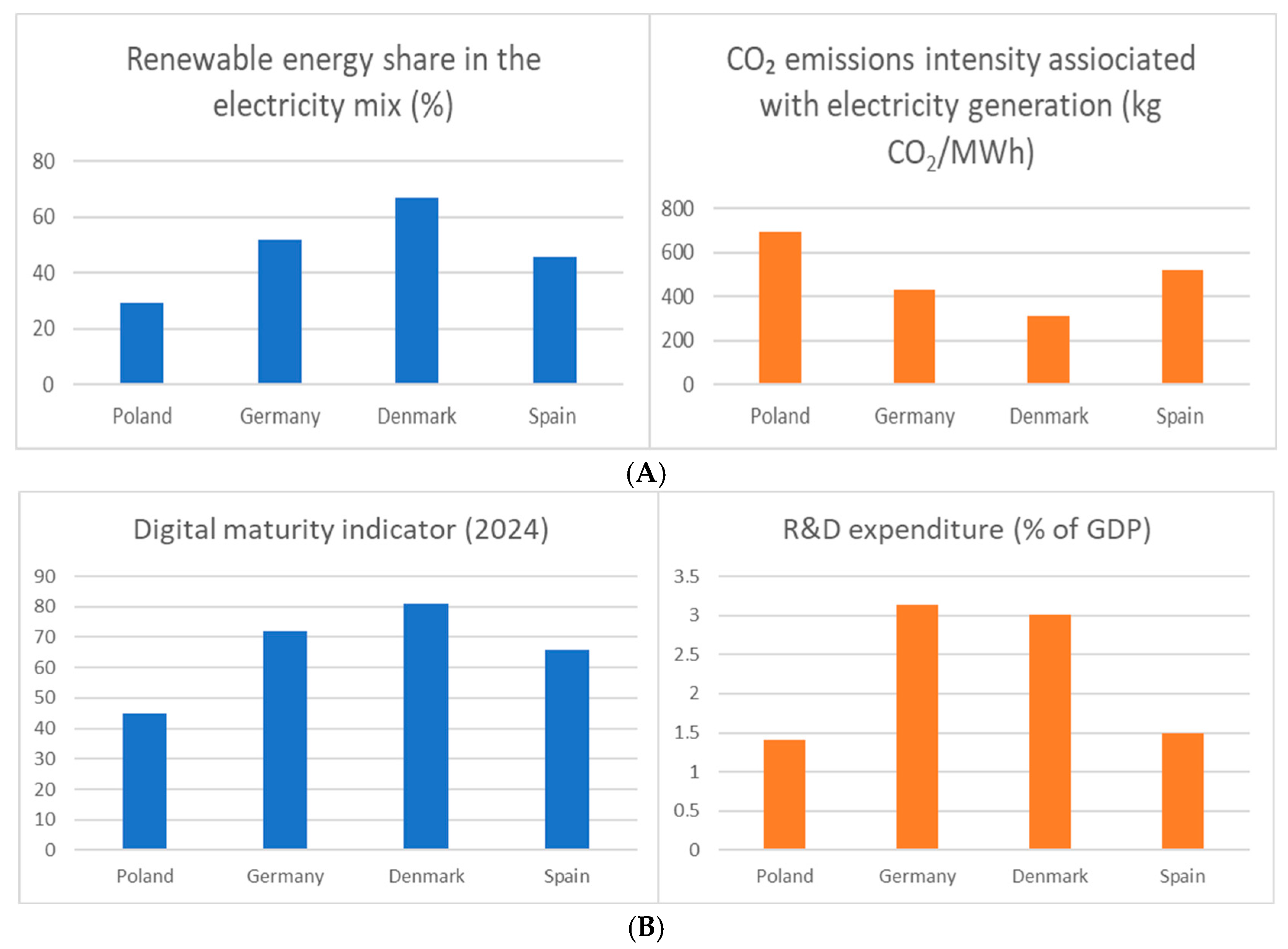
The comparative analysis reveals noticeable differences in renewable energy transition pathways across the analyzed countries. Although countries with stronger renewable energy integration generally exhibit lower carbon intensity, these comparative patterns remain conditioned by institutional coordination and governance stability. Figure 2A first presents the relationship between renewable energy integration and CO2 emissions intensity, providing the basis for the subsequent comparison of digital maturity and innovation capacity.
Figure 2A compares renewable energy deployment and carbon intensity across the analyzed countries. The comparative evidence indicates that countries characterized by higher levels of renewable energy integration generally exhibit lower carbon intensity within their electricity generation systems.
The comparison of renewable energy performance provides a basis for examining the digital and innovation conditions underlying these different transition pathways. Figure 2B presents the distribution of the analyzed countries across selected digitalization and innovation indicators. The comparative patterns indicate that digital maturity may function as an important enabling condition for more adaptive and sustainability-oriented renewable energy transition pathways.
Figure 2B illustrates differences in digital maturity and innovation intensity across the analyzed countries. The comparative patterns suggest that higher levels of digitalization are associated with stronger innovation-oriented transition capacities.
The comparative findings suggest that Germany and Denmark are characterized as data-driven transition models, where digital technologies are closely embedded within organizational and institutional processes. In these systems, digital tools facilitate the development of decentralized and participatory forms of energy management, including energy communities, prosumer networks, and platform-based coordination mechanisms. The integration of digital infrastructures with relatively stable governance frameworks also may facilitate faster organizational learning and more adaptive forms of renewable energy transition management consistent with the dynamic capabilities perspective [16] (p. 43).
Spain represents a partially different transition trajectory. While the country demonstrates a relatively high share of renewable energy and visible progress in decarbonization, the level of digital integration remains comparatively less developed than in Denmark and Germany. The comparative evidence suggests that the Spanish transition model is driven more strongly by policy support and regulatory intervention than by deeply embedded digital coordination mechanisms. As a result, renewable energy expansion appears more policy-induced than systematically integrated with organizational learning and digitally enabled business model transformation.
Poland represents a hybrid transition pathway characterized by the coexistence of conventional energy structures with rapidly expanding renewable energy initiatives and ongoing digital transformation efforts. Despite visible progress in renewable energy deployment, lower levels of digital maturity and comparatively weaker innovation intensity continue to constrain systemic integration. Consequently, transition processes remain dependent on localized initiatives and fragmented coordination mechanisms rather than fully institutionalized and data-driven forms of renewable energy transition management. This pattern reflects broader institutional asymmetries associated with post-coal transition environments, where technological modernization advances more rapidly than governance adaptation. Poland represents a hybrid transition pathway characterized by the coexistence of conventional energy structures with rapidly expanding renewable energy initiatives and ongoing digital transformation efforts. Poland represents a hybrid transition pathway characterized by the coexistence of conventional energy structures with rapidly expanding renewable energy initiatives and ongoing digital transformation efforts. Despite visible progress in renewable energy deployment, lower levels of digital maturity and comparatively weaker innovation intensity continue to constrain systemic integration. Consequently, transition processes remain dependent on localized initiatives and fragmented coordination mechanisms rather than fully institutionalized and data-driven forms of renewable energy transition management. This pattern reflects broader institutional asymmetries associated with post-coal transition environments, where technological modernization advances more rapidly than governance adaptation. Despite visible progress in renewable energy deployment, lower levels of digital maturity and comparatively weaker innovation intensity continue to constrain systemic integration. Consequently, transition processes remain dependent on localized initiatives and fragmented coordination mechanisms rather than fully institutionalized and data-driven forms of renewable energy transition management. This pattern reflects broader institutional asymmetries associated with post-coal transition environments, where technological modernization advances more rapidly than governance adaptation.
The country-level comparison further suggests that more advanced transition performance is accompanied by stronger organizational learning capacities. More digitally advanced systems appear better able to coordinate information flows, interpret transition signals, and adapt strategic responses, indicating that digitalization may reshape not only operational processes but also the mechanisms through which renewable energy systems are coordinated and adapted over time [3].
Overall, the comparative evidence indicates that renewable energy transition processes are shaped by the interaction of technological capabilities, digital maturity, organizational learning, and institutional governance. Rather than identifying direct causal relationships, the findings highlight recurring comparative patterns suggesting that digitally advanced environments provide more favorable conditions for the integration of renewable energy systems and the implementation of Sustainable Business Model Innovation. These observations should therefore be interpreted as analytically grounded comparative insights rather than statistically generalizable conclusions.
Collectively, these comparative findings provide empirical support for Proposition P1 by indicating that higher levels of digital maturity create more favorable conditions for adaptive coordination, organizational learning, and renewable energy transition management across the analyzed institutional contexts.

4.2. Digitalization as a Catalyst for Sustainable Business Model Innovation

Building on the comparative patterns identified in Section 4.1, the analysis now considers the organizational dimension of digital transformation, focusing on its relationship with Sustainable Business Model Innovation (SBMI). Across the analyzed countries, digital technologies appear to facilitate the development of more decentralized, participatory, and service-oriented energy models, although the scale and maturity of these transformations vary substantially between national contexts [26]. The following comparative interpretation integrates evidence obtained from the comparative quantitative analysis, documentary analysis, and structured expert assessment. The identified SBMI configurations represent analytically synthesized patterns rather than direct empirical classifications of individual organizations.
The comparative analysis distinguished three recurring configurations of digitally enabled Sustainable Business Model Innovation (SBMI) within the renewable energy sector (Table 8). These configurations should not be interpreted as rigid categories, but rather as adaptive organizational responses shaped by different levels of digital maturity, institutional coordination, and organizational capability development. The proposed classification therefore represents a heuristic interpretive typology intended to facilitate analytical comparison rather than mutually exclusive organizational categories, as individual organizations may simultaneously exhibit characteristics of more than one configuration.
As shown in Table 8, digitally enabled business model transformation increasingly extends beyond technological modernization and involves broader changes in the logic of coordination and value creation. The proposed SBMI configurations illustrate that renewable energy systems evolve toward more decentralized, participatory, and platform-oriented arrangements, where digital infrastructures facilitate interaction between producers, consumers, and institutional actors.
Platform-based configurations are most visible in digitally advanced systems such as Denmark and Germany. In these contexts, digital technologies support real-time coordination between grid operators, producers, and prosumers, enabling the development of integrated energy ecosystems. The comparative evidence suggests that digital platforms function not only as technological tools, but also as enabling mechanisms supporting adaptive coordination, system flexibility, and renewable energy integration [5].
The second configuration, prosumer and community-based models, reflects a more decentralized and collaborative transition pathway. In this model, digital tools enable collective ownership structures, local energy balancing, and participatory governance mechanisms. While Denmark demonstrates relatively mature forms of such arrangements, Poland illustrates an emerging hybrid transition pathway characterized by locally embedded renewable energy initiatives and gradually expanding forms of decentralized governance. The third configuration, flexible service-based models, illustrates the growing importance of subscription-oriented and usage-based forms of energy provision. In Spain and Germany, digital technologies such as blockchain, smart metering, and automated settlement systems increasingly support adaptive and service-oriented approaches to energy management. These models shift the focus from ownership toward flexible access and ongoing service relationships.
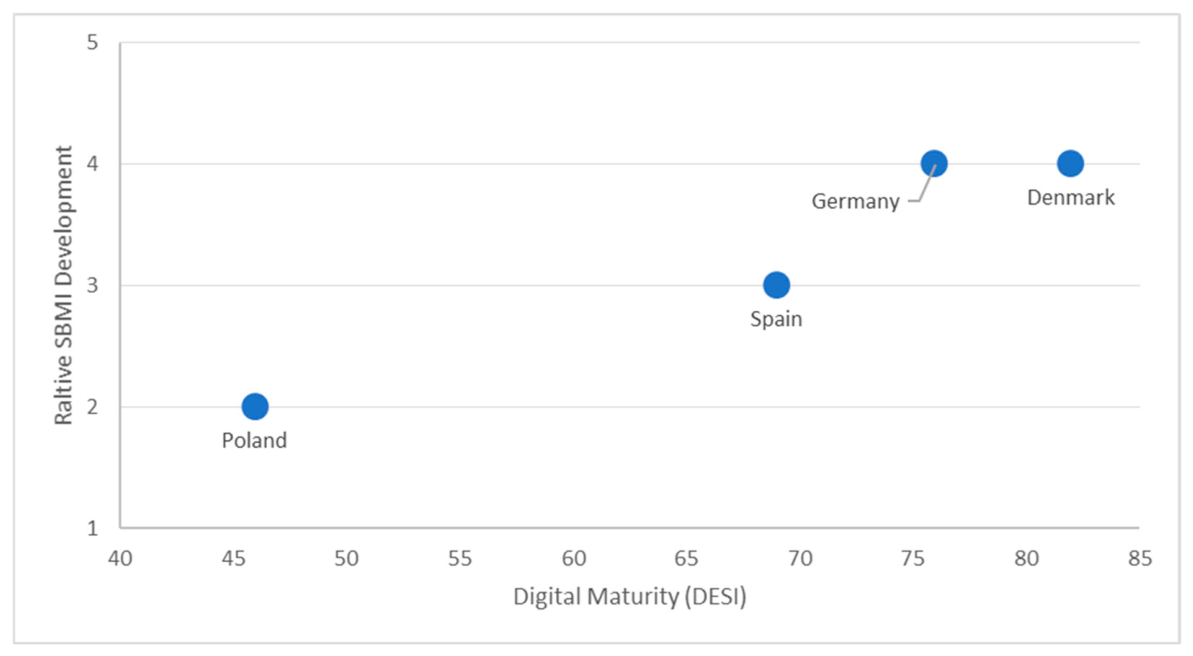
The findings further suggest that digitalization reshapes the logic of value creation within renewable energy systems. In digitally advanced contexts, energy increasingly functions as a data-driven and service-oriented ecosystem supported by platform coordination, decentralized participation, and real-time information exchange. Consequently, the importance of digital capabilities extends beyond operational efficiency and increasingly influences renewable energy integration, organizational adaptability, and ecosystem coordination. Figure 3 illustrates the comparative positioning of the analyzed countries according to digital maturity and the development of Sustainable Business Model Innovation within renewable energy systems.
Figure 3 illustrates the comparative positioning of the analyzed countries according to digital maturity and the relative development of Sustainable Business Model Innovation within renewable energy systems. The proposed positioning suggests that more digitally advanced systems demonstrate stronger integration of participatory, platform-based, and service-oriented business model configurations. The positioning of countries across the SBMI development stages was based on qualitative interpretation of documentary evidence, structured expert assessment findings, and comparative analysis of participatory and platform-based renewable energy initiatives. The classification reflects the relative maturity of sustainability-oriented business model configurations and should therefore be interpreted as heuristic and illustrative rather than as a formal measurement scale.
The comparative patterns indicate that Denmark and Germany represent the most advanced digitally integrated transition systems among the analyzed countries. These systems combine higher levels of digital maturity with more developed and diversified SBMI configurations. Spain occupies an intermediate position, characterized by relatively strong renewable energy expansion but more limited integration of digitally enabled business model transformation. Poland remains in a transitional position, combining moderate digitalization with emerging forms of business model experimentation and decentralized governance initiatives.
From the perspective of dynamic capabilities, these differences reflect varying capacities to sense transition opportunities, implement adaptive responses, and reconfigure organizational and inter-organizational arrangements under changing environmental conditions [16] (p. 41). Digitally advanced systems appear better positioned to integrate organizational learning processes with sustainability-oriented business model transformation, while less mature systems continue to rely more heavily on fragmented and localized experimentation [30].
From a cross-country perspective, the contribution of digital transformation to Sustainable Business Model Innovation depends on the extent to which digital technologies are embedded within broader organizational and institutional arrangements. Rather than acting as an independent driver of change, digital capabilities appear to create favorable conditions for more decentralized, participatory, and adaptive forms of renewable energy governance and value creation. These observations should therefore be interpreted as analytically grounded comparative insights rather than evidence of direct causal relationships.
Taken together, these findings provide empirical support for Proposition P2 by showing that Sustainable Business Model Innovation develops most effectively when digital transformation enables decentralized, participatory, and platform-based forms of value creation within renewable energy systems.

4.3. Organizational Learning and Adaptive Coordination in Renewable Energy Transitions

The evidence obtained from the structured expert assessment (n = 22) suggests that organizational learning constitutes an important mechanism linking digital transformation, adaptive coordination processes, and Sustainable Business Model Innovation (SBMI) within renewable energy systems. The findings suggest that learning supports the coordination of digital transformation and sustainability-oriented adaptation across organizational and institutional contexts.
To provide a transparent overview of the expert evidence, Table 9 presents the mean scores and response distributions for the twelve statements before the analysis turns to the organizational learning mechanisms identified across the four countries.
The descriptive results provide an overall view of the expert assessment before the analysis turns to organizational learning as a key mechanism within the proposed framework. Regulatory conditions received the lowest assessments, whereas the strategic dimension received the highest overall assessments. The technological and social dimensions showed more moderate and internally differentiated response patterns. These results are treated as descriptive expert evidence rather than as inferential statistical evidence.
To place these aggregate findings in their institutional context, the expert assessment results were considered alongside the documentary and comparative evidence for each of the four country cases. Across the analyzed countries, different configurations of learning mechanisms can be observed, reflecting broader renewable energy transition trajectories. Although these configurations vary in terms of institutional structure and intensity, they fulfil a common adaptive function: enabling organizations and stakeholders to adapt to technological, regulatory, and market-related changes through the continuous circulation and interpretation of knowledge. The country-specific learning configurations presented below represent integrated analytical interpretations derived through convergent triangulation of quantitative evidence, documentary analysis, and structured expert assessment rather than direct summaries of individual data sources.
In digitally advanced contexts such as Denmark, learning is strongly embedded in experimental environments, including pilot microgrid projects, living laboratories, and collaborative testing platforms. These mechanisms appear to facilitate iterative experimentation and rapid feedback between technological implementation and organizational adaptation. As a result, digital transformation becomes closely integrated with organizational learning and long-term coordination processes.
Germany demonstrates a more network-oriented learning configuration. The evidence from the structured expert assessment and documentary analysis suggests that cooperation between public institutions, energy firms, research organizations, and technology providers may facilitate systematic knowledge exchange across multiple levels of the energy ecosystem. In this context, learning appears to occur primarily through inter-organizational collaboration and coordinated information sharing, strengthening the capacity for adaptive governance and long-term transition alignment.
Spain represents a more regulatory-oriented learning trajectory. Here, organizational adaptation is shaped predominantly through institutional and policy-learning processes, where regulatory frameworks evolve in response to changing technological and market conditions. Although digitalization supports renewable energy expansion, learning mechanisms remain more strongly embedded within formal governance structures than within decentralized experimentation processes.
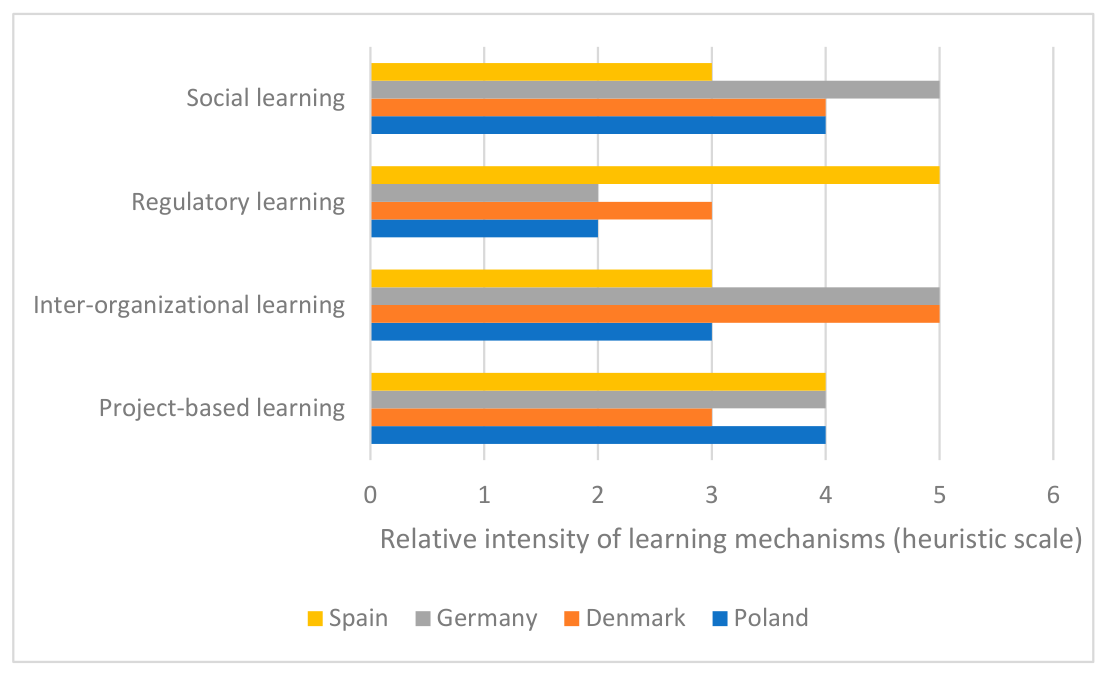
Poland illustrates a more emergent and project-based learning pattern characteristic of hybrid renewable energy transition environments undergoing institutional transformation. The findings suggest that learning processes are primarily driven by localized experimentation within energy clusters, pilot renewable energy initiatives, and public–private cooperation projects. Compared with more digitally mature systems, these mechanisms remain less institutionalized and more fragmented; however, they also demonstrate considerable adaptive capacity and responsiveness to local transition challenges. Figure 4 synthesizes the dominant organizational learning mechanisms identified across the analyzed countries.
Figure 4 illustrates differences in the dominant mechanisms of organizational learning across the analyzed countries. The comparative assessment suggests that digitally advanced systems appear to be characterized by more institutionalized and network-oriented learning structures, while less mature systems rely more strongly on localized and project-based experimentation.
The integrated evidence further suggests that organizational learning functions as a bridging mechanism between digital transformation and Sustainable Business Model Innovation. While digital technologies increase the availability of data and facilitate coordination processes, the capacity to interpret, transfer, and operationalize knowledge determines whether technological innovation translates into broader organizational and systemic transformation [7] (pp. 5180–5183). In digitally coordinated environments, organizational adaptation increasingly evolves toward participatory and collaborative forms of coordination, enabling stakeholders to respond more effectively to changing technological and regulatory conditions [26]. Examples from Poland, including locally coordinated renewable energy initiatives and public support programs for prosumer energy systems, further illustrate how bottom-up experimentation may gradually strengthen participatory forms of energy governance and decentralized transition coordination [31].
From a comparative perspective, the findings indicate that digitally advanced systems demonstrate stronger capacities to institutionalize learning processes and coordinate knowledge exchange across organizational boundaries. In contrast, less mature transition environments continue to rely more heavily on localized experimentation and fragmented adaptation mechanisms. These differences appear to contribute to variation in the coherence, resilience, and long-term adaptability of renewable energy transition pathways.
Taken together, the comparative evidence suggests that the effectiveness of digital transformation within renewable energy systems depends not only on technological deployment but also on the capacity of organizations and institutions to embed organizational learning within broader governance and coordination processes. Organizational learning therefore emerges as an important integrative mechanism connecting digital transformation, Sustainable Business Model Innovation, and adaptive renewable energy transition management. These observations should be interpreted as comparative analytical insights illustrating how different institutional contexts shape learning processes and adaptive coordination rather than as evidence of universal causal relationships.
Overall, the integrated comparative evidence supports Proposition P3 by illustrating that the alignment of digital transformation, organizational learning, and Sustainable Business Model Innovation contributes to more adaptive and resilient renewable energy transition management.

4.4. Poland: Renewable Energy Transition Under Conditions of Institutional and Digital Imbalance

Poland represents a hybrid renewable energy transition pathway shaped by institutional instability, uneven digitalization, and accelerating technological modernization. The comparative evidence suggests that the Polish energy transition evolves under conditions of structural imbalance, where technological modernization progresses more rapidly than institutional coordination and governance adaptation.
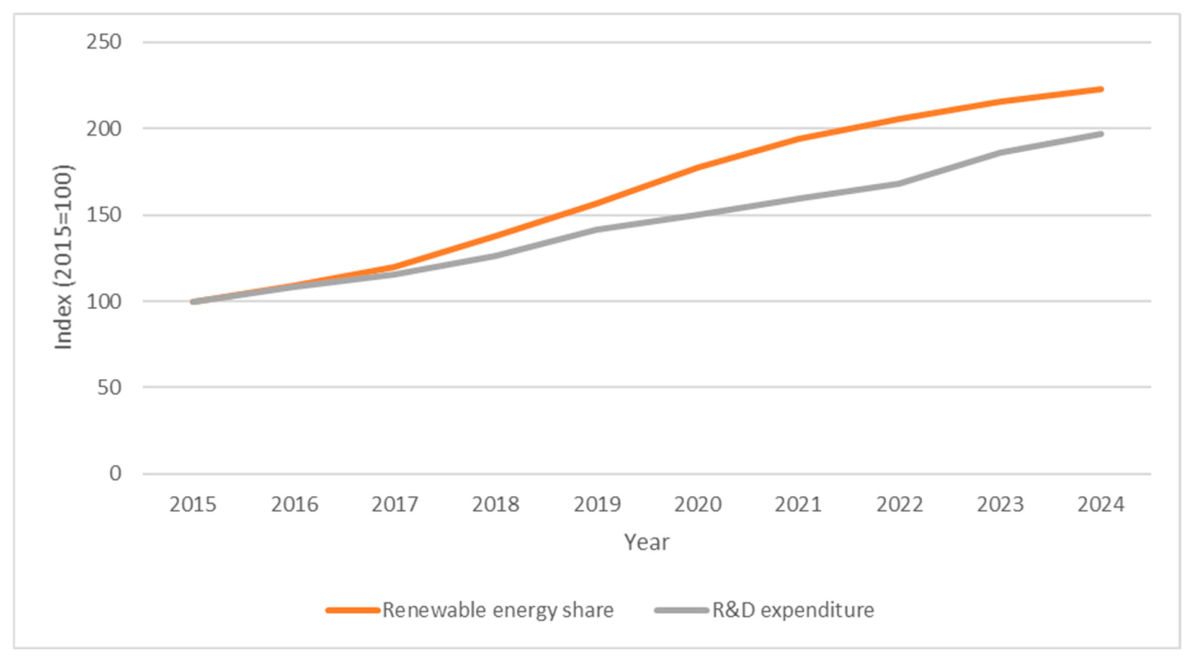
On the one hand, the comparative assessment indicates a gradual strengthening of technological and innovation-related capabilities. Investments in renewable energy technologies, growing R&D expenditure, and the gradual implementation of digital solutions such as smart grid systems, predictive analytics, and automated monitoring platforms indicate a transition toward more data-driven forms of energy management. On the other hand, institutional instability, regulatory volatility, and fragmented governance structures continue to constrain the systemic integration of these innovations within the broader energy ecosystem. Figure 5 illustrates the comparative development of renewable energy deployment and innovation-related investment in Poland between 2015 and 2024. For Figure 5, each indicator was indexed to its 2015 value, which was set equal to 100, using the formula It = (Xt/X2015) × 100, where Xt represents the value of the indicator in year t.
The comparative trends indicate that both indicators increased over the analyzed period, reflecting the growing importance of innovation within the Polish renewable energy sector. Although the simultaneous upward trajectories suggest that technological modernization and renewable energy expansion evolved alongside one another, the available evidence does not imply a direct causal relationship. The pace and coherence of this transformation nevertheless remained influenced by institutional fragmentation and changing regulatory conditions. Both indicators were indexed (2015 = 100) to facilitate comparison of relative trends despite their different original units of measurement.
As a result, renewable energy transition governance in Poland assumes a hybrid and adaptive form, combining bottom-up experimentation with top-down regulatory interventions. Organizations operating within this environment continuously adjust operational and organizational practices in response to evolving technological opportunities and institutional constraints. In line with the dynamic capabilities perspective, adaptive coordination and organizational flexibility appear increasingly important under conditions of uncertainty and transition instability [16], (p. 47).
Despite visible progress, several systemic barriers continue to limit the scalability of renewable energy transformation in Poland. These barriers include administrative fragmentation, instability of support mechanisms, uneven access to investment capital, and limited long-term coordination between technological modernization and governance reform. As a consequence, many renewable energy initiatives remain localized and project-based rather than fully integrated into broader transition structures.
The Polish case also illustrates the broader comparative findings of this study by showing how digital transformation, organizational learning, and Sustainable Business Model Innovation interact under less mature transition conditions. The results suggest that even in the absence of highly institutionalized digital ecosystems, sustainability-oriented transformation may emerge through iterative experimentation, localized learning processes, and adaptive forms of coordination.
From a comparative perspective, Poland illustrates that renewable energy transitions may develop despite institutional fragmentation and uneven levels of digital maturity. The comparative evidence nevertheless suggests that the long-term resilience and scalability of these transition processes depend on strengthening governance coordination, institutionalizing organizational learning, and embedding digital transformation within broader sustainability-oriented business model development. Viewed in this way, the Polish experience provides analytically relevant insights for other emerging renewable energy systems characterized by similar institutional and organizational conditions.

4.5. Transition Management Recommendations and Priorities for Poland

The synthesized comparative evidence suggests that the effectiveness of renewable energy transitions depends on the ability to align digital transformation, organizational learning, and sustainability-oriented business model adaptation within broader institutional frameworks. Based on the empirical findings, three interrelated transition management dimensions can be identified as particularly important for the long-term coordination and adaptability of renewable energy transition systems: digital orchestration, Sustainable Business Model Innovation (SBMI), and the institutionalization of organizational learning.
The first transition management dimension, digital orchestration, refers to the integration of digital technologies within renewable energy transition coordination and decision-making processes. The comparative assessment suggests that countries characterized by higher levels of digital maturity generally demonstrate more adaptive coordination mechanisms and more advanced renewable energy transition pathways. In digitally advanced environments, technologies such as AI, IoT systems, predictive analytics, and integrated data platforms increasingly support real-time monitoring, adaptive planning, and decentralized coordination processes. The findings therefore suggest that digitalization increasingly functions as a core transition capability rather than solely an operational support mechanism.
The comparative evidence further suggests that digitally integrated infrastructures facilitate the emergence of more coordinated and data-driven energy ecosystems [3]. Experiences observed in Germany and Denmark illustrate how digital platforms may support adaptive forms of ecosystem coordination, including energy-as-a-service models, platform-based energy management, and decentralized participation mechanisms. In the context of Poland and institutionally comparable European transition environments, the development of digitally coordinated innovation ecosystems involving public institutions, private firms, and technology providers appears particularly important for strengthening long-term transition capacity.
The second transition management dimension concerns Sustainable Business Model Innovation. The comparative evidence suggests that renewable energy transitions increasingly involve a shift from transactional and centralized forms of value creation toward more participatory, service-oriented, and decentralized configurations ([4] (p. 16) and [5]). In digitally enabled transition systems, users become active participants within broader energy ecosystems through prosumer arrangements, energy communities, and platform-based coordination mechanisms.
Importantly, the comparative analysis suggests that digitalization alone does not automatically generate business model innovation. The effectiveness of SBMI depends on the integration of technological capabilities with governance structures, organizational learning processes, and social participation mechanisms [6] (p. 200). In the context of Poland and institutionally comparable European transition environments, hybrid transition configurations combining market-oriented solutions with localized and municipal initiatives appear particularly relevant for supporting adaptive and socially embedded transition pathways.
The third transition management dimension concerns the institutionalization of organizational learning. The integrated evidence suggests that continuous knowledge exchange and coordinated learning processes play an important role in aligning digital transformation with renewable energy transition adaptation. Organizational learning therefore emerges not as an isolated activity, but as a systemic capability embedded within broader transition structures [7] (p. 5190).
From a practical perspective, the findings suggest that institutionalized learning infrastructures may strengthen long-term transition coordination by facilitating knowledge transfer, experimentation, and strategic evaluation across organizational boundaries. Collaborative arrangements linking academia, industry, and public administration may therefore support the diffusion of innovation and strengthen adaptive governance capacities within renewable energy ecosystems.
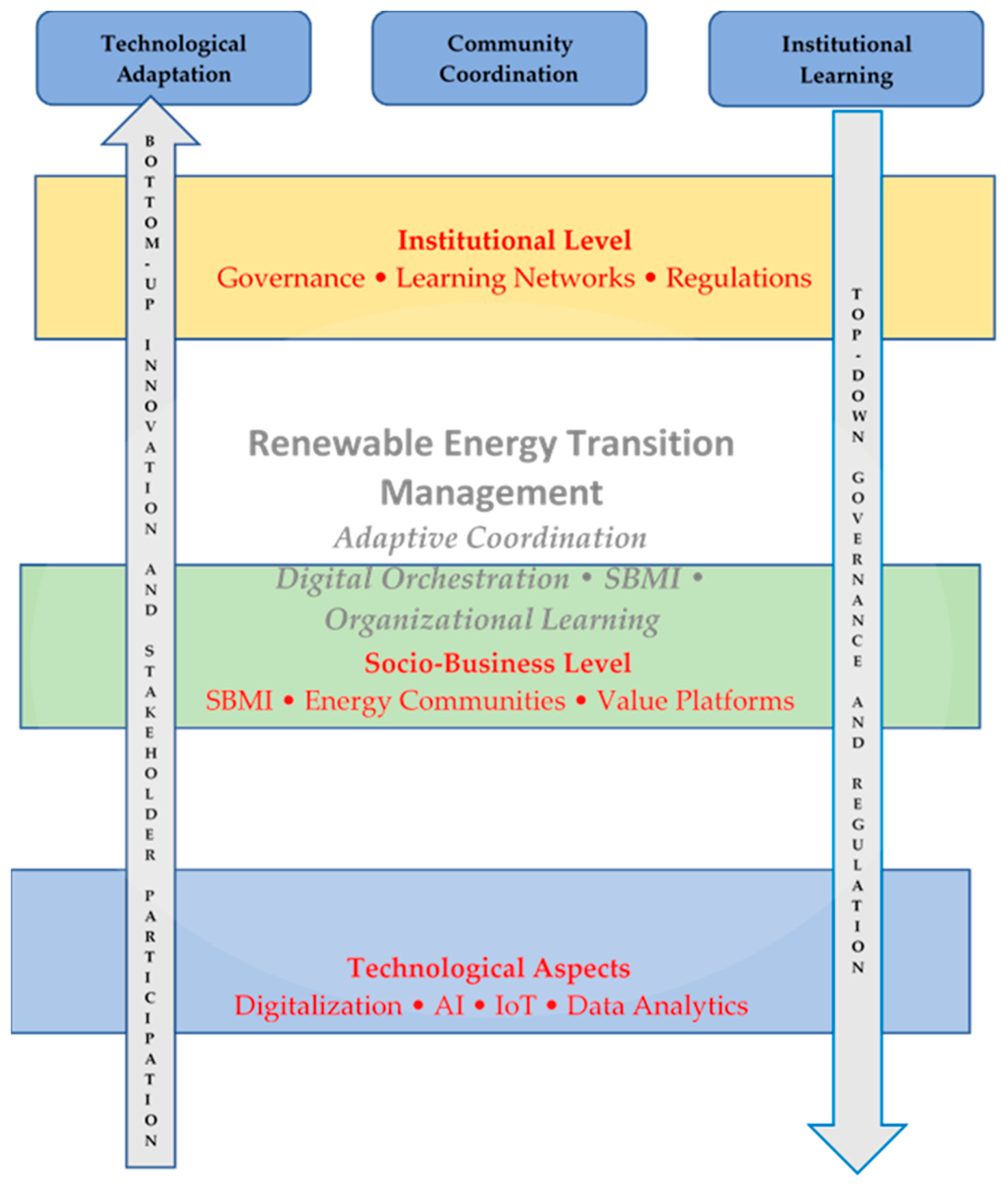
Building on these findings, the study proposes an integrated framework for strategic management of renewable energy transitions in digitally transforming ecosystems (Figure 6). The framework conceptualizes renewable energy transition as a multidimensional system composed of three interrelated layers: technological, socio-business, and institutional.
Figure 6 presents an integrated framework linking digital transformation, Sustainable Business Model Innovation, organizational learning, and institutional coordination within renewable energy transition systems. The framework illustrates how interactions between technological, socio-business, and institutional dimensions may contribute to long-term transition effectiveness and adaptive capacity.
The upper layer of the framework highlights three cross-cutting transition capabilities: technological adaptation, community coordination, and institutional learning. These capabilities are intended to facilitate interactions between technological, socio-business, and institutional dimensions and support the long-term resilience and adaptability of renewable energy transition systems.
Within the proposed framework, the technological layer provides the infrastructural foundation for digital transformation through AI systems, IoT technologies, data analytics, and digital coordination tools. These technological capabilities are translated within the socio-business layer into new forms of value creation, including Sustainable Business Model Innovation, prosumer systems, and platform-oriented coordination mechanisms. The institutional layer stabilizes and coordinates these processes through regulatory frameworks, learning networks, and governance structures supporting long-term adaptation. The proposed interactions between these layers represent an analytical interpretation derived from the convergent integration of comparative evidence rather than a formally validated causal model.
Importantly, the relationships between these layers remain dynamic and bidirectional. Institutional arrangements influence the conditions under which digital innovation develops, while technological transformation simultaneously reshapes organizational practices, governance mechanisms, and forms of societal participation. At the center of the framework lies renewable energy transition management, understood as a continuous and adaptive process integrating digital transformation, organizational learning, Sustainable Business Model Innovation, and institutional coordination. This process may facilitate the alignment of technological capabilities, governance arrangements, and stakeholder participation mechanisms required for effective renewable energy system transformation ([7] (p. 5177) and [16] (p. 44)).
Overall, the proposed framework conceptualizes renewable energy transition as a multidimensional and adaptive process emerging from interactions between technological capabilities, organizational learning, Sustainable Business Model Innovation, and institutional coordination. Rather than representing a prescriptive or predictive model, the framework offers an analytically grounded interpretation of how these dimensions may interact across different institutional contexts. Consequently, it provides a conceptual basis for future comparative research and for the development of context-sensitive renewable energy transition management strategies.
For Poland and other hybrid transition environments, these findings translate into three practical priorities. They are not intended as a universal transition roadmap, but as context-sensitive directions derived from the comparative evidence and the specific institutional conditions identified in the Polish case.
The first transition priority concerns the strengthening of digital capabilities within organizational and institutional structures. The comparative assessment suggests that countries characterized by higher levels of digital maturity generally exhibit more adaptive and analytically coordinated transition processes. In this context, digital transformation increasingly extends beyond technological modernization and involves the development of data governance capabilities, cross-sector coordination mechanisms, and evidence-based transition decision-making processes. The findings further suggest that digitally coordinated infrastructures support more resilient and adaptive forms of renewable energy governance [32].
The second transition priority relates to the development of participatory and hybrid business model configurations. The comparative evidence suggests that decentralized and participatory forms of value creation, including prosumer arrangements, energy communities, and locally coordinated transition initiatives, contribute to stronger social engagement and greater transition flexibility [33]. In institutionally diverse renewable energy transition environments, hybrid models combining market-oriented mechanisms with local governance structures appear particularly important for supporting socially embedded and institutionally adaptive transition pathways.
The third transition priority concerns the institutionalization of organizational learning processes. The comparative evidence suggests that more mature transition environments generally exhibit stronger capacities for coordinating knowledge exchange. For institutionally developing renewable energy transition environments, strengthening institutional learning capacities may support greater coherence and long-term transition stability [7] (p. 5189). In this context, learning infrastructures such as open data systems, evaluation mechanisms, and inter-organizational collaboration platforms may contribute to more adaptive forms of energy governance and transition coordination.
The findings additionally suggest that coordination mechanisms may support renewable energy transition adaptation across institutionally comparable transition environments. Knowledge-sharing platforms, comparative policy-learning initiatives, and inter-organizational cooperation networks may strengthen the diffusion of effective transition practices while simultaneously supporting regionally differentiated approaches to sustainability-oriented transformation [34].
Taken together, these priorities support an interpretation of renewable energy transition in institutionally diverse transition environments as a learning-based and multidimensional transformation process in which digitalization, participation, organizational adaptation, and institutional coordination function as mutually reinforcing dimensions. Rather than representing a fixed transition roadmap, the proposed perspective emphasizes the continuous reconfiguration of transition capabilities under conditions of technological uncertainty and institutional change.
Collectively, the evidence points to the view that renewable energy transition is a multidimensional and learning-oriented process shaped by interactions between digitalization, organizational adaptation, Sustainable Business Model Innovation, and institutional coordination. Rather than proposing a universal transition model, the study highlights how these dimensions may interact differently across institutional contexts, particularly within hybrid renewable energy transition environments undergoing institutional transformation. Consequently, the proposed transition priorities should be interpreted as analytically grounded recommendations intended to inform future research and context-sensitive transition management rather than as universally applicable policy prescriptions.

5. Conclusions

This study examined how digital transformation, organizational learning, and Sustainable Business Model Innovation (SBMI) jointly shape renewable energy transition management by combining Poland as the focal case with comparative evidence from Germany, Denmark, and Spain. The study findings suggest that renewable energy transition outcomes depend not only on technological investments but also on the interaction between digital capabilities, organizational learning, and sustainability-oriented business model innovation. The analysis integrated perspectives from digital transformation, dynamic capabilities, organizational learning, and sustainability-oriented business model research to explore how renewable energy systems adapt under conditions of technological and institutional change [5,6,7,16].
The findings suggest that digital transformation, organizational learning, and sustainability-oriented business model innovation function as strongly interconnected dimensions of renewable energy transition. Countries characterized by higher levels of digital maturity appear to exhibit stronger capacities for adaptive coordination, knowledge exchange, and the development of participatory and platform-based business model configurations. In this context, digitalization extends beyond technological modernization and becomes embedded within broader governance, coordination, and organizational adaptation processes.
From a theoretical perspective, the principal contribution of this study lies in the development of an integrated analytical perspective that combines digital transformation, organizational learning, dynamic capabilities, and Sustainable Business Model Innovation within the context of renewable energy transition management. Unlike many previous studies that examine these dimensions in relative isolation, the proposed framework integrates them within a single analytical perspective using convergent triangulation of comparative quantitative and qualitative evidence. Rather than treating these concepts as separate research streams, the study demonstrates their complementary role in explaining adaptive transition processes across different institutional environments. The findings further suggest that renewable energy transitions should be understood as learning-oriented and capability-driven processes shaped by interactions between technological, organizational, and institutional dimensions [5].
The study also contributes to understanding renewable energy transition challenges faced by Poland and institutionally comparable European countries operating under conditions of institutional and technological transformation. The results suggest that Poland operates under structurally hybrid transition conditions characterized by uneven digitalization, institutional fragmentation, and experimentation-based adaptation processes. Rather than representing an incomplete version of Western European transition models, this environment reveals a distinct and context-sensitive pathway shaped by localized learning, adaptive coordination, and evolving governance arrangements.
Overall, the empirical findings provide indicative support for the analytical propositions developed in the conceptual framework and remain consistent with the exploratory character of the proposed relationships between digital transformation, organizational learning, and Sustainable Business Model Innovation.
From a practical perspective, the findings suggest that effective renewable energy transition increasingly depends on the ability to integrate digital infrastructures, organizational learning mechanisms, and sustainability-oriented business model innovation within coherent institutional frameworks. The results additionally highlight the importance of strengthening participatory governance structures, inter-organizational collaboration, digital capabilities, and long-term learning capacities in order to support adaptive and resilient transition systems [31].
Several limitations of the study should be acknowledged. First, the comparative analysis included a relatively limited number of countries, which constrains the generalizability of findings. Second, the quantitative component of the study was exploratory in nature and therefore does not allow for causal inference or statistical generalization. Third, differences in national reporting systems and data availability restricted the comparability of some longitudinal indicators. Future research should therefore explore renewable energy transition management and organizational learning processes using longitudinal, network-oriented, and multi-level analytical approaches, while extending the analysis to additional emerging and developing transition environments. Future studies may also seek to validate the proposed conceptual framework using larger cross-country datasets and complementary quantitative modelling techniques.
Taken together, the findings support the view that renewable energy transition should be understood as a multidimensional and adaptive process emerging from interactions between digital transformation, organizational learning, Sustainable Business Model Innovation, and institutional coordination. Rather than proposing a universal transition model, the study offers an analytically grounded framework that may support future comparative research and context-sensitive renewable energy transition management. From a policy perspective, the findings suggest that strengthening digital infrastructures, organizational learning capabilities, inter-organizational collaboration, and participatory governance mechanisms may enhance the long-term adaptability and resilience of renewable energy systems, particularly within hybrid renewable energy transition environments undergoing institutional transformation.

Supplementary Materials

The following supporting information can be downloaded at: https://www.mdpi.com/article/10.3390/en19184417/s1.

Funding

Funded by the Ministry of Science under the “Regional Initiative of Excellence Program”.

Institutional Review Board Statement

The study involved an anonymous structured expert assessment conducted among 22 adult professional participants. The questionnaire collected only limited professional background information, including the country in which the participant was professionally active, and did not collect nationality, health information, psychological information, personal experiences, or other sensitive personal data. Participants were asked to express their professional opinions on 12 closed-ended statements concerning renewable energy transition processes, using a five-point Likert scale. The study involved no medical, psychological, or behavioral intervention, and participation was entirely voluntary. Informed consent was obtained from all participants before participation. The study also incorporated publicly available secondary data obtained from official statistical and institutional sources. According to the Institutional regulations (Kodeks Etyki Pracownika Naukowego), introduced by Rector’s Order No. 62 of 14 December 2021, did not require standard, non-invasive diagnostic surveys to undergo ethical review.

Informed Consent Statement

Informed consent was obtained from all subjects involved in the study.

Data Availability Statement

The data supporting the findings of this study were derived from publicly available sources, including Eurostat, the International Energy Agency (IEA), the World Bank, and Statistics Poland (GUS). The datasets underlying the figures and comparative analyses are provided in Supplementary Dataset S1, while detailed variable definitions, units of measurement, and data sources are presented in Supplementary Table S1. The structured expert assessment protocol is available in Supplementary Materials File S1. Because the structured expert assessment was conducted anonymously, only aggregated results are available upon reasonable request in a form that fully preserves participant confidentiality.

Conflicts of Interest

The author declares no conflicts of interest.

Abbreviations

The following abbreviations are used in this manuscript:
IRENAInternational Renewable Energy Agency
IEAInternational Energy Agency
RESRenewable Energy Sources
SBMISustainable Business Model Innovation
OECDOrganisation for Economic Cooperation and Development
KPMGKlynveld, Peat, Marwick & Goerdeler
GUS (pol.)Główny Urząd Statystyczny (pol.) Statistical Office
ECEuropean Commission
EUEuropean Union
WBWorld Bank
WCEDWorld Commission on Environment and Development

References

  1. El Zein, M.; Gebresenbet, G. Digitalization in the Renewable Energy Sector. Energies 2024, 17, 1985. [Google Scholar] [CrossRef] [Scilit]
  2. George, G.; Merrill, R.K.; Schillebeeckx, S.J.D. Digital Sustainability and Entrepreneurship: How Digital Innovations Are Helping Tackle Climate Change and Sustainable Development. Entrep. Theory Pract. 2021, 45, 999–1027. [Google Scholar] [CrossRef] [Scilit]
  3. Zakeri, B. Digitalization for Resilient and Sustainable Energy Transitions. Energies 2024, 17, 5434. [Google Scholar] [CrossRef] [Scilit]
  4. Boons, F.; Lüdeke-Freund, F. Business models for sustainable innovation: State-of-the-art and steps towards a research agenda. J. Clean. Prod. 2013, 45, 9–19. [Google Scholar] [CrossRef] [Scilit]
  5. Bocken, N.M.P.; Short, S.W. Unsustainable business models-Recognising and resisting the norms. J. Clean. Prod. 2021, 312, 127828. [Google Scholar] [CrossRef] [Scilit]
  6. Pieroni, M.P.P.; McAloone, T.C.; Pigosso, D.C.A. Business model innovation for circular economy and sustainability: A review of approaches. J. Clean. Prod. 2019, 215, 198–216. [Google Scholar] [CrossRef] [Scilit]
  7. Ademi, B.; Sætre, A.S.; Klungseth, N.J. Advancing the understanding of sustainable business models through organizational learning. Bus. Strategy Environ. 2024, 33, 5174–5194. [Google Scholar] [CrossRef] [Scilit]
  8. Organisation for Economic Cooperation and Development. Regions in Industrial Transition: Policies for People and Places; OECD Publishing: Paris, France, 2022. [Google Scholar]
  9. Maltby, T.; Mišík, M. Energy Transitions in Central and Eastern Europe: The Political Economy of Climate and Energy Policy; Cambridge University Press & Assessment: Cambridge, UK, 2024. [Google Scholar]
  10. Campana, P.; Censi, R.; Ruggieri, R.; Amendola, C. Smart Grids and Sustainability: The Impact of Digital Technologies on the Energy Transition. Energies 2025, 18, 2149. [Google Scholar] [CrossRef] [Scilit]
  11. Fathollahi, A. Machine Learning and Artificial Intelligence Techniques in Smart Grids: A Review. Energies 2025, 18, 3431. [Google Scholar] [CrossRef] [Scilit]
  12. World Commission on Environment and Development. Our Common Future (Brundtland Report); Oxford University Press: Oxford, UK, 1987. [Google Scholar]
  13. Baden-Fuller, C.; Haefliger, S. Business models and technological innovation. Long Range Plan. 2013, 46, 419–426. [Google Scholar] [CrossRef] [Scilit]
  14. Whittington, R. Opening Strategy: Professional Strategists and Practice Change, 1960 to Today; Oxford University Press: Oxford, UK, 2019. [Google Scholar]
  15. Palmié, M.; Aebersold, A.; Oghazi, P.; Pashkevich, N.; Gassmann, O. Digital-sustainable business models: Definition, systematic literature review, integrative framework and research agenda from a strategic management perspective. Int. J. Manag. Rev. 2024, 27, 346–374. [Google Scholar] [CrossRef] [Scilit]
  16. Teece, D.J. Business models and dynamic capabilities. Long Range Plan. 2018, 51, 40–49. [Google Scholar] [CrossRef] [Scilit]
  17. Creswell, J.W.; Plano Clark, V.L. Designing and Conducting Mixed Methods Research, 3rd ed.; SAGE Publications: Thousand Oaks, CA, USA, 2018. [Google Scholar]
  18. Eurostat. Data on the Share of RES in EU Countries, 2024. Available online: https://ec.europa.eu/eurostat/databrowser/view/NRG_IND_REN/default/table?lang=en&category=nrg.nrg_quant.nrg_quanta.nrg_ind_share (accessed on 18 April 2026).
  19. International Energy Agency. World Energy Outlook, 2023. Available online: https://www.iea.org/reports/world-energy-outlook-2023 (accessed on 20 April 2026).
  20. Statistics Poland (GUS). Energies 2024-2025, 2025. Available online: https://stat.gov.pl/obszary-tematyczne/srodowisko-energia/energia/energia-2025,1,13.html (accessed on 18 May 2026).
  21. World Bank. Research and Development Expenditure (% of GDP), 2024. Available online: https://databank.worldbank.org/metadataglossary/world-development-indicators/series/GB.XPD.RSDV.GD.ZS (accessed on 29 April 2026).
  22. Digital Economy and Society Index (DESI), 2024. Available online: https://digital-strategy.ec.europa.eu/en/policies/desi?utm (accessed on 29 April 2026).
  23. Yin, R.K. Case Study Research and Applications: Design and Methods, 6th ed.; SAGE Publications: Thousand Oaks, CA, USA, 2018. [Google Scholar]
  24. European Commission. EU ETS Factsheet: The EU Emissions Trading System in 2024, 2025. Available online: https://climate.ec.europa.eu/areas-action/carbon-markets/eu-emissions-trading-system-eu-ets_en (accessed on 15 February 2026).
  25. European Commission. REPowerEU Plan 2023, 2024. Available online: https://eur-lex.europa.eu/legal-content/EN/TXT/HTML/?uri=CELEX:52022DC0230 (accessed on 29 April 2026).
  26. Ahmed, S.; Ali, A.; D’Angola, A. A Review of Renewable Energy Communities: Concepts, Scope, Progress, Challenges, and Recommendations. Sustainability 2024, 16, 1749. [Google Scholar] [CrossRef] [Scilit]
  27. International Renewable Energy Agency (IRENA). Renewable Power Generation Costs in 2020, 2021. Available online: https://www.irena.org/-/media/Files/IRENA/Agency/Publication/2021/Jun/IRENA_Power_Generation_Costs_2020.pdf (accessed on 12 May 2026).
  28. KPMG. Turning the Tide in Scaling Renewables, 2024. Available online: https://kpmg.com/xx/en/our-insights/esg/energy-transition/turning-the-tide-in-scaling-renewables.html (accessed on 27 May 2026).
  29. European Commission. European Green Deal: Progress and Implementation Report 2023, 2024. Available online: https://climate.ec.europa.eu/system/files/2023-11/com_2023_653_glossy_en_0.pdf (accessed on 2 May 2026).
  30. Trevisan, L.V.; Filho, W.L.; Pedrozo, E.A. Transformative organisational learning for sustainability in higher education: A literature review and an international multi-case study. J. Clean. Prod. 2024, 447, 141634. [Google Scholar] [CrossRef] [Scilit]
  31. Sovacool, B.K.; Martiskainen, M. Hot transformations: Governing rapid and just transitions to renewable electricity. Energy Policy 2020, 139, 111330. [Google Scholar] [CrossRef] [Scilit]
  32. Dzwigol, H.; Kwilinski, A.; Lyulyov, O.; Pimonenko, T. Digitalization and Energy in Attaining Sustainable Development: Impact on Energy Consumption, Energy Structure, and Energy Intensity. Energies 2024, 17, 1213. [Google Scholar] [CrossRef] [Scilit]
  33. Bellini, F.; Campana, P.; Censi, R.; Di Renzo, M.; Tarola, A.M. Energy Communities in the Transition to Renewable Sources: Innovative Models of Energy Self-Sufficiency through Organic Waste. Energies 2024, 17, 3789. [Google Scholar] [CrossRef] [Scilit]
  34. Kiasari, M.; Ghaffari, M.; Aly, H.H. A Comprehensive Review of the Current Status of Smart Grid Technologies for Renewable Energies Integration and Future Trends: The Role of Machine Learning and Energy Storage Systems. Energies 2024, 17, 4128. [Google Scholar] [CrossRef] [Scilit]
Figure 1. Integrated analytical framework for renewable energy transition management. Source: author’s own elaboration based on [4,7,16].
Energies 19 04417 g001
Figure 2. (A). Renewable energy integration and CO2 emissions intensity in selected European countries (2024). Source: author’s own elaboration based on [18,19,20,21,24,25]. (B). Digital maturity and R&D expenditure across the analyzed countries (2024). Source: author’s own elaboration based on [18,19,20,21,22,24,25]. Note: The indicators are presented in separate panels because they are measured in different units and have substantially different numerical ranges. No normalization or rescaling of the underlying data was applied.
Energies 19 04417 g002
Figure 3. Heuristic comparative positioning of the analyzed countries according to digital maturity (DESI) and Sustainable Business Model Innovation (SBMI) development stage. Note: The SBMI development stages were determined through qualitative comparative assessment based on documentary evidence, structured expert assessment findings, and the observed level of digital integration and prevalence of participatory, platform-based, and service-oriented business model configurations across the analyzed countries. The classification should be interpreted as heuristic and illustrative rather than as a formal measurement scale. For graphical representation, the four SBMI development stages were coded ordinally as 1 = Emerging, 2 = Experimentation-based, 3 = Moderately developed, and 4 = Advanced digitally integrated models. Source: author’s own elaboration based on documentary evidence, structured expert assessment findings, and [22,27,28,29].
Energies 19 04417 g003
Figure 4. Comparative patterns of organizational learning in renewable energy transition systems. Note: The comparative assessment reflects the relative intensity and institutional embeddedness of identified learning mechanisms based on qualitative interpretation of structured expert assessment and documentary evidence. For graphical representation, the mechanisms were assessed using a six-point ordinal heuristic scale from 0 to 5, where 0 indicates no identifiable evidence, 1 very limited evidence, 2 limited or emerging evidence, 3 moderate evidence, 4 pronounced evidence, and 5 highly pronounced and institutionally embedded evidence. The assessment is intended to illustrate comparative patterns rather than to provide a formal quantitative ranking of countries. Source: author’s own elaboration based on structured expert assessment and industry reports [27,28].
Energies 19 04417 g004
Figure 5. Comparative development of renewable energy share and R&D expenditure in Poland (2015–2024; 2015 = 100). Source: author’s own elaboration based on [8,19,20,25].
Energies 19 04417 g005
Figure 6. Conceptual synthesis framework integrating the comparative findings on renewable energy transition management in digitally transforming energy ecosystems. Source: author’s own elaboration based on research findings and the literature [4,5,7,16].
Energies 19 04417 g006
Table 1. Theoretical perspectives on digital transformation and renewable energy transitions.
Research StreamDominant FocusKey ContributionsMain LimitationsImplications for This Study
Sustainable development and sustainability transitionsSustainable energy transitions, decarbonization pathways, and sustainability-oriented system transformationProvides the conceptual foundation for linking sustainability transitions with organizational and technological dimensions of renewable energy systems [5,12]Strong emphasis on macro-level governance; limited attention to organizational adaptation and digital transformation processesHighlights the need to connect sustainability transitions with organizational and technological dimensions of energy system transformation
Sustainable Business Model Innovation (SBMI)Redesign of value creation, delivery, and capture mechanisms to support sustainability objectivesExplains how organizations develop sustainability-oriented and participatory business models, including prosumer systems and energy communities [4,6]Limited integration with digital transformation and institutional transition dynamics; insufficient empirical evidence from institutionally diverse European transition environmentsSupports the analysis of digitally enabled business model transformation in renewable energy systems
Digital transformation in renewable energy systemsDigitalization of energy systems through AI, IoT, smart grids, digital platforms, and data analyticsExplains how digital technologies support renewable energy integration, decentralized coordination, system flexibility, and adaptive decision-making [1,3,13]Frequently analyzed separately from organizational learning and sustainability-oriented business model innovationProvides the basis for examining how digitalization supports renewable energy transition outcomes and organizational adaptation
Organizational learning and adaptive coordinationContinuous learning, experimentation, knowledge exchange, and adaptive coordination under conditions of uncertaintyEmphasizes the role of learning processes in supporting technological adaptation, organizational transformation, and innovation implementation [7,14]Limited application to renewable energy transition processes and digitally enabled energy systemsIdentifies organizational learning as an integrative mechanism linking digitalization and Sustainable Business Model Innovation
Comparative studies on European renewable energy transitionsInstitutional instability, uneven digitalization, and post-coal transformation trajectoriesHighlights the specificity of hybrid and experimentation-based renewable energy transition pathways across institutionally diverse European contextsResearch remains fragmented and weakly connected with digital transformation, organizational learning, and SBMI perspectivesEstablishes the contextual foundation for analyzing adaptive renewable energy transition pathways in Poland and the other countries included in the comparative analysis
Source. author’s own elaboration based on the literature.
Table 2. Operationalization of key analytical constructs.
ConstructDefinitionAnalytical Role in the StudyEmpirical Evidence
Digital transformationThe integration of digital technologies, data infrastructures, and analytical capabilities into renewable energy systems and transition processes.Explanatory condition influencing coordination, adaptation, and innovation processes.DESI; strategic documents; structured expert assessments
Organizational learningProcesses of knowledge acquisition, sharing, interpretation, and adaptation that enable organizations to respond to changing technological and institutional conditionsIntegrative mechanism linking digital transformation and transition outcomes.Structured expert assessments; industry reports; strategic documents
Sustainable Business Model Innovation (SBMI)The development of participatory, decentralized, and sustainability-oriented forms of value creation, delivery, and capture within renewable energy systems.Organizational mechanism enabling sustainability-oriented value creation.Structured expert assessments; documentary analysis
Digital orchestrationThe coordination of actors, resources, and information flows through digital technologies and platform-based infrastructures.Strategic capability supporting adaptive coordination and system integration.Strategic documents; structured expert assessments
Renewable energy transition managementAdaptive coordination of technological, organizational, and institutional processes supporting long-term sustainability transitions.Analytical perspective integrating digital transformation, organizational learning, and Sustainable Business Model Innovation within renewable energy transition management.Comparative analysis; documentary evidence; structured expert assessments
Source. author’s own elaboration based on the literature.
Table 3. Comparative mixed-methods research design and analytical stages.
StagePurposeData SourcesCountries/ScopeAnalytical FocusMethods
I. Quantitative analysisTo examine comparative patterns in digitalization, innovation intensity, and renewable energy transition across the selected countriesEurostat [18];
IEA [19];
Statistics Poland–GUS [20]; World Bank [21]
Poland,
Germany,
Denmark, Spain
(2015–2024)
Renewable energy share; R&D expenditure; DESI; CO2 emissions intensityDescriptive comparative trend analysis and cross-country comparative assessment
II. Qualitative documentary analysis and structured expert assessmentTo examine organizational and institutional mechanisms shaping renewable energy transition management and organizational learning processesStrategic documents; industry reports; structured expert assessments (n = 22) conducted in Poland, Germany, Denmark, and Spain22 structured expert assessments conducted in
Poland, Germany,
Denmark, and Spain
Organizational learning; digital orchestration; participatory value creation; collaborative governanceDescriptive synthesis of structured expert assessments
III. Integrative analysisTo identify convergences and divergences between structural transition patterns and organizational practicesIntegrated evidence from quantitative analysis, documentary analysis, and structured expert assessmentCross-country comparative assessmentIntegrated interpretation of convergent evidence across the analytical dimensions.Convergent triangulation and integrative interpretation
Source. author’s own elaboration.
Table 4. Quantitative variables and data sources.
VariableDefinitionUnit of MeasurementSourcePeriod
Renewable energy share Share of renewable energy sources in total electricity generation%Eurostat2015–2024
R&D expenditureGross domestic expenditure on research and development% of GDPWorld Bank—World Development Indicators (Research and development expenditure (% of GDP)2015–2024
Digital maturity indicatorDigital Economy and Society Index measuring digital development and capabilitiesComposite indicator of digital development and capabilities
0–100
European Commission2024
CO2 emissions intensityCarbon dioxide emissions associated with electricity generationkg CO2/MWhIEA2015–2024
Source. author’s own elaboration—based on [18,19,21,22].
Table 5. Analytical dimensions of the expert assessment questionnaire.
DimensionNumber of StatementsAnalytical Focus
Regulatory3Regulatory stability and institutional barriers
Technological3Digitalization and technological capabilities
Social3Public participation and social acceptance
Strategic3Governance and institutional capacity
Source. author’s own elaboration.
Table 6. Profile of experts participating in the structured expert assessment.
CharacteristicCategoryNumber of Participants
Type of work performedEnergy sector employees4
Renewable energy project managers5
Energy researchers7
Electricity network operators6
Country of operationPoland7
Spain5
Denmark5
Germany5
Total 22
Source. author’s own elaboration.
Table 7. Convergent triangulation matrix.
Analytical PropositionQuantitative Evidence Documentary EvidenceExpert Assessment EvidenceOverall AssessmentInterpretation
P1.Higher levels of digital maturity are generally associated with more adaptive renewable energy transition processes through enhanced coordination and organizational learning mechanisms.National digitalization and energy transition strategies emphasize the importance of data-driven coordination and learning mechanisms.Experts highlighted the importance of digital capabilities for adaptive transition management and knowledge exchange.Convergent evidenceThe three evidence streams converge in indicating a positive association between digital maturity, digital capabilities, and more advanced transition trajectories.
P2.Countries with higher digital maturity exhibit more advanced participatory and platform-based energy models.Policy documents and industry reports emphasize prosumer models, energy communities, and digital platforms.The expert assessment indicated the growing importance of decentralized and participatory business model configurations.Partially convergent and complementary evidenceDocumentary and expert assessment evidence complement the comparative quantitative pattern by providing contextual evidence on the importance of participatory, decentralized, and platform-based business model configurations. The evidence is therefore partially convergent, while the different evidence streams do not provide an equivalent country-level test of the proposition.
P3.Comparative patterns suggest positive associations between digital maturity and transition performance.Strategic documents highlight the importance of integrated approaches to digital transformation and sustainability transitions.Experts consistently emphasized the need for coordination between technological, organizational, and institutional dimensions.Convergent and complementary evidenceThe evidence converges toward an integrated interpretation of digital, organizational, and institutional coordination, while the documentary and expert evidence provide complementary insights into country-specific institutional conditions.
Source. author’s own elaboration.
Table 8. Digitally enabled configurations of Sustainable Business Model Innovation in renewable energy systems.
SBMI ConfigurationDigital MechanismOrganizational CharacteristicsSustainability Contribution
Platform-based models.AI platforms, smart grids, real-time analyticsData-driven coordination and ecosystem integrationImproved energy efficiency, better integration of renewable energy sources, lower system emissions
Prosumer and community-based modelsShared digital monitoring and balancing systemsParticipatory governance and decentralized value creationIncreased citizen participation, local energy self-sufficiency, stronger social acceptance of renewable energy
Flexible service-based modelsSmart metering, blockchain, subscription platformsService-oriented and adaptive energy provisionMore efficient energy consumption, reduced resource intensity, greater flexibility of energy demand
Source: author’s own elaboration based on documentary analysis, structured expert assessment, and [27,28].
Table 9. Descriptive results of the structured expert assessment.
DimensionItemMeanResponse Distribution (1–5)
RegulatoryR1. Existing renewable energy policies provide sufficient long-term stability for investment decisions.1.4117/2/2/1/0
R2. Current regulatory frameworks adequately support renewable energy transition processes.1.7714/3/2/2/1
R3. Institutional coordination mechanisms effectively facilitate renewable energy development.1.9111/6/2/2/1
TechnologicalT1. Digital technologies significantly improve renewable energy system management.2.825/5/4/5/3
T2. AI, IoT, and data analytics enhance renewable energy integration and operational efficiency.3.144/3/5/6/4
T3. Digital infrastructures accelerate renewable energy transition processes.3.093/5/5/5/4
SocialS1. Public participation is an important factor supporting renewable energy transition.3.502/3/5/6/6
S2. Energy communities and prosumer initiatives contrib-ute positively to renewable energy development.3.413/3/4/6/6
S3. Stakeholder collaboration facilitates adaptation to energy transition challenges2.506/7/3/4/2
StrategicST1. Organizational learning capabilities strengthen renewable energy transition processes. 4.002/2/2/4/12
ST2. Sustainable Business Model Innovation contributes to long-term transition resilience.3.952/2/2/5/11
ST3. Effective renewable energy transition requires integrated coordination between technological, organizational, and institutional actors.3.005/5/2/5/5
Note: Responses were recorded on a five-point Likert scale: 1 = strongly disagree; 2 = disagree; 3 = neither agree nor disagree; 4 = agree; 5 = strongly agree. N = 22 for all items. Source. author’s own elaboration based on the study.
Disclaimer/Publisher’s Note: The statements, opinions and data contained in all publications are solely those of the individual author(s) and contributor(s) and not of MDPI and/or the editor(s). MDPI and/or the editor(s) disclaim responsibility for any injury to people or property resulting from any ideas, methods, instructions or products referred to in the content.