Review

Advanced Control Strategies for Energy-Efficient Electric Vehicle Cabin Air Conditioning Systems: A Review

1
Department of Mechanical Engineering, Kookmin University, 77 Jeongneung-ro, Seongbuk-gu, Seoul 02707, Republic of Korea
2
Department of Mechanical and Information Engineering, University of Seoul, Seoulsiripdae-ro 163, Dongdaemun-gu, Seoul 02504, Republic of Korea
*
Author to whom correspondence should be addressed.
Energies 2026, 19(13), 3053; https://doi.org/10.3390/en19133053
Submission received: 7 May 2026 / Revised: 13 June 2026 / Accepted: 26 June 2026 / Published: 28 June 2026
(This article belongs to the Section E: Electric Vehicles)

Abstract

Energy efficiency is a critical challenge in heating, ventilation, and air conditioning (HVAC) systems in battery electric vehicles (BEVs), as they are among the main auxiliary systems directly affecting driving range. This review examines control-oriented strategies for EV cabin thermal management, focusing on how advanced control can improve energy utilization while maintaining thermal comfort. Specifically, the review examines predictive control methods, optimization-based strategies, and data-driven learning approaches applied to HVAC systems, with particular emphasis on model predictive control, dynamic programming, and reinforcement learning frameworks. The literature shows that advanced controllers can reduce HVAC energy consumption while maintaining thermal comfort; however, most existing studies still focus on whole-cabin air regulation. In contrast, localized actuators, including seat heaters, radiant panels, infrared heaters, and targeted airflow systems, are rarely optimized or incorporated as explicit manipulated variables in control frameworks. This review identifies the lack of coordinated local–global actuator optimization and control as a major research gap. Future EV cabin thermal management should therefore prioritize human-centric, prediction-aware, and safety-constrained control frameworks that jointly optimize global HVAC operation and localized comfort actuation.

1. Introduction

Electric vehicles (EVs) are increasingly gaining global acceptance as an effective means of reducing carbon emissions [1]. As evidence of this trend, EV sales have increased at a steep rate in recent years. Despite this progress, challenges such as range anxiety and charging infrastructure have limited their widespread deployment. Among the contributing factors, the energy consumption of heating, ventilation, and air conditioning (HVAC) systems plays a critical role, as it can substantially reduce driving range, particularly under extreme ambient conditions. Effective control of EV HVAC systems is therefore essential, as these systems must simultaneously balance multiple, often competing objectives, including occupant thermal comfort, energy efficiency, and safety-related factors such as cabin air quality, humidity, and windshield fogging [2,3,4].
In this context, the present work aims to review advanced control-oriented solutions for electric vehicle cabin HVAC and thermal-management systems, with a specific focus on control strategies capable of handling the nonlinear, coupled, and time-varying dynamics of EV cabin environments. Unlike general reviews that broadly discuss HVAC hardware, refrigerants, or thermal comfort technologies, this review focuses primarily on control strategies for EV cabin air conditioning systems.
The review scope was intentionally limited to advanced control methods that are suitable for managing complex EV cabin thermal dynamics, multi-objective energy–comfort trade-offs, actuator constraints, disturbance variations, and real-time implementation challenges. Accordingly, the main control categories considered in this review are model-based control, data-driven and learning-enhanced control, and dynamic-programming-based optimization. Model predictive control and its linear, nonlinear, and hierarchical variants were selected because they can explicitly handle system constraints, previewed disturbances, multi-input–multi-output interactions, and comfort–energy optimization. Data-driven and learning-based controllers were included because they can reduce modeling complexity and capture nonlinear thermal behavior when high-fidelity physical models are computationally expensive or difficult to derive. Dynamic programming was included because it provides globally optimal or near-optimal benchmark solutions and is frequently used as a supervisory planning tool for energy-efficient cabin thermal control.
To support the control-oriented discussion, the review first provides an overview of conventional whole-cabin HVAC and heat pump air conditioning architectures, as well as emerging localized thermal-management technologies. This background is necessary because the choice of control strategy is strongly related to the available actuators. Human thermal comfort assessment methods are also briefly reviewed because comfort metrics such as predicted mean vote, equivalent temperature, thermal sensation, and localized comfort indices are increasingly used as objective-function terms, constraints, reward variables, or feedback signals in advanced EV HVAC controllers.
The novelty of this review therefore lies in its control-oriented organization of EV cabin air conditioning literature and in its explicit distinction between whole-cabin HVAC control and emerging integrated local–global thermal comfort control. While previous studies have separately reviewed HVAC architectures, energy-saving technologies, refrigerants, and human thermal comfort models, the present review analyzes how advanced control and optimization methods are used to improve cabin thermal-management performance. By linking HVAC system architecture, comfort assessment, actuator selection, and control strategy, this review highlights a key research gap: most advanced controllers still focus on whole-cabin air regulation, whereas the real-time coordinated control of localized and global thermal actuators remains insufficiently developed.
The remainder of the paper is organized as follows. Section 2 introduces conventional whole-cabin HVAC systems and localized thermal-management technologies for EV cabins. Section 3 briefly reviews thermal comfort assessment and modeling approaches relevant to control formulation. Section 4 critically reviews advanced control strategies, including model-based control, data-driven and learning-enhanced control, dynamic-programming-based optimization, disturbance-preview integration, and integrated local–global actuator control. Finally, Section 5 and Section 6 summarize the main findings, research gaps, and future directions for energy-efficient and human-centric EV cabin thermal management.

Literature Search Scope and Selection Protocol

A targeted literature search was conducted to identify studies relevant to advanced control strategies for electric vehicle cabin HVAC and thermal-management systems. Scopus and Web of Science were used as the primary databases. The main search period was limited to 2018–2025 to capture recent developments in electric vehicle cabin air conditioning control, while earlier studies were retained only when they provided foundational control methods, thermal comfort models, or localized thermal comfort concepts directly relevant to the review. The search combined three main concept groups: electric vehicle terms (“electric vehicle,” “battery electric vehicle,” “BEV,” “EV cabin,” “electric vehicle HVAC,” and “electric vehicle air conditioning”), cabin thermal-management terms (“cabin thermal management,” “cabin HVAC,” “vehicle HVAC,” “heat pump air conditioning,” “HPAC,” “cabin climate control,” and “air conditioning system”), and control/optimization terms (“model predictive control,” “MPC,” “nonlinear MPC,” “NMPC,” “linear time-varying MPC,” “hierarchical MPC,” “dynamic programming,” “reinforcement learning,” “deep reinforcement learning,” “machine learning,” “neural network,” “data-driven control,” “disturbance preview,” “preview control,” and “optimization”). Google Scholar was used as a supplementary source to identify highly cited, recent, or potentially missing studies, while selected publisher-level searches, including MDPI, were used only as additional checks for recent open access publications. Studies were included when they addressed pure electric vehicle cabin HVAC control, heat pump air conditioning control, cabin–battery or integrated vehicle thermal management involving cabin comfort, learning-based or optimization-based HVAC control, disturbance-preview control, comfort models used in control formulation, or local–global actuator coordination. Studies were excluded when they focused only on building HVAC, internal-combustion or hybrid vehicles, battery-only thermal management without cabin–HVAC coupling, motor or power-electronics thermal management without cabin relevance, charging or grid energy management, or component-level refrigerant and heat-exchanger design without control relevance.

2. Conventional and Localized HVAC Systems

2.1. Conventional Whole-Cabin HVAC Systems

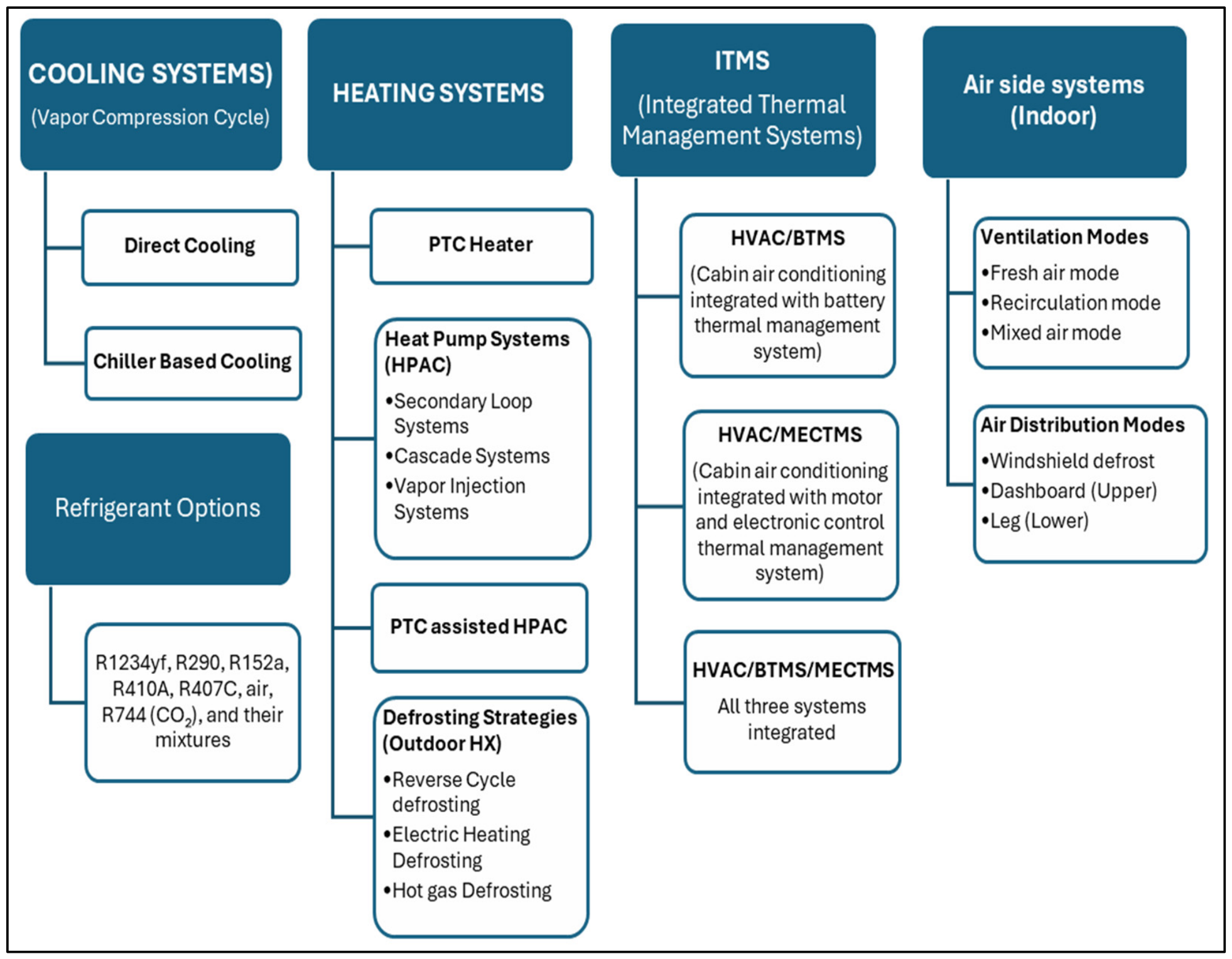
Conventional HVAC systems refer to the earliest and most widely available method of ensuring human thermal comfort in electric vehicles, operating by conditioning the entire cabin air volume. Traditionally, cooling is achieved through vapor-compression cycles (VCCs), while heating relies on positive temperature coefficient (PTC) heaters. Although VCC systems are energy-efficient for cooling, PTC heaters exhibit high energy consumption under cold ambient conditions, exacerbating driving-range limitations [5,6]. This drawback has driven the adoption of heat pump air conditioning (HPAC) systems, which utilize reversible refrigerant flow via switching valves to provide both heating and cooling within a single architecture.
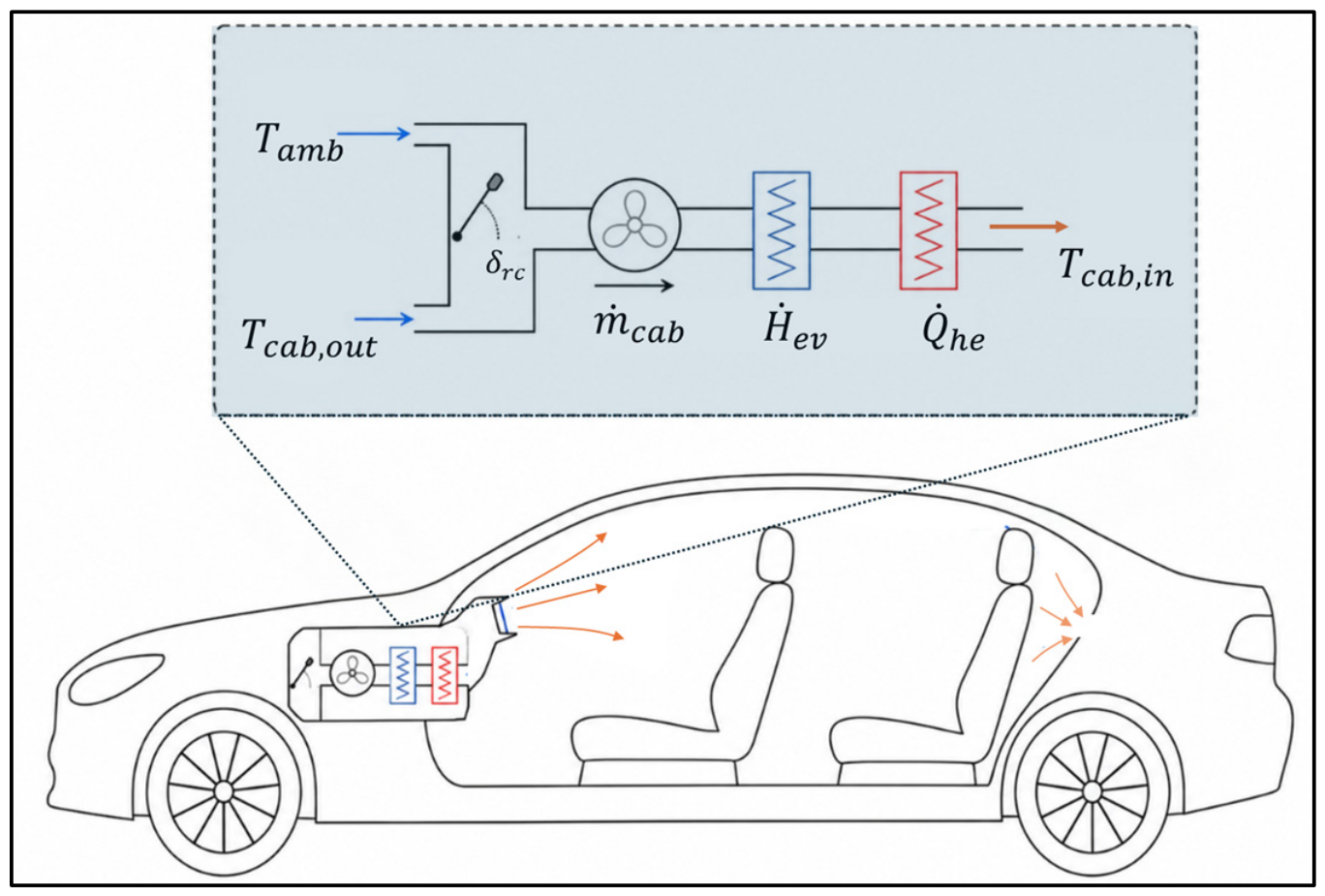
HPAC systems are broadly classified into single-loop and secondary-loop configurations, as shown in Figure 1, depending on the heat-transfer medium. Secondary-loop systems employ an additional coolant circuit—typically a water–glycol mixture—to transfer heat between the refrigerant loop and the cabin heat exchanger, thereby reducing refrigerant leakage risks and associated health concerns [7,8,9,10]. However, HPAC performance decreases at very low ambient temperatures. Mitigation strategies include PTC-assisted heating, vapor injection, and multistage compression.
In addition to thermodynamic limitations, frost formation on the outdoor heat exchanger poses a critical operational challenge. To mitigate frost formation, several defrosting strategies have been proposed, including hot-gas defrosting, electric-heater defrosting, and reverse-cycle defrosting [11,12,13]. Environmental concerns associated with high-GWP refrigerants such as R134a have motivated the search for alternative refrigerants with low global warming potential, including R1234yf, R290, R152a, R410A, R407C, air, R744 (CO2), and their mixtures [8,10,14,15,16].
Integrated thermal-management systems (ITMS) have emerged as an extension of conventional HVAC, enabling coordinated operation of battery, motor, and cabin subsystems. These architectures leverage waste heat from high-temperature components (e.g., motor, inverter, power electronics) to augment cabin heating, improving overall energy efficiency [17,18]. However, such systems strongly depend on effective subsystem coordination and control, underscoring the critical role of advanced control strategies [10,19].

2.2. Localized HVAC Systems

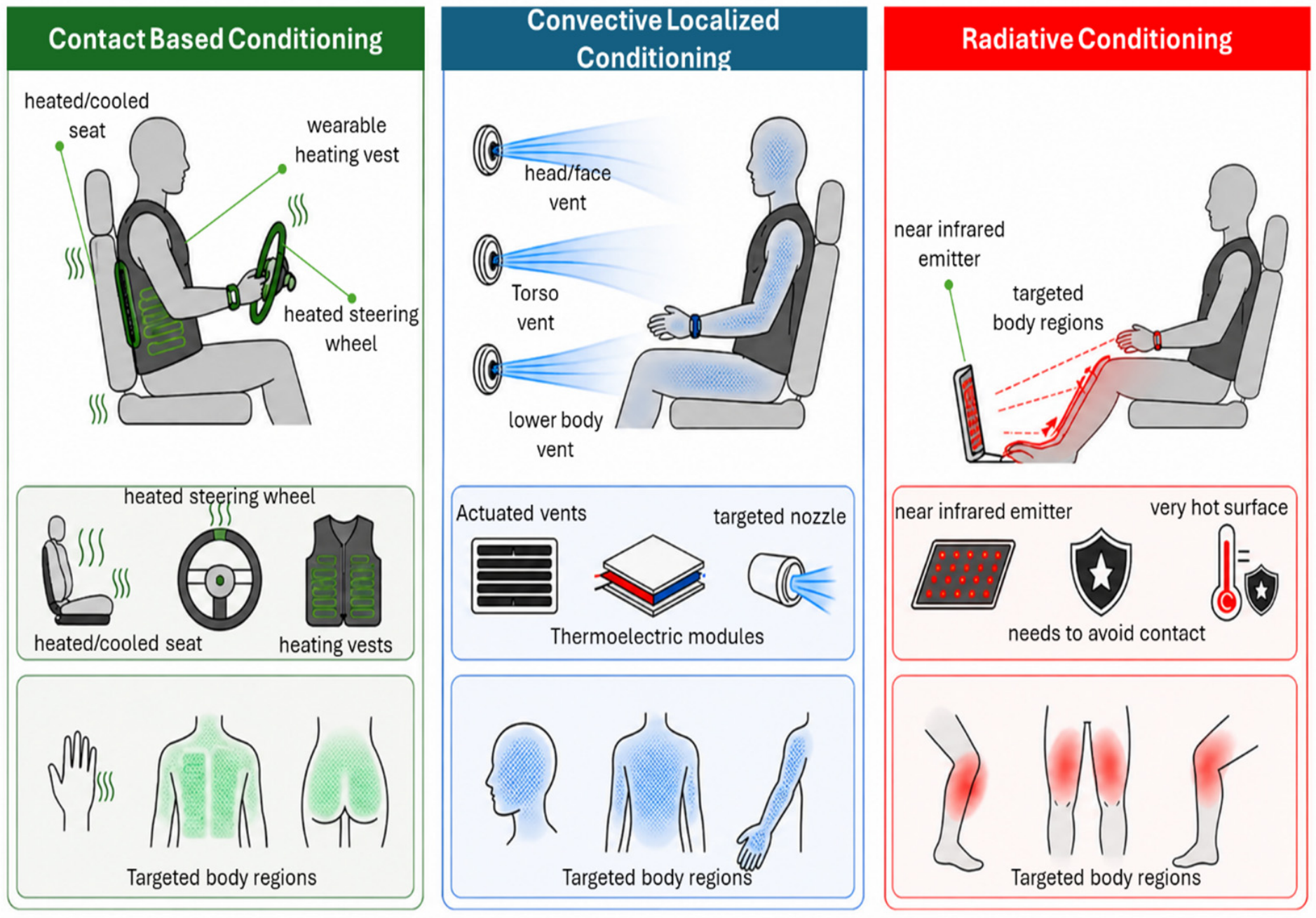
In contrast to conventional whole-cabin conditioning, human-centric (localized) HVAC systems regulate thermal comfort by directly conditioning the occupant microclimate, targeting only occupied regions, as illustrated in Figure 2. By focusing on specific body segments, these systems can enhance perceived comfort while reducing overall energy demand.
Contact-based conditioning operates through direct thermal exchange at the body–surface interface, providing heating or cooling via components such as seat heaters/coolers, heated steering wheels, and wearable devices. These systems primarily rely on conductive heat transfer and enable rapid, localized thermal sensation control.
Convective localized conditioning delivers conditioned air directly to the occupant through strategically positioned vents. Advanced vent control strategies enable spatially distributed airflow targeting different body regions (e.g., face, torso, hands), allowing independent regulation of local thermal conditions [20]. Given the heterogeneous thermal sensitivity of the human body, such systems are often implemented using thermoelectric modules, which enable precise, bidirectional (heating/cooling) control at localized points [21,22,23,24].
Radiative conditioning employs near-infrared emitters to deliver thermal energy directly to the occupant without significantly altering ambient air temperature [25,26]. These systems are typically positioned near the lower extremities (e.g., legs, knees, thighs) to reduce time-to-sensation and improve comfort response [27,28]. However, due to the diffusive nature of infrared radiation and proximity requirements, careful thermal management is necessary to avoid surface overheating and associated risks such as discomfort or burns. Accordingly, advanced designs incorporate safety mechanisms that limit surface temperature upon contact, ensuring safe operation under close-range exposure [29].

3. Overview of Human Thermal Comfort and Modeling

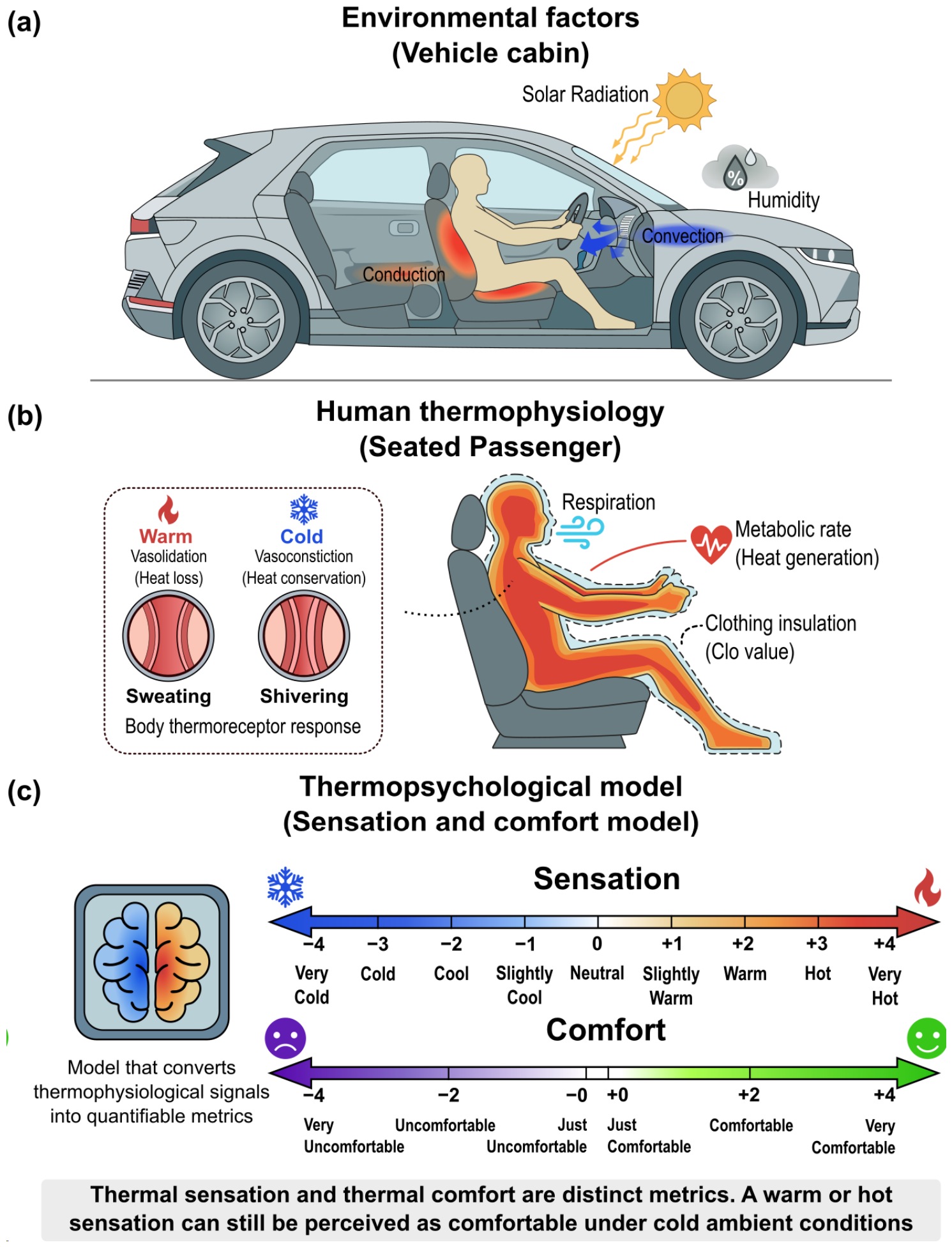
In EV cabins, thermal comfort is not only a passenger experience metric but also a control-relevant variable directly linked to energy consumption, as HVAC loads draw from the traction battery. Unlike stationary environments, EV cabins exhibit highly non-uniform and transient thermal conditions, requiring comfort metrics that are both spatially resolved and suitable for control-oriented optimization. Comfort prediction can be viewed as a coupled process: cabin heat and mass transfer defines the local microclimate, the human body responds through thermophysiological regulation (e.g., skin and core temperature), and perceptual models map these responses to thermal sensation and comfort as shown in Figure 3.
At the most basic level, environmental indices that are used to characterize cabin conditions, including air temperature (Ta) [30], relative humidity (RH) [31], mean radiant temperature (Tmrt) [32], and equivalent temperature (Teq) [33,34,35] are used as comfort-evaluation metrics. Typical comfort guidelines place cabin air temperature within approximately 23–28 °C, although acceptable ranges depend on humidity and solar load.
Thermophysiological models provide a more detailed representation by solving human energy balance equations, accounting for metabolic heat generation and heat exchange with the environment via conduction, convection, radiation, and evaporation. These models predict skin and core temperatures, which serve as primary indicators of thermal state and comfort [36,37,38,39,40,41].
These perceptual models are particularly important in electric vehicle cabins, where thermal management often involves localized and transient strategies rather than whole-cabin conditioning. Representative perceptual models include predicted mean vote (PMV), Predicted Percentage of Dissatisfied (PPD) [42], dynamic thermal sensation (DTS) [43], and Berkeley models [44,45,46].
From a real-time control perspective, the above-mentioned comfort metrics differ in computational cost and required physiological information. Cabin air temperature, operative temperature, and equivalent temperature are the least demanding because they rely mainly on measurable environmental variables and can be directly used as feedback signals or constraints. Equivalent temperature is more suitable for vehicle cabins than air temperature because it includes combined convective and radiative effects, but it remains limited under highly transient conditions. PMV has moderate cost and is suitable for near-uniform whole-cabin control, although it requires several environmental and personal inputs and cannot capture local exposure, seat contact, or rapid transients. DTS is more computationally demanding because it depends on transient skin/core temperature states and their rates of change, making it more suitable for transient comfort assessment than low-level control unless simplified observers are used. OTS and Berkeley-type local/overall models are the most informative for localized and integrated local–global control because they capture body-segment responses, but they require local skin temperatures, segment-level physiological states, adaptive setpoints, and local-to-overall comfort aggregation.

4. Control Techniques

Control is a critical part of automotive TMS because of the inherently multi-objective and coupled nature of the systems [2,3,4]. This section analyzes, summarizes, and classifies studies on advanced control strategies applied to EV cabin thermal management by differentiating between whole-cabin HVAC control and integrated local–global control. Whole-cabin control refers to studies in which cabin comfort is controlled mainly through global HVAC variables such as compressor speed, blower flow rate, and recirculation ratio, whereas integrated local–global control describes frameworks in which whole-cabin HVAC and localized actuators are jointly coordinated to meet both comfort and traction-battery-energy constraints. In the following subsections, the reviewed studies are compared according to system scope, manipulated variables, comfort representation, disturbance-preview capability, optimization complexity, and performance and representative papers for each technique are summarized in Table 1.

4.1. Whole-Cabin Control Systems

4.1.1. Model Predictive Control (MPC)-Based Strategies

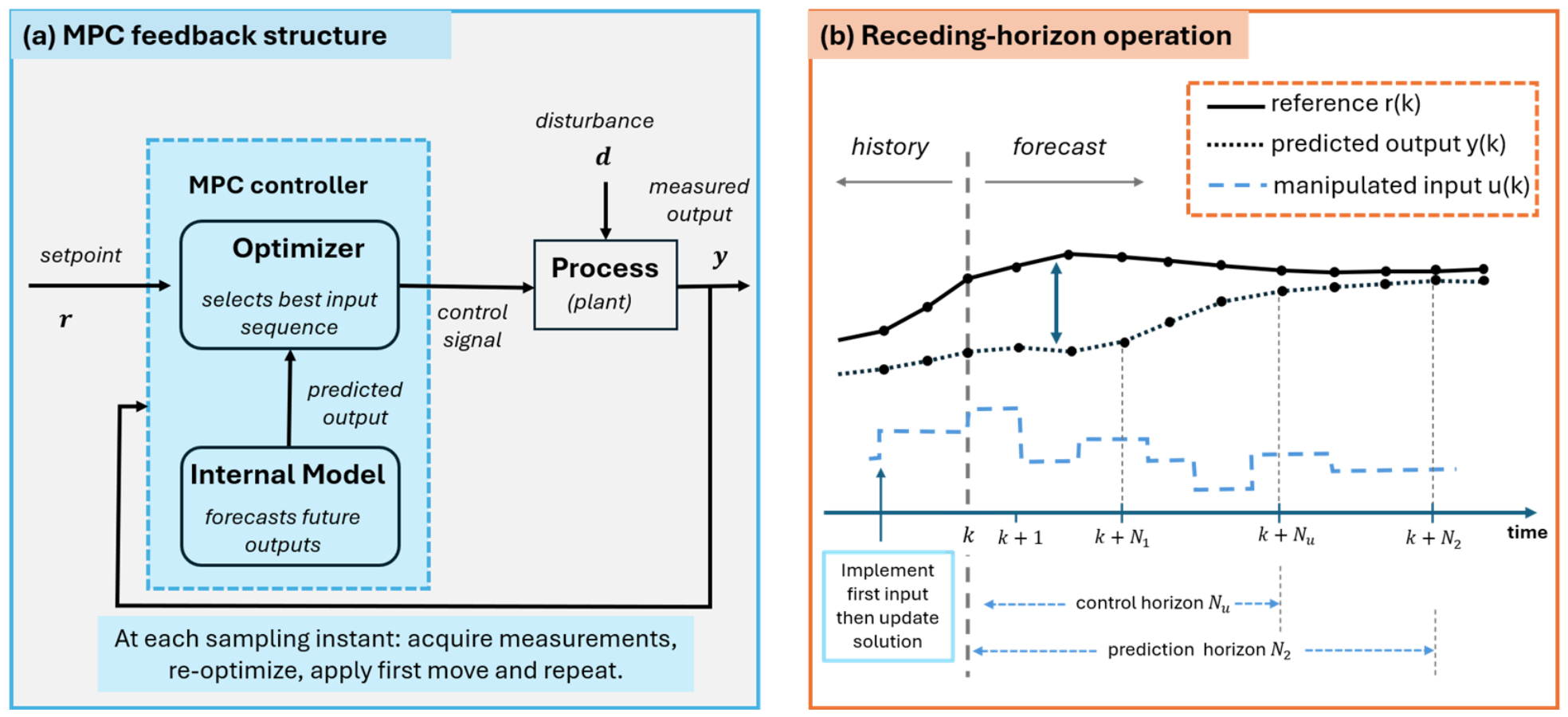
Model predictive control (MPC) refers to a receding-horizon optimization framework in which a control-oriented model predicts future cabin or thermal-management behavior, an objective function balances comfort and energy use, while actuator and safety constraints are enforced, and only the first optimized control action is applied before the problem is solved again at the next sampling step, as shown in Figure 4 [4,47,48]. This is particularly relevant to EV cabin air conditioning because cabin thermal states are influenced by nonlinear heat transfer, thermal inertia, refrigerant-cycle behavior, occupant heat load, solar radiation, ambient temperature, vehicle speed, and ventilation demand. Unlike rule-based or PID controllers, MPC can use future information such as route data, vehicle-speed preview, passenger-number prediction, traffic conditions, and air-quality demand to adjust HVAC operation before large thermal or ventilation loads occur [49,50,51,52]. However, MPC performance mainly depends on model accuracy, solver robustness, prediction accuracy, calibration, and automotive ECU capabilities [53,54,55].
In this review, MPC is classified according to four main technical dimensions: model linearity, prediction-model construction, control hierarchy, and disturbance handling. Linearized MPC studies mainly emphasize real-time feasibility and reduced computational burden [56,57]. Nonlinear and economic MPC formulations are used when refrigerant-cycle behavior, cabin–battery coupling, humidity, air quality, or comfort indices must be represented with higher fidelity [4,52]. Data-driven and surrogate-model MPC approaches use neural network-based or reduced-order prediction models to approximate nonlinear HVAC and thermal-management dynamics with lower online computational cost. Hierarchical and robust MPC formulations further address multi-time-scale coordination and uncertainty in long-horizon preview information. The following subsections classify the literature into linear MPC, nonlinear MPC, data-driven or machine learning-assisted MPC, and hierarchical MPC.
Figure 4. Schematic representation of the (a) MPC closed-loop structure and (b) receding-horizon principle, showing model-based output prediction, constrained control-sequence optimization, first-move implementation, and repeated re-optimization using update [58].
Energies 19 03053 g004
Linear MPC
Linear MPC formulations have been widely implemented to balance control performance and real-time feasibility in EV HVAC applications. Y. Chen et al. [2] implemented a linear time-varying MPC strategy that regulates cabin temperature while minimizing energy consumption under varying driving and environmental conditions. In addition to power consumption, the thermal comfort cost was formulated as a weighted quadratic deviation between cabin temperature and the setpoint. The strategy controls the compressor, fan, and electric heater and uses simplified quadratic programming for a real-time solution of the cost function. Evaluation under standard driving cycles (UDDS, HWFET, US06, and WLTC) and multiple ambient temperatures showed that the controller maintains comparable regulation performance to nonlinear economic MPC, while reducing computational time by 72.4% on average and achieving faster cool-down, reaching target cabin temperatures 69–115 s earlier than rule-based control with 3.2–15% lower energy use.
Similarly emphasizing computational efficiency, Schaut and Sawodny [4] employed a linear-quadratic MPC framework based on low-order cabin and HVAC models combined with an extended Fanger PMV comfort formulation to evaluate occupant thermal comfort in vehicles. Based on the extended comfort model, minimum and maximum PMV limits of ±3 were used to define the feasible comfort range, and the controller was designed to guide the system into this range through manipulated variables. By incorporating disturbance forecasts such as solar load and ambient temperature, the controller predicts cabin and HVAC dynamics over a long horizon while enforcing comfort-envelope, air-quality, and safety constraints. As shown in Figure 5, control actions are applied through flap position, blower flow, and heating/cooling power, enabling both heating and cooling operation with a computational burden suitable for automotive ECUs, particularly when compared with nonlinear MPC approaches that rely on short prediction horizons.
Extending linear MPC concepts, Vatanparvar and Al Faruque [59] proposed a battery-aware climate control strategy that integrates single-zone HVAC thermodynamics with battery degradation, drive profile, and powertrain load models. The MPC forecasts motor power demand, cabin-temperature dynamics, and HVAC power consumption, enabling coordinated HVAC modulation to reduce battery state-of-charge (SoC) deviation while maintaining comfort. Occupant comfort was maintained by constraining cabin temperature within predefined minimum and maximum limits. The optimization objective also penalizes deviation between cabin temperature and the target temperature, thereby linking HVAC energy management with cabin comfort. The results showed up to 13.2% reduction in battery degradation and 14.4% reduction in energy consumption across multiple drive cycles and ambient conditions.
Generally, linear MPC mainly utilizes linearization, piecewise-linear modeling, adaptive setpoint override, hybrid/discrete actuator handling, and value-function approximation to enable practical embedded implementation.
Nonlinear MPC
Nonlinear MPC has been adopted to address the strong nonlinearities, multivariable coupling, and expanded comfort and safety requirements inherent to EV thermal-management systems. Comfort-oriented formulations mainly use more robust comfort models in the cost function or constraints to improve the energy–comfort trade-off [60,61], while health- and air-quality-oriented NMPC extends the objective beyond temperature regulation by including ventilation, CO2, humidity, or infection-risk constraints [52,62]. Integrated thermal-management NMPC further expands the control scope from cabin-only HVAC to coupled cabin–battery thermal regulation, where cabin comfort, battery safety, heat pump operation, and range or energy objectives are optimized simultaneously [63,64].
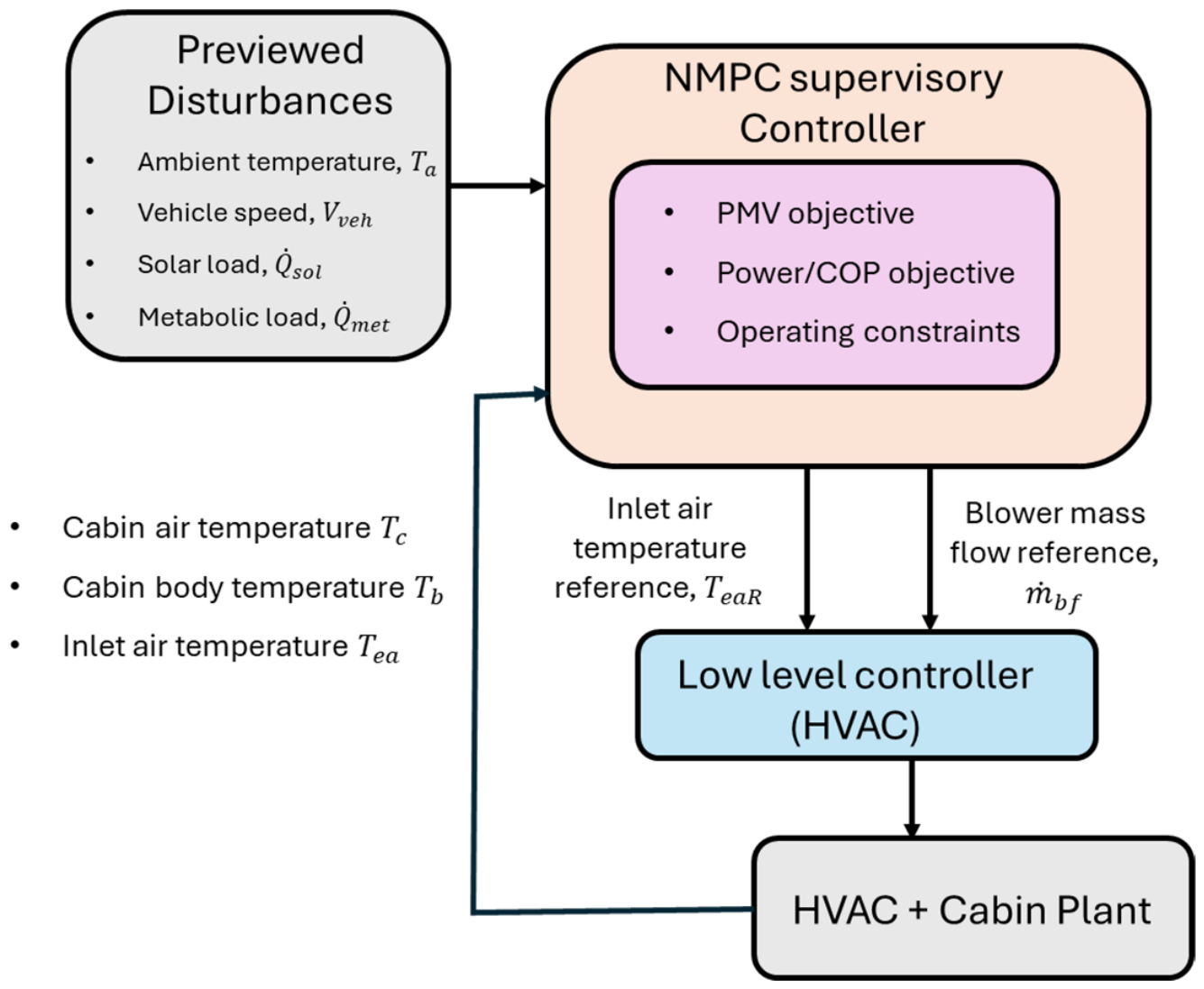
Accordingly, Schutzeich et al. [65] applied nonlinear MPC to jointly manage cabin temperature, CO2 concentration, humidity, and fogging prevention by modeling windshield temperature and air humidity. The controller manipulates blower speed, heating/cooling intensity, and air recirculation ratio. Passenger comfort was quantified using equivalent temperature (ET), because cabin air temperature alone does not capture the radiative effect of the included radiant panel. The cost function was solved using multi-shooting nonlinear optimization, and energy reductions of up to 37.9% under hot conditions and 15.4% under cold conditions were reported compared to rule-based control. Similarly, Cvok and Deur [60] addressed optimal coordination of multiple HVAC actuators under time-varying disturbances using NMPC. The predicted mean vote (PMV) index was used to assess cabin thermal comfort. Although PMV considers six different factors, the resulting PMV map was approximated as a quadratic function of cabin air temperature and cabin inlet flow, which was then minimized in the cost function. As shown in Figure 6, the controller explicitly incorporates previewed disturbances such as vehicle speed, solar load, ambient temperature, and metabolic heat, and computes optimal cabin inlet air temperature and air mass flow using a direct single-shooting optimization approach.
Extending nonlinear MPC to fully integrated thermal management under extreme conditions, Hajidavalloo et al. [63] developed an NMPC strategy for coordinated cabin and battery thermal control by manipulating compressor speed and coolant-flow rates for both subsystems. Control-oriented models of the heat pump, cabin thermal dynamics, and electrothermal battery behavior are employed, with particular emphasis on sub-zero ambient operation. To handle the resulting multi-objective optimization problem, dynamic programming is used to approximate the global optimal solution, and the proposed strategy was shown to increase driving range by more than two hours compared to a cabin-only heating baseline.
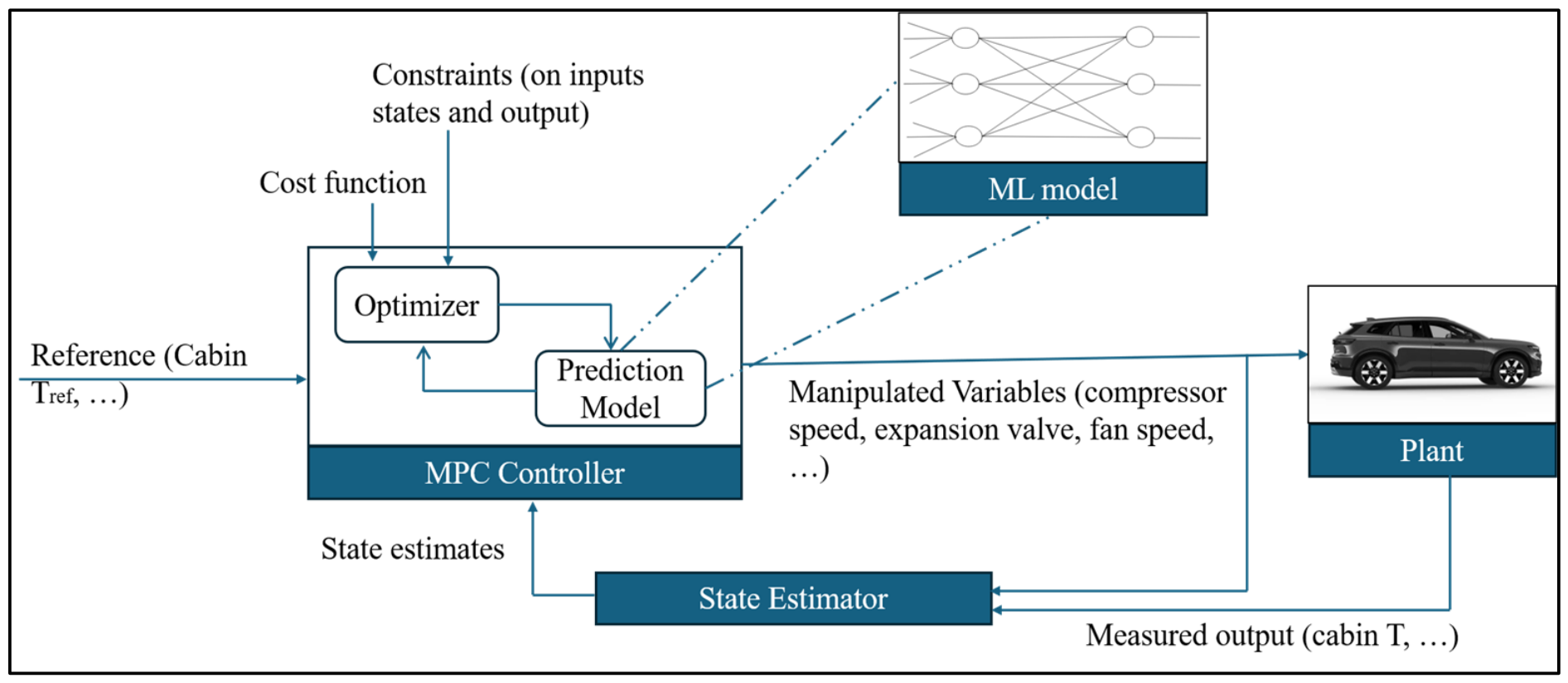
However, the computational cost associated with nonlinear modeling of systems hinders the practical implementation of NMPC for real-time control. This limitation has been partly addressed through data-driven modeling of nonlinear system dynamics, as shown in Figure 7. This issue is especially relevant for air conditioning systems with strong nonlinearities and large time-lag characteristics [66], coupled air conditioning system–battery thermal-management system control [67] and transcritical CO2 thermal systems [68]. Experimental data-driven MPC further addresses practical implementation issues by training control-oriented models from experimental data and validating the controller under fixed and variable ambient temperatures [69,70].
For instance, Jess et al. [71] developed a purely data-driven cabin thermal model capable of reproducing multi-zone thermal dynamics with very low computational cost. For integrated thermal-management systems, Pan and Li [3] proposed a data-driven NMPC approach in which a NARX-RNN model was used to capture the nonlinear dynamics of the integrated cabin–battery thermal system. By controlling compressor speed and expansion-valve openings, the controller maintained the desired cabin and battery temperatures while maximizing the coefficient of performance (COP). Although the surrogate model reduced the computational burden compared to NMPC, it still faced practical implementation challenges because of its high computation time, which was reported as 30 s for a 1 s control interval.
Hierarchical MPC
Hierarchical MPC architectures have been introduced to explicitly address the multi-time-scale nature of EV thermal systems, where slow cabin and battery thermal dynamics coexist with fast actuator responses and time-varying operating conditions [72]. The supervisory layer operates over a relatively long prediction horizon to optimize cabin-temperature trajectories, occupant comfort targets, and battery-energy allocation. In contrast, the lower layer operates at a shorter sampling time to regulate fast actuator dynamics, including compressor speed, blower flow rate, and electronic expansion-valve operation [73]. Such time-scale separation reduces the computational burden because the upper layer solves a lower-frequency optimization problem, while the lower layer handles rapid tracking, actuator saturation, and disturbance rejection.
This structure is particularly useful for integrated EV thermal-management systems, where cabin air and interior surfaces respond slowly, whereas refrigerant-side and electrical actuators respond much faster. In the framework of Figure 3, the comfort model acts as a link between the environmental states and the supervisory control layer. Instead of minimizing only instantaneous cabin-temperature error, the upper layer plans comfort-feasible cabin-temperature trajectories, which are then transferred to the lower layer to track the planned thermal state through actuator manipulation.
Accordingly, Amini et al. [74] presented a two-layer hierarchical MPC in which the upper layer plans long-term optimal thermal trajectories using traffic and vehicle-speed previews, while the lower layer executes near-term control. Intelligent online constraint handling adjusts the comfort zone based on AC efficiency variations with vehicle speed. Compared to single-layer MPC, fuel-consumption reductions of 2.2–5.3% were reported on urban and city cycles.
Building on the concept of supervisory coordination, Liu and Zhang [75] applied MPC to coordinate the operation of separate cabin and battery thermal-management systems, in which neural network-aided control was used for the BTMS and PI control was used for the cabin AC system. The approach schedules energy usage to avoid load peaks and prioritize regenerative energy utilization over recharging while maintaining thermal comfort, which is represented mainly by cabin-temperature tracking at the environmental-descriptor level in Figure 3. The strategy, solved using particle swarm optimization, achieved up to 6.5% energy savings and a 4.3% reduction in recharging energy compared to a non-integrated benchmark. Hierarchical NMPC has also been extended to transient cabin disturbances through coolant-flow division and cabin-air-inflow regulation during door-opening events [76,77].
In general, the methodological value of hierarchical MPC is its ability to decompose EV thermal control into planning and tracking layers, separate slow and fast dynamics, and coordinate comfort, energy use, battery protection, and transient disturbance response within one structured framework.
Disturbance Prediction and Preview Integration
Disturbance preview is important because the optimal use of energy depends on future cabin thermal load, which is strongly influenced by upcoming driving and environmental conditions. For instance, if solar load or ambient temperature is expected to change rapidly, the controller can precondition the cabin globally or temporarily rely more on local actuators to reduce compressor demand. Therefore, accurate prediction and systematic integration of external disturbances are critical for high-performance predictive control of EV thermal-management systems. Disturbance-preview integration can be classified into deterministic and stochastic preview. In deterministic preview, future driving, weather, or air-quality variables are treated as known or directly forecasted trajectories over the MPC horizon. In stochastic preview, uncertain disturbances are predicted probabilistically using statistical or data-driven methods. This is especially important for electric buses because passenger-number variation randomly changes the internal heat load and therefore the future cabin cooling demand. The predicted variables commonly include vehicle speed, route-dependent driving load, ambient temperature, solar radiation, cabin thermal load, ventilation demand, and air-quality constraints, because these variables determine future compressor load, fresh-air heating/cooling demand, cabin heat gain, and high-power HVAC periods [51,52,78,79].
Accordingly, Schaut and Sawodny [4] incorporated solar load and ambient temperature forecasts directly into a long-horizon linear MPC framework to improve prediction accuracy and control performance. Amini et al. [74] further exploited preview information by integrating traffic and vehicle-speed predictions within a hierarchical MPC architecture, enabling long-term thermal trajectory planning and shifting cooling loads toward higher-efficiency operating periods. Complementing these model-based approaches, Rausch et al. [80] developed a machine learning-based disturbance-prediction system that combines weather forecasts, Car2X technologies, and vehicle sensor data to generate route-specific previews of vehicle speed, solar radiation, and ambient temperature using k-nearest neighbor and linear regression techniques, thereby overcoming the limitations of constant or naïvely estimated disturbances commonly assumed in predictive HVAC control.

4.1.2. Data-Driven and Learning-Enhanced Control

The use of machine learning techniques in EV HVAC system control has increased because they can approximate nonlinear cabin–HVAC dynamics, learn control actions from operating data, reduce dependence on manually tuned rules, and adapt control behavior under changing ambient and driving conditions. Different ML techniques, including Deep Q-Network, deep deterministic policy gradient, Twin Delayed Deep Deterministic Policy Gradient, Soft Actor-Critic, and multi-agent reinforcement learning, have been used to solve problems related to nonlinear prediction, compressor energy reduction, continuous actuator control, comfort–energy trade-off optimization, and MIMO actuator coordination. Deep RL methods such as DQN, DDPG, TD3, and SAC have been used to control compressor speed and blower-fan speed [81,82,83]. In coupled cabin–battery systems, RL has been used to control compressor speed and secondary-throttle-orifice opening to regulate both occupant-compartment temperature and battery cold-plate temperature [84]. Multi-agent RL has also been used to assign separate learning agents to actuators such as the compressor and electronic expansion valve so that cabin temperature, subcooling, and efficiency can be optimized simultaneously [85].
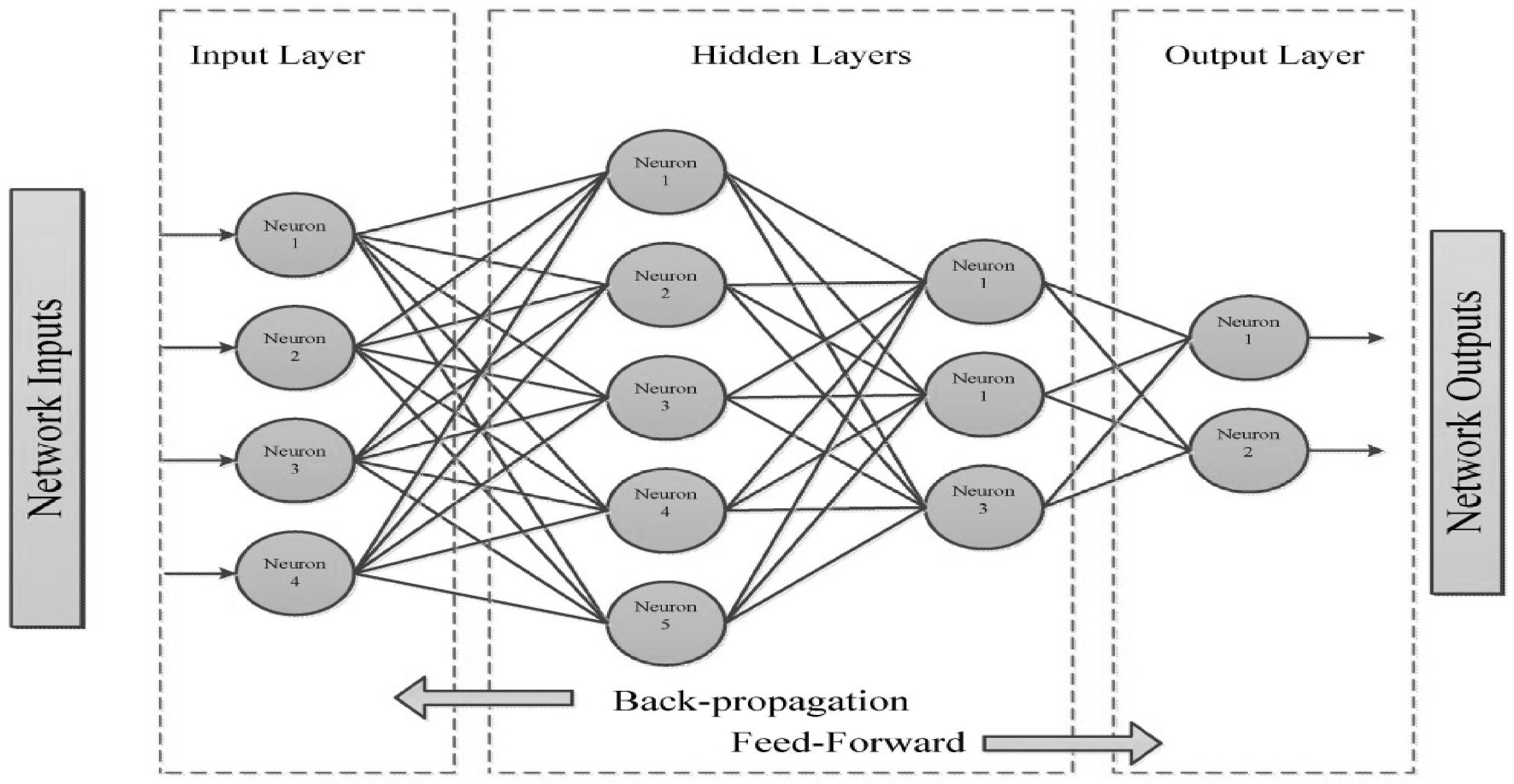
Additionally, Chen [86] proposed a backpropagation neural network-based temperature control strategy for EV heat pump air conditioning systems, in which the neural network directly generates control actions for the compressor and expansion valve, as shown in Figure 8, realizing thermal comfort by maintaining cabin temperature at the setpoint. By learning the nonlinear relationship between operating conditions and thermal response, the controller achieved reduced temperature fluctuations and faster settling times across a range of operating scenarios. Moving beyond direct temperature regulation, Brusey et al. [33] modeled thermal comfort using ET, formulated a thermal comfort control as a Markov decision process, and applied Sarsa (λ) reinforcement learning to explicitly optimize the trade-off between passenger comfort and energy consumption.
Addressing the challenges in direct cooled battery–cabin integrated thermal-management systems, Zhang et al. [84] introduced a deep reinforcement learning strategy based on deep deterministic policy gradient. By augmenting the battery cooling branch with a secondary throttle orifice, the controllability of the integrated system is improved, enabling the DRL controller to effectively manage the thermal interactions that are difficult to handle using conventional PID-based strategies.
Table 1. Summary of representative control strategies for whole-cabin EV HVAC systems, including MPC, learning-based control, reinforcement learning, and DP-based hierarchical control, with emphasis on controlled variables, comfort modeling, solvers, and quantitative energy–comfort performance (see Table A1 for the extended literature comparison).
Ref.Control MethodSystem ScopePlanned/Controlled VariablesComfort ModelingOptimization/SolverKey MetricsKey Quantitative Results
[2]Linear time-varying MPCCabin HVACCompressor, fan, electric heater (blower treated as disturbance)Cabin air temperatureQuadratic programmingTemp deviation, cool-down time, energy72.4% computation reduction vs. NEMPC; 69–115 s faster vs. RB; 3.2–15% less energy
[65]Nonlinear MPCCabin HVACBlower speed, heating/cooling power, recirculation ratioEquivalent temperature (ET)Nonlinear programming (acados, direct multiple shooting)Energy use, ET deviation, CO2 & humidity limits, fogging prevention15.4% energy savings (cold); ~38–40% savings (hot) vs. rule-based, while maintaining comfort & safety
[74]Two-layer MPCCabin + BatteryEvaporator temperature setpoint, blower flow rate, battery cooling fan speedAdaptive comfort temperature zoneNonlinear programming (hierarchical MPC with decentralized sub controllers)2.2–5.3% fuel savings; up to ~7.5% battery-energy reduction vs. single-layer MPC2.2–5.3% fuel savings; up to ~7.5% battery-energy reduction vs. single-layer MPC
[86]BP Neural NetworkCabin HVACCompressor, expansion valveCabin air temperature tracking-Temp fluctuation, settling timeFaster response (≈30–40% reduction) and reduced temperature fluctuation vs. PID
[33]Reinforcement Learning (Sarsa(λ))Cabin HVACVent air temperature, vent air flow rate, recirculation ratioEquivalent temperature (ET)-Time in comfort, HVAC power, average reward≈13% lower energy use and ≈23% higher comfort time vs. next-best controller
[87]Two-layer hierarchical control (DP + fuzzy PID)Cabin HVACPlanned cabin temperature (supervisory), compressor speedPMV-based comfort with learned passenger thermal preferenceDynamic programming (exhaustive search) + fuzzy PIDAC energy, compressor speed, cabin temp fluctuation, operative temperature28–37% energy reduction vs. on–off, 5–12% vs. PID
[88]Two-stage hierarchical control (DP + fuzzy PID)Cabin + BatteryPlanned cabin & battery temperatures; compressor & pump speedsPMV-based comfort with passenger-preference learningDP (offline exhaustive search) + fuzzy PIDTemp deviation, PMV comfort, energy use, battery capacity loss42.9% energy reduction vs. on–off, 18.5% vs. PID; 21.5% battery-life improvement
Extending learning-based control to fully integrated systems, Guo et al. [89] proposed an evolutionary multi-agent deep reinforcement learning architecture that combines multi-agent DDPG with the Cross-Entropy Method. In this framework, a coordination agent plans optimal temperature trajectories for the cabin and battery, while execution agents directly control compressors, blowers, pumps, fans, and valves to regulate cabin, battery, and motor temperatures. This hierarchical learning structure enables simultaneous optimization of temperature regulation, air conditioning efficiency, and energy consumption across multiple subsystems within an integrated thermal-management system.
These studies indicate that data-driven and learning-enhanced controllers are useful when cabin–HVAC dynamics are highly nonlinear, uncertain, or too high-dimensional for simplified physics-based control. Their strengths include nonlinear function approximation, adaptation to changing conditions, and potential integration of occupant feedback. However, the implementation of ML-based HVAC control is highly dependent on training-data quality, simulation fidelity, reward-function design, operating-condition coverage, and actuator constraints, which can limit robustness and generalization under unseen driving cycles, ambient conditions, and passenger preferences.

4.1.3. Global Optimization Based on Dynamic Programming

Dynamic programming has been widely used in EV HVAC control mainly to identify optimal energy–comfort trajectories over a known or statistically described driving horizon to serve as a benchmark or supervisory layer for real-time control strategies. DP can optimize AC cooling capacity or compressor/blower commands while considering cabin temperature, PMV, COP, solar radiation, passenger load, and HVAC electricity consumption. In stochastic formulations, solar-radiation variation and passenger-number uncertainty are represented probabilistically to determine energy-efficient AC operation under variable thermal loads [90,91,92].
Specifically, Lahlou et al. [93] implemented dynamic programming (DP) for supervisory optimization by formulating a coupled powertrain–HVAC–battery optimization problem in which comfort is quantified as quadratic deviation in temperature and relative humidity. The system computes optimal thermal comfort trajectories by optimally allocating battery power between traction and air conditioning for a complete trip under known initial battery energy, weather conditions, and driving cycles.
Focusing on extreme ambient operation, Lian et al. [94] applied DP to integrated EV thermal management under low-temperature conditions, coordinating compressor speed, PTC heater power, and waste-heat mode selection. In this formulation, cabin temperature is selected as the state variable, while energy consumption is minimized subject to the cabin’s temperature increase rate constraints, that is, the amount of time it takes for the temperature to reach the desired level in order to take cabin comfort into account. Performance was evaluated in terms of energy use and time-to-target cabin temperature at ambient temperatures of −7 °C and −25 °C, demonstrating the capability of DP to identify globally optimal heating strategies in cold climates.
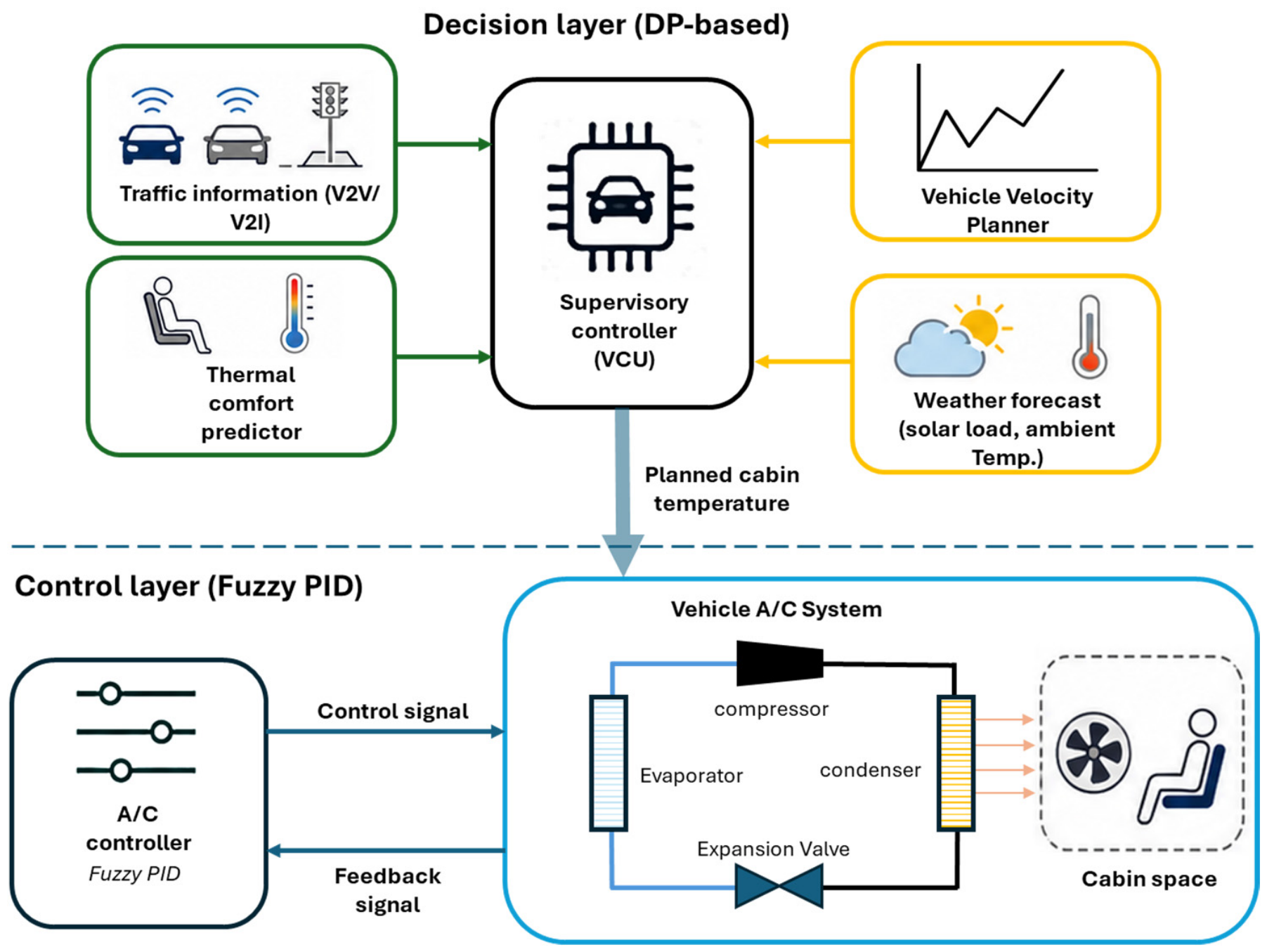
Recognizing the impracticality of DP for real-time implementation, several studies have employed DP as a planning layer combined with low-level controllers. Xie et al. [87] proposed a two-layer eco-cooling strategy in which an upper DP-based decision layer plans time-varying cabin-temperature trajectories using vehicle velocity, weather information, and passenger comfort prediction, while a lower fuzzy PID controller tracks the planned trajectory in real time by adjusting compressor speed as shown in Figure 9. This approach achieved energy reductions of up to 28.2% compared with on–off control, along with a significant reduction in cabin-temperature fluctuations. Similarly, Zhao et al. [88] proposed a two-stage control framework where a global DP planner generates optimal cabin and battery temperature trajectories and fuzzy PID controllers track them with reduced actuator oscillations.
In a related benchmarking study, Cvok et al. [92] proposed a hierarchical thermal comfort control system consisting of low-level feedback controllers, an optimization-based control-allocation algorithm for setting references for the low-level controllers, and a superimposed cabin-temperature controller that commands cooling capacity to the allocation algorithm. The strategy was then compared with DP-based globally optimal control-trajectory results, showing that comparable performance can be achieved through appropriate controller tuning.
In general, the main advantage of DP in EV cabin thermal management is not direct real-time implementation, but the generation of globally optimal trajectories that can be used as benchmarks or supervisory references for implementable controllers. This is particularly relevant for local–global thermal management because DP can quantify the theoretically optimal allocation between compressor power, cabin-temperature trajectory, and localized actuator use over a known driving cycle.

4.2. Integrated Local–Global Thermal Actuator Control System

Studies consistently show that localized actuators can reduce whole-cabin HVAC demand by directly conditioning thermally sensitive body regions. For instance, heated-seat and foot-heater studies reported heater-energy reductions of about 15% for seat heating, 10% for foot heating, and 25% when both were combined at 0 °C [95]. Thermoelectric localized heating/cooling systems also achieved equivalent comfort at relaxed cabin setpoints, with reported heating- and cooling-power reductions of approximately 37.7% and 36.7%, respectively [21]. Zonal heating strategies using local devices such as heated seats, steering wheels, and floor mats showed about 28.5% [96] heating-energy reduction, while more advanced local–global systems using radiant panels, or microclimate devices reported 20–30% power reduction [22,27] and up to 45.3% cold-condition energy savings [28] compared with HVAC-only operation. These results suggest that whole-cabin advanced control improves energy efficiency by optimizing global HVAC operation, whereas local–global control can provide additional savings by reducing the thermal load that must be supplied to the entire cabin.
However, the literature shows that local actuators have mainly been studied through comfort assessment, actuator development, numerical analysis, and predefined operating-case evaluation rather than through fully integrated local–global control frameworks. Experimental comfort and physiological assessments have been used to evaluate heated seats, foot heaters, local warmers, radiant heating, and personal comfort systems [26,28,95,97]. In parallel, actuator-design and hardware-performance studies have focused on developing and testing localized thermal devices [22,98,99,100]. Numerical and CFD-based studies have also been used to optimize local airflow, seat ventilation/heating, vent arrangement, and non-isothermal jet supply [21,24,46]. Other studies used predefined operating modes or case-based comparisons [20,26,28,101]. These studies confirm the comfort and energy-saving potential of local actuators, but they also show that localized systems are still commonly treated as hardware, comfort-evaluation, or operating-mode studies rather than as explicit manipulated variables in real-time integrated local–global HVAC control. However, only limited studies, that are summarized in Table 2, have jointly controlled both local and global heating or cooling systems.
One of the earliest system-level studies was conducted by Steiner et al. [102], where a comparative energy–comfort analysis was carried out using different case studies of localized actuators, namely a smart seat heater and a radiant panel, combined with a heat pump. Fuzzy logic adaptive control was applied to regulate the system using PMV-based comfort feedback. The results showed that 75 W applied to the smart seat allowed the cabin air temperature to be reduced by 7 K while maintaining the same passenger comfort, while 100 W of radiant-panel power allowed a 3 K reduction under quasi-static heating conditions. At the vehicle level, combining the heat pump, seat heating, and panel heating reduced average electric power for cabin heating from 3.51 kW to 0.83 kW at 0 °C, corresponding to a 76% reduction relative to PTC heating. However, the paper mainly evaluates preselected operating cases rather than a full closed-loop local–global supervisory controller.
Kipp et al. [103] presented offline AI-based optimization of cabin thermal management, where conventional HVAC is supplemented by radiant heaters. Equivalent temperature was used as an objective thermal comfort metric, and ET for 16 body regions was predicted by a trained extreme gradient boosting (XGBoost) model. The actuator set consists of nine independently controlled radiant heating panels and adjustable convective outlets. Shapley Additive Explanations (SHAP) were used to identify which HVAC variables most influenced ET; airflow temperature was dominant, followed by upper-body radiant panels such as the front window, upper dashboard, and headliner, while footwell and door panels primarily affected extremities. The optimized configurations maintained at least 50% of local body regions and 100% of upper/lower averaged regions in the neutral zone and reduced power demand by up to 240 W relative to convection-heavy strategies.
Dvorak et al. [104], approached local–global control from a human–machine interface (HMI) perspective. The demonstrator EV uses an AC system for cabin heating/cooling and IRPs for heating specific cabin areas, while the HMI allows users to provide thermal comfort feedback and the operating strategy calculates target cabin-air and panel temperatures from that feedback. For passenger safety, the panel temperature was limited to 60 °C, although the infrared radiant panels (IRPs) were designed for up to 80 °C. The results showed that the demonstrator increased the maximum range from 64 km to 86.8 km at −10 °C and from 137 km to 140 km at 40 °C compared with the baseline vehicle, while final thermal comfort was rated comfortable and acceptable in both winter and summer weather conditions. This study demonstrates a practical local–global architecture and passenger-level setpoint logic, but it relies on user feedback rather than an automatic comfort observer.
Cvok et al. [105] extended this idea into a formal integrated control-allocation problem by using a driver-side IRP system, consisting of two IRP clusters corresponding to the driver’s head/chest and legs, combined with the global HVAC system. The control technique has two branches: a multi-objective genetic algorithm is used offline to generate optimal control-input allocation maps, and a hierarchical HVAC controller is extended with a proportional PMV feedback controller that commands the IRP control channel. The optimization minimizes total power consumption and the absolute value of the driver’s mean PMV. Under steady-state conditions at an ambient temperature of −10 °C, IRP heating enabled a roughly 300–400 W, or 26–32%, power reduction while maintaining comfort.
However, PMV requires iterative nonlinear computation and Cvok et al. [106] directly addressed this key limitation of the real-time PMV-based IRP controller by proposing ANN-predicted PMV. The IRP system used in this study is organized into clusters, and the control strategy uses local PMV feedback to regulate IRP panel groups while decoupling IRP heating from the convective heat pump-based HVAC system. In simulation, the ANN-predicted PMV closely tracked ideal model PMV, with small delays caused by air temperature sensor dynamics. Hardware testing showed that all six ANN observers ran within a 10 ms sampling period, required less than 3% of ECU resources, and executed within about 200 µs, supporting feasibility for production vehicle controllers. This work bridges simulation-based PMV control and real-time implementable local IRP feedback control.
A more human-centric microclimate control architecture was presented by Tiwari et al. [107] with heated/cooled seats, a heated steering wheel, a neck warmer, footwell heating, and central HVAC systems. A model-based predictive control technique was used for the microclimate system, while the human thermal state was represented by overall thermal sensation (OTS), which was inferred from occupant heat-transfer rates and anthropometric characteristics by dynamically estimating zonal heat-transfer rates using conductive, convective, and radiative heat-transfer models. Verification was conducted using both objective methods, based on a TAITherm human thermal model, and subjective methods, in which participants reported overall thermal sensation every 3–5 min. The controller was reported to drive the devices to the desired OTS target of ±0.5 across −18 °C to +43 °C ambient conditions, and energy savings of up to 48–74% in cold conditions and 17–36% in hot conditions were achieved relative to HVAC-only operation. Additionally, subjective winter rides showed that 90% of subjects maintained comfort and that time to comfort was improved by 2–7 min.
Overall, integrated local–global thermal actuator control remains less mature than whole-cabin HVAC control. The reviewed studies demonstrate that localized actuators can reduce global HVAC demand and improve time to comfort, especially under heating conditions. However, the control problem is more complex than conventional cabin-temperature regulation because the controller must estimate non-uniform occupant comfort, allocate energy between global and local actuators, enforce safety limits for contact and radiant heating, and manage different actuator time scales. Existing studies provide promising demonstrations through HMI-based control, offline optimization, PMV feedback, ANN-based observers, and model-based microclimate control, but few studies present a fully integrated, real-time, experimentally validated supervisory controller for simultaneous HVAC and localized actuator coordination.
Table 2. Control-oriented comparison of integrated local–global EV cabin thermal-management studies, showing how whole-cabin HVAC variables and localized actuators are coordinated through comfort feedback, supervisory logic, optimization, or learning-based observers.
Ref.Control MethodIntegrated System ScopeGlobal HVAC VariablesComfort Feedback/ModelCoordination StrategyKey Quantitative Results
[102]Fuzzy PID only for HP + different local actuator combination casesHP + smart seat + radiant panelsCabin target air temperature, HP powerPMV = 0 constraintLocal heating reduces required cabin air temperatureUp to 76% lower heating power at 0 °C vs. PTC
[105]GA-based allocation + hierarchical control + proportional controlHVAC + IRPsInlet-air temperature, blower/radiator flow, pump speedsPMV feedbackAllocation maps + PMV-based IRP control20–30% typical power reduction; 36% faster comfort response
[104]HMI-based operating strategyHVAC + IRPsTarget cabin air temperatureUser comfort feedbackMinimum cabin target + IRP compensationRange 64 → 86.8 km at −10 °C
[107]PID/model-based controlHVAC + microclimate devicesCentral HVAC supportOTS from heat-transfer estimationController drives local/global devices to target OTS48–74% cold energy savings; 2–7 min faster comfort
[106]ANN local PMV observer + proportional IRP controlHVAC + IRP Cabin T/RH, inlet T, blower flowANN-estimated local PMVReal-time local PMV feedback for IRPs<3% VCU processing load
[103]AI-based setpoint optimizationHVAC + radiant panelsAirflow temperature, fan/damper settingsET for 16 body regionsML search for comfort-feasible low-power settingsUp to 240 W power saving

4.3. Limitation of the Present Review

One limitation of the present review is that it focuses mainly on the technical and control-oriented aspects of EV cabin air conditioning systems, including control architecture, thermal comfort modeling, energy-efficiency improvement, actuator coordination, and real-time feasibility. Therefore, the cost implications of the reviewed methods were not analyzed in detail. Although vehicle-level cost is important for practical adoption, a consistent techno-economic comparison is difficult because many advanced methods, including integrated local–global thermal actuator control, human-centric comfort observers, vision-based sensing, and learning-enhanced control, are still at the simulation, prototype, or early demonstration stage. Consequently, publicly available data on manufacturing cost, vehicle price impact, service cost, calibration cost, and lifetime operating costs remain limited and inconsistent across studies.

5. Conclusions

This review studied advanced control strategies for energy-efficient EV cabin thermal management, with specific attention to the distinction between whole-cabin HVAC control and integrated local–global thermal actuator control. According to the examined literature, whole-cabin EV HVAC control is comparatively mature. MPC has become one of the most broadly considered approaches because of its ability to handle multivariable dynamics, actuator constraints, disturbance preview, and energy–comfort trade-offs. Linear and hierarchical MPC systems enhance real-time feasibility, while nonlinear MPC captures coupled thermal dynamics more accurately at the cost of higher computational demand. DP is mostly used as an offline global optimization target or supervisory planning tool, whereas reinforcement learning and learning-enhanced approaches are increasingly studied for nonlinear and multi-agent thermal-management problems.
The review also indicates that comfort models are used in controllers at different levels of complexity. Some studies use cabin air temperature as a simplified comfort-related controlled variable, while others incorporate PMV, equivalent temperature, adaptive comfort zones, or thermal sensation as objective-function terms, constraints, reward components, or feedback variables. This shows that thermal comfort models are increasingly becoming part of the control formulation rather than only a post-processing evaluation tool.
Integrated local–global control remains less mature than whole-cabin HVAC control. Recent studies have utilized strategies such as fuzzy comfort control, HMI-based systems, hierarchical control allocation, model predictive control, AI-based optimization, and ML-based local comfort observers. According to these studies, localized actuators can reduce energy consumption and enhance transient comfort when coordinated with global HVAC operation. However, the literature remains limited, and most existing studies focus on specific case studies of actuator combinations and offline optimization, rather than a fully unified framework that jointly optimizes global HVAC and multiple localized actuators under comfort, safety, air-quality, visibility, and traction-battery constraints.
From an automotive industry perspective, these developments are important because they support the transition from conventional fixed-setpoint cabin-temperature control toward predictive, occupant-aware, and energy-adaptive thermal management. Such a transition can improve current vehicles by reducing auxiliary HVAC power demand, preserving driving range, and improving transient thermal comfort.

6. Recommendation for Further Study Directions

Future research on EV cabin thermal-management control should move beyond optimized whole-cabin HVAC regulation toward integrated local–global control. Existing studies have shown that MPC, dynamic programming, and data-driven controllers can reduce HVAC energy consumption while maintaining cabin-level comfort. However, the next research challenge is to develop unified supervisory frameworks that dynamically allocate heating or cooling demand between whole-cabin air conditioning and localized actuators such as heated seats, ventilated seats, radiant panels, foot heaters, or personalized air jets. This allocation should depend on ambient conditions, cabin thermal state, occupant distribution, actuator availability, comfort demand, and traction-battery-energy constraints.
A key challenge in this transition is real-time occupant-state estimation. Whole-cabin HVAC control can often rely on cabin air temperature, humidity, solar load, and vehicle operating data, whereas local–global control requires information about the occupant’s localized thermal state. Direct measurement of local skin temperature, segmental air velocity, radiant exposure, clothing insulation, posture, and local discomfort is difficult in production vehicles. Therefore, practical local–global control will require soft sensors and surrogate comfort observers. These observers may combine sparse cabin-temperature and humidity sensors, infrared or RGB camera data, seat-pressure distribution, radiant-panel temperature, occupant posture, and historical comfort preference with data-driven, physics-informed, or hybrid comfort models to estimate local thermal sensation, overall thermal sensation, local discomfort, or equivalent temperature.
The main limitation of these observers is robustness. Vision-based and thermal-camera systems can be affected by lighting, obstruction, clothing, sensor placement, and occupant posture, while purely data-driven models may fail under unusual occupant behavior, unseen cabin layouts, or untrained ambient conditions. Therefore, future occupant-centric HVAC control should prioritize hybrid observer structures that combine physical sensing, reduced-order thermal models, and data-driven estimation. These observers must also be computationally lightweight enough for automotive ECUs, reliable enough for closed-loop control, and accurate enough to support safe control of localized actuators. Based on these challenges, future work should address the following research directions.
  • Optimal local–global energy allocation and energy-saving differential: What fraction of the heating or cooling load should be supplied by localized actuators, and how much additional HVAC energy reduction can integrated local–global control achieve compared with optimized whole-cabin-only control?
  • Comfort-observer accuracy: How can real-time comfort observers estimate local thermal sensation, overall thermal sensation, or equivalent temperature within acceptable error under transient and non-uniform EV cabin conditions?
  • Real-time control feasibility: How can local–global MPC or learning-assisted predictive control solve the supervisory energy-allocation problem within a practical control interval on an automotive ECU, and how can such controllers benefit from emerging techniques such as vehicular edge computing and resource allocation [108]?
  • Safety-constrained local heating: How should safety constraints be imposed on contact and radiant heaters to achieve rapid comfort response without discomfort or burn risk?
  • Production-level cost–benefit: What is the minimum energy-saving or driving-range improvement required for localized actuators, additional sensors, comfort observers, and supervisory controllers to justify their added cost and complexity in production EVs?

Author Contributions

Conceptualization, R.C.G., M.F.B.S. and H.L.; Methodology, R.C.G., M.F.B.S. and H.L.; Formal analysis, R.C.G., M.F.B.S., H.L., D.S.J., J.K.K. and D.L.; Investigation, R.C.G., M.F.B.S., H.L., D.S.J., J.K.K. and D.L.; Writing—Original draft preparation, R.C.G.; Writing—Review and Editing, H.L.; Project administration, H.L.; Funding acquisition, H.L. All authors have read and agreed to the published version of the manuscript.

Funding

This research was funded by National Research Foundation of Korea: RS-2025-02217102.

Data Availability Statement

No experimental or simulation data was used for the research described in the article.

Acknowledgments

During the preparation of this manuscript the authors used ChatGPT-5.5 (OpenAI, San Francisco, CA, United States.) for the purposes of improving the language and readability of the manuscript. The authors have reviewed and edited the output and take full responsibility for the content of this publication.

Conflicts of Interest

The authors declare that they have no known competing financial interests or personal relationships that could have appeared to influence the work reported in this paper.

Appendix A

Table A1. Summary of selected control techniques applied to electric vehicles.
ReferenceControl MethodSystem ScopeControlled VariablesModels UsedComfort ModelingDisturbance/PreviewOptimization/SolverKey MetricsKey Quantitative Results
[2]Linear time-varying MPCCabin HVACCompressor, fan, electric heater (blower treated as disturbance)Simplified cabin & HVAC modelsCabin air temperatureDriving speed Quadratic programmingTemp deviation, cool-down time, energy72.4% computation reduction vs. NEMPC; 69–115 s faster vs. RB; 3.2–15% less energy
[4]Linear quadratic MPCCabin HVAC (heating & cooling, air quality)Recirculation rate, blower mass flow, heating/cooling powerLow-order cabin & HVAC + PMVExtended Fanger PMVSolar load (preview), ambient temperature, passenger count, ambient humidityQuadratic programming (qpOASES)Comfort envelope, air quality, safetyComparable comfort & energy performance to nonlinear MPC with drastically reduced computation time;
[59]Nonlinear MPCCabin + Battery + Power trainSupply air temp, coil loads, airflow, recirculation ratioHVAC thermodynamics, battery degradation, powertrainCabin air temperatureDriving route & motor power preview, ambient temperature, solar loadSequential Quadratic Programming (fmincon)SoH degradation, energy, temperature deviationUp to 13.2% battery lifetime improvement and 14.4% energy reduction vs. fuzzy control
[65]Nonlinear MPCCabin HVACBlower speed, heating/cooling power, recirculation ratioPhysics-based nonlinear cabin, HVAC, CO2, humidity & windshield modelsEquivalent temperature (ET)Ambient temperature, solar radiation, humidity, passenger heat & CO2Nonlinear programming (acados, direct multiple shooting)Energy use, ET deviation, CO2 & humidity limits, fogging prevention15.4% energy savings (cold); ~38–40% savings (hot) vs. rule-based, while maintaining comfort & safety
[60]Nonlinear MPCCabin HVACInlet-air temp, air mass flowNonlinear cabin, HVACPredicted mean vote (PMV)Ambient temperature, vehicle speed, solar radiation, metabolic load (preview)Nonlinear programming (CasADi + IPOPT)Energy use, PMV discomfort indices, temperature tracking error, COPUp to 37% reduction in PMV discomfort and ~5% energy savings vs. hierarchical control
[3]Nonlinear MPCCabin + BatteryCompressor speed, cabin EEV opening, battery EEV openingNARX-RNN control-oriented models trained from Modelica ITMS simulationsCabin supply-air temperature constraintBattery cooling load preview from driving cycleNonlinear programmingCOP, battery temperature, superheat, cabin temperature COP improved from ~3.11 to ~3.46 while maintaining battery temperature (RMSE ≈ 0.4 °C)
[63]Nonlinear MPCCabin + BatteryCompressor speed, coolant-flow rates, blower flow rateHeat pump, cabin, battery, vehicle energy modelsCabin air temperature constraintsTraction, powerNonlinear programming, DP used as global benchmarkEnergy, temperature deviation, rangeNMPC achieves near-optimal driving range close to DP
[74]Two-layer MPCCabin + BatteryEvaporator temperature setpoint, blower flow rate, battery cooling fan speedCabin, battery, HVAC, powertrainAdaptive comfort temperature zoneVehicle-speed preview (V2X + traffic flow), ambient conditionsNonlinear programming (hierarchical MPC with decentralized sub controllers)2.2–5.3% fuel savings; up to ~7.5% battery-energy reduction vs. single-layer MPC2.2–5.3% fuel savings; up to ~7.5% battery-energy reduction vs. single-layer MPC
[75]Supervisory MPC + NN + PICabin + BTMSAC cooling capacity, BTMS airflow rateBattery electro-thermal, NN-based BTMS, cabin thermal, AC COP & vehicle energy modelsCabin air temperature trackingDriving cycle, regenerative power, auxiliary loadsPSO-based MPCRecharging energy, total energy use, SoC, battery & cabin temperatures4.3% reduction in recharging energy and 6.5% reduction in total energy vs. no energy management
[86]BP neural networkCabin HVACCompressor, expansion valveData-driven BP neural networkCabin air temperature tracking--Temp fluctuation, settling timeFaster response (≈30–40% reduction) and reduced temperature fluctuation vs. PID
[33]Reinforcement learning (Sarsa(λ))Cabin HVACVent air temperature, vent air flow rate, recirculation ratio-Equivalent temperature (ET)--Time in comfort, HVAC power, average reward≈13% lower energy use and ≈23% higher comfort time vs. next-best controller
[84]Reinforcement learning (DDPG)Cabin + Direct-Cooled BatteryCompressor speed, secondary throttle orifice-Cabin air temperature trackingVehicle speed, ambient temperature, solar radiation, passenger heat (no preview)-Cabin & cold-plate temp deviation, superheat stability, energy5.7% (constant speed) and 7.3% (NEDC) lower compressor energy vs. PID; smoother compressor operation
[89]Multi-agent DRL (CEM-MADDPG)Cabin + Battery + MotorCompressor, blower, fan, battery & motor pumps, valve positions, target temperature adjustment-Cabin air temperature trackingVehicle speed, ambient temperature, solar radiation, passenger load (no preview) Temp MAE, ITMS energy, compressor & blower power19.8% energy reduction vs. rule-based, 14.6% vs. DDPG, 7.2% vs. MPC; improved actuator efficiency
[93]Dynamic programming (offline)Cabin HVAC + EV Energy System (supervisory)Supply/evaporator air temperatureCabin temp & humidity, HVAC power, powertrain and battery-energy modelsQuadratic discomfort index based on cabin temperature and relative humidityFull trip preview (driving cycle, ambient T & RH, solar)Dynamic Programming (global optimization)Thermal discomfort, HVAC energy, traction energy, remaining SOEDP reveals Pareto-optimal comfort–energy trade-off; discomfort reduced from ≈4.0 to ≈2.2 with ≈200 Wh extra HVAC energy
[94]Dynamic programming (forward, offline)Cabin + Battery + MotorCompressor speed, PTC power, waste-heat modeHigh-fidelity physics-based cabin, battery, motor & heat pump models (AmeSim–Simulink)Cabin-temperature rise-rate constraintFull CLTC driving-cycle and ambient previewDynamic Programming (global optimization)Battery energy, energy per 100 km, cabin temperature6.8% energy reduction at −7 °C and 2.8% at −25 °C vs. rule-based while meeting comfort constraints
[87]Two-layer hierarchical control (DP + fuzzy PID)Cabin HVACPlanned cabin temperature (supervisory), compressor speedPhysics-based cabin thermal + AC cycle modelPMV-based comfort with learned passenger thermal preferenceVehicle speed, ambient temperature, solar radiation, passenger preferenceDynamic programming (exhaustive search) + fuzzy PIDAC energy, compressor speed, cabin temp fluctuation, operative temperature28–37% energy reduction vs. on–off, 5–12% vs. PID
[88]Two-stage hierarchical control (DP + fuzzy PID)Cabin + BatteryPlanned cabin & battery temperatures; compressor & pump speedsPhysics-based AC–cabin + battery thermo-electro-aging modelsPMV-based comfort with passenger-preference learningVehicle speed, weather, passenger traits, battery condition (preview)DP (offline exhaustive search) + fuzzy PIDTemp deviation, PMV comfort, energy use, battery capacity loss42.9% energy reduction vs. on–off, 18.5% vs. PID; 21.5% battery-life improvement
[92]DP benchmark + hierarchical cascade controlCabin HVACCompressor speed, evaporator air mass flow (supervisory); evaporator outlet temp & superheat (inner loops)Control-oriented HVAC (moving-boundary) + lumped cabin thermal model with PMV mapsPMV-based comfortAmbient temperature, solar radiation, vehicle speed (offline DP)Dynamic programming (offline) + online optimization-based control allocationEnergy use, PMV comfort indices, COP, temperature responseHierarchical controller approaches DP optimum; up to ~25% energy reduction or ~30% comfort improvement depending on tuning

References

  1. IEA Global EV Outlook 2025. Available online: https://www.iea.org/reports/global-ev-outlook-2025 (accessed on 10 January 2026).
  2. Chen, Y.; Kwak, K.H.; Kim, J.; Kim, Y.; Jung, D. Energy-Efficient Cabin Climate Control of Electric Vehicles Using Linear Time-Varying Model Predictive Control. Optim. Control Appl. Methods 2023, 44, 773–797. [Google Scholar] [CrossRef]
  3. Pan, C.; Li, Y. Nonlinear Model Predictive Control for Integrated Thermal Mangement of Electric Vehicle Battery and Cabin Environment. Int. Refrig. Air Cond. Conf. 2022, 2484, 2458. [Google Scholar]
  4. Schaut, S.; Sawodny, O. Thermal Management for the Cabin of a Battery Electric Vehicle Considering Passengers’ Comfort. IEEE Trans. Control Syst. Technol. 2020, 28, 1476–1492. [Google Scholar] [CrossRef]
  5. Jin, G.; Zhao, C.; Zhang, X.; Deng, X.; Wang, T.; Zhang, B.; Luo, B.; Huang, T. Research on the Influence of Environment Temperature and Running Condition on the Driving Range of Battery Electric Vehicle. Adv. Mech. Eng. 2024, 16, 16878132241273540. [Google Scholar] [CrossRef]
  6. Lajunen, A.; Yang, Y.; Emadi, A. Review of Cabin Thermal Management for Electrified Passenger Vehicles. IEEE Trans. Veh. Technol. 2020, 69, 6025–6040. [Google Scholar] [CrossRef]
  7. Cvok, I.; Ratković, I.; Deur, J. Optimisation of Control Input Allocation Maps for Electric Vehicle Heat Pump-Based Cabin Heating Systems. Energies 2020, 13, 5131. [Google Scholar] [CrossRef]
  8. Liu, G.; Li, M.; Gan, Y.; Yi, B.; Li, X.; Chang, W.; Teng, H. Experimental Study on the Performance of a Secondary-Loop R454C Heat Pump System for Electric Vehicles. Appl. Therm. Eng. 2025, 269, 126177. [Google Scholar] [CrossRef]
  9. Singirikonda, S.; Obulesu, Y.P. Adaptive Secondary Loop Liquid Cooling with Refrigerant Cabin Active Thermal Management System for Electric Vehicle. J. Energy Storage 2022, 50, 104624. [Google Scholar] [CrossRef]
  10. Zhao, J.; Luo, Z.; Zhang, Y.; Yakubu, A.U.; Ye, X.; Jiang, Q.; Xiong, S.; Xia, C. Performance Investigation of a Cabin Thermal Management System for Electric Vehicles Based on R290 Refrigerant. Int. J. Energy Res. 2025, 2025, 9270883. [Google Scholar] [CrossRef]
  11. Li, K.; Xia, D.; Luo, S.; Zhao, Y.; Tu, R.; Zhou, X.; Zhang, H.; Su, L. An Experimental Investigation on the Frosting and Defrosting Process of an Outdoor Heat Exchanger in an Air Conditioning Heat Pump System for Electric Vehicles. Appl. Therm. Eng. 2022, 201, 117766. [Google Scholar] [CrossRef]
  12. Steiner, A.; Rieberer, R. Simulation Based Identification of the Ideal Defrost Start Time for a Heat Pump System for Electric Vehicles. Int. J. Refrig. 2015, 57, 87–93. [Google Scholar] [CrossRef]
  13. Zhou, G.; Li, H.; Liu, E.; Li, B.; Yan, Y.; Chen, T.; Chen, X. Experimental Study on Combined Defrosting Performance of Heat Pump Air Conditioning System for Pure Electric Vehicle in Low Temperature. Appl. Therm. Eng. 2017, 116, 677–684. [Google Scholar] [CrossRef]
  14. Huang, L. Energy and Exergy Performance Comparison of Different HFC/R1234yf Mixtures in Vapor-Compression Cycles. J. Therm. Anal. Calorim. 2020, 140, 2447–2459. [Google Scholar] [CrossRef]
  15. Ning, Q.; He, G.; Xiong, G.; Sun, W.; Song, H. Operation Strategy and Performance Investigation of a High-Efficiency Multifunctional Two-Stage Vapor Compression Heat Pump Air Conditioning System for Electric Vehicles in Severe Cold Regions. Sustain. Energy Technol. Assess. 2021, 48, 101617. [Google Scholar] [CrossRef]
  16. Zhang, Y.; Zhao, Y.; Wu, L.; He, L. Heating Control Strategy of CO2 Heat Pump Air Conditioning System of Electric Vehicle Based on Waste Heat Recovery Technology. Energy Technol. 2024, 13, 2401463. [Google Scholar] [CrossRef]
  17. He, L.; Jing, H.; Zhang, Y.; Li, P.; Gu, Z. Performance Research of Integrated Thermal Management System for Battery Electric Vehicles with Motor Waste Heat Recovery. J. Energy Storage 2024, 84, 110893. [Google Scholar] [CrossRef]
  18. Liu, X.-A.; Zhang, F.; Zhang, Z.; Huang, Y.; Chen, L.; Li, X. A Three-Heat Source Segmented Heating Control Strategy Based on Waste Heat Recovery Technology for Electric Vehicles. Energy Convers. Manag. 2024, 300, 117932. [Google Scholar] [CrossRef]
  19. Ramesh Babu, A.; Sebben, S.; Chronéer, Z.; Etemad, S. Heating Load Reduction Strategies for Cabin and Battery Climatization in Electric Trucks Operating in Cold Climates. Therm. Sci. Eng. Prog. 2025, 60, 103417. [Google Scholar] [CrossRef]
  20. Chen, S.; Xue, D.; Li, Q.; Du, B.; Fan, X. Thermal Comfort of Automobile Driver Based on Local Air Conditioning Vent Arrangement. Int. J. Automot. Technol. 2023, 24, 945–954. [Google Scholar] [CrossRef]
  21. Chen, K.-H.; Bozeman, J.; Wang, M.; Ghosh, D.; Wolfe, E.; Chowdhury, S. Energy Efficiency Impact of Localized Cooling/Heating for Electric Vehicle. In Proceedings of the SAE 2015 World Congress, Detroit, MI, USA, 21–23 April 2015. SAE Technical Paper 2015-01-0352. [Google Scholar]
  22. Wang, M.; Wolfe, E.; Ghosh, D.; Bozeman, J.; Chen, K.; Han, T.; Zhang, H.; Arens, E. Localized Cooling for Human Comfort. SAE Int. J. Passeng. Cars-Mech. Syst. 2014, 7, 755–768. [Google Scholar] [CrossRef][Green Version]
  23. Wan, Q.; Su, C.; Yuan, X.; Tian, L.; Shen, Z.; Liu, X. Assessment of a Truck Localized Air Conditioning System with Thermoelectric Coolers. J. Electron. Mater. 2019, 48, 5453–5463. [Google Scholar] [CrossRef]
  24. Wan, Q.; Zhang, Y.; Wu, S. Research on Non-Isothermal Jet Air Supply Method for Human Thermal Comfort Regulation in Commercial Vehicle Based on Localized Air Conditioning System. Int. J. Automot. Technol. 2024, 25, 1399–1413. [Google Scholar] [CrossRef]
  25. Gopi, G.; Kim, W.; Lee, Y.; Cho, C.; Kim, J.K. Experimental Evaluations of Berkeley Thermal Sensation and Comfort Models in Electric Vehicle Cabin under Cold Outdoor Conditions. Build. Environ. 2025, 267, 112231. [Google Scholar] [CrossRef]
  26. Suhaimi, M.F.B.; Kim, W.G.; Cho, C.-W.; Kim, J.K.; Lee, H. Evaluation of Localized Radiant Heating Effectiveness and Physiological Response in an Electric Vehicle Cabin. Build. Environ. 2026, 290, 114203. [Google Scholar] [CrossRef]
  27. Sasaki, H.; Sakamoto, D. Cabin Comfort Improvement and Heating Energy Reduction under Cold-Condition by Using Radiative Heater. In Proceedings of the WCX SAE World Congress Experience, Detroit, MI, USA, 5–7 April 2022. SAE Technical Paper 2022-01-0202. [Google Scholar]
  28. Gopi, G.; Yoon, S.E.; Suhaimi, M.F.B.; Lee, H.; Kim, J.K. Investigating the Effect of Lower Body Local Radiant Warming on Occupant Thermal Comfort in Battery Electric Vehicles during Cold Conditions. Sustain. Cities Soc. 2024, 111, 105535. [Google Scholar] [CrossRef]
  29. Sago, Y.; Ishikawa, K.; Seki, H.; Tanaka, Y. New Radiant Heater Structure Which Combines Warmth and Safety for EV Range Extension. SAE Int. J. Adv. Curr. Prac. Mobil. 2023, 06, 81–88. [Google Scholar] [CrossRef]
  30. Devonshire, J.M.; Sayer, J.R. Radiant Heat and Thermal Comfort in Vehicles. Hum. Factors J. Hum. Factors Ergon. Soc. 2005, 47, 827–839. [Google Scholar] [CrossRef] [PubMed]
  31. Alahmer, A.; Abdelhamid, M.; Omar, M. Design for Thermal Sensation and Comfort States in Vehicles Cabins. Appl. Therm. Eng. 2012, 36, 126–140. [Google Scholar] [CrossRef]
  32. Suhaimi, M.F.B.; Kim, W.G.; Cho, C.W.; Lee, H. Impact of Solar Radiation on Human Comfort in a Vehicle Cabin: An Analysis of Body Segment Mean Radiant Temperature. Build. Environ. 2023, 245, 110849. [Google Scholar] [CrossRef]
  33. Brusey, J.; Hintea, D.; Gaura, E.; Beloe, N. Reinforcement Learning-Based Thermal Comfort Control for Vehicle Cabins. Mechatronics 2018, 50, 413–421. [Google Scholar] [CrossRef]
  34. Ion-guţă, D.D.; Ursu, I.; Toader, A.; Enciu, D.; Dancă, P.A.; Nastase, I.; Croitoru, C.V.; Bode, F.I.; Sandu, M. Advanced Thermal Manikin for Thermal Comfort Assessment in Vehicles and Buildings. Appl. Sci. 2022, 12, 1826. [Google Scholar] [CrossRef]
  35. Chen, B.; Lian, Y.; Xu, L.; Deng, Z.; Zhao, F.; Zhang, H.; Liu, S. State-of-the-Art Thermal Comfort Models for Car Cabin Environment. Build. Environ. 2024, 262, 111825. [Google Scholar] [CrossRef]
  36. Huizenga, C.; Hui, Z.; Arens, E. A Model of Human Physiology and Comfort for Assessing Complex Thermal Environments. Build. Environ. 2001, 36, 691–699. [Google Scholar] [CrossRef]
  37. Salloum, M.; Ghaddar, N.; Ghali, K. A New Transient Bioheat Model of the Human Body and Its Integration to Clothing Models. Int. J. Therm. Sci. 2007, 46, 371–384. [Google Scholar] [CrossRef]
  38. Ferreira, M.S.; Yanagihara, J.I. A Transient Three-Dimensional Heat Transfer Model of the Human Body. Int. Commun. Heat. Mass. Transf. 2009, 36, 718–724. [Google Scholar] [CrossRef]
  39. Tanabe, S.; Kobayashi, K.; Nakano, J.; Ozeki, Y.; Konishi, M. Evaluation of Thermal Comfort Using Combined Multi-Node Thermoregulation (65MN) and Radiation Models and Computational Fluid Dynamics (CFD). Energy Build. 2002, 34, 637–646. [Google Scholar] [CrossRef]
  40. Givoni, B.; Goldman, R.F. Predicting Metabolic Energy Cost. J. Appl. Physiol. 1971, 30, 429–433. [Google Scholar] [CrossRef] [PubMed]
  41. Gagge, A.; Stolwijk, J.; Nishi, Y. An Effective Temperature Scale Based on a Simple Model of Human Physiological Regulatiry Response. Mem. Fac. Eng. Hokkaido Univ. 1972, 13, 21–36. [Google Scholar]
  42. Fanger, P.O. Thermal Comfort: Analysis and Applications in Environmental Engineering. Appl. Ergon. 1972, 3, 181. [Google Scholar] [CrossRef]
  43. Fiala, D.; Lomas, K.J.; Stohrer, M. First Principles Modeling of Thermal Sensation Responses in Steady-State and Transient Conditions. ASHRAE Trans. 2003, 109, 179–186. [Google Scholar]
  44. Zhang, H.; Arens, E.; Huizenga, C.; Han, T. Thermal Sensation and Comfort Models for Non-Uniform and Transient Environments: Part I: Local Sensation of Individual Body Parts. Build. Environ. 2010, 45, 380–388. [Google Scholar] [CrossRef]
  45. Zhang, H.; Arens, E.; Huizenga, C.; Han, T. Thermal Sensation and Comfort Models for Non-Uniform and Transient Environments, Part II: Local Comfort of Individual Body Parts. Build. Environ. 2010, 45, 389–398. [Google Scholar] [CrossRef]
  46. Zhang, H.; Arens, E.; Huizenga, C.; Han, T. Thermal Sensation and Comfort Models for Non-Uniform and Transient Environments, Part III: Whole-Body Sensation and Comfort. Build. Environ. 2010, 45, 399–410. [Google Scholar] [CrossRef]
  47. Eckstein, J.; Lüke, C.; Brunstein, F.; Friedel, P.; Köhler, U.; Trächtler, A. A Novel Approach Using Model Predictive Control to Enhance the Range of Electric Vehicles. Procedia Technol. 2016, 26, 177–184. [Google Scholar] [CrossRef]
  48. Huang, Y.; Khajepour, A.; Bagheri, F.; Bahrami, M. Optimal Energy-Efficient Predictive Controllers in Automotive Air-Conditioning/Refrigeration Systems. Appl. Energy 2016, 184, 605–618. [Google Scholar] [CrossRef]
  49. Yan, M.; He, H.; Jia, H.; Li, M.; Xue, X. Model Predictive Control of the Air-Conditioning System for Electric Bus. Energy Procedia 2017, 105, 2415–2421. [Google Scholar] [CrossRef]
  50. He, H.; Jia, H.; Sun, C.; Sun, F. Stochastic Model Predictive Control of Air Conditioning System for Electric Vehicles: Sensitivity Study, Comparison, and Improvement. IEEE Trans. Ind. Inf. 2018, 14, 4179–4189. [Google Scholar] [CrossRef]
  51. Wang, H.; Kolmanovsky, I.; Amini, M.R.; Sun, J. Model Predictive Climate Control of Connected and Automated Vehicles for Improved Energy Efficiency. In Proceedings of the 2018 Annual American Control Conference (ACC); IEEE: Milwaukee, WI, USA, 2018; pp. 828–833. [Google Scholar]
  52. Ma, B.; Chu, F.; Guo, L.; Hu, Y.; Xu, F.; Chen, H. Real-Time Predictive Control for EVs Cabin Thermal Management Considering Air Quality. IEEE Trans. Transp. Electrif. 2024, 10, 6715–6725. [Google Scholar] [CrossRef]
  53. Lim, T.H.; Shin, Y.; Kim, S.; Kwon, C. Predictive Control of Car Refrigeration Cycle with an Electric Compressor. Appl. Therm. Eng. 2017, 127, 1223–1232. [Google Scholar] [CrossRef]
  54. Wang, L. Model Predictive Control System Design and Implementation Using MATLAB®; Advances in Industrial Control; Springer: London, UK, 2009. [Google Scholar]
  55. Naidu, D.S.; Rieger, C.G. Advanced Control Strategies for HVAC&R Systems—An Overview: Part II: Soft and Fusion Control. HVACR Res. 2011, 17, 144–158. [Google Scholar] [CrossRef]
  56. Kibalama, D.; Liu, Y.; Stockar, S.; Canova, M. Model Predictive Control for Automotive Climate Control Systems via Value Function Approximation. IEEE Control Syst. Lett. 2022, 6, 1820–1825. [Google Scholar] [CrossRef]
  57. Fussey, P.; Ma, H.; Dutta, N. Application of Model Predictive Control to Cabin Climate Control Leading to Increased Electric Vehicle Range. In Proceedings of the WCX SAE World Congress Experience, Detroit, MI, USA, 18–20 April 2023. SAE Technical Paper 2023-01-0137. [Google Scholar]
  58. Schwenzer, M.; Ay, M.; Bergs, T.; Abel, D. Review on Model Predictive Control: An Engineering Perspective. Int. J. Adv. Manuf. Technol. 2021, 117, 1327–1349. [Google Scholar] [CrossRef]
  59. Vatanparvar, K.; Al Faruque, M. Design and Analysis of Battery-Aware Automotive Climate Control for Electric Vehicles. ACM Trans. Embed. Comput. Syst. 2018, 17, 1–22. [Google Scholar] [CrossRef]
  60. Cvok, I.; Deur, J. Nonlinear Model Predictive Control of Electric Vehicle Cabin Cooling System for Improved Thermal Comfort and Efficiency. In Proceedings of the 2022 European Control Conference (ECC); IEEE: London, UK, 2022; pp. 1759–1764. [Google Scholar]
  61. Grden, L.; Škugor, B.; Deur, J.; Cvok, I. An Energy-Efficient Control Allocation Strategy for PTC Heater-Based Electric Vehicle Cabin Thermal Management. Energies 2026, 19, 1592. [Google Scholar] [CrossRef]
  62. Liu, Z.; Xie, Y.; Hu, X.; Shi, B.; Lin, X. A Control Strategy for Cabin Temperature of Electric Vehicle Considering Health Ventilation for Lowering Virus Infection. Int. J. Therm. Sci. 2022, 172, 107371. [Google Scholar] [CrossRef] [PubMed]
  63. Hajidavalloo, M.R.; Chen, J.; Hu, Q.; Song, Z.; Yin, X.; Li, Z. NMPC-Based Integrated Thermal Management of Battery and Cabin for Electric Vehicles in Cold Weather Conditions. IEEE Trans. Intell. Veh. 2023, 8, 4208–4222. [Google Scholar] [CrossRef]
  64. Yang, G.; Xiao, G.; Pan, C.; Wu, J.; Jia, Z. Control Strategy of the Vehicle Thermal Management System for Battery Electric Vehicles Considering Energy Consumption Optimization. Energies 2026, 19, 2687. [Google Scholar] [CrossRef]
  65. Schutzeich, P.; Pischinger, S.; Hemkemeyer, D.; Franke, K.; Hamelbeck, P. A Predictive Cabin Conditioning Strategy for Battery Electric Vehicles. World Electr. Veh. J. 2024, 15, 224. [Google Scholar] [CrossRef]
  66. Xi, C.; Liu, Q.; Zhao, Z.; Liu, J.; Ye, B. Research on Control of Electric Vehicle Air Conditioning System Based on LSTM-MPC. In Proceedings of the 2025 Asian Conference on Artificial Intelligence Technology (ACAIT); IEEE: Ordos, China, 2025; pp. 1128–1136. [Google Scholar]
  67. He, L.; Jing, H.; Zhang, Y.; Li, P.; Gu, Z. Performance Study of the MPC Based on BPNN Prediction Model in Thermal Management System of Battery Electric Vehicles. J. Therm. Sci. 2024, 33, 2318–2335. [Google Scholar] [CrossRef]
  68. Wang, H.; Wang, W.; Song, Y.; Yang, X.; Valdiserri, P.; Rossi Di Schio, E.; Yu, G.; Cao, F. Data-Driven Model Predictive Control of Transcritical CO2 Systems for Cabin Thermal Management in Cooling Mode. Appl. Therm. Eng. 2023, 235, 121337. [Google Scholar] [CrossRef]
  69. Miao, T.; Zong, S.; Yang, X.; Wang, W.; Song, Y.; Cao, F. Experimental Study of Data-Driven Model Predictive Control on Transcritical CO2 Thermal System in Electric Vehicles. Int. J. Refrig. 2025, 170, 477–488. [Google Scholar] [CrossRef]
  70. Kurt, E.; Tunalı, T.E.; Tavşancı, G.; Özgül, E. Machine Learning-Based Predictive Control of Thermal Management System in Battery Electric Vehicles. Therm. Sci. Eng. Prog. 2025, 67, 104104. [Google Scholar] [CrossRef]
  71. Jess, B.; Brusey, J.; Rostagno, M.M.; Merlo, A.M.; Gaura, E.; Gyamfi, K.S. Fast, Detailed, Accurate Simulation of a Thermal Car-Cabin Using Machine-Learning. Front. Mech. Eng. 2022, 8, 753169. [Google Scholar] [CrossRef]
  72. Xiao, J.; Min, H.; Zhao, H.; Fu, Y.; Jiang, H.; Sun, W.; Zhang, Z. Integrated Thermal Management System in Electric Vehicles: A Multi-Horizon Hierarchical Model Predictive Control Framework. Energy 2025, 338, 138893. [Google Scholar] [CrossRef]
  73. Zhang, Y.; Tong, L. Regenerative Braking-Based Hierarchical Model Predictive Cabin Thermal Management for Battery Life Extension of Autonomous Electric Vehicles. J. Energy Storage 2022, 52, 104662. [Google Scholar] [CrossRef]
  74. Amini, M.R.; Wang, H.; Gong, X.; Liao-Mcpherson, D.; Kolmanovsky, I.; Sun, J. Cabin and Battery Thermal Management of Connected and Automated Hevs for Improved Energy Efficiency Using Hierarchical Model Predictive Control. IEEE Trans. Control Syst. Technol. 2020, 28, 1711–1726. [Google Scholar] [CrossRef]
  75. Liu, Y.; Zhang, J. Electric Vehicle Battery Thermal and Cabin Climate Management Based on Model Predictive Control. J. Mech. Des. 2021, 143, 031705. [Google Scholar] [CrossRef]
  76. Nam, S.; Lee, H.; Kim, Y.; Kwak, K.H.; Han, K. Hierarchical Climate Control Strategy for Electric Vehicles with Door-Opening Consideration. In Proceedings of the 2024 IEEE Intelligent Vehicles Symposium (IV); IEEE: Jeju Island, Republic of Korea, 2024; pp. 2634–2639. [Google Scholar]
  77. Wu, Q.; Ma, B.; Guo, L. Cabin Temperature and Humidity Comfort Control for Electric Vehicles in High Temperature and Humidity Environment. In Proceedings of the 2024 China Automation Congress (CAC); IEEE: Qingdao, China, 2024; pp. 6143–6148. [Google Scholar]
  78. He, H.; Yan, M.; Sun, C.; Peng, J.; Li, M.; Jia, H. Predictive Air-Conditioner Control for Electric Buses with Passenger Amount Variation Forecast☆. Appl. Energy 2018, 227, 249–261. [Google Scholar] [CrossRef]
  79. Hu, Q.; Amini, M.R.; Wiese, A.; Semel, R.; Seeds, J.B.; Kolmanovsky, I.; Sun, J. Robust Thermal Management of Electric Vehicles Using Model Predictive Control with Adaptive Optimization Horizon and Location-Dependent Constraint Handling Strategies. IEEE Trans. Contr. Syst. Technol. 2023, 31, 2119–2131. [Google Scholar] [CrossRef]
  80. Rausch, A.; Knieke, C.; Schranz, M.; International Academy, Research, and Industry Association (Eds.) ADAPTIVE 2018: The Tenth International Conference on Adaptive and Self-Adaptive Systems and Applications: 18–22 February 2018, Barcelona, Spain; IARIA: Wilmington, DE, USA, 2018. [Google Scholar]
  81. Zhang, Y.; Zhao, D.; Wu, L.; Yan, F.; Tan, Y.; He, L. Intelligent Control of Air Conditioning System for an Electric Vehicle: Based on Reinforcement Learning. Proc. Inst. Mech. Eng. Part D J. Automob. Eng. 2024, 245, 122817. [Google Scholar] [CrossRef]
  82. Dai, S.; Li, K.; Liu, J.; Xie, Y. Energy-Saving and Thermal Comfort Control of Electric Vehicle Air Conditioning Systems with Deep Reinforcement Learning. In Proceedings of the 15th International Conference on Applied Energy (ICAE2023), Doha, Qatar, 3–7 December 2023. [Google Scholar]
  83. He, L.; Li, P.; Zhang, Y.; Jing, H.; Gu, Z. Intelligent Control of Electric Vehicle Air Conditioning System Based on Deep Reinforcement Learning. Appl. Therm. Eng. 2024, 245, 122817. [Google Scholar] [CrossRef]
  84. Zhang, Y.; Huang, J.; He, L.; Zhao, D.; Zhao, Y. Reinforcement Learning-Based Control for the Thermal Management of the Battery and Occupant Compartments of Electric Vehicles. Sustain. Energy Fuels 2024, 8, 588–603. [Google Scholar] [CrossRef]
  85. Joo, S.; Lee, D.; Kim, M.; Lee, T.; Choi, S.; Kim, S.; Lee, J.; Kim, J.; Lim, Y.; Lee, J. Multi-Agent Reinforcement Learning Based Actuator Control for EV HVAC Systems. IEEE Access 2023, 11, 7574–7587. [Google Scholar] [CrossRef]
  86. Chen, C. Temperature Control System of Electric Vehicle Heat Pump Air Conditioning Based on BP Neural Network. Procedia Comput. Sci. 2025, 261, 1093–1099. [Google Scholar] [CrossRef]
  87. Xie, Y.; Yang, P.; Qian, Y.; Zhang, Y.; Li, K.; Zhou, Y. A Two-Layered Eco-Cooling Control Strategy for Electric Car Air Conditioning Systems with Integration of Dynamic Programming and Fuzzy PID. Appl. Therm. Eng. 2022, 211, 118488. [Google Scholar] [CrossRef]
  88. Zhao, Y.; Dan, D.; Zheng, S.; Wei, M.; Xie, Y. A Two-Stage Eco-Cooling Control Strategy for Electric Vehicle Thermal Management System Considering Multi-Source Information Fusion. Energy 2023, 267, 126606. [Google Scholar] [CrossRef]
  89. Guo, X.; Peng, J.; Wu, J.; Wu, C.; Ma, C. Energy-Efficient Integrated Thermal Management for Electric Vehicles Using Evolutionary Deep Reinforcement Learning. Expert. Syst. Appl. 2026, 299, 130331. [Google Scholar] [CrossRef]
  90. He, H.; Jia, H.; Huo, W.; Yan, M. Stochastic Dynamic Programming of Air Conditioning System for Electric Vehicles. Energy Procedia 2017, 105, 2518–2524. [Google Scholar] [CrossRef]
  91. Yan, M.; He, H.; Sun, C.; Jia, H.; Li, M. Stochastic Dynamic Programming of Air Conditioning System under Time-Varying Passenger Condition for Electric Bus. Energy Procedia 2016, 104, 360–365. [Google Scholar] [CrossRef]
  92. Cvok, I.; Škugor, B.; Deur, J. Control Trajectory Optimisation and Optimal Control of an Electric Vehicle HVAC System for Favourable Efficiency and Thermal Comfort. Optim. Eng. 2021, 22, 83–102. [Google Scholar] [CrossRef]
  93. Lahlou, A.; Ossart, F.; Boudard, E.; Roy, F.; Bakhouya, M. A Dynamic Programming Approach for Thermal Comfort Control in Electric Vehicles. In Proceedings of the 2018 IEEE Vehicle Power and Propulsion Conference (VPPC); IEEE: Chicago, IL, USA, 2018; pp. 1–6. [Google Scholar]
  94. Lian, Y.; Ling, H.; Zhu, J.; Lv, J.; Xie, Z. Thermal Management Optimization Strategy of Electric Vehicle Based on Dynamic Programming. Control Eng. Pract. 2023, 137, 105562. [Google Scholar] [CrossRef]
  95. Oi, H.; Yanagi, K.; Tabata, K.; Tochihara, Y. Effects of Heated Seat and Foot Heater on Thermal Comfort and Heater Energy Consumption in Vehicle. Ergonomics 2011, 54, 690–699. [Google Scholar] [CrossRef] [PubMed]
  96. Jeffers, M.A.; Chaney, L.; Rugh, J.P. Climate Control Load Reduction Strategies for Electric Drive Vehicles in Cold Weather. SAE Int. J. Passeng. Cars-Mech. Syst. 2016, 9, 75–82. [Google Scholar] [CrossRef]
  97. Oi, H.; Tabata, K.; Naka, Y.; Takeda, A.; Tochihara, Y. Effects of Heated Seats in Vehicles on Thermal Comfort during the Initial Warm-up Period. Appl. Ergon. 2012, 43, 360–367. [Google Scholar] [CrossRef] [PubMed]
  98. Elarusi, A.; Attar, A.; Lee, H. Analysis and Experimental Investigation of Optimum Design of Thermoelectric Cooling/Heating System for Car Seat Climate Control (CSCC). J. Electron. Mater. 2018, 47, 1311–1321. [Google Scholar] [CrossRef]
  99. Liew, N.J.Y.; Suhaimi, M.F.B.; Ju, D.; Lee, H. Design and Development of Electric Radiant Heaters for Local Heating inside the Cabin of Electric Vehicles. Appl. Therm. Eng. 2024, 256, 124087. [Google Scholar] [CrossRef]
  100. Muhammad, A.H.; Fauzan; Hakiem, F.Z.A.; Kim, H.; Park, S.H.; Chang, Y.S. Design and Performance Evaluation of Car Seat Heat Pump for Electric Vehicles. Energies 2025, 18, 6197. [Google Scholar] [CrossRef]
  101. Wu, J.; Liu, J.; Zhao, J.; Su, Y. Influencing Assessment of Different Heating Modes on Thermal Comfort in Electric Vehicle Cabin. Energy Built. Environ. 2024, 5, 556–567. [Google Scholar] [CrossRef]
  102. Steiner, A.; Rauch, A.; Larrañaga, J.; Izquierdo, M.; Piovano, A.A.; Gyoeroeg, T.; Backes, D.; Trenktrog, M. Energy Efficient & Comfortable Cabin Heating; Springer: Cham, Switzerland, 2021. [Google Scholar]
  103. Kipp, M.; Wang, R.; Bengler, K. Optimizing Thermal Comfort in Highly Automated Vehicles: An AI-Based HVAC Management Approach with Radiant Panels for Winter Conditions. Energy Build. 2026, 357, 117113. [Google Scholar] [CrossRef]
  104. Dvorak, D.; Kruger, V.; Wang, J. Innovative HMI and Control Concept for Efficient Thermal Management of Electric Vehicles. IEEE Trans. Intell. Transp. Syst. 2022, 23, 21360–21377. [Google Scholar] [CrossRef]
  105. Cvok, I.; Ratković, I.; Deur, J. Multi-Objective Optimisation-Based Design of an Electric Vehicle Cabin Heating Control System for Improved Thermal Comfort and Driving Range. Energies 2021, 14, 1203. [Google Scholar] [CrossRef]
  106. Cvok, I.; Yerramilli-Rao, I.; Miklauzic, F. Real-Time PMV Thermal Comfort Index Observer Based on Artificial Neural Networks for Infrared Heating Panel Control. In Proceedings of the WCX SAE World Congress Experience, Detroit, MI, USA, 8–10 April 2025. SAE Technical Paper 2025-01-8139. [Google Scholar]
  107. Tiwari, A.; Varandani, V.; Mandali, S.; Arsenault, J. Design of a Human-Centric Auto-Climate Control System for Electric Vehicles. SAE Int. J. Adv. Curr. Prac. Mobil. 2022, 05, 748–761. [Google Scholar] [CrossRef]
  108. Cao, Y.; Zhao, C.; Zhang, Y.; Jin, Y. Optimizing Resource Allocation and Energy Efficiency in Vehicle Mobile-Edge Computing with Blockchain Integration. IEEE Internet Things J. 2025, 12, 36807–36818. [Google Scholar] [CrossRef]
Figure 1. Taxonomy of conventional whole-cabin air conditioning systems in EVs.
Energies 19 03053 g001
Figure 2. Localized human comfort management systems in EVs: contact-based systems, vent control (convection) approaches, and radiant warmers. The green, blue, and red panels represent contact-based conditioning, convective localized conditioning, and radiative conditioning, respectively indicating the direction of localized heat or airflow delivery and the targeted occupant body segments.
Energies 19 03053 g002
Figure 3. Conceptual framework for evaluating thermal comfort in vehicle cabins. (a) Cabin environmental factors and heat-transfer modes affecting occupants, including solar radiation, humidity, convective airflow, and conductive heat transfer through seat contact. (b) Human thermophysiological response of a seated passenger, including metabolic heat generation, respiration, clothing insulation, and thermoregulatory mechanisms such as vasodilation, vasoconstriction, sweating, and shivering. (c) Thermopsychological interpretation that converts physiological responses into subjective thermal perception, represented by thermal sensation and thermal comfort scales (e.g., Berkeley sensation and comfort models). The framework illustrates the progression from cabin environmental exposure to physiological response and ultimately to perceived thermal sensation and comfort.
Energies 19 03053 g003
Figure 5. Simplified vehicle cabin HVAC architecture showing air mixing, blower-driven airflow, evaporator cooling, heater-based air conditioning, and conditioned air delivery to the passenger cabin [4].
Energies 19 03053 g005
Figure 6. Conceptual representation of an NMPC-based EV cabin cooling control framework. The supervisory NMPC layer uses previewed thermal disturbances and measured cabin states to optimize inlet-air temperature and blower mass-flow commands which are tracked by low-level controller [60].
Energies 19 03053 g006
Figure 7. MPC system with machine learning model used for prediction.
Energies 19 03053 g007
Figure 8. Backpropagation neural network-based temperature control, with compressor speed and expansion-valve opening as manipulated variables [86].
Energies 19 03053 g008
Figure 9. Two-layered control of cabin temperature in which dynamic programming is used to provide planned cabin temperature and fuzzy PID is used in the lower layer to track the temperature [87].
Energies 19 03053 g009
Disclaimer/Publisher’s Note: The statements, opinions and data contained in all publications are solely those of the individual author(s) and contributor(s) and not of MDPI and/or the editor(s). MDPI and/or the editor(s) disclaim responsibility for any injury to people or property resulting from any ideas, methods, instructions or products referred to in the content.