Optimal Scheduling of Weak-Grid Green Ammonia Systems Based on ALK–PEM Electrolyzer Coordination



Abstract
1. Introduction
- (1)
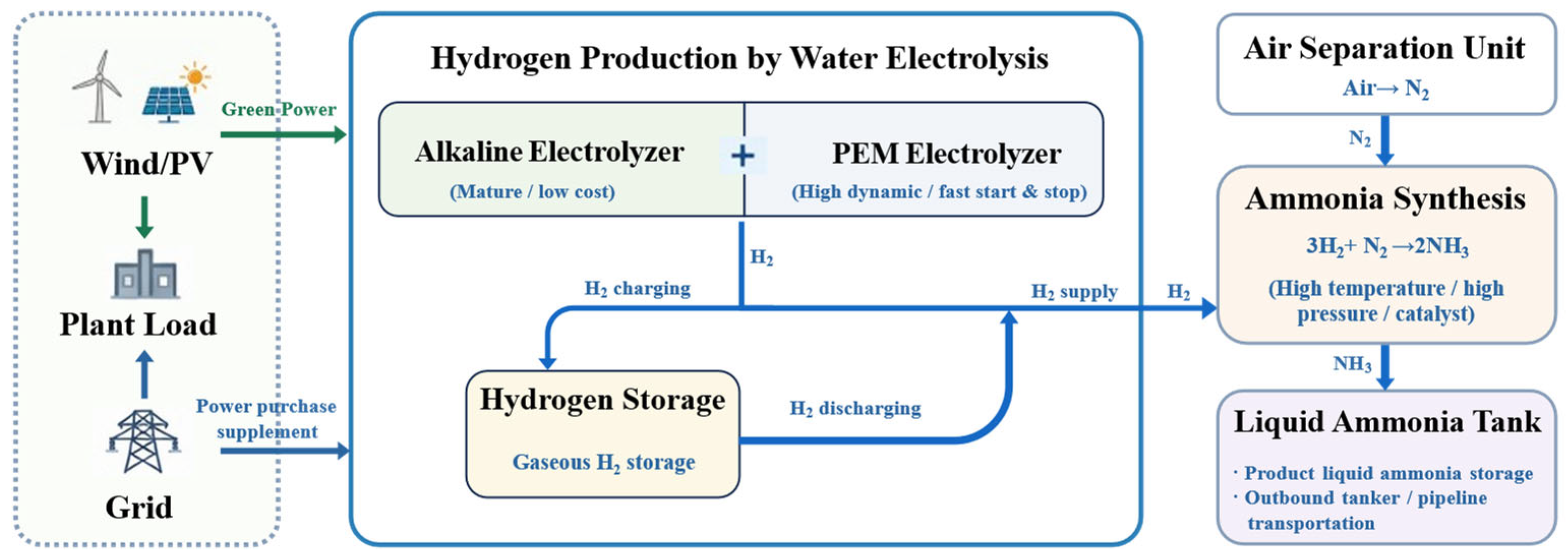
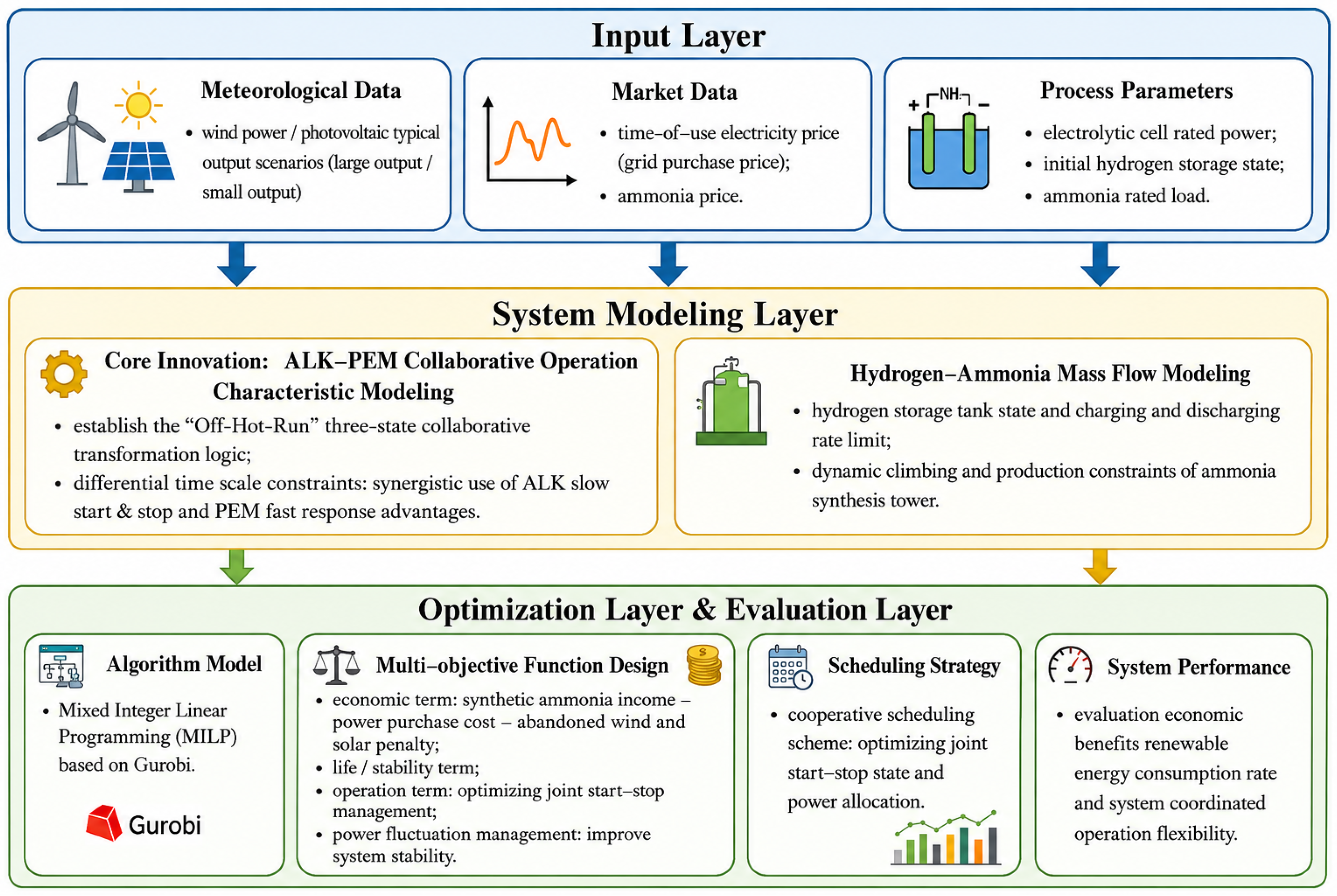
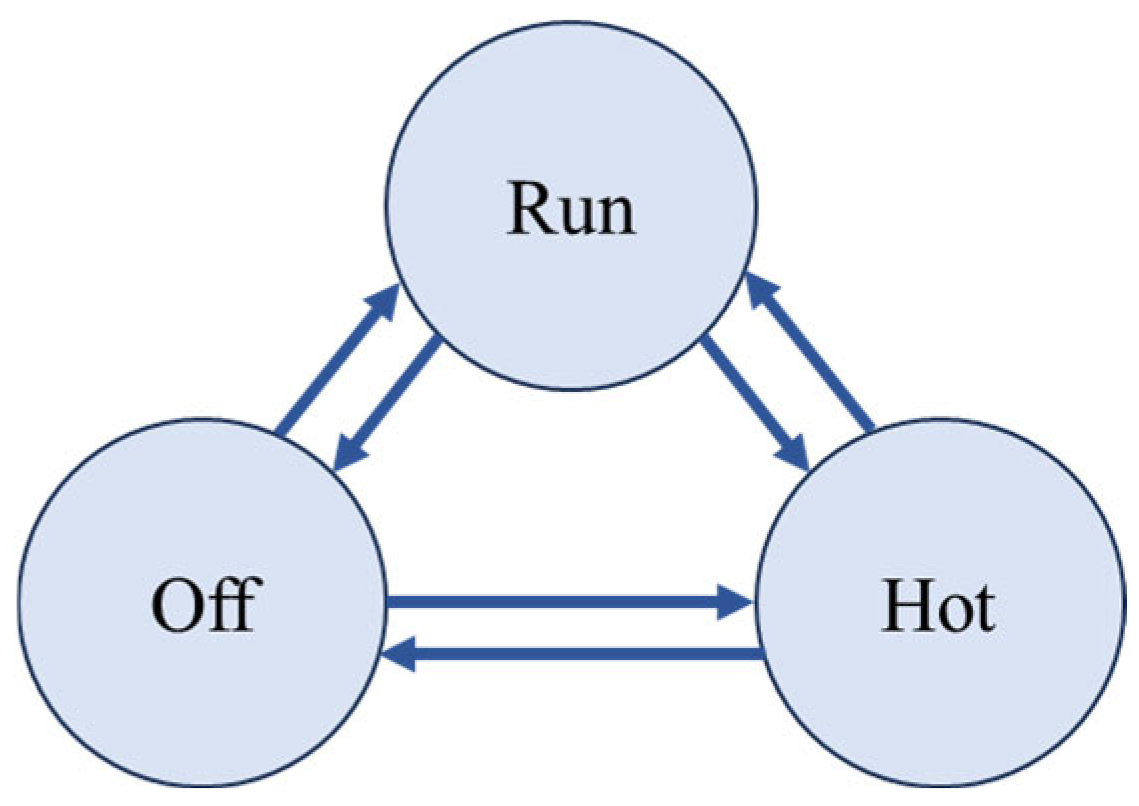
- A refined physical model of heterogeneous equipment is established. An integrated MILP model is developed for the full chain of “wind–solar power, hybrid hydrogen production, hydrogen storage, and ammonia synthesis.” The shutdown, hot-standby, and operating states of electrolyzers are described through state-transition logic. Differentiated cold-start times and hot-standby power parameters are introduced to accurately represent the heterogeneous dynamic characteristics of ALK and PEM electrolyzers in practical operation.
- (2)
- A continuous-constraint-based platform-like flexible scheduling criterion for ammonia synthesis is designed. A flexible evaluation mechanism based on a chemical load fluctuation penalty is proposed for the ammonia synthesis section. This mechanism balances the conflict between maximizing ammonia production and maintaining process stability. The ammonia synthesis load is treated as a continuous decision variable, and strict mathematical constraints are imposed on its allowable load range and ramping rate.
- (3)
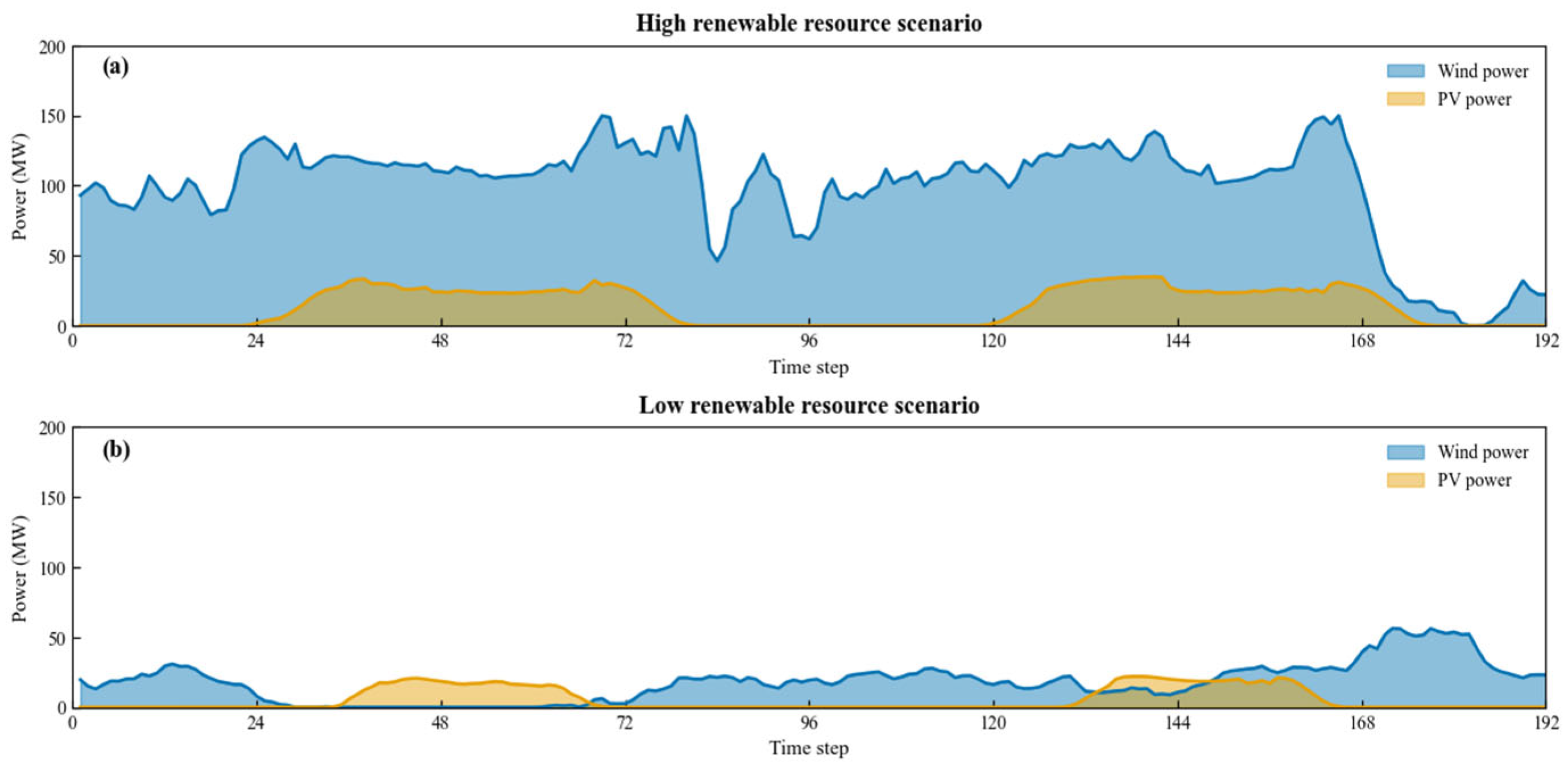
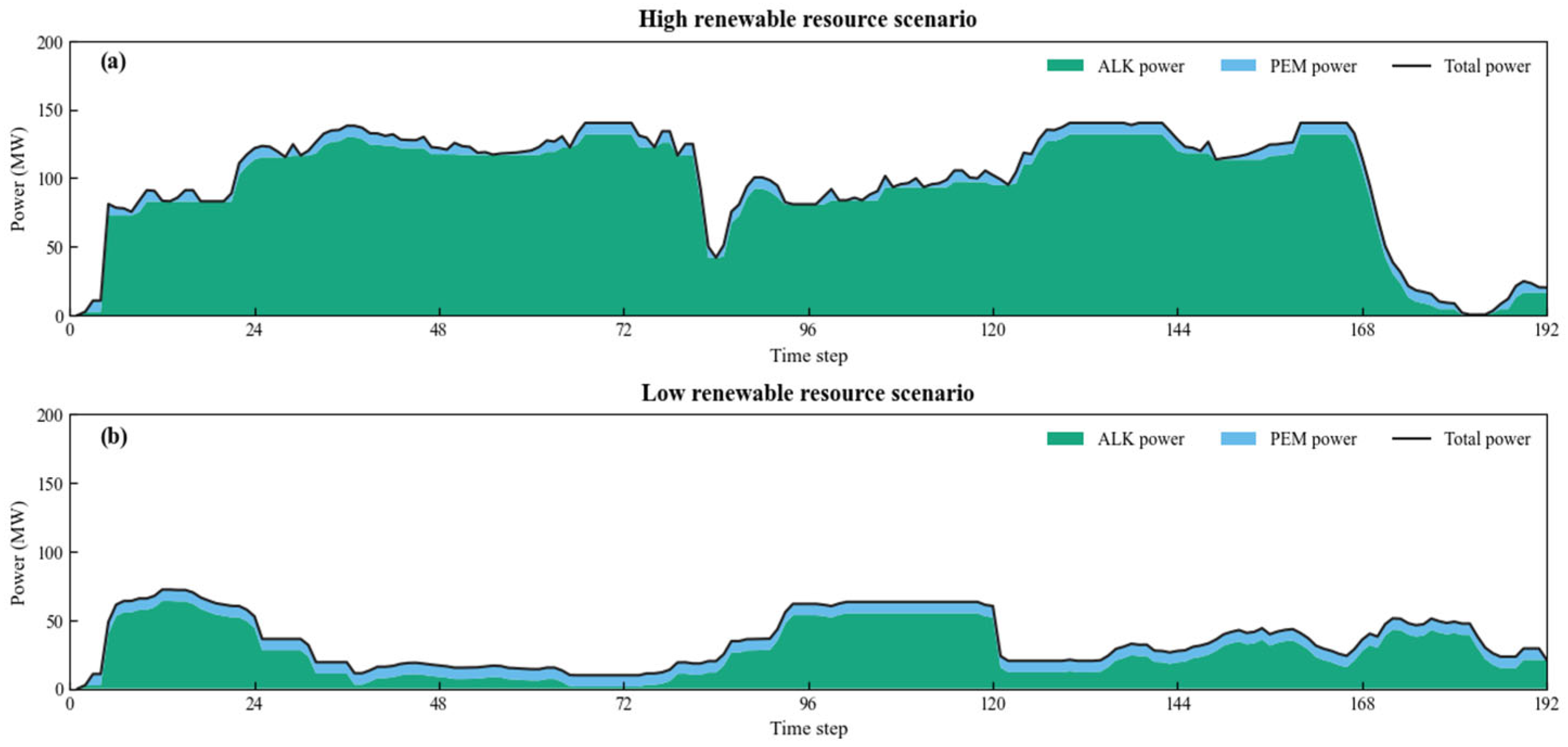
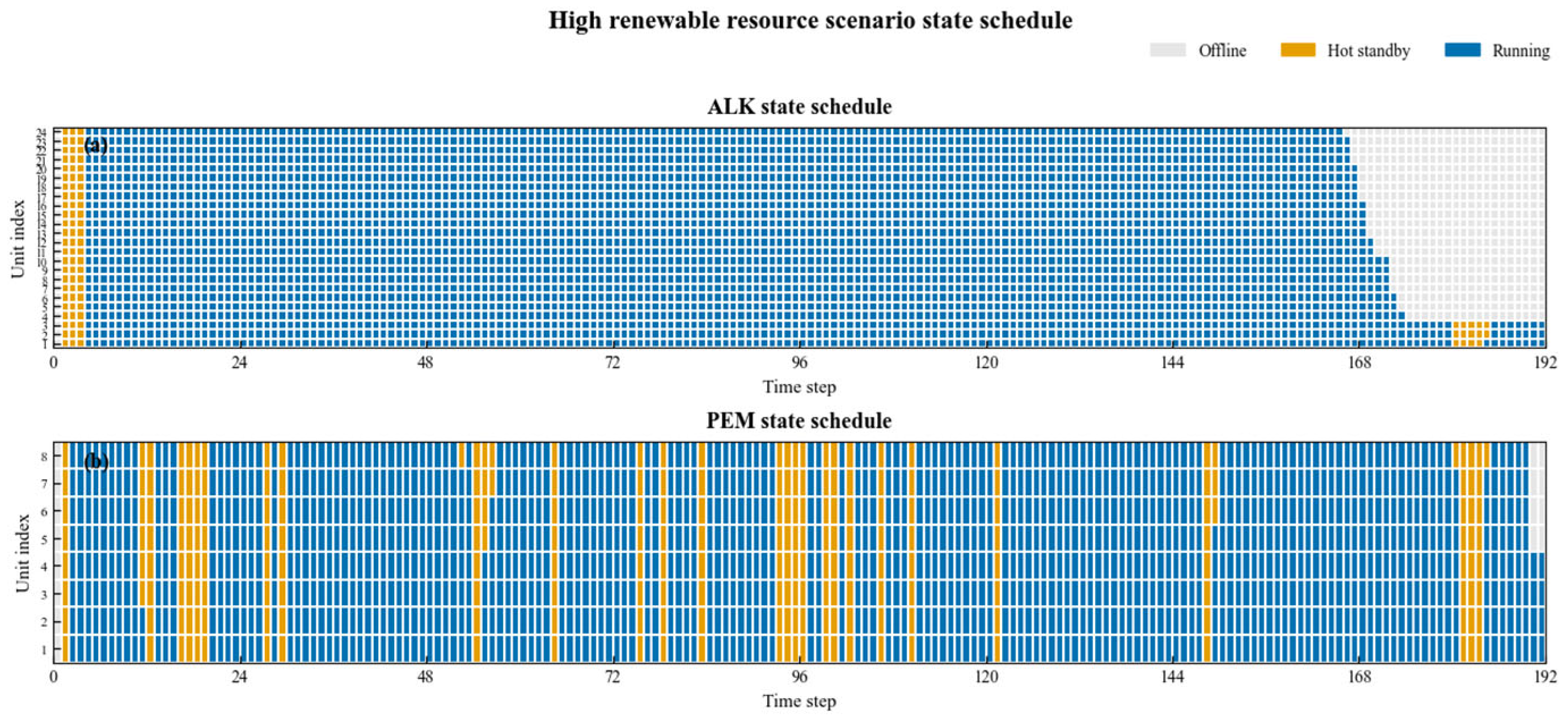
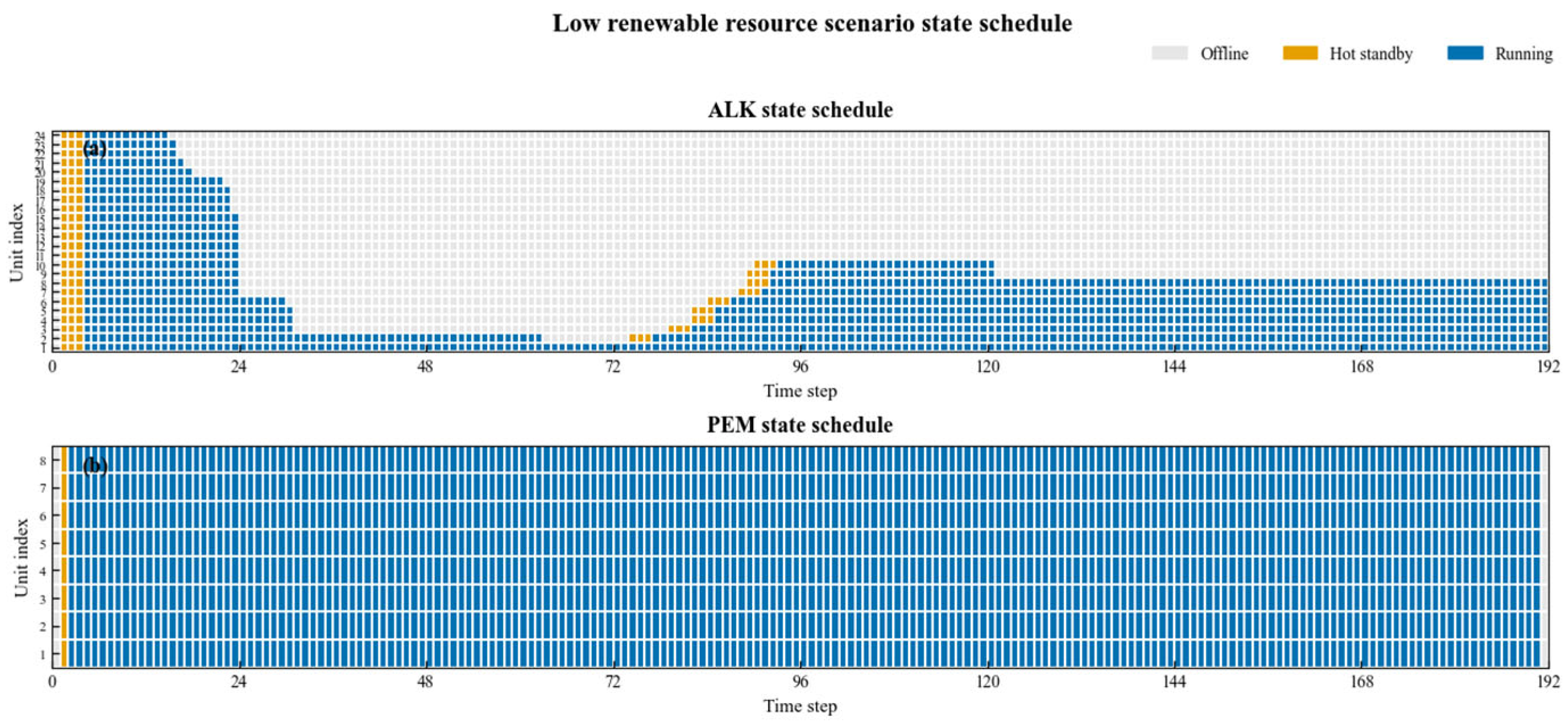
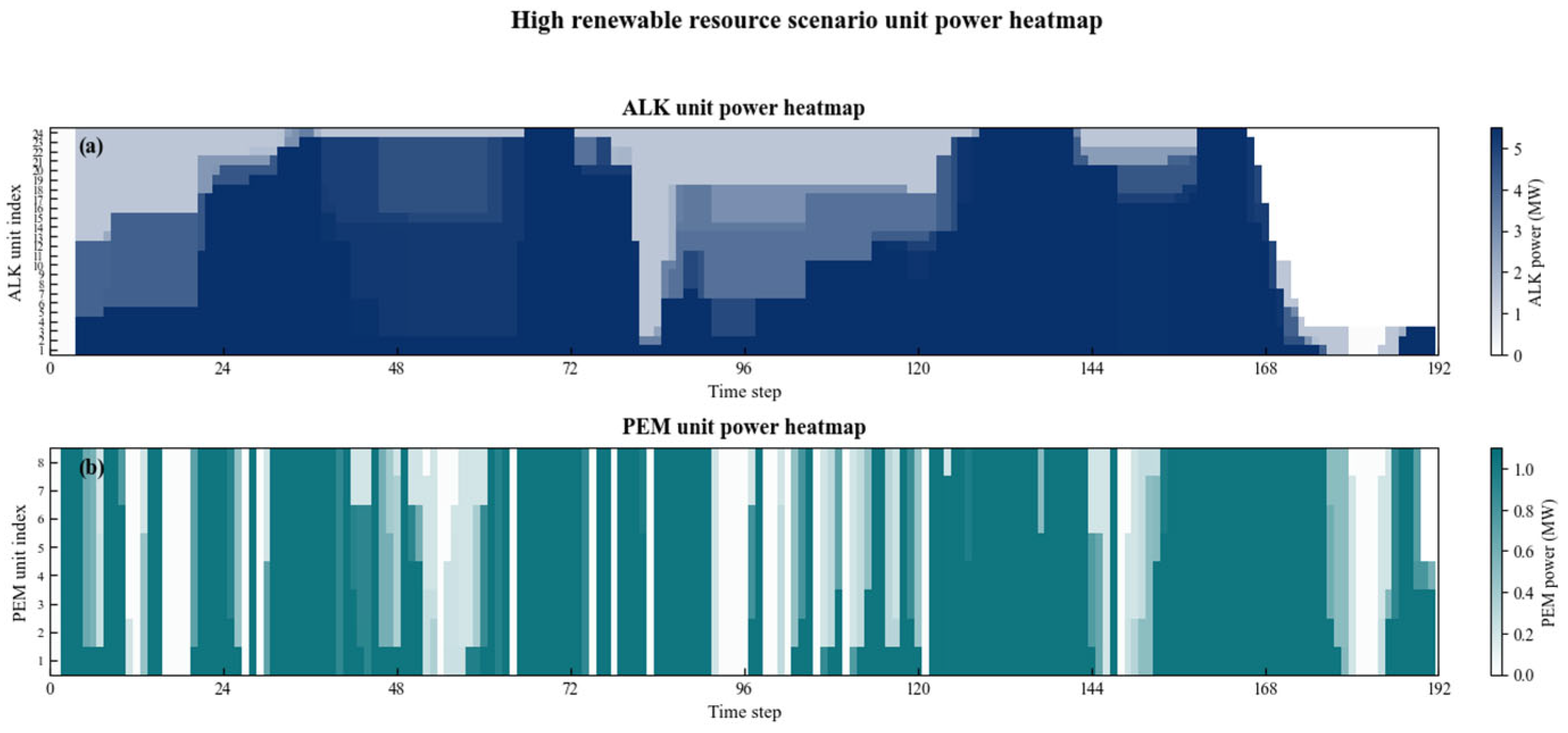
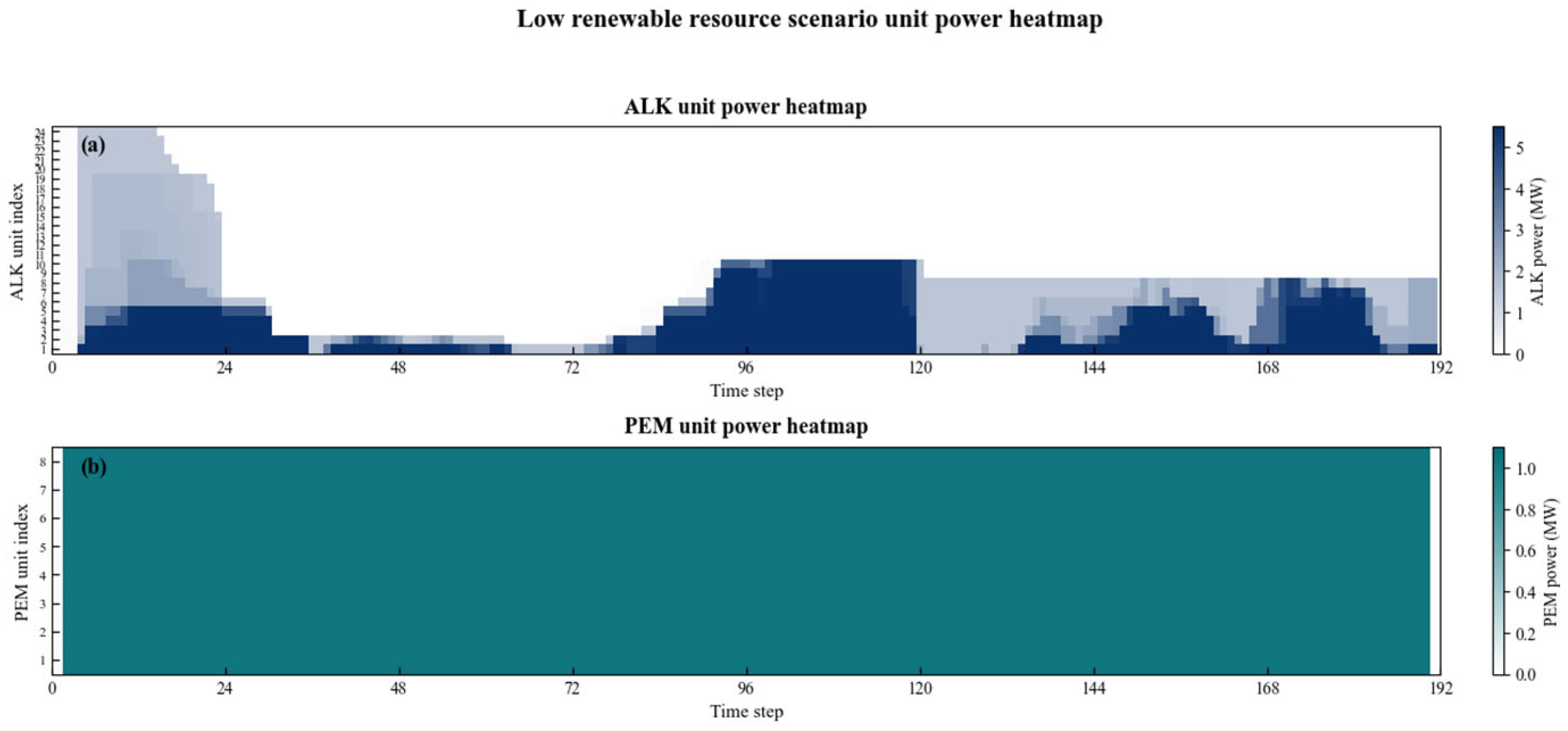
- The underlying coordination mechanism of the hybrid hydrogen production system is revealed. Based on real wind and solar meteorological data with a 15 min resolution over two consecutive days, the power allocation and state evolution of hydrogen storage, ALK electrolyzers, and PEM electrolyzers are compared under high- and low-renewable-resource scenarios. The results reveal a coordinated operating paradigm in which ALK electrolyzers provide stable base-load support, while PEM electrolyzers deliver fast and flexible regulation. This further clarifies the basic dispatch logic of the hybrid hydrogen production system.
2. System Structure and Research Framework
2.1. Composition of the Green Ammonia System
2.2. Synergistic Operation Mechanism of ALK–PEM
2.3. Optimal Scheduling Framework
3. Green Ammonia System Optimal Scheduling Model
3.1. Power Balance Constraints
3.2. ALK–PEM Hybrid Hydrogen Production Cluster Model
3.3. Hydrogen Storage Section
3.4. Air Separation Nitrogen Production Section
3.5. Ammonia Synthesis Section
3.6. Objective Function and Decision Variables
4. Case Study
4.1. Case Scenarios and Parameter Settings
4.2. Renewable-Resource Characteristics and Overall Scheduling Results
4.3. Analysis of the Coordinated Operation Characteristics of ALK–PEM Electrolyzers
4.4. Comprehensive Economic Performance and Operational Adaptability
5. Conclusions
- (1)
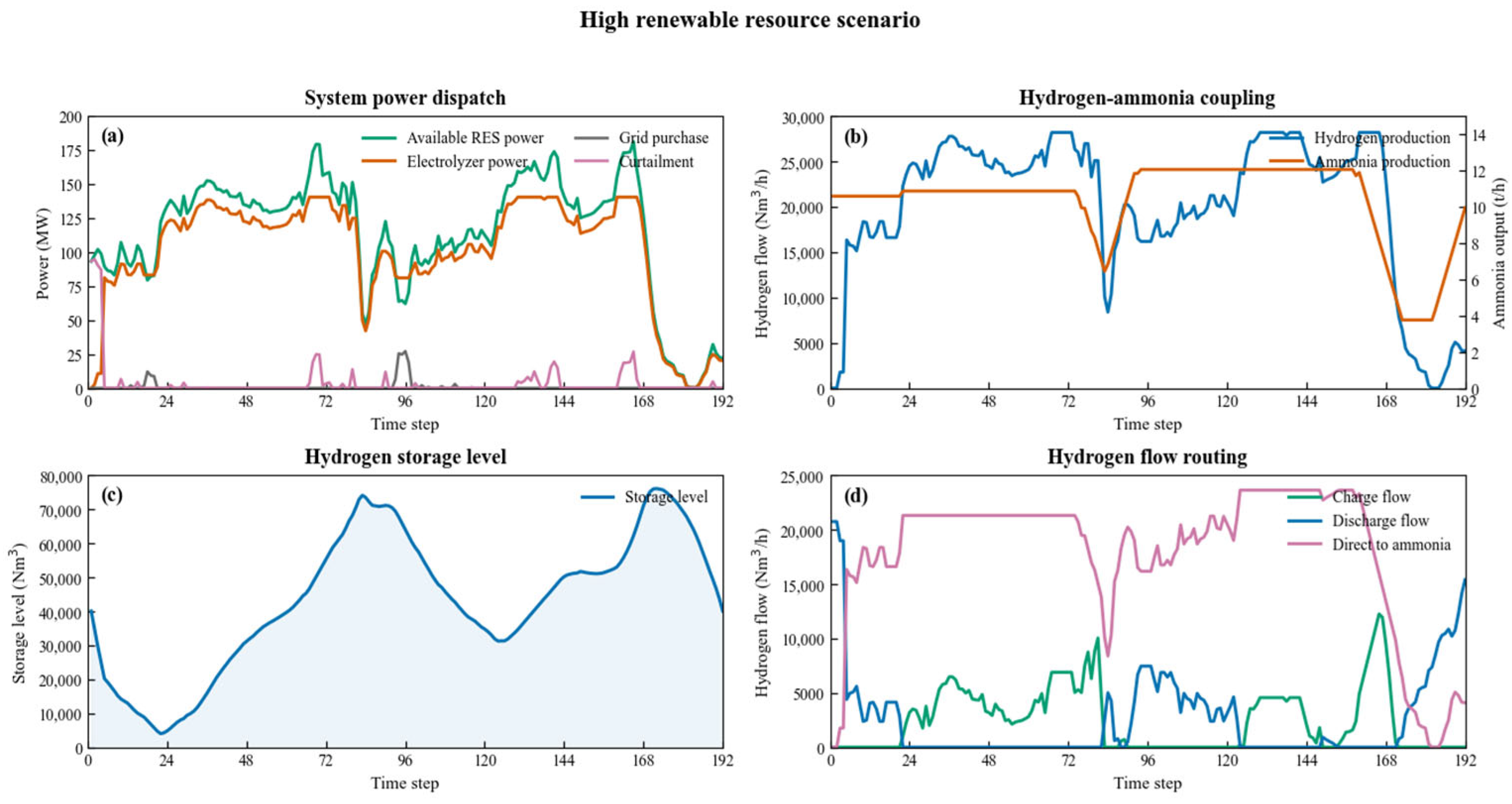
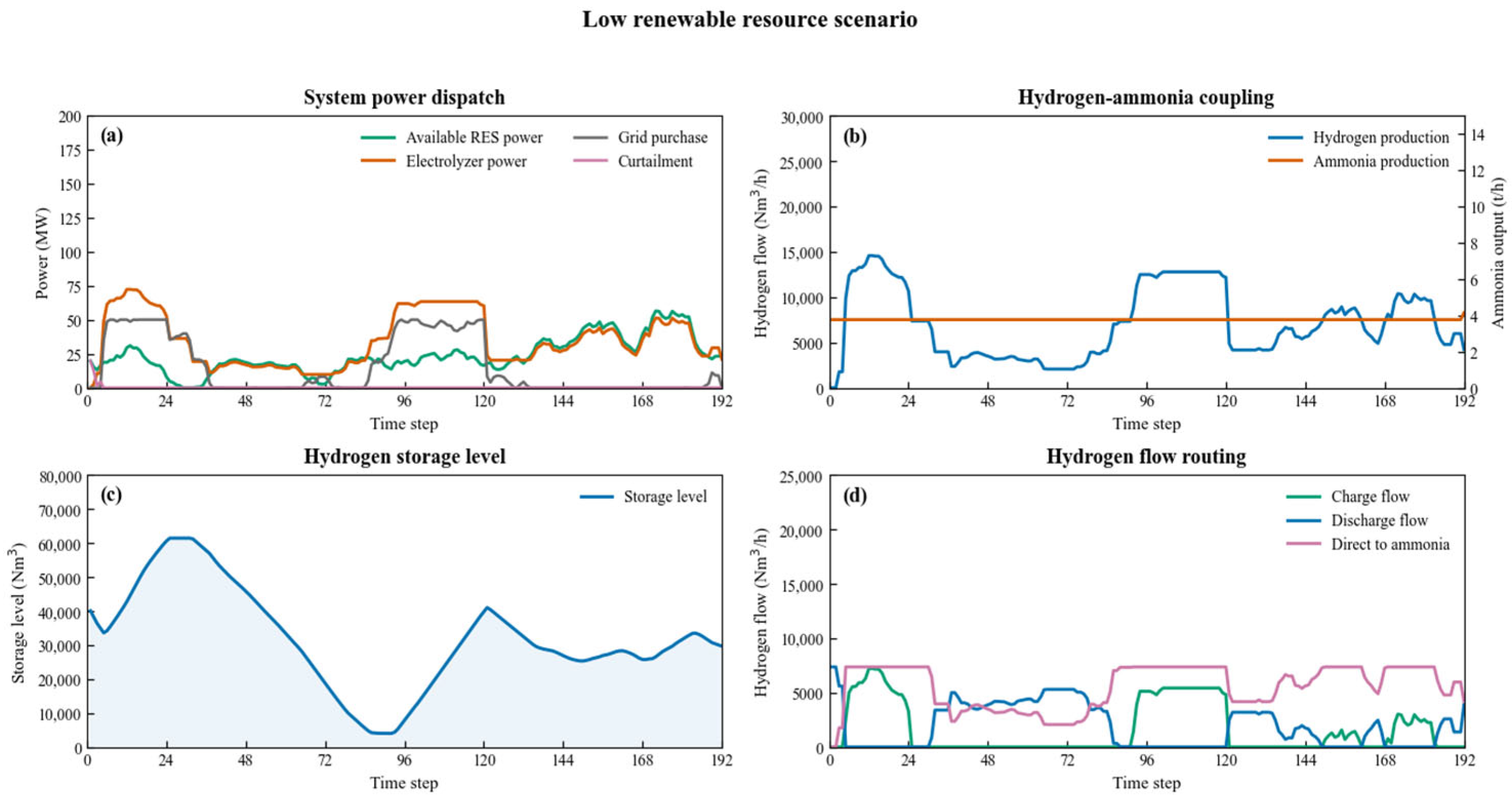
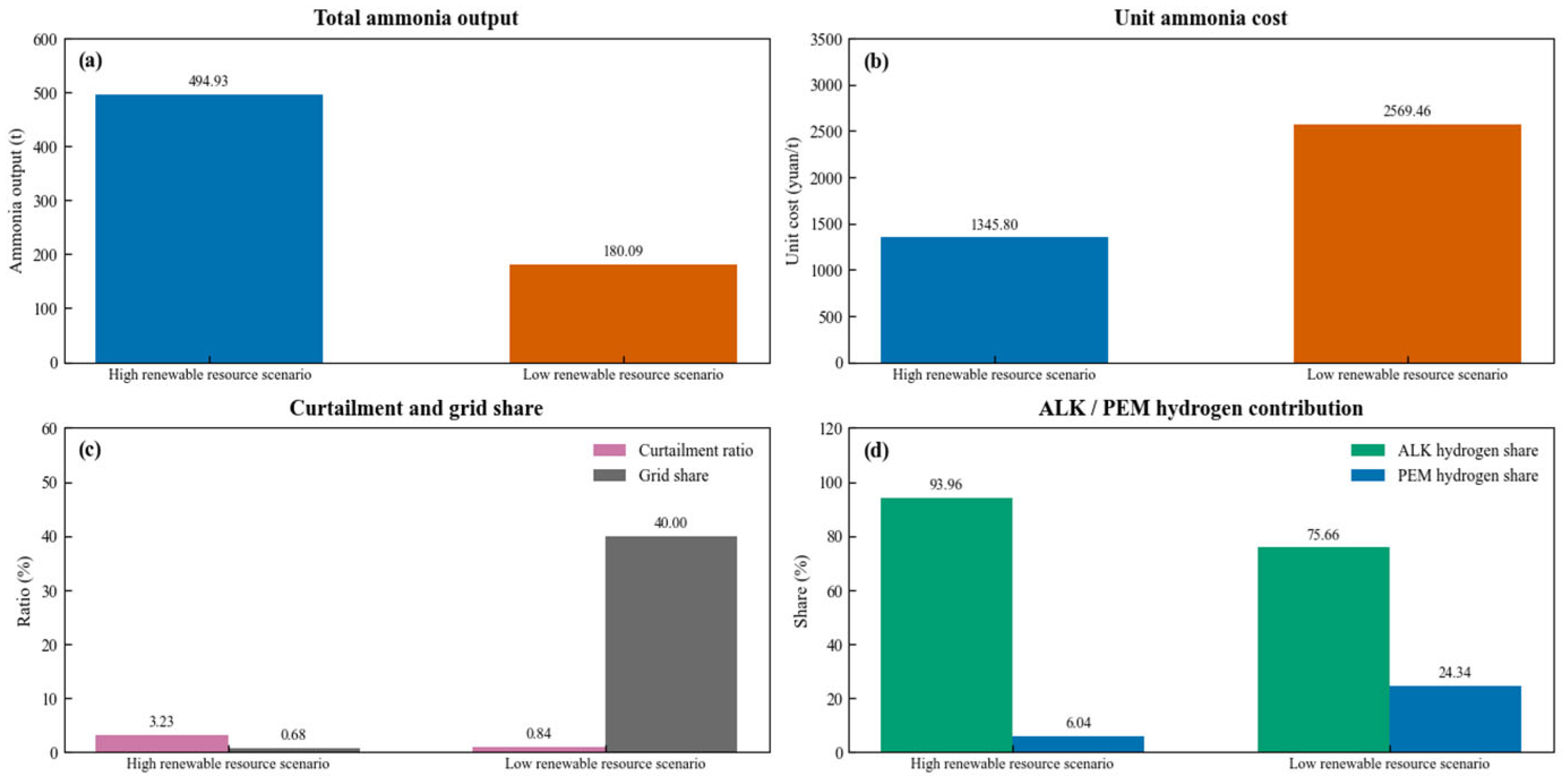
- The proposed model can effectively describe the multi-section coupled scheduling characteristics of a weakly grid-connected green ammonia system. In the high-resource scenario, the ammonia production is 494.93 t, the curtailment rate is 3.23%, and the grid electricity share is 0.68%. In the low-resource scenario, the ammonia production is 180.09 t, the curtailment rate is 0.84%, and the grid electricity share is 40%. These results show that feasible scheduling schemes can be obtained in both scenarios. The high-resource scenario reflects the renewable-energy conversion capability, while the low-resource scenario reflects the ability to ensure continuous production.
- (2)
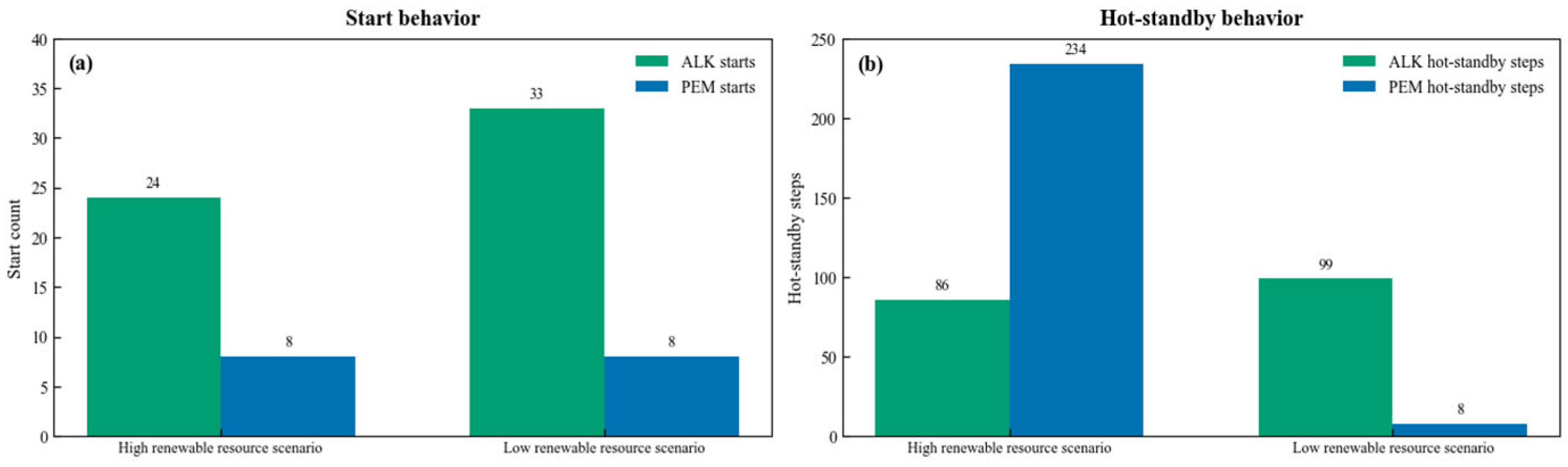
- ALK and PEM electrolyzers form an adaptive division of labor under different resource conditions. In the high-resource scenario, ALK electrolyzers contribute 93.96% of the total hydrogen production and serve as the main units for large-scale hydrogen production. In the low-resource scenario, the hydrogen production share of PEM electrolyzers increases to 24.34%, and PEM units maintain a high online level. This indicates that PEM electrolyzers undertake more important marginal regulation tasks when renewable resources are insufficient and fluctuations become more significant. The advantage of the hybrid electrolyzer configuration is that it can provide both large-scale low-cost hydrogen production and fast power matching.
- (3)
- The hydrogen storage unit and the platform-like flexible ammonia synthesis load jointly reduce the impact of wind and PV fluctuations on the chemical process. In the high-resource scenario, the hydrogen inventory reaches the safety boundaries of 4000–76,000 Nm3, mainly to expand the renewable-energy absorption boundary. In the low-resource scenario, the maximum hydrogen inventory is 61,339.90 Nm3, and hydrogen storage is mainly used to maintain continuous hydrogen supply and inventory safety. The ammonia synthesis load shows multi-platform operation in the high-resource scenario and almost remains at the minimum steady state in the low-resource scenario. This indicates that the core role of flexible ammonia synthesis operation is to form orderly load regulation within the process-acceptable range.
- (4)
- System economic performance is highly sensitive to renewable-resource availability and the share of grid electricity. In the high-resource scenario, the unit ammonia production cost is 1345.80 CNY/t, and the total profit is 818,716.75 CNY. In the low-resource scenario, the unit ammonia production cost increases to 2569.46 CNY/t, and the total profit decreases to 77,538.13 CNY. A low curtailment rate does not necessarily correspond to better economic performance. When renewable energy is insufficient to support continuous chemical production, dependence on grid electricity and the low-output dilution effect can significantly increase the unit cost.
Author Contributions
Funding
Data Availability Statement
Conflicts of Interest
Nomenclature
| PV | Photovoltaic |
| ALK | Alkaline electrolyzer |
| PEM | Proton exchange membrane electrolyzer |
| MILP | Mixed-integer linear programming |
| t | Index for time periods |
| Total renewable-energy output | |
| Wind power at time t | |
| PV power at time t | |
| Grid-purchased power at time t | |
| Power for water electrolysis at time t | |
| Auxiliary power consumption at time t | |
| Curtailed power at time t | |
| Auxiliary power coefficient | |
| Grid purchase constraint coefficient | |
| Maximum purchased power | |
| Dispatch time step | |
| i, j | The i-th ALK electrolyzer, the j-th PEM electrolyzer |
| m | A represents ALK electrolyzer, P represents PEM electrolyzer, |
| The number of ALK and PEM electrolyzers | |
| Shutdown state of m-th electrolyzer i at t time | |
| Hot standby state of m-th electrolyzer i at t time | |
| Running state of m-th electrolyzer i at t time | |
| Hydrogen production of m-th electrolyzer i at t time | |
| Hydrogen power of m-th electrolyzer i at t time | |
| Rated hydrogen production capacity of ALK electrolyzer | |
| Rated hydrogen production capacity of PEM electrolyzer | |
| Lower limits of ALK and PEM electrolyzer load rate | |
| Upper limits of ALK and PEM electrolyzer load rate | |
| Start-up variable of m-th electrolyzer | |
| Shutdown variable m-th electrolyzer | |
| Unit hydrogen production power consumption coefficient of m-th electrolyzer | |
| Hot standby power of m-th electrolyzer | |
| Unit hydrogen production power consumption coefficient of ALK electrolyzer | |
| Unit hydrogen production power consumption coefficient of PEM electrolyzer | |
| Total hydrogen production | |
| Length of cold start of electrolytic cell | |
| Hydrogen storage capacity of time t | |
| Hydrogen flow directly into the synthetic ammonia section at time t | |
| Hydrogen storage charge flow at time t | |
| Hydrogen storage discharge flow at time t | |
| Total hydrogen consumption of the synthetic ammonia section at time t | |
| Upper capacity limit of the hydrogen storage tank | |
| Minimum inventory ratios | |
| Maximum inventory ratios | |
| Charging state of hydrogen storage tank at t time | |
| Discharging state of hydrogen storage tank at t time | |
| Idle state of hydrogen storage tank at t time | |
| Upper limits of charging hydrogen flow | |
| Upper limits of discharging hydrogen flow | |
| Nitrogen demand at t time | |
| Hydrogen-to-nitrogen ratio constant | |
| Ammonia production rate at t time | |
| Hydrogen consumption coefficient per unit ammonia production | |
| Minimum ammonia production rates | |
| Maximum ammonia production rates | |
| Lower ramping rates | |
| Upper ramping rates | |
| Ammonia selling price | |
| The time-of-use electricity purchase price | |
| The renewable-electricity cost | |
| The ammonia sales revenue | |
| The electricity purchase cost | |
| The renewable-electricity utilization cost | |
| The start-up and shutdown penalty of electrolyzers | |
| The fluctuation penalty of the ammonia load | |
| The fluctuation penalty of the ALK cluster | |
| The fluctuation penalty of the PEM cluster | |
| The fluctuation penalty of the ALK individual units | |
| The fluctuation penalty of the PEM individual units | |
| Start-up penalty parameter of ALK electrolyzer | |
| Start-up penalty parameter of PEM electrolyzer | |
| Shutdown penalty parameter of ALK electrolyzer | |
| Shutdown penalty parameter of PEM electrolyzer | |
| The fluctuation penalty absolute value auxiliary variable of the ammonia load | |
| The fluctuation penalty absolute value auxiliary variable of the ALK cluster | |
| The fluctuation penalty absolute value auxiliary variable of the PEM cluster | |
| The fluctuation penalty absolute value auxiliary variable of the ALK individual units | |
| The fluctuation penalty absolute value auxiliary variable of the PEM individual units | |
| Fluctuation penalty parameter of the ammonia load | |
| Fluctuation penalty parameter of the ALK cluster | |
| Fluctuation penalty parameter of the PEM cluster | |
| Fluctuation penalty parameter of the ALK individual units | |
| Fluctuation penalty parameter of the PEM individual units |
References
- Calise, F.; Cappiello, F.L.; Cimmino, L.; Dentice d’Accadia, M.; Vicidomini, M. Thermo-economic analysis and dynamic simulation of a novel layout of a renewable energy community for an existing residential district in Italy. Energy Convers. Manag. 2024, 313, 118582. [Google Scholar] [CrossRef] [Scilit]
- Kebede, M.H.; Ustolin, F.; Völler, S.; Korpås, M.; Oleinikova, I. System integration of large-scale green hydrogen production: Conceptualization, challenges, and opportunities. Energy Convers. Manag. X 2025, 28, 101365. [Google Scholar] [CrossRef] [Scilit]
- Salmon, N.; Bañares-Alcántara, R. Green ammonia as a spatial energy vector: A review. Sustain. Energy Fuels 2021, 5, 2814–2839. [Google Scholar] [CrossRef] [Scilit]
- Fasihi, M.; Weiss, R.; Savolainen, J.; Breyer, C. Global potential of green ammonia based on hybrid PV-wind power plants. Appl. Energy 2021, 294, 116170. [Google Scholar] [CrossRef] [Scilit]
- Hasan, M.H.; Mahlia, T.M.; Mofijur, M.; Rizwanul Fattah, I.M.; Handayani, F.; Ong, H.C.; Silitonga, A.S. A Comprehensive Review on the Recent Development of Ammonia as a Renewable Energy Carrier. Energies 2021, 14, 3732. [Google Scholar] [CrossRef] [Scilit]
- Zheng, Y.; Zhu, S.; Yang, D.; Li, J.; Rong, F.; Ji, X.; He, G. A Multi-Time Scale Optimal Dispatch Strategy for Green Ammonia Production Using Wind–Solar Hydrogen Under Renewable Energy Fluctuations. Energies 2025, 18, 6518. [Google Scholar] [CrossRef] [Scilit]
- Liu, J.; Liu, Y.; Shen, Q.; Li, K.; Chen, Y. A hybrid artificial intelligence and deep learning architecture for accurate renewable energy forecasting: Comprehensive case studies on wind and PV power. Sustain. Energy Technol. Assess. 2026, 85, 104812. [Google Scholar] [CrossRef] [Scilit]
- Li, C.; Shah, N.; Li, Z.; Liu, P. Modelling of wind and solar power output uncertainty in power systems based on historical data: A characterisation through deterministic parameters. J. Clean. Prod. 2024, 484, 144233. [Google Scholar] [CrossRef] [Scilit]
- Wu, H.; Kong, Q.; Huber, M.; Sun, M.; Craig, M.T. Climate change will increase high-temperature risks, degradation, and costs of rooftop photovoltaics globally. Joule 2026, 10, 102218. [Google Scholar] [CrossRef] [Scilit]
- Verleysen, K.; Parente, A.; Contino, F. How sensitive is a dynamic ammonia synthesis process? Global sensitivity analysis of a dynamic Haber-Bosch process (for flexible seasonal energy storage). Energy 2021, 232, 121016. [Google Scholar] [CrossRef] [Scilit]
- Cheema, I.I.; Krewer, U. Operating envelope of Haber–Bosch process design for power-to-ammonia. RSC Adv. 2018, 8, 34926–34936. [Google Scholar] [CrossRef] [Scilit]
- Zhang, X.; Li, G.; Zhou, Z.; Nie, L.; Dai, Y.; Ji, X.; He, G. How to Achieve Flexible Green Ammonia Production: Insights via Three-Dimensional Computational Fluid Dynamics Simulation. Ind. Eng. Chem. Res. 2024, 63, 12547–12560. [Google Scholar] [CrossRef] [Scilit]
- Park, J.; Kang, S.; Kim, S.; Kim, H.; Cho, H.-S.; Lee, J.H. Comparative techno-economic evaluation of alkaline and proton exchange membrane electrolysis for hydrogen production amidst renewable energy source volatility. Energy Convers. Manag. 2025, 325, 119423. [Google Scholar] [CrossRef] [Scilit]
- Hu, H.; Chen, F.; Xu, Y.; Ye, H.; Hou, Z.; Zhang, B.; Chen, X. Triple-level cost-effective sizing optimization for solar-powered hybrid hydrogen system with PEM and alkaline electrolyzers. Energy 2025, 334, 137647. [Google Scholar] [CrossRef] [Scilit]
- Huang, C.; Zong, Y.; You, S.; Træholt, C. Analytical Modeling and Control of Grid-Scale Alkaline Electrolyzer Plant for Frequency Support in Wind-Dominated Electricity-Hydrogen Systems. IEEE Trans. Sustain. Energy 2023, 14, 217–232. [Google Scholar] [CrossRef] [Scilit]
- Trinke, P.; Haug, P.; Brauns, J.; Bensmann, B.; Hanke-Rauschenbach, R.; Turek, T. Hydrogen Crossover in PEM and Alkaline Water Electrolysis: Mechanisms, Direct Comparison and Mitigation Strategies. J. Electrochem. Soc. 2018, 165, F502. [Google Scholar] [CrossRef] [Scilit]
- Hossain, M.B.; Islam, M.R.; Muttaqi, K.M.; Sutanto, D.; Agalgaonkar, A.P. Power System Dynamic Performance Analysis Based on Frequency Control by Proton Exchange Membrane Electrolyzers. IEEE Trans. Ind. Appl. 2023, 59, 4998–5008. [Google Scholar] [CrossRef] [Scilit]
- Kiemel, S.; Smolinka, T.; Lehner, F.; Full, J.; Sauer, A.; Miehe, R. Critical materials for water electrolysers at the example of the energy transition in Germany. Int. J. Energy Res. 2021, 45, 9914–9935. [Google Scholar] [CrossRef] [Scilit]
- Liu, B.; Maréchal, F. Optimal design and operation of a green ammonia production system considering multi-electrolyzer operation. Appl. Therm. Eng. 2025, 274, 126534. [Google Scholar] [CrossRef] [Scilit]
- Lin, L.; Li, X.; Ou, K.; Xing, J.; Wang, Y.-X. Mixed integer linear programming-based optimal capacity configuration of ALK/PEM mixed water electrolysis system. Energy 2025, 333, 137419. [Google Scholar] [CrossRef] [Scilit]
- Shi, S.; Pan, Y.; Li, Y.; Wang, H.; Lu, Y. Capacity configuration and optimization of an off-grid wind-solar-hydrogen integrated system considering hybrid hydrogen production with alkaline electrolyzers and proton exchange membrane electrolyzers. Renew. Energy 2026, 258, 124814. [Google Scholar] [CrossRef] [Scilit]
- Wu, H.; Qiu, D.; Zhang, L.; Sun, M. Adaptive multi-agent reinforcement learning for flexible resource management in a virtual power plant with dynamic participating multi-energy buildings. Appl. Energy 2024, 374, 123998. [Google Scholar] [CrossRef] [Scilit]
- Pagani, G.; Hajimolana, Y.; Acar, C. Green hydrogen for ammonia production—A case for the Netherlands. Int. J. Hydrogen Energy 2024, 52, 418–432. [Google Scholar] [CrossRef] [Scilit]
- Sousa, J.; Waiblinger, W.; Friedrich, K.A. Techno-economic Study of an Electrolysis-Based Green Ammonia Production Plant. Ind. Eng. Chem. Res. 2022, 61, 14515–14530. [Google Scholar] [CrossRef] [Scilit]
- Liang, X.; Tang, Y.; Peng, S.; Wang, X.; Tang, J.; Liu, H.; Xie, J.; Zhang, H.; Ma, X. Techno-environmental-economic assessment of green ammonia production system integrated with off-grid offshore wind power. Int. J. Hydrogen Energy 2025, 184, 151902. [Google Scholar] [CrossRef] [Scilit]
- Qiu, Y.; Zhou, Y.; Chen, S.; Zang, T.; Zhou, B. Flexibility assessment and aggregation of alkaline electrolyzers considering dynamic process constraints for energy management of renewable power-to-hydrogen systems. Renew. Energy 2024, 235, 121261. [Google Scholar] [CrossRef] [Scilit]
- Wu, H.; Sun, M.; Craig, M.T. Updating global green-hydrogen production costs and configurations under future climates. Innovation 2026, 7, 101303. [Google Scholar] [CrossRef] [Scilit] [PubMed]
- Zhang, Q.; Xie, D.; Zeng, Y.; Liu, Y.; Yu, H.; Liu, S. Optimizing wind-solar hydrogen production through collaborative strategy with ALK/PEM multi-electrolyzer arrays. Renew. Energy 2024, 232, 121116. [Google Scholar] [CrossRef] [Scilit]
- Tang, Y.; Zheng, Z.; Min, F.; Xie, J.; Yang, H. An optimization framework for component sizing and energy management of hybrid electrolyzer systems considering physical characteristics of alkaline electrolyzers and proton exchange membrane electrolyzers. Renew. Energy 2025, 243, 122555. [Google Scholar] [CrossRef] [Scilit]
- Xie, Z.; Fan, Y.; Hou, J.; Bai, X. Multi-Time-Scale Coordinated Optimization Scheduling Strategy for Wind–Solar–Hydrogen–Ammonia Systems. Electronics 2026, 15, 795. [Google Scholar] [CrossRef] [Scilit]
- Peng, C.; Wu, Y.; Zhang, Y.; Wang, Z.; Xue, F.; Xu, H. Coordinated dispatch of alkaline and PEM electrolyzers: A stochastic optimization approach under renewable energy uncertainty. Int. J. Hydrogen Energy 2025, 193, 152237. [Google Scholar] [CrossRef] [Scilit]
- Zhou, J.; Zhang, Z.; Zhang, R.; Zhang, W.; Xu, G.; Wang, H. Optimal capacity and multi-stable flexible operation strategy of green ammonia systems: Adapting to fluctuations in renewable energy. Energy Convers. Manag. 2024, 314, 118720. [Google Scholar] [CrossRef] [Scilit]
- Ji, X.; Lin, J.; Nie, L.; Zhou, L.; Yuan, S.; Zhang, H.; He, G.; Dai, Y. Multistable—Flexible ammonia process adapted to renewable energy. Clean Coal Technol. 2024, 30, 23–35. [Google Scholar] [CrossRef]
- Zhao, J.; Hu, Z.; Yang, J.; Wang, J.; Zan, L.; Ji, X.; He, G. Adaptive Feature Selection and Random Forest Modeling for Green Ammonia Production Process. Chem. Eng. Technol. 2025, 48, e70076. [Google Scholar] [CrossRef] [Scilit]
- Liu, D.; Wang, Y.; Xiong, M.; Wang, Z.; Zhou, L.; He, G.; Ji, X. Capacity Configuration and Operation Scheduling for Green Ammonia Production. Ind. Eng. Chem. Res. 2025, 64, 13289–13306. [Google Scholar] [CrossRef] [Scilit]
- Buttler, A.; Spliethoff, H. Current status of water electrolysis for energy storage, grid balancing and sector coupling via power-to-gas and power-to-liquids: A review. Renew. Sustain. Energy Rev. 2018, 82, 2440–2454. [Google Scholar] [CrossRef] [Scilit]
- Yang, S.; Fan, Y.; Hou, J.; Bai, X. Capacity optimization model for an ALK-PEM electrolytic hydrogen production system considering the stabilization of wind and PV fluctuations. Power Syst. Prot. Control 2024, 52, 85–96. [Google Scholar] [CrossRef]
- Zhang, Y.; Zhang, N.; Ji, X.; Dong, Z.; Ye, P.; Wang, Y. Power Distribution Strategy for Hybrid Electrolytic Hydrogen Production Systems Considering Second-Level Response Characteristics. Autom. Electr. Power Syst. 2026, 50, 218–230. [Google Scholar]
- Ding, S.; Tian, Z.; Hu, S.; Guo, B.; Yang, H.; Yang, F.; Ouyang, M. Study on multi-power-level configuration scheme and scheduling strategy for multi-stack alkaline water electrolysis system in off-grid wind power scenario. Energy Convers. Manag. 2024, 314, 118714. [Google Scholar] [CrossRef] [Scilit]



| Parameter | Unit | ALK Electrolyzer | PEM Electrolyzer |
|---|---|---|---|
| Electrolysis efficiency | % | 60~75 | 70~90 |
| Load regulation range | % | 30~110 | 20~110 |
| Cold start-up time | min | 45 | 15 |
| Ramp rate | %/s | 8 | 25 |
| Hydrogen production energy consumption | kWh/Nm3 | 4.5~5.5 | 3.8~5.0 |
| Parameter | Value | Parameter | Value |
|---|---|---|---|
| Scheduling time step | 0.25 h | ALK electricity-to-hydrogen coefficient | 0.0050 MWh/Nm3 |
| Total number of time steps | 192 | PEM electricity-to-hydrogen coefficient | 0.0047 MWh/Nm3 |
| Number of ALK electrolyzers | 24 units | Hydrogen storage capacity | 80,000 Nm3 |
| Number of PEM electrolyzers | 8 units | Initial hydrogen storage | 40,000 Nm3 |
| Rated hydrogen production of one ALK unit | 1000 Nm3/h | Maximum hydrogen charging/discharging rate | 10,000 Nm3/h |
| Rated hydrogen production of one PEM unit | 200 Nm3/h | Load range | 3.75–13.75 t/h |
| ALK load range | 0.3–1.1 | Load ramping range | −2.5–2.5 t/h |
| PEM load range | 0.2–1.1 | Grid electricity purchase constraint coefficient | 0.4 |
| ALK cold-start time | 0.75 h | Grid electricity price, 09:00–21:00 | 980 CNY/MWh |
| PEM cold-start time | 0.25 h | Grid electricity price, 06:00–09:00/21:00–23:00 | 680 CNY/MWh |
| ALK hot-standby power | 0.10 MW/unit | Grid electricity price, 23:00–06:00 | 370 CNY/MWh |
| PEM hot-standby power | 0.02 MW/unit |
| Indicator | High-Renewable-Resource Scenario | Low-Renewable-Resource Scenario |
|---|---|---|
| Available wind and PV electricity/MWh | 5438.23 | 1122.05 |
| Curtailed electricity/MWh | 175.83 | 9.46 |
| Curtailment rate/% | 3.23 | 0.84 |
| Grid electricity purchase/MWh | 36.19 | 741.73 |
| Grid electricity share/% | 0.68 | 40 |
| Electrolyzer electricity consumption/MWh | 4816.90 | 1685.74 |
| Process electricity consumption/MWh | 5298.59 | 1854.32 |
| Hydrogen production/Nm3 | 966,219.7 | 341,635.32 |
| Hydrogen consumption for ammonia synthesis/Nm3 | 970,064.35 | 352,985 |
| Ammonia production/t | 494.93 | 180.09 |
| Electricity cost/CNY | 666,075.63 | 462,745.03 |
| Unit ammonia production cost/CNY/t | 1345.80 | 2569.46 |
| Total profit/CNY | 818,716.75 | 77,538.13 |
| Share of hydrogen produced by ALK/% | 93.96 | 75.66 |
| Share of hydrogen produced by PEM/% | 6.04 | 24.34 |
| ALK operating time steps | 4029 | 1473 |
| ALK hot-standby time steps | 86 | 99 |
| PEM operating time steps | 1286 | 1512 |
| PEM hot-standby time steps | 234 | 8 |
| ALK start-up times | 24 | 33 |
| PEM start-up times | 8 | 8 |
| Minimum hydrogen storage/Nm3 | 4000 | 4000 |
| Maximum hydrogen storage/Nm3 | 76,000 | 61,339.9 |
| Solution time/s | 50.50 | 120.89 |
Disclaimer/Publisher’s Note: The statements, opinions and data contained in all publications are solely those of the individual author(s) and contributor(s) and not of MDPI and/or the editor(s). MDPI and/or the editor(s) disclaim responsibility for any injury to people or property resulting from any ideas, methods, instructions or products referred to in the content. |
© 2026 by the authors. Licensee MDPI, Basel, Switzerland. This article is an open access article distributed under the terms and conditions of the Creative Commons Attribution (CC BY) license.
Share and Cite
Cheng, L.; Ji, X. Optimal Scheduling of Weak-Grid Green Ammonia Systems Based on ALK–PEM Electrolyzer Coordination. Energies 2026, 19, 2807. https://doi.org/10.3390/en19122807
Cheng L, Ji X. Optimal Scheduling of Weak-Grid Green Ammonia Systems Based on ALK–PEM Electrolyzer Coordination. Energies. 2026; 19(12):2807. https://doi.org/10.3390/en19122807
Chicago/Turabian StyleCheng, Limin, and Xu Ji. 2026. "Optimal Scheduling of Weak-Grid Green Ammonia Systems Based on ALK–PEM Electrolyzer Coordination" Energies 19, no. 12: 2807. https://doi.org/10.3390/en19122807
APA StyleCheng, L., & Ji, X. (2026). Optimal Scheduling of Weak-Grid Green Ammonia Systems Based on ALK–PEM Electrolyzer Coordination. Energies, 19(12), 2807. https://doi.org/10.3390/en19122807