PCA and Autoencoder-Based ANN Models for Transformer Fault Diagnosis Using Dissolved Gas Analysis: Comparative Insights and Challenges

Abstract
1. Introduction
1.1. Necessity of the Study
1.2. Novelty of the Proposed Work
1.3. Research Contributions
2. Theoretical Background
2.1. DGA and IEC 60599 Fault Classification
2.2. Linear Feature Extraction Using PCA
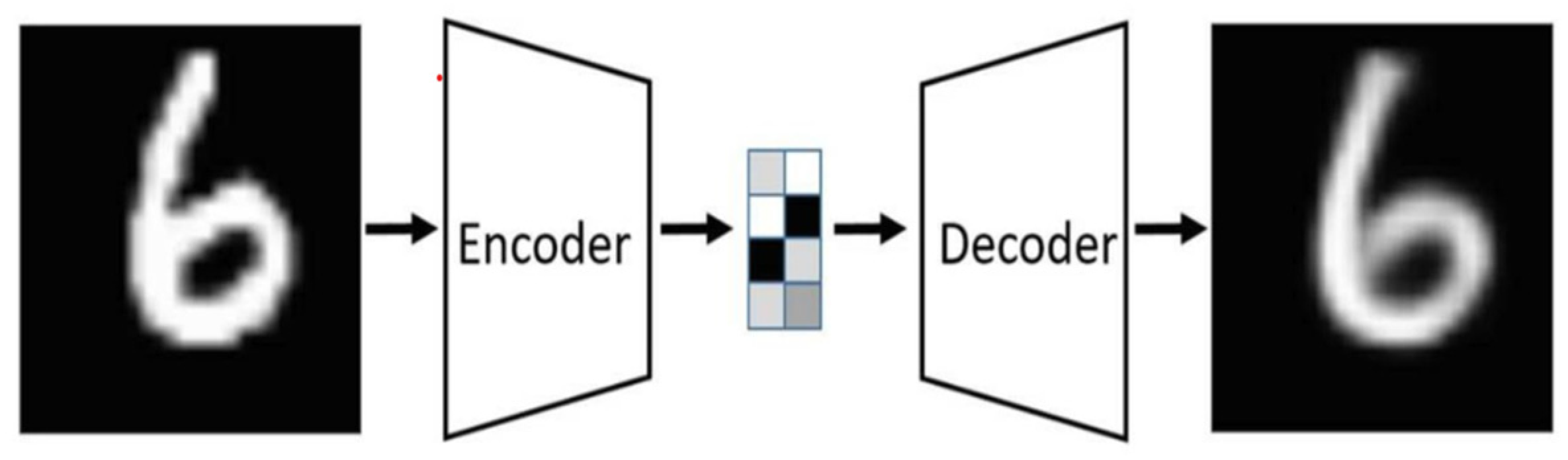
2.3. Nonlinear Feature Extraction Using Bottleneck Autoencoder
2.4. ANN Classifier
2.5. State-of-the-Art in DGA-Based Transformer Fault Diagnosis
3. Methodology
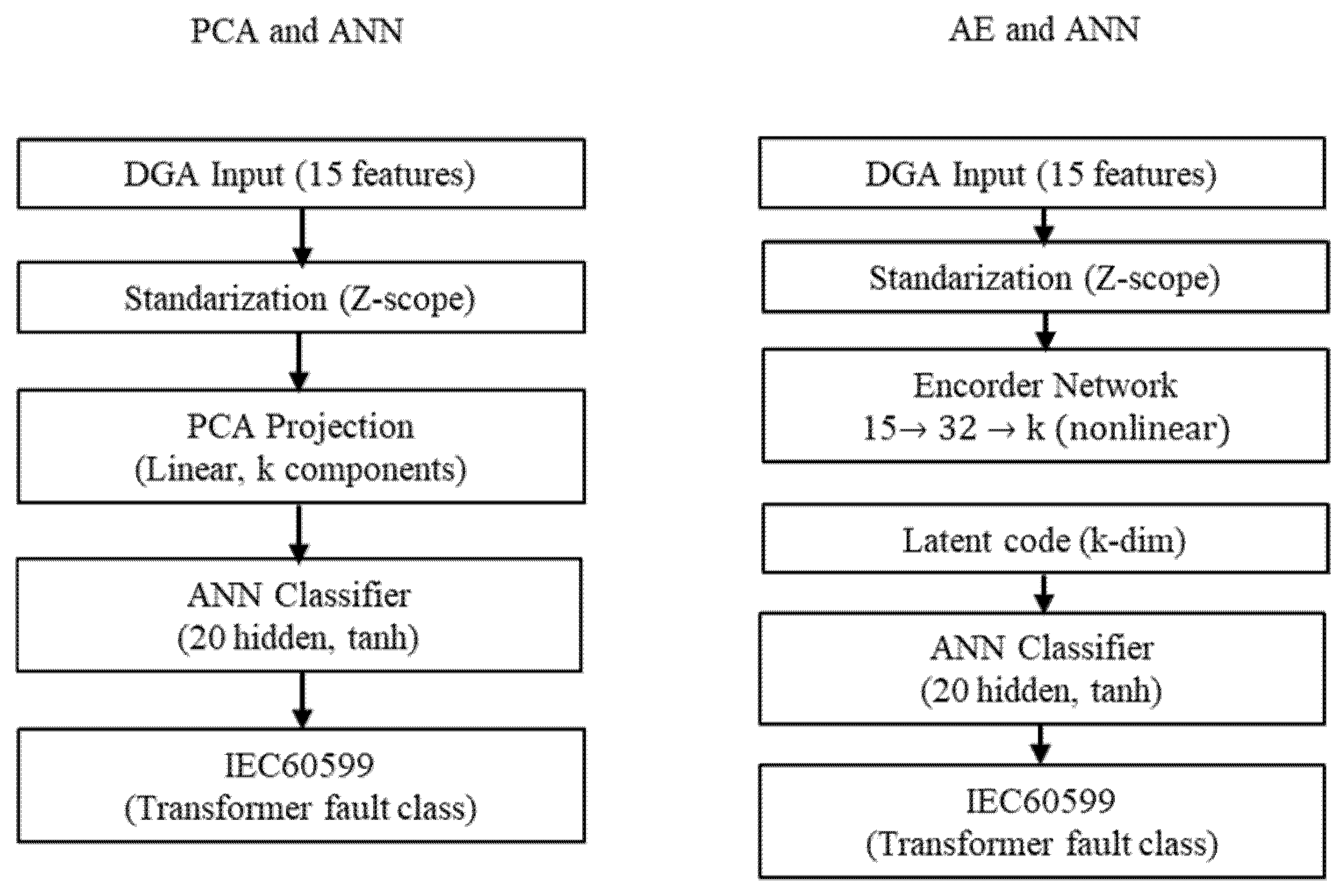
3.1. Comparative Pipeline Architecture
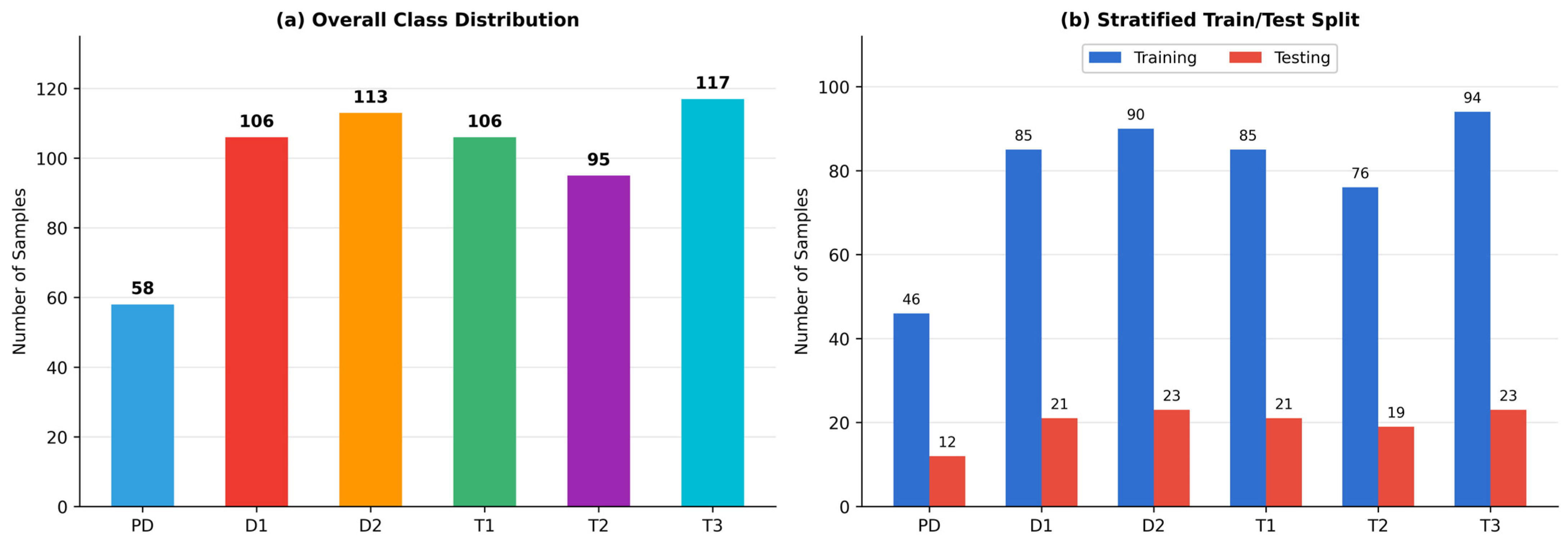
3.2. Dataset Description and Class Distribution
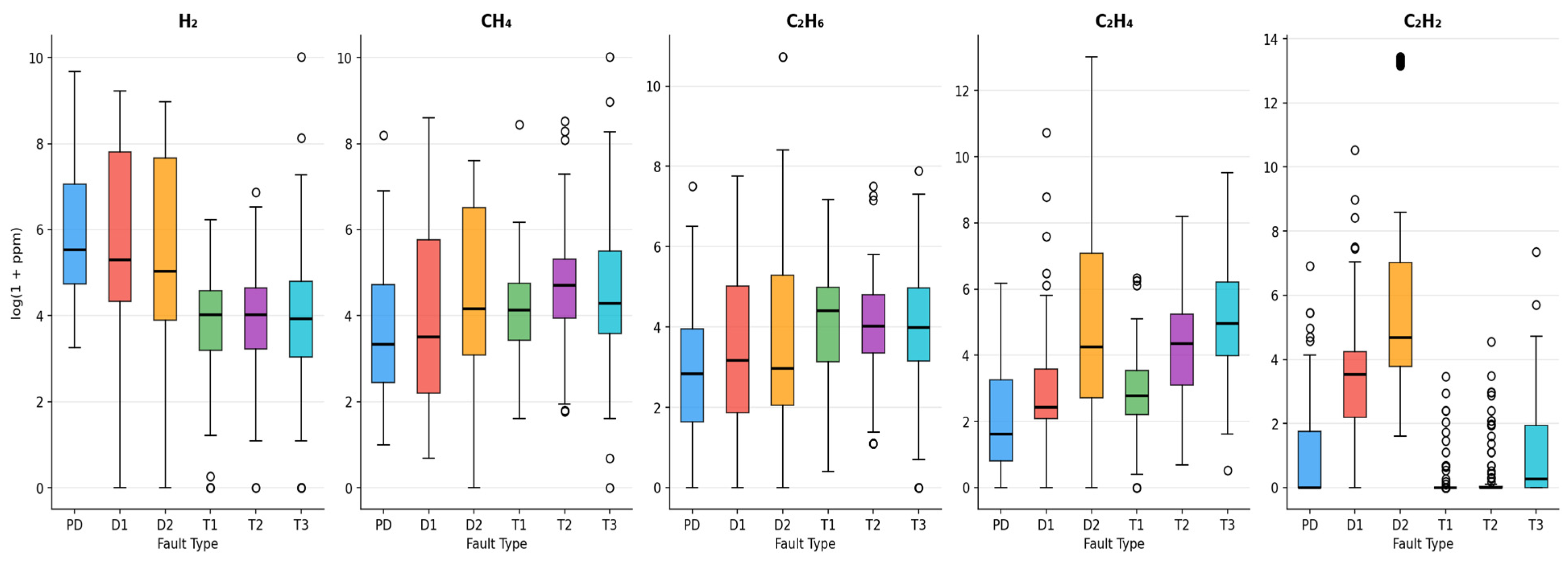
3.3. Feature Construction
3.4. Data Standardization
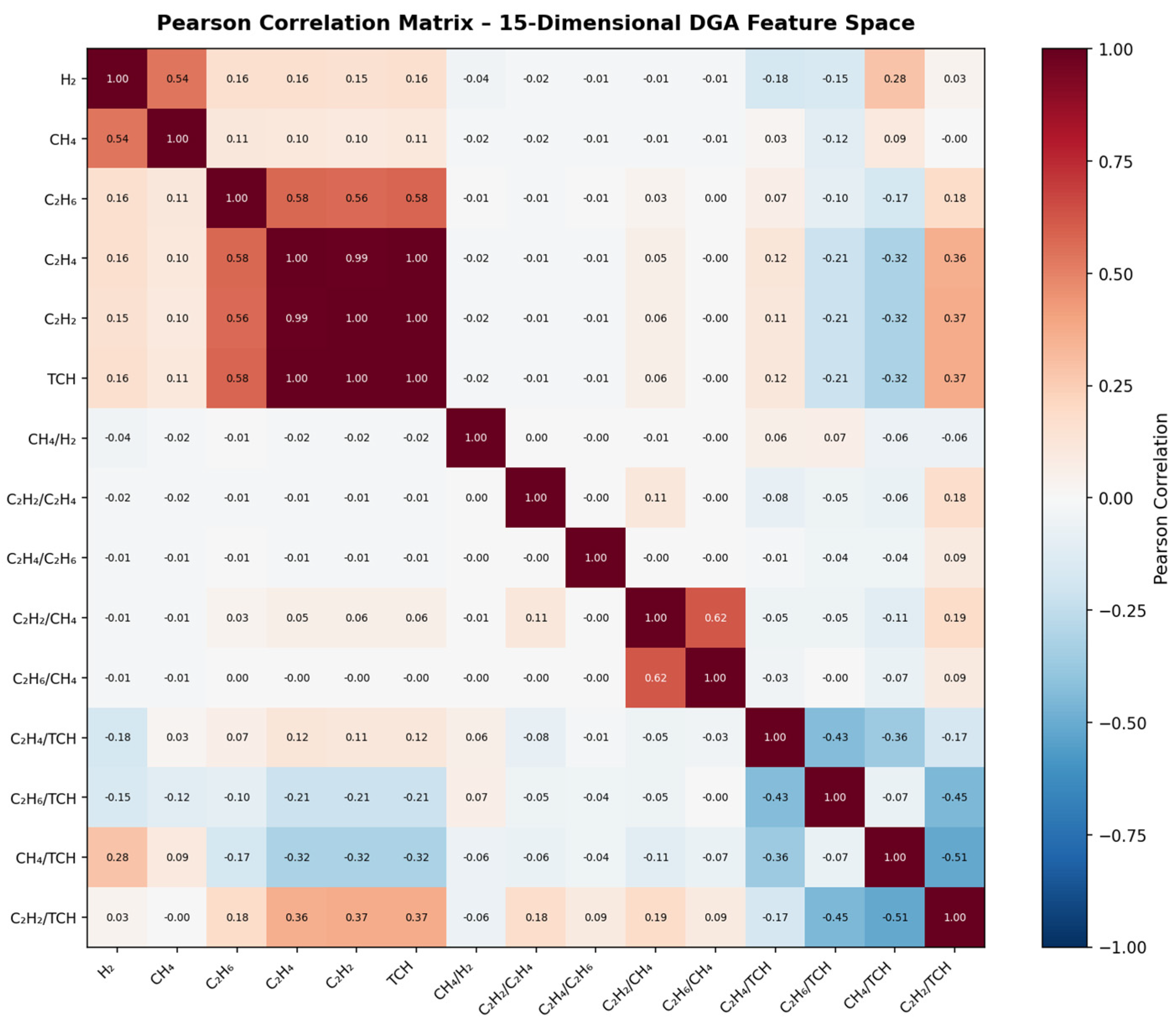
3.5. Feature-Space Correlation Analysis
3.6. PCA-Based Linear Feature Extraction
3.7. Autoencoder-Based Nonlinear Feature Extraction
3.8. ANN Classification Procedure
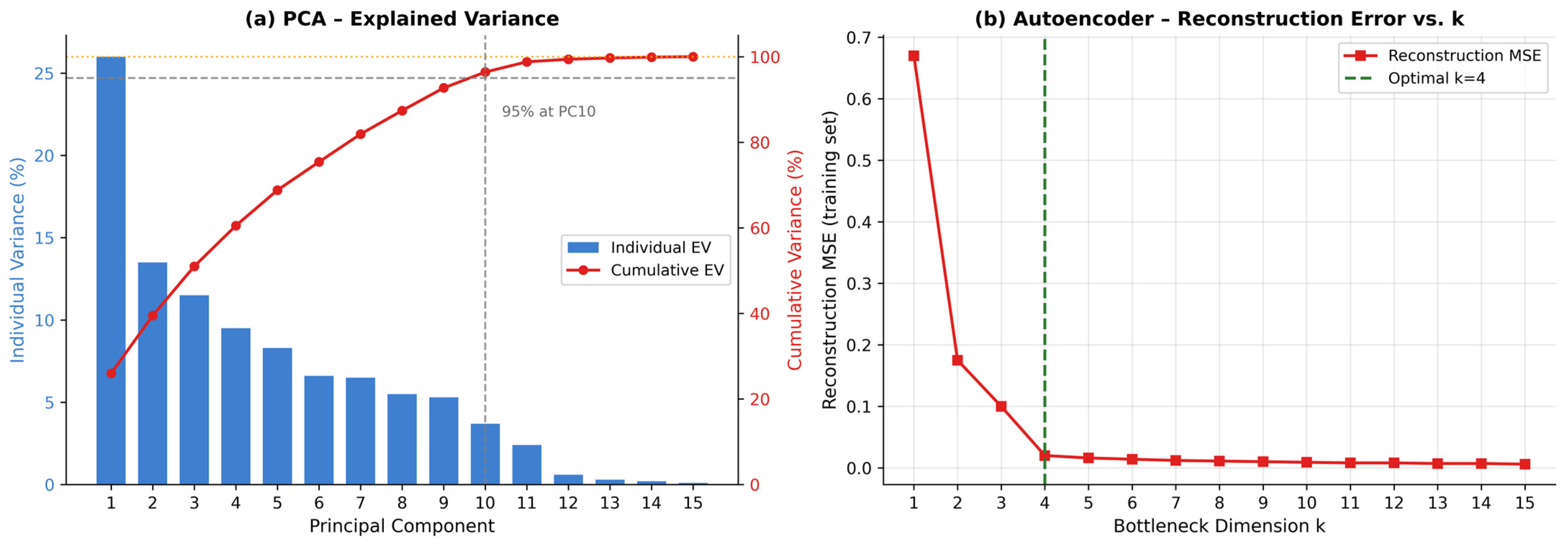
3.9. Feature Extraction Diagnostics
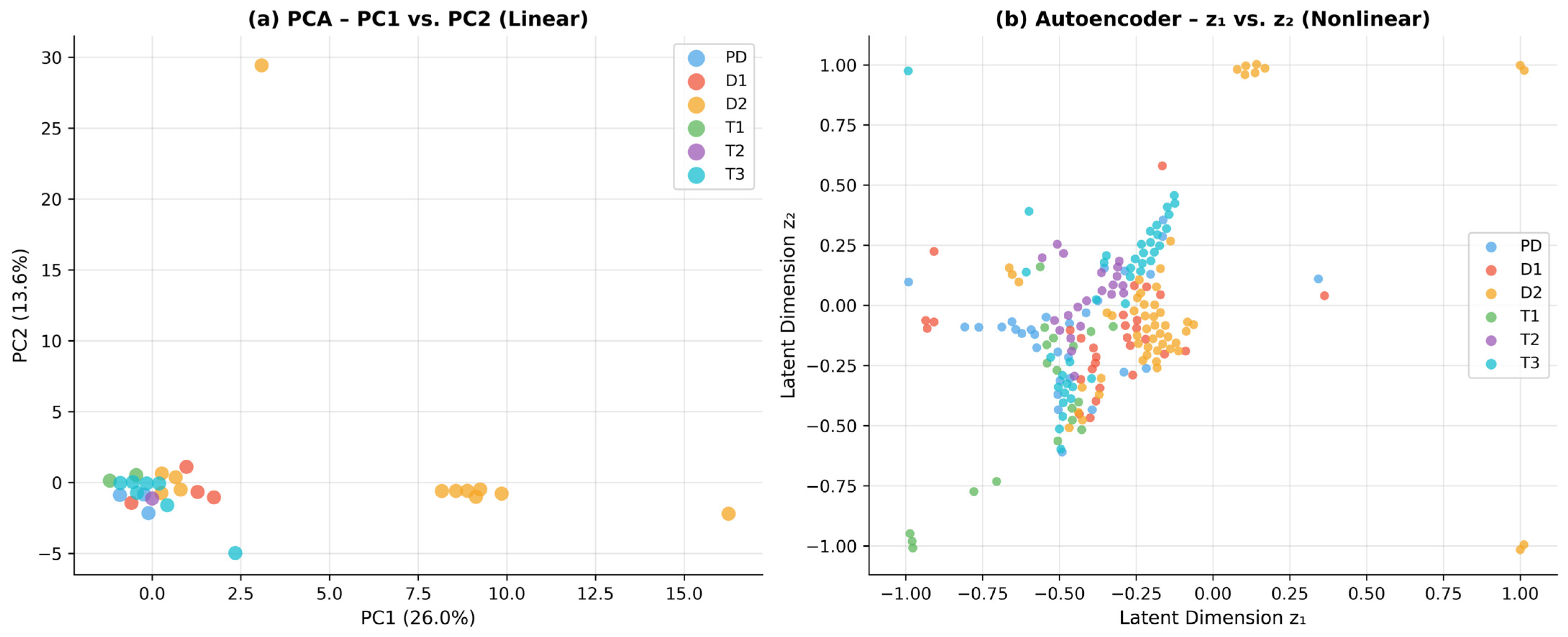
3.10. Latent-Space Visualization
3.11. Performance Evaluation Metrics
3.12. Experimental Protocol
4. Results and Discussion
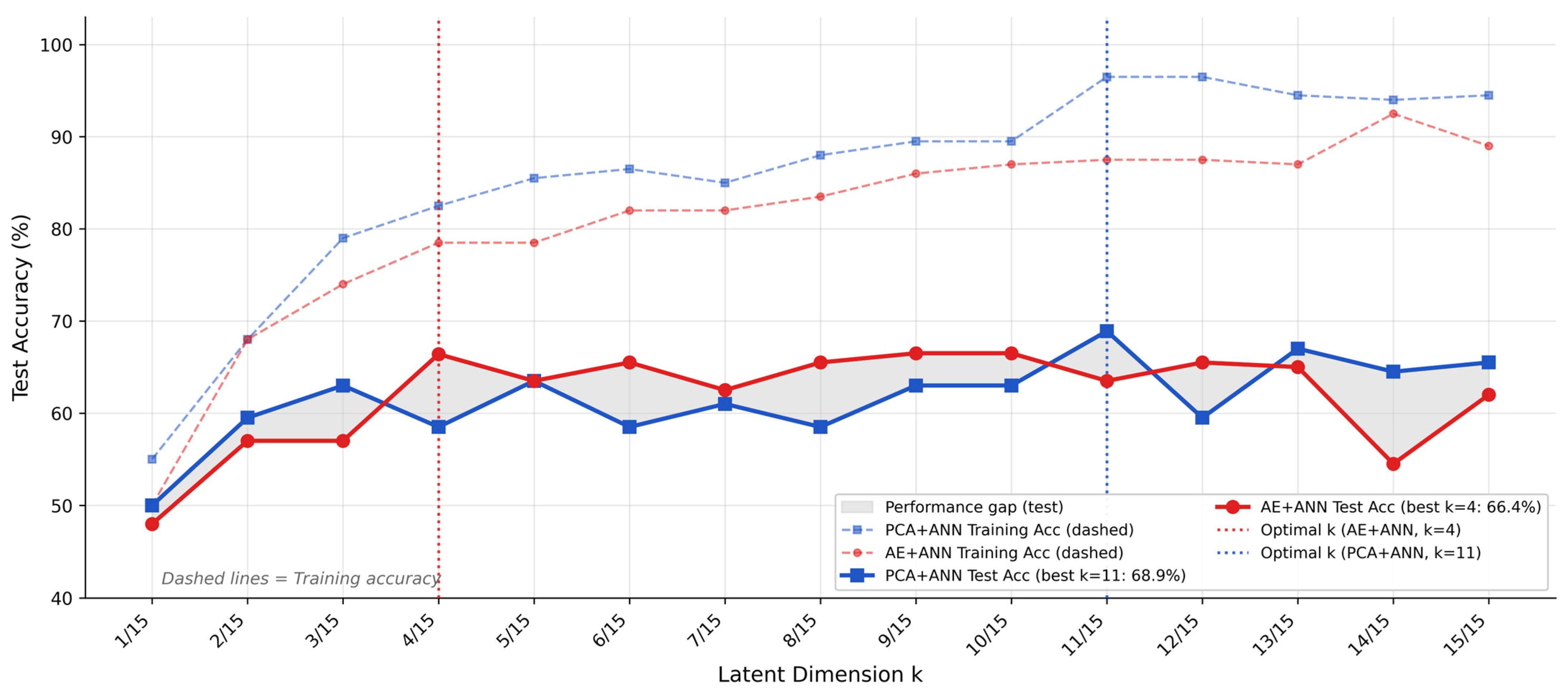
4.1. Classification Accuracy Across Latent Dimensions
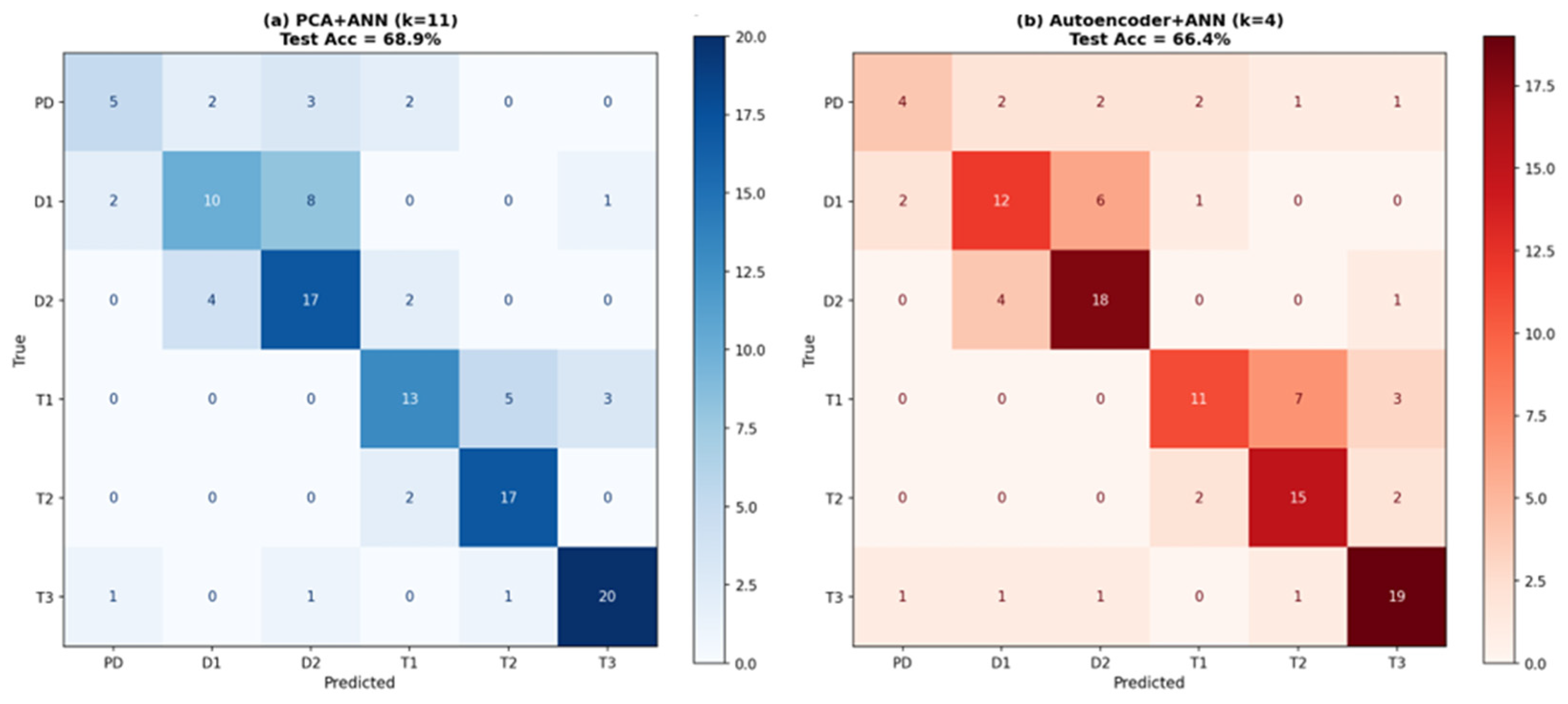
4.2. Confusion Matrix Analysis
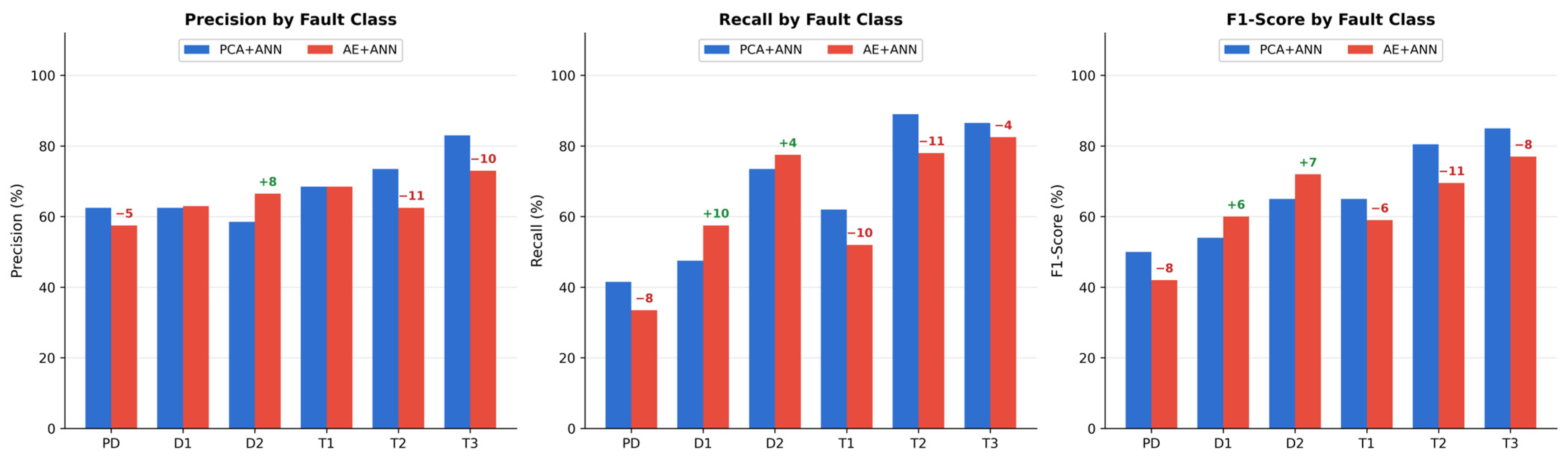
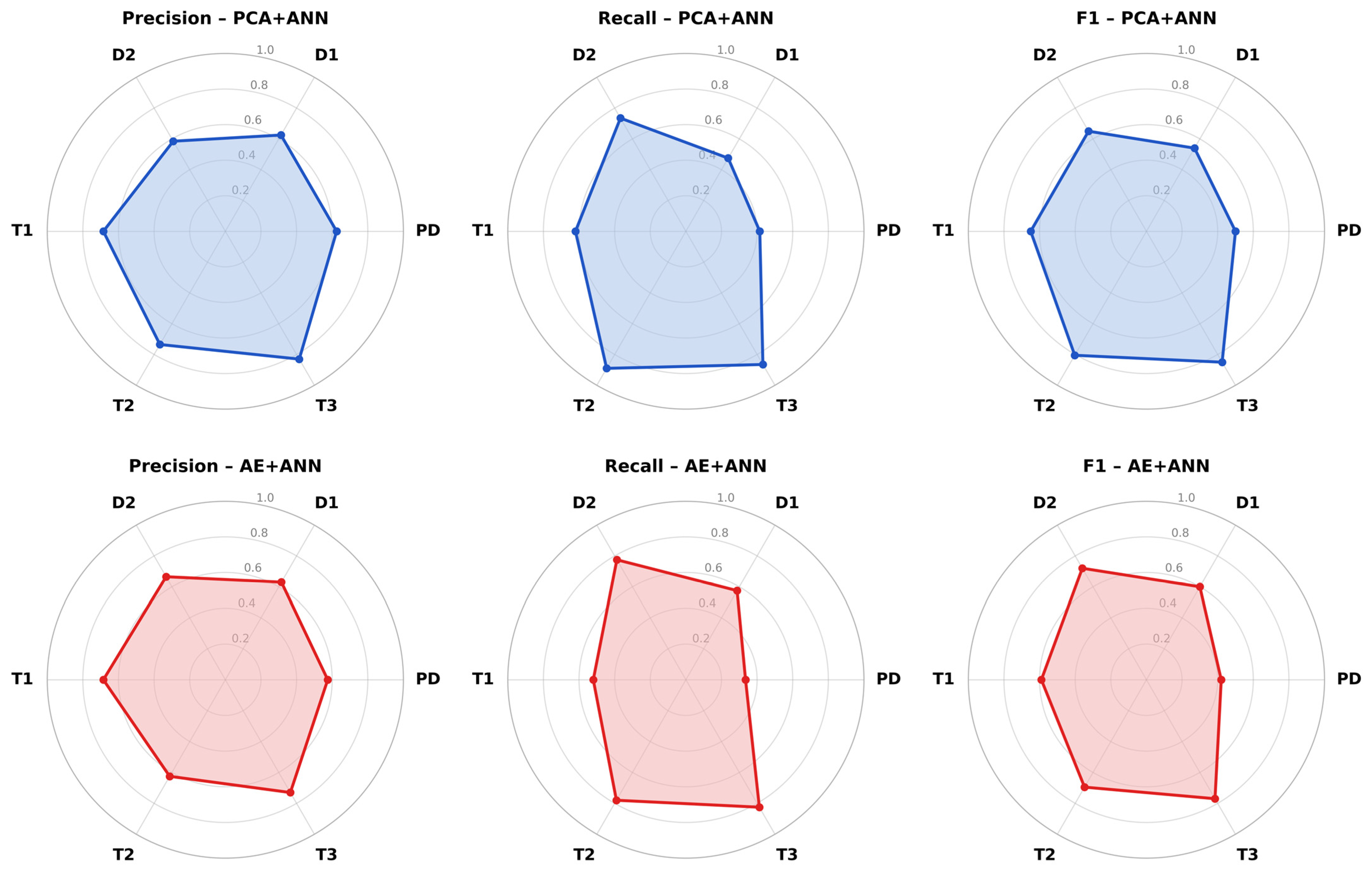
4.3. Per-Class Precision, Recall, and F1-Score Analysis
4.4. Cross-Validation Stability Comparison
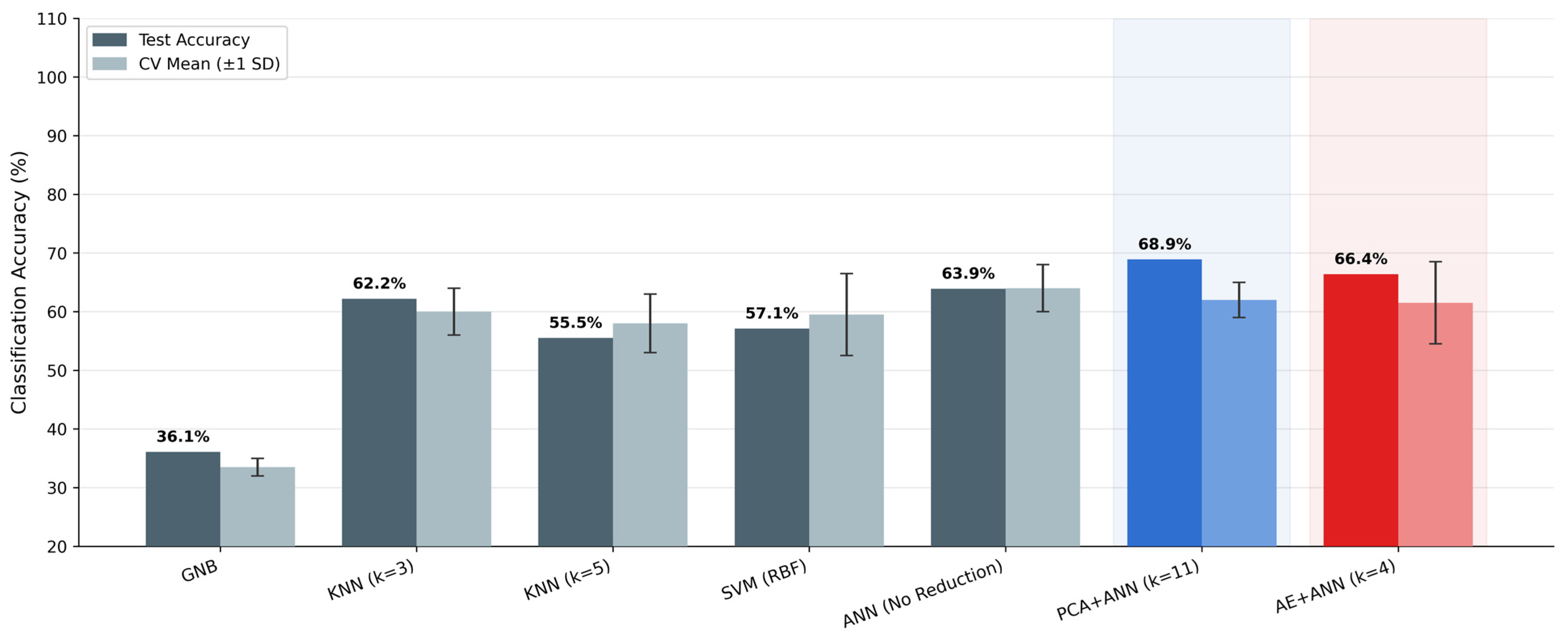
4.5. Benchmark Against Conventional Classifiers
4.6. Head-to-Head Comparison of PCA+ANN and AE+ANN
4.7. Practical Interpretation and Deployment Implications
4.8. Summary of Findings
5. Conclusions
Author Contributions
Funding
Data Availability Statement
Acknowledgments
Conflicts of Interest
Abbreviations
| AE | Autoencoder |
| AE+ANN | Autoencoder with Artificial Neural Network |
| ANN | Artificial Neural Network |
| CV | Cross-Validation |
| D1 | Low Energy Discharge |
| D2 | High Energy Discharge |
| DGA | Dissolved Gas Analysis |
| F1 | F1-Score |
| GNB | Gaussian Naïve Bayes |
| IEC | International Electrotechnical Commission |
| KNN | K-Nearest Neighbors |
| L-BFGS | Limited-memory Broyden-Fletcher-Goldfarb-Shanno |
| MLP | Multilayer Perceptron |
| MSE | Mean Squared Error |
| P | Precision |
| PCA | Principal Component Analysis |
| PCA+ANN | Principal Component Analysis with Artificial Neural Network |
| PC | Principal Component |
| PD | Partial Discharge |
| R | Recall |
| SVD | Singular Value Decomposition |
| SVM | Support Vector Machine |
| T1 | Thermal Fault (T < 300 °C) |
| T2 | Thermal Fault (300–700 °C) |
| T3 | Thermal Fault (T > 700 °C) |
| TCH | Total Hydrocarbon Content |
| H2 | Hydrogen |
| CH4 | Methane |
| C2H2 | Acetylene |
| C2H4 | Ethylene |
| C2H6 | Ethane |
| CO | Carbon Monoxide |
Appendix A. Representative DGA Cases
| Dissolved Gases | H2 | CH4 | C2H6 | C2H4 | C2H2 | IEC Diagnosis |
|---|---|---|---|---|---|---|
| PD-1 | 2587.2 | 112.25 | 4.704 | 1.4 | 0.001 | Partial Discharges (PD) |
| PD-2 | 16,000 | 3600 | 670 | 14 | 0.001 | Partial Discharges (PD) |
| PD-3 | 490 | 193 | 85 | 475 | 21 | Partial Discharges (PD) |
| PD-4 | 292.58 | 38.39 | 3.87 | 0.84 | 0.001 | Partial Discharges (PD) |
| PD-5 | 160 | 24.7 | 38.5 | 0.001 | 0.001 | Partial Discharges (PD) |
| PD-6 | 103.5 | 4.7 | 16.3 | 3.5 | 0.001 | Partial Discharges (PD) |
| PD-7 | 5869.58 | 175.21 | 16.45 | 1.45 | 0.001 | Partial Discharges (PD) |
| PD-8 | 1076 | 95 | 71 | 4 | 231 | Partial Discharges (PD) |
| PD-9 | 441 | 678 | 73 | 62 | 0 | Partial Discharges (PD) |
| PD-10 | 199 | 21 | 0 | 40 | 144 | Partial Discharges (PD) |
| PD-11 | 6600 | 1000 | 38 | 2 | 19 | Partial Discharges (PD) |
| PD-12 | 3417.62 | 131.42 | 14.36 | 1.22 | 0.001 | Partial Discharges (PD) |
| D1-1 | 1950 | 123 | 38 | 2 | 2 | Discharges of low energy (D1) |
| D1-2 | 980 | 73 | 58 | 12 | 0.001 | Discharges of low energy (D1) |
| D1-3 | 9201 | 744 | 226 | 12 | 13 | Discharges of low energy (D1) |
| D1-4 | 14.2 | 4 | 1.4 | 1.5 | 9.51 | Discharges of low energy (D1) |
| D1-5 | 700 | 137.4 | 14.9 | 194.8 | 936.6 | Discharges of low energy (D1) |
| D1-6 | 176 | 206 | 47.7 | 75.7 | 68.7 | Discharges of low energy (D1) |
| D1-7 | 4879 | 262 | 15 | 332 | 1827 | Discharges of low energy (D1) |
| D1-8 | 50 | 2 | 28 | 8 | 6 | Discharges of low energy (D1) |
| D1-9 | 9619 | 780 | 220 | 9 | 38 | Discharges of low energy (D1) |
| D1-10 | 476 | 28 | 27 | 36 | 148 | Discharges of low energy (D1) |
| D1-11 | 137 | 33 | 8 | 29 | 111 | Discharges of low energy (D1) |
| D1-12 | 65.2 | 20 | 3.9 | 8.13 | 25.1 | Discharges of low energy (D1) |
| D2-1 | 440 | 522 | 31 | 62 | 183 | Discharges of high energy |
| D2-2 | 2271 | 739 | 4419 | 350,700 | 626,882 | Discharges of high energy |
| D2-3 | 151 | 51 | 16 | 12 | 19 | Discharges of high energy |
| D2-4 | 2118 | 844 | 4443 | 449,264 | 540,711 | Discharges of high energy |
| D2-5 | 235.46 | 333.59 | 177.52 | 1201.85 | 148.87 | Discharges of high energy |
| D2-6 | 26.6 | 4 | 0.001 | 8 | 50 | Discharges of high energy |
| D2-7 | 7238.97 | 695.16 | 231.6 | 2394.3 | 2308.92 | Discharges of high energy |
| D2-8 | 2409 | 712 | 4284 | 440,297 | 589,171 | Discharges of high energy |
| D2-9 | 240 | 28 | 6 | 26 | 85 | Discharges of high energy |
| D2-10 | 43 | 19 | 3 | 0.001 | 40 | Discharges of high energy |
| D2-11 | 5760 | 540 | 40.5 | 1000 | 2760 | Discharges of high energy |
| D2-12 | 84 | 6 | 1 | 14 | 86 | Discharges of high energy |
| T1-1 | 110.4 | 112 | 32.5 | 80.8 | 0.001 | Thermal fault, t < 300 °C |
| T1-2 | 43 | 28 | 72 | 9 | 0.001 | Thermal fault, t < 300 °C |
| T1-3 | 85 | 152 | 128 | 120 | 0 | Thermal fault, t < 300 °C |
| T1-4 | 68 | 30 | 9 | 32 | 0 | Thermal fault, t < 300 °C |
| T1-5 | 90 | 313 | 67 | 566 | 10 | Thermal fault, t < 300 °C |
| T1-6 | 219 | 44 | 3 | 3 | 0.001 | Thermal fault, t < 300 °C |
| T1-7 | 92 | 27 | 67 | 7 | 0.001 | Thermal fault, t < 300 °C |
| T1-8 | 181 | 262 | 41 | 28 | 0.001 | Thermal fault, t < 300 °C |
| T1-9 | 9 | 38 | 93 | 8 | 0.001 | Thermal fault, t < 300 °C |
| T1-10 | 93.5 | 131.9 | 39 | 11.7 | 0.001 | Thermal fault, t < 300 °C |
| T1-11 | 112 | 68 | 136 | 9 | 0.001 | Thermal fault, t < 300 °C |
| T1-12 | 48 | 40 | 11 | 0.5 | 0.001 | Thermal fault, t < 300 °C |
| T2-1 | 110.6 | 458.8 | 242.6 | 406.4 | 0.001 | Thermal fault, 300 °C < t < 700 °C |
| T2-2 | 109 | 102 | 28 | 91 | 0.001 | Thermal fault, 300 °C < t < 700 °C |
| T2-3 | 12 | 8 | 3 | 2 | 0 | Thermal fault, 300 °C < t < 700 °C |
| T2-4 | 35 | 112 | 55 | 143 | 0 | Thermal fault, 300 °C < t < 700 °C |
| T2-5 | 223 | 390 | 160 | 392 | 2 | Thermal fault, 300 °C < t < 700 °C |
| T2-6 | 100 | 125 | 188 | 10 | 0 | Thermal fault, 300 °C < t < 700 °C |
| T2-7 | 110 | 136 | 50 | 125 | 0 | Thermal fault, 300 °C < t < 700 °C |
| T2-8 | 110 | 137 | 50 | 124 | 0 | Thermal fault, 300 °C < t < 700 °C |
| T2-9 | 670 | 224 | 45 | 67 | 2 | Thermal fault, 300 °C < t < 700 °C |
| T2-10 | 84 | 126 | 28.9 | 132.2 | 0.37 | Thermal fault, 300 °C < t < 700 °C |
| T2-11 | 65 | 42 | 17 | 103 | 0 | Thermal fault, 300 °C < t < 700 °C |
| T2-12 | 550 | 38 | 36 | 18 | 0 | Thermal fault, 300 °C < t < 700 °C |
| T3-1 | 374 | 900 | 932 | 5759 | 55 | Thermal fault, t > 700 °C |
| T3-2 | 13 | 39 | 52 | 20 | 0 | Thermal fault, t > 700 °C |
| T3-3 | 179 | 306 | 73 | 579 | 0.001 | Thermal fault, t > 700 °C |
| T3-4 | 20 | 26 | 6 | 55 | 0.001 | Thermal fault, t > 700 °C |
| T3-5 | 25 | 63 | 31 | 103 | 0 | Thermal fault, t > 700 °C |
| T3-6 | 42 | 79 | 31 | 152 | 1 | Thermal fault, t > 700 °C |
| T3-7 | 50 | 52 | 56 | 30 | 0 | Thermal fault, t > 700 °C |
| T3-8 | 148 | 396 | 481 | 131 | 1 | Thermal fault, t > 700 °C |
| T3-9 | 85 | 320 | 102 | 650 | 0 | Thermal fault, t > 700 °C |
| T3-10 | 0.001 | 106 | 170 | 871 | 6 | Thermal fault, t > 700 °C |
| T3-11 | 103 | 221.7 | 47.2 | 422 | 0.9 | Thermal fault, t > 700 °C |
| T3-12 | 27 | 51 | 0.001 | 153 | 0.001 | Thermal fault, t > 700 °C |
References
- Gifalli, A.; Neto, A.B.; de Souza, A.N.; de Mello, R.P.; Ikeshoji, M.A.; Garbelini, E.; Neto, F.T. Fault Detection and Normal Operating Condition in Power Transformers via Pattern Recognition Artificial Neural Network. Appl. Syst. Innov. 2024, 7, 41. [Google Scholar] [CrossRef]
- De Andrade Ferreira, R.S.; Picher, P.; Ezzaidi, H.; Fofana, I. Frequency Response Analysis Interpretation Using Numerical Indices and Machine Learning: A Case Study Based on a Laboratory Model. IEEE Access 2021, 9, 67051–67063. [Google Scholar] [CrossRef]
- Domor, I.; Theo, M. Deep Autoencoder Neural Networks: A Comprehensive Review and New Perspectives. Arch. Comput. Methods Eng. 2025, 32, 0123456789. [Google Scholar] [CrossRef]
- Faridpak, B.; Musilek, P. Resilient Operation Strategies for Integrated Power-Gas Systems. Energies 2024, 17, 6270. [Google Scholar] [CrossRef]
- Pan, W.; Li, Y.; Guo, Z.; Zhang, Y. Interdependent Expansion Planning for Resilient Electricity and Natural Gas Networks. Processes 2024, 12, 775. [Google Scholar] [CrossRef]
- Sun, Q.; Wu, Z.; Gu, W.; Dong, Z.Y.; Liu, P.; Qiu, H.; Amer, Y.; Lu, Y.; Zheng, Y. Seismic-Resilient Planning for Integrated Energy System: A Risk-Economic Coordination Perspective. In IEEE Transactions on Power Systems; IEEE: Washington, DC, USA, 2025. [Google Scholar]
- Velásquez, R.M.A.; Lara, J.V.M. Root cause analysis improved with machine learning for failure analysis in power transformers. Eng. Fail. Anal. 2020, 115, 104684. [Google Scholar] [CrossRef]
- Khan, M.A.M. Ai and Machine Learning in Transformer Fault Diagnosis: A Systematic Review. Am. J. Adv. Technol. Eng. Solut. 2025, 1, 290–318. [Google Scholar] [CrossRef]
- Li, Z.; He, Y.; Xing, Z.; Duan, J. Transformer fault diagnosis based on improved deep coupled dense convolutional neural network. Electr. Power Syst. Res. 2022, 209, 107969. [Google Scholar] [CrossRef]
- Rangel Bessa, A.; Farias Fardin, J.; Marques Ciarelli, P.; Frizera Encarnação, L. Conventional Dissolved Gases Analysis in Power Transformers: Review. Energies 2023, 16, 7219. [Google Scholar] [CrossRef]
- Cabral, T.W.; De Lima, E.R.; Cândido, J.; Filho, S.S.; Meloni, L.G.P. Autoencoders Beat PCA for Low-Dimension DGA-based Fault Diagnosis of Power Transformers. In Proceedings of the XLII Simpósio Brasileiro de Telecomunicações e Processamento de Sinais, Belem do Pará, Brazil, 1–4 October 2024. [Google Scholar]
- Du, Y.; Wang, Z.; Feng, G. A Methodology to Diagnose Transformer Faults Based on Principal Components Analysis and Artificial Neural Network. In 2022 IEEE 6th Conference on Energy Internet and Energy System Integration (EI2); IEEE: Washington, DC, USA, 2022; pp. 1186–1189. [Google Scholar] [CrossRef]
- Demirci, M.; Gözde, H.; Taplamacioglu, M.C. Improvement of power transformer fault diagnosis by using sequential Kalman filter sensor fusion. Int. J. Electr. Power Energy Syst. 2023, 149, 109038. [Google Scholar] [CrossRef]
- Al-Sakini, S.R.; Bilal, G.A.; Sadiq, A.T.; Al-Maliki, W.A.K. Dissolved Gas Analysis for Fault Prediction in Power Transformers Using Machine Learning Techniques. Appl. Sci. 2025, 15, 118. [Google Scholar] [CrossRef]
- Zhang, L.; Xu, Z.; Lu, C.; Qiao, T.; Su, H.; Luo, Y. Heliyon Transformer fault diagnosis based on adversarial generative networks and deep stacked autoencoder. Heliyon 2024, 10, e30670. [Google Scholar] [CrossRef]
- Sakurada, M.; Yairi, T. Anomaly detection using autoencoders with nonlinear dimensionality reduction. In Proceedings of the 2014 2nd Workshop on Machine Learning for Sensory Data Analysis; Association for Computing Machinery: New York, NY, USA, 2014; pp. 4–11. [Google Scholar]
- Jaiswal, G.; Rani, R.; Mangotra, H.; Sharma, A. Integration of hyperspectral imaging and autoencoders: Benefits, applications, hyperparameter tunning and challenges. Comput. Sci. Rev. 2023, 50, 100584. [Google Scholar] [CrossRef]
- Van Der Maaten, L.; Hinton, G. Visualizing Data using t-SNE. J. Mach. Learn. Res. 2008, 9, 2579–2605. [Google Scholar]
- Rahman, M.A.; Muniyandi, R.C. An Enhancement in Cancer Classification Accuracy Using a Two-Step Feature Selection Method Based on Artificial Neural Networks with 15 Neurons. Symmetry 2020, 12, 271. [Google Scholar] [CrossRef]
- Xu, G.; Zhang, M.; Chen, W.; Wang, Z. Transformer Fault Diagnosis Utilizing Feature Extraction and Ensemble Learning Model. Information 2024, 15, 561. [Google Scholar] [CrossRef]
- Shlens, J. A tutorial on principal component analysis. arXiv 2014, arXiv:1404.1100. [Google Scholar] [CrossRef]
- Laayati, A.; El-Bazi, N.; Bouzi, M.; Chebak, A.; Guerrero, J.M. An AI-Layered with MultiAgent Systems Architecture for Prognostics Health Management of Smart Transformers: A Novel Approach for Smart Grid-Ready Energy Management Systems. Energies 2022, 15, 7217. [Google Scholar]
- Matharage, S.Y.; Liu, Q.; Wang, Z.D.; Mavrommatis, P.; Wilson, G.; Jarman, P. Ageing assessment of transformer paper insulation through detection of methanol in oil. In Proceedings of the 2015 IEEE 11th International Conference on the Properties and Applications of Dielectric Materials (ICPADM), Sydney, NSW, Australia, 19–22 July 2015; pp. 392–395. [Google Scholar]
- Kamel, H. Artificial intelligence for predictive maintenance. J. Phys. Conf. Ser. 2022, 2299, 012001. [Google Scholar] [CrossRef]
- Nagpal, T.; Brar, Y.S. Artificial neural network approaches for fault classification: Comparison and performance. Neural Comput. Appl. 2014, 25, 1863–1870. [Google Scholar] [CrossRef]
- Schmidgall, S.; Ziaei, R.; Achterberg, J.; Kirsch, L.; Hajiseyedrazi, S.P.; Eshraghian, J. Brain-Inspired Learning in Artificial Neural Networks: A Review. APL Mach. Learn. 2024, 2, 021501. [Google Scholar] [CrossRef]
- Liu, S.; Zhang, C.; Ma, J. Stacked Auto-Encoders for Feature Extraction with Neural Networks. In Bio-Inspired Computing—Theories and Applications; Springer: Berlin/Heidelberg, Germany, 2016; Volume 1, pp. 377–384. [Google Scholar] [CrossRef]
- Aciu, A.-M.; Nicola, C.-I.; Nicola, M.; Nițu, M.-C. Complementary Analysis for DGA Based on Duval Methods and Furan Compounds Using Artificial Neural Networks. Energies 2021, 14, 588. [Google Scholar] [CrossRef]


| Code | Fault Type Description/Mechanism | Primary Gas Signs | Label |
|---|---|---|---|
| PD | Partial Discharge; low-energy corona in voids | Very high H2, trace C2H2 | 1 |
| D1 | Low Energy Discharge; sparking or arcing at low energy | High H2 and C2H2 | 2 |
| D2 | High Energy Discharge; sustained arc discharge | High C2H2 and C2H4 | 3 |
| T1 | Thermal Fault; mild overheating of cellulose, T < 300 °C | CH4, some CO | 4 |
| T2 | Thermal Fault; moderate oil overheating, 300–700 °C | CH4 and C2H4 | 5 |
| T3 | Thermal Fault; severe oil thermal degradation, T > 700 °C | High C2H4, some C2H2 | 6 |
| Author | Year | Objective | Method/Technique | Pros | Cons/Research Gap |
|---|---|---|---|---|---|
| Gifalli et al. [1] | 2024 | Detect transformer faults and normal operating conditions | Pattern recognition ANN | Demonstrates ANN capability for automated transformer fault detection | Does not focus on dimensionality reduction or PCA-AE comparison |
| Ferreira et al. [2] | 2021 | Interpret transformer frequency response analysis using numerical indices and ML | Numerical indices, machine learning | Shows the usefulness of ML in transformer condition assessment | Focuses on FRA rather than DGA-based fault classification |
| Arias Velásquez and Mejía Lara [7] | 2020 | Improve root-cause analysis for transformer failure | Machine learning-based failure analysis | Supports ML for identifying transformer failure mechanisms | Not centered on IEC 60599 DGA class prediction |
| Khan [8] | 2025 | Review AI and ML methods for transformer fault diagnosis | Systematic review | Provides broad coverage of AI-based transformer diagnosis | Review-based; does not provide a controlled experimental PCA-AE benchmark |
| Li et al. [9] | 2022 | Improve transformer fault diagnosis using deep learning | Improved deep coupled dense CNN | Strong deep-learning feature extraction capability | Higher architectural complexity; limited interpretability |
| Cabral et al. [11] | 2024 | Compare Autoencoders and PCA for low-dimensional DGA fault diagnosis | Autoencoder, PCA | Directly addresses low-dimensional DGA feature extraction | Requires further controlled evaluation across all latent dimensions and identical ANN classification |
| Du et al. [12] | 2022 | Diagnose transformer faults using PCA and ANN | PCA+ANN | Shows PCA can reduce redundancy before ANN classification | Focuses on PCA; does not compare with nonlinear Autoencoder features |
| Zhang et al. [15] | 2024 | Diagnose transformer faults using generative and deep Autoencoder methods | Adversarial generative networks, deep stacked Autoencoder | Captures nonlinear DGA representations | More complex model; limited direct comparison with classical PCA |
| Van der Maaten and Hinton [18] | 2008 | Visualize high-dimensional data in low-dimensional space | t-SNE | Useful for latent-space visualization and separability analysis | Visualization method, not a classifier or diagnostic framework |
| Xu et al. [20] | 2024 | Improve transformer fault diagnosis using feature extraction and ensemble learning | Feature extraction, ensemble model | Confirms the value of transformed features in DGA diagnosis | Does not isolate PCA and AE under identical ANN conditions |
| Domor and Theo [3] | 2025 | Review deep Autoencoder neural networks | Deep Autoencoder review | Establishes AE relevance for nonlinear representation learning | General review; not specific to transformer DGA diagnosis |
| Liu et al. [27] | 2016 | Investigate stacked Autoencoders for feature extraction | Stacked Autoencoder | Supports AE-based feature extraction in complex datasets | Not directly applied to IEC 60599 transformer fault classification |
| Proposed study | 2026 | Compare linear PCA and nonlinear AE feature extraction for IEC 60599 DGA fault diagnosis | PCA+ANN and AE+ANN | Uses the same dataset, 15-dimensional feature space, ANN classifier, and evaluates k = 1–15, accuracy, F1-score, and CV stability | Limited to the available IEC 60599-labeled DGA dataset; future work can explore hybrid and class-conditional AE models |
| Code | Fault Class | Total | Training | Testing |
|---|---|---|---|---|
| PD | Partial Discharge | 58 | 46 | 12 |
| D1 | Low Energy Discharge | 106 | 85 | 21 |
| D2 | High Energy Discharge | 113 | 90 | 23 |
| T1 | Thermal Fault, T < 300 °C | 106 | 85 | 21 |
| T2 | Thermal Fault, 300–700 °C | 95 | 76 | 19 |
| T3 | Thermal Fault, T > 700 °C | 117 | 94 | 23 |
| Total | 595 | 476 | 119 |
| PCA Cumulative Variance | PCA+ANN Test Accuracy | AE Reconstruction MSE | AE+ANN Test Accuracy | |
|---|---|---|---|---|
| 1 | 26.0% | 49.6% | 0.655 | 47.9% |
| 2 | 39.5% | 59.7% | 0.173 | 57.1% |
| 3 | 51.2% | 63.0% | 0.096 | 57.1% |
| 4 | 60.7% | 58.8% | 0.019 | 66.4% |
| 5 | 69.1% | 63.9% | 0.019 | 63.9% |
| 8 | 88.2% | 58.8% | 0.010 | 65.5% |
| 10 | 97.4% | 63.0% | 0.006 | 66.4% |
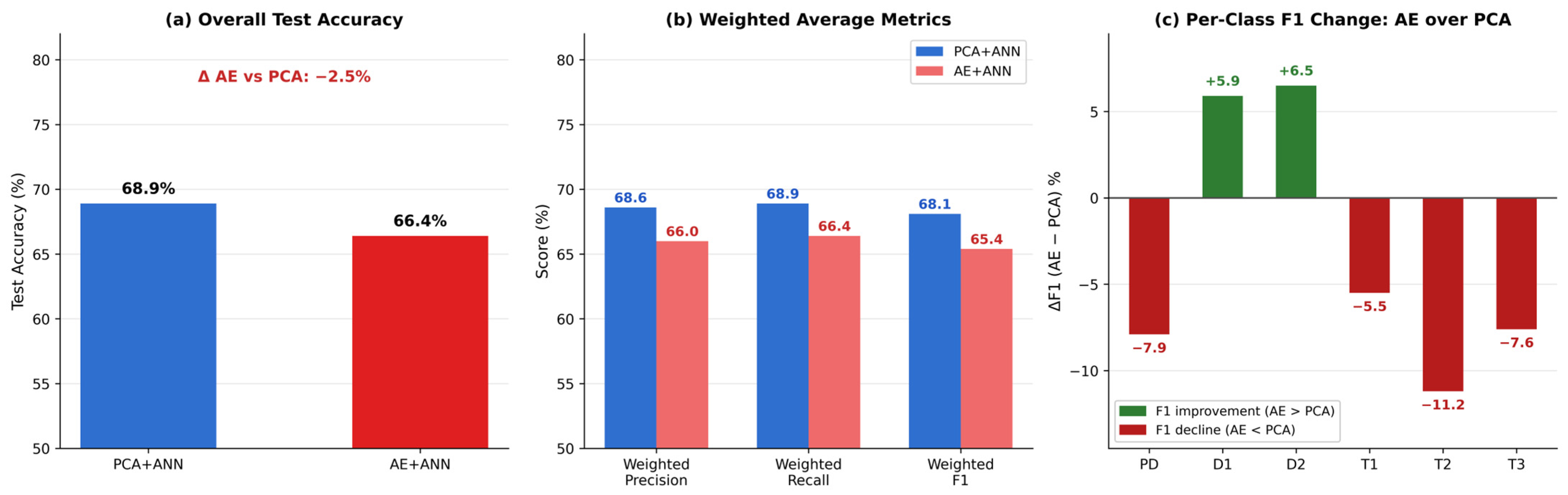
| 11 | 99.9% | 68.9% | 0.007 | 66.4% |
| 15 | 100.0% | 65.5% | 0.005 | 62.2% |
| Code | Fault Class | PCA P | PCA R | PCA F1 | AE P | AE R | AE F1 | F1 (AE − PCA) |
|---|---|---|---|---|---|---|---|---|
| PD | Partial Discharge | 62.5% | 41.7% | 50.0% | 57.1% | 33.3% | 42.1% | −7.9% |
| D1 | Low Energy Discharge | 62.5% | 47.6% | 54.1% | 63.2% | 57.1% | 60.0% | +5.9% |
| D2 | High Energy Discharge | 58.6% | 73.9% | 65.4% | 66.7% | 78.3% | 72.0% | +6.6% |
| T1 | Thermal Fault, T < 300 °C | 68.4% | 61.9% | 65.0% | 68.8% | 52.4% | 59.5% | −5.5% |
| T2 | Thermal Fault, 300–700 °C | 73.9% | 89.5% | 81.0% | 62.5% | 78.9% | 69.8% | −11.2% |
| T3 | Thermal Fault, T > 700 °C | 83.3% | 87.0% | 85.1% | 73.1% | 82.6% | 77.6% | −7.6% |
| Weighted Avg. | 68.6% | 68.9% | 68.1% | 66.0% | 66.4% | 65.4% | −2.7% |
Disclaimer/Publisher’s Note: The statements, opinions and data contained in all publications are solely those of the individual author(s) and contributor(s) and not of MDPI and/or the editor(s). MDPI and/or the editor(s) disclaim responsibility for any injury to people or property resulting from any ideas, methods, instructions or products referred to in the content. |
© 2026 by the authors. Licensee MDPI, Basel, Switzerland. This article is an open access article distributed under the terms and conditions of the Creative Commons Attribution (CC BY) license.
Share and Cite
Nkwambe, M.S.; Thango, B.A. PCA and Autoencoder-Based ANN Models for Transformer Fault Diagnosis Using Dissolved Gas Analysis: Comparative Insights and Challenges. Energies 2026, 19, 2806. https://doi.org/10.3390/en19122806
Nkwambe MS, Thango BA. PCA and Autoencoder-Based ANN Models for Transformer Fault Diagnosis Using Dissolved Gas Analysis: Comparative Insights and Challenges. Energies. 2026; 19(12):2806. https://doi.org/10.3390/en19122806
Chicago/Turabian StyleNkwambe, Mwamba S., and Bonginkosi A. Thango. 2026. "PCA and Autoencoder-Based ANN Models for Transformer Fault Diagnosis Using Dissolved Gas Analysis: Comparative Insights and Challenges" Energies 19, no. 12: 2806. https://doi.org/10.3390/en19122806
APA StyleNkwambe, M. S., & Thango, B. A. (2026). PCA and Autoencoder-Based ANN Models for Transformer Fault Diagnosis Using Dissolved Gas Analysis: Comparative Insights and Challenges. Energies, 19(12), 2806. https://doi.org/10.3390/en19122806