Article

Enhanced Liquid–Solid Triboelectric Nanogenerator with Multi-Tube Nesting Structure for Efficient Wave Energy Harvesting


1
School of Ocean Engineering and Energy, Guangdong Ocean University, Zhanjiang 524088, China
2
School of Chemistry and Environment Science, Guangdong Ocean University, Zhanjiang 524088, China
3
School of Electrical and Information Engineering, Guangdong Ocean University, Zhanjiang 524088, China
4
Guangdong Province Key Laboratory of Intelligent Equipment of South China Sea Marine Ranching, Guangdong Ocean University, Zhanjiang 524088, China
*
Authors to whom correspondence should be addressed.
Energies 2026, 19(11), 2722; https://doi.org/10.3390/en19112722 (registering DOI)
Submission received: 27 April 2026 / Revised: 31 May 2026 / Accepted: 4 June 2026 / Published: 5 June 2026
(This article belongs to the Section D3: Nanoenergy)

Abstract

Real-time monitoring of marine ecosystems is crucial for global climate change research. In extreme marine environments such as the westerly regions in the Arctic and Antarctic, monitoring buoys and platforms often suffer from severe challenges, including insufficient energy supply, limited battery life, and difficult maintenance. Triboelectric nanogenerators (TENGs) offer a promising strategy for self-powered marine sensing. However, conventional tubular liquid–solid triboelectric nanogenerators (LS-TENGs) suffer from low efficiency of interfacial charge transfer due to limited contact area and excessive internal resistance, which restricts their output. In this study, a multi-tube nested liquid–solid triboelectric nanogenerator (MLS-TENG) is proposed, and the suitable filling ratio is determined through comparative experiments on structural parameters. This design significantly increases the effective contact area, reduces internal resistance, and improves synergistic charge transfer at multiple interfaces. Experimental results demonstrate that the MLS-TENG exhibits substantially improved electrical output compared with the corresponding single-tube structures. When integrated with a power management module, the capacitor charging efficiency is improved by approximately 120 times. In real sea trials, an array composed of MLS-TENG units successfully drives a self-powered sensing system, achieving stable 4G transmission of environmental parameters. This work provides a scalable structural optimization strategy for constructing high-performance blue energy-harvesting self-powered nodes for the marine Internet of Things.

1. Introduction

Oceans cover more than 70% of the Earth’s surface, yet more than 95% of the marine area remains poorly explored by humans. This lack of information constrains the implementation of environmental monitoring and targeted ecological conservation measures [1,2,3]. With the increasing demand for marine environmental protection, resource management, and marine Internet of Things applications, real-time and long-term online monitoring networks are becoming increasingly important for ocean observation [4]. Especially in extreme marine environments such as the westerlies in the Antarctic region [5,6], despite the extremely high-density wave energy [7], monitoring equipment often faces severe operational challenges. Conventional monitoring buoys rely heavily on batteries or solar photovoltaic cells [8]. Routine maintenance is extremely difficult in remote and harsh sea areas. Therefore, developing self-powered systems that can directly harvest electrical energy from the marine environment is the key to breaking through monitoring bottlenecks and constructing a wide-area marine Internet of Things [9,10].
Several transduction mechanisms have been investigated for harvesting low-frequency mechanical energy, including piezoelectric, electromagnetic, and triboelectric approaches. Piezoelectric energy harvesters convert mechanical deformation into electrical energy and have attracted increasing attention with the development of MEMS-compatible and lead-free piezoelectric materials, such as aluminum nitride (AlN) [11]. Electromagnetic harvesters generate electricity through the relative motion between magnetic elements and coils and have also been explored for sloshing-induced energy harvesting [12]. However, piezoelectric systems generally require repeated mechanical deformation of functional materials, while electromagnetic systems often involve magnets and coils, which may increase structural complexity and device volume. In comparison, triboelectric nanogenerators (TENGs) convert mechanical energy into electrical energy through contact electrification and electrostatic induction and are attractive for low-frequency and irregular wave-induced motion because of their simple structure, low cost, high sensitivity to small-amplitude excitation, and ease of scalable integration. Therefore, the triboelectric approach was selected in this work for self-powered marine sensing applications. TENGs can effectively harvest low-frequency mechanical energy from the environment—such as vibration, impact, and friction—and convert it into electric energy [13,14]. Owing to their simple structure, low cost, and high sensitivity, TENGs are suitable for distributed energy systems and ocean energy harvesting [15]. Strategies such as alternating current to direct current (AC-DC) conversion [16], voltage regulation [17], and energy storage have continuously improved the output performance, showing broad application prospects in wearable devices, environmental monitoring, ocean energy, and other fields [18,19,20,21]. Early TENGs are mostly based on solid–solid structures [22]. Although such structures can achieve high output in the initial stage, the energy conversion process highly relies on direct contact between two solid-phase surfaces. During long-term operation, problems such as surface abrasion, performance degradation, and charge decay easily occur [23,24,25,26,27]. Although solid–solid structures exhibit certain advantages in output voltage, they generally suffer from structural drawbacks such as excessive interface rigidity and non-uniform contact, resulting in insufficient contact and limited durability [28].
In contrast, liquid–solid TENGs generate charges through the contact-separation process between liquid and solid surfaces, which effectively avoids surface wear caused by solid–solid contact [29,30]. They are particularly suitable for the high humidity and saltwater conditions in the ocean, providing a stable output [31,32,33]. As a flexible electrolyte, the liquid medium not only exhibits excellent fluidity and adaptive capability to interfacial deformation but also significantly improves the environmental tolerance of the device. Previous studies have demonstrated that the liquid–solid mode can realize efficient conversion of low-frequency mechanical energy. For example, Wang et al. [34] realized the conversion from mechanical energy to electrical energy via the electric double layer between water and graphite electrodes; Cui et al. [35] designed a low-frequency ocean-wave energy harvester based on the triboelectric effect between water and hydrophobic fluorinated ethylene propylene (FEP) tubes. Long et al. [36] combined the advantages of tubular liquid–solid TENG and electromagnetic generator to achieve high-efficiency energy conversion and stable power output. Huang et al. [37] further enhanced the output performance by using integrated electrodes in a tubular liquid–solid TENG. These studies demonstrate the remarkable output of the liquid–solid contact mode in harvesting the blue energy. Previous studies have shown that, under normal conditions, the electronegativity of polytetrafluoroethylene (PTFE) is much higher than that of water. When contacting, charges transfer from water toward PTFE, leading to the water being positively charged. Due to electrostatic induction, the positive charges induced on the metal electrodes, which are integrated with PTFE, are reduced, building up the general working mechanism of liquid–solid TENGs. However, since water is a poor conductor, positive charges cannot migrate freely, and this effect only occurs at the phase interface. It can therefore be inferred that a larger number of phase interfaces or contact areas will lead to more charge transfer and improved TENG performance. For tubular liquid–solid TENGs with limited space, a multi-tube design provides a feasible strategy for improving spatial utilization and increasing effective liquid–solid contact interfaces.
In order to improve the output performance, this study designed and fabricated a liquid–solid triboelectric nanogenerator with a multi-tube structure (MLS-TENG). Through the synergistic effect of multilayer liquid–solid interfaces and appropriate liquid filling ratio, the device achieves efficient charge transfer and energy conversion, significantly improving the overall performance of the liquid–solid mode. The open-circuit voltage and short-circuit current of the MLS-TENG reach 155.1 V and 325.8 nA, respectively, which are approximately 2.0-fold and 3.5-fold higher than those of the single-tube structure. Furthermore, to overcome the low direct energy storage efficiency caused by the high internal resistance and pulsed output characteristics of TENG, a power management module (PMM) is integrated into the MLS-TENG system to realize energy rectification, storage, and stable release. Based on this strategy, the capacitor charging efficiency is improved by about 120 times. The system successfully drives a low-power temperature and humidity sensor and transmits the collected environmental data to the cloud platform in real time, verifying the feasibility of the MLS-TENG for self-powered intelligent sensing and data transmission in real marine environments.

2. Materials and Methods

2.1. Structure and Working Principle of the Multi-Tube Nested Triboelectric Nanogenerator

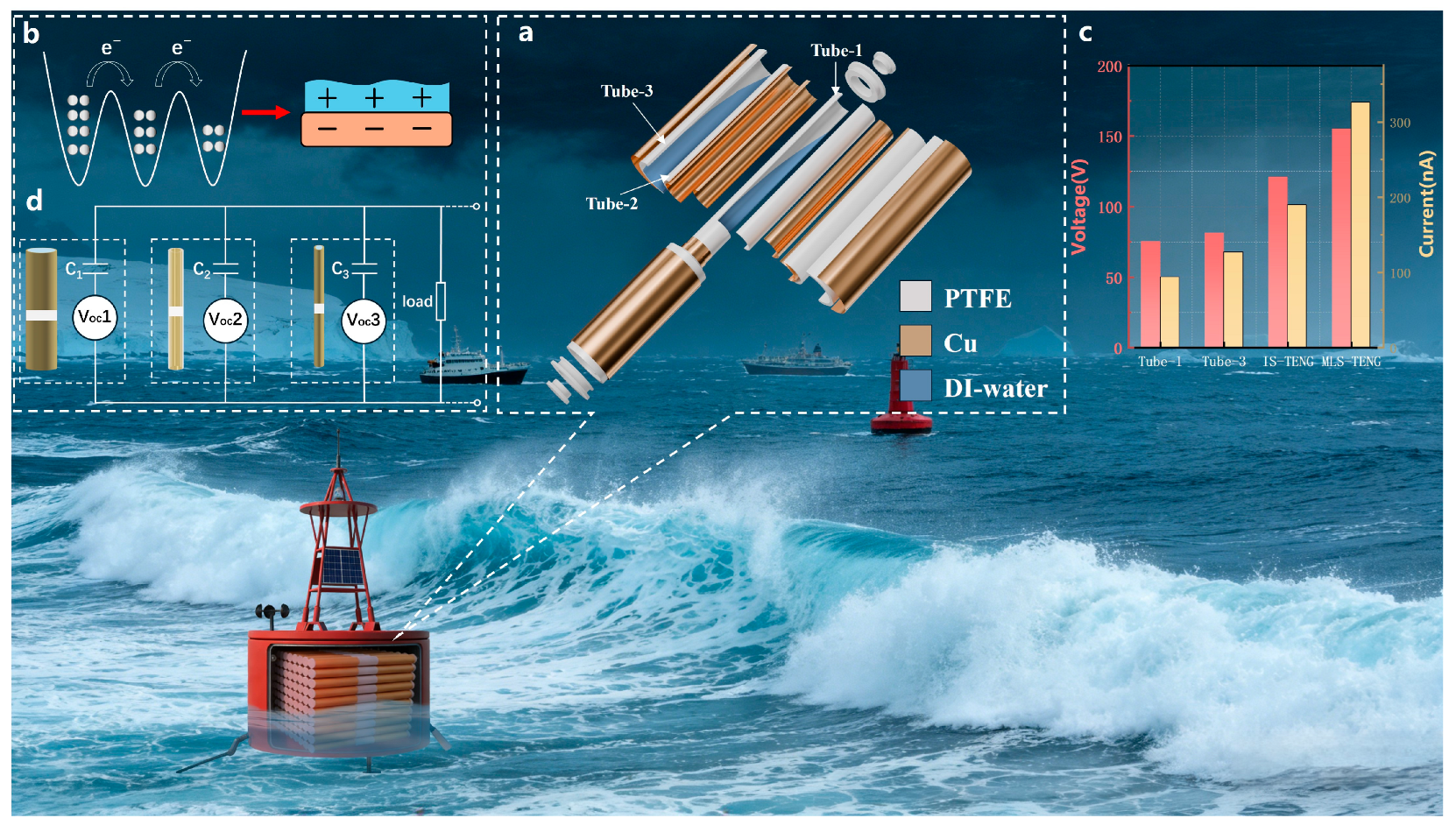
As illustrated in Figure 1a, the proposed multi-tube nested triboelectric nanogenerator (MLS-TENG) consists of three polytetrafluoroethylene tubes with different dimensions nested coaxially. The inner diameter × outer diameter values of Tube-1, Tube-2, and Tube-3 are 15 × 17 mm, 18 × 20 mm, and 25 × 29 mm, respectively, with a uniform length of 25 cm. The device is constructed as a multilayer liquid–solid triboelectric unit using copper foil electrodes, deionized water (DI water), and rubber stoppers. To ensure surface cleanliness and the stability of contact electrification, the inner and outer walls of all PTFE tubes are cleaned successively with anhydrous ethanol and deionized water. Subsequently, two copper foil strips with a length of 12 cm and a thickness of 60 µm are attached to both ends of the outer walls of Tube-1 and Tube-3, as well as both ends of the inner wall of Tube-2. Tube-2 is coaxially inserted into Tube-3 to form a 2.5 mm annular interlayer gap. In this study, this Tube-2 and Tube-3 interlayer configuration is defined as the interlayer-structure triboelectric nanogenerator (IS-TENG), in which the annular gap serves as the interlayer liquid channel. Tube-1 is further inserted into Tube-2 to form a 1 mm inner annular gap, and a copper foil sheet connected to the electrodes is placed in the gap as the charge transport channel for the inner nested structure. Finally, the integration of Tube-1, Tube-2, and Tube-3 constructs the complete MLS-TENG with multiple liquid–solid contact interfaces. The dimensions of Tube-1, Tube-2, and Tube-3 were selected by comprehensively considering the liquid–solid charge transfer behavior, liquid flow characteristics, and fabrication feasibility. First, due to the strong electronegativity of PTFE and the dielectric properties of water, an appropriate tube spacing was required to ensure effective interfacial charge transfer during periodic liquid–solid contact. Second, the tube dimensions were further designed by considering the viscosity and surface tension of water to maintain a stable liquid sloshing motion under low-frequency excitation. Excessively small diameters restricted liquid mobility, whereas overly large diameters reduced effective contact efficiency and structural compactness. Finally, based on the above considerations and the commercially available PTFE tube specifications, suitable tube dimensions were selected for the present MLS-TENG design.
As depicted in Figure 1b, the working principle is based on the liquid–solid contact-separation triboelectric effect. Under low-frequency wave excitation, the liquid periodically moves along the PTFE surfaces, resulting in repeated liquid–solid contact and separation. In the multi-tube nested structure, multiple liquid–solid interfaces participate in charge generation simultaneously, which increases the effective contact area and provides parallel charge transfer pathways. Moreover, the fluctuation caused by non-uniform liquid motion at a single interface can be partially compensated by the other interfaces, leading to a more continuous charge transfer process and improved output stability. Figure 1c shows that the output voltage and current of the MLS-TENG are significantly higher than those of the single-tube structures (Tube-1 and Tube-3), verifying the performance advantages of the multilayer nested design. Figure 1d presents the equivalent circuit model of the MLS-TENG power supply, demonstrating that multiple parallel electrodes can collectively drive external loads.
In summary, the MLS-TENG achieves high output power and excellent durability by expanding the friction interface and charge transfer pathways, demonstrating outstanding energy harvesting capability in complex ocean wave environments.

2.2. Methods

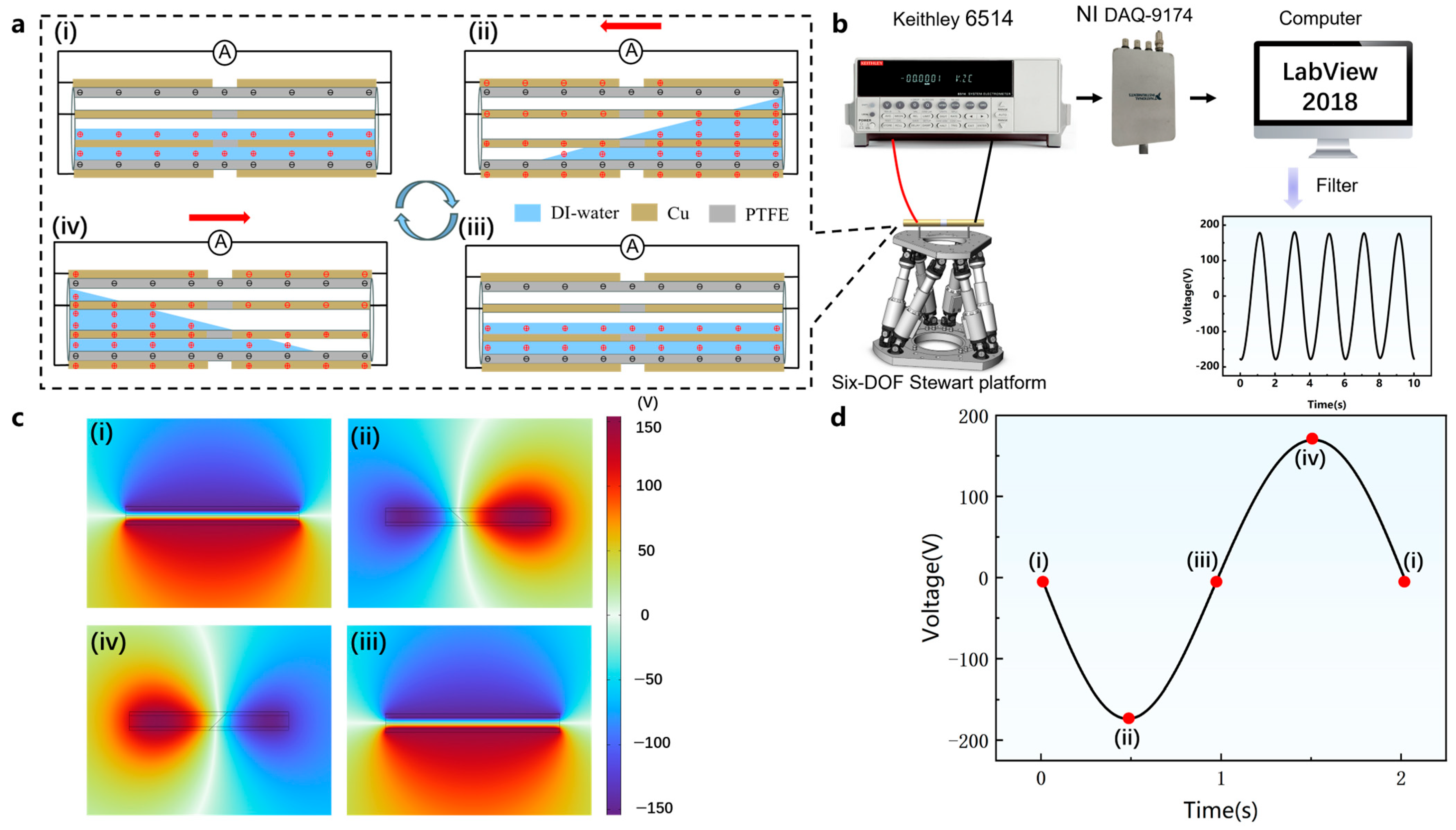
To further investigate the energy conversion mechanism of the MLS-TENG under wave-like excitation, a six-degree-of-freedom vibration platform was employed to provide controlled periodic rocking motion in the frequency range of 0.1–0.5 Hz. This frequency range corresponds to a motion period of approximately 2–10 s and is consistent with the low-frequency excitation conditions commonly used in previous studies on liquid–solid tubular TENGs and ocean-wave energy harvesting [7,30]. It should be noted that the present laboratory excitation was used to provide controllable and repeatable wave-like motion, rather than to fully reproduce the random spectrum of real ocean waves, as illustrated in Figure 2b. The device was fixed to an acrylic base to ensure stability and repeatability. A Keithley 6514 electrometer was used to measure the output voltage, current, and transferred charge in real time. Data were acquired by a National Instruments DAQ-9174 acquisition card (National Instruments, Austin, TX, USA) and processed using LabVIEW2018 software (National Instruments, Austin, TX, USA), to analyze the correlation between excitation parameters and electrical responses.
Figure 2a illustrates the fundamental working mechanism of the MLS-TENG. When the device is horizontally positioned, the liquid is uniformly distributed in the middle of the tubes, resulting in a small potential difference. When tilted to the right, the liquid slides along the PTFE surface and triggers triboelectric power generation, forming an asymmetric electric field distribution. As it returns to the horizontal state, the liquid partially detaches from the surface, weakening the potential difference. When tilted to the left, the liquid flows in the opposite direction, and the polarity of the potential is reversed. This periodic liquid–solid contact-separation process enables continuous electron flow in the external circuit. The multi-tube nested structure generates charges synchronously at multiple liquid–solid interfaces, thereby significantly enhancing the output performance.
To further reveal the electrical coupling mechanism of the MLS-TENG, finite element simulations of the electric potential distribution were carried out using COMSOL Multiphysics 6.2. The electrostatics module was adopted to establish a simplified electrostatic model based on the actual device configuration, including the PTFE tube walls, copper electrodes, DI water region, and surrounding air domain. The PTFE, DI water, air, and copper electrode domains were assigned their corresponding dielectric or conductive properties, and the copper electrodes were treated as conductive domains. An equivalent surface charge density was applied at the PTFE–water contact interface to represent the triboelectric charges generated during liquid–solid contact, while the outer boundary of the air domain was set as electrical insulation. To describe the potential evolution during liquid motion, four representative liquid positions were considered, corresponding to the states shown in Figure 2a: (i) the initial horizontal state, (ii) liquid moving to the right, (iii) liquid returning toward the middle position, and (iv) liquid moving to the left. The mesh was locally refined near the PTFE–water interface and electrode regions to improve the resolution of the electric potential distribution. As shown in Figure 2c, the simulated potential distribution changes with the liquid position, indicating the polarity reversal induced by the reciprocating motion of the liquid. The experimentally measured voltage curve in Figure 2d further supports the qualitative correspondence between liquid motion states and output voltage polarity. It should be noted that the COMSOL simulation was mainly used to visualize the electrostatic induction process and polarity reversal, rather than to quantitatively predict the absolute output voltage. Therefore, the simulation results in Figure 2c are discussed qualitatively together with the experimentally measured voltage response in Figure 2d.

3. Results and Discussion

3.1. Comparative Analysis of the Output Performance of MLS-TENG Under Different Structural Parameters

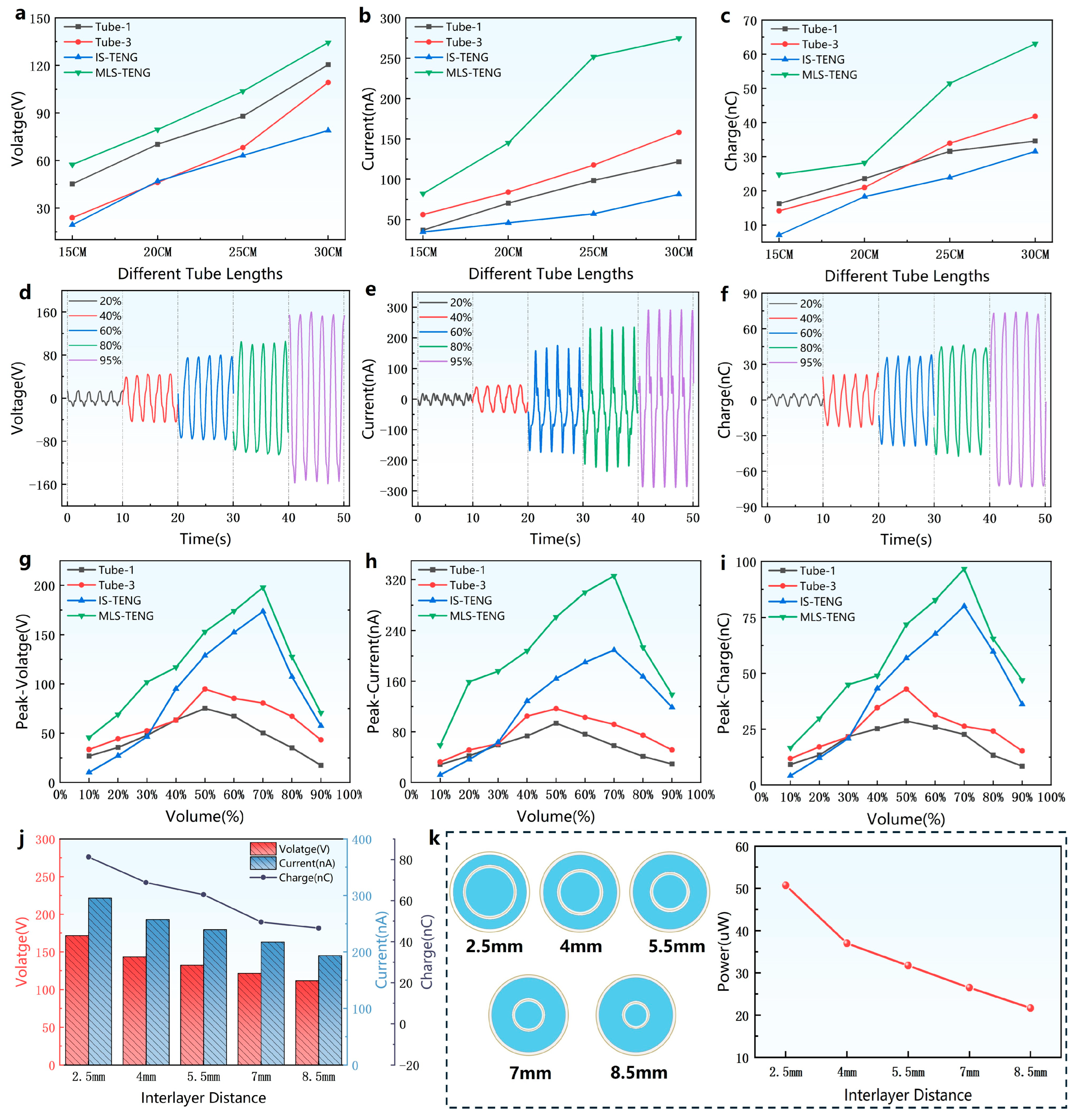
To systematically investigate the power-generation performance of the MLS-TENG under various structural parameters, this section presents a series of comparative experiments focusing on tube length, electrode width, liquid volume, and interlayer spacing. As shown in Figure 3a–c, in the tube-length variable experiments, the electrode width of all samples was set to 80% of the tube length, and the liquid volume was fixed at 50% of the tube length. The experimental results reveal that the peak voltage, current, and transferred charge of the MLS-TENG are significantly superior to those of Tube-1 and Tube-3 at all tube lengths. Moreover, the output performance increases continuously as the tube length rises from 15 cm to 30 cm. This is mainly attributed to the larger liquid–solid contact area provided by a longer tube, which strengthens the contact electrification effect. The multi-tube nested structure further amplifies this advantage through the synergistic effect of multiple interfaces and more uniform liquid distribution, enabling more efficient charge transfer. For instance, at a tube length of 30 cm, the MLS-TENG delivers a peak voltage of 134.45 V, which is 11.5–23.08% higher than that of the single-tube structures; the peak current of 274.7 nA and transferred charge of 63.04 nC are increased by 73–125% and 50.8–82%, respectively. In the electrode-width variable experiments (Figure 3d–f), the influence of the external electrode area on output performance was systematically investigated by adjusting the electrode coverage length to 20%, 40%, 60%, 80%, and 95% of the tube length. The results indicate that the output performance of the MLS-TENG is remarkably enhanced with increasing electrode width. At 95% coverage, the MLS-TENG achieves a peak voltage of 159.78 V, a peak current of 292.4 nA, and a transferred charge of 74.05 nC. The larger electrode area significantly improves charge collection and transfer efficiency, allowing full capture and utilization of triboelectric charges generated during liquid sloshing.
A further comparative study was conducted on the liquid volume inside the tubes. As shown in Figure 3g–i, the effect of liquid volume on power-generation performance exhibits a structure-dependent behavior. For Tube-1 and Tube-3, the output performance is optimal at a liquid volume of 50%, and either insufficient or excessive liquid leads to performance degradation. For the IS-TENG, the peak voltage, current, and charge at a filling ratio of 70% are increased by 34.8%, 27.5%, and 41%, respectively, compared with those at 50%. When the filling ratio is further increased to 80%, liquid flow is restricted, and insufficient dynamic interfacial contact occurs, resulting in reduced energy conversion efficiency. The overall output of the MLS-TENG reaches its optimum when combining the two optimal conditions: 50% for the inner tube and 70% for the interlayer. The liquid can effectively fill the gaps between the inner and outer tube walls, maximizing the triboelectric effect across multiple interfaces. At this point, according to Equation (1), the total area of the multilayer triboelectric interfaces can be expressed as
A total = A inner + A outer
where A inner and A outer are the effective triboelectric areas of the inner and outer walls, respectively. Owing to the uniform liquid distribution and sufficient flow in the interlayer, A total , the optimal performance is achieved at a filling ratio of 70%, thereby significantly enhancing the transferred charge quantity Q t o t a l = σ A total , where σ is the charge density. Finally, as shown in Figure 3j,k, when the interlayer spacing is increased from 2.5 mm to 8.5 mm, the power-generation performance exhibits a downward trend. This is mainly because an overlarge gap reduces the available triboelectric area and restricts the charge-generating interfaces. Meanwhile, the liquid volume within a single tube decreases, lowering the triboelectric interface area and reducing the overall energy conversion efficiency. This phenomenon arises because the liquid–solid triboelectric nanogenerator generates static charges via the relative motion of two contact interfaces and converts energy through capacitance variation. Therefore, the geometric design of the liquid–solid TENG should strike a balance between liquid fluidity and capacitive coupling efficiency. Excessively large or small spacing will result in restricted motion or insufficient charge coupling, respectively. Systematic experimental comparisons reveal that the energy conversion efficiency of the MLS-TENG is appropriate at an inner–outer tube spacing of 2.5 mm. This phenomenon can be explained by the intrinsic capacitance model, in which the total capacitance is mainly determined by the overlapping area. The calculation formula according to Equation (2) is as follows:
C = ε 0 w ( l x ) d 0
where C is the equivalent capacitance between the liquid and electrode, ε0 is the vacuum permittivity, w is the width of the entire structure, l is the length, x 0 is the lateral separation distance, d 0 is the effective thickness constant. Based on this favorable geometric configuration, the proposed MLS-TENG is designed to enlarge the effective liquid–solid interfacial contact area through the multilayer nested architecture and layered liquid-distribution design, thereby improving charge transfer, energy conversion efficiency, and output stability.
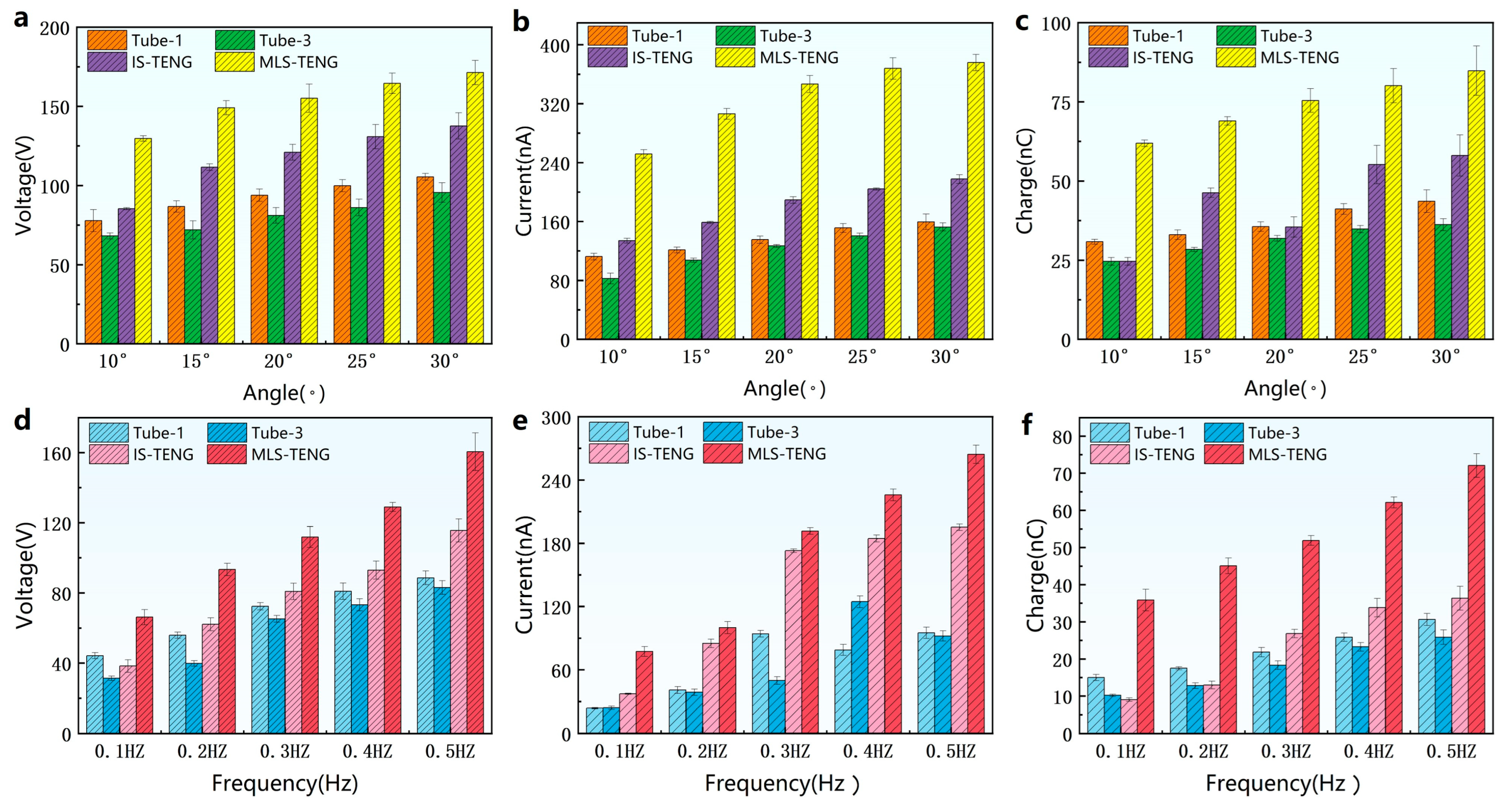
To systematically evaluate the influence of mechanical excitation parameters on the output performance of the MLS-TENG, comparative experiments under different rocking angles (θ) and frequencies (F) were carried out using a six-degree-of-freedom vibration table. The tested structures included Tube-1, Tube-3, IS-TENG, and MLS-TENG, and their peak voltage (V-Peak), peak current (I-Peak), and transferred charge (Q-Peak) were recorded. At a fixed frequency of 0.5 Hz, the pitch angle increased from 10° to 30°, as shown in Figure 4a–c. The results indicate that the V-Peak, I-Peak, and Q-Peak of all structures increase monotonically with the angle. In contrast, the MLS-TENG exhibits the optimal output performance over the entire angular range: its V-Peak rises from 129.66 V to 171.39 V, I-Peak from 251.65 nA to 375.81 nA, and Q-Peak from 61.92 nC to 84.82 nC. It shows a more significant increase compared with the single-tube structures (Tube-1 and Tube-3) and IS-TENG. These results demonstrate that the pitch angle is a key parameter affecting the liquid–solid interfacial triboelectric behavior. As the tilt angle increases, the inertial impact and flow amplitude of the liquid inside the tube are enhanced, thereby expanding the effective contact area, promoting charge transfer, and ultimately improving the overall output performance. To better simulate real wave frequencies, as shown in Figure 4d–f, at a fixed pitch angle of 15°, the frequency was adjusted from 0.1 Hz to 0.5 Hz. The output of all four structures increases significantly with rising frequency across the whole range. For the MLS-TENG, the V-Peak is 58.3 V, I-Peak is 92.4 nA, and Q-Peak is 23.1 nC at 0.1 Hz, which are enhanced to 165 V, 268.5 nA, and 72.4 nC at 0.5 Hz, with increases of 184%, 190%, and 213%, respectively. In comparison, Tube-1 and Tube-3 show weaker frequency responses, mainly limited by the smaller contact area and insufficient charge coupling. The results confirm that the multi-interface nested design can effectively strengthen the liquid–solid coupling strength and charge migration ability, achieving higher energy conversion efficiency and demonstrating the excellent frequency adaptability of the MLS-TENG in low-frequency wave energy harvesting.

3.2. Performance and Applications

The power output capability of the MLS-TENG is one of the important indicators for evaluating its practical application potential and load adaptability. As shown in Figure 5a, the output characteristics of the MLS-TENG under different external load resistances from 100 MΩ to 1000 MΩ are presented. The peak voltage under each load was measured in real time, according to Equation (3), based on the following formula:
P M L S - T E N G = V 2 R
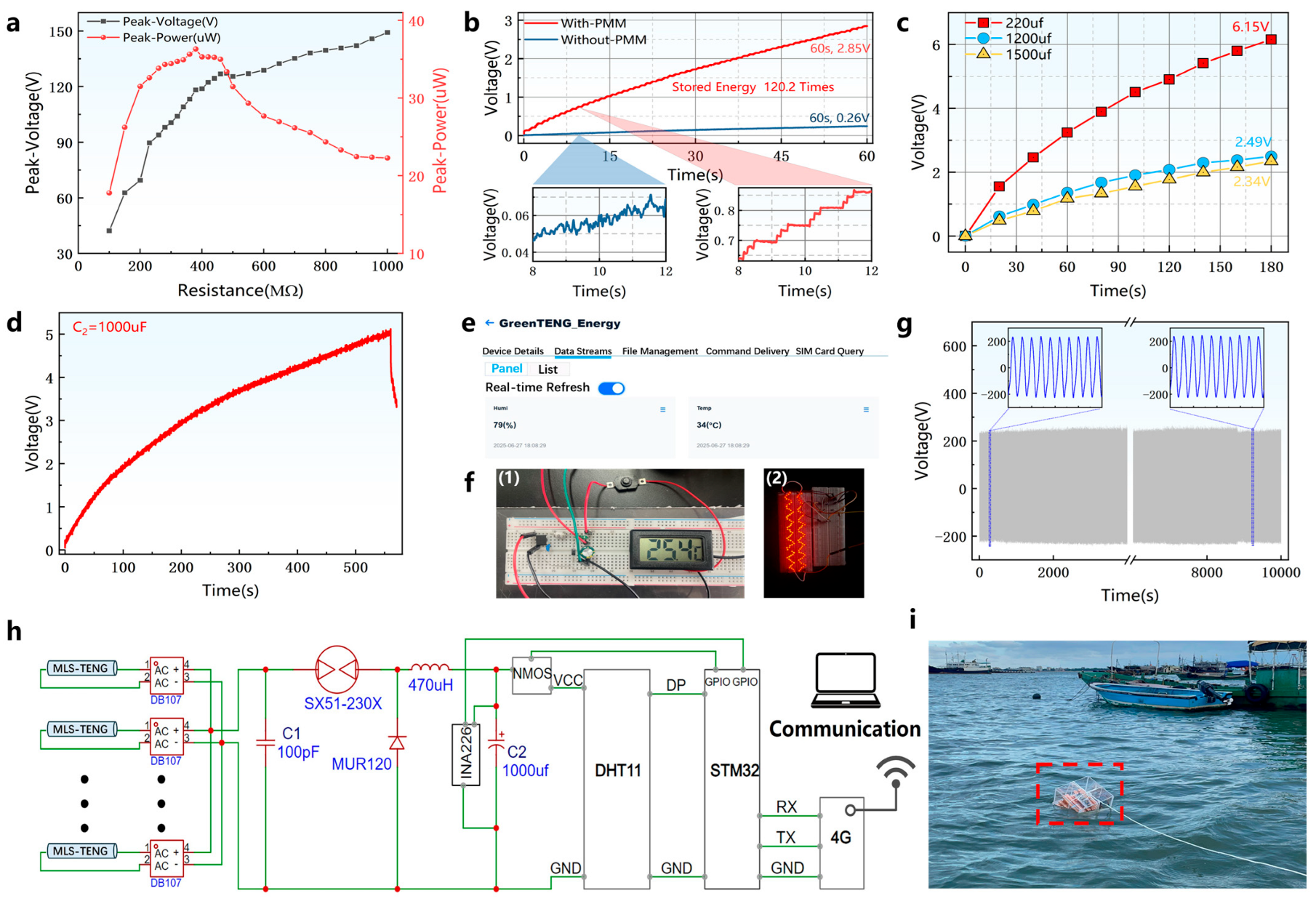
where V is the output voltage of the MLS-TENG and R is the external load resistance. With increasing load resistance, the peak voltage first rises and then falls. A maximum instantaneous power of 36.29 μW is obtained at the optimal resistance matching of 385 MΩ, with a corresponding peak voltage of 118.21 V. This result clearly identifies this resistance as the optimal impedance matching point of the system, highlighting the importance of matching the load resistance in the energy harvesting process to maximize energy transfer efficiency. Notably, powering low-power sensors is a key application direction for TENGs toward self-powered marine Internet of Things (IoT) nodes. However, the frequency and amplitude of real ocean waves fluctuate unpredictably with time and environment. Due to the inherently high internal resistance and pulsed output characteristics of TENGs, the direct energy storage efficiency is relatively low. To address this issue, multiple MLS-TENG units were connected in parallel to reduce the overall internal resistance. Furthermore, a power management module (PMM) was introduced between the MLS-TENG and the energy storage capacitor [38]. Figure 5b compares the capacitor charging characteristics with and without the PMM under the same mechanical excitation. Without the PMM, the voltage of the 330 μF capacitor only rises to 0.26 V within 60 s. In contrast, with the PMM integrated, the voltage rapidly increases to 2.85 V in the same charging duration. The charging curve shows a stepwise rise, corresponding to the storage of discrete energy in each excitation cycle, with an approximately 120.2-fold energy enhancement, according to Equation (4):
E = 1 2 C V 2
where C is the capacitance, and V is the voltage across the capacitor. This result confirms the crucial role of the PMM in improving energy storage efficiency under wave mechanical excitation. Figure 5c further presents the charging characteristics of different capacitors driven by 30 MLS-TENG units with the PMM regulation. Subsequently, to verify the capability of the MLS-TENG in driving practical electronic devices, a 1000 μF capacitor was charged to 5 V within 550 s under excitation of 0.5 Hz and 20° using the six-degree-of-freedom vibration table, as shown in the charging curve in Figure 5d. The stored energy successfully drove a DHT11 temperature sensor (Aosong Electronics Co., Ltd., Guangzhou, China), as shown in Figure 5f(1). Meanwhile, the stacked MLS-TENG units could easily light up 121 LEDs in series, as illustrated in Figure 5f(2) and Movie S1. To verify the long-term stability of the device, a single MLS-TENG was tested continuously for 10,000 s on the six-degree-of-freedom platform, as shown in Figure 5g. The waveform and amplitude of the output voltage remained stable without significant degradation, demonstrating excellent structural durability.
To demonstrate the system application capability, as shown in Figure 5h, a self-powered sensing system was designed and constructed, consisting of an MLS-TENG array, PMM, STM32 microcontroller, DHT11 sensor, INA226 voltage and current detection module, and 4G communication module. A homemade buoy equipped with 30 MLS-TENG units was deployed in the real marine environment at Fisherman’s Wharf in Zhanjiang City, as illustrated in Figure 5i, with auxiliary circuit modules mounted on the power-generation core. The buoy harvested wave energy to charge the capacitor. When the INA226 module detected that the voltage across capacitor C2 reached 5 V, it transmitted this signal to the STM32 microcontroller via the I2C interface. The STM32 then triggered the NMOS tube to conduct and supply power to the DHT11 temperature and humidity sensor. After 710 s, the system successfully uploaded environmental data (humidity 79%, temperature 34 °C) to the OneNET IoT cloud platform named “GreenTENG_Energy”, as shown in Figure 5e. This confirms that the self-powered buoy can achieve closed-loop operation of stable energy supply, intelligent control, and real-time signal transmission, marking a significant step toward self-powered sensing applications using fully TENG-based devices in marine conditions. Finally, the long-term durability of the MLS-TENG was verified.

4. Conclusions

In this work, a multi-tube nested enhanced liquid–solid triboelectric nanogenerator (MLS-TENG) was designed and fabricated. The integrated structure significantly increases the effective triboelectric area and liquid motion efficiency, thereby achieving higher charge transfer efficiency. Systematic tests verified the performance differences of various structures under different liquid filling ratios. Under an impedance matching of 385 MΩ, the MLS-TENG delivered a maximum instantaneous power output of 36.29 μW. To improve the inherent high internal resistance and pulsed output characteristics of TENGs, a power management module (PMM) was introduced, which improved the energy storage efficiency by approximately 120 times. Thirty MLS-TENG units easily lit up 121 high-brightness LEDs. In a real marine environment, the device drove a low-power temperature and humidity sensor within 710 s and uploaded data to the cloud platform. Long-term continuous operation tests showed that the structure maintained stable output and excellent durability over 10,000 s. This study demonstrates the potential of the MLS-TENG for efficient wave energy harvesting and self-powered marine Internet of Things applications. Future work will focus on improving the long-term reliability of the device under real marine conditions, including sealing performance, corrosion resistance, and stability under irregular wave excitation. Further optimization of device arrays and power management circuits will also be conducted to enhance the practical applicability of MLS-TENG-based self-powered sensing nodes.

Supplementary Materials

The following supporting information can be downloaded at: https://www.mdpi.com/article/10.3390/en19112722/s1, Movie S1. Demonstration of 30 MLS-TENG units lighting up 121 LEDs.

Author Contributions

Conceptualization, D.L., S.L. and Q.Z.; methodology, D.L.; software, D.L.; validation, D.L., P.Z., P.L., J.S. and W.L.; formal analysis, D.L.; investigation, D.L., P.Z. and P.L.; resources, S.L. and Q.Z.; data curation, D.L.; writing—original draft preparation, D.L.; writing—review and editing, S.L. and Q.Z.; visualization, D.L.; supervision, S.L. and Q.Z.; project administration, S.L. and Q.Z.; funding acquisition, S.L. and Q.Z. All authors have read and agreed to the published version of the manuscript.

Funding

This research was funded by the National Natural Science Foundation of China, grant number 52101381; the Natural Science Foundation of Guangdong Province, grant number 2023A1515010996; the Special Fund for Science and Technology Innovation Strategy of Guangdong Province, grant number pdjh2023b0288; and the Fund of Guangdong Provincial Key Laboratory of Intelligent Equipment for South China Sea Marine Ranching, grant number 2023B1212030003, The APC was funded by Qianxi Zhang and Guangdong Ocean University.

Data Availability Statement

The original contributions presented in this study are included in the article/Supplementary Materials. Further inquiries can be directed to the corresponding author.

Conflicts of Interest

The authors declare no conflicts of interest.

Abbreviations

The following abbreviations are used in this manuscript:
TENGTriboelectric nanogenerator
LS-TENGLiquid–solid triboelectric nanogenerator
IS-TENGInterlayer-structure triboelectric nanogenerator
MLS-TENGMulti-tube liquid–solid triboelectric nanogenerator
PTFEPolytetrafluoroethylene
FEPFluorinated ethylene propylene
DI waterDeionized water
AC-DCAlternating current to direct current
IoTInternet of Things
AlNAluminum nitride
PMMPower management module
LEDsLight-emitting diodes

References

  1. Ahmad, T.; Zhang, D. A critical review of comparative global historical energy consumption and future demand: The story told so far. Energy Rep. 2020, 6, 1973–1991. [Google Scholar] [CrossRef]
  2. Bloch, H.; Rafiq, S.; Salim, R. Economic growth with coal, oil and renewable energy consumption in China: Prospects for fuel substitution. Econ. Model. 2015, 44, 104–115. [Google Scholar] [CrossRef]
  3. Zhang, D.; Wang, J.; Lin, Y.; Si, Y.; Huang, C.; Yang, J.; Huang, B.; Li, W. Present situation and future prospect of renewable energy in China. Renew. Sustain. Energy Rev. 2017, 76, 865–871. [Google Scholar] [CrossRef]
  4. Xie, H.; Bui, W.K.T. Impact of globalization and energy consumption on CO2 emissions in China: Implications for energy transition. Financ. Res. Lett. 2024, 67, 105939. [Google Scholar] [CrossRef]
  5. Maka, A.O.M.; Ghalut, T.; Elsaye, E. The pathway towards decarbonisation and net-zero emissions by 2050: The role of solar energy technology. Green Technol. Sustain. 2024, 2, 100107. [Google Scholar] [CrossRef]
  6. Vallejo Díaz, A.; Herrera Moya, I. Urban wind energy with resilience approach for sustainable cities in tropical regions: A review. Renew. Sustain. Energy Rev. 2024, 199, 114525. [Google Scholar] [CrossRef]
  7. Shan, B.; Ai, T.; Wang, K. Triboelectric nanogenerator for ocean energy harvesting: A review of technological advances and future perspectives. Int. J. Electrochem. Sci. 2024, 19, 100694. [Google Scholar] [CrossRef]
  8. Shi, X.; Liang, B.; Li, S.; Zhao, J.; Wang, J.; Wang, Z. Wave energy resource classification system for the China East Adjacent Seas based on multivariate clustering. Energy 2024, 299, 131454. [Google Scholar] [CrossRef]
  9. Li, H.; Wu, J.; Shi, X.; Kong, L.; Kong, W.; Zhang, Z.; Pan, Y.; Luo, D.; Yan, J. A self-powered smart wave energy converter for sustainable sea. Mech. Syst. Signal Process. 2024, 220, 111641. [Google Scholar] [CrossRef]
  10. Abbaspour, M.; Farshforoush, A. Optimal arrangements for semi-submersible cylindrical wave energy converters: A study in layout optimization and power extraction efficiency. Ocean Eng. 2024, 296, 116833. [Google Scholar] [CrossRef]
  11. Rosso, M.; Maspero, F.; Esposito, A.; Afifi, T.A.; Riani, M.; Gattere, G.; Di Matteo, A.; Corigliano, A.; Ardito, R. Characterization of AlN in MEMS: Synergistic use of dynamic testing, static profilometry, and an enhanced reduced-order model. Eur. J. Mech.—A/Solids 2026, 115, 105834. [Google Scholar] [CrossRef]
  12. Abdolmaleki, A.H.; Asadi, M.; Farajollahi, M.; Malaie, O. Experimental investigation of electromagnetic energy harvesting induced by sloshing motion. Results Eng. 2025, 27, 105860. [Google Scholar] [CrossRef]
  13. Zhong, W.; Xu, L.; Wang, H.; Li, D.; Wang, Z.L. Stacked pendulum-structured triboelectric nanogenerators for effectively harvesting low-frequency water wave energy. Nano Energy 2019, 66, 104108. [Google Scholar] [CrossRef]
  14. Wang, Z.L.; Jiang, T.; Xu, L. Toward the blue energy dream by triboelectric nanogenerator networks. Nano Energy 2017, 39, 9–23. [Google Scholar] [CrossRef]
  15. Song, Y.; Wang, H.; Cheng, X.; Li, G.; Chen, X.; Chen, H.; Miao, L.; Zhang, X.; Zhang, H. High-efficiency self-charging smart bracelet for portable electronics. Nano Energy 2019, 55, 29–36. [Google Scholar] [CrossRef]
  16. Wang, F.; Tian, J.; Ding, Y.; Shi, Y.; Tao, X.; Wang, X.; Yang, Y.; Chen, X.; Wang, Z.L. A universal managing circuit with stabilized voltage for maintaining safe operation of self-powered electronics system. iScience 2021, 24, 102502. [Google Scholar] [CrossRef]
  17. Zhang, H.; Lu, Y.; Ghaffarinejad, A.; Basset, P. Progressive contact-separate triboelectric nanogenerator based on conductive polyurethane foam regulated with a Bennet doubler conditioning circuit. Nano Energy 2018, 51, 10–18. [Google Scholar] [CrossRef]
  18. Hong, H.; Chen, T.; Yang, J.; Hu, Y.; Hu, J.; Li, D.; Liu, F.; Liu, L.; Wu, H. Omnidirectional water wave energy harvesting by a spherical triboelectric nanogenerator with sliced-pizza-shaped electrodes. Cell Rep. Phys. Sci. 2024, 5, 101933. [Google Scholar] [CrossRef]
  19. Li, J.; Cheng, L.; Wan, N.; Ma, J.; Hu, Y.; Wen, J. Hybrid harvesting of wind and wave energy based on triboelectric-piezoelectric nanogenerators. Sustain. Energy Technol. Assess. 2023, 60, 103466. [Google Scholar] [CrossRef]
  20. Zhao, T.; Xu, M.; Xiao, X.; Ma, Y.; Li, Z.; Wang, Z.L. Recent progress in blue energy harvesting for powering distributed sensors in ocean. Nano Energy 2021, 88, 106199. [Google Scholar] [CrossRef]
  21. Salman, M.; Sorokin, V.; Aw, K. Systematic literature review of wave energy harvesting using triboelectric nanogenerator. Renew. Sustain. Energy Rev. 2024, 201, 114626. [Google Scholar] [CrossRef]
  22. Jiang, T.; Yao, Y.; Xu, L.; Zhang, L.; Xiao, T.; Wang, Z.L. Spring-assisted triboelectric nanogenerator for efficiently harvesting water wave energy. Nano Energy 2017, 31, 560–567. [Google Scholar] [CrossRef]
  23. Kim, D.Y.; Kim, H.S.; Kong, D.S.; Choi, M.; Kim, H.B.; Lee, J.-H.; Murillo, G.; Lee, M.; Kim, S.S.; Jung, J.H. Floating buoy-based triboelectric nanogenerator for an effective vibrational energy harvesting from irregular and random water waves in wild sea. Nano Energy 2018, 45, 247–254. [Google Scholar] [CrossRef]
  24. Liu, W.; Xu, L.; Bu, T.; Yang, H.; Liu, G.; Li, W.; Pang, Y.; Hu, C.; Zhang, C.; Cheng, T. Torus structured triboelectric nanogenerator array for water wave energy harvesting. Nano Energy 2019, 58, 499–507. [Google Scholar] [CrossRef]
  25. Zhang, B.; Zhang, C.; Yang, O.; Yuan, W.; Liu, Y.; He, L.; Hu, Y.; Zhao, Z.; Zhou, L.; Wang, J.; et al. Self-Powered Seawater Electrolysis Based on a Triboelectric Nanogenerator for Hydrogen Production. ACS Nano 2022, 16, 15286–15296. [Google Scholar] [CrossRef]
  26. Chen, X.; Gao, L.; Chen, J.; Lu, S.; Zhou, H.; Wang, T.; Wang, A.; Zhang, Z.; Guo, S.; Mu, X.; et al. A chaotic pendulum triboelectric-electromagnetic hybridized nanogenerator for wave energy scavenging and self-powered wireless sensing system. Nano Energy 2020, 69, 104440. [Google Scholar] [CrossRef]
  27. Ouyang, R.; Huang, Y.; Ye, H.; Zhang, Z.; Xue, H. Copper particles-PTFE tube based triboelectric nanogenerator for wave energy harvesting. Nano Energy 2022, 102, 107749. [Google Scholar] [CrossRef]
  28. Wang, D.; Zhao, J.; Zhang, F.; Claesson, P.; Pan, J.; Shi, Y. In-situ coating wear condition monitoring based on solid-liquid triboelectric nanogenerator and its mechanism study. Nano Energy 2023, 112, 108479. [Google Scholar]
  29. Xu, Q.; Shang, C.; Ma, H.; Hong, Q.; Li, C.; Ding, S.; Xue, L.; Sun, X.; Pan, Y.; Sugahara, T.; et al. A guided-liquid-based hybrid triboelectric nanogenerator for omnidirectional and high-performance ocean wave energy harvesting. Nano Energy 2023, 109, 108240. [Google Scholar]
  30. Zhang, Q.; He, M.; Pan, X.; Huang, D.; Long, H.; Jia, M.; Zhao, Z.; Zhang, C.; Xu, M.; Li, S. High performance liquid-solid tubular triboelectric nanogenerator for scavenging water wave energy. Nano Energy 2022, 103, 107810. [Google Scholar] [CrossRef]
  31. Wei, W.; Kemp, D.B.; Lu, Y.; Wang, Z.; Ma, Y.; Liu, H.; Zhang, S.; Zhang, J.; Teng, X.; Robbins, L.J.; et al. Astronomically forcing salinity variations in a marginal-marine environment, Bohai Bay Basin, NE China. Chem. Geol. 2024, 665, 122300. [Google Scholar] [CrossRef]
  32. Zheng, Y.; Ni, Y.; Zi, Y.; Cui, H.; Li, X. Enhanced triboelectric nanogenerators in saline environments and their applications in the ocean. Nano Energy 2024, 126, 109636. [Google Scholar] [CrossRef]
  33. Xiang, T.; Chen, X.; Sun, H.; Liu, D.; Jiang, Y.; Chen, S.; Xie, Y.; Zhang, S. Advances in liquid-solid triboelectric nanogenerators and its applications. J. Mater. Sci. Technol. 2025, 214, 153–169. [Google Scholar]
  34. Wang, Z.; Wan, D.; Fang, R.; Yuan, Z.; Zhuo, K.; Wang, T.; Zhang, H. Water-based triboelectric nanogenerator for wireless energy transmission and self-powered communication via a solid-liquid-solid interaction. Appl. Surf. Sci. 2022, 605, 154765. [Google Scholar] [CrossRef]
  35. Cui, M.; Feng, Y.; Wu, H.; Jin, Y.; Li, W.; Wang, Z. Low-frequency blue energy harvesting for sustainable and active anticorrosion. Nano Res. 2023, 16, 11871–11877. [Google Scholar] [CrossRef]
  36. Long, H.; Li, S.; Jia, M.; Huang, D.; Zhang, P.; Wang, X.; Li, X.; Wu, J.; Hou, D.; Zhang, Q. A tubular liquid-solid triboelectric-electromagnetic hybrid nanogenerator for enhancing wave energy harvesting. Energy 2024, 304, 132119. [Google Scholar]
  37. Huang, D.; Li, S.; Zhang, P.; Yan, J.; Li, X.; Long, H.; Zhang, Q. Enhancement of the tubular liquid-solid triboelectric nanogenerator by coupling electrode pairs. Appl. Energy 2025, 377, 124694. [Google Scholar]
  38. Wang, Y.; Du, H.; Yang, H.; Xi, Z.; Zhao, C.; Qian, Z.; Chuai, X.; Peng, X.; Yu, H.; Zhang, Y.; et al. A rolling-mode triboelectric nanogenerator with multi-tunnel grating electrodes and opposite-charge-enhancement for wave energy harvesting. Nat. Commun. 2024, 15, 6834. [Google Scholar] [PubMed]
Figure 1. (a) Core power-generation structure of the MLS-TENG. (b) Electron cloud model. (c) Comparison of current and voltage generated by single-tube, nested interlayer, and double-tube configurations. (d) Equivalent circuit diagram.
Energies 19 02722 g001
Figure 2. Working mechanism, measurement system, COMSOL Multiphysics 6.2 (COMSOL AB, Stockholm, Sweden) simulation and experimental voltage response of the multi-tube nested liquid–solid triboelectric nanogenerator (MLS-TENG). (a) Charge distribution and transfer process during one liquid-sloshing cycle: (i) initial horizontal state, (ii) liquid moving to the right, (iii) liquid returning toward the middle position, and (iv) liquid moving to the left. The “+” and “−” symbols in Figure 2a represent positive and negative triboelectric charges, respectively. (b) Schematic illustration of the experimental measurement system. (c) COMSOL-simulated electric potential distribution of the MLS-TENG at the four representative liquid positions corresponding to states (iiv), where the color scale represents the electric potential distribution. (d) Experimentally measured voltage curve during one operating cycle, showing the correspondence between liquid motion states and output voltage polarity. The labels (iiv) correspond to the four representative liquid motion states shown in Figure 2a,c.
Energies 19 02722 g002
Figure 3. Experimental output performance comparison of different TENG structures under various structural parameters. (ac) Peak voltage, current, and transferred charge of different tube structures with the same electrode width and different tube lengths. (df) Output voltage, current, and transferred charge of the nested tube structure at different electrode widths. (gi) Effects of different liquid filling ratios on the peak output performance of different structure types. (j) Output voltage, current, and transferred charge at different interlayer spacings. (k) Schematic illustrations of tube-layer structures with different spacings and the corresponding output power variation trend.
Energies 19 02722 g003
Figure 4. Output performance of the MLS-TENG. (ac) Peak output voltage, current, and charge of the MLS-TENG at different pitch angles. (df) Peak output voltage, current, and charge of the MLS-TENG at different frequencies.
Energies 19 02722 g004
Figure 5. Demonstration of power-generation performance optimization and system applications of the MLS-TENG. (a) Maximum power matching of a single MLS-TENG unit. (b) Charging speed comparison of a 330 μF capacitor with and without a power management module (PMM). (c) Charging history of a stacked MLS-TENG (30 units) with a PMM for different capacitors. (d) Capacitor discharging during the self-powered sensing process. (e) Data received by the PC in self-powered sensing. (f) Subplot (1): a stacked MLS-TENG (30 units) driving a temperature sensor; Subplot (2): a stacked MLS-TENG (30 units) lighting up 121 LEDs. (g) Continuous operation of the MLS-TENG for 10,000 s. (h) System structure diagram of the temperature and humidity sensor. (i) Self-powered sensing process in a real marine environment.
Energies 19 02722 g005
Disclaimer/Publisher’s Note: The statements, opinions and data contained in all publications are solely those of the individual author(s) and contributor(s) and not of MDPI and/or the editor(s). MDPI and/or the editor(s) disclaim responsibility for any injury to people or property resulting from any ideas, methods, instructions or products referred to in the content.