


Abstract
This paper proposes an adaptive-confidence-window-modulated model predictive controller (ACW-M2PC) for induction motor drives. The method combines angle-guided local sector selection with a confidence-triggered bounded expansion toward adjacent sectors, so that the online search remains local whenever the local solution is reliable and expands only when necessary. This decision structure reduces unnecessary candidate evaluations while preserving low computational burden and improving the quality of the selected voltage action. The proposed controller was implemented and validated through real-time hardware-in-the-loop experiments on a dSPACE DS1202 platform. Compared with a baseline full-search-modulated model predictive controller (M2PC), ACW-M2PC reduced the average number of evaluated sectors by 79.7% while maintaining zero-overrun real-time execution. At the same time, it improved torque quality, reducing torque ripple peak-to-peak by 70.2% and torque ripple RMS by 62.0%, with a slight reduction in speed integral absolute error. An ablation study further showed that angle-guided local reduction already captures a large part of the computational benefit, whereas the confidence-triggered bounded expansion provides the additional corrective action required when the local solution becomes insufficient. Overall, these results show that ACW-M2PC improves the performance–complexity trade-off while remaining suitable for real-time induction motor drive control.
1. Introduction
Model predictive control (MPC) has become a well-established control framework for electric drives because it can handle multivariable behavior, converter constraints, and fast electromagnetic dynamics within a unified decision structure. Among its variants, finite-control-set MPC (FCS-MPC) has attracted particular attention for induction motor drives because of its direct implementation principle based on inverter switching states [1,2]. This simplicity, however, comes with familiar limitations, including relatively high steady-state ripple, variable switching frequency, sensitivity to cost function design, and a non-negligible online computational burden [3,4,5].
Recent motor performance studies also show that torque ripple and harmonic effects can be addressed from the electromagnetic design side, for instance, through time–space harmonic field optimization in PM vernier machines [6] and harmonic dimensionality reduction in double-rotor, flux-modulated PM motors [7]. In contrast, the present work addresses torque ripple reduction from the predictive control side through confidence-guided online selection of two-vector voltage actions.
To improve the steady-state behavior of conventional FCS-MPC, many studies have moved toward two-vector and, more generally, modulated model predictive control strategies [8,9,10,11]. By combining two active vectors, or active and zero vectors, within the same sampling interval, these approaches can better approximate the desired voltage reference and thereby reduce torque and current ripple. This line of research is now well-established in induction motor drives, and both earlier and more recent works confirm that multi-vector predictive control remains an effective route for improving waveform quality without abandoning the predictive control framework [8,9,10,11].
In parallel, another important research direction has focused on reducing the online computational complexity of predictive control [3,9]. Reduced-search and fast-computation MPC methods aim to limit the number of evaluated candidates by exploiting converter geometry, staged decision rules, or other structural simplifications. Recent reviews explicitly classify these methods as a major trend in FCS-MPC research, especially for applications where real-time execution is a primary concern [3,4]. This issue becomes even more critical in multi-vector predictive control, where the improvement in control quality may otherwise be offset by an increase in online optimization effort [3,9].
The literature has already shown the value of modulated two-vector predictive control, and it has also shown the usefulness of reduced-complexity search strategies. What remains less explored is a structured combination of these two ideas. In practice, it is desirable to preserve a local reduced search when the current decision is sufficiently reliable, and to enlarge the candidate set only when that local decision becomes questionable. Such a strategy is attractive because it targets the performance–complexity trade-off directly, instead of improving one side of the problem at the expense of the other [3,8,9,10].
Recent low-complexity predictive strategies for induction motor and AC drives have explored several structural directions to limit the online search effort. Among these, vector-projection-based M2PC [12] and sequential cost evaluation approaches [8,13] have demonstrated that meaningful reductions in execution time are achievable without sacrificing waveform quality. Duty cycle optimization and weighting-factor-free formulations [14,15,16] have further contributed to this trend by simplifying the candidate evaluation process. However, a characteristic shared by most of these contributions is that the candidate reduction policy is applied uniformly at every sampling instant, independent of whether the local solution is actually reliable under the current operating conditions. A strategy that explicitly validates the local decision quality—and expands the search only when necessary—remains less explored in this context.
Recent low-complexity MPC methods reduce the online burden through different mechanisms, such as sequential evaluation, vector projection, DSVM/virtual-vector screening, ranking-based multi-objective selection, weighting-factor-free formulations, or model-free prediction. These methods confirm the importance of reducing the candidate evaluation effort in predictive drive control. However, most of them apply a fixed or structurally predefined simplification rule at each sampling instant. In contrast, the proposed ACW-M2PC uses an adaptive local-to-adjacent search: the angle-guided local two-vector solution is first tested through an algebraic confidence criterion, and adjacent sectors are evaluated only when the local solution is unreliable. The resulting positioning with respect to recent low-complexity MPC families is summarized in Table 1.
Table 1.
Positioning of ACW-M2PC with respect to recent low-complexity MPC strategies.
ACW-M2PC therefore occupies a distinct position among recent low-complexity MPC strategies. Rather than applying a fixed reduced-candidate rule, it validates the angle-guided local two-vector solution through an algebraic confidence criterion and expands only to adjacent sectors when needed. This confidence-driven bounded local-to-adjacent search is the main contribution of the proposed controller. The method is validated through real-time HIL experiments on a dSPACE DS1202 platform and compared with two relevant predictive baselines: an analytical dynamic-weighting-law (DWL) controller, representing the weighted cost branch [19,20,21], and a baseline M2PC controller, representing the direct structural predecessor of the proposed method [8,9,10,11].
The reported results show that ACW-M2PC preserves the lightweight execution profile of baseline M2PC while improving torque ripple indicators under nominal and rotor resistance mismatch conditions.
Contributions
This paper proposes an adaptive reduced-search predictive control strategy for electrical drives.
The main contributions are summarized as follows:
- A confidence-guided local decision mechanism enabling real-time validation of locally selected switching vectors without full candidate enumeration.
- A feasibility-based interpretation of the confidence metric, ensuring that admissible solutions are identified through geometric consistency conditions.
- An adaptive bounded expansion strategy that preserves robustness while maintaining low computational complexity.
- A real-time implementation on a Hardware-in-the-Loop platform demonstrating bounded execution time and stable operation.
- A comparative experimental validation against DWL and baseline M2PC under nominal and rotor resistance mismatch conditions.
2. Methodology and Control System Modeling
2.1. Induction Motor and Inverter Model
The considered drive consists of a two-level voltage source inverter (VSI) feeding a three-phase induction motor. For predictive control implementation, the machine model is expressed in the stationary frame, which is convenient for one-step prediction and direct association with the inverter voltage vectors. The same plant model and parameter set are used for all controllers, ensuring that the subsequent comparisons primarily reflect differences in the predictive decision strategy rather than modeling discrepancies.
Using the stator current vector and the rotor–flux vector as state variables, the induction motor model can be written in compact form as follows [22,23]:
where the model coefficients are defined as
Here, represents the equivalent stator current damping coefficient, represents the rotor–flux coupling coefficient in the stator current dynamics, and represents the stator-voltage-to-current dynamic gain. Furthermore, denotes the mechanical speed, is the number of pole pairs, is the rotor time constant, is the total leakage coefficient, is the identity matrix, and is the skew-symmetric rotation matrix.
The electromagnetic torque is expressed as follows:
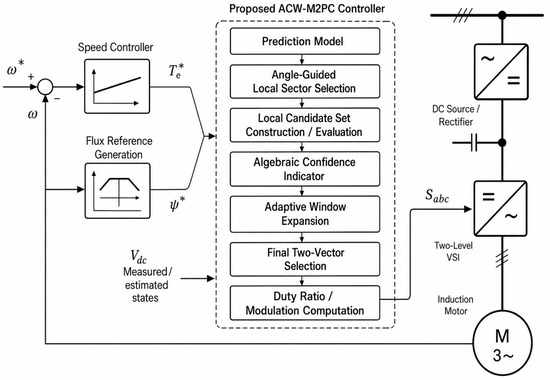
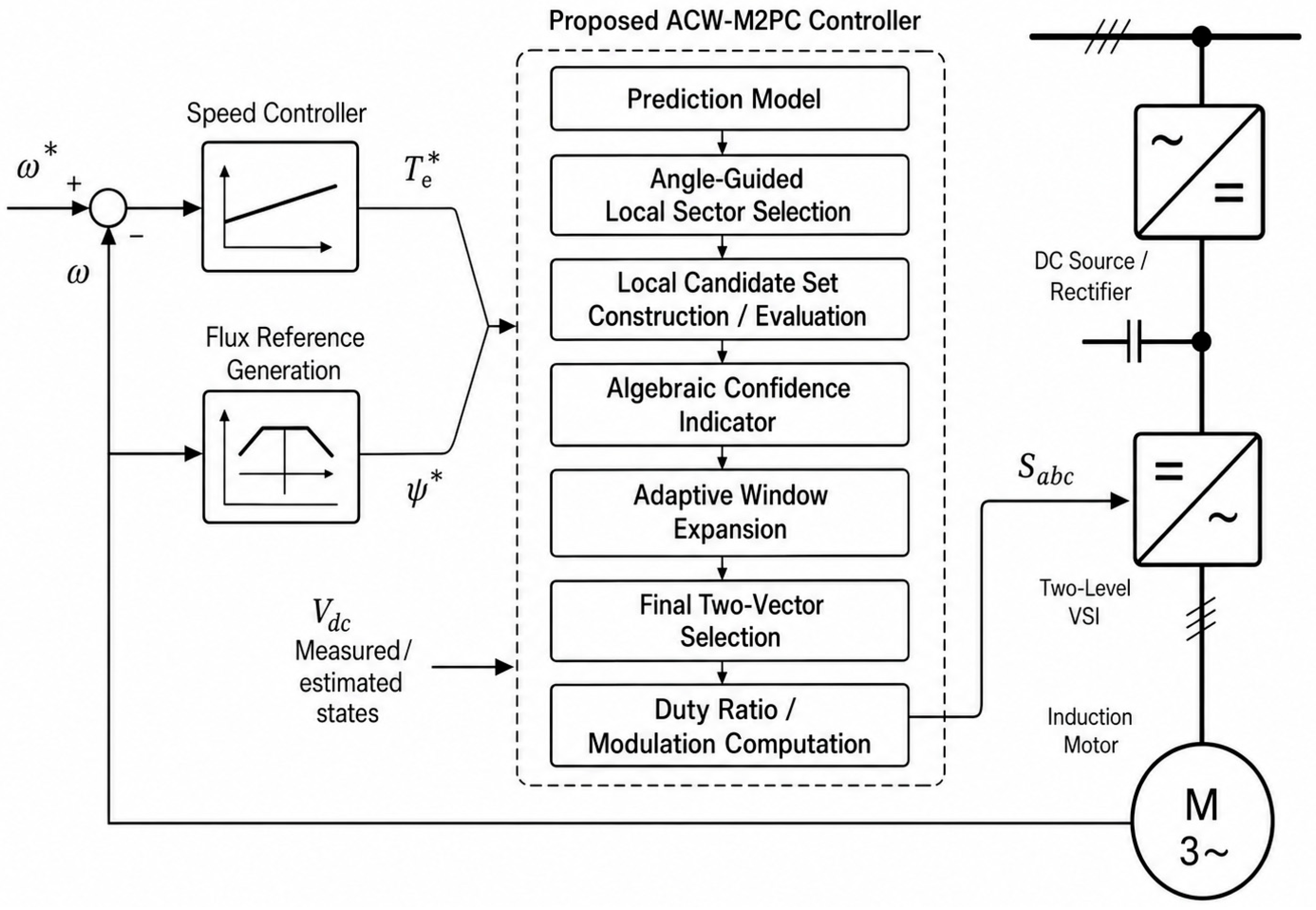
For the inverter, each admissible switching state generates a stator voltage vector in the frame. With the DC-link voltage , the corresponding phase-to-neutral quantities can be mapped into the stationary frame through the standard Clarke transformation. The overall closed-loop structure of the proposed ACW-M2PC-based induction motor drive is shown in Figure 1. The outer speed controller generates the electromagnetic torque reference, while the flux reference block provides the rotor–flux reference. These references are supplied to the ACW-M2PC controller together with the measured mechanical speed, measured currents, estimated fluxes, and DC-link voltage. The controller performs prediction, angle-guided local sector selection, confidence evaluation, bounded window expansion, and final two-vector selection. It then computes the duty ratios applied to the two-level VSI driving the induction motor. The measured mechanical speed is fed back to close the outer speed loop, while the measured or estimated electrical states and are used internally by the predictive controller for switching-vector selection.
Figure 1.
Overall control block diagram of the proposed ACW-M2PC-based induction motor drive.
The induction motor, inverter, and implementation parameters considered in this study are summarized in Table A1 in the Appendix A. The same parameter set was retained for DWL, baseline M2PC, and the proposed ACW-M2PC in order to ensure a fair comparison.
2.2. Baseline Predictive Controllers
2.2.1. Role of the Baselines in This Work
Two baseline predictive controllers are used in this work: an analytical dynamic-weighting-law controller (DWL) and a baseline two-vector-modulated model predictive controller (M2PC). Their roles are complementary. The DWL controller represents the class of weighted cost predictive control methods, whereas the baseline M2PC is the direct structural predecessor of the proposed ACW-M2PC strategy. Accordingly, comparison with DWL provides a broader benchmark against an adaptive weighted predictive control formulation [19,20,21], whereas comparison with baseline M2PC reveals the contribution of the adaptive-confidence-window search mechanism introduced in the proposed controller [8,9,10,11].
All methods are evaluated under identical conditions using the same prediction model, cost function, constraints, sampling period, and HIL platform. Therefore, the comparison focuses on the effect of the candidate-evaluation and selection strategy rather than differences in plant model, prediction structure, or experimental conditions.
The recent low-complexity methods summarized in Table 1 are used for structural positioning rather than direct numerical benchmarking. A fair quantitative comparison would require reimplementing each method with the same machine, inverter, sampling period, prediction model, cost function, and hardware platform. Similarly, classical control methods such as FOC, DTC, and DTC-SVM remain important industrial solutions for induction motor drives because of their maturity, implementation simplicity, and well-established performance [24,25]. In particular, DTC-SVM can reduce the torque and flux ripple of conventional DTC by introducing a more regular modulation pattern [26].
The present work, however, does not aim to establish universal superiority over all classical or recently proposed drive control methods. Its objective is to improve the candidate selection mechanism inside the modulated predictive control framework. Therefore, DWL and baseline M2PC are retained as the experimental comparators. Since baseline M2PC and ACW-M2PC share the same prediction model, cost function, constraints, sampling period, duty cycle computation, and two-vector modulation principle, their comparison isolates the contribution of the proposed confidence-guided, reduced-search mechanism within the multi-vector predictive control framework [27].
2.2.2. DWL-Based Predictive Controller
The first baseline is a weighted FCS-MPC strategy in which the final switching state is selected by minimizing a multi-objective cost function of the form
where , , and denote the tracking-related, flux-related, and switching-related terms, respectively. In contrast to fixed-weight formulations, the weighting factors are adjusted online according to normalized operating indicators derived from the speed tracking error and the torque request. More specifically, the normalized variables are defined as
with saturation to the interval [0, 1]. Based on these normalized indicators, the analytical weighting law adopted in this work is defined as follows. This formulation is consistent with the broader weighting-factor design strategies reported in [20,21]:
followed by bound enforcement to preserve numerical consistency. This baseline is relevant because it represents the weighted cost branch of predictive control and provides an interpretable adaptive-weight formulation. However, it still requires online evaluation of a weighted cost function over the candidate switching set, which results in a higher computational burden than reduced-search-modulated strategies, as discussed later in the real-time execution analysis.
2.2.3. Baseline M2PC Controller
The second baseline is a two-vector-modulated predictive controller in which two adjacent active voltage vectors are combined within each sampling interval through duty ratios and . Instead of applying a single switching state over the full period, the controller synthesizes an averaged voltage action according to
For each sampling instant, the baseline M2PC evaluates all six valid sectors systematically. In each sector, the two adjacent active vectors are selected, the raw duty ratios are computed analytically from the current-tracking objective, and the resulting solution is projected onto the admissible modulation region when needed. The predicted current response is then evaluated through a cost function combining a tracking term and a switching penalty, i.e.,
and the sector yielding the minimum total cost is retained for the final modulated switching action. This baseline is particularly relevant because it already provides a favorable compromise between waveform quality and computational cost, while remaining the direct structural ancestor of the proposed ACW-M2PC. Its main limitation, relative to the proposed method, is that it performs a systematic six-sector evaluation at every sampling instant and does not include confidence-guided local selection or bounded adaptive expansion.
Accordingly, the comparison among DWL, baseline M2PC, and ACW-M2PC highlights three different candidate selection philosophies: weighted full-set evaluation, systematic two-vector sector evaluation, and confidence-guided bounded reduced-search evaluation.
2.3. Proposed ACW-M2PC
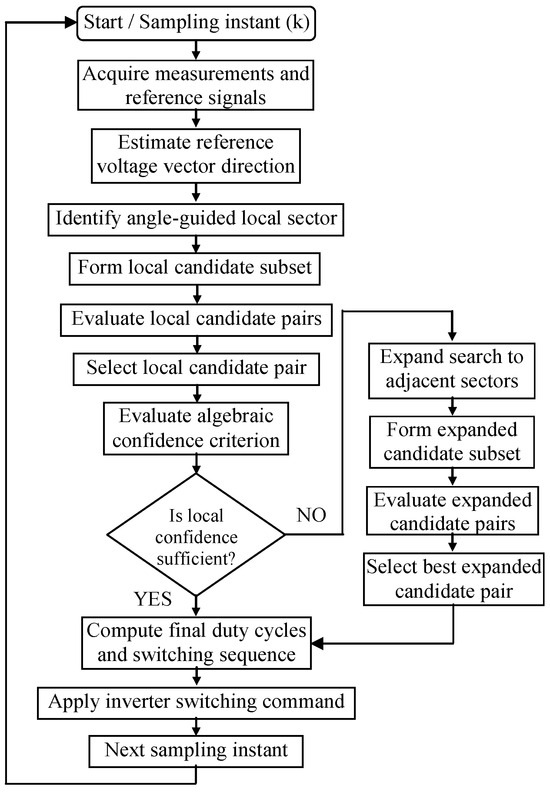
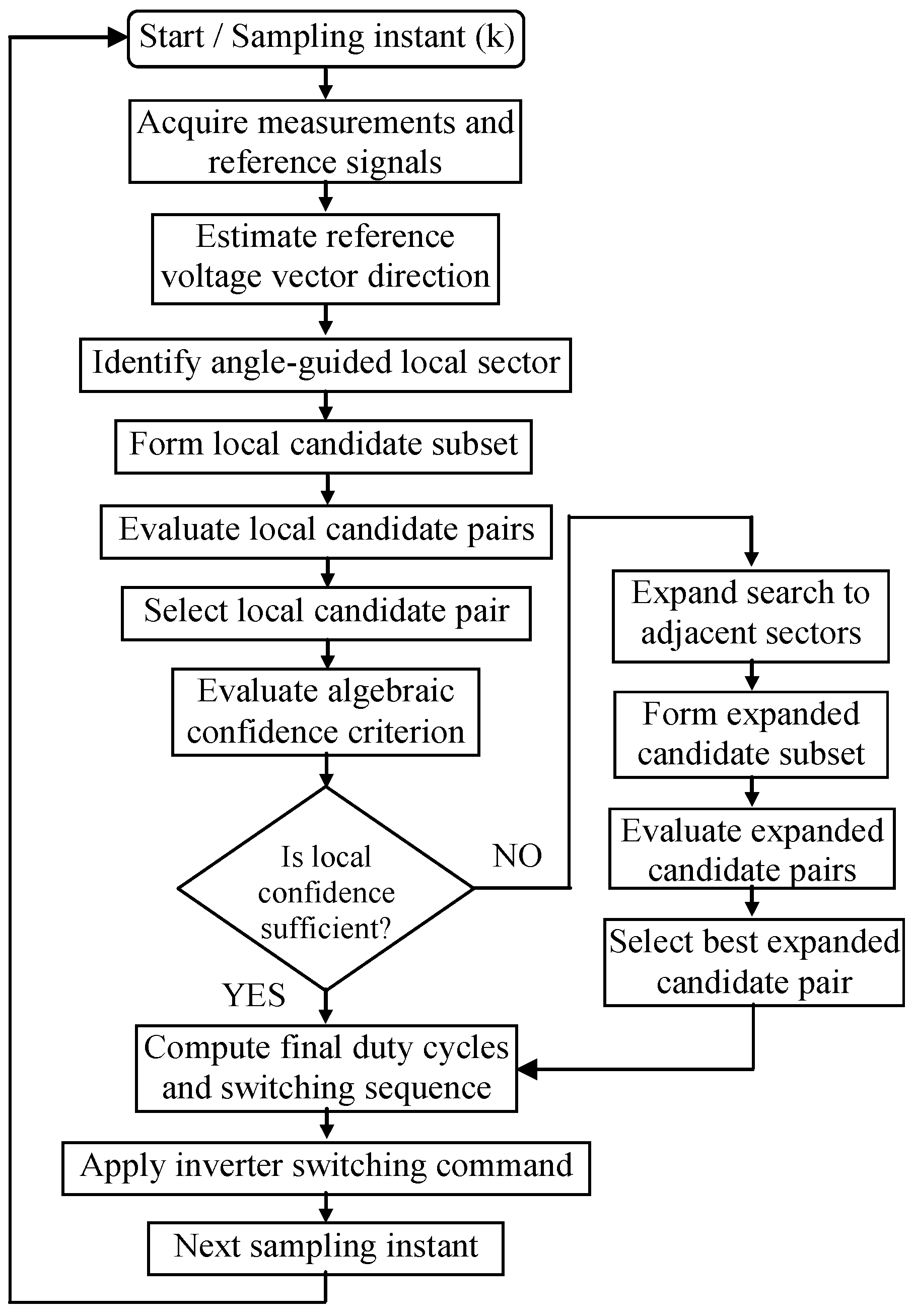
The proposed controller, denoted as ACW-M2PC (adaptive-confidence-window-modulated model predictive control), is developed from the baseline two-vector M2PC structure. Its objective is to preserve the low online burden of reduced-search-modulated predictive control while improving the quality of the selected voltage action, especially with respect to torque ripple behavior. The overall architecture is shown in Figure 1, and the associated decision sequence executed at each sampling time is summarized in Figure 2.
Figure 2.
Flowchart of the proposed ACW-M2PC decision sequence.
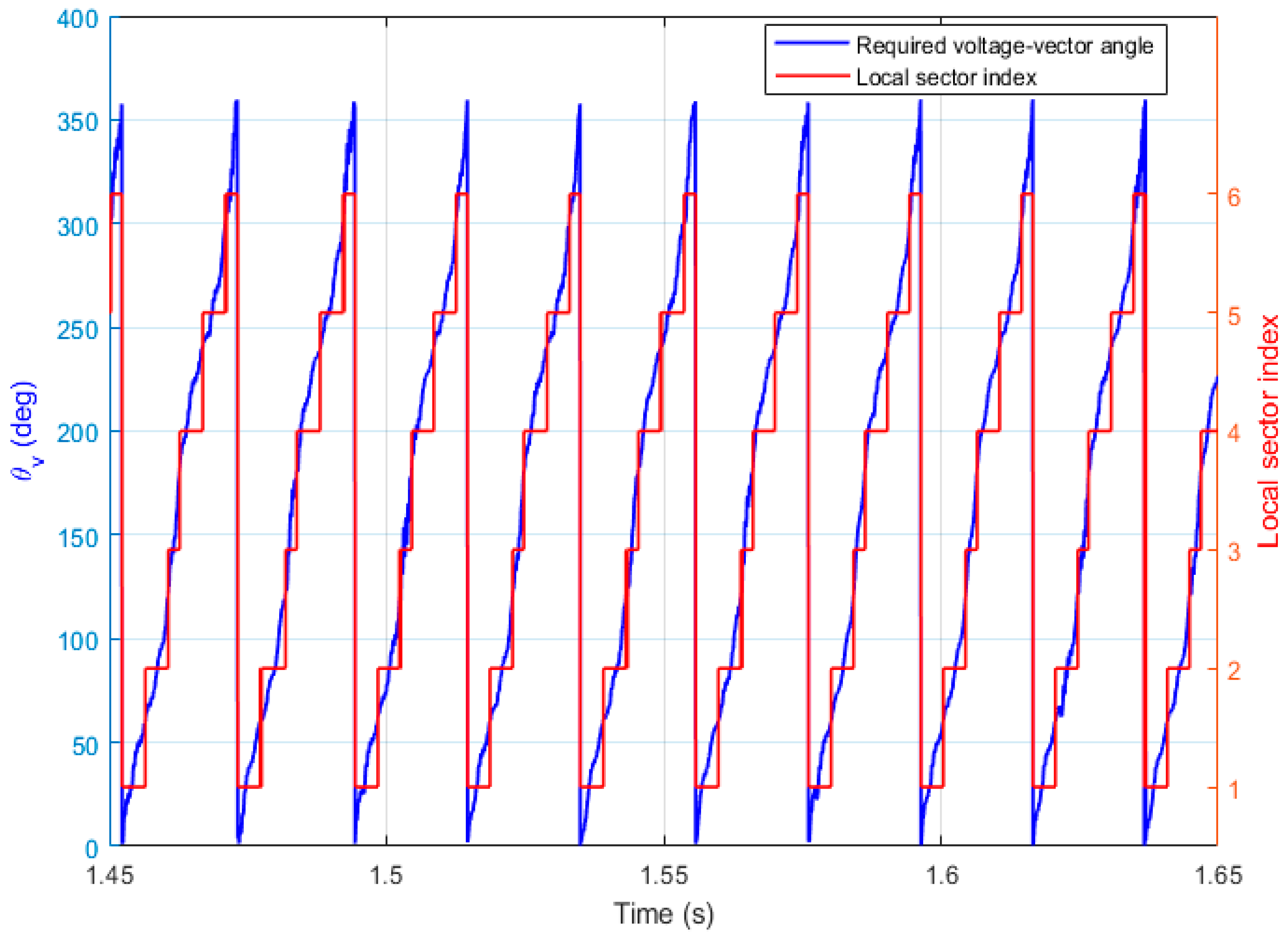
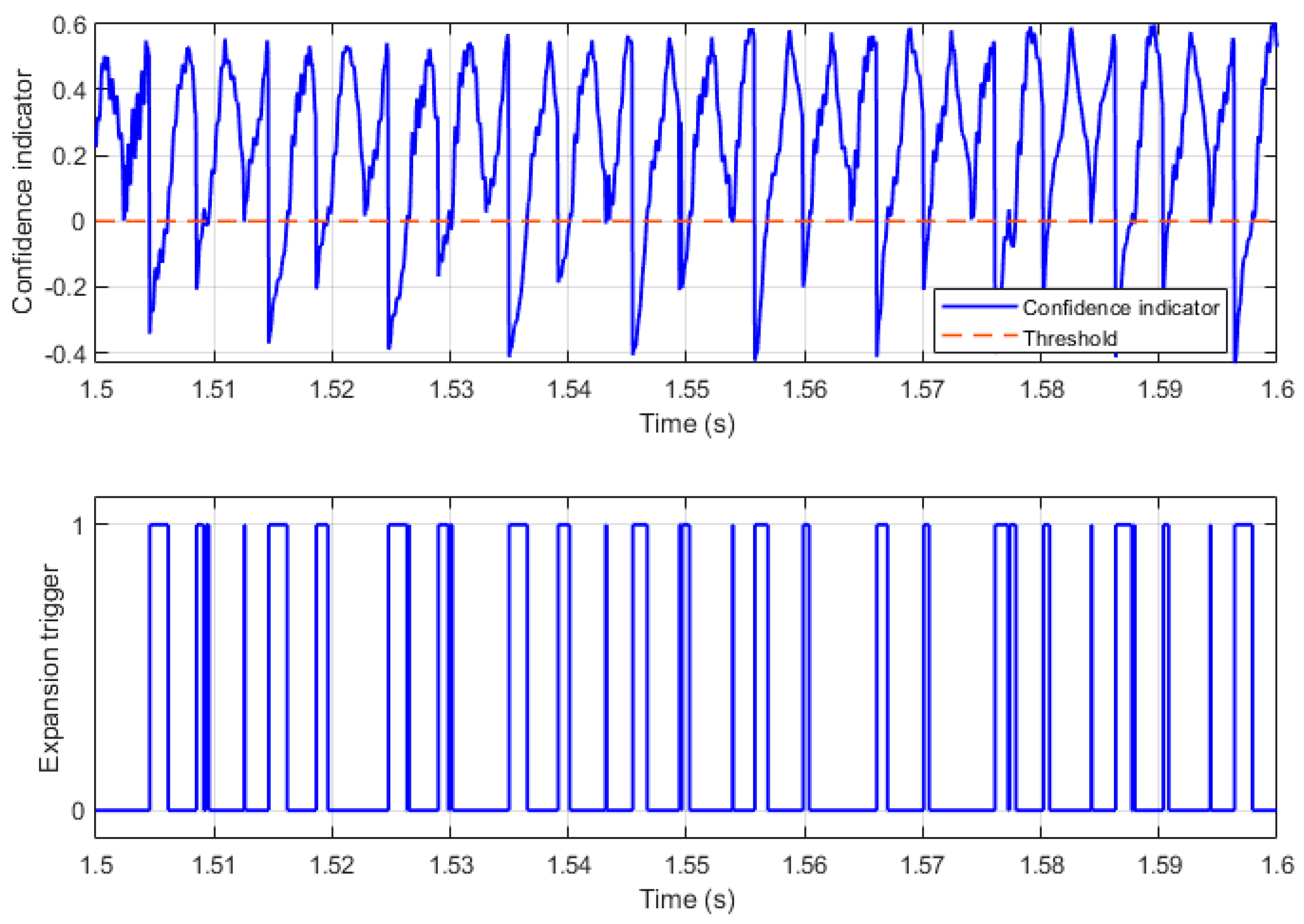
Unlike a conventional full-search-modulated predictive controller, ACW-M2PC does not evaluate all admissible candidate vector pairs at every sampling instant. Instead, it combines three coordinated mechanisms: (i) angle-guided local candidate preselection, (ii) a confidence criterion applied to the local solution, and (iii) adaptive search window expansion only when the local decision is not considered sufficiently reliable. The internal behavior of these mechanisms is further illustrated in Figure 3 and Figure 4.
Figure 3.
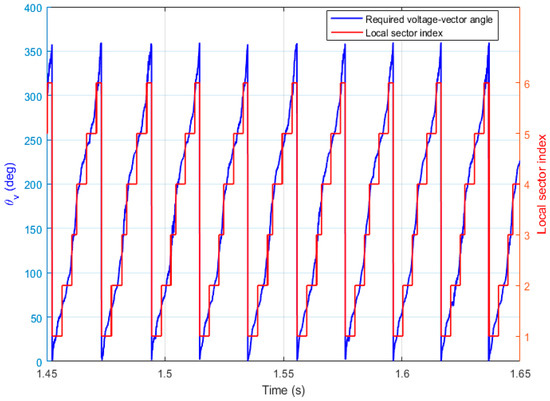
Required voltage vector angle and corresponding local sector selection over a representative transient interval.
Figure 4.
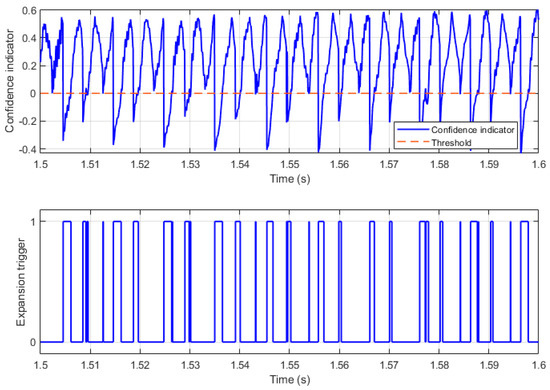
Confidence indicator and corresponding expansion trigger over a representative transient interval.
2.3.1. Reference Generation and Required Voltage Vector Direction
At each time step, the outer loops generate the torque and flux references () shown in Figure 1. In the implemented controller, the flux reference is constrained by the inverter voltage capability, and the torque reference is converted into the corresponding synchronous frame current reference. The internal current references and are then obtained in the stationary frame using the estimated electrical angle .
Using the predictive model, an uncompensated one-step current prediction is firstly computed without any applied voltage:
where the unforced current derivatives are obtained directly from the continuous-time machine model:
The corresponding current tracking error components are then evaluated as follows:
An unconstrained required voltage action is then inferred algebraically from these errors to guide the spatial search:
The direction of the required voltage vector is
This angle is mapped to the local sector index , which defines the most relevant initial search region:
This angle-guided reduction mechanism is illustrated in Figure 3, where the proposed controller uses the estimated voltage vector direction to identify the local sector and reduce the candidate search space before confidence-based adaptive expansion.
2.3.2. Local Candidate Set Construction and Evaluation
Once the local sector has been identified, the controller constructs the associated local candidate subset using the two active vectors that bound this sector, and . The corresponding current increments acting over the sample time are defined as
The raw duty ratios and are obtained by solving the local linear system:
This system yields the exact closed-form solutions:
Since the raw duty cycle solution is obtained without explicitly enforcing inverter feasibility constraints, the resulting values may fall outside the physically realizable region. In particular, negative duty times have no physical meaning in the switching sequence and therefore cannot be applied in practice. For this reason, the first projection step clips any negative raw duty time to zero:
If the sum of the two active-duty times still exceeds the available normalized interval, i.e.,
The duty cycles are then rescaled to satisfy the feasibility constraint while preserving their relative proportion. This yields
This normalization enforces
without altering the ratio between the two active-vector durations. For simplicity, the updated values are subsequently denoted again by and .
The zero-vector duty cycle is subsequently defined as . The local predicted current response under this modulated action becomes
This response is finally evaluated through a predictive cost function that combines tracking accuracy with a switching penalty, namely
where the tracking-related term is defined as
and the switching penalty is given by
where denotes the candidate switching state and denotes the switching state applied in the previous control step. If , the switching state difference is then given by
This quantity therefore counts the number of inverter legs that change their switching state between the previously applied vector and the candidate one. As a result, it provides a simple measure of switching effort: a value of 0 means no commutation, whereas values of 1, 2, and 3 correspond to one-leg, two-leg, and three-leg commutations, respectively.
The corresponding modulated action is given by
The local sector candidate minimizing the predictive cost within the considered local subset is retained as the tentative solution. This stage remains close to the baseline M2PC structure, but the search is intentionally confined to a reduced local region to lower the online burden.
2.3.3. Confidence Criterion
A key element of ACW-M2PC is that the local solution is not accepted blindly. Its reliability is assessed by a confidence criterion derived from the feasibility of the raw duty cycle solution and from the local tracking quality. In the implemented controller, the local decision is considered reliable when
where is a small tolerance margin on the raw duty cycles and is a local quality threshold, specifically,
To preserve the computational advantage of local reduced-search operation without accepting unreliable local solutions, the proposed confidence criterion combines raw duty cycle feasibility with local tracking quality. From a geometric viewpoint, it checks whether the reference voltage vector remains adequately representable by the convex combination of the two adjacent active vectors in the angle-guided local sector. Markedly negative raw duty ratios, or an excessive local tracking cost, indicate that the local subset may no longer be sufficient. Accordingly, the local solution is accepted only when is satisfied; otherwise, the search is expanded only to the adjacent sectors.
The values and = 1.0 were selected as a balanced nominal setting and kept fixed for all reported tests. The duty ratio tolerance corresponds to a 5% margin on the normalized raw duty ratios, avoiding unnecessary adjacent sector expansion near sector boundaries while preventing overly permissive local acceptance.
The three tested values {0.02, 0.05, 0.10} yield values within a limited range of 0.213–0.226 N·m, indicating limited sensitivity to the precise choice of within this interval. The value was retained because, compared with the stricter setting , it provides a slightly higher confidence rate (78.7% versus 76.8%) with only a negligible torque ripple penalty of approximately 0.6%. It also avoids the higher observed with the more permissive setting . Thus, represents the most balanced operating point, as confirmed by the sensitivity results in Table 2.
Table 2.
Sensitivity of ACW-M2PC to the confidence thresholds under nominal operation.
The threshold acts as a normalized tracking quality limit, and its variation over had negligible influence in the tested scenario.
The objective of the confidence criterion is not to provide a global optimality certificate, but to supply a lightweight online reliability test that remains compatible with real-time two-vector predictive control. In this way, the controller preserves a local reduced-search decision when the angle-guided sector is reliable while activating bounded adjacent sector expansion only when the local candidate set is deemed insufficient.
Figure 4 illustrates a representative confidence indicator together with the associated expansion trigger, showing that the adaptive search window expansion is activated whenever the confidence level falls below the prescribed threshold, before the final two-vector action is computed.
2.3.4. Adaptive Search Window Expansion
When the confidence condition in Equation (32) is not satisfied, the controller does not switch to a full exhaustive evaluation. Instead, the search window is expanded in a controlled algebraic manner.
The implemented logic explores only the sectors adjacent to the initially selected local sector, according to the sign of the raw duty cycle violation or the magnitude of the local tracking cost. In formal notation, the expanded candidate set is uniquely determined by
For each expanded sector in , the exact same algebraic duty cycle computation and predictive evaluation are executed. The final candidate set therefore contains the local sector and, only when needed, one or two adjacent sectors, so that at most three sectors are evaluated at each time step: .
This adaptive mechanism is the key element that allows ACW-M2PC to preserve a reduced average search while remaining robust during sector transitions, abrupt load changes, or locally unfavorable operating conditions. Therefore, the proposed expansion mechanism is not a full-search fallback, but a bounded adjacent sector expansion policy. This structural property is precisely what allows ACW-M2PC to preserve the low-complexity nature and lightweight execution profile of the baseline M2PC framework.
2.3.5. Final Two-Vector Action and Modulation
After the local or expanded decision stage, the best optimal solution is retained from the pool of evaluated candidates, and the final modulated switching action is synthesized as
The resulting action is then applied to the VSI during the current sampling interval. Therefore, the contribution of the proposed method does not lie in a new modulation principle by itself, but in the adaptive-confidence decision architecture used to identify the candidate pair online.
2.3.6. Stability-Oriented Discussion
The proposed ACW-M2PC does not introduce additional continuous closed-loop dynamics. It modifies only the online candidate selection rule of the baseline two-vector M2PC, while preserving the same prediction model, cost function, modulation principle, and admissible inverter voltage set. Therefore, the stability-oriented discussion can be linked to the boundedness of the applied voltage action and to the tracking quality of the selected candidate.
The calculated duty cycles are systematically projected onto the admissible modulation simplex:
so that the synthesized voltage vector remains a bounded convex combination of admissible inverter vectors for a bounded DC-link voltage . Let the one-step current tracking error be defined as
and consider the tracking energy function
The proposed confidence criterion prevents unconditional acceptance of a local candidate when its raw duty cycle feasibility or tracking quality is poor. If the local solution satisfies the confidence condition, the selected action satisfies the imposed local tracking quality bound. Otherwise, the search is expanded only to adjacent sectors, increasing the retained candidate set while keeping the worst-case search finite and bounded, with a maximum of three evaluated sectors. Hence, under bounded references, bounded load torque, bounded , and feasible voltage demand, the selected voltage action remains bounded and the current tracking error is practically bounded within the considered operating region.
This result should be interpreted as a practical boundedness argument rather than a global asymptotic stability proof. A formal terminal-set-based Lyapunov proof is not claimed, since the implemented controller is a finite-control-set, one-step-modulated predictive controller without terminal constraints or terminal invariant sets. The real-time HIL experimental results further support this practical stability interpretation, showing bounded speed, torque, and current responses under nominal and parameter mismatch conditions, with no overrun events.
2.3.7. Decision Sequence Interpretation and Links to the Validation Section
The complete online procedure is summarized in Figure 2. At each time step, the controller acquires the measured or estimated states and references, determines the required voltage vector direction, identifies the angle-guided local sector, constructs and evaluates the local candidate subset, computes the confidence criterion, and either accepts the local solution or activates the bounded adjacent sector expansion before generating the final two-vector action. Figure 3 and Figure 4 complement this procedural view by illustrating the angle-guided sector selection and the confidence-based decision mechanism, respectively. The practical relevance of this strategy is assessed in the following section through the simulation trends summarized in Table 3. The practical relevance of this strategy is assessed in the following section through real-time computational metrics, and closed-loop HIL responses.
Table 3.
Nominal simulation performance comparison.
For clarity and reproducibility, the main execution steps of the proposed ACW-M2PC strategy are summarized in Algorithm 1.
| Algorithm 1: Proposed ACW-M2PC decision procedure |
|
As summarized in Algorithm 1, the proposed controller preserves a reduced-search operation through an angle-guided local evaluation, and activates a bounded adjacent sector expansion only when the local solution fails to satisfy the algebraic confidence criterion.
2.4. Real-Time HIL Setup
Real-time hardware-in-the-loop validation is widely used to assess the practical feasibility of predictive control strategies under implementation constraints [28]. In this work, the proposed controller was assessed in a real-time HIL environment using a dSPACE DS1202 MicroLabBox platform. This setup was selected in order to evaluate not only the control performance of the compared predictive strategies, but also their practical real-time executability under embedded implementation constraints.
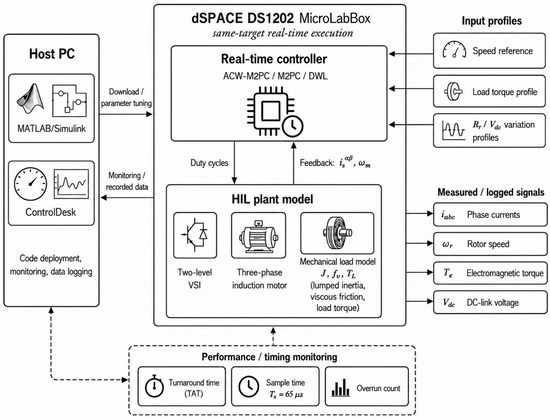
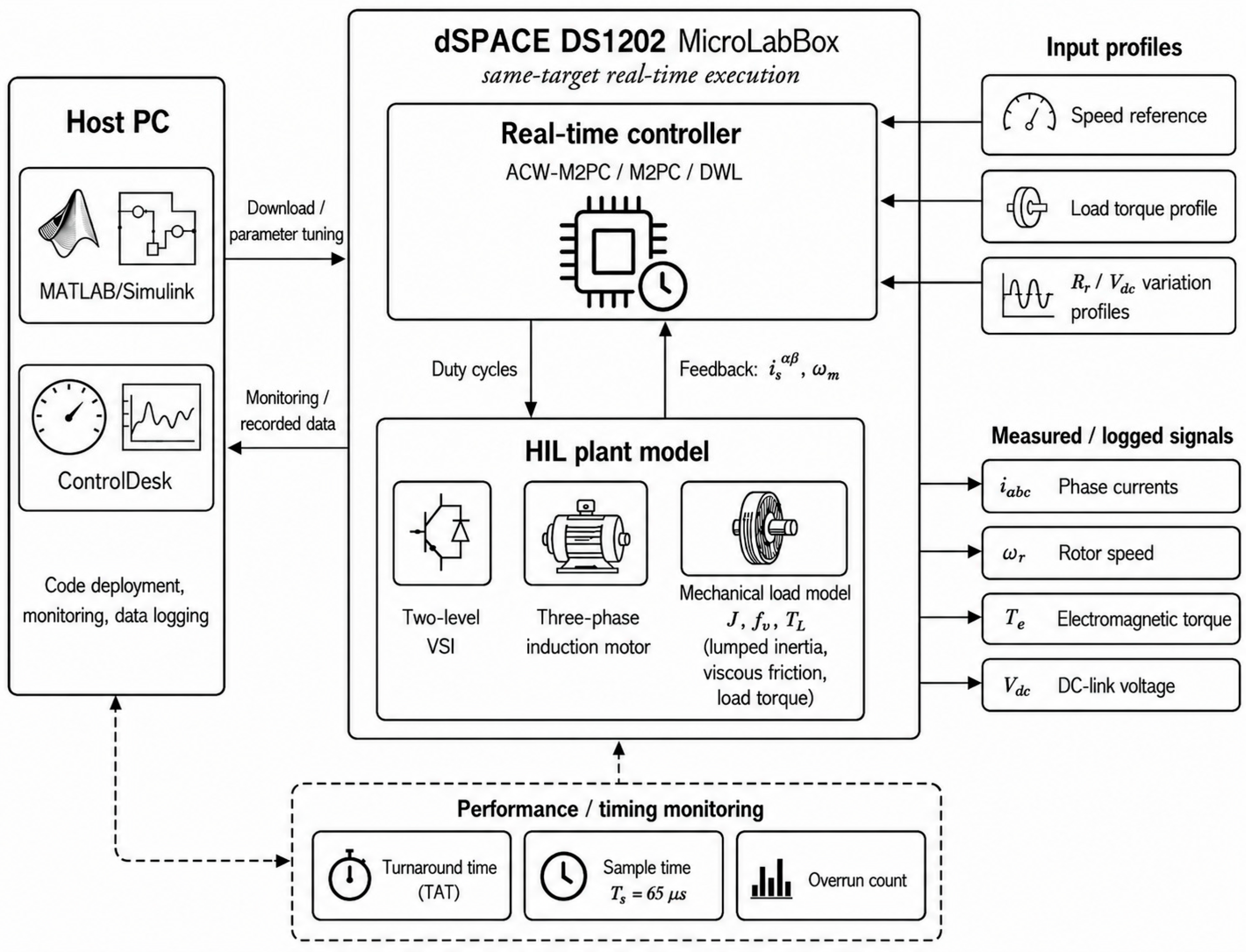
Figure 5 illustrates the dSPACE DS1202-based HIL validation platform. The controller and the HIL plant model are executed on the same real-time target. Depending on the test case, the target runs ACW-M2PC, baseline M2PC, or DWL together with the plant model, which includes the two-level VSI, three-phase induction motor, and lumped mechanical load. The host PC running MATLAB/Simulink R2023a and dSPACE ControlDesk Release 2024-B (24.2), is used for deployment, tuning, monitoring, and data logging. The input profiles include speed reference, load torque, and selected / variations, while the recorded signals include phase currents, rotor speed, electromagnetic torque, DC-link voltage, turnaround time, sample time, and overrun count.
Figure 5.
dSPACE DS1202-based HIL validation platform.
All controllers were executed with a fixed sampling period of . This value was retained as the common experimental sampling time for all tested methods in order to ensure a fair comparison between the analytical DWL controller, the baseline M2PC controller, and the proposed ACW-M2PC controller. The same motor, inverter, and test-scenario settings were preserved throughout the HIL study.
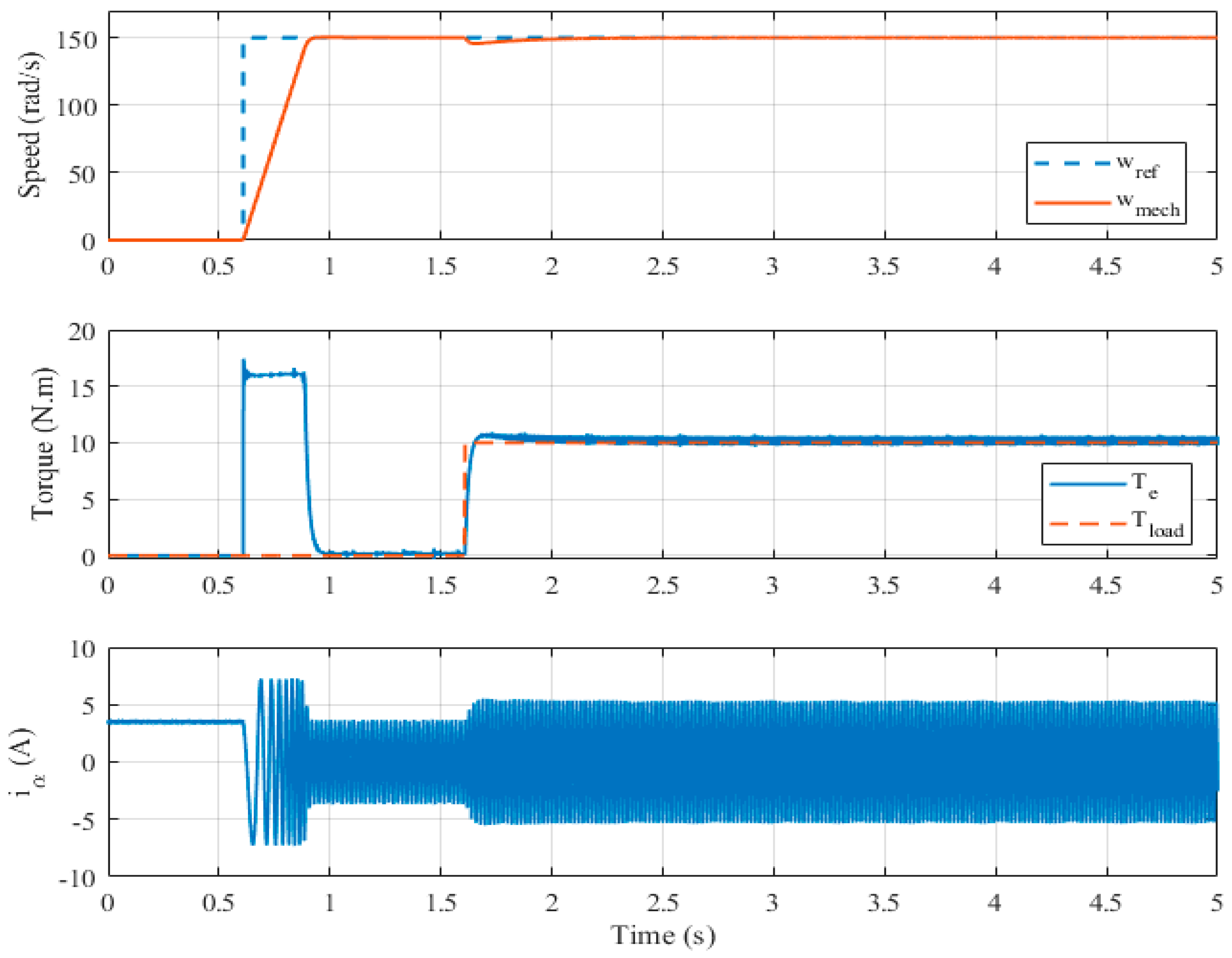
The real-time experiments were conducted under a nominal operating scenario consisting of a speed step from 0 to 150 rad/s, followed by a load torque step from 0 to 10 N·m. In addition, robustness tests were performed under rotor resistance mismatch conditions corresponding to and . These operating cases were chosen to evaluate both nominal behavior and sensitivity to predictive model parameter deviations.
The present HIL study focuses on the inverter-fed induction motor control problem. Therefore, the mechanical load is represented by a lumped inertia and viscous friction model, which is commonly used to isolate the behavior of predictive motor-control algorithms. Nevertheless, practical driven systems may include torsional shaft flexibility, gear backlash, periodic mesh-stiffness variations, joint compliance, and load torque pulsations. These effects can introduce low-frequency oscillations and transient torque disturbances that interact with the electromagnetic torque produced by the motor [29,30].
The proposed ACW-M2PC mainly acts on the motor-side electromagnetic torque quality by improving the online selection of two-vector voltage actions. Therefore, the reported torque ripple improvements should be interpreted as motor-side electromagnetic improvements under the considered HIL model. If the driven machine contains strong torsional resonances, backlash nonlinearities, or periodic load torque components, the motor-side predictive controller alone may not suppress all mechanical oscillations. In such cases, ACW-M2PC could be combined with an outer active damping loop, a load torque observer, notch-filter-based compensation, or an extended predictive model including two-mass drivetrain dynamics.
To assess both closed-loop control quality and hardware real-time feasibility, a comprehensive set of variables was recorded from the DS1202 experiments during post-processing. The primary mechanical and electrical signals continuously monitored included the reference and actual mechanical speeds (, ), the applied load torque (), and the generated electromagnetic torque (). In parallel, execution-level metrics were strictly tracked by logging the fixed task sample time alongside the variable task turnaround time and instantaneous overrun occurrences.
Based on these recorded arrays, a structured set of key performance indicators (KPIs) was extracted to ensure a systematic comparison. For dynamic and steady-state performance evaluation, the controllers were benchmarked by calculating their speed overshoot, the error-band settling time, the integral absolute error (IAE) of the mechanical speed, the maximum speed drop under load application, the torque transient maximum peak, the peak-to-peak steady-state torque ripple, and the root mean square (RMS) of the torque ripple.
Similarly, the real-time feasibility and temporal execution profile of each embedded controller were rigorously analyzed. The task-monitoring variables yielded critical hardware metrics, specifically the mean and maximum turnaround times, and the continuous overrun statistics. A normalized percentage task load index was ultimately computed from the ratio between the execution turnaround time and the absolute hardware sample time limit. This targeted metric quantifies the exact proportional computational burden demanded by each predictive strategy.
Taken together, this HIL procedure provides a consistent basis for comparison. It allows the dynamic and steady-state behavior of the controllers to be assessed together with their real-time implementation feasibility.
3. Experimental Results and Analysis
3.1. Preliminary Simulation Assessment
Before the real-time HIL validation study, preliminary simulation tests were carried out to verify the expected behavior of the compared predictive controllers and to guide the selection of the final experimental scenarios. These simulations were not intended to constitute the main validation stage of the study, but rather to confirm the relative trends between the considered methods before implementation on the DS1202 platform.
The simulation results already indicated that the proposed ACW-M2PC provided the most favorable torque ripple behavior among the compared controllers while preserving a dynamic speed response comparable to that of the baseline methods. These observations motivated the subsequent real-time HIL assessment, which was then used as the main experimental validation framework of the paper.
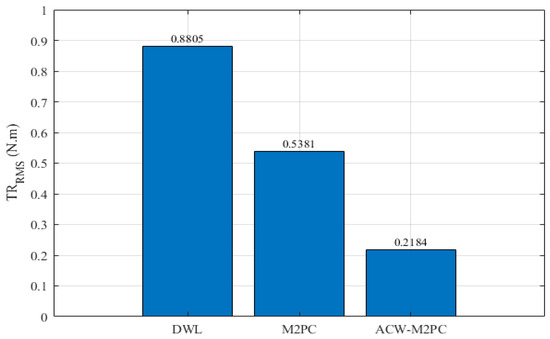
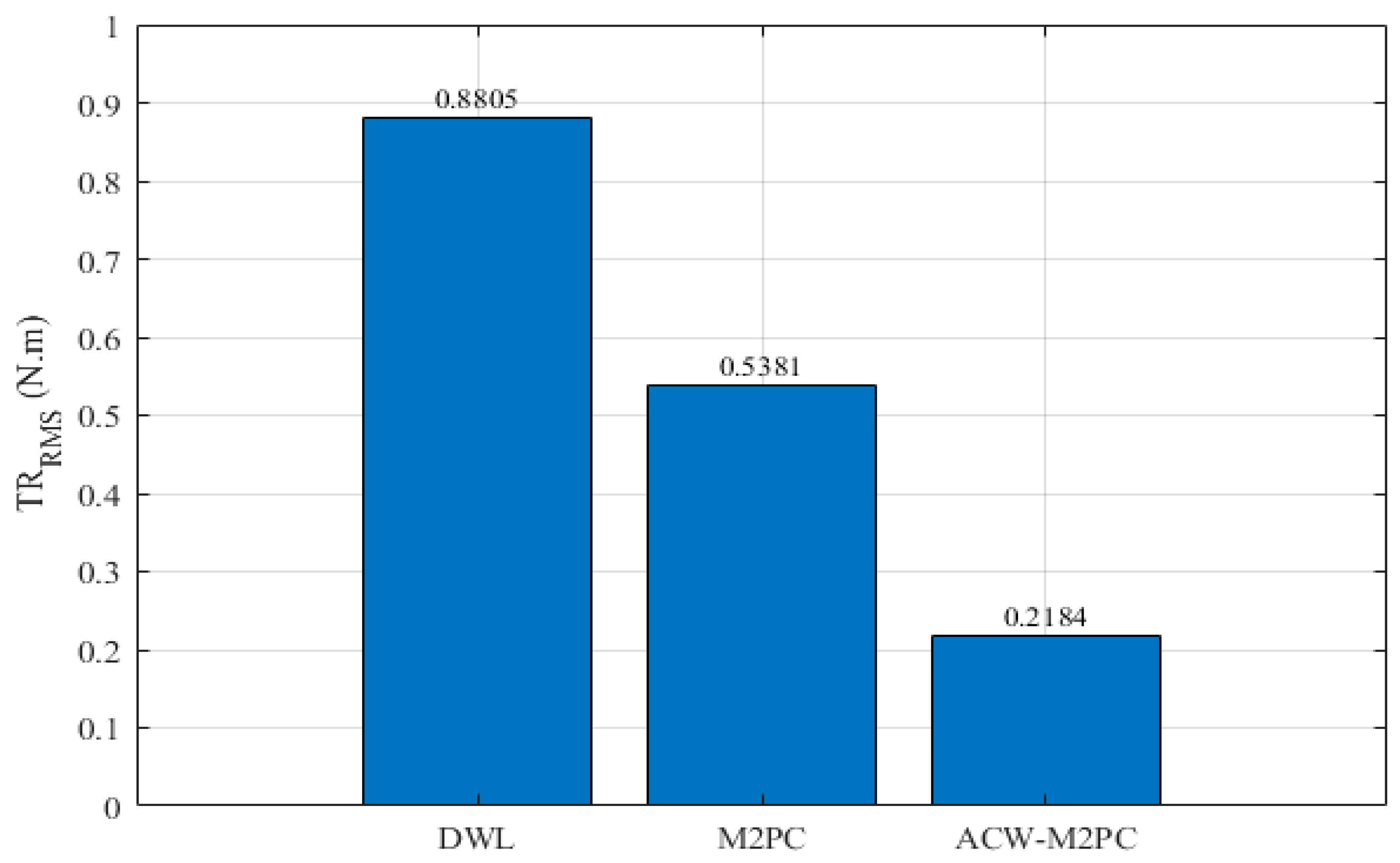
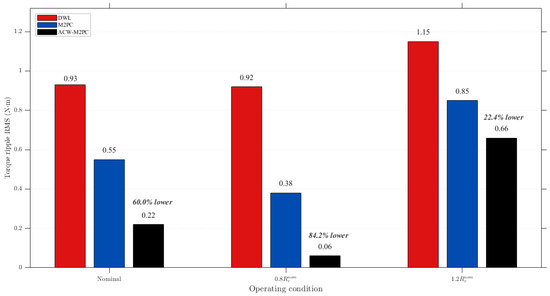
For conciseness, only a compact nominal simulation comparison is reported here, whereas the detailed discussion is intentionally focused on the HIL results. The corresponding steady-state torque ripples are shown in Figure 6.
Figure 6.
Nominal simulation comparison of torque ripple RMS for DWL, M2PC, and ACW-M2PC.
3.2. Real-Time Feasibility
The real-time feasibility of the three controllers was assessed on the DS1202 platform by monitoring the task turnaround time, the corresponding normalized processor load, and the number of overrun events. Here, the turnaround time denotes the actual execution time of the real-time control task, the normalized load expresses this execution time relative to the available sampling period, and the overrun count indicates whether the task fails to complete before the next sampling step.
The results reported in Table 4 show that all three strategies were executed successfully in real time with zero overrun events, which confirms that they all remain implementable under the selected sampling period.
Table 4.
Real-time computational metrics.
The main difference appears in computational burden. The DWL-based controller operates much closer to the real-time limit, with a mean task load in the high-80% range. Although no overrun was observed, its timing margin is clearly narrower than that of the other methods.
Baseline M2PC shows a very different execution profile. Its mean task load remains around 11–12%, which indicates a much lighter online computational demand than DWL. This confirms that the modulated predictive structure is well suited to real-time implementation.
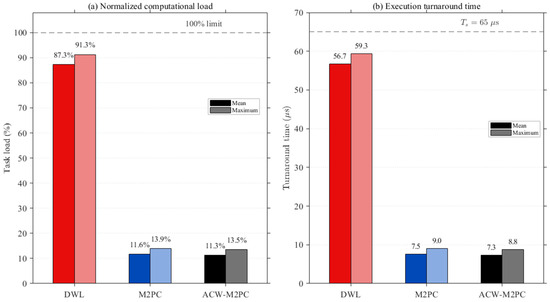
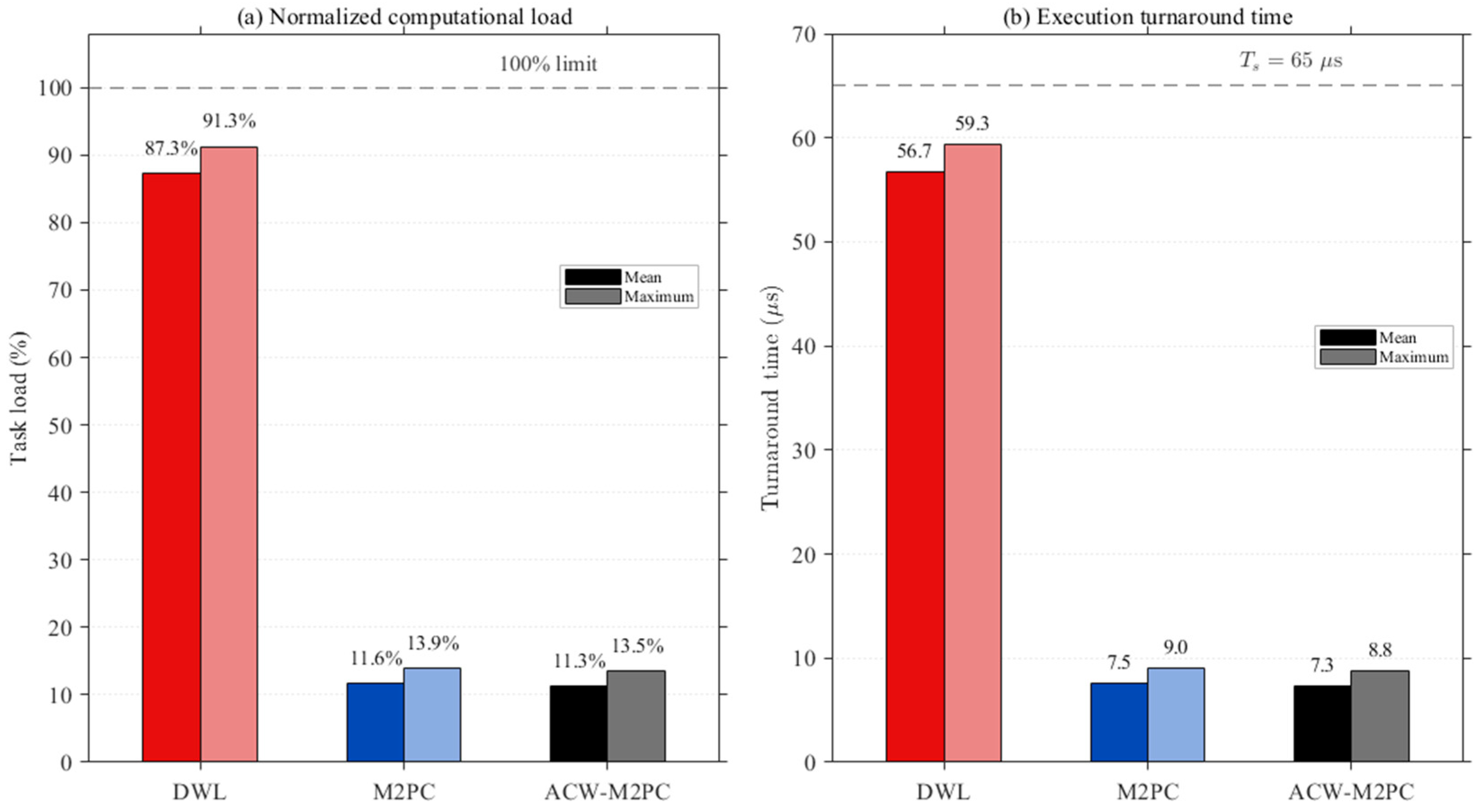
Figure 7 provides a visual summary of the real-time execution profile reported in Table 4. The DWL controller exhibits the highest computational demand, with a mean task load of 87.27% and a maximum value of 91.26%, while remaining below the 100% real-time limit. In contrast, M2PC and ACW-M2PC operate with much lower task loads. ACW-M2PC reaches a mean task load of 11.27% and a maximum value of 13.48%, with a mean turnaround time of 7.33 μs and a maximum value of 8.76 μs. These values remain far below the sampling period μs, confirming the lightweight real-time execution of the proposed controller.
Figure 7.
Real-time computational load and execution turnaround time of DWL, M2PC, and ACW-M2PC. (a) Normalized computational load. (b) Execution turnaround time. Mean and maximum values are reported for each controller, with the real-time limits indicated by the dashed lines.
Beyond the raw DS1202 timing values, the low-complexity nature of ACW-M2PC is directly linked to its internal decision structure. Unlike a wider-search-modulated predictive strategy, the proposed controller does not systematically re-evaluate all candidate sectors at every time step. Instead, it firstly operates on an angle-guided local sector and activates the adaptive expansion only when the confidence criterion is not satisfied. Therefore, the additional internal logic does not introduce a heavy optimization loop; rather, it replaces systematic wider search with a conditional local-to-adjacent exploration policy. This point is confirmed by the DS1202 measurements in Table 4, where ACW-M2PC preserves essentially the same execution profile as the baseline M2PC, with a mean turnaround time of 7.33 μs versus 7.55 μs and a mean task load of 11.27% versus 11.62%, while both remain far below the DWL controller (56.73 μs and 87.27%, respectively). In all tested cases, zero overrun was observed, which confirms that the proposed confidence-driven adaptive search remains fully compatible with strict real-time execution.
To further quantify the reduced-search behavior of the proposed controller, Table 5 reports the internal decision-mode and search-efficiency statistics of ACW-M2PC under representative rotor resistance conditions. In addition to the average number of evaluated sectors, the table reports the standard deviation, maximum value, 95th percentile, and sample-wise distribution of the evaluated sector count.
Table 5.
Extended decision-mode and search-efficiency statistics of ACW-M2PC.
The results show that the confidence-satisfied ratios remain high across the tested conditions, indicating that the angle-guided local candidate set is adequate during most sampling instants. Specifically, the confidence condition is satisfied in 78.666% of nominal samples, 78.787% under , and 70.141% under . Accordingly, the bounded adjacent sector expansion mechanism is activated in 21.334%, 21.213%, and 29.859% of the samples, respectively.
The extended statistics confirm that the search effort remains stable and strictly bounded. The maximum number of evaluated sectors is three in all tested cases, with no sample exceeding this limit. Moreover, the 95th percentile is equal to two sectors under nominal and conditions, and increases to three sectors only under the more unfavorable mismatch. Three-sector evaluations are almost negligible under nominal and conditions, representing only 0.013% of the samples, and remain limited to 5.002% under . These results show that the reported average does not conceal frequent high-search events. Instead, ACW-M2PC preserves a predominantly local-search behavior while increasing the corrective search effort only under the most challenging rotor resistance mismatch condition.
3.3. Nominal HIL Performance
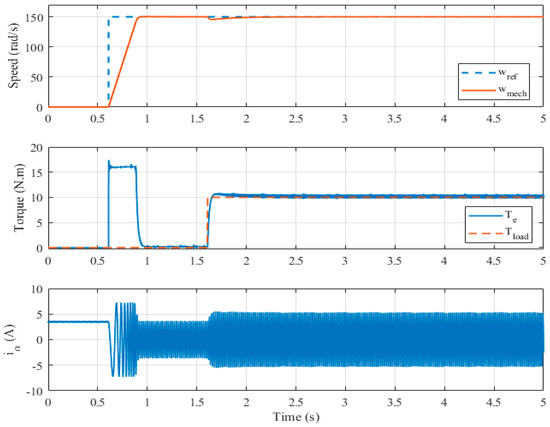
Figure 8 illustrates the nominal real-time HIL behavior of the proposed ACW-M2PC controller using the DS1202 platform. In addition to speed tracking and current behavior, the simultaneous representation of the electromagnetic torque and the applied load torque makes it possible to visualize the controller response to the load disturbance within the same experimental scenario.
Figure 8.
Real-time HIL nominal response of the proposed ACW-M2PC controller on the DS1202 platform: speed tracking, electromagnetic torque, load torque, and stationary current component.
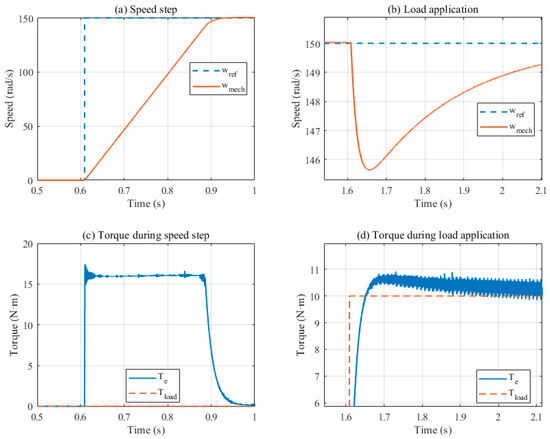
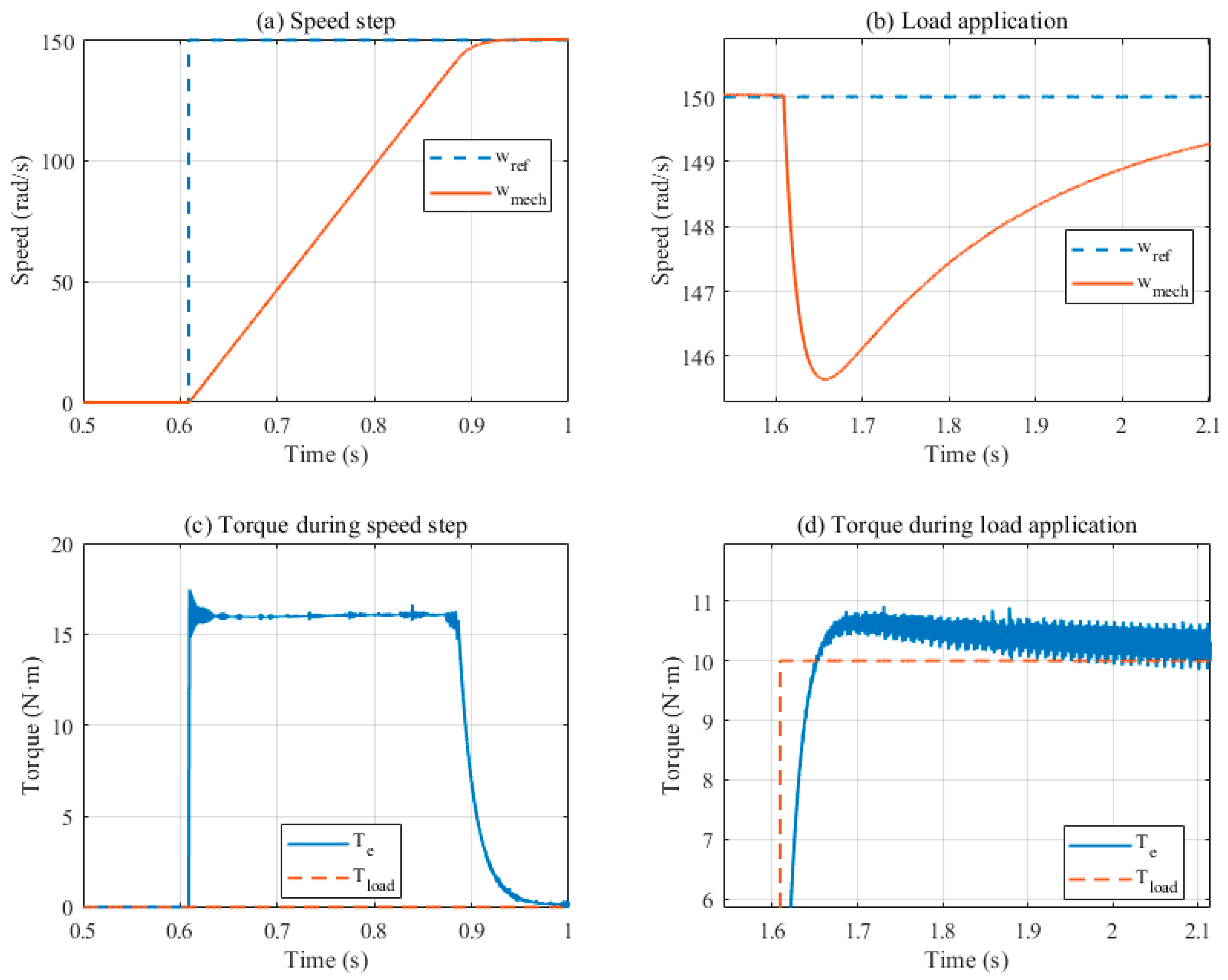
To better highlight the transient behavior, Figure 9 provides zoomed views around the speed step interval and the load torque application interval, allowing a clearer assessment of the controller dynamics during the two main operating transitions.
Figure 9.
Zoomed transient views of the nominal HIL response of the proposed ACW-M2PC on the DS1202 platform, highlighting the speed step and load disturbance intervals in the speed and torque responses.
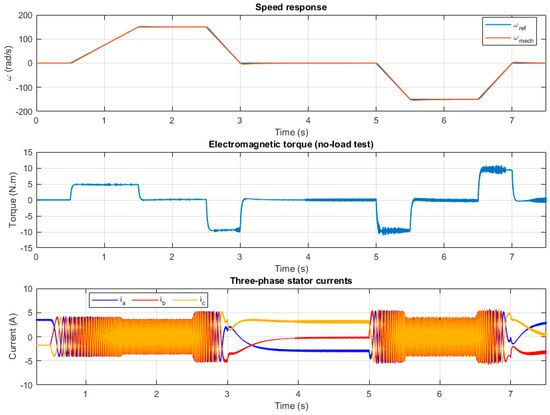
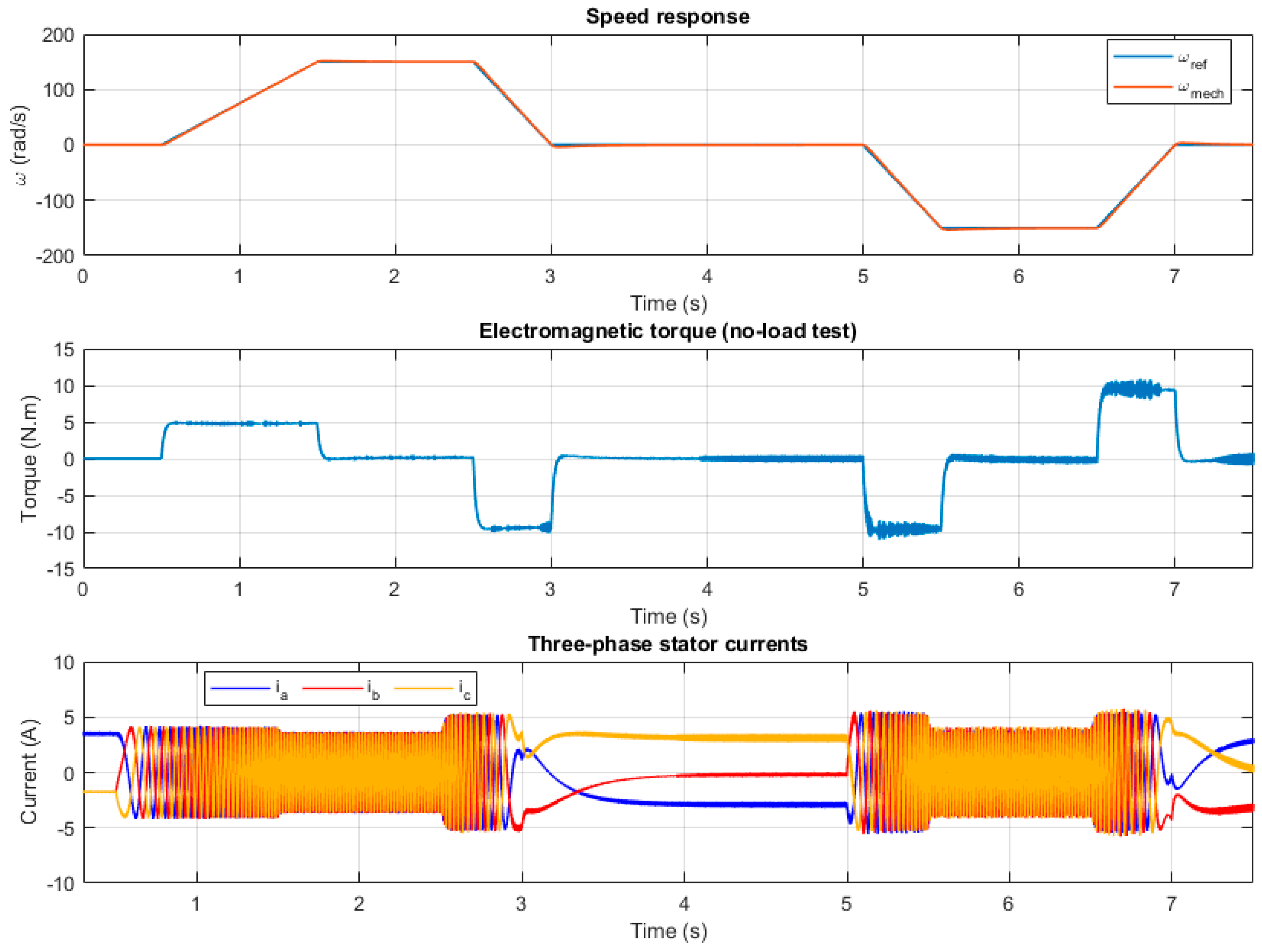
Figure 10 shows the real-time HIL response of the proposed ACW-M2PC during a no-load speed-reversal test with a zero-speed dwell interval. The reference speed is increased to 150 rad/s, reduced to zero at about 3 s, kept at standstill over 3–5 s, then reversed to −150 rad/s before returning to zero near 7 s. The measured speed closely follows the reference throughout the entire sequence, including both zero-speed crossings. The torque response remains well controlled during acceleration, deceleration, and reversal.
Figure 10.
Real-time HIL no-load speed-reversal test of the proposed ACW-M2PC on the DS1202 platform: speed tracking, electromagnetic torque, and three-phase stator currents.
During the standstill interval, the phase currents appear quasi-DC because the electrical frequency becomes nearly zero and the stator field is maintained almost stationary. These results confirm smooth bidirectional operation and stable zero-speed behavior under real-time HIL implementation.
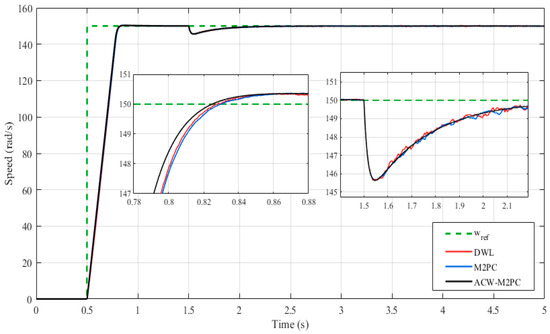
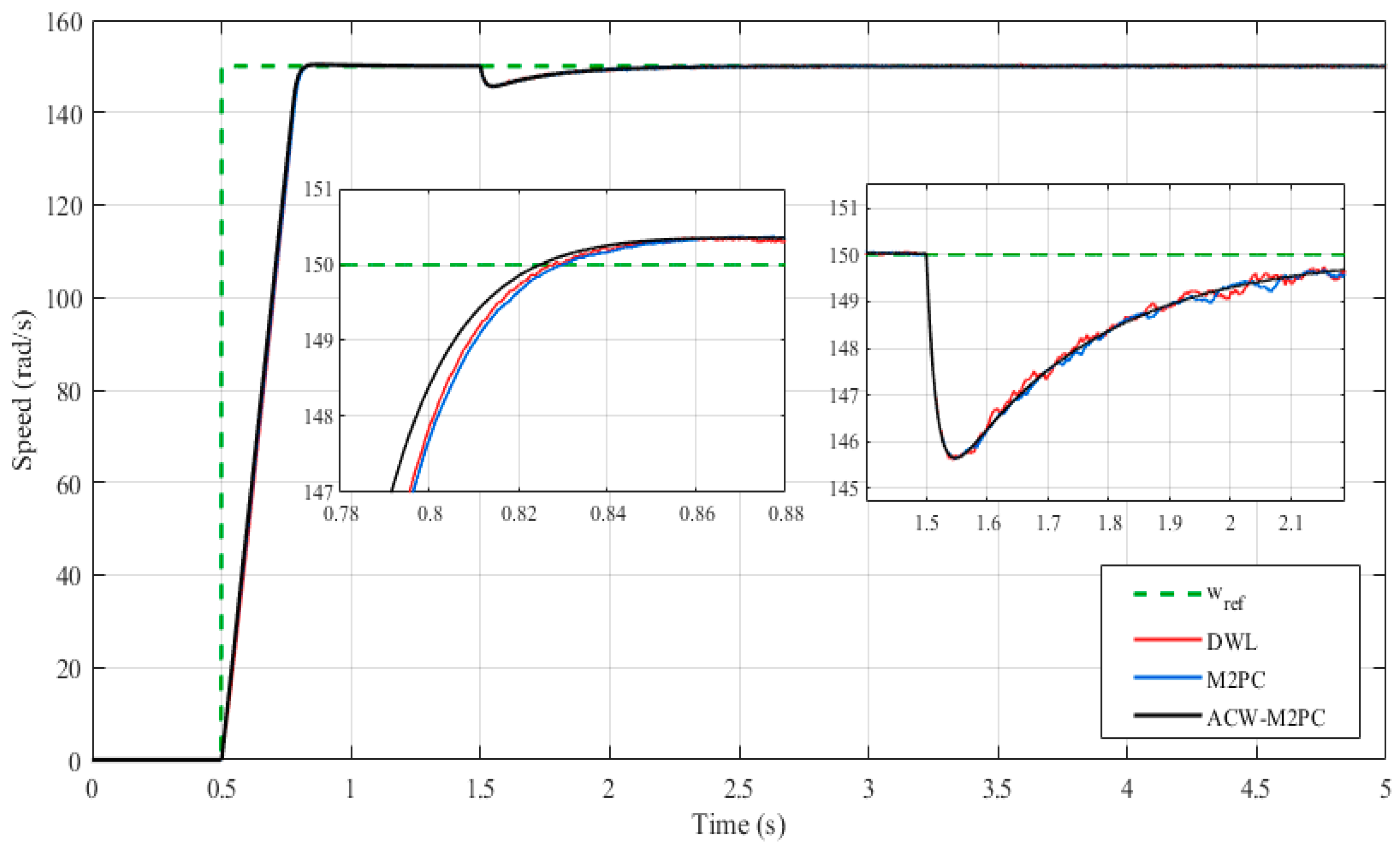
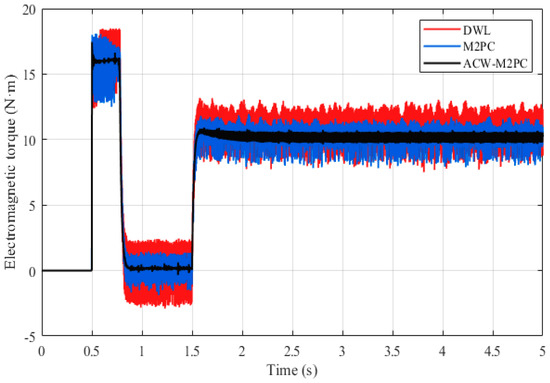
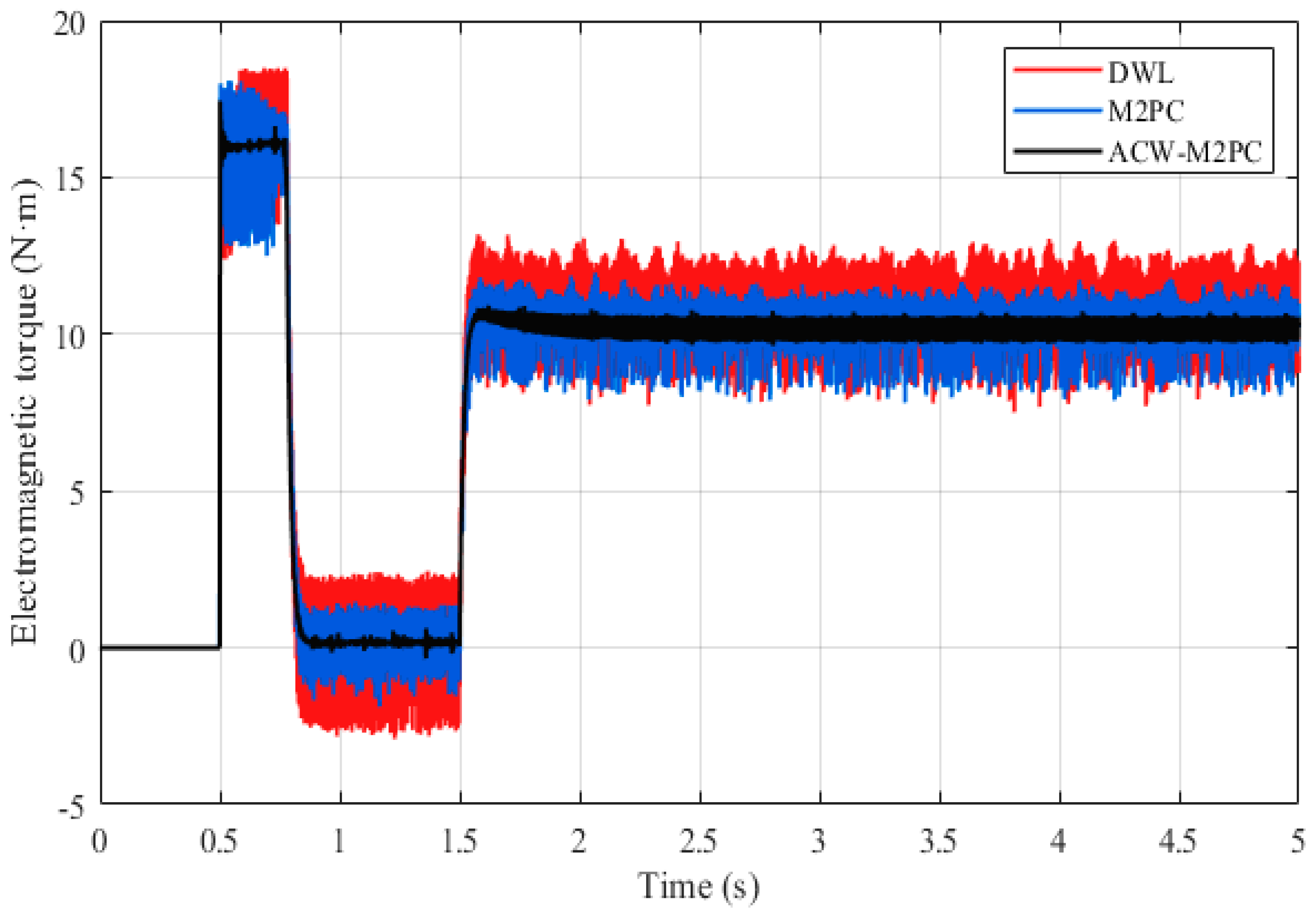
The HIL results obtained under nominal operating conditions also show a consistent improvement brought by the proposed ACW-M2PC strategy over both the analytical DWL controller and the baseline M2PC scheme. As shown by the detailed comparative speed and torque responses (see Figure 11 and Figure 12), all three controllers achieve satisfactory tracking of the reference speed, with very similar transient behavior and no visible loss of closed-loop stability.
Figure 11.
Real-time HIL nominal speed responses on the DS1202 platform for DWL, M2PC, and ACW-M2PC.
Figure 12.
Real-time HIL nominal electromagnetic torque responses on the DS1202 platform for DWL, M2PC, and ACW-M2PC.
The nominal HIL key performance indicators are summarized in Table 6. From the reported speed-related indicators, the differences remain relatively limited. The overshoot values are low for all methods, and the settling times remain close, indicating that the proposed controller does not degrade the dynamic speed response. A slight improvement can nevertheless be observed in the integral speed tracking error, with ACW-M2PC providing the lowest IAE among the tested controllers under nominal conditions.
Table 6.
Nominal KPI performance.
The most significant differences appear in the torque-related performance. The proposed ACW-M2PC achieves the lowest torque peak and, more importantly, a substantial reduction in both torque ripple peak-to-peak and torque ripple RMS. Compared with DWL, the ripple reduction is very pronounced, while a consistent improvement is also maintained with respect to the baseline M2PC controller. This behavior is consistent with the objective of the proposed adaptive-confidence search strategy, which improves the quality of vector selection without increasing the computational burden.
These observations are also reflected in the real-time waveforms. In the nominal torque response (Figure 12), ACW-M2PC produces a visibly smoother profile under load. In steady state, Figure 12 shows that the torque response remains more oscillatory under DWL and baseline M2PC than under ACW-M2PC. This qualitative observation is supported by the nominal KPI values reported in Table 6, which show that ACW-M2PC achieves the lowest torque ripple in both peak-to-peak and RMS terms. The inset views in Figure 11 highlight the transient tracking region and the post-load disturbance behavior, confirming that the proposed controller maintains accurate speed tracking both during the transient and after load application.
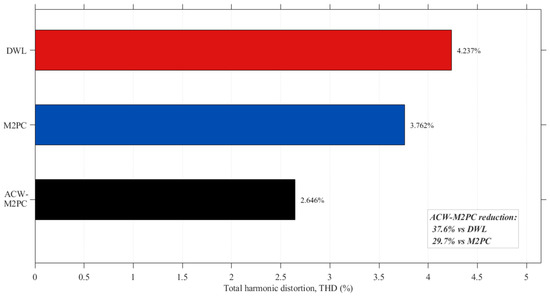
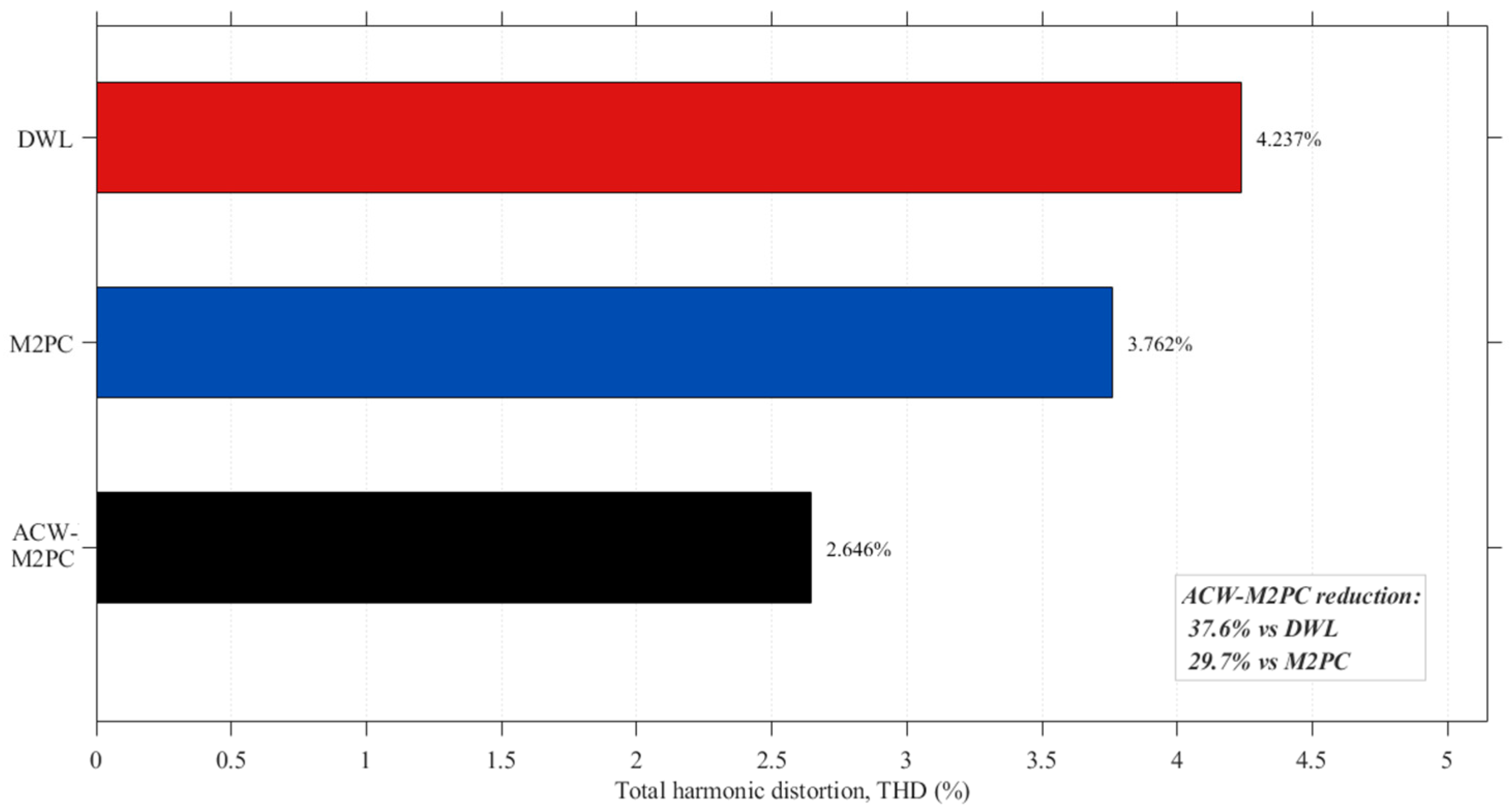
A supplementary harmonic analysis was performed on the steady-state stationary current component under nominal HIL operation. The obtained THD values were 4.24% for DWL, 3.76% for M2PC, and 2.65% for the proposed ACW-M2PC. These results confirm that the proposed controller not only improves torque ripple indicators, but also provides the most favorable current harmonic behavior among the compared methods, as further illustrated by the harmonic spectra in Figure 13.
Figure 13.
THD comparison of the stationary current component under nominal operating conditions in real-time HIL experiments using DS1202 platform.
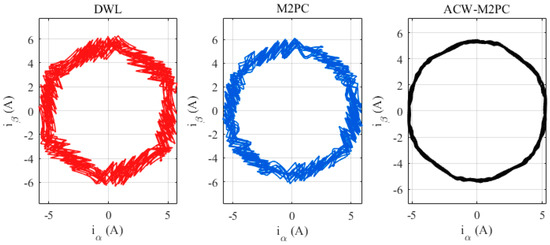
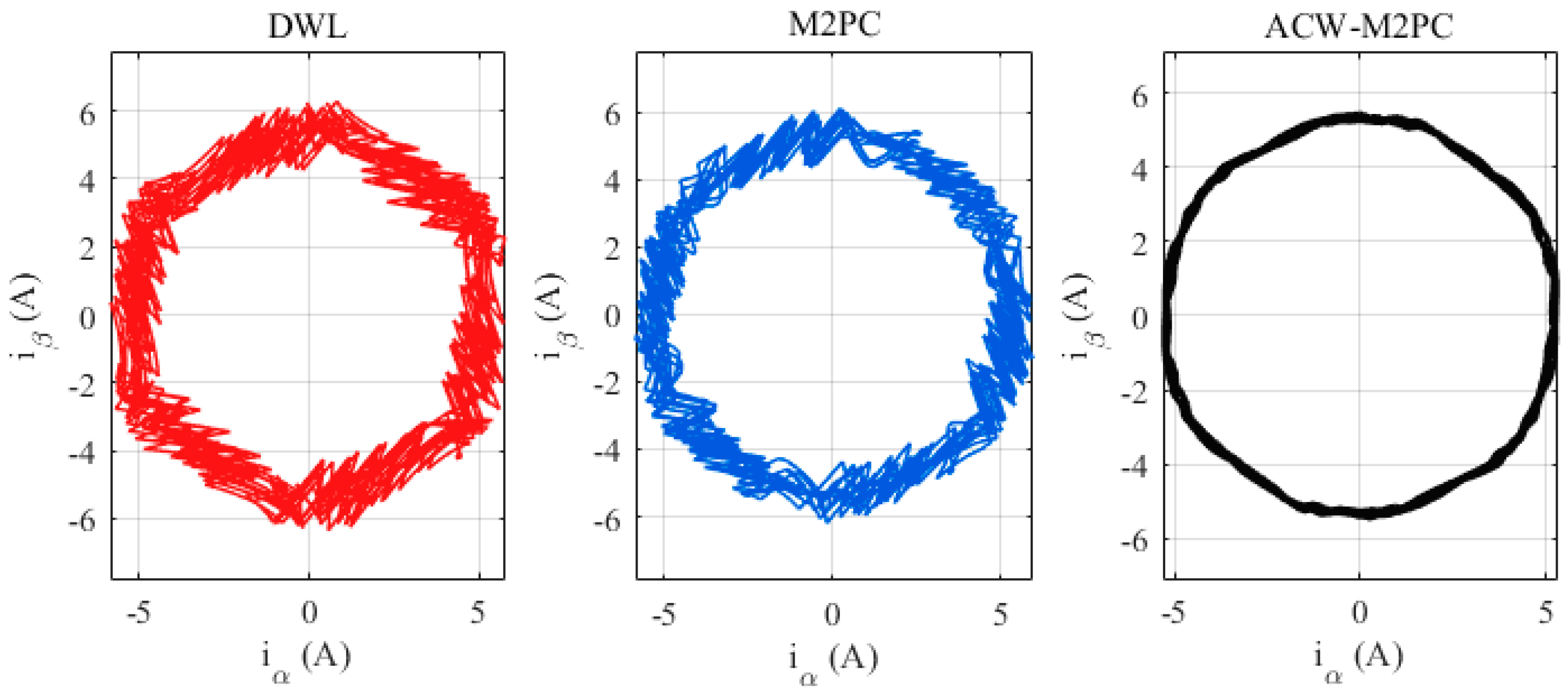
To complement the reported THD results, Figure 14 shows the steady-state stator current trajectories in the stationary αβ frame under nominal HIL operation. The proposed ACW-M2PC produces a visibly smoother and more regular current trajectory than DWL and baseline M2PC, which is consistent with its lower harmonic distortion.
Figure 14.
Steady-state stator current trajectories in the stationary αβ frame under nominal HIL operation for DWL, baseline M2PC, and ACW-M2PC.
Overall, the HIL results obtained under nominal operating conditions indicate that ACW-M2PC provides a highly favorable performance–complexity trade-off: it preserves the low computational cost of the modulated predictive control framework while delivering the most favorable torque ripple characteristics and slightly improved tracking quality under nominal operating conditions.
3.4. Robustness to Rotor Resistance Mismatch
Rotor resistance mismatch was selected as the primary robustness scenario because it directly perturbs the predictive model of the induction motor. To evaluate the sensitivity of the compared controllers to parameter uncertainty, two mismatch cases were considered, namely and . Although practical thermal effects generally increase rotor resistance, the lower-resistance case was retained here as a generic underestimation scenario for robustness assessment.
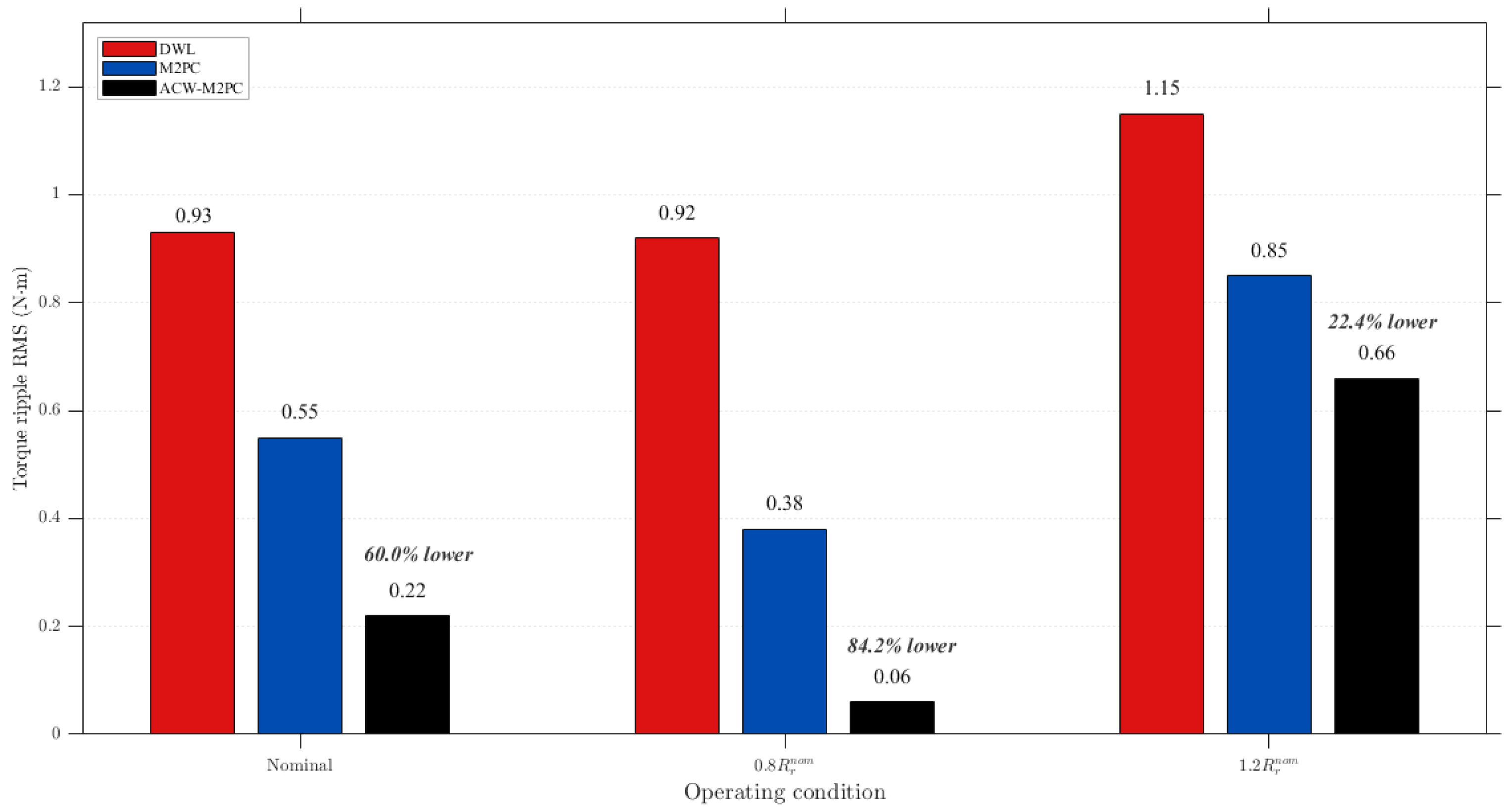
As summarized in Table 7 and Figure 15, the conventional DWL controller’s torque ripple remains consistently high across rotor resistance drift conditions. ACW-M2PC, however, exhibits improved robustness in terms of torque ripple behavior. At , its TRRMS reaches 0.06 N·m, indicating a very low torque ripple level under this tested condition. Even under elevated rotor resistance, , it maintains TRRMS = 0.66 N·m, which remains lower than both DWL and standard M2PC under identical conditions. The speed IAE is also the lowest among the tested controllers, indicating favorable robustness behavior for ACW-M2PC as a computationally efficient controller in this evaluation.
Table 7.
Performance under rotor resistance mismatch conditions ().
Figure 15.
Comparison of torque ripple RMS under nominal and rotor resistance mismatched conditions () in real-time HIL experiments on the DS1202 platform.
It should be noted that under , the transient torque peak of ACW-M2PC is slightly higher than that of baseline M2PC, namely 13.12 N·m compared with 13.00 N·m. This difference is small, approximately 0.9%, and occurs during the transient phase under parameter mismatch. It does not contradict the main torque quality trend, since ACW-M2PC still provides lower steady-state torque ripple RMS and lower speed IAE under the same condition. Therefore, the proposed method should be interpreted as improving the overall performance–complexity and steady-state torque ripple trade-off, rather than guaranteeing the lowest instantaneous torque peak in every transient case.
Overall, the HIL results consistently show that the proposed ACW-M2PC controller preserves the real-time efficiency of the modulated predictive control framework while providing the lowest torque ripple indicators among the tested methods in nominal and rotor resistance mismatched conditions.
3.5. Supplementary Robustness Assessment Under Rs, Lm, and Vdc Variations
To address additional practical uncertainty sources in induction motor drives, supplementary robustness tests were carried out under stator resistance drift, mutual inductance variation, and DC-link voltage reduction. The considered cases were and . The controller parameters and confidence thresholds were kept unchanged.
The results summarized in Table 8 show that ACW-M2PC preserves its bounded reduced-search behavior under all additional perturbations, with the maximum number of evaluated sectors remaining equal to three.
Table 8.
Supplementary robustness assessment under additional uncertainty sources.
The higher mean sector count observed under and perturbations, 1.67 and 1.91 respectively, compared with 1.22 under nominal conditions, reflects the increased mismatch between the angle-guided local sector and the voltage vector region preferred under altered flux model accuracy or reduced voltage availability.
Compared with baseline M2PC under the same perturbed conditions, ACW-M2PC reduces torque ripple RMS by 48.13%, 31.57%, and 37.06% under the , , and cases, respectively. The corresponding peak-to-peak torque ripple reductions are 69.40%, 21.21%, and 49.27%. These results confirm that the proposed confidence-driven search mechanism remains effective in improving torque quality behavior beyond rotor resistance mismatch.
Regarding speed tracking IAE, both M2PC and ACW-M2PC exhibit comparable percentage increases relative to their respective nominal values: +38.2% versus +41.4% under reduction, and +15.9% versus +16.1% under reduction. This indicates that the observed IAE degradation is mainly caused by the imposed plant perturbation and common outer-loop operating conditions, rather than by the proposed reduced-search mechanism itself.
3.6. Final Performance–Complexity Trade-Off and Ablation Study
The final comparison between the baseline full-search M2PC and the proposed ACW-M2PC is reported in Table 9. The results show that the proposed strategy achieves a substantially more favorable balance between control performance and computational complexity.
Table 9.
Final main comparison between baseline M2PC and proposed ACW-M2PC.
From the computational viewpoint, the average number of evaluated sectors is reduced from 6 for the baseline M2PC to 1.2135 for ACW-M2PC, corresponding to a reduction of approximately 79.8%. This confirms that the proposed controller preserves a predominantly local-search behavior, with the confidence criterion satisfied in 78.666% of the evaluated samples and bounded adjacent sector expansion activated in only 21.334% of the cases.
Despite this major reduction in online search effort, ACW-M2PC does not degrade control quality. On the contrary, it significantly improves the torque-related indicators relative to the baseline M2PC. The torque ripple peak-to-peak value decreases from 3.8588 N·m to 1.1496 N·m, corresponding to a reduction of about 70.2%, while the torque ripple RMS decreases from 0.56506 N·m to 0.21471 N·m, corresponding to a reduction of about 62.0%. In addition, the speed tracking integral absolute error is slightly reduced from 23.901 to 23.331.
These results indicate that the proposed confidence-driven bounded search is not only a low-complexity alternative to full-search M2PC, but also a more effective decision structure in terms of torque quality improvement.
To clarify the contribution of the adaptive confidence mechanism, an ablation study was carried out by comparing the full ACW-M2PC strategy with a local-only reduced-search variant. In the local-only variant, the controller remains restricted to the angle-guided local sector at every time step and never activates adjacent sector expansion, regardless of the confidence condition. The local-only controller is not introduced as an external literature baseline, but as an internal ablation variant derived from the proposed ACW-M2PC structure by disabling the bounded expansion mechanism.
As summarized in Table 10, the local-only strategy already provides a very low search effort, with exactly one evaluated sector per time step, which confirms that the angle-guided local selection is itself highly relevant. However, the proposed ACW-M2PC still provides additional improvement by activating bounded adjacent sector expansion only when required. More specifically, the torque ripple peak-to-peak value decreases from 1.43 N·m to 1.15 N·m, corresponding to an improvement of about 19.6%, while the torque ripple RMS decreases from 0.23 N·m to 0.215 N·m, corresponding to an improvement of about 6.8%. A slight improvement is also observed in the speed IAE, which decreases from 23.35 to 23.33. Importantly, this improvement is achieved with only a limited increase in average search effort, from 1 to 1.215 evaluated sectors per sample. Furthermore, this performance gain is strictly achieved without increasing the worst-case computational burden, since the expansion remains bounded to adjacent sectors.
Table 10.
Final ablation study: local-only reduced-search mode versus full ACW-M2PC.
These ablation results confirm that the benefit of the proposed controller does not arise solely from angle-guided local restriction. Instead, the confidence-triggered bounded expansion mechanism provides a useful corrective action when the local candidate set becomes insufficient, thereby improving torque quality while preserving the low-complexity character of the reduced-search strategy.
The values reported for the local-only controller in Table 10 are not expected to match those of ACW-M2PC, even though the same algebraic confidence condition is used, because the two controllers generate different closed-loop trajectories under the same speed and load scenario. For this reason, the quantity is more rigorously interpreted as “confidence satisfied (%)” rather than “local acceptance (%)” when comparing ACW-M2PC and local-only.
Taken together, Table 9 and Table 10 show that the proposed controller relies on two complementary mechanisms: a highly effective angle-guided local sector selection that strongly reduces the search space, and a confidence-triggered bounded expansion that is activated only when necessary. This explains why ACW-M2PC remains very close to the local-only variant in average computational effort while clearly outperforming both the baseline full-search M2PC and the local-only reduced-search mode in torque quality indicators. These results confirm that the proposed ACW-M2PC achieves a superior performance–complexity trade-off compared to both full-search and purely local reduced-search strategies. Accordingly, the proposed confidence mechanism should be interpreted as a structured decision rule for bounded reduced-search operation rather than as a formal optimality certificate. Taken together, the DS1202 timing metrics, the decision-mode statistics, and the final main comparison consistently indicate that the proposed controller combines a low average search effort, bounded expansion behavior, and strict real-time feasibility.
4. Conclusions
This paper presented an adaptive-confidence-window-modulated predictive control strategy for induction motor drives. The core idea is straightforward: rather than evaluating all candidate sectors at every sampling instant, or restricting the search to a fixed local subset, ACW-M2PC first checks whether the locally selected solution is actually reliable—and only expands the search when it is not.
The real-time HIL results on the dSPACE DS1202 platform confirmed that this approach works in practice. The average search effort dropped by 79.7% relative to baseline full-search M2PC, while torque ripple peak-to-peak and RMS improved by 70.2% and 62.0% respectively—all within a zero-overrun execution profile that remained very close to that of the baseline controller. Reducing complexity and improving performance at the same time is not always achievable; the results here suggest that a confidence-driven decision structure makes it possible.
The ablation study helped clarify what is actually doing the work. Angle-guided local selection already captures most of the computational benefit, but without the bounded expansion mechanism, some torque quality improvement is left on the table. It is the combination of both that gives ACW-M2PC its character.
The main contribution of this work is therefore not just a smaller search space, but a more selective decision mechanism that improves candidate evaluation without compromising lightweight real-time implementation.
A stability-oriented analysis further shows that ACW-M2PC preserves bounded voltage action and practical boundedness of the current tracking error under feasible voltage demand conditions, which is consistent with the stable zero-overrun HIL behavior observed experimentally.
Supplementary simulation-based robustness tests under stator resistance drift, mutual-inductance detuning, and DC-link voltage sag further confirmed that ACW-M2PC preserves bounded reduced-search operation and substantially reduces torque ripple indicators compared with baseline M2PC under all tested uncertainty sources. The speed tracking IAE degradation observed under these perturbations was found to be equally shared by baseline M2PC, confirming that it originates from the parametric perturbation acting on the outer speed loop rather than from the proposed reduced-search mechanism.
Future work will address sensorless operation, fault-aware predictive control, combined uncertainty scenarios, adaptive threshold tuning, flexible-load electromechanical systems, and direct comparison with optimized FOC, DTC, and DTC-SVM. For flexible-load applications, torsional shaft dynamics, backlash, and periodic load torque disturbances may require coupling ACW-M2PC with active damping, load torque observation, or an extended multi-mass predictive model. The comparison with classical control methods should be performed under matched switching frequency, bandwidth, and hardware conditions.
Author Contributions
Conceptualization, B.S.K. and A.K.; methodology, B.S.K., N.C. and A.K.; software, B.S.K. and N.C.; validation, B.S.K., N.C. and A.K.; formal analysis, B.S.K., A.K. and M.A.; investigation, B.S.K., N.C. and A.K.; resources, B.S.K. and A.K.; data curation, B.S.K., N.C., A.K. and M.A.; writing—original draft preparation, B.S.K. and A.K.; writing—review and editing, B.S.K., N.C., A.K. and M.A.; visualization, B.S.K., A.K., M.A. and J.R.; supervision, A.K. and M.A.; project administration, A.K., M.A. and J.R.; funding acquisition, M.A. and J.R. All authors have read and agreed to the published version of the manuscript.
Funding
This research received no external funding.
Data Availability Statement
All data used in this study are provided within the paper and its referenced sources.
Acknowledgments
J. Rodriguez acknowledges the support of ANID through project CIA250006.
Conflicts of Interest
The authors declare no conflicts of interest.
Nomenclature
Main abbreviations and mathematical symbols:
| ACW-M2PC | Adaptive-confidence-window-modulated model predictive control |
| MPC | Model predictive control |
| FCS-MPC | Finite-control-set model predictive control |
| M2PC | Modulated model predictive control |
| DWL | Dynamic weighting law |
| VSI | Voltage source inverter |
| HIL | Hardware-in-the-loop |
| DS1202 | dSPACE DS1202 real-time HIL platform |
| FOC | Field-oriented control |
| DTC | Direct torque control |
| DTC-SVM | Space–vector-modulated direct torque control |
| DSVM | Discrete space–vector modulation |
| KPI | Key performance indicator |
| TAT | Turnaround time |
| THD | Total harmonic distortion |
| IAE | Integral absolute error |
| RMS | Root mean square |
| Torque ripple peak-to-peak | |
| Torque ripple root mean square | |
| Stator current vector in the stationary frame | |
| Rotor–flux vector in the stationary frame | |
| Rotor mechanical speed | |
| Rotor mechanical speed reference | |
| Electromagnetic torque | |
| Load torque | |
| Total leakage coefficient, | |
| Rotor time constant, | |
| identity matrix | |
| skew-symmetric rotation matrix, | |
| Voltage-to-current gain in the stator current dynamics, | |
| Equivalent damping coefficient in the stator current dynamics, | |
| Rotor–flux coupling coefficient in the stator current dynamics, | |
| Stator voltage vector | |
| Reference voltage vector | |
| Modulation index, | |
| Required voltage vector angle | |
| Angle-guided local sector index | |
| Local candidate sector set | |
| Expanded candidate sector set | |
| Evaluated candidate sector set | |
| Active-vector duty ratios | |
| Raw unconstrained active-vector duty ratios | |
| Zero-vector duty ratio, | |
| Total predictive cost function | |
| Tracking-related cost term | |
| Switching penalty cost term | |
| Switching penalty weighting coefficient | |
| Algebraic confidence indicator | |
| Duty cycle feasibility tolerance | |
| Local tracking quality threshold | |
| Number of evaluated sectors at a sampling instant | |
| 95th percentile of a reported variable |
Appendix A
Table A1.
Induction motor, inverter, and control parameters.
References
- Rodriguez, J.; Kazmierkowski, M.P.; Espinoza, J.R.; Zanchetta, P.; Abu-Rub, H.; Young, H.A.; Rojas, C.A. State of the Art of Finite Control Set Model Predictive Control in Power Electronics. IEEE Trans. Ind. Inf. 2013, 9, 1003–1016. [Google Scholar] [CrossRef] [Scilit]
- Karamanakos, P.; Geyer, T. Guidelines for the Design of Finite Control Set Model Predictive Controllers. IEEE Trans. Power Electron. 2020, 35, 7434–7450. [Google Scholar] [CrossRef] [Scilit]
- Marsal, E.; Arahal, M.R.; Satué, M.G.; Perales, M. Review of Fast Computation Methods for Finite-State Predictive Control of Multi-Phase Drives. Appl. Sci. 2024, 14, 11774. [Google Scholar] [CrossRef] [Scilit]
- Xu, W.; Xiao, H.; Tang, Y.; Ge, J.; Guo, L.; Junejo, A.K. A Review of Finite Control Set Model Predictive Control for Linear Machines. IET Electr. Power Appl. 2024, 18, 1567–1583. [Google Scholar] [CrossRef] [Scilit]
- Li, C.; Meng, Q.; Shi, T. A Review on Model Predictive Control Strategies for AC Motor Drives. IET Electr. Power Appl. 2024, 18, 1584–1604. [Google Scholar] [CrossRef] [Scilit]
- Xiang, Z.; Wei, J.; Zhu, X. Torque Ripple Suppression of a PM Vernier Machine From Perspective of Time and Space Harmonic Magnetic Field. IEEE Trans. Ind. Electron. 2024, 71, 10150–10161. [Google Scholar] [CrossRef] [Scilit]
- Xiang, Z.; Zhou, Y.; Zhu, X.; Quan, L.; Fan, D.; Liu, Q. Research on Characteristic Airgap Harmonics of a Double-Rotor Flux-Modulated PM Motor Based on Harmonic Dimensionality Reduction. IEEE Trans. Transp. Electrif. 2024, 10, 5750–5761. [Google Scholar] [CrossRef] [Scilit]
- Vodola, V.; Odhano, S.; Garcia, C.; Norambuena, M.; Vaschetto, S.; Zanchetta, P.; Rodriguez, J.; Bojoi, R. Modulated Model Predictive Control for Induction Motor Drives with Sequential Cost Function Evaluation. In Proceedings of the 2019 IEEE Energy Conversion Congress and Exposition (ECCE), Baltimore, MD, USA, 29 September 2019–3 October 2019; pp. 4911–4917. [Google Scholar]
- Gao, H.; Wu, B.; Xu, D.; Zargari, N.R. Two-vector Based Low-complexity Model Predictive Flux Control for Current-source Inverter-fed Induction Motor Drive. IET Electr. Power Appl. 2020, 14, 1631–1641. [Google Scholar] [CrossRef] [Scilit]
- Zhou, C.; Zhang, Y.; Zheng, W.; Yang, H.; Rodriguez, J. Symmetric Generalized Two-Vector Model Predictive Control With Optimal Vector Sequence and Duty Cycle for Induction Motor Drives. IET Power Electron. 2025, 18, e70084. [Google Scholar] [CrossRef] [Scilit]
- Zhang, Y.; Yang, H. Two-Vector-Based Model Predictive Torque Control Without Weighting Factors for Induction Motor Drives. IEEE Trans. Power Electron. 2016, 31, 1381–1390. [Google Scholar] [CrossRef] [Scilit]
- Huang, Z.; Wei, Q.; Zhu, R.; Xia, Y. Improved Modulated Model Predictive Control Technique for PMSM Drives Using the Vector Projection. IEEJ Trans. Elec Engng 2024, 19, 567–575. [Google Scholar] [CrossRef] [Scilit]
- Nasr, A.; Gu, C.; Buticchi, G.; Bozhko, S.; Gerada, C. A Low-Complexity Modulated Model Predictive Torque and Flux Control Strategy for PMSM Drives Without Weighting Factor. IEEE J. Emerg. Sel. Top. Power Electron. 2023, 11, 1305–1316. [Google Scholar] [CrossRef] [Scilit]
- Jin, T.; Song, H.; Ipoum-Ngome, P.G.; Mon-Nzongo, D.L.; Tang, J.; Zhu, M.; Rodriguez, J. Low Complexity Model Predictive Flux Control Based on Discrete Space Vector Modulation and Optimal Switching Sequence for Induction Motors. IEEE Trans. Ind. Electron. 2024, 71, 305–315. [Google Scholar] [CrossRef] [Scilit]
- Lee, J.Y.; Woo Lee, E.; Choi, D.; Lee, J.-S. Low-Complexity Model Predictive Control Method for Driving Dual Induction Motors Fed by Five-Leg Inverter. In Proceedings of the 2025 IEEE Applied Power Electronics Conference and Exposition (APEC), Atlanta, GA, USA, 16–20 March 2025; pp. 2311–2316. [Google Scholar]
- Nicolás-Martín, C.; Montilla-DJesus, M.E.; Santos-Martín, D.; Martínez-Crespo, J. Computationally Efficient and Loss-Minimizing Model Predictive Control for Induction Motors in Electric Vehicle Applications. Energies 2025, 18, 1444. [Google Scholar] [CrossRef] [Scilit]
- Zhang, Y.; Jia, D.; Yin, Z.; Luo, P. GRA-TOPSIS-Based Model Predictive Torque Control for Induction Motor Without Weighting Factors. IEEE Trans. Power Electron. 2025, 40, 12309–12320. [Google Scholar] [CrossRef] [Scilit]
- Hossen, M.B.; Habibullah, M. Robust Model-Free Predictive Torque Control for Induction Motor Drive Based on an Ultralocal Model. IEEE Access 2025, 13, 47514–47524. [Google Scholar] [CrossRef] [Scilit]
- Davari, S.A.; Khaburi, D.A.; Kennel, R. An Improved FCS–MPC Algorithm for an Induction Motor With an Imposed Optimized Weighting Factor. IEEE Trans. Power Electron. 2012, 27, 1540–1551. [Google Scholar] [CrossRef] [Scilit]
- Bándy, K.; Stumpf, P. Dynamic Weighting Factor Assignment Method for the Predictive Control of Electrical Drives. IET Power Electron. 2024, 17, 2083–2094. [Google Scholar] [CrossRef] [Scilit]
- Zerdali, E.; Rivera, M.; Wheeler, P. A Review on Weighting Factor Design of Finite Control Set Model Predictive Control Strategies for AC Electric Drives. IEEE Trans. Power Electron. 2024, 39, 9967–9981. [Google Scholar] [CrossRef] [Scilit]
- Bose, B.K. Modern Power Electronics and AC Drives; Prentice Hall PTR: Upper Saddle River, NJ, USA, 2002; ISBN 978-0-13-016743-9. [Google Scholar]
- Novotny, D.W.; Lipo, T.A. Vector Control and Dynamics of AC Drives; Oxford University Press: Oxford, UK, 1996; ISBN 978-0-19-856439-3. [Google Scholar]
- Wang, F.; Zhang, Z.; Mei, X.; Rodríguez, J.; Kennel, R. Advanced Control Strategies of Induction Machine: Field Oriented Control, Direct Torque Control and Model Predictive Control. Energies 2018, 11, 120. [Google Scholar] [CrossRef] [Scilit]
- Karlovsky, P.; Lettl, J. Induction Motor Drive Direct Torque Control and Predictive Torque Control Comparison Based on Switching Pattern Analysis. Energies 2018, 11, 1793. [Google Scholar] [CrossRef] [Scilit]
- Moussaoui, L. Performance Enhancement of Direct Torque Control Induction Motor Drive Using Space Vector Modulation Strategy. Electr. Eng. Electromec. 2022, 29–37. [Google Scholar] [CrossRef] [Scilit]
- Zhang, Y.; Bai, Y.; Yang, H. A Universal Multiple-Vector-Based Model Predictive Control of Induction Motor Drives. IEEE Trans. Power Electron. 2018, 33, 6957–6969. [Google Scholar] [CrossRef] [Scilit]
- Uralde, J.; Barambones, O.; Artetxe, E.; Calvo, I.; Del Rio, A. Model Predictive Control Design and Hardware in the Loop Validation for an Electric Vehicle Powertrain Based on Induction Motors. Electronics 2023, 12, 4516. [Google Scholar] [CrossRef] [Scilit]
- Li, W.; Zhu, W.; Zhu, X.; Guo, J. Robust Oscillation Suppression Control of Electrified Powertrain System Considering Mechanical-Electric-Network Effects. IEEE Access 2020, 8, 56441–56451. [Google Scholar] [CrossRef] [Scilit]
- Pejovski, D.; Di Gerlando, A.; Foglia, G.M.; Perini, R. Electrical Drive in/around Torsional Resonance Analytical Model. In Proceedings of the 2022 International Conference on Electrical Machines (ICEM), Valencia, Spain, 5–8 September 2022; pp. 2193–2199. [Google Scholar]

Disclaimer/Publisher’s Note: The statements, opinions and data contained in all publications are solely those of the individual author(s) and contributor(s) and not of MDPI and/or the editor(s). MDPI and/or the editor(s) disclaim responsibility for any injury to people or property resulting from any ideas, methods, instructions or products referred to in the content. |
© 2026 by the authors. Licensee MDPI, Basel, Switzerland. This article is an open access article distributed under the terms and conditions of the Creative Commons Attribution (CC BY) license.