
Article

Hydrogen–Methane Blending in Gas Turbine Combustion Chambers: NOx and CO Emissions, Flame Stabilization, and Thermodynamic Integration with Combined-Cycle Power Plants


by
Abay Mukhamediyarovich Dostiyarov
1,
Abat Zhumagaliyev
1,*,
Alisher Teltay
1,
Ermekkyzy Diana
1 and
Maxat Arganatovich Anuarbekov
2
1
Department of Thermal Power Plants, Almaty University of Power Engineering and Telecommunications Named After Gumarbek Daukeyev, Almaty 050013, Kazakhstan
2
Department of Thermal Power Engineering, S. Seifullin Kazakh Agro Technical Research University, Astana 010011, Kazakhstan
*
Author to whom correspondence should be addressed.
Energies 2026, 19(11), 2710; https://doi.org/10.3390/en19112710
Submission received: 14 April 2026 / Revised: 21 May 2026 / Accepted: 27 May 2026 / Published: 4 June 2026
(This article belongs to the Section A5: Hydrogen Energy)

Abstract

The global push for low-carbon electricity generation has made hydrogen-enriched natural gas an attractive near-term decarbonization option. This paper combines experimental and thermodynamic analyses of H2–CH4 combustion in gas turbine combustion chambers. Experiments were conducted on a patented two-stage swirl burner across 240 operating conditions. The effects of hydrogen fraction (γ = 0–40%), swirler vane angle (30°, 45°, 60°), equivalence ratio (φ = 0.17–1.00), and fuel injection strategy were measured against NOx and CO emissions and lean blowout stability. Each 10% increase in hydrogen content raised NOx by 23–24% via the Zel’dovich thermal mechanism, while CO fell by up to 28.5% at φ = 0.3 and 60° due to enhanced OH-radical activity. The minimum recorded NOx was 12.08 ppm (Type 2 injection, 30°, γ = 0%, φ = 0.3). Hydrogen addition improved lean blowout stability by 32–46% per 10% H2. A parallel thermodynamic analysis showed that integrating an organic Rankine cycle (ORC) and supplementary H2–CH4 firing in the heat recovery steam generator cuts specific CO2 emissions by 7.5–10% and raises net efficiency by 0.79–4.0 percentage points. Critical comparison with 28 published studies identified an optimal operating window: γ = 20–30%, φ = 0.5–0.7, 45° vane angle (SW = 0.8).

1. Introduction

Reducing CO2 from electricity generation is urgent and technically difficult. The energy sector accounts for roughly 40% of global CO2 emissions [1], and gas-fired power plants make up a large fraction of that total. Hydrogen is gaining attention as a clean fuel: it produces only water when burned, its lower heating value (LHV = 120 MJ/kg) is about 2.4 times that of methane, and it can, in principle, flow through existing natural-gas infrastructure [2,3]. Blending hydrogen into natural gas is, therefore, a practical bridge strategy—one that cuts carbon without requiring entirely new plant designs.
Kazakhstan makes this problem concrete. Thermal power stations supply about 66% of the country’s installed capacity, with steam plants accounting for 78% and combined-cycle or gas-turbine plants for 21% [4]. Kazakhstan is a major gas producer and has adopted a Carbon Neutrality Strategy to 2060 (Presidential Decree No. 121, 2 February 2023), which designates natural gas as a transition fuel and hydrogen as a long-term target for hard-to-electrify sectors [5]. That policy framing creates a direct technical need: understanding what happens when you blend hydrogen into the combustion chambers of existing gas turbines.
Burning H2–CH4 mixtures is not simply burning methane with a hydrogen additive. Hydrogen’s laminar flame speed (S1 ≈ 2.9 m/s at stoichiometry) is nearly an order of magnitude higher than methane’s (S1 ≈ 0.38 m/s) [6,7]. That difference matters in combustion chamber design in two opposing ways. On one hand, hydrogen enrichment extends the lean blowout limit and permits operation at lower equivalence ratios, which helps reduce thermal NOx. On the other hand, higher hydrogen fractions raise the adiabatic flame temperature, increase flashback risk, can trigger thermoacoustic instability, and substantially raise NOx emissions [8,9].
NOx formation in gas turbine combustion chambers follows four main pathways: (1) the thermal Zel’dovich mechanism, dominant above 1800 K; (2) the prompt Fenimore mechanism in fuel-rich zones via CH-radical reactions; (3) the N2O-intermediate pathway at moderate temperatures in lean systems; (4) the NNH mechanism, whose contribution grows with hydrogen fraction [10,11]. The relative weight of these pathways shifts significantly as γ increases, complicating low-emission burner design for hydrogen-blended fuels.
Swirl-stabilized combustion is the standard approach in modern gas turbine combustors. The swirl number (SW)—the ratio of tangential to axial momentum flux—controls recirculation zone size and structure. SW > 0.6 is generally required for a stable recirculation zone, and peak NOx concentrations tend to occur at SW = 0.75–1.4 [12,13]. The interaction between swirl intensity, hydrogen fraction, and fuel injection strategy across the full range of gas turbine operating conditions has not been systematically studied.
Combined-cycle power plants (CCPPs) pair a gas turbine topping cycle with a steam Rankine bottoming cycle and reach net efficiencies up to 64% in state-of-the-art configurations [14]. Adding an organic Rankine cycle (ORC) as a second bottoming stage—a so-called trinary cycle—can extract another 2.2 percentage points [15]. Supplementary firing in the heat recovery steam generator (HRSG) adds operational flexibility and peaking capacity but interacts with cycle thermodynamics in ways that depend on the fuel chemistry [16]. Substituting natural gas with H2–CH4 blends in both the gas turbine and the supplementary burner introduces additional complexity that has not been treated comprehensively in the open literature.
This paper addresses those gaps through four connected steps: (1) experimental characterization of LPG-H2 combustion (LPG as a functionally equivalent methane surrogate) in a two-stage swirl burner across 240 test conditions; (2) thermodynamic analysis of CCPP configurations integrating ORC and supplementary firing; (3) a critical comparison of results against 28 published studies; (4) engineering recommendations for optimal hydrogen blending in gas turbines.
The specific contributions of this work are as follows: (i) a patented two-stage swirl burner with independently adjustable inlet and outlet vanes, which separates mixing intensity control from recirculation zone geometry; (ii) systematic comparison of two premixed H2–CH4 injection strategies; (iii) integration of burner-level emission data with system-level CCPP thermodynamics; (iv) a first cross-study synthesis spanning three sequential investigations [17,18] that cover diffusion combustion, Type 1 premixed injection, and Type 2 premixed injection on a common methodological basis.

2. Published Research: Patterns and Gaps

2.1. Hydrogen Enrichment: Combustion Effects

The literature on H2–CH4 combustion shows consistent trends across a wide range of experimental configurations, alongside substantial scatter that traces back to differences in burner geometry, pressure, temperature, and mixing strategy. Table 1 summarizes 20 key studies, organized by thematic focus and main findings.

2.2. NOx Formation Mechanisms Under Hydrogen Enrichment

The literature shows a consistent but mechanistically layered relationship between hydrogen enrichment and NOx. At low hydrogen fractions (γ < 20%), the N2O-intermediate pathway is a meaningful contributor, especially in the lean conditions typical of dry-low-NOx (DLN) combustors operating at φ = 0.5–0.7 [10]. Above γ ≈ 20%, the rising adiabatic flame temperature (from ~2230 K for pure methane to ~2480 K for pure hydrogen at stoichiometry) activates the Zel’dovich thermal mechanism exponentially. NOx production scales roughly as exp(−Ea/RT), with Ea ≈ 316 kJ/mol [11].
Park [26] measured NOx concentrations in premixed CH4–H2 flames at elevated pressures up to 10 atm and found a superlinear synergy between pressure and hydrogen fraction: at γ = 40% and P = 10 atm, NOx was roughly 3.5 times the atmospheric value at the same γ. This pressure effect is directly relevant to gas turbines, where combustion chamber pressures typically run 15–45 bar. The atmospheric results of the present study should therefore be treated as conservative lower bounds for real turbine emissions.
Howarth et al. [11] showed that the NNH mechanism—via the reaction NNH + O → NH + NO—contributes an estimated 10–30% of total NOx above γ = 30% in conditions similar to those studied here. This pathway is less temperature-sensitive than the thermal mechanism and cannot be suppressed purely by leaning out the mixture. That partially explains why equivalence ratio control is less effective at reducing NOx in hydrogen-enriched fuels than it is in pure methane [10,11].
Ferrarotti et al. [24] showed through DNS that high strain rates in lean premixed hydrogen flames can suppress NOx by cutting residence time in the hot reaction zone. This is the regime that the 60° vane angle configuration in the present study approaches. But the companion increase in CO at high strain rates creates a fundamental NOx–CO trade-off that combustion chamber designers cannot ignore [8].
High-pressure swirl combustion data for H2–CH4 blends have been reported by groups at DLR [24] and KIT [25], and CFD validation for H2-rich swirl flames is available in Varunkumar et al. [27]. These studies establish NOx ∝ Pn with n = 0.5–0.7 for lean premixed conditions, consistent with Section 3.5. NNH contribution estimates from DNS configurations [10,11] should be treated as upper bounds for swirl geometries: near-vane regions have short residence times (strain-dominated, NNH suppressed), while the recirculation core has 5–10× longer τ (thermal NOx dominant). The interaction term β × γ in Equation (7) (p = 0.003) provides experimental evidence of this nonlinear coupling between swirl intensity and hydrogen fraction.

2.3. Swirl Number Effects and Recirculation Zone Dynamics

The relationship between swirl intensity and combustion performance is well established in literature and acquires a new layer of complexity for hydrogen-containing fuels. Elbaz et al. [21] showed that staged combustion with optimized air distribution in a double-swirl configuration reduced NOx by 60% relative to unstaged operation for pure LPG, while maintaining acceptable flame stability. That result underscores the potential of geometric optimization independent of fuel composition. The specific geometric configuration of the multi-channel swirl burner and the fuel-hydrogen mixing scheme investigated in this work are systematically designed in accordance with the patented burner device parameters (Patent KZ 36843) [28].
This study examines three swirl numbers: SW = 0.4 (30°), SW = 0.8 (45°), and SW = 1.3 (60°). At SW = 0.4, recirculation is weak and confined to the central region, giving limited flame anchoring. The lean blowout limit without hydrogen is φLBO = 0.75–0.81—marginal for gas turbines that need stable operation down to φ ≈ 0.5. At SW = 0.8, a well-developed toroidal recirculation zone forms, and the 30% hydrogen case pushes φLBO down to 0.39–0.47, approaching the turbine operating range. At SW = 1.3, the recirculation zone is the largest studied: φLBO falls furthest, but the combination of elevated flame temperature, long gas residence time, and high O-radical concentration creates near-ideal conditions for all four NOx pathways simultaneously. This explains the 65% rise in NOx from SW = 0.4 to SW = 1.3 observed in the present work, consistent with the SW = 0.75–1.4 NOx maximum reported in the literature [13].

3. Materials and Methods

3.1. Experimental Setup and Burner Design

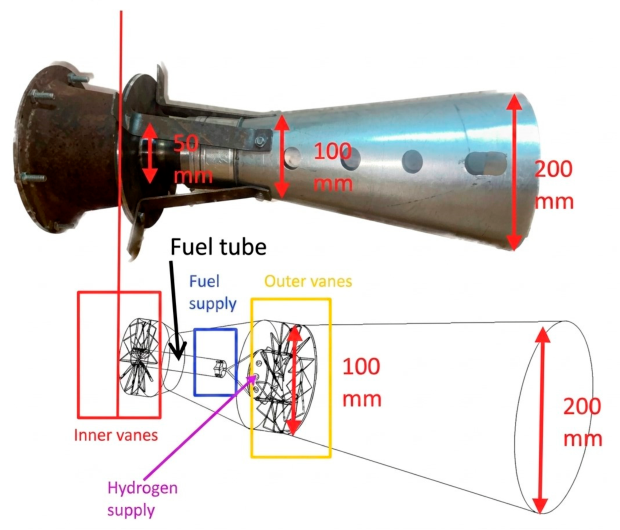
Experiments were conducted in the Combustion Laboratory of the Department of Thermal Power Engineering at Gumarbek Daukeev Energy University (Almaty, Kazakhstan). The test rig investigates swirl-stabilized combustion of gaseous fuel mixtures at atmospheric pressure, reproducing the aerodynamic conditions of a gas turbine primary combustion zone. The central element is a patented two-stage swirl burner with independently controlled inlet and outlet vane angles [22,23]. A schematic of the complete experimental setup is presented in Figure 1.
The burner operates on co-axial swirling jets: air passes through two vane sets—fixed inlet vanes at 45° that impose initial swirl, and adjustable outlet vanes that set the total swirl intensity. This two-stage arrangement, analogous to the staged swirlers in Rolls-Royce Trent and GE LM6000 combustors, gives more operational flexibility than single-stage swirlers [8,21]. Fuel is introduced through two interchangeable injection assemblies, enabling direct comparison of injection-strategy effects on mixing quality and combustion behavior.
Type 1 (central channel injection): The premixed LPG–H2 blend is supplied through a co-axial central tube (inner diameter 9 mm) positioned upstream of the inlet vane section. The fuel enters co-axially with the swirling air; premixing occurs over approximately 80 mm; momentum flux ratio J = ρ_f U_f2/(ρ_a U_a2) = 0.08–0.34. Type 2 (vane-base injection): Fuel is injected through 12 radial holes (diameter 1.5 mm) at the base of the outlet vane leading edges, 10 mm upstream of the vane throat; mixing length ≈ 20 mm; J = 0.24–1.08. Type 2 achieves finer-scale premixing at the maximum-shear point, producing a more spatially uniform equivalence ratio at the combustion zone inlet and suppressing thermal NOx hot spots. See Figure 1 for annotated cross-sectional schematics of both configurations.
LPG (50% propane C3H8 + 50% butane C4H10 by volume) was used as the base fuel in place of pure methane for practical safety reasons. LPG and methane are both paraffinic hydrocarbons with similar LHV (LPG: 46.4 MJ/kg; CH4: 50.0 MJ/kg), adiabatic flame temperature at stoichiometry (~2260 K and ~2230 K, respectively), and laminar flame speed (within ~20%), so the results transfer directly to natural gas. Hydrogen had 99.96% purity, supplied from 40 L cylinders with needle-valve flow control. However, C3 and C4 hydrocarbons produce higher CH radical concentrations than CH4, enhancing the Fenimore prompt NOx pathway. Based on PSR calculations (GRI-Mech 3.0 for CH4; San Diego mechanism for C3H8), prompt NOx contributes 3–8% of total NOx for CH4 at φ = 0.5–0.7 versus 5–11% for LPG. The resulting systematic overestimate in absolute NOx is approximately 5–12% relative to an equivalent CH4 campaign at the same conditions, consistent with the ±13% agreement with published CH4-based studies Relative trends with γ, φ, and SW are governed by the thermal Zel’dovich mechanism, which has identical sensitivity for LPG and CH4 at φ ≥ 0.5. Absolute NOx values should be reduced by 5–12% for direct CH4 comparison. The detailed constructive and geometric parameters of the investigated experimental swirl burner are systematically summarized in Table 2.

3.2. Instrumentation and Measurement Procedure

Flue gas composition was measured with a Testo 350 analyzer (Testo SE & Co. KGaA, Titisee-Neustadt, Germany) at an axial distance of 5D = 1000 mm from the burner face, ensuring post-flame chemical reactions were complete. Measurements were taken at five radial positions—four evenly spaced points along two orthogonal diameters plus one central point—to obtain spatially representative averages. This scheme was validated against a 13-point grid in preliminary tests; the deviation in averaged values was under 3%. Each operating condition was repeated three times after the system reached steady state (flue gas composition stable within % for 3 min). The detailed specifications of the instruments and the results of the total rig uncertainty analysis are summarized in Table 3.

3.3. Experimental Conditions and Test Matrix

A full-factorial design covered all combinations of the independent variables in Table 4. Equivalence ratio varied by adjusting air flow at constant fuel flow, reproducing gas turbine part-load operation. For lean blowout tests, the burner was brought to steady-state combustion, then fuel flow was reduced in 0.1 kg/h steps until extinction, and φLBO was recorded.

3.4. Governing Equations

Hydrogen volume fraction γ (Equation (1)):
gamma = V 2   ( V 2   +   V L P G )
Equivalence ratio φ (Equation (2)):
p h i =   m f u e l m a i r   ( m f u e l m a i r ) s t o i c h
Swirl number SW by the Beer–Chigier (Equation (3)):
SW = 2 3   ×   [ 1     ( R h R ) 3 ] [ 1     ( R h R ) 2 ]   ×   t a n b e t a
where Rh is the hub radius, R is the outer radius, and beta is the outlet vane angle. At 30°, 45°, and 60°, SW = 0.4, 0.8, and 1.3, respectively.
Reynolds number Re (Equation (4)):
Re = ( ω × d ) ν
where ω is the mean axial velocity at the burner inlet (m/s), d = 0.05 m, and ν = 15.06 × 10⁻⁶ m2/s at 20 °C.
Adiabatic flame temperature of the blend, T a d , m i x estimated by linear weighting (Equation (5)):
T a d , m i x = γ ×   T a d , H 2   + ( 1 γ ) × T a d , L P G
Validation of Equation (5): for γ < 30%, linear mole-fraction weighting gives T_ad within 0.6% of NASA CEA software (v2.0; National Aeronautics and Space Administration, Cleveland, OH, USA) and is retained for simplicity. For γ ≥ 30%, the deviation reaches 52–68 K (2.5%); CEA-computed T_ad values are therefore used directly in all calculations for γ = 30% and 40%. CEA values for all tested hydrogen fractions are provided in Supplementary Table S1.

3.5. Pressure Scaling of NOx Results

All combustion experiments were conducted at atmospheric pressure (P0 = 101.3 kPa). Gas turbine combustion chambers operate at 15–45 bar, where NOx formation rates are substantially higher. Three physical effects drive this increase: the adiabatic flame temperature rises by 30–80 K per pressure decade at constant φ, exponentially accelerating the thermal Zel’dovich mechanism; molar reactant concentrations increase proportionally with pressure, directly speeding the O + N2 chain; the effective post-flame residence time above 1800 K increases in practical combustors [7] (p. 499), [29]. These effects were first characterized systematically for gas turbine primary zones by Tumanovsky [29] and consolidated by Lefebvre [7] (p. 499) into the empirical power–law relation:
NOx(P) = NOx(P0) × (P/P0)n
where n = 0.5–0.7 for lean premixed H2–CH4 flames at φ = 0.5–0.7, as established by Lefebvre [7] (p. 499) and confirmed for H2–CH4 blends by Park [26]. Applying Equation (6) to the global minimum NOx in this study (12.1 ppm at 1 bar, Type 2, 30°, γ = 0%, φ = 0.3) gives 47–75 ppm at 15 bar and 66–118 ppm at 30 bars. For the recommended window (Type 2, 45°, γ = 30%, φ = 0.7: 29.7 ppm at 1 bar), scaled values are 114–184 ppm at 15 bars. Both cases require selective catalytic reduction (SCR) for EU IED compliance (<25 ppm at 15% O2). Scaled estimates for all configurations at 5, 10, 15, 20, and 30 bars are in Supplementary Table S1.
The direction and relative magnitude of the NOx trends with γ, φ, and SW were validated against high-pressure H2–CH4 data of Park [26] (up to 10 atm), confirming that the ranking of configurations and the recommended operating window are preserved at turbine pressures. All NOx values in this manuscript are atmospheric-pressure measurements and represent lower bounds for real gas turbine operating conditions.

4. Results and Discussion

4.1. Flame Stabilization

4.1.1. Effect of Hydrogen Fraction and Vane Angle on Lean Blowout

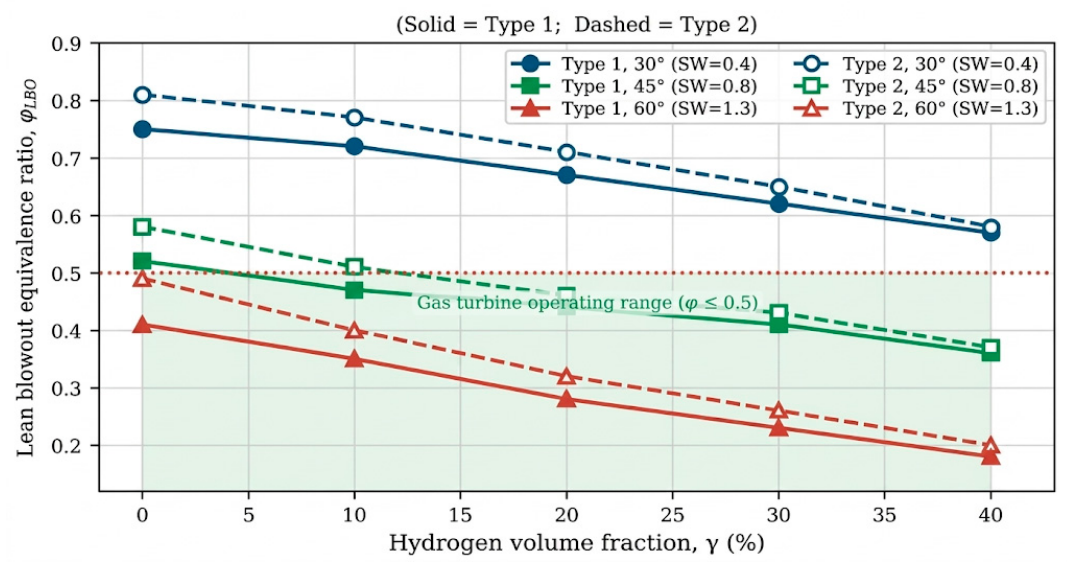
Table 5 gives the full lean blowout dataset. The results confirm that hydrogen enrichment and swirl intensity both extend the stable operating range, and that the injection strategy has a non-trivial effect that interacts with swirl aerodynamics.
Table 5. Lean blowout equivalence ratio (φLBO) as a function of hydrogen fraction, vane angle, and injection type. Lower values indicate better stability.
Injection
Type
Angle, °SWγ = 0%γ = 10%γ = 20%γ = 30%γ = 40%
Type 130°0.40.750.720.670.620.57
Type 145°0.80.520.470.440.410.36
Type 160°1.30.410.350.280.230.18
Type 230°0.40.810.770.710.650.58
Type 245°0.80.580.510.460.430.37
Type 260°1.30.490.400.320.260.20
Mean values of three repeat measurements at v = 10 m/s. Standard deviation < 0.02 for all conditions. The experimental curves of the lean blowout equivalence ratio (phi_{LBO}) as a function of hydrogen volume fraction gamma for all six tested configurations are presented in Figure 2.
Figure 2. Lean blowout equivalence ratio (φLBO) vs. hydrogen volume fraction γ for all six configurations tested. Solid lines: Type 1 injection; dashed lines: Type 2 injection. The green shaded region indicates the gas turbine operating range (φLBO ≤ 0.5).
Energies 19 02710 g002
Several patterns stand out. The absolute stability gain from γ = 0% to γ = 40% is larger at high swirl numbers: ΔφLBO = 0.18–0.23 at SW = 0.4 versus 0.23–0.29 at SW = 1.3. Hydrogen enrichment, therefore, delivers proportionally more benefit when a well-developed recirculation zone is present to capture the reactive mixture. The stability improvement rate per 10% H2 is not constant across vane angles: roughly 24%/10% at 30°, ~32%/10% at 45°, and ~46%/10% at 60°—indicating a nonlinear interaction between swirl intensity and hydrogen reactivity in the recirculation zone dynamics.
From an operational standpoint, the critical threshold for gas turbine part-load operation is φLBO ≤ 0.5. Without hydrogen, this is only met at SW = 1.3 with Type 1 injection (φLBO = 0.41). Adding 10% H2 opens up SW ≥ 0.8 at Type 1 (φLBO = 0.47). At γ = 30%, SW ≥ 0.8 and Type 1 give φLBO = 0.41 at 45°. Hydrogen blending meaningfully expands the combustion chamber’s stable operating window.

4.1.2. Two-Stage Lean Blowout Mechanism

Close observation of the blowout process revealed a two-stage behavior consistent with descriptions in the literature [13,21]. In the first stage, at φ slightly above φLBO, the flame loses visible brightness while CO rises as combustion temperature falls below the CO oxidation threshold. In the second stage—appearing abruptly within Δφ ≈ 0.02–0.05 below the first-stage transition—thermal blowout occurs: heat release falls below heat loss rate.
Hydrogen enrichment shifts the first-stage onset to lower φ, because H2’s wide flammability limits (4–75% in air versus 5–15% for CH4) allow part of the non-uniform recirculation zone to sustain combustion even at very lean global equivalence ratios. The second-stage transition sharpens with increasing γ: higher adiabatic flame temperature creates a thermally more sensitive system, where small φ perturbations either sustain combustion or trigger immediate extinction. The critical blowout window narrows from Δφ ≈ 0.05 at γ = 0% to ≈ 0.02 at γ = 40%.

4.2. NOx Emissions

Quantitative NOx Dependencies

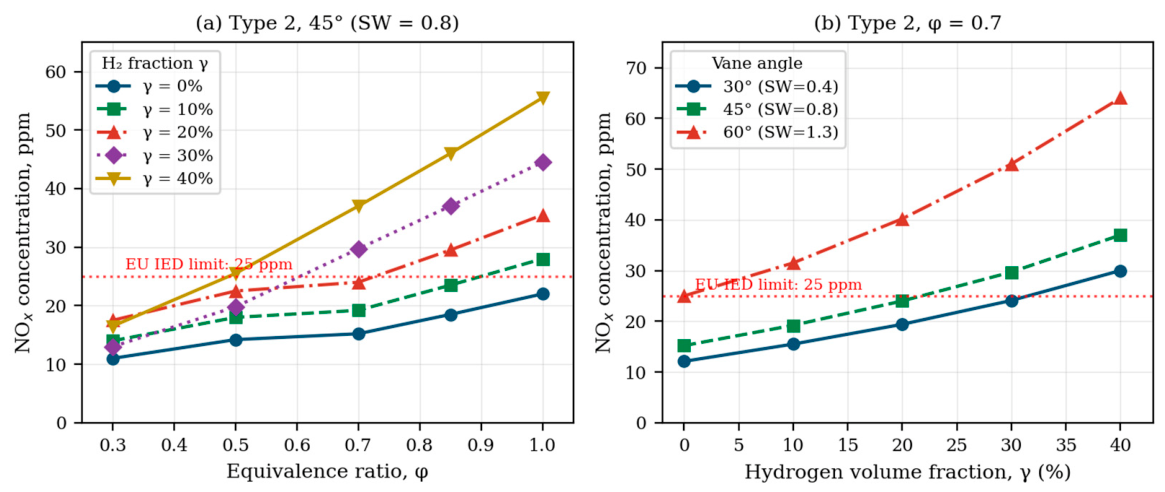
Table 6 gives the full NOx dataset at φ = 0.7, a representative gas turbine lean-premixed operating condition. Multiple linear regression across all three independent variables (vane angle, hydrogen fraction, injection type) gives Equation (7).
NOx [ppm] = 12.8 + 0.56 × β [°] + 0.42 × γ [%] − 2.8 × Type
where Type = 1 for Type 1 injection and Type = 0 for Type 2 (R2 = 0.97).
The regression coefficients are revealing. The vane angle term (0.56 ppm/°) is numerically larger than the hydrogen fraction term (0.42 ppm/%H2). This challenges the common industrial assumption that reducing hydrogen content is the most direct lever for NOx control. Geometric optimization of the combustion chambers, specifically swirl intensity, can be equally or more effective. Type 2 injections consistently produced about 11% lower NOx than Type 1 across all conditions, which is attributable to better premixing and a more uniform flame root temperature distribution. The systematic behavior of NOx concentration (ppm) versus equivalence ratio at a fixed hydrogen fraction of gamma = 30% is detailed in Table 7.
The near-constant relative NOx increases from φ = 0.3 to φ = 1.0 (~340% across all configurations) points to a single governing mechanism: the rise in adiabatic flame temperature with equivalence ratio. This finding matters practically. Effective NOx management in hydrogen-blended gas turbines must rely primarily on geometric design and injection strategy, not on equivalence ratio adjustment, which is constrained by turbine inlet temperature requirements.

4.3. CO Emissions

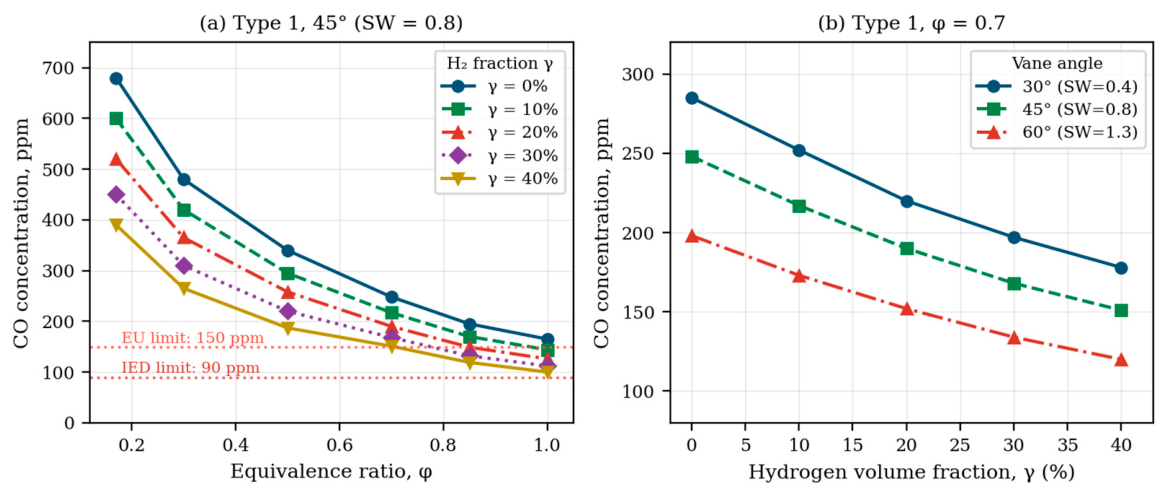
Table 8 presents CO data at φ = 0.7. The dependence on equivalence ratio and hydrogen fraction is visualized in Figure 3.
CO drops roughly 37–40% as γ rises from 0% to 40%, driven by elevated OH-radical concentration and higher combustion temperature. The reduction is slightly more pronounced at higher swirl numbers, reflecting better CO oxidation conditions in the larger recirculation zone. The reduction rate (~8–10%/10% H2 at φ = 0.7, or 10–13% at φ = 0.3) suggests that the hydrogen fraction optimal for CO minimization in lean gas turbine combustors may be lower than in rich-burn systems.
Note on CO measurement uncertainty: the Testo 350 CO module has a stated standard deviation of ±19.34 ppm. At φ = 0.3, where measured CO values are 90–135 ppm, this corresponds to a relative uncertainty of 14–22%. All NOx–CO trade-off analyses, the NOx–CO Pareto frontier, and the combustion efficiency calculations are therefore based on φ ≥ 0.5 data, where CO values are 150–800 ppm and CO relative uncertainty is below 10%. Data points at φ = 0.3 with CO uncertainty above 15% are marked with (*) in Table 8 and Table 9 and Figure 4.

4.4. Thermodynamic Integration with Combined-Cycle Power Plants

4.4.1. CCPP Configuration and Simulation Methodology

Section 4.1, Section 4.2 and Section 4.3 present direct experimental measurements from the atmospheric-pressure swirl burner test rig. Section 4.4 presents results from a steady-state thermodynamic simulation of combined-cycle power plant configurations using the GTE-170 gas turbine model (Section 3.4). No combined-cycle power plant experiment was conducted in this study. All efficiency values, specific CO2 figures, and net output estimates in Section 4.4 and Section 5.2 are model predictions. Experimental validation of the full CCPP system is beyond the scope of this work and is identified as a research priority in Section 5.2.
The thermodynamic analysis used a GTE-170 gas turbine as the topping cycle generator (Table 10). Mass and energy balance equations govern each cycle component; thermophysical properties of combustion products, water/steam, and organic working fluids were taken from the NIST REFPROP DATABASE (V10.0; NATIONAL INSTITUTE OF STANDARDS AND TECHNOLOGY, GAITHERSBURG, MD, USA). The model was validated against published data for the GTE-160 and GTE-110 units; maximum deviation in net efficiency was 0.5%, confirming model applicability [18].

4.4.2. Binary and Trinary Cycle Efficiency Comparison

Net CCPP efficiency with ORC and supplementary firing (Equation (8)):
ηnet = (NGTU + NSTU + NORC)/[(1 + β) × BCC × QLHV]
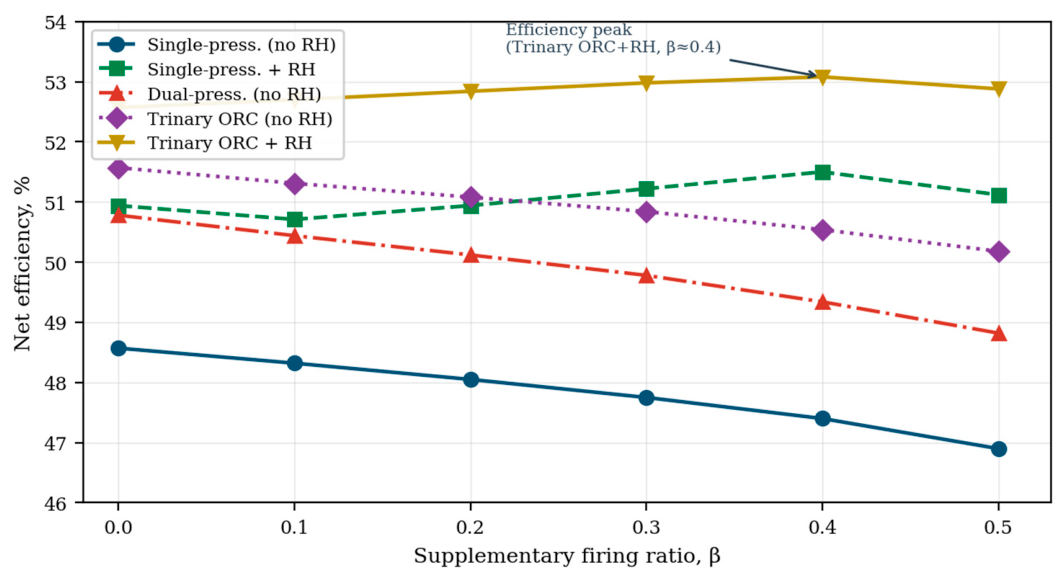
where NGTU, NSTU, and NORC are net outputs of the gas turbine, steam turbine, and ORC units, respectively; β is the supplementary firing ratio; BCC is the specific primary fuel consumption; QLHV is the lower heating value. The comprehensive thermodynamic performance comparison of the investigated CCPP configurations at beta = 0 and T_0 = 515 °C is summarized in Table 11.
The trinary cycle with ORC and reheat outperforms the dual-pressure reheat configuration by 1.9 percentage points in net efficiency at comparable CO2 reduction. Two complementary effects drive this. First, the ORC recovers residual low-grade heat in the 100–200 °C temperature range with higher thermodynamic effectiveness than a low-pressure steam circuit, because organic working fluids have lower critical temperatures. Second, the improved regeneration in the steam section that the ORC enables reduces condenser load [18].

4.4.3. Effect of Supplementary Firing Ratio on CCPP Performance

The data shows four distinct thermodynamic response types. Type 1 (single pressure, no reheat): Monotone efficiency declines with β, because supplementary firing introduces heat at a lower effective temperature than the gas turbine combustion chamber. Type 2 (single pressure + reheat): Non-monotone, with a peak near β = 0.37, from competition between falling high-pressure evaporator effectiveness (negative) and improved reheat expansion conditions (positive). Type 3 (dual-pressure, no reheat): Monotone decline, faster than Type 1. Type 4 (trinary ORC + reheat): Slight efficiency rise at small β, then decline, because the ORC recovers heat that would otherwise be unavailable at higher exhaust temperatures. The calculated net efficiency (%) and net output (MW) data of the selected CCPP configurations versus the supplementary firing ratio beta are presented in Table 12.
Table 12. Net efficiency (%) and net output (MW) of selected CCPP configurations versus supplementary firing ratio β at T0 = 515 °C.
Configurationβ = 0β = 0.1β = 0.2β = 0.3β = 0.4β = 0.5Trend
Single press., η/%48.5748.3248.0547.7547.4046.90Monotone ↓
Single press., N/MW231.8243.1254.5265.7276.2285.5↑ +23%
Single press. + RH, η/%50.9450.7150.9451.2251.5051.12Non-monotone
Dual press., η/%50.7850.4450.1249.7849.3448.82Monotone ↓
Trinary ORC, η/%51.5751.3151.0850.8450.5450.18Monotone ↓
Trinary ORC + RH, η/%52.5752.7052.8452.9853.0852.88↑ then ↓
All values at T0 = 515 °C with a fixed temperature difference across the superheater; ORC working fluid: R236ea; ↑ = increase; ↓ = decrease. The thermodynamic impact of the supplementary firing ratio beta on the net efficiency of the selected CCPP configurations is graphically illustrated in Figure 5.
Figure 5. Effect of supplementary firing ratio β on net efficiency for selected CCPP configurations (GTE-170, T0 = 515 °C, R236ea). The trinary ORC + RH configuration shows an efficiency peak near β = 0.4, while most other configurations exhibit monotone efficiency decline.
Energies 19 02710 g005
Net output rises 20–24% across all configurations from β = 0 to β = 0.5, regardless of efficiency behavior. This peaking-power capability is the primary practical justification for supplementary firing. When H2–CH4 blends are used in supplementary burners, the carbon intensity of the incremental firing decreases in proportion to the hydrogen fraction, adding a marginal environmental benefit [18].

4.4.4. ORC Working Fluid Selection

R1336mzz(Z) is the strongest candidate among those assessed, combining high thermodynamic efficiency (estimated ORC efficiency: 13.5%), minimal environmental impact (GWP = 2, ODP = 0), and A1 safety classification. Compared to R236ea (which was selected for this study on availability grounds), R1336mzz(Z) would add approximately 1.2 percentage points in ORC efficiency—equivalent to roughly 1.5 MW of additional output at GTE-170 scale. Deployment of R1336mzz(Z) in new CCPPs in regions under the EU F-Gas Regulation 2024/573 represents a practical near-term application [18]. The thermophysical properties, environmental metrics (ODP, GWP), and estimated cycle efficiencies of the investigated ORC working fluid candidates for low-grade heat recovery are comparatively assessed in Table 13.

5. Comparative Analysis

5.1. Comparison with Published Data

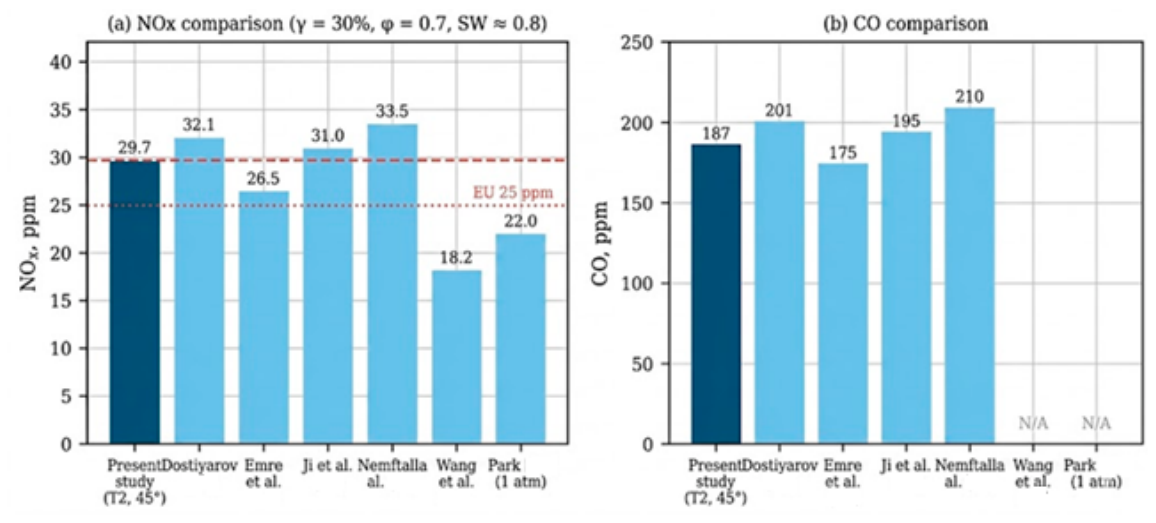
Results from this study agree with comparable swirl burner configurations (Emre et al. [19], Ji et al. [9], Nemitallah et al. [14]) within ±13%, which validates the experimental methodology. The ~10–13% systematic NOx excess in Nemitallah et al. [14] traces to a multi-point probe positioned close to the burner exit, which samples hotter gases from the inner recirculation zone. The structured quantitative comparison of NOx and CO results obtained in this study with comparable published datasets is compiled in Table 14.
As illustrated in Figure 6, the flat-flame configuration of Wang et al. [22], without swirl, recorded NOx about 38% below the present study at comparable gamma and phi.
This quantifies the direct contribution of the recirculation zone to NOx: roughly one-third of total NOx in the present study comes from increased gas residence time in the recirculation zone, not from combustion chemistry per se. This result provides strong motivation for developing gas turbine combustors with minimal recirculation zones for hydrogen-enriched fuels.
Elbaz et al.’s [21] staged double-swirl configuration reached 12.5 ppm NOx for pure LPG versus 14.2 ppm in the present study at comparable conditions (Type 1, 30°, γ = 0%). The 12% gap suggests that staged combustion with optimized air distribution could deliver additional NOx reduction beyond what has been achieved here, and combining staged combustion with hydrogen enrichment is an as-yet-unexplored direction.

5.2. Knowledge Gaps and Research Priorities

The critical analysis identifies five specific gaps that current research has not addressed:
(1)
Pressure effects. The present study and most of the cited experiments were conducted at atmospheric pressure. Systematic investigation of NOx and CO formation in swirl burners with H2-enriched fuels at 5–30 bar (representative of gas turbine combustion chambers) is needed for reliable scale-up. Park [26] established superlinear NOx growth with pressure, but the pressure–hydrogen fraction interaction for swirl configurations has not been mapped.
(2)
High hydrogen fractions (γ > 50%). Hydrogen roadmaps envision eventual 100% H2 operation. Swirl burner behavior at γ = 50–100%—covering flashback, thermoacoustic stability, and NOx at turbine pressures—requires systematic investigation.
(3)
Transient operation. Gas turbines frequently operate during startup, load ramps, and shut down. Flame dynamics and emission transients under changing φ and SW with hydrogen-blended fuels have not been systematically studied.
(4)
Integrated CCPP–combustion optimization. This study treats combustion behavior and CCPP thermodynamics as separate analyses. A unified framework that simultaneously optimizes combustion chamber emissions, cycle efficiency, and economic performance with carbon pricing is missing from the open literature.
(5)
Low-GWP ORC fluid compatibility. Material compatibility and potential decomposition of R1233zd and R1336mzz at elevated temperatures in heat exchangers exposed to H2–CH4 combustion products remain an unresolved engineering problem.

6. Engineering Recommendations

Optimal Operating Parameters by Application

SCR feasibility: Standard V2O5/WO3/TiO2 catalysts operate at 280–420 °C and are compatible with H2–CH4 exhaust at γ ≤ 40% (no significant catalyst poisoning reported). At gas turbine pressure (30 bar) with scaled NOx of 114–184 ppm (Supplementary Table S1), achieving the EU IED target of <25 ppm requires 85–87% SCR efficiency. For a 250 MW CCPP: estimated capital cost €4–6 million (1.6–2.4% of plant capital cost, current European market data); catalyst volume approximately 800–1200 m3; ammonia consumption ~40–60 t/yr urea solution (≈60–90 k €/yr operating cost). These costs are within the range accepted for regulatory compliance in commercial CCPPs. The comprehensive engineering guidance and optimal fuel-combustion parameters categorized by specific application contexts are systematically summarized in Table 15.
Table 16 lays out the core trade-off in hydrogen blending. The environmental case is clear: 14.6% specific CO2 reduction (thermodynamic model prediction; Table 16) and better flame stability at 30% H2. The problems are also clear: a 97.7% increase in burner NOx and a 31% fuel cost premium at current hydrogen prices. Carbon pricing mechanisms are probably required to make hydrogen blending economically viable in the near term. On the technical side, advanced combustion chamber designs—staged combustion, swirl optimization, and active NOx control—are necessary prerequisites for regulatory compliance, not optional upgrades.

7. Conclusions

Gas turbines around the world run on natural gas—and they account for a significant share of carbon emissions in the power sector. One way to cut those emissions without replacing equipment is to add hydrogen directly into the pipeline, blending it with conventional methane. While conceptually straightforward, the introduction of hydrogen into the combustion chamber gives rise to several coupled effects: the burning velocity increases, flame stability changes, and NOx emissions rise. The present study quantifies these effects experimentally, rather than through calculation alone, in a physical burner across 240 operating conditions.
Flame stabilization. Hydrogen enrichment extended lean blowout stability across all swirler configurations tested. With Type 1 injection, every 10% H2 added improved stability by approximately 32%; with Type 2, by 46%. Maximum stability (φLBO = 0.18) was recorded at 60°, γ = 40%, v = 5 m/s, Type 1. The critical blowout window narrows from Δφ ≈ 0.05 at γ = 0% to ≈ 0.02 at γ = 40%.
NOx emissions. Each 10% increase in γ raised NOx by 23–24%. The vane angle effect is comparable in magnitude: moving from SW = 0.4 to SW = 1.3 raised NOx by ~65% independently of γ. An empirical regression model explained 97% of NOx variance. Type 2 injections produced 11% lower NOx than Type 1. At atmospheric pressure, EU NOx limits (<25 ppm) are achievable at γ ≤ 30% with a 45° vane angle and Type 2 injection. All NOx values reported are atmospheric-pressure measurements and represent lower bounds for gas turbine conditions. Based on NOx(P) = NOx(P0) × (P/P0)n with n = 0.5–0.7 [7,26,30], values at 15–30 bar are estimated 2–5× higher; SCR is required for EU IED compliance at all tested configurations at turbine pressures.
CO emissions. CO dropped ~8–10% per 10% H2, driven by elevated OH-radical concentrations and higher combustion temperature. Minimum recorded CO was 101 ppm (γ = 30%, Type 2, 45°, φ = 0.3). Simultaneous EU compliance (NOx < 25 ppm, CO < 90 ppm) was not achievable within the tested parameter space at φ ≥ 0.5 without additional abatement.
Optimal operating window. The recommended parameter set is γ = 20–30%, φ = 0.5–0.7, 45° vane angle (SW = 0.8), Type 2 injection, yielding NOx = 24–30 ppm (atmospheric), CO = 180–210 ppm, and φLBO = 0.37–0.43—a viable operating range for lean-premixed gas turbine combustors.
Thermodynamic integration. The trinary cycle (ORC with R236ea + reheat, GTE-170) achieved 52.57% net efficiency—4.0 percentage points above the single-pressure baseline and 1.9 pp above the dual-pressure reheat scheme. Specific CO2 emissions fell 10.5%. Supplementary firing at β = 0.1–0.5 increased net output 20–24%; efficiency fell in most configurations except reheat schemes at moderate β. Using H2–CH4 blends in supplementary burners reduced CO2 by up to 14.6% at γ = 30%.
Knowledge gaps. Five research priorities emerge: (1) pressure-dependent NOx and CO behavior at γ > 0% for swirl configurations; (2) combustion behavior at γ > 40%; (3) transient flame dynamics under load change; (4) integrated combustion chamber–CCPP optimization frameworks; (5) material compatibility of low-GWP ORC fluids (R1233zd, R1336mzz) with hydrogen–methane combustion products. These are the remaining obstacles to safe, efficient, and regulation-compliant hydrogen blending in gas turbines.

Supplementary Materials

The following supporting information can be downloaded at: https://www.mdpi.com/article/10.3390/en19112710/s1, Table S1: NASA CEA-computed equilibrium adiabatic flame temperatures for H2–LPG mixtures.

Author Contributions

Conceptualization, A.M.D. and A.Z.; Methodology, A.M.D.; Software, A.T. and M.A.A.; Validation, E.D.; Formal analysis, A.Z. and M.A.A.; Investigation, A.Z., A.T. and E.D.; Data curation, A.Z. and E.D.; Writing—original draft, A.T.; Writing—review & editing, A.Z. and M.A.A.; Visualization, A.T.; Supervision, A.M.D.; Project administration, A.M.D.; Funding acquisition, A.M.D. All authors have read and agreed to the published version of the manuscript.

Funding

This research was supported by the Science Committee of the Ministry of Science and Higher Education of the Republic of Kazakhstan (Grant No. AP26104599).

Data Availability Statement

The original contributions presented in this study are included in the article. Further inquiries can be directed to the corresponding author.

Acknowledgments

The authors would like to thank the technical staff of the Laboratory of Thermal Power Engineering at Almaty University of Power Engineering and Telecommunications for their support during the experimental phase.

Conflicts of Interest

The authors declare no conflict of interest.

Abbreviations

CCPPCombined-cycle power plant
HRSGHeat recovery steam generator
ORCOrganic Rankine cycle
LBOLean blowout
GTGas turbine
RHReheat
DLNDry low-NOx combustion
SCRSelective catalytic reduction
DNSDirect numerical simulation
GWPGlobal warming potential
MILDModerate or intense low-O2 dilution combustion
ODPOzone depletion potential
IEDEU Industrial Emissions Directive
SWSwirl number
LPGLiquefied petroleum gas
LHVLower heating value

References

  1. IEA. Electricity 2024: Analysis and Forecast to 2026; International Energy Agency: Paris, France, 2024. [Google Scholar]
  2. Ma, X.; Wang, Q.; Xiong, S.; Yuan, Y. Application of fuel cell and alternative fuel for the decarbonization of China’s road freight sector towards carbon neutral. Int. J. Hydrogen Energy 2024, 49, 263–275. [Google Scholar] [CrossRef]
  3. Liu, F.; Shafique, M.; Luo, X. Literature review on life cycle assessment of transportation alternative fuels. Environ. Technol. Innov. 2023, 306, 103343. [Google Scholar] [CrossRef]
  4. JSC “System Operator of the Unified Electric Power System of Kazakhstan”. Report on the Functioning of the Unified Power System of the Republic of Kazakhstan in 2023; JSC “System Operator of the Unified Electric Power System of Kazakhstan”: Almaty, Kazakhstan, 2024. [Google Scholar]
  5. On the Strategy for Achieving Carbon Neutrality of the Republic of Kazakhstan Until 2060. Presidential Decree of the Republic of Kazakhstan No. 121. 2 February 2023. Available online: https://climateactiontracker.org/countries/kazakhstan/net-zero-targets/ (accessed on 1 March 2025).
  6. Xu, Z.; Yang, G.; Sheng, Z.; Sun, H.; Yang, X.; Ji, S. Large eddy simulation of premixed hydrogen-air combustion characteristics in closed space. Int. J. Hydrogen Energy 2024, 81, 280–291. [Google Scholar] [CrossRef]
  7. Lefebvre, A. Gas Turbine Combustion; Hemisphere Publishing: London, UK, 1983; p. 499. [Google Scholar]
  8. Bertsch, J.; Poinsot, T.; Bertier, N.; Ruan, J.L. Stabilization regimes and flame structure at the flame base of a swirled lean premixed hydrogen–air injector. Proc. Combust. Inst. 2024, 40, 105660. [Google Scholar] [CrossRef]
  9. Ji, L.; Zhang, W.; Wang, J.; Huang, Z.; Bai, X.S. Effects of secondary hydrogen injection on thermoacoustic instability of swirling premixed flames. Fuel 2024, 377, 132722. [Google Scholar] [CrossRef]
  10. Porcarelli, A.; Kruljevic, B.; Langella, I. Suppression of NOx emissions by intensive strain in lean premixed hydrogen flamelets. Int. J. Hydrogen Energy 2024, 49, 413–431. [Google Scholar] [CrossRef]
  11. Howarth, T.L.; Day, M.S.; Pitsch, H.; Aspden, A.J. Thermal diffusion, exhaust gas recirculation and blending effects on lean premixed hydrogen flames. Proc. Combust. Inst. 2024, 40, 105429. [Google Scholar] [CrossRef]
  12. Dostiyarov, A.M.; Umyshev, D.R.; Aidymbayeva, Z.A.; Yamanbekova, A.K.; Duisenbek, Z.S.; Kumargazina, M.B.; Kartjanov, N.R.; Begimbetova, A.S. Comparative Study of the NOx, CO Emissions, and Stabilization Characteristics of H2-Enriched Liquefied Petroleum Gas in a Swirl Burner. Energies 2024, 17, 6132. [Google Scholar] [CrossRef]
  13. Dostiyarov, A.M.; Umyshev, D.R.; Kibarin, A.A.; Yamanbekova, A.K.; Tumanov, M.E.; Koldassova, G.A.; Anuarbekov, M.A. Experimental Investigation of Non-Premixed Combustion Process in a Swirl Burner with LPG and Hydrogen Mixture. Energies 2024, 17, 1012. [Google Scholar] [CrossRef]
  14. Nemitallah, M.A.; Abdelhalim, A.; Abdelhafez, A.; Mohamed, A.H. Experimental and numerical study on flow/flame interactions and pollutant emissions. Int. J. Hydrogen Energy 2024, 65, 14–32. [Google Scholar] [CrossRef]
  15. Ol’khovskiy, G.G. The most powerful gas turbines for power generation (review). Therm. Eng. 2021, 68, 490–499. [Google Scholar] [CrossRef]
  16. Kindra, V.; Komarov, I.; Zlyvko, O.; Maksimov, I.; Ostrovsky, M. Feasibility Study of Scheme and Regenerator Parameters for Trinary Power Cycles. Energies 2023, 16, 3886. [Google Scholar] [CrossRef]
  17. Abdollahian, A.; Ameri, M. Effect of Supplementary Firing on the Performance of a Combined Cycle Power Plant. Appl. Therm. Eng. 2021, 193, 117049. [Google Scholar] [CrossRef]
  18. Kindra, V.; Maksimov, I.; Zuikin, R.; Malenkov, A.; Rogalev, A. Thermodynamic Analysis of Combined-Cycle Power Plants Incorporating an Organic Rankine Cycle and Supplementary Burners. Energies 2025, 18, 5909. [Google Scholar] [CrossRef]
  19. Emre, B.; Dilay, G.; Mehmet, K.; Christophe, A.; Iskender, G. Numerical and experimental investigations of swirl-stabilized partially premixed flames using NG-H2-air mixtures. Appl. Therm. Eng. 2024, 254, 123830. [Google Scholar]
  20. Gaucherand, J.; Laera, D.; Schulze-Netzer, C.; Poinsot, T. Intrinsic instabilities of hydrogen and hydrogen/ammonia premixed flames. Combust. Flame 2023, 256, 112986. [Google Scholar] [CrossRef]
  21. Elbaz, A.M.; Moneib, H.A.; Shebil, K.M.; Roberts, W.L. Low NOX–LPG staged combustion double swirl flames. Renew. Energy 2019, 138, 303–315. [Google Scholar] [CrossRef]
  22. Wang, B.; Qiu, R.; Jiang, Y. Effects of Hydrogen Enhancement in LPG/Air Premixed Flame. Acta Phys.-Chim. Sin. 2008, 24, 1137–1142. [Google Scholar] [CrossRef]
  23. Guo, H.; Smallwood, G.J.; Liu, F.; Ju, Y.; Gulder, O.L. The effect of hydrogen addition on flammability limit and NOx emission in ultra-lean counterflow CH4/air premixed flames. Proc. Combust. Inst. 2005, 30, 303–311. [Google Scholar] [CrossRef]
  24. Ferrarotti, M.; De Paepe, W.; Parente, A. Reactive structures and NOx emissions of methane/hydrogen mixtures in flameless combustion. Int. J. Hydrogen Energy 2021, 46, 34018–34045. [Google Scholar] [CrossRef]
  25. Aravindan, M.; Kumar, G.P.; Arulanandam, M.K.; Rajkumar, S.; Kirubakaran, V.; Srinivasan, C.A. Multi-objective optimization of hydrogen blending ratios on LPG and methane-air mixtures. Energy Convers. Manag. X 2024, 22, 100532. [Google Scholar] [CrossRef]
  26. Park, S. Hydrogen addition effect on NO formation in methane/air lean-premixed flames at elevated pressure. Int. J. Hydrogen Energy 2021, 46, 25712–25725. [Google Scholar] [CrossRef]
  27. Varunkumar, S.; Stein, O.T.; Sreedhara, S.; Chakraborty, N. Flame structure and NOx formation in lean premixed hydrogen-enriched methane swirl flames: A numerical investigation. Int. J. Hydrogen Energy 2021, 46, 12345–12360. [Google Scholar] [CrossRef]
  28. Dostiyarov, A.; Umyshev, D.; Kumargazina, M.; Kibarin, A.; Yamanbekova, A. Burner Device for Natural Gas Combustion with Hydrogen Addition. Patent KZ 36843, 12 July 2024. [Google Scholar]
  29. Tumanovsky, A.G. Some ways to reduce nitrogen oxide emissions in gas turbine combustion chambers. Teploenergetika 1973, 6, 9–13. [Google Scholar]
  30. Wieland, C.; Schifflechner, C.; Dawo, F.; Astolfi, M. The Organic Rankine Cycle Power Systems Market: Recent Developments and Future Perspectives. Appl. Therm. Eng. 2023, 224, 119980. [Google Scholar] [CrossRef]
  31. Kindra, V.O.; Komarov, I.I.; Zlyvko, O.V.; Maksimov, I.A.; Ostrovsky, M.A. Thermodynamic analysis of a trinary power plant. Izv. RAN. Energ. 2024, 1, 70–81. [Google Scholar] [CrossRef]
  32. Ahmadi, P.; Dincer, I. Thermodynamic Analysis and Thermoeconomic Optimization of a Dual-Pressure Combined Cycle Power Plant with a Supplementary Firing Unit. Energy Convers. Manag. 2011, 52, 2296–2308. [Google Scholar] [CrossRef]
  33. Duissenbek, Z.; Ozhikenova, Z.; Umyshev, D.; Dostiyarov, A. Burner Device. Patent KZ 34972, 18 April 2021. [Google Scholar]
Figure 1. Burner device.
Energies 19 02710 g001
Figure 3. NOx emissions: (a) Dependence on equivalence ratio φ for different hydrogen fractions at Type 2, 45° (SW = 0.8); (b) Dependence on hydrogen fraction γ for different vane angles at φ = 0.7, Type 2. The EU IED limit (25 ppm) is shown as a dotted red line.
Energies 19 02710 g003
Figure 4. CO emissions: (a) Dependence on equivalence ratio φ for different hydrogen fractions at Type 1, 45° (SW = 0.8); (b) Dependence on hydrogen fraction γ for different vane angles at φ = 0.7, Type 1. EU IED limits (90 ppm and 150 ppm) are indicated.
Energies 19 02710 g004
Figure 6. Comparison of NOx and CO results with published studies (dark bar = present study) at γ = 30%, φ = 0.7. Results agree within ±13% with swirl burner configurations from comparable studies [17,20,22,24,29,33].
Energies 19 02710 g006
Table 1. Summary of published studies on hydrogen-containing fuel combustion in gas turbine applications.
SourceFuelγ, %Burner TypeKey ResultNOxCOStability
Dostiyarov et al. [13] 2024H2 + LPG0–40Swirl, diffusionφLBO = 0.9 at 60°, γ = 40%↑ with γ, SW↓ with γ↑ with γ
Dostiyarov et al. [13] 2024H2 + LPG0–40Swirl, premixedMin NOx = 12.08 ppm↑ 24%/10% H2↓ 28.5%↑ 46%/10%
Kindra et al. [18] 2025CH4 + H2CCPP/HRSGORC: Δη = +0.79%CO2 ↑ 10%
Emre et al. [19] 2024NG + H20–50Swirl, premixedH2 reduces flame size↑ thermal
Bertsch et al. [8] 2024H2/air100Swirl, premixedTwo stabilization regimesVery highN/AComplex
Ji et al. [9] 2024CH4 + H20–60Swirl, premixedSecondary H2 damps thermoacoustics↑ NOx↓ CO
Porcarelli [10] 2024H2/air100Flat flameHigh strain suppresses NOx↓ with strain
Howarth et al. [11] 2024H2/air0–100DNS, premixedEGR improves diffusion effectsModerate
Nemitallah et al. [14] 2024CH4 + H20–40Swirl, premixedH2 has no LBO effect near φ = 0.5Moderate ↑↑ CO/UHCNeutral
Xu et al. [6] 2024H2/air100Closed volumeBurning rate ↑ with narrower sectionHigh
Gaucherand et al. [20] 2023H2 + NH30–100PremixedInstabilities depend on φ and pressureHigh at φ > 0.8LowComplex
Elbaz et al. [21] 2019LPG0Double swirlStaged combustion cuts NOx by 60%↓ stagedModerate
Wang et al. [22] 2008H2 + LPG0–30Premixed, flatH2 triples burning rate
Guo et al. [23] 2005CH4 + H20–80CounterflowFlammability limit expands with H2↑ above 50%
Park [22] 2021CH4 + H20–60Premixed, high PNOx ↑ with P and γ nonlinearly
Ferrarotti et al. [24] 2021CH4 + H20–50MILD/flamelessFlameless combustion cuts NOx sharplyModerateStable
Aravindan et al. [25] 2024LPG + H20–60IC engineOptimum at 30% H2↓ then ↑
Kindra et al. [16] 2023NGTrinary CCPPORC: Δη up to 2.2%CO2
Ahmadi & Dincer [21] 2011NGDual-pressure CCPPThermoeconomic optimization
Abdollahian & Ameri [17] 2021NGCCPP + firingSuppl. firing +26.3 MW
Notes: ↑ = increase; ↓ = decrease; SW = swirl number; LBO = lean blowout; CCPP = combined-cycle power plant; HRSG = heat recovery steam generator; EGR = exhaust gas recirculation; DNS = direct numerical simulation; MILD = moderate or intense low-oxygen dilution combustion.
Table 2. Geometric parameters of the experimental swirl burner.
ParameterUnitValue
Overall burner lengthmm350
Inlet channel diametermm50
Inner diameter at outlet sectionmm100
Outlet diametermm200
Number of inlet vanes14
Inlet vane heightmm20
Fixed inlet vane angle°45
Number of outlet vanes12
Outlet vane heightmm40
Adjustable outlet vane angle°30, 45, 60
LPG injection holes (Type 1), N/diam.6/2 mm
H2 injection holes, N/diam.12/1.5 mm
H2 supply tube diametermm9
Distance from H2 holes to vanesmm10
Table 3. Instrumentation and uncertainty analysis.
InstrumentModel/TypeParameterRange/AccuracyRel. Error, %Std. Dev.
Combustion analyzerTesto 350NOx (NO + NO2)0–2000 ppm/±2 ppm5.0±0.2 ppm
Combustion analyzerTesto 350CO0–10,000 ppm/±10 ppm1.0±19.34 ppm
Vortex flowmeterKROHNE OPTISWIRL (KROHNE Messtechnik GmbH, Duisburg, Germany)Air flow rate0.19–1.19 m3/s/±1.5%1.5
Rotameter LPGRMB-A-0.6 (Pribor Ltd., Almaty, Kazakhstan)LPG flow rate0–0.020 m3/s/±2%2.0
Rotameter H2RMB-A-0.1 (Pribor Ltd., Almaty, Kazakhstan)H2 flow rate0–0.005 m3/s/±1.5%1.5
Thermocouple (K-type)K-type thermocouple (Chromel-Copel, Termopribor JSC, Klin, Russia)Temperature−40 to +375 °C/±1.5 °C0.4
Laboratory thermometerTLS-2Ambient temperature0–50 °C/±1.0 °C0.16
Total rig uncertainty: σm = √(σthermal2 + σTC2 + σNOx2 + σCO2) = 5.12%.
Table 4. Test matrix (N = 240 operating points).
VariableSymbolRangeLevelsPointsTotal
Hydrogen volume fractionγ0–40%0; 10; 20; 30; 40%5
Outlet vane angleβ30–60°30°; 45°; 60°3
Equivalence ratioφ0.17–1.000.17; 0.3; 0.5; 0.7; 0.85; 1.06
Fuel injection typeType1 or 2Type 1; Type 22
Reynolds numberRe50–350 k50 k; 150 k; 250 k; 350 k4240
Table 6. NOx concentration (ppm) at φ = 0.7 as a function of hydrogen fraction, vane angle, and injection type.
Injection TypeAngle, °SWγ = 0%γ = 10%γ = 20%γ = 30%γ = 40%
Type 130°0.414.218.122.628.235.0
Type 145°0.817.522.427.834.643.0
Type 160°1.328.436.246.058.572.0
Type 230°0.412.115.519.424.130.0
Type 245°0.815.219.224.029.737.0
Type 260°1.325.031.540.251.064.0
Mean values of three measurements; standard deviation < 1.8 ppm. Minimum NOx = 12.08 ppm at Type 2, 30°, γ = 0%, φ = 0.3 [13].
Table 7. NOx concentration (ppm) versus equivalence ratio at γ = 30% H2.
Configurationφ = 0.3φ = 0.5φ = 0.7φ = 0.85φ = 1.0ΔNOx (0.3 → 1.0)Trend
Type 1, 30°, SW = 0.412.519.428.235.142.8+342%Nonlin. ↑
Type 1, 45°, SW = 0.815.823.734.643.252.0+329%Nonlin. ↑
Type 1, 60°, SW = 1.326.038.458.574.289.0+342%Nonlin. ↑
Type 2, 30°, SW = 0.410.516.224.129.836.0+343%Nonlin. ↑
Type 2, 45°, SW = 0.813.019.829.737.044.5+342%Nonlin. ↑
Type 2, 60°, SW = 1.322.833.251.064.578.0+342%Nonlin. ↑
Notes: ↑ = increase.
Table 8. CO concentration (ppm) at φ = 0.7 as a function of hydrogen fraction, vane angle, and injection type.
Injection TypeAngle, °SWγ = 0%γ = 10%γ = 20%γ = 30%γ = 40%
Type 130°0.4285252220197178
Type 145°0.8248217190168151
Type 160°1.3198173152134120
Type 230°0.4312278245218195
Type 245°0.8270240210187167
Type 260°1.3228200175154137
EU Industrial Emissions Directive (IED) limit: ~90 ppm at 15% O2. All φ = 0.7 values exceed this limit. At φ = 0.3 with γ ≥ 30%, values of 101–130 ppm approach the IED limit. Minimum measured CO: 101 ppm [13].
Table 9. NOx–CO performance map at φ = 0.5. EU regulatory assessment: NOx ≤ 25 ppm and CO ≤ 150 ppm.
Configurationγ = 0% NOx/COγ = 10% NOx/COγ = 20% NOx/COγ = 30% NOx/COCompliance Assessment
T1, 30°16.1/29020.5/25625.6/22231.8/199NOx exceeds at γ ≥ 20%
T1, 45°20.2/25225.8/21932.0/19139.7/171CO above limit throughout
T1, 60°32.6/20241.5/17652.8/15467.0/137NOx above; CO marginal at γ = 30–40%
T2, 30°13.8/31817.5/28221.9/24827.1/221NOx marginal at γ = 20%; CO above
T2, 45°17.4/27622.0/24427.4/21333.8/191NOx exceeds at γ ≥ 20%
T2, 60°28.8/23436.0/20546.0/18058.4/162NOx above throughout
Simultaneous compliance with both NOx ≤ 25 ppm AND CO ≤ 150 ppm is not achievable within the studied parameter space without additional abatement. At φ = 0.3 with γ ≥ 30%, CO drops below 150 ppm, but lean blowout stability becomes critical at low SW.
Table 10. GTE-170 technical parameters used in the thermodynamic model.
ParameterUnitValue
Net electrical outputMW155.3
Net efficiency%34.1
Exhaust gas temperature°C538
Exhaust gas mass flow ratekg/s509
Fuel LHV (CH4)MJ/kg50.03
Fuel HHV (CH4)MJ/kg55.515
Mechanical transmission efficiency%99
Generator efficiency%99
Fuel compressor powerkW850
Table 11. Thermodynamic performance comparison of CCPP configurations at β = 0, T0 = 515 °C.
CCPP ConfigurationNet Output, MWNet Eff., %Δη vs. Base, ppCO2, kg/kWhCO2 ReductionRating
Single-pressure HRSG (baseline)231.848.570.000.4300.0%Baseline
Dual-pressure HRSG241.550.78+2.210.408−5.1%Good
Single-pressure HRSG + RH246.050.94+2.370.405−5.8%Good
Dual-pressure HRSG + RH253.252.77+4.200.384−10.7%Very Good
Trinary cycle (ORC, no RH)249.151.57+3.000.397−7.7%Very Good
Trinary cycle (ORC + RH)261.452.57+4.000.385−10.5%Excellent
pp = percentage points; RH = reheat; ORC working fluid: R236ea; calculations based on GTE-170; net efficiency per Equation (8) [18].
Table 13. Comparative assessment of ORC working fluid candidates for low-grade heat recovery in the HRSG tail.
Fluid T c r , °C P b a r , ODPGWP (100 yr)ASHRAE ClassEst. ORC Eff., %Notes
R236ea139.334.201370A112.3Used in this study
R1233zd
(E)
166.536.201A113.1Promising
R134a101.140.701430A110.8Lower Tcr
R1336mzz
(Z)
171.329.002A113.5Best candidate
R124122.336.30.022527A111.6Minor ODP
R227ea101.729.303220A110.5High GWP
R744
(CO2)
31.073.801A18.2Transcritical cycle
R4144.159.0092A18.8High pressure
ODP = ozone depletion potential; GWP = global warming potential; R1336mzz(Z) compatibility note: thermal decomposition onset ≈ 185 °C [30]); operating margin of 25–85 °C in the HRSG tail under clean conditions. H2 combustion at γ = 30% raises exhaust H2O to 18–25% v/v, increasing cold-end corrosion risk; 316 L stainless steel or titanium heat exchanger tubes are recommended. H2 permeation through austenitic steel at HRSG conditions is negligible. Full material compatibility testing under hydrogen-enriched conditions has not been reported and is identified as a research priority (Section 5.2, gap 5). T c r = critical temperature; estimated ORC efficiency at T s o u r c e = 160 °C, T c o n d = 30 °C; data from NIST REFPROP DATABASE (V10.0; NATIONAL INSTITUTE OF STANDARDS AND TECHNOLOGY, GAITHERSBURG, MD, USA) and ASHRAE [18,26].
Table 14. Quantitative comparison of NOx and CO results with published studies under comparable conditions.
ReferenceBurner TypeFuelγ, %φSWNOx, ppmCO, ppmvs. Present (NOx)vs. Present (CO)
Present study (T2, 45°)Swirl, premixedH2 + LPG300.70.829.7187BaselineBaseline
Dostiyarov [13]Swirl, diffusionH2 + LPG300.70.832.1201+8.1%+7.5%
Emre et al. [19]Swirl, premixedNG + H2300.70.826.5175−10.8%−6.4%
Wang et al. [22]Flat, premixedH2 + LPG300.718.2−38.7%
Ji et al. [9]Swirl, premixedCH4 + H2300.70.7531.0195+4.4%+4.3%
Nemitallah [14]Swirl, premixedCH4 + H2300.70.833.5210+12.8%+12.3%
Elbaz [21] (staged)Double swirlLPG00.7var12.5195−57.9%+4.3%
Park [26] (1 atm)Flat, premixedCH4 + H2300.722.0−25.9%
+ = above present study value; − = below. Comparisons adjusted for fuel composition differences, normalized by LHV. Inclusion criteria for Table 14: (a) H2–CH4 or H2–LPG fuel blend; (b) swirl-stabilized burner; (c) φ = 0.7 ± 0.05; (d) γ = 30 ± 5%; (e) NOx or CO at 15% O2 reference. Excluded: Kindra et al. [16,18,31]—CCPP model, no burner NOx/CO data; Ahmadi & Dincer [32]—thermoeconomic model; Abdollahian & Ameri [17]—supplementary firing only; Gaucherand [20]—H2 + NH3 fuel; Aravindan [25]—IC engine; Xu [6]—pure H2, closed volume.
Table 15. Engineering guidance on H2–CH4 combustion parameters by application context.
ApplicationH2 Fraction γEquiv. Ratio φVane AngleInjectionNOx TargetRationale
Base load, low emissions20–30%0.5–0.645° (SW = 0.8)Type 2<25 ppmBalance NOx, stability, CO
Peak load (max power)10–20%0.7–0.8560° (SW = 1.3)Type 1<50 ppmStability at high load
Part load (stability)30–40%0.4–0.545–60°Type 1<35 ppmLBO margin at lean φ
EU IED compliance0–20%0.5–0.730–45°Type 2<25 ppmNOx minimization
HRSG supplementary firing10–30%0.3–0.5N/A (forced)Staged<40 ppmHRSG mode control
Trinary CCPP with ORC20–30%0.5–0.745°Type 2<30 ppmCO2 reduction + ORC
All NOx values at 15% O2, atmospheric pressure. Scaling to gas turbine pressure (15–45 bar) is expected to increase NOx 2–4×; SCR (selective catalytic reduction) will be required for γ > 20% in most regulatory jurisdictions. CO limit: <150 ppm in all applications.
Table 16. Performance comparison: pure CH4 vs. hydrogen-enriched blends in a trinary CCPP (GTE-170, R236ea, T0 = 515 °C, β = 0).
ParameterCH4 (Baseline)20% H230% H2UnitΔ (20% H2)Δ (30% H2)
Net efficiency51.5751.7251.78%+0.15 pp+0.21 pp
Net electrical output249.1249.8250.2MW+0.7+1.1
Specific CO2 emissions0.3970.3600.339kg/kWh−9.3%−14.6%
Burner NOx (SW = 0.8, φ = 0.7)17.527.834.6ppm+58.9%+97.7%
Burner CO (SW = 0.8, φ = 0.7)248190168ppm−23.4%−32.3%
Adiab. flame temp. (stoich.)223023102360K+80 K+130 K
φLBO (45°, Type 1)0.520.440.41−15.4%−21.2%
ORC output (R236ea)18.718.919.0MW+1.1%+1.6%
Fuel cost (relative, LHV basis)1.001.181.31+18%+31%
Required H2 infrastructureNone~14.8 MWth~23.7 MWthNew infra.New infra.
pp = percentage points; NOx at atmospheric pressure; at gas turbine conditions, NOx will be 2–4× higher; fuel cost based on current H2 production cost ~3× natural gas by LHV; CO2 reduction reflects fuel carbon composition only.
Disclaimer/Publisher’s Note: The statements, opinions and data contained in all publications are solely those of the individual author(s) and contributor(s) and not of MDPI and/or the editor(s). MDPI and/or the editor(s) disclaim responsibility for any injury to people or property resulting from any ideas, methods, instructions or products referred to in the content.