Geoloop (v1.0)—An Efficient Semi-Analytical Deep Borehole Heat Exchanger Model


Abstract
1. Introduction
2. Materials and Methods
2.1. Methodology
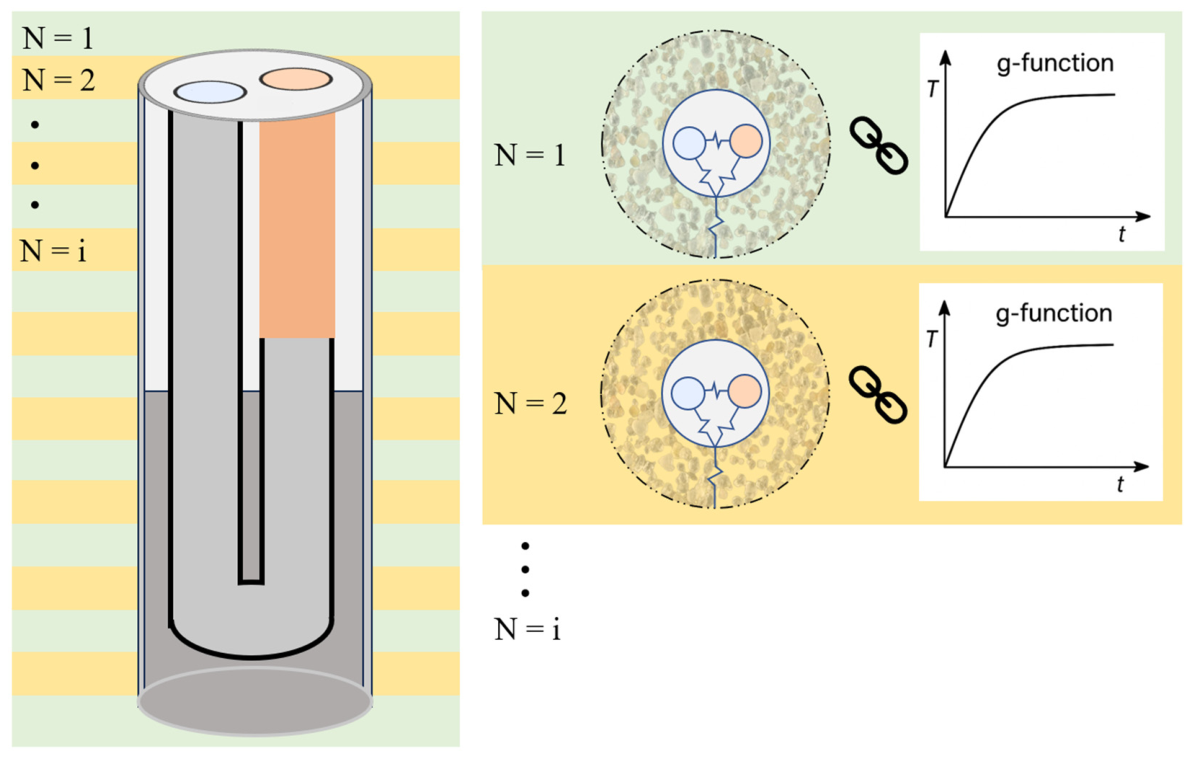
2.1.1. Vertically Stacked Approach
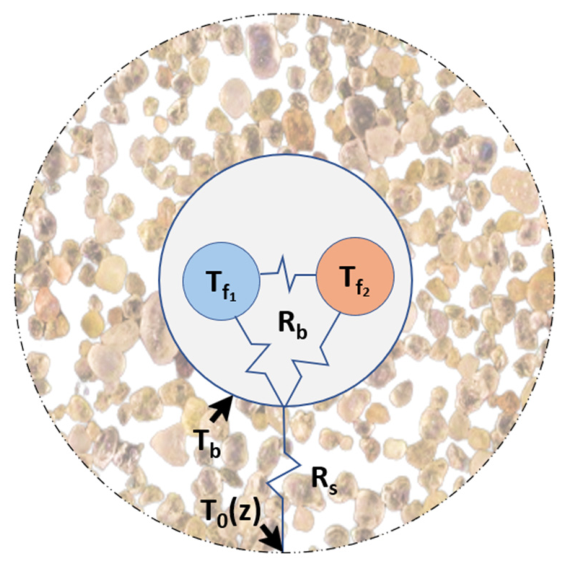
2.1.2. Segment Thermal Resistivity
2.1.3. Stacked Solution for Fluid Temperatures
| Algorithm 1: Iterative solution for depth-dependent fluid temperatures. | |
| 1: | |
| 2: | |
| 3: | while do |
| 4: | |
| 5: | |
| 6: | |
| 7: | while do |
| 8: | for to do |
| 9: | = |
| 10: | repeat |
| 11: | |
| 12: | Determine and from Equations (4) and (6) based on |
| 13: | |
| 14: | |
| 15: | until |
| 16: | end for |
| 17: | |
| 18: | |
| 19: | Adjust by a newton iteration step such that |
| 20: | end while |
| 21: | Adjust by newton iteration towards |
| 22: | end while |
2.1.4. Soil Thermal Conductivities
2.2. Geoloop Implementation and Features
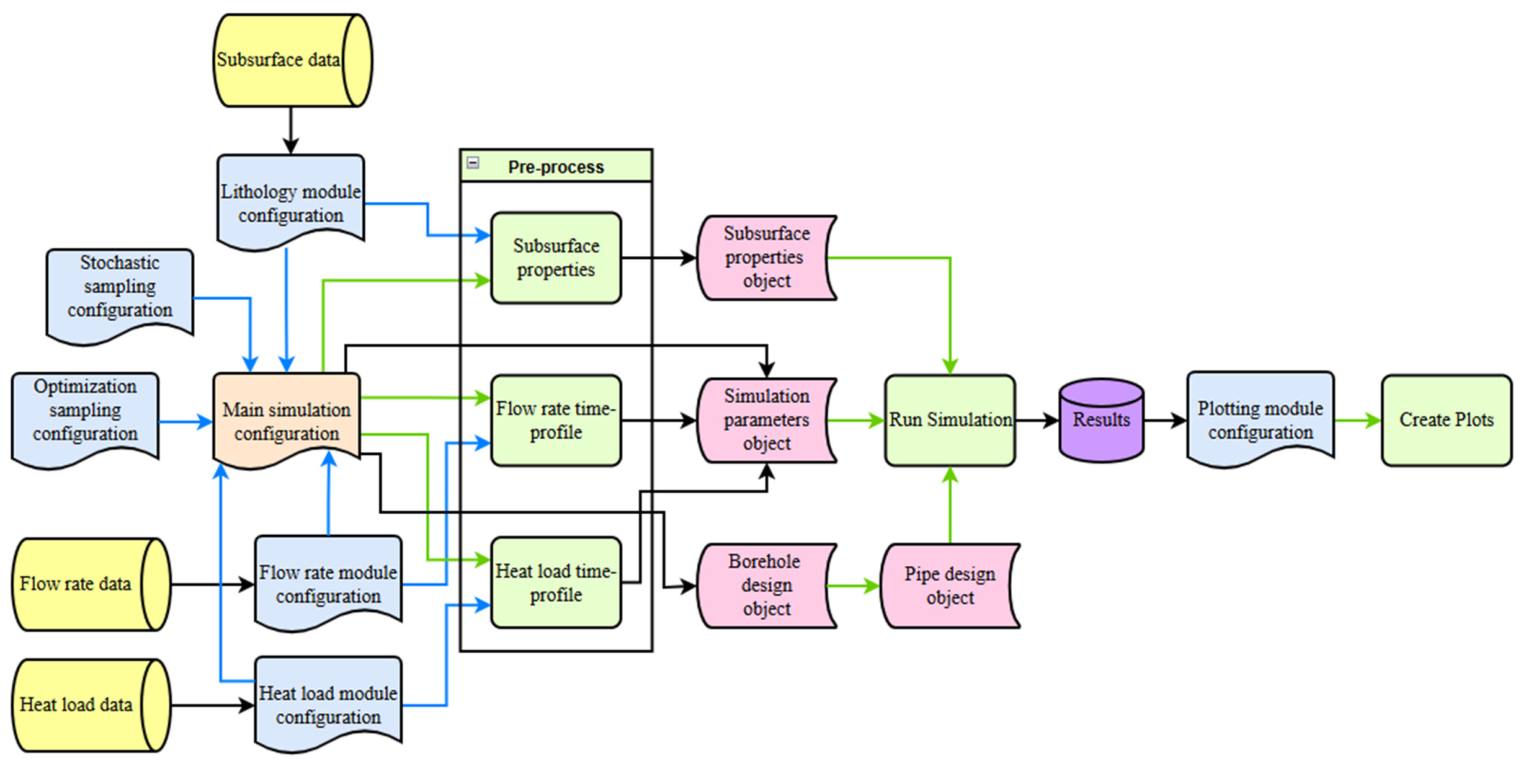
2.2.1. Modular Framework
2.2.2. Support for Semi-Analytical and Numerical Models
2.2.3. Sensitivity Analysis, Constraints and Optimization
2.2.4. Visualization Features
3. Results
3.1. Model Validation
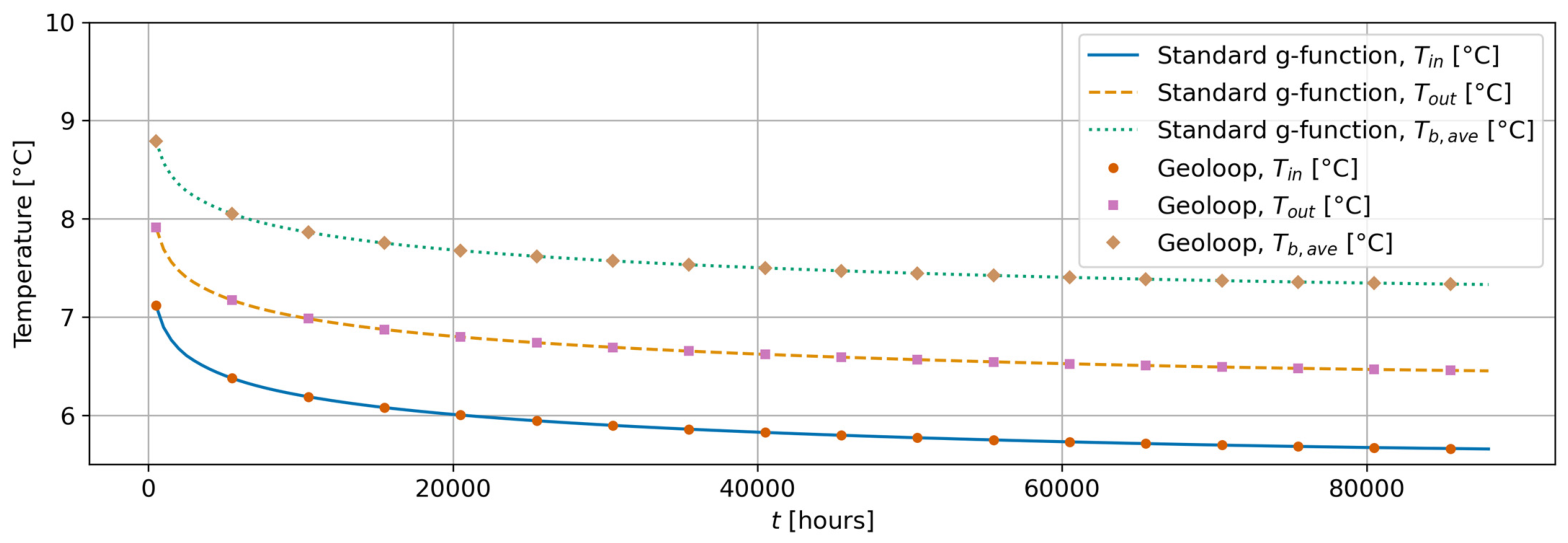
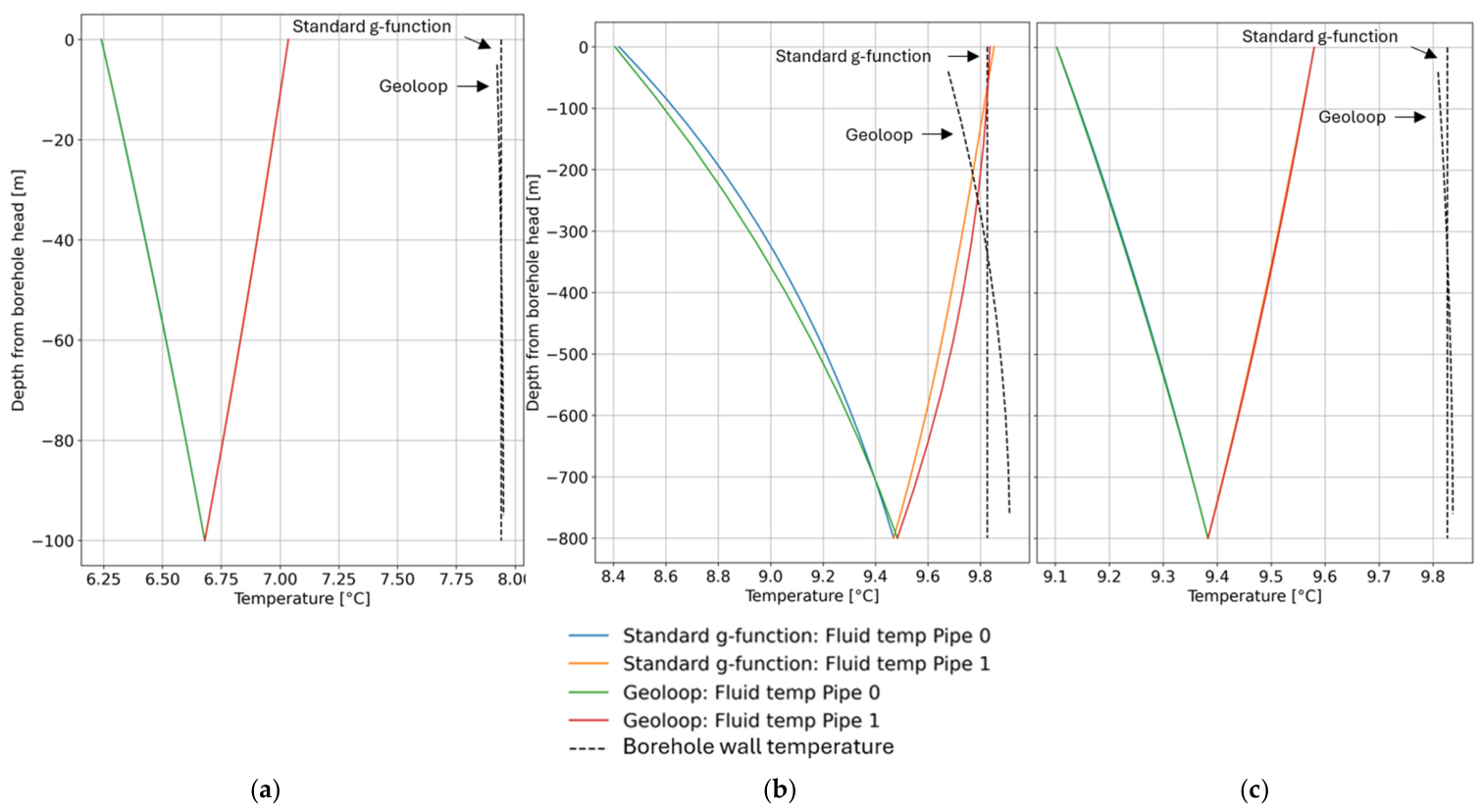
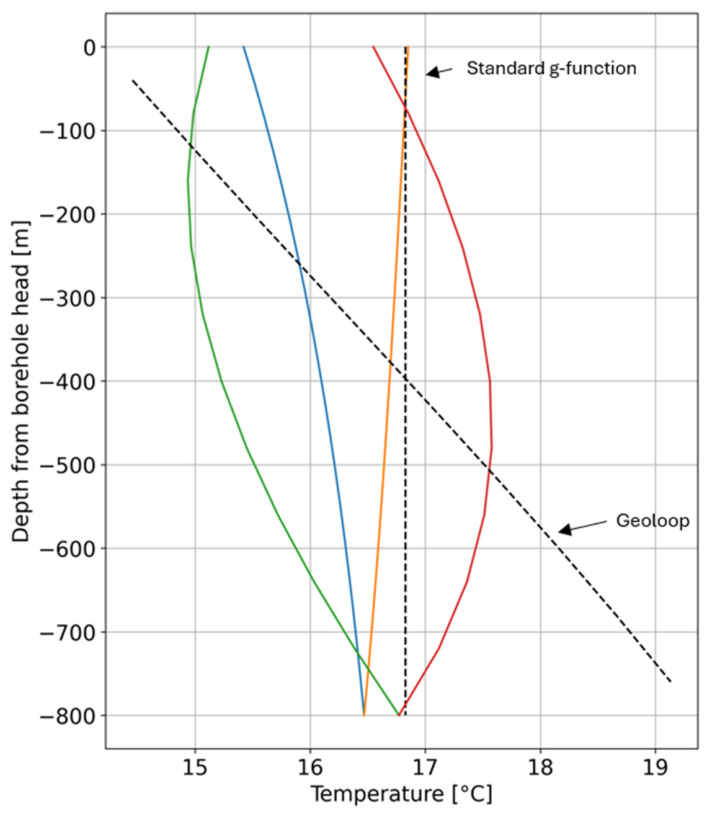
3.1.1. Benchmark Against Standard (Depth-Uniform) g-Functions
Comparison of Fluid Temperatures
The Effect of a Geothermal Gradient
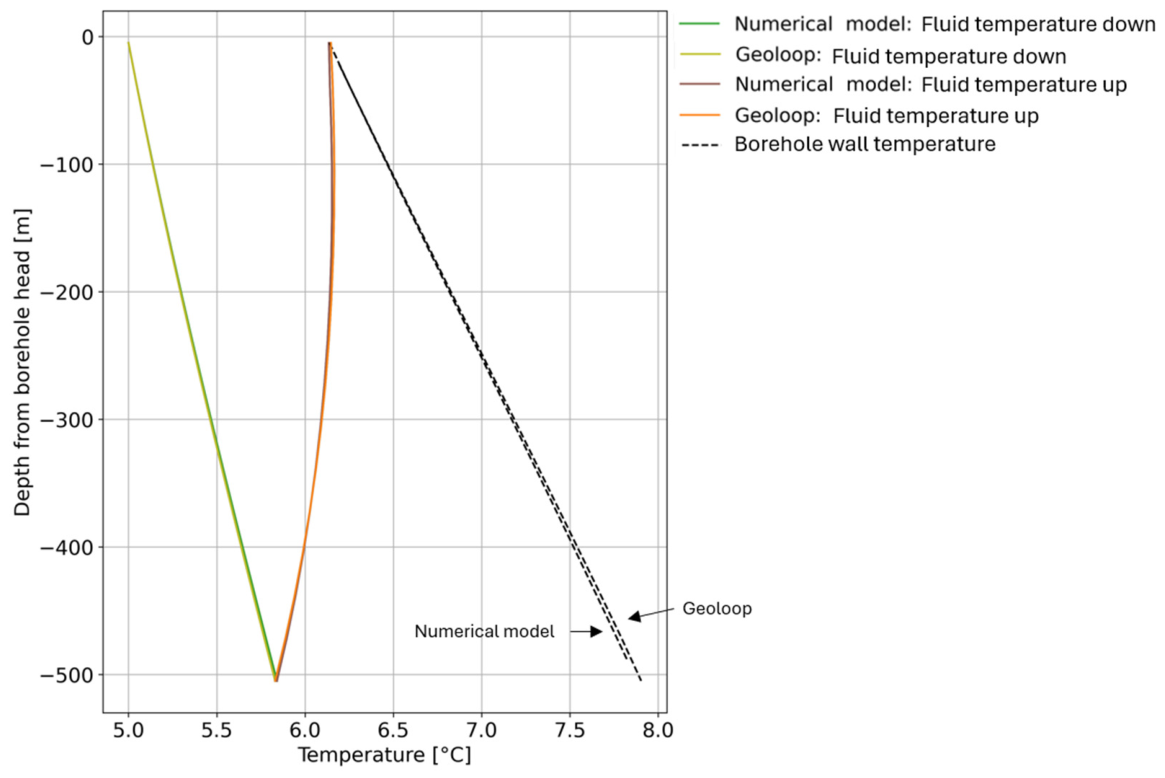
3.1.2. Benchmark Against Finite Volume Approach
The Effect of Axial Heat Flow
3.2. Application for Deep Borehole Heat Exchangers in The Netherlands
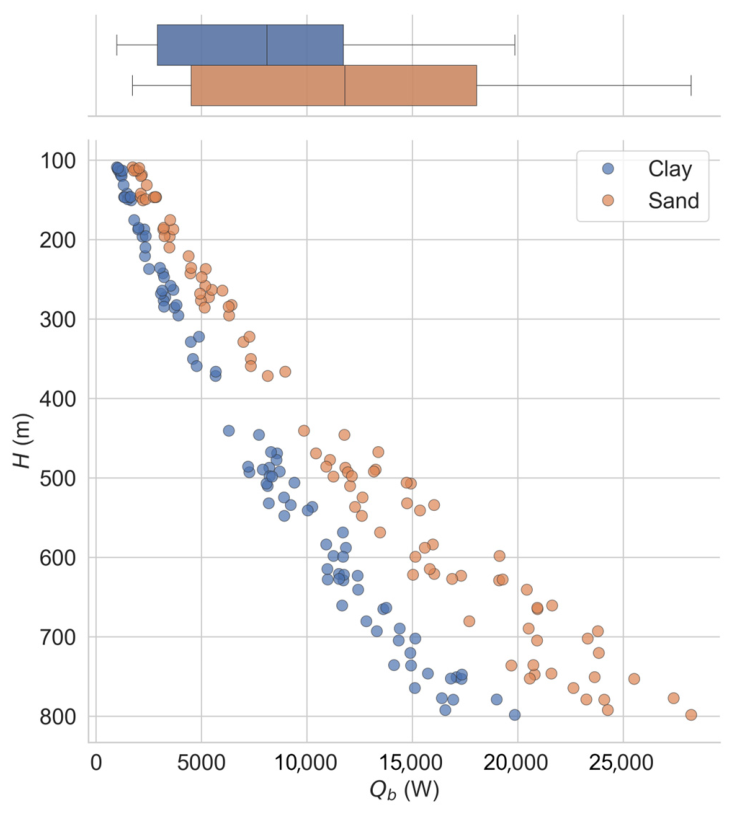
3.2.1. Impact of Depth-Dependent Subsurface Properties on System Performance
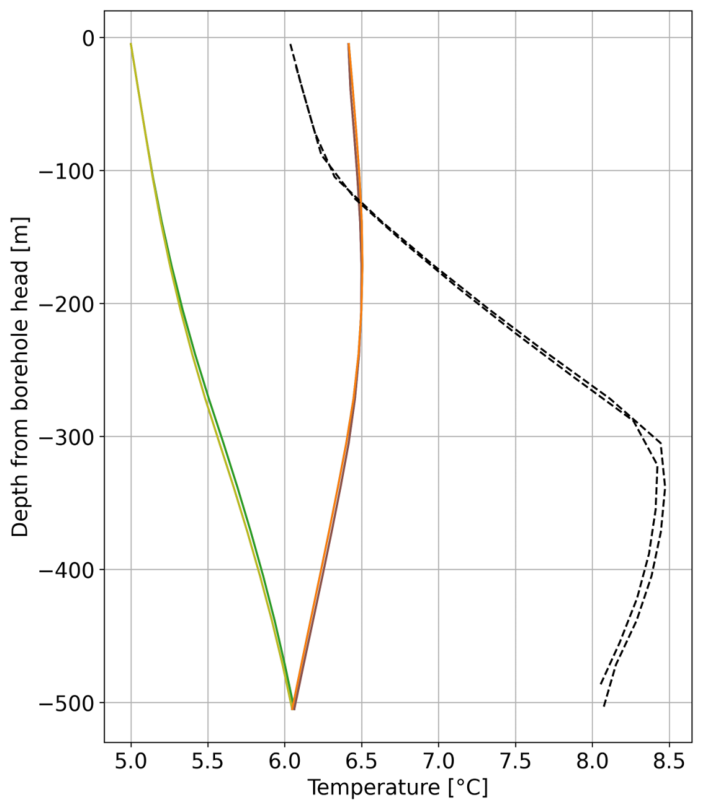
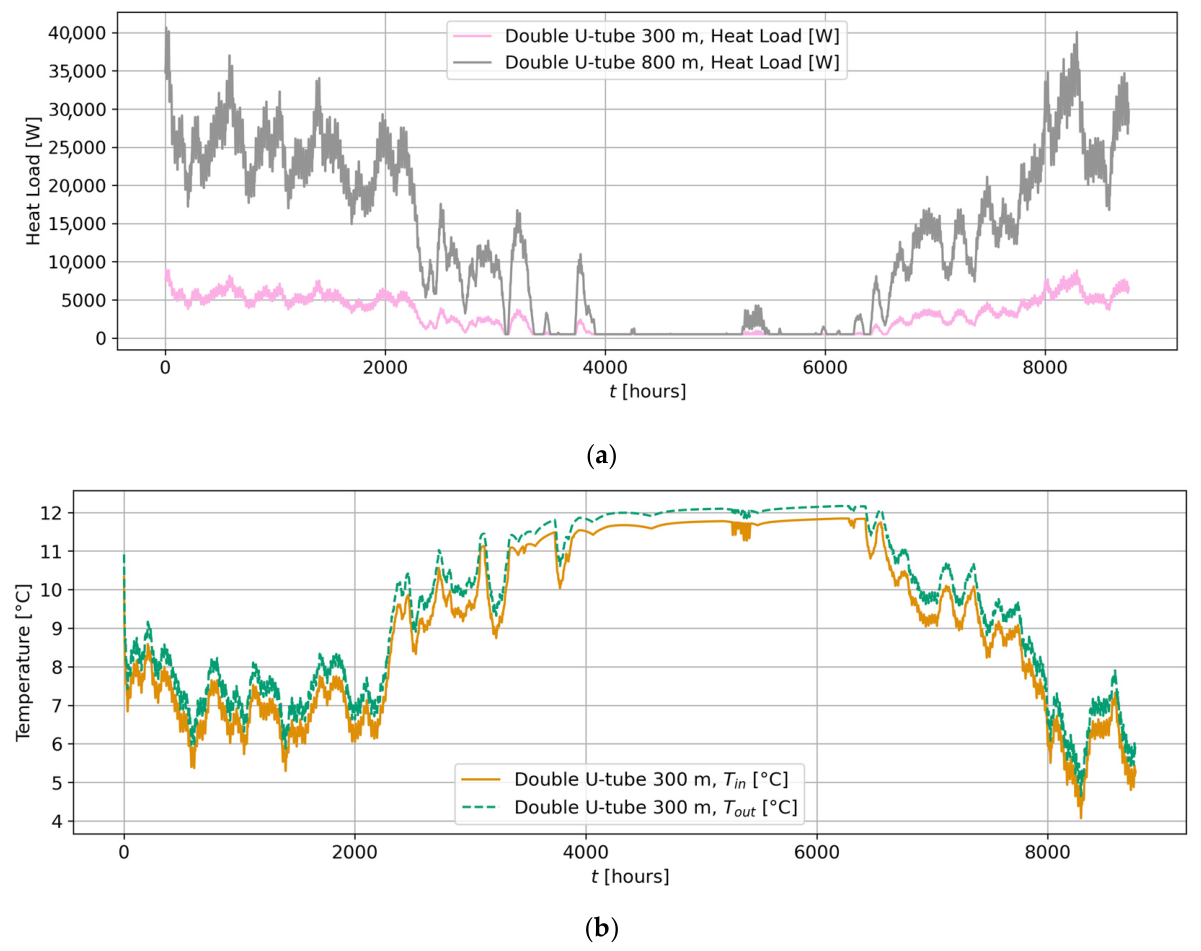
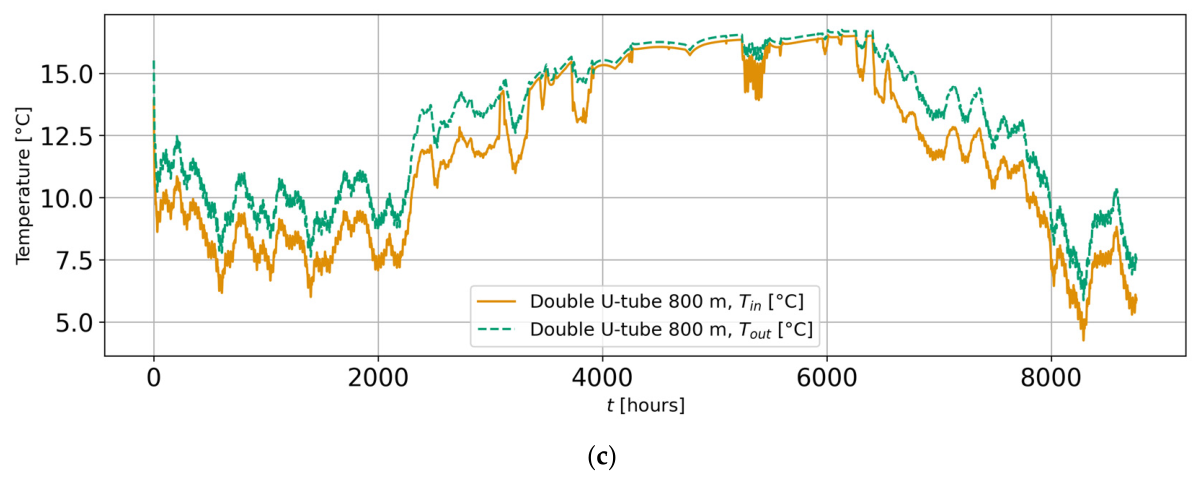
3.2.2. Implications for a Realistic Subsurface Model on a Deep Coaxial BHE
4. Discussion
5. Conclusions
Author Contributions
Funding
Data Availability Statement
Acknowledgments
Conflicts of Interest
Nomenclature
| Mathematic symbol | Description | Unit |
| Heat load aggregation algorithm | - | |
| Heat capacity | [Jkg/K] | |
| Fluid circulation pump COP | - | |
| Heat pump COP | - | |
| g-function | - | |
| Subsurface bulk thermal conductivity | [W/mK] | |
| Mass flow rate | [kg/s] | |
| Heat load (temporal varying) | [W] | |
| Heat extraction/injection rate | [W/m] | |
| Segment heat load | [W/m] | |
| Load at the considered time | [W] | |
| Borehole thermal resistance matrix | [mK/W] | |
| Thermal resistance between outer pipe and borehole wall (coaxial design) | [mK/W] | |
| Thermal resistance | [mK/W] | |
| Time | [s] or [h] | |
| Ambient surface temperature | [°C] | |
| Borehole wall temperature | [°C] | |
| Fluid temperature | [°C] | |
| Fluit inlet temperature at top of BHE | [°C] | |
| Fluid temperature in inlet pipe at bottom of BHE | [°C] | |
| Fluid outlet temperature at top of BHE | [°C] | |
| Fluid temperature in outlet pipe at bottom of BHE | [°C] | |
| Model parameter | Description | Unit |
| Thermal diffusivity | [m2/s] | |
| Minimum fluid circulation pump COP | - | |
| D | Buried depth | [m] |
| Pipe roughness | [m] | |
| fluid | Heat carrier fluid | - |
| H | Borehole length | [m] |
| Thermal conductivity of backfill material | [W/mK] | |
| Pipe thermal conductivity | [W/mK] | |
| lp_minscaleflow | Minimum flow rate scaling factor | - |
| lp_scale | Heat load scaling factor | - |
| Mass flow rate | [kg/s] | |
| n_samples | Stochastic samples | - |
| nInlets | Number of inlet pipes | - |
| nled | Simulated timestep | [h] |
| nr | Number of cells in radial direction (numerical model) | - |
| nsegments | Number of depth segments (Geoloop) | - |
| nyear | Simulated period | [y] |
| optimize_keys | Parameter(s) to optimize | - |
| optimize_keys_bounds | Boundary values for optimization parameters | - |
| pos | Pipe position inside borehole | [x, y] |
| Imposed total heat load | [W] | |
| Calculated subsurface heat load | [W] | |
| Power consumed by fluid circulation pump | [W] | |
| Borehole radius | [m] | |
| Inner pipe radius | [m] | |
| Outer pipe radius | [m] | |
| Maximum radial distance (numerical model) | [m] | |
| Surface temperature | [°C] | |
| Subsurface temperature gradient | [°C/m] |
Abbreviations
| BHE | Borehole heat exchanger |
| BHEs | Borehole heat exchangers |
| COP | Coefficient of performance |
| FLS | Finite line source |
| GSHP | Ground-source heat pump |
| HP | Heat pump |
| ILS | Infinite line source |
| MFLS | Moving finite line source |
| TRT | Thermal response test |
References
- Dumas, P.; Kumar, S.; Martini, E.; Cittadini, G.; Kuhlman, L. EGEC Geothermal Market Report; EGEC: Brussels, Belgium, 2024. [Google Scholar]
- Hellström, G. Ground Heat Storage—Thermal Analyses of Duct Storage Systems. Ph.D. Thesis, University of Lund, Lund, Sweden, 1991. [Google Scholar]
- Eskilson, P. Thermal Analysis of Heat Extraction Boreholes. Ph.D. Thesis, University of Lund, Lund, Sweden, 1987. [Google Scholar]
- Hellström, G.; Sanner, B. Software for Dimenstioning Og Deep Boreholes for Heat Extraction; Espoo/Helsinki: Espoo, Finland, 1994. [Google Scholar]
- Spitler, J.D. GLHEPRO—A Design Tool for Commercial Building Ground Loop Heat Exchangers. In Proceedings of the Fourth International Heat Pumps in Cold Climates Conference, Aylmer, Québec, 17–18 August 2000. [Google Scholar]
- Bernier, M.; Labib, R.; Pinel, P.; Paillot, R. A Multiple Load Aggregation Algorithm for Annual Hourly Simulations of GCHP Systems. HVAC R Res. 2004, 10, 471–487. [Google Scholar] [CrossRef]
- Lamarche, L.; Kajl, S.; Beauchamp, B. A Review of Methods to Evaluate Borehole Thermal Resistances in Geothermal Heat-Pump Systems. Geothermics 2010, 39, 187–200. [Google Scholar] [CrossRef]
- Claesson, J.; Hellström, G. Multipole Method to Calculate Borehole Thermal Resistances in a Borehole Heat Exchanger. HVACR Res. 2011, 17, 895–911. [Google Scholar] [CrossRef]
- Abdelaziz, S.L.; Ozudogru, T.Y.; Olgun, C.G.; Martin, J.R., II. Multilayer Finite Line Source Model for Vertical Heat Exchangers. Geothermics 2014, 51, 406–416. [Google Scholar] [CrossRef]
- Cimmino, M.; Bernier, M. A Semi-Analytical Method to Generate g-Functions for Geothermal Bore Fields. Int. J. Heat Mass Transf. 2014, 70, 641–650. [Google Scholar] [CrossRef]
- Ruiz-Calvo, F.; De Rosa, M.; Acuña, J.; Corberán, J.M.; Montagud, C. Experimental Validation of a Short-Term Borehole-to-Ground (B2G) Dynamic Model. Appl. Energy 2015, 140, 210–223. [Google Scholar] [CrossRef]
- Cimmino, M. Fluid and Borehole Wall Temperature Profiles in Vertical Geothermal Boreholes with Multiple U-Tubes. Renew. Energy 2016, 96, 137–147. [Google Scholar] [CrossRef]
- Schulte, D.O.; Rühaak, W.; Welsch, B.; Sass, I. BASIMO—Borehole Heat Exchanger Array Simulation and Optimization Tool. Energy Procedia 2016, 97, 210–217. [Google Scholar] [CrossRef]
- Schulte, D.O.; Welsch, B.; Boockmeyer, A.; Rühaak, W.; Bär, K.; Bauer, S.; Sass, I. Modeling Insulated Borehole Heat Exchangers. Environ. Earth Sci. 2016, 75, 910. [Google Scholar] [CrossRef]
- Cimmino, M. G-Functions for Bore Fields with Mixed Parallel and Series Connections Considering Axial Fluid Temperature Variations. In Proceedings of the IGSHPA Research Track 2018, Stockholm, Sweden, 18–19 September 2018; International Ground Source Heat Pump Association: Springfield, IL, USA, 2018; pp. 1–9. [Google Scholar]
- Cimmino, M. Semi-Analytical Method for g-Function Calculation of Bore Fields with Series- and Parallel-Connected Boreholes. Sci. Technol. Built Environ. 2019, 25, 1007–1022. [Google Scholar] [CrossRef]
- Cazorla-Marín, A.; Montagud-Montalvá, C.; Tinti, F.; Corberán, J.M. A Novel TRNSYS Type of a Coaxial Borehole Heat Exchanger for Both Short and Mid Term Simulations: B2G Model. Appl. Therm. Eng. 2020, 164, 114500. [Google Scholar] [CrossRef]
- Cazorla Marín, A. Modelling and Experimental Validation of an Innovative Coaxial Helical Borehole Heat Exchanger for a Dual Source Heat Pump System. Ph.D. Thesis, Universitat Politècnica de València, Valencia, Spain, 2019. [Google Scholar]
- Formhals, J.; Hemmatabady, H.; Welsch, B.; Schulte, D.; Sass, I. A Modelica Toolbox for the Simulation of Borehole Thermal Energy Storage Systems. Energies 2020, 13, 2327. [Google Scholar] [CrossRef]
- Cazorla-Marín, A.; Montagud-Montalvá, C.; Corberán, J.M.; Montero, Á.; Magraner, T. A TRNSYS Assisting Tool for the Estimation of Ground Thermal Properties Applied to TRT (Thermal Response Test) Data: B2G Model. Appl. Therm. Eng. 2021, 185, 116370. [Google Scholar] [CrossRef]
- Cimmino, M.; Cook, J. Pygfunction 2.2: New Features and Improvements in Accuracy and Computational Efficiency. In Proceedings of the IGSHPA Research Track 2022, Las Vegas, NV, USA, 6–8 December 2022; International Ground Source Heat Pump Association: Springfield, IL, USA, 2022. [Google Scholar]
- Javadi, H.; Urchueguía, J.F.; Badenes, B.; Mateo, M.Á.; Nejad Ghafar, A.; Chaudhari, O.A.; Zirgulis, G.; Lemus, L.G. Laboratory and Numerical Study on Innovative Grouting Materials Applicable to Borehole Heat Exchangers (BHE) and Borehole Thermal Energy Storage (BTES) Systems. Renew. Energy 2022, 194, 788–804. [Google Scholar] [CrossRef]
- Seib, L.; Welsch, B.; Bossennec, C.; Frey, M.; Sass, I. Finite Element Simulation of Permeable Fault Influence on a Medium Deep Borehole Thermal Energy Storage System. Geotherm. Energy 2022, 10, 15. [Google Scholar] [CrossRef]
- Urchueguía, J.F.; Badenes, B.; Javadi, H.; Mateo, M.Á.; Armengot, B. Adapted Composite Two-Region Line Source Methods for Evaluation of Borehole Heat Exchangers with Advanced Materials. Appl. Therm. Eng. 2023, 231, 120910. [Google Scholar] [CrossRef]
- Guo, Y.; Zhao, J.; Liu, W.V. A Novel Solution for Vertical Borehole Heat Exchangers in Multilayered Ground with the Robin Boundary Condition. Appl. Therm. Eng. 2024, 255, 123923. [Google Scholar] [CrossRef]
- Dong, S.; Yu, Y.; Li, B.; Ni, L. Thermal Analysis of Medium-Depth Borehole Heat Exchanger Coupled Layered Stratum Thermal Conductivity. Renew. Energy 2025, 246, 122880. [Google Scholar] [CrossRef]
- Cimmino, M. The Effects of Borehole Thermal Resistances and Fluid Flow Rate on the G-Functions of Geothermal Bore Fields. Int. J. Heat Mass Transf. 2015, 91, 1119–1127. [Google Scholar] [CrossRef]
- Bonté, D.; Van Wees, J.-D.; Verweij, J.M. Subsurface Temperature of the Onshore Netherlands: New Temperature Dataset and Modelling. Neth. J. Geosci. 2012, 91, 491–515. [Google Scholar] [CrossRef]
- Claesson, J.; Javed, S. A Load-Aggregation Method to Calculate Extraction Temperatures of Borehole Heat Exchangers. ASHRAE Trans. 2012, 118, 530–540. [Google Scholar]
- Cimmino, M. Pygfunction: An Open-Source Toolbox for the Evaluation of Thermal Response Factors for Geothermal Borehole Fields. In Proceedings of the eSim 2018, the 10th Conference of IBPSA-Canada, Montréal, QC, Canada, 9–10 May 2018. [Google Scholar]
- Limberger, J.; Bonte, D.; De Vicente, G.; Beekman, F.; Cloetingh, S.; Van Wees, J.D. A Public Domain Model for 1D Temperature and Rheology Construction in Basement-Sedimentary Geothermal Exploration: An Application to the Spanish Central System and Adjacent Basins. Acta Geod. Geophys. 2017, 52, 269–282. [Google Scholar] [CrossRef]
- Hantschel, T.; Kauerauf, A.I. Fundamentals of Basin and Petroleum Systems Modeling; Springer: Berlin/Heidelberg, Germany, 2009; ISBN 978-3-540-72317-2. [Google Scholar]
- Colvin, S.; Jolibois, E.; Ramezani, H.; Garcia Badaracco, A.; Dorsey, T.; Montague, D.; Matveenko, S.; Trylesinski, M.; Runkle, S.; Hewitt, D.; et al. Pydantic Validation; Zenodo: Genève, Switzerland, 2025. [Google Scholar]
- De Rosa, M.; Ruiz-Calvo, F.; Corberán, J.M.; Montagud, C.; Tagliafico, L.A. A Novel TRNSYS Type for Short-Term Borehole Heat Exchanger Simulation: B2G Model. Energy Convers. Manag. 2015, 100, 347–357. [Google Scholar] [CrossRef]
- Ten Veen, J.H.; Vis, G.-J.; De Jager, J.; Wong, T.E. Geology of The Netherlands, 2nd ed.; Amsterdam University Press: Amsterdam, The Netherlands, 2025; ISBN 978-94-6372-836-2. [Google Scholar]
- Gies, C.; Struijk, M.; Békési, E.; Veldkamp, H.; van Wees, J.-D. An Effective Method for Paleo-Temperature Correction of 3D Thermal Models: A Demonstration Based on High Resolution Datasets in The Netherlands. Glob. Planet. Change 2021, 199, 103445. [Google Scholar] [CrossRef]
- Geological Survey of The Netherlands. Available online: https://www.geologischedienst.nl/en/ (accessed on 19 December 2025).
- Pfenninger, S.; Staffell, I. Long-Term Patterns of European PV Output Using 30 Years of Validated Hourly Reanalysis and Satellite Data. Energy 2016, 114, 1251–1265. [Google Scholar] [CrossRef]
- Staffell, I.; Pfenninger, S. Using Bias-Corrected Reanalysis to Simulate Current and Future Wind Power Output. Energy 2016, 114, 1224–1239. [Google Scholar] [CrossRef]
- Molina-Giraldo, N.; Blum, P.; Zhu, K.; Bayer, P.; Fang, Z. A Moving Finite Line Source Model to Simulate Borehole Heat Exchangers with Groundwater Advection. Int. J. Therm. Sci. 2011, 50, 2506–2513. [Google Scholar] [CrossRef]
- Cimmino, M.; Bernier, M.; Adams, F. A Contribution towards the Determination of G-Functions Using the Finite Line Source. Appl. Therm. Eng. 2013, 51, 401–412. [Google Scholar] [CrossRef]
- Korevaar, Z.; Brett, H.; van Wees, J.-D. Geoloop 1.0.0—Python Package for Deep Borehole Heat Exchanger Simulation; Zenodo: Genève, Switzerland, 2026. [Google Scholar]



| Parameter | Description | Unit | Simulation Set a | Simulation Set b | Simulation Set c |
|---|---|---|---|---|---|
| H | Borehole length | [m] | 100 | 800 | 800 |
| D | Buried depth | [m] | 0 | 0 | 0 |
| nInlets | Number of inlet pipes | - | 1 | 1 | 1 |
| Borehole radius | [m] | 0.07 | 0.07 | 0.07 | |
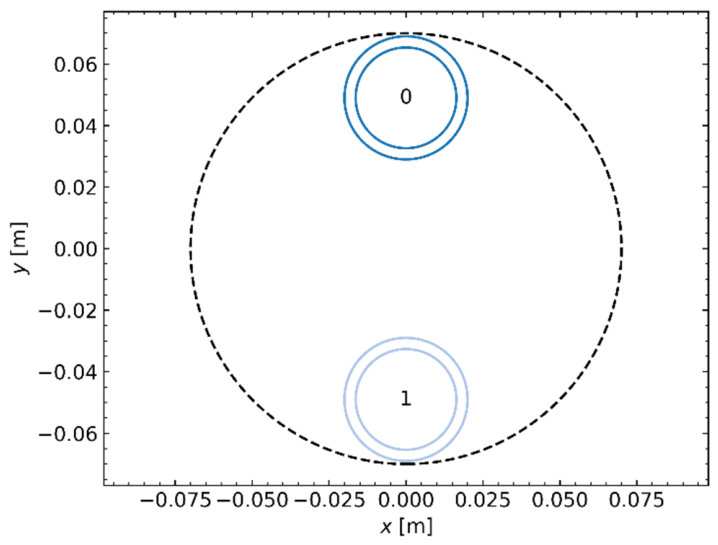
| pos | Pipe position inside borehole | [x, y] | see Figure 4 | see Figure 4 | see Figure 4 |
| Outer pipe radius | [m] | 0.02 | 0.02 | 0.02 | |
| Inner pipe radius | [m] | 0.0164 | 0.0164 | 0.0164 | |
| Pipe thermal conductivity | [W/mK] | 0.41 | 0.41 | 0.41 | |
| Surface temperature | [°C] | 11 | 11 | 11 | |
| Subsurface bulk thermal conductivity | [W/mK] | 2.4 | 2.4 | 2.4 | |
| Subsurface heat load | [W] | 1000 | 3000 | 3000 | |
| Mass flow rate | [kg/s] | 0.3 | 0.5 | 1.5 | |
| nyear | Simulated period | [years] | 10 | 10 | 10 |
| nled | Simulated timestep | [hours] | 500 | 500 | 500 |
| nsegments | Number of depth segments (Geoloop) | - | 10 | 10 | 10 |
| Parameter | Description | Unit | Depth-Dependent Semi-Analytical Simulation | Standard g-Function Simulation |
|---|---|---|---|---|
| H | Borehole length | [m] | 800 | 800 |
| D | Buried depth | [m] | 0 | 0 |
| nInlets | Number of inlet pipes | - | 1 | 1 |
| Borehole radius | [m] | 0.07 | 0.07 | |
| pos | Pipe position inside borehole | [x, y] | see Figure 4 | see Figure 4 |
| Outer pipe radius | [m] | 0.02 | 0.02 | |
| Inner pipe radius | [m] | 0.0164 | 0.0164 | |
| Pipe thermal conductivity | [W/mK] | 0.41 | 0.41 | |
| Surface temperature | [°C] | 10 | 18 | |
| Geothermal gradient | [°C/m] | 0.02 | 0 | |
| Subsurface bulk thermal conductivity | [W/mK] | 2.4 | 2.4 | |
| Subsurface heat load | [W] | 3000 | 3000 | |
| Mass flow rate | [kg/s] | 0.5 | 0.5 | |
| nyear | Simulated period | [years] | 10 | 10 |
| nled | Simulated timestep | [hours] | 500 | 500 |
| nsegments | Number of depth segments (Geoloop) | - | 10 | 1 |
| Parameter | Description | Unit | Value |
|---|---|---|---|
| H | Borehole length | [m] | 500 |
| D | Buried depth | [m] | 5 |
| nInlets | Number of inlet pipes | - | 3 |
| Borehole radius | [m] | 0.085 | |
| pos | Pipe position in borehole | [x, y] | see Figure 8 |
| Outer pipe radius | [m] | 0.025 | |
| Inner pipe radius | [m] | 0.0205 | |
| Pipe thermal conductivity | [W/mK] | 0.41 | |
| Surface temperature | [°C] | 10 | |
| Geothermal gradient | [°C/m] | 0.02 | |
| Subsurface bulk thermal conductivity | [W/mK] | Synthetic profile of 70% sand and 30% clay | |
| Inlet temperature | [°C] | 5 | |
| Mass flow rate | [kg/s] | 3 | |
| nyear | Simulated period | [years] | 0.1 |
| nled | Simulated timestep | [hours] | 1 |
| nsegments | Number of depth segments | - | 15 |
| nr * | Number of cells in the radial direction | - | 20 |
| * | Simulated radial distance from borehole wall | [m] | 20 |
| Parameter | Description | Unit | Value |
|---|---|---|---|
| optimize_keys | Parameter(s) to optimize for | - | Flow rate |
| optimize_keys_bounds | Boundary values for optimization parameters | [kg/s] | 0.1–10 |
| Minimum COP of the fluid circulation pump | - | 15 | |
| D | Buried depth | [m] | 5 |
| H | BHE length | [m] | 100–800 |
| nInlets | Number of inlet pipes | - | 2 |
| Borehole radius | [m] | 0.085 | |
| pos | Pipe position in borehole | [x, y] | (0.054, 0), (−0.054, 0), (0, 0.054), (0, −0.054) |
| Outer pipe radius | [m] | 0.025 | |
| Inner pipe radius | [m] | 0.0205 | |
| Pipe roughness | [m] | 10−6 | |
| Pipe thermal conductivity | [W/mK] | 0.41 | |
| fluid | Heat carrier fluid | - | Water |
| Thermal conductivity of the backfill | [W/mK] | 0.844 | |
| Surface temperature | [°C] | 10 | |
| Geothermal gradient | [°C/m] | 0.02 | |
| Subsurface thermal diffusivity | [m2/s] | 10−6 | |
| Subsurface bulk thermal conductivity | [W/mK] | Synthetic profile of sand or clay | |
| Inlet temperature | [°C] | 5 | |
| nyear | Simulated period | [years] | 1 |
| nsegments | Depth segments | - | 20 |
| n_samples | Stochastic samples | - | 100 |
| Parameter | Description | Unit | Double U-Tube 300 m | Double U-Tube 800 m |
|---|---|---|---|---|
| D | Buried depth | [m] | 5 | 5 |
| H | BHE length | [m] | 300 | 800 |
| nInlets | Number of inlet pipes | - | 2 | 2 |
| Borehole radius | [m] | 0.085 | 0.085 | |
| pos | Pipe position in borehole | [x, y] | (0.044, 0), (−0.044, 0), (0, 0.044), (0, −0.044) | see Table 3 |
| Outer pipe radius | [m] | 0.025 | 0.03 | |
| Inner pipe radius | [m] | 0.0205 | 0.0245 | |
| Pipe roughness | [m] | 10−6 | 10−6 | |
| Pipe thermal conductivity | [W/mK] | 0.41 | 0.41 | |
| fluid | Heat carrier fluid | - | Water | Water |
| Thermal conductivity of the backfill | [W/mK] | 0.844 | 0.844 | |
| Surface temperature | [°C] | 10 | 10 | |
| Geothermal gradient | [°C/m] | 0.02 | 0.02 | |
| Subsurface thermal diffusivity | [m2/s] | 10−6 | 10−6 | |
| Subsurface bulk thermal conductivity | [W/mK] | Synthetic profile of sand | Synthetic profile of sand | |
| Heat load | [W] | see Figure 12a | see Figure 12a | |
| lp_scale | Heat load scaling factor | - | 2.1 | 9.5 |
| Maximum mass flow rate | [kg/s] | 3.7 | 6 | |
| lp_minscaleflow | Minimum flow rate scaling factor | - | 0.1 | 0.1 |
| nyear | Simulated period | [years] | 1 | 1 |
| nled | Simulated timestep | [hours] | 1 | 1 |
| nsegments | Depth segments | - | 20 | 20 |
| Parameter | Description | Unit | Depth-Dependent Simulation a, b, c | Standard g-Functions Simulation a, b, c |
|---|---|---|---|---|
| D | Buried depth | [m] | 5 | 5 |
| H | BHE length | [m] | 2000 | 2000 |
| nInlets | Number of inlet pipes | - | 1 | 1 |
| Borehole radius | [m] | 0.156 | 0.156 | |
| pos | Pipe position in borehole | [x, y] | 0, 0 | 0, 0 |
| Outer pipe radius | [m] | 0.15 (outer pipe), 0.08 (inner pipe) | 0.15 (outer pipe), 0.08 (inner pipe) | |
| Inner pipe radius | [m] | 0.135 (outer pipe), 0.072 (inner pipe) | 0.135 (outer pipe), 0.072 (inner pipe) | |
| Pipe roughness | [m] | 10−6 | 10−6 | |
| Pipe thermal conductivity | [W/mK] | 30 | 30 | |
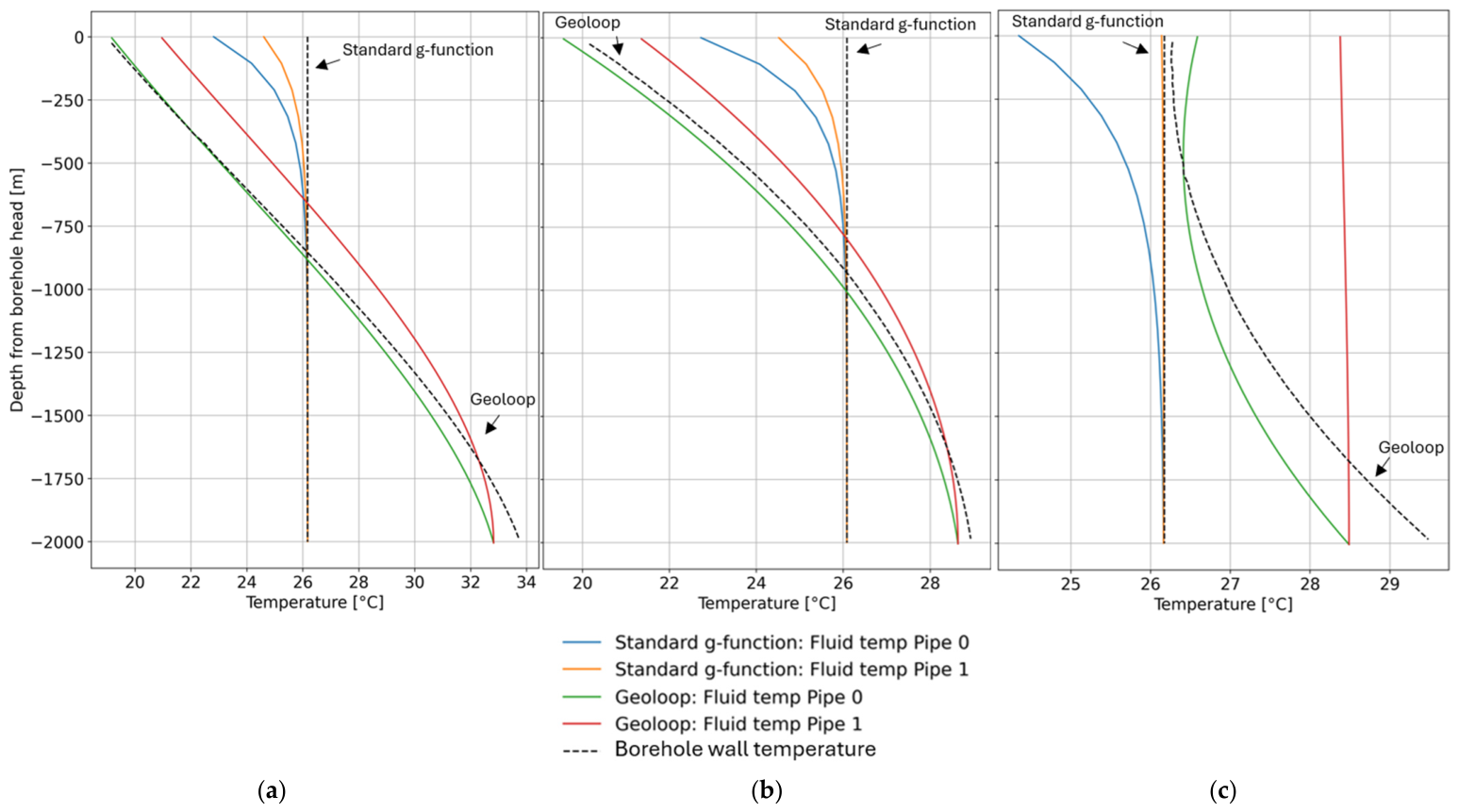
| Fraction of pipe radius with insulation | - | 0 (a)/0 (b)/0.5 (c) | 0 (a)/0 (b)/0.5 (c) | |
| Insulation thermal conductivity | [W/mK] | - (a)/- (b)/0.026 (c) | - (a)/- (b)/0.026 (c) | |
| Maximum depth of pipe insulation | [m] | - (a)/- (b)/2000 (c) | - (a)/- (b)/2000 (c) | |
| fluid | Heat carrier fluid | - | Water | Water |
| Mass flow rate | [kg/s] | 20 | 20 | |
| Thermal conductivity of the backfill | [W/mK] | 2 | 2 | |
| Surface temperature | [°C] | 10(a)/40(b)/10(c) | 40 | |
| Geothermal gradient | [°C/m] | 0.03(a)/0(b)/0.03(c) | 0 | |
| Subsurface thermal diffusivity | [m2/s] | 10−6 | 10−6 | |
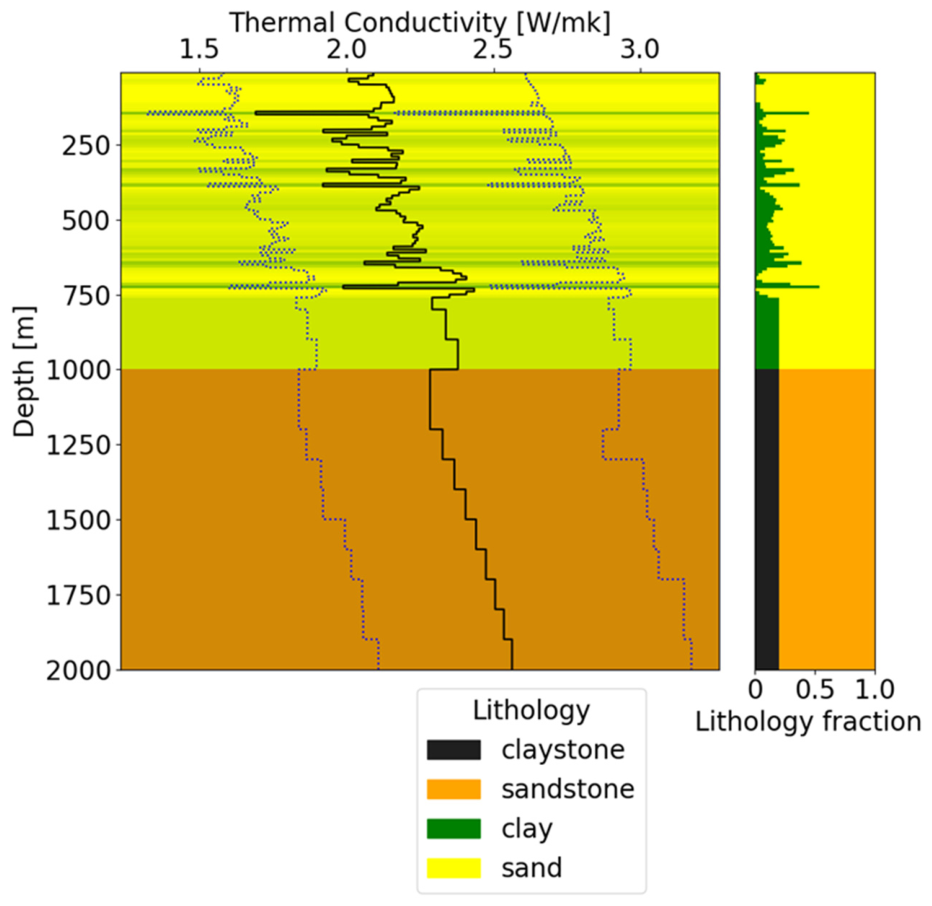
| Subsurface bulk thermal conductivity | [W/mK] | see Figure 13 | 2.3 (average of Figure 13) | |
| Heat load | [W] | 150,000 | 150,000 | |
| nyear | Simulated period | [years] | 0.085 | 0.085 |
| nsegments | Depth segments | - | 50 | 1 |
Disclaimer/Publisher’s Note: The statements, opinions and data contained in all publications are solely those of the individual author(s) and contributor(s) and not of MDPI and/or the editor(s). MDPI and/or the editor(s) disclaim responsibility for any injury to people or property resulting from any ideas, methods, instructions or products referred to in the content. |
© 2026 by the authors. Licensee MDPI, Basel, Switzerland. This article is an open access article distributed under the terms and conditions of the Creative Commons Attribution (CC BY) license.
Share and Cite
Korevaar, Z.; Brett, H.; Lourens, A.; van Wees, J.-D. Geoloop (v1.0)—An Efficient Semi-Analytical Deep Borehole Heat Exchanger Model. Energies 2026, 19, 2697. https://doi.org/10.3390/en19112697
Korevaar Z, Brett H, Lourens A, van Wees J-D. Geoloop (v1.0)—An Efficient Semi-Analytical Deep Borehole Heat Exchanger Model. Energies. 2026; 19(11):2697. https://doi.org/10.3390/en19112697
Chicago/Turabian StyleKorevaar, Zanne, Hen Brett, Aris Lourens, and Jan-Diederik van Wees. 2026. "Geoloop (v1.0)—An Efficient Semi-Analytical Deep Borehole Heat Exchanger Model" Energies 19, no. 11: 2697. https://doi.org/10.3390/en19112697
APA StyleKorevaar, Z., Brett, H., Lourens, A., & van Wees, J.-D. (2026). Geoloop (v1.0)—An Efficient Semi-Analytical Deep Borehole Heat Exchanger Model. Energies, 19(11), 2697. https://doi.org/10.3390/en19112697