


Abstract
The aim of this review is to provide a critical synthesis of peer-reviewed literature focusing exclusively on MSWI, rather than the broader field of Waste-to-Energy, based on a search in Scopus and a structured narrative synthesis. The methodology comprised eight Scopus queries defined for the main analytical axes of MSWI, deduplication, screening according to the established eligibility criteria, a layered corpus design, and domain-specific weighting of evidence within the framework of a structured narrative synthesis. This yielded 5435 unique records after deduplication, from which the main time window of 2010–2026 and a layer of publications from 2019 to 2026 were extracted. The review shows that the net balance of MSWI does not result from a single parameter or a single evaluation metric, but from the interplay between feedstock variability, combustion management, air pollution control (APC) configuration, residue management, and the utilisation of recovered heat and energy. Modern APC systems have reduced stack emissions, but do not eliminate the significance of transient states or the transfer of pollutants to fly ash and APC residues. Bottom ash exhibits conditional potential for material and metal recovery, whilst fly ash and APC residues remain the main constraint on recovery pathways. Environmental, climatic, health and economic assessments remain highly sensitive to system boundaries, functional units, counterfactual scenarios, the local energy mix, the quality of exposure reconstruction and integration with district heating. The added value of the review lies in maintaining MSWI as the sole analytical core and integrating the process, emissions, residues and system assessments within a single interpretative framework focused on comparability, trade-offs and the MSWI system balance.
1. Introduction
Municipal solid waste incineration with energy recovery (MSWI) currently occupies a central yet controversial position in research into municipal waste management systems. This technology is no longer interpreted solely as a method of thermal waste disposal, but as a component of systemic infrastructure where sanitary, energy, environmental, climate, health and economic issues intersect. For this reason, the literature on MSWI is extensive but highly fragmented across studies of combustion and energy recovery, emissions and air pollution control (APC), process residues, environmental and health assessments, and system integration [1,2,3,4].
The importance of MSWI stems primarily from the fact that even in systems with high recycling rates, a heterogeneous residual fraction remains, which cannot be easily managed using material-based methods alone. The review literature consistently shows that it is precisely in relation to such a waste stream that MSWI fulfils a technological and sanitary function that is difficult to replace: it reduces the volume and mass of waste, stabilises the residual fraction, enables energy recovery and reduces the system’s reliance on landfill [1,2,5].
At the same time, the modern form of MSWI differs significantly from the historical concept of waste incineration alone. The development of such facilities has moved from systems focused primarily on reducing waste volume towards facilities integrated with the recovery of electricity and useful heat, as well as increasingly advanced flue gas treatment systems, which changes the way the technology is assessed both at the plant level and across the entire Waste-to-Energy system [1].
Consequently, MSWI should be analysed as a multidimensional technology whose overall impact cannot be reduced to the combustion process alone. Reviews focusing on the circular economy and systems analysis show that interpreting MSWI as a simple energy supplier is insufficient if one overlooks local infrastructure, the regulatory regime, the organisation of the waste system, and the actual use of recovered heat and energy [3,6,7]. At the same time, MSWI operates within the broader field of Waste-to-Energy (WtE), but equating these two concepts would be methodologically incorrect. Broad reviews of WtE are useful as a technological roadmap, but they encompass processes with differing feedstock requirements, levels of technical maturity, end products and analytical boundaries. Against this background, MSWI retains its distinctiveness as a technology primarily handling a heterogeneous, residual municipal solid waste (MSW) stream, which justifies treating it as a separate subject of review [1,2,3,4,8].
The high significance of MSWI also stems from persistent interpretative tensions. These relate to the relationship between incineration and recycling, the control of dioxins and other trace contaminants, the properties of bottom ash, fly ash and APC residues, and how health and climate impacts are accounted for. It is precisely this accumulation of interrelated trade-offs that makes MSWI a technology of great practical significance, yet one that is highly sensitive to interpretation [5,9,10,11,12,13,14,15,16,17,18,19].
The need for this review does not stem from a lack of review literature, but rather from its increasing fragmentation and specialisation. Older but still useful syntheses have effectively captured the evolution of WtE/incineration plants and the development of municipal waste incineration in more technologically advanced regions, but they were produced prior to the latest wave of research on the digitalisation of control systems, decarbonisation, the selective assessment of process residues, and the role of MSWI in the circular economy [1,2].
In the more recent literature, the field has undergone a clear thematic segmentation. Reviews focusing on model predictive control, intelligent control and machine learning in Waste-to-Energy systems are developing separately; similarly, there are separate reviews on fly ash treatment and metal recovery from bottom ash, as well as the literature on dioxins. In parallel, the number of environmental, climate and systems-level reviews is growing. This specialisation has enriched the evidence base, but has made it more difficult to interpret MSWI as a single systemic technology, the assessment of which requires a simultaneous consideration of the process, APC, residues, environment/health and economics/system [5,6,11,12,13,15,18,19,20,21,22,23,24].
What is therefore needed is an up-to-date, critical synthesis organised around the main dimensions of MSWI assessment and the sources of discrepancy between studies. Briefly, previous reviews fall into five groups: broad WtE/MSW-to-energy panoramas, process-control and combustion syntheses, emissions/dioxins/APC reviews, residue-treatment reviews, and environmental/health/economic assessments. These works provide important sectoral background, mechanism-specific knowledge and system-level framing, but they remain either technology-wide or domain-specific. Broad WtE reviews mix pathways with different feedstocks and boundaries; process-control reviews rarely close the link with residues, health, LCA and economics; emissions and residue reviews are often pollutant- or stream-centred; and system/health/economic reviews do not usually reconstruct the whole MSWI train. This review, therefore, uses the review literature as a concise field map and novelty benchmark, while the main synthesis narrows the corpus to MSWI and integrates process performance, whole-train emissions, residue management and system-level assessment [1,3,5,6,14,15,18,19,21,25,26,27,28,29].
Against this background, the novelty of this work lies in maintaining MSWI as the sole analytical core and in connecting process, emissions, residues, environmental/health and system-integration evidence within one critical framework. The review does not assume automatic comparability of findings; instead, it identifies how conclusions are shaped by system boundaries, functional units, feedstock structure, local energy mix, operating conditions and data type [3,4,5,8,18,19,21,22,24,29].
The aim of this article is to provide a critical, comprehensive and methodologically transparent synthesis of the scientific literature on municipal solid waste incineration with energy recovery, based on a clearly defined set of publications retrieved from Scopus. We are interested not only in describing the main findings but also in their conditionality, comparability and limitations. The article therefore addresses three overarching questions: what does the literature on MSWI show in a relatively consistent manner, where do findings remain divergent or difficult to reconcile, and what methodological and contextual factors explain these differences.
Understood in this way, the objective requires the clear definition of the scope of the analysis. In the energy section, the review deliberately distinguishes between incineration efficiency, energy recovery efficiency, local heat-use efficiency, and regulatory indicators such as the R1 energy efficiency criterion used to classify incineration as a recovery operation rather than disposal [30]. Conflating these categories remains one of the main sources of incomparability in the literature. In this context, the chapters on emissions, residues, environment/health and economics are not secondary to the energy axis, but rather identify the boundary conditions of the actual MSWI system balance.
The scope of the review has been narrowly defined to ensure the comparability of the core MSWI. We include only the peer-reviewed scientific literature in the analysis, and the primary focus of the synthesis remains the thermal treatment of municipal waste in dedicated municipal solid waste incineration with energy recovery facilities. Waste-to-Energy serves as a contextual category in the article but is not the primary focus of the synthesis. Thus, pyrolysis, gasification, anaerobic digestion, landfill gas systems, RDF/SRF co-incineration in cement plants, sludge incineration, hazardous waste incineration and medical waste incineration remain outside the main scope, unless they are referred to merely as a comparative background. Such a narrowing of the scope limits the breadth of the field, but enhances analytical consistency and facilitates the comparison of data on processes, emissions, residues and system integration within a single technology [3,4,8].
2. Review Methodology
This review was conducted as a critical, comprehensive review based on a transparent search, explicit inclusion criteria and a critical, structured narrative synthesis. This approach is appropriate for the heterogeneous field of MSWI, encompassing full-scale and operational studies, laboratory experiments, process modelling, LCA, risk assessment, biomonitoring and economic studies, without artificially treating the entire body of evidence as a set suitable for a single meta-analytical procedure [31]. For transparency in reporting, selected elements of PRISMA-S, an extension to the PRISMA statement for reporting literature searches in systematic reviews, and of the PRISMA 2020 Statement were used for the identification, deduplication and screening of records [32,33]. The aim of this review was to provide a critical synthesis of the mechanisms, trade-offs and sources of heterogeneity within the MSWI evidence base. However, this review was not a formal systematic review, scoping review or meta-analysis; it was not pre-registered and did not aim to quantitatively pool results.
2.1. Databases, Search Strategy, and Time Window
The query architecture was finalised in mid-March 2026, and the final executed searches Q1–Q8 were carried out on 27 March 2026 in the Scopus database. Scopus was selected as a single database because it provides broad coverage of engineering, energy, environmental science and waste-management journals, while also offering consistent bibliographic metadata (titles, abstracts, keywords, DOI, source title, document type and year) needed for reproducible querying, DOI-first deduplication and corpus stratification. Combining several databases would have increased retrieval volume, but would also have introduced heterogeneous indexing rules, duplicate structures and uneven metadata fields, which would have weakened auditability for a critical narrative synthesis. The single-database design was therefore a bounded choice for internal comparability and transparent corpus construction, not a claim of exhaustive coverage. Overlap analysis across the query families, together with review mapping and backward snowballing, suggested that the Scopus corpus captured the main body of literature used for the 2010–2026 qualitative synthesis within this search architecture, while some relevant publications outside this collection may still have been missed.
The search architecture comprised eight query families (Q1–Q8): Q1 served as a broad core query for the MSWI field, Q2 was used to map previous reviews, and Q3–Q8 organised the main analytical domains. The full search strings are presented in the Supplementary Materials, in the “Section S1. Full search strings”. Table 1 organises this architecture, listing the function of each query family alongside the number of unique records and their interpretative role.
Table 1.
The architecture of query families and their methodological function.
The total volume for Q1–Q8 amounted to 17,970 hits, which, after deduplication, was reduced to 5435 unique records covering the years 1980–2026. The main window for the qualitative synthesis was set for the years 2010–2026 (4762 records), and the most recent layer of publications from 2019 to 2026 was separated out (3163 records; 66.4% of the core). The literature prior to 2010 was retained selectively as a definitional and historical background. An analysis of query overlaps indicated that, for the 2010–2026 window, the selection of a single database did not weaken the core of the qualitative synthesis: Q1 fully covered the process-energy, emissions/APC, residues and economics/system; the contribution of Q2 beyond Q1 remained marginal, and the contribution of Q6–Q7 beyond Q1 concerned almost exclusively older definitional and historical background. However, this result should not be interpreted as evidence of complete inter-database coverage; rather, it shows that, within the adopted query architecture, Scopus captured the core of the qualitative synthesis for 2010–2026, although it does not rule out the omission of individual relevant publications outside this collection.
Accordingly, the database choice is treated below as a methodological limitation rather than as proof of bibliographic completeness.
2.2. Eligibility Criteria, Screening, and Study Selection
The eligibility criteria were designed to ensure the comparability of the core MSWI. Only peer-reviewed research articles and reviews directly concerning municipal solid waste incineration with energy recovery, or segments of the system that cannot be reliably interpreted without an explicit MSWI component, were included in the analysis. The scope covered the combustion process, energy recovery, emissions/APC, bottom ash, fly ash, APC residues, LCA, health risks, and economics/system integration.
The scope of the technology has been defined narrowly. Work focusing primarily on pyrolysis, gasification, anaerobic digestion, landfill and landfill gas, sludge incineration, hazardous waste incineration, medical waste incineration, cement co-processing, RDF/SRF and coal or biomass co-combustion was excluded from the main scope of the synthesis if it was not possible to identify a component specific to the core of MSWI. Publications in the field of materials engineering were included only if they remained anchored in the MSWI problem, reporting on the composition of residues, leachability, treatment route, durability of immobilisation, or a real downstream use case. The main synthesis window covered the years 2010–2026, with the most recent layer of publications from 2019 to 2026 treated separately; publications prior to 2010 were retained selectively as a definitional and historical background. The full qualification logic is presented in the Supplementary Materials (Tables S4 and S5).
The selection process was multi-layered: following the standardisation of metadata and the removal of duplicates, the records were organised according to their function within the article, as publications forming the core of the synthesis, a map of previous reviews or older historical and definitional background; those works that were central to at least one analytical axis of the review and sufficiently informative for the interpretation of mechanisms, trade-offs and sources of heterogeneity were retained for direct synthesis. The screening of titles and abstracts, as well as the full-text evaluation, was carried out by all three authors, working on a collection of retrieved articles divided into three parts. Borderline cases were resolved by consensus according to the criteria of eligibility and usefulness for the analytical axes of the review. The final bibliography used directly in the text comprised 215 unique items, including 212 substantive sources relating to MSWI and 3 methodological sources; this figure represents the final set of publications directly used in the manuscript following screening and domain-specific weighting of evidence, rather than the complete collection of all bibliographically qualified records. The detailed screening process and the layered organisation of the source material are presented in the Supplementary Materials (Sections S2 and S3).
2.3. Data Extraction and Evidence Synthesis
Data extraction and the weighting of evidence were guided by the logic of problem-based critical synthesis, rather than a single mechanical quantitative procedure. In the main text, this aspect has been limited to general principles, whilst the full extraction matrix, domain fields and the logic of comparability assessment are presented in the Supplementary Materials (Section S4; Tables S6–S10). The assessment of evidence quality was domain-specific rather than based on a single universal risk-of-bias tool.
Greater interpretative weight was given to full-scale, long-term studies and works that explicitly reported feedstock characteristics, sampling points, system boundaries, functional units and downstream pathways, whilst less weight was given to proof-of-concept and single-case studies, as well as publications with limited transparency regarding these elements. When selecting publications, significant attention was paid to studies that combined a clear definition of the object under analysis with appropriate boundary control specific to the given domain. In process-energy studies, this primarily meant explicit feedstock characteristics and a full-scale operational context; in emissions/APC studies: the sampling point, operating regime and consideration of transient states; in residues studies: a clear distinction of the stream, leaching protocol and downstream pathway; and in LCA, health-risk and economics/system studies: transparent functional units, system boundaries, counterfactual scenarios and sensitivity analyses. The absence of these elements did not result in the automatic rejection of a study, but limited its interpretative weight and scope of comparability in the synthesis. Only those conclusions that were consistent across multiple studies representing at least one well-described class of full-scale data or several independent classes of studies were considered robust. The ‘mixed’ category was assigned where the direction of the conclusions clearly depended on system boundaries, functional units, operating regimes, sampling points or the quality of exposure reconstruction. The ‘non-comparable’ category was used when differences in definitions and scenarios made it impossible to carry out a meaningful synthesis without the risk of false comparability.
2.4. Methodological Limitations
The use of a single database is the first methodological limitation of this review. Restricting the search to Scopus-indexed, English-language, peer-reviewed literature improved corpus consistency and metadata homogeneity, but it may have excluded relevant studies indexed elsewhere, non-English publications, and technical or regulatory materials. Within the adopted search architecture, the overlap structure suggests that this limitation is more likely to have omitted some peripheral or otherwise uncaptured records than to have changed the qualitative core of the 2010–2026 synthesis. Even so, the present review should be read as a critical synthesis of a clearly delimited Scopus-based corpus rather than as an exhaustive representation of the entire global literature on MSWI.
The second limitation is of a terminological nature. Even a well-tuned search query may overlook works describing an installation component without explicit use of MSWI terminology, those employing local nomenclature, or those placing results within a broad WtE collection without a clear distinction of technology. Mapping of previous reviews and backward snowballing mitigate this problem, but do not eliminate it.
The third limitation stems from the role of expert judgement in chapter-specific screening. Screening and full-text evaluation were carried out by all three authors, with borderline cases decided by consensus; nevertheless, some decisions regarding the interpretative weight of a publication were of an expert nature rather than purely mechanical.
The final limitation is of a structural nature. Differences in system boundaries, functional units, installation classes, reporting practices and data quality mean that some of the results are only conditionally comparable. For this reason, the methodology adopted is critical and organising in nature: its aim is not to mechanically aggregate results, but to distinguish relatively robust findings from conditional results that are highly context-dependent.
3. Conceptual and Technical Framing of MSWI
In the literature, the terms ‘municipal solid waste incineration’ (MSWI), ‘Waste-to-Energy’ (WtE) and ‘energy-from-waste’ (EfW) are often used interchangeably, but they do not refer to the same level of analysis or the same class of technological systems. Broad definitions of WtE, encompassing incineration, gasification, pyrolysis, anaerobic digestion and landfill gas recovery, are useful as a map of the technological landscape, but quickly lose their value when the aim is to compare the technical, emissions and environmental performance specific to dedicated municipal waste incineration plants. In this review, the term MSWI is therefore used in a narrower sense: as stationary facilities for the thermal treatment of municipal residual waste, designed primarily for a heterogeneous stream of MSW residues and equipped with an energy recovery system in the form of electricity, useful heat or cogeneration [1,4,8,34].
MSWI, understood in this way, does not automatically encompass all processes in which municipal waste is used as an energy source. The difference between residual MSW and RDF/SRF fuel with controlled specifications is not merely cosmetic but methodologically fundamental, as it alters the variability of moisture content, calorific value, chlorine content, ash content and non-combustible matter. For the same reason, conclusions from sludge incineration, hazardous waste incineration, medical waste incineration or cement co-processing cannot be automatically applied to conventional MSWI. The aim of this narrowing is not to artificially limit the scope, but to restrict the heterogeneity of the evidence to a range within which the synthesis remains genuinely comparable [3,25,35].
Just as important as defining the technology itself is distinguishing the system boundaries. In operational studies, the boundaries of MSWI are often set narrowly, ranging from waste intake to the point of emissions from the stack and the discharge of ash and slag; whereas in environmental and economic studies, they are usually broadened to include reagents, auxiliary energy consumption, metal recovery from bottom ash, transport and management of residues, and systemic consequences in the form of energy substitution and avoided landfill. From this perspective, a consistent distinction must be made between technological boundaries and analytical boundaries: the former answer the question of which infrastructure elements belong to the installation, whilst the latter determine which consequences are attributed to the operation of that infrastructure. It is precisely at this level that the most significant interpretative misunderstandings arise, as a plant described as technologically ‘the same’ may receive a different net assessment depending on whether the analysis ends at the plant boundary or also encompasses the downstream use of energy and residues. Therefore, the efficiency of MSWI cannot be treated as a single indicator, but rather as a system of several assessment categories: combustion quality, plant-level energy recovery, system-level heat use, and regulatory indicators [36,37,38,39,40,41].
Table 2 outlines four levels of analysis, which, in the literature on MSWI, most often overlap, although they should not be treated as interchangeable.
Table 2.
Main levels of analysis used in the literature on MSWI (author’s synthesis based on the literature cited in this chapter).
Figure 1 summarises this assessment logic, illustrating the transition from the technological boundary of the installation to a broader analytical and systemic boundary. In the remainder of the study, process studies, residue-side studies, LCA, biomonitoring, epidemiology and techno-economic assessment are treated as complementary but not commensurable classes of evidence; their integration takes the form of a cross-cutting interpretation of mechanisms and boundary conditions, rather than a single common quantitative metric.
Figure 1.
Conceptual architecture for the assessment of MSWI, integrating feedstock, the combustion process, APC, residues and the net balance from environmental, climatic, health, ecological, economic and systemic perspectives (own work). Solid arrows indicate simplified material, energy and pollutant/residue flows, whereas dashed arrows indicate boundary-dependent assessment links and net outcomes.
4. Feedstock Characteristics, Process Fundamentals, and Energy Recovery
When analysing MSWI, the plant should be viewed as an integrated technical chain in which feedstock preparation and buffering, combustion, heat recovery and the conditions for further energy utilisation are all interlinked. Therefore, process and energy efficiency do not depend on a single parameter or on the technology label itself, but on the relationship between variable feedstock, furnace and boiler configuration, process operation, control quality, and the actual possibility of utilising recovered heat. It is precisely this multi-layered nature that constitutes the main source of heterogeneity in the process-energy literature and justifies the integrated consideration of fuel, process and energy recovery system [1,25].
4.1. Feedstock Variability and Combustion Envelope
The starting point remains the fact that municipal solid waste is not a standardised fuel. The composition of MSW varies geographically, seasonally, organisationally and methodologically; it depends on income levels, consumer habits, the proportion of bio-waste, the scale of separate collection, and the methods used for sampling, sorting and aggregating composition categories. Therefore, two studies reporting on ‘MSW composition’ do not necessarily describe a comparable subject, and this incomparability has direct technological consequences, as it alters the calorific value, the renewable share of energy contained in the waste, and the combustion conditions. Of particular importance are the interactions between moisture content, the proportion of organic matter, ash and combustible fractions; a high proportion of organic matter alone does not necessarily mean good fuel if it is accompanied by high moisture content. This picture is further complicated by the impact of selective collection and recycling, which alter the nature of the residual fraction in a non-linear manner, as well as the growing role of LHV (lower heating value) and HHV (higher heating value) predictive models, which are operationally useful but heavily dependent on the local representativeness of the input data [51,52,53,54,55,56,57,58].
At the same time, it is worth clarifying that LHV/HHV models are no longer merely a supplementary addition to the traditional feedstock characterisation. Research spanning from early artificial neural networks (ANN) to newer machine learning models shows that calorific value prediction can be carried out both on the basis of the physicochemical composition of the waste and on the basis of operational data, which increases the plant’s ability to detect changes in feedstock quality at an earlier stage. This does not eliminate the problem of local data representativeness, but it clearly shifts AI/ML (Artificial Intelligence/Machine Learning) from a purely descriptive role towards a role of operational support for feedstock characterisation and process preparation [59,60,61].
From the perspective of thermal treatment, moisture content remains the key factor linking the characteristics of the feedstock to the combustion process, as it influences the drying load, ignition, bed temperature, after-burning stability and, ultimately, the usable energy recovery. The literature agrees that a high water content reduces the effective calorific value and increases operational sensitivity, but the distribution of moisture and physical structure within the bed is equally important: two streams with similar average LHV may behave differently if they differ in porosity, particle size, density and degree of heterogeneity. Wang and Ma [62] further demonstrate that the effect of moisture content is non-linear and coupled with the thermal parameters of the entire system; in the 600 t/d line model, maximum incineration efficiency was achieved at a moisture content of 26.53% and an inlet temperature of 40.86 °C, i.e., not with an extremely ‘dry’ feedstock, but under a specific configuration of process conditions. For this reason, the feedstock should be treated as an active factor determining drying, degassing, ignition, combustion and temperature distribution, rather than as a passive background to the process [35,43,52,53,62,63,64].
Taken together, feedstock quality, moisture-LHV coupling, grate and air control, pretreatment options and the selected energy-utilisation route determine not only the achievable energy recovery but also the comparability of reported process-energy results. Table 3 summarises these relationships by linking the main process signals with their energy consequences and interpretative risks.
Table 3.
Key relationships between feedstock characteristics, process control and energy balance in the MSWI literature.
In response to the problem of high-moisture feedstock, the literature describes biodrying, size sorting, pre-drying and torrefaction, including solutions integrated with heat recovery from flue gas. Their common feature is that they can improve the fuel properties of waste, but they do not constitute a universal system improvement, as they require additional time, infrastructure, auxiliary energy and process control. The assessment of such solutions must therefore consider not only the quality of the fuel after treatment but also the net balance of the entire system and local constraints on the collection and utilisation of waste heat [67,68,69].
In practice, differences in moisture content, LHV, bed structure and the quality of input data should be regarded as the primary source of discrepancies between studies evaluating seemingly similar plants. These factors jointly determine the control margin, combustion stability and the potential for subsequent energy recovery, and thus define the plant’s actual operating range [35,63,67].
4.2. Process Control, Configurations, and Combustion Performance
In most grate-fired systems, combustion is spatially distributed: the waste passes through zones of drying, degassing, ignition of volatile matter, coke combustion and final burning; in actual installations, these zones partially overlap and remain highly dependent on the local composition, moisture content and aeration. Therefore, the operating parameters should be interpreted as a system of coupled variables, comprising grate speed, primary air flow and temperature, secondary air distribution, excess oxygen, waste feed rate, boiler heat load and flue gas recirculation. A change in any one of these parameters simultaneously affects drying, ignition, the combustion rate of volatile matter, the combustion of solid residues, the temperature profile and the conditions for further heat recovery [35,64,66,70,71].
Such strong coupling explains why MSWI is a difficult system to control. The municipal waste incineration process is MIMO, non-linear, time-delayed and partially unobservable, which is why classical control strategies based on a limited set of signals are often insufficient when it is necessary to simultaneously maintain a stable temperature, good combustion, an acceptable excess of air, and conditions conducive to energy recovery and emission control. Hence, there is a rapid rise in interest in predictive control, data-driven models, digital twins and advanced in situ diagnostics. At the same time, the literature agrees that digital tools do not eliminate the physical heterogeneity of the fuel; their value depends on the quality of feedstock information and on the ability to integrate mechanistic models, full-scale data and calibration procedures. Zhuang et al. [35] highlight four barriers that remain relevant in the latest wave of research: the lack of a single simulation environment covering the entire process, poor model fit to real-world data, the unresolved challenge of digital twin design, and the conflict between computational accuracy and operational utility [22,29,35,65,72,73,74,75,76].
However, a new wave of research shows that AI/ML in MSWI is no longer limited to the general concept of predictive control. In studies based on data from real-world installations, MIMO models, event-triggered adaptive control, and whole-process and end-edge-cloud platforms are being developed, with the aim of maintaining furnace temperature, oxygen content and other critical variables whilst reducing sensitivity to operational disturbances. It is therefore more accurate to say that the implementation maturity of these tools is increasing at the level of individual facilities, although the issue of transferability between installations remains less well resolved [77,78,79].
In terms of plant configuration, the literature on mature MSWI plants shows a predominance of grate firing, primarily due to its high tolerance for raw, heterogeneous and only partially prepared feedstock. Fluidised bed technology may offer more favourable combustion conditions and greater process uniformity, but it typically requires better-prepared fuel and introduces additional requirements regarding pre-treatment and ash management. Crucially, the advantages of fluidised bed technology do not automatically translate into a clear net environmental benefit, as in both systems an extensive APC train plays a key role, which partially offsets the differences in emissions. Therefore, a critical synthesis should not be reduced to a simple ranking of furnace types; a more pertinent question is which configuration is best suited to the fuel quality, the expected level of fuel preparation and the local waste management system [1,25].
In the more recent literature, the focus has shifted from general comparisons of plant types towards the optimisation of full-scale grate boilers, including the selection of secondary air arrangements, modelling the bed as a porous medium, and improving operational stability in the face of increasing feedstock variability. This means that combustion performance cannot be reduced to either incineration efficiency or throughput alone; rather, it concerns the plant’s ability to maintain a stable thermal profile, limit the risk of incomplete combustion, and create conditions conducive to meaningful energy recovery. Only when understood in this way is performance comparable across configurations and studies [25,35,42,64,71,80].
4.3. Energy Recovery Metrics and System Trade-Offs
In the literature on MSWI, the term ‘energy recovery’ is often used too broadly. However, ‘energy recovery’ can refer to electricity generation, combined recovery of electricity and useful heat, an improvement in the system’s exergetic efficiency, or an increase in the R1 control ratio, and these metrics are not equivalent. Banaś et al. [30] clearly demonstrate that R1 has regulatory and operational significance, but is not a simple equivalent of the thermodynamic efficiency of the process; for installations commissioned after 31 December 2008, the classification threshold is 0.65, whilst the average for six Polish plants between 2020 and 2024 was 0.864, ranging from 0.6696 in Konin to 1.0272 on average in Krakow, with a maximum of 1.123 in 2024. At the most basic level, the energy balance of the MSWI depends on the quality of the feedstock and the stability of combustion, but even with a comparable combustion profile, it is also shaped by steam parameters, heat exchange, material limitations related to corrosion and fouling, and the existence of actual heat consumption beyond electricity generation itself [1,30].
In practice, combined heat and power (CHP) systems remain the most important route to improving the utilisation of energy recovered from MSW; however, their viability depends on local heat demand, the degree of integration with the energy system and the operational organisation of the entire system, rather than solely on the boiler’s nominal parameters. A similar logic applies to newer avenues for improving efficiency, such as low-temperature waste heat recovery, multi-criteria optimisation of auxiliary systems, O2-enriched air, oxy-combustion, or the integration of flue gas waste heat recovery with pre-drying or torrefaction. These solutions may improve selected energy or exergy parameters, but they remain heavily dependent on the local heat balance and usually entail additional energy, material and organisational costs. Consequently, electricity-only generation, CHP/district heating, exhaust-steam use, low-temperature heat recovery, pre-drying/torrefaction and CCUS integration should not be ranked along a single efficiency ladder, because they improve or alter different parts of the MSWI balance and depend on different boundary conditions, including heat demand, steam parameters, auxiliary energy, corrosion constraints, seasonality and the displaced energy mix. Electrical efficiency, total heat-use efficiency, R1 and exergy-based metrics should therefore be interpreted as complementary rather than interchangeable indicators [30,44,67,81,82,83,84,85].
A key recurring theme in the process-energy literature remains the persistent trade-offs. Increasing throughput and grate speed may improve the short-term energy balance, but moving the bed too quickly reduces drying and combustion times, thereby compromising thermal stability and the quality of after-burning. Similarly, biodrying, pre-drying or torrefaction may improve the fuel properties of waste, but they do so at the cost of greater logistical and energy complexity of the entire system. More advanced approaches to thermodynamic improvement also require a multi-criteria assessment, as the energy optimum is not necessarily the economic or environmental optimum [66,67,68,71,82,83].
A separate tension concerns the relationship between the logic of the circular economy and the logic of ensuring a stable supply to the plant. Selective collection and recycling are desirable from a systemic perspective, but at the same time, they alter the mass, composition and calorific value of the residual fraction, and thus also the combustion conditions and the adaptation requirements of the incinerator. Therefore, the plant’s ability to operate with increasing fuel variability becomes an advantage just as important as its nominal efficiency. Advanced sensors, models and predictive control strategies can mitigate the costs of this trade-off, but they do not negate the fundamental fact that MSW remains a partially unpredictable fuel [22,29,42,54,55,72].
Two general conclusions can be drawn from this literature. Firstly, the quality of the process and energy recovery in MSWI is determined by a chain of interdependencies, starting with the composition and quality of the feedstock and ending with how the recovered heat is utilised. Secondly, at virtually every point in this chain, there are trade-offs between process robustness, energy recovery targets, flexibility in response to changes in feedstock, and the complexity of the entire system.
These process-energy choices also define the starting conditions for the next part of the chain: combustion stability, air staging, boiler operation and energy-recovery mode influence the raw flue-gas profile and the initial partitioning of pollutants between gas, particulate and solid streams, which is why Section 5 treats emissions as a whole-train outcome rather than as an isolated stack metric.
5. Emissions, Pollutant Formation, and Air Pollution Control
Emissions remain the aspect of MSWI that most strongly shapes the environmental interpretation of the technology and its social legitimacy. However, the contemporary literature no longer simply asks whether an incinerator emits pollutants, but rather which families of pollutants are formed, at which stage of the process they are controlled, and into which streams they are ultimately transferred. For this reason, an emissions assessment cannot be limited to stack data, as effective capture in the gas phase often results in an increased burden on the fly ash, APC residues or liquid streams [1,39,45].
The most useful approach to this literature is therefore a whole-train perspective: the emission profile is the result of combustion quality, the cooling process, the APC configuration, transient conditions and the subsequent fate of pollutants, rather than a simple function of a single device or a single stack value. This is precisely why emissions from MSWI should not be treated as a single indicator, but as an interconnected system of formation, capture and phase transfer [86,87,88].
5.1. Whole-Train Logic and Pollutant Families
From the perspective of a critical synthesis, the most important aspect is to distinguish between the main families of pollutants. The literature distinguishes at least between acid gases, combustion gases such as NOx and CO, metals and metalloids, persistent organic pollutants, and particulate matter, including ultrafine particles. Each of these families has a different process origin, a different locus of control and a different interpretative meaning; therefore, a single parameter cannot represent the entire emission profile of a plant [15,89,90,91].
The levels of acid gases are primarily a function of feedstock composition and deacidification; NOx and CO are much more closely linked to combustion quality and de-NOx management; metals depend on volatility, speciation and partitioning between bottom ash, fly ash and APC residues; and dioxins reflect post-combustion chemistry and the behaviour of particulate matter, whilst particulate matter requires an assessment that goes beyond mere dust mass. The most important question is therefore not ‘how much does MSWI emit?’, but how different pollutant families are formed, captured and transferred between gas, dust and residues [14,70,90,91,92,93].
This distinction has direct practical implications. For metals, it is crucial to distinguish between stack abatement and transfer to residues; for mercury, speciation and adsorption are also significant; and for particulate matter, fractional distribution and particle chemistry are key. Dioxins retain their status as a sentinel pollutant not because they describe the entire emission profile, but because they integrate feedstock quality, combustion stability, cooling profile, and the behaviour of the entire APC train exceptionally well [14,15,91,92,93,94,95].
Therefore, the environmental significance of modern MSWI does not lie in a simple shift from ‘high emissions’ to ‘low emissions’, but in a change in the assessment logic: from mere stack compliance to the question of where in the system pollutants are actually controlled and into which streams they are transferred.
From this perspective, stack data are a necessary but insufficient condition for a comprehensive interpretation. The emission profile must be read in conjunction with feedstock quality, reagents, cooling behaviour, filtration, residue-side burden and any liquid streams; only such an approach allows for the comparison of installations without false simplicity [39,45,86,87]. Table 4 is therefore used as an interpretative map connecting pollutant families with control loci and final sinks, rather than as a disconnected list of emission values.
Table 4.
An overview of the main pollutant groups in the MSWI literature.
5.2. Formation Pathways, Phase Transfer, and Operational Determinants
Dioxins and chlorinated organic micropollutants remain the most diagnostically sensitive pollutants. The recent literature agrees that high furnace temperatures are a necessary but insufficient condition, as PCDD/F levels are also influenced by precursor-mediated pathways, de novo synthesis on fly ash surfaces, and the post-furnace cooling process. For this reason, dioxins are best understood not as a separate analytical domain, but as an indicator of the quality of the entire combustion–cooling–APC system [14,15,93,95].
The quality of the feedstock and the plant’s operating mode are also significant factors in dioxin emissions. Waste classification can limit dioxin emissions not only by reducing chlorine-bearing components, but also by altering moisture content, ignition stability and local temperature distributions, whilst transient operations reveal the limitations of conventional periodic monitoring. Start-up, shut-down and other transient conditions can generate different congener profiles and short-lived emission peaks that cannot be interpreted by analogy with steady-state operation [15,96,98,102,103,104].
Similarly, in the case of metal contamination, it is essential to move away from the broad category of ‘heavy metals’. A meaningful assessment requires tracking speciation and partitioning between gas, bottom ash, fly ash and APC residues, as stack-side success usually entails shifting the burden to solid streams. Mercury presents the most distinct case: its capture depends on temperature, oxidation, sorbent dose and adsorption conditions, and therefore does not follow the same logic as less volatile elements [91,92,94,105].
Particulate matter should not be regarded solely as a mass indicator either. Fine and ultrafine fractions differ in terms of their formation mechanisms, particle count, specific surface area and the charge of semi-volatile compounds; therefore, low total PM emissions do not in themselves determine the comparability of installations. Of particular significance is the fact that the scrubber-baghouse system contributes to the condensation, agglomeration and removal of particle-phase toxicants, including dioxins [90,100,101].
Families of pollutants differ not only in terms of emission levels, but above all in their formation mechanisms, capture locations and susceptibility to phase transfer. Consequently, the operational determinants of emissions must be considered collectively, rather than on a pollutant-by-pollutant basis, as the same process configuration can simultaneously improve one component of the emission profile whilst worsening another [15,89,90].
5.3. APC Train, Monitoring, and the Limits of Compliance-Oriented Interpretation
The greatest weakness of purely descriptive approaches is that they reduce APC to a mere list of equipment. Meanwhile, the full-scale literature shows quite clearly that the effectiveness of emission reduction is determined by the logic of the entire treatment process. In modern installations, the sequence usually includes dry or semi-dry deacidification, carbon adsorbent dosing, a fabric filter, de-NOx and, occasionally, wet polishing, but the purpose of these modules only becomes apparent when they work together in the process [45,106].
This applies to both conventional pollutants and trace pollutants. Acid gas abatement depends on the variability of the raw gas and the reactivity of the sorbent; a bag filter coupled with activated carbon injection simultaneously facilitates the removal of particulates and semi-volatile toxicants, whilst de-NOx is not a separate ‘end module’ but part of a system that also influences combustion and the profile of organic micropollutants. In a study of 22 scenarios for three full-scale 500 t/d plants, all hourly NOx emissions remained below 250 mg/Nm3, but the range of 67–207.7 mg/Nm3 showed that the effectiveness of this segment depends on the specific configuration of the whole train, rather than on the technology label alone [70,97,107,108,109].
The wet scrubber remains the least intuitive, as it can improve the final polishing whilst simultaneously altering the phase distribution of PCDD/Fs and exacerbating the memory effect under unfavourable system dynamics. Whole-train studies therefore show that there is no universally optimal APC configuration in isolation from the rest of the plant; rather, there are more or less coherent configurations tailored to the feedstock, combustion quality and downstream requirements [86,87,88,110].
Monitoring remains a key limitation of this literature. Dioxins, mercury speciation and ultrafine particles are not as easily monitored in real time as O2, CO, NOx or HCl; consequently, compliance-oriented interpretation, by definition, describes only part of the actual burden. Soft sensors and data-driven models provide an important solution to this gap, but existing work also highlights their limited transferability between installations and their dependence on the quality of training data [15,111,112,113,114].
At the same time, the scope of applications for data-driven monitoring is now broader than would be suggested by a focus on compliance monitoring alone. In addition to NOx prediction, models are being developed for dioxins/PCDD/Fs and for a wider range of exhaust gas concentrations, including approaches based on small-sample learning, large-sample datasets and interpretable modelling. This does not yet mean that reference measurements can be fully replaced, but it shows that soft sensors are beginning to serve as a practical tool for early warning and to support whole-train emission control, rather than merely as a methodological experiment [115,116,117,118].
Against this backdrop, transient conditions remain of central, rather than marginal, importance. It is precisely during start-up, shut-down, load changes and maintenance-related events that the discrepancy between reported values and the actual emission profile may be greatest. From a practical perspective, this means that the assessment of a modern installation cannot be limited to the question of whether it ‘meets the standards’, but must also consider which pollutant groups were monitored, at what frequency, under which operating conditions, and whether the analysis also tracked transfer to residues and liquid streams [87,98,104].
Even during steady-state operation, low stack concentrations do not fully account for the fate of pollutants. Whole-train studies show that ultra-low stack emissions may coexist with the transfer of the pollution load to fly ash, APC residues and leachate, and that improving feedstock quality through waste classification can have a more systemic impact on emissions than a localised modification of a single APC unit. In a mature system, feedstock quality policy and stack treatment policy should therefore be considered in conjunction, rather than as alternative strategies for reducing the load [96,99,103].
A study of the analysed literature leads to a single overarching conclusion: modern MSWI plants should not be assessed by analogy with historical installations featuring low levels of flue gas treatment; however, it would be equally mistaken to equate ultra-low stack emissions with a complete solution to the problem. Emission profiles today are more dependent on whole-train control, transient regimes and pollutant transfer than on the presence of a single ‘good’ device; therefore, the most reliable emission assessment remains that of the coupled combustion–APC–residues system [39,45,86,97,98,99].
The consequence for the residue side is direct: effective gas-phase capture reduces stack release but concentrates part of the pollutant burden in fly ash, APC residues and secondary streams, so Section 6 treats residue management as the downstream expression of the combustion–APC chain rather than as an independent end-of-pipe issue.
6. Residues, By-Products, and Post-Treatment Pathways
Process residues from MSWI are no longer merely an additional factor in the emissions problem or simply the ‘end of the process’, but one of the key determinants of a plant’s net balance. The literature is fairly unanimous in showing that individual residue streams differ in terms of origin, composition, pollutant mobility and recovery potential. The answer to the question of when treatment and valorisation actually shift the system towards resource recovery, and when they merely alter the form of the burden and transfer it to the next stage of the chain, remains far less consistent [19,46,119].
6.1. Residue Streams, Asymmetry, and Contaminant Architecture
The division into bottom ash (BA), fly ash (FA) and APC residues should be regarded not as a simple inventory classification, but as a basic map of burden transfer on the residue side. Bottom ash dominates in terms of quantity and more often opens up recovery pathways, whilst fly ash and APC residues concentrate soluble salts, volatile metals and persistent organic micropollutants. Even at this level, the literature thus reveals an asymmetry not only in terms of material composition but also in terms of regulation: BA is usually assessed in terms of the quality of the mineral fraction and metal recovery, whilst FA/APC residues are assessed in terms of detoxification, leachability and the risk of contaminant transfer to secondary streams. This distinction remains necessary, though it is not absolute, as the boundary between fly ash and APC residues depends on the configuration of the flue gas treatment system and the sampling point [19,46,119,120,121,122].
A quantitative analysis further highlights this asymmetry, but does not justify reducing the assessment of residues to mass fractions alone. The review literature indicates that the total mass of residues from MSW incineration may amount to approximately 20% of the feedstock mass, whilst bottom ash typically accounts for 80–90% by weight of the total residue mass. At the same time, the mass fraction for FA, and for APC-side fractions depending on the adopted residue classification, is significantly lower: a review on the carbonation of MSWI fly ash indicated approximately 6.9 million tonnes of FA annually on a global scale and approximately 2–3% of the mass of incinerated waste as the FA fraction. Therefore, the residue-side risk profile cannot be inferred from the mass of the stream: fractions with a lower mass may concentrate soluble salts, volatile metals and persistent organic micropollutants [123,124].
Within bottom ash, the heterogeneity of the material is key. It is not a homogeneous ‘mineral combustion residue’, but a mixture of vitreous, silicate, clay, calcium and ferrous phases, enriched with metal residues and reactive particles, the significance of which changes with weathering. From a recovery perspective, the degree of grain liberation, fractional distribution, the presence of metallic aluminium and the history of ageing are just as important as the overall composition, as these factors jointly determine volume stability, leachability and the efficiency of subsequent metal separation. Therefore, the results of tests for BA are not transferable without information on the method of collection, the condition of the material and the extraction method [18,47,123,125,126,127,128,129].
The sample composition differs for fly ash and APC residues. Here, fine particles with a high specific surface area, significant proportions of calcium, chlorine and sulphur, and high concentrations of Zn, Pb, Cu, Cd, and occasionally also Sb and Hg, predominate. However, it is not the total concentrations alone that determine the risk, but the chemical form, mobility and method of defining the analysed stream. It is also becoming increasingly clear that the classic heavy metals–chlorides–sulphates–PCDD/Fs panel does not fully address the issue, as more recent studies identify more complex organic micropollutants in eluates and a high sensitivity of results to the choice of leaching procedure and APC configuration. From this perspective, the contaminant profile is determined not only by the feedstock and combustion but also by the sampling point, weathering history, APC configuration and analytical method [130,131,132,133,134,135].
Table 5 provides a clear functional classification of residues, but does not eliminate the fundamental source of incomparability. Even nominally similar BA, FA or APC residues may represent different classes of material if they differ in terms of collection point, curing time, the proportion of deacidifying reagents, or the extent of prior pretreatment. Therefore, all further literature on treatment and valorisation requires prior differentiation of the material stream and its history; without this, it is easy to confuse methodological differences with actual differences [19,20,46,119,120,121].
Table 5.
A summary of the main streams of residues at the MSWI.
6.2. Treatment Routes Between Stabilisation and Resource Recovery
The most useful way to view treatment pathways is to distinguish between three objectives: desalination and the removal of mobile components, stabilisation of the material prior to storage or use, and a more profound transformation towards resource recovery. This distinction is more important than the catalogue of technologies itself, as the same process may effectively reduce leaching whilst simultaneously failing to close the resource balance or generating problematic eluates, secondary solids and reagent costs. For this reason, the most mature literature tends to describe sequences tailored to the downstream pathway rather than single ‘best’ operations [20,121,136,137,138,139,140].
Washing and leaching remain the most established set of solutions for FA/APC residues, as they effectively remove chlorides and some of the readily soluble salts. However, their limitations lie in the transfer of the burden to wastewater and concentrates, as well as the risk of matrix dissolution under more aggressive conditions. Newer low-water variants, steam washing and systems combined with hydrothermal treatment improve economics and reduce some resource consumption, but do not eliminate this trade-off. Similarly, accelerated carbonation can support stabilisation and create climate-related added value, but the drop in pH may simultaneously increase the mobility of Sb, and in some studies also Cd and Cr, thereby altering the risk profile rather than simply eliminating it [121,122,124,141,142,143,144,145,146].
Quantitative data from studies on water/salt washing confirm that the effectiveness of removing soluble components is accompanied by the transfer of mass and contaminant load to the washing liquor/saline effluent. In a study of MSWI fly ash and air-pollution-control ash (FA/APCA), total mass losses after salt washing ranged from 24.2% to 49.5%, whilst the same paper’s comparison with earlier washing studies indicated mass losses of 25–53%, chloride removal of 74–99% and sulphate removal of 6.9–51.5%. Such ranges reinforce the conclusion that washing should be assessed as an operation involving the redistribution and concentration of soluble load, rather than solely as a simple detoxification step; it is necessary to report in parallel the composition of the washing liquor/saline effluent, including soluble salts and dissolved metal load, and the subsequent management or salt-recovery route [131].
Similar caution should be exercised when assessing carbonation as a stabilisation/CCU pathway. A review of accelerated carbonation of MSWI fly ash reports a sequestration potential of up to 0.24 g CO2/g ash, whilst a study of multi-source MSWI ashes showed 82.3 and 150.9 g CO2/kg ash, with maximum CO2 removal rates of 0.117 and 0.191 mmol/s. These values demonstrate the real potential for carbonation, but do not eliminate the requirement to report the ash source, APC configuration, CO2 concentration, liquid-to-solid ratio, temperature, pH evolution and leaching protocol, as both the CO2 sequestration balance and the mobility of metals following a reduction in pH depend on these parameters [124,147].
Solidification/stabilisation, as well as thermal, hydrothermal, melting, vitrification and plasma treatment, are appropriate when the priority is the deep immobilisation or final detoxification of the most challenging waste streams. The literature confirms that these solutions can improve the short-term stability of the material, reduce its volume and alter its mineralogy, but they are not without significant side effects. In the case of binding matrices, durability following carbonation, UV exposure and humidity–temperature cycles remains a problem, whilst for high-temperature technologies, energy consumption, secondary transfer of volatile metals, and the need to control downstream emissions are key issues. Therefore, plasma treatment retains its greatest value as a technology for the final disposal or deep detoxification of FA/APC residues, rather than as a universal route for widespread implementation [136,137,138,139,140,143,148,149,150,151].
Against this backdrop, disposal remains not so much a sign of technological failure as a realistic baseline scenario, particularly for fly ash and APC residues. A critical review does not currently identify a single technology that would simultaneously minimise leachability, be low-cost, generate no problematic secondary streams, and deliver a product of consistent performance quality. The most promising approaches appear to be sequences tailored to a specific residue stream, rather than individual operations assessed in isolation from the downstream use case and the full balance of mass, energy and risk [20,121,137,138,139,140,143,148,150].
6.3. Recovery Potential, Regulatory Feasibility, and Evidence Limits
In the field of recovery, the literature makes a very clear distinction between bottom ash, fly ash and APC residues. For bottom ash, metal recovery and mineral uses remain the most established applications, but even here, it is not simply a matter of finding a material outlet. Recovery efficiency depends on the degree of particle liberation, particle size distribution, seasoning practices, the layout of the processing line and the quality of the material itself. Mineral applications also require control of reactive Al, fine fractions, long-term leachability and compliance with standards [152]. Therefore, bottom ash becomes a secondary aggregate or filler only within a specific class of application and after meeting material and regulatory requirements, as is also clearly demonstrated by more advanced or pilot processing lines [18,23,47,48,123,125,153,154,155,156,157,158,159,160,161,162,163].
The potential of FA/APC residues remains far more limited. Without pretreatment, their direct incorporation into construction materials is constrained by high chloride content, the presence of volatile metals, poor pozzolanic activity, and the risk of long-term contaminant leaching. Pathways such as ash-to-cement, vitrification-derived products, carbonation, bioleaching or co-processing with Si/Al-rich waste are therefore not universal outlets, but scenarios dependent on the quality of the input material, prior desalination, a comprehensive environmental and economic assessment, and the product’s regulatory compliance. This also applies to valorisation after carbonation: improvements in material properties and a partial reduction in carbon emissions do not negate the requirement for leaching control or a full-chain assessment [48,49,124,155,156,164,165,166,167,168,169,170,171,172].
During the transition from process feasibility to acceptable material application, environmental and regulatory constraints become the key factor determining the practical feasibility of these pathways. Technological success cannot be equated with the successful outcome of a single laboratory test, as feasibility is determined by the material’s behaviour in the anticipated usage scenario, the durability of stabilisation, the quality of secondary streams, and the full environmental balance. Bound and unbound uses, different leaching protocols, batch-to-batch variability, carbonation, UV exposure, cracking and humidity–temperature cycles mean that regulatory feasibility is no less important than the technological feasibility itself. Without a clear definition of the residue stream, point of collection, weathering history, leaching protocol and downstream use case, most claims regarding safety or valorisation remain poorly transferable [23,46,48,49,119,144,145,147,158,159,173,174].
A review of the cited literature shows that residues are not a by-product of MSWI, but one of the key areas where the true balance of the technology is determined. Bottom ash offers conditional but real recovery potential, whilst fly ash and APC residues remain streams for which treatment, valorisation and disposal still require more convincing full-scale and long-term data. The greatest gap, therefore, is not the lack of further proof-of-concept studies, but the scarcity of research combining full-scale treatment, mass balance, long-term monitoring and a genuine assessment of downstream compliance. Without such a sequence, the available evidence base remains at the level of laboratory feasibility and does not allow for reliable conclusions regarding stable systemic practice [19,46,49,119,171].
These residue pathways then condition the environmental and health assessment: the same MSWI plant may receive a different net interpretation depending on whether bottom-ash recovery, fly-ash stabilisation, secondary eluates and long-term compliance are included in the system boundary considered in Section 7.
7. Environmental, Health, and System-Level Assessment
The environmental and health assessment of municipal solid waste incineration (MSWI) is not a separate strand from energy recovery, but rather a body of evidence that helps determine the net balance and systemic acceptability of the technology. Within the same body of literature, LCA and system assessment, local human-health and ecological risk assessment, environmental monitoring, biomonitoring, dispersion modelling and epidemiological studies coexist—that is, classes of evidence relating to different analytical objects. Therefore, the fundamental question is not whether MSWI has a negative or positive impact on the environment or health, but which findings are actually comparable, where the result depends on system boundaries and exposure reconstruction, and in what sense the facility should be assessed as a plant-level entity and in what sense as an element of the local waste and energy system [26,27,175,176].
7.1. Assessment Layers and Comparability Boundaries
The literature on the environmental assessment of MSWI is developing across several overlapping but distinct strands: LCA and related systems analyses, site-specific risk assessment, environmental monitoring (including biomonitoring), and epidemiology. Each of these describes a different level of reality: the waste and energy system, local exposure, actual concentrations in the environment, or population-level health outcomes. The results of these studies should therefore not be interpreted as competing ‘versions of the same verdict’, but as complementary classes of evidence, the comparability of which depends on a clear definition of the object of analysis [26,27,175,176,177].
LCA retains a privileged position in systemic assessment because it allows for the integration of direct impacts, avoided processes and energy recovery effects; however, it does not directly address the question of exposure among the population living in the vicinity of a specific facility. Conversely, local risk assessment, monitoring and biomonitoring provide information on the specific receptor population, but do not in themselves determine the net balance of the entire Waste-to-Energy system. This asymmetry explains why systemic, local and health-related results can be methodologically sound yet not directly comparable on a one-to-one basis [50,178,179,180,181,182,183,184,185,186].
To ensure comparability, it is therefore essential to make a clear distinction: what the assessed result relates to, what system boundaries have been adopted, how the exposure has been reconstructed, and to which class of receptors the conclusion applies. Table 6 organises these layers, listing the predominant types of assessment alongside their quantitative indicators and the main boundaries of comparability. Only through such an organisation can we avoid a situation in which LCA, dispersion modelling, food-pathway studies and epidemiology are interpreted as if they were addressing the same research question [26,27,175,176].
Table 6.
The main types of assessment used in the literature on MSWI and their key limitations in terms of comparability.
7.2. System-Level Environmental Performance, Climate Outcomes, and Counterfactual Comparisons
At the system level, LCA is of paramount importance, but its explanatory power stems more from the transparency of its assumptions than from the method’s prestige alone. Functional units, system boundaries, avoided processes, treatment of residues, and counterfactual scenarios alter the interpretation without changing the facility itself. Consequently, an incineration plant assessed in terms of tonnes of waste incinerated, tonnes of residual waste after sorting, units of energy, or the entire municipal system is not, in fact, the same analytical object. Therefore, the most useful role of LCA lies not in generating a single ‘final’ figure, but in identifying the variables that truly determine the net balance of MSWI [26,36,50,187].
This has a particularly strong impact on climate change assessments. Sectoral studies show that the climate balance of MSWI remains a function of the share of fossil carbon, actual heat off-take, the local energy mix and how residues are accounted for; consequently, even plants of the same technological class can achieve vastly different net results. CHP systems and a stable heat sink typically improve the balance more significantly than the sale of electricity alone, whilst decarbonisation pathways, including CCUS, alter the climate profile only at the cost of additional energy, new burdens and new scenario dependencies. Climate conclusions should therefore be interpreted as the result of system configuration, rather than as a simple property of combustion itself [84,85,178,179,189,190].
The same logic applies to comparisons with alternative waste management strategies. MSWI generally performs better than systems heavily reliant on landfill, but its advantage diminishes when the counterfactual scenario involves a system with a high level of upstream recovery, well-developed separate collection of bio-waste and a low-carbon energy mix. Therefore, the technology finds its strongest systemic justification when it actually handles residual waste after sorting, rather than when it competes for materials still suitable for material recovery. Comparisons with alternatives do not, therefore, lead to a single universal verdict, but rather to an assessment of the quality of the local reference system [50,179,187,189,191].
7.3. Exposure Reconstruction, Health Evidence, and Why Conclusions Diverge
In the context of health and ecological risk, the quality of exposure reconstruction is of decisive importance. The methodological literature consistently shows that simple distance proxies provide a poor description of the actual distribution of emissions, whereas dispersion modelling, site-specific risk assessment and environmental monitoring allow for a better distinction between the signal from the installation and the regional background. At the same time, biomonitoring and food-pathway studies show that local exposure need not be determined primarily by inhalation; in some locations, chronic deposition and secondary transfer to food, particularly poultry products and eggs, are of greater significance. It is precisely for this reason that the results of local risk assessments and monitoring are, by definition, highly site-specific [175,176,177,180,181,182,183,184,185,186,188].
The epidemiological evidence does not undermine this interpretation, but rather supports it. The latest review by Bottini et al. [27], covering 51 studies and over 500 effect estimates, indicates only weak or inconclusive associations for some health outcomes, with a meta-analytic HR of 1.02 (0.94–1.11) for respiratory diseases and moderate heterogeneity in most analyses (I2 30–60%). At the same time, a study by Ji et al. [192] focusing on a 1000 t/d incinerator in Jiangsu showed that even with higher concentrations of PCDD/Fs in the serum of downwind residents and in eggs from that side of the plant, no significant change in SMR (Standard Mortality Ratio) was observed before and after the plant’s commissioning, and the dominant route of exposure remained diet, accounting for over 90% of total exposure [188]. For this reason, the health assessment of MSWI depends primarily on the quality of exposure reconstruction, control of confounding factors, and whether the study effectively distinguishes the plant’s signal from other background sources and correctly identifies the dominant route of exposure.
The discrepancies in results within the environment/health literature are therefore not coincidental. They most often stem from five recurring sources of non-equivalence: different functional units and system boundaries, differing local energy and heat systems, variations in residual waste, APC and residue-side treatment, differing quality of exposure assessment, and incomparable operating regimes and historical maturity levels of the installations. The same technology may be assessed differently because studies describe different analytical objects, and not because there is a lack of consistent data on MSWI in the literature [26,27,36,50,84,85,175,176,178,179,183,184,187,189].
For the environmental and health assessments of MSWI to be comparable, there must be a clear distinction between the installation and the system, between emissions and exposure, between exposure and outcomes, and between the gross balance and the net balance, including avoided effects. Such rigour does not remove the conditional nature of the conclusions, but it allows us to distinguish genuine uncertainty from spurious contradictions in the literature, and thus to better situate MSWI within a cross-cutting assessment of the technology and its systemic context.
This comparability logic leads directly to the economic and system-integration layer: once boundaries, exposure pathways and avoided burdens are defined differently, the same plant can also appear economically resilient, environmentally beneficial or strategically problematic under different local scenarios, which is why Section 8 treats economics as a system property rather than a plant-only indicator.
8. Economic Performance and System Integration
The economics of municipal solid waste incineration with energy recovery (MSWI) is one of those areas of the literature where the difference between assessing a plant as a standalone technical facility and assessing MSWI as part of a local and regional waste, energy and regulatory system is most evident. In practice, this means that indicators such as cost per tonne of waste, revenue from electricity, or simple payback period provide a useful but often incomplete picture. A recurring theme in the research is that the economic balance of a plant depends not only on the combustion technology but also on the structure of waste acceptance fees, the capacity to sell heat, the costs of flue gas treatment and residue management, local transport constraints, sorting policies and—increasingly—the price of CO2 emissions and the cost of decarbonisation pathways [193,194,195,196].
The literature therefore supports neither the claim that MSWI is economically advantageous regardless of the context, nor the opposite claim that it is a fundamentally unprofitable technology. A more conditional conclusion is much better established: MSWI achieves a relatively favourable economic balance where the plant handles a stable stream of residual waste, operates at a high utilisation rate, is linked to a viable heat off-take, and is embedded within the predictable rules of the local Waste-to-Energy system. Where, however, revenue from electricity alone dominates, there is no local heat sink, the costs of managing residues are rising, or the quantity and quality of the feedstock are changing rapidly as a result of effective sorting, the economic balances become significantly more sensitive [44,197,198].
8.1. Economic Architecture, Revenue Logic, and Sensitivity Drivers
In the literature on MSWI, the traditional distinction between capital expenditure (CAPEX) and operating expenditure (OPEX) remains necessary, but does not in itself explain the actual economics of the sector. This is because, alongside high capital costs, the balance sheet of an installation is also influenced by reagents for air pollution control, monitoring and compliance, the downstream handling of bottom ash, fly ash and APC residues, and the maintenance of operational availability. Therefore, the economics of MSWI cannot be separated from the APC architecture or from the set of system services that the plant actually provides; a more useful question than the simple ‘is the plant cost-effective?’ is: ‘in what technical and system configuration does it remain economically viable?’ [194,195,196,199,200,201,202].
The risk factors in Table 7 are therefore used as a sensitivity map for the following discussion: each row identifies a variable that can change the economic interpretation of otherwise similar MSWI facilities.
Table 7.
Key sensitivity factors affecting the net balance of the MSWI.
On the revenue side, the gate fee remains the most stable component, whilst electricity and, to a lesser extent, heat are subject to greater price and contractual volatility. For this reason, the economics of MSWI are rarely a simple function of electricity sales; significantly more favourable balances occur where the plant operates in a CHP configuration or has a stable heat off-take, whilst residue-related revenues remain selective and asymmetrical, as bottom ash can partially improve the balance through metal recovery and valorisation, whilst fly ash and APC residues typically generate environmental compliance costs. Even the import of combustible waste into systems with a high proportion of district heating and variable renewable energy makes sense only in specific market configurations and should not be interpreted as a universal advantage of combustion [44,81,159,193,194,195,197,204,205].
Economies of scale do exist, but they are neither linear nor unconditionally positive. Larger facilities can spread CAPEX more easily and justify more advanced systems for energy recovery, emissions control and material recovery; however, they also increase the radius over which waste is transported, the risk of conflicts over siting, and the system’s vulnerability to subsequent declines in the supply of residual waste. Therefore, rather than asking about an abstractly ‘optimal’ size, it is more useful to examine the relationship between scale, siting, the structure of local heat demand and public policy. Mandatory sorting, rising recycling rates and decarbonisation scenarios may, in fact, reshape both the quality of the feedstock and the economic viability of the entire system, and in recent years, carbon constraints and CCUS have been added to the classic sources of uncertainty [193,198,201,202,206,207].
8.2. System Integration, Circular-Economy Tensions, and Strategic Trade-Offs
The most firmly established systemic issue concerns integration with district heating and, more broadly, with local energy systems. What is of key importance here is not the technical capability to generate heat per se, but the nature of the system into which the heat is fed, and which fuels and system services are actually being displaced. In systems with developed district heating or another stable heat sink, heat from MSWI can become one of the main sources of value, whereas in power-only systems, a significant portion of the plant’s potential advantage remains untapped. Increasingly, integration is being considered more broadly, encompassing waste-heat recovery, industrial applications, desalination pathways and CCUS, but each of these options reveals additional trade-offs between energy sales, auxiliary resource consumption and the climate profile of the entire system [44,197,199,200,201,202,208].
Equally significant tensions are emerging at the intersection of MSWI, recycling and the circular economy. Incineration can be compatible with high levels of recycling when it actually processes residual waste, but this relationship quickly becomes conflictual when the plant begins to compete for fractions still suitable for upstream recovery, or when oversized capacity creates an infrastructural lock-in. Mandatory sorting and increasing selective collection reshape the mass, composition, moisture content and calorific value of the residual waste stream rather than affecting only its quantity. Where food waste is effectively removed, residual-waste moisture may decrease and LHV may increase; where dry combustible or recyclable fractions are removed more strongly, the opposite effect may occur. In both cases, the operational implication for MSWI is greater pressure on flexibility, capacity planning and the definition of the plant as infrastructure for genuinely residual waste rather than as a competing sink for recoverable fractions [28,54,55,102,198,203,209].
At the system level, MSWI offers several tangible benefits: a predictable pathway for the management of residual waste, a more stable energy and heat profile than many weather-dependent renewables, and the potential to support local energy security. However, these benefits remain inextricably linked to tensions regarding gate fees, overcapacity, residue costs, siting conflicts and decarbonisation pressures. For this reason, the most favourable economic and system profile is demonstrated not by the ‘largest’ or ‘most efficient’ plants in the abstract, but by those that handle residual waste, have a stable heat demand, operate at high availability, and realistically internalise APC and residue costs [44,193,195,196,199,201,202].
An economic assessment of MSWI is only meaningful if it also takes into account the quality of its integration into the wider system. A plant may show a positive financial balance for the operator, yet perform poorly from the perspective of the circular economy; it may also be costly to invest in, yet still be of systemic value as part of the local heating network and for stabilising the energy system. The role of MSWI is therefore determined not by the combustion technology itself, but by the quality of its integration into the local waste, energy and regulatory systems [28,204,210].
These economic and system relations complete the causal chain reviewed in Section 4, Section 5, Section 6, Section 7 and Section 8: feedstock and process choices shape emissions and residues, residue pathways shape environmental and health burdens, and all three domains condition the economic and systemic role of MSWI. Section 9, therefore, synthesises the evidence as a set of cross-chain trade-offs rather than as separate chapter-level conclusions.
9. Cross-Cutting Critical Discussion
Taken together, the evidence reviewed in Section 4, Section 5, Section 6, Section 7 and Section 8 shows that the literature on MSWI does not support a single, unambiguous synthetic conclusion, nor does it provide a single metric capable of fairly replacing a multidimensional assessment of the plant. Section 4, Section 5, Section 6, Section 7 and Section 8 provide five streams of evidence (process/energy, emissions/APC, residues, environment/health and economics/system), which we classify below as robust, mixed and non-comparable. Their mutual process and system interlinkages are schematically presented in Figure 1. It is far more justified to distinguish between three levels of interpretation: firstly, findings that are relatively resistant to changes in context; secondly, conclusions that remain conditional or mixed; and thirdly, sources of incomparability that explain why seemingly similar studies arrive at different results. Table 8 summarises this distribution of the strength of evidence, and the remainder of the chapter organises it without repeating material from Section 4, Section 5, Section 6, Section 7 and Section 8.
Table 8.
An overview of the weighting of evidence across the main dimensions of the MSWI assessment.
9.1. What Is Robust Across the Evidence Base
It is a well-established fact that the net balance of a Waste-to-Energy plant is determined by the interplay of several interrelated factors: the properties of the feedstock, combustion control, energy recovery, flue gas treatment and the subsequent management of residues. This means that no single metric, neither boiler efficiency, nor stack emissions, nor unit cost, can serve as a neutral summary of the plant’s overall performance. The process, environmental and economic literature is largely in agreement on this point: a meaningful assessment of MSWI requires first distinguishing the plant-level from the net balance of the entire system [25,26,36,44,86,211]. This applies in particular to the energy sector, where electrical, thermal, CHP, exergy-based and R1-based indicators are often reported side by side, even though they describe different levels of system performance.
It remains equally clear that feedstock variability is not a secondary disturbance, but a primary technological constraint. Moisture content, calorific value, the proportion of combustible fractions, and changes caused by sorting and recycling all influence ignition, after-burning, control margins and energy yield. In practice, this means that there is no single process configuration that is optimal for all residual waste streams, and the majority of differences between plants begin even before the combustion chamber [25,42,43,102].
The conclusion regarding the whole-train logic of emissions control also holds true. Modern APC systems have significantly reduced stack emissions compared to historical configurations, but they have not eliminated the problem of pollutant transfer between the gas, dust and solid phases. The most reliable body of literature therefore no longer interprets emission performance solely in terms of stack compliance, but rather in terms of the combined behaviour of combustion quality, APC configuration, transient operations and residue-side burdens [15,39,86,98,99].
Knowledge regarding the asymmetry of residues and the systemic role of heat recovery is currently at a similar stage of maturity. Bottom ash has real, albeit conditional, recovery potential, whilst fly ash and APC residues remain the main environmental and regulatory constraint. At the same time, the net balance of MSWI improves significantly where the plant is coupled with actual heat utilisation and primarily processes residual waste following upstream recovery. It is precisely in this configuration that incineration finds its strongest systemic justification [6,18,19,44,198].
9.2. Where Conclusions Remain Conditional or Mixed
The conclusions regarding the climate balance and, more broadly, the environmental and systemic balance remain the most contingent. In these areas, the result depends more heavily than in process-based studies on the functional unit adopted, the system boundaries, the counterfactual scenario, the actual use of heat, and the method of modelling avoided processes and residues. Therefore, the literature supports neither the automatic conclusion of a net climate benefit nor the equally automatic opposite conclusion; rather, it supports the conclusion that the outcome is scenario-dependent and locally conditioned [36,85,187].
The evidence regarding health effects remains equally mixed. Local monitoring and site-specific risk assessments often do not indicate a high population-level risk for modern, regulated facilities, but the strength of this conclusion depends on the quality of exposure reconstruction, environmental background monitoring, and the consideration of dietary pathways. The latest epidemiological evidence does not provide grounds for alarmist generalisations, but neither does it justify complete reassurance regardless of the context; in practice, the primary limitation remains the quality of exposure assessment rather than the sheer number of studies [27,176,188,192].
There are also conditions regarding the compliance of MSWI with the circular economy and the readiness to implement various resource utilisation pathways, particularly for fly ash and APC residues. In a configuration where the incinerator actually processes residual waste following upstream recovery, the tension with recycling is often manageable; in a configuration characterised by excess capacity, poor sorting or competition for fractions suitable for material recovery, the risk of lock-in increases. Similarly, laboratory-scale feasibility of treatment and valorisation does not yet constitute proof of the technology’s systemic readiness if the balance of secondary streams, the durability of immobilisation and downstream compliance have not been finalised [6,19,49,198,209].
However, the growing body of literature on AI and data-driven optimisation requires careful interpretation. While progress in the tools is undeniable, most models remain highly dependent on a specific installation, are poorly validated outside the training set, and are only to a limited extent resilient to variations in feed characteristics and changes in operating conditions. This means that AI tools currently represent an important avenue of development, but do not yet provide a sufficiently mature foundation for solving the problem of MSWI heterogeneity [22,29,72].
However, it would be going too far to regard the entire field of AI as still purely prospective. In several task categories, particularly in LHV prediction, temperature and oxygen control, NOx soft-sensing, and dioxin emissions modelling, operational utility has already been demonstrated using full-scale or quasi-industrial data. It is therefore more accurate to say that the operational maturity of AI/ML in MSWI is growing faster than its transfer, standardisation and regulatory maturity. The problem is not a lack of applications, but a lack of broad cross-facility validation and a shared data infrastructure [60,77,115,116,117].
From a decision-making perspective, this places AI/ML in a support role: it can improve observability, early warning and local operational optimisation, but it cannot yet replace reference measurements, operator supervision or scenario-based engineering judgement. Its credibility boundary is reached when a model is transferred to a new plant, a changed feedstock regime or a rare transient state without external validation, uncertainty reporting and human-in-the-loop control.
9.3. Why Published Results Remain Difficult to Compare
The apparent inconsistency in the results found in the MSWI literature is usually the result not of random chaos, but of recurring heterogeneity. The most significant source of incomparability stems from the subject of the study itself: the term ‘municipal solid waste’ can refer to mixed waste, residual waste following sorting, or waste streams with varying moisture content, calorific value and proportion of combustible fractions. Added to this is the local context, namely the availability of district heating, the energy mix, the waste collection radius, the industrial background, the effectiveness of upstream sorting, and the maturity of the waste infrastructure. Two studies may therefore formally concern “MSWI”, yet in practice describe different technological and systemic setups; the same error occurs when conclusions from regions with stable heat demand and better-controlled feedstock are transferred without adjustment to contexts with weaker system integration and greater variability in the residual waste stream [6,43,198].
A second major source of incomparability stems from system boundaries and functional units. Studies that refer to one tonne of incinerated waste, one tonne of residual waste after sorting, a unit of energy, or the entire municipal system address different questions, even if they use similar terminology. The same issue applies to the way in which avoided processes, the treatment of residues, and counterfactual scenarios are modelled. Consequently, the results of LCA, health risk and techno-economic assessments are not automatically interchangeable simply because they all relate to the same class of technology [26,36,187].
A third source of heterogeneity stems from the plant itself and its operating regime. Differences in feedstock management, grate operation, air distribution, APC configuration, sampling points, transient operations and the weathering history of residues significantly affect combustion, emissions and the properties of secondary materials. Comparisons between steady-state studies and those involving start-up, shut-down or load changes, as well as comparisons of residues with different collection and ageing histories, can be particularly misleading. In such cases, it is not a matter of two different answers to the same question, but rather answers to questions posed regarding different states of the technology [25,46,86,98,212].
The fourth group concerns metrics and reporting practices. The same terms, including performance, efficiency, impact, and risk, often mean different things across different domains, and some studies do not make sufficiently clear the scenario assumptions, the level of detail in the reporting, or the data limitations. For this reason, the results of studies on MSWI can only be compared if the level of analysis, alternative scenario, operating regime and key modelling assumptions are aligned. Where such alignment does not exist, it is more honest to speak of conditional results rather than simple contradictions in the literature [21,27,36].
9.4. Cross-Chain Trade-Offs in MSWI Assessment
The trade-offs identified in Section 4, Section 5, Section 6, Section 7 and Section 8 are not isolated chapter-level observations but recurring cross-chain relationships. Table 9 extracts the most important ones in order to show how a local improvement in one part of the MSWI train may shift costs, burdens or uncertainty to another part of the system.
Table 9.
Core cross-chain trade-offs running through the MSWI assessment.
This cross-chain view explains why the present review avoids a universal ranking of MSWI configurations and instead distinguishes robust conclusions from conditional and non-comparable findings.
10. Research Gaps and Future Directions
The research agenda for MSWI should be determined not by the sheer number of thematic gaps, but by identifying those areas where the available evidence base does not yet allow the net balance of a technology to be assessed with sufficient certainty. The greatest weakness of the current research landscape is not a shortage of publications, but the persistent fragmentation of process data, knowledge on the fate of contaminants, residue management pathways, systemic assessments and health evidence across distinct research traditions. Research priorities should therefore be determined according to three criteria: the potential to reduce the incomparability of assessments, the relevance for resolving key trade-offs, and the utility for decisions at the installation and system levels [26,27,28,36].
From this perspective, the research agenda for the MSWI should not take the form of a broad, exhaustive list of topics. It should focus on a limited number of areas that simultaneously strengthen data and reporting infrastructure, improve the quality of environmental and health assessments, enable the closure of residue flow balances, and allow for the reliable modelling of MSWI’s position in systems characterised by an increasing degree of selective waste collection and the ongoing decarbonisation of the energy sector. These priorities are summarised in Table 10 and discussed in detail later in this chapter.
10.1. Priority 1: Integrated Data and Reporting Architecture
The top priority is to move from scattered case study descriptions to an integrated data architecture that combines feedstock characteristics, process logs, APC configuration, transient events, stack emissions, energy output and residue properties. Without this minimum standard, even high-quality studies remain difficult to compare, as it is impossible to determine whether they describe the same feedstock class and the same operating regime. The sector therefore needs a practical reporting standard for MSWI, covering time-resolved characteristics of residual waste, a transparent record of operational events, sampling points, transient conditions and the basic variables subsequently required for LCA, health risk and techno-economic assessment. The greatest value here will be provided by cross-plant, anonymised data repositories, rather than further publications based on an incomplete description of input conditions [25,27,86,114].
10.2. Priority 2: Harmonised Cross-Level Assessment Frameworks
The second priority concerns the harmonisation of system-level assessments. LCA, health risk and techno-economic studies should clearly distinguish between gross and net balances, explicitly state the functional unit, system boundaries, substitution rules, treatment of residues and counterfactual scenarios, and routinely report sensitivity and uncertainty analyses. The current literature too often compares results that in reality relate to different analytical objects. Common reference scenarios are therefore needed for residual waste, heat use, displaced energy, landfill avoidance and residue management, so that future syntheses can compare not only the final figures but also the assumptions on which these figures are based [21,26,27,36,85].
10.3. Priority 3: Dynamic Full-Scale Process and APC Studies
The third priority involves dynamic, full-scale process studies. The greatest gaps today do not concern steady-state operation, but rather how MSW Incineration Plants (MSWIPs) behave during start-up, shut-down, load changes, feedstock shifts and equipment ageing. It is precisely under these conditions that the most significant issues regarding whole-train emissions, dioxin peaks, APC burden and controllability come to light. The field requires planned perturbation campaigns, synchronised processes and emissions monitoring, and physics-informed/digital twin models validated across facilities. The aim should not merely be to better predict a single variable, but to develop a control system that simultaneously maintains burnout, emission control, energy recovery and equipment durability under realistic operating variability [22,29,65,98].
10.4. Priority 4: Long-Term Validation of Residue Pathways
The fourth priority concerns the long-term validation of residue pathways. In the case of bottom ash, research should shift from laboratory proof-of-concept studies towards a full-scale assessment of material outlets and metal recovery, whilst simultaneously monitoring batch quality, leachability and field performance. In the case of fly ash and APC residues, it is crucial to close the full mass and risk balance: the treatment route must be assessed not only by the improvement of a single parameter, but also by the fate of eluates, secondary solids, volatile phases and downstream compliance. The greatest insights will be provided by research sequences that combine sampling, pretreatment, product testing and post-deployment monitoring, as only such sequences will enable a distinction to be made between laboratory feasibility and actual implementability [19,48,49,158,172,214].
At the same time, there is a need to standardise the definition, reporting and analytical aspects of residue pathway studies. Publications should explicitly state the point of collection, APC configuration, weathering history, sample preparation, leaching protocol and downstream use case, as without this information, even studies nominally concerning the same class of BA, FA or APC residues remain difficult to compare. It is also particularly important to extend the characterisation beyond the standard panel to include speciation, fine fractions and emerging contaminants where the aim is material use rather than merely safe storage; otherwise, the risk of secondary release may remain underestimated despite an apparent improvement in classic indicators [132,133,134,135].
10.5. Priority 5: Dynamic System Integration and Decarbonisation Scenarios
The fifth priority requires a shift from static comparisons to dynamic regional models. The future role of MSWI will depend on the simultaneous evolution of residual waste supply, sorting intensity, heat demand, grid decarbonisation, APC requirements and carbon constraints. Therefore, systemic research should model classes of representative plants and regions over a multi-year horizon, rather than just an average plant in a single reference year. Of particular importance here are scenarios integrating district heating, overcapacity risk, CCUS pathways and lock-in effects. Without such an architecture, it is easy to overestimate the future dominance of combustion or to prematurely conclude that its systemic role will decline regardless of the local configuration [28,44,85,193,196,198].
10.6. Priority 6: AI, Digital Twins and Model Governance
The sixth priority concerns AI, digital twins and model governance. The most promising approaches do not involve duplicating or multiplying models developed and evaluated solely within individual installations, but rather building externally validated tools that are resilient to feedstock drift and embedded in transparent uncertainty assessment protocols. The field requires benchmark datasets, common evaluation metrics, physics-informed models and human-in-the-loop implementation principles, so that data-driven solutions improve process observability and operational decisions without creating a new layer of opacity. In practice, AI should be treated not as a separate research objective, but as a research and operational infrastructure integrating priorities 1–5 [29,65,72,215].
For this reason, benchmark datasets and model governance should not be viewed merely as prerequisites for future applications, but as the next stage in organising a field in which some AI/ML applications have shown operational potential in selected tasks. The priority, therefore, is not simply to demonstrate that models can predict selected variables, but to verify the extent to which they maintain accuracy in the face of feedstock drift, changes in operating conditions and transfer between installations [77,78,115,215].
The required next generation of AI models is therefore not merely more complex, but more accountable: physics-informed, uncertainty-aware, externally validated and designed as human-in-the-loop tools linked to digital twins and benchmark datasets, so that predictions can be interpreted as decision support rather than autonomous decision rules.
In summary, the most pressing research need in the field of MSWI is not to produce yet more isolated case studies, but to develop research and analytical frameworks that reduce the incomparability of findings, capture trade-offs in a holistic manner, and enhance the usefulness of the evidence base for technological and systemic decisions.
11. Conclusions
MSWI should be analysed as a multi-level infrastructure rather than as a one-dimensional combustion technology. The net balance of the plant is not a function of the furnace alone or of a single indicator, but the result of the interaction between feedstock, process control, whole-train emissions control, residue management and local energy utilisation. Any assessment that reduces this system to a single figure oversimplifies the technology beyond what is permitted by the current state of knowledge [1,25,36,189].
Feedstock variability remains the primary technical constraint, and there is no universal process optimum that is independent of the quality of the residual waste. Moisture content, calorific value, the proportion of combustible fractions, and changes caused by sorting and recycling all contribute to combustion stability, control margins, and energy yield. In practice, this means that the advantage of one technological configuration over another is always conditional and depends on the actual feedstock profile, not on the technology label itself [25,42,43,54,55,203].
Modern APC technology has fundamentally changed the emission profile of MSWI plants, but it has not simplified the environmental assessment to focus solely on the stack. The historical problem of high stack emissions has been largely mitigated; however, modern assessments must also track the transfer of pollutants to fly ash, APC residues, and other secondary streams, as well as the plant’s behaviour during transient conditions. Today, the most reliable emissions assessment is a whole-train approach, rather than a stack-only one [15,39,86,87,98,99].
Residues remain the primary material test of MSWI maturity. Bottom ash has real, though clearly limited, potential for metal recovery and reuse of the mineral fraction, while fly ash and APC residues continue to pose the main environmental, regulatory, and implementation constraints. It is precisely this asymmetry between BA and FA/APC that best illustrates that the assessment of MSWI cannot be limited to efficient combustion and low stack emissions [18,19,47,48].
The net environmental and economic balance depends primarily on the actual utilisation of heat and on the explicitly defined system boundaries. The same installation can show a positive or negative balance depending on whether it operates in a system with a real heat sink, what energy mix it displaces, how residues are treated, and what alternative scenario is adopted. Therefore, there is no single universal environmental footprint or single universal economic analysis of MSWI independent of the local system [36,44,195,198]. Consequently, electrical efficiency alone cannot serve as a representative measure of the total energy efficiency of the MSWI unless it has been determined what portion of the heat was actually used and in which energy system it was substituted.
The strongest systemic justification for MSWI lies in the management of residual waste following upstream recovery; beyond this role, the risk of lock-in increases rapidly. Where an incinerator complements a system based on prevention, reuse, sorting, and recycling, it can serve a rational infrastructural function. However, where it begins to compete for materials still suitable for recovery or forces the maintenance of an excessive stream of combustible waste for decades, both its environmental and systemic justifications weaken [5,28,198].
The greatest weakness of the current evidence base is not a lack of publications, but the absence of an integrated, comparable, and dynamic data architecture. The literature provides a good description of individual segments of the system (process, emissions, residues, LCA, health risk, or economics) but is much less effective at reconstructing their causal relationships within a single, comparable framework. This is precisely why so many seemingly contradictory results actually turn out to be the result of different analysis boundaries, different scenario assumptions, and different quality of input data [26,27,29,36].
Future progress will only be meaningful if digitalisation, AI, and decarbonisation pathways are integrated into the same systemic framework. Digital twins, soft sensors, predictive control, CCUS, and other areas of development should not be treated as standalone solution blocks, but rather as tools that enhance process observability, whole-train control, responsible management of residues, and the quality of systemic decisions. Ultimately, the decisive question is not whether MSWI is abstractly “for” or “against”, but under what conditions its full configuration provides a more favourable balance than realistic alternatives [22,28,29,196].
Supplementary Materials
The following supporting information can be downloaded at: https://www.mdpi.com/article/10.3390/en19112698/s1.
Author Contributions
Conceptualisation, M.B. and T.P.; methodology, M.B. and T.P.; software, M.B.; validation, T.P. and M.B.; formal analysis, T.P., M.B. and J.C.; investigation, M.B., T.P. and J.C.; writing—original draft preparation, M.B., T.P. and J.C.; writing—review and editing, M.B., T.P. and J.C.; visualisation, M.B.; supervision, T.P. and M.B. All authors have read and agreed to the published version of the manuscript.
Funding
This study was financed by the AGH research project no. 16.16.130.942 supported by the Polish Ministry of Education and Science.
Data Availability Statement
No new experimental data were generated in this review. The bibliographic search architecture, study selection framework, eligibility rules, and data extraction matrix are provided in Supplementary Materials. Further details can be obtained from the corresponding author upon reasonable request.
Conflicts of Interest
The authors declare no conflicts of interest.
References
- Makarichi, L.; Jutidamrongphan, W.; Techato, K.-A. The Evolution of Waste-to-Energy Incineration: A Review. Renew. Sustain. Energy Rev. 2018, 91, 812–821. [Google Scholar] [CrossRef] [Scilit]
- Lu, J.-W.; Zhang, S.; Hai, J.; Lei, M. Status and Perspectives of Municipal Solid Waste Incineration in China: A Comparison with Developed Regions. Waste Manag. 2017, 69, 170–186. [Google Scholar] [CrossRef] [Scilit] [PubMed]
- Hoang, A.T.; Varbanov, P.S.; Nižetić, S.; Sirohi, R.; Pandey, A.; Luque, R.; Ng, K.H.; Pham, V.V. Perspective Review on Municipal Solid Waste-to-Energy Route: Characteristics, Management Strategy, and Role in Circular Economy. J. Clean. Prod. 2022, 359, 131897. [Google Scholar] [CrossRef] [Scilit]
- Varjani, S.; Shahbeig, H.; Popat, K.; Patel, Z.; Vyas, S.; Shah, A.V.; Barceló, D.; Hao Ngo, H.; Sonne, C.; Shiung Lam, S.; et al. Sustainable Management of Municipal Solid Waste through Waste-to-Energy Technologies. Bioresour. Technol. 2022, 355, 127247. [Google Scholar] [CrossRef] [Scilit] [PubMed]
- Song, Y.; Xian, X.; Zhang, C.; Zhu, F.; Yu, B.; Liu, J. Residual Municipal Solid Waste to Energy under Carbon Neutrality: Challenges and Perspectives for China. Resour. Conserv. Recycl. 2023, 198, 107177. [Google Scholar] [CrossRef] [Scilit]
- Munir, M.T.; Mohaddespour, A.; Nasr, A.T.; Carter, S. Municipal Solid Waste-to-Energy Processing for a Circular Economy in New Zealand. Renew. Sustain. Energy Rev. 2021, 145, 111080. [Google Scholar] [CrossRef] [Scilit]
- Silva, M.G.; Przybysz, A.L.; Piekarski, C.M. Location as a Key Factor for Waste to Energy Plants. J. Clean. Prod. 2022, 379, 134386. [Google Scholar] [CrossRef] [Scilit]
- Farooq, A.; Haputta, P.; Silalertruksa, T.; Gheewala, S.H. A Framework for the Selection of Suitable Waste to Energy Technologies for a Sustainable Municipal Solid Waste Management System. Front. Sustain. 2021, 2, 681690. [Google Scholar] [CrossRef] [Scilit]
- Schneider, D.R.; Ragossnig, A.M. Recycling and Incineration, Contradiction or Coexistence? Waste Manag. Res. 2015, 33, 693–695. [Google Scholar] [CrossRef] [Scilit]
- Kumagai, S.; Koda, S.; Oda, H. Exposure Evaluation of Dioxins in Municipal Waste Incinerator Workers. Ind. Health 2003, 41, 167–174. [Google Scholar] [CrossRef] [Scilit]
- Setyono, P.; Raharjo, S.; Chegenizadeh, A.; Budihardjo, M.A.; Wati, H.R. Review on Waste-to-Energy towards Circular Economy Using Life Cycle Assessment. Sustain. Futur. 2025, 10, 101164. [Google Scholar] [CrossRef] [Scilit]
- Buekens, A.; Huang, H. Comparative Evaluation of Techniques for Controlling the Formation and Emission of Chlorinated Dioxins/Furans in Municipal Waste Incineration. J. Hazard. Mater. 1998, 62, 1–33. [Google Scholar] [CrossRef] [Scilit]
- Tuppurainen, K.; Asikainen, A.; Ruokojärvi, P.; Ruuskanen, J. Perspectives on the Formation of Polychlorinated Dibenzo-p-Dioxins and Dibenzofurans during Municipal Solid Waste (MSW) Incineration and Other Combustion Processes. Acc. Chem. Res. 2003, 36, 652–658. [Google Scholar] [CrossRef] [Scilit]
- Zhou, H.; Meng, A.; Long, Y.; Li, Q.; Zhang, Y. A Review of Dioxin-Related Substances during Municipal Solid Waste Incineration. Waste Manag. 2015, 36, 106–118. [Google Scholar] [CrossRef] [Scilit]
- Peng, Y.; Lu, S.; Li, X.; Yan, J.; Cen, K. Formation, Measurement, and Control of Dioxins from the Incineration of Municipal Solid Wastes: Recent Advances and Perspectives. Energy Fuels 2020, 34, 13247–13267. [Google Scholar] [CrossRef] [Scilit]
- Vehlow, J.; Bergfeldt Britta, B.; Hunsinger, H. PCDD/F and Related Compounds in Solid Residues from Municipal Solid Waste Incineration—A Literature Review. Waste Manag. Res. 2006, 24, 404–420. [Google Scholar] [CrossRef] [Scilit]
- Costa, G.; Baciocchi, R.; Polettini, A.; Pomi, R.; Hills, C.D.; Carey, P.J. Current Status and Perspectives of Accelerated Carbonation Processes on Municipal Waste Combustion Residues. Environ. Monit. Assess. 2007, 135, 55–75. [Google Scholar] [CrossRef] [Scilit] [PubMed]
- Šyc, M.; Simon, F.G.; Hykš, J.; Braga, R.; Biganzoli, L.; Costa, G.; Funari, V.; Grosso, M. Metal Recovery from Incineration Bottom Ash: State-of-the-Art and Recent Developments. J. Hazard. Mater. 2020, 393, 122433. [Google Scholar] [CrossRef] [Scilit] [PubMed]
- Zhang, Y.; Wang, L.; Chen, L.; Ma, B.; Zhang, Y.; Ni, W.; Tsang, D.C.W. Treatment of Municipal Solid Waste Incineration Fly Ash: State-of-the-Art Technologies and Future Perspectives. J. Hazard. Mater. 2021, 411, 125132. [Google Scholar] [CrossRef] [Scilit] [PubMed]
- Zhang, J.; Zhang, S.; Liu, B. Degradation Technologies and Mechanisms of Dioxins in Municipal Solid Waste Incineration Fly Ash: A Review. J. Clean. Prod. 2020, 250, 119507. [Google Scholar] [CrossRef] [Scilit]
- Hamidinasab, B.; Nabavi-Pelesaraei, A. Systematic Review on Environmental Impact Assessment of Incineration Technologies. Energy Convers. Manag. X 2025, 26, 101039. [Google Scholar] [CrossRef] [Scilit]
- Tang, J.; Tian, H.; Wang, T. A Review of Model Predictive Control for the Municipal Solid Waste Incineration Process. Sustainability 2024, 16, 7650. [Google Scholar] [CrossRef] [Scilit]
- Yeo, R.J.; Sng, A.; Wang, C.; Tao, L.; Zhu, Q.; Bu, J. Strategies for Heavy Metals Immobilization in Municipal Solid Waste Incineration Bottom Ash: A Critical Review. Rev. Environ. Sci. Biotechnol. 2024, 23, 503–568. [Google Scholar] [CrossRef] [Scilit]
- Bristol, D.M.N.; Gue, I.H.V.; Ubando, A.T. A State-of-the-Art Review on Machine Learning Based Municipal Waste to Energy System. Clean. Energy Syst. 2024, 9, 100143. [Google Scholar] [CrossRef] [Scilit]
- Leckner, B.; Lind, F. Combustion of Municipal Solid Waste in Fluidized Bed or on Grate—A Comparison. Waste Manag. 2020, 109, 94–108. [Google Scholar] [CrossRef] [Scilit]
- Di Maria, F.; Mastrantonio, M.; Uccelli, R. The Life Cycle Approach for Assessing the Impact of Municipal Solid Waste Incineration on the Environment and on Human Health. Sci. Total Environ. 2021, 776, 145785. [Google Scholar] [CrossRef] [Scilit]
- Bottini, I.; Vecchi, S.; De Sario, M.; Bauleo, L.; Trentalange, A.; Michelozzi, P.; Ancona, C. Residential Exposure to Municipal Solid Waste Incinerators and Health Effects: A Systematic Review with Meta-Analysis. BMC Public Health 2025, 25, 1989. [Google Scholar] [CrossRef] [Scilit] [PubMed]
- Dal Pozzo, A.; Lucquiaud, M.; De Greef, J. Research and Innovation Needs for the Waste-To-Energy Sector towards a Net-Zero Circular Economy. Energies 2023, 16, 1909. [Google Scholar] [CrossRef] [Scilit]
- Tao, J.; Li, Z.; Chen, C.; Liang, R.; Wu, S.; Lin, F.; Cheng, Z.; Yan, B.; Chen, G. Intelligent Technologies Powering Clean Incineration of Municipal Solid Waste: A System Review. Sci. Total Environ. 2024, 935, 173082. [Google Scholar] [CrossRef] [Scilit] [PubMed]
- Banaś, M.; Pająk, T.; Wróbel, W.; Ciuła, J. The State and Development Directions of Polish Waste-to-Energy Plants in Improving R1-Based Energy Recovery Performance. Energies 2026, 19, 1143. [Google Scholar] [CrossRef] [Scilit]
- Turnbull, D.; Chugh, R.; Luck, J. Systematic-Narrative Hybrid Literature Review: A Strategy for Integrating a Concise Methodology into a Manuscript. Soc. Sci. Humanit. Open 2023, 7, 100381. [Google Scholar] [CrossRef] [Scilit]
- Page, M.J.; McKenzie, J.E.; Bossuyt, P.M.; Boutron, I.; Hoffmann, T.C.; Mulrow, C.D.; Shamseer, L.; Tetzlaff, J.M.; Akl, E.A.; Brennan, S.E.; et al. The PRISMA 2020 Statement: An Updated Guideline for Reporting Systematic Reviews. BMJ 2021, 372, n71. [Google Scholar] [CrossRef] [Scilit]
- Rethlefsen, M.L.; Kirtley, S.; Waffenschmidt, S.; Ayala, A.P.; Moher, D.; Page, M.J.; Koffel, J.B.; Blunt, H.; Brigham, T.; Chang, S.; et al. PRISMA-S: An Extension to the PRISMA Statement for Reporting Literature Searches in Systematic Reviews. Syst. Rev. 2021, 10, 39. [Google Scholar] [CrossRef] [Scilit] [PubMed]
- Khan, A.H.; López-Maldonado, E.A.; Alam, S.S.; Khan, N.A.; López, J.R.L.; Herrera, P.F.M.; Abutaleb, A.; Ahmed, S.; Singh, L. Municipal Solid Waste Generation and the Current State of Waste-to-Energy Potential: State of Art Review. Energy Convers. Manag. 2022, 267, 115905. [Google Scholar] [CrossRef] [Scilit]
- Zhuang, J.; Tang, J.; Aljerf, L. Comprehensive Review on Mechanism Analysis and Numerical Simulation of Municipal Solid Waste Incineration Process Based on Mechanical Grate. Fuel 2022, 320, 123826. [Google Scholar] [CrossRef] [Scilit]
- Cleary, J. Life Cycle Assessments of Municipal Solid Waste Management Systems: A Comparative Analysis of Selected Peer-Reviewed Literature. Environ. Int. 2009, 35, 1256–1266. [Google Scholar] [CrossRef] [Scilit]
- Fruergaard, T.; Astrup, T.; Ekvall, T. Energy Use and Recovery in Waste Management and Implications for Accounting of Greenhouse Gases and Global Warming Contributions. Waste Manag. Res. 2009, 27, 724–737. [Google Scholar] [CrossRef] [Scilit]
- Scipioni, A.; Mazzi, A.; Niero, M.; Boatto, T. LCA to Choose among Alternative Design Solutions: The Case Study of a New Italian Incineration Line. Waste Manag. 2009, 29, 2462–2474. [Google Scholar] [CrossRef] [Scilit]
- Damgaard, A.; Riber, C.; Fruergaard, T.; Hulgaard, T.; Christensen, T.H. Life-Cycle-Assessment of the Historical Development of Air Pollution Control and Energy Recovery in Waste Incineration. Waste Manag. 2010, 30, 1244–1250. [Google Scholar] [CrossRef] [Scilit]
- Gohlke, O. Efficiency of Energy Recovery from Municipal Solid Waste and the Resultant Effect on the Greenhouse Gas Balance. Waste Manag. Res. 2009, 27, 894–906. [Google Scholar] [CrossRef] [Scilit]
- Fruergaard, T.; Christensen, T.H.; Astrup, T. Energy Recovery from Waste Incineration: Assessing the Importance of District Heating Networks. Waste Manag. 2010, 30, 1264–1272. [Google Scholar] [CrossRef] [Scilit]
- Gu, T.; Ma, W.; Berning, T.; Guo, Z.; Andersson, R.; Yin, C. Advanced Simulation of a 750 t/d Municipal Solid Waste Grate Boiler to Better Accommodate Feedstock Changes Due to Waste Classification. Energy 2022, 254, 124338. [Google Scholar] [CrossRef] [Scilit]
- Zhou, H.; Meng, A.; Long, Y.; Li, Q.; Zhang, Y. An Overview of Characteristics of Municipal Solid Waste Fuel in China: Physical, Chemical Composition and Heating Value. Renew. Sustain. Energy Rev. 2014, 36, 107–122. [Google Scholar] [CrossRef] [Scilit]
- Bourtsalas, A.C.T.; Wei, J. Exhaust Steam Utilization in Waste-to-Energy Strategies: From District Heating to Desalination. J. Clean. Prod. 2023, 428, 139389. [Google Scholar] [CrossRef] [Scilit]
- Beylot, A.; Hochar, A.; Michel, P.; Descat, M.; Ménard, Y.; Villeneuve, J. Municipal Solid Waste Incineration in France: An Overview of Air Pollution Control Techniques, Emissions, and Energy Efficiency. J. Ind. Ecol. 2018, 22, 1016–1026. [Google Scholar] [CrossRef] [Scilit]
- Phua, Z.; Giannis, A.; Dong, Z.-L.; Lisak, G.; Ng, W.J. Characteristics of Incineration Ash for Sustainable Treatment and Reutilization. Environ. Sci. Pollut. Res. 2019, 26, 16974–16997. [Google Scholar] [CrossRef] [Scilit] [PubMed]
- Dou, X.; Ren, F.; Nguyen, M.Q.; Ahamed, A.; Yin, K.; Chan, W.P.; Chang, V.W.-C. Review of MSWI Bottom Ash Utilization from Perspectives of Collective Characterization, Treatment and Existing Application. Renew. Sustain. Energy Rev. 2017, 79, 24–38. [Google Scholar] [CrossRef] [Scilit]
- Tian, Y.; Dai, S.; Wang, J. Environmental Standards and Beneficial Uses of Waste-to-Energy (WTE) Residues in Civil Engineering Applications. Waste Dispos. Sustain. Energy 2023, 5, 323–350. [Google Scholar] [CrossRef] [Scilit]
- Vele, A.M.; Galisteo, F.C.; Atanes-Sánchez, E.; Nieto-Márquez, A.; Martín de Vidales, M.J. Sustainable Management of Municipal Solid Waste Incineration Fly Ash: A Life Cycle Assessment Based Review of Treatment and Valorization Pathways. J. Hazard. Mater. Adv. 2025, 19, 100817. [Google Scholar] [CrossRef] [Scilit]
- Turconi, R.; Butera, S.; Boldrin, A.; Grosso, M.; Rigamonti, L.; Astrup, T. Life Cycle Assessment of Waste Incineration in Denmark and Italy Using Two LCA Models. Waste Manag. Res. 2011, 29, 78–90. [Google Scholar] [CrossRef] [Scilit]
- Horttanainen, M.; Teirasvuo, N.; Kapustina, V.; Hupponen, M.; Luoranen, M. The Composition, Heating Value and Renewable Share of the Energy Content of Mixed Municipal Solid Waste in Finland. Waste Manag. 2013, 33, 2680–2686. [Google Scholar] [CrossRef] [Scilit]
- Komilis, D.; Kissas, K.; Symeonidis, A. Effect of Organic Matter and Moisture on the Calorific Value of Solid Wastes: An Update of the Tanner Diagram. Waste Manag. 2014, 34, 249–255. [Google Scholar] [CrossRef] [Scilit]
- Edjabou, M.E.; Jensen, M.B.; Götze, R.; Pivnenko, K.; Petersen, C.; Scheutz, C.; Astrup, T.F. Municipal Solid Waste Composition: Sampling Methodology, Statistical Analyses, and Case Study Evaluation. Waste Manag. 2015, 36, 12–23. [Google Scholar] [CrossRef] [Scilit] [PubMed]
- Calabrò, P.S. The Effect of Separate Collection of Municipal Solid Waste on the Lower Calorific Value of the Residual Waste. Waste Manag. Res. 2010, 28, 754–758. [Google Scholar] [CrossRef] [Scilit] [PubMed]
- Abedini, A.R.; Atwater, J.W.; Fu, G.Y. Effect of Recycling Activities on the Heating Value of Solid Waste: Case Study of the Greater Vancouver Regional District (Metro Vancouver). Waste Manag. Res. 2012, 30, 839–848. [Google Scholar] [CrossRef] [Scilit]
- Abylkhani, B.; Aiymbetov, B.; Yagofarova, A.; Tokmurzin, D.; Venetis, C.; Poulopoulos, S.; Sarbassov, Y.; Inglezakis, V.J. Seasonal Characterisation of Municipal Solid Waste from Astana City, Kazakhstan: Composition and Thermal Properties of Combustible Fraction. Waste Manag. Res. 2019, 37, 1271–1281. [Google Scholar] [CrossRef] [Scilit] [PubMed]
- Lin, X.; Wang, F.; Chi, Y.; Huang, Q.; Yan, J. A Simple Method for Predicting the Lower Heating Value of Municipal Solid Waste in China Based on Wet Physical Composition. Waste Manag. 2015, 36, 24–32. [Google Scholar] [CrossRef] [Scilit]
- Boumanchar, I.; Chhiti, Y.; M’hamdi Alaoui, F.E.; Sahibed-dine, A.; Bentiss, F.; Jama, C.; Bensitel, M. Municipal Solid Waste Higher Heating Value Prediction from Ultimate Analysis Using Multiple Regression and Genetic Programming Techniques. Waste Manag. Res. 2019, 37, 578–589. [Google Scholar] [CrossRef] [Scilit]
- Dong, C.; Jin, B.; Li, D. Predicting the Heating Value of MSW with a Feed Forward Neural Network. Waste Manag. 2003, 23, 103–106. [Google Scholar] [CrossRef] [Scilit]
- Birgen, C.; Magnanelli, E.; Carlsson, P.; Skreiberg, Ø.; Mosby, J.; Becidan, M. Machine Learning Based Modelling for Lower Heating Value Prediction of Municipal Solid Waste. Fuel 2021, 283, 118906. [Google Scholar] [CrossRef] [Scilit]
- Taki, M.; Rohani, A. Machine Learning Models for Prediction the Higher Heating Value (HHV) of Municipal Solid Waste (MSW) for Waste-to-Energy Evaluation. Case Stud. Therm. Eng. 2022, 31, 101823. [Google Scholar] [CrossRef] [Scilit]
- Wang, Y.; Ma, H.; Zeng, W.; Bu, Q.; Yang, X. Influence of Moisture Content and Inlet Temperature on the Incineration Characteristics of Municipal Solid Waste (MSW). Appl. Therm. Eng. 2025, 258, 124677. [Google Scholar] [CrossRef] [Scilit]
- Sun, R.; Ismail, T.M.; Ren, X.; Abd El-Salam, M. Numerical and Experimental Studies on Effects of Moisture Content on Combustion Characteristics of Simulated Municipal Solid Wastes in a Fixed Bed. Waste Manag. 2015, 39, 166–178. [Google Scholar] [CrossRef] [Scilit] [PubMed]
- Hoang, Q.N.; Van Caneghem, J.; Croymans, T.; Pittoors, R.; Vanierschot, M. A Novel Comprehensive CFD-Based Model for Municipal Solid Waste Incinerators Based on the Porous Medium Approach. Fuel 2022, 326, 124963. [Google Scholar] [CrossRef] [Scilit]
- Ding, H.; Tang, J.; Qiao, J. Dynamic Modeling of Multi-Input and Multi-Output Controlled Object for Municipal Solid Waste Incineration Process. Appl. Energy 2023, 339, 120982. [Google Scholar] [CrossRef] [Scilit]
- Tang, J.; Zhuang, J.; Aljerf, L.; Xia, H.; Wang, T.; Gao, B. Numerical Simulation Modelling on Whole Municipal Solid Waste Incineration Process by Coupling Multiple Software for the Analysis of Grate Speed and Air Volume Ratio. Process Saf. Environ. Prot. 2023, 176, 506–527. [Google Scholar] [CrossRef] [Scilit]
- Xing, Z.; Ping, Z.; Xiqiang, Z.; Zhanlong, S.; Wenlong, W.; Jing, S.; Yanpeng, M. Applicability of Municipal Solid Waste Incineration (MSWI) System Integrated with Pre-Drying or Torrefaction for Flue Gas Waste Heat Recovery. Energy 2021, 224, 120157. [Google Scholar] [CrossRef] [Scilit]
- Shao, L.-M.; Ma, Z.-H.; Zhang, H.; Zhang, D.-Q.; He, P.-J. Bio-Drying and Size Sorting of Municipal Solid Waste with High Water Content for Improving Energy Recovery. Waste Manag. 2010, 30, 1165–1170. [Google Scholar] [CrossRef] [Scilit]
- Tom, A.P.; Pawels, R.; Haridas, A. Biodrying Process: A Sustainable Technology for Treatment of Municipal Solid Waste with High Moisture Content. Waste Manag. 2016, 49, 64–72. [Google Scholar] [CrossRef] [Scilit]
- Liang, Z.; Ma, X. Mathematical Modeling of MSW Combustion and SNCR in a Full-Scale Municipal Incinerator and Effects of Grate Speed and Oxygen-Enriched Atmospheres on Operating Conditions. Waste Manag. 2010, 30, 2520–2529. [Google Scholar] [CrossRef] [Scilit]
- Zeng, W.; Wang, Y.; Bu, Q.; Ma, S.; Hu, H.; Ma, D.; Ma, H. Influence of Main Operating Parameters on the Incineration Characteristics of Municipal Solid Waste (MSW). Process Saf. Environ. Prot. 2024, 185, 325–339. [Google Scholar] [CrossRef] [Scilit]
- Muri, H.I.D.I.; Hjelme, D.R. Sensor Technology Options for Municipal Solid Waste Characterization for Optimal Operation of Waste-to-Energy Plants. Energies 2022, 15, 1105. [Google Scholar] [CrossRef] [Scilit]
- Zheng, S.; Cai, W.; Sui, R.; Luo, Z.; Lu, Q. In-Situ Measurements of Temperature and Emissivity during MSW Combustion Using Spectral Analysis and Multispectral Imaging Processing. Fuel 2022, 323, 124328. [Google Scholar] [CrossRef] [Scilit]
- Chen, J.; Tang, J.; Xia, H.; Yu, W.; Qiao, J. Modelling the Furnace Temperature Field of a Municipal Solid Waste Incinerator Using the Numerical Simulation and the Deep Forest Regression Algorithm. Fuel 2023, 347, 128511. [Google Scholar] [CrossRef] [Scilit]
- Sun, J.; Meng, X.; Qiao, J. Data-Driven Optimal Control for Municipal Solid Waste Incineration Process. IEEE Trans. Ind. Inform. 2023, 19, 11444–11454. [Google Scholar] [CrossRef] [Scilit]
- Yan, A.; Hu, K. Data-Driven Multitarget Online Modeling of the Municipal Solid Waste Incineration Process. IEEE Trans. Ind. Inform. 2024, 20, 14124–14133. [Google Scholar] [CrossRef] [Scilit]
- Ding, H.; Tang, J.; Qiao, J. MIMO Modeling and Multi-Loop Control Based on Neural Network for Municipal Solid Waste Incineration. Control Eng. Pract. 2022, 127, 105280. [Google Scholar] [CrossRef] [Scilit]
- Qiao, J.; Sun, J.; Meng, X. Event-Triggered Adaptive Model Predictive Control of Oxygen Content for Municipal Solid Waste Incineration Process. IEEE Trans. Autom. Sci. Eng. 2024, 21, 463–474. [Google Scholar] [CrossRef] [Scilit]
- Tang, J.; Yang, X.; Wang, W.; Rong, J. Evaluating Municipal Solid Waste Incineration Through Determining Flame Combustion to Improve Combustion Processes for Environmental Sanitation. Sustainability 2025, 17, 8872. [Google Scholar] [CrossRef] [Scilit]
- Zhi, M.; Li, H.; Li, Z.; Zhao, L.; Du, P.; Wang, R.; Zhang, X.; Zhang, A.; Sun, Z.; Mei, Y.; et al. Numerical Simulation of Secondary Air Location Effect on Waste Incineration in a Grate Boiler. J. Air Waste Manag. Assoc. 2026, 76, 240–254. [Google Scholar] [CrossRef] [Scilit] [PubMed]
- Traven, L. The Potential for a Combined Heat and Power (CHP) Generation from Municipal Solid Waste: A Case Study of Croatia. Case Stud. Chem. Environ. Eng. 2023, 8, 100450. [Google Scholar] [CrossRef] [Scilit]
- Pan, M.; Lu, F.; Zhu, Y.; Li, H.; Yin, J.; Liao, Y.; Tong, C.; Zhang, F. 4E Analysis and Multiple Objective Optimizations of a Cascade Waste Heat Recovery System for Waste-to-Energy Plant. Energy Convers. Manag. 2021, 230, 113765. [Google Scholar] [CrossRef] [Scilit]
- Vilardi, G.; Verdone, N. Exergy Analysis of Municipal Solid Waste Incineration Processes: The Use of O2-Enriched Air and the Oxy-Combustion Process. Energy 2022, 239, 122147. [Google Scholar] [CrossRef] [Scilit]
- Bisinella, V.; Hulgaard, T.; Riber, C.; Damgaard, A.; Christensen, T.H. Environmental Assessment of Carbon Capture and Storage (CCS) as a Post-Treatment Technology in Waste Incineration. Waste Manag. 2021, 128, 99–113. [Google Scholar] [CrossRef] [Scilit]
- Christensen, T.H.; Bisinella, V. Climate Change Impacts of Introducing Carbon Capture and Utilisation (CCU) in Waste Incineration. Waste Manag. 2021, 126, 754–770. [Google Scholar] [CrossRef] [Scilit]
- Lin, X.; Ma, Y.; Chen, Z.; Li, X.; Lu, S.; Yan, J. Effect of Different Air Pollution Control Devices on the Gas/Solid-Phase Distribution of PCDD/F in a Full-Scale Municipal Solid Waste Incinerator. Environ. Pollut. 2020, 265, 114888. [Google Scholar] [CrossRef] [Scilit]
- Wei, J.; Li, H.; Liu, J. Phase Distribution of PCDD/Fs in Flue Gas from Municipal Solid Waste Incinerator with Ultra-Low Emission Control in China. Chemosphere 2021, 276, 130166. [Google Scholar] [CrossRef] [Scilit]
- Ren, M.; Lv, Z.Y.; Xu, L.; Lu, Q.; Zhang, X.; Yu, Y.; Fan, Y.; Gao, Y.; Chen, J.; Zhang, H. Partitioning and Removal Behaviors of PCDD/Fs, PCBs and PCNs in a Modern Municipal Solid Waste Incineration System. Sci. Total Environ. 2020, 735, 139134. [Google Scholar] [CrossRef] [Scilit]
- Ji, L.; Lu, S.; Yang, J.; Du, C.; Chen, Z.; Buekens, A.; Yan, J. Municipal Solid Waste Incineration in China and the Issue of Acidification: A Review. Waste Manag. Res. 2016, 34, 280–297. [Google Scholar] [CrossRef] [Scilit]
- Jones, A.M.; Harrison, R.M. Emission of Ultrafine Particles from the Incineration of Municipal Solid Waste: A Review. Atmos. Environ. 2016, 140, 519–528. [Google Scholar] [CrossRef] [Scilit]
- Hu, Y.; Cheng, H.; Tao, S. The Growing Importance of Waste-to-Energy (WTE) Incineration in China’s Anthropogenic Mercury Emissions: Emission Inventories and Reduction Strategies. Renew. Sustain. Energy Rev. 2018, 97, 119–137. [Google Scholar] [CrossRef] [Scilit]
- Romero, L.M.; Lyczko, N.; Nzihou, A.; Antonini, G.; Moreau, E.; Richardeau, H.; Coste, C.; Madoui, S.; Durécu, S. New Insights on Mercury Abatement and Modeling in a Full-Scale Municipal Solid Waste Incineration Flue Gas Treatment Unit. Waste Manag. 2020, 113, 270–279. [Google Scholar] [CrossRef] [Scilit] [PubMed]
- Zhao, B.; Hu, X.; Lu, J. Analysis and Discussion on Formation and Control of Dioxins Generated from Municipal Solid Waste Incineration Process. J. Air Waste Manag. Assoc. 2022, 72, 1063–1082. [Google Scholar] [CrossRef] [Scilit] [PubMed]
- Takahashi, F.; Kida, A.; Shimaoka, T. Statistical Estimate of Mercury Removal Efficiencies for Air Pollution Control Devices of Municipal Solid Waste Incinerators. Sci. Total Environ. 2010, 408, 5472–5477. [Google Scholar] [CrossRef] [Scilit]
- Peng, Y.; Chen, J.; Lu, S.; Huang, J.; Zhang, M.; Buekens, A.; Li, X.; Yan, J. Chlorophenols in Municipal Solid Waste Incineration: A Review. Chem. Eng. J. 2016, 292, 398–414. [Google Scholar] [CrossRef] [Scilit]
- Wang, P.; Xie, F.; Yan, F.; Shen, X.; Chen, H.; Zhong, R.; Wu, H.; Zhang, Z. Long-Term Implications of Municipal Solid Waste (MSW) Classification on Emissions of PCDD/Fs and Other Pollutants: Five-Year Field Study in a Full-Scale MSW Incinerator in Southern China. J. Clean. Prod. 2024, 440, 140848. [Google Scholar] [CrossRef] [Scilit]
- Zhou, H.; Hong, L.; Chen, D.; Lu, J.; Song, X. Influences of Non-SCR De-NOx Technologies on NOx and Dioxin Emissions in Full Scale Municipal Solid Waste (MSW) Incinerators. Aerosol Air Qual. Res. 2024, 24, 230319. [Google Scholar] [CrossRef] [Scilit]
- Xiong, S.; Yaqi, P.; Shengyong, L.; Chen, K.; Li, X.; Kefa, C. PCDD/Fs from a Large-Scale Municipal Solid Waste Incinerator under Transient Operations: Insight Formation Pathways and Optimal Reduction Strategies. J. Environ. Manag. 2022, 314, 114878. [Google Scholar] [CrossRef] [Scilit]
- Wei, J.; Li, H.; Liu, J. Fate of Dioxins in a Municipal Solid Waste Incinerator with State-of-the-Art Air Pollution Control Devices in China. Environ. Pollut. 2021, 289, 117798. [Google Scholar] [CrossRef] [Scilit]
- Xu, Y.; Liu, X.; Qi, J.; Zhang, T.; Wang, Z.; Zhu, J.; Xu, M. Evolution of Particulate Matter in a Municipal Solid Waste Incinerator: Probing into the Effects of a Rotary Spray Semi-Dry Scrubber and a Baghouse. Energy Fuels 2021, 35, 4237–4245. [Google Scholar] [CrossRef] [Scilit]
- Lv, Z.Y.; Yu, Y.; Ren, M.; Dang, T.; Wu, S.; Zhou, H.; Gao, L.; Yue, J.; Zhang, H.; Jiping, C. Spraying Polyacrylamide Solution to Improve the Removal of Particle-Phase Dioxins by Bag Filter in a Full-Scale Municipal Solid Waste Incineration System. Chemosphere 2021, 285, 131392. [Google Scholar] [CrossRef] [Scilit]
- Li, X.; Ma, Y.; Zhang, M.; Zhan, M.; Wang, P.; Lin, X.; Chen, T.; Lu, S.; Yan, J. Study on the Relationship between Waste Classification, Combustion Condition and Dioxin Emission from Waste Incineration. Waste Dispos. Sustain. Energy 2019, 1, 91–98. [Google Scholar] [CrossRef] [Scilit]
- Liu, B.; Han, Z.; Liang, X. Dioxin Emissions from Municipal Solid Waste Incineration in the Context of Waste Classification Policy. Atmos. Pollut. Res. 2023, 14, 101842. [Google Scholar] [CrossRef] [Scilit]
- Šyc, M.; Fišerová, E.; Karban, J.; Punčochář, M.; Pekárek, V. The Effect of Transient Operations on the Levels and Congener Profiles of PCBz, PCPh and PCDD/F in Raw Flue Gases of MSWI Plant. Chemosphere 2015, 118, 261–267. [Google Scholar] [CrossRef] [Scilit] [PubMed]
- Wang, P.; Lin, X.; Xu, S.; Li, X.; Ma, Y.; Liu, W.; Wu, J.; Ding, J. Simultaneous Removal of PCDD/Fs and Mercury by Activated Carbon from a Full-Scale MSW Incinerator in Southeast China. Environ. Sci. Pollut. Res. 2023, 30, 2440–2449. [Google Scholar] [CrossRef] [Scilit]
- Czerwińska, J.; Wielgosiński, G. Functioning of the Flue Gas Treatment System in Polish Municipal Waste Incineration Plants. Sci. Rev. Eng. Environ. Sci. 2020, 29, 108–119. [Google Scholar] [CrossRef] [Scilit]
- Biganzoli, L.; Racanella, G.; Rigamonti, L.; Marras, R.; Grosso, M. High Temperature Abatement of Acid Gases from Waste Incineration. Part I: Experimental Tests in Full Scale Plants. Waste Manag. 2015, 36, 98–105. [Google Scholar] [CrossRef] [Scilit]
- Kim, K.-D.; Jeon, S.-M.; Hasolli, N.; Lee, K.-S.; Lee, J.-R.; Han, J.-W.; Kim, H.T.; Park, Y.-O. HCl Removal Characteristics of Calcium Hydroxide at the Dry-Type Sorbent Reaction Accelerator Using Municipal Waste Incinerator Flue Gas at a Real Site. Korean J. Chem. Eng. 2017, 34, 747–756. [Google Scholar] [CrossRef] [Scilit]
- Chen, T.; Sun, C.; Wang, T.; Zhan, M.; Li, X.; Lu, S.; Yan, J. Removal of PCDD/FS and CBZS by Different Air Pollution Control Devices in MSWIS. Aerosol Air Qual. Res. 2020, 20, 2260–2272. [Google Scholar] [CrossRef] [Scilit]
- Wang, P.; Yan, F.; Cai, J.; Xie, F.; Shen, X.; Wei, X.; Yang, G.; Zhong, R.; Huang, J.; Li, Z.; et al. Emission Levels and Phase Distributions of PCDD/Fs in a Full-Scale Municipal Solid Waste Incinerator: The Impact of Wet Scrubber System. J. Clean. Prod. 2022, 337, 130468. [Google Scholar] [CrossRef] [Scilit]
- Wen, C.; Lin, X.; Ying, Y.; Ma, Y.; Yu, H.; Li, X.; Yan, J. Dioxin Emission Prediction from a Full-Scale Municipal Solid Waste Incinerator: Deep Learning Model in Time-Series Input. Waste Manag. 2023, 170, 93–102. [Google Scholar] [CrossRef] [Scilit] [PubMed]
- Xia, H.; Tang, J.; Pan, X.; Yu, W.; Qiao, J. Multimodal Data-Driven Interpretable Deep Modeling Approach of Dioxins Generation for Municipal Solid Waste Incineration Processes. IEEE Trans. Instrum. Meas. 2024, 73, 2534618. [Google Scholar] [CrossRef] [Scilit]
- Yin, W.; Wen, C.; Liu, L.; Xie, D.; Han, J.; Lin, X. Prediction and Correlation Study of Dioxin Emissions Classifications from Municipal Solid Waste Incinerators. Atmos. Pollut. Res. 2024, 15, 102066. [Google Scholar] [CrossRef] [Scilit]
- Fei, F.; Zhang, X.; Cheng, Q.; Wen, Z.; Ma, H.; Zhang, J. New Data-Driven off-Site-Supervision Mode for Flue Gas Emissions: Data Mining of 713 Municipal Solid-Waste Incineration Factories in China. J. Environ. Manag. 2025, 390, 126219. [Google Scholar] [CrossRef] [Scilit] [PubMed]
- Meng, X.; Tang, J.; Qiao, J. NOx Emissions Prediction With a Brain-Inspired Modular Neural Network in Municipal Solid Waste Incineration Processes. IEEE Trans. Ind. Inform. 2022, 18, 4622–4631. [Google Scholar] [CrossRef] [Scilit]
- Tang, J.; Xia, H.; Aljerf, L.; Wang, D.; Ukaogo, P.O. Prediction of Dioxin Emission from Municipal Solid Waste Incineration Based on Expansion, Interpolation, and Selection for Small Samples. J. Environ. Chem. Eng. 2022, 10, 108314. [Google Scholar] [CrossRef] [Scilit]
- Xia, H.; Tang, J.; Aljerf, L.; Cui, C.; Gao, B.; Ukaogo, P.O. Dioxin Emission Modeling Using Feature Selection and Simplified DFR with Residual Error Fitting for the Grate-Based MSWI Process. Waste Manag. 2023, 168, 256–271. [Google Scholar] [CrossRef] [Scilit]
- Qi, Y.-P.; He, P.-J.; Lan, D.-Y.; Lü, F.; Zhang, H. Novel Method for Predicting Concentrations of Incineration Flue Gas Based on Waste Composition and Machine Learning. J. Environ. Manag. 2025, 373, 123588. [Google Scholar] [CrossRef] [Scilit]
- Al-Ghouti, M.A.; Khan, M.; Nasser, M.S.; Al-Saad, K.; Heng, O.E. Recent Advances and Applications of Municipal Solid Wastes Bottom and Fly Ashes: Insights into Sustainable Management and Conservation of Resources. Environ. Technol. Innov. 2021, 21, 101267. [Google Scholar] [CrossRef] [Scilit]
- De Boom, A.; Degrez, M. Belgian MSWI Fly Ashes and APC Residues: A Characterisation Study. Waste Manag. 2012, 32, 1163–1170. [Google Scholar] [CrossRef] [Scilit]
- Ferraro, A.; Farina, I.; Race, M.; Colangelo, F.; Cioffi, R.; Fabbricino, M. Pre-Treatments of MSWI Fly-Ashes: A Comprehensive Review to Determine Optimal Conditions for Their Reuse and/or Environmentally Sustainable Disposal. Rev. Environ. Sci. Biotechnol. 2019, 18, 453–471. [Google Scholar] [CrossRef] [Scilit]
- Zhang, Y.; Ma, Z.; Fang, Z.; Qian, Y.; Zhong, P.; Yan, J. Review of Harmless Treatment of Municipal Solid Waste Incineration Fly Ash. Waste Dispos. Sustain. Energy 2020, 2, 1–25. [Google Scholar] [CrossRef] [Scilit]
- Chen, B.; Perumal, P.; Illikainen, M.; Ye, G. A Review on the Utilization of Municipal Solid Waste Incineration (MSWI) Bottom Ash as a Mineral Resource for Construction Materials. J. Build. Eng. 2023, 71, 106386. [Google Scholar] [CrossRef] [Scilit]
- Alptekin, F.M.; Zanoletti, A.; Depero, L.E.; Bontempi, E. Accelerated Carbonation of Municipal Waste Fly Ash for Carbon Sequestration: A Review. Environ. Chem. Lett. 2025, 23, 1661–1687. [Google Scholar] [CrossRef] [Scilit]
- Lu, Y.; Tian, A.; Zhang, J.; Tang, Y.; Shi, P.; Tang, Q.; Huang, Y. Physical and Chemical Properties, Pretreatment, and Recycling of Municipal Solid Waste Incineration Fly Ash and Bottom Ash for Highway Engineering: A Literature Review. Adv. Civ. Eng. 2020, 2020, 8886134. [Google Scholar] [CrossRef] [Scilit]
- Santos, R.M.; Mertens, G.; Salman, M.; Cizer, T.; Van Gerven, T. Comparative Study of Ageing, Heat Treatment and Accelerated Carbonation for Stabilization of Municipal Solid Waste Incineration Bottom Ash in View of Reducing Regulated Heavy Metal/Metalloid Leaching. J. Environ. Manag. 2013, 128, 807–821. [Google Scholar] [CrossRef] [Scilit] [PubMed]
- Chen, B.; Chen, J.; de Mendonça Filho, F.F.; Sun, Y.; van Zijl, M.B.; Copuroglu, O.; Ye, G. Characterization and Mechanical Removal of Metallic Aluminum (Al) Embedded in Weathered Municipal Solid Waste Incineration (MSWI) Bottom Ash for Application as Supplementary Cementitious Material. Waste Manag. 2024, 176, 128–139. [Google Scholar] [CrossRef] [Scilit] [PubMed]
- Ingold, P.; Weibel, G.; Kämpfer, P.; Churakov, S. V Weathering and Trace Element Mobilisation of MSWI Bottom Ash from Wet and Dry Extraction. J. Contam. Hydrol. 2025, 272, 104566. [Google Scholar] [CrossRef] [Scilit]
- Nørgaard, K.P.; Hyks, J.; Mulvad, J.K.; Frederiksen, J.O.; Hjelmar, O. Optimizing Large-Scale Ageing of Municipal Solid Waste Incinerator Bottom Ash Prior to the Advanced Metal Recovery: Phase I: Monitoring of Temperature, Moisture Content, and CO2 Level. Waste Manag. 2019, 85, 95–105. [Google Scholar] [CrossRef] [Scilit]
- Qu, X.; Wang, Y.; Chen, F.; Li, C.; He, Y.; Dou, J.; Zhang, S.; Ding, J.; Zhang, H.; Zhong, Y. Evaluation of Fly Ash Composition from Municipal Solid Waste Incinerators: The Role of the Incinerator Type and Flue Gas Deacidification Process. Toxics 2025, 13, 588. [Google Scholar] [CrossRef] [Scilit]
- Soylu, E.; Lode, S.; Silva, C.M.; Simavik, K.R.; Ekstrøm, K.E.; Johansson, I.; Sørensen, B.E.; Kowalczuk, P.B.; Tranell, G. Comprehensive Characterization of Solid Waste Incineration Fly Ash before and after Salt Washing: Evaluating Analytical Methods for Sustainable Waste Management. Resour. Conserv. Recycl. Adv. 2025, 27, 200268. [Google Scholar] [CrossRef] [Scilit]
- Gorjatšova, E.; Bergman, F.; Sigfridsson Clauss, K.G.V.; Skoglund, N.; Fedje, K.K.; Rissler, J. Zinc Speciation in Fine and Coarse Fly Ash Particles Collected In-Flight at a Waste Incinerator. ACS Environ. Au 2026, 6, 283–294. [Google Scholar] [CrossRef] [Scilit]
- Yu, S.; Wang, R.; He, P.; Lü, F.; Zhang, H. Insight into the Organic Micropollutants in MSWI Fly Ash Eluate: Toward a Molecular-Level Risk for Marine Discharge. ACS EST Water 2026, 6, 1902–1914. [Google Scholar] [CrossRef] [Scilit]
- Bogush, A.A.; Stegemann, J.A.; Roy, A. Changes in Composition and Lead Speciation Due to Water Washing of Air Pollution Control Residue from Municipal Waste Incineration. J. Hazard. Mater. 2019, 361, 187–199. [Google Scholar] [CrossRef] [Scilit]
- Kang, C.; Lan, Y.; Xu, X.; Zhong, Y.; Xiong, J. Physicochemical Properties, Heavy Metal Speciation and Environmental Risk Assessment of Municipal Solid Waste Incineration Fly Ash from Eastern China: A Particle Size-Dependent Investigation. Environ. Geochem. Health 2025, 47, 554. [Google Scholar] [CrossRef] [Scilit]
- Zhang, Z.; Zhao, C.; Rao, Y.; Yu, C.; Luo, Z.; Zhao, H.; Wang, X.; Wu, C.; Wang, Q. Solidification/Stabilization and Risk Assessment of Heavy Metals in Municipal Solid Waste Incineration Fly Ash: A Review. Sci. Total Environ. 2023, 892, 164451. [Google Scholar] [CrossRef] [Scilit]
- Huang, B.; Gan, M.; Ji, Z.; Fan, X.; Zhang, D.; Chen, X.; Sun, Z.; Huang, X.; Fan, Y. Recent Progress on the Thermal Treatment and Resource Utilization Technologies of Municipal Waste Incineration Fly Ash: A Review. Process Saf. Environ. Prot. 2022, 159, 547–565. [Google Scholar] [CrossRef] [Scilit]
- He, D.; Hu, H.; Jiao, F.; Zuo, W.; Liu, C.; Xie, H.; Dong, L.; Wang, X. Thermal Separation of Heavy Metals from Municipal Solid Waste Incineration Fly Ash: A Review. Chem. Eng. J. 2023, 467, 143344. [Google Scholar] [CrossRef] [Scilit]
- Fan, X.; Yuan, R.; Gan, M.; Ji, Z.; Sun, Z. Subcritical Hydrothermal Treatment of Municipal Solid Waste Incineration Fly Ash: A Review. Sci. Total Environ. 2023, 865, 160745. [Google Scholar] [CrossRef] [Scilit]
- Li, W.; Yan, D.; Li, L.; Wen, Z.; Liu, M.; Lu, S.; Huang, Q. Review of Thermal Treatments for the Degradation of Dioxins in Municipal Solid Waste Incineration Fly Ash: Proposing a Suitable Method for Large-Scale Processing. Sci. Total Environ. 2023, 875, 162565. [Google Scholar] [CrossRef] [Scilit] [PubMed]
- Bernasconi, D.; Caviglia, C.; Destefanis, E.; Bonadiman, C.; Brombin, V.; Mancinelli, M.; Tassinari, R.; Pavese, A. Steam Washing for MSWI-FA Treatment. Waste Manag. 2025, 195, 10–21. [Google Scholar] [CrossRef] [Scilit]
- Soylu, E.; Meistad, L.; Emil-Kaya, E.; Ekstrøm, K.E.; Johansson, I.; Kowalczuk, P.B.; Tranell, G. Investigation of Methanesulfonic Acid as a Novel Leaching Agent for Metal Recovery from Municipal Solid Waste Incineration Fly Ash. J. Sustain. Metall. 2026, 12, 142–156. [Google Scholar] [CrossRef] [Scilit]
- Yi, S.; Yu, S.; He, P.; Lyu, F.; Gu, S.; Zou, L.; Zhang, H. The Impact of Chemical-Added Washing and Thermal Treatment on the Leaching and Volatility Characteristics of Municipal Solid Waste Incineration Air Pollution Control Residues. Huagong Xuebao/CIESC J. 2025, 76, 5311–5321. [Google Scholar] [CrossRef]
- Li, M.; Qian, Y.; Chen, J.; Zhuang, J.; Chen, M.; Peng, Y.; Lin, X.; Li, X.; Yan, J. Fixed-Bed Continuous Water-Washing: An Ultra-Low Water Strategy for Waste Incineration Fly Ash Desalination. Desalination 2025, 614, 119164. [Google Scholar] [CrossRef] [Scilit]
- Zhou, Q.; Zhai, Y.; Xing, B.; Ye, Y.; Liu, X.; Lu, S.; Pan, Z. Impacts of Accelerated Carbonation on the Leaching of Harmful Elements in MSWIFA. ACS Omega 2025, 10, 52576–52584. [Google Scholar] [CrossRef] [Scilit] [PubMed]
- Hossain, M.R.; Zheng, R.; Long, Y.; Ying, Y.; Yan, M. Optimization of Heavy Metal Removal and Salt Recovery from MSWI Fly Ash through Pre-Washing Combined with Hydrothermal Treatment. J. Energy Inst. 2026, 124, 102419. [Google Scholar] [CrossRef] [Scilit]
- Cheng, Y.; Li, Z.; Zhang, P.; Chen, J.; Qin, C. CO2 Mineralization and Heavy Metal Leaching of Multi-Source Ashes from Municipal Solid Waste Incineration. Sep. Purif. Technol. 2025, 354, 128825. [Google Scholar] [CrossRef] [Scilit]
- Mu, Z.; Die, Q.; Wang, F.; Huang, Q.; Xu, S.; Yang, Y.; Luo, Z. Heavy Metals Leaching Control in Fly Ash through Cement and Chelating Agent Solidification: A Microstructural Evolution Kinetics Study. Environ. Technol. Innov. 2026, 41, 104694. [Google Scholar] [CrossRef] [Scilit]
- Hossain, M.R.; Sun, Y.; Ying, Y.; Zheng, R.; Yan, M. Advancing Fly Ash Treatment: Innovative Strategies for Material Recovery and Environmental Sustainability. Waste Manag. Res. 2026, 44, 133–153. [Google Scholar] [CrossRef] [Scilit]
- Xue, Z.; Du, Z.; Zhang, H.; Li, P.; Du, C. Plasma Vitrification of Waste Incineration Fly Ash: A Review. Plasma Chem. Plasma Process. 2026, 46, 34. [Google Scholar] [CrossRef] [Scilit]
- Wang, Y.; Hu, J.; Gong, H.; Qi, C.; Zhu, N. Factors Affecting the Durability of Dimethyl Dithiocarbamate-Stabilized Air Pollution Control (APC) Residues Derived from Municipal Solid Waste Incineration. J. Environ. Manag. 2023, 345, 118778. [Google Scholar] [CrossRef] [Scilit] [PubMed]
- Li, J.; Hou, Q.; Peng, J.; Hu, H.; Vizzari, D. A Critical Review of Heavy Metal Characteristics and Risk Assessment Approaches of Municipal Solid Waste Incineration Bottom Ash in Subgrade Construction. J. Traffic Transp. Eng. (Engl. Ed.) 2025, 12, 1150–1173. [Google Scholar] [CrossRef] [Scilit]
- Fan, X.; Zhang, D. Unveiling the Role of Processing Route in CO2 Mineralization by Incineration Bottom Ash under Near-Ambient Aqueous Conditions. Environ. Sci. Technol. Lett. 2025, 12, 341–347. [Google Scholar] [CrossRef] [Scilit]
- Chen, D.; Zhang, Y.; Xu, Y.; Nie, Q.; Yang, Z.; Sheng, W.; Qian, G. Municipal Solid Waste Incineration Residues Recycled for Typical Construction Materials—A Review. RSC Adv. 2022, 12, 6279–6291. [Google Scholar] [CrossRef] [Scilit] [PubMed]
- Jamalimoghadam, M.; Vakili, A.H.; Keskin, I.; Totonchi, A.; Bahmyari, H. Solidification and Utilization of Municipal Solid Waste Incineration Ashes: Advancements in Alkali-Activated Materials and Stabilization Techniques, a Review. J. Environ. Manag. 2024, 367, 122014. [Google Scholar] [CrossRef] [Scilit]
- Clavier, K.A.; Paris, J.M.; Ferraro, C.C.; Townsend, T.G. Opportunities and Challenges Associated with Using Municipal Waste Incineration Ash as a Raw Ingredient in Cement Production—A Review. Resour. Conserv. Recycl. 2020, 160, 104888. [Google Scholar] [CrossRef] [Scilit]
- Bakker, E.; Soen, H.; van Kempen, M.; van Leest, A.; van der Wegen, G.; Dehaudt, S.; Cheeseman, C. Industrial Trials Using the Mineral Fraction of Municipal Solid Waste Incinerator Bottom Ash as a Filler in Unreinforced Concrete Products. Prog. Eng. Sci. 2025, 2, 100055. [Google Scholar] [CrossRef] [Scilit]
- Silva, R.V.; de Brito, J.; Lynn, C.J.; Dhir, R.K. Environmental Impacts of the Use of Bottom Ashes from Municipal Solid Waste Incineration: A Review. Resour. Conserv. Recycl. 2019, 140, 23–35. [Google Scholar] [CrossRef] [Scilit]
- Zou, H.; He, P.; Lü, F.; Zhang, H. Practice and Challenges for Beneficial Use of Municipal Solid Waste Incineration Bottom Ash in China. J. Environ. Chem. Eng. 2025, 13, 117923. [Google Scholar] [CrossRef] [Scilit]
- Funari, V.; Toller, S.; Vitale, L.; Santos, R.M.; Gomes, H.I. Urban Mining of Municipal Solid Waste Incineration (MSWI) Residues with Emphasis on Bioleaching Technologies: A Critical Review. Environ. Sci. Pollut. Res. 2023, 30, 59128–59150. [Google Scholar] [CrossRef] [Scilit]
- Van Caneghem, J.; De Coster, E.; Vandenbergh, K.; De Broyer, S.; Lambrix, N.; Weemaels, L. Closing the Household Metal Packaging Cycle through Recovery of Scrap from Waste-to-Energy Bottom Ash: The Case Study of Flanders. Resour. Conserv. Recycl. 2019, 144, 115–122. [Google Scholar] [CrossRef] [Scilit]
- Adhiwiguna, I.B.G.S.; Yu, X.; Warnecke, R.; Deike, R. Citric Acid-Based Treatment for Refining Mineral Fractions Recovered from Processed MSW Incinerator Bottom Ash. Appl. Sci. 2025, 15, 249. [Google Scholar] [CrossRef] [Scilit]
- Chuchro, M.; Bielowicz, B. Critical Elements in Incinerator Bottom Ash from Solid Waste Thermal Treatment Plant. Energies 2025, 18, 4186. [Google Scholar] [CrossRef] [Scilit]
- Wang, Y.; Liang, Y.; Wang, X.; Zhu, X.; Liu, X. Chlorine Removal Technologies for Resource Utilization of Municipal Solid Waste Incineration Fly Ash. Environ. Res. 2025, 268, 120784. [Google Scholar] [CrossRef] [Scilit] [PubMed]
- Zhang, R.; Zhao, H.; Lv, G.; Ma, X.; Jiang, X. Advanced Ex-Situ Carbon Stabilization Technology Using Municipal Solid Waste Incineration Fly Ash: A Review. Renew. Sustain. Energy Rev. 2025, 218, 115763. [Google Scholar] [CrossRef] [Scilit]
- Zhang, Y.; Ma, Z.; Zhang, G.; Sun, J.; Zhang, B.; Zhang, J.; Ma, P.; Yan, J. Valorization of Municipal Solid Waste Incineration Fly Ash for Mineral Wool Fiber Production: Effects on Vitrification Process and Melt Viscosity. J. Environ. Chem. Eng. 2025, 13, 116882. [Google Scholar] [CrossRef] [Scilit]
- Zhang, Y.; Ma, Z.; Xu, M.; Sun, J.; Zhang, B.; Zhang, J.; Ma, P.; Yan, J. Pilot Trial of Upcycling of MSWI Fly Ash into Mineral Wool: Effects of Fluxing Agents on Vitrification, Viscosity and Heavy Metal Immobilization. Case Stud. Constr. Mater. 2025, 23, e05124. [Google Scholar] [CrossRef] [Scilit]
- Yang, D.; Kow, K.-W.; Wang, W.; Meredith, W.; Zhang, G.; Mao, Y.; Xu, M. Co-Treatment of Municipal Solid Waste Incineration Fly Ash and Alumina-/Silica-Containing Waste: A Critical Review. J. Hazard. Mater. 2024, 479, 135677. [Google Scholar] [CrossRef] [Scilit]
- Zheng, T.; Wang, H.; Zhou, R.; Wang, X.; Liu, C.; Xie, H.; Zhou, F.; Meng, H. Ultrafast Carbothermal Process of Municipal Solid Waste Incineration Fly Ash for Purification and Valuable Elements Recovery. ACS EST Eng. 2024, 4, 2756–2767. [Google Scholar] [CrossRef] [Scilit]
- Karyappa, R.; Jin Ong, P.; Bu, J.; Tao, L.; Zhu, Q.; Wang, C. Recent Advances in Immobilization of Heavy Metals from Municipal Solid Waste Incineration Fly Ash. Fuel 2025, 381, 133216. [Google Scholar] [CrossRef] [Scilit]
- Chen, K.; Dai, S.; Li, J.; Lin, L.; Qin, W.; Gao, Y.; Hu, E.; Jiang, J. Towards Circular Economy: Sustainable Valorization of Municipal Solid Waste Incineration Fly Ash for Recovery of High-Purity Chlorides and Calcium, and Separation of Heavy Metals. Environ. Res. 2025, 277, 121536. [Google Scholar] [CrossRef] [Scilit] [PubMed]
- Chen, J.; Chen, Z.; Lin, X.; Li, X.; Yan, J. A Systematic Review of Accelerated Carbonation Technology for Municipal Solid Waste Incineration Fly Ash: Carbon Sequestration, Reuse and Heavy Metal Risk Assessment. Chem. Eng. J. 2025, 508, 160926. [Google Scholar] [CrossRef] [Scilit]
- Zhou, Y.; Zhang, H.; Li, S.; He, S. Environmental Stability and Leaching Behavior of Alkali-Activated Cement Mortar with High-Temperature Sintered MSWI Fly Ash Exposed to Extreme Environmental Conditions. Constr. Build. Mater. 2025, 481, 141555. [Google Scholar] [CrossRef] [Scilit]
- Sun, X.; Ye, Y.; Qin, X.; Liu, Z.; Zhao, W.; Wang, Z. Deterioration Behavior and Mechanism of Heavy Metal Leaching Inhibition Efficiency of MSWI Fly Ash–Asphalt Mastic under Ultraviolet Irradiation. Waste Manag. 2026, 215, 115428. [Google Scholar] [CrossRef] [Scilit]
- Ashworth, D.C.; Fuller, G.W.; Toledano, M.B.; Font, A.; Elliott, P.; Hansell, A.L.; De Hoogh, K. Comparative Assessment of Particulate Air Pollution Exposure from Municipal Solid Waste Incinerator Emissions. J. Environ. Public Health 2013, 2013, 560342. [Google Scholar] [CrossRef] [Scilit]
- Douglas, P.; Freni-Sterrantino, A.; Leal Sanchez, M.; Ashworth, D.C.; Ghosh, R.E.; Fecht, D.; Font, A.; Blangiardo, M.; Gulliver, J.; Toledano, M.B.; et al. Estimating Particulate Exposure from Modern Municipal Waste Incinerators in Great Britain. Environ. Sci. Technol. 2017, 51, 7511–7519. [Google Scholar] [CrossRef] [Scilit]
- Rovira, J.; Mari, M.; Nadal, M.; Schuhmacher, M.; Domingo, J.L. Environmental Monitoring of Metals, PCDD/Fs and PCBs as a Complementary Tool of Biological Surveillance to Assess Human Health Risks. Chemosphere 2010, 80, 1183–1189. [Google Scholar] [CrossRef] [Scilit] [PubMed]
- Beylot, A.; Villeneuve, J. Environmental Impacts of Residual Municipal Solid Waste Incineration: A Comparison of 110 French Incinerators Using a Life Cycle Approach. Waste Manag. 2013, 33, 2781–2788. [Google Scholar] [CrossRef] [Scilit]
- Sisani, F.; Maalouf, A.; Di Maria, F. Environmental and Energy Performances of the Italian Municipal Solid Waste Incineration System in a Life Cycle Perspective. Waste Manag. Res. 2022, 40, 218–226. [Google Scholar] [CrossRef] [Scilit]
- Vilavert, L.; Nadal, M.; Figueras, M.J.; Kumar, V.; Domingo, J.L. Levels of Chemical and Microbiological Pollutants in the Vicinity of a Waste Incineration Plant and Human Health Risks: Temporal Trends. Chemosphere 2011, 84, 1476–1483. [Google Scholar] [CrossRef] [Scilit]
- Vilavert, L.; Nadal, M.; Schuhmacher, M.; Domingo, J.L. Long-Term Monitoring of Dioxins and Furans near a Municipal Solid Waste Incinerator: Human Health Risks. Waste Manag. Res. 2012, 30, 908–916. [Google Scholar] [CrossRef] [Scilit]
- Vilavert, L.; Nadal, M.; Schuhmacher, M.; Domingo, J.L. Seasonal Surveillance of Airborne PCDD/Fs, PCBs and PCNs Using Passive Samplers to Assess Human Health Risks. Sci. Total Environ. 2014, 466–467, 733–740. [Google Scholar] [CrossRef] [Scilit]
- Ollson, C.A.; Whitfield Aslund, M.L.; Knopper, L.D.; Dan, T. Site Specific Risk Assessment of an Energy-from-Waste/Thermal Treatment Facility in Durham Region, Ontario, Canada. Part B: Ecological Risk Assessment. Sci. Total Environ. 2014, 466–467, 242–252. [Google Scholar] [CrossRef] [Scilit]
- Ollson, C.A.; Knopper, L.D.; Whitfield Aslund, M.L.; Jayasinghe, R. Site Specific Risk Assessment of an Energy-from-Waste Thermal Treatment Facility in Durham Region, Ontario, Canada. Part A: Human Health Risk Assessment. Sci. Total Environ. 2014, 466–467, 345–356. [Google Scholar] [CrossRef] [Scilit]
- Xu, P.; Chen, Z.; Wu, L.; Chen, Y.; Xu, D.; Shen, H.; Han, J.; Wang, X.; Lou, X. Health Risk of Childhood Exposure to PCDD/Fs Emitted from a Municipal Waste Incinerator in Zhejiang, China. Sci. Total Environ. 2019, 689, 937–944. [Google Scholar] [CrossRef] [Scilit]
- Xu, P.; Zheng, Y.; Wang, X.; Shen, H.; Wu, L.; Chen, Y.; Xu, D.; Xiang, J.; Cheng, P.; Chen, Z.; et al. Breastfed Infants’ Exposure to Polychlorinated Biphenyls, Polychlorinated Dibenzo-p-Dioxins and Dibenzofurans, and per- and Polyfluoroalkyl Substances: A Cross-Sectional Study of a Municipal Waste Incinerator in China. Chemosphere 2022, 309, 136639. [Google Scholar] [CrossRef] [Scilit]
- Coventry, Z.A.; Tize, R.; Karunanithi, A.T. Comparative Life Cycle Assessment of Solid Waste Management Strategies. Clean Technol. Environ. Policy 2016, 18, 1515–1524. [Google Scholar] [CrossRef] [Scilit]
- Zhang, B.; Guo, M.; Liang, M.; Gu, J.; Ding, G.; Xu, J.; Shi, L.; Gu, A.; Ji, G. PCDD/F and DL-PCB Exposure among Residents Upwind and Downwind of Municipal Solid Waste Incinerators and Source Identification. Environ. Pollut. 2023, 331, 121840. [Google Scholar] [CrossRef] [Scilit] [PubMed]
- Beylot, A.; Muller, S.; Descat, M.; Ménard, Y.; Villeneuve, J. Life Cycle Assessment of the French Municipal Solid Waste Incineration Sector. Waste Manag. 2018, 80, 144–153. [Google Scholar] [CrossRef] [Scilit] [PubMed]
- Ma, Y.; He, P.-J.; Lü, F.; Zhang, H. Greenhouse Gas Emissions and Mitigation Strategies across the Life Cycle of Municipal Solid Waste Incineration Plants in China. ACS Sustain. Chem. Eng. 2024, 12, 9268–9278. [Google Scholar] [CrossRef] [Scilit]
- Bueno, G.; Latasa, I.; Lozano, P.J. Comparative LCA of Two Approaches with Different Emphasis on Energy or Material Recovery for a Municipal Solid Waste Management System in Gipuzkoa. Renew. Sustain. Energy Rev. 2015, 51, 449–459. [Google Scholar] [CrossRef] [Scilit]
- Ji, G.; Chen, Q.; Ding, Z.; Gu, J.; Guo, M.; Shi, L.; Yu, H.; Sun, H. High Mortality and High PCDD/Fs Exposure among Residents Downwind of Municipal Solid Waste Incinerators: A Case Study in China. Environ. Pollut. 2022, 294, 118635. [Google Scholar] [CrossRef] [Scilit] [PubMed]
- Kyriakis, E.; Psomopoulos, C.; Kokkotis, P.; Bourtsalas, A.; Themelis, N. A Step by Step Selection Method for the Location and the Size of a Waste-to-Energy Facility Targeting the Maximum Output Energy and Minimization of Gate Fee. Environ. Sci. Pollut. Res. 2018, 25, 26715–26724. [Google Scholar] [CrossRef] [Scilit] [PubMed]
- Zhao, X.-G.; Jiang, G.-W.; Li, A.; Li, Y. Technology, Cost, a Performance of Waste-to-Energy Incineration Industry in China. Renew. Sustain. Energy Rev. 2016, 55, 115–130. [Google Scholar] [CrossRef] [Scilit]
- Sun, H.; Li, W.; Wang, J.; Qin, X.; Jin, L.; Tian, F.; Yang, T.; Zhang, F.; Chen, L.; Shi, Y.; et al. Integrated Assessment of Environmental and Economic Impact of Municipal Solid Waste Incineration for Power Generation: A Case Study in China. Heliyon 2024, 10, e33700. [Google Scholar] [CrossRef] [Scilit] [PubMed]
- Xu, M.; Zhang, J.; Wen, Z.; Wang, P.; Chen, J. Economic and Environmental Assessment of Plant-Level Decarbonization in Waste-to-Energy Industry with CCUS Technology: Evidence from China. Appl. Energy 2025, 381, 125148. [Google Scholar] [CrossRef] [Scilit]
- Tozlu, A.; Abusoglu, A.; Ozahi, E.; Anvari-Moghaddam, A. Municipal Solid Waste-Based District Heating and Electricity Production: A Case Study. J. Clean. Prod. 2021, 297, 126495. [Google Scholar] [CrossRef] [Scilit]
- Gao, C.; Bian, R.; Yin, C.; Du, X.; Han, H.; Niu, Y.; Sun, Y.; Wang, Y. Towards Sustainable Municipal Solid Waste Treatment: Life Cycle Environmental-Economic Analysis under Waste Sorting. J. Environ. Sci. 2026, 162, 612–620. [Google Scholar] [CrossRef] [Scilit]
- Dzierwa, P.; Trojan, M.; Peret, P.; Taler, J.; Taler, D.; Kaczmarski, K.; Wrobel, W.; Bator, J. Technological and Economical Analysis of the Heat Recovery System from Flue Gas in a Thermal Waste Treatment Plant. Energy 2024, 307, 132708. [Google Scholar] [CrossRef] [Scilit]
- Ling, J.; Chen, X. Energy and Economic Analysis of a New Combination Cascade Waste Heat Recovery System of a Waste-to-Energy Plant. Energies 2024, 17, 5196. [Google Scholar] [CrossRef] [Scilit]
- Magnanelli, E.; Mosby, J.; Becidan, M. Scenarios for Carbon Capture Integration in a Waste-to-Energy Plant. Energy 2021, 227, 120407. [Google Scholar] [CrossRef] [Scilit]
- Moioli, S.; De Guido, G.; Pellegrini, L.A.; Fasola, E.; Riva, E.R.; Alberti, D.; Carrara, A. Techno-Economic Assessment of the CO2 Value Chain with CCUS Applied to a Waste-to-Energy Italian Plant. Chem. Eng. Sci. 2024, 287, 119717. [Google Scholar] [CrossRef] [Scilit]
- Wang, Y.; Shi, Y.; Zhou, J.; Zhao, J.; Maraseni, T.; Qian, G. Implementation Effect of Municipal Solid Waste Mandatory Sorting Policy in Shanghai. J. Environ. Manag. 2021, 298, 113512. [Google Scholar] [CrossRef] [Scilit] [PubMed]
- Ryu, C.; Shin, D. Combined Heat and Power from Municipal Solid Waste: Current Status and Issues in South Korea. Energies 2013, 6, 45–57. [Google Scholar] [CrossRef] [Scilit]
- Pizarro-Alonso, A.; Cimpan, C.; Ljunggren Söderman, M.; Ravn, H.; Münster, M. The Economic Value of Imports of Combustible Waste in Systems with High Shares of District Heating and Variable Renewable Energy. Waste Manag. 2018, 79, 324–338. [Google Scholar] [CrossRef] [Scilit]
- Han, Q.-L.; Liu, H.-Q.; Wei, G.-X.; Zhu, Y.-W.; Li, Q.; Li, T.; Su, X.-R.; Duan, W.-Y. Environmental-Energy-Economic Analyses of Waste Incinerators and Co-Combustion Pathways: A Bottom-up Study of over 300 Cities in China. Energy Convers. Manag. 2025, 325, 119437. [Google Scholar] [CrossRef] [Scilit]
- Sun, C.; Meng, X.; Ouyang, X.; Xu, M. Social Cost of Waste-to-Energy (WTE) Incineration Siting: From the Perspective of Risk Perception. Environ. Impact Assess. Rev. 2023, 102, 107204. [Google Scholar] [CrossRef] [Scilit]
- Solheimslid, T.; Harneshaug, H.K.; Lümmen, N. Calculation of First-Law and Second-Law-Efficiency of a Norwegian Combined Heat and Power Facility Driven by Municipal Waste Incineration-A Case Study. Energy Convers. Manag. 2015, 95, 149–159. [Google Scholar] [CrossRef] [Scilit]
- Akther, S.; Evans, J.; Millington, N. Why Do Cities in the Global South Pursue Waste Incineration Rather than Source Segregation and Recycling? Insights from Bangladesh. Front. Sustain. 2024, 5, 1496075. [Google Scholar] [CrossRef] [Scilit]
- Prateep Na Talang, R.; Sirivithayapakorn, S. Comparative Analysis of Environmental Costs, Economic Return and Social Impact of National-Level Municipal Solid Waste Management Schemes in Thailand. J. Clean. Prod. 2022, 343, 131017. [Google Scholar] [CrossRef] [Scilit]
- Jamasb, T.; Nepal, R. Issues and Options in Waste Management: A Social Cost-Benefit Analysis of Waste-to-Energy in the UK. Resour. Conserv. Recycl. 2010, 54, 1341–1352. [Google Scholar] [CrossRef] [Scilit]
- Di Gianfilippo, M.; Hyks, J.; Verginelli, I.; Costa, G.; Hjelmar, O.; Lombardi, F. Leaching Behaviour of Incineration Bottom Ash in a Reuse Scenario: 12 Years-Field Data vs. Lab Test Results. Waste Manag. 2018, 73, 367–380. [Google Scholar] [CrossRef] [Scilit] [PubMed]
- Ding, H.X.; Qiao, J.F.; Huang, W.M.; Yu, T. Event-Triggered Fuzzy Neural Multivariable Control for a Municipal Solid Waste Incineration Process. Sci. China Technol. Sci. 2023, 66, 3115–3128. [Google Scholar] [CrossRef] [Scilit]
- Shen, X.; Liu, C.; Zhao, Y.; Li, Q.; Wang, J. The Recycling Use of MSWI Bottom Ash as Road Construction Material for Carbon Emissions Reduction Based on Life Cycle Assessment—A Case Study in China. Waste Manag. 2025, 207, 115122. [Google Scholar] [CrossRef] [Scilit] [PubMed]
- Tang, J.; Wang, T.; Xia, H.; Cui, C. An Overview of Artificial Intelligence Application for Optimal Control of Municipal Solid Waste Incineration Process. Sustainability 2024, 16, 2042. [Google Scholar] [CrossRef] [Scilit]
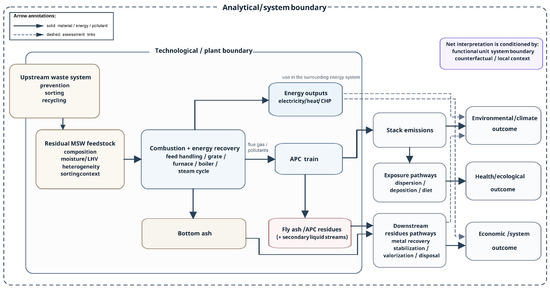
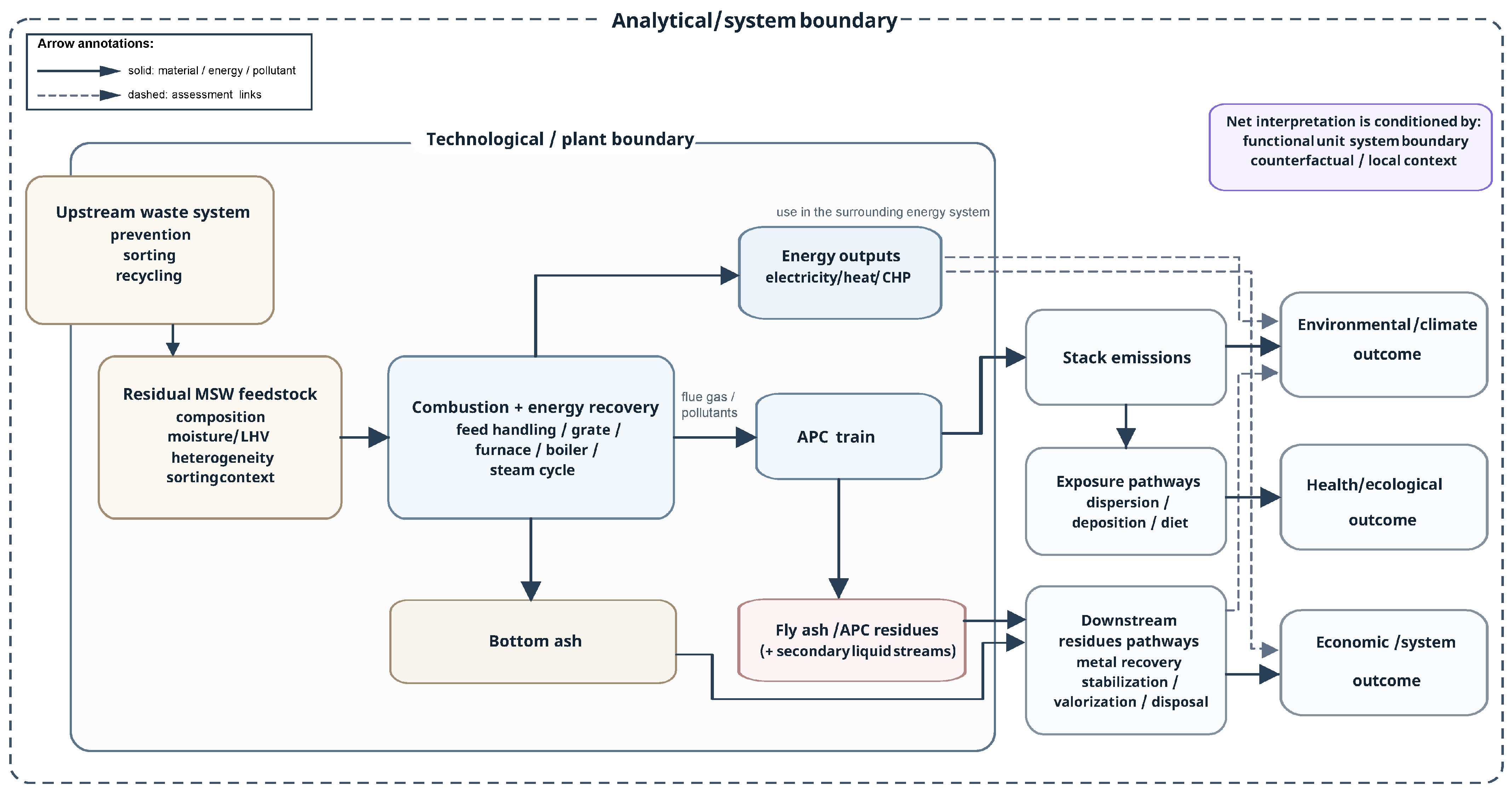

Disclaimer/Publisher’s Note: The statements, opinions and data contained in all publications are solely those of the individual author(s) and contributor(s) and not of MDPI and/or the editor(s). MDPI and/or the editor(s) disclaim responsibility for any injury to people or property resulting from any ideas, methods, instructions or products referred to in the content. |
© 2026 by the authors. Licensee MDPI, Basel, Switzerland. This article is an open access article distributed under the terms and conditions of the Creative Commons Attribution (CC BY) license.