Comparative Evaluation of In Situ U-Value Measurement Techniques of an External Wall in a Multi-Method Field Study


Abstract
1. Introduction
2. Common Methods for Determining the U-Value
2.1. Calculation (CAL) Method
2.2. Heat Flux Meter (HFM) Method
2.3. Infrared Thermography (IRT) Method
2.4. Infrared Thermometer (IRTM) Method
2.5. Thermometric (THM) Method
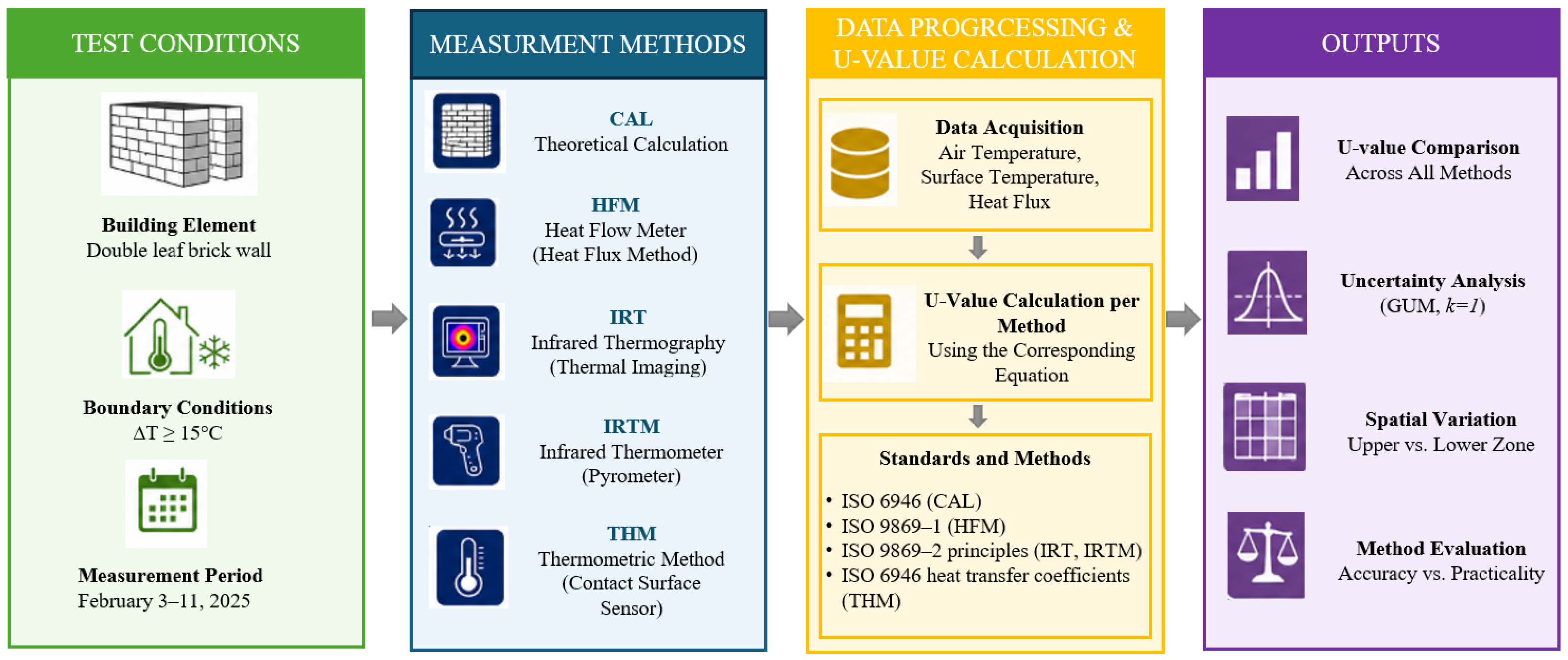
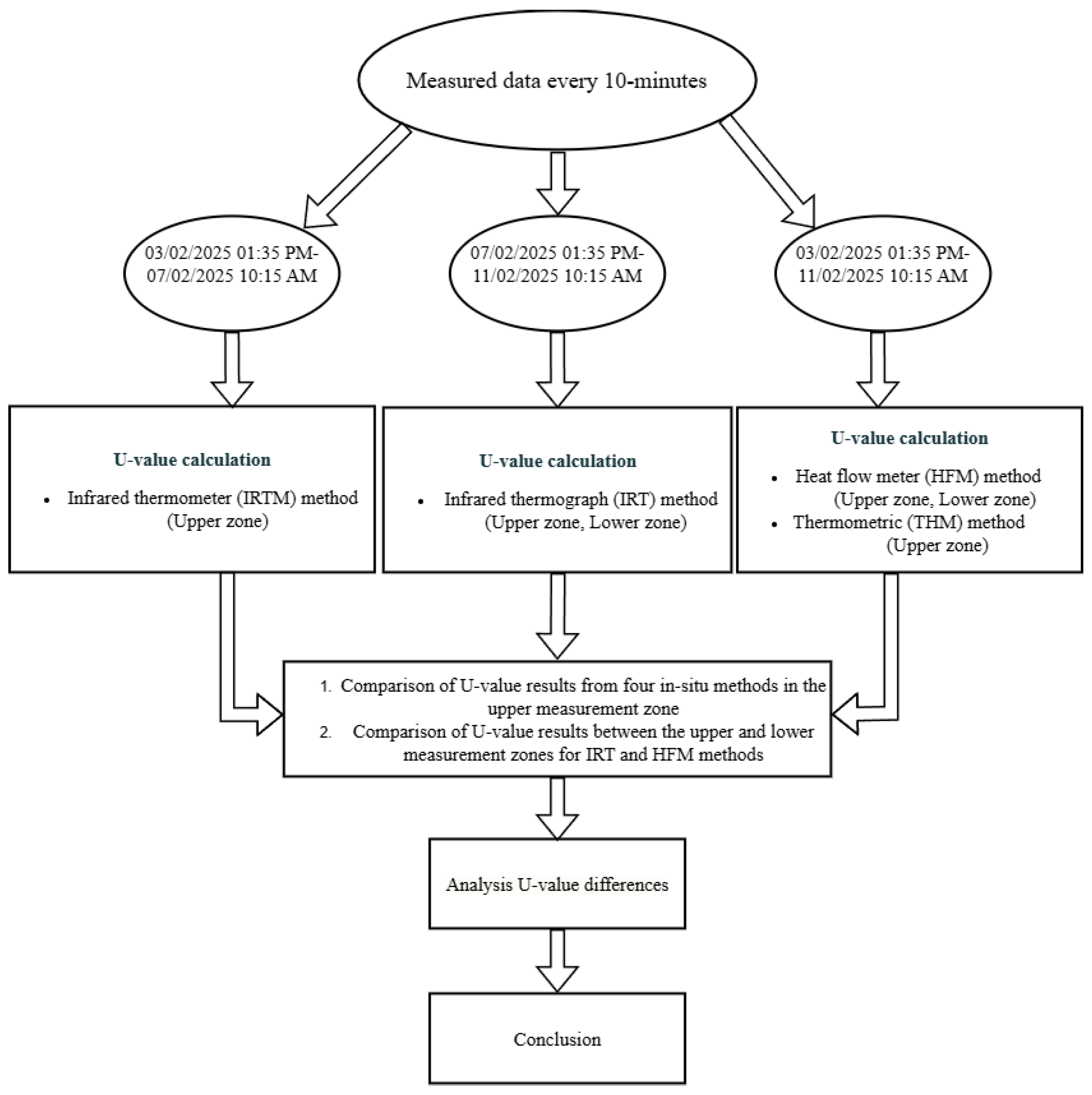
2.6. Research Concept and Methodological Framework
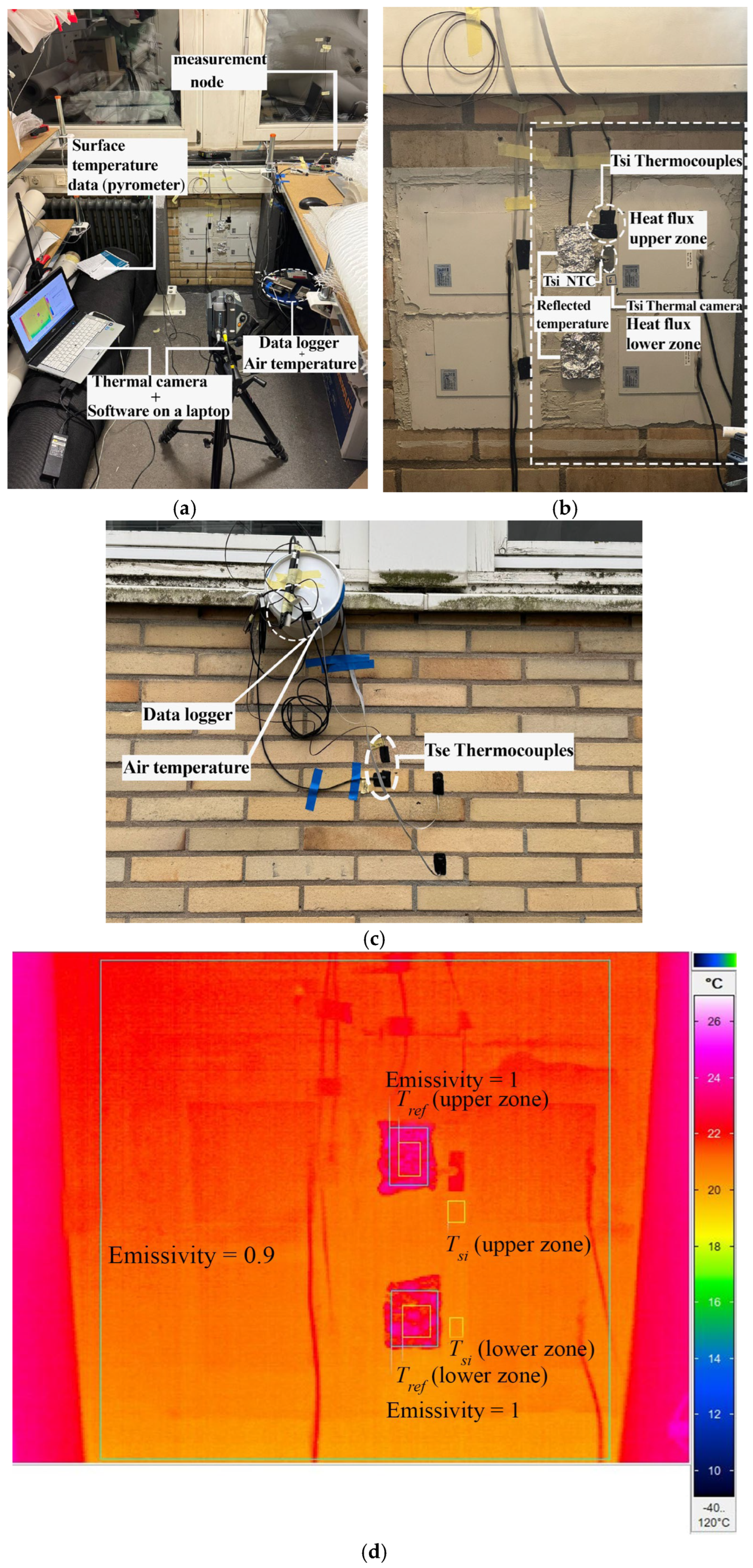
3. In Situ Experimental Tests
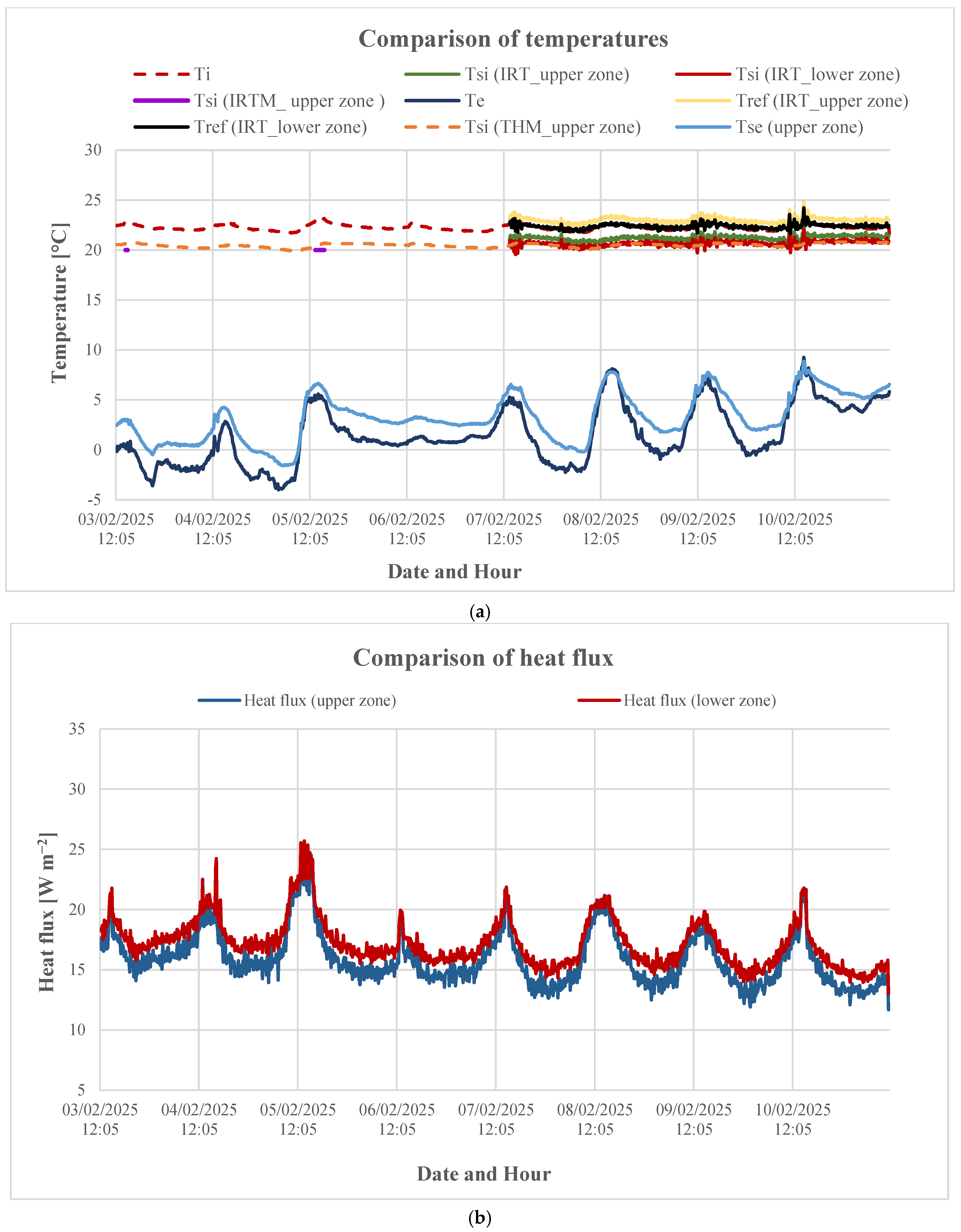
- During the test period, the value of the interior air temperature was constant but with slight variations between 21.7 °C and 23.2 °C.
- The exterior air temperature varied between −4 °C and 9.2 °C.
- According to recommendations from the literature, the temperature difference between the interior and exterior was always greater than 15 °C throughout the experiment [21], except for 45 min on 10.02.2025 from 13:45 to 14:25 in the text, when it ranged from 13.6 °C to 14.9 °C.
- The exterior surface temperature measured by a surface sensor was always, as expected, higher than the exterior temperature, with a variation of −1.6 °C to 8.8 °C. The temperature difference is more pronounced during cooler hours of the day and night.
- For the interior surface temperature, the values measured by thermal camera (IRT method), pyrometer (IRTM method), and the sensor (THM method) are generally close to each other. At the wall’s upper zone, the measured interior surface temperatures are approximately from 20.1 °C to 22.6 °C (IRT), 20 °C (IRTM), and from 19.8 °C to 20.8 °C (THM).
- The interior surface temperature of the lower zone measured by the IRT method is about 20.7 °C, which is around 0.5 °C lower than the upper zone’s interior surface temperature, 21.2 °C, measured by the same method.
- The reflected temperature of the environment recorded by the infrared camera (IRT) in the upper zone ranges from 22.3 °C to 24.8 °C, which is slightly higher than the corresponding values in the lower zone (21.6 °C to 24.2 °C).
Uncertainty Estimation
4. Results and Discussion
4.1. Experimental Conditions and Instantaneous U-Value Measurements
4.2. Comparative Analysis and Discussion of U-Value Measurements
5. Conclusions and Further Research
Author Contributions
Funding
Data Availability Statement
Conflicts of Interest
References
- Jo, H.H.; Yuk, H.; Kang, Y.; Kim, S. Conservation of architectural heritage: Innovative approaches to enhance thermal comfort and promote sustainable usage in historic buildings. Case Stud. Therm. Eng. 2023, 51, 103500. [Google Scholar] [CrossRef]
- Tejedor, B.; Lucchi, E.; Bienvenido-Huertas, D.; Nardi, I. Non-destructive techniques (NDT) for the diagnosis of heritage buildings: Traditional procedures and futures perspectives. Energy Build. 2022, 263, 112029. [Google Scholar] [CrossRef]
- Baker, P. Technical Paper 10: U-Values and Traditional Buildings—In Situ Measurements and Their Significance; Historic Scotland: Edinburgh, UK, 2011. [Google Scholar]
- Davies, M.G. Building Heat Transfer; Wiley: Hoboken, NJ, USA, 2004. [Google Scholar] [CrossRef]
- ISO 7345; Thermal Performance of Buildings and Building Components—Physical Quantities and Definitions. International Organization for Standardization (ISO): Geneva, Switzerland, 2018.
- Aguilar-Santana, J.L.; Velasco-Carrasco, M.; Riffat, S. Thermal Transmittance (U-value) Evaluation of Innovative Window Technologies. Future Cities Environ. 2020, 6, 1–13. [Google Scholar] [CrossRef]
- ISO 6946; Building Components and Building Elements—Thermal Resistance and Thermal Transmittance—Calculation Method. International Organization for Standardization (ISO): Geneva, Switzerland, 2017.
- ISO 9869-1; Thermal Insulation—Building Elements—In-Situ Measurement of Thermal Resistance and Thermal Transmittance—Part 1: Heat Flow Meter Method. International Organization for Standardization (ISO): Geneva, Switzerland, 2014.
- ISO 9869-2; Thermal Insulation—Building Elements—In-Situ Measurement of Thermal Resistance and Thermal Transmittance—Part 2: Infrared Method for Frame Structure Dwelling. International Organization for Standardization (ISO): Geneva, Switzerland, 2018.
- ASTM E1862-14(2022); Standard Practice for Measuring and Compensating for Reflected Temperature Using Infrared Imaging Radiometers. American Society for Testing Materials: West Conshohocken, PA, USA, 2022. [CrossRef]
- ASTM C1155-95(2001); Standard Practice for Determining Thermal Resistance of Building Envelope Components from In-Situ Data. American Society for Testing Materials: West Conshohocken, PA, USA, 2001. [CrossRef]
- Kossecka, E.; Kośny, J. Method of averages to determine insulation conductivity under transient conditions. J. Therm. Envel. Build. Sci. 1999, 23, 145–158. [Google Scholar] [CrossRef]
- Deconinck, A.H.; Roels, S. Comparison of characterisation methods determining the thermal resistance of building components from onsite measurements. Energy Build. 2016, 130, 309–320. [Google Scholar] [CrossRef]
- Gaspar, K.; Casals, M.; Gangolells, M. Influence of HFM thermal contact on the accuracy of in situ measurements of façades’ U-value in operational stage. Appl. Sci. 2021, 11, 979. [Google Scholar] [CrossRef]
- Fokaides, P.A.; Kalogirou, S.A. Application of infrared thermography for the determination of the overall heat transfer coefficient (U-Value) in building envelopes. Appl. Energy 2011, 88, 4358–4365. [Google Scholar] [CrossRef]
- Albatici, R.; Tonelli, A.M. Infrared thermovision technique for the assessment of thermal transmittance value of opaque building elements on site. Energy Build. 2010, 42, 2177–2183. [Google Scholar] [CrossRef]
- Gaši, M.; Milovanović, B.; Gumbarević, S. Comparison of infrared thermography and heat flux method for dynamic thermal transmittance determination. Buildings 2019, 9, 132. [Google Scholar] [CrossRef]
- Song, A.; Kim, Y.; Hwang, S.; Shin, M.; Lee, S. A comprehensive review of thermal transmittance assessments of building envelopes. Buildings 2024, 14, 3304. [Google Scholar] [CrossRef]
- Geske, M.; Voelker, C. Addressing uncertainty in U-value estimation with infrared thermography: A Kriging-based model calibration approach. Energy Build. 2026, 352, 116778. [Google Scholar] [CrossRef]
- Videras Rodríguez, M.; Gómez Melgar, S.; Andújar Márquez, J.M. Evaluation of aerial thermography for measuring the thermal transmittance (U-value) of a building façade. Energy Build. 2024, 324, 114874. [Google Scholar] [CrossRef]
- Bienvenido-Huertas, D.; Rodríguez-Álvaro, R.; Moyano, J.J.; Rico, F.; Marín, D. Determining the U-Value of façades using the thermometric method: Potentials and limitations. Energies 2018, 11, 360. [Google Scholar] [CrossRef]
- Evangelisti, L.; De Cristo, E.; Guattari, C.; Gori, P.; De Rubeis, T.; Monteleone, S. Preliminary development of a non-contact method for thermal characterization of building walls: Laboratory evaluation. Case Stud. Therm. Eng. 2025, 69, 106012. [Google Scholar] [CrossRef]
- Andújar Márquez, J.M.; Martínez Bohórquez, M.Á.; Gómez Melgar, S. A new metre for cheap, quick, reliable and simple thermal transmittance (U-value) measurements in buildings. Sensors 2017, 17, 2017. [Google Scholar] [CrossRef] [PubMed]
- Madding, R.P. Finding R-values of stud-frame constructed houses with IR thermography. In Proceedings of InfraMation 2008; IT-66-2008; Infrared Training Center (ITC): Reno, NV, USA, 2008; Available online: https://www.researchgate.net/publication/285737245 (accessed on 20 November 2024).
- Mathew, D.; Hegarty, R.O.; Kinnane, O. Historic buildings to Positive Energy Buildings: A trilemma between energy efficiency, lifecycle carbon and architecture conservation. J. Phys. Conf. Ser. 2023, 2654, 012010. [Google Scholar] [CrossRef]
- Simões, N.; Moghaddam, S.A.; da Silva, M.G. Review of the experimental methods for evaluation of windows’ thermal transmittance: From standardized tests to new possibilities. Buildings 2023, 13, 703. [Google Scholar] [CrossRef]
- Alqahtani, S.; Ali, H.M.; Farukh, F.; Kandan, K. Experimental and computational analysis of polymeric lattice structure for efficient building materials. Appl. Therm. Eng. 2022, 218, 119366. [Google Scholar] [CrossRef]
- Shin, D.H.; Kim, S.H.; Kim, J.H.; Kim, S. Experimental analysis of low-cost energy retrofit strategies for residential buildings to overcome energy poverty. Case Stud. Therm. Eng. 2022, 32, 101874. [Google Scholar] [CrossRef]
- Lee, Y.J.; Moon, J.H.; Choi, D.S.; Ko, M.J. Influences of average temperature difference and measurement period on estimation of in situ thermal transmittance of building exterior walls using the average method of ISO 9869-1. Energies 2024, 17, 1177. [Google Scholar] [CrossRef]
- Gumbarević, S.; Milovanović, B.; Bašić, B.D.; Gaši, M. Combining deep learning and the heat flux method for in-situ thermal-transmittance measurement improvement. Energies 2022, 15, 5029. [Google Scholar] [CrossRef]
- ISO 18434-1; Conditions Monitoring and Diagnostics of Machines—Thermography—Part 1: General Procedures. International Organization for Standardization (ISO): Geneva, Switzerland, 2008.
- Bergman, T.L.; Levine, A.S. Fundamentals of Heat and Mass Transfer; Wiley: Hoboken, NJ, USA, 2019. [Google Scholar]
- Kim, S.H.; Kim, J.H.; Jeong, H.G.; Song, K.D. Reliability field test of the air-surface temperature ratio method for in situ measurement of U-values. Energies 2018, 11, 803. [Google Scholar] [CrossRef]
- ISO/IEC Guide 98-3:2008; Uncertainty of Measurement—Part 3: Guide to the Expression of Uncertainty in Measurement (GUM:1995). ISO/IEC: Geneva, Switzerland, 2008.



| Interior Total Heat-Transfer Coefficient (W m−2 K−1) | Direction of Heat Flow | ||
|---|---|---|---|
| Upwards (Roof) | Horizontal (Wall) | Downwards (Floor) | |
| 10 | 7.69 | 5.88 | |
| Method | Setup | Measuring Devices: Number | Formula |
|---|---|---|---|
| Calculation (CAL) method |  | - | |
| Heat flow meter (HFM) method |  |
| |
| Infrared thermography (IRT) method |  |
| |
| Infrared thermometer (IRTM) method |  |
| |
| Thermometric (THM) method |  |
|
| Surface Thermal Resistance (m2 K W−1) | Direction of Heat Flow | ||
|---|---|---|---|
| Upwards (Roof or Floor) | Horizontal (Wall) | Downwards (Roof or Floor) | |
| 0.10 | 0.13 | 0.17 | |
| 0.04 | 0.04 | 0.04 | |
| Instrument | Model | Specifications |
|---|---|---|
| Thermal camera | InfraTec—VarioCAM hr (InfraTec GmbH, Dresden, Germany) | Detector: Uncooled Microbolometer FPA Image resolution: up to 1.280 × 980 pixels Spectral range: 7.5 to 14 µm Temperature measurement range: −40 to 1200 °C NETD (thermal resolution): <0.05 °C at 30 °C Measurement accuracy: ±1.5 °C or ±2% of reading (whichever is greater) Image rate: 50/60 Hz |
| Pyrometer (infrared thermometer) | Testo—830 T2 (Testo SE & Co. KGaA, Titisee-Neustadt, Germany) | Temperature measurement range: −30 to 400 °C Accuracy: ±1.5 °C or ±1.5% v. Mw. of reading (+0.1 to 400 °C) ±2 °C or ±2% of reading (−30 to 0 °C) (whichever value is greater applies) Resolution: 0.1 °C |
| Measurement node and base module | Custom MPA Module (Materials Testing Institute, University of Stuttgart, Stuttgart, Germany) | Channels: 4 (2× sensor SHT25 and 2× heat flux plate) |
| Air-temperature sensor | Sensirion—SHT25 (Sensirion AG, Stäfa, Switzerland) | Temperature measurement range: −40 to 125 °C Accuracy: ±0.2 °C |
| Heat flux plates | Ahlborn—FQA018 (Ahlborn Mess- und Regelungstechnik GmbH, Holzkirchen, Germany) | Dimensions (mm): 120 × 120 × 3 Temperature resistance: −40 to 80 °C Calibration value: <15 W/m2 ≈ 1 mV Accuracy: 5% at 23 °C |
| Data logger A | Testo—175 H1 (Testo SE & Co. KGaA, Titisee-Neustadt, Germany) | Temperature measurement range: −20 to 55 °C |
| Air-temperature sensor | Testo—NTC (Testo SE & Co. KGaA, Titisee-Neustadt, Germany) | Temperature measurement range: −20 to 50 °C Accuracy: ±0.5 °C Resolution: 0.1 °C |
| Data logger B | Testo—175 T3 (Testo SE & Co. KGaA, Titisee-Neustadt, Germany) | Temperature measurement range: −20 to 55 °C |
| Surface-temperature sensor | Testo—Thermocouples (Testo SE & Co. KGaA, Titisee-Neustadt, Germany) | Materials: copper and copper–nickel Temperature measurement range: −50 to 250 °C Accuracy: ±0.5 °C (−50 to +70 °C), ±0.7% v. Mw. (+70.1 to 400 °C) Resolution: 0.1 °C |
| Data logger C | Testo—175 T2 (Testo SE & Co. KGaA, Titisee-Neustadt, Germany) | Temperature measurement range: −35 to 55 °C |
| Surface-temperature sensor | Testo—NTC (Testo SE & Co. KGaA, Titisee-Neustadt, Germany) | Temperature measurement range: −50 to 80 °C Accuracy: ±0.2 °C (−50 to 80 °C) Resolution: 0.1 °C |
| Quantity | Symbol | Standard Uncertainty u(x) | Sensitivity Coefficient cx = ∂U/∂x | Contribution cxu(x) |
|---|---|---|---|---|
| Heat flux | q | u(q) | ∂U/∂q | cqu(q) |
| Interior air temperature | Ti | u(Ti) | ∂U/∂Ti | cTiu(Ti) |
| Exterior air temperature | Te | u(Te) | ∂U/∂Te | cTeu(Te) |
| Interior surface temperature | Tsi | u(Tsi) | ∂U/∂Tsi | cTsiu(Tsi) |
| Convective heat transfer coefficient | hci | u(hci) | ∂U/∂hci | chciu(hci) |
| Reflected temperature | Tref | u(Tref) | ∂U/∂Tref | cTrefu(Tref) |
| Emissivity | ε | u(ε) | ∂U/∂ε | cεu(ε) |
| Interior total heat-transfer coefficient | hi | u(hi) | ∂U/∂hi | chiu(hi) |
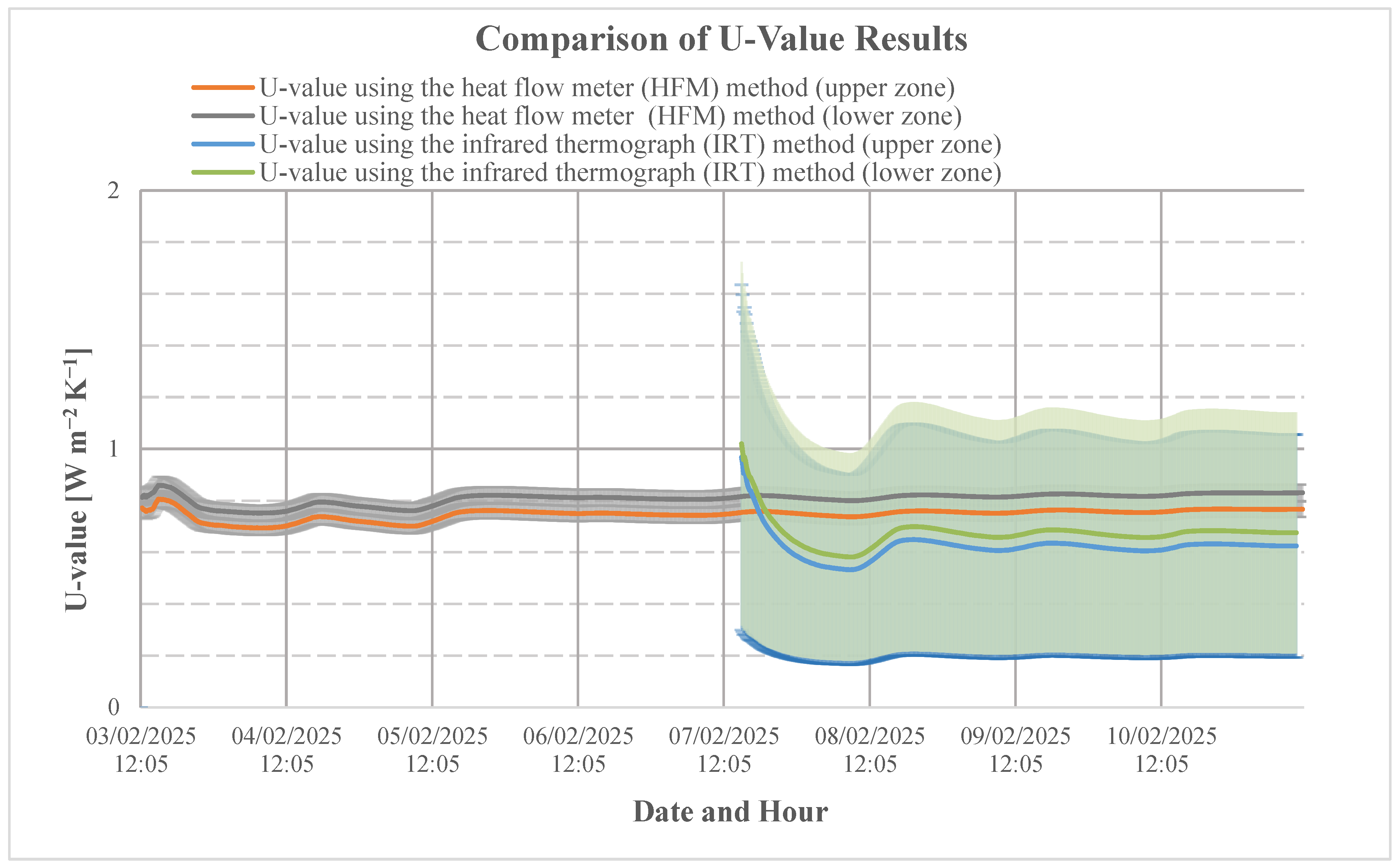
| Method | U-Value (W m−2 K−1) Upper Zone | Uncertainty (k = 1) |
|---|---|---|
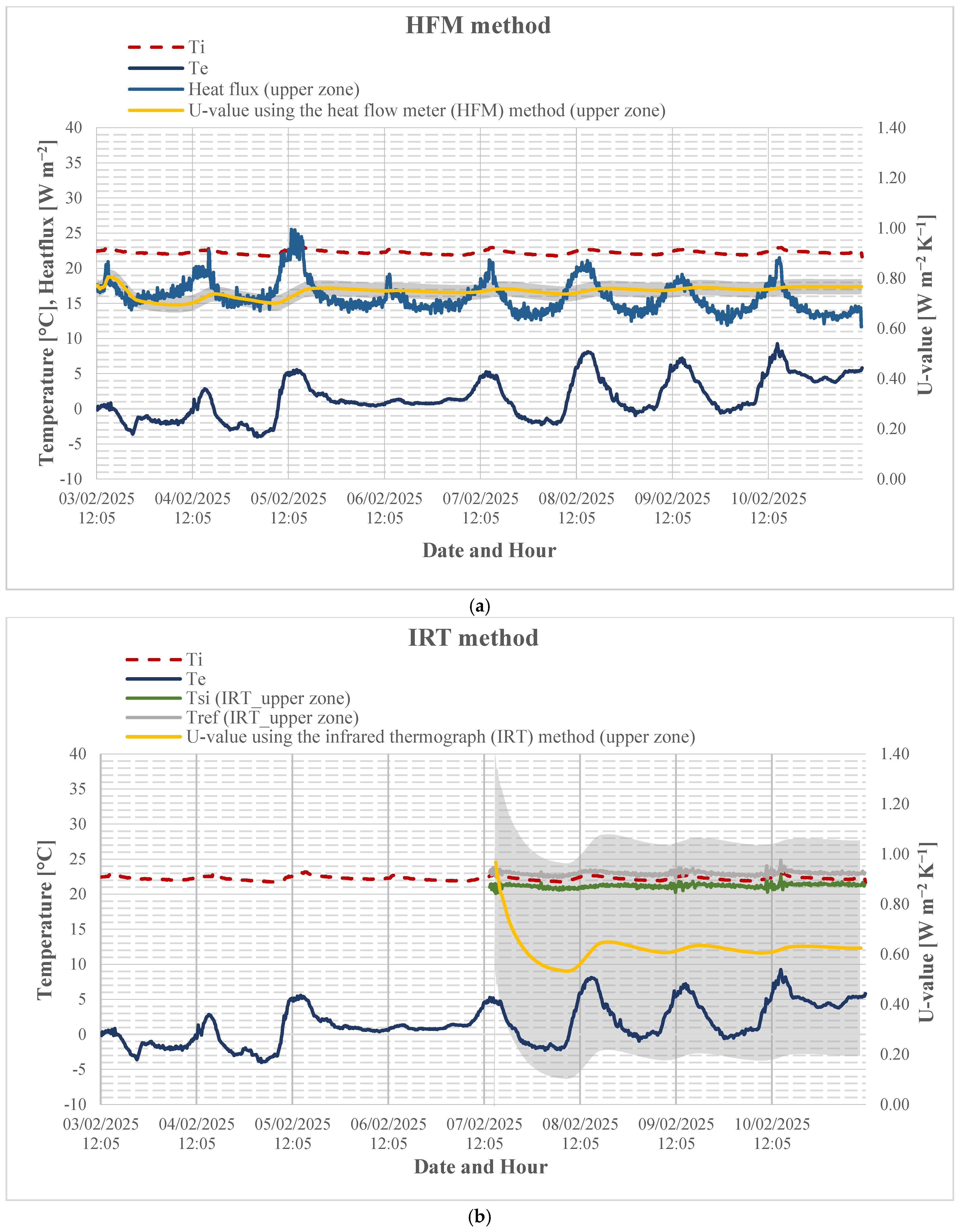
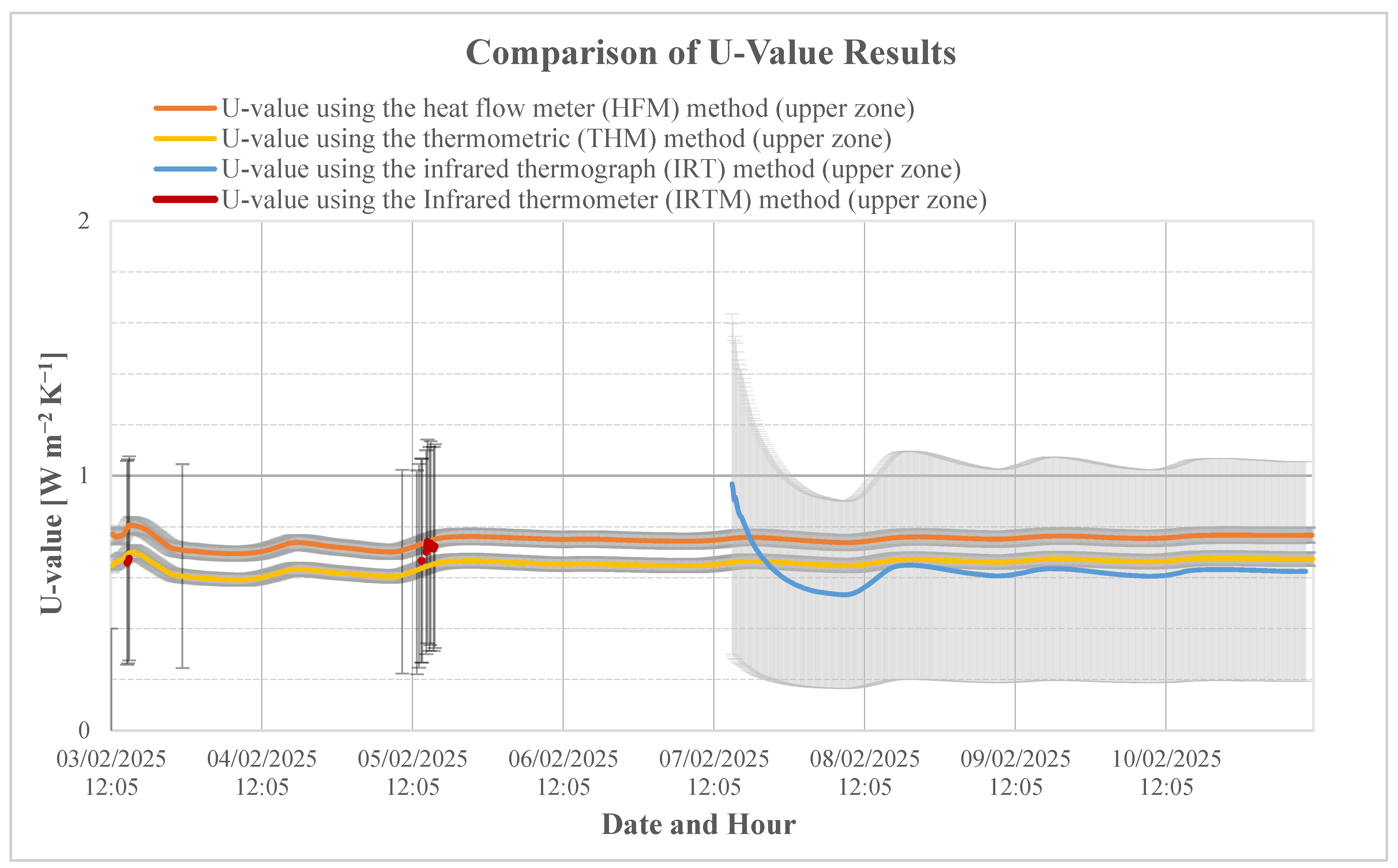
| Heat flow meter (HFM) | 0.77 ± 0.03 | 3.9% |
| Infrared thermography (IRT) | 0.62 ± 0.43 | 69% |
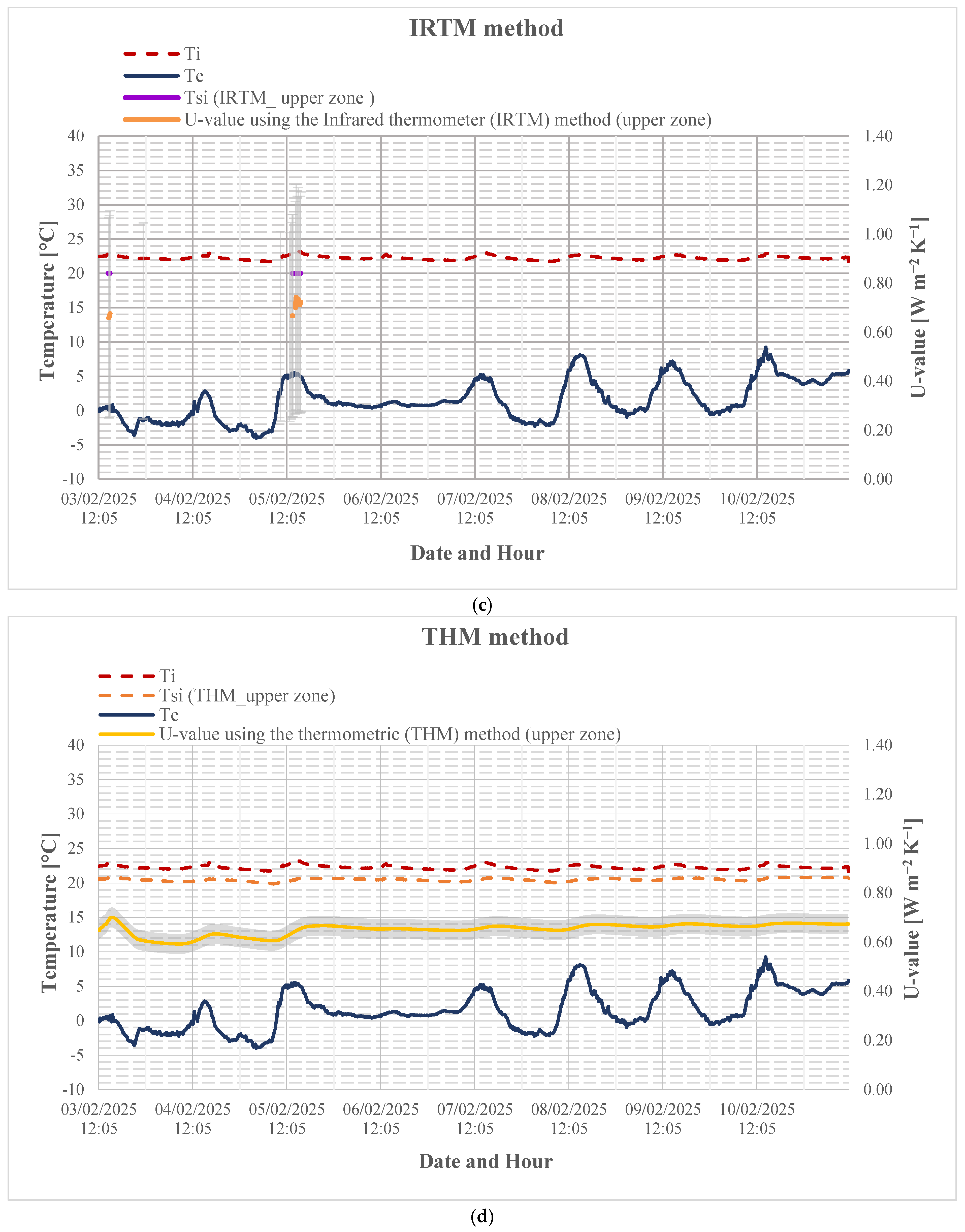
| Infrared thermometer (IRTM) | 0.69 ± 0.40 | 62% |
| Thermometric (THM) | 0.67 ± 0.04 | 5.9% |
| Method | U-Value (W m−2 K−1) | |
|---|---|---|
| Upper Zone | Lower Zone | |
| Heat flow meter (HFM) | 0.77 ± 0.03 | 0.83 ± 0.04 |
| Infrared thermography (IRT) | 0.62 ± 0.43 | 0. 68 ± 0.43 |
Disclaimer/Publisher’s Note: The statements, opinions and data contained in all publications are solely those of the individual author(s) and contributor(s) and not of MDPI and/or the editor(s). MDPI and/or the editor(s) disclaim responsibility for any injury to people or property resulting from any ideas, methods, instructions or products referred to in the content. |
© 2026 by the authors. Licensee MDPI, Basel, Switzerland. This article is an open access article distributed under the terms and conditions of the Creative Commons Attribution (CC BY) license.
Share and Cite
Hejazi, B.; Huß, A.; Frick, J.; Garrecht, H. Comparative Evaluation of In Situ U-Value Measurement Techniques of an External Wall in a Multi-Method Field Study. Energies 2026, 19, 2668. https://doi.org/10.3390/en19112668
Hejazi B, Huß A, Frick J, Garrecht H. Comparative Evaluation of In Situ U-Value Measurement Techniques of an External Wall in a Multi-Method Field Study. Energies. 2026; 19(11):2668. https://doi.org/10.3390/en19112668
Chicago/Turabian StyleHejazi, Bina, Andreas Huß, Jürgen Frick, and Harald Garrecht. 2026. "Comparative Evaluation of In Situ U-Value Measurement Techniques of an External Wall in a Multi-Method Field Study" Energies 19, no. 11: 2668. https://doi.org/10.3390/en19112668
APA StyleHejazi, B., Huß, A., Frick, J., & Garrecht, H. (2026). Comparative Evaluation of In Situ U-Value Measurement Techniques of an External Wall in a Multi-Method Field Study. Energies, 19(11), 2668. https://doi.org/10.3390/en19112668