1. Introduction
Despite significant advances in materials, design methodologies, and numerical modelling, reliability remains the principal barrier to large-scale deployment of marine renewable energy systems. Existing approaches to structural integrity and lifetime prediction are predominantly based on empirical design rules, simplified fatigue formulations, and loosely coupled modelling frameworks. While these methods have enabled initial deployment, they often fail to capture the underlying physical mechanisms governing degradation in aggressive offshore environments, particularly when multiple damage processes, such as corrosion–fatigue interaction, hydrogen-assisted cracking, and microstructure-sensitive deformation, act concurrently.
A number of review studies have addressed individual aspects of this challenge, including material selection, corrosion mechanisms, fatigue behaviour, and numerical modelling techniques [
1,
2,
3,
4,
5,
6]. However, these contributions are typically fragmented, focusing either on specific material classes or isolated degradation mechanisms, and rarely provide an integrated perspective linking material behaviour, multiscale modelling, and structural qualification. There remains a lack of frameworks that connect microstructural damage evolution to engineering-scale design and certification procedures in a physically consistent manner. This limitation becomes particularly critical in marine renewable systems where interacting degradation mechanisms govern failure.
1.1. Global Expansion of Marine Renewable Energy
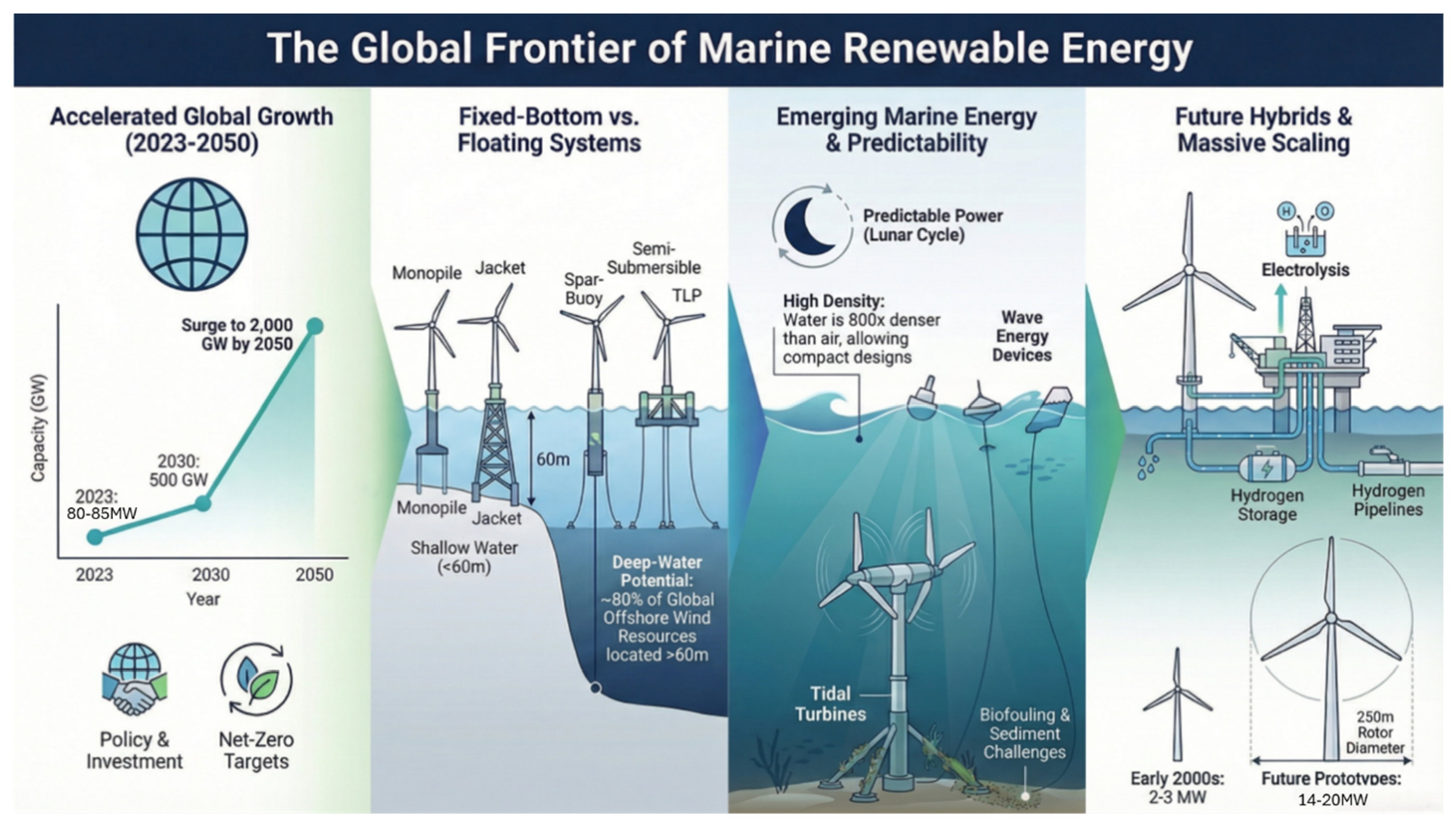
Marine renewable energy systems are expanding rapidly as countries pursue decarbonisation and net-zero strategies. Offshore wind has experienced particularly strong growth, with global installed capacity now exceeding 80 GW and long-term projections indicating substantial future expansion [
7,
8,
9]. Alongside fixed-bottom offshore wind systems, floating offshore wind technology is emerging as a key solution for accessing deeper-water resources inaccessible to conventional monopile foundations [
10,
11,
12] (
Figure 1). Floating concepts, including spar-buoy, semi-submersible, and tension-leg platforms, introduce significantly greater structural and operational complexity due to coupled aerodynamic and hydrodynamic loading [
12,
13,
14].
Beyond wind energy, tidal and wave energy systems represent emerging marine renewable technologies. Tidal systems benefit from predictable loading conditions and high energy density, while hybrid offshore wind-to-hydrogen systems are increasingly being explored for integrated renewable generation and energy storage [
15,
16,
17,
18,
19,
20]. These systems introduce additional material and structural challenges associated with aggressive seawater exposure, cyclic loading, chemical process integration, and limited accessibility for maintenance.
The continued increase in turbine size, water depth, and offshore deployment distance is amplifying structural integrity challenges across marine renewable systems. Modern offshore wind turbines now exceed 15 MW capacity, with larger rotor diameters and increasingly flexible support structures [
21]. Floating platforms must withstand combined wind, wave, and current loading under severe environmental conditions, while tidal systems operate in highly corrosive and sediment-laden environments [
22,
23]. Consequently, reliability and degradation-driven failures are becoming increasingly important constraints on long-term performance and economic viability.
1.2. Reliability as the Primary Barrier to Cost Reduction
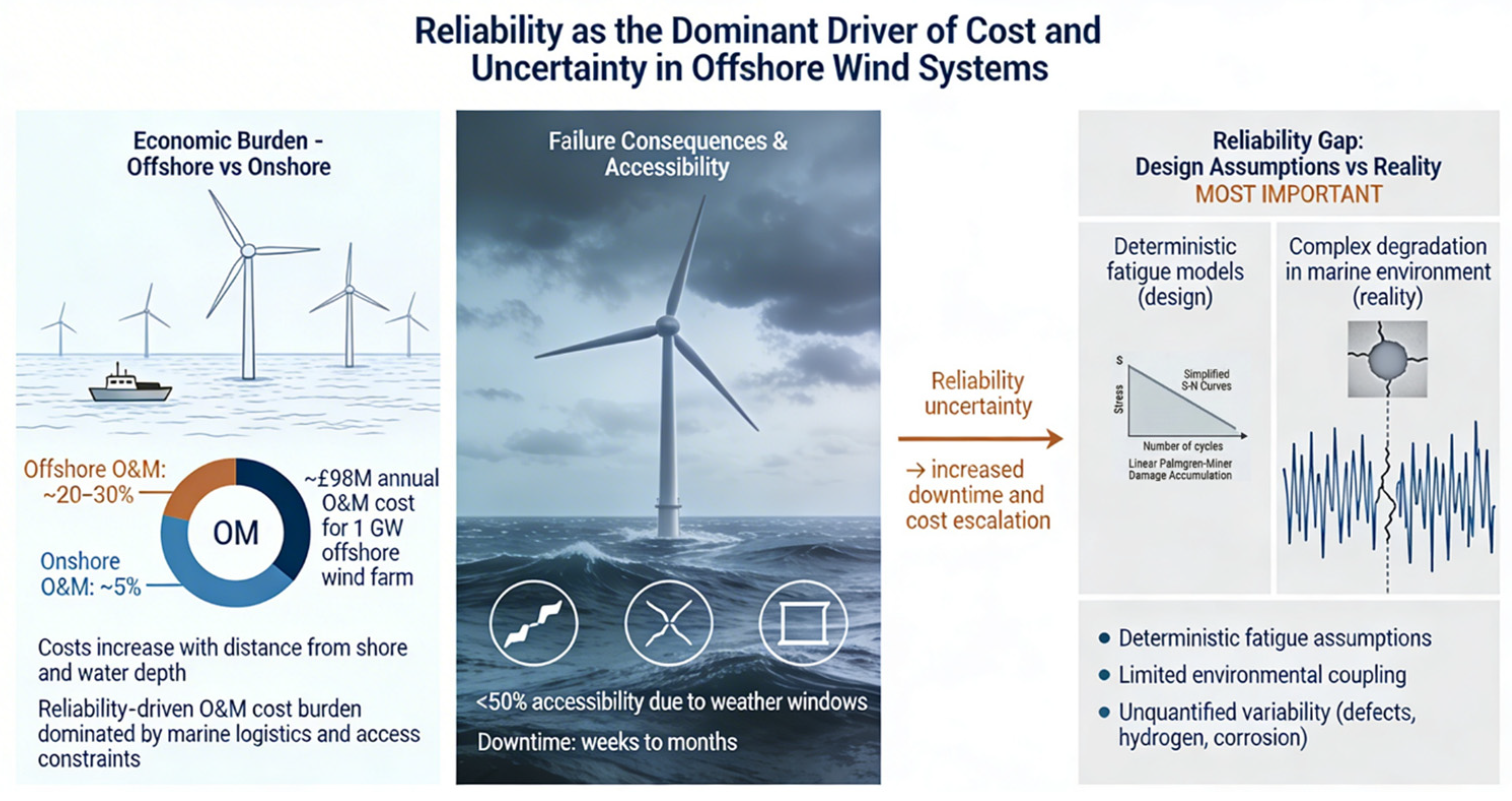
Despite technological progress, reliability remains the dominant economic and operational barrier to large-scale deployment of marine renewable energy systems. Offshore operations and maintenance costs are substantially higher than for onshore systems due to limited accessibility, harsh environmental conditions, and dependence on specialised marine logistics [
24,
25,
26,
27,
28] (see
Figure 2). Unscheduled failures can therefore result in extended downtime and significant economic penalties, particularly for floating systems operating far offshore [
29,
30,
31].
Current qualification approaches are primarily based on empirical S–N fatigue methodologies, linear damage accumulation assumptions, and deterministic safety factors adapted largely from offshore oil and gas practice [
32,
33]. While effective for conventional offshore structures, these approaches remain insufficient for capturing the interacting degradation mechanisms governing modern marine renewable systems. Important limitations include:
Corrosion–fatigue interaction: Marine environments significantly accelerate fatigue crack growth due to electrochemical effects at crack tips, while conventional S–N approaches typically treat corrosion using simplified reduction factors [
34,
35].
Hydrogen-assisted degradation: Cathodic protection systems can introduce hydrogen into high-strength steels, increasing susceptibility to hydrogen-assisted cracking and embrittlement, particularly in advanced offshore structural materials [
36,
37].
Variable-amplitude loading effects: Offshore systems experience highly complex loading spectra arising from wind, waves, currents, and turbine operation, violating simplified linear damage assumptions such as the Palmgren–Miner rule [
38].
Manufacturing variability: Weld quality, residual stress distributions, geometric imperfections, and material heterogeneity introduce significant scatter in fatigue performance that is not explicitly represented in current qualification procedures (see [
39] and references therein).
These limitations highlight a critical gap between empirical qualification methodologies and the underlying physical mechanisms governing degradation and failure. Recent offshore wind maintenance campaigns and foundation retrofit programmes have further demonstrated that substantial reliability margins remain poorly quantified under current design approaches [
40,
41]. Consequently, there is growing need for mechanism-based structural integrity methodologies capable of linking environmental loading, material behaviour, degradation evolution, and system-level reliability within a unified framework.
1.3. Need for Mechanism-Resolved Structural Integrity Assessment
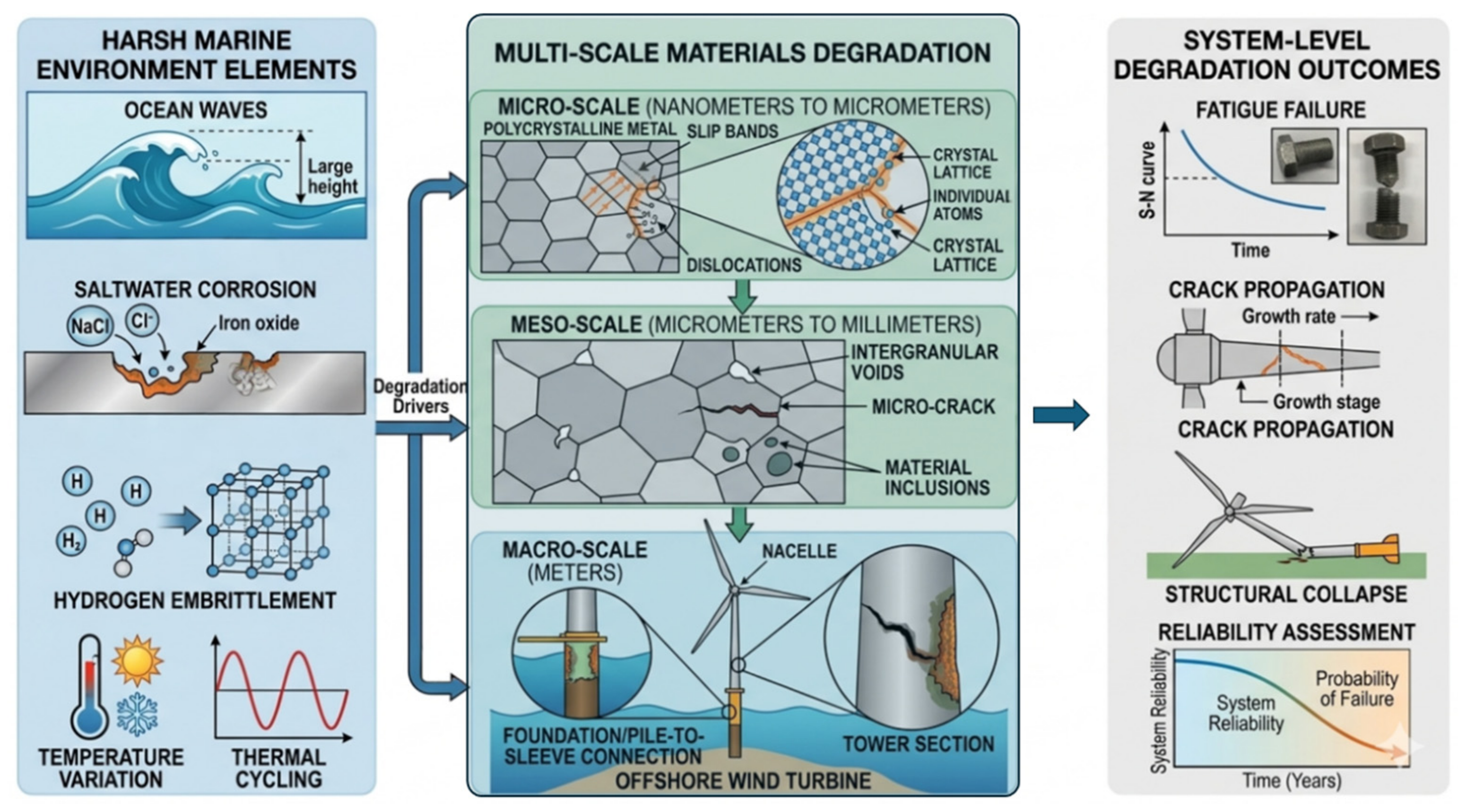
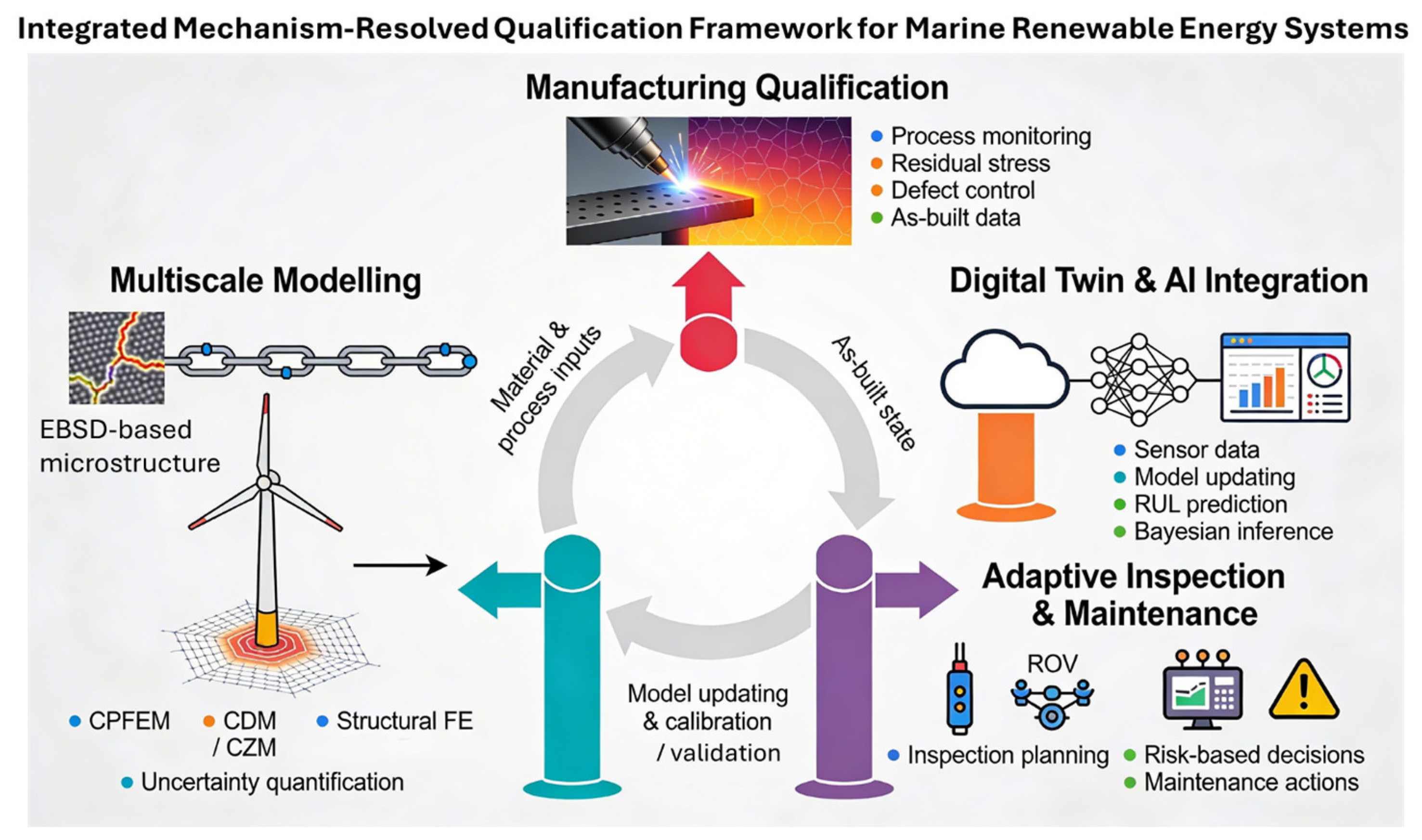
Despite advances in modelling techniques, integration of these scales into engineering design remains limited. Addressing the reliability–cost challenge requires a fundamental shift from empirical, component-level qualification to mechanism-resolved, physics-based structural integrity assessment. This paradigm recognises that understanding degradation requires linking environmental loading → material microstructure behaviour → structural system reliability across multiple length and time scales (
Figure 3).
At the microstructural scale (1–100 μm), damage initiation is governed by crystallographic slip localisation, grain and phase boundary incompatibilities, void nucleation, and hydrogen trapping effects that promote crack initiation [
42,
43]. At the mesoscale (0.1–10 mm), crack propagation transitions from microstructurally sensitive short-crack behaviour to long-crack fracture mechanics regimes [
44]. Approaches such as cohesive zone modelling, phase field methods, and XFEM provide important capabilities for representing these transitions [
45,
46].
At the structural scale (1–100 m), system-level reliability assessment must consider load redistribution, structural redundancy, progressive degradation, and uncertainty propagation across multiple interacting components [
47]. Importantly, these multiscale approaches provide predictive capability for emerging materials and manufacturing routes, including advanced titanium alloys, high-strength steels, and additively manufactured structures, where historical empirical databases remain limited [
48,
49,
50,
51,
52,
53,
54]. These interactions highlight the need for integrated frameworks capable of linking mechanism-level degradation physics with engineering-scale qualification and lifecycle assessment.
1.4. Scope and Contributions of This Review
This review provides a comprehensive synthesis of mechanism-based structural integrity assessment for marine renewable energy systems, with particular emphasis on integrating degradation physics, multiscale modelling, and engineering-scale reliability assessment. The principal contributions of this work include:
Integration of microstructure-sensitive degradation mechanisms with engineering-scale structural integrity assessment.
Critical assessment of multiscale modelling approaches spanning crystal plasticity, damage mechanics, fracture mechanics, probabilistic reliability, and digital twin methodologies.
Discussion of manufacturing variability, residual stress effects, defect populations, and material heterogeneity as critical drivers of structural reliability.
Development of an integrated framework combining mechanism-based modelling, monitoring, uncertainty-aware reliability assessment, and adaptive qualification methodologies.
The review is structured to guide readers from degradation mechanisms (
Section 2,
Section 3 and
Section 4), through modelling methodologies (
Section 5), to monitoring, qualification, and future framework development (
Section 6,
Section 7,
Section 8 and
Section 9). Particular emphasis is placed on the limitations of current empirical approaches and the growing need for physically informed, mechanism-resolved structural integrity methodologies for next-generation marine renewable systems.
2. Marine Renewable Energy Systems and Structural Components
2.1. Offshore Wind Energy Structures
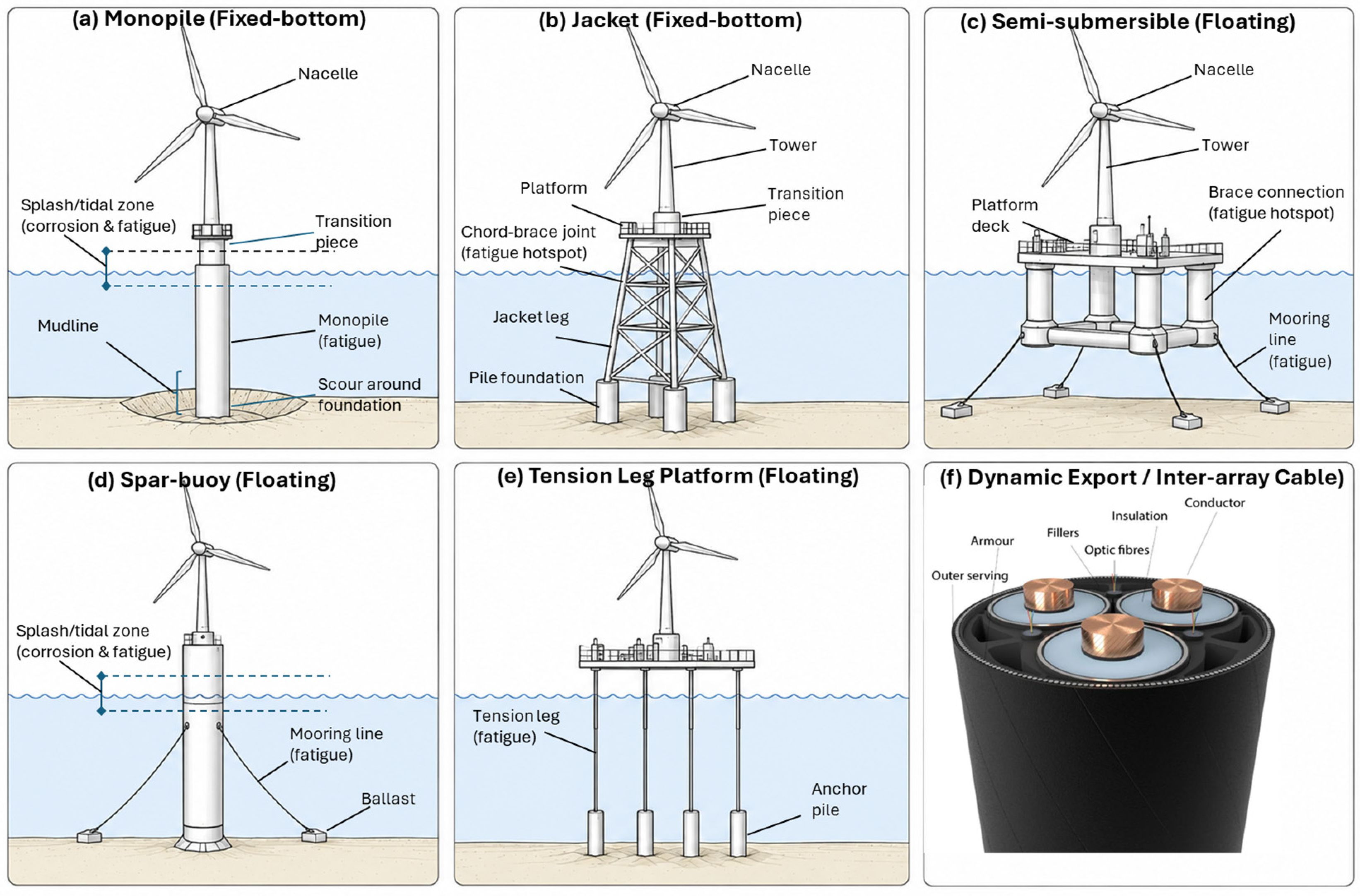
Offshore wind energy systems comprise multiple structural subsystems exposed to distinct loading regimes and degradation environments. Fixed-bottom turbines currently dominate commercial deployment, particularly monopile and jacket-supported structures used in shallow to intermediate water depths [
55]. As illustrated in
Figure 4a,b, fatigue-critical regions are commonly located near transition pieces, welded joints, mudline regions, and splash zones where cyclic loading interacts with corrosive seawater exposure [
56].
Jacket structures, adapted from offshore oil and gas platforms, provide increased stiffness for deeper waters and larger turbines and consist of welded tubular members connected at complex nodal joints [
39].
Figure 4b highlights representative chord–brace intersections and welded joints that are particularly susceptible to hotspot fatigue stresses due to geometric stress concentrations [
57]. Multiaxial stress states and weld toe geometry variability complicate fatigue life prediction.
Floating wind platforms enable deployment in deeper waters and are realised as semi-submersible, spar-buoy, or tension-leg concepts [
29], shown schematically in
Figure 4c–e. These systems introduce additional fatigue-critical regions associated with brace connections, mooring interfaces, tendon attachments, and platform–column junctions [
13]. Dynamic export and inter-array cables connecting floating or fixed platforms to shore-based infrastructure are also emerging integrity hotspots, with armour-wire fatigue, polymer degradation, and water ingress identified as key concerns for long-term operation, as illustrated in
Figure 4f [
58].
Turbine towers and blades, while not the primary focus of this structural integrity review, merit mention for completeness. Towers, typically fabricated from rolled steel plate with longitudinal and circumferential welds, experience fatigue from turbine start–stop cycles, yaw manoeuvres, and vortex-induced vibration during shutdown periods [
59]. Blades, constructed from glass and carbon fibre-reinforced polymer composites, degrade via matrix cracking, fibre–matrix debonding, delamination, and leading-edge erosion. These composite failure mechanisms differ fundamentally from metallic structural failures but share common themes of multiscale damage accumulation [
60,
61]. Overall, the structural configurations shown in
Figure 4 demonstrate that offshore wind system integrity is highly location-dependent, governed by the interaction between geometry-induced stress concentrations, environmental exposure, and complex cyclic loading conditions. This complexity highlights the limitations of uniform empirical design approaches and motivates mechanism-resolved assessment strategies.
2.2. Wave and Tidal Energy Devices
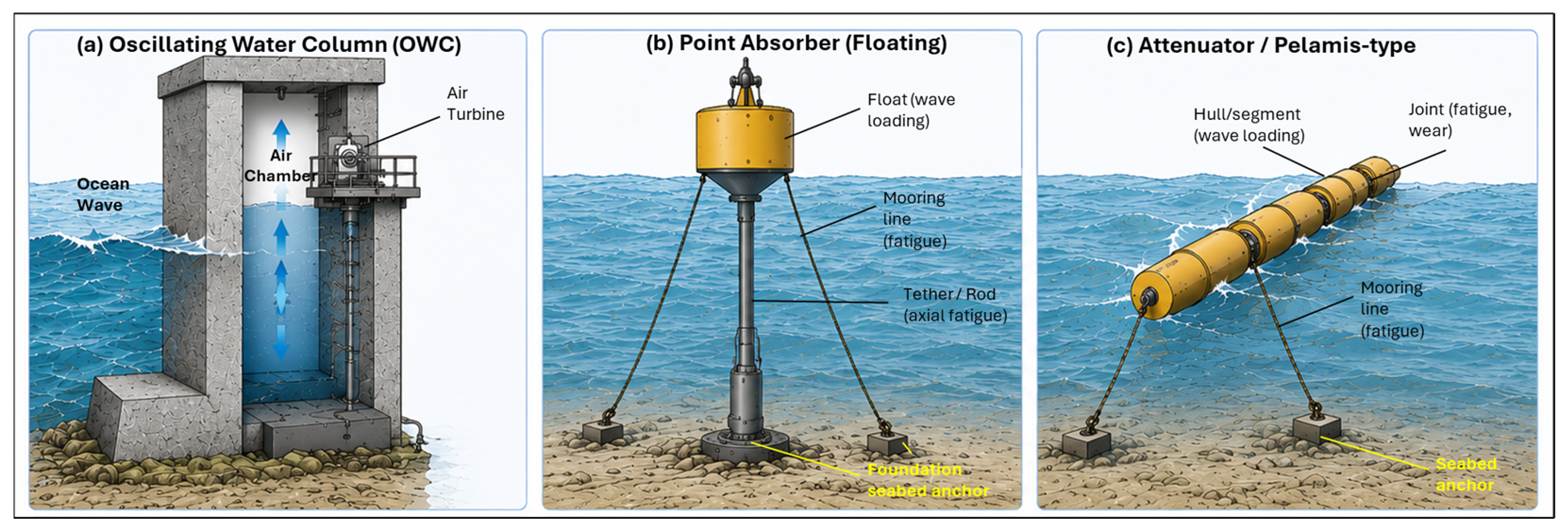
Wave and tidal energy technologies represent diverse device concepts, each with specific structural integrity requirements. Representative wave energy concepts are illustrated in
Figure 5, including oscillating water column (OWC), point absorber, and attenuator/Pelamis-type systems. Oscillating water column systems employ partially submerged chambers where wave-induced pressure fluctuations drive air turbines [
62]. As shown in
Figure 5a, critical degradation regions include chamber walls subjected to repeated wave impact loading, turbine housings exposed to high-frequency cyclic stresses, splash-zone corrosion regions, and mooring attachment locations. The interaction between wave impact fatigue and marine corrosion creates severe degradation conditions in these systems. Point absorber and attenuator-type devices, shown in
Figure 5b,c, introduce additional structural challenges associated with mooring line fatigue, articulated joint loading, hydraulic power take-off (PTO) cyclic stresses, and seabed anchor degradation. The large-amplitude cyclic motions experienced by these systems generate complex multiaxial loading conditions that are difficult to represent using simplified fatigue methodologies.
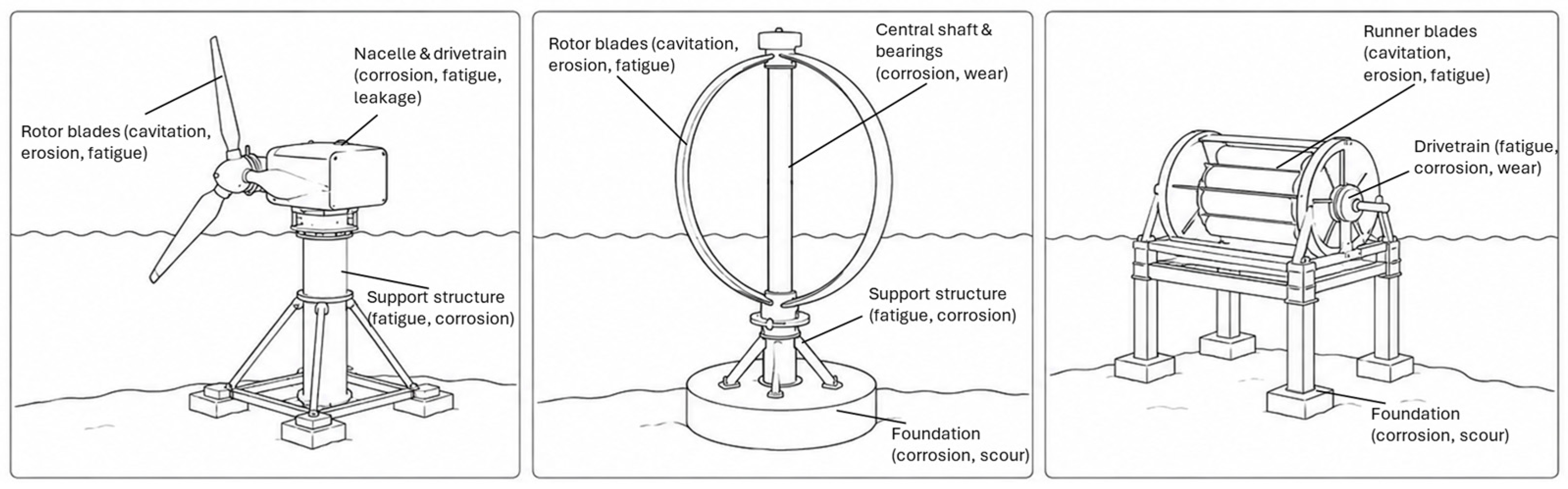
Tidal energy converters operate in energetic tidal currents and are often described as “underwater wind turbines,” typically using horizontal-axis rotor configurations analogous to conventional wind turbines [
16]. Representative tidal turbine concepts are shown in
Figure 6, including horizontal-axis, vertical-axis, and crossflow devices. Structural elements such as rotors, drivetrains, support structures, and foundations are continuously subjected to cyclic hydrodynamic loading and aggressive seawater exposure [
20].
As illustrated in
Figure 6, leading-edge blade erosion, cavitation, scour effects, drivetrain degradation, biofouling, and corrosion–fatigue interaction are particularly important integrity concerns for submerged tidal systems. Because these devices operate fully submerged and commonly use metallic components protected by cathodic systems, hydrogen-related degradation mechanisms such as hydrogen embrittlement in high-strength alloys are also relevant concerns for material selection and qualification strategies [
63]. Compared with offshore wind systems, the continuous submersion and higher fluid density encountered in tidal and wave environments introduce distinct degradation pathways, particularly in relation to corrosion–fatigue interaction, cavitation erosion, biofouling, and scour-induced loading changes. Consequently, these systems require tailored integrity assessment methodologies capable of accounting for coupled environmental and mechanical degradation mechanisms.
2.3. Hybrid Marine Energy Systems
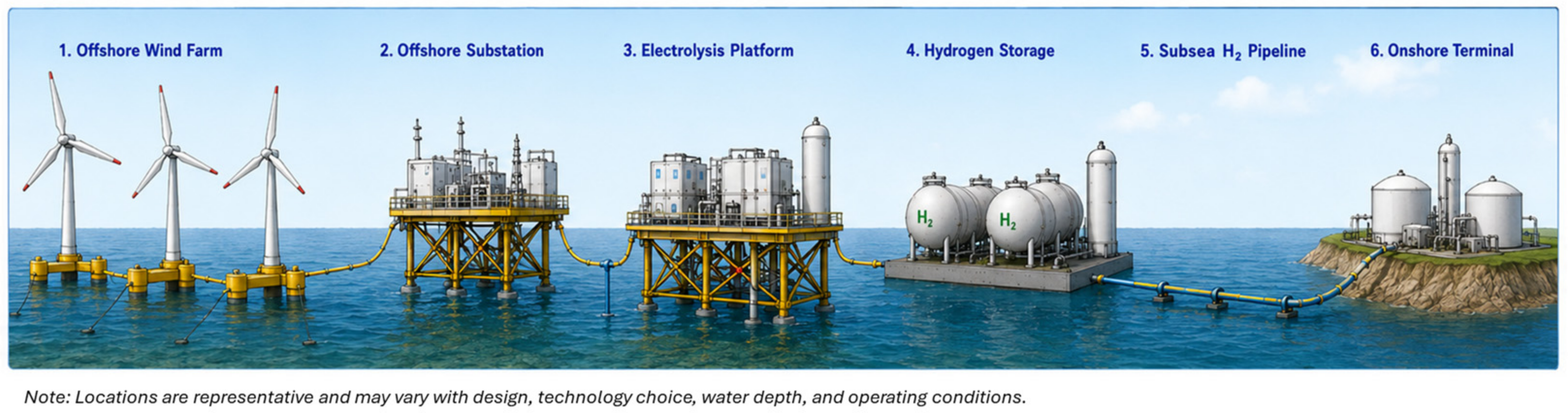
Hybrid offshore wind-to-hydrogen systems integrate renewable power generation with electrolysis, compression, storage, and subsea transport infrastructure.
Figure 7 illustrates a representative offshore wind-to-hydrogen concept linking offshore wind farms with substations, electrolysis platforms, hydrogen storage systems, subsea pipelines, and onshore receiving terminals.
The H2Mare project (Germany) and similar initiatives aim to produce green hydrogen directly offshore, thereby reducing transmission losses and enabling long-term energy storage [
19,
64]. However, these systems introduce additional structural integrity challenges beyond those encountered in conventional offshore wind systems. Representative degradation-prone components within hybrid marine energy systems include:
- -
Offshore substations exposed to combined fatigue, corrosion, and vibration loading;
- -
Electrolysis platforms subjected to thermal, chemical, and cyclic structural loading;
- -
High-pressure or cryogenic hydrogen storage vessels susceptible to fatigue and hydrogen-assisted degradation;
- -
Subsea hydrogen pipelines exposed to hydrogen permeation, embrittlement, corrosion, and flow-induced vibration [
65];
- -
Offshore-to-onshore transition interfaces vulnerable to settlement, corrosion, and connection degradation.
The intersection of marine structural engineering with chemical process safety represents new qualification territory, requiring integration of pressure vessel codes (ASME Section VIII, EN 13445) with offshore structural standards (API, ISO, DNV). The integration of marine structures with hydrogen processing systems introduces coupled mechanical–chemical degradation mechanisms that are not adequately addressed by existing offshore or pressure vessel standards alone, reinforcing the need for unified, mechanism-consistent qualification frameworks. To improve consistency across marine renewable energy systems,
Table 1 summarises representative structural components, dominant loading conditions, and key degradation mechanisms discussed throughout this review.
2.4. Environmental Conditions and Structural Loading
Marine renewable energy structures experience complex multiaxial loading arising from simultaneous environmental and operational sources. The structural systems illustrated in
Figure 4,
Figure 5,
Figure 6 and
Figure 7 demonstrate that degradation is governed not by isolated loading conditions, but by interacting aerodynamic, hydrodynamic, thermal, corrosive, and operational effects acting across multiple spatial and temporal scales. Cyclic wave loading remains one of the dominant drivers of fatigue damage accumulation. Ocean waves impose repeated forces and moments on submerged and surface-piercing structures at frequencies typically ranging from 0.05 to 0.3 Hz (wave periods 3–20 s) [
26]. Spectral fatigue assessment must account for Jonswap or Pierson–Moskowitz wave spectra, directional loading effects, and long-term environmental statistics combining operational sea states with extreme events [
25]. For typical offshore wind applications, fatigue calculations may involve more than 100 sea-state bins, each contributing differently to cumulative damage accumulation [
32]. The dominant loading conditions and associated failure modes for representative marine renewable systems are summarised in
Table 2.
Combined aerodynamic–hydrodynamic loading is particularly important in floating offshore wind systems shown in
Figure 4c–e. Wind loading on turbines interacts with wave and current loading on floating substructures, generating complex multi-frequency structural response. Rotor harmonics, platform natural frequencies, and wave excitation frequencies can interact to produce resonance amplification and accelerated fatigue damage [
66]. Turbine control systems, including blade pitch and generator torque control, further influence fatigue accumulation by modifying structural dynamic response.
Modern floating offshore wind assessment increasingly relies on coupled aero-hydro-servo-elastic simulation frameworks capable of resolving interactions between aerodynamic loading, hydrodynamic platform response, mooring dynamics, and turbine control systems. Tools such as OpenFAST and related coupled dynamic solvers enable integrated prediction of structural response under realistic environmental loading conditions. Importantly, controller-induced loading amplification, platform pitch dynamics, and transient shutdown events may significantly influence fatigue accumulation in floating systems. Consequently, digital twin frameworks for floating offshore wind must integrate coupled dynamic simulation with field monitoring data to ensure reliable prediction of structural degradation and remaining useful life.
Thermal gradients also contribute to structural degradation. Daily and seasonal temperature variations, solar heating of splash-zone regions, and process heat generation within electrolysis systems shown in
Figure 7 can produce thermal expansion mismatches and local stress concentrations [
58]. Although marine temperature variations are moderate compared with aerospace or power-generation systems, thermal cycling may accelerate corrosion and fatigue interactions over long service durations.
Marine corrosive environments involve multiple simultaneous degradation processes including chloride-induced pitting, crevice corrosion, galvanic interactions, and microbiologically influenced corrosion (MIC) [
22]. Splash-zone regions highlighted in
Figure 4 and
Figure 5 are particularly aggressive due to repeated wet–dry cycling and elevated dissolved oxygen availability. Corrosion rates in these regions can substantially exceed those observed in fully submerged areas protected by cathodic systems [
38].
Sediment abrasion and erosion–corrosion effects are especially important for tidal systems shown in
Figure 6. Suspended sediment particles impacting structural surfaces remove protective coatings and accelerate material loss. Cavitation erosion at blade leading edges and scour-induced foundation instability further modifies local loading conditions and contribute to fatigue damage accumulation [
60,
67]. These complex multiaxial loading conditions do not act independently but instead drive coupled degradation mechanisms including corrosion–fatigue, hydrogen-assisted cracking, fretting fatigue, cavitation erosion, and environmentally assisted damage accumulation.
Emerging offshore deployments in Asia-Pacific and Arctic regions introduce additional qualification challenges associated with typhoon loading, sea ice interaction, low-temperature embrittlement, and seismic excitation. Extreme transient loading generated during typhoon events may substantially accelerate fatigue accumulation and overload damage in floating systems, while low-temperature conditions can reduce fracture toughness and increase brittle failure susceptibility in welded steel structures. Ice-induced vibration, impact loading, and seismic-induced dynamic response further complicate structural reliability assessment because these effects are only partially represented within conventional offshore fatigue qualification methodologies. Consequently, future marine renewable qualification frameworks must increasingly incorporate site-specific extreme environmental reliability assessment together with probabilistic treatment of low-frequency high-consequence loading events.
3. Materials Landscape in Marine Renewable Energy Systems
3.1. Structural Steels
Structural steels remain the dominant material class for marine renewable energy substructures due to their established manufacturing infrastructure, weldability, availability, and cost-effectiveness. Their principal advantages include high structural efficiency, mature fabrication routes, and compatibility with large-scale offshore construction. However, structural steels are also highly susceptible to corrosion–fatigue interaction, hydrogen-assisted degradation, and weld-related fatigue cracking in aggressive marine environments. Consequently, their long-term performance is governed not only by bulk mechanical properties, but also by welded joint behaviour, environmental exposure, and local microstructural heterogeneity.
Fatigue and corrosion sensitivity: Carbon–manganese steels and low-alloy steels traditionally used in offshore structures exhibit significant fatigue strength degradation in seawater environments. DNV RP C203 reflects this effect by using more onerous S–N curves for seawater with cathodic protection (e.g., W series curves) compared with in-air classifications, indicating substantially reduced fatigue strength at high cycles [
57]. Experimental studies also show a marked reduction in fatigue crack growth thresholds in seawater compared with air, promoting crack propagation from smaller initial defects [
68].
High-strength steels (S690, S960) offer potential for weight and cost reduction in next-generation designs. These steels achieve substantially higher yield strengths than conventional offshore grades, typically through quenching and tempering or thermomechanical processing. However, high strength correlates with increased hydrogen embrittlement susceptibility, particularly under cathodic protection where hydrogen generation rates are elevated [
69]. Existing offshore standards (DNV, API) limit design strength to reduce brittleness risk, potentially negating weight savings.
Welded joint behaviour: Welded connections represent critical fatigue locations due to geometric stress concentrations, residual stresses, and microstructural gradients. Arc welding processes (SMAW, FCAW, GMAW) introduce heat-affected zones (HAZs) with altered microstructure (grain growth, phase transformations) extending from fusion line. Residual tensile stresses approaching the yield strength may develop near weld toes, reducing the effective fatigue threshold. Weld toe geometry is characterised by toe radius and angle, producing higher stress concentration factors [
41].
Post-weld improvement techniques including grinding, hammer peening, and high-frequency mechanical impact (HFMI) can shift fatigue classification by introducing compressive residual stresses and smoothing weld toe geometry [
41]. However, the effectiveness of these treatments is reduced in corrosive seawater environments, and long-term optimisation of corrosion–fatigue life remains an active research topic [
56].
Microstructural heterogeneity: Modern high-strength low-alloy (HSLA) steels used in offshore structures are produced via controlled thermomechanical processing to develop microstructures that balance strength and toughness. Typical weld and HAZ microstructures include bainitic–ferritic mixtures, granular bainite with martensite–austenite (MA) constituents, and acicular ferrite in multi-pass welds, all of which influence fatigue and fracture behaviour [
39].
This microstructural complexity introduces spatial variability in mechanical properties across welded joints, and locally hardened regions in the heat-affected zone are particularly susceptible to hydrogen-assisted cracking during fabrication and service [
37]. Consequently, structural steels remain highly vulnerable to coupled corrosion–fatigue and hydrogen-assisted degradation, particularly at welded regions, making them a primary focus for improved mechanism-based structural integrity assessment.
3.2. Titanium and Advanced Alloys
Titanium alloys offer several attractive properties for marine renewable applications, including high specific strength, excellent corrosion resistance, and superior fatigue performance in seawater environments. Their primary advantages are associated with low density, passive corrosion resistance, and high fracture toughness. However, widespread adoption remains limited by high material and fabrication costs, galvanic compatibility challenges, and strong sensitivity of mechanical behaviour to microstructural morphology.
High strength-to-weight advantages: Ti-6Al-4V (Ti64), the most widely used titanium alloy, provides tensile strength of 900–1000 MPa at a density of 4.43 g/cm
3, compared to S355 steel with 550 MPa strength at 7.85 g/cm
3. Therefore, compared with structural steels such as S355 exhibiting lower specific strength at significantly higher density, for floating offshore structures where weight directly influences stability and mooring loads, this density reduction can provide important system-level benefits. Near-β titanium alloys such as Ti-5Al-5Mo-5V-3Cr (Ti-5553) achieve strengths of 1200–1400 MPa together with excellent fracture toughness, making them attractive for highly loaded offshore connectors and dynamic structural components [
44,
48].
Titanium forms a stable, self-healing TiO
2 passive film in seawater, providing near immunity to pitting, crevice corrosion, and stress corrosion cracking across the full range of marine temperatures and salinities [
63]. This eliminates cathodic protection requirements, avoiding hydrogen embrittlement concerns. However, galvanic coupling between titanium and steel can accelerate corrosion of adjacent steel components, requiring careful design of dissimilar metal interfaces [
70].
Microstructure-sensitive deformation behaviour: For
alloys such as Ti-6Al-4V, microstructural morphology strongly influences fatigue crack initiation and propagation behaviour. Bimodal microstructures containing primary equiaxed
grains within transformed
matrix provide a balance between crack initiation resistance and crack growth resistance [
71]. Fully lamellar microstructures exhibit superior crack deflection behaviour but lower fatigue limits due to larger effective grain sizes [
72]. The Burgers orientation relationship (BOR) between
and
phases creates crystallographic alignment affecting slip transfer across phase boundaries [
73,
74]. Crystal plasticity studies reveal heterogeneous strain partitioning, with
regions often accumulating 2–3× higher plastic strain than
phase under uniaxial loading [
71]. This strain incompatibility generates high stresses at
interfaces, serving as preferential sites for void nucleation and fatigue crack initiation [
43,
74].
Modelling implications: Unlike conventional structural steels, titanium alloys exhibit pronounced microstructure-sensitive deformation behaviour requiring advanced modelling methodologies capable of resolving local strain heterogeneity, phase interactions, and crack nucleation mechanisms. Consequently, crystal plasticity and microstructure-resolved modelling approaches are increasingly important for reliable structural integrity assessment of advanced titanium systems in marine applications.
While titanium alloys offer superior corrosion resistance and fatigue performance, their excessive cost and microstructure-sensitive behaviour currently restrict application to highly critical offshore components where reliability and weight reduction justify increased material expenditure.
3.3. Fibre Reinforced Composites
Fibre-reinforced polymer (FRP) composites dominate wind turbine blade construction and are increasingly considered for tidal turbine blades, lightweight floating platform structures, and offshore repair systems. Their primary advantages include high specific stiffness, corrosion resistance, and excellent weight-saving capability. However, composite degradation is governed by fundamentally different mechanisms than metallic systems, including matrix cracking, moisture absorption, fibre–matrix debonding, and delamination.
Blade structures and manufacturing variability: Modern wind turbine blades employ glass fibre-reinforced epoxy (GFRE) in spar caps and aerodynamic shells, providing tensile strength at lower density, while carbon fibre-reinforced epoxy (CFRE) in highly loaded spar regions offer a strength of 1500–2500 MPa and stiffness of 130–180 GPa but at 5–10× the material cost. Sandwich construction with foam or balsa wood cores provides high bending stiffness at minimal weight [
60]. Manufacturing processes such as vacuum-assisted resin transfer moulding (VARTM) and resin infusion inevitably introduce fibre misalignment, resin-rich regions, porosity, and local defects that serve as damage initiation sites [
61].
Moisture absorption and environmental degradation: Epoxy resins absorb seawater (saturation levels 1–3% by weight after 3–12 months immersion), causing matrix plasticisation and interfacial degradation. Moisture diffusion follows Fickian behaviour with diffusion coefficient ≈ 10
−8 mm
2/s at 20 °C, accelerating at elevated temperatures (diffusion coefficient doubles per 15–20 °C increase) [
75]. Absorbed moisture reduces glass transition temperature (
) by 20–40 °C and decreases interlaminar shear strength by 15–30% [
76]. Compared with metallic systems, composites are not susceptible to electrochemical corrosion; however, environmental degradation still strongly influences long-term durability through moisture-assisted interfacial weakening and matrix degradation.
Delamination mechanisms and multiscale damage: Interlaminar delamination, separation between composite plies, initiates from manufacturing defects, impact damage, or fatigue cycling. Mode I (opening), Mode II (sliding shear), and mixed-mode fracture characterise delamination growth, with critical energy release rates
= 200–400 J/m
2 and
= 800–1500 J/m
2 for typical GFRE laminates (see [
77] and references therein). Fatigue delamination growth follows the Paris law form
with exponents
= 4–8, indicating high sensitivity to cyclic energy release rate range [
61].
Delamination critically reduces compression strength due to sub laminate buckling. Ultrasonic inspection, thermography, and acoustic emission monitoring enable delamination detection, but repair strategies remain challenging for offshore installed blades [
76]. Unlike metallic materials, composite degradation is dominated by interfacial and matrix-controlled mechanisms operating across multiple scales. Consequently, fracture mechanics, cohesive zone methods, and continuum damage mechanics approaches are often required for reliable structural integrity assessment.
3.4. Additively Manufactured Materials
Additive manufacturing (AM), particularly wire arc additive manufacturing (WAAM) and laser powder bed fusion (LPBF), offers significant opportunities for customised geometries, lightweight topologies, rapid prototyping, and offshore repair applications. Key advantages include design flexibility, material efficiency, and the ability to produce geometrically complex components. However, AM materials also exhibit substantial variability, anisotropy, residual stress accumulation, and defect populations that complicate qualification for offshore structural applications.
Microstructural anisotropy: Layer-by-layer deposition creates columnar grain structures aligned with build direction, producing mechanical property anisotropy. LPBF Ti-6Al-4V exhibits tensile strength variation of 950 MPa (vertical, parallel to build) vs. 1050 MPa (horizontal, perpendicular to build), with corresponding ductility variation 10% vs. 14% [
78]. Columnar prior-
grains (100–500 μm width, mm-scale length) contain fine
lamellae (1–5 μm thickness), providing different crack propagation resistance depending on loading direction [
79]. Compared with wrought materials, AM components therefore exhibit stronger sensitivity to local thermal history and process conditions, complicating transferability of coupon-scale test data to full structural components.
Residual stress and fatigue behaviour: Rapid thermal cycling during AM (heating rates 10
3–10
6 °C/s, cooling rates 10
2–10
4 °C/s) generates steep temperature gradients and associated residual stresses. Tensile residual stresses commonly occur in as-built components, approaching or exceeding yield strength [
80]. These stresses cause part distortion during build or post-processing and reduce fatigue performance by elevating mean stress. Stress-relief heat treatment reduces residual stresses by 60–80% but also coarsens microstructure [
79]. Surface machining removes the compressive surface layer but exposes subsurface tensile region, potentially degrading fatigue strength unless followed by shot peening or similar treatment [
81].
Defect populations and qualification challenges: AM materials exhibit characteristic defect populations including gas porosity, lack-of-fusion defects, unmelted powder particles, and surface roughness irregularities [
82]. These defects introduce substantial scatter in fatigue performance and require probabilistic qualification methodologies. Process parameter sensitivity also produces batch-to-batch variability exceeding that typically observed in wrought materials. Furthermore, laboratory coupon properties often fail to fully represent thermal histories and defect distributions within large-scale structural builds.
Despite these limitations, AM technologies enable optimised topologies, functionally graded materials, and lightweight lattice structures with potentially superior performance-to-weight ratios once robust qualification methodologies mature [
78]. Consequently, AM systems strongly motivate the development of probabilistic, defect-informed, and mechanism-based integrity assessment frameworks.
3.5. Material Selection Trade-Offs
Material selection for marine renewable energy systems involves balancing durability, manufacturability, inspection requirements, structural efficiency, and lifecycle cost. As summarised in
Table 3, each material class exhibits distinct advantages, limitations, degradation mechanisms, and modelling requirements. Structural steels remain economically attractive and highly manufacturable but are vulnerable to corrosion–fatigue and hydrogen-assisted degradation. Titanium alloys offer superior corrosion resistance and fatigue performance but are restricted by high cost and microstructure-sensitive behaviour. Composite systems eliminate metallic corrosion concerns but introduce delamination and moisture-driven degradation mechanisms requiring fundamentally different assessment methodologies. Additively manufactured materials provide unprecedented design flexibility but introduce anisotropy, defect variability, and qualification uncertainty. Material selection therefore depends not only on nominal mechanical properties but also on the interaction between environmental exposure, microstructural behaviour, manufacturing variability, and loading conditions. Components associated with high failure consequences may justify premium materials despite higher acquisition costs [
26,
29]. Manufacturing constraints further influence design decisions [
83]. Structural steels benefit from mature fabrication infrastructure, while titanium alloys require specialised joining procedures, and composites demand tightly controlled curing conditions [
28]. Standardisation of material systems can simplify qualification, inspection, logistics, and repair procedures, although it may limit exploitation of emerging high-performance materials.
Overall, no single material system provides a universal solution for marine renewable applications. Instead, reliable structural performance depends on application-specific material selection combined with mechanism-informed qualification methodologies capable of accounting for coupled environmental and mechanical degradation processes across multiple scales.
4. Mechanism-Based Degradation Processes in Marine Renewable Systems
Marine renewable energy structures are exposed to multiple degradation mechanisms that rarely act in isolation. Instead, structural failure typically arises from the interaction of electrochemical, mechanical, tribological, and microstructural processes operating across different length and time scales. The dominant degradation pathway depends on material selection, environmental exposure, loading characteristics, and protection strategies such as coatings and cathodic protection. Importantly, many environmentally assisted degradation processes originate from localised microstructural damage accumulation, making mechanism-based assessment essential for reliable lifetime prediction.
4.1. Microstructure-Driven Degradation Mechanisms
Macroscopic structural degradation in marine renewable energy systems originates from microstructural mechanisms governed by crystallography, phase distribution, defect populations, and local deformation heterogeneity. These mechanisms control damage initiation and early crack propagation, particularly under cyclic loading and aggressive marine environmental conditions [
68,
84]. Consequently, degradation processes such as corrosion–fatigue, hydrogen embrittlement, and environmentally assisted cracking cannot be fully understood without considering their underlying microstructural origins.
Plastic deformation in metallic polycrystals is accommodated by dislocation glide on crystallographic slip systems, the nature of which depends on crystal structure. FCC materials exhibit multiple equivalent slip systems, while BCC and HCP materials display more complex, temperature- and orientation-dependent slip behaviour [
85,
86]. As a result, deformation is inherently heterogeneous, with favourably oriented grains accumulating significantly higher local plastic strain.
This heterogeneity promotes slip localisation within persistent slip bands (PSBs), where cyclic plastic strain accumulates preferentially. These localised deformation regions act as precursors to fatigue crack initiation, particularly at free surfaces where intrusions and extrusions generate local stress concentration [
87,
88]. Fatigue crack nucleation is therefore strongly governed by local microstructural orientation and strain localisation rather than nominal macroscopic stress alone [
44].
Ductile fracture mechanisms are similarly controlled at the microscale through void nucleation, growth, and coalescence. Voids preferentially nucleate at microstructural heterogeneities such as second-phase particles, inclusions, and grain boundaries, where local stress concentrations exceed interfacial strength [
43]. Subsequent void growth is strongly influenced by stress triaxiality, with higher hydrostatic stress promoting accelerated growth and coalescence, consistent with established micromechanical models [
89,
90].
In multiphase materials, such as titanium alloys and advanced steels, phase interactions introduce additional sources of damage. Mechanical incompatibility between phases, arising from differences in elastic modulus, yield strength, and slip behaviour, leads to local strain partitioning and stress concentration at phase boundaries [
91,
92]. These interfaces therefore act as preferential sites for damage initiation. Microstructure-resolved simulations, such as CPFEM, consistently predict significant local stress amplification at phase boundaries, providing mechanistic explanation for experimentally observed crack nucleation behaviour [
93].
At larger scales, microstructural heterogeneity manifests through grain clusters or orientation domains, which deform collectively and form mesoscale deformation bands. These bands can concentrate damage, influence crack propagation paths, and contribute to scatter in fatigue life due to their stochastic spatial distribution [
44]. Quantifying such effects requires statistical characterisation of microstructure (e.g., via EBSD) combined with representative volume modelling approaches [
42,
94,
95].
Importantly, these microstructure-driven mechanisms interact strongly with marine environmental effects. Corrosion pits act as local stress concentrators, hydrogen accumulates at defects and interfaces, and manufacturing-induced heterogeneity further amplifies local damage evolution. Consequently, structural degradation in marine renewable systems is governed by coupled multiscale and multiphysics interactions rather than isolated mechanisms. The dominant degradation mechanisms and their structural implications are summarised in
Table 4.
This inherent multiscale and multiphysics coupling highlights the limitations of traditional empirical design approaches and provides the fundamental motivation for mechanism-resolved modelling frameworks, as discussed in the following sections.
4.2. Corrosion and Corrosion–Fatigue
Marine environments impose aggressive electrochemical conditions, with corrosion and fatigue mechanisms interacting synergistically rather than occurring independently. Seawater, typically characterised by salinity of approximately 3–4% and pH in the range 7.5–8.5, provides a conductive electrolyte with electrical conductivity on the order of a few S/m, thereby facilitating electrochemical charge transfer in corrosion processes [
38]. Corrosion in offshore systems is governed by coupled anodic metal dissolution and cathodic oxygen reduction reactions, while chloride-rich seawater promotes passive film breakdown and localised corrosion processes [
22,
34].
Localised corrosion commonly initiates at microscale defects, inclusions, weld imperfections, or coating damage. Chloride ions penetrate protective oxide films and promote autocatalytic pitting processes, particularly in structural steels and welded regions [
22]. Manganese sulphide (MnS) inclusions in structural steels act as preferential pit initiation sites due to local galvanic interactions [
34,
41,
69]. Once initiated, corrosion pits act as local stress concentrators that significantly accelerate fatigue crack nucleation under cyclic loading conditions.
Fatigue loading continuously disrupts passive films through cyclic plastic deformation at crack tips, exposing fresh metal surfaces to corrosive attack. This interaction between cyclic loading and electrochemical degradation leads to corrosion–fatigue behaviour characterised by:
Accelerated crack growth rates in seawater relative to air;
Significant reduction in effective fatigue thresholds;
Increased sensitivity to loading frequency and environmental exposure;
Earlier crack initiation from smaller surface defects [
35,
68].
Corrosion–fatigue effects are particularly severe under low-frequency offshore loading conditions because longer cycle durations allow increased time for electrochemical reactions at crack tips [
35]. Splash-zone regions and welded joints are especially vulnerable due to combined cyclic loading, wet–dry exposure, elevated oxygen availability, and residual stress concentrations [
38].
Surface pits generated by corrosion further amplify local stresses and promote crack nucleation at stress levels substantially below those associated with smooth specimens. Combined pit growth and accelerated crack propagation can therefore reduce offshore fatigue life by several times relative to laboratory air conditions [
35]. Consequently, corrosion–fatigue remains one of the dominant degradation mechanisms governing structural integrity in offshore wind, tidal, and marine steel structures, particularly in welded and splash-zone components where environmental and mechanical effects strongly interact.
Despite extensive use of empirical corrosion–fatigue design curves in offshore standards, current engineering assessment approaches remain largely phenomenological and do not explicitly resolve the underlying electrochemical–mechanical interactions governing pit evolution, crack nucleation, and environmentally assisted crack propagation. Simplified environmental reduction factors and uncoupled S–N methodologies therefore provide limited predictive capability for emerging offshore materials, complex welded geometries, and variable loading histories characteristic of marine renewable systems.
4.3. Hydrogen Embrittlement
Hydrogen embrittlement (HE) represents a critical degradation mechanism in marine structures, particularly those employing cathodic protection systems or high-strength steels. Hydrogen may enter metallic materials through several pathways, including cathodic protection reactions, corrosion processes, and galvanic coupling between dissimilar metals [
36,
37].
Offshore structures commonly employ sacrificial anodes or impressed current cathodic protection (ICCP) systems to mitigate corrosion. However, excessive cathodic polarisation can increase hydrogen generation at steel surfaces, allowing atomic hydrogen to diffuse into the material [
70]. Local environmental conditions, including crevices, marine growth accumulation, and restricted oxygen access, can further increase hydrogen uptake and localise degradation [
63,
96]. High-strength steels are particularly susceptible because their fine microstructures and elevated hardness increase sensitivity to hydrogen-assisted cracking processes [
63].
Hydrogen embrittlement is generally associated with several interacting mechanisms, including:
Hydrogen-enhanced decohesion (HEDE), where hydrogen weakens atomic bonding near crack tips;
Hydrogen-enhanced localised plasticity (HELP), where hydrogen promotes highly localised deformation;
Adsorption-induced dislocation emission (AIDE), where hydrogen modifies dislocation nucleation and crack-tip behaviour [
63].
These mechanisms collectively reduce fracture toughness, accelerate subcritical crack growth, and increase susceptibility to brittle failure under sustained loading conditions. Offshore components subjected to high tensile stress and cathodic protection, such as mooring chains, connectors, risers, and subsea pipelines, are therefore particularly vulnerable to hydrogen-assisted cracking [
70].
Hydrogen embrittlement is especially challenging because crack growth may occur under stresses well below nominal design limits, often without significant macroscopic plastic deformation prior to failure. Consequently, hydrogen-assisted degradation represents a major concern for long-term structural reliability of high-strength offshore components and highlights the need for mechanism-informed qualification methodologies capable of accounting for coupled environmental and microstructural effects.
Current offshore qualification methodologies primarily control hydrogen-assisted degradation through conservative hardness limits, cathodic protection criteria, and material restrictions. However, these approaches do not explicitly account for local hydrogen diffusion, trapping behaviour, microstructural heterogeneity, or coupled cyclic loading effects, thereby limiting predictive assessment of long-term structural reliability in high-strength offshore components.
4.4. Fatigue and Multiaxial Cyclic Damage
Fatigue is the dominant failure mode in marine renewable structures, accounting for 60–80% of predicted damage accumulation over design life [
32]. The fatigue response is governed by a combination of high-cycle fatigue (HCF) at the structural scale and localised low-cycle fatigue (LCF) arising from stress concentrations.
Marine structures predominantly operate in the HCF regime (N > 10
4 cycles), characterised by nominally elastic strains and long crack initiation phases, where fatigue life is largely governed by crack nucleation and early growth [
33]. However, geometric discontinuities such as weld toes, notches, and connection interfaces introduce local plasticity, leading to LCF behaviour in confined regions where crack initiation occurs rapidly and propagation is accelerated [
35]. This transition is particularly evident in monopile grouted connections, where local slip and cyclic contact stresses generate plastic strain accumulation and early crack initiation at grout–steel interfaces [
34,
41,
69], with field observations indicating relatively short initiation periods under adverse conditions [
39].
A defining feature of offshore fatigue loading is the highly variable amplitude nature of environmental excitation. Wave-driven loading produces a broad spectrum of stress ranges spanning several orders of magnitude, with operational, design, and extreme sea states contributing differently to cumulative damage [
25]. Fatigue assessment therefore relies on cycle counting techniques, such as rainflow analysis, combined with linear damage accumulation models of the Palmgren–Miner form:
where
represents the number of applied cycles at a given stress range
, and
is the corresponding fatigue life from S–N data. While widely adopted, this linear framework does not capture load sequence effects, which are particularly relevant in marine environments characterised by irregular loading histories [
35]. Overload–underload interactions can induce crack growth retardation or acceleration, leading to significant deviations from linear damage accumulation, with effective failure damage ratios departing from unity under different loading sequences.
Current offshore design standards (e.g., DNV-RP-C203) address these uncertainties through partial safety factors and conservative S–N formulations; however, they do not explicitly resolve the underlying physical mechanisms governing sequence effects, thereby limiting predictive capability and potentially obscuring optimisation opportunities [
57].
Fatigue performance is further dominated by welded joint behaviour, where geometric and metallurgical discontinuities create pronounced stress concentrations. Tubular joints typical of jacket structures exhibit stress concentration factors (SCFs) that can vary widely depending on joint configuration [
39]:
For representative K-joints, hotspot stresses may be several times higher than nominal stresses, particularly at chord crown and saddle locations [
34,
41,
69]. When combined with local weld toe effects, total stress amplification can become substantial, such that even relatively low nominal stress ranges produce local stress levels sufficient to initiate fatigue cracking [
32].
Overall, fatigue in marine renewable systems is inherently multiscale and strongly influenced by environmental variability, structural detail, and material response. The combined effects of variable amplitude loading, low-frequency excitation, and localised plasticity challenge conventional linear damage models, underscoring the need for mechanism-informed approaches capable of capturing sequence effects and microstructure-sensitive fatigue behaviour.
Although current offshore fatigue design procedures provide practical engineering tools for lifetime assessment, they remain heavily dependent on empirical S–N data, linear damage accumulation assumptions, and deterministic safety factors. Such approaches do not fully capture load sequence effects, localised plasticity, microstructure-sensitive crack initiation, or evolving environmental interactions, limiting their applicability for next-generation marine renewable systems operating under increasingly complex loading conditions.
4.5. Wear and Abrasion
Tribological degradation plays a significant role in components subjected to relative motion or particulate impact, particularly in sediment-rich marine environments.
Sediment-induced erosion is a key concern for tidal turbines operating in high-suspended-solids conditions. Particulate-laden flows induce material removal on leading edges, blade surfaces, and sealing interfaces, with erosion rates governed by particle velocity, impact angle, and material response [
60]. Empirical relationships typically express erosion rate as a function of velocity and impact angle, with exponents dependent on material ductility and particle characteristics. For metallic materials such as carbon steels, erosion rates increase strongly with particle velocity and are maximised at near-normal impact conditions [
50]. Under representative tidal flow conditions, material loss may accumulate over operational lifetimes, necessitating periodic repair or replacement of exposed components [
16].
In addition to erosion, contact and fretting damage are critical in components experiencing small-amplitude cyclic motion. Bolted connections, grouted interfaces, and mooring chain links are particularly susceptible to fretting fatigue, where repeated micro-slip leads to surface damage, oxide debris formation, and accelerated crack initiation [
81]. The combined action of mechanical wear and oxidation generates surface features that act as stress concentrators, significantly reducing fatigue resistance compared to plain fatigue conditions [
70]. In offshore mooring systems, cyclic contact at chain links can produce measurable wear scars over service periods, progressively reducing cross-section and fatigue capacity [
31].
Seal and bearing systems represent another critical class of tribological components. Progressive wear of seals can lead to loss of sealing integrity, allowing seawater ingress and contamination of lubricants. This accelerates degradation of bearings through combined rolling contact fatigue, adhesive wear, and corrosion processes [
16]. Such coupled degradation mechanisms are often difficult to detect early and can lead to rapid functional failure.
Overall, wear and abrasion are highly system-dependent but can dominate degradation in specific components such as tidal turbine blades, mooring systems, and mechanical interfaces. In these cases, material loss and surface damage not only reduce load-bearing capacity but also act as precursors to fatigue and corrosion-driven failure, highlighting the need for integrated tribological and structural integrity assessment.
Tribological degradation mechanisms are frequently treated using empirical wear coefficients and simplified inspection intervals within engineering practice. However, these approaches often neglect coupled interactions between wear, corrosion, fatigue, and evolving surface roughness, limiting reliable prediction of long-term degradation in tidal and mechanically interacting offshore systems.
4.6. Residual Stress and Manufacturing Defects
The as-manufactured condition of structural components plays a critical role in determining in-service performance, often governing variability in fatigue and fracture behaviour. Residual stresses generated during welding arise from severe thermal gradients and constrained contraction during cooling [
34]. These stresses are typically tensile within the weld metal and heat-affected zone (HAZ), with magnitudes that can approach a significant fraction of the material yield strength and are balanced by compressive regions in the surrounding base material [
69]. Such residual stress fields modify the effective stress ratio experienced under cyclic loading, elevating mean stress and thereby accelerating fatigue crack initiation and growth. Even moderate tensile residual stresses can significantly reduce fatigue life when combined with service loading, as captured through standard mean stress correction approaches [
35].
Additive manufacturing processes, including wire arc additive manufacturing (WAAM) and laser powder bed fusion (LPBF), introduce additional complexity through spatially varying thermal histories. These processes generate pronounced microstructural gradients along the build direction and within individual layers due to repeated thermal cycling and melt pool interactions [
78,
79]. The resulting heterogeneity in grain structure and phase distribution leads to local variations in mechanical properties, necessitating statistical treatment in structural assessment [
34,
41,
69].
Surface modification techniques further alter near-surface stress states and fatigue performance. Mechanical treatments such as shot peening introduce compressive residual stresses in the surface layer, which can significantly enhance fatigue resistance, although associated surface roughness may partially offset these benefits [
34,
41,
69]. Advanced methods such as laser peening achieve deeper compressive layers with reduced surface damage, albeit at higher cost [
81]. Conversely, coating processes used for corrosion protection may introduce tensile stresses within the coating system, with corresponding implications for crack initiation if adhesion or integrity is compromised [
38].
Overall, residual stresses and manufacturing-induced defects rarely act as independent failure mechanisms but play a critical role in accelerating other degradation processes. By increasing local stress intensity and reducing effective crack initiation thresholds, they strongly influence fatigue, corrosion–fatigue, and hydrogen-assisted cracking behaviour, underscoring the need for manufacturing-aware structural integrity assessment.
Existing qualification methodologies typically incorporate manufacturing variability and residual stress effects indirectly through conservative design margins and fabrication quality controls. However, such approaches do not explicitly resolve local defect populations, spatial residual stress distributions, or process-induced microstructural heterogeneity, thereby limiting predictive capability for welded and additively manufactured offshore structures.
Collectively, these degradation mechanisms demonstrate that structural failure in marine renewable systems is governed by strongly coupled multiphysics interactions spanning electrochemical, mechanical, tribological, and microstructural processes across multiple scales. Current engineering qualification approaches remain largely empirical and often treat these mechanisms independently through simplified reduction factors and deterministic safety margins. As offshore systems increase in scale, complexity, and environmental severity, these limitations increasingly motivate the development of mechanism-informed and multiscale structural integrity methodologies capable of explicitly capturing coupled degradation behaviour.
5. Multiscale Modelling Frameworks for Degradation and Structural Integrity
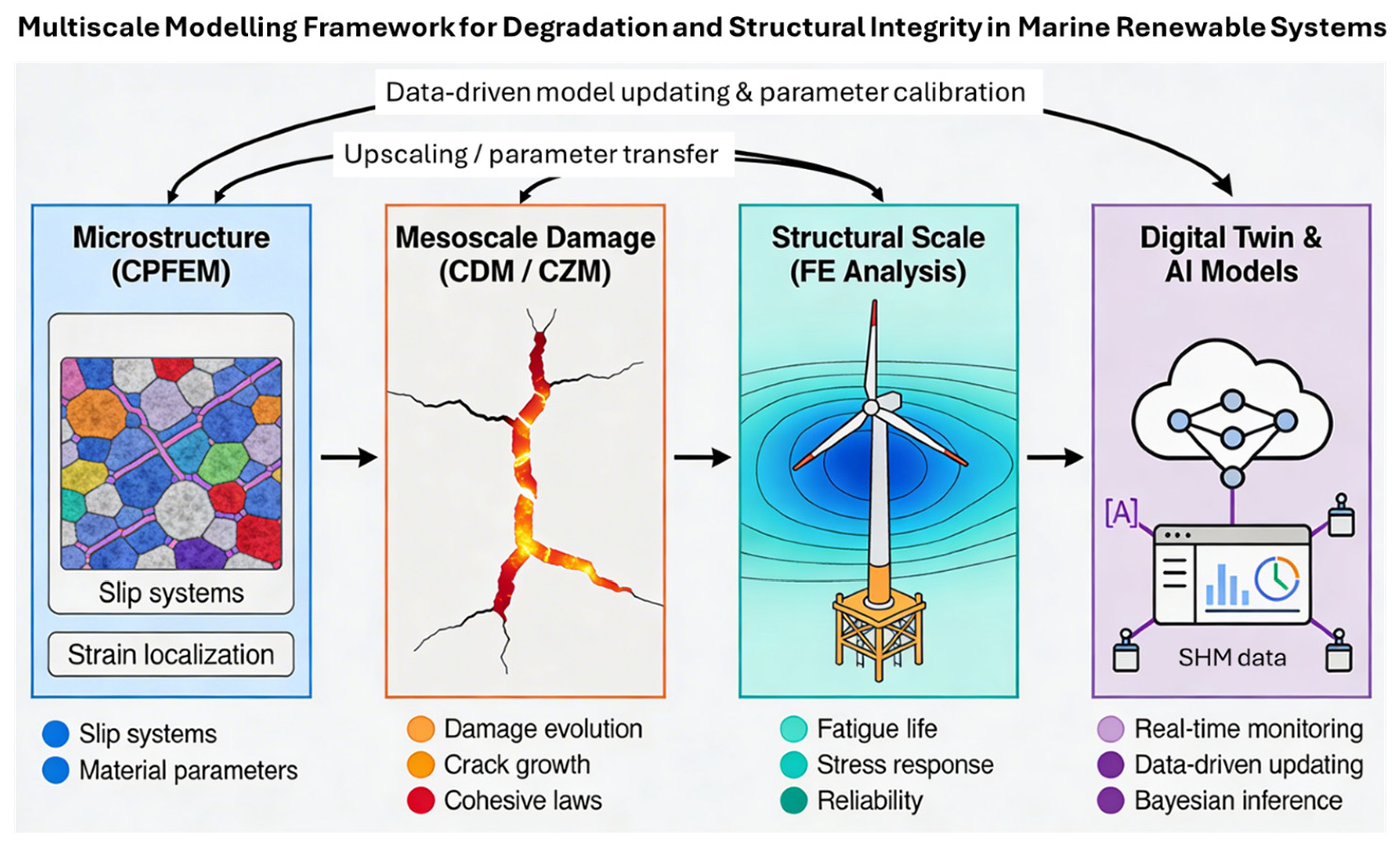
Bridging the gap between microstructure-scale degradation mechanisms and structural system reliability requires hierarchical computational frameworks that integrate physics across multiple length scales. While a wide range of modelling approaches exists, their application to marine renewable energy systems remains fragmented, with limited consistency in information transfer across scales. Microstructure-resolved models provide detailed insight into fundamental deformation and damage mechanisms but are computationally demanding, whereas structural-scale models are efficient but rely heavily on empirical or homogenised assumptions. A key challenge, therefore, lies in developing hierarchical multiscale frameworks that enable consistent parameter transfer and uncertainty propagation across scales, allowing physically informed and computationally tractable structural integrity assessment. This hierarchical framework is illustrated schematically in
Figure 8.
5.1. Microstructure-Resolved Modelling
Crystal plasticity finite element modelling (CPFEM) provides a physically grounded framework for capturing microstructure-sensitive deformation by explicitly resolving crystallographic slip at the grain scale [
93,
97,
98]. These approaches enable direct linkage between grain orientation, phase distribution, slip localisation, and macroscopic mechanical response.
A major advantage of CPFEM lies in its ability to generate physically informed damage indicators relevant to crack initiation and localisation. Common outputs include:
Accumulated plastic strain energy density;
Grain boundary stress concentrations;
Dislocation density evolution;
Fatigue indicator parameters (FIPs) linked to cyclic localisation [
99,
100,
101].
These quantities provide mechanistic insight into preferential crack nucleation sites and enable incorporation of microstructural variability into probabilistic fatigue assessment frameworks [
102].
However, CPFEM remains computationally expensive and requires extensive experimental calibration [
93]. As a result, its primary role within multiscale frameworks is not direct structural analysis but rather the generation of physically informed constitutive behaviour, damage metrics, and variability descriptors that can be transferred to higher-scale models.
A key challenge in hierarchical modelling is preserving physically relevant information during scale transition. Traditional homogenisation approaches may average out localised driving forces governing crack initiation and fatigue variability [
103]. Recent studies therefore emphasise probabilistic transfer of microstructure-sensitive damage indicators rather than purely deterministic homogenised quantities [
104]. Such approaches enable more physically consistent linkage between microstructural behaviour and engineering-scale reliability assessment.
In contrast to classical structural scaling approaches based purely on geometric similarity, multiscale structural integrity frameworks rely on physically representative scale transitions. Representative volume elements (RVEs) are selected such that the governing deformation and damage mechanisms remain statistically representative of the underlying microstructure while maintaining computational tractability [
103]. Consequently, scale selection is governed not by a single geometric scaling ratio but by preservation of physically relevant quantities including strain localisation, crack-tip fields, phase interactions, and damage evolution behaviour. Homogenisation procedures, localisation metrics, and uncertainty propagation techniques are therefore used to ensure physically consistent transfer of information between CPFEM, mesoscale damage models, and structural-scale reliability assessment frameworks.
5.2. Mesoscale Structural Damage Modelling
Mesoscale damage models provide a critical bridge between microstructure-resolved deformation mechanisms and structural-scale integrity assessment. At this scale, damage is represented either explicitly through discrete crack models or implicitly via continuum degradation approaches.
Cohesive zone modelling (CZM) describes crack initiation and propagation through traction–separation relationships defined along predefined or evolving interfaces [
45,
105]. These approaches are particularly effective for representing:
Complementary to CZM, continuum damage mechanics (CDM) represents material degradation through internal state variables that reduce the effective stiffness of the material [
45,
105,
106]. Such models capture distributed damage evolution associated with ductile fracture, void growth, and cyclic degradation under multiaxial loading conditions relevant to offshore structures [
107].
For cyclic loading, fracture mechanics approaches are commonly employed to represent crack propagation behaviour, particularly under corrosion–fatigue conditions where environmental exposure accelerates crack growth relative to air conditions [
56,
69]. Mesoscale approaches therefore provide a practical framework for incorporating physically informed damage evolution into structural analysis. However, their predictive capability depends strongly on parameter calibration from lower-scale simulations and targeted experimental observations. This highlights the importance of consistent information transfer between microstructure-sensitive models and engineering-scale integrity assessment.
5.3. Macroscale Structural Integrity Assessment
At the structural scale, integrity assessment frameworks combine environmental loading, stress analysis, fatigue accumulation, and reliability evaluation to predict structural performance of marine renewable systems [
33]. These approaches form the basis of current offshore engineering practice.
Structural fatigue assessment typically combines:
Metocean loading statistics;
Aero-hydro-servo-elastic simulations;
Stress cycle counting procedures;
Cumulative damage evaluation using S–N methodologies.
The total accumulated fatigue damage is commonly expressed using linear cumulative damage formulations:
where
represents the occurrence probability of a given sea state,
the number of cycles at a given stress range, and
the corresponding fatigue capacity [
32].
For components containing defects or detected cracks, fracture mechanics approaches are employed to estimate remaining life. Crack growth is commonly described using Paris-type relationships, with the remaining number of cycles obtained by integrating crack growth rate from an initial to a critical crack size:
where crack growth depends on stress intensity factor range and material crack growth constants [
35].
Reliability-based design frameworks incorporate uncertainties associated with loading, material behaviour, stress concentration, and modelling assumptions. Structural reliability is commonly represented through limit state formulations:
where resistance and loading effects are treated probabilistically [
108,
109,
110,
111].
Although these structural-scale approaches remain central to offshore design practice, they rely heavily on empirical S–N relationships, simplified cumulative damage assumptions, and deterministic safety factors. Consequently, they often struggle to capture variable-amplitude loading effects, microstructure-sensitive crack initiation, corrosion-assisted degradation, and coupled multiphysics behaviour characteristic of marine renewable systems.
Table 5 summarises the above discussed methods. Among these approaches, mechanism-based multiscale frameworks offer the greatest potential for future marine renewable applications because they enable physically consistent representation of coupled degradation mechanisms across scales.
5.4. Coupled Multiphysics Modelling
In marine environments, structural degradation is inherently governed by the interaction of mechanical loading with electrochemical, hydrogen, and thermal processes. Accurate prediction of structural integrity therefore requires coupled multiphysics formulations that capture these interactions within a unified framework.
Corrosion–mechanics coupling links electrochemical dissolution with evolving stress and strain fields [
38,
56]. Local stress concentration may accelerate corrosion kinetics, while evolving corrosion geometry modifies local mechanical response and crack driving force.
Hydrogen-assisted degradation introduces additional coupling between diffusion and stress fields [
37]. Hydrogen transport is strongly influenced by hydrostatic stress, resulting in preferential accumulation near crack tips and highly stressed regions [
63]. These effects may be incorporated into finite element frameworks capable of simultaneously solving diffusion and mechanical fields.
Thermomechanical coupling is also important in offshore systems incorporating hydrogen production or thermal process equipment. Thermal gradients generate additional stress fields and influence both corrosion kinetics and fatigue behaviour [
58]. Collectively, these multiphysics interactions demonstrate that marine degradation mechanisms cannot be treated independently. However, current coupled formulations remain computationally demanding and are generally limited to component-scale simulations. Extending such approaches toward full structural-scale reliability assessment therefore remains a major challenge for next-generation offshore integrity frameworks.
5.5. Digital Twins and Data-Driven Modelling
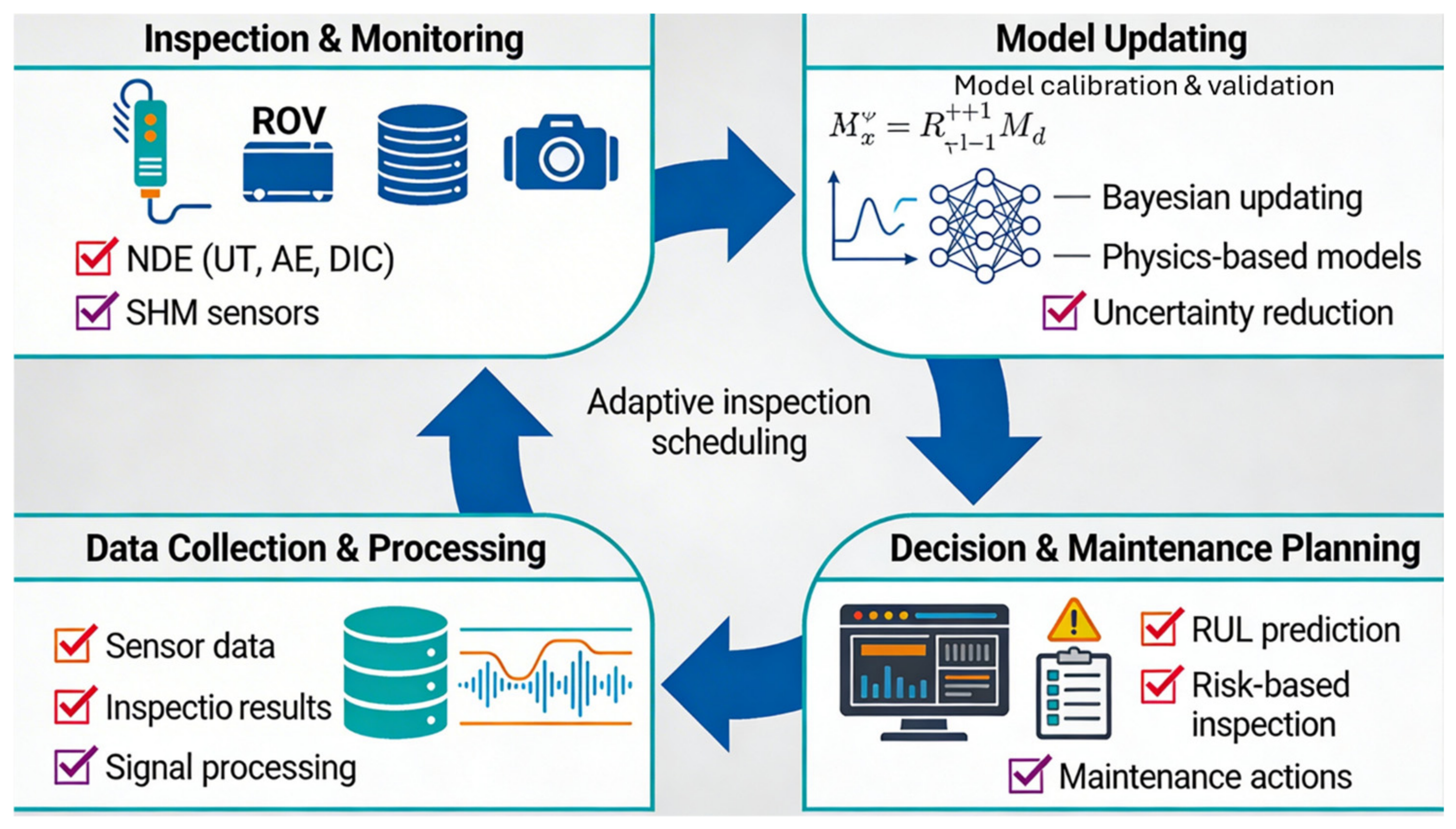
Digital twin and data-driven approaches provide a pathway for integrating physics-based modelling with real-time operational data, enabling adaptive structural integrity assessment throughout service life. However, practical deployment within marine renewable systems remains at an early stage due to challenges associated with data quality, sensor durability, computational cost, and model validation.
Machine learning approaches trained using inspection data, SHM measurements, and simulation outputs can capture complex non-linear relationships difficult to represent using purely mechanistic models [
111]. Common applications include:
Image-based damage detection;
Vibration and strain prediction;
Corrosion evolution forecasting;
Remaining useful life (RUL) estimation.
Modern probabilistic machine learning methods additionally enable uncertainty quantification, providing confidence bounds necessary for risk-informed maintenance decisions (see [
111] and references therein).
To improve physical consistency, increasing attention is being given to hybrid digital twin frameworks combining physics-based modelling with machine learning correction. Physics-informed machine learning (PIML) approaches, including physics-informed neural networks (PINNs), embed governing physical constraints directly within the learning process [
112]. Such approaches are particularly attractive for offshore applications where data availability remains limited and multiphysics interactions are complex.
Digital twins extend this concept into cyber-physical systems integrating:
Typical offshore monitoring systems provide measurements of strain, acceleration, vibration, temperature, and environmental conditions. These measurements are assimilated into computational models through Bayesian updating or filtering approaches, enabling refinement of reliability predictions and maintenance planning throughout service life [
47,
108].
Despite rapid research growth, most offshore digital twin implementations remain at the demonstration level [
113,
115,
116]. Widespread industrial adoption requires:
Validated workflows;
Robust uncertainty quantification;
Standardised architectures;
Clear model credibility metrics;
Reliable long-term sensing strategies in harsh marine environments.
Within multiscale frameworks, digital twins should therefore be viewed not as replacements for physics-based modelling but as complementary tools enabling continuous model updating, uncertainty reduction, and adaptive lifecycle management.
5.6. Comparative Assessment of Modelling Approaches
To contextualise the applicability of different modelling approaches,
Table 6 provides a comparative overview of their capabilities, limitations, and industrial readiness. No single approach is sufficient in isolation. Effective integrity assessment requires hierarchical integration, where lower-scale models inform constitutive behaviour and uncertainty bounds at higher scales.
6. Manufacturing-Induced Performance Variability
Manufacturing processes fundamentally define the as-built material state, which subsequently governs degradation behaviour and structural performance in marine renewable energy systems. Variability introduced during fabrication, including process-induced heterogeneity, residual stresses, and defect populations, represents a major source of uncertainty in fatigue life prediction and structural reliability, often exceeding the influence of nominal material properties alone.
These effects are closely linked to the degradation mechanisms discussed in
Section 4 but are not explicitly represented within most conventional offshore design methodologies. Instead, manufacturing variability is typically incorporated indirectly through empirical safety factors and conservative qualification procedures. However, as marine renewable systems increasingly utilise advanced materials, complex welded geometries, and additive manufacturing processes, process-induced variability becomes more spatially heterogeneous and mechanistically significant.
Consequently, manufacturing-aware structural integrity assessment is increasingly required, where fabrication history, microstructure evolution, defect populations, and residual stress states are explicitly linked to structural performance and degradation behaviour. The following sections examine key manufacturing processes and their associated sources of variability, highlighting their impact on degradation mechanisms and structural reliability.
6.1. Welding and Joining Effects
Welded joints represent the dominant source of manufacturing-induced variability in offshore steel structures and are widely recognised as critical locations for fatigue crack initiation and structural degradation.
Thermal cycles during welding modify local microstructures within the heat-affected zone (HAZ), producing spatial variations in toughness, hardness, and fatigue resistance [
34]. Characteristic regions such as the coarse-grained HAZ (CGHAZ), fine-grained HAZ (FGHAZ), and inter-critical HAZ (ICHAZ) exhibit different microstructural features and mechanical behaviour [
69]. In multi-pass welds, reheating effects may further generate inter-critically reheated regions associated with reduced toughness and preferential crack propagation paths [
39].
Welding additionally introduces tensile residual stresses and geometric discontinuities that increase local stress concentration and accelerate fatigue crack initiation. Weld defects including porosity, lack of fusion, slag inclusions, and undercut defects may act as pre-existing crack-like flaws, substantially reducing fatigue life [
35,
47].
High-strength steels are particularly sensitive to welding-induced microstructural transformations and hydrogen-assisted cracking susceptibility. Consequently, welding procedure specifications (WPS), including control of preheat temperature, interpass temperature, and heat input, play a critical role in managing residual stress and microstructural evolution [
69].
Although current offshore design methodologies account for welding effects through fatigue class reductions and conservative design rules, these approaches generally do not explicitly resolve local microstructural heterogeneity, residual stress distributions, or stochastic defect populations. As a result, welded joints remain one of the largest sources of uncertainty in offshore fatigue assessment.
6.2. Additive Manufacturing and Hybrid Manufacturing
Additive manufacturing (AM) enables geometrically complex structures, lightweight topologies, and repair strategies difficult to achieve using conventional fabrication methods. However, the layer-by-layer deposition process introduces significant variability in residual stress, microstructure, and defect populations, all of which strongly influence structural performance.
Residual stress formation in AM differs fundamentally from conventional welding due to repeated localised thermal cycling and complex scan strategies [
78,
79]. These effects generate spatially varying residual stress fields that may promote distortion, crack initiation, and fatigue degradation.
Microstructural evolution is similarly governed by local thermal gradients and solidification conditions, producing anisotropic grain structures and orientation-dependent mechanical behaviour [
79]. AM components therefore commonly exhibit:
Pronounced anisotropy;
Heterogeneous microstructures;
Elevated fatigue scatter;
Strong process sensitivity.
Defect populations including porosity, lack-of-fusion defects, unmelted particles, and surface roughness irregularities further contribute to fatigue variability and reduced structural reliability [
82].
Modern qualification approaches increasingly incorporate:
However, universally accepted qualification frameworks for large-scale offshore AM components remain under development.
Consequently, additive manufacturing strongly motivates process-informed and probabilistic structural integrity methodologies capable of explicitly accounting for process–structure–property relationships and manufacturing-induced variability.
6.3. Surface Engineering and Coatings
Surface engineering and coating systems are widely employed to improve corrosion and wear resistance in marine renewable energy systems. Their effectiveness, however, depends strongly on coating integrity, adhesion quality, and long-term durability under combined environmental and mechanical loading.
Wear-resistant coatings such as WC–Co and Cr
3C
2–NiCr thermal spray systems are commonly applied to components exposed to erosive environments, including tidal turbine blades and leading-edge regions [
60]. Corrosion protection systems typically utilise multilayer coating architectures comprising primers, barrier coatings, and environmental topcoats [
38].
Although coatings provide important environmental protection, their degradation can significantly accelerate structural damage. Coating defects, porosity, cracking, or debonding may allow seawater ingress, leading to under-coating corrosion and localised degradation [
50]. Thermal mismatch between coating and substrate may additionally generate residual stresses that influence fatigue performance [
81].
Importantly, coating degradation often acts as a trigger for accelerated corrosion–fatigue and environmentally assisted cracking within the underlying substrate material. Consequently, coatings should not be treated as permanent barriers but rather as degradation-sensitive systems requiring ongoing inspection, monitoring, and maintenance throughout service life.
6.4. Process → Structure → Property → Performance Linkages
The process–structure–property–performance (PSPP) paradigm provides a unified framework linking manufacturing processes to structural integrity and lifecycle performance [
117]. Within this framework, manufacturing is treated not as an external factor but as a primary driver of microstructural state, mechanical response, and structural reliability.
At the process level, fabrication conditions such as thermal history, cooling rate, and heat input govern microstructural evolution, including:
These microstructural features subsequently determine local mechanical properties including strength, ductility, fatigue resistance, and fracture toughness. Importantly, such properties are spatially heterogeneous rather than uniform throughout the component.
Incorporating this variability into structural-scale analysis enables more realistic prediction of stress localisation, crack initiation, and fatigue life compared with conventional approaches based solely on nominal material properties [
39]. Studies incorporating manufacturing-induced heterogeneity into structural assessment consistently demonstrate substantial differences in predicted fatigue performance relative to idealised homogeneous assumptions.
More broadly, PSPP relationships provide a framework for integrating manufacturing variability into multiscale modelling approaches. By linking process simulations, microstructure evolution, property prediction, and structural analysis, these approaches enable consistent transfer of information across scales, reducing reliance on empirical assumptions.
Table 7 summarises representative manufacturing processes, principal variability sources, and their primary structural implications.
Overall, manufacturing-induced variability represents a critical link between material behaviour and structural performance in marine renewable systems. Defects, residual stresses, and microstructural heterogeneity strongly influence crack initiation, degradation evolution, and failure probability, reinforcing the need for manufacturing-aware and mechanism-resolved structural integrity assessment frameworks.
7. Inspection, Monitoring, and Lifetime Prediction
Inspection and monitoring systems provide the critical link between predicted and actual structural behaviour, enabling validation and continuous updating of degradation models under real operating conditions. In marine renewable energy systems, where environmental variability and manufacturing-induced uncertainty are significant, inspection data plays a vital role in reducing uncertainty and improving reliability through adaptive, data-informed structural integrity assessment.
As illustrated in
Figure 9, inspection, monitoring, and decision-making form a closed-loop framework in which information flows continuously between data acquisition, model updating, and maintenance planning. Non-destructive evaluation (NDE) techniques and structural health monitoring (SHM) systems provide data on structural condition, which is subsequently integrated into physics-based and data-driven models. Bayesian and statistical updating approaches are then used to refine estimates of damage state, degradation evolution, and remaining useful life (RUL).
The updated predictions inform risk-based inspection scheduling and maintenance decisions, which in turn influence future inspection strategies. This feedback loop enables a transition from static, design-stage assessment toward dynamic lifecycle management, where structural integrity is continuously refined based on operational evidence.
This integrated framework is particularly important for marine renewable systems, where harsh environments, variable loading, and manufacturing variability limit the reliability of purely predictive approaches. By incorporating inspection and monitoring data within multiscale modelling frameworks, more robust prediction of degradation evolution and structural reliability becomes possible.
7.1. Non-Destructive Evaluation Techniques
Non-destructive evaluation (NDE) and structural health monitoring (SHM) systems provide essential information on structural condition without interrupting operation. Within multiscale structural integrity frameworks, these techniques are important not only for defect detection but also for supplying physically relevant data used in model calibration, uncertainty reduction, and digital twin updating.
Ultrasonic inspection techniques, including phased array ultrasonic testing (PAUT), are widely used for identifying internal defects such as fatigue cracks, weld discontinuities, and corrosion damage in offshore structure [
116]. Within structural integrity frameworks, ultrasonic methods primarily provide crack size and geometry, defect location, weld integrity information, and crack growth monitoring data.
Acoustic emission (AE) systems provide passive monitoring of active degradation processes by detecting transient elastic waves associated with crack propagation, corrosion activity, or local damage evolution [
111]. AE methods are particularly valuable for:
Identifying active damage regions;
Detecting onset of crack growth;
Continuous large-area monitoring;
Supporting early warning system [
114].
Digital image correlation (DIC) offers full-field strain measurement by tracking surface deformation patterns between successive images [
67]. This technique enables detailed characterisation of strain localisation, particularly in critical regions such as welded joints and crack tips. While DIC is widely used in laboratory validation, its offshore application remains more limited, typically involving fixed camera systems monitoring selected regions at discrete intervals [
113].
Structural health monitoring (SHM) systems provide continuous operational measurements using permanently installed sensors including strain gauges, accelerometers, tiltmeters, corrosion probes, and fibre optic sensing system [
118,
119]. These systems supply:
Strain histories;
Vibration characteristics;
Environmental loading data;
Temperature distributions;
Long-term degradation trends.
Importantly, no single monitoring technique captures all relevant degradation mechanisms. Ultrasonic methods provide information on existing defects, AE captures active damage processes, while SHM systems deliver continuous operational response data. Consequently, modern structural integrity frameworks increasingly rely on integration of multiple inspection modalities within the closed-loop architecture illustrated in
Figure 9.
Rather than serving solely as inspection tools, NDE and SHM systems now function as critical data sources within multiscale modelling and digital twin frameworks, enabling continuous updating of degradation models and reliability predictions throughout service life.
7.2. Inspection-Driven Structural Integrity Models
Inspection-driven structural integrity models provide a formal framework for integrating field observations with physics-based degradation models, enabling continuous refinement of structural integrity predictions throughout service life. Within this approach, inspection data acts not only as a diagnostic input but also as a key source of probabilistic information for updating model predictions.
Bayesian updating approaches are widely employed to incorporate inspection evidence into reliability assessment frameworks [
108]. Structural condition variables such as crack size, corrosion depth, or damage state are represented probabilistically, with initial distributions derived from design-stage modelling and prior assumptions.
Inspection results are incorporated through likelihood functions associated with the probability of detection (POD) characteristics of the inspection technique [
47]. For example:
Ultrasonic inspection updates crack size distributions;
AE monitoring updates active damage probability;
SHM measurements refine loading and degradation histories.
Repeated inspections progressively reduce uncertainty and improve confidence in predicted structural condition [
110]. Depending on problem complexity, updating may be performed using analytical Bayesian approaches or numerical methods such as Markov Chain Monte Carlo (MCMC) techniques.
As illustrated in
Figure 9, the updated structural state feeds directly into model calibration, degradation prediction, and maintenance decision-making. Inspection therefore becomes an active component of predictive structural integrity assessment rather than simply a periodic verification activity.
Within multiscale frameworks, inspection-driven updating is particularly important because it enables reconciliation between lower-scale degradation models and observed structural behaviour, thereby improving reliability prediction and reducing model-form uncertainty.
7.3. Reliability-Based Maintenance Strategies
Maintenance strategies in marine renewable systems are increasingly transitioning from deterministic, schedule-based approaches towards reliability- and risk-informed frameworks that explicitly account for uncertainty in degradation processes. Within the closed-loop paradigm illustrated in
Figure 9, inspection data, model updating, and decision-making are tightly coupled to enable adaptive lifecycle management.
Risk-based inspection (RBI):
Inspection planning is prioritised based on quantified risk, defined as the product of failure probability (
and consequence (
):
Components are ranked according to their risk contribution, enabling targeted allocation of inspection resources to critical locations [
116]. For example, structural hotspots such as monopile mudlines and jacket joints typically exhibit higher risk due to combined fatigue loading and environmental exposure, whereas lower-risk components are inspected less frequently [
110]. This prioritisation ensures that inspection effort is aligned with structural criticality and reliability targets.
Predictive and condition-based maintenance:
Traditional time-based inspection intervals are increasingly replaced by condition-based strategies informed by monitoring data [
111]. Structural health monitoring systems continuously provide cumulative fatigue damage indicators, vibration signatures, strain evolution, and environmental exposure histories.
These measurements support adaptive maintenance planning and enable early identification of abnormal degradation behaviour.
Remaining useful life (RUL) prediction:
Remaining useful life estimation combines inspection data, degradation modelling, and probabilistic updating to predict future structural performance [
47]. Typical RUL approaches integrate:
Fracture mechanics crack growth models;
Measured loading histories:
Environmental degradation effects;
Uncertainty quantification frameworks.
Bayesian updating enables continuous refinement of RUL predictions as new inspection and monitoring data become available [
110]. Importantly, probabilistic RUL estimation provides confidence bounds on predicted service life, supporting risk-informed maintenance and operational decision-making.
Overall, integration of inspection data, SHM systems, probabilistic updating, and physics-based degradation modelling enables adaptive structural integrity management throughout service life. This closed-loop framework forms a key foundation for future digital twin-enabled lifecycle management of marine renewable energy infrastructure.
8. Qualification and Design Standards: Current Gaps
Qualification and design standards provide the foundation for structural integrity assessment in marine renewable energy systems, defining accepted methodologies for design, material selection, inspection, and lifecycle management. However, these frameworks have largely evolved from offshore oil and gas practices and remain predominantly empirical in nature, relying on historical datasets, simplified damage models, and conservative safety factors.
As highlighted in preceding sections, degradation in marine renewable systems is governed by complex, interacting mechanisms spanning multiple length and time scales, including microstructure-sensitive fatigue, corrosion–fatigue coupling, hydrogen-assisted cracking, and manufacturing-induced variability. While advanced modelling approaches (
Section 5) and inspection-informed updating frameworks (
Section 7) offer the capability to capture these mechanisms, their integration into current standards remains limited.
This disconnect becomes increasingly critical as marine renewable systems grow in scale, operate under more severe cyclic loading, and incorporate advanced materials and manufacturing processes. Consequently, existing qualification approaches may introduce excessive conservatism in some cases while failing to capture critical degradation mechanisms in others.
These limitations highlight the need for a transition from purely empirical design frameworks towards mechanism-informed, data-integrated qualification methodologies that combine physics-based modelling, probabilistic assessment, and inspection-driven updating. The following sections critically examine current standards, identify key limitations, and outline pathways toward next-generation qualification frameworks.
8.1. Existing Offshore and Marine Standards
Offshore renewable energy design frameworks are largely derived from established oil and gas industry standards, adapted to account for wind- and wave-induced loading conditions. These standards provide comprehensive guidance for structural design, material qualification, and inspection planning, forming the basis of current engineering practice.
Structural design is primarily governed by standards such as DNV-ST-0126, which provides design requirements for offshore wind turbine support structures, including both fixed and floating configurations. Fatigue design is typically addressed using recommended practices such as DNV-RP-C203, which defines S–N curves and fatigue assessment procedures, while ISO 19902 provides broader guidance for fixed offshore steel structures. In parallel, IEC 61400-3-1 establishes design requirements specific to offshore wind energy systems, integrating environmental loading and turbine–structure interaction considerations [
57,
116,
120,
121].
Material qualification and fabrication are addressed through standards such as DNV-ST-C502 for offshore concrete structures [
122] and AWS D1.1 for structural welding [
123], which define testing procedures, acceptance criteria, and welding qualification requirements. Supporting guidelines, including DNVGL-CG-0129 [
57], provide material property data and fatigue design parameters derived from experimental databases.
Inspection and integrity management are guided by probabilistic frameworks such as DNV-RP-C210 [
116], which supports risk-based inspection planning for fatigue-critical components. More recently, standards such as DNVGL-RP-0001 [
124] have begun to address emerging technologies, including the qualification and assurance of digital twins, reflecting the increasing role of data-driven approaches in structural integrity assessment.
While these standards provide a robust and widely accepted foundation for design and lifecycle management, they are predominantly based on empirical relationships and historical datasets. As a result, their ability to capture emerging materials, complex multiphysics degradation mechanisms, and manufacturing-induced variability remains limited, particularly in the context of next-generation marine renewable energy systems.
8.2. Limitations of Current Qualification Approaches
Despite their widespread adoption, current qualification approaches exhibit fundamental limitations in their ability to represent the underlying physics governing degradation and structural performance. These limitations arise primarily from the reliance on empirical formulations that do not fully capture the multiscale and multiphysics nature of damage evolution in marine environments.
A key limitation lies in the treatment of materials as homogeneous continua within fatigue design methodologies. Conventional S–N curve approaches neglect microstructural effects such as grain size, crystallographic texture, phase distribution, and local heterogeneity within heat-affected zones (HAZs) [
42]. As discussed in
Section 4 and
Section 5, these features play a critical role in crack initiation and early damage evolution. Their omission necessitates the use of conservative safety factors, typically on the order of 1.5–3.0, which may penalise advanced materials and restrict design optimisation.
A second limitation is the lack of mechanistic coupling between interacting degradation processes. While standards account for environmental effects through empirical reduction factors, for example, applying fatigue life reduction factors for seawater exposure, they do not explicitly model the interaction between electrochemical processes, cyclic loading, and hydrogen effects [
56]. Consequently, key phenomena such as corrosion–fatigue interaction, hydrogen-assisted cracking, and coating degradation are treated in a simplified and decoupled manner, limiting predictive capability under realistic service conditions.
Manufacturing-induced variability represents a further source of discrepancy between qualification and in-service performance. Current qualification procedures, particularly for welded structures, rely on limited testing of procedure qualification records (PQRs), often based on a small number of specimens under controlled conditions [
39]. These tests do not adequately capture the statistical variability associated with production-scale welding, including residual stress distributions, defect populations, and geometric variability. As a result, the influence of manufacturing on structural performance is only partially represented.
These challenges are further amplified for emerging manufacturing technologies such as additive manufacturing, where variability in microstructure, defect distribution, and mechanical properties remains significantly higher than in conventional processes [
82]. The absence of standardised qualification methodologies, coupled with limited long-term performance data, introduces substantial uncertainty in the structural reliability of additively manufactured components.
Collectively, these limitations indicate that current qualification frameworks remain largely disconnected from the physical mechanisms governing material degradation and failure. Their reliance on conservative empirical factors can lead either to over-conservative designs or, in some cases, insufficient representation of critical degradation processes. This highlights the need for a transition towards mechanism-informed qualification approaches that integrate multiscale modelling, multiphysics coupling, and inspection-driven updating.
8.3. Need for Mechanism-Resolved Qualification Frameworks
Addressing the limitations identified above requires a fundamental shift towards mechanism-resolved qualification frameworks, in which material behaviour, degradation processes, and structural response are explicitly linked through multiscale modelling and inspection-informed updating. Rather than relying solely on empirical testing and historical datasets, future qualification approaches must integrate validated physics-based models with targeted experimental evidence.
A central requirement is the explicit incorporation of microstructure–property relationships. Advanced modelling approaches, such as crystal plasticity and phase-field methods, calibrated using micromechanical testing and microstructural characterisation (e.g., nanoindentation, micropillar testing, and EBSD), enable prediction of fatigue behaviour and damage initiation based on material microstructure [
42]. This provides a pathway for evaluating material performance beyond conventional S–N curve representations.
In parallel, manufacturing processes must be explicitly incorporated into qualification through process–structure modelling. Thermal–metallurgical–mechanical simulations enable prediction of residual stress fields, microstructural evolution, and defect distributions, providing realistic as-manufactured material states as input to structural analyses [
78]. This represents a departure from traditional approaches that assume nominal material properties.
A further requirement is the integration of coupled multiphysics degradation models. As discussed in earlier sections, degradation mechanisms in marine environments arise from interactions between electrochemical processes, mechanical loading, hydrogen diffusion, and environmental exposure. Finite element frameworks capable of capturing these coupled phenomena are essential for realistic prediction of damage evolution under service conditions [
56].
Equally important is the incorporation of inspection-informed updating within the qualification process. Bayesian frameworks enable continuous refinement of degradation predictions as inspection data becomes available, allowing qualification to evolve over the structure’s lifetime rather than remaining fixed at the design stage [
47]. This capability is further enhanced through integration with digital twin architectures, where real-time sensor data and operational information are assimilated into predictive models to provide asset-specific structural integrity assessment [
111].
Collectively, these elements establish a mechanism-resolved approach that reduces reliance on extensive empirical testing, enables qualification of novel materials and manufacturing routes, and provides transparent safety margins grounded in physical understanding rather than historical precedent. Such frameworks support a transition from static, design-stage qualification towards dynamic, lifecycle-based assessment, in which structural integrity is continuously evaluated and updated.
Table 8 summarises the key differences between current empirical approaches and mechanism-based qualification frameworks. Overall, while existing standards provide a necessary baseline for structural design, they lack the capability to fully capture the complex, coupled degradation processes present in marine renewable systems. Bridging this gap requires integration of multiscale modelling, manufacturing-aware analysis, and inspection-informed updating within unified qualification frameworks. The following section builds upon these concepts to present an integrated mechanism-resolved design and qualification framework.
9. Future Framework: Mechanism-Resolved Reliability Design
Building on the limitations identified in current qualification approaches (
Section 8), this section presents an integrated mechanism-resolved reliability framework for marine renewable energy systems. The proposed framework synthesises advances in multiscale modelling (
Section 5), manufacturing-aware analysis (
Section 6), and inspection-informed updating (
Section 7) into a unified design and qualification methodology.
In contrast to conventional approaches, which rely on empirical relationships, static safety factors, and decoupled analyses, the proposed framework explicitly links material behaviour, degradation mechanisms, and structural response across scales. This integration enables a physically consistent representation of damage initiation, propagation, and failure under realistic service conditions.
A key feature of the framework is the transition from static, design-stage qualification to dynamic, lifecycle-based structural integrity assessment. By incorporating manufacturing variability, environmental interactions, and continuously updated inspection data, the framework supports adaptive prediction of structural performance and reliability over time.
This mechanism-resolved approach provides a pathway for reducing design conservatism while maintaining safety, enabling qualification of advanced materials and manufacturing processes, and supporting digital twin-based asset management. The following subsections outline the key components of the framework and their integration into a closed-loop reliability design methodology.
9.1. Proposed Integrated Design Framework
The proposed framework is structured around four interconnected pillars that collectively enable mechanism-resolved structural integrity assessment across the full lifecycle of marine renewable energy systems. As illustrated in
Figure 10, these pillars form a closed-loop reliability framework, in which information continuously circulates between multiscale modelling, manufacturing qualification, digital twin integration, and adaptive inspection and maintenance. Unlike conventional approaches, this framework explicitly links material behaviour, as-manufactured state, operational data, and decision-making within a unified and continuously evolving system.
9.1.1. Pillar 1: Multiscale Modelling
The first pillar establishes a hierarchical modelling chain linking processing → structure → properties → performance [
117]. At the microscale, material behaviour is represented using synthetic microstructure generation techniques (e.g., Voronoi tessellation, phase-field methods) or direct EBSD-based inputs capturing grain morphology, crystallographic texture, and phase distribution. Crystal plasticity finite element modelling (CPFEM) is employed to resolve stress–strain heterogeneity and identify damage initiation indicators such as fatigue indicator parameters (FIPs).
At the mesoscale, statistically representative volume element (RVE) homogenization provides effective constitutive laws for continuum-scale modelling, while damage evolution is captured using continuum damage mechanics (CDM) and cohesive zone models (CZMs). These models are subsequently integrated into macroscale finite element (FE) simulations to predict structural response, fatigue life, and reliability under realistic loading conditions.
Uncertainty quantification, typically through Monte Carlo sampling across microstructural realizations, provides statistical bounds on performance [
42]. Importantly, this pillar enables upscaling and parameter transfer across length scales, while also allowing feedback from higher-scale observations to refine lower-scale models. These outputs provide the foundational material behaviour and uncertainty bounds required for manufacturing qualification and structural analysis.
9.1.2. Pillar 2: Manufacturing Qualification
The second pillar captures the as-manufactured state, which plays a critical role in determining structural performance. Process monitoring and control are achieved through in situ sensing techniques, such as weld thermal imaging and additive manufacturing melt pool monitoring, providing real-time indicators of fabrication quality. These measurements are coupled with process–structure models to predict microstructural evolution, residual stress distributions, and defect populations based on thermal histories [
78].
Statistical process control frameworks track key manufacturing indicators (e.g., heat input variability, defect occurrence rates), enabling early detection of deviations and corrective action. Additionally, comprehensive as-built documentation, including geometry, residual stress measurements, and process histories, is generated for each component.
This pillar transforms manufacturing from a deterministic assumption into a data-rich input, where the resulting as-built state feeds directly into digital twin initialization and subsequent structural integrity assessment.
9.1.3. Pillar 3: Digital Twin Integration
The third pillar introduces a cyber-physical system that maintains a continuously updated digital representation of the physical asset [
113]. The digital twin is initialised using calibrated FE models that incorporate as-manufactured properties, including measured residual stresses, geometry deviations, and material heterogeneity.
During operation, real-time data from structural health monitoring (SHM) systems—such as strain, acceleration, tilt, and temperature—are assimilated alongside environmental inputs (wind, waves) using filtering techniques (e.g., Kalman filtering) to continuously update the structural state.
Physics-based degradation models are then applied to predict damage evolution and estimate remaining useful life (RUL) with associated uncertainty bounds.
Crucially, this pillar enables data-driven model updating and parameter calibration, ensuring that predictions remain consistent with observed structural behaviour. The updated state information forms the basis for decision-making and maintenance planning.
9.1.4. Pillar 4: Adaptive Inspection and Maintenance
The fourth pillar closes the loop by linking model predictions to inspection and maintenance strategies. Initial inspection plans are derived from design-stage reliability assessments, typically using risk-based methodologies. As inspection data become available—such as crack detection or measured defect sizes—Bayesian updating techniques are used to refine probabilistic descriptions of damage states and structural reliability [
110].
This updated information enables re-optimization of inspection intervals, selection of appropriate inspection techniques, and prioritization of critical components. Maintenance actions are triggered based on predicted reliability thresholds and RUL estimates, transitioning from fixed schedules to condition-based and predictive maintenance strategies.
Importantly, inspection outcomes and operational data are fed back into both the digital twin and multiscale modelling frameworks, enabling continuous improvement of predictive capability and informing future design practices.
9.1.5. Framework Integration and Closed-Loop Operation
Collectively, these four pillars establish a closed-loop, mechanism-resolved framework that links material-scale behaviour to system-level performance while continuously incorporating real-world data. The interaction between pillars, material and manufacturing inputs, as-built state transfer, data-driven model updating, and feedback to modelling, ensures that structural integrity assessment evolves throughout the lifecycle of the asset.
This integrated approach represents a shift from static, design-stage qualification toward adaptive, data-informed lifecycle management, enabling reduced uncertainty, improved reliability prediction, and more efficient inspection and maintenance strategies.
9.2. Integration with Materials 4.0 and Industry 5.0
Emerging paradigms such as Materials 4.0 and Industry 5.0 provide enabling capabilities for the implementation of mechanism-resolved reliability frameworks, supporting the integration of data-driven methodologies, physics-based modelling, and lifecycle management.
Materials 4.0 represents a data-centric approach to materials development, combining high-throughput experimentation, computational modelling, and machine learning to accelerate material discovery and qualification [
125,
126]. In this context, large-scale datasets generated through combinatorial synthesis and automated testing enable the development of surrogate models—such as Gaussian process regression and neural networks—that interpolate material behaviour across composition and processing spaces. Active learning strategies further enhance efficiency by iteratively selecting experiments that maximise information gain, thereby reducing the experimental effort required for model calibration [
127].
Within marine renewable energy applications, these approaches offer the potential to accelerate the development and qualification of advanced materials, including corrosion-resistant high-strength steels (e.g., S550–S750) and novel alloy systems. Data-driven optimisation of composition and processing parameters can reduce development timelines while enabling targeted improvement of fatigue, corrosion, and hydrogen resistance [
128]. Importantly, when integrated with the multiscale modelling framework described in
Section 9.1, Materials 4.0 enables direct linkage between material design and structural performance.
Industry 5.0 extends this paradigm by emphasising human-centric, sustainable, and resilient manufacturing systems that integrate digital technologies with expert knowledge [
125]. In the context of structural integrity assessment, this enables collaborative qualification approaches in which domain expertise from metallurgists, inspectors, and operators is combined with AI-assisted predictions to support informed decision-making. Furthermore, Industry 5.0 introduces sustainability considerations into the design process, incorporating lifecycle environmental impact, material recyclability, and repair-versus-replacement strategies into qualification frameworks.
In addition, distributed and flexible manufacturing approaches, such as additive manufacturing and modular fabrication, enhance supply chain resilience and enable localised production of critical components [
129]. However, these approaches also introduce variability that must be explicitly accounted for within mechanism-based qualification methodologies.
The integration of Materials 4.0 and Industry 5.0 concepts within the proposed framework enhances its scalability, adaptability, and predictive capability. By combining data-driven materials design, physics-based modelling, and inspection-informed updating, the framework supports reduced design conservatism, improved qualification of emerging materials and manufacturing processes, and more efficient lifecycle management through adaptive inspection and maintenance strategies.
9.3. Research Priorities and Emerging Technologies
The practical implementation of mechanism-resolved qualification frameworks requires addressing several critical research challenges that currently limit their scalability, validation, and industrial adoption. These challenges span multiscale modelling, manufacturing variability, and data-driven decision systems, and must be resolved to enable reliable, deployable engineering solutions.
A key priority is the development of robust corrosion–fatigue multiphysics models. Although individual corrosion and fatigue mechanisms are relatively well understood, validated coupled formulations that simultaneously capture electrochemical kinetics, mechanical loading, and damage evolution remain limited. Progress in this area requires benchmark experimental datasets obtained under controlled conditions, incorporating simultaneous electrochemical and mechanical measurements, alongside the development of constitutive laws capable of representing coupled degradation processes across scales [
56].
Another major challenge lies in quantifying variability in additively manufactured materials. Compared to conventional manufacturing, AM components exhibit greater scatter in mechanical properties and defect populations, necessitating statistically rigorous characterisation. This includes large-sample experimental studies, detailed defect mapping through destructive and non-destructive techniques, and systematic evaluation of the transferability of coupon-scale data to structural components [
82]. Without such datasets, reliable integration of AM materials into structural integrity frameworks remains constrained.
The credibility and validation of digital twins represent a further research priority. While digital twin technologies offer significant potential for real-time structural assessment, standardised validation methodologies are still emerging. Key requirements include quantitative metrics for model fidelity—such as prediction–measurement residuals and uncertainty coverage—as well as evaluation of decision-making performance, including false-positive and false-negative rates in maintenance actions [
111,
113]. Establishing such validation protocols is essential to ensure confidence in digital twin-assisted integrity management.
In addition, the qualification of hybrid renewable systems introduces new interdisciplinary challenges. The integration of offshore structures with process equipment, such as electrolyzers and hydrogen handling systems, requires reconciliation between traditionally separate design frameworks, including offshore structural standards and pressure equipment codes. This necessitates consideration of hydrogen–material interactions, process safety methodologies (e.g., HAZOP), and their integration within structural integrity assessment [
58,
130].
Alongside these research challenges, several emerging technologies offer significant potential to support mechanism-resolved qualification frameworks. Self-sensing materials, incorporating embedded sensing capabilities such as piezoelectric fibres or magneto-elastic coatings, may enable distributed structural monitoring without reliance on external sensor networks [
131]. Autonomous inspection systems, including underwater robotic platforms equipped with onboard artificial intelligence, provide opportunities for more frequent, consistent, and cost-effective inspection, reducing dependence on human operators and improving data quality [
132].
Advances in corrosion-resistant materials, including alloy design strategies for enhanced durability in marine environments, may reduce reliance on conventional protection systems such as cathodic protection, thereby simplifying maintenance requirements [
37]. In parallel, the development of offshore edge computing technologies enables localised data processing and real-time analytics, reducing communication demands and enhancing the robustness of monitoring systems under limited connectivity conditions [
113].
Collectively, addressing these research priorities and leveraging emerging technologies are essential steps toward transitioning mechanism-resolved frameworks from conceptual models to practical engineering tools. By integrating advances in materials science, multiscale modelling, and digital technologies, the proposed framework provides a pathway toward next-generation structural integrity assessment, in which design, monitoring, and maintenance are unified within a continuously evolving, data-informed system. This approach has the potential to reduce uncertainty, enhance reliability, and optimise lifecycle performance, thereby supporting the large-scale deployment of marine renewable energy infrastructure.
In practice, integration of mechanism-informed structural integrity methodologies into existing offshore qualification frameworks is likely to occur progressively rather than through immediate replacement of current standards. Hybrid approaches combining conventional DNV/IEC/API design procedures with physics-based degradation models, probabilistic updating, and digital twin-assisted inspection planning may provide the most realistic near-term pathway toward industrial adoption. Initially, advanced multiscale methodologies are likely to supplement existing qualification procedures in high-consequence regions such as welded joints, floating mooring interfaces, hydrogen infrastructure, and additively manufactured components before broader standardisation is achieved.
10. Key Research Gaps and Open Challenges
Despite advances in modelling and materials, several critical challenges limit the practical implementation of mechanism-resolved structural integrity frameworks:
Lack of validated multiphysics corrosion–fatigue models; existing models typically treat corrosion and fatigue independently, whereas real systems exhibit strongly coupled behaviour.
Manufacturing-induced variability not fully quantified; residual stresses, defects, and microstructural gradients significantly influence fatigue life but are not systematically incorporated into design models.
Digital twin validation remains immature; robust validation methodologies and performance metrics are lacking, limiting industrial confidence.
Microstructure effects are absent in design standards; current standards assume homogeneous materials, neglecting microstructure-sensitive behaviour.
Data scarcity for emerging materials; advanced alloys and AM components lack long-term field data required for reliable qualification.
Addressing these gaps is essential for transitioning from empirical design approaches to predictive, mechanism-based frameworks.
11. Conclusions
This review has examined the degradation mechanisms, modelling approaches, and qualification challenges governing structural integrity in marine renewable energy systems, including offshore wind, tidal, wave, and emerging hybrid offshore energy platforms. A central finding is that current qualification approaches remain heavily dependent on empirical fatigue methodologies and deterministic safety factors that do not adequately capture the coupled degradation processes operating in harsh marine environments. Corrosion–fatigue, hydrogen-assisted cracking, manufacturing-induced variability, wear, and variable-amplitude loading interact across multiple length scales, limiting the predictive capability of conventional design methodologies.
The review further demonstrates that structural reliability is strongly influenced by microstructure-sensitive deformation, residual stress distributions, defect populations, and process-induced heterogeneity. These effects are particularly important in welded structures, advanced alloys, composite systems, and additively manufactured components, where local material behaviour governs crack initiation and early damage evolution. Consequently, understanding structural performance requires integration of material-scale degradation mechanisms with engineering-scale reliability assessment.
Multiscale and multiphysics modelling approaches, including crystal plasticity, damage mechanics, fracture mechanics, probabilistic reliability methods, and inspection-informed updating, provide important pathways for bridging this gap. At the same time, digital twin frameworks and structural health monitoring systems enable continuous updating of degradation predictions using operational data, supporting adaptive lifecycle management rather than static design-stage verification alone.
The review identifies several key limitations in current offshore qualification practice, including limited treatment of coupled degradation mechanisms, insufficient representation of manufacturing variability, and incomplete integration of inspection and monitoring data within structural reliability assessment. To address these gaps, an integrated mechanism-informed framework has been proposed linking multiscale modelling, manufacturing-aware qualification, digital twin integration, and adaptive inspection strategies within a unified reliability-based approach.
Future progress in marine renewable structural integrity assessment will depend on validated multiphysics degradation models, improved representation of manufacturing uncertainty, robust digital twin credibility assessment, and enhanced qualification methodologies for emerging offshore hydrogen infrastructure and advanced materials systems. In practice, integration of mechanism-informed structural integrity methodologies into offshore qualification standards is likely to occur progressively through hybrid workflows combining conventional DNV/IEC/API procedures with physics-based degradation models, probabilistic updating, and digital twin-assisted inspection planning. Initially, such approaches are most likely to supplement existing deterministic methodologies in high-consequence regions including welded joints, floating mooring interfaces, hydrogen infrastructure, and additively manufactured components.