Systematic Review

Hydrogen Fuel Cells and Electric Vehicles: A Systematic Review for Sustainable Mobility

by
Filipe Lima
1,
Vasco Amorim
1,2 and
Margarida L. R. Liberato
1,3,4,*
1
Engineering Department, School of Science and Technology, University of Trás-os-Montes and Alto Douro (UTAD), 5000-801 Vila Real, Portugal
2
Instituto de Engenharia de Sistemas e Computadores, Tecnologia e Ciência (INESC TEC), 4200-465 Porto, Portugal
3
Centre for the Research and Technology of Agro-Environmental and Biological Sciences (CITAB), Institute for Innovation, Capacity Building and Sustainability of Agri-Food Production (Inov4Agro), University of Trás-os-Montes and Alto Douro (UTAD), 5000-801 Vila Real, Portugal
4
Instituto Dom Luiz (IDL), Faculty of Sciences, University of Lisbon, 1749-016 Lisbon, Portugal
*
Author to whom correspondence should be addressed.
Energies 2026, 19(11), 2557; https://doi.org/10.3390/en19112557
Submission received: 11 July 2025 / Revised: 2 September 2025 / Accepted: 9 September 2025 / Published: 26 May 2026
(This article belongs to the Special Issue Advanced Technologies for Electrified Transportation and Robotics)

Abstract

This systematic review examines the potential of hydrogen fuel cell electric vehicles (HFCEVs) and battery electric vehicles (BEVs) as sustainable alternatives to traditional internal combustion vehicles (ICEs) based on fossil fuels in transitioning to greener mobility. By exploring recent literature and applying PRISMA guidelines, we focus on key aspects such as the technological performance, cost-effectiveness, and environmental impact of HFCs compared to EVs. The review emphasizes the critical role of hydrogen production, mainly green hydrogen, and the challenges associated with refueling infrastructure and market viability. Analyzing selected studies, we present insights into the advantages, obstacles, and prospects of HFCEVs in the context of global efforts toward sustainable transportation.

1. Introduction

The energy transition is already underway and represents not just a goal, but an ongoing process. The primary step toward achieving a carbon-neutral society is the implementation of renewable energy sources to replace fossil fuels [1]. As of 23 April 2021, 44 countries and the European Union have committed to the “net-zero emissions” target: reducing net greenhouse gas emissions. Currently, the Earth is 1.1 °C warmer than at the end of the nineteenth century. To avoid the worst impacts of climate change and preserve a healthy environment, the global temperature rise must be limited to 1.5 °C above pre-industrial levels. According to the Paris Agreement, this requires a 45% reduction in emissions by 2030 and achieving near-zero emissions by 2050 [2]. In this context, hydrogen emerges as a gas with a significant potential to support the energy transition, acting as a complementary alternative to fossil fuels [3]. Wind energy, as a clean and renewable energy source, offers effective solutions to mitigate climate change and address the energy crisis. Its utilization significantly reduces CO2, SO2, and NOx emissions that are typically released by coal power plants or radioactive waste from nuclear power plants [1].
One of the most promising strategies for storing surplus renewable electricity is converting it into green hydrogen through water electrolysis. When renewable energy generation from solar or wind exceeds the immediate demand, this excess energy can be redirected to power electrolysis systems, splitting water into hydrogen and oxygen without greenhouse gas emissions [4,5]. The produced hydrogen can be stored and later used for electricity generation or industrial processes or as a clean transportation fuel, thereby addressing the intermittency challenge of renewable energy sources. Recent studies have demonstrated that integrating renewable energy with advanced electrolysis technologies, such as proton exchange membranes (PEMs) and solid oxide electrolyzers, significantly improves efficiency and system flexibility [6,7]. Furthermore, research highlights that this approach advances decarbonization objectives and strengthens energy security through the provision of large-scale seasonal storage [8]. Such integration not only stabilizes the grid but also accelerates the adoption of a hydrogen-based economy, particularly in regions with high renewable potential, by making full use of otherwise curtailed energy.
Beyond electrolysis, global research and industrial initiatives are exploring alternative methods to produce green hydrogen. Biomass-based hydrogen production, through thermochemical and biochemical pathways, enables the conversion of organic and agricultural waste into hydrogen, simultaneously contributing to waste management. Advanced techniques such as pyrolysis, gasification, and photobiological production using microorganisms and solar energy are also gaining traction. Emerging technologies like photocatalytic and photoelectrochemical water splitting employ sunlight and specialized catalysts to directly split water, opening opportunities for decentralized and sustainable hydrogen production. Moreover, hybrid renewable systems that combine multiple sources (e.g., solar, wind, and hydro) with electrolysis are being demonstrated to increase operational flexibility and reduce costs [6]. Sectoral strategies in regions such as India, the European Union, and parts of the United States are further accelerating the hydrogen economy through pilot projects, national policies, targeted investments, and cost-reduction incentives tailored to local renewable resource availability.
Hydrogen, especially when produced with minimal carbon emissions, offers a versatile energy carrier that can decarbonize hard-to-abate sectors, enable long-duration energy storage, and facilitate the transition away from fossil fuels. While electrolysis of water is recognized as a flagship method for green hydrogen production, it is far from the only viable pathway. In addition to electrolysis powered by renewable energy sources such as solar, wind, or hydropower which yields hydrogen without greenhouse gas emissions and is essential to meeting climate targets [4] advances in electrolyzer technology, including PEM, alkaline, and solid oxide cells, are enhancing efficiency and scalability [5].
In 2016, the European Commission introduced the legislative package “Clean Energy for All Europeans” to promote the energy transition during the 2030 decade, in line with the Paris Agreement and economic growth objectives. This package requires all member states to present an Integrated National Energy and Climate Plan to the European Commission for the 2030 horizon. In 2020, the European Commission stepped up Europe’s 2030 climate ambition. In this context, the European Union has approved ambitious targets to be achieved by 2030 [9]:
  • A 32% share of energy from renewable sources in gross final consumption;
  • A 32.5% reduction in energy consumption;
  • A 55% reduction in greenhouse gas emissions compared to 1990 levels;
  • A 15% electrical interconnection rate.
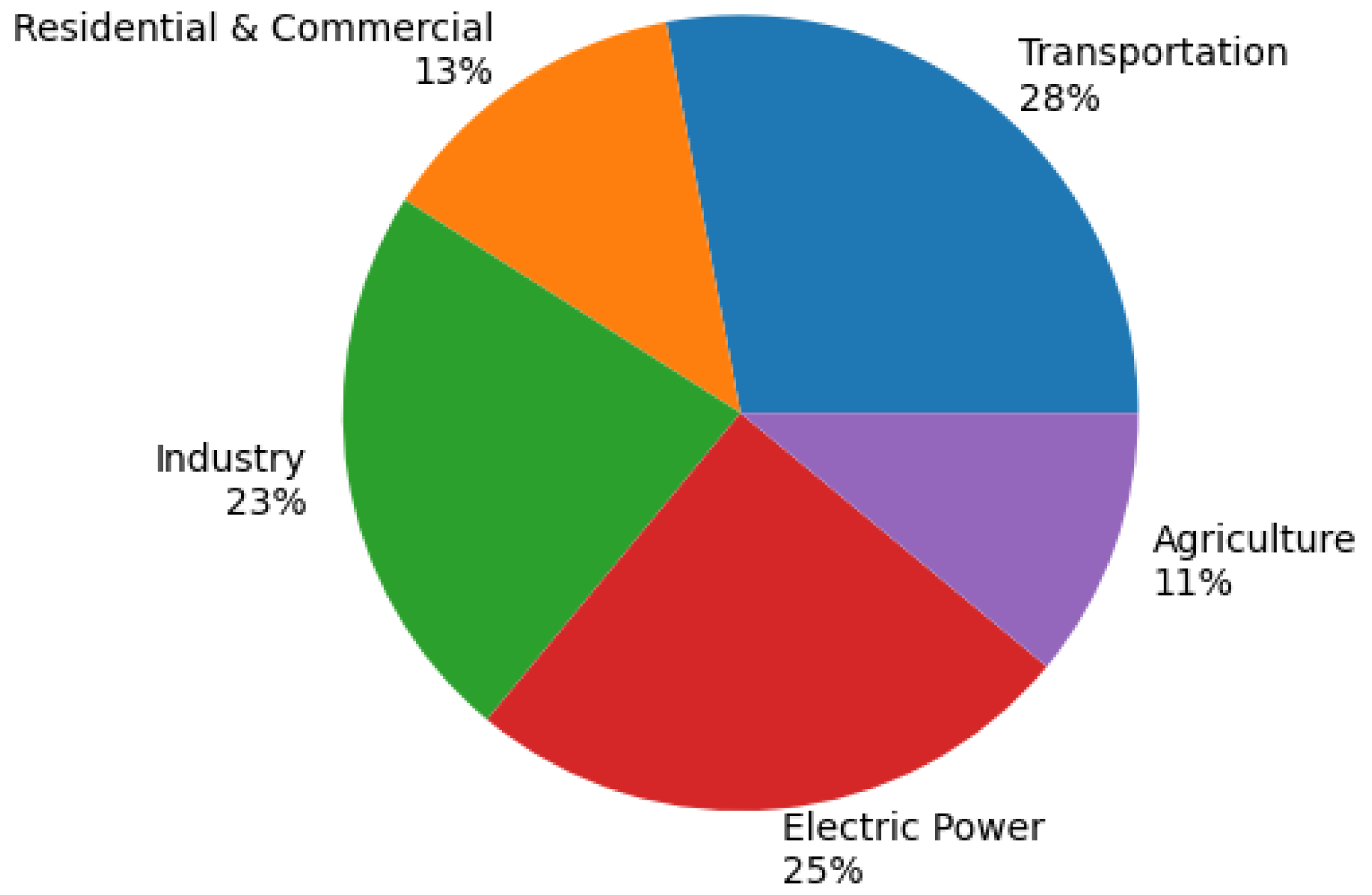
Figure 1 represents the distribution of greenhouse gas (GHG) emissions across key sectors. Industry with 23%, attributed to energy-intensive processes and fossil fuel combustion. Electricity production accounts for 25%, reflecting reliance on coal and natural gas for power generation. The transportation sector with 28%, primarily from petroleum-based fuels like gasoline and diesel, making it a critical target for decarbonization through electric and hydrogen-powered alternatives. Agriculture contributes 11% of emissions, driven by livestock, rice production, and soil management, particularly methane and nitrous oxide release. Lastly, residential and commercial represent 13%, with emissions originating from heating, cooling, and refrigeration systems. Solutions include transitioning to renewable energy in power generation, improving electric and hydrogen mobility for transportation, adopting sustainable agricultural practices, and improving energy efficiency in buildings. A comprehensive and integrated approach is essential to achieving significant emission reductions and supporting climate goals [10]. These initiatives underscore the importance of hydrogen and renewable energy systems in achieving sustainability goals [11].

1.1. Sustainable Hydrogen Production

To ensure clean and sustainable hydrogen production, it is vital to critically evaluate the various production methods and their associated environmental impacts, including considerations for storage and usage that account for seasonal demand variations. Hydrogen can be derived from both fossil-based and renewable sources, each with distinct benefits and challenges. However, the commonly used color classification of hydrogen (e.g., green, blue, gray) is not entirely reliable. For instance, green hydrogen does not inherently guarantee lower carbon emissions compared to blue or gray hydrogen, challenging popular assumptions. Table 1 compares green, blue, and gray hydrogen production methods. Green hydrogen uses renewable energy and water via electrolysis, producing oxygen as a by-product with minimal environmental impact. Blue hydrogen relies on carbon capture and storage (CCS), resulting in low emissions. Gray hydrogen uses hydrocarbons but emits CO2 directly, leading to a higher environmental footprint [12]. Water splitting via electrolysis is gaining prominence in hydrogen production. Nevertheless, meeting even a quarter of the global energy demand with hydrogen under climate change mitigation scenarios would require an unprecedented amount of renewable electricity. The required energy would exceed the total current global electricity production from all sources combined.

Carbon Intensity of Electrolytic Hydrogen Production

When producing hydrogen via electrolysis, the kgCO2/kgH2 ratio—that is, the lifecycle of anthropogenic greenhouse gas emissions per kilogram of hydrogen produced—varies significantly depending on the source of electricity. Electrolysis powered by 100% renewable energy results in extremely low CO2 emissions, often between 0 and 1 kgCO2/kgH2. Most studies and certifications, such as the GH2 Green Hydrogen Standard, require emissions below 1 kgCO2/kgH2 to qualify as “green hydrogen”, accounting for minimal upstream lifecycle impacts from manufacturing solar panels, wind turbines, and electrolyzers. In specific cases, wind-powered electrolysis can achieve values as low as 0.3–0.6 kgCO2/kgH2, while solar-powered systems may have values of up to 2.5 kgCO2/kgH2 due to panel production emissions. Hydropower and nuclear-powered electrolysis also maintain low emissions, around 0.3 kgCO2/kgH2 and 0.6 kgCO2/kgH2, respectively. In contrast, electrolysis using grid-mix electricity produces much higher emissions, often exceeding 5–12 kgCO2/kgH2, depending on the carbon intensity of the local energy mix. In regions with coal-heavy grids, such as parts of China, Australia, and the United Arab Emirates, values can reach 10–20 kgCO2/kgH2, potentially surpassing the emissions of traditional fossil-derived hydrogen (“gray” hydrogen) [13,14,15,16,17].
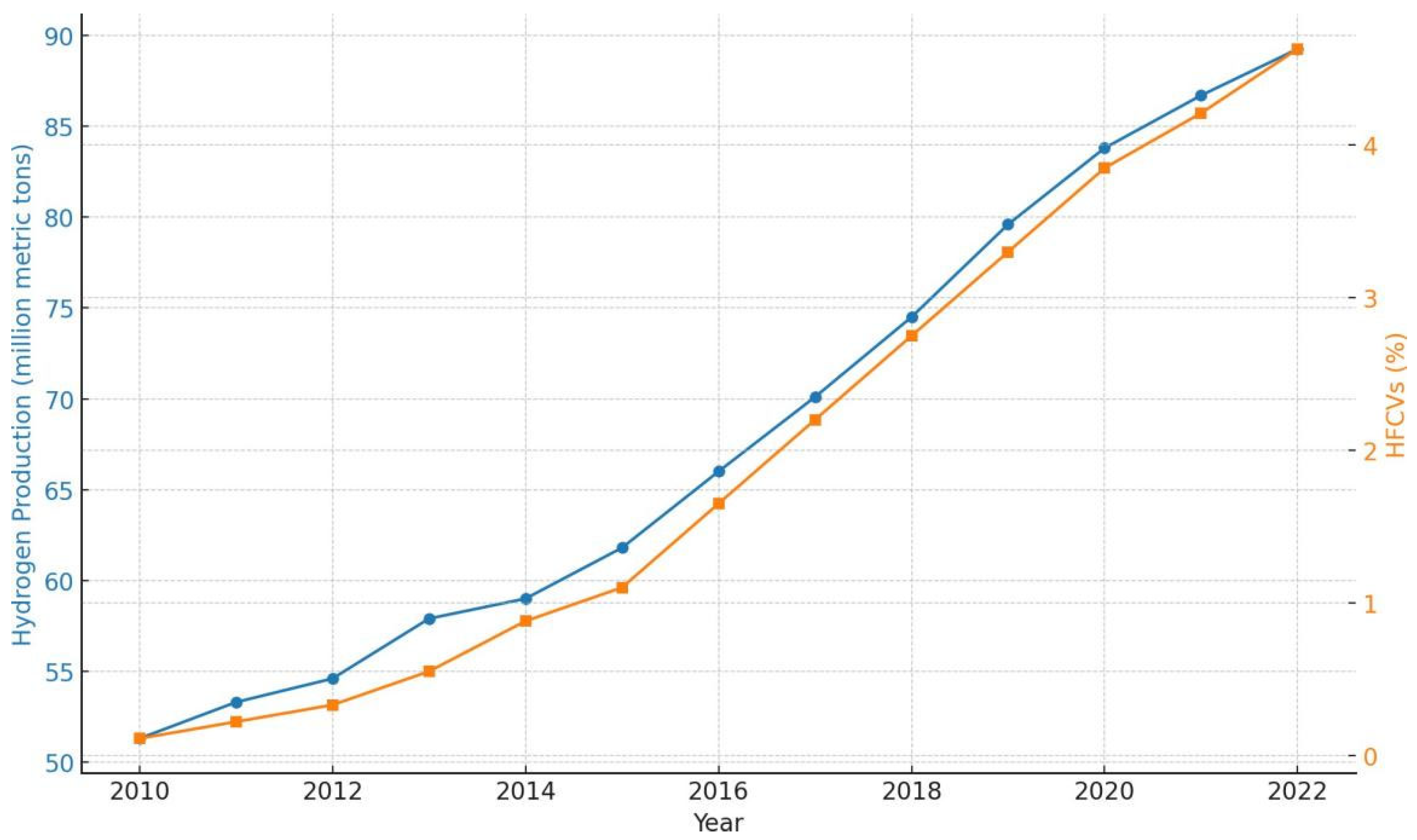
Hydrogen production requires significant quantities of freshwater, a resource already critically depleted in many parts of the world. Although seawater presents an alternative, its large-scale application is hindered by challenges such as chloride-induced corrosion of anode metals. Figure 2 depicts the global increase in hydrogen production from 2010 to 2022, rising from 51.3 million metric tons to 89.25 million metric tons. Over the same period, the percentage of HFCVs grew significantly, highlighting a growing adoption of hydrogen-based technologies in transportation. Initial growth was slow, but production accelerated after 2015, driven by technological advancements and increasing demand in industries such as refining and chemicals. By 2020, production stabilized, with a stronger focus on sustainable methods like electrolysis and renewable energy integration. Future growth is expected to be driven by the adoption of cleaner, green hydrogen technologies.

1.2. Hydrogen Production Technologies

Hydrogen can be produced through steam reforming, an industrial process that extracts hydrogen from hydrocarbons at high temperatures. This technology uses natural gas as an energy source extracted from the Earth’s crust. Approximately 96% of the hydrogen produced in the USA relies on this technology. Natural gas contains methane, which can be combined with steam using thermal processes such as steam reforming and partial oxidation to produce hydrogen. With this technology, steam is maintained at temperatures between 700 and 1000 °C and pressures of 3 to 25 bar, reacting with methane (CH4) in the presence of a catalyst to produce hydrogen, carbon monoxide, and carbon dioxide. The carbon monoxide and steam react again in the presence of the catalyst, producing more carbon dioxide and hydrogen. After this process, carbon dioxide and impurities are removed to obtain pure hydrogen. Other fuels such as propane, gasoline, diesel, or ethanol can also be used instead of methane. The catalyst must be nickel for this reaction to occur [18,19]. Another production method is electrolysis, where electricity separates water into hydrogen and oxygen. Although cleaner, it requires substantial energy input, lowering efficiency. In electrolysis, water is split into hydrogen and oxygen through the application of an electric current. Generally, two electrodes (anode and cathode) are used in an aqueous solution containing an electrolyte like KOH; this setup is the electrolyzer. These electrolyzers can be large or small, depending on the scale of hydrogen production desired. Hydrogen production can be achieved with zero greenhouse gas emissions, depending on the energy source used to separate the water molecules. The reactions occurring in the alkaline electrolyzer are
Electrolyte : 4 H 2 O 4 H + + 4 OH
Cathode : 4 H + + 4 e 2 H 2
Anode : 2 H 2 O O 2 + 4 H + + 4 e
Overall : 2 H 2 O O 2 + 2 H 2
Even though alkaline electrolysers are dominant, other electrolyzer exist; for more information, especially on PEM electrolyzers, the reader may consult [20,21,22,23,24,25].
The automotive sector has been a major contributor to global warming, driving environmental degradation for over a century through reliance on fossil fuels. With accelerating technological progress, the imperative to transition toward sustainable mobility solutions has become increasingly evident. Current advancements offer a spectrum of alternatives, including internal combustion engine (ICE) vehicles, Battery Electric Vehicles (BEVs), and Hydrogen Fuel Cell Vehicles (HFCVs). Among these, BEVs and HFCVs distinguish themselves as the most promising technologies to mitigate environmental impacts, offering significant reductions in anthropogenic greenhouse gas emissions and aligning with global decarbonization objectives [26]. Though hydrogen internal combustion engine vehicles (HICEVs) represent an interesting and growing segment—especially in commercial vehicles, where their fast refueling and compatibility with existing engine technology are advantages—they are overshadowed in the scientific and policy literature by fuel cell vehicles. The superior efficiency, true zero-emission profile, and broader strategic support for fuel cells explain why this review places greater emphasis on HFCEVs. Hydrogen fuel cells, which have been used in spacecraft since the mid-20th century, offer another promising solution. They generate electricity with only heat and water vapor as byproducts, making them a critical technology that global powers compete to control due to their significant economic impact across various sectors, including transportation [26,27]. By leveraging technologies such as fuel cells and hybrid renewable energy systems, hydrogen emerges as a critical element in reducing greenhouse gas emissions and transitioning to a cleaner energy future. Events such as the COVID-19 pandemic and the European energy crisis have accelerated the push toward electrification in the automotive sector, especially in Europe, where EV sales saw remarkable growth in 2020 and 2021, driven by generous incentives and stricter emission standards. These measures helped mitigate the impact of the pandemic on the EV market; however, the crisis also exposed vulnerabilities in the automotive supply chain, including complex supply chains and reliance on raw materials. Additionally, rising energy prices in 2022 increased both operating and manufacturing costs for EVs [27]. Fuel cells for stationary applications have been commercially viable for over two decades. They are frequently used as backup power sources or as part of hybrid systems that include batteries, supercapacitors, and renewable energy technologies such as photovoltaics and wind turbines. These hybrid systems ensure reliable energy supply during peak demand or outages [27,28].

Document Structure

Section 2 begins by outlining the objectives and research question that guide the study, providing a clear framework for its scope and direction. It describes the information sources used, including databases, scientific articles, reports, and other relevant materials, ensuring a comprehensive approach to data collection. The criteria for inclusion and exclusion of resources are detailed, offering transparency in the selection process and ensuring the reliability and relevance of the analyzed materials. At the end of this section, the initial results obtained are presented, summarizing key data or metrics that justify the analyses carried out in subsequent sections.
Section 3 focuses on the functioning of fuel cells. The study then explores the types of vehicles that utilize fuel cells and identifies key manufacturers and the models they have brought to market. It also delves into hydrogen transport and storage systems, discussing existing challenges and technological advancements in these areas. Furthermore, the current state of hydrogen refueling infrastructure is evaluated, highlighting regional and global developments, barriers to implementation, and recent progress.
Section 4 interprets the findings of the study. The implications of the results for the development of fuel cell technology and the broader market are analyzed, offering insights into the potential of these technologies to meet sustainability goals.
The study concludes by summarizing the main findings, reflecting on the limitations of the research, and suggesting areas for future exploration. It also presents proposals for policies and actions to support the advancement of fuel cell technology, hydrogen infrastructure, and sustainable transportation systems.

2. Materials and Methods

2.1. Objectives and Research Question

Building on the issues highlighted in the introduction, this chapter outlines the specific objectives that this study seeks to achieve. The objectives are designed to provide a comprehensive analysis of EVs and HFCVs in the context of their role in mitigating global warming and promoting a sustainable future for the automotive sector. The main question is, “Are Hydrogen Fuel Cell Vehicles the future of sustainable transportation?”. With this question, we aim to assess the technological readiness and market viability in comparison to other sustainable transportation options, particularly EVs. We intend to offer insights that can inform future research, development, and policy-making, with the goal of facilitating the adoption of HFCVs if they prove to be a viable solution for the future of transportation.

2.2. Information Source

A systematic review of the available literature was conducted according to the PRISMA (Preferred Reporting Items for Systematic Reviews and Meta-analyses) guidelines [29]. The literature search included all records in the databases available up to the end of June 2024. The databases used for this research were SCOPUS and IEEE, as both are reputable sources for scientific articles in this area of study. The initial search was conducted in IEEE using the keywords “fuel cell” and “hydrogen”, applied to the title, keywords, or full text of the document. This search yielded 1972 articles. Recognizing that this was too broad for the scope of our research, the search was refined by adding the keyword “battery” under the same conditions. This adjustment slightly narrowed the results to 1683 articles. To further focus the search, we limited the keywords “fuel cell” and “hydrogen” to appear only in the titles, which resulted in 159 articles. A similar approach was taken in SCOPUS. An initial search for “fuel cell” and “hydrogen” returned 1728 articles. To refine this further, we introduced the keywords “fuel cell”, “hydrogen” and “mobility” which reduced the results to 431 articles, a more manageable and relevant set for the scope of our study.

2.3. Inclusion and Exclusion Criteria

In the article selection, strict guidelines were adopted to ensure the accuracy and relevance of the chosen studies. Only articles published from 2020 onward were considered, with preference given to the most recent publications. The search was carefully conducted to ensure the term "Fuel cell" was consistently associated with electric mobility. Additionally, for articles addressing both topics, priority was given to those that included “hydrogen”, especially with a focus on “Green hydrogen". To further refine the selection, emphasis was placed on documents presenting results through software simulations.

2.4. Results

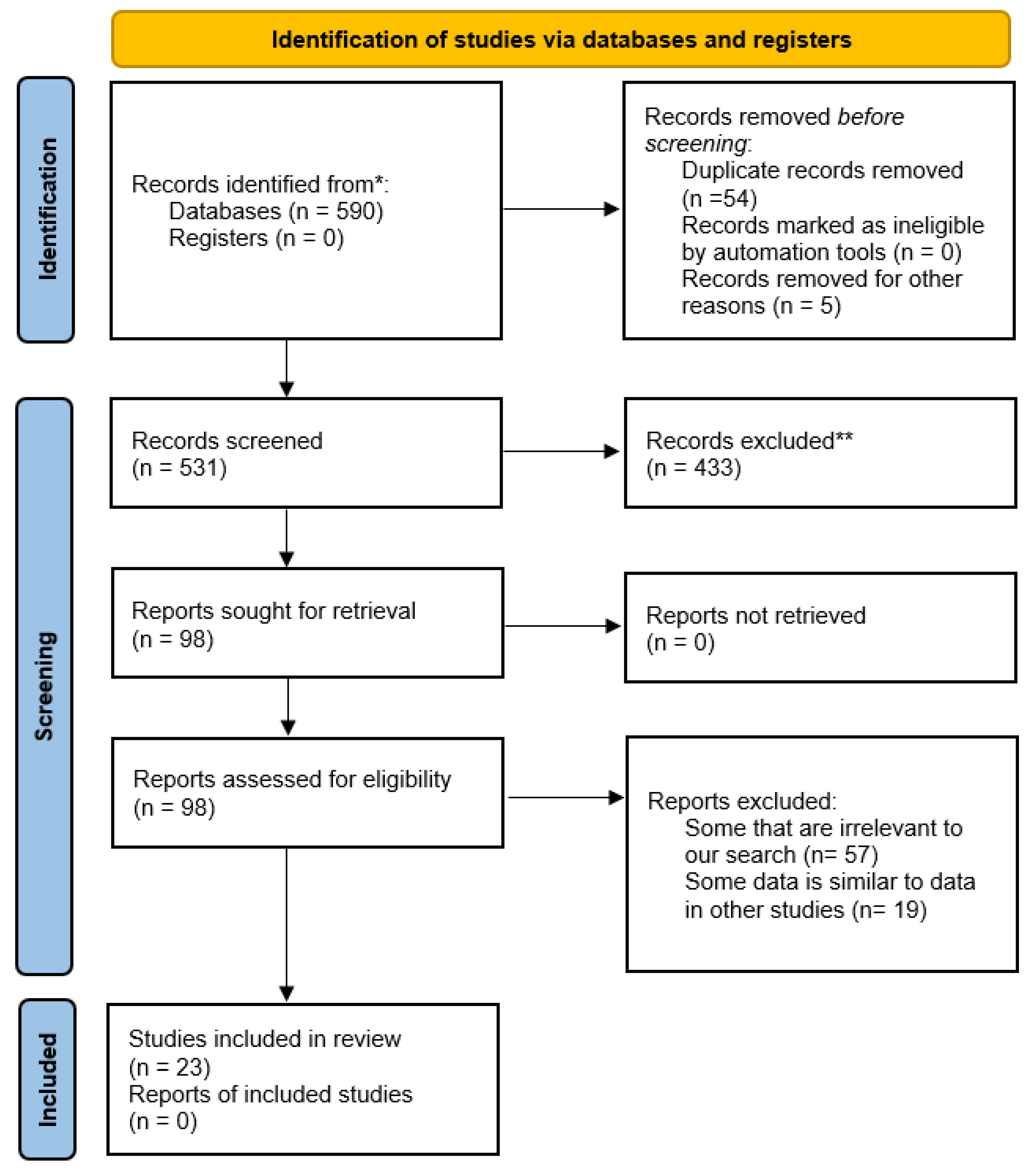
The adherence to PRISMA guidelines not only ensured a systematic and transparent review process but also enhanced the replicability of this study. By clearly documenting each phase of the article selection process, from identification to final inclusion, this review allows future researchers to trace the decision-making process and potentially build upon it in their own work. This level of rigor is particularly critical in emerging fields like hydrogen fuel cell technology, where the rapid pace of innovation necessitates ongoing reviews of the most current literature. As shown in Figure 3, the initial identification phase, which resulted in 590 records, encompassed a broad range of studies on hydrogen fuel cells. However, given the rapidly evolving nature of hydrogen technology, it was critical to narrow down the focus to the most recent and directly relevant studies. The screening process therefore prioritized publications from 2020 onward, ensuring that only the latest advancements in fuel cell technology were considered. Of the 433 records excluded during the initial screening phase, a significant portion were studies focused on stationary applications of fuel cells, which, while relevant to the broader hydrogen economy, did not align with the focus on the automotive sector. In summary, the selection process was guided by well-defined inclusion and exclusion criteria to ensure that only studies directly aligned with the objectives of this review were retained. Inclusion criteria comprised publications focusing on PEMFCs applied to the automotive sector, with an emphasis on studies presenting practical examples, case studies, or real-world implementations. Exclusion criteria included works that addressed only theoretical or simulation-based analyzes without a direct link to practical PEMFC applications, studies primarily centered on chemical aspects of hydrogen production rather than automotive engineering, and research related to non-road transport sectors such as marine or aerospace applications. The final 23 studies selected for detailed analysis were not only the most up to date but also represented a broad geographic distribution, with significant contributions from Asia, Europe, and North America. These regions are currently leading the research and development of hydrogen fuel cell technologies, particularly in the automotive sector. The inclusion of studies from both emerging and developed markets ensures a balanced perspective on the technological, economic, and infrastructural challenges associated with the adoption of HFCVs. The geographical distribution of the selected studies highlights the global momentum behind hydrogen fuel cell research, with the majority of studies originating from Asia, particularly China and Japan. These countries have made significant strides in hydrogen infrastructure development, with China focusing on heavy-duty transport applications and Japan positioning itself as a leader in fuel cell technologies for passenger vehicles. European countries also feature prominently in the analysis, reflecting their strong policy commitments toward achieving net-zero emissions through green hydrogen initiatives [27,28].
For this research, we can observe that more than half of the articles selected for detailed analysis are of Asian origin, with the majority coming from China and India, respectively. Following that, we have several articles from European countries, such as Portugal, Italy, and Austria, which focus on specific areas of the study.

3. Green Mobility

The pressing demand for sustainable energy has sparked a thorough reexamination of conventional transportation methods globally. With mounting concerns over climate change, air pollution, and the dwindling reserves of fossil fuels, the transition to cleaner, more sustainable alternatives has become critical. Amid this paradigm shift, hydrogen-powered vehicles are emerging as a groundbreaking alternative to electric cars. This exploration highlights the potential advantages and challenges of adopting hydrogen as a primary automotive fuel source. Although EVs have gained traction, the reliance on finite resources like lithium, nickel, and cobalt for batteries poses supply risks. This predicament underscores the urgency of pivoting toward hydrogen-based energy solutions. Hydrogen technology development is pivotal for environmental protection, as numerous studies confirm the detrimental impact of emissions from traditional vehicles. Real-world tests on diverse vehicle types further reinforce the promise of hydrogen and electric drivetrains as leading solutions for sustainable mobility [30]. Energy storage mechanisms differ substantially between BEVs and hydrogen-powered vehicles. BEVs rely on large battery packs to store energy, which is then directly supplied to the electric motor. In contrast, HFCVs are equipped with specialized tanks that store compressed hydrogen. This hydrogen is processed in fuel cells, where it reacts with oxygen to produce electricity, which powers the vehicle. Hydrogen-powered technology presents a promising alternative to traditional batteries, particularly by addressing some of their inherent limitations. Despite continuous advancements, batteries remain relatively heavy, bulky, and time-consuming to recharge—a drawback that is especially pronounced when relying on home charging solutions [31].
Hydrogen’s potential extends far beyond combustion, with its use in fuel cells emerging as a highly promising avenue. Proton exchange membrane fuel cells (PEMFCs), also known as Polymer Electrolyte Membrane Fuel Cells, are particularly noteworthy. These cells, available in low- and high-temperature variants, use a solid-phase electrolyte—often a perfluorinated polymer—to enhance safety and efficiency. They offer several advantages, including high power density, rapid startup times, and theoretical efficiencies of up to 83% [32,33]. PEMFCs operate by supplying oxygen to the cathode and hydrogen to the anode. The two electrodes are separated by a semipermeable membrane, which facilitates the flow of H+ ions generated during hydrogen oxidation at the anode. These protons travel through the membrane to the cathode, where they combine with oxygen ions. Simultaneously, electrons generated during the hydrogen oxidation process flow through an external circuit, powering an electric motor. Similar to hydrogen combustion, the only byproducts of this redox reaction are water and heat. Although the practical efficiency of PEMFCs is 65%, cogeneration systems that utilize the released heat could significantly enhance this efficiency [32,34]. It is important to note that hydrogen is not a primary energy source but an energy carrier, enabling the storage and transport of energy in a readily usable form. Therefore, advancing hydrogen technology requires a strong focus on improving production and storage methods.

3.1. Hydrogen Fuel Cell Technology

Hydrogen research is gaining significant interest from the scientific community due to its potential to boost the hydrogen economy and extend system lifetimes. Consequently, research publications in this field are rapidly increasing, as demonstrated by recent studies [35,36,37]. (HFCVs) are a significant innovation in sustainable transportation, effectively addressing limitations associated with internal combustion engine vehicles (ICEVs) and BEVs. HFCVs offer advantages such as extended driving range, high energy density, and rapid refueling times, which are critical for long-haul and heavy-duty transportation applications. Unlike BEVs, which are constrained by energy storage capacity and lengthy charging durations, HFCVs leverage hydrogen’s superior gravimetric energy density to achieve operational flexibility and reduced downtime. However, HFCVs face persistent challenges related to economic viability and technological maturity. High production costs, driven primarily by hydrogen extraction methods like electrolysis and steam methane reforming (SMR), remain a barrier to widespread adoption. Infrastructure deficits, particularly the limited availability of hydrogen refueling stations (HRS), exacerbate these challenges. Additionally, fuel cell systems experience degradation due to load cycling, transient operations, and thermal stresses, which shorten their operational lifespan compared to stationary applications [38,39].

3.1.1. Principles of PEMFC

At its core, a hydrogen fuel cell is an electrochemical device that converts the chemical energy stored in hydrogen into electrical energy [18]. This process occurs without combustion, ensuring high efficiency and near-zero environmental impact. Fuel cells consist of two electrodes—an anode and a cathode—separated by an electrolyte that facilitates ionic transport while preventing the mixing of hydrogen and oxygen. The operation begins at the anode, where hydrogen molecules (H2) are oxidized into protons (H+) and electrons (e) [40]:
H 2 2 H + + 2 e
The electrons travel through an external circuit, producing direct current (DC) electricity, while the protons migrate through the electrolyte to the cathode. At the cathode, oxygen (O2) reacts with the protons and electrons to produce water (H2O) and release heat in an exothermic reaction:
O 2 + 4 H + + 4 e 2 H 2 O
The overall reaction is expressed as
2 H 2 + O 2 2 H 2 O + Energy ( Electricity + Heat )
This direct conversion of chemical energy into electrical energy, without the intermediary steps or energy losses typical of combustion, makes fuel cells highly efficient and reliable. Their modular design enables scalability for diverse applications, from small portable systems to large-scale industrial operations.

3.1.2. Advantages of Hydrogen as a Fuel Source

Hydrogen possesses a high gravimetric energy density—also referred to as specific energy, representing the amount of energy per unit mass—of approximately 142 MJ/kg (based on the Higher Heating Value, HHV) under standard conditions [41]. This property allows hydrogen fuel cells to achieve extended operational durations without the significant weight and volume penalties typically associated with conventional batteries. Furthermore, hydrogen can be produced sustainably through water electrolysis powered by renewable energy sources, following the reaction
2 H 2 O + Energy 2 H 2 + O 2
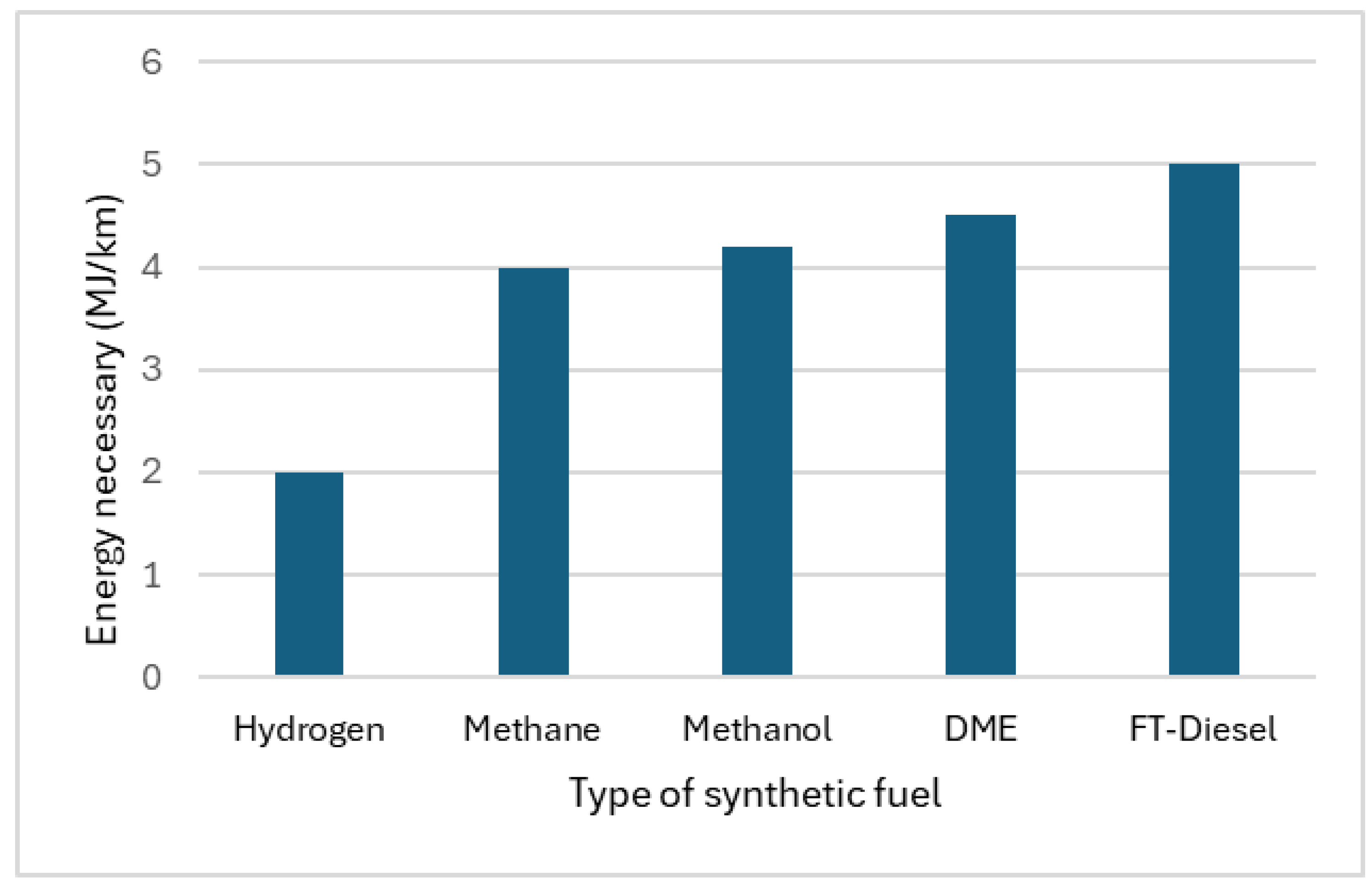
Lindorfer et al. [42] highlights the versatility of fuel cells in using various fuels, including hydrogen and methanol. Hydrogen is presented as the most promising fuel due to its high energy content and zero-emission potential when produced from renewable sources like electrolysis powered by wind or solar energy. Figure 4 provides insight into the relative efficiency of different synthetic fuels in terms of the electric energy required. Among the fuels compared, hydrogen stands out as the most energy-efficient, requiring approximately 2 MJ/km. This highlights its potential as an ideal energy carrier, particularly for applications demanding high efficiency, such as long-range or heavy-duty vehicles. In contrast, liquid fuels like methanol and FT-diesel are easier to store and transport, making them more compatible with existing infrastructure and technologies.
Notably, the water produced as a byproduct during fuel cell operation can be recycled, forming a closed-loop and environmentally sustainable energy system. These characteristics underscore hydrogen’s potential as a clean and renewable fuel for decarbonized energy systems. Research on PEMFCs has led to significant technical advancements aimed at improving efficiency, durability, and cost-effectiveness. Simulation studies [39] have demonstrated the impact of critical parameters such as operating temperature, pressure, and hydrogen flow rate on fuel cell performance. Key innovations include
  • Optimized Operating Conditions: Maintaining optimal thermal and pressure profiles to maximize electrochemical efficiency and reduce degradation.
  • Advanced Power Electronics: Integrating DC-DC boost converters to stabilize output voltage and enhance system performance.
  • Improved Hydrogen Utilization: Employing flow rate regulators to optimize fuel consumption and minimize losses.
Hydrogen fuel cells are recognized for their exceptional versatility, underpinning a wide range of applications across sectors. According to recent studies [33,42,43,44], these systems are increasingly utilized in transportation, stationary power generation, and industrial processes, where their ability to deliver clean, efficient, and continuous power positions them as a transformative technology for addressing global energy challenges.
FCEVs are increasingly recognized as a promising solution for the decarbonization of the transportation sector, particularly in applications where rapid refueling and extended driving range are critical. These vehicles present several notable advantages, balanced by certain challenges that currently constrain their widespread adoption. From an operational standpoint, fast refueling is one of the most significant benefits. FCEVs can typically be refueled in under five minutes, a process comparable to conventional gasoline or diesel vehicles and considerably faster than the charging times of battery electric vehicles (BEVs), which can range from 30 min to several hours depending on the charging technology used. This capability enhances vehicle availability and operational efficiency, making hydrogen-powered vehicles especially well-suited for commercial fleets, public transportation, and other intensive-use scenarios [45,46,47]. In terms of autonomy, hydrogen fuel cells provide high energy density, enabling ranges of approximately 300–600 km per fill for passenger vehicles and even greater distances for heavy-duty applications such as buses, coaches, trucks, and regional trains. For instance, fuel cell buses often achieve ranges of 300–450 km—comparable to their diesel counterparts—while heavy trucks and coaches can reach 600–800 km on a single refueling. This positions FCEVs as a competitive option for long-haul transport, where the weight and charging constraints of large battery packs can be limiting [45,48]. Another important advantage is payload capacity. Hydrogen storage systems are generally lighter and more compact than the large-capacity batteries required for equivalent BEV ranges. This translates into a lower impact on payload capacity, which is particularly beneficial for heavy-duty vehicles, as it allows more space and weight allocation for passengers or cargo [45]. Despite these benefits, the lack of hydrogen refueling infrastructure remains the most significant barrier to large-scale adoption. At present, the network of hydrogen stations is geographically limited, with higher concentration in specific regions such as California, Japan, South Korea, and certain parts of Europe [49]. The development of a comprehensive infrastructure requires substantial investment and cross-sector coordination, creating a “chicken-and-egg” dilemma: low station density discourages consumers from purchasing FCEVs, while the limited vehicle fleet delays investment in infrastructure expansion [50,51]. Given these constraints, current deployment strategies tend to focus on fleet-based operations and regional transit systems with centralized refueling facilities, which offer a more controlled and economically viable approach in the short term compared to widespread private ownership.

3.1.3. Degradation Mechanisms in Automotive PEMFCs

The operational lifespan of PEMFCs in automotive applications is significantly influenced by degradation mechanisms that are exacerbated by the dynamic and demanding conditions of vehicular operation. These mechanisms primarily include
  • Chemical degradation of the membrane;
  • Mechanical degradation due to hygro-thermal stresses;
  • Deterioration of the catalyst layer.
In addition, transient operating conditions—such as gas starvation and water flooding—can impair reactant delivery, thereby accelerating performance losses. Elevated operating temperatures above the optimal range (80–90 °C) further intensify both chemical and mechanical degradation. These degradation pathways often act synergistically, leading to a faster decline in PEMFC performance in automotive environments compared to stationary applications, where steady-state operation and controlled conditions reduce stress factors. As a mitigation strategy, hydrogen PEMFC vehicles typically integrate a small auxiliary battery, which supports regenerative braking and helps maintain more stable PEMFC operation. This understanding is supported by recent scientific studies that examine the degradation mechanisms of PEMFCs under automotive conditions, highlighting the interplay between electrochemical, thermal, and mechanical factors that govern performance decay and maintenance requirements [52,53,54,55].

3.1.4. Resource Use and End-of-Life

BEVs’ environmental footprint is influenced by battery production, which involves critical raw materials and energy-intensive processes, with current challenges including battery recycling. Advances in recycling (up to 95% recovery in some technologies) and second-life applications are expected to reduce these impacts by 2030 [56,57,58]. FCEVs have lower raw material demand for fuel cells than BEVs for batteries, and fuel cells tend to have long lifetimes, minimizing disposal issues. However, hydrogen storage tanks and production equipment have their own sustainability considerations [59].

3.1.5. Infrastructure and Market Readiness

BEV charging infrastructure is more widespread and continues to expand rapidly, supporting the scalability of BEVs. FCEV adoption is currently constrained by limited hydrogen refueling stations, though progress is accelerating in some regions. Infrastructure costs and availability remain significant challenges for FCEVs in the mass market by 2030 [58]. The market roles of BEVs and HFCVs are distinct and evolving, as discussed in the previous comment requesting more market-trend analysis. Actual data and forecasts show that BEVs have secured and are expected to maintain global market dominance through the next decade [60,61,62]. BEVs continue to see rapid growth, leading the green mobility transition in key regions. In 2025, global BEV and plug-in hybrid sales are expected to surpass 22 million units, marking a 25% year-on-year increase. BEVs alone make up about 14–16% of total global vehicle sales, with top European countries like Denmark and Sweden posting even higher market shares. China is the largest market—contributing nearly two-thirds of global BEV sales—while Europe and the U.S. trail behind [61,63,64,65,66,67,68,69,70,71,72,73].
Major growth drivers include
  • Declining lithium-ion battery costs [63].
  • Expanded charging infrastructure [67].
  • Strong government incentives and tightening emissions regulations [66].
  • Growing consumer preference for zero-emission vehicles with low operational costs [66,67].
Analysts forecast that by 2030, annual BEV sales will exceed 40 million, supported by ongoing cost reductions and technological advancement [60,61,64,68,69,70].
HFCVs—while technologically promising, particularly for range and rapid refueling—remain a niche offering. Their global market size in 2024 is valued between USD 2.4–3.5 billion, with annual growth rates projected at 36–43% through 2033. However, actual unit sales fall far short compared to BEVs, accounting for less than 1 million vehicles globally. Adoption is concentrated in a handful of regions (like California and parts of East Asia) due to limited hydrogen refueling stations and high vehicle/system costs [71,72,73,74]. HFCV growth is fastest in commercial fleet and long-haul transport segments, but mass adoption depends on major investments in hydrogen infrastructure and continued technological innovation. Policy measures in Europe, Asia, and some U.S. states are helping, but BEVs remain the preferred choice for most private consumers and manufacturers [60,61,62,75,76,77]. Actual market trends show that BEVs will maintain their dominant position in the passenger vehicle sector for the rest of this decade and beyond. This leadership is driven by infrastructure, policy support, and rapid technology innovation. HFCVs will experience significant percentage growth from a small base—mainly in commercial and heavy-duty transport—but their overall market share is expected to remain limited due to cost and refueling constraints. A likely outcome is technological coexistence: BEVs dominating urban and private transport and HFCVs filling niche roles where fast refueling and long operational ranges are priorities, such as logistics fleets and specialized industries [76,77].

3.1.6. Outlook—Which Will Be Best in 2030?

For passenger vehicles and urban applications, BEVs are expected to remain the more sustainable and practical choice due to superior energy efficiency, established charging infrastructure, and lower lifecycle emissions aligned with cleaner electricity grids. FCEVs may play a complementary role in heavy-duty, long-range, and specialized vehicles (e.g., buses, trucks, and regional trains) where fast refueling and high energy density are critical, especially if green hydrogen becomes widely available and economically viable by 2030 [78]. Thus, the best sustainability outcome by 2030 likely involves a mixed transport ecosystem: predominantly BEVs for light-duty transportation supported by a clean electricity grid, coupled with FCEVs powered by green hydrogen for heavy-duty and range- critical applications.
These studies underscore the importance of powertrain integration and energy management strategies in enhancing the viability of HFCVs. For instance, high-power motors paired with optimized PEMFC systems have been shown to achieve greater efficiency, extended range, and reduced hydrogen consumption, addressing critical performance metrics [39,79]. Table 2 serves as a concise summary of the key considerations for each vehicle type, highlighting the trade-offs between traditional and emerging technologies.

3.1.7. Fuel Cell Stack

Fuel cell stacks are engineered by connecting multiple individual fuel cells in series and/or parallel configurations to meet specific voltage and current requirements. Each single PEMFC produces a relatively low voltage—around 0.6 to 0.8 V under load—making it necessary to combine cells to achieve practical output levels for applications such as automotive propulsion or stationary power generation [80,81].
Series connections are employed to increase voltage, with the anode of one cell linked to the cathode of the next. In this arrangement, the total stack voltage equals the sum of the voltages of all cells, while the current remains constant throughout the series. Conversely, parallel connections are used to increase current output by electrically bridging all positive terminals together and all negative terminals together; in this configuration, the voltage remains that of a single cell or stack, but the total current is the sum of all parallel branches. Many commercial fuel cell systems combine both series and parallel arrangements to balance voltage, current, and overall power output.
A complete fuel cell stack consists of several key components, including
  • Membrane Electrode Assemblies (MEAs)—where the electrochemical reaction occurs;
  • Bipolar plates—serving as current collectors, providing gas flow channels, and facilitating heat and water management;
  • End plates and tie rods or bolts—ensuring mechanical compression and sealing;
  • Gaskets and seals—preventing gas leakage between cells.
Uniform distribution of reactants is critical for stable performance. Flow field designs—commonly U-shaped or Z-shaped—help ensure that hydrogen and oxygen (or air) are evenly delivered across the active area of each cell. Manifolds are used to feed and collect reactants uniformly, maintaining consistent current density and temperature across the stack. Thermal and mechanical management are also fundamental. Stacks must be kept within an optimal temperature range to prevent hot spots, membrane dehydration, or excessive flooding. Mechanical compression must be evenly applied to minimize contact resistance and prevent structural damage. As highlighted by Hyfindr [82], the voltage and current output of a fuel cell stack are essential considerations for ensuring compatibility with external loads or energy storage systems. These parameters can be tailored not only by configuring cells in series and/or parallel but also through the use of dedicated voltage and current regulation electronics [80,81,82,83,84].
Beyond advances in catalyst activity and materials optimization, recent studies highlight diagnostic tools that facilitate real-time optimization of PEMFC stacks. Meng [85] introduces a polarization loss decomposition method capable of isolating ohmic, activation, and mass transport losses, providing dynamic insights into performance degradation. Zhang [86] demonstrates the efficacy of deep-learning-based state-of-health estimation to monitor fuel cell efficiency and durability under transient operating conditions.

3.1.8. Regional Applicability and Technology Positioning

BEVs are well-suited for temperate and warm regions but require robust thermal management, preheating, and adaptive controls to prevent capacity loss and performance degradation in colder climates. HFCEVs may retain range and refueling speed more effectively during cold starts, yet their operational reliability in sub-zero conditions can be hindered by water management issues and ice formation within the fuel cell. In such environments, dedicated infrastructure—such as fueling stations designed for sub-zero operation—is essential for consistent performance. Both technologies demand specific adaptations, including optimized heating systems, material selection, and tailored operational protocols, for deployment in regions with extreme temperature profiles or unique environmental constraints [87,88,89,90,91,92].
HICEVs do not emit CO2; they produce nitrogen oxides due to high-temperature combustion. In contrast, HFCEVs emit only water vapor, aligning more closely with the definition of true zero-emission vehicles. This advantage has contributed to a stronger emphasis on HFCEVs in research, policy, and funding strategies [45]. Technological maturity further reinforces this focus: fuel cell systems have undergone decades of intensive research and commercialization, with advances in catalyst materials, membrane durability, and system integration. This has positioned HFCEVs as the flagship hydrogen mobility technology, often overshadowing HICEVs despite the latter’s compatibility with existing combustion engine manufacturing lines and maintenance networks [51,93].
Market trends mirror these technological and policy priorities. HFCEVs are generally preferred for passenger and light-duty vehicles, where efficiency, quiet operation, and refined driving characteristics are valued. HICE technology, by contrast, has carved out a more specialized niche in heavy-duty and commercial transport, benefiting from rapid refueling and adaptability to current engine architectures. However, its lower overall efficiency—typically 20–30% compared to the 40–60% efficiency of HFCEVs—limits its appeal for long-term decarbonization goals [45,94].
In summary, while HICEVs continue to develop as a viable technology for specific applications, their lower efficiency, NOx emissions, and reduced alignment with stringent zero-emission targets contribute to their lower profile in the hydrogen mobility discourse. HFCEVs, with higher efficiency, genuine zero-emission credentials, and stronger institutional backing, remain at the forefront of both market and research agendas.
Recent quantitative research demonstrates significant advances in lifespan prediction for hydrogen fuel cells under dynamic operating conditions. Modern data-driven health state estimation models can now predict the inflection point of performance degradation as early as 2000 h in advance, substantially extending the service life of fuel cell stacks and reducing the overall total cost of ownership. For example, the IEEE study by Tang et al. [95] proposes a deep-learning-based prediction approach capable of providing early warnings of stack degradation, thus offering engineering feasibility for proactive maintenance and operational optimization.
Other published research supports these findings. Wu et al. [96] introduced a health indicator extraction methodology for fuel cells undergoing dynamic variable loads. Their framework, based on adaptive Bayesian time convolution networks, achieved a prediction error as low as 6.8%, showing adaptability across different data sets and validating its effectiveness for remaining useful life assessment under non-steady operating profiles. Additionally, He et al. [97] demonstrated that machine learning algorithms, particularly those using ensemble and deep neural networks, outperform traditional methods for predicting RUL and power output, marking a substantial step forward in reliability and cost-effectiveness for practical applications. Collectively, these results underscore that data-driven models—especially those employing advanced neural networks like LSTM, GRU, and attention-based structures—are now central to early and accurate hydrogen fuel cell degradation prediction, enabling maintenance strategies that maximize stack lifespan and lower costs.
Salodkar et al. [44] studied the modeling of a PEMFC, emphasizing its efficiency as a green energy source. Similarly, refs. [79,98,99,100] focus on simulating PEMFCs to showcase their efficiency and environmental advantages in power generation. The selection of PEMFCs is justified by their proven benefits, including lighter weight, robustness, solid electrolyte, and rapid startup. These studies apply the model to analyze how different parameters, such as temperature and pressure, affect fuel cell performance. Several authors [41,79,99,101] highlight the numerous advantages of fuel cells and emphasize that people and organizations should recognize their benefits. However, it cannot be overlooked that the cost of these vehicles is currently higher compared to internal combustion engine vehicles (ICEVs) and even BEVs, due to the immature technology they use to power the motor. While fuel cells are gaining attention for their "zero emissions" and the convenience of long-range capabilities, their market share is expected to remain small over the next decade. This is because they still face significant challenges, such as high costs, limited durability, and the need for more extensive refueling infrastructure. While [41] focus on comparing FCEVs and BEVs in terms of energy efficiency, cost, and infrastructure availability, emphasizing BEVs’ higher energy efficiency and greater market penetration, ref. [99] delve into the technical modeling of PEM fuel cells, particularly their integration with battery systems for dynamic performance in real-world driving cycles. In contrast, ref. [79] take a unique approach by addressing power management strategies aimed at improving FCEV durability and fuel economy, with a focus on heavy-duty commercial vehicles. Gao [101], on the other hand, provides an overarching perspective, discussing advancements in FCEV technologies like the Toyota Mirai while addressing the ongoing challenges of cost reduction and infrastructure development. These distinct focal points illustrate the multifaceted challenges and opportunities in FCEV research and adoption, ranging from technical innovation to comparative market dynamics.
For example, Jahan et al. [98] use HFC as an alternative power source for EVs, highlighting the increasing interest in clean energy technologies, particularly the use of PEMFC. The study aims to evaluate the energy efficiency, fuel consumption, and overall system performance through software simulations. Additionally, the importance of improving the energy efficiency and driving range of HFCEVs is emphasized, particularly in light of environmental concerns and the global push towards sustainable mobility solutions. The system uses a 50 Vdc, 12 kW fuel cell stack that supplies power to a separately excited DC motor. The energy output of the fuel cell is regulated by two DC-DC boost converters, which ensure that the voltage is increased and stabilized for the motor’s field and armature circuits. They also use a flow rate regulator that is employed to maintain hydrogen consumption at its optimal level. The performance parameters such as stack voltage, efficiency, fuel, and air consumption vary depending on hydrogen flow adjustments [35,98]. The results shown in Table 3 suggest that using a high-power motor would be advantageous for such systems due to its higher efficiency and better utilization of hydrogen, which would improve the performance, range, and sustainability of the vehicle. This underscores the importance of optimizing both the powertrain components (motors and power electronics) and fuel cell technologies to enhance the viability of hydrogen as a sustainable energy solution for electric mobility. Just as hydrogen fuel cells (HFCs) are demonstrated to be effective in low-power EVs, they hold significant potential for motorcycles. Motorcycles, which typically require less power and are used for shorter trips compared to cars or trucks, could benefit from the efficiency and low emissions offered by HFCs [98].

3.2. Hydrogen Storage and Transportation

Hydrogen storage methods are critical to the success and adoption of hydrogen-based technologies. Among the various options available, as shown in Table 4, compressed hydrogen is the most widely used. Hydrogen is stored at pressures of 350–700 bar in lightweight, carbon fiber-reinforced plastic vessels. This method is energy-efficient enough to provide driving ranges comparable to internal combustion engine (ICE) vehicles. However, approximately 15% of hydrogen’s lower heating value is consumed during the compression process [102]. Another option is liquid cryogenic hydrogen, which achieves a higher density (71 kg/m3 at atmospheric pressure and −253 °C) compared to compressed hydrogen (40 kg/m3 at 700 bar). This approach eliminates the need for high-pressure systems. Despite its advantages, it faces significant challenges, such as high energy consumption, exceeding 30% of hydrogen’s heating value, boil-off losses, limited storage time, and high costs. Additionally, insulated vessels are necessary to maintain the extremely low temperatures required, making this method less practical for everyday applications [33,103]. Metal hydrides offer another alternative, characterized by high gravimetric and volumetric storage capacities. Hydrogen is chemically bound within hydrides like AlH3, LiBH4, and NaBH4. This method reduces refueling costs by 36–39% and enables thermal integration with fuel cell systems, improving efficiency by up to 40–45%. However, metal hydride storage systems are relatively heavy, have slower hydrogen release rates, require high temperatures and pressures for reversible operation, and result in longer refueling times. Each of these storage methods presents unique benefits and challenges, and their suitability depends on the specific application and technological requirements. Continued research and development are essential to optimize these systems and address the existing limitations [103].

3.3. Hydrogen Refueling Systems and Infrastructure Management

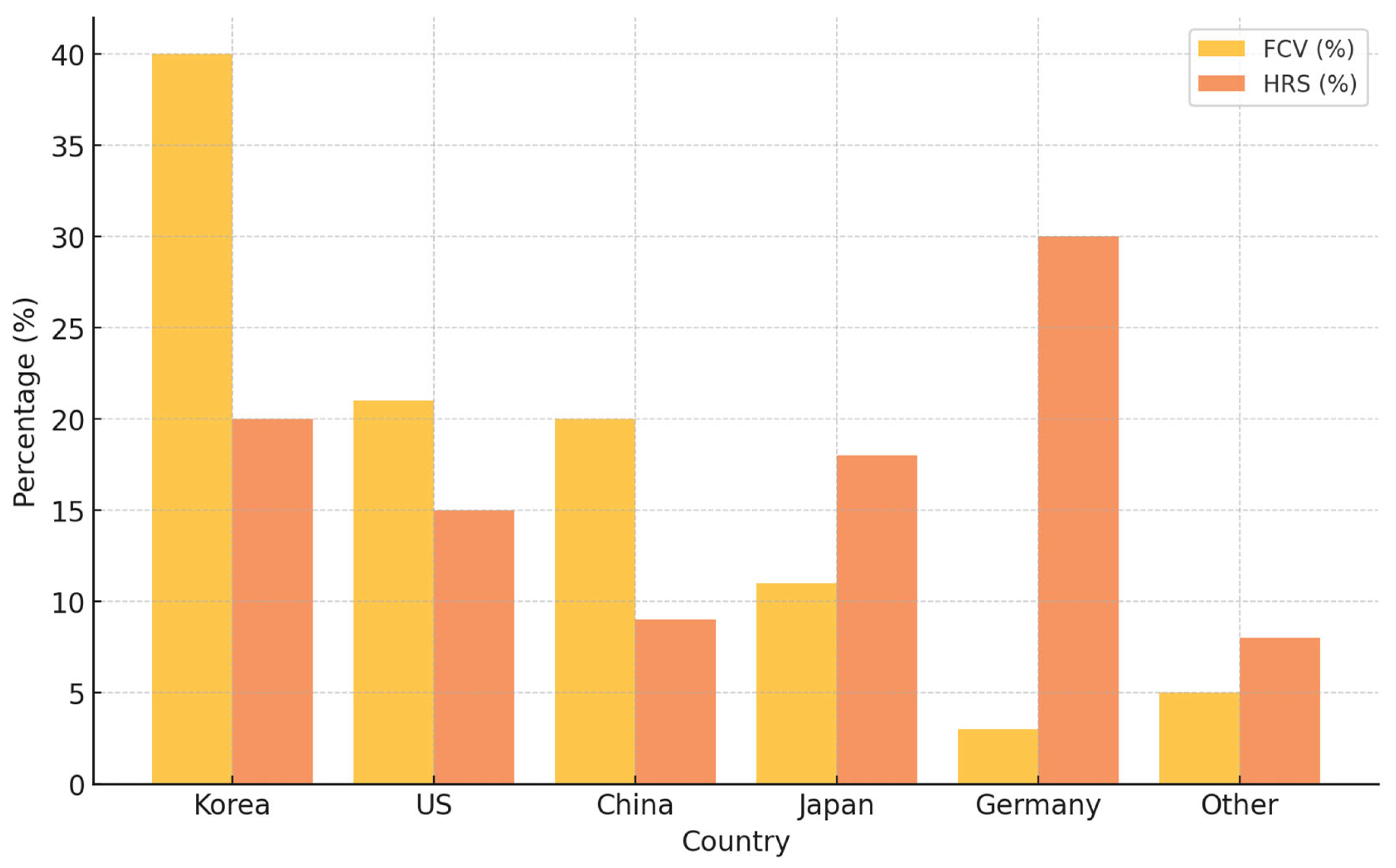
The authors of [27,36,40,43,104] explore hydrogen refueling systems, with a focus on the hydrogen supply chain and the promotion of renewable energy for hydrogen production. They also address the challenges associated with establishing FCEV refueling stations. It is anticipated that hydrogen/fuel-cell-based mobility will expand alongside the development of hydrogen production and refueling infrastructure, with both being closely connected to the ongoing reduction in hydrogen production costs. Yu et al. [36] propose a system structure that includes three primary components: the Hydrogen Production System (HPS), HRS, and the hydrogen supply chain. The HPS purchases electricity from the grid and produces hydrogen via water electrolysis, actively participating in both the electricity and carbon markets. The HRS provides hydrogen refueling services for FCEVs. The hydrogen supply chain is responsible for transporting hydrogen from the HPS to the HRS. Although pipelines are commonly used for transporting large amounts of hydrogen over long distances, their construction is costly, especially in urban areas. They evaluate three scenarios: hydrogen is produced onsite at the HRS, eliminating the need for hydrogen logistics and carbon footprint tracking; hydrogen is produced at the HPS, requiring a delivery system but without carbon tracking; and hydrogen is produced at the HPS with both hydrogen delivery and carbon footprint tracking in place. Different countries have taken varied approaches to adopting FCVs and developing refueling networks, reflecting regional priorities and government support. Understanding the global landscape of FCV adoption and HRS distribution helps to assess the progress and challenges in building a viable hydrogen-based transport system. Figure 5 illustrates the global distribution of FCVs and HRS in 2022 across key countries. Korea leads in FCV adoption, while Germany has invested most heavily in refueling infrastructure. The comparison highlights differing regional strategies, where some countries prioritize vehicle deployment, while others focus on infrastructure development to support future growth in hydrogen mobility [35].
Ala et al. [104] discuss the hydrogen refueling infrastructure necessary to support FCEVs, offering insights into its development, in Portugal. The investment costs for hydrogen refueling infrastructure are compared to those of battery electric vehicle (BEV) charging infrastructure. For smaller vehicle fleets (e.g., 0.1 million vehicles), BEV infrastructure proves to be more cost-effective. However, as fleet size increases, hydrogen refueling infrastructure demonstrates cost advantages. Government policies and incentives are noted as essential for cost-effective infrastructure development. The authors suggest that with appropriate support, hydrogen could play a pivotal role in sustainable transport, especially for large-scale applications and heavy-duty vehicles [105]. The study applies the SERA (Scenario Evaluation and Regionalization Analysis) model, which is a tool from the National Renewable Energy Laboratory (NREL) used to simulate the spatial and temporal development of hydrogen infrastructure. The model identifies the quantity, size, and optimal locations for HRS based on projected fuel demand from FCEVs and hydrogen production requirements specifically for Portugal, using various metrics to assess regions that could benefit most from early hydrogen infrastructure. This includes a detailed assessment of regions like Lisbon, Porto, and Aveiro, where factors like population density, existing electric vehicle (EV) infrastructure, and socio-economic conditions suggest a higher readiness for FCEV technology.
The current scarcity of hydrogen refueling stations presents a considerable barrier to the widespread adoption of FCEVs. Unlike the well-established network of BEV charging stations, HRS remains in its nascent stages. As noted by [43], economies of scale are essential to reducing costs, but initial investments remain prohibitively high; they also underscore the importance of coupling renewable hydrogen production with refueling stations to support long-term decarbonization goals. According to [40], the limited availability of refueling stations is one of the primary obstacles for consumers considering FCEVs, particularly in regions with nascent hydrogen economies Similarly, ref. [41] emphasize that the availability of infrastructure strongly influences consumer preferences and regional adoption rates, noting that countries like Japan and South Korea have prioritized investments in hydrogen refueling stations, while Germany has also emerged as a leader in establishing a robust hydrogen infrastructure, supported by policy incentives and public–private partnerships. Pindoriya et al. [40] highlight that international cooperation and targeted subsidies have been instrumental in fostering hydrogen ecosystems in these regions, aligning infrastructure development with national energy strategies.
While Europe has made strides in adopting hydrogen technologies, the limited availability of hydrogen vehicles and just 228 refueling stations highlight the challenges in scaling infrastructure. In contrast, Asia is rapidly advancing, with Japan targeting 800,000 hydrogen-powered vehicles by 2030 and China aiming for 1 million by 2035. These ambitious targets underscore a concerted effort to drive cost reductions, scale production, and establish a robust hydrogen supply chain. Leading the automotive sector’s transition are companies like Toyota and Hyundai, which continue to innovate in hydrogen-powered mobility. Additionally, BMW has re-entered the hydrogen market, positioning it as a complementary technology to battery EVs. The German automaker plans to introduce a limited fleet of iX5 Hydrogen vehicles worldwide by the end of the year, primarily for testing and evaluation. Such developments reflect the automotive industry’s varied approaches to hydrogen adoption, with significant investments concentrated among a few key players [30,106,107].

3.4. Challenges Facing the Commercialization of PEMFC Technology

While PEMFC technology holds immense promise for clean energy applications, several challenges must be addressed before it can achieve widespread commercialization. These challenges revolve around infrastructure, cost, and durability. One of the primary obstacles is the high cost of producing pure hydrogen, which is essential for the efficient operation of PEMFCs. Current methods of hydrogen production, such as steam reforming of hydrocarbons (e.g., natural gas or coal gasification), are not only energy-intensive but also emit significant amounts of carbon dioxide (CO2) into the atmosphere, undermining the environmental benefits of the technology. Additionally, the supply of high-purity hydrogen is critical, as contaminants like carbon monoxide can severely poison the anode electro-catalyst, reducing the fuel cell’s efficiency and lifespan. PEMFCs operate at elevated temperatures, and while this presents challenges, it also offers opportunities. Higher operating temperatures improve performance by reducing voltage losses, enhancing resistance to carbon monoxide contamination, and increasing the reaction rates. Elevated temperatures also allow for more efficient heat management, which is beneficial for both performance and durability. Despite these advancements, the lack of a robust hydrogen infrastructure remains a significant barrier. The development of a widespread network of hydrogen production, storage, and refueling stations is critical for enabling PEMFCs to compete with traditional fossil-fuel-based technologies and BEVs [100,108]. Hydrogen has achieved cost-competitiveness, with gray hydrogen currently priced on par with oil at approximately 40–45 USD/MWh. FCVs are gaining traction due to hydrogen’s high energy density, which provides 6–7 times more energy than BEVs [43]. For instance, 1 kg of hydrogen delivers an approximate range of 100 km, as demonstrated by the Toyota Mirai. Leading automakers such as Toyota, Hyundai, and Honda have been pioneering the development of fuel cell vehicles, strongly supported by substantial government subsidies, particularly in markets like China [109]. FCVs address key automotive requirements, including extended driving ranges, rapid refueling times, and adaptability to diverse environmental conditions. Projections for 2030 suggest that hydrogen-powered vehicles could account for 1 in 12 cars in pivotal markets such as Germany, Japan, and South Korea. Beyond passenger vehicles, hydrogen-powered trucks, trains, and ships are anticipated to play a transformative role in reducing global carbon emissions. Table 5 presents an overview of fuel cell technology applications in the transport sector, highlighting the maturity level of various technologies, types of fuel cells employed, power ranges, and fuel specifications.
Structurally and functionally, FCVs share many similarities with conventional internal combustion engine (ICE) vehicles. Both incorporate core systems such as the powertrain, chassis, electronics, and body into an integrated design. However, FCVs distinguish themselves through their use of a fuel cell system and electric motor to generate and deliver power. Hydrogen, stored in high-pressure tanks, is converted into electricity by the fuel cell stack, which powers the vehicle’s electric motor with support from a small onboard battery. Unlike BEVs, which rely entirely on large battery packs for energy storage, the battery in an FCV primarily stabilizes the fuel cell’s power output, storing excess energy during low demand and releasing it during peak demand for seamless operation [43,109].
FCEVs differentiate themselves from BEVs through their unique operational mechanism. While BEVs store electricity in batteries recharged from the electric grid, FCEVs generate electricity on demand via a chemical reaction within fuel cells. This electricity powers the wheel motors, producing only water vapor as a byproduct. Additionally, hydrogen refueling stations offer a key advantage: the refueling process takes a similar amount of time as conventional petrol or diesel vehicles, while delivering comparable driving ranges. This combination of quick refueling, zero emissions, and efficient energy use positions hydrogen-powered cars as a pivotal technology in the pursuit of sustainable mobility. However, the automotive industry remains divided on the hydrogen transition, with significant investments concentrated among a few key players. While some regions and companies accelerate hydrogen adoption, the development of comprehensive infrastructure remains critical to unlocking its full potential [41].
Table 6 highlights the performance characteristics of modern PEMFC vehicles. For instance, the Hyundai Nexo achieves the highest driving range at 756 km due to its larger tank capacity (6.33 kg). The Mercedes-Benz GLC F-CELL, on the other hand, features the most powerful fuel cell stack with an output of 141.6 kW. These advancements reflect significant progress in hydrogen storage, fuel cell efficiency, and vehicle design, solidifying FCEVs as a competitive alternative to BEVs in achieving carbon-neutral transportation. By offering high energy efficiency, rapid refueling times, and zero-emission operation, PEMFC-powered vehicles address key limitations associated with conventional transportation systems and contribute to the broader adoption of hydrogen as a clean energy vector [30,106,107].

Passenger Light-Duty Vehicle

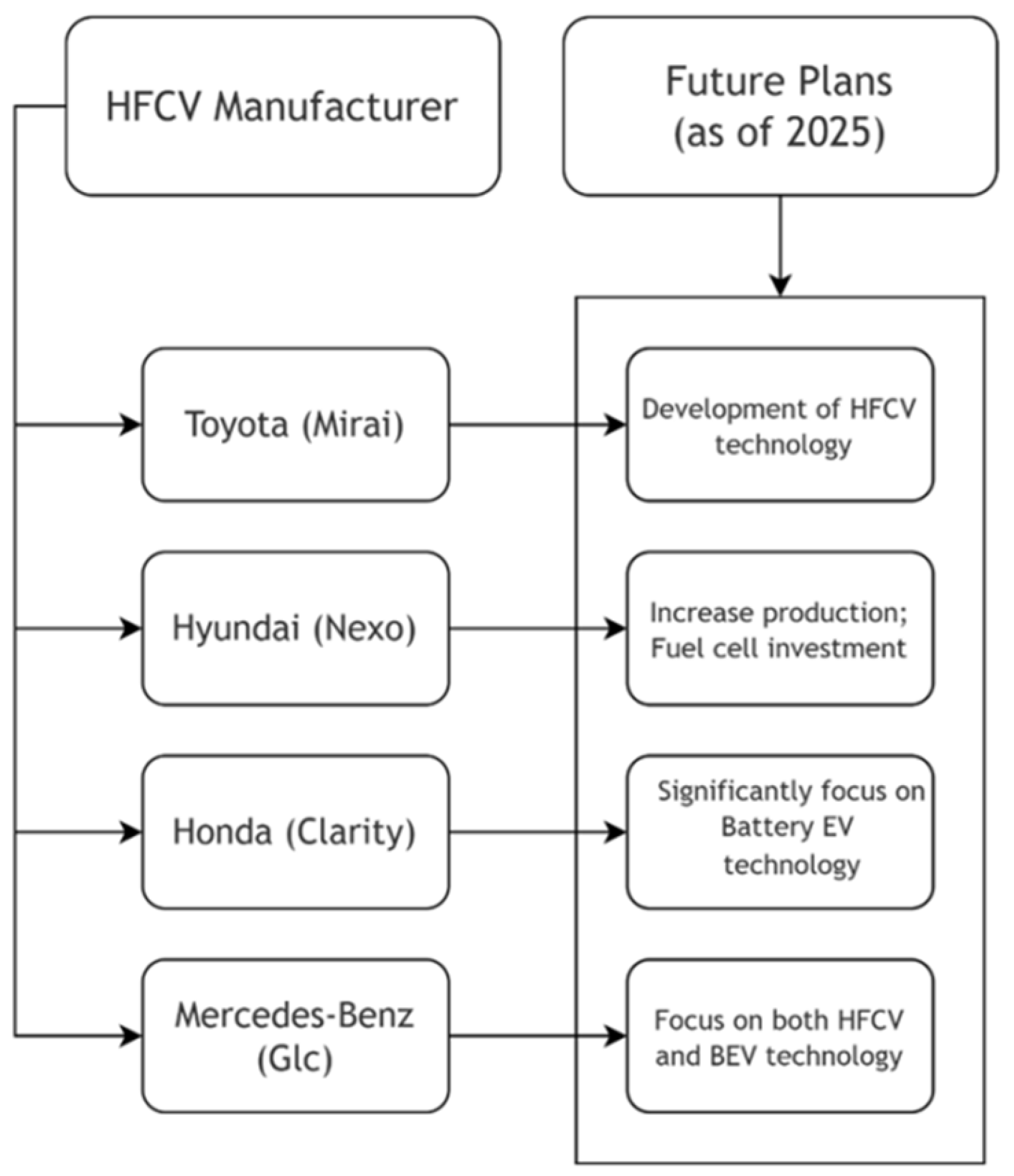
According to the International Energy Agency (IEA) [110] net-zero emission scenario, hydrogen demand in transportation is projected to reach 2.6% of the sector’s total energy consumption by 2030 and more than a quarter by 2050. However, the current use of hydrogen in transportation remains minimal, accounting for less than 0.01% of the energy consumed in the sector. This highlights the scale of transformation required to meet the future energy needs of a hydrogen-based transportation system. From 2017 to 2020, the global stock of FCEVs experienced rapid growth, with an average annual increase of 70%. By June 2021, there were more than 40,000 FCEVs in operation worldwide, predominantly in the United States and Japan. The United States maintains the second-largest fleet of FCEVs, with over 9200 vehicles sold by the end of 2020. In Japan, there are currently 4100 FCEVs on the road, and the country aims to manufacture 800,000 passenger light-duty vehicles (PLDVs) by 2030. South Korea, a leading player in the FCEV market between 2019 and 2020, registered 4400 PLDVs by mid-2020 and has set ambitious targets of 200,000 FCEVs by 2025 and 2.9 million by 2040 [10,111,112]. Despite these developments, significant barriers hinder the widespread commercialization of FCEVs. The high total cost of ownership (TCO) remains a major challenge, making FCEVs less competitive compared to other low-carbon transportation options. The gradual growth of FCEV stock in key markets underscores the need for continued investment in technology, cost-reduction strategies, and infrastructure to support the broader adoption of hydrogen-powered vehicles. Figure 6 highlights the strategic directions of four major HFCV manufacturers. Toyota focuses on advancing HFCV technology, while Hyundai plans to expand production and fuel cell investment. Honda shifts its focus to BEVs, and Mercedes-Benz balances efforts between HFCV and BEV technologies, reflecting diverse approaches to sustainable mobility [106].
Recent studies reinforce the critical role of lifespan prediction in lowering the total cost of ownership. Hua et al. [113] propose a multi-timescale lifespan prediction framework for PEMFC systems under dynamic operating conditions, enabling a more accurate estimation of remaining service life. Complementarily, Wang et al. [114] demonstrate the effectiveness of a neural network model in predicting PEMFC degradation with higher precision under transient loads. These predictive methods provide practical tools to anticipate performance inflection points well in advance, enhancing maintenance planning and TCO modeling.
Based on various literature reviews on fuel cells [35,44], it is clear that hydrogen technology is gaining significant attention due to its potential as a clean energy source with zero environmental impact. Ajanovic et al. [35], Ala et al. [27] and Dah et al. [33] mention that the transition to more sustainable mobility involves not only adopting EVs but also applying strategies to avoid unnecessary travel, reduce trip distances, and shift to more eco-friendly modes of transport. The authors state that EVs face challenges beyond mileage, as battery life degrades over time, even when not in use, leading to costly replacements. Additionally, charging stations are limited in Europe, and the current infrastructure cannot support the higher demand of widespread electric mobility. Upgrading the grid would require significant investment and major modifications, especially given its integration with underground transport systems. The authors in [27,115] discuss the Well-to-Mileage (WtM) approach to compare the consumption of different fuel types, rather than focusing on vehicle efficiency under a defined speed profile. For synthetic fuels, the HFCV demonstrates the lowest consumption of electrical energy.
Hydrogen fuel cell technology has emerged as a pivotal area of research, particularly in its applications within the transportation sector. Studies have explored various aspects of this technology, from the modeling and simulation of PEMFCs to the optimization of energy management systems for FCEVs. Comparative analyses often focus on HFCVs versus BEVs and traditional combustion engines, evaluating their environmental, economic, and operational impacts.

3.5. Energy Management System

FCEVs consist of various integrated systems that require precise management to maintain optimal performance and durability. Effective energy management strategies are crucial for hybrid configurations, which combine power flows from the fuel cell, battery, and potentially supercapacitors. These strategies aim to minimize hydrogen consumption, sustain the charge of the energy storage system (ESS), and prolong the lifespan of components, particularly the fuel cell. The fuel cell is particularly susceptible to wear and damage under demanding conditions, such as
  • Frequent start–stop cycles.
  • Variable power loads.
  • Low- and high-power operations.
In PEMFCs, hydrogen and oxygen undergo an electrochemical reaction to generate electricity, producing water as a primary by-product. The water formed within the cell plays a crucial role in maintaining optimal performance, as it hydrates the proton exchange membrane—a condition essential for efficient proton conductivity and stable cell operation at low to moderate current densities. However, at higher operating current densities, the rate of water generation increases substantially. If not effectively managed, excess water can accumulate within the porous layers and gas diffusion media, leading to a phenomenon known as flooding. Flooding obstructs gas pathways, restricting the access of hydrogen and oxygen to the catalyst sites, and induces mass transport limitations. These effects cause a rapid decline in cell voltage and power output, and, if persistent, can accelerate degradation mechanisms within the fuel cell. A detailed discussion of water management challenges and strategies, particularly at high operating current densities, is provided by [116].
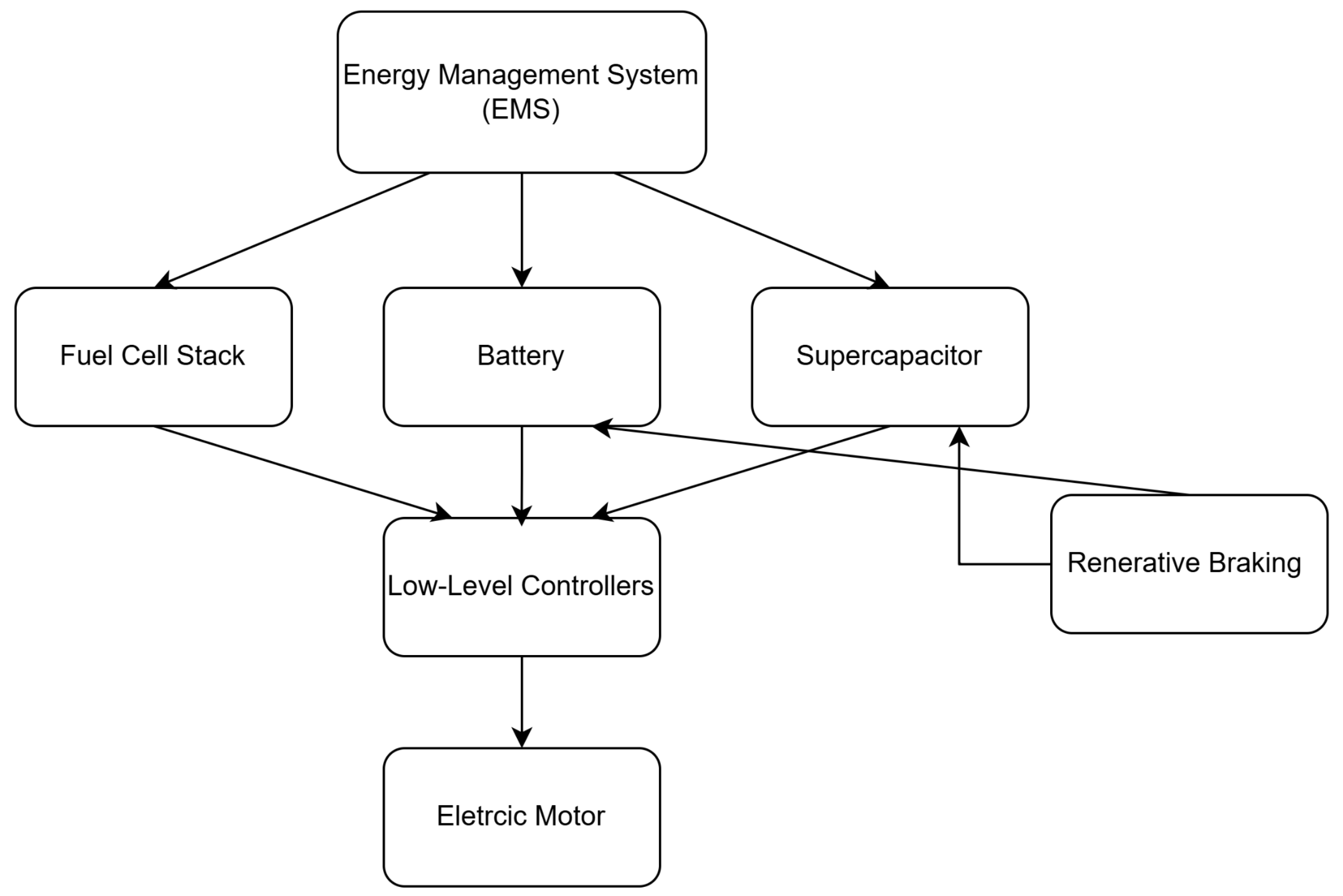
Proper water management is essential to mitigate these issues and ensure efficient performance. Additionally, the control system must effectively manage power flows, such as during regenerative braking and energy distribution among components, as illustrated in Figure 7. The EMS serves as the central control unit, coordinating the interaction and performance of the various components to ensure optimal energy distribution and system efficiency. The fuel cell stack serves as the primary energy source, providing steady power, while the battery and supercapacitor act as auxiliary energy storage systems. The battery supports sustained energy demands, and the supercapacitor handles rapid power bursts from peak loads. Regenerative braking captures kinetic energy during deceleration, converting it into electrical energy to recharge the battery or supercapacitor. The electric motor converts the supplied electrical energy into mechanical energy to power the system [117].

3.6. Hydrogen Infrastructure Expansion Plans by 2030

By 2030, major economies will have advanced ambitious hydrogen infrastructure plans to support energy transition and zero-emission mobility goals.

3.6.1. Europe

The EU’s REPowerEU Plan targets producing 10 million tonnes of renewable hydrogen domestically and importing another 10 million tonnes annually by 2030, supported by 40 GW of electrolyzer capacity [118]. The European Hydrogen Backbone (EHB) initiative outlines five large-scale hydrogen pipeline corridors linking major supply regions—North Africa, North Sea, Baltic, Mediterranean, and Central/East Europe—to demand hubs, enabling transport and storage of around 20 million tonnes annually and boosting cross-border trade [119]. By 2030, Europe also plans to have hundreds of hydrogen refueling stations and several large underground hydrogen storage facilities [118]. Investment projections amount to EUR 28–38 billion for pipelines and EUR 6–11 billion for storage, with the EU Hydrogen Bank supporting market development [118].

3.6.2. China

China’s national targets include deploying at least 1 million hydrogen fuel cell electric vehicles (FCEVs) and establishing more than 1000 hydrogen refueling stations nationwide by 2030 [120,121]. Provincial governments set additional goals—such as Zhejiang (89 stations), Sichuan (80), and Hebei (100) [121]—while major corporations like Sinopec commit to building 1000 stations by 2025 [122]. The emphasis is on infrastructure for heavy trucks, buses, and logistics fleets, along with continued investment in hydrogen production, storage, and distribution [120].

3.6.3. Japan

Japan seeks to expand from roughly 160 hydrogen refueling stations today to approximately 1000 stations nationwide by 2030 [123] to support its plan for 800,000 FCEVs (both passenger and commercial) and 3 million tonnes/year hydrogen consumption [124]. The rollout includes 900–1000 stations with a focus on large commercial-scale facilities and purchase subsidies [123,124]. This expansion is part of Japan’s broader zero-emission mobility and hydrogen industrial strategy [123].

3.6.4. South Korea

South Korea plans to produce 3.9 million tonnes/year of hydrogen by 2030, sourced from a mix of gray, blue, and increasingly green production [125]. Infrastructure targets include building several hundred hydrogen refueling stations by 2030, progressing toward a long-term goal of 1200 stations by 2040, of which 70 will be liquid hydrogen stations for commercial fleets [125,126]. The country also aims to have 300,000 FCEVs and 21,200 hydrogen buses operating by 2030 [127], backed by combined public and private investments of about USD 20 billion in infrastructure, vehicles, and supply chains [125].
  • China: ≥1000 hydrogen refueling stations [120].
  • Japan: ∼1000 hydrogen refueling stations [123].
  • South Korea: Several hundred stations by 2030; moving toward 1200 by 2040 (including 70 liquid hydrogen stations) [125].

3.7. Hydrogen Refueling Station Targets in the EU (AFIR)

The Alternative Fuels Infrastructure Regulation (AFIR) adopted by the European Union establishes ambitious, binding targets for HRS deployment by 2030, illustrating the critical role of policy and regulation in advancing the clean energy transition [128]. The regulation includes provisions for flexibility, such as allowing reduced capacity on roads with fewer than 2000 heavy-duty vehicles per day and exemptions for islands or remote EU regions due to logistical challenges [129].
AFIR mandates that:
  • Station density: At least one HRS must be available every 200 km along the Trans-European Transport Network (TEN-T) Core network [128].
  • Urban coverage: Each major urban node within the TEN-T must host at least one hydrogen refueling station [128].
  • Station capacity: Stations must supply a minimum of 1 t of hydrogen per day to meet increasing demand [130].
  • Pressure requirements: Dispensers must operate at a pressure of at least 700 bar, with optional 350 bar dispensers for heavy-duty vehicles [128,130].
  • Payment interoperability: Stations must support payment systems such as contactless and card payments to enhance user convenience [128,130].
The regulation includes provisions for flexibility, such as allowing reduced capacity on roads with fewer than 2000 heavy-duty vehicles per day and exemptions for islands or remote EU regions due to logistical challenges [129]. As of 2022, Europe had approximately 254 operational hydrogen refueling stations, predominantly located in Germany (105), France (44), the UK and the Netherlands (17 each), and Switzerland (14) [131]. To meet AFIR targets, an estimated 700 additional stations must be installed by 2030 [131].

Importance of Policy and Regulation

Strong policies like AFIR are essential for several reasons:
  • Investment certainty: Binding targets provide a predictable and stable market outlook, encouraging investments from both public and private sectors [132].
  • Equitable infrastructure distribution: AFIR ensures balanced coverage across the EU, preventing regional disparities in refueling access [128].
  • Market harmonization: Standardized technical and operational requirements reduce barriers and enable the interoperability necessary for a seamless user experience [131].
  • Accelerated decarbonization: The policies support the development of hydrogen infrastructure critical for fuel cell vehicles, especially in heavy-duty transport sectors harder to electrify through battery technologies [129].
  • Alignment with climate goals: AFIR supports the EU’s broader “Fit for 55” package, aiming for a 55% reduction in greenhouse gas emissions by 2030 [132].
In summary, AFIR’s comprehensive regulatory framework is a key driver in making hydrogen fuel cell vehicles a viable and scalable solution for sustainable European mobility by 2030.

4. Discussion

A comprehensive overview of various studies related to hydrogen fuel cell technology, particularly focusing on its application in electric and fuel cell vehicles, is presented in Table 7.
HFCs and EVs are increasingly seen as critical technologies in the shift toward reducing greenhouse gas emissions and fostering sustainable transportation. While EVs made significant advancements in recent years, particularly through incentives, tax exemptions, and infrastructure development, their environmental impact remains closely tied to the production and disposal of batteries. As noted in [100], battery degradation remains one of the most significant challenges, impacting both vehicle longevity and the overall sustainability of EVs. Moreover, EVs continue to face infrastructural challenges, particularly in regions where charging networks are insufficient to meet the growing demand. On the other side, we have hydrogen fuel cells that provide a complementary alternative, particularly for applications that require longer ranges and shorter refueling times. Studies such as those by [44] have highlighted the superior energy density and faster refueling capabilities of hydrogen, making it more suitable for heavy-duty and long-range transportation. Furthermore, as the hydrogen fuel production infrastructure evolves, especially with the rise of green hydrogen derived from renewable energy, the environmental footprint of hydrogen fuel cells could significantly decrease. However, the adoption of HFCs faces significant hurdles, such as high production costs and a limited refueling infrastructure, both of which have been barriers to widespread adoption. For example, the work by [42] emphasizes the importance of advancing hydrogen production technologies to make hydrogen a cost-effective fuel source in the future. Additionally, studies have shown that while hydrogen fuel cells offer many benefits, their overall market viability depends heavily on the development of supportive infrastructure and the reduction of production costs. The comparative performance between HFCVs and EVs continues to be a subject of debate. Some research indicates that, while HFCVs excel in areas such as range and refueling speed, EVs benefit from an already established and expanding charging infrastructure, particularly in urban areas where short-range travel dominates. This suggests that both technologies will play crucial roles in future mobility, with EVs dominating short-range, urban transport, and HFCs being more suited for long-haul and heavy-duty applications [35].

5. Conclusions

This article presents a systematic literature review on the potential of hydrogen fuel cells as an environmentally friendly alternative to conventional fossil fuels and EVs in the shift towards sustainable transportation. While both solutions offer substantial environmental benefits compared to conventional internal combustion engines, they present unique challenges and opportunities that will influence their future adoption. While the 23 studies selected through the PRISMA methodology provided the systematic foundation and methodological backbone of this review, the analysis was further expanded by incorporating additional publications and technical reports. This approach ensured both transparency in the selection process and the inclusion of the most up-to-date perspectives on hydrogen fuel cells and electric vehicles, thereby broadening the scope beyond the initial PRISMA-based dataset. EVs have made significant progress, particularly in urban and short-range transportation, supported by expanding charging infrastructure and governmental incentives. However, their environmental impact remains tied to the production and disposal of batteries, which rely on finite resources and present issues related to degradation over time. Continued advancements in battery technology, as well as improvements in recycling processes, are critical to furthering the sustainability of EVs. Hydrogen fuel cells, on the other hand, offer a promising alternative for long-range and heavy-duty applications, where faster refueling times and higher energy density make them more suitable than battery-powered vehicles. However, the adoption of HFC technology remains limited by high production costs and a lack of refueling infrastructure. For HFCs to become a viable mainstream option, substantial investments in hydrogen production, particularly green hydrogen, and the development of refueling stations are necessary. Ultimately, the future of sustainable mobility will likely involve a combination of both technologies, each serving distinct roles based on the specific needs of the transportation sector. EVs will continue to dominate short-range and urban mobility, while hydrogen fuel cells could play a key role in decarbonizing long-haul and commercial transport. To achieve these goals, continued research, supportive policies, and significant infrastructure investments will be essential.

Author Contributions

Conceptualization, methodology and formal analysis: F.L., V.A. and M.L.R.L.; writing—original draft preparation: F.L.; writing—review and editing: F.L., V.A. and M.L.R.L.; supervision: V.A. and M.L.R.L.; funding acquisition: M.L.R.L. All authors have read and agreed to the published version of the manuscript.

Funding

The study was developed under the project A-MoVeR—“Mobilizing Agenda for the Development of Products & Systems towards an Intelligent and Green Mobility”,—operation n.º 02/C05-i01.01/2022.PC646908627-00000069, approved under the terms of the call n.º 02/C05-i01/2022—Mobilizing Agendas for Business Innovation—financed by European funds provided to Portugal by the Recovery and Resilience Plan (RRP), in the scope of the European Recovery and Resilience Facility (RRF), framed in the Next Generation UE, for the period from 2021 to 2026. This work is supported by National Funds by FCT—Portuguese Foundation for Science and Technology, under the project UIDB/04033/2020 (https://doi.org/10.54499/UIDB/04033/2020) (accessed on 6 June 2025). This work is supported by National Funds by FCT—Portuguese Foundation for Science and Technology, under the projects UID/04033/2025: Centre for the Research and Technology of AgroEnvironmental and Biological Sciences (https://doi.org/10.54499/UID/04033/2025) (accessed on 6 June 2025) and LA/P/0126/2020 (https://doi.org/10.54499/LA/P/0126/2020) (accessed on 6 June 2025).

Data Availability Statement

The data supporting the findings of this study are derived from publicly available sources, including reports and databases from international organizations. These sources are cited within the article. No new datasets were generated.

Conflicts of Interest

The authors declare no conflicts of interest.

Abbreviations

The following abbreviations are used in this manuscript:
BEVBattery Electric Vehicle
CCSCarbon capture and storage
CO2carbon dioxide
DCDirect current
EMSEnergy Management System
EVElectric Vehicle
FCVFuel Cell Vehicles
ICEVInternal Combustion Engine Vehicle
GHGGreenhouse Gas
HFCEVHydrogen fuel cell electric vehicles
HFCVHydrogen fuel cell vehicles
HICEVHydrogen Internal Combustion Engine Vehicle
HPSHydrogen Production System
HRShydrogen refueling stations
ICEInternal Combustion Engine
PNECNational Energy and Climate Plan
PLDVPassenger light-duty vehicle
PEMFCProton Exchange Membrane Fuel Cell

References

  1. Douak, M.; Settou, N. Estimation of hydrogen production using wind energy in Algeria. Energy Procedia 2015, 74, 981–990. [Google Scholar] [CrossRef]
  2. International Energy Agency. Net Zero by 2050; International Energy Agency Publications (IEA): Paris, France, 2021; Available online: https://www.iea.org/reports/net-zero-by-2050 (accessed on 6 June 2025).
  3. Calado, G.; Castro, R. Hydrogen production from offshore wind parks: Current situation and future perspectives. Appl. Sci. 2021, 11, 5561. [Google Scholar] [CrossRef]
  4. Back, C.; González-Morán, L.; Iranzo, A. Green hydrogen from renewable surplus: Production and storage potential in Spain’s 2040 energy horizon. Int. J. Hydrogen Energy 2025, 140, 2–10. [Google Scholar] [CrossRef]
  5. Nnabuife, S.G.; Hamzat, A.K.; Whidborne, J.; Kuang, B.; Jenkins, K.W. Integration of renewable energy sources in tandem with electrolysis: A technology review for green hydrogen production. Int. J. Hydrogen Energy 2025, 107, 218–240. [Google Scholar] [CrossRef]
  6. Reda, B.; Elzamar, A.A.; AlFazzani, S.; Ezzat, S.M. Green hydrogen as a source of renewable energy: A step towards sustainability, an overview. Environ. Dev. Sustain. 2025, 27, 29213–29233. [Google Scholar] [CrossRef]
  7. Segovia-Hernández, J.G.; Hernández, S.; Cossio-Vargas, E.; Juarez-Garcia, M.; Sanchez-Ramirez, E. Green hydrogen production for sustainable development: A critical examination of barriers and strategic opportunities. RSC Sustain. 2025, 3, 134. [Google Scholar] [CrossRef]
  8. Sebbagh, T.; Şahin, M.E.; Beldjaatit, C. Green Hydrogen Revolution for a Sustainable Energy Future. Clean Technol. Environ. Policy 2024, 26, 4017–4040. [Google Scholar] [CrossRef]
  9. European Commission. Stepping Up Europe’s 2030 Climate Ambition: Investing in a Climate-Neutral Future for the Benefit of Our People; COM(2020) 562 Final; European Commission: Brussels, Belgium, 2020; Available online: https://eur-lex.europa.eu/legal-content/EN/TXT/PDF/?uri=CELEX:52020DC0562 (accessed on 18 June 2025).
  10. International Energy Agency (IEA). Global Hydrogen Review 2021; IEA: Paris, France, 2021; Available online: https://www.iea.org/reports/global-hydrogen-review-2021 (accessed on 6 June 2025).
  11. United Nations. SDG Resource Document: Targets Overview. In Proceedings of the 4th SDG Youth Summer Camp–SDG Resource Document, Virtual, 10–21 August 2019; United Nations: Washington, DC, USA, 2019; Available online: https://www.un.org/sustainabledevelopment/ (accessed on 9 August 2024).
  12. Ajanovic, A.; Sayer, M.; Haas, R. The economics and the environmental benignity of different colors of hydrogen. Int. J. Hydrogen Energy 2022, 47, 24136–24154. [Google Scholar] [CrossRef]
  13. Bhandari, R.; Trudewind, C.A.; Zapp, P. Life cycle assessment of hydrogen production via electrolysis—A review. J. Clean. Prod. 2014, 85, 151–163. [Google Scholar] [CrossRef]
  14. Nnabuife, S.G.; Darko, C.K.; Obiako, P.C.; Kuang, B.; Sun, X.; Jenkins, K. A Comparative Analysis of Different Hydrogen Production Methods and Their Environmental Impact. Clean Technol. 2023, 5, 1344–1380. [Google Scholar] [CrossRef]
  15. Miotti, M.; Supran, G.J.; Kim, E.J.; Trancik, J.E. Personal vehicles evaluated against climate change mitigation targets. Environ. Sci. Technol. 2016, 50, 10795–10804. [Google Scholar] [CrossRef] [PubMed]
  16. Pehnt, M. Life-Cycle Assessment of Fuel Cell Stacks. Int. J. Hydrogen Energy 2001, 26, 91–101. [Google Scholar] [CrossRef]
  17. Staffell, I.; Scamman, D.; Velazquez Abad, A.; Balcombe, P.; Dodds, P.E.; Ekins, P.; Shah, N.; Ward, K.R. The role of hydrogen and fuel cells in the global energy system. Energy Environ. Sci. 2019, 12, 463–491. [Google Scholar] [CrossRef]
  18. Balat, M. Possible methods for hydrogen production. Energy Sources Part Recover. Util. Environ. Eff. 2008, 31, 39–50. [Google Scholar] [CrossRef]
  19. Acar, C.; Dincer, I. Comparative assessment of hydrogen production methods from renewable and non-renewable sources. Int. J. Hydrogen Energy 2014, 39, 1–12. [Google Scholar] [CrossRef]
  20. Barbir, F. PEM electrolysis for production of hydrogen from renewable energy sources. Sol. Energy 2005, 78, 661–669. [Google Scholar] [CrossRef]
  21. Carmo, M.; Fritz, D.L.; Mergel, J.; Stolten, D. A comprehensive review on PEM water electrolysis. Int. J. Hydrogen Energy 2013, 38, 4901–4934. [Google Scholar] [CrossRef]
  22. Laguna-Bercero, M.A. Recent advances in high temperature electrolysis using solid oxide fuel cells: A review. J. Power Sources 2012, 203, 4–16. [Google Scholar] [CrossRef]
  23. Wang, T.; Cao, X.; Jiao, L. PEM Water Electrolysis for Hydrogen Production: Fundamentals, Advances, and Prospects. Carbon Neutrality 2022, 1, 21. [Google Scholar] [CrossRef]
  24. Ursúa, A.; Gandia, L.M.; Sanchis, P. Hydrogen production from water electrolysis: Current status and future trends. Proc. IEEE 2012, 100, 410–426. [Google Scholar] [CrossRef]
  25. Maier, M.; Dodwell, J.; Ziesche, R.; Tan, C.; Heenan, T.; Majasan, J.; Kardjilov, N.; Markötter, H.; Manke, I.; Castanheira, L.; et al. Mass Transport in Polymer Electrolyte Membrane Water Electrolyser Liquid-Gas Diffusion Layers: A Combined Neutron Imaging and X-Ray Computed Tomography Study. J. Power Sources 2018, 455, 227968. [Google Scholar] [CrossRef]
  26. Üçok, M.D. Prospects for Hydrogen Fuel Cell Vehicles to Decarbonize Road Transport. Discov. Sustain. 2023, 4, 42. [Google Scholar] [CrossRef]
  27. Ala, G.; Colak, I.; Di Filippo, G.; Miceli, R.; Romano, P.; Silva, C.; Valtchev, S.; Viola, F. Electric Mobility in Portugal: Current Situation and Forecasts for Fuel Cell Vehicles. Energies 2021, 14, 7945. [Google Scholar] [CrossRef]
  28. Falfari, S.; Bianchi, G. Concerns on full electric mobility and future electricity demand in Italy. Energies 2023, 16, 1704. [Google Scholar] [CrossRef]
  29. Page, M.J.; McKenzie, J.E.; Bossuyt, P.M.; Boutron, I.; Hoffmann, T.C.; Mulrow, C.D.; Shamseer, L.; Tetzlaff, J.M.; Akl, E.A.; Brennan, S.E.; et al. The PRISMA 2020 statement: An updated guideline for reporting systematic reviews. Int. J. Surg. 2021, 88, 105906. [Google Scholar] [CrossRef]
  30. Kurc, B.; Gross, X.; Szymlet, N.; Rymaniak, Ł.; Woźniak, K.; Pigłowska, M. Hydrogen-Powered Vehicles: A Paradigm Shift in Sustainable Transportation. Energies 2024, 17, 4768. [Google Scholar] [CrossRef]
  31. Buja, G.; Bertoluzzo, M.; Mude, K.N. Design and Experimentation of WPT Charger for Electric City Car. IEEE Trans. Ind. Electron. 2015, 62, 7436–7447. [Google Scholar] [CrossRef]
  32. Cleveland, C.J.; Morris, C.G. Handbook of Energy: Diagrams, Charts, and Tables; Elsevier: Newnes, NSW, Australia, 2013; Volume 1, ISBN 0-08-091457-8. [Google Scholar]
  33. Dash, S.K.; Chakraborty, S.; Roccotelli, M.; Sahu, U.K. Hydrogen Fuel for Future Mobility: Challenges and Future Aspects. Sustainability 2022, 14, 8285. [Google Scholar] [CrossRef]
  34. Pollet, B.; Staffell, I.; Shang, J. Current status of hybrid, battery and fuel cell electric vehicles: From electrochemistry to market prospects. Electrochim. Acta 2012, 84, 235–249. [Google Scholar] [CrossRef]
  35. Ajanovic, A. Electricity vs hydrogen in the transition towards sustainable mobility. Oxf. Open Energy 2023, 2, oiad013. [Google Scholar] [CrossRef]
  36. Yu, F.; Chen, J.; Xie, T.; Zhang, Z.; Yao, Y.; Tao, Y. A hydrogen refueling system for fuel cell electric vehicles: Towards low carbon oriented power and transportation systems. In Proceedings of the 2022 IEEE 5th International Electrical and Energy Conference (CIEEC 2022), Nanjing, China, 27–29 May 2022; pp. 4617–4622. [Google Scholar] [CrossRef]
  37. Zhou, M.; Jiang, W. Review on hybrid power system of hydrogen fuel cell passenger vehicles. In Proceedings of the 2021 China Automation Congress (CAC 2021), Beijing, China, 22–24 October 2021; pp. 2404–2407. [Google Scholar] [CrossRef]
  38. Martel, F.; Dube, Y.; Kelouwani, S.; Agbossou, K. Economy-Focused PHEV Battery Lifetime Management through Optimal Fuel Cell Load Sharing. In Proceedings of the IEEE Vehicle Power and Propulsion Conference (VPPC), Montreal, ON, Canada, 19–22 October 2015. [Google Scholar] [CrossRef]
  39. Halder, P.; Babaie, M.; Salek, F.; Shah, K.; Stevanovic, S.; Bodisco, T.A.; Zare, A. Performance, emissions and economic analyses of hydrogen fuel cell vehicles. Renew. Sustain. Energy Rev. 2024, 199, 114543. [Google Scholar] [CrossRef]
  40. Pindoriya, R.M.; Ahuja, V.; Sharma, A.; Singh, A.; Jain, S. An analytical review on state-of-the-art of green hydrogen technology for fuel cell electric vehicles applications. In Proceedings of the 2023 IEEE 3rd International Conference on Sustainable Energy and Future Electric Transportation (SeFet), Bhubaneswar, India, 9–12 August 2023. [Google Scholar] [CrossRef]
  41. Pergamalis, C.; Tsampasis, E.; Dedes, I.-C.; Elias, C. Hydrogen fuel cell electric vehicles (FCEV) - battery electric vehicles (BEV) - comparison and future challenges. In Proceedings of the IEEE 2024 13th Mediterranean Conference on Embedded Computing (MECO), Budva, Montenegro, 11–14 June 2024. [Google Scholar] [CrossRef]
  42. Lindorfer, J.; Rosenfeld, D.C.; Böhm, H. Fuel cells: Energy conversion technology. In Future Energy: Improved, Sustainable and Clean Options for Our Planet; Elsevier: Amsterdam, The Netherlands, 2020; pp. 495–517. [Google Scholar] [CrossRef]
  43. Fragiacomo, P.; Piraino, F.; Genovese, M.; Corigliano, O.; Lorenzo, G. Strategic overview on fuel cell-based systems for mobility and electrolytic cells for hydrogen production. Procedia Comput. Sci. 2022, 200, 1254–1263. [Google Scholar] [CrossRef]
  44. Salodkar, P.; Shrivastava, O.; Nagpure, M. Design and evaluation of hydrogen-based fuel cell as a green energy source. In Proceedings of the 2023 International Conference on Computer, Electronics and Electrical Engineering and their Applications (IC2E3 2023), Dhaka, Bangladesh, 9–10 December 2023. [Google Scholar] [CrossRef]
  45. Atawey. Green Mobility: The Role of Hydrogen in Technological Transition. 2025. Available online: https://atawey.com/en/green-mobility-the-role-of-hydrogen-in-technological-transition/ (accessed on 30 June 2025).
  46. TWI. What Are the Pros and Cons of Hydrogen Fuel Cells? 2025. Available online: https://www.twi-global.com/technical-knowledge/faqs/what-are-the-pros-and-cons-of-hydrogen-fuel-cells (accessed on 30 June 2025).
  47. BMW. How Hydrogen Fuel Cell Cars Work. 2023. Available online: https://www.bmw.com/en/innovation/how-hydrogen-fuel-cell-cars-work.html (accessed on 2 April 2025).
  48. VTM Global. A Brief Introduction to Hydrogen Fuel Cell Vehicles. 2024. Available online: https://vtm-global.com/2024/05/08/a-brief-introduction-to-hydrogen-fuel-cell-vehicles/ (accessed on 2 April 2025).
  49. Nuchhi, S.; Somashekarappa, M. Hydrogen fuel cells for automobiles: Challenges and opportunities. World J. Adv. Res. Rev. 2023, 18, 1683–1689. Available online: https://wjarr.com/sites/default/files/fulltext_pdf/WJARR-2023-1042.pdf (accessed on 2 April 2025). [CrossRef]
  50. Fivet. The Chicken-and-Egg Dilemma of Clean Mobility: How Europe Can Build a Coherent Network of Hydrogen Refueling Stations at Scale. 2023. Available online: https://fivet.com/blogs/insights-publications/the-chicken-and-egg-dilemma-of-clean-mobility-how-europe-can-build-a-coherent-network-of-hydrogen-refueling-stations-at-scale (accessed on 6 June 2025).
  51. FASTECH. Top 6 Barriers Explained. 2025. Available online: https://www.fastechus.com/blog/barriers-to-hydrogen-vehicle-adoption (accessed on 30 August 2025).
  52. Lee, H.; Jeong, S.; Song, J.; Kim, M.; Chu, C.; Lee, Y.; Kim, D.; Kim, M. Influence of PEMFC degradation on its performance in different temperature and relative humidity conditions. J. Mech. Sci. Technol. 2023, 37, 2095–2108. [Google Scholar] [CrossRef]
  53. Liu, Z.; Cai, S.; Tu, Z.; Chan, S.H. Recent development in degradation mechanisms of proton exchange membrane fuel cells for vehicle applications: Problems, progress, and perspectives. Energy Storage Sav. 2024, 3, 106–152. [Google Scholar] [CrossRef]
  54. Ren, P.; Pei, P.; Li, Y.; Wu, Z.; Chen, D.; Huang, S. Degradation mechanisms of proton exchange membrane fuel cell under typical automotive operating conditions. Prog. Energy Combust. Sci. 2020, 80, 100859. [Google Scholar] [CrossRef]
  55. Thiele, P.; Gouveia, L.; Ulrich, O.; Yang, Y.; Liu, Y.; Wick, M.; Pischinger, S. Realistic accelerated stress tests for PEM fuel cells: Operation condition dependent load profile optimization. J. Power Sources 2024, 617, 234959. [Google Scholar] [CrossRef]
  56. Earth. Hydrogen vs. Electric Cars: Comparing Innovative Sustainability. 2025. Available online: https://earth.org/hydrogen-vs-electric-cars/ (accessed on 2 April 2025).
  57. Europarl. Environmental Challenges Through the Life Cycle of Battery Electric Vehicles (BEVs). Policy Department for Structural and Cohesion Policies. 2023. Available online: https://www.europarl.europa.eu/RegData/etudes/STUD/2023/733112/IPOL_STU(2023)733112_EN.pdf (accessed on 19 May 2025).
  58. BatteryTechOnline. BEV vs FCEV: Which Is More Sustainable? 2024. Available online: https://www.batterytechonline.com/automotive-mobility/bev-vs-fcev-which-is-more-sustainable- (accessed on 19 May 2025).
  59. Haush. Carbon Cost Comparison: Battery Electric Vehicles (BEVs) and Fuel Cell Electric Vehicles (FCEVs). 2025. Available online: https://haush.co.uk/carbon-cost-comparison-battery-electric-vehicles-bevs-and-fuel-cell-electric-vehicles-fcevs/ (accessed on 19 May 2025).
  60. BloombergNEF. Electric Vehicle Outlook. 2025. Available online: https://about.bnef.com/insights/clean-transport/electric-vehicle-outlook/ (accessed on 19 May 2025).
  61. BloombergNEF. BloombergNEF Annual EV Sales Forecast. 2025. Available online: https://about.bnef.com/insights/clean-transport/global-electric-vehicle-sales-set-for-record-breaking-year-even-as-us-market-slows-sharply-bloombergnef-finds/ (accessed on 19 May 2025).
  62. BloombergNEF. BloombergNEF EVO 2025 Webinar. 2025. Available online: https://www.bloomberg.com/professional/insights/webinar/bloombergnefs-electric-vehicle-outlook-2025/ (accessed on 19 May 2025).
  63. Electrive. BNEF Forecast: Global EV Market Growth. 2025. Available online: https://www.electrive.com/2025/06/24/bnef-forecast-global-ev-market-to-grow-by-a-quarter-in-2025/ (accessed on 19 May 2025).
  64. German Autopreneur. EV Report 2025: China, Europe, USA Market Data. 2025. Available online: https://germanautopreneur.com/p/ev-report-2025-china-europe-usa-market-data (accessed on 6 June 2025).
  65. ACEA. Vehicles in Use Europe 2023. 2023. Available online: https://www.acea.auto/publication/report-vehicles-in-use-europe-2023/ (accessed on 6 June 2025).
  66. Virta. The Future of Electromobility: IEA’s Global EV Outlook. 2025. Available online: https://www.virta.global/blog/the-future-of-electromobility-ieas-global-ev-outlook (accessed on 6 June 2025).
  67. International Energy Agency. Global EV Outlook 2024. 2024. Available online: https://iea.blob.core.windows.net/assets/a9e3544b-0b12-4e15-b407-65f5c8ce1b5f/GlobalEVOutlook2024.pdf (accessed on 6 June 2025).
  68. Rocky Mountain Institute. Record Global EV Growth: Five Takeaways from Recent Electric Vehicle Outlooks. 2025. Available online: https://rmi.org/record-global-ev-growth-five-takeaways-from-recent-electric-vehicle-outlooks/ (accessed on 6 June 2025).
  69. ACEA. Vehicles on European Roads 2025. 2025. Available online: https://www.acea.auto/publication/report-vehicles-on-european-roads-2025/ (accessed on 30 June 2025).
  70. International Energy Agency. Global EV Outlook 2024: Analysis. 2024. Available online: https://www.iea.org/reports/global-ev-outlook-2024?utm_content=buffere12ec&utm_medium=social&utm_source=linkedin.com&utm_campaign=buffer (accessed on 7 January 2025).
  71. IMARC Group. Hydrogen Fuel Cell Vehicle Market Size, Share, Trends and Forecast by Technology, Vehicle Type, and Region, 2026–2034. 2025. Available online: https://www.imarcgroup.com/hydrogen-fuel-cell-vehicle-market (accessed on 7 January 2025).
  72. Precedence Research. Hydrogen Fuel Cells Market. 2025. Available online: https://www.precedenceresearch.com/hydrogen-fuel-cells-market (accessed on 7 January 2025).
  73. Allied Market Research. Hydrogen Fuel Cell Vehicle Market. 2025. Available online: https://www.alliedmarketresearch.com/hydrogen-fuel-cell-vehicle-market (accessed on 6 June 2025).
  74. Cognitive Market Research. Global Hydrogen Fuel Cell Vehicle Market Report. 2025. Available online: https://www.cognitivemarketresearch.com/hydrogen-fuel-cell-vehicle-market-report (accessed on 2 April 2025).
  75. Hydrogen Council. Path to Hydrogen Competitiveness. 2020. Available online: https://hydrogencouncil.com/wp-content/uploads/2020/01/Path-to-Hydrogen-Competitiveness_Full-Study-1.pdf (accessed on 2 April 2025).
  76. Hydrogen Council. Hydrogen In Action. 2020. Available online: https://hydrogencouncil.com/en/hydrogen-in-action/ (accessed on 21 September 2024).
  77. Ammonia Energy Association. Hydrogen Council. 2024. Available online: https://ammoniaenergy.org/organization/hydrogen-council/ (accessed on 21 September 2024).
  78. CarboEurope. Hydrogen Fuel vs. Electric Cars—Which Is the Future of Transportation? 2025. Available online: https://www.carboeurope.org/hydrogen-fuel-vs-electric-cars/ (accessed on 6 May 2025).
  79. Han, J.; Woo, J.; Kim, Y.; Yu, S. Fuel cell/battery power supply system operational strategy to secure the durability of commercial hydrogen vehicles. Energy Convers. Manag. 2023, 288, 117163. [Google Scholar] [CrossRef]
  80. Firat, A.E. Mechanical Analysis of PEM Fuel Cell Stack Design. Cuvillier Verlag. 2016. Available online: https://cuvillier.de/get/ebook/4892/9783736982574_E-Book.pdf (accessed on 11 March 2025).
  81. FuelCellShop. Fuel Cell Stack Assembly and Operation Explained. 2022. Available online: https://www.fuelcellshop.com/fuel-cell-stack-assembly-and-operation-explained/t1371 (accessed on 11 March 2025).
  82. Hyfindr. Fuel Cell Stack. 2023. Available online: https://hyfindr.com/en/hydrogen-knowledge/fuel-cell-stack (accessed on 11 March 2025).
  83. Fan, L.; Tu, Z.; Cai, S.; Miao, B.; Ding, O.L.; Chen, Y.; Chan, S.H. Design Principles and Analysis of Manifold Design in a Large-Scale PEMFC Stack. Energy 2025, 319, 117163. [Google Scholar] [CrossRef]
  84. TMNetch. Principles of Fuel Cell Stack Design And Development. 2024. Available online: https://tmnetch.com/principles-of-fuel-cell-stack-design-and-development/ (accessed on 11 March 2025).
  85. Meng, X.; Liu, M.; Mei, J.; Li, X.; Grigoriev, S.; Hasanien, H.M.; Tang, X.; Li, R.; Sun, C. Polarization loss decomposition-based online health state estimation for proton exchange membrane fuel cells. Int. J. Hydrogen Energy 2025, 157, 150162. [Google Scholar] [CrossRef]
  86. Zhang, Y.; Tang, X.; Xu, S.; Sun, C. Deep Learning-Based State-of-Health Estimation of Proton-Exchange Membrane Fuel Cells under Dynamic Operation Conditions. Sensors 2024, 24, 4451. [Google Scholar] [CrossRef]
  87. EcoFlow. How Do Lithium Batteries Perform in Cold Weather? 2025. Available online: https://www.ecoflow.com/us/blog/how-do-lithium-batteries-perform-in-cold-weather. (accessed on 2 April 2025).
  88. Electroverse. How Does Cold Weather Affect EV Battery Capacity? 2025. Available online: https://electroverse.com/community/ev-blogs-and-guides/how-does-colder-weather-affect-ev-battery-capacity (accessed on 2 April 2025).
  89. Lee, S. Cold Start in Fuel Cell Tech. Understanding the Challenges and Solutions in Hydrogen Fuel Cells. 2025. Available online: https://www.numberanalytics.com/blog/cold-start-fuel-cell-technology (accessed on 4 April 2025).
  90. Lu, Z.; Gu, P.; Wang, J.; Jiang, C. Study on hot and cold starting characteristics of fuel cell engines. E3S Web Conf. 2021, 257, 01088. Available online: https://www.e3s-conferences.org/articles/e3sconf/pdf/2021/33/e3sconf_aesee2021_01088.pdf (accessed on 6 June 2025). [CrossRef]
  91. Reddi, K.; Elgowainy, A.; Rustagi, N.; Gupta, E. Impact of Hydrogen SAE J2601 Fueling Methods on Fueling Time of Light-Duty Fuel Cell Electric Vehicles. Int. J. Hydrogen Energy 2017, 42, 16675–16685. [Google Scholar] [CrossRef]
  92. Wiltson Energy. How Cold Weather Affects Battery Life: Performance Loss and Lifespan. 2025. Available online: https://www.wiltsonenergy.com/The-Truth-About-Cold-Weather-Battery-Performance.html (accessed on 11 April 2025).
  93. Precedence Research. Hydrogen Internal Combustion Engines Market Innovations Supporting Decarbonization. 2025. Available online: https://www.precedenceresearch.com/hydrogen-internal-combustion-engines-market (accessed on 11 April 2025).
  94. Ghodbane, H.; Khaldi, F.; Bahloul, D. Hydrogen Internal Combustion Engines: Bridging the Gap to Zero-Emission Transportation. Energy Environ. 2025, 1–21. [Google Scholar] [CrossRef]
  95. Tang, X.; Shi, L.; Li, M.; Xu, S.; Sun, C. Health State Estimation and Long-Term Durability Prediction for Vehicular PEM Fuel Cell Stacks Under Dynamic Operational Conditions. IEEE Trans. Power Electron. 2025, 40, 4498–4509. [Google Scholar] [CrossRef]
  96. Wu, H.; Zhang, R.; Zhu, W.; Xie, C.; Li, Y.; Yang, Y.; Guo, B.; Li, C.; Xiong, R. A health index-based approach for fuel cell lifetime estimation. Front. Energy Res. 2024, 27, 110979. [Google Scholar] [CrossRef] [PubMed]
  97. He, S.; Wu, X.; Bai, Z.; Zhang, J.; Lou, S.; Mu, G. Data-Driven Power Prediction for Proton Exchange Membrane Fuel Cell Reactor Systems. Sensors 2024, 24, 6120. [Google Scholar] [CrossRef]
  98. Jahan, I.; Islam, M.A.; Farrok, O. Hydrogen fuel cell-based low-power DC motor-driven energy-efficient electric vehicle: A comparative analysis. In Proceedings of the 2022 4th International Conference on Sustainable Technologies for Industry 4.0 (STI), Dhaka, Bangladesh, 17–18 December 2022. [Google Scholar] [CrossRef]
  99. Parreira, A.; Viveiros, C.; Fonte, P.M. Hydrogen as the fuel of the future and its application in electric mobility. In Proceedings of the 2022 International Conference on Electrical, Computer, Communications and Mechatronics Engineering (ICECCME), Malé, Maldives, 16–18 November 2022. [Google Scholar] [CrossRef]
  100. Aimani, S.E. Modeling and simulation of a hydrogen-based proton exchange membrane fuel cell for power generation. In Proceedings of the 2023 IEEE 5th Global Power, Energy and Communication Conference (GPECOM 2023), Cappadocia, Turkiye, 14–16 June 2023; pp. 381–387. [Google Scholar] [CrossRef]
  101. Gao, F. Hydrogen fuel cell electric vehicles: State of art and outlooks. In Proceedings of the 2022 IEEE 9th International Conference on Power Electronics Systems and Applications (PESA), Hong Kong, China, 20–22 September 2022. [Google Scholar] [CrossRef]
  102. Magliano, A.; Perez Carrera, C.; Pappalardo, C.M.; Guida, D.; Berardi, V.P. A Comprehensive Literature Review on Hydrogen Tanks: Storage, Safety, and Structural Integrity. Appl. Sci. 2024, 14, 9348. [Google Scholar] [CrossRef]
  103. Mancino, A.N.; Menale, C.; Vellucci, F.; Pasquali, M.; Bubbico, R. PEM Fuel Cell Applications in Road Transport. Energies 2023, 16, 6129. [Google Scholar] [CrossRef]
  104. Ala, G.; Castiglia, V.; Di Filippo, G.; Miceli, R.; Romano, P.; Viola, F. From electric mobility to hydrogen mobility: Current state and possible future expansions. In Proceedings of the 20th IEEE Mediterranean Electrotechnical Conference (MELECON 2020), Palermo, Italy, 15–18 June 2020. [Google Scholar] [CrossRef]
  105. Magueta, D.; Madaleno, M.; Ferreira Dias, M.; Meireles, M. New cars and emissions: Effects of policies, macroeconomic impacts and cities characteristics in Portugal. J. Clean. Prod. 2018, 181, 178–191. [Google Scholar] [CrossRef]
  106. Olabi, A.G.; Wilberforce, T.; Abdelkareem, M.A. Fuel Cell Application in the Automotive Industry and Future Perspective. Energy 2021, 214, 118955. [Google Scholar] [CrossRef]
  107. Turón, K. Hydrogen-Powered Vehicles in Urban Transport Systems–Current State and Development. Transp. Res. Procedia 2020, 45, 835–841. [Google Scholar] [CrossRef]
  108. Rosli, R.; Sulong, A.; Daud, W.; Zulkifley, M.; Husaini, T.; Rosli, M.; Majlan, E.H.; Haque, M.A. A review of high-temperature proton exchange membrane fuel cell (HTPEMFC) system. Int. J. Hydrogen Energy 2017, 42, 9293–9314. [Google Scholar] [CrossRef]
  109. Bethoux, O. Hydrogen Fuel Cell Road Vehicles: State of the Art and Perspectives. Energies 2020, 13, 5843. [Google Scholar] [CrossRef]
  110. International Energy Agency (IEA). World Energy Outlook 2023 Annex A; IEA: Paris, France, 2023; Available online: https://www.iea.org/reports/world-energy-outlook-2023 (accessed on 2 April 2025).
  111. Mohideen, M.M.; Ramakrishna, S.; Prabu, S.; Liu, Y. Advancing green energy solution with the impetus of COVID-19 pandemic. J. Energy Chem. 2021, 59, 688–705. [Google Scholar] [CrossRef]
  112. Mohideen, M.M.; Subramanian, B.; Sun, J.; Ge, J.; Guo, H.; Radhamani, A.V.; Ramakrishna, S.; Liu, Y. Techno-economic analysis of different shades of renewable and non-renewable energy-based hydrogen for fuel cell electric vehicles. Renew. Sustain. Energy Rev. 2023, 174, 113153. [Google Scholar] [CrossRef]
  113. Hua, Z.; Zheng, Z.; Pahon, E.; Pera, M.C.; Gao, F. Multi-Timescale Lifespan Prediction for PEMFC Systems under Dynamic Operating Conditions. IEEE Trans. Transp. Electrif. 2022, 8, 345–355. [Google Scholar] [CrossRef]
  114. Wang, X.; Huang, Z.; Zhang, D.; Yuan, H.; Cai, B.; Liu, H.; Wang, C.; Cao, Y.; Zhou, X.; Dong, Y. Dynamic Prediction of Proton-Exchange Membrane Fuel Cell Degradation Based on Gated Recurrent Unit and Grey Wolf Optimization. Energies 2024, 17, 5855. [Google Scholar] [CrossRef]
  115. Hänggi, S.; Elbert, P.; Bütler, T.; Cabalzar, U.; Teske, S.; Bach, C.; Onder, C. A review of synthetic fuels for passenger vehicles. Energy Rep. 2019, 5, 555–569. [Google Scholar] [CrossRef]
  116. Weber, A.Z.; Balliet, R.; Gunterman, H.P.; Newman, J. Modeling Water Management in Polymer-Electrolyte Fuel Cells. In Modeling and Numerical Simulations. Modern Aspects of Electrochemistry; Springer: New York, NY, USA, 2008; Volume 43. [Google Scholar] [CrossRef]
  117. Zou, Z.; Kang, J.; Hu, J. Analysis of energy management strategies for hydrogen fuel cell hybrid rail transit. In Proceedings of the 2023 IEEE PELS Students and Young Professionals Symposium (SYPS), Shanghai, China, 27–29 August 2023. [Google Scholar] [CrossRef]
  118. European Commission. Hydrogen-Energy. 2025. Available online: https://energy.ec.europa.eu/topics/eus-energy-system/hydrogen_en (accessed on 2 April 2025).
  119. European Hydrogen Backbone. Five Potential Hydrogen Supply Corridors. 2025. Available online: https://www.ehb.eu/newsitem/ehb-publishes-five-potential-hydrogen-supply-corridors-to-meet-europe-s-accelerated-2030-hydrogen-goals (accessed on 6 June 2025).
  120. Interact Analysis. China Plans to Build More than 1200 Hydrogen Refueling Stations by 2025. Available online: https://interactanalysis.com/insight/china-plans-to-build-more-than-1200-hydrogen-refueling-stations-by-2025-more-than-the-current-total-worldwide/ (accessed on 2 April 2025).
  121. Hydrogen Insight. Hydrogen Refuelling Stations to See Sixfold Increase by 2030. 2024. Available online: https://www.hydrogeninsight.com/transport/hydrogen-refuelling-stations-will-see-sixfold-increase-by-2030-with-almost-half-in-china-analyst/2-1-1649805 (accessed on 2 April 2025).
  122. Seneca ESG. Sinopec to Build 1000 Hydrogen Fueling Stations by 2025. 2025. Available online: https://senecaesg.com/insights/sinopec-to-build-1000-hydrogen-fueling-stations-by-2025/ (accessed on 6 June 2025).
  123. Hydrogen Central. Japan Targets 1000 Hydrogen Stations by End of Decade. 2021. Available online: https://hydrogen-central.com/japan-1000-hydrogen-stations/ (accessed on 2 April 2025).
  124. Grand View Research. Japan Hydrogen Fueling Station Market Size & Outlook, 2030. 2022. Available online: https://www.grandviewresearch.com/horizon/outlook/hydrogen-fueling-station-market/japan (accessed on 2 April 2025).
  125. Green Hydrogen Organisation. South Korea Country Details. 2024. Available online: http://gh2.org/countries/south-korea (accessed on 2 April 2025).
  126. HyResource (CSIRO). Republic of Korea National Roadmap. 2025. Available online: https://research.csiro.au/hyresource/policy/international/republic-of-korea-south-korea/ (accessed on 6 June 2025).
  127. Asian Insiders. Korea Takes the Lead in Hydrogen Economy Implementation. 2024. Available online: https://asianinsiders.com/2024/08/13/2024-korea-hydrogen-economy/ (accessed on 14 December 2024).
  128. European Commission. Alternative Fuels Infrastructure Regulation (AFIR). Observatory on Clean Hydrogen. 2025. Available online: https://observatory.clean-hydrogen.europa.eu/eu-policy/alternative-fuels-infrastructure-regulation (accessed on 6 June 2025).
  129. Hydrogen Europe. A New Dawn for H2 Mobility in EU; Hydrogen Europe: Brussels, Belgium, 2023; Available online: https://hydrogeneurope.eu/a-new-dawn-for-h2-mobility-in-eu/ (accessed on 6 June 2025).
  130. Resato Hydrogen. AFIR Regulation. 2025. Available online: https://www.resato-hydrogen.com/afir-regulation/ (accessed on 6 June 2025).
  131. Hydrogen Insight. Europe to Install Hundreds of Hydrogen Filling Stations by 2030 After EU Ministers Give Final Approval to AFIR. 2024. Available online: https://www.hydrogeninsight.com/policy/europe-to-install-hundreds-of-hydrogen-filling-stations-by-2030-after-eu-ministers-give-final-approval-to-afir/2-1-1491167 (accessed on 6 June 2025).
  132. Volvo Trucks. What You Need to Know About the EU’s AFIR Regulation. 2024. Available online: https://www.volvotrucks.com/en-en/news-stories/insights/articles/2024/dec/what-you-need-to-know-about-the-eu-s-afir-regulation.html (accessed on 6 June 2025).
  133. Zhao, A. Research on transmission system optimization of hydrogen fuel cell vehicle based on Simulink. In Proceedings of the 2021 IEEE International Conference on Emergency Science and Information Technology (ICESIT 2021), Chongqing, China, 22–24 November 2021; pp. 946–950. [Google Scholar] [CrossRef]
  134. Chakraborty, A.; Islam, M.; Shahriyar, F.; Uddin, M.M.; Uddin, M.H.; Minar, M.R. Economic and environmental feasibility study of fossil fuel, electric and hydrogen fuel cell vehicles in perspective of Bangladesh. In Proceedings of the 2023 14th International Conference on Computing Communication and Networking Technologies (ICCCNT 2023), Delhi, India, 6–8 July 2023. [Google Scholar] [CrossRef]
  135. Pan, F.; Chen, J.; Xiao, C.; Zhou, Z. Model predictive control of bidirectional DC/DC converters for hydrogen fuel cell vehicles. In Proceedings of the 2020 Chinese Automation Congress (CAC 2020), Shanghai, China, 6–8 November 2020; pp. 5778–5782. [Google Scholar] [CrossRef]
  136. Patra, K.; Puhan, D.; Pani, S.; Mishra, S. Optimal control and voltage regulation of a hydrogen fuel-cell. In Proceedings of the 2022 International Conference on Intelligent Controller and Computing for Smart Power (ICICCSP 2022), Hyderabad, India, 21–23 July 2022. [Google Scholar] [CrossRef]
  137. Salodkar, P.; Meshram, S.; Dey, S. Review of hydrogen fuel cell as an emergent field in green technology. In Proceedings of the 2022 Second International Conference on Power, Control and Computing Technologies (ICPC2T), Raipur, India, 1–3 March 2022; pp. 1–6. [Google Scholar] [CrossRef]
Figure 1. GHG emissions (in percentage) across key sectors [10].
Energies 19 02557 g001
Figure 2. Global hydrogen production (in million metric tons) and global HFCVs as a percentage of the total vehicles from 2010 to 2022 [10,12].
Energies 19 02557 g002
Figure 3. Article selection process with the PRISMA methodology.
Energies 19 02557 g003
Figure 4. Energy necessary for each type of synthetic fuel [42].
Energies 19 02557 g004
Figure 5. Global Share of FCVs and HRS in 2022 [35].
Energies 19 02557 g005
Figure 6. Future plans as of 2025 for HFC manufacturers [106].
Energies 19 02557 g006
Figure 7. Energy Management System Diagram (see text for details).
Energies 19 02557 g007
Table 1. Comparison of hydrogen production methods [12].
CharacteristicGreenBlueGray
Energy sourceRenewablesHydrocarbons + CCSHydrocarbons
FeedstockWaterHydrocarbonsHydrocarbons
TechnologyElectrolysisReforming + CCSReforming
By-productsOxygenCO2 (captured)CO2
Environmental footprintMinimalLowMedium/High
Table 2. Comparison of EVs with conventional diesel engines [38,39].
Powertrain TypeAdvantagesDisadvantages
BEV- No emissions
- Quiet propulsion
- Convenient charging
- Long recharging time
- Short battery life
- Limited range
HFCEV- No emissions
- Fast refueling
- Flexible range
- High energy density
- High cost
- Limited hydrogen infrastructure
- Storage challenges
- Fuel cell degradation
Diesel ICE- Mature technology
- Easy fueling
- High durability
- High emissions
- Noisy
- Low efficiency
- Volatile fuel prices
Table 3. Comparison of a Low-Power and High-Power Motors [98].
SpecificationLow-PowerHigh-Power
Power Output5187 W7978 W
Efficiency61%78%
Hydrogen Utilization68%87%
Torque35 N-m43 N-m
Speed1418 rpm1749 rpm
Table 4. Hydrogen Storage Methods [102,103].
Storage MethodDescriptionAdvantages and Drawbacks
Compressed HydrogenStored at 350–700 bar in lightweight vessels.Proven range, lightweight; energy-intensive compression (15% loss).
Liquid HydrogenStored at −253 °C in insulated vessels.High density, avoids high pressure; high energy use (>30%), boil-off losses.
Metal HydridesStored in hydrides (e.g., NaBH4, AlH3).High capacity; efficiency gains possible; heavy, slow release, costly infrastructure.
Table 5. Fuel Cell Applications in Road and Rail Transport [43,109].
AttributeRoadRail
Technology MaturityEarly MarketPilot Project, Early Market
Fuel Cell TypesPEMFCPEMFC, SOFC
Fuel Cell Size (kW)50–250100–1300
Input FuelH2H2, Methanol, LNG (SOFC)
Energy StorageBattery, SupercapacitorBattery
Fuel ConsumptionH2: 0.01–0.16 kg/kmH2: 0.2–0.5 kg/km; LNG: 7L/km
Fuel StorageCompressed tankCompressed tank
Table 6. Comparison of HFCVs [30,106,107].
AspectHonda Clarity Fuel CellMercedes-Benz GLC F-CELLToyota MiraiHyundai NEXO
Launch Date2016201820212022
Seating capacity5545
Range (approximate)589 km500 km + 51 (battery)650 km756 km
Refueling time3–5 minN/A3–5 min5 min
Power output174 hp208 hp182 hp161 hp
Torque221 lb-ft258 lb-ft221 lb-ft291 lb-ft
Stack Power [kW]103141.6128120
Fuel Economy [km/kg]118 km/kg120 km/kg116 km/kg119 km/kg
Tank Capacity [kg]54.45.66.33
Key featuresHonda Sensing SuitePlug-in hybrid capabilityAdvanced safety systemsExtensive safety features
AvailabilityAvailableLimited availabilityAvailableAvailable
Table 7. Studies on Fuel Cell and Electric Vehicle Technologies.
RefOverview
[27]Reviews the current state of electric mobility in Portugal, focusing on BEVs and the potential for FCEVs.
[28]Examines the challenges of transitioning Italy’s passenger vehicle fleet to EVs and FCVs, estimating a 27.6% increase in electricity demand by 2050 and exploring the feasibility of meeting this demand with renewable energy.
[43]Provides an overview of electrolyzers used for hydrogen production, detailing the applications of various technologies, from low-temperature to high-temperature units, fuel flexibility, and their potential for coupling with renewable energy sources.
[35]Explores the shift from fossil fuels to EVs and HFCVs in the quest for zero-emission transportation. It compares the benefits and challenges of both technologies, emphasizing the importance of policy support, investments, and strategic planning.
[99]Examines the role of hydrogen, particularly PEMFCs, in EVs. It includes simulations of FCEVs to assess the impact of battery capacity on performance and hydrogen consumption, highlighting the need for batteries to support fuel cells during dynamic driving, with a minimal impact on efficiency.
[38]Proposes an optimized energy management strategy for PHEVs, balancing operating costs and energy carrier degradation (battery and PEMFC). The approach outperforms traditional strategies by reducing costs and improving efficiency during driving cycles.
[39]Reviews recent research on HFCVs, including performance, energy management, and lifecycle analysis, highlighting progress and addressing technical and economic challenges to their commercialization while identifying key research gaps.
[33]Describes the current state of hydrogen use as a fuel, focusing on the transportation industry. It discusses the advantages of onboard hydrogen generation and hydrogen refueling for internal combustion engines.
[98]Presents an analysis of a PEMFC-powered electric vehicle driven by a low-power DC motor.
[117]Elucidates the meaning, essence, and objectives of energy management for hybrid trains.
[36]Explores key aspects of developing and implementing fuel cell electric vehicles (FCEVs) and hydrogen refueling systems.
[41]Compares FCEVs and BEVs, examining their advantages, disadvantages, and environmental impacts.
[101]Highlights the potential of PEM fuel cells as a low-carbon transportation technology crucial for meeting the European Union’s 2050 CO2 emission goals.
[44]Develops a mathematical model of a PEMFC stack using modeling software.
[133]Focuses on optimizing the fixed gear transmission system in FCEVs to enhance fuel efficiency and operational convenience.
[134]Evaluates the economic and environmental feasibility of fossil fuel vehicles, EVs, and HFCVs in Bangladesh.
[37]Highlights the significance of hydrogen fuel cells (PEMFCs) as a promising solution for reducing carbon emissions.
[135]Explores using model predictive control (MPC) to enhance the performance of bidirectional DC/DC converters in HFCVs.
[100]Models and simulates a PEMFC using modeling software, highlighting how temperature and pressure impact its efficiency.
[40]Highlights the potential of green hydrogen technology to achieve net-zero emissions in the transportation sector.
[136]Explores optimizing hydrogen fuel cell voltage regulation using a PI controller tuned by a genetic algorithm (GA).
[137]Provides a comprehensive overview of hydrogen fuel cells, focusing on their potential in sustainable energy systems.
[104]Explores the transition from EVs to FCEVs in Italy, focusing on current electric mobility, challenges in infrastructure, and the potential for hydrogen technology.
Disclaimer/Publisher’s Note: The statements, opinions and data contained in all publications are solely those of the individual author(s) and contributor(s) and not of MDPI and/or the editor(s). MDPI and/or the editor(s) disclaim responsibility for any injury to people or property resulting from any ideas, methods, instructions or products referred to in the content.