BatteryMoE: An Improved Sparse Mixture-of-Experts Transformer for Battery SOH Estimation and RUL Prediction

Abstract
1. Introduction
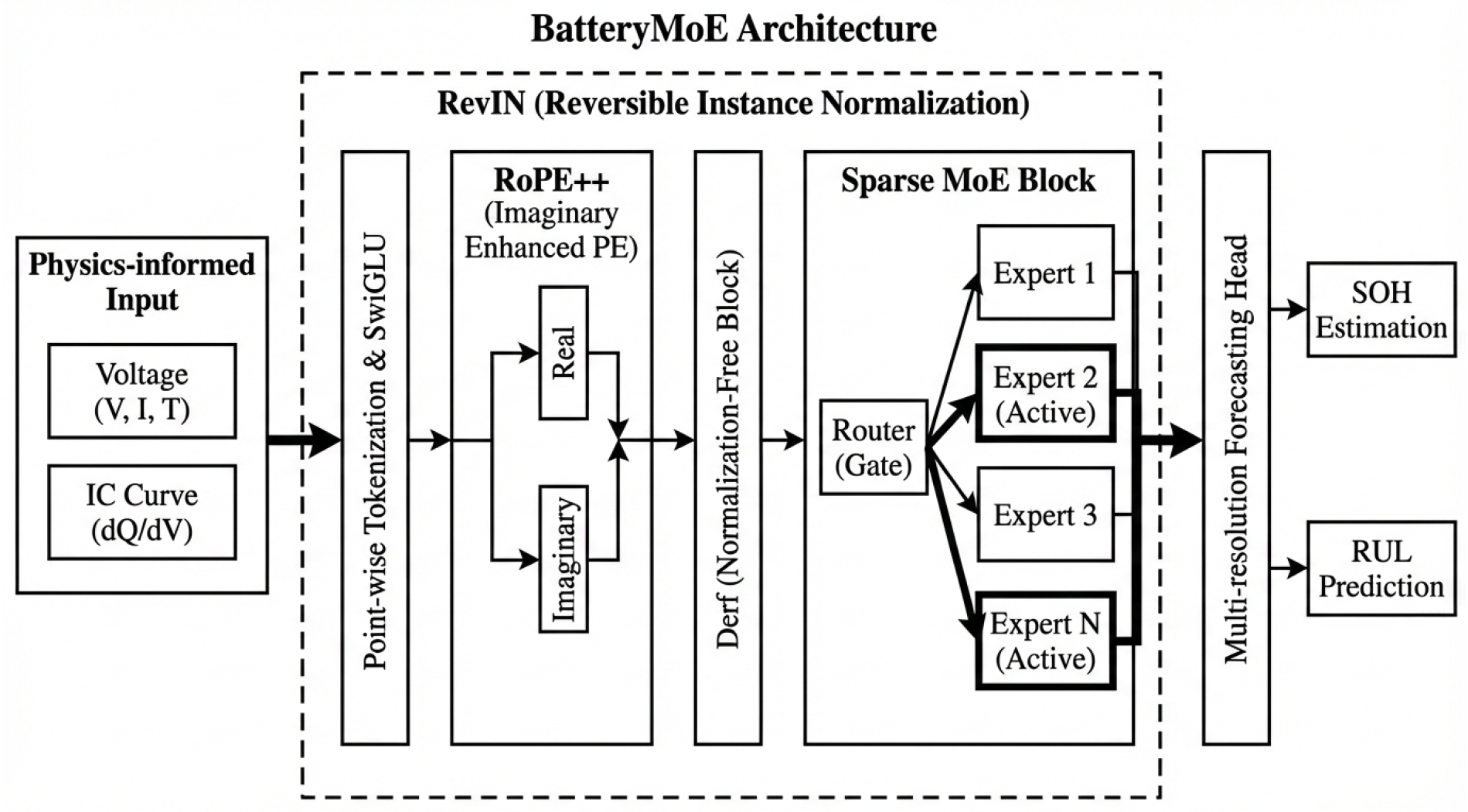
- We propose BatteryMoE, a specialized sparse Mixture-of-Experts Transformer architecture for battery SOH estimation and RUL prediction. Our work integrates normalization-free MoE with physics-aware features for battery health management, achieving a balance between high prediction accuracy, low inference latency, and long-horizon extrapolation capability. Our contribution lies in aligning advanced attention mechanisms with the unique non-stationary and noisy characteristics of battery degradation data both theoretically and empirically.
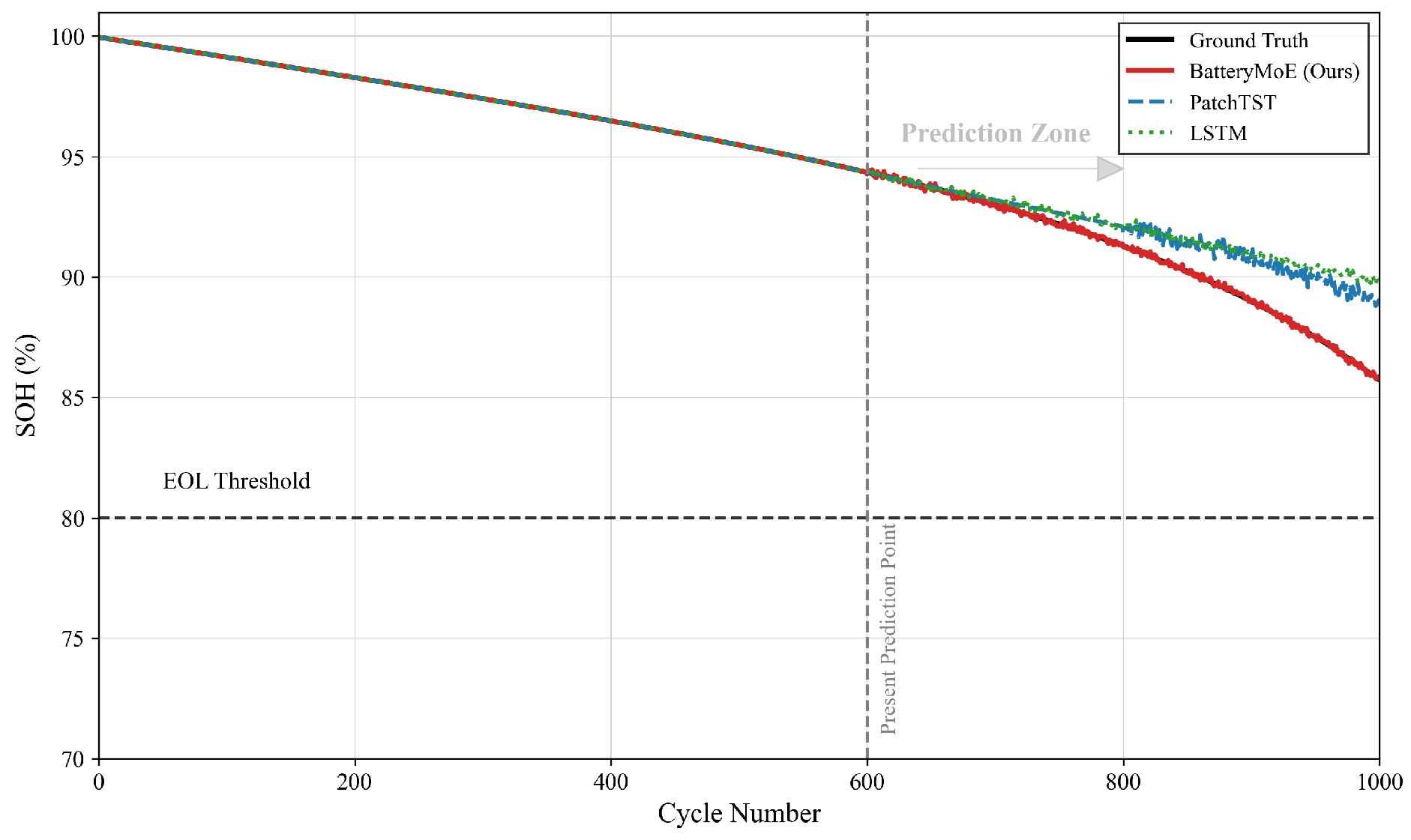
- We introduce a normalization-free design leveraging the dynamic error function (Derf) activation mechanism combined with imaginary-enhanced Rotary Positional Encoding (RoPE++) and Reversible Instance Normalization (RevIN) layers. This synergistic design significantly enhances the model’s robustness against sensor noise, mitigates temporal distribution shifts, and enables reliable extrapolation of degradation trends beyond the training horizon—factors critical for practical RUL forecasting in aging battery systems.
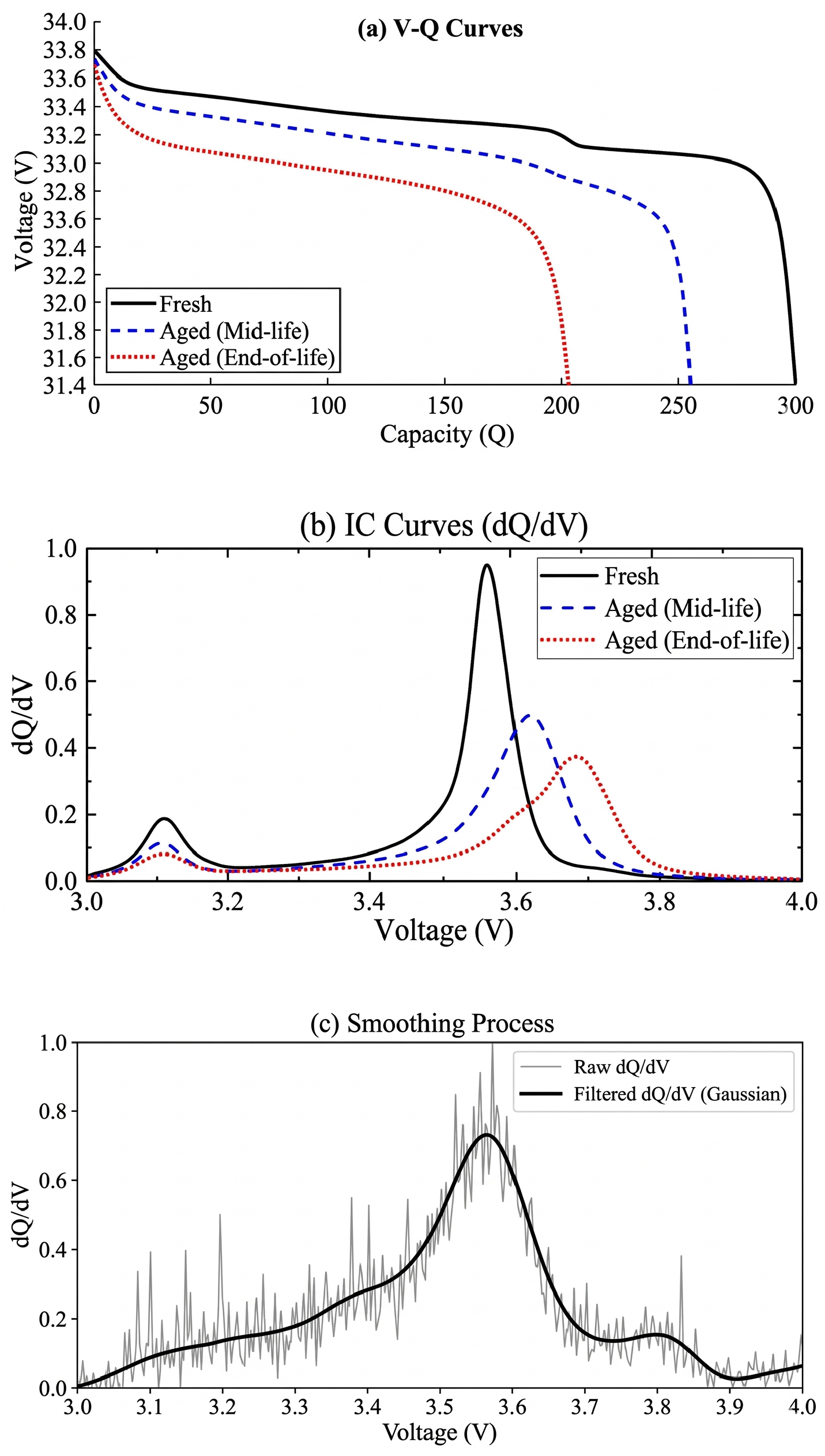
- We incorporate physics-aware feature engineering Incremental Capacity Analysis (ICA) as an auxiliary feature stream, enabling the model to leverage electrochemical domain knowledge without requiring complex parameter identification or invasive testing procedures, thereby enhancing interpretability and cross-battery generalization.
- We conduct extensive experiments on multiple public UPS battery datasets (NASA, CALCE, MIT, XJTU, and TJU) and real-world fast-charging datasets. BatteryMoE consistently achieves the lowest MAE and RMSE across all the datasets, demonstrating superior generalization capabilities for both SOH estimation and RUL prediction tasks across diverse operating conditions and battery chemistries.
2. Background
2.1. UPS Battery Prognostics in Communication Networks
2.2. SOH Estimation and RUL Prediction
2.3. Incremental Capacity Analysis
3. Methodology
3.1. Problem Formulation and Architecture Overview
3.2. Physics-Aware Input Feature Engineering
3.3. Normalization-Free Block with Derf
3.4. Imaginary-Enhanced Rotary Positional Embedding
- Real Attention (): It focuses on local semantic locality (similar to standard RoPE).
- Imaginary Attention (): It focuses on the global context and long-range decay.
- The computation is formulated as
3.5. Sparse Mixture-of-Experts Layer
3.6. Multi-Resolution Forecasting Head
3.7. Implementation Details of Core Components
4. Experiment
4.1. Datasets and Preprocessing
- NASA Battery Dataset: We selected the widely used B0005, B0006, B0007, and B0018 batteries. These were cycled at room temperature (24 °C) with a standard constant-current–constant-voltage (CC-CV) charging and constant-current (CC) discharging protocol.
- CALCE Battery Dataset: We utilized the CS2 series (e.g., CS2-35, CS2-36, CS2-37, and CS2-38), which focuses on high-temperature aging (multi-stage degradation) and provides rigorous benchmarks for SOH tracking.
- MIT Fast-Charging Dataset: This massive dataset involves 124 LFP/Graphite cells cycled under various fast-charging policies. It serves as a stress test to determine our model’s ability to handle rapid degradation and complex charging profiles.
- XJTU Battery Dataset: It provides run-to-failure data for 15 batteries under different discharge rates (1C, 2C, and 3C), allowing us to evaluate robustness against varying load profiles typical in UPS scenarios.
- TJU Battery Dataset: It is used to validate the model’s performance on high-capacity cells with long cycle lives by testing the long-term dependency modeling of the imaginary-enhanced PE module.
4.2. Evaluation Metrics
4.2.1. SOH Estimation Metrics
4.2.2. RUL Prediction Metrics
4.3. Baselines
- LSTM and GRU: Classical Recurrent Neural Networks (RNNs) are widely used in battery prognostics for their ability to handle sequential data.
- CNN-LSTM: It is a hybrid architecture where CNN layers extract local features from voltage curves, followed by LSTM layers for temporal modeling.
- TCN (Temporal Convolutional Network): It uses dilated causal convolutions to model long-term history, serving as a strong non-RNN baseline.
- Transformer (Vanilla): It is the standard Transformer model with sinusoidal positional encoding and LayerNorm, serving as a baseline to validate our architectural improvements.
- FEDformer (Frequency-Enhanced Decomposed Transformer): It is a highly competitive long-horizon time-series forecasting model that utilizes seasonal-trend decomposition and frequency-domain sparse attention. It serves as a robust baseline for evaluating long-term global trend modeling under non-stationary conditions.
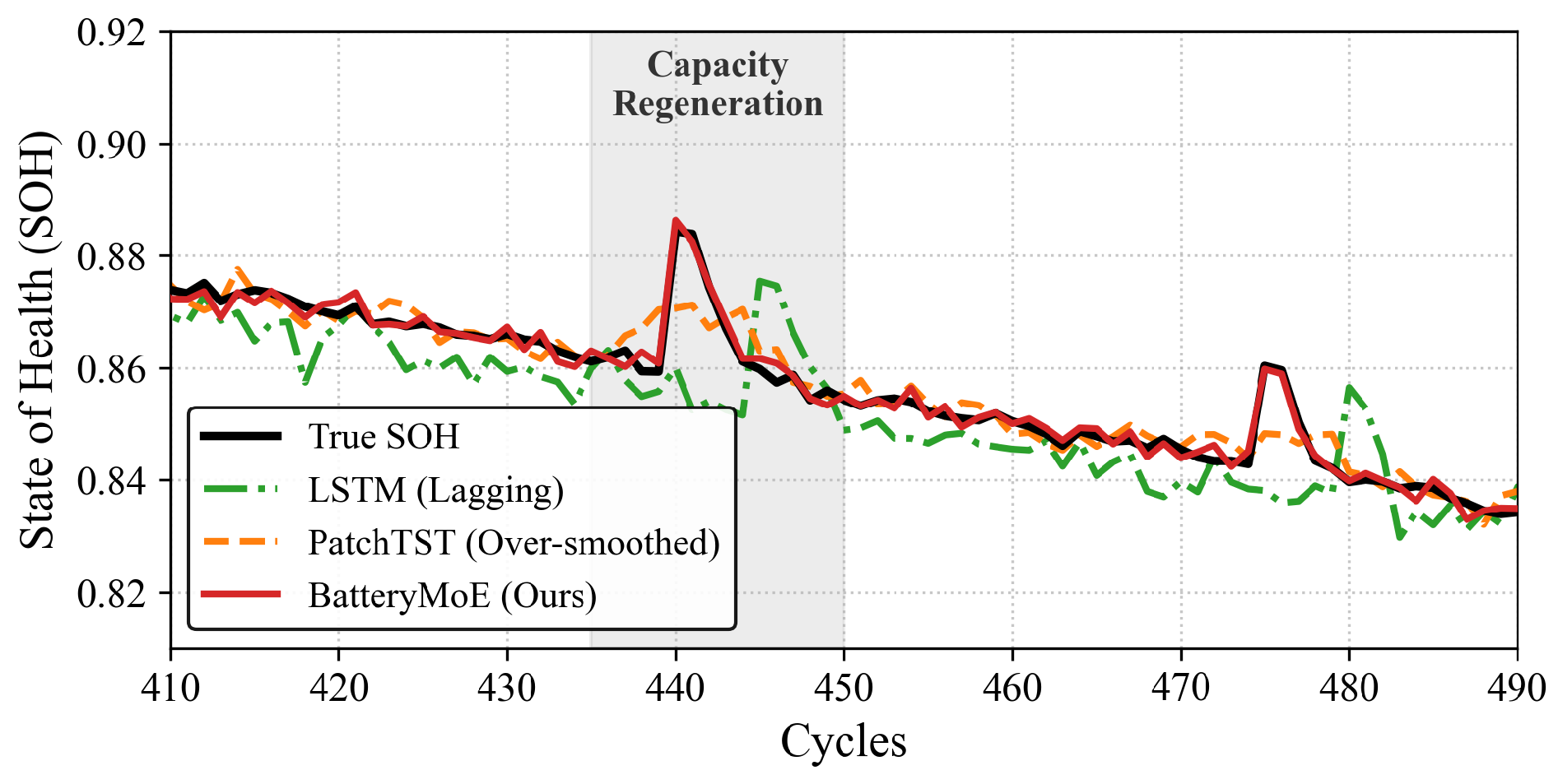
- PatchTST (Patch Time-Series Transformer): It is the current state-of-the-art multivariate time-series forecasting model that uses channel independence and patching. It serves as the strongest competitor.
4.4. Implementation Details
4.5. Main Results
4.5.1. SOH Estimation Performance
4.5.2. RUL Prediction Performance
4.5.3. Capacity Regeneration Phenomena
4.6. Ablation Studies
- w/o Derf (using RMSNorm): Replacing Derf with standard RMSNorm resulted in a 6.5% increase in RMSE. This confirms that the normalization-free design with dynamic saturation is more robust to battery sensor noise.
- w/o RoPE++ (using RoPE): Reverting to standard RoPE caused a degradation in RUL prediction accuracy, Specifically, when predicting at a long horizon (), disabling the imaginary attention branch resulted in an 9.4% increase in MAE on the NASA dataset, validating the contribution of the imaginary attention component in capturing global degradation trends.
- w/o Sparse MoE (using Dense FFN): Replacing the MoE layer with a dense FFN increased inference latency by 40% (at an equivalent parameter count) and slightly reduced accuracy on the variable-condition XJTU dataset, proving that experts specialize effectively in different discharge rates.
- w/o Physics-Aware Input: Removing the IC curve features led to a performance drop on the CALCE dataset, demonstrating that physics-aware features are essential for detecting multi-stage aging.
5. Conclusions
Author Contributions
Funding
Data Availability Statement
Conflicts of Interest
References
- Liang, Y.; Zhao, C.Z.; Yuan, H.; Chen, Y.; Zhang, W.; Huang, J.Q.; Yu, D.; Liu, Y.; Titirici, M.M.; Chueh, Y.L.; et al. A review of rechargeable batteries for portable electronic devices. InfoMat 2019, 1, 6–32. [Google Scholar] [CrossRef]
- Harper, G.; Sommerville, R.; Kendrick, E.; Driscoll, L.; Slater, P.; Stolkin, R.; Walton, A.; Christensen, P.; Heidrich, O.; Lambert, S.; et al. Recycling lithium-ion batteries from electric vehicles. Nature 2019, 575, 75–86. [Google Scholar] [CrossRef] [PubMed]
- Xiong, R.; Kim, J.; Shen, W.; Lv, C.; Li, H.; Zhu, X.; Zhao, W.; Gao, B.; Guo, H.; Zhang, C.; et al. Key technologies for electric vehicles. Green Energy Intell. Transp. 2022, 1, 100041. [Google Scholar] [CrossRef]
- Almaita, E.; Alshkoor, S.; Abdelsalam, E.; Almomani, F. State of charge estimation for a group of lithium-ion batteries using long short-term memory neural network. J. Energy Storage 2022, 52, 104761. [Google Scholar] [CrossRef]
- He, H.; Sun, F.; Wang, Z.; Lin, C.; Zhang, C.; Xiong, R.; Deng, J.; Zhu, X.; Xie, P.; Zhang, S.; et al. China’s battery electric vehicles lead the world: Achievements in technology system architecture and technological breakthroughs. Green Energy Intell. Transp. 2022, 1, 100020. [Google Scholar] [CrossRef]
- Ren, D.; Hsu, H.; Li, R.; Feng, X.; Guo, D.; Han, X.; Lu, L.; He, X.; Gao, S.; Hou, J.; et al. A comparative investigation of aging effects on thermal runaway behavior of lithium-ion batteries. ETransportation 2019, 2, 100034. [Google Scholar] [CrossRef]
- Vennam, G.; Sahoo, A.; Ahmed, S. A survey on lithium-ion battery internal and external degradation modeling and state of health estimation. J. Energy Storage 2022, 52, 104720. [Google Scholar] [CrossRef]
- Rauf, H.; Khalid, M.; Arshad, N. Machine learning in state of health and remaining useful life estimation: Theoretical and technological development in battery degradation modelling. Renew. Sustain. Energy Rev. 2022, 156, 111903. [Google Scholar] [CrossRef]
- Zhou, D.; Li, Z.; Zhu, J.; Zhang, H.; Hou, L. State of health monitoring and remaining useful life prediction of lithium-ion batteries based on temporal convolutional network. IEEE Access 2020, 8, 53307–53320. [Google Scholar] [CrossRef]
- He, K.; Dai, X.; Li, X.; Zhou, R.; Lin, F.; Zhang, W.; Ma, H. State of health and remaining useful life full lifecycle prediction for lithium-ion battery based on frequency domain interpolation and phased approach. Ionics 2025, 31, 11783–11796. [Google Scholar] [CrossRef]
- Gao, Y.; Liu, K.; Zhu, C.; Zhang, X.; Zhang, D. Co-estimation of state-of-charge and state-of-health for lithium-ion batteries using an enhanced electrochemical model. IEEE Trans. Ind. Electron. 2021, 69, 2684–2696. [Google Scholar] [CrossRef]
- Wang, Q.K.; Shen, J.N.; Ma, Z.F.; He, Y.J. Decoupling parameter estimation strategy based electrochemical-thermal coupled modeling method for large format lithium-ion batteries with internal temperature experimental validation. Chem. Eng. J. 2021, 424, 130308. [Google Scholar] [CrossRef]
- Zhang, Q.; Huang, C.G.; Li, H.; Feng, G.; Peng, W. Electrochemical impedance spectroscopy based state-of-health estimation for lithium-ion battery considering temperature and state-of-charge effect. IEEE Trans. Transp. Electrif. 2022, 8, 4633–4645. [Google Scholar] [CrossRef]
- Zhang, Y.; Li, Y.F. Prognostics and health management of Lithium-ion battery using deep learning methods: A review. Renew. Sustain. Energy Rev. 2022, 161, 112282. [Google Scholar] [CrossRef]
- Li, Y.; Liu, K.; Foley, A.M.; Zülke, A.; Berecibar, M.; Nanini-Maury, E.; Van Mierlo, J.; Hoster, H.E. Data-driven health estimation and lifetime prediction of lithium-ion batteries: A review. Renew. Sustain. Energy Rev. 2019, 113, 109254. [Google Scholar] [CrossRef]
- El Fallah, S.; Kharbach, J.; Vanagas, J.; Vilkelytė, Ž.; Tolvaišienė, S.; Gudžius, S.; Kalvaitis, A.; Lehmam, O.; Masrour, R.; Hammouch, Z.; et al. Advanced state of charge estimation using deep neural network, gated recurrent unit, and long short-term memory models for lithium-Ion batteries under aging and temperature conditions. Appl. Sci. 2024, 14, 6648. [Google Scholar] [CrossRef]
- Yao, Q.; Kollmeyer, P.J.; Lu, D.D.C.; Emadi, A. A comparison study of unidirectional and bidirectional recurrent neural network for battery state of charge estimation. In Proceedings of the 2024 IEEE Transportation Electrification Conference and Expo (ITEC); IEEE: Piscataway, NJ, USA, 2024; pp. 1–6. [Google Scholar]
- Shu, X.; Shen, J.; Li, G.; Zhang, Y.; Chen, Z.; Liu, Y. A flexible state-of-health prediction scheme for lithium-ion battery packs with long short-term memory network and transfer learning. IEEE Trans. Transp. Electrif. 2021, 7, 2238–2248. [Google Scholar] [CrossRef]
- Li, L.; Li, Y.; Mao, R.; Li, L.; Hua, W.; Zhang, J. Remaining useful life prediction for lithium-ion batteries with a hybrid model based on TCN-GRU-DNN and dual attention mechanism. IEEE Trans. Transp. Electrif. 2023, 9, 4726–4740. [Google Scholar] [CrossRef]
- Cai, N.; Qin, Y.; Chen, X.; Wu, K. Dual time-scale state-coupled co-estimation of state of charge, state of health and remaining useful life for lithium-ion batteries via Deep Inter and Intra-Cycle Attention Network. J. Energy Storage 2024, 77, 109797. [Google Scholar] [CrossRef]
- Chang, C.; Pan, Y.; Wang, S.; Jiang, J.; Tian, A.; Gao, Y.; Jiang, Y.; Wu, T. Fast EIS acquisition method based on SSA-DNN prediction model. Energy 2024, 288, 129768. [Google Scholar] [CrossRef]
- Li, Y.; Qin, X.; Chai, M.; Wu, H.; Zhang, F.; Jiang, F.; Wen, C. SOH evaluation and RUL estimation of lithium-ion batteries based on MC-CNN-TimesNet model. Reliab. Eng. Syst. Saf. 2025, 261, 111125. [Google Scholar] [CrossRef]
- Solís, M.; Gil-Gamboa, A.; Troncoso, A. Metalearning for improving time series forecasting based on deep learning: A water case study. Results Eng. 2025, 28, 107541. [Google Scholar] [CrossRef]
- Kapanski, A.A.; Hruntovich, N.V.; Klyuev, R.V.; Boltrushevich, A.E.; Sorokova, S.N.; Efremenkov, E.A.; Demin, A.Y.; Martyushev, N.V. Intelligent methods of operational response to accidents in urban water supply systems based on lstm neural network models. Smart Cities 2025, 8, 59. [Google Scholar] [CrossRef]
- Vaswani, A.; Shazeer, N.; Parmar, N.; Uszkoreit, J.; Jones, L.; Gomez, A.N.; Kaiser, Ł.; Polosukhin, I. Attention is all you need. In Proceedings of the 31st Conference on Neural Information Processing Systems (NIPS 2017), Long Beach, CA, USA, 4–9 December 2017; Volume 30. [Google Scholar]
- Zhou, H.; Zhang, S.; Peng, J.; Zhang, S.; Li, J.; Xiong, H.; Zhang, W. Informer: Beyond efficient transformer for long sequence time-series forecasting. In Proceedings of the AAAI Conference on Artificial Intelligence; Association for the Advancement of Artificial Intelligence: Washington, DC, USA, 2021; Volume 35, pp. 11106–11115. [Google Scholar]
- Hu, W.; Zhao, S. Remaining useful life prediction of lithium-ion batteries based on wavelet denoising and transformer neural network. Front. Energy Res. 2022, 10, 969168. [Google Scholar] [CrossRef]
- Gu, X.; See, K.W.; Li, P.; Shan, K.; Wang, Y.; Zhao, L.; Lim, K.C.; Zhang, N. A novel state-of-health estimation for the lithium-ion battery using a convolutional neural network and transformer model. Energy 2023, 262, 125501. [Google Scholar] [CrossRef]
- Zhou, K.; Zhang, Z. Remaining useful life prediction of lithium-ion batteries based on data denoising and improved transformer. J. Energy Storage 2024, 100, 113749. [Google Scholar] [CrossRef]
- Hu, J.; Fu, P.; Wei, Z.; Huang, Y.; Early, J.; Fly, A.; Zhang, Y. Early prediction of lithium-ion battery degradation with a generative pre-trained transformer. Nat. Commun. 2026, 17, 126. [Google Scholar] [CrossRef]
- Modekwe, G.; Al-Wahaibi, S.; Lu, Q. Transformer-based capacity prediction for lithium-ion batteries with data augmentation. IFAC-PapersOnLine 2024, 58, 408–413. [Google Scholar] [CrossRef]
- Chen, D.; Hong, W.; Zhou, X. Transformer network for remaining useful life prediction of lithium-ion batteries. IEEE Access 2022, 10, 19621–19628. [Google Scholar] [CrossRef]
- Xiong, R.; Yang, Y.; He, D.; Zheng, K.; Zheng, S.; Xing, C.; Zhang, H.; Lan, Y.; Wang, L.; Liu, T. On layer normalization in the transformer architecture. In Proceedings of the International Conference on Machine Learning; PMLR: Cambridge, MA, USA, 2020; pp. 10524–10533. [Google Scholar]
- Shleifer, S.; Weston, J.; Ott, M. Normformer: Improved transformer pretraining with extra normalization. arXiv 2021, arXiv:2110.09456. [Google Scholar] [CrossRef]
- Fedus, W.; Zoph, B.; Shazeer, N. Switch transformers: Scaling to trillion parameter models with simple and efficient sparsity. J. Mach. Learn. Res. 2022, 23, 1–39. [Google Scholar]
- Liu, X.; Liu, J.; Woo, G.; Aksu, T.; Liang, Y.; Zimmermann, R.; Liu, C.; Savarese, S.; Xiong, C.; Sahoo, D. Moirai-moe: Empowering time series foundation models with sparse mixture of experts. arXiv 2024, arXiv:2410.10469. [Google Scholar]
- Su, J.; Ahmed, M.; Lu, Y.; Pan, S.; Bo, W.; Liu, Y. Roformer: Enhanced transformer with rotary position embedding. Neurocomputing 2024, 568, 127063. [Google Scholar] [CrossRef]
- Kim, T.; Kim, J.; Tae, Y.; Park, C.; Choi, J.H.; Choo, J. Reversible Instance Normalization for Accurate Time-Series Forecasting against Distribution Shift. In Proceedings of the International Conference on Learning Representations (ICLR) 2022, Virtual, 25 April 2022; pp. 1–25. [Google Scholar]
- Chen, M.; Lu, T.; Zhu, J.; Sun, M.; Liu, Z. Stronger normalization-free transformers. arXiv 2025, arXiv:2512.10938. [Google Scholar]
- Dubarry, M.; Svoboda, V.; Hwu, R.; Yann Liaw, B. Incremental capacity analysis and close-to-equilibrium OCV measurements to quantify capacity fade in commercial rechargeable lithium batteries. Electrochem. Solid-State Lett. 2006, 9, A454–A457. [Google Scholar] [CrossRef]
- Feng, H.; Song, D. A health indicator extraction based on surface temperature for lithium-ion batteries remaining useful life prediction. J. Energy Storage 2021, 34, 102118. [Google Scholar] [CrossRef]



| Dataset | H | Metric | LSTM | CNN-LSTM | TCN | FEDformer | PatchTST | BatteryMoE |
|---|---|---|---|---|---|---|---|---|
| NASA | 24 | RMSE | 2.15 ± 0.16 | 1.88 ± 0.14 | 1.22 ± 0.09 | 0.91 ± 0.07 | 0.72 ± 0.05 | 0.56 ± 0.04 |
| MAE | 1.72 ± 0.13 | 1.45 ± 0.11 | 0.95 ± 0.07 | 0.72 ± 0.05 | 0.55 ± 0.04 | 0.43 ± 0.03 | ||
| 48 | RMSE | 2.35 ± 0.18 | 2.10 ± 0.16 | 1.35 ± 0.11 | 0.98 ± 0.08 | 0.78 ± 0.06 | 0.62 ± 0.04 | |
| MAE | 1.88 ± 0.15 | 1.65 ± 0.13 | 1.08 ± 0.08 | 0.78 ± 0.06 | 0.62 ± 0.05 | 0.48 ± 0.03 | ||
| 96 | RMSE | 2.65 ± 0.21 | 2.35 ± 0.18 | 1.55 ± 0.13 | 1.15 ± 0.10 | 0.88 ± 0.07 | 0.68 ± 0.05 | |
| MAE | 2.15 ± 0.17 | 1.85 ± 0.15 | 1.25 ± 0.11 | 0.92 ± 0.08 | 0.70 ± 0.06 | 0.55 ± 0.04 | ||
| CALCE | 24 | RMSE | 2.25 ± 0.18 | 2.02 ± 0.15 | 1.30 ± 0.10 | 1.05 ± 0.08 | 0.80 ± 0.06 | 0.62 ± 0.04 |
| MAE | 1.82 ± 0.14 | 1.58 ± 0.12 | 1.02 ± 0.08 | 0.82 ± 0.06 | 0.62 ± 0.04 | 0.48 ± 0.03 | ||
| 48 | RMSE | 2.52 ± 0.20 | 2.25 ± 0.17 | 1.48 ± 0.12 | 1.18 ± 0.09 | 0.88 ± 0.07 | 0.68 ± 0.05 | |
| MAE | 2.05 ± 0.16 | 1.78 ± 0.14 | 1.18 ± 0.09 | 0.92 ± 0.07 | 0.68 ± 0.05 | 0.52 ± 0.04 | ||
| 96 | RMSE | 2.85 ± 0.24 | 2.55 ± 0.20 | 1.70 ± 0.15 | 1.35 ± 0.11 | 1.02 ± 0.09 | 0.79 ± 0.06 | |
| MAE | 2.31 ± 0.19 | 2.02 ± 0.16 | 1.38 ± 0.13 | 1.08 ± 0.09 | 0.82 ± 0.07 | 0.60 ± 0.05 | ||
| MIT | 24 | RMSE | 1.95 ± 0.15 | 1.72 ± 0.13 | 1.15 ± 0.09 | 0.90 ± 0.07 | 0.68 ± 0.05 | 0.52 ± 0.04 |
| MAE | 1.58 ± 0.12 | 1.35 ± 0.10 | 0.90 ± 0.07 | 0.70 ± 0.05 | 0.52 ± 0.04 | 0.38 ± 0.02 | ||
| 48 | RMSE | 2.15 ± 0.17 | 1.90 ± 0.15 | 1.25 ± 0.10 | 0.95 ± 0.08 | 0.74 ± 0.06 | 0.57 ± 0.05 | |
| MAE | 1.72 ± 0.14 | 1.50 ± 0.12 | 0.98 ± 0.08 | 0.75 ± 0.06 | 0.56 ± 0.04 | 0.42 ± 0.03 | ||
| 96 | RMSE | 2.45 ± 0.19 | 2.15 ± 0.17 | 1.45 ± 0.12 | 1.10 ± 0.09 | 0.82 ± 0.07 | 0.62 ± 0.06 | |
| MAE | 2.02 ± 0.16 | 1.68 ± 0.13 | 1.15 ± 0.09 | 0.88 ± 0.07 | 0.65 ± 0.05 | 0.49 ± 0.04 | ||
| XJTU | 24 | RMSE | 2.18 ± 0.16 | 1.95 ± 0.14 | 1.25 ± 0.10 | 0.98 ± 0.08 | 0.78 ± 0.06 | 0.58 ± 0.04 |
| MAE | 1.75 ± 0.13 | 1.52 ± 0.11 | 0.98 ± 0.09 | 0.77 ± 0.06 | 0.60 ± 0.04 | 0.45 ± 0.04 | ||
| 48 | RMSE | 2.45 ± 0.18 | 2.18 ± 0.16 | 1.42 ± 0.11 | 1.12 ± 0.09 | 0.85 ± 0.07 | 0.65 ± 0.05 | |
| MAE | 2.00 ± 0.15 | 1.72 ± 0.13 | 1.12 ± 0.09 | 0.88 ± 0.07 | 0.65 ± 0.05 | 0.50 ± 0.04 | ||
| 96 | RMSE | 2.75 ± 0.22 | 2.45 ± 0.19 | 1.62 ± 0.14 | 1.28 ± 0.11 | 0.98 ± 0.08 | 0.74 ± 0.07 | |
| MAE | 2.26 ± 0.18 | 1.95 ± 0.15 | 1.28 ± 0.11 | 1.02 ± 0.08 | 0.78 ± 0.06 | 0.58 ± 0.05 | ||
| TJU | 24 | RMSE | 2.05 ± 0.15 | 1.82 ± 0.13 | 1.18 ± 0.09 | 0.95 ± 0.07 | 0.70 ± 0.05 | 0.55 ± 0.03 |
| MAE | 1.67 ± 0.12 | 1.42 ± 0.10 | 0.92 ± 0.07 | 0.72 ± 0.05 | 0.54 ± 0.04 | 0.42 ± 0.02 | ||
| 48 | RMSE | 2.25 ± 0.17 | 2.02 ± 0.15 | 1.30 ± 0.10 | 1.05 ± 0.08 | 0.76 ± 0.06 | 0.58 ± 0.04 | |
| MAE | 1.80 ± 0.14 | 1.58 ± 0.12 | 1.02 ± 0.08 | 0.80 ± 0.06 | 0.58 ± 0.04 | 0.45 ± 0.03 | ||
| 96 | RMSE | 2.55 ± 0.20 | 2.28 ± 0.18 | 1.50 ± 0.12 | 1.20 ± 0.09 | 0.85 ± 0.07 | 0.67 ± 0.05 | |
| MAE | 2.08 ± 0.16 | 1.82 ± 0.14 | 1.20 ± 0.09 | 0.95 ± 0.07 | 0.68 ± 0.05 | 0.53 ± 0.04 |
| Dataset | Metric | LSTM | CNN-LSTM | TCN | FEDformer | PatchTST | BatteryMoE |
|---|---|---|---|---|---|---|---|
| NASA | MAE | 22.8 ± 3.5 | 20.4 ± 3.1 | 18.5 ± 2.8 | 16.2 ± 2.4 | 13.8 ± 1.8 | 11.5 ± 0.9 |
| 25.1 ± 4.2 | 22.6 ± 3.6 | 20.8 ± 3.2 | 18.5 ± 2.8 | 15.2 ± 2.1 | 12.8 ± 1.1 | ||
| CALCE | MAE | 26.5 ± 4.1 | 24.1 ± 3.6 | 22.0 ± 3.2 | 19.8 ± 2.6 | 17.5 ± 2.2 | 14.8 ± 1.2 |
| 30.2 ± 4.8 | 27.5 ± 4.2 | 24.8 ± 3.7 | 22.4 ± 3.1 | 19.1 ± 2.4 | 16.2 ± 1.4 | ||
| MIT | MAE | 19.4 ± 3.0 | 17.5 ± 2.6 | 16.2 ± 2.4 | 14.5 ± 2.0 | 11.9 ± 1.5 | 9.8 ± 0.8 |
| 21.8 ± 3.5 | 19.4 ± 3.0 | 17.8 ± 2.7 | 16.1 ± 2.2 | 13.4 ± 1.7 | 11.0 ± 0.9 | ||
| XJTU | MAE | 24.1 ± 3.8 | 21.8 ± 3.3 | 19.6 ± 2.9 | 17.8 ± 2.5 | 15.4 ± 1.9 | 13.1 ± 1.0 |
| 27.6 ± 4.5 | 24.5 ± 3.9 | 22.2 ± 3.4 | 20.2 ± 2.9 | 17.2 ± 2.2 | 14.5 ± 1.3 | ||
| TJU | MAE | 21.5 ± 3.2 | 19.2 ± 2.8 | 17.4 ± 2.5 | 15.6 ± 2.2 | 13.0 ± 1.6 | 10.6 ± 0.9 |
| 23.6 ± 3.8 | 21.0 ± 3.2 | 19.2 ± 2.8 | 17.4 ± 2.5 | 14.5 ± 1.8 | 11.8 ± 1.0 |
Disclaimer/Publisher’s Note: The statements, opinions and data contained in all publications are solely those of the individual author(s) and contributor(s) and not of MDPI and/or the editor(s). MDPI and/or the editor(s) disclaim responsibility for any injury to people or property resulting from any ideas, methods, instructions or products referred to in the content. |
© 2026 by the authors. Licensee MDPI, Basel, Switzerland. This article is an open access article distributed under the terms and conditions of the Creative Commons Attribution (CC BY) license.
Share and Cite
Zhang, P.; Fu, J.; Zhang, J.; Mai, X.; Tang, J.; Yang, C. BatteryMoE: An Improved Sparse Mixture-of-Experts Transformer for Battery SOH Estimation and RUL Prediction. Energies 2026, 19, 2554. https://doi.org/10.3390/en19112554
Zhang P, Fu J, Zhang J, Mai X, Tang J, Yang C. BatteryMoE: An Improved Sparse Mixture-of-Experts Transformer for Battery SOH Estimation and RUL Prediction. Energies. 2026; 19(11):2554. https://doi.org/10.3390/en19112554
Chicago/Turabian StyleZhang, Peiming, Jiajia Fu, Jian Zhang, Xuanhao Mai, Jie Tang, and Cui Yang. 2026. "BatteryMoE: An Improved Sparse Mixture-of-Experts Transformer for Battery SOH Estimation and RUL Prediction" Energies 19, no. 11: 2554. https://doi.org/10.3390/en19112554
APA StyleZhang, P., Fu, J., Zhang, J., Mai, X., Tang, J., & Yang, C. (2026). BatteryMoE: An Improved Sparse Mixture-of-Experts Transformer for Battery SOH Estimation and RUL Prediction. Energies, 19(11), 2554. https://doi.org/10.3390/en19112554