Resilience-Oriented Management of Integrated Energy Systems: A Review of Characteristics, Quantification, Assessment and Enhancement Methods



Abstract
1. Introduction
- (i)
- How to define IESs’ resilience given its complexity, by linking adverse events to practical applications?
- (ii)
- What are the preferred metrics, frameworks, and methods to analyze and evaluate the IESs’ resilience?
- (iii)
- How to enhance IESs’ resilience, particularly with the advancement of emerging data and the accompanying technologies?
- (iv)
- What are the existing research gaps and future research perspectives?
2. Research Methodology
3. Resilience in Integrated Energy Systems
3.1. Differentiation of Key Concepts: The Difference Between Resilience and Reliability, Robustness, Flexibility, and Stability

| Similarities | Differences | |
|---|---|---|
| Reliability | Both focus on the energy supply loss scenarios | Focus on high-probability, low-impact adversities |
| Robustness | Both focus on the high-probability, high-impact scenarios | Emphasizes maintaining stable operation under disturbances, more focused on “predictable” scenarios |
| Flexibility | Both emphasize adaptation and guarantee supply–demand matching | Focus on frequent, low-impact disruptions |
| Stability | Both emphasize the ability to recover supply–demand matching | Stress the equilibrium operation rather than allowance to adapt to change |
3.2. Development of IESs’ Resilience
4. Resilience Identification and Quantification
4.1. Assessment Framework of IESs
4.1.1. Resilience Assessment Metrics
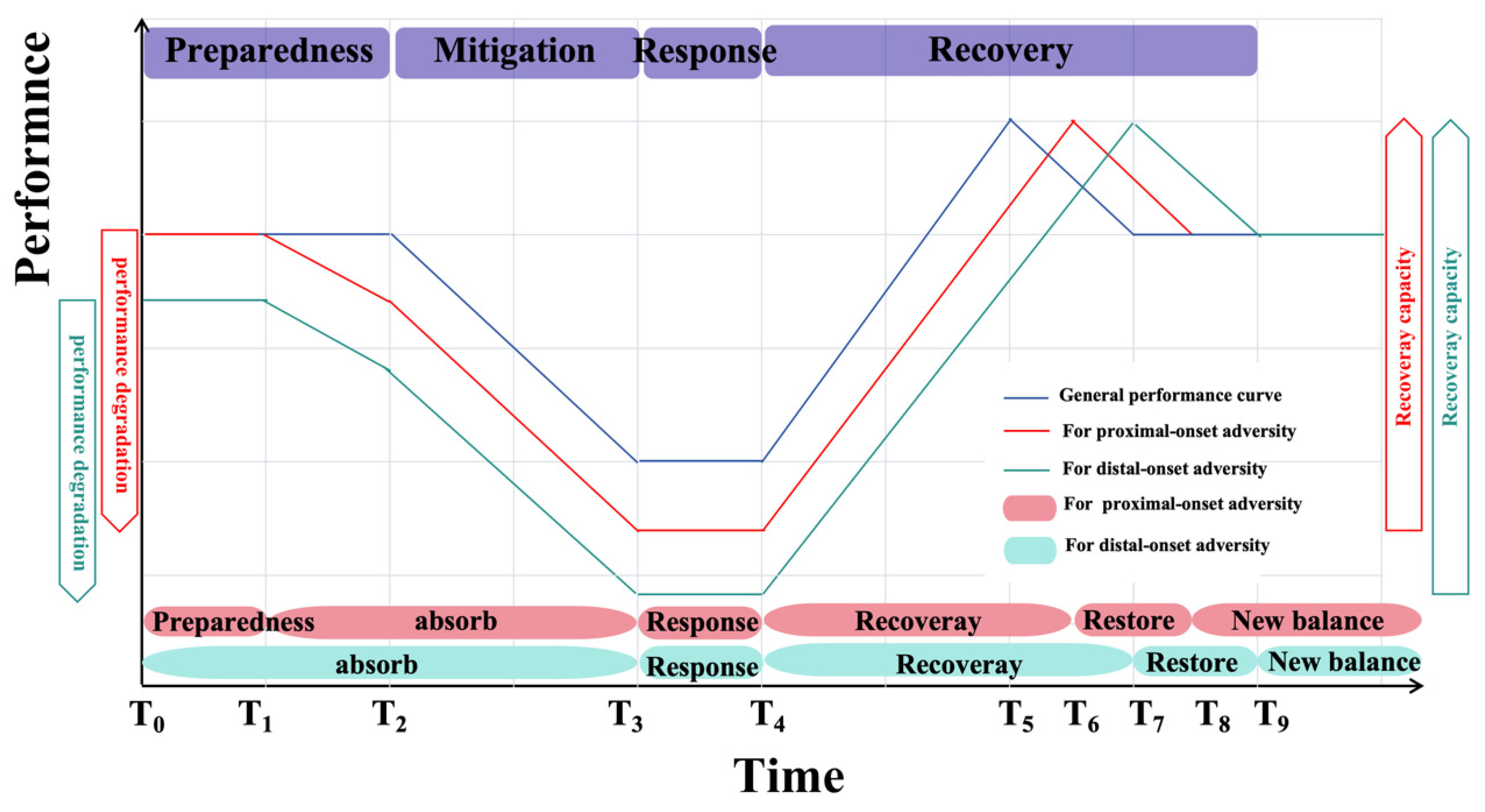
4.1.2. Resilience Phases
4.2. Modeling Techniques for the Evaluation of Resilience of IESs
| Model Description | Approach | Computational Precision | Data Demands | Computational Duration | Sectoral Scope | Reference | |||||
|---|---|---|---|---|---|---|---|---|---|---|---|
| Low | High | Low | Medium | High | Short | Medium | Long | ||||
| Simulation models with a correlation matrix | Simulation-based: Bottom-up | √ | √ | √ | Electrical distribution systems | [44] | |||||
| Dynamic simulation | √ | √ | √ | Integrated energy system (gas, heat, and power sector) | [46] | ||||||
| Performance-based model for characterizing and assessing resilience | Simulation-based: Top-down | √ | √ | √ | Integrated energy system (power plant, heating and cooling systems, distributed generation systems) | [45] | |||||
| Resilience assessment model and optimal power flow model | Optimization-based: Top-down | √ | √ | √ | Integrated gas and power systems | [41] | |||||
| Probabilistic modeling approach, including a hurricane hazard model, component fragility models, a power system performance model, and a system restoration model | Optimization-based: Bottom-up | √ | √ | √ | Power system | [75] | |||||
| Modeling the probability of transmission line failures | √ | √ | √ | Integrated energy system | [48] | ||||||
| ORNL-PSerc-Alaska (OPA) and Crucitti-Latora-Marchiori (CLM) to analyze cascading failures | √ | √ | √ | Power grids | [82] | ||||||
| Dynamic modeling of a power grid as a graph to analyze the cascading effects with a proposed robustness metric | √ | √ | √ | Power grids | [83] | ||||||
| Resilience-driven multi-objective restoration model using mixed-integer programming | √ | √ | √ | Interdependent infrastructure networks | [84] | ||||||
| Methods and techniques for simulating human systems | Agent-based: Top-down | √ | √ | √ | ------- | [76] | |||||
| Modeling based on smart agent communication with sequential Monte Carlo simulation | Agent-based: Bottom-up | √ | √ | √ | Integrated energy systems | [85] | |||||
| Modeling by MG-based power system architecture | √ | √ | √ | Power system | [86] | ||||||
| Modeling based on a resilience-driven multi-objective restoration model | √ | √ | √ | Power system | [87] | ||||||
| Agent-based electricity market simulation | √ | √ | √ | Power system | [88] | ||||||
| Modeling based on the interdependent critical infrastructure model (ICIM) | √ | √ | √ | √ | Power and water system | [89] | |||||
| Modeling by the stochastic programming method | Stochastic-based: Bottom-up | √ | √ | √ | Power and water system | [90] | |||||
| Combine a stochastic model with a realistic cascading failure simulator for modeling | √ | √ | √ | Power system | [91] | ||||||
| Integrated, dynamic modeling and simulation frameworks are applied | √ | √ | √ | Power system | [92] | ||||||
| Modeling by a sequential Monte Carlo-based time-series simulation model | √ | √ | √ | Power system | [79] | ||||||
| Fuzzy rule-based method of selecting between alternative infrastructure architectures | Fuzzy logic models | √ | √ | √ | Connected infrastructure system (focus on general system infrastructures) | [93] | |||||
| Indices from both the system level and the component level | Indicator-based: Top-down | √ | √ | √ | Island city-integrated energy systems (IC-IESs) | [47] | |||||
| Integrated framework with an energy security metric to assess energy security | √ | √ | √ | Energy system | [94] | ||||||
5. Resilience Enhancement
6. Conclusions
- (i)
- Resilience is a complex concept involving multiple scenarios, which needs to be clearly distinguished from reliability, robustness, flexibility, and stability. In this paper, an IESs’ definition was attempted to be proposed, which is summarized as follows: IESs’ resilience indicates a system’s capability to adapt to and tolerate shocks arising from unpredictable and high-impact disturbances. It also encompasses its ability to recover to the original or a new stable state following the disturbances.
- (ii)
- The extreme events causing systems’ resilient process can be categorized based on their occurrence probability and consequence severity. From the perspective of IES resilience, high-impact events should draw primary attention irrespective of their occurrence frequency.
- (iii)
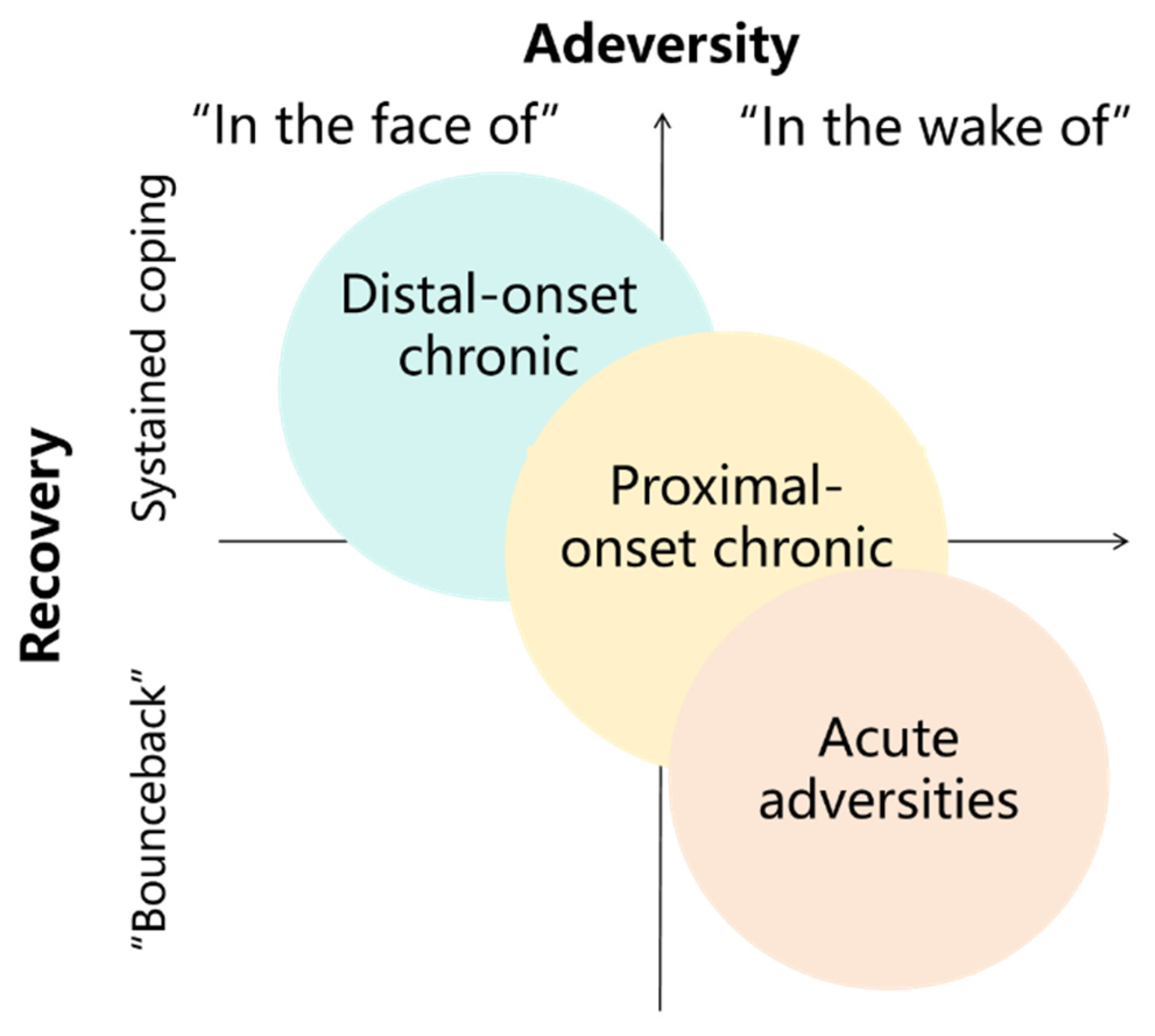
- Different types of adversities lead to distinct functional states (different responses) of the system during the resilience process. Considering the specific action points of extreme events, the adversities are grouped into acute, distal-onset chronic, and proximal-onset chronic. Chronic adversities can reflect the cumulative degradation from sustained adverse conditions. The impact of such events on system resilience is often hidden, yet it warrants focused attention. Nevertheless, a considerable portion of existing research has yet to address this in a targeted manner.
- (iv)
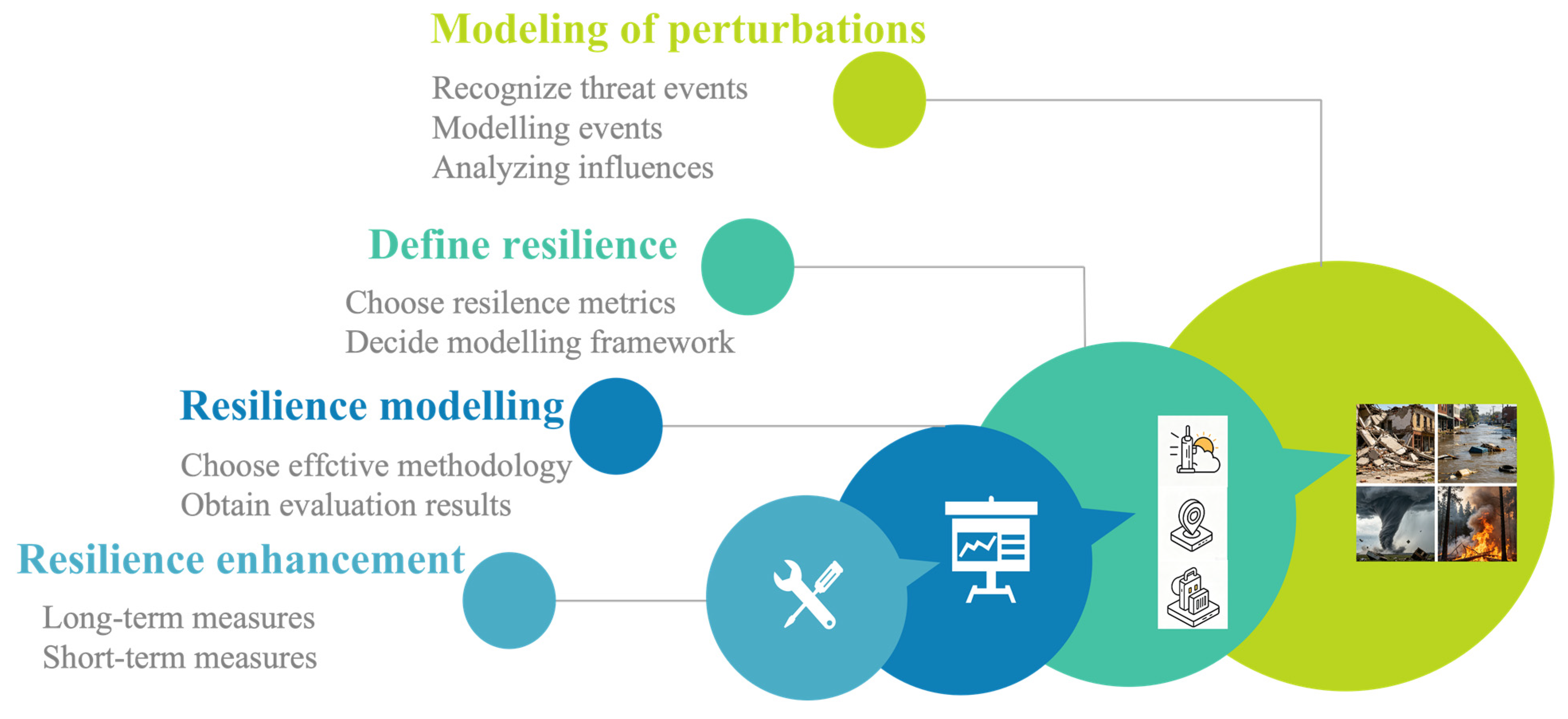
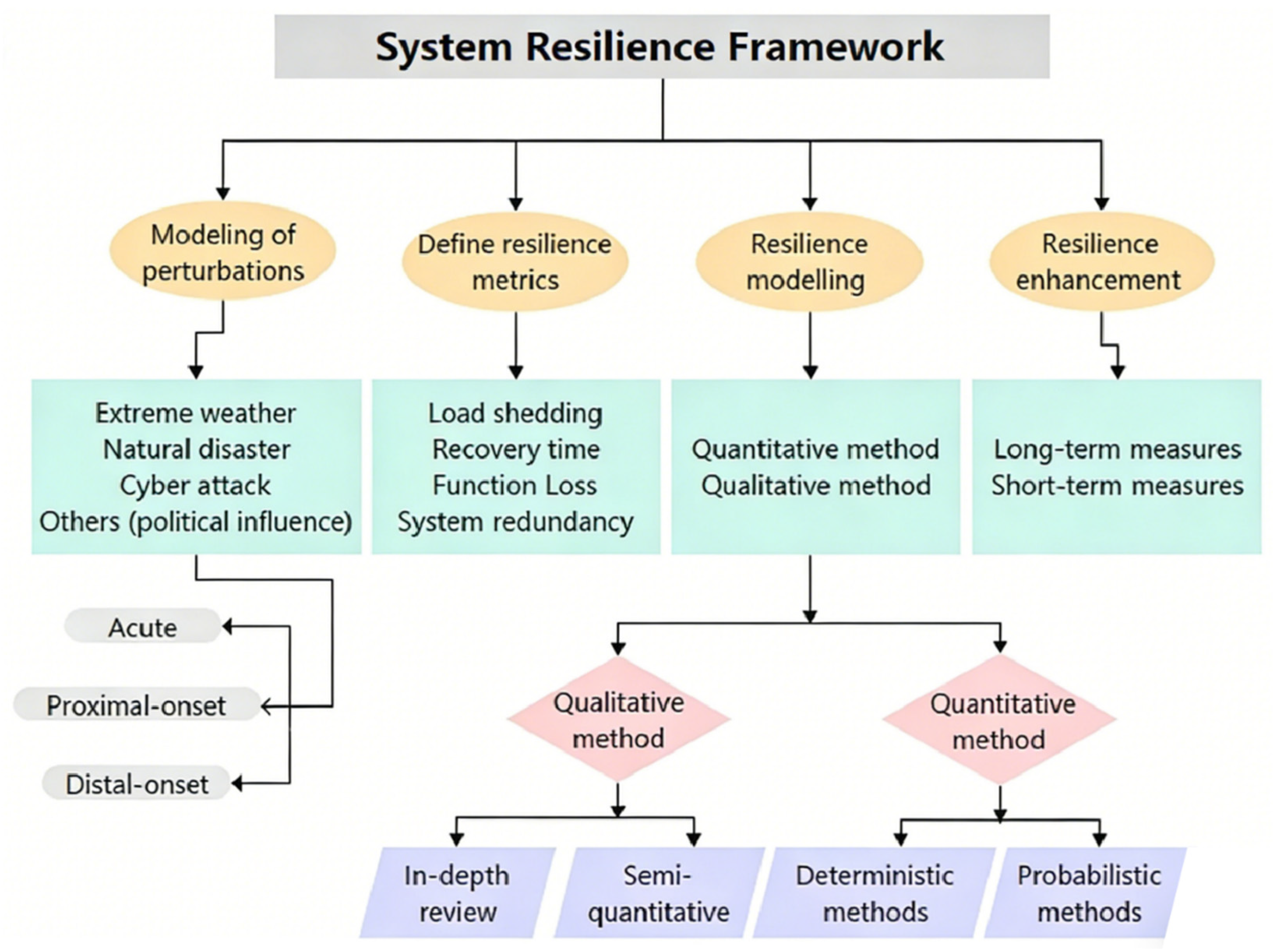
- Inspired by well-developed analytical approaches in power systems, an evaluation framework with superior performance should exhibit a critical ability of extreme event recognition, resilience metrics selection, and system performance evaluation.
- (v)
- Most appropriate resilience assessment metrics should have common features in reflecting systems’ recovery abilities, reflecting systems’ uncertainties, prioritizing different events and their consequences, and exhibiting spatiotemporal specificity. According to review results, a total of eight metrics, including load shedding, system recovery time, and fraction, etc., which are categorized into attribute-based and performance-based, are the most robust and suitable for evaluation purposes.
- (vi)
- IESs’ resilience evaluation approaches are reviewed from the perspective of their modeling characteristics and methodologies. Key features examined include the computational precision (low or high), data demands (low, medium, high), computational duration (short-term or long-term), and sectoral coverage. The results indicate that quantitative analytical methods (including simulation, optimization, and stochastic approaches) are well-developed and have high-precision results.
- (vii)
- Key resilience enhancement methods include storage-grid integration, vehicle-to-grid utilization, market mechanism reform, and decentralized trading. Furthermore, the significant application potential of AI-driven methods in energy system resilience research has progressively garnered academic focus.
7. Resilience Research Gaps and Future Research Fields
- (i)
- From the perspective of adversities for IESs, the proper way to comprehensively estimate the adverse influence on each and overall components of IESs should be necessary. More advanced approaches should be employed to conduct risk analysis for the sake of guiding IESs’ resilience management.
- (ii)
- Given the complexity of IESs, how to more effectively model the system is an important issue to be explored. Optimal methods that have the ability to extract a large amount of information and knowledge hidden behind the complex system, as well as to model the system characteristics, should be developed. Particular attention should be paid to the data-driven and AI technologies.
- (iii)
- With respect to big data-driven technologies and AI for enhancing IESs’ resilience, potential research directions center on reliable data acquisition in long-term and short-term frameworks, including the construction of data platforms, data scarcity under extreme scenarios, data aggregation scales, and data reliability validation, among others.
Author Contributions
Funding
Data Availability Statement
Conflicts of Interest
References
- Jasiunas, J.; Lund, P.D.; Mikkola, J. Energy system resilience-A review. Renew. Sustain. Energy Rev. 2021, 150, 111476. [Google Scholar] [CrossRef]
- Ren, H.; Zhang, Y.; Wu, Q.; Li, Q. A review of planning and operational scheduling of integrated energy systems for resilience enhancement. Autom. Electr. Power Syst. 2025, 49, 16. [Google Scholar]
- Huang, J.P.; Lian, X.B.; Wang, H.J.; Zhu, T.; Li, H.; Zhao, Y.J.; Ang, R.; Wang, D.F.; Yan, W.; Hu, S.J.; et al. An overview of extreme weather-epidemic compound disasters. Sci. Bull. 2025, 70, 2868–2885. [Google Scholar] [CrossRef]
- Ji, Q.; Guo, J.F. Oil price volatility and oil-related events: An Internet concern study perspective. Appl. Energy 2015, 137, 256–264. [Google Scholar] [CrossRef]
- Zhang, C.; Su, Y.; Wang, J.; Rezgui, Y.; Luo, Z.; Wu, Y.; Sun, C.; Zhao, T. A critical review and future perspectives: How to define, assess, improve, and optimize the energy resilience for building energy systems by generalized flexible energy resources? Renew. Sustain. Energy Rev. 2026, 233, 116814. [Google Scholar] [CrossRef]
- Mochizuki, J.; Chang, S.E. Disasters as opportunity for change: Tsunami recovery and energy transition in Japan. Int. J. Disaster Risk Reduct. 2017, 21, 331–339. [Google Scholar] [CrossRef]
- Breda, A.V. A critical review of resilience theory and its relevance for social work. Soc. Work./Maatskaplike Werk 2018, 54, 18. [Google Scholar]
- Holling, C.S. Engineering resilience versus ecological resilience. In Engineering Within Ecological Constraints; National Academies Press: Washington, DC, USA, 1996. [Google Scholar]
- Holling, C.S. Resilience and stability of ecological systems. Annu. Rev. Ecol. Syst. 1973, 4, 1–23. [Google Scholar] [CrossRef]
- Monie, S.W.; Gustafsson, M.; Önnered, S.; Guruvita, K. Renewable and integrated energy system resilience—A review and generic resilience index. Renew. Sustain. Energy Rev. 2025, 215, 115554. [Google Scholar] [CrossRef]
- Zhang, P.C.; Peeta, S. A generalized modeling framework to analyze interdependencies among infrastructure systems. Transp. Res. Part B Methodol. 2011, 45, 553–579. [Google Scholar] [CrossRef]
- Rehak, D.; Senovsky, P.; Hromada, M.; Lovecek, T. Complex approach to assessing resilience of critical infrastructure elements. Int. J. Crit. Infrastruct. Prot. 2019, 25, 125–138. [Google Scholar] [CrossRef]
- Berkeley, A.R.; Grayson, M.E.; Gallegos, G.G. National Infrastructure Advisory Council Critical Infrastructure Partnership Strategic Assessment Final Report and Recommendations; National Infrastructure Advisory Council: Arlington, VA, USA, 2008. [Google Scholar]
- Ahmadi, S.; Saboohi, Y.; Vakili, A. Frameworks, quantitative indicators, characters, and modeling approaches to analysis of energy system resilience: A review. Renew. Sustain. Energy Rev. 2021, 144, 110988. [Google Scholar] [CrossRef]
- Ghanbari, M.; Jiang, J. A comprehensive review on power system resilience: Definition, assessment, and enhancement strategies. Int. J. Electr. Power Energy Syst. 2025, 172, 111149. [Google Scholar] [CrossRef]
- Widyatmanto, J.N. Energy system resilience: Formulating a guiding concept for energy policymaking. Energy Res. Soc. Sci. 2025, 127, 104332. [Google Scholar] [CrossRef]
- Arghandeh, R.; von Meier, A.; Mehrmanesh, L.; Mili, L. On the definition of cyber-physical resilience in power systems. Renew. Sustain. Energy Rev. 2016, 58, 1060–1069. [Google Scholar] [CrossRef]
- Hosseini, S.; Barker, K.; Ramirez-Marquez, J.E. A review of definitions and measures of system resilience. Reliab. Eng. Syst. Saf. 2016, 145, 47–61. [Google Scholar] [CrossRef]
- Shafiei, K.; Zadeh, S.G.; Hagh, M.T. Robustness and resilience of energy systems to extreme events: A review of assessment methods and strategies. Energy Strategy Rev. 2025, 58, 101660. [Google Scholar] [CrossRef]
- Gan, W.; Yan, M.; Yao, W.; Guo, J.; Ai, X.; Fang, J.; Wen, J. Decentralized computation method for robust operation of multi-area joint regional-district integrated energy systems with uncertain wind power. Appl. Energy 2021, 298, 117280. [Google Scholar] [CrossRef]
- Wang, Y.; Peng, D.; Qu, B.; Shui, J.; Wang, D. Multi-interested entities in integrated energy system: A review on collaborative optimization strategies. Neurocomputing 2026, 666, 132281. [Google Scholar] [CrossRef]
- Gholami, A.; Shekari, T.; Amirioun, M.H.; Aminifar, F.; Amini, M.H.; Sargolzaei, A. Toward a consensus on the definition and taxonomy of power system resilience. IEEE Access 2018, 6, 32035–32053. [Google Scholar] [CrossRef]
- Gholami, A.; Aminifar, F.; Shahidehpour, M. Front lines against the darkness: Enhancing the resilience of the electricity grid through microgrid facilities. IEEE Electrif. Mag. 2016, 4, 18–24. [Google Scholar] [CrossRef]
- Zhou, Y.K. Climate change adaptation with energy resilience in energy districts—A state-of-the-art review. Energy Build. 2023, 279, 112649. [Google Scholar] [CrossRef]
- Zhou, Y.K. Low-carbon urban–rural modern energy systems with energy resilience under climate change and extreme events in China—A state-of-the-art review. Energy Build. 2024, 321, 114661. [Google Scholar] [CrossRef]
- Yang, J.; Zhao, Y.; Wu, Q.; Wang, S. Resilience enhancement encryption strategy for cyber-physical energy systems under multiple extreme events based on edge graph computing. Reliab. Eng. Syst. Saf. 2026, 268, 111992. [Google Scholar] [CrossRef]
- Zheng, D.; Huang, K.; Xing, H.; Cao, X. Toward latency differentials optimization in deploying URLLC service function chains. IEEE Trans. Serv. Comput. 2026, 19, 1619–1632. [Google Scholar] [CrossRef]
- Sharifi, A.; Yamagata, Y. Principles and criteria for assessing urban energy resilience: A literature review. Renew. Sustain. Energy Rev. 2016, 60, 1654–1677. [Google Scholar] [CrossRef]
- Bajwa, A.A.; Mokhlis, H.; Mekhilef, S.; Mubin, M. Enhancing power system resilience leveraging microgrids: A review. J. Renew. Sustain. Energy 2019, 11, 035503. [Google Scholar] [CrossRef]
- Watson, J.P.; Guttromson, R.; Silva-Monroy, C.; Jeffers, R.; Jones, K.; Ellison, J.; Rath, C.; Gearhart, J.; Jones, D.; Corbet, T.; et al. Conceptual Framework for Developing Resilience Metrics for the Electricity, Oil, and Gas Sectors in the United States; Sandia National Laboratories: Albuquerque, NM, USA, 2014. [Google Scholar]
- Arghandeh, R.; Brown, M.; Del Rosso, A.; Ghatikar, G.; Stewart, E.; Vojdani, A.; von Meier, A. The local team: Leveraging distributed resources to improve resilience. IEEE Power Energy Mag. 2014, 12, 76–83. [Google Scholar] [CrossRef]
- Bie, Z.; Lin, Y.; Li, G.; Li, F. Battling the extreme: A study on the power system resilience. Proc. IEEE 2017, 105, 1253–1266. [Google Scholar] [CrossRef]
- Li, Z.; Shahidehpour, M.; Aminifar, F.; Alabdulwahab, A.; Al-Turki, Y. Networked microgrids for enhancing the power system resilience. Proc. IEEE 2017, 105, 1289–1310. [Google Scholar] [CrossRef]
- Gasser, P.; Lustenberger, P.; Cinelli, M.; Kim, W.; Spada, M.; Burgherr, P.; Hirschberg, S.; Stojadinovic, B.; Sun, T.Y. A review on resilience assessment of energy systems. Sustain. Resilient Infrastruct. 2021, 6, 273–299. [Google Scholar] [CrossRef]
- Lin, Y.; Bie, Z. Study on the resilience of the integrated energy system. Energy Procedia 2016, 103, 171–176. [Google Scholar] [CrossRef]
- Haimes, Y.Y. On the definition of resilience in systems. Risk Anal. 2009, 29, 498–501. [Google Scholar] [CrossRef]
- Yang, J.; Zhou, K.; Hu, R. City-level resilience assessment of integrated energy systems in China. Energy Policy 2024, 193, 114294. [Google Scholar] [CrossRef]
- Li, Y.; Ma, W.; Li, Y.; Li, S.; Chen, Z.; Shahidehpour, M. Enhancing cyber-resilience in integrated energy system scheduling with demand response using deep reinforcement learning. Appl. Energy 2025, 379, 124831. [Google Scholar] [CrossRef]
- Wu, Y.; Feng, J.; Chen, X.; Ye, Y.; Lin, Z.; Yuan, J.; He, X.; Yin, Z.; Lu, J. Enhancing power grid resilience through weather-aware security constraints: A deep reinforcement learning approach with hybrid CNN-GRU architecture. Appl. Energy 2026, 407, 127363. [Google Scholar] [CrossRef]
- Gong, Z.; Liang, D. A resilience framework for safety management of fossil fuel power plant. Nat. Hazards 2017, 89, 1081–1095. [Google Scholar] [CrossRef]
- Wang, Y.C.; Yang, Y.B.; Xu, Q.S. Resilience assessment of the integrated gas and power systems under extreme weather. Energy Rep. 2023, 9, 160–167. [Google Scholar] [CrossRef]
- Pang, K.; Zhou, J.; Tsianikas, S.; Ma, Y. Deep reinforcement learning based microgrid expansion planning with battery degradation and resilience enhancement. In Proceedings of the 2021 3rd International Conference on System Reliability and Safety Engineering (SRSE), Harbin, China, 26–28 November 2021; pp. 251–257. [Google Scholar]
- Ibrahim, M.; Alsheikh, A.; Elhafiz, R. Resiliency assessment of power systems using deep reinforcement learning. Comput. Intell. Neurosci. 2022, 2022, 2017366. [Google Scholar] [CrossRef] [PubMed]
- Dwivedi, D.; Babu, K.V.S.M.; Yemula, P.K.; Chakraborty, P.; Pal, M. Data-driven evaluation for quantifying energy resilience in distribution systems with microgrids and P2P energy trading, e-Prime—Advances in Electrical Engineering. Electron. Energy 2024, 9, 100714. [Google Scholar]
- Moslehi, S.; Reddy, T.A. Sustainability of integrated energy systems: A performance-based resilience assessment methodology. Appl. Energy 2018, 228, 487–498. [Google Scholar] [CrossRef]
- Senkel, A.; Bode, C.; Schmitz, G. Quantification of the resilience of integrated energy systems using dynamic simulation. Reliab. Eng. Syst. Saf. 2021, 209, 107447. [Google Scholar] [CrossRef]
- Jiang, T.; Sun, T.K.; Liu, G.D.; Li, X.; Zhang, R.F.; Li, F.X. Resilience evaluation and enhancement for island city integrated energy systems. IEEE Trans. Smart Grid 2022, 13, 2744–2760. [Google Scholar] [CrossRef]
- Yu, F.W.; Zhao, F.; Liu, L.; Zheng, Y.Y. Resilience assessment of integrated energy system against cold wave disasters. In Proceedings of the 2025 IEEE International Symposium on the Application of Artificial Intelligence in Electrical Engineering, AAIEE, Beijing, China, 25–28 April 2025; pp. 618–623. [Google Scholar]
- Alizad, E.; Hasanzad, F.; Rastegar, H. A tri-level hybrid stochastic-IGDT dynamic planning model for resilience enhancement of community-integrated energy systems. Sustain. Cities Soc. 2024, 117, 105948. [Google Scholar] [CrossRef]
- Panteli, M.; Trakas, D.N.; Mancarella, P.; Hatziargyriou, N.D. Boosting the power grid resilience to extreme weather events using defensive islanding. IEEE Trans. Smart Grid 2016, 7, 2913–2922. [Google Scholar] [CrossRef]
- Di Maio, F.; Tonicello, P.; Zio, E. A modeling framework for the analysis of integrated energy systems exposed to naTech events induced by climate change. In Proceedings of the 2021 5th International Conference on System Reliability and Safety (ICSRS 2021), Palermo, Italy, 24–26 November 2021; pp. 293–297. [Google Scholar]
- Panteli, M.; Mancarella, P. The grid: Stronger, bigger, smarter?: Presenting a conceptual framework of power system resilience. IEEE Power Energy Mag. 2015, 13, 58–66. [Google Scholar] [CrossRef]
- Vugrin, E.D.; Castillo, A.R.; Silva-Monroy, C.A. Resilience Metrics for the Electric Power System: A Performance-Based Approach; Sandia National Laboratories (SNL-NM): Albuquerque, NM, USA, 2017. [Google Scholar]
- Stirling, A. Diversity and Ignorance in Electricity Supply Investment—Addressing the Solution Rather Than the Problem. Energy Policy 1994, 22, 195–216. [Google Scholar] [CrossRef]
- Heckel, J.P.; Becker, C. Dynamic simulation of an integrated energy system for northern Germany with improved resilience. In ETG-Kongress 2019—Das Gesamtsystem im Fokusder Energiewende; VDE Verlag GmbH: Berlin, Germany, 2019; pp. 165–170. [Google Scholar]
- Bao, M.L.; Ding, Y.; Sang, M.S.; Li, D.Q.; Shao, C.Z.; Yan, J.Y. Modeling and evaluating nodal resilience of multi-energy systems under windstorms. Appl. Energy 2020, 270, 115136. [Google Scholar] [CrossRef]
- Zhang, H.; Wang, P.; Yao, S.; Liu, X.; Zhao, T. Resilience assessment of interdependent energy systems under hurricanes. IEEE Trans. Power Syst. 2020, 35, 3682–3694. [Google Scholar] [CrossRef]
- Manshadi, S.D.; Khodayar, M.E. Resilient operation of multiple energy carrier microgrids. IEEE Trans. Smart Grid 2015, 6, 2283–2292. [Google Scholar] [CrossRef]
- Fu, G.; Wilkinson, S.; Dawson, R.J.; Fowler, H.J.; Kilsby, C.; Panteli, M.; Mancarella, P. Integrated Approach to Assess the Resilience of Future Electricity Infrastructure Networks to Climate Hazards. IEEE Syst. J. 2018, 12, 3169–3180. [Google Scholar] [CrossRef]
- Ghasemi, M.; Kazemi, A.; Bompard, E.; Aminifar, F. A two-stage resilience improvement planning for power distribution systems against hurricanes. Int. J. Electr. Power Energy Syst. 2021, 132, 107214. [Google Scholar] [CrossRef]
- Abessi, A.; Jadid, S. Internal combustion engine as a new source for enhancing distribution system resilience. J. Mod. Power Syst. Clean Energy 2021, 9, 1130–1136. [Google Scholar] [CrossRef]
- Wang, J.Y.; Zhao, J.; Deng, S.; Sun, T.W.; Du, Y.P.; Li, K.X.; Xu, Y.F. Integrated assessment for solar-assisted carbon capture and storage power plant by adopting resilience thinking on energy system. J. Clean. Prod. 2019, 208, 1009–1021. [Google Scholar] [CrossRef]
- Matelli, J.A.; Goebel, K. Conceptual design of cogeneration plants under a resilient design perspective: Resilience metrics and case study. Appl. Energy 2018, 215, 736–750. [Google Scholar] [CrossRef]
- Younesi, A.; Shayeghi, H.; Wang, Z.; Siano, P.; Mehrizi-Sani, A.; Safari, A. Trends in modern power systems resilience: State-of-the-art review. Renew. Sustain. Energy Rev. 2022, 162, 112397. [Google Scholar] [CrossRef]
- Henry, D.; Ramirez-Marquez, J.E. Generic metrics and quantitative approaches for system resilience as a function of time. Reliab. Eng. Syst. Saf. 2012, 99, 114–122. [Google Scholar] [CrossRef]
- Bhusal, N.; Abdelmalak, M.; Kamruzzaman, M.; Benidris, M. Power system resilience: Current practices, challenges, and future directions. IEEE Access 2020, 8, 18064–18086. [Google Scholar] [CrossRef]
- Parag, Y.; Ainspan, M.; Shamir, S.Z. Why current resilience metrics fall short in the energy transition: A system-level review of gaps and needs. Energy Strategy Rev. 2026, 63, 102023. [Google Scholar] [CrossRef]
- Gong, J.; You, F. Resilient design and operations of process systems: Nonlinear adaptive robust optimization model and algorithm for resilience analysis and enhancement. Comput. Chem. Eng. 2018, 116, 231–252. [Google Scholar] [CrossRef]
- Rajabzadeh, M.; Kalantar, M. Enhancing resilience of distribution systems: Integrating mobile energy storage systems and information gap decision theory for uncertainty management. J. Energy Storage 2024, 102, 113996. [Google Scholar] [CrossRef]
- Panteli, M.; Trakas, D.N.; Mancarella, P.; Hatziargyriou, N.D. Power systems resilience assessment: Hardening and smart operational enhancement strategies. Proc. IEEE 2017, 105, 1202–1213. [Google Scholar] [CrossRef]
- Erker, S.; Stangl, R.; Stoeglehner, G. Resilience in the light of energy crises—Part I: A framework to conceptualise regional energy resilience. J. Clean. Prod. 2017, 164, 420–433. [Google Scholar] [CrossRef]
- Cassottana, B.; Shen, L.; Tang, L.C. Modeling the recovery process: A key dimension of resilience. Reliab. Eng. Syst. Saf. 2019, 190, 106528. [Google Scholar] [CrossRef]
- Todman, L.C.; Fraser, F.C.; Corstanje, R.; Deeks, L.K.; Harris, J.A.; Pawlett, M.; Ritz, K.; Whitmore, A.P. Defining and quantifying the resilience of responses to disturbance: A conceptual and modelling approach from soil science. Sci. Rep. 2016, 6, 28426. [Google Scholar] [CrossRef]
- Chivunga, J.N.; Lin, Z.; Blanchard, R. Power system resilience: A comprehensive literature review. Energies 2023, 16, 7256. [Google Scholar] [CrossRef]
- Ouyang, M.; Dueñas-Osorio, L. Multi-dimensional hurricane resilience assessment of electric power systems. Struct. Saf. 2014, 48, 15–24. [Google Scholar] [CrossRef]
- Bonabeau, E. Agent-based modeling: Methods and techniques for simulating human systems. Proc. Natl. Acad. Sci. USA 2002, 99, 7280–7287. [Google Scholar] [CrossRef] [PubMed]
- Macal, C.M.; North, M.J. Tutorial on agent-based modelling and simulation. J. Simul. 2010, 4, 151–162. [Google Scholar] [CrossRef]
- Hosseini, S.; Al Khaled, A.; Sarder, M.D. A general framework for assessing system resilience using Bayesian networks: A case study of sulfuric acid manufacturer. J. Manuf. Syst. 2016, 41, 211–227. [Google Scholar] [CrossRef]
- Panteli, M.; Mancarella, P. Modeling and evaluating the resilience of critical electrical power infrastructure to extreme weather events. IEEE Syst. J. 2017, 11, 1733–1742. [Google Scholar] [CrossRef]
- Hall, L.M.; Buckley, A.R. A review of energy systems models in the UK: Prevalent usage and categorisation. Appl. Energy 2016, 169, 607–628. [Google Scholar] [CrossRef]
- del Granado, P.C.; van Nieuwkoop, R.H.; Kardakos, E.G.; Schaffner, C. Modelling the energy transition: A nexus of energy system and economic models. Energy Strategy Rev. 2018, 20, 229–235. [Google Scholar] [CrossRef]
- Cupac, V.; Lizier, J.T.; Prokopenko, M. Comparing dynamics of cascading failures between network-centric and power flow models. Int. J. Electr. Power Energy Syst. 2013, 49, 369–379. [Google Scholar] [CrossRef]
- Koç, Y.; Warnier, M.; Kooij, R.E.; Brazier, F.M. An entropy-based metric to quantify the robustness of power grids against cascading failures. Saf. Sci. 2013, 59, 126–134. [Google Scholar] [CrossRef]
- Almoghathawi, Y.; Barker, K.; Albert, L.A. Resilience-driven restoration model for interdependent infrastructure networks. Reliab. Eng. Syst. Saf. 2019, 185, 12–23. [Google Scholar] [CrossRef]
- Li, G.; Bie, Z.; Kou, Y.; Jiang, J.; Bettinelli, M. Reliability evaluation of integrated energy systems based on smart agent communication. Appl. Energy 2016, 167, 397–406. [Google Scholar] [CrossRef]
- Dehghanpour, K.; Colson, C.; Nehrir, H. A survey on smart agent-based microgrids for resilient/self-healing grids. Energies 2017, 10, 620. [Google Scholar] [CrossRef]
- Solanki, J.M.; Khushalani, S.; Schulz, N.N. A multi-agent solution to distribution systems restoration. IEEE Trans. Power Syst. 2007, 22, 1026–1034. [Google Scholar] [CrossRef]
- Zhou, Z.; Zhao, F.; Wang, J. Agent-based electricity market simulation with demand response from commercial buildings. IEEE Trans. Smart Grid 2011, 2, 580–588. [Google Scholar] [CrossRef]
- Thompson, J.R.; Frezza, D.; Necioglu, B.; Cohen, M.L.; Hoffman, K.; Rosfjord, K. Interdependent critical infrastructure model (ICIM): An agent-based model of power and water infrastructure. Int. J. Crit. Infrastruct. Prot. 2019, 24, 144–165. [Google Scholar] [CrossRef]
- Najafi, J.; Peiravi, A.; Anvari-Moghaddam, A.; Guerrero, J.M. Resilience improvement planning of power-water distribution systems with multiple microgrids against hurricanes using clean strategies. J. Clean. Prod. 2019, 223, 109–126. [Google Scholar] [CrossRef]
- Cadini, F.; Agliardi, G.L.; Zio, E. A modeling and simulation framework for the reliability/availability assessment of a power transmission grid subject to cascading failures under extreme weather conditions. Appl. Energy 2017, 185, 267–279. [Google Scholar] [CrossRef]
- Goldbeck, N.; Angeloudis, P.; Ochieng, W.Y. Resilience assessment for interdependent urban infrastructure systems using dynamic network flow models. Reliab. Eng. Syst. Saf. 2019, 188, 62–79. [Google Scholar] [CrossRef]
- Muller, G. Fuzzy architecture assessment for critical infrastructure resilience. Procedia Comput. Sci. 2012, 12, 367–372. [Google Scholar] [CrossRef]
- Martišauskas, L.; Augutis, J.; Krikštolaitis, R. Methodology for energy security assessment considering energy system resilience to disruptions. Energy Strategy Rev. 2018, 22, 106–118. [Google Scholar] [CrossRef]
- Kiehbadroudinezhad, M.; Hosseinzadeh-Bandbafha, H.; Rosen, M.A.; Gupta, V.K.; Peng, W.; Tabatabaei, M.; Aghbashlo, M. The role of energy security and resilience in the sustainability of green microgrids: Paving the way to sustainable and clean production. Sustain. Energy Technol. Assess. 2023, 60, 103485. [Google Scholar] [CrossRef]
- Smith, O.; Cattell, O.; Farcot, E.; O’Dea, R.D.; Hopcraft, K.I. The effect of renewable energy incorporation on power grid stability and resilience. Sci. Adv. 2022, 8, eabj6734. [Google Scholar] [CrossRef]
- Hu, R.; Zhou, K.; Yang, J.; Yin, H. Management of resilient urban integrated energy system: State-of-the-art and future directions. J. Environ. Manag. 2024, 363, 121318. [Google Scholar] [CrossRef]
- Javadi, E.A.; Joorabian, M.; Barati, H. A sustainable framework for resilience enhancement of integrated energy systems in the presence of energy storage systems and fast-acting flexible loads. J. Energy Storage 2022, 49, 104099. [Google Scholar] [CrossRef]
- Hussain, A.; Bui, V.H.; Kim, H.M. A proactive and survivability-constrained operation strategy for enhancing resilience of microgrids using energy storage system. IEEE Access 2018, 6, 75495–75507. [Google Scholar] [CrossRef]
- Hussain, A.; Bui, V.H.; Kim, H.M. Microgrids as a resilience resource and strategies used by microgrids for enhancing resilience. Appl. Energy 2019, 240, 56–72. [Google Scholar] [CrossRef]
- Sandhya, K.; Chatterjee, K. A review on the state of the art of proliferating abilities of distributed generation deployment for achieving resilient distribution system. J. Clean. Prod. 2021, 287, 125023. [Google Scholar] [CrossRef]
- Lei, S.B.; Chen, C.; Li, Y.P.; Hou, Y.H. Resilient disaster recovery logistics of distribution systems: Co-optimize service restoration with repair crew and mobile power source dispatch. IEEE Trans. Smart Grid 2019, 10, 6187–6202. [Google Scholar] [CrossRef]
- Liu, Z.; Zhang, Y.; Ning, Y. Emergency mobile energy storage optimal allocation in microgrid-integrated distribution networks considering economic and resilience benefits. Energy 2025, 322, 135633. [Google Scholar] [CrossRef]
- Ping, D.; Li, C.; Yu, X.; Liu, Z.; Tu, R.; Zhou, Y. City-scale information modelling for urban energy resilience with optimal battery energy storages in Hong Kong. Appl. Energy 2025, 378, 124813. [Google Scholar] [CrossRef]
- Shafiei, K.; Seifi, A.; Hagh, M.T. A novel multi-objective optimization approach for resilience enhancement considering integrated energy systems with renewable energy, energy storage, energy sharing, and demand-side management. J. Energy Storage 2025, 115, 115966. [Google Scholar] [CrossRef]
- Bozic, D.; Pantos, M. Impact of electric-drive vehicles on power system reliability. Energy 2015, 83, 511–520. [Google Scholar] [CrossRef]
- Liu, S.; Vlachokostas, A.; Kontou, E. Leveraging electric vehicles as a resiliency solution for residential backup power during outages. Energy 2025, 318, 134613. [Google Scholar] [CrossRef]
- Dan, Z.; Song, A.; Zheng, Y.; Zhang, X.; Zhou, Y. City information models for optimal EV charging and energy-resilient renaissance. Nexus 2025, 2, 100056. [Google Scholar] [CrossRef]
- Cui, D.; Wang, Z.; Liu, P.; Wang, S.; Zhang, Z.; Dorrell, D.G.; Li, X. Battery electric vehicle usage pattern analysis driven by massive real-world data. Energy 2022, 250, 123837. [Google Scholar] [CrossRef]
- Zhang, Z.; Ye, B.; Wang, S.; Ma, Y. Analysis and estimation of energy consumption of electric buses using real-world data. Transp. Res. Part D Transp. Environ. 2024, 126, 104017. [Google Scholar] [CrossRef]
- Jafari, A.; Ganjehlou, H.G.; Khalili, T.; Bidram, A. A fair electricity market strategy for energy management and reliability enhancement of islanded multi-microgrids. Appl. Energy 2020, 270, 115170. [Google Scholar] [CrossRef]
- Bayat, P.; Afrakhte, H.; Bayat, P. Reliability-oriented operation of distribution networks with multi-microgrids considering peer-to-peer energy sharing. Sustain. Energy Grids Netw. 2021, 28, 100530. [Google Scholar] [CrossRef]
- Ren, H.; Jiang, Z.; Wu, Q.; Li, Q.; Yang, Y. Integrated optimization of a regional integrated energy system with thermal energy storage considering both resilience and reliability. Energy 2022, 261, 125333. [Google Scholar] [CrossRef]
- Zhou, Y.; Dan, Z. Modern energy resilience studies with artificial intelligence for energy transitions. Cell Rep. Phys. Sci. 2025, 6, 102508. [Google Scholar] [CrossRef]
- Zhou, Y. AI-driven digital circular economy with material and energy sustainability for industry 4.0. Energy AI 2025, 20, 100508. [Google Scholar] [CrossRef]
- Dan, Z.; Zhou, B.; Zhou, Y. Optimal infrastructures and integrative energy networks for sustainable and energy-resilient city renaissance. Appl. Energy 2025, 387, 125612. [Google Scholar] [CrossRef]


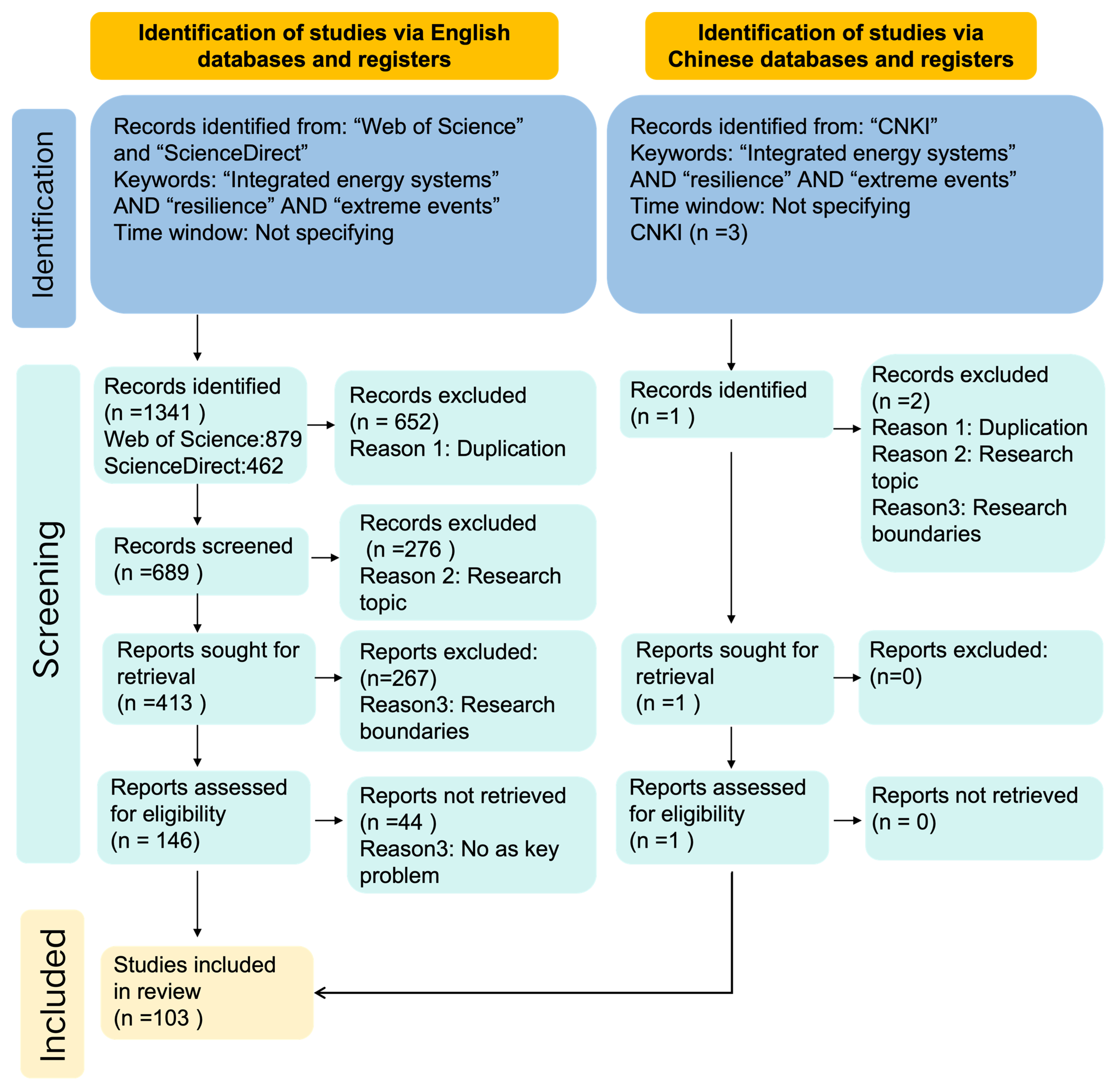
| Search Runs | Search Keywords |
|---|---|
| First run | “Integrated energy systems” |
| Second run | “Integrated energy systems” AND “resilience” |
| Third run | “Integrated energy systems” AND “resilience” AND “extreme events” |
| Query Set | Meaning |
|---|---|
| TS = “Energy system” NOT “Transportation, Supply chain, Social work, etc.” | The focus of the research is set around the energy system |
| TS = “Resilience” NOT “Flexibility” | Keywords are set for energy resilience |
| AND (“Power system” OR “Power grids” OR “Electricity and Natural gas system, etc.” | The focus of the research is set on the energy- and electricity-integrated system |
| AND (“Adversity” OR “Disaster” OR “Extreme weather” | Emphasizing specifying disturbance |
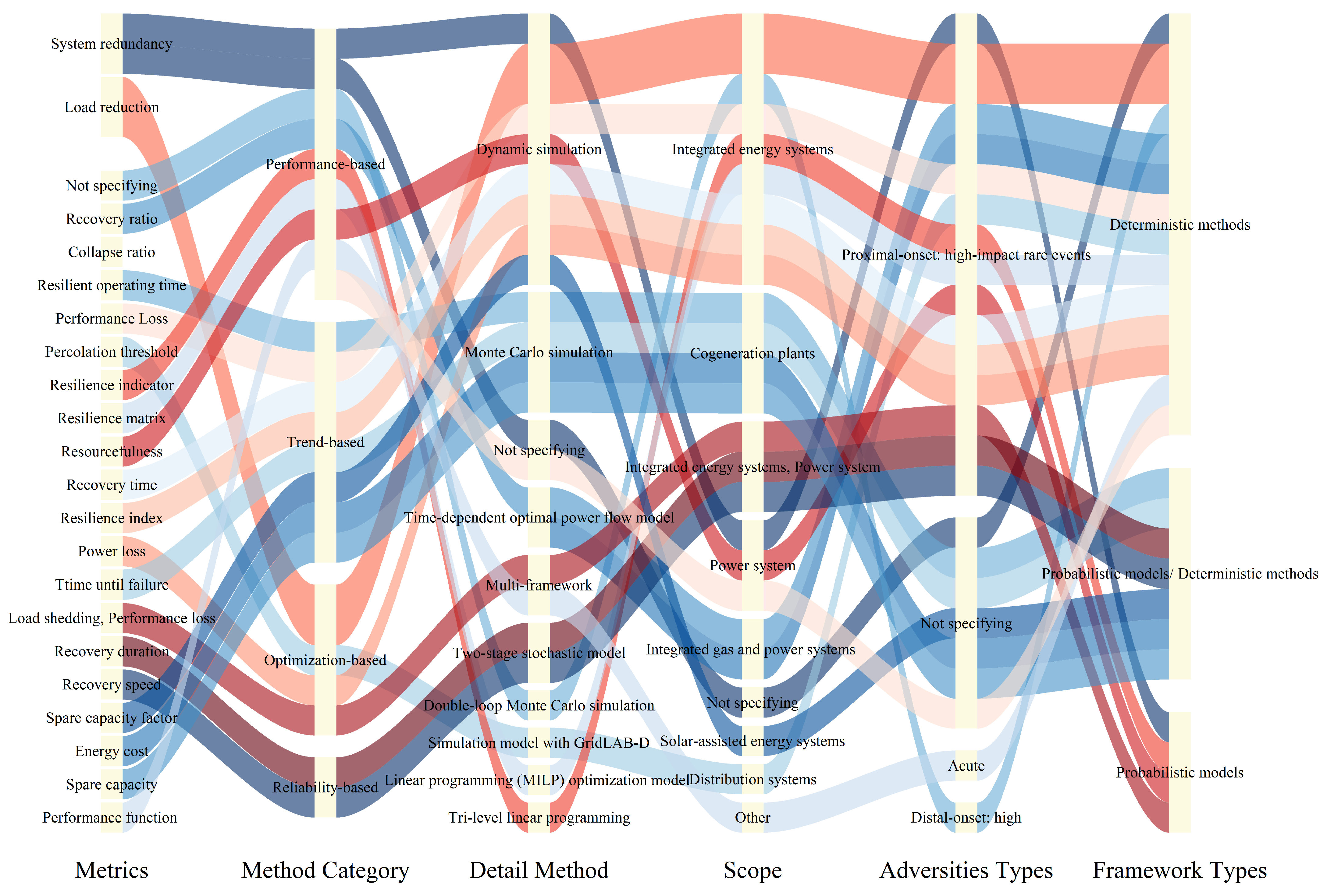
| Adversities’ Type | Characteristics | Framework Types | Reference No. |
|---|---|---|---|
| Not specified | ------- | Qualitative: In-depth review | [40] |
| Not specified | ------- | Qualitative: Semi-quantitative | [37] |
| Proximal-onset: High-impact rare events (Acute) | Moderate impact; Rapid recovery with targeted measures | Quantitative: Semi-quantitative | [41,42] |
| Quantitative: Deterministic methods | [22,41,42,43,44,45,46,47,48] | ||
| Quantitative: Probabilistic methods | [49,50] | ||
| Distal-onset events | Insidious, enduring, and deeply impactful; long-term and sustained adaptation measures | Quantitative: Deterministic methods | [51] |
| Metric | Metric Dimensions and Category | Evaluation Method | Strength and Limitations | Reference |
|---|---|---|---|---|
| Load shedding (Load curtailments) | Optimization-based | Probabilistic models | (i) Not suitable for HILF events; (ii) Need simplifying assumptions for easier computation | [56,57,58] |
| System recovery time (Recovery duration, recovery speed) | Reliability-based | Probabilistic models/deterministic methods | Neglect temporal dynamics and emergent resilience properties | [59,60,61] |
| Total functional service losses | Trend-based | Probabilistic models/deterministic methods | (i) Performance curves must be simplified (e.g., via trapezoidal modeling), which can result in computational errors. (ii) Absence of standardized metrics constrains comparative analysis | [45] |
| Fraction (Spare capacity factor) | [62] | |||
| Duration (Resilient operating time, time until failure) | [63] | |||
| System redundancy | Performance-based | Deterministic methods | More informative | [1] |
| Performance loss | Require data granularity and event modeling capabilities | [22,64] | ||
| Performance function | Inadequate for real-time dynamics under stress | [65] |
Disclaimer/Publisher’s Note: The statements, opinions and data contained in all publications are solely those of the individual author(s) and contributor(s) and not of MDPI and/or the editor(s). MDPI and/or the editor(s) disclaim responsibility for any injury to people or property resulting from any ideas, methods, instructions or products referred to in the content. |
© 2026 by the authors. Licensee MDPI, Basel, Switzerland. This article is an open access article distributed under the terms and conditions of the Creative Commons Attribution (CC BY) license.
Share and Cite
Chang, C.; Hou, Y.; Zhu, N. Resilience-Oriented Management of Integrated Energy Systems: A Review of Characteristics, Quantification, Assessment and Enhancement Methods. Energies 2026, 19, 2531. https://doi.org/10.3390/en19112531
Chang C, Hou Y, Zhu N. Resilience-Oriented Management of Integrated Energy Systems: A Review of Characteristics, Quantification, Assessment and Enhancement Methods. Energies. 2026; 19(11):2531. https://doi.org/10.3390/en19112531
Chicago/Turabian StyleChang, Chen, Yingzhen Hou, and Neng Zhu. 2026. "Resilience-Oriented Management of Integrated Energy Systems: A Review of Characteristics, Quantification, Assessment and Enhancement Methods" Energies 19, no. 11: 2531. https://doi.org/10.3390/en19112531
APA StyleChang, C., Hou, Y., & Zhu, N. (2026). Resilience-Oriented Management of Integrated Energy Systems: A Review of Characteristics, Quantification, Assessment and Enhancement Methods. Energies, 19(11), 2531. https://doi.org/10.3390/en19112531