Article

The Number of Mega Hydropower Projects in Cascade Hydropower Systems Should Be Kept Moderate: Empirical Evidence from 23 River Basins in China (1998–2022)


1
College of Economics and Management, Taiyuan University of Technology, Taiyuan 030024, China
2
Business School, University of International Business and Economics, Beijing 100029, China
3
School of Accountancy, Shanxi Vocational University of Engineering Science and Technology, Jinzhong 030619, China
*
Author to whom correspondence should be addressed.
Energies 2026, 19(11), 2521; https://doi.org/10.3390/en19112521 (registering DOI)
Submission received: 3 March 2026 / Revised: 3 May 2026 / Accepted: 20 May 2026 / Published: 24 May 2026

Abstract

Mega hydropower projects (MHPs) are known for their substantial socioeconomic benefits but also face significant environmental challenges. This study introduces a novel framework to determine the moderate number of MHPs within a cascade hydropower system (CHS) to achieve a favorable trade-off between socioeconomic benefits and environmental challenges. First, eco-efficiency of cascade hydropower (ECH) is defined to assess this trade-off. Second, a multi-period difference-in-differences model is used to examine the impact of MHP expansion on ECH. Finally, the moderate number of MHPs in CHS is identified based on the estimated effects. The results from 23 case basins reveal that as the cascade of MHPs expands, ECH experiences a sequence of strong positive, weak positive, no effect, and negative impacts. The positive effect of MHP expansion on ECH demonstrates diminishing marginal returns. Once the number exceeds the moderate threshold (five in our case study basins), the positive impact eventually turns negative. This conclusion has undergone a series of robustness checks. The proposed framework provides valuable guidance for optimizing CHS configurations.

1. Introduction

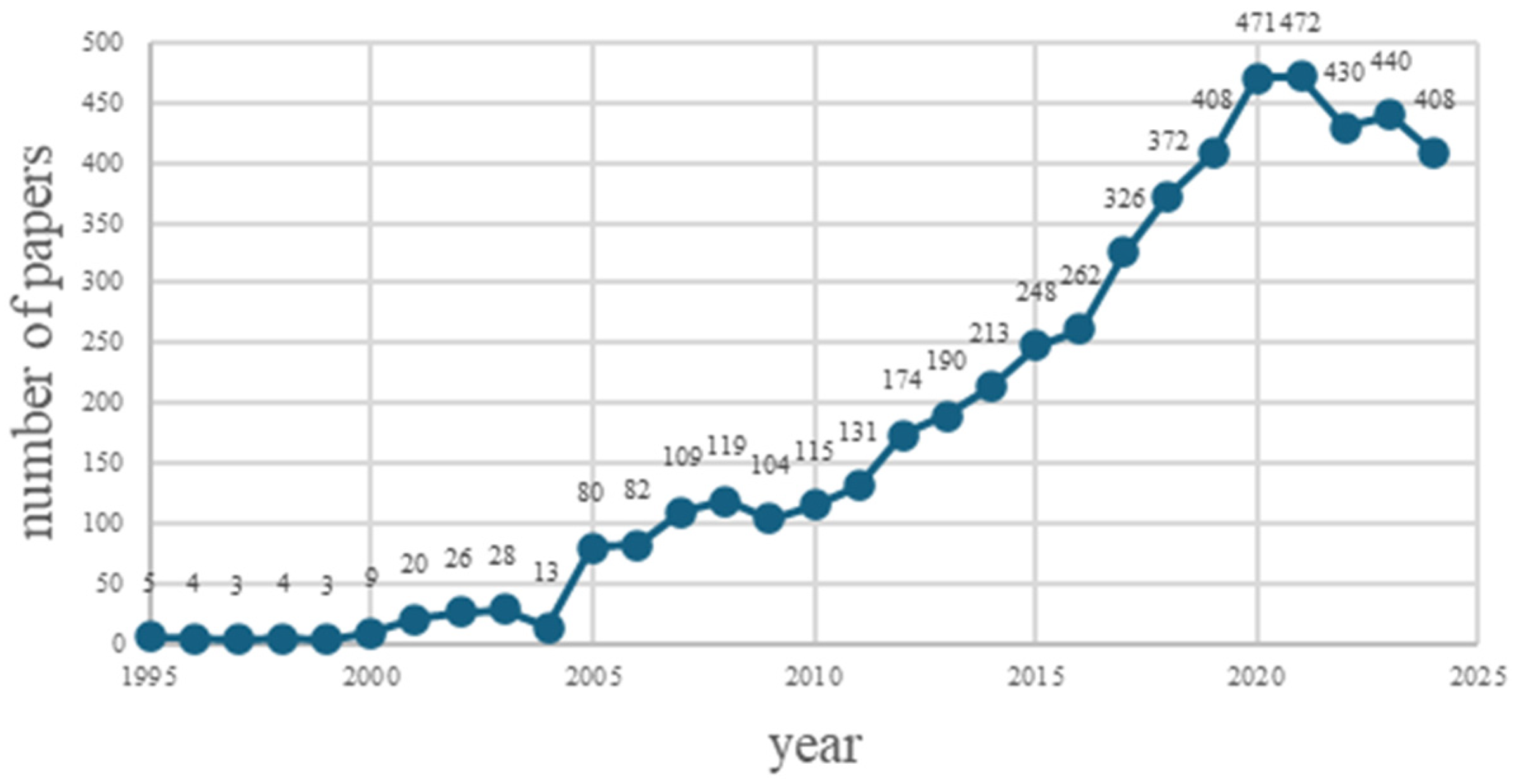
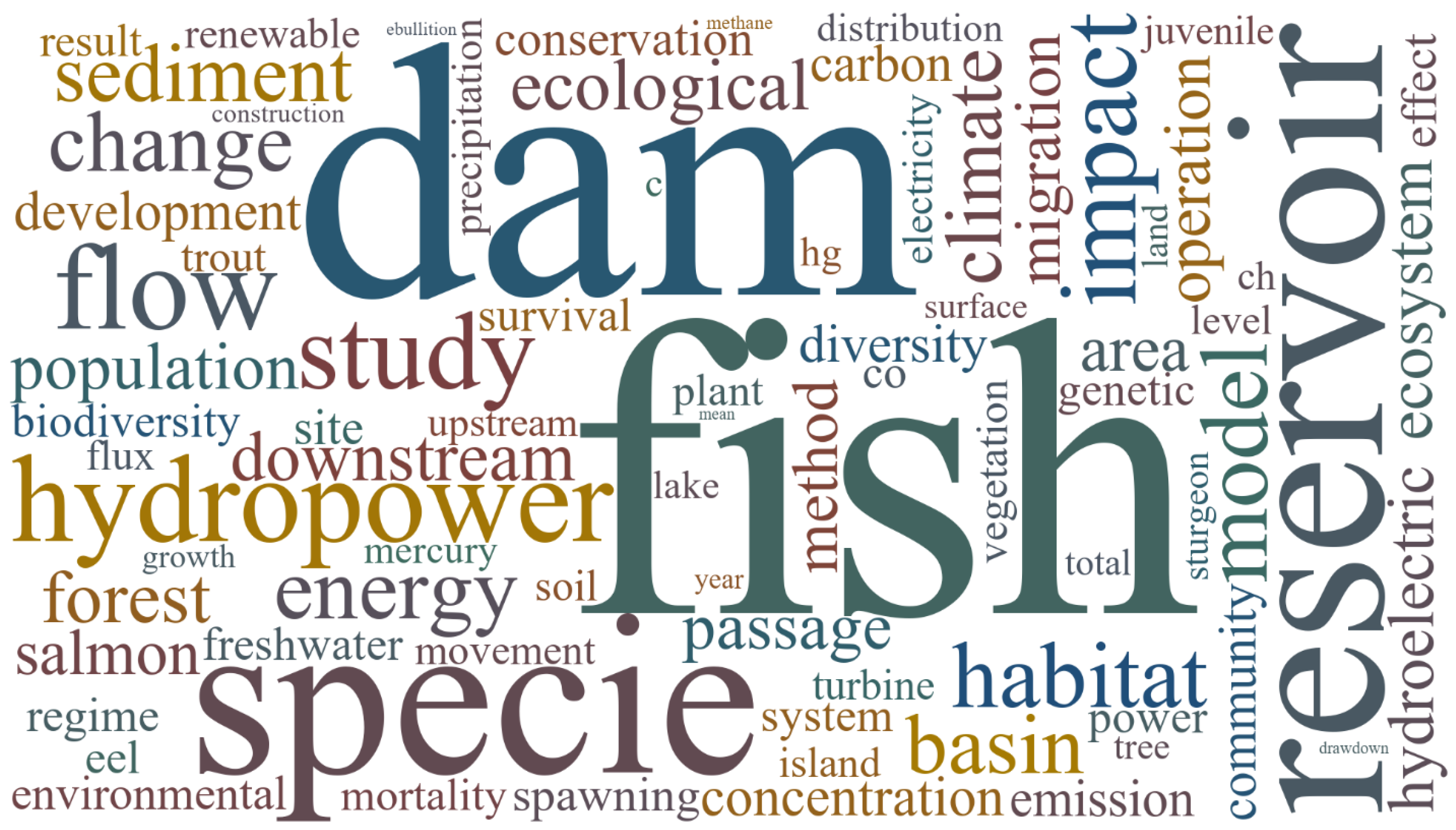
Hydropower remains the largest source of renewable energy worldwide. In 2024, hydropower accounted for 14% of global electricity generation and 45% of total renewable electricity generation [1]. Projections indicate that by 2050, global hydropower generation will be 1.5 times its current level [2]. In addition to providing substantial amounts of clean energy, hydropower projects offer a range of socioeconomic benefits, including irrigation, drinking water supply, and flood control, and have played a role in poverty alleviation within local communities [3,4]. However, it is important to recognize that the operation of hydropower projects does have environmental impacts. We analyzed the number of publications addressing the environmental impacts of large hydropower projects (LHPs) in the Web of Science database up to 2024 (Figure 1), as well as conducted word cloud analyses of the abstracts of these papers (Figure 2). The results indicate that research in this field has increased steadily since 1995, reaching a peak in 2022 before experiencing a slight decline. The primary research topics have focused on the loss of fish habitats and the decline in biodiversity [5,6,7]. Other frequently discussed issues include reduced river connectivity and alterations in hydrological conditions, which can further affect downstream regions [8,9,10,11]. To mitigate the environmental impacts of hydropower development, it is a reasonable approach to establish an upper limit on the size of hydropower development within a river basin. This principle has, in fact, become a common guideline in current hydropower development policy-making [12,13]. In the European Union, the Water Framework Directive, adopted in 2000, mandates the protection of surface water bodies. The European Water Resilience Strategy, adopted in 2025, further underscores the need to regulate water quantities, which in practice constrains the overall scale of hydropower development. In China, the “three red lines” constitute the core framework of the strictest water resources management regime introduced in 2011, including caps on total water resources development and utilization, targets for improving water use efficiency, and limits on pollutant discharges within water function zones. In 2025, to further strengthen constraints on water resources development, the Assessment Measures for Implementing the Rigid Water Resources Constraint System were introduced, explicitly stipulating controls on the total volume of water resources development and utilization.
While controlling the scale of hydropower development can help mitigate its impacts on riverine ecosystems—for example, by maintaining an ecological flow estimated between 30% and 50% of the river’s natural discharge depending on basin characteristics and allocating the remaining flow as the maximum exploitable resource—this can help establish a baseline for the river’s ecological health; however, the diversity of hydropower project types complicates this approach. Hydropower projects encompass multiple configurations, such as dam-based, run-of-river, diversion, and hybrid systems, and these types differ significantly in their patterns of water use as well as in the extent of their socio-economic benefits and environmental impacts [14]. Dam-based hydropower relies on reservoirs created by impounding water. Depending on the reservoir’s size, these projects can also serve a variety of additional purposes. Generally, larger-scale projects offer greater capacity for regulating river flow, but this often comes at the expense of more significant environmental impacts. For instance, the well-known Three Gorges Hydropower Project stores 39.3 billion cubic meters of water, generates an average of 88.2 billion kWh annually, provides substantial flood control and drought relief, and has improved navigation conditions on the Yangtze River. However, it has also caused significant change to the river habitat, subsequently affecting species diversity. Furthermore, the project has altered the geological environment, resulting in an increased risk of geological disasters [15,16]. Run-of-river hydropower projects typically do not involve large-scale water storage, thereby reducing downstream impacts. A diversion-type hydropower project generates electricity by conveying river water through diversion channels to a downstream location, where a concentrated hydraulic head is created for power generation. Run-of-river and diversion hydropower projects do not directly rely on large reservoirs and are generally considered to have less impact on river ecosystems compared to dam-based hydropower projects [14]. Nevertheless, the stable operation of run-of-river and diversion projects is often dependent on the regulation of river flow by upstream headwater reservoirs, which typically possess significant storage capacity. Therefore, merely regulating the size of cascade hydropower systems (CHS) may not be sufficient to effectively balance socioeconomic benefits and environmental impacts; it is also essential to take into account the composition of the CHS. In particular, a key consideration is determining the number or proportion of dam-based projects with large reservoirs. However, existing hydropower research has paid limited attention to the composition of the CHS. Therefore, this study investigates how the number of dam-based projects with large reservoirs influences the trade-off between overall socioeconomic benefits and environmental impacts at the river basin scale.
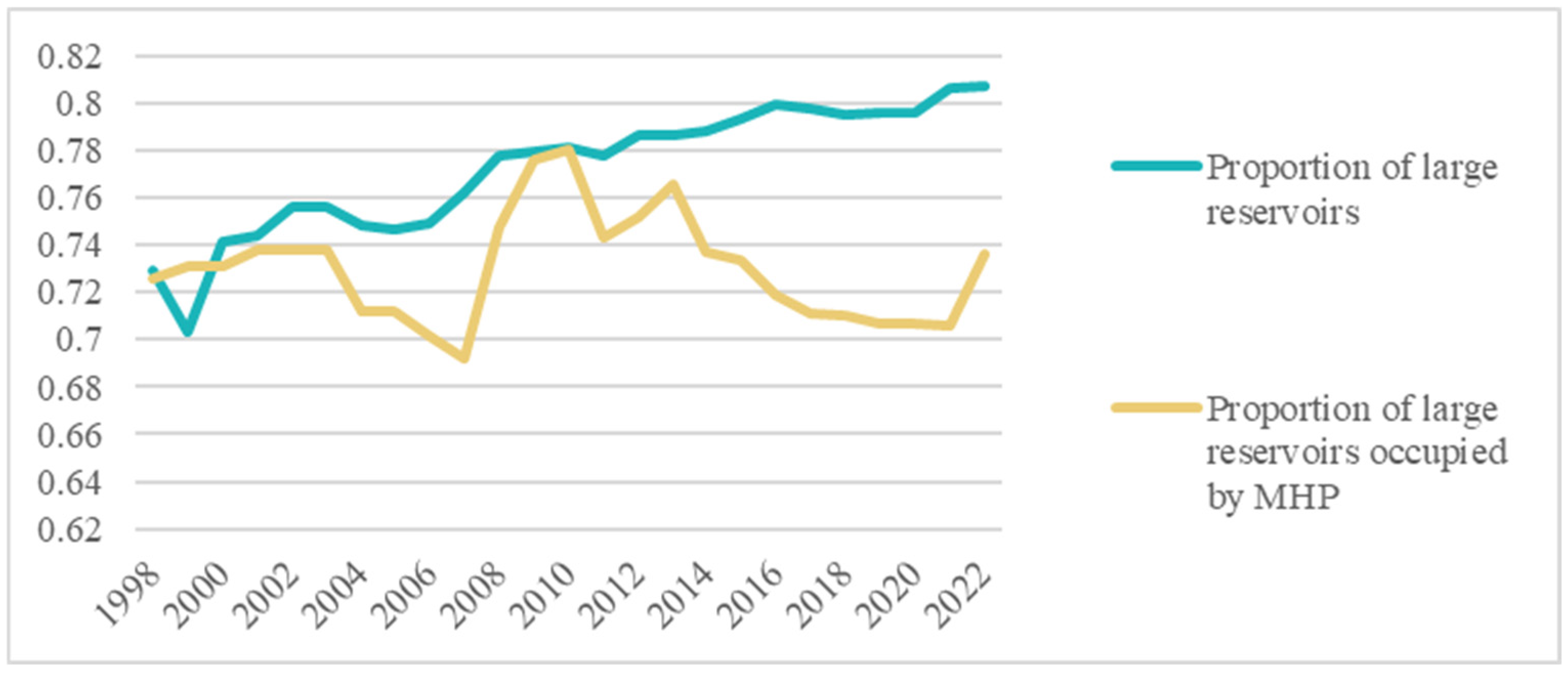
Among the various types of hydropower, dam-based hydropower projects have gradually become the hallmark of modern hydropower development. As the future development of hydropower in river basins shifts from numerous small projects to a smaller number of large projects, dam-based hydropower projects are expected to play an increasingly vital role. China stands out as one of the most successful countries in the development of dam-based hydropower, with the size of individual projects continuously increasing and evolving from conventional LHPs to mega hydropower projects (MHPs). Figure 3 presents year by year changes in the share of China’s large reservoirs and in the share of MHPs within them. As shown in the figure, the share of total reservoir storage capacity accounted for by large reservoirs has continued to increase over time. At the same time, within the category of large reservoirs, the proportion associated with MHPs has remained relatively stable, fluctuating by around 74 percent over a prolonged period. Taken together, these two patterns underscore both the importance of MHPs and the strong momentum of their development.
Accordingly, this study examines how MHPs’ expansion within CHS influences the trade-off between its benefits and consequences, with the objective of identifying the moderate number that achieves the most favorable trade-off. The structure of this research is as follows: Section 2 reviews methods for assessing trade-offs between environmental impacts and socioeconomic benefits. Section 3 proposes the research framework based on econometric models and introduces the river basin cases. Section 4 presents the research findings and analyzes their robustness. Section 5 discusses the rationality and applicability of the results. Section 6 concludes the paper, emphasizing its policy implications.

2. Literature Review

The trade-off between socioeconomic benefits and environmental impacts is complex and challenging to quantify, largely because the environmental consequences of hydropower development are diverse and multifaceted.

2.1. Methods for Assessing Trade-Offs

Emergy analysis is a widely recognized approach based on the premise that all energy on Earth ultimately originates from solar radiation. By converting various forms of energy within a system into a common unit of solar emergy, it enables the conversion of different resources and products into emergy values. This provides a unified metric for assessing all material and energy flows within a system, thereby facilitating evaluation of the trade-off between economic benefits and environmental impacts [17]. Several studies have applied emergy analysis to hydropower systems on the Qinghai–Tibet Plateau to evaluate their emergy outputs [18]. Du et al. [19] employed emergy analysis to assess the environmental sustainability of large cascade hydropower projects in the upper reaches of the Yangtze River. Rather than adopting the conventional approach of defining a single hydropower project as the system boundary, they considered the river reach as the fundamental system unit. Ren et al. [20] also used emergy analysis to evaluate the cascade hydropower system in the middle and lower reaches of the Lancang River, and their results showed that joint cascade operation enables the hydropower system to achieve superior economic and ecological benefits. However, effective application of this method requires careful consideration of system components and clear boundaries between energy and material flows [21].
Ecosystem services assessment, a widely adopted evaluation approach, monetizes environmental impacts by highlighting the essential role of ecosystems in supporting human well-being [22]. This method recognizes that different ecosystem services necessitate distinct forms of compensation. Building on ecosystem service assessments, Fang et al. [23] proposed an evaluation framework for balancing hydropower development and conducted a case study in the Yalong River Basin. They investigated the relationship between hydropower generation and ecosystem services before construction, during construction, and throughout the operational period of a cascade system consisting of four large hydropower stations in the basin. Using an ecosystem service assessment approach, Fu et al. [24] evaluated all hydropower stations in the Zagunao River Basin in southwestern China and summarized the problems encountered during the hydropower development process in this basin, as well as potential improvements. This method requires comprehensive evaluation of multiple factors and is subject to fluctuations in monetary systems and market conditions [25].
Ecological efficiency was first introduced by Schaltegger and Sturm [26] in 1990 as a tool for linking enterprises to sustainable development. Since its inception, the concept has been extended to various fields, including industry and environmental management. Van Berkel [27] successfully applied ecological efficiency to mineral processing and metal production, demonstrating its effectiveness for management in traditional industries. From both technical and operational perspectives, ecological efficiency has been shown to enhance enterprise operations. Park et al. [28] examined the relationship between the manufacturing and transportation sectors in the United States, evaluating the sustainability performance of manufacturing subsectors with an emphasis on transportation, and incorporated social factors into the ecological efficiency assessment framework. Picazo-Tadeo et al. [29] collected sample data from agricultural production in Spain, calculating ecological efficiency at both the farm level and in terms of specific environmental pressures. In the hydropower sector, some scholars have investigated the eco-efficiency of Brazil’s hydropower industry and, on this basis, provided insights into its development [30]. This study aims to examine, at the river basin scale, how the number of MHPs within a basin influences the tradeoff between the overall socioeconomic benefits and environmental impacts. In this context, eco-efficiency is the most appropriate metric for capturing this relationship. As Hoffren et al. [31] noted, however, eco-efficiency provides only a relatively coarse representation of the issue and is therefore better suited to evaluating the overall sustainability of an activity. At the same time, unlike emergy analysis, eco-efficiency does not require the conversion of diverse factors into a common unit, thereby avoiding the errors associated with such transformations. This is entirely consistent with the focus of the present study.
The concept of eco-efficiency offers a comprehensive framework for evaluating the trade-off between economic benefits and environmental impacts. However, the specific calculation of eco-efficiency varies depending on the application context. Currently, three primary methods are employed: life cycle assessment, stochastic frontier analysis, and data envelopment analysis (DEA).
Life cycle assessment enables a quantitative analysis of environmental impacts throughout the entire process, providing a thorough explanation of the trade-off between economic benefits and environmental impacts over the full life cycle of a project. Saling et al. [32] developed a general tool based on life cycle assessment to evaluate eco-efficiency in the chemical industry. Onat et al. [33] assessed the eco-efficiency of electric vehicles in the United States using life cycle assessment and offered policy recommendations for the future development of electric vehicles based on their findings. Chen et al. [34] integrated life cycle assessment into machine learning to evaluate the carbon and water footprints of hydropower development across China at the national scale, and their findings highlighted the environmental impacts associated with hydropower development. Zhao et al. [35] employed life cycle assessment to estimate the water footprint of the Three Gorges Hydropower Project and suggested that earlier methods may have overestimated this footprint.
Stochastic frontier analysis assumes that the distance between a production unit and the best practice frontier is the sum of “true” inefficiency and random fluctuations. Moutinho et al. [36] used stochastic frontier analysis to evaluate the eco-efficiency of countries in Asia and Africa. Wang et al. [37] employed a stochastic frontier model to estimate the energy and ecological efficiency of the Yellow River Basin from 2002 to 2016 and to examine its spatial spillover effects. In related research, other scholars have also applied stochastic frontier analysis to evaluate the efficiency of environmental restoration measures associated with hydropower projects, with the results indicating that some projects are cost inefficient [38].
DEA is currently the most widely used method for assessing eco-efficiency. As a non-parametric approach, it does not require the pre-specification of production or efficiency functions, thereby avoiding subjectivity and errors associated with model specification. This characteristic makes it particularly suitable for evaluating eco-efficiency in cases with complex data structures. In the hydropower sector, Wang et al. [39] used DEA to calculate the eco-efficiency of hydropower development in Southwest China and found that most power projects were insufficient in terms of generation scale or fish protection. Wang et al. [40] utilized DEA to evaluate the generation efficiency of two primary components of China’s power sector: thermal power and hydropower. They analyzed the specific efficiencies of thermal and hydropower across various regions in China, compared the efficiency differences between these two types of power generation, and assessed the technological gap between them. Liu et al. [41] applied DEA to 43 hydropower plant cases in China and found that the environmental impacts of hydropower projects throughout their life cycle mainly originated from the preparation and construction stages.
Hydropower projects within a river basin involve both competitive and cooperative interactions [42]. As the number of projects in a CHS increases, the system’s complexity grows exponentially [43], making these relationships extremely difficult to disentangle. Using the entire river basin as the unit of analysis helps address this challenge. Moreover, because hydropower generation is a production process involving multiple inputs and outputs, this approach is also methodologically appropriate. On this basis, DEA is a more suitable method for measuring eco-efficiency of cascade hydropower (ECH) in our study.

2.2. Identifying Turning Points of Trade-Offs

A CHS has the potential to generate socioeconomic benefits that surpass the combined gains of individual projects operating independently [44]. However, hydropower development and its coordinated operations may also generate cumulative environmental impacts [45,46] that intensify in a nonlinear manner [47]. Under such circumstances, it remains unclear whether an increase in the number of cascades within a CHS has a positive or negative impact on ECH. Furthermore, it is not yet known whether there exists a number threshold beyond which the effect reverses compared to when the number is below this threshold. Although existing research has paid limited attention to this issue, numerous studies in the field of economics offer valuable perspectives that could inform future investigations.
In examining the trade-off between economic development and environmental impacts, the Environmental Kuznets Curve (EKC) has emerged as a widely accepted concept among scholars since its introduction by Grossman and Krueger [48]. The EKC hypothesis posits an inverted U-shaped relationship between per capita income and environmental pollution, suggesting that environmental degradation initially increases with rising income, but begins to decline after reaching a certain income threshold. Numerous empirical studies have provided support for this hypothesis. For instance, research on Kenya’s energy system and analyses of electronic waste in European Union countries have both confirmed the presence of such a curve [49,50]. However, the EKC hypothesis has also faced significant challenges. Some scholars have questioned its universality; for example, a study using provincial panel data from China found that when regional interdependence is adequately controlled for, the EKC pattern disappears [51]. It is important to note that the EKC does not always follow an inverted U-shape; in some cases, it may also exhibit an N-shape or an inverted N-shape [52]. Methodologically, the identification of such turning points relies on a variety of mathematical models. The classic approach involves introducing a quadratic income term into pollution emission regressions [53], while more recent studies have incorporated higher-order terms to capture more complex dynamics [54]. Drawing on the concept of the Environmental Kuznets Curve, the relationship between economic development and environmental impact is often nonlinear. In light of this, scholars have utilized a variety of analytical methods, including panel threshold models, difference-in-differences (DID) models, the Bayesian vector autoregression methodology, and autoregressive distributed lag models [51,55,56,57,58] to examine how economic development affects the environment.
When assessing the impact of MHPs’ cascade expansion on ECH, a similar nonlinear relationship may be present. However, because the number of MHPs is a discrete rather than a continuous variable, we treat different numbers of MHPs as distinct states and conduct separate DID analyses for each state.

3. Methodology and Data

3.1. Research Framework

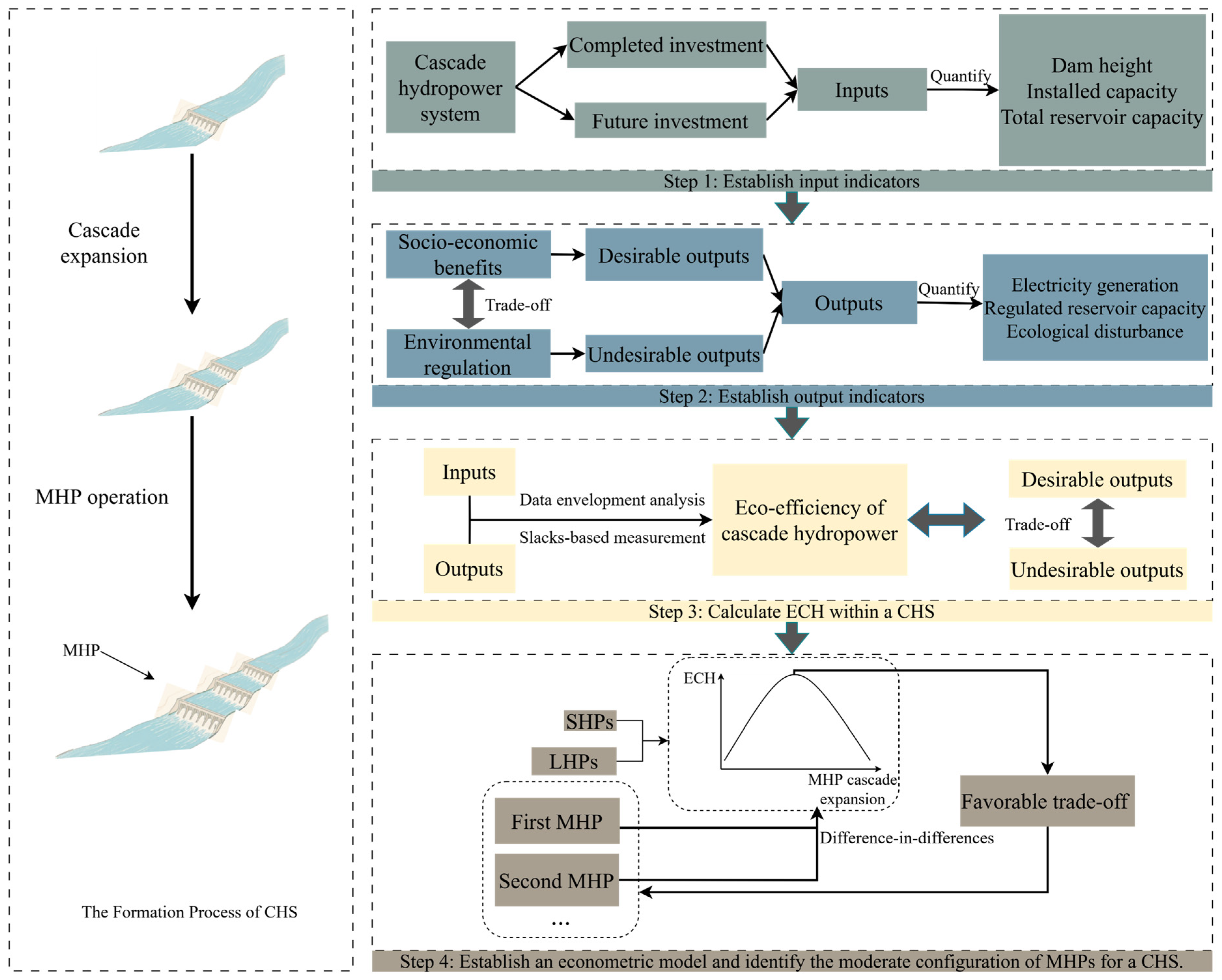
This study proposes a research framework to evaluate the moderate number of MHPs, which achieve a favorable trade-off between socio-economic and environmental performance within CHS. By adopting a basin-wide perspective, the first step involves analyzing the process of cascade hydropower exploitation, with particular emphasis on the accumulation of input indicators throughout the exploitation process. The second step focuses on the output side, identifying both socio-economic desirable outputs and environmental undesirable outputs; the core trade-off lies between these two categories. The third step integrates both inputs and outputs to evaluate the ECH from a basin-wide perspective. Higher efficiency indicates a more favorable trade-off, wherein increases in desirable outputs are not accompanied by increases in undesirable outputs, representing a favorable trade-off. The fourth step constructs a DID model, although the siting of MHPs is shaped by multiple factors, including hydrological conditions, economic feasibility, and local infrastructure; technological advances and infrastructure improvements have expanded the number of feasible sites within river basins, leading to the widespread presence of MHPs across major basins. Therefore, although project siting is not random, the cascade expansion of MHPs can still be treated as an exogenous shock to the CHS. On this basis, we further examine the impact of each expansion on ECH. A positive effect signifies an improvement in ECH, reflecting a more favorable trade-off between socio-economic and environmental performance. The fifth step incorporates case studies to examine the specific trends of these impacts and, based on these trends, determines the moderate number for MHPs in a river basin. Figure 4 presents the research framework for this study.

3.2. Methodology for Measuring ECH

We utilize DEA to assess the trade-off between socio-economic and environmental performance by measuring ECH. For the input indicators, this study uses dam height, installed capacity, and total reservoir capacity as proxies for construction costs. It should be noted that these indicators do not directly represent the construction costs of hydropower projects. Given the substantial variation among hydropower stations in terms of construction period, geographic location, and specific functions, their direct construction costs may be affected by a wide range of factors, including interest rates, local infrastructure conditions, financing arrangements, and the operational practices of project owners. Therefore, using project scale as a proxy for construction cost may be a more practical approach. Regarding the output indicators, we use the annual electricity generation of the hydropower project as an indicator of its economic benefits. At the same time, hydropower projects also play a regulatory role in water supply, flood storage, and navigation; therefore, we introduce regulated reservoir capacity as an indicator of these positive benefits. However, the operation of hydropower projects inevitably affects downstream ecological water use, which may impact or even damage downstream ecosystems. Thus, we use the ratio of regulated reservoir capacity to river runoff to represent this disturbance, thereby characterizing the environmental impacts of hydropower projects on the river basin. For these indicators, we annually aggregate data from all hydropower projects within the basin. Detailed indicator definitions are provided in Table 1.
The super-efficiency SBM model is a type of non-radial, non-angular DEA model that can distinguish efficiency differences among efficient decision-making units and also overcomes the impact of slack variables on efficiency measurement. We adopt the SBM approach proposed by Tone et al. [59] and incorporate subsequent improvements suggested by later scholars based on this method [60], thereby constructing the SBM model employed in this study:
ρ = m i n 1 + 1 m i = 1 m s i x i k 1 1 s 1 + s 2 r = 1 s 1 s r d y r k d + r = 1 s 2 s r u d y r k u d s . t x i k j = 1 , j k n x i j λ j s i y r k d j = 1 , j k n y i j d λ j + s r d y t k d j = 1 , j k n y i j u d λ j s r u d s 0 , s r d 0 , s r u d 0 , λ 0
This study employs a non-oriented data envelopment analysis model under the assumption of constant returns to scale. In the above equation, X denotes the input vector, Yd represents the desirable output vector, and Yud denotes the undesirable output vector. sd, s-, and sud correspond to the associated slack variables. m, s1, and s2 represent the number of variables in each respective category.

3.3. Econometric Model

This paper utilizes a DID model to investigate the moderate number of MHPs within the CHS. The operation of MHPs within the basin is employed as the core explanatory variable, while the ECH is used as the explained variable. Meanwhile, this paper incorporates water resource endowment, the concentration of CHS, the scale of CHS, and the average installed capacity of CHS as control variables. The definition of MHPs in this study is based on the “Classification of Standards for Water Conservancy, Hydropower Projects, and Flood Control” (SL252-2017 [61]). According to this standard, mega reservoirs are defined as those with a total storage capacity of at least one billion cubic meters or an installed capacity of at least 1.2 million kilowatts. Therefore, in this study, any hydropower project that satisfies either of these criteria is classified as a MHP. Table 2 provides descriptions of the variables employed in the econometric model.
The multi-period DID model is employed to estimate the impact of MHPs’ cascade expansion on ECH; the operation of MHP is treated as a quasi-natural experiment. Consequently, the following equation is derived to estimate the nexus between MHP and ECH:
ECH i t = β 0 + β 1 M H P x i t + α X i t + μ i + δ t + ε i t
MHPx is a binary variable that indicates whether the corresponding MHP operational scenario is satisfied in a given river basin and year. A value of 1 denotes that this condition is satisfied, while a value of 0 indicates that it is not. β0 and β1 refer to the estimated parameters. Xit denotes a vector of control variables (i.e., Flow, Concentrate, Scale, and Average), μI indicates the basin-specific effects, δt means the time-specific effects, and εit is a random disturbance term.

3.4. Sample Description

We selected 23 river basins across China as case study areas. The annual runoff of these basins ranges from 12.7 billion to 333.8 billion cubic meters, ensuring broad representativeness. The minimum runoff of 12.7 billion cubic meters guarantees that each basin possesses sufficient potential for MHP exploitation. In terms of spatial distribution, these river basins encompass the Southwest, South-Central, Southern, Southeastern, Northeastern, and Northern regions of China. While some of these areas are rich in water resources, others are comparatively scarce. In terms of temporal distribution, hydropower exploitation in these case areas has a long history, with the earliest hydropower project dating back to 1953. During this period, China’s renewable energy generation increased more than tenfold, with hydropower accounting for a significant proportion, thus representing the exploitation of hydropower in China, including the continuous exploitation of MHPs. This ensures that the data for the selected study period (1998–2022) are comprehensive and reliable.
In this study, we select medium and large river basins as case studies and further subdivide these basins into several sub-basins. For instance, the Yangtze River is partitioned into multiple sub-basins. For these river basins, advances in hydropower construction technology and improvements in infrastructure have made them comparable in terms of their overall development potential, although they do not have identical probabilities of MHP development: that is, of receiving treatment. The sub-basins without developed MHP serve as the control group, thereby meeting the requirements for DID analysis. Because the number of MHPs varies across watersheds, experiments conducted for a given MHP count do not necessarily include all watersheds. Table 3 presents the corresponding grouping scheme. In Table 3, “▲” denotes the control group, which is always included in the computation of MHPx under all scenarios. “●” indicates that, under the current grouping rule, the basin is included in the computation as part of the treatment group. “○” indicates that, under the current grouping rule, the basin is excluded from the computation, implying that the number of MHPs in the basin does not meet the required count.
For data selection, we gathered all accessible information on mega, large, and medium hydropower projects, mainly because the number of small hydropower projects is too many and their reservoir capacity is very limited, making their contribution to watershed water resource utilization relatively minor. The total installed capacity of the hydropower projects included in the case basins accounts for 75.7% of the national total, which is representative of the overall development level in China.
Table 4 presents the descriptive statistics for each variable, based on a sample of 575 observations. The results reveal substantial variation in ECH, the scale of CHS, water resource endowment, and the average installed capacity of CHS across the different sample basins, indicating that the sample selection is relatively comprehensive. Overall, the concentration of CHS remains generally high in all basins. The core explanatory variables are a set of binary indicators denoted as MHPx, which take the value of one if there are x MHP in operation within a given watershed and zero otherwise. Across 575 observations, the mean values decline monotonically with x, indicating that watersheds with fewer operating MHPs are more prevalent in the sample. Specifically, the sample means are 0.809 for MHP1, 0.683 for MHP2, 0.412 for MHP3, 0.313 for MHP4, and 0.245 for MHP5. All MHPx variables are binary indicators, with standard deviations spanning 0.394 to 0.493.

4. Results

4.1. ECH Results

Table 5 presents the mean ECH scores for 23 CHSs across various river basins. During the study period from 1998 to 2022, the Yangtze River mainstream, the Pearl River, and the Yalong River demonstrated the highest average ECH. In contrast, the Qingyi River exhibited the lowest average ECH, with the Jialing River and the Min River following closely behind. These results indicate that river basins with below-average ECH scores are primarily concentrated in southwestern China, suggesting that hydropower projects in this region are less effective at balancing socioeconomic and environmental outcomes. Previous studies have also demonstrated that the efficiency of hydropower development in southwestern China is relatively low [62,63], implying that hydropower resources in this area have not been fully utilized. Additionally, the region’s extensive mountainous terrain and forest cover increase its sensitivity to changes in the hydrological environment. From the perspective of MHP, there is no direct observable impact of the presence or number of such projects within a basin on ECH. Therefore, it is necessary to employ econometric models to further analyze the potential relationship.

4.2. Benchmark Regression Results

Prior to performing the benchmark regression analysis, it is essential to assess the stationarity properties of all variables to mitigate the risk of spurious regression results. Accordingly, the widely adopted Im–Pesaran–Shin panel unit root test is utilized to evaluate the stationarity of each variable. The outcomes of these tests are presented in Table 6. The results indicate that the null hypothesis of the presence of a unit root is rejected for all variables, thereby confirming that all variables employed in this study exhibit stationarity.
We employed a fixed effects model to assess the impact of MHPs cascade expansion on ECH, with the results summarized in Table 7. Model (1) indicates that the operation of a single MHP has a significant positive effect on ECH. In Model (2), which adds control variables to the specification in Model (1), the regression coefficient increases from 0.152 to 0.273, and the effect remains significantly positive. Model (3) demonstrates that the operation of two MHPs also exerts a significant positive impact on ECH. After including control variables in Model (4), the coefficient decreases to 0.0768 but remains significantly positive. Model (5) reveals that the operation of three MHPs results in an insignificant negative effect, whereas Model (6) shows that, after the inclusion of control variables, the negative impact increases to −0.163 and becomes significant. Model (7) indicates that the operation of four MHPs produces a significant positive effect at the 1% level; however, when control variables are incorporated in Model (8), the significance diminishes. Model (9) demonstrates that the operation of five MHPs has a significant negative effect on the basin, and this negative impact becomes stronger and more significant when control variables are included in Model (10).

4.3. Robustness Check

4.3.1. Parallel Trend Test

There is a crucial prerequisite for conducting DID: before the operation of MHP in the treatment group, the trend in the ECH between the treatment group and control group should be identical, indicating no systematic differences ex ante.
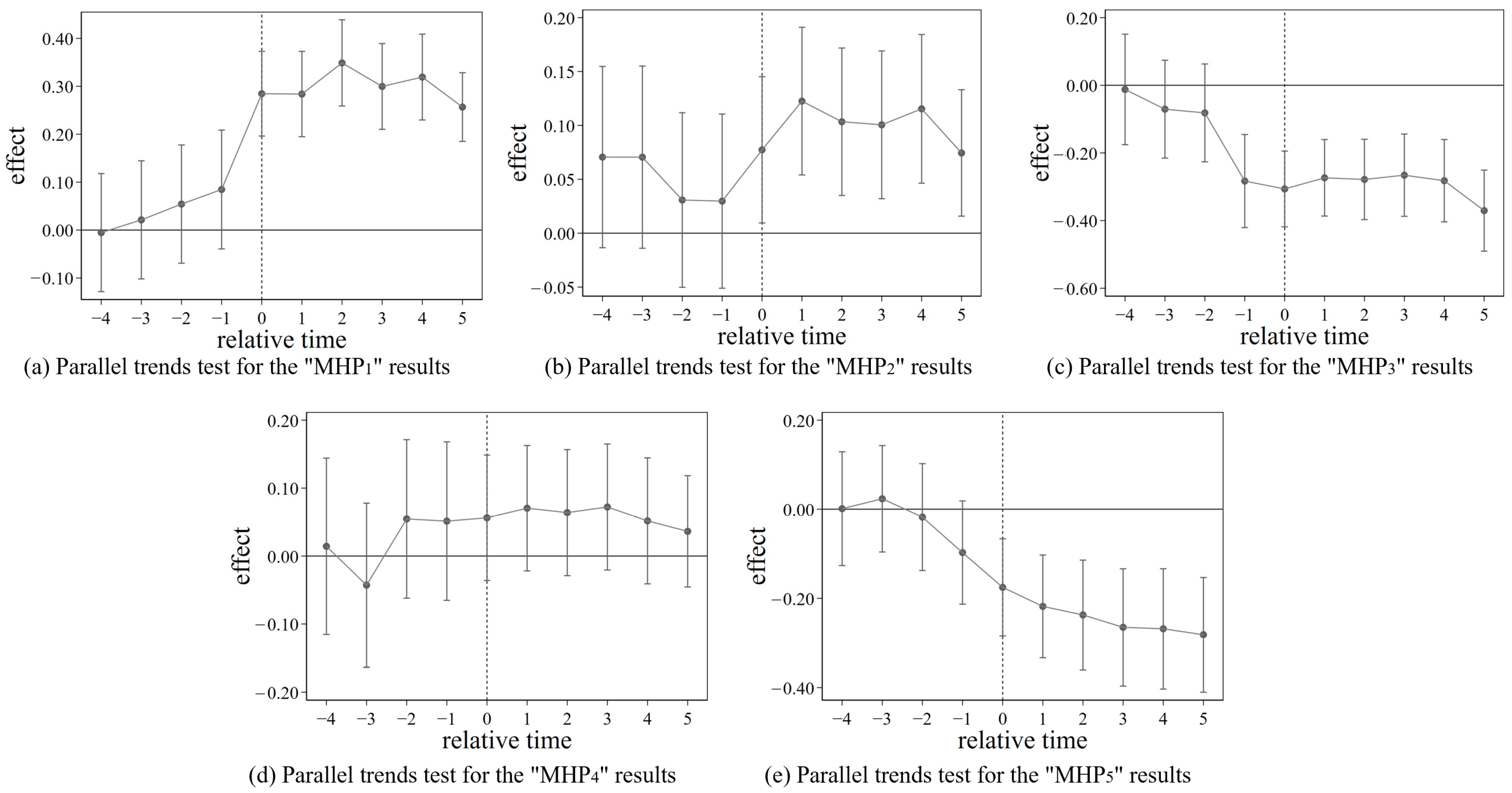
The results presented in Table 7 indicate that, after accounting for control variables, the operation of one, two or four MHPs has a significant positive effect. In contrast, the operation of three and five MHPs demonstrates a significant negative effect. Therefore, we conduct a parallel trends test to further investigate these findings, as illustrated in Figure 5. Panels (a), (b), and (e) in Figure 5 demonstrate that the results for MHP1, MHP2, and MHP5 satisfy the parallel trends test. Consequently, these panels can be utilized to evaluate the impact of the respective numbers of MHP on ECH.

4.3.2. Placebo Test

To investigate the presence of a placebo effect in the experiment, we conducted time placebo tests for MHP1, MHP2, and MHP5, as well as mixed placebo tests that incorporated both pseudo-treatment timing and pseudo-treated individuals.
Table 8 reports the results of the time placebo tests for all specifications. When the treatment timing is lagged, the estimated treatment effect becomes statistically insignificant. We further conduct mixed placebo tests for these three specifications.
Table 9 reports the results of the mixed placebo test. For MHP1, the coefficient is positive, and both the two-tailed p-value and the right-tailed p-value are significant at the 1% level. For MHP2, the coefficient is also positive, with both the two-tailed p-value and the right-tailed p-value significant at the 5% level. For MHP5, the coefficient is negative, and both the two-tailed p-value and the left-tailed p-value are significant at the 5% level. MHP1, MHP2, and MHP5 passed the parallel trends test, the temporal placebo test, and the combined placebo test, indicating that these three scenarios have a statistically significant effect on ECH.

4.3.3. Other Robustness Checks

To further assess the robustness of our results, we adopted an alternative approach to measuring the ECH. In this approach, ECH was calculated as the ratio of the total annual power generation within the basin to the product of the total installed capacity and the total ecological disturbance in the basin, as specified in Equation 3. To reduce the impact of outliers, the results were subsequently standardized.
ECH = e l e c t r i c i t y   g e n e r a t i o n ( i n s t a l l e d   c a p a c i t y × e c o l o g i c a l   d i s t u r b a n c e )
As presented in Table 10, the previously identified effects remain evident: when the number of MHPs is one or two, both are associated with a statistically significant positive effect, with a larger magnitude when there is one MHP. By contrast, having five MHPs is associated with a statistically significant negative effect.

4.3.4. Heterogeneity Test

From the perspective of the effects of the control variables on ECH, water resource endowment and the scale of CHS consistently have a statistically significant impact on ECH. Given the substantial differences in water resource endowment across the case basins, it may also influence the scale of development. Accordingly, we categorized the overall sample based on the water resource endowment of each basin. Basins with water resource endowment values above the mean are categorized as high-endowment basins, while those with values below the mean are classified as low-endowment basins. The high-endowment group comprises 11 basins, and the low-endowment group comprises 12 basins. The results are summarized in Table 11. In both low-endowment and high-endowment basins, as the number of MHPs increases, the estimated effect shifts from significantly positive to significantly negative, suggesting that our results are robust.

5. Discussion

5.1. The Moderate Number of MHPs in a CHS

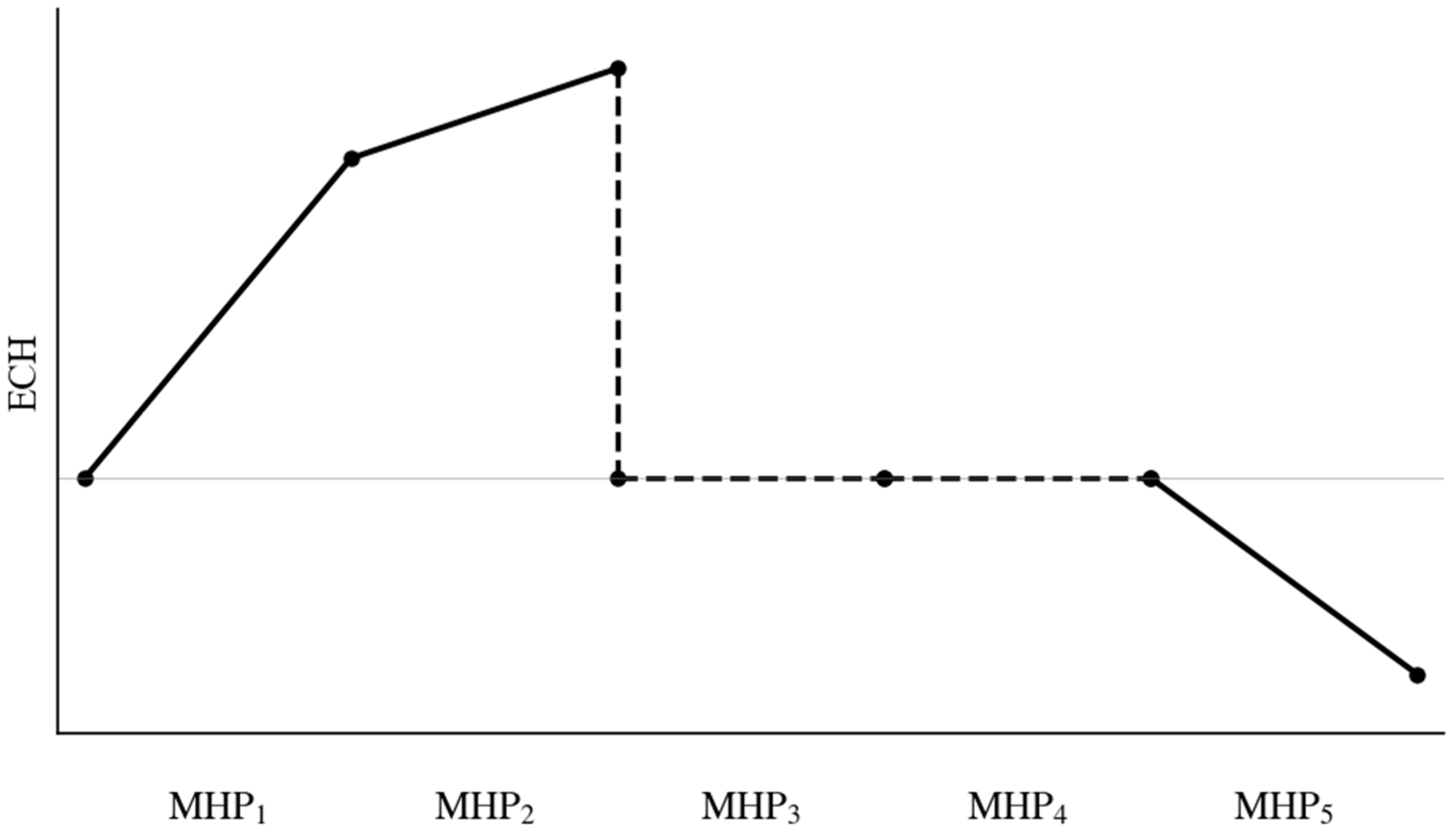
Based on the results of our empirical analysis of 23 river basins in China, we find that, within the sampled basins, having one or two MHPs is associated with a statistically significant positive effect on ECH, with the effect being stronger when there is one MHP. When the number increases to three or four, the effect on ECH is no longer statistically significant. When the number further increases to five, a statistically significant effect reemerges, but it becomes negative. These findings suggest that as MHPs cascade expansion, their positive effect on ECH exhibits diminishing marginal returns, and once the number reaches five, the effect declines and turns negative (Figure 6).
Our findings can be summarized in two main points. First, implementing MHPs at a moderate number can positively influence the ECH. This improvement can be primarily attributed to the superior regulatory capacity, enhanced operational flexibility, and scale effect of MHPs compared to other small hydropower projects [64,65]. Particularly when MHPs are integrated into cascade scheduling, higher power generation efficiency as well as enhanced regulation of water supply for other uses can be yielded [66,67,68], thereby enhancing the social benefits of MHPs [69]. These considerations underscore the scale effect inherent in the socio-economic benefits associated with MHPs. Second, when the number of MHPs surpass a certain threshold, they may negatively affect the ECH. When the number of MHPs in a CHS exceeds the moderate number, competitive effects among MHPs begin to manifest. One point is that the addition of new MHPs to a CHS can substantially alter the downstream hydrological environment [70], thereby increasing the complexity of water resource management and operational scheduling. The cumulative impacts of multiple MHPs often exhibit nonlinear characteristics, amplifying their environmental consequence [71,72]. Similar threshold effects have also been observed in the cumulative impacts of hydropower projects. One study found that the construction of the fourth dam within a river basin triggered the most rapid rate of land use change [47], suggesting that the number of MHPs in a basin may influence broader underlying mechanisms and thus lead to comparable outcomes. Such nonlinear relationships exist not only among hydropower projects but also among different functions within a single project. This implies that, as the demand intensity for a particular function of a hydropower project increases, its overall environmental impact does not rise linearly but instead follows a nonlinear trajectory. Case studies have shown that when the frequency of hydropower generation at a given project exceeds 90%, the expected levels of both water supply and environmental provision decline sharply [73]. Another point is that the number of sites within a river basin that are suitable for the multifunctional development of MHPs is inherently limited. The siting of MHP dams is constrained by a range of factors [74,75,76,77]. Only a limited number of MHPs can be constructed at the most suitable sites for hydropower development. For subsequent MHPs, the utilization of water resources will be lower compared to those projects located at the optimal sites.
Diminishing marginal effects observed in the development of hydropower resources are common in practice. Drawing on the Hotelling rule, we argue that the prices of certain nonrenewable resources increase exponentially over the extraction period, implicitly reflecting heterogeneity in resource grades [78]. A closely related example concerns the scale of farmland management. With continuous advances in agricultural machinery and technology, large scale farming has become increasingly prevalent. However, given constraints arising from various factors, a larger operational scale does not necessarily yield better outcomes. Instead, there exists an appropriate scale at which inputs can be allocated efficiently and the economic returns from farmland are maximized: namely, the moderate scale of farmland management [79]. Even the development of wind and solar power, typically regarded as more environmentally friendly sources of electricity, may still be subject to market feedback that generates diminishing marginal returns. Moreover, diminishing marginal effects are pervasive across a wide range of contexts, including the impact of educational investment on regional poverty reduction [80], the effect of green research and development on carbon emissions [81], and the influence of temperature on economic outcomes [82].

5.2. Uncertainty Analysis

This study finds that the positive effect of cascade expansion of MHPs on ECH exhibits diminishing marginal returns, yet two sources of uncertainty remain. First, in quantifying environmental impacts through undesirable outputs, this study considers only runoff disturbance. Although runoff disturbance is a major driver of ecological impacts on river channels, it is not the only determinant. Water temperature and water quality, among other factors, also play important roles, which introduces uncertainty into the measurement of the tradeoff. Second, due to limitations in the available sample, the estimated treatment effects in this study can be identified only up to the fifth MHP. Although diminishing marginal returns are already apparent at this stage, if hydropower development continues to accelerate, the effects of the sixth, seventh, or subsequent MHPs on ECH may not remain significantly negative. This possibility should be examined in future research as hydropower development progresses.

6. Conclusions and Policy Implications

After identifying the exploitable hydropower resources within a river basin, it is essential to determine the optimal exploitation strategy. Given the growing size of individual hydropower projects and CHS, particular attention should be paid to the spatial configuration of MHPs. A prerequisite for addressing this issue is to determine the configuration of MHPs within a CHS. We conduct an empirical analysis and obtain the following main findings:
(1)
In the case basins, the presence of one or two MHPs positively influences the trade-off between socioeconomic and environmental performance. However, when the number of MHPs reaches five, this trade-off is adversely affected.
(2)
In basins with high flow levels, the construction of MHPs yields stronger positive effects and weaker negative impacts. However, the moderate number remained unchanged. In both cases, the efficiency effect shifted from positive to negative at the fifth MHP.
(3)
Due to methodological limitations, the findings of this study cannot be regarded as fully conclusive in a strict continuous sense. Nevertheless, the study provides adequate evidence for diminishing marginal returns and indicates that, in balancing socioeconomic benefits against environmental impacts, there exists a moderate number of MHPs within a CHS. Although the exact value of this threshold may vary depending on the inherent characteristics of individual river basins, such variation does not undermine the existence of the threshold itself.
To advance the sustainability of CHS, this paper offers the following policy recommendations: First, hydropower development should be guided by a basin-wide perspective and adopt an integrated approach that accounts for the total potential of developable resources and the maximum feasible number of projects, thereby avoiding overdevelopment. Second, in basins with heterogeneous characteristics, to prevent uncoordinated competition for water resources among cascade hydropower projects and to mitigate excessive cumulative environmental impacts, the framework proposed in this paper for identifying the moderate number of MHPs can be applied to cascade development planning or dam removal planning within a basin, with full consideration of the basin’s specific characteristics. Finally, once the number of MHPs within a river basin exceeds the established threshold, particular attention should be given to the ecological impacts of hydropower development in that basin, and protective measures should be implemented in a timely manner.

Author Contributions

Conceptualization, S.L., Y.G. and J.Z.; Methodology, S.L., Y.G. and J.Z.; Writing—original draft, S.L., Y.G. and J.Z.; Writing—review & editing, S.L., Y.G. and J.Z.; Supervision, J.Z.; Project administration, J.Z. All authors have read and agreed to the published version of the manuscript.

Funding

This work was supported by the National Natural Science Foundation of China (Grant No. 42101279) and Humanities and Social Sciences Foundation of the Ministry of Education, China (Grant No. 21YJCZH211).

Data Availability Statement

The original contributions presented in this study are included in the article. Further inquiries can be directed to the corresponding author.

Conflicts of Interest

The authors declare no conflict of interest.

References

  1. EI. Statistical Review of World Energy; Energy Institute: London, UK, 2025. [Google Scholar]
  2. IEA. World Energy Outlook 2025; IEA: Paris, France, 2025. [Google Scholar]
  3. Adjei, E.A.; Amoabeng, K.O.; Ayetor, G.K.K.; Obeng, G.Y.; Quansah, D.A.; Adusei, J.S. Assessing the impact of hydro energy project on poverty alleviation: The case of Bui Dam in Ghana. Energy Policy 2022, 170, 113227. [Google Scholar] [CrossRef]
  4. Yuksel, I. Hydropower for sustainable water and energy development. Renew. Sustain. Energy Rev. 2010, 14, 462–469. [Google Scholar] [CrossRef]
  5. Barbarossa, V.; Schmitt, R.J.P.; Huijbregts, M.A.J.; Zarfl, C.; King, H.; Schipper, A.M. Impacts of current and future large dams on the geographic range connectivity of freshwater fish worldwide. Proc. Natl. Acad. Sci. USA 2020, 117, 3648–3655. [Google Scholar] [CrossRef]
  6. Luo, Y.Q.; Xu, M.Z.; Zhou, X.D.; Lei, F.K.; Hassan, M.A.; Fu, X.D. Potential benefits to the endemic fish habitat in the highland deeply incised high-energy river responding to hydropower development. J. Environ. Manag. 2025, 376, 124498. [Google Scholar] [CrossRef]
  7. Sor, R.; Ngor, P.B.; Lek, S.; Chann, K.; Khoeun, R.; Chandra, S.; Hogan, Z.S.; Sarah, E.E. Fish biodiversity declines with dam development in the lower Mekong basin. Sci. Rep. 2023, 13, 8571. [Google Scholar] [CrossRef] [PubMed]
  8. Lai, X.; Liang, Q.; Jiang, J.; Huang, Q. Impoundment effects of the three-gorges-dam on flow regimes in two China’s largest freshwater lakes. Water Resour. Manag. 2014, 28, 5111–5124. [Google Scholar] [CrossRef]
  9. Lauri, H.; de Moel, H.; Ward, P.J.; Rasanen, T.A.; Keskinen, M.; Kummu, M. Future changes in Mekong river hydrology: Impact of climate change and reservoir operation on discharge. Hydrol. Earth Syst. Sci. 2012, 16, 4603–4619. [Google Scholar] [CrossRef]
  10. Lin, Z.; Qi, J. Hydro-dam—A nature-based solution or an ecological problem: The fate of the Tonle sap lake. Environ. Res. 2017, 158, 24–32. [Google Scholar] [CrossRef] [PubMed]
  11. Rasanen, T.A.; Koponen, J.; Lauri, H.; Kummu, M. Downstream hydrological impacts of hydropower development in the upper Mekong basin. Water Resour. Manag. 2012, 26, 3495–3513. [Google Scholar] [CrossRef]
  12. Mishra, S.; Singal, S.K.; Khatod, D.K. Optimal installation of small hydropower plant-a review. Renew. Sustain. Energy Rev. 2011, 15, 3862–3869. [Google Scholar] [CrossRef]
  13. Santolin, A.; Cavazzini, G.; Pavesi, G.; Ardizzon, G.; Rossetti, A. Techno-economical method for the capacity sizing of a small hydropower plant. Energy Convers. Manag. 2011, 52, 2533–2541. [Google Scholar] [CrossRef]
  14. Egré, D.; Milewski, J.C. The diversity of hydropower projects. Energy Policy 2002, 30, 1225–1230. [Google Scholar] [CrossRef]
  15. Tang, H.; Wasowski, J.; Juang, C.H. Geohazards in the three gorges reservoir area, China lessons learned from decades of research. Eng. Geol. 2019, 261, 105267. [Google Scholar] [CrossRef]
  16. Zhang, Q.; Lou, Z. The environmental changes and mitigation actions in the three gorges reservoir region, China. Environ. Sci. Policy 2011, 14, 1132–1138. [Google Scholar] [CrossRef]
  17. Xu, A.; Yang, L.; Liu, Z.; Xiong, Y.; Xiao, X.; Deng, C.; Yang, S. Sustainability evaluation of a PEMFC system for coalbed methane recovery based on life cycle assessment and emergy analysis. J. Clean. Prod. 2024, 434, 140344. [Google Scholar] [CrossRef]
  18. Chen, J.; Mei, Y.; Ben, Y.; Hu, T. Emergy-based sustainability evaluation of two hydropower projects on the Tibetan Plateau. Ecol. Eng. 2020, 150, 105838. [Google Scholar] [CrossRef]
  19. Du, H.; Yang, L.; Wang, W.; Lu, L.; Li, Z. Emergy theory to quantify the sustainability of large cascade hydropower projects in the upper Yangtze. Ecol. Modell. 2022, 468, 109954. [Google Scholar] [CrossRef]
  20. Ren, S.; Feng, X. Emergy evaluation of ladder hydropower generation systems in the middle and lower reaches of the Lancang river. Renew. Energy 2021, 169, 1038–1050. [Google Scholar] [CrossRef]
  21. Kullmann, F.; Markewitz, P.; Stolten, D.; Robinius, M. Combining the worlds of energy systems and material flow analysis: A review. Energy Sustain. Soc. 2021, 11, 13. [Google Scholar] [CrossRef]
  22. Martin-Lopez, B.; Gomez-Baggethun, E.; Garcia-Llorente, M.; Montes, C. Trade-offs across value-domains in ecosystem services assessment. Ecol. Indic. 2014, 37, 220–228. [Google Scholar] [CrossRef]
  23. Fang, Z.; Wang, H.; Bai, Y.; Campos-Arceiz, A.; Liu, G.; Jiang, B. Framework for a more balanced consideration of hydropower development through ecosystem services assessment. Sustain. Prod. Consum. 2022, 33, 557–566. [Google Scholar] [CrossRef]
  24. Fu, B.; Wang, Y.K.; Xu, P.; Yan, K.; Li, M. Value of ecosystem hydropower service and its impact on the payment for ecosystem services. Sci. Total Environ. 2014, 472, 338–346. [Google Scholar] [CrossRef]
  25. Briones-Hidrovo, A.; Uche, J.; Martínez-Gracia, A. Estimating the hidden ecological costs of hydropower through an ecosystem services balance: A case study from ecuador. J. Clean. Prod. 2019, 233, 33–42. [Google Scholar] [CrossRef]
  26. Schaltegger, S.; Sturm, A. Ökologische rationalität: Ansatzpunkte zur ausgestaltung von ökologieorientierten managementinstrumenten. Die Unternehm. 1990, 44, 273–290. [Google Scholar]
  27. van Berkel, R. Eco-efficiency in the Australian minerals processing sector. J. Clean. Prod. 2007, 15, 772–781. [Google Scholar] [CrossRef]
  28. Park, Y.S.; Egilmez, G.; Kucukvar, M. A novel life cycle-based principal component analysis framework for eco-efficiency analysis: Case of the united states manufacturing and transportation nexus. J. Clean. Prod. 2015, 92, 327–342. [Google Scholar] [CrossRef]
  29. Picazo-Tadeo, A.J.; Gomez-Limon, J.A.; Reig-Martinez, E. Assessing farming eco-efficiency: A data envelopment analysis approach. J. Environ. Manag. 2011, 92, 1154–1164. [Google Scholar] [CrossRef]
  30. Bermann, C.E.L. Impasses and controversies of hydroelectricity. Estud. Avançados 2007, 21, 139–153. [Google Scholar] [CrossRef]
  31. Hoffrén, J.; Apajalahti, E.L. Emergent eco-efficiency paradigm in corporate environment management. Sustain. Dev. 2009, 17, 233–243. [Google Scholar] [CrossRef]
  32. Saling, P.; Kicherer, A.; Dittrich-Krämer, B.; Wittlinger, R.; Zombik, W.; Schmidt, I.; Schrott, W.; Schmidt, S. Eco-efficiency analysis by basf: The method. Int. J. Life Cycle Assess. 2002, 7, 203–218. [Google Scholar] [CrossRef]
  33. Onat, N.C.; Kucukvar, M.; Afshar, S. Eco-efficiency of electric vehicles in the united states: A life cycle assessment based principal component analysis. J. Clean. Prod. 2019, 212, 515–526. [Google Scholar] [CrossRef]
  34. Chen, X.; Liu, C.; van Oel, P.; Mergia Mekonnen, M.; Thorp, K.R.; Yin, T.; Wang, J.; Muhammad, T.; Li, Y. Water and carbon risks within hydropower development on national scale. Appl. Energy 2022, 325, 119872. [Google Scholar] [CrossRef]
  35. Zhao, D.; Liu, J. A new approach to assessing the water footprint of hydroelectric power based on allocation of water footprints among reservoir ecosystem services. Phys. Chem. Earth (2002) 2015, 79–82, 40–46. [Google Scholar] [CrossRef]
  36. Moutinho, V.; Madaleno, M. Assessing eco-efficiency in Asian and African countries using stochastic frontier analysis. Energies 2021, 14, 1168. [Google Scholar] [CrossRef]
  37. Wang, L.; Zhang, F.; Fu, W.; Tan, Q.; Chen, J. Analysis of temporal and spatial differences and influencing factors of energy eco-efficiency in energy-rich area of the yellow river basin. Phys. Chem. Earth (2002) 2021, 121, 102976. [Google Scholar] [CrossRef]
  38. Tirkaso, W.T.; Gren, I.M.R.E. Evaluation of cost efficiency in hydropower-related biodiversity restoration projects in Sweden—A stochastic frontier approach. J. Environ. Plan. Manag. 2023, 66, 221–240. [Google Scholar] [CrossRef]
  39. Wang, W.; Wang, H.; Liu, G.; Gao, L. Analysis of the trade-off between hydroelectricity generation and ecological protection from the perspective of eco-efficiency in southwest China. J. Environ. Manag. 2022, 315, 115063. [Google Scholar] [CrossRef] [PubMed]
  40. Wang, R.M.; Tian, Z.; Ren, F.R. Energy efficiency in China: Optimization and comparison between hydropower and thermal power. Energy Sustain. Soc. 2021, 11, 36. [Google Scholar] [CrossRef]
  41. Liu, X.; Jiang, Y.; Zheng, X.; Hou, W.; Chen, X.; Xiao, S.; Zhang, X.; Deng, S.; Hao, J.; Luo, H.; et al. Moving towards co-benefits of hydropower: Ecological efficiency evaluation based on LCA and DEA. Environ. Impact Assess. Rev. 2023, 102, 107208. [Google Scholar] [CrossRef]
  42. Ambec, S.; Doucet, J.A. Competition Along a River: Decentralizing Hydropower Production; Centre for Studies in Economics and Finance (CSEF), University of Naples: Napoli, Italy, 2001. [Google Scholar]
  43. Feng, Z.K.; Niu, W.J.; Cheng, C.T.; Wu, X.Y. Optimization of hydropower system operation by uniform dynamic programming for dimensionality reduction. Energy 2017, 134, 718–730. [Google Scholar] [CrossRef]
  44. Zhou, Y.; Guo, S.; Chang, F.J.; Xu, C.Y. Boosting hydropower output of mega cascade reservoirs using an evolutionary algorithm with successive approximation. Appl. Energy 2018, 228, 1726–1739. [Google Scholar] [CrossRef]
  45. Chen, S.; Chen, B.; Fath, B.D. Assessing the cumulative environmental impact of hydropower construction on river systems based on energy network model. Renew. Sustain. Energy Rev. 2015, 42, 78–92. [Google Scholar] [CrossRef]
  46. Zhu, Y.; He, J.; Xiong, F.; Wu, Z.; Zhang, J.; Li, Y.; Lin, Y.; He, A.; Wang, D.; Han, Y. Cumulative ecological impact of cascade hydropower development on fish community structure in the main stream of the Xijiang river, China. Animals 2025, 15, 495. [Google Scholar] [CrossRef]
  47. Wang, Y.; He, X.; Wang, Y.; Li, K. Assessing cumulative impacts of cascade dams on vegetation in the reservoir-hydropower impact zone. J. Environ. Manag. 2025, 394, 127444. [Google Scholar] [CrossRef] [PubMed]
  48. Grossman, G.M.; Krueger, A.B. Economic growth and the environment. Q. J. Econ. 1995, 110, 353–377. [Google Scholar] [CrossRef]
  49. Boubellouta, B.; Kusch-Brandt, S. Testing the environmental Kuznets curve hypothesis for e-waste in the EU28+2 countries. J. Clean. Prod. 2020, 277, 123371. [Google Scholar] [CrossRef]
  50. Fodha, M.; Zaghdoud, O. Economic growth and pollutant emissions in Tunisia: An empirical analysis of the environmental kuznets curve. Energy Policy 2010, 38, 1150–1156. [Google Scholar] [CrossRef]
  51. Hu, Y.; Guan, K.; Wang, S. Challenging the environmental Kuznets curve in China: Evidence from a dynamic panel threshold model with cross-sectional dependence. J. Environ. Manag. 2026, 398, 128432. [Google Scholar] [CrossRef] [PubMed]
  52. Churchill, S.A.; Inekwe, J.; Ivanovski, K.; Smyth, R. The environmental Kuznets curve in the OECD: 1870–2014. Energy Econ. 2018, 75, 389–399. [Google Scholar] [CrossRef]
  53. He, Y.; Lin, B. Investigating environmental Kuznets curve from an energy intensity perspective: Empirical evidence from China. J. Clean. Prod. 2019, 234, 1013–1022. [Google Scholar] [CrossRef]
  54. Stern, D.I. The rise and fall of the environmental Kuznets curve. World Dev. 2004, 32, 1419–1439. [Google Scholar] [CrossRef]
  55. Kilinc-Ata, N. Investigation of the impact of environmental degradation on the transition to clean energy: New evidence from sultanate of Oman. Energies 2025, 18, 839. [Google Scholar] [CrossRef]
  56. Wang, Q.; Wang, X.; Li, R. Does urbanization redefine the environmental kuznets curve ? An empirical analysis of 134 countries. Sustain. Cities Soc. 2022, 76, 103382. [Google Scholar] [CrossRef]
  57. Zafeiriou, E.; Galatsidas, S.; Moulogianni, C.; Sofios, S.; Arabatzis, G. Evaluating enteric fermentation-driven environmental Kuznets curve dynamics: A Bayesian vector autoregression comparative study of the EU and least developed countries. Agriculture 2024, 14, 2036. [Google Scholar] [CrossRef]
  58. Zhang, Q.; Yu, Z.; Kong, D. The real effect of legal institutions: Environmental courts and firm environmental protection expenditure. J. Environ. Econ. Manag. 2019, 98, 102254. [Google Scholar] [CrossRef]
  59. Tone, K. A slacks-based measure of super-efficiency in data envelopment analysis. Eur. J. Oper. Res. 2002, 143, 32–41. [Google Scholar] [CrossRef]
  60. Yu, J.; Zhou, K.; Yang, S. Regional heterogeneity of China’s energy efficiency in “new normal”: A meta-frontier super-SBM analysis. Energy Policy 2019, 134, 110941. [Google Scholar] [CrossRef]
  61. SL 252-2017; Classification and Flood Standards for Water Resources and Hydropower Projects. China Water&Power Press: Beijing, China, 2017.
  62. Bin, D. Discussion on the development direction of hydropower in China. Clean Energy 2021, 5, 10–18. [Google Scholar] [CrossRef]
  63. Liu, B.; Liao, S.; Cheng, C.; Chen, F.; Li, W. Hydropower curtailment in Yunnan province, southwestern China: Constraint analysis and suggestions. Renew. Energy 2018, 121, 700–711. [Google Scholar] [CrossRef]
  64. IRENA. Renewable Power Generation Costs in 2020; International Renewable Energy Agency: Abu Dhabi, United Arab Emirates, 2021. [Google Scholar]
  65. Luo, X.; Huang, L.; Sui, X. Capacity optimization of existing reservoir hydropower expansion and its impact on power system flexibility. Appl. Energy 2025, 377, 124549. [Google Scholar] [CrossRef]
  66. Guo, X.Y.; Ma, C.; Tang, Z.B. Multi-timescale joint optimal dispatch model considering environmental flow requirements for a dewatered river channel: Case study of Jinping cascade hydropower stations. J. Water Resour. Plan. Manag. 2018, 144, 05018014. [Google Scholar] [CrossRef]
  67. He, Z.; Zhou, J.; Qin, H.; Jia, B.; Lu, C. Long-term joint scheduling of hydropower station group in the upper reaches of the Yangtze river using partition parameter adaptation differential evolution. Eng. Appl. Artif. Intell. 2019, 81, 1–13. [Google Scholar] [CrossRef]
  68. Shang, Y.; Lu, S.; Ye, Y.; Liu, R.; Shang, L.; Liu, C.; Meng, X.; Li, X.; Fan, Q. China’ energy-water nexus: Hydropower generation potential of joint operation of the three gorges and Qingjiang cascade reservoirs. Energy 2018, 142, 14–32. [Google Scholar] [CrossRef]
  69. Jager, H.I.; Efroymson, R.A.; Opperman, J.J.; Kelly, M.R. Spatial design principles for sustainable hydropower development in river basins. Renew. Sustain. Energy Rev. 2015, 45, 808–816. [Google Scholar] [CrossRef]
  70. Zhu, J.; Fan, H.; Deng, Y.; Chen, M.; Lu, J. Impact of daily operations of cascade hydropower stations on reservoir flow fluctuation characteristics. Water 2025, 17, 1608. [Google Scholar] [CrossRef]
  71. Wang, X.; Wang, P.; Deng, Y.; Xing, X.; Yuan, Q.; Du, C.; Gan, J.; Zheng, Y.; Liu, Y.; Xia, Y.; et al. Impacts of cascade hydropower development on river ecosystem homeostasis: A review. J. Hydrol. 2024, 638, 131484. [Google Scholar] [CrossRef]
  72. Yang, H.; Guo, W.; Wang, H. Anthropogenic intensification of the eco-hydrothermal regime transition in regulated rivers: The cumulative effect of cascade reservoirs. J. Environ. Manag. 2024, 349, 119478. [Google Scholar] [CrossRef]
  73. Chen, L.; Huang, K.; Zhou, J.; Duan, H.F.; Zhang, J.; Wang, D.; Qiu, H. Multiple-risk assessment of water supply, hydropower and environment nexus in the water resources system. J. Clean. Prod. 2020, 268, 122057. [Google Scholar] [CrossRef]
  74. Forzieri, G.; Gardenti, M.; Caparrini, F.; Castelli, F. A methodology for the pre-selection of suitable sites for surface and underground small dams in arid areas: A case study in the region of Kidal, Mali. Phys. Chem. Earth (2002) 2008, 33, 74–85. [Google Scholar] [CrossRef]
  75. Jozaghi, A.; Alizadeh, B.; Hatami, M.; Flood, I.; Khorrami, M.; Khodaei, N.; Ghasemi Tousi, E. A comparative study of the AHP and TOPSIS techniques for dam site selection using GIS: A case study of Sistan and Baluchestan province, Iran. Geosciences 2018, 8, 494. [Google Scholar] [CrossRef]
  76. Othman, A.A.; Al-Maamar, A.F.; Al-Manmi, D.A.M.A.; Liesenberg, V.; Hasan, S.E.; Obaid, A.K.; Al-Quraishi, A.M.F. GIS-based modeling for selection of dam sites in the Kurdistan region, Iraq. ISPRS Int. J. Geoinf. 2020, 9, 244. [Google Scholar] [CrossRef]
  77. Zhang, Z.; Chen, X.; Huang, Y.; Zhang, Y. Effect of catchment properties on runoff coefficient in a karst area of southwest China. Hydrol. Process. 2014, 28, 3691–3702. [Google Scholar] [CrossRef]
  78. Devarajan, S.; Fisher, A.C. Hotelling’s “economics of exhaustible resources”: Fifty years later. J. Econ. Lit. 1981, 19, 65–73. [Google Scholar]
  79. Yan, X.; Wang, Y.; Yang, G.; Liao, N.; Li, F. Research on the scale of agricultural land moderate management and countermeasures based on farm household analysis. Sustainability 2021, 13, 591. [Google Scholar] [CrossRef]
  80. Xie, X.; Sarntisart, S.; Uddin, M.N. The impact of education investment on regional poverty alleviation, dynamic constraints, and marginal benefits: A case study of Yunnan’s poor counties. Economies 2023, 11, 42. [Google Scholar] [CrossRef]
  81. Lee, K.H.; Min, B. Green r&d for eco-innovation and its impact on carbon emissions and firm performance. J. Clean. Prod. 2015, 108, 534–542. [Google Scholar] [CrossRef]
  82. Burke, M.; Hsiang, S.M.; Miguel, E. Global non-linear effect of temperature on economic production. Nature 2015, 527, 235–239. [Google Scholar] [CrossRef]
Figure 1. Trends in the number of publications on LHP-related impact studies.
Energies 19 02521 g001
Figure 2. Word cloud of research keywords.
Energies 19 02521 g002
Figure 3. The proportion of large reservoirs and the percentage of MHPs among these large reservoirs. Note: The data are obtained from the China Water Statistical Yearbook and the China Hydropower Yearbook.
Energies 19 02521 g003
Figure 4. Schematic illustration of the research framework.
Energies 19 02521 g004
Figure 5. Parallel trends test.
Energies 19 02521 g005
Figure 6. Diminishing marginal returns.
Energies 19 02521 g006
Table 1. Description of indicators related to ECH calculation.
IndicatorDescriptionData Resource
Economic inputDam height (m)Dam height can positively affect construction costs. It also determines the hydraulic head for power generation, which has a proportional impact on electricity output.Relevant literature
Installed capacity (104 kW)Installed capacity has a positive impact on construction costs. It is correlated with electricity generation and also determines the maximum possible electricity output.The almanac of China’s water power (1998–2022)
Total reservoir capacity (108 m3)Total reservoir capacity can, to some extent, represent the land requirements of a hydropower project. A larger total reservoir capacity is likely to result in higher levels of resettlement and land acquisition, thereby affecting construction costs. It also has a positive impact on the overall output of the hydropower project.Relevant literature
Socio-economic desirable outputElectricity generation (108 kWh)The electricity generation of a hydropower project is an important indicator for measuring its economic output, and the annual electricity generation is a key indicator of the project’s economic benefits.The almanac of China’s water power (1998–2022)
Regulated reservoir capacity (108 m3)The regulated reservoir capacity represents the potential of a hydropower project in functions such as water supply, flood storage, and navigation, and can serve as an indicator of the project’s positive social outputs.Relevant literature
Environmental undesirable outputEcological disturbance (dimensionless)It can be quantified as the ratio of regulating reservoir capacity to the volume of runoff. While a hydropower project serves the dual function of storing and releasing water, the act of storing water reduces downstream runoff, whereas releasing water increases it. This alteration of the natural runoff characteristics can ultimately disturb the downstream river water ecosystem.Relevant literature and China water statistical yearbook
Note: The data for ‘relevant literature’ is derived from pertinent data found in the relevant Chinese literature.
Table 2. Variables’ description.
VariableDescriptionData Resource
Explained variableECHECH. The super SBM model is employed to estimate it based on input-output variables in Section 2.1.
Core explanatory variableOperation of MHPMHPX. We have identified the operational status of various MHPs within the basin. The notation MHPx signifies that only x MHPs are currently operational in the basin.The almanac of China’s water power (1998–2022)
Control variableWater resource endowmentFlow. The maximum annual inflow of water into a cascade reservoir determines the upper limit of water resources available for power generation at cascade hydropower projects. Given the substantial variation in this value among different river basins, its logarithmic form is commonly used in analysis. Water resource endowment is jointly influenced by natural meteorological factors and human activities, and it directly impacts the efficiency of cascade hydropower generation. By incorporating water resource endowment as a control variable, these influences can be comprehensively accounted for.China water statistical yearbook
Concentration of CHSConcentrate. The concentration degree of hydropower exploitation is measured by the ratio of the combined installed capacity of the top three hydropower projects within a watershed to the total installed capacity of all hydropower projects in the same watershed. This indicator reflects the extent to which hydropower exploitation is concentrated within the watershed. A higher value indicates that the majority of the installed hydropower capacity is concentrated in the top three projects, signifying a higher degree of concentration. This, in turn, reflects the hydropower exploitation strategy adopted in the watershed.The almanac of China’s water power (1998–2022)
Scale of CHSScale. The value is calculated as follows: (total reservoir capacity/the volume of runoff) × 0.5 + (total installed capacity/theoretical hydro energy reserves) × 0.5. It indicates the degree of integrated development of the basin’s water resource and hydro energy resource. Hydropower exploitation scale reflects the simultaneous demands for electricity and water supply driven by regional socio-economic growth. The almanac of China’s water power (1998–2022)
Average installed capacity of CHSAverage. The average installed capacity is determined by dividing the total installed capacity of the basin by the total number of hydropower projects within the basin. A higher average installed capacity, especially when there are MHPs present, indicates that MHPs are relatively more numerous in the basin, meaning that MHPs play a dominant role.The almanac of China’s water power (1998–2022)
Table 3. The treatment group and the control group.
BasinMHP1MHP2MHP3MHP4MHP5
Minjiang River
Honghe River
Qingyi River
Yalong River
Wujiang River
Jialing River
Hanjiang River
Qingjiang River
Jinsha River
Mainstream of the Yangtze River
Lancang River
Qiantang River
Dadu River
Xijiang River
Pearl River
Xiangjiang River
Yuanjiang River
Dongting Lake
Poyang Lake
Hunjiang-Yalu River
Songhua River
Minjiang River
Mainstream of the Yellow River
Note: There are two entries for “Minjiang River” in the table. The first refers to a major tributary of the Yangtze River located in Southwest China, while the second denotes a river in Southeast China that flows directly into the East China Sea. Although both share the same transliteration due to identical pronunciation, each basin was assigned a unique numerical identifier during data processing. As a result, this does not affect the outcomes.
Table 4. Descriptive statistics.
(1)(2)(3)(4)(5)
VariablesNMeanSDMinMax
ECH5750.7320.2120.2171.116
Average57571.07123.4186.551051.75
Concentrate5750.7470.1980.4021
Flow57525.1481.47219.87128.185
Scale5750.2920.2340.0030.945
MHP15750.8090.39401
MHP25750.6830.46601
MHP35750.4120.49301
MHP45750.3130.46401
MHP55750.2450.43101
Table 5. ECH in each river basin.
BasinAverage ECHBasinAverage ECH
Minjiang River0.739Honghe River0.682
Dadu River0.594Xijiang River0.835
Qingyi River0.372Pearl River0.949
Yalong River0.945Xiangjiang River0.832
Wujiang River0.531Yuanjiang River0.697
Jialing River0.461Dongting Lake0.824
Hanjiang River0.770Poyang Lake0.794
Qingjiang River0.491Hunjiang-Yalu River0.515
Jinsha River0.860Songhua River0.921
Mainstream of the Yangtze River0.976Minjiang River0.479
Lancang River0.799Mainstream of the Yellow River0.836
Qiantang River0.931Total0.732
Table 6. Results of panel unit root tests.
VariableIPS
ECH−8.0355 ***
Flow−6.2822 ***
Scale−2.3734 ***
Con−2.5247 ***
Ave−2.8214 ***
Note: *** represent statistical significance at the 1% levels, respectively.
Table 7. The results for benchmark regression.
Model (1)Model (2)Model (3)Model (4)Model (5)Model (6)Model (7)Model (8)Model (9)Model (10)
MHP10.152 ***0.273 ***
−5.5−9.59
MHP2 0.134 ***0.0768 ***
−6.97−3.59
MHP3 −0.0423−0.163 ***
(−1.24)(−4.21)
MHP4 0.0849 ***0.0502 *
−2.7−1.68
MHP5 −0.0778 *−0.167 ***
(−1.85)(−4.57)
Average 0.000168 ** 0.0000519 −0.0000878 0.000277 −0.000556
−2.17 −0.63 (−0.58) −1.13 (−1.13)
Concentrate 0.222 *** 0.288 *** 0.177 * −0.0724 −0.171
−3.89 −4.32 −1.81 (−0.72) (−1.56)
Flow −0.0549 *** −0.0370 *** −0.0775 *** −0.122 *** −0.135 ***
(−6.86) (−3.27) (−5.29) (−8.20) (−8.82)
Scale 0.469 *** 0.383 *** 0.522 *** 0.248 ** 0.896 ***
−8.98 −6.58 −6.04 −2.47 −5.16
_cons0.666 ***1.640 ***0.717 ***1.348 ***0.872 ***2.629 ***0.766 ***3.794 ***0.844 ***4.216 ***
−21.42−7.58−27.09−4.21−21.49−6.11−17.31−8.83−17.61−9.5
N575575540540331331287287240240
Note: ***, **, and * represent statistical significance at the 1%, 5%, and 10% levels, respectively.
Table 8. Time placebo test results.
ScenarioTime TreatmentCoefficientp-Value
MHP1F10.0984440.051
F20.04051210.307
F30.00410650.908
F4−0.02385980.475
F5−0.04960270.125
MHP2F1−0.03146130.303
F2−0.03256380.202
F3−0.03192710.178
F4−0.02603290.258
F5−0.04018430.077
MHP5F1−0.08127940.117
F2−0.06600970.132
F3−0.08130010.067
F4−0.04249220.358
F5−0.02697130.653
Note: F1 to F5 indicate that the implementation year of the target MHP is lagged by 1 to 5 years.
Table 9. Mixed placebo test results.
ScenarioCoefficientTwo-Tailed p-ValueLeft-Tailed p-ValueRight-Tailed p-Value
MHP10.272619p < 0.0011p < 0.001
MHP20.0767810.0440.9760.024
MHP5−0.1671860.0480.0120.988
Table 10. Results of other robustness checks.
Model (11)Model (12)Model (13)
MHP10.108 ***
(4.56)
MHP2 0.0958 ***
(5.47)
MHP5 −0.0660 **
(−2.46)
Control variablesyesyesyes
_cons0.824 ***1.234 ***0.619 *
(4.59)(4.71)(1.90)
N575540240
Note: ***, **, and * represent statistical significance at the 1%, 5%, and 10% levels, respectively.
Table 11. Heterogeneity test result.
Low-Endowment GroupHigh-Endowment Group
Model (14)Model (15)Model (16)Model (17)Model (18)Model (19)
MHP10.248 *** 0.280 ***
(5.98) (6.95)
MHP2 0.0834 0.129 ***
(1.47) (5.69)
MHP5 −0.148 ** −0.104 ***
(−2.16) (−2.84)
Control variablesyesyesyesyesyesyes
_cons2.264 ***2.418 ***1.491 *0.197−0.422−0.648
(6.54)(5.38)(1.99)(0.31)(−0.66)(−0.62)
N30027795275263145
Note: ***, **, and * represent statistical significance at the 1%, 5%, and 10% levels, respectively.
Disclaimer/Publisher’s Note: The statements, opinions and data contained in all publications are solely those of the individual author(s) and contributor(s) and not of MDPI and/or the editor(s). MDPI and/or the editor(s) disclaim responsibility for any injury to people or property resulting from any ideas, methods, instructions or products referred to in the content.