1. Introduction
Faced with rapid population growth, accelerating urbanization, and increasing technological saturation, global electricity demand continues to rise. The residential sector represents a major share of energy consumption, accounting for approximately 30–40% of global electricity use [
1,
2]. Conventional energy generation, highly dependent on fossil fuels, is a key driver of greenhouse gas emissions and a major contributor to climate change [
3]. In response, a global energy transition towards the integration of renewable energy sources (RES), including photovoltaic (PV) systems and wind turbines, is underway [
4,
5]. However, large-scale integration of RES is challenged by their variability and intermittency. These characteristics introduce operational uncertainties and complicate the real-time balance between electricity supply and demand [
6].
To meet these challenges, conventional power grids are evolving towards Smart Grids, which enable bidirectional flow of information and energy between suppliers and consumers [
7,
8]. At the household level, Home Energy Management Systems (HEMSs) constitute a key component of this paradigm [
1,
2]. HEMS are advanced digital platforms based on the Internet of Things (IoT) technology that allow the real-time monitoring, control, and automation of household electrical appliances, as well as the management of distributed energy resources such as home energy storage systems (ESS), thermal energy storage (TES) and electric vehicles (EV) [
1,
9].
The fundamental operational mechanism of HEMS systems is the Demand Side Management (DSM) and Demand Response (DR) programs [
1,
4,
10]. DR programs incentivize consumers to adjust their electricity consumption patterns through economic signals, most commonly dynamic pricing schemes such as Time-of-Use (TOU) and Real-Time Pricing (RTP) [
3,
11,
12]. Within this context, load scheduling constitutes a critical mechanism for implementing Demand Response at the building level. It involves the intelligent scheduling of flexible household appliances (for example, washing machines, dishwashers, and HVAC systems) by shifting their operation from peak periods, characterized by high electricity prices, to off-peak periods or intervals of increased local renewable energy generation [
1,
4].
From a mathematical and algorithmic perspective, the scheduling of residential load can be considered an NP-hard optimization problem [
13]. The objective is to achieve a trade-off among competing criteria (multi-criteria optimization), including the minimization of total energy cost (ECR), reduction of the Peak-to-Average Ratio (PAR) to smooth demand profiles and enhance grid stability, and the preservation of user comfort (e.g., minimizing appliance waiting times for devices to start up and maintaining adequate thermal comfort). Although conventional optimization approaches, such as Mixed-Integer Linear Programming (MILP), provide accurate solutions, they are insufficient for real-time applications. Their limited scalability, coupled with the computational complexity and non-linear dynamics inherent in modern smart homes, constrains their ability to effectively handle the increasing data volume and uncertainty [
4].
Recent advances in HEMS research have been driven by three dominant technological paradigms that address the limitations of classical optimization methods [
14]. The first is conventional Machine Learning (ML), which enables accurate forecasting of RES generation, user behavior, and load profiles [
15]. The second is Deep Reinforcement Learning (DRL), particularly well-suited to model-free environments, where agents learn optimal control policies through continuous interaction with the system in real time [
16,
17]. The third paradigm involves the use of flexible metaheuristic optimization techniques (e.g., Genetic Algorithms, Particle Swarm Optimization), which effectively balance electricity bills with PAR parameters and user discomfort by excelling at handling large search spaces and solving complex multi-objective optimization problems [
1,
16,
18].
Despite the large number of publications on the algorithms used for energy management in buildings, there is still a lack of comprehensive literature that reliably compares their computational and economic effectiveness. The diversity of models and approaches makes it difficult to clearly determine the most effective technology for specific boundary conditions (e.g., cloud vs. edge devices). The main objective of this article is to systematically review and organize knowledge about algorithms implemented in the load scheduling process in HEMS systems. To fulfill this objective and address the existing gaps in the literature, the main contributions of this review are highlighted as follows:
Systematic and up-to-date synthesis: Conducting a rigorous comprehensive literature review, encompassing 78 high-quality, peer-reviewed studies published between 2020 and 2026 focused exclusively on advanced AI and metaheuristic techniques for residential load scheduling.
Comprehensive algorithmic categorization and evaluation: Critically evaluating and organizing the state-of-the-art methods into three distinct paradigms (Metaheuristic and Nature-Inspired Algorithms, Machine Learning and Deep Learning (DL), and Reinforcement and Deep Reinforcement Learning), highlighting how they balance conflicting multi-objective goals such as minimizing electricity bills, reducing the PAR, and preserving user comfort.
Technological paradigm shift analysis: Documenting and analyzing the critical transition in Smart Grids from traditional, computationally intensive deterministic solvers (e.g., MILP) to highly scalable, data-driven, and hybrid artificial intelligence approaches capable of overcoming the “curse of dimensionality” and severe uncertainties related to renewable energy sources and dynamic pricing.
Identification of research gaps and future roadmaps: Pinpointing current technological and methodological limitations—such as the over-reliance on idealized simulation environments without physical constraints—and outlining robust future development pathways, including the integration of edge computing, Federated Learning (FL), and decentralized multi-agent systems for real-world HEMS commercialization.
In this review, the discussion of HEMS scheduling approaches is organized primarily by the underlying different methods, rather than by the full HEMS task chain from forecasting through scheduling, control, and coordination. The aim is to provide a tool-oriented guide for researchers interested in implementing or studying scheduling algorithms, so that they can quickly identify which methods are most relevant to their specific problem and where the main research gaps remain.
The remainder of this paper is organized as follows.
Section 2 describes the methodology employed for the literature review and article selection.
Section 3 presents the detailed analysis and categorization of novel load scheduling algorithms.
Section 4 discusses the technological paradigm shift toward flexible and data-driven solutions.
Section 5 identifies existing research gaps and outlines future directions for intelligent energy-management systems. Finally,
Section 6 concludes the article.
2. Methodology
To ensure scientific rigor, transparency and repeatability of the research process, this comprehensive literature review was designed and conducted inspired with the updated PRISMA (Preferred Reporting Items for Systematic Reviews and Meta-Analyzes) 2020 guidelines. This involved precisely defining the search strategy, identifying relevant databases, and establishing eligibility criteria, as well as a multi-stage selection process for the articles [
19].
2.1. Search Strategy and Information Sources
The literature search was conducted across three major interdisciplinary scientific databases: Web of Science (WoS), IEEE Xplore, and Scopus [
19]. To systematically identify studies addressing energy management in buildings using advanced artificial intelligence techniques, a structured search query was developed based on Boolean operators (AND, OR). This query was divided into three main conceptual domains: target environment, management process, and optimization techniques. The search query used took the following form:
(“smart home” OR “residential” OR “household” OR “home energy management” OR “HEMS” ) AND ( “load scheduling” OR “appliance scheduling” OR “demand response” OR “demand side management” OR “energy scheduling” ) AND ( “machine learning” OR “deep learning” OR “reinforcement learning” OR “neural network” OR “metaheuristic” OR “optimization algorithm” OR “genetic algorithm” OR “particle swarm” OR “swarm intelligence”).
In order to include only the latest state-of-the-art knowledge, the query was further limited to articles published between 2020 and 2026:
(PUBYEAR > 2019 AND PUBYEAR ≤ 2026).
2.2. Study Selection Process
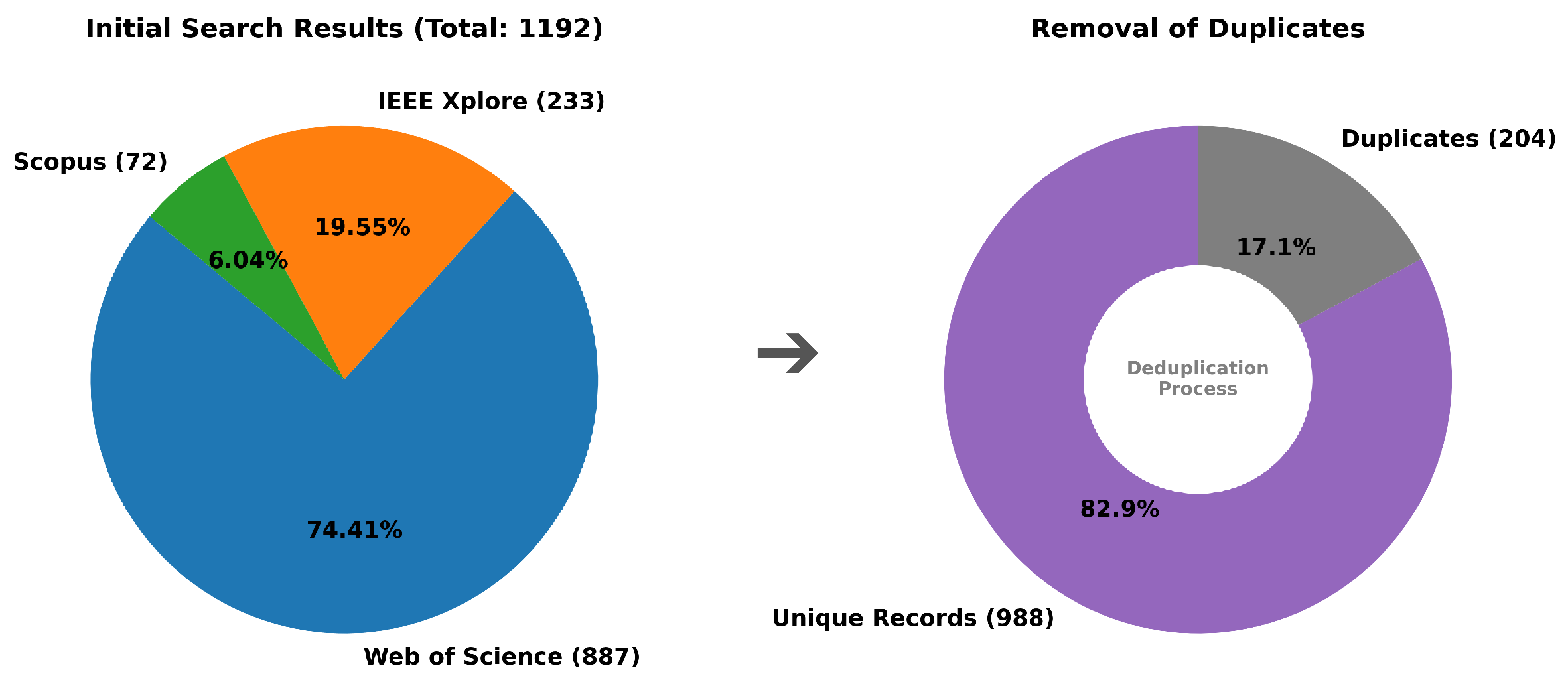
An initial search of selected databases identified a total of 1192 records. The largest number of publications was obtained from the Web of Science database (887 articles), followed by IEEE Xplore (233 articles) and Scopus (72 articles). In the first phase of selection, all collected records underwent a deduplication process, resulting in the removal of 194 duplicate items, as shown in
Figure 1. A total of 988 unique articles were qualified for the screening stage. The records were first screened based on titles and abstracts, and in cases of uncertainty, full-text analysis was performed.
2.3. Eligibility Criteria
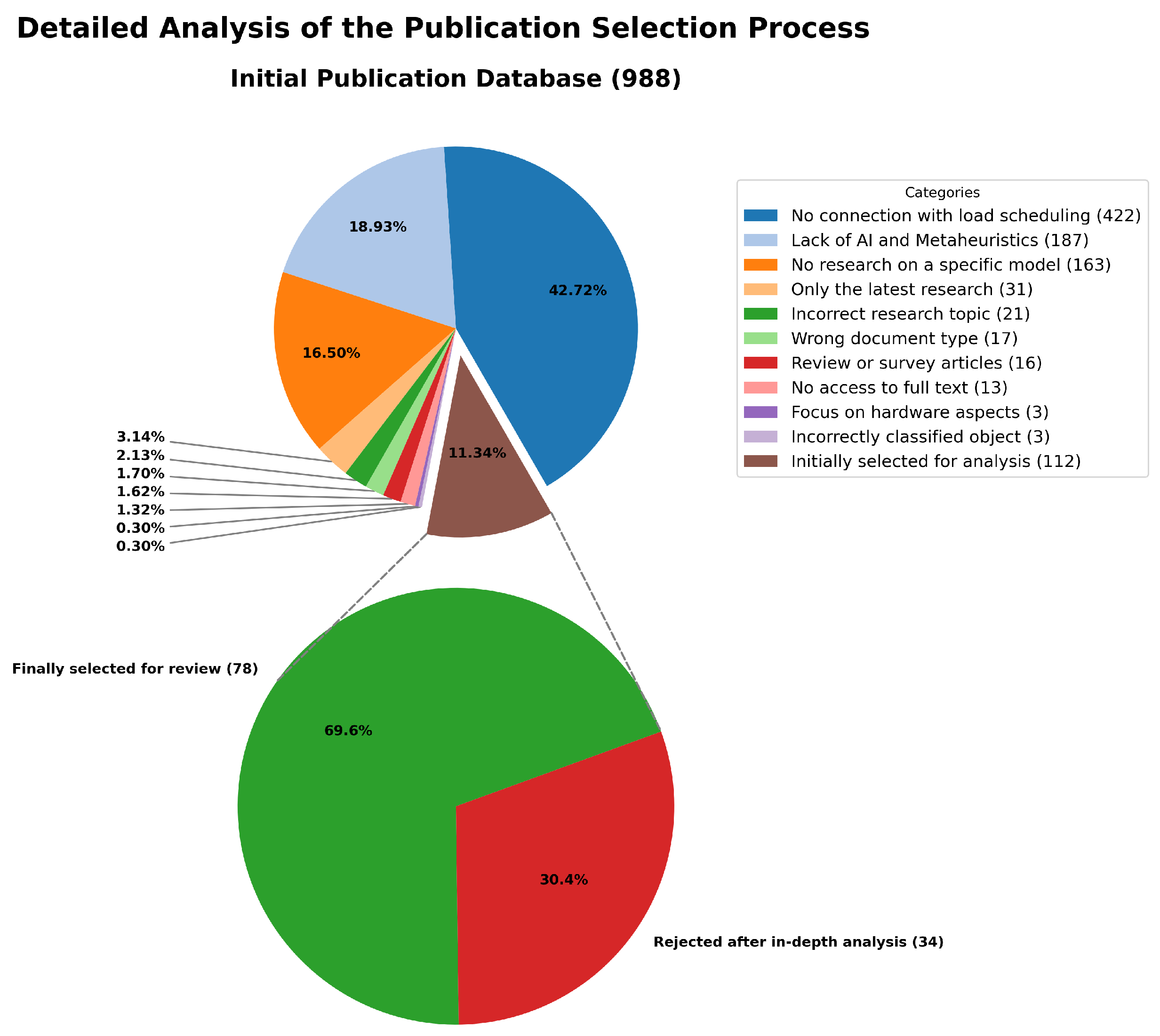
During the selection process, a total of 876 records were rejected because they did not meet the strict criteria for inclusion in the final synthesis. The exclusion criteria were based on the following grounds:
No connection with load scheduling (422 articles): The largest group of rejected projects concerned macro-level power systems, microgrids without implemented residential load control logic, or EV charging without home energy management algorithms.
Lack of AI and metaheuristics technologies (187 articles): Publications describing only energy market issues, energy policy, or based on very simple mathematical models that did not use ML, DL or bio-inspired algorithms.
No research on a specific model (163 articles): Works containing only general descriptions of technologies or theoretical concepts that have not been supported by implementation and verification on specific research models.
No access to full text (13 articles): Publications whose full text was not available in the scientific repositories usedv.
Only the latest research (31 articles): Despite the constraints imposed by the query, some of the articles were based on data sets and research that actually predated 2020, meaning that they did not reflect the latest technological trends.
Incorrect research topic (21 articles): A collection of works focusing exclusively on the problem of energy consumption forecasting (Load Forecasting) or signal monitoring without any application in HEMS/BEMS, which is crucial for this review.
Document type (17 articles): Non-scientific or incomplete materials, such as errata, tables of contents, standalone abstracts, and short conference announcements, were rejected.
Review or survey articles (16 articles): To avoid double counting of results and data redundancy, other review or survey articles that were not original experimental studies were excluded from the synthesis.
Focus on hardware aspects (3 articles): Work strictly related to materials engineering, dealing with the construction of inverters, physical batteries, or thermal insulation of buildings.
Incorrectly classified object (3 articles): Articles on automation in which the object of optimization was not residential buildings (e.g., factories or agricultural facilities).
2.4. Included Studies
After excluding publications that did not meet the thematic and technological criteria, a group of 112 articles was selected for full-text evaluation (Eligibility). An in-depth analysis of these texts in terms of methodological rigor, consistency of results, and quality of the reported optimization data allowed the final selection of 78 studies, which were included in the final qualitative and quantitative synthesis forming the basis of this review article [
19]. A detailed quantitative breakdown of this multi-stage elimination process, including the specific proportions of articles rejected under each predefined criterion, is illustrated in
Figure 2. Specifically, the upper pie chart visualizes the exact distribution of reasons for excluding initial records during the preliminary screening, while the lower chart highlights the ultimate ratio of accepted to rejected papers during the comprehensive full-text evaluation phase.
3. Novel Methods of Load Scheduling
In the reviewed studies, a variety of performance indicators are used to evaluate HEMS scheduling algorithms. Owing to the large number of analyzed works and the diversity of their objective functions, constraint sets, and experimental conditions, it is not always possible to compare these indicators in a strictly nominal way across different publications. The reported values should therefore be interpreted primarily within the context of the respective study. In the context of HEMS flight planning, it generally does not make sense to evaluate optimization algorithms using standard error metrics, such as Mean Absolute Percentage Error (MAPE), Mean Squared Error (MSE), Root Mean Square Error (RMSE), or Coefficient of Determination (), which are commonly used in ML and DL models. These indicators effectively assess how well the model aligns with reality, they are not as well-suited for scheduling. When such metrics appear in the reviewed works, they typically refer to the performance of predictive models (e.g., demand or renewable generation forecasts), which constitute an integral but distinct component of the overall problem. The scheduling algorithms are therefore assessed using a different set of indicators, focused on cost, load shaping, self-consumption, and environmental impact. In this paper, we focus on five metrics related to scheduling that appear most frequently in the literature:
Cost reduction—Cost-related indicators are one of the most common ways to assess the effectiveness of HEMS scheduling algorithms. Cost reduction, expressed either in percentage terms or in absolute monetary units, reflects how much a proposed scheduling strategy lowers the energy bill relative to a baseline scenario (for example, uncontrolled operation or a simpler control strategy). This type of metric directly captures the primary economic benefit of scheduling, independently of the specific tariff structure.
Peak-to-average ratio—Peak-to-average ratio measures how much the instantaneous power demand deviates from its average value over a given time horizon. A lower PAR corresponds to a flatter load profile with reduced peaks. In practical terms, this often translates into lower costs, especially under dynamic or demand-based tariffs, because high power peaks typically coincide with periods of higher prices or higher demand charges. Therefore, PAR reduction can be interpreted as an indirect cost-related benefit: by smoothing the load profile and mitigating peaks, the scheduling algorithm helps avoid expensive consumption periods and reduce the overall energy expenditure.
Reduction of energy consumption—Another frequently used group of metrics concerns the reduction of total energy consumption, both electrical and thermal. Since energy consumption is directly linked to monetary cost, lower consumption generally leads to lower operating expenses, regardless of whether the tariff structure is flat, time-of-use, or fully dynamic. These metrics quantify how effectively the scheduling algorithm reduces overall demand by shifting or curtailing loads, while still satisfying user comfort and operational constraints.
Export reduction and self-consumption increase—In systems with local generation (e.g., rooftop PV), many works consider indicators related to self-consumption and export reduction. The objective is to increase the fraction of locally generated energy that is consumed on-site and to decrease the amount exported to the grid. Higher self-consumption can help avoid additional charges or unfavorable compensation mechanisms associated with injecting energy into the grid and later drawing it back, effectively reducing the implicit “storage fee” associated with using the distribution network as a buffer.
CO2 emissions reduction—Finally, several studies report metrics related to CO2 emissions. Here, the aim is to reduce the use of energy produced from fossil fuels, either by decreasing total demand or by shifting consumption towards periods with a cleaner generation mix. Lower emissions usually imply reduced fuel usage and, in many cases, improved economic performance when carbon pricing or emission-related costs are taken into account. These indicators capture the environmental benefits of the proposed scheduling strategies in addition to their economic impact.
3.1. Metaheuristic & Nature-Inspired Algorithms
Energy management in Smart Homes and load scheduling present highly stochastic and NP-hard optimization problems [
20,
21]. Although traditional, rigorous mathematical optimization methods such as MILP offer guarantees for identifying the exact global optimum, they become computationally impractical with the increasing number of residential devices and proliferation of complex, time-varying pricing schemes. This scalability issue is commonly referred to as the “curse of dimensionality” [
4,
22,
23]. For systems requiring real-time decision-making and control of around a dozen devices, researchers are increasingly turning to metaheuristic algorithms [
11,
24]. Inspired by biological phenomena, animal behavior, or physical processes, these methods offer an excellent compromise: they provide near-optimal solutions in a fraction of the time required by mathematical solvers [
25]. Moreover, they do not require the construction of a perfect mathematical model of the entire environment demonstrating significant flexibility [
26]. Recent comprehensive studies confirm that metaheuristics can efficiently handle non-linear constraints, such as battery degradation or complex user comfort profiles, which often prevent traditional deterministic solvers from functioning [
27]. Consequently, algorithms based on swarm intelligence and evolutionary computing have become the fundamental tool for tackling the multi-objective nature of modern Smart Grids [
21,
25]. The most frequently used metaheuristic methods are outlined in
Table 1.
3.1.1. Classic Evolutionary and Swarm Techniques
The most well-established methods in the literature often serve as the main point of reference when evaluating newer proposals. These methods are primarily Genetic Algorithms (GA) and Particle Swarm Optimization (PSO) [
18,
35]. The GA algorithm operates using mechanisms that mimic natural evolution, such as selection, crossover, and mutation [
16,
27]. This makes the mechanism excellent at searching for powerful solutions across large spaces (exploration), and in some stochastic environments it allows for stable smoothing of the demand curve, producing better results than older techniques [
16,
36]. The PSO algorithm, on the other hand, mimics the collective behavior of schools of fish or flocks of birds searching for food and is characterized by much faster convergence [
37,
38]. In the context of household appliances with discrete operating states (on or off), a variant of this algorithm called Binary Particle Swarm Optimization (BPSO) is widely used [
11,
24,
39,
40]. This algorithm effectively shifts flexible loads from peak to off-peak hours, reducing energy costs by several percent and significantly lowering the unfavorable PAR [
41,
42]. However, basic algorithms such as PSO may struggle with premature convergence and undesirable local minima in the case of highly complex and multidimensional tasks (e.g., the simultaneous management of equipment fleets, PV panels and batteries) [
25,
43]. To overcome these inherent limitations, recent studies frequently introduce enhanced variants, such as Improved PSO (IPSO), or hybridize GA and PSO together to optimally balance global exploration and local exploitation [
25,
43,
44]. Such hybrid approaches ensure more robust and cost-effective scheduling, especially when handling the high variability of integrated renewable energy resources and dynamic pricing schemes [
20,
45].
3.1.2. Modern Algorithms Inspired by Nature
The aim of overcoming the limitations of classical algorithms, particularly their tendency to fall into local minima and the imbalance between exploration and exploitation, has led to the development of sophisticated modern heuristics [
25,
46]. One notable example is the Binary Sparrow Search Algorithm (BSSA), which models the foraging and predator avoidance strategies of sparrows by organizing a population of artificial agents into ’producer’ and ’gatherer’ subgroups. Research shows that, in smart home environments, this algorithm significantly outperforms the traditional PSO algorithm. Processing high-resolution schedules (15-min decision windows) enables BSSA optimization to reduce bills by up to 27.6% (and by up to 33.34% in broader microgrid environments), while significantly cutting the key peak PAR indicator by 40.32%. This is in contrast to PSO, which achieves a cost reduction of only 13.42% and a PAR reduction of 36.05% under the same conditions [
31,
42,
47]. Another innovative approach in terms of customer comfort is the Improved Bald Eagle Search Algorithm (IBES). This model mimics eagles’ hunting techniques in multiple stages: territory selection, searching, and diving steeply onto prey. The HEMS system, supported by the IBES algorithm, uses dynamic programming methods to handle household requests smoothly in real time. This dramatically reduces user discomfort, cutting equipment start-up waiting times by 22% compared to scenarios without an optimizer, while maintaining high profitability under highly variable TOU and RTP tariffs [
2]. The Satin Bowerbird Optimization (SBO) algorithm is also worthy of mention. Researchers coupled its iterations with an unsupervised machine learning tool (K-means clustering), which was assigned to creating a framework of so-called Discrete Comfort Windows (DCWs) based on household members’ past habits. The SBO algorithm precisely locates individual device actions within the defined comfort windows. This system reduced daily energy costs by 21.6% (from 29.14 to 22.84 INR/day), while decreasing PAR by 10.28% and guaranteeing uncompromising respect for the population’s time habits. Compared to GA, PSO and ABC algorithms, the SBO-based system also impressed with its unrivaled convergence speed [
48]. Following a similar trajectory, researchers are continually exploring other unique ecological behaviors to tackle the non-linear dynamics of energy scheduling. For instance, marine-inspired models such as the Multi-objective Beluga Whale Optimization (AMOBWO) and mammalian-inspired methods such as the Coati Optimization Algorithm (COA) have been recently deployed to handle complex smart building loads [
5,
49,
50]. These highly specialized and nature-inspired mechanisms demonstrate that the adoption of diverse biological paradigms can successfully bypass the limitations of classical swarm methods, offering superior adaptability to volatile renewable energy generation and dynamic tariffs.
3.1.3. Multi-Objective Optimization and System Constraints
The enormous added value of heuristic techniques lies in their innate ability to seamlessly solve Multi-Objective Optimization (MOO) systems, which is becoming a necessity in homes due to the highly antagonistic conflict of interests: lowest bills vs. high time comfort vs. flattened PAR index [
8,
20,
21]. Instead of creating a single pre-determined scenario, metaheuristics, including the popular Non-dominated Sorting Genetic Algorithm II (NSGA-II), Multiobjective Particle Swarm Optimization (MOPSO), or hybrid NSGA-MOPSO forms, can generate multidimensional spaces known as Pareto fronts, representing hundreds of compromise variants [
36,
51,
52]. Advanced bio-inspired algorithms, such as the Multi-Objective Arithmetic Optimization Algorithm (MOAOA) or the Improved Multi-Objective Equilibrium Optimizer (IMOEO), also leverage these mechanisms to provide uniformly distributed Pareto fronts across multiple conflicting goals [
8,
53,
54]. Multi-Criteria Decision Making (MCDM) techniques, such as VIšekriterijumska Optimizacija I Kompromisno Rešenje (VIKOR, en. Multicriteria Optimization and Compromise Solution) and Technique for Order of Preference by Similarity to Ideal Solution (TOPSIS), are widely employed to automatically extract the ‘most advantageous’ compromise scenario from these fronts based on the prior or posterior user articulation [
22,
53,
55]. Their performance is highly dependent on extensive hyperparameter tuning, often requiring manual adjustment of parameters such as population size, iteration count, inertia weights, and learning rates to accommodate the scale and non-linear dynamics of specific building and microgrid environments [
38,
56,
57]. The use of solvers on natural or discrete numbers (forced by ON/OFF scheduling) also forces developers to use artificial transfer or mapping functions (e.g., sigmoid functions), which can reduce evolutionary efficiency by converting continuous variables into binary ‘0/1’ strings, as frequently observed in the Binary PSO or Binary Sparrow Search Algorithm [
31,
39,
42]. Regardless of these adversities, it is precisely their agility and enormous tolerance for powerful amounts of input stochastic factors, such as fluctuating renewable generation and unpredictable user behavior, that make intelligent and hybridized metaheuristics the most powerful and widely appreciated core of modern load scheduling optimizer platforms to this day [
25,
58,
59].
3.1.4. Other Specialized Metaheuristic Algorithms
Due to the growing complexity of distributed generation systems, hundreds of other iterative techniques are also analyzed in the literature. Particular attention is drawn to the COA, which, thanks to its adaptive, team-based search strategy, allows suboptimal traps to be avoided without error. Evaluated alongside Hamiltonian Deep Neural Networks, COA achieved very low daily electricity charges of 0.10 USD while maintaining a PAR value of 4.0%, noticeably outperforming the Wild Horse (WHO), PSO and Seagull Optimization Algorithm (SOA) [
50]. The efficiency of the Grey Wolf Optimizer (GWO), based on a strict pack structure, is widely appreciated for its seamless balance of the exploration and exploitation phases [
59,
60]. Another highly effective framework is the Adaptive Salp Swarm Algorithm (ASSA), which demonstrates excellent capabilities in smoothing voltage peaks and optimally coupling power consumption with variable, unstable generation from renewable photovoltaic sources, allowing exceptional cost reductions of up to 45.3% [
61]. More recent studies have also successfully used the hybridization of the Honey Badger Algorithm (HBA) with Dwarf Mongoose Optimization (DMO), tuned to the environment of critical exchange tariffs, to balance the delay imposed on devices and maximum budget limits [
17]. Furthermore, the continuous effort to address severe load uncertainties has resulted in the development of the Ameliorated Sand Cat Swarm Optimization (ASCAO), which leverages orthogonal learning to provide optimal PV and battery scheduling across diverse light and heavy loading scenarios without premature convergence [
46]. Equally promising is the recent application of the Meerkat Optimization Algorithm (MOA), inspired by the cooperative and exploratory behaviors of meerkats. Applied to residential energy management that integrates PV systems, battery storage, and demand response, MOA achieves significant cost reductions—up to 16% under real-time pricing while demonstrating superior computational efficiency and faster execution times compared to standard GA and PSO methods [
62].
3.2. Machine Learning and Deep Learning
The use of classical ML and DL techniques plays a fundamental role in HEMS [
63,
64]. Although these models rarely function as direct, standalone decision-making algorithms for scheduling (due to the lack of built-in multi-criteria optimization mechanisms for NP-hard problems), they provide an essential perceptual and prognostic basis for the optimization layer [
55,
65]. Accurate short-term load forecasting (STLF), prediction of RES generation and energy prices are a prerequisite without which metaheuristic algorithms or DRL agents could not function effectively [
26,
66]. For example, state-of-the-art ensemble models, such as a combination of eXtreme Gradient Boosting and an Artificial Neural Network (XGBoost-ANN), and hybrid deep networks, such as a Convolutional Neural Network combined with a Bidirectional Gated Recurrent Unit (CNN-BiGRU) or a PSO-optimized Multilayer Perceptron (PSO-MLP), achieve exceptional precision in Seasonal-Trend decomposition Forecasting using Locally Estimated Scatterplot Smoothing (STLF). These models successfully capture complex spatiotemporal dependencies and rapid load fluctuations [
38,
67,
68]. Similarly, advanced DL models equipped with attention mechanisms or Long Short-Term Memory (LSTM) networks are widely deployed to mitigate the severe uncertainties of solar irradiance and dynamic market tariffs [
13,
69]. Furthermore, the development of deep networks has allowed them to be used as ultra-fast approximators (imitators) for traditional mathematical models [
4]. By learning from the optimal schedules generated offline by exact solvers like MILP, supervised deep neural networks can perform highly accurate real-time scheduling inferences in milliseconds, effectively circumventing the computational bottlenecks of mathematical programming [
4,
70]. Finally, these data-driven architectures serve as powerful systems for non-invasive device monitoring [
56]. Specifically, Non-Intrusive Load Monitoring (NILM) frameworks utilize Variable Mode Decomposition (VMD) and sequence-to-sequence deep models for disaggregation of total household power signals into individual appliance states, providing critical high-resolution data for the HEMS without the need for expensive plug-level sensors [
13,
42]. The most frequently used ML and DL methods are outlined in
Table 2.
3.2.1. Classic Machine Learning Models, Ensemble Methods, and Feature Engineering
In the early stages of HEMS development and in environments with limited computing resources (e.g., embedded systems, Edge Computing), classical regression and classification algorithms play a dominant role. These include Support Vector Machines (SVM/SVR), Random Forest (RF) and Gradient Boosting-based systems (XGBoost, LightGBM) [
63,
64]. Decision Tree-based models show high resistance to noise in smart meter data and an inherent ability to extract the most important features. To maximize prediction accuracy, ensemble learning methods such as stacking and voting are currently promoted in the literature. The use of the Stacking ensemble model, which uses Ridge Regression as a meta-learner to integrate the results of smaller models, allows for significant stabilization of forecasts in residential buildings [
63]. Equally impressive results are achieved by hybridizing the XGBoost model with Artificial Neural Networks (ANNs). The weighted XGBoost-ANN ensemble model reduces prediction errors by compensating for variance, achieving an exceptionally low RMSE of only 0.0008, outperforming autonomous SVM models or baseline CNNs in a direct comparison [
68]. A key aspect of classical ML is feature engineering. Research shows that dynamic selection of input features supported by explainable artificial intelligence (XAI) methods, such as Shapley Additive Explanations (SHAP) values, allows noise-inducing variables to be rejected. The use of SHAP in the ensemble models reduced MAPE from 11.85% to 9.31% in the cold months and from 11.67% to 9.14% in the warm months [
63]. When high speed is required (e.g., online learning), the LightGBM algorithm, supported by PSO for hyperparameter tuning, proves to be one of the most efficient solutions. It maintains a
of 80–90% at a fraction of the training time required by complex deep networks, smoothly adapting to the concept drift in the changing habits of household members [
64]. Furthermore, the predictive capabilities of these boosting frameworks can be significantly amplified when hybridized with evolutionary algorithms; for example, coupling XGBoost with Genetic Algorithms (GA-XGBoost) has been shown to effectively optimize hyperparameters and minimize RMSE in building cooling and heating load forecasting [
65]. Additionally, ensemble models such as XGBoost are increasingly utilized not only as standalone predictors but also as robust feature selection and regularization tools, successfully reducing dataset complexity before feeding the filtered data into more advanced parallel deep learning architectures [
67].
3.2.2. Deep Learning and Spatio-Temporal Feature Extraction
When historical data are characterized by very high resolution and non-linear complexity, classical ML algorithms give way to DL. The research center for sequential analytics is Recurrent Neural Networks (RNN), or more precisely, their advanced variants: LSTM and Gated Recurrent Unit (GRU). They solve the problem of vanishing gradients through complex gating mechanisms (forgetting gates, inputs, and outputs), which allows models to remember long-term dependencies in load profiles (e.g., seasonal patterns) [
77,
78]. The contemporary literature strongly favors hybrid structures that combine LSTM/GRU networks with one-dimensional convolutional networks (1D-CNN) [
67,
79]. These architectures, such as the parallel CNN-BiGRU network, divide tasks: CNN layers operate as spatial feature extractors (local correlations between temperature, humidity and power profile), while BiGRU layers analyze these features for long-term temporal dependencies (both forward and backward). This combination, optimized metaheuristically (e.g., with the PSO algorithm for hyperparameter selection), results in highly satisfying predictive metrics (MAPE of only 3.11% for 24-h forecasts), outperforming sequential models and conventional CNNs [
67,
80]. To further enhance the processing of extremely long sequences without the computational bottlenecks of standard recurrent layers, researchers are also adopting Temporal Convolutional Networks (TCN) coupled with BiLSTM (such as the PSO-BiTC model), which utilize dilated causal convolutions to aggressively expand the receptive field and minimize forecast errors [
81]. The next step in the evolution are the attention mechanisms and Transformer models, which allow the algorithm to ‘focus’ on the most relevant parts of the time series [
82,
83]. Complex structures, such as Deep Attention-Enhanced Sequence-to-Sequence Model (AES2S), flawlessly handle load disaggregation and behavior mapping while maintaining minimal delays [
13]. Additionally, cutting-edge multi-channel Informer architectures are now being deployed to explicitly model complex cross-channel spatiotemporal interactions between volatile renewable generation and residential load, ensuring high-accuracy joint forecasting [
83]. Another breakthrough described in recent publications is the implementation of the Kolmogorov–Arnold Network (KAN). Hybrid CNN-KAN models replace traditional fully connected perceptrons (MLP) with approximators using B-splines on learning grids. This guarantees the model a continuous, smooth, and differentiable non-linear transformation that is highly resistant to sharp jumps and noise in the data. In forecasting tests, the CNN-KAN architecture demonstrated absolute superiority over the standard LSTM, achieving a negligible MAPE (approx. 0.0047) and reducing the total energy deviation attributed to erroneous forecasts by more than 64% compared to classical deep networks [
78].
3.2.3. Deep Learning as an Imitation Learning Mechanism
In addition to STLF forecasting, DL networks have found an ingenious application to solve the problem of computational delays in mathematical solvers (such as MILP) directly. Although linear programming guarantees the optimal cost-effectiveness in device scheduling (e.g., battery and EV layout), its execution time of several minutes is unacceptable in real-world conditions that require immediate dynamic responsiveness. Supervised learning circumvents this drawback through the paradigm of imitation learning. A historical dataset containing optimal reference schedules, which were generated with a long delay by an offline MILP solver, is used to train a deep neural network (DNN). This network ’learns’ the expert’s strategy by mapping input state variables—such as current energy prices, PV generation, and the initial state-of-charge of the EV directly to the optimal scheduling actions. Once implemented in a real-time online environment, the trained DNN acts as a highly robust and fast approximator, accepting input states and generating load shifting decisions with millisecond speed (e.g., averaging 28 ms per scheduling step). At the same time, this data-driven approach keeps the total cost deviation from the absolute mathematical ideal at a marginal fraction of a percentage (typically around 1.78% to 2.01%), proving it to be a highly viable, scalable substitute for exact mathematical programming in time-critical smart home applications [
4,
84].
3.3. Reinforcement and Deep Reinforcement Learning Models
Traditional control and scheduling methods based on mathematical models (such as linear programming or MILP) require complete and precise knowledge of system dynamics and a deterministic environment [
23,
66,
84]. In the face of uncertainty related to energy generation from renewable sources (e.g., photovoltaics), volatility of market energy prices (RTP, TOU), and the unpredictability of household behavior, these models become insufficient and their implementation in real time is computationally intensive and lacks scalability [
4,
84,
85]. The answer to these challenges is the use of RL and DRL algorithms [
3,
66]. These are data-driven, model-free methods in which an intelligent agent learns the optimal control policy through continuous interaction with a stochastic environment by trial and error, minimizing the need for knowledge of exact mathematical equations or predefined rules [
66,
84,
85]. The decision-making problem is formulated here as a Markov Decision Process (MDP), consisting of a state space, actions, transition probabilities, and a reward function [
66,
84,
86]. To seamlessly integrate continuous state and action spaces without the curse of dimensionality typical of standard tabular Q-learning, modern approaches deploy deep neural networks as function approximators within the RL framework [
7,
85]. This empowers the HEMS to autonomously adapt to unforeseen environmental changes, enabling robust decision-making that bridges the gap between cost minimization and user comfort even under partial observability [
84,
87,
88] The most frequently used RL methods are outlined in
Table 3.
3.3.1. Classic Value-Based Approaches: Q-Learning and Fuzzy Logic
In the initial phase of HEMS development, the classic Q-Learning algorithm was widely used, based on a discrete table of values (Q-table) mapping state-action pairs. Despite its simplicity, this algorithm works well in systems with a small number of devices [
69,
84]. In one study, Q-learning was integrated with fuzzy reasoning, where fuzzy inference was used as a reward function to evaluate user satisfaction with the time shift of devices. The algorithm operated as a single agent controlling 14 home appliances, reducing the state-action space, which allowed the demand profile to be smoothed while maintaining customer preferences [
3]. Another innovation in this area was the use of Multi-Objective Reinforcement Learning (MORL), which uses separate Q tables for energy costs and user discomfort. The MORL architecture copes well with sudden changes in residents’ preferences, using previously acquired knowledge to instantly adjust schedules; in simulations, this model achieved a cost reduction of 8.44% compared to a classic mathematical optimizer Mixed Integer Non-Linear Programming (MINLP), with a minimal increase in discomfort of only 1.37% [
96]. To further mitigate the inherent curse of dimensionality associated with classic Q-tables, recent advancements have expanded fuzzy-RL by hybridizing it with metaheuristic optimization algorithms such as WHO and Harris Hawks Optimization (HHO). This hybrid fuzzy-RL approach adaptively models severe uncertainties, such as stochastic solar generation and dynamic EV presence, reducing energy costs by up to 53% in real-time scenarios [
17]. Additionally, instead of relying on a single massive Q-table, deploying multi-agent Q-learning architectures allows the computational burden to be decentralized across individual appliances, ensuring highly scalable and adaptive decision-making without exponentially increasing the state-action space [
66,
69].
3.3.2. Deep Q-Network and Overcoming the ‘Curse of Dimensionality’
The main weakness of traditional Q-learning is the ‘curse of dimensionality’ with a large number of continuous variables (e.g., battery charge level, dynamic prices), the Q table grows to a size that makes calculations practically impossible [
7,
84]. DQN algorithms have proved to be a breakthrough, replacing the discrete Q-table with deep neural networks that act as robust value function approximators [
69,
84]. DQN works perfectly in complex decision-making problems in homes equipped with PV panels, ESS and EV. In the multi-criteria DRL-HEMS model based on DQN, the reward function combines three key aspects: minimizing energy costs, reducing thermal discomfort (or fear of a discharged EV) and mitigating distribution transformer degradation (Loss-of-Life). Importantly, after many hours of offline training (so-called exploration), the trained DQN agent was able to generate optimal control actions in just 5 s, while traditional optimization solvers (MILP) needed an average of 15 s to do so. In addition, the schedule generated by DQN differed from the absolute mathematical optimum by only 2%, outperforming MILP in terms of real-time stability and computational efficiency. To further address the challenges of massive state-action spaces and improve convergence stability, recent studies have introduced enhanced variants such as the Double Deep Q-Network with Prioritized Experience Replay (DDQN-PER). Furthermore, researchers are increasingly adopting dual-agent architectures, where DQN is specifically assigned to handle discrete appliance scheduling, while working in tandem with other continuous-action algorithms to comprehensively bypass dimensionality limits and optimize overall home energy management without computational bottlenecks [
58,
84,
97].
3.3.3. Optimization in Continuous Spaces
Although DQN functions well with discrete decisions (e.g., turn the washing machine on/off), controlling devices with continuous power consumption (such as air conditioning in HVAC, EV charging systems or edge computing loads) requires algorithms that operate in continuous space [
7,
98]. To this end, the literature implements methods based on the Actor-Critic architecture. A prominent algorithm from this family is DDPG [
4,
58]. In studies combining residential demand management with offloading computational tasks from edge computing servers, the DDPG model successfully minimized penalties for breaching contracts with the network operator, significantly outperforming basic heuristic methods [
7,
86,
99]. In turn, in controlling the charging and discharging of EV and residential ESS, algorithms from the DDPG and SAC families achieve unprecedented adaptive effectiveness [
98,
100]. The SAC algorithm, based on the entropy maximization paradigm, forces the agent to search for the most diverse strategies possible, which prevents it from getting stuck in local minima [
97,
98]. To solve network security problems (e.g., exceeding power flow parameters), researchers have developed the Safe-AutoSAC architecture, which combines the decision-making process with automated machine learning (AutoML) tools and rigorous policy pre-selection mechanisms, achieving a 7.06% improvement in net profits over standard SAC while ensuring strict compliance with network constraints [
83]. The PPO algorithm is characterized by equally high performance. By employing a clipped objective function, PPO prevents overly drastic changes in control policy in subsequent iterations, ensuring exceptionally stable convergence. The PPO-EMS system, designed for entire communities within a microgrid, reduced total energy costs by 31% to 58% compared to conventional rule-based (fixed) scheduling strategies, while maintaining superior household comfort levels among benchmarked DRL approaches [
88]. To further enhance the management of both continuous constraints and discrete devices, hybrid architectures coupling DDPG with DQN have recently been introduced to simultaneously mitigate PV forecasting errors and scheduling appliances [
58]. Moreover, multi-agent extensions, such as Multi-Agent Proximal Policy Optimization (MA-PPO) and Multi-Agent Asynchronous Soft Actor–Critic (MAASAC), have demonstrated remarkable scalability in coordinating massive fleets of EVs and HVAC systems, ensuring fast-timescale grid stability without compromising data privacy [
97,
101].
3.3.4. Multi-Agent and Dual-Agent Systems
When the environment becomes even more complex—for example, operating at the level of multiple homes or multiple devices in mutual correlation—MARL comes into play. It enables distributed scheduling, in which each device (or home) becomes an autonomous agent maximizing its own reward function, which simultaneously removes the computational effort from the central processor [
66,
85]. To avoid the problem of environmental non-stationarity (where agents simultaneously update their strategies, disrupting the learning process for their neighbors), the literature proposes asynchronous network updates, as in the MAASAC model for EV fleets, which radically stabilizes the efficiency of the algorithm [
97]. In turn, innovative frameworks such as GridSyncNet combine MARL architecture with Federated Machine Learning and blockchain technology, ensuring full decentralization, optimization of distributed resources, and security of meter data privacy at the system level [
6]. The pinnacle of hybrid engineering is the DADRL solution. This system simultaneously uses two different deep algorithms to combat two types of uncertainty in a smart home: the DDPG-based agent (operating in continuous space) is dedicated exclusively to minimizing errors in PV energy generation forecasts using storage buffering, while the second DQN-based agent (operating in discrete space) simultaneously schedules the operation of household appliances. This “division of responsibilities” allows exceptionally smooth results and a drastic reduction in forecast errors (the lowest absolute error rates compared to independent algorithms) [
58]. Furthermore, deploying individual appliance agents within a multi-agent DQN architecture allows highly scalable scheduling under real-time pricing and solar uncertainty, effectively respecting various user comfort constraints without central bottlenecks [
69]. Such decentralized MARL frameworks have also proven exceptionally effective for fast-timescale frequency regulation, successfully coordinating hundreds of flexible devices on the second-timescale without the need for a central coordinator [
101]. In summary, although the DRL and MARL-based methods have the characteristics of ‘black box’ algorithms (lack of full mathematical interpretability) and require an extremely long, multi-hour offline training process, their unmatched inference speed (on the order of milliseconds) in the online (execution) phase and their ability to adapt to completely new stochastic conditions without human intervention make them the most promising direction in the development of automated home demand response systems [
84,
101].
3.4. Advanced Decision Models: Hybrid Algorithms and Game Theory
The complexity of HEMS, which involves the simultaneous need for accurate forecasting (renewable energy generation, user behavior, prices) and multi-criteria optimization (minimizing bills, reducing peak demand, maintaining comfort), means that individual algorithms often encounter technological barriers [
20,
21]. Classical metaheuristics tend to get stuck in local minima when dealing with highly non-linear load profiles [
42], DL networks require enormous computational resources and manual effort to optimally tune hyperparameters [
38,
57], and RL algorithms frequently struggle with convergence issues, sample inefficiency, and instability in highly stochastic environments [
4,
97]. For this reason, the state-of-the-art is increasingly dominated by hybrid solutions that intelligently combine the advantages of different mechanisms, effectively overcoming their individual weaknesses while ensuring robust real-time performance [
58,
87]. The hybrids described in the literature can be divided into three main categories: metaheuristic algorithm fusions (where multiple search strategies are merged to balance exploration and exploitation) [
27,
59], metaheuristic integrations with predictive models (where optimizers automatically fine-tune ML/DL architectures like XGBoost or MLP) [
38,
65], and hybrid DRL systems (where diverse DRL agents or exact solvers are unified to seamlessly handle both continuous and discrete action spaces simultaneously) [
58].
3.4.1. Fusion of Metaheuristic Algorithms
Combining various swarm and evolutionary algorithms aims to achieve the balance between broad exploration of the search space (global search) and precise exploitation of the best solutions found (local search). One of the most mature solutions described in the literature is the HGWOPSO (Hybrid Grey Wolf and Particle Swarm Optimization) model. This algorithm combines the unique hierarchy of the pack and the exploratory capabilities of GWO with the precise vector velocity update and the memory of the best experiences from the Particle Swarm. By dynamically adjusting the balance between the search phases, the model successfully avoids the problem of premature convergence. The evaluation of HGWOPSO in an HEMS environment with integrated RES showed promising results. Compared to no scheduling, the use of this hybrid resulted in a 15.6% reduction in total energy costs (better than 11% for PSO alone and 12.8% for GWO). Most importantly, from the point of view of grid stability, this hybrid achieved an unprecedented reduction in the PAR index of 52.3% (a decrease in PAR to only 1.3441), effectively preventing the phenomenon of so-called rebound peaks after load shifting [
60]. Another significant innovation in this segment is the HGAIDO architecture (Hybrid Genetic Algorithm and Improved Dandelion Optimizer). It combines the early exploration phase using the crossover and mutation operators of the Genetic Algorithm with an efficient final local exploitation phase driven by Gamma distribution and Lévy flights from the Improved Dandelion Optimizer (IDO). This solution has been tested on flexible and rigid equipment in IoT homes. Simulation results have shown that HGAIDO, with the participation of PV systems, has drastically reduced the PAR index from a baseline value of 4.338 to a sensational level of 0.944. At the same time, daily electricity costs were reduced from an uncoordinated 153.8 units to 113.5 units. Friedman’s statistical tests confirmed the overall superiority of this hybrid, assigning it the lowest average rank of 1.13, which outclasses both standard GA and DO, while maintaining a very fast execution time (an average of only 7.85 s per 98 iterations) [
27]. Similar hybridization strategies are successfully applied to specific high-load appliances and mixed-variable problems. For example, merging global PSO exploration with local exploitation of Ant Colony Optimization (ACO) creates a powerful hybrid PSO-ACO model that specifically targets dynamic HVAC control, reducing cooling energy consumption by 28.9% and peak loads by 29.2% [
102]. Furthermore, integrating standard continuous PSO with its discrete counterpart, such as BPSO, enables the unified handling of both real and binary decision variables without the need for artificial mapping functions, resulting in up to 52.9% cheaper electricity bills compared to unoptimized setups [
20].
3.4.2. Integration of Metaheuristics with Advanced ML/DL Systems (Forecasting and Scheduling)
In modern HEMS systems, the optimization layer cannot function without an excellent prediction of stochastic environmental behavior. Hence, frameworks combining artificial neural networks (responsible for predictions) with metaheuristics (responsible for calibrating these networks or scheduling the devices themselves) are gaining popularity. A particularly innovative approach in this area integrates the COA with Deep Neural Networks based on Hamilton’s physics (HDNN) into the COA-HDNN platform. HDNN networks, due to the incorporation of physical energy conservation principles (Hamilton’s equations), capture the non-linear, temporal patterns of device power consumption much more effectively. In turn, COA metaheuristics is responsible for scheduling based on these excellent forecasts. Measurements have shown that COA-HDNN achieved an absurdly low daily energy consumption cost of only USD 0.10, outperforming WHO (USD 0.29) and PSO (USD 0.39) algorithms in this respect. The MSE of the network itself in the forecasting task fell to an impressive 0.015. At the same time, this solution maintained the PAR index at a rigorous level of 4.0% with a very short execution time of 0.17 milliseconds. This approach allowed for a 76% reduction in electricity costs in scenarios using photovoltaics [
50]. To work with data with highly stochastic variance (e.g., high-frequency peaks on smart meters), a multi-layer decomposition and tuning model called SWD-OLPIDGWO-MLP has been proposed. This solution first uses Swarm Decomposition (SWD) to break down the noisy electricity consumption signal into readable subcomponents. Then, the GWO algorithm, enhanced with a PID controller (ensuring a smooth update trajectory) and an opposition-based learning mechanism (OBL—preventing getting stuck in dead zones), automatically optimizes the weights of the MLP. The use of SWD-OLPIDGWO-MLP improved the MSE error by an incredible 99.5% (a decrease from the baseline 713,080 for pure MLP to just 3500) and reduced the MAPE from 26.24% to a negligible 1.47% (an improvement of 94.4%) in demanding time environments [
59]. Another interesting predictive variant is the PSO-MLP hybrid, where a swarm of particles directly manages the entire perceptron architecture. This model reduced the average MAPE by 25.4% compared to conventional architectures, guaranteeing a powerful operational advantage with microscopic inference times on standard CPUs of less than 3 ms [
38]. In turn, in environments prone to sudden ‘concept drift’ (e.g., dynamic change in habits after a holiday), an online solution called LightGBM-PSO was used. Through constant evolutionary tuning on the fly, this hybrid achieves a stable accuracy of 80–90% with minimal computational overhead at the edge of the network [
64]. This proves that the LightGBM-PSO hybrid is the most resilient to sudden and temporary changes in user habits of all the reviewed algorithms. Furthermore, the metaheuristic tuning of DL models increasingly extends to highly complex, multi-branch architectures. For example, combining PSO with parallel CNN-BiGRU networks or hybrid TCN-BiLSTM structures (such as the PSO-BiTC model) enables optimal selection of hyperparameters, achieving exceptional predictive accuracy and minimal errors even in highly volatile spatiotemporal load scenarios [
67,
81]. Similarly, advanced algorithms such as Quantum-inspired PSO (QPSO) and Age of Exploration-Inspired Optimizer (AEIO) have been successfully applied to tune RNNs and LSTMs, efficiently avoiding local minima and vastly improving convergence speeds when forecasting complex seasonal fluctuations in building energy demands [
57,
77].
3.4.3. Hybridisation of Deep Reinforcement Learning and Fuzzy Logic
The last, highly advanced area encompasses hybrids based on model-free decision-making algorithms, which, in order to avoid lengthy training and become resistant to sudden input variables, are combined with metaheuristic optimizers, predictive models, or fuzzy logic. A phenomenal achievement in this domain is the integration of Fuzzy-RL with WHO or HHO algorithms [
17]. The system uses Takagi–Sugeno fuzzy inference to parameterize soft thermal comfort conditions and the uncertainty of EV presence in the home (e.g., by modeling the usage profile using beta probability density). The reinforcement agent adaptively updates its policies, and metaheuristics (such as WHO) enforce the rigor of the global optimum. This cooperation has yielded unprecedented gains—the model reduced total energy bills by as much as 53% (a decrease in costs from 1239 to 582.58 cents), while maintaining an extremely high convergence rate and generating a ready disposition in less than 60 s. It is also worth mentioning the structure of dual-agent artificial intelligence, known as DADRL. This hybrid integrates two separate algorithms: DDPG, which operates in continuous space and whose sole task is to mitigate errors and fluctuations in PV panel production forecasts through smooth battery control, and DQN, which operates in discrete space and simultaneously schedules equipment ON/OFF switching, taking into account the preferences of household members. This clever division of responsibilities resulted in a sensationally smooth profiling result, for which the absolute error reached its lowest value of 0.5901 in relation to the ideal optimization curves [
17,
58]. In the latest research on the integration of device identification and control, the AES2S-EAORL system has been implemented. Here, a model based on attention networks (Attention-Enhanced Sequence-to-Sequence) performs non-invasive signal disaggregation (NILM), identifying in real time which appliances are currently operating and sending this precise information to the Energy-Aware Optimized Reinforcement Learning (EAORL) module, which shifts demand on an ongoing basis to ensure network stability [
13]. To further ensure that RL agents strictly adhere to physical constraints and comfort boundaries without trial-and-error violations, recent frameworks successfully hybridize Q-learning with explicit Model Predictive Control (MPC) and Input Convex Neural Networks (ICLSTM), guaranteeing zero temperature discomfort while yielding up to 15% energy savings in HVAC scheduling [
87]. Similarly, integrating AutoML with SAC (creating the Safe-AutoSAC model) enforces rigid safety layers during policy exploration, allowing the RL agent to securely optimize integrated demand response and EV charging without ever breaching microgrid power flow limits [
83].
3.4.4. Game Theory
Game Theory-based models are used to find the so-called Nash equilibrium in ecosystems characterized by an explicit conflict of interest, for example, between an electricity supplier or aggregator seeking to maximize profit and balance the grid, and prosumers seeking to minimize their costs [
12,
85]. The integration of Game Theory-based decision models with DL has been successfully used for the intelligent, day-ahead control of highly energy-intensive air conditioning systems. The sustainable operating strategies developed in this way have reduced cooling/heating bills by 36%, while cutting peak overloads (PAR index) by 9.97% [
103]. In another instance, cooperative analysis of market dilemmas in a Community Multi-Energy System (CMES) was combined with advanced heuristics, the Quantum Particle Swarm Optimization Algorithm (QPSO). This framework was used to determine favorable commercial tariffs and coordinate PV generation with EV charging fleets, resulting in balanced profits and a highly scalable pathway for low-carbon communities [
12]. While metaheuristic algorithms and DRL successfully optimize individual buildings, multi-agent and game theory-based techniques come into play where decentralization is required. These tools flawlessly manage distributed market flexibility and P2P (Peer-to-Peer) prosumer interactions, demonstrating that stability and fairness in the Smart Grid network can be achieved without compromising individual profits of individual users [
85,
103]. Moreover, cutting-edge decentralized frameworks now integrate game-theoretic multi-agent systems with blockchain technology (e.g., GridSyncNet), ensuring fully transparent, tamper-proof, and privacy-preserving energy trading among peers without requiring a central trusted intermediary [
6].
3.5. Summary
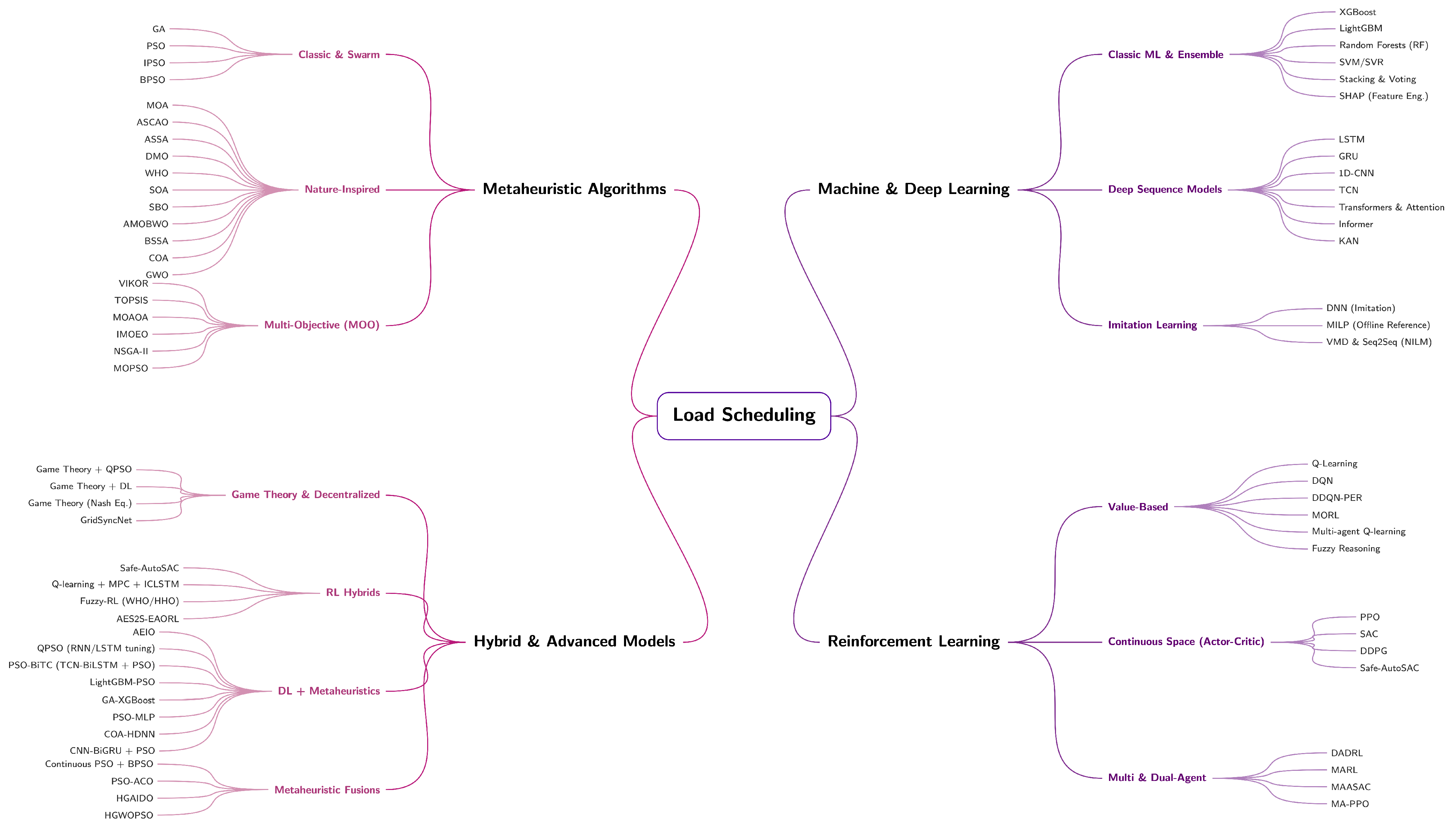
To summarize the comprehensive review of the literature conducted in this chapter, it can be clearly stated that the area of load scheduling optimization in smart energy management systems has undergone a dynamic evolution in recent years. There has been a clear shift in focus from rigid, deterministic mathematical models, such as MILP, towards highly adaptive artificial intelligence systems, with a particular emphasis on hybrid architectures. Based on the underlying technological paradigms, the analyzed optimization algorithms have been divided into four distinct categories, and this classification is visually presented in
Figure 3. A synthesis of the accumulated scientific evidence allows for a reliable definition of the set of critical features that the target dispatch algorithm should have.
Considering the limitations and advantages of individual technologies identified in the literature, an home scheduler must, above all, guarantee flawless multi-objective optimization in real time. This means the ability to continuously strike a fair compromise between drastically conflicting goals: minimizing costs on consumer bills, flattening the demand curve to reduce the PAR, and rigorously safeguarding the comfort of household members by minimizing delays in the operation of appliances. To meet these requirements, the algorithm must have ultra-low computational overhead, allowing it to bypass the infamous ‘curse of dimensionality’ and reduce the inference time to single milliseconds or seconds. Such performance is critical for the efficient implementation of models directly on low-cost edge devices (Edge Computing), which eliminates delays resulting from communication with the cloud and protects data privacy. Furthermore, the solution requires inherent resilience to environmental stochasticity, including unpredictable fluctuations in generation from home PV, volatility in dynamic pricing tariffs, and the phenomenon of concept drift in user habits. Full scalability and the ability to operate simultaneously in discrete decision-making spaces (turning equipment on/off) and continuous spaces (smooth modulation of HVAC systems or EV fleet charging) are also required. The results of the review can be concluded by noting that no single basic algorithm meets all of these assumptions at the same time. However, innovative hybrid architectures are currently considered to be significantly ahead of other solutions described in the literature. A prominent example in the field of metaheuristics is the HGWOPSO model, which combines optimization with Grey Wolf behavior and particle swarm optimization. This algorithm permanently solves the problem of stuck in local minima and is extremely effective in mitigating the troublesome phenomenon of rebound peaks, allowing a reduction in the PAR index by more than 50% while maintaining noticeable reductions in energy costs. From the perspective of absolute financial gains and adaptation to human preferences, hybrids combining DL with Fuzzy-RL and swarm optimizers (e.g., WHO) are extremely effective. These approaches can reduce total energy bills by up to 53%, completing complex decision-making processes in less than a minute. In the area of deep integration of prediction with optimization, architectures such as COA-HDNN stand out, where the use of neural networks based on Hamilton’s physics provides such accurate forecasts that the heuristics working with them can reduce daily operating costs to an absolute minimum, strictly keeping the PAR index in check with microscopic execution times of fractions of milliseconds. For larger, stochastic environments burdened by the simultaneous charging of multiple EVs, this ideal materializes in the form of multi-agent DRL structures such as MAASAC, which dramatically cut the operating costs of distributed fleets and effectively enforce the physical voltage constraints imposed on the network. This comprehensive review provides strong evidence that optimal scheduling engineering in modern buildings has moved away from the search for a single “golden algorithm”. The future of HEMS lies in a close, modular fusion, involving the parallel use of state-of-the-art DL architectures (e.g., models with attention mechanisms or KAN networks) for spatio-temporal perception and error-free forecasting, and the implementation of flexible, hybrid metaheuristics or multi-agent DRL models in the strictly executive layer. Only such a simultaneous, multi-criteria combination of technologies can guarantee full rationalization of energy costs without any loss of comfort for residents, which is the ultimate condition for the successful implementation of sustainable smart grids (Smart Grids).
4. Discussion
A review of the literature clearly confirms the profound transformation that has taken place in the field of DSM and BEMS. There has been a clear shift away from deterministic, classical mathematical methods (such as linear programming or MILP) towards flexible stochastic solutions and data-driven models. The evidence gathered indicates that single, basic algorithms are rarely able to cope with rigorous multi-criteria optimization, in which the objectives of minimizing bill costs, smoothing the PAR and maximizing user comfort are mutually exclusive. Currently, advanced hybrid frameworks achieve the highest effectiveness. The combination of DL architectures (used to accurately predict RES generation and household behavior) with swarm optimization mechanisms or RL algorithms eliminates decision delays and reduces energy costs by several dozen percent compared to scenarios without scheduling. Despite promising optimization indicators, the solutions analyzed in the literature have significant limitations that must be taken into account before mass commercialization. The vast majority of the scheduling architectures tested (both metaheuristic and DRL agent-based) were validated exclusively in simulation environments on historical data sets. There is still a lack of extensive Hardware-in-the-Loop (HIL) testing and long-term experiments in real smart homes in the online mode in this field. Furthermore, theoretical models often assume idealized conditions for the functioning of the IoT, completely ignoring critical issues such as data transmission delays, control packet loss, and physical errors in smart meters. Another challenge is the artificial intelligence algorithms themselves. The training process of agents requires massive historical data sets and time-consuming training phases. Introducing such a system into a new home without proper pre-training would initially result in chaotic and costly decisions for the user (the so-called cold start effect). It is also important to note the limitations inherent in the research methodology adopted in this study. The focus on the largest English-language databases may have resulted in the omission of valuable regional pilot projects that tested algorithms in specific local tariff and market conditions. Furthermore, the categorical division of techniques into specific algorithmic groups used in the study may have simplified, to some extent, highly complex and individualized hybrid models that cannot be clearly assigned to a single category. There is also an inevitable risk of publication bias—the scientific literature is much more willing and frequent to report experiments in which modern artificial intelligence methods achieved significant success, marginalizing studies in which classical mathematical methods have proved sufficient or superior. However, the conclusions drawn from the analysis of the latest methods have specific implications for engineering practice and energy policy. From a technological perspective, future HEMS installations should be implemented in the edge computing architecture. Transferring the computational load from the cloud directly to local home controllers will not only minimize decision-making delays to milliseconds but above all ensure rigorous protection of household data privacy. On the political and legislative side, the huge savings potential (often exceeding 40%) demonstrated in studies will not materialize in reality without the implementation of an appropriate legal framework. This requires governments and distribution system operators (DSOs) to make dynamic exchange tariffs (e.g., RTP) more widely available and accessible to individual consumers and to standardize communication protocols for metering infrastructure. In summary, although load scheduling and forecasting technologies within individual smart buildings have already reached a high degree of algorithmic maturity, researchers face new and much broader challenges. The future of this field will focus on the transition from centralized systems to distributed operations, which will involve the coordination of entire energy communities and microgrids. The key to success in these environments will be the use of multi-agent algorithms working in conjunction with game theory, supported by blockchain technology and Federated Learning for secure energy trading between prosumers. Ultimately, it is the modular fusion of rapid predictive analytics with advanced decision-making algorithms that will form the foundation of the fail-safe and self-sufficient Smart Grids of the future.
5. Gaps and Future Works
Despite significant progress in recent years in the field of demand management and load scheduling, due to the use of artificial intelligence and advanced metaheuristic algorithms, a review of the literature reveals clear research gaps. These gaps provide a natural starting point for future scientific work and implementation projects aimed at the full commercialization of smart energy systems.
5.1. Identified Research Gaps
The majority of the reviewed scheduling architectures, including hybrid metaheuristics and complex DRL models, have only been validated in idealized, controlled simulation environments using historical datasets. This reveals a clear deficit in the verification of algorithms on physical devices under real-world conditions [
38,
99]. Simulation studies often assume perfect connectivity between devices and the management system, ignoring physical constraints such as data transmission delays in IoT networks, loss of control packets, or smart meter malfunctions. Furthermore, despite the growing importance of probabilistic models, much of the work described is still based on deterministic generation profiles from home PV and fixed-time tariffs. This does not fully take into account the impact of sudden weather fluctuations, high prediction errors, or highly dynamic energy pricing in real-time markets [
17]. There is also a lack of proven strictly adaptive mechanisms, which drastically limits the scalability of systems in the face of concept drift and long-term changes in household habits [
64]. Similarly significant is the highly simplified modeling of user comfort itself. In mathematical algorithms, this usually reduces to rigid time frames. For example, it imposes a maximum delay time for starting the dishwasher or a fixed temperature range. This ignores advanced behavioral models based on direct recognition of human activity [
100]. The literature also rarely mentions dynamic feedback loops that would enable systems to adjust schedules continuously based on residents’ actual feelings and interactions with the smart home application [
3]. Many artificial intelligence methods, including ML models and metaheuristics, suffer from a lack of automatic tuning mechanisms. This requires a tedious configuration of hyperparameters, which significantly delays the rapid adaptation of these methods to new, untested buildings [
57,
83]. Finally, an important gap that remains to be addressed concerns the explicit assessment of how the quality of forecasting models affects the performance of the scheduling algorithm. In the presented works, prediction errors are not systematically varied, and the optimization procedure is evaluated under a single, nominal forecast scenario. In practice, however, forecast accuracy may change significantly over time (e.g., due to extreme weather or sensor faults), potentially degrading the quality of the resulting schedules [
83].
5.2. Future Directions of Research
In order to fully realize the market potential of smart homes and eliminate the identified research shortcomings, future roadmaps must clearly distinguish between technologies that are already functioning and ready for broader scaling, and those that represent more distant, hypothetical evolutionary steps. Among the solutions that are already being successfully implemented in functioning systems are decentralized edge computing architectures [
7]. Using these technologies enables artificial intelligence algorithms to train their decision-making policies locally on inexpensive microcontrollers, which significantly reduces system response times and limits reliance on the central cloud. Similarly, the integration of Game Theory with predictive models is already effectively operating in practical applications, such as the day-ahead control of specific high-load appliances, waiting to be expanded to broader building-level applications [
103]. On the other hand, the transition from optimizing individual, autonomous households to large-scale distributed systems, coordinating the simultaneous cooperation of dozens of buildings within connected microgrids and local energy communities, remains a highly anticipated, yet distant next step [
12,
85]. This future milestone requires intensified research into highly scalable MARL algorithms and fully decentralized frameworks. Potential future breakthroughs include enabling individual buildings, prosumer energy storage facilities, and integrated EV fleets to securely trade flexibility on a P2P basis using blockchain technology, while preventing the risk of overloading local transformer nodes [
6]. To further enhance these decentralized architectures, another critical evolutionary trend is the integration of the FL paradigm [
6]. While edge computing already localizes processing, FL will enable multiple independent agents to collaboratively learn shared prediction models without exchanging raw, sensitive data with the cloud, ensuring absolute privacy. Equally important for future research is the investigation of scheduling approaches with significantly shorter decision intervals (e.g., on a sub-minute scale), which may lead to improved performance and more precise energy management. While current studies predominantly assume typical HEMS operation with 15-min or hourly resolutions, under which communication delays remain negligible, reducing the scheduling interval exposes the system to the effects of network-induced latency and packet loss. Therefore, assessing the interplay between finer-grained scheduling and communication reliability, particularly in residential Wi-Fi and Zigbee networks, represents an important area for further study. Another promising direction for future research would be to perform a controlled study in which true profiles (e.g., renewable generation or demand) are deliberately altered to produce specific error levels according to standard metrics [
96]. Such an analysis would make it possible to quantify the sensitivity of the proposed algorithm to prediction quality and to identify robustness margins beyond which scheduling performance becomes unacceptable. Furthermore, a highly valuable, yet currently hypothetical, solution to the time-consuming deployment of optimization models is the widespread implementation of AutoML tools. Integrating adaptive hyperparameter optimization frameworks enables HEMS to self-tune immediately after deployment in a new residence. Utilizing Bayesian or multi-fidelity search strategies, such as the Tree-structured Parzen Estimator (TPE), these tools can automatically select models and jointly optimize neural architectures with minimal computational overhead. This capability empowers HEMS to perform cold-start adaptation, online self-calibration, and long-term performance optimization without manual human intervention [
83]. Ultimately, the maturity of all these load scheduling methods, both currently operating and proposed for the future, must be validated through experimental deployment in real-world commercial systems. This validation enables a comprehensive assessment of their performance under practical operating conditions, including integration with modern standards and IoT devices, and robustness to environmental uncertainty.
6. Conclusions
This comprehensive literature review, conducted according to rigorous methodological guidelines, aimed to comprehensively analyze, critically evaluate, and systematize the latest developments in the field of load scheduling algorithms and forecasting in home energy management systems. In the context of the ongoing global energy transition, the pressing need to integrate stochastic RES into the grid, and the rising demand for grid reliability, it has been demonstrated that conventional deterministic mathematical models are being superseded by modern technologies. A thorough analysis of the aggregated scientific evidence clearly confirms that the center of gravity in building management systems engineering has shifted entirely towards artificial intelligence, including deep machine learning models and advanced heuristic optimization. These offer unprecedented flexibility and effectiveness in non-linear, variable environments. The research literature indicates that the optimal energy management in smart buildings is a highly complex task, requiring a flawless balance between opposing objectives: minimizing operating costs for the consumer, reducing the PAR that threatens the stability of the distribution network, and rigorously maintaining the comfort of household members. The most important conclusion of the review is that modern engineering has already abandoned the search for a single universal algorithm. Hybrid architectures have proven to be the contemporary standard and the most efficient solution (state-of-the-art). The parallel combination of advanced predictive models (e.g., deep networks with attention mechanisms or ensemble models) with rapid decision-making algorithms (such as hybridized swarm algorithms or DL networks with reinforcement) allows excellent results to be achieved. The most effective systems described in the literature have been shown to reduce users’ total electricity bills by 30% to more than 50%, while simultaneously reducing dangerous network overloads (PAR index) by 40–50%. These systems have also been demonstrated to almost completely eliminate the discomfort caused by delays in the operation of equipment. Providing such a transparent and comprehensive overview of the current state of knowledge allows relevant conclusions to be drawn for energy market stakeholders. The implementation of the technologies identified in the review brings mutual and measurable benefits—both for end users and DSOs. However, in order to fully realize this potential and transfer it from laboratory environments to commercial implementations, it is necessary to overcome the identified implementation barriers. These include the need for broader hardware validation on edge computing devices in real-world conditions and the urgent dissemination of dynamic market-based pricing tariffs by legislators. The gaps identified in the literature, along with the research paths outlined in response, clearly demonstrate that the future of home energy management is more than simply achieving greater percentage reductions in consumers’ bills. The main scientific challenge is now to overcome implementation barriers, particularly with regard to communication reliability, hardware computation time, and flexibility in the face of unpredictable human behavior. The most effective way to transform theoretical laboratory models into scalable, secure, and reliable marketable products that can power the flexible architecture of modern, self-sufficient smart grid systems is to focus efforts on developing highly optimized distributed technologies with edge computing, FL and multi-agent algorithms at the forefront. In summary, smart load scheduling technology in residential buildings has reached a high level of algorithmic maturity. The subsequent logical progression in its evolution is the transition from isolated optimization of individual households to decentralized operation of entire microgrids. This transition will be facilitated by multi-agent systems and FL, which will enable the management of microgrids on a large scale. The implementation of such a highly integrated and intelligent operational framework will provide the absolute foundation for building sustainable, flexible, and efficient next-generation Smart Grids.
Author Contributions
Conceptualization, J.G. and D.L.; methodology, F.D.; validation, J.G. and D.L.; formal analysis, F.D.; investigation, F.D., J.G. and D.L.; resources, F.D.; data curation, D.L. and J.G.; writing—original draft preparation, F.D. and D.L.; writing—review and editing, J.G.; visualization, F.D.; supervision, D.L. and J.G.; project administration, J.G.; funding acquisition, D.L. and J.G. All authors have read and agreed to the published version of the manuscript.
Funding
The work was carried out as part of research funded by a subsidy from the Ministry of Science and Higher Education (16.16.120.77) for scientific activities, conducted at the Faculty of Electrical Engineering, Automatics, Computer Science and Biomedical Engineering of the AGH University of Krakow and research project supported/partly supported by program “Excellence initiative—research university” for the AGH University of Krakow.
Data Availability Statement
No new data were created or analyzed in this study.
Acknowledgments
During the preparation of this manuscript, the authors used SCOPUS-AI solely as an advanced search-support tool to identify potentially relevant publications within the scope of the study. It was employed in a manner analogous to an enhanced literature discovery interface, helping to navigate large volumes of publications based on metadata, abstracts, and indexing, and was not used to generate text, structure the review, autonomously identify themes, or draft any part of the manuscript. In addition, the Open Writefull tool (version 2025.50.0) was used to verify the grammatical and stylistic correctness of the text. The authors have reviewed and edited all tool-assisted outputs and take full responsibility for the final content of this publication.
Conflicts of Interest
The authors declare no conflicts of interest.
References
- Gheouany, S.; Ouadi, H.; Giri, F.; Jrhilifa, I.; Bakali, S.E.; Mounir, N. Optimal Supply-Side and Demand-Side Management Strategies for Energy Efficiency in Residential Buildings using Particle Swarm Optimization. IFAC-PapersOnLine 2024, 58, 188–193. [Google Scholar] [CrossRef]
- Youssef, H.; Kamel, S.; Hassan, M.H.; Nasrat, L.; Jurado, F. An improved bald eagle search optimization algorithm for optimal home energy management systems. Soft Comput. 2024, 28, 1367–1390. [Google Scholar] [CrossRef]
- Alfaverh, F.; Denai, M.; Sun, Y. Demand Response Strategy Based on Reinforcement Learning and Fuzzy Reasoning for Home Energy Management. IEEE Access 2020, 8, 39310–39321. [Google Scholar] [CrossRef]
- Huy, T.H.B.; Dinh, H.T.; Vo, D.N.; Kim, D. Real-time energy scheduling for home energy management systems with an energy storage system and electric vehicle based on a supervised-learning-based strategy. Energy Convers. Manag. 2023, 292, 117340. [Google Scholar] [CrossRef]
- Yi, L.; Zhang, H.; Wang, Y.; Luo, B.; Fan, L.; Liu, J.; Li, G.H. Multi-objective optimal scheduling of electricity consumption in smart building based on resident classification. J. Build. Eng. 2024, 98, 111085. [Google Scholar] [CrossRef]
- Singh, A.R.; Kumar, R.S.; Bajaj, M.; Kumar, B.H.; Blazek, V.; Prokop, L. A blockchain-enabled multi-agent deep reinforcement learning framework for real-time demand response in renewable energy grids. Energy Strategy Rev. 2025, 62, 101905. [Google Scholar] [CrossRef]
- Li, T.; Xiao, Y.; Song, L. Deep reinforcement learning based residential demand side management with edge computing. In Proceedings of the 2019 IEEE International Conference on Communications, Control, and Computing Technologies for Smart Grids, SmartGridComm 2019, Beijing, China, 21–23 October 2019; IEEE: New York, NY, USA, 2019. [Google Scholar] [CrossRef]
- Bahmanyar, D.; Razmjooy, N.; Mirjalili, S. Multi-objective scheduling of IoT-enabled smart homes for energy management based on Arithmetic Optimization Algorithm: A Node-RED and NodeMCU module-based technique. Knowl.-Based Syst. 2022, 247, 108762. [Google Scholar] [CrossRef]
- Jing, Q.; Guo, Y.; Liu, Y.; Wang, Y.; Du, C.; Liu, X. Optimization study of energy saving control strategy of carbon dioxide heat pump water heater system under the perspective of energy storage. Appl. Therm. Eng. 2026, 283, 129030. [Google Scholar] [CrossRef]
- Li, W.; Sui, W.; Cheng, L.; Ji, Y.; Guo, Y.; Zhu, J. Quantifying seasonal demand-side flexibility in residential air conditioning under diverse control strategies. Energy Build. 2026, 352, 116764. [Google Scholar] [CrossRef]
- Mahmood, D.; Javaid, N.; Alrajeh, N.; Khan, Z.A.; Qasim, U.; Ahmed, I.; Ilahi, M. Realistic Scheduling Mechanism for smart homes. Energies 2016, 9, 202. [Google Scholar] [CrossRef]
- Xiao, D.; Deng, W.; Liu, B.; Huang, W.; Zhu, Z. Game-theoretic energy scheduling for community multi-energy system with electric vehicle aggregator leveraging quantum swarm intelligence. Int. J. Electr. Power Energy Syst. 2025, 172, 111200. [Google Scholar] [CrossRef]
- Deepa, K.R.; Thillaiarasu, N. Integrated Architecture for Smart Grid Energy Management: Deep Attention-Enhanced Sequence-to-Sequence Model with Energy-Aware Optimized Reinforcement Learning for Demand Response. SN Comput. Sci. 2024, 5, 1017. [Google Scholar] [CrossRef]
- Tifoura, K.; Meliani, H.; Mahrane, A. Home energy management system based on applied real-time load scheduling for self-consumption enhancement. Energy Build. 2025, 345, 116107. [Google Scholar] [CrossRef]
- Zhang, H.; Liu, X.; Gao, X.; Liu, Z. Hybrid ARIMAX model integrating optimal time-lag selection and markov chain error correction for residential heating load forecasting. Energy Rep. 2025, 14, 5259–5273. [Google Scholar] [CrossRef]
- Mota, B.; Faria, P.; Vale, Z. Residential load shifting in demand response events for bill reduction using a genetic algorithm. Energy 2022, 260, 124978. [Google Scholar] [CrossRef]
- Hamedani, M.M.K.; Jahangiri, A.; Mehri, R.; Shamim, A.G. Adaptive energy management in smart homes through fuzzy reinforcement learning and metaheuristic optimization algorithms to minimize costs. Sci. Rep. 2025, 15, 42246. [Google Scholar] [CrossRef] [PubMed]
- Mahmood, Z.; Cheng, B.; Butt, N.A.; Rehman, G.U.; Zubair, M.; Badshah, A.; Aslam, M. Efficient Scheduling of Home Energy Management Controller (HEMC) Using Heuristic Optimization Techniques. Sustainability 2023, 15, 1378. [Google Scholar] [CrossRef]
- Page, M.J.; McKenzie, J.E.; Bossuyt, P.M.; Boutron, I.; Hoffmann, T.C.; Mulrow, C.D.; Shamseer, L.; Tetzlaff, J.M.; Akl, E.A.; Brennan, S.E.; et al. The PRISMA 2020 statement: An updated guideline for reporting systematic reviews. BMJ 2021, 372, n71. [Google Scholar] [CrossRef]
- Chreim, B.; Esseghir, M.; Merghem-Boulahia, L. LOSISH—LOad Scheduling In Smart Homes based on demand response: Application to smart grids. Appl. Energy 2022, 323, 119606. [Google Scholar] [CrossRef]
- Ayub, S.; Ayob, S.M.; Tan, C.W.; Arif, S.M.; Taimoor, M.; Aziz, L.; Bukar, A.L.; Al-Tashi, Q.; Ayop, R. Multi-Criteria Energy Management with Preference Induced Load Scheduling Using Grey Wolf Optimizer. Sustainability 2023, 15, 957. [Google Scholar] [CrossRef]
- Javadi, M.S.; Nezhad, A.E.; Nardelli, P.H.; Gough, M.; Lotfi, M.; Santos, S.; Catalão, J.P. Self-scheduling model for home energy management systems considering the end-users discomfort index within price-based demand response programs. Sustain. Cities Soc. 2021, 68, 102792. [Google Scholar] [CrossRef]
- Makroum, R.E.; Zwickl-Bernhard, S.; Kranzl, L.; Auer, H. Load scheduling optimization for user-centric residential demand response leveraging time use surveys. Appl. Energy 2026, 403, 127080. [Google Scholar] [CrossRef]
- Waseem, M.; Abdullah, M.; Akram, F.; Zaidi, S.S.H. Energy Management System in Residential Sector with Renewable Energy Source under Demand Response Consideration. In Proceedings of the ICET 2021—16th International Conference on Emerging Technologies 2021, Proceedings, Islamabad, Pakistan, 22–23 December 2021; IEEE: New York, NY, USA, 2021. [Google Scholar] [CrossRef]
- Hafeez, G.; Ullah, S.; Islam, M.; Khan, F.A.; Alsafran, A.S.; Alghamdi, B.; Kraiem, H. An improved meta-heuristic algorithm for energy optimization in smart grids considering photovoltaic, storage battery, and demand response. J. Energy Storage 2025, 119, 115929. [Google Scholar] [CrossRef]
- Falco, P.D.; Sperlí, G.; Vestri, M.; Vignali, A. Smart home Demand-Side Management Based on rooftop deep learning photovoltaic power forecasting. Sustain. Comput. Inform. Syst. 2025, 47, 101162. [Google Scholar] [CrossRef]
- Saroha, P.; Singh, G.; Lilhore, U.K.; Khan, M.; Masud, M.; Khalid, A.; Algarni, S. Enhancing Smart Home Energy Efficiency Using a Hybrid Genetic Algorithm and Improved Dandelion Optimizer. Int. J. Comput. Intell. Syst. 2025, 18, 323. [Google Scholar] [CrossRef]
- Mirjalili, S.; Mirjalili, S.M.; Lewis, A. Grey Wolf Optimizer. Adv. Eng. Softw. 2014, 69, 46–61. [Google Scholar] [CrossRef]
- Kennedy, J.; Eberhart, R. Particle swarm optimization. In Proceedings of the ICNN’95—International Conference on Neural Networks, Perth, WA, Australia, 27 November–1 December 1995; IEEE: New York, NY, USA, 1995; pp. 1942–1948. [Google Scholar] [CrossRef]
- Dehghani, M.; Montazeri, Z.; Trojovská, E.; Trojovský, P. Coati Optimization Algorithm: A new bio-inspired metaheuristic algorithm for solving optimization problems. Knowl.-Based Syst. 2023, 259, 110011. [Google Scholar] [CrossRef]
- Akarne, Y.; Essadki, A.; Nasser, T.; Annoukoubi, M. Enhanced smart microgrid scheduling: An empirical study on simultaneous energy supply and demand optimization using binary sparrow search algorithm. Results Eng. 2025, 27, 106811. [Google Scholar] [CrossRef]
- Coello, C.A.C.; Lechuga, M.S. MOPSO: A proposal for multiple objective particle swarm optimization. In Proceedings of the 2002 Congress on Evolutionary Computation, CEC 2002, Honolulu, HI, USA, 12–17 May 2002; IEEE: New York, NY, USA, 2002; Volume 2, pp. 1051–1056. [Google Scholar] [CrossRef]
- Deb, K.; Pratap, A.; Agarwal, S.; Meyarivan, T. A Fast and Elitist Multiobjective Genetic Algorithm: NSGA-II. IEEE Trans. Ind. Inform. 2022, 6, 182–197. [Google Scholar] [CrossRef]
- Zhang, T.; McCarthy, Z.; Jow, O.; Lee, D.; Chen, X.; Goldberg, K.; Abbeel, P. Deep Imitation Learning for Complex Manipulation Tasks from Virtual Reality Teleoperation. In Proceedings of the 2018 IEEE International Conference on Robotics and Automation (ICRA), Brisbane, QLD, Australia, 21–25 May 2018; IEEE: New York, NY, USA, 2018. [Google Scholar]
- Shirsat, G.; Mukherjee, A.; Soni, A. Comparative Study of Genetic Algorithm and Particle Swarm Optimization for Load Scheduling and Cost Minimization in Energy Management of IoT-Based Smart Homes. Lect. Notes Electr. Eng. 2025, 1276, 103–117. [Google Scholar] [CrossRef]
- Chen, Z.; Chen, Y.; He, R.; Liu, J.; Gao, M.; Zhang, L. Multi-objective residential load scheduling approach for demand response in smart grid. Sustain. Cities Soc. 2022, 76, 103530. [Google Scholar] [CrossRef]
- Sun, H.; Cui, X.; Latifi, H. Optimal management of microgrid energy by considering demand side management plan and maintenance cost with developed particle swarm algorithm. Electr. Power Syst. Res. 2024, 231, 110312. [Google Scholar] [CrossRef]
- Tindall, J.R.; Rogage, K.; Doukari, O. Optimising deep learning for smart building energy prediction: A particle swarm approach with real-world validation. J. Build. Eng. 2025, 116, 114652. [Google Scholar] [CrossRef]
- Disanayaka, R.U.; Hemapala, K.T. Optimal Scheduling of Residential Loads Using Binary Particle Swarm Optimization (BPSO) Algorithm. In Proceedings of the 2023 International Conference for Advancement in Technology, ICONAT 2023, Goa, India, 24–26 January 2023; IEEE: New York, NY, USA, 2023. [Google Scholar] [CrossRef]
- Li, Y.; Wang, H.; Luo, J.; Hu, J. Power System Load Optimization Dispatching Based on Genetic Algorithm and Particle Swarm Optimization Algorithm. ACM Int. Conf. Proceeding Ser. 2024, 24, 883–888. [Google Scholar] [CrossRef]
- Remani, T.; Jasmin, E.A.; Ahamed, T.P.I. Residential load scheduling considering maximum demand using binary particle swarm optimisation. Int. J. Adv. Intell. Paradig. 2020, 17, 29–43. [Google Scholar] [CrossRef]
- Jrhilifa, I.; Ouadi, H.; Jilbab, A.; Mounir, N.; Ouaguid, A. A VMD-deep learning approach for individual load monitoring and forecasting for residential buildings energy management. e-Prime-Adv. Electr. Eng. Electron. Energy 2024, 8, 100624. [Google Scholar] [CrossRef]
- Wang, H.; Guo, L.; Wang, W. Optimal scheduling of thermostatically controlled loads and energy storage configuration for enhanced photovoltaic accommodation in village-level microgrids. J. Energy Storage 2026, 141, 119272. [Google Scholar] [CrossRef]
- dos Santos, S.A.B.; Coutinho, L.R.R.; Tofoli, F.L.; Barroso, G.C. Community energy management system for residential energy communities integrating demand response, distributed generation, and energy storage systems. J. Energy Storage 2025, 132, 117832. [Google Scholar] [CrossRef]
- Cheng, Y.; Zheng, H.; Juanatas, R.A.; Golkar, M.J. Profitably scheduling the energy hub of inhabitable houses considering electric vehicles, storage systems, revival provenances and demand side management through a modified particle swarm optimization. Sustain. Cities Soc. 2023, 92, 104487. [Google Scholar] [CrossRef]
- Elseify, M.A.; Mostafa, R.R.; Hashim, F.A.; Domínguez-García, J.L.; Kamel, S. Optimal scheduling of photovoltaic and battery energy storage in distribution networks using an ameliorated sand cat swarm optimization algorithm: Economic assessment with different loading scenarios. J. Energy Storage 2025, 116, 116026. [Google Scholar] [CrossRef]
- Jrhilifa, I.; Ouadi, H.; Jilbab, A.; Gheouany, S.; Mounir, N.; Bakali, S.E. Residential Appliances Scheduling Using Binary Sparrow Search Algorithm For Demand Side Management. IFAC-PapersOnLine 2024, 58, 194–199. [Google Scholar] [CrossRef]
- Chellamani, G.K.; Chandramani, P.V. An Optimized Methodical Energy Management System for Residential Consumers Considering Price-Driven Demand Response Using Satin Bowerbird Optimization. J. Electr. Eng. Technol. 2020, 15, 955–967. [Google Scholar] [CrossRef]
- Yi, L.; Zhang, H.; Wang, Y.; Luo, B.; Fan, L.; Liu, J.; Li, G.H. Multi-objective global dynamic optimal scheduling of smart building loads considering carbon emissions. Energy Build. 2023, 301, 113740. [Google Scholar] [CrossRef]
- Adaikalam, I.A.D.; Kumar, P.M.; Raghavendran, C.R.; Bhoopathi, M. Enhancing residential energy management: COA-HDNN approach for optimized demand side management. Energy 2025, 335, 137799. [Google Scholar] [CrossRef]
- Rocha, H.R.; Honorato, I.H.; Fiorotti, R.; Celeste, W.C.; Silvestre, L.J.; Silva, J.A. An Artificial Intelligence based scheduling algorithm for demand-side energy management in Smart Homes. Appl. Energy 2021, 282, 116145. [Google Scholar] [CrossRef]
- Zhang, J.; Xing, N.; Liu, J.; Liu, Y.; Chen, G.; Liu, C. Coordinated optimal operation of a joint virtual energy storage system based on an improved non-dominated sorting genetic and multi-objective particle swarm optimization algorithm. Energy Rep. 2025, 14, 3993–4005. [Google Scholar] [CrossRef]
- Yi, L.; Li, G.; Chen, K.; Liu, Q.; Liu, J. Optimal scheduling of residential houses with optimal photovoltaic energy utilization strategy using improved multi-objective equilibrium optimizer algorithm. J. Build. Eng. 2022, 59, 105102. [Google Scholar] [CrossRef]
- Suresh, P.; Keerthika, P.; Devi, R.M.; Kamalam, G.K.; Logeswaran, K.; Sadasivuni, K.K.; Devendran, K. Optimized task scheduling approach with fault tolerant load balancing using multi-objective cat swarm optimization for multi-cloud environment. Appl. Soft Comput. 2024, 165, 112129. [Google Scholar] [CrossRef]
- Kumar, J.; Rani, P.; Saxena, D.; Singh, A.K.; Makkar, A. Evolutionary learning driven load forecasting and demand response management model for smart grid. Appl. Soft Comput. 2025, 177, 113169. [Google Scholar] [CrossRef]
- Lin, Y.H. Trainingless multi-objective evolutionary computing-based nonintrusive load monitoring: Part of smart-home energy management for demand-side management. J. Build. Eng. 2021, 33, 101601. [Google Scholar] [CrossRef]
- Chou, J.S.; Nguyen, H.M. Advancing Energy Predictive Models in Smart and Sustainable Buildings through the Age of Exploration-Inspired Optimization of Machine and Deep Learning. Build. Environ. 2025, 290, 114113. [Google Scholar] [CrossRef]
- Zheng, W.; Pi, R.; Zhong, X.; Yang, C. Demand response for home energy management systems: A novel dual-agent DRL approach. Energy Syst. 2025, 1–27. [Google Scholar] [CrossRef]
- Akil, M.; Yuzgec, U.; Dokur, E. Opposition learning & PID-based grey wolf optimizer with swarm intelligence for improved load forecasting. Eng. Sci. Technol. Int. J. 2025, 72, 102237. [Google Scholar] [CrossRef]
- Adib, A.U.R.; Rashid, W.B.I.; Jahin, M.A.R.; Apon, H.J. Hybrid GWOPSO Algorithm Based Load Scheduling Approach for PV Integrated Households. In Proceedings of the 12th International Conference on Smart Grid, icSmartGrid 2024, Setubal, Portugal, 27–29 May 2024; IEEE: New York, NY, USA, 2024; pp. 400–405. [Google Scholar] [CrossRef]
- Panda, S.; Samanta, I.S.; Rout, P.K.; Sahu, B.K.; Bajaj, M.; Blazek, V.; Prokop, L.; Misak, S. Priority-based scheduling in residential energy management systems integrated with renewable sources using adaptive Salp swarm algorithm. Results Eng. 2024, 23, 102643. [Google Scholar] [CrossRef]
- Majd, M.H.E.; Kamyab, G.R.; Balochian, S. A novel framework for optimizing residential load response planning with consideration of user satisfaction. Energy Inform. 2025, 8, 49. [Google Scholar] [CrossRef]
- Taheri, N.; Karttunen, L.; Jouttijärvi, S.; Piazzi, A.; Tucci, M.; Miettunen, K. Enhancing residential load forecasting accuracy through dynamic feature selection and ensemble machine learning models: A real-world scenario in Southern Finland. Energy Build. 2025, 349, 116589. [Google Scholar] [CrossRef]
- Bouyakhsaine, K.; Brakez, A.; Draou, M.; Addi, K. Day-ahead residential power load forecasting using adaptive online learning and Particle Swarm Optimization. Adv. Eng. Inform. 2025, 68, 103754. [Google Scholar] [CrossRef]
- Mustaffa, Z.; Sulaiman, M.H. Advanced forecasting of building energy loads with XGBoost and metaheuristic algorithms integration. Energy Storage Sav. 2025, 4, 421–438. [Google Scholar] [CrossRef]
- Lu, R.; Hong, S.H.; Yu, M. Demand Response for Home Energy Management Using Reinforcement Learning and Artificial Neural Network. IEEE Trans. Smart Grid 2019, 10, 6629–6639. [Google Scholar] [CrossRef]
- Irankhah, A.; Yaghmaee, M.H.; Ershadi-Nasab, S. Optimized short-term load forecasting in residential buildings based on deep learning methods for different time horizons. J. Build. Eng. 2024, 84, 108505. [Google Scholar] [CrossRef]
- R, H.G.; Sreedharan, S.; C, N.B. Advanced short-term load forecasting for residential demand response: An XGBoost-ANN ensemble approach. Electr. Power Syst. Res. 2025, 242, 111476. [Google Scholar] [CrossRef]
- Shantanu, K.; Choudhary, N.K.; Singh, N.; Kumar, K. Demand response for residential appliances using multi-agent reinforcement learning with price and solar power uncertainty. Energy Rep. 2025, 14, 3725–3737. [Google Scholar] [CrossRef]
- Ilbeigi, M.; Ghomeishi, M.; Dehghanbanadaki, A. Prediction and optimization of energy consumption in an office building using artificial neural network and a genetic algorithm. Sustain. Cities Soc. 2020, 61, 102325. [Google Scholar] [CrossRef]
- Chen, T.; Guestrin, C. XGBoost: A Scalable Tree Boosting System. In Proceedings of the KDD ’16, San Francisco, CA, USA, 13–17 August 2016; Association for Computing Machinery: New York, NY, USA, 2016; pp. 785–794. [Google Scholar] [CrossRef]
- Sheridan, R.P.; Liaw, A.; Tudor, M. Light Gradient Boosting Machine as a Regression Method for Quantitative Structure-Activity Relationships. arXiv 2021, arXiv:2105.08626. [Google Scholar] [CrossRef]
- Gers, F. Long Short-Term Memory in Recurrent Neural Networks; Technical Report; École Polytechnique Fédérale de Lausanne: Lausanne, Switzerland, 2001. [Google Scholar]
- Takahashi, N.; Ishitobi, K.; Nishi, T. Sufficient conditions for one-dimensional cellular neural networks to perform connected component detection. Nonlinear Anal. Real World Appl. 2010, 11, 4202–4213. [Google Scholar] [CrossRef]
- Bahdanau, D.; Cho, K.; Bengio, Y. Neural Machine Translation by Jointly Learning to Align and Translate. arXiv 2016, arXiv:1409.0473. [Google Scholar] [CrossRef]
- Liu, Y.; Wan, F. Integrated Optimization of Microgrids with Renewable Energy, Electric Vehicles, and Adaptive Demand Response for Sustainable and Efficient Energy Management. Smart Grids Sustain. Energy 2025, 10, 30. [Google Scholar] [CrossRef]
- Khan, S.; Mazhar, T.; Shahzad, T.; Ali, T.; Ayaz, M.; Ghadi, Y.Y.; Aggoune, E.H.M.; Hamam, H. Optimizing load demand forecasting in educational buildings using quantum-inspired particle swarm optimization (QPSO) with recurrent neural networks (RNNs):a seasonal approach. Sci. Rep. 2025, 15, 19349. [Google Scholar] [CrossRef]
- Zhu, J.; Yang, J.; Peng, M.; Liang, X.; Ben, C. Deep learning-driven heat load prediction: Investigating the impacts of optimizer and learning rate scheduler strategies. Energy 2025, 340, 139195. [Google Scholar] [CrossRef]
- Bareth, R.; Yadav, A.; Gupta, S.; Pazoki, M. Daily average load demand forecasting using LSTM model based on historical load trends. IET Gener. Transm. Distrib. 2024, 18, 952–962. [Google Scholar] [CrossRef]
- Abdelaziz, A.; Santos, V.; Dias, M.S.; Mahmoud, A.N. A hybrid model of self-organizing map and deep learning with genetic algorithm for managing energy consumption in public buildings. J. Clean. Prod. 2024, 434, 140040. [Google Scholar] [CrossRef]
- Dai, L.P. Performance analysis of deep learning-based electric load forecasting model with particle swarm optimization. Heliyon 2024, 10, e35273. [Google Scholar] [CrossRef]
- Chen, B.; Yang, W.; Yan, B.; Zhang, K. An advanced airport terminal cooling load forecasting model integrating SSA and CNN-Transformer. Energy Build. 2024, 309, 114000. [Google Scholar] [CrossRef]
- Li, Y.; Zhao, B.; Li, Y.; Long, C.; Li, S.; Dong, Z.; Shahidehpour, M. Safe-AutoSAC: AutoML-enhanced safe deep reinforcement learning for integrated energy system scheduling with multi-channel informer forecasting and electric vehicle demand response. Appl. Energy 2025, 399, 126468. [Google Scholar] [CrossRef]
- Amer, A.A.; Shaban, K.; Massoud, A.M. DRL-HEMS: Deep Reinforcement Learning Agent for Demand Response in Home Energy Management Systems Considering Customers and Operators Perspectives. IEEE Trans. Smart Grid 2023, 14, 239–250. [Google Scholar] [CrossRef]
- Chung, H.M.; Maharjan, S.; Zhang, Y.; Eliassen, F. Distributed Deep Reinforcement Learning for Intelligent Load Scheduling in Residential Smart Grids. IEEE Trans. Ind. Inform. 2021, 17, 2752–2763. [Google Scholar] [CrossRef]
- Li, T.; Xiao, Y.; Song, L. Integrating Future Smart Home Operation Platform with Demand Side Management via Deep Reinforcement Learning. IEEE Trans. Green Commun. Netw. 2021, 5, 921–933. [Google Scholar] [CrossRef]
- Heidarykiany, R.; Ababei, C. Advanced day-ahead scheduling of HVAC demand response control using novel strategy of Q-learning, model predictive control, and input convex neural networks. Energy AI 2025, 20, 100509. [Google Scholar] [CrossRef]
- Zhang, J.; Jiang, Z.; Wang, W.; Ju, Y. Deep reinforcement learning-driven operational strategy for community microgrid systems: Balancing energy efficiency and occupant comfort in residential buildings. Energy Build. 2026, 352, 116749. [Google Scholar] [CrossRef]
- Watkins, C.J.C.H.; Dayan, P. Q-learning. Mach. Learn. 1992, 8, 279–292. [Google Scholar] [CrossRef]
- Mnih, V.; Kavukcuoglu, K.; Silver, D.; Rusu, A.A.; Veness, J.; Bellemare, M.G.; Graves, A.; Riedmiller, M.; Fidjeland, A.K.; Ostrovski, G.; et al. Human-level control through deep reinforcement learning. Nature 2015, 518, 529–533. [Google Scholar] [CrossRef]
- Fujimoto, S.; Meger, D.; Precup, D. Off-Policy Deep Reinforcement Learning without Exploration. In Proceedings of the ICML 2019, Long Beach, CA, USA, 9–15 June 2019. [Google Scholar]
- Goodfellow, I.; Bengio, Y.; Courville, A. Deep Learning; MIT Press: Cambridge, MA, USA, 2016; Available online: http://www.deeplearningbook.org (accessed on 15 April 2026).
- Schulman, J.; Wolski, F.; Dhariwal, P.; Radford, A.; Klimov, O. Proximal Policy Optimization Algorithms. arXiv 2017, arXiv:1707.06347. [Google Scholar] [CrossRef]
- Huh, D.; Mohapatra, P. Multi-agent Reinforcement Learning: A Comprehensive Survey. arXiv 2024, arXiv:2312.10256. [Google Scholar] [CrossRef]
- Zheng, Y.; Li, Z.; Jiang, P.; Peng, Y. Dual-Agent Deep Reinforcement Learning for Dynamic Pricing and Replenishment. arXiv 2024, arXiv:2410.21109. [Google Scholar] [CrossRef]
- Chen, S.J.; Chiu, W.Y.; Liu, W.J. User Preference-Based Demand Response for Smart Home Energy Management Using Multiobjective Reinforcement Learning. IEEE Access 2021, 9, 161627–161637. [Google Scholar] [CrossRef]
- Zhao, Q.; Xu, C.; Sun, C.; Han, Y. Smart residential electric vehicle charging and discharging scheduling via multi-agent asynchronous-updating deep reinforcement learning. Comput. Electr. Eng. 2025, 126, 110473. [Google Scholar] [CrossRef]
- Mansour, S.H.; Azzam, S.M.; Hasanien, H.M.; Tostado-Véliz, M.; Alkuhayli, A.; Jurado, F. Deep reinforcement learning-based plug-in electric vehicle charging/discharging scheduling in a home energy management system. Energy 2025, 316, 134420. [Google Scholar] [CrossRef]
- Kumaresan, S.S.; Jeyaraj, P.R. Smart building transferable energy scheduling employing reward shaping deep reinforcement learning with demand side energy management. J. Build. Eng. 2025, 104, 112316. [Google Scholar] [CrossRef]
- Wu, Z.; Chen, X.; Lin, Y.; Wen, J.; Chen, Y. A smart home energy management system based on human activity recognition and deep reinforcement learning. Energy Build. 2024, 325, 114951. [Google Scholar] [CrossRef]
- Mai, V.; Maisonneuve, P.; Zhang, T.; Nekoei, H.; Paull, L.; Lesage-Landry, A. Multi-agent reinforcement learning for fast-timescale demand response of residential loads. Mach. Learn. 2024, 113, 5203–5234. [Google Scholar] [CrossRef]
- I, V.K.; Subramani, R.; Rusho, M.A.; Sharma, S.; T, R.; Mahapatro, A.; Gupta, D.; Lozanovic, J. Swarm intelligence for energy-efficient heating, ventilation, and air conditioning (HVAC) systems: A case study in smart buildings. Case Stud. Therm. Eng. 2025, 74, 106823. [Google Scholar] [CrossRef]
- Heidarykiany, R.; Ababei, C. HVAC energy cost minimization in smart grids: A cloud-based demand side management approach with game theory optimization and deep learning. Energy AI 2024, 16, 100362. [Google Scholar] [CrossRef]
| Disclaimer/Publisher’s Note: The statements, opinions and data contained in all publications are solely those of the individual author(s) and contributor(s) and not of MDPI and/or the editor(s). MDPI and/or the editor(s) disclaim responsibility for any injury to people or property resulting from any ideas, methods, instructions or products referred to in the content. |