Article

Integrating Well-to-Wheel Life Cycle Assessment and System Dynamics to Evaluate the Carbon and Health Impacts of BEVs and FCEVs Under Taiwan’s 2050 Net-Zero Pathway


1
Graduate Institute of Gerontechnology, MacKay Medical University, New Taipei City 252, Taiwan
2
Institute of Environmental Engineering and Management, National Taipei University of Technology, 1, Sec. 3, Zhongxiao E. Rd., Taipei 10608, Taiwan
3
Department of Industrial Design, Faculty of Architecture, Chulalongkorn University, Bangkok 10330, Thailand
*
Author to whom correspondence should be addressed.
Energies 2026, 19(11), 2495; https://doi.org/10.3390/en19112495
Submission received: 9 April 2026 / Revised: 29 April 2026 / Accepted: 7 May 2026 / Published: 22 May 2026

Abstract

To address transportation-related emissions, Taiwan’s 2022 net-zero strategy sets targets to increase the adoption of battery electric vehicles (BEVs). However, current policy frameworks insufficiently consider the technological diversity of low-emission alternatives, particularly hydrogen fuel cell electric vehicles (FCEVs). This study integrates a well-to-wheel life cycle assessment (LCA) with system dynamics modeling to evaluate and compare the environmental and health impacts of transitioning from internal combustion engine vehicles (ICEVs) to BEVs and hydrogen FCEVs. The framework incorporates LCA-based carbon emissions and disability-adjusted life years (DALYs) into a dynamic population simulation. Results show that, while DALY effects on life expectancy and population growth are limited, low-carbon vehicle adoption substantially reduces environmental burdens and helps moderate population decline. Projections to 2050 highlight significant emission-reduction potential, with hydrogen FCEV carbon emissions decreasing as renewable energy in hydrogen production increases. Adoption of green hydrogen could achieve a net-negative carbon balance for hydrogen FCEVs by 2049, positioning them as a sustainable long-term alternative to BEVs.

1. Introduction

Humanity is well into the Anthropocene, i.e., 12,000 years away from the Holocene, the state in which we have evidence that the Earth System could support the world as we know it [1]. Human activities, particularly in the transportation sector, have exerted significant pressure on the global Earth System through escalating transport-related pollution. In response, the United Nations Conference on Sustainable Development held in Rio de Janeiro established a set of universal goals to address urgent environmental challenges. Within this framework, sustainable transportation is recognized as a key enabler for achieving the Sustainable Development Goals, which were initially rooted in the outcomes of the Earth Summit and later reaffirmed and expanded in 2015 [2]. Governments worldwide, including developed and developing economies, are promoting vehicle electrification not only to address energy, climate, and environmental concerns, but also to secure or expand their position in the global automotive value chain [3]. In Taiwan, the local government has articulated a comprehensive roadmap to achieve net-zero emissions by 2050, with the transportation sector identified as a critical domain for decarbonization. Therefore, many policies have been adopted, among which key policy measures include improving vehicle energy efficiency, promoting alternative fuels, expanding public transportation systems, advancing sustainable urban planning, and encouraging non-motorized mobility alongside EV deployment. Within this framework, both battery-electric and FCEV are conceived as novel technological pathways for reducing transport-related emissions. However, effective adoption of these alternative solutions requires a holistic life-cycle perspective under a dynamic modeling that evaluates environmental impacts across all stages, from raw material extraction and manufacturing to use and end-of-life management, rather than focusing solely on tailpipe emissions [4]. The alignment of climate, environmental, and industrial policies is expected to accelerate the diffusion of EVs. Nevertheless, amid increasing geopolitical uncertainties, it is essential for policymakers to anticipate emerging research and implementation challenges, enabling more strategic resource allocation and supporting a resilient and genuinely sustainable transition to vehicle electrification.
Previous studies have extensively compared hydrogen fuel cell vehicles (FCEVs) and battery electric vehicles (EVs) in terms of carbon emissions. Notably, Simons and Bauer (2015) [5] demonstrated that FCEVs powered by hydrogen from renewable sources can partially offset the environmental impacts associated with EVs’ production phase. Bicer and Dincer (2018) [6] emphasized that FCEVs are the most environmentally friendly option. Hydrogen fuel, as a sustainable and clean energy source, has a lower ozone-depleting potential than EVs. Winkler et al. (2022) [7] compared battery EVs (BEVs) and FCEVs as replacements for ICEVs (ICEVs) and found that FCEVs have a superior greenhouse gas (GHG) reduction effect. Furthermore, using hydrogen for transportation in Germany, with current hydrogen production technology, can reduce GHG emissions by 33%, concluding that FCEVs have substantial potential to reduce carbon emissions. Despite Taiwan’s ambitious BEV target policies in the net-zero roadmap, as of 2022, the market share of EVs was only 5.4%, with a total ownership rate of 3.97% [8]. Furthermore, hydrogen FCEVs are excluded from the policy formulation considerations in the report, thereby overlooking their superior emission-reduction potential. As a result, efforts to speed up EV adoption have gained significant focus. It is essential to scientifically forecast EV ownership, explore the factors influencing EV adoption, and analyze the emission reduction benefits. This will offer valuable insights for policymaking and help achieve net-zero targets. System dynamics (SD) provides a strategic framework for transportation planning and forecasting, offering powerful tools to guide policy analysis and decision-making [9].
Recent studies increasingly emphasize low-carbon vehicles as a key pathway to reducing greenhouse gas emissions (Haase et al., 2022; Joshi, Sharma, & Baral, 2022; Winkler et al., 2022) [7,10,11]. Many other studies, including (Lee et al., 2016; Liu et al., 2018; Kim et al., 2021; Li et al., 2022; Pu et al., 2023; Li et al., 2023) [12,13,14,15,16,17], analyzed the complex relationship between policies and the manufacturing of alternative vehicles. However, the relationship between vehicles’ adoption and population-level ownership of new energy vehicles has only recently begun to attract attention. In Taiwan, only a few studies have applied system dynamics (SD) as a policy evaluation tool in the transportation sector [18]. No research has been conducted on the net-zero policy and the sales-volume target for EVs in Taiwan. Ownership simulation under different policy scenarios is thus lacking. This study is one of the first domestic studies to focus on studying the impact of introducing hydrogen FCEVs to the market, emphasizing their carbon emissions and environmental impacts during the well-to-wheel (WTW) stage. This study draws on the contemporary literature evaluating the environmental impacts of various hydrogen production technologies and develops tailored life cycle assessment (LCA) frameworks aligned with Taiwan’s existing energy production systems. By integrating Taiwan’s strategic blueprint for hydrogen energy development with the net-zero research and development policy recommendations from the National Research Institute, Academia Sinica, this research offers a forward-looking projection of potential structural transformations in Taiwan’s hydrogen energy sector. Therefore, the results of this study provide a reference for assessing carbon emission reductions under policy formulation scenarios in the transportation sector.

2. Materials and Methods

2.1. System Boundary

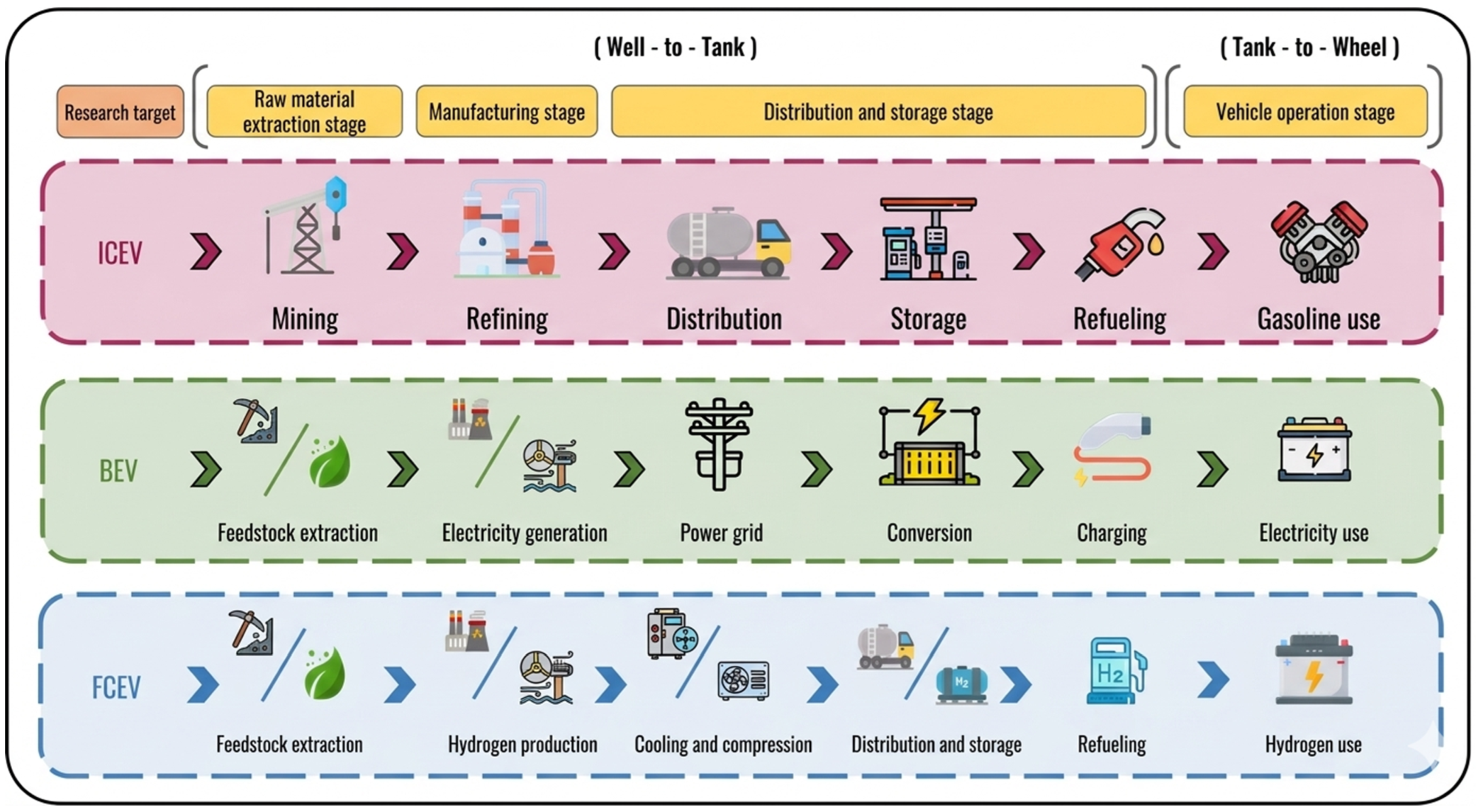
This study focuses exclusively on the assessment of ICEVs, BEVs, and hydrogen FCEVs, and its evaluation scope extends from raw material extraction to vehicle energy use in Taiwan. The WTW analysis process was divided into the well-to-tank and tank-to-wheel stages, accounting for the different vehicle drive types. The well-to-tank stage encompasses energy extraction, refining, and distribution, while the tank-to-wheel stage considers energy conversion processes in specific vehicles. Figure 1 illustrates the system boundary adopted in this study.

2.2. System Conceptualization

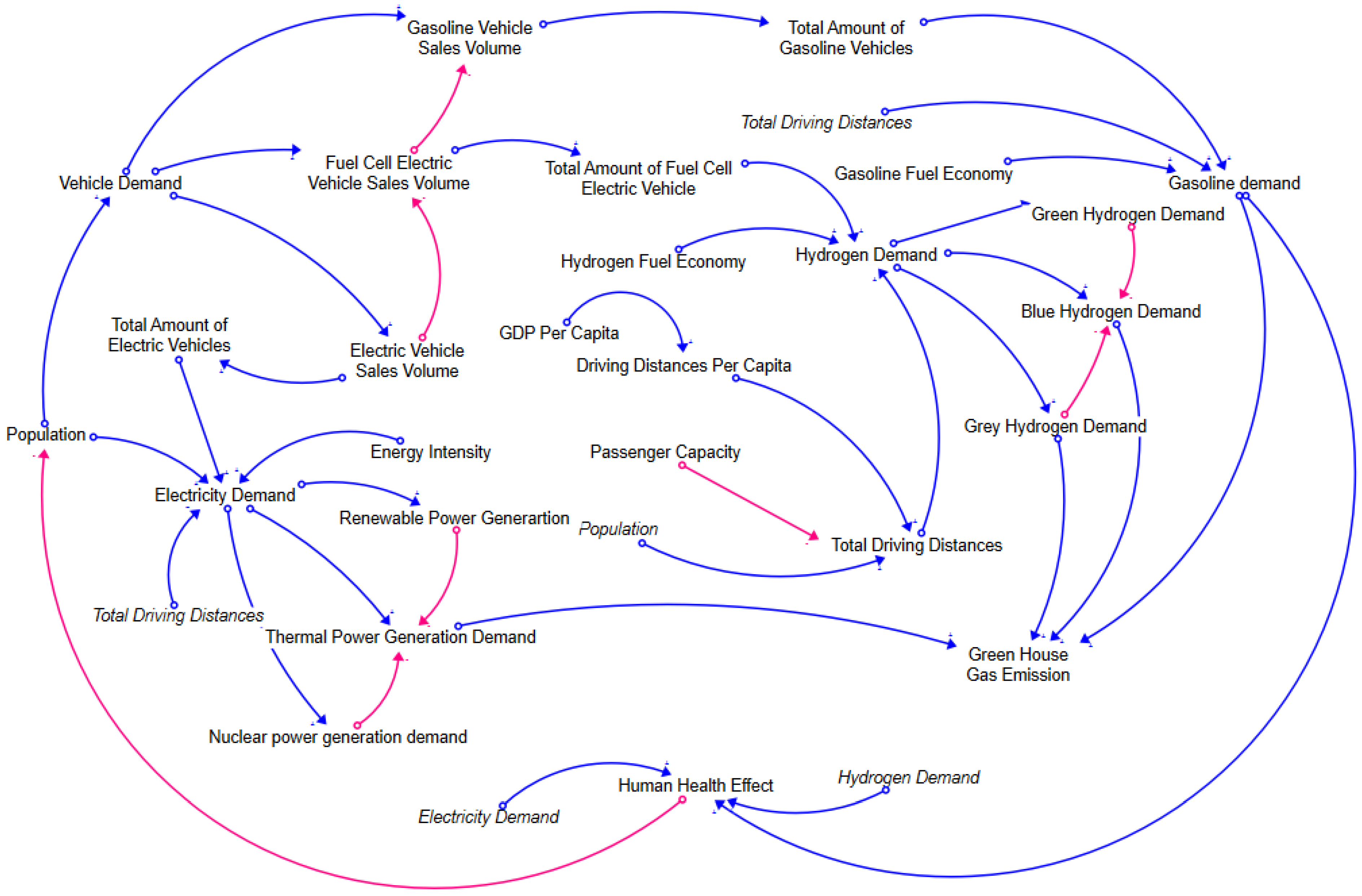
In system dynamics modeling, as shown in Figure 2, causal loop diagrams (CLDs) help identify key feedback loops within the system (Sterman, 2000, p. 700) [19] states that these loops can reinforce, enhance, balance, or dampen the initial variable’s variation. The proposed system dynamics model has eight balancing loops and one reinforcing loop, with the remaining loops based on assumptions about exogenous variables. In these loops, a positive sign denotes a positive correlation, and a negative sign denotes a negative correlation. The following is a brief explanation of the loops:
  • Balancing loops
    (1)
    Population → (+) Vehicle Demand → (+) ICEV Total → (+) Fuel Demand → (+) Human Health Impact → (−) Population.
    (2)
    Population → (+) Vehicle Demand → (+) EV Total → (+) Electricity Demand → (+) Human Health Impact → (−) Population.
    (3)
    Population → (+) Vehicle Demand → (+) FCEV Total → (+) Hydrogen Demand → (+) Human Health Impact → (−) Population.
Figure 2. Causal loop diagram.
Energies 19 02495 g002

2.3. System Dynamic Model Construction

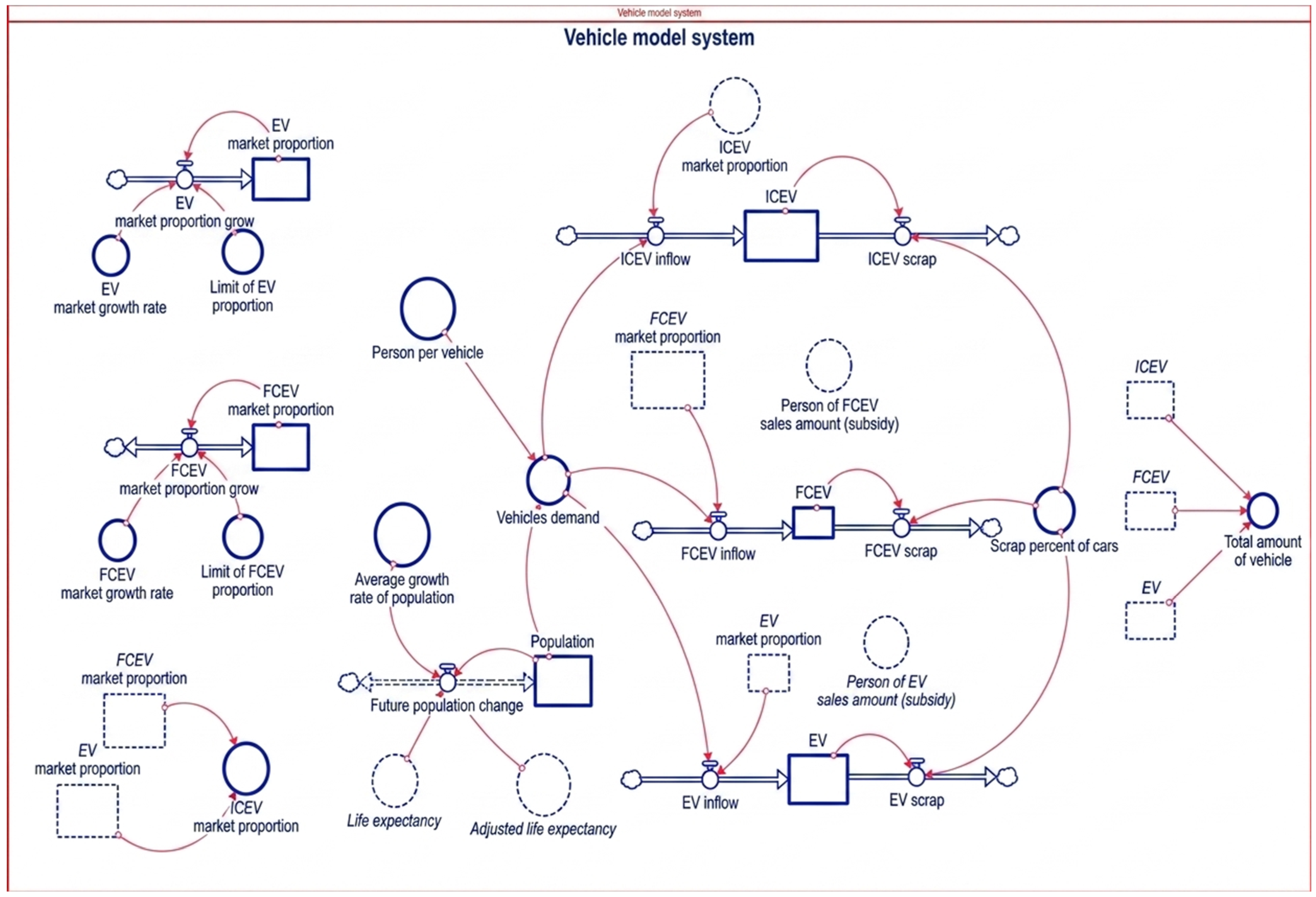
Figure 3 shows the CLDs constructed in this study. Each system has its own meanings for its internal components. The model includes the number of vehicles described by Figure 4, their carbon emissions, and the subsystem’s overall environmental impact.

2.3.1. Vehicle Number Subsystem

The vehicle quantity subsystem in this study, as shown in Figure 3, treats vehicle quantity as a key factor influencing vehicle carbon emissions. When predicting the diffusion of new technologies, researchers often employ S-curve models, such as the Bass diffusion model or the logit model. These models have been employed in many studies. For example, van der Kam et al. (2018) [20] used the Bass diffusion model to assess the future adoption of photovoltaic vehicles and EVs in different regions of the Netherlands. Yuan and Cai (2021) [21] used the entropy-weighted method and the S-shaped growth curve to evaluate the technological development trends of low-pollution energy vehicles. Focusing on expanding EV market share, Yang et al. (2015) [22] employed system dynamics and agent-based modeling to develop an EV market-share prediction model that considers multiple factors and yielded an S-shaped growth curve. In this study, a vehicle growth rate model was specially designed to calculate the future market rate (Formula (1)). The designed model was used to align the vehicle market rate with annual policy goals and to simulate vehicle growth using an S-curve. The ultimate saturation level for EVs is based on Taiwan’s annual electric vehicle growth target. The saturation level of hydrogen FCEVs is based on forecast data from a global automotive industry platform.
Annual market rate of each vehicle type = market growth rate × market rate × (saturation level − market rate).
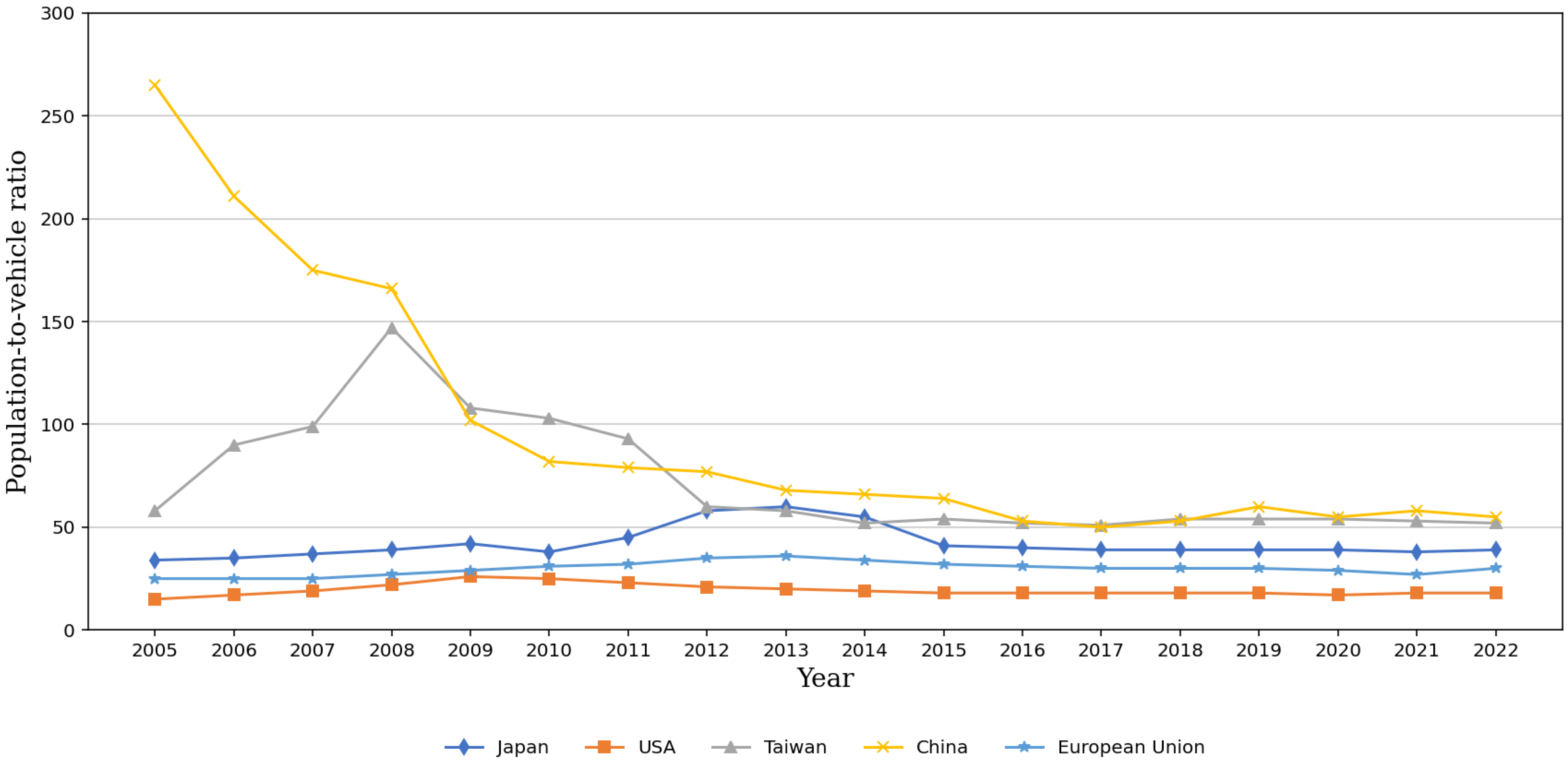
Population size is a key determinant of vehicle ownership and must therefore be projected. The average population growth rate is derived from estimates provided by the National Development Council of Taiwan, and future population trajectories are calculated using Formula (2). As specified in Formula (4), the projected population was combined with the population-to-vehicle ratio to estimate annual new-car demand. The population-to-vehicle ratio, defined as the ratio of new-car sales to the total population in a given country or region over a specified period, served as a proxy for consumers’ propensity to purchase new vehicles. Lower values indicate greater purchasing capacity for new cars, whereas higher values suggest more constrained demand. As such, this indicator also provides insight into the level and dynamics of economic development. As illustrated in Figure 4, the ratio remains relatively stable in mature, economically stable markets such as the United States and the European Union. By contrast, China experienced a marked decline in this ratio between 2005 and 2015, reflecting rapid economic growth and a corresponding surge in vehicle demand. In recent years, however, the trend has plateaued, indicating a moderation in demand growth as the economy stabilizes. Accordingly, the long-term trajectory of this indicator is expected to converge toward patterns observed in mature markets. In Taiwan, the population-to-vehicle ratio declined sharply in 2008, coinciding with the global financial crisis and a contraction in automotive demand, before stabilizing after 2012. This stabilization suggests a relatively steady outlook for future vehicle demand. When combined with projected population estimates, this indicator provides a basis for forecasting future automotive sales in Taiwan. Furthermore, annual sales by vehicle type are estimated by multiplying total new-car demand by each vehicle category’s projected market share.
F u t u r e   p o p u l a t i o n   c h a n g e = a v e r a g e   g r o w t h   r a t e   o f   p o p u l a t i o n × p o p u l a t i o n + p o p u l a t i o n × ( a d j u s t e d   l i f e   e x p e c t a n c y / l i f e   e x p e c t a n c y )
N e w   c a r   d e m a n d   q u a n t i t y = p o p u l a t i o n × p o p u l a t i o n t o v e h i c l e   r a t i o
A n n u a l   s a l e s   q u a n t i t y   o f   e a c h   v e h i c l e   t y p e = n e w   c a r   d e m a n d   q u a n t i t y × a n n u a l   m a r k e t   r a t e   o f   e a c h   v e h i c l e   t y p e
In the model, DALYs were implemented as an exogenous outcome indicator rather than a feedback driver. They were calculated at each time step by combining years of life lost due to premature mortality and years lived with disability, based on simulated changes in disease prevalence and mortality. These DALY estimates were then linked to population number by allowing health burden to reflect changes in mortality rates over time, thereby influencing overall population dynamics indirectly. Life expectancy statistics were obtained from the National Development and Reform Commission, which reported an average lifespan of 79.84 years in 2022 [23]. Population estimates were derived from the broader demographic trends provided by the same source. Adjusted life expectancy is subsequently estimated by integrating life expectancy, human health impacts, and population dynamics. This study further incorporates vehicle scrappage rates to simulate variations in the total vehicle stock. Scrappage quantities were calculated using Formula (5). The scrappage rate was specified based on data from the Directorate General of Highways, Ministry of Transportation (2022) [24], with an average baseline rate of 3.78% over the past five years. Given an average vehicle lifespan of 10.5 years and the recent introduction of hydrogen FCEVs to the market, the model assumes a delayed scrappage schedule for hydrogen FCEVs; specifically, scrappage is deferred by a decade in the simulation. This assumption reflects the limited early-stage retirement of newly introduced vehicle technologies. These adjustments were implemented to enhance the robustness and realism of the model, thereby enabling more accurate simulation and projection of vehicle stock dynamics and associated carbon emissions in Taiwan.
S c r a p p a g e q u a n t i t y   o f   e a c h   v e h i c l e   t y p e = t o t a l   q u a n t i t y   o f   e a c h   v e h i c l e   t y p e × a v e r a g e   s c r a p p a g e   r a t e

2.3.2. Vehicle Carbon Emission and Environmental Impact Subsystem

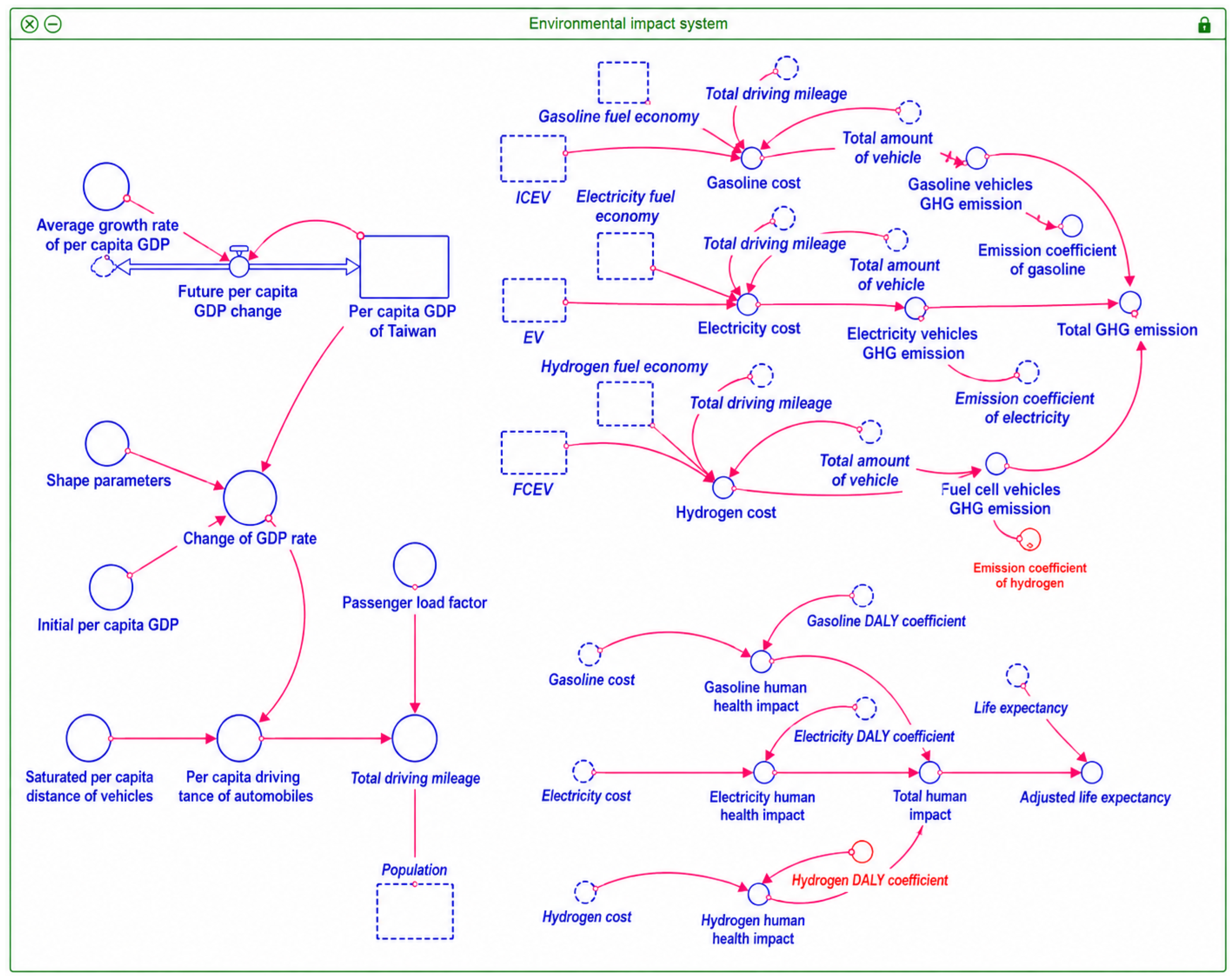
The subsystem for vehicle carbon emissions and its environmental impact is shown in Figure 5. The subsystem simulates the contributions of ICEVs, BEVs, and hydrogen FCEVs to carbon emissions and environmental impacts. Carbon emissions and environmental impacts primarily stem from vehicle energy demand, which is influenced by factors such as fuel efficiency and driving distance. Therefore, in the model of this study, considerations were made for future improvements in gasoline fuel economy and for reducing energy intensity as the power structure shifts toward low-carbon development. Although fuel economy and energy intensity are crucial factors that affect energy demand, this study does not specifically simulate them. Instead, they were treated as exogenous variables in the model, without accounting for their loop relationships.
Regarding fuel economy for ICEVs, this study refers to the International Energy Agency (IEA) report from 2021b [25] to assess its value. Additionally, this research draws on IEA reports on fuel economy for major-market automobiles from 2005 to 2019 and considers scenarios such as the Stated Policies Scenario (STEPS), APS, and NZE. STEPS was used in this study. The scenario considers the influence of current and stated policies, including fuel-economy standards, zero-emission vehicle requirements, and laws and regulations for the comprehensive phasing out of ICEVs. STEPS also incorporates the effects of legislatively formulated policies to reduce the carbon intensity of fuel supply, such as renewable energy combination standards for power, energy system scope, specific fuel technology, and carbon dioxide and GHG reduction targets. The report predicts that the fuel efficiency in 2050 will reach the target of 2.0 Lge/100 km under net-zero policies. The power consumption per kilometer (energy intensity) required for the total electricity consumption of EVs also needs to be evaluated. The energy intensity of EVs is calculated based on the formula proposed by Hou et al. (2021) [26], as shown in Formula (6).
E n e r g y   i n t e n s i t y = α × ^ ( β × ( t 2000 ) ) + c
where t denotes the time (Year),
α denotes the parameters fitted with the data of 2019 of the International Energy Agency [27],
β represents the parameters fitted with the guide for Fuel Economy in 2011–2017 of the US Environmental Protection Agency (Environmental Protection Agency 2022) [28] and 2017 Energy Technology Perspectives (IEA, 2017) [29], and
c denotes the parameters fitted with the 2018 Series Report on Global Electric Vehicle Perspectives (IEA, 2018) [30].
The per capita car distance can be multiplied by the total population and then divided by the average passenger load factor to obtain the annual total vehicle driving distance. Per capita annual car distance is an individual mobility indicator influenced by income levels, as reflected in the per capita gross domestic product [30]. Typically, per capita car distance is described as a function of per capita GDP, following a Weibull cumulative distribution function, as shown in Formula (7) [31].
P e r   c a p i t a   c a r   d i s t a n c e = s a t u r a t e d   p e r   c a p i t a   c a r   d i s t a n c e × ( 1 e ^ ( ( ( p e r   c a p i t a   G D P   o f   T a i w a n   i n   y e a r   t i n i t i a l   p e r   c a p i t a G D P ) / 10,000 ) ) )
Regional geography, road infrastructure levels, public transportation, and traffic policies can influence the saturated per capita car distance. The shape parameters, saturated per capita car distance, and initial per capita GDP are simulated based on the study of Hou et al. (2021) [26]. Subsequently, per capita car distance can be calculated based on per capita GDP, and the total car distance can be derived using Formula (8).
T o t a l   c a r   d i s t a n c e = ( p o p u l a t i o n × p e r   c a p i t a   c a r   d i s t a n c e ) / ( p a s s e n g e r   l o a d   f a c t o r )
The correlation coefficient of the passenger load factor is obtained from Harvey’s (2013) [32] study. The initial per capita GDP is based on the International Institute for Applied Systems Analysis’s integrated assessment modeling framework. This framework is part of the Shared Socioeconomic Pathways (SSP) database, a new framework adopted by the climate change research community to facilitate a comprehensive analysis of future climate effects, vulnerability, adaptation, and mitigation. Additional information about the scenario processes and SSP framework can be found in the works of Moss et al. (2010), van Vuuren et al. (2014), O’Neil et al. (2014), and Kriegler et al. (2014) [33,34,35,36].
Energy demand is modeled using the ASIF (Activity, Structure, Intensity, and Fuel) approach, where fuel consumption is calculated as a function of activity, structural parameters, and energy intensity. The governing equations for the energy requirements of EVs, hydrogen FCEVs, and ICEVs are defined in Formulas (9) through (11).
E l e c t r i c i t y   c o n s u m p t i o n = p o p u l a t i o n × p e r   c a p i t a   c a r   d i s t a n c e p a s s e n g e r   l o a d   f a c t o r × E V   p r o p o r t i o n × e n e r g y   i n t e n s i t y
H y d r o g e n   c o n s u m p t i o n = p o p u l a t i o n × p e r   c a p i t a   c a r   d i s t a n c e p a s s e n g e r   l o a d   f a c t o r × F C E V   p r o p o r t i o n × h y d r o g e n   f u e l   e c o n o m y
G a s o l i n e   c o n s u m p t i o n = p o p u l a t i o n × p e r   c a p i t a   c a r   d i s t a n c e p a s s e n g e r   l o a d   f a c t o r × I C E V   p r o p o r t i o n × g a s o l i n e   f u e l   e c o n o m y
Greenhouse gas (GHG) emissions are quantified based on carbon outputs across distinct vehicle operational stages. For ICEVs, emissions are calculated using gasoline carbon-intensity coefficients from the Taiwan Environmental Protection Agency’s carbon footprint database. Conversely, emissions for BEVs and hydrogen FCEVs are determined by multiplying their respective energy consumption by the carbon emission coefficients projected for the 2021–2050 period as estimated in this study. The comprehensive calculation framework is formalized in Equation (12).
G H G   e m i s s i o n = e l e c t r i c i t y   c o n s u m p t i o n × e m i s s i o n   c o e f f i c i e n t   o f   e l e c t r i c   p o w e r   +   h y d r o g e n   c o n s u m p t i o n × e m i s s i o n   c o e f f i c i e n t   o f   h y d r o g e n   +   g a s o l i n e   c o n s u m p t i o n × e m i s s i o n   c o e f f i c i e n t   o f   g a s o l i n e )
The human health effect coefficients for electricity and gasoline were quantified using the ReCiPe 2016 Endpoint (H) method in SimaPro software version 9.4.0.1.
H u m a n   h e a l t h   e f f e c t s   = g a s o l i n e   c o n s u m p t i o n × g a s o l i n e   D A L Y   c o e f f i c i e n t s   +   e l e c t r i c i t y   c o n s u m p t i o n × e l e c t r i c i t y   D A L Y   c o e f f i c i e n t s   +   h y d r o g e n   c o n s u m p t i o n × h y d r o g e n   D A L Y   c o e f f i c i e n t s

2.4. Limitations of This Study

Based on the defined scope and system boundary, the following limitations have been adopted:
  • This study is based on Taiwan’s Net-Zero Emissions Pathway and it employs a well-to-wheel system boundary, excluding upstream (raw materials, manufacturing) and downstream (end-of-life and recycling) processes for vehicles, batteries, and fuel cells. This may limit the direct applicability of the findings to other regions.
  • Vehicle technology is not disaggregated; hybrid and extended-range electric vehicles, as well as non-gasoline fuels such as diesel and LPG, are excluded from the analysis.
  • Changes in public transport systems, future automotive manufacturing technologies and fuel economy are not considered due to data and forecasting limitations.
  • Energy consumption for electric and hydrogen vehicles is based on literature values, as no official efficiency standards currently exist in Taiwan.
  • The analysis is based on current assumptions and available data, reflecting inherent uncertainties in long-term scenario projections.

3. Results and Discussions

3.1. Energy Scenarios Modeling and Environmental Coefficients Assessment

The primary objective of this study is to evaluate the carbon emission coefficients for electricity and hydrogen across diverse energy scenarios. For electricity emissions, this study uses an energy balance sheet to establish carbon emission coefficients for various power generation types. Based on the energy structure planned by the Energy Bureau, the future power generation structure up to 2050 is estimated to explore potential changes in the carbon emission coefficients of electricity. The evaluation scope and calculation methods are detailed in Supplementary Materials SA. Given the absence of onsite examples of hydrogen production in Taiwan, a deep WTW inspection cannot be conducted; instead, this study establishes a corresponding LCA inventory based on a substantial body of the literature. This LCA inventory, combined with the Hydrogen Application Development Blueprint planned by the Industrial Technology Research Institute, is used to estimate the future hydrogen energy structure up to 2050 and to investigate potential changes in hydrogen’s carbon emission coefficients. The evaluation scope and calculation methods are detailed in Supplementary Materials SB. Additionally, the trend of economic growth affects future per capita travel distance. Increases in a country or region’s per capita travel distance are often associated with growth in per capita GDP. Therefore, this result is used to predict changes in per capita travel distance and, subsequently, to estimate vehicle energy demand. The detailed results are presented in Supplementary Materials SC.

3.2. System Dynamic Simulation Results

In this study, the vehicle growth scenarios are categorized into policy and sustainable scenarios for comparison. The policy scenario primarily simulates the current market, where ICEVs and EVs dominate. The sustainable scenario assumes that the future automotive market will move toward an environmentally friendly direction, with gradually increasing market shares for EVs and hydrogen FCEVs and decreasing market shares for ICEVs. The policy scenario excludes hydrogen FCEVs, thereby providing a clearer understanding of their contribution to carbon emission reductions. The scenario comparisons are presented in Table 1.

3.2.1. Forecasting Vehicle Stock and Dynamics

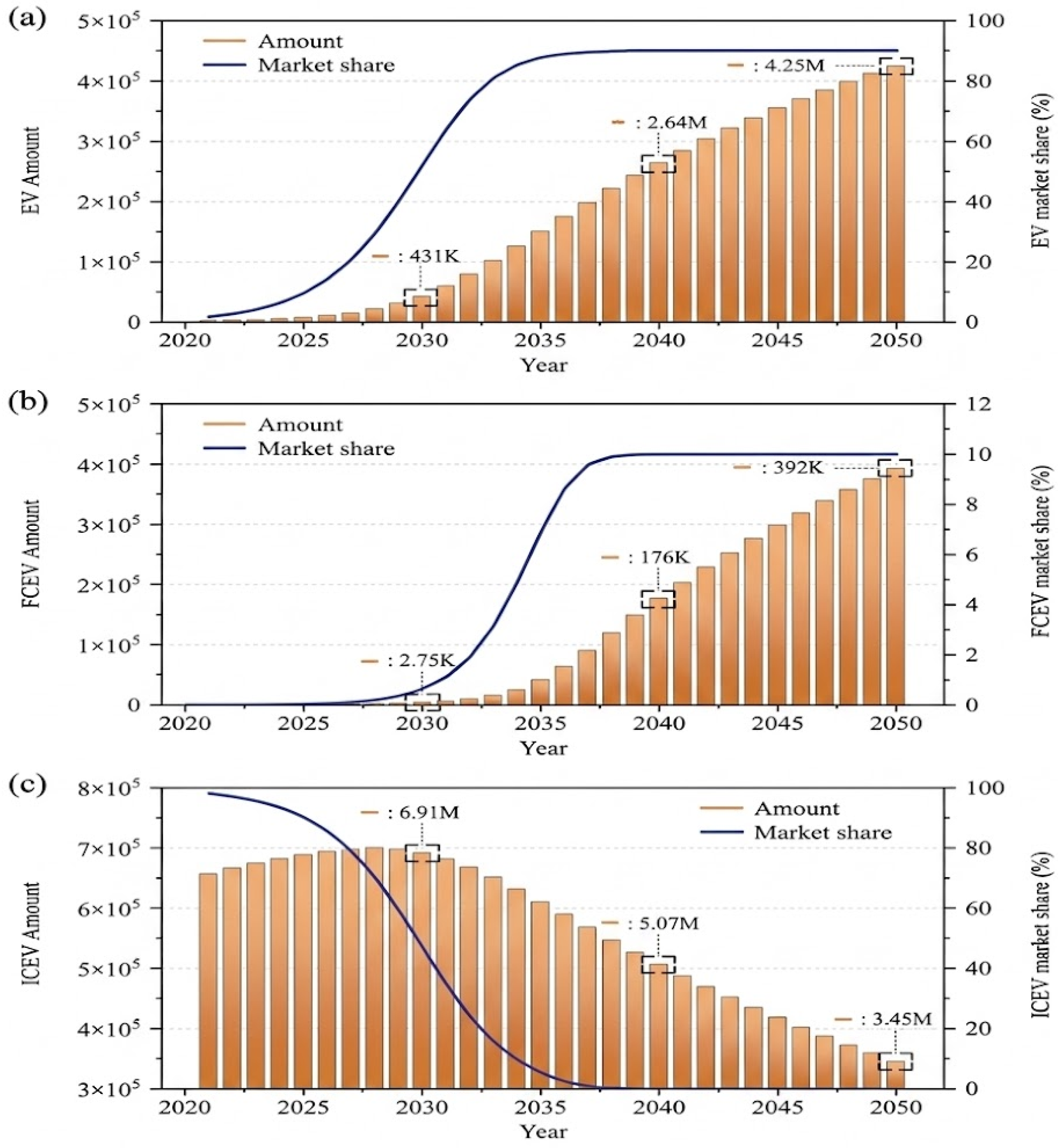
According to the simulation analysis of the sustainable scenario in this study (Figure 6), the market growth trajectories of EVs and hydrogen FCEVs exhibit S-shaped patterns. This pattern indicates that after a period of rapid expansion, the market will enter a saturated state. Conversely, as new EVs become increasingly popular, the market share of traditional ICEVs will gradually weaken, following an S-shaped trend. Figure 6a shows that the market share of EVs is projected to reach 90% by 2040, with total quantities of approximately 431,000, 2.64 million, and 4.25 million vehicles in 2030, 2040, and 2050, respectively. Figure 6b indicates that hydrogen FCEVs are expected to achieve a market share of 10% by 2040, with total quantities increasing to approximately 275,000; 176,000, and 392,000 vehicles in 2030, 2040, and 2050, respectively. Figure 6c shows that the market share of ICEVs in 2040 is projected to shrink to 0%, with total quantities of approximately 6.91 million, 5.07million, and 3.45 million vehicles in 2030, 2040, and 2050, respectively. The detailed simulation data are presented in Table 2.
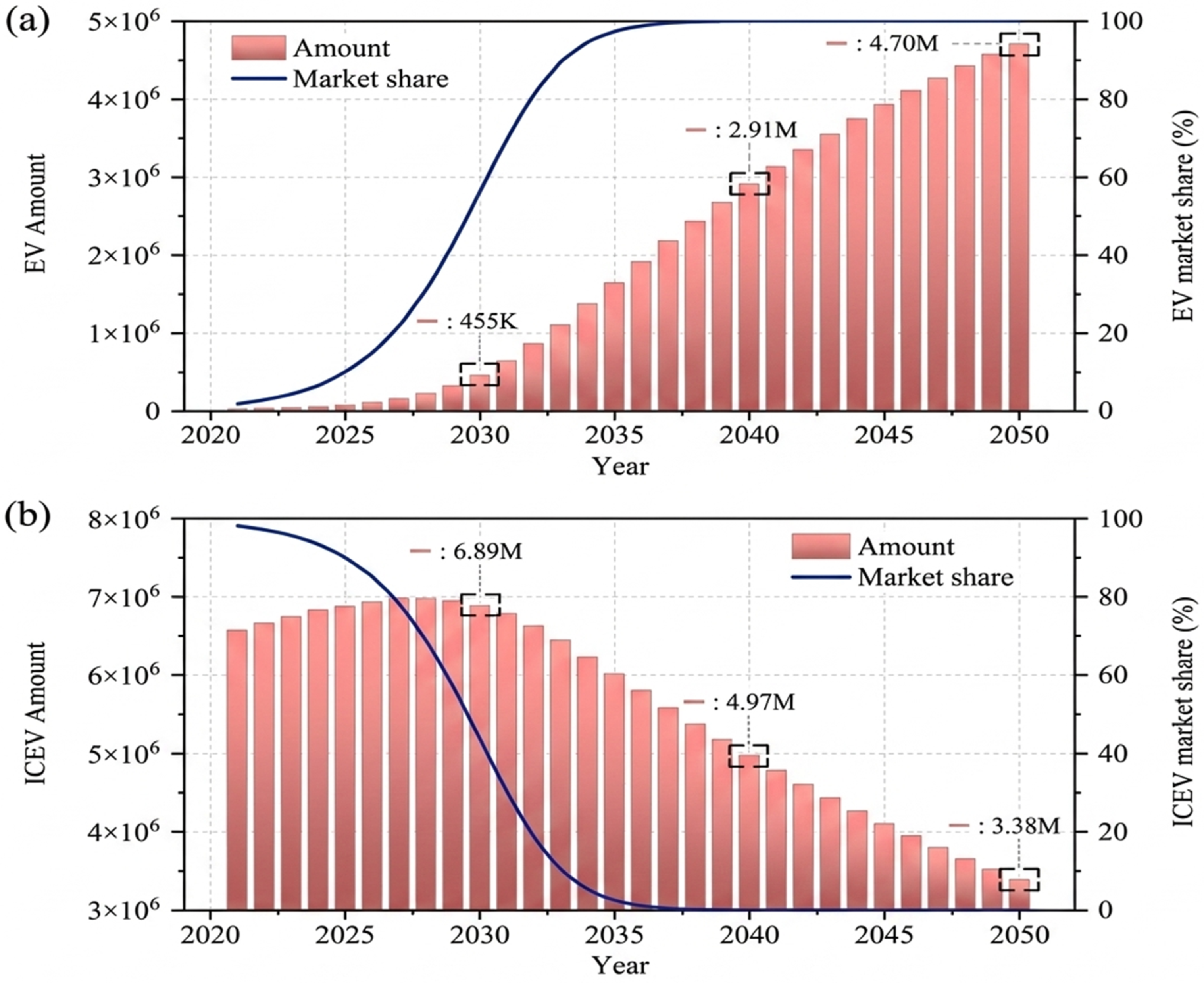
The study’s policy scenario simulation is shown in Figure 7, which illustrates an S-shaped growth curve for the EV market. This pattern suggests that following rapid expansion, the market will reach saturation. Meanwhile, as EV popularity rises, the market share of traditional ICEVs will steadily decline, also following an S-shaped trend. Figure 7a indicates that the market share of EVs is projected to reach 100% by 2040, with total quantities of approximately 455,000, 2.91 million, and 4.70 million vehicles in 2030, 2040, and 2050, respectively. Figure 7b shows that the market share of ICEVs in 2040 is projected to shrink to 2040%, with total quantities of approximately 6.89 million, 4.97 million, and 3.38 million vehicles in 2030, 2040, and 2050, respectively. The detailed simulation data are presented in Table 3.

3.2.2. Estimating Greenhouse Gas Emissions from Passenger Vehicles

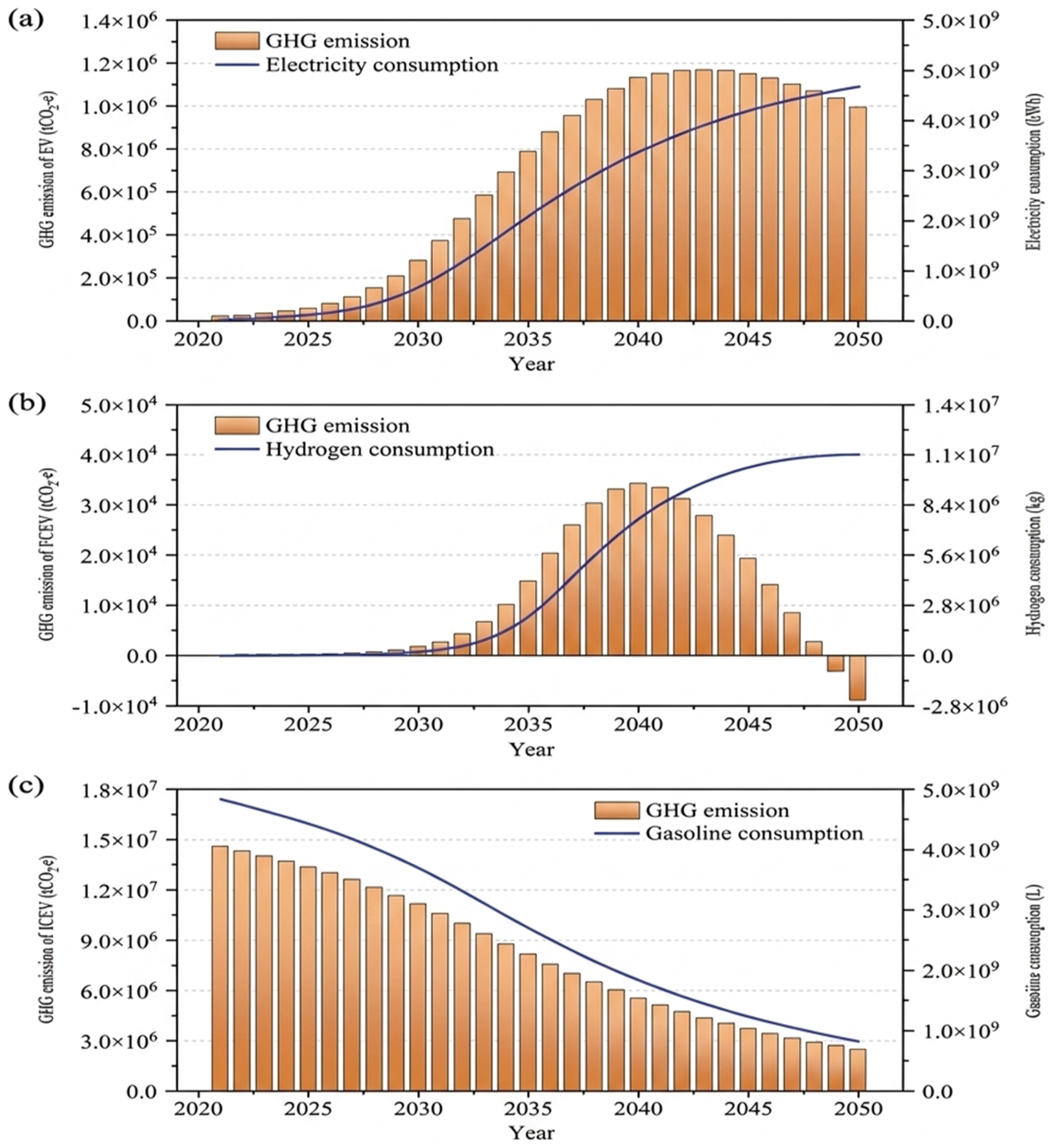
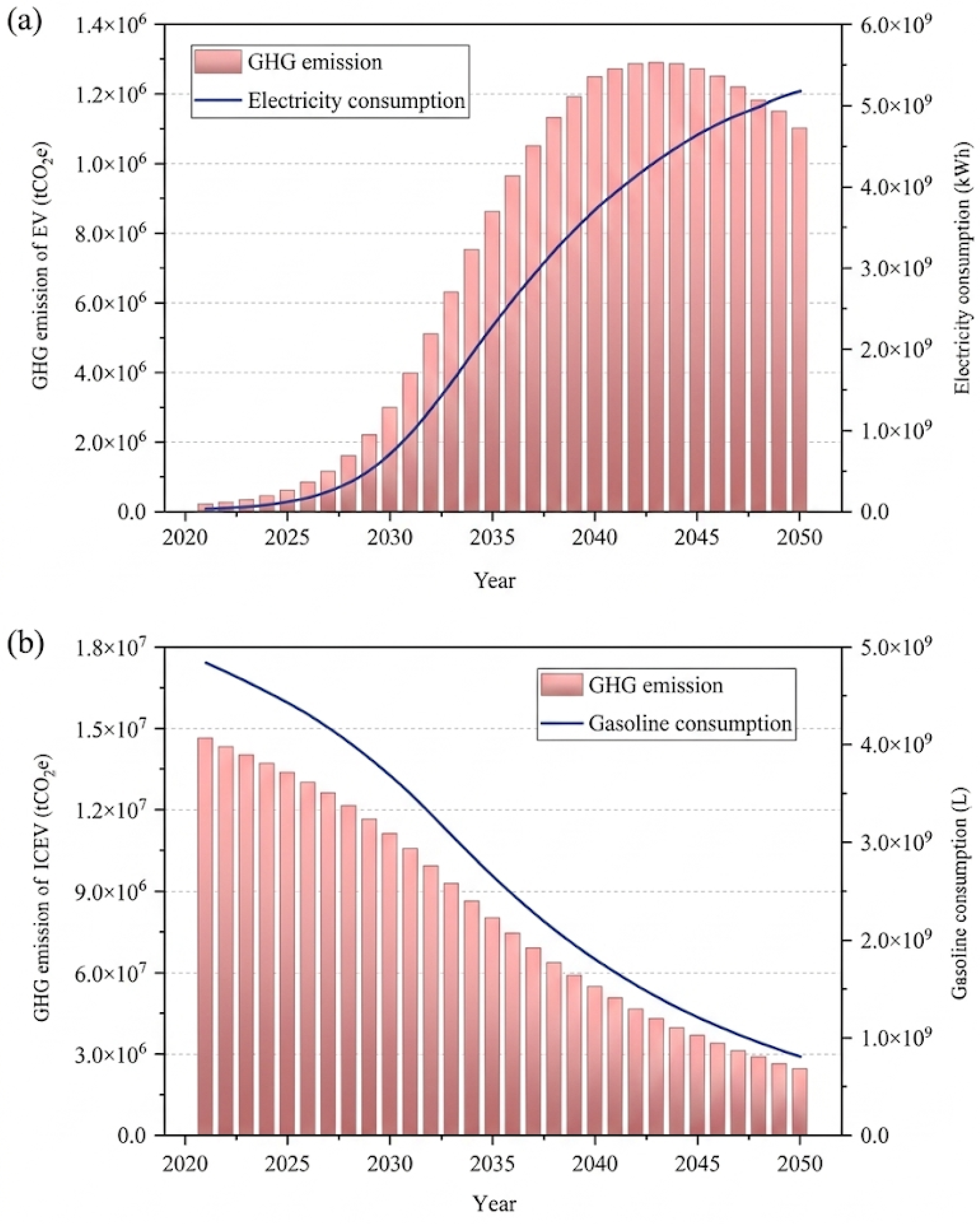
Based on the sustainable scenario outlined in this study, Figure 8 and Table 4 present GHG emissions from various energy vehicles. Figure 8a,b show that the usage of corresponding energy is expected to increase gradually with the growth in the quantities of EVs and hydrogen FCEVs. Initially, the carbon emissions of EVs and hydrogen FCEVs will rise as usage of the corresponding energy sources increases. However, due to the rapid decrease in emission coefficients, the carbon emissions of EVs and hydrogen FCEVs will decrease after 2042 and 2040, respectively. Hydrogen FCEVs even achieve negative carbon emissions by 2049 through green hydrogen production via biomass gasification and carbon sequestration, and through biomass gasification with carbon capture and storage. Regarding ICEVs, with fewer vehicles, gasoline consumption is expected to decline year by year, leading to a continuous reduction in carbon emissions, as shown in Figure 8c. In sum, in the sustainable scenario of this study, EVs and hydrogen FCEVs exhibit lower carbon emissions, while ICEVs exhibit declining annual emissions.
Based on the policy scenario set in this study, Figure 9 and Table 5 present GHG emissions for various energy vehicles. As shown in Figure 9a, with increasing numbers of EVs, energy usage is expected to rise gradually. Initially, EVs’ carbon emissions increase as electricity demand rises. However, due to the rapid decrease in emission coefficients, carbon emissions will decrease after 2042. Regarding ICEVs, with fewer vehicles, gasoline consumption is expected to decrease annually, leading to a sustained decline in carbon emissions, as observed in Figure 9b. In sum, in the policy scenario of this study, EVs exhibit lower carbon emissions, and ICEVs show decreasing emissions year by year.
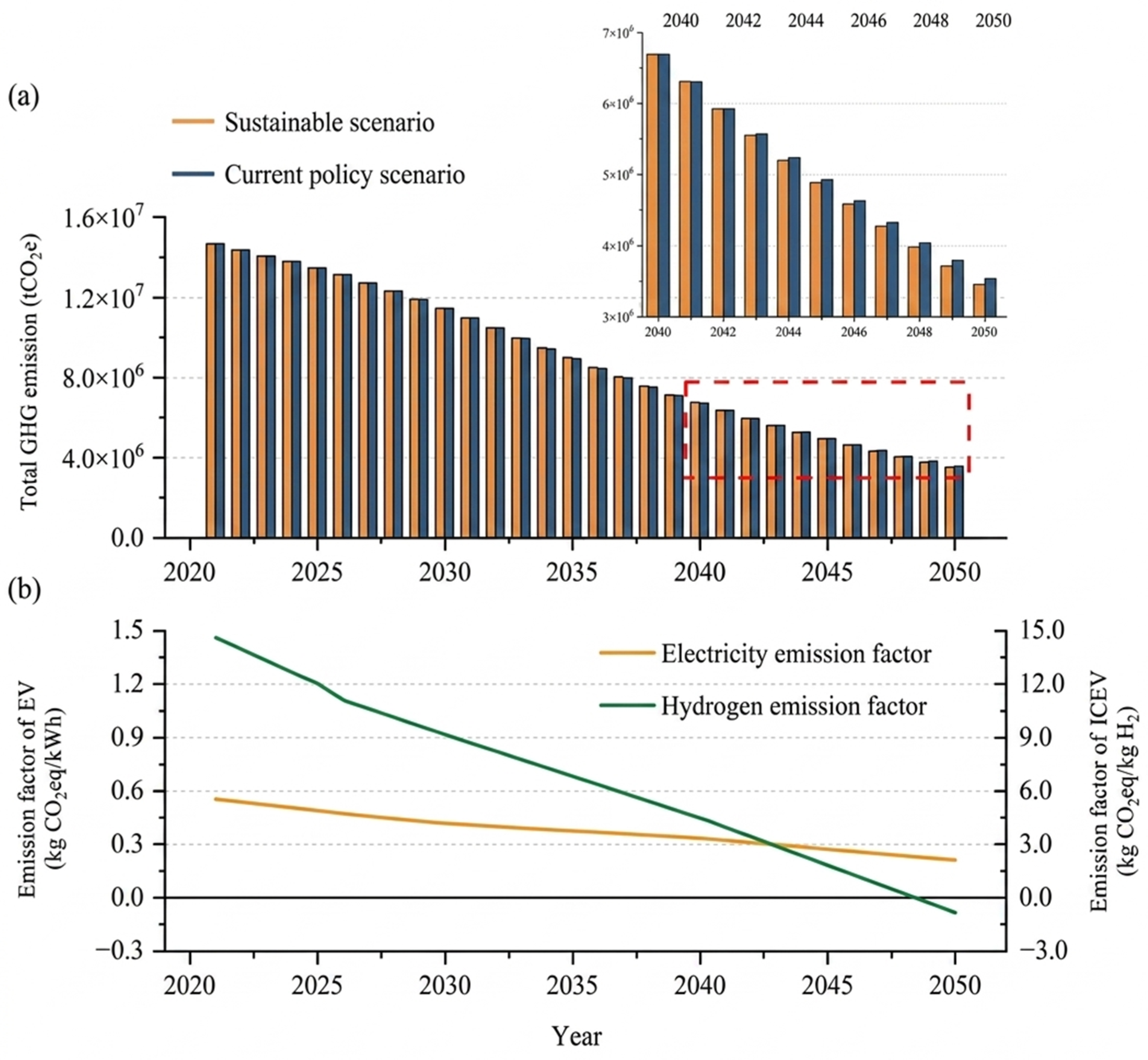
Figure 10a illustrates the overall GHG emissions of passenger cars under sustainable and policy scenarios. The simulation results of this study reveal that, from 2042 onward, the overall emissions under the sustainable scenario will be lower than those under the policy scenario. This phenomenon is mainly due to a decrease in the hydrogen emission coefficient and an increase in the market share of hydrogen FCEVs. These trends are shown in Figure 10b, and detailed data are provided in Table 6. In 2042, the energy structure of hydrogen will comprise 46.8% green hydrogen, 28.9% blue hydrogen, and 24.3% gray hydrogen. From this proportion, we can infer that an increase in the ratio of green and blue hydrogen will contribute to a decrease in the hydrogen emission coefficient and, consequently, a reduction in overall emissions. In the same year, the market share of hydrogen FCEVs will only be about 2.9%. This estimate implies that hydrogen FCEVs have a significant emission reduction advantage, even with a small market share, contingent on the hydrogen source.

3.2.3. GHG Reduction Potential Estimates for Vehicles

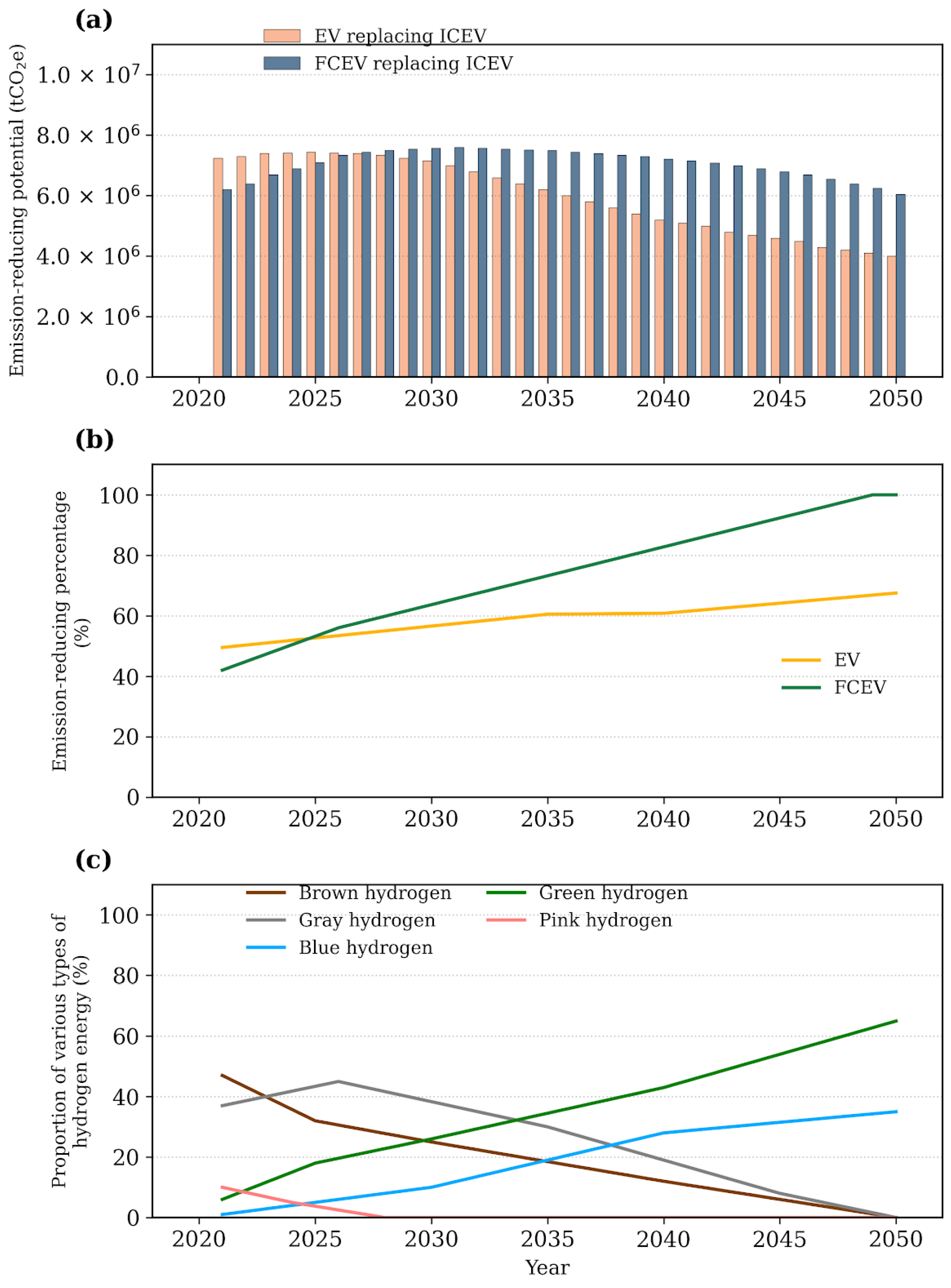
This study further compares the potential of EVs and hydrogen FCEVs to reduce emissions when used to replace fossil-fuel vehicles. EVs or hydrogen FCEVs are assumed to cover all driving distances to estimate their potential for reducing emissions. The detailed calculation method is shown in Formulas (11) and (12). According to the data in Figure 11a and Table 7, from 2021 to 2026, the emission reduction potential of EVs exceeds that of hydrogen FCEVs. However, after 2026, hydrogen FCEVs are estimated to surpass EVs in terms of emission reduction potential. As shown in Figure 11c, from 2021 to 2026, the energy structure of hydrogen was mainly gray and brown hydrogen, with the proportion decreasing from 83.3% to 73.0%. This situation indicates that a large proportion of gray hydrogen negatively affects the contribution of hydrogen vehicles to carbon emission reduction. However, due to a decrease in total car distance, the emission reduction potential of both types of vehicles has decreased over the years. As presented in Figure 11b, at the initial stage, the emission reduction rate of EVs is higher than that of hydrogen FCEVs. However, after 2026, the emission reduction rate of hydrogen FCEVs will surpass that of EVs and ultimately reach 100% as hydrogen emission coefficients decrease.
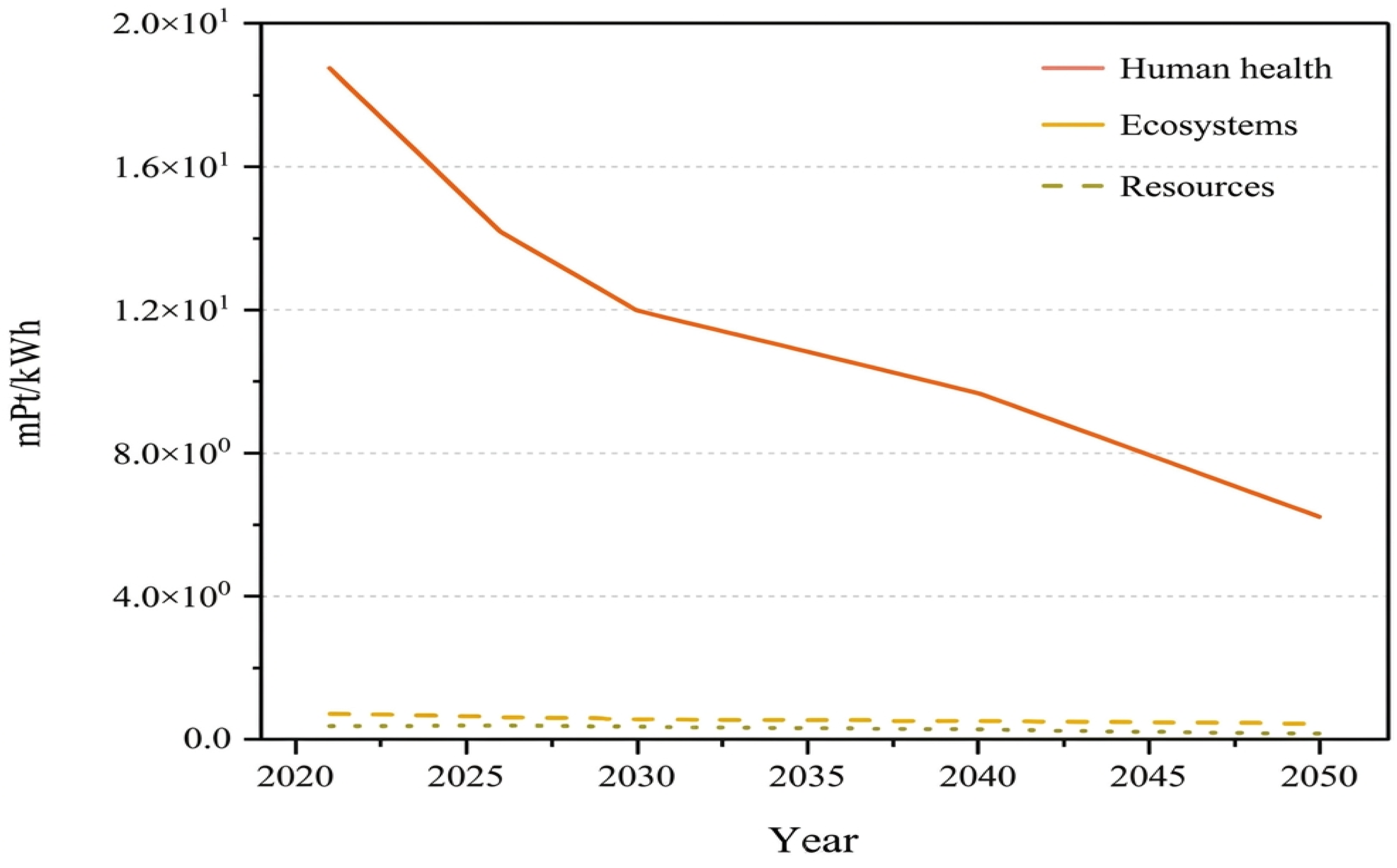
The environmental impact assessment shows that the impact per kilowatt-hour, as shown in Figure 12 and Table 8, has steadily decreased over time. This trend is mainly due to the growing share of renewable energy in power generation. Since renewable sources typically cause less environmental harm than traditional thermal power, this decline indicates Taiwan’s energy system is transforming. Additionally, the results indicate that, compared to resource depletion and ecosystem damage, electricity use has a more significant effect on human health damage.
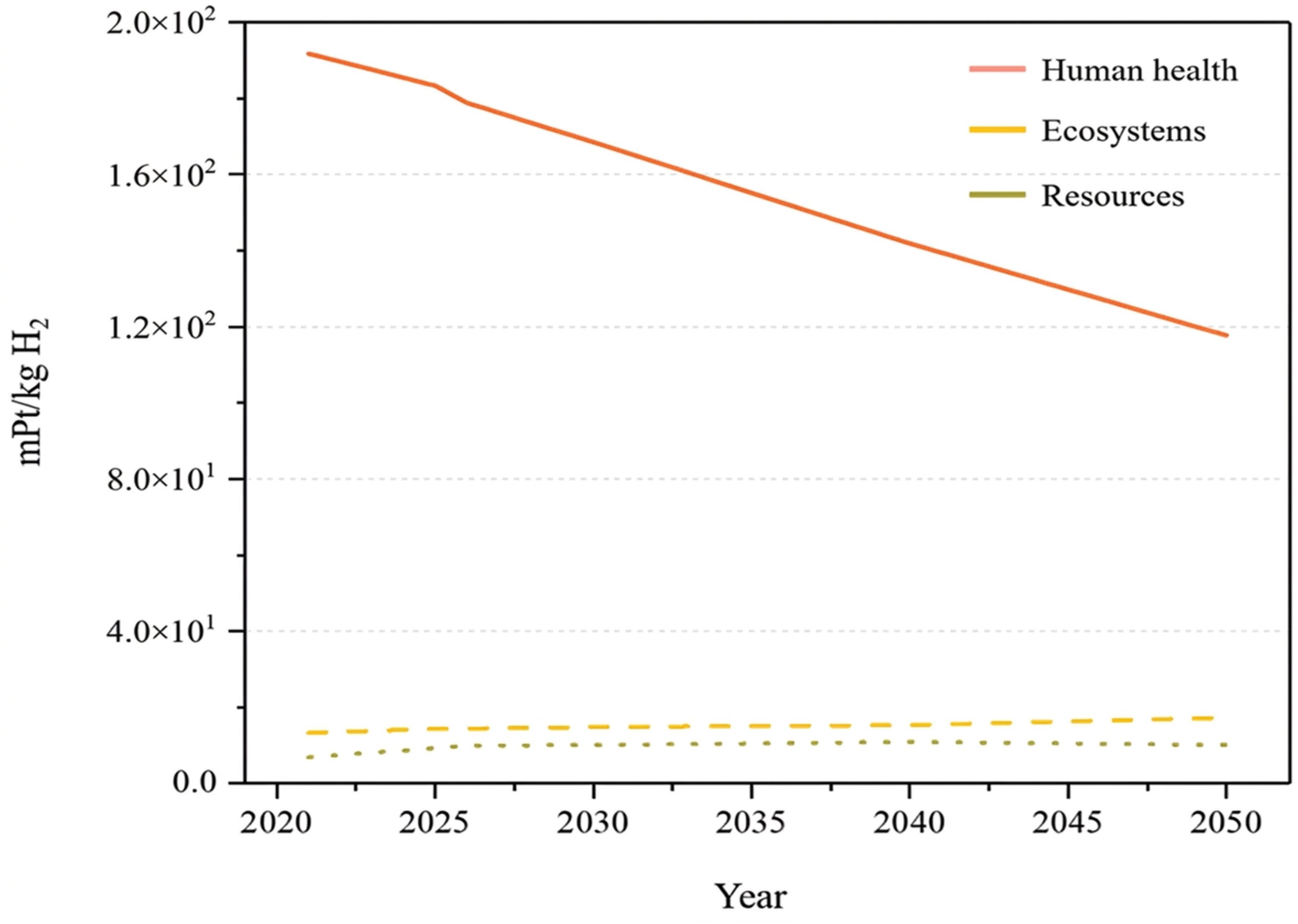
Figure 13 and Table 9 display the environmental impact per kilogram of hydrogen. Over time, the impact on human health is expected to decrease gradually, mainly because the share of blue and green hydrogen is increasing, which have lower environmental impacts than gray hydrogen. Conversely, the effect on ecosystems is projected to rise, primarily due to increased green hydrogen use for biomass gasification and wider adoption of new carbon capture technologies. These factors have a greater influence on ecosystems compared to other hydrogen production methods. The resource depletion index for hydrogen is expected to grow until 2027, mainly because gray and blue hydrogen, especially methane steam reforming and methane reforming with carbon capture, dominate. However, as green hydrogen’s share increases, the resource depletion index is projected to decline gradually in recent years.
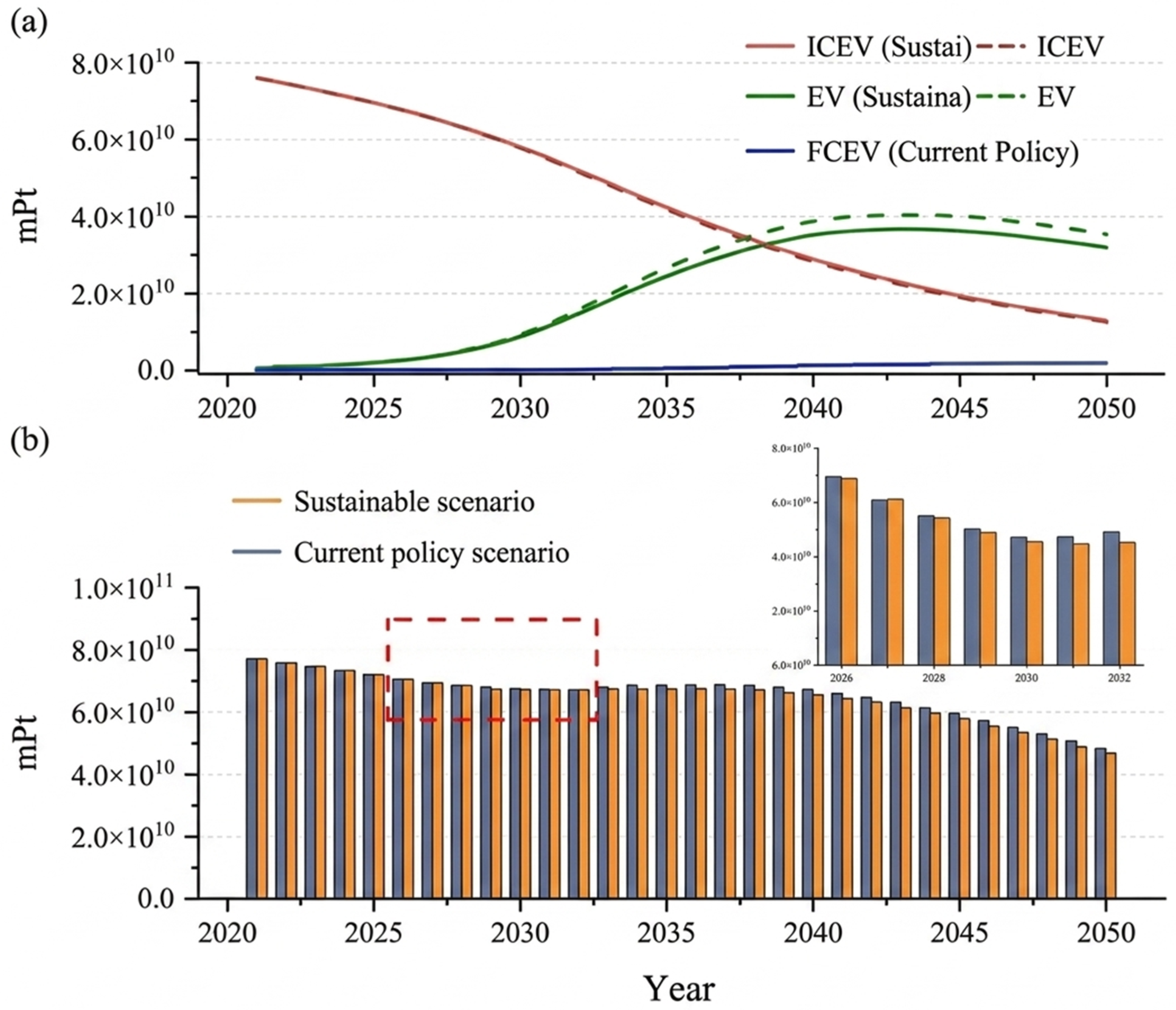
This study compares the environmental effects of electric vehicles (EVs) and hydrogen fuel cell electric vehicles (FCEVs) by calculating their impacts across various scenarios and analyzing the overall environmental footprint. As illustrated in Figure 14a, traditional internal combustion engine vehicles (ICEVs) see a reduction in impact as fuel consumption drops in all scenarios. Initially, EVs’ environmental impact rises in both scenarios due to increased electricity demand, but after 2036, it diminishes as impact coefficients decrease. Comparing the total impact in the sustainable (solid line) and policy (dashed line) scenarios reveals that EVs exert a smaller environmental footprint in the sustainable scenario than in the policy scenario. The observed results can be attributed to the inclusion of hydrogen fuel cell electric vehicles (FCEVs) in the sustainable scenario, which reduces the market share of battery electric vehicles (EVs). Consequently, the sustainable scenario features fewer EVs than the policy scenario, leading to a relatively smaller contribution from electricity use to the overall environmental impact. As illustrated in Figure 14b, the total environmental impact in the sustainable scenario remains lower than that of the policy scenario from 2026 onwards, despite the integration of hydrogen FCEVs. However, prior assessments of hydrogen production indicate that hydrogen is associated with a higher environmental burden than electricity; thus, the introduction of hydrogen FCEVs cannot be assumed to inherently reduce environmental impacts. Moreover, Table 10 suggests that the current level of hydrogen vehicle deployment is insufficient to significantly influence the overall environmental impact. These findings imply that the net effect of hydrogen adoption remains limited under the present assumptions, highlighting the need for further scenario-based analyses to validate these results and better understand the conditions under which hydrogen deployment may yield substantial environmental benefits.

3.2.4. Estimated Reduction in Environmental Impact

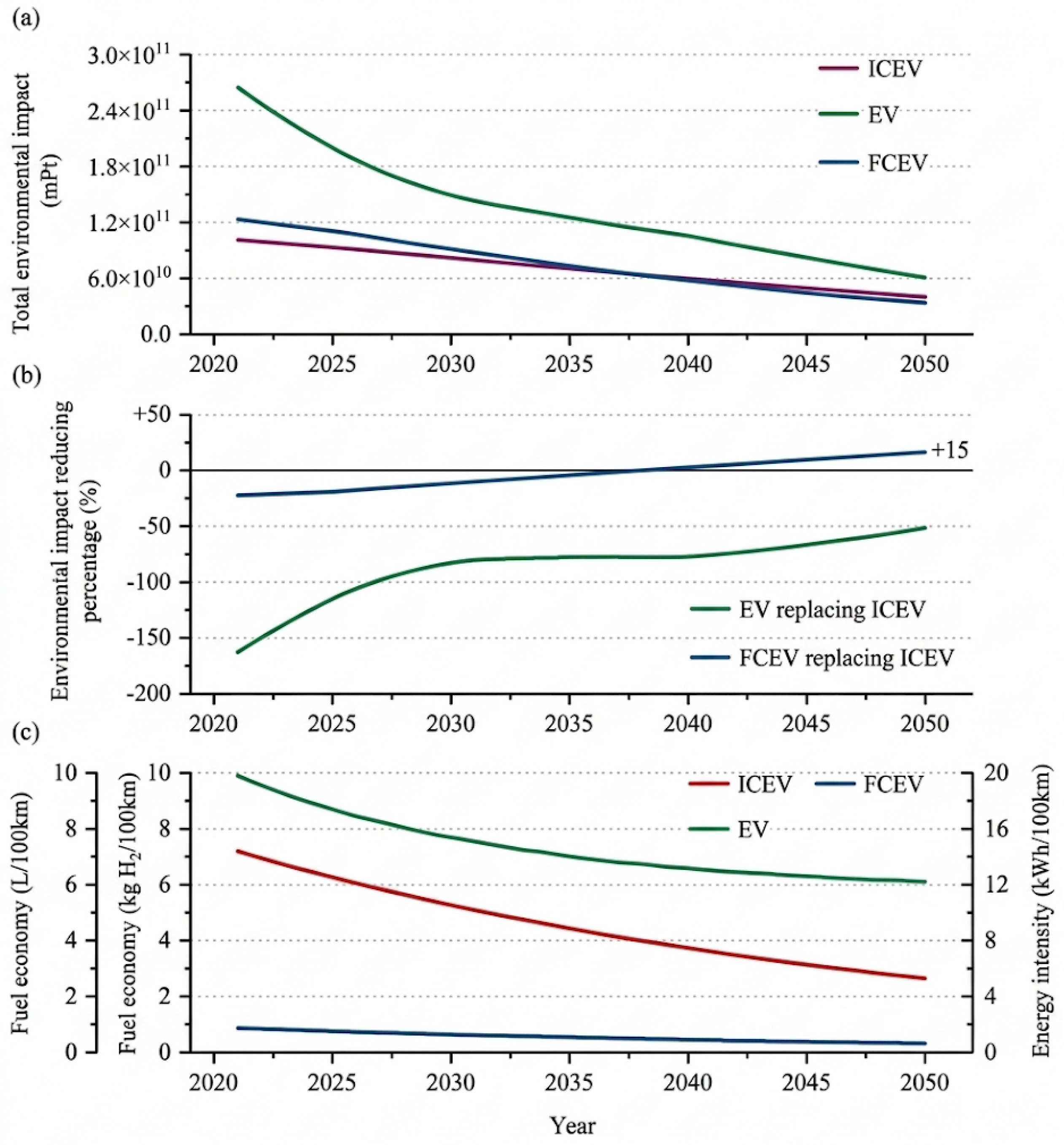
This study also assesses whether hydrogen FCEVs outperform EVs in environmental impact. All driving distances are assumed to be covered by either EVs or hydrogen FCEVs to evaluate their potential to reduce environmental impact compared to traditional ICEVs. As shown in Figure 15a and Table 11, the overall environmental impact of both EVs and hydrogen FCEVs declines over time. This decrease results from reductions in the environmental impact of individual energy sources, depicted in Figure 15c, as well as improvements in hydrogen fuel efficiency and energy intensity.
From 2021 to 2050, EVs have a higher overall environmental impact than hydrogen FCEVs and ICEVs, mainly because EVs consume more energy per kilometer. However, the environmental impact of hydrogen FCEVs is expected to be lower than that of ICEVs after 2038, due to decreased hydrogen environmental impact coefficients and better fuel economy. As shown in Figure 15b, from 2038 onward, replacing ICEVs with hydrogen FCEVs is anticipated to lower environmental impacts. Ultimately, adopting a green energy transition alongside enhanced fuel efficiency is crucial to reduce environmental effects.

3.2.5. Population Size Estimation

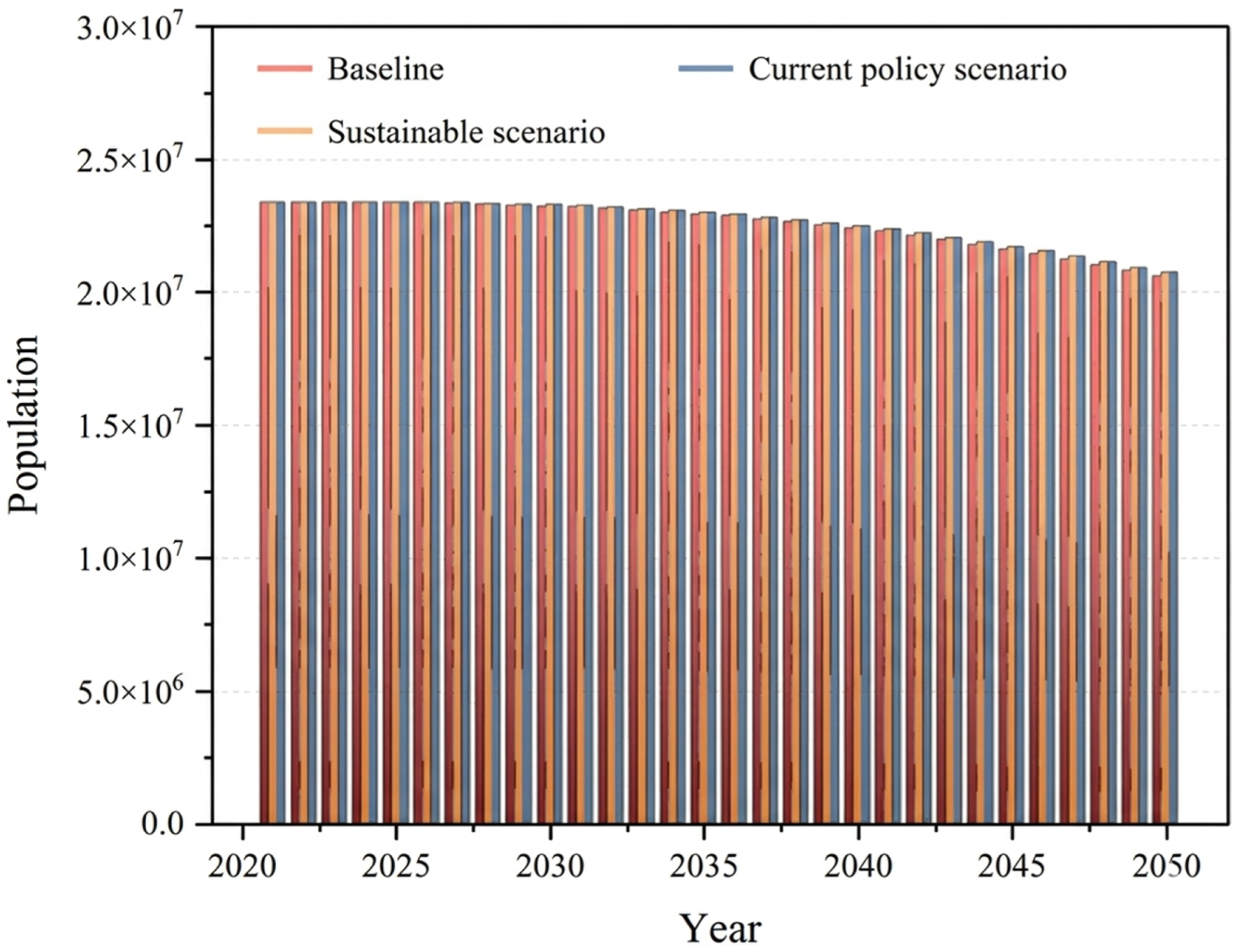
In the system dynamics model of this study, a crucial loop is specifically considered: the effect of disability-adjusted life years (DALYs) on the population. The results of both scenarios are compared with population predictions from the National Development Council (NDC). Figure 16 and Table 12 show that although the effect of DALY on lifespan and population is relatively small, reducing the environmental impacts of hydrogen FCEVs and EVs helps slow the decline in population. This result provides an interesting perspective: improving energy choices and transportation methods can indirectly improve population health.
Despite the relatively high efficiency of fuel cell systems, important challenges remain regarding the hydrogen storage, safety requirements, and maintenance costs, which can limit their large-scale commercial deployment. These constraints are consistent with the current state of technological and economic development of FCEV systems and should be considered when interpreting our results.

4. Conclusions

This study assesses Taiwan’s transport decarbonization pathways toward its net-zero 2050 target using an integrated framework that combines system dynamics, S-curve diffusion, and a well-to-wheel LCA. Two transition pathways are examined: an EV-focused scenario and a broader pathway that includes hydrogen FCEVs. This approach captures not only technology diffusion patterns but also how changes in the energy system reshape long-term environmental outcomes. The inclusion of DALY-based feedback mechanisms further extends the assessment by linking environmental impacts to population and energy demand dynamics. The results show that decarbonizing the energy supply is the main driver of long-term emission reductions. Projections indicate that Taiwan’s electricity emission intensity is expected to fall by 61.63% between 2021 and 2050 due to the expansion of renewable energy, while emissions from hydrogen could shift from 14.67 kg CO2e/kg H2 in 2021 to net-negative levels (−0.10 kg CO2e/kg H2) by 2050 under a green hydrogen pathway. Although both EVs and FCEVs lead to higher energy demand in the early stages, they begin to deliver clear emission reductions after the early 2040s. From around 2042, the FCEV scenario performs better than the EV-only pathway. The analysis also shows a clear shift over time in the relative benefits of the two technologies. EVs are more effective in the short term because hydrogen production is still relatively carbon-intensive today. However, as hydrogen production becomes cleaner, FCEVs gradually gain a stronger advantage. In the longer term, FCEVs have greater potential to reduce overall environmental impacts, though some trade-offs remain, particularly regarding ecosystems and resource use. A key policy insight is that relying on a single technology pathway is unlikely to be sufficient. A combined strategy that supports both renewable electricity and low-carbon hydrogen is necessary for deep decarbonization. In particular, achieving meaningful benefits from FCEVs would require a market share of at least 9% by 2040, along with a substantial reduction in gray hydrogen to below 25% by 2050. The findings suggest that Taiwan’s transition to net-zero transport will depend on the coordinated development of clean electricity and hydrogen systems, supported by flexible, life-cycle-based policy design that can adapt to technological and system-level uncertainties over time. Future research should expand system boundaries to a full LCA, incorporate a wider range of vehicle technologies, and integrate behavioral, economic, and macroeconomic variables to further enhance robustness.

Supplementary Materials

The following supporting information can be downloaded at: https://www.mdpi.com/article/10.3390/en19112495/s1, Table S1: Calculation of the carbon emission coefficients of various power plants; Table S2: Changes in the proportion of energy generation by year; Table S3: Estimated DALY impact per kilowatt-hour of electricity use in the future; Table S4: Recent literature that compared the environmental effects of hydrogen production methods; Table S5: Life cycle inventory table for different hydrogen production technologies; Table S6: Life cycle inventory table for simulating the production of 1 kilogram of biomass; Table S7: Emission coefficients for different hydrogen production technologies; Table S8: Changes in hydrogen production technology percentage by year; Table S9: Changes in the annual hydrogen emission coefficient; Table S10: Estimated DALY impact per kilogram of hydrogen use in the future; Figure S1: Electricity generation trend in Taiwan from 2021 to 2050; Figure S2: Per capita GDP trend.

Author Contributions

Conceptualization, Y.-S.S., G.-T.H. and A.H.H.; methodology, G.-T.H., L.H.H. and Y.-S.S.; software, Y.-S.S. and G.-T.H.; validation, L.H.H., A.O., A.H.H., C.-H.K. and Y.-S.S.; formal analysis, A.O.; investigation, G.-T.H.; resources, A.H.H.; data curation, G.-T.H.; writing—original draft preparation, G.-T.H. and A.O.; writing—review and editing, A.O.; visualization, G.-T.H. and A.O.; supervision, L.H.H. and C.-H.K.; project administration, A.H.H.; funding acquisition, Y.-S.S. All authors have read and agreed to the published version of the manuscript.

Funding

This research was funded by the National Science and Technology Council, Taiwan, grant number 111-2221-E-715-001, and by MacKay Medical University, Taiwan, grant number RD1110034.

Data Availability Statement

The original contributions presented in the study are included in the article/Supplementary Materials, further inquiries can be directed to the corresponding author.

Conflicts of Interest

The authors declare no conflicts of interest. The funders had no role in the design of the study, the collection, analysis, or interpretation of data, the writing of the manuscript, or the decision to publish the results.

References

  1. Rockström, J.; Gupta, J.; Qin, D.; Lade, S.J.; Abrams, J.F.; Andersen, L.S.; Armstrong McKay, D.I.; Bai, X.; Bala, G.; Bunn, S.E.; et al. Safe and just Earth system boundaries. Nature 2023, 619, 102–111. [Google Scholar] [CrossRef]
  2. Shah, K.J.; Pan, S.; Lee, I.; Kim, H.; You, Z.; Zheng, J.; Chiang, P. Green transportation for sustainability: Review of current barriers, strategies, and innovative technologies. J. Clean. Prod. 2021, 326, 129392. [Google Scholar] [CrossRef]
  3. Dua, R. Net-zero transport dialogue: Emerging developments and the puzzles they present. Energy Sustain. Dev. 2024, 82, 101516. [Google Scholar] [CrossRef]
  4. Dua, R.; Almutairi, S.; Bansal, P. Emerging energy economics and policy research priorities for enabling the electric vehicle sector. Energy Rep. 2024, 12, 1836–1847. [Google Scholar] [CrossRef]
  5. Simons, A.; Bauer, C. A life-cycle perspective on automotive fuel cells. Appl. Energy 2015, 157, 884–896. [Google Scholar] [CrossRef]
  6. Bicer, Y.; Dincer, I. Life cycle environmental impact assessments and comparisons of alternative fuels for clean vehicles. Resour. Conserv. Recycl. 2018, 132, 141–157. [Google Scholar] [CrossRef]
  7. Winkler, J.K.; Grahle, A.; Syré, A.M.; Martins-Turner, K.; Göhlich, D. Fuel cell drive for urban freight transport in comparison to diesel and battery electric drives: A case study of the food retailing industry in Berlin. Eur. Transp. Res. Rev. 2022, 14, 2. [Google Scholar] [CrossRef]
  8. Net Zero Roadmap|Taiwan 2050 Net-Zero. Available online: https://www.cca.gov.tw/en/climatetalks/net-zero-roadmap/1891.html (accessed on 26 April 2026).
  9. Abbas, K.A.; Bell, M.G.H. System dynamics applicability to transportation modeling. Transp. Res. Part A Policy Pract. 1994, 28, 373–390. [Google Scholar] [CrossRef]
  10. Haase, M.; Wulf, C.; Baumann, M.; Ersoy, H.; Koj, J.C.; Harzendorf, F.; Mesa Estrada, L.S. Multi-criteria decision analysis for prospective sustainability assessment of alternative technologies and fuels for individual motorized transport. Clean Technol. Environ. Policy 2022, 24, 3171–3197. [Google Scholar] [CrossRef]
  11. Joshi, A.; Sharma, R.; Baral, B. Comparative life cycle assessment of conventional combustion engine vehicle, battery electric vehicle and fuel cell electric vehicle in Nepal. J. Clean. Prod. 2022, 379, 134407. [Google Scholar] [CrossRef]
  12. Lee, Y.; Kim, C.; Shin, J. A hybrid electric vehicle market penetration model to identify the best policy mix: A consumer ownership cycle approach. Appl. Energy 2016, 184, 438–449. [Google Scholar] [CrossRef]
  13. Liu, D.; Xiao, B. Exploring the development of electric vehicles under policy incentives: A scenario-based system dynamics model. Energy Policy 2018, 120, 8–23. [Google Scholar] [CrossRef]
  14. Kim, Y.; Kim, H.; Suh, K. Environmental performance of electric vehicles on regional effective factors using system dynamics. J. Clean. Prod. 2021, 320, 11. [Google Scholar] [CrossRef]
  15. Li, Y.; Taghizadeh-Hesary, F. The economic feasibility of green hydrogen and fuel cell electric vehicles for road transport in China. Energy Policy 2022, 160, 112703. [Google Scholar] [CrossRef]
  16. Pu, F.Y.; Jiang, S.Y.; Zhang, L. Future scenarios of China’s electric vehicle ownership: A modeling study based on system dynamic approach. Environ. Dev. Sustain. 2023, 12, 10017–10028. [Google Scholar] [CrossRef]
  17. Li, Y.; Liang, C.; Ye, F.; Zhao, X. Designing government subsidy schemes to promote the electric vehicle industry: A system dynamics model perspective. Transp. Res. Part A Policy Pract. 2023, 167, 103558. [Google Scholar] [CrossRef]
  18. Trappey, A.J.C.; Trappey, C.; Hsiao, C.T.; Ou, J.J.R.; Li, S.J.; Chen, K.W.P. An evaluation model for low carbon island policy: The case of Taiwan’s green transportation policy. Energy Policy 2012, 45, 510–515. [Google Scholar] [CrossRef]
  19. Sterman, J.D. Business Dynamics: Systems Thinking and Modeling for a Complex World; McGraw-Hill: New York, NY, USA, 2000. [Google Scholar]
  20. van der Kam, M.J.; Meelen, A.A.H.; van Sark, W.G.J.H.M.; Alkemade, F. Diffusion of solar photovoltaic systems and electric vehicles among Dutch consumers: Implications for the energy transition. Energy Res. Soc. Sci. 2018, 46, 68–85. [Google Scholar] [CrossRef]
  21. Yuan, X.; Cai, Y. Forecasting the development trend of low emission vehicle technologies: Based on patent data. Technol. Forecast. Soc. Change 2021, 166, 120651. [Google Scholar] [CrossRef]
  22. Yang, W.; Zhou, H.; Liu, J.; Dai, S.; Ma, Z.; Youbo, L. Market evolution modeling for electric vehicles based on system dynamics and multi-agents. In 2015 International Symposium on Smart Electric Distribution Systems and Technologies (EDST); IEEE: New York, NY, USA, 2015. [Google Scholar] [CrossRef]
  23. National Development Council. Available online: https://www.ndc.gov.tw/en/default.aspx?Create=1 (accessed on 15 February 2026).
  24. Ministry of Transportation. 2022. Available online: https://stat.thb.gov.tw/hb01/webMain.aspx?sys=100&funid=e11100 (accessed on 9 September 2024).
  25. International Energy Agency. Vehicle Fuel Economy in Major Markets 2005–2019; IEA: Paris, France, 2021; Available online: https://www.globalfueleconomy.org/resources (accessed on 26 April 2026).
  26. Hou, F.; Chen, X.; Chen, X.; Yang, F.; Ma, Z.; Zhang, S.; Liu, C.; Zhao, Y.; Guo, F. Comprehensive analysis method of determining global long-term GHG mitigation potential of passenger battery electric vehicles. J. Clean. Prod. 2021, 289, 125137. [Google Scholar] [CrossRef]
  27. International Energy Agency. Global EV Outlook 2019; IEA: Paris, France, 2019; Available online: https://www.iea.org/reports/global-ev-outlook-2019. (accessed on 9 March 2026).
  28. US Environmental Protection Agency. 2022. Available online: https://www.epa.gov/system/files/documents/2022-12/420r22029.pdf/ (accessed on 4 April 2023).
  29. International Energy Agency. Energy Technology Perspectives 2017; IEA: Paris, France, 2017; Available online: https://www.iea.org/reports/energy-technology-perspectives-2017 (accessed on 11 January 2026).
  30. International Energy Agency. Global EV Outlook 2018; IEA: Paris, France, 2018; Available online: https://www.iea.org/reports/global-ev-outlook-2018 (accessed on 18 January 2026).
  31. Huo, H.; Zhang, Q.; He, K.; Yao, Z.; Wang, M. Vehicle-use intensity in China: Current status and future trend. Energy Policy 2012, 43, 6–16. [Google Scholar] [CrossRef]
  32. Harvey, L.D.D. Global climate-oriented transportation scenarios. Energy Policy 2013, 54, 87–103. [Google Scholar] [CrossRef]
  33. Moss, R.H.; Edmonds, J.A.; Hibbard, K.A.; Manning, M.R.; Rose, S.K.; van Vuuren, D.P.; Carter, T.R.; Emori, S.; Kainuma, M.; Kram, T.; et al. The next generation of scenarios for climate change research and assessment. Nature 2010, 463, 747–756. [Google Scholar] [CrossRef] [PubMed]
  34. van Vuuren, D.P.; Kriegler, E.; O’Neill, B.C.; Ebi, K.L.; Riahi, K.; Carter, T.R.; Edmonds, J.; Hallegatte, S.; Kram, T.; Mathur, R.; et al. A new scenario framework for Climate Change Research: Scenario matrix architecture. Clim. Change 2014, 122, 373–386. [Google Scholar] [CrossRef]
  35. O’Neill, B.C.; Kriegler, E.; Riahi, K.; Ebi, K.L.; Hallegatte, S.; Carter, T.R.; Mathur, R.; van Vuuren, D.P. A new scenario framework for climate change research: The concept of shared socioeconomic pathways. Clim. Change 2014, 122, 387–400. [Google Scholar] [CrossRef]
  36. Kriegler, E.; Edmonds, J.; Hallegatte, S.; Ebi, K.L.; Kram, T.; Riahi, K.; Winkler, H.; van Vuuren, D.P. A new scenario framework for climate change research: The concept of shared climate policy assumptions. Clim. Change 2014, 122, 401–414. [Google Scholar] [CrossRef]
Figure 1. System boundary.
Energies 19 02495 g001
Figure 3. Vehicle stock subsystem. The square indicates the stock, which is the accumulation of flows within a system, representing any quantity that can be accumulated and depleted. The circle indicates the converter, also called a transformation variable; it can take input values or convert input values into a specific output. The arrow indicates the rate of change of a stock per unit time; it has direction and can either flow into or out of a stock.
Energies 19 02495 g003
Figure 4. Evolution of the population to vehicle ratio.
Energies 19 02495 g004
Figure 5. The vehicle carbon-emission and environmental-impact subsystem. The square indicates the stock, which is the accumulation of flows within a system, representing any quantity that can be accumulated and depleted. The circle indicates the converter, also called a transformation variable; it can accept input values or convert them into a specific output. The arrow indicates the rate of change of a stock per unit time; it has direction and can either flow into or out of a stock.
Energies 19 02495 g005
Figure 6. Market share and total quantity changes in (a) EVs, (b) hydrogen FCEV, and (c) ICEVs in the sustainable scenario from 2021 to 2050.
Energies 19 02495 g006
Figure 7. Market share and total quantity changes in (a) EVs and (b) ICEVs in the policy scenario from 2021 to 2050.
Energies 19 02495 g007
Figure 8. Changes in the energy demand and emissions of (a) EVs, (b) hydrogen FCEVs, and (c) ICEVs in the sustainable scenario from 2021 to 2050.
Energies 19 02495 g008
Figure 9. Changes in energy demand and emissions of (a) EVs and (b) ICEVs in the policy scenario from 2021 to 2050.
Energies 19 02495 g009
Figure 10. (a) Changes in the overall greenhouse gas emissions and (b) energy emission coefficients of passenger cars.
Energies 19 02495 g010
Figure 11. Comparison of the (a) emission reduction potential, (b) emission reduction rates of EVs and hydrogen FCEVs with changes in the energy structure of hydrogen, and (c) hydrogen energy structure in Taiwan.
Energies 19 02495 g011
Figure 12. Environmental impact per kilowatt-hour of electricity use.
Energies 19 02495 g012
Figure 13. Environmental impact coefficient per kilogram of hydrogen use.
Energies 19 02495 g013
Figure 14. (a) Overall environmental impact of various types of energy vehicles in the sustainable scenario (solid line) and policy scenario (dashed line), and (b) comparison of the overall environmental impact in sustainable and policy scenarios.
Energies 19 02495 g014
Figure 15. (a) Overall environmental impact, (b) reduction rate of environmental impact, and (c) fuel economy and energy intensity of EVs and hydrogen FCEVs.
Energies 19 02495 g015
Figure 16. Variations in the effect of DALY on the population amount in different scenarios.
Energies 19 02495 g016
Table 1. Comparison and explanation of simulated scenarios.
Scenario AssumptionsScenario 1Scenario 2
Policy ScenariosSustainable Scenarios
FCEVs 10% market share by 2040
EVs100% market share by 204090% market share by 2040
Scenario ExplanationSimulate current policy planning, with ICEVs and EVs dominating the main market. The market share of EVs is expected to rapidly rise and become mainstream in the future.In sustainable scenarios, the future automotive market is expected to diversify and become more environmentally friendly, with the market share of electric and hydrogen FCEVs gradually increasing.
Table 2. Future total quantity changes in EVs, hydrogen FCEV, and ICEVs in the sustainable scenario.
YearTotal Quantity of EVs (Market Share %)Total Quantity of Hydrogen FCEVs (Market Share %)Total Quantity of ICEVs (Market Share %)
202118,145 (0.28%)12 (0.00%)6,569,232 (99.72%)
2030431,181 (5.89%)2753 (0.04%)6,911,206 (94.07%)
20402,637,965 (33.5%)175,965 (2.23%)5,066,907 (64.27%)
20504,246,931 (52.5%)392,213 (4.85%)3,446,878 (42.65%)
Table 3. Future total quantity changes in EVs (EV) and ICEVs (ICEVs) in the policy scenario.
YearTotal Number of EVs (Market Share)Total Number of ICEVs (Market Share)
202118,145 (0.28%)6,569,232 (99.72%)
2030455,140 (6.20%)6,889,858 (93.80%)
20402,908,646 (36.91%)4,971,903 (63.09%)
20504,703,191 (58.17%)3,382,230 (41.83%)
Table 4. Energy demand and greenhouse gas emissions of EVs, hydrogen FCEVs, and ICEVs in the sustainable scenario.
YearPower Consumption (kWh)GHG Emissions of EV (tCO2e)Hydrogen Consumption (kg)GHG Emissions of HFCEVs (tCO2e)Gasoline Consumption (L)GHG Emissions of ICEVs (tCO2e)
20213.68 × 1072.04 × 1041.06 × 1031.55 × 1014.84 × 1091.46 × 107
20306.75 × 1082.81 × 1051.76 × 1051.61 × 1033.69 × 1091.12 × 107
20403.38 × 1091.13 × 1067.63 × 1063.43 × 1041.83 × 1095.54 × 106
20504.67 × 1099.94 × 1051.12 × 107−9.18 × 1038.20 × 1082.48 × 106
Table 5. Energy demand and greenhouse gas emissions of EVs and ICEVs in the policy scenario.
YearPower Consumption (kWh)GHG Emissions of EVs (tCO2eq)Gasoline Consumption (L)GHG Emissions of ICEVS (tCO2e)
20213.68 × 1072.04 × 1044.84 × 1091.46 × 107
20307.10 × 1082.96 × 1053.68 × 1091.11 × 107
20403.72 × 1091.25 × 1061.80 × 1095.43 × 106
20505.17 × 1091.10 × 1068.05 × 1082.43 × 106
Table 6. Changes in the overall greenhouse gas emissions and energy emission coefficients of passenger cars.
YearSustainable Scenario
Overall GHG Emissions (tCO2e)
Policy Scenario
Overall GHG Emissions (tCO2e)
Electricity
Emission Coefficient
Hydrogen
Emission Coefficient
20211.46 × 1071.46 × 1075.55 × 10−11.46 × 101
20301.14 × 1071.14 × 1074.17 × 10−19.15 × 100
20406.70 × 1066.68 × 1063.35 × 10−14.49 × 100
20503.46 × 1063.53 × 1062.13 × 10−1−8.22 × 10⁻¹
Table 7. Emission reduction potential and rates of EVs and hydrogen FCEVs.
Total Emissions Distribution Across All Energy Vehicle Types (100% Basis)
YearTotal Mileage (km)EVs’ GHG (tCO2e)Hydrogen FCEVs
GHG (tCO2e)
ICEVs GHG (tCO2e)
20216.74 × 10107.41 × 1068.50 × 1061.47 × 107
20307.44 × 10104.78 × 1064.30 × 1061.19 × 107
20407.64 × 10103.38 × 1061.54 × 1068.61 × 106
20507.29 × 10101.89 × 106−1.89 × 1055.81 × 106
Emission Reduction Potential of All Kinds of Energy Vehicles
YearEmission Reduction Potential of EVs (tCO2e)Emission Reduction Rate of EVs (%)Emission Reduction Potential of Hydrogen FCEVs (tCO2e)Emission Reduction Rate of Hydrogen FCEVs (%)
20217.25 × 10649.5%6.16 × 10642.0%
20307.07 × 10659.7%7.55 × 10663.7%
20405.23 × 10660.7%7.08 × 10682.2%
20503.92 × 10667.5%6.00 × 106103.0%
Table 8. Environmental impact per kilowatt-hour of electricity use.
YearHuman Health (mPt)Ecosystems (mPt)Resources (mPt)Total (mPt)
20211.87 × 1017.20 × 10−13.71 × 10−11.98 × 101
20301.20 × 1015.66 × 10−13.63 × 10−11.29 × 101
20409.67 × 1005.16 × 10−12.81 × 10−11.05 × 101
20506.21 × 1004.41 × 10−11.58 × 10−16.81 × 100
Table 9. Environmental impact coefficient per kilogram of hydrogen use.
YearHuman Health (mPt)Ecosystems (mPt)Resources (mPt)Total (mPt)
20211.92 × 1021.33 × 1016.86 × 1002.12 × 102
20301.69 × 1021.48 × 1011.01 × 1011.93 × 102
20401.42 × 1021.53 × 1011.09 × 1011.68 × 102
20501.18 × 1021.73 × 1011.01 × 1011.45 × 102
Table 10. Overall environmental impact of various types of energy vehicles in the sustainable scenario and policy scenario, and comparison of the overall environmental impact in sustainable and policy scenarios.
Total Environmental Impact of Various Energy Vehicles (mPt)
YearSustainable Scenario Policy Scenario
ICEVsEVsHydrogen FCEVsICEVsEVs
20217.61 × 10107.29 × 1082.25 × 1057.61 × 10107.29 × 108
20305.81 × 10108.71 × 1093.41 × 1075.79 × 10109.17 × 109
20402.88 × 10103.54 × 10101.28 × 1092.83 × 10103.90 × 1010
20501.29 × 10103.18 × 10101.62 × 1091.27 × 10103.53 × 1010
Total Environmental Impact Under Various Scenarios (mPt)
YearSustainable ScenarioPolicy Scenario
20217.68 × 10107.68 × 1010
20306.68 × 10106.71 × 1010
20406.55 × 10106.73 × 1010
20504.64 × 10104.79 × 1010
Table 11. Comparative assessment of environmental impact, reduction rates, fuel economy, and energy intensity of electric and hydrogen FCEVs.
Total Environmental Impact Distribution Across All Energy Vehicle Types (100% Basis)
YearTotal Mileage (km)Environmental Impact of EVs (mPt)Environmental Impact of ICEVs (mPt)Environmental Impact of Hydrogen Vehicles
(mPt)
20216.74 × 10102.65 × 10111.01 × 10111.23 × 1011
20307.44 × 10101.48 × 10118.16 × 10109.10 × 1010
20407.64 × 10101.06 × 10115.93 × 10105.75 × 1010
20507.29 × 10106.06 × 10104.00 × 10103.35 × 1010
Environmental Impact Reduction Rates of Alternative Energy Vehicles Relative to Conventional Fuel Vehicles
YearReduction Rate of EVs (%)Reduction Rate of Hydrogen Energy Vehicles (%)
2021−162.2%−22.1%
2030−81.2%−11.5%
2040−78.1%3.1%
2050−51.4%16.4%
Fuel Economy and Energy Intensity of Various Types of Energy Vehicles
YearFuel Economy of ICEVsEnergy Intensity of EVsFuel Economy of Hydrogen Energy Vehicles
20217.219.80.86
20305.315.40.63
20403.713.20.45
20502.612.20.32
Table 12. Population estimate situation.
YearPopulation
Estimated Population (NDC)Sustainable ScenarioPolicy Scenario
202023,375,31423,375,31423,375,314
202523,232,10123,271,13023,271,109
203722,389,73622,474,99222,474,404
205020,577,17520,717,39320,715,812
Disclaimer/Publisher’s Note: The statements, opinions and data contained in all publications are solely those of the individual author(s) and contributor(s) and not of MDPI and/or the editor(s). MDPI and/or the editor(s) disclaim responsibility for any injury to people or property resulting from any ideas, methods, instructions or products referred to in the content.