Article

Identification of Magmatic Fluid Inputs and Geochemical Evidence of the Mantle-Derived Components in Magma-Heated Geothermal Systems

1
Institute of Hydrogeology and Environmental Geology, Chinese Academy of Geological Sciences, Shijiazhuang 050061, China
2
Technology Innovation Center of Geothermal & Hot Dry Rock Exploration and Development, Ministry of Natural Resources, Shijiazhuang 050800, China
*
Author to whom correspondence should be addressed.
Energies 2026, 19(11), 2492; https://doi.org/10.3390/en19112492
Submission received: 29 March 2026 / Revised: 29 April 2026 / Accepted: 15 May 2026 / Published: 22 May 2026
(This article belongs to the Special Issue Geothermal Energy Resource and High-Effective Utilization)

Abstract

Magma-heated geothermal systems have garnered significant attention in academia due to their unique formation mechanisms and vast potential. This paper focuses on the Rehai, Ruidian, and Banglazhang geothermal fields in the Tengchong area. We present the element geochemistry and isotope compositions of hot springs, cold springs, and surface water to explore magmatic fluid input into geothermal systems and investigate the release of deep mantle-derived components. Based on our findings, we propose a conceptual model and theoretical framework for geothermal system genesis constrained by magmatic heat source influences. Results indicate that magma-heated geothermal systems coexist with three types of geothermal water: neutral chloride-rich water, acidic sulfate-rich water, and alkaline bicarbonate-rich water. The infusion of magmatic fluids into geothermal systems. The enrichment of trace elements in hot springs is jointly controlled by magmatic fluid input and host rock leaching. The magma chamber is the primary factor influencing the reservoir temperature. The parent geothermal fluid can be identified within the geothermal system. During circulation, the parent geothermal fluid undergoes three cooling processes: adiabatic cooling, conductive cooling, and mixing with cold water. We propose that the release of mantle-derived materials is a key factor in element enrichment within magma-heated geothermal systems, and mantle-derived components are more enriched in areas with active magma chambers. The findings of this study provide insights into magmatic fluid input into geothermal systems and highlight the critical role of the release of mantle-derived components in the formation of high-temperature geothermal resources.

1. Introduction

As a vital component of clean energy systems, geothermal energy holds an irreplaceable position in the global energy revolution and carbon reduction strategies [1,2,3]. Among the various types of geothermal resources, high-temperature geothermal resources are particularly noteworthy due to their immense development potential and unique research value [4,5,6]. In China, high-temperature geothermal resources are primarily distributed in the Yunnan–Tibet geothermal belt, encompassing regions such as southern Tibet, western Sichuan, and western Yunnan [7]. The high-temperature geothermal activities in these areas are closely linked to deep magmatic processes triggered by the collision between the Indian Plate and the Eurasian Plate [8,9,10].
Magma-heated geothermal systems are high-temperature geothermal systems that are influenced by both heat conducted from shallow magma chambers and the direct replenishment of magmatic fluids [11,12,13,14]. Due to their exceptionally high reservoir temperatures and distinctive geochemical characteristics, magma-heated geothermal systems have attracted significant attention from the academic community [15,16,17,18,19,20]. These geothermal systems are predominantly located at plate boundaries and in mantle plume activity regions [21,22], such as the Pacific Ring of Fire geothermal belt [23], the Mediterranean–Himalayan geothermal belt [24,25,26], and the Mid-Atlantic Ridge geothermal belt [27,28]. The presence of magmatic heat sources not only maintains the high-temperature state of the system but also significantly alters the hydrochemical and isotope composition of the geothermal fluids through the input of magmatic fluids [5,29,30,31,32,33,34,35,36,37,38].
Geothermal systems are near-surface manifestations of heat transfer from the Earth’s core to the surface, and fluids play a pivotal role in the transfer of heat and mass [39,40]. Recent studies have demonstrated that fluid geochemical data possess unique advantages in deciphering the genesis of geothermal systems. Such data not only accurately trace fluid sources but also reflect key geochemical processes occurring within reservoirs [10,34,41,42,43,44,45,46,47,48,49,50,51,52]. Geochemical investigations have revealed that magmatic heat-source geothermal systems exhibit the following distinctive characteristics: (1) enrichment in mantle-derived helium and volatile gases from magmatic degassing, indicating the presence of magmatic heat sources [53,54,55]; (2) the occurrence of acidic springs (pH < 7), closely associated with magmatic volatiles, particularly H2S [56,57,58]; (3) high concentrations of major elements, such as Cl and trace elements, including B, As, Li, Rb, and Cs, in the geothermal water, reflecting contributions from magmatic fluids [5,10,19,24,59]; and (4) significant positive δ18O shifts, indicative of intense water–rock interactions [60,61]. These features collectively constitute critical hydrogeochemical markers for identifying magmatic heat-source geothermal systems. However, previous research on magmatic heat-source geothermal systems has primarily focused on genesis models and mechanisms of element enrichment. The identification and quantification of magmatic fluid input, as well as the mechanisms of the release of mantle-derived components within geothermal systems, require further investigation.
Similar to most magmatic heat-source geothermal systems worldwide, the formation of the Tengchong geothermal system is closely related to magmatic activity. Geophysical surveys indicate the presence of a shallow magma chamber beneath the Tengchong region [62,63,64], providing a stable and continuous heat source for the geothermal system. This unique magma-hydrothermal interaction mechanism makes the Tengchong geothermal area an ideal natural laboratory for studying the formation and evolution of magmatic heat-source geothermal systems. Most previous studies have focused on the heat sources, reservoir temperatures, and genesis of hot springs in the Tengchong region, while research on the quantitative analysis of hot spring material sources and the impact of mantle-derived material on geothermal water has been relatively limited. In this study, three groups of high-temperature geothermal water from the Tengchong region were selected as research subjects: the Rehai (RH), Ruidian (RD), and Banglazhang (BLZ) geothermal water. By analyzing the fluid geochemical data, the input of deep magmatic fluids was determined, and the cooling processes experienced by the parent geothermal fluid beneath the geothermal fields were investigated. The proportions of magmatic water mixed into the geothermal water were calculated using deuterium and oxygen isotopes. Helium isotope analysis (3He/4He (R/Ra) data are from [65,66]) was employed to assess the impact of the release of mantle-derived material on the composition of the geothermal water.
The major objectives of this study were (1) to employ geochemical methods to identify the presence of magmatic heat sources within the studied geothermal systems; (2) to quantitatively analyze the contributions of magmatic fluids to the geothermal systems and identify the chemical components derived from the magmatic sources; (3) to investigate the impact of the magmatic heat sources on the deep reservoir temperatures, identify parent geothermal fluids, and analyze their circulation processes; and (4) to explore the processes of the release of mantle-derived components in magma-heated geothermal systems.

2. Geologic Setting

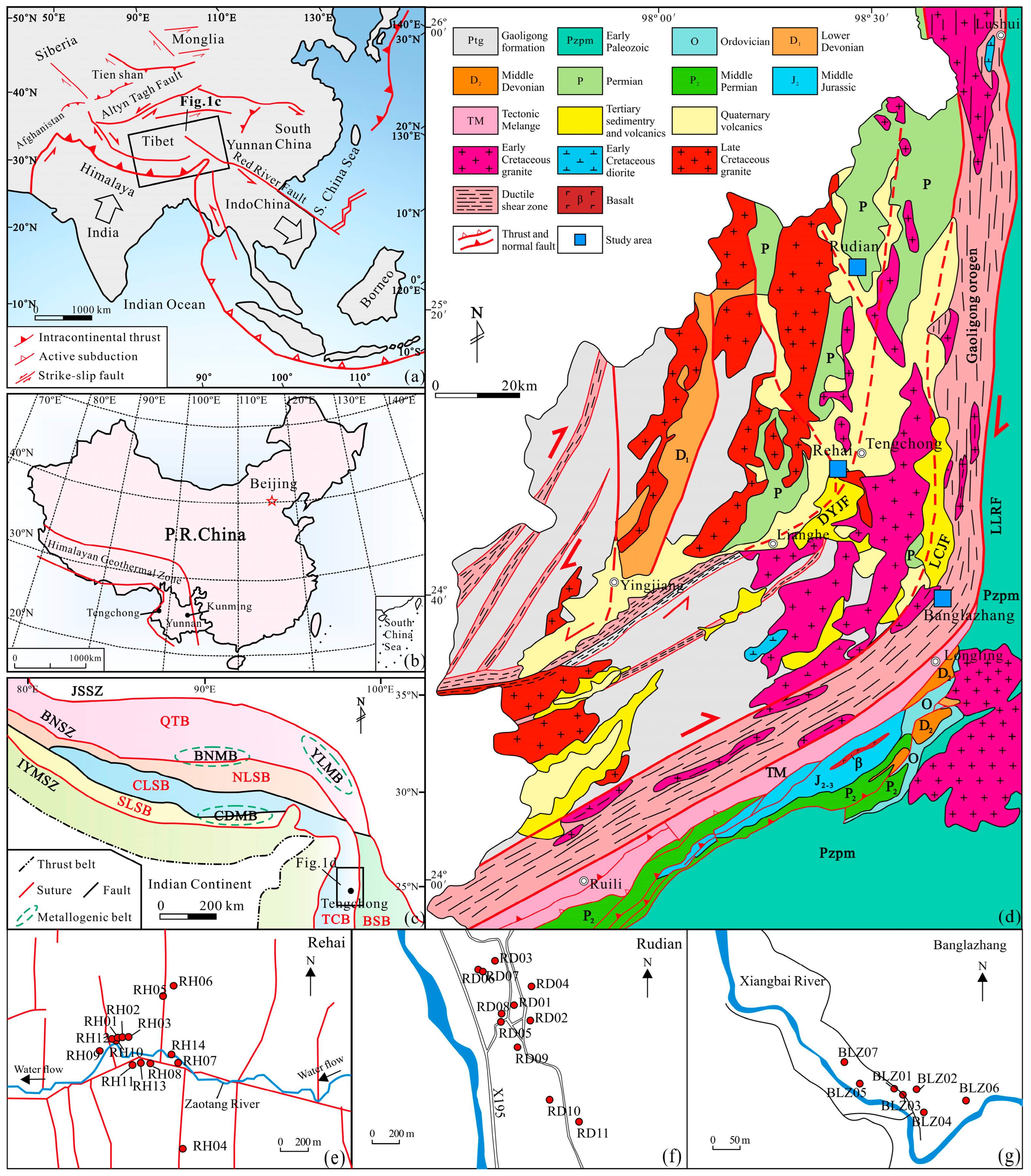
The Tengchong Block is situated at the southeastern escape margin of the India–Eurasia suture zone (Figure 1a), in the western segment of the Sanjiang Tethys Orogenic Belt. It is part of the southeastern deformation zone of the Qinghai–Tibet Plateau (Figure 1c) and has been shaped by the subduction, escape, rotation, and strike-slip movements following the closure of the Nujiang Ocean (170–100 Ma) and the Myitkyina Ocean (150–65 Ma) [67]. The internal tectonic deformation of the Tengchong Block is highly distinct: the eastern boundary is defined by the nearly N-S-trending Gaoligong strike-slip fault zone connecting it to the Baoshan–Menglian Block, and the western boundary is delineated by the N-S-trending large strike-slip fault zone. Numerous strike-slip faults are developed between these fault zones, and they predominantly trend NE and N-S [68]. The formation of the volcanic rocks, the seismic activity, and the distribution of the geothermal areas in Tengchong are closely associated with the extensive fault development in the region.
The Tengchong Block experienced frequent magmatic activity during the Mesozoic and Cenozoic, including two major magmatic events during the Yanshanian and Himalayan periods. The stratigraphic development within the region is incomplete, with some strata missing [69]. The lithology of the Tengchong Block includes high-grade metamorphic rocks, Devonian–Permian sedimentary rocks, and Mesozoic–Cenozoic volcanic rocks (Figure 1d). The Proterozoic Gaoligongshan Group metamorphic basement is considered to be the oldest stratum in the Tengchong Block and is primarily composed of gneiss, schist, marble, slate, and amphibolite [70,71].
Tengchong is part of the Himalayan geothermal region (Figure 1b), characterized by abundant hot springs associated with volcanic activity, large-scale hydrothermal activity, and intense hydrothermal alteration. Sinter deposits are commonly present near hot spring outcrops. The hydrothermal activity within the region manifests in diverse forms, including typical hot springs, high-temperature boiling springs, natural gas vents, steam escaping from the ground, and hydrothermal explosions. The Rehai geothermal field, as the largest and most active hydrothermal area in Tengchong [24], features hot springs and boiling springs as its primary manifestations, along with numerous gas vents, heat-dissipating grounds, and extensive sinter deposits. The geothermal reservoir in the region consists of metamorphic rocks of the Gaoligongshan Group and the Yanshanian granites, while the caprock is composed of Tertiary Nanlin Formation sandstone and conglomerates. N-NE-trending faults serve as critical conduits for the upward migration of geothermal fluids. Studies have confirmed the presence of an uncooled magma chamber beneath the Rehai geothermal field, which serves as the heat source for this high-temperature geothermal system [7,62,72]. Based on MT survey results, a high-conductivity body approximately 7 km deep and 20 km thick has been inferred beneath the Rehai area, and it is to be a cooling magma chamber [73]. Based on carbon isotope fractionation calculations, ref. [74] estimated that the current temperature of the Tengchong–Heshun–Rehai magma chamber is 438–773 °C, with an average of 566 °C.
Figure 1. (a) Geotectonic map of the major Cenozoic fracture zones in Asia modified from [75]. (b) Map showing the location of the Himalayan geothermal region. (c) Tectonic map of the Sanjiang Tethys orogenic belt modified from [76]. (d) Geologic map of Tengchong and location of the study area modified from [77]. (e) Location of the Rehai samples modified from [5]. (f) Location of the Ruidian samples modified from [78]. (g) Location of the Banglazhang samples modified from [5].
Energies 19 02492 g001

3. Materials and Methods

3.1. Sampling and Analysis

The sampling was conducted between April and May 2023, during which 14 water samples were collected, including 10 geothermal water samples, three surface water samples, and one cold spring water sample. To obtain more comprehensive hydrochemical data, 22 additional water sample datasets were obtained from published studies [24,57,78,79]. The sampling locations are shown in Figure 1e–g. When sampling, all water samples were filtered through 0.45 μm membranes on-site. In the field, a multiparameter water quality (HI991301, HANNA, Woonsocket, RI, USA) was used to measure the temperature, pH, electrical conductivity (EC), redox potential (Eh), and total dissolved solids (TDSs) of each water sample. The water samples were collected in 500-mL high-density polyethylene (HDPE) bottles, which were rinsed three times prior to sampling. For the samples intended for cation and trace element analysis, 2 mL of high-purity nitric acid was added to acidify the samples to a pH of <2. After sampling, the bottles were immediately sealed with parafilm.
The water sample analyses were conducted by the Groundwater and Environmental Monitoring Center of the Institute of Hydrogeology and Environmental Geology, Chinese Academy of Geological Sciences, Ministry of Natural Resources. The water chemistry and hydrogen-oxygen isotope analyses were conducted according to the Methods for Groundwater Quality Analysis. The major cations and trace elements were analyzed using an inductively coupled plasma optical emission spectrometer (Avio 550 Max, Waltham, MA, USA), and the anions were analyzed using an ion chromatograph (Metrohm 930, Herisau, Switzerland). The anion and cation balance error control was within 3%. The hydrogen and oxygen isotopes were analyzed using a water isotope analyzer (L2030i, Santa Clara, CA, USA) employing wavelength scanning-cavity ring-down spectroscopy (WS-CRDS, Santa Clara, CA, USA). The D/H and 18O/16O isotope ratios were calibrated against the Vienna Standard Mean Ocean Water (V-SMOW) international standard, and the analytical precisions for δD and δ18O were 1‰ and 0.1‰, respectively.

3.2. Analysis Methods

The magma-heat-source type geothermal system is a geothermal system strongly influenced by underground magma [24]. The magmatic fluids released from the magma chamber beneath it are a more significant factor in the geochemistry of geothermal water than the rock-water reactions within the heat reservoir. Magmatic fluids are high-temperature gases and superheated solutions that separate from magma as it rises and cools underground; they transport heat and dissolved elements. To determine whether a geothermal system is influenced by magmatic fluids, it is necessary to assess whether magmatic water has been mixed into the geothermal water; this requires first identifying the parent geothermal fluid.

3.2.1. Proportion of Magmatic Water Mixing

The proportion of the magmatic water mixed in the geothermal fluids was calculated based on the hydrogen and oxygen isotope compositions of the geothermal water, magmatic water, and atmospheric precipitation. The specific calculation formula is as follows [60]:
X a = δ d δ m δ a δ m
where Xa is the mixing ratio of magmatic water; and δd, δa, and δm are the δD or δ18O composition (‰ V-SMOW) of the geothermal water, magmatic water, and atmospheric precipitation, respectively.

3.2.2. Identification Methods for Parent Geothermal Fluids

The Cl-enthalpy model and Cl-deuterium model have been widely used to identify the presence of parent geothermal fluids and their associated processes [80,81]. These models have also been applied to estimate the temperatures of parent geothermal fluids and analyze their cooling and mixing mechanisms during ascent [19,24,82,83].
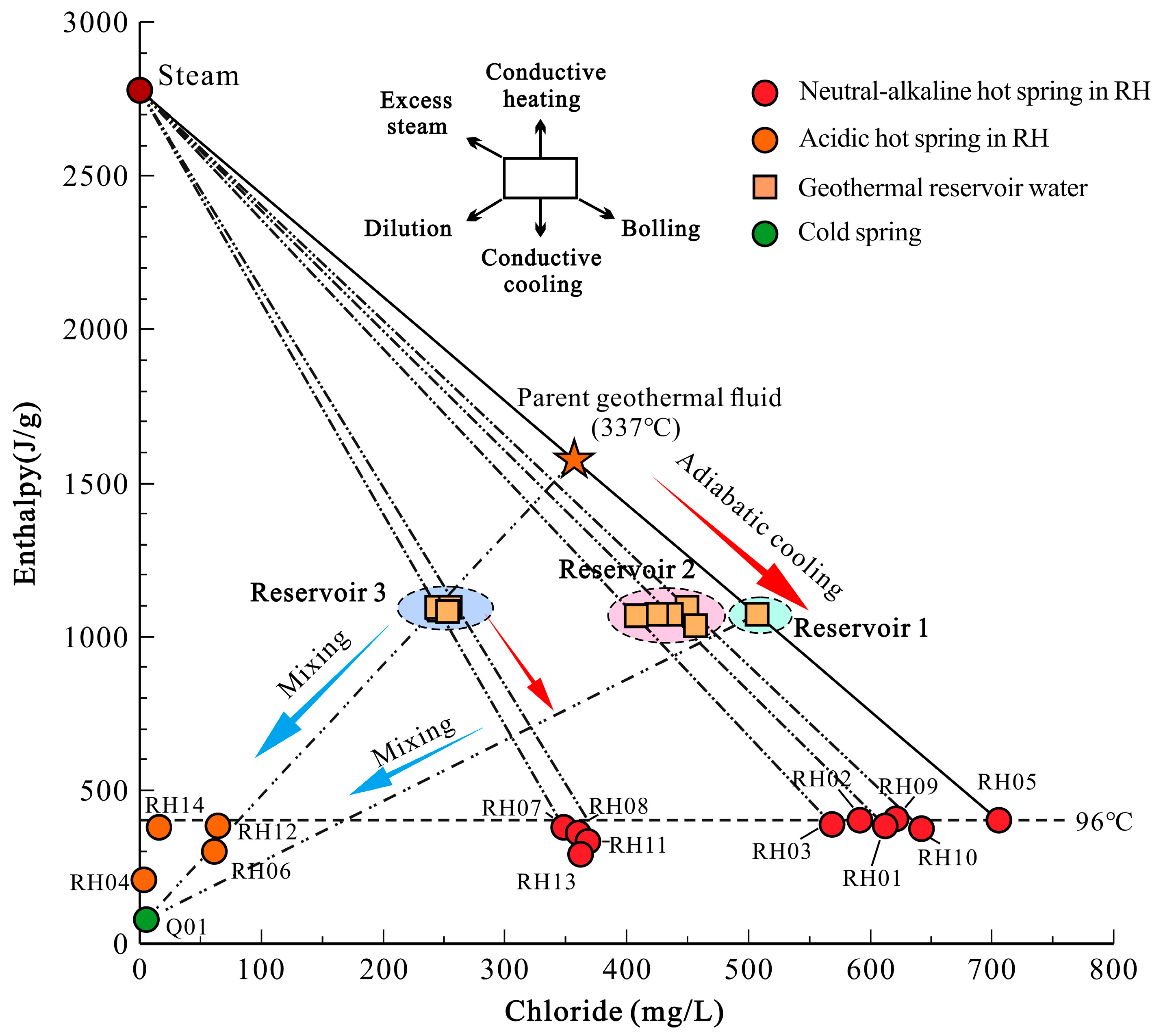
To identify parent geothermal fluids using the Cl-enthalpy model, it is first necessary to estimate the reservoir temperature. The Na-K geothermometer effectively reflects deep reservoir temperatures [24,84,85,86]. Hence, it was selected for use in this study. On the Cl-enthalpy diagram, cooling and mixing lines were plotted to interpret the cooling and mixing mechanisms of the geothermal fluids. The adiabatic cooling line was drawn by connecting the saturation vapor point (enthalpy value of 2779.4 J/g; chloride ion concentration of 0 mg/L) to the sample points, while the mixing line connected the cold water points to the sample points. The intersection of these two lines represents the parent geothermal fluid.
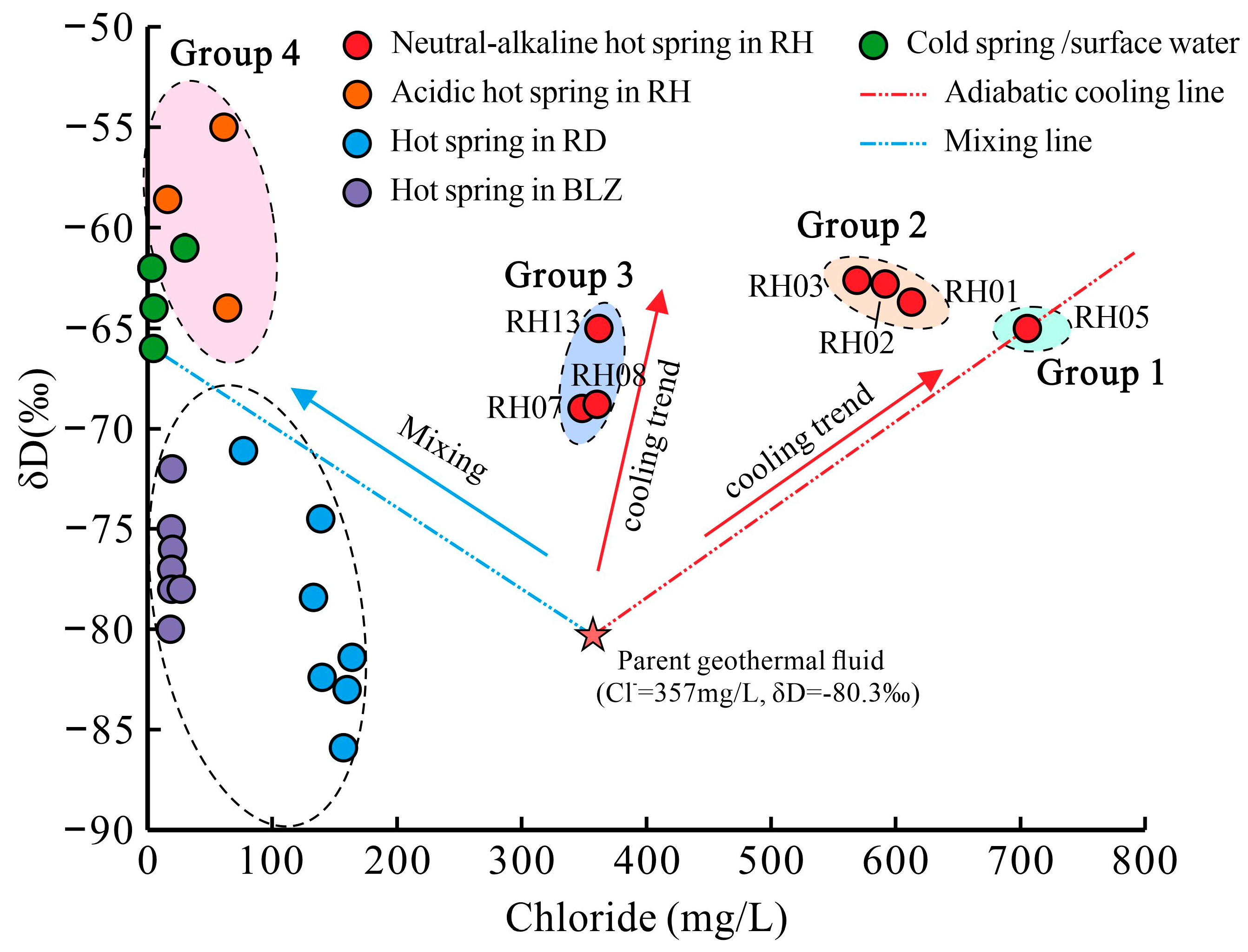
The Cl-deuterium model can be employed to study the mixing and cooling processes affecting the composition of the geothermal fluid [81]. Using this model, the isotope compositions of the parent geothermal fluids must first be calculated. For a single water–vapor separation process at a given temperature, the isotope compositions of the parent geothermal fluids can be determined [19,81]. The proportion of the vapor phase (fv) after water–vapor separation can be calculated using the following formula:
f v = H 0 H l ( H v H l )
where H0 is the initial enthalpy value of the parent geothermal fluid; and Hl and Hv are the enthalpy values of the liquid and vapor phases after water–vapor separation at a specific temperature.
Assuming rapid isotopic fractionation between the water and vapor phases during ascent after water–vapor separation, the fluid in the reservoir remains in isotopic equilibrium. Thus, the isotopic mass balance equation is as follows:
δ v f v + δ l 1 f v = δ 0
where δv and δl are the isotope δ values of the vapor and liquid phases, respectively; and δ0 is the isotope δ value of the parent geothermal fluid. The isotopic difference between the vapor and liquid phases can be approximated using the isotopic fractionation coefficient α at a specific temperature [87]:
δ l δ v = 10 3 l n α l v
δ 0 = δ l f v 10 3 l n α l v
The isotopic fractionation coefficients for hydrogen and oxygen isotopes between 0 and 374.1 °C can be calculated using the following formulas [88]:
10 3 l n α l v δ D = 1158.8 T 3 10 9 1620.1 T 2 10 6 + 794.84 T 10 3 161.04 + 2.9992 10 9 T 3
10 3 l n α l v δ 18 O = 7.685 + 6.7123 10 3 T 1.6664 10 6 T 2 + 0.35041 10 9 T 3
where T is the temperature at which isotopic fractionation occurs (K).

4. Results

4.1. Hydrochemical Characteristics

The physical properties, stable hydrogen–oxygen isotopes, and major and trace element analysis results for the water samples are presented in Table 1 and Table 2. Based on the sampling locations and pH, the geothermal water samples were categorized into four groups: (I) acidic geothermal water from Rehai (RH04, RH06, RH12, and RH14); (II) neutral to alkaline geothermal water from Rehai (RH01-RH03, RH05, RH07-RH11, and RH13); (III) alkaline geothermal water from Ruidian (RD01-RD11); and (IV) alkaline geothermal water from Banglazhang (BLZ01-BLZ07). The pH range of the acidic geothermal water from RH is 1.81–4.85, and the TDS values range from 110 to 2420 mg/L (average = 902 mg/L). The neutral to alkaline geothermal water sample from Rehai has a pH range of 7.24–9.33 and TDS values ranging from 1153 to 2502 mg/L (average = 1822.2 mg/L), and they are characterized by higher Cl and TDS levels overall. The TDS values of the neutral to alkaline geothermal water from RD and BLZ are 783–1403 mg/L and 458–767 mg/L, respectively, which are lower than those of the neutral to alkaline geothermal water from RH. The cold spring and surface water samples have a pH range of 6.68–8.67 and TDS values ranging from 99 to 204 mg/L.

4.2. Stable Isotope Composition

The δD and δ18O values of the acidic geothermal water from RH range from −64‰ to −55‰ and from −8.5‰ to −5.06‰, respectively. The δD and δ18O values of the neutral-alkaline geothermal water from RH range from −69‰ to −62.6‰ and from −9.3‰ to −7.1‰, respectively. The δD and δ18O values of the geothermal water from RD range from −85.9‰ to −71.1‰ and from −11.39‰ to −8.54‰, respectively. The δD and δ18O values of the geothermal water from BLZ range from −80‰ to −72‰ and from −11.8‰ to −9.2‰, respectively. The δD and δ18O values of the non-geothermal water range from −66‰ to −61‰ and from −9.1‰ to −8.4‰, respectively. The δD and δ18O values of the geothermal water from RH dominate among all of the types of geothermal water.

5. Discussion

5.1. Identification of Magmatic Heat Sources

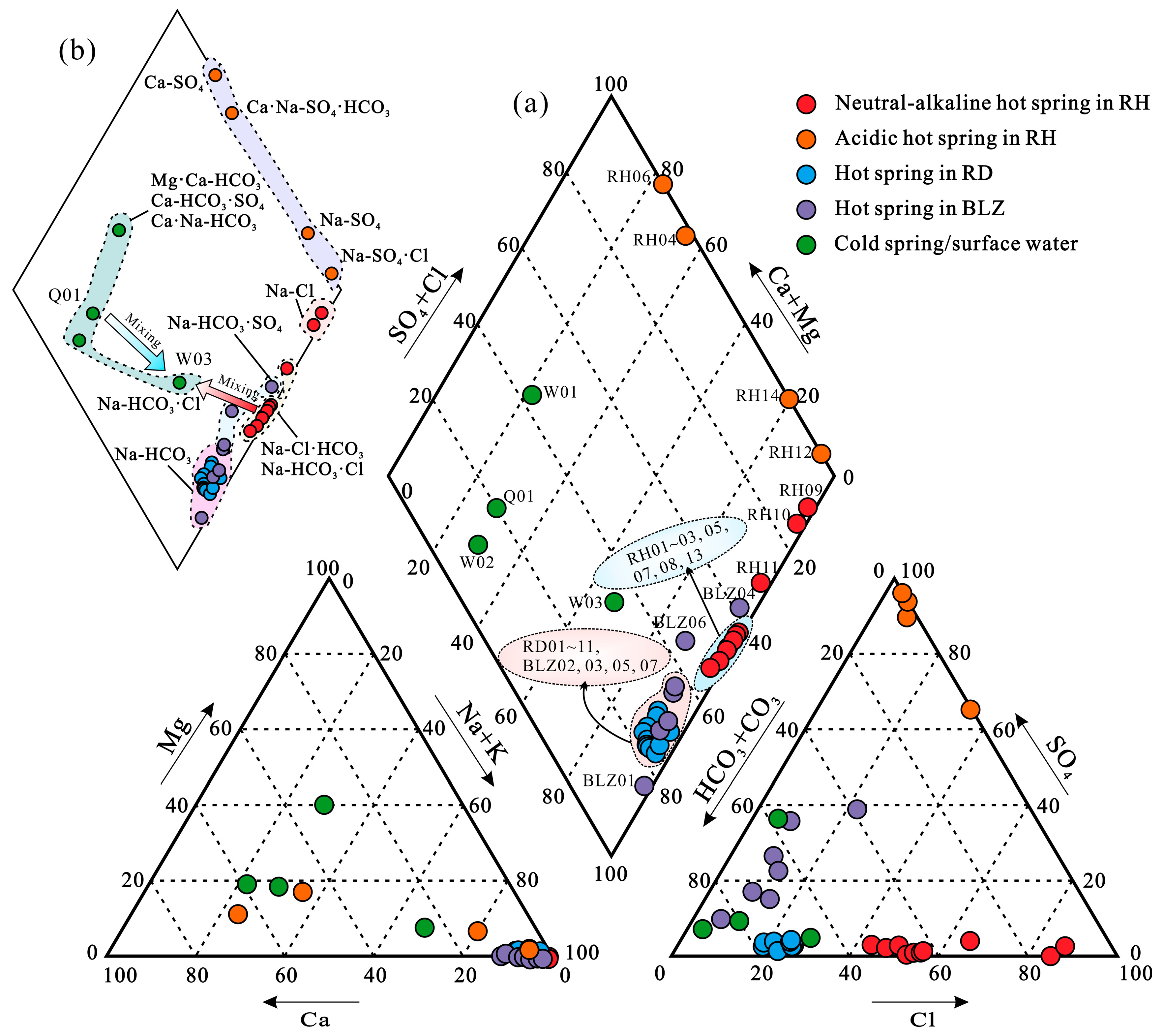
Hydrochemical analysis is an effective method for identifying the heat sources of geothermal systems. Magma-heated geothermal systems typically include three types of hot springs: (I) neutral chloride-rich thermal water, (II) acidic sulfate-rich thermal water, and (III) alkaline bicarbonate-rich thermal water [24,34,90]. Type I thermal water is considered to be derived from parent geothermal fluids that have undergone adiabatic processes. Type II water originates from acidic geothermal steam separated from the parent geothermal fluid, which ascends to shallow cold water layers. Type III water is formed during the migration of type I thermal water toward the periphery of the hydrothermal zone, where the temperature and pressure are lower and dissolved CO2 undergoes further hydrolysis, enhancing water–rock interactions. Different types of hot springs experience distinct hydrogeochemical processes. According to the Piper diagram (Figure 2), the neutral-alkaline geothermal water from RH is chloride-rich water, including Na-Cl·HCO3, Na-Cl, and Na-HCO3·Cl types. The acidic geothermal water from RH is sulfate-rich water, including Na-SO4·Cl, Na-SO4, Ca-SO4, and Ca·Na-SO4·HCO3 types. The geothermal water from RD and BLZ is bicarbonate-rich water, primarily Na-HCO3 type, as well as some Na-HCO3·SO4 type water in the BLZ geothermal field. The non-geothermal water types include Mg·Ca-HCO3, Ca-HCO3·SO4, Ca·Na-HCO3, and Na-HCO3·Cl. Notably, surface water sample W03 is Na-HCO3·Cl type water, and it has higher Na+ and Cl concentrations than the other surface water samples, indicating mixing of Na+ and Cl-rich thermal water in W03. In the three typical high-temperature geothermal fields selected in the study area, all three types of hot springs were observed, suggesting the presence of a magmatic heat source deep underground.

5.2. Identification of Magmatic Fluid Input in Geothermal Systems

5.2.1. Recharge Source Identified by δD and δ18O

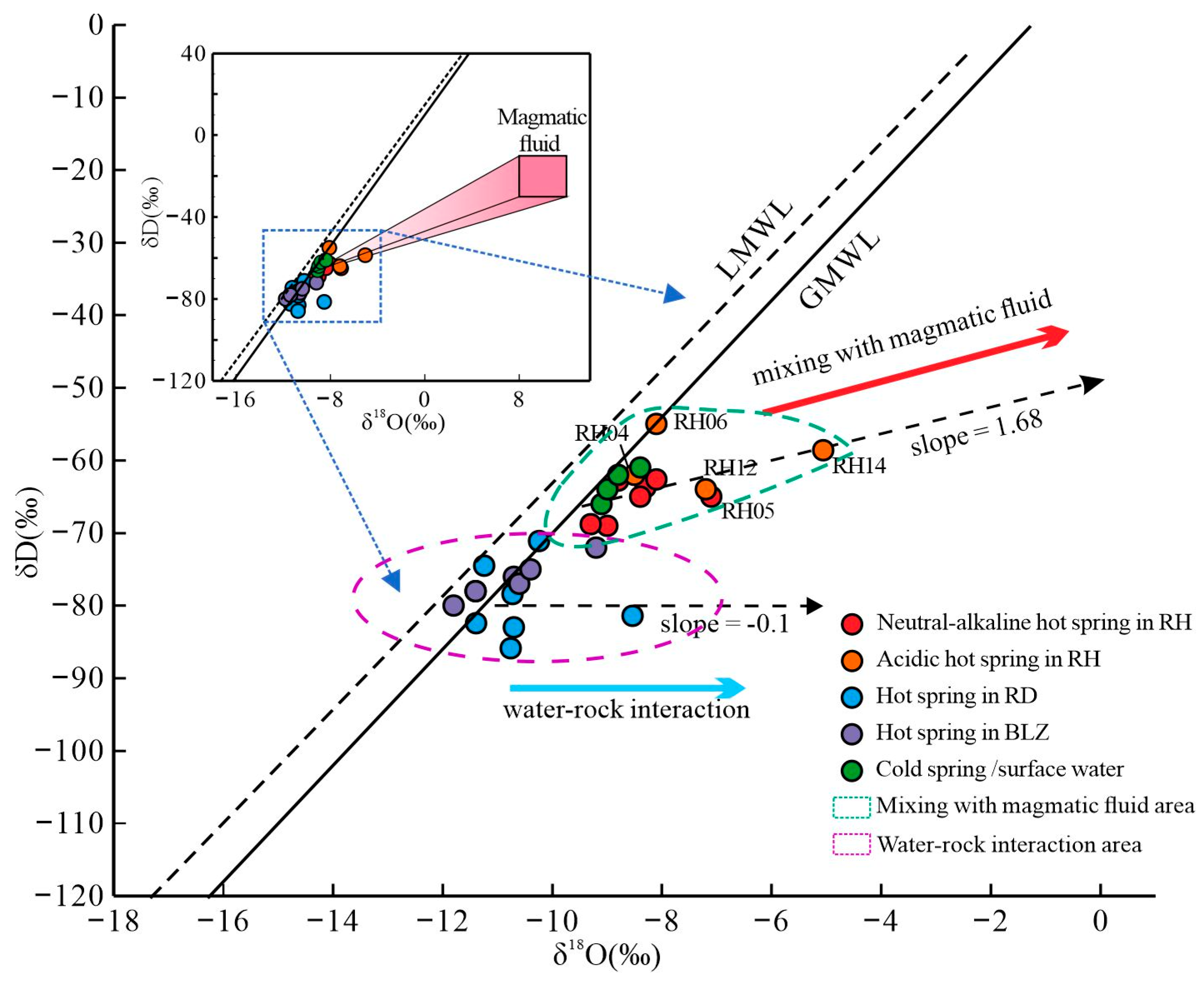
Stable hydrogen and oxygen isotopes have commonly been used as effective tracers for identifying groundwater sources, water–rock interactions, and the groundwater distribution. By determining the primary recharge sources of deep geothermal fluids, the circulation processes of the geothermal fluids can be explored [19,91,92,93]. On the δD-δ18O diagram (Figure 3), the hydrogen and oxygen isotope distributions of the water samples from the study area plot close to the global meteoric water line (GMWL: δD = 8δ18O + 10) [94] and the local meteoric water line (LMWL: δD = 7.8δ18O + 14.9) [89], indicating that precipitation infiltration is the primary recharge source of the geothermal water in the study area.
In geothermal systems with homogeneous rock composition and water-to-rock ratios, oxygen isotope shifts in deep hydrothermal fluids are primarily driven by vaporization and mixing with cold water during ascent [95]. Consequently, these shift values serve as crucial indicators for tracing hydrothermal evolution [89]. Notably, the RH samples exhibit a significant rightward δ18O shift. A linear fit of the RH geothermal water yields a slope of 1.68, characteristic of a magmatic fluid mixing line, suggesting the occurrence of deep magmatic fluid recharge [60,96]. The δD and δ18O values of the geothermal water samples from RD and BLZ are relatively low, and the degrees of the δ18O shift are less pronounced than those in the RH geothermal water, indicating a smaller contribution from magmatic fluids enriched in δ18O. The rightward δ18O shift is primarily associated with water–rock interactions under high-temperature conditions.
Analysis confirms the presence of magmatic fluid recharge in the RH geothermal water. Using Equation (1), the proportion of magmatic water mixing was calculated, and the stable hydrogen and oxygen isotope compositions of the magmatic water were determined to be δD = −20‰ and δ18O = 10‰ [60]. A local precipitation sample was collected from the Tengchong area, and its stable isotope composition was determined to be δD = −102‰ and δ18O = −14.3‰. Our calculations indicate that magmatic water contributes 21–38% to the RH geothermal water. Except for RH14 (with a mixing ratio of 38%), the contributions of the magmatic water to the other hot springs range from 21% to 30%, which are comparable to the values for high-temperature geothermal fields in southern Tibet that are influenced by magmatic fluid input (mixing ratios of 14–31%) [20].

5.2.2. Identification of Magma-Sourced Components

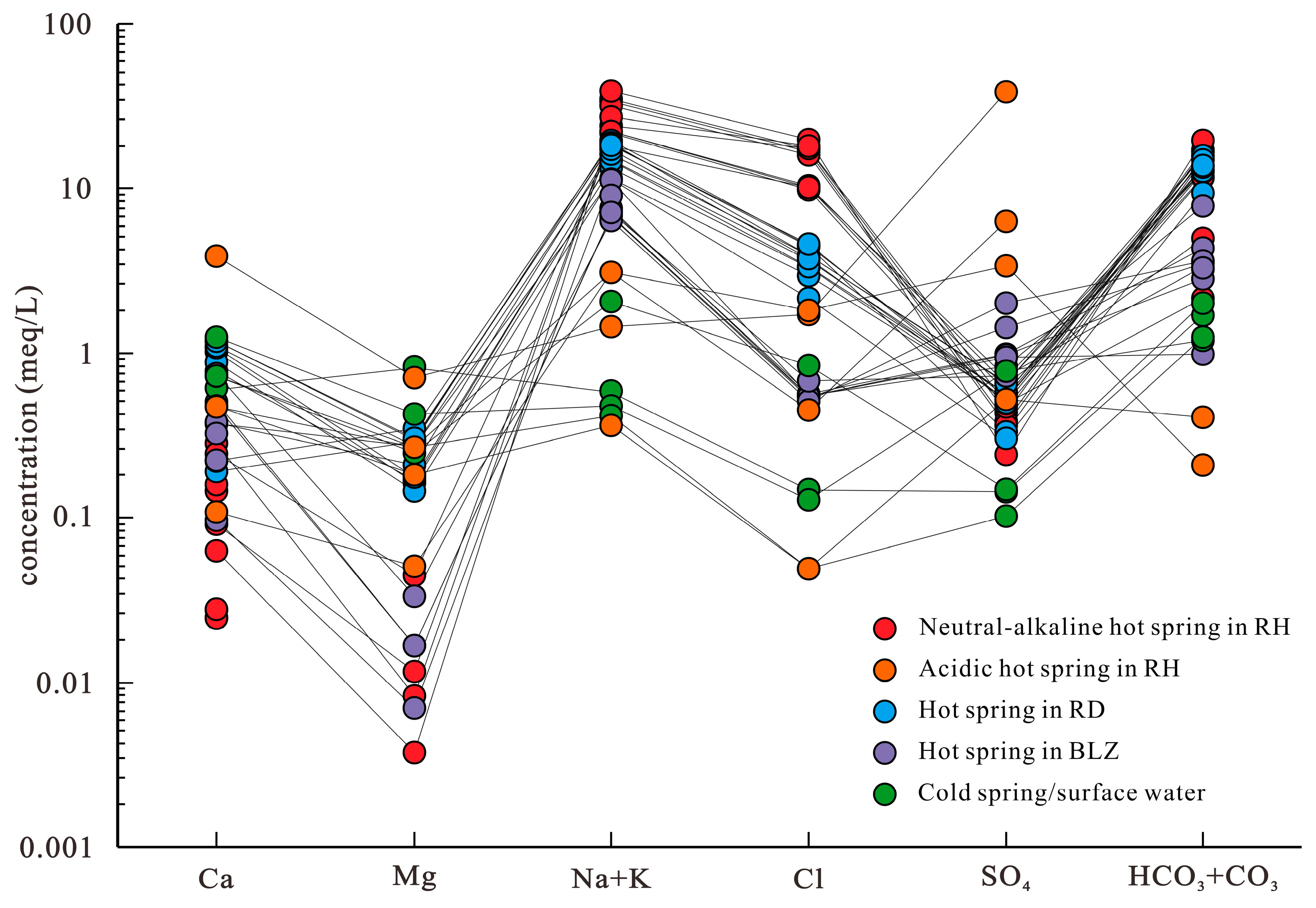
Based on the concentrations of the major ions in the water samples, a Schoeller diagram was plotted (Figure 4). For the RH neutral to alkaline geothermal waters, the predominant cation is Na+, ranging from 375 to 832.4 mg/L, while Cl has the anion with the highest concentration, ranging from 348.4 to 705.5 mg/L. The RH acidic geothermal water is enriched in Ca2+ and Mg2+, which is attributed to the significant mixing of shallow cold Ca2+-rich and Mg2+-rich water. The dominant anion is SO42−, and sample RH06 has the highest SO42− concentration, reaching 1855 mg/L. Overall, the SO42− concentrations of the acidic geothermal water are higher than those of the other types of geothermal water. The geothermal water samples from RD and BLZ exhibit similar ionic compositions, with Na+ as the dominant cation and HCO3 as the dominant anion. Figure 4 illustrates that the magmatic source-related Na+ and Cl [97] are most enriched in the RH neutral-alkaline geothermal water, while the SO42−, associated with acidic H2S geothermal steam heating [57], is most enriched in the RH acidic geothermal water. HCO3, linked to silicate weathering and dissolution, is most enriched in the RD geothermal water.
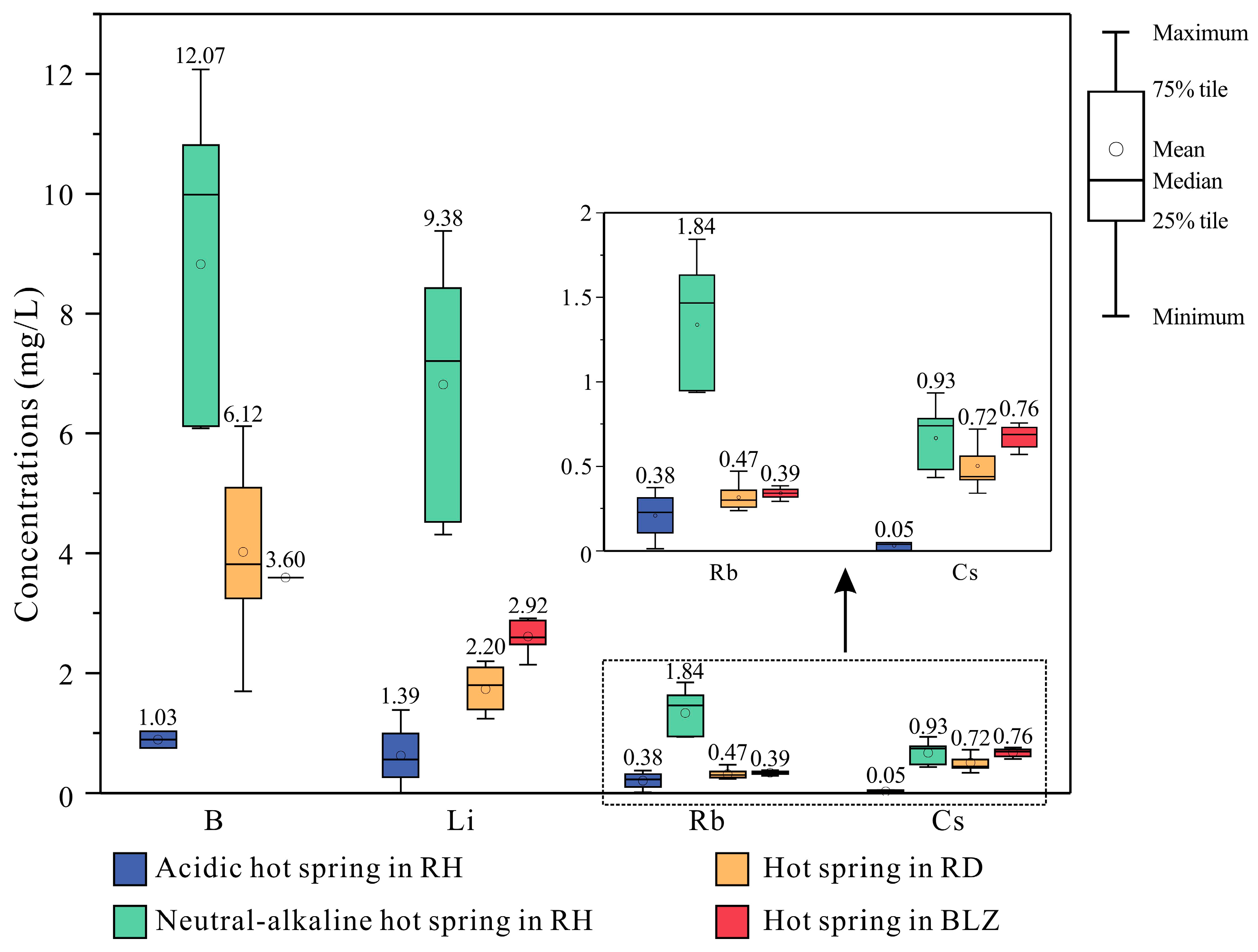
Diagnostic trace elements such as B, Li, Rb, and Cs are considered to be the typical geothermal suite, and the concentrations of these elements are primarily influenced by magmatic degassing, dissolution of host rock minerals, and mixing with cold groundwater or surface water [20,98,99]. The relationships among the B, Li, Rb, and Cs concentrations are shown in Figure 5. The RH neutral-alkaline geothermal water exhibits high concentrations of B (6.09–12.07 mg/L), Li (4.31–9.38 mg/L), Rb (0.937–1.843 mg/L), and Cs (0.435–0.932 mg/L). The elevated trace element concentrations of thermal water samples are not only related to release from host rocks but also to magmatic volatiles [19]. Due to the relatively shallow depth of the magmatic heat source in the RH geothermal field, the influence of magmatic fluid input cannot be neglected. The high B, Li, Rb, and Cs concentrations are jointly contributed by magmatic fluids and leaching of the host rocks.
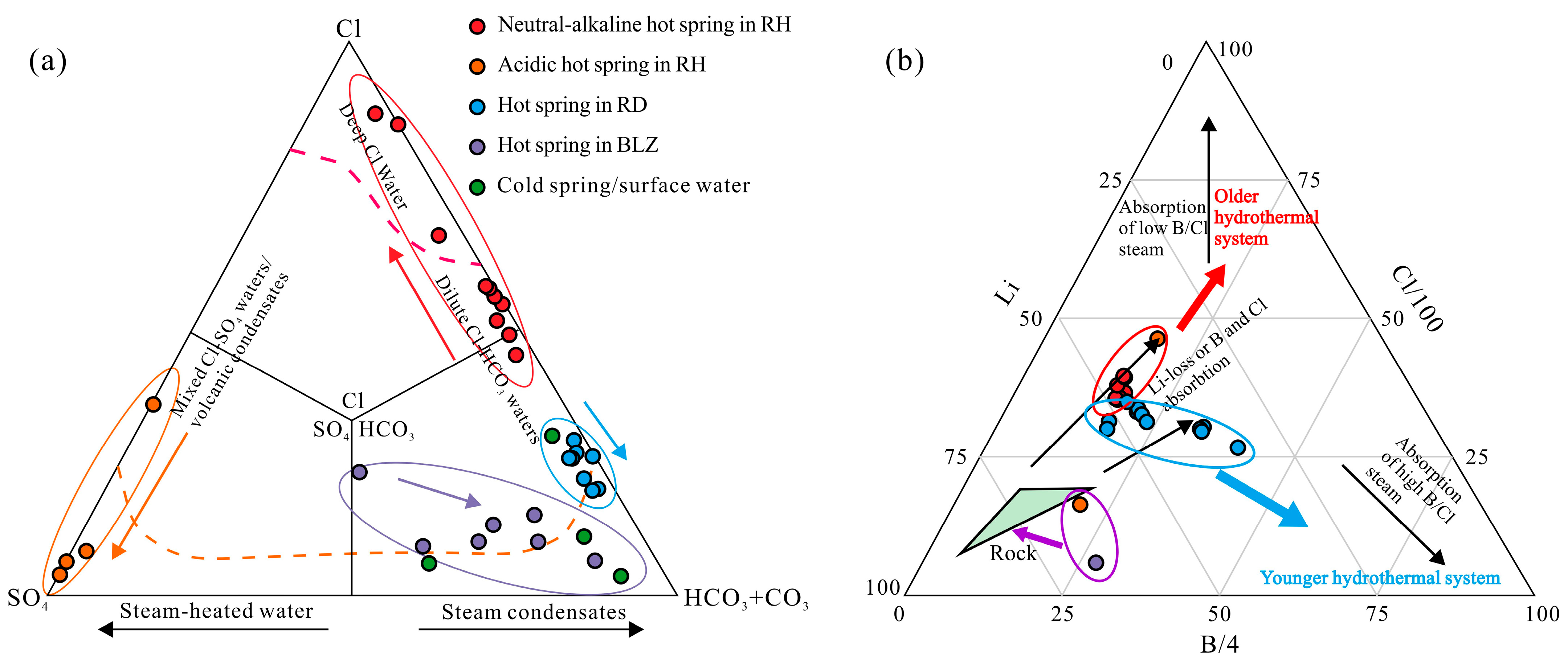
The Cl-SO4-HCO3 ternary diagram is primarily used to interpret the major geochemical processes of geothermal fluids [86]. Geothermal water is classified into deep Cl water (near the Cl vertex), peripheral circulation water (near the HCO3 vertex), and steam-heated water (near the SO4 vertex). As shown in Figure 6a, the acidic geothermal water from RH is a typical steam-heated type, characterized by very low pH values and high SO42− concentrations, which results from the dissolution of acidic gases such as H2S and SO2 released from magma. The neutral to alkaline geothermal water from RH mainly plots in the deep Cl water area and its vicinity, indicating that it is influenced by recharge from Cl-rich magmatic fluids. In contrast to the first two types, the geothermal water samples from RD and BLZ are classified as peripheral circulation water (steam-condensed water) due to their high HCO3 contents, indicating that the elements in these water samples primarily originate from leaching of the host rocks. The Cl-Li-B ternary diagram illustrates the relative Cl, Li, and B concentrations, with varying degrees of conservative behavior (Figure 6b), showing the distinct distribution patterns among the different types of geothermal water. The geothermal water from RH and RD deviates from the rock region due to the absorption of B or Cl geothermal steam. The geothermal water from RH trends toward the absorption of low B/Cl steam, suggesting that RH represents a relatively older geothermal system, whereas the geothermal water from RD corresponds to a relatively younger geothermal system. The geothermal water from BLZ and some of the acidic geothermal water samples from RH, due to limited Cl supplementation, plot near the rock region. The Cl-Li-B ternary diagram indicates that the Cl, B, and Li concentrations in the geothermal water samples are influenced by magmatic activity within the geothermal area.

5.3. Constraints of Magmatic Heat Source on Reservoir Temperature

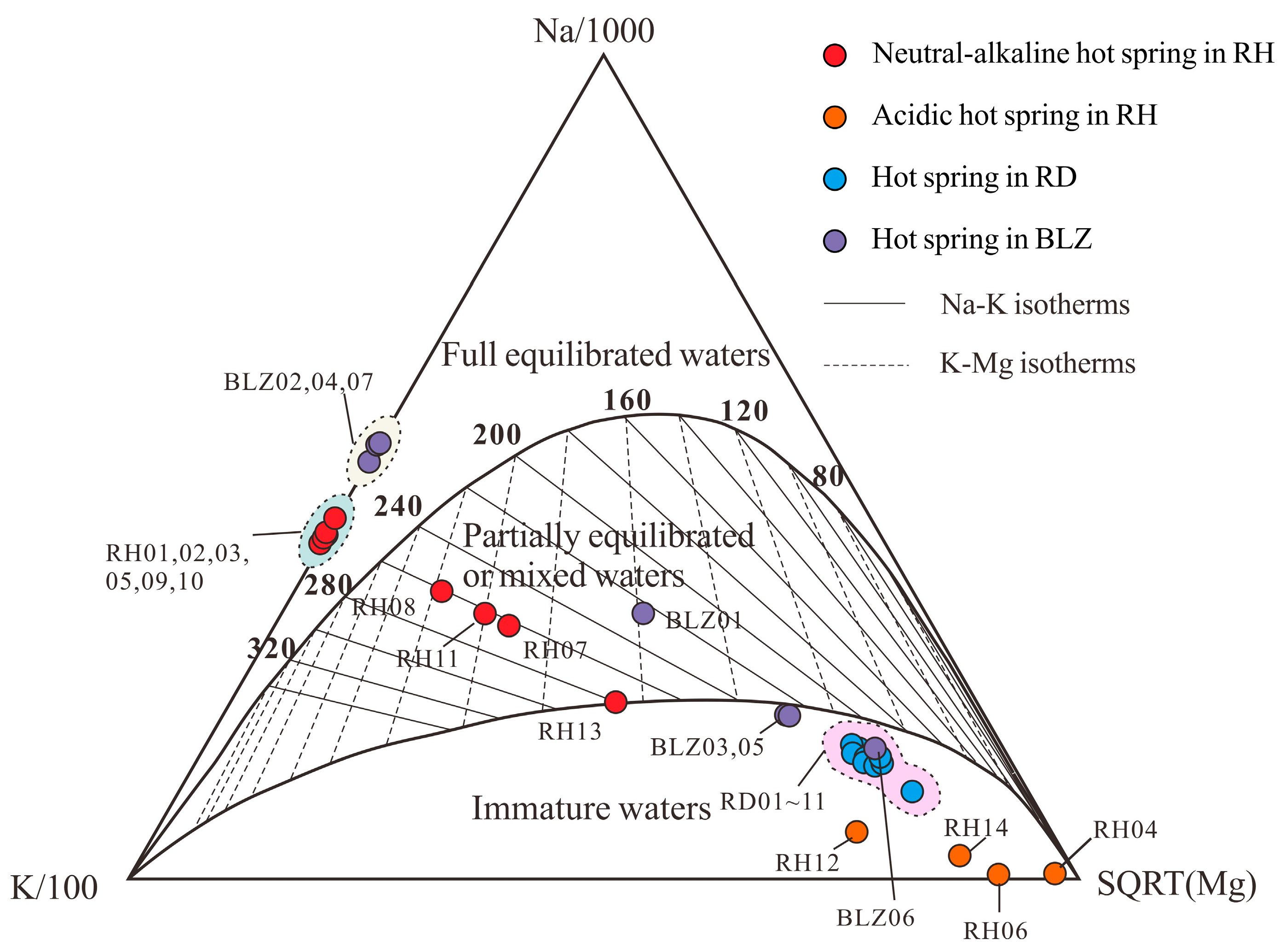
The processes of dilution, mixing, and re-equilibration of geothermal water can affect the accuracy of geothermal thermometers [101]. The Na-K-Mg ternary diagram, first introduced by [86], is a commonly used and efficient method for determining geothermal equilibrium states and the extent of water–rock interactions. As shown in Figure 7, the neutral-alkaline geothermal water from RH primarily plots within the fully equilibrated and partially equilibrated or mixed water zones, indicating a high degree of water–rock interaction. The hot springs exposed along the N-S-trending faults (RH01-RH03, RH05, RH09, and RH10) exhibit higher water–rock equilibrium levels than those exposed along the E-W-trending Zaotang River faults (RH07, RH08, RH11, and RH13), suggesting that the fault zones not only serve as water conduits but also play a crucial role in controlling the water–rock equilibrium. The acidic geothermal water from RH and the geothermal water from RD plot entirely within the immature water zone, which is associated with the mixing of shallow cold Ca-rich and Mg-rich waters, shallow circulation depths, and fast flow rates. Immature water may yield significantly overestimated or underestimated temperatures when using cation geothermometers [20].
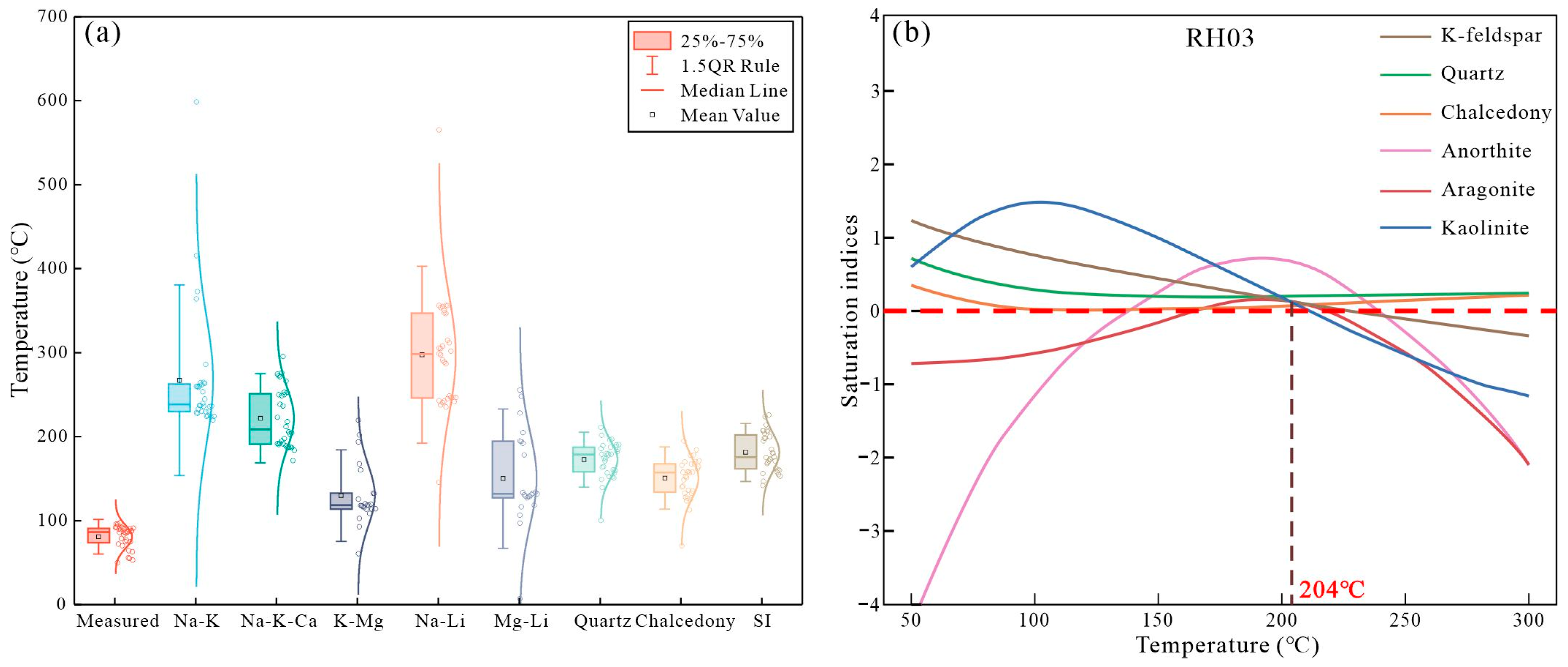
Significant differences exist in the reservoir temperature estimates based on various geothermometers (Table 3 and Figure 8a). Due to the influence of cold water mixing and SiO2 re-equilibration, the temperatures calculated using the K-Mg, Li-Mg, and SiO2 geothermometers tend to be underestimated, often reflecting the temperature of the geothermal water near the spring outlets [102]. Na+ is considered to reflect the equilibrium between alkaline feldspar and deep fluids. However, geothermal water rarely achieves re-equilibration during ascent, making the Na ion geothermometer relatively accurate for calculating the reservoir temperatures of high-temperature geothermal systems [86,103]. Since the Na-Li geothermometer provides a wide temperature range, and the Na-K geothermometer yields more accurate temperature estimates, the Na-K geothermometer is deemed to be more reliable for predicting deep reservoir temperatures. Using the Na-K geothermometer, the deep reservoir temperatures in RH (excluding the acidic springs classified as immature water), RD, and BLZ were calculated to be 254–286 °C, 224–245 °C, and 220–236 °C, respectively. According to the analysis results presented in Figure 7, the samples from RD were identified as immature water, indicating that the water in RD is formed by the mixing of deep reservoir water and infiltrating cold water. The temperature of the shallow reservoir was calculated using the quartz geothermometer [24], yielding temperatures of 139–197 °C.
Geochemical thermodynamic models have been proven to be effective in predicting reservoir temperatures [104,105,106]. Using the PHREEQC geochemical program and the phreeqc.dat thermodynamic database, multi-component mineral equilibrium temperatures were inferred for the geothermal water samples from the study area. Sodium feldspar was selected as the appropriate aluminum mineral phase to enforce dissolution-precipitation equilibrium, and the temperature calculations were set within the range of 50–300 °C, which was divided into 60 steps. As shown in Figure 8b, for water sample RH03, K-feldspar, quartz, chalcedony, aragonite, and kaolinite converge well near logQ/K = 0 at a temperature of 204 °C. The simulation results indicate that the reservoir temperatures are within the ranges of 142–226 °C (average = 199 °C) for RH, 168–185 °C (average = 175 °C) for RD, and 147–163 °C (average = 157 °C) for BLZ.
The RH geothermal field is located above the central Tengchong–Heshun–Rehai magma chamber, approximately 7 km from the deep magma chamber [73], and has the highest reservoir temperatures. The BLZ and RD geothermal fields have lower reservoir temperatures as they are situated above the edge of the magma chamber and connected to the magma chamber via faults, respectively [65], which indicates that the magma chamber beneath the geothermal fields serves as the primary heat source of these magma-heated geothermal systems, and both the distance from the magma chamber and the temperature of the magma chamber are influencing the deep reservoir temperatures.
Table 3. Equilibrium temperatures estimated using the selected chemical geothermometers.
No.Measured TemperatureNa-KNa-K-CaK-MgNa-LiMg-LiQuartz (No Loss)Quartz (Max Loss)ChalcedonySI Method
(1)(2)(3)(4)(5)(6)(7)(8)(9)
RH0192260275-305-186173166207
RH0296260272-299-179167158207
RH0392.5259272-305-164155140204
RH0450-22361146710010170142
RH0596260276-308-211193195224
RH0672-29693565107190176170156
RH0790264250194297228164155141214
RH0886262253220291256175164153207
RH09 a97.5254238-347-171161149195
RH10 a89.5265249-347-174163151206
RH11 a79263236202315248180168159226
RH12 b91.8-266125289116157149133198
RH13 b70286250168312195180168158200
RH14 c91-25310330297178167157198
RD0183229212118243133153146128175
RD02 d90228192118238131196181178168
RD03 d86233191117241129187174167169
RD04 d75237192116243127179167158171
RD05 d85237195120235129197182178173
RD06 c77230191114245129149143124173
RD07 c87240218118248131152145127185
RD08 c86.5236198119247132160152136181
RD09 c56245206109247119139135113180
RD10 c64230203120242134151144125176
RD11 c55224189114247132157149133171
BLZ0190.5225205160287205159151135163
BLZ02 a75230187-356-188174168158
BLZ03 a87236187133354194190176171160
BLZ04 a88224188-355-202186184155
BLZ05 a63236187132350192182170162160
BLZ06 a53220171114356178185172164147
BLZ07 a91224184-356-191177171153
a = data from [78]; b = data from [57]; c = data from [89]; and d = data from [24]. “-” denotes negative values. (1) T = 1390/[1.750 + lg(Na/K)] − 273.15 [86]; (2) T = 1647/[lg(Na/K) + (lg(Ca0.5/Na) + 2.06)/3 + 2.47] − 273.15 [84]; (3) T = 4410/[13.95 − lg(K2/Mg)] − 273.15 [86]; (4) T = 1590/[0.779 + lg(Na/Li)] − 273.15 [107]; (5) T = 2200/[5.47 + lg(Mg0.5/Li)] − 273.15 [108]; (6) T = 1309/[5.19 − lg(SiO2)] − 273.15 [80]; (7) T = 1522/[5.75 − lg(SiO2)] − 273.15 [80]; (8) T = 1032/[4.69 − lg(SiO2)] − 273.15 [80]; (9) SI method [104].

5.4. Identification of Parent Geothermal Fluids and Analysis of Cooling Processes

5.4.1. Chloride-Enthalpy Model

The analysis described in Section 5.2 revealed the presence of magmatic water recharge of the RH geothermal water, suggesting the likely existence of parent geothermal fluids beneath the RH geothermal field. Based on the chloride-enthalpy diagram (Figure 9), we successfully identified the presence of parent geothermal fluids, with an enthalpy value of 1575.8 J/g (337 °C, derived from the International Steam Tables [109]) and a Cl− concentration of 357 mg/L. Thus, the neutral-alkaline geothermal water in RH originates from parent geothermal fluids, while the acidic geothermal water is not derived from parent geothermal fluids and likely originates from shallow cold water that is unaffected by parent geothermal fluids.
Based on the various formation processes of hot springs, they can be categorized into three types. (1) Hot springs formed by direct adiabatic cooling of parent geothermal fluids, which then ascend to the surface through reservoir 1 (RH05). These hot springs exhibit the highest chloride ion concentrations among all three types, and their hydrochemical characteristics closely resemble those of deep geothermal fluids. (2) Hot springs formed by the mixing of parent geothermal fluids with infiltrating cold water, with a temperature of around 313 °C. The mixed geothermal fluids reach reservoir 2 (RH01, RH02, RH03, RH09, and RH10) via adiabatic cooling and subsequently ascend to the surface, and they undergo boiling during their ascent. (3) Hot springs formed by the direct mixing of parent geothermal fluids with infiltrating cold water within reservoir 3 (RH07, RH08, RH11, and RH13), which is located along the mixing line. These fluids ascend through adiabatic cooling at approximately 252 °C, and once the temperature drops to the boiling point, no further boiling occurs. They then ascend to the surface through conductive cooling. These hot springs have temperatures below the local boiling point. The hydrochemical characteristics of the hot springs are influenced by the fault activity in various directions. Reservoirs 1, 2, and 3 correspond to hot springs exposed along faults with different orientations, and while these reservoirs are relatively independent, they all originate from the same parent geothermal fluid. Notably, the acidic samples from the RH region plot above the mixing boundary. Some of the acidic hot springs approach the local boiling point but are characterized by low chloride ion concentrations and low TDS contents. These springs are formed by shallow underground cold water heated by high-temperature flash steam separated from deep geothermal fluids.

5.4.2. Chlorine-Deuterium Model

The application of the chlorine-deuterium model [81] constrains the existence of parent geothermal fluids and validates the results obtained from the chlorine-enthalpy model. Assuming that steam separation occurs in a single process at a given temperature, the hydrogen and oxygen isotope compositions of the parent geothermal fluids were calculated using Equations (2)–(7). The δD value and Cl content of the parent geothermal fluids were determined to be −80.3‰ and 357 mg/L, respectively. Figure 10 presents the chlorine-deuterium diagram, showing that the neutral-alkaline geothermal water from RH originates from the parent geothermal fluids, whereas the acidic geothermal water does not. The geothermal water samples in Groups 1, 2, and 3 in Figure 10 correspond to reservoirs 1, 2, and 3 in Figure 9. The geothermal fluid mixing and cooling processes indicated by both models are consistent. For Groups 1 and 2, the adiabatic cooling process maintains the temperature of the geothermal water, with boiling occurring and the water–rock interactions reaching complete equilibrium (Figure 7). The geothermal water samples in Group 3 primarily undergo conductive cooling, with faster temperature loss than in Groups 1 and 2, and they exhibit lower water–rock interaction levels, achieving partial equilibrium. The geothermal water samples in Group 4 are mainly influenced by cold water mixing, and the water–rock reactions do not reach equilibrium.
The geothermal water samples from the RD and BLZ plots below the cooling line have relatively low Cl concentrations, indicating minimal influence from the parent geothermal fluid. According to existing research, three magma chambers are present beneath the Tengchong volcanic area. The central magma chamber is situated only 7 km away from the RH geothermal reservoir and exhibits the highest activity [65]. RD is situated 10 km north of the northern magma chamber and is connected to it via fractures [110]. The BLZ geothermal field is located at the edge of the southern magma chamber [57]. Therefore, the geothermal water in RD and BLZ is less affected by the parent geothermal fluid. The RH geothermal field, which is located close to the magma chamber, is significantly influenced by the parent geothermal fluid, and the chemical characteristics spring water are the most similar to those of the deep parent geothermal fluid.

5.5. Release of Deep Mantle-Derived Components

In Section 5.4, the parent geothermal fluid was successfully identified. However, whether the chemical composition of the geothermal water is influenced solely by the parent fluid or also by the release of mantle-derived components requires further discussion. Since 3He primarily originates from the mantle and 4He predominantly originates from the crust, the helium isotope ratio 3He/4He is an effective tracer for identifying the origin of mantle-derived magmatic fluids, assessing their dilution by crustal materials, and monitoring short-term variations caused by volcanic activity [50,53].
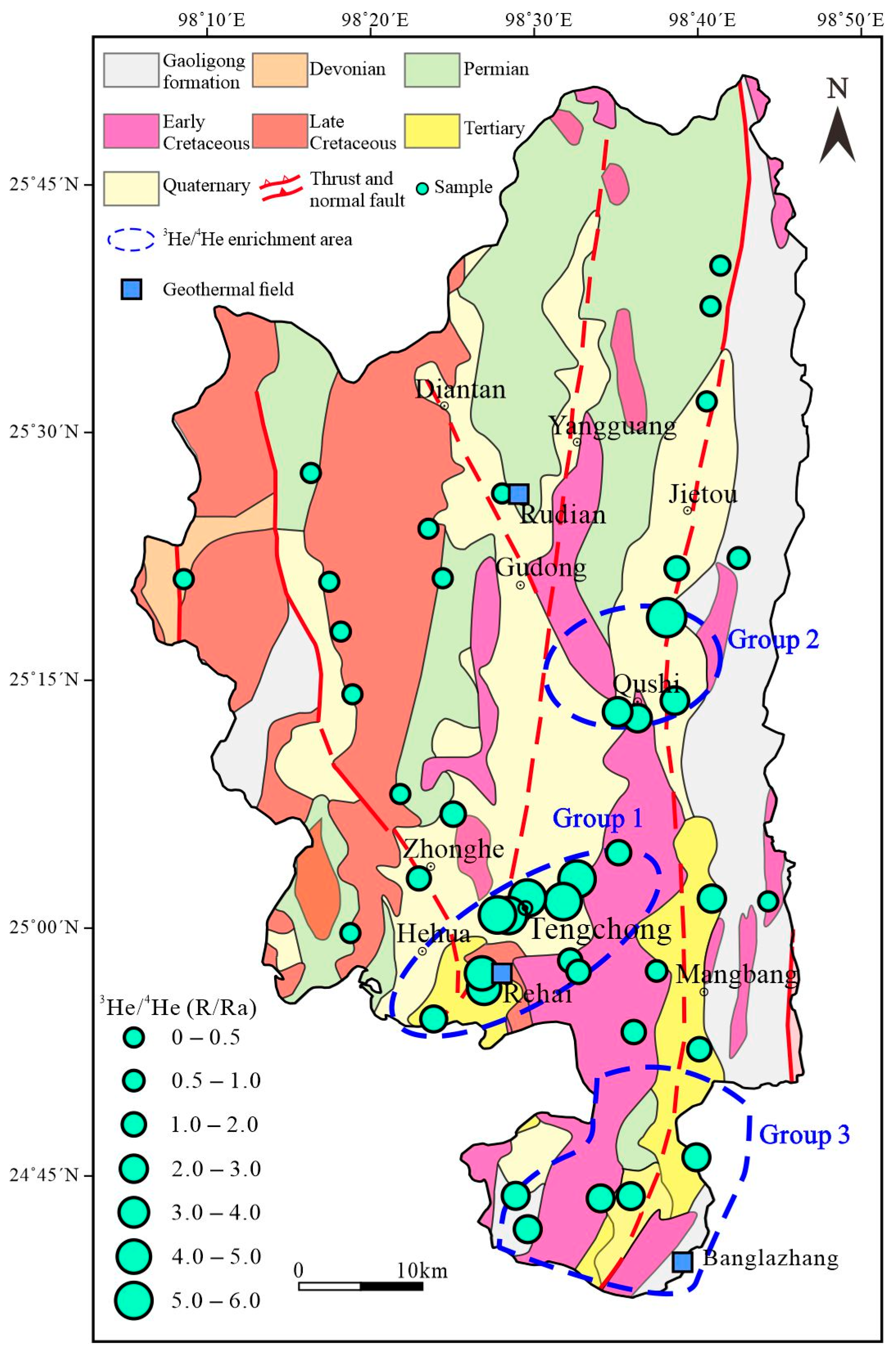
By mapping the spatial distribution of the 3He/4He ratios of the water samples from Tengchong, the present-day activity in the volcanic region, and the intensity of the release of deep mantle-derived material were investigated. As shown in Figure 11, three mantle-derived helium enrichment zones were identified in the Tengchong, primarily located in the central and southern regions. These zones are characterized by recent intense volcanic activity and significant release of mantle-derived materials. The first zone has the highest 3He/4He ratios, with a maximum value of 5.92Ra and an average value of greater than 4.5Ra. The second zone has an average ratio of 3.75Ra, and the third one has an average of 2Ra. The other regions have an average 3He/4He ratio of 0.8Ra. It is evident that the first zone has the highest proportion of mantle-derived helium and the most intense recent volcanic activity. This zone also corresponds to the distribution of the RH hot springs, where the geothermal reservoir temperature is the highest in Tengchong. The RD geothermal field is located north of the second zone and is connected to the deep magma chambers via faults, while the BLZ geothermal field lies on the periphery of the third zone and has reservoir temperatures lower than those of the RH geothermal field.
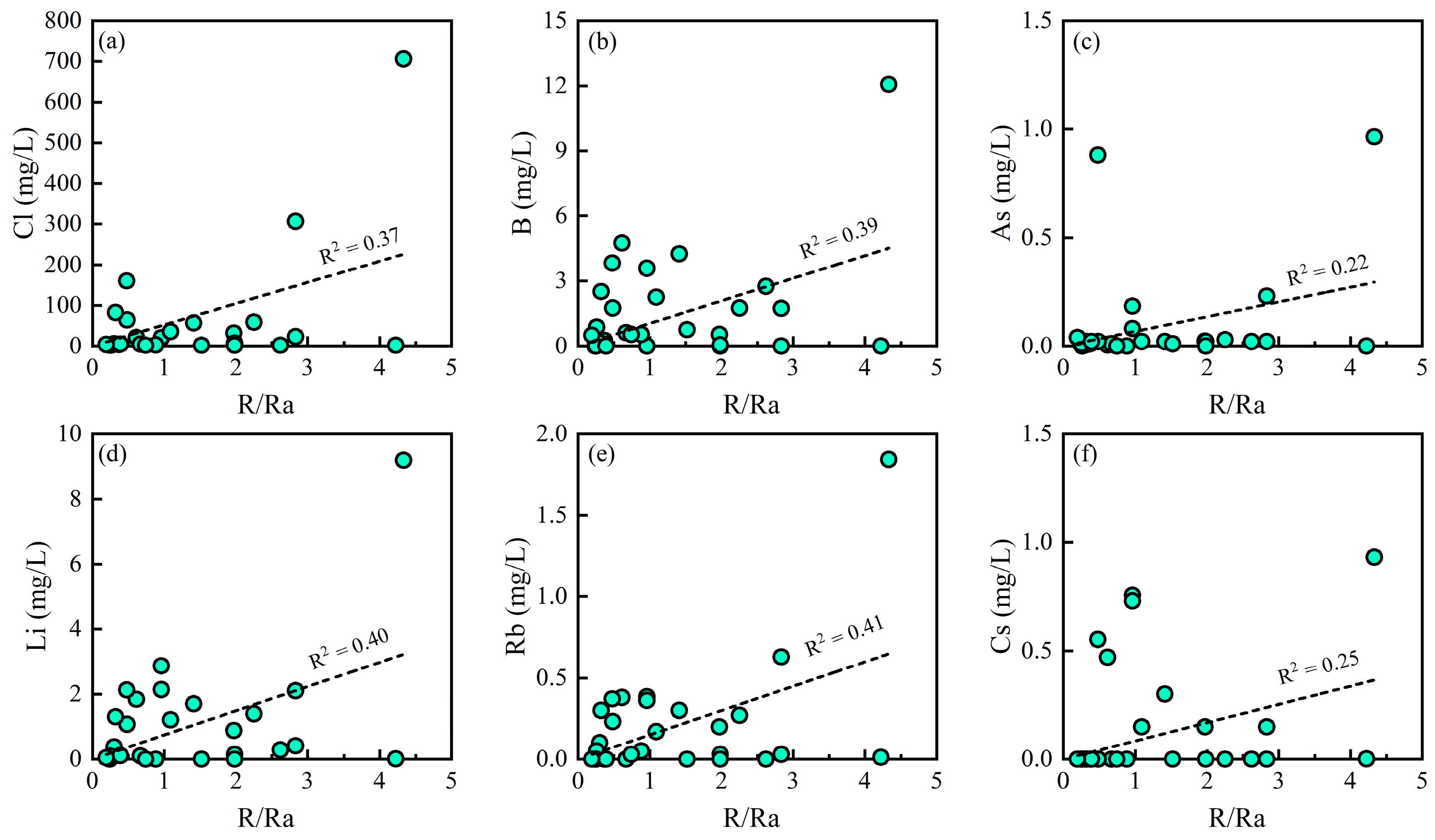
The relatively high R/Ra values in Tengchong suggest that a greater proportion of mantle-derived volatile components ascend to the surface along faults that extend to great depths. Additionally, in the geothermal systems constrained by magmatic heat sources, the high concentrations of trace elements are linked to magmatic volatiles. However, it remains uncertain whether the element compositions of the geothermal water originate from the upper mantle or entirely from the magma chambers within the crust. By analyzing the relationship between the helium isotopes and the Cl, B, As, Li, Rb, and Cs concentrations of the geothermal water (Figure 12), we found that helium isotopes and trace element concentrations are positively correlated. Among these, the correlations between the 3He/4He ratio and the Cl, B, Li, and Rb concentrations are particularly strong, suggesting that these trace elements may originate from the release of mantle-derived components.
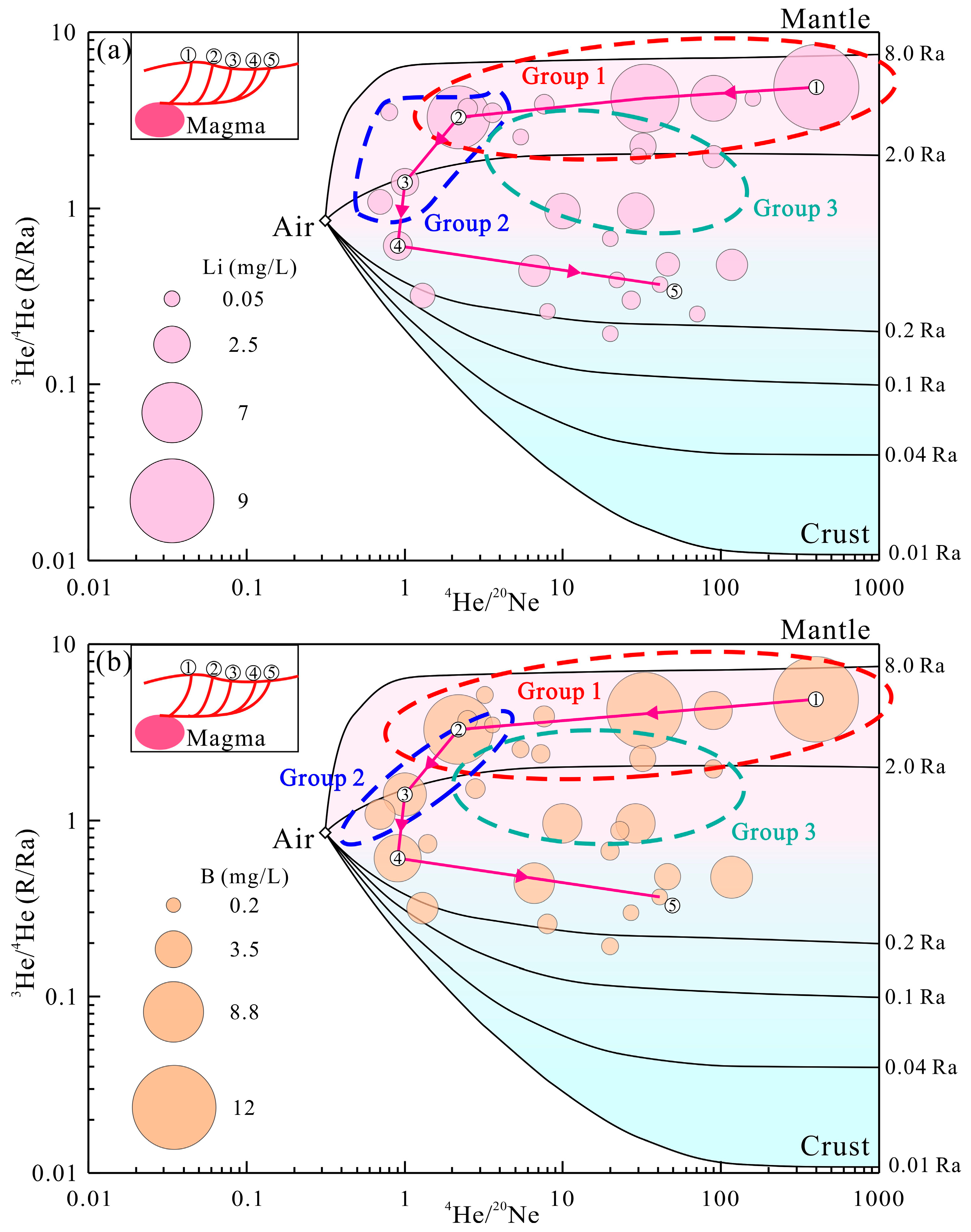
To further investigate the factors influencing the release intensity of mantle-derived components, we constructed a plot of 3He/4He versus 4He/20Ne for the gas samples (Figure 13). Given the high correlations between the 3He/4He ratios and the B and Li concentrations (Figure 12), as well as the fact that the B and Li characteristics of the geothermal water can be used to effectively identify whether the residual magmatic fluid components enter the geothermal water through magmatic degassing [5,111], the bubble size in Figure 13 represents the Li and B concentrations. As shown in Figure 13, the samples in Group 1 not only have high 3He/4He ratios but also elevated concentrations of Li and B, exhibiting positive correlations between the 3He/4He ratio and the trace element concentrations. Thus, the release of mantle-derived components is a crucial factor in the enrichment of elements in the magmatic heat-source geothermal systems. The RH geothermal field is the region with the highest trace element enrichment in the study area, likely due to the strong activity of the magma chamber associated with RH, which releases the most mantle-derived volatile components. Along the path from springs 1 to 5 (Figure 13), it is evident that, as the distance from the magma chamber increases, the concentration of mantle-derived components in the emitted gases decreases, and the Li and B concentrations also decrease. The fractures extending beneath the springs serve as conduits for the release of mantle-derived substances, transporting gases and chemical components from the mantle upward. Concurrently, the deep convection of geothermal fluids, accompanied by intense thermal convection, provides heat sources for the formation of high-temperature geothermal systems. The uplift of the upper mantle beneath the Tengchong Volcano has created a tectonic pathway for magma supply from deep sources and for magma eruptions from magma chambers. The locally ascending asthenosphere is highly molten and relatively rich in volatile elements such as chlorine, boron, and lithium, providing a source of compositions for geothermal water.

6. Patterns of Magmatic Fluid Input to Hot Springs

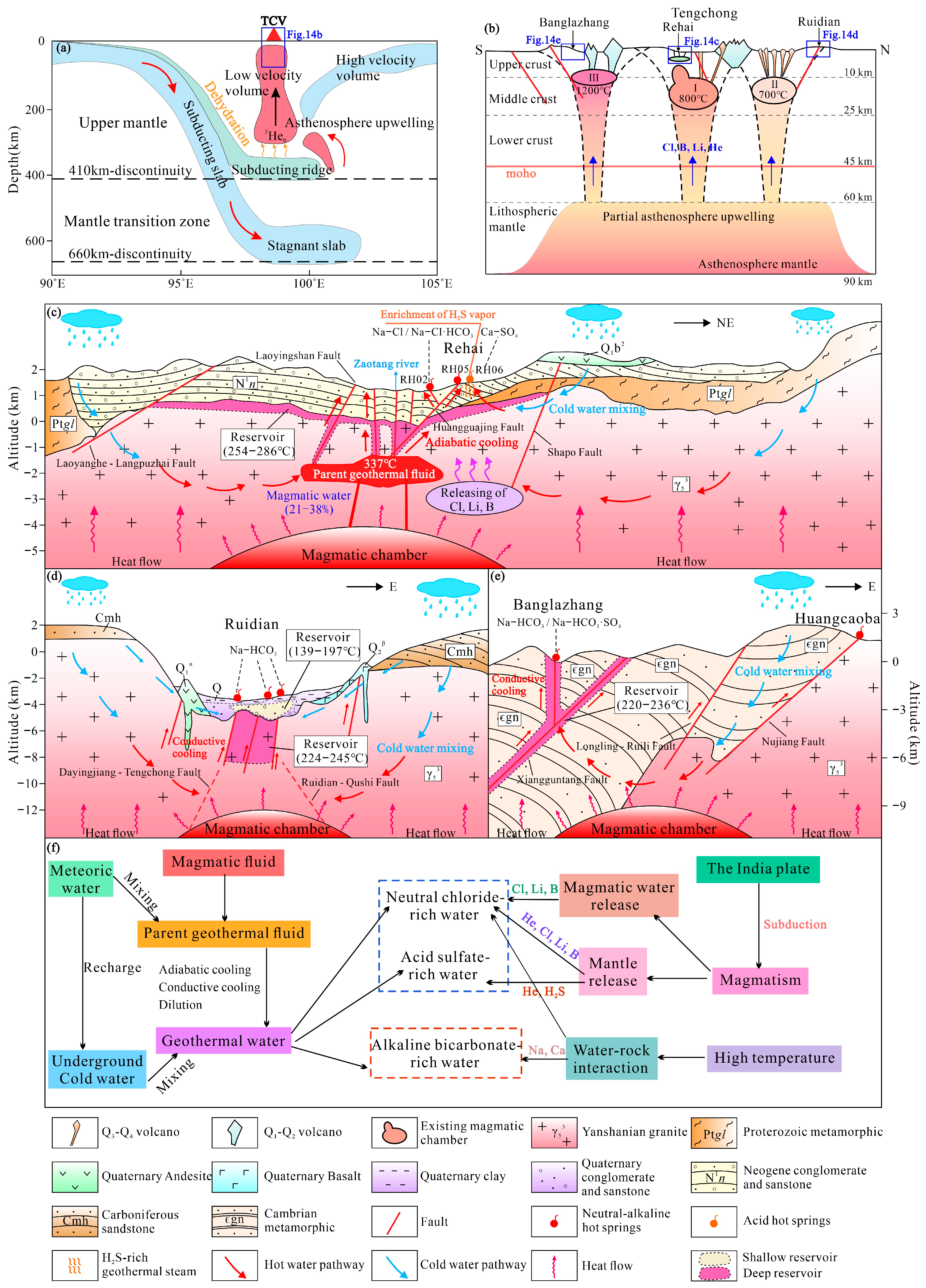
Based on the findings of this study regarding the input of magmatic fluids and the release mechanisms of mantle-derived volatiles, a genetic model for magmatic heat-source geothermal systems was established using the high-temperature geothermal fields in Tengchong as an example (Figure 14).
The Tengchong volcano originates from the deep mantle above the mantle transition zone. As illustrated in Figure 14a, the subduction of the Indian Plate penetrates the discontinuity at a depth of 410 km and extends to the mantle transition zone at a depth of 660 km. The dehydration associated with plate subduction accelerates the upwelling of high-temperature materials, altering the mantle substances that ascend along tensile fractures and erupt at the surface to form volcanoes [112]. The upwelling of hot asthenosphere materials has led to magma eruptions and the formation of three crustal magma chambers at depths of 5–25 km [65], which provide localized high-temperature heat sources for the geothermal systems and continuously release substances such as Cl, B, and Li into the geothermal systems (Figure 14b). Influenced by the magmatic heat sources, several typical high-temperature geothermal fields have formed in the Tengchong area, including the Rehai geothermal field (Figure 14c), the Ruidian geothermal field (Figure 14d), and the Banglazhang geothermal field (Figure 14e). Although these high-temperature geothermal fields shared certain intrinsic connections during their formation, their geochemical characteristics exhibit some differences.
The primary recharge sources of the RH geothermal water are precipitation and magmatic fluids. Precipitation from the surrounding mountains (metamorphic rock zones of the Gaoligong Mountain range) infiltrates deeply through a series of N-S-, N-W-, and N-E-trending faults and circulates along the major faults. During deep circulation, the water primarily absorbs heat from the magma chambers within the crust. The magmatic fluid component in the geothermal water originates from parent geothermal fluids, which have temperatures of up to 337 °C. As the parent geothermal fluids ascend, they undergo adiabatic cooling due to the decreasing temperature and pressure of the surrounding environment and are further cooled by the infiltration of shallow cold water, forming geothermal reservoirs with temperatures ranging from 254 to 286 °C. The mid-alkaline geothermal water in RH, influenced by deeper magmatic fluids, exhibits high concentrations of ions such as Cl, Li, and B ions. Under high-temperature conditions, intense water–rock interactions occur between the geothermal water and surrounding rocks, leading to rapid increases in the concentrations of Na, K, SiO2, and certain trace elements such as B, Li, Rb, and Cs. Ultimately forming Cl-rich geothermal water, which is dominated by Na-Cl·HCO3 and Na-Cl type water. The acidic geothermal water in RH is replenished by significant amounts of shallow cold water, and its heat source primarily consists of deep geothermal steam rich in H2S. The dissolved H2S in the geothermal water provides SO4, and the ionization of the H2S in the water releases protons, rendering the geothermal water acidic. This ultimately results in sulfate-type geothermal water, such as the Ca-SO4 type.
The RD geothermal water is primarily recharged by precipitation infiltrating from the mountainous regions on the eastern and western sides. Under the influence of gravity, the precipitation circulates along geothermal water channels composed of faults. During circulation, the weathered granite zone absorbs volatile components and high-temperature heat released from the magma chambers, forming geothermal reservoirs. Due to the greater distance of the RD geothermal activity area from the magma chambers, the heat supply to this area is lower than that to the RH and BLZ areas, resulting in deep reservoir temperatures ranging from 224 to 245 °C, which are lower than those of the RH geothermal field. Influenced by magmatic volatile components and water–rock interactions, the geothermal water becomes enriched in Li and B. Driven by density differences, the deep geothermal water migrates upward, bypasses the low-permeability layers, and recharges the shallow gravel aquifers, forming shallow geothermal reservoirs. These shallow reservoirs are further influenced by lateral cold water recharge and conductive cooling processes, ultimately forming Na-HCO3 type geothermal water.
The geothermal water in BLZ is replenished by precipitation from the mountainous region on the eastern side. The infiltrating cold water undergoes dissolution and filtration as it circulates through the Yanshanian granite and the Cambrian metamorphic rocks. Due to the area’s history of multiple large-scale fractures, these fractures cut deeply, providing excellent conduits for the downward infiltration of shallow cold water and the upward migration of hot water. Cold water enters the aquifer and accumulates in large-scale water-conducting fracture zones, absorbing heat from the magma chambers to form thermal reservoirs with temperatures of 220–236 °C. During its circulation, the geothermal water undergoes intense water–rock interactions with the surrounding rocks, eventually ascending to the surface and forming hot springs, which are primarily characterized by Na-HCO3 and Na-HCO3·SO4 type water.
Figure 14. (a) Conceptual model of the subduction of the Indian Plate modified from [113]. TVC: Tengchong volcano. (b) Schematic diagram of the current distribution of the magma chambers and their formation mechanisms in the Tengchong volcanic region [66]. (c) Conceptual model of the genesis of the geothermal system in the Rehai geothermal field, modified from [114]. (d) Conceptual model of the genesis of the geothermal system in the Ruidian geothermal field, modified from [110]. (e) Conceptual model diagram of the genesis of the geothermal system in the Banglazhang geothermal field, modified from [115]. (f) Theoretical framework for the genesis mechanism of the Tengchong geothermal system, constrained by magmatic heat sources.
Energies 19 02492 g014
In summary, the presence of magmatic heat sources constrains the formation of the high-temperature geothermal systems in Tengchong (Figure 14f). The magma chambers not only act as heat sources but also transport chemical substances into the geothermal systems. The subduction of the Indian Plate triggered magmatism, during which magmatic water replenishes the geothermal water, and mantle-derived volatile substances are released into the geothermal systems, contributing to the chemical composition of the geothermal water. Additionally, under the high-temperature conditions, the geothermal water undergoes intense water–rock interactions with the surrounding rocks, which is another source of the chemical composition of the geothermal water. The three key factors, namely, magmatic water replenishment, the release of mantle-derived component, and water–rock interactions, are crucial contributors to the composition of the geothermal water. The geothermal water originates from the mixing of precipitation and magmatic fluids, and it undergoes various cooling processes during its ascent before reaching the surface. The Tengchong area contains three types of geothermal water: neutral chloride-rich geothermal water, acidic sulfate-rich geothermal water, and alkaline bicarbonate-rich geothermal water. The coexistence of these three types of geothermal water further demonstrates that the geothermal system is constrained by magmatic heat sources.

7. Conclusions and Outlooks

7.1. Conclusions

In this study, we conducted a systematic hydrogeochemical analysis of geothermal fluids in a magma-heated geothermal system. Our focus was on examining the differences among various hot springs, identifying the input processes of magmatic fluids, and determining the presence of parent geothermal fluids. From the perspective of mantle sources, we analyzed the processes of element enrichment of the geothermal water. Based on the geochemical analysis results, we propose that the hydrochemical types of magma-heated geothermal systems can be classified into three categories: neutral chloride-rich thermal water, acidic sulfate-rich thermal water, and alkaline bicarbonate-rich thermal water. Neutral chloride-rich thermal water is primarily influenced by the mixing of Cl-rich magmatic water, acidic sulfate-rich thermal water is mainly formed via heating by deep geothermal steam, and alkaline bicarbonate-rich thermal water results from water–rock interactions combined with the mixing of shallow cold water. The primary recharge source for the hot springs is precipitation, accompanied by the input of magmatic fluids, and the input proportion ranges from 21% to 38%. The trace element enrichment (B, Li, Rb, and Cs) of the hot springs is jointly controlled by the input of magmatic fluids and leaching of the host rocks. The magma chamber beneath the geothermal fields serves as the main heat source for the geothermal systems, and both the distance of the heat reservoir from the magma chamber and the temperature of the magma chamber influence the temperatures of the heat reservoirs. A Cl-enthalpy model was used to identify the parent geothermal fluid (337 °C), which ascends to the surface through adiabatic, mixing, and conductive cooling processes, confirming the critical role of magmatic fluids in the deep circulation. The release of mantle-derived materials is a key factor in the element enrichment of the magma-heated geothermal systems, and the mantle-derived components are more enriched in regions with high magma chamber activity. In this study, we elucidated the pivotal role of magmatic fluids in deep geothermal circulation, quantitatively analyzed the mixing proportion of magmatic water in magmatic heat-source geothermal systems, and thoroughly investigated the sources of the components. Our findings have significant scientific implications for the development and utilization of magmatic heat-source geothermal resources.

7.2. Outlooks

This study investigates the genesis model of the Tengchong magmatic heat source geothermal system from the perspectives of hydrochemistry and isotopics and summarizes the genesis model of this type of geothermal system based on three aspects: magmatic water recharge, high-temperature water-rock interactions, and the release of mantle-derived components. However, research on the quantitative contributions of these various sources to the multiple elements in geothermal fluids remains insufficient, which represents a direction for future research.

Author Contributions

Conceptualization, Z.Z.; Formal analysis, Z.Z.; Investigation, Z.Z., W.Z., G.W., S.W., F.L., Y.L. and L.L.; Data curation, Z.Z.; Writing—original draft, Z.Z.; Writing—review & editing, W.Z., G.W. and H.Z.; Visualization, Z.Z.; Supervision, W.Z. and G.W.; Funding acquisition, W.Z. All authors have read and agreed to the published version of the manuscript.

Funding

This study was funded by (1) The National Key Research and Development Program of China (No. 2021YFB1507401); (2) The project of Basic Research Fees of Chinese Academy of Geological Sciences (No. SK202302); (3) The project of Xiamen Natural Science Foundation (No. 3502Z202372111); and (4) Basic Research Fees of the Institute of Hydrogeology and Environmental Geology, Chinese Academy of Geological Sciences (No. SK202212).

Data Availability Statement

The original contributions presented in this study are included in the article. Further inquiries can be directed to the corresponding author.

Conflicts of Interest

The authors declare no conflict of interest.

References

  1. Barbier, E. Geothermal Energy Technology and Current Status: An Overview. Renew. Sustain. Energy Rev. 2002, 6, 3–65. [Google Scholar] [CrossRef]
  2. Ellabban, O.; Abu-Rub, H.; Blaabjerg, F. Renewable Energy Resources: Current Status, Future Prospects and Their Enabling Technology. Renew. Sustain. Energy Rev. 2014, 39, 748–764. [Google Scholar] [CrossRef]
  3. Østergaard, P.A.; Duic, N.; Noorollahi, Y.; Mikulcic, H.; Kalogirou, S. Sustainable Development Using Renewable Energy Technology. Renew. Energy 2020, 146, 2430–2437. [Google Scholar] [CrossRef]
  4. Ármannsson, H. The Fluid Geochemistry of Icelandic High Temperature Geothermal Areas. Appl. Geochem. 2016, 66, 14–64. [Google Scholar] [CrossRef]
  5. Wang, M.; Zhang, H.; Liang, L.; Zhu, Z.; Zhang, A. Constraining the Properties of the Heat Sources of High-Temperature Hydrogeothermal Systems: Evidence from the Lithium Concentrations of Geothermal Waters. J. Hydrol. 2024, 640, 131696. [Google Scholar] [CrossRef]
  6. Li, Y.; Guan, H.; Pan, S.; Zhao, P.; Zhao, X.; Zhao, H.; Nan, D.; Dawa, P.; Liu, X.; Dor, J. Discovery and Genesis of High-Temperature Geothermal Energy Adjacent to the South Tibetan Detachment System, Central Himalaya. Renew. Energy 2025, 238, 121911. [Google Scholar] [CrossRef]
  7. Liao, Z.; Zhao, P. Geothermal Zones in Yunnan and Tibet; Science Press: Beijing, China, 1999. (In Chinese) [Google Scholar]
  8. Hochstein, M.P.; Regenauer-Lieb, K. Heat Generation Associated with Collision of Two Plates: The Himalayan Geothermal Belt. J. Volcanol. Geotherm. Res. 1998, 83, 75–92. [Google Scholar] [CrossRef]
  9. Li, J.; Yang, G.; Sagoe, G.; Li, Y. Major Hydrogeochemical Processes Controlling the Composition of Geothermal Waters in the Kangding Geothermal Field, Western Sichuan Province. Geothermics 2018, 75, 154–163. [Google Scholar] [CrossRef]
  10. Han, C.; Fan, Q.; Xiao, Y.; Li, Q.; Yang, H.; Chen, T.; Zhao, W.; Wang, S. B–Li Differential Enrichment of Geothermal Systems in the Da Qaidam and Gonghe–Guide Basin, Northeastern Tibetan Plateau: Evidence from Water Chemistry and H–O–B–Li Isotopes. Sci. Total Environ. 2024, 955, 176868. [Google Scholar] [CrossRef]
  11. Giggenbach, W.F. Variations in the Carbon, Sulfur and Chlorine Contents of Volcanic Gas Discharges from White Island, New Zealand. Bull. Volcanol. 1975, 39, 15–27. [Google Scholar] [CrossRef]
  12. Gherardi, F.; Panichi, C.; Yock, A.; Gerardo-Abaya, J. Geochemistry of the Surface and Deep Fluids of the Miravalles Volcano Geothermal System (Costa Rica). Geothermics 2002, 31, 91–128. [Google Scholar] [CrossRef]
  13. Lowenstern, J.B.; Bergfeld, D.; Evans, W.C.; Hunt, A.G. Origins of Geothermal Gases at Yellowstone. J. Volcanol. Geotherm. Res. 2015, 302, 87–101. [Google Scholar] [CrossRef]
  14. Guo, Q. Definition of magma-impacted geothermal system. Acta Geol. Sin. 2022, 96, 208–214. (In Chinese) [Google Scholar] [CrossRef]
  15. Caracausi, A.; Ditta, M.; Italiano, F.; Longo, M.; Nuccio, P.M.; Paonita, A.; Rizzo, A. Changes in Fluid Geochemistry and Physico-Chemical Conditions of Geothermal Systems Caused by Magmatic Input: The Recent Abrupt Outgassing off the Island of Panarea (Aeolian Islands, Italy). Geochim. Cosmochim. Acta 2005, 69, 3045–3059. [Google Scholar] [CrossRef]
  16. Guo, Q. Hydrogeochemistry of High-Temperature Geothermal Systems in China: A Review. Appl. Geochem. 2012, 27, 1887–1898. [Google Scholar] [CrossRef]
  17. Scott, S.; Driesner, T.; Weis, P. Geologic Controls on Supercritical Geothermal Resources above Magmatic Intrusions. Nat. Commun. 2015, 6, 7837. [Google Scholar] [CrossRef]
  18. Kalacheva, E.G.; Taran, Y.A.; Kotenko, T.A.; Inguaggiato, S.; Voloshina, E.V. The Hydrothermal System of Mendeleev Volcano, Kunashir Island, Kuril Islands: The Geochemistry and the Transport of Magmatic Components. J. Volcanol. Seismol. 2017, 11, 335–352. [Google Scholar] [CrossRef]
  19. Pan, S.; Kong, Y.; Wang, K.; Ren, Y.; Pang, Z.; Zhang, C.; Wen, D.; Zhang, L.; Feng, Q.; Zhu, G.; et al. Magmatic Origin of Geothermal Fluids Constrained by Geochemical Evidence: Implications for the Heat Source in the Northeastern Tibetan Plateau. J. Hydrol. 2021, 603, 126985. [Google Scholar] [CrossRef]
  20. Zhou, H.; Kuang, X.; Hao, Y.; Wang, C.; Feng, Y.; Zou, Y.; Zhu, M.; Zheng, C. Magmatic Fluid Input Controlling the Geochemical and Isotopic Characteristics of Geothermal Waters along the Yadong-Gulu Rift, Southern Tibetan Plateau. J. Hydrol. 2023, 619, 129196. [Google Scholar] [CrossRef]
  21. Barry, P.H.; Hilton, D.R.; Füri, E.; Halldórsson, S.A.; Grönvold, K. Carbon Isotope and Abundance Systematics of Icelandic Geothermal Gases, Fluids and Subglacial Basalts with Implications for Mantle Plume-Related CO2 Fluxes. Geochim. Cosmochim. Acta 2014, 134, 74–99. [Google Scholar] [CrossRef]
  22. Bernal, N.F.; Gleeson, S.A.; Dean, A.S.; Liu, X.-M.; Hoskin, P. The Source of Halogens in Geothermal Fluids from the Taupo Volcanic Zone, North Island, New Zealand. Geochim. Cosmochim. Acta 2014, 126, 265–283. [Google Scholar] [CrossRef]
  23. Birkle, P.; Bundschuh, J.; Sracek, O. Mechanisms of Arsenic Enrichment in Geothermal and Petroleum Reservoirs Fluids in Mexico. Water Res. 2010, 44, 5605–5617. [Google Scholar] [CrossRef]
  24. Guo, Q.; Wang, Y. Geochemistry of Hot Springs in the Tengchong Hydrothermal Areas, Southwestern China. J. Volcanol. Geotherm. Res. 2012, 215, 61–73. [Google Scholar] [CrossRef]
  25. Tang, X.; Zhang, J.; Pang, Z.; Hu, S.; Tian, J.; Bao, S. The Eastern Tibetan Plateau Geothermal Belt, Western China: Geology, Geophysics, Genesis, and Hydrothermal System. Tectonophysics 2017, 717, 433–448. [Google Scholar] [CrossRef]
  26. Zhang, J.; Li, W.; Tang, X.; Tian, J.; Wang, Y.; Guo, Q.; Pang, Z. Geothermal Data Analysis at the High-Temperature Hydrothermal Area in Western Sichuan. Sci. China Earth Sci. 2017, 60, 1507–1521. [Google Scholar] [CrossRef]
  27. Arnason, B.; Theodorsson, P.; Björnsson, S.; Saemundsson, K. Hengill, a High Temperature Thermal Area in Iceland. Bull. Volcanol. 1969, 33, 245–259. [Google Scholar] [CrossRef]
  28. Sæmundsson, K.; Sigurgeirsson, M.Á.; Friðleifsson, G.Ó. Geology and Structure of the Reykjanes Volcanic System, Iceland. J. Volcanol. Geotherm. Res. 2020, 391, 106501. [Google Scholar] [CrossRef]
  29. Giggenbach, W.F. Variations in the Chemical and Isotopic Composition of Fluids Discharged from the Taupo Volcanic Zone, New Zealand. J. Volcanol. Geotherm. Res. 1995, 68, 89–116. [Google Scholar] [CrossRef]
  30. Taran, Y.A. Geochemistry of Volcanic and Hydrothermal Fluids and Volatile Budget of the Kamchatka–Kuril Subduction Zone. Geochim. Cosmochim. Acta 2009, 73, 1067–1094. [Google Scholar] [CrossRef]
  31. Millot, R.; Hegan, A.; Négrel, P. Geothermal Waters from the Taupo Volcanic Zone, New Zealand: Li, B and Sr Isotopes Characterization. Appl. Geochem. 2012, 27, 677–688. [Google Scholar] [CrossRef]
  32. Lü, Y.; Zheng, M.; Zhao, P.; Xu, R. Geochemical Processes and Origin of Boron Isotopes in Geothermal Water in the Yunnan-Tibet Geothermal Zone. Sci. China Earth Sci. 2014, 57, 2934–2944. [Google Scholar] [CrossRef]
  33. Guo, Q.; Planer-Friedrich, B.; Liu, M.; Yan, K.; Wu, G. Magmatic Fluid Input Explaining the Geochemical Anomaly of Very High Arsenic in Some Southern Tibetan Geothermal Waters. Chem. Geol. 2019, 513, 32–43. [Google Scholar] [CrossRef]
  34. Liu, M.; Guo, Q.; Shi, H.; Cao, Y.; Shang, J.; Zhang, M. Chlorine Geochemistry of Various Geothermal Waters in China: Implications for Geothermal System Geneses. J. Hydrol. 2023, 616, 128783. [Google Scholar] [CrossRef]
  35. Rivas, S.; Sanchez-Alfaro, P.; Alvarez-Amado, F.; Perez-Fodich, A.; Godfrey, L.; Becerra, P.; Tardani, D.; Perez-Flores, P.; Aron, F.; Fica, C.; et al. Water-Rock Interaction and Magmatic Contribution in Thermal Fluids of the Southern Volcanic Zone, Chile: Insights from Li, B and Sr Isotopes. J. Volcanol. Geotherm. Res. 2024, 453, 108149. [Google Scholar] [CrossRef]
  36. Chiodi, A.; Báez, W.; Tassi, F.; Bustos, E.; Filipovich, R.; Murray, J.; Rizzo, A.L.; Vaselli, O.; Giordano, G.; Viramonte, J.G. Fluid Geochemistry of the Cerro Galán Geothermal System (Southern Puna, Argentina): Implications for the Geothermal Potential of One of the Youngest Giant Calderas in the Andes. J. Volcanol. Geotherm. Res. 2024, 450, 108089. [Google Scholar] [CrossRef]
  37. Zhang, X.; Guo, Q.; Li, X.; Luo, A.; Hu, F.; Zhang, M.; Sun, W. Key Geochemical Processes in Typical Magmatic Hydrothermal Systems Explaining REE Patterns in the Neutral Boiling Springs. J. Hydrol. 2025, 657, 133147. [Google Scholar] [CrossRef]
  38. Zhang, Y.; Tan, H.; Shi, Z.; Xue, F.; Zhang, X.; Ma, H. Decoding Cycling and Enrichment of Boron and Associated Lithium in Waters of the Tibetan Plateau with Boron Isotopes. Gondwana Res. 2025, 141, 120–134. [Google Scholar] [CrossRef]
  39. Nicholson, K. Geothermal Fluids; Springer: Berlin, Heidelberg, 1993; ISBN 978-3-642-77846-9. [Google Scholar]
  40. Eppelbaum, L.; Kutasov, I.; Pilchin, A. Applied Geothermics; Lecture Notes in Earth System Sciences; Springer: Berlin/Heidelberg, Germany, 2014; ISBN 978-3-642-34022-2. [Google Scholar]
  41. Elderfield, H.; Greaves, M.J. Strontium Isotope Geochemistry of Icelandic Geothermal Systems and Implications for Sea Water Chemistry. Geochim. Cosmochim. Acta 1981, 45, 2201–2212. [Google Scholar] [CrossRef]
  42. D’amore, F.; Panichi, C. Geochemistry in Geothermal Exploration. Int. J. Energy Res. 1985, 9, 277–298. [Google Scholar] [CrossRef]
  43. Millot, R.; Négrel, P.H.; Petelet-Giraud, E. Multi-Isotopic (Li, B, Sr, Nd) Approach for Geothermal Reservoir Characterization in the Limagne Basin (Massif Central, France). Appl. Geochem. 2007, 22, 2307–2325. [Google Scholar] [CrossRef]
  44. Smith, C.N.; Kesler, S.E.; Blum, J.D.; Rytuba, J.J. Isotope Geochemistry of Mercury in Source Rocks, Mineral Deposits and Spring Deposits of the California Coast Ranges, USA. Earth Planet. Sci. Lett. 2008, 269, 399–407. [Google Scholar] [CrossRef]
  45. Millot, R.; Ásmundsson, R.; Négrel, P.H.; Sanjuan, B.; Bullen, T.D. Multi-Isotopic (H, O, C, S, Li, B, Si, Sr, Nd) Approach for Geothermal Fluid Characterization in Iceland. Geochim. Cosmochim. Acta Suppl. 2009, 73, A883. [Google Scholar]
  46. Dotsika, E.; Poutoukis, D.; Raco, B. Fluid Geochemistry of the Methana Peninsula and Loutraki Geothermal Area, Greece. J. Geochem. Explor. 2010, 104, 97–104. [Google Scholar] [CrossRef]
  47. Kaasalainen, H.; Stefánsson, A.; Giroud, N.; Arnórsson, S. The Geochemistry of Trace Elements in Geothermal Fluids, Iceland. Appl. Geochem. 2015, 62, 207–223. [Google Scholar] [CrossRef]
  48. Wang, Z.; Guo, H.; Xing, S.; Liu, H. Hydrogeochemical and Geothermal Controls on the Formation of High Fluoride Groundwater. J. Hydrol. 2021, 598, 126372. [Google Scholar] [CrossRef]
  49. Liu, J.; Ren, Z.; Yu, Q.; Qi, K.; Wu, H.; Wang, Z.; Zhang, G.; Zhang, Y.; Jia, M.; Jia, P. Hydrochemical Processes and Fluoride Enrichment Patterns in High-Fluoride Geothermal Water in the Weihe Basin, China. J. Hazard. Mater. 2024, 480, 136468. [Google Scholar] [CrossRef]
  50. Lu, R.; Xie, W.; Liu, B.; Zhang, S.; Zhu, J.; Lin, W. Geothermal Fluid Chemistry and Isotope for Interpreting the Formation of Complex Geothermal System in the Gonghe Basin, Northeastern Tibetan Plateau. J. Hydrol. 2024, 633, 130813. [Google Scholar] [CrossRef]
  51. Yang, H.; Xiao, Y.; Zhang, Y.; Wang, L.; Wang, J.; Hu, W.; Liu, G.; Liu, F.; Hao, Q.; Wang, C.; et al. Lithology Controls on the Mixing Behavior and Discharge Regime of Thermal Groundwater in the Bogexi Geothermal Field on Tibetan Plateau. J. Hydrol. 2024, 628, 130523. [Google Scholar] [CrossRef]
  52. Cao, R.; Yan, Y.; Dor, J.; Liu, Q.; Cai, Y.; Wan, S.; Chen, D. The Source and Differential Enrichment Mechanisms of Lithium in Gudui Geothermal Field: Constraints from Enrichment and Dilution Processes of Geothermal-Type Lithium. Geothermics 2025, 125, 103190. [Google Scholar] [CrossRef]
  53. Hilton, D.R.; Hammerschmidt, K.; Teufel, S.; Friedrichsen, H. Helium Isotope Characteristics of Andean Geothermal Fluids and Lavas. Earth Planet. Sci. Lett. 1993, 120, 265–282. [Google Scholar] [CrossRef]
  54. Shangguan, Z.; Zhao, C.; Li, H.; Gao, Q.; Sun, M. Evolution of Hydrothermal Explosions at Rehai Geothermal Field, Tengchong Volcanic Region, China. Geothermics 2005, 34, 518–526. [Google Scholar] [CrossRef]
  55. Shi, L.-H.; Yuan, J.-Y.; Lin, L.-H.; Liu, X.-S.; Ai, M.-Q.; Jin, F.-F.; Wang, P.-L.; Chen, X.-G. Gas Geochemistry of Hot Springs at the Tengchong Field, Southwest China: Controlled by the Spatial Distribution of Magmatic Chamber. J. Volcanol. Geotherm. Res. 2020, 402, 106998. [Google Scholar] [CrossRef]
  56. Guo, Q.; Kirk Nordstrom, D.; Blaine McCleskey, R. Towards Understanding the Puzzling Lack of Acid Geothermal Springs in Tibet (China): Insight from a Comparison with Yellowstone (USA) and Some Active Volcanic Hydrothermal Systems. J. Volcanol. Geotherm. Res. 2014, 288, 94–104. [Google Scholar] [CrossRef]
  57. Guo, Q.; Liu, M.; Li, J.; Zhang, X.; Wang, Y. Acid Hot Springs Discharged from the Rehai Hydrothermal System of the Tengchong Volcanic Area (China): Formed via Magmatic Fluid Absorption or Geothermal Steam Heating? Bull. Volcanol. 2014, 76, 868. [Google Scholar] [CrossRef]
  58. Barrett, T.J.; Joseph, E.P. Extreme Alteration in an Acid-Sulphate Geothermal Field: Sulphur Springs, Saint Lucia. Chem. Geol. 2018, 500, 103–135. [Google Scholar] [CrossRef]
  59. Li, J.; Wang, X.; Ruan, C.; Sagoe, G.; Li, J. Enrichment Mechanisms of Lithium for the Geothermal Springs in the Southern Tibet, China. J. Hydrol. 2022, 612, 128022. [Google Scholar] [CrossRef]
  60. Giggenbach, W.F. Isotopic Shifts in Waters from Geothermal and Volcanic Systems along Convergent Plate Boundaries and Their Origin. Earth Planet. Sci. Lett. 1992, 113, 495–510. [Google Scholar] [CrossRef]
  61. Wang, W.; Jiang, S.-Y.; Xiao, Y. Fluid-Rock Interaction Effects on Li Isotope Behavior in Continental Geothermal Systems. Chem. Geol. 2023, 631, 121525. [Google Scholar] [CrossRef]
  62. Bai, D.; Meju, M.A.; Liao, Z. Magnetotelluric Images of Deep Crustal Structure of the Rehai Geothermal Field near Tengchong, Southern China. Geophys. J. Int. 2001, 147, 677–687. [Google Scholar] [CrossRef]
  63. Chen, K.; Lin, Y.; Shen, W.; Xu, X.; Wang, W.; Liu, S. The origin of the Tengchong volcano: A review of geophysical and geochemical studies. Rev. Geophys. Planet. Phys. 2023, 54, 216–230. (In Chinese) [Google Scholar] [CrossRef]
  64. Liu, M.; Tan, Y.J.; Lei, X.; Li, H.; Zhang, Y.; Wang, W. Intersection between Tectonic Faults and Magmatic Systems Promotes Swarms with Large-Magnitude Earthquakes around the Tengchong Volcanic Field, Southeastern Tibetan Plateau. Geology 2024, 52, 302–307. [Google Scholar] [CrossRef]
  65. Zhao, C. Mantle-Derived Helium Release Characteristics and Deep Magma Charmber Activities of Present Day in the Tengchong Volcanic Area. Ph.D. Thesis, Institute of Geology, China Earthquake Administration, Beijing, China, 2008. (In Chinese) [Google Scholar]
  66. Zhao, C.; Ran, H.; Wang, Y. Present-day mantle derived helium release in the Tengchong volcanic field, Southwest China: Implications for tectonics and magmatism. Acta Petrol. Sin. 2012, 28, 1189–1204. (In Chinese) [Google Scholar]
  67. Mo, X.; Pan, G. From the Tethys to the formation of the Qinghai-Tibet Plateau: Constrained by tectono-magmatic events. Earth Sci. Front. 2006, 13, 43–51. (In Chinese) [Google Scholar]
  68. Wang, Y.; Zhang, X.; Jiang, C.; Wei, H.; Wan, J. Tectonic Controls on the Late Miocene–Holocene Volcanic Eruptions of the Tengchong Volcanic Field along the Southeastern Margin of the Tibetan Plateau. J. Asian Earth Sci. 2007, 30, 375–389. [Google Scholar] [CrossRef]
  69. He, X.; Zhou, R.; Tan, S.; Liu, Z.; Wang, G.; Jiang, Z.; Cao, Y. Late Cretaceous–Eocene Magmatism Induced by Slab Rollback and Breakoff in the Tengchong Terrane, SW China. Int. Geol. Rev. 2021, 63, 294–316. [Google Scholar] [CrossRef]
  70. Kornfeld, D.; Sonntag, B.-L.; Gast, S.; Matthes, J.; Ratschbacher, L.; Pfänder, J.A.; Eckert, S.; Liu, D.; Appel, E.; Ding, L. Apparent Paleomagnetic Rotations Reveal Pliocene–Holocene Internal Deformation of the Tengchong Block, Southeastern Tibetan Plateau. J. Asian Earth Sci. 2014, 96, 1–16. [Google Scholar] [CrossRef]
  71. Zhao, S.; Lai, S.; Qin, J.; Zhu, R.-Z. Petrogenesis of Eocene Granitoids and Microgranular Enclaves in the Western Tengchong Block: Constraints on Eastward Subduction of the Neo-Tethys. Lithos 2016, 264, 96–107. [Google Scholar] [CrossRef]
  72. Shangguan, Z.; Bai, C.; Sun, M. Mantle-Derived Magmatic Gas Releasing Features at the Rehai Area, Tengchong County, Yunnan Province, China. Sci. China Ser. Earth Sci. 2000, 43, 132–140. [Google Scholar] [CrossRef]
  73. Bai, D.; Liao, Z.; Zhao, G.; Wang, X. Inferencing the magma heat source of Tengchong Rehai thermal field from MT detection results. Chin. Sci. Bull. 1994, 39, 344–347. (In Chinese) [Google Scholar]
  74. Zhao, C.; Ran, H.; Chen, H. Present-day temperatures of magma chambers in the crust beneath Tengchong volcanic field, southwestern China: Estimation from carbon isotopic fractionation between CO2 and CH4 of free gases escaped from thermal springs. Acta Petrol. Sin. 2011, 27, 2883–2897. (In Chinese) [Google Scholar]
  75. Tapponnier, P.; Lacassin, R.; Leloup, P.H.; Schärer, U.; Dalai, Z.; Haiwei, W.; Xiaohan, L.; Shaocheng, J.; Lianshang, Z.; Jiayou, Z. The Ailao Shan/Red River Metamorphic Belt: Tertiary Left-Lateral Shear between Indochina and South China. Nature 1990, 343, 431–437. [Google Scholar] [CrossRef]
  76. Dong, P.; Dong, G.; Santosh, M.; Mo, X.; Sun, Z.; Ketchaya, Y.B.; Pan, Y.; Lemdjou, Y.B. Eocene Magmatism in the Western Tengchong Block: Implications for Crust-Mantle Interaction Associated with the Slab Rollback of the Neo-Tethys Ocean. Gondwana Res. 2022, 106, 259–280. [Google Scholar] [CrossRef]
  77. Qi, X.; Wei, C.; Zhang, C.; Zhang, S.; Hu, Z.; Ji, F. Southward Extension of the Bangonghu–Nujiang Suture: Evidence from Early Cretaceous Intermediate and Felsic Magmatism in the Gaoligong Orogen, China. J. Asian Earth Sci. 2019, 175, 1–25. [Google Scholar] [CrossRef]
  78. Luo, L. Sources, Migration, Morphological Transformation and Removal of Tungsten from Typical Geothermal Water Environment in Tengchong. Ph.D. Thesis, China University of Geosciences, Wuhan, China, 2021. (In Chinese) [Google Scholar]
  79. Wang, M. Hydrochemical and Isotopic Characteristics of Geothermal Water in the Rehai Region in Tengchong of Yunnan. Ph.D. Thesis, China University of Geosciences, Beijing, China, 2020. (In Chinese) [Google Scholar]
  80. Fournier, R.O. Chemical Geothermometers and Mixing Models for Geothermal Systems. Geothermics 1977, 5, 41–50. [Google Scholar] [CrossRef]
  81. Truesdell, A.H.; Nathenson, M.; Rye, R.O. The Effects of Subsurface Boiling and Dilution on the Isotopic Compositions of Yellowstone Thermal Waters. J. Geophys. Res. 1977, 82, 3694–3704. [Google Scholar] [CrossRef]
  82. Pürschel, M.; Gloaguen, R.; Stadler, S. Geothermal Activities in the Main Ethiopian Rift: Hydrogeochemical Characterization of Geothermal Waters and Geothermometry Applications (Dofan-Fantale, Gergede-Sodere, Aluto-Langano). Geothermics 2013, 47, 1–12. [Google Scholar] [CrossRef]
  83. Belhai, M.; Fujimitsu, Y.; Barragan-Reyes, R.M.; Iwanaga, T.; Maeno, M.; Ayad, B.; Bouchareb-Haouchine, F.Z.; Nishijima, J.; Belhai, D.; Haouchine, A. Insights into Geochemical Characteristics of the Geothermal Fluids of Northwestern Algeria: An Updated Conceptual Model. Geothermics 2022, 99, 102304. [Google Scholar] [CrossRef]
  84. Fournier, R.O.; Truesdell, A.H. An Empirical NaKCa Geothermometer for Natural Waters. Geochim. Cosmochim. Acta 1973, 37, 1255–1275. [Google Scholar] [CrossRef]
  85. Fournier, R.O. Geochemical and Hydrologic Considerations and the Use of Enthalpy-Chloride Diagrams in the Prediction of Underground Conditions in Hot-Spring Systems. J. Volcanol. Geotherm. Res. 1979, 5, 1–16. [Google Scholar] [CrossRef]
  86. Giggenbach, W.F. Geothermal Solute Equilibria. Derivation of Na-K-Mg-Ca Geoindicators. Geochim. Cosmochim. Acta 1988, 52, 2749–2765. [Google Scholar] [CrossRef]
  87. Bottinga, Y.; Craig, H. Oxygen Isotope Fractionation between CO2 and Water, and the Isotopic Composition of Marine Atmospheric CO2. Earth Planet. Sci. Lett. 1968, 5, 285–295. [Google Scholar] [CrossRef]
  88. Horita, J.; Wesolowski, D.J. Liquid-Vapor Fractionation of Oxygen and Hydrogen Isotopes of Water from the Freezing to the Critical Temperature. Geochim. Cosmochim. Acta 1994, 58, 3425–3437. [Google Scholar] [CrossRef]
  89. Tong, W.; Zhang, M. Geothermics in Tengchong; Science Press: Beijing, China, 1989; p. 262. (In Chinese) [Google Scholar]
  90. Guo, Q. Magma-heated geothermal systems and hydrogeochemical evidence of their occurrence. Acta Geol. Sin. 2020, 94, 3544–3554. (In Chinese) [Google Scholar]
  91. Mao, X.; Zhu, D.; Ndikubwimana, I.; He, Y.; Shi, Z. The Mechanism of High-Salinity Thermal Groundwater in Xinzhou Geothermal Field, South China: Insight from Water Chemistry and Stable Isotopes. J. Hydrol. 2021, 593, 125889. [Google Scholar] [CrossRef]
  92. Yuan, J.; Xu, F.; Zheng, T. The Genesis of Saline Geothermal Groundwater in the Coastal Area of Guangdong Province: Insight from Hydrochemical and Isotopic Analysis. J. Hydrol. 2022, 605, 127345. [Google Scholar] [CrossRef]
  93. Li, J.; Zhang, L.; Ruan, C.; Tian, G.; Sagoe, G.; Wang, X. Estimates of Reservoir Temperatures for Non-Magmatic Convective Geothermal Systems: Insights from the Ranwu and Rekeng Geothermal Fields, Western Sichuan Province, China. J. Hydrol. 2022, 609, 127668. [Google Scholar] [CrossRef]
  94. Craig, H. Isotopic Variations in Meteoric Waters. Science 1961, 133, 1702–1703. [Google Scholar] [CrossRef]
  95. Craig, H.; Gordon, L.I.; Horibe, Y. Isotopic Exchange Effects in the Evaporation of Water: 1. Low-Temperature Experimental Results. J. Geophys. Res. 1963, 68, 5079–5087. [Google Scholar] [CrossRef]
  96. Pang, Z.; Kong, Y.; Li, J.; Tian, J. An Isotopic Geoindicator in the Hydrological Cycle. Procedia Earth Planet. Sci. 2017, 17, 534–537. [Google Scholar] [CrossRef]
  97. Rose, W.I.; Chuan, R.L.; Giggenbach, W.F.; Kyle, P.R.; Symonds, R.B. Rates of Sulfur Dioxide and Particle Emissions from White Island Volcano, New Zealand, and an Estimate of the Total Flux of Major Gaseous Species. Bull. Volcanol. 1986, 48, 181–188. [Google Scholar] [CrossRef]
  98. Pasvanoğlu, S.; Çelik, M. A Conceptual Model for Groundwater Flow and Geochemical Evolution of Thermal Fluids at the Kızılcahamam Geothermal Area, Galatian Volcanic Province. Geothermics 2018, 71, 88–107. [Google Scholar] [CrossRef]
  99. Li, X.; Qi, J.; Yi, L.; Xu, M.; Zhang, X.; Zhang, Q.; Tang, Y. Hydrochemical Characteristics and Evolution of Geothermal Waters in the Eastern Himalayan Syntaxis Geothermal Field, Southern Tibet. Geothermics 2021, 97, 102233. [Google Scholar] [CrossRef]
  100. Alçiçek, H.; Bülbül, A.; Brogi, A.; Liotta, D.; Ruggieri, G.; Capezzuoli, E.; Meccheri, M. Origin, evolution and geothermometry of the thermal waters in the Gölemezli Geothermal Field, Denizli Basin (SW Anatolia, Turkey). J. Volcanol. Geotherm. Res. 2018, 349, 1–30. [Google Scholar] [CrossRef]
  101. Luo, Z.; Zhou, X.; He, M.; Liang, J.; Li, J.; Dong, J.; Tian, J.; Yan, Y.; Li, Y.; Liu, F.; et al. Earthquakes Evoked by Lower Crustal Flow: Evidence from Hot Spring Geochemistry in Lijiang-Xiaojinhe Fault. J. Hydrol. 2023, 619, 129334. [Google Scholar] [CrossRef]
  102. Guo, Q.; Liu, M.; Li, J.; Zhang, X.; Guo, W.; Wang, Y. Fluid Geochemical Constraints on the Heat Source and Reservoir Temperature of the Banglazhang Hydrothermal System, Yunnan-Tibet Geothermal Province, China. J. Geochem. Explor. 2017, 172, 109–119. [Google Scholar] [CrossRef]
  103. Ellis, A.J. Chemical Geothermometry in Geothermal Systems. Chem. Geol. 1979, 25, 219–226. [Google Scholar] [CrossRef]
  104. Reed, M.; Spycher, N. Calculation of pH and Mineral Equilibria in Hydrothermal Waters with Application to Geothermometry and Studies of Boiling and Dilution. Geochim. Cosmochim. Acta 1984, 48, 1479–1492. [Google Scholar] [CrossRef]
  105. Blasco, M.; Gimeno, M.J.; Auqué, L.F. Low Temperature Geothermal Systems in Carbonate-Evaporitic Rocks: Mineral Equilibria Assumptions and Geothermometrical Calculations. Insights from the Arnedillo Thermal Waters (Spain). Sci. Total Environ. 2018, 615, 526–539. [Google Scholar] [CrossRef]
  106. Goswami, S.; Rai, A.K.; Tripathy, S. Re-Visiting Geothermal Fluid Circulation, Reservoir Depth and Temperature of Geothermal Springs of India. J. Hydrol. 2022, 612, 128131. [Google Scholar] [CrossRef]
  107. Kharaka, Y.K.; Lico, M.S.; Law, L.M. Chemical Geothermometers Applied to Formation Waters, Gulf of Mexico and California Basins: ABSTRACT. Aapg Bull. 1982, 66, 588. [Google Scholar] [CrossRef]
  108. Kharaka, Y.K.; Mariner, R.H. Chemical Geothermometers and Their Application to Formation Waters from Sedimentary Basins. In Thermal History of Sedimentary Basins; Naeser, N.D., McCulloh, T.H., Eds.; Springer: New York, NY, USA, 1989; pp. 99–117. ISBN 978-1-4612-8124-5. [Google Scholar]
  109. Wagner, W.; Kretzschmar, H.-J. International Steam Tables; Springer: Berlin/Heidelberg, Germany, 2008; ISBN 978-3-540-21419-9. [Google Scholar]
  110. Ba, J. Genetic Model of Magma Chamber Heat Reservoir in Ruidian Geothermal Field, Tengchong County, Yunnan Province. Ph.D. Thesis, Kunming University of Science and Technology, Kunming, China, 2017. (In Chinese) [Google Scholar]
  111. Zhang, W.; Tan, H.; Zhang, Y.; Wei, H.; Dong, T. Boron Geochemistry from Some Typical Tibetan Hydrothermal Systems: Origin and Isotopic Fractionation. Appl. Geochem. 2015, 63, 436–445. [Google Scholar] [CrossRef]
  112. Zhou, M.-F.; Robinson, P.T.; Wang, C.Y.; Zhao, J.-H.; Yan, D.-P.; Gao, J.-F.; Malpas, J. Heterogeneous Mantle Source and Magma Differentiation of Quaternary Arc-like Volcanic Rocks from Tengchong, SE Margin of the Tibetan Plateau. Contrib. Mineral. Petrol. 2012, 163, 841–860. [Google Scholar] [CrossRef]
  113. Wang, Y.; Zhou, X.; Tian, J.; Jia, H.; Zhu, X.; Li, J.; He, M.; Zeng, Z.; Yan, Y.; Yao, B.; et al. Spatiotemporal Characteristics of Hydrothermal Volatiles from the Tengchong Volcanic Field in the Southeastern Tibetan Plateau: A Probable Constraint on the Genesis of Intraplate Volcanism. J. Volcanol. Geotherm. Res. 2025, 457, 108237. [Google Scholar] [CrossRef]
  114. Guo, T. Characteristics and Genesis of Rehai Geothermal Field in Tengchong, Yunnan Province. Ph.D. Thesis, Kunming University of Science and Technology, Kunming, China, 2013. (In Chinese) [Google Scholar]
  115. Liu, Y. A Study of Hydrochemistry and Geyser of Thermal Groundwater in the Banglazhang Geothermal Field in Longling, Yunnan. Master’s Thesis, China University of Geosciences (Beijing), Beijing, China, 2009. (In Chinese) [Google Scholar]
Figure 2. (a) Piper plot of the water samples from the study area; (b) Part of the Piper plot in diagram a.
Energies 19 02492 g002
Figure 3. δD and δ18O (‰VSMOW) values of the water samples collected from the study area.
Energies 19 02492 g003
Figure 4. Schoeller diagram of the water samples from the study area.
Energies 19 02492 g004
Figure 5. Box and whisker plots of the trace element concentrations.
Energies 19 02492 g005
Figure 6. (a) Cl SO4-HCO3 ternary diagram based on [100] and (b) Cl-Li-B ternary diagram based on [79] for the studied samples.
Energies 19 02492 g006
Figure 7. Na-K-Mg ternary diagram from the studied geothermal water samples.
Energies 19 02492 g007
Figure 8. (a) Box and whisker plots of the geothermometer calculations. (b) log Q/K-T diagram for RH03 sample.
Energies 19 02492 g008
Figure 9. Chlorine-enthalpy diagram for the studied geothermal waters. The blue arrows represent the mixing process. The red arrows represent the adiabatic cooling process.
Energies 19 02492 g009
Figure 10. Chlorine-deuterium diagram for the studied geothermal waters. The blue arrows represent the mixing process. The red arrows represent the adiabatic cooling process.
Energies 19 02492 g010
Figure 11. Map showing the distribution of the hot springs with varying 3He/4He ratios in Tengchong. The 3He/4He (R/Ra) data are from [65,66].
Energies 19 02492 g011
Figure 12. Relationships between the helium isotope composition and element contents of the gas from the hot springs in Tengchong. (a) Cl; (b) B; (c) As; (d) Li; (e) Rb (f) Cs. The 3He/4He (R/Ra) data referenced from [65,66]. The trace element data are from [89] (the relationship between 3He/4He (R/Ra) and the trace element data is based on the same spring water).
Energies 19 02492 g012
Figure 13. Plot of 3He/4He versus 4He/20Ne for the geothermal gases in Tengchong. The size of the bubble indicates the (a) Li and (b) B concentrations of the geothermal water. Group 1, Group 2, and Group 3 represent the three mantle-derived helium enrichment zones shown in Figure 11.
Energies 19 02492 g013
Table 1. Physical properties and stable isotope compositions of water samples from the Tengchong region.
SitesNo.TypeT (°C)pHTDS (mg/L)δD (‰)δ18O (‰)Hydrochemical Type
RehaiRH01Hot spring928.752330−63.7−8.3Na-Cl·HCO3
RH02Hot spring968.742228−62.8−8.8Na-Cl·HCO3
RH03Hot spring92.57.92104−62.6−8.1Na-Cl·HCO3
RH04Hot spring504.85110−62−8.5Ca·Na-SO4·HCO3
RH05Hot spring967.242502−65−7.1Na-Cl·HCO3
RH06Hot spring721.812420−55−8.1Ca-SO4
RH07Hot spring908.081474−69−9Na-HCO3·Cl
RH08Hot spring868.31516−68.8−9.3Na-Cl·HCO3
RH09 aHot spring97.59.331677--Na-Cl
RH10 aHot spring89.59.151778--Na-Cl
RH11 aHot spring798.431153--Na-Cl·HCO3
RH12 bHot spring91.84.5461−64−7.2Na-SO4·Cl
RH13 bHot spring708.321460−65−8.4Na-HCO3·Cl
RH14 cHot spring913.1617−58.6−5.06Na-SO4
RuidianRD01Hot spring837.431278−83−10.7Na-HCO3
RD02 dHot spring907.61314--Na-HCO3
RD03 dHot spring8671307--Na-HCO3
RD04 dHot spring757.471055--Na-HCO3
RD05 dHot spring856.911403--Na-HCO3
RD06 cHot spring777.21113−74.5−11.24Na-HCO3
RD07 cHot spring878.11270−82.4−11.39Na-HCO3
RD08 cHot spring86.57.71273−85.9−10.76Na-HCO3
RD09 cHot spring567.9783−71.1−10.24Na-HCO3
RD10 cHot spring648.121143−78.4−10.73Na-HCO3
RD11 cHot spring557.51223−81.4−8.54Na-HCO3
BanglazhangBLZ01Hot spring90.57.76767−72−9.2Na-HCO3
BLZ02 aHot spring757.97517−76−10.7Na-HCO3
BLZ03 aHot spring878.45513−77−10.6Na-HCO3
BLZ04 aHot spring889.13527−78−11.4Na-HCO3·SO4
BLZ05 aHot spring638.25490−75−10.4Na-HCO3·SO4
BLZ06 aHot spring537.14458−80−11.8Na-HCO3·SO4
BLZ07 aHot spring918.36530−78−11.4Na-HCO3
Entire TengchongQ01Cold spring19.26.68168−64−9Mg·Ca-HCO3
W01Surface water20.18.67140−66−9.1Ca-HCO3·SO4
W02Surface water25.38.4599−62−8.8Ca·Na-HCO3
W03Surface water24.57.63204−61−8.4Na-HCO3·Cl
Note: a = data from [78]; b = data from [57]; c = data from [89]; and d = data from [24]. - = not analyzed.
Table 2. Hydrogeochemistry of water samples from the Tengchong region (in mg/L).
No. NaKCaMgHCO3CO3ClSO4FAsBSrLiRbCsSiO2
RH01745.0103.50.50n.d.509.5261612.720.8515.680.33810.810.0847.9881.6530.818218.2
RH02716.699.50.55n.d.519.3246591.718.5515.40.76810.420.0737.1561.5430.778196.8
RH03681.093.360.49n.d.677.3138569.017.4815.480.7759.990.0597.2681.5280.781155.8
RH046.43.459.542.1825.0201.825.090.190.003n.d.0.0710.0060.0120.00248.3
RH05832.4115.80.56n.d.11990705.511.6518.170.96512.070.0959.1821.8430.932304.6
RH0618.226.0077.428.520061.318552.320.074n.d.0.1081.3880.3760.039229.5
RH07460.567.131.830.14567.572.01348.422.588.120.2596.090.0564.5260.9430.469158.1
RH08472.367.021.260.05456.4127.2360.627.6890.2776.250.0254.3180.9370.481184.5
RH09 a511.4662.9087.321.7621.623.815.90.841--8.4251.4050.724174.9
RH10 a573.383.83.20147.125.1642.3015.91.042--9.3811.6310.757181.7
RH11 a471.968.15.70.1285.88.936831.19.10.402--5.6070.9450.435199.3
RH12 b58.521.72.160.6112.8064.31621.380.0701.030.010.5200.2500.050140.0
RH13 b37568.94.880.5470839.1362348.970.3106.120.064.3100.9700.500199.0
RH14 c58239.433.2100163031.20.0400.75-0.6000.200n.d.195.0
RD01428.340.873.813.48701.7102160.025.868.020.8803.820.4602.1310.3700.553130.6
RD02 d32630.815.52.0392816.9130.927.3-0.7425.440.491.5090.2760.433251.8
RD03 d290.129.220.41.96906.24.1117.625.2-0.6824.890.521.4000.2580.407222.6
RD04 d250.226.617.71.74752.77.110525.5-0.8116.120.451.2420.2360.340197.1
RD05 d320.233.921.62.12902.23.4119.127.1-0.6965.100.521.4380.2840.422254.0
RD06 c3503422.23.2677501393270.6403.25-1.8000.3000.440123.0
RD07 c410454.454.289536.314031.57.040.6402.90-2.2000.4700.710129.0
RD08 c4004223.63.579120157168.50.8004.00-2.1000.3300.440148.0
RD09 c24528.57.453.2552024.676.914.64.040.0901.70-1.2900.2500.560104.0
RD10 c37836.67.522.5276824.6133256.850.5603.78-1.8500.3600.720126.0
RD11 c4003623.63.668370164248.50.8003.25-2.1000.3300.520140.0
BLZ01245.222.391.940.08427.12419.639.8620.270.0813.600.0212.1380.3850.755146.0
BLZ02 a160.715.77.60260.12.42047.222.20.184--2.8740.3610.729223.5
BLZ03 a148.515.59.60.2163.24.519.446.620.70.175--2.5980.3340.656231.2
BLZ04 a164.614.84.5047.26.319.445.220.40.191--2.9150.3640.720270.9
BLZ05 a146.515.410.10.2206.73.51968.518.70.139--2.4780.3160.614207.2
BLZ06 a140.512150.4220.50.318.296.520.30.109--2.5090.2900.570214.7
BLZ07 a155.914.16.50196.44.424.134.922.40.169--2.7830.3410.688232.9
Q0110.84.3112.009.79103.705.36.880.35n.d.n.d.0.0970.0070.0170.00056.8
W019.72.1425.105.1573.2204.637.530.950.005n.d.0.0470.0070.0090.00111.4
W028.71.6614.593.2376.2701.84.910.350.001n.d.0.0410.0110.0060.00321.9
W0343.07.5514.472.99122.6029.87.181.240.0130.360.0910.2340.0600.02539.0
Note: a = data from [78]; b = data from [57]; c = data from [89]; and d = data from [24]. The hydrogen and oxygen stable isotope data for RH01, RH02, RH03, and RH08 are from [79], and those for RH06 data are from [57]. - = not analyzed; and n.d.= not detected (Mg < 0.013 mg/L, As < 0.001 mg/L, B < 0.05 mg/L).
Disclaimer/Publisher’s Note: The statements, opinions and data contained in all publications are solely those of the individual author(s) and contributor(s) and not of MDPI and/or the editor(s). MDPI and/or the editor(s) disclaim responsibility for any injury to people or property resulting from any ideas, methods, instructions or products referred to in the content.