Article

Techno-Economic Assessment of Electrochemical CO2 Reduction to Ethylene: A Cu10–Sn Catalyst Case Study and Performance Targets


Shandong Key Laboratory of Green Thermal Power and Carbon Reduction, Engineering Research Center of Environmental Thermal Technology of Ministry of Education, School of Nuclear Science, Energy and Power Engineering, Shandong University, Jinan 250061, China
*
Authors to whom correspondence should be addressed.
Energies 2026, 19(10), 2462; https://doi.org/10.3390/en19102462
Submission received: 13 March 2026 / Revised: 26 April 2026 / Accepted: 11 May 2026 / Published: 20 May 2026
(This article belongs to the Section B: Energy and Environment)

Abstract

Electrocatalytic CO2 reduction reaction (CO2RR) to ethylene (C2H4) has emerged as a promising approach for converting CO2 into valuable chemicals while utilizing renewable electricity. To facilitate the commercialization of this technology, a process-level techno-economic assessment (TEA) is constructed for a plant producing 100 tons/day of C2H4 from coal-power flue gas CO2 using a membrane electrode assembly (MEA) electrolyzer and downstream gas separations. The model integrates (i) flue gas CO2 capture by chemical absorption, (ii) CO2RR to C2H4 with H2 as the only co-product, and (iii) cathode off-gas separation by pressure swing adsorption (PSA) plus anode off-gas CO2 recovery and recycle. A Cu10–Sn catalyst measured in an H-cell is projected to MEA operation by scaling current density by 10×, yielding a “Case Study in This Article” scenario of j = 246 mA·cm−2 and FE(C2H4) = 48.74%. Under this scenario, the total cost is 592.61 thousand USD/day (5926 USD/ton), dominated by electricity (39.8%). Scenario analysis shows that the total cost can decrease to 76,755.0 USD/day (767.6 USD/ton) under a future-outlook case with improved electrolyzer performance and low-cost power, enabling a net profit of 19,945.0 USD/day at an ethylene selling price of 967 USD/ton. Sensitivity analysis identifies FE(C2H4), full-cell voltage, and electricity price as the most influential variables. The results translate laboratory catalyst metrics into industrial cost drivers and clarify quantitative performance targets for commercialization.

1. Introduction

The increasing atmospheric CO2 concentration has become a global environmental challenge, and the electrochemical reduction of CO2 to high-value-added chemicals and fuels is regarded as a sustainable solution to mitigate carbon emissions while realizing carbon resource utilization [1,2].
CO2RR can produce a variety of carbon-based products, and its reaction pathways depend largely on the catalyst surface, electrolyte environment, and operating potential. C1 products have been extensively studied because their reaction pathways are simpler than those of C2+ products; for example, carbon monoxide and formate are two-electron products, and they have been considered the most economically viable CO2RR products in previous techno-economic studies [1,3]. A review by Ahmed et al. [3] points out that the conversion of CO2RR to C1 chemicals still faces challenges such as the chemical inertness of carbon dioxide, high overpotential, competitive hydrogen evolution reaction (HER), and insufficient product selectivity. They also emphasize that product selectivity depends on multiple electron–proton transfer steps, as well as the catalyst’s ability to stabilize key intermediates. These conclusions are directly relevant to this study, as they indicate that catalyst design cannot be evaluated solely based on activity; selectivity, energy efficiency, and product separation must also be considered at the process level.
Recent advances in CO2 electrolysis for ethylene production indicate that, under advanced flow cell or membrane electrode assembly conditions, Faradaic efficiency has reached approximately 60–80% with current densities of 300–1000 mA cm−2, suggesting that electrochemical ethylene production is approaching a performance window suitable for industrial applications [4,5]. However, the production of ethylene is more demanding than that of C1 compounds, as the cathode requires 12 electrons and two CO2 molecules to generate a single C2H4 molecule; this means that energy efficiency and carbon utilization are critical to economic viability.
In recent years, significant progress has been made in the development of CO2RR catalysts for C2H4 production, with copper-based catalysts being the most promising due to their unique ability to catalyze C–C coupling [6]. The Cu10-Sn catalyst synthesized in a lab has shown enhanced C2H4 selectivity and current density compared to pure copper catalysts, laying a foundation for its potential industrial application [7].
However, most catalytic studies are limited to lab-scale H-type electrolyzers, and studies comparing the same Cu-based catalysts across reactor types have demonstrated that MEA current densities are generally more than one order of magnitude higher than those in H-cells [8,9], necessitating systematic translation of laboratory metrics to industrially relevant conditions for meaningful economic assessment. Techno-economic analysis (TEA) is an essential tool to bridge lab research and industrialization, which can evaluate the economic feasibility of the process, identify key cost-driving factors, and provide optimization directions for catalyst and reactor design [10].
The fundamental TEA studies by Jouny et al. [1] and Sisler et al. [5] established a standardized framework for CO2 electrolysis systems, taking into account Faraday efficiency, cell voltage, current density, and electricity price. Moore et al. [11] demonstrated that the energy consumption of downstream gas separation is about two orders of magnitude lower than that of the electrolyzer, confirming that electricity cost plays a dominant role in overall economic performance. These studies provide validated cost models, such as a PSA cost model based on a reference value of $1,989,043 and a capacity of 1000 m3·h−1 with a scaling factor of 0.7 [5]; these models can be applied to process-level TEA for specific catalyst systems.
To date, several TEA studies have been reported for electrochemical CO2 reduction to C2H4 [12], but most focus on general process modeling without combining the performance of specific catalysts [13]. In this work, a complete process model for CO2RR to C2H4 was established based on CO2 capture from coal-fired power plant flue gas, electrochemical reduction via a membrane electrode assembly (MEA) electrolyzer, and product separation/purification. Taking the Cu10-Sn catalyst as the research object, we calculated the economic cost and energy consumption under four different technical scenarios, compared its performance with other reported catalysts for C2H4 production, and conducted a detailed sensitivity analysis to identify the key parameters affecting process economy and energy efficiency. This work aims to evaluate the industrial application potential of the Cu10-Sn catalyst and provide a theoretical reference for the commercialization of electrochemical CO2 reduction to C2H4.

2. Methods

2.1. Process Modeling

2.1.1. Process Overview

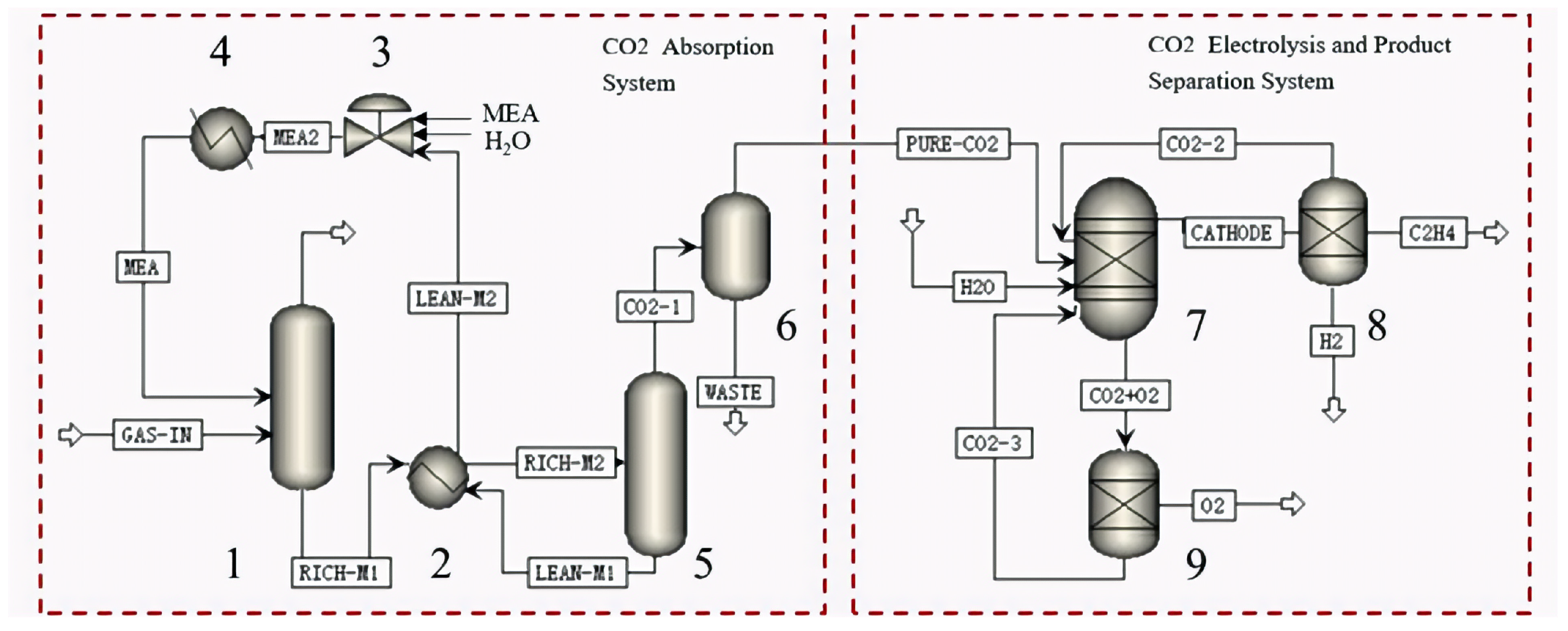
Based on the literature findings, the complete process for electrocatalytic CO2 reduction to C2H4 consists of three main stages: (1) CO2 capture from flue gas; (2) electrochemical conversion of CO2 to C2H4 in a membrane electrode assembly (MEA) electrolyzer; and (3) product separation and purification. The process flow diagram is illustrated in Figure 1.
CO2 is first captured from coal-fired power plant flue gas using chemical absorption with monoethanolamine (MEA). The captured CO2 is then compressed and fed into the cathode compartment of the electrolyzer, where it is reduced to C2H4 and other products (primarily H2 as a byproduct) at the catalyst surface. The anode compartment generates oxygen through the oxygen evolution reaction (OER). The cathode outlet stream, containing unreacted CO2, C2H4, and H2, is sent to a pressure swing adsorption (PSA) unit for product separation. Unreacted CO2 is recycled back to the electrolyzer inlet.

2.1.2. Unit Modeling

Since C2H4 is the primary focus of this study, other byproducts are disregarded. It is assumed that all cathodic CO2 is reduced to C2H4, while only oxygen evolution occurs at the anode. All CO2RR reactions proceed at ambient temperature and pressure; the electrochemical reactions occurring in the MEA electrolyzer are modeled as follows:
Cathode reaction (CO2 reduction):
2CO2 + 12H+ + 12e → C2H4 + 4H2O
Cathode side reaction (hydrogen evolution):
2H+ + 2e → H2
Anode reaction (oxygen evolution):
2H2O → O2 + 4H+ + 4e
The PSA separation system for cathode products is modeled using industrial biogas upgrading parameters, with a reference capacity of 1000 m3/h and scaling factor of 0.7 [1,5].

2.1.3. Model Assumptions

The techno-economic analysis follows established methodologies from previous studies while incorporating specific parameters for ethylene production [1,5,14]. Key assumptions for the four scenarios are summarized in Table 1.
The conservative electricity price is derived from high-cost industrial grid rates, based on scenarios without renewable energy subsidies; applicable to regions with poor grid stability and low renewable energy penetration. The realistic value is sourced from the 2024–2025 global average industrial grid rates, reflecting a benchmark scenario with partial renewable energy subsidies. The optimistic value is derived from low-cost electricity following grid parity for large-scale wind and solar renewables, applicable to regions abundant in new energy resources [16]. The future outlook value is derived from the target electricity price following the comprehensive large-scale deployment of global renewable energy by 2030.
The conservative CO2 price reflects the high-cost capture price for low-concentration industrial tail gas CO2, including purification and transportation costs; the realistic price represents the mainstream capture cost for high-concentration flue gas CO2 from power plants in 2024–2025, serving as the global TEA research benchmark; the optimistic value represents the feedstock price for high-purity CO2 from industrial byproducts, factoring in carbon tax and carbon subsidy offsets; the future outlook value targets the cost after large-scale carbon capture technology matures by 2030.
The current market price for MEA electrolysis cells is $600 per kilowatt, indicating near-industrialization but not mass production yet [11].
The plant is designed for a production capacity of 100 tons of C2H4 per day, operating 300 days per year with a 20-year lifetime. As the H-type reactor is only available at the laboratory scale for catalyst screening, its current density differs from that in industrial production [12,19]. Therefore, The H-type cell performance data from laboratory experiments was scaled to MEA reactor conditions by assuming that the current density was increased to 10 times the original value, consistent with literature reports for similar catalyst systems. The research teams led by Wang Nan [9] and Choi Woong [8] conducted comparative studies on the catalytic performance of the same copper-based catalyst in H-type cells and MEA-type cells; under corresponding normal operating voltages, the current density in MEA-type cells is generally more than one order of magnitude higher than that in H-type cells. This magnitude of change depends on catalyst restructuring, local pH, CO2 supply, water management, ion migration, and electrode structure [8]; therefore, there is no universal fixed conversion factor. In this paper, the current density of H-cells reported in several literature sources is scaled up by a factor of 10 to serve as a scenario analysis parameter for MEA cells, thereby enabling a comparison of the catalytic performance and cost-effectiveness of different catalysts. The scaled-up current density does not strictly represent the actual current density of the catalyst in an MEA cell.

2.2. Economic Analysis Method

The economic analysis calculates the total production cost by summing all capital and operating costs. The cost components include:
(1) CO2 input cost: assuming no losses, calculate the amount of CO2 input required to produce 100 tons of C2H4. Calculated based on the stoichiometric requirement of 2 moles CO2 per mole C2H4, CO2 lost during the CO2RR process (whether reacted with carbonates or unreacted CO2) will be separated and recovered to the cathode for reuse as feedstock. The daily CO2 requirement is 314.29 tons. Therefore, the CO2 input cost in the conservative case is 18,857 USD per day, in the present case it is 15,715 USD per day, in the optimistic case it is 6286 USD per day, and in the future expectation case it is 3143 USD per day.
(2) Water input cost: assume no water can be recovered from the anode output, or the cost of recovery exceeds the cost of purchasing new water. Based on 6 moles H2O required per mole C2H4 produced, it totals 385.71 tons per day. Therefore, applying the water unit price of $0.6 per ton, the cost of water input amounts to 231 USD per day.
(3) Electrolyzer cost: calculated from the required electrode area, determined by current density and Faradaic efficiency. The capital cost is annualized using the capital recovery factor (CRF) with a 7% discount rate over 20 years.
First, calculate the production rate of C2H4 (mol/s) using Equation (4), yielding a C2H4 production rate of 41.336 mol/s.
C 2 H 4 , yield = C 2 H 4 , yield   ×   10 6 M C 2 H 4   ×   24   ×   3600
Considering the electronic losses resulting from a FE below 100%, the current required to produce C2H4 at this efficiency is given by Equation (5).
I = C 2 H 4 , yield   ×   12   ×   F FE C 2 H 4
where I is the total current (A) required to produce 100 tons of C2H4; 12 is the number of electrons transferred to generate 1 mol of C2H4; F is the Faraday constant (96,485 C/mol); and FE C 2 H 4 is the FE (%) of C2H4.
The power consumption (kW) of the electrolytic cell is given by Equation (6):
P   =   I   ×   U battery 1000
where P represents the power (kW) required to produce 100 tons of C2H4, and Ubattery denotes the battery voltage (V).
Assuming a reference current density of 400 mA/cm2, this is used to evaluate how much of the electrolytic cell material is occupied by the current density. Based on the electrolyzer cost modeling in the TEA by Sisler et al. [5], the total cost of the electrolytic cell is:
Total   Cost   of   Electrolysis   Cell   =   P   ×   Electrolyzer   Unit   Power   Cost   ×   j b e n c h m a r k j
where jbenchmark is the reference current density, and j is the input current density (mA/cm2). This cost represents the total one-time cost for all electrolytic cells and must be converted to the daily cost of producing C2H4.
The capital recovery factor (CRF), based on the discount rate i and material lifespan a, is:
CRF = i ( i + 1 ) a ( i +   1 ) a 1
In Table 1, assuming a discount rate of i = 7% and an electrolyzer lifespan of a = 20 years, the CRF electrolyzer value is calculated as 0.094393. Therefore, the daily cost of the electrolyzer (USD/day) is:
T h e   d a i l y   c o s t   o f   t h e   e l e c t r o l y z e r = CRF e l e c t r o l y z e r × T o t a l   C o s t   o f   E l e c t r o l y s i s   C e l l 300
(4) Catalyst and membrane cost: Assumed as 5% of electrolyzer cost, with a 5-year replacement cycle. Use the same steps as in (3) to calculate the daily cost of the catalyst and membrane. Therefore, when the material lifespan a = 5 years, the CRF is 0.24389, and the daily cost of the catalyst and membrane for producing C2H4 is
Daily   cost   of   catalysts   and   membranes = C R F C a t a l y s t s   a n d   m e m b r a n e s × Total   Cost   of   Electrolysis   Cell   ×   5 % 300
(5) Electrolyte cost:
Based on the electrolyte volume ratio for laboratory-scale systems mentioned in the economic analysis by Sisler et al. [5], by using a fixed volume ratio of 100 L electrolyte per m2 of electrolyzer (approximated from lab-scale experiments), we can find the total volume of electrolyte needed. The total area of the required electrolytic cells is (m2):
Electrolyzer   area = I   × 10 3 j   × 10 4
The total mass of KHCO3 required (g) is:
m KHCO 3 = 0.1 × Electrolyzer   area   × 100 × M KHCO 3
To determine the total cost of the electrolyte, the cost of water must also be considered. Assume the price of KHCO3 is $800 per ton, and the price of water is the same as above. Therefore, the total cost of the electrolyte solution is:
Total   cost   of   electrolyte = m KHCO 3 ×   10 6   ×   Electrolyte   unit   price   +   m KHCO 3 M K H C O 3 ×   0.1 ×   H 2 O   price
To calculate the daily cost of the electrolyte, assuming an electrolyte lifespan of a years, the CRF electrolyte is 1.07. Therefore, the daily electrolyte cost is:
Daily   cost   of   electrolyte = CRF electrolyte ×   Total   cost   of   electrolyte 300
(6) Electricity cost: calculated from the power consumption (P = I × U) and operating hours. The daily electricity cost is:
Electricity   cost = P × 24 × Electricity   price
(7) Other operating costs: to account for additional operating costs associated with factory operations (such as labor and maintenance costs), an extra 10% has been added to the electricity cost:
Other   operating   costs = Electricity   cost × 0.1
(8) Separation costs: to calculate the cathode separation cost, first determine the total flow rate at the cathode outlet. Assuming standard conditions, the C2H4 flow rate is calculated using Equation (17), yielding an outlet flow rate of 3639.5 m3/h.
C 2 H 4 , outflow = R × T × 10 8 P × M C 2 H 4 × 24
where R is the gas constant (8.314 J/(mol·K)); T is the temperature (298 K); and P is the pressure (101,300 Pa).
Through a single conversion, assuming constant pressure, determine the CO2 flow rate at the cathode. It is important to note that this single-conversion CO2 flow rate represents the amount of unreacted CO2 at the cathode outlet. Therefore, the cathode-side CO2 outlet flow rate is calculated as shown in Equation (18).
C O 2 , Cathode   outlet   flow   rate = C 2 H 4 , Outflow   ×   2 b   ×   ( 1 b )
Here, b represents the conversion rate in Table 1.
Since this chapter assumes H2 is another unique cathode product, the calculations for the current flowing to H2 (A), H2 production rate (mol/h), and H2 flow rate (m3/h) are given by Equations (19)–(21):
I H 2 = I × ( 1 FE C 2 H 4 )
H 2 , yield = I H 2   ×   3600 2   ×   F
H 2 , flow = H 2 , yield   ×   R   ×   T P  
Therefore, the total flow rate on the cathode side is:
Total   Cathode   Flow   Rate   =   C 2 H 4 , Outflow   +   C O 2 , Cathode   outlet   flow   rate   +   H 2 , Outflow
Assume the gas output from the cathode is separated using a PSA separation unit. While the capital investment requirements for distillation and PSA systems are similar, the operating costs of PSA systems are significantly lower. Although this more economical separation method is advantageous for gaseous products, they often require additional compression for transportation/storage, which can substantially increase costs [1]. The PSA separation costs in this paper are based on a case study from Sisler et al.’s TEA [5], which uses a PSA model to separate gas produced at the cathode containing hydrogen, carbon dioxide, and ethylene. This model uses a reference cost of $1,989,043 for a 1000 m3/hour flowrate capacity with a scaling factor of 0.7 and an energy consumption of 0.25 kWh/m3. The total capital and operating costs for cathode separation are detailed in Equations (23) and (24).
PSA Cost   of   capital = 1989043   ×   ( Total   Cathode   Flow   Rate 1000 ) 0.7
PSA Operating   costs = 0.25   ×   Total   Cathode   Flow   Rate × 24 × Electricity   price
The capital cost of producing C2H4 daily can be expressed by assuming the PSA lifespan is identical to that of the electrolyzer (20 years) (CRFelectrolyzer = 0.094393):
PSA Daily   Cost   of   Capital   =   CRF   ×   PSA Cost   of   capital 300
In the model presented in our analysis, an anode separation system is employed to isolate CO2 that crosses over from the anode oxygen evolution reaction (OER), enabling its recirculation to the cathode input for reuse. To estimate the cost of anode separation, an absorption-based CO2 capture system is assumed to separate O2 produced at the anode and the CO2 that crosses over. The cost of anode separation can be estimated based on the cost of CO2 capture from flue gas. Based on the laboratory data from Li et al. [20], regarding neutral MEA cells, we set the cross-ratio to 4, meaning that for every CO2 molecule reduced, 4 CO2 molecules migrate from the cathode to the anode. Therefore, the daily cost of anode CO2 separation is given by Equation (26), which includes both operational and capital costs associated with the capture process.
C O 2 , Anode   capture   cost = M CO 2 M C 2 H 4 ×   2 × 4 × 100 × CO 2   price
(9) Balance of Plant (BoP) and installation: to estimate the cost of peripheral equipment for the electrolyzer and separation unit, the total capital cost must first be calculated. For all calculations, assume the plant’s Balance of Plant (BoP) factor is 50% and the Lang factor is 1. The total capital cost is obtained by summing the costs of the electrolyzer, membranes and catalysts, cathode separation capital, and anode separation capital (note: since the respective proportions of operating costs and capital costs for anode separation are unknown, it is assumed that half stems from operating costs and half from capital costs).
Total   Cost   of   Capital = Electrolyzer   Cost + Cost   of   catalysts   and   membranes   + PSA Daily   Cost   of   Capital + 0.5 × C O 2 , Anode   capture   cost
BoP = 50 % × Total   Cost   of   Capital
Installation   fee = Lang   Factor × Total   Cost   of   Capital
By summing all the aforementioned holding costs and applying the hypothetical data inputs from Table 1, the daily cost of producing 100 tons of C2H4 in a neutral MEA electrolyzer is calculated. In the conservative case, this amounts to $1,695,904.20/day; in the present case study: $592,606.18/day; in the optimistic scenario: $157,722.49/day; and in the future outlook: $76,755.00/day.

2.3. Energy Consumption Analysis Method

The energy consumption analysis evaluates three main components:
(1)
Electrolysis energy: CO2RR occurs under ambient temperature and pressure conditions. Therefore, the primary energy consumption of this process stems from the electrical energy expended during electrolysis, expressed as:
Welectrolysis = Pt × 3.6 × 10⁻³.
The power consumption (kW) of the electrolytic cell is calculated using Equation (6). With a duration t of 24 h, the total electrical energy consumed (GJ) by the process can be determined.
(2)
Cathode separation energy: the cathode separation model employs a PSA system for biogas upgrading, with an energy consumption of 0.25 kWh/m3. Research by Moore et al. [11] indicates that in the process of producing ethylene via carbon dioxide electrolysis, the energy consumption required for downstream gas separation is approximately two orders of magnitude lower than the electrical energy consumed by the electrolyzer itself; therefore, in conceptual techno-economic analyses, it is reasonable to approximate the energy consumption of PSA compression by incorporating it into the capital cost installation factor, rather than accounting for it separately as a distinct energy consumption item. Therefore, the cathode separation energy consumption (GJ) is:
WCathode Separation = 0.25 × Total Cathode Flow Rate × 24 × 3.6 × 10−3.
(3)
Anode separation energy: the anode separation employs the same CO2 absorption system as carbon capture, utilizing a MEA absorbent to separate CO2. Regarding the energy loss incurred in this process, Yue et al. [2] conducted detailed calculations for the CO2 capture stage, providing a specific value of 19.56 GJ/ton of CO2. Based on the   C O 2 , Anode   capture   cost from Equation (26), the daily CO2 mass separated by the anode can be calculated as:
manode   CO 2 =   C O 2 , Anode   capture   cost CO 2 p r i c e ;
Therefore, the energy consumption for anode separation (GJ) is:
WAnode Separation = 19.56 × manode CO2.
(4)
Other energy losses: for every 1 mol of C2H4 produced in the membrane electrode assembly (MEA) electrolyzer, 6 mol of CO32− is generated, causing the membrane resistance to increase fourfold. This results in an additional energy consumption of 60–90 GJ per ton of C2H4 produced [21]. Taking 75 GJ as the value, daily production of 100 tons of C2H4 would incur an additional 7500 GJ of other energy consumption.
Therefore, the total energy consumption (GJ) for producing 100 tons of C2H4 daily is:
W = W electrolysis + W Cathode   Separation + W Anode   Separation + W Other   energy   losses

3. Results and Discussion

3.1. Material Flow Analysis

Material flow analysis reveals the substantial CO2 requirements and losses in the CO2RR process. Table 2 presents the material flow for the present work scenario.
The above results were calculated based on Equations (1)–(3), using the relevant assumptions from Section 2.1 (including a Faraday efficiency of 48.74%).

3.2. Economic Analysis

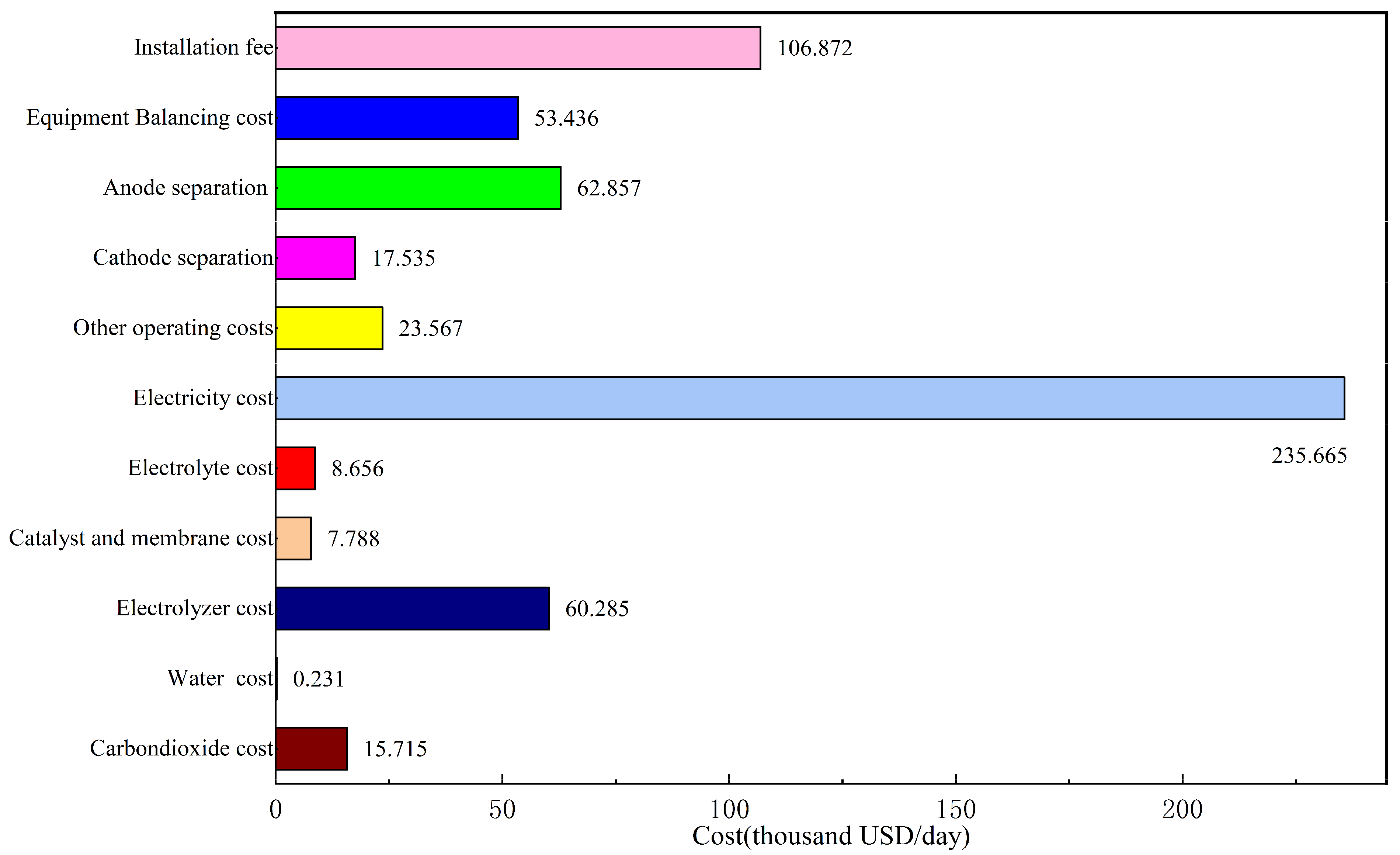
As shown in Figure 2, the specific cost distribution for each stage in the case study of this paper is listed. The results of this analysis are similar to those reported by Moore et al. [11], with the electricity costs for the electrolyzer being significantly higher than those for other modules. Electricity cost represents the largest portion at 39.8% of total production cost (236 thousand USD/day), followed by installation costs (18.0%), anode separation cost (10.6%), and electrolyzer cost (10.2%). The high electricity cost reflects the energy-intensive nature of CO2RR, particularly for C2 products requiring 12 electrons per molecule.
This result indicates that electricity costs are a significant factor affecting the entire electrolytic reduction process. According to a review by Guo et al. [22], with the development and widespread adoption of renewable energy sources such as solar and wind power, electricity prices may fall further to $0.03 per kilowatt-hour or even lower. Additionally, improvements in electrolyzer technology will enhance CO2 conversion rates [23], which will also contribute to lower electricity costs. Therefore, electricity costs are expected to decrease substantially in the future, indicating promising prospects for CO2 reduction reactions (CO2RR).
The FE and current density data for the catalysts in the table below were obtained using an H-type electrolytic cell. Similarly, the current density was increased to ten times its original value for comparison with the Cu10-Sn catalyst.
Substitute the current density and FE values from Table 1 (the case study in this paper) with those from Table 2 (the catalysts) to calculate the cost of the catalysts listed in Table 2. A comparison of production costs using different catalysts is presented in Table 3. The Cu10-Sn catalyst developed in this work demonstrates the lowest production cost at 592.61 thousand USD/day, primarily due to its high Faradaic efficiency (48.74%) and current density (246 mA/cm2 in MEA configuration). This cost is approximately 8.2% lower than the next best catalyst (CuO NS) and 53.3% lower than the highest cost catalyst (Ag@BIF-104 NSs(Cu)). The results indicate that current density and product selectivity are key factors influencing the cost of CO2 reduction reactions (CO2RR). The Cu10-Sn catalyst synthesized in this work exhibits high current density and excellent C2H4 selectivity, thereby achieving a low CO2RR cost.
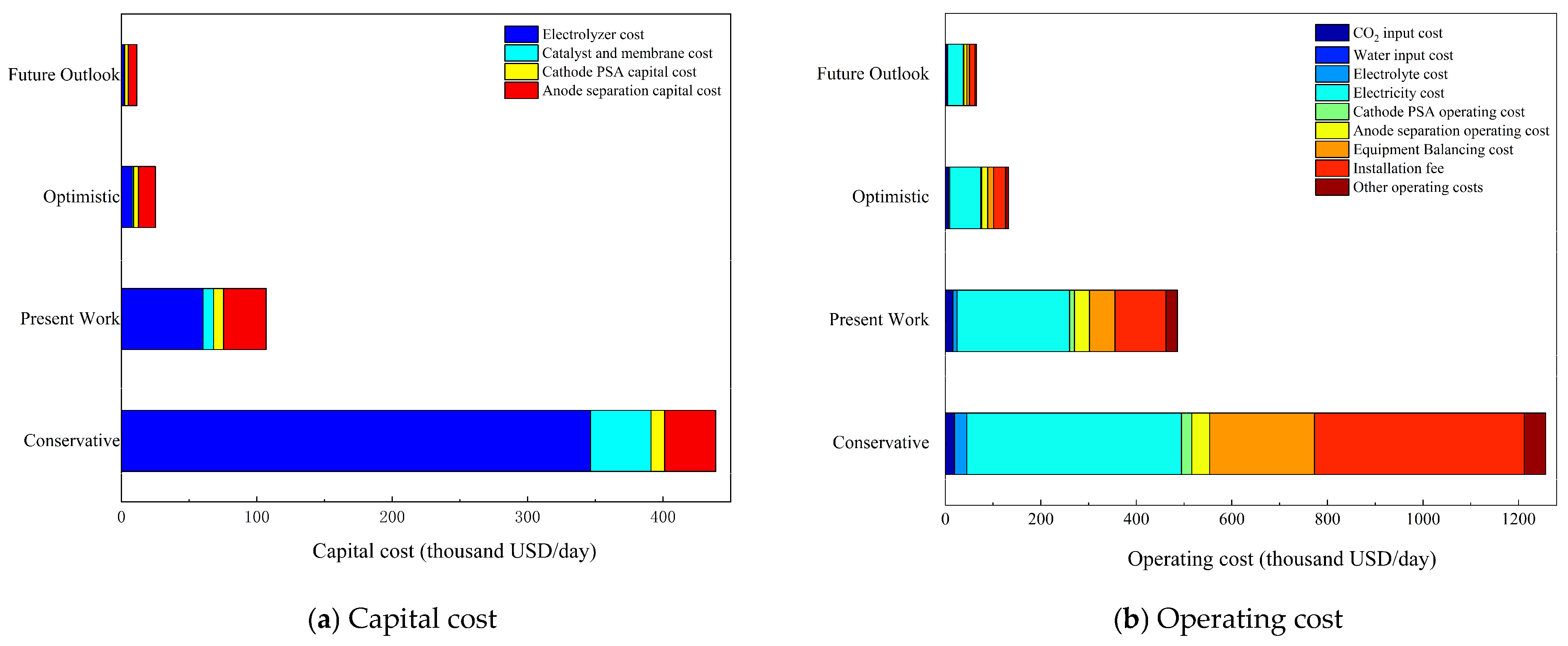
The comparison of capital and operating costs across the four scenarios is shown in Figure 3. The conservative scenario exhibits capital costs of 438.93 thousand USD/day and operating costs of 1256.97 thousand USD/day. The present work scenario reduces these to 106.87 thousand USD/day (capital) and 485.74 thousand USD/day (operating). The optimistic and future outlook scenarios show further reductions, with the future outlook achieving total costs of only 76.8 thousand USD/day.
Comparing these cases reveals that the most significant factors affecting capital costs are the costs of electrolyzer and anode separation. Electrolyzer costs are related to C2H4 selectivity, cell voltage, and unit cell cost, while anode separation costs are linked to CO2 price. The most significant factors affecting operating costs are electricity costs and installation costs, with installation costs being linked to capital costs. Therefore, capital costs and operating costs can be reduced by optimizing electrolytic cells, improving catalysts, and developing renewable energy sources. Comparing Figure 3a,b reveals that operating costs significantly exceed capital costs. For instance, in the conservative case, capital costs amount to 438.93 thousand USD/day, while operating costs reach 1256.97 thousand USD/day—approximately three times the capital costs. This disparity stems from the substantial electrical energy input required for C2H4 production, leading to substantially increased electricity expenses.
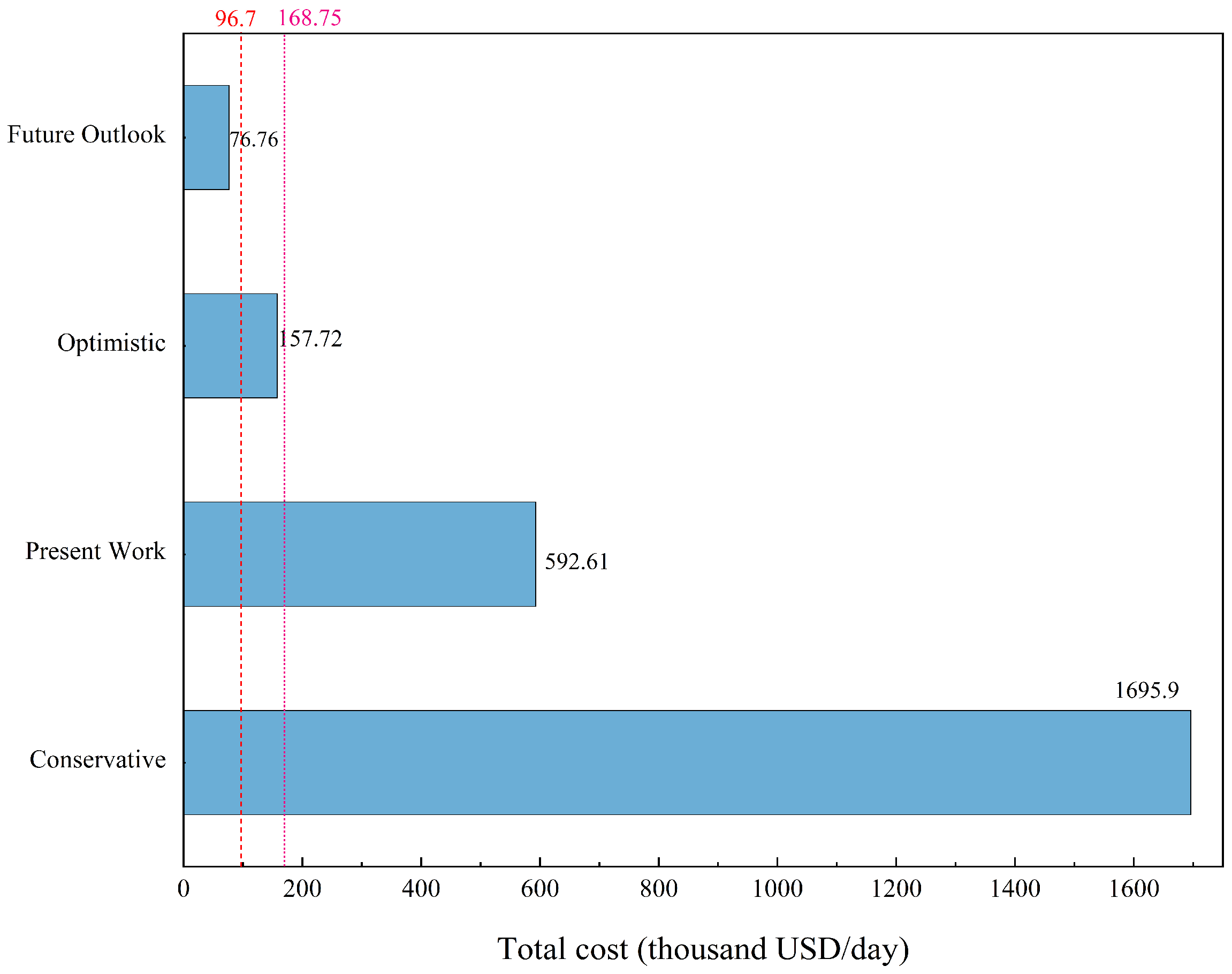
The total production cost per scenario is shown in Figure 4: conservative (1,695,904 USD/day), present work (592,606 USD/day), optimistic (157,722 USD/day), and future outlook (76,755 USD/day). Based on the TEA by Alerte et al. [35], the benchmark ethylene price is $967 per ton (96,700 USD/day for 100 tons in 2023), which means that current technology is not economically viable. However, the future outlook scenario could potentially achieve profitability with a projected profit of approximately 20,000 USD/day. In addition, Sajeev et al.’s TEA [36] uses $1250 per ton as the benchmark market price for ethylene (as of May 2024) and forecasts that, as demand rises in the future, the price of ethylene is expected to increase by 35% (reaching $1687.50 per ton). Under a future scenario with an ethylene benchmark price of $1687.50 per ton, daily profits of $91,990 are projected.
Therefore, with technological advancements, CO2RR for producing C2H4 holds significant application potential.

3.3. Energy Consumption Analysis

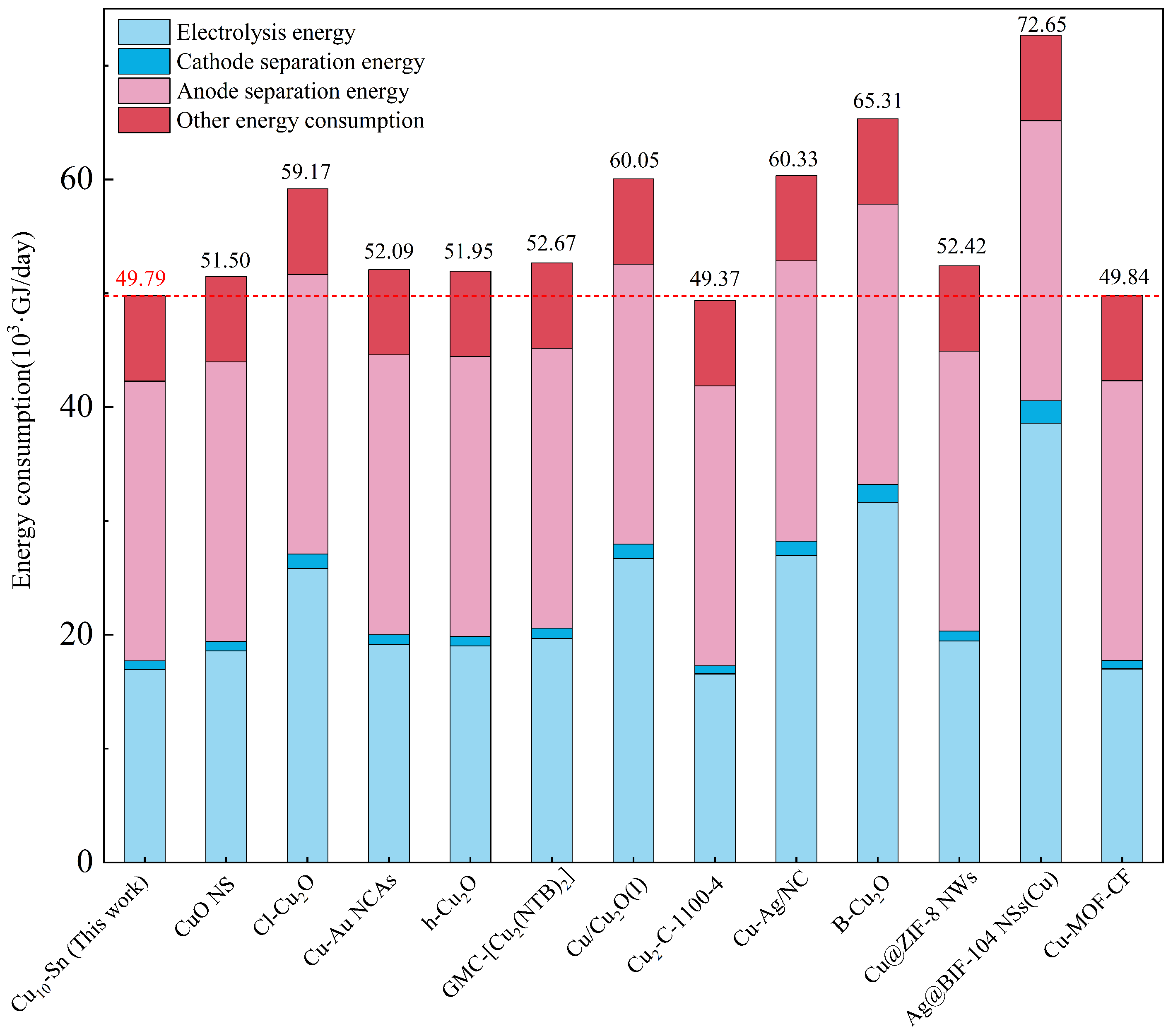
The energy consumption comparison for different catalysts is presented in Figure 5. The Cu-Sn catalyst exhibits an energy consumption at 49.79 thousand GJ/day, comparable to the lowest Cu2-C-1100-4 catalyst (49.37 thousand GJ/day), lower than other reported catalysts. The highest energy consumption is observed for Ag@BIF-104 NSs (Cu) (72.65 thousand GJ/day), primarily due to its low Faradaic efficiency.
Furthermore, comparing the total energy consumption results for GMC-[Cu2(NTB)2], Cu/Cu2O(I), and Cu@ZIF-8 NWs reveals that Faraday efficiency impacts energy consumption more significantly than current density. Therefore, to reduce energy consumption, efforts should first focus on enhancing the Faraday efficiency of the reduction reaction.
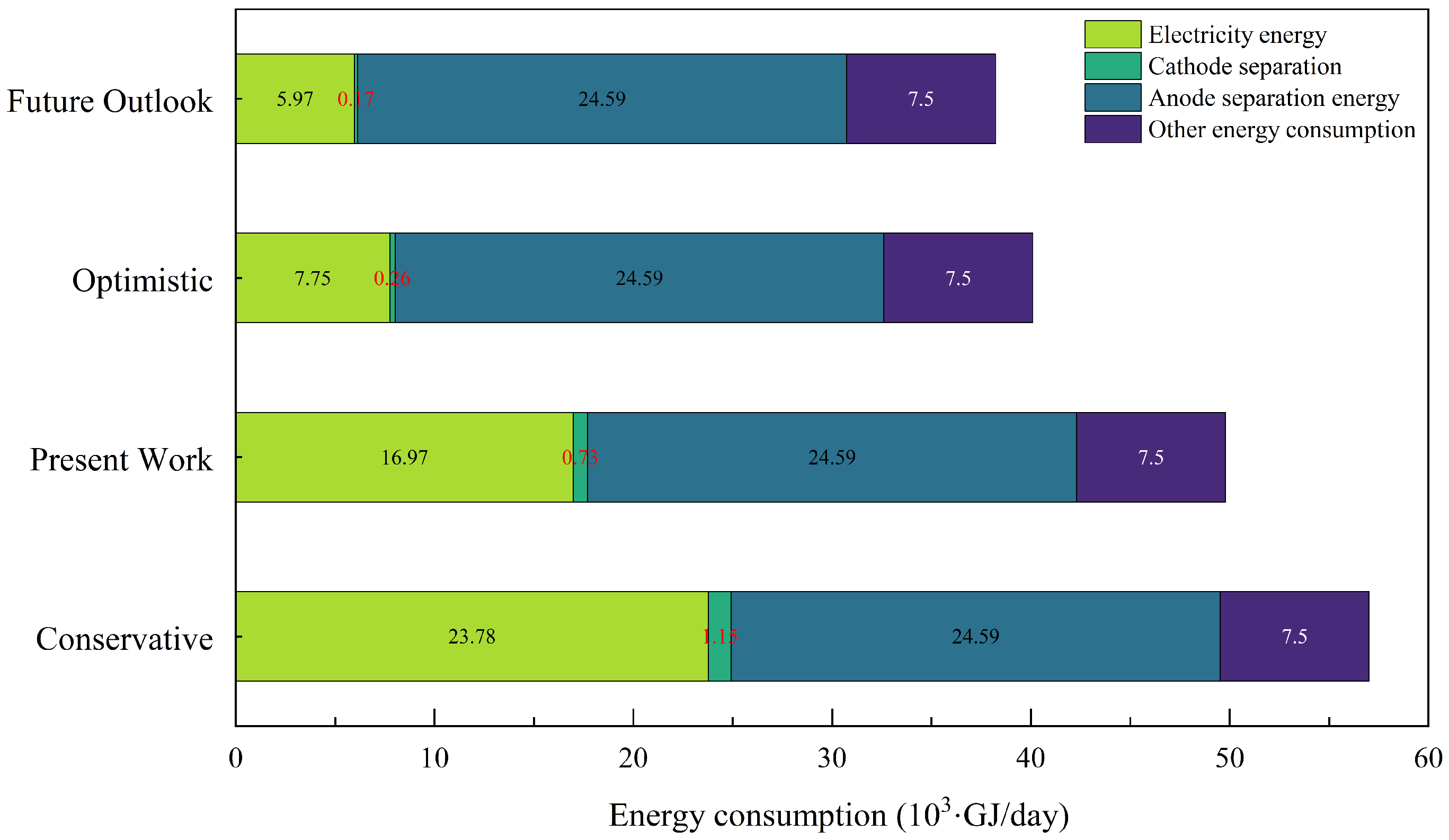
Additionally, in the energy consumption distribution of CO2RR, electrical energy and anode separation account for over half of the total energy consumption. The electrical energy loss aligns with the cost analysis results in Section 3.1. Anode separation primarily involves chemically adsorbing CO2, a process whose energy consumption is independent of the product and solely dependent on the mass of CO2 to be captured.
As shown in Figure 6, the energy consumption distribution for daily production of 100 tons of C2H4 across different scenarios is illustrated. The conservative scenario exhibits total energy consumption of 57.02 thousand GJ/day, the case study scenario shows 49.79 thousand GJ/day, the optimistic scenario indicates 40.11 thousand GJ/day, and the future outlook projects 38.23 thousand GJ/day. In these scenarios, the energy consumption for anode separation and other processes remains unchanged. The variation in total energy consumption stems primarily from differences in electrical energy consumption and cathode separation energy consumption. Consistent with the economic analysis results in Section 3.1, the main factor influencing electrical energy consumption is the difference in FE C 2 H 4 and overall cell voltage. Therefore, reducing energy consumption in the CO2RR process primarily requires enhancing C2H4 selectivity and lowering the overall cell voltage.

3.4. Sensitivity Analysis

Sensitivity analysis was performed to identify the key parameters affecting production costs. Sensitivity analysis was conducted by adjusting parameters such as electricity price, C2H4 feed-through efficiency, and current density by ±20% while keeping other conditions constant (Table 4). This assessed the impact of parameter variations on economic benefits and identified key factors requiring consideration for achieving commercial application, thereby accelerating the efficient resource utilization of CO2.
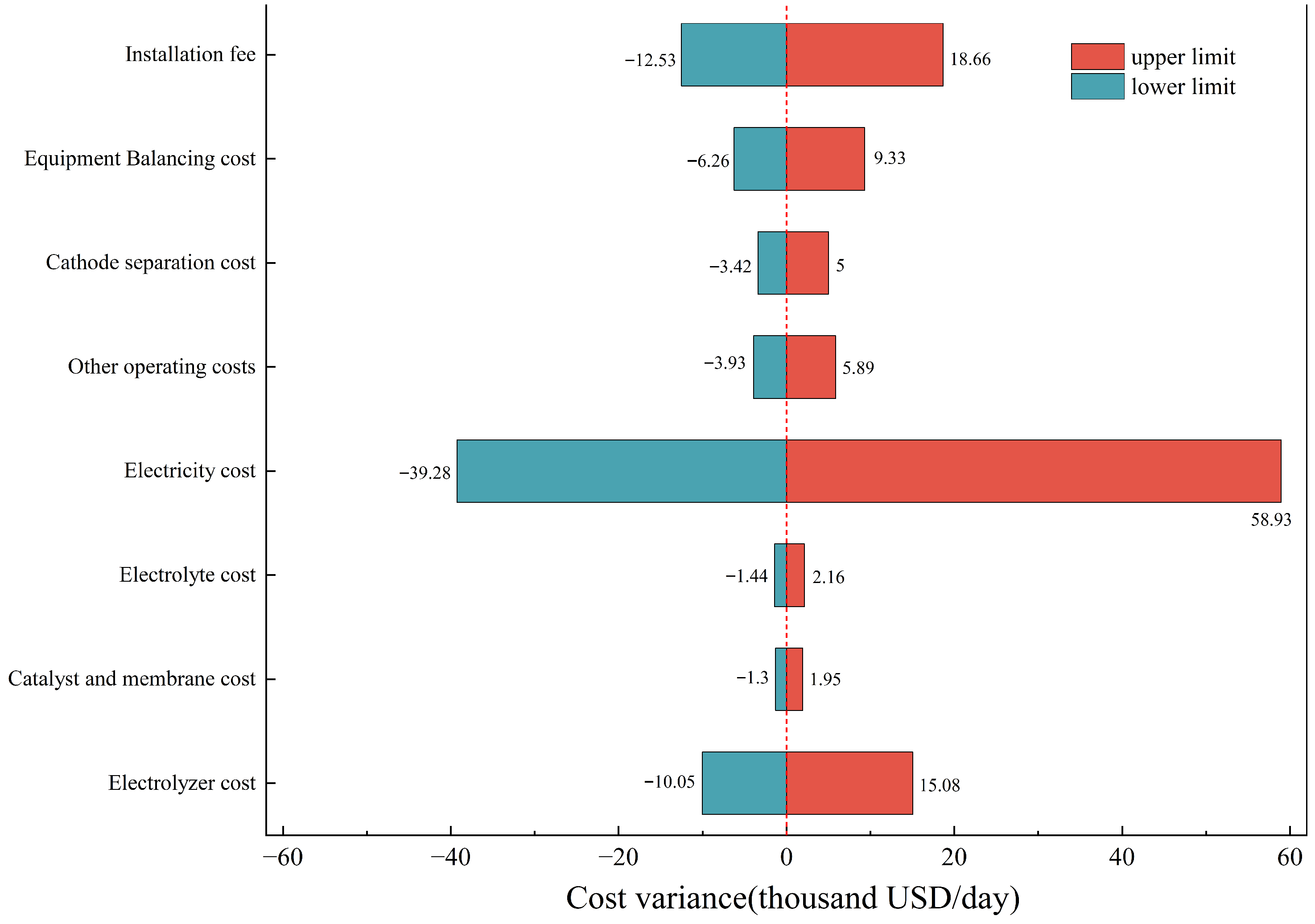
The FE of C2H4 and the full cell voltage impact multiple cost components. Therefore, we first investigate the sensitivity analysis of C2H4’s FE (Figure 7) and the full cell voltage (Figure 8) on the costs of each component. As shown in Figure 8, the FE of C2H4 has the greatest impact on electricity costs. Increasing the FE of C2H4 by 20% reduces daily electricity costs by 39.28 thousand USD, while decreasing the FE by 20% increases daily electricity costs by 58.93 thousand USD. Secondarily, C2H4 FE also significantly impacts installation costs and electrolyzer expenses. A 20% increase in FE reduces installation costs by 12.53 thousand USD/day and electrolyzer costs by 10.05 thousand USD/day. Conversely, a 20% decrease in FE increases these costs by 18.66 thousand USD/day and 15.08 thousand USD/day, respectively. Additionally, the FE of C2H4 exerts certain effects on equipment balance, cathode separation costs, other operational expenses, electrolyte costs, as well as catalyst and membrane expenses.
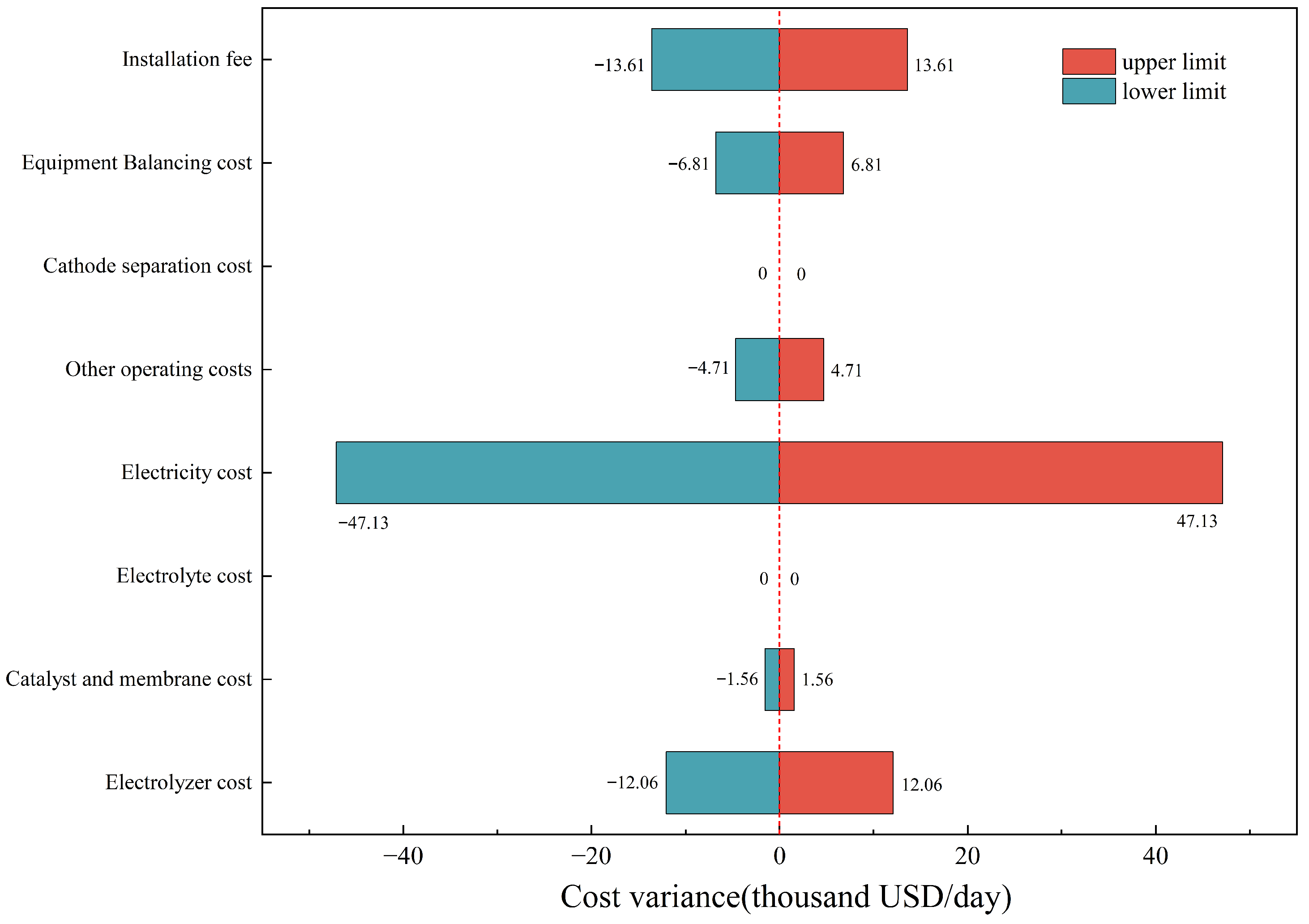
As shown in Figure 8, the overall battery voltage also has the greatest impact on electricity costs. Increasing the overall battery voltage by 20% raises daily electricity costs by 47.13 thousand USD. Conversely, decreasing the overall battery voltage by 20% reduces daily electricity costs by 47.13 thousand USD—the same amount as the increase when raised by 20%. Secondarily, the overall battery voltage significantly impacts installation costs and electrolyzer expenses. A 20% increase in overall battery voltage raises installation costs by 13.61 thousand USD/day and electrolyzer costs by 12.06 thousand USD/day. Conversely, a 20% decrease reduces these costs by the identical amounts. Additionally, the overall battery voltage exerts certain effects on other operational costs, equipment balance, and the costs of catalysts and membranes.
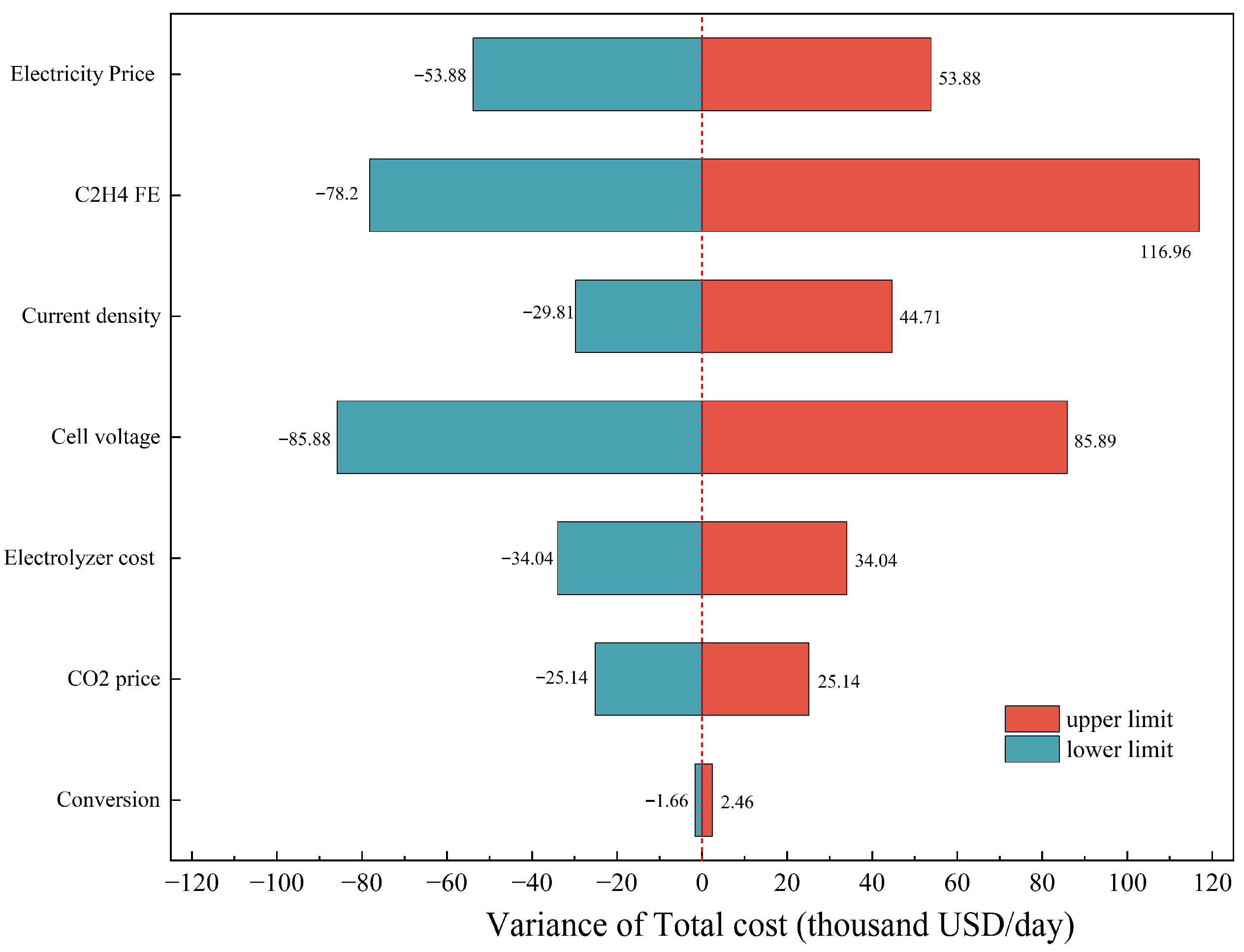
We further evaluated the impact of key parameters (i.e., electricity price, FE of C2H4, current density, cell voltage, electrolyzer cost, CO2 cost, and conversion rate) on total cost, as shown in Figure 9.
The Faradaic efficiency of C2H4 has the largest impact on total cost. A 20% increase in FE reduces total cost by 78.20 thousand USD/day, while a 20% decrease increases cost by 116.96 thousand USD/day. Computational analysis shows that the variation in total cost with respect to the Faraday efficiency of ethylene exhibits asymmetry; this asymmetric response reflects the non-linear relationship between FE and electricity consumption. Higher selectivity results in less wasted electricity during H2 production, thereby reducing the total current required. This leads to lower power demand, ultimately decreasing electricity costs. Additionally, the reduction in total current decreases the overall cell area, lowering the capital cost of the electrolyzer.
Cell voltage is the second most influential parameter, with a 20% change in either direction affecting total cost by approximately 85.88 thousand USD/day. The linear relationship reflects the direct proportionality between voltage and power consumption. Reducing battery voltage lowers overall power requirements, significantly impacting products with high electricity operating costs.
Electricity price also shows significant impact, with a 20% change (0.01 USD/kWh) affecting total cost by 53.88 thousand USD/day. This highlights the importance of accessing low-cost renewable electricity for commercial viability [1].
Current density affects costs primarily through electrolyzer area requirements. Lower current densities significantly increase capital costs, while higher current densities provide diminishing returns beyond approximately 300 mA/cm2.
CO2 price and electrolyzer cost show moderate impacts, with 20% changes affecting total costs by 25.14 thousand USD/day, respectively. Single-pass conversion has a relatively minor impact on total cost, as unreacted CO2 can be economically recycled.
Analysis of Figure 9 reveals that different factors exhibit varying cost fluctuations within a 20% range of total costs. When electricity prices, battery voltage, electrolyzer costs, and CO2 costs increase or decrease by 20%, the resulting cost fluctuations are consistent. However, when the C2H4 FE (C2H4’s faradaic efficiency), current density, and conversion rate increase or decrease by 20%, the resulting cost fluctuations differ.
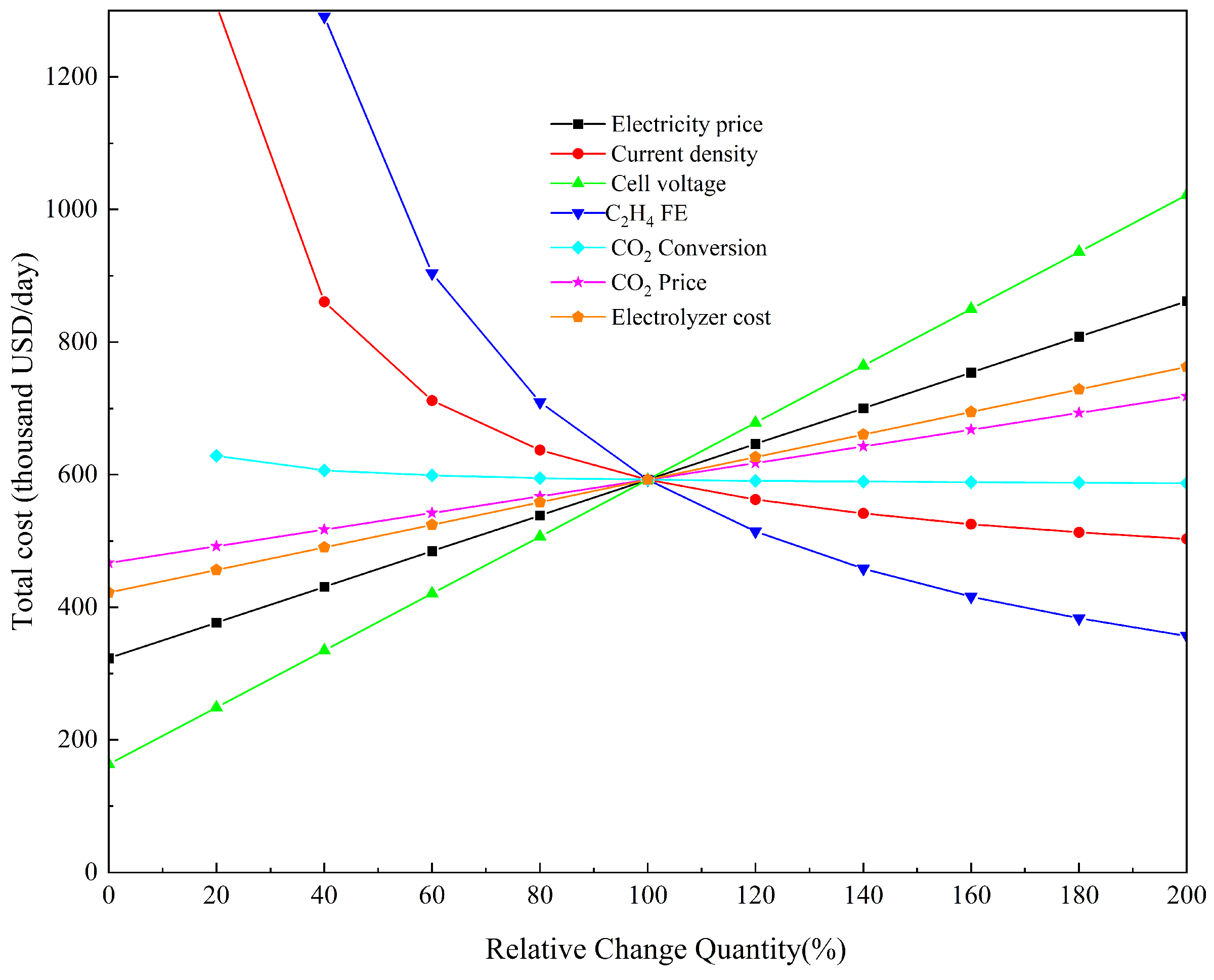
Therefore, using the case study data values as a baseline and keeping other conditions constant, we investigated the sensitivity trends of total cost by adjusting parameters such as electricity price, C2H4 FE, and current density by 20%, 40%, 60%, 80%, and 100% (Figure 10).
The results revealed that the FE (faradaic efficiency) of C2H4 is the factor with the greatest impact on cost among these variables. When FE is relatively low, its influence on cost is more significant than when FE is high. Therefore, enhancing the FE of C2H4 is particularly crucial for improving the economic viability of the system.
The effect of current density on cost is similar to that of FE: at lower current densities, the impact on cost is greater, but as current density increases to a certain level, its influence on cost begins to level off. Thus, for the product C2H4, increasing the current density to 200–300 mA/cm2 is critical. As the conversion rate increases, the total cost initially decreases slightly. However, once a certain threshold is exceeded, conversion rate becomes the least significant parameter affecting cell performance, exerting a relatively minor influence on costs.
Regarding conversion rate, since the cost of recovering unreacted CO2 is relatively low, it can be recovered using a cathode separation module even at low single-pass conversion rates, which is cheaper than purchasing new CO2. Increases in cell voltage, electricity price, electrolyzer cost, and CO2 cost drive total costs along a linear trend, with the slope related to cell voltage being the steepest and exerting the greatest influence on total costs. Therefore, CO2 electrolyzers should operate at the lowest possible voltage.
Overall, FE, current density, cell voltage, and electricity prices are the most critical cost drivers. Enhancing C2H4 FE and overall current density, reducing total cell voltage, and vigorously developing renewable energy to lower electricity prices are key pathways to improving system economics.

4. Conclusions

In this work, a process-level techno-economic assessment was developed for electrochemical CO2 reduction to ethylene using a neutral membrane electrode assembly electrolyzer and a Cu10–Sn catalyst as a case study. The model integrates three major process sections: CO2 capture from coal-fired flue gas, CO2 electroreduction to C2H4 in an MEA electrolyzer, and downstream separation of the cathode outlet gas mixture containing C2H4, unreacted CO2 and H2. Unlike studies that focus only on intrinsic catalyst activity, this work connects laboratory catalyst performance with industrially relevant cost drivers, including Faradaic efficiency, current density, full-cell voltage, electricity price, CO2 utilization, PSA separation and CO2 recycling. This framework is useful because the commercial feasibility of CO2RR-to-ethylene cannot be judged solely by a high current density or a high ethylene selectivity—it depends on the combined performance of the catalyst, reactor and separation system.
The analysis confirms that ethylene is a strategically important but technically demanding CO2RR product. Compared with C1 products such as CO and formate, which involve simpler two-electron pathways, ethylene formation requires C–C coupling and twelve-electron transfer per molecule. This makes ethylene production more sensitive to energy efficiency and selectivity losses. The recent review by Ahmed et al. [3] highlights that CO2RR is generally limited by high overpotential, low selectivity and competing HER, while the optimization of catalyst active sites, reaction intermediates and structure–activity relationships remains essential for practical application. These insights support the central assumption of this work: catalyst performance must be evaluated together with system-level economics.
Due to the limitations of the H-type reactor used for catalyst testing, when comparing the target catalyst in this paper with some previously reported catalysts, we selected catalysts tested under identical reactor conditions for comparison. Furthermore, since H-type reactors, as screening devices for catalysts, exist only at the laboratory scale, their current densities differ from those in industrial production. Therefore, based on reported current density discrepancies for the same catalyst across different reactors in the literature [8,9], this chapter assumes the CO2RR reactor to be a membrane electrode assembly (MEA) reactor [27,37]. To assess technical and economic feasibility, the current density of the catalyst prepared in this study and some reported catalysts under the same reactor conditions is scaled up by a factor of 10.
A comprehensive techno-economic analysis of electrocatalytic CO2 reduction to ethylene was conducted to evaluate the economic viability and identify key cost drivers. The following conclusions can be drawn:
(1)
The Cu10-Sn bimetallic catalyst developed in this work demonstrates superior techno-economic performance compared to some of the previously reported copper-based catalysts, with the lowest production cost (592.61 thousand USD/day) and relatively low energy consumption (49.79 thousand GJ/day or 13.83 million kW·h) among evaluated catalysts. This is attributed to its high Faradaic efficiency (48.74%) and current density.
(2)
Electricity cost is the dominant factor in CO2RR-to-C2H4 production, accounting for 39.8% of total costs in the present scenario. This highlights the critical importance of accessing low-cost renewable electricity and improving energy efficiency.
(3)
Sensitivity analysis identifies Faradaic efficiency, cell voltage, electricity price, and current density as the key parameters affecting production costs. Improving these parameters through catalyst optimization and electrolyzer design is essential for achieving commercial viability.
(4)
While current technology is not economically viable for ethylene production, the future outlook scenario suggests that with continued improvements in catalyst performance and reduced electricity costs, the process could become profitable. In future projections, producing C2H4 via CO2RR could yield a profit of approximately 20,000 USD per day, and in the future, the daily profits are expected to reach 91,990 USD with the demand for ethylene increasing [36].

Author Contributions

Conceptualization, X.Z.; methodology, K.X. and P.Z.; software, K.X.; validation, X.Z., and P.Z.; formal analysis, K.X., and P.Z.; investigation, K.X., and P.Z.; resources, P.Z.; data curation, K.X.; writing—original draft preparation, K.X.; writing—review and editing, X.Z., and P.Z.; visualization, K.X.; supervision, P.Z., and X.Z.; project administration, X.Z.; funding acquisition, X.Z. All authors have read and agreed to the published version of the manuscript.

Funding

This research received no external funding.

Data Availability Statement

The original contributions presented in this study are included in the article. Further inquiries can be directed to the corresponding author.

Acknowledgments

The study was financially supported by Jinan Science and Technology Project of Principal Investigator Work-room (no. 202333057).

Conflicts of Interest

The authors declare no conflicts of interest.

References

  1. Jouny, M.; Luc, W.; Jiao, F. General Techno-Economic Analysis of CO2 Electrolysis Systems. Ind. Eng. Chem. Res. 2018, 57, 2165–2177. [Google Scholar] [CrossRef]
  2. Yue, P.; Fu, Q.; Li, J.; Zhu, X.; Liao, Q. Comparative Life Cycle and Economic Assessments of Various Value-Added Chemicals’ Production via Electrochemical CO2 Reduction. Green. Chem. 2022, 24, 2927–2936. [Google Scholar] [CrossRef]
  3. Ahmed, S.; Hussain, M.S.; Khan, M.K.; Kim, J. Innovations in Catalysis towards Efficient Electrochemical Reduction of CO2 to C1 Chemicals. J. Energy Chem. 2025, 107, 622–649. [Google Scholar] [CrossRef]
  4. Dinh, C.-T.; Burdyny, T.; Kibria, M.G.; Seifitokaldani, A.; Gabardo, C.M.; García De Arquer, F.P.; Kiani, A.; Edwards, J.P.; De Luna, P.; Bushuyev, O.S.; et al. CO2 Electroreduction to Ethylene via Hydroxide-Mediated Copper Catalysis at an Abrupt Interface. Science 2018, 360, 783–787. [Google Scholar] [CrossRef]
  5. Sisler, J.; Khan, S.; Ip, A.H.; Schreiber, M.W.; Jaffer, S.A.; Bobicki, E.R.; Dinh, C.-T.; Sargent, E.H. Ethylene Electrosynthesis: A Comparative Techno-Economic Analysis of Alkaline vs Membrane Electrode Assembly vs CO2–CO–C2H4 Tandems. ACS Energy Lett. 2021, 6, 997–1002. [Google Scholar] [CrossRef]
  6. Li, Y.; Sun, Q. Recent Advances in Breaking Scaling Relations for Effective Electrochemical Conversion of CO2. Adv. Energy Mater. 2016, 6, 1600463. [Google Scholar] [CrossRef]
  7. Wang, H.; Zhang, F.; Li, Y.; Pang, Y.; Zhao, X.; Song, Z.; Wang, W.; Sun, J.; Mao, Y. Sn-Modified Cu Nanosheets Catalyze CO2 Reduction to C2H4 Efficiently by Stabilizing CO Intermediates and Promoting CC Coupling. J. Colloid Interface Sci. 2025, 678, 506–514. [Google Scholar] [CrossRef] [PubMed]
  8. Choi, W.; Chae, Y.; Liu, E.; Kim, D.; Drisdell, W.S.; Oh, H.; Koh, J.H.; Lee, D.K.; Lee, U.; Won, D.H. Exploring the Influence of Cell Configurations on Cu Catalyst Reconstruction during CO2 Electroreduction. Nat. Commun. 2024, 15, 8345. [Google Scholar] [CrossRef] [PubMed]
  9. Wang, N.; Zhang, Y.; Min, Z.; Chang, B.; Wang, H.; Li, Z.; Fan, M.; Zhang, S.; Wang, J. Selective Electrosynthesis of Ethanol from CO2 Enabled by High CuI Content and Enhanced H2O Activation of Molecularly Modified Cu-Based Catalyst. J. Am. Chem. Soc. 2026, 148, 13633–13643. [Google Scholar] [CrossRef]
  10. Kibria, M.G.; Edwards, J.P.; Gabardo, C.M.; Dinh, C.; Seifitokaldani, A.; Sinton, D.; Sargent, E.H. Electrochemical CO2 Reduction into Chemical Feedstocks: From Mechanistic Electrocatalysis Models to System Design. Adv. Mater. 2019, 31, 1807166. [Google Scholar] [CrossRef]
  11. Moore, T.; Oyarzun, D.I.; Li, W.; Lin, T.Y.; Goldman, M.; Wong, A.A.; Jaffer, S.A.; Sarkar, A.; Baker, S.E.; Duoss, E.B.; et al. Electrolyzer Energy Dominates Separation Costs in State-of-the-Art CO2 Electrolyzers: Implications for Single-Pass CO2 Utilization. Joule 2023, 7, 782–796. [Google Scholar] [CrossRef]
  12. Feng, J.; Badreldin, A.; Li, Y. Electrochemical CO2 Reduction to Multicarbon Fuels and Chemicals: Progress and Prospects of Tandem Electrolyzer Strategies. Energy Fuels 2025, 39, 21175–21225. [Google Scholar] [CrossRef]
  13. Pérez-Fortes, M.; Schöneberger, J.C.; Boulamanti, A.; Harrison, G.; Tzimas, E. Formic Acid Synthesis Using CO2 as Raw Material: Techno-Economic and Environmental Evaluation and Market Potential. Int. J. Hydrog. Energy 2016, 41, 16444–16462. [Google Scholar] [CrossRef]
  14. Shi, R.; Guo, J.; Zhang, X.; Waterhouse, G.I.N.; Han, Z.; Zhao, Y.; Shang, L.; Zhou, C.; Jiang, L.; Zhang, T. Efficient Wettability-Controlled Electroreduction of CO2 to CO at Au/C Interfaces. Nat. Commun. 2020, 11, 3028. [Google Scholar] [CrossRef] [PubMed]
  15. Aui, A.; Moore, T.; Li, W.; Sarkar, A.; Duoss, E.B.; Hahn, C.; Baker, S. Net-Zero Ethylene: On the Sustainability, Economics, and Scalability of Synthetic and Fossil Production Pathways. ACS Sustain. Chem. Eng. 2025, 13, 14714–14725. [Google Scholar] [CrossRef]
  16. Kumar, B.; Muchharla, B.; Dikshit, M.; Dongare, S.; Kumar, K.; Gurkan, B.; Spurgeon, J.M. Electrochemical CO2 Conversion Commercialization Pathways: A Concise Review on Experimental Frontiers and Technoeconomic Analysis. Environ. Sci. Technol. Lett. 2024, 11, 1161–1174. [Google Scholar] [CrossRef] [PubMed]
  17. Zhang, S.; Tang, W.; Yin, J.; Wang, S.; Yu, Y.; Huang, R.; Huo, E. Feasibility and Prospects of Electrocatalytic Conversion of CO2 for Chemical Feedstock Production and Renewable Energy Storage. ACS Sustain. Chem. Eng. 2025, 13, 9841–9858. [Google Scholar] [CrossRef]
  18. Da Cunha, S.C.; Resasco, J. Insights from Techno-Economic Analysis Can Guide the Design of Low-Temperature CO2 Electrolyzers toward Industrial Scaleup. ACS Energy Lett. 2024, 9, 5550–5561. [Google Scholar] [CrossRef]
  19. Shao, P.; Zhang, H.-X.; Hong, Q.-L.; Yi, L.; Li, Q.-H.; Zhang, J. Enhancing CO2 Electroreduction to Ethylene via Copper−Silver Tandem Catalyst in Boron-Imidazolate Framework Nanosheet. Adv. Energy Mater. 2023, 13, 2300088. [Google Scholar] [CrossRef]
  20. Li, F.; Thevenon, A.; Rosas-Hernández, A.; Wang, Z.; Li, Y.; Gabardo, C.M.; Ozden, A.; Dinh, C.T.; Li, J.; Wang, Y.; et al. Molecular Tuning of CO2-to-Ethylene Conversion. Nature 2020, 577, 509–513. [Google Scholar] [CrossRef]
  21. Ozden, A.; Wang, Y.; Li, F.; Luo, M.; Sisler, J.; Thevenon, A.; Rosas-Hernández, A.; Burdyny, T.; Lum, Y.; Yadegari, H.; et al. Cascade CO2 Electroreduction Enables Efficient Carbonate-Free Production of Ethylene. Joule 2021, 5, 706–719. [Google Scholar] [CrossRef]
  22. Guo, Z.; Yang, F.; Li, X.; Zhu, H.; Do, H.; Loon Fow, K.; Hirst, J.D.; Wu, T.; Ye, Q.; Peng, Y.; et al. Electrocatalytic CO2 Reduction to C2H4: From Lab to Fab. J. Energy Chem. 2024, 90, 540–564. [Google Scholar] [CrossRef]
  23. Romero Cuellar, N.S.; Scherer, C.; Kaçkar, B.; Eisenreich, W.; Huber, C.; Wiesner-Fleischer, K.; Fleischer, M.; Hinrichsen, O. Two-Step Electrochemical Reduction of CO2 towards Multi-Carbon Products at High Current Densities. J. CO2 Util. 2020, 36, 263–275. [Google Scholar] [CrossRef]
  24. Qu, Y.; Zheng, W.; Wang, P.; Huang, H.; Huang, M.; Hu, L.; Wang, H.; Chen, Q. Creating Interfaces of Cu0/Cu+ in Oxide-Derived Copper Catalysts for Electrochemical CO2 Reduction to Multi-Carbon Products. J. Colloid Interface Sci. 2023, 645, 735–742. [Google Scholar] [CrossRef] [PubMed]
  25. Chen, B.; Li, W.; Xia, R.; Wang, X.; Hu, H.; Dai, H.; Guan, Q.; Wang, C.; Liu, Y.; Li, W. Constructing and Stabilizing Cu0/Cu+ Sites through Dual Chlorine-Induced Strategy for CO2 Electroreduction to C2H4. J. Colloid Interface Sci. 2025, 699, 138237. [Google Scholar] [CrossRef] [PubMed]
  26. Yan, Y.; Zhou, H.; Li, T.; Wang, D.; Schaaf, P.; Guo, G.; Wang, X. Bimetallic Tandem Strategy for Effective Modulation of CO2 Electrocatalytic Selectivity on Relatively Inert Cu Interfaces. Small 2026, 22, 2501125. [Google Scholar] [CrossRef]
  27. Jun, M.; Kwak, C.; Lee, S.Y.; Joo, J.; Kim, J.M.; Im, D.J.; Cho, M.K.; Baik, H.; Hwang, Y.J.; Kim, H.; et al. Microfluidics-Assisted Synthesis of Hierarchical Cu2O Nanocrystal as C2 -Selective CO2 Reduction Electrocatalyst. Small Methods 2022, 6, e2200074. [Google Scholar] [CrossRef]
  28. Balamurugan, M.; Jeong, H.-Y.; Choutipalli, V.S.K.; Hong, J.S.; Seo, H.; Saravanan, N.; Jang, J.H.; Lee, K.-G.; Lee, Y.H.; Im, S.W.; et al. Electrocatalytic Reduction of CO2 to Ethylene by Molecular Cu-Complex Immobilized on Graphitized Mesoporous Carbon. Small 2020, 16, 2000955. [Google Scholar] [CrossRef]
  29. Liu, Y.; Liu, H.; Wang, C.; Wang, Y.; Lu, J.; Wang, H. Reconstructed Cu/Cu2O(I) Catalyst for Selective Electroreduction of CO2 to C2+ Products. Electrochem. Commun. 2023, 150, 107474. [Google Scholar] [CrossRef]
  30. Huang, X.; Li, X.; Yan, S.; Wang, D.; Long, C.; Ying, Y.; An, P.; Guo, Z.; Li, Q.; Yang, C.; et al. Strain-Optimized Copper Dual-Atom Sites for Selective Electroreduction of Carbon Dioxide to Ethylene. Sci. Adv. 2025, 11, eads0609. [Google Scholar] [CrossRef]
  31. Zou, X.; Li, A.; Ma, C.; Gao, Z.; Zhou, B.; Zhu, L.; Huang, Z. Nitrogen-Doped Carbon Confined Cu-Ag Bimetals for Efficient Electroreduction of CO2 to High-Order Products. Chem. Eng. J. 2023, 468, 143606. [Google Scholar] [CrossRef]
  32. Yao, Y.; Zhou, Y.; Liu, X.; Li, Y.; Wang, D.; Chi, X.; Wang, X.; Zhao, R.; Zhang, H.; Sun, Y.; et al. Restraining Lattice Oxygen of Cu2O by Enhanced CuO Hybridization for Selective and Stable Production of Ethylene with CO2 Electroreduction. J. Mater. Chem. A 2022, 10, 20914–20923. [Google Scholar] [CrossRef]
  33. Sun, B.; Hu, H.; Liu, H.; Guan, J.; Song, K.; Shi, C.; Cheng, H. Highly-Exposed Copper and ZIF-8 Interface Enables Synthesis of Hydrocarbons by Electrocatalytic Reduction of CO2. J. Colloid Interface Sci. 2024, 661, 831–839. [Google Scholar] [CrossRef] [PubMed]
  34. Yan, T.; Wang, P.; Sun, W.-Y. Single-Site Metal–Organic Framework and Copper Foil Tandem Catalyst for Highly Selective CO2 Electroreduction to C2H4. Small 2023, 19, 2206070. [Google Scholar] [CrossRef] [PubMed]
  35. Alerte, T.; Gaona, A.; Edwards, J.P.; Gabardo, C.M.; O’Brien, C.P.; Wicks, J.; Bonnenfant, L.; Rasouli, A.S.; Young, D.; Abed, J.; et al. Scale-Dependent Techno-Economic Analysis of CO2 Capture and Electroreduction to Ethylene. ACS Sustain. Chem. Eng. 2023, 11, 15651–15662. [Google Scholar] [CrossRef]
  36. Sajeev, A.; Kroes, M.; Bagemihl, I.; Kortlever, R.; de Jong, W.; Ramdin, M. Process Modeling and Techno-Economic Analysis of an Integrated Large-Scale CO2/CO Electroreduction Plant to Produce C2+ Products. Ind. Eng. Chem. Res. 2026, 65, 1716–1733. [Google Scholar] [CrossRef]
  37. Vos, J.; Ibarra-Gonzalez, P.; Burdyny, T.; Ramírez, A. Towards Fossil-Free Ethylene: Ex-Ante Techno-Economic Comparison of Three Alternative Processes at Low Technology Readiness Levels. J. Clean. Prod. 2026, 545, 147746. [Google Scholar] [CrossRef]
Figure 1. Process flow for CO2 absorption, electrolysis, and separation of product C2H4 based on chemical methods. 1. Absorption tower; 2. Lean-rich liquid heat exchanger; 3. Mixer; 4. Condenser; 5. Regeneration tower; 6. Flash tower; 7. CO2RR reactor; 8. Distillation tower; 9. Distillation tower.
Energies 19 02462 g001
Figure 2. Specific cost distribution across each stage in the present study (daily costs are calculated based on a daily production of 100 tons of ethylene).
Energies 19 02462 g002
Figure 3. Comparison chart of operating costs and capital costs across different scenarios.
Energies 19 02462 g003
Figure 4. Total daily cost for producing 100 tons of C2H4 across different scenarios (dashed line indicates the price of C2H4).
Energies 19 02462 g004
Figure 5. Energy consumption comparison chart between the catalyst in this case study and other catalysts for C2H4 production.
Energies 19 02462 g005
Figure 6. Energy consumption distribution for daily production of 100 tons of C2H4 across different scenarios.
Energies 19 02462 g006
Figure 7. Sensitivity analysis of FE for each component cost of C2H4.
Energies 19 02462 g007
Figure 8. Sensitivity analysis of full battery voltage on component costs.
Energies 19 02462 g008
Figure 9. Sensitivity analysis of total cost to different factors.
Energies 19 02462 g009
Figure 10. Sensitivity trends of total cost to different factors.
Energies 19 02462 g010
Table 1. Process assumptions for techno-economic model for CO2RR to C2H4.
ParameterConservativePresent WorkOptimisticFuture Outlook
Production rate (ton/day)100100100100
Lifetime (years)20202020
Operating time (days/year)300300300300
Electricity price [15,16,17] (USD/kWh)0.0680.050.030.02
Current density [7] (mA/cm2)1002465001000
Cell voltage [18] (V)2.32.01.51.3
C2H4 FE (%) [7]4048.748090
Single-pass conversion (%) [7]30507080
CO2 price [15] (USD/ton)60502010
Electrolyzer cost [18] (USD/kW)1000600350250
H2O price (USD/ton)0.60.60.60.6
Interest rate (discount rate) i (%)7777
Table 2. Material balance for 100 tons/day C2H4 production (present work scenario).
Stream ComponentFlow Rate (Tons/Day)Notes
Inputs
Fresh CO2 feed314.29Stoichiometric requirement
Recycle CO21571.45From cathode separation and anode separation
Total CO2 to cathode1885.74Feed + recycle
Water input385.71
Outputs
C2H4 product100Target product
H2 byproduct45.00Based on FE balance (51.26% goes to H2)
CO2 converted314.29
CO2 crossover (from cathode to anode)1257.16Crossover ratio = 4
CO2 recycle (cathode)314.29Unreacted CO2 recovered and recycled at the cathode
O2 produced (anode)703.44Based on a FE of 48.74%
Table 3. Production cost comparison for different copper-based catalyst (present work scenario).
CatalystFE (%)j (mA/cm2)Total Cost (Thousand USD/Day)
Cu10-Sn (This work) [7]48.74246592.61
CuO NS [24]44.50236645.52
Cl-Cu2O [25]32.00431720.08
Cu-Au NCAs [26]43.20196704.12
h-Cu2O [27]43.50205689.08
GMC-[Cu2(NTB)2] [28]42.00130852.91
Cu/Cu2O(I) [29]31.00225886.14
Cu2-C-1100-4 [30]49.9074987.73
Cu-Ag/NC [31]30.70173986.86
B-Cu2O [32]26.132001073.02
Cu@ZIF-8 NWs [33]42.5063.51250.79
Ag@BIF-104 NSs(Cu) [19]21.432041270.11
Cu-MOF-CF [34]48.60165682.00
Table 4. Sensitivity analysis parameters and thresholds for the case study in this paper.
ParametersLower LimitBenchmarkUpper Limit
Electricity price (USD/kWh)0.040.050.06
C2H4 FE (%)38.9948.7458.49
Current density (mA/cm2)196.8246295.2
Cell voltage (V)1.622.4
Electrolyzer cost (USD/kW)480600720
CO2 price (USD/ton)405060
Conversion (%)405060
Disclaimer/Publisher’s Note: The statements, opinions and data contained in all publications are solely those of the individual author(s) and contributor(s) and not of MDPI and/or the editor(s). MDPI and/or the editor(s) disclaim responsibility for any injury to people or property resulting from any ideas, methods, instructions or products referred to in the content.