Article

Multi-Source Information Fusion for Degradation Assessment of Metal-Oxide Surge Arresters in Power Systems

School of Electrical Engineering, Shenyang University of Technology, Shenyang 110178, China
*
Author to whom correspondence should be addressed.
Energies 2026, 19(10), 2450; https://doi.org/10.3390/en19102450
Submission received: 11 February 2026 / Revised: 17 April 2026 / Accepted: 27 April 2026 / Published: 20 May 2026

Abstract

As the scale of ultra-high-voltage (UHV) and extra-high-voltage (EHV) transmission networks continues to expand, the operational reliability of surge arresters has become increasingly important for power-system security. Based on equivalent degradation experiments conducted on a 1000 kV class UHV surge arrester, this study proposes a multi-source information fusion approach for degradation-state assessment. Leakage-current, UHF partial-discharge, voltage, and temperature-field data were jointly used to construct a hybrid framework integrating a multi-branch convolutional neural network (CNN) and a long short-term memory (LSTM) network. To improve model performance, the sparrow search algorithm (SSA) was introduced for hyperparameter optimization. Experimental results show that the proposed method achieved accuracies of 97.47% and 94.23% on the training and test sets, respectively, and was able to distinguish the normal condition from different degraded-section conditions under the laboratory-emulated equivalent degradation scenario considered in this study. These results indicate that multi-source information fusion combined with data-driven hyperparameter optimization is a feasible approach for laboratory-scale degradation assessment of surge arresters and provides a basis for further validation under more realistic service conditions.

1. Introduction

With the rapid development of ultra-high-voltage (UHV) and extra-high-voltage (EHV) transmission systems, increasingly stringent requirements have been imposed on the operational safety and equipment reliability of power grids. Metal-oxide surge arresters (MOSAs) are essential protective devices for limiting both lightning overvoltages and switching overvoltages, and their operating condition is therefore directly related to the safe and stable operation of transmission lines and substation equipment [1,2,3]. Under the combined effects of long-term power-frequency voltage stress, transient overvoltages, and environmental factors, the ZnO varistor blocks inside a surge arrester inevitably undergo aging and degradation. This degradation leads to an increase in leakage current and a reduction in energy absorption capability; in severe cases, it may even trigger catastrophic failures such as explosions [4,5,6]. Therefore, accurate condition assessment and early identification of surge-arrester degradation are of great engineering significance.
Conventional methods for surge-arrester condition assessment typically rely on a single indicator or a limited set of parameters, such as power-frequency leakage current, dc reference voltage, infrared thermography, and partial-discharge (PD) measurements [7,8,9]. Among these indicators, the resistive component of leakage current is widely regarded as a key parameter for characterizing the degradation level of ZnO varistor blocks; however, it is susceptible to external factors such as ambient humidity, surface contamination, and voltage fluctuations [10]. Infrared thermography can directly visualize surface thermal anomalies, but its sensitivity to localized internal degradation is limited [11]. Although PD detection can reflect insulation defects, it often suffers from noise contamination and difficulties in reliable pattern recognition [12]. As a result, a single diagnostic technique is generally insufficient to capture the complex degradation mechanisms of surge arresters, thereby limiting the reliability of assessment results.
In recent years, advances in sensing technologies and computational capability have stimulated growing interest in multi-source information fusion for surge-arrester condition assessment [13,14]. By jointly utilizing heterogeneous monitoring signals, such as leakage current, partial-discharge activity, voltage, and temperature, the operating condition of an arrester can be characterized from multiple perspectives, including electrical behavior, thermal behavior, and temporal dynamics, thereby improving the accuracy and stability of degradation identification [15]. In parallel, deep-learning approaches have demonstrated strong capabilities in automatic feature extraction and nonlinear modeling for power-equipment fault diagnosis. Convolutional neural networks (CNNs) are effective in capturing local signal features, whereas long short-term memory (LSTM) networks have clear advantages in modeling temporal dependencies. Their combination has been successfully applied to partial-discharge recognition and condition assessment of power equipment [16,17,18].
However, the performance of deep-learning models is highly dependent on the network architecture and the selection of hyperparameters, and conventional trial-and-error tuning based on experience often fails to achieve a globally optimal solution. To address this limitation, swarm-intelligence optimization algorithms have been introduced for model-parameter tuning. The sparrow search algorithm (SSA), owing to its fast convergence and strong global search capability, has shown promising potential in fault diagnosis and hyperparameter-optimization problems [19,20]. Therefore, integrating SSA with deep-learning models provides a promising approach for developing surge-arrester condition-assessment methods with high accuracy and strong robustness.
Building on the above background, this study conducts equivalent degradation experiments on UHV surge arresters to acquire multi-source operational data, and develops a condition-assessment model that combines a multi-branch CNN with an LSTM network. In addition, SSA is introduced to optimize the model hyperparameters, enabling accurate identification of equivalent degradation states in laboratory-emulated scenarios. The results provide theoretical foundations and technical support for online monitoring and condition-based maintenance of surge arresters.

2. Materials and Methods

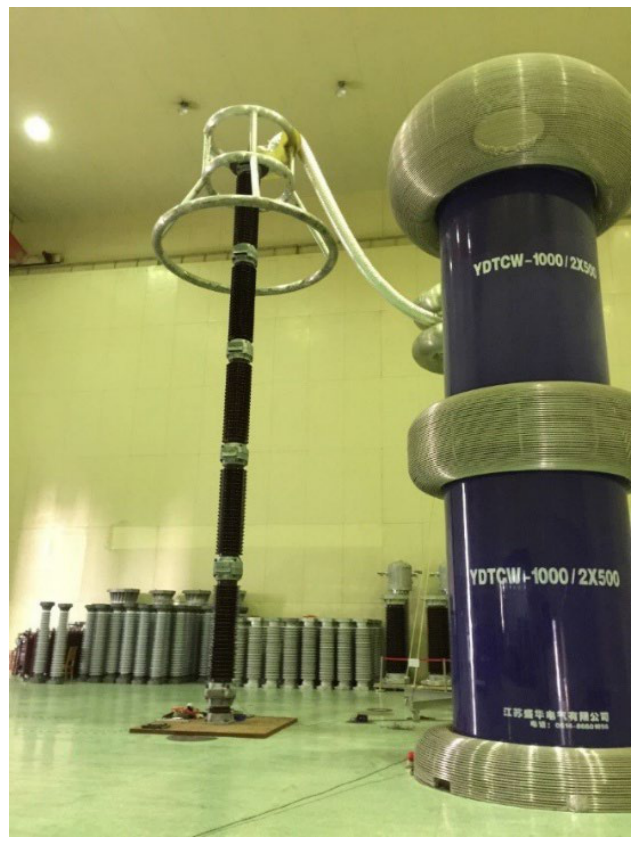
The degradation of the 1000 kV class surge arrester was emulated by short-circuiting a portion of the ZnO varistor blocks. The experiment was conducted in an indoor high-voltage laboratory hall at an ambient temperature of 18.0 °C and a relative humidity of 51%, under an applied voltage of 638 kV. In this study, a gapless metal-oxide surge arrester (MOA), type Y20W1-828/1620W, together with the grading rings used for 1000 kV arresters, was employed as the test specimen. The complete arrester assembly consisted of five arrester sections of identical height connected in series, labeled from top to bottom as #1, #2, #3, #4, and #5. A double-layer grading-ring structure was installed at the top of the MOA. A photograph of the 1000 kV UHV AC surge arrester is shown in Figure 1.
DC and AC tests were then conducted on both the healthy (normal) section and the degraded section of the MOA; for the AC test, a continuous operating voltage of 128 kV was applied. The experimental data are summarized in Table 1 and Table 2.
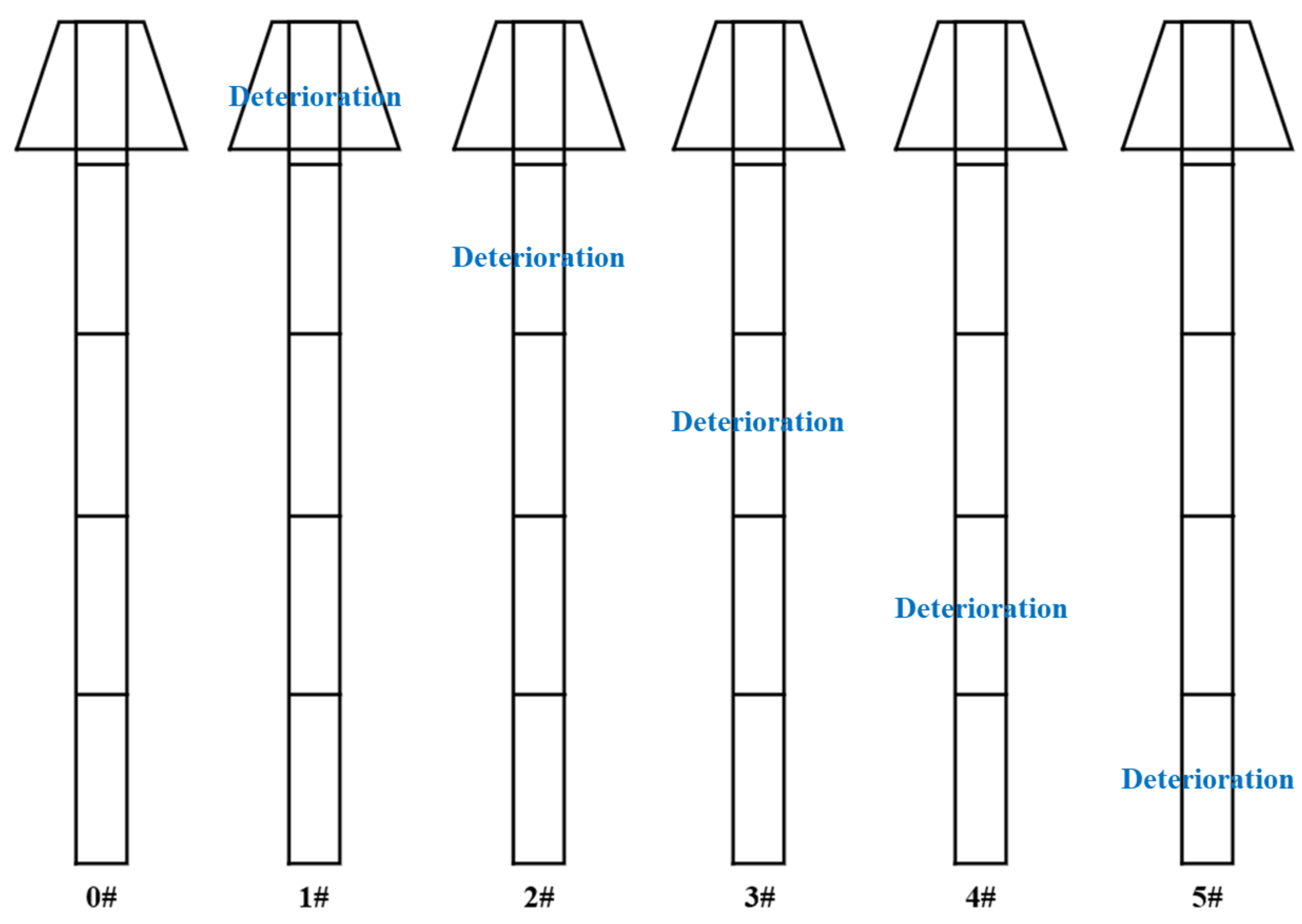
By varying the location of the degraded section within the MOA (i.e., placing it at Section #1, #2, #3, #4, or #5) while keeping all other sections in a normal state, five defective specimens were prepared, denoted as #1–#5. Specimen #0 corresponds to the normal (healthy) MOA. The configurations are shown in Figure 2.
Under a continuous operating voltage of 638 kV, the total current and resistive current at the bottom terminal were measured for specimens #0–#5. The results are summarized in Table 3.
As shown in Table 1 and Table 2, after short-circuiting six ZnO varistor blocks in one section, the dc reference voltage at 1 mA (U1mA) decreases from 225 kV to 194 kV, corresponding to a reduction of approximately 13.8%, while the leakage current at 0.75U1mA increases from 15 μA to 100 μA. These changes indicate a pronounced electrical abnormality in the tested section. In this study, the condition created by short-circuiting six varistor blocks in one section is referred to as an equivalent fault condition. The reported 13.8% therefore refers specifically to the reduction in U1mA, rather than to a quantified degradation degree. Since this experimental treatment does not reproduce the full physicochemical aging process in service, it is used here as a laboratory-emulated equivalent fault condition for subsequent analysis and model validation. It should be noted that short-circuiting ZnO varistor blocks does not physically reproduce all field aging mechanisms, such as moisture ingress, thermal aging, or surface contamination. Instead, it is adopted here as an equivalent degradation emulation method that produces measurable changes in voltage distribution, leakage current, thermal behavior, and PD response. Therefore, the present experiment is intended to validate the sensitivity of the proposed multi-source fusion framework to representative degraded-state manifestations, rather than to reproduce the full physicochemical aging process.
Overall, under the continuous operating-voltage condition of the complete arrester, the changes in total current and resistive current caused by a single short-circuit-type degraded section are relatively small. As a result, the resulting abnormalities can be easily masked by on-site environmental disturbances and measurement conditions. This indicates that conventional single-parameter electrical indicators alone are insufficient for reliable identification of the equivalent degradation condition. Based on the equivalent degradation test specimens established in Section 2, in which #0 denotes the normal condition and #1–#5 represent different degraded-section locations, the following sections present a comparative analysis of multidimensional monitoring quantities. The objective is to extract more discriminative degradation features and to provide a basis for the subsequent fusion-based assessment model.

3. Degradation Characteristics Analysis of UHV Surge Arresters

This study sequentially analyzes the temperature characteristics, current characteristics, and PD signal characteristics of the surge arrester to establish the correspondence between degradation severity and multi-source monitoring quantities. The results provide a basis for feature design and validation of the subsequent multi-source information fusion assessment model.

3.1. Temperature Characteristic Analysis

Temperature is a key parameter for characterizing the energy dissipation and thermal stability of surge arresters. Degradation-induced changes in the voltage distribution across the varistor blocks and in leakage current directly affect the loss level and its spatial distribution, thereby altering the temperature rise, hotspot location, and degree of temperature uniformity. Accordingly, with specimen #0 taken as the reference, this section compares the temperature responses of specimens #1–#5 under identical energization conditions, with emphasis on temperature-rise magnitude, heating rate, and inter-section temperature-distribution characteristics.

3.1.1. Temperature Characteristics of a UHV Surge Arrester

To investigate the internal temperature evolution and spatial distribution of a UHV AC surge arrester under normal operating conditions, a steady-state temperature-rise experiment was carried out in an indoor high-voltage test hall. The ambient temperature was 18 °C and the relative humidity was 51%. During the experiment, a power-frequency reference voltage of 638 kV was applied to simulate the normal operating condition of the arrester. Under this condition, the total current was approximately 1800 μA, the resistive current was about 340 μA, and the energization ratio was approximately 71%, indicating that the arrester was operating in a representative normal state.
The internal temperature of the surge arrester was monitored in real time using temperature-sensing modules embedded in the potential-distribution probes. All measurement points were uniformly distributed along the axial direction of the arrester, and their locations coincided with those used for potential-distribution measurement. Temperature data at each point were transmitted remotely via wireless communication. Measurements were recorded at 1, 6, 12, 18, 23, 30, and 38 min after energization. The resulting internal temperature data for the normal arrester are summarized in Table 4.
As indicated in Table 4, under continuous application of the power-frequency reference voltage, the temperatures at all internal measurement points exhibit a gradual increase with time and then progressively stabilize, indicating a transition toward a quasi-steady thermal state.
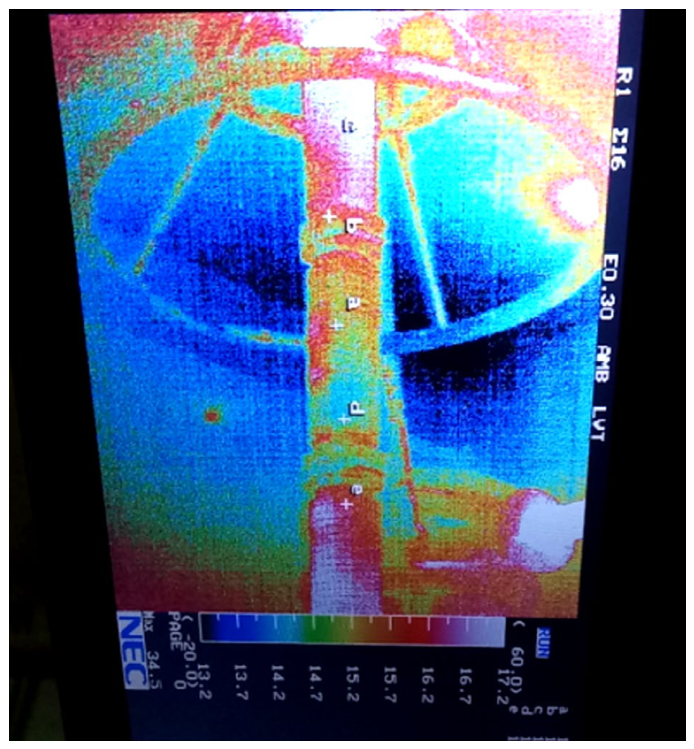
Overall, at 38 min the temperature rise at each measurement point relative to the initial value generally falls within 1.5–3.0 °C, and no abrupt changes or localized abnormal heating are observed. This indicates that, under normal operating conditions, the internal energy dissipation of the surge arrester is low and its thermal stability is satisfactory. Figure 3 shows the external surface infrared thermogram of the arrester in the normal condition.
Figure 3 presents the infrared thermographic image of the surge arrester under the normal operating condition. As shown, the temperature field on the outer surface is generally continuous, without pronounced discontinuities or high-temperature hotspots. This observation indicates that, during the sustained application of the reference voltage, the external thermal state of the arrester remains stable and no localized abnormal overheating occurs. To further quantify the temporal evolution of the surface temperature and inter-section differences, representative regions on the outer surface of each arrester section were selected for infrared temperature measurements. The temperature statistics at different time instants are listed in Table 5.
As indicated in Table 5, under continuous power-frequency voltage stress, heat generated by internal losses is gradually transferred to the outer surface, leading to an overall temperature increase. Among the five sections, Section #3 exhibits the largest temperature rise of 2.7 °C, followed by Section #2 with 2.2 °C. Sections #5 and #4 show rises of 1.7 °C and 1.4 °C, respectively, whereas Section #1 shows the smallest rise of 0.7 °C. These results indicate that, under normal operating conditions, the surface temperature rise differs to some extent among sections; however, the overall temperature distribution remains relatively uniform, without forming distinct hot–cold regions.

3.1.2. Temperature Characteristics of a UHV Surge Arrester Under the Equivalent Fault Condition

To investigate the internal temperature evolution and spatial distribution of a UHV AC surge arrester under a representative degraded condition, a steady-state temperature-rise experiment was performed on the arrester in the fault state. The measured internal temperature distribution is summarized in Table 6.
As shown in Table 6, compared with the normal condition (#0), the overall internal temperature level of the surge arrester increases noticeably under the fault condition. For specimen #0, the mean temperature across all measurement points is 20.29 °C, with a maximum of 21.7 °C and a minimum of 19.2 °C. The temperature range (maximum–minimum) is 2.5 °C, and the temperature field exhibits a low degree of dispersion (standard deviation ≈ 0.67 °C), reflecting favorable thermal stability under the normal condition.
Under the fault condition, the mean temperature across all measurement points for specimens #1–#5 increases to 23.16–23.53 °C, corresponding to an average rise of approximately 2.87–3.24 °C relative to specimen #0. The corresponding maximum temperature increases to 25.3–28.0 °C, the temperature range expands to 5.0–7.9 °C, and the dispersion of the temperature field increases markedly, with standard deviations of approximately 1.45–2.30 °C. These results indicate that the fault condition not only raises the overall temperature level but also amplifies temperature differences among sections and measurement points, causing the internal temperature field to shift from an approximately uniform state to a distinctly non-uniform one.
While the internal temperature was being measured, an infrared thermal imager was used simultaneously to monitor the outer surface temperature of the surge arrester. The test voltage, ambient conditions, and measurement arrangement were kept consistent with those used in the internal-temperature experiment. Figure 3 shows the infrared thermographic image of the arrester surface, and Table 7 summarizes the maximum and minimum surface temperatures of each section in the steady-state stage.
Under the fault condition, the overall surface temperature level also increases. For the five defective-location cases (#1–#5), the average surface temperature is approximately 19.54–19.87 °C, representing an increase of about 0.99–1.32 °C relative to specimen #0 (18.55 °C). Meanwhile, the global temperature difference expands to 2.5–3.7 °C, and the surface temperature field changes from weakly non-uniform to distinctly non-uniform, with markedly enhanced hotspot visibility in the infrared thermograms.
As shown in Table 7, under the normal condition (#0), the surface temperature of the surge arrester is generally uniform. The maximum surface temperature occurs at Section #2 (19.3 °C), whereas the minimum is observed at Section #5 (18.2 °C), yielding a global temperature difference of only 1.1 °C. This indicates that no pronounced hotspot region is present on the outer surface in the normal state.
Overall, the temperature results indicate that degradation affects not only the overall thermal level of the surge arrester, but also the spatial distribution of the temperature field. Compared with the normal condition, the degraded cases exhibit higher mean temperature, larger temperature range, and stronger spatial non-uniformity. Moreover, the surface hotspot tends to shift toward the section associated with the degraded location, suggesting that temperature information can provide useful spatial cues for degradation localization.

3.2. Current Characteristic Analysis

Current characteristics directly reflect the conduction state and loss level of a surge arrester under continuous operating voltage, among which the resistive current component is more closely associated with heating. Under identical test conditions, this section compares the total current and resistive current of specimens #0 and #1–#5, with emphasis on changes in magnitude, phase/waveform differences, and the influence of the degraded-section location on the overall current response. In Table 8, the symbols “NaN” and the value 0.01 mA represent abnormal raw-data entries rather than valid current measurements. The NaN entries were caused by temporary sensor dropout during acquisition, whereas the 0.01 mA values were identified as invalid readings caused by measurement interruption. In total, 12 abnormal entries were observed in the raw current table, including 10 NaN values and 2 invalid 0.01 mA values. These entries were excluded during preprocessing before model training and evaluation, and the same rule was consistently applied to all data subsets. Accordingly, Table 8 is retained only to present the raw measurement situation, while the cleaned dataset used for subsequent analysis did not include these abnormal entries.
As shown in Table 8, under the normal condition (#0), the total current ranges from 1.30 mA to 2.10 mA, with an average of approximately 1.61 mA. In terms of the axial distribution, the current generally exhibits a pattern of being higher in the upper-to-middle sections and lower toward the bottom. This result suggests that, under continuous operating voltage, the combined effects of inter-section voltage sharing and distributed capacitance/stray parameters in a healthy arrester lead to an axial current gradient, which provides a baseline for subsequent comparisons with fault conditions.
Under the fault condition, the overall level of the total current increases and its distribution becomes more uniform. From the data for cases #1–#5, the mean current across all measurement points is approximately 1.61 mA in the normal condition (#0), whereas it increases to about 1.80–1.85 mA under the fault condition, corresponding to an average increment of roughly 0.17–0.24 mA. Meanwhile, the dispersion of the total current decreases markedly: the global range is about 0.80 mA in the normal case but typically drops to 0.29–0.39 mA in the degraded cases. These results indicate that the total-current distribution shifts from a “pronounced gradient” to a “relatively uniform” pattern when a fault is present.

3.3. PD Signal Characteristic Analysis

PD signals are important indicators of weak insulation regions and local electric-field distortion inside a surge arrester. Short-circuit-type degradation alters the voltage sharing of the varistor blocks and the distribution of local field strength, leading to differences in PD activity in terms of pulse occurrence, amplitude, and periodicity with respect to the power-frequency phase. Accordingly, using specimen #0 as the reference, this section compares the UHF PD responses of specimens #1–#5 with different degraded-section locations under identical energization conditions, focusing on the presence/absence of PD pulses and the time-/frequency-domain characteristics and phase-distribution patterns of representative single pulses.
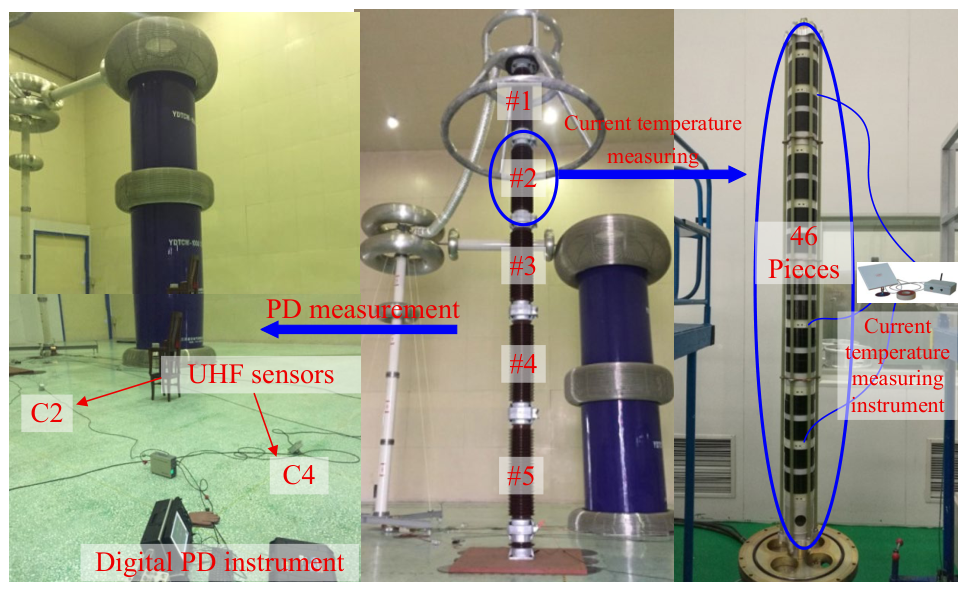
To improve the reliability of PD identification, two synchronized UHF sensors (C2 and C4) were installed at fixed positions around the arrester specimen. In this study, no universal fixed UHF amplitude threshold was assumed. A pulse was regarded as valid only when its amplitude exceeded the measured background-noise floor and exhibited consistent pulse characteristics in the synchronized UHF channels. The two-channel recordings were further used for time-difference-of-arrival analysis to distinguish signals originating from the arrester specimen from external interference. If no synchronized pulses above the threshold were observed, the corresponding condition was categorized as showing no evident PD activity.
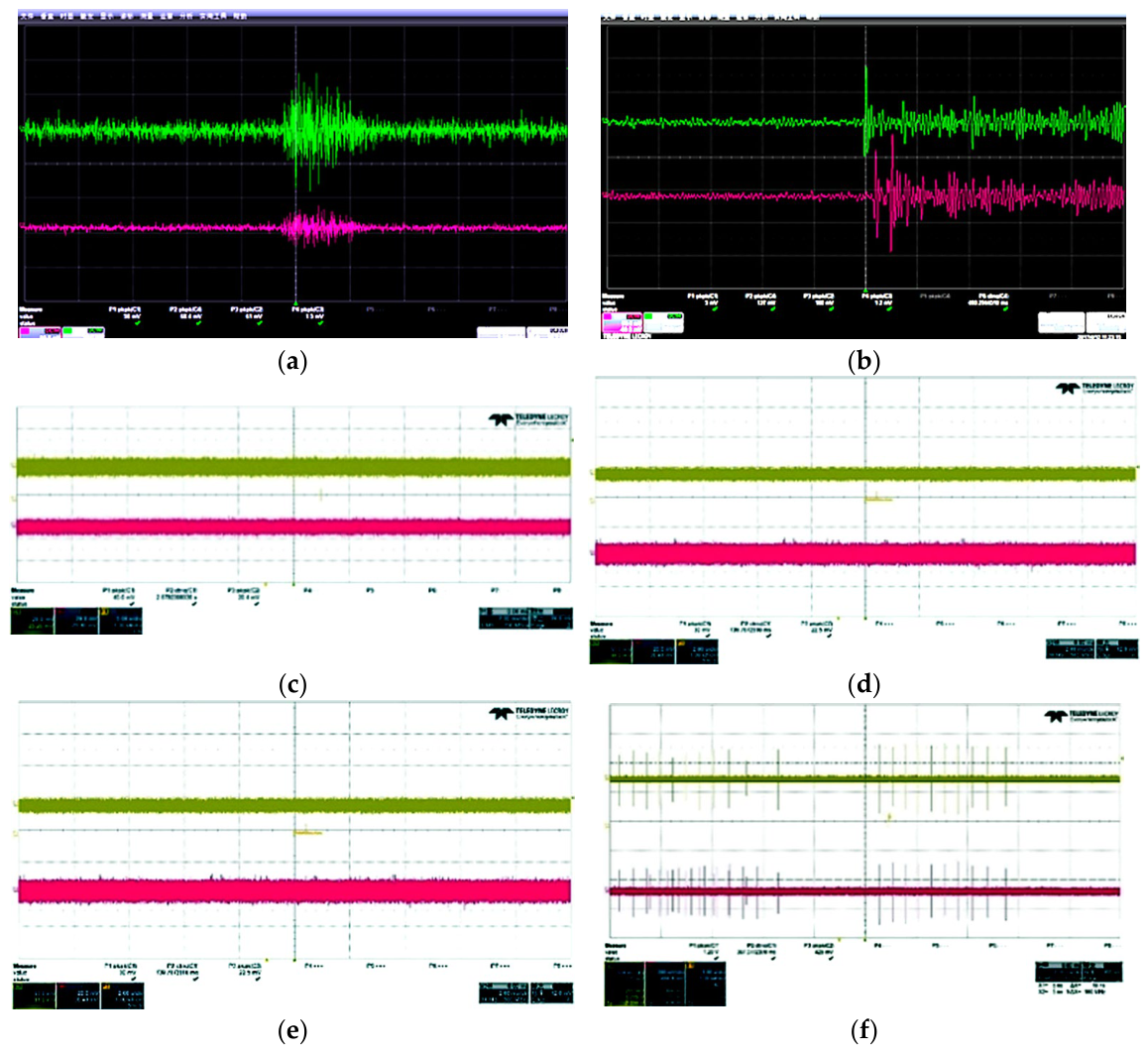
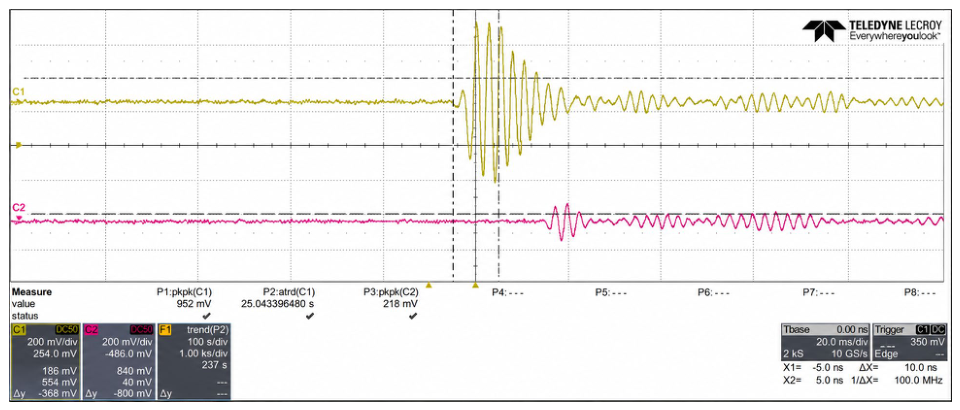
As shown in Figure 4 and Table 9, two synchronized UHF sensors (C2 and C4) were placed at fixed positions around the arrester specimen. Depending on the defective-section location, the sensor-to-arrester distances ranged from 2.0 to 3.5 m for C4 and from 5.0 to 8.5 m for C2. Under these configurations, evident PD activity was detected only for specimens #1 and #5, whereas no evident PD pulses were observed for specimens #0, #2, #3, and #4.
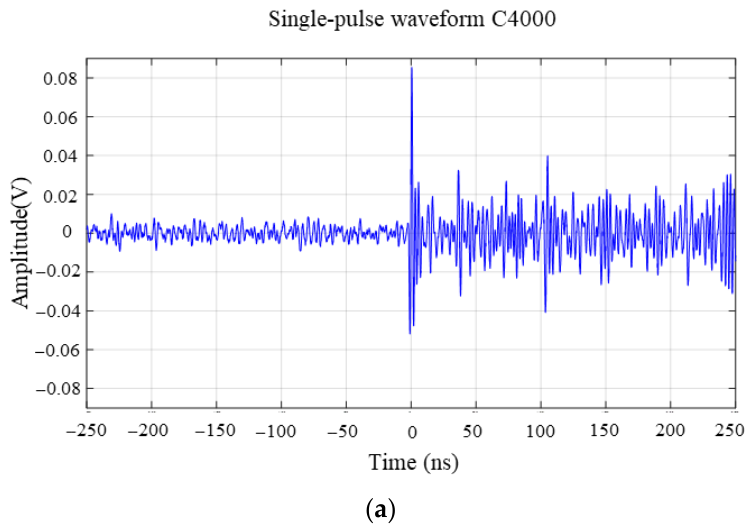
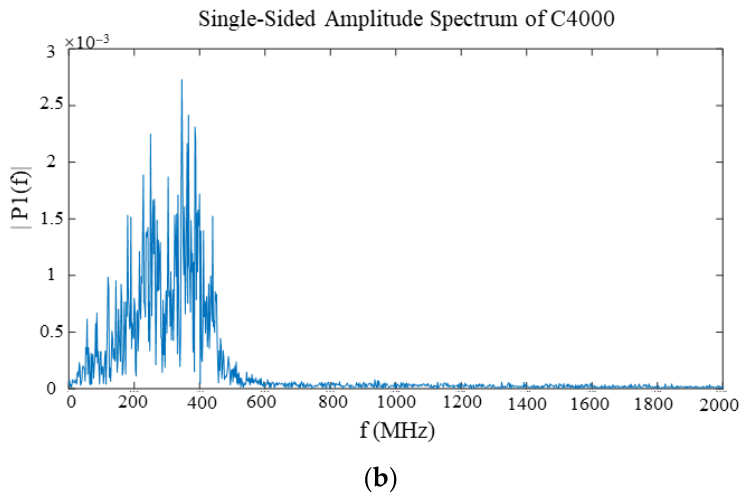
The effective operating bandwidth of the UHF sensors used in this study was 300–1500 MHz. Under the present acquisition configuration, the measured background-noise peak-to-peak levels were approximately 0.008 V for channel C2 and 0.009 V for channel C4. As a representative example, for the pulse file C4000 under specimen #1, the peak-to-peak amplitude recorded in C2 was 0.1373 V, while the synchronized pulse amplitude recorded in C4 was 0.094 V. Both values were clearly higher than the corresponding background-noise levels. In addition, the pulse in C2 arrived approximately 3 ns earlier than that in C4. Therefore, this event was accepted as a valid specimen-originated PD pulse according to the two-channel acceptance rule.
To investigate the PD characteristics of a UHV AC surge arrester under fault conditions, five short-circuit-defect specimens (#1–#5) were prepared by placing the degraded section at different locations within the MOA (Sections #1–#5), while specimen #0 corresponds to the normal MOA. A voltage of 638 kV was applied to all specimens. The PD signals detected when the degraded section was located at Sections #1, #2, #3, #4, and #5 are shown in Figure 5.
From Figure 5, it can be observed that specimens #0, #2, #3, and #4 exhibit no evident pulse signals in the data recorded by the UHF sensors C4 and C2. The UHF measurements consistently indicate that no PD activity is detected in these specimens.
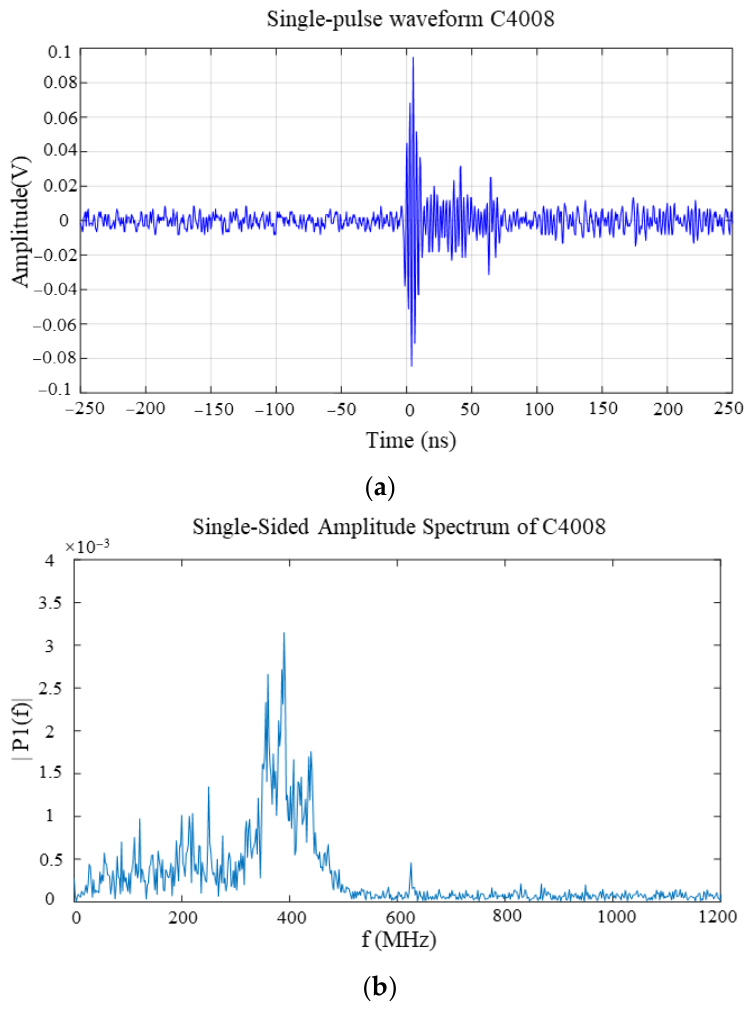
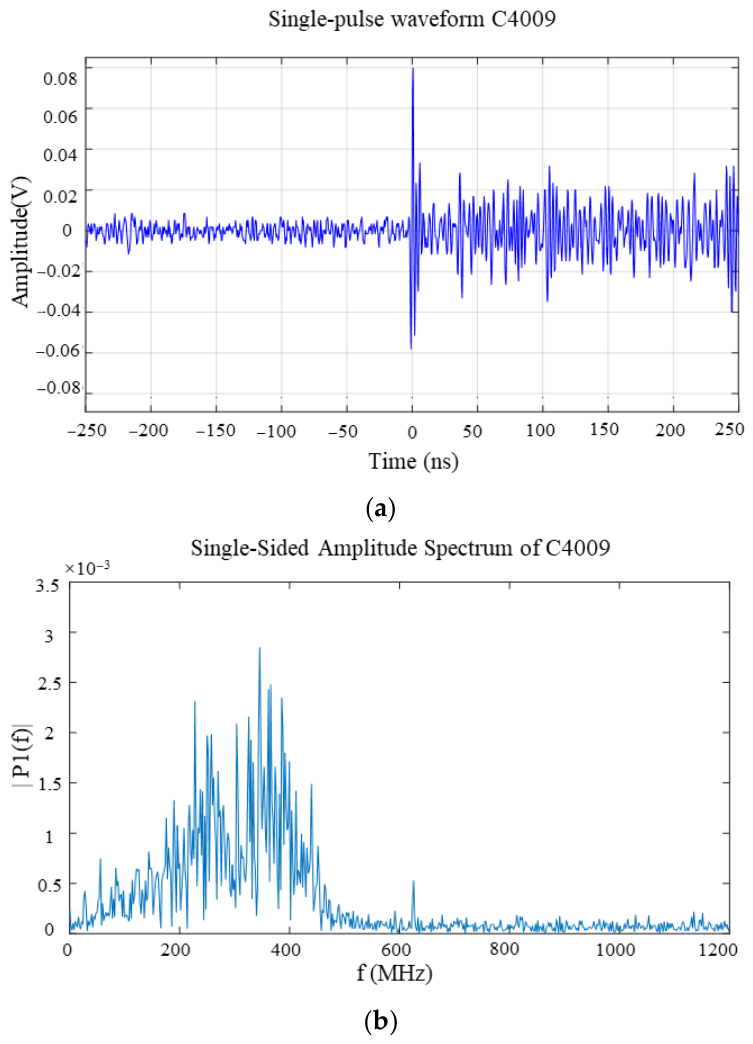
Specimen #1 corresponds to the fault case where Section #1 is degraded. Using the single-pulse files C4000, C4008, and C4009, the time- and frequency-domain waveforms of representative individual pulses are plotted in Figure 6, Figure 7 and Figure 8, respectively.
Based on the UHF time-difference-of-arrival (TDOA) localization analysis, the UHF signals captured by the C2-channel sensor consistently arrive earlier than those recorded by the C4-channel sensor for all examined directions. This timing relationship indicates that the UHF pulses originate from the surge specimen. Clear pulse signals are observed in the measured data, and the UHF results confirm the presence of PD activity in the specimen. The pulses exhibit a certain periodicity with respect to the power-frequency cycle; according to the phase distribution and characteristic patterns, the discharges are preliminarily identified as insulation-type PD.
Specimen #5 corresponds to the fault case where Section #5 is degraded. Using the recorded single-pulse files, the time-domain waveforms of representative individual pulses are plotted in Figure 9.
Clear pulse signals are observed in the measured data. According to the UHF time-difference-of-arrival (TDOA) localization analysis, the signals detected by the C2 sensor consistently arrive earlier than those recorded by the C4 sensor for all examined directions, indicating that the UHF pulses originate from the surge arrester specimen. The pulses exhibit periodicity with respect to the power-frequency cycle, consistent with discharge behavior. Moreover, the phase distribution and spectral-pattern characteristics agree with those of floating discharges. The UHF results therefore confirm the presence of PD activity in the specimen, identified as floating discharge.
Under fault conditions, the three categories of monitoring quantities—temperature, current, and PD signals—exhibit distinct and complementary response characteristics. Temperature and current primarily reflect changes in the overall loss level and its distribution, whereas PD is more sensitive to localized insulation abnormalities and electric-field distortions; moreover, the presence or absence of PD shows a pronounced dependence on the location of the degraded section. A single type of signal is therefore often insufficient to meet the simultaneous requirements of identifying both “global variations” and “local anomalies.” It is thus necessary to jointly model and fuse multi-source information, including leakage current, temperature, PD, and voltage. On this basis, the next chapter will develop a deep-learning assessment model with multi-source information fusion and employ SSA to optimize key hyperparameters, enabling high-accuracy identification of both the degradation state and the degraded-section location of the surge arrester.

4. Degradation Assessment of Surge Arresters Based on a Multi-Source Information Fusion Model

4.1. Dataset Construction and Preprocessing

For reproducibility, the dataset construction and preprocessing procedures are described as follows. Six operating conditions were considered, including one normal condition (#0) and five degraded-location conditions (#1–#5), corresponding to the healthy arrester and the five possible locations of the degraded section, respectively. To characterize the degradation state of the surge arrester from multiple complementary perspectives, four types of data were collected, namely leakage-current signals, voltage signals, UHF PD signals, and temperature data.
The leakage-current and voltage signals were synchronously acquired at a sampling frequency of 100 kHz, with 4096 points recorded in each acquisition. Each record was segmented into 512-point windows with 50% overlap, and each window was treated as an input sample. The UHF PD signals were acquired separately at 1 GHz, with 2048 points per record, and were segmented into 256-point windows using the same overlap ratio. The temperature data were organized as 45 × 7 spatial–temporal tensors, where 45 denotes the internal temperature measurement points along the arrester and 7 denotes the acquisition instants. This representation preserves both the temporal evolution and the spatial distribution of the temperature field. For the PD modality, the UHF signals were not represented only by manually selected single-pulse descriptors. Instead, the raw UHF waveforms were segmented into fixed-length windows and directly used as inputs to the 1D-CNN branch, so that discriminative local patterns related to pulse occurrence, oscillation behavior, and time–frequency characteristics could be learned automatically during training.
To avoid bias caused by class imbalance, the final dataset was constructed to be as balanced as possible across the six operating conditions. Specifically, the dataset used for model training and evaluation contained a total of 200 samples in all, with the samples distributed as evenly as possible among the six classes. Before being fed into the network, all inputs were normalized to reduce the influence of scale differences among heterogeneous modalities and to improve training stability. For one-dimensional time-series data, normalization was performed on each sample sequence. The temperature tensors were normalized in matrix form before being fed into the corresponding network branch.
Particular attention was paid to preventing information leakage during dataset partitioning. Since overlapping windows extracted from the same acquisition sequence are highly similar, random splitting at the sample-window level may lead to overly optimistic results. For this reason, a specimen-level partition strategy was adopted. Specifically, all windowed samples generated from the same physical specimen under the same operating condition were assigned to only one subset, rather than being randomly distributed between the training and test sets. In this way, samples from the same specimen were prevented from appearing in different subsets, thereby enabling a stricter and more realistic evaluation of model generalization.
It should also be emphasized that no artificial noise augmentation was used in constructing the training, validation, or test datasets. All samples were obtained directly from experimentally measured signals through windowing and normalization, without introducing any synthetic perturbations into the original data. Therefore, the reported classification performance was not achieved by artificially increasing class separability, but was determined solely by the actual operating conditions of the arrester specimens.
To further examine the robustness of the proposed model to measurement disturbances, an additional noise-sensitivity analysis was performed on the test set. In this analysis, additive Gaussian white noise with different signal-to-noise ratio (SNR) levels was superimposed on the electrical signal inputs, while the specimen-level partition remained unchanged. The corresponding results are presented in Table 10.
The results show that the proposed SSA-optimized CNN–LSTM framework maintained relatively stable classification performance under moderate noise contamination, suggesting that the degradation features learned by the model were not overly sensitive to external disturbances. Since the added noise was introduced only for robustness evaluation and was applied in a class-independent manner, this procedure did not create artificial separability among classes.

4.2. Fundamental Principles of the Model

4.2.1. CNN Architecture

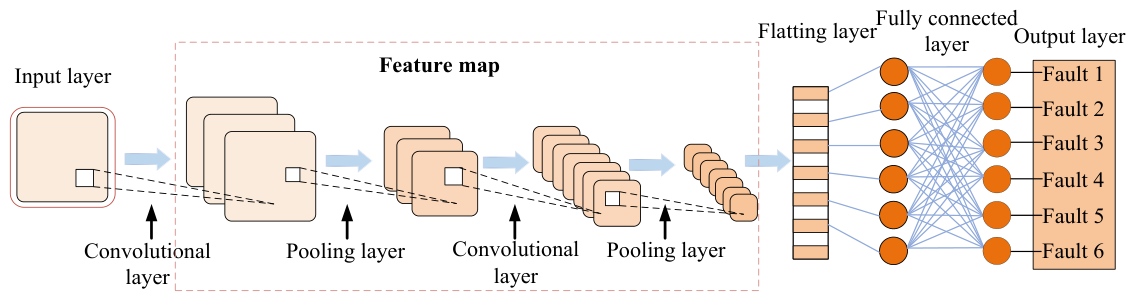
A standard CNN architecture typically begins with an input layer, followed by multiple convolutional and pooling layers stacked alternately in a hierarchical manner. The network then terminates with fully connected layers to perform feature-to-output mapping and generate the final predictions. The overall architecture is illustrated in Figure 10.
Depending on the dimensionality of the input, CNNs are generally categorized into one-dimensional (1D), two-dimensional (2D), and three-dimensional (3D) variants. Considering the differences in temporal and spatial representations of the sensing data in this study, the network branches are configured in a targeted manner. For 1D time-series signals—such as power-frequency leakage current, PD signals, and voltage waveforms—1D convolutional kernels along the time axis are employed for feature extraction. For 2D representational data, such as temperature-field distributions, 2D convolutional kernels are adopted to model spatial features.
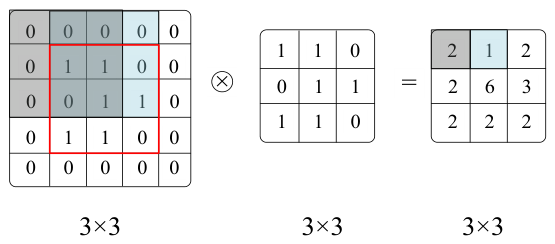
In this study, convolutions are performed in same mode, as indicated by the red box in Figure 11. Specifically, symmetric boundary padding is applied to extend the edges of the input feature map (3 × 3), ensuring that, when a 3 × 3 convolution kernel is used, the output feature map remains exactly the same size as the input. This mode preserves effective extraction of edge features while maintaining continuity of feature propagation through parameter sharing, thereby providing the network with a stable hierarchical flow of spatial information.
As shown in Figure 11, the convolution operation follows (1):
H n = f H n 1 w n + b n
where Hn denotes the output of the n-th convolutional layer; Hn−1 denotes the input to the n-th convolutional layer (which is also the output of the (n−1)-th layer); f is the activation function; wn and bn are the weights and bias of the n-th convolutional layer, respectively.
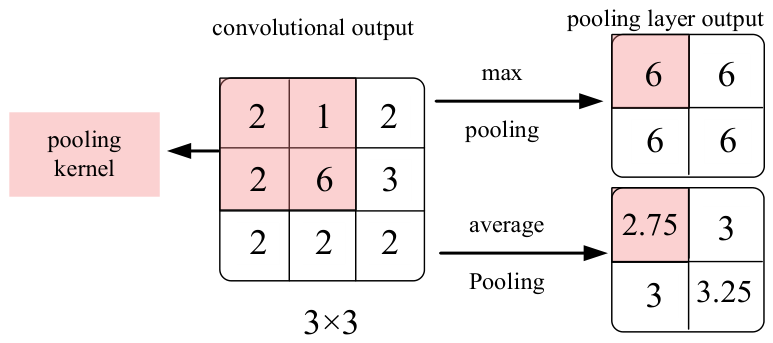
The pooling layer reduces the resolution of feature maps, thereby decreasing the number of parameters and computational complexity and alleviating overfitting. The pooling operation is illustrated in Figure 12.
The output layer maps the continuous feature representation produced by the fully connected module to a class-level probability distribution, and a Softmax classifier is employed to determine the diagnostic category. The Softmax function is given by (2):
p ( y = m z ) = e z m k = 1 K e z k
where p(y = m|z) of the input zm vector z with sequence size K, belonging to the probability of class m.

4.2.2. LSTM Architecture

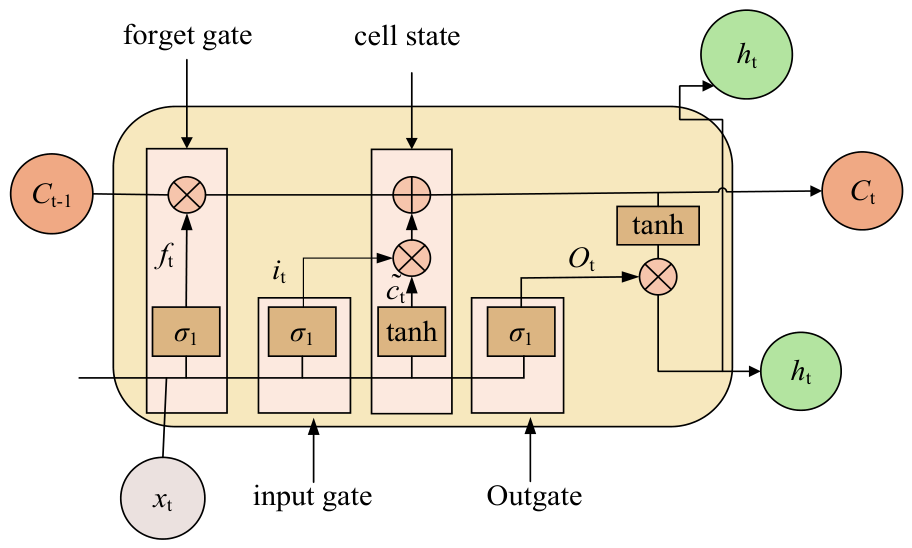
LSTM achieves precise control of long-term temporal dependencies through a gating mechanism, and its core structure consists of the following four components, as shown in Figure 13.
By combining the gating results of the forget gate and the input gate, the cell state is adaptively updated, thereby continuously retaining the most critical memory information associated with long-term evolution during iteration. The cell state update at time t is given by (3):
f t = σ 1 W f [ h t 1 , x t ] + b f i t = σ 1 W i [ h t 1 , x t ] + b i C ˜ t = tanh W c [ h t 1 , x t ] + b c C t = f t C t 1 + i t C ˜ t o t = σ 1 W o [ h t 1 , x t ] + b o h t = o t tanh ( C ˜ t )
where f t , i t , and o t denote the outputs of the forget gate, input gate, and output gate, respectively; x t represents the input at time step t ; h t represents the output at time step t ; C ~ t denotes the new candidate cell state vector; and C t is the cell state at time step t . W f , W i , W o , b f , b i , and b o are the weight matrices and bias vectors associated with the gating structures, respectively, while W c and b c are the weight matrix and bias vector corresponding to the candidate cell state vector. σ 1 and t a n h denote the activation functions.

4.2.3. Fundamental Principle of the SSA Algorithm

The sparrow search algorithm (SSA) is a swarm-intelligence optimization method that searches the solution space by simulating the division of labor and cooperative behavior of sparrows during foraging and anti-predation processes.
In the sparrow search algorithm, the sparrow population is represented by the following matrix:
X = x 1 x 2 x n = x 1 , 1 x 1 , 2 x 1 , d x 2 , 1 x 2 , 2 x 2 , d x n , 1 x n , 2 x n , d
where historically best position is denoted as Xbest. The function f(x) is defined as the food amount in the current region, which represents the fitness value of the objective function. Based on this setting, according to the specific position of each sparrow, the corresponding fitness value at that position can be accurately calculated.
X i t + 1 = X i t e x p i α t m a x , R 2 < S T , X i t + q L , R 2 S T ,
Once danger occurs, the discoverers need to quickly lead the population to evacuate the current area; if there is no danger, the discoverers need to search for new food sources over a wider range. The update equation for the discoverers is:
X i t + 1 = q e x p X w t X i t i 2 , i > n 2 , X p t + X i t X p t A + L , i n 2 ,
where t denotes the current iteration number, tmax is the maximum number of iterations in the entire process. α is a random value generated in an open interval. R2 is the preset warning value; ST is the safety threshold. q is a random number following a normal distribution; L is a row matrix whose elements are all 1.
When R2 is less than ST, the population is in a safe state and performs a wide-range search. Conversely, if R2 is greater than or equal to ST, it indicates the presence of predation threats, and the population, guided by the vigilant individuals, moves to a safer area to continue foraging.
The update equation for the followers is:
F = f ( x 1 ) f ( x 2 ) f ( x n )
where X p t represents the best position of the discoverers, while X w t denotes the worst position in the sparrow population at the current time. The matrix A+ is a special one-row multidimensional matrix, in which each element takes a value of either 1 or −1. n/2 refers to the number of remaining sparrows in the population. When I > n/2, it means that, in the whole sparrow population, the fitness value corresponding to the i-th sparrow is relatively low; it has not successfully obtained food resources, and therefore needs to fly to other areas to search for food in order to survive.
The initial positions of the vigilant individuals are generated by a randomization method, ensuring that, in the early stage of algorithm iteration, they can be uniformly distributed in the solution space, thereby effectively fulfilling the functions of environmental monitoring and risk warning. The position update equation for the vigilant individuals is:
X i t + 1 = X b t + β · X i t X b t , f i f g , X i t + K · X i t X w t f i f w + ε , f i = f g ,
where X b t represents the global best position at this moment. β is a step-size control parameter, which plays a regulating role in the step length of the corresponding operation. β is a random number with a value range between (0, 1), and its randomness brings uncertainty factors to the system. fi denotes the fitness value of the current individual in the population, and fw and fg correspond to the best and worst fitness values in the current population, respectively. To prevent the denominator from being zero, a constant ε is introduced.
When fifg, the individual is mostly located at the edge of the population and faces a higher predation risk. When fi = fg, it indicates that the individual has perceived danger and tends to move toward the population center to reduce the risk.
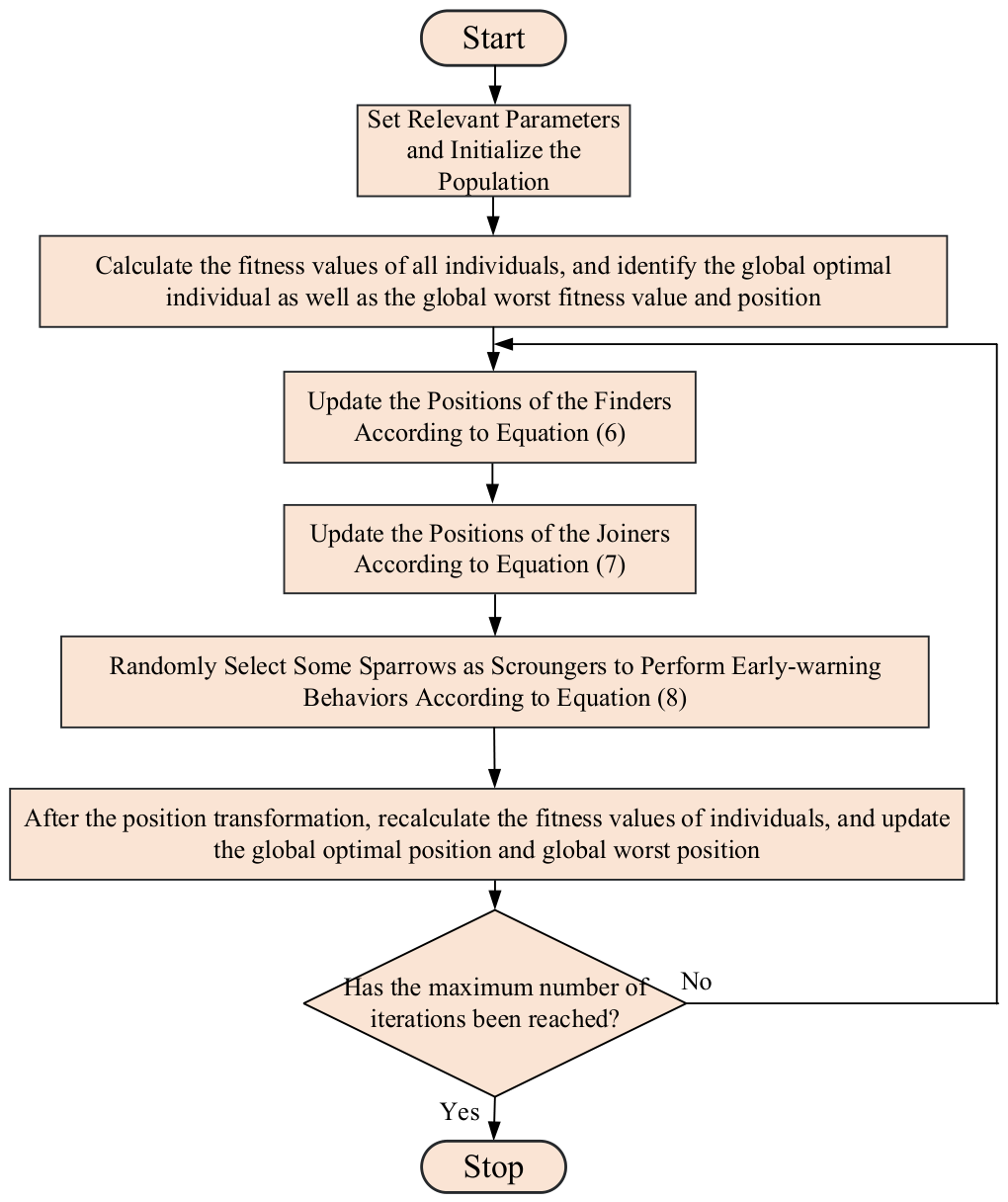
The overall procedure of SSA is shown in Figure 14.
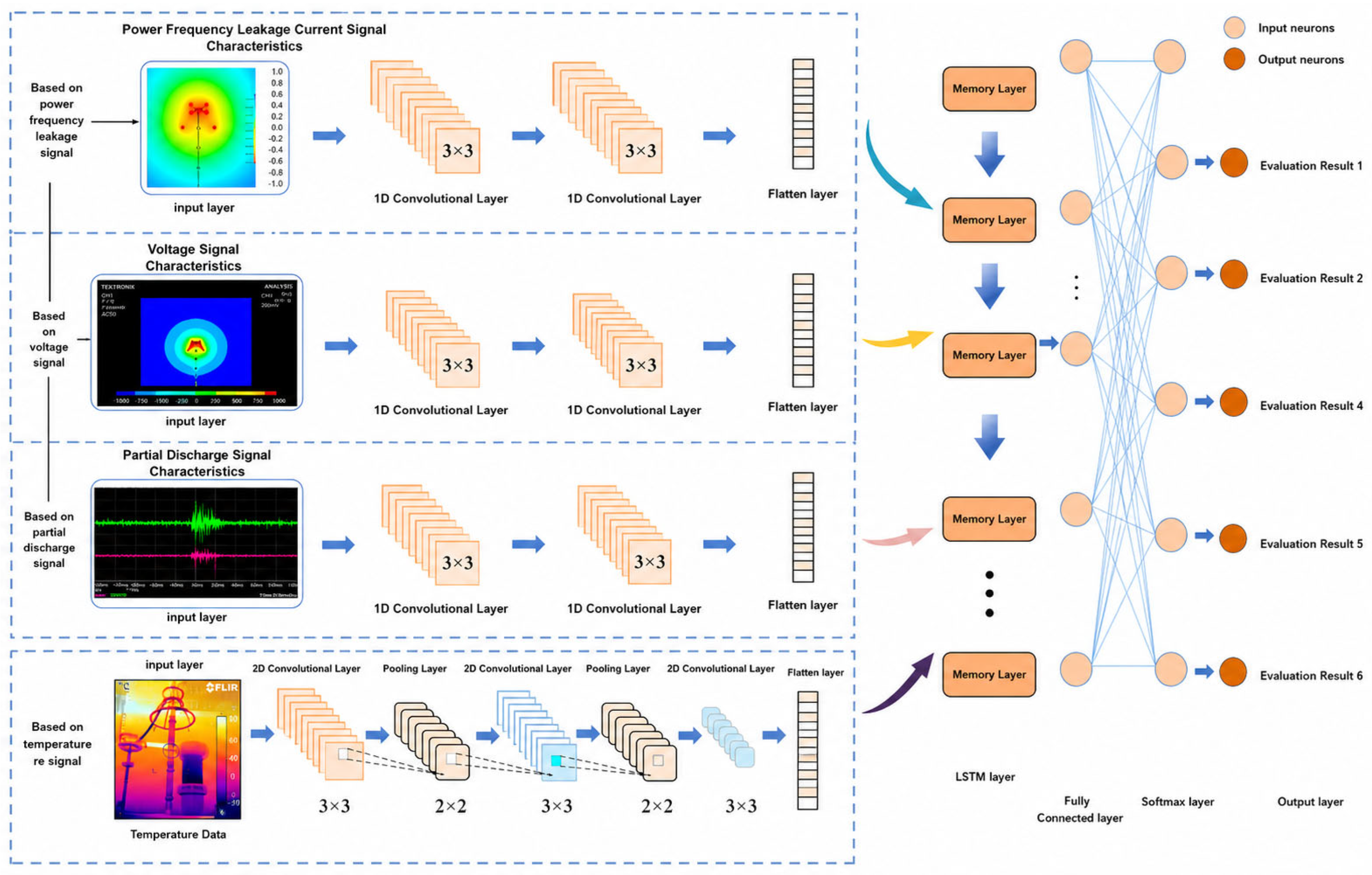
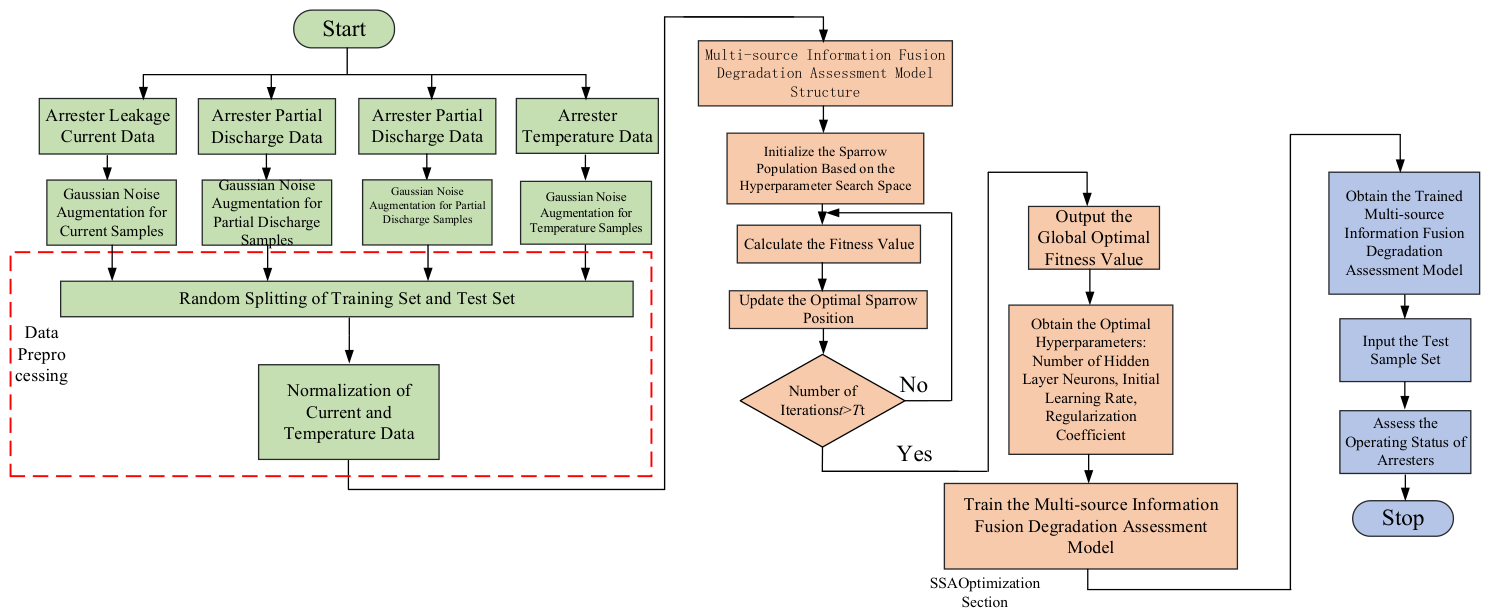
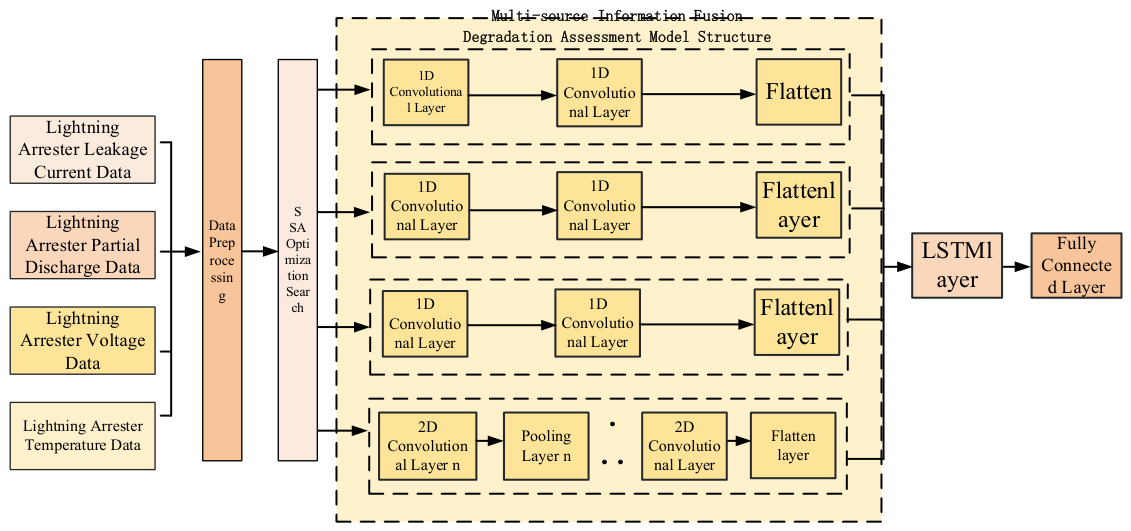
The power-frequency leakage-current sequences and the PD- and voltage-fluctuation feature sequences collected from surge arresters under different operating conditions are taken as inputs, and key features such as amplitude variations and temporal patterns are extracted using two 1D convolutional neural network layers, respectively. “Based on temperature signals” refers to using the internal temperature measurement points of the varistor blocks in each section at different operating stages together with the outer-surface temperature data as inputs, and adopting a structure composed of three convolutional layers and two pooling units to learn and extract deep representations of the spatial distribution characteristics of the temperature field and their temporal variations. Subsequently, the features extracted by the four branches are flattened into 1D vectors through a Flatten layer; after fusion, they are fed into an LSTM network, where the temporal dependence relationships among multi-source features are further modeled. Finally, the operating state of the surge arrester and the identification results of the degraded-section location are output through a fully connected layer and a Softmax layer. Based on the above analysis, the overall network architecture of the proposed multi-source information fusion degradation assessment algorithm is shown in Figure 15. Multi-source information fusion deterioration assessment process. is shown in Figure 16. Structural framework of degradation assessment model for multi-source information fusion is shown in Figure 17.
To improve reproducibility, the detailed implementation settings of the proposed multi-branch CNN–LSTM model are summarized in Table 10. The leakage-current, voltage, and PD branches each adopt two 1D convolutional layers followed by a max-pooling layer for local temporal feature extraction, whereas the temperature branch adopts three 2D convolutional layers and two max-pooling layers to capture the spatial–temporal characteristics of the temperature field. After branch-wise feature extraction, the resulting feature vectors are flattened and concatenated, and the fused features are then fed into the LSTM layer for temporal dependency modeling, followed by a fully connected layer and a Softmax classifier for final diagnosis.
As shown in Table 11, the leakage-current, voltage, and PD signals were treated as one-dimensional single-channel sequences, and their input dimensions were therefore expressed as 512 × 1 or 256 × 1 , where the last dimension denotes the number of channels. The temperature data were represented as a 45 × 7 × 1 tensor, where 45 denotes the spatial measurement points, 7 denotes the acquisition instants, and 1 denotes the single temperature channel. After branch-wise feature extraction, the resulting feature maps were flattened into one-dimensional vectors and concatenated to form the fused feature representation. This fused feature vector was then fed into the LSTM layer to model temporal dependency, and the final classification result was obtained through the fully connected layer and the Softmax classifier. Based on the above network architecture, SSA was further employed to optimize the key hyperparameters of the proposed model.
In this study, SSA was used to optimize the key hyperparameters of the proposed CNN–LSTM model, including the number of hidden neurons in the LSTM layer, batch size, initial learning rate, L2 regularization coefficient, and number of training epochs. To ensure reproducibility, the search ranges were set as follows: the number of hidden neurons was searched in the range of 16–64, the batch size in 8–32, the initial learning rate in 1 × 10⁻⁴ to 1 × 10⁻², the L2 regularization coefficient in 1 × 10⁻⁵ to 1 × 10⁻², and the number of training epochs in 30–80. The population size of SSA was set to 10, and the maximum number of iterations was set to 15. Under these settings, a total of 150 candidate hyperparameter combinations were evaluated during the optimization process. These search intervals were chosen empirically in view of the relatively small sample size, so as to control model complexity while maintaining sufficient optimization flexibility.
The fitness function was defined as the classification accuracy on the validation subset. For each candidate solution generated by SSA, the model was trained on the training subset and then evaluated on the validation subset, and the resulting fitness value was returned to guide the population update. The predefined search ranges of the hyperparameters and the final optimized configuration obtained after convergence are summarized in Table 12. After the optimization process converged, the final selected hyperparameters were determined as follows: the number of hidden neurons in the LSTM layer was 48, the batch size was 16, the initial learning rate was 2.5 × 10⁻³, the L2 regularization coefficient was 5.0 × 10⁻³, and the number of training epochs was 50.
If multiple candidate solutions yielded similar fitness values, the one with the lower validation loss and more stable convergence behavior was selected as the final configuration.


4.3. Degradation Assessment: Results and Discussion

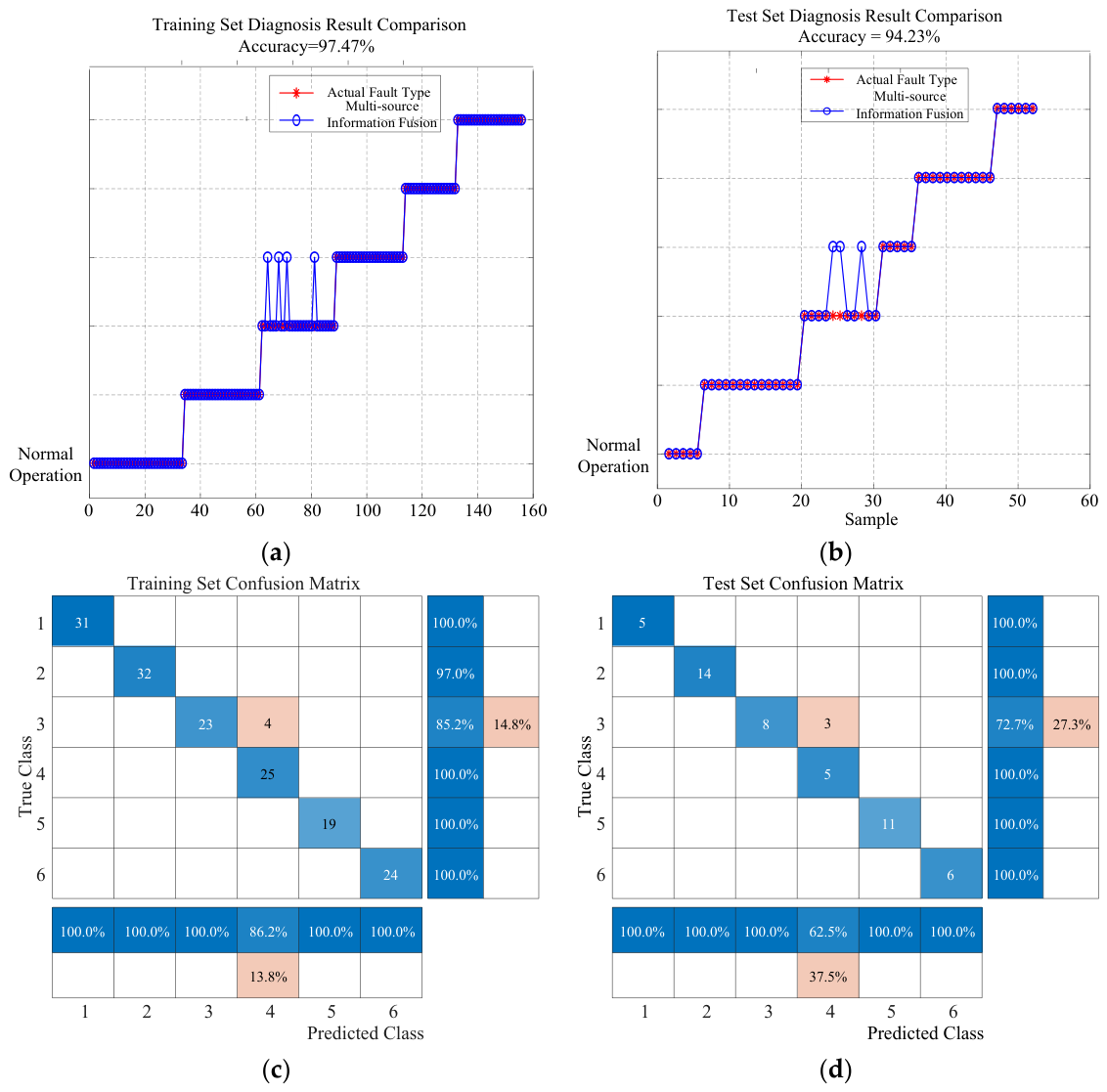
After training with 20 iterations per round and a total of 1360 iterations, both the accuracy curve and the loss function gradually converge and become stable. The recognition accuracies of the training and test sets, together with the corresponding confusion matrices, are shown in Figure 18.
As shown in Figure 18, after simultaneously incorporating the power-frequency leakage current, PD, voltage, and temperature signals, the proposed assessment method achieves a pronounced performance improvement on both the training and test sets. The proposed method achieves an accuracy of 97.47% on the training set and 94.23% on the test set, with a gap of only 3.24 percentage points. This relatively small difference indicates that the model does not merely memorize the training samples but maintains satisfactory generalization capability on unseen data.
From the confusion matrices, most classes are identified correctly, and the misclassifications are mainly concentrated between Class 3 and Class 4. Specifically, several samples belonging to Class 3 are misclassified as Class 4 in both the training and test sets, while the remaining classes are almost perfectly recognized. This indicates that the proposed model has strong discriminative capability for most degradation locations, whereas the feature representations of these two adjacent classes still exhibit partial overlap. A possible reason for this phenomenon is that the degradation states corresponding to Class 3 and Class 4 may produce relatively similar responses in leakage current, PD activity, voltage fluctuation, and temperature distribution. When the degraded locations are adjacent or their severity levels are close, the inter-class differences become weaker, which increases the difficulty of boundary discrimination.
As can be seen, to further assess the classification behavior of training set and test set at the class level, the detailed precision, recall, F1-score, and accuracy values are reported in Table 13.
As reported in Table 13, most classes achieve 100% precision, recall, and F1-score. In contrast, Class 3 exhibits the lowest recall, while Class 4 shows the lowest precision, which is consistent with the confusion-matrix results and further confirms that the main classification ambiguity occurs between these two classes.
These results demonstrate that the proposed multimodal fusion framework can effectively identify the degradation location of surge arresters with high accuracy and stability, showing good potential for practical condition assessment and early fault warning in engineering applications.

4.4. Generalization Validation with Specimen-Level Data Split

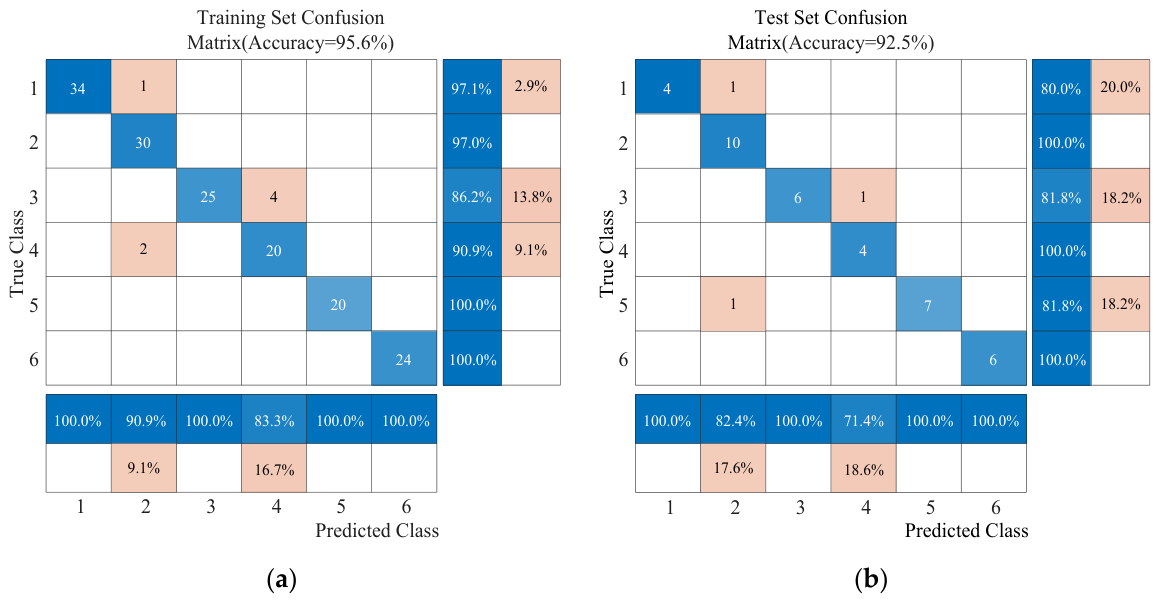
Although the above experimental results demonstrate the effectiveness of the proposed method, the use of overlapping windows in sample construction may introduce a risk of information leakage if the dataset is randomly divided at the sample-window level. To address this issue, a stricter specimen-level data partition strategy was further adopted in this study. Specifically, all windowed samples generated from the same physical specimen under the same operating condition were assigned exclusively to one subset only. As a result, no samples originating from the same specimen were allowed to appear simultaneously in the training, validation, and test sets. In addition, stratified partitioning was performed across the six operating-condition classes to maintain class balance in each subset. Under this protocol, the obtained results provide a more reliable assessment of the proposed model’s generalization capability to unseen specimens, rather than reflecting performance inflated by the presence of highly similar adjacent windows extracted from the same acquisition sequence.
Figure 19 presents the confusion matrices of the proposed method under the specimen-level partition strategy. The model achieved an accuracy of 95.6% on the training set and 92.5% on the test set, indicating that the overall classification performance remained stable even after the elimination of potential leakage caused by sample-window-level random splitting. The relatively small gap between the training and test accuracies suggests that the proposed SSA-optimized CNN-LSTM framework maintained satisfactory robustness and did not exhibit obvious overfitting under the stricter validation protocol.
A closer inspection of the test confusion matrix further confirms the discriminative capability of the proposed model. Classes 2, 4, and 6 were all identified with a recall of 100.0%, whereas Classes 1, 3, and 5 achieved recalls of 80.0%, 85.7%, and 87.5%, respectively. Most misclassifications were concentrated between Classes 1 and 2, between Classes 3 and 4, and between Classes 5 and 2. These confusion patterns are physically reasonable, because the corresponding degradation states may share partially similar temporal or multimodal feature characteristics after specimen-level partitioning. Nevertheless, the diagonal dominance of the confusion matrix indicates that the extracted spatiotemporal features still provide effective class separation for most unseen specimens.
It should also be noted that the class-wise percentages fluctuated to some extent under the stricter specimen-level split, mainly because the number of available specimens in several classes was limited. Even so, the test-set results demonstrate that the proposed model preserved strong generalization capability across all six operating-condition classes. Therefore, the specimen-level validation results provide additional evidence that the proposed method is not merely memorizing highly similar overlapping windows, but is also capable of learning representative degradation features with practical value for unseen-sample diagnosis.

4.5. Baseline Comparisons and Ablation Study

To further clarify the respective roles of each data modality and the effect of SSA-based hyperparameter optimization, additional comparative experiments were added in study. Three groups of baseline methods were considered. First, single-modality models were established using only one type of input, namely leakage current, temperature, PD, or voltage. Second, a multi-source fusion model without SSA optimization was constructed, in which the same fusion architecture was retained but the hyperparameters were selected empirically. Third, a conventional machine-learning baseline was introduced using handcrafted features extracted from the multi-source data and classified by a traditional classifier.
To ensure a fair comparison, all methods were evaluated under the same preprocessing procedure, specimen-level data partition strategy, and class-balanced setting as those used for the proposed model. For the deep-learning baselines, the network backbone was kept as consistent as possible, and only the input branches were adjusted according to the modality under consideration. For the fusion model without SSA, the network structure remained unchanged, while the hyperparameters were determined manually rather than through SSA. For the conventional machine-learning baseline, representative statistical features were extracted from the current, voltage, PD, and temperature data and then used as inputs to the classifier.
As reported in Table 14, the comparative results show that all single-modality models performed worse than the multi-source fusion models, indicating that no individual signal can adequately characterize the degradation state on its own. The fusion model without SSA already outperformed the single-modality baselines, which confirms the advantage of combining heterogeneous monitoring information.
Since the main purpose of this analysis was to quantify the variability introduced by random data partitioning and SSA-based hyperparameter search, repeated-run experiments were conducted for the proposed SSA-CNN–LSTM model and the main fusion baseline CNN–LSTM without SSA, which constitute the most direct comparison for evaluating the contribution of SSA. Specifically, both models were trained and evaluated over five independent runs using different random seeds (1, 2, 3, 4, and 5) under the same specimen-level partition strategy. For each run, the corresponding seed controlled the data partition and model initialization, and for the proposed model it also controlled the initialization of the SSA population. For each seed, the specimen-level data partition and network initialization were controlled consistently, and for the proposed model the seed also governed the initialization of the SSA population. The values reported in Table 15 are the mean ± standard deviation over the five independent runs. The mean and standard deviation of accuracy and Macro-F1 across the five runs are summarized in Table 15.
As shown in Table 15, the proposed SSA-CNN–LSTM model achieved higher average accuracy and Macro-F1 than the CNN–LSTM fusion baseline without SSA across repeated runs, indicating that the observed performance gain is robust rather than being dependent on a single favorable run.
Overall, the results in Table 14 and Table 15 indicate that the performance gain of the proposed method is attributable not only to multi-source information fusion, but also to the more effective hyperparameter selection enabled by SSA, and that this gain remains stable across repeated runs with different random seeds.

5. Conclusions

Based on equivalent degradation experiments on a 1000 kV class UHV surge arrester, this study established a multi-source information fusion framework for degradation-state assessment using leakage current, PD, temperature-field information, and voltage signals. The results show that the proposed SSA-optimized CNN–LSTM model is able to distinguish the normal state from different degraded-section conditions with good accuracy under the laboratory conditions considered in this work. These results suggest that combining multi-source information with hyperparameter optimization is an effective way to improve degradation-state identification.
At the same time, some limitations of this study should be noted. First, the experimental verification was carried out on only one type of surge arrester under controlled laboratory conditions. Second, the degraded condition was simulated by short-circuiting part of the ZnO varistor blocks as an equivalent degradation mode, which cannot fully represent the full range of natural aging processes in service, such as moisture ingress, thermal aging, or surface contamination. Third, the dataset used in this study was obtained from laboratory experiments rather than long-term field operation, so the performance of the proposed method under practical operating conditions still needs to be further examined.
Future work will include validation on different arrester types and voltage classes, consideration of additional degradation mechanisms, and evaluation using field-measured data under more complex environmental and operating conditions. Therefore, the proposed method should be regarded as a promising approach validated under laboratory conditions, while further study is still needed before practical large-scale application.

Author Contributions

Conceptualization, D.Z. and Z.C.; methodology, D.Z.; software, D.Z.; validation, D.Z. and Z.C.; formal analysis, D.Z.; investigation, D.Z.; resources, D.Z.; data curation, D.Z.; writing—original draft preparation, D.Z.; writing—review and editing, D.Z.; visualization, D.Z.; supervision, D.Z.; project administration, D.Z.; funding acquisition, Z.C. All authors have read and agreed to the published version of the manuscript.

Funding

This research received no external funding.

Data Availability Statement

The original contributions presented in the study are included in the article, further inquiries can be directed to the corresponding author.

Conflicts of Interest

The authors declare no conflict of interest.

References

  1. Thomas, J.; Joseph, B.; Jose, P.J.; Maria, H.J.; Main, P.; Rahman, A.A.; Francis, B.; Ahmad, Z.; Thomas, S. Recent Advances in Cross-linked Polyethylene-based Nanocomposites for High Voltage Engineering Applications: A Critical Review. Ind. Eng. Chem. Res. 2019, 58, 20863–20879. [Google Scholar] [CrossRef]
  2. Christodoulou, A.C.; Vita, V.; Mladenov, V.; Ekonomou, L. On the Computation of the Voltage Distribution along the Non-Linear Resistor of Gapless Metal Oxide Surge Arresters. Energies 2018, 11, 3046. [Google Scholar] [CrossRef]
  3. Metwally, I.A.; Eladawy, M.; Feilat, E.A. Online condition monitoring of surge arresters based on third-harmonic analysis of leakage current. IEEE Trans. Dielectr. Electr. Insul. 2017, 24, 2274–2281. [Google Scholar] [CrossRef]
  4. Paplinski, P.; Wankowicz, J. Application of Leakage Current Parameters for Technical Diagnostics of Surge Arresters. IEEE Trans. Dielectr. Electr. Insul. 2016, 23, 3458–3465. [Google Scholar] [CrossRef]
  5. Khodsuz, M.; Teymourian, H.M.; Seyyedbarzegar, S. New criteria for metal oxide surge arrester condition monitoring based on leakage current analysis: Considering non-uniform pollution effect. IET Gener. Transm. Distrib. 2024, 18, 1072–1089. [Google Scholar] [CrossRef]
  6. Bhoye, G.; Jain, I. Failure Analysis and Optimization of High Mechanical Strength Surge Arresters Using Finite Element Analysis. J. Fail. Anal. Prev. 2024, 24, 1230–1242. [Google Scholar] [CrossRef]
  7. Munir, A.; Abdul-Malek, Z.; Arshad, R.N. Resistive component extraction of leakage current in metal oxide surge arrester: A hybrid method. Measurement 2020, 173, 108588. [Google Scholar] [CrossRef]
  8. Araujo, B.V.S.; Rodrigues, G.A.; de Oliveira, J.H.P.; Xavier, G.V.R.; de Souza Lebre, U.D.E.; de Araujo, C.A.C.; Freire, E.O.; Neto, E.T.W.; Ferreira, T.V. Monitoring ZnO surge arresters using convolutional neural networks and image processing techniques combined with signal alignment. Measurement 2025, 248, 116889. [Google Scholar] [CrossRef]
  9. Kim, J.; Song, I.; Kim, C.; Mun, J. Leakage Current Characteristics of 18kV ZnO Lightning Arresters by Accelerated Aging Test. Trans. Korean Inst. Electr. Eng. C 2002, 5, 62–67. [Google Scholar]
  10. Zacarias, T.G.; Sant’Ana, W.C. A Bibliometric and Comprehensive Review on Condition Monitoring of Metal Oxide Surge Arresters. Sensors 2024, 24, 235. [Google Scholar]
  11. Azam Kayser, M.S.; Othman, M.; Illias, H.A.; Latef, T.A.; Islam, M.T.; Ain, M.F. Ultra-high frequency printable antennas for partial discharge diagnostics in high voltage equipment. Alex. Eng. J. 2023, 64, 709–729. [Google Scholar] [CrossRef]
  12. Zacarias, T.G.; Martins, R.; Xavier, C.E.; Castioni, J.C.O.; Sant’Ana, W.C.; Lambert-Torres, G.; Gama, B.R.; Areias, I.A.d.S.; Bonaldi, E.L.; Assuncao, F.D.O. Detection of Failures in Metal Oxide Surge Arresters Using Frequency Response Analysis. Sensors 2023, 23, 5633. [Google Scholar] [CrossRef] [PubMed]
  13. Lin, L.; Li, J.; Wang, J.; Luo, Y.; Liu, Y. Arrester Fault Recognition Model Based on Thermal Imaging Images Using VMamba. Electronics 2025, 14, 4784. [Google Scholar] [CrossRef]
  14. Lira, G.R.S.; Costa, E.G.; Ferreira, T.V. Metal-oxide surge arrester monitoring and diagnosis by self-organizing maps. Electr. Power Syst. Res. 2014, 108, 315–321. [Google Scholar] [CrossRef]
  15. Da Silva, D.A.; Lahti, K.; Buontempo, R.C.; Filho, J.P. Aspects of moisture ingress in polymer housed surge arresters. Electr. Power Syst. Res. 2017, 148, 162–170. [Google Scholar] [CrossRef]
  16. He, T.; Li, Y.; Zhang, Z.; Shen, P.; Zhang, Y. Leakage Current Sensor and Neural Network for  MOA Monitoring. Comput. Intell. Neurosci. 2022, 2022, 6728900. [Google Scholar] [CrossRef] [PubMed]
  17. Fu, Y.; Li, T.; Li, Y.; Hu, X.; Jiang, X.; Dong, Y.; Zhao, P.; Yu, C.; Wang, J. Research on Field Source Characteristics of Leakage Current of Arrester Based on TMR Sensor. Sensors 2023, 23, 3830. [Google Scholar] [CrossRef] [PubMed]
  18. Lian, L. Improved sparrow search algorithm optimized extreme learning machine for ultra-short-term wind speed prediction. J. Atmos. Sol.-Terr. Phys. 2026, 278, 106693. [Google Scholar] [CrossRef]
  19. Lu, Y.; Xue, Z.; Guo, J.; Zhang, C.; Liu, J.; Xiao, X.; Sun, J. Aging monitoring and fault positioning for zinc oxide surge arresters based on the fifth harmonic of the leakage current. Front. Phys. 2025, 131, 595410. [Google Scholar] [CrossRef]
  20. Ding, L.; Hu, X.; Deng, J.; Zhu, W.; Hu, J. MambaSolar-Forcaster: A trustworthy photovoltaic ultra-short-term power forecasting method based on normalized optimization and multi-step forecasting mechanism. Array 2026, 29, 100640. [Google Scholar] [CrossRef]
Figure 1. Physical diagram of the 1000 kV UHV AC surge arrester.
Energies 19 02450 g001
Figure 2. Schematic diagram of degraded-section locations in the 1000 kV surge arrester.
Energies 19 02450 g002
Figure 3. Infrared thermogram of the arrester under normal operating conditions.
Energies 19 02450 g003
Figure 4. Experimental arrangement for multi-source measurements of the 1000 kV surge arrester.
Energies 19 02450 g004
Figure 5. UHF PD signals under different degraded-section conditions. (a) 0# Normal condition, (b) 1# Section #1 short-circuited, (c) 2# Section #2 short-circuited, (d) 3# Section #3 short-circuited, (e) 4# Section #4 short-circuited, (f) 5# Section #5 short-circuited.
Energies 19 02450 g005
Figure 6. Section 1 short circuit C4000 single-pulse waveform. (a) Time-domain peak-to-peak value: 0.1373 V. (b) Frequency domain: dominant frequency f1 = 345.9308 MHz.
Energies 19 02450 g006aEnergies 19 02450 g006b
Figure 7. Section 1 short circuit C4008 single-pulse waveform. (a) Time-domain peak-to-peak value: 0.1793. (b) Frequency domain: dominant frequency f1 = 389.6882 MHz.
Energies 19 02450 g007
Figure 8. Section 1 short circuit C4009 single-pulse waveform. (a) Time-domain peak-to-peak value: 0.1378 V. (b) Frequency domain: dominant frequency f1 = 345.7234 MHz.
Energies 19 02450 g008
Figure 9. Section 5 short-circuit single-pulse waveform.
Energies 19 02450 g009
Figure 10. Typical convolutional neural networks.
Energies 19 02450 g010
Figure 11. Same mode convolution process diagram.
Energies 19 02450 g011
Figure 12. Pooling process diagram.
Energies 19 02450 g012
Figure 13. The network structure of LSTM.
Energies 19 02450 g013
Figure 14. Sparrow algorithm flowchart.
Energies 19 02450 g014
Figure 15. Multi-source information fusion deterioration assessment algorithm network structure.
Energies 19 02450 g015
Figure 16. Multi-source information fusion deterioration assessment process.
Energies 19 02450 g016
Figure 17. Structural framework of degradation assessment model for multi-source information fusion.
Energies 19 02450 g017
Figure 18. Accuracy of degradation assessment in multi-source information fusion. (a) Accuracy on the training set. (b) Accuracy on the test set. (c) Training set confusion matrix. (d) Test set confusion matrix. (Note: Blue cells indicate correctly classified samples (diagonal elements), whereas orange cells indicate misclassified samples (off-diagonal elements)).
Energies 19 02450 g018
Figure 19. Confusion matrices of the proposed model under the specimen-level data partition strategy. (a) Training set confusion matrix. (b) Test set confusion matrix.
Energies 19 02450 g019
Table 1. DC test data of single MOA.
SpecimenU1mA (kV)I0.75u (uA)
Normal section22515
Degraded section194100
Change rate−13.8%+5.6 times
Table 2. Single MOA AC test data.
SpecimenTotal Current
Ix (mA)
Peak Resistive Current Irlp (mA)Resistive Current Phase Angle ψ (°)
Ir1p (mA)1.800.2285.0
Normal section2.200.4881.1
Degraded section+22.2%+1.2−3.9°
Table 3. The whole MOA AC test data.
Specimen IDTotal Current
Ix (mA)
Peak Resistive Current
Ip (mA)
Resistive Current Phase Angle
Ψ (°)
0#1.90.2584.7
1#1.950.2684.5
2#1.960.2684.5
3#1.970.2784.4
4#1.990.2884.4
5#2.040.2884.6
Table 4. Internal temperature test data of normal arrester.
Time1 min6 min12 min18 min23 min30 min38 min
Temperature of Each Measuring Point in Section #14516.816.716.71717.117.317.7
4417.217.117.117.417.517.718.1
4316.816.81717.217.317.417.8
4216.516.917.217.517.617.718.2
4116.716.716.917.217.217.318.2
4016.816.917.117.517.517.718.2
3916.616.817.117.517.517.718.3
3816.516.71717.517.517.818.4
3715.81616.317.317.417.618.2
Temperature of Each Measuring Point in Section #23616.216.316.717.317.517.818.8
3516.216.416.817.417.617.919
3416.216.316.516.81717.218.6
3316.216.516.817.317.417.618.5
3216.316.416.717.117.217.518.3
3116.316.316.516.91717.218
3016.316.316.516.91717.218
2916.216.316.717.117.216.718.2
2815.815.81616.216.216.316.5
Temperature of Each Measuring Point in Section #32715.715.715.916.216.216.316.5
2615.916.116.516.917.217.518.2
2516.316.416.616.91717.117.7
2416.516.616.817.117.217.317.9
2316.316.416.616.91717.117.7
2215.716.216.716.917.417.617.8
2116.516.216.616.917.217.317.8
2016.116.316.817.217.317.617.8
1915.715.315.9161616.116.2
Temperature of Each Measuring Point in Section #41815.415.215.515.715.81616.4
1715.315.415.71616.116.216.8
1615.415.515.715.91616.216.6
1515.415.515.715.91616.216.6
1415.215.315.515.716.115.816.7
1315.515.715.916.216.216.316.7
1215.315.415.7161616.116.5
1115.215.315.515.815.815.916.3
1014.814.91515.215.215.215.3
Temperature of Each Measuring Point in Section #5915.315.415.615.815.91616.2
815.215.315.515.715.715.816.2
715.215.215.415.615.715.716.1
615.115.215.315.615.615.716.1
515.115.215.315.515.615.716.1
414.815.115.315.515.615.716.1
314.91515.215.415.515.516
214.614.71515.215.315.415.8
11414.114.214.314.314.314.5
Table 5. External test temperatures of different sections of the surge arrester at different times.
Time/TemperatureSection #1/°CSection #2/°CSection #3/°CSection #4/°CSection #5/°C
20:0715.314.113.013.414.3
20:1415.714.013.213.714.4
20:461616.215.714.816
Difference0.72.22.71.41.7
Table 6. Data on the internal temperatures of 6 deteriorated sections of the surge arrester.
Measurement LocationTemperature Measurement Data (°C)
Measurement Point0#1#2#3#4#5#
Section #1Measurement point 4019.823.123.223.223.223.1
Measurement point 3920.524.524.424.424.324.3
Measurement point 3820.826.825.325.425.125.2
Measurement point 3720.727.625.525.325.225.2
Measurement point 3620.627.625.425.225.225.1
Measurement point 3520.827.725.525.425.325.3
Measurement point 3420.727.42525.124.924.8
Measurement point 33 20.223.422.822.422.322.4
Section #2Measurement point 322124.323.524.223.923.8
Measurement point 3121.525.32625.325.124.9
Measurement point 3021.725.827.525.425.225.0
Measurement point 2921.425.927.925.625.525.2
Measurement point 2821.625.92825.525.425.2
Measurement point 2721.625.727.925.22525.0
Measurement point 2620.624.82724.624.624.3
Measurement point 2519.621.723.421.821.821.8
Section #3Measurement point 2420.122.523.823.222.622.4
Measurement point 2320.423.624.42523.823.7
Measurement point 2220.62424.525.224.123.8
Measurement point 2120.52424.725.324.324.0
Measurement point 2020.523.824.625.32423.8
Measurement point 1920.623.624.625.123.823.5
Measurement point 1820.422.323.624.522.622.5
Measurement point 1719.421.121.221.721.121.1
Section #4Measurement point 1619.721.721.922.221.622.0
Measurement point 1520.321.92222.52222.1
Measurement point 142022.322.422.523.522.6
Measurement point 1320.222.222.322.423.622.5
Measurement point 1220.122.122.122.523.522.4
Measurement point 1119.922.322.222.423.422.5
Measurement point 1019.921.721.721.823.221.9
Measurement point 919.420.320.320.42120.3
Section #5Measurement point 819.720.520.920.72121.2
Measurement point 719.720.720.921.021.222.0
Measurement point 619.42120.720.821.322.5
Measurement point 519.721.121.121.221.222.4
Measurement point 419.621.221.221.121.322.4
Measurement point 319.620.720.820.921.222.4
Measurement point 219.720.920.921.021.121.3
Measurement point 119.220.020.120.120.320.4
Table 7. Test data of the highest and lowest temperatures of the different sections of the surge arrester.
Measurement LocationMeasured Value0#1#2#3#4#5#
Section #1Maximum 18.922.0 21.0 21.0 20.9 20.9
Minimum18.419.9 19.9 19.6 19.6 19.6
Section #2Maximum 19.321.2 22.1 21.0 21.0 20.9
Minimum18.319.3 20.2 20.1 19.3 19.3
Section #3Maximum18.820.8 20.7 20.9 20.6 20.5
Minimum18.319.0 19.0 19.3 18.4 18.4
Section #4Maximum18.619.8 19.6 19.6 20.2 19.6
Minimum18.318.7 18.7 18.7 18.4 18.5
Section #5Maximum18.419.1 19.1 18.4 18.5 19.6
Minimum18.218.4 18.4 18.4 18.5 18.5
Table 8. Full current measurement data (mA) of the arrester under the equivalent fault condition.
SectionMeasurement Point0#1#2#3#4#5#
Section #1Measurement point 401.43NaN1.961.941.951.93
Measurement point 391.53NaN1.931.91.921.9
Measurement point 381.611.941.941.921.931.91
Measurement point 371.701.951.951.931.941.92
Measurement point 361.771.961.971.951.961.94
Measurement point 351.651.981.991.971.981.96
Measurement point 341.5222.011.9921.98
Measurement point 331.442.022.032.012.022
Section #2Measurement point 321.671.96NaN1.941.951.93
Measurement point 311.851.94NaN1.931.941.92
Measurement point 301.971.931.961.921.931.91
Measurement point 292.101.931.941.921.931.91
Measurement point 281.991.921.931.911.921.9
Measurement point 271.871.911.921.91.911.89
Measurement point 261.761.91.911.891.91.88
Measurement point 251.671.891.91.881.891.87
Section #3Measurement point 241.580.011.84NaN1.831.81
Measurement point 231.650.011.83NaN1.821.8
Measurement point 221.771.861.821.851.811.79
Measurement point 211.851.861.811.851.81.78
Measurement point 201.941.851.811.841.81.78
Measurement point 191.981.851.81.841.791.77
Measurement point 181.881.841.81.831.791.77
Measurement point 171.761.831.791.821.781.76
Section #4Measurement point 161.711.741.751.76NaN1.72
Measurement point 151.661.731.741.75NaN1.71
Measurement point 141.591.691.741.741.771.71
Measurement point 131.511.691.731.741.761.7
Measurement point 121.451.681.731.731.751.7
Measurement point 111.401.671.721.721.751.69
Measurement point 101.361.671.711.721.741.68
Measurement point 91.301.661.71.711.731.67
Section #5Measurement point 81.311.731.731.721.75NaN
Measurement point 71.311.741.741.731.76NaN
Measurement point 61.321.751.751.731.771.61
Measurement point 51.321.751.751.741.771.63
Measurement point 41.331.761.761.751.791.64
Measurement point 31.341.771.771.751.81.66
Measurement point 21.351.781.781.771.821.67
Measurement point 11.371.791.81.791.841.69
Table 9. UHF PD detection results and sensor-to-arrester distances under different equivalent fault conditions.
ConditionSpecimen DescriptionApplied
Voltage (kV)
PD ResultC4 Distance (m)C2 Distance (m)
#0Normal specimen638No evident PD detected2.05.0
#1Section #1 short-circuited638PD detected; insulation-type3.58.2
#2Section #2 short-circuited638No evident PD detected3.05.3
#3Section #3 short-circuited638No evident PD detected3.08.1
#4Section #4 short-circuited638No evident PD detected3.08.1
#5Section #5 short-circuited638PD detected; floating discharge3.08.5
Table 10. Noise sensitivity of the proposed model under different SNR levels.
SNR (dB)Accuracy (%)Macro-F1 (%)
Clean97.4497.43
3095.8796.57
2594.5696.21
2094.3395.67
Table 11. Network architecture of the proposed multi-branch CNN–LSTM model.
ModuleInput SizeArchitectureMain Settings
Leakage-current branch512 × 12 Conv1D + MaxPooling + Flattenkernel = 3, stride = 1, filters = 32, 64
Voltage branch512 × 12 Conv1D + MaxPooling + Flattenkernel = 3, stride = 1, filters = 32, 64
PD branch256 × 12 Conv1D + MaxPooling + Flattenkernel = 3, stride = 1, filters = 32, 64
Temperature branch45 × 7 × 13 Conv2D + 2 MaxPooling + Flattenkernel = 3 × 3, stride = 1, filters = 32, 64, 128
Fusion layerFeature
concatenation
LSTM layerLSTMhidden units = 48
Output layerFully connected + Softmax6 classes
Note: Same padding was used in all convolutional layers. ReLU was adopted as the activation function. The pooling operation denotes max-pooling. The features extracted from the four branches were flattened and concatenated before being fed into the LSTM layer. The number of hidden units in the LSTM layer was optimized by SSA and set to 48.
Table 12. SSA-based hyperparameter search ranges and optimized values for the proposed CNN–LSTM model.
HyperparameterSearch RangeOptimized Value
LSTM hidden neurons16–6448
Batch size8–3216
Initial learning rate10−4–10−22.5 × 10⁻³
L2 regularization coefficient10−5–10−25.0 × 10⁻³
Number of epochs30–8050
Table 13. Classification performance metrics of the proposed multi-source fusion method on the training and test sets.
ClassPrecision (%)Recall (%)F1-Score (%)Accuracy (%)Overall
Accuracy (%)
Training Set1100.00100.00100.00100.0097.47
2100.00100.00100.00100.00
3100.0085.1992.0097.47
486.21100.0092.5997.47
5100.00100.00100.00100.00
6100.00100.00100.00100.00
Test Set1100.00100.00100.00100.0094.23
2100.00100.00100.00100.00
3100.0072.7384.2194.23
462.50100.0076.9294.23
5100.00100.00100.00100.00
6100.00100.00100.00100.00
Table 14. Test-set performance comparison of the proposed method and baseline models.
ModelInput ModalityAccuracy (%)Macro-F1 (%)
CNN–LSTMCurrent only89.3488.56
CNN–LSTMTemperature only90.2191.46
CNN–LSTMPD only90.7890.48
CNN–LSTMVoltage only91.6390.38
CNN–LSTM (without SSA)Current + Temperature + PD + Voltage93.4692.89
Classical ML baselineHandcrafted multi-source features84.3785.72
Proposed SSA-CNN–LSTMCurrent + Temperature + PD + Voltage94.2393.67
Table 15. Test-set repeat-run performance of the proposed model and the main fusion baseline over multiple random seeds.
ModelSeedsAccuracy (%)Macro-F1 (%)
CNN–LSTM (without SSA)1, 2, 3, 4, 593.46 ± 0.5292.89 ± 0.48
Proposed SSA-CNN–LSTM1, 2, 3, 4, 594.23 ± 0.4193.67 ± 0.36
Disclaimer/Publisher’s Note: The statements, opinions and data contained in all publications are solely those of the individual author(s) and contributor(s) and not of MDPI and/or the editor(s). MDPI and/or the editor(s) disclaim responsibility for any injury to people or property resulting from any ideas, methods, instructions or products referred to in the content.