1. Introduction
The use of fossil fuels, such as coal, oil, and gas, is no longer sufficient to meet global energy demands. Decreasing fossil fuel resources and their rising extraction costs, along with ongoing geopolitical turmoil in global markets, translate directly into rising energy costs and indirectly into the cost of living. In this context, there is a need to conserve energy and implement alternative methods of its generation [
1,
2]. One energy source that can contribute to meeting global energy demand is solar energy [
3,
4,
5,
6,
7]. Photovoltaic systems are considered one of the most promising renewable energy sectors, potentially reducing energy costs and enabling the achievement of ambitious climate goals [
8,
9,
10,
11,
12].
The last decade in the PV installation sector has been characterized by very dynamic growth in global installation capacity. In 2014, according to data published by the International Renewable Energy Agency, IRENA [
13], the global net installed capacity of PV systems worldwide was 175 GW. By the end of 2024, the cumulative installed capacity of PV systems worldwide reached 1858.7 GW. During the first 12 months of 2024, 452 GW of additional capacity was connected to the power system, representing a 32.1% increase compared to the 1406.6 GW recorded at the end of 2023.
The development of the PV installation sector is largely determined by economic and political factors [
14,
15,
16]. In terms of scale and method of connecting PV installations to the power system, several basic segments can be distinguished [
17,
18]. The first are prosumer installations, installed primarily on residential buildings and public utility buildings, whose primary purpose is to meet the electricity demand of a given facility [
19,
20]. The second segment comprises industrial and commercial PV installations, used by businesses to reduce operating costs and reduce their carbon footprint. The third segment comprises large-scale installations—photovoltaic farms—which constitute a crucial element of national power systems and operate most often based on auction mechanisms or long-term contracts for the sale of electricity produced [
21,
22]. The development of the PV sector contributes to increased energy security by diversifying energy sources and reducing dependence on fossil fuels [
23,
24,
25].
Electricity production from PV installations is directly dependent on climatic conditions, particularly solar radiation levels and ambient temperature [
26]. Significant variation in energy yields from PV systems is observed globally, resulting from geographic location, cloud cover, seasonality of solar radiation, and local operating conditions [
27,
28,
29]. Comparative analysis of energy production from PV systems in different climate zones allows for the assessment of potential and identification of factors determining solar energy conversion efficiency [
30,
31,
32].
Despite the analyses of performance of photovoltaic systems and attempts to compare some similar systems widely discussed in the literature [
33,
34], the number of publications which provide useful comparisons of the performance of such systems located within a close distance are rather rare. In some cases, the authors publish only the results of simulations and compare them to meteorological data. An example of this approach is the paper by [
35]. In the paper, the authors discussed several factors affecting the performance of exemplary PV systems located in Oxford. The main finding of the paper is that PV-system design and component sizing are challenging, and it is difficult to generate the theoretically attainable energy level.
The aim of the present work is to provide a comparison of different types of real-life PV installations carried out over a quite long period of time (four successive years), located within a close distance (radius not exceeding 2 km). We assume that in our case the effects related to geographic location and, for example, uneven dust pollution can be skipped. The 2 km radius reflects the actual location of the analyzed PV installations. The selection of the analyzed PV installations was dictated by the need to maintain comparable solar radiation conditions. Microclimatic differences and the impact of seasonal variations in solar radiation for the analyzed PV installation location are described in detail in
Section 2.
Despite our best efforts, we were unable to find similar publications on the topic of actual performance of tracking systems at comparable latitudes. However, we decided to include a link to one paper [
36], which contains information on the annual performance of various systems installed in Bratislava and Leeds, among others. Bratislava is a city in Slovakia, located approximately 300 km south of the analyzed location. Its southern location contributes to higher solar radiation levels, but interestingly, the kWh/kWp values reported in the paper were slightly lower, around 1380. Leeds is a city in the United Kingdom located approximately 1550 km northwest of Częstochowa as the crow flies. The geographical coordinates are 53°47′59″ N 1°32′57″ W, which corresponds to northern Poland. For Leeds the kWh/kWp values given in this paper were around 1050.
The rest of the paper is organized as follows.
Section 2 discusses the conditions for operation of PV installations in Częstochowa, a medium-size city in Southern Poland.
Section 3 presents the spatial arrangement of the analyzed PV installations. The subsequent sections provide information on technical parameters of the analyzed PV installations, real-life data on produced electric energy from the period 2022–2025 and their analysis, enriched with a comparison of simulation results. The paper contains a section with conclusions and practical remarks concerning the efficiency of the systems considered.
2. The Influence of Solar Radiation Conditions on the Efficiency of PV Installations
The following part of the article will focus on the analysis and the comparison of electricity yields from actual PV installations located in Częstochowa (50.8° N; 19.1° E), Poland. Insolation conditions in Poland are typical for a transitionally temperate climate zone. Poland is in Central Europe, at latitudes 49–55° N, which determines a moderate level of annual solar radiation compared to regions in Southern Europe.
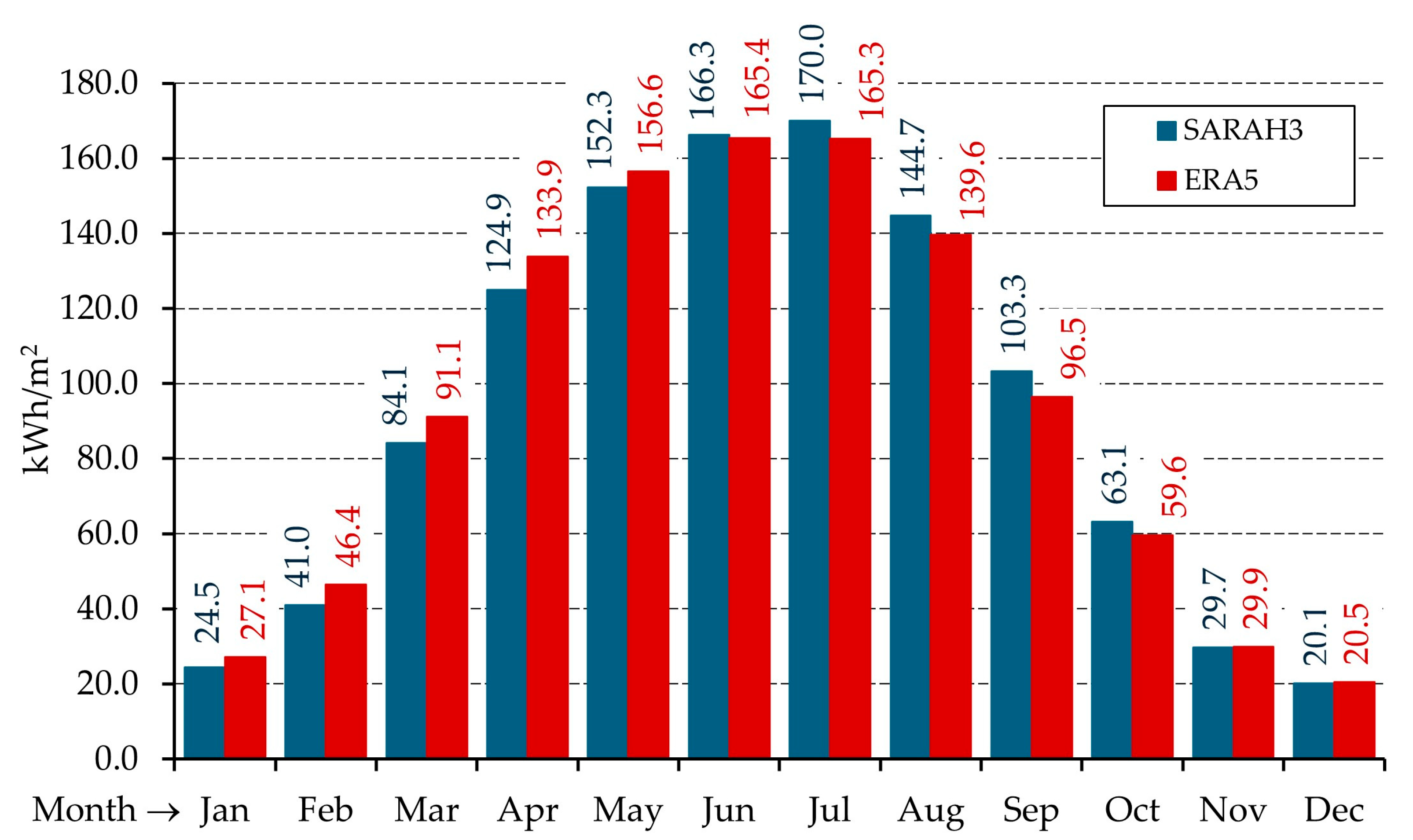
Figure 1 presents the monthly insolation levels on a horizontal plane for Częstochowa. The values were generated using the Photovoltaic Geographical Information System (PVGIS) [
37] web platform for two available solar radiation databases.
The annual solar insolation sum on a horizontal plane for Częstochowa, determined based on the SARAH3 database, is 1124.1 kWh/m
2, while that determined based on the ERA5 database is 1131.9 kWh/m
2 [
37]. As already stated, the analysis is based on real-life data from four successive years, 2022–2025. When analyzing time series or variations in some quantities over time, a natural question which arises is whether the data considered represent a typical pattern. Poland, like most of the countries in the world, experiences climate changes nowadays. In
Table 1 the annual values of solar radiation generated from the PVGIS platform [
37] are shown, with the values measured with satellites in years 2022–2025, published on Copernicus Atmosphere Monitoring Service (CAMS) [
38]. The values given refer to the horizontal plane for the city of Częstochowa. The analyzed period is characterized by higher solar radiation values than the multi-year average values assumed in the simulation software databases.
In comparison with the value assumed in the ERA5 database in 2022 and 2024, the measured value is higher by 65 kWh/m
2 in 2022 and 2024 (+5.7%), whereas in 2025 it is higher by 38 kWh/m
2 (+3.6%).
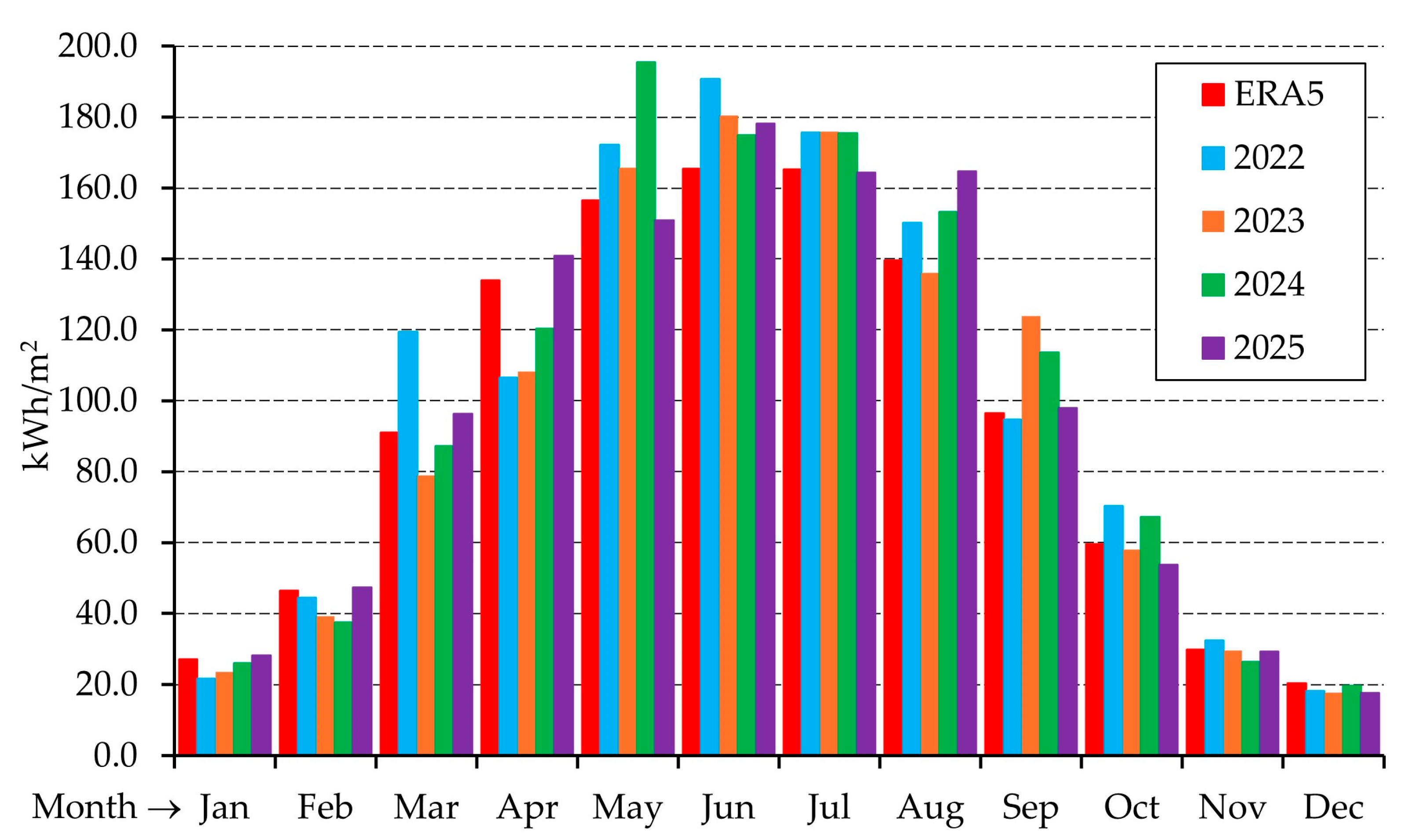
Figure 2 shows monthly solar radiation levels measured by satellite on the horizontal plane for Częstochowa in the analyzed period of 2022–2025 [
38], compared to the values generated by simulation (ERA5 database—PVGIS) [
37].
A significant characteristic of solar insolation conditions in Poland is their seasonal variability. By, far most annual energy production from PV installations occurs between March and September, with the summer months characterized by the highest daily solar insolation values. In winter, due to the short day length, low sun position above the horizon, and frequent cloud cover, solar insolation is limited, which translates into low energy yields. The highest dynamics of variations in solar radiation occur in spring months (March, April and May), as well as in the autumn (September). In these months quite often variable weather conditions occur (sunny and cloudy days, rainfalls). In the analyzed period the highest deviations from the reference value occurred in March 2022 (+28.3 kWh/m2), in May 2024 (+38.9 kWh/m2), in September 2023 (+28.3 kWh/m2) and in April 2022 (−27.4 kWh/m2).
Comparing the measured values of annual solar radiation on the horizontal plane, the difference was equal to 5.2% during the analyzed period. We assume that similar weather conditions like those discussed in the paper will prevail during the successive decade. The assumption of a relatively long period for the purpose of the analysis was aimed at eliminating the potential effect of interannual variability.
2.1. Solar Exposure of Stationary PV Installations
In the case of stationary PV installations, achieving the maximum amount of electricity produced is directly related to the orientation of the PV modules’ active surface towards the South (azimuth) and their tilt angle relative to the ground surface [
39,
40,
41]. In real-world conditions, the total annual energy production from a PV installation is the result of the PV modules’ orientation towards the cardinal directions, their tilt angle, and local solar radiation conditions [
42]. The orientation of PV modules relative to the azimuth is crucial for maximizing energy yields. For the Northern Hemisphere (where Poland is located), the optimal solution is the southward orientation (azimuth around 0°), which provides the highest annual solar radiation total. The tilt angle of PV modules relative to the ground surface affects the efficiency of solar radiation capture on a seasonal scale [
43,
44]. For stationary PV installations, the optimal tilt angle is closely related to the location’s latitude [
45]. Positioning PV modules at the optimal angle provides a compromise between maximizing energy yields in summer and limiting losses in winter, when the sun is low above the horizon [
46].
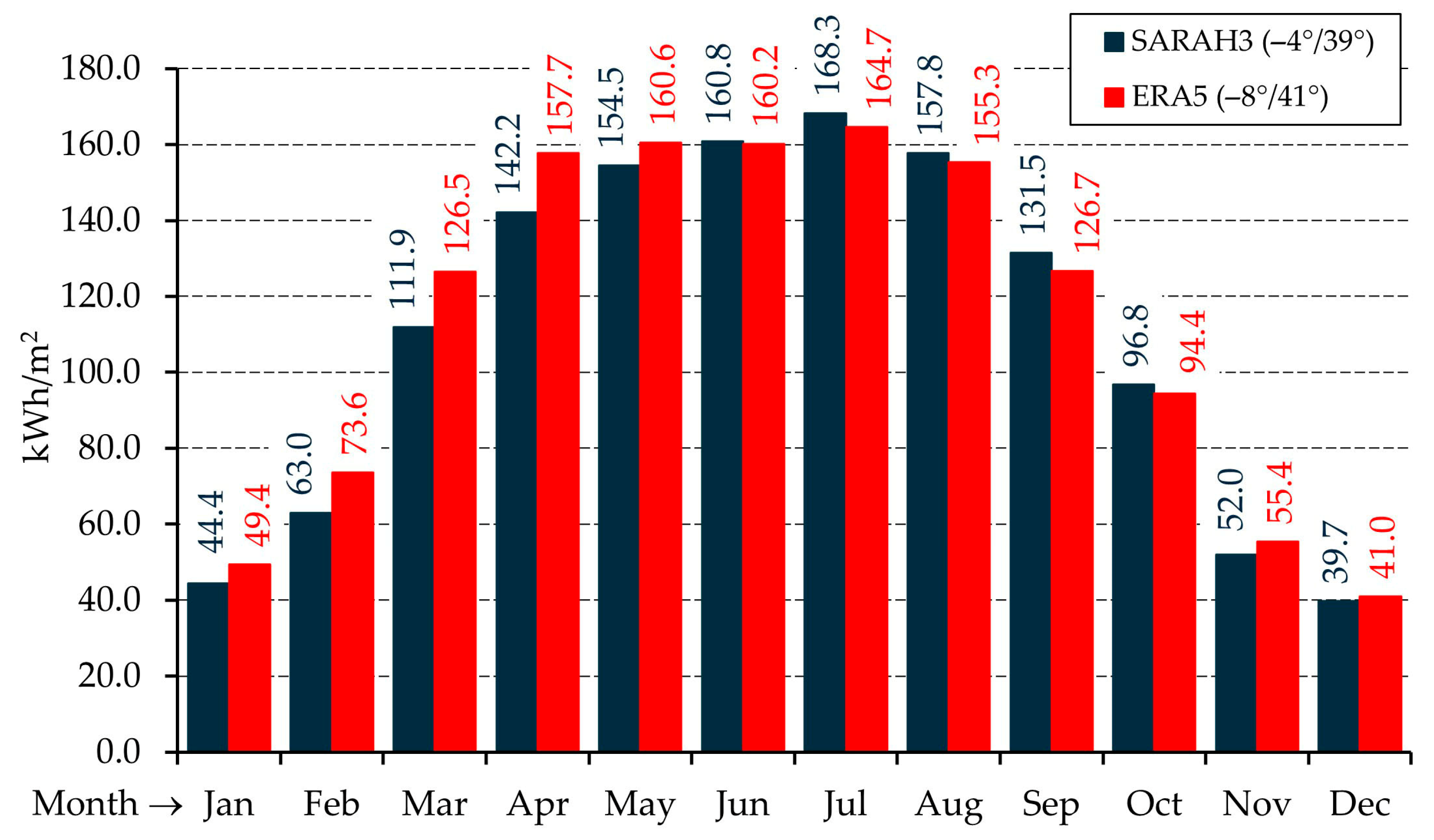
The optimal orientation of PV modules for the Częstochowa area, determined according to the PVGIS [
37] internet platform, for the SARAH3 database is azimuth −4°, tilt angle 39°, while for the ERA5 database, it is azimuth −8°, tilt angle 41°.
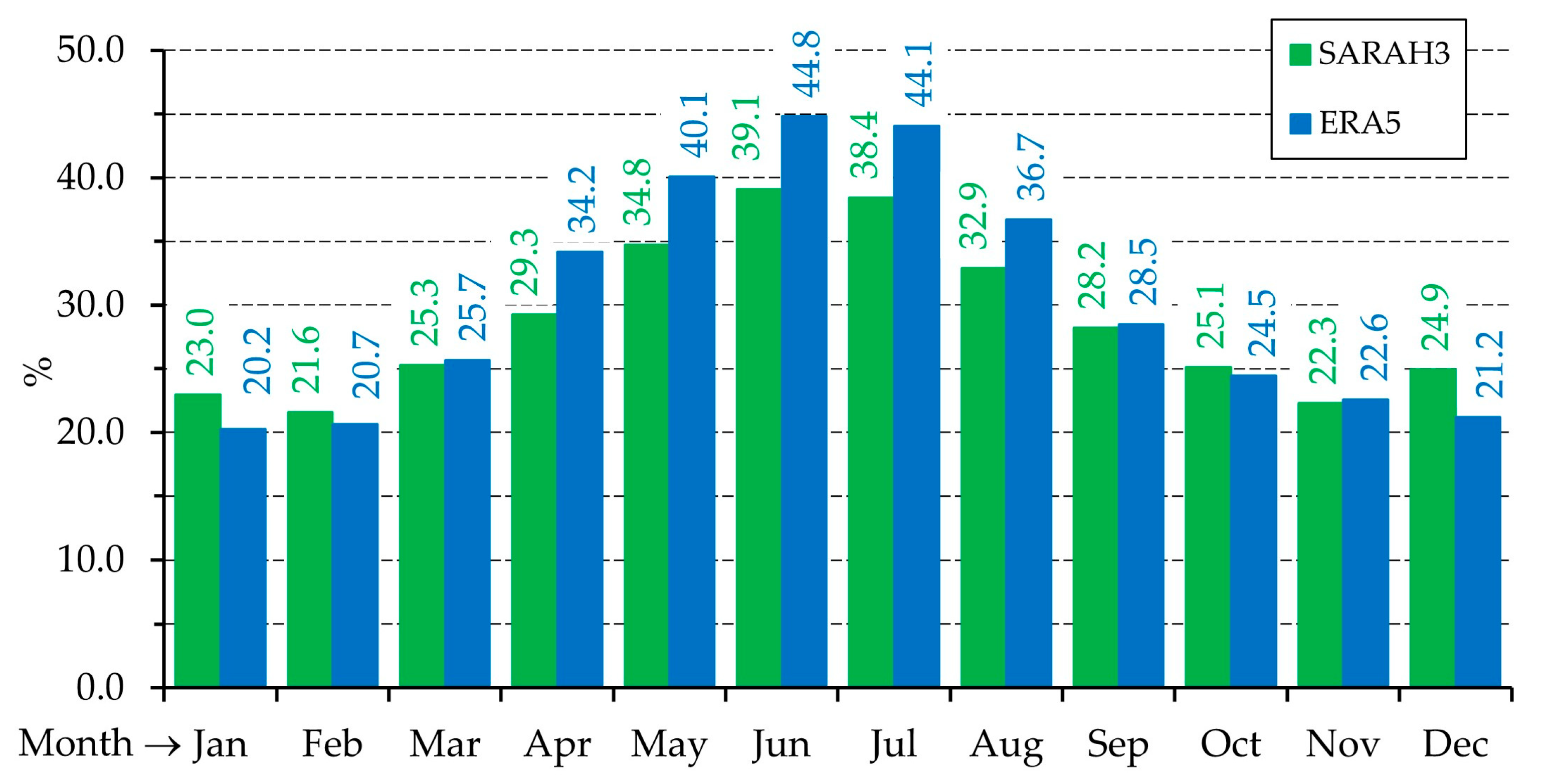
Figure 3 presents monthly insolation levels on the optimal orientation plane for the city of Częstochowa. The values were generated using the PVGIS [
37] internet platform.
The annual sum of insolation at the optimal plane of PV module arrangement for Częstochowa determined by the SARAH3 database is 1322.9 kWh/m
2, while based on the ERA5 database it is 1365.4 kWh/m
2 [
37]. The difference between the values given is 3.2%.
It is worth noting that the southward deviation of the PV module mounting plane leads to a gradual decrease in annual insolation and lower energy yields. A change in the azimuth of the PV modules, on the order of ±30° relative to the south, results in relatively small changes in annual insolation, not exceeding a few percent.
Table 2 presents the percentage changes in annual insolation for various azimuth angles and PV module tilt angles for Częstochowa. The values were determined based on simulations conducted using the PVGIS online platform for the SARAH3 database [
37].
In Central Europe, afternoon and evening cloud covering and storms are common during the summer, resulting in limited sunlight. This shifts the optimal azimuth angle by several degrees to the east. Reducing the tilt angle of PV modules relative to the ground surface promotes increased energy production in the summer months at the expense of lower yields in winter. A steeper tilt improves the PV system’s operating conditions in winter but leads to a decrease in annual energy production.
In the case of installations mounted on buildings, PV modules are rarely mounted at an optimal angle. Most often, the orientation of PV modules is a direct result of the building’s location, roof structure, and spatial conditions related to the presence of shading zones [
47,
48,
49]. In the cases discussed in the subsequent part of the manuscript, where the fixed value of tilt angle was either 10° or 30° degrees, this value resulted from architectural conditions (the angular position of roofs of the buildings).
2.2. Solar Exposure of Tracking PV Installations
In a tracking system, PV modules are mounted on a support structure equipped with a mechanism that allows for continuous or step-by-step changes in orientation to track the sun’s current position in the sky. Depending on the system’s level, solar tracking can be achieved on a single or dual axis [
50,
51,
52,
53,
54]. Single-axis systems allow for changes in the PV module orientation, typically in an east–west plane, tracking the Sun’s daily movement. Dual-axis tracking systems additionally correct the PV module tilt angle relative to the horizontal, adapting their position to seasonal changes in the Sun’s altitude above the horizon [
55,
56]. Dual-axis systems maintain perpendicular orientation of PV modules to direct radiation for most of the day and year [
57,
58].
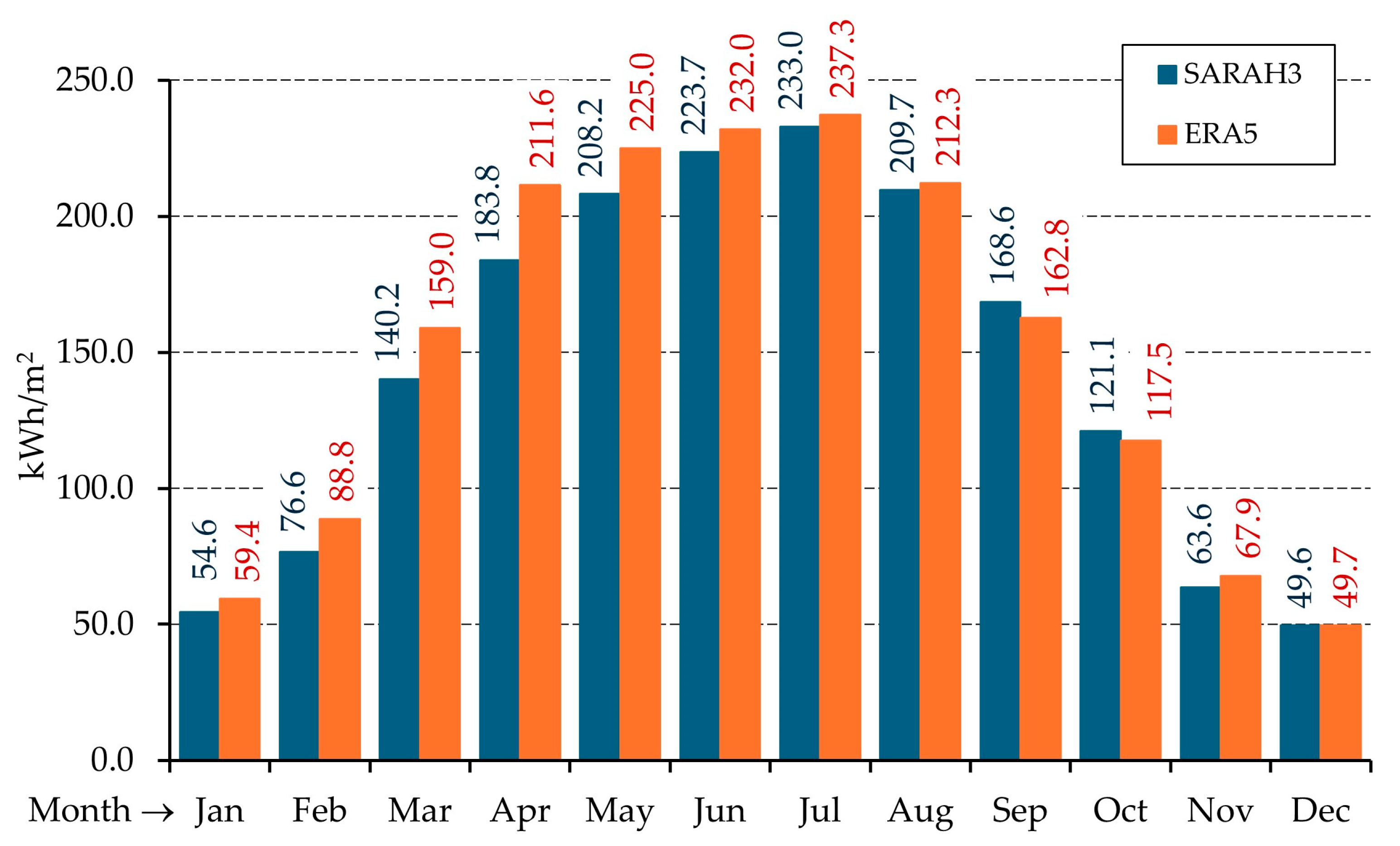
Figure 4 shows monthly solar radiation levels for the biaxially controlled tracking system for Częstochowa. The values were determined based on simulations conducted using the PVGIS online platform for the SARAH3 and ERA5 databases [
37].
The annual sum of insolation for the two-axis controlled tracking installation for Częstochowa, determined based on the SARAH3 database, is 1732.8 kWh/m
2, while based on the ERA5 database it is 1823.4 kWh/m
2 [
37]. The difference between the given values is 5.2%.
Figure 5 shows the percentage differences in monthly insolation between the stationary installation set at the optimal angle (
Figure 3) and the two-axis controlled tracking installation (
Figure 4) for Częstochowa city [
37]. The annual percentage difference in insolation for the installations analyzed is 30%.
From an energetic perspective, a tracking system enables more efficient use of direct radiation, particularly during morning and afternoon hours, when the angle of incidence of radiation on the modules is unfavorable in stationary installations. As a result, the instantaneous power obtained in tracking systems is higher, and the energy generation profile throughout the day is more balanced [
59]. However, it should be emphasized that increased energy production is achieved at the cost of greater technical complexity of the system, higher auxiliary energy consumption for drives, and the need to ensure the reliability of mechanical components operating in outdoor conditions [
60,
61]. Limitations on the use of tracking systems include the requirement for adequate, shadow-free location space for their construction and the high construction costs of rotating platforms compared to stationary systems [
62,
63].
3. Spatial Arrangement of the Analyzed PV Installations
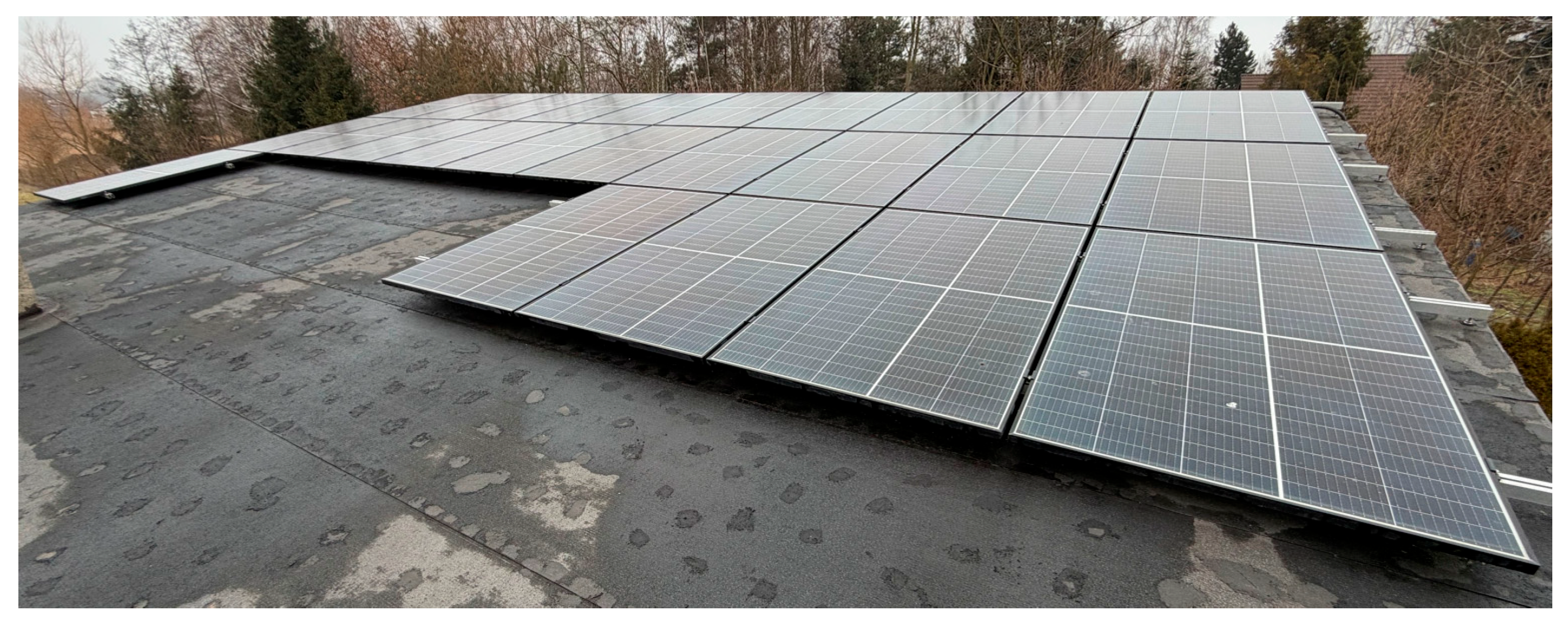
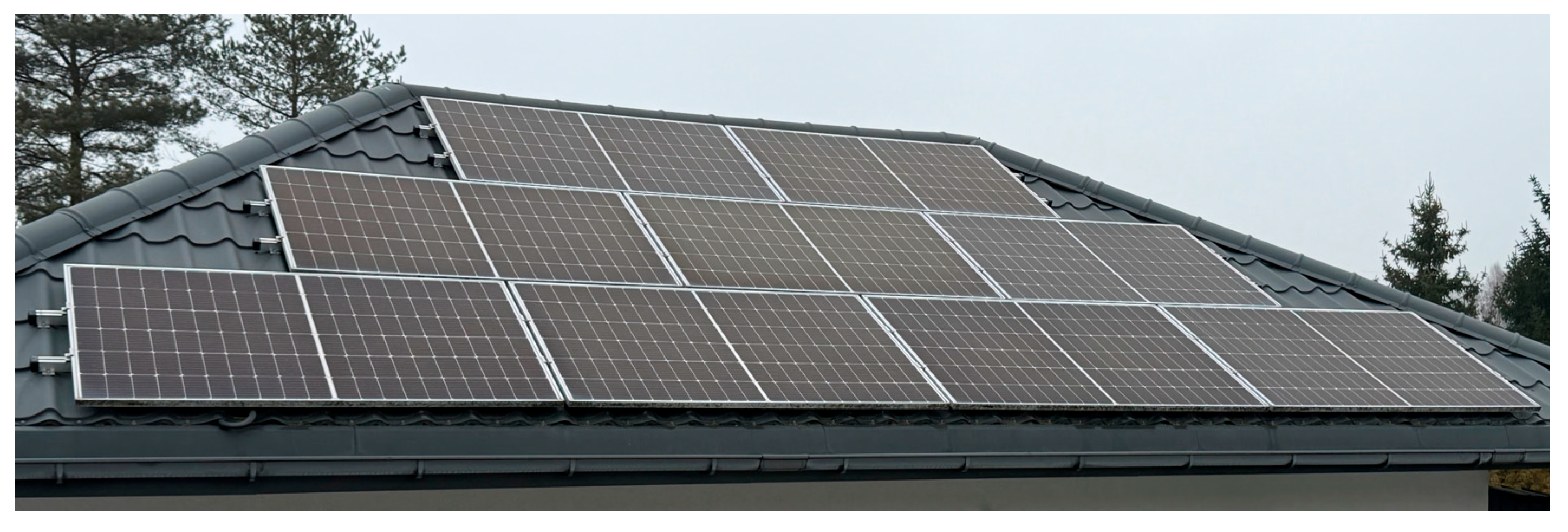
Table 3 summarizes the information regarding the arrangement of the photovoltaic modules in the analyzed installations. Installations A and B are typical prosumer installations, installed on the roofs of a residential/commercial building, intended to generate energy to cover the demands of the building. The arrangement of the active surface of the PV modules is directly determined by the roof pitch and the building’s orientation towards the south. In both installations, longitudinal 40 × 40 mm aluminum PV profiles were anchored directly to the roof, considering the requirements for load-bearing capacity, wind and snow load resistance, and roof tightness.
Figure 6 shows the arrangement of PV modules in installation A, whereas
Figure 7 shows that in installation B. The PV modules were mounted to the longitudinal profiles using system brackets, which secure stable mounting and adequate ventilation of the rear surface of the modules, crucial for reducing temperature losses [
64,
65]. The mounting technique used ensures proper routing of the DC cabling, protecting it from mechanical damage and the effects of unfavorable weather conditions [
66].
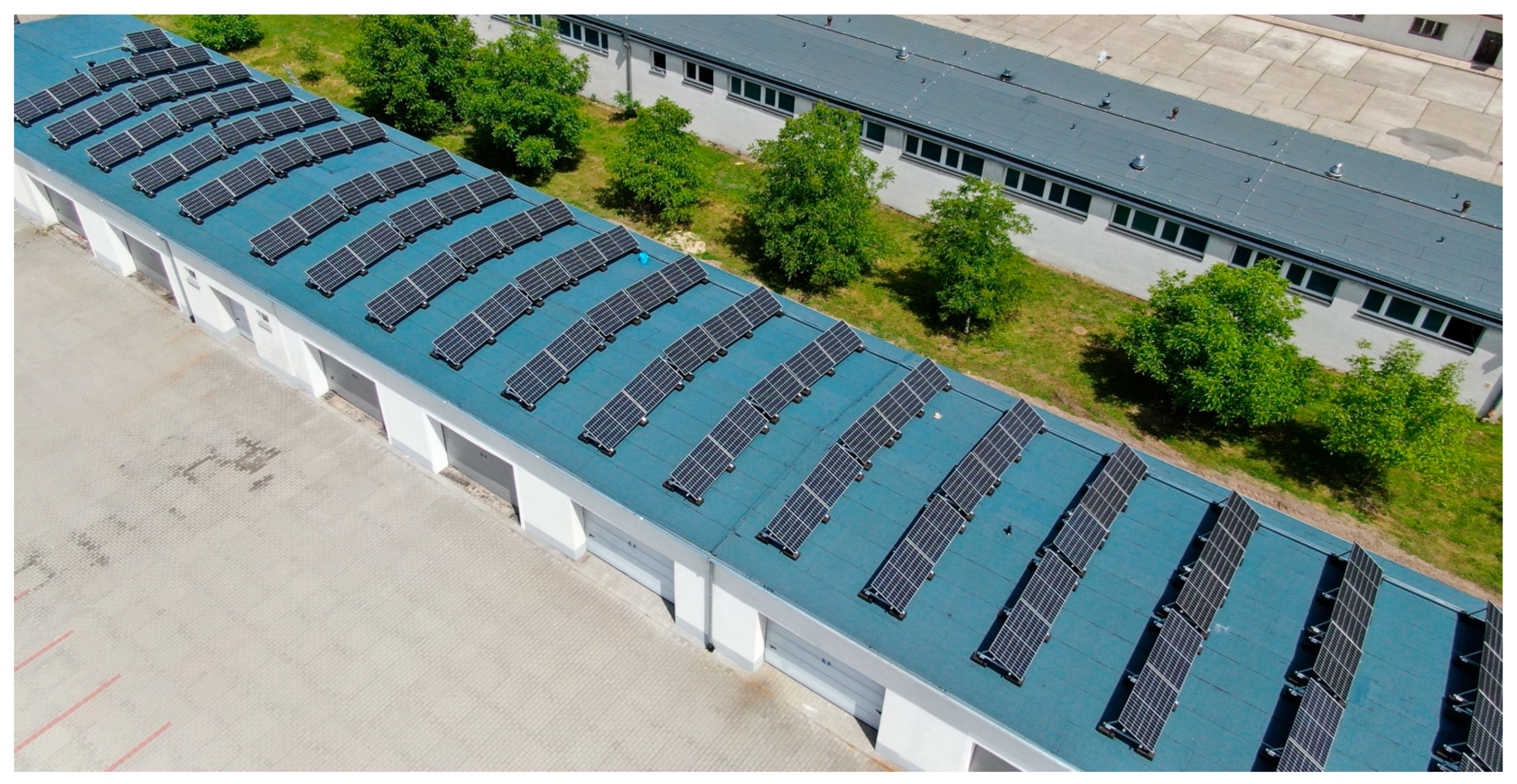
Installation C is located on top of a warehouse building measuring 10 m wide and 96 m long (
Figure 8). This is an example of an industrial PV system used by a company to reduce its operating costs. The roof consists of two slopes inclined at a 10° angle in the east–west direction (the roof ridge faces south–north). PV modules are mounted on special support structures, placed on the roof using a ballast mounting technique, five per row. The spacing between rows is 3.2 m, ensuring that the PV modules do not shade each other at the sun’s lowest point in the sky (December 22nd in the Northern Hemisphere). The system stability is ensured using carefully selected concrete blocks, whose mass counteracts suction and wind pressure forces acting on the PV module surfaces. The ballast installation technique, with the correct selection of the ballast mass and its distribution on the roof surface, ensures safe operation of the PV installation while maintaining the tightness and integrity of the roof covering.
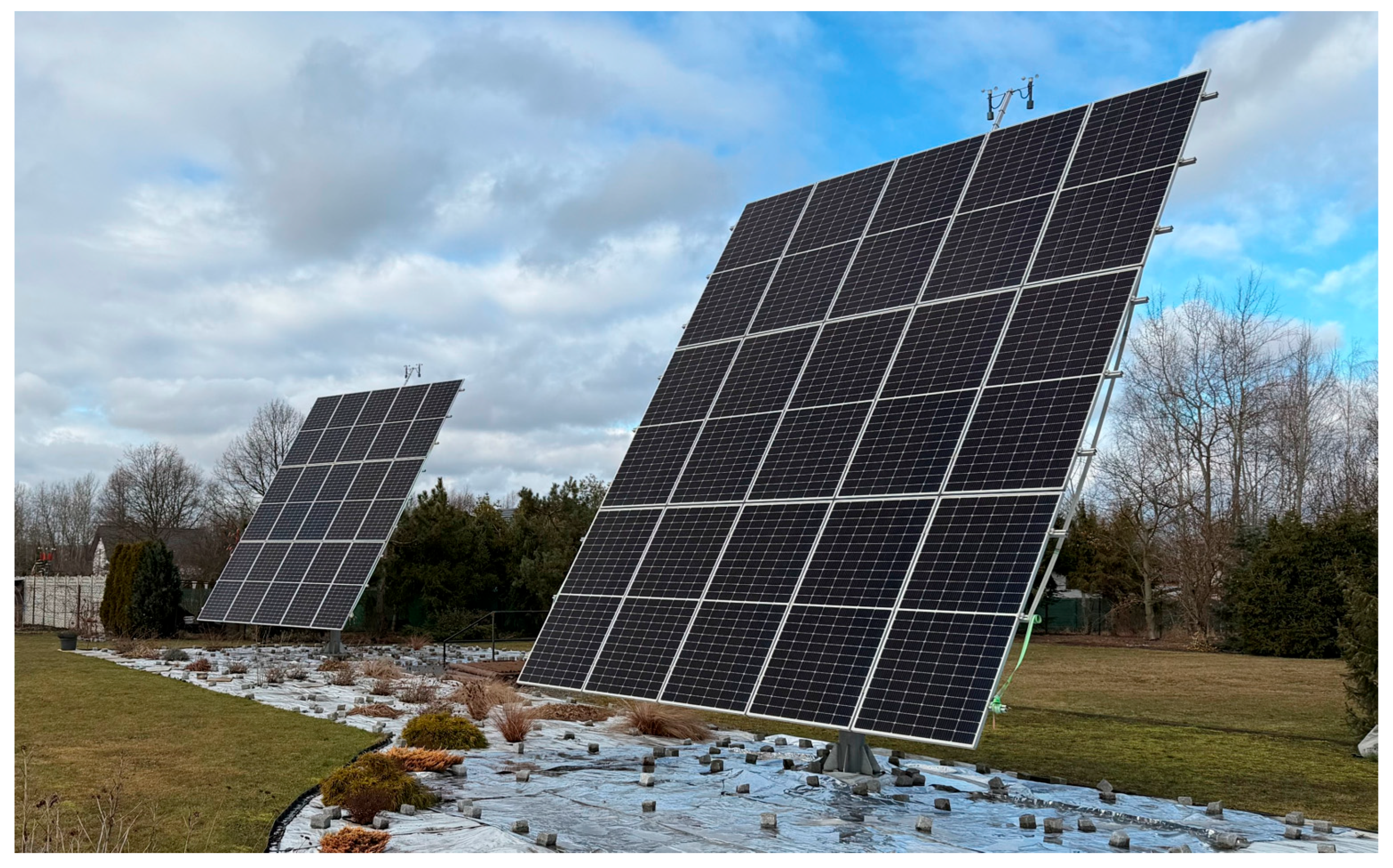
Installation D is a tracking system that follows the sun’s position in the sky (
Figure 9). The system consists of two supporting poles placed on separate foundations. The poles are equipped with a bearing system enabling smooth rotation of the upper section, to which an intermediate horizontal frame is mounted. The horizontal frame is equipped with a bearing-mounted joint allowing for changes in the tilt angle relative to the ground surface. A truss made of system aluminum profiles is attached to the intermediate frame. The truss serves as a base for mounting PV modules, ensuring the appropriate stiffness and mechanical strength of the entire structure. Each truss supports 15 PV modules.
The movement of platforms within two axes is achieved by a geared motor and a linear actuator. Each platform has an independent control system. The controller determines the sun’s position based on the signal from the GPS receiver location coordinates and the current time. Efficient controller operation and operational safety are ensured by a gyroscopic sensor, a grid voltage outage sensor, magnetic limit switches, and two independent wind speed sensors.
4. Technical Parameters of the Analyzed PV Installations
Table 4 summarizes the basic technical parameters of the PV modules installed in the analyzed systems. All PV modules are monocrystalline. The LR4 series modules are manufactured using bifacial PERC technology [
67]. The parameters given in
Table 4 correspond to the standard test conditions—STC: irradiance 1000 W/m
2, cell temperature 25 °C, air mass AM 1.5, and measuring tolerance ±3%.
The scientific literature contains numerous articles devoted to the efficiency and comparison of energy yields of bifacial PV modules with single-sided modules. In Ref. [
68], the authors report that the use of bifacial PERC modules can increase energy yields by up to 25%. In other works [
69,
70,
71], the authors report the possibility of increasing energy yields by up to 15%, which depends directly on the PV module mounting angle and the reflected and diffuse radiation present at a given location. In [
72], the authors experimentally examined the effect of mounting height of bifacial and monofacial panels above ground level, taking into account ground with different albedo. For grass, mounting heights above 0.75 m and a slope angle of 35°, the increase in energy yield for bifacial modules was estimated at 15%.
In the analyzed installation B (
Figure 7), the PV modules are mounted parallel to the roof surface. In this case, there is negligible reflected and diffuse radiation reaching the other side of the PV module. In installation C (
Figure 8), the PV modules are mounted directly above the roof surface at an angle of 30°. Considering the experimental analysis presented in [
72], an increase in energy yield of up to 6% can be expected compared to monofacial modules.
The best energy yield increase from PERC modules can be expected for tracking installation D (
Figure 9). In this installation, the modules are mounted at a height of more than 1 m above the ground, and the other side of the PV modules can directly collect diffuse and reflected radiation. The area immediately surrounding the tracking installation is open, grassy, and free from objects that could generate shading. In this case, an increase in energy yield from bifacial modules can be expected at a level of 15% [
72].
Table 4.
Technical parameters of PV modules [
67,
73].
Table 4.
Technical parameters of PV modules [
67,
73].
| Installation: | | A | B | C | D |
|---|
| Module type | - | Vertex S TSM-395 | LR4-60HBD-365M | LR4-60HPH-365M | LR4-72HBD-445M |
| Maximum power, Pmax | W | 395 | 365 | 365 | 445 |
| Open circuit voltage, VOC | V | 41.0 | 40.7 | 40.7 | 49.4 |
| Short circuit current, ISC | A | 12.21 | 11.41 | 11.43 | 11.52 |
| Voltage at maximum power, Vmp | V | 34.0 | 34.1 | 34.2 | 41.2 |
| Current at maximum power, Imp | A | 11.62 | 10.71 | 10.68 | 10.80 |
| Temperature coefficient of ISC | %/°C | +0.04 | +0.05 | +0.05 | +0.05 |
| Temperature coefficient of VOC | %/°C | −0.25 | −0.284 | −0.265 | −0.284 |
| Temperature coefficient of Pmax | %/°C | −0.34 | −0.35 | −0.34 | −0.35 |
| Dimension | mm | 1754 × 1096 × 30 | 1755 × 1038 × 30 | 1775 × 1038 × 35 | 2094 × 1038 × 35 |
| Module efficiency | % | 20.0 | 20.5 | 20.0 | 20.5 |
Table 5 summarizes the basic technical parameters of the analyzed PV installations, including DC input parameters and the inverters used. Installations A, B, and C utilize string inverters that convert DC voltage to AC in a three-phase system. Installation D utilizes microinverters operating in a single-phase system.
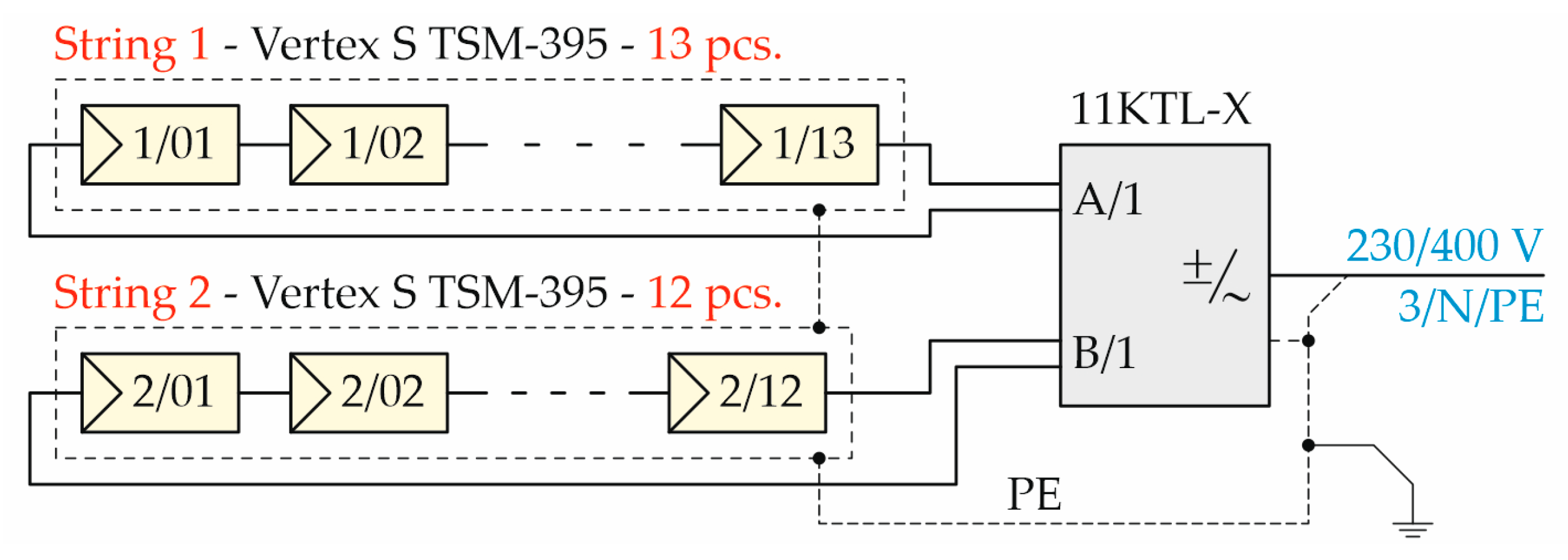
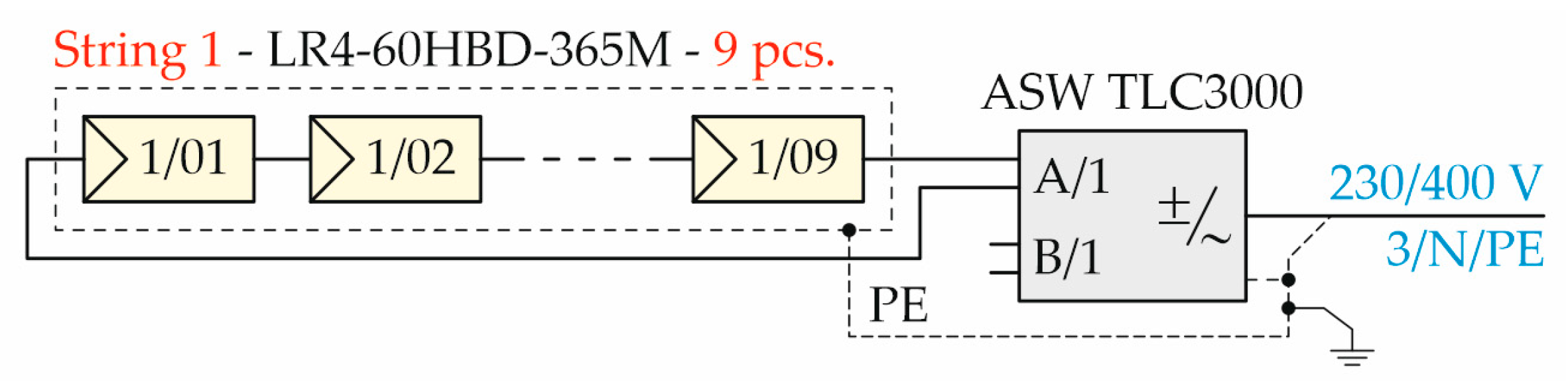
Installations A, B, and C are based on string inverters with two independent maximum power point tracking (MPPT) modules. In installation A, 25 PV modules with a total power of 9875 W are installed. The modules are connected in series to two strings connected to two independent MPPTs, as shown in the schematic diagram in
Figure 10. In installation B, 9 PV modules with a total power of 3285 W are installed. The modules are connected in series to form a single string, as shown in the schematic diagram in
Figure 11.
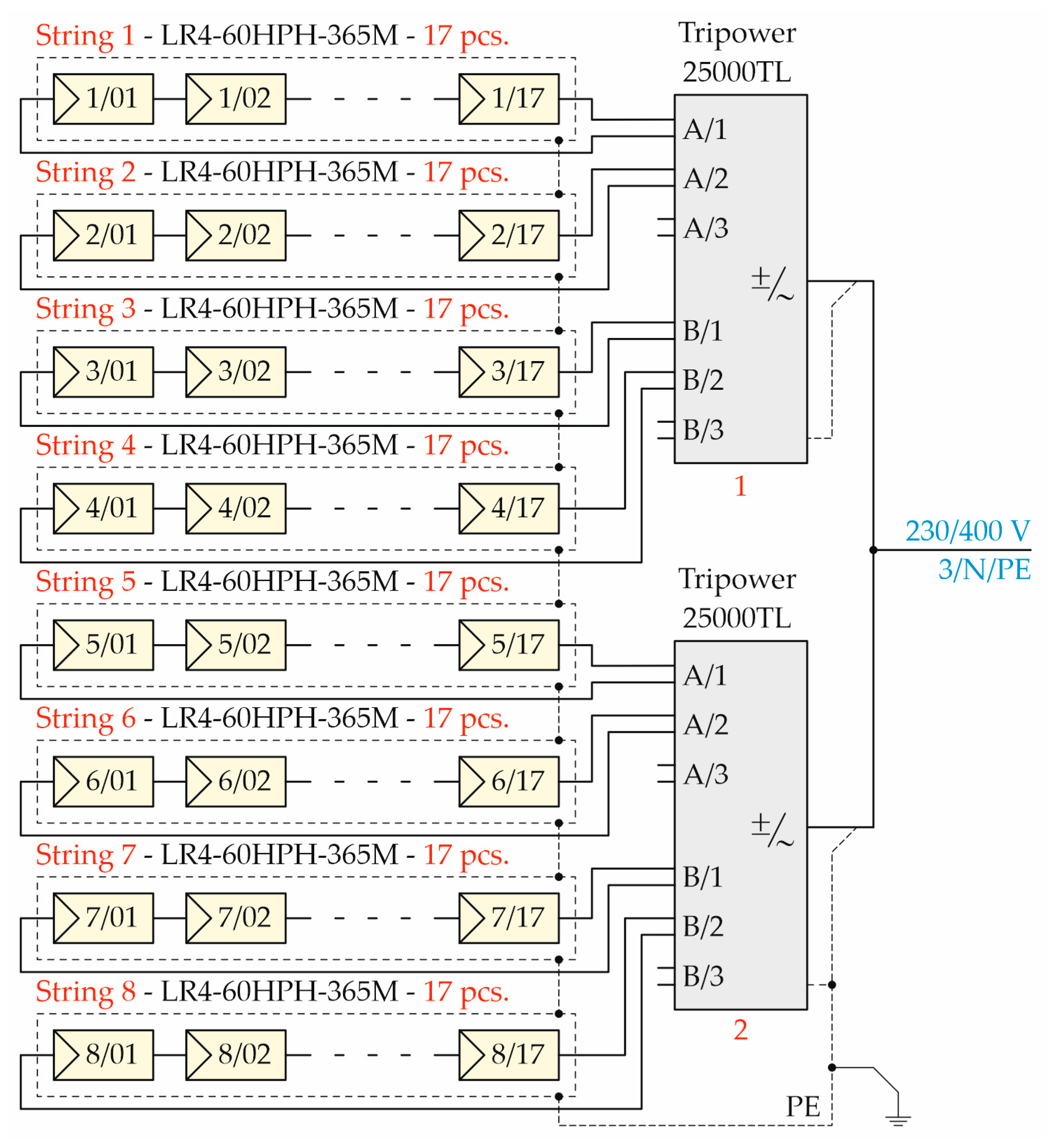
In installation C, there are 136 PV modules with a total power of 49,640 W. The PV modules are connected in series into 8 independent strings of 17 pieces each, according to the schematic diagram shown in
Figure 12. The strings are connected to two inverters—two strings to an independent MPPT.
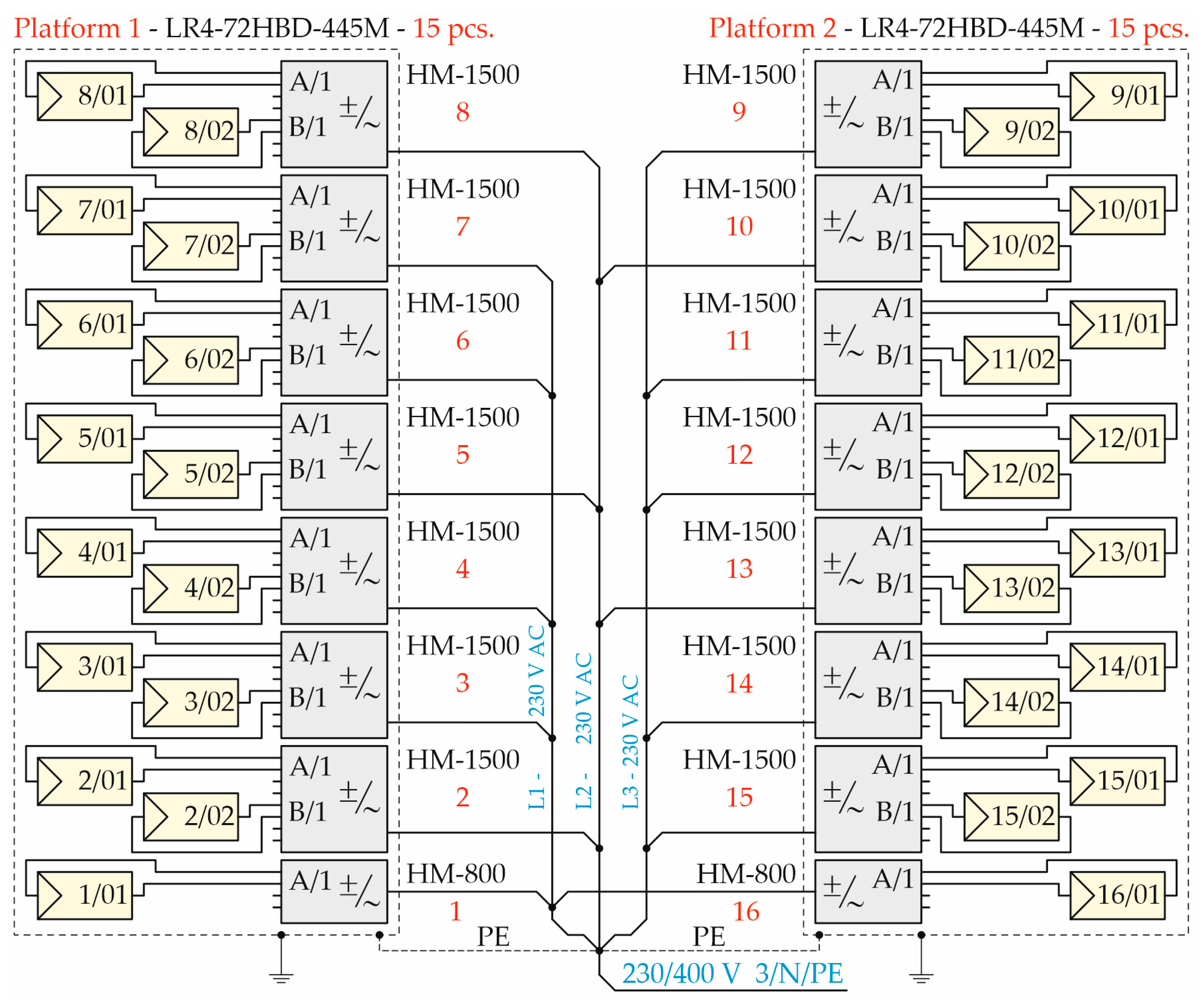
Installation D includes 30 PV modules with a total power of 13,350 W. The PV modules are mounted on two rotating platforms, each containing 15 modules. The modules are connected to 14 HM-1500 microinverters and two HM-800 microinverters, according to the schematic diagram shown in
Figure 13. The microinverters are connected to three phases on the AC voltage side to achieve balanced power distribution.
The controllers ensure a continuous operation of the platform positioning system in automatic mode, regardless of cloud coverage. Manual control is available for maintenance or emergency situations. When wind speeds exceed 35 km/h, the platforms automatically move to a horizontal position. There is no mutual shading between the rotating platforms of installation D and adjacent buildings during the whole year.
At this point it is interesting to analyze whether the use of microinverters in installation D could have an additional impact on the comparative analysis with stationary installations using string inverters. In [
78], the authors analyzed energy yields from 200 PV installations operating in France (100 installations built with string inverters, 100 with microinverters). The analysis for individual installations covered different time periods, but no differences were found between the energy yields in the two groups. The work did not include shading analysis. In [
79], the authors analyzed six PV installations operating in Italy (two installations with string inverters and four with microinverters). Depending on the shading occurring on approximately 9% of the PV module surface, a difference in energy yield in favor of microinverters of up to 7% was found. In [
80,
81], the authors analyzed the effect of PV module shading on energy yields for various installation configurations using simulations. The presented conclusions demonstrate higher efficiency of microinverter solutions, but only in cases of significant PV module shading.
In the case of tracking system D considered in this study, no shading occurs regardless of the position of the rotating platforms or the season. For all PV systems analyzed in this work, shading occurs only in the very early morning and late evening hours. Therefore, it can be concluded that the use of microinverters in system D does not result in an increased yield compared to stationary systems (A, B, C) built with string inverters.
5. Analysis of Electric Energy Production
Table 6 provides the electric energy yields from the analyzed PV installations in the years 2022–2025 (the values are read-outs from inverter registers). The accuracy of power measurement declared by the manufacturers of inverters and micro-inverters is ±3% [
74,
75,
76,
77].
In
Table 6 the values of Performance Ratio indicators are compiled. These were computed in reference to the insolation value on the assembly plane determined with simulations [
37]. For installations A, B, and D, the electric energy yields are similar in each year; the differences result from variable solar radiation conditions each year. In the case of installation C, a technical inspection in 2022 revealed a faulty MC4 connector in one string of PV modules, which resulted in a lowered total annual production [
52,
65]. Therefore, the total annual production value of 48,319.5 kWh is underestimated and does not correspond to the energy that would be produced by a technically efficient installation. Due to the varying power of the installed PV modules in each installation, the conversion factor for electricity yield per 1 kWp of installed modules, presented in
Table 7, was used for comparison purposes.
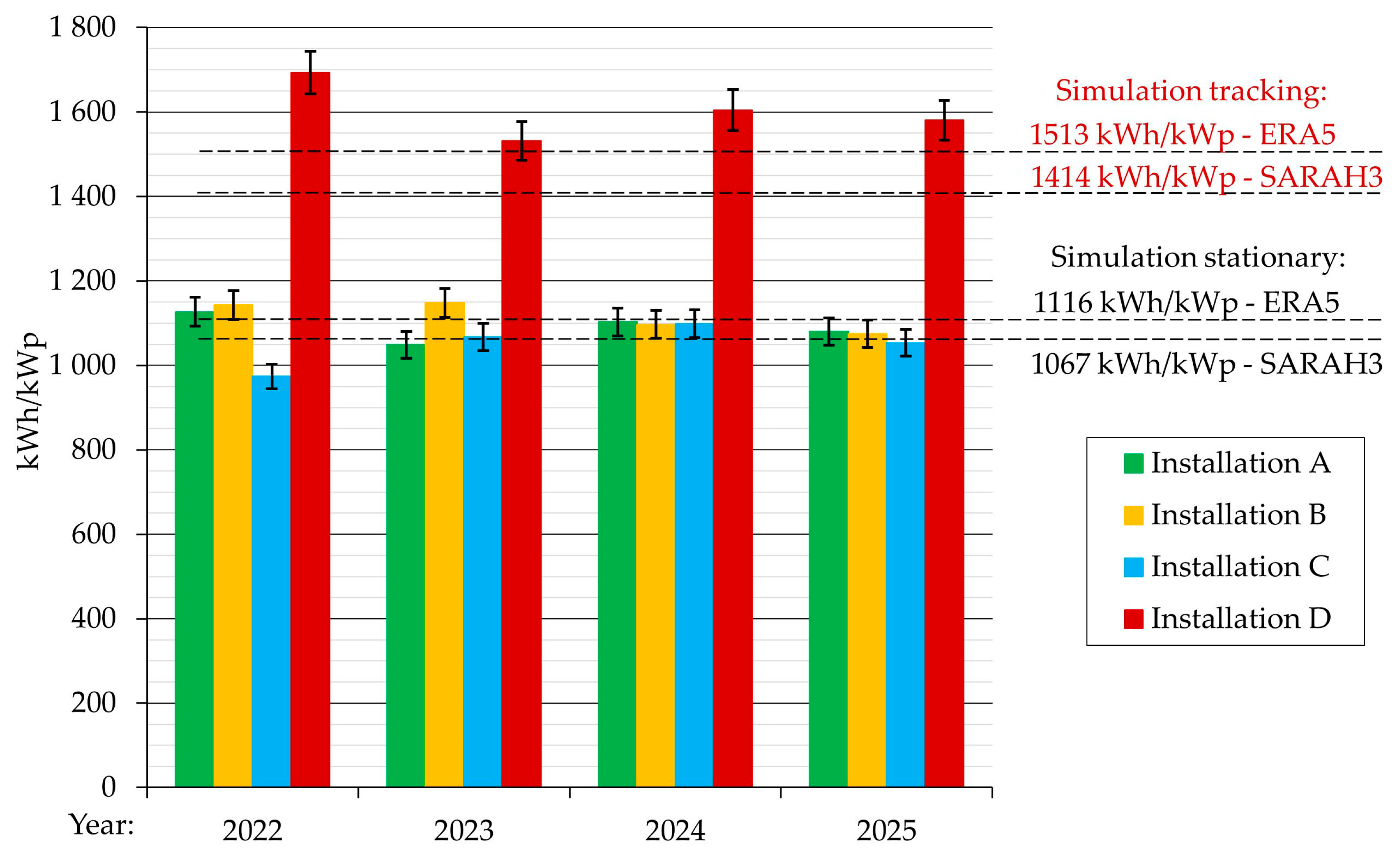
In the case of the stationary PV installation located in Częstochowa, for the optimal module orientation and for an installed power of 1 kWp, the annual electricity production value determined according to a simulation performed using the PVGIS internet platform [
37] is 1067 kWh for the SARAH 3 database, while for the ERA5 database it is 1116 kWh. In the case of the tracking PV installation, the annual production values are for the SARAH3 database—1414 kWh, and for the ERA5 database—1513 kWh. The simulations were performed considering 14% system losses and for PV modules made of crystalline silicon.
Figure 14 compares the electricity yields from actual installations with the values determined based on the simulations.
The stationary installations (A, B, and C) achieved very similar annual electricity production results per 1 kWp of the installed PV modules in 2024 and 2025, with a difference of less than 2%. In 2023, a 10% discrepancy occurred. The measured values from the stationary installations are consistent with those determined by simulation.
For tracking installation D, the energy yield results in individual years are better than the values determined by simulation. The discrepancy between energy production results in individual years is 9%, which is due to variable solar radiation conditions, which correlate with the results for stationary installations.
Table 8 compares the annual energy production of the analyzed stationary installations with the values generated by simulation for the actual angles of the PV modules of a given installation, given in
Table 3.
In all analyzed years, in reality, installation A produced more energy in comparison to the values obtained from simulations. Compared to the simulated value (ERA5), the difference is in the range of 6–13.8%. In the case of installation B, actual production is comparable to the simulated value. Only in two years (2022–2023) was there an increase of 5.5%. In the case of installation C, actual annual production values are comparable to the simulated values. As mentioned earlier, this installation experienced technical defects, and the arrangement of PV modules results in higher system losses in the DC circuits.
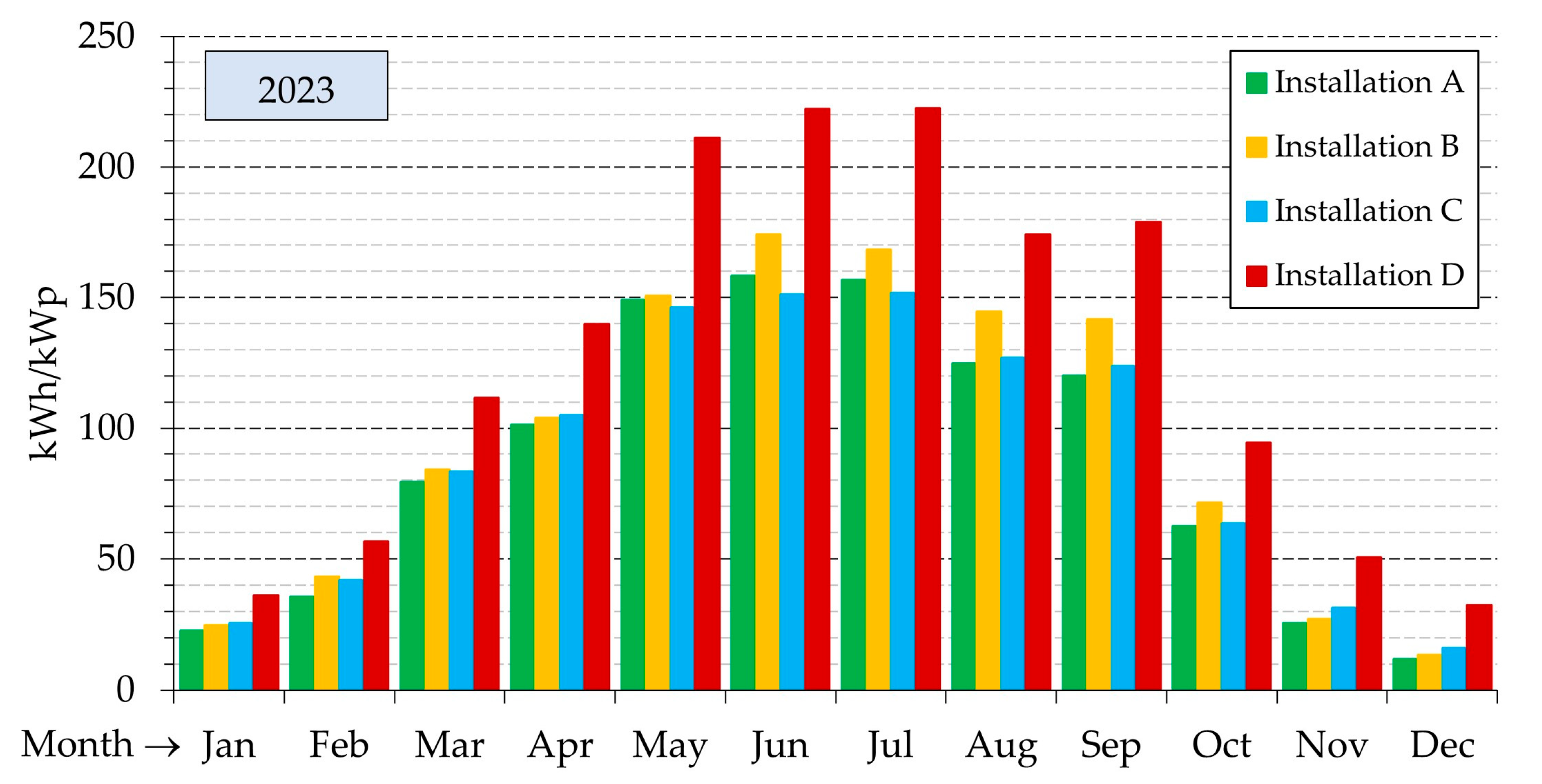
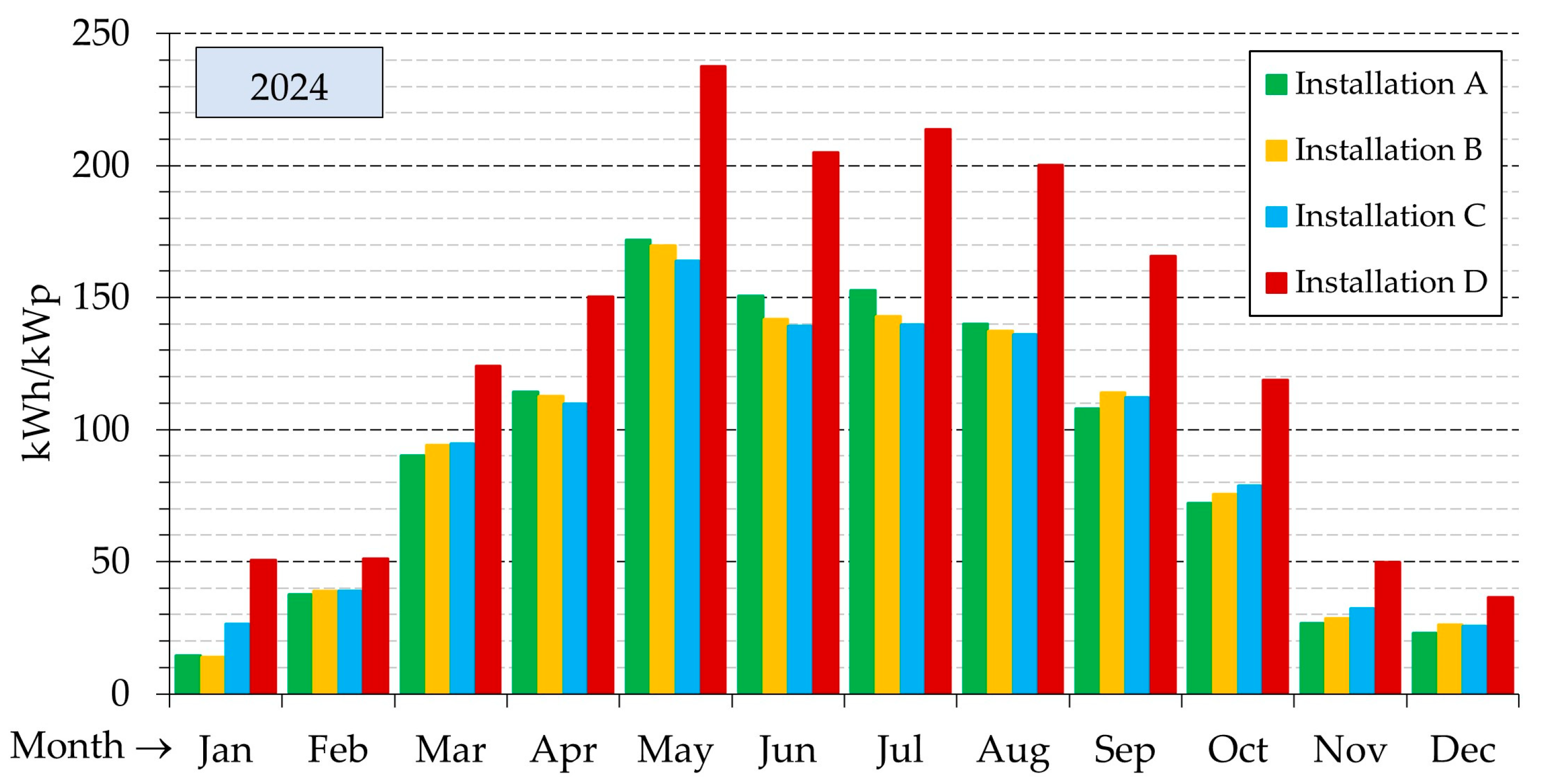
Due to the seasonal variability of solar radiation conditions in Poland, the energy yields of the installations were analyzed in individual months of the year. A detailed analysis was performed for 2023, which showed the largest differences in energy production for stationary installations and the lowest production for tracking installations, and 2024, which showed almost identical production for stationary installations.
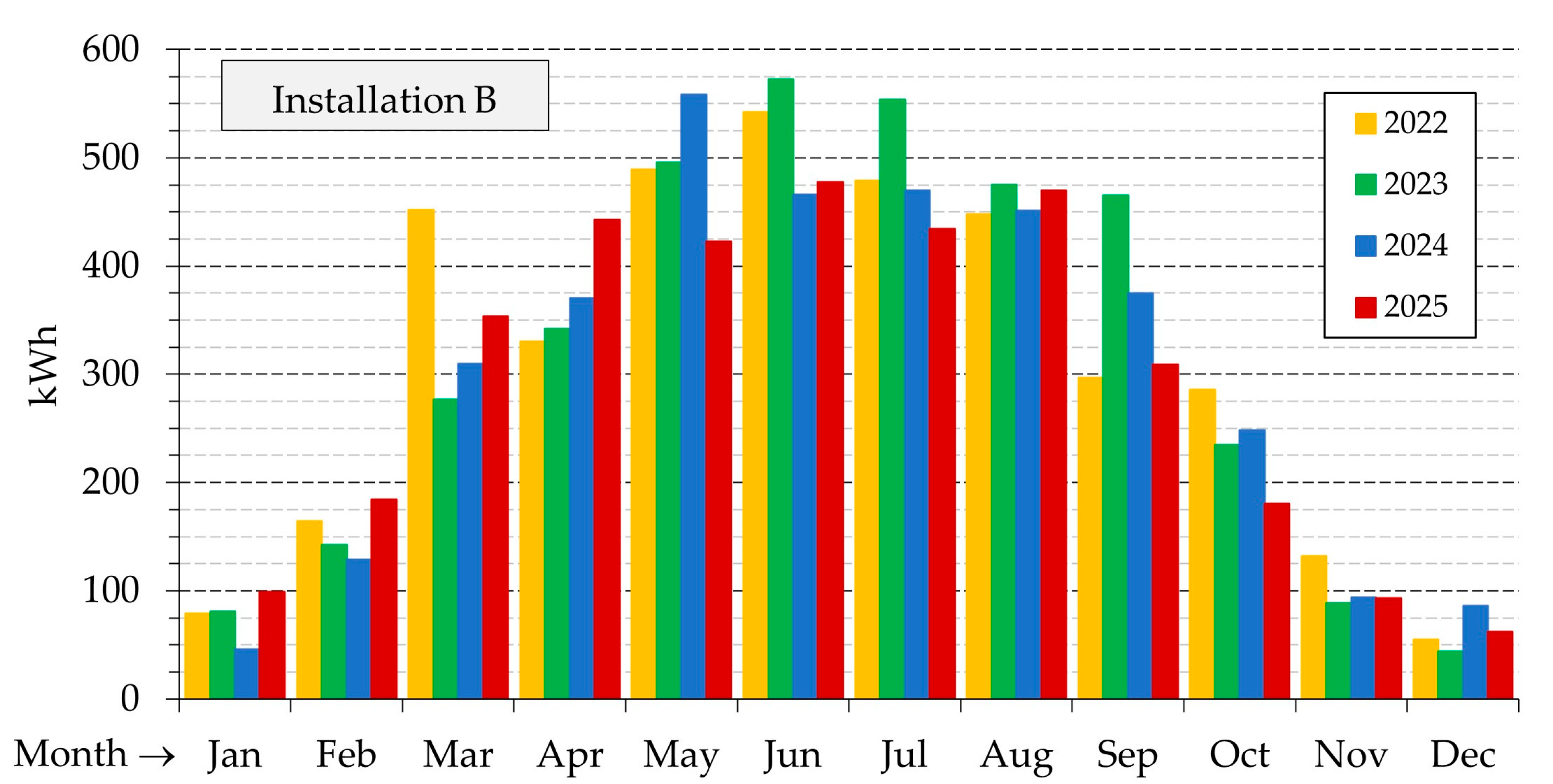
Figure 15 depicts the energy yields per 1 kWp of the installed PV modules in the analyzed installations in 2023. In the period from May to October, among the stationary installations, installation B features the best efficiency. It is the smallest installation, with 6 m long DC circuit cables between the PV modules and the inverter. Installation C covers the largest area in terms of DC circuits, from the outermost PV modules to the inverter, with 65 m cabling length. The configuration of DC circuit cabling results in higher system losses for this installation.
Figure 16 depicts energy yields per 1 kWp of the installed PV modules in 2024.
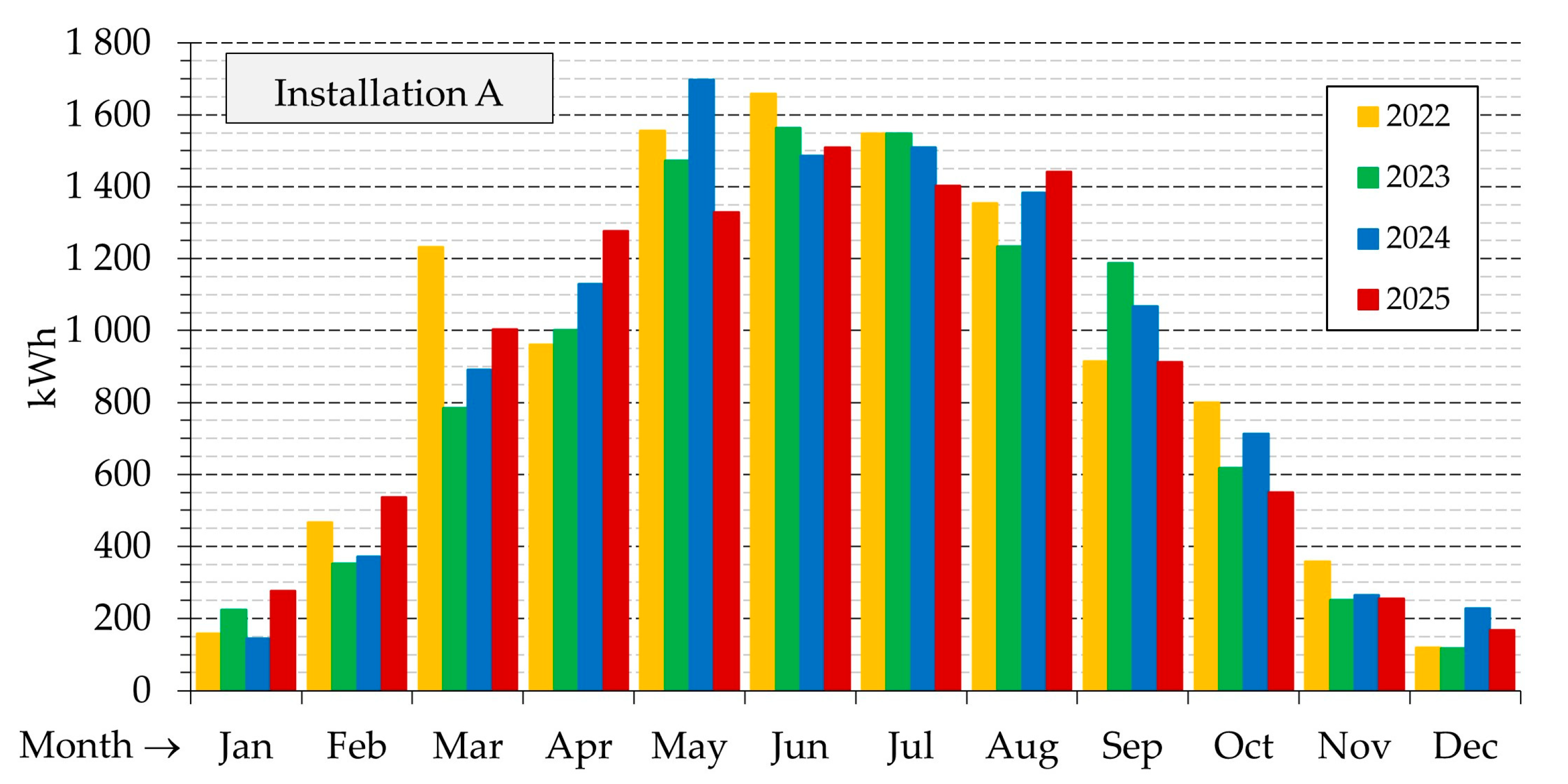
In 2024, among the stationary installations, during the summer period between May and September, the highest efficiency was achieved by installation A, in which the PV modules are at the angled 10° to the ground surface (the other installations are at 30°). This is due to a high number of days with direct sunlight, when the sun is high above the horizon. The energy yields of installation A directly correlate with those of tracking installation D, in which the active surface of the PV modules is always optimally aligned with the sun’s position. In the months from September to March, when the Sun’s position above the horizon is low, installations B and C, in which the PV modules are installed at a 30° angle to the ground surface, achieve better results.
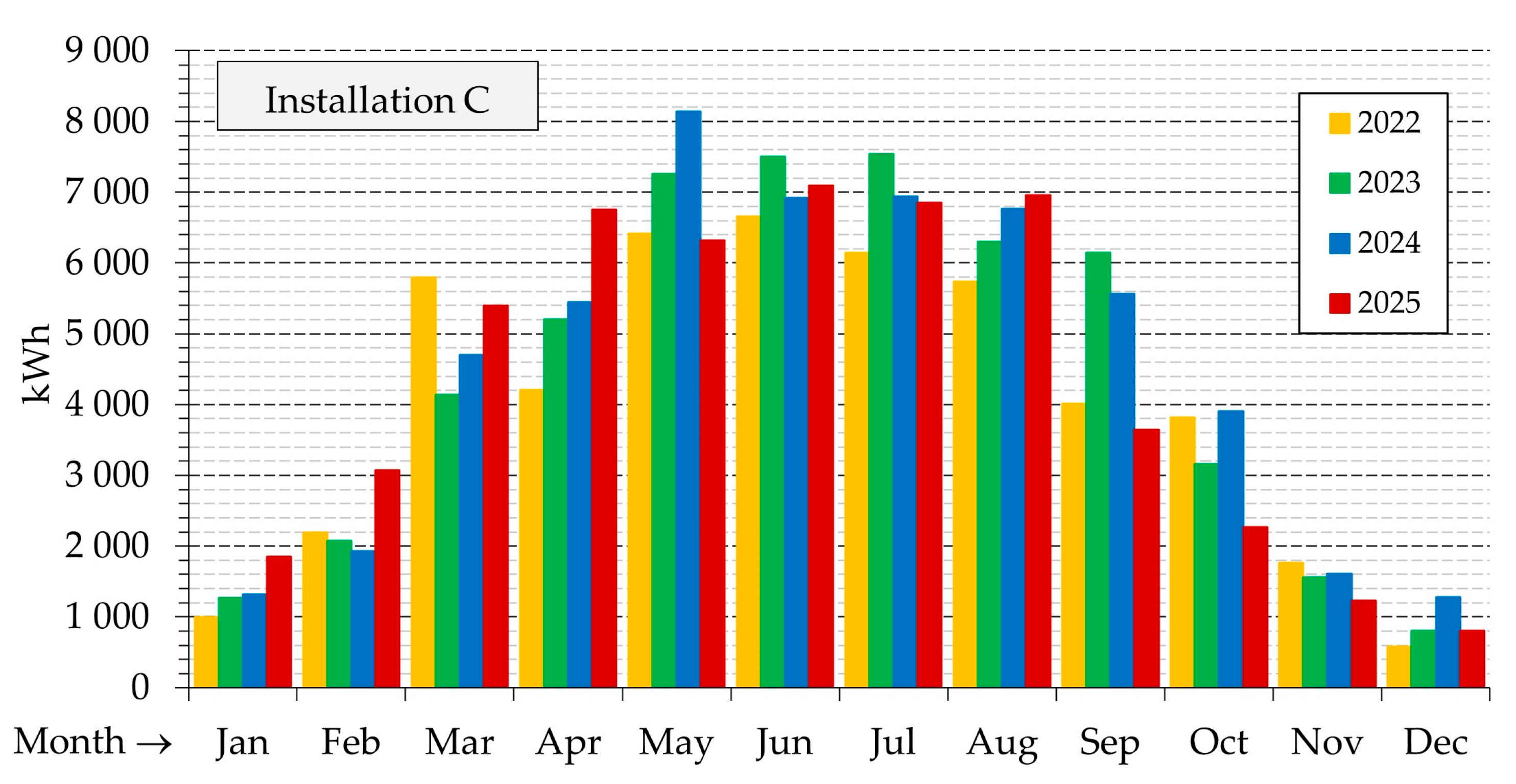
Figure 17,
Figure 18 and
Figure 19 present the electricity yields of stationary installation A, B and C for the years 2022–2025, broken down by month.
Energy yields in individual months correspond to the general solar radiation parameters determined for the climate zone where the PV installation is located. The discrepancies are due to a variable number of days with direct sunlight. March 2022 is particularly distinct, as energy production reached a level comparable to that for summer months. This is due to very good solar radiation conditions during this period, and moreover to low average temperature, which contributed to higher PV module efficiency [
64,
65]. This effect was noticed for all analyzed installations.
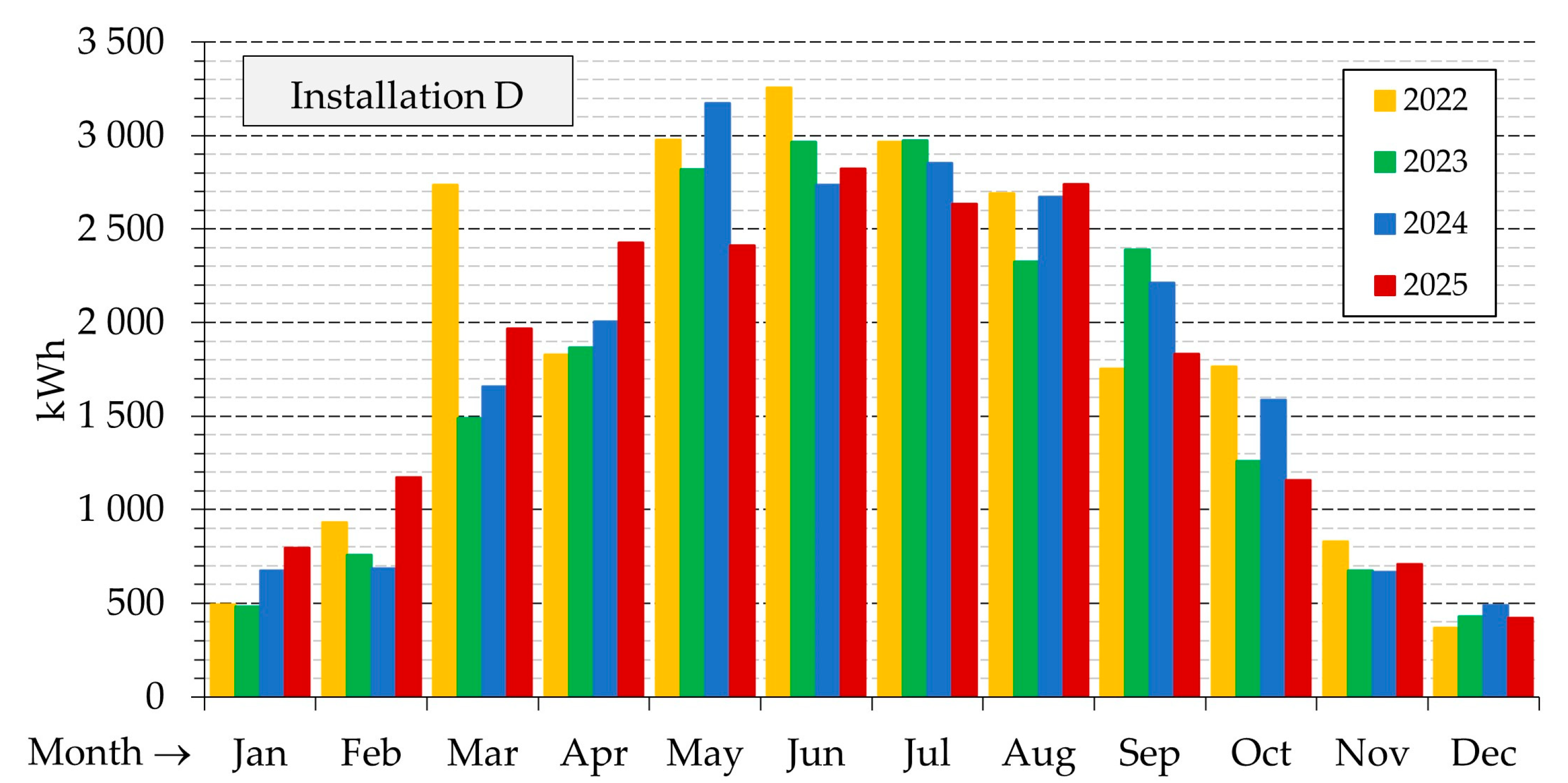
Figure 20 depicts the electric energy yields in tracking installation D during the years 2022–2025 broken down by month.
In the case of tracking installation D, in which the orientation of the active surfaces of PV modules tracks the sun’s position in the sky, the energy yields in individual months are directly correlated to direct sunlight exposure. In the case of the analyzed tracking system, the control system is equipped with a sensor that detects the direct sunlight on the PV module surfaces. In the case of heavy cloud coverage, the PV modules are positioned horizontally, which ensures the highest level of diffuse sunlight, thus increasing energy production.
6. Conclusions
All analyzed PV installations were commissioned between September 2020 and October 2021. It should be stressed that these are not model PV installations with identical technical parameters and configurations but real-life installations working at a given location. Technical parameters of the devices and DC circuit configurations of the analyzed PV installations result from technical solutions implemented in practice. The installations are equipped with PV modules with efficiencies of 20 or 20.5% and quite similar technical parameters, as listed in
Table 4.
During the analyzed four-year period, stationary installations achieved energy production per 1 kWp of installed PV modules ranging from 1052.8 to 1148.0 kWh annually. The difference in energy production between the extreme annual values is 9%. This difference is due to variable solar radiation conditions each year and the different active plane orientation of the PV modules within a given installation. In installation A, the PV modules are at a 10° angle to the ground surface, which increases production efficiency during the summer months when the sun is high above the horizon at the expense of lower production during the rest of the year. This installation has achieved the highest value of PR indicators among the stationary units at 85.3–91.6%. Installations B and C, in which the modules are at an angle of 30°, achieve optimal efficiency over a longer period, from spring to autumn. However, considering the variable seasonality of insolation at the considered location (Częstochowa, 50.8° N; 19.1° E), all stationary installations achieved energy production results comparable to those obtained from simulation. The average annual production value per 1 kWp of installed PV modules for all analyzed stationary installations is 1084.3 kWh. Installation C achieved the lowest values of the PR indicators, 72.7–82%, due to long DC supply cables and frequently occurring technical malfunctions.
During the analyzed period, tracking installation D achieved an average annual energy production of 1602 kWh per 1 kW of installed modules. This value is 47% higher than the average production of stationary installations (1084.3 kWh). It is worth noting that all stationary installations (A, B, and C) operate in string systems, while the tracking installation (D) operates on microinverters, where each PV module is connected separately to an independent MPPT input. An additional factor that influences the higher energy yield in the tracking installation D is the use of bifacial PV panels (PERC technology). In a simulation study which focused on the comparison of stationary and tracking PV installations with comparable technical parameters for Częstochowa, the difference is equal to 35% (
Figure 14). Considering that in the tracking installation there was no shading, the additional difference between the real energy yield value and the value from simulation (12%) is due to the use of bifacial modules. Installation D achieved a PR indicator value of 88–92.9%. Such a high value is the result of very good insolation conditions which occurred during the analyzed period, compared to the value generated from simulations. The difference in energy production by the tracking system between the extreme annual values is 9%. The percentage differences in energy production by the tracking system and the stationary installations during the analyzed period are identical, indicating that they result from variable solar radiation conditions (
Figure 2).
From an economic perspective, tracking systems are characterized by a higher capital investment per unit of installed power. The cost of the structure, drives, control systems, and additional foundation work results in a higher unit cost per kWp than stationary installations. Moreover, tracking installations require a larger area due to the need to maintain spacing to prevent mutual shading in different operating positions, which may reduce the installed power density per unit area. Stationary PV systems mounted on the roofs of existing buildings generate relatively low construction and subsequent operating costs.