Article

Coordinated Frequency Regulation Control Strategy for Wind-Storage Systems Based on Dynamic Weighting Coefficients and Model Predictive Control

Department of Electrical Engineering, Northeast Electric Power University, Jilin City 132012, China
*
Author to whom correspondence should be addressed.
Energies 2026, 19(10), 2354; https://doi.org/10.3390/en19102354 (registering DOI)
Submission received: 23 April 2026 / Revised: 9 May 2026 / Accepted: 12 May 2026 / Published: 14 May 2026

Abstract

Wind-storage coordinated frequency regulation enhances the frequency stability of large-scale wind power systems. However, existing methods often rely on fixed parameters, limiting adaptability and accelerating energy storage depletion. To address these limitations, a coordinated control strategy based on dynamic weighting coefficients and model predictive control (MPC) is proposed. First, a dynamic weighting mechanism is designed to adaptively adjust the contributions of virtual inertia and droop control based on the system frequency state and the energy storage system’s (ESS) state of charge (SOC), thereby avoiding abrupt power variations and maintaining the SOC within safe limits. Second, an MPC-based rolling optimization model is established to continuously allocate the active power outputs between the doubly fed induction generator (DFIG) and the ESS, aiming to minimize both frequency deviations and regulation costs. Simulation results demonstrate the superiority of the proposed strategy. Under a step load disturbance, the maximum frequency deviation is reduced by 11.3%, and the peak time is shortened by 13% compared to conventional droop control. Furthermore, under continuous load fluctuations, the proposed approach significantly mitigates SOC depletion and minimizes system frequency fluctuations, proving its effectiveness in enhancing the frequency resilience of wind-storage combined systems.

1. Introduction

China’s energy system is accelerating its shift toward a clean, low-carbon path amid the “dual-carbon” targets, with wind power installed capacity continuing to rise. As a higher share of wind power is integrated into the grid, new challenges have emerged for power system frequency stability [1]. On the one hand, the system’s frequency regulation load is exacerbated by the volatility and randomness of wind power generation [2]. Conversely, the doubly fed induction generator (DFIG) is connected to the grid via power electronic devices, which reduces the system’s equivalent inertia by weakening the direct coupling between its mechanical spinning components and the grid frequency. As the proportion of conventional synchronous generators gradually declines, the grid’s frequency support capability is further weakened, making the insufficiency of primary frequency regulation (PFR) under high wind power penetration increasingly prominent [3].
To meet the operational needs of new-type power systems, large-scale wind farms are increasingly required to provide PFR [4]. Current approaches to DFIG primary frequency regulation can be broadly divided into two groups: power reserve control and rotor kinetic energy control [5]. The former adjusts the rotor speed or pitch angle to move the turbine away from the maximum power point tracking (MPPT) operating state, thereby reserving a margin for active power regulation [6]. As core technical methods, virtual inertia control and droop control are used in the latter to release rotor kinetic energy for system frequency support [7]. Reference [8] reserves part of the power for the DFIG through rotor overspeed control, enabling bidirectional frequency regulation capability. Reference [9] coordinates rotor overspeed control and pitch angle control to achieve continuous active power support over the full wind speed range. Optimized control schemes for DFIGs involved in PFR are proposed in References [10,11]. The adoption of virtual inertia control and adaptive droop mechanisms helps improve DFIG frequency performance and better realize rotor speed recovery characteristics. Reference [12] further combines power reserve control and rotor kinetic energy control to optimize power output during the inertia response stage and reduce the system frequency recovery time. However, the effectiveness of these methods is still constrained by factors such as wind speed conditions, operating scenarios, and turbine states. Under complex disturbances or sustained frequency regulation scenarios, their active power support capability remains somewhat limited [13].
Characterized by fast response and flexible power regulation, the energy storage system (ESS) is commonly deployed to facilitate PFR of power systems. References [14,15] adaptively combine virtual inertia control with droop control, thereby achieving smooth coordination among different ESS control modes. By accounting for the state of charge (SOC), Reference [16] introduces a strategy to recover the SOC of the ESS within the frequency regulation dead-band stage, which effectively prolongs its cycle life. These findings suggest that integrating the ESS significantly enhances the rate of change of frequency (ROCOF) and effectively mitigates steady-state frequency deviation. However, the ESS’s frequency regulation capability is constrained by rated capacity and SOC limits. If the control parameters cannot be dynamically adjusted according to operating conditions, overcharging or over-discharging may easily occur during frequency support, thereby weakening the system’s capability for sustained regulation.
Consequently, the integrated involvement of both the DFIG and the ESS in PFR has steadily gained traction as a key research focus [17]. The DFIG provides sustained active power support, while the ESS offers rapid power compensation. The two are highly complementary in response speed, regulation sustainability, and operational constraints. Reference [18] advances a strategy based on the principle of “the ESS first, wind power supplementation.” The coordinated allocation of output power between the DFIG and the ESS is realized in Reference [19] through fuzzy logic control. However, because these control rules are highly dependent on empirical settings, ensuring the global optimality of the outcomes remains a significant challenge. To overcome these empirical limitations, advanced control techniques have been introduced to enhance wind-storage frequency regulation. For instance, model predictive control (MPC) has been applied to coordinate wind farms and energy storage systems for fast frequency response due to its multi-objective optimization capabilities [20]. Simultaneously, adaptive control strategies integrating virtual inertia and droop mechanisms have been explored to dynamically adjust the frequency support from the ESS based on grid conditions [21]. However, two critical gaps remain in the existing literature: conventional MPC methods often rely on simplified weighting configurations and struggle to seamlessly integrate continuous dynamic mode-switching during complex, sustained load fluctuations; and existing adaptive strategies frequently lack a higher-level rolling optimization framework to strictly constrain the SOC while economically allocating power between the DFIG and the ESS.
To bridge these literature gaps, the main novelty of this paper lies in proposing a coordinated control strategy that combines dynamic weighting with MPC. Unlike existing methods that rely on fixed parameters or simple logic switching, our approach dynamically coordinates both the internal control modes of the ESS and the overall power allocation of the wind-storage combined system. The main contributions of this study are summarized as follows:
First, a continuous dynamic weighting mechanism based on hyperbolic tangent and logistic functions is proposed. This allows the ESS to smoothly transition between virtual inertia and droop control based on frequency variations, avoiding abrupt power changes.
Second, introduce an SOC feedback loop. By directly integrating the operating state of the ESS into the control weights, the strategy effectively prevents the ESS from overcharging or over-discharging during continuous frequency regulation.
Finally, an MPC-based rolling optimization model is established. It determines the optimal active power allocation between the DFIG and the ESS in real-time, balancing frequency regulation performance with system operational constraints.

2. Materials and Methods

This section details the complete methodological framework of the proposed wind-storage coordinated optimal control strategy. First, Section 2.1 analyzes the frequency regulation traits of the combined system. Based on this, Section 2.2 introduces the comprehensive control strategy using dynamic weighting coefficients. Finally, Section 2.3 formulates the MPC-based optimal control algorithm to achieve optimal power allocation.

2.1. Analysis of Frequency Regulation Traits in the Wind-Storage Combined System

This subsection analyzes the frequency response characteristics of the wind-storage combined system to lay the groundwork for the proposed control strategy. First, Section 2.1.1 outlines the basic structure of the combined system. Then, Section 2.1.2 discusses the operational constraints and active power regulation capabilities of the DFIG and the ESS.

2.1.1. Structure of the Wind-Storage Combined Frequency Regulation System

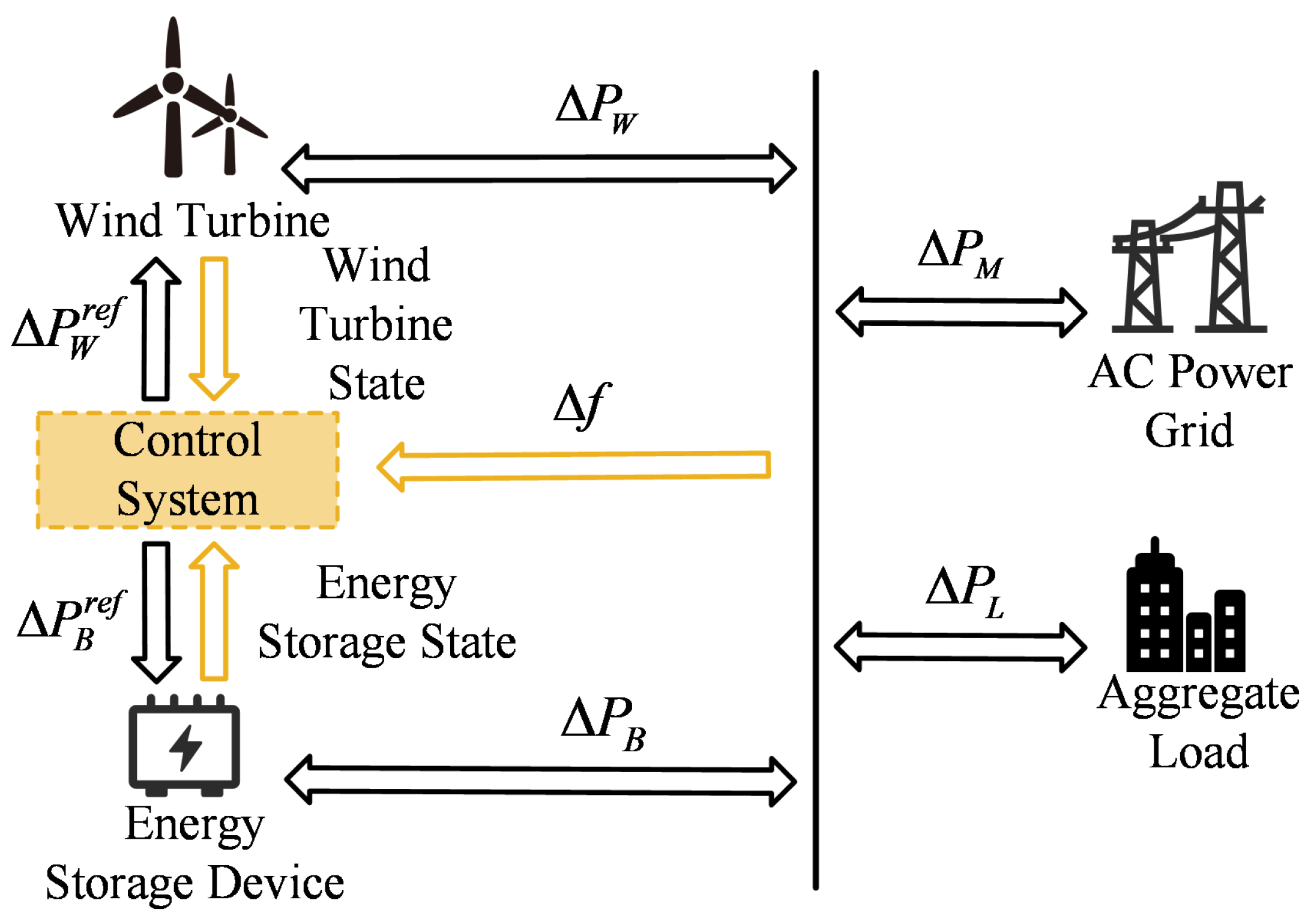
The wind-storage combined frequency regulation system mainly consists of an AC power grid, a DFIG, an ESS, and an aggregate load, as shown in Figure 1.
Here, Δ P M , Δ P W , and Δ P B denote the changes in active power output of conventional generating units, the DFIG, and the ESS, respectively; Δ P L denotes the aggregate load disturbance; Δ f denotes the system frequency deviation; Δ P W r e f and Δ P B r e f denote the reference frequency regulation power of the DFIG and the ESS, respectively.
A discrepancy between active power supply and demand due to load fluctuations causes the grid frequency to deviate from its rated value. In response to the frequency deviation and the specific operating states of the DFIG and the ESS, the control system jointly manages their active power outputs to support PFR [22]. To further the study, the research analyzes how the DFIG and ESS respond during PFR, subsequently establishing a representative model for the wind-storage combined system.

2.1.2. Primary Frequency Regulation Response Characteristics of DFIG and ESS

Both the DFIG and the ESS can support PFR in power systems, but they differ significantly in regulation mechanism, dynamic response speed, and operational constraints [23]. A DFIG can support system frequency by reserving an active power margin; however, its regulation capability is strongly affected by wind speed, operating conditions, and turbine status. In contrast, the ESS features fast response and flexible power regulation, enabling it to rapidly track frequency regulation commands after a disturbance. Therefore, the two exhibit strong complementarity in PFR, making coordinated wind-storage frequency regulation of great significance.
The mechanical power generated by the DFIG is essentially a function of wind speed v and the wind energy utilization factor C P ( λ , β ) , given by:
P m = 1 2 ρ S ν 3 C P ( λ , β )
where P m is the mechanical power harvested by the DFIG; ρ is the atmospheric air density; S is the swept area of the blades; v is the wind speed; C P ( λ , β ) is the wind energy utilization factor; λ is the tip-speed ratio; and β is the pitch angle.
The wind energy utilization coefficient is given by:
C P ( λ , β ) = 0.22 ( 116 λ 0.4 β 5 ) e 12.5 λ
λ = r ω ν
where r is the wind wheel radius and ω is the rotor angular speed.
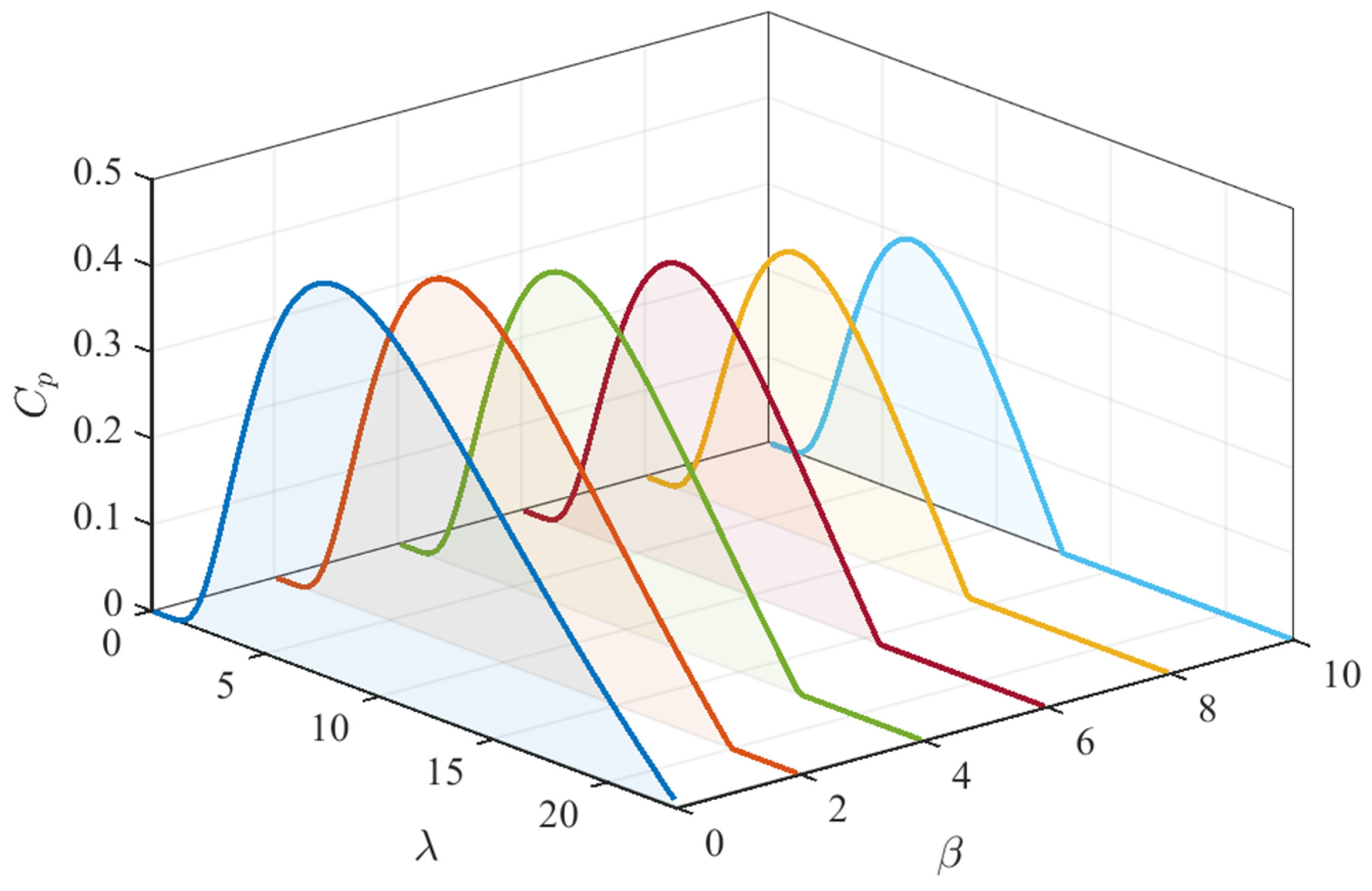
Figure 2 shows the variation characteristics of C P with respect to λ and β .
It can be observed that, for a given wind speed, the DFIG captures peak mechanical power by operating close to the optimal tip-speed ratio. At this operating point, the turbine’s primary objective is to maximize wind energy utilization efficiency. However, the physical meaning of this peak state is that the turbine has already reached its energy extraction limit, leaving an active power reserve of effectively zero. Consequently, when the system frequency drops, providing further sustained active power support becomes impossible if the turbine remains in this MPPT state. This inherent physical limitation directly dictates the necessity of the de-loaded operation.
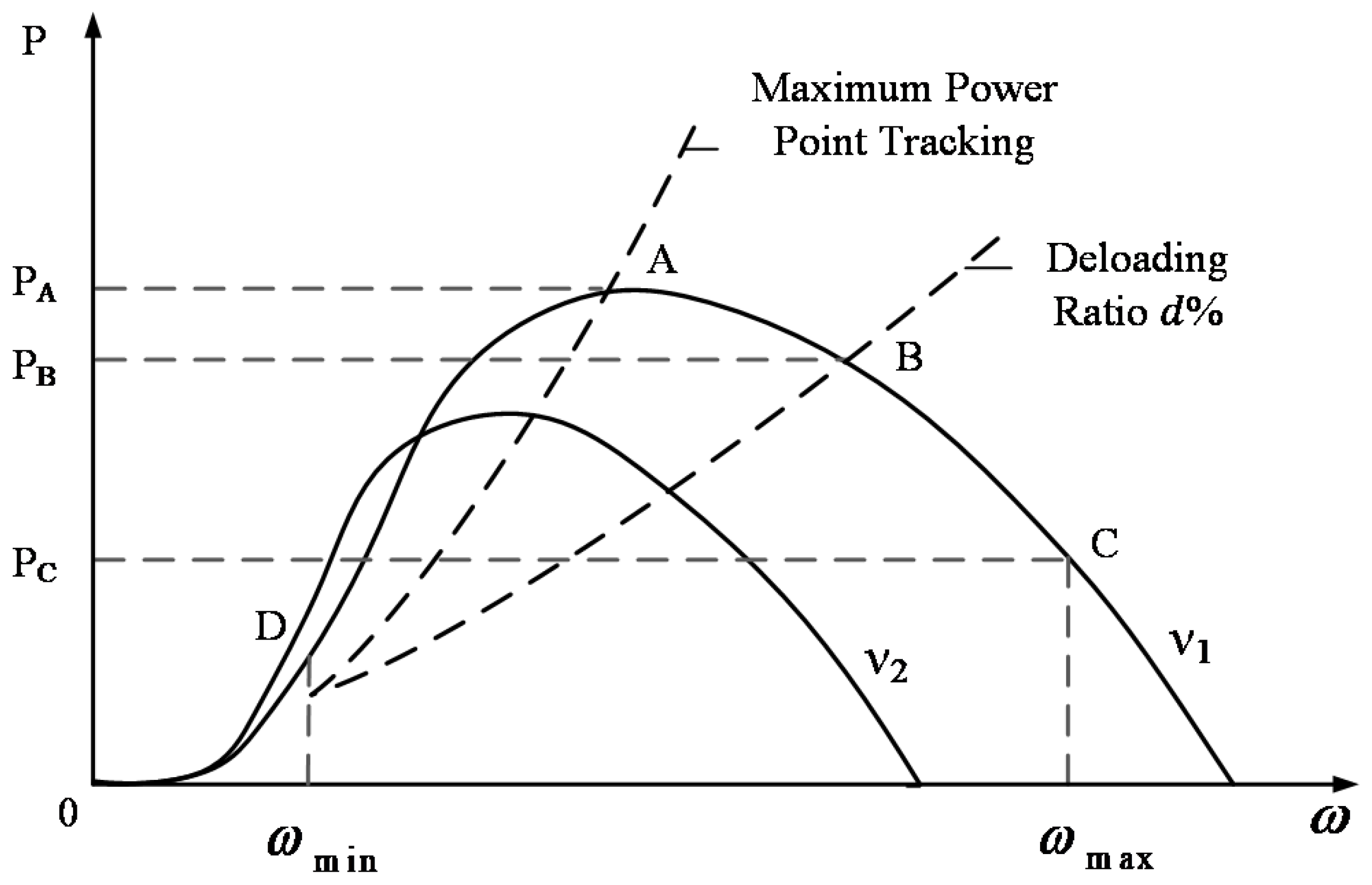
To enhance the PFR capability of the DFIG, a certain amount of active power reserve can be maintained through de-loaded operation [24]. Figure 3 illustrates the de-loaded operation curve implemented through rotor overspeed control.
For the DFIG functioning in de-loaded operation mode, its output power can be formulated as follows:
P = 1 d % P A = 1 2 1 d % ρ S ν 1 3 C P o p t
where P is the output power generated by DFIG under de-loaded operation; d % is the de-loaded ratio; P A is the output power generated by the wind turbine operating in MPPT mode at a specific wind speed v 1 ; and C P o p t is the optimal wind energy utilization coefficient.
The corresponding wind energy utilization factor can be expressed as:
C P = 1 d % C P o p t
As shown in Figure 3 and in Equations (4) and (5), de-loaded operation can reserve an active power regulation margin for DFIG. In response to a disturbance-induced decline in system frequency, the turbine provides sustained active power support by discharging its reserved power during the PFR process. Nevertheless, the frequency regulation capability of DFIG remains constrained by wind speed, de-loaded level, and turbine operating status, and thus is subject to limitations.
Compared with DFIG, the ESS has a faster power response in PFR. Because the duration of PFR is short, the regulating unit must respond rapidly after a disturbance to suppress further expansion of frequency deviation. The ESS exchanges energy with the grid through charging and discharging, and its output power can quickly track regulation commands within a short period. Moreover, it is not directly affected by external random factors such as wind speed, making it more suitable for rapid frequency support tasks in the initial stage of disturbances.
As the ESS engages in charging and discharging behavior, its SOC undergoes continuous changes that directly modulate the available regulation capability for the remainder of the frequency regulation process. When the SOC level approaches its upper or lower operational limits, maintaining high charging or discharging power may easily lead to overcharging or over-discharging, thereby restricting the extent to which the ESS can continuously participate in frequency regulation tasks. Therefore, while ensuring the effectiveness of frequency regulation, the operational state constraints of the ESS must also be taken into consideration.
DFIG provides relatively sustained support but is constrained by the de-loading level and wind conditions. ESS provides fast support but is constrained by SOC and rated power. Therefore, a coordination mechanism should not only assign response priorities across regulatory stages but also adapt ESS participation to its operating state.

2.2. Comprehensive Control Strategy for the Wind-Storage Combined System Based on Dynamic Weighting Coefficients

This subsection presents the comprehensive control strategy based on dynamic weighting coefficients. First, Section 2.2.1 introduces the overall dynamic control framework. Then, Section 2.2.2 details the design of the dynamic input weights based on the system frequency state. Finally, Section 2.2.3 explains the formulation of the dynamic feedback weights based on the SOC.

2.2.1. Comprehensive Control Based on Dynamic Weighting Coefficients

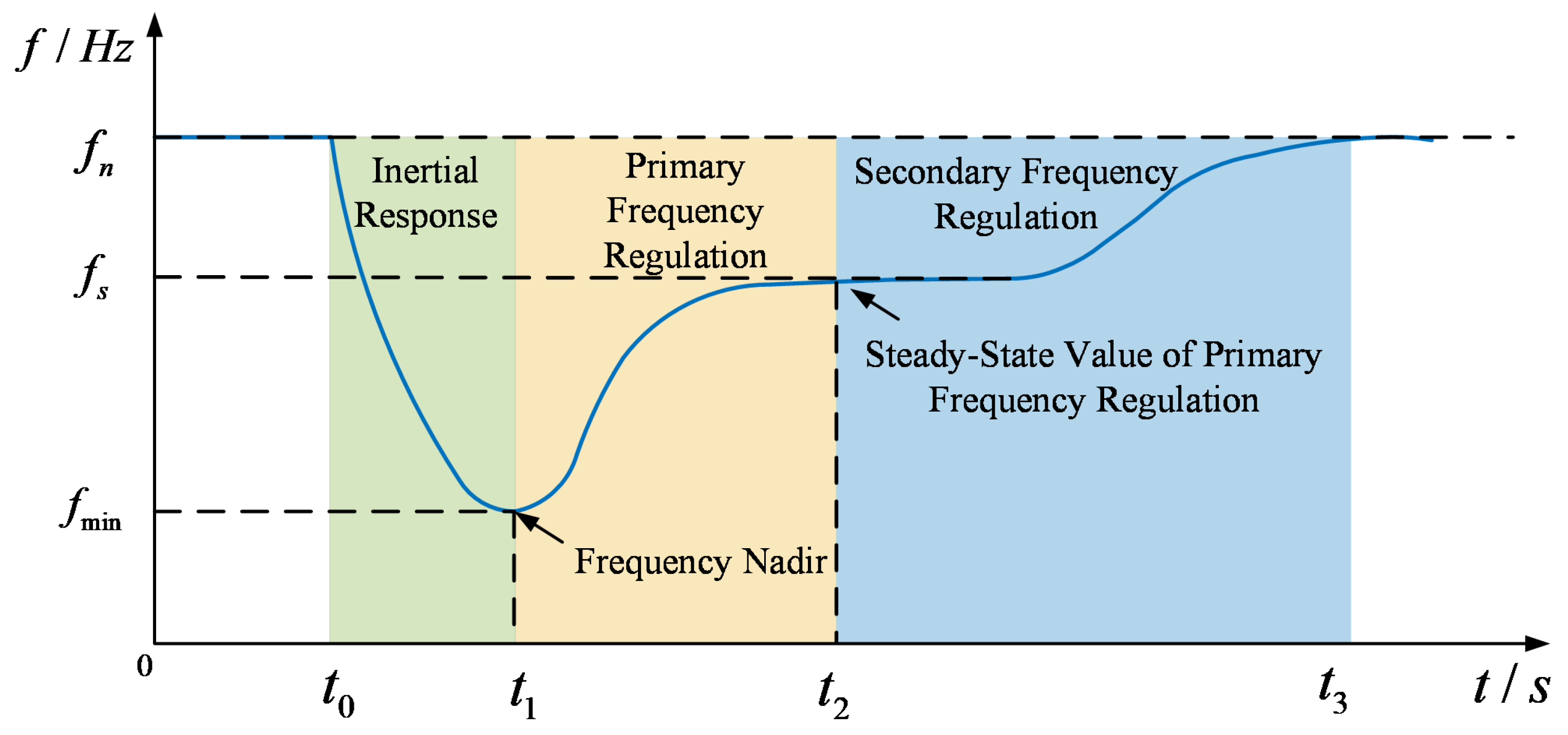
To better describe the control requirements of the wind-storage combined system during the initial disturbance and subsequent frequency restoration, the PFR process is divided into several stages for detailed analysis. By selecting the instant at which the system frequency deviation reaches its peak as the demarcation point, the process can be separated into an inertial response stage and a primary frequency regulation stage, as shown in Figure 4. The inertial response stage begins when the frequency deviation exceeds the frequency regulation dead band and ends when its absolute magnitude reaches its maximum [25]. During this stage, the primary goal is to limit the ROCOF and mitigate the peak frequency deviation. The primary frequency regulation stage begins when the frequency deviation reaches its maximum and continues until it gradually approaches a steady state. The primary goal of this stage is to further minimize frequency deviation and improve the system’s ability to recover its frequency.
To satisfy the control requirements of different frequency regulation stages, the ESS can support grid frequency through the combined application of virtual inertia and droop control. Virtual inertia control mainly functions in the initial stage of a frequency disturbance, providing quick power support by responding to the ROCOF and helping to slow down the rate of frequency decrease. In contrast, droop control regulates active power output in proportion to the magnitude of the frequency deviation, thereby effectively suppressing frequency deviations and improving steady-state regulation performance. Consequently, coordinated implementation of these two control strategies is essential to ensure effective support over the entire primary frequency regulation process. In the literature, the coordination of virtual inertia control and droop control is commonly implemented using fixed-parameter schemes or threshold-based switching strategies. While these approaches can capture the functional roles of the two control mechanisms, they tend to introduce abrupt variations in the ESS power output during switching transitions, undermining the continuity and smoothness of the frequency regulation process [26]. To overcome this limitation, this paper proposes a coordinated control framework that enables continuous adjustment of control actions in response to the system operating conditions.
A comprehensive control strategy composed of virtual inertia and droop control is established:
Δ P B = α 1 β 1 K H d Δ f d t + α 2 β 2 K s c s s Δ f
where Δ P B is the variation in active power output of the ESS; K H and K s c s s represent the power regulation coefficients associated with virtual inertia control and droop control, respectively; α 1 and α 2 denote the corresponding input weights, subject to the constraint α 1 + α 2 = 1 ; β 1 and β 2 denote the feedback weights.
As shown in Equation (6), the output power of the ESS under the proposed inertial control framework is jointly influenced by the virtual inertia control component and the droop control component. To enable coordinated operation of these two control mechanisms across different frequency regulation stages, appropriate weighting coefficients are introduced.

2.2.2. Dynamic Input Weight Design Based on Frequency State

To facilitate the coordinated operation of virtual inertia and droop control across different frequency regulation stages, their contributions are dynamically adjusted based on the system frequency condition. To this end, input weighting coefficients α 1 and α 2 are introduced to represent the contribution ratios of virtual inertia and droop control at the current moment, respectively, with the constraint α 1 + α 2 = 1 . The input weights are dynamically tuned in response to changes in frequency deviation, ensuring a smooth transition between the two control mechanisms throughout the PFR process.
The hyperbolic tangent function offers good continuity and tunability and can effectively capture the regulatory characteristics of control actions that vary with the frequency state across different frequency regulation stages. Compared with piecewise switching methods, constructing input weights with continuous functions helps reduce power fluctuations due to control switching and improve the smoothness of the frequency regulation process. Therefore, the input weights are designed using the hyperbolic tangent function.
(1)
Input weight design for the inertial response stage
During the inertial response stage, the system frequency deviation continues to increase, and the primary objective is to limit the ROCOF and minimize the peak frequency deviation. At this stage, virtual inertia control should dominate, while droop control should play a supplementary role. The input weights for the inertial response stage are designed as follows:
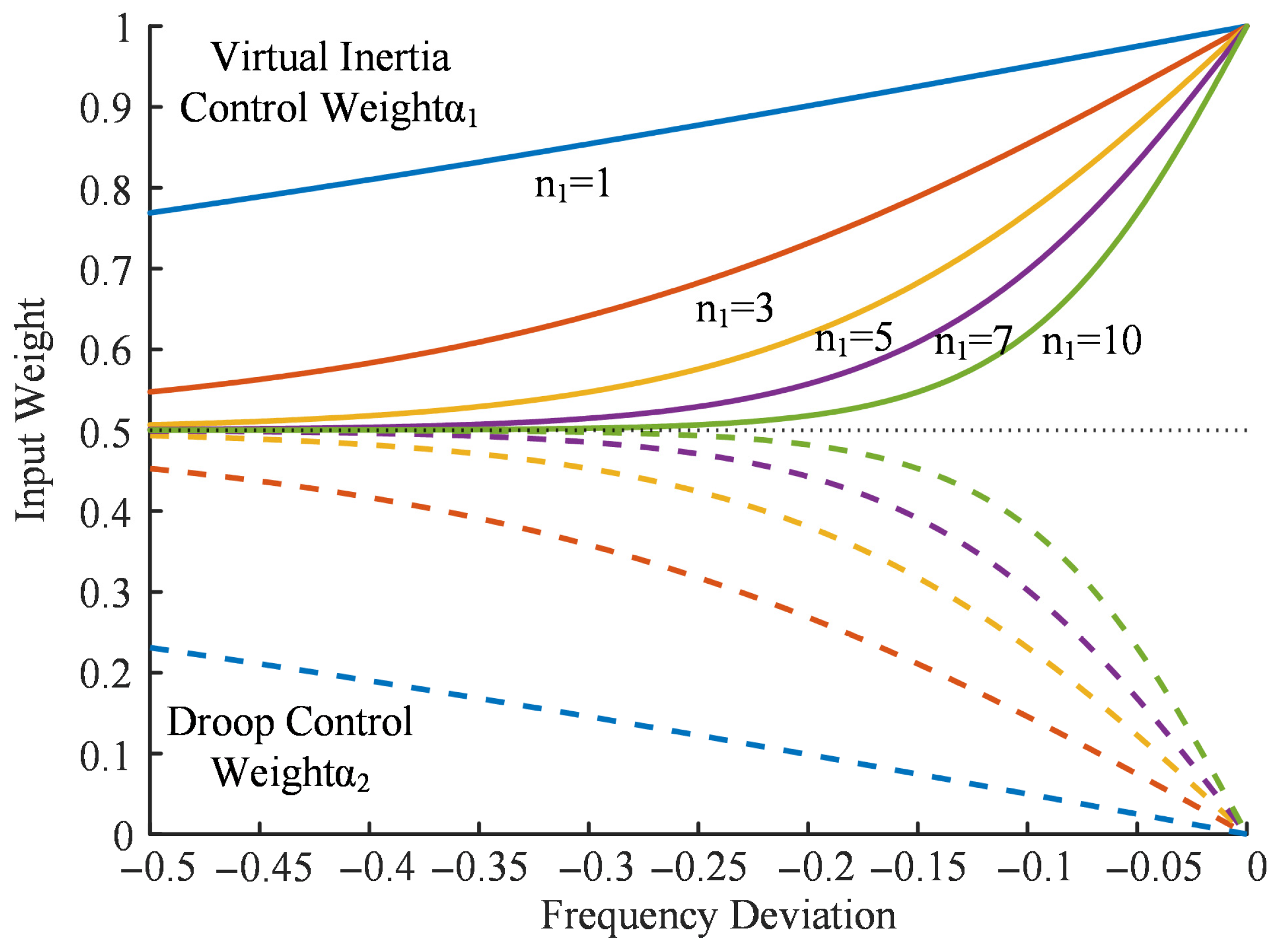
α 1 = 1 α 2 0.5 α 2 = e n 1 Δ f e n 1 Δ f e n 1 Δ f + e n 1 Δ f 0.5
where n 1 is a shape parameter used to adjust the sensitivity of the input weights to frequency deviation variation. The variation curves of the input weights in the inertial response stage, derived from Equation (7), are illustrated in Figure 5.
As shown in Figure 5, during the inertial response stage, as the absolute value of the frequency deviation increases, the input weight for virtual inertia control gradually becomes dominant, while the droop control weight changes accordingly. This allows the ESS to fully utilize its fast inertial support capability during the initial disturbance stage, effectively limiting the system ROCOF and reducing the maximum frequency deviation.
(2)
Input weight design for the primary frequency regulation stage
During the primary frequency regulation stage, the system frequency deviation gradually returns to its peak, and the control objective shifts toward minimizing the frequency deviation and improving the system’s ability to recover its frequency. At this stage, droop control should dominate, while virtual inertia control should play a supplementary role. The input weights for the primary frequency regulation stage are designed as follows:
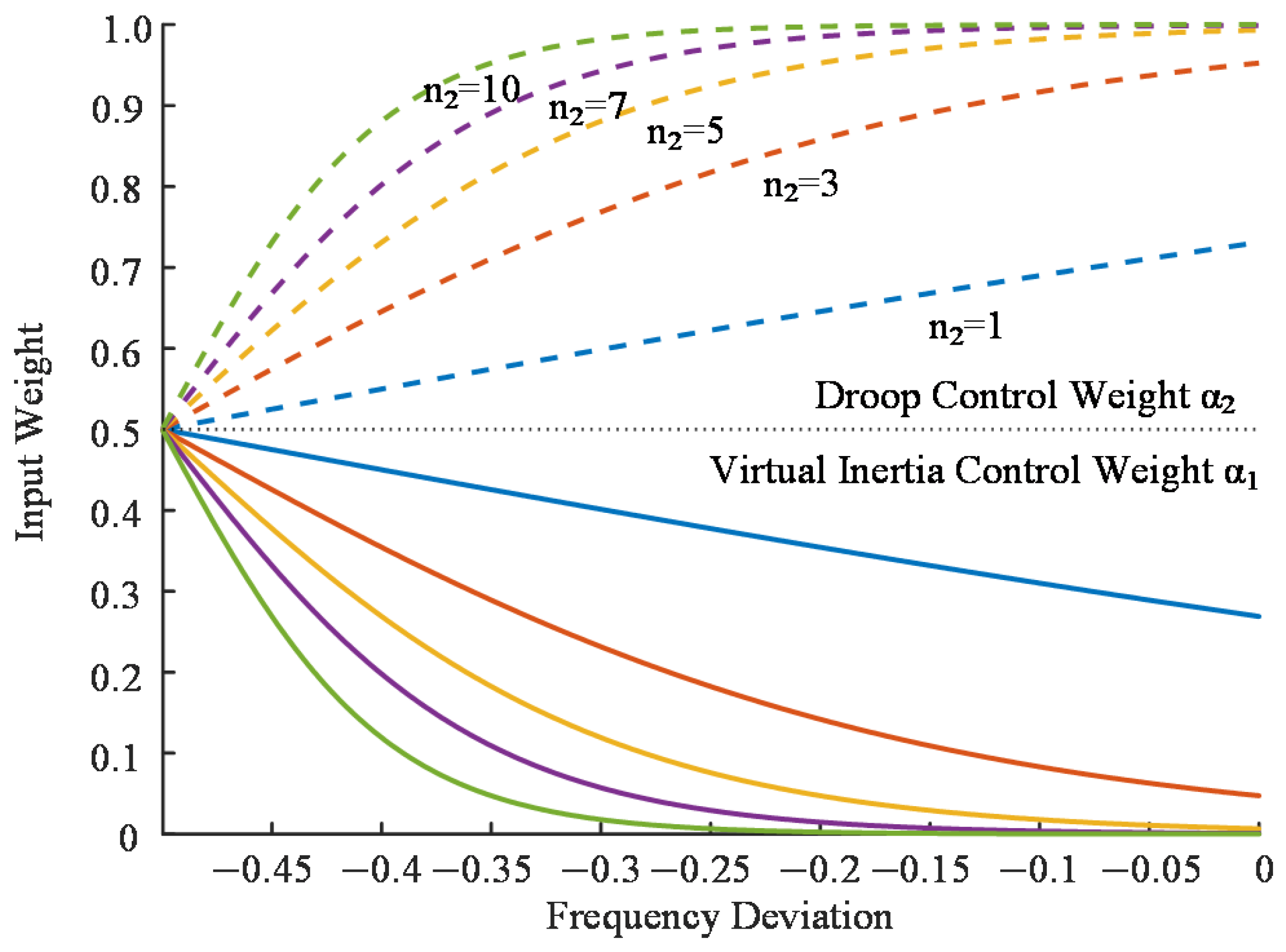
α 1 = 1 α 2 0.5 α 2 = e n 2 ( Δ f + Δ f max ) e n 2 ( Δ f + Δ f max ) e n 2 ( Δ f + Δ f max ) + e n 2 ( Δ f + Δ f max ) 0.5
where Δ f max is the maximum frequency deviation, and n 2 is a shape parameter. The variation in the input weights in the primary frequency regulation stage, derived from Equation (8), is illustrated in Figure 6.
As shown in Figure 6, during the primary frequency regulation stage, as the frequency deviation gradually recovers, the input weight for droop control gradually increases and becomes dominant, while the weight of virtual inertia control decreases accordingly. This enhances the system’s active power regulation capability during the frequency recovery stage, thereby reducing frequency deviation and improving steady-state frequency regulation performance.
The variation characteristics of the input weights are closely related to the parameters n 1 and n 2 . Smaller parameter values result in relatively smooth weight transitions, which are insufficient to distinguish control priorities among different frequency regulation stages. In contrast, larger parameter values produce excessively steep transitions, potentially degrading the smoothness of the control process. By jointly considering response speed and control smoothness, this paper sets n 1 = n 2 = 5 . These values were determined through extensive empirical tuning to achieve an optimal balance between transition smoothness and frequency response speed.

2.2.3. Dynamic Feedback Weight Design Based on SOC

During ESS participation in PFR, charging and discharging processes result in dynamic variations in SOC. As the SOC approaches its upper or lower bounds, sustained high charging or discharging power increases the risk of overcharging or over-discharging, which can degrade subsequent frequency regulation capability and shorten the ESS’s service life. Therefore, within comprehensive control, not only are the contributions of different control mechanisms allocated based on the frequency state, but the ESS’s frequency regulation output is also adjusted in accordance with its operating condition. To this end, dynamic feedback weights are further designed as a function of SOC.
The Logistic function exhibits continuity, monotonicity, and smooth variation, and effectively captures the dynamic adjustment law of the ESS’s charging and discharging capability as SOC varies. Therefore, the Logistic function is used to determine the charging and discharging coefficients of the ESS during the frequency regulation process [27].
When the SOC is in the low-value interval [ 0 ,   Q SOCmin ] , the discharging capability of the ESS is limited, and its charging and discharging coefficients are given by:
K c = K m ,   K d = 0
where K c is the charging coefficient, K d is the discharging coefficient, K m is the maximum charging/discharging coefficient, and Q SOC min is the lower SOC limit.
When the SOC is in the high-value interval [ Q SOCmax ,   1 ] , the charging capability of the ESS is limited, and its charging and discharging coefficients are given by:
K c = 0 ,   K d = K m
where Q S O C max is the upper SOC limit.
When the SOC is within the normal operating interval [ Q SOCmin ,   Q SOCmax ] , a continuous regulation model is constructed using the Logistic function, and its expression is:
K c = 0.01 K m exp 15 ( Q SOCmax Q SOC ) ( Q SOCmax Q SOCmin ) / 2 K m + 0.01 exp 15 ( Q SOCmax Q SOC ) Q SOCmax Q SOCmin / 2 1 K d = 0.01 K m exp 15 ( Q SOC Q SOCmin ) ( Q SOCmax Q SOCmin ) / 2 K m + 0.01 exp 15 ( Q SOC Q SOCmin ) ( Q SOCmax Q SOCmin ) / 2 1
where Q S O C denotes the current SOC of the ESS.
On the basis of the obtained charging and discharging coefficients, the feedback weights β 1 and β 2 in the comprehensive control are further constructed as follows:
β 1 = λ K c    d f / d t 0 λ K d    d f / d t < 0
β 2 = K c f 0.03   Hz K d f < 0.03   Hz
where β 1 and β 2 are the feedback weights of virtual inertia control and droop control, respectively; d f / d t is the ROCOF; and λ is the proportional coefficient of the feedback weight, which is set to λ = 0.35 in this paper. The specific value of the proportional coefficient was selected based on iterative sensitivity testing to prevent overcharging or over-discharging without causing numerical instability.
The proposed design allows the feedback weights to be dynamically adjusted in response to SOC variations, ensuring that the provided frequency regulation capability remains consistent with the operating state. Consequently, the safe operating range of the ESS is considered during frequency support, while maintaining its sustained participation in PFR.
In summary, the frequency-state-based input weights enable smooth coordination between virtual inertia and droop control across different frequency regulation stages, whereas the SOC-dependent feedback weights further account for the impact of the ESS operating condition on frequency regulation capability. Together, they constitute the dynamic weighting coefficients in the comprehensive control, thereby laying the foundation for the subsequent coordinated optimal control of the wind-storage combined system.

2.3. Coordinated Optimal Control Strategy for the Wind-Storage Combined System Based on MPC

This subsection details the implementation of the coordinated optimal control strategy based on MPC. Specifically, Section 2.3.1 establishes the discrete state-space model for the system frequency response. Section 2.3.2 formulates the multi-objective function and the corresponding operational constraints for optimization. Finally, Section 2.3.3 describes the rolling optimization procedure and the power allocation mechanism between the DFIG and the ESS.

2.3.1. Frequency Response Model and State-Space Representation of the Wind-Storage Combined System

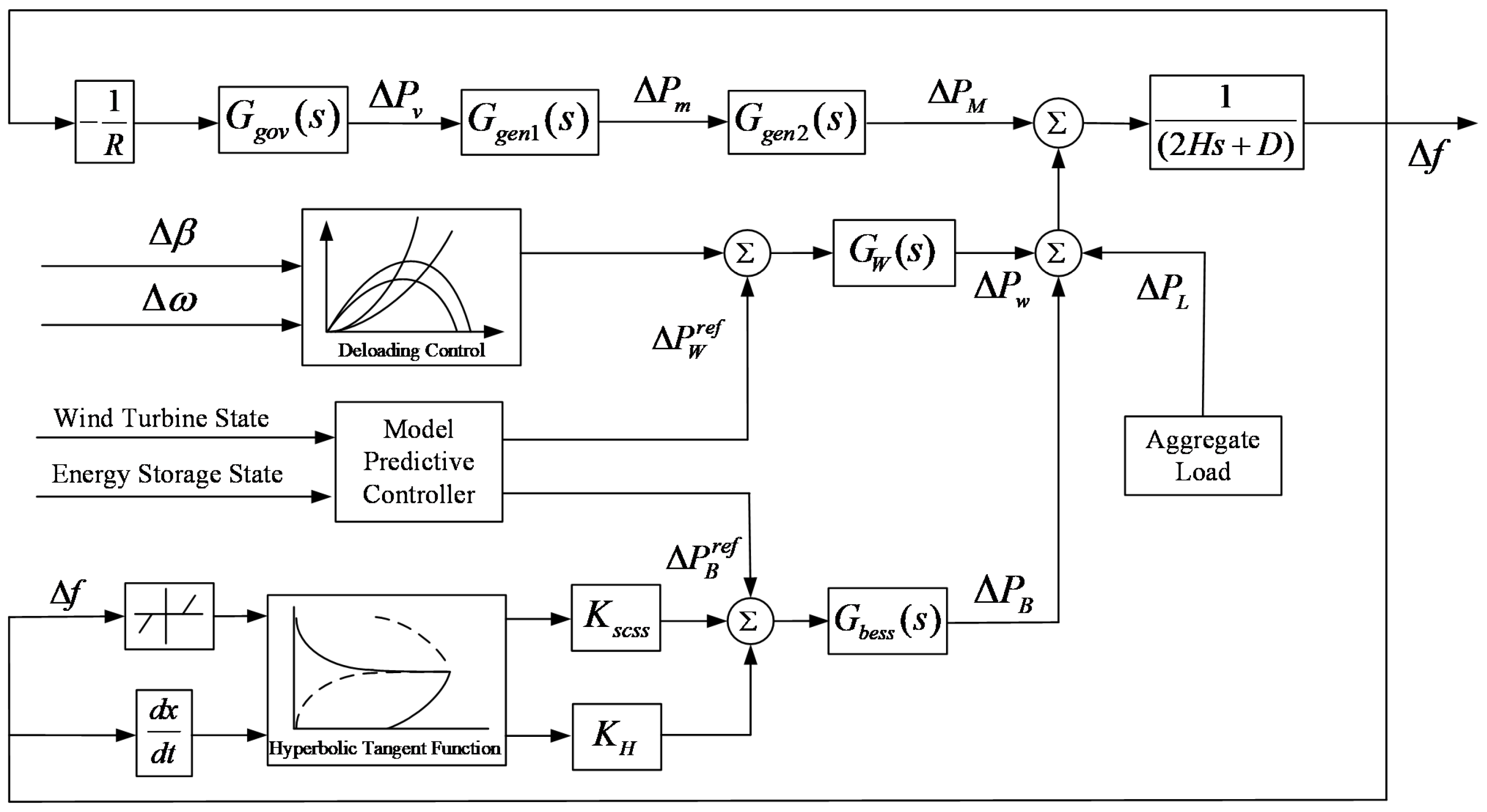
A wind-storage combined system typically comprises traditional synchronous generators, a DFIG, ESS, and aggregated electrical loads. Among them, conventional generating units provide basic frequency regulation support through the governor and turbine links; DFIGs participate in frequency regulation by adjusting active power output; and ESSs compensate for system frequency disturbances by virtue of their rapid power-regulation capability. When load disturbances occur, every component of the system participates in PFR, and the corresponding frequency response model is shown in Figure 7.
Under load disturbances, an imbalance in active power leads to deviations in system frequency. Conventional generators, DFIG, and ESS adjust their active power outputs in response to frequency changes and control signals, working together to mitigate frequency deviations and enhance the system’s dynamic performance. The dynamic-weighting-based comprehensive control generates an adaptive ESS reference based on the frequency state and SOC condition, while the MPC layer coordinates the output allocation between the DFIG and ESS under multiple operating constraints.
The PFR of the wind-storage combined system can be described by the following set of continuous state equations:
Δ P v = 1 R Δ f G gov ( s ) Δ P m = P v G genl ( s ) Δ P M = P m G gen 2 ( s ) Δ P W = Δ P W r e f G W ( s ) Δ P B = Δ P B r e f G bess ( s ) Q SOC = Q SOC 0 Δ P B T E B Δ f = ( Δ P b + Δ P w + Δ P M Δ P L ) 1 2 H s + D
where Δ P v , Δ P m , and Δ P M denote the governor position increment, the intermediate power variable output from the front-stage link of the conventional unit, and the active power variation of the conventional unit, respectively; G gov ( s ) , G genl ( s ) , and G gen 2 ( s ) denote the transfer functions of the governor, the front-stage turbine link, and the rear-stage turbine link, respectively; Δ P W and Δ P B denote the active power output variations of the DFIG and the ESS, respectively; Δ P W r e f and Δ P B r e f are their reference frequency regulation power; G W ( s ) and G bess ( s ) are the dynamic transfer functions of the DFIG and the ESS, respectively; Q SOC and Q SOC 0 denote the SOC of the ESS and its initial value, respectively; E B is the rated capacity of the ESS; T is the sampling period; Δ P L is the aggregate load disturbance; Δ f is the system frequency deviation; R is the droop coefficient of the primary frequency regulation of the conventional unit; H is the system inertia time constant; and D is the system damping coefficient [28].
Equation (14) characterizes the dynamic frequency response of the wind-storage combined system under load disturbances. In this framework, both the DFIG and the ESS contribute to active power control via their individual dynamic components, whereas the system frequency is governed by the net active power imbalance.
For the convenience of subsequent MPC implementation, the above continuous-time model is further discretized and transformed into a standard discrete-time state-space form, namely:
x ( k + 1 ) = A x ( k ) + B u ( k ) + R r ( k ) y ( k ) = C x ( k )
where k is the current sampling instant; x ( k ) , u ( k ) , r ( k ) , and y ( k ) are the state variable vector, control input vector, disturbance vector, and output vector, respectively; and A , B , R , and C are the state matrix, control input matrix, disturbance matrix, and output matrix, respectively.
Furthermore, discretize the equations for the wind-storage combined frequency regulation system in the standard form of model predictive control, as shown in Appendix A.
According to the established model in this paper, the variables are defined as follows.
The state variable vector is:
x ( k ) = Δ P v ( k ) ,   Δ P m ( k ) ,   Δ P M ( k ) ,   Δ P w ( k ) , Δ P B ( k ) ,   Q S O C ( k ) ,   Δ f ( k ) T
The control input vector is:
u ( k ) = Δ P W r e f k ,   Δ P B r e f k T
The disturbance vector is:
r ( k ) = Δ P L k
The output vector is:
y ( k ) = Δ P W k ,   Δ P B k ,   Q S O C k ,   Δ f k T

2.3.2. Coordinated Optimization Objective Function and Constraints

Based on the developed discrete state-space model for the wind-storage combined system, the MPC cost function and its associated constraints should be formulated to enable coordinated optimal control of the DFIG and the ESS in PFR.
According to the comprehensive control strategy established in Section 2.2, the PFR power of the ESS under the current operating state can be obtained as:
Δ P B a d ( k ) = α 1 ( k ) β 1 ( k ) K H d Δ f ( k ) d t + α 2 ( k ) β 2 ( k ) K s c s s Δ f ( k )
where Δ P B a d ( k ) denotes the reference frequency regulation power of the ESS generated by the comprehensive control strategy based on dynamic weighting coefficients.
Equation (20) describes the reference frequency regulation action on the ESS side, reflecting the ESS’s expected response to system frequency support under comprehensive control. On this basis, MPC is further introduced to perform unified, coordinated optimization of the actual power outputs of the DFIG and the ESS, thereby achieving better frequency regulation performance while satisfying system operating constraints. Therefore, the objective function for MPC optimization is formulated as follows:
min   J = i = 1 N p a 1 Δ f ( k + i | k ) 2 + a 2 C c o s t ( k + i | k ) + a 3 Δ P B ( k + i | k ) Δ P B a d ( k ) 2
where N p is the prediction horizon; a 1 , a 2 , and a 3 are the weighting coefficients for the frequency regulation performance term, the operating cost term, and the reference tracking term, respectively. These weighting coefficients were fine-tuned based on a heuristic sensitivity approach across multiple operating scenarios to achieve a trade-off among frequency deviation minimization, control cost reduction, and SOC constraint management.
In the objective function, the frequency regulation performance term is used to suppress system frequency deviation, thereby ensuring that the wind-storage combined system possesses good frequency support capability and dynamic response performance under disturbances. The operating cost term is used to comprehensively characterize the regulatory costs of the DFIG and the ESS during frequency regulation, while accounting for SOC deviations to avoid excessive power fluctuations or overconsumption of the ESS during control. The reference-tracking term is used to constrain the tracking of the ESS’s actual output power to the reference power generated by the comprehensive control strategy, thereby establishing an effective link between the dynamic weighting coefficient and the coordinated optimal allocation in this chapter.
To further quantify the power regulation cost of wind and storage and the deviation in the operating state of the ESS, the comprehensive cost function is defined as:
C cost ( k + i | k ) = c 1 Δ P B ( k + i | k ) 2 + c 2 Δ P W ( k + i | k ) 2 + c 3 Q soc ( k + i | k ) Q soc r e f 2
where c 1 , c 2 , and c 3 are the weighting coefficients for the ESS power regulation cost, the DFIG frequency regulation action cost, and the SOC deviation cost, respectively; and Q soc r e f is the reference value of the SOC of the ESS.
To ensure that the optimization results satisfy actual operating requirements, the operating constraints of each component unit should also be considered in the MPC solution process.
When the DFIG is involved in frequency regulation, the amount of its power adjustment shall meet the following requirement:
Δ P W min Δ P W ( k + i | k ) Δ P W max
where P W min and P W max denote the minimum and maximum bounds of the DFIG power regulation range, respectively.
The charging and discharging power of the ESS is constrained by its rated capacity, and the corresponding limitation can be expressed as:
P B max Δ P B ( k + i | k ) P B max
where P B max is the maximum bounds of the rated power of the ESS.
The SOC of the ESS should be maintained within a safe operating range to avoid overcharging or over-discharging, and the corresponding constraint is:
Q SOC min Q SOC ( k + i | k ) Q SOC max
where Q SOC min and Q SOC max represent the minimum and maximum bounds of the SOC, respectively.
The active power output of the thermal power unit should satisfy:
P M min P M ( k + i | k ) P M max
where P M min and P M max denote the minimum and maximum bounds of the active power output of the thermal power unit, respectively.
In summary, the formulated objective function accounts for the system’s overall frequency regulation performance, wind-storage power allocation cost, and ESS operating constraints, and integrates comprehensive control with MPC via a reference-tracking term. This enables coordinated optimal power allocation between the DFIG and the ESS.

2.3.3. Rolling Optimization Solution Procedure of MPC

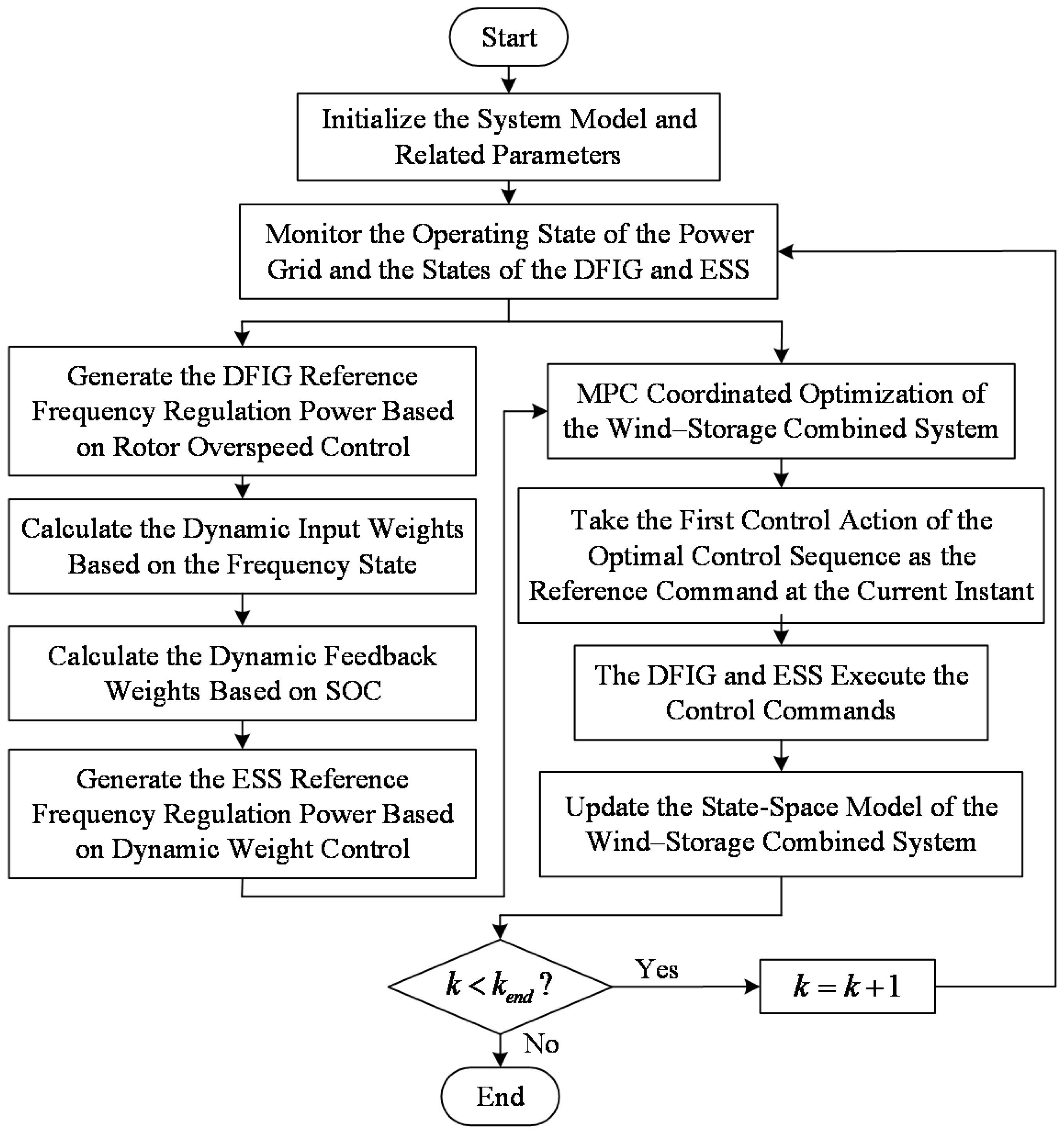
Based on the developed discrete state-space model of the wind-storage combined system, this study establishes a rolling optimization framework for coordinated frequency regulation using MPC. The proposed approach performs online optimization at each sampling instant using the current system operating conditions and load disturbance information. Specifically, the operating states of the power grid, the DFIG, and the ESS are first monitored. For the DFIG, the reference frequency regulation power is determined according to the de-loaded operating condition using rotor overspeed control. For the ESS, dynamic input and feedback weighting factors are derived based on the frequency condition and SOC, respectively, and the reference frequency regulation power is obtained using a comprehensive control strategy that incorporates these dynamic weighting coefficients.
Based on this, the reference frequency regulation powers are simultaneously fed into the MPC-based coordinated optimization module of the wind-storage combined system, where the optimal control sequence within the prediction horizon is derived subject to the imposed constraints. Owing to the rolling optimization characteristic of MPC, only the first control input of the obtained sequence is implemented as the reference command at the current sampling instant after each optimization step. Subsequently, the DFIG and the ESS perform the control action, and the state-space model of the wind-storage combined system is updated before proceeding to the next sampling instant in the subsequent optimization cycle.
To provide a clear logical overview of the proposed control algorithm, the detailed execution flowchart is illustrated in Figure 8. The procedure begins with system initialization and real-time monitoring of the grid frequency and the states of the DFIG and ESS. The core logic is structured into two collaborative stages. In the first stage, the DFIG frequency regulation power is determined via rotor overspeed control, while the ESS power reference is adaptively generated through the dynamic weighting mechanism, which considers both frequency deviation and SOC constraints. Crucially, these calculated references are then fed into the second stage—the MPC-based coordinated optimization. By solving the cost function within the receding horizon while respecting physical bounds, the optimal control sequence is obtained. Only the first action of this sequence is applied to the wind-storage combined system at each interval. Finally, the system state is updated for the next iteration at k + i , ensuring a continuous and stable closed-loop frequency regulation.

3. Analysis and Discussion of the Results

This section comprehensively evaluates the proposed control strategy. Section 3.1 presents the quantitative simulation results under various typical operational scenarios in MATLAB/Simulink R2024b. Subsequently, Section 3.2 provides an in-depth theoretical discussion of these results, focusing on the dynamic frequency support performance and the SOC recovery mechanism.

3.1. Results

This subsection presents the quantitative simulation results to evaluate the effectiveness and superiority of the proposed coordinated optimal control strategy. First, Section 3.1.1 details the simulation model and corresponding parameter settings established in MATLAB/Simulink. The subsequent subsections comprehensively analyze the system’s dynamic frequency support performance under various typical operating conditions, including step load disturbances and continuous wind speed variations.

3.1.1. Simulation Model and Parameter Settings

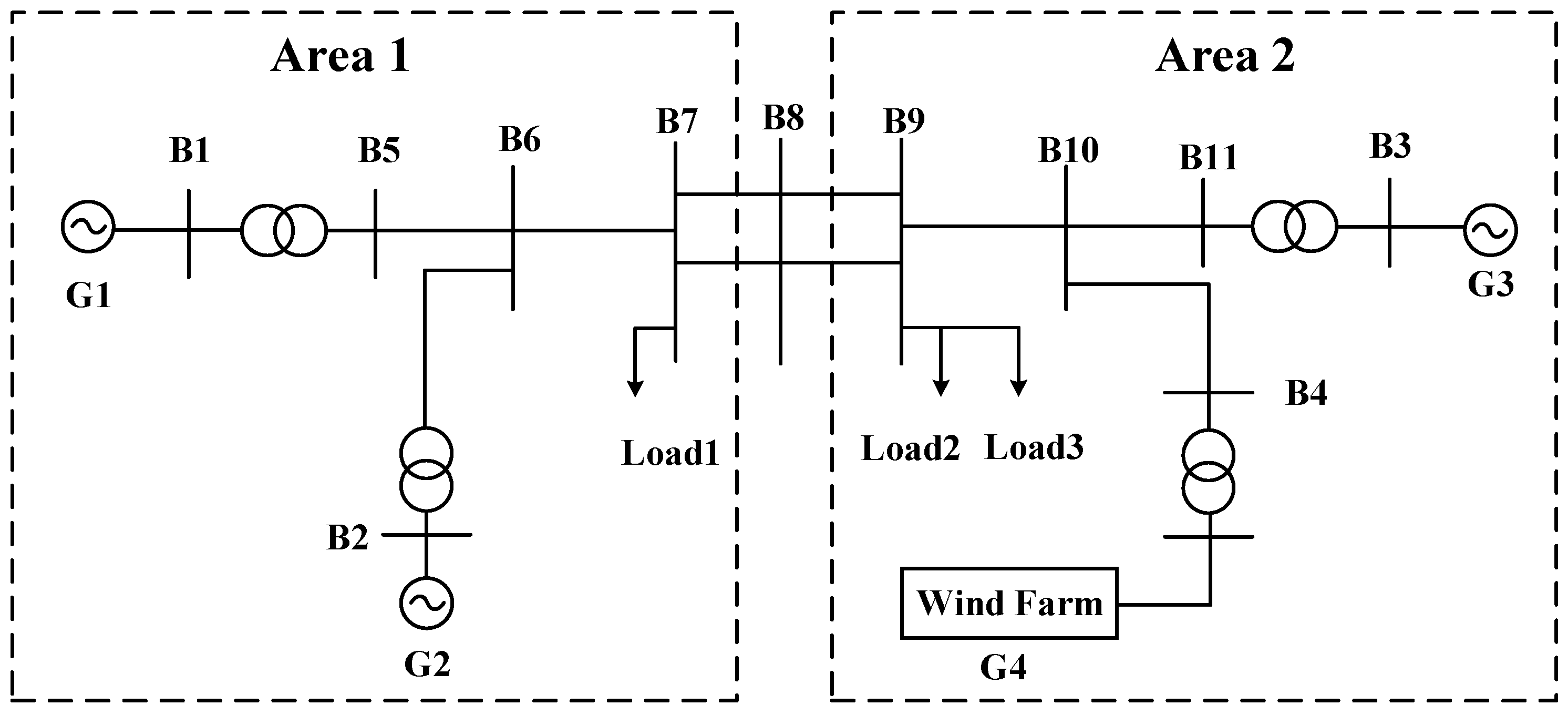
To evaluate the performance of the proposed wind-storage coordinated control strategy incorporating dynamic weighting coefficients and MPC, the wind-storage combined frequency regulation system depicted in Figure 9 is selected as the study case, and a simulation model is developed using the MATLAB/Simulink platform. To ensure the validity and practical relevance of the simulation modeling, the simulation platform is constructed based on the classic two-area four-machine power system model. The fundamental parameters of the DFIG, the ESS, and the equivalent synchronous generators are configured using typical values widely adopted in related power system stability and frequency regulation studies, ensuring that the dynamic responses reflect realistic operational characteristics.
The rated capacity of the conventional synchronous generator in the AC grid is specified as 150 MW, while the installed capacity of the wind farm is 100 MW. To balance generation efficiency and frequency regulation capability when the DFIG participates in primary frequency regulation, the de-loaded ratio of the DFIG is set to 0.15, thereby reserving a margin for active power adjustment. The ESS is configured with a power/capacity of 10 MW/5 MWh, and its initial SOC is set to 0.5. The frequency regulation dead bands for both the DFIG and the ESS are defined as ±0.03 Hz. The MPC sampling interval, prediction horizon, and control horizon are set to 0.1 s, 4 s, and 3 s, respectively. Other relevant parameters are provided in Table 1.
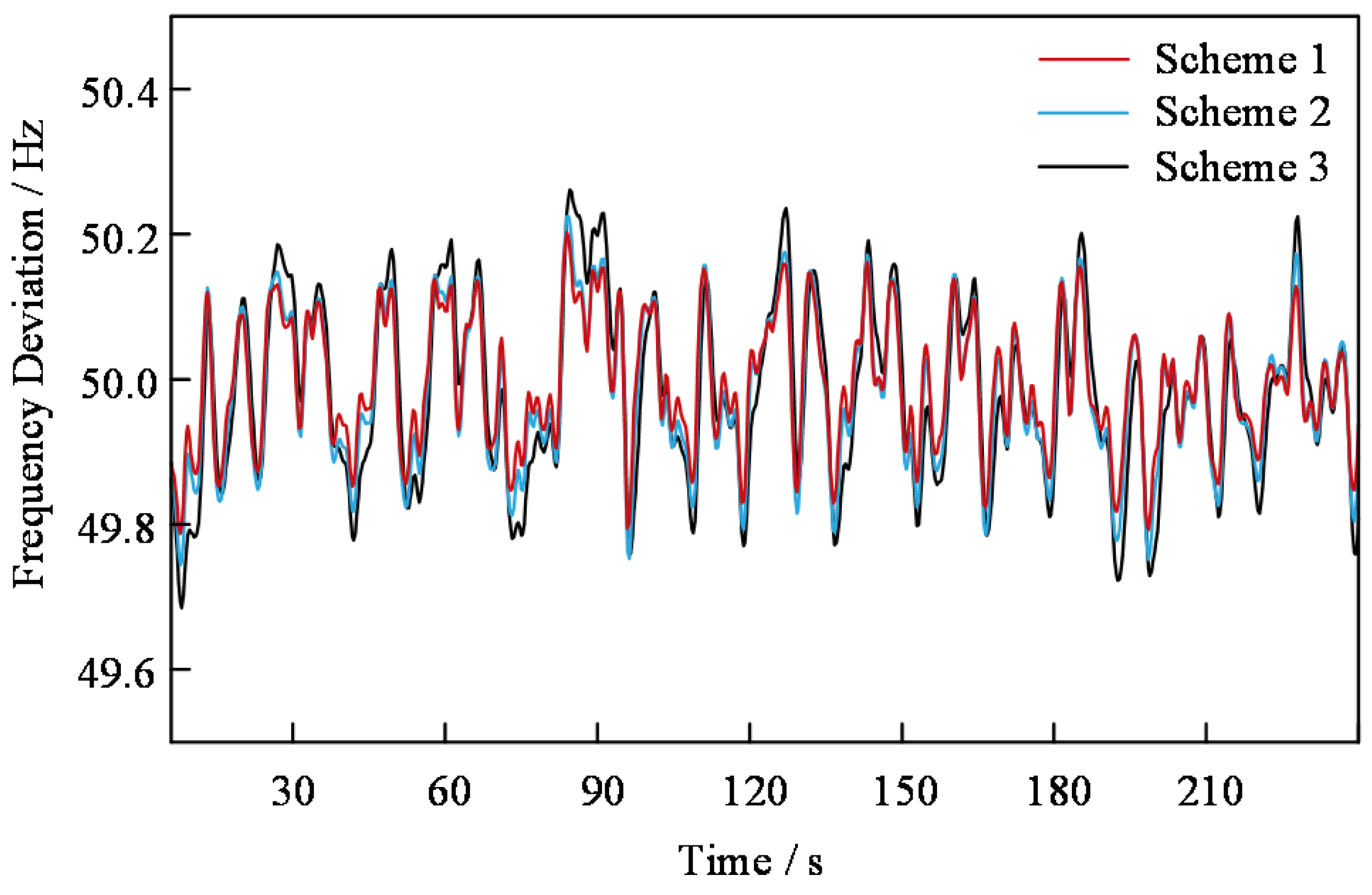
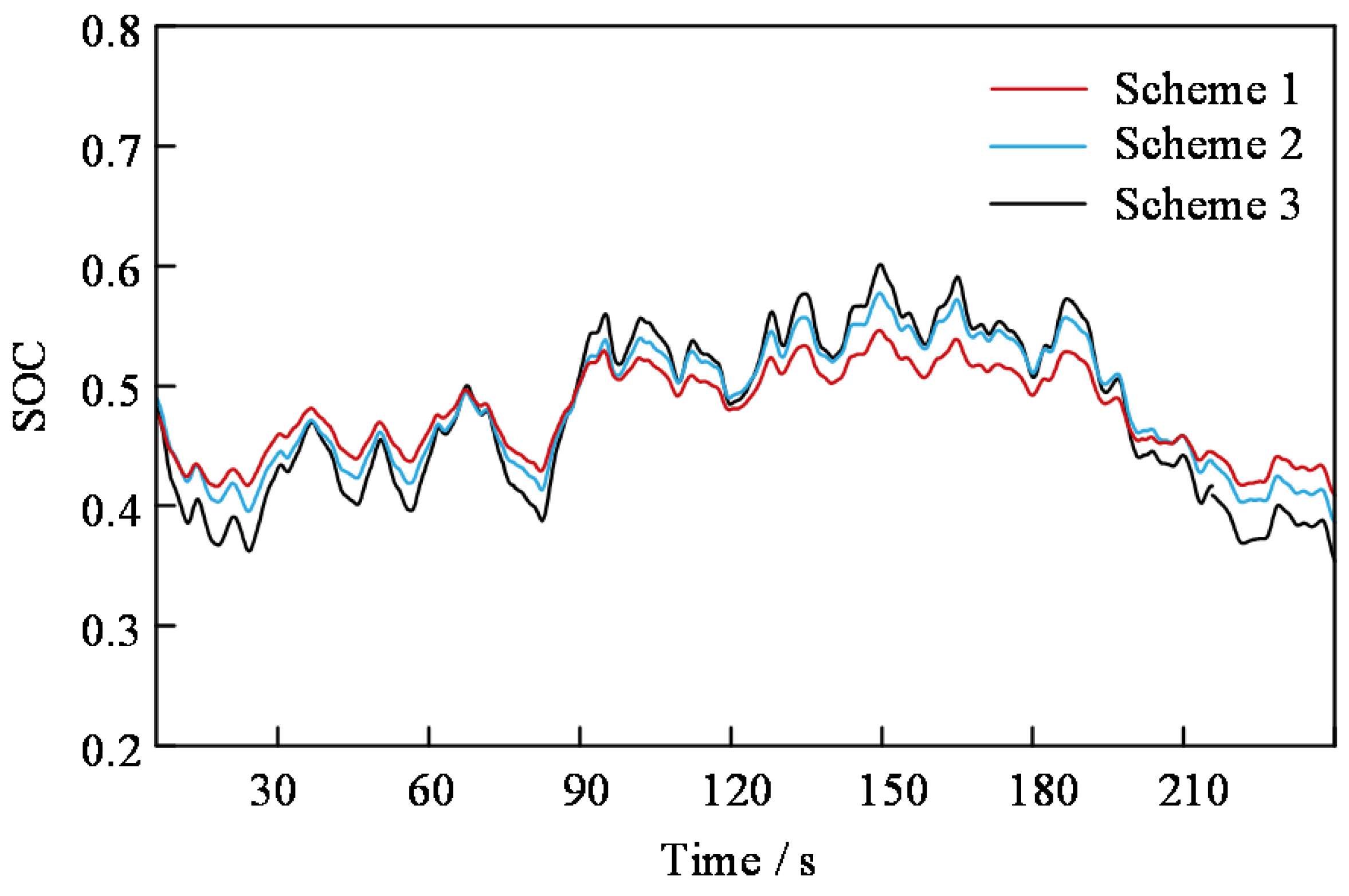
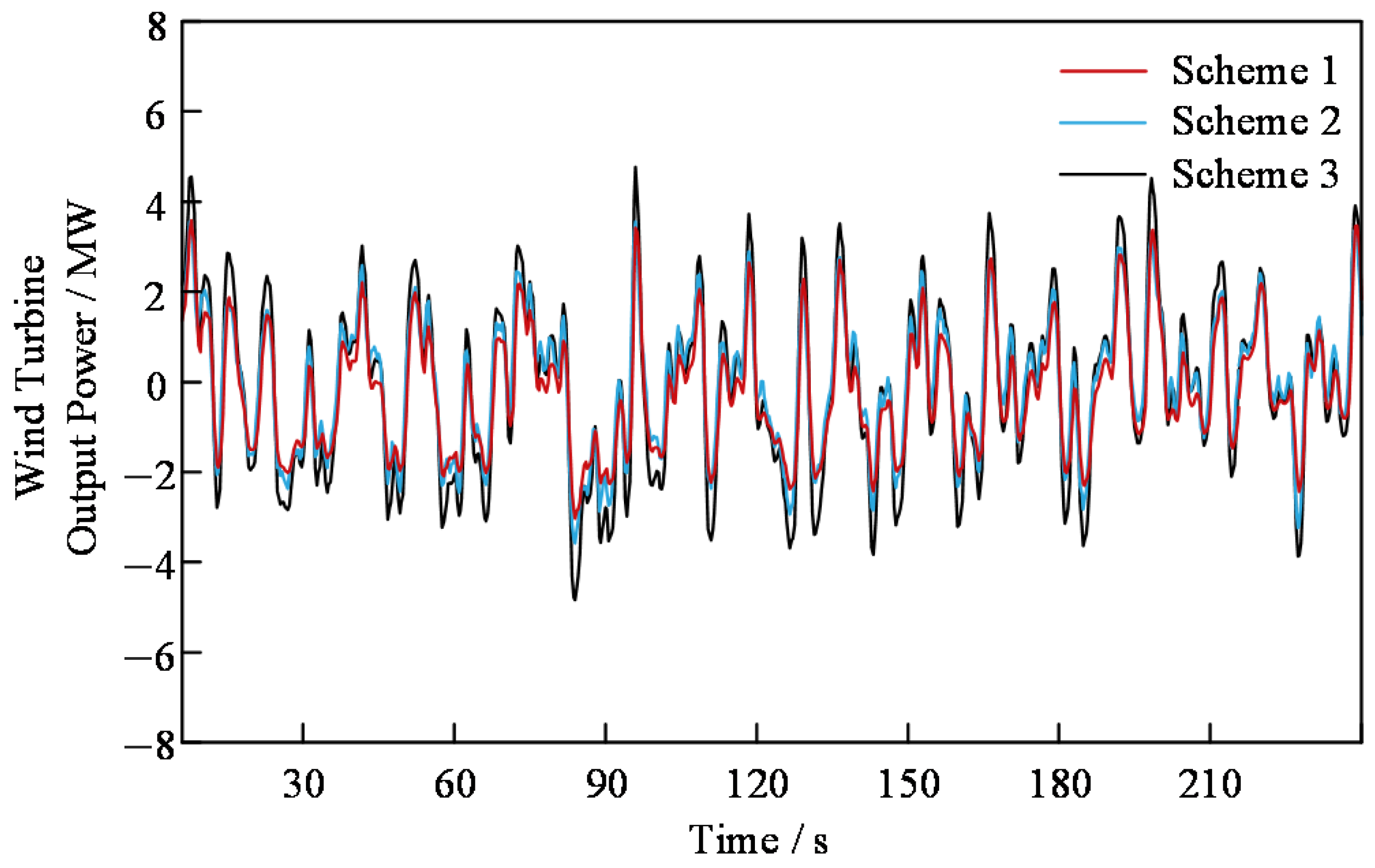
To assess the effectiveness of the proposed strategy across different operating conditions, two representative scenarios are investigated: a step load disturbance and a continuous load variation. To ensure clarity in the visual presentation, three control approaches are defined as follows: Scheme 1 denotes the proposed Dynamic-weight MPC coordinated control; Scheme 2 represents the dynamic-weight control; and Scheme 3 refers to the droop control. In the subsequent analysis, the frequency regulation performance of these schemes is evaluated comprehensively, considering system frequency deviation, changes in SOC, and the power output distribution characteristics of the DFIG and the ESS.

3.1.2. Analysis of the Step Load Disturbance Condition

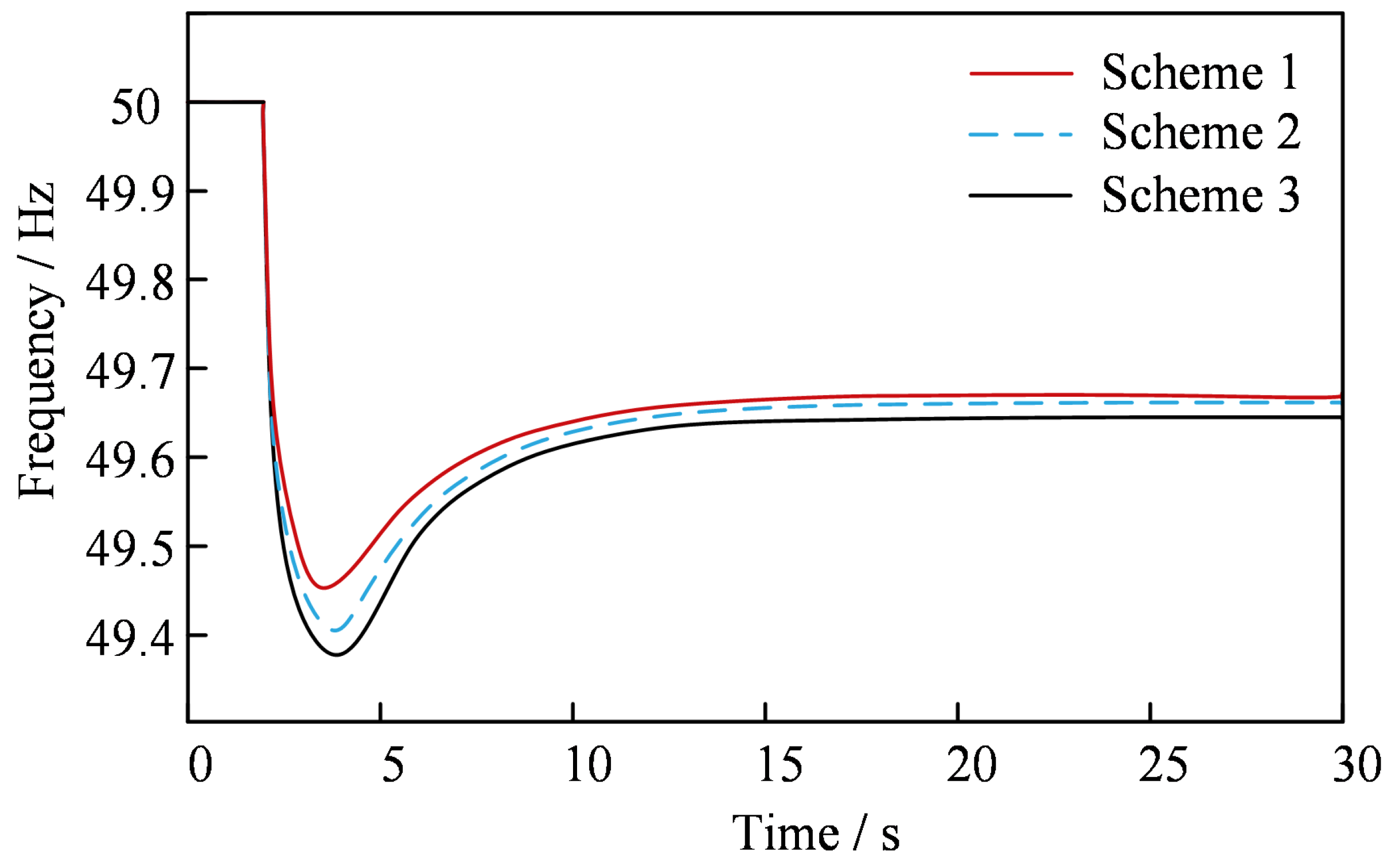
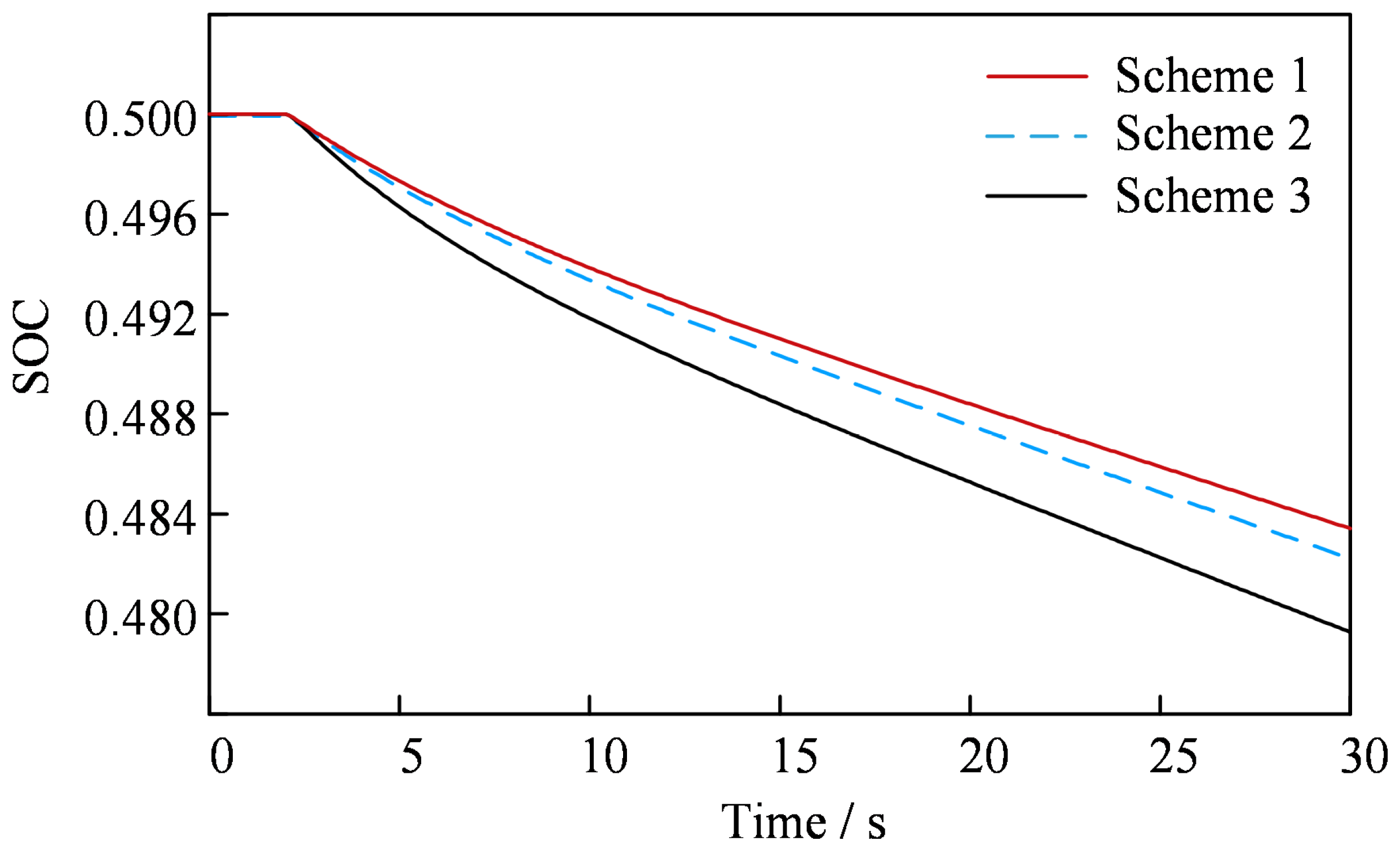
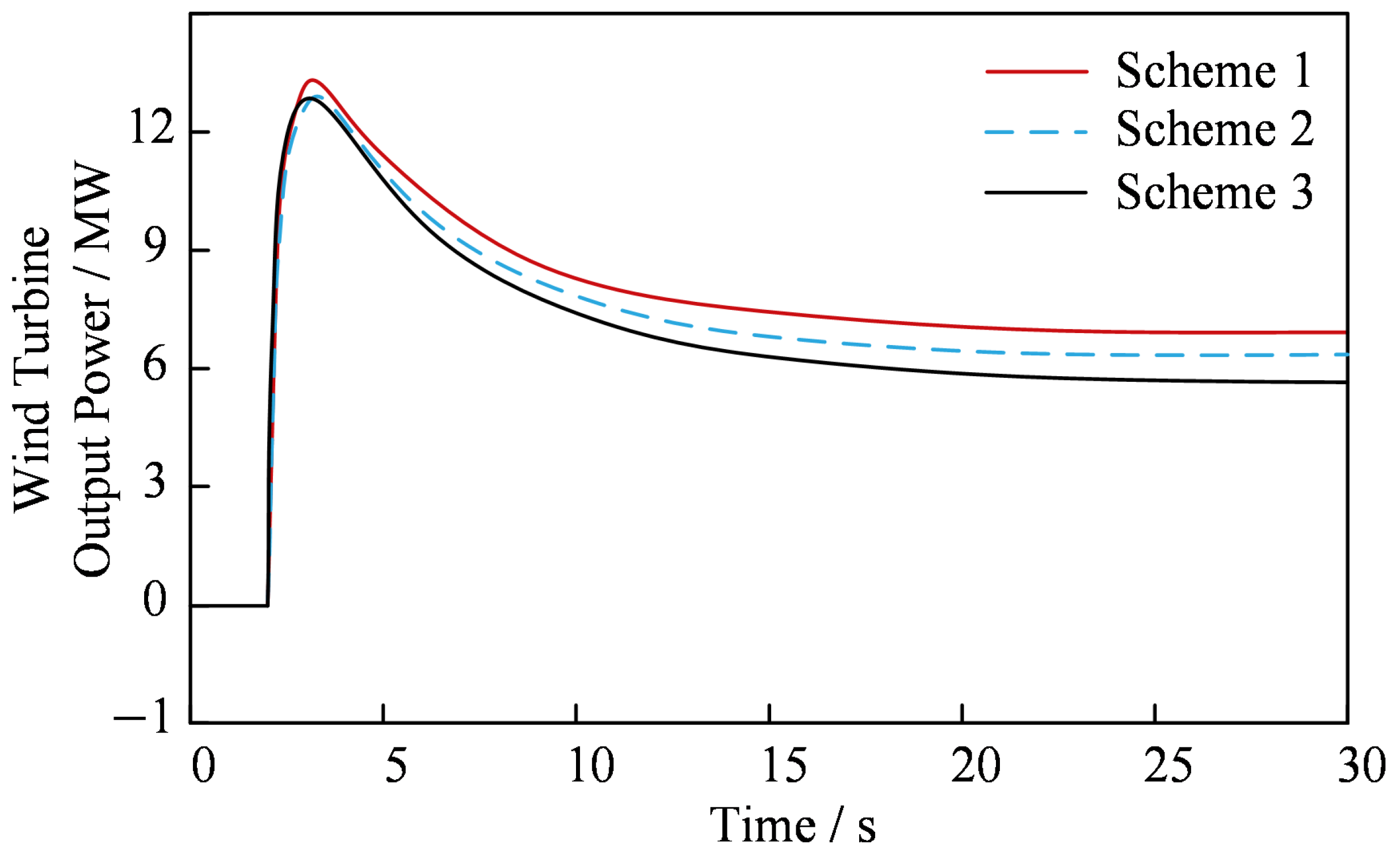
To evaluate the frequency regulation capability of the proposed strategy under a sudden power imbalance, a step load-disturbance scenario is simulated. The wind speed is fixed at 10 m/s, the initial SOC of the ESS is set to 0.5, and a 30 MW step load disturbance is introduced at 2 s. The system responses corresponding to three control methods are compared. The simulation results are presented in Figure 10, Figure 11, Figure 12 and Figure 13, and the associated frequency regulation metrics are summarized in Table 2.
As shown in Figure 10, under a step load disturbance, the system frequency drops to varying degrees, then gradually recovers toward stability. However, the frequency response processes under different control strategies show obvious differences. Under droop control, the system frequency experiences the deepest drop and a relatively slow recovery process. By comparison, dynamic-weight control mitigates the frequency dip following a disturbance and accelerates frequency restoration. When MPC is further incorporated, the system frequency response becomes smoother, with a higher minimum frequency and a faster recovery rate. As indicated in Table 2, under dynamic-weight MPC coordinated control, the maximum frequency deviation is 0.55 Hz, representing a reduction of about 11.3% compared with 0.62 Hz under droop control. Meanwhile, the steady-state frequency deviation decreases from 0.36 Hz to 0.33 Hz, and the peak time is shortened from 4.21 s to 3.66 s. These findings demonstrate that the proposed strategy enables a more rapid coordinated response of wind power and the ESS after disturbances, effectively restraining frequency decline and improving the system’s dynamic performance.
As shown in Figure 11, after the step load disturbance, the SOC of the ESS gradually decreases under all three control strategies, due to the continuous discharge of the ESS to support system frequency regulation. Compared with droop control, the SOC decline rate is slowed down under dynamic-weight control. After further adoption of dynamic-weight MPC-coordinated control, the SOC curve remains the highest overall and shows the smallest decrease. At 30 s, the SOC values under droop control, dynamic-weight control, and dynamic-weight MPC coordinated control are approximately 0.480, 0.482, and 0.484, respectively. This indicates that dynamic-weight MPC coordinated control can, while ensuring the frequency regulation effect, more reasonably coordinate the output allocation between the DFIG and the ESS, reduce the sustained discharge intensity of the ESS, and thus slow down energy consumption while preserving more frequency regulation margin.
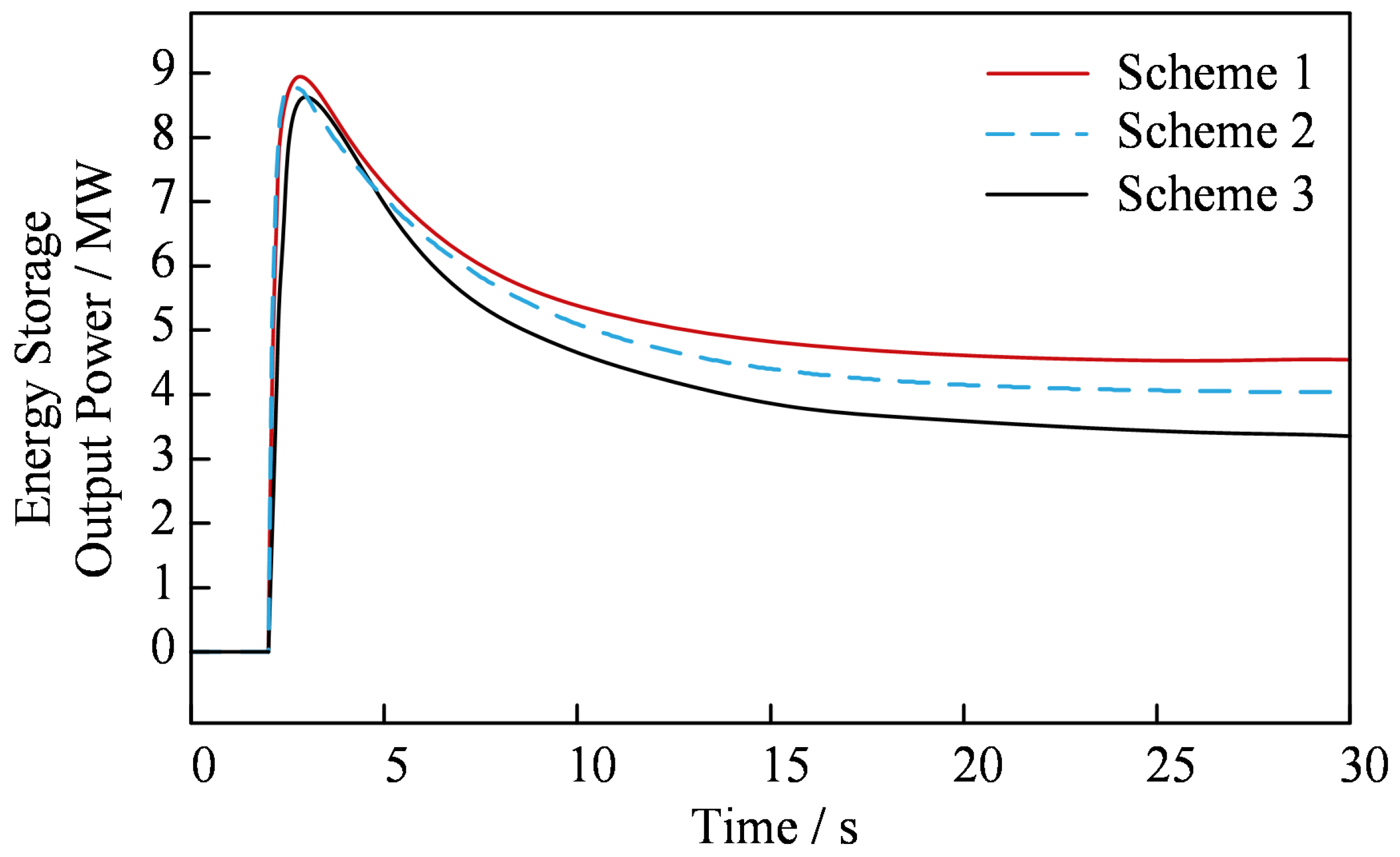
Combining Figure 12 and Figure 13, the output-sharing characteristics of the DFIG and the ESS under the three strategies can be further analyzed. After the disturbance occurs, both the DFIG and the ESS rapidly increase their outputs to participate in system frequency regulation; the ESS responds faster, while the DFIG provides relatively sustained active power support. Under droop control, the ESS assumes a larger frequency regulation task after the disturbance. Dynamic-weight control improves, to a certain extent, the coordination between virtual inertia control and droop control across different frequency regulation stages by dynamically adjusting their weights. Dynamic-weight MPC-coordinated control further optimizes the coordinated output allocation between wind power and the ESS, enabling the DFIG to make fuller use of the reserved de-loaded power for frequency regulation in both the initial disturbance stage and the recovery stage, while suppressing the peak output and the subsequent sustained output level of the ESS.

3.1.3. Analysis of the Continuous Load Fluctuation Condition

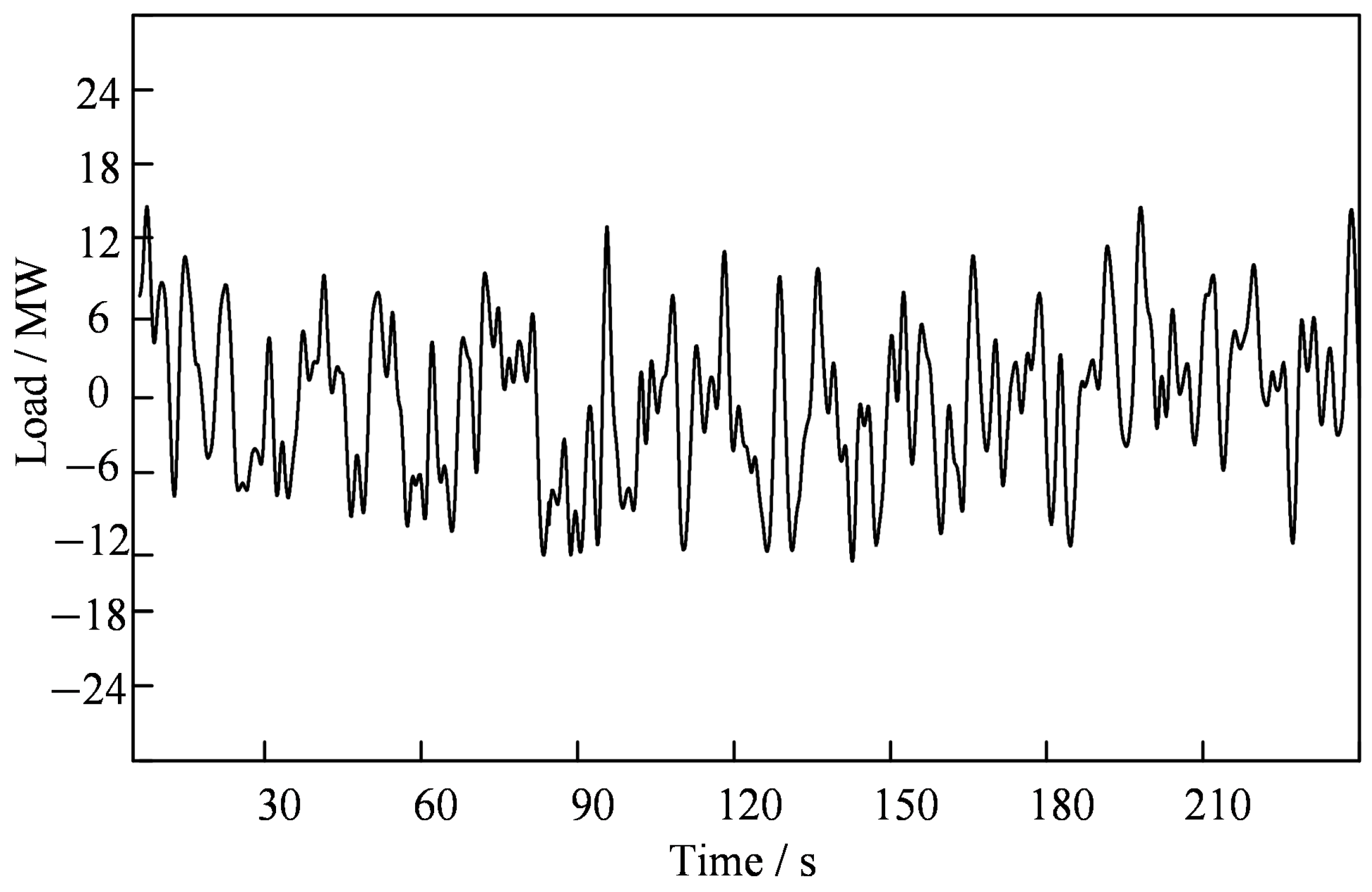
To further evaluate the frequency regulation capability of the proposed control strategy under continuous disturbance conditions, a scenario with ongoing load fluctuations is simulated. The corresponding load profile is presented in Figure 14.
In this case, the system load varies continuously over time, placing more stringent demands on both the frequency support and sustained regulation capabilities of the wind-storage combined system. The responses of the system under three control strategies—droop control, dynamic-weight control, and dynamic-weight MPC-based coordinated control—are comparatively analyzed. The simulation outcomes are illustrated in Figure 15, Figure 16, Figure 17 and Figure 18, and the corresponding quantitative evaluation indices are summarized in Table 3.
As shown in Figure 15 and Table 3, under continuous load fluctuations, all three control strategies can suppress system frequency deviation to some extent, but their control performance differs significantly. Under droop control, the amplitude of fluctuations in system frequency deviation is largest, with a peak-to-peak frequency deviation of 0.62 Hz and an RMS frequency deviation of 0.138 Hz. Dynamic-weight control adjusts the contribution ratios of virtual inertia control and droop control based on the frequency state, thereby reducing the peak-to-peak and RMS frequency deviations to 0.54 Hz and 0.129 Hz, respectively. In contrast, under dynamic-weight MPC coordinated control, the frequency deviation curve is the smoothest overall. Its peak-to-peak and RMS frequency deviations are further minimized to 0.46 Hz and 0.122 Hz, respectively, indicating that this strategy has better frequency support and disturbance-rejection capabilities under continuous disturbance conditions. This is because MPC can perform rolling optimal allocation of the outputs of the DFIG and the ESS according to the current system state and the operating trend over the prediction horizon, thereby responding to load changes in a more timely and smoother manner and reducing system frequency fluctuations.
As shown in Figure 16 and Table 3, the SOC variation trends of the ESS also differ significantly under different control strategies. Under droop control, the SOC fluctuation amplitude is relatively large, with an SOC variation range reaching 0.25, and the overall SOC level is the lowest, indicating that the ESS undertakes a relatively heavy frequency regulation task and thus consumes energy more rapidly. Dynamic-weight control can slow the downward trend in SOC to some extent, narrowing the variation range to 0.18. Under dynamic-weight MPC coordinated control, however, the SOC curve remains overall the highest and fluctuates more smoothly, with the narrowest SOC variation range of 0.13. This indicates that this strategy can more reasonably constrain the energy release process of the ESS while satisfying the system frequency regulation requirements, maintaining a higher remaining charge level, and thereby enhancing the ability of the ESS to continuously participate in frequency regulation.
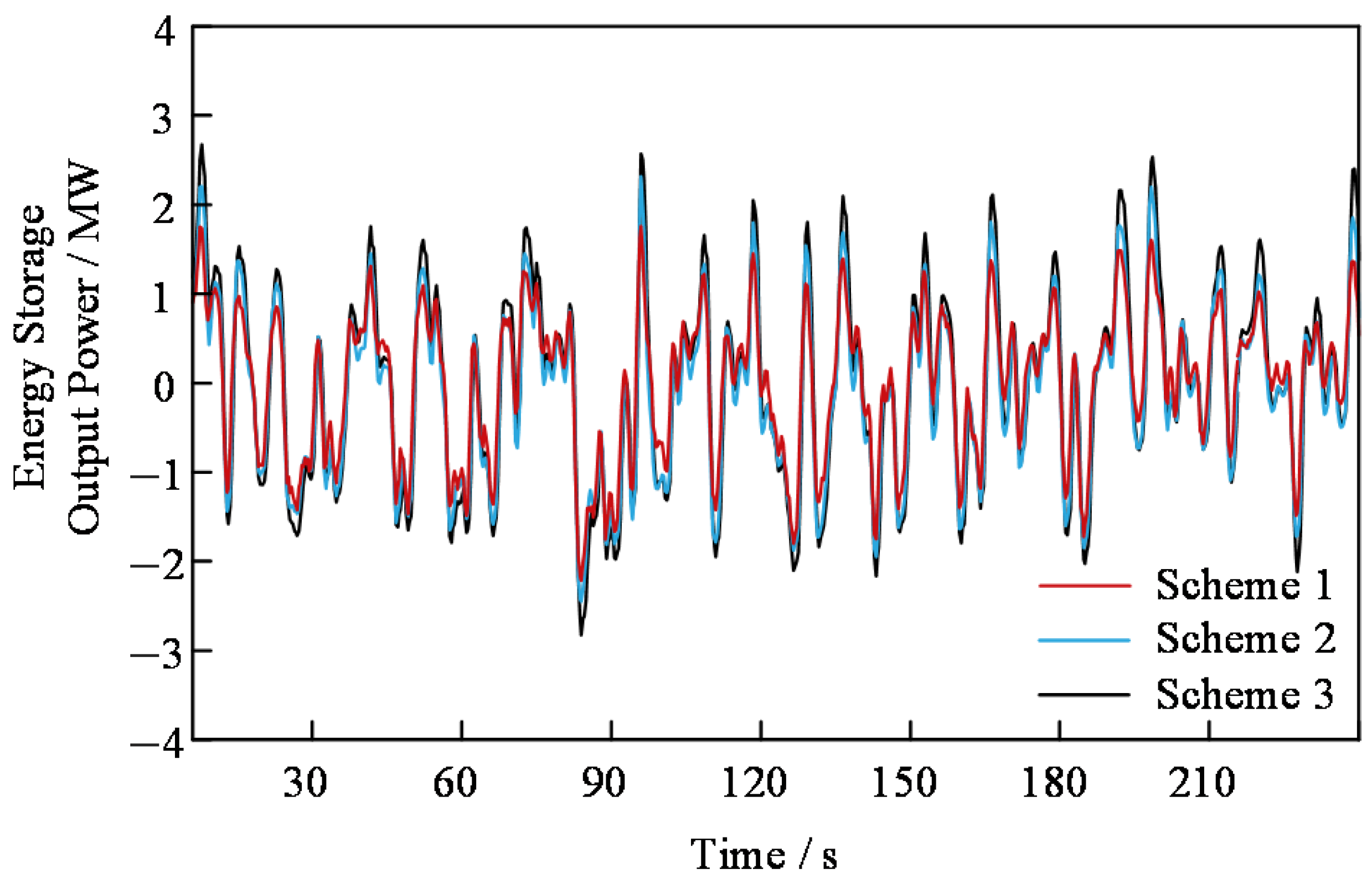
By combining Figure 17 and Figure 18, the output-sharing characteristics of the DFIG and the ESS under continuous disturbance conditions can be further analyzed. As shown in Figure 17, the DFIG output power under all three control strategies varies with load fluctuations. However, under droop control, the fluctuation of the DFIG output is relatively larger. Dynamic-weight control improves the smoothness of the DFIG response during frequency regulation to some extent, whereas dynamic-weight MPC-coordinated control enables the DFIG output to maintain better coordination while tracking the system frequency regulation demand. As shown in Figure 18, the ESS output power also varies frequently in response to load disturbances. Under droop control, the ESS’s power fluctuations are relatively large, indicating greater reliance on the ESS for rapid compensation. Dynamic-weight control can appropriately suppress excessively frequent and severe power variations of the ESS. Under dynamic-weight MPC-coordinated control, the fluctuation of the ESS output is further reduced, indicating that this strategy allows the ESS to primarily provide rapid and necessary power compensation through rolling optimization, while the DFIG provides relatively more sustained active power support. In this way, the complementary advantages of the DFIG and the ESS in terms of regulation stability and response speed can be more fully exploited.

3.2. Discussion

The results indicate that the proposed coordinated control strategy, based on dynamic weighting coefficients and MPC, provides better frequency support for the wind-storage combined system under both step load disturbances and continuous load fluctuations. Compared with droop control, the proposed method reduces the maximum and steady-state frequency deviations while accelerating frequency recovery. In addition, the ESS’s SOC decline is mitigated, and the output allocation between the DFIG and the ESS becomes more balanced. These results support the main idea of this study that frequency regulation performance can be improved by combining dynamic weighting-based comprehensive control with MPC-based coordinated optimization.
The improvement mainly comes from two aspects. The dynamic input weights allow virtual inertia control and droop control to shift smoothly across different stages of primary frequency regulation. This helps the ESS provide rapid support in the early stage of the disturbance and improves frequency restoration in the later stage. Compared with fixed-parameter or switching-based methods reported in previous studies, this continuous adjustment mechanism is better suited to reducing abrupt power variations during control transitions. The SOC-based feedback weights enable the ESS to participate in frequency regulation according to its operating state. This reduces the risk of excessive charging or discharging and helps preserve the ESS’s sustained regulatory capability. The smoother SOC trajectory under the proposed method reflects this effect.
The introduction of MPC further enhances coordination between the DFIG and the ESS. Compared with dynamic-weight control without MPC, the proposed dynamic-weight MPC coordinated control achieves better frequency quality and more balanced output sharing. This indicates that the front-end dynamic weighting design and the back-end predictive optimization play distinct but complementary roles. The ESS support is determined according to the instantaneous frequency state and SOC condition, while optimizing the actual power allocation of the DFIG and ESS over the prediction horizon under system constraints and operating costs. Therefore, the proposed framework is not merely a combination of two methods but a hierarchical coordination structure that integrates adaptive response shaping with rolling optimal dispatch. This distinguishes it from many existing wind-storage coordinated control methods based mainly on fixed rules or empirical logic.
From an engineering perspective, the findings are relevant to primary frequency regulation in power systems with high wind power penetration. As conventional synchronous generation is gradually displaced, equivalent inertia and frequency support capability decline. Under such conditions, neither wind turbines nor ESS alone can fully satisfy the requirements of rapidity, sustainability, and economy in frequency regulation. The results indicate that wind-storage coordination can improve transient frequency response while reducing the energy burden on storage, thereby enhancing the frequency resilience of future low-inertia power systems. In particular, allowing the DFIG to provide more sustained support and reserving the ESS mainly for fast compensation may improve both control performance and storage utilization efficiency.
Nevertheless, several limitations should be noted. First, the current study is based on a simplified simulation model under ideal operating conditions. In practical engineering applications, non-ideal factors such as communication delays, parameter mismatch, and measurement noise could potentially affect the performance of the proposed strategy. For instance, severe communication delays might degrade the real-time rolling optimization capabilities of the MPC, while measurement noise could introduce unexpected fluctuations in the dynamic weight calculations. Although the proposed framework demonstrates robust performance under idealized settings, evaluating and mitigating these non-ideal physical constraints remains a critical step for future practical deployment. Second, the ESS capacity is predefined, and the impact of storage sizing on coordinated frequency regulation performance and economic efficiency is not examined in depth. Third, although the proposed method performs well under the selected disturbance scenarios, its robustness under more complex multi-disturbance conditions and large-scale renewable integration still needs further verification. Future work may therefore focus on incorporating additional uncertainties and delays into the control design, jointly optimizing ESS sizing and coordinated control parameters, and extending the proposed strategy to more realistic multi-area or grid-connected renewable energy systems.

4. Conclusions

This paper investigated the primary frequency regulation problem for a wind-storage combined system under high wind power penetration and proposed a coordinated control strategy that integrates dynamic weighting coefficients with MPC. Based on theoretical modeling and simulation validations, the main conclusions are summarized as follows:
First, the dynamic input weights based on the frequency state allow the system to adjust the contributions of virtual inertia and droop control more adaptively. By incorporating SOC-dependent feedback weights, the ESS regulation capability is aligned with its operating conditions, which helps prevent excessive charging or discharging and maintains a stable SOC.
Second, the MPC layer optimizes the active power allocation between the DFIG and ESS while satisfying various operational constraints. Quantitative simulation results show that compared to conventional control methods, the proposed strategy reduces the maximum frequency deviation by 11.3% and shortens the peak recovery time by 13% under typical disturbance scenarios.
Overall, the proposed coordinated approach improves the frequency response of the system and ensures the sustained participation of the ESS. Future work will further examine the influence of ESS capacity allocation and more complex grid conditions on the control performance.


Author Contributions

Conceptualization, T.C. and D.W.; methodology, D.W.; software, D.W.; validation, T.C. and D.W.; formal analysis, D.W.; investigation, D.W.; resources, D.W.; data curation, D.W.; writing—original draft preparation, D.W.; writing—review and editing, T.C.; visualization, T.C.; supervision, T.C. All authors have read and agreed to the published version of the manuscript.

Funding

This research received no external funding. The APC was funded by the authors.

Data Availability Statement

The original contributions presented in this study are included in the article. Further inquiries can be directed to the corresponding author.

Conflicts of Interest

The authors declare no conflicts of interest.

Appendix A

The system of equations for the wind-storage combined frequency regulation system is discretized according to the standard formulation of model predictive control:
Δ P v k + 1 = 1 T T G P v k + 1 / R T G T Δ f k Δ P m k + 1 = 1 T T C H P m k + T T C H P v k Δ P M k + 1 = 1 T T R H P M k + T 1 T R H F H P T C H P m k + T F H P T C H P v k Δ P W k + 1 = 1 T T w Δ P W k + T T w Δ P W r e f k Δ P B k + 1 = 1 T T B Δ P B k + T T B Δ P B r e f k Q S O C k + 1 = Q S O C k Δ P B k T E B Δ f k + 1 = 1 D T 2 H Δ f k + T 2 H Δ P M k + Δ P W k + Δ P B k Δ P L k
A = 1 T T G 0 0 0 0 0 T R T G T T C H 1 T T C H 0 0 0 0 0 T F H P T C H T 1 T R H F H P T C H 1 T T R H 0 0 0 0 0 0 0 1 T T W 0 0 0 0 0 0 0 1 T T B 0 0 0 0 0 0 T E B 1 0 0 0 T 2 H T 2 H T 2 H 0 1 D T 2 H ,
B = 0 0 0 0 0 0 T T W 0 0 T T B 0 0 0 0 ,   R = 0 0 0 0 0 T 2 H ,   C = 0 0 0 1 0 0 0 0 0 0 0 1 0 0 0 0 0 0 0 1 0 0 0 0 0 0 0 1

References

  1. Ma, Y.; Yu, P. Research on Combined Frequency Regulation Control Method of Wind Storage with Storage System Optimized Intervals Considered. Math. Probl. Eng. 2022, 2022, 6872799. [Google Scholar] [CrossRef]
  2. Li, X.; Wang, W.; Ye, L.; Ren, G.; Fang, F.; Liu, J.; Chen, Z.; Zhou, Q. Improving Frequency Regulation Ability for a Wind-Thermal Power System by Multi-Objective Optimized Sliding Mode Control Design. Energy 2024, 300, 131535. [Google Scholar] [CrossRef]
  3. Deng, L.; Huang, L.; Cai, H.; Hu, Y.; Liao, M.; Huang, Y. Effect of Battery Energy Storage System Frequency Regulation on Frequency Characteristic of Power Systems. In Proceedings of the IEEE International Conference on Power Systems and Electrical Technology (PSET), Aalborg, Denmark, 13–15 October 2022; pp. 353–358. [Google Scholar]
  4. Wang, G.; Shu, H.; Shi, B.; Ma, H.; Zhu, L. Dynamic Cluster and Wind-Storage Collaborative Frequency Regulation Control Strategy for Large Scale Wind Farms. Sustain. Energy Grids Netw. 2025, 44, 101991. [Google Scholar] [CrossRef]
  5. Lim, S.; Seo, K.; Park, J.-W.; Lee, K.Y. New Frequency Stability Assessment Based on Contribution Rates of Wind Power Plants. Int. J. Electr. Power Energy Syst. 2025, 164, 110388. [Google Scholar] [CrossRef]
  6. Kayedpour, N.; De Kooning, J.D.M.; Samani, A.E.; Vandevelde, L.; Crevecoeur, G. An Adaptive Operational Strategy for En-Hanced Provision of Frequency Containment Reserve by Wind Turbines: Data-Driven Based Power Reserve Adjustment. Electr. Power Syst. Res. 2023, 223, 109564. [Google Scholar] [CrossRef]
  7. Gao, H.; Zhang, F.; Ding, L.; Cornélusse, B.; Zhang, G.; Salimu, A. Multi-Segment Droop Control and Optimal Parameter Setting Strategy of Wind Turbine for Frequency Regulation. Int. J. Electr. Power Energy Syst. 2024, 158, 109968. [Google Scholar] [CrossRef]
  8. Ouyang, J.; Pang, M.; Li, M.; Zheng, D.; Tang, T.; Wang, W. Frequency Control Method Based on the Dynamic Deloading of DFIGs for Power Systems with High-Proportion Wind Energy. Int. J. Electr. Power Energy Syst. 2021, 128, 106764. [Google Scholar] [CrossRef]
  9. Gu, H.; Chen, Z.; Yin, M.; Li, Q.; Li, Q.; Zhao, D. Active Power Control for Wind Turbines via Wind Speed Probability Distribu-Tion-Based Equilibrium Point Optimization. Int. J. Electr. Power Energy Syst. 2025, 173, 111425. [Google Scholar] [CrossRef]
  10. Niu, G.; Hu, L.; Zheng, N.; Ji, Y.; Wu, M.; Shi, P.; Yan, X. Adaptive Primary Frequency Regulation Control Strategy for Doubly Fed Wind Turbine Based on Hybrid Ultracapacitor Energy Storage and Its Performance Optimization. Electronics 2026, 15, 182. [Google Scholar] [CrossRef]
  11. Zhang, C.; Wen, Y.; Li, J. Control Strategy and Parameter Setting for Wind Power Considering Secondary Frequency Drop. Int. J. Electr. Power Energy Syst. 2025, 170, 110903. [Google Scholar] [CrossRef]
  12. Zhang, C.; Sun, X.; Cai, D.; Ding, L.; Bao, W.; Ma, R.; Terzija, V. Delayed Inertial Control-Based Coordinated Frequency Support Using Wind Turbine Generators. Int. J. Electr. Power Energy Syst. 2025, 171, 111025. [Google Scholar] [CrossRef]
  13. Besheer, A.H.; Liu, X.; Eissa, S.F.; Rabah, M.; Mahgoub, A.; Rashad, H. Overview on Fast Primary Frequency Adjustment Tech-Nology for Wind Power Future Low Inertia Systems. Alex. Eng. J. 2023, 78, 318–338. [Google Scholar] [CrossRef]
  14. Xing, C.; Xiao, J.; Li, P.; Xi, X.; Chen, Y.; Guo, Q. Adaptive Virtual Inertial Control and Virtual Droop Control Coordinated Control Strategy for Hybrid Energy Storage Taking into Account State of Charge Optimization. Electronics 2024, 13, 1228. [Google Scholar] [CrossRef]
  15. Shu, H.; Dong, H.; Wang, G.; Chen, J.; Shi, B.; Tang, Y. Wind-Storage Coordinated Control Strategy for Inertia Enhancement of High Ratio Renewable Energy Power Systems. J. Energy Storage 2024, 97, 112998. [Google Scholar] [CrossRef]
  16. Kang, H.; Sun, Y.; Liu, J.; Chen, Z.; Shi, X.; Zhang, X.; Shi, Y.; Yang, P. Research on the Primary Frequency-Regulation Strategy of Wind-Storage Collaborative Participation Systems Considering the State of Charge of Energy Storage. Energies 2024, 17, 6333. [Google Scholar] [CrossRef]
  17. Shang, L.; Dong, X.; Liu, C.; Gong, Z. Fast Grid Frequency and Voltage Control of Battery Energy Storage System Based on the Amplitude-Phase-Locked-Loop. IEEE Trans. Smart Grid 2022, 13, 941–953. [Google Scholar] [CrossRef]
  18. Taghvaei, M.; Gilvanejad, M.; Sedighizade, M. Cooperation of Large-Scale Wind Farm and Battery Storage in Frequency Control: An Optimal Fuzzy-Logic Based Controller. J. Energy Storage 2022, 46, 103834. [Google Scholar] [CrossRef]
  19. Zhu, Y.; Shi, Q.; Yao, S.; Wei, Z. Adaptive MPC and Power Dispersion Index Based Improved Hierarchical Frequency Regulation for Wind-Storage Integrated System. J. Energy Storage 2025, 107, 115006. [Google Scholar] [CrossRef]
  20. Cirio, D.; Conte, F.; Gabriele, B.; Gandolfi, C.; Massucco, S.; Rapizza, M.R.; Silvestro, F. Fast Frequency Regulation from a Wind Farm-BESS Unit by Model Predictive Control: Method and Hardware-in-the-Loop Validation. IEEE Trans. Sustain. Energy 2023, 14, 2049–2061. [Google Scholar] [CrossRef]
  21. Ma, X.; Zhao, J.; Zhao, M. Adaptive Control Strategy of Electric Vehicles Participating in Primary Frequency Regulation of Power Grid. In Proceedings of the 2021 IEEE 4th International Electrical and Energy Conference (CIEEC), Wuhan, China, 28–30 May 2021; IEEE: New York, NY, USA, 2021. [Google Scholar]
  22. Tian, X.; Chi, Y.; Cheng, P.; Zhao, Y.; Liu, H. Optimal Frequency Response Coordinated Control Strategy for Hybrid Wind-Storage Power Plant Based on State Reconstruction. IET Renew. Power Gener. 2024, 18, 2892–2906. [Google Scholar] [CrossRef]
  23. Jiang, Y.; Wang, C.; Xiao, L.; Yu, D.; Zhang, X. Wind/Storage Coordinated Control Strategy Based on System Frequency Regulation Demands. Energy Rep. 2024, 11, 1551–1559. [Google Scholar] [CrossRef]
  24. Tang, Z.; Jia, W.; Liu, J.; Tang, Y.; Zeng, P. A Robust Model Predictive Control Based Frequency Regulation Approach for Wind-Storage Joint System. In Proceedings of the IEEE/IAS Industrial and Commercial Power System Asia (I&CPS Asia), Chongqing, China, 7–9 July 2023; pp. 2399–2405. [Google Scholar]
  25. Wang, Y.; Zhao, J.; Zhang, F.; He, Z.; Zhang, J.; Nian, H.; Xu, W. Optimal Configuration Strategy Design for Offshore Wind Farm Energy Storage Systems Considering Primary Frequency Regulation and Black-Start Support Capabilities. Designs 2025, 9, 48. [Google Scholar] [CrossRef]
  26. Zhang, Y.; Yu, Y.; Zhang, Y.; Chen, B.; Liu, Z. Frequency Regulation Performance of a Wind–Energy Storage Hybrid System During Turbine Shutdown Due to Extreme Wind. Processes 2025, 13, 3383. [Google Scholar] [CrossRef]
  27. Kong, Z.; Sun, Y.; Guo, N.; Meng, G.; Zhao, K.; Yu, Y. Research on Wind Storage Coordinated Frequency Control Considering Optimal Power Allocation of Hybrid Energy Storage System. Electronics 2026, 15, 1629. [Google Scholar] [CrossRef]
  28. Ma, S.; Xin, D.; Jiang, Y.; Li, J.; Wu, Y.; Sha, G. Primary-Frequency-Regulation Coordination Control of Wind Power Inertia and Energy Storage Based on Compound Fuzzy Logic. Batteries 2023, 9, 564. [Google Scholar] [CrossRef]
Figure 1. Structural diagram of the wind-storage combined system.
Energies 19 02354 g001
Figure 2. Characteristic curve of C P ( λ , β ) . The different colored lines represent the curves under various pitch angle β .
Energies 19 02354 g002
Figure 3. De-loaded operation curve implemented through rotor overspeed control. Points A and B represent the operating points under MPPT mode and de-loaded mode at wind speed v 1 , respectively. Point C denotes the minimum power output limit, and Point D represents the operating boundary at the minimum rotor speed.
Energies 19 02354 g003
Figure 4. Schematic diagram of the dynamic process of primary frequency regulation.
Energies 19 02354 g004
Figure 5. Variation curves of input weights in the inertial response stage. The solid lines represent the virtual inertia control weight α 1 , and the dashed lines represent the droop control weight α 2 . Different colors correspond to different shape parameters ( n 1 = 1 ,   3 ,   5 ,   7 ,   10 ).
Energies 19 02354 g005
Figure 6. Variation curves of input weights in the primary frequency regulation stage. The solid lines represent the virtual inertia control weight α 1 , and the dashed lines represent the droop control weight α 2 . Different colors correspond to different shape parameters ( n 2 = 1 ,   3 ,   5 ,   7 ,   10 ).
Energies 19 02354 g006
Figure 7. Frequency response model of the wind-storage combined system.
Energies 19 02354 g007
Figure 8. Flowchart of the wind-storage coordinated frequency regulation control based on dynamic weighting coefficients and MPC.
Energies 19 02354 g008
Figure 9. Simulation structure of frequency response for the wind-storage combined frequency regulation system.
Energies 19 02354 g009
Figure 10. System frequency under the step load disturbance.
Energies 19 02354 g010
Figure 11. SOC under the step load disturbance.
Energies 19 02354 g011
Figure 12. DFIG output power under the step load disturbance.
Energies 19 02354 g012
Figure 13. ESS output power under the step load disturbance.
Energies 19 02354 g013
Figure 14. Continuous load curve.
Energies 19 02354 g014
Figure 15. Frequency deviation under continuous load fluctuations.
Energies 19 02354 g015
Figure 16. SOC under continuous load fluctuations.
Energies 19 02354 g016
Figure 17. DFIG output power under continuous load fluctuations.
Energies 19 02354 g017
Figure 18. ESS output power under continuous load fluctuations.
Energies 19 02354 g018
Table 1. Simulation parameters.
ParameterValue
governor time constant  T G / s 0.08
main steam chest time constant  T CH / s 0.3
reheater time constant  T RH / s 10
mechanical torque coefficient of the high-pressure turbine  F HP 0.5
system inertia time constant  H / s 9
system damping coefficient  D 1
ESS response time constant  T B / s 0.1
regulation coefficient of virtual inertia control  K H 5
regulation coefficient of droop control  K s c s s 5
weighting coefficient of the frequency regulation performance term  a 1 2
weighting coefficient of the operating cost term  a 2 1
weighting coefficient of the reference tracking term  a 3 1
Table 2. Frequency regulation indices under the step load disturbance.
Control StrategyMaximum Frequency Deviation/HzSteady-State Frequency Deviation/HzTime to Reach the Peak/s
Dynamic-weight MPC coordinated control0.550.333.66
Dynamic-weight control0.590.343.94
Droop control0.620.364.21
Table 3. Frequency regulation indices under the continuous load fluctuations.
Control StrategyPeak-to-Peak Frequency Deviation/HzRMS Frequency Deviation/HzSOC Variation Range
Dynamic-weight MPC coordinated control0.460.1220.13
Dynamic-weight control0.540.1290.18
Droop control0.620.1380.25
Disclaimer/Publisher’s Note: The statements, opinions and data contained in all publications are solely those of the individual author(s) and contributor(s) and not of MDPI and/or the editor(s). MDPI and/or the editor(s) disclaim responsibility for any injury to people or property resulting from any ideas, methods, instructions or products referred to in the content.