Article

Joint Scheduling and Coordinating Operation of a Mega Hydropower System Based on Gaussian Radial Basis Functions and the Borg Algorithm in the Upper Yangtze River, China


1
State Key Laboratory of Water Resources Engineering and Management, Wuhan University, Wuhan 430072, China
2
China Yangtze Power Co., Yichang 443000, China
*
Author to whom correspondence should be addressed.
Energies 2026, 19(10), 2352; https://doi.org/10.3390/en19102352
Submission received: 30 March 2026 / Revised: 8 May 2026 / Accepted: 12 May 2026 / Published: 14 May 2026
(This article belongs to the Special Issue Flexibility Solutions and Innovations for Sustainable Hydropower)

Abstract

A large number of reservoirs (or hydropower plants) have been constructed for flood control and energy production in the past several decades in the Yangtze River basin in China. The conventional scheduling rule curves (Scheme A) were designed in the reservoir construction period and did not consider river flow alternation, which needs to be modified to increase comprehensive benefits in the reservoir operation period. In this study, six large-scale cascade reservoirs or mega hydropower systems constructed and operated by the China Yangtze Three Gorges Cooperation were selected for this case study. The current joint scheduling plans of cascade reservoirs (Scheme B) were introduced, and a joint scheduling and multi-objective coordinating operation model (Scheme C) was proposed for this mega hydropower system. The Gaussian radial basis functions (GRBFs) were used to fit operation policies of each reservoir, and the Borg multi-objective evolutionary algorithm was selected to optimize three-objective functions for Scheme C. The observed daily flow data series at main hydrometric stations from 2003 to 2025 were used to simulate and compare different operation scheduling schemes. The results show that the performance of joint scheduling of cascade reservoirs (both Schemes B and C) is much better than the single-reservoir scheduling (Schemes A) with overall benefit; Scheme C-best achieves a comprehensive target of decreasing average annual spillway wastewater by 12.82 billion m3 (or a decrease of 28.5%), increasing average annual power generation by 31.02 billion kWh (or an increase of 10.7%), and improving average annual impoundment efficiency rate by 5.0%. The GRBF can fit reservoir operation policies well, while the Borg multi-objective evolutionary algorithm can quickly converge with high-precision non-dominated solution sets. The proposed joint scheduling and multi-objective coordinating operation model will provide a scientific basis for achieving maximum benefits in flood protection and hydropower generation for the mega hydropower system.

1. Introduction

China has the most abundant waterpower resources in the world. The exploitable hydropower capacity is about 542 GW, accounting for 15.85% of the global exploitable hydropower capacity. With the fast development of the social economy in the past several decades, a large number of reservoirs and hydropower plants were constructed for flood prevention and power generation. The total of installed hydropower capacity and annual hydropower generation in China reached 436 GW and 1274.25 billion KWh in 2024, both of which were ranked first in the world. As a clean and renewable energy source, hydropower plays an important role in the Chinese energy system to support sustainable socioeconomic development [1].
Reservoirs are the most efficient engineering tool for hydropower development and water resource management; it plays an important role in meeting energy and water requirements. By altering the spatiotemporal variation in runoff generation and flow routing, reservoirs have many functions, including flood prevention, hydropower generation, water supply, navigation, etc. [2]. Most of the reservoirs in the world are still managed on predetermined operating rules, which is mainly due to technological and computational limitations [3]. As the number of reservoirs increases, the operation of the reservoir group system is one of the complex problems for hydropower generation and water resource management. In recent decades, the simulation or optimization models or methods have been widely used for water resources planning and management, streamflow regulation strategies, and reservoir real-time release decisions [4]. Reservoir operation with different time scales, ranging from seasonal to daily, hourly, and real-time operation, has been used in practice. The conventional optimization methods are nonlinear programming and dynamic programming (DP) [5]. Since the operation of cascade reservoirs is a stochastic and even highly nonlinear problem, the discrete combinations of state variables increase exponentially as the number of state variables increases, which is called “curse of dimensionality” in dynamic programming. Various modifications of the DP have been developed to reduce the dimensionality problems of multi-state decision [6], including progressive optimality algorithm (POA) and discrete differential dynamic programming (DDDP). For example, Guo et al. (2011) developed joint operation models with the objective functions of maximizing hydropower generation for the Three Gorges Reservoir and Qingjiang cascade reservoirs, and used the POA to obtain the final solution [7]. Feng et al. (2017) used the DDDP to optimize an operation model for a hydropower system based on orthogonal experiment design [8]. Moridi and Yazdi (2017) used a multi-objective optimization approach to optimally allocate flood control capacity for multi-reservoir systems [9]. He et al. (2020) [10] used the Pareto archived dynamically dimensioned search (PA-DDS) algorithm to derive adapting operation rules for cascade reservoirs with maximization of water supply and power generation based on future projections (2021–2100) of two global climate models. They reported that the adaptive operation rules can significantly increase the annual power generation [10]. Rot Weiss et al. (2025) developed a data-driven simulation model for the Drava cascade, trained reinforcement learning (RL) agents, and showed that RL agents were comparable to the general human dispatcher [11]. Zhang et al. (2025) investigated reservoir flood prevention storage substitution from multi-reservoirs to single reservoirs, and optimized storage reservation for hydropower generation in cascade reservoir systems [12].
Multi-objective evolutionary algorithms (MOEAs), including the nondominated sorting genetic algorithm-II (NSGA-II), the strength Pareto evolutionary algorithm 2 (SPEA2), self-adaptive multi-objective differential evolution (SAMODE), and the Borg algorithm, are widely used in water resources system planning and management [13]. For example, Kollat and Reed (2006) [14] compared four MOEAs (NSGA-II, ε-NSGA-II, ε-MOEA, and SPEA2) with four-objective functions for a long-term groundwater monitoring design case. They found that ε-NSGA-II performed better than other MOEAs in the search effectiveness and efficiency [14]. Hadka and Reed (2013) found that the Borg algorithm had consistent levels of effectiveness and efficiency for the numerical optimizations, and performed better on higher-dimensional problems [15]. Zheng et al. (2016) compared the performance of NSGA-II, Borg, and SAMODE algorithms for water system design problems, and reported that the NSGA-II algorithm performed more robustly in finding the approximate fronts, while the Borg algorithm converged more quickly than the other MOEAs due to its frequent updating of the searching population [16].
Current reservoir scheduling methods are managed on the predetermined operating rules for a single reservoir and the guidelines for cascade reservoirs. The aim of the study is to develop a joint scheduling and multi-objective coordinating operation model for the mega hydropower system in the upper Yangtze River, and to compare the comprehensive benefits of different operation scheduling schemes. The scientific novelty and contribution of the present study are to fit operating policies of each reservoir using Gaussian radial basis functions (GRBFs) and to apply the Borg multi-objective evolutionary algorithm to optimize solutions. The difference between the flood limit water level and flood control water level during flood season, which are key parameters to balance the flood prevention safety and hydropower benefits, is also presented. The study mainly contains the following contents: (1) introduce six large-scale reservoirs (hydropower plants) in the upper Yangtze River; (2) establish single reservoir scheduling rule curves, joint scheduling scheme of cascade reservoirs, joint scheduling and coordinating operation model; (3) compare the performance of different reservoir operation schemes with comprehensive benefits; and (4) discuss the advantages and limitations of this study.

2. Materials and Data

2.1. Study Area

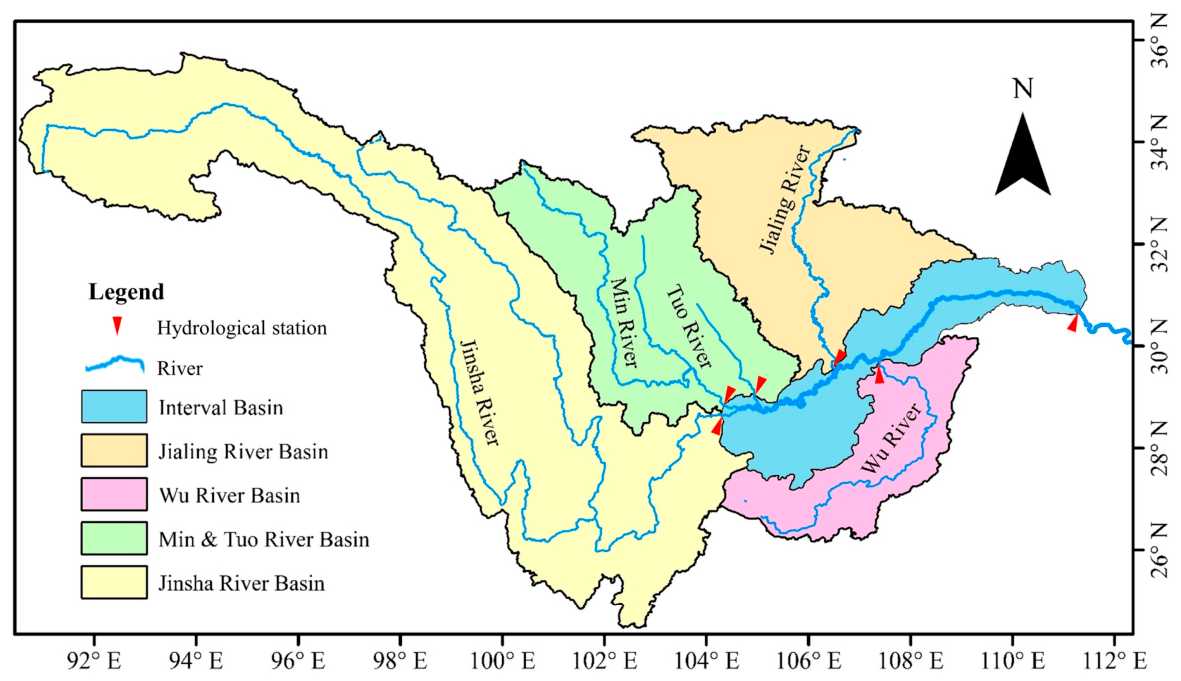
The length of main stream in the upper Yangtze River is approximately 4504 km, which is spanning from its headwaters in Qinghai Province to Yichang City in Hubei Province, China. The catchment area of the upper Yangtze River basin is around 1 million km2. The basin exhibits pronounced topographic complexity, with marked elevation variations, clear vertical zonation, and strong spatial heterogeneity in climate and environmental conditions. The average annual precipitation is about 800~1200 mm, with 70~90% falling in the rainy season between May and October. Figure 1 illustrates the schematic map of the upper Yangtze River basin, on which there are five main tributaries or sub-basins, i.e., the Jinsha River basin, the Ming and Tuo River basin, the Jialing River basin, the Wu River basin, and the interval basin. Characterized by abundant water resources and steep topographic gradients, the upper Yangtze River is full of potential for hydropower development. In the last three decades, 117 large-scale reservoirs with a total storage capacity of 91.152 billion m3 were constructed in the upper Yangtze River basin. The hydrological regime and spatiotemporal distribution of flow runoff in the Yichang hydrometric station have been profoundly altered after the construction and operation of these reservoirs [17].

2.2. Large-Scale Cascade Reservoirs and Mage Hydropower System

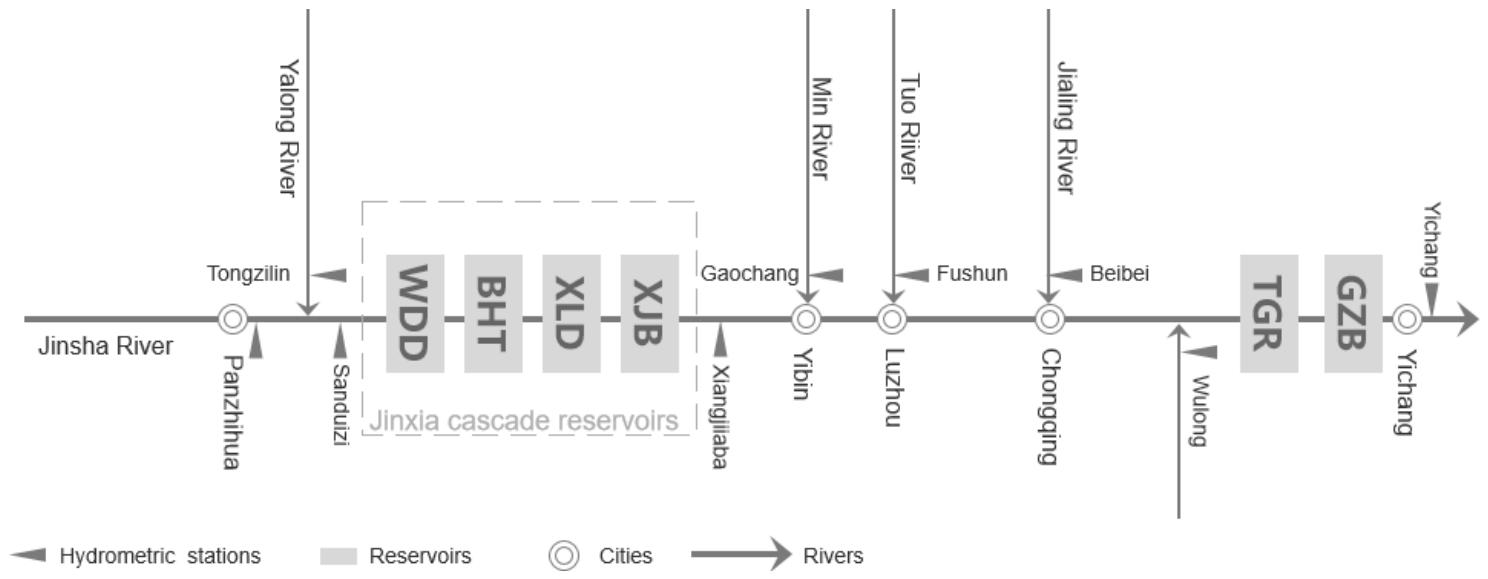
Six large-scale cascade reservoirs constructed and operated by the China Yangtze Three Gorges Cooperation were selected for this case study. Figure 2 shows the schematic diagram of the six large-scale cascade reservoirs in the upper Yangtze River basin. The Jinxia cascade reservoirs, including Wudongde (WDD), Baihetan (BHT), Xiluodu (XLD), Xiangjiaba (XJB) reservoirs located at Jinshan River downstream, and Three Gorges Reservoir (TGR) and Gezhouba (GZB) hydropower plants located at the mainstream of the Yangtze River. Figure 2 also shows the locations of Panzhihua, Tongzilin, Sanduizi, Xinjiaba, Gaochang, Fushun, Wulong, Beibei, and Yichang hydrometric stations.
The GZB hydropower plants began construction in 1971 and were fully commissioned in 1988, which is the first dam built in the mainstream of the Yangtze River. The TGR officially started construction in 1994 and was fully commissioned in July 2012. The XJB, XLD, BHT, and WDD reservoirs were constructed in the year of 2014, 2017, 2022, and 2021, respectively. The construction time order of the six reservoirs was from downstream to upstream in the Yangtze River.
Table 1 lists the main characteristic parameters of these six cascade reservoirs. Among them, the installed capacities of TGR, BHT, XLD, WDD, and XJB hydropower plants are ranked first, second, fourth, seventh, and eleventh in the world, while the GZB is a runoff hydropower plant. The TGR, with a basin area of nearly one million km2, is a vitally key hydraulic complex project to develop and harness the Yangtze River [18]. The sum of the total storage capacity and the adjustable storage capacity is 91.152 and 37.321 billion m3 for these cascade reservoirs, respectively. The total installed capacity of these six hydropower plants is 71,695 MW and accounts for about 17% hydropower installed capacity in China. The designed average annual hydropower generation is 290.55 billion kWh, which is about 20% of the Chinese national hydropower output. Both installed capacity and power generation are ranked first in China, and are also the largest in the world [1].
With the completion of six hydropower plants, they form the largest clean energy corridor in the world. Through a joint operation dispatching system, the six cascade reservoirs have comprehensive benefits for flood prevention, power generation, navigation, and water supply, which also contribute to the goals of achieving carbon peak and carbon neutrality in China [19]. The current operation models or schemes for these cascade reservoirs need to be further improved for highly efficient water resource utilization.

2.3. Data

The observed daily flow data series at Panzhihua, Tongzilin, Sanduizi, Xinjiaba, Gaochang, Fushun, Wulong, Beibei, and Yichang hydrometric stations from 2003 to 2025 were sourced from the Hydrological Bureau of the Yangtze River Commission. This hydrological data series has been checked and treated without missing values. The inflow of each reservoir was calculated by the water balance principle and the hydrological analogy method. The entire optimization and simulation framework operates at a daily time step, and the data series of reservoir storages, water levels, outflow discharges, hydropower generation outputs, etc., were provided by China Yangtze Power Cooperation.

3. Methods

3.1. Characteristic Water Levels of Reservoirs

There are several characteristic water levels of a reservoir, including dead water level, flood limit water level, normal water level, and design flood water level, among which the flood limit water level is an important parameter to balance the conflict between flood prevention and water resources utilization during the flood season [20]. Table 2 lists the characteristic water levels of six large-scale cascade reservoirs, where the dead water level, flood limit water level, normal water level, and design flood water level were determined in the reservoir construction period.
The existing reservoir operation rules and schemes in China are based on the flood limit water level derived from the design flood hydrograph in the construction period. According to the “Regulation for calculating design flood of water resources and hydropower projects”, the design flood was estimated based on annual maximum flood data series at the site [21]. Since a large number of reservoirs (or hydropower plants) were built in the past several decades, the regulation of upstream reservoirs has significantly altered the downstream hydrologic regime and changed the spatiotemporal distribution of streamflow, and the overall degree of hydrologic alteration reached 72% at Yichang station [17].
The design flood based on on-site natural flood data series in the construction period is unsuitable in the reservoir operation period. Therefore, the investigation on “design flood in operation period” is necessary and significant for utilizing floodwater resources effectively [20]. We have proposed and developed two methods, i.e., the most likely flood regional composition method and the nonstationary flood frequency analysis method, to consider the regulation impacts of upstream reservoirs on design floods in the downstream. In this study, the most likely flood regional composition method [22] and the time-varying P-III distribution coupled with the curve fitting method [23] are used to estimate design floods in the reservoir operation period. The design flood hydrographs of these reservoirs for given return periods are derived using the peak and volume amplitude method, and the corresponding flood control water level in the reservoir operation period is determined through an iterative reservoir flood routing calculation approach, in which the flood prevention standards remain unchanged [22]. The estimated flood control water levels for these reservoirs are also shown in Table 2, which shows that the flood control water levels of WDD, BHT, XLD, XJA, and TGR are 960, 795, 571, 374, and 155 m, and have risen 8, 10, 11, 4, and 10 m from the flood limit water levels, respectively.

3.2. Single-Reservoir Scheduling Rule Curves (Referred to as Scheme A)

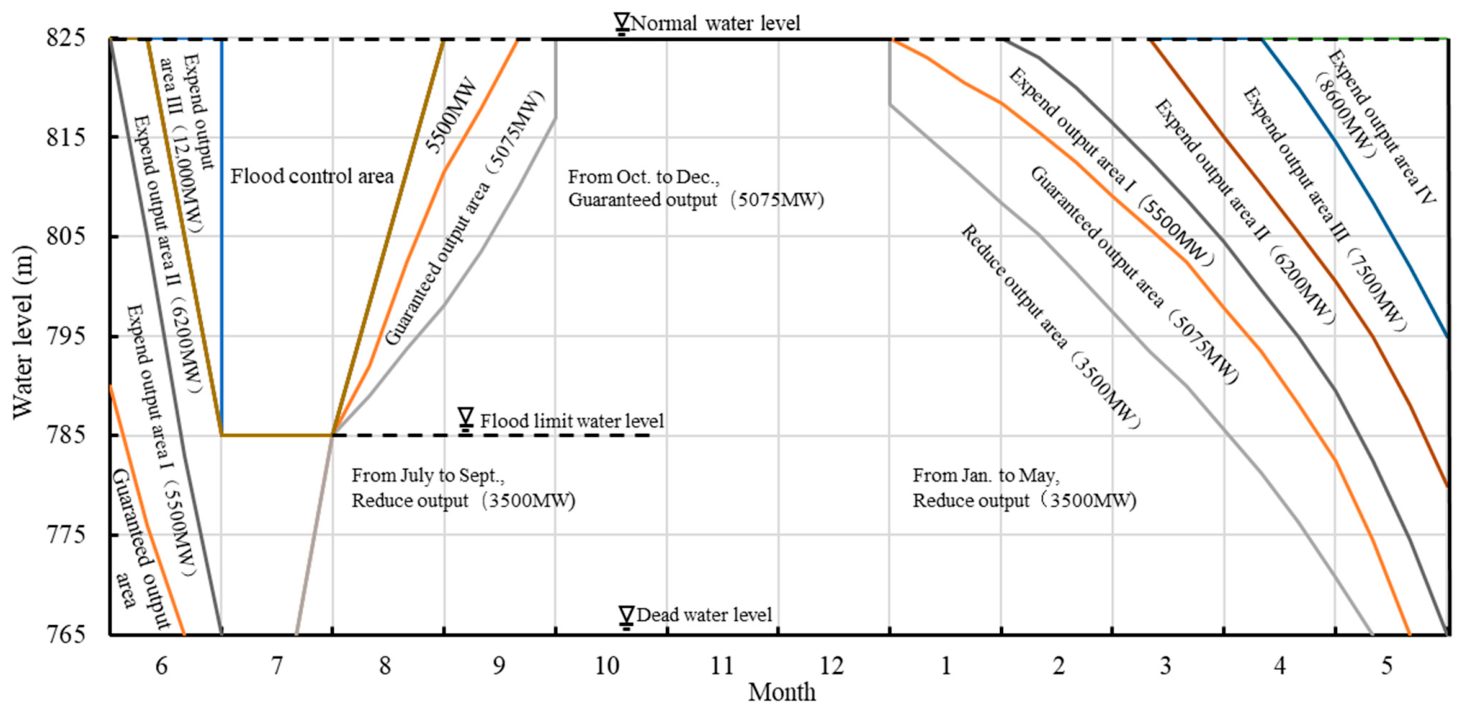
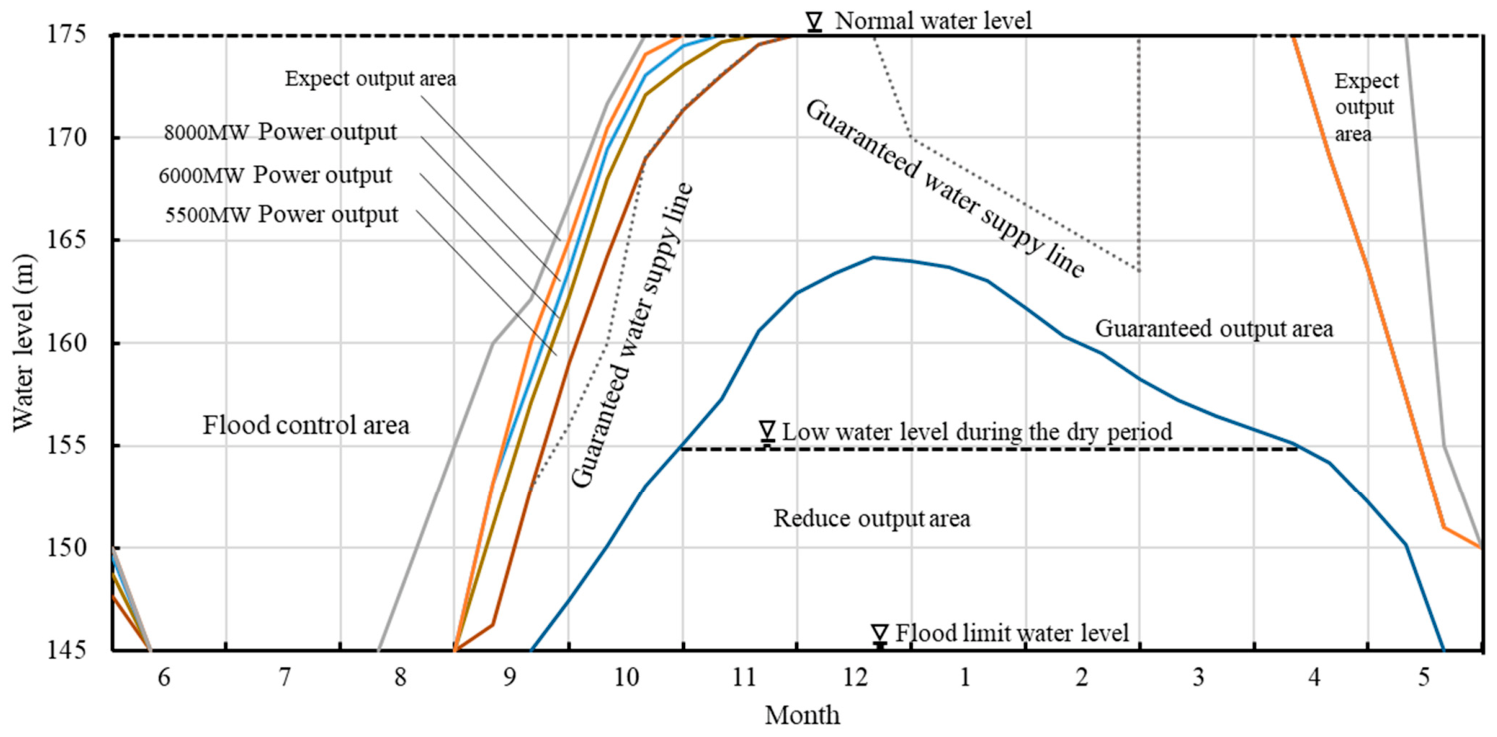
The single-reservoir scheduling is guided by the actual and conventional rule curves or diagram [5], which takes into account the relationship between outflow from a single site and tail water levels, as well as the influence of downstream reservoir water level on upstream hydropower output. The conventional scheduling diagram serves as a tool for long-term reservoir management and flow regulation, which depicts time (month or season) along the horizontal axis and water level or reservoir storage along the vertical axis. It is divided into different output zones (or input zones) through some control signals related to reservoir electricity generation output (or reservoir storage and inflow). The scheduling diagram specifies the operating values for each reservoir, allowing for equal output calculation based on the scheduled water level. Figure 3 and Figure 4 plot the designed operation scheduling rule curves or diagrams of the Baihetian (BHT) Reservoir and Three Gorges Reservoir (TGR), respectively.
The formulas for hydropower energy calculation by means of regulating power output are as follows:
E i ( t ) = N i ( t ) × Δ t = K i × Q i f ( t ) × h i ( t ) × Δ t
h i ( t ) = 1 2 Z i u ( V i ( t ) ) + Z i u ( V i ( t + 1 ) ) Z i d ( Q i o ( t ) ) h i l
where N i ( t ) and E i ( t ) are power output and hydropower generation of reservoir i in period t, i is the order of cascade reservoirs from upper to downstream (i = 1, 2 … M), M is the number of reservoirs, Ki is the generating flow water consumption rate function of reservoir i; h i ( t ) is the effective net head of reservoir i; Q i f ( t ) and Q i o ( t ) are the average generating flow and outflow discharges of reservoir i; V i ( t ) and V i ( t + 1 ) are the ith reservoir storages in period t and t + 1; Z i u ( ) is the function of the water level—storage capacity of reservoir i; Z i d ( ) is the function of the water level—outflow discharge of reservoir i; and h i l represents the generating water head loss of reservoir i.
The main constraints for reservoir operation include: water balance equation, hydraulic connection, power output, reservoir storage and variation, outflow discharge and variation, boundary conditions, etc.
(1) Water balance equation:
V i ( t + 1 ) = V i ( t ) + ( Q i I ( t ) Q i o ( t ) ) Δ t
(2) Hydraulic connection between two adjacent reservoirs:
Q i I ( t ) = f r ( Q i 1 o ( t τ ) ) + Q i q ( t )
(3) Power generation limits:
N i min ( t ) N i ( t ) N i max ( t )
(4) Reservoir storage capacity limits:
V i min ( t ) V i ( t ) V i max ( t ) V i ( t + 1 ) V i ( t ) Δ V i max
(5) Outflow discharge limits:
Q out , i min ( t ) Q out , i ( t ) Q out , i max ( t ) Q out , i ( t + 1 ) Q out , i ( t ) Δ Q out , i max
(6) Initial and end storage limits:
V i ( 0 ) = V i b , V i ( T ) = V i e
where Q i I ( t ) is the inflow discharge for reservoir i in period t; Q i q ( t ) is the interflow between reservoirs i and i + 1; f r ( ) is a calculation function for outflow discharge routing to downstream flood control section; τ is the delay time; N i min ( t ) and N i max ( t ) are the minimum and maximum power output limits for reservoir i in period t; V i min ( t ) and V i max ( t ) are the minimum and maximum storage limits for reservoir i in period t; Δ V i max is the maximum storage variation in adjacent period for reservoir i; Q out , i min ( t ) and Q out , i max ( t ) are the minimum and maximum outflow discharges for reservoir i in period t, V i b and V i e are the initial and end storage for reservoir i.

3.3. Joint Scheduling of Cascade Reservoirs (Referred to as Scheme B)

The current joint scheduling plan was established based on the “Joint scheduling scheme for cascade reservoir in the lower Jinsha River” [24], “Operation scheduling guidelines of the Three Gorges and Gezhouba cascade reservoirs” [25], and “Joint scheduling plan for water engineering projects for the Yangtze River basin in 2025” [26]. The functions and tasks of the joint scheduling plans for cascade reservoirs follow the requirements of flood control safety, and maximize overall benefits from hydropower generation, navigation, water supply, and ecological protection. The joint scheduling plan, based on the above regulations and guidelines, takes into account water and energy constraints and backwater effects.

3.4. Joint Scheduling and Multi-Objective Coordinating Operation Model (Referred to as Scheme C)

3.4.1. Multi-Objective Coordinating Operation Models

A joint scheduling and multi-objective coordinating operation model for these six large-scale cascade reservoirs is established to minimize the flood control risk, to maximize hydropower generation and impoundment efficiency [27].
(1) The first objective is to minimize the flood control risk. We quantify this objective as the maximum available flood prevention storage of cascade reservoirs.
min F C R = min i = 1 M F C R i
F C R i = max t = 1 T V i ( t ) V i safe ( t ) V i max V i safe ( t ) , 0
where F C R and F C R i are the flood control risks of cascade reservoirs and reservoir i; V i max is the maximum flood prevention storage for reservoir i; V i safe ( t ) is the storage capacity corresponding to the highest safety water level for reservoir i.
(2) The second objective is to maximize the average annual hydropower generation. We compute this objective as the sum of daily power production for these six cascade reservoirs over the full simulation period.
max E ¯ = max i M t T N i ( t ) × Δ t / n y
(3) The final objective is to maximize the impoundment efficiency, which is an important indicator to measure the refill rate of cascade reservoirs.
max I E = max i = 1 M I E i
I E i = θ i n y 1 n y V i ( t ) V d , i V n , i V d , i , i = 1 M θ i = 1
where T is the length of the data series; I E and I E i are the average annual impoundment efficiency of cascade reservoirs and reservoir i; V n , i V d , i is the adjustable storage (the difference between normal water level and dead water level); and θ i is the ratio of adjustable storage capacity of reservoir i to total storage capacity of cascade reservoirs.

3.4.2. Formulation of Operating Policies

Radial basis functions (RBFs) are scalar functions that depend only on the distance from a reference point along the radial direction, and they take their values based solely on the spatial distance to this reference point. By combining multiple RBFs, it becomes possible to construct a highly flexible response surface, often used as an approximation for Markov decision processes [28]. Therefore, the operating policies for five reservoirs (excluding GZB) are determined using the Gaussian radial basis functions (GRBFs) to map a vector of system states for reservoir releases. At each reservoir, the GRBF representation of daily outflow release policies is given by the following equation:
Q out , m ( t ) = i = 1 K ω m , i φ i x ( t ) = i = 1 K ω m , i exp j = 3 J x j ( t ) c j , i 2 b j , i 2 + x J 1 2 ( t ) + x J 2 ( t )
where K is the number of radial basis functions for a single reservoir, J is the number of decision factors x(t), ω m , i is the weight of the mth reservoir in the kth radial basis function, ω m , i [ 0 ,   1 ] ,   ω m , i = 1 ,   c j , i [ 1 ,   1 ] ,   b j , i ( 0 ,   1 ] ,   i , j are parameters of the kth radial basis function.
The cascade reservoir system scheduling operation uses a non-linear control function to adapt high-dimensional and multi-objective characteristics, which is referred to by the current state variables, including inflows, reservoir storages [29]. Due to the significant periodicity and seasonality in the rainfall and runoff in the basin, the current time step is also an important decision reference index in reservoir operation. To improve the continuity and flexibility of scheduling rules, Quinn et al. (2018) [30] used two trigonometric functions, sin ( 2 π t / 365 p 1 ) and cos ( 2 π t / 365 p 2 ) , to represent time, where P1 and P2 are the phase shifts, where p1 and p2 are phase shifts on [0, 2π]. In this study, nine state variables, i.e., inflow of WDE reservoir, inflow from the interval basin between XJB~TGRs with large basin area, storage values of five cascade reservoirs (excluding GZB), P1 and P2 in the current time, are selected. The rationale for selecting these state variables is explained as follows: the WDE is the first reservoir in the system, the interval basin between XJB~TGRs has a large catchment area, and the first five cascade reservoirs have large flood prevention storages.
The first seven state variables are linearly normalized with the values within the [0, 1] interval. Therefore, the GRBF representation of the operating policies in this study can be described by the following equation:
x ( t ) = sin 2 π t 366 p 1 , cos 2 π t 366 p 2 , V i ( t ) , I WDD ( t ) , I IB ( t ) | i = 1 , 2 , , M
where V i ( t ) are storage capacities of WDD, BHT, XLD, XJB and TGR, I W D D and I I B are inflows of the WDD reservoir and the interval basin between XJB~TGRs.
It can be observed from Equations (14) and (15) that there are I(M + 2(J − 2)) + 2 parameters used to establish the operation scheduling rule of cascade reservoirs. Based on the previous studies [28,30], we select five GRBFs to describe the operating policies or scheduling rules for each reservoir. In total, there are 97 parameters in this study.

3.4.3. The Borg Algorithm

Hadka and Reed (2013) developed the Borg algorithm, which is a hybrid multi-objective evolutionary algorithm (MOEA) that combines ε-dominance, ε-progress, randomized restart, and auto-adaptive multi-operator recombination into a unified framework [15]. The operators used in the Borg algorithm include simulated binary crossover, differential evolution, patent-centric crossover, unimodal normal distribution crossover, simplex crossover, and uniform mutation. An important feature of the Borg algorithm is its auto-adaptive multioperation selection scheme, where a feedback loop is established in which operators that produce more successful offspring are rewarded by increasing their selection probabilities for generating new solutions for the next generation. Another important feature of the Borg algorithm is the implementation of a restart strategy within the framework to avoid premature convergence. The operators of Borg MOEAs are adaptively selected based on the problem, and it is of particular importance to adapt the discovery of key operators to benchmark how variation operators enhance search for complex many-objective problems [16].
This study employs the adaptive Borg algorithm to optimize the scheduling scheme. Based on previous studies [15,16], the parameter settings are as follows: after normalizing the three objectives, flood control risk, average annual power generation, and impoundment efficiency, a uniform ε precision value of 0.001 is set for all objectives; the maximum number of function evaluations for the Borg algorithm is set to 5.6 million to ensure sufficient convergence and distribution of the Pareto front; and the initial population size is set to 200. The adaptive mechanisms of Borg MOEA, including operator selection, parameter adjustment, and restart strategies, are executed automatically during the optimization process without manual intervention. This parameter configuration has been widely validated in studies on optimal scheduling of cascade reservoirs and is capable of obtaining high-precision non-dominated solution sets at a reasonable computational cost. Interested readers can contact Patrick Reed (preed@engr.psu.edu) for access to the Borg MOEA’s source code [15].

4. Results

4.1. Comparison of Average Annual Scheduling Results of Different Operation Schemes

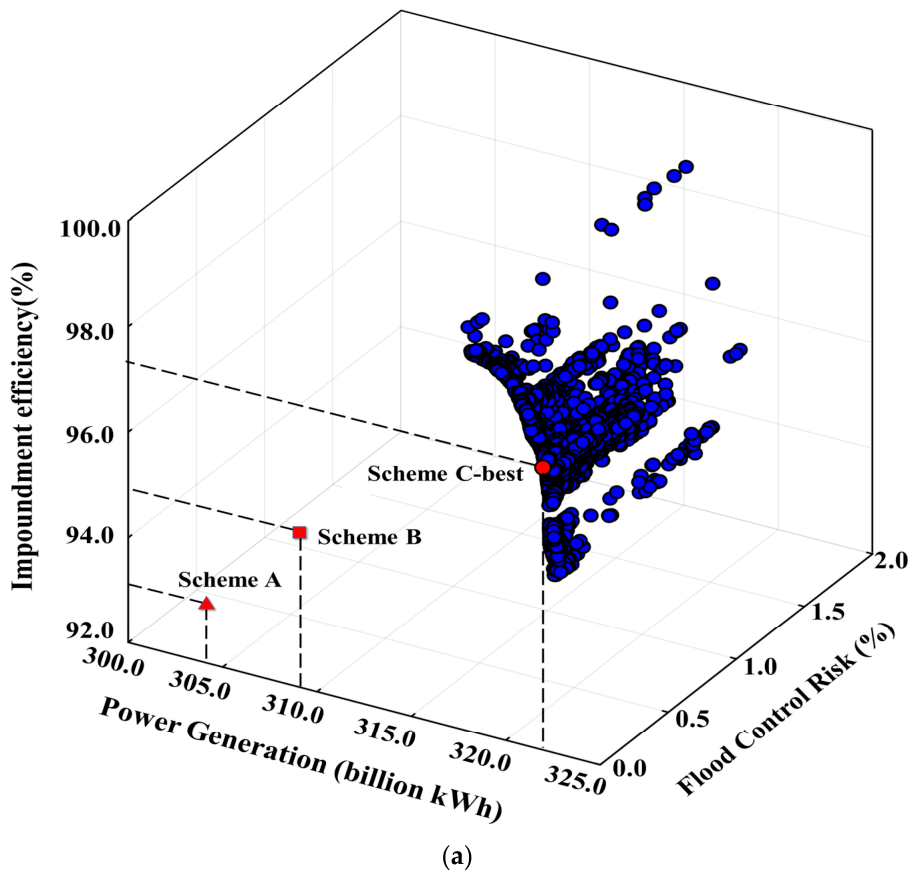
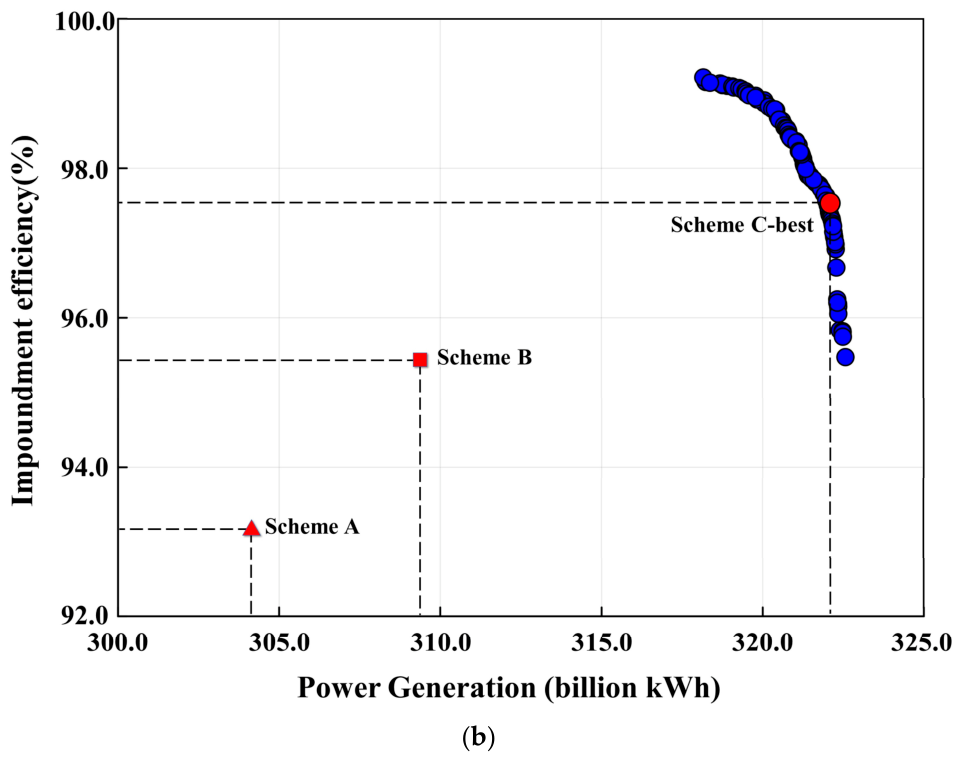
Based on daily observed flow data during 2003–2025 at eight hydrometric stations, the inflow data series of each reservoir and interval basin are calculated using hydrological analogy and water balance methods. These inflow data series are used as inputs for Schemes (A–C) to conduct numerical simulations. Figure 5a shows the three-dimensional Pareto frontier plots of power generation—impoundment efficiency—flood control risk, on which hydropower generation and storage capacity targets have a competition relationship for Scheme C, i.e., the more hydropower generation, the lower impoundment efficiency. Figure 5b shows the two-dimensional Pareto frontier plots of hydropower generation—impoundment efficiency with zero flood control risk, in which the relationship of hydropower generation—impoundment efficiency exhibits a negative correlation. Based on these findings, the performance of Scheme C is better than that of Schemes A and B, both in hydropower generation and storage capacity targets.
To effectively analyze and compare the scheduling results of Scheme C with those of Schemes A and B, an optimal solution (red point) with the zero-flood control risk, as shown in Figure 5b, is selected and denoted as Scheme C-best. Table 3 compares the average annual benefit indicators for three different reservoir scheduling Schemes. For hydropower generation (HPG), the average annual design power generation of these six hydropower plants is 290.55 billion kWh, as shown in Table 1 and used as the comparison benchmark. Schemes A, B and C-best can generate 304.17, 308.68 and 321.57 billion kWh, which represent increases of 13.62, 18.13 and 31.02 billion kWh, respectively. Compared with scheme A, Schemes B and C-best can reduce spillway wastewater (SWW) by 9.50 and 12.82 billion m3, corresponding to reductions of 21.1% and 28.5%, respectively. For impoundment efficiency rate (IER), Scheme B increases from 93.1% (Scheme A) to 94.7%, while Scheme C-best increases to 97.7%.
Each reservoir has its own operation rules and constraints; the benefit indicators for these scheduling schemes are different. Table 3 shows that some individual reservoirs do not always show monotonic improvement benefits, while the system-level total improves. The TGR located at the downstream of Jinxia cascade reservoirs is a key reservoir with the largest storage and installation capacities; Scheme C-best has considered the hydraulic connection and flood control storage complementary equivalent relationship between upper and downstream reservoirs, so the TGR has the largest operational difference among these three scheduling schemes.

4.2. Comparison of Operation Scheduling Results in Typical Years

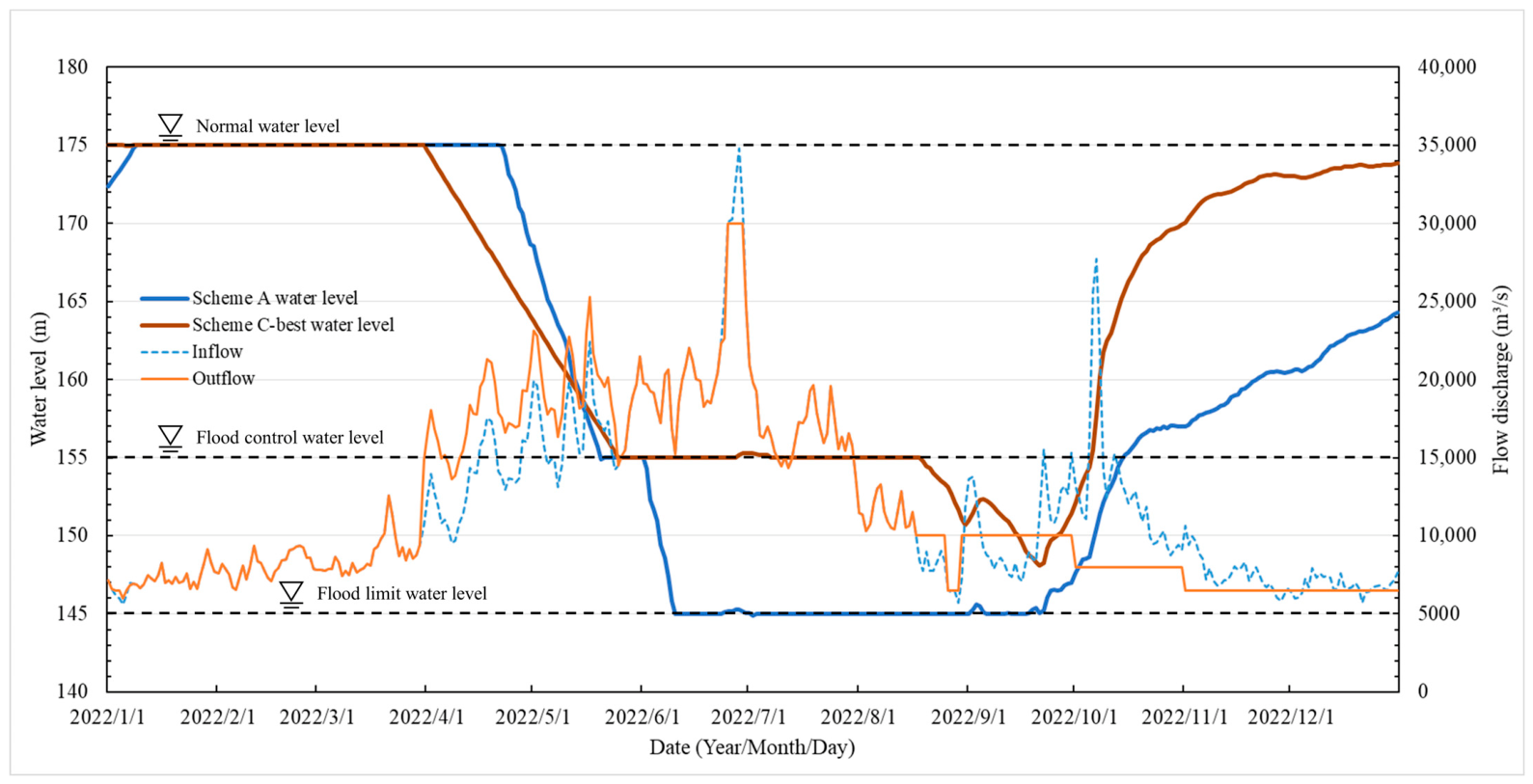
To compare the operation results of these three scheduling schemes in the typical years, a wet year (2020), a dry year (2022), and a normal year (2024) were selected for further simulation analysis. Table 4 compares the operation scheduling results for different schemes in typical years. The impoundment efficiency rate (IER) reached to 100% for all schemes and typical years in the lower Jinsha cascade reservoirs, while TGR is unable to refill to 175 m normal water level, and the IER values are 87.2%, 91.1% and 95.4% for Schemes A, B, and C-best in the 2022 dry year. For hydropower generation in TGR, the values of HPG are 114.19, 116.67 and 122.93 billion kWh for Schemes A, B, and C-best in the 2020 wet year, respectively. The findings indicate that different scheduling schemes exhibit significant differences in the spillway wastewater, hydropower generation, and impoundment efficiency for each reservoir. These discrepancies are primarily attributed to the schemes adopted different operational water levels during the flood season.
The TGR is an important reservoir with multifunctional uses of flood control, hydropower generation, navigation, water supply, etc. Table 4 shows that Scheme C-best stands out among the three schemes in both power generation and impoundment efficiency performance across typical years. By leveraging increased water levels and applying multi-objective optimization algorithms to effectively control spillway wastewater while enhancing power generation and storage capacity, especially during dry and normal years, the Scheme C-best is able to achieve a more efficient balance between flood prevention safety and water resource utilization.
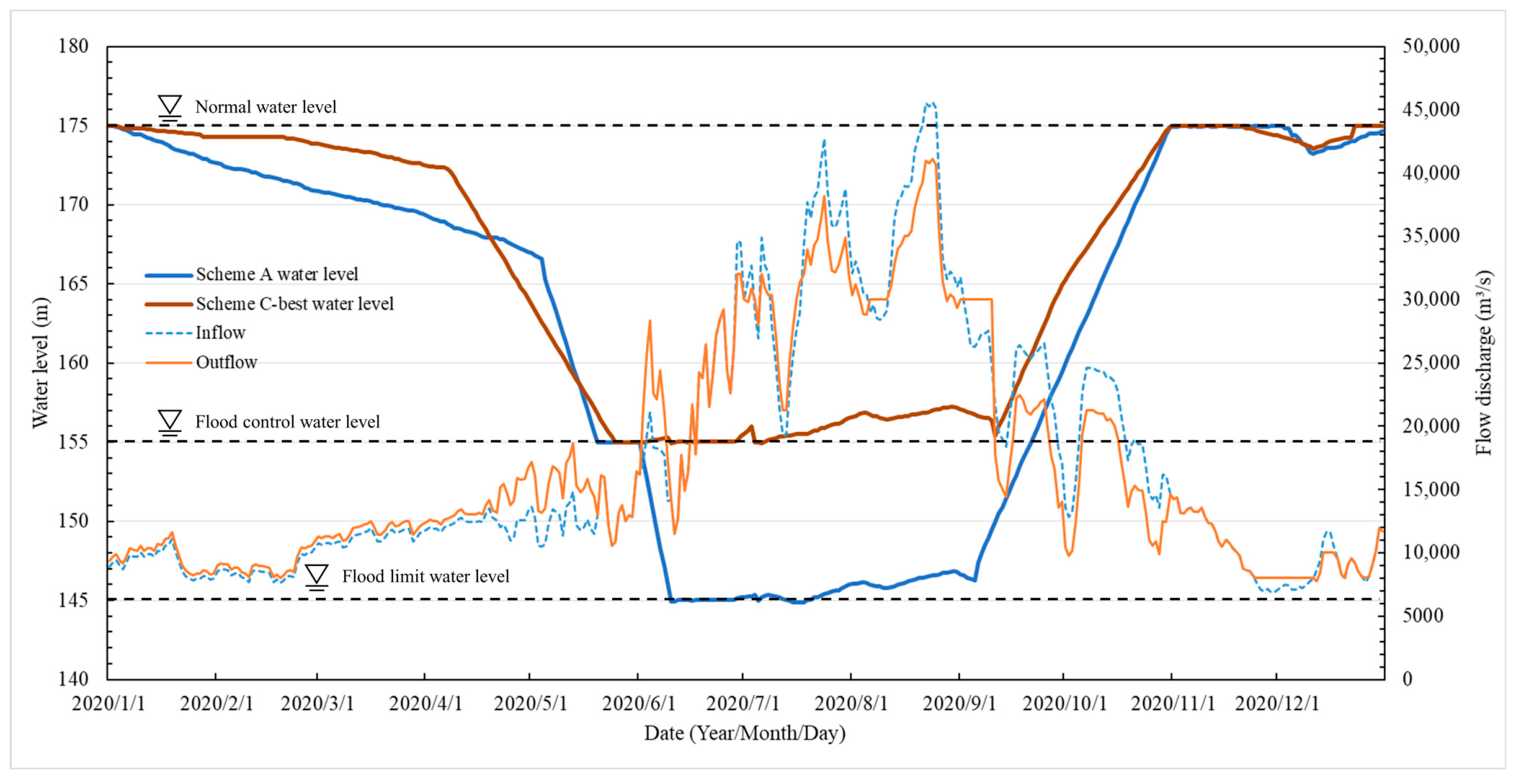
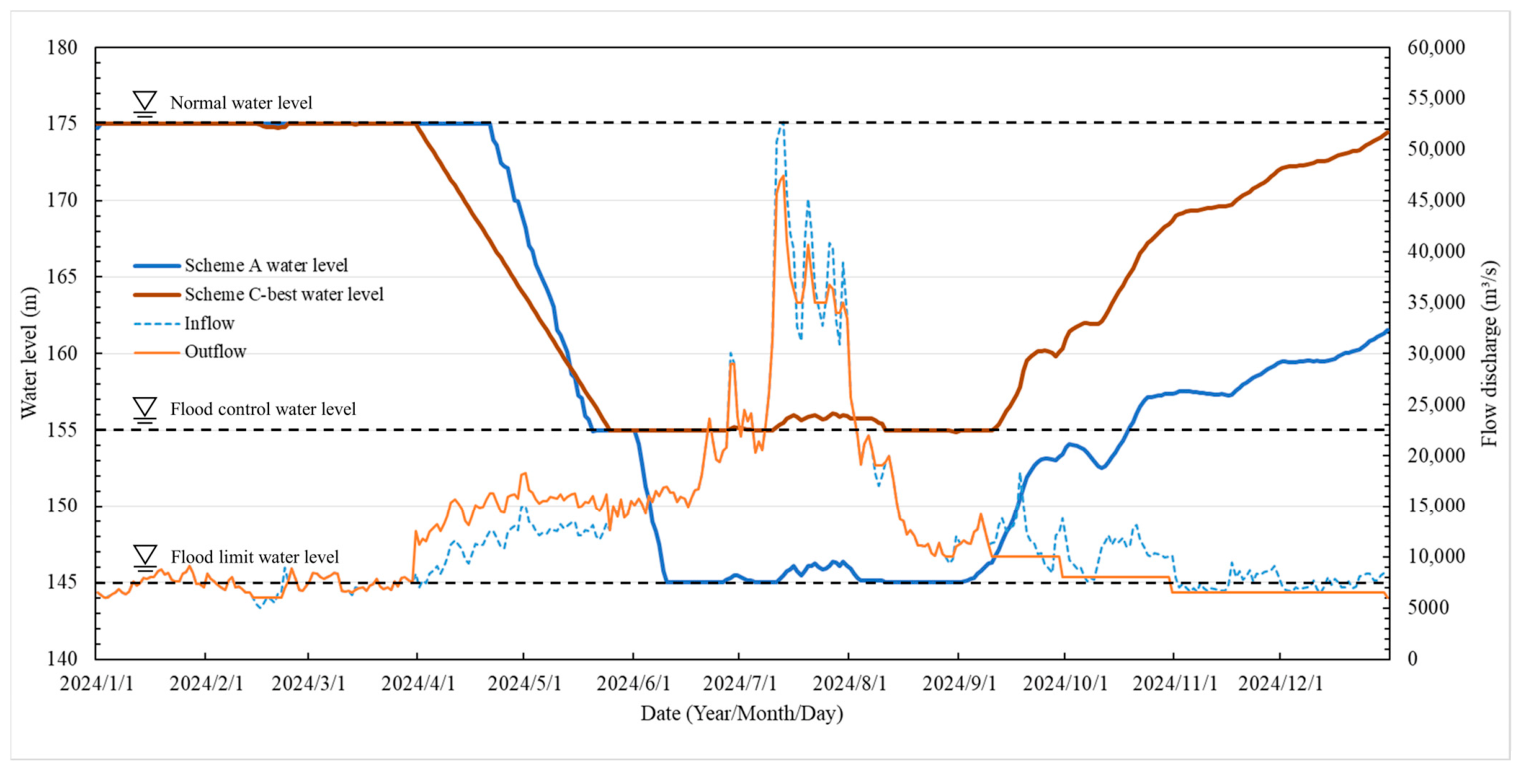
Figure 6, Figure 7 and Figure 8 compare the operational water level scheduling processes of TGR in the 2020 wet year, 2024 normal year, and 2022 dry year, respectively, on which inflow and outflow hydrographs were calculated by Scheme C-best. Flood limit water level and flood control water level during the flood season are also shown in these figures. It is shown that the operational water level of Scheme C-best is higher than that of Scheme A, which can generate more hydropower. According to the TGR operation rules [24], the 100-year design the highest flood prevention water level is 171 m, and the operational water level during the flood season, as shown in these figures, is all less than 157 m, which can ensure flood control safety in the downstream.

5. Discussion

The reservoirs were designed and constructed during different periods; for example, the TGR and BHT reservoirs were designed in 1993 and 2012. The conventional scheduling diagrams, as shown in Figure 3 and Figure 4, were planned in the construction period, while the joint scheduling plans or guidelines of cascade reservoirs (Scheme B) were proposed in recent years [24,25,26]. The simulation scheduling results in Table 3 and Figure 5 clearly show that joint scheduling of cascade reservoirs is much better than single-reservoir operation for overall benefits [31].
The current single-reservoir operation rules (Scheme A) and joint scheduling plan of cascade reservoirs (Scheme B) are based on the flood limit water level during the flood season. The flood limit water level was derived from historical design flood estimates at-site in the reservoir construction period. After 2000, a large number of reservoirs were constructed in the upper Yangtze River basin, which have significantly altered the downstream hydrological regime [17]. To consider the regulation impact of upstream reservoirs, the design floods in the reservoir operation period and the corresponding flood control water level were derived [21]. Figure 6, Figure 7 and Figure 8 show that moderately raising the operation water level can effectively increase power generation and improve the refill storage ratio.
Reservoir operational water level is crucial for improving the overall benefits of cascade reservoirs. A joint and optimal scheduling scheme can effectively decrease reservoir spillway wastewater while improving the adjustment flood control storage capacity and refill storage ratio [32]. For example, Scheme C-best maintained a high operation water level of TGR, as shown in Figure 6, Figure 7 and Figure 8, which can increase hydropower generation and impoundment efficiency.
The main limitations of existing cascade reservoir scheduling methods (Schemes A and B) are that their operating rules are predefined and unable to consider river flow alternation and flood control storage complementary equivalent relationship between upper and downstream reservoirs [33]. The advantages of GRBF operating policies and the Borg algorithm are that the optimal solution set of multi-objective coordinating operation can be obtained easily for a given flow data series, which provides a scientific basis for achieving maximum comprehensive benefits in flood protection and power generation. The methods and algorithms can be applied to the multi-reservoir system operation scheduling in other basins.
However, this study also has several limitations. Only the objective functions of flood control, power generation, and impoundment efficiency were selected to establish the joint scheduling and multi-objective coordinating operation model. How to consider climatic and hydrological alternations and ecological regulation for this mage hydropower system will be further studied [34]. In addition, the integration of flow forecasting information into Schemes B and C will be considered in our future research, since the accurate inflow forecasts are very important in decision-making, both for flood protection and hydropower generation. Machine learning and artificial intelligence techniques have been introduced for reservoir operation scheduling processes in recent years [35], which will be our new research area.

6. Conclusions

This study advances operation scheduling schemes for a mega hydropower system, contributing a new model for joint scheduling and multi-objective coordinating operation. We used the Gaussian radial basis functions to describe reservoir operating rules and the Borg multi-objective evolutionary algorithm to optimize the model parameters. We also compared the proposed model with the current available scheduling schemes using the daily flow data series during 2003–2025 in the upper Yangtze River basin in China, and demonstrated how to increase hydropower output with unchanged flood prevention standards. The increase in hydroelectricity will provide a reliable and practical pathway for sustainable development in China. The main conclusions of this study were summarized as follows.
(1) The Gaussian radial basis functions combined with the Borg multi-objective evolutionary algorithm are a useful method for operating cascade reservoirs characterized by high-dimensional decision variables and multiple competing objective functions.
(2) The performance of Schemes B and C is better than that of Scheme A, with high hydropower generation and impoundment efficiency rate, demonstrating that the joint scheduling of cascade reservoirs is advantageous over single reservoir operation.
(3) Through analyzing the scheduling results of each reservoir, the optimal operation provides better utilization of water resources for TGR. As shown in Table 3, Scheme C-best can generate an average annual power of 97.64 billion kWh with an increase of 10.7%, and the impoundment efficiency rate is increased from 87.4% to 95.6%.
(4) The proposed joint scheduling and multi-objective coordinating operation model performs much better than current operation scheduling methods. Scheme C-best achieves a comprehensive target of decreasing average annual spillway wastewater by 12.82 billion m3 (or a decrease of 28.5%), increasing average annual power generation by 31.02 billion kWh (or an increase of 10.7%), and improving average annual impoundment efficiency rate by 5.0%.

Author Contributions

S.G.: Conceptualization, Writing—original draft, Review and editing, Project administration, Funding acquisition. C.L.: Conceptualization, Data curation, Calculation. B.S. and X.W.: Data curation, Calculation. P.L. and L.G.: Data curation, Calculation. All authors have read and agreed to the published version of the manuscript.

Funding

This study was financially supported by the National Natural Science Foundation of China (No. U2340205) and the China Yangtze Power Cooperation Ltd. (Z242402005).

Data Availability Statement

Some or all data, models, or code that support the findings of this study are available from the corresponding author upon reasonable request.

Acknowledgments

The authors would like to thank the editor and anonymous reviewers whose comments and suggestions helped to improve the manuscript.

Conflicts of Interest

Authors Peng Li and Le Guo were employed by the China Yangtze Power Co. The remaining authors declare that the research was conducted in the absence of any commercial or financial relationships that could be construed as a potential conflict of interest.

Abbreviations

The following abbreviations are used in this manuscript:
WDDWudongde reservoir (or hydropower plant)
BHTBaihhetan reservoir (or hydropower plant)
XLDXiluodu reservoir (or hydropower plant)
XJBXiangjiaba reservoir (or hydropower plant)
TGRThree Gorges Reservoir (or hydropower plant)
GZBGezhouba reservoir (or hydropower plant)
SWWSpillway wastewater
HPGHydro power generation
IERImpoundment efficiency rate

References

  1. National Bureau of Statistics of PRC. China Energy Statistical Yearbook; China Statistics Press: Beijing, China, 2025. (In Chinese)
  2. Lai, V.; Huang, Y.F.; Koo, C.H.; Ahmed, A.N.; El-Shafie, A. A review of reservoir operation optimisations: From traditional models to metaheuristic algorithms. Arch. Comput. Methods Eng. 2022, 29, 3435–3457. [Google Scholar] [CrossRef]
  3. Yeh, W. Reservoir management and operations models: A state-of-the-art review. Water Resour. Res. 1985, 21, 1797–1818. [Google Scholar] [CrossRef]
  4. Wurbs, R.A. Reservoir-system simulation and optimization models. J. Water Resour. Plan. Manag. 1993, 119, 455–472. [Google Scholar] [CrossRef]
  5. Labadie, J.W. Optimal operation of multi-reservoir systems: State-of-the-art review. J. Water Resour. Plan. Manag. 2004, 130, 93–111. [Google Scholar] [CrossRef]
  6. Turgeon, A. Optimal short-term hydro scheduling from the principle of progressive optimality. Water Resour. Res. 1981, 17, 481–486. [Google Scholar] [CrossRef]
  7. Guo, S.L.; Chen, J.H.; Li, Y.; Liu, P.; Li, T.Y. Joint operation of the multi-reservoir system of the Three Gorges and the Qingjiang cascade reservoirs. Energies 2011, 4, 1036–1050. [Google Scholar] [CrossRef]
  8. Feng, Z.-K.; Niu, W.-J.; Cheng, C.-T.; Liao, S.-L. Hydropower system operation optimization by discrete differential dynamic programming based on orthogonal experiment design. Energy 2017, 126, 720–732. [Google Scholar] [CrossRef]
  9. Moridi, A.; Yazdi, J. Optimal allocation of flood control capacity for multi-reservoir systems using multi-objective optimization approach. Water Resour. Manag. 2017, 31, 4521–4538. [Google Scholar] [CrossRef]
  10. He, S.; Guo, S.; Yang, G.; Chen, K.; Liu, D.; Zhou, Y. Optimizing operation rules of cascade reservoirs for adapting climate change. Water Resour. Manag. 2020, 34, 101–120. [Google Scholar]
  11. Rot Weiss, E.; Gselman, R.; Polner, R.; Šafarič, R. Cascade hydropower plant operational dispatch control using deep reinforcement learning on a digital twin environment. Energies 2025, 18, 4660. [Google Scholar] [CrossRef]
  12. Zhang, J.; Ding, W.; Li, M.; Wang, Q.; Zhou, H. Flood control storage substitution from multiple to single-reservoir and storage reservation strategy for hydropower optimization in cascade reservoir systems. J. Hydrol. 2025, 662, 133926. [Google Scholar] [CrossRef]
  13. Liu, D.; Huang, Q.; Yang, Y.; Liu, D.; Wei, X. Bi-objective algorithm based on NSGA-II framework to optimize reservoirs operation. J. Hydrol. 2020, 585, 124830. [Google Scholar] [CrossRef]
  14. Kollat, J.B.; Reed, P.M. Comparing state-of-the-art evolutionary multi-objective algorithms for long-term groundwater monitoring design. Adv. Water Resour. 2006, 29, 792–807. [Google Scholar] [CrossRef]
  15. Hadka, D.; Reed, P. Borg: An auto-adaptive many-objective evolutionary computing framework. Evol. Comput. 2013, 21, 231–259. [Google Scholar] [CrossRef]
  16. Zheng, F.; Zecchin, A.C.; Maier, H.R.; Simpson, A.R. Comparison of the searching behavior of NSGA-II, SAMODE, and Borg MOEAs applied to water distribution system design problems. J. Water Resour. Plan. Manag. 2016, 142, 04016017. [Google Scholar] [CrossRef]
  17. Zhong, S.; Guo, S.; Wang, Y.; Wang, H.; Xie, Y.; Xu, C. A novel joint probability density difference approach for assessing the alteration of hydrologic regime. River Res. Appl. 2024, 40, 659–672. [Google Scholar] [CrossRef]
  18. Wang, X.; Dong, Z.; Ai, X.; Dong, X.; Li, Y. Multi-objective model and decision-making method for coordinating the ecological benefits of the Three Gorges Reservoir. J. Clean. Prod. 2020, 270, 122066. [Google Scholar] [CrossRef]
  19. Xu, Z.; Mo, L.; Zhou, J.; Zhang, X. Optimal dispatching rules of hydropower reservoir in flood season considering flood resources utilization: A case study of Three Gorges Reservoir in China. J. Clean. Prod. 2023, 388, 135975. [Google Scholar] [CrossRef]
  20. Guo, S.; Muhammad, R.; Liu, Z.; Xiong, F.; Yin, J. Design flood estimation methods for cascade reservoirs based on copulas. Water 2018, 10, 560. [Google Scholar] [CrossRef]
  21. Ministry of Water Resources of PRC. Regulation for Calculating Design Flood of Water Resources and Hydropower Projects; Water & Power Press: Beijing, China, 2006. (In Chinese)
  22. Xiong, F.; Guo, S.; Liu, P.; Xu, C.-Y.; Zhong, Y.; Yin, J.; He, S. A general framework of design flood estimation for cascade reservoirs in operation period. J. Hydrol. 2019, 577, 124003. [Google Scholar] [CrossRef]
  23. Xie, Y.Z.; Guo, S.; Zhong, S.R.; Wang, X.; Tian, J.; Liang, Z. A novel time-varying P-III distribution curve fitting model to estimate design floods in Three Gorges Reservoir operation period. Hydrology 2024, 11, 203. [Google Scholar] [CrossRef]
  24. Ministry of Water Resources of PRC. Guidelines of Scheduling for the Three Gorges and Gezhouba Cascade Reservoirs; Ministry of Water Resources of PRC: Beijing, China, 2019. (In Chinese)
  25. Ministry of Water Resources of PRC. Guidelines of Joint Scheduling for Cascade Reservoir in the Lower Jinsha River; Ministry of Water Resources of PRC: Beijing, China, 2024. (In Chinese)
  26. Ministry of Water Resources of PRC. Approval of the Joint Operation Plan for Water Projects in the Yangtze River Basin in 2025; Ministry of Water Resources of PRC: Beijing, China, 2025. (In Chinese)
  27. Zhu, Y.; Zhou, Y.; Xu, C.-Y.; Chang, F.-J. Optimizing complementary operation of mega cascade reservoirs for boosting hydropower sustainability. Sustain. Energy Technol. Assess. 2024, 64, 103719. [Google Scholar] [CrossRef]
  28. Giuliani, M.; Castelletti, A.; Pianosi, F.; Mason, E.; Reed, P.M. Curses, tradeoffs, and scalable management: Advancing evolutionary multi-objective direct policy search to improve water reservoir operations. J. Water Resour. Plan. Manag. 2015, 142, 04015050. [Google Scholar] [CrossRef]
  29. Yang, G.; Guo, S.; Liu, P.; Li, L.; Xu, C. Multiobjective reservoir operating rules based on cascade reservoir input variable selection method. Water Resour. Res. 2017, 53, 3446–3463. [Google Scholar] [CrossRef]
  30. Quinn, J.D.; Reed, P.M.; Giuliani, M.; Castelletti, A.; Oyler, J.W.; Nicholas, R.E. Exploring how changing monsoonal dynamics and human pressures challenge multi-reservoir management for flood protection, hydropower production, and agricultural water supply. Water Resour. Res. 2018, 54, 4638–4662. [Google Scholar] [CrossRef]
  31. Li, J.; Zhong, P.; Yang, M.; Zhu, F.; Chen, J.; Xu, B.; Liu, W. Dynamic and intelligent modeling methods for joint operation of a flood control system. J. Water Resour. Plan. Manag. 2019, 145, 04019044. [Google Scholar] [CrossRef]
  32. Wang, X.; Wu, F.; Hu, T.; Zeng, X.; Li, X.; Huang, J. Modeling competitive-cooperative relationship between flood control and hydropower generation within hierarchical gaming structure of reservoir operation. J. Hydrol. 2023, 620, 129429. [Google Scholar] [CrossRef]
  33. Liu, Y.; Qin, H.; Zhang, Z.; Yao, L.; Wang, Y.; Li, J.; Liu, G.; Zhou, J. Deriving reservoir operation rule based on Bayesian deep learning method considering multiple uncertainties. J. Hydrol. 2019, 579, 124207. [Google Scholar] [CrossRef]
  34. Yu, M.; Song, H.; Zhang, J.; Jin, J.; Meng, Q.; Chen, J.; He, J.; Liu, X.; Ren, Y.; Xu, Z.; et al. Accumulated ecohydrological impacts and ecological risk of mega-cascade reservoir operations. J. Hydrol. 2026, 672, 135321. [Google Scholar] [CrossRef]
  35. Kang, L.; Wu, X.; Zhou, L.; Wen, Y. A novel deep learning coupled model for extracting flood control scheduling rules for reservoir groups. J. Hydrol. 2026, 669, 135083. [Google Scholar] [CrossRef]
Figure 1. Schematic map of the upper Yangtze River basin and five main tributaries.
Energies 19 02352 g001
Figure 2. Schematic diagram of the six large-scale cascade reservoirs in the upper Yangtze River basin.
Energies 19 02352 g002
Figure 3. The designed operation scheduling rule curves or diagram of the Baihetian (BHT) Reservoir.
Energies 19 02352 g003
Figure 4. The designed operation scheduling rule curves or diagram of the Three Gorges Reservoir.
Energies 19 02352 g004
Figure 5. (a) Three-dimensional Pareto frontier plots of hydropower generation ~ impoundment efficiency ~ flood control risk; (b) two-dimensional Pareto frontier plots of hydropower generation ~ impoundment efficiency with zero flood control risk.
Energies 19 02352 g005aEnergies 19 02352 g005b
Figure 6. Comparison of TGR operation scheduling processes in 2020 wet year.
Energies 19 02352 g006
Figure 7. Comparison of TGR operation scheduling processes in 2024 normal year.
Energies 19 02352 g007
Figure 8. Comparison of TGR operation scheduling processes in 2022 dry year.
Energies 19 02352 g008
Table 1. The characteristic parameters of these six large-scale reservoirs.
Reservoir
Name
Catchment
Area/104 km2
Total Storage
Capacity/109 m3
Adjustable Storage
Capacity/109 m3
Installed
Capacity/MW
Power Energy/109 kW·h
WDD40.617.4083.02010,20037.69
BHT43.0320.62710.43616,00061.09
XLD45.4412.916.46213,86057.12
XJB45.885.1630.903640030.75
TGR100.0045.04416.50022,50088.20
GZB100.55//273515.70
Sum/91.15237.32171,695290.55
Table 2. Characteristic water levels of six large-scale cascade reservoirs.
ReservoirWDDBHTXLDXJBTGRGZB
Dead water level (m)945.00765.00540.00370.00145.00/
Flood limit water level (m)952.00785.00560.00370.00145.00/
Flood control water level (m)960.00795.00571.00374.00155.00/
Normal water level (m)975.00825.00600.00380.00170.0066
Design flood water level (m)979.38827.83604.23380.00175.00/
Table 3. Comparison of average annual benefit indicators for three different reservoir scheduling schemes.
ReservoirScheme AScheme BScheme C-Best
SWWHPGIERSWWHPGIERSWWHPGIER
WDD3.2139.35100.02.7839.06100.03.1339.12100.0
BHT3.3060.6399.92.9160.63100.03.0460.60100.0
XLD10.5161.4697.67.3365.5298.56.6868.45100.0
XJB19.3332.56100.014.1335.78100.010.6736.94100.0
TGR8.5793.4287.48.2691.0290.28.5897.6495.6
GZB/16.75//16.67//18.83/
Total44.92304.1793.135.42308.6894.732.10321.5797.7
Increase or
decrease
/13.62/−9.5018.131.6−12.8231.024.6
Percentage/4.7%/−21.1%6.2%1.7%−28.5%10.7%5.0%
Notes: The unit of spillway wastewater (SWW) is billion m3, hydropower generation (HPG) is billion kWh, and impoundment efficiency rate (IER) is %.
Table 4. Comparison of operation scheduling results for different schemes in typical years.
ReservoirYearScheme AScheme BScheme C-Best
SWWHPGIERSWWHPGIERSWWHPGIER
WDD20202.68 35.79 100.0 2.69 35.87 100.0 2.75 36.53 100.0
20220.24 39.80 100.0 0.28 39.92 100.0 0.11 39.89 100.0
20242.02 39.44 100.0 2.07 39.49 100.0 2.20 39.96 100.0
BHT20203.42 56.21 100.0 3.46 56.10 100.0 2.78 55.78 100.0
20220.11 59.16 100.0 0.79 60.85 100.0 0.00 63.50 100.0
20241.10 61.24 100.0 2.30 62.76 100.0 1.60 64.46 100.0
XLD202022.75 64.33 100.0 16.22 68.57 100.0 15.18 72.55 100.0
20220.67 56.24 100.0 6.64 67.18 100.0 0.77 70.32 100.0
20241.40 59.09 100.0 4.36 66.59 100.0 3.73 69.64 100.0
XJB202035.06 33.49 100.0 23.87 37.02 100.0 22.56 37.59 100.0
20227.91 31.23 100.0 17.70 37.07 100.0 7.61 40.07 100.0
20244.84 32.71 100.0 11.79 38.09 100.0 6.89 39.58 100.0
TGR202031.91 114.19 96.2 24.36 116.67 98.4 29.68 122.93 99.6
20221.67 78.46 87.2 4.97 84.42 91.1 1.13 89.15 95.4
202411.94 81.04 94.2 17.63 85.35 95.4 18.20 90.82 98.5
Notes: The unit of spillway wastewater (SWW) is billion m3, hydro power generation (HPG) is billion kWh, and impoundment efficiency rate (IER) is %.
Disclaimer/Publisher’s Note: The statements, opinions and data contained in all publications are solely those of the individual author(s) and contributor(s) and not of MDPI and/or the editor(s). MDPI and/or the editor(s) disclaim responsibility for any injury to people or property resulting from any ideas, methods, instructions or products referred to in the content.