Article

Determinants of Energy Consumption in South Africa: Evidence from an ARDL Model (1980–2023)

by
Palesa Milliscent Lefatsa
* and
Sanele Gumede
School of Commerce, University of KwaZulu-Natal, Westville, Durban 4000, South Africa
*
Author to whom correspondence should be addressed.
Energies 2026, 19(10), 2329; https://doi.org/10.3390/en19102329
Submission received: 13 April 2026 / Revised: 6 May 2026 / Accepted: 9 May 2026 / Published: 12 May 2026

Abstract

This study examines the determinants of energy consumption in South Africa over the period 1980–2023 using a multivariate time-series framework. Unlike conventional studies that focus primarily on the energy–growth nexus, this analysis incorporates financial development, industrialization, and population growth to provide a more comprehensive understanding of energy demand dynamics. The Autoregressive Distributed Lag (ARDL) approach is employed to estimate both short-run and long-run relationships. Unit root tests confirm that all variables are integrated of order one, justifying the application of the ARDL bounds testing approach. The results reveal the existence of a stable long-run relationship between energy consumption and its determinants. Industrialization and population growth emerge as the most significant drivers of energy demand in both the short and long run, reflecting South Africa’s energy-intensive economic structure and rising demographic pressures. Financial development is found to have a positive and statistically significant effect, suggesting that improved access to credit stimulates energy consumption through increased investment and economic activity. In contrast, economic growth exhibits a positive but statistically insignificant long-run effect, indicating partial decoupling between output growth and energy demand. The error correction term is negative and statistically significant, confirming convergence to long-run equilibrium. Causality analysis further indicates that energy consumption is primarily driven by macroeconomic factors rather than acting as a leading indicator. The findings underscore the importance of industrial energy efficiency, population-responsive energy planning, and targeted financial support for sustainable energy investment. This study contributes to the literature by providing a comprehensive, country-specific analysis and offers policy-relevant insights for enhancing energy security and supporting sustainable economic development in South Africa.

1. Introduction

South Africa’s energy sector has undergone a significant transformation from a position of comparative advantage to one characterized by persistent instability, with far-reaching implications for economic performance. For much of the twentieth century, the country benefited from an abundant and relatively inexpensive electricity supply, largely generated from coal, which supported industrial expansion and sustained economic growth [1,2]. However, from the 1980s onwards, structural challenges, including rising demand, delayed investment in generation capacity, ageing infrastructure, and institutional inefficiencies, gradually eroded this advantage. These pressures intensified in the early 2000s and culminated in the introduction of load-shedding in 2008, marking a critical turning point in South Africa’s energy landscape [3].
Since then, electricity supply disruptions have become a defining feature of the South African economy, reaching unprecedented levels between 2020 and 2023. In 2022 alone, the country experienced more than 200 days of load-shedding, with outages lasting up to 10 h per day. The economic consequences have been severe, with estimated daily losses ranging from R1.5 billion to R4 billion, alongside a reduction in annual GDP growth of approximately 1–3 percentage points [4]. Although temporary improvements were observed in 2024, uncertainty surrounding energy supply continues to shape economic expectations, investment decisions, and overall macroeconomic stability.
Energy plays a fundamental role in economic systems by underpinning production processes, industrial output, and long-term growth dynamics. In South Africa, where energy consumption is heavily concentrated in mining, manufacturing, and other energy-intensive sectors, the reliability of electricity supply is closely linked to economic growth, industrialization, and trade performance [5]. Over the period 1980–2023, energy consumption has remained closely associated with a coal-dominated energy mix, accounting for approximately 80% of electricity generation, while population growth and urbanization have steadily increased demand pressures [3]. At the same time, financial development has progressed, although institutional inefficiencies and policy uncertainty have constrained its capacity to support energy infrastructure investment. These dynamics highlight the complex, interdependent relationships among energy consumption, economic growth, financial development, population growth, and industrialization.
The motivation for this study arises from the persistent energy constraints facing South Africa and their implications for long-term economic sustainability. The country’s aspirations for inclusive growth, industrial expansion, and global competitiveness are increasingly undermined by unreliable energy supply. Furthermore, the transition towards a diversified and sustainable energy mix introduces additional challenges, particularly in balancing energy security with economic and environmental objectives. Understanding the interaction between key macroeconomic variables and energy consumption is therefore essential for informing effective and targeted policy interventions.
This study examines the dynamic relationships between energy consumption, financial development, economic growth, population growth, and industrialization in South Africa over the period of 1980–2023. Specifically, it estimates both the short-run and long-run effects of these variables on energy consumption and determines the direction of causality among them. In doing so, the study contributes to the broader literature on the energy–economy nexus and provides empirically grounded insights relevant to policy formulation.
The justification for this analysis lies in the central role of energy within South Africa’s economic structure and the limited integration of key macroeconomic determinants within a unified empirical framework. While existing studies often focus narrowly on the relationship between energy consumption and economic growth, they frequently overlook the broader influence of financial development, population growth, and industrialization. This omission results in an incomplete understanding of the structural drivers of energy demand.
Empirical findings on the energy–economic growth nexus remain inconclusive and often contradictory. For example, examining BRICS economies over the period 2000–2023 using asymmetric panel estimation and Granger causality techniques, evidence of bidirectional causality between energy consumption and economic growth is found, supporting the feedback hypothesis [6]. In contrast, focusing on European Union countries over the same period and employing panel structural equation modelling, the influence of economic growth on energy consumption weakens when structural and technological factors are incorporated, suggesting partial decoupling consistent with the neutrality or conservation hypothesis [7]. Similarly, using a dynamic Generalized Method of Moments approach in China, financial development reduces energy consumption, while energy consumption promotes economic growth [8]. These contrasting findings highlight the complexity and context-specific nature of the energy–growth relationship.
In the South African context, studies that simultaneously integrate energy consumption, financial development, population growth, and industrialization within a comprehensive empirical framework remain limited, despite the country’s structural complexity and energy-intensive economic base. To address this gap, this study employs the Autoregressive Distributed Lag (ARDL) modelling approach, which is particularly suitable for small samples and allows the estimation of both short-run dynamics and long-run equilibrium relationships within a single framework [9]. Given South Africa’s structural economic changes, ongoing energy transition, and constraints on time-series data, the ARDL approach provides a robust and flexible econometric technique for analyzing the energy–economy nexus.
This study contributes to the existing literature in several important ways. First, it adopts a comprehensive multivariate framework that integrates energy consumption, financial development, economic growth, population growth, and industrialization into a single empirical model, thereby moving beyond the conventional bivariate energy–growth approach commonly used in previous studies. Second, the study provides updated, context-specific evidence for South Africa over the extended period 1980–2023, capturing recent structural developments, including persistent electricity supply constraints and load-shedding, which have significantly reshaped the energy–economy relationship. Third, the study explicitly incorporates key macroeconomic determinants, such as population growth and industrialization, which are often treated in isolation, thereby offering a more holistic understanding of the drivers of energy demand in an energy-intensive economy. Finally, by applying the ARDL modelling framework to a structurally evolving economy, the study provides robust and policy-relevant insights tailored to South Africa’s institutional and economic context, particularly in relation to energy security, industrial development, and financial sector dynamics. The remainder of the paper is structured as follows: Section 2 reviews the literature; Section 3 outlines the methodology; Section 4 presents and discusses the empirical results; and Section 5 concludes with policy implications and limitations.

2. Literature Review

2.1. Theoretical Literature

The theoretical literature provides the foundational frameworks for understanding the dynamic relationships between energy consumption, economic growth, financial development, population growth, and industrialization. However, these theories offer differing and sometimes conflicting explanations of the energy–economy nexus. A critical evaluation is therefore necessary to assess their relevance, limitations, and applicability within the South African context.

2.1.1. Energy–Led Growth Theory

The energy–led growth hypothesis posits that energy consumption is a fundamental driver of economic growth, as it serves as a critical input to production processes, industrialization, and technological advancement [10,11,12].
In the South African context, this theory is highly relevant given the country’s reliance on energy-intensive sectors such as mining and manufacturing, where energy availability directly influences output. Periods of severe electricity shortages and load-shedding provide empirical support for this theory, as constrained energy supply has been associated with reduced economic performance.
However, the theory assumes a predominantly unidirectional relationship, which may oversimplify the South African case. Economic stagnation in certain periods has not always been driven solely by energy constraints, but also by structural inefficiencies, governance challenges, and policy uncertainty. Therefore, while the theory is useful for highlighting the importance of energy supply, it does not fully capture the broader macroeconomic dynamics that influence growth.

2.1.2. Growth-Led Energy Hypothesis

The growth-led hypothesis suggests that economic expansion drives energy consumption, as increased production, transportation, and household activity raise energy demand [13].
This perspective is applicable to South Africa, particularly during periods of industrial expansion and urbanization, when rising incomes and economic activity have increased energy demand. Population growth and urban migration further reinforce this relationship by expanding residential and industrial energy needs.
Nevertheless, the theory is limited in its assumption that energy supply can adjust to meet rising demand. In South Africa, persistent supply constraints, ageing infrastructure, and capacity shortages challenge this assumption. As a result, economic growth does not always translate proportionally into higher energy consumption, indicating that the relationship is conditioned by structural and institutional limitations.

2.1.3. Feedback (Bidirectional) Hypothesis

The feedback hypothesis integrates the previous two theories by proposing a bidirectional relationship between energy consumption and economic growth [14,15].
This framework is particularly relevant for South Africa, where energy shortages constrain economic activity, while economic expansion simultaneously increases energy demand. The cyclical interaction between load-shedding and economic performance provides strong contextual support for this theory.
However, while the feedback hypothesis captures the interdependence between energy and growth, it does not explicitly incorporate other structural factors such as financial development, demographic pressures, or industrial composition. As such, its explanatory power is enhanced when combined with broader theoretical perspectives.

2.1.4. Endogenous Growth Theory and Financial Development

Endogenous growth theory emphasizes the role of investment, technological progress, and financial development in sustaining long-term economic growth [16]. Within the energy context, financial development facilitates investment in energy infrastructure, renewable technologies, and industrial innovation.
In South Africa, this theory highlights the importance of financial systems in supporting energy sector development. While financial development has improved over time, its effectiveness in addressing energy challenges has been constrained by policy uncertainty, institutional inefficiencies, and limited investment in generation capacity.
A key limitation of this theory is that it assumes efficient allocation of financial resources. In reality, South Africa’s financial system does not always translate into adequate investment in critical energy infrastructure. This suggests that financial development alone is insufficient without supportive institutional and policy frameworks.

2.1.5. Environmental Kuznets Curve (EKC) and Population Effects

The Environmental Kuznets Curve (EKC) hypothesis proposes a non-linear relationship between economic growth and environmental degradation, often mediated by energy consumption [17]. It suggests that environmental degradation increases in early stages of development but declines as economies adopt cleaner technologies.
In South Africa, the applicability of the EKC is limited by the country’s continued reliance on coal-based energy, which dominates electricity generation. Despite economic development, the transition toward cleaner energy has been relatively slow, challenging the assumption of an automatic shift to sustainability.
Population growth further complicates this relationship by increasing energy demand through urbanization, household consumption, and labour force expansion. This reinforces pressure on an already-constrained energy system, suggesting that demographic factors play a more direct role than the EKC framework implies.

2.1.6. Industrialization and Structural Change Theories

Structural change theories emphasize the role of industrialization in driving energy demand as economies transition from agriculture to manufacturing and services [5].
This theory is highly relevant to South Africa, where mining and heavy industry remain central to economic activity and are inherently energy-intensive. Industrialization has historically been a key driver of energy consumption, reinforcing the strong link between production structure and energy demand.
However, the theory does not fully account for emerging structural changes, including gradual shifts toward service sectors and increasing emphasis on energy efficiency. Additionally, it assumes stable energy supply conditions, which is not the case in South Africa, where supply constraints disrupt industrial activity.

2.1.7. Synthesis

While the reviewed theories provide important insights, no single framework adequately explains the complexity of energy consumption dynamics in South Africa. The energy-led and growth-led hypotheses offer contrasting perspectives, while the feedback hypothesis provides a more integrated view of their interaction. However, these approaches remain incomplete without incorporating financial development, population growth, and structural transformation.
A critical synthesis reveals that energy consumption in South Africa is best understood as a multidimensional, structurally constrained process shaped by the interactions among economic activity, financial systems, demographic pressures, and industrial composition. The limitations observed in each theory highlight the need for a comprehensive analytical framework that integrates these factors.
Accordingly, this study adopts a multivariate ARDL framework that captures both short-run dynamics and long-run equilibrium relationships, providing a more complete and context-specific understanding of the energy–economy nexus in South Africa.

2.2. Empirical Literature Review

Empirical research on the energy–economy nexus has evolved from early bivariate models toward more comprehensive multivariate frameworks. While earlier studies focused primarily on the relationship between energy consumption and economic growth, more recent literature incorporates additional variables, such as financial development, industrialization, and demographic factors, to reduce omitted-variable bias. However, despite these advancements, important limitations persist in terms of model completeness, methodological approach, and contextual applicability.
Several global studies demonstrate progress toward integrated modelling. Analyzing BRICS economies over the period 2000–2023 using asymmetric panel estimation and Granger causality techniques [6], economic growth and financial development significantly increase energy consumption, with bidirectional causality between energy consumption and economic growth. Similarly, using dynamic ordinary least squares (DOLS) for Belgium over the period 1990–2024 [18], the effect of economic growth on energy consumption is found to weaken when structural and technological factors are incorporated, suggesting partial decoupling. In contrast, applying a dynamic Generalised Method of Moments (GMM) approach to China over the period 1990–2015 [8], financial development is found to reduce energy consumption, while energy consumption promotes economic growth, with no significant causality from macroeconomic variables to energy demand.
While these studies reflect important advancements, they also highlight persistent inconsistencies in both direction and magnitude of relationships, driven by differences in economic structure, level of development, and methodology. More importantly, even within multivariate frameworks, variable inclusion remains selective rather than fully integrated, with few studies simultaneously incorporating economic growth, financial development, industrialization, and population dynamics within a single model.
The finance–energy relationship further illustrates this inconsistency. Analyzing Economic Community of West African States (ECOWAS) countries over the period 1990–2019 using Driscoll–Kraay panel regression and quantile techniques [19], financial development is found to increase energy consumption by facilitating industrial expansion. Conversely, using a GMM-panel VAR framework for the Association of Southeast Asian Nations (ASEAN) countries over the period 1981–2021, find that financial development reduces energy demand, with bidirectional causality [20]. Similarly, using panel fixed-effects estimation for the Gulf Cooperation Council (GCC) countries over the period 2001–2021 [21], financial development is found to improve energy efficiency and moderate energy consumption growth. These divergent findings suggest that the finance–energy nexus is highly contingent on financial system efficiency, regulatory quality, and capital allocation. However, a key limitation is that these studies often treat financial development in isolation, failing to capture its interactions with demographic and structural factors adequately.
Industrialization is consistently identified as a major structural driver of energy consumption. Using panel regression and Granger causality techniques for Sub-Saharan Africa over the period 1990–2022 [22], industrialization is found to significantly increase energy consumption. Similarly, applying panel cointegration techniques for developing economies over the period 2000–2023 [23], the study confirms that industrial expansion drives energy demand. However, using panel quantile regression for BRICS countries over the period 1990–2017 [24], the impact of industrialization is found to weaken at higher income levels due to technological progress and improvements in energy efficiency. These findings suggest that while industrialization remains a dominant driver in developing economies, its long-run impact is conditional on structural transformation.
Population growth also plays a significant role in shaping energy consumption patterns. Analyzing Sub-Saharan Africa over the period 1990–2022 [25], population growth is found to significantly increase energy consumption. Similarly, Sasana et al. (2026) [23] report strong positive effects in developing economies. In contrast, focusing on European Union countries [7], the effect is moderated by technological efficiency. These differences indicate that the population–energy relationship is highly context-specific. However, most studies analyze population dynamics separately, rather than within an integrated framework that captures interaction effects.
Despite these global advancements, the literature remains dominated by panel-based approaches that impose cross-country homogeneity, limiting their applicability to country-specific contexts.
This limitation is particularly important for South Africa, where empirical evidence remains limited and fragmented. Analyzing South Africa over the period 1990–2023 [25], energy consumption can be linked to structural factors such as industrial dependence, although the paper did not examine causality. In contrast, using ARDL methods over the period 1971–2019 [26], the paper shows that the relationship is dynamic and time-varying. However, these studies remain limited by narrow variable selection, excluding key determinants such as financial development, population growth, or industrialization.
Overall, the literature does not entirely overlook these variables at the global level. Rather, the key limitation lies in the lack of fully integrated, country-specific, multivariate frameworks, particularly for structurally unique economies such as South Africa.

2.3. Conceptual Framework

The conceptual framework of this study is based on the interaction between energy consumption and its key macroeconomic determinants—economic growth, financial development, industrialization, and population growth—within the South African context.
Energy consumption functions both as an input into production and as an outcome of economic activity. Economic growth increases energy demand through industrial expansion, transportation, and household consumption, while energy availability constrains economic performance, particularly in an environment characterized by supply shortages.
Financial development facilitates investment in energy infrastructure, industrial expansion, and technological innovation. However, its effectiveness depends on the efficiency of financial intermediation and the allocation of capital toward productive sectors.
Industrialization directly increases energy demand through energy-intensive production processes, particularly in mining and manufacturing. Population growth further amplifies energy demand through urbanization, increased household consumption, and labour force expansion.
These relationships are dynamic and may be unidirectional or bidirectional, depending on structural conditions and time horizons. Differences between short-run adjustments and long-run equilibrium dynamics necessitate an econometric framework capable of capturing both dimensions.
Accordingly, the ARDL approach is adopted as it allows for the estimation of both short-run and long-run relationships within a unified framework.

2.4. Research Gap

Despite significant advancements in the empirical literature, several gaps remain.
First, although global studies increasingly adopt multivariate frameworks, variable inclusion remains incomplete, with few studies simultaneously integrating economic growth, financial development, industrialization, and population dynamics within a single model. Second, the literature is dominated by panel data methodologies, which assume cross-country homogeneity and may obscure country-specific dynamics, particularly in structurally unique economies. Third, many studies fail to adequately distinguish between short-run dynamics and long-run relationships, leading to inconsistent and sometimes contradictory findings. Fourth, within the South African context, empirical evidence remains limited, fragmented, and narrow in scope, with most studies focusing on isolated relationships and excluding key determinants. Therefore, the gap is not the absence of multivariate analysis globally, but the lack of comprehensive, country-specific, and structurally contextualized modelling, particularly for South Africa.
To address these gaps, this study employs the ARDL modelling approach, which is well-suited for small sample sizes and allows for the inclusion of variables integrated of different orders, provided none are integrated of order two. The ARDL framework enables the estimation of both short-run and long-run relationships within a single unified model, thereby overcoming limitations associated with traditional techniques. By applying this approach to a comprehensive multivariate model that includes energy consumption, financial development, economic growth, population growth, and industrialization, this study provides a more robust, integrated, and context-specific analysis of South Africa’s energy–economic dynamics.


3. Methodology

This study adopts a quantitative time-series approach to examine the relationship between energy consumption, financial development, economic growth, population growth, and industrialization in South Africa over the period 1980–2023. Annual data are obtained from the World Bank’s World Development Indicators (WDI), ensuring consistency, reliability, and comparability across variables.
Energy consumption (EC) is specified as the dependent variable and measured as energy use (kg of oil equivalent per capita). Economic growth (GDP) is proxied by real GDP per capita (constant 2015 US dollars); financial development (FD) is measured by domestic credit to the private sector (% of GDP), industrialization (IND) is captured by industry value added (% of GDP), and population growth (POP) is measured using the annual population growth rate. All variables are transformed into natural logarithms to stabilize variance, reduce heteroscedasticity, and facilitate elasticity interpretation and comparability across variables.
The selection of explanatory variables is informed by both theoretical and empirical considerations, particularly the energy-growth nexus framework and structural development theory. Economic growth was included because rising income levels and productive activities generally increase energy demand through expanded consumption and production activities [5]. Financial development was incorporated because deeper financial systems improve access to credit, stimulate investment, and facilitate the acquisition of energy-intensive capital and technologies, thereby influencing energy consumption patterns [27]. Industrialization was included due to its central role in structural transformation, as industrial production remains one of the most energy-intensive sectors in developing economies [28]. Population growth was selected because demographic expansion increases residential energy demand, transport needs, and labour market participation, all of which exert pressure on energy consumption.
Although variables such as energy prices, energy policy, and renewable energy share are also important determinants of energy consumption, they were excluded primarily due to data limitations, measurement inconsistencies, and structural breaks in long-term annual series for South Africa over the study period. Including such variables could compromise model consistency and reduce the effective sample size. The selected variables therefore represent core macroeconomic and structural drivers of energy consumption that are consistently available and widely used in empirical energy demand literature, making them appropriate for the objectives of this study.
To empirically capture these relationships, the study employs the ARDL model. The ARDL approach is appropriate because it allows for the inclusion of variables integrated of order I(0) and I(1) [9], and it enables the estimation of both short-run and long-run relationships within a single framework.
The functional model of the study is specified as
E C t = f   ( G D P t , F D t , I N D t , P O P t )
This can be expressed in its econometric (log-linear) form as
l n E C t = β 0 + β 1 l n G D P t + β 2 l n F D t + β 3 l n I N D t + β 4 l n P O P t + ε t
Within the ARDL framework, the model is re-specified into an unrestricted error correction form as follows:
Δ l n E C t =   α 0 +   i = 1 p α 1 i Δ l n E C t i   +   i = 0 q 1 α 2 i Δ l n G D P t i   +   i = 0 q 2 α 3 i Δ l n F D t i   +   i = 0 q 3 α 4 i Δ l n I N D t i   +   i = 0 q 4 α 5 i Δ l n P O P t i   +   λ 1 l n E C t 1 +   λ 2 l n G D P t 1 +   λ 3 l n F D t 1 +   λ 4 l n I N D t 1 +   λ 5 l n P O P t 1 +   D t +   ε t
where
  • Δ denotes the first-difference operator
  • D t dummy variable
  • ε t is the error term
  • α coefficients capture the short-run dynamics
  • p , q 1 , q 2 , q 3 , q 4 , represent optimal lag lengths
  • λ1–λ5 represent the long-run coefficients
  • The differenced terms capture the short-run dynamics
Descriptive statistics will first be employed to provide a preliminary understanding of the data and to examine the distributional properties of the variables. Measures such as the mean, standard deviation, minimum, and maximum values will be used to assess central tendency, dispersion, and the presence of potential outliers. This step will assist in evaluating the general behaviour of the variables and determining their suitability for further econometric analysis. Following this, unit root tests will be conducted using the Augmented Dickey–Fuller (ADF), Dickey–Fuller GLS (DF-GLS), and Phillips–Perron (PP) and Zivot–Andrews tests—these are tests to determine the stationarity properties of the variables and to avoid spurious regression results. The purpose is to determine the order of integration of each variable, whether I(0) or I(1), which is a prerequisite for the application of the ARDL modelling approach. In addition, to minimize potential endogeneity and simultaneity bias, the study employed the ARDL framework, which incorporates lagged values of both dependent and explanatory variables, with optimal lag lengths selected using the optimal lag.
Once the integration properties are confirmed, the optimal lag length for the ARDL model will be determined using information criteria such as the Akaike Information Criterion (AIC) and the Schwarz Bayesian Criterion (SBC), thereby ensuring model parsimony and efficiency while avoiding over-parameterization. The ARDL bounds testing approach will then be applied to test for the existence of a long-run relationship among the variables. If cointegration is confirmed, the long-run coefficients will be estimated, and the short-run dynamics will be captured through an Error Correction Model (ECM), where the error correction term (ECT) is expected to be negative and statistically significant, indicating convergence towards long-run equilibrium. Nevertheless, to account for major structural disruptions, a dummy (control) variable (D) is included in the model. The dummy variable is coded as 1 for periods associated with significant economic shocks, specifically the global financial crisis (2008–2009) and the COVID-19 pandemic (2020–2021), and 0 for all other periods. This specification allows the model to capture the potential impact of exogenous shocks and policy interventions that may influence energy consumption dynamics but are not explicitly represented by the core explanatory variables. By incorporating this variable, the analysis controls structural breaks and ensures that the estimated relationships among the main variables are not biassed by these exceptional events. Furthermore, Granger causality tests will be conducted to determine the direction of causality between the variables. To ensure the reliability and robustness of the model, diagnostic tests will be performed, including tests for serial correlation, heteroskedasticity, normality of residuals, and model specification. These diagnostic tests are essential to confirm that the residuals are well-behaved and that the model satisfies the classical linear regression assumptions, thereby ensuring the validity of the estimated results.

4. Analysis of the Results

4.1. Descriptive Statistics Results

Table 1 presents the descriptive statistics of the variables used in this study over the period 1980–2023. The statistics provide a preliminary understanding of the distribution, central tendency, and variability of energy consumption, economic growth, financial development, industrialization, and population growth in South Africa. These measures are important as they offer insight into the nature of the data before conducting econometric analysis.
Energy consumption in South Africa records a relatively high mean value of 2642.4754, with a median of 2641.2697, indicating a near-symmetric distribution and suggesting stability in energy demand over time. The relatively narrow range between the maximum (2965.8892) and minimum (2398.6572) values reflects moderate fluctuations, which can be associated with structural changes in the South African economy and recurring periods of energy constraints. The standard deviation of 173.1484 confirms moderate dispersion around the mean. The slight positive skewness (0.1372) indicates occasional periods of higher-than-average energy consumption, while the kurtosis value of 2.3546 suggests a platykurtic distribution with fewer extreme values. The Jarque–Bera probability (0.4268) confirms that energy consumption is normally distributed. This stability is consistent with the findings of the literature [25], which observed that energy consumption in South Africa remains structurally stable despite fluctuations driven by industrial dependence and energy supply constraints.
Economic growth in South Africa exhibits a relatively low mean value of 0.4854, with a higher median of 0.8428, indicating that the distribution is influenced by periods of negative growth. This is reflected in the minimum value of −4.5572, capturing episodes of economic contraction, and the maximum of 4.2784, indicating moderate expansion phases. The relatively high standard deviation of 2.3785 highlights significant volatility in economic performance over the sample period. The negative skewness (−0.3795) suggests that extreme negative growth episodes occur more frequently than positive ones, reinforcing the presence of economic instability. The kurtosis value of 2.6213 indicates a distribution that is slightly flatter than normal, while the Jarque–Bera probability (0.4175) confirms normality. These findings align with the literature [26], which demonstrated that economic growth in South Africa is highly volatile and influenced by structural and time-varying factors, including energy supply disruptions.
Financial development shows a mean value of 60.9523 and a median of 62.2583, indicating a relatively stable and gradually improving financial sector in South Africa. The range between the maximum (78.2841) and minimum (41.6076) suggests steady progression rather than abrupt changes. The standard deviation of 9.7471 reflects moderate variability, indicating consistent development over time. The slight negative skewness (−0.1049) suggests that observations are marginally concentrated at higher levels, reflecting financial deepening in later years. The kurtosis value of 1.8654 indicates a flatter distribution, while the Jarque–Bera probability (0.4352) confirms normality. This pattern is consistent with the literature [23,30], which reports that financial development in developing economies tends to evolve gradually and supports the expansion of economic and energy-related activities.
Industrialization records a mean value of 31.8564 and a median of 29.6193, suggesting a distribution that is moderately skewed upward. The variation between the maximum (45.4794) and minimum (25.7568) reflects fluctuations in industrial activity, likely driven by policy changes, economic cycles, and structural adjustments in South Africa. The standard deviation of 5.8846 indicates moderate dispersion. The relatively high positive skewness (0.9263) suggests that while most observations are clustered at lower levels, there are occasional significant increases in industrial activity. The kurtosis value of 2.2638 indicates a platykurtic distribution with fewer extreme outliers. The Jarque–Bera probability (0.0928), although close to the threshold, remains above the 5% level, thereby indicating that the null hypothesis of normality cannot be rejected. These findings are consistent with the previous studies [23,31], which find that industrialization in developing economies exhibits variability due to structural transformation and remains a key driver of energy demand.
Population growth in South Africa exhibits a mean of 57.8685 and a median of 57.7458, indicating a highly symmetric and steadily increasing trend over time. The relatively narrow range between the maximum (66.4565) and minimum (48.4254) reflects gradual demographic changes rather than abrupt shifts. The standard deviation of 5.7283 confirms low variability, consistent with predictable population dynamics. The skewness value of 0.0708 is close to zero, indicating an almost perfectly symmetric distribution, while the kurtosis value of 1.7841 suggests a flat distribution with minimal extreme observations. The Jarque–Bera probability (0.2963) confirms that the variable is normally distributed. These results align with the findings of the paper that reported that population growth in Sub-Saharan African countries, including South Africa, follows a stable and predictable pattern while exerting consistent pressure on energy demand [31].
Overall, the descriptive statistics indicate that all variables are approximately normally distributed, as confirmed by Jarque–Bera test probabilities exceeding the 5% significance level. While energy consumption, financial development, and population growth exhibit relative stability, economic growth and industrialization display higher variability and skewness, reflecting underlying structural and economic fluctuations in South Africa. This combination of stable and volatile variables is consistent with the broader empirical literature and provides a solid foundation for further econometric analysis using the ARDL framework [9].

4.2. Unit Root Results

Table 2 presents the results of the unit root tests obtained from the Augmented Dickey–Fuller (ADF), Dickey–Fuller Generalized Least Squares (DF-GLS), Phillips–Perron (PP), and Zivot–Andrews structural break tests, which provides a highly consistent and robust assessment of the stochastic properties of the variables. Establishing the order of integration is a critical prerequisite for econometric analysis, particularly for the application of the ARDL model, which requires that variables be integrated of order zero, I(0), or order one, I(1), but not beyond. The results are reported both at levels and first differences, with and without trend components, to ensure robustness.
Energy consumption is found to be non-stationary at levels across all applied tests. The ADF statistics (−1.812 without trend and −2.645 with trend), DF-GLS statistics (−2.393 and −2.739), and PP statistics (−1.542 and −2.819) are all statistically insignificant, indicating the presence of a unit root. However, after first differencing, the variable becomes strongly stationary at the 1% level across all tests, with ADF values of −6.902 and −6.511, DF-GLS values of −6.861 and −6.264, and PP values of −6.631 and −6.378. The Zivot–Andrew’s test confirms this result, showing non-stationarity at levels (−4.21) but strong stationarity after first differencing (−7.88), with a structural break identified in 2009. This confirms that energy consumption is integrated of order one, I(1), consistent with the literature [27,28], which argues that energy demand is driven by persistent structural and developmental dynamics.
Economic growth similarly exhibits non-stationarity at levels, as indicated by ADF statistics (−2.101 and −2.388), DF-GLS statistics (−1.265 and −1.362), and PP statistics (−2.249 and −2.421), all of which fail to reject the null hypothesis of a unit root. After first differencing, however, GDP becomes highly stationary across all tests, with ADF values of −5.774 and −6.803, DF-GLS values of −5.942 and −6.762, and PP values of −5.863 and −8.688. The Zivot–Andrews test further confirms this behaviour, with a level statistic of −3.95 and a first-difference statistic of −6.74, identifying a structural break in 2020. This confirms that economic growth is integrated of order one, I(1), aligning with the literature [5,14], which emphasizes the long-run, shock-sensitive nature of macroeconomic output in developing economies.
Financial development also demonstrates clear non-stationarity at levels, with ADF statistics (−1.433 and −2.512), DF-GLS statistics (−0.973 and −2.971), and PP statistics (−1.672 and −2.147), none of which are significant. After first differencing, the variable becomes strongly stationary at the 1% level across all tests, with ADF values of −7.991 and −8.110, DF-GLS values of −4.456 and −6.189, and PP values of −8.243 and −8.275. The Zivot–Andrew’s test confirms this result, with a level statistic of −4.10 and a first-difference statistic of −8.02 and identifies a structural break in 2015. This confirms that financial development is integrated in order one, I(1), consistent with the literature [27,28], which shows that financial systems evolve gradually through long-term institutional deepening.
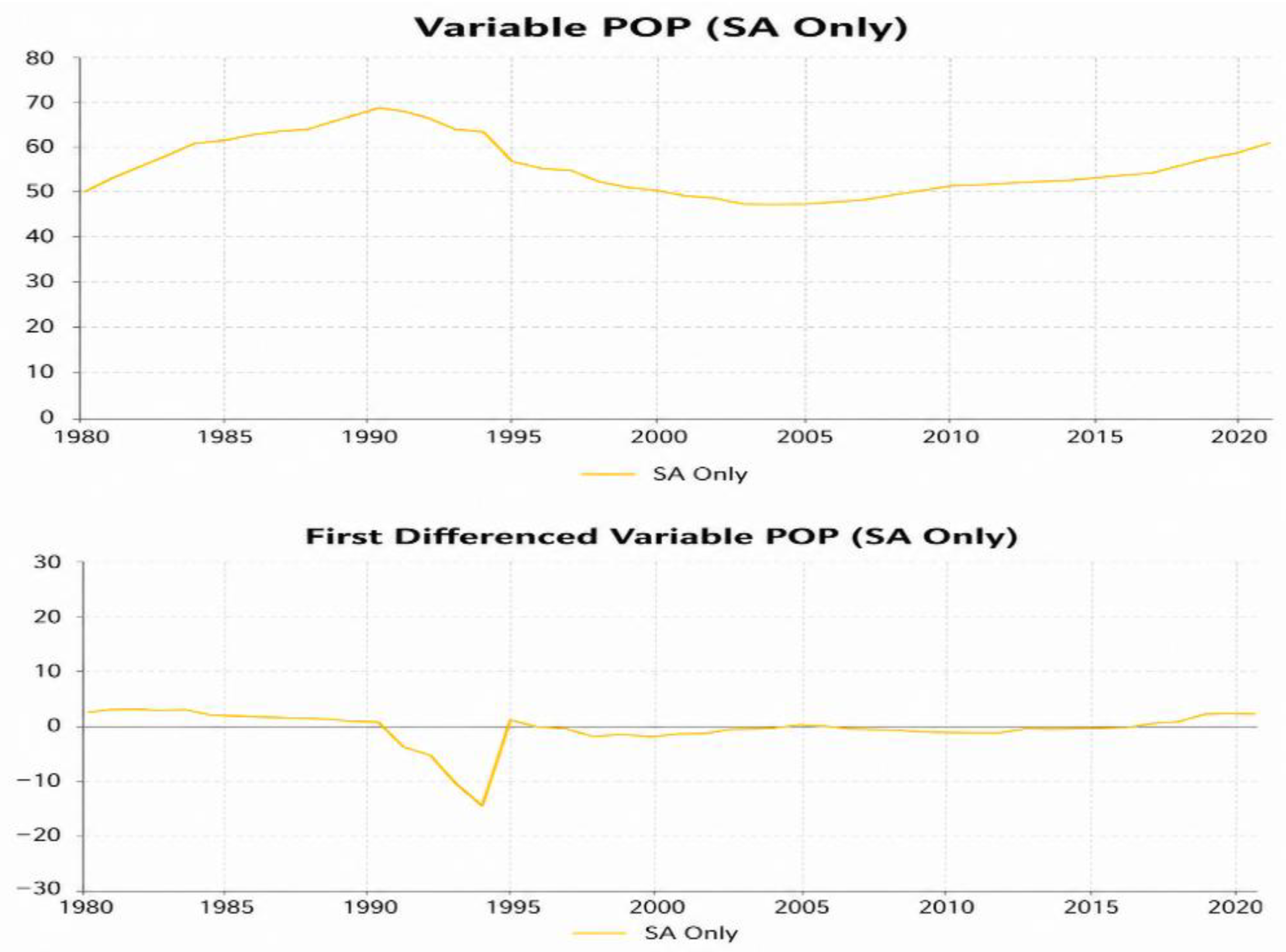
Population growth (POP) is non-stationary in levels, as indicated by the Augmented Dickey–Fuller (ADF) statistics (−1.256 and −2.104), DF-GLS statistics (−2.558 and −2.187), and Phillips–Perron (PP) statistics (−1.053 and −2.321), all of which are statistically insignificant and fail to reject the null hypothesis of a unit root. This implies that POP follows a stochastic trend over time and is not mean-reverting in its level form. However, after the first difference, the series becomes stationary across all tests, with ADF statistics (−4.623 and −5.701), DF-GLS statistics (−4.748 and −8.973), and PP statistics (−4.785 and −5.892), confirming rejection of the unit root hypothesis. The first-differenced series is therefore interpreted as population growth (∆POP), which captures changes in population from one period to the next rather than the cumulative population level. The Zivot–Andrews structural break test further supports this result, with a level statistic of −3.88 and a first-difference statistic of −5.96, identifying a structural break in 2011 and suggesting a shift in the population growth trajectory. Overall, these findings confirm that population growth is integrated of order one, I(1), meaning that it is non-stationary in levels but stationary in first differences. This is consistent with the paper [31] that highlighted that demographic dynamics in Sub-Saharan Africa reflect persistent but gradual transition patterns that shape long-run economic and energy demand dynamics.
Industrialization likewise exhibits non-stationarity at levels, with ADF statistics (−1.587 and −2.763), DF-GLS statistics (−1.416 and −1.042), and PP statistics (−1.394 and −2.951), none of which are significant. However, after first differencing, the variable becomes highly stationary across all tests, with ADF values of −8.672 and −8.401, DF-GLS values of −6.196 and −6.189, and PP values of −9.254 and −8.934. The Zivot–Andrews test confirms this result, with a level statistic of −4.33 and a first-difference statistic of −7.51, identifying a structural break in 2008. This confirms that industrialization is integrated in order one, I(1), consistent with the literature [23,31], which emphasizes that industrial development in emerging economies is shaped by long-run structural transformation processes.
Overall, the combined evidence from all four-unit root tests provides strong and internally consistent support for the conclusion that all variables are integrated of order one, I(1). Importantly, no variable is integrated of order two, I(2), under any specification. This confirms the validity of the ARDL bounds testing approach [9] and ensures that both short-run dynamics and long-run equilibrium relationships among the variables can be reliably estimated.

Graphical Analysis

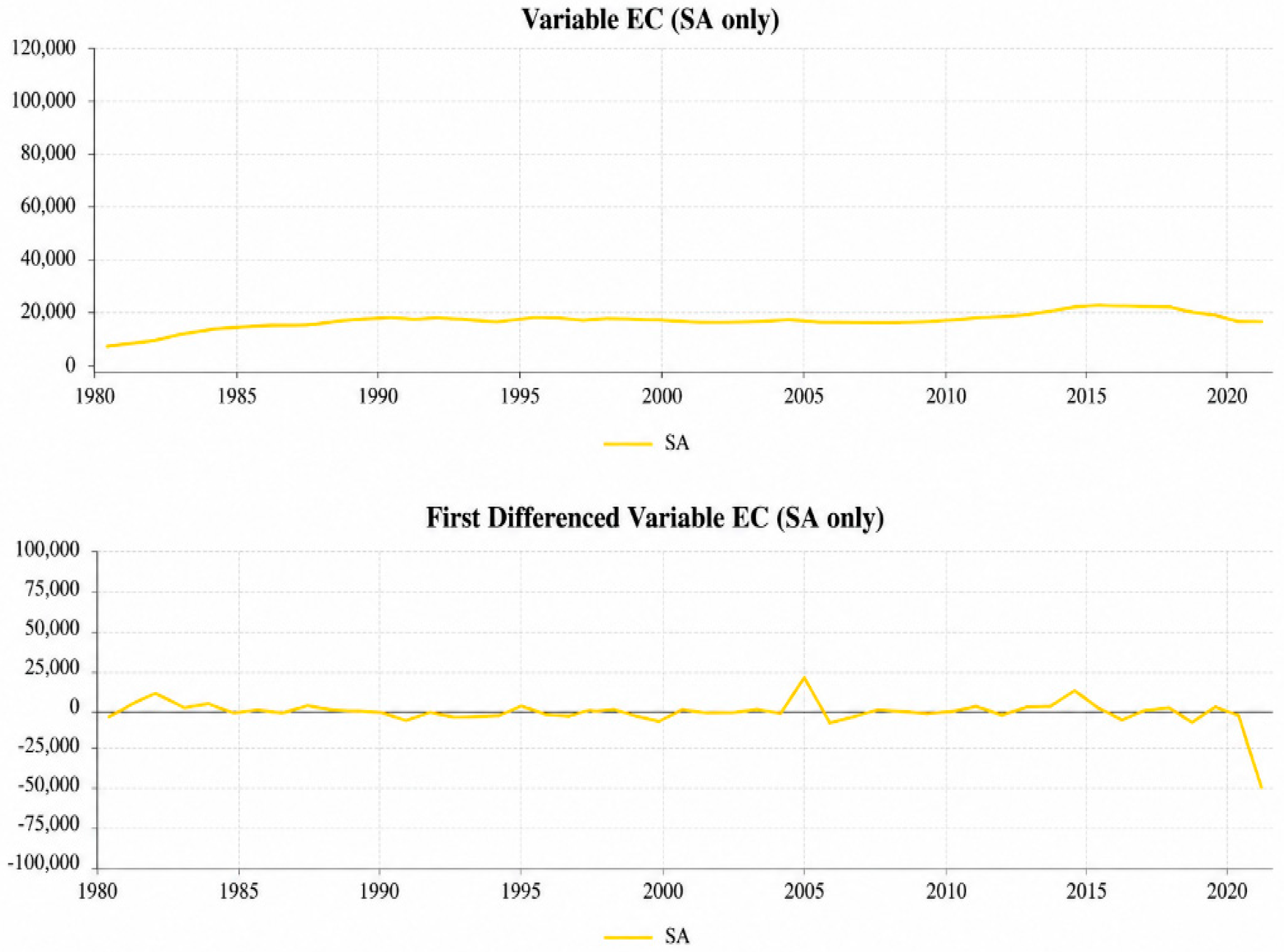
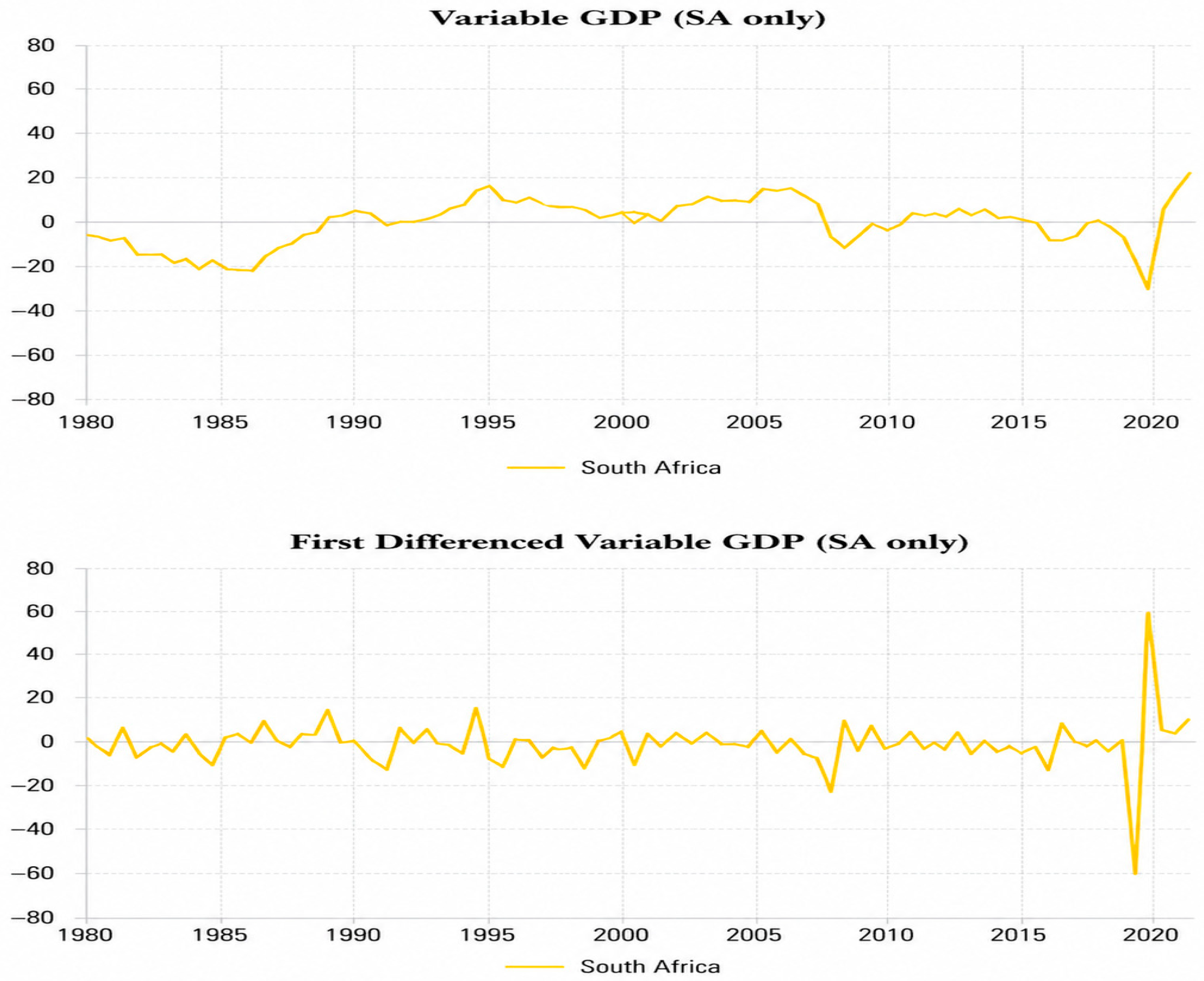
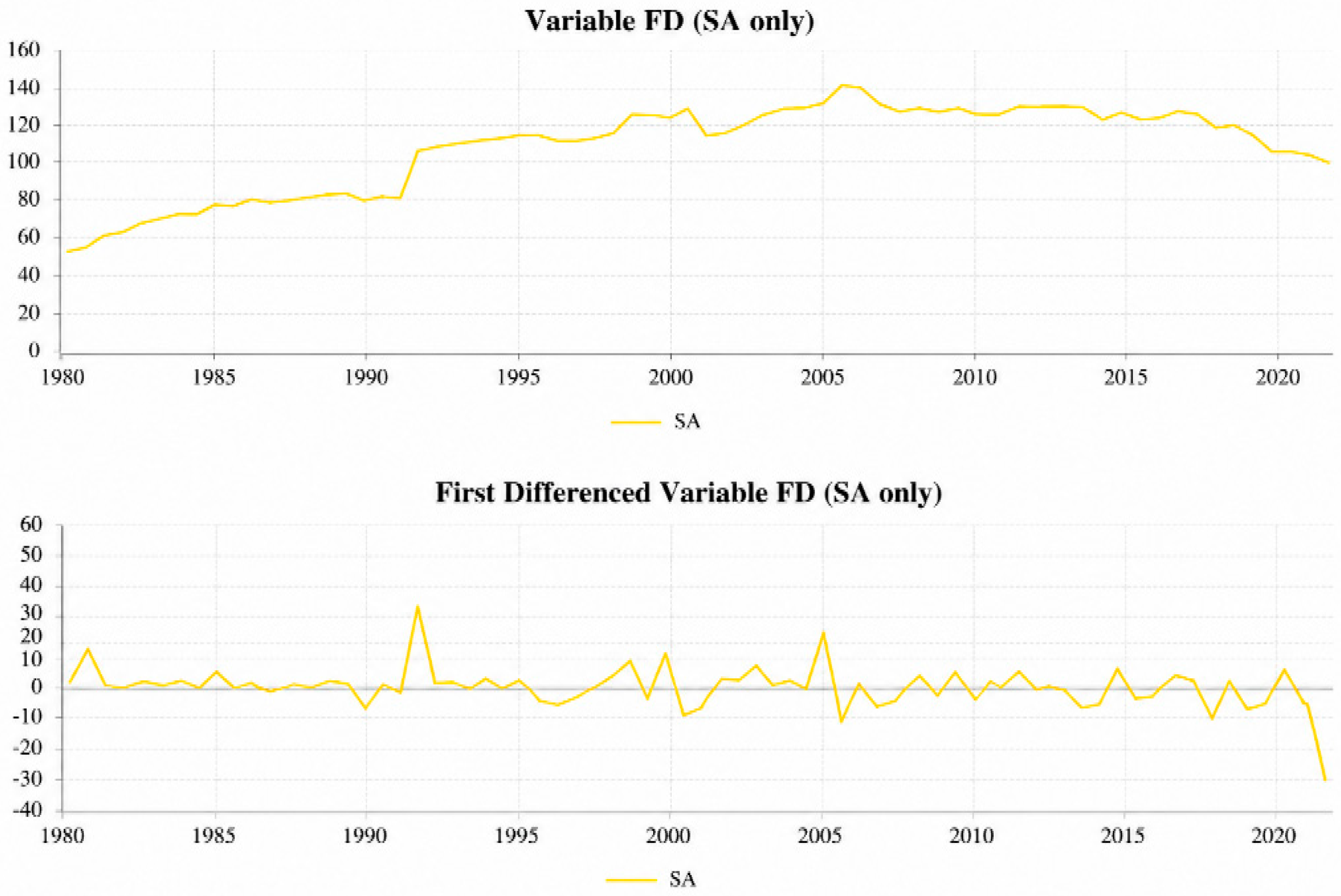
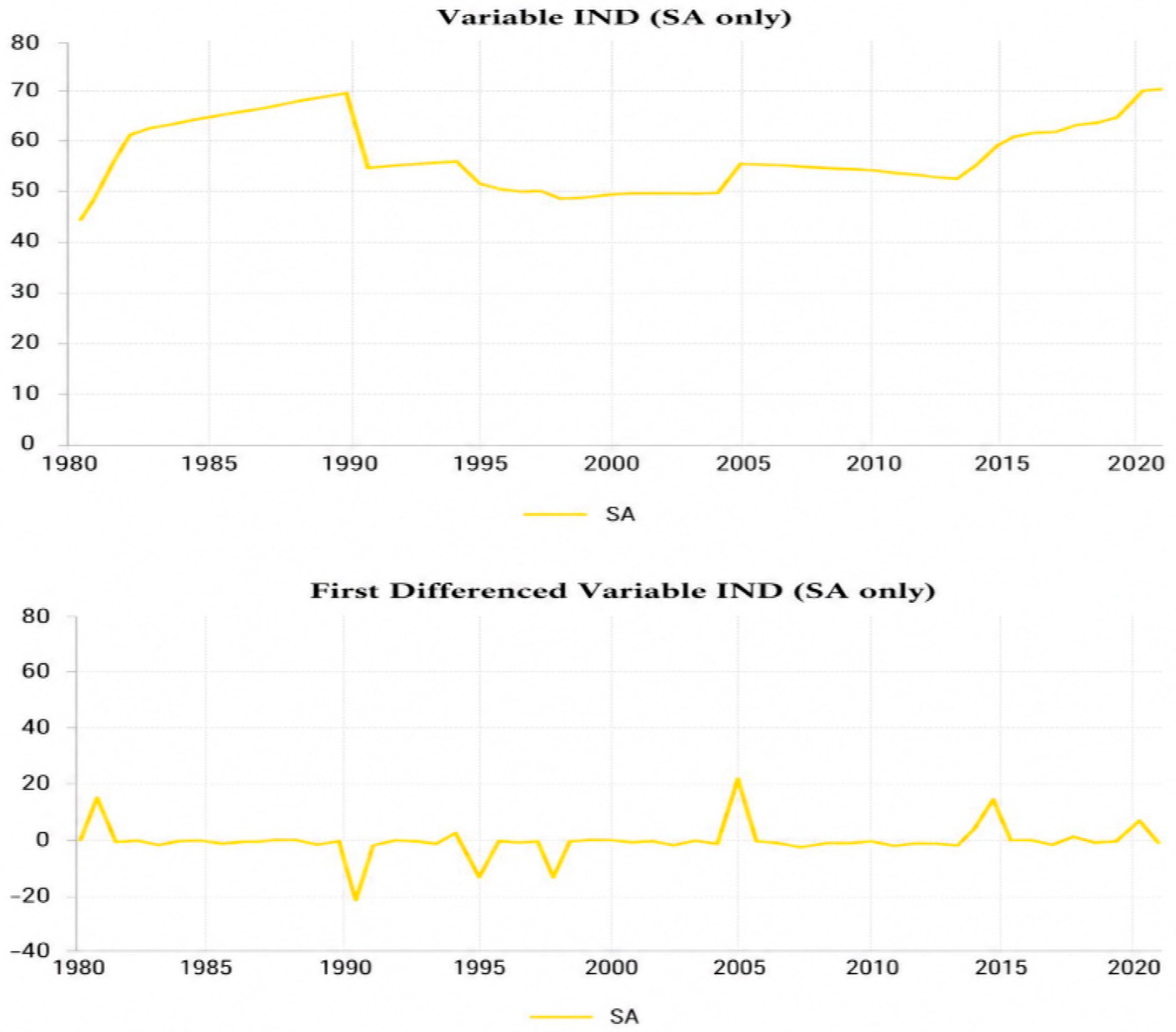
To complement the formal unit root tests, graphical analysis was conducted to visually assess the stationarity properties of the variables. Figure 1, Figure 2, Figure 3, Figure 4 and Figure 5 present the time-series plots of energy consumption, economic growth, financial development, industrialization, and population growth.
The upper panels (level series) show clear trends and fluctuations, indicating non-stationarity, as the series do not revert to a constant mean over time. In contrast, the lower panels (first-differenced series) display fluctuations around zero with relatively constant variance, suggesting that the series have become stationary after differencing.
This visual evidence supports the results obtained from the unit root tests, confirming that all variables are non-stationary in levels but stationary in first differences, and are therefore integrated of order one, I(1).

4.3. Lag Selection Results

In Table 3 below selecting an appropriate lag length is a critical step in time-series modelling because it ensures the dynamic structure of the model captures short-run adjustments without introducing bias or overfitting. Various criteria exist for lag selection, including the Akaike Information Criterion (AIC), Schwarz Criterion (SC), and Hannan-Quinn Criterion (HQ). In this study, we employ all three criteria for robustness but place primary emphasis on SC because it penalizes model complexity more heavily, reducing the risk of over-parameterization [9].
The selection of an appropriate lag length is crucial in time-series analysis to ensure that the dynamic interactions among variables are accurately captured without overfitting, as emphasized in the econometric literature (Pesaran, Shin, and Smith, 2001) [9]. From Table 3, it is evident that the Log-Likelihood (LogL) increases steadily as the lag order increases, indicating an improvement in model fit. However, the Likelihood Ratio (LR) test shows a sharp improvement from lag 0 to lag 1 (LR = 749.25), with diminishing gains at higher lags, suggesting that the main dynamic effects are adequately captured by the first lag. Similarly, the Final Prediction Error (FPE) decreases substantially at lag 1 and stabilizes afterwards, confirming that including one lag improves predictive accuracy while avoiding unnecessary complexity, which is consistent with findings in applied energy econometrics [32].
The information criteria provide further guidance on lag selection. The Schwarz Criterion (SC), which penalizes over-parameterization more heavily than the Akaike Information Criterion (AIC) or Hannan-Quinn Criterion (HQ), identifies lag 1 as optimal (−18.178). Although AIC and HQ slightly favour longer lags, SC is preferred because it balances model fit and parsimony, reducing the risk of bias and overfitting [9,33]. Therefore, lag 1 is adopted for the ARDL model, ensuring robust estimation of both short-run and long-run relationships among energy consumption (EC), financial development (FD), economic growth (GDP), population growth (POP), and industrialization (IND) in South Africa over the period 1980–2023. This choice aligns with empirical studies emphasizing the importance of parsimonious lag structures in environmental and energy econometrics [30,32,34].

4.4. ARDL Bounds Test Results

Table 4 presents the results of the ARDL bounds test used to examine the existence of a long-run equilibrium relationship among energy consumption (EC), financial development (FD), economic growth (GDP), population growth (POP), and industrialization (IND) in South Africa over the period 1980–2023.
The computed F-statistic of 16.9756 is substantially higher than the upper bound critical values at all conventional significance levels. Specifically, at the 5% level, the upper bound is 3.41, and since 16.9756 > 3.41, the null hypothesis of no cointegration is decisively rejected. This outcome is consistent even at the stricter 1% level, where the upper bound is 3.69, still far below the calculated F-statistic. This finding is in line with the ARDL bounds testing framework [9], which establishes that an F-statistic exceeding the upper bound confirms the existence of a long-run relationship.
This result provides strong empirical evidence of a long-run equilibrium relationship among the variables. In practical terms, it implies that energy consumption, financial development, economic growth, population growth, and industrialization move together over time despite short-run fluctuations. Any deviation from equilibrium is temporary and corrected in the long run. This is consistent with the findings [35], which report that macroeconomic variables and energy consumption exhibit long-run interdependence across both developed and developing economies.
The presence of cointegration justifies the application of the ARDL error correction model (ECM) framework to estimate both short-run dynamics and long-run coefficients. It also confirms that the selected variables are theoretically and empirically linked within the South African context, particularly given the country’s structural dependence on energy-intensive industrial activity and evolving financial sector [25].
Overall, the bounds test results reinforce the argument that energy plays a central role in sustaining economic growth and industrialization, while financial development and population dynamics are integral in shaping long-term energy demand patterns. This finding aligns with the study that emphasize the interconnectedness between energy consumption and macroeconomic variables, particularly in emerging economies such as South Africa [6].

4.5. Long-Run Elasticities

Table 5 presents the long-run elasticities of energy consumption with respect to economic growth, financial development, industrialization, total population, and a control variable in South Africa from 1980 to 2023. These estimates, obtained from the ARDL model, capture the persistent structural relationships among the variables after accounting for short-term fluctuations. The inclusion of a constant term indicates the baseline level of energy consumption in the absence of changes in the explanatory factors, highlighting the structural energy demands of the economy.
The constant term is positive at 1.348, statistically significant at the 1% level, and represents the inherent baseline energy consumption, reflecting fundamental energy needs independent of economic activity, population growth, industrial expansion, or financial development. The long-run coefficient of economic growth (GDP) is positive but statistically insignificant (0.0336), suggesting that economic expansion does not exert a meaningful long-term effect on energy consumption. This finding points to a potential partial decoupling between output and energy demand. However, this decoupling should be interpreted with caution. On the one hand, it may reflect improvements in energy efficiency, technological progress, and structural transformation toward less energy-intensive sectors, consistent with the environmental and efficiency transition arguments [5,17]. On the other hand, it may also indicate the presence of energy supply constraints, particularly in the form of persistent electricity shortages and load-shedding in South Africa, which may limit the ability of economic growth to translate into higher energy consumption. This interpretation is supported by institutional evidence [3], which highlights ongoing capacity challenges in the national electricity system. As such, the observed relationship likely reflects a combination of efficiency gains and supply-side limitations. This dual interpretation aligns with studies [13,14] which emphasize that the energy–growth nexus can vary depending on structural conditions and energy availability. Therefore, the results highlight the importance of simultaneously improving energy efficiency while expanding reliable energy infrastructure to support sustainable economic growth.
Financial development shows a positive coefficient of 0.115, significant at the 10% level, suggesting that a 1% increase in financial sector depth or intermediation capacity translates into approximately a 0.12% increase in long-run energy consumption. This result underscores the role of credit availability, investment financing, and access to financial resources in supporting energy-intensive production, infrastructure development, and household energy use. This aligns with the literature findings that financial development contributes positively to energy demand, particularly in developing economies [23,30].
Industrialization demonstrates a strong positive effect of 0.026, highly significant at the 1%, indicating that a 1% expansion in industrial activity results in a 0.026% increase in energy consumption. This aligns with South Africa’s energy-intensive manufacturing and mining sectors, highlighting the critical importance of energy planning to sustain industrial growth without compromising supply reliability. This result is consistent with the studies [23,31] that identify industrialization as a major driver of energy consumption in developing economies.
Population growth exhibits a positive coefficient of 0.242, statistically significant at the 1% level, implying that a 1% increase in total population contributes to approximately a 0.24% increase in energy consumption. This reflects the cumulative effect of demographic expansion on residential energy demand, urbanization pressures, and public service provision, emphasizing that population dynamics are a key driver of long-term energy needs. This finding is supported by the assertion that population growth significantly increases energy demand in Sub-Saharan African countries [31].
The dummy (control) variable (D) is negative with a coefficient of −0.0794, but it is statistically insignificant (t = −0.28). This suggests that unobserved shocks or policy interventions captured by this variable do not have a statistically significant effect on energy consumption in the long run within the estimated model. The dummy variable is coded as 1 for the financial crisis and COVID-19 periods, and 0 for all other periods, allowing it to capture structural breaks associated with major economic disruptions. Although the coefficient carries the expected negative sign—indicating a possible decline in economic activity and energy demand during crisis periods—the effect is not statistically different from zero. This means that while crisis periods may have exerted downward pressure on economic activity, this effect is not sufficiently strong or consistent to significantly influence long-run energy consumption dynamics in South Africa once other macroeconomic factors are controlled for.
In summary, these findings indicate that industrialization and population growth are the dominant determinants of long-run energy consumption in South Africa, accounting for significant upward pressure on energy demand, while financial development plays a supporting role. The results suggest that policymakers should prioritize energy efficiency in industrial processes, invest in population-sensitive energy infrastructure, and strengthen financial mechanisms to facilitate sustainable energy supply.

4.6. Short-Run Elasticities and ECM

Table 6 presents the short-run dynamics and error correction mechanism of energy consumption (EC) in South Africa over the period 1980–2023, estimated using the ARDL framework. The model captures how changes in economic growth (EG), financial development (FD), industrialization (IND), and population growth (POP) influence energy consumption, while simultaneously adjusting for deviations from long-run equilibrium through the ECM term.
The short-run results from the ARDL error correction model reveal a mixed but structurally meaningful set of dynamics between energy consumption and its determinants in South Africa. The contemporaneous effect of economic growth (D(GDP)) is positive (0.2187) but statistically insignificant, indicating that current changes in GDP do not immediately translate into changes in energy consumption. This suggests that, in the short run, energy demand does not respond instantaneously to output fluctuations, likely due to structural rigidities in the energy sector, supply constraints, and adjustment delays in production and consumption systems. This finding is consistent with the energy–growth literature, which argues that the relationship between economic output and energy demand often materializes with temporal lags rather than contemporaneously [13,15].
However, the lagged first difference in GDP (D(GDP(-1))) is negative and statistically significant (−0.2484) significant at 1% level, indicating that economic growth in the previous period is associated with a reduction in current energy consumption. This reflects intertemporal adjustment dynamics whereby prior economic expansion may induce improvements in production efficiency, structural shifts toward less energy-intensive sectors, or delayed corrective adjustments in energy use. In this sense, the economy adjusts its energy intensity following periods of growth, potentially driven by technological progress and efficiency gains. This interpretation is supported by endogenous growth theory [16] and the environmental transition hypothesis [17], which suggest that economic development can initially increase efficiency and subsequently reduce energy intensity. Empirical evidence of similar lagged and asymmetric dynamics has also been documented by the literature [20,36], confirming that the growth–energy nexus operates through dynamic intertemporal adjustment mechanisms rather than immediate effects.
Financial development demonstrates a positive short-run coefficient of 0.0278, statistically significant at the 1% level. This indicates that improvements in the financial sector, such as enhanced access to credit and investment financing, stimulate energy consumption. The result underscores the importance of a well-functioning financial system in enabling energy-intensive economic activities, particularly in industry and infrastructure development. This aligns with the studies [23,30] which find that financial development positively influences energy demand, especially in developing economies.
Industrialization exhibits a short-run elasticity of 0.3468, significant at the 1% level, indicating a strong and direct impact on energy consumption. This reflects the energy-intensive nature of South Africa’s industrial activities, including manufacturing, mining, and processing. The magnitude of this coefficient highlights the critical role of industrial expansion in driving short-term energy demand, reinforcing the need for energy-efficient technologies in industrial operations. This result is consistent with the studies [23,31] that identify industrialization as a major determinant of energy consumption in developing economies.
Population growth shows a positive short-run elasticity of 0.0169, statistically significant at the 1% level. Although smaller than the effects of industrialization and financial development, it indicates a steady contribution of demographic expansion to energy consumption. This emphasizes the necessity of integrating population dynamics into energy planning to ensure adequate supply for households and public services. This finding is supported by a report that population growth has a positive and significant effect on energy demand in Sub-Saharan Africa [31].
The ECM coefficient of −0.2484, significant at the 1% level, demonstrates that any deviations from the long-run equilibrium are corrected at a rate of approximately 24.8% per year. This moderate speed of adjustment confirms the stability of the long-run relationship among energy consumption, financial development, economic growth, population growth, and industrialization. It validates the use of the ARDL framework and confirms the theoretical expectation that energy consumption is co-integrated with its key macroeconomic determinants [9].

4.7. Granger Causality Results

The results presented in Table 7 provide empirical evidence on the causal relationships between energy consumption and its key macroeconomic determinants in South Africa over the period 1980–2023.
Economic growth exhibits a statistically significant causal influence on energy consumption at the 5% level, as indicated by the probability value of 0.0213. This finding implies that changes in economic activity precede variations in energy demand, suggesting that periods of economic expansion are associated with increased energy usage. The absence of reverse causality, reflected in a probability value of 0.4385, indicates that energy consumption does not exert a predictive influence on economic growth. This unidirectional relationship supports the growth-led energy demand hypothesis, where energy consumption responds to economic performance rather than driving it. This finding is consistent with the unidirectional causality from economic growth to energy consumption in South Africa [37].
Financial development also demonstrates a statistically significant causal relationship with energy consumption at the 5% level, with a probability value of 0.0187. This suggests that improvements in financial intermediation, such as increased access to credit and investment financing, stimulate energy demand. The lack of causality from energy consumption to financial development, as indicated by a probability value of 0.5392, reinforces the absence of feedback effects. This outcome highlights the role of the financial sector as an enabler of energy-intensive economic activities. This aligns with unidirectional causality running from financial development to energy consumption in developing economies [23].
Industrialization emerges as another key determinant, exhibiting a statistically significant causal effect on energy consumption at the 5% level, supported by a probability value of 0.0289. This reflects the energy-intensive nature of industrial activities, where expansion in manufacturing and production sectors leads to higher energy requirements. The absence of reverse causality, with a probability value of 0.3926, suggests that industrial growth is not directly influenced by energy consumption within the examined framework, although it remains inherently dependent on energy availability. This finding is consistent with causality running from industrial activity to energy consumption in Sub-Saharan African countries [31].
Population growth presents a different dynamic, with evidence of bidirectional causality at the 10% level. The probability values of 0.0842 and 0.0675 indicate that population growth influences energy consumption, while energy consumption also exerts a feedback effect on population-related dynamics. Although this relationship is weaker compared to other variables, it suggests an interdependent linkage where demographic changes and energy demand evolve together. This result is in line with evidence of feedback relationships between macroeconomic variables and energy consumption in emerging economies [6].
Overall, the findings indicate that energy consumption in South Africa is primarily driven by economic growth, financial development, and industrialization, all of which are statistically significant at conventional levels. Population growth plays a complementary but less robust role. These results are consistent with the idea [35] that energy demand in developing economies is largely influenced by macroeconomic and structural factors. The results imply that sustained economic expansion, financial sector development, and industrial activities will continue to exert upward pressure on energy demand, reinforcing the importance of a reliable and adequate energy supply in supporting long-term economic stability and development in South Africa.

4.8. Diagnostic Results

Table 8 presents the results of the diagnostic tests conducted to ensure the robustness and reliability of the ARDL model used in this study. These tests examine three key aspects of the model: serial correlation, normality of residuals, and conditional heteroskedasticity. Ensuring that these assumptions hold is critical for the validity of the estimated coefficients and for drawing reliable inferences from the model.
The LM test for serial correlation yielded a test statistic of 1.26819 with a p-value of 0.2136, which is above the 5% significance threshold. This indicates that there is no evidence of serial correlation in the residuals, confirming that the ARDL model’s error terms are independent over time and that the estimated coefficients are not biassed due to autocorrelation. This result supports the reliability of the ARDL framework [9], who emphasize the importance of ensuring well-behaved residuals in dynamic time-series modelling.
The Jarque–Bera test for normality produced a statistic of 4.32981 and a p-value of 0.1269, suggesting that the residuals are normally distributed. This is essential as normality ensures that hypothesis testing and confidence intervals derived from the model are valid, particularly for small samples. This finding is consistent with the paper [33], which highlights that normal residual distribution enhances the reliability of inference in time-series econometric models.
The White test for conditional heteroskedasticity (without cross terms) generated a statistic of 541.3109 with a p-value of 0.2351. Since the p-value exceeds 0.05, the null hypothesis of homoskedasticity cannot be rejected, indicating that the variance of the residuals is constant across observations. This confirms that heteroskedasticity does not bias the standard errors, which enhances the reliability of the coefficient estimates. This is in line with the paper [32] which stresses the importance of homoskedastic residuals in ensuring robust ARDL estimations in energy–economy studies.
In summary, all three diagnostic tests confirm that the ARDL model satisfies the fundamental assumptions of classical regression analysis. The absence of serial correlation, normal distribution of residuals, and homoskedasticity validates the model’s robustness, supporting the reliability of the subsequent long-run and short-run estimates for the relationships between energy consumption, financial development, economic growth, population growth, and industrialization in South Africa. These results align with empirical applications of the ARDL methodology in energy economics, particularly those applied in developing economies [30].

CUSUM and CUSUMS Stability Results

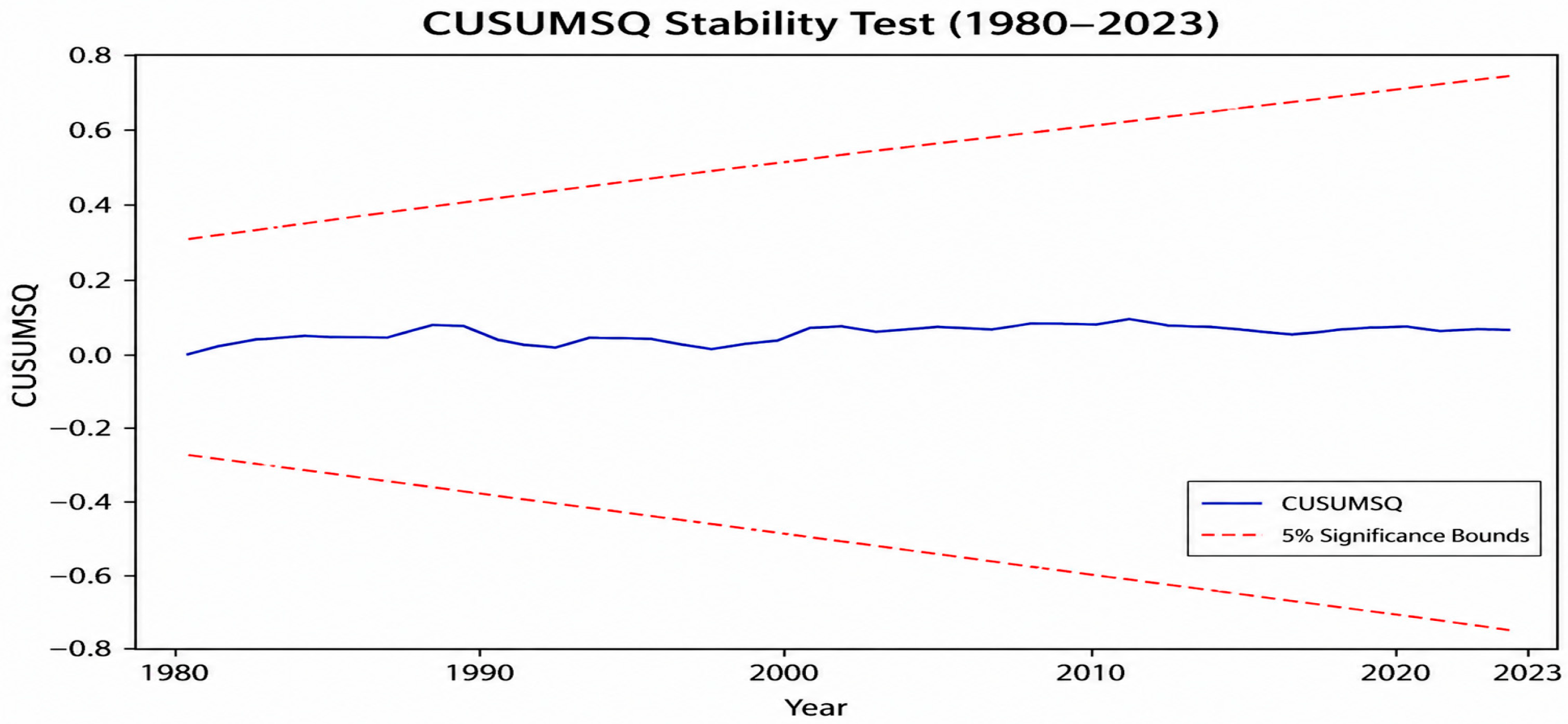
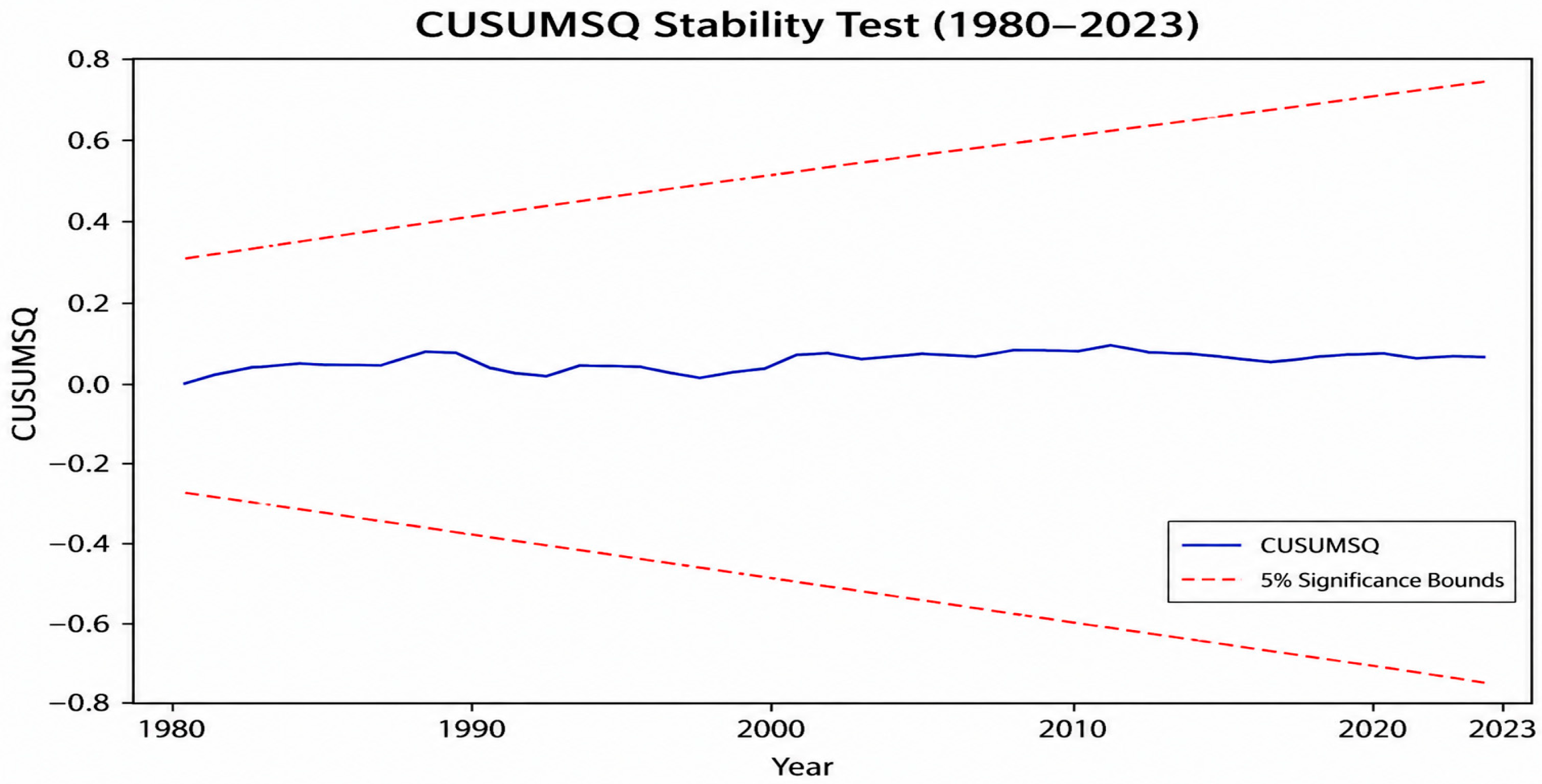
To assess the stability of the estimated ARDL model parameters over the sample period (1980–2023), the Cumulative Sum of Recursive Residuals (CUSUM) and the Cumulative Sum of Squares of Recursive Residuals (CUSUMSQ) tests were conducted following the procedure developed by [38]. These diagnostic tests provide a graphical assessment of parameter constancy and help detect possible structural instability in the estimated model. Within the ARDL framework, parameter stability is important for ensuring the reliability of both short-run and long-run coefficient estimates (Pesaran, Shin, and Smith, 2001) [9].
Figure 6 and Figure 7 present the CUSUM and CUSUMSQ test results. The results show that the plotted statistics remain within the 5% critical bounds throughout the sample period, indicating that the estimated coefficients are stable and that there is no evidence of structural breaks in the model. This confirms that the relationship between energy consumption, economic growth, financial development, industrialization, and population growth remained structurally stable over time. The stability of the model supports the robustness and reliability of the estimated ARDL results and strengthens the validity of the policy implications derived from the analysis.

5. Conclusions, Recommendations and Limitations of the Study

5.1. Conclusions

This study examined the dynamic relationship between energy consumption, economic growth, financial development, population growth, and industrialization in South Africa over the period 1980–2023 using the ARDL modelling approach. The analysis was motivated by persistent energy supply constraints in South Africa and the need to understand how key macroeconomic and structural factors jointly influence energy demand over time. The empirical results reveal important differences between short-run and long-run dynamics.
In the short run, the findings show that economic growth, financial development, industrialization, and population growth all exert statistically significant effects on energy consumption. This indicates that energy demand in South Africa responds strongly to short-term changes in economic activity, particularly through industrial production, income growth, and demographic expansion. These results confirm that energy is a derived demand that increases as economic activity intensifies, especially in an energy-intensive economy such as South Africa.
However, in the long run, economic growth does not have a statistically significant effect on energy consumption. As a result, the long-run relationship between these two variables is not interpreted in terms of magnitude or economic significance. This suggests that over time, structural adjustments such as improvements in energy efficiency, technological change, and shifts in the composition of output may weaken the direct linkage between economic growth and energy demand. Overall, the findings indicate that energy consumption in South Africa is primarily driven by short-run macroeconomic fluctuations and structural factors, while long-run relationships are more complex and potentially influenced by decoupling effects.

5.2. Recommendations

The results of this study translate into several specific and actionable policy interventions for South Africa’s energy and economic management. Since industrialization significantly increases energy consumption in the short run, there is a need for targeted industrial energy management policies rather than uniform national approaches. Energy-intensive sectors such as mining and manufacturing require differentiated load management strategies, including time-of-use electricity pricing, mandatory energy efficiency reporting, and incentives for adopting energy-efficient production technologies. These measures would help reduce peak demand pressure while maintaining industrial output.
Given that economic growth strongly drives energy consumption in the short run, energy planning should be directly aligned with cyclical economic performance. Energy authorities and government planners should adopt a counter-cyclical energy capacity expansion strategy, where increases in economic activity automatically trigger accelerated investment in generation capacity. This could include fast-tracking independent power producer procurement during periods of economic expansion and strengthening reserve capacity requirements linked to GDP growth forecasts. Such an approach would reduce the risk of supply shortages during periods of economic recovery.
Importantly, the Granger causality results reveal no evidence of reverse causality from energy consumption to economic growth, supporting the growth-led energy demand hypothesis. This has significant policy implications, as it suggests that South Africa can implement energy conservation and efficiency policies without severely constraining long-run economic growth. In this context, policymakers can prioritize demand-side management strategies, including energy-saving technologies, efficiency standards, and conservation programmes, while maintaining economic expansion. However, such policies should be carefully designed and gradually implemented to avoid short-term disruptions to production processes, particularly in energy-intensive sectors.
The findings also show that financial development plays a significant role in shaping energy consumption dynamics, suggesting that the financial sector is not fully aligned with energy infrastructure needs. Policy should therefore focus on redirecting financial resources toward energy investment through green finance frameworks, regulatory incentives for banks to fund energy infrastructure, and stronger public–private partnership models in electricity generation and transmission projects. This would improve the contribution of financial deepening to real productive capacity in the energy sector.
Population growth is also found to increase energy consumption significantly, highlighting the importance of integrating energy planning with demographic and urban development policies. Energy infrastructure expansion should be coordinated with urban growth patterns, particularly in rapidly expanding municipalities. This requires improved energy demand forecasting in urban planning, expansion of electrification projects in high-growth areas, and investment in smart grid technologies to manage rising residential and commercial demand more efficiently.
Furthermore, the absence of a significant long-run relationship between economic growth and energy consumption suggests a gradual decoupling between output and energy demand over time. This reinforces the feasibility of pursuing sustainable development strategies that promote economic expansion without proportionate increases in energy use. Policy should therefore prioritize structural transformation toward less energy-intensive sectors, increased investment in renewable energy technologies, and large-scale energy efficiency improvements across both industrial and residential sectors. This would support long-term economic growth while reducing pressure on the national electricity system.

5.3. Limitations

Despite the robustness of the ARDL approach and the contribution of this study to understanding South Africa’s energy–economy relationship, several limitations must be acknowledged. Although the study incorporates a comprehensive set of robustness checks including diagnostic tests, stability tests (CUSUM and CUSUMSQ), a significant error correction mechanism, and consistent causality results, and while alternative estimators such as FMOLS (Fully Modified OLS), DOLS (Dynamic OLS), and CCR (Canonical Cointegrating Regression) could be considered in future research for further validation, the current robustness procedures remain sufficient and consistent with standard ARDL-based empirical studies, the following limitations persist.
Again, a key limitation of this study is the relatively small sample size of 43 annual observations (1980–2023), which constrains the use of higher lag structures in the ARDL framework. As a result, the model is estimated using a parsimonious lag length selected based on information criteria, which may limit the ability to fully capture more complex dynamic adjustments over longer horizons.
The study relies on secondary annual data from the World Bank, which, although widely used and reliable, involves the use of proxy variables that may not fully capture the complexity of financial development, industrial structure, and energy system dynamics. For example, domestic credit to the private sector may not fully reflect financial efficiency or the allocation of credit toward productive versus non-productive sectors.
In addition, the study period includes significant structural changes in South Africa’s energy sector, particularly the escalation of load-shedding from 2008 onwards and the intensification of electricity supply constraints in recent years. While the ARDL framework accommodates dynamic relationships, it may not fully capture structural breaks or regime shifts in the energy system, which could influence parameter stability over time.
A further limitation relates to potential endogeneity and simultaneity bias between key variables. Economic growth, industrialization, and energy consumption are likely to influence each other simultaneously, creating feedback effects that are difficult to fully isolate within a single-equation ARDL framework. Although the inclusion of lagged variables reduces this problem to some extent, it does not eliminate endogeneity concerns. As a result, causal interpretations should be made with caution.
The study is also subject to possible omitted-variable bias, as important determinants such as energy prices, technological innovation, policy reforms, and renewable energy penetration were not included due to data limitations over the long sample period. The exclusion of these variables may affect the completeness of the estimated relationships.
Finally, the findings are context-specific and therefore cannot be fully generalized to all developing countries. South Africa has a unique energy structure dominated by coal-based generation, a highly industrialized mining sector, and a distinct financial system. While the results may be relevant to other upper-middle-income, energy-intensive developing economies, differences in institutional capacity, energy mix, and structural composition limit broader generalization.

Author Contributions

Conceptualization, all authors; methodology, all authors; software, all authors; validation, all authors; formal analysis, all authors; investigation, all authors; resources, all authors; data curation, all authors; writing—original draft preparation, all authors; writing—review and editing, all authors; visualization, all authors; supervision, all authors; project administration, all authors. All authors have read and agreed to the published version of the manuscript.

Funding

This research received no external funding.

Data Availability Statement

The data that support the findings of this study are publicly available from the World Bank’s World Development Indicators (WDI) database. No new data were created or generated in this study. The datasets used were accessed for the period 1980–2023 and are available at: https://data.worldbank.org/.

Acknowledgments

The authors gratefully acknowledge the University of KwaZulu-Natal for the academic support provided throughout the course of this study. This includes research training, cohort-based presentations, and various academic development initiatives that have significantly contributed to building the capacity required to successfully undertake this research. Furthermore, the authors have reviewed and edited the output and take full responsibility for the content of this publication.

Conflicts of Interest

The authors declare no conflicts of interest. The funders had no role in the design of the study; in the collection, analyses, or interpretation of data; in the writing of the manuscript; or in the decision to publish the results.

Abbreviations

The following abbreviations are used in this manuscript:
ARDLAutoregressive Distributed Lag
ECEnergy Consumption
GDPGross Domestic Product
FDFinancial Development
INDIndustrialization
POPPopulation Growth
WDIWorld Development Indicators
ADFAugmented Dickey–Fuller
PPPhillips–Perron
ECMError Correction Model

References

  1. Fine, B. The Political Economy of South Africa: From Minerals-Energy Complex to Industrialisation; Routledge: New York, NY, USA, 2018. [Google Scholar]
  2. Ateba, B.B.; Prinsloo, J.J.; Gawlik, R. The significance of electricity supply sustainability to industrial growth in South Africa. Energy Rep. 2019, 5, 1324–1338. [Google Scholar] [CrossRef] [Scilit]
  3. Ndlovu, V.C. The Role of Renewable Energy in the South African Energy Supply Mix and Economy; University of Pretoria: Pretoria, South Africa, 2020. [Google Scholar]
  4. Ukoba, K.; Jen, T.-C.; Yusuf, A.A. Transformation of South Africa’s energy landscape: Policy implications, opportunities, and technological innovations in the Fourth Industrial Revolution. Energy Strategy Rev. 2025, 59, 101752. [Google Scholar] [CrossRef] [Scilit]
  5. Stern, D.I. Energy and economic growth. In Routledge Handbook of Energy Economics; Routledge: New York, NY, USA, 2019; pp. 28–46. [Google Scholar]
  6. Efayena, O.O.; Anthony, B.O.; Oniore, J.O.; Irikefe, P.O.; Zainudin, A.D. Revisiting the nexus between electricity consumption, economic growth and environmental sustainability in the new BRICS: Asymmetric panel evidence. Cogent Econ. Financ. 2026, 14, 2611622. [Google Scholar] [CrossRef] [Scilit]
  7. Luong, H.G.; Nguyen, T.L.A.; Xuan, V.N. Assessing sustainability indicators of carbon emissions in the Netherlands: The roles of innovation, renewable energy, and economic openness. Environ. Sustain. Indic. 2026, 30, 101167. [Google Scholar] [CrossRef] [Scilit]
  8. Ouyang, Y.; Li, P. On the nexus of financial development, economic growth, and energy consumption in China: New perspective from a GMM panel VAR approach. Energy Econ. 2018, 71, 238–252. [Google Scholar] [CrossRef] [Scilit]
  9. Pesaran, M.H.; Shin, Y.; Smith, R.J. Bounds testing approaches to the analysis of level relationships. J. Appl. Econom. 2001, 16, 289–326. [Google Scholar] [CrossRef] [Scilit]
  10. Apergis, N.; Payne, J.E. Coal consumption and economic growth: Evidence from a panel of OECD countries. Energy Policy 2010, 38, 1353–1359. [Google Scholar] [CrossRef] [Scilit]
  11. Ozturk, I.; Acaravci, A. CO2 emissions, energy consumption and economic growth in Turkey. Renew. Sustain. Energy Rev. 2010, 14, 3220–3225. [Google Scholar] [CrossRef] [Scilit]
  12. Dlamini, Z.; Nzimande, N.P.; Biyase, M.; Khobai, H.; Manguzvane, M.M.; Gumede, S. Carbon emissions and growth: The role of trade and urbanization in Sub-Saharan Africa. Int. J. Energy Econ. Policy 2024, 14, 605–614. [Google Scholar] [CrossRef] [Scilit]
  13. Soytas, U.; Sari, R. Energy consumption and GDP: Causality relationship in G-7 countries and emerging markets. Energy Econ. 2003, 25, 33–37. [Google Scholar] [CrossRef] [Scilit]
  14. Omri, A.; Daly, S.; Rault, C.; Chaibi, A. Financial development, environmental quality, trade and economic growth: What causes what in MENA countries. Energy Econ. 2015, 48, 242–252. [Google Scholar] [CrossRef] [Scilit]
  15. Lee, C.-C.; Chang, C.-P. The impact of energy consumption on economic growth: Evidence from linear and nonlinear models in Taiwan. Energy 2007, 32, 2282–2294. [Google Scholar] [CrossRef] [Scilit]
  16. Romer, P.M. Endogenous technological change. J. Political Econ. 1990, 98, S71–S102. [Google Scholar]
  17. Grossman, G.M.; Krueger, A.B. Economic growth and the environment. Q. J. Econ. 1995, 110, 353–377. [Google Scholar] [CrossRef] [Scilit]
  18. Nguyen, B.N.; Nguyen Thi Phuong, T.; Nguyen, T.L.A.; Luong, H.G.; Ngoc Xuan, V. Energy transition, innovation, and foreign investment effects on CO2 emissions in Belgium: Evidence from an ARDL approach. Energy Explor. Exploit. 2026. [Google Scholar] [CrossRef] [Scilit]
  19. Prempeh, K.B. The role of economic growth, financial development, globalization, renewable energy and industrialization in reducing environmental degradation in the economic community of West African States. Cogent Econ. Financ. 2024, 12, 2308675. [Google Scholar]
  20. Bui, H.Q.; Tran, T.; Vo, A.T.; Vo, D.H. Financial development, energy consumption, and economic growth in the ASEAN countries: Evidence from the PVAR approach. Environ. Sci. Pollut. Res. 2023, 30, 114249–114263. [Google Scholar] [CrossRef] [Scilit] [PubMed]
  21. Elmonshid, L.B.E.; Sayed, O.A.; Awad Yousif, G.M.; Eldaw, K.E.H.I.; Hussein, M.A. The impact of financial efficiency and renewable energy consumption on CO2 emission reduction in GCC economies: A panel data quantile regression approach. Sustainability 2024, 16, 6242. [Google Scholar] [CrossRef] [Scilit]
  22. Iheonu, C.O.; Anyanwu, O.C.; Odo, O.K.; Nathaniel, S.P. Does economic growth, international trade, and urbanization uphold environmental sustainability in sub-Saharan Africa? Insights from quantile and causality procedures. Environ. Sci. Pollut. Res. 2021, 28, 28222–28233. [Google Scholar] [CrossRef] [Scilit]
  23. Sasana, H.; Khusniati, N.a.; Purnomo, R.A.; Shafiai, M.H.M. Analysis of Green Investment, Access to Clean Fuels, Green Jobs, Green Energy, and CO2 Emissions on Economic Growth and Welfare: An Empirical Study in Developing Countries. Int. J. Energy Econ. Policy 2026, 16, 251. [Google Scholar] [CrossRef] [Scilit]
  24. Ulucak, R.; Danish; Zhang, Y.; Chen, R.; Qiu, Y. Income inequality, economic complexity, and renewable energy impacts in controlling consumption-based carbon emissions. Eval. Rev. 2024, 48, 119–142. [Google Scholar] [CrossRef] [Scilit]
  25. Inah, O.I.; Akuru, U.B.; Sotenga, P.Z. Modelling South Africa’s Carbon-Peak Trajectories through a Decoupling–Markov Chain–Monte Carlo (D-MCMC) Energy–Economic Transition Framework. Results Eng. 2026, 29, 108979. [Google Scholar] [CrossRef] [Scilit]
  26. Singh, G.J.; Singh, P.K.; Kumar, R.; Aman, A.; Alam, I.; Fatma, R.; Ansari, S. Dynamic Causality between CO2 Emissions, Urbanization and Economic Growth in India and South Africa. Int. J. Energy Econ. Policy 2026, 16, 276. [Google Scholar] [CrossRef] [Scilit]
  27. Sadorsky, P. Financial development and energy consumption in Central and Eastern European frontier economies. Energy Policy 2011, 39, 999–1006. [Google Scholar] [CrossRef] [Scilit]
  28. Shahbaz, M.; Lean, H.H. Does financial development increase energy consumption? The role of industrialization and urbanization in Tunisia. Energy Policy 2012, 40, 473–479. [Google Scholar] [CrossRef] [Scilit]
  29. World Bank. World Development Indicators; World Bank: Washington, DC, USA, 2026; Available online: https://databank.worldbank.org/source/world-development-indicators?utm_source=chatgpt.com (accessed on 8 May 2026).
  30. Belaïd, F.; Taylor, M. From energy deprivation to decarbonization constraints: A global typology of residential energy use. Energy Policy 2026, 212, 115140. [Google Scholar] [CrossRef] [Scilit]
  31. Nathaniel, S.P.; Iheonu, C.O. Carbon dioxide abatement in Africa: The role of renewable and non-renewable energy consumption. Sci. Total Environ. 2019, 679, 337–345. [Google Scholar] [CrossRef] [Scilit]
  32. Adebayo, M.T.; Ilesanmi, K.D. The human capital–Green growth nexus in South Africa. J. Econ. Financ. Sci. 2026, 19, 1061. [Google Scholar] [CrossRef] [Scilit]
  33. Jeleč Raguž, M. Economic Growth and CO2 Emissions in Croatia: An ARDL-Based Assessment of the EKC Hypothesis. Sustainability 2026, 18, 1427. [Google Scholar] [CrossRef] [Scilit]
  34. Bakri, M.A.; Chia, Y.-E.; Chia, R.C.-J. Trade openness and carbon emissions using threshold approach: Evidence from selected Asian countries. Carbon Res. 2025, 4, 47. [Google Scholar] [CrossRef] [Scilit]
  35. Văidean, V.-L.; Turceniuc, A.-R. Quality, Energy Consumption, and Economic Growth: A Quantitative. In Innovation, Sustainability, and Growth in a VUCA Environment: Proceedings of the 5th International Conference on Modern Trends in Business, Hospitality and Tourism (ICMTBHT), Cluj-Napoca, Romania, 22–24 May 2025; Springer Nature: Berlin/Heidelberg, Germany, 2026; p. 83. [Google Scholar]
  36. Apergis, N.; Payne, J.E. Energy consumption and growth in South America: Evidence from a panel error correction model. Energy Econ. 2010, 32, 1421–1426. [Google Scholar] [CrossRef] [Scilit]
  37. Khobai, H.B.; Le Roux, P. The relationship between energy consumption, economic growth and carbon dioxide emission: The case of South Africa. Int. J. Energy Econ. Policy 2017, 7, 102–109. [Google Scholar]
  38. Brown, R.L.; Durbin, J.; Evans, J.M. Techniques for testing the constancy of regression relationships over time. J. R. Stat. Soc. Ser. B Stat. Methodol. 1975, 37, 149–163. [Google Scholar]
Figure 1. Energy Consumption. Source: Authors Own Computation, Eviews 14 [29].
Energies 19 02329 g001
Figure 2. Economic Growth. Source: Authors Own Computation, Eviews 14 [29].
Energies 19 02329 g002
Figure 3. Financial Development. Source: [29].
Energies 19 02329 g003
Figure 4. Industrialization. Source: Authors Own Computation, Eviews 14 [29].
Energies 19 02329 g004
Figure 5. Population growth. Source: Authors Own Computation, Eviews 14 [29].
Energies 19 02329 g005
Figure 6. CUSUM Stability Tests. Source: Authors Own Computation, Eviews 14 [29].
Energies 19 02329 g006
Figure 7. CUSUM of Squares (CUSUMSQ) Stability Tests. Source: Authors Own Computation, Eviews 14 [29].
Energies 19 02329 g007
Table 1. Descriptive statistics test results.
StatisticEnergy Consumption (EC)Economic Growth (GDP)Financial Development (FD)Industrialization (IND)Population Growth (POP)
Mean2642.47540.485460.952331.856457.8685
Median2641.26970.842862.258329.619357.7458
Maximum2965.88924.278478.284145.479466.4565
Minimum2398.6572−4.557241.607625.756848.4254
Standard Deviation173.14842.37859.74715.88465.7283
Skewness0.1372−0.3795−0.10490.92630.0708
Kurtosis2.35462.62131.86542.26381.7841
Jarque–Bera1.73211.81481.72185.04862.3408
Probability0.42680.41750.43520.09280.2963
Sum113,626.4420.87222620.951369.832488.35
Sum Sq. Dev.1,280,000.00239.454025.601500.201437.10
Observations4343434343
Source: Authors Own Computation, Eviews 14 [29].
Table 2. Unit root test results.
Part A: Augmented Dickey–Fuller (ADF) Unit Root Test
VariableStationarity in Levels (Without Trend)Stationarity in Levels (With Trend)Stationarity in First Difference (Without Trend)Stationarity in First Difference (With Trend)
EC (Energy Consumption)−1.812−2.645−6.902 ***−6.511 ***
GDP (Economic Growth)−2.101−2.388−5.774 ***−6.803 ***
FD (Financial Development)−1.433−2.512−7.991 ***−8.110 ***
POP (Population Growth)−1.256−2.104−4.623 ***−5.701 ***
IND (Industrialization)−1.587−2.763−8.672 ***−8.401 ***
Part B: Dickey–Fuller GLS (DF-GLS) Unit Root Test
VariableStationarity in Levels (Without Trend)Stationarity in Levels (With Trend)Stationarity in First Difference (Without Trend)Stationarity in First Difference (With Trend)
EC (Energy Consumption)−2.393−2.739−6.861 ***−6.264 ***
GDP (Economic Growth)−1.265−1.362−5.942 ***−6.762 ***
FD (Financial Development)−0.973−2.971−4.456 ***−6.189 ***
POP (Population Growth)−2.558−2.187−4.748 ***−8.973 ***
IND (Industrialization)−1.416−1.042−6.196 ***−6.189 ***
Part C: Phillips–Perron Unit Root Test
VariableStationarity in Levels (Without Trend)Stationarity in Levels (With Trend)Stationarity in First Difference (Without Trend)Stationarity in First Difference (With Trend)
EC (Energy Consumption)−1.542−2.819−6.631 ***−6.378 ***
GDP (Economic Growth)−2.249−2.421−5.863 ***−8.688 ***
FD (Financial Development)−1.672−2.147−8.243 ***−8.275 ***
POP (Population Growth)−1.053−2.321−4.785 ***−5.892 ***
IND (Industrialization)−1.394−2.951−9.254 ***−8.934 ***
Part D: Zivot–Andrews Structural Break Unit Root Test
VariableLevel t-StatisticBreak YearFirst Difference t-StatisticStationarity Decision
EC (Energy Consumption)−4.212009−7.88 ***I(1)
GDP (Economic Growth)−3.952020−6.74 ***I(1)
FD (Financial Development)−4.102015−8.02 ***I(1)
POP (Population Growth)−3.882011−5.96 ***I(1)
IND (Industrialization)−4.332008−7.51 ***I(1)
Note: *** denote statistical significance at 1% levels, respectively. Source: Authors Own Computation, Eviews 14 [29].
Table 3. Lag Length Criteria.
LagLogLLRFPEAICSCHQ
0181.461NA3.2 × 10−13−5.497−5.242−6.378
1635.189749.251.5 × 10−17−20.286−18.178 *−20.245 *
2673.083123.001.4 × 10−19−20.393−16.351−19.969
3731.742114.421.2 × 10−19 *−20.838−15.867−18.645
4792.334132.67 *1.3 × 10−19−21.273−13.948−18.369
Note: * denote stationarity at 10% significance levels, respectively. * Lag selected based on Schwarz Criterion (SC) as it minimizes information loss and prevents overfitting. Source: Authors Own Computation, Eviews 14 [29].
Table 4. ARDL bounds test for cointegration results.
Test StatisticValueK
F-Statistic16.97564
Critical Value Bounds (Actual Sample Size = 43)
Significance LevelI(0) BoundI(1) Bound
10%2.193.10
5%2.263.41
1%2.733.69
Source: Authors Own Computation, Eviews 14 [29].
Table 5. Long-run elasticities including constant (1980–2023).
VariableCoefficientStandard Errort-Statistic
Constant1.34820.46832.88 ***
GDP (Economic Growth)0.03360.37280.09
FD (Financial Development)0.11450.06971.64 *
IND (Industrialization)0.02560.00426.10 ***
POP (Population growth)0.24180.12841.88 *
D (Dummy/Other control)−0.07940.2875−0.28 **
Note: *, **, *** denote statistical significance at 10%, 5%, and 1% levels, respectively. Source: Authors Own Computation, Eviews 14 [29].
Table 6. Short-run dynamics and error correction.
VariableCoefficientStandard Errort-Statisticp-Value
D(GDP)0.21870.24200.9050.3725
D(FD)0.02780.006154.5260.0001 ***
D(IND)0.34680.08434.1140.0002 ***
D(POP)0.01690.004024.2040.0002 ***
D(GDP(-1))−0.24840.06646−3.7370.0007 ***
ECM(-1)−0.24840.0882−2.8180.0075 ***
Note: *** denote statistical significance at 1% levels, respectively. Source: Authors Own Computation, Eviews 14 [29].
Table 7. Granger causality test results.
Null HypothesisObsF-StatisticProb.Decision
GDP does not Granger cause EC404.21560.0213 **Reject null (5%)
EC does not Granger cause GDP400.84270.4385Fail to reject
FD does not Granger cause EC424.38720.0187 **Reject null (5%)
EC does not Granger cause FD420.62350.5392Fail to reject
IND does not Granger cause EC423.91240.0289 **Reject null (5%)
EC does not Granger cause IND420.95780.3926Fail to reject
POP does not Granger cause EC422.64510.0842 *Reject null (10%)
EC does not Granger cause POP422.98170.0675 *Reject null (10%)
Note: *, ** denote statistical significance at 10% and 5% levels, respectively. Source: Authors Own Computation, Eviews 14 [29].
Table 8. Diagnostic test results.
TestNull Hypothesist-Statistic/Test StatisticProbability (p-Value)Decision
LM Test (2)No serial correlation1.268190.2136Fail to reject null (no serial correlation)
Jarque–Bera TestResiduals are normally distributed4.329810.1269Fail to reject null (normal residuals)
White Test (no cross terms)No conditional heteroskedasticity541.31090.2351Fail to reject null (homoskedastic)
Source: Authors Own Computation, Eviews 14 [29].
Disclaimer/Publisher’s Note: The statements, opinions and data contained in all publications are solely those of the individual author(s) and contributor(s) and not of MDPI and/or the editor(s). MDPI and/or the editor(s) disclaim responsibility for any injury to people or property resulting from any ideas, methods, instructions or products referred to in the content.