Article

Analysis of the Impact of Thermal and Electrical Energy Storage Solutions Coupled with PV and CSP Plants in Microgrids


by
Gabriella Ferruzzi
and
Raffaele Liberatore
*
ENEA, Italian National Agency for New Technologies, Energy and Sustainable Economic Development, Lungotevere Thaon di Revel 76, 00196 Rome, Italy
*
Author to whom correspondence should be addressed.
Energies 2026, 19(10), 2327; https://doi.org/10.3390/en19102327
Submission received: 20 February 2026 / Revised: 19 April 2026 / Accepted: 1 May 2026 / Published: 12 May 2026
(This article belongs to the Section A1: Smart Grids and Microgrids)

Abstract

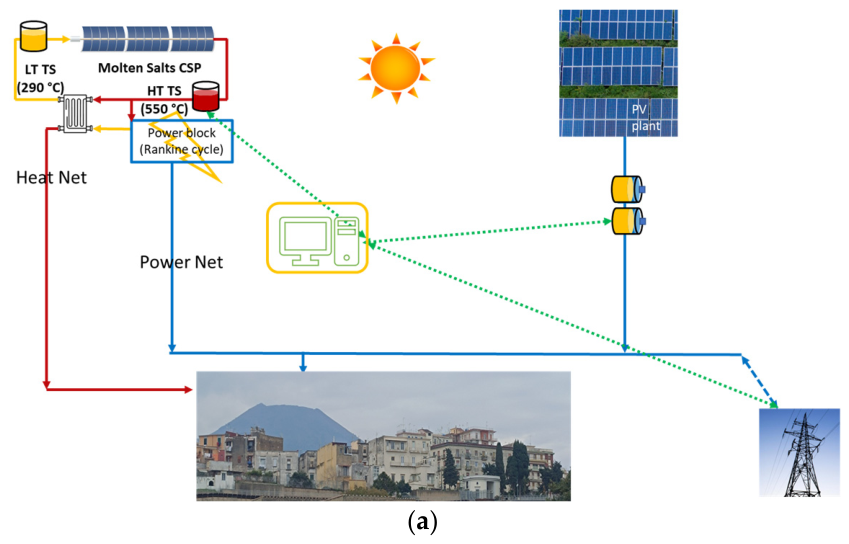
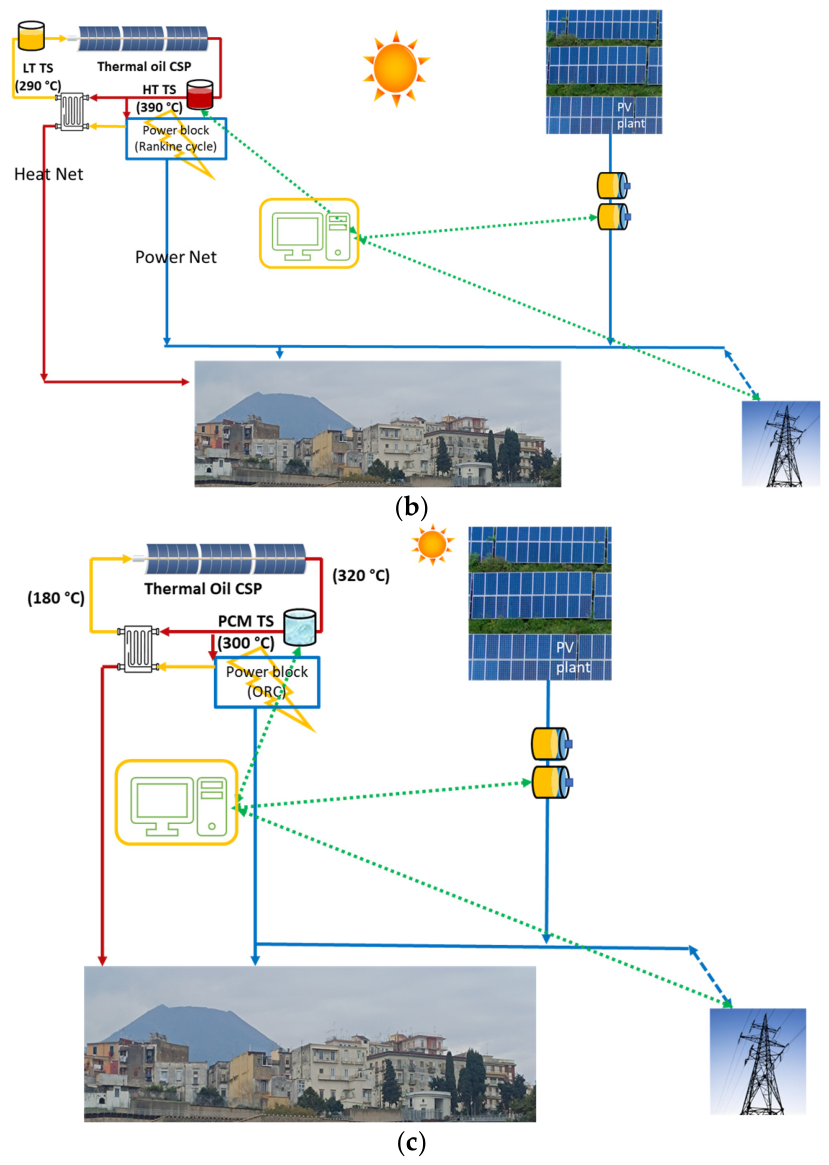
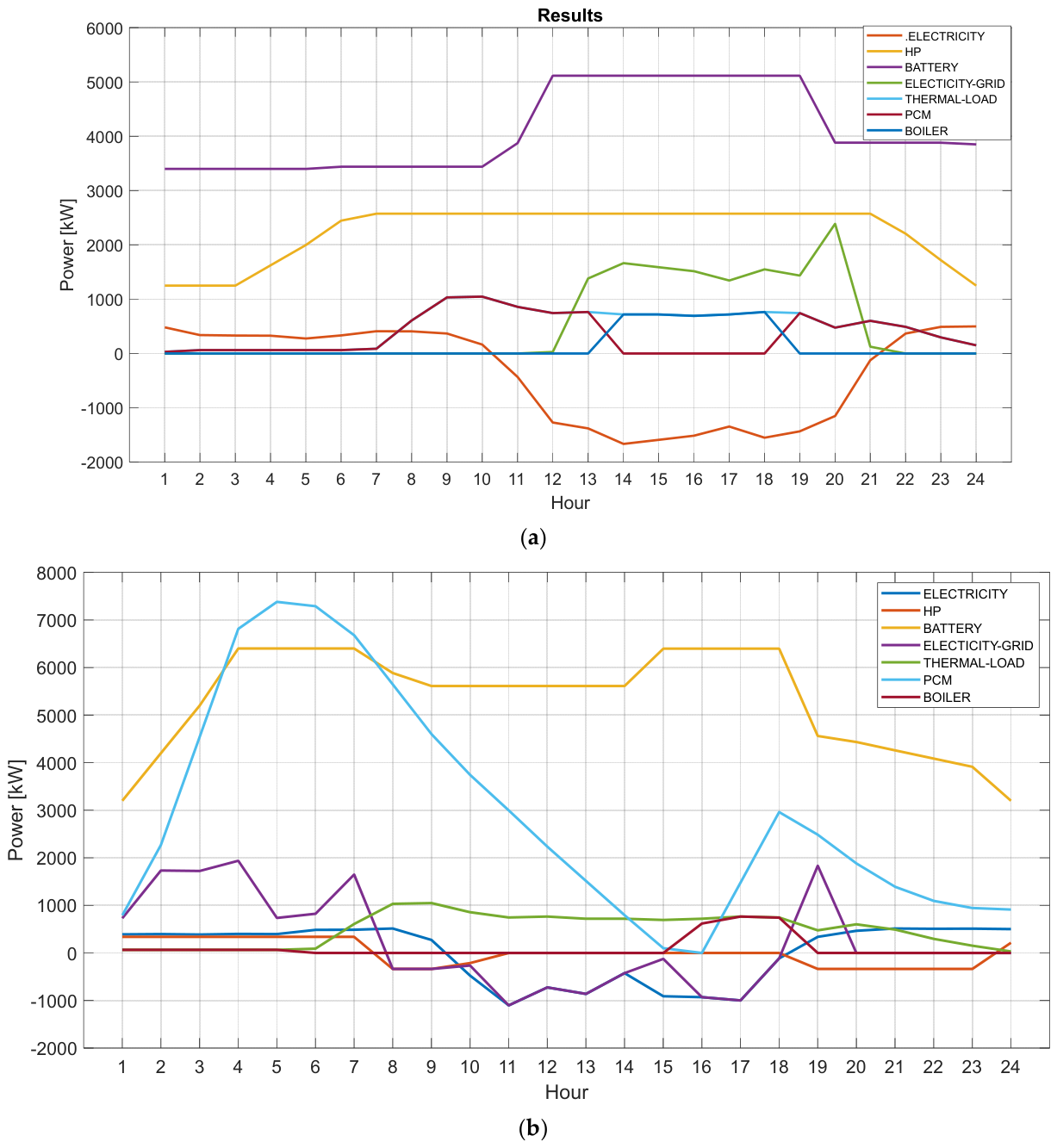
This study analyzes the impact of thermal and electrical storage solutions coupled with Photovoltaic (PV) and Concentrating Solar Power (CSP) plants, proposing an innovative model to test a Hybrid Energy Storage System (HESS). The work presents an innovative Mixed Integer Linear Programming (MILP) model to determine the optimal configuration and operational strategy of a HESS within a grid-connected Microgrid (MG). The research focuses on the synergistic integration of PV with Lithium-ion Electrical Energy Storage (EES) and CSP with Thermal Energy Storage (TES). The MG includes dynamic residential, commercial, and hospital loads. The MILP model is optimized over a 24 h horizon across four season-representative days, utilizing a multi-criteria objective function that balances economic performance and CO2 emissions via a weighting factor ω ∈ [0, 1]. Three distinct CSP options such as Parabolic Trough Collectors with varying Heat Transfer Fluids (molten salt or thermal oil) and TES types (direct and indirect dual-tank, or Phase Change Material) are analyzed, each coupled with a Rankine or Organic Rankine Cycle. Key constraints address energy balances, component efficiencies, power limits, and storage dynamics. The comprehensive results identify the most suitable technology portfolio mix and optimal hour-by-hour operational rules, providing transparent decision-making criteria based on storage size, process temperatures, and specific demand profiles.
Keywords: hybrid energy storage; thermal energy storage; microgrids; key performance indexes hybrid energy storage; thermal energy storage; microgrids; key performance indexes