Article

Frequency-Domain 3D BSEM Forward and Inverse Modeling and Application in HDR Energy Monitoring and Development in the Gonghe Basin

1
College of Geo-Exploration Science and Technology, Jilin University, Changchun 130026, China
2
Center for Hydrogeology and Environmental Geology Survey, China Geological Survey, Tianjin 300309, China
3
School of Earth and Space Sciences, University of Science and Technology of China, Hefei 230026, China
*
Authors to whom correspondence should be addressed.
Energies 2026, 19(10), 2326; https://doi.org/10.3390/en19102326
Submission received: 19 March 2026 / Revised: 5 May 2026 / Accepted: 9 May 2026 / Published: 12 May 2026

Abstract

The formation and exploitation of geothermal reservoirs in hot dry rock (HDR) primarily rely on microseismic methods, but seismic techniques lack sufficient sensitivity to fluids. The electromagnetic method, however, demonstrates sensitivity to fluid movements during the monitoring of fracturing processes that form geothermal reservoirs in HDR. This study examines the role of electromagnetic methods in HDR development, taking China’s first Enhanced Geothermal System (EGS) demonstration site in the Qinghai Gonghe Basin as a case study. Based on the Gonghe HDR development site, a frequency-domain 3D borehole-to-surface electromagnetic forward modeling method with unstructured-grid discretization was employed to simulate the complex electromagnetic field responses induced by fracturing fluid injection and dynamic changes in fractures during HDR reservoir development. To enhance computational efficiency, a supercomputer was employed to perform 3D borehole-to-surface electromagnetic data inversion under conditions of massive multi-source and multi-frequency data. This quantitatively revealed the electrical characteristics at different depth intervals within the study area. The research demonstrates the feasibility of borehole-to-surface electromagnetic methods for determining the spatial distribution of fracturing injection, dynamically monitoring fracture development, and tracking fluid migration, thereby providing crucial technical support for monitoring HDR resources development.

1. Introduction

Geothermal energy, due to its cleanliness, operational stability, and widespread distribution, has become a key focus of research and development worldwide as a new energy source. HDR refers to high-temperature rock bodies with little or no water, which are widely distributed and possess immense resource potential [1]. Statistics indicate that the energy potential of HDR resources at depths of 3–10 km underground is equivalent to 30 times the combined energy reserves of all the world’s oil, natural gas, and coal deposits [2,3]. Currently, due to limitations in technology and methodology, the human development and utilization of HDR resources have primarily focused on shallow-buried, high-temperature underground HDR bodies.
Enhanced Geothermal Systems (EGSs) are generally used for HDR development [4]. Through engineering fracturing and other techniques, circulation channels are established within low-permeability reservoirs. The circulating medium then transports reservoir heat to the surface for utilization. By controlling water injection pressure, large volumes of low-temperature fluid are injected into the high-temperature rock mass. The temperature difference causes the rock to cool rapidly and abruptly, generating thermal shock stresses [5]. This induces the displacement and extension of existing fractures within the reservoir, thereby creating an effective heat exchange area [6]. As a fluid migration channel, the fracture network is crucial for the exploitation and utilization of HDR thermal energy [7]. Hydraulic fracturing primarily involves activating pre-existing natural fractures, a process controlled by the in situ stress field. With current technology, it is difficult to know the stress distribution within the well, let alone that of distant wells. Stress directions may vary with reservoir depth, making fracture propagation direction unpredictable. Additionally, due to the difficulty in measuring and simulating subsurface geological structures, structural characteristics, and hydraulic parameters, it is challenging to determine the extent of fracture propagation and the scope of modification after fracturing. Currently, the effect of reservoir modification is primarily monitored through microseismic surveys. However, microseismic monitoring faces two limitations: one is the issue of positioning accuracy, and the other is that not all fluid entry channels generate seismic events. Therefore, its effectiveness in evaluating reservoir stimulation monitoring remains inaccurate and unreliable [8,9,10].
Fracturing fluid injection, as it propagates, induces anomalies in the physical, chemical, and other responses of the surrounding and overlying reservoir media, particularly electrical and electrochemical anomalies. Water-bearing fractures in HDR reservoirs cause a significant resistivity difference compared with the surrounding rock, forming the theoretical basis for the application of electromagnetic methods [11]. The HDR reservoir at the Gonghe experimental site is composed of dense granite. The fractures and fracture clusters formed during reservoir fracturing are extremely complex and irregular, with small fracture widths and limited lengths. Conducting electromagnetic surveys on the ground makes it challenging to obtain electromagnetic responses from fluids and difficult to predict the spatial distribution characteristics of the fractures.
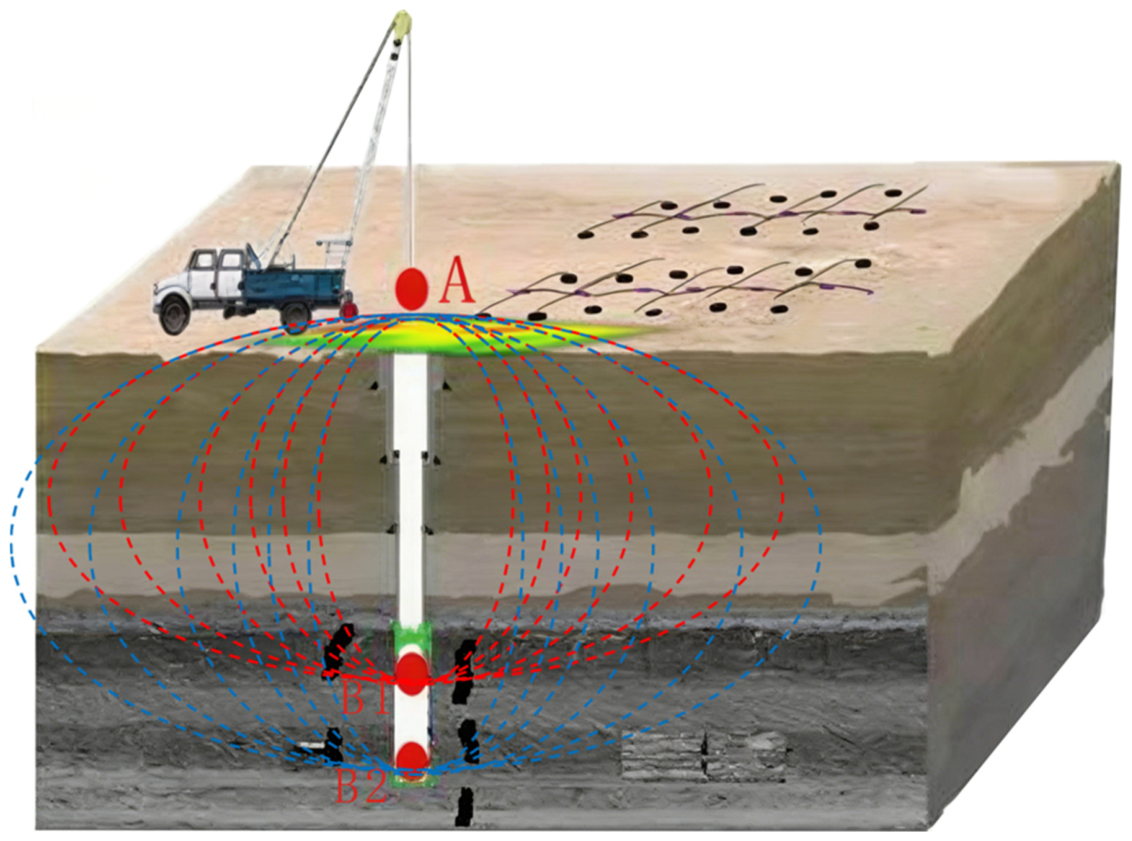
The borehole-to-surface electromagnetic method (BSEM) is an electromagnetic exploration technique that supplies high-power alternating current to a finite-length conductor within a borehole, while receiving electromagnetic responses at the surface and within the borehole [12,13,14]. In BSEM, one electrode of the transmitter array is positioned near the borehole entrance, while the other is placed within the borehole. Through two successive excitations, discrete square-wave electric fields of different frequencies are transmitted around the borehole. When the generated electromagnetic field signal diffuses around the target body, the body generates an electromagnetic response that can be observed both at the surface and within the borehole. Due to the proximity of the field source to the geological target, the generated excitation signal is strong. This transmission method yields surface data with a higher signal-to-noise ratio than traditional surface electromagnetic methods, providing advantages not found in other electrical methods [15]. The BSEM is widely applied in mineral exploration, and, with the improvement of data analysis and interpretation techniques, it has been extended to the oil, gas, and geothermal fields. Applications include determining the direction and flow rate of local groundwater fluids [16] and delineating the boundaries of oil and gas reservoirs [11], providing crucial data for further oil and gas field development.
As China’s first demonstration project for the investigation, exploration, and trial extraction of HDR resources, the site in the Gonghe Basin entered the development stage in 2019 [17]. Tens of thousands of cubic meters of fluid have been injected through fracturing, generating numerous fractures or fracture clusters near the wellbore and providing space for water storage. The water-bearing fractures and fracture clusters significantly reduce the resistivity of the HDR mass, which provides a solid physical basis for studying their distribution using the BSEM method. Existing studies on borehole-to-surface electromagnetic methods still present notable limitations. Ref. [11] established a borehole-to-surface time–frequency electromagnetic sounding system targeting hydrocarbon exploration and carried out preliminary three-dimensional numerical simulation and inversion exploration. However, it neither adopted refined unstructured grid discretization and efficient optimization algorithms, nor performed large-scale three-dimensional frequency-domain inversion. Furthermore, it lacked specialized application to hydraulic fractures of deep granite HDR. Ref. [15] is limited only to forward mechanism analysis and model tests, with no three-dimensional inversion conducted and no practical application to hot dry rock reservoir evaluation. Ref. [18] carried out borehole-to-surface electromagnetic anisotropic forward modeling for marine gas hydrate exploration. It merely focused on numerical simulation analysis without the support of inversion algorithms, and its research scenario differs significantly from fracture exploration of deep terrestrial HDR.
Different from the above previous studies, this paper integrates the unstructured grid finite-element method with L-BFGS iterative inversion to establish a frequency-domain three-dimensional borehole-to-surface electromagnetic forward and inversion method. This method is applied to China’s first demonstration project for resource investigation, exploration and the pilot production of HDR. By analyzing the electromagnetic responses induced by fracturing fluid migration and fracture variation, the spatial distribution of fracturing water injection is investigated. This research is expected to provide theoretical guidance for analyzing the development characteristics, distribution regularities and stimulation effects of hydraulic fractures at the Gonghe geothermal site, and supports the investigation and evaluation of HDR resources.

2. Geological Characteristics of Gonghe HDR Development Site

The Gonghe Basin is situated at the western end of the West Qinling Orogenic Belt in northeastern Qinghai Province, bordered by Qinghai Lake to the north and the Longyangxia Reservoir of the Yellow River to the south. As Qinghai’s third-largest basin, it is traversed by the Yellow River from south to north along its short axis. The boundaries of its geological and geomorphological units are primarily controlled by faults trending northwest, northwest–west, and nearly north–south. Existing geophysical and drilling data within the basin indicate a widespread absence of Jurassic and Cretaceous strata. Since the Late Pleistocene, intense tectonic activity has caused the uplift of the surrounding mountains and a significant subsidence of the basin, leading to the deposition of thick Tertiary and Quaternary sediments. This has resulted in the exposure of the Paleogene–Neogene strata of the Xining, Linxia, and Xianshuihe Formations, as well as Quaternary deposits. These formations are widely distributed, with maximum thicknesses reaching 6000–7000 m. The basement of the Gonghe Basin primarily consists of Pre-Triassic shallow metamorphic strata and Indo-Yanshan intermediate-acidic rocks, which are extensively exposed at the highest elevations of the surrounding mountains [19].
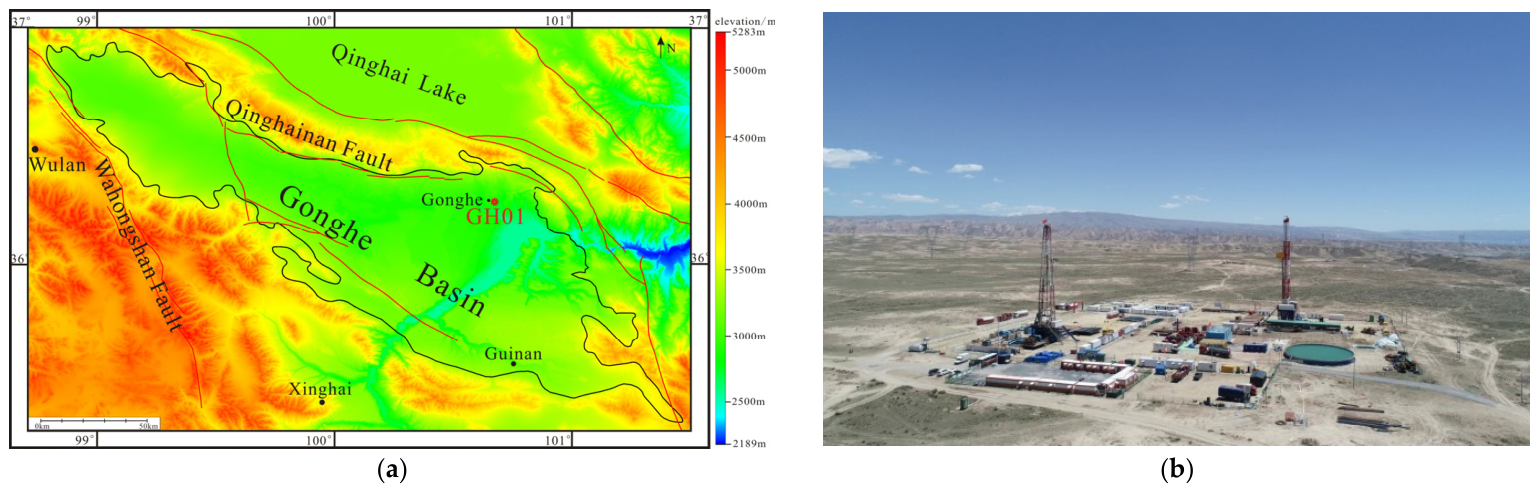
In 2017, China achieved a breakthrough in HDR exploration by drilling to high-quality HDR with a temperature of 236 °C at an elevation of 3705 m in Qiaobuqia Town, Gonghe Basin, Qinghai Province. In 2019, the China Geological Survey conducted the first test fracturing operation on a geothermal reservoir well in the Gonghe Basin to obtain stratigraphic parameters, marking the entry of China’s HDR resources into the development stage [20]. However, due to a relatively late start, numerous challenges and issues remain in the exploration and development of geothermal resources [21,22]. To precisely characterize the spatial distribution of reservoir fractures and determine the distribution direction of injected fluid, this study relies on actual production data from well GH01 in the southeastern part of Gonghe County, Qinghai Province. It conducts a 3D forward modeling of a frequency-domain BSEM method based on unstructured-grid discretization. This research provides technical support and a scientific basis for the efficient exploration, development, and sustainable utilization of HDR resources. The HDR development site is shown in Figure 1.
Well GH-01 has a total depth of 4003 m. Drilling revealed that the interval from the surface to 1360 m consists of fluvial–lacustrine sedimentary cover, while the interval from 1360 m to 4000 m comprises Middle-Late-Triassic granitic bodies. The geothermal reservoir is composed of low-permeability, hard granite, which contains little or no fluid due to its high temperature [23]. Through hydraulic fracturing, a hole is drilled deep into the target layer, and fracturing fluid is injected to increase bottom-hole pressure. After hydraulic fracturing and water injection, a certain amount of water-filled fractures form in the exploration target layer. The granite reservoir is extremely dense, and, during the hydrofracturing process, low-temperature-induced thermal stress and injected water pressure jointly influence fracture initiation and propagation [24], leading to the formation of numerous fractures. Granite is a high-resistivity body. Geophysical logging data indicate that the resistivity of granite bodies at depths between 2880 and 4000 m ranges from 11,500 to 38,000 Ω·m. When fluids enter the fracture clusters within granite reservoirs, a distinct low-resistivity zone forms. This relatively low-resistivity anomaly provides a solid physical basis for studying the distribution of water-rich fractures in HDR reservoirs using the BSEM method.

3. Electromagnetic Field Response Simulation of HDR Fracturing

A ground-based high-power transmitter emits alternating electromagnetic field signals through the power supply electrodes. On the surface, measurement points are established in accordance with the operational design. Data acquisition stations record potential signals received between electrodes radially oriented toward the wellbore. The collected voltage signals are processed through a series of procedures to obtain information reflecting subsurface geological targets. The operation of the BSEM system is shown in Figure 2. To further simulate and study the changes in ground potential during the monitoring of geothermal energy extraction and injected water dynamics using the BSEM in HDR development, and to comprehensively analyze its application potential in addressing related detection and monitoring challenges [11], this article examines the dynamic monitoring capability of the BSEM by varying the model’s resistivity (to simulate resistivity changes in water-rich fractures). The method’s detection resolution for fluid migration direction is evaluated by adjusting the model orientation. Additionally, its effectiveness in detecting fractures of different sizes is assessed by modifying the model dimensions.

3.1. Forward Algorithm

Taking the time-harmonic factor as e i ω t , the frequency-domain electromagnetic field satisfies Maxwell’s equations [25]:
× E = i ω μ H
× H = J s + σ E
where E is the electric field, H is the magnetic field, ω is the angular frequency, μ is the magnetic permeability of free space with a value of 4 π × 10 7 H · m 1 , σ is the electrical conductivity of the subsurface medium, and J s represents the source term. By taking the curl of Equation (1) and substituting Equation (2), we derive the second-order vector Helmholtz equation for the electric field:
× × E + i ω μ σ E = i ω μ J s
Two approaches are available to deal with the source current J s : the total field method and the secondary field method. In the controlled-source electromagnetic methods (CSEMs), the secondary field method is typically employed to reduce the singularity caused by the field source. However, for complex models, particularly those with undulating terrain, it is difficult to select an appropriate background model for the secondary field method. In this case, the total field method is more adaptable. After careful consideration, the total field method is used in this study.
For BSEM, the electric dipole field source at position ( x 0 , y 0 , z 0 ) can be expressed as
J s = I δ x 0 δ y 0 δ z 0 d
where I is the current intensity, δ is the Dirac delta function, and d is the direction of the field source. If the computational domain is sufficiently large, we can assume that the electromagnetic field has sufficiently attenuated at the boundary; then, the boundary condition is
n × E = 0
where n is the normal vector on the boundary.
The solution domain is discretized by unstructured hexahedral and tetrahedral meshes. To satisfy the electric field continuity condition, edge-based shape functions are defined to construct vector element. Dot product both sides of Equation (3) with the vector shape function V and integrate over the entire computational domain:
Ω × × E + i ω μ σ E V d Ω = i ω μ Ω J s V d Ω
where   Ω is the computational domain, V H ( c u r l ; Ω ) , and H ( c u r l ; Ω ) is the Hilbert space of curl-squared integrable functions, defined as
H c u r l ; Ω = u L 2 Ω × u L 2 ( Ω ) }
where L 2 Ω denotes the space of square-integrable functions.
According to the vector identity and the principle of integration by parts, Equation (7) can be transformed into
Ω × E × V + i ω μ σ E V d Ω = i ω μ Ω J s V d Ω
Equation (8) is the functional form equivalent to Equation (3). Calculating and summing Equation (8) for each cell in the region, we obtain
e Ω e × E × V + i ω μ σ E V d e = i ω μ e Ω e J s V d e
The integral over each element can be calculated via analytical or numerical integration, and the following system of linear equations can eventually be obtained:
K E = S
where K is a large, sparse matrix, S is a vector representing the source contribution, and E is the electric field component to be solved, that is, the electric field values on the edges of unstructured tetrahedral elements.
For the field source expressed by Equation (10), the right-hand side term s is nonzero only within the element where the source is located. Because the integral of the Dirac function is 1, s can be expressed as
s i = i ω μ V i d
where s i is the i-th component of the source vector, and V i is the i -th basis function.
By solving Equation (11), the interpolation coefficients for each edge can be obtained. The electric field value at any point can then be calculated by the formula
E = i = 1 N f e i V I
where N f is the number of shape functions on the element. e i is the interpolation coefficient for the i -th edge.

3.2. Establishment of Geoelectric Model for Fracturing of HDR

The BSEM performs multiple equidistant excitations directly on the target layer in the well. A high-density surface measurement network is employed to observe the target layer, which is sensitive to its resistivity. Water-bearing fractures and the surrounding rock exhibit a significant resistivity difference, forming a solid–liquid boundary. This electrical heterogeneity easily induces charging and discharging effects, which generate induced electromagnetic fields. These induced fields cause variations in the electromagnetic signal curves recorded by ground-based observation stations. By extracting the electrical and phase anomalies resulting from these differences and changes, the range and boundaries of the target body can be effectively determined.
To evaluate the BSEM’s ability to detect fracturing fluid migration and fracture changes, this study conducts the identification of low-resistivity fractures within the depth range of 3250–3950 m. This is combined with the depth data of the main fracturing interval (3600–3900 m) from the hydraulic fracturing operation of GH01. Forward modeling was designed to discuss the patterns of electromagnetic anomalies [26].
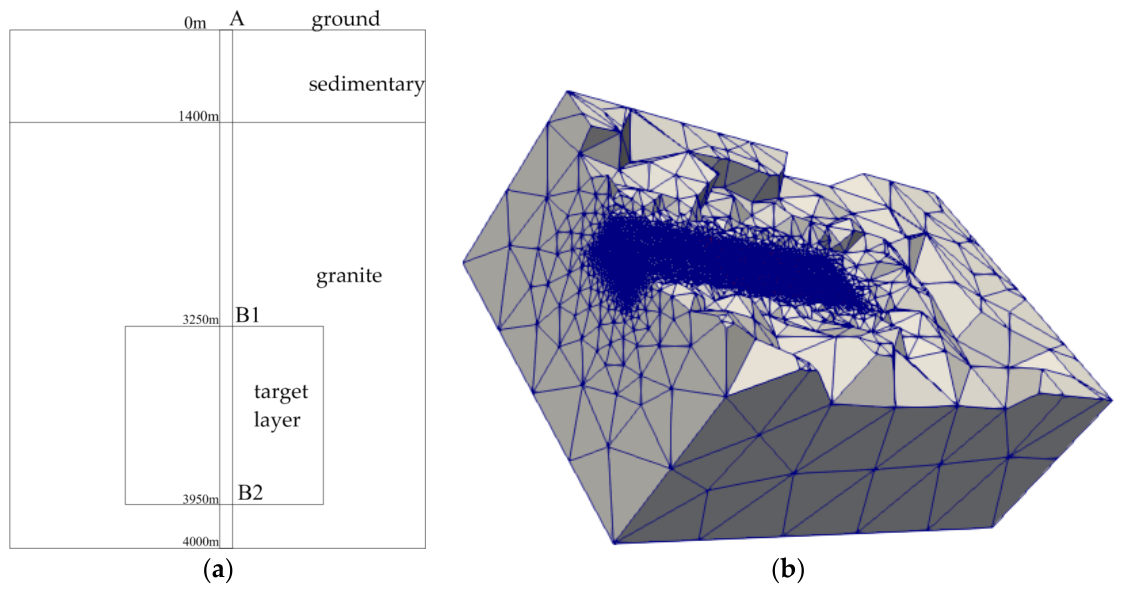
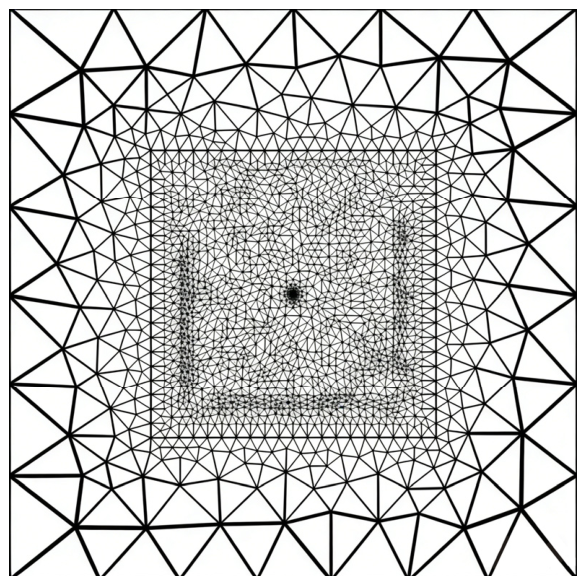
There are two excitation points for the source in the well: the ground-end excitation electrode A and the downhole transmission electrode B, as shown in Figure 3. Electrode A is positioned directly above the well bottom, while electrode B is placed at a designated location in the well. Based on drilling data (lithological stratification), the forward-modeled strata are classified into sedimentary layers and granite layers. Sedimentary rock extends from 0–1400 m and granite from 1400–4000 m, with overall high resistivity. Restricted by the complex spatial morphology and discrete distribution of underground natural and hydraulically induced fractures, the refined curved-surface fracture modeling requires an enormous number of meshes and involves extremely high computational cost. This hinders the implementation of large-scale, multi-frequency supercomputing inversion. It is a common practice to simplify the model using rectangular-block equivalent medium. By assigning equivalent resistivity, computational efficiency can be significantly enhanced while ensuring the equivalence of electromagnetic responses. The computational center’s fine-mesh domain is defined as 1000 m × 1000 m × 4000 m, with the fracture model scale set at 600 m × 600 m × 700 m (predict the area affected by fracturing). The model is shown in Figure 3. The electrical conductivities of the air layer, sedimentary rock layer, and granite layer are 1.0 × 10⁻⁸ S·m−1, 1.0 × 10⁻³ S·m−1, and 1.0 × 10⁻⁴ S·m−1, respectively. The ground survey grid has a point–line spacing of 50 m × 50 m, and its center is located directly above the anomaly body, as shown in Figure 4.

3.3. Electromagnetic Response Calculation and Analysis

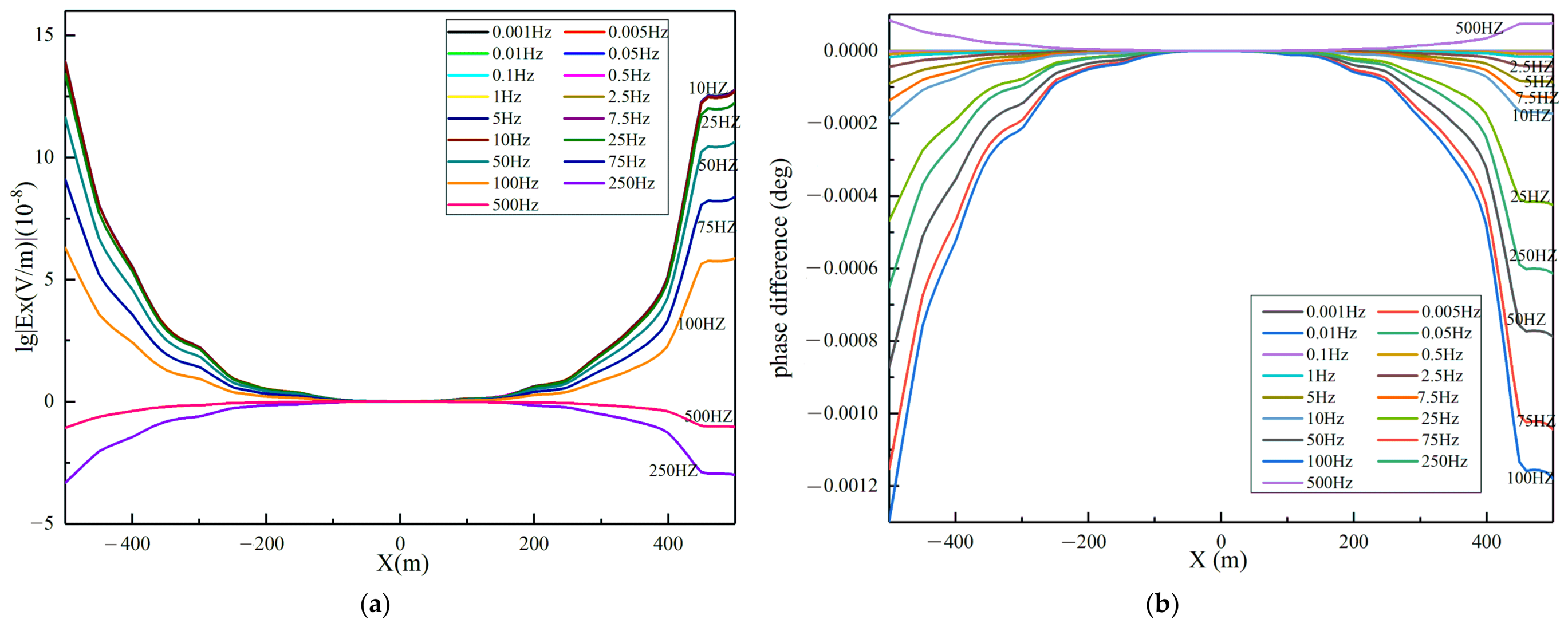
The deepest excitation point in the well is at the depth of 3950 m (B2 in Figure 3), and the shallowest point is at 3250 m (B1 in Figure 3). Due to differences in electrical properties between fracture clusters and the surrounding rock, as well as at solid–liquid interfaces, when the electrodes in the well are positioned near areas of higher conductivity in the study section, significant changes can be observed in the surface electric field signal. The time-series signal underwent a Fourier transform to obtain real and imaginary components that vary with frequency. This allows for the calculation of lg|Ex| and phase data curves, and the results are shown in Figure 5. By analyzing the differential lg|Ex| and phase values at various measurement points under different excitation conditions, we can qualitatively infer regions where granite fractures are concentrated. The frequency band adopted in this simulation ranges from 0.001 Hz to 250 Hz. The excitation signal frequencies are selected according to the results of lg|Ex| and phase difference between the two transmitting sources B1 and B2 (as shown in Figure 3). The results indicate that anomalies mainly occur in the 1–100 Hz frequency band. At lower frequencies, the calculated phase difference is approximately zero, while, at frequencies exceeding 100 Hz, the calculated lg|Ex| is around zero. Therefore, it is advisable to select transmitting frequency points within the range of 1–100 Hz in actual field exploration.
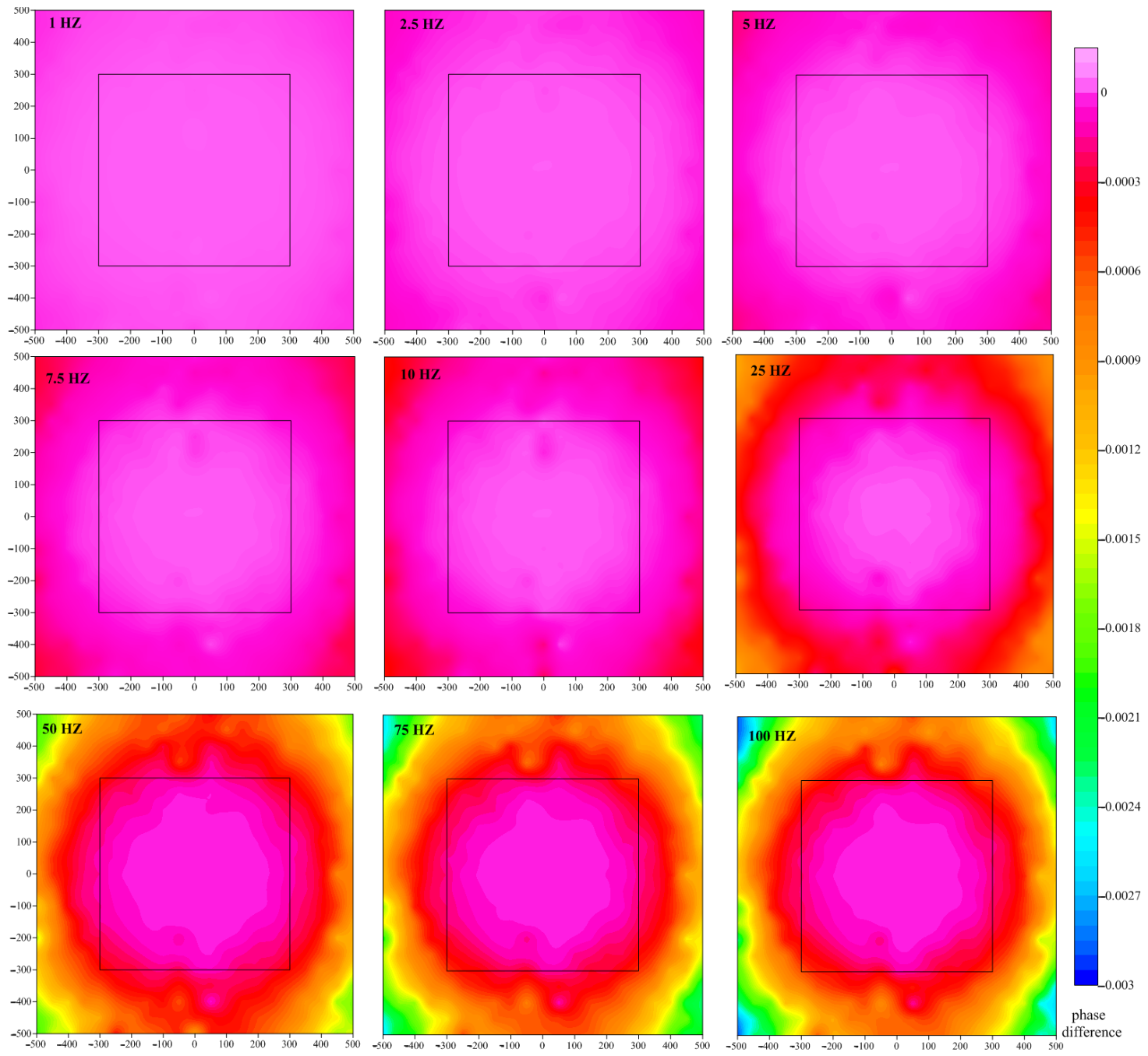
The phase-difference variations observed at ground level were calculated for a model resistivity of 10 Ω·m at frequencies of 1 Hz, 2.5 Hz, 5 Hz, 7.5 Hz, 10 Hz, 25 Hz, 50 Hz, 75 Hz, and 100 Hz. Figure 6 indicates that, as frequency increases, the phase difference anomalies also grow progressively larger.

3.3.1. Dynamic Monitoring Simulation

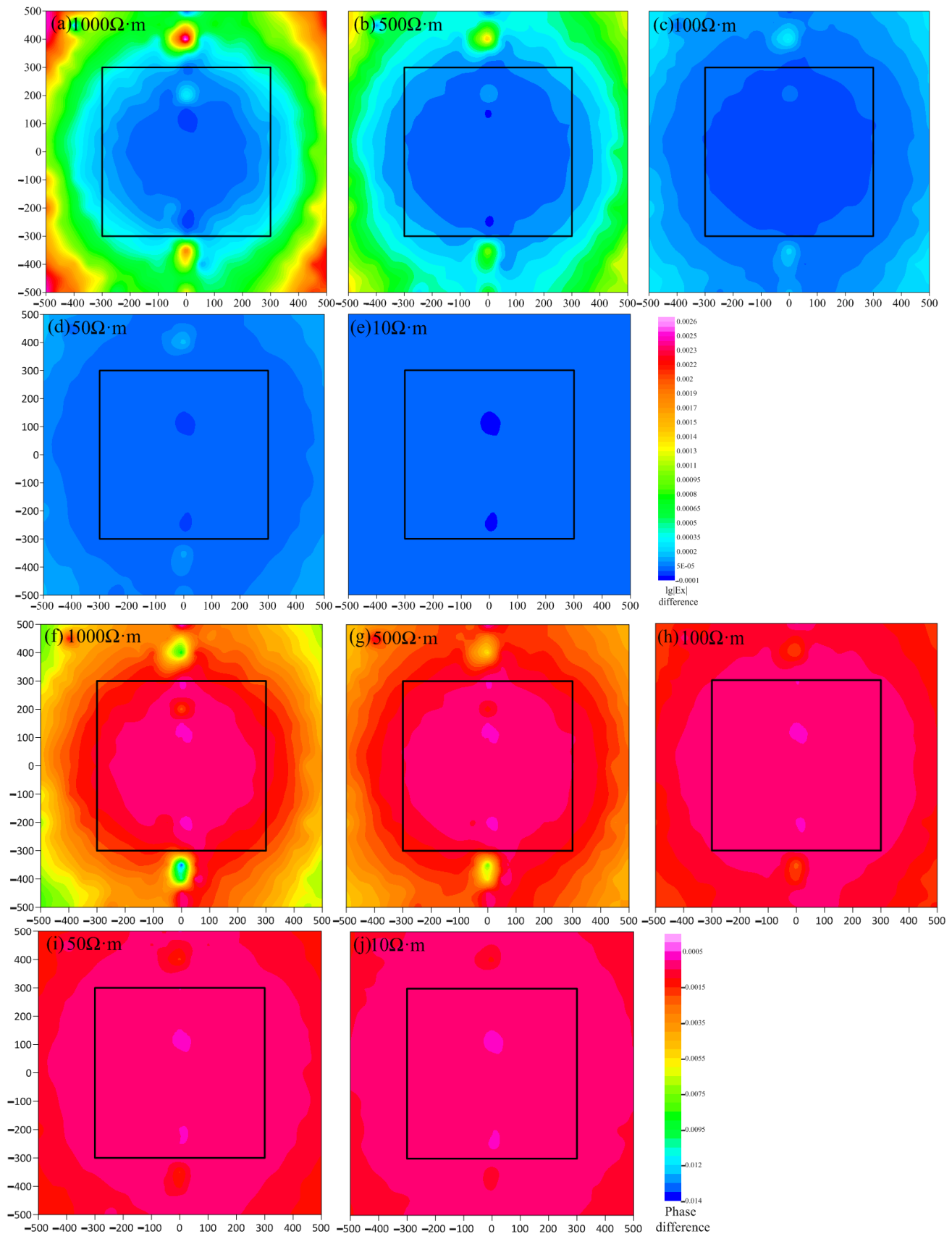
As fracturing progresses, the fracture cluster becomes saturated with water, decreasing resistivity from high to low values. Forward modeling was designed to evaluate the effectiveness of dynamic electromagnetic monitoring. Given that the formation consists of dense granite, no significant structural changes occur during fracturing, so the surrounding rock’s resistivity remains constant. With a fixed transmission frequency (set at 25 Hz), we assumed that the resistivity of the fracture model would decrease from 1000 to 500, 100, 50, and finally 10 Ω·m. Stimulation occurs at depths of 3250 m and 3950 m. Calculate the lg|Ex| difference and phase difference between points B1 and B2 to monitor dynamic changes in fracture expansion and water-filled fractures.
Figure 7 indicates that, as the model resistivity decreases, both the lg|Ex| difference and phase difference anomalies between points B1 and B2 diminish progressively. Although there are no significant structural changes during fracturing, resistivity exhibits pronounced variations with increasing fracture density and water injection volume. This demonstrates the effectiveness of BSEM monitoring for fracturing operations in dense granite formations.

3.3.2. Simulation of Fluid Migration Direction

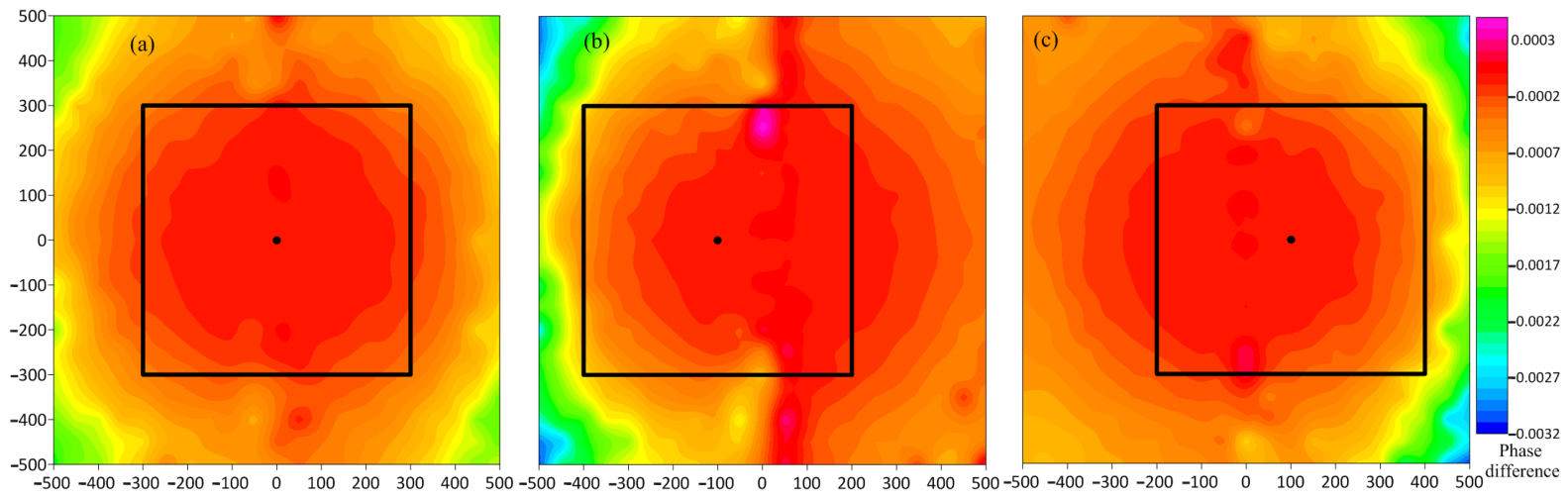
To simulate changes in fracture propagation direction during fracturing, forward modeling was designed for two distinct directions. With model centers located at (0, 0) (Figure 8a), (−100, 0) (Figure 8b), and (100, 0) (Figure 8c), the phase difference variation between points B1 and B2 was calculated to monitor changes in fracture propagation direction.
Figure 8 indicates that different fracture propagation directions induce corresponding phase anomaly variations. When the center is at (0, 0), phase anomalies appear as concentric circles, indicating that the fracture expands uniformly outward without fluid migration. When the center is at (−100, 0), the distribution of phase anomalies is asymmetric. Around the center point, the change in phase values shows a clear leftward bias, and the fracture tends to extend farther to the left. When the center is at (100, 0), the phase anomaly distribution is also asymmetric, with a significant rightward bias, and the fracture tends to extend farther to the right. By comparing the phase-difference variations across the three models, the changes in fracture propagation direction become clearly discernible, demonstrating the effectiveness of the BSEM method in monitoring and tracking fluid migration direction.

3.3.3. Simulation of Fracture Scale Variations

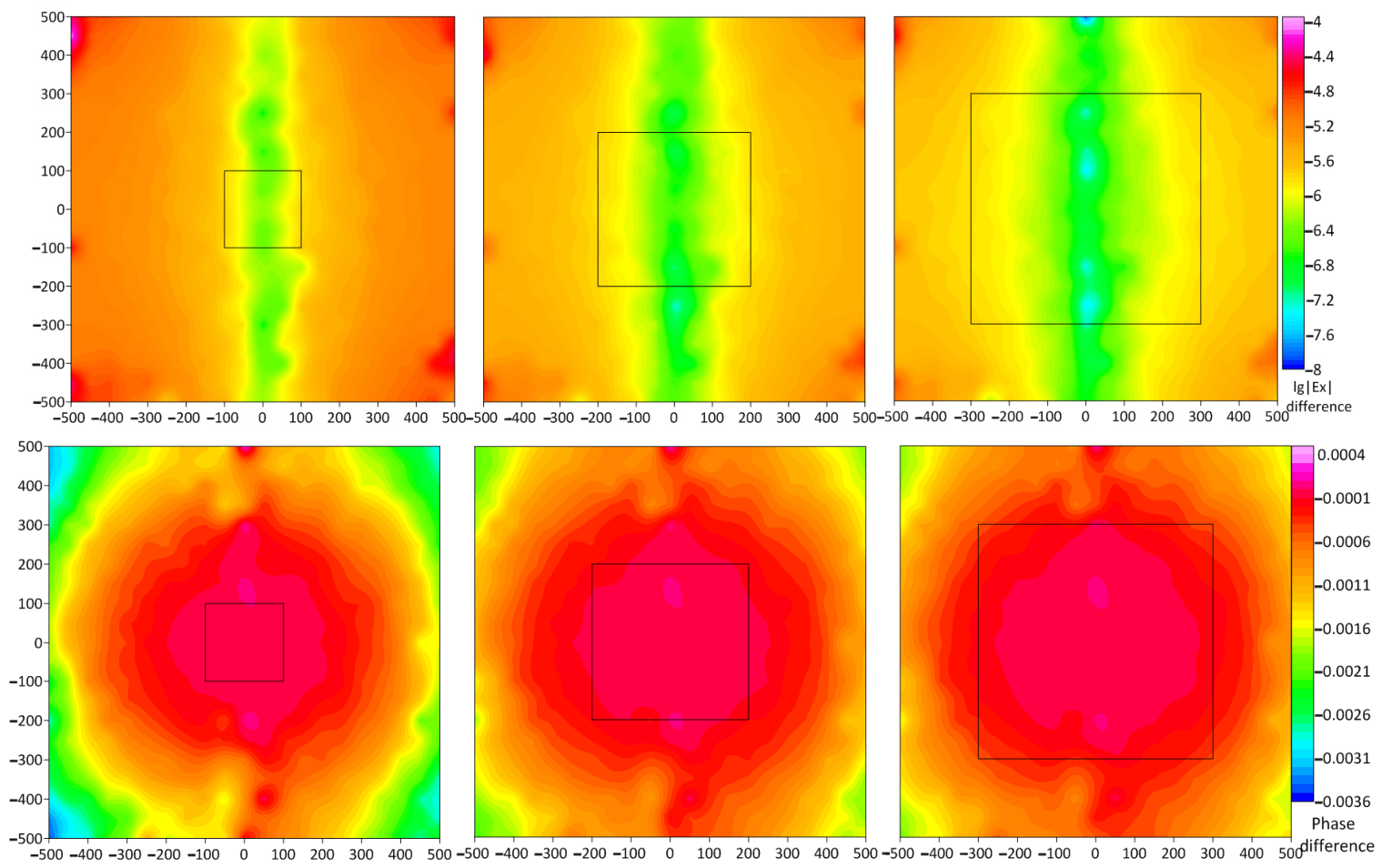
To simulate BSEM’s capability to monitor and detect HDR development, numerical simulations were conducted using a fracture model of varying sizes (from small to large). Specifically, at a transmission frequency of 25 Hz and a fracture model resistivity of 100 Ω·m, the phase difference and lg|Ex| anomaly responses were calculated separately for the 200 m × 200 m, 400 m × 400 m, and 600 m × 600 m models. The results are shown in Figure 9.
Forward modeling results indicate that anomaly intensity varies significantly with fracture scale, while anomaly width is correlated with model size, which can effectively delineate the boundaries of the models. As the fracture expansion range increases, the resistivity undergoes significant changes. As shown in the figure, when the fracture model size increases from 200 m × 200 m to 600 m × 600 m, the widths of the lg|Ex| difference and phase difference responses correspond to the respective model sizes, with distinct variations in anomaly intensity. This phenomenon occurs because larger fracture expansions accommodate more fluids, leading to a larger-scale conductive channel network underground. Consequently, the overall conductivity of the formation increases while the resistivity decreases, which demonstrates the effectiveness of the BSEM method in monitoring and tracking changes in fracture scale.

4. Application of BSEM in HDR Development Sites

4.1. Borehole-to-Surface Electromagnetic Layout at HDR Development Sites

The ground survey area is a rectangular 600 m × 400 m area centered on the well GH01. A total of 21 survey lines were deployed, with 20 m line spacing and 10 m point spacing, totaling 1133 survey points. Within this survey grid, radial components of the horizontal electric field (Er) were measured. The azimuth was oriented toward the well. The M electrode was positioned at the near-well point, the N electrode at the far-well point, and the survey point was located at the midpoint of MN. Non-polarizing electrodes were used, buried 40 cm into the soil to ensure good contact. Both electrodes were buried under identical conditions. The ground resistivity at each survey point was measured and found to be below 3000 Ω·m. Two surface elements were collected: the first covered survey points from line 12 to line 21, and the second covered survey points from line 1 to line 11.
Using the established stratigraphic resistivity model, the required excitation period for the target stratum was calculated as 0.4 s, corresponding to an excitation signal frequency of 2.5 Hz. To ensure effective processing and interpretation, we expanded the actual excitation signal frequency range, setting the excitation signal period range from 0.016 to 1.024 s, with a total of 16 signal periods. The low-frequency band ensures that electromagnetic waves can penetrate deep granite formations at depths of 3500–4000 m and reduces the rapid attenuation of high-frequency signals. Meanwhile, this frequency band balances formation resolution and anti-interference capability, making it the optimal operating frequency range for borehole-to-surface electromagnetic detection of deep HDR. To acquire electric field signals with a high signal-to-noise ratio, the transmitting current in the study area is designed to be 25–30 A. A large transmitting current can enhance the intensity of weak deep electromagnetic response signals, effectively improve the signal-to-noise ratio, and satisfy the identification requirements for weak anomalies of deep fractures, while remaining within the rated safe output range of the instrument. The electrode spacing at receiving survey points is set to 10 m.

4.2. Inversion Methods

Forward modeling derives observed data from known electrical structures of subsurface media, while inversion determines the electrical structure of the subsurface media from observed data. The primary objective of inversion is to identify a geological model that adequately fits the observed data, thereby reconstructing the distribution of electrical structure within the subsurface. Due to limitations in the observational data, fitting errors and multiple solutions may arise during the fitting process. To achieve optimal fitting, constraints are imposed on the model space during inversion. Inversion can be considered an optimization problem: by defining an objective function and minimizing it, the goal of optimal inversion is attained.
The Newton method employs a second-order Taylor expansion of the function to find the optimal point where the derivative is zero. When updating the model vector, the Newton method always requires the computation of the Hessian matrix. The Hessian matrix is high-dimensional, requires substantial storage, and is computationally complex. This method is suitable for solving small-scale optimization problems, thus limiting the application of the Newton method in three-dimensional inversion.
Given Newton’s method’s limitations, quasi-Newton methods were developed. These approaches utilize only the gradient information of the objective function during the inversion process, approximating the Hessian matrix at each iteration based on the observed changes in the solution vector and the corresponding gradient updates. The BFGS algorithm is a quasi-Newton method designed for invertible matrices. However, it consumes substantial memory for data storage at each iteration. The Limited-Memory BFGS (L-BFGS) [27] algorithm, by contrast, stores only a finite number of previous solution vectors and gradient changes, which effectively reduces memory consumption while preserving fast convergence. Its search direction closely approximates that of the Newton method, thereby significantly reducing computational time.

4.2.1. Objective Function

The inversion problem is mathematically ill-posed. To solve it stably, the Tikhonov regularization inversion principle is adopted, and a model constraint term is introduced into the objective function. Consequently, the objective function of the regularized inversion is defined as [28]
ϕ m = ϕ d m + λ ϕ m m
where ϕ d ( m ) is the data misfit term, ϕ m ( m ) is the model regularization term, and λ denotes the regularization factor.
An adaptive attenuation method is used to select the regularization factor, which is calculated as
λ k = λ 1 q k 1 , k = 1,2 , , n
in which λ 1 is the initial value of the regularization factor, q is the attenuation factor with 0 < q < 1 , and k represents the attenuation iteration number.
The data misfit term is expressed as
ϕ d m = 1 2 W d Q A m 1 q d o b s 2 2
where W d is the diagonal data weighting matrix; Q is the interpolation matrix; d o b s = d 1 , d 2 , , d n Τ is the N-dimensional observed data vector.
The model constraint term is given by
ϕ m m = α s 2 W s m m r e f 2 2 + i = x , y , z α i 2 W i m m r e f 2 2
where α s is the smoothness weighting coefficient; m r e f is the prior reference model, generally adopting a geological background model without abnormal anomalies; α i controls the smoothness constraint in the x, y, and z directions to produce smoother inversion results.
W s is a diagonal weighting matrix containing discrete integral terms over element volumes, corresponding to
W s = Ω ( m m r e f ) 2 d V
W x ,    W y , and W z are the products of the first-order finite difference matrix and element volume term in the corresponding coordinate directions.
Substituting the above items, the complete objective function reads
ϕ m = 1 2 W d Q A m 1 q d o b s 2 2 + α s 2 W s m m r e f 2 2 + i = x , y , z α i 2 W i m m r e f 2 2
Taking the partial derivative of Equation (15) with respect to the model parameter m, the gradient of the objective function g ( m ) is
g m = ϕ d m m + λ ϕ m m m = J ( m ) T W d T W d d ( m ) d o b s + λ W m T W m m r e f
The dimension of g ( m ) is consistent with the model vector m.
The limited-memory quasi-Newton method (L-BFGS) is employed to minimize the objective function. The linear system at each iteration is written as
J m T J ( m ) + λ W m T W m Δ m = g m
The model update increment Δ m is obtained by approximately solving the above equation.
J ( m ) denotes the Jacobian matrix with dimension N × M, expressed as
J m = Q A m 1 G m , u
where A( m ) represents the forward modeling operator. G ( m , u ) is a sparse matrix of size N × M, defined as
G m , u = A m u m
Since the objective function is strongly nonlinear, an iterative optimization scheme is adopted. The model vector is updated iteratively, and the line search strategy is used to determine the iteration step length. Let the model of the k-th iteration be m k ; the model update formula is
m k + 1 = m k + α k P k
where P k is the search direction, and α k P k = Δ m .
The electrical conductivity of formation media varies over several orders of magnitude. To guarantee positive conductivity values throughout the inversion, a logarithmic transformation is applied to the conductivity before inversion. The model parameter vector m is defined as the logarithm of conductivity σ:
m = l o g σ
After inversion, the recovered conductivity is retrieved by exponential transformation:
σ r e c = e m = e l o g σ
The corresponding inverted resistivity is calculated as the reciprocal of conductivity:
ρ = 1 / σ r e c

4.2.2. L-BFGS Inversion Algorithm

In the L-BFGS algorithm, the model update increment is calculated by the inner product of the approximate inverse Hessian matrix H ^ k and the gradient g k , which is expressed as
Δ m k = H ^ k g k
The approximate inverse Hessian matrix H ^ k is updated by the following iterative formula:
H ^ k + 1 = V k T H ^ k V k + ρ k s k s k T
where ρ k = 1 / y k T s k , V k = I ρ k y k s k T , s k = m k + 1 m k , y k = g k + 1 g k and I denotes the identity matrix.
It can be seen that the L-BFGS algorithm does not need to store the complete inverse Hessian matrix. Instead, it only stores the curvature vector pairs ( s k , y k ) from the most recent several iterations to complete the calculation.
Generally, the curvature information from the latest 3–20 iterations is adopted. The expression of the approximate inverse Hessian matrix is written as
H ^ k + 1 = V k 1 T V k m T H ^ k 0 ( V k m V k 1 ) + ρ k m V k 1 T V k m + 1 T s k m s k m T V k m + 1 V k 1 + ρ k m + 1 V k 1 T V k m + 2 T s k m + 1 s k m + 1 T V k m + 2 V k 1 + + ρ k 1 s k 1 s k 1 T  
where H ^ k 0 is the given initial approximate inverse Hessian matrix. Experience shows that setting H ^ k 0 = γ k I achieves the best algorithm performance.
Here,
γ k = s k 1 T y k 1 y k 1 T y k 1
which serves as a scaling factor for estimating the search direction.
During the iteration of the L-BFGS algorithm, the model increment Δ m k is solved by the double-loop recursive algorithm. The procedure of the L-BFGS algorithm is shown in Algorithm 1.
Algorithm 1. L-BFGS algorithm workflow.
Input: initial model m 0 , error threshold ε , memory parameter m.
Output: minimization of the objective function m i n Φ ( m )
1. Assign m = m 0
2. Calculate the gradient g ( m 0 )
3. Set iteration number k = 0
4. While  g ( m ) > ε  do
5. Calculate scaling factor: γ k = s k 1 T y k 1 y k 1 T y k 1
6. Initialize: H ^ k 0 = γ k I
7. Compute model increment Δ m k
8. Determine the search step a k by line search, satisfying
             Φ m k + a k Δ m k = m i n a 0   Φ m k + a Δ m k
9. Update model: m k + 1 = m k + a k Δ m k
10. If  k > m  Then
11. Delete the earliest vector pair ( s k , y k ) from memory
12. End If
13. Calculate gradient g ( m k + 1 )
14. Compute and store: s k = m k + 1 m k , y k = g k + 1 g k
15. Set k = k + 1
16. End While

4.2.3. Inversion Parameter Settings

Two stopping criteria are adopted for the inversion:
(1)
The iteration reaches the preset maximum number of iterations;
(2)
The data misfit decreases below the given threshold.
The root-mean-square (RMS) data misfit is defined as
R M S = i = 1 N   [ ( d i o b s F ( m k ) i ) / e i ] 2 N
where N is the total number of observation data, d i o b s denotes the observed data, F ( m k ) i represents the forward response of the k -th iterative model, and e i is the error of the i -th data point.
The maximum number of iterations is set to 500, and the data misfit is 5.
All algorithms in this study are run on a server equipped withIntel(R) Xeon(R) Gold 5120 CPU @ 2.20 GHz and 128 GB of physical memory, with a total of four computing nodes. The 3D inversion was performed on a high-performance computing cluster, with four computational nodes used.
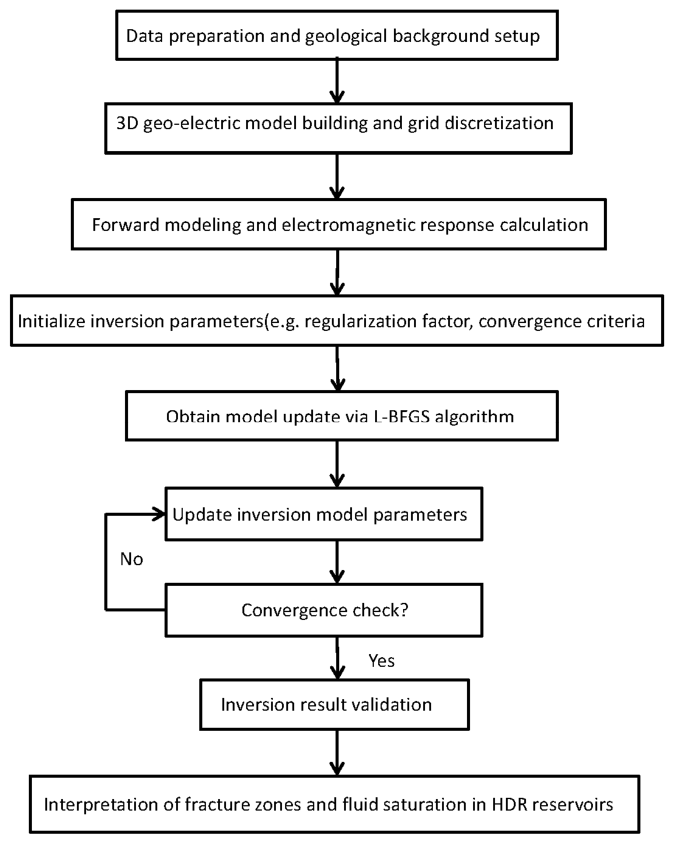
To provide a clear overview of the complete inversion workflow adopted in this study, the main steps of the 3D frequency-domain BSEM forward and inverse modeling are illustrated in the following flowchart (Figure 10). This flowchart systematically presents the entire process from initial data preparation to final reservoir interpretation, including key steps such as forward modeling, iterative inversion using the L-BFGS algorithm, convergence check, and multi-source validation.

4.3. 3D Inversion Characteristics of Resistivity Anomalies

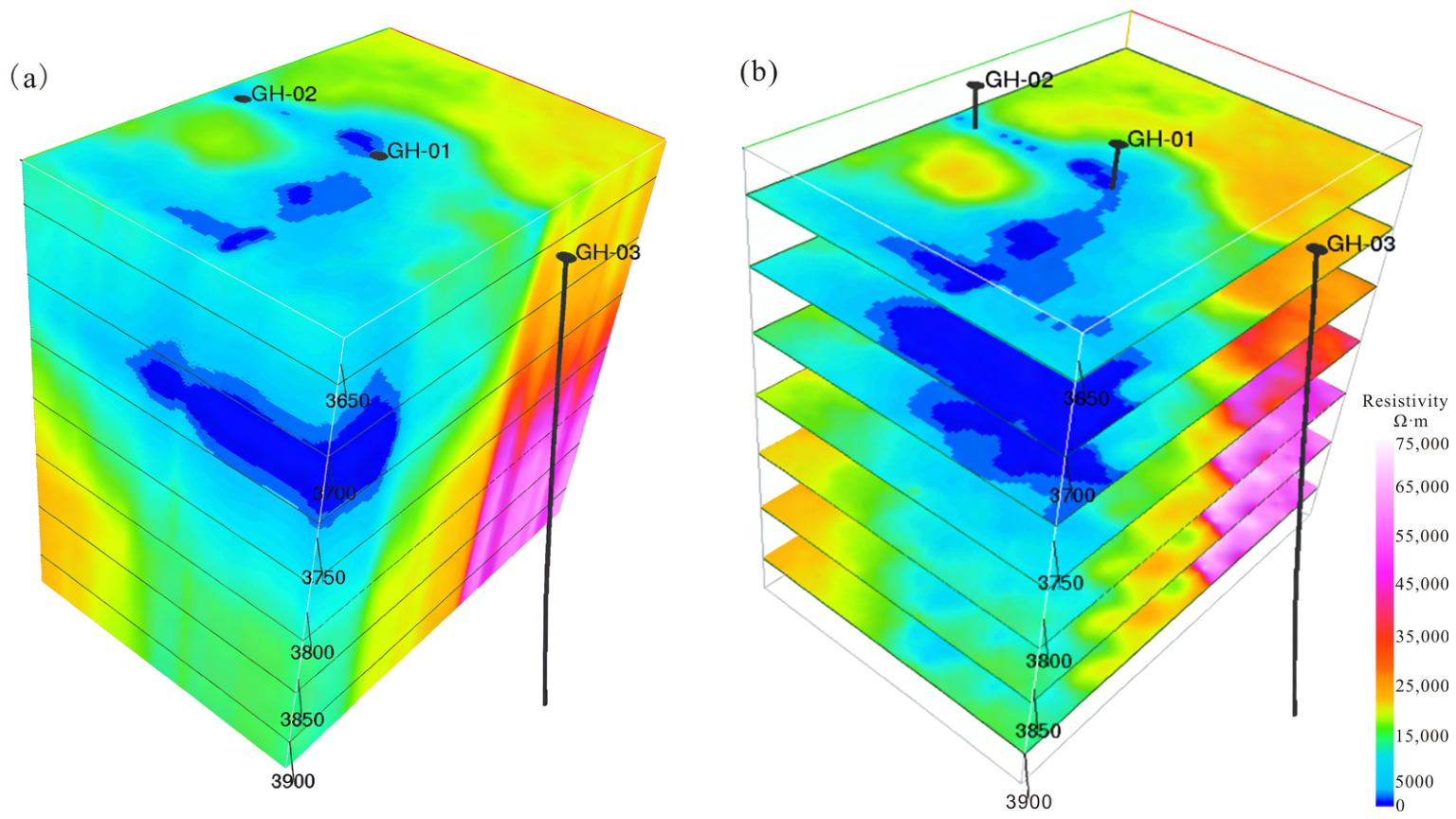
Changes in apparent resistivity values can qualitatively reflect the presence of granite, fractures, and water-filled zones within the range of 3637 m–3925 m (Figure 11).
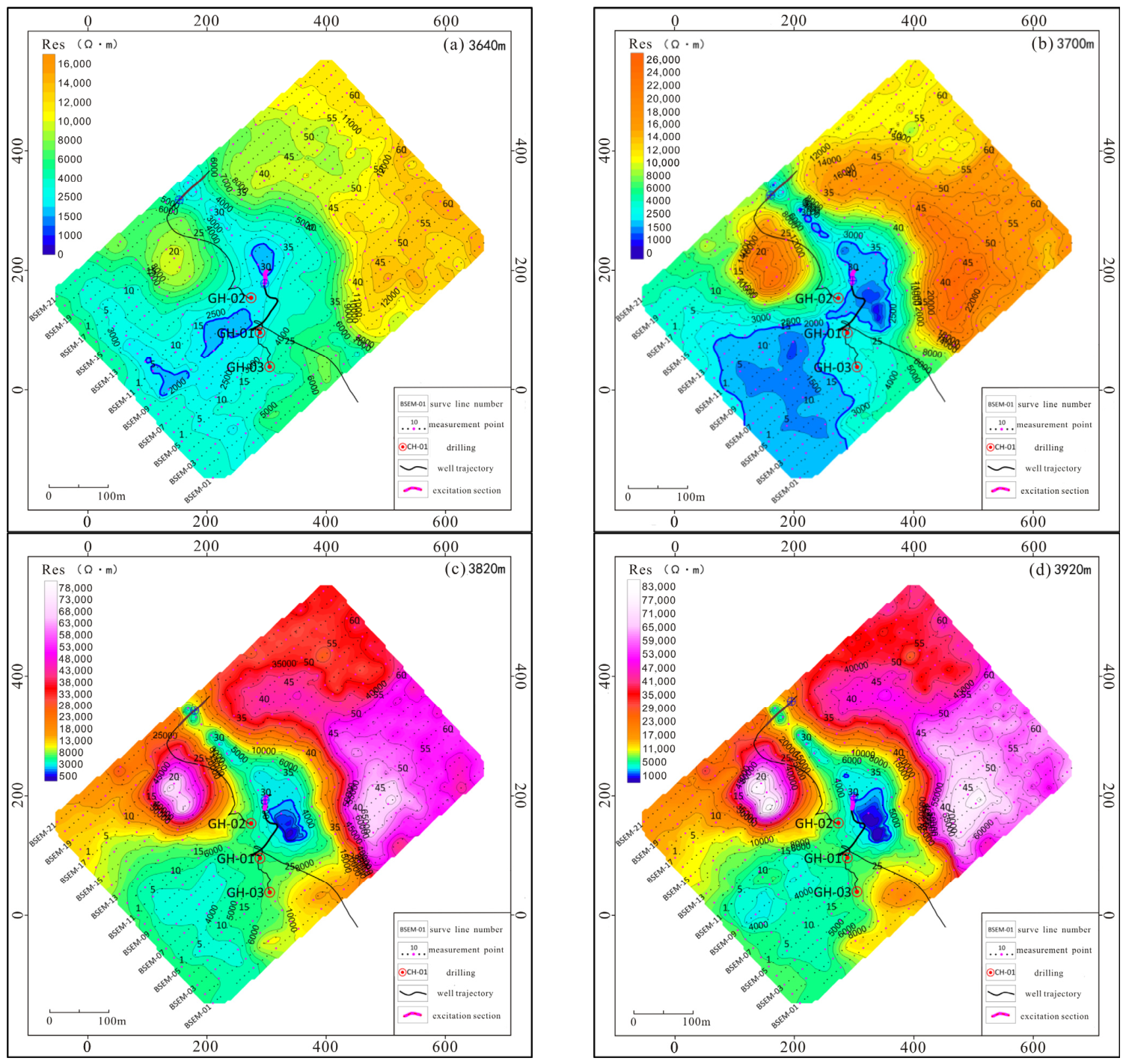
Figure 12 presents resistivity contour maps at depths of 3640 m, 3700 m, 3820 m, and 3920 m. Macro-scale observations reveal a high-resistivity anomaly zone in the northeast and a low-resistivity anomaly zone in the southwest of the survey area. Within the low-resistivity anomaly zone in the southwest, localized high-resistivity anomalies are also developed. The low-resistivity anomaly in the southwest exhibits a characteristic pattern: its size gradually increases from shallow to deep levels before gradually decreasing. This phenomenon suggests the low-resistivity zone corresponds to a water-filled area, while the high-resistivity zone indicates weakly water-filled or non-water-filled regions.
Overall, the low-resistivity anomalies observed on the plan view are primarily distributed across two distinct zones.
Central Low-Resistivity Zone: Located at the bottom of well GH01 and its surrounding area, this zone exhibits a lens-shaped morphology with its major axis oriented northwest (NW). The low-resistivity anomaly extends to the bottom of well GH02 in the NW direction, while its southeast (SE) direction shifts to a near-north–south (SN) orientation. Below a depth of 3637 m, the anomaly’s center shifts from the northwest side of the bottom of well GH01 toward the southeast side of the well bottom.
Southwestern Low-Resistivity Zone: Distributed to the west and southwest of well GH01, this zone exhibits an overall NW-trending band-like pattern. Near Survey Line 09 and Survey Point 10, the low-resistivity anomaly splits into two branches: one trending NW and the other northeast (NE), with the NE branch showing a tendency to extend toward the central low-resistivity anomaly.

4.4. Predicting Fracture Aquifer Conditions Based on Resistivity Anomalies

Fractures and fracture clusters exhibit variations in scale, density, and water-filling capacity. However, there are no distinct geological or lithological boundaries between them and the HDR mass. From the primary fracture and fracture cluster development zones outward, their scale gradually diminishes and water-filling capacity progressively weakens, showing a characteristic gradual change. Therefore, in the absence of borehole calibration, the connectivity between existing injection and production wells can serve as the primary basis for defining the boundaries of electrical anomalies.
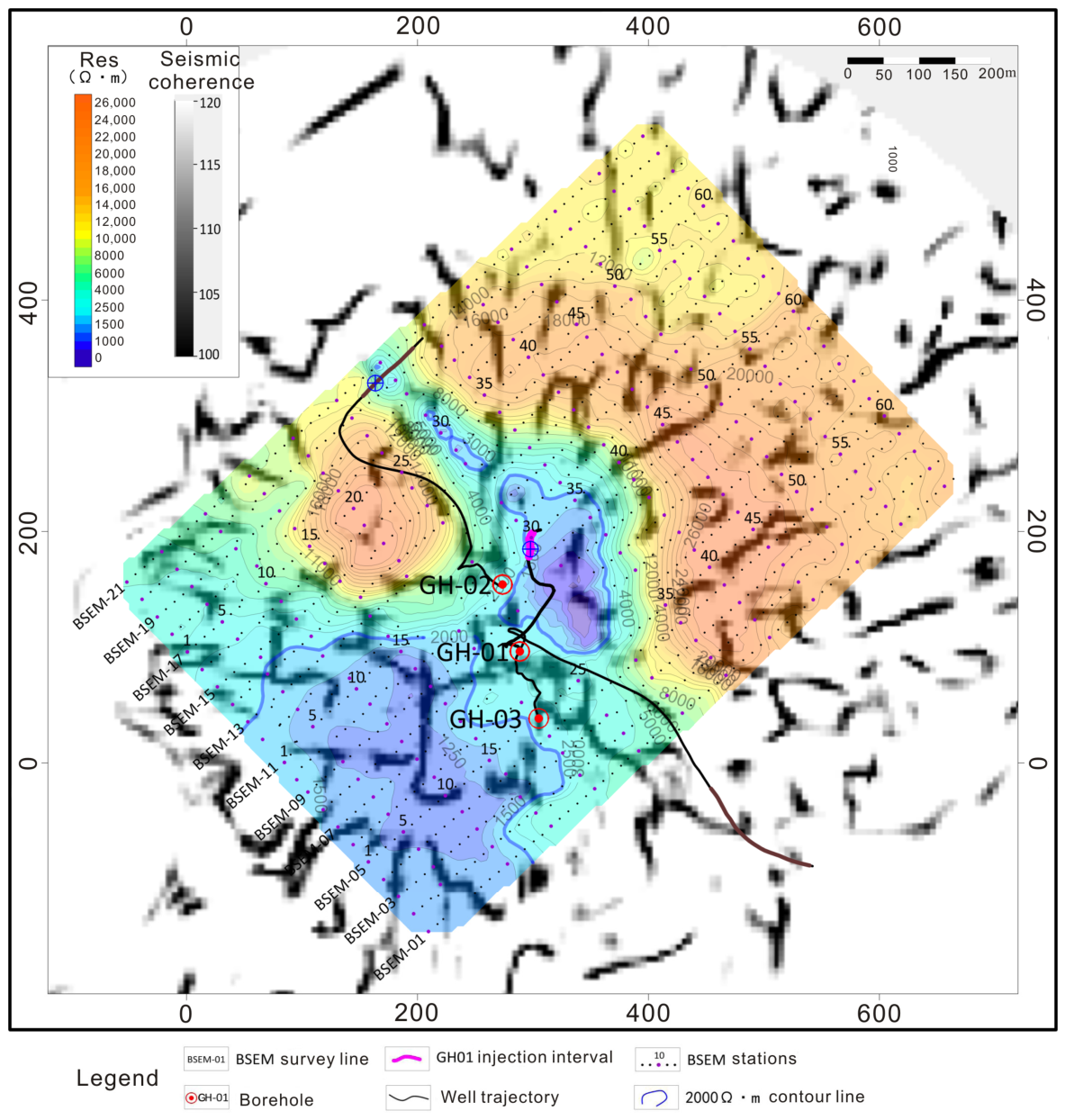
Taking a depth of 3720 m as an example, the overlay map of resistivity and seismic coherence (Figure 13) shows that the seismic coherence anomalies within the 2000 Ω·m contour line of the low-resistivity zone in the southwest are relatively denser, with larger lengths and widths. The seismic coherence anomaly at the low-resistivity anomaly location at the bottom of well GH-01 is also more obvious than that in the surrounding area; although its length is shorter, its width is larger, and it is entirely distributed within the 2000 Ω·m contour line. Based on the comprehensive analysis of resistivity data and its comparison with seismic coherence results, the 2000 Ω·m contour line is selected as the outer boundary of the low-resistivity anomaly.
Previous injection and production data indicate that wells GH01 and GH02 exhibit connectivity, while the connectivity between wells GH01 and GH03 is poor. Using the 2000 Ω·m resistivity contour as the low-resistivity anomaly boundary, the 3720 m resistivity plan view (Figure 12) shows the largest range of low-resistivity anomalies. Although the bottom areas of wells GH01 and GH02 are not simultaneously enclosed within the 2000 Ω·m contour, a beaded low-resistivity anomaly zone develops along the 30th survey point from survey line 15 to survey line 18. This anomaly exhibits characteristics indicating a potential connection between the bottom anomalies of wells GH02 and GH01. The boundary of the low-resistivity anomaly southeast of well GH01 lies north of survey line 05, showing no tendency to extend toward the bottom of well GH03. The resistivity anomaly characteristics at the well bottoms of the three wells can partially reflect their connectivity.
In summary, areas with predicted resistivity values below 2000 Ω·m indicate zones with developed fractures and fracture clusters that possess a certain degree of water-filling. However, it should be noted that, while resistivity values can qualitatively assess the extent of water-filling, they cannot provide a quantitative analysis of water-filling conditions.

4.5. Discussion

4.5.1. Comparison with Tracer Test Results

A total of 150 kg of sodium fluorescein tracer was injected into well GH-01. Monitoring results show that concentration variations were detected at well GH-02 after 23 h, and the tracer concentration reached a peak value of 23.4 mg/L at 45.27 h. No obvious concentration change of sodium fluorescein was detected in well GH-03 until the end of the tracer test. Subsequently, 1.36 kg of Rhodamine B tracer was injected into well GH-03. Concentration responses were observed at well GH-01 16 h later, with the tracer concentration peaking at 59 μg/L at 41.5 h. Parameter calculation results indicate that the hydraulic connection between well GH-01 and well GH-03 is dominated by a limited number of sparse major fracture channels, with fewer minor fractures and poor connectivity among these minor fractures. Compared with the connectivity between well GH-01 and well GH-02, the fluid residence time between well GH-01 and well GH-03 is shorter, resulting in lower heat exchange efficiency. Under current injection-production conditions, the effective heat exchange volume between well GH-03 and well GH-01 is approximately 10 m3, which is smaller than the 34 m3 effective heat exchange volume between well GH-01 and well GH-02.
The test results confirm that the inter-well connectivity between well GH-01 and well GH-02 is favorable, whereas the connectivity between well GH-01 and well GH-03 is relatively poor. This finding is generally consistent with the extension pattern of inter-well resistivity anomalies, further verifying the reliability of the resistivity inversion interpretation.

4.5.2. Method Resolution, Inversion Non-Uniqueness and Casing Signal Effect

The spatial resolution of the 3D frequency-domain BSEM method is jointly governed by observation layout, numerical grid discretization and data signal-to-noise ratio. In the study area, the actual hydraulic fractures are mostly developed in a connected network pattern, with no obvious outcrop of isolated small-scale fracture clusters. The overall low-resistivity anomalies reflect the macro-scale development characteristics of large-scale, well-connected fracture-pore water-bearing complexes. With the joint interpretation constrained by VSP seismic data, local fracture development units with a short-axis scale of approximately 20 m can be finely characterized and identified.
Resistivity inversion inherently suffers from the non-uniqueness of geophysical solutions. In deep granite HDR formations, the resistivity response is determined not merely by the water saturation of fractures, but also comprehensively regulated by multiple physical factors, including formation temperature, formation water salinity, fracture density, spatial fracture connectivity, and fluid gas saturation. As the formation temperature rises, the conductivity of both granite matrix and fracture fluids increases simultaneously, leading to an overall decrease in formation resistivity. Higher formation water salinity enhances the conductivity of fracture fluids, which tends to form prominent low-resistivity anomalies. Furthermore, isolated small fractures, high-angle fracture networks and well-connected fracture clusters can produce similar BSEM responses despite their distinct geometric morphologies, which reflect the inherent non-uniqueness of electromagnetic inversion.
From the perspective of method sensitivity, the low-resistivity anomalies derived from the 3D BSEM inversion in this study represent the superimposed comprehensive response of fracture density, fracture connectivity, and fluid saturation. More developed fractures, better spatial connectivity, and higher water saturation correspond to more prominent low-resistivity anomalies. In contrast, fracture systems with poor development, weak connectivity, or partial saturatation exhibit weak electrical response amplitudes, making it difficult to clearly distinguish them from the host rock background. Therefore, it is more rigorous to interpret low-resistivity anomalies as a comprehensive geological indicator of developed fracture clusters with favorable water-bearing properties and hydraulic connectivity, rather than simply regarding them as fully saturated, single water-filled fracture clusters.
Steel drilling casing acts as a low-resistivity good conductor, which significantly disturbs the original electromagnetic field distribution around the well, distorts observed electromagnetic signals, shields and interferes with the true resistivity response of deep formations, and further reduces the accuracy of inversion interpretation. The casing alters the near-well electric field pattern and reduces apparent resistivity values, causing particularly severe interference to small-scale fracture anomalies near the wellbore. In this study, the electrical interference caused by the wellbore structure was reasonably considered in numerical modeling. Under the current grid discretization and inversion framework, the reliability of the macro-scale identification of regional low-resistivity fracture zones can be guaranteed. In follow-up studies, local grid refinement, equivalent resistivity assignment for the casing, and forward response correction considering casing effects can be adopted to finely characterize the casing influences in numerical models and further improve the inversion resolution for small-scale fracture anomalies.

4.5.3. Limitations and Future Work

Generalizing the complex subsurface hydraulic-natural fracture network into regular rectangular uniform low-resistivity blocks for numerical modeling and inversion interpretation inevitably has inherent limitations. The actual fracture network exhibits a highly irregular spatial morphology, with significant differences in fracture density, strike, dip angle, and spatial discreteness. In contrast, the uniform block model adopts homogeneous electrical parameter assignment and cannot characterize the internal variations in fracture development intensity or the detailed electrical anisotropy within fracture zones.
The uniform low-resistivity equivalence scheme also hardly distinguishes the electrical signatures of isolated small fractures, connected fracture networks, and diffuse fractured zones. It can only reflect the overall spatial distribution and macroscopic low-resistivity response of fracture systems while losing local fine structural information. Moreover, a single low-resistivity anomaly may correspond to multiple fracture combination patterns, aperture scales, and connectivity modes, which further increases the non-uniqueness of inversion interpretation.
In addition, the homogeneous model assignment ignores the lateral heterogeneity of water saturation, salinity, and temperature within fracture zones, thereby introducing deviations in forward responses and inversion fitting errors. In summary, the uniform block equivalence simplification adopted in this study is only suitable for macroscopically delineating the spatial extent of fracture zones and identifying the overall volume of hydraulically stimulated reservoirs—it is not applicable to finely characterizing the geometric morphology of individual fractures or local seepage structures.
Future research can be advanced mainly from three aspects. First, fractured media in deep granite commonly exhibit obvious electrical conductivity anisotropy, and their electrical responses are jointly controlled by fracture strike, dip angle, and filling fluids [29,30]. Further studies can introduce discrete fracture models and adopt block-wise heterogeneous and anisotropic electrical parameter assignment schemes to make the numerical model closer to the actual subsurface fracture network structure. Second, the observation system layout and L-BFGS iterative inversion algorithm will be further optimized to improve forward modeling efficiency and the fine identification accuracy of small-scale deep fracture zones. This can provide more reliable theoretical and technical support for the dynamic monitoring of hydraulic fractures and evaluation of reservoir stimulation effects in hot dry rock reservoirs. Third, the refined simulation method of wellbore casing effects will be improved, and a casing influence correction method suitable for borehole-to-surface electromagnetic detection in hot dry rock exploration will be established, so as to further enhance the reliability of inversion interpretation and small-scale fracture identification.

5. Conclusions

Based on the specific geological conditions of well GH01 in the Gonghe Basin, this study employed unstructured-grid frequency-domain 3D forward modeling to analyze the electromagnetic responses induced by fracturing fluid injection and dynamic fracture evolution during HDR development. By calculating the variations of lg|Ex| and phase difference anomalies at different frequencies, the optimal excitation frequency for the target formation was determined to be 1–100 Hz. At the same time, through simulations of dynamic monitoring, fracture propagation direction, and fracture scale evolution, the effectiveness of the BSEM in dynamically monitoring fracture development and fluid migration was evaluated.
For the first time, supercomputing was employed to invert 3D BSEM data under conditions of massive multi-source and multi-frequency data. The results indicate that water-filled fractures and fracture clusters are primarily distributed in low-resistivity zones in the central and southwestern regions, with the 2000 Ω·m contour line as the boundary. The research results indicate that the BSEM method has certain effectiveness during the HDR development stage, providing crucial technical support and monitoring tools for the safe and efficient exploitation of HDR resources.

Author Contributions

Conceptualization, Y.M., Z.Z., Q.W. and Z.C.; software, Q.W. and Z.C.; validation, Y.M., E.Z. and X.J.; data curation, Z.C. and S.L.; writing—original draft preparation, Y.M. and Q.W.; writing—review and editing, Z.Z. and E.Z.; visualization, S.L.; supervision, Z.Z.; funding acquisition, E.Z. and X.J. All authors have read and agreed to the published version of the manuscript.

Funding

This research was funded by Project of China Geological Survey (Grant Nos. DD202605202302, DD202305009 (2025), No. DD20211336, No. DD202305009, No. DD20251176).

Data Availability Statement

The data presented in this study are available on request from the corresponding author.

Conflicts of Interest

The authors declare no conflicts of interest.

References

  1. Lund, J.W.; Toth, A.N. Direct utilization of geothermal energy 2020 worldwide review. Geothermics 2021, 90, 101915. [Google Scholar] [CrossRef]
  2. Xu, T.F.; Yuan, Y.L.; Jiang, Z.J.; Hou, Z.Y.; Feng, B. Hot dry rock and enhanced geothermal engineering: International Experience and China Prospect. J. Jilin Univ. (Earth Sci. Ed.) 2016, 46, 1139–1152. (In Chinese) [Google Scholar]
  3. Zhu, Y.Q.; Li, D.Q.; Zhang, Q.X.; Zhang, X.; Liu, Z.J.; Wang, J.H. Characteristics of geothermal resource in Qiabuqia, Gonghe Basin: Evidence from high precision resistivity data. Ore Geol. Rev. 2022, 148, 105053. [Google Scholar] [CrossRef]
  4. Zhang, S.Q.; Wen, D.G.; Xu, T.F.; Fu, L.; Jia, X.F.; Sun, S.; Wang, W.; Zhang, Y.; Yang, T.; Joseph, M.; et al. The U.S. Frontier observatory for research in geothermal energy project and comparison of typical EGS site exploration status in China and U.S. Earth Sci. Front. 2019, 26, 321–334. (In Chinese) [Google Scholar]
  5. Kumari, W.G.P.; Ranjith, P.G.; Perera, M.S.A.; Li, X.; Li, L.H.; Chen, B.K.; Isaka, B.L.A.; De Silva, V.R.S. Hydraulic fracturing under high temperature and pressure conditions with micro CT applications: Geothermal energy from hot dry rocks. Fuel 2018, 230, 138–154. [Google Scholar] [CrossRef]
  6. Alzo’ubi, A.K.; Alneasan, M. Thermal effect on shear and compressive behaviors of rock fractures: Cases of sandstone and granite. J. Rock Mech. Geotech. Eng. 2025, 17, 7007–7022. [Google Scholar] [CrossRef]
  7. Tan, X.F.; Liu, X.; Ma, Z.M.; Lin, W.J.; Wang, G.L. Discussion on the key technology for fracture identification in hot dry rock reservoir. Drill. Eng. 2023, 50, 47–56. (In Chinese) [Google Scholar]
  8. Dai, Y.F.; Hou, B.; Wang, M.Y. Numerical Simulation of Hydraulic Fracture Propagation in Hot Dry Rock (HDR) Reservoirs Based on Phase Field Method. Geol. J. 2025, 63, 2281–2296. [Google Scholar] [CrossRef]
  9. Elzbieta, W.; Andrzej, L.; Jens, B. Induced Seismicity and Detailed Fracture Mapping as Tools for Evaluating HDR Reservoir Volume. Energies 2021, 14, 2593. [Google Scholar] [CrossRef]
  10. Li, L.; Tan, J.; Wood, D.A.; Zhao, Z.; Becker, D.; Lyu, Q.; Shu, B.; Chen, H. A review of the current status of induced seismicity monitoring for hydraulic fracturing in unconventional tight oil and gas reservoirs. Fuel 2019, 242, 195–210. [Google Scholar] [CrossRef]
  11. He, Z.X. Research to Borehole-Surface Electromagnetic Technique—A New Way of Mapping Reservoir Boundary. Ph.D. Thesis, Chengdu University of Technology, Chengdu, China, 2006. (In Chinese) [Google Scholar]
  12. Um, E.S.; Kim, J.; Wilt, M. 3D borehole-to-surface and surface electromagnetic modeling and inversion in the presence of steel infrastructure. Geophysics 2020, 85, 139–152. [Google Scholar] [CrossRef]
  13. Zhang, Z.H.; Zhou, N. Optimal survey parameters for the borehole-to-surface controlled source electromagnetic method. J. Appl. Geophys. 2025, 241, 105840. [Google Scholar] [CrossRef]
  14. Cao, H.; Mao, L.F.; Wang, X.B.; He, Z.X.; Wang, K.P. Numerical modeling of borehole-surface electromagnetic responses with 3-D finite difference method and comparison with physical simulations. Stud. Geophys. Geod. 2015, 59, 83–96. [Google Scholar] [CrossRef]
  15. Xiong, Z.T.; Tang, X.G.; Li, D.D. Arbitrarily anisotropic forward modeling of the 3D borehole-to-surface resistivity method based on unstructured grid finite element. Chin. J. Geophys. 2023, 66, 2201–2218. (In Chinese) [Google Scholar]
  16. Sjostrom, K.J. Determination of Groundwater Flow Parameters from Borehole-to-Surface Electrical Measurement. Master’s Thesis, Montana Tech of University of Montana, Butte, MT, USA, 1990. [Google Scholar]
  17. Schill, E.; Genter, A.; Cuenot, N.; Kohl, T. Hydraulic performance history at the Soultz EGS reservoirs from stimulation and long-term circulation tests. Geothermics 2017, 70, 110–124. [Google Scholar] [CrossRef]
  18. Omisore, B.O.; Fayemi, O.; Brantson, E.T.; Jin, S.; Ansah, E. Three-dimensional anisotropy modelling and simulation of gas hydrate borehole-to surface responses. J. Nat. Gas Sci. Eng. 2022, 106, 104738. [Google Scholar] [CrossRef]
  19. Ming, Y.Y.; Zeng, Z.F.; Tian, P.Y.; Cheng, Z.P.; Lu, F.; Zhang, L.Y.; Li, Q.C.; Niu, X.; Guo, S.J. Temperature Field Construction in Qinghai-Gonghe Basin Based on Integrated Geophysical Inversion Results. Appl. Sci. 2025, 15, 10630. [Google Scholar] [CrossRef]
  20. Zhang, C.; Huang, R.; Qin, S.; Hu, S.; Zhang, S.; Li, S.; Zhang, L.; Wang, Z. The high-temperature geothermal resources in the Gonghe-Guide area, northeast Tibetan plateau: A comprehensive review. Geothermics 2021, 97, 102264. [Google Scholar] [CrossRef]
  21. Wang, G.L.; Liu, Y.G.; Zhu, X.; Zhang, W. The status and development trend of geothermal resources in China. Earth Sci. Front. 2020, 27, 1–9. (In Chinese) [Google Scholar]
  22. Zhu, G.L.; Zhang, L.Y.; Deng, Z.H.; Feng, Q.D.; Niu, Z.X.; Xu, W.H. Three-Dimensional Geological Modeling and Resource Estimation of Hot Dry Rock in the Gonghe Basin, Qinghai Province. Energies 2023, 16, 5871. [Google Scholar] [CrossRef]
  23. Cheng, Y.X.; Zhang, Y.J.; Yu, Z.W.; Hu, Z.J.; Yang, Y.X. An investigation on hydraulic fracturing characteristics in granite geothermal reservoir. Eng. Fract. Mech. 2020, 237, 107252. [Google Scholar] [CrossRef]
  24. Guo, T.K.; Tang, S.J.; Liu, S.; Liu, X.Q.; Zhang, W.; Qu, G.Z. Numerical simulation of hydraulic fracturing of hot dry rocks under thermal stress. Eng. Fract. Mech. 2020, 240, 107350. [Google Scholar] [CrossRef]
  25. Qin, C.; Li, H.N.; Li, H.; Zhao, N. High-order finite-element forward-modeling algorithm for the 3D borehole-to-surface electromagnetic method using octree meshes. Geophysics 2024, 89, 61–75. [Google Scholar] [CrossRef]
  26. Caudillo-Mata, L.Q.; Haber, E.; Schwarzbach, C. An oversampling technique for the multiscale finite volume method to simulate electromagnetic responses in the frequency domain. Comput. Geosci. 2017, 21, 963–980. [Google Scholar] [CrossRef]
  27. Nocedal, J. Updating quasi-Newton matrices with limited storage. Math. Comput. 1980, 35, 773–782. [Google Scholar] [CrossRef]
  28. Zhdanov, M.S. Geophysical Inverse Theory and Regularization Problems; Elsevier: Amsterdam, The Netherlands, 2002. [Google Scholar]
  29. Yan, H.; Han, T.C.; Fu, L.Y. Theoretical Models for the Effective Electrical Conductivity of Transversely Isotropic Rocks with Inclined Penny-Shaped Cracks. J. Geophys. Res.-Solid Earth 2020, 125, e2020JB020371. [Google Scholar] [CrossRef]
  30. Usui, Y. Electrical conductivity model for transversely isotropic rocks with interconnected cracks. Phys. Earth Planet. Inter. 2024, 354, 107226. [Google Scholar] [CrossRef]
Figure 1. HDR development site in the Gonghe Basin. (a) Location of well GH01. The background map shows the surface elevation with the color bar indicating altitude (m). (b) HDR development site.
Energies 19 02326 g001
Figure 2. BSEM survey configuration. The red dashed line indicates the energy field excited by the upper source of the target body, and the blue dashed line corresponds to that excited by the lower source.
Energies 19 02326 g002
Figure 3. The model. (a) Plane view at X–Z. A is the ground-end excitation electrode, and B is the downhole transmission electrode; (b) grid subdivision in a topographic half-space.
Energies 19 02326 g003
Figure 4. Grid subdivision at the survey points.
Energies 19 02326 g004
Figure 5. Results of lg|Ex|and phase difference at different frequencies. (a) Results of lg|Ex|; (b) Results of phase.
Energies 19 02326 g005
Figure 6. Phase difference anomaly results at different frequencies.
Energies 19 02326 g006
Figure 7. lg|Ex| and phase difference responses to model resistivity variations (25 Hz).
Energies 19 02326 g007
Figure 8. Phase difference variations with model position. (a) the center position of the model is at (0, 0); (b) the center position of the model is at (−100, 0); (c) the center position of the model is at (100, 0).
Energies 19 02326 g008
Figure 9. Variations of lg|Ex| and phase difference with model scale (25 Hz).
Energies 19 02326 g009
Figure 10. Workflow of the 3D frequency-domain borehole-to-surface electromagnetic (BSEM) forward and inverse modeling method for HDR reservoir monitoring.
Energies 19 02326 g010
Figure 11. 3D resistivity inversion results: (a) 3D resistivity distribution; (b) slice at different depths.
Energies 19 02326 g011
Figure 12. Plan views of resistivity at different depths. (a) resistivity at a depth of 3640 m; (b) resistivity at a depth of 3700 m; (c) resistivity at a depth of 3820 m; (d) resistivity at a depth of 3920 m.
Energies 19 02326 g012
Figure 13. Overlay of resistivity and seismic coherence at 3700 m depth.
Energies 19 02326 g013
Disclaimer/Publisher’s Note: The statements, opinions and data contained in all publications are solely those of the individual author(s) and contributor(s) and not of MDPI and/or the editor(s). MDPI and/or the editor(s) disclaim responsibility for any injury to people or property resulting from any ideas, methods, instructions or products referred to in the content.