Perspective

When Distributed Energy Becomes Governable: A Perspective on Coordination and Aggregation in Energy Transitions

1
School of Electrical Engineering, Shandong University, Jinan 250061, China
2
State Grid Electric Power Research Institute (NARI Group Corporation), Nanjing 211106, China
*
Author to whom correspondence should be addressed.
Energies 2026, 19(10), 2303; https://doi.org/10.3390/en19102303
Submission received: 2 April 2026 / Revised: 27 April 2026 / Accepted: 7 May 2026 / Published: 11 May 2026
(This article belongs to the Section K: State-of-the-Art Energy Related Technologies)

Abstract

The energy transition requires not only the deployment of low-carbon technologies, but also the organization of dispersed resources into forms of coordination that are operationally effective, institutionally legitimate, and socially durable. The existing transition frameworks explain institutions, niches, and system formation well, yet they are less explicit about how coordination intensifies across physical, digital, and social domains, why technically capable arrangements may remain socially fragile, and how aggregation redistributes authority and visibility. Building on Xue et al.’s Cyber–Physical–Social Systems in Energy (CPSSE) framework, this Perspective develops an interpretive elaboration of CPSSE to address that gap. Its main contribution is a shared analytical vocabulary that links uncertainty, staged coordination, and aggregation, and that recasts virtual power plants as socio-technical accomplishments rather than merely control architectures. Rather than proposing a measurement model, this article uses concepts drawn from information, coordination, and aggregation to examine what conditions render distributed energy governable, whose participation is stabilized or marginalized, and how legitimacy, accountability, and user acceptance become constitutive conditions of coordination. The Perspective contributes to energy social science by clarifying how cyber–physical capability interacts with governance conditions, participation, and institutional durability, while identifying an empirical agenda for studying how coordination is negotiated, stabilized, contested, and unevenly distributed across distributed energy systems.

1. Introduction

The transition toward low-carbon energy systems is not only a matter of technology deployment. It also depends on whether dispersed resources can be organized into forms of coordination that are operationally effective, institutionally legitimate, and socially durable. This problem is especially visible in virtual power plants (VPPs) and demand-side management (DSM) arrangements, which seek to turn distributed assets into collective actors capable of providing services historically associated with centralized generation [1,2]; complementary design studies frame distributed assets as candidates for coordinated dispatch [3,4]. Recent reviews show how such arrangements rely on intensive data exchange and algorithmic coordination [5,6], while case-oriented studies emphasize market design and demand-side integration [7,8]; complementary work in technological innovation systems situates this trajectory within longer-run institutional change [9].
This development has been widely documented, but an important analytical question remains undertheorized: how should energy social science describe the intensification of coordination across physical, digital, and social domains, and explain why technically capable arrangements may still remain fragile or contested? The existing frameworks often provide rich descriptions of socio-technical structure and institutional change, yet they offer less guidance on how changing uncertainty, staged forms of ordering, and aggregation can be interpreted together. In response, this article builds on Xue et al.’s CPSSE concept and develops an interpretive framework for analyzing energy-system evolution through coordination, information, and aggregation.
Relative to established literature on CPSSE, Multi-Level Perspective (MLP), and Technological Innovation Systems (TISs), the contribution here is not another list of parallel concepts. The article instead develops three explicit mappings and one shared analytical vocabularyas a theoretical elaboration of CPSSE. Information-related concepts are used to interpret changing uncertainty in the context of aggregation. Coordination-related concepts are used to describe movement between disordered, transitional, and ordered states. Aggregation is treated as the formation of a lower-dimensional, but more actionable, system representation. These mappings are expressed through a common vocabulary built around system states X , information variables Y, coordination intensity K, degree of ordering Ψ , and aggregation mapping Φ . Together, they offer a compact way to discuss how collective capability is assembled, stabilized, and sometimes left socially fragile.
The article is written as a Perspective rather than an empirical validation study. Its aim is not to provide an exhaustive review or a finished measurement model, but to sharpen a problem that runs through contemporary debates on distributed energy. More specifically, it asks how coordination becomes governable, how aggregation selectively represents collective capability, and why legitimacy and participation are conditions of durability rather than secondary social considerations. On that basis, the paper brings several strands of argument into a common register for energy social science and sets out a research agenda for future empirical work on governance, legitimacy, participation, and institutional durability in distributed energy systems. Section 2 positions the argument within existing energy-transition research. Section 3 develops the framework. Section 4 illustrates its use in the VPP context. Section 5 discusses governance implications, limitations, and future research. Section 6 concludes.

2. Positioning CPSSE Within Energy Transition Research

2.1. From CPSS to CPSSE

Cyber–physical–social system (CPSS) research recognizes that contemporary infrastructures are shaped simultaneously by material assets, digital systems, and social organization. Xue et al. extended this logic to energy systems through the CPSSE concept, highlighting the co-evolution of physical, cyber, and social dimensions [10,11]. This was an important move because energy systems cannot be reduced either to engineering infrastructures or to institutions alone. However, the CPSSE literature remains largely conceptual and descriptive. It identifies relevant dimensions but offers less guidance on how to translate them into a shared analytical language capable of linking uncertainty, coordination, and staged change.
From a socio-technical perspective, this limitation matters because descriptive multidimensionality does not by itself explain why some socio-technical arrangements stabilize while others remain fragile. A framework may identify relevant layers, actors, and infrastructures, yet still leave open the question of how coordination is assembled, how it deepens, and how it becomes durable across technical and institutional domains. What is missing is not another inventory of components, but a clearer language for describing relational change across them.

2.2. VPP-DSM as a Motivating Case

VPPs and DSM provide an instructive motivating case because they make coordination visible. These systems have evolved toward increasingly data-intensive arrangements [1,4], with reviews documenting how algorithmic coordination, communication infrastructures, and aggregation protocols have become central design concerns [5,6], and with demand-side integration extending the same logic to consumption-side flexibility [7]. As coordination intensifies, information flows increase, operational uncertainty can be reduced, and new collective capabilities become feasible. At the same time, governance, trust, market design, and institutional legitimacy remain central to whether such capability can be sustained and accepted; empirical studies of social acceptance [12] and of innovative governance arrangements [8] both make this dependence visible.

2.3. What the Existing Frameworks Explain and What They Leave Open

The existing frameworks make different contributions. Recent overviews and established reviews of Multi-Level Perspective research clarify how niche, regime, and landscape dynamics shape socio-technical transitions [13,14]. Recent reviews of technological innovation systems explain how innovation functions and institutional conditions support technological development [9]. Recent CPSSE-oriented work highlights cyber–physical–social interdependence in energy systems [11], while adaptive-network scholarship emphasizes emergence, reconfiguration, and interdependence in coordinated systems [15]. Yet these approaches usually stop short of specifying how uncertainty reduction, coordination intensity, and aggregation can be represented together within one compact analytical language.
This gap becomes especially clear when scholars move between levels of analysis. MLP and TISs explain institutional dynamics, path creation, and system formation well, but are less explicit about how intensifying coordination unfolds within the operational life of emerging infrastructures. Engineering-oriented CPSSE discussions, by contrast, identify cyber–physical–social interdependence, but say less about how those interdependencies are stabilized through governance, legitimacy, and social acceptance. The present framework is intended to sit between these areas. It does not displace their explanatory strengths; it offers a mediating vocabulary for discussing coordination as a socio-technical, informational, and organizational accomplishment.
The present article addresses that gap. Its aim is not to replace MLP, TISs, or CPSSE, but to complement them with a more explicit way of analyzing how coordination deepens, becomes governable, and sometimes remains fragile in energy systems.
More specifically, whereas MLP and TISs are well suited to explaining how transition dynamics and innovation functions unfold at broader institutional levels, and CPSSE clarifies the coexistence of physical, cyber, and social layers, the present framework is designed to compare how uncertainty reduction, coordination intensity, and aggregation become aligned within the operational life of distributed energy systems. Its novelty therefore lies less in proposing another transition theory than in offering a compact interpretive vocabulary for analyzing how coordinated capability is assembled, stabilized, and rendered governable across cases. This also differentiates the present Perspective from VPP optimization studies: studies of dispatch and storage utilization [16], stochastic scheduling under uncertainty [17], and techno-economic VPP design [3,6] are indispensable for evaluating technical performance, while the contribution here is narrower and complementary, namely to provide an interpretive layer for analyzing how technically coordinated arrangements become institutionally and socially durable.

3. A Conceptual Synthesis Framework for CPSSE

3.1. Why Coordination Needs Interpretation

The framework developed here is explicitly interpretive. It does not claim to establish a new physical law, nor does it present empirical validation. Instead, it borrows selected ideas from information theory, coordination, and aggregation logic and uses them to elaborate the CPSSE concept for energy-transition analysis. Its novelty lies in bringing previously separate conceptual vocabularies into a single analytical register that can support comparison, interpretation, and future operationalization. The argument proceeds through three linked interpretive moves and one shared vocabulary.
Accordingly, the notation introduced below should be read as heuristic support for qualitative comparison: symbols such as H, K, Ψ , and Φ are intended to discipline interpretation and to indicate directions for future operationalization, not to claim empirical closure here.

3.2. A Vocabulary for Comparing Coordination

We define the following core terms as heuristic descriptors rather than direct observables. X = { X 1 , X 2 , , X N } denotes the state vector of heterogeneous resources, and Y denotes a vector of measured or communicated signals (for example, sensor data, telemetry, market signals, or aggregate forecasts) through which the cyber layer observes those states. H ( X ) denotes Shannon entropy [18], H ( X Y ) conditional entropy, and I ( X ; Y ) mutual information. K denotes coordination intensity, K c a threshold above which coordination becomes more stable, and Ψ denotes the degree of ordering. The aggregation mapping Φ : M N M agg denotes the passage from a high-dimensional resource description to a lower-dimensional aggregate representation. Throughout the paper, H ind ( X ) is used as a shorthand for the higher uncertainty associated with weakly coordinated resources considered in isolation, and I mutual denotes the cross-layer counterpart of I ( X ; Y ) that captures alignment between the physical, cyber, and social layers.
Taken together, these variables constitute a shared analytical vocabulary for the framework. Their role is not merely definitional. They provide a common basis for discussing states, information, coordination, ordering, and aggregation across physical, cyber, and social layers. For the analysis developed here, the point is not formal precision for its own sake, but a clearer way to compare how technical coordination becomes institutionally durable, socially accepted, or politically contested.
This vocabulary matters because coordination is never only about successful alignment. It is also about what becomes legible, what can be acted upon, and what is pushed outside the frame of relevance. A perspective grounded in H, K, Ψ , and Φ , therefore, does more than rename familiar processes. It foregrounds how uncertainty reduction can create new dependencies, how higher ordering can coexist with distributive conflict, and how aggregation can make collective action possible while simultaneously narrowing whose preferences, risks, and temporalities count in practice.
The proxies in Table 1 are illustrative rather than validated; they are summarized here so that readers can see at a glance how the framework’s vocabulary connects analytical concepts to the CPSSE layers and to possible empirical handles.

3.3. Coordination, Information, and Uncertainty

The first interpretive move links information-related quantities to changing uncertainty in coordinated energy systems. When the cyber layer acquires and processes information about system states, conditional entropy declines, so that
H ( X Y ) < H ind ( X ) .
Here, H ind ( X ) refers to the shorthand introduced in Section 3.2 above. The precise magnitude is not the point; the expression is used only to indicate that better information and stronger coordination can make collective system states more knowable and more governable.
In the language of the framework, stronger coordination is therefore interpreted as stronger information coupling and lower conditional uncertainty. This does not mean that real systems literally minimize entropy in a simple engineering sense. Rather, the notation offers a compact way to describe movement from weakly coordinated to more coordinated states and to ask how such movement is enabled or constrained by market rules, organizational routines, and trust relations.
Landauer’s principle links information processing to energy dissipation [19]. The point here is simple: coordinated order is not free. Maintaining lower effective uncertainty requires infrastructures for sensing, communication, and computation.

3.4. Staged Change as a Coordination Problem

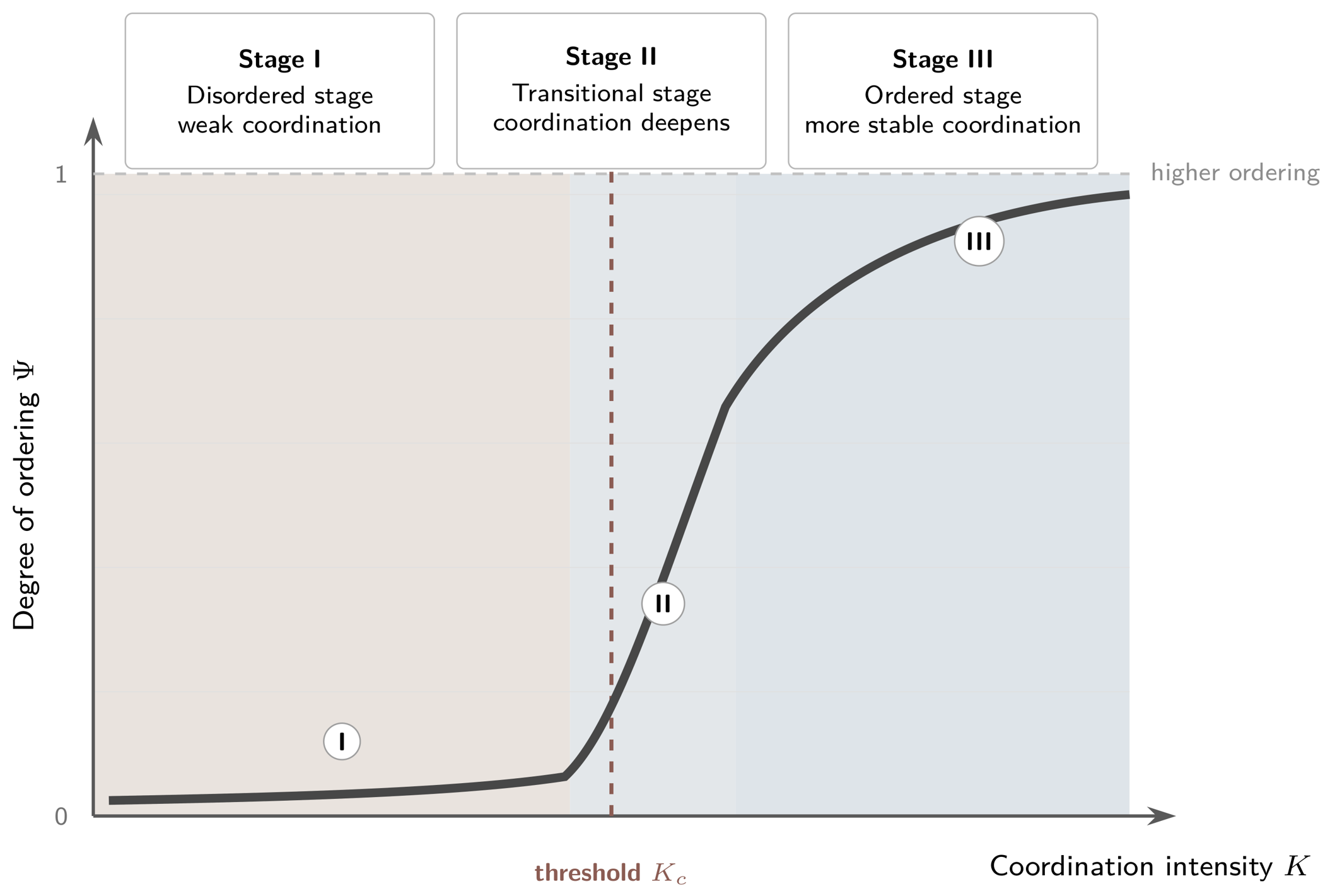
The second interpretive move links coordination to staged change in energy systems. Drawing loosely on Kuramoto-style threshold thinking, system evolution can be interpreted through the relationship between coordination intensity K, a critical threshold K c , and the degree of ordering Ψ . This language is not presented as a literal measurement model for VPPs. Rather, it is used as interpretive shorthand for describing how weakly coordinated systems may remain disordered, how transitional states can emerge near a threshold, and how stronger coordination can produce more stable collective behaviour [15,20,21].
On that basis, the framework distinguishes three interpretive stages: a disordered stage, a transitional stage, and an ordered stage. These stages are not claimed as universal empirical categories. They are heuristic labels for comparing coordination trajectories across cases and for discussing how different forms of ordering may emerge. Importantly, movement between stages depends not only on cyber–physical coupling, but also on whether authority, legitimacy, and user participation are assembled in ways that make deeper coordination governable.
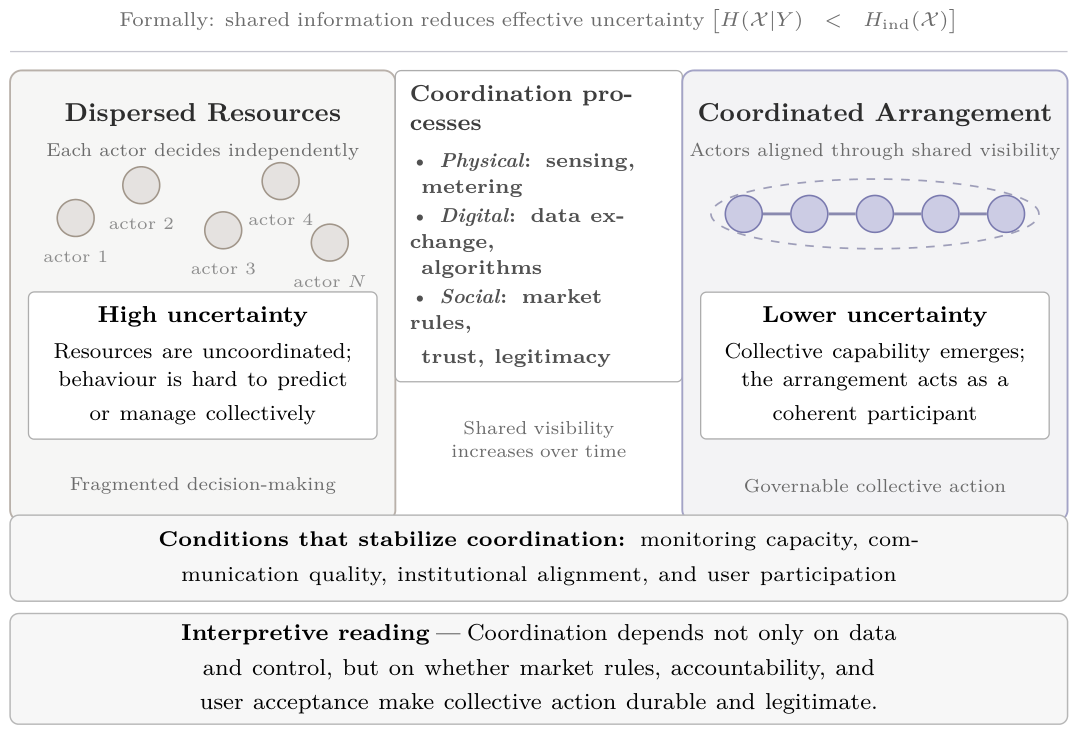
Figure 1 illustrates this first mapping between fragmented resources, shared visibility, and reduced effective uncertainty.
Figure 2 then places this staged reading in numerical order by linking K, K c , and Ψ to disordered, transitional, and ordered regimes.

3.5. Aggregation as Representation and Authority

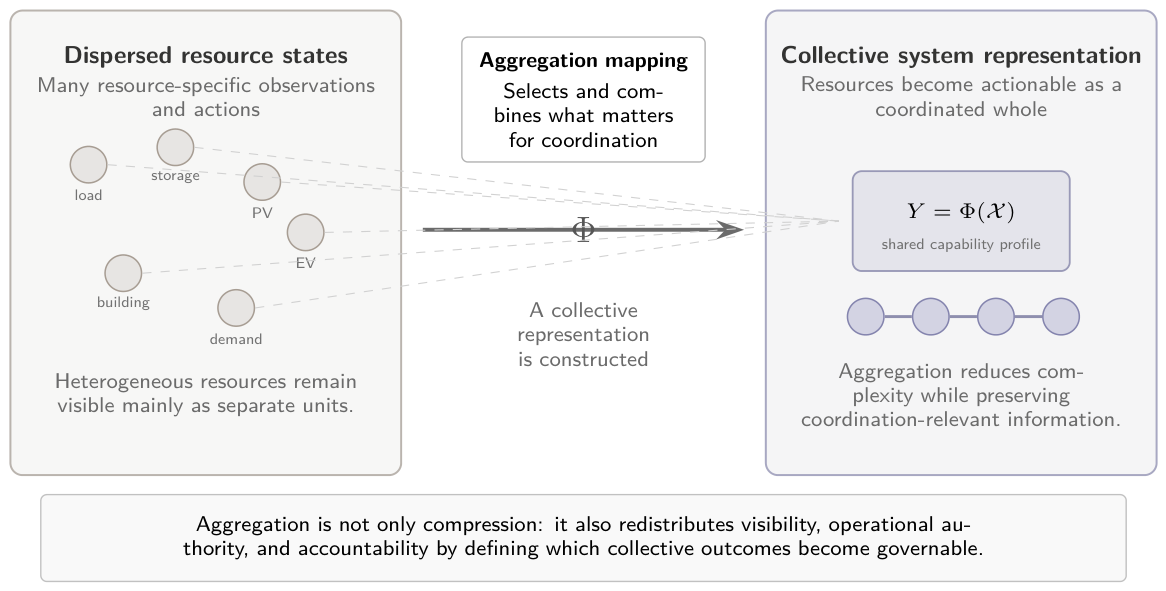
The third interpretive move links aggregation to low-dimensional but functionally enhanced system representation. In this framework, Φ : M N M agg denotes not merely compression, but a selective representation of collective capability. Aggregation reduces dimensionality while preserving the information needed for coordination and service provision. At the same time, aggregation is also institutional: it redistributes visibility, operational authority, and accountability by deciding which resource behaviours count, which actors can intervene, and which collective outcomes become actionable.
In qualitative terms, aggregation matters because it preserves coordination-relevant characteristics while discarding many microscopic details. It can therefore be understood at once as informational compression and as an institutional construction of collective capability.
Figure 3 summarizes this third mapping by showing aggregation as selective representation from heterogeneous resources to a coordinated aggregate.
For that reason, aggregation should be understood as a problem of representation rather than a neutral technical step. To aggregate is to decide which forms of heterogeneity are manageable, which differences can be ignored, and which actors may speak or be spoken for through the platform, market intermediary, or control architecture. From an energy social science perspective, the crucial question is therefore not simply whether aggregation works, but what kinds of publics, obligations, and exclusions are created when households, devices, or communities are rendered as a single coordinated entity.

3.6. Locating Coordination Across Physical, Digital, and Social Domains

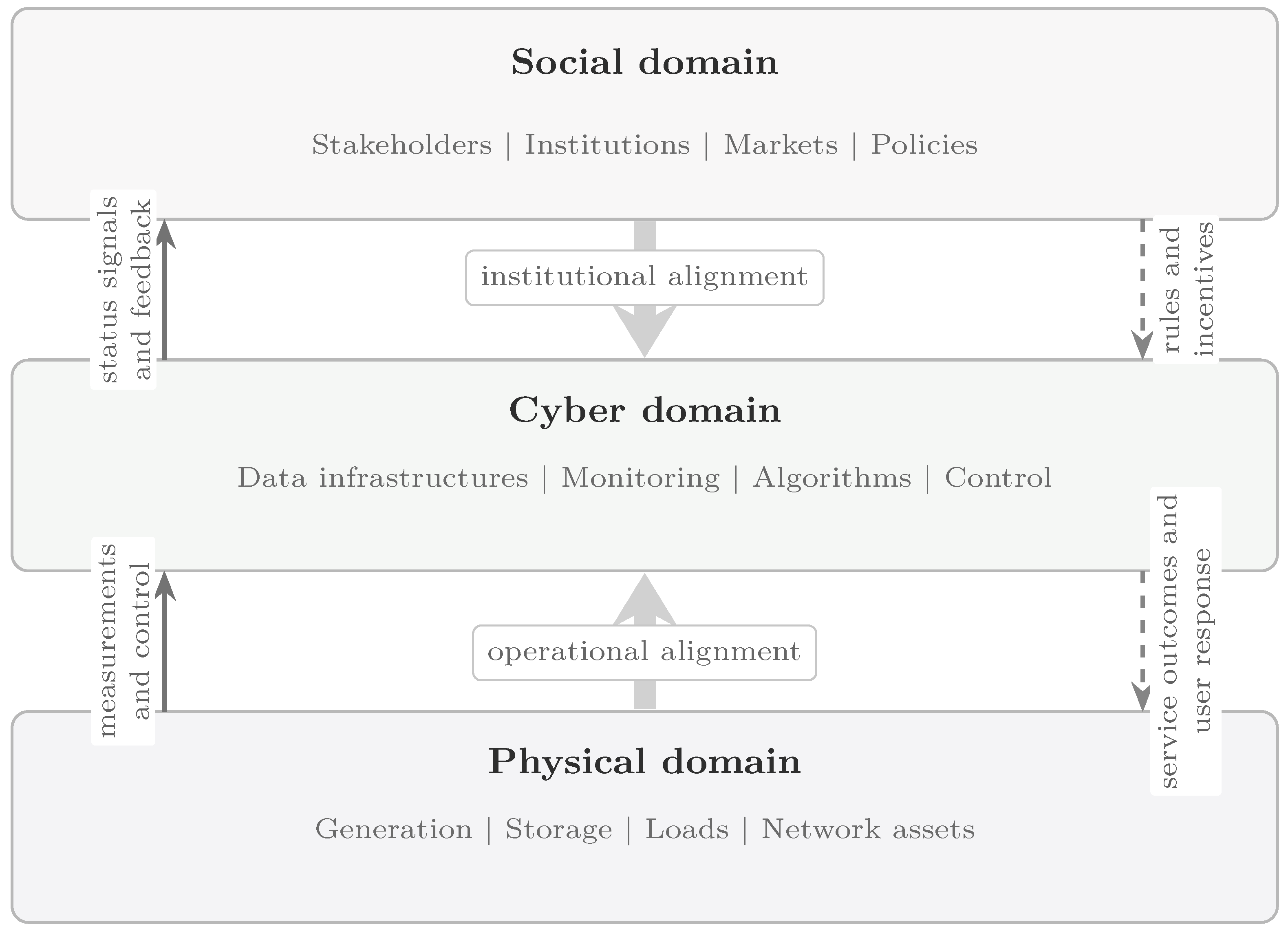
These interpretive moves come together in a CPSSE architecture composed of physical, cyber, and social layers. The physical layer includes generation, storage, loads, and infrastructures. The cyber layer includes sensing, communications, data processing, and control. The social layer includes markets, institutions, governance arrangements, and stakeholder relations. Total system entropy can be represented conceptually as
H total = H phy + H cyb + H soc I mutual ,
where cross-layer mutual information expresses forms of alignment or coordination across domains. Here again, the equation should be read as an interpretive summary of cross-layer relations rather than as a complete empirical model.
The inclusion of the social layer is crucial for the contribution developed here. Coordination failures cannot be understood solely in technical terms. Trust, legitimacy, fairness, and institutional coherence affect whether cyber–physical capability translates into stable collective ordering. In this sense, the framework treats social relations not as contextual add-ons, but as constitutive conditions of whether aggregation is accepted, whether coordination claims are seen as legitimate, and whether collective capability can persist.
Put differently, the social layer is where governability is won or lost. A system may achieve greater observability and tighter control while simultaneously generating suspicion, opacity, or uneven benefit distribution. In such cases, the failure is not external to coordination; it shows that coordination has been assembled on terms too narrow to sustain broader consent. Social contestation is therefore treated not as noise around an otherwise technical process, but as evidence about the limits of the coordinating arrangement itself.
Figure 4 brings the three mappings together in a CPSSE arrangement spanning physical, cyber, and social domains.

4. Illustrative Use in Virtual Power Plants

4.1. A Conceptual Walkthrough

VPPs provide a useful context for illustrating how the framework may be used. They aggregate dispersed assets, rely on digital coordination, and operate within institutional and market environments. For that reason, they are well suited to showing how the framework’s vocabulary and mappings can be mobilized interpretively. This section should be read as a conceptual walkthrough rather than an empirical evaluation. It is not intended to specify a full control scheme, optimization architecture, or reproducible implementation workflow for a particular VPP.
The value of the VPP example is not that it resolves causal questions on its own. It is that VPPs make a larger transition problem unusually visible: distributed energy does not become collective capability automatically. It does so through the ongoing construction of rules, interfaces, incentives, obligations, and claims to legitimacy. That is why VPPs are analytically useful here. They expose, in compressed form, the broader socio-technical challenge of turning heterogeneity into governable coordination.

4.2. Illustrative Stage Matrix

To make the framework concrete without implying false precision, Table 2 summarizes how the three interpretive stages can be read across technical, informational, and institutional dimensions. Rather than assigning numerical values, the table shows the kind of qualitative changes that the framework is meant to render comparable across cases.
The point is not to calibrate an idealized VPP. It is to show how weakly coordinated, transitional, and more ordered arrangements may differ in terms of information visibility, control integration, market organization, and social acceptability. This is closer to the kind of comparative language used in energy social science, where the analytical task is often to identify patterned differences across cases before those differences can be measured directly.
The table should therefore be read as a comparative heuristic. It clarifies how lower uncertainty, stronger coordination, and more durable ordering may be interpreted together without suggesting that the framework already supplies a validated measurement model.

4.3. Reading Stage Evolution Qualitatively

The framework suggests one way to read VPP evolution qualitatively. In a disordered stage, information flows are weak, coordination remains sequential or manual, and collective capability is limited. In a transitional stage, bidirectional data exchange and integrated optimization become more visible, and partial coordination emerges. In an ordered stage, distributed intelligence, faster response, and more stable coordination become possible. Crucially, these shifts are also social and institutional: users, aggregators, market operators, and regulators must recognize the arrangement as credible, acceptable, and worth sustaining.
This staged reading is interpretive rather than deterministic. It is intended to support comparative analysis of coordination trajectories, not to impose a fixed universal sequence on all cases.
Qualitative evidence from reported VPP implementations is broadly compatible with this interpretation. Field-oriented studies illustrate how operational coordination intensifies through aggregation platforms [4,5], and reviews of demonstrator projects document recurring patterns in how data exchange and control integration deepen over time [6]. For instance, the StoreNet project in Ireland can be read retrospectively as moving from basic aggregation toward more intensive bidirectional coordination [5]. Yet published case materials do not directly measure K, Ψ , or H, so this remains a qualitative interpretation rather than a test of the framework.
This is also where the framework adds insight beyond a standard technical or transition-based reading. A purely technical account would typically emphasize optimization performance, response speed, or resource scheduling, while a transition-oriented account would more often stress market formation, policy support, or niche-regime interaction. The interpretive vocabulary developed here instead makes visible how improved observability, stronger coordination, selective aggregation, and social acceptability must be assembled together if a VPP is to function as a durable collective actor rather than merely as a temporary control arrangement. On that reading, a case such as StoreNet is analytically useful not only because coordination intensified, but because the project also illustrates how technical integration, platform-mediated representation, and the credibility of the coordinating arrangement co-evolve.

4.4. From Concept to Empirical Operationalization

The framework also clarifies what future empirical work would need to operationalize. Coordination intensity K might be approximated through communication density, control frequency, or coordination responsiveness. Degree of ordering Ψ might be proxied through response simultaneity or correlation in resource behaviour. Information entropy H might be approximated through forecasting uncertainty and data quality. For the social layer, technically tractable proxies could include user churn or opt-out rates, latency in response to market or control signals, participation persistence, benefit distribution, dispute frequency, and other trust-related indicators. At present, these remain conceptual correspondences rather than validated measurement strategies, and they would need to be interpreted alongside interview, policy, and institutional evidence rather than treated as self-sufficient indicators.

5. Discussion: Governance Implications, Scope Conditions, and Research Agenda

5.1. Governance Implications

For scholars of distributed energy and energy transitions, the main value of the framework lies less in optimization and more in interpretation. It suggests that governance interventions can be read as interventions into coordination conditions. Standardization, data-sharing arrangements, market design, and accountability mechanisms are relevant not because they mechanically determine outcomes, but because they shape information flows, coupling conditions, and the social acceptability of coordination.
Seen in this way, the framework shifts attention from technology adoption alone to the social production of coordinated capability. VPPs do not become effective merely because digital tools are available; they become effective when data exchange, operational authority, market incentives, and user acceptance are aligned well enough for collective action to become credible and repeatable. Governance is therefore central rather than peripheral. The practical question is not only how to optimize assets, but how to create the institutional and relational conditions under which coordination can be trusted, enacted, and maintained.
This shift has a further implication that deserves emphasis. Greater coordination does not necessarily constitute a social good. Highly coordinated arrangements can concentrate discretion in platform operators, obscure value redistribution behind technical optimization, and normalize asymmetries in whose flexibility is called upon and whose convenience is protected. A Perspective on governability therefore has to ask not only whether coordination deepens, but for whom it deepens, under what terms, and with what consequences for accountability and democratic oversight.
This implies three broad governance insights. First, information infrastructures matter because coordination depends on more than physical interconnection alone. Second, staged change is unlikely to be purely technical; institutional coherence and stakeholder trust affect whether cyber–physical capability can be translated into stable collective ordering. Third, highly coordinated systems create new governance requirements around transparency, accountability, and equity.
For energy social science, these implications recast familiar concerns in a different analytical register. Questions of fairness, legitimacy, participation, and institutional capacity are not external “social factors” appended to an otherwise technical system. They are part of the process through which coordination either consolidates or breaks down. In that sense, the framework brings debates about socio-technical transition, digital coordination, and energy justice into closer analytical contact.
This concern is consistent with existing work on social acceptance, prosumer integration, and justice in electricity systems. Empirical studies show that smart-grid arrangements are shaped by perceived fairness and inclusion [8,12], while design-oriented analyses emphasize how value choices embedded in digital infrastructures distribute benefits and burdens unevenly [22]. In that sense, legitimacy and trust are not secondary supplements to coordination; they are part of the conditions under which coordinated flexibility becomes acceptable, durable, and publicly defensible.
This is also why the social layer should be read into the framework’s stage vocabulary rather than alongside it. In disordered stages, weak trust, opaque incentives, and uneven inclusion sustain high effective uncertainty even where physical and cyber conditions could in principle support tighter coupling. In transitional stages, contestation over fairness, participation rights, and benefit distribution shapes whether coordination intensity K approaches a workable threshold or stalls. In more ordered stages, institutionalized accountability and procedural legitimacy condition whether the aggregation mapping Φ is recognized as representing a credible collective actor rather than an extractive intermediary. Read in this way, social-layer concerns are not a separate column added to Table 2; they are conditions for whether each stage transition is achieved at all, and they vary case by case in ways the framework is intended to render visible.

5.2. Scope Conditions and Limitations

The framework has clear limits. The synchronization analogy assumes substantial homogeneity and gradual evolution that real systems may not satisfy. Systems subject to abrupt policy shifts, imported technological platforms, or discontinuous institutional change may not follow a gradual staged pattern. The framework also remains more developed for electricity than for multi-vector energy systems. Most importantly, the social layer is still analytically thinner than the cyber and physical layers, because constructs such as trust, participation, and institutional capacity remain difficult to operationalize in consistent ways.
For the same reason, the article does not attempt a full review of the extensive literature on legitimacy, trust, participation, and energy justice; instead, it engages these strands selectively in order to clarify why the social layer should be treated as constitutive rather than contextual within analyses of coordinated energy systems.
There are also limits of interpretation. The staged language used here is analytically useful, but it may obscure cycling, contestation, or reversal if applied too rigidly. Some systems may move unevenly across domains, displaying high technical coordination alongside weak social legitimacy, or strong institutional support alongside limited operational integration. For that reason, the framework should be used to sensitize analysis to different dimensions of coordination, not to force cases into a single linear narrative.
There is a second limitation specific to the Perspective format. Because the argument is intentionally synthetic, it risks giving a cleaner and more coherent image of coordination than empirical settings usually warrant. Real arrangements are often improvised, contested, and institutionally layered. Concepts such as legitimacy, trust, and accountability also travel unevenly across contexts. The value of the present Perspective lies in disciplined simplification, but that same simplification should not be mistaken for completeness.
These limitations are not peripheral. They define the proper scope of the contribution: an interpretive framework for comparative analysis and future empirical work, not a finished measurement model.

5.3. Research Agenda

Three directions follow directly from the framework. First, longitudinal empirical studies could investigate whether real cases exhibit measurable shifts in information coupling, coordination intensity, and staged ordering. Second, mixed-method research could examine how governance, trust, and benefit distribution condition the transition from cyber–physical capability to sustained collective coordination. Third, comparative case analysis could explore whether the framework travels across different institutional settings, including contexts with uneven infrastructure, fragmented regulation, or strong incumbent resistance.
Beyond these primary directions, four further lines of inquiry would deepen the Perspective’s usefulness.Methodologically, future studies could combine system data with interviews, document analysis, and institutional mapping so that coordination is not inferred from technical signals alone. Comparatively and politically, researchers could examine who benefits from highly coordinated arrangements, whose agency is displaced by automation, and how accountability is redistributed as aggregation platforms become more powerful. Temporally, future work could ask whether coordination that appears durable at short operational timescales remains legitimate over longer periods marked by tariff change, policy reversal, or shifting public expectations. Finally, in terms of political economy, scholars could examine how business models, ownership structures, and market concentration shape which forms of aggregation become thinkable, financeable, and governable. These questions matter because coordination is never assembled in an institutional vacuum; it is built through competitive strategies, regulatory compromises, and uneven capacities to define what counts as system value.

6. Conclusions

This Perspective has developed an interpretive elaboration of Xue et al.’s CPSSE concept for understanding how distributed energy becomes coordinated and governable. Its central claim is that coordination should be analysed not only as a technical achievement, but as a socio-technical accomplishment in which information, aggregation, and ordering are stabilized through governance, legitimacy, accountability, and selective forms of representation.
For energy social science, the framework is useful because it provides a shared vocabulary for comparing how collective capability is assembled and why technically capable arrangements may remain institutionally weak or socially contested. By linking uncertainty, staged coordination, and aggregation, it helps shift attention from technology adoption alone to the conditions under which coordination becomes credible, acceptable, durable, and politically negotiable.
The framework also creates a more direct conversation between engineering discussions of control and aggregation, transition studies of institutional change, and energy social science concerns with legitimacy, justice, participation, and governance. Its value lies in making coordination legible across these disciplines without collapsing them into a single deterministic model.
The framework remains provisional and requires empirical development. The most useful next step is research that examines how coordination is negotiated, institutionalized, resisted, and unevenly distributed across real cases, and that tests whether the proposed vocabulary helps explain variation in legitimacy, participation, durability, and representational inclusion across distributed energy arrangements. Because the article is framed as a Perspective, it does not report numerical control results or a validated implementation benchmark; its contribution is instead to clarify the questions, distinctions, and operational directions that such future studies should address. Read in that way, the Perspective is less a model of optimal system behaviour than a device for asking when coordinated energy systems become governable, acceptable, and politically durable, and when they do so only by concealing unresolved social conflicts.

Author Contributions

H.L.: conceptualization, methodology, investigation, writing—original draft preparation. W.L.: investigation, resources, writing—review and editing. H.Z.: conceptualization, methodology, resources, writing—review and editing, supervision, project administration, funding acquisition. All authors have read and agreed to the published version of the manuscript.

Funding

This research was funded by the National Natural Science Foundation of China Intelligent Power Grid Joint Fund, grant number U22B6008. The funding was not provided by State Grid Electric Power Research Institute (NARI Group Corporation).

Data Availability Statement

No new data were created or analyzed in this study. Data sharing is not applicable to this article.

Acknowledgments

The authors thank colleagues for informal feedback on earlier versions of this argument.

Conflicts of Interest

Author Wei Li was employed by State Grid Electric Power Research Institute (NARI Group Corporation). The remaining authors declare that the research was conducted in the absence of any commercial or financial relationships that could be construed as a potential conflict of interest. The funders had no role in the design of the study; in the collection, analyses, or interpretation of data; in the writing of the manuscript; or in the decision to publish the results.

List of Abbreviations

CPSS, cyber–physical–social systems; CPSSE, Cyber–Physical–Social Systems in Energy; DSM, demand-side management; MLP, multi-level perspective; TIS, technological innovation system; VPP, virtual power plant.

References

  1. Abdelkader, S.; Amissah, J.; Abdel-Rahim, O. Virtual power plants: An in-depth analysis of their advancements and importance as crucial players in modern power systems. Energy Sustain. Soc. 2024, 14, 52. [Google Scholar] [CrossRef]
  2. Koza, E.; Oeztuerk, A. A literature review to analyze the state of the art of virtual power plants in context of information security. In Advances and New Trends in Environmental Informatics; Wohlgemuth, V., Naumann, S., Behrens, G., Arndt, H.K., Eds.; Progress in IS; Springer: Cham, Switzerland, 2022; pp. 49–69. [Google Scholar] [CrossRef]
  3. Nafkha-Tayari, W.; Ben Elghali, S.; Heydarian-Forushani, E.; Benbouzid, M. Virtual power plants optimization issue: A comprehensive review on methods, solutions, and prospects. Energies 2022, 15, 3607. [Google Scholar] [CrossRef]
  4. Bhuiyan, E.A.; Hossain, M.Z.; Muyeen, S.M.; Fahim, S.R.; Sarker, S.K.; Das, S.K. Towards next generation virtual power plant: Technology review and frameworks. Renew. Sustain. Energy Rev. 2021, 150, 111358. [Google Scholar] [CrossRef]
  5. Bahloul, M.; Breathnach, L.; Cotter, J.; Daoud, M.; Saif, A.; Khadem, S. Role of aggregator in coordinating residential virtual power plant in StoreNet: A pilot project case study. IEEE Trans. Sustain. Energy 2022, 13, 2148–2158. [Google Scholar] [CrossRef]
  6. Naughton, J.; Riaz, S.; Cantoni, M.; Zhang, X.P.; Mancarella, P. Comprehensive optimization-based techno-economic assessment of hybrid renewable electricity-hydrogen virtual power plants. J. Mod. Power Syst. Clean Energy 2023, 11, 553–566. [Google Scholar] [CrossRef]
  7. Meng, F.; Lu, Z.; Li, X.; Han, W.; Peng, J.; Liu, X.; Niu, Z. Demand-side energy management reimagined: A comprehensive literature analysis leveraging large language models. Energy 2024, 291, 130303. [Google Scholar] [CrossRef]
  8. Botelho, D.F.; Dias, B.H.; de Oliveira, L.W.; Soares, T.A.; Rezende, I.; Sousa, T. Innovative business models as drivers for prosumers integration: Enablers and barriers. Renew. Sustain. Energy Rev. 2021, 144, 111057. [Google Scholar] [CrossRef]
  9. Weckowska, D.; Weiss, D.; Schwaebe, C.; Dreher, C. Technological innovation system analyses and sustainability transitions: A literature review. Environ. Innov. Soc. Transit. 2025, 54, 100935. [Google Scholar] [CrossRef]
  10. Xue, Y.; Yu, X. Beyond smart grid: A Cyber-Physical-Social System in Energy future. Proc. IEEE 2017, 105, 2290–2292. [Google Scholar] [CrossRef]
  11. Yang, X.; Cai, B.; Xue, Y. Review on optimization of nuclear power development: A Cyber-Physical-Social System in Energy perspective. J. Mod. Power Syst. Clean Energy 2022, 10, 547–561. [Google Scholar] [CrossRef]
  12. Bugden, D.; Stedman, R. Unfulfilled promise: Social acceptance of the smart grid. Environ. Res. Lett. 2021, 16, 034019. [Google Scholar] [CrossRef]
  13. Geels, F.W. The Multi-Level Perspective on sustainability transitions: Background, overview, and current research topics. Camb. Open Engag. 2024. [Google Scholar] [CrossRef]
  14. Geels, F.W. Socio-technical transitions to sustainability: A review of criticisms and elaborations of the Multi-Level Perspective. Curr. Opin. Environ. Sustain. 2019, 39, 187–201. [Google Scholar] [CrossRef]
  15. Berner, R.; Gross, T.; Kuehn, C.; Kurths, J.; Yanchuk, S. Adaptive dynamical networks. Phys. Rep. 2023, 1031, 1–59. [Google Scholar] [CrossRef]
  16. Thavlov, A.; Bindner, H.W. Utilization of Flexible Demand in a Virtual Power Plant Set-Up. IEEE Trans. Smart Grid 2015, 6, 640–647. [Google Scholar] [CrossRef]
  17. Sheidaei, F.; Ahmarinejad, A. Multi-stage stochastic framework for energy management of virtual power plants considering electric vehicles and demand response programs. Int. J. Electr. Power Energy Syst. 2020, 120, 106047. [Google Scholar] [CrossRef]
  18. Shannon, C.E. A Mathematical Theory of Communication. Bell Syst. Tech. J. 1948, 27, 379–423. [Google Scholar] [CrossRef]
  19. Landauer, R. Irreversibility and heat generation in the computing process. IBM J. Res. Dev. 1961, 5, 183–191. [Google Scholar] [CrossRef]
  20. Kuramoto, Y. Chemical Oscillations, Waves, and Turbulence; Springer Series in Synergetics; Springer: Berlin/Heidelberg, Germany, 1984; Volume 19. [Google Scholar] [CrossRef]
  21. Acebrón, J.A.; Bonilla, L.L.; Pérez Vicente, C.J.; Ritort, F.; Spigler, R. The Kuramoto model: A simple paradigm for synchronization phenomena. Rev. Mod. Phys. 2005, 77, 137–185. [Google Scholar] [CrossRef]
  22. Milchram, C.; Kuenneke, R.; Doorn, N.; van de Kaa, G.; Hillerbrand, R. Designing for justice in electricity systems: A comparison of smart grid experiments in the Netherlands. Energy Policy 2020, 147, 111720. [Google Scholar] [CrossRef]
Figure 1. Interpretive schematic of how aggregation can turn fragmented resources into a more coordinated arrangement by increasing shared visibility and reducing effective uncertainty. Effective uncertainty falls only insofar as visibility is accompanied by trustworthy information channels and acceptable terms of use.
Energies 19 02303 g001
Figure 2. Interpretive view of staged change, showing how coordination intensity (K), a critical threshold ( K c ), and the degree of ordering ( Ψ ) can be used as a language for describing different coordination regimes. The three quantities are read jointly as a comparative language for stage differences, not as a deterministic phase law.
Energies 19 02303 g002
Figure 3. Interpretive view of aggregation as the formation of a lower-dimensional but functionally enhanced system representation. The mapping Φ should be read as selective representation that simultaneously enables collective action and redistributes whose behaviour counts.
Energies 19 02303 g003
Figure 4. Interpretive view of CPSSE as a three-domain arrangement in which physical, cyber, and social processes are linked through measurement, control, feedback, rules, and service outcomes. The social domain is treated not as context but as a constitutive condition of whether coordination becomes legitimate and durable; the alignment arrows indicate the main shaping directions rather than strictly one-way causality. The social domain therefore conditions whether cross-domain alignment is recognized as legitimate, not merely whether it is technically achieved.
Energies 19 02303 g004
Table 1. Analytical variables at a glance: how the shared vocabulary maps onto CPSSE layers and possible operational proxies.
SymbolConceptPrimary CPSSE LocusPossible Operational Proxies (Heuristic)
X State of heterogeneous resources Physical Power, energy, availability, technical state vectors
H , H ( X Y ) , I ( X ; Y ) Uncertainty and information coupling Cyber–physical Forecasting error, data latency, mutual predictability
K , K c Coordination intensity and threshold Cyber–social Communication density, control frequency, response coupling
Ψ Degree of ordering Cross-layer Response simultaneity, behavioural correlation
Φ Aggregation mapping Social–cyber Platform composition rules, market representation, accountability lines
Table 2. Qualitative stage matrix for comparing VPP coordination trajectories across technical, informational, and institutional dimensions.
DimensionDisordered StageTransitional StageOrdered Stage
Information visibilityFragmented, delayed, and weakly sharedPartial visibility with improving data exchangeIntegrated, timely, and more actionable visibility
Control and coordinationSequential, manual, or weakly integrated controlMixed manual–digital coordination with emerging optimizationMore automated, repeatable, and coordinated control
Aggregation formLoose bundling of heterogeneous assetsPlatform-based coordination begins to stabilizeAggregation acts more clearly as a collective actor
Governance conditionsUnclear roles, uneven incentives, and limited trustNegotiated rules, growing legitimacy, and contested authorityInstitutionalized accountability and wider social acceptance
Typical analytical readingHigh uncertainty and weak orderingCoordination deepens but remains politically contestedMore stable ordering that remains social and political
Disclaimer/Publisher’s Note: The statements, opinions and data contained in all publications are solely those of the individual author(s) and contributor(s) and not of MDPI and/or the editor(s). MDPI and/or the editor(s) disclaim responsibility for any injury to people or property resulting from any ideas, methods, instructions or products referred to in the content.