Article

A Two-Stage Voltage Sag Source Localization Method in Microgrids

1
CSG Electric Power Research Institute, Guangzhou 510663, China
2
China Southern Power Grid Co., Ltd., Guangzhou 510663, China
*
Author to whom correspondence should be addressed.
Energies 2026, 19(1), 258; https://doi.org/10.3390/en19010258
Submission received: 4 December 2025 / Revised: 27 December 2025 / Accepted: 31 December 2025 / Published: 3 January 2026
(This article belongs to the Special Issue Modeling, Stability Analysis and Control of Microgrids)

Abstract

Accurate localization of voltage sag sources is crucial for maintaining reliable and stable operation in microgrids with high penetration of distributed generation (DG). However, the complex topology, bidirectional and time-varying power flows, and measurement uncertainty make it difficult for these conventional model-based approaches to achieve high accuracy. To address these challenges, this paper proposes a two-stage voltage sag source localization method that integrates a data-driven spatio-temporal learning model with a model-based binary search refinement. In the first stage, an improved spatial-temporal graph convolutional network (STGCN) is developed to extract temporal and spatial correlations among voltage and current measurements, enabling section-level localization of sag sources. In the second stage, a binary search–based refinement strategy is applied within the candidate section to iteratively converge on the exact fault location with high precision and robustness. Simulations are conducted on a modified IEEE 33-node system with diverse PV output scenarios, covering combinations of fault types and locations. The results demonstrate that the proposed method maintains stable localization performance under high DG penetration and achieves high accuracy despite multiple fault types and noise interference.

1. Introduction

With the rapid development of advanced manufacturing, especially the extensive application of voltage-sag-sensitive equipment in high-end manufacturing fields, users’ requirements and emphasis on power quality have significantly increased [1,2]. Voltage sag, as one of the most common power quality disturbances in microgrids, has become an issue that urgently needs to be addressed on a priority basis [3,4]. The extensive integration of distributed power sources in microgrids makes the network topology more complex and the power flow direction more variable [5,6]. Among the various factors that cause voltage sags, short-circuit faults are the main cause, resulting in significant economic losses. Given that voltage sags are difficult to completely avoid, rapid and accurate fault source localization after an event occurs is of great significance [7,8]. On the one hand, it helps to clarify power supply and consumption responsibilities and conduct impact assessments; on the other hand, it is equally crucial for ensuring the safe and stable operation of the microgrid and the wider power system [9]. Compared with non-fault sag sources determined by the installation location of the equipment, existing research pays more attention to the localization of fault sources [10,11].
Voltage sag source localization can be classified into upstream and downstream localization, section localization and precise localization based on localization accuracy. The upstream and downstream localization rely on single-point measurements. By comparing the changes in electrical quantities before and after the sag, it is determined whether the voltage sag source is located upstream or downstream of the monitoring point [12]. This type of method is easy to deploy and has low requirements for measurement coverage, but it can only provide upstream/downstream conclusions and has a relatively large fault range. Section localization usually combines the topology of the microgrid to construct a network description matrix [13], which is then multiplied by the fault feature vectors reported by the line terminals during the sag period to form a criterion matrix to determine the section [14,15]. However, it is sensitive to the quality of terminal data. Data distortion and loss can easily lead to misjudgment. Precise localization aims to refine the voltage sag sources to the specific position on the line between two nodes or at a certain point along the line [16,17]. Relevant research draws on the idea of fault location, such as using compressive sensing to identify faulty nodes from sparse fault responses, or calculating the time difference of the faulty traveling wave reaching the monitoring points at both ends based on traveling wave theory combined with wavelet transformation to achieve localization [18,19]. The traveling wave method has relatively high accuracy in long-distance transmission networks [20], but in microgrids with numerous branches, traveling wave measurement devices need to be widely deployed, which results in both high costs and significant implementation difficulties [21].
Under the background of the construction of the new power system, the large-scale integration of distributed photovoltaic and other renewable energy sources has resulted in bidirectional and time-varying power flows [22,23]. Consequently, the stability of traditional localization criteria has been significantly compromised, limiting the accuracy of these methods. Concurrently, the accelerated deployment of power quality monitoring devices (PQMDs) has significantly expanded measurement coverage on the microgrid side, enabling systematic collection and analysis of disturbance data. This provides a crucial foundation for data-driven source localization of momentary voltage sag. Radial basis function neural networks have also been used to learn the mapping between node voltages and fault locations, as reported in [24], which improves localization efficiency. However, their outputs lack interpretability and are often confined to very limited neighboring regions. Several studies combine artificial intelligence methods with phasor measurement unit (PMU) data, achieving good performance. Yet, considering economic and implementation feasibility, comprehensive PMU deployment across microgrids remains impractical. Overall, existing methods still exhibit shortcomings in measurement coverage, data quality robustness, adaptability to complex power flows, and cost feasibility.
In response to the above challenges, this paper proposes an accurate localization method for voltage sag sources in microgrids that integrates an improved spatio-temporal graph convolutional network (STGCN) [25] with binary search. Firstly, a section-level localization module is embedded in the improved STGCN to fully explore the spatio-temporal correlation of voltage sags and achieve efficient initial localization of the sag source section. Then, by taking advantage of the low complexity and fast convergence characteristics of binary search, precise localization is accomplished within the candidate section. Finally, multi-scenario simulations are conducted on the modified IEEE 33-node system. The results show that this method has high localization accuracy and robustness under the condition of high-penetration DGs. Overall, this study establishes a data-model fusion framework for voltage sag source localization and contributes to data-driven stability assessment and reliable operation in modern microgrids. The main contributions of this work are summarized as follows:
(1)
A two-stage localization framework is proposed for identifying voltage sag sources in microgrids with high renewable penetration. The method integrates a data-driven spatial-temporal learning model and a model-based refinement strategy, combining the strengths of data-driven intelligence and physical interpretability.
(2)
An improved STGCN is developed to capture spatio-temporal dependencies among node measurements. The model enables section-level localization of voltage sag sources while maintaining strong robustness against measurement asynchrony and data noise.
(3)
A binary search refinement algorithm is proposed to achieve precise fault localization within the identified section. The algorithm iteratively compares simulated and measured sag characteristics and converges rapidly to the actual fault point, thereby improving both accuracy and convergence speed.

2. Section-Level Localization of Voltage Sag Sources Based on Improved STGCN

2.1. Spatio-Temporal Correlation Analysis and Modeling of Microgrid

To depict the temporal dynamics and spatial dependence of voltage and current, the microgrid is modeled as a generalized graph: with power sources, loads and other units as nodes, and the lines connecting the nodes as edges.

2.1.1. Analysis of Spatio-Temporal Coupling Characteristics of Microgrids

In the temporal dimension, the power output of renewable generation units fluctuates randomly, which causes bus voltages to vary over time. The voltage/current at a single moment is difficult to use to depict the entire process of “trigger—drop—maintenance—recovery”, and thus needs to be characterized by time series features.
In the spatial dimension, the coupling among sources, network, loads, and storage units leads to strong spatial correlation between the measurements of adjacent nodes. In a microgrid, the voltage at different nodes does not change independently. When a short-circuit fault occurs, the magnitude and duration of the voltage sag at nearby nodes are usually more severe than those at distant nodes. In addition, the disturbance propagates along the network with attenuation and directionality. The differences in arrival time and sag depth among nodes provide important information for identifying the line section where the sag source is located. Ignoring such spatial correlation can easily lead to misjudgment of the section. The spatio-temporal correlation diagram of the operating status of the microgrid is shown in Figure 1, where Aij refers to the entry located at row i and column j of the adjacency matrix A, representing the spatial connectivity between nodes.

2.1.2. Modeling of Spatio-Temporal Coupling Characteristics of Microgrid

With the continuous development of monitoring infrastructures, PQMDs have been widely deployed in microgrids. They make it possible to collect voltage and current data at multiple voltage levels. In practical engineering, however, edge-side measurements are often not fully synchronized and may be affected by bandwidth and storage limitations. To this end, under the premise of ensuring engineering availability, this paper takes low-redundancy RMS statistics as the core representation and constructs a spatio-temporal modeling structure of “temporal convolution + graph propagation + attention” to compensate for the information loss caused by feature compression.
Since only RMS values are required rather than synchronized waveforms, the method is naturally tolerant to slight time misalignment and asynchronous communication. The resulting data volume is low and compatible with event-driven transmission schemes.
The proposed method only requires PQMDs to provide per-cycle RMS values during fault events, typically at 20 ms resolution. Since the approach is based on scalar magnitude comparison, it is robust to variability in sampling frequency, data compression, and asynchronous reporting, making it suitable for bandwidth-constrained edge deployments.
In terms of the time dimension, the voltage sag is characterized by a non-stationary process of a short and rapid fall followed by recovery. Considering the cross-station time asynchrony, this paper selects the voltage and current RMS values provided by PQMDs at the fundamental frequency cycle scale as the input. In the microgrid, the effective values Urms and Irms, and apparent power S of each phase voltage and current, can be defined as:
U rms = 1 T 0 T u ( t ) 2 d t = U 2
I rms = 1 T 0 T i ( t ) 2 d t = I 2
S = 3 U rms I rms
where U denotes the peak value of the sinusoidal voltage waveform, and I denotes the peak value of the sinusoidal current waveform.
Although RMS calculation introduces a short temporal delay, its robustness and compatibility with non-synchronized measurements make it more suitable for wide-area PQMD-based fault localization than instantaneous signal representations.
This strategy relies on the widely deployed PQMDs on the microgrid and has good robustness against asynchronous data across nodes. It is convenient to derive apparent power and other indicators related to tapering behavior, enabling the model to focus more on the nonlinear relationship associated with voltage sag.
Based on this, at time t, the effective values of voltage and current for each node are extracted, and a two-dimensional feature matrix Xt is formed.
X t = V t 1 V t 2 V t N I t 1 I t 2 I t N
where N denotes the number of nodes, and Vt1 and It1 respectively represent the average values of the RMS values of the three-phase voltages and the three-phase currents at node 1.
In the spatial dimension, the microgrid is modeled as a graph structure. Based on its topology, an N × N electrical connection matrix A is constructed: if a line connection exists between node i and node j, Aij = 1; otherwise, Aij = 0.
The network topology of the microgrid is modeled by an adjacency matrix ARN×N. The entry Aij equals 1 when an electrical line directly connects nodes i and j, and equals 0 otherwise.

2.2. Architecture of the Improved STGCN-Based Voltage Sag Source Section Localization Model

This paper equates “a voltage sag occurring in a certain section” with “simultaneous voltage sag characteristics appearing at both end nodes of that section.” Based on this, a node-level label is constructed: nodes at both ends of the section are marked as 1, while all other nodes are marked as 0. The model takes the time-series feature Xt and the electrical connection matrix A as inputs, outputting the probability that each node is the source of the voltage sag. When the probabilities of both end nodes of a line simultaneously exceed a preset threshold, that line is identified as the voltage sag source section. This approach transforms the section-level problem into a node-level probability estimation task.

2.2.1. Overall Model Architecture and Spatiotemporal Coupling Representation

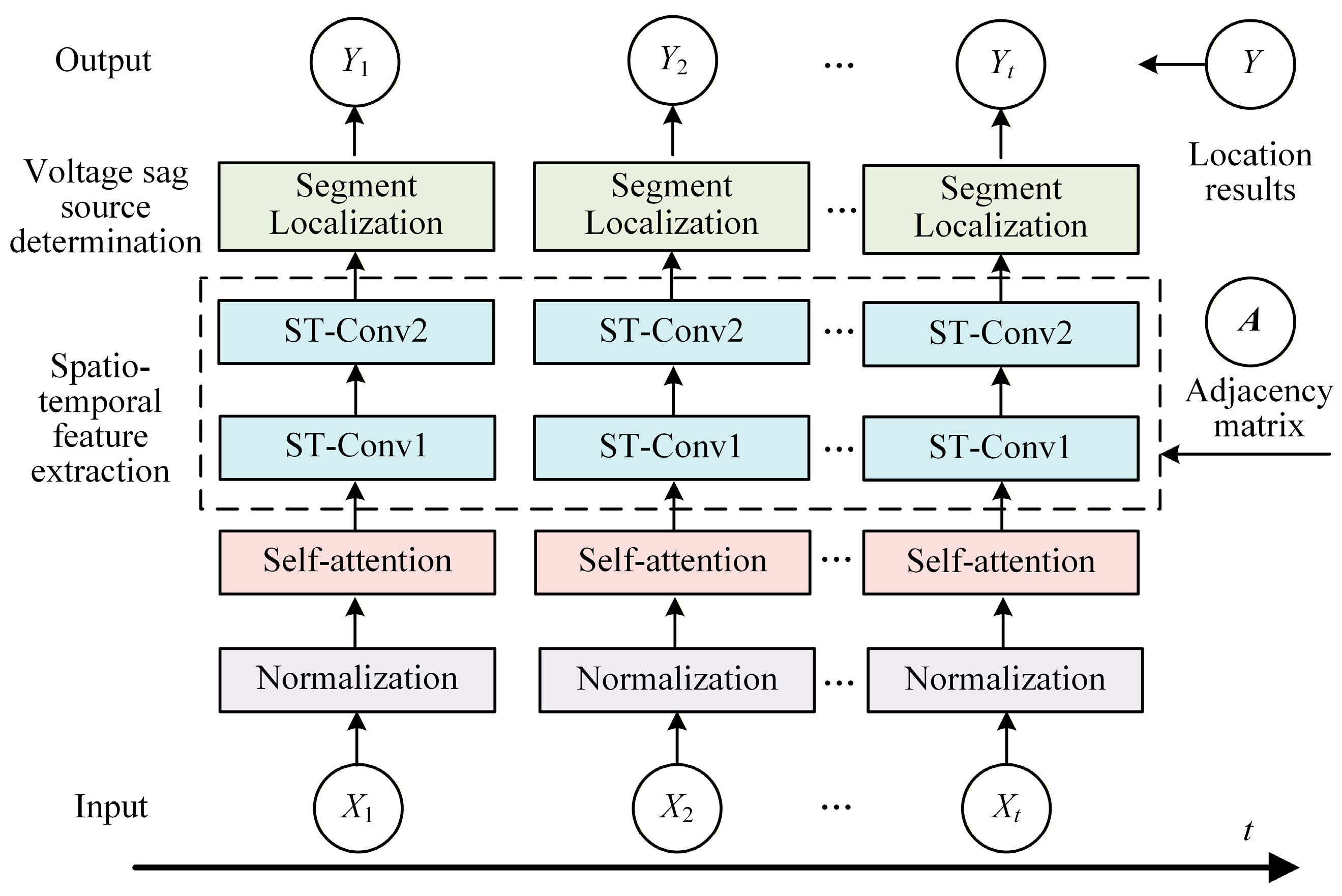
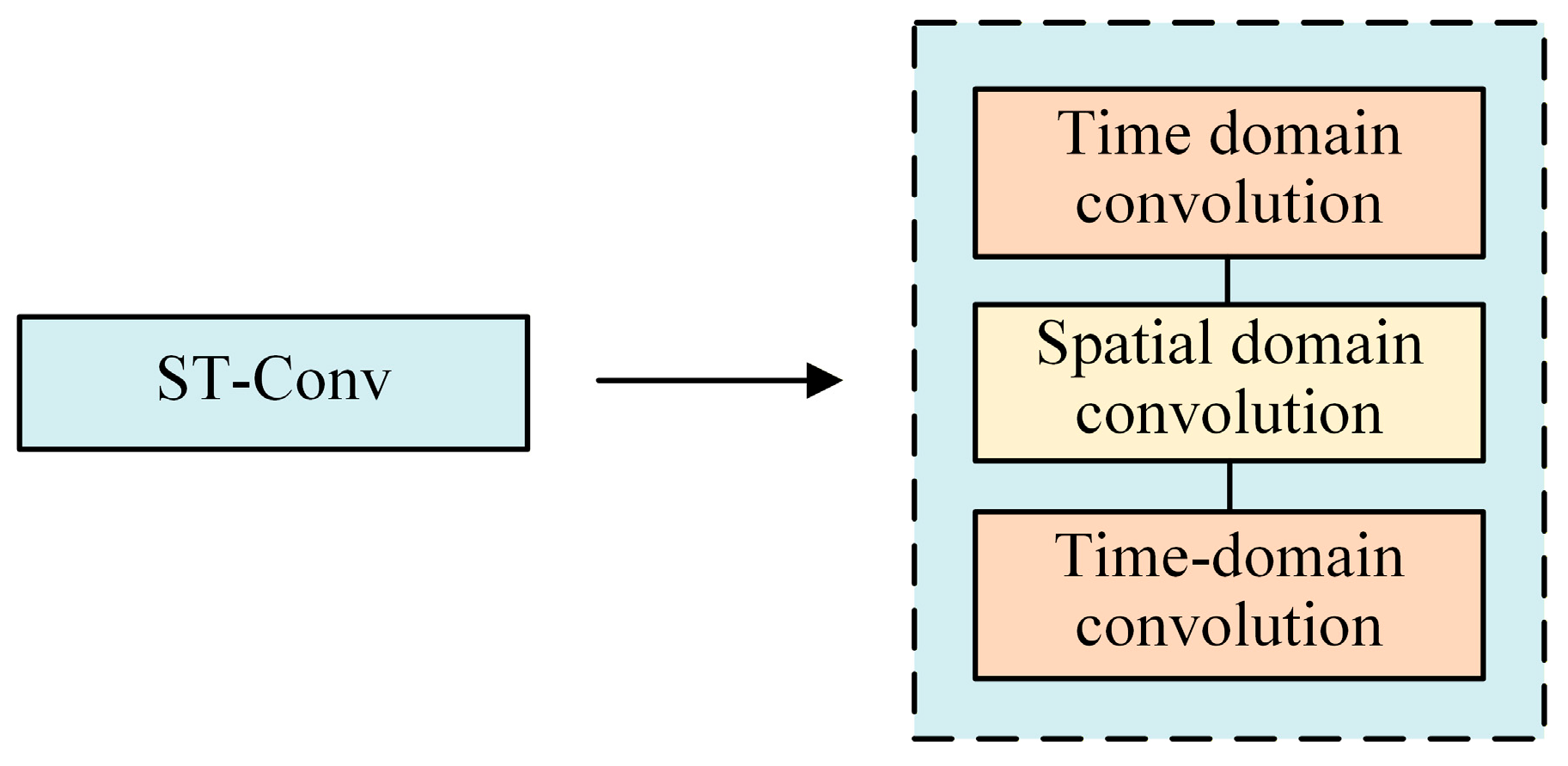
Leveraging the spatio-temporal modeling capabilities of STGCN, and considering the task requirements and data characteristics of voltage sag source section localization, this paper introduces self-attention and a section localization modules. The constructed improved STGCN section localization model consists of four functional modules connected in series: normalization module, spatio-temporal graph convolution (ST-Conv) module, self-attention module, and section localization module. The overall model structure is shown in Figure 2, while the structure of the ST-Conv submodule is depicted in Figure 3.
Regarding data and normalization, the voltage sag features are input as a tensor of shape (B, N, T, 2), where B denotes the batch size, N represents the number of nodes, T indicates the time section length, and 2 signifies the number of features. To ensure rapid convergence, the normalization module performs 0–1 normalization on the input feature matrix Xt and the electrical connection matrix A. This eliminates dimensional differences and ensures comparability:
x i = x i x i , min x i , max x i , min
where xi,max and xi,min are the maximum and minimum values of the corresponding feature.
In the spatio-temporal graph convolutional module, each submodule adopts a serial structure of “temporal convolution—spatial convolution—temporal convolution.” First, a single convolution is applied along the temporal dimension to the normalized input, extracting short-term temporal patterns. Subsequently, graph convolution models the topological dependencies between nodes. The output from the graph convolution undergoes ReLU activation before undergoing a second convolution along the temporal dimension, further integrating temporal features with spatial information.
For the lth block, the input and output are denoted as X(l) and X(l+1). The computation can be written in a compact form as
X l + 1 = Γ 1 l σ Θ l G Γ 0 l X l
where ∗ denotes convolution along the time dimension; Γ 0 ( l ) and Γ 1 ( l ) denote the convolution kernels of the two temporal domain convolutional layers, respectively; Θl denotes the convolution kernel of the spatial domain convolutional layer; σ (⋅) is a nonlinear activation function, and G is the directed graph defined by the electrical connection matrix and measurement features.
Convolution in the time dimension is implemented using a gated linear unit (GLU) to perform one-dimensional causal convolution, with the following form:
Γ Y = α σ β R M K t + 1 × C
where α and β represent inputs that have undergone GLU gating; ⊙ denotes the Hadamard product; M is the temporal length of the input features; Kt is the size of the temporal neighborhood; and C is the number of output channels.
In the spatial dimension, graph convolutions are employed to fuse information from adjacent nodes and the node itself. First, the Laplacian operator is applied to the electrical connection matrix to aggregate neighborhood information, followed by a nonlinear mapping of the node’s own features:
H l + 1 = σ D ˜ 1 2 A ˜ D ˜ 1 2 H l W l
where D is the degree matrix, H(l) is the node feature matrix at layer l, W is the trainable weight matrix, and f (⋅) is a nonlinear activation function.
After passing the graph convolution output through a ReLU activation, a second temporal convolution is performed to refine the temporal details within the submodule. Cascading the two submodules yields an intermediate output ft with shape (B, N, 1).
Standard graph convolution mainly captures local neighborhood relations and may be insufficient to model long-range dependencies across the microgrid. To overcome this limitation, a self-attention mechanism is introduced after the ST-Conv blocks.
Considering the limited modeling of global dependencies in standard graph convolutions, a self-attention module is introduced after the spatio-temporal graph convolution. The output ft undergoes normalization and linear mapping, followed by sequence flattening to compute scaled dot-product attention:
A t t Q , K , V = softmax Q K T d V
where Q = ftWQ, K = ftWK, and V = ftWV are learnable parameter matrices, and d is hyperparameter.
Attention mechanisms can establish spatio-temporal correlations between early strong dropout nodes and subsequent weak dropout nodes, thereby enhancing robustness against asynchronous measurements and cross-feeder propagation.

2.2.2. Section Localization Module Design

To determine the probability of voltage sag at each node, a section localization module was designed incorporating a fully connected layer, activation functions, and criteria for locating voltage sag sources. Spatio-temporal features enhanced by self-attention are fed into this module. Through the fully connected layer and nonlinear mapping, node-level outputs of size (B, N) are generated. These are then subjected to a Sigmoid mapping to form a probability matrix Y0 for voltage sag sources within the (0, 1) interval. Node-level determination is performed based on the voltage sag source identification criterion: if a node’s voltage sag source probability exceeds a preset threshold, it is identified as satisfying the criterion and designated as the start or end point of the section; otherwise, it does not satisfy the criterion. If both end nodes of a line yield outputs of 1, the line is identified as the section containing the voltage sag source. The output of the section localization module is denoted as Y = [Y1, Y2, …, YN], where N is the number of nodes. This completes the section localization for the voltage sag source.
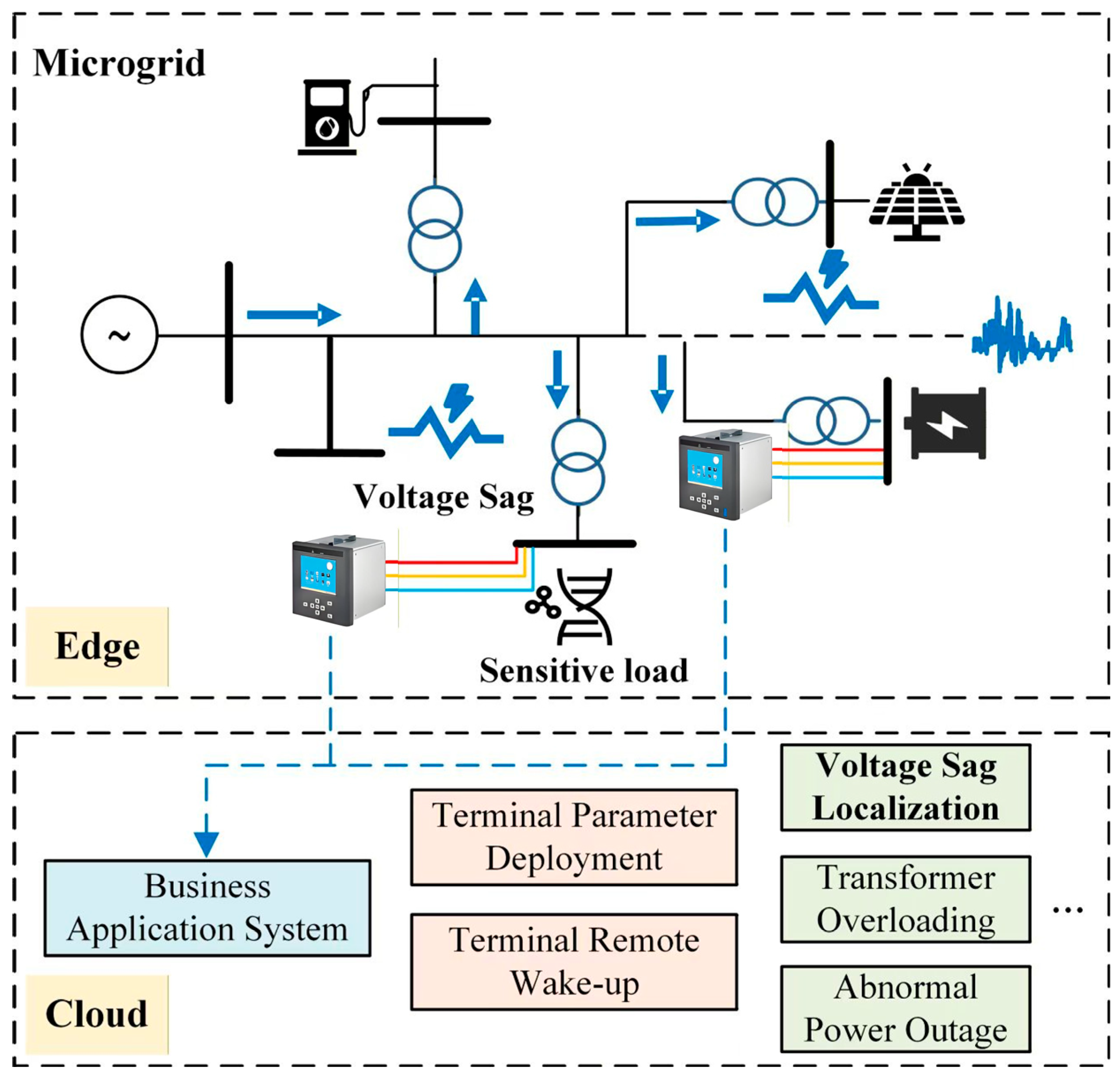
To further illustrate the practical implementation of the proposed framework, Figure 4 presents a representative edge–cloud deployment architecture. In this configuration, PQMDs installed at sensitive or representative nodes measure the RMS voltage and current during fault events. These scalar features are transmitted to local edge servers, where lightweight inference of the localization model is conducted under bandwidth and synchronization constraints. The results can be further integrated into cloud-based systems for application-layer decisions, remote control, or fault record management. This architecture highlights the feasibility and modularity of the proposed method in real-world microgrid scenarios.
Figure 4 Edge–cloud collaborative deployment of the proposed voltage sag localization framework. PQMDs measure per-cycle RMS voltage and current values and transmit them to edge processors for inference. Localization results and system interaction are further managed via cloud-based applications.

3. Precise Localization Strategy of Voltage Sag Sources

After locating the source section, precise fault localization within the section is required. To replace inefficient and noise-sensitive point-by-point inspection, this paper employs a precise localization strategy based on binary search: injecting an equivalent voltage sag source current matching the identified fault type at the midpoint of candidate intervals, comparing the difference between the “simulated drop” and the “actual drop” to determine the sub-interval containing the fault. The interval is then iteratively reduced until the required accuracy is satisfied. To address the limitations of traditional methods that rely on the single-point sag difference at the two terminals and therefore lack robustness, improvements are introduced in the design of the difference metric, the convergence judgment, and the handling of engineering constraints.
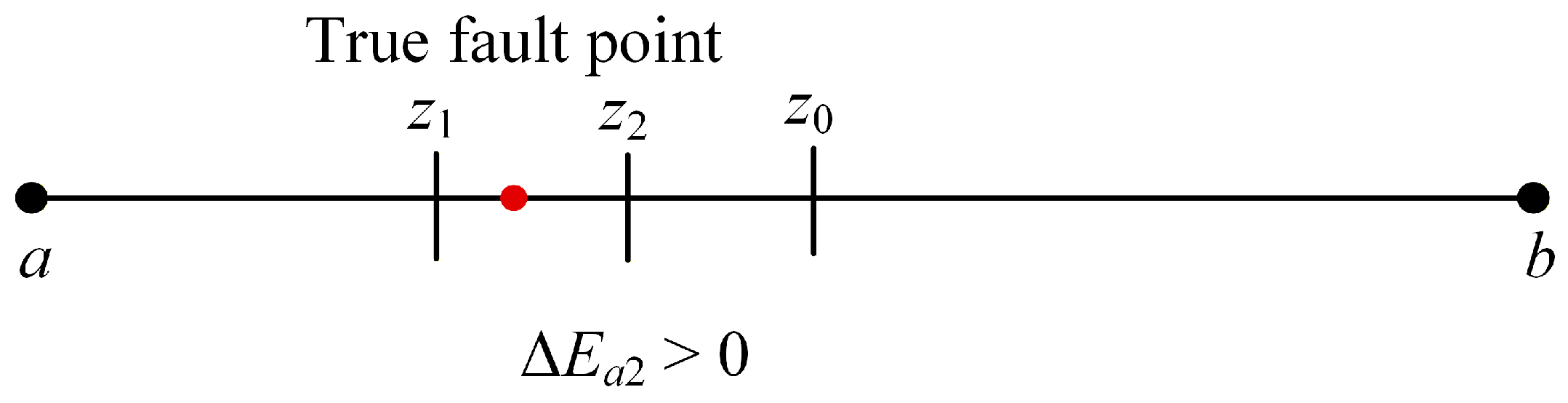
During the initial search, let the two ends of the section be denoted as a and b. During the event, the three-phase voltage RMS values are obtained from PQMDs. The normalized drop values for each phase at both ends are calculated and summed, denoted as Ea and Eb, respectively. Based on the event type (e.g., three-phase short circuit, single-phase ground fault, two-phase short circuit), an equivalent voltage sag source current of the same type is injected at the midpoint z0 between a and b. Rapid power flow calculation yields simulated drop sums at points a and b, denoted as Ea0 and Eb0. The difference quantities ΔEa0 = EaEa0 and ΔEb0 = EbEb0 are obtained. If ΔEa0 > 0 and ΔEb0 < 0, the true fault point lies between a and z0; conversely, if ΔEa0 < 0 and ΔEb0 > 0, the true fault point lies between z0 and b. To suppress misjudgments caused by noise, a tolerance threshold ε is introduced. When |ΔEa0| and |ΔEb0| are too small, the interval is not updated. If neither end shows significant improvement, the midpoint is retained as a candidate, and the contraction direction is selected based on the magnitude of improvement. See Figure 5 for the corresponding illustration.
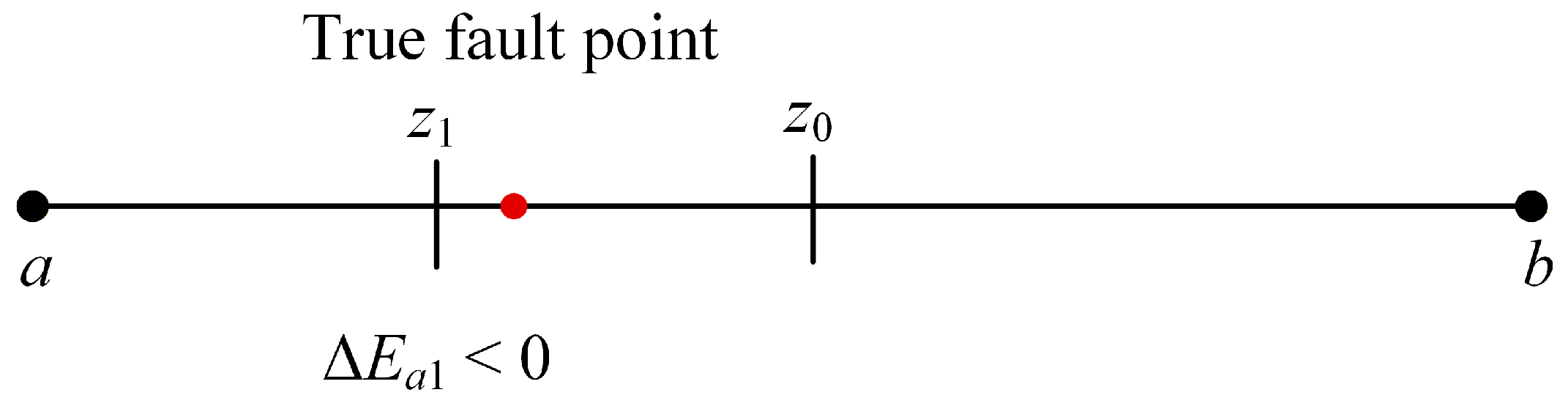
During the second search, taking the previous step’s determination that “the fault point is closer to a” as an example, set an equivalent fault point z1 at the midpoint between a and z0. Apply the same method to inject an equivalent voltage sag source current at z1 for simulation, obtaining the simulated drop at point a and Ea1. Calculate ΔEa1 = EaEa1. If ΔEa1 < 0, it indicates that the simulated voltage sag at z1 is slightly stronger than the actual sag, meaning the true fault point is closer to a than z1. If ΔEa1 ≥ 0, the true fault point is closer to z0 than z1. Simultaneously, calculate the difference at the end b for auxiliary judgment. If necessary, narrow the interval according to the principle of “maximizing difference improvement.” To enhance stability in asymmetric voltage sags, the above difference calculations employ weighted summation across three phases. See Figure 6 for a schematic illustration.
During the third search iteration, continue selecting the midpoint z2 within the subinterval determined in the previous round. Inject the equivalent voltage sag source current and perform a simulation. Calculate the difference between the two ends and determine the contraction direction using the same principle. If measurable intermediate nodes exist within the section, incorporate them into the difference evaluation set to form a multi-node, multi-phase weighted difference metric. This further enhances the stability and spatial resolution of the determination. After three iterations, the candidate interval is theoretically reduced to 1/8 of its original length. For longer sections or higher precision requirements, the process may be repeated iteratively until termination criteria are met. The schematic for the third iteration corresponds to Figure 7.
To simulate realistic faults, fault types are first identified based on sequence component and phase-to-phase mismatch before precise localization. Voltage sag source current models of the same type are employed in simulations. The amplitude and phase of current sources are obtained by inversion from minimum voltage, short-circuit current, or equivalent impedance. During iteration, parameters undergo sensitivity-based fine-tuning according to the divergence degree to mitigate the impact of model mismatch on convergence direction. To ensure convergence and engineering feasibility, a combined stopping condition based on “interval length” and “difference improvement” is introduced. Iteration terminates and outputs results when either condition is met: (1) When the interval length is less than δL; (2) The relative improvement in divergence J between consecutive iterations is below δJ, i.e., (J(t − 1) − J(t)/J(t − 1)) < δJ. Here, δL is specified based on engineering accuracy requirements (e.g., 1% of the interval line length or 100–300 m); δJ is typically set at 1–3%, and relaxed to 5% under high noise conditions. In summary, the proposed method effectively suppresses redundant iterations and directional oscillations without increasing process complexity, achieving more stable convergence and higher localization accuracy in asymmetric sag scenarios.

4. Case Study

To validate the accuracy and effectiveness of the proposed voltage sag source localization method, a modified IEEE 33-node model was constructed in MATLAB/Simulink 2021B for simulation analysis.

4.1. Test System and Data Configuration

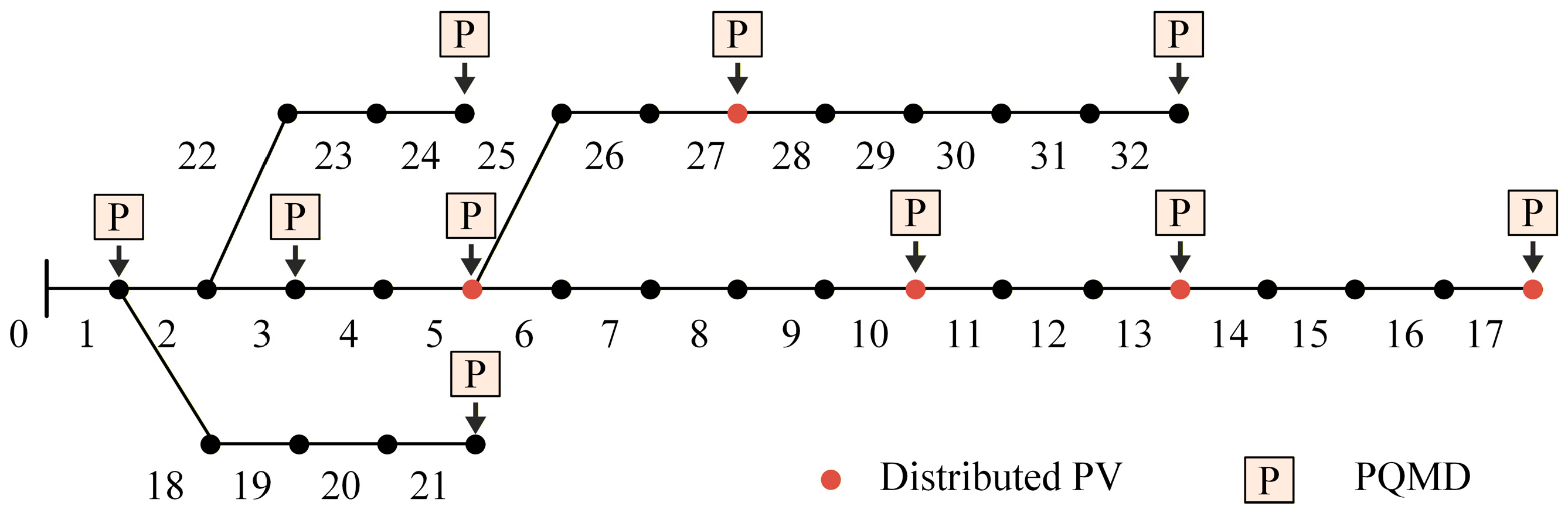
The IEEE 33-node system operates at a voltage level of 10 kV and a rated frequency of 50 Hz, connected to the main grid at node 0. The network comprises 33 nodes, 32 distribution lines of varying lengths, and 32 loads, with distributed PV connected at nodes 5, 10, 13, 17, and 27.
Considering that not all nodes are equipped with PQMDs in practice, this paper assumes PQMDs are installed at nodes with distributed power sources and at branch-divergence nodes to collect voltage and current data. The 10 total observable nodes are Nodes 1, 3, 5, 10, 13, 17, 21, 24, 27, and 32. Measurements at the remaining nodes without PQMDs are treated as unobserved and set to zero in the input feature tensor. The simulation model structure is shown in Figure 8.
The simulation scenarios cover typical operating conditions of voltage sags in microgrids. Multiple fault types including single-phase grounding, two-phase grounding, two-phase short circuits, three-phase grounding, and three-phase short circuits were configured at different fault locations across 32 lines. These were combined with varying levels of PV output to generate the simulation dataset, thereby thoroughly validating the model’s accuracy and robustness under conditions of high penetration of DG. Detailed simulation sample parameters are shown in Table 1.
The dataset partitioning and model training configuration are as follows: the simulation-generated fault dataset is divided into training, validation, and test sets in a 6:2:2 ratio. Using the microgrid connection matrix and corresponding fault dataset as model inputs, training and testing for section-level localization of voltage sag sources are completed. The model was implemented using Python 3.12 and the PyTorch v1.97 framework. Hyperparameter settings were as follows: learning rate 0.001, batch size 16, and 100 training epochs.

4.2. Accuracy Analysis of the Proposed Method in Different Fault Scenarios

4.2.1. Section Localization of Voltage Sag Sources

To validate the advantages of the proposed method, the accuracy of the voltage sag source section localization model presented in this paper was compared with that of long short-term memory (LSTM), convolutional neural network (CNN), and graph convolutional network (GCN). Ten replicate experiments were conducted on the test set for each model, and the final average test accuracy was calculated to evaluate their performance. The accuracy results are presented in Table 2.
As shown in Table 2, the proposed method for locating voltage sag sources achieves an accuracy rate exceeding 99% under various short-circuit fault conditions, demonstrating a significant performance advantage over LSTM, CNN, and GCN models. Although LSTM and CNN can learn the voltage sag characteristics of input features, and GCN can learn the spatial characteristics of input features, they fail to fully exploit the spatio-temporal characteristics of input features. Consequently, their performance in locating voltage sag sources falls short of the proposed method.
For accuracy calculation, the model outputs a sag-source probability for each node. Nodes whose predicted probabilities exceed a predefined threshold are considered source-related. When multiple such nodes exist, the shortest line segment in the feeder topology that connects them is defined as the predicted sag section. If this predicted section matches the actual faulted segment, it is counted as a correct localization. The final accuracy is calculated as the proportion of test cases where the predicted section matches the true fault-injected section.

4.2.2. Precise Localization of Voltage Sag Sources

After completing the section localization and determining that the voltage sag source is located between node 9 and node 10, assume this voltage sag event is a three-phase short circuit occurring at the 20% position from node 9. To achieve precise localization, a binary search is employed to refine the target section.
Node 9 is designated as point a, and node 10 is designated as point b. In each search iteration, an equivalent voltage sag source current matching the actual fault type is injected at the midpoint of the current search section. The relative position of the voltage sag source is determined by comparing the measured changes at both ends. The first iteration yields ΔEa0 > 0 and ΔEb0 < 0, indicating the voltage sag source is closer to point a. Binary search is then continuously applied to progressively narrow the section range until the accuracy requirement is met.
Assuming a positioning accuracy of 1‰ of the section length, after 9 rounds of search, the section length reached the preset threshold. The sag source was determined to be within the interval 19.922–20.117% from node 9. The midpoint of this interval was taken as the voltage sag source location, approximately 20.02% of the section length from node 9. The localization accuracy achieved was 99.98%.

4.3. Accuracy Analysis of the Proposed Method in Different Fault Scenarios

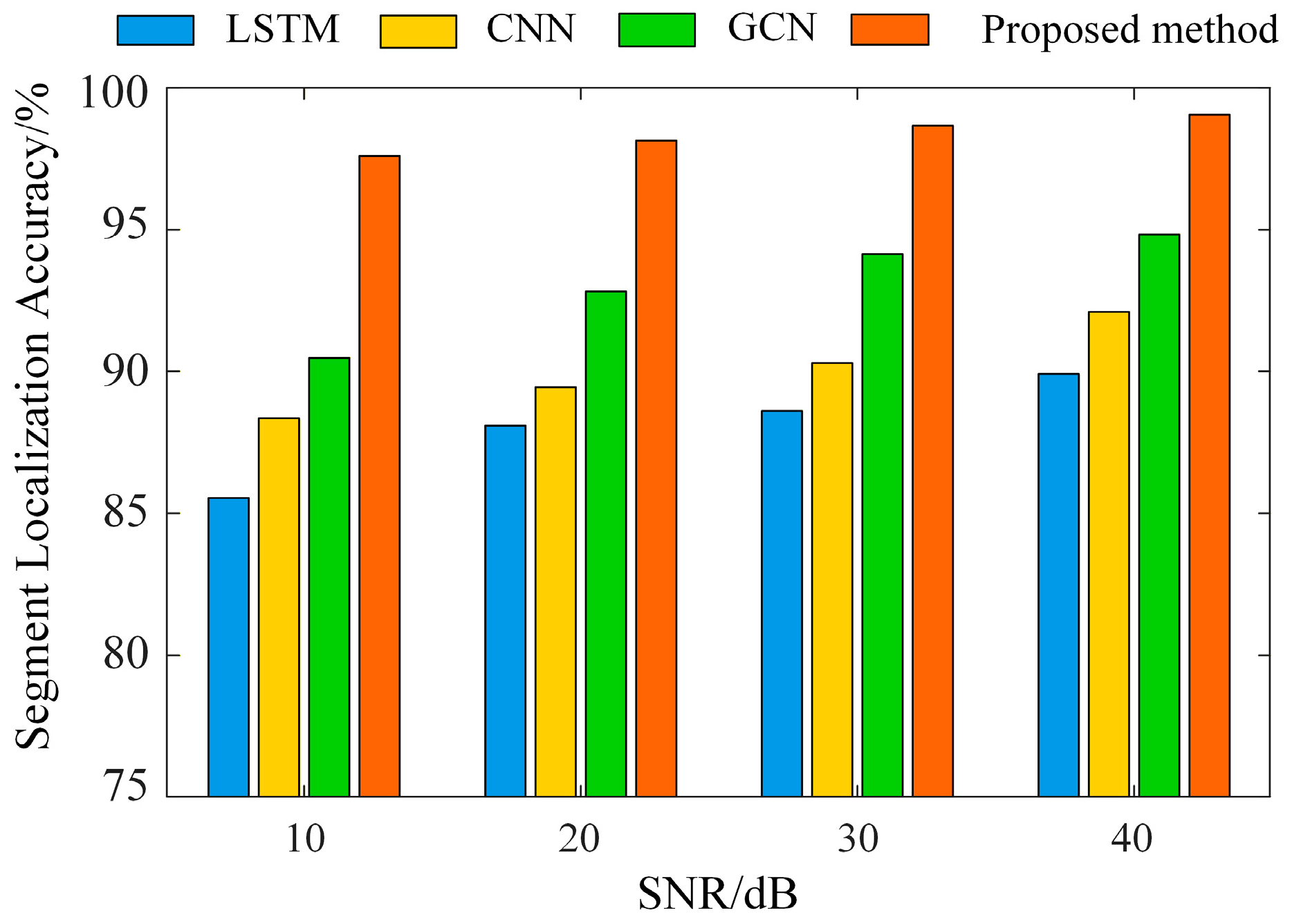
To align with practical engineering scenarios, environmental noise inevitably affects the sampling process of PQMDs, introducing noise into measurement data. Given that interference resistance directly impacts the engineering applicability of localization methods, this paper introduces noise of varying intensities into the test set to validate the method’s robustness. Specifically, using the most common single-phase ground fault in microgrids as an example, Gaussian noise was superimposed on the test set to simulate environmental interference. Multiple signal-to-noise ratios (SNR) were set for evaluation: 10dB, 20dB, 30dB, and 40dB. The results are shown in Figure 9.
As shown in Figure 9, the proposed method demonstrates the best overall noise resistance compared to LSTM, CNN, and GCN. Under 30 dB noise conditions, CNN and GCN still maintain high localization accuracy; however, when the SNR drops to 10 dB, the localization accuracy of LSTM, CNN, and GCN all degrade significantly. In contrast, the proposed method retains higher accuracy, demonstrating its effective utilization of the power grid’s physical topology and steady-state RMS information of voltage and current. This enhances its robustness and engineering applicability in strong noise scenarios.
Similarly, after completing the section localization and determining that the voltage sag source is located between nodes 16 and 17, assume this voltage sag event is a single-phase ground fault occurring at the 40% position from node 16. To achieve precise localization, a binary search is employed to refine the target section.
Nodes 16 and 17 are designated as points a and b. In each search iteration, an equivalent voltage sag source current matching the actual fault type is injected at the midpoint of the current search section. This ultimately pinpoints the voltage sag source at approximately 39.94% of the section length from node 16, achieving a localization accuracy of 99.94%.
Although environmental factors such as temperature and humidity are not explicitly modeled, their influence is indirectly reflected through the introduction of measurement noise with varying signal-to-noise ratios. The proposed method maintains stable localization performance under these conditions, indicating robustness to environmental uncertainty commonly encountered in practical deployments.

4.4. Verification of the Generalizability of the Proposed Method

Microgrids undergo dynamic changes in network topology due to uncertainties such as equipment failures and natural disasters. For instance, switching interconnections or line disconnections will reconfigure the network, altering voltage, current, and power flow distributions, thereby affecting the localization of voltage sag sources.
To evaluate the proposed method’s generalization capability across topology scenarios, this paper adjusts the wiring configuration of the simulation model to construct three typical topology change scenarios and generates test samples. The results are shown in Table 3.
Microgrid topologies undergo frequent changes with complex power flows, leading to significant differences in voltage and current characteristics before and after faults, making fault location more challenging. As shown in Table 3, even under high penetration rates, the proposed method maintains stable performance across various topology changes. When two lines change simultaneously, the accuracy remains above 96%, demonstrating excellent topology adaptability and engineering applicability.

5. Conclusions

This paper proposes a two-stage voltage sag sources precise localization method based on improved STGCN and binary search. Taking the RMS values of voltage and current at key monitoring points as feature inputs, the section localization is completed first, and then precise localization is achieved through binary search. Multi-scenario simulation verification was carried out on the modified IEEE 33-node system, and the main conclusions are as follows:
(1)
The improved STGCN effectively integrates the spatial topology and steady-state time series information of the microgrid, and the extracted spatio-temporal features have good section localization capabilities. Compared with other basic methods, it maintains a high accuracy rate of section localization under different penetration rates of distributed new energy and can adapt to the operational characteristics of microgrids.
(2)
Based on the section localization, binary search is introduced. By injecting and discriminating the equivalent voltage sag source current, the range is rapidly narrowed down, achieving the preset accuracy within a limited number of rounds and realizing high-precision voltage sag source localization within the fault section.
(3)
Under the conditions of noise interference and topological changes, the proposed method can still maintain a high localization accuracy rate, demonstrating good robustness and generalization ability, and has strong engineering application potential.

Author Contributions

Methodology, R.Y. and Y.Z.; Software, H.B. and T.L.; Formal analysis, R.Y. and Y.L.; Investigation, S.J. and Y.Z.; Data curation, Y.L.; Writing—original draft, S.J. and T.L.; Writing—review and editing, R.Y. and H.B. All authors have read and agreed to the published version of the manuscript.

Funding

This research was funded by the Science and Technology Project of China Southern Power Grid Co., Ltd. (No. ZBKJXM20232297).

Data Availability Statement

The original contributions presented in this study are included in the article. Further inquiries can be directed to the corresponding author.

Conflicts of Interest

Authors Yiyong Lei and Yawen Zheng were employed by the China Southern Power Grid Co., Ltd. The remaining authors declare that the research was conducted in the absence of any commercial or financial relationships that could be construed as a potential conflict of interest.

References

  1. Xu, F.W.; Guo, K.; Wang, C.; Huang, J.; Zhao, B.; Liu, J. Estimation of Voltage Sag Frequency Based on the Multiple Characteristic Factors. IEEE Trans. Power Del. 2025, 40, 2402–2411. [Google Scholar] [CrossRef]
  2. Luo, S.N.; Peng, K.X.; Hu, C.B.; Ding, S.X.; Fan, H. A Residual-Generator-Based Plug-and-Play Control Scheme Toward Enhancing Power Quality in AC Microgrids. IEEE Trans. Ind. Electron. 2022, 69, 8146–8156. [Google Scholar] [CrossRef]
  3. Nguyen, T.K.; Chang, G.W.; Liu, Y.J.; Li, G.Y. Improving Voltage Ride-Through Capability of Grid-Tied Microgrid with Harmonics Mitigation. IEEE Trans. Power Del. 2023, 38, 738–741. [Google Scholar] [CrossRef]
  4. Ji, L.; Shi, J.B.; Hong, Q.T.; Fu, Y.; Chang, X.; Cao, Z. A Multi-Objective Control Strategy for Three Phase Grid-Connected Inverter During Unbalanced Voltage Sag. IEEE Trans. Power Del. 2021, 36, 2490–2500. [Google Scholar] [CrossRef]
  5. Peng, Y.L.; Kwang, M.H.; Soon, R.N. A Fault Location Algorithm for Multi-Section Combined Transmission Lines Considering Unsynchronized Sampling. Energies 2024, 17, 703. [Google Scholar] [CrossRef]
  6. Alireza, F.; Mohammad, S.G.; Mehdi, S.; Mehdi, B. Support Vector Machine Based Fault Location Identification in Microgrids Using Interharmonic Injection. Energies 2021, 14, 2317. [Google Scholar] [CrossRef]
  7. Hajiahmadi, M.; Hooshmand, R.-A.; Kiyoumarsi, A. Voltage Sag Monitor Placement for Fault Location Detection Based on Precise Determination of Areas of Vulnerability. J. Modern Power Syst. Clean Energy 2025, 13, 228–240. [Google Scholar] [CrossRef]
  8. Li, B.; Tang, L.J.; Gu, Z.M.; Liu, L.; Wu, Z.S. Research on Distribution Network Fault Location Based on Electric Field Coupling Voltage Sensing and Multi-Source Information Fusion. Energies 2025, 18, 913. [Google Scholar] [CrossRef]
  9. Deng, Y.P.; Liu, X.H.; Jia, R.; Huang, Q.; Xiao, G.; Wang, P. Sag Source Location and Type Recognition via Attention-based Independently Recurrent Neural Network. J. Modern Power Syst. Clean Energy 2021, 9, 1018–1031. [Google Scholar] [CrossRef]
  10. Wang, P.; Zhang, Z.Y.; Dai, N.Y.; Huang, Q.; Lee, W.J. Robust dynamic equivalent modeling of active distribution network with time-varying parameters. IEEE Trans. Power Syst. 2025, 40, 2014–2026. [Google Scholar] [CrossRef]
  11. Lan, Z.; Yuan, Y.S.; He, D.; Zeng, J.H.; Yu, X.P. A Fault Location Method for DC Distribution Network Based on Differential Initial Value of Current. South. Power Syst. Technol. 2023, 17, 109–116. [Google Scholar]
  12. Chang, G.W.; Chao, J.P.; Huang, H.M.; Huang, H.M.; Chen, C.L.; Chu, S.Y. On tracking the source location of voltage sags and utility shunt capacitor switching transients. IEEE Trans. Power Del. 2008, 23, 2124–2131. [Google Scholar] [CrossRef]
  13. Luo, H.Q.; Zeng, X.J.; Yu, K.; Li, Z.; Xie, Z.J.; Deng, J. Fault Section Location Method for Distribution Network Based on Multi-Dimensional Waveform Difference Clustering Analysis. South. Power Syst. Technol. 2024, 18, 58–68+97. [Google Scholar]
  14. Rao, G.K.; Jena, P.A. Novel Fault Identification and Localization Scheme for Bipolar DC Microgrid. IEEE Trans. Ind. Inform. 2023, 19, 11752–11764. [Google Scholar] [CrossRef]
  15. Yadegar, M.; Zarei, S.F.; Meskin, N.; Blaabjerg, F. A Distributed High-Impedance Fault Detection and Protection Scheme in DC Microgrids. IEEE Trans. Power Del. 2024, 39, 141–154. [Google Scholar] [CrossRef]
  16. Arsoniadis, C.G.; Nikolaidis, V.C. Precise Fault Location in Active Distribution Systems Using Unsynchronized Source Measurements. IEEE Syst. J. 2023, 17, 4114–4125. [Google Scholar] [CrossRef]
  17. Jiang, K.; Wang, H.F.; Shahidehpour, M.; He, B.T. Block-Sparse Bayesian Learning Method for Fault Location in Active Distribution Networks with Limited Synchronized Measurements. IEEE Trans. Power Syst. 2021, 36, 3189–3203. [Google Scholar] [CrossRef]
  18. Wang, J.; Zhang, Y.X. Traveling Wave Propagation Characteristic-Based LCC-MMC Hybrid HVDC Transmission Line Fault Location Method. IEEE Trans. Power Del. 2022, 37, 208–218. [Google Scholar] [CrossRef]
  19. Lopes, F.V.; Reis, R.L.A.; Silva, K.M. Improving Traveling Wave-Based Transmission Line Fault Location by Leveraging Classical Functions Available in off-the-Shelf Devices. IEEE Trans. Power Del. 2023, 38, 2969–2972. [Google Scholar] [CrossRef]
  20. Xia, Y.X.; Li, Z.W.; Xi, Y.H.; Wu, G.R.; Peng, W.X.; Mu, L.Z. Accurate Fault Location Method for Multiple Faults in Transmission Networks Using Travelling Waves. IEEE Trans. Ind. Inform. 2024, 20, 8717–8728. [Google Scholar] [CrossRef]
  21. Huo, J.B.; Li, W.; Zhou, Q.L.; Bai, H.; Li, D.; Yuan, Z.Y. Feeder Single-Phase Disconnection Fault Protection Method of Arc Suppression Coil Grounding System Based on Zero Sequence Admittance. South. Power Syst. Technol. 2023, 17, 117–124. [Google Scholar]
  22. Li, Y.; Wu, X.Y.; Shuai, Z.K.; Zhou, Q.; Chen, H.J.; Shen, Z.J. A Systematic Stability Enhancement Method for Microgrids with Unknown-Parameter Inverters. IEEE Trans. Power Electron. 2023, 38, 3029–3043. [Google Scholar] [CrossRef]
  23. Li, Y.; Shuai, Z.K.; Liu, X.; Chen, Y.D.; Li, Z.Y.; Hong, Y. Stability Analysis and Location Optimization Method for Multiconverter Power Systems Based on Nodal Admittance Matrix. IEEE J. Emerg. Sel. Top. Power Electron. 2021, 9, 529–538. [Google Scholar] [CrossRef]
  24. Liu, X.; He, H. Fault Diagnosis for TE Process Using RBF Neural Network. IEEE Access 2021, 9, 118453–118460. [Google Scholar] [CrossRef]
  25. Yu, B.; Yin, H.T.; Zhu, Z.X. Spatio-temporal graph convolutional networks: A deep learning framework for traffic forecasting. In Proceedings of the 27th International Joint Conference on Artificial Intelligence, Stockholm, Sweden, 13–19 July 2018; pp. 3634–3640. [Google Scholar]
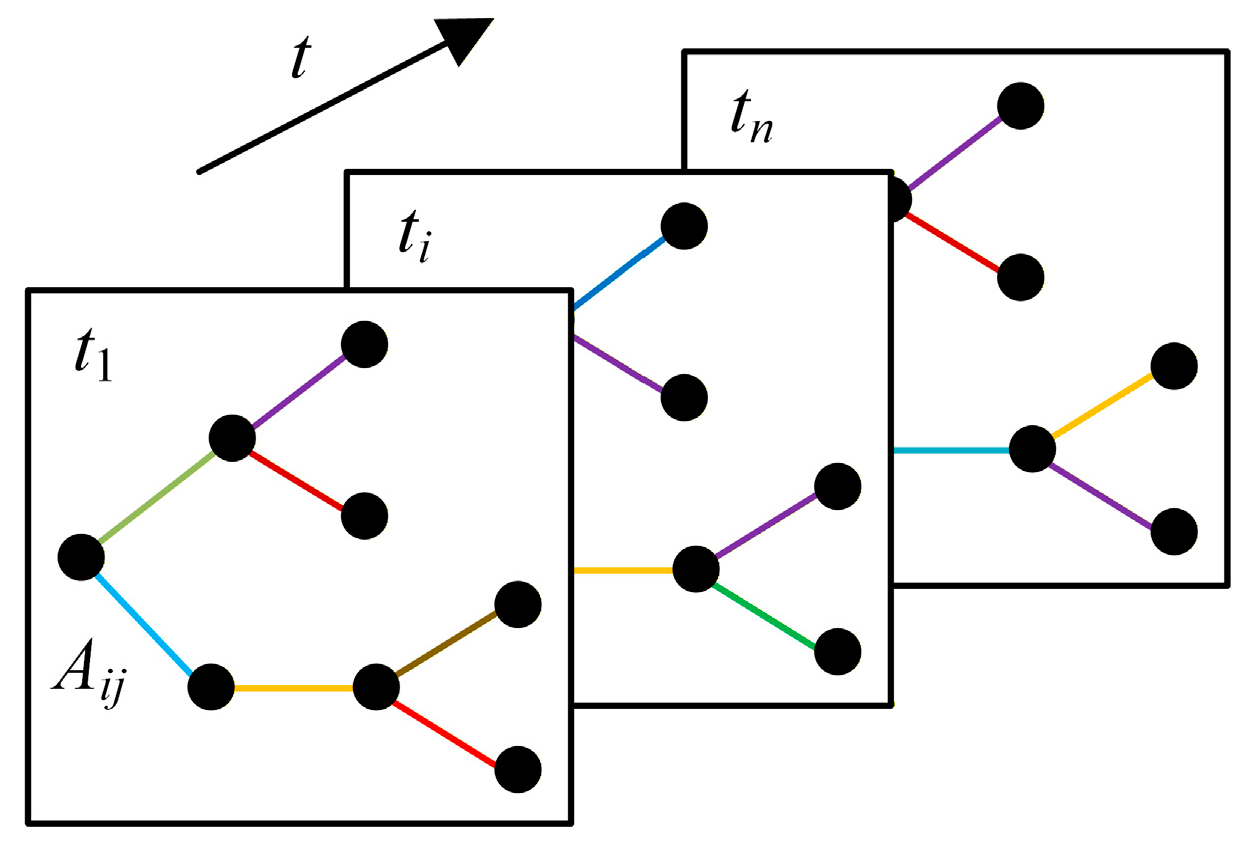
Figure 1. Spatio-temporal correlations of operating states. Different colors represent different distances between nodes, and dots represent nodes in the microgrid.
Energies 19 00258 g001
Figure 2. Overall framework for voltage sag source section localization.
Energies 19 00258 g002
Figure 3. Spatiotemporal convolution module.
Energies 19 00258 g003
Figure 4. Overall framework for intelligent sensing of power quality.
Energies 19 00258 g004
Figure 5. Schematic of the first search. The letters a and b refer to the results obtained from the section positioning, that is, the section between nodes a and b.
Energies 19 00258 g005
Figure 6. Schematic of the second search.
Energies 19 00258 g006
Figure 7. Schematic of the third search.
Energies 19 00258 g007
Figure 8. Diagram of the microgrid simulation model.
Energies 19 00258 g008
Figure 9. Comparison of section localization accuracy under different noise conditions.
Energies 19 00258 g009
Table 1. Parameters of simulated samples in case studies.
Parameter TypeSample Parameter RangeNumber of Parameters
voltage sag lineLines 1–3232
fault locationAt 20%, 40%, 60%, and 80% of the line length4
fault resistance0.01, 2, 5, 10, 20, 50, 80, 100Ω8
PV output20%, 40%, 60%, 80%, 100%5
load level90%, 100%, 110%3
Table 2. Localization accuracy of different methods.
Fault TypeAccuracy/%
LSTMCNNGCNProposed Method
Single-phase to ground fault91.0493.8995.8499.39
Two-phase to ground fault90.9194.3696.2299.65
Two-phase short circuit91.3493.9596.0199.58
Three-phase to ground fault92.0794.9696.7899.82
Three-phase short circuit91.2694.5596.6499.71
Table 3. Localization accuracy under different topological scenarios.
Change ScenariosAccuracy/%
Connect the connection line between nodes 17 and 3298.33
Connect the connection lines between nodes 17 and 32,
and 7 and 20
96.92
Connect the connection lines between nodes 7 and 20,
and disconnect the line between nodes 19 and 20
97.17
Disclaimer/Publisher’s Note: The statements, opinions and data contained in all publications are solely those of the individual author(s) and contributor(s) and not of MDPI and/or the editor(s). MDPI and/or the editor(s) disclaim responsibility for any injury to people or property resulting from any ideas, methods, instructions or products referred to in the content.