1. Introduction
Although the concept is theoretically simple and the technology is already available, Green hydrogen is typically produced via electrolysis at relatively low pressures (up to ~30 bar) and must be either liquefied or compressed (up to 700 bar or higher) prior to storage, due to its low volumetric density. High-pressure gaseous hydrogen storage has become the most common option due to its simplicity, lower cost, and fast release rate, with pressures typically achieved using industrial mechanical compressors. However, drawbacks such as numerous moving parts, vibrations, high power requirements with low average efficiency, and high maintenance costs have led researchers to focus increasingly on non-mechanical compressors [
1,
2].
An electrochemical hydrogen compressor (EHC), also known as an “electrochemical hydrogen pump,” is a promising alternative to mechanical compressors [
3]. It essentially combines a fuel cell anode with an electrolyzer cathode. Low-pressure hydrogen on the anode side splits into protons and electrons in the so-called hydrogen oxidation reaction (HOR):
The protons pass through a proton-conductive polymer membrane to the cathode side. At the same time, the electrons are transferred to the cathode side through an external circuit via electrically conductive parts, driven by an externally imposed potential difference. At the cathode, protons and electrons recombine to form hydrogen in the hydrogen evolution reaction (HER):
As long as the cathode compartment remains closed, the pressure will continue to rise as hydrogen is “pumped” into it. In this way, hydrogen is not only pumped to an elevated pressure but also purified, as all impurities remain on the anode side (i.e., only hydrogen passes across the membrane). Of course, this process requires external power source, i.e., externally supplied direct current (DC) of certain voltage. The minimal (theoretical) potential needed to obtain high-pressure hydrogen at the cathode outlet, also known as the Nernst voltage,
ENernst, is given by the Nernst equation:
where
R is the ideal gas constant (J mol
−1 K
−1),
T is the hydrogen feed temperature (K),
n is the moles of electrons passed for 1-mol hydrogen oxidized (in this case
n = 2),
F is the Faraday constant (96,485 C mol
−1),
pcathode refers to the hydrogen partial pressure at the cathode and
panode is the hydrogen partial pressure at the anode side.
E0 is the cell potential at the standard conditions, and is by convention considered zero for the hydrogen oxidation/reduction reactions. This equation represents only a thermodynamic approach, based on the partial pressures of hydrogen at both electrodes and the EHC operating temperature. In practice, the required potential is higher due to inevitable losses, such as activation losses related to the kinetics of the electrochemical half-reactions, electrical and/or ionic internal resistances (ohmic losses), and reactant transport limitations to/from the catalytic sites, known as mass transport losses. Therefore, the required operating voltage can be calculated by considering the Nernst potential together with all overpotentials, as follows:
As each mole of hydrogen transferred from the anode to the cathode corresponds to 2 electrons, the electrical current (
I) is proportional to the rate of hydrogen compression, according to Faraday’s equation:
Compressor efficiency is expressed as the specific energy consumption, i.e., kWh of electrical energy used per kg of gas compressed. This may also apply to mechanical compressors as they usually use electric motors. The minimum (theoretical) energy needed for compression in mechanical compressors corresponds to adiabatic compression. Of course, actual energy is always higher than the theoretical value. Therefore, the ratio between the theoretical and actual energy consumption may be considered as the compressor’s efficiency. However, adiabatic compression does not apply to electrochemical compressors. The equation for the specific energy consumption of an electrochemical compressor, obtained by multiplying voltage and current and dividing by the hydrogen molar flux, is identical to the thermodynamic equation for isothermal compression:
Adiabatic compression requires
κ times the power of isothermal compression (where
κ is the heat capacities ratio or the adiabatic exponent; for hydrogen it is 1.4). Electrochemical (isothermal) compression is therefore theoretically 40% more efficient than the mechanical (adiabatic) compression for any compression ratio. Therefore, EHCs have potential to be more efficient than mechanical compressors, and operate silently without moving parts. However, the electrochemical compressor will only become competitive with mechanical compressors if it can operate at high current densities (>2 A cm
−2) combined with low cell voltages (<0.5 V) [
4]. Besides compression, EHCs can also be used for applications such as hydrogen recirculation in a fuel cell stack from outlet to inlet, as reported by Barbir and Görgün [
5]. Moreover, EHCs can be used for hydrogen separation from mixtures with other gases and can even achieve single-stage simultaneous compression and purification, as reported by Grigoriev et al. [
6]. To date, the maximum reported output pressure achieved experimentally using a single-stage EHC is 20 MPa [
7].
The proton exchange membrane (PEM), as in PEM fuel cells, is the EHC core element and must be well hydrated to enable proton conduction. The protonic conductivity of the most commonly used Nafion
TM membrane is a strong function of its water content [
8], since water increases the mobility of protons from one sulphonic group to another [
9]. Because there is no water production on the cathode side, as in PEM fuel cells, the membrane in the EHC should be properly humidified by an external source from either the anode or the cathode side, or from both sides simultaneously, which is necessary to prevent membrane dehydration. However, in order to achieve stable performance, neutral water balance is required, i.e., water brought into the cell must somehow exit the cell either on the anode or on the cathode. Moreover, two processes take place in an EHC membrane—electroosmotic drag from the anode to the cathode and back permeation of water from the cathode to the anode due to either concentration gradient or pressure difference. Therefore, inadequate water management may significantly affect the EHC cell performance—insufficient water may result in membrane drying causing an increase in ohmic losses. In contrast, too much water may result in flooding of either or both electrodes causing an increase in mass transport losses, which can lead to instability in EHC operations [
7].
In light of these considerations, many researchers have experimentally investigated EHC by controlling multiple operating parameters to gain insight into the overall voltage distribution within the cell and, eventually, to improve compressor performance. For example, Ströbel et al. [
10] focused their paper on diffusion study due to hydrogen permeation as a crucial problem in achieving high pressures. Grigoriev et al. [
6] investigated the role of different operating parameters on the EHC performance regarding the polarization and the ohmic losses across the membrane. According to their results, monitoring hydrogen humidification is mandatory to prevent the appearance of mass transport limitations. In addition, Nordio et al. [
11] varied different flow rates and encountered water management issues. Zou et al. [
12] reported EHC evaluation with variations in operating temperature, inlet pressures of 0.3–0.9 bar, and hydrogen’s stoichiometric ratio between 1 and 2. They obtained dehydration with an increase in current density, which consequently caused an increase in ohmic losses due to insufficient humidity within the cell. Therefore, they pointed out that the balance between the transport of protons and the humidity level must be carefully maintained, but there is no solution on how to do this. Moreover, although all the aforementioned authors [
6,
10,
11,
12] specifically emphasize the importance of proper water management, they lack information regarding relative humidity or did not clarify its level in their papers. For instance, Aykut et al. [
13] tested a single-cell EHC system under different operating temperatures and different applied voltage values to reach the desired pressure of 0.5 MPa. However, only in low-temperature measurements they reported that inlet hydrogen was under fully humidified conditions. On the other hand, Sdanghi et al. [
14] have also recognized the importance of water balance within EHC. They proposed an innovative water management system for optimal EHC humidification under different operating temperatures.
Nevertheless, several recently published papers [
15,
16,
17,
18,
19] provided information regarding the relative humidity (RH) level of the inlet hydrogen during EHC operation, but did not evaluate its impact on EHC performance using already established and proven electrochemical diagnostic methods such as polarization (
I–
V) curves, electrochemical impedance spectroscopy (EIS) and linear sweep voltammetry (LSV). Sdangi et al. [
15] used experimental and numerical methods to investigate segmented EHC cell performance. They have studied the effects of the current density supplied to the system and the membrane thickness on the EHC performances at 90% RH. Kim et al. [
16] investigated the effect of the current density and temperature on the EHC performance at 80% RH, while in their follow-up study [
17] have examined the changes in EHC efficiency and power consumption under high-pressure conditions (up to 10 MPa) at different relative humidity levels (50, 70 and 100% RH). Pineda-Delgado et al. [
18] studied the effect of two RHs (50% and 100% RH) and two operating temperatures (30 °C and 80 °C) to determine the highest EHC efficiency. In their follow-up study [
19] they evaluated galvanostatic and potentiostatic modes of operation on EHC performance under fully humidified conditions. In order to evaluate the membrane gas permeability, they studied hydrogen crossover within the EHC for the first time with the LSV [
18]. Their results show that increase in temperature led to enhance of hydrogen molecules permeation from the cathode to the anode, confirming the diagnostic potential of the LSV in further EHC experimental studies.
Latest review papers, including Bagacki et al. [
20] and Zhu et al. [
21], have emphasized the importance of employing electrochemical impedance spectroscopy (EIS) in the diagnostics of EHCs, while simultaneously pointing out that published articles in this area remains notably limited. Additionally, Zhu et al. further highlighted that electrochemical diagnostic techniques provide valuable insights into water management by capturing the influence of water on electrical signals. Moreover, three other research groups [
22,
23,
24] have also used EIS in attempts to improve water transport by structural modifications of GDL/MPL structures. Zou et al. [
22] developed a GDL with a wettability gradient by incorporating controlled mass fractions of Nafion resin into the microporous layer, thereby generating spatially resolved hydrophilic-hydrophobic domains. The resulting structures were characterized by EIS to quantify the proton transport impedance of the anode catalytic layer (CL). Yao et al. [
23] also used EIS analysis to investigate newly designed gas diffusion layers (GDLs) with multilayer microporous layers (MPLs) to improve water transport and retention. Furthermore, Wang et al. [
24] incorporated hollow mesoporous silica nanoparticles functionalized with amino groups (HMSNs–NH
2) into the anodic catalytic layers of EHCs to establish moisture-independent proton conduction pathways via acid-base interactions with Nafion ionomers and reported their comparison through EIS measurements. Although these analyses together with the EIS results are not directly relevant to this study, the importance of the EIS technique in diagnosing water transport within EHCs is nevertheless reaffirmed.
Throughout this work, the terms anode and cathode refer exclusively to the electrodes of the cell operating in electrochemical hydrogen compression (EHC) mode. While the anodic reaction is identical to that in a PEM fuel cell (hydrogen oxidation), the cathodic reaction corresponds to hydrogen evolution, as in a PEM electrolyzer.
The objective of this research is to characterize a PEM fuel cell operation in the electrochemical hydrogen compression mode at different operating conditions, namely pressure, temperature and relative humidity, with particular emphasis on water management. Although the use of an existing fuel cell and its construction limits the range of pressures, it allows investigation of the main principle—electrochemical hydrogen compression from anode to cathode. In this study, cell performance was evaluated with respect to stability at different current densities using the polarization curve diagnostics to obtain current–voltage relationship, EIS to gain insight into different losses, and LSV to estimate membrane gas permeability. In addition, the importance of precisely determining the operating temperature of the EHC cell was particularly emphasized. Furthermore, this work overcomes existing knowledge gap from the lack of combined use of advanced diagnostics such as EIS and LSV. This approach enables deeper insight into the interplay between proton conductivity, membrane dehydration, or electrodes flooding and provide an integrated and experimentally consistent evaluation of water management strategies in EHC operation. The ultimate goal was to examine the impact of different ways of cell humidification on its performance, maintaining its stable conditions during operation.
2. Materials and Methods
Electrochemical hydrogen compression tests were conducted in the Laboratory for Hydrogen Technologies at FESB, University of Split, using a 890CL fuel cell test station (Scribner Associates Inc., Southern Pines, NC, USA) equipped with a Teledyne Medusa module, and a programmable DC power supply (Sorensen DCS8 series, Maxim Instruments, San Diego, CA, USA).
Electrochemical diagnostics were performed using a potentiostat/galvanostat (SP-150, BioLogic Science Instruments, Seyssinet-Pariset, France) equipped with a VMP3B-10 signal amplifier and operated using EC-Lab software V11.60 (BioLogic Science Instruments).
Experimental tests were carried out on an adapted commercial single PEM fuel cell with an active area of 50 cm2, supplied by ElringKlinger AG (Dettingen an der Erms, Germany). The cell was water-cooled, allowing maintenance of the desired operating temperature.
The experimental design was intentionally divided into two stages. The first stage aimed to establish baseline EHC behavior under simplified and controlled operating conditions, focusing on temperature and inlet humidity effects with a dry cathode. The second stage expanded the operating window by introducing a flooded cathode configuration and additional temperature and humidity levels, allowing investigation of coupled thermal and water transport effects under more complex conditions.
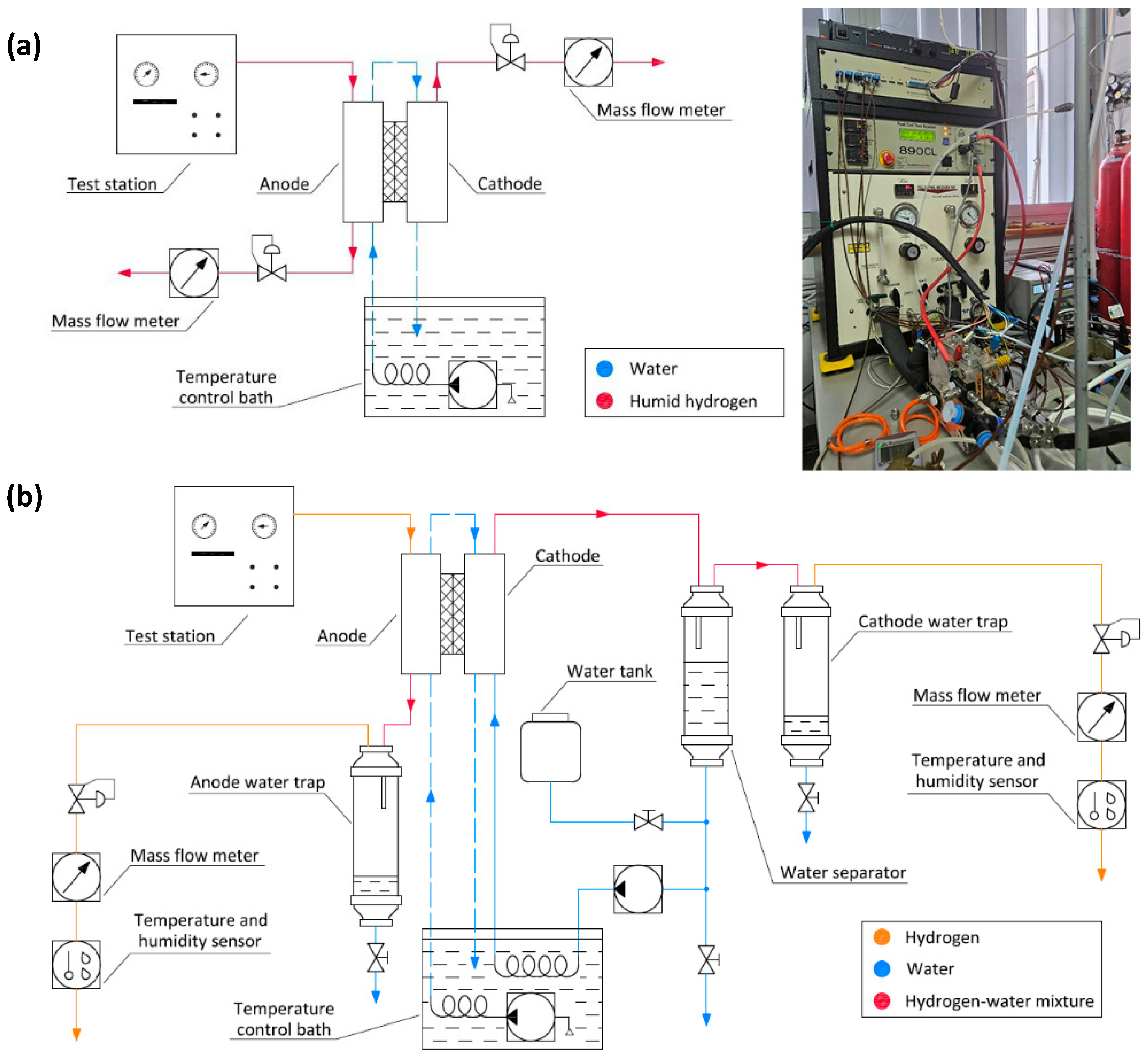
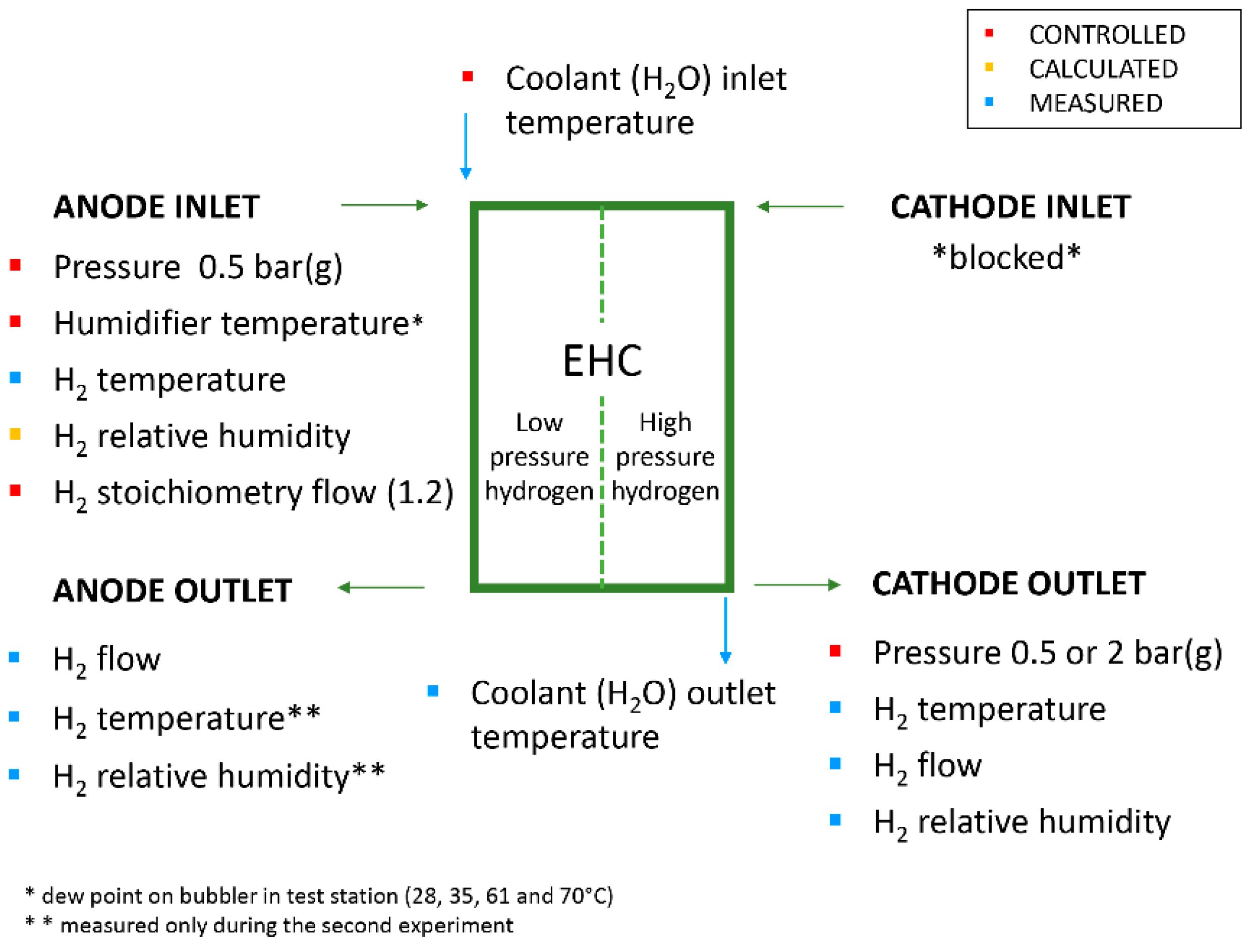
In the compression experiments, the cathode compartment of the cell was hermetically sealed, and a backpressure regulator at the cathode outlet controlled the operating pressure up to 2 bar (g) using an external power supply. All references to anode and cathode in this study correspond to the EHC operating configuration. The first experiment was carried out with a dry cathode, while the membrane was moistened by humidified hydrogen entering the cell on the anode side. During the second experiment, the cathode compartment was constantly filled with water (flooded), which maintained the water content in the membrane through back diffusion from the cathode to the anode. In addition, the humidification of hydrogen entering the cell on the anode side was varied during the second experiment. For all experimental cases examined, the backpressure regulator at the anode outlet was adjusted to maintain a hydrogen gauge pressure of 0.5 bar, while a mass flow controller in the test station maintained the hydrogen flow at a constant stoichiometry of 1.2 during the first experiment and 1 SLPM during the second experiment. A stainless steel Huber bathtub with a thermoregulation system and an accompanied pump were used to maintain a precise coolant water inlet temperature. Before the anode inlet, hydrogen was humidified by bubbling through a vessel filled with water and equipped by a heater so a desired temperature can be maintained. Hydrogen line between the humidifier and the cell was heated to a few degrees above the humidification temperature to avoid condensation in the line. During the experiments, both the humidifier temperature and the coolant water inlet temperature were controlled. Additionally, to obtain a more accurate representation of the cell temperature, temperature sensors (T-type thermocouples) were installed at the anode inlet, coolant outlet, and cathode outlet. The humidifier temperature (dew point in the bubbler) was varied to achieve hydrogen RH levels of 67% and 100% for the first experiment, and 0%, 50%, and 100% for the second experiment. The gas pressures on both the anode and cathode sides were monitored at the outlet using pressure transducers. Schematic representations of the experimental setup for both experiments, are shown in
Figure 1.
Figure 2 shows which operating parameters were controlled, which were measured, and which were calculated in both experiments.
As the main objective was to determine the effects of different operating temperatures and relative humidity levels at various current densities and compression ratios on the overall performance and efficiency of the fuel cell operating in electrochemical hydrogen compression mode, all test cases with parameter variations in both experiments are presented in
Table 1.
All measurements were conducted in galvanostatic mode, with the current controlled and the voltage response measured. After pressure stabilization and attainment of the desired temperature and RH level, the cell was conditioned for 1 h under a hydrogen atmosphere. Polarization curves were recorded from 0 to 2.5 A cm−2, starting with 1 min at open-circuit voltage (OCV), followed by several minutes at each operating point (3 min in the first experiment and 5 min in the second), with 0.25 A cm−2 galvanostatic increments. During the second experiment, electrochemical impedance spectroscopy (EIS) and linear sweep voltammetry (LSV) measurements were also conducted. EIS spectra were recorded at 1 A cm−2 over a frequency range of 10 kHz to 0.1 Hz, with a short stabilization phase prior to each test at the selected operating conditions to allow the cell to reach steady state (17 min total per measurement). The AC signal amplitude in EIS was set to 10% of the DC current to ensure a linear system response. LSV measurements were recorded between 0 V and −0.6 V at a constant sweep rate of 1 mV s−1 (10 min total per measurement).
3. Results and Discussion
Electrochemical diagnostic techniques such as polarization curves, EIS, and LSV are well established in PEM fuel cell research and are commonly interpreted based on characteristic signal features rather than statistical dispersion [
8,
25]. In contrast, their systematic application to electrochemical hydrogen compressors remains limited, and standardized protocols for statistical treatment of EIS and LSV data are still lacking, as highlighted in recent review papers [
20,
21]. Accordingly, the present study applies established PEM fuel cell diagnostic methodologies to EHC operation, focusing on physically meaningful trends and mechanistic interpretation under different operating conditions.
Although the operating pressure range in this study was constrained by the use of existing PEM fuel cell hardware, it enabled targeted investigation of fundamental electrochemical and transport phenomena relevant to electrochemical hydrogen compression. Higher-pressure operation using dedicated EHC hardware is beyond the scope of the present work and will be addressed in future studies.
3.1. Operating Temperature Determination
The cell operating temperature is one of the most important parameters for fuel cell operation, including operation in electrochemical hydrogen compression mode. It affects reaction kinetics, membrane conductivity, and, most importantly, water management inside the cell, the gas–liquid ratio in the channels and porous structures, and water transport across the membrane. For that reason, it is important to define it properly.
In addition, heat generation during EHC operation is intrinsically coupled to membrane hydration and gas transport processes. Increased current density leads to higher internal heat generation, which locally raises membrane temperature, enhances water evaporation, and alters the balance between electro-osmotic drag and back diffusion. These coupled thermal and hydration effects directly influence gas transport resistance and voltage response, linking the observed temperature profiles to changes in electrochemical performance.
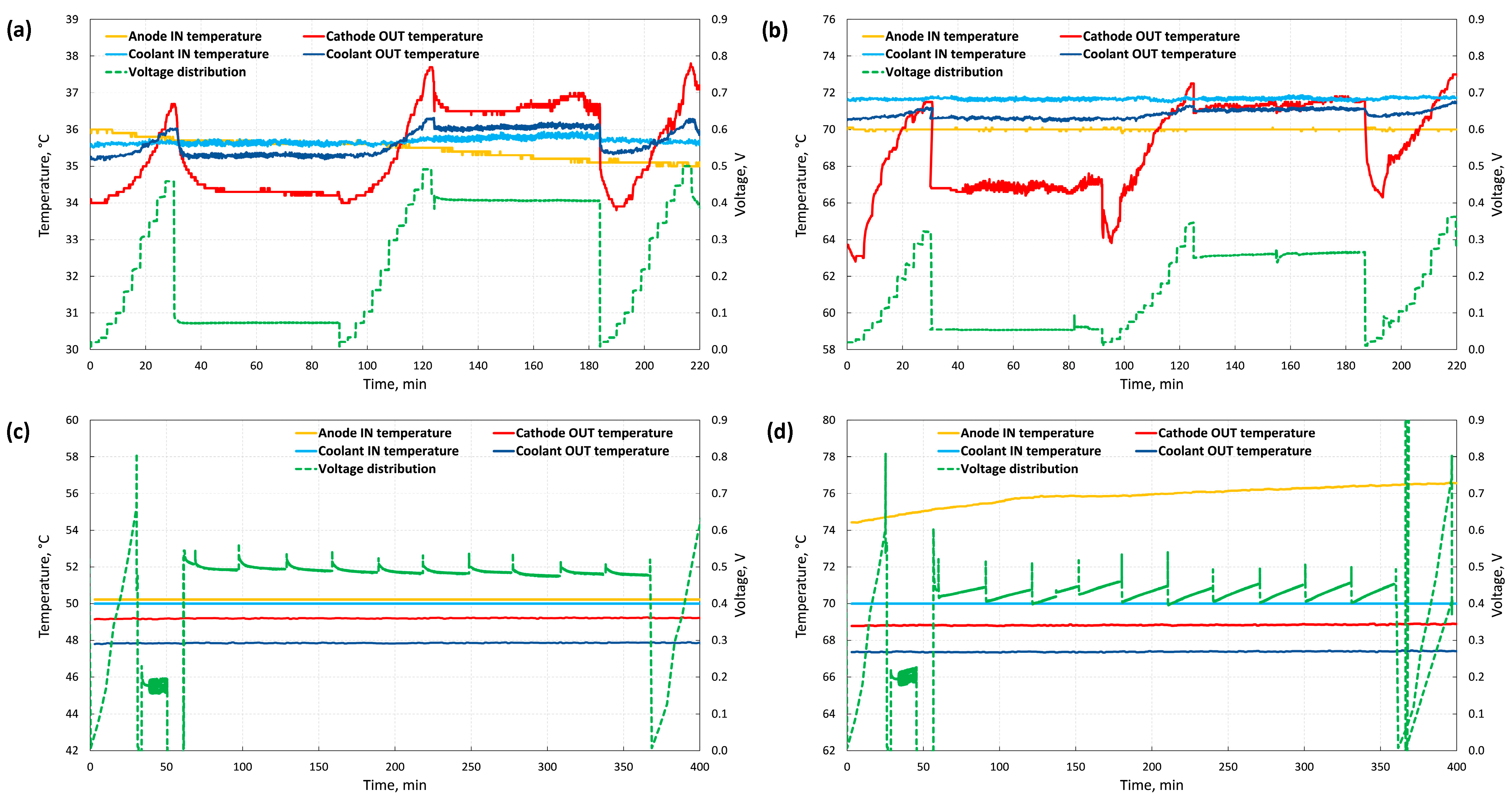
The cell operating temperature may be defined in several ways, such as the temperature of the coolant at the inlet, the temperature of the coolant at the outlet (or their average), the hydrogen outlet temperature, or the temperature at the cell surface. All of these are relatively easy to measure and control, but none exactly corresponds to the actual temperature inside the cell (in the channels and porous structures), at the reaction sites, or within the membrane. Therefore, in this study, temperature sensors were installed at the anode inlet, coolant water outlet, and cathode outlet, while the coolant water inlet temperature was controlled. The resulting temperature measurements and corresponding voltage distributions for both experiments are shown in
Figure 3.
It should be emphasized that the voltage and temperature profiles shown in
Figure 3 correspond to continuous operation under stepwise changes in current density. Each segment of the curves therefore reflects a quasi-steady-state response of the cell at a given operating point, rather than transient or uncontrolled fluctuations. This representation allows direct comparison of thermal and electrochemical behavior between dry and flooded cathode operation under otherwise comparable conditions. Such stepwise galvanostatic operation is commonly used to assess coupled thermal and electrochemical responses in PEM-based systems.
To better interpret the data complexity observed in
Figure 3, the evolution of coolant and hydrogen temperatures is analyzed in relation to operating current density and humidification strategy. During operation with a dry cathode (
Figure 3a,b), the cell was prone to temperature fluctuations. The desired cell temperature was maintained by the coolant flow. At lower operating current densities (lower voltages),
Figure 3a shows that the coolant inlet temperature was higher than the coolant outlet temperature, indicating that the cell was being heated by the coolant. However, at higher operating current densities (higher voltages), the coolant outlet temperature rose above the coolant inlet temperature due to internal heat generation, meaning the coolant was cooling the cell. Consequently, the hydrogen temperature at the cathode outlet also increased. During operation at a higher temperature (70 °C), the coolant inlet temperature was consistently above the coolant outlet temperature, indicating that the cell was heated by the coolant throughout (
Figure 3b). Heat dissipation to the surroundings by natural convection from the cell hardware surface was much higher than in the previous case due to the larger temperature difference between the cell surface and the ambient air.
These observations highlight that the definition and control of the operating temperature in EHC experiments are non-trivial and strongly dependent on both humidification strategy and current density, which must be carefully considered when comparing results across different studies.
During operation with a flooded cathode (
Figure 3c,d), the coolant inlet and outlet temperatures, as well as the hydrogen temperature at the cathode outlet, remained constant throughout the experiments. This indicates that the cell operating temperature was maintained by coolant flow not only through the cooling channels but also through the cathode compartment (as shown in
Figure 1b).
Considering hydrogen outlet temperature measurements at the cathode, it strongly depends on operating current density for the dry cathode (
Figure 3a,b) but remains remarkably stable for the flooded cathode (
Figure 3c,d) due to the large thermal mass of circulating water. These results demonstrate that temperature, membrane hydration, and mass transport are strongly interdependent, and that thermal effects cannot be interpreted independently of water distribution within the EHC.
Therefore, it appears easiest to control and maintain the coolant outlet temperature, bearing in mind that the actual cell operating temperature may still be a few degrees higher. It should be noted that the heating mode, in which the coolant outlet temperature is lower than the coolant inlet temperature, applies only to single-cell testing, where the cell’s external surface area is relatively large compared to its active area, and thus heat dissipation to the surroundings exceeds the heat generated inside the cell. This should not be an issue in a large multi-cell large stack. It is also important to note that published papers on EHC experiments rarely specify exactly where the “operating temperature” was measured, and as these considerations show, this can significantly influence the conclusions drawn.
3.2. Characterization of the Operation with Dry Cathode
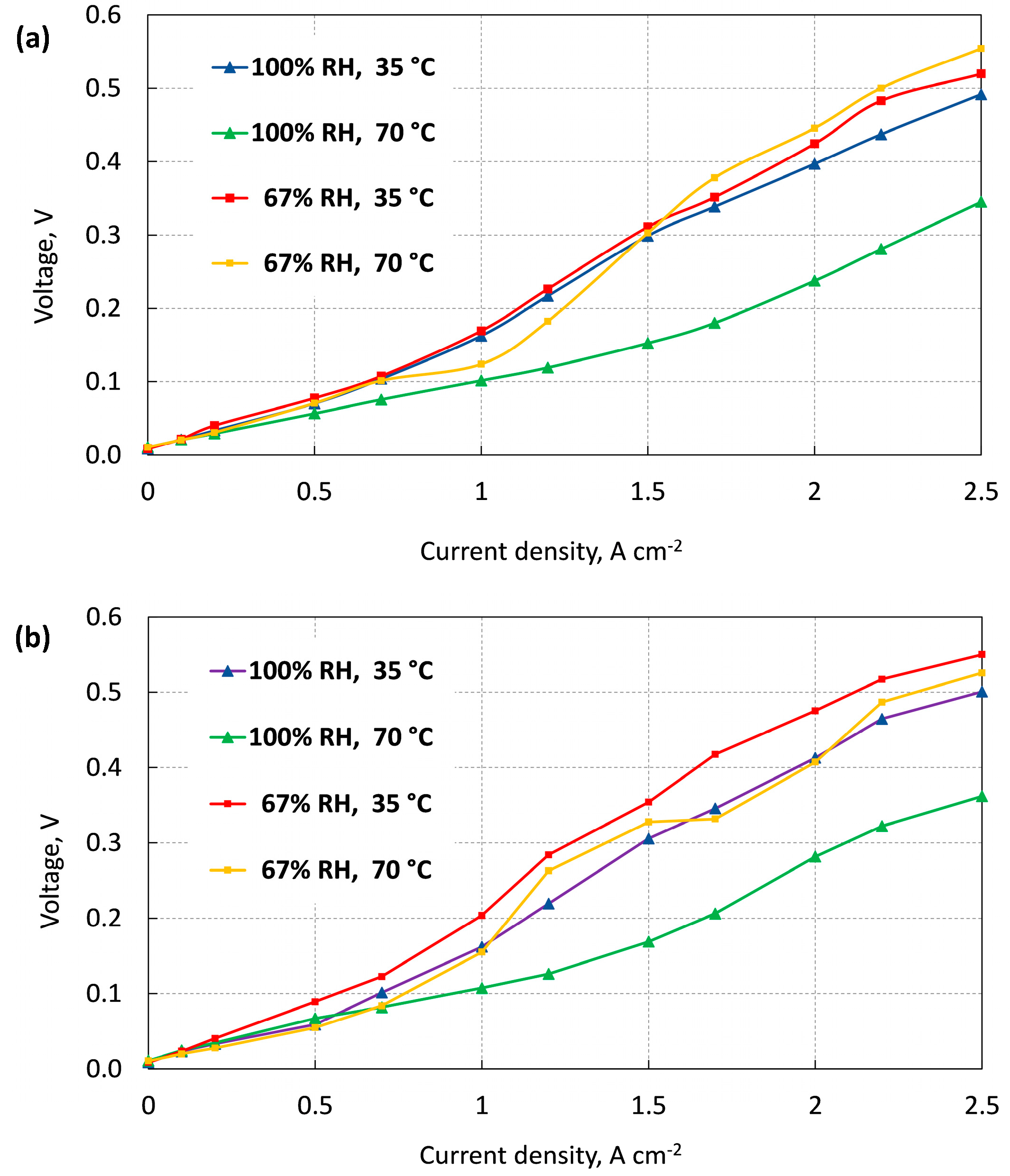
To characterize the performance of cell operation with a dry cathode at different temperatures and RHs during the first hydrogen compression experiment at a compression ratio of 2,
Figure 4 presents the polarization curves recorded immediately after 1 h of operation at lower (0.5 A cm
−2,
Figure 4a) and higher (2 A cm
−2,
Figure 4b) current densities.
The cell performance was apparently not significantly affected by 1 h of operation under different conditions, at either lower (0.5 A cm−2) or higher (2 A cm−2) current densities, suggesting that the cell had reached a steady state. All of the polarization curves deviate from a linear current–voltage relationship, which may result from increased membrane resistance at higher current densities or increased mass transport losses. For both current densities and temperatures (35 °C and 70 °C), fully humidified hydrogen at the inlet (100% RH) had a beneficial effect on cell performance. However, operation with 67% RH results in instabilities, especially at higher current densities. This indicates that water must be supplied to the cell to compensate for water loss on the anode side due to electroosmotic drag, thereby maintaining optimal conditions for proton conduction in the polymer membrane. Clearly, the best performance was achieved at higher temperature (70 °C) and with fully humidified (100% RH) hydrogen at the inlet.
Therefore, the preferred operating conditions with dry cathode are higher temperature and with fully humidified hydrogen on the anode. Higher temperature, as expected, has a positive effect not only on reaction kinetics but also on proton conductivity, particularly when sufficient water is available to prevent membrane drying. It should be noted that the cell used in these experiments had a relatively thin polymer membrane (20 μm), which allowed high current densities (>2 A cm−2) to be achieved at relatively low voltages (<0.3 V), minimizing the overall energy requirements for the compression process. However, due to limitations in the cell construction, these experiments were conducted only up to 2 bar (g). Otherwise, operation at higher pressure differentials with thin membranes may be limited by hydrogen crossover, leading to a loss of efficiency.
3.3. Characterization of the Operation with Flooded Cathode
As the ultimate goal of the study was to examine the impact of different ways of cell humidification on its performance, the next set of experiments was conducted with flooded cathode compartment, i.e., water was circulated through the cathode as shown in
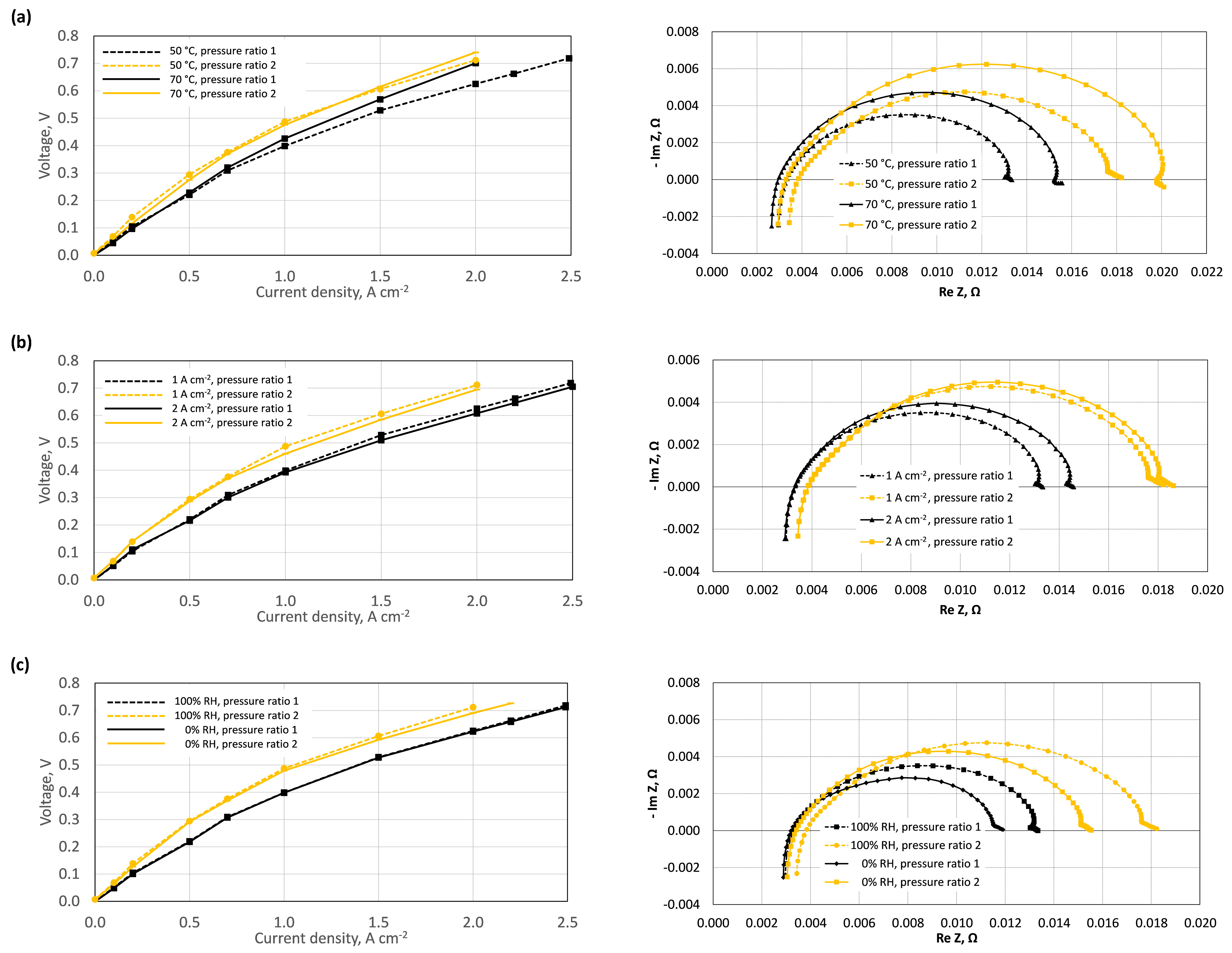
Figure 1b. The concept was that liquid water would keep the membrane moist through back diffusion from the cathode to the anode, and that hydrogen produced at the cathode would bubble through the liquid water in a manner similar to an electrolyzer cathode. Humidification of hydrogen entering the cell on the anode side was also investigated during the experiment. A detailed characterization of cell performance with a flooded cathode at different temperatures, current densities, and RH levels during the second hydrogen compression experiment at compression ratios of 1 and 2 was performed based on analysis of polarization curves and EIS spectra, recorded immediately after 5 h of operation and shown in
Figure 5.
In
Figure 5, it is evident that, unlike the case with a dry cathode, the polarization curves for cell operation with a flooded cathode also deviate from a linear current–voltage relationship, but with a noticeably different (inverted) shape due to changed resistances in the water-filled cathode compartment.
As temperature increases, the difference in measured voltage values grows at higher current densities in the polarization curves (
Figure 5a), but this difference is less pronounced with increasing cathode pressure. However, a pronounced drop in performance at a higher compression ratio, particularly at higher current densities, is caused by differential forces on the membrane, which increase mass transport resistance, i.e., concentration losses, especially at higher current densities. The differences are even more pronounced in the EIS spectra, especially in the lower frequency range (right side of the EIS spectrum), where mass transport losses and their variation are clearly visible (low-frequency region, LF). In the LF region, the impedance response is dominated by slow transport-related processes, particularly two-phase water transport and diffusion limitations within the porous structures and flow channels. An increase in ohmic losses (membrane resistance) at the high-frequency intercept of the
x-axis (high-frequency region, HF) is noticeable (shift to the right) at a higher compression ratio, while a decrease (shift to the left) is observed at higher temperature. The HF intercept is primarily associated with membrane ionic resistance and reflects changes in membrane hydration and mechanical stress. Therefore, lower operating temperatures mitigate the effect of hydrogen back diffusion and are more desirable when operating with thin membranes under high pressure. However, higher operating temperatures increase the diffusion of water into the membrane, thereby decreasing membrane resistance due to improved hydration. This highlights the trade-off between reduced ohmic losses and increased water-related transport effects.
The effect of 5 h of cell operation at different current densities (
Figure 5b) is almost negligible in the polarization curves, whereas mass transport resistances become increasingly pronounced at higher current densities and are noticeably higher at a higher compression ratio, as expected. As cathode pressure increases, there is a noticeable drop in performance, especially at higher current densities, due to differential forces on the membrane, which increase mass transport resistance, i.e., concentration losses. The differences are even more pronounced in the EIS spectra, especially in the LF range (right side of the EIS spectrum), where mass transport losses and their variation are clearly visible. Additionally, the medium-frequency (MF) arc becomes broader with increasing compression ratio and current density, indicating increased interfacial and charge-transfer resistance caused by non-uniform water distribution and partial flooding of the catalyst layer. An increase in ohmic losses (membrane resistance) at the HF intercept of the
x-axis is also noticeable (shift to the right) at a higher compression ratio.
The performances obtained at different hydrogen inlet relative humidities (
Figure 5c) show very similar measured voltages over the entire current density range in the polarization curves, while a pronounced drop in performance at a higher compression ratio, especially at higher current densities, is again noticeable. However, EIS spectra show an increase in total resistance with increasing hydrogen humidity, while membrane resistance remains unchanged. This indicates that the additional resistance originates predominantly from MF and LF contributions, rather than from the membrane itself. This suggests flooding on the anode side, where water droplets slow the reaction processes by occupying catalytic sites. Consequently, there is an apparent increase in activation losses and mass transport limitations, which are masked in the polarization curves. Ohmic losses (membrane resistance) increased noticeably only at a higher compression ratio with 100% RH, suggesting likely flooding within the cell on both sides due to inadequate water balance. Therefore, achieving water balance within the cell by setting appropriate operating conditions is crucial for maximizing electrochemical compression performance.
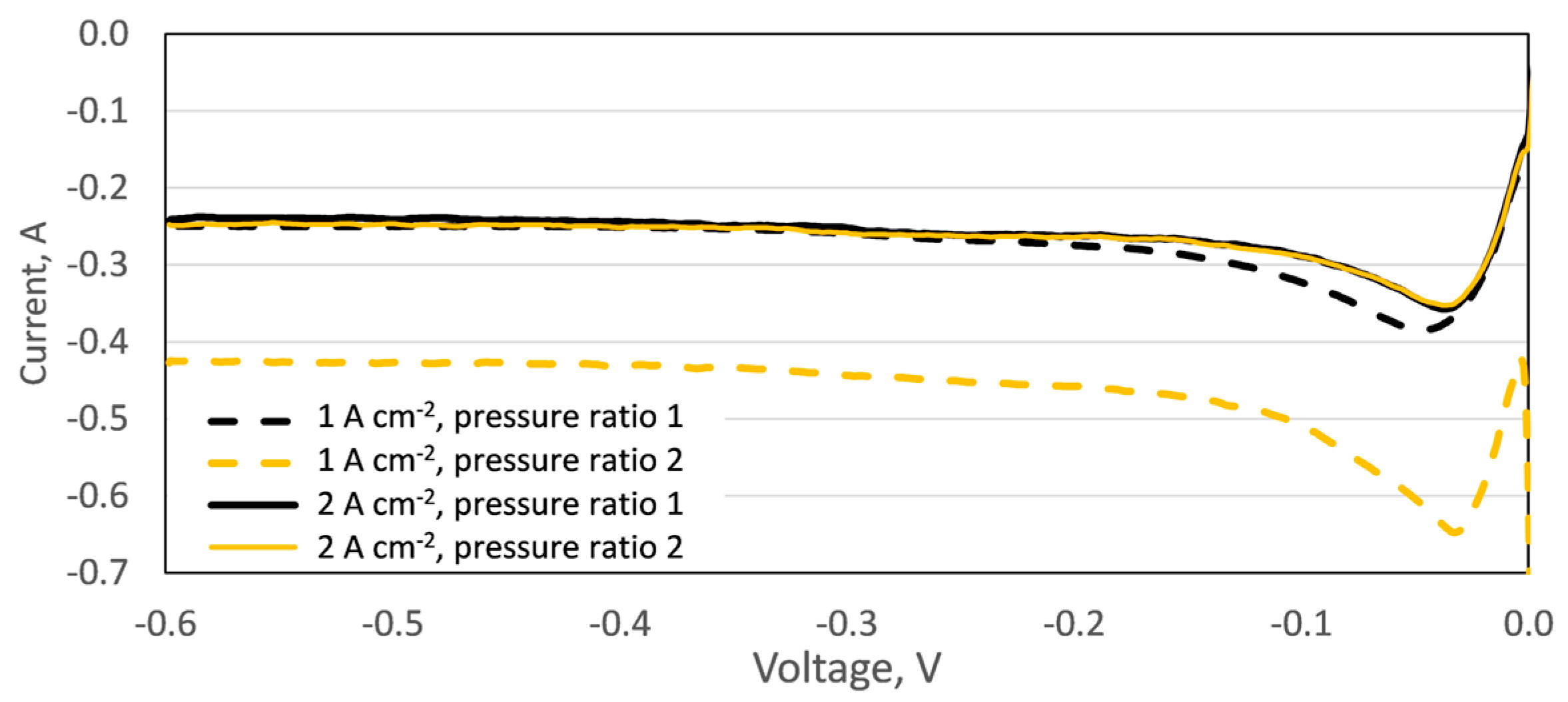
In this study, LSV measurements were also performed to examine and monitor hydrogen back diffusion through the membrane (from cathode to anode) during nitrogen supply to the anode. Theoretically, at sufficiently high voltages (applied externally by a potentiostat), the current generated at the anode can only result from oxidation of hydrogen that has crossed the membrane from the cathode (since only nitrogen is present at the anode). Thus, the LSV current directly reflects hydrogen crossover and its dependence on operating conditions, rather than electrochemical reaction kinetics. This current corresponds to losses due to crossover and internal currents. Therefore, LSV analysis was based on comparing experimentally obtained curves after 5 h of cell operation under different conditions, as shown in
Figure 6.
For instance, after 5 h of cell operation at a lower current density, there is an apparent increase in current response, indicating greater hydrogen back diffusion (crossover). This is even more pronounced at higher compression ratio, as higher cathode pressure increases hydrogen crossover through the membrane from cathode to anode. At higher current densities, the crossover-related current becomes less pronounced, as the increased electro-osmotic water transport and hydrogen consumption reduce the effective driving force for back diffusion. However, after 5 h of cell operation at a higher current density, there is almost negligible increase in current response, as expected, since crossover current is known to be more significant at lower current densities.
Since the membrane in our cell was relatively thin (20 μm) compared to conventional membranes in EHCs, the obtained current values were expectedly higher (e.g., for PEM fuel cell membranes with a thickness of 50 μm, they are around 2 mA cm−2). Although current densities approaching 3 A cm−2 can be achieved at relatively low cell voltages, such operating conditions are accompanied by increased mass transport resistance and hydrogen back diffusion, particularly in flooded cathode configurations. Consequently, high current density alone does not directly translate into improved system efficiency. While this leads to increased hydrogen crossover, it also enables high proton conductivity and low ohmic losses, illustrating the fundamental trade-off in membrane selection. Therefore, when selecting a membrane for an EHC, it is necessary to balance high proton conductivity with low hydrogen back diffusion to minimize the total energy requirements for the compression process. Although the thin membrane used in this study enables high proton conductivity and low ohmic losses, it also increases hydrogen back diffusion, highlighting the fundamental trade-off between membrane thickness and compression efficiency, particularly relevant for higher-pressure EHC operation.
3.4. Integrated Interpretation of Electrochemical Diagnostic Techniques
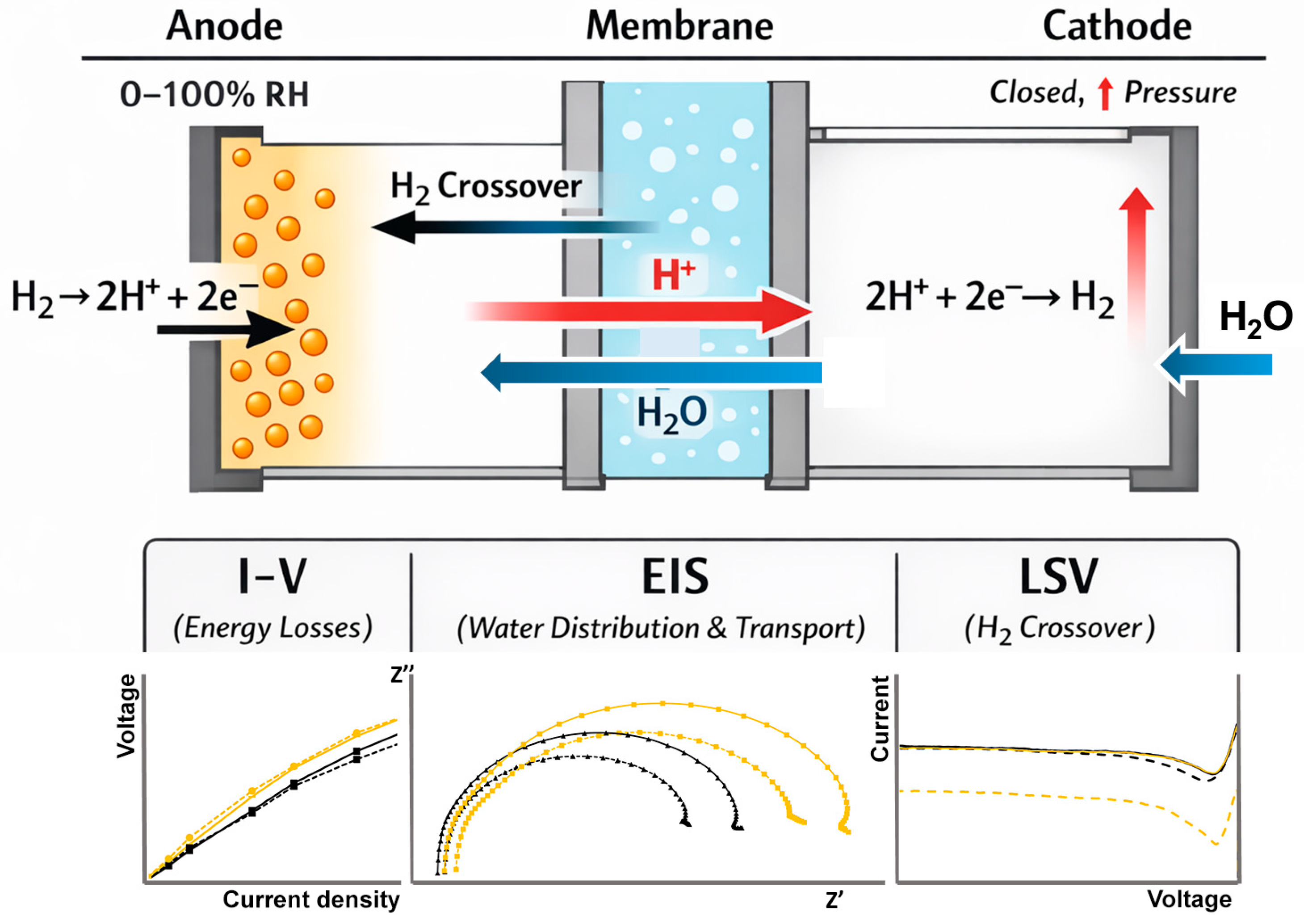
Figure 7 schematically illustrates the operation of a PEM fuel cell in EHC mode, emphasizing the interplay between physical transport processes (proton, water, and hydrogen transport, as well as pressure build-up in the closed cathode compartment), and the electrochemical diagnostic techniques applied in this study. Polarization curves reflect the overall energetic response of the system, EIS separates ohmic, interfacial, and transport-related contributions associated with membrane hydration and water distribution, while LSV directly quantifies hydrogen back diffusion through the membrane under elevated cathode pressure.
As shown in
Figure 7, operation in EHC mode is based on the same electrode reactions as in conventional fuel cell operation. Hydrogen oxidation at the anode (H
2 → 2H
+ + 2e
−) and proton reduction at the cathode (2H
+ + 2e
− → H
2) occur in both cases; however, in EHC mode, these reactions are driven forcibly by an external power supply rather than proceeding spontaneously. The closed cathode compartment leads to hydrogen accumulation and a continuous increase in cathode pressure, which becomes a key physical variable governing the subsequent system behavior.
Protons generated at the anode cannot exist as free ions and are transported through the membrane exclusively in a hydrated form. Proton conduction proceeds via the Grotthuss hopping mechanism, in which protons are transferred along a hydrogen-bonded network of water molecules within the membrane. Importantly, this mechanism enables rapid charge transport without requiring net translational diffusion of water molecules. Consequently, proton transport itself does not appear as a diffusion-controlled process in electrochemical impedance spectra, even though adequate membrane hydration is a strict prerequisite for proton conductivity [
8].
In contrast, EIS, particularly in the LF region, is sensitive to slow processes associated with water redistribution and mass transport. As the excitation frequency decreases, EIS progressively probes slower phenomena, with water transport and accumulation emerging as dominant contributors to impedance at low frequencies. An increase in the diameter of the impedance arc therefore directly reflects increased transport resistance, most commonly caused by water accumulation in porous electrode structures or by changes in the dielectric properties of the hydrated membrane and catalyst layers. In this context, EIS primarily indicates water and its spatial distribution rather than proton motion itself, enabling separation of ohmic losses (HF intercept), interfacial processes (MF region), and transport limitations related to water management (LF response) [
8,
25].
The increase in pressure in the closed cathode compartment, resulting from increased current density or cathode flooding (liquid water circulation), introduces an additional driving force for the transport of hydrogen from the cathode back to the anode. This process disrupts the electrochemical equilibrium. Since electroneutrality must be preserved in all components of the system, including both the electrode and the membrane, hydrogen reaching the anode compartment is immediately reintegrated into the oxidation reaction. This leads to a corresponding increase in the anode current and an automatic adjustment of the cathode current. In this way, the electrochemical circuit remains self-consistent, and the pressure-driven hydrogen transfer is electrically manifested as a current within the system.
LSV differs fundamentally from EIS in that it employs larger DC potentials, thereby deliberately enhancing the cathodic reaction and increasing hydrogen production in the closed cathode compartment. The resulting pressure increase amplifies hydrogen back diffusion through the membrane, which is detected by LSV as a measurable crossover current. Consequently, LSV provides a direct quantitative measure of hydrogen back diffusion and defines the operational limits of efficient EHC under given conditions.
The combined use of polarization curves, EIS, and LSV thus provides a comprehensive diagnostic framework: polarization curves reflect the overall energetic response of the system, EIS separates resistance contributions associated with membrane hydration and transport phenomena, and LSV directly identifies operational boundaries imposed by hydrogen back diffusion. Such an integrated diagnostic interpretation is particularly important for EHC systems, where systematic electrochemical diagnostics and mechanistic interpretation remain limited in the existing literature [
20].
4. Conclusions
This work systematically examined the performance of a PEM fuel cell operated in electrochemical hydrogen compression (EHC) mode under varying temperatures, RH levels, and compression ratios, with a focus on water management. Two humidification strategies, dry cathode with humidified anode hydrogen and flooded cathode with controlled anode humidification, were analyzed using polarization curves, EIS, and LSV. The contribution of this study is the combined use of EIS and LSV analysis diagnostic approaches that are absent or under-addressed in previously published EHC studies. This diagnostic framework enables a more comprehensive interpretation of water distribution, membrane hydration, and transport processes, ultimately advancing the understanding of water dynamics in EHC systems.
For the dry cathode configuration, optimal operation was achieved at 70 °C with fully humidified anode gas (100% RH), which enhanced proton conductivity, minimized ohmic losses, and enabled current densities above 2 A cm−2 at voltages below 0.3 V. Partial humidification (67% RH) led to membrane dehydration and instability, particularly at higher current densities. In the flooded cathode configuration, increased cathode pressure raised mass transport resistance, while excessive inlet humidification caused flooding and reduced performance. LSV measurements revealed that thin membranes (20 μm) offer high proton conductivity but increase hydrogen back diffusion, underscoring the need for careful material selection.
Although high current densities can be achieved at low voltages, they do not necessarily translate into improved system efficiency due to increased mass transport limitations and hydrogen back diffusion.
These findings confirm that precise control of water balance is critical for stable and efficient EHC operation. Closely related to water balance is the hydrogen temperature, as it determines condensation/evaporation processes, thus affecting the water balance. However, hydrogen temperature may be controlled only at the inlet, but hydrogen temperature inside the cell depends on the hardware temperature. Therefore, cell cooling/heating and precise control of the cell temperature are also important for stable and efficient EHC operation. Special attention must be paid to definition of the cell temperature and to the internal processes that may affect it.
The results provide operational guidelines for optimizing compression efficiency, minimizing energy consumption, and improving durability, thereby supporting the development of high-performance and low-maintenance EHCs for stationary and mobile applications.
Future studies should extend the present analysis to multi-cell EHC stacks operating at higher compression ratios to better replicate industrial applications. Optimization of membrane materials with tailored thickness and water transport properties is essential to balance high proton conductivity with low hydrogen back diffusion. Advanced water management strategies, such as adaptive humidification control, modified flow-field designs, or integrated phase-change systems, should be investigated to maintain optimal hydration under variable load conditions. Long-term durability testing under cyclic and high-pressure operation will be necessary to assess degradation mechanisms and their impact on efficiency. Coupling experimental data with multiphysics modeling can enable predictive design optimization, accelerating the scale-up of EHC technology for commercial hydrogen infrastructure.