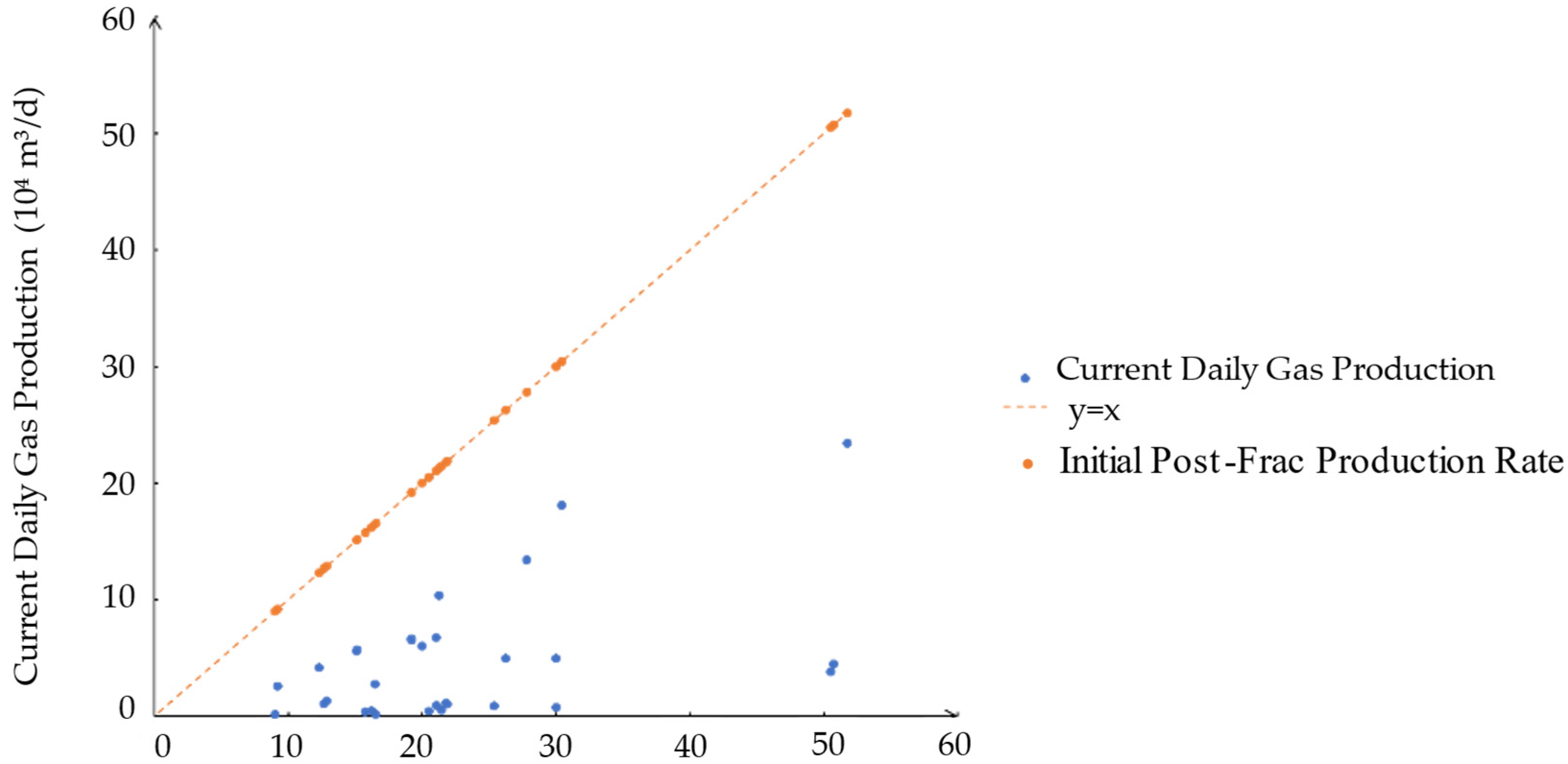
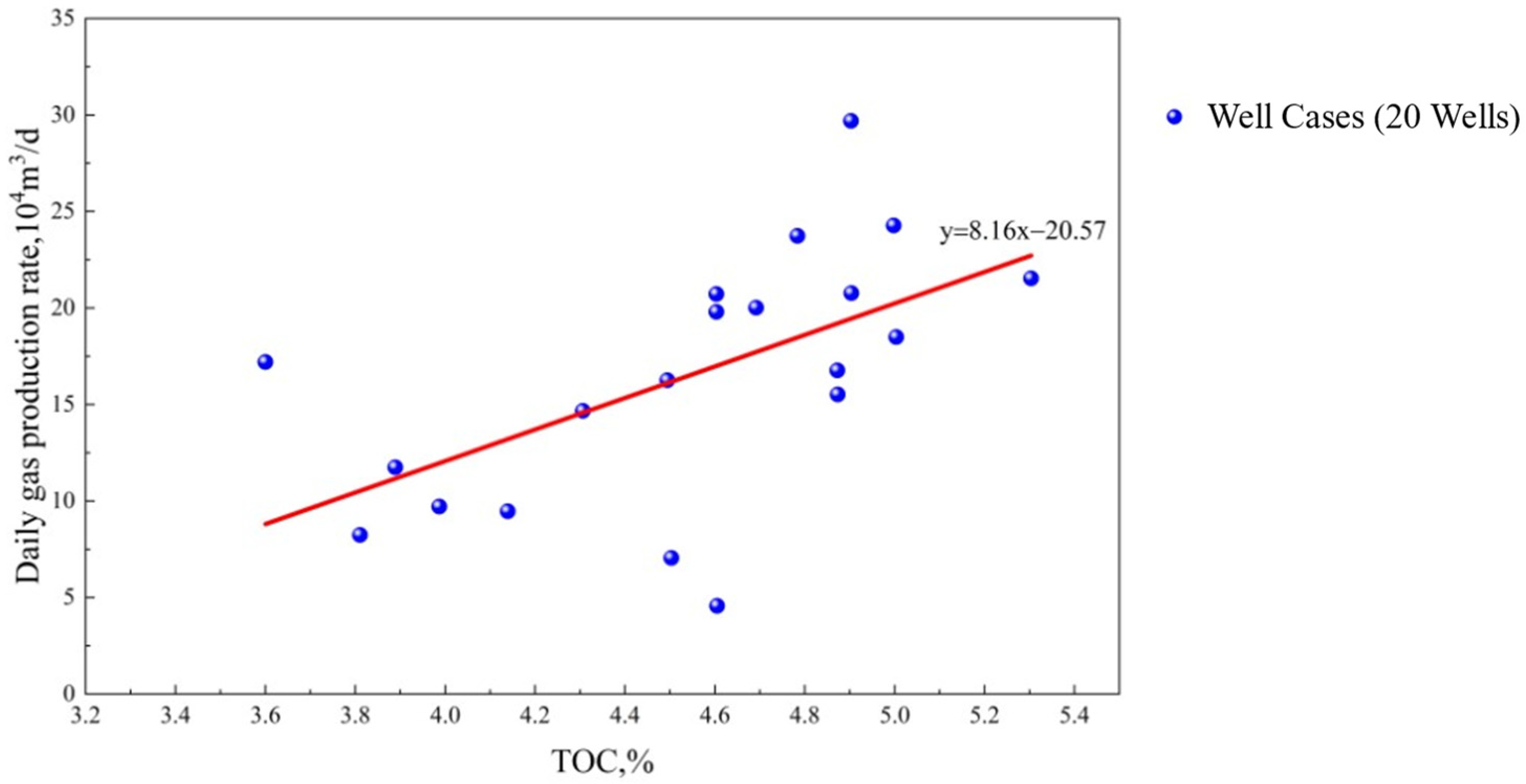
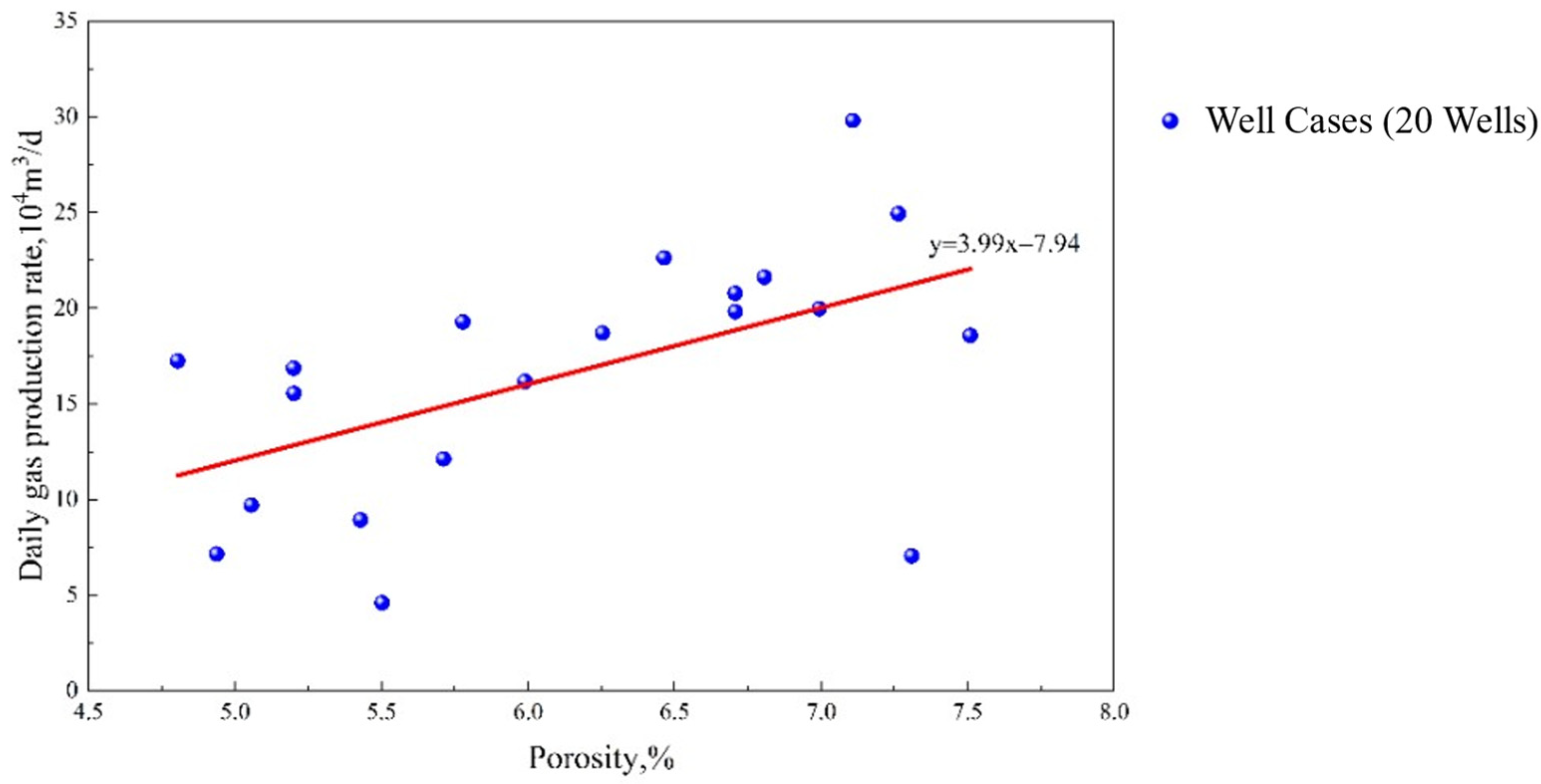
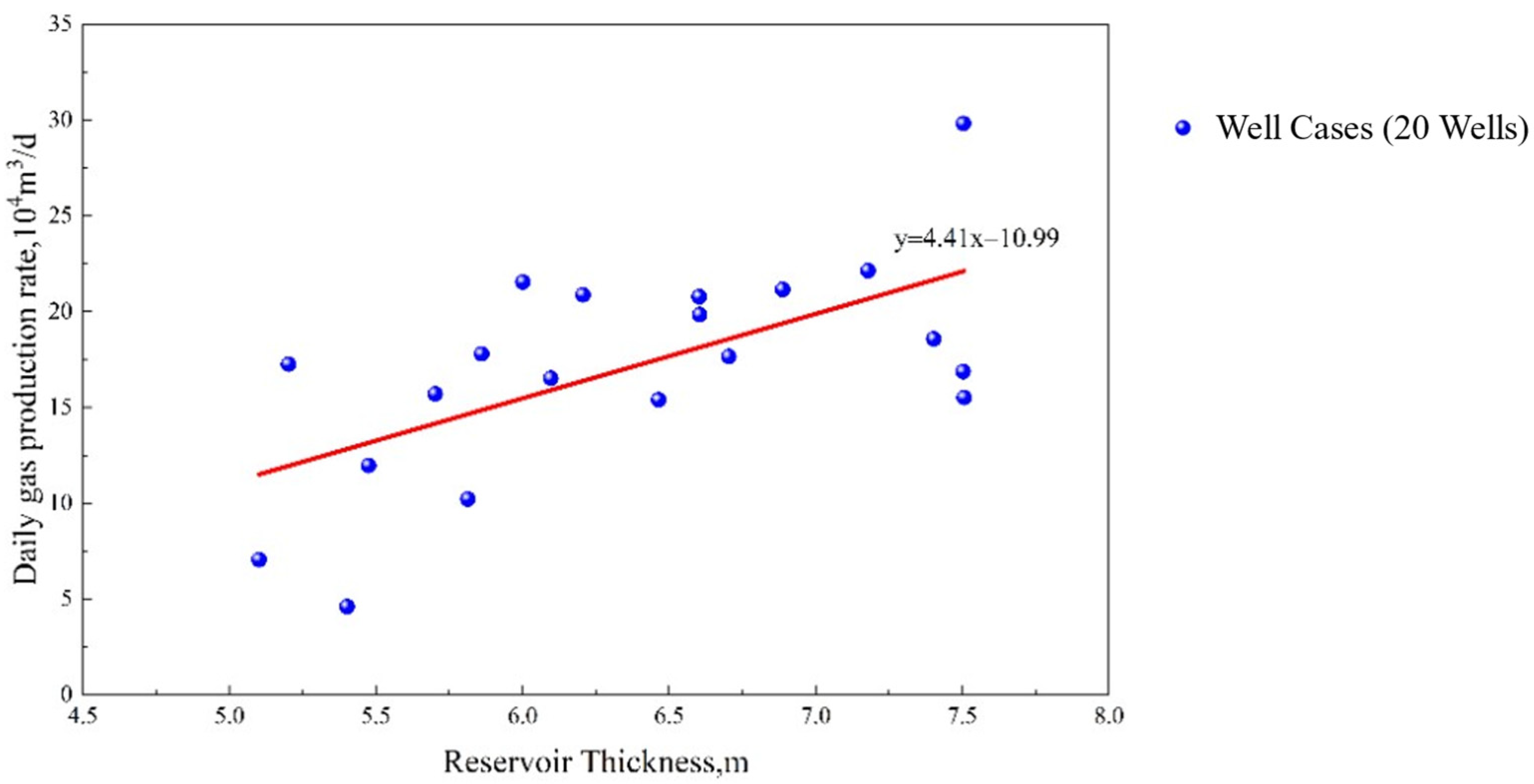
4.1. Comprehensive Evaluation Model and Evaluation Indicator Thresholds
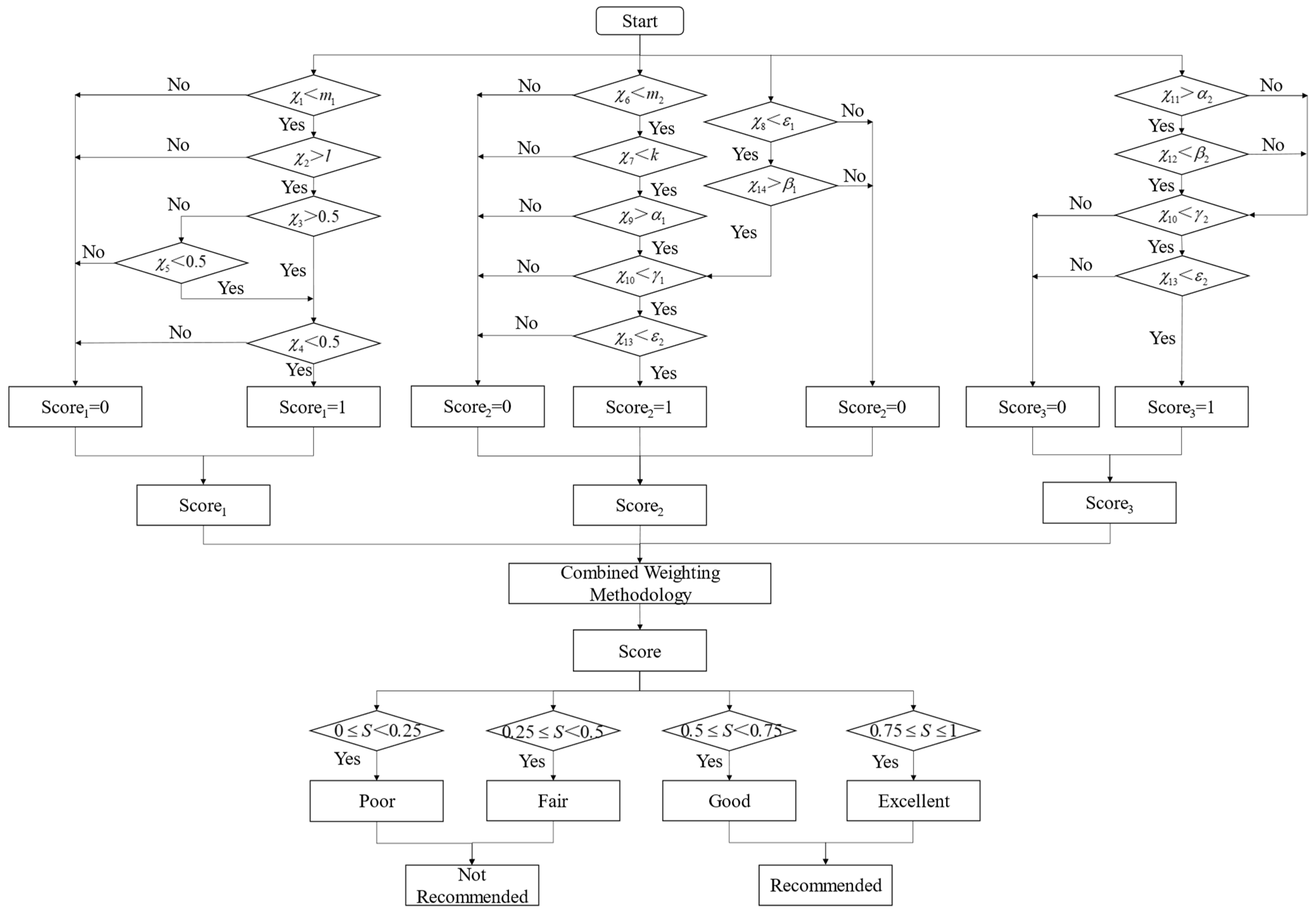
The comprehensive evaluation model for re-fracturing candidate selection, established based on the research framework discussed above, is presented in
Figure 13.
This model comprehensively integrates three categories of factors—geological, engineering, and production dynamics—for a holistic evaluation in shale gas well selection. The evaluation indicators for each category are listed in
Table 2:
- (1)
horizontal stress differential coefficient
The horizontal stress differential coefficient is used to evaluate the complexity of the fracture network created within the reservoir during the initial fracturing treatment [
17] the formula for calculating the horizontal stress differential coefficient is as follows:
In the formula, is the horizontal stress differential coefficient, dimensionless; is the maximum horizontal principal stress, MPa; is the minimum horizontal principal stress, MPa; and is the threshold value of the horizontal stress differential coefficient, dimensionless.
Blanton’s experimental study [
18] concluded that both the principal stress difference and the approach angle affect fracture propagation, as shown in
Table 3.
Based on the established conditions for fracture network formation in this shale gas block in the Southern Chuan basin, a horizontal stress differential coefficient of less than 0.2 is considered favorable for the development of a complex fracture network within the rock [
17,
20,
24].
- (2)
Shale gas reservoir evaluation index
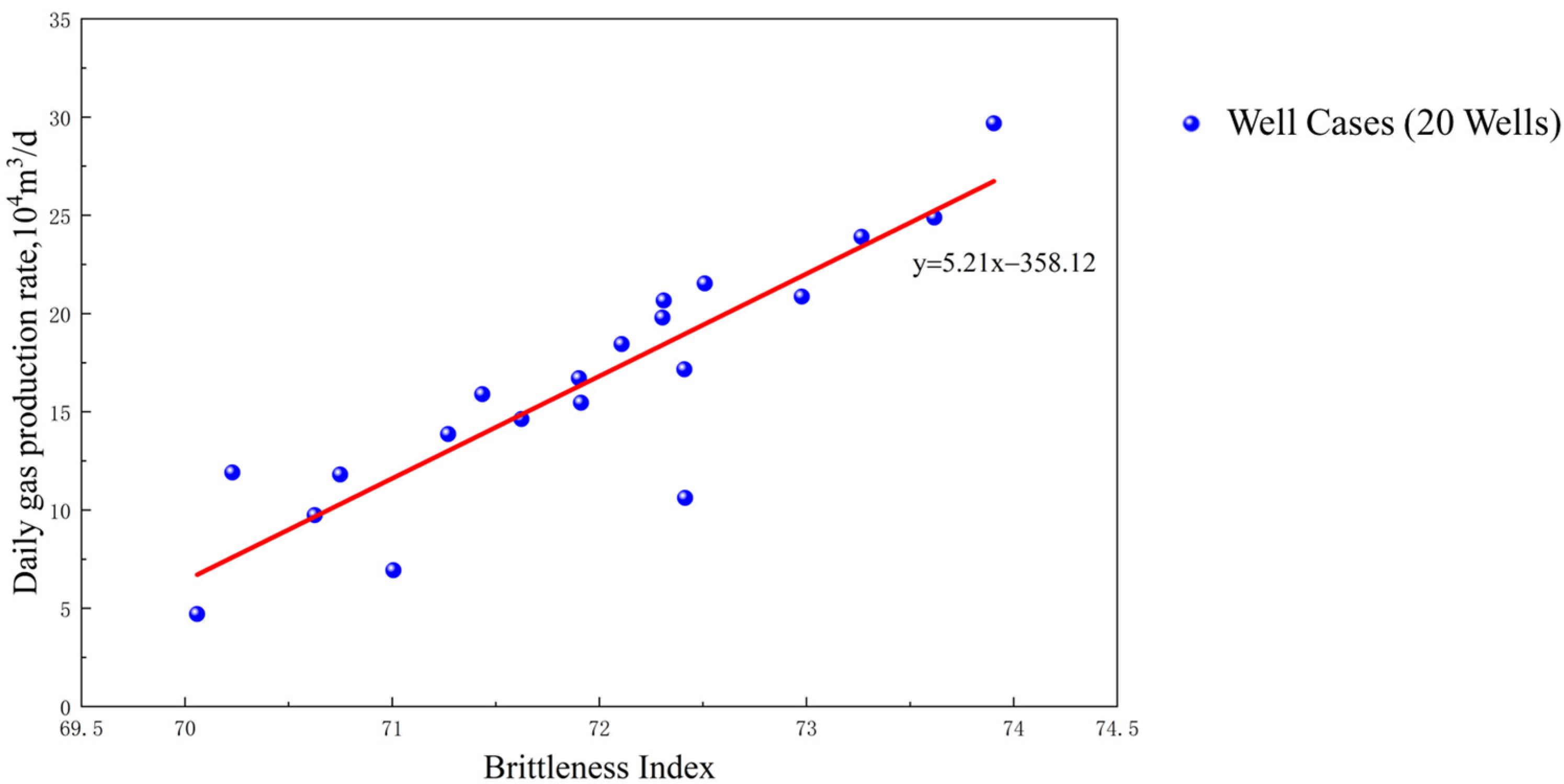
The shale gas reservoir evaluation index is calculated from the normalized values of toc content, porosity, total gas content, and the brittleness index. The formula for this calculation is as follows:
Wherein, the normalization formula for each reservoir parameter is:
In the formula,
is the shale gas reservoir evaluation index, dimensionless;
is the total number of reservoir parameters considered (in this case,
n = 4), dimensionless;
is a weighting factor for the
i-th reservoir parameter, dimensionless;
is the normalized value of the
i-th reservoir parameter (representing total organic carbon (toc), porosity, total gas content, or brittleness index), dimensionless;
is the maximum value of a given parameter observed across all wells on the same pad as the candidate well;
is the minimum value of a given parameter observed across all wells on the same pad as the candidate well;
is the actual value of the
i-th parameter for the candidate well.
The shale gas reservoir evaluation index is calculated from the normalized values of toc content, porosity, total gas content, and the brittleness index. Toc is a fundamental parameter as it directly reflects the organic matter accumulation, which is controlled by a combination of palaeoproductivity and preservation conditions and serves as the basis for gas generation and storage [
25].
Based on the fracture description data from core analysis and mud logging within the study block, and integrating multiple factors including the practical exploration and development outcomes consistent with the actual conditions of the study area, a quantitative classification was established on the basis of the qualitatively defined three fracturability levels, as detailed in
Table 4. A fracturability level of grade
i indicates that the re-fracturing potential is relatively high [
39,
40]. Therefore, the shale gas reservoir evaluation index’s threshold value is set at 0.6.
- (3)
single-well fluid usage index
The formula for calculating the single-well fluid usage index is as follows:
In the formula,
is the single-well fluid usage index, dimensionless;
is the number of stages where the fluid intensity and injection rate meet the requirements for re-fracturing; and
is the total number of stages in the candidate well.
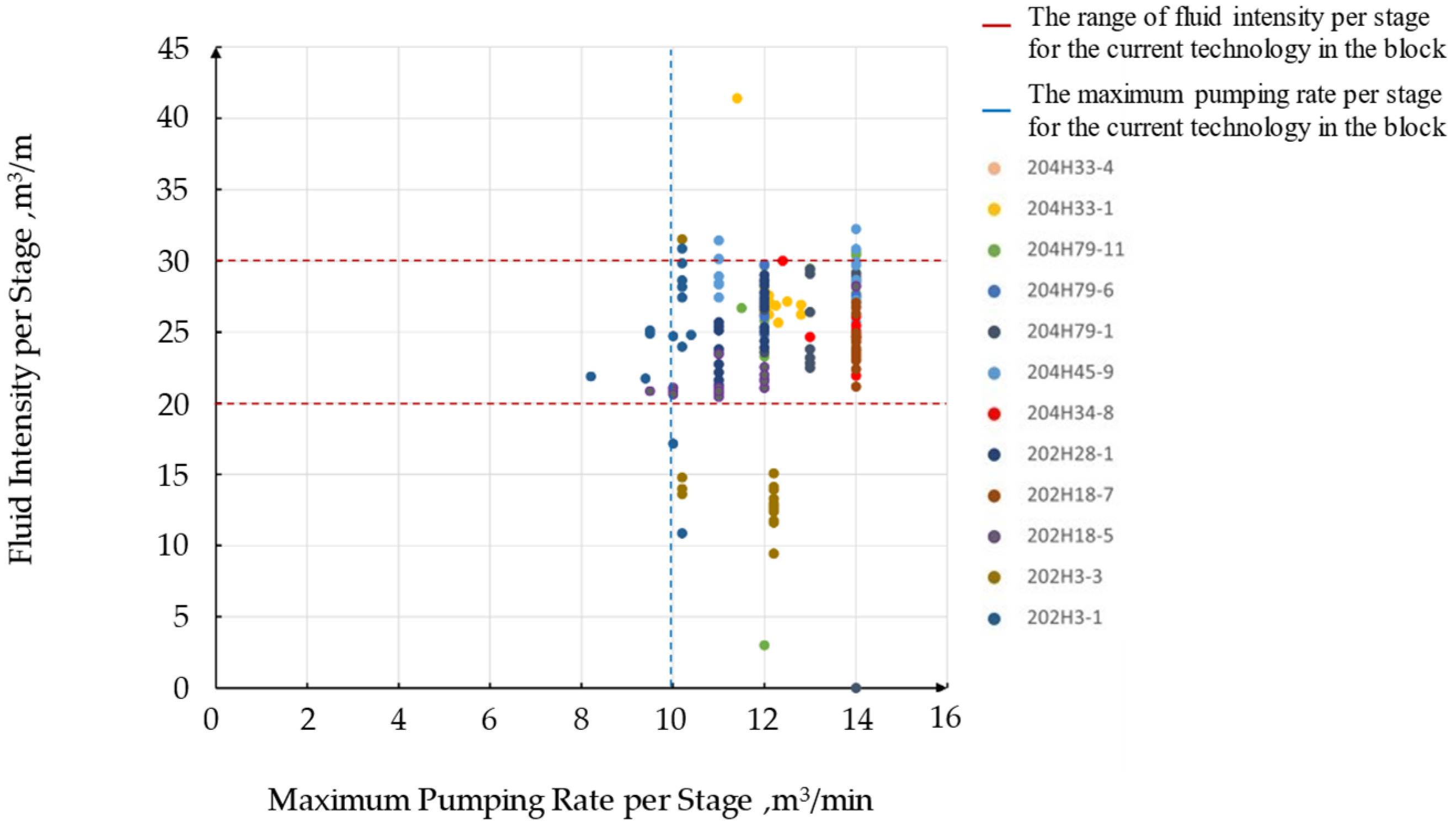
A crossplot of fluid intensity per stage versus maximum treatment rate per stage, as shown in
Figure 14, is used to determine the number of stages that satisfy the requirements for re-fracturing.
For re-fracturing operations, downhole tools need to be redeployed. Re-fracturing is deemed unnecessary if the number of stages where the fluid intensity per stage and pump rate meet the re-fracturing requirements, or the number of stages where the proppant intensity per stage and sand ratio meet the re-fracturing requirements, is less than half of the total stages in the candidate well. Therefore, it is required that both the fluid usage index and the proppant volume index be greater than 0.5. If the fluid usage index is less than 0.5, candidate wells with an initial fracturing SRV index below 0.5 and a proppant volume index greater than 0.5 should be selected for re-fracturing.
- (4)
Single-well proppant usage index
The formula for calculating the single-well proppant usage index is as follows:
In the formula,
is a proppant usage evaluation index, dimensionless;
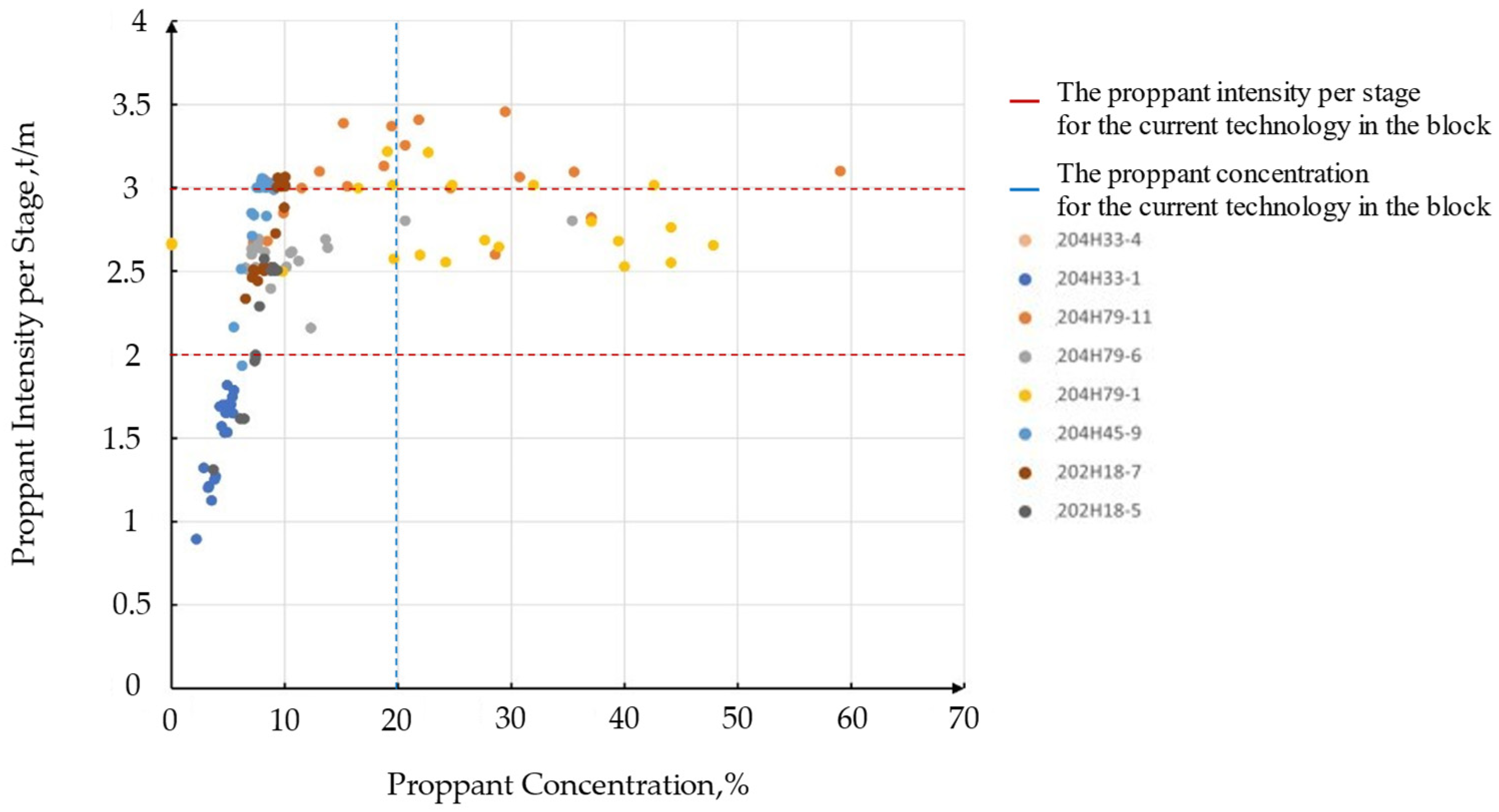
is the number of stages that meet the proppant usage criteria, dimensionless. The proppant usage evaluation index must be greater than 0.5.
A crossplot of proppant intensity per stage versus proppant concentration, as shown in
Figure 15, is used to determine the number of stages that satisfy the re-quirements for re-fracturing.
- (5)
SRV ratio from initial fracturing
The SRV ratio from the initial fracturing is introduced to evaluate the effectiveness of the original treatment. The formula for this calculation is as follows:
In the formula,
is the SRV ratio from initial fracturing, dimensionless;
is the stimulated reservoir volume from initial fracturing, m
3;
is well spacing, m;
is the reservoir thickness, m; and
is the lateral length of the horizontal section, m.
When the SRV created by the initial fracturing is less than half of the theoretical total volume, the shale gas well is considered to have undergone incomplete development and possesses re-fracturing potential. Therefore, the threshold for the SRV ratio from the initial fracturing is set at 0.5.
- (6)
poroelastic stress reorientation coefficient [
16]
This coefficient is defined as the ratio of the pre-re-fracturing horizontal principal stress difference to the stress difference induced by the gas reservoir pressure gradient. The formula for this calculation is as follows:
In the formula,
is poroelastic stress reorientation coefficient, dimensionless;
is stress difference induced by the pore pressure gradient, MPa;
is Biot’s coefficient, dimensionless;
is Poisson’s ratio, dimensionless;
is formation pressure, MPa;
is bottomhole flowing pressure, MPa.
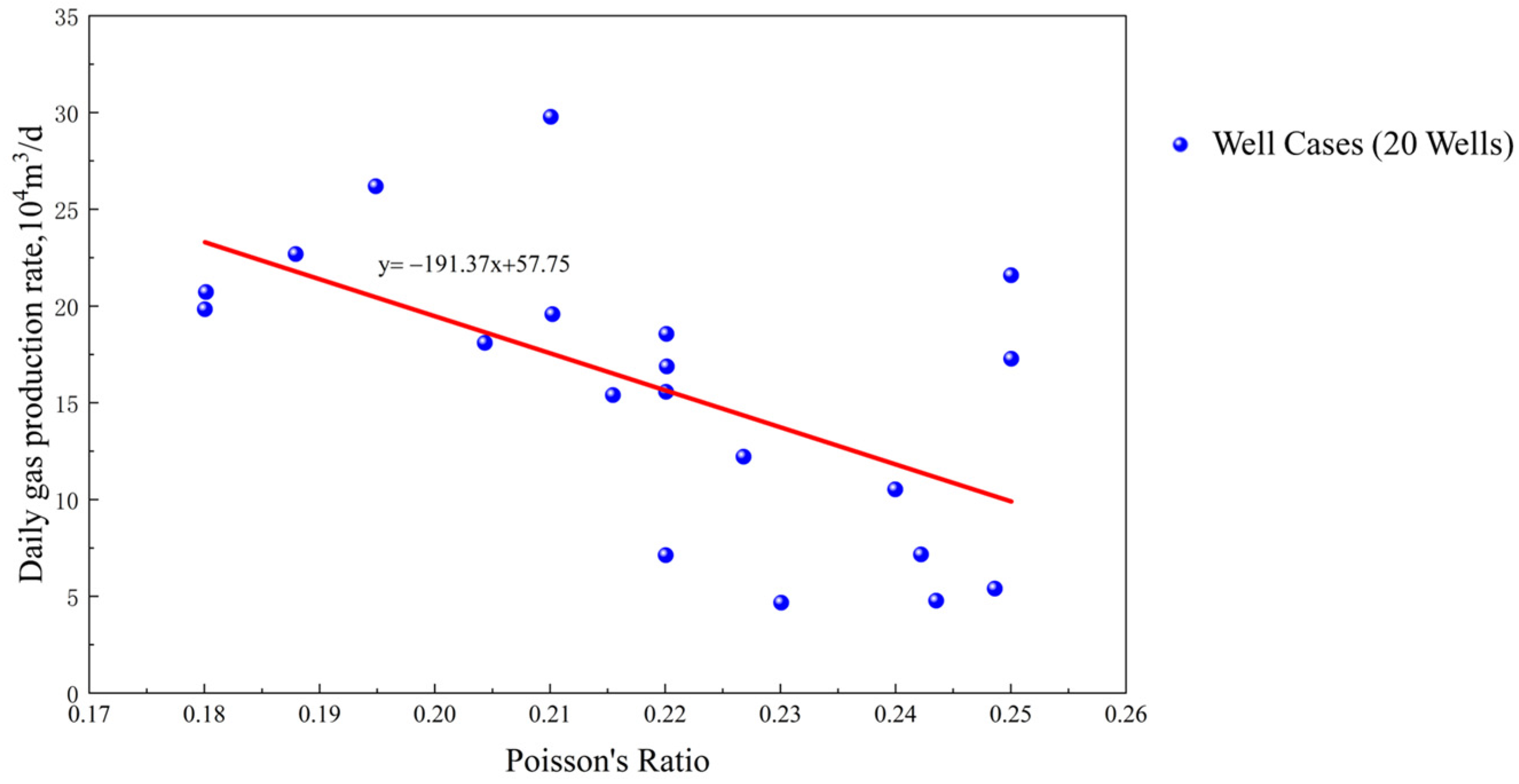
For shale gas wells in this block, the threshold value for the poroelastic stress reorientation coefficient needs to be calculated by integrating geological conditions, in situ stress field characteristics, and pore pressure parameters specific to the area. The horizontal principal stress difference in this region is typically small, usually ranging from 5 to 10 MPa; the Biot’s coefficient for the shale typically ranges from 0.6 to 0.9; the Poisson’s ratio of the shale typically ranges from 0.2 to 0.3; the formation pressure typically ranges from 30 to 40 MPa; and the bottom-hole flowing pressure during production typically ranges from 10 to 20 MPa [
23,
25]. Based on the aforementioned geological parameters, the range of the poroelastic stress reorientation coefficient is presented in
Table 5.
- (7)
Elastic productivity-pressure coefficient
This coefficient reflects the reservoir energy, initial fracture length, and fracture conductivity. The formula for its calculation is as follows:
In the formula,
is elastic productivity, defined as the volume of gas produced per unit of formation pressure drawdown, in m
3/MPa;
is cumulative gas production corresponding to the observed formation pressure drop, in m
3;
is formation pressure coefficient, dimensionless;
is hydrostatic pressure at the same depth, in MPa.
The elastic productivity-pressure coefficient and the formation pressure coefficient for re-fracturing candidate wells should be higher than the average levels of shale gas wells in the same block. Therefore, the thresholds for these two coefficients should be set as the average values of the candidate wells in that block.
- (8)
Gas reservoir quality index
This index employs a comprehensive methodology to transform qualitative assessments into a quantitative evaluation. It is based on an integrated assessment of key parameters: toc, total hydrocarbons, porosity, and gas saturation. The formula for its calculation is as follows:
In the formula,
is gas reservoir quality index, dimensionless;
is a weighting factor for the
i-th geological parameter, dimensionless;
is the value of the
i-th geological parameter for a given well, dimensionless.
Shale gas wells with a gas reservoir quality index higher than the average for the area possess greater re-fracturing potential. Therefore, the threshold for this index should be set as the average value of shale gas wells within that block.
- (9)
Normalized Pseudo-Production decline rate
The formula for calculating the Normalized Pseudo-Production Decline Rate is as follows:
In the formula,
is the normalized Pseudo-Production decline rate, %;
is maximum daily production rate, 10
4 m
3/d.
It is recommended to prioritize candidate wells that exhibit both a normalized Pseudo-Production decline rate and remaining recoverable reserves higher than the area average [
41].
- (10)
Depleted gas volume
This parameter describes the pore volume occupied by the gas that has contributed to flow from the reservoir over the course of a well’s production history. The formula for its calculation is as follows:
In the formula,
is depleted gas volume, 10
4 m
3;
is total compressibility, MPa
−1;
is pressure coefficient, dimensionless;
is initial reservoir pressure, MPa;
is the gas production rate, 10
4 m
3/d.
The average value of the depleted gas volume is used as the threshold value for selection.
- (11)
Current recovery factor
This is defined as the ratio of cumulative gas production to the depleted gas volume. The formula for its calculation is as follows:
In the formula,
is the current recovery factor, dimensionless.
The average value of the current recovery factor among the candidate wells is used as the threshold for selection.
- (12)
Reservoir depletion coefficient
This coefficient reflects the combined influence of formation parameters, the location of neighboring wells, and their cumulative production. The formula for its calculation is as follows:
In the formula,
is reservoir depletion coefficient, dimensionless;
is effective reservoir thickness, m;
is gas formation volume factor, dimensionless;
is the cumulative production of the
i-th offset well, 10
4 m
3;
is formation porosity, dimensionless;
is the minimum distance from the
i-th offset well to the target well, m;
is the total number of nearby offset wells.
The threshold value is defined as the value of the reservoir depletion coefficient at which the slope of its relationship curve with the daily gas production rate equals −1.
4.2. Combined Weighting Methodology
This study integrates the Analytic Hierarchy Process (AHP) with Gray Relational Analysis (GRA) to determine the combined weights for the multi-model system. Although AHP is a widely used and effective method for determining subjective weights in shale gas potential evaluation, the construction of its judgment matrix is heavily reliant on expert experience. To enhance objectivity, this paper incorporates GRA to establish an objective matrix for AHP based on the intrinsic relationships within the data itself, thereby establishing a more balanced and robust weighting strategy [
42,
43].
- (1)
Objective weight calculation
The formula for calculating the gray relational weights is as follows:
In the formula,
is the gray relational degree of the
j-th factor on the production of the fractured well, dimensionless;
is the number of samples, dimensionless; and
is the distinguishing coefficient, dimensionless, with a value between 0 and 1.
- (2)
Subjective weight calculation
The application of AHP involves several key steps [
18,
26,
31]: first, clearly defining the final objective; second, breaking down the decision problem into multiple levels, such as the goal, criteria, and alternatives; and third, performing pairwise comparisons of the elements within each level to establish their relative importance. The outcomes of these comparisons are then used to construct a judgment matrix
for the evaluation indicators, reflecting their ranked priorities.
In the formula,
is Judgment matrix;
is a quantified value representing the relative importance of element
i compared to element
j.
Normalize the matrix columns:
The formula for calculating AHP relational weights is as follows:
In the formula,
is an element of the column-normalized matrix;
is the unnormalized weight of the
i-th parameter; and
is the normalized weight of the
i-th parameter.
- (3)
Calculation of final combined weights
The judgment matrix in the AHP is typically constructed based on subjective experience to analyze the relative importance of different influencing factors, which lacks objectivity. Therefore, this study employs the GRA method to provide an objective judgment matrix for AHP. This matrix is derived from the degree to which existing parameters meet the requirements of the comprehensive evaluation model for shale gas well selection, thereby yielding objective and comprehensive integrated weights.
The AHP judgment matrix, constructed using the gray relational degree ratio
, is:
In the formula,
is the scale adjustment factor, used to bring the matrix into compliance with AHP’s 1–9 scale requirement.
Compute all ratios
and determine the maximum ratio
, subsequently calculating the scale adjustment factor
: