What Can the History of Function Allocation Tell Us About the Role of Automation in New Nuclear Power Plants?
Abstract
1. Introduction
1.1. Regulatory Perspectives on Function Allocation (FA)
1.2. Review Objectives
2. Methodology
2.1. Literature Review Definition
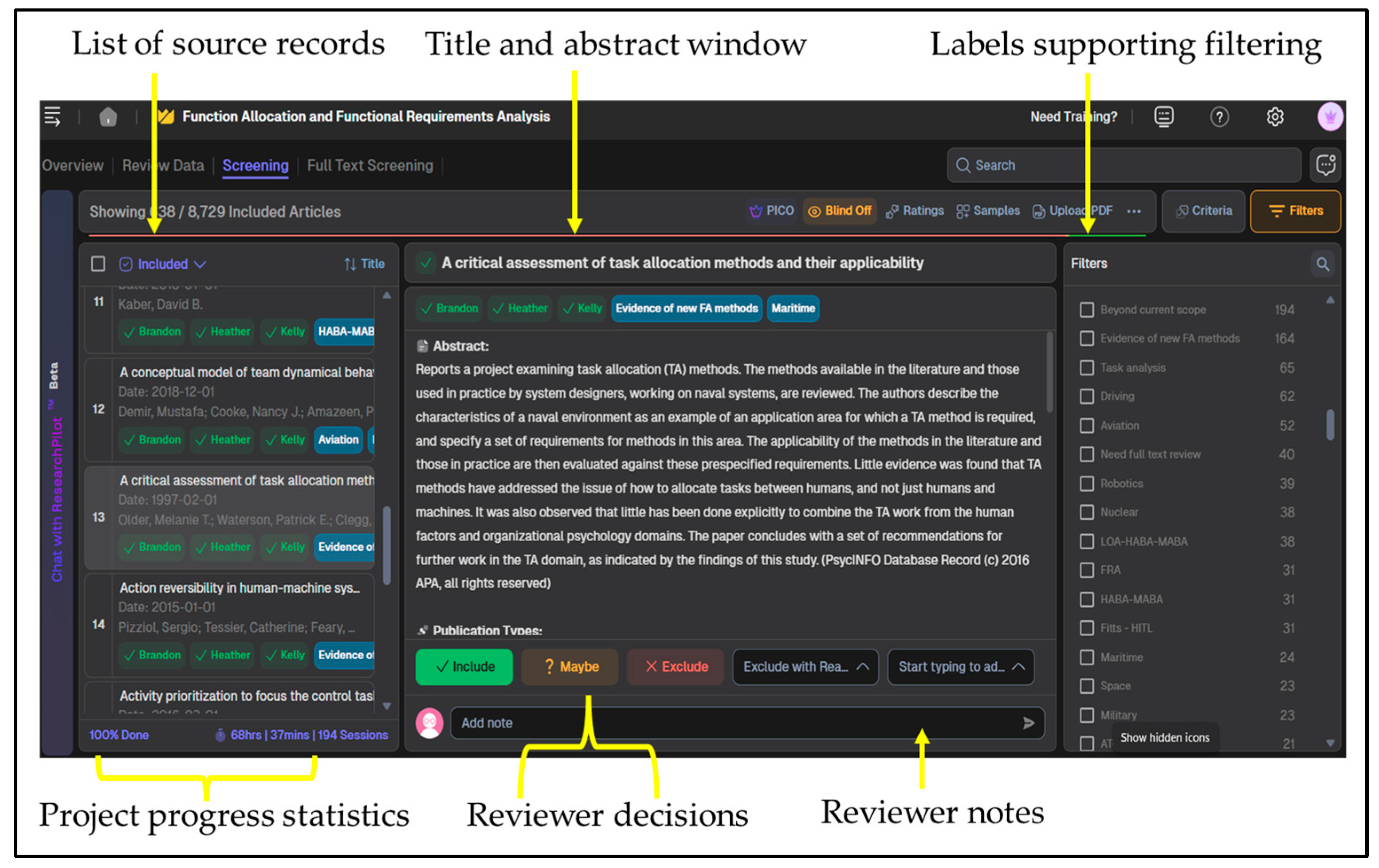
2.2. Review Software
2.3. Literature Search Procedures
2.3.1. Database Selection
2.3.2. Definition of Search Criteria
2.3.3. Keyword Mapping
2.3.4. Extraction and Storage of Citation Data
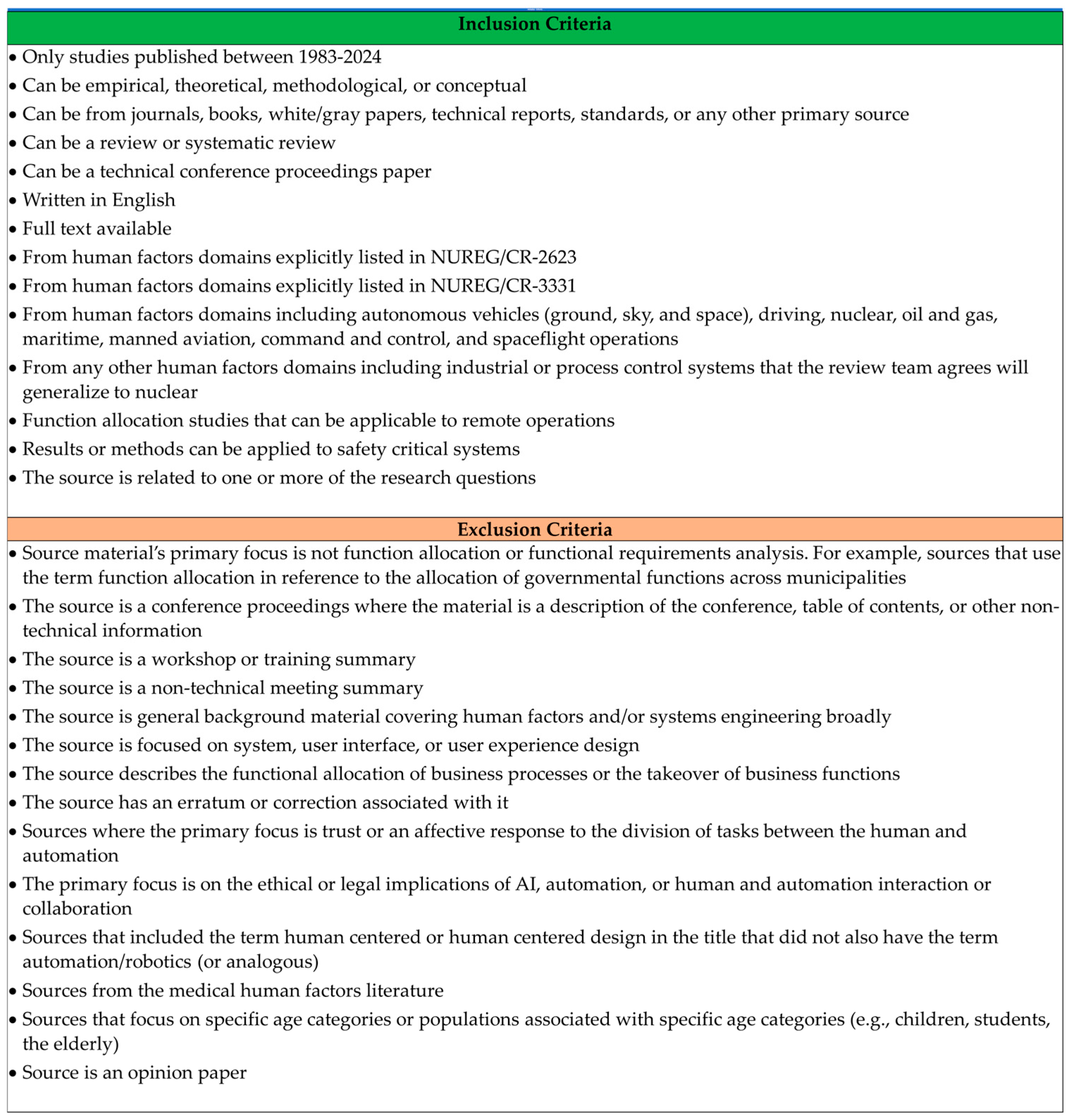
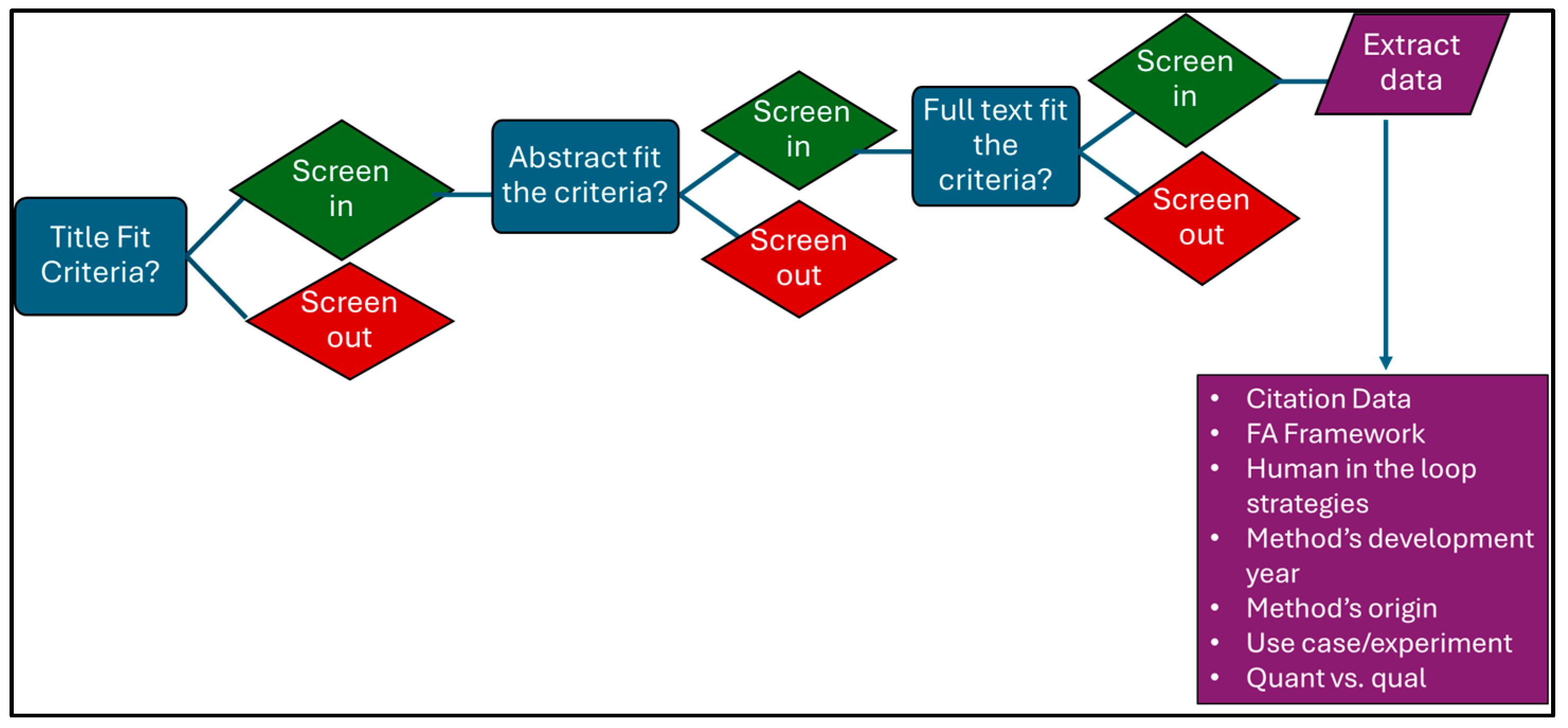
2.4. Screening Process
2.4.1. Title-Level Screening
2.4.2. Abstract-Level Screening
2.4.3. Full-Text Screening
2.4.4. Backwards–Forwards Search
3. Results
3.1. Literature Characteristics
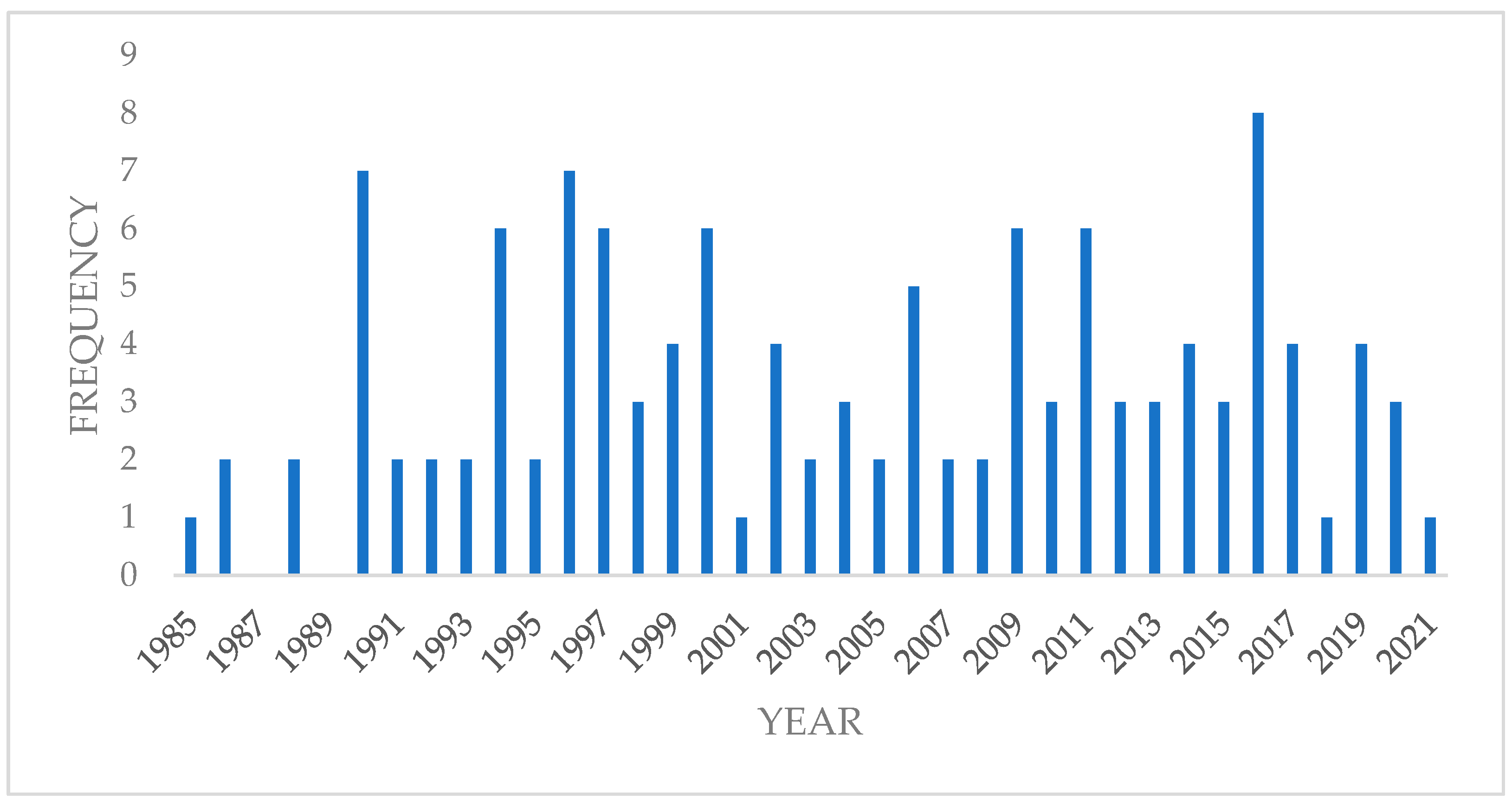
3.2. Publications by Year
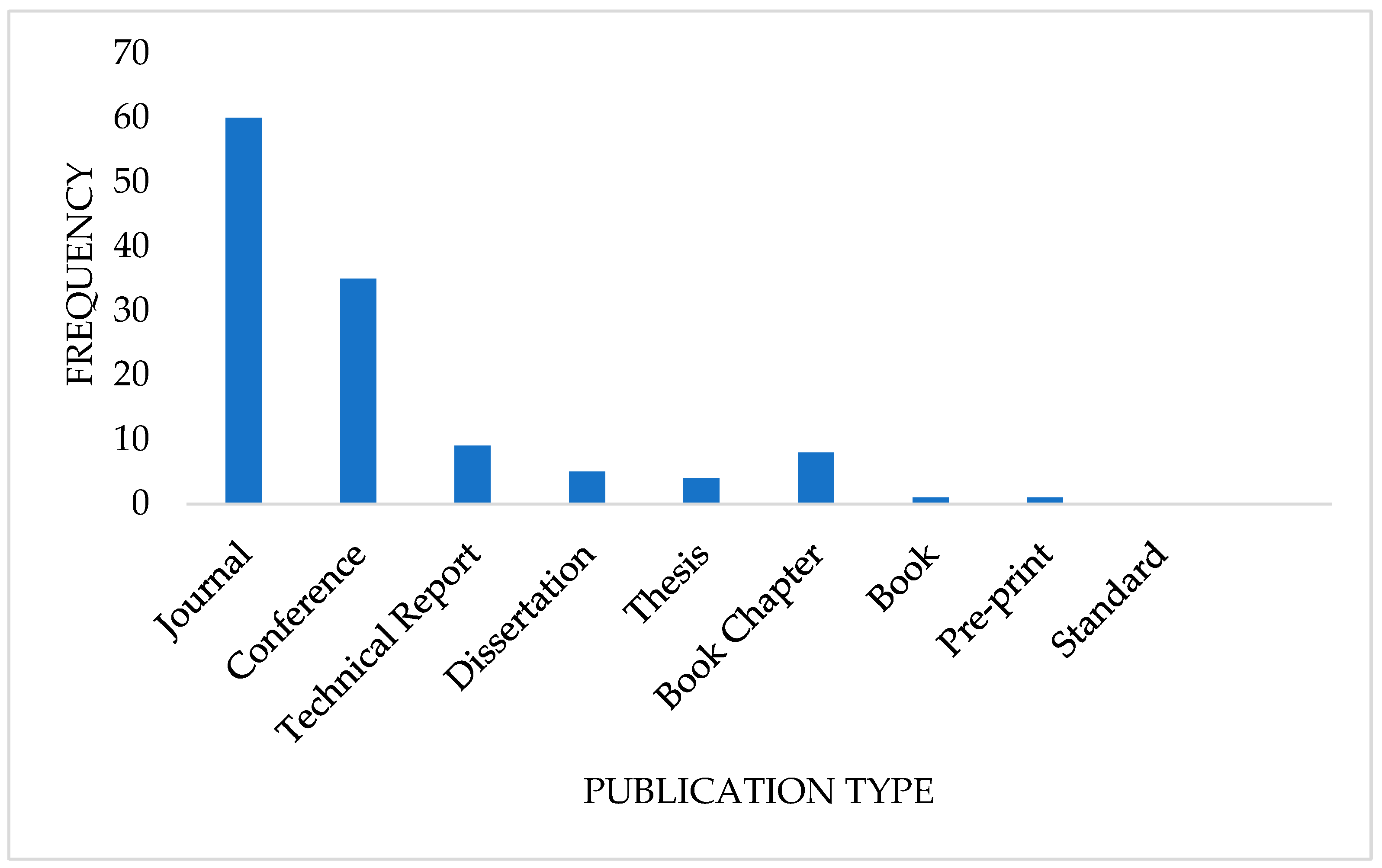
3.3. Publication Types
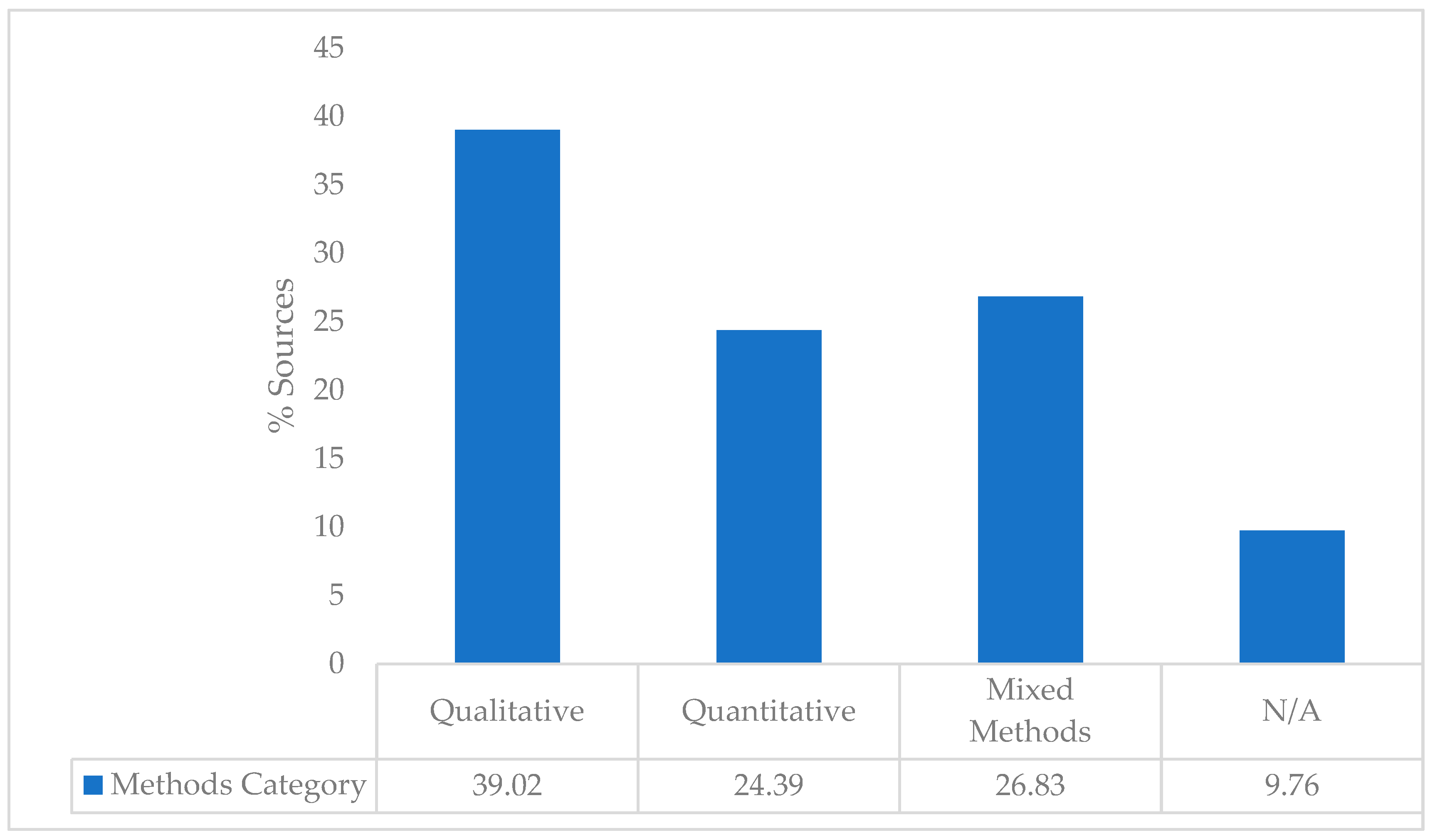
3.4. Representation of Methodological Approaches
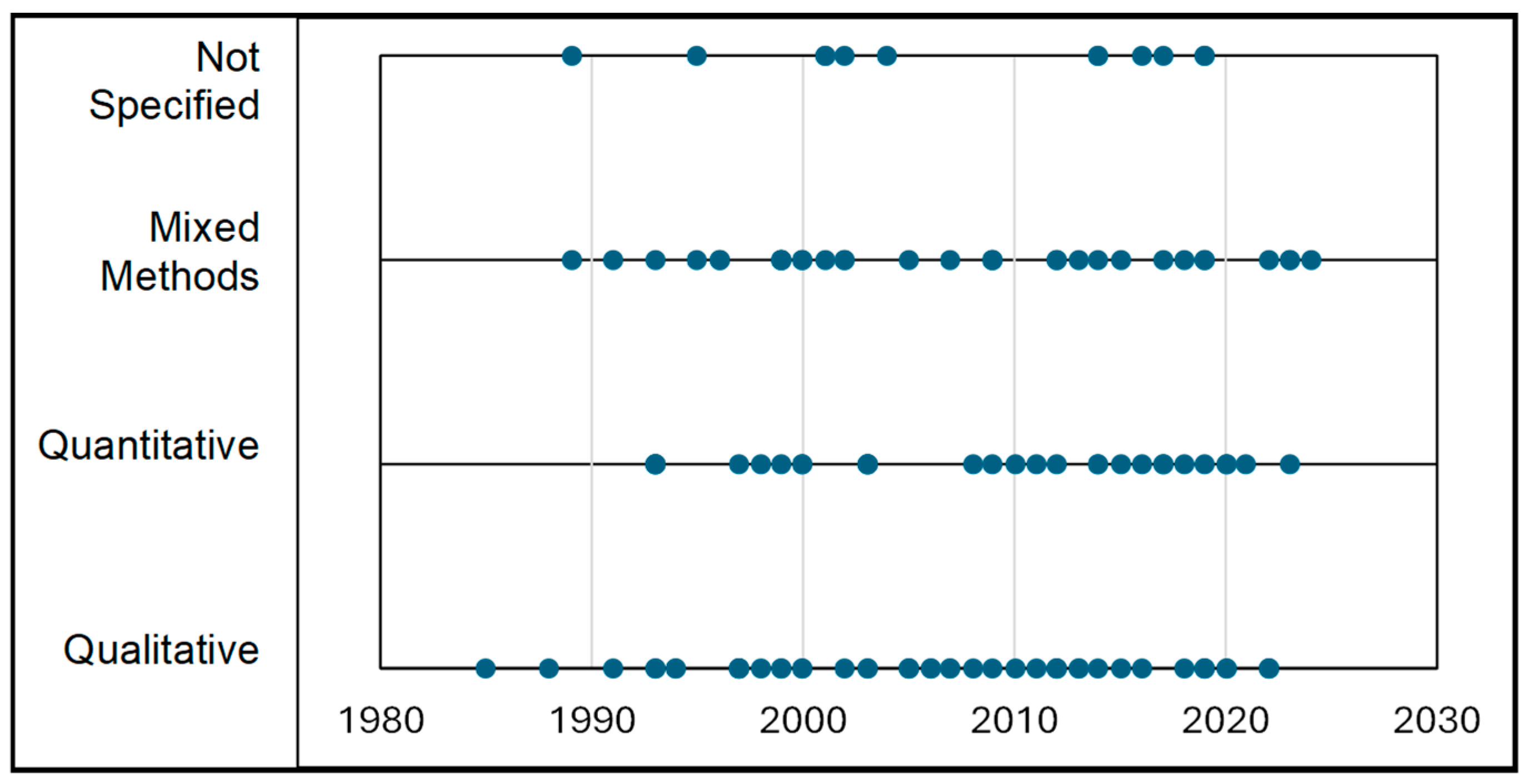
3.5. Are Quantitative Approaches Newer?
4. Discussion
4.1. The Benefits and Limitations of Different FA Methods Categories
4.2. Was the Fitts List Represented in the Post-1983 Literature?
4.3. How Does FA Need to Change with Increased Use of AI?
4.4. Common and Less Common Human-in-the-Loop Strategies
5. Conclusions
5.1. Data-Driven and Simulator-Based Approaches
5.2. Function Allocation Pre- and Post-1983: New Challenges for Long-Standing Frameworks
Supplementary Materials
Funding
Data Availability Statement
Conflicts of Interest
References
- Pulliam, R.; Price, H.; Bongarra, J.; Sawyer, C.; Kisner, R. A Methodology for Allocating Nuclear Power Plant Control Nuclear to Human or Automatic Control NUREG/CR-3331; ADAMS Accession No. ML20024E954; U.S. NRC: Washington, DC, USA, 1983.
- Fitts, P.M. Human Engineering for an Effective Air-Navigation and Traffic-Control System; National Research Council: Washington, DC, USA, 1951.
- Price, H.E.; Maisano, R.E.; Van Cott, H.P. The Allocation of Functions in Man-Machine Systems: A Perspective and Literature Review NUREG-CR-2623; Oak Ridge National Laboratories: Oak Ridge, TN, USA, 1982. [Google Scholar]
- O’Hara, J.; Higgins, J.; Fleger, S.; Pieringer, P. Human Factors Engineering Program Review Model (NUREG-0711, Revision 3); U.S. NRC Agencywide Document Access and Management System (ADAMS) Accession No. ML12324A013; U.S. NRC: Washington, DC, USA, 2012.
- International Atomic Energy Agency. Safety Related Terms for Advanced Nuclear Plants (IAEA-TECDOC-626); International Atomic Energy Agency: Wien, Austria, 1991.
- Green, B.; Buchanan, T.; D’Agostino, A. Assessing independence from human performance: Considerations for functional requirements analysis and function allocation. In Proceedings of the 14th Nuclear Plant Instrumentation, Control & Human-Machine Interface Technologies (NPIC&HMIT), Chicago, IL, USA, 15–18 June 2025; pp. 228–235. [Google Scholar]
- Morrow, S.; Xing, J.; Hughes Green, N. Revisiting Functional Requirements Analysis and Function Allocation to Support Automation Decisions in Advanced Reactor Designs. In Proceedings of the 14th Nuclear Plant Instrumentation, Control & Human-Machine Interface Technologies (NPIC&HMIT), Chicago, IL, USA, 15–18 June 2025; pp. 228–235. [Google Scholar]
- O’Hara, J.; Higgins, J. Adaptive Automation: Current Status and Challenges (RIL 2020-05); U.S. NRC Agencywide Document Access and Management System (ADAMS) Accession No. ML20176A199; U.S. NRC: Washington, DC, USA, 2020.
- Higgins, J.; O’Hara, J.; Hughes, N. Safety Evaluations of Adaptive Automation: Suitability of Existing Review Guidance (RIL 2020-06); U.S. NRC Agencywide Document Access and Management System (ADAMS) Accession No. ML22006A020; U.S. NRC: Washington, DC, USA, 2022.
- O’Hara, J.; Fleger, S. Human-System Interface Design Review Guidelines (NUREG-0700, Rev. 3); U.S. NRC Agencywide Document Access and Management System (ADAMS) Accession No. ML20206A436; U.S. NRC: Washington, DC, USA, 2020.
- Elmagarmid, A.K.; Fedorowicz, Z.; Hammady, H.; Ilyas, I.F.; Khabsa, M.; Ouzzani, M. Rayyan: A Systematic Reviews Web App for Exploring and Filtering Searches for Eligible Studies for Cochrane Reviews. Available online: https://www.rayyan.ai/ (accessed on 1 November 2024).
- Webster, J.; Watson, R.T. Analyzing the past to prepare for the future: Writing a literature review. MIS Q. 2002, 26, xiii–xxiii. [Google Scholar]
- Sheridan, T.B.; Verplank, W.L. Human and Computer Control of Undersea Teleoperators; DTIC N00014-77-C0256; MIT: Cambridge, MA, USA, 1978. [Google Scholar]
- Parasuraman, R.; Sheridan, T.B.; Wickens, C.D. A model for types and levels of human interaction with automation. IEEE Trans. Syst. Man Cybern. 2000, 30, 286–297. [Google Scholar] [CrossRef]
- Caldwell, B.S.; Nyre-Yu, M.; Hill, J.R. Advances in human-automation collaboration, coordination and dynamic function allocation. In Transdisciplinary Engineering for Complex Socio-Technical Systems; IOS Press: Amsterdam, The Netherlands, 2019; pp. 348–359. [Google Scholar]
- Pupa, A.; Landi, C.T.; Bertolani, M.; Secchi, C. A dynamic architecture for task assignment and scheduling for collaborative robotic cells. In International Workshop on Human-Friendly Robotics; Springer International Publishing: Cham, Switzerland, 2021; pp. 74–88. [Google Scholar]
- Wang, G.; Zhou, S.; Zhang, S.; Niu, Z.; Shen, X. SFC-based service provisioning for reconfigurable space-air-ground integrated networks. IEEE Sel. Areas Commun. 2020, 38, 1478–1489. [Google Scholar] [CrossRef]
- Eraslan, E.; Yildiz, Y.; Annaswamy, A.M. Shared control between pilots and autopilots: An illustration of a cyberphysical human system. IEEE Control Syst. Mag. 2020, 40, 77–97. [Google Scholar] [CrossRef]
- Sebok, A.; Wickens, C.D. Implementing lumberjacks and black swans into model-based tools to support human–automation interaction. Hum. Factors 2017, 59, 189–203. [Google Scholar] [CrossRef] [PubMed]
- Hilburn, B.; Molloy, R.; Wong, D.; Parasuraman, R. Operator versus computer control of adaptive automation. In The Adaptive Function Allocation for Intelligent Cockpits (AFAIC) Program: Interim Research and Guidelines for the Application of Adaptive Automation; DTIC: Fort Belvoir, VA, USA, 1993; pp. 31–36. [Google Scholar]
- Older, M.T.; Waterson, P.E.; Clegg, C.W. A critical assessment of task allocation methods and their applicability. Ergonomics 1997, 40, 151–171. [Google Scholar] [CrossRef]
- Yang, F. A Function Allocation Framework for the Automation of Railway Maintenance Practices. Ph.D. Dissertation, University of Birmingham, Birmingham, UK, 2022. [Google Scholar]
- Waterson, P.E.; Older Gray, M.T.; Clegg, C.W. A sociotechnical method for designing work systems. Hum. Factors 2002, 44, 376–391. [Google Scholar] [CrossRef] [PubMed]
- Rencken, W.D.; Durrant-Whyte, H.F. A quantitative model for adaptive task allocation in human-computer interfaces. IEEE Trans. Syst. Man Cybern. 1993, 23, 1072–1090. [Google Scholar] [CrossRef]
- Hancock, P.A.; Chignell, M.H. Adaptive Function Allocation by Intelligent Interfaces. In Proceedings of the 1st International Conference on Intelligent User Interfaces, Orlando, FL, USA, 4–7 January 1993. [Google Scholar]
- Morrison, J.G.; Gluckman, J.P.; Deaton, J.E. Adaptive Function Allocation for Intelligent Cockpits; Report No. NADC-91028-60; Office of Naval Technology: Ballston, VA, USA, 1991.
- Parasuraman, R.; Mouloua, M.; Molloy, R.; Hilburn, B. Adaptive Function Allocation Reduces Performance Cost of Static Automation. In Proceedings of the 7th International Symposium on Aviation Psychology, Dayton, OH, USA, 22–29 April 1993. [Google Scholar]
- Clamann, M.P.; Kaber, D.B. Authority in adaptive automation applied to various stages of human-machine system information processing. In Proceedings of the Human Factors and Ergonomics Society Annual Meeting; SAGE Publications: Los Angeles, CA, USA, 2003; Volume 47. [Google Scholar]
- Feigh, K.M.; Dorneich, M.C.; Hayes, C.C. Toward a characterization of adaptive systems: A framework for researchers and system designers. Hum. Factors 2012, 54, 1008–1024. [Google Scholar] [CrossRef] [PubMed]
- Li, H.; Wickens, C.D.; Sarter, N.; Sebok, A. Stages and levels of automation in support of space teleoperations. Hum. Factors 2014, 56, 1050–1061. [Google Scholar] [CrossRef] [PubMed]
- Boy, G.A. Cognitive function analysis for human-centered automation of safety-critical systems. In Proceedings of the SIGCHI Conference on Human Factors in Computing Systems, Los Angeles, CA, USA, 18–23 April 1998. [Google Scholar]
- Schwaninger, A. Why do airport security screeners sometimes fail in covert tests? In Proceedings of the 43rd Annual 2009 International Carnahan Conference on Security Technology, Zurich, Switzerland, 5–8 October 2009; pp. 41–45. [Google Scholar]
- Hawley, J.K.; Mares, A.L. Developing Effective Adaptive Missile Crews and Command and Control Teams for Air and Missile Defense Systems; No. ARLSR149; U.S. Army Research Laboratory: Washington, DC, USA, 2007.
- Lew, R.; Ulrich, T.A.; Boring, R.L.; Werner, S. Applications of the rancor microworld nuclear power plant simulator. In Proceedings of the 2017 Resilience Week (RWS), Wilmington, DE, USA, 18–22 September 2017; pp. 143–149. [Google Scholar]
- Park, J.; Yang, T.; Boring, R.L.; Ulrich, T.A.; Kim, J. Analysis of human performance differences between students and operators when using the Rancor Microworld simulator. Ann. Nucl. Energy 2023, 180, 109502. [Google Scholar] [CrossRef]
- Park, J.; Ulrich, T.A.; Boring, R.L.; Kim, J.; Lee, S.; Park, B. An Empirical Study on the Use of the Rancor Microworld Simulator to Support Full-Scope Data Collection; No. INL/CON-20-57751-Rev000; Idaho National Laboratory (INL): Idaho Falls, ID, USA, 2020. [Google Scholar]
- Ulrich, T.A.; Boring, R.L.; Lew, R. Rancor-HUNTER: A Virtual Plant and Operator Environment for Predicting Human Performance; No. INL/MIS-24-76401-Rev001; Idaho National Laboratory (INL): Idaho Falls, ID, USA, 2024. [Google Scholar]
- Boring, R.L.; Ulrich, T.A.; Lew, R. The Procedure Performance Predictor (P3): Application of the HUNTER Dynamic Human Reliability Analysis Software to Inform the Development of New Procedures. In Proceedings of the 33rd European Safety and Reliability Conference (ESREL 2023), Southampton, UK, 3–7 September 2023. [Google Scholar]
- Rasmussen, J. Skills, rules, and knowledge; signals, signs, and symbols, and other distinctions in human performance models. IEEE Trans. Syst. Man Cybern. 1983, SMC-13, 257–266. [Google Scholar] [CrossRef]
- Schreck, J.; Matthews, G.; Lin, J.; Mondesire, S.; Metcalf, D.; Dickerson, K.; Grasso, J. Levels of Automation for a Computer-Based Procedure for Simulated Nuclear Power Plant Operation: Impacts on Workload and Trust. Safety 2025, 11, 22. [Google Scholar] [CrossRef]
- Ulrich, T.A.; Lew, R.; Kim, J.; Jurski, D.; Gideon, O.; Dickerson, K.; DuBois, Z.; Boring, R.L. A Tale of Two Simulators—A Comparative Human-in-the-Loop Nuclear Power Plant Operations Study on Thermal Power Dispatch for Hydrogen Production. In Proceedings of the Human Factors and Ergonomics Society Annual Meeting; SAGE Publications: Los Angeles, CA, USA, 2024; Volume 68, pp. 791–795. [Google Scholar] [CrossRef]
- Lin, J.; Matthews, G.; Schreck, J.; Dickerson, K.; Green, N.H. Evolution of Workload Demands of the Control Room with Plant Technology. Hum. Factors Simul. 2023, 83, 57–66. [Google Scholar]
- Kochunas, B.; Huan, X. Digital twin concepts with uncertainty for nuclear power applications. Energies 2021, 14, 4235. [Google Scholar] [CrossRef]
- Wilsdon, K.; Hansel, J.; Kunz, M.R.; Browning, J. Autonomous control of heat pipes through digital twins: Application to fission batteries. Prog. Nucl. Energy 2023, 163, 104813. [Google Scholar] [CrossRef]
- Wen, H.Y. Human-Automation Task Allocation in Lunar Landing: Simulation and Experiments. Ph.D. Dissertation, Massachusetts Institute of Technology, Cambridge, MA, USA, 2011. [Google Scholar]
- Jiang, X.; Kaewkuekool, S.; Khasawneh, M.T.; Bowling, S.R.; Gramopadhye, A.K.; Melloy, B.J. Communication between Humans and Machines in a Hybrid Inspection System. In IISE Annual Conference; Institute of Industrial and Systems Engineers (IISE): Norcross, GA, USA, 2003; p. 1. [Google Scholar]
- Prinzel, L.J.; Freeman, F.G.; Scerbo, M.W.; Mikulka, P.J.; Pope, A. A closed-loop system for examining psychophysiological measures for adaptive task allocation. Int. J. Aviat. Psychol. 2000, 10, 393–410. [Google Scholar] [CrossRef] [PubMed]
- Wright, M.C.; Kaber, D.B. Effects of automation of information-processing functions on teamwork. Hum. Factors 2005, 47, 50–66. [Google Scholar] [CrossRef] [PubMed]
- Endsley, M.R. From here to autonomy: Lessons learned from human–automation research. Hum. Factors 2017, 59, 5–27. [Google Scholar] [CrossRef] [PubMed]



| Humans Are Better at… | Machines Are Better at… |
|---|---|
| Detecting small amounts of visual or acoustic energy (i.e., “just noticeable differences”). | Responding quickly to control signals and applying great force smoothly and precisely. |
| Perceiving patterns of light and sound. | Performing repetitive/routine tasks. |
| Improvising/using flexible procedures. | Storing information briefly and then erasing it completely. |
| Storing a very large amount of information for a very long duration and recalling relevant facts at the appropriate time. | Reasoning deductively, including computational ability. |
| Reasoning inductively. | Handling highly complex operations (i.e., performing many different things at once). |
| Exercising judgment. |
| Area | Question |
|---|---|
| Identify prevalence of quantitative, qualitative, and mixed-methods approaches | 1. What is the percentage of quantitative, qualitative, and mixed-methods approaches in FA and/or LOA? 2. What LOA frameworks are most common? |
| Developments in LOA frameworks | 3. Are there LOA frameworks that address advanced autonomy, like AI? |
| Revisions to Fitts List | 4. Is there still a place for Fitts List in this literature? |
| Technology as an enabling factor of advanced reactor operations | 5. Is there evidence of a shift towards modeling- and/or simulator-based approaches |
| Database | Content Description |
|---|---|
| ACM | Full text access to all articles and some conference proceedings published in ACM publications. |
| Engineering Village | Comprehensive interdisciplinary engineering database, referencing engineering journals and conference materials. |
| Google Scholar | Includes peer-reviewed papers, theses, books, preprints, abstracts, and technical reports from broad-ranging research areas. |
| Keyword List | ||
|---|---|---|
| Abnormal Conditions | Function reallocation | Normal operations |
| Abnormal Operating Occurrence | Functional allocation strategies | Nuclear |
| Abnormal Operations | Functional Analysis Methods | Off-normal operations |
| Adaptive task allocation | Functional requirement specification | Operating experience |
| Advanced reactor | Functional requirements analysis | Operator Action |
| Allocation of function method | Handoff or takeover/take over | Performance requirements |
| Allocation of functions | Human Action | Process control |
| Automatic Control | Human Factors Engineering | Reallocation of functions |
| Autonomy | Human-system interface | Requirements engineering |
| Aviation | Human-automation interaction | Safety functions |
| Cognitive work analysis/task analysis | Human-autonomy teaming | Shared allocation |
| Control room | Human-system collaboration | Static allocation |
| Design process | Human-system integration | Supervisory control |
| Economic feasibility | Level of automation | System components |
| Emergency Operations | Levels of automation | System design |
| Fitts list | Light water reactor | Systems engineering |
| Function allocation framework | Main control room | Systems requirements engineering |
| Function allocation method | Management requirements | Task allocation |
| Function allocation methods (FAME) | Man-machine interface | Task analysis |
| Function allocation process | Manual Control | Task distribution |
| Function decomposition | Military | Validation |
| Excluded Search Terms and Term Combinations | |
|---|---|
| Insurance | Legal |
| Underwriting | Ethical/ethics |
| Light water reactor and aviation | Natural language processing/NLP |
| Military and control room | Software |
| Military and main control room | Business requirements |
Disclaimer/Publisher’s Note: The statements, opinions and data contained in all publications are solely those of the individual author(s) and contributor(s) and not of MDPI and/or the editor(s). MDPI and/or the editor(s) disclaim responsibility for any injury to people or property resulting from any ideas, methods, instructions or products referred to in the content. |
© 2025 by the authors. Licensee MDPI, Basel, Switzerland. This article is an open access article distributed under the terms and conditions of the Creative Commons Attribution (CC BY) license.
Share and Cite
Dickerson, K.; Watkins, H.; Sparks, D.; Hughes Green, N.; Morrow, S. What Can the History of Function Allocation Tell Us About the Role of Automation in New Nuclear Power Plants? Energies 2026, 19, 220. https://doi.org/10.3390/en19010220
Dickerson K, Watkins H, Sparks D, Hughes Green N, Morrow S. What Can the History of Function Allocation Tell Us About the Role of Automation in New Nuclear Power Plants? Energies. 2026; 19(1):220. https://doi.org/10.3390/en19010220
Chicago/Turabian StyleDickerson, Kelly, Heather Watkins, Dalton Sparks, Niav Hughes Green, and Stephanie Morrow. 2026. "What Can the History of Function Allocation Tell Us About the Role of Automation in New Nuclear Power Plants?" Energies 19, no. 1: 220. https://doi.org/10.3390/en19010220
APA StyleDickerson, K., Watkins, H., Sparks, D., Hughes Green, N., & Morrow, S. (2026). What Can the History of Function Allocation Tell Us About the Role of Automation in New Nuclear Power Plants? Energies, 19(1), 220. https://doi.org/10.3390/en19010220