1. Introduction
The United States has laid out plans to achieve a national goal of net-zero greenhouse gas (GHG) emissions by 2050 [
1,
2]. Nuclear power plants (NPPs) will play a pivotal role in achieving this goal by contributing to the decarbonization of the power grid [
3,
4]. The Light Water Reactors (LWRs) in the U.S. have been supplying electricity to the national power grid for the past 40 years and in January 2015, the U.S. Nuclear Regulatory Commission (US-NRC) renewed the license of 75 NPP units for another 20 years, allowing the plants to operate for up to 60 years in total [
5].
NPPs are base load power plants by design and due to the nature of their energy source (nuclear reactor core), plants cannot fluctuate the energy output as readily as other energy sources such as fossil fuel, gas-based power plants, and renewables. In the current power grid system, the presence of renewable energy and fossil-fuel based power plants supply electricity at much lower costs than the LWR plants, which has created an economic hurdle for the LWRs to stay competitive in terms of energy price [
6,
7]. To tackle this issue, the United States Department of Energy (US-DOE) has taken the lead to reimagine the LWRs and other types of NPPs as flexible power hubs for the emerging Hybrid Energy System (HES) and Integrated Energy System (IES). According to this plan, the thermal power from nuclear plants will support the thermal energy demands of various endothermic industries in addition to generating electricity to support the power grid. This initiative will be a leading performer in decarbonizing the power sector and achieving net-zero GHG emission by the year 2050 [
8,
9,
10,
11]. Cho et al. investigated the three different thermal dispatch modes, which are fixed dispatch, fully flexible dispatch and flexible dispatch with minimum heat supply requirements [
12].
Redfoot et al. [
13] demonstrated the coupling of a water purification plant with an NPP to explore the economic and thermodynamic benefits. Agbaje et al. analyzed and designed a thermal power dispatch system from a boiling water reactor for hydrogen production purposes [
14]. Garcia et al. conducted analysis of two Hybrid Energy Systems in West Texas and Northeastern Arizona [
15]. O’Brien et al. designed and constructed a test facility for demonstrating the integration of a thermal energy transport loop, thermal energy source and thermal energy storage system [
16]. The team tried to implement dynamic coupling at node level.
To meet the thermal energy demand of endothermic industries, thermal energy from the reactor system needs to be extracted and dispatched, bypassing the power generation system. This functionality is backed by the hydraulic system of the plant and critical flow control is required to conserve the integrity of the plant and balance the system dynamically. Considering the vital role of the control valves in initiating, regulating and isolating the flow in a hydraulic system, modernization of valves and their control strategies will enhance the safety and efficiency in operation of a hydraulic system. Taking the current manual regulation and control approach [
17] into account, the modernization of valve control and regulation system can bring about significant improvements to the overall safety and efficiency of the hydraulic system. Moreover, hydraulic systems in IES must support safe, reliable and flexible operation and the system must respond dynamically to varying loads to maintain the balance between electricity generation and thermal power dispatch to industries. For smooth integration with the IES and modernization of valves in the hydraulic systems of a nuclear facility, capabilities such as load-based coordinated valve regulation and built-in monitoring systems for valves and hydraulic systems are some of the key expectations. A Zigbee-based hydraulic balancing and monitoring system is demonstrated by Zhao et al. for household heating system control valves [
18]. Dong et al. demonstrated a wireless communication and monitoring technique for a hydraulic system using the Internet of Things [
19]. Padillo et al. demonstrated an Internet of Things-based failure management of a regional water transmission system [
20]. A volumetric Internet of Things-based smart hydraulic system is proposed and demonstrated by Okafor et al. [
21].
Still, there is no demonstration of coordinated valve control in a thermal extraction and dispatch hydraulic loop, where the system can regulate and coordinate the valves across the system, which will reduce human intervention and precision of the system significantly. It will be a great scope for modern systems such as the Internet of Things to be implemented, and modernize the existing system.
The SMART (Strategic Management Analysis Requirements and Technology) valves are a key component in this field with features such as embedded sensors and flexible actuation systems. Those features will allow the SMART valves to regulate and balance the flow automatically in response to the change in system demand, while coordinating with other valves and components in the hydraulic system. Additionally, the SMART valves will monitor the system parameters such as pressure, flowrate and temperature to scan for any anomaly across the hydraulic system to ensure safety and integrity.
Valve and hydraulic system monitoring functionality can be achieved by training a machine learning model to detect various system anomalies corresponding to hydraulic events such as pressure spike, pressure loss, flow stagnation, and unwanted valve movements. A facility with the capability to simulate these anomalies will record and log the patterns of flow parameters such as pressure and flowrate across the facility while testing. Produced datasets can be used to train the machine learning model to monitor the facility and valves. This study focuses on the design, calibration and adjustment of the SMART valve testbed, and dataset generation. Machine learning and anomaly detection systems will be an extension for this work in the future. To validate the coordinated valve control algorithm and generate training datasets for the anomaly detection system, a testing facility is required. The facility must be capable of flexible valve positioning, robust communication protocol, and lastly, ease of programming to simulate various scenarios. Additionally, various parameters must be measured throughout the facility to monitor the system parameters and create the datasets for each test.
The flow coefficient is a parameter which indicates the amount of flow passing through a valve for a unit pressure drop. There are two types of expressions for flow coefficients found in various literature and they are denoted by C
v or K
v. C
v is measured in
and K
v is measured in
. The conversion between C
v and K
v can be performed by Equation (1). In this paper, K
v will be used as the flow coefficient.
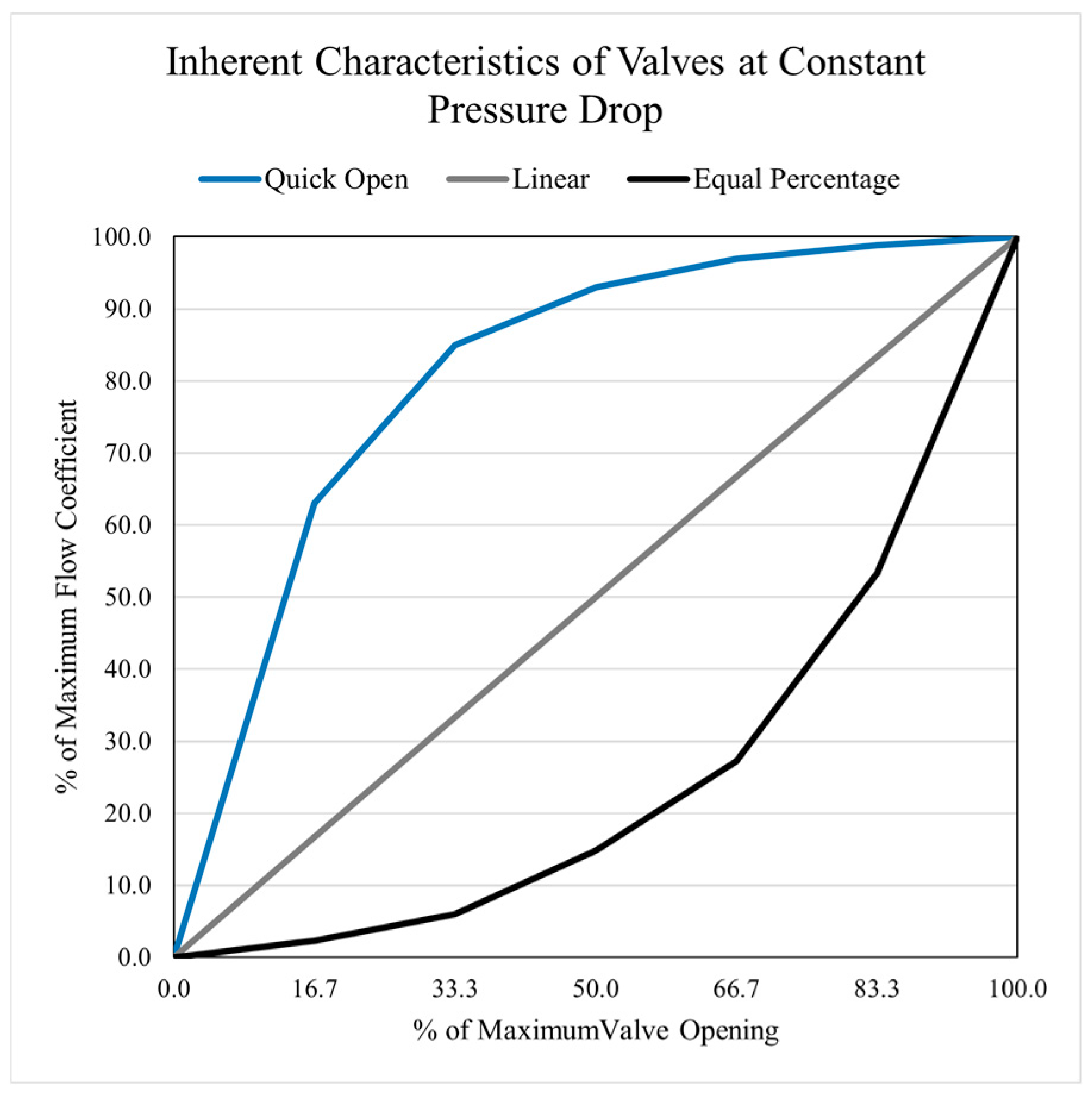
The flow coefficient creates a common ground for comparing various types and sizes of valves. Effect of size, valve position, flowrate and fluid properties are also reflected through this parameter. The plot of flow coefficients versus valve positions commonly exhibits three types of correlations, displayed in
Figure 1. Authors of [
22] found that the butterfly valve follows the quick open type characteristics in their flow characteristics. Using this correlation, valve position can be calculated for specific flow coefficient value. In the parallel branching of flow, equivalent flow coefficient can be calculated by Equation (2).
Load-based coordinated valve regulation aims to regulate the valves in a hydraulic system based on the loading condition and demand. Two types of approaches, upstream-based and downstream-based strategies, can be followed to obtain load-based coordinated control.
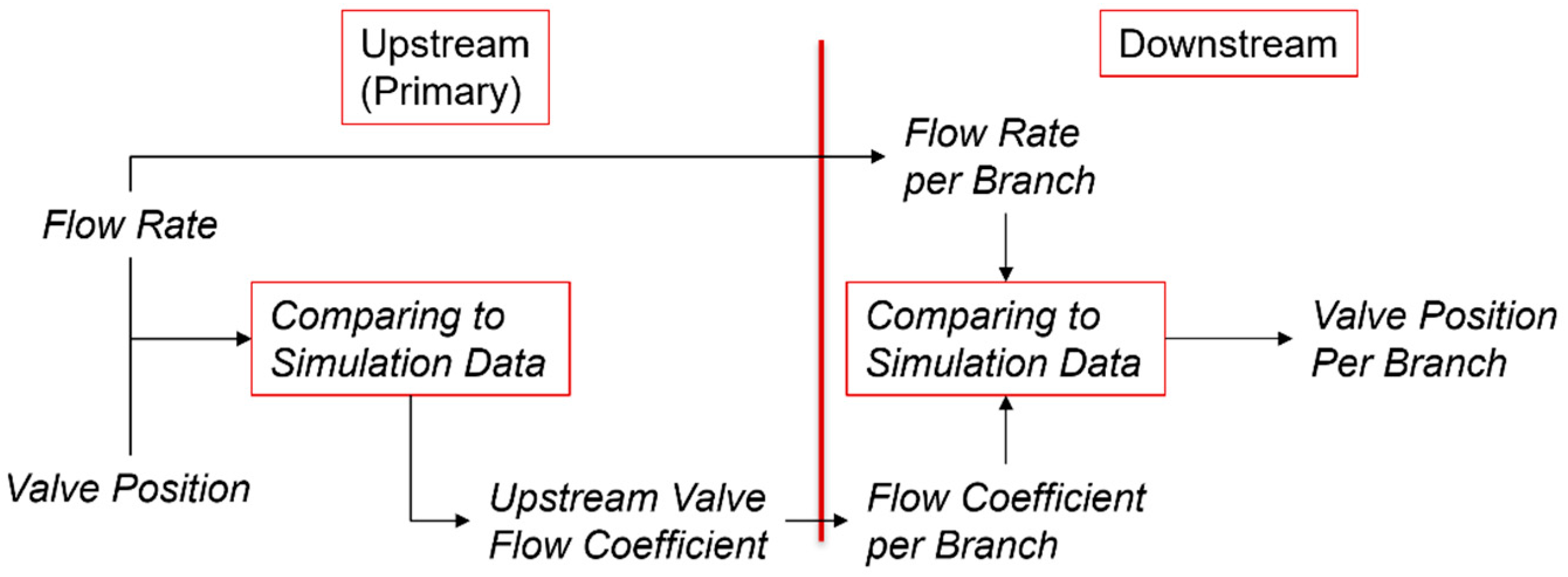
Figure 2 and
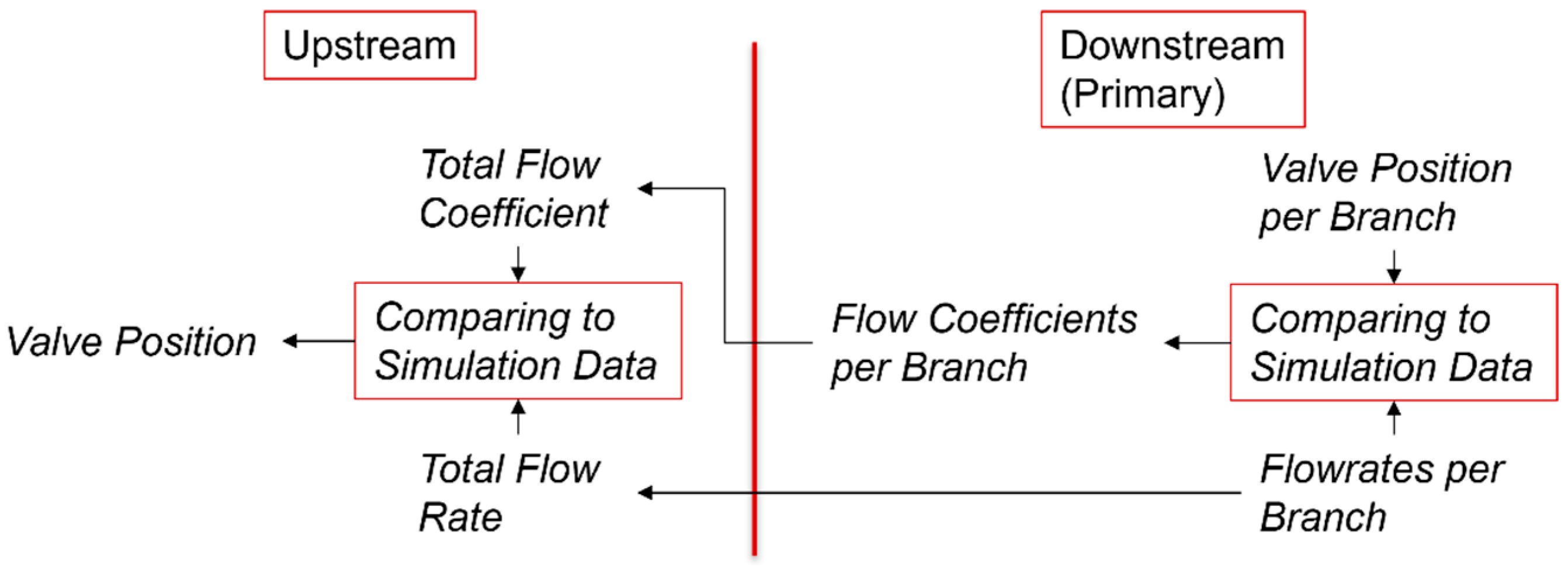
Figure 3 summarize the upstream- and downstream-based control suggested by Bairagi et al. [
22].
In the upstream regulating downstream scenario (
Figure 2), the flowrate and valve position are defined for the upstream. Those parameters are compared with the valve performance dataset to determine the flow coefficient for the upstream valve, which is then passed to downstream. From the upstream flowrate, flowrate per branch is estimated for the downstream and the flow coefficient from upstream is divided among the downstream valves in proportion to their cross-sectional area. By comparing the flowrate and the flow coefficient of each branch with the valve performance dataset for the downstream valves, corresponding valve positions can be found. In the downstream regulating upstream scenario (
Figure 3), valve positions and per branch flowrate are defined and corresponding flow coefficients are calculated by comparing to the valve performance datasets. Total flowrate and flow coefficient are passed to upstream, and by comparing to upstream valve performance dataset, the upstream valve position can be found.
In this paper, a facility is designed, constructed and tested for upstream-based control to validate the control strategy suggested by [
22]. Additionally, the facility is capable of producing various test results to train the machine learning model for monitoring the hydraulic system and detecting various anomalies in the system.
To study the effect of each valve on the hydraulic loop, parameters such as upstream and downstream pressures and flowrate must be measured for each valve individually. Two notable valve testing facilities in the United States are Kopra valve test section operated by FRAMATOME [
23] and Flow Component Testing facilities operated by the Southwest Research Institute [
24]. Both facilities are capable of conducting flow tests, performance tests, and safety tests for varieties of standards. The Kopra valve testing facility [
25] has a reservoir for flow testing with water and a steam generator for steam flow testing. The facility is capable of testing valve sizes up to DN250 and provides sufficient space for both the upstream and downstream sides of the valve section. This spacing helps the flow passing through the test valve recover pressure and reduce the turbulence to stabilize the sensor readings. For smaller valves, this spacing on up and downstream of a valve is suggested by Sandalci et al. [
26]. The authors suggested that for a certain size of pipeline, the pressure readings taken upstream should be at least 2.5 times the inner diameter from the valve and downstream should be at least 10 times the inner diameter from the valve.
The facility aims to test the coordinated valve regulation in load-based flow branching [
27,
28] scenarios, which is important for both thermal dispatch to multiple targets and bypass of flow to maintain a certain level of flowrate depending on the required amount of energy [
29]. Authors tried to model the thermal load-balancing between two branches such as the turbine system of the combined cycle power plants, but coordinated control of valves in branching flow and bypass set up has not been tested yet.
With this goal, the facility is designed with one node between the upstream and downstream. The downstream will have two parallel branches to simulate the varying loading conditions on each branch. Parameters such as flowrate and pressure up and downstream of the valves will be measured for each valve.
2. Facility Layout, Design and Construction
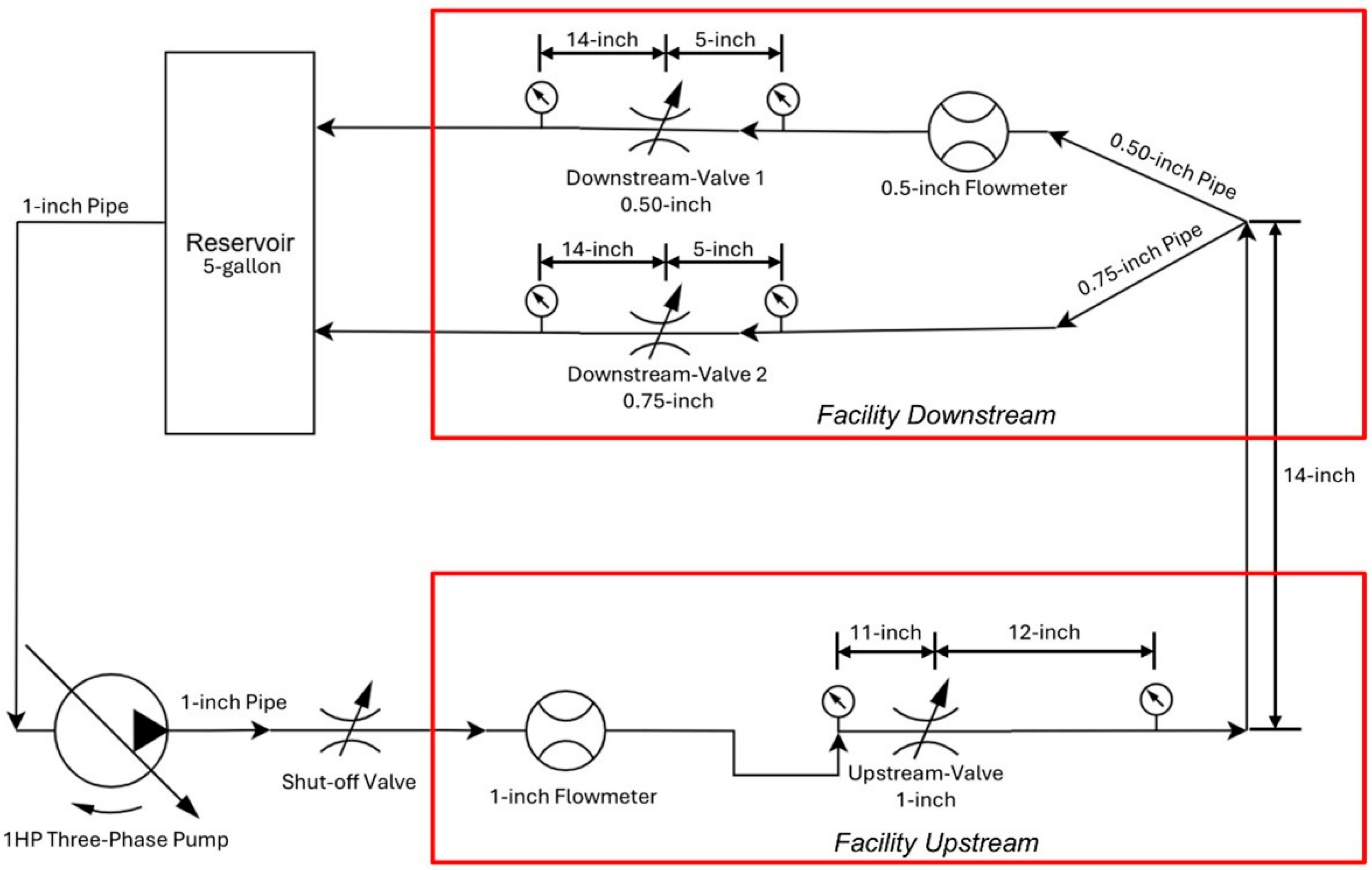
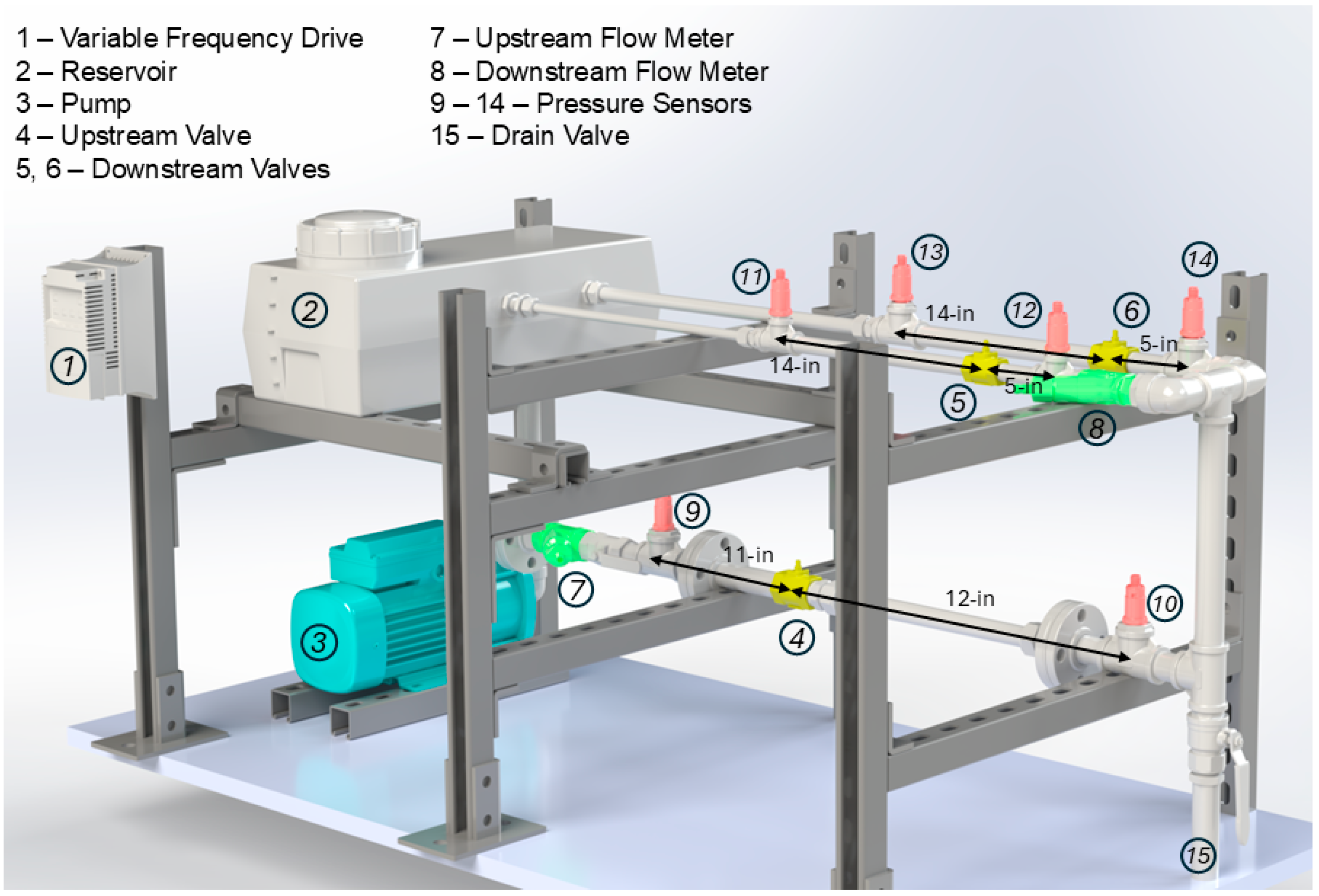
The facility consists of three valves on three branches. The largest valve is attached to the upstream and the other two valves are attached to the downstream; this can be seen in
Figure 4. The water is pumped from the reservoir through the upstream valve, and the flow is split into two separate downstream branches, each with its own valve, before returning to the reservoir. The layout simulates thermal dispatch, with the upstream representing the plant side and the downstream representing the dispatch side or bypass system. Coordinating the pump and valves using a valve actuator enables the facility to demonstrate coordinated control of all three valves for various loading conditions and flow-division.
To accommodate the facility in the laboratory, this layout is converted to a two-step vertical layout. Considering the power and space requirements of the facility, a 1-horsepower (hp) three-phase pump is selected for the facility. To achieve a target Reynolds number (Re) of 400,000 in the branches, 1-inch (DN25), 0.75-inch (DN20) and 0.5-inch (DN15) pipe and valve sizes are selected after calculating maximum flowrates. Equation (3) is used for the Reynolds number, where
is the density of the fluid (
),
is the flow velocity (
),
is the diameter of the pipe (
), and
is the kinematic viscosity of the fluid (
).
The facility schematic diagram is displayed in
Figure 4. In the figure, the spacing between the valves and their corresponding up and downstream pressure sensors are indicated. These distances are more than the minimum spacing suggested by [
26] and adjusted for the facility layout. The computer-aided design (CAD) of the facility is exhibited in
Figure 5. For the ease of exchanging valves, tubes and flanges are used to mount the valves in the facility.
For the structural part of the facility, 1-inch unistrut channels are used for the flexibility of machining and adjusting the placement of the attachments. To mount the valves, flanges are used for the 1-inch valve due to the confined space and tubes are used for 0.5-inch and 0.75-in valves. AISI-316 stainless steel (SS) pipes are selected for their strong resistance to corrosion and temperature resistance. AISI-316 SS pipes are found in various sizes and thickness. Three sizes, 1-inch, 0.75-inch and 0.5-inch pipes of schedule 40 are selected for the facility. Butterfly, ball and globe valves are selected with appropriate size to be used with the facility. Initially, butterfly valves are mounted for testing.
For sensing the pressure across the facility, six G27M0242EW100 pressure sensors are selected. Those sensors have −14.7 psi to 100 psi range. The output signal from the sensors is in the 4–20 mA range and it connects to the Data Acquisition (DAQ) system using A4-M12 male connector. For sensing the flow, two variable area flowmeters are used in the facility. The SBN446 flow meter is attached in the 1-inch line and the SBN443 flow meter is attached in the 0.5-inch line. The flow through the 0.75-inch line can be obtained by subtracting the reading from those sensors. Both flow sensors are equipped with an A4-M12 male connector, and the output is a 4–20 mA analog signal.
A 3-phase 1-hp Grundfos pump is selected for the facility considering the size and flowrate requirements. A 3-phase pump can produce various flowrates by using a Variable Frequency Drive (VFD). A 5-gallon reservoir is placed above the pump to gravity-feed water to the system to avoid cavitation around the pump impeller. The pump can produce pump head of 29.27 m. For regulating the flowrate of the pump, a Leeson Speed Master 2 VFD is selected, which is suitable to operate a 1-hp pump. This VFD supports 4–20 mA and 0–10 V analog inputs for external control.
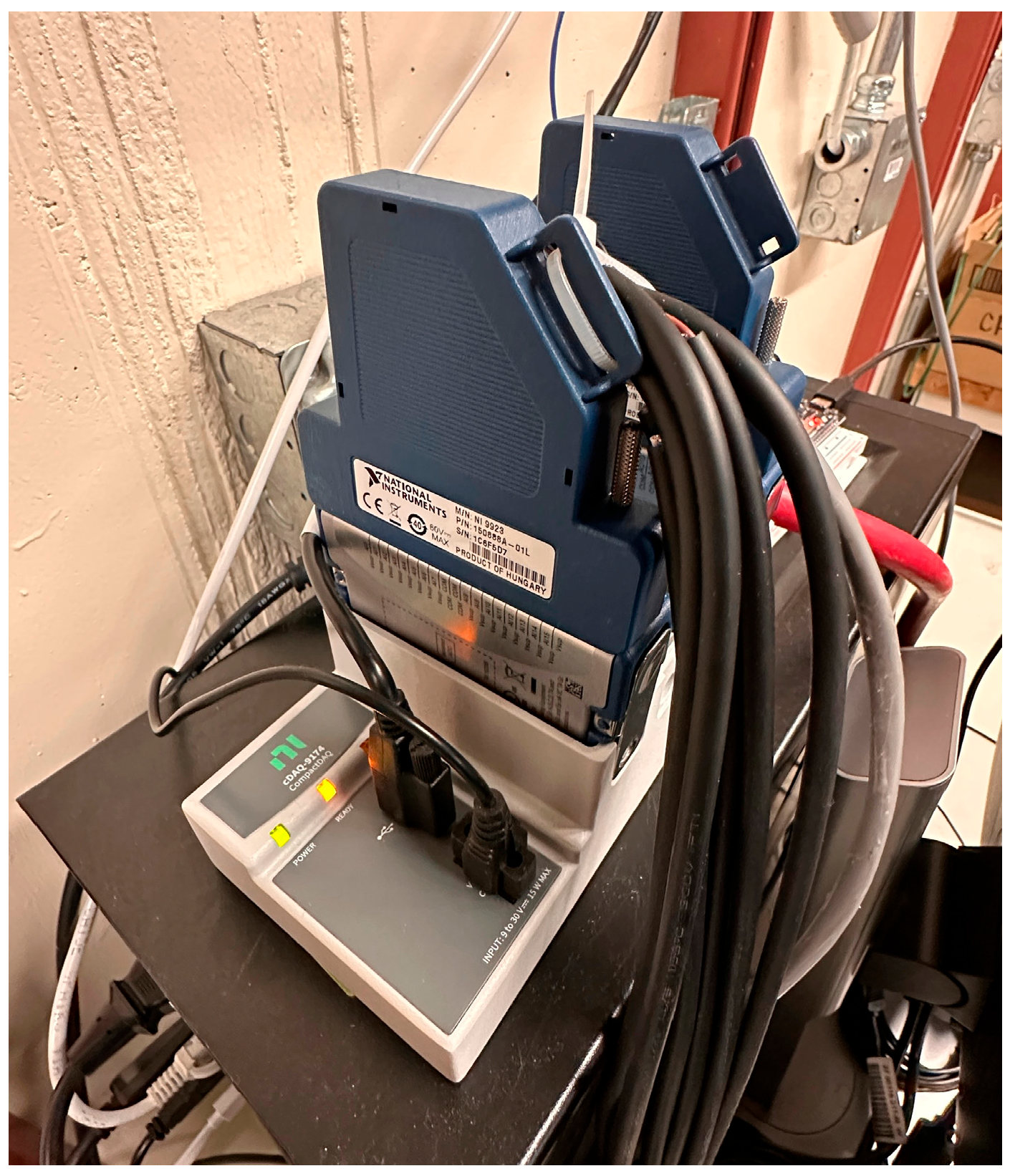
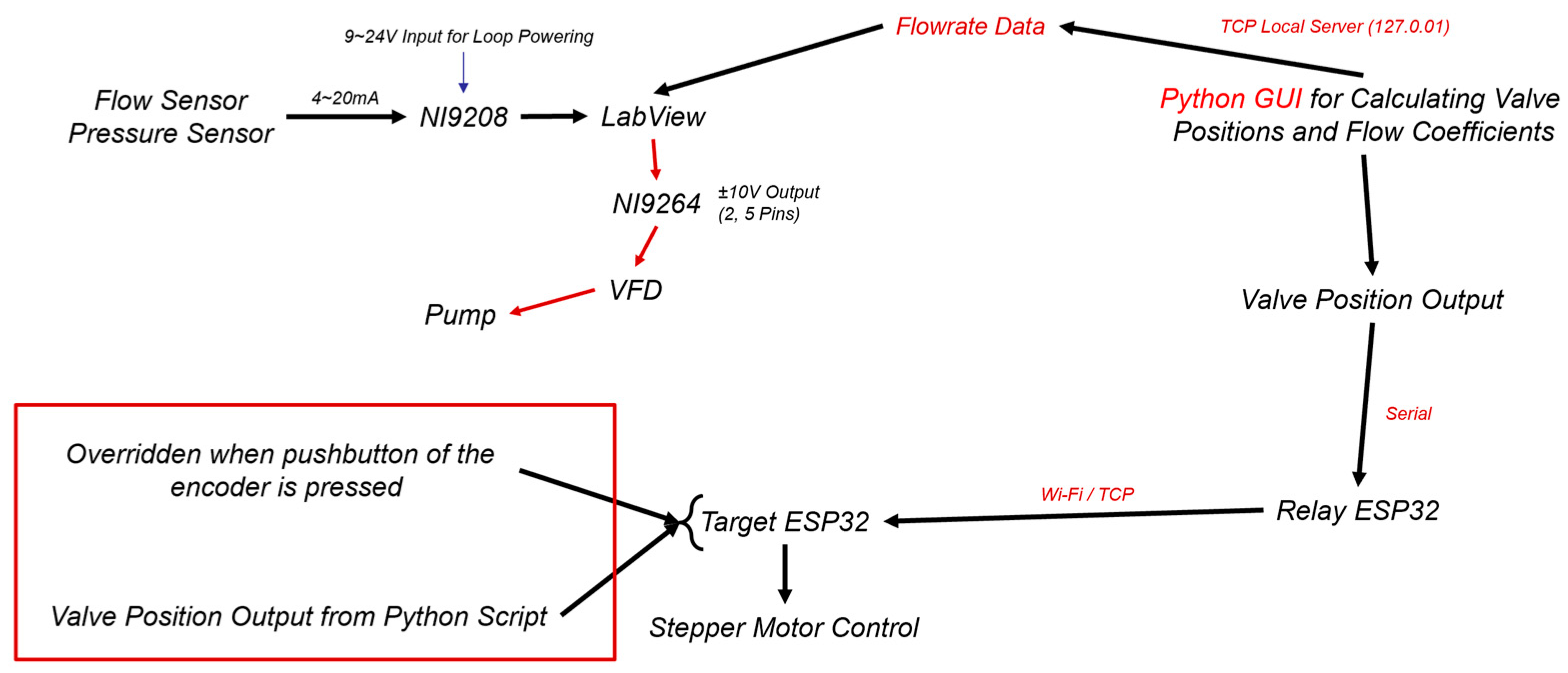
In the facility, the sensors output 4–20 mA analog signals and the VFD has both 4–20 mA and 0–10 V input. For acquiring a 4–20 mA analog signal, a NI-9208 module is used and for 0–10 V input to the VFD, a NI-9264 module is used. To connect those NI modules with the system, a NI-cDAQ 9174 module is used. This module utilizes USB connection to convey the signals between the sensors, VFD and the host computer. NI modules utilize LabVIEW software to calibrate sensors, generate input and output, and log data. The NI module setup is exhibited in
Figure 6.
The facility is designed to interchange valves easily to test various types of valves. The valves selected for testing with the facility are actuated using two types of motions, which are quarter-turn (butterfly and ball valves) and multi-turn (globe valve). For the selected valve sizes, original equipment manufacturers (OEM) proportional motorized valves are not available. For this reason, manual valves are retrofitted with appropriate actuators. To accommodate quarter and multi-turn movement of valves and the ease of programming the movement, two of the suitable options are stepper motors and servo motors. Stepper motors are more widely available in various configurations and controllers for stepper motors are comparatively easier to program than the servo motors.
For the given size of the valves, required torque is calculated using the valve-body geometry of the largest butterfly valve (1-inch), as it has the most area perpendicular to the flow. Using the maximum pump-head produced by the pump (), the maximum pressure obtained on the upstream of 1-inch valve at stagnant condition is found to be . Using the radius of the 1-inch valve-body (), the required torque to regulate the valve is calculated to be . Including a 20% overhead to account for the friction of the valve stem, the required torque is found to be around 3.43 Nm. So, the selected motor should have at least 3.43 Nm of pull-out torque, so that the motor can output this torque while preserving the synchronous speed. This parameter is not often provided by the manufacturer, and upon contacting a few manufacturers, it is found that pull-out torque is approximately 82% of the holding torque for NEMA34 stepper motors. Considering this approximation, 4.2 Nm NEMA34 stepper motors are selected as the actuator for retrofitting the manual valves.
The stepper motors are controlled by the step signal provided by the stepper motor driver. But, in general this signal lacks homing or setpoint functionality and the power-up position is defined to be the home position. A rotary encoder provides stepper motors with setpoint and homing capabilities. Rotary encoder also helps the steppers to hold a position. If external force causes rotation of the shaft, the rotary encoder moves the shaft back to the setpoint. It is easier to translate the rotary encoder signal to position data than to keep track of the step signals. Stepper motors with built-in encoders are known as closed-loop stepper motors because of the feedback mechanism. For the facility, 4.2 Nm NEMA34 stepper motors with rotary encoder are selected as actuator. For the stepper motor driver, CL86T drivers are selected for built-in encoder support. The stepper motors and drivers are connected by two types of connections. One is the 4-pin aviation connector to provide power-signal, and the other is the DB-15 connector for carrying the encoder signal to and from the CL86T driver.
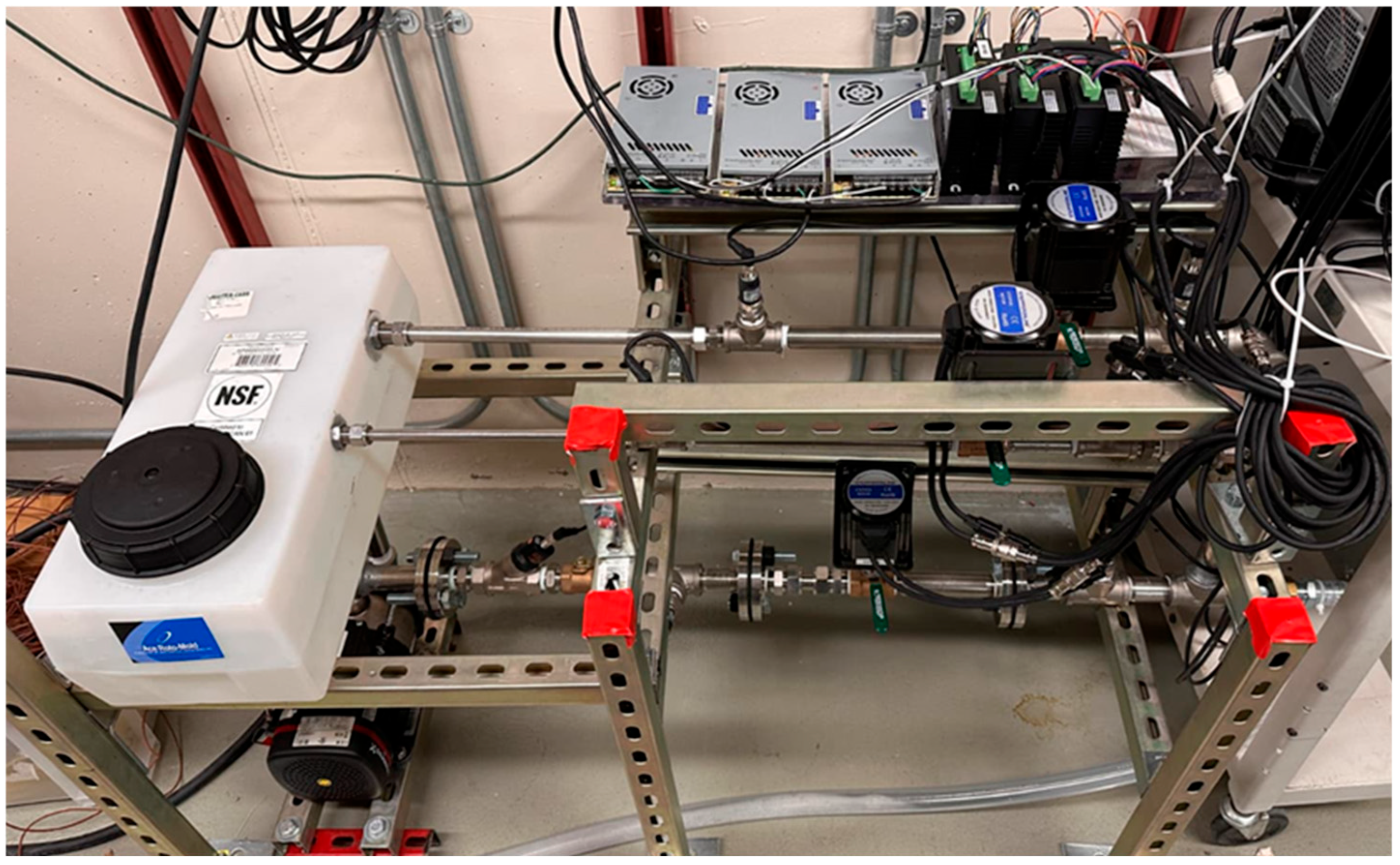
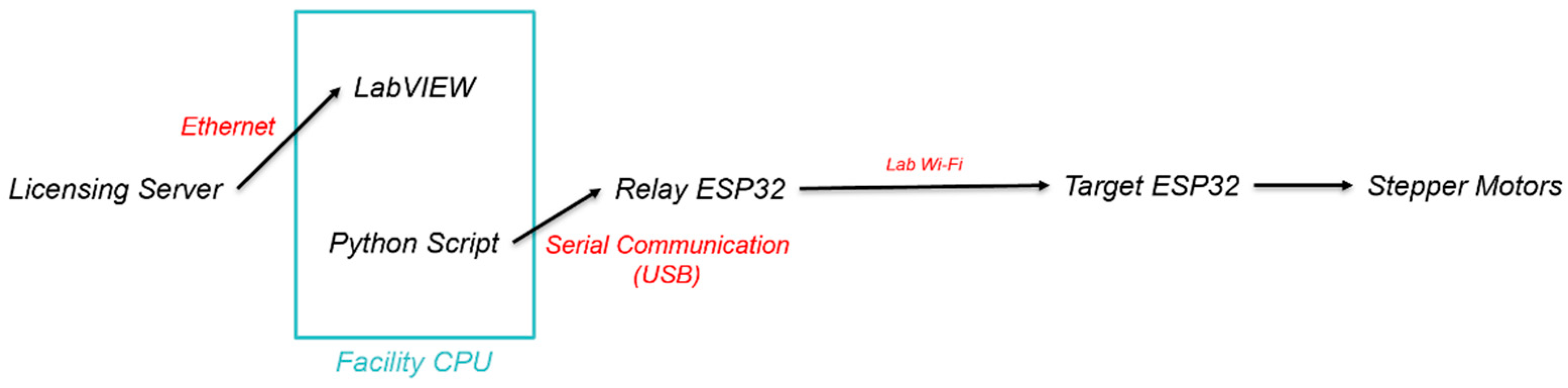
For pairing the host computer with the facility, wireless communication is used for integrating the system with an IoT like communication system. All three stepper drivers are connected to an ESP32 module. ESP32 is a system-on-chip micro controller with Bluetooth and Wi-Fi functionalities. It has an onboard digital to analog converter (DAC), which can translate digital signals from the host computer to analog control signals for the stepper drivers. ESP32 also supports libraries such as AccelMotor, Encoder, and Ezbutton which are suitable to be used with the facility. The complete facility is displayed in
Figure 7.
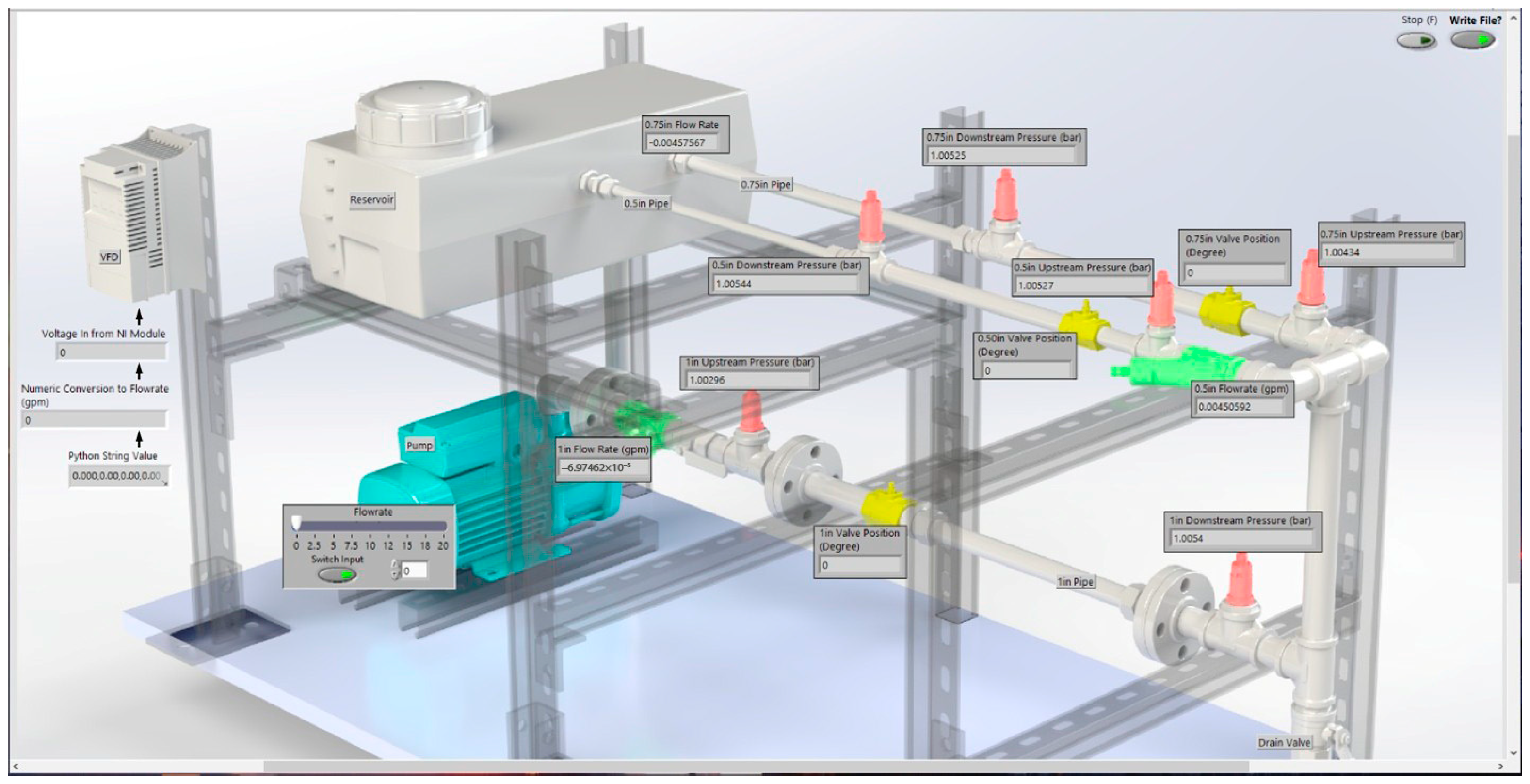
For data acquisition and logging, a LabVIEW interface is designed for the facility. For logging the data generated by the python script described in the later section, a Transmission Control Protocol (TCP) pallet is utilized. This pallet utilizes the local server generated by the python script to obtain the valve positions and flowrate data. Valve positions are used for logging, and the flowrate command is processed further to generate appropriate signals to the VFD through the NI-9264 module. The LabVIEW interface is exhibited in
Figure 8. The data obtained from the python script is the string type. This string is split by a comma and converted to numerical data in order to convert it to signal or logging.
3. Scripting
There are three types of parameters listed in the valve performance dataset described by Bairagi et al. [
22], which are the Reynolds number, valve position and flow coefficient (K
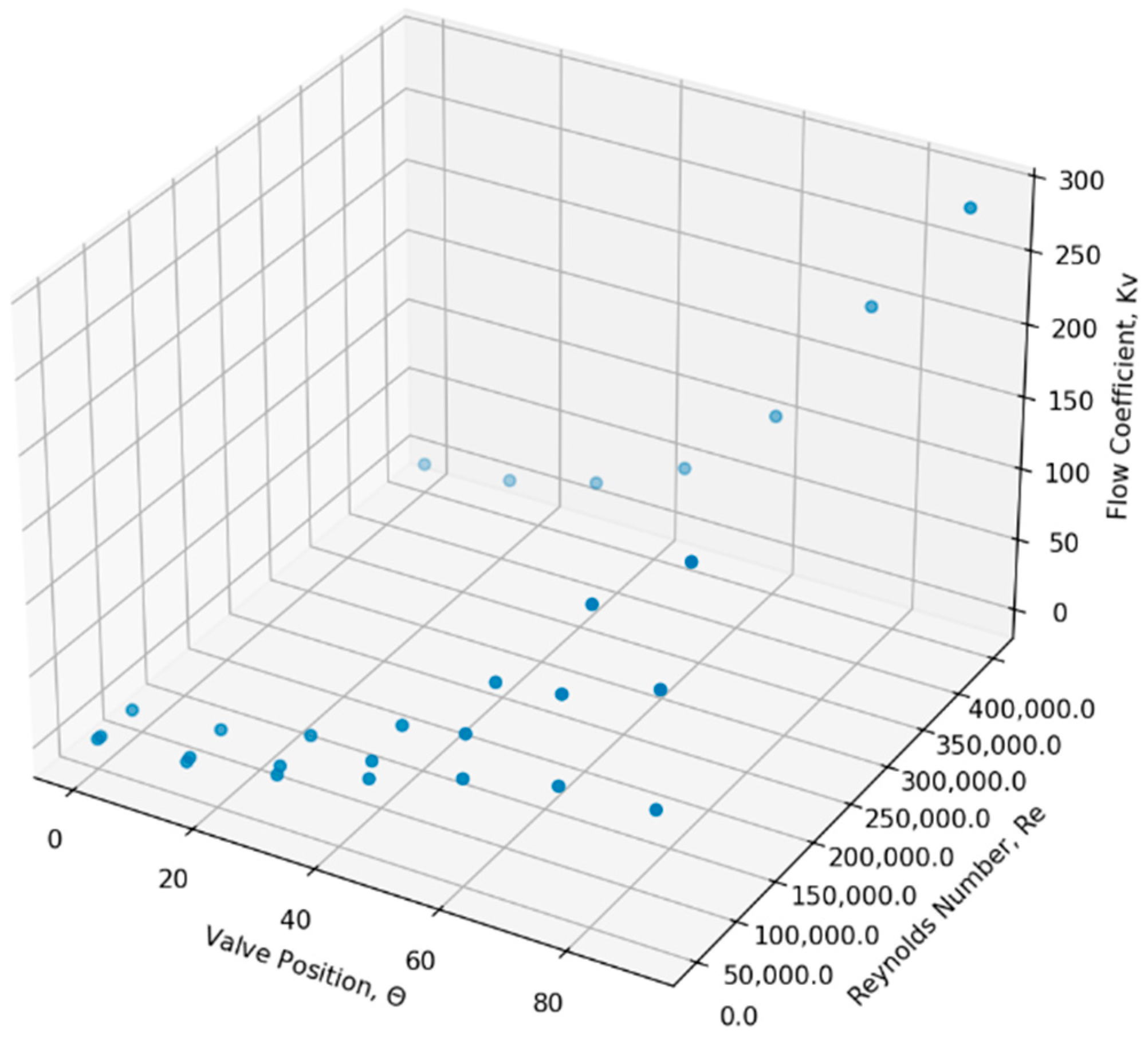
v). These three parameters can be represented in a three-dimensional plot, shown in
Figure 9.
To replicate the process described in
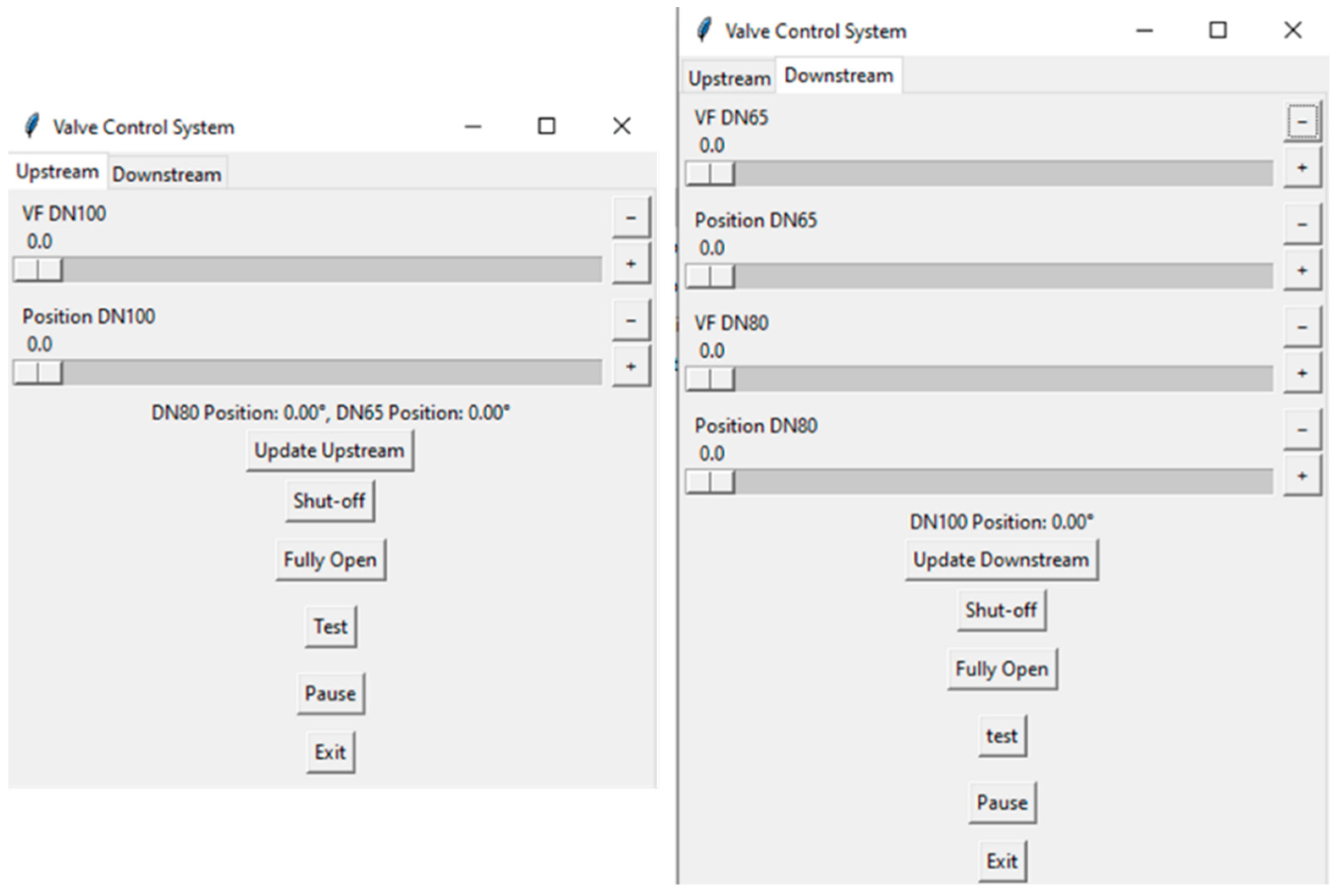
Figure 2, input parameters for both upstream and downstream need to be compared with the corresponding valve performance datasets. For this purpose, a python script is created with the performance dataset for each valve as tuples, consisting of valve positions, flow coefficients, and flowrates. After all the inputs are given, these parameters are used to perform multiple interpolations using the “interp1d” function, which is part of the “Scipy” library. The flow coefficient values are passed for the next step, and interpolation is performed again for the other valve positions. For real-time input and output from the python script, a graphical user interface (GUI) is designed using “Tkinter” library. The interface has two pages, one for the upstream regulating downstream and the other for the downstream regulating upstream. For each input, a slider is placed with increment and decrement buttons. Those interfaces are shown in
Figure 10. After providing the inputs for the valve positions and flowrates, the “Update Upstream” button is pressed to send the command signal to the actuators and pump. The “Shut Off” button overrides the system and closes all the valves and stops the pump. The “Fully Open” button opens all the valves to 90° and commands the pump to generate maximum flow. The “Test” button initiates automated testing with various combinations of valve positions and flowrates to simulate various scenarios or evaluate the performance of the control script. The “Pause” button pauses and resumes the testing process if needed and while paused, the valves will remain at the positions defined but the pump will stop completely until the button is pressed again. The “Exit” button terminates the testing process if needed and closes all valves and stops the pump.
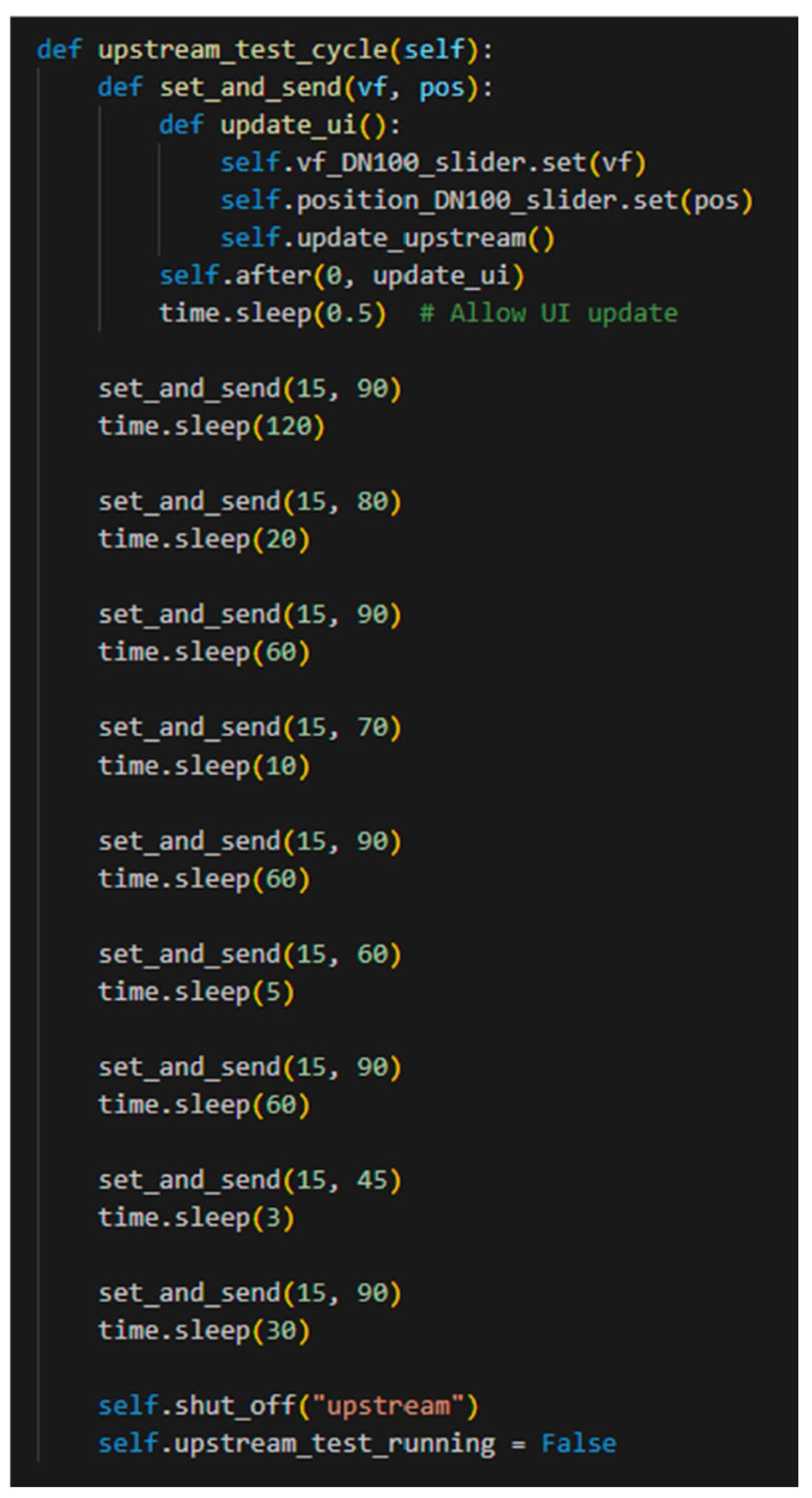
An example of the automated testing script is shown in
Figure 11. The python script consists of two distinct functionalities, which are sending valve position signals to the ESP32 to control the three stepper motors and act as a local server for the LabVIEW to connect with the TCP pallet and obtain the valve position and flowrate data for logging. The flowrate command generated by the python script is processed by LabVIEW to generate the appropriate signal (0–10 V) for the VFD to control the pump.
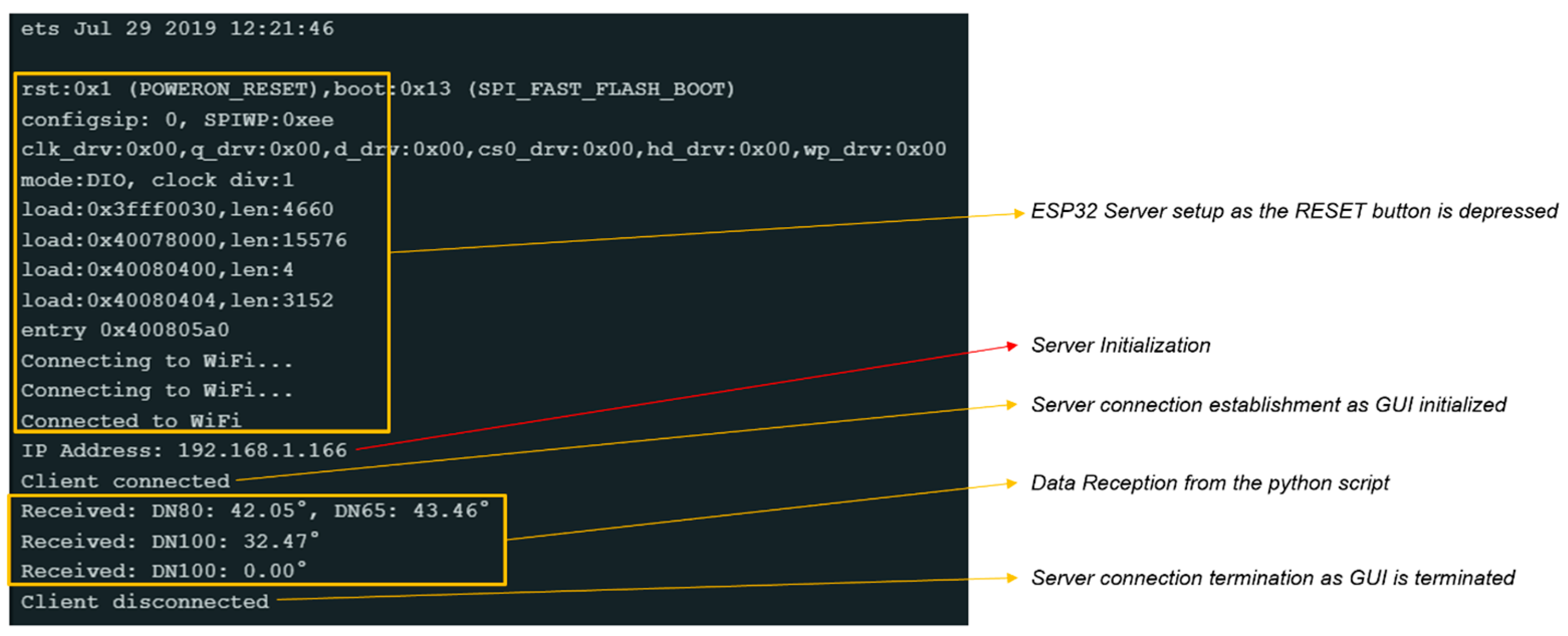
When the GUI is initialized, the script connects to the ESP32 and remains connected until the GUI is terminated. After termination of the GUI, all the valves are moved to closed position, and the pump is turned off.
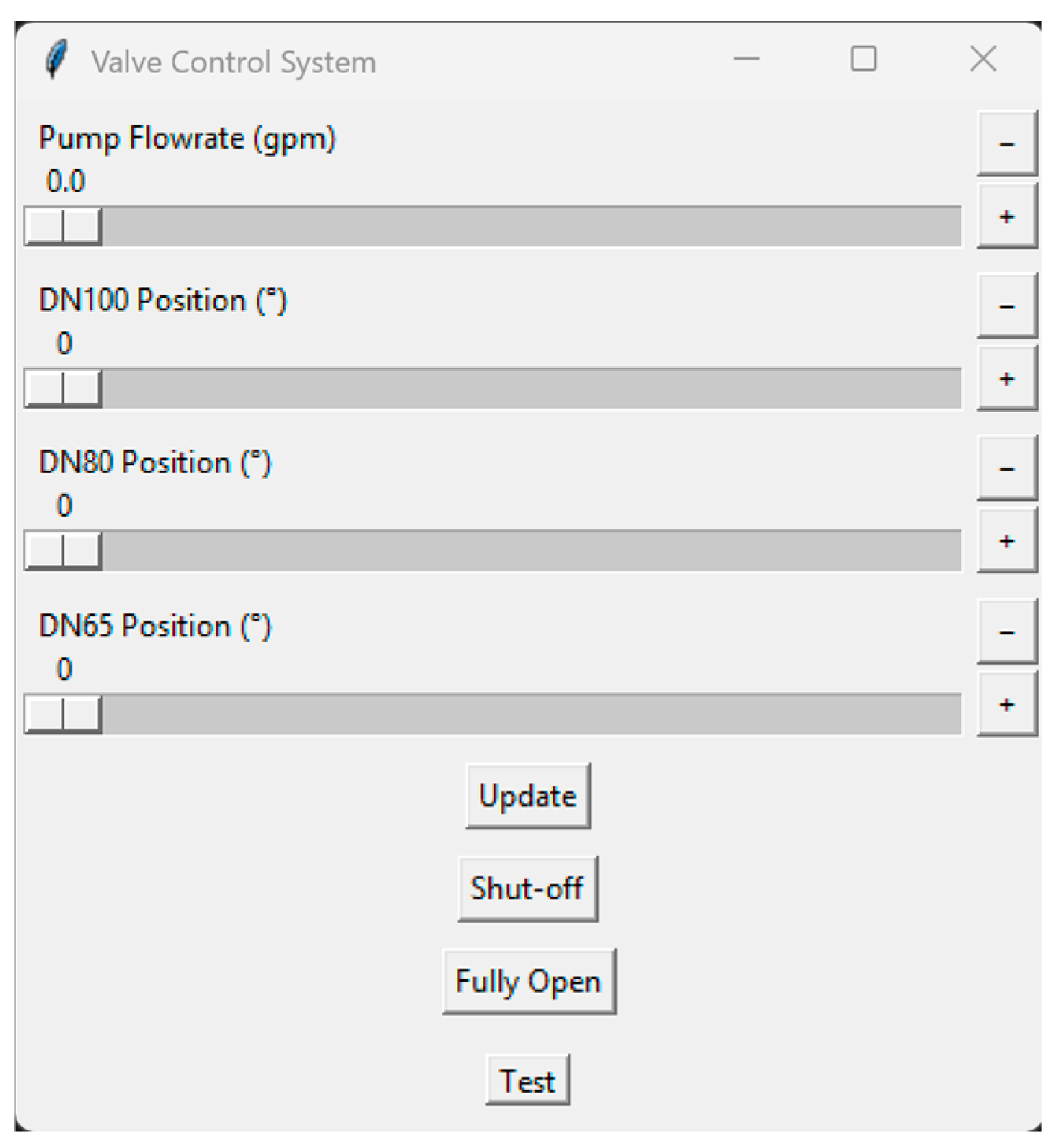
Another version of the python script is designed to test the effect of individual and independent movements of valves. This script does not contain any valve performance datasets, rather all the parameters are defined by the user. The user interface is displayed in
Figure 12.
5. Calibrating and Adjusting the Flowrate
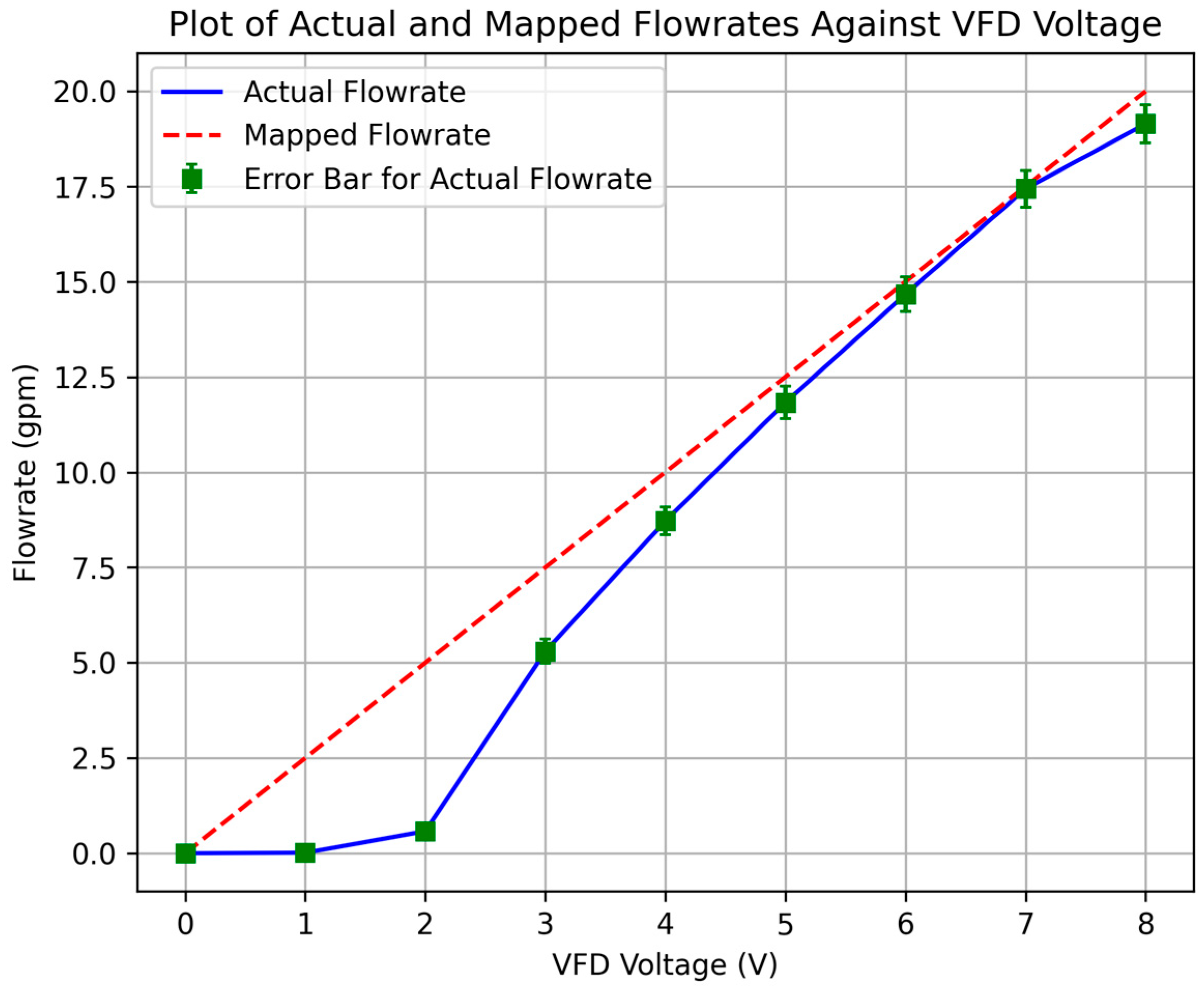
For accurate output from the pump, the VFD is signaled with controlled voltages ranging from 0 to 8 V and the initially mapped flowrate changes linearly from 0 to 20 gpm. The mapped and actual flowrate with various VFD voltages is exhibited in
Figure 17. The actual flowrate is averaged from multiple runs ranging from 1 V to 8 V. It is observed that the actual flowrate deviates significantly at lower flowrates and closely matches at a higher flowrate of around 17.5 gpm. As will be shown in a later section, the pump does not display hysteresis effect in the voltage–flow relationship.
During the calibration, the flowrate is measured with all the valves in the facility at fully opened position. In this way, the pump will match the maximum flowrate command and the actual flowrate in the facility will be adjusted by the upstream valve. It will also prevent the VFD from generating fluctuating frequency and the pump can be controlled independently with simple correlation.
To minimize this deviation between the mapped and actual flowrate, curve fitting is performed. Since we want the system to predict the flowrate, higher R
2 value regressions are preferred. It is found that quartic regression (Equation (4)) results in the highest R
2 value of 0.9999.
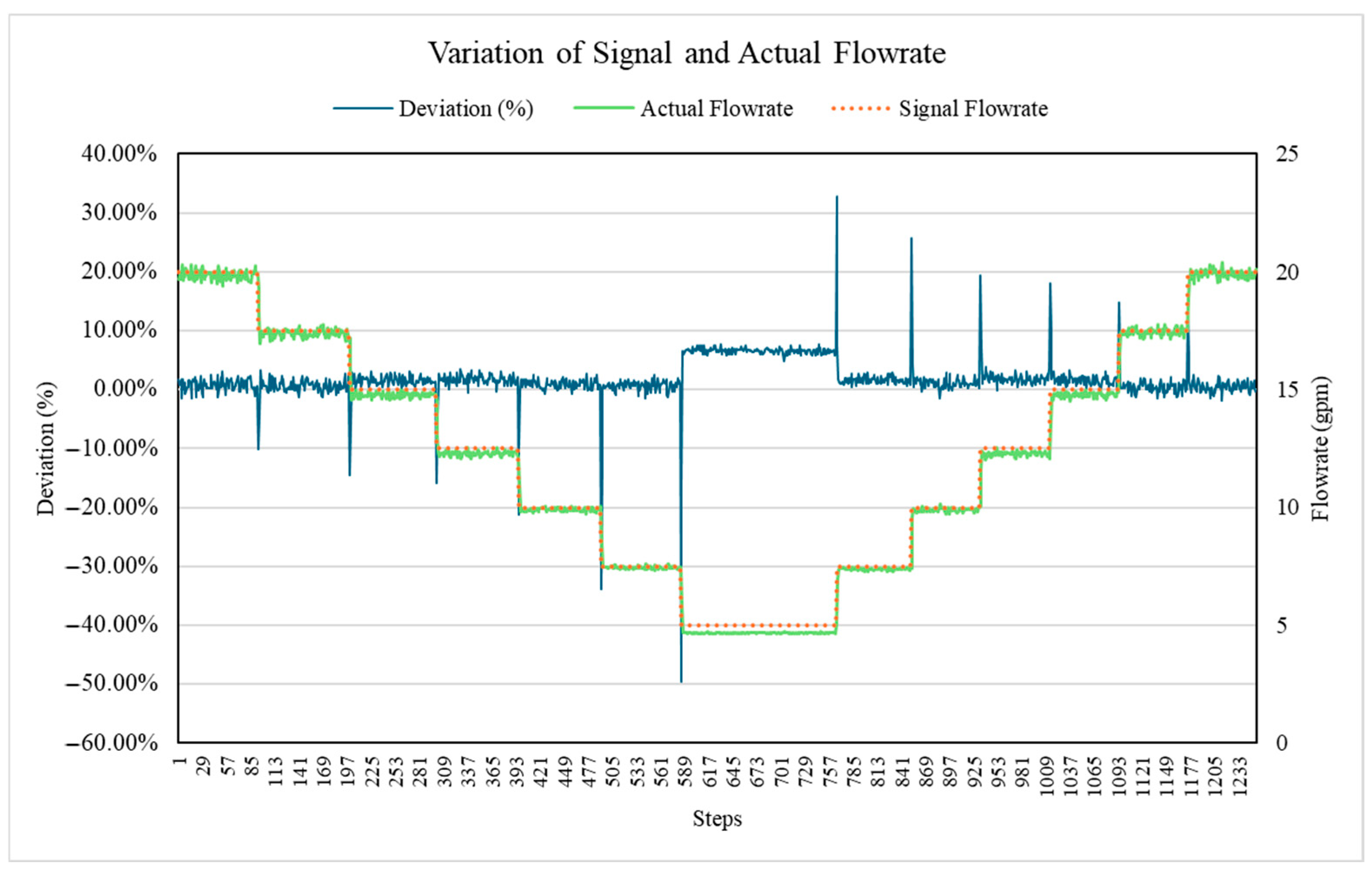
This Equation is implemented in LabVIEW to convert the received flowrate to voltage for the NI9264 module, so that it will produce output from 0 to 8 V depending on the input from the python script. The curve fitting was tested on the facility with all the valves set to 90° open. Equation (5) is used to calculate the fluctuation between the actual flowrate and the signal flowrate. The test includes both the descending and ascending order of flowrates to check if there is any anomaly present in the system. The result is displayed in
Figure 18.
Ranging from the 5 gpm to 20 gpm flowrate, the actual flowrates fluctuate an average of ±1.5% from the signal flowrates. The 2.5 gpm fluctuates around ±6%. From this test, it was decided that flowrates below 5 gpm should not be included for testing in the facility. There are some upward and downward spikes observed which happen when the pump is changing the flowrate and results in a high deviation for a few seconds. Additionally, the result is symmetric for descending and ascending order, which indicates there is no abnormal behavior with the curve fitting used. It is concluded that the curve fitting is suitable for converting the python script flowrate signal to NI-9264 signal voltage.
6. Results
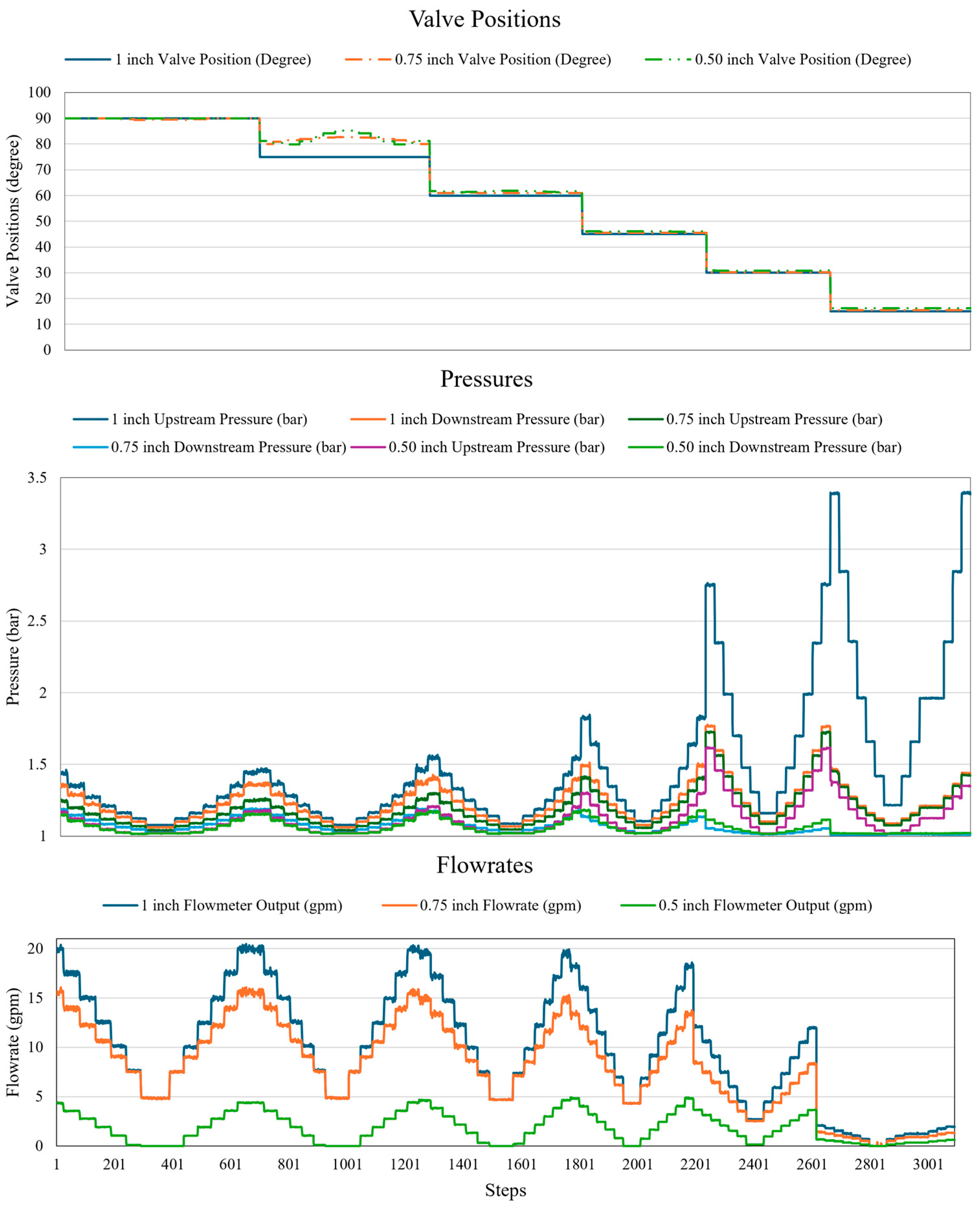
The upstream-based coordinated control algorithm is tested in the facility. Here, the upstream valve positions from 15° to 90° are tested at 15° intervals. It is observed that the flowrate at valve positions below 15° is very low and very high velocity localized flow and pressure drops are observed around the valve body. For these reasons, 15° is selected as the lower bound of valve position. For each valve position, the pump flowrate varies from 20 gpm to 5 gpm and back to 20 gpm in 2.5 gpm intervals. The test results, consisting of valve positions, flowrates and pressure readings are shown in
Figure 19. It can be observed that except for the 17.5 gpm flowrate, all three valves are moving to almost the same valve positions. The deviation in 17.5 gpm may result from the valve performance interpolations, but no abnormal behavior in pressure or flowrate is observed.
We can observe that the 1-inch upstream pressure exceeds 3 bars at 30° and 15° valve positions. At the 15° valve position, the flowrate drops drastically. In the flowrate plot, it is observed that the 0.5-inch line has no flow between 5 gpm and 7.5 gpm. All the flow passes through the 0.75-inch line after passing through the 1-inch line. This results from the higher resistance of the 0.5-inch line. This test aims to demonstrate the coordinated control of all three valves from 15° to 90° upstream valve positions and flowrates ranging from 5 gpm to 20 gpm. The pressure and flowrate plots show how the coordinated regulation affects the downstream.
The target ESP-32 is coded to send a confirmation signal to the host after the actuators are signaled for movement. It is found that the response time of the system ranges from 247 ms to 292 ms, averaging at 281 ms. As the system relies on the lab Wi-Fi, this response time can be affected by the load on the router. The movement of the stepper motors is very accurate with the signal data. The maximum deviation from the signal position and actual position is found to be 0.9°. It is measured by comparing the actual and signal valve position while running this test. There is no hysteresis observed in the test results and no deviation is observed for repeated command.
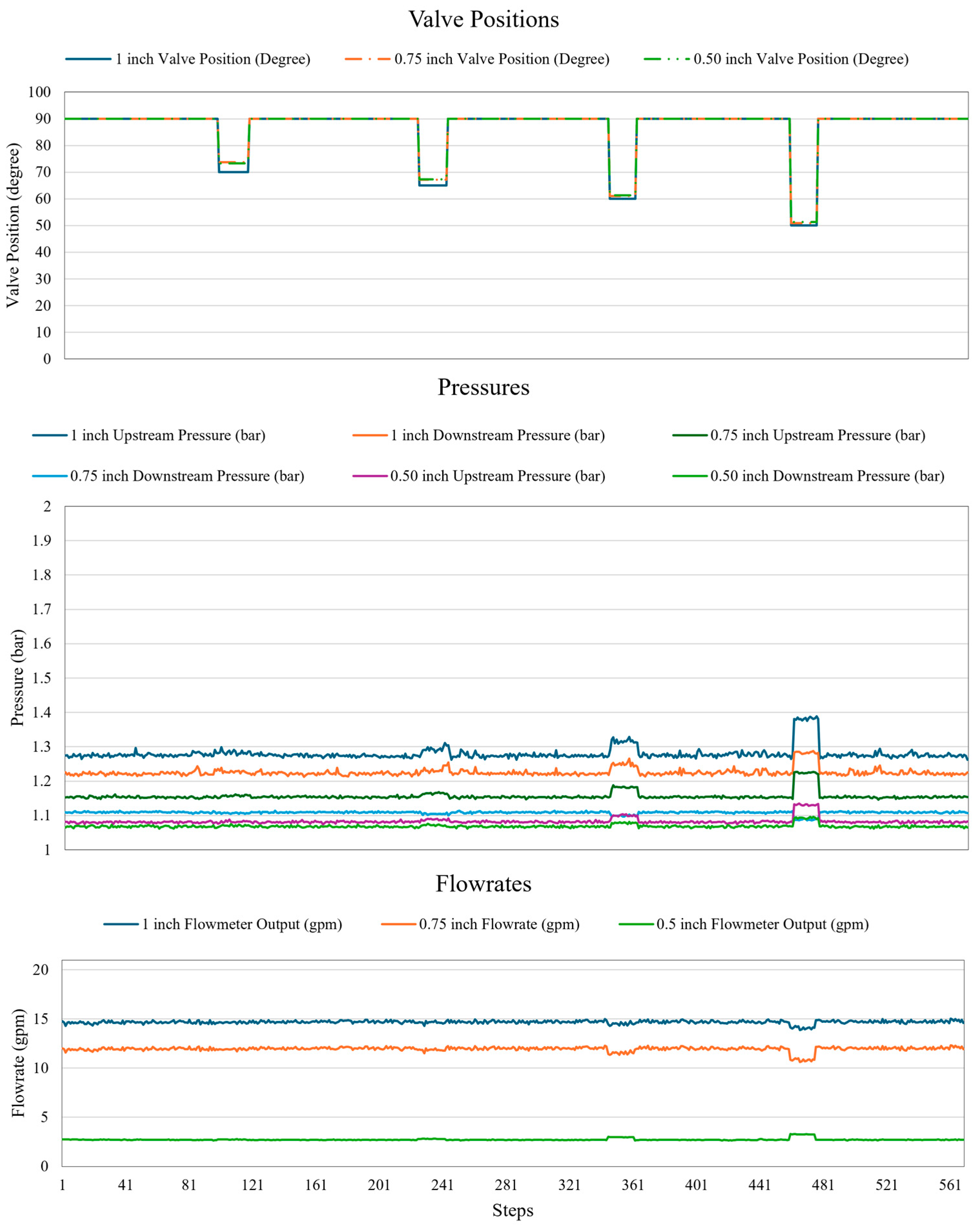
The next test kept the flowrate constant at a value of 15 gpm while the position of the 1-inch valve is varied; the 1-inch valve positions are moved to 70°, 65°, 60° and 50° with the valve returned to fully open (90°) between each tested valve position. This is shown in
Figure 20. In the plot of the valve positions, it is further confirmed that the downstream valve positions closely follow the upstream valve positions. In the pressure reading, the 0.75-inch downstream pressure drops when the valve opening is 65° or less while all the other pressures, including the 0.75-inch upstream increase. Theoretically, the pressure should drop across both downstream lines as the 1-inch valve is moving to a narrower position. The key valve positions, average pressure drops and branch flowrates are tabulated in
Table 1. To investigate this behavior, valves are independently tested using the independent control script.
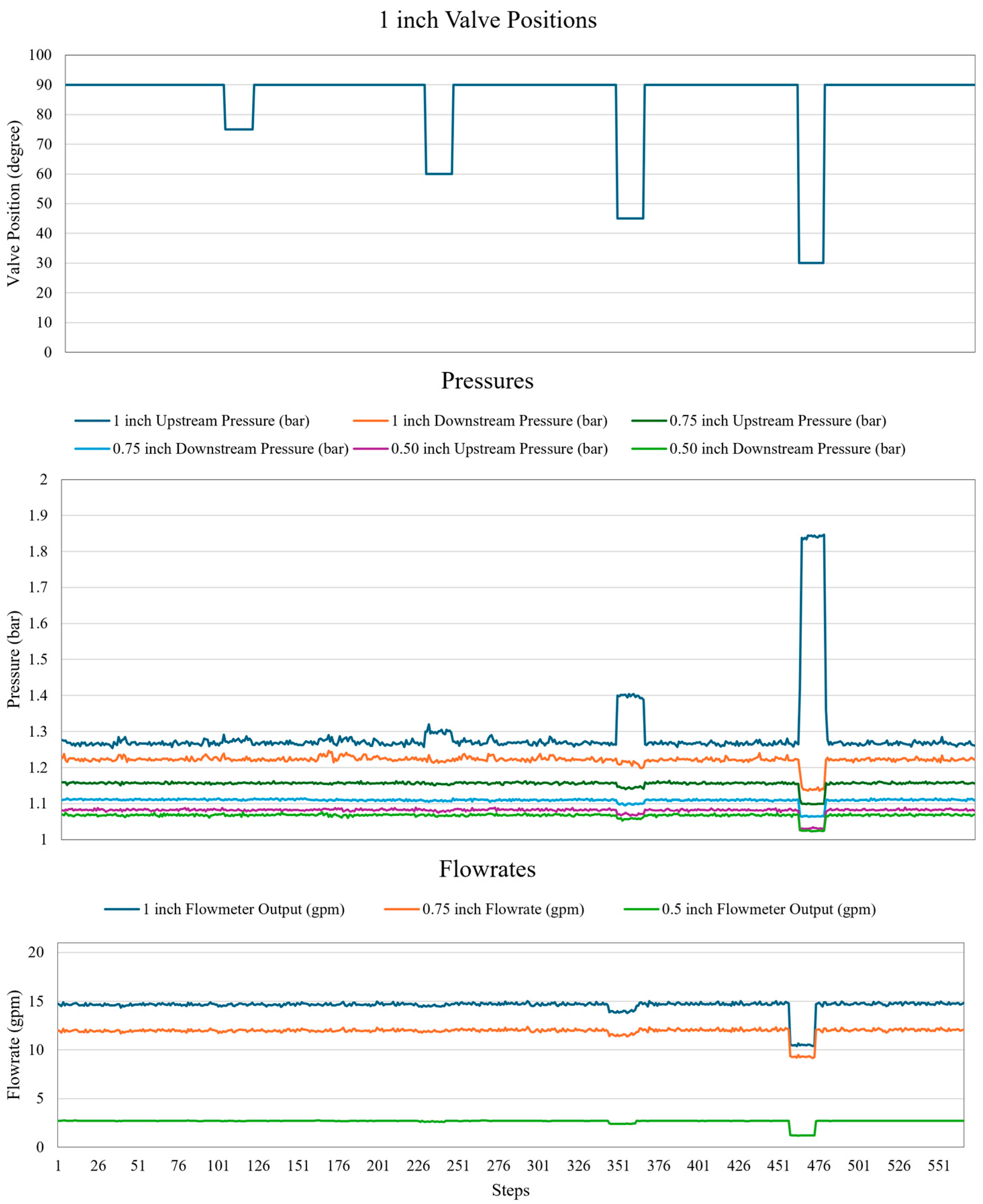
In the test conducted in
Figure 21, only the 1-inch valve is moved to 75°, 60°, 45°, 30° at a constant flowrate of 15 gpm while the other two valves remain fully open at 90°. We see that every pressure reading drops except the 1-inch upstream pressure. Significant drops in flowrate are detectable at the 45° and 30° valve position. At the 30° valve position, the upstream pressure of the 1-inch valve rose significantly reaching almost 1.85 bar, which is 0.45 bar more than the 45° position. The key valve positions, average pressure drops and branch flowrates for this test are tabulated in
Table 2.
A similar test is conducted with the 0.75-inch valve in
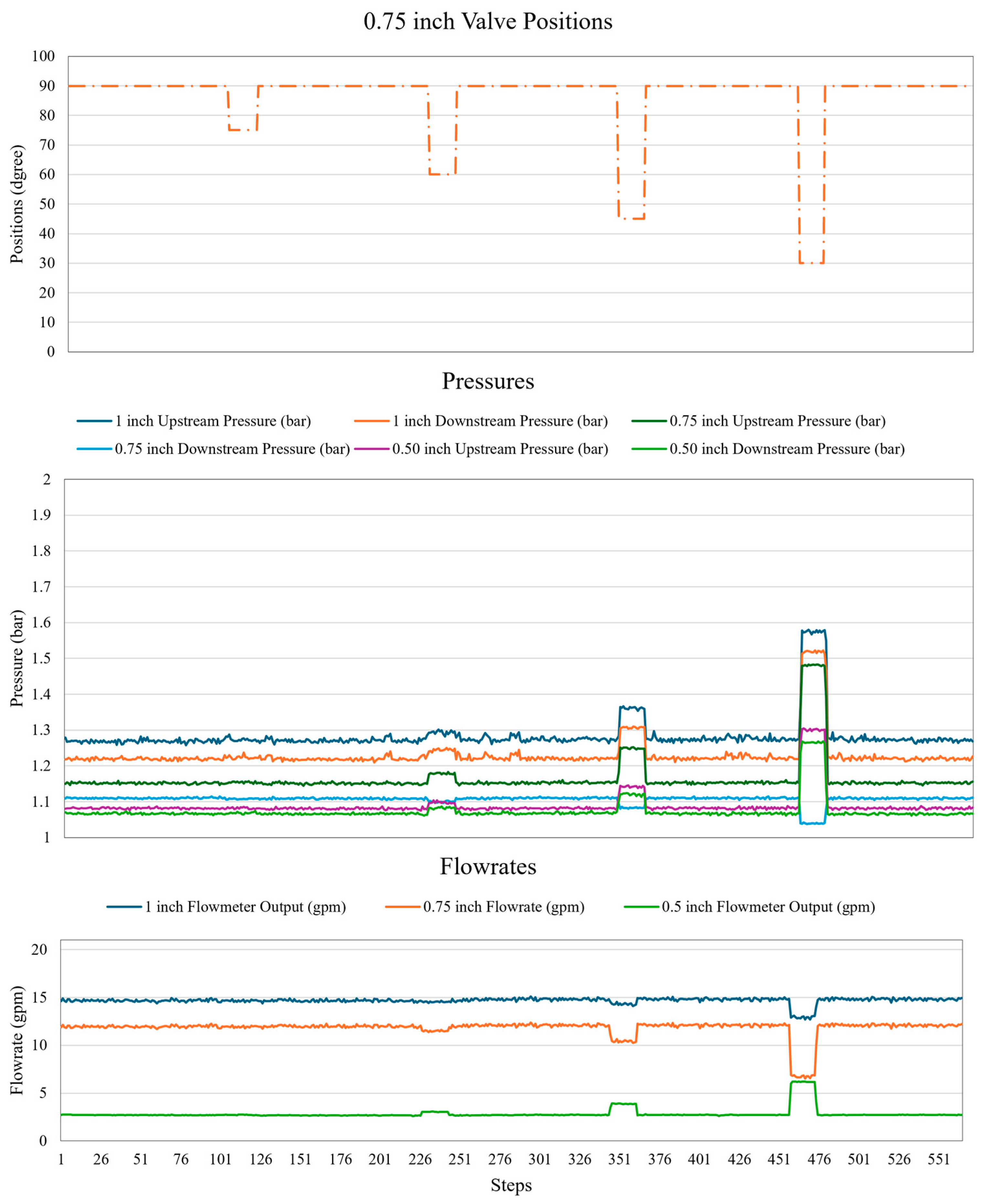
Figure 22. Only the 0.75-inch valve is moved to 75°, 60°, 45°, 30° at 15 gpm and the other two valves remain fully open at 90°. It is observed at valve positions of 60° and lower, all five pressure sensors, except for the 0.75-inch downstream, have gained pressure. Additionally at a valve position of 45° and lower, it is evident that the flow through the 0.5-inch line has increased. This test indicates that due to the resistance of the 0.5-inch line, the 0.75-inch line acts as the main flow path for the system. But if the 0.75-inch path is obstructed, it diverts the flow towards the 0.5-inch line. This diversion of flow from 0.75-inch to 0.5-inch causes pressure to rise in the system except for 0.75-inch downstream, even though the 1-inch valve is moving towards a smaller opening. The key valve positions, average pressure drops and branch flowrates for this test are tabulated in
Table 3.
The test conducted in
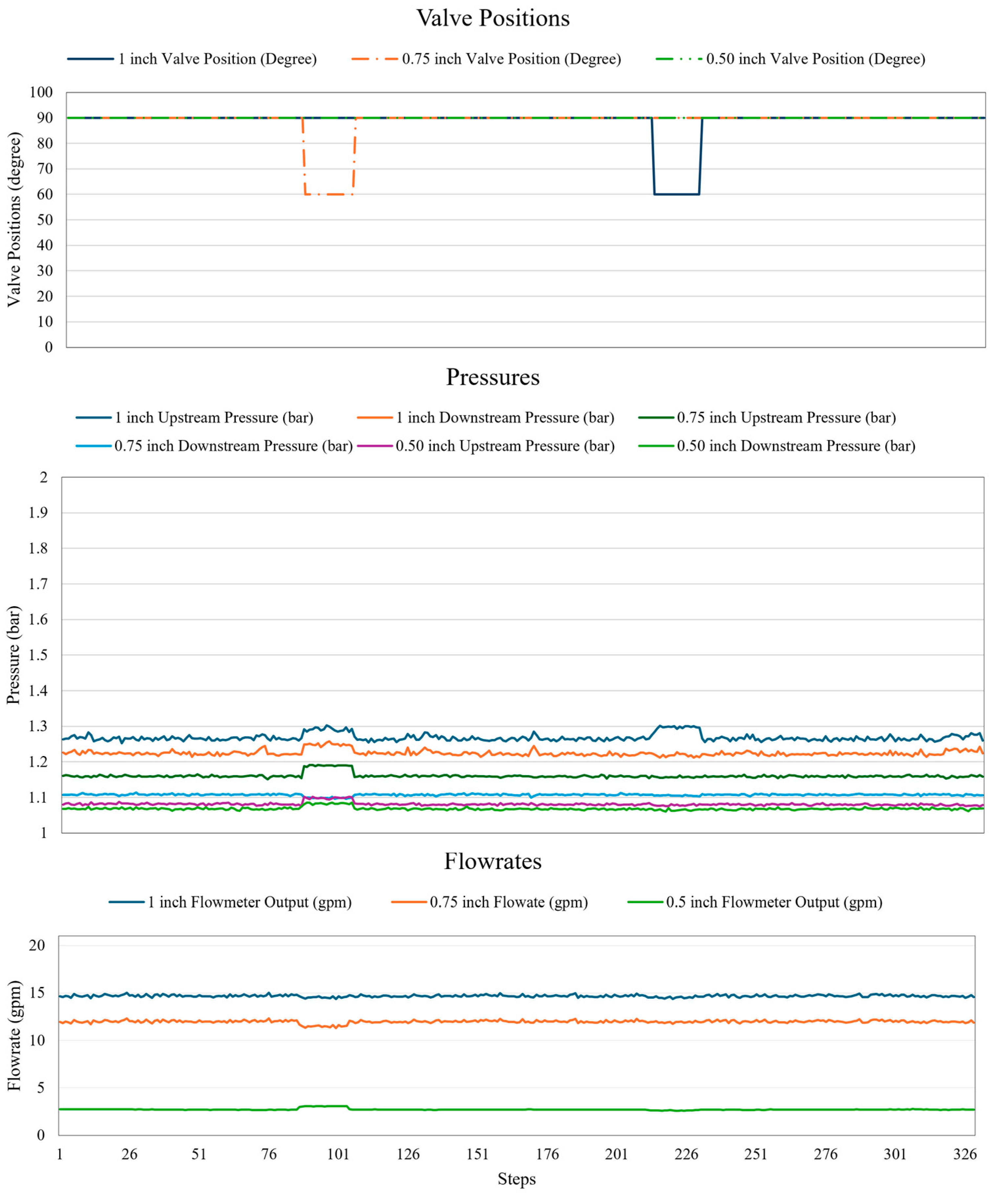
Figure 23 compares the effects of moving the 0.75-inch and 1-inch valve more clearly. Moving both valve positions to 60° independently, it can be observed that the 1-inch valve movement only affects the 1-inch upstream pressure but moving the 0.75-inch valve affects all the pressure sensors and the flowrates across the system. This test indicates that the 0.75-inch valve has the most influence on governing the flow across the facility. It is a crucial point to consider while training the anomaly detection system with test results generated by the facility. The key valve positions, average pressure drops and branch flowrates for this test are tabulated in
Table 4.
Observing the variation in the signal flowrates sent to the VFD and actual flowrates from the 1-inch flow meter, the fluctuations are observed to be below 5% for the flowrates ranging from 7.5 gpm to 20 gpm.
7. Conclusions
This facility provides a testbed for developing, evaluating, and demonstrating the coordinated SMART valve control expected to be necessary in nuclear IES for thermal power dispatch to cogenerating systems. The goal of the current testing is to draw the baseline for the load-based valve coordination. Although the facility is equipped with significantly smaller valve sizes, the patterns obtained from the pressure and flow sensors can be scaled to real-life NPP. The facility can achieve a similar Reynolds number as a real-life nuclear prototype. From the test results, it can be concluded that the initial coordinated valve regulation algorithm is effective with no significant anomalous movement of valves or obstruction of the flow. The sensor calibration is well within range with an acceptable amount of noise. The signal conversion mechanism for the pump is a sensitive part of the control system, essential for closely following the flowrate signal generated by the python script. The curve fitting has achieved ±1.5% fluctuation within the 5–20 gpm range which has reduced the uncertainty in the results significantly.
With both coordinated and independent control scripts, the facility has a very flexible control system, which is easy to program. To generate the training datasets for the anomaly detection system for SMART valves, this flexibility is the key feature to simulate various hydraulic conditions in a controlled manner. To ensure proper training of the system, some initial behaviors of the system are characterized.
Due to the limitation of space, the current facility had to be designed in a compact manner and the ability to test various valves are limited by the size. But the facility has achieved seamless coordination among the valve actuation and pump control system. The communication system layout used for the facility is scalable and more complexities can be introduced in the future to train and test the SMART valve system more rigorously. In the next iteration of the coordinated control, more parameters such as response to pressure drops and per-branch flow regulation can be introduced.



 ,
,