1. Introduction
In modern power systems, generating units and transmission lines operate under increasing pressure to continuously meet real-time electricity demand. Regular inspections and preventive maintenance are essential to minimize equipment failures and ensure high operational reliability. During maintenance, generating units are disconnected from the grid, and transmission lines temporarily stop power delivery. Therefore, effective maintenance scheduling for both generation and transmission assets is crucial to maintaining system supply capacity and reliability.
Maintenance activities in power generation and transmission often require starting up other high-emission units to compensate for the production shortfall, which can substantially increase carbon emissions. The increasing integration of renewable energy sources and the rise of carbon-related operational constraints further complicate the coordination of such maintenance activities. Traditional maintenance planning typically focuses on economic or reliability objectives while overlooking the emission impacts caused by these compensatory operations, as well as uncertainty-driven reliability degradation. This motivates the development of a comprehensive framework that jointly optimizes maintenance scheduling and operational planning to effectively manage system-level carbon emissions while maintaining economic and reliability performance [
1,
2,
3,
4].
In a market-driven power sector, generation and transmission entities are individually responsible for the maintenance of their respective assets. Consequently, generation maintenance scheduling (GMS) and transmission maintenance scheduling (TMS) have become important areas of study. The main objective of GMS is to determine preventive maintenance intervals for generating units within a given planning horizon, seeking to enhance reliability, maximize profitability, minimize maintenance and operational expenditures, or achieve a balanced trade-off among these goals.
Similarly, TMS focuses on ensuring that maintenance activities on transmission infrastructure do not compromise network reliability or system security. The TMS problem can be investigated either independently or in conjunction with GMS. However, the integrated coordination of generation and transmission maintenance introduces additional modeling complexity and computational difficulty, as highlighted in earlier research efforts [
4,
5,
6,
7,
8].
Although substantial progress has been made in studying GMS, TMS, and their integrated formulations, the issue of carbon emission management has received comparatively limited attention. With the increasing penetration of renewable energy sources, such as wind and solar power, carbon considerations have become an essential factor in both operational planning and long-term system design. Traditional maintenance scheduling frameworks predominantly focus on economic optimization and system reliability, often treating emission constraints as secondary or neglecting them entirely. However, under the ongoing global movement toward power-sector decarbonization, this omission represents a growing limitation. Incorporating carbon emission constraints and risk measures into maintenance scheduling models is therefore critical to ensure that system operation aligns with sustainability and emission-reduction objectives. Recent studies have begun to incorporate carbon emission costs and constraints into maintenance scheduling frameworks [
9,
10].
In parallel with the maintenance-scheduling literature, a large body of research has investigated long-term decarbonization pathways and high-renewable or even 100% renewable power systems by 2050 at regional, national, and island scales. These studies include case-based analyses for regions such as Latin America and the Caribbean, South Africa, and the European Union, as well as country-level planning for Mexico, Ecuador, Spain, Japan, and island systems such as Gran Canaria and the Galapagos. However, most of these works primarily focus on capacity expansion, technology portfolios, and policy design under carbon-neutrality targets, while maintenance coordination and asset availability are treated in a simplified manner or implicitly embedded in reliability margins rather than being explicitly optimized [
11,
12,
13].
Stochastic optimization is a well-established approach for addressing uncertainties in power system operation, assuming that the probability distributions of uncertain parameters are known. It enhances model solvability by capturing the randomness of renewable energy output and load demand through a finite set of representative scenarios [
14,
15]. Maintenance decisions are typically designed to ensure that electricity demand is satisfied across all scenarios [
16,
17] or, at a minimum, under the worst-case realization. Alternatively, chance-constrained models can be employed to guarantee that demand is met with a specified confidence level [
18,
19,
20]. Such chance constraints can be interpreted as limiting the Value-at-Risk (VaR). A more robust and risk-sensitive measure, Conditional Value-at-Risk (CVaR), controls the expected loss under the worst α-percent of scenarios, thereby offering a tighter risk management mechanism. Although CVaR has been widely adopted in risk management applications across finance, logistics, and energy systems [
21,
22,
23], only a relatively limited number of studies have applied CVaR to unit-commitment or maintenance-type problems in power systems, typically focusing on economic cost or price risks [
24,
25,
26]. In contrast, the present work incorporates CVaR-based management for both economic and carbon-emission risks within an integrated generation–transmission maintenance scheduling framework.
To address these research gaps, this study establishes a comprehensive optimization framework that jointly coordinates preventive maintenance scheduling with power system operational strategies under uncertainty, with explicit consideration of carbon mitigation and long-term sustainability. The proposed framework systematically integrates the stochastic influences of renewable penetration, load variability, and emission management into a unified planning environment. A bi-layer, scenario-oriented mixed-integer model is formulated to capture the interdependence between maintenance and real-time operation, and the distinctions between this study and existing research are illustrated in
Table 1.
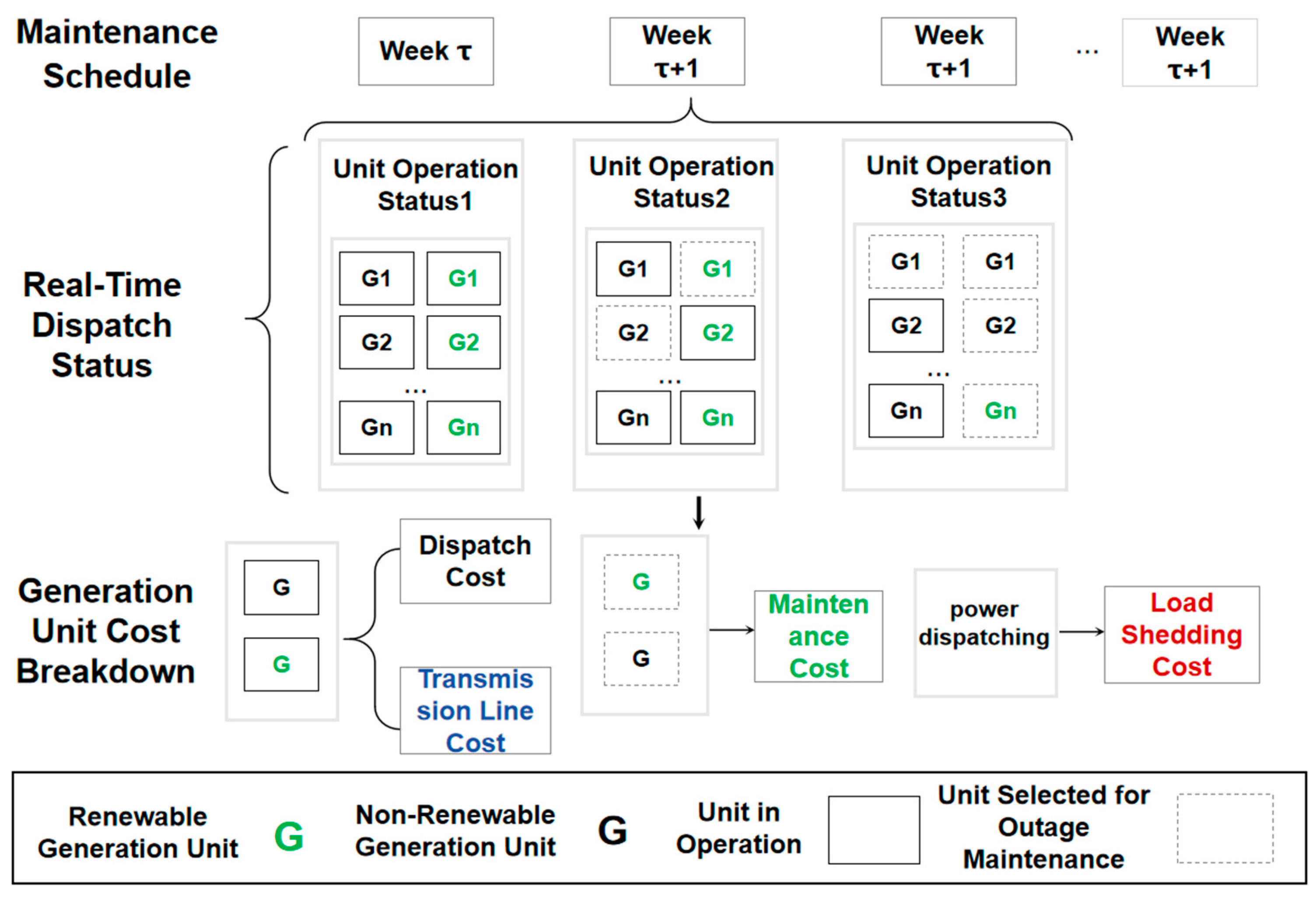
In the upper layer, weekly preventive maintenance arrangements for generating units and transmission corridors are determined using the probabilistic profiles of uncertain factors, as conceptually illustrated in
Figure 1. Once these maintenance decisions are established, the lower layer dynamically adapts operational actions—such as generation scheduling and power flow coordination—based on realized conditions like renewable shortfalls or sudden demand surges. Furthermore, a conditional tail-risk control mechanism is introduced to restrain extreme carbon outcomes, thereby maintaining a rational balance among economic performance, system reliability, and environmental responsibility. The main contributions of this study are summarized as follows:
Integrated risk-aware optimization model—A carbon-constrained bi-layer stochastic optimization framework is developed, jointly addressing maintenance planning, generation scheduling, and transmission coordination. This structure improves the capability to reconcile cost efficiency with low-carbon operation goals.
Scenario-driven analytical evaluation—Multiple scenario experiments are conducted under different monthly carbon coefficients, demand fluctuation intensities, and decision-maker risk perceptions. These analyses provide insights into the interrelations among emission risk exposure, maintenance timing, and operational expenditures.
Scalable decomposition solution—A parallel cut-generation decomposition algorithm is applied to handle the dimensionality arising from long-term and multi-scenario modeling. The proposed method achieves high computational efficiency and scalability for large power systems.
2. Methodology
The overall decision-making framework for coordinating transmission maintenance is illustrated conceptually in
Figure 1. The planning horizon spans one year, during which power demand and renewable generation are represented as stochastic factors. This section formulates a bi-layer scenario-based mixed-integer optimization model designed for risk-sensitive coordination of generation and transmission maintenance, integrating long-term preventive scheduling with short-term operational control.
To clarify the modeling of transmission lines, we first outline how uncertainty is represented and propagated across the bi-level structure. At the upper layer, weekly preventive-maintenance decisions for generators and transmission lines are determined prior to the realization of uncertainty. At the lower layer, given a fixed weekly maintenance configuration, hourly economic dispatch is solved under multiple joint scenarios of renewable output and demand. The lower-layer expected operating cost and CVaR-based carbon-risk metrics are then fed back to the upper-layer objective, forming a consistent optimization loop. This organization explicitly links long-term maintenance with short-term operation under uncertainty.
Scenario construction. Uncertainty in wind power, solar PV, and electricity demand is captured via Monte Carlo sampling of their joint realizations. For each week , we generate 20 representative scenarios that share the same weekly maintenance status but differ in hourly renewable and demand trajectories . The scenario set is re-sampled weekly to reflect temporal variability while keeping a fixed cardinality for computational tractability. These scenarios enter the lower-layer dispatch as parallel evaluations, with probabilities used to form expectations and CVaR terms.
Unlike traditional stochastic planning models that treat operational recourse as a single aggregated process over the entire horizon, the proposed framework partitions the annual schedule into 52 weekly time blocks. This structure reflects the practical rolling-planning behavior of system operators, who typically forecast and dispatch within limited temporal windows of several hours or days. Accordingly, preventive maintenance is planned once at the beginning of the year, while each week’s operational optimization is performed separately to generate fine-grained hourly schedules.
To represent operational uncertainty, the lower-layer optimization is formulated under a scenario sampling approach, where each scenario corresponds to a possible joint realization of renewable output and load demand. Within every weekly block, conditional tail-expectation constraints are applied to bound the expected performance losses under adverse realizations, ensuring the system remains robust to extreme operating conditions.
2.1. Preventive Maintenance Scheduling Model
Consider a power system consisting of a set of generating units and a set of transmission elements . To sustain reliable operation and prevent unexpected equipment outages, periodic maintenance must be strategically scheduled across the planning horizon. The upper-level decision variables, denoted by (), comprise two binary indicators: , for each generating unit and for each transmission line . These variables specify whether the corresponding component is scheduled for preventive maintenance during week .
The goal of this stage is to determine an optimal maintenance allocation that minimizes the total maintenance expenditure (TMC) over the entire scheduling horizon. The associated optimization expression is given by Equation (1).
In this formulation, and denote the weekly preventive-maintenance expenditures associated with generating unit and transmission element , respectively. A summary of all relevant sets, parameters, and decision variables is provided in Table 2 for clarity.
To preserve the operational reliability of each generating unit, the interval between two consecutive maintenance actions cannot exceed the prescribed maintenance cycle. Accordingly, for any given week
, at least one maintenance activity must have been executed within the preceding
weeks. This operational requirement is formulated through the constraint expressed in Equation (2).
For the maintenance requirements of transmission lines, similar constraints are introduced in Equation (3).
Constraint (4) specifies the maintenance resource constraint, which limits how many generating units or transmission elements can be taken out of service for maintenance within the same week.
Constraints (5)–(6) define the temporal continuity of maintenance activities, requiring that once a maintenance operation commences in week ttt, it remains active for the entire duration specified by its maintenance cycle.
2.2. Economic Dispatch Model
Once a year-long maintenance plan is finalized for all assets in the power network, the subsequent task is to determine cost-effective operational schedules that satisfy real-time demand while ensuring system reliability. In this lower-level operational stage, dispatch decisions are refined on an hourly basis in accordance with the maintenance configuration determined earlier.
To alleviate the computational burden associated with continuous year-round optimization, the annual horizon is partitioned into weekly operating segments, each independently optimized based on prevailing system conditions. Let denote the collection of operating hours within week . Under standard operation, assuming seven days per week and twenty-four hours per day, the cardinality of this set is .
In practical operation, system performance is influenced by multiple uncertain factors, including fluctuations in renewable generation, variability in fuel prices, and stochastic load behavior. This study primarily focuses on the uncertainty stemming from renewable intermittency and load volatility. The renewable uncertainty originates from the unpredictable and intermittent characteristics of solar and wind resources, whereas demand uncertainty arises from random consumption changes, variations in electric-vehicle charging behavior, and the dynamic penetration of distributed renewable generation.
Let denote the scenario of the t-th week, , and let the operational stage consist of all random variables associated with generating units during this week. Meanwhile, let represent the set of all possible scenarios. The economic dispatch problem is formulated as a “wait-and-see” and expectation-based scheduling model; that is, for each scenario , the corresponding economic dispatch is determined. The weekly economic dispatch model is described as follows.
In the above problem, the decisions are made for each scenario and have an hourly time resolution. Therefore, each decision variable is associated with both an upper index and a lower index . The objective is to minimize the total operational cost (TOC), which includes fuel costs associated with power generation and power transfer for each generating unit, as well as penalty costs for unmet demand, as expressed in (8). The cost function is generally modeled as a convex quadratic function (hence the inclusion of term (32)). If the uncertain economic dispatch problem is expressed as a nonlinear programming problem, the quadratic cost function can be approximated by a piecewise linear cost function.
Constraints (9) and (10) ensure that if a generating unit is under maintenance in a given week, it cannot be scheduled for power generation in any hour of that week. Constraint (11) limits the maximum generation capacity of each generating unit. Constraint (12) reflects the power output of renewable resources (such as solar and wind) under different weather conditions. Constraints (13) and (14) describe the startup and shutdown behavior of generating units. Constraint (15) specifies the spinning reserve requirements at each bus during hour . Constraint (16) indicates that when preventive maintenance is planned, any transmission line undergoing maintenance must have zero power flow. Constraint (17) expresses the basic power balance between total generation and total demand, considering load forecasts and the real-time equilibrium between supply and demand.
It is important to note that the first-stage maintenance schedule directly influences the second-stage dispatch decisions through constraints (9)–(11) and (16). Specifically, actual power generation and transmission are limited by the maintenance plans determined in that week. The second-stage uncertainty includes renewable energy generation in (12) and the real-time electricity demand in (17).
2.3. Carbon Reduction Risk Management Based on CVaR
In power systems, scheduling multiple assets for preventive maintenance at the same time can significantly increase the likelihood of supply shortfalls, particularly under conditions with high renewable penetration and uncertain generation output. To mitigate this risk and maintain emission compliance, a conditional tail-risk measure (CVaR-type constraint) is embedded in the optimization model to quantify and control the potential deviations related to carbon emission performance.
Within the proposed framework, two categories of tail-risk constraints are introduced: weekly levelweekly-level constraints (19)–(21) and hourly levelconstraints (22)–(25). These formulations ensure that carbon emissions remain within allowable limits across both aggregated and fine-grained temporal scales. By incorporating such risk-control mechanisms, the model prevents excessive emission outcomes that could arise from sub-optimal dispatch strategies or poorly coordinated maintenance schedules.
By introducing the CVaR framework, the model can evaluate and control carbon emission fluctuations during power system operation, particularly under conditions such as intensive maintenance schedules, unstable renewable energy output, or sudden demand surges. The purpose of the CVaR constraint is to limit excessive carbon emissions under worst-case scenarios, ensuring that emissions remain below predetermined thresholds. This mechanism effectively mitigates the risk of excessive carbon emissions arising from unreasonable power dispatch or maintenance scheduling decisions.
Constraint (19) limits the CVaR at the confidence level
, ensuring that it does not exceed the predefined threshold
. Here,
represents the VaR variable corresponding to the same confidence level, while
is a non-negative variable representing the excess portion that surpasses VaR (typically expressed as total unmet demand). The variable
equals 0 if the outcome does not exceed VaR. These requirements and properties are formulated in constraints (20) and (21).
Constraints (22), (23), and (25) establish the linearized representation of the hourly conditional tail-risk requirements, which are conceptually parallel to the weekly risk constraints defined in (19)–(21). In contrast to the weekly formulation that governs aggregate demand shortfalls over each week, the hourly constraints focus on limiting instantaneous demand deviations within every hour, where the magnitude of each deviation is determined through constraint (24).
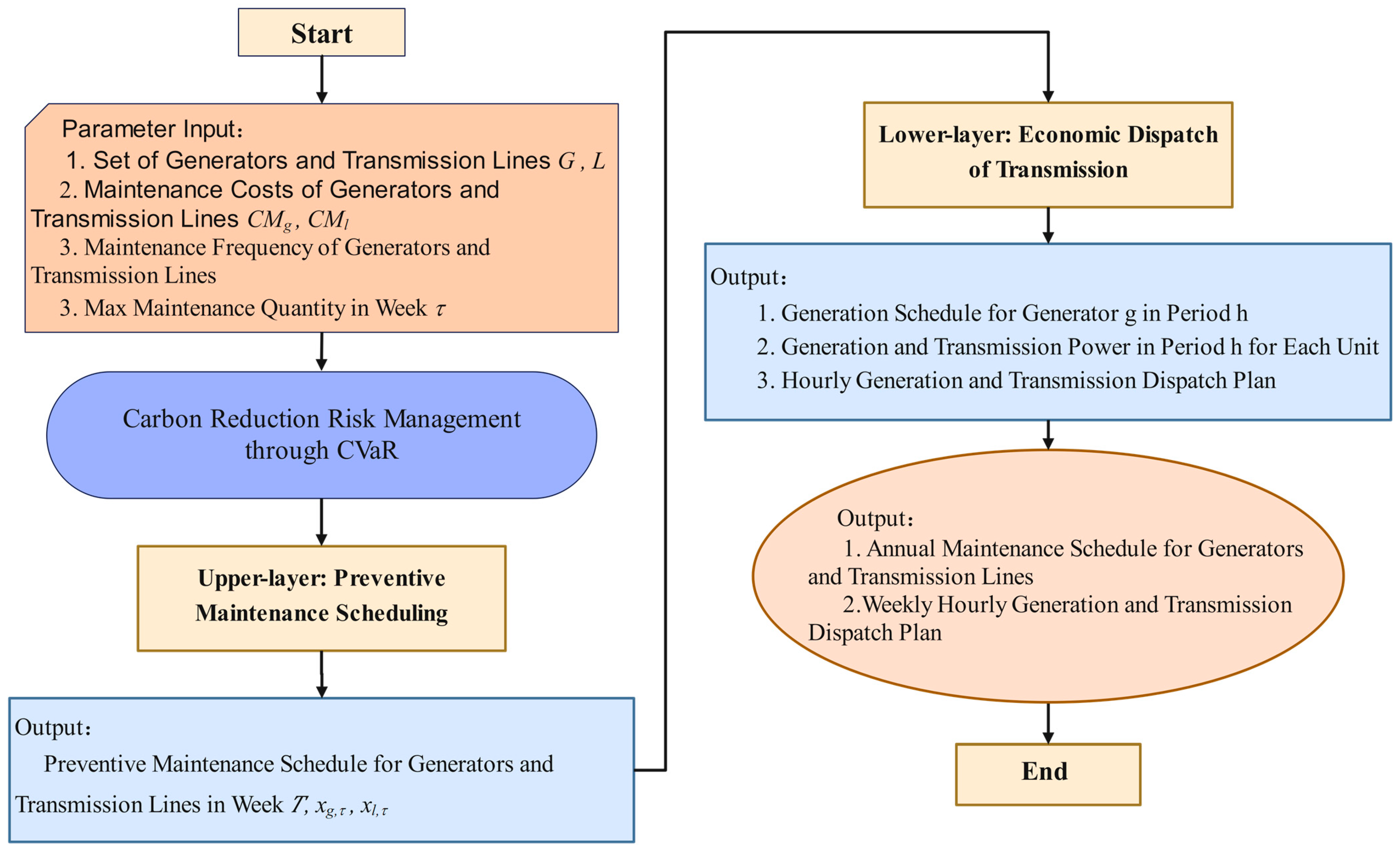
Overall, the procedural structure of the proposed bi-layer generation and transmission maintenance optimization model is summarized in
Figure 2, which illustrates the integrated flow from preventive scheduling to hourly operational adjustment.
2.4. Complete Model Formulation
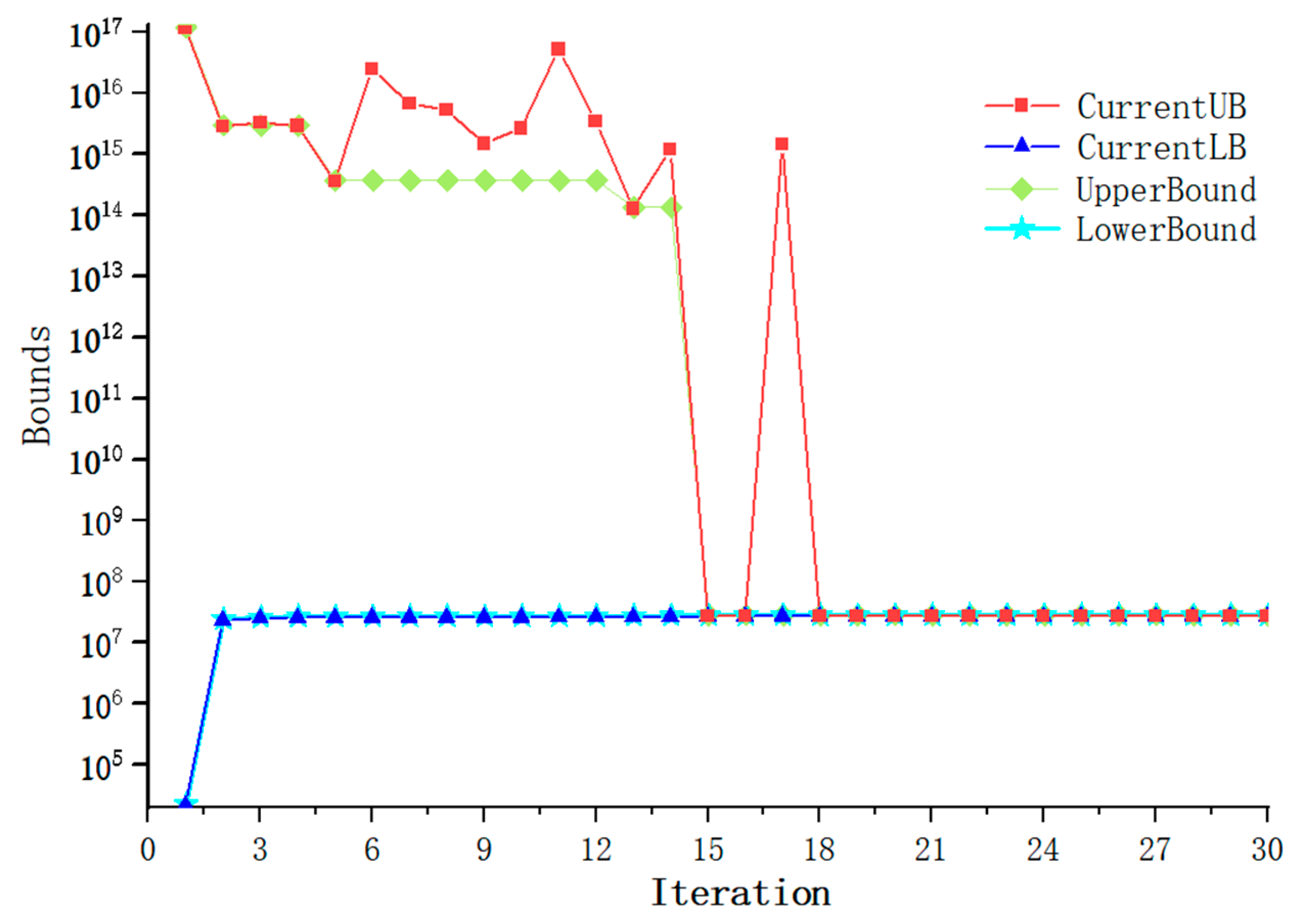
Given upper-layer maintenance decisions for the year, weekly lower-layer subproblems are solved scenario-wise, and their dual information is used to generate scenario cuts that refine the master problem. Moving the CVaR components to the master problem enables parallel cut generation and faster tightening of the recourse approximation compared with aggregated weekly cuts, which is corroborated by the bound-convergence trajectories (
Figure 3). This design maintains exact coupling with availability constraints while scaling to large networks and many scenarios.
To support the algorithmic development discussed in the subsequent section, the complete formulation of the proposed risk-sensitive generation and transmission maintenance scheduling with carbon emission limit model (GTMS-CEL) is presented below.
The objective function in Equation (26a) seeks to minimize the aggregate maintenance expenditure and the expected operational cost over the planning horizon. The upper-level (maintenance) decisions are governed by the preventive scheduling rules specified in constraints (2)–(6) and (26h), collectively represented by the feasible set . Constraints (26b) describe the operational feasibility region, ensuring that all dispatch and flow variables remain within technical and reliability limits. The interaction between long-term maintenance planning and short-term operational scheduling is captured through coupling relations in constraints (9)–(11) and (16). Risk-control components based on the conditional tail-expectation principle are formulated in constraints (26c)–(26g).
The parameters , and denote the input matrices and vectors that link maintenance and operational decisions within the model structure. The binary variable represents maintenance-related decisions for week , defined by constraint (26h), whereas the continuous vector corresponds to the operational adjustments under scenario .
Through the rGTMS formulation, an integrated maintenance strategy can be produced that achieves economic efficiency while maintaining operational reliability under stochastic demand and varying renewable generation levels.
2.5. Integrated Model
The rGTMS model proposed in the previous section often leads to a large-scale mixed-integer stochastic optimization problem when it is directly formulated as a single monolithic model. The dimensionality arises from the long planning horizon, the number of generating units and transmission lines, and the large number of uncertainty scenarios required to represent renewable generation and demand variability. To make the problem tractable while preserving its essential structure, a decomposition-based solution framework is adopted. The core idea is to separate the annual preventive maintenance scheduling (first-stage decisions) from the weekly operational dispatch under uncertainty (second-stage decisions), and then iteratively coordinate them through Benders-type cuts. This section describes the relaxed master problem, the weekly and scenario-level subproblems, and the construction of optimality cuts used to accelerate convergence.
The original rGTMS problem is first decomposed into a relaxed master problem (RMP) associated with the annual maintenance planning and a family of weekly subproblems representing detailed system operation. The RMP aggregates all long-term maintenance decisions and approximates the expected operating cost of the second stage through an auxiliary variable. Its mathematical formulation is given in Equations (27a) and (27b).
Here, the variable represents the estimated lower bound of the second-stage expected value function which is calculated based on the maintenance scheduling decisions .
Once the annual maintenance schedule has been established, the model decomposes into a series of scenario-dependent subproblems, each corresponding to a specific week of the planning horizon. The objective of each subproblem is to identify, for every scenario, the cost-efficient operational strategy that satisfies all technical and risk-related requirements. The weekly subproblem is denoted as
, and its formulation is given below.
To guarantee the feasibility of subproblems, two auxiliary variables—
and
—are introduced. Variable
serves as a slack term for the lower tail-risk constraint (28c), while
performs the same role for the upper tail-risk condition (28e). A large positive coefficient
is included to ensure that these auxiliary variables remain inactive under normal conditions. The penalty coefficients for the slack variables
and
are set to
(e.g.,
in cost units), which is slightly larger than the upper bound of the hourly operating cost plus carbon cost under the worst-case demand and renewable output. This modification ensures complete recourse, thereby preventing the generation of infeasible cuts within the iterative process.
During the iterative solution process, a relaxed master problem (RMP) is solved first to obtain candidate maintenance decisions for the entire planning period. These decisions are then passed to the subproblems, which determine the optimal operational responses across scenarios. The feedback from each subproblem is used to construct cutting-plane constraints that refine the approximation of the master problem’s objective. The algorithm proceeds iteratively until the difference between the upper and lower bounds meets the prescribed convergence tolerance.
In the classical decomposition framework, each iteration adds a new optimality cut—defined by Equation (29)—to the master problem. These cuts progressively enhance the outer approximation of the recourse function and guide the master problem toward the global optimum of the rGTMS model.
In the equation, , , are related to the subproblem constraints in Equations (28b), (28c), and (28e). Since each cut is based on the consideration of all scenarios for a given week, it is referred to as a scenario-cut. Alternatively, if the cuts are derived from the problem’s constraint relaxation, they are considered as Benders feasibility cuts.
Although introducing an optimality cut, such as that in Equation (29), progressively improves the master problem’s approximation of the recourse function, the efficiency of these aggregated cuts may be limited because scenario-specific dispatch information is compressed into a single combined representation. Moreover, as the number of scenarios increases, solving the weekly subproblem can become computationally demanding.
To alleviate this computational burden, each weekly problem is further divided into a set of independent scenario-level subproblems, each representing a unique realization of uncertainty. This separation can be achieved by relocating the conditional tail-risk constraints (26c)–(26g) from the subproblems to the master formulation, thereby yielding a revised master problem structure. The new form of the relaxed master problem (RMP) explicitly incorporates these risk-control components, allowing for parallel scenario processing and enhanced convergence efficiency.
Solving the revised master problem (RMP) produces not only the preventive maintenance decisions but also the corresponding values of unserved demand for each scenario, denoted by
. Consequently, every weekly problem can be decomposed into a collection of independent scenario-level operational submodels, each represented as
.
Within this framework, constraint (31b) retains the same mathematical structure as constraint (28b), except that the power-balance relationship is now embedded within constraint (31c). Since the unmet demand at each bus under every scenario is already captured through the master problem, a slack variable is incorporated into constraint (31c) to preserve feasibility for all operating conditions. The corresponding dual multipliers associated with this constraint are denoted by and .
Instead of employing a single aggregated cut as in Equation (29), the decomposition framework now generates a set of scenario-specific optimality cuts, formulated in Equation (32). These individualized cuts enhance the precision of the master problem’s approximation by incorporating distinct information from each uncertainty scenario, thereby improving convergence and reducing computational redundancy across the iterative solution process.
The algorithm iteratively refines the maintenance schedule to achieve the lowest possible carbon emissions. The updated plan is subsequently utilized to resolve the associated scenario subproblems . After each subproblem is optimized, its dual solution information is extracted and employed to construct corresponding optimality cuts, which are incorporated into the master problem to enhance its approximation accuracy. The iterative process concludes once the difference between the upper and lower objective bounds of the master problem becomes smaller than a predefined convergence threshold.
3. Scenario Analysis and Discussion
This section is organized into several subsections to present and analyze the computational results of the proposed model. It provides a concise yet comprehensive discussion of the experimental outcomes, their interpretation, and the conclusions that can be drawn regarding model performance and practical implications.
3.1. Case Study Setup
A six-bus test system is adopted to evaluate the effectiveness of the proposed framework for generation and transmission maintenance coordination. The benchmark configuration is adapted from the datasets reported in [
27,
28]. The network includes four thermal generating units, one wind turbine, and one solar photovoltaic plant, which collectively supply electricity to six load buses interconnected through seven transmission branches.
To ensure the credibility of the scenario generation process, the probability distributions used for wind speed, solar irradiance, and load demand were calibrated based on historical meteorological and operational data from the China Southern Power Grid region. The Weibull distribution parameters for wind speed were derived from multi-year regional weather statistics, consistent with widely validated formulations in wind-power modeling literature. Solar generation and electricity demand were modeled using Normal distributions, with means and standard deviations estimated from typical irradiance profiles and historical load curves. These assumptions reflect short-term stochastic behavior observed in real systems and provide a statistically grounded basis for Monte Carlo sampling.
The maintenance horizon varies depending on equipment type and workload: each generating unit requires an outage period of one to four weeks, while every transmission element scheduled for preventive maintenance is assigned a fixed one-week duration. The power system model parameter settings are summarized in
Table 2. These settings provide a balanced representation of thermal and renewable generation, enabling a realistic assessment of maintenance scheduling under mixed energy portfolios.
Table 2.
Power System Model Parameter Settings.
Table 2.
Power System Model Parameter Settings.
| Parameter Settings |
|---|
| Number of Units | | Transmission Line Maintenance Cost | $100 |
| Number of Transmission Lines | | Thermal Power Plant Maintenance Cost | $1000 |
| Number of Nodes | 6 | Clean Energy Power Plant Maintenance Cost | $1500 |
| Maximum Maintenance Period | 10
weeks | Penalty Cost | $60 |
| Rating of Transmission Lines | 200
MW | Weekly Conditional Value-at-Risk Limit | |
| Transmission Line Voltage Level | 15
min | Hourly Conditional Value-at-Risk Limit | 1 |
| Number of Random Scenarios | 20 | Model Uncertainty Factors | 0.3 |
Within the decision-making environment, the outputs of renewable generators as well as electricity consumption are treated as random quantities. The test system incorporates two types of renewables—solar and wind—and their variability is captured through probabilistic characterizations. The solar plant’s hourly generation is represented by a normal distribution, where the spread is taken as 10% of its mean value to reflect short-term fluctuations in solar irradiance.
Wind conditions are modeled using a Weibull distribution, with seasonal changes reflected through distinct parameter sets. The wind turbine starts producing electricity once the wind reaches 3 m/s and its output rises proportionally with wind speed until 12 m/s, at which point the unit delivers its rated power. The variations in wind speed are assumed to be unrelated to solar radiation levels.
For electricity demand, each hour’s load level is also modeled as normally distributed, using the average derived from the load pattern in [
29], and a dispersion equal to 10% of that mean. Detailed specifications of the six generating units in the system are provided in
Table 3.
3.2. Results Analysis
The proposed Benders-type decomposition algorithm was implemented in C++ with MPI and executed on a high-performance computing (HPC) node equipped with dual AMD EPYC 9005 Series (“Turin” architecture, 5 nm) processors. Each processor provides up to 192 cores (384 threads), supported by 256 GB of DDR5-5600 ECC memory and a PCIe 5.0/CXL 2.0 interconnect. Both the relaxed master problem (RMP) and the associated subproblems were solved using the commercial optimization solver Gurobi 10.0.1.
Figure 3 illustrates the convergence trajectory of the upper and lower objective bounds with respect to the number of iterations for two cut-generation strategies. It is observed that the decomposition approach employing individual scenario-based cuts—generated by independently solving each weekly subproblem under each uncertainty scenario—achieves faster convergence than the aggregated-cut scheme, in which all weekly scenarios are consolidated into a single subproblem.
Figure 3 illustrates the convergence trajectory of the upper and lower objective bounds for the two cut-generation strategies. The results clearly show that the parallel scenario-cut approach achieves faster convergence and smoother bound tightening than the aggregated-cut scheme. In early iterations, the gap between the upper and lower bounds decreases sharply, demonstrating the efficiency of distributing scenario subproblems across multiple processors. After approximately 18 iterations, the parallel version reaches the optimality gap threshold, whereas the aggregated-cut method still exhibits oscillations due to information compression across scenarios.
The optimized generation and transmission maintenance schedules derived from the proposed bi-layer stochastic optimization framework are summarized in
Table 4. As shown in the results, the thermal generating units are primarily scheduled for maintenance during the winter season, a period characterized by limited renewable output and relatively high electricity demand. Conducting maintenance during this interval helps mitigate carbon emissions, since the monthly emission factor reaches its peak compared with other seasons.
In contrast, renewable units, including the wind turbine and solar plant, are maintained during autumn, when the carbon intensity of the overall system is at its lowest. Because these units operate without direct emissions, scheduling their outages in low-carbon periods minimizes the impact on the system’s emission performance. The transmission network maintenance is distributed between summer and winter, ensuring that system reliability is maintained throughout the planning horizon while balancing seasonal variations in demand and renewable availability.
After performing the second-stage transmission dispatch, the total system cost was calculated to be $27,737,948. Due to the inclusion of the risk-based CVaR constraint, the optimized schedule keeps carbon-emission risk within the prescribed CVaR limits, so that the additional environmental penalty for exceeding the risk threshold becomes zero under the tested parameter settings. The remaining costs consist of a total operational cost of $27,536,300, generation maintenance cost of $22,000, transmission maintenance cost of $200, and a penalty of $179,448 for unmet demand.
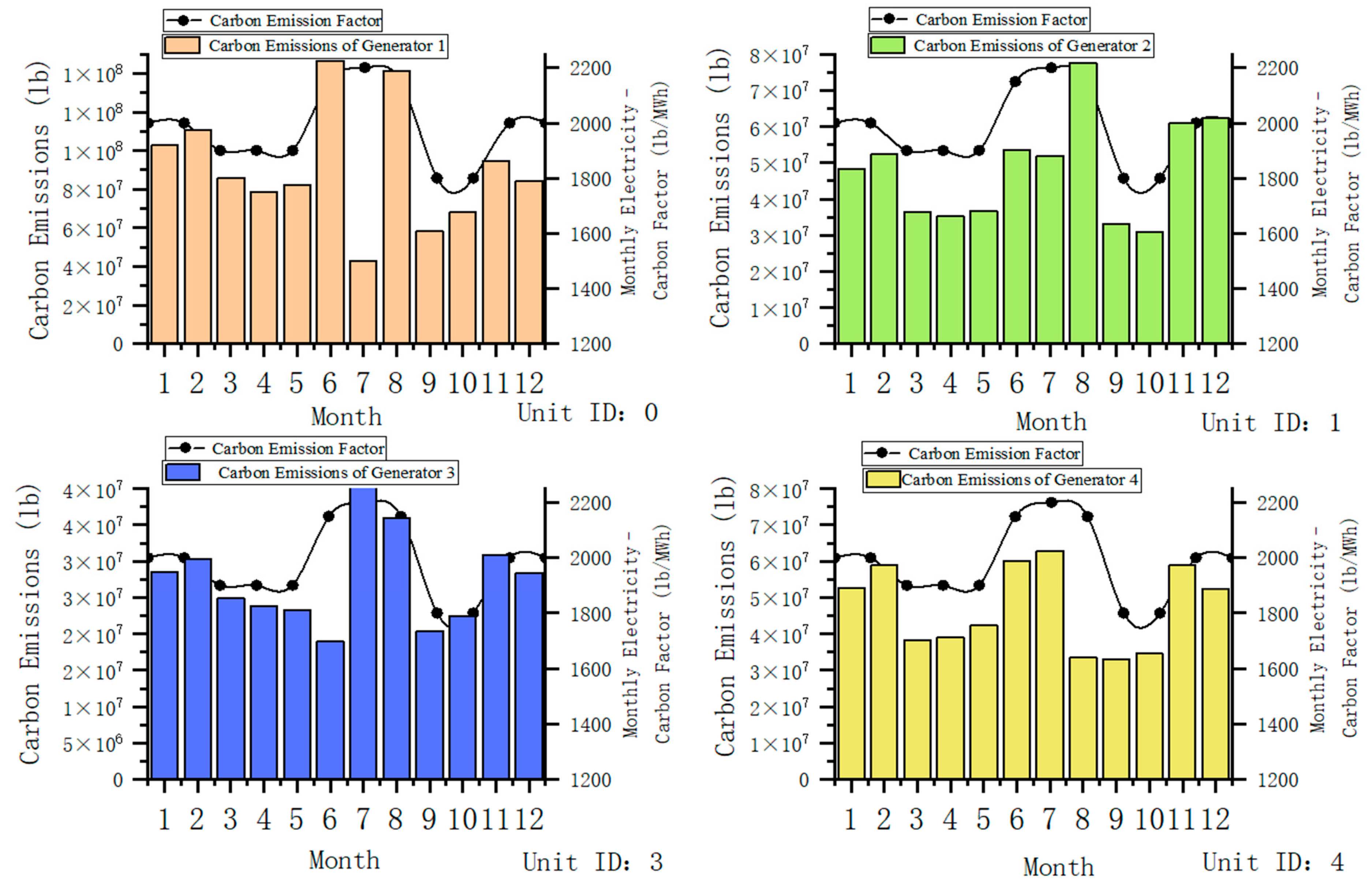
In the studied year, the total power generation of the plant reached 1,685,170 MWh, of which thermal generating units produced 1,345,370 MWh, accounting for 79.84% of the total generation. The four thermal units together emitted 2,651,565,000 pounds of carbon dioxide during the year. Unit 0, the largest and most heavily loaded generator, produced 561,630 MWh over the year. However, due to a three-week maintenance outage in November, its carbon emissions in that month were reduced by approximately 90,000,000 pounds, representing 7.95% of its annual total emissions.
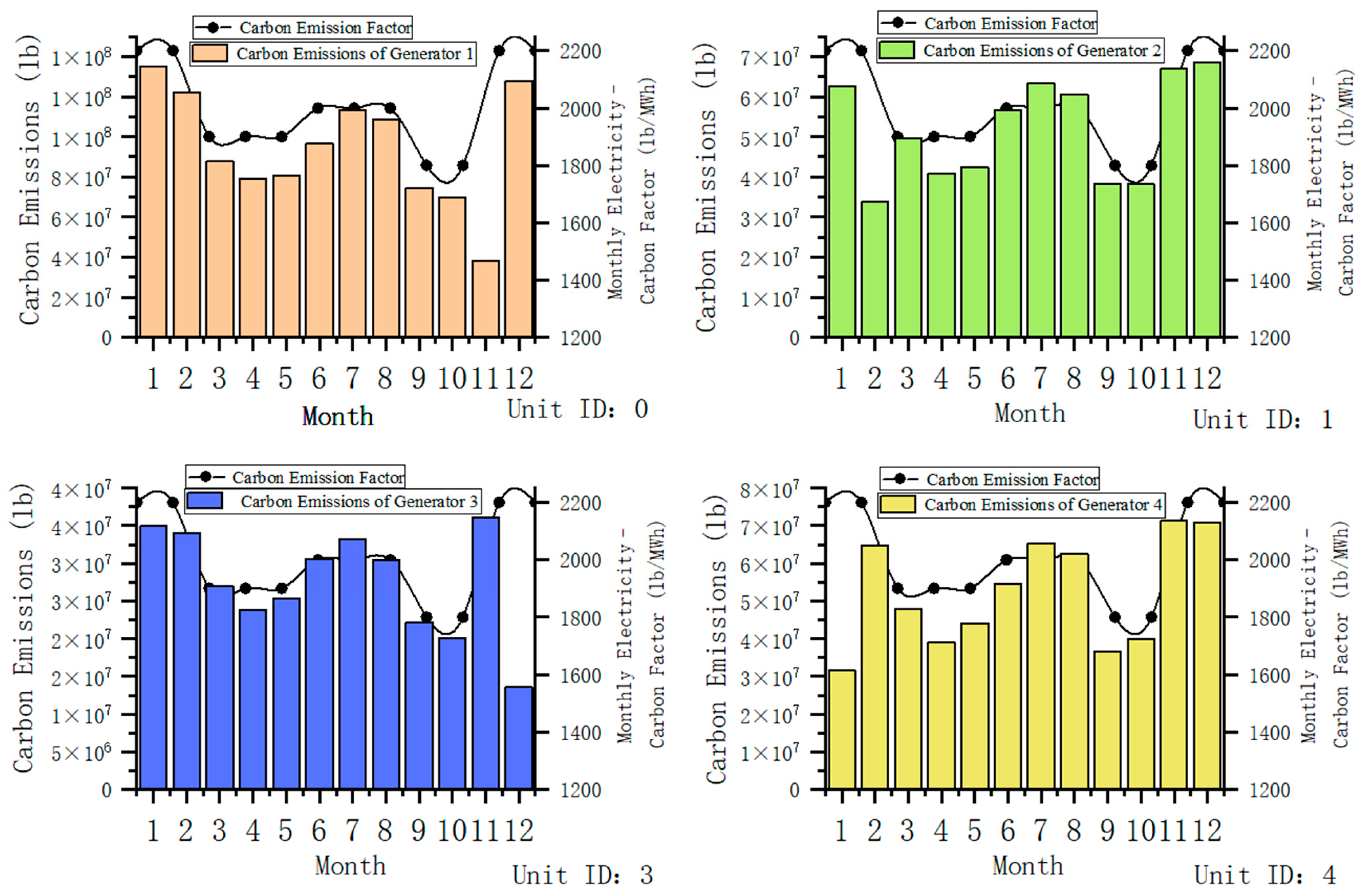
The carbon emission levels of the remaining generating units are illustrated in
Figure 4. However, the four thermal units differ in capacity and operating duration, all of them schedule maintenance during the winter months when the electricity–carbon factor is relatively high, in accordance with the risk-based carbon reduction constraints. Specifically, Units 1 and 4 were scheduled for maintenance in February and January, respectively, while Units 0 and 3 underwent maintenance in November and December.
The core strategy lies in aligning maintenance schedules with periods of high carbon intensity by integrating the electricity–carbon factor into the decision-making process. This approach ensures that maintenance outages occur at appropriate times to achieve emission reduction targets, reflecting environmental awareness in both system planning and operation. Consequently, this strategy not only effectively reduces carbon emissions but also maintains the overall operational efficiency of the system, demonstrating the practicality and effectiveness of the optimized power dispatch and carbon management framework in real-world applications.
3.3. Scenario Analysis
3.3.1. Analysis of Electricity–Carbon Factor Adjustment
To further evaluate the performance of the proposed model under different carbon emission conditions, a scenario analysis was conducted based on monthly variations in the electricity–carbon factor. Typically, the electricity–carbon factor is higher in winter due to the increased loading of thermal generating units, which leads to relatively higher carbon emissions. However, considering the seasonal fluctuations in energy demand, an additional scenario was designed by adjusting the electricity–carbon factor in summer to simulate a high-emission condition.
In this scenario, the summer electricity–carbon factor was increased to reflect the surge in electricity demand caused by high temperatures and the corresponding rise in thermal unit loading. The adjusted generation and transmission maintenance schedules of the power system under this scenario are presented in
Table 5.
After performing the second-stage transmission dispatch, the total system cost was calculated to be USD 26,672,756. Due to the implementation of the risk-based CVaR constraints, the optimized schedule keeps carbon-emission risk within the prescribed CVaR limits, so that the additional environmental penalty for exceeding the risk threshold becomes zero under the tested parameter settings. The remaining costs included a total operational cost of USD 26,431,200, generation maintenance cost of USD 22,000, transmission maintenance cost of USD 200, and a penalty of USD 219,356 for unmet power demand.
The carbon emission levels of the generating units are illustrated in
Figure 5. The total annual power generation of the plant reached 1,585,260 MWh, with thermal generating units producing 1,281,360 MWh. All four thermal units underwent maintenance from June to August. Compared with the previous case—when the electricity–carbon factor was higher in winter—the total annual power generation from thermal units decreased by 4.76%. Consequently, the total annual carbon emissions amounted to 2,521,924,000 pounds, representing a 4.88% reduction compared to the previous scenario.
Figure 5 shows the emission outcomes when the electricity–carbon factor is elevated during the summer period. The model responds by shifting major thermal unit maintenance—previously concentrated in winter—to June through August, aligning outage decisions with the newly defined high-carbon months. As a result, total annual emissions decrease by 4.88% compared with the baseline case, while the total operational cost remains nearly constant.
This scenario demonstrates the framework’s adaptive and policy-responsive capability: when carbon intensity or pricing signals change, maintenance timing automatically re-optimizes to minimize emission exposure. Practically, this feature allows system operators to incorporate dynamic carbon-price forecasts or policy-driven emission targets into maintenance planning, achieving low-carbon operation without requiring major infrastructure adjustments.
3.3.2. Effect of Varying Decision-Maker Confidence Levels
The confidence level plays a crucial role in the conditional tail-risk formulation, as it defines the probabilistic boundary that distinguishes normal operating outcomes from extreme, low-probability events. To further validate the applicability and robustness of the proposed model under different risk preferences, three comparative experiments were designed based on varying confidence levels. Specifically, three cases were considered: a conservative scenario (high confidence level), an aggressive scenario (low confidence level), and a baseline scenario (without CVaR constraint). These settings allow for an examination of how decision-makers adapt their maintenance and dispatch strategies in response to demand fluctuations and carbon emission uncertainty.
From a mathematical perspective, the effect of the confidence level
α on feasibility can be interpreted directly from the CVaR constraint. Denote by
L the random loss associated with carbon emissions (e.g., emission cost or tons of CO
2 in the tail), and let Γ be the prescribed risk bound. The constraint can be written in the generic form.
For a fixed loss distribution L and a fixed bound , is a non-decreasing function of : as increases, the measure focuses on a smaller, worse subset of scenarios and therefore becomes larger. Consequently, the feasible set of the optimization problem shrinks as α increases. In principle, for each combination of system parameters and risk bound , there exists an upper threshold beyond which no maintenance–operation strategy can simultaneously satisfy the demand, reliability, and CVaR constraints, and the problem becomes infeasible.
In the numerical experiments reported in this paper, we restrict attention to α in the range [0.85, 0.99]. Within this interval, both the 6-bus and IEEE 118-bus test cases admit feasible solutions: higher α values lead to more conservative maintenance and dispatch patterns, gradually increasing total cost and reducing emission volatility, but do not cause infeasibility. This behavior indicates that, for the tested systems and parameter settings, the chosen Γ values are still compatible with the physical and economic limits of the grid. In practical applications, α is typically selected in a similar range (e.g., 0.90–0.99), and should be calibrated jointly with Γ: excessively tight pairs (α, Γ) may render the problem infeasible, whereas moderately conservative choices can achieve a reasonable balance between cost, reliability, and environmental risk.
A higher confidence level corresponds to stricter risk constraints, effectively limiting losses under extreme conditions but potentially increasing system operating costs. Conversely, a lower confidence level allows greater flexibility, emphasizing economic efficiency and moderate risk tolerance. The scenario without CVaR constraints serves as a benchmark, revealing the system’s decision characteristics in the absence of explicit risk control. By comparing these three scenarios, the comprehensive impact of confidence level selection on maintenance scheduling and carbon emission control can be systematically assessed, thereby validating the model’s effectiveness in balancing risk and economic performance.
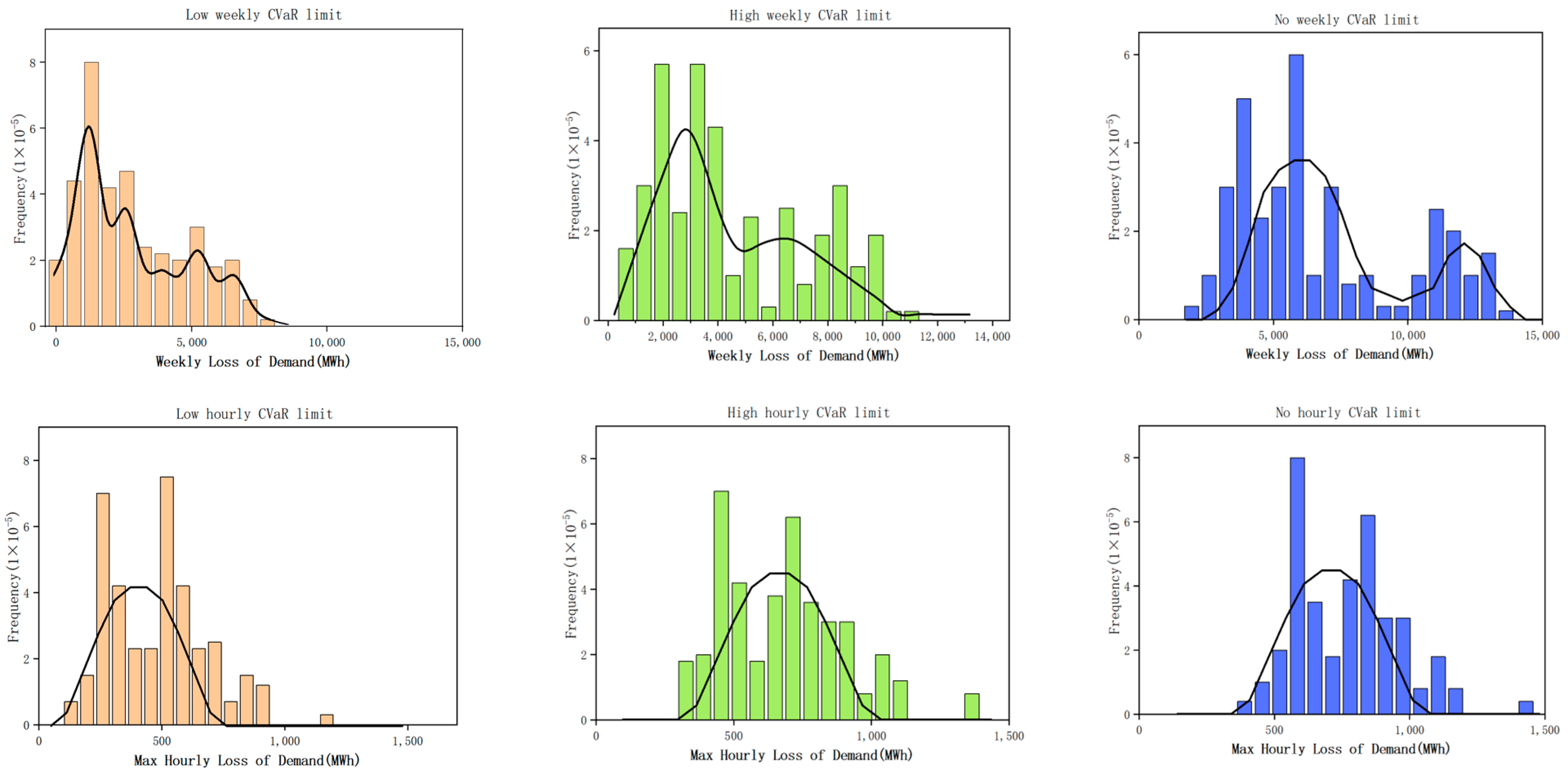
A representative week was selected to illustrate the influence of CVaR constraints on the loss distribution, as shown in
Figure 6. From left to right, as the CVaR constraint is gradually relaxed, the loss distribution shifts rightward. This indicates that when CVaR constraints are tightened, losses under extreme scenarios are restricted, while losses under all other scenarios decrease—reflected by the overall rightward movement of the density curve.
The results indicate that when the confidence level was reduced below 0.91%, the rGTMS framework failed to produce a feasible solution because the imposed tail-risk restrictions became overly stringent. Conversely, as the confidence level increased—effectively relaxing the restriction—certain weeks exhibited demand shortfalls exceeding the lower bound of the confidence interval. Further relaxation of the risk threshold led to even greater unmet demand under adverse conditions. When the weekly conditional tail-risk constraint was entirely removed, several weeks experienced substantial load curtailments, thereby demonstrating the rGTMS model’s effectiveness in moderating extreme-risk events in power system maintenance scheduling.
As the CVaR confidence level increases, the model places greater emphasis on controlling high-emission tail events, resulting in a more conservative operational strategy. Quantitatively, when the confidence level is raised from α = 0.85 to α = 0.99, the total annual carbon emissions decrease by approximately 6.1%, while the total cost increases by only 1.8%. This indicates that the model achieves a disproportionately larger reduction in emissions compared with the associated increase in cost. The higher cost primarily originates from more frequent reliance on moderate-cost units and additional reserve commitments, whereas the emission reductions are driven by lower dispatch from high-carbon thermal units during critical hours. These results demonstrate that increasing the confidence level strengthens environmental performance with only a modest economic penalty, offering a favorable cost–emission trade-off for decision-makers seeking low-carbon operation.
Subsequently, the weekly risk constraint was partially relaxed, and the hourly confidence level for the conditional tail-risk measure was adjusted from 18.7% (representing a stricter bound) to 20% (a more relaxed condition). These confidence levels were selected according to the maximum expected load observed across all hourly intervals within each week, ensuring consistency in evaluating demand variability and carbon exposure across different temporal resolutions.
It is also worth noting that the proposed framework exhibits robustness with respect to potential distributional misspecification. If the actual stochastic behavior of renewable outputs or demand exhibits heavier tails or different skewness than the assumed Weibull or Normal distributions, the CVaR-based risk constraints in the lower layer effectively limit exposure to extreme scenarios by bounding the expected tail losses. In addition, the structure of the model allows the probability distributions to be replaced by empirical distributions or non-parametric bootstrap sampling without altering the optimization formulation, enabling further enhancement of robustness when real-world data are available.
3.3.3. Analysis for the Modified IEEE 118-Bus System
To further validate the scalability and practical applicability of the proposed framework, a modified IEEE 118-bus test system was examined. The benchmark dataset was adapted from the original IEEE source data and the supplementary dataset in [
29]. The system configuration includes 36 thermal generating units, 10 wind farms, and 8 solar power plants, which collectively supply electricity to 118 demand buses interconnected by 186 transmission lines.
To assess computational scalability, we additionally examined the runtime on the two benchmark systems. On the 6-bus case, the proposed decomposition algorithm solves all weekly scenarios within approximately 18 min, reflecting the small problem size and limited network constraints. When applied to the IEEE 118-bus system, the runtime increases to 6 h, but grows approximately linearly with the number of scenarios and weekly subproblems, confirming that the parallel cut-generation strategy effectively controls computational growth. This behavior indicates that the framework remains computationally tractable even for large-scale grids with high-dimensional uncertainty.
The maintenance duration for generating units varies according to equipment characteristics and operational workload, ranging from two to eight weeks. Each transmission element requiring preventive maintenance is assigned a fixed outage period of one week throughout the annual scheduling horizon. The maintenance plan of generating units is shown in
Table 6, and the maintenance plan of transmission lines is shown in
Table 7. This large-scale test case enables a comprehensive evaluation of the model’s performance in coordinating multi-energy generation and transmission maintenance under complex network conditions and diverse renewable penetrations.
After performing the second-stage transmission dispatch, the total system cost was calculated to be $369,668,200. Due to the inclusion of the risk-based CVaR constraint, the optimized schedule keeps carbon-emission risk within the prescribed CVaR limits, so that the additional environmental penalty for exceeding the risk threshold becomes zero under the tested parameter settings. The remaining costs consisted of a total operational cost of $336,414,600, generation maintenance cost of $25,490,000, transmission maintenance cost of $220,000, and a penalty of $7,543,600 for unmet power demand.
During the analyzed year, the total power generation of the system reached 23,592,380 MWh, of which thermal generating units produced 17,235,180 MWh, accounting for 73.05% of the total generation. The thermal units emitted a total of 34,470,345,000 pounds of carbon dioxide over the year. Through the proposed scheduling model, the annual carbon emissions of the generating units were reduced by approximately 11,075,322,000 pounds, representing a 32.13% decrease in total emissions.
To further evaluate the robustness of the proposed framework, a brief sensitivity analysis was performed on key model parameters. First, the maintenance cost coefficient was varied within a ±30% range from its nominal value. The results show that while total system expenditure increases almost linearly with higher maintenance costs, the total carbon emissions and CVaR-based risk levels remain nearly unchanged, indicating that the emission-control mechanism is largely insensitive to direct cost variations. This demonstrates that the model’s environmental performance is primarily governed by the embedded risk constraints rather than by absolute maintenance expenses.
In addition, the CVaR confidence level (α) was adjusted between 0.85 and 0.99 to examine its effect on system performance. As the confidence level increases, the model becomes more risk-averse, producing more conservative operational strategies with slightly higher total costs but significantly lower emission volatility. When α exceeds 0.95, the marginal benefit in emission reduction diminishes, suggesting that this range represents a practical balance between cost efficiency and environmental security.
Overall, these parameter perturbations confirm that the model maintains convergence and stable scheduling outcomes under varying assumptions, validating its robustness and scalability for different decision-maker preferences and economic settings.
4. Conclusions
This study addresses the joint maintenance coordination problem for power generation and transmission systems under uncertainty, with an emphasis on carbon emission mitigation. A bi-layer stochastic mixed-integer optimization framework was developed to integrate preventive maintenance scheduling and operational dispatch decisions within a unified risk-sensitive, carbon-aware formulation. The proposed model incorporates CVaR constraints to jointly control economic and emission-related risks, ensuring a balanced trade-off between reliability, cost efficiency, and environmental responsibility.
The proposed framework was validated using both 6-bus and IEEE 118-bus benchmark systems. Quantitative results confirm its strong performance: on the large-scale IEEE 118-bus system, the optimized strategy reduced total annual CO2 emissions by 32.13%, achieving a total system cost of USD 369.67 million with zero carbon penalties. On the smaller 6-bus system, a 4.88% emission reduction was observed under the adjusted summer carbon-intensity scenario, while maintaining nearly constant operational costs.
The computational study further shows that the parallel cut-generation decomposition algorithm converged within 20 iterations, effectively reducing the optimality gap faster than the aggregated-cut approach. The framework remained stable across different CVaR confidence levels (0.85–0.99), confirming its robustness against risk-parameter variations.
In addition to the methodological contributions, this study also emphasizes practical relevance. Model parameters—such as maintenance time, shutdown window, and carbon factor—are all selected within the consistent operating range of public utility practices, ensuring the practicality of the project.
While the current validation relies on benchmark systems to ensure reproducibility and scalability, future research will extend the framework to real-world datasets collected from industrial partners. The next phase will focus on empirically calibrating renewable generation and demand uncertainty distributions using actual operational data, integrating dynamic carbon pricing mechanisms, and conducting a pilot implementation in a regional grid maintenance planning platform to evaluate computational performance and decision accuracy under real operating constraints. These extensions aim to bridge the gap between theoretical optimization and practical engineering application, demonstrating the proposed framework’s potential for large-scale, low-carbon, and risk-aware power system maintenance management.