


Abstract
With the increasing penetration of distributed energy resources (DERs) and the rapid development of active distribution networks, the traditional centrally controlled operation mode can no longer meet the flexibility and autonomy requirements under the multi-dimensional coupling of sources, networks, loads, and storage. To achieve regional energy self-balancing and autonomous operation, this paper proposes a partitioned configuration method for energy storage systems (ESSs) in energy-autonomous distribution networks based on autonomous unit division. First, the concept and hierarchical structure of the energy-autonomous distribution network and its autonomous units are clarified, identifying autonomous units as the fundamental carriers of the network’s autonomy. Then, following the principle of “tight coupling within units and loose coupling between units,” a comprehensive indicator system for autonomous unit division is constructed from three aspects: electrical modularity, active power balance, and reactive power balance. An improved genetic algorithm is applied to optimize the division results. Furthermore, based on the obtained division, an ESS partitioned configuration model is developed with the objective of minimizing the total cost, considering the investment and operation costs of ESSs, power purchase cost from the main grid, PV curtailment losses, and network loss cost. The model is solved using the CPLEX solver. Finally, a case study on a typical multi-substation, multi-feeder distribution network verifies the effectiveness of the proposed approach. The results demonstrate that the proposed model effectively improves voltage quality while reducing the total cost by 20.89%, ensuring optimal economic performance of storage configuration and enhancing the autonomy of EADNs.
1. Introduction
With the large-scale integration of renewable energy and distributed generation, distribution systems are undergoing a profound transformation from unidirectional power supply to bidirectional interaction. The stochastic and fluctuating outputs of high-penetration distributed photovoltaic (PV) and wind power make the power flow characteristics of distribution networks increasingly complex, leading to challenges such as voltage fluctuations, reverse power flows, and insufficient timeliness of control [1,2]. The conventional operation mode dominated by centralized scheduling and global control can no longer meet the flexibility and response requirements under high renewable energy penetration. Meanwhile, the continuous development of distributed generators, energy storage systems (ESSs), and controllable loads provides new physical foundations for achieving local energy self-balancing and autonomous operation in distribution systems [3,4].
Against this background, the concept of the energy-autonomous distribution network (EADN) has emerged. It aims to build a local autonomous system with self-perception, self-regulation, and self-balancing capabilities by deeply integrating distributed generation, energy storage, controllable loads, and distribution network infrastructure [5,6,7]. Unlike traditional active distribution networks that rely on centralized dispatch, EADNs emphasize coordinated operation and hierarchical autonomous control of multiple energy components within clearly defined physical boundaries, enabling the system to maintain local energy balance and stable operation under external disturbances or resource fluctuations [8,9,10]. To realize such autonomous characteristics, the key lies in establishing a coordinated mechanism between structural partitioning and resource allocation. First, autonomous units should be scientifically divided according to electrical coupling strength and energy complementarity, forming a hierarchical network structure characterized by “tight coupling within units and loose coupling between units.” Second, based on the division results, energy storage systems should be properly configured to achieve spatiotemporal energy balance within each unit and flexible power sharing among units, thereby enhancing local autonomy while ensuring overall economic efficiency and operational performance of the system.
In terms of autonomous structure partitioning, existing studies mostly employ complex network theory and community detection algorithms to realize network regionalization by analyzing the electrical coupling relationships among nodes. References [11,12,13] proposed network partitioning methods based on functional community structures or electrical modularity to identify closely correlated node clusters within distribution networks. Reference [14] introduced the concept of regional autonomy capability and developed a hierarchical optimization and scheduling model to achieve coordinated control among autonomous regions. References [15,16,17] regarded autonomous units as basic operational entities of distribution networks, exploring local autonomy structures such as autonomous feeder areas and microgrids. However, most of these studies focus on partitioning strategies from the operational control perspective, lacking systematic quantitative indicators and optimization methods to characterize the energy balance features of autonomous units.
Regarding the optimal configuration of energy storage systems, previous studies have mainly focused on siting, sizing, and economic optimization. References [18,19] addressed the uncertainties of load and renewable generation by proposing energy storage planning models based on load forecasting and robust optimization, achieving coordinated optimization of investment and operational costs through two-stage or scenario-based approaches. References [20,21] developed planning models considering frequency security constraints and multi-scenario benefits of independent energy storage, aiming to enhance local self-restoration capability and economic performance. References [22,23,24] further incorporated extreme weather risks, flexible control of power electronics in active distribution networks, and various energy storage technologies to propose optimization approaches for resilience enhancement and multi-energy coordination. Although these methods improve economic efficiency and operational stability to some extent, most rely on centralized planning assumptions and fail to consider the spatial distribution and inter-unit energy complementarity of storage systems, thus lacking the regional coordination characteristics of EADNs.
In summary, existing studies have explored partitioned operation and planning of distribution networks by forming supply-sufficient areas, microgrids, or autonomous regions, and have investigated the coordinated allocation of distributed generation and energy storage resources. These works have provided valuable insights into network partitioning and resource planning, typically focusing on topological characteristics, reliability-driven criteria, or centralized economic optimization objectives. However, most existing partitioning-based planning approaches treat network partitioning and energy storage configuration as loosely coupled or sequential problems. The partitioning process is often driven mainly by electrical topology or reliability considerations, while the subsequent energy storage planning is conducted in a centralized manner, without explicitly embedding the energy self-balancing capability of each partition into the partitioning model itself. As a result, the obtained partitions may not be well aligned with the spatiotemporal characteristics of source–load balance, and their effectiveness in supporting autonomous operation through energy storage deployment is not fully exploited.
In this context, this paper focuses on developing an engineering-oriented coordinated method that explicitly links autonomous unit partitioning with energy storage system configuration. By jointly considering electrical modularity, active power balance, and reactive power balance in the partitioning stage, the proposed approach establishes a direct modeling connection between the internal energy self-balancing capability of autonomous units and subsequent ESS siting and sizing decisions. This coupling mechanism distinguishes the proposed method from existing partitioning-based planning frameworks and provides a practical pathway for enhancing autonomy-oriented energy storage configuration in distribution networks.
The main contributions of this paper are summarized as follows:
- An indicator-driven autonomous unit partitioning method is developed for energy-autonomous distribution networks. By jointly considering electrical modularity, active power balance, and reactive power balance, the proposed method identifies autonomous units from both topological compactness and energy self-balancing perspectives.
- Based on the obtained autonomous unit structure, a partitioned energy storage system configuration model is formulated. The model explicitly links the autonomous unit partitioning results with ESS siting and sizing decisions, enabling energy storage planning to be coordinated with the internal energy balance characteristics of each unit rather than relying solely on centralized optimization.
- The effectiveness of the proposed coordinated partitioning and ESS configuration method is validated through a case study on a typical multi-substation, multi-feeder distribution network. Simulation results demonstrate that the proposed approach can effectively reduce network losses, improve voltage profiles, and enhance local energy autonomy while achieving improved economic performance.
The remainder of this paper is organized as follows. Section 2 introduces the concept and architecture of energy autonomous distribution networks. Section 3 presents the autonomous unit partitioning method and indicator system. Section 4 formulates the ESS configuration optimization model. Section 5 provides the case study and discusses the simulation results. Section 6 concludes the paper and outlines future research directions.
2. Energy-Autonomous Distribution Network
The EADN can be defined as a special form of distribution network that emerges when the source–network–load–storage elements develop to a certain extent. It refers to a local autonomous system with clearly defined physical boundaries, capable of self-balancing, self-management, and self-regulation. The EADN can comprehensively perceive the states of all source–network–load–storage elements. Internally, it achieves autonomous management through its control center, while externally, it interacts with the upper-level grid dispatch based on tie-line power exchange curves or accumulated exchanged energy. It features “single controllability to the outside and tight autonomy within the inside.”
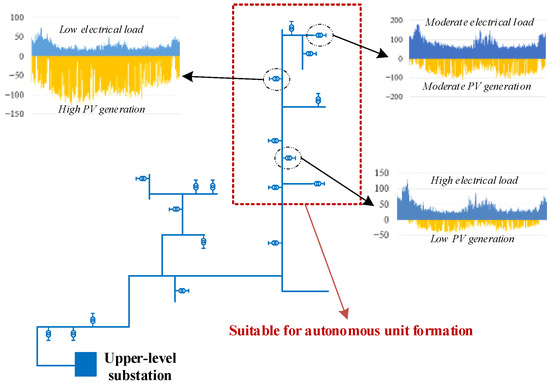
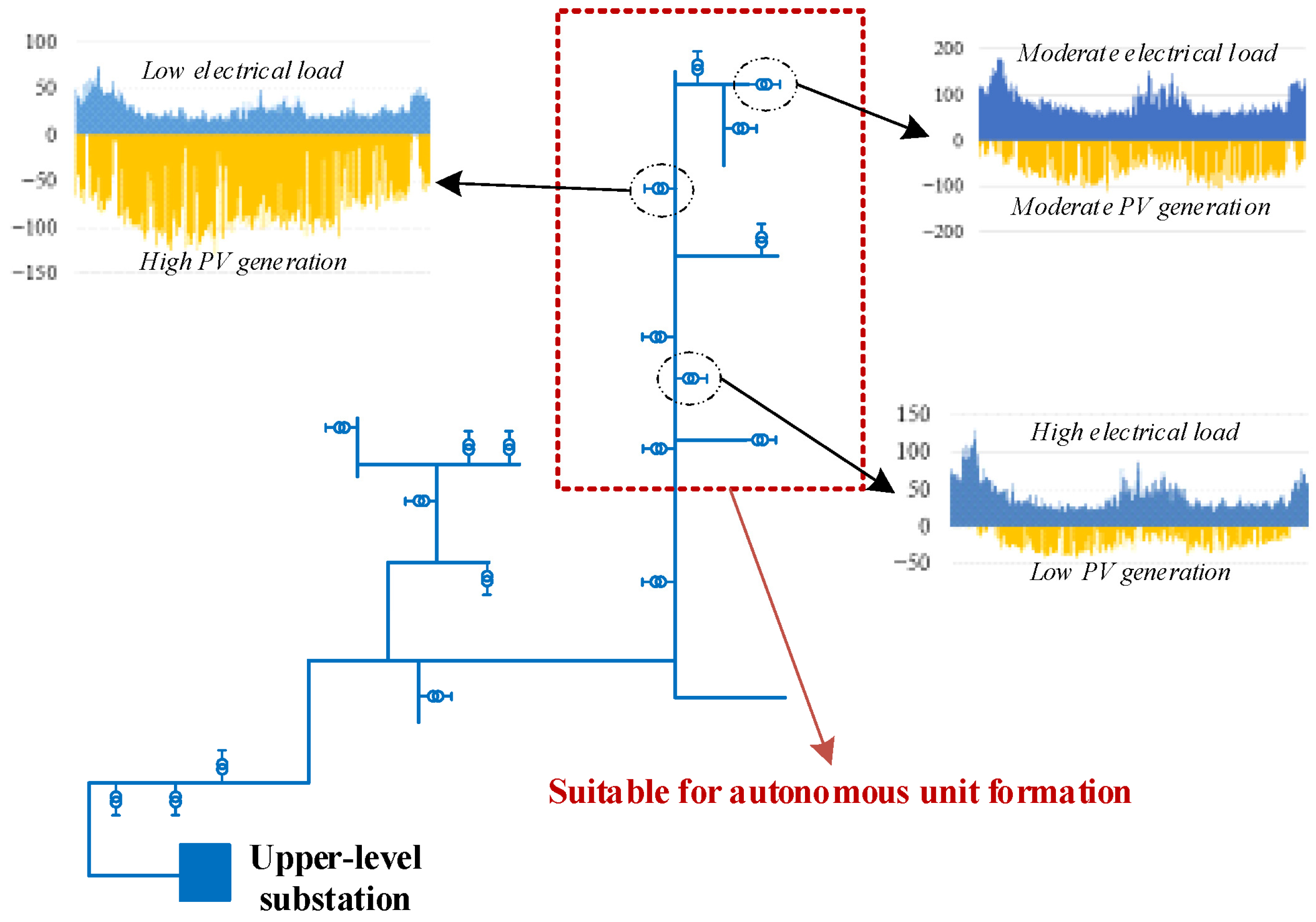
The EADN is composed of autonomous units. Each autonomous unit can consist of various elements such as distributed generators, controllable reactive power sources, flexible loads with demand response capability, inflexible loads without demand response capability, and energy storage systems. Considering the complementarity between source–load characteristics of different feeders or distribution areas, and the shared nature of storage resources, electrical topology can be taken into account to aggregate elements into local autonomous units that are internally self-governed yet externally controllable. Depending on the types and capacities of controllable elements included, these units exhibit different external characteristics and levels of autonomy. The formation of autonomous units is illustrated in Figure 1.
Figure 1.
Formation of autonomous units.
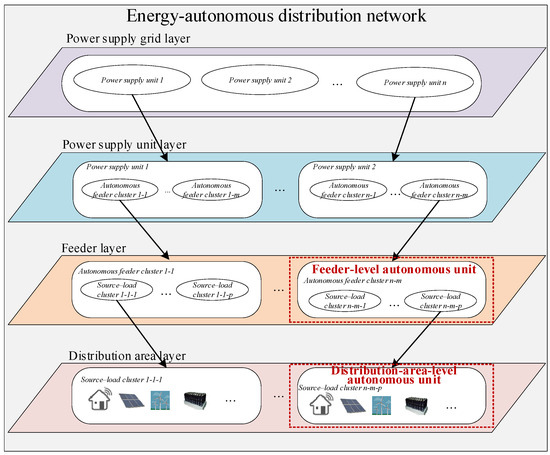
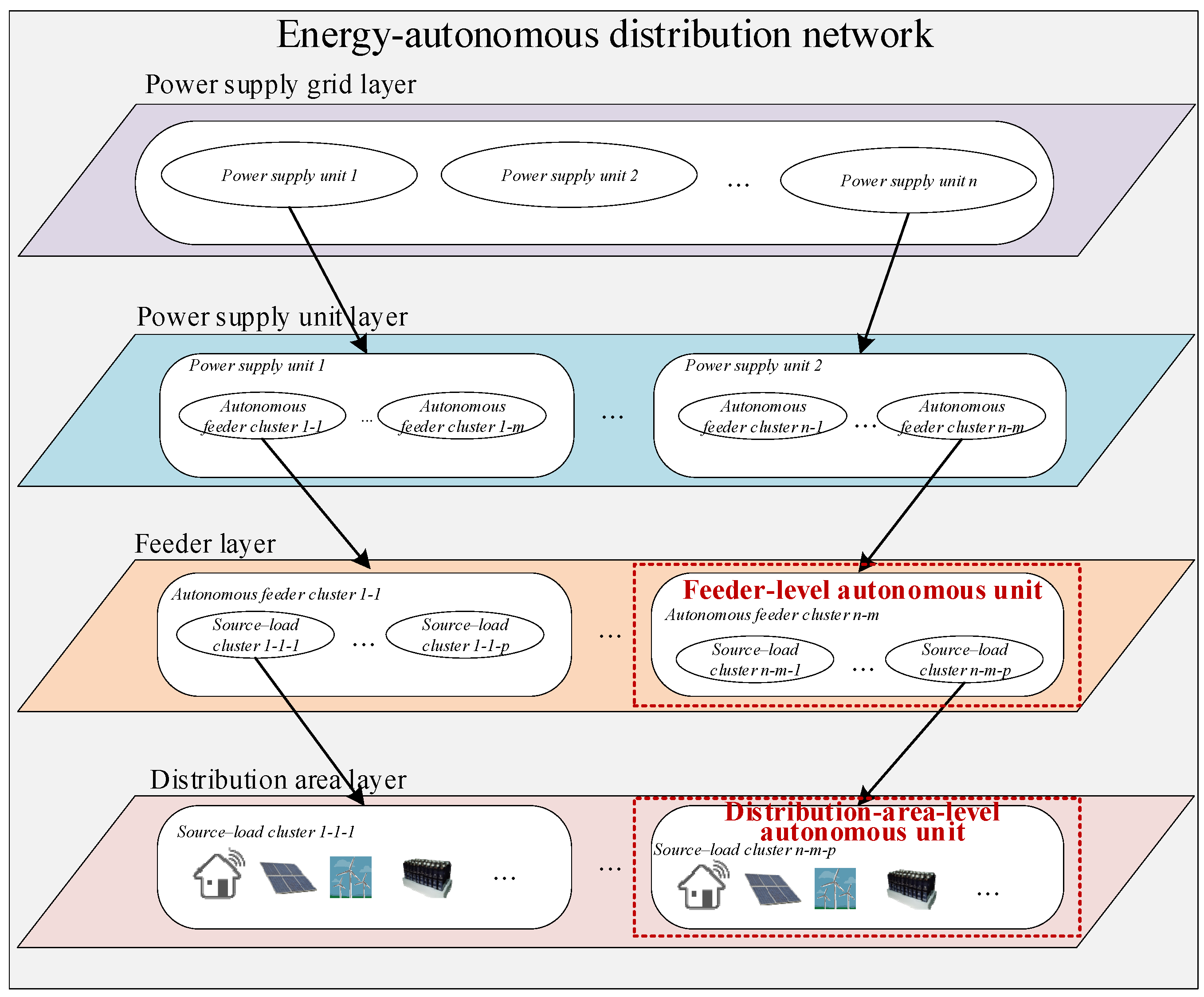
Based on the above analysis, an autonomous unit is defined as an aggregation of source–load–storage resources within an autonomous distribution network. According to the geographical distribution of source and load, differentiated reliability requirements, and local resource endowments, the distribution network is partitioned into several autonomous units with distinct external characteristics. The goal is to achieve maximal internal power and energy balance and ensure self-management and control within each unit. The schematic structure is illustrated in Figure 2.
Figure 2.
Composition of the EADN.
Autonomous units at different hierarchical levels play crucial roles. At the basic level of distribution areas, autonomous units exhibit a unique organizational form, where multiple flexible resources are aggregated in an orderly manner according to specific rules, forming so-called source–load aggregation units. These units are interconnected via advanced communication and control technologies and operate collaboratively under predefined rules to achieve energy supply–demand balance and optimal scheduling within the area.
For instance, when solar PV generation is abundant, the surplus energy can be stored in energy storage systems or partially curtailed by reducing the power of controllable loads through intelligent control strategies to prevent energy waste. Conversely, when PV generation is insufficient, the storage systems can discharge energy or increase controllable load power to meet local demand. This design of source–load aggregation units not only enhances the flexibility and efficiency of local energy utilization but also improves the entire grid’s hosting capacity for distributed energy resources.
At the feeder level, the structure of autonomous units becomes more complex. It is formed by aggregating multiple source–load aggregation units, with the core objective of achieving power and energy balance along the feeder. As the key link between substations and user areas, the feeder’s power balance is vital to the stable operation of the entire distribution network. To achieve this goal, feeder-level autonomous units must coordinate the operation of all source–load aggregation units. By monitoring the generation output, load demand, and storage status of each distribution area in real time, the feeder-level unit can dynamically adjust power allocation and optimize energy flow paths. For example, when a distribution area exhibits power surplus, its excess energy can be transferred via feeders to other areas with insufficient power, thus realizing energy complementarity and balance at the feeder level. This cross-area coordination mechanism effectively reduces feeder power fluctuations, enhances grid stability, lowers network losses, and improves overall energy utilization efficiency.
An EADN is a higher-level system composed of multiple autonomous units. It represents a special form of distributed intelligent grid characterized by high autonomy and flexibility. Typically, an EADN covers a certain geographic area, such as an industrial park, a town, or a county. Within this area, autonomous units cooperate to achieve stable operation and optimized energy allocation of the local grid. The core advantage of an EADN lies in its ability to fully utilize local distributed energy resources, thereby reducing dependence on the external bulk power grid and enhancing the reliability and security of energy supply. Meanwhile, through advanced intelligent control technologies, an EADN can rapidly respond to both internal and external disturbances—such as the intermittent fluctuations of distributed generation and sudden load variations—enabling autonomous fault isolation and service restoration. For example, in an EADN, when a fault occurs in one autonomous unit, other units can quickly adjust their operating states and redistribute power to maintain normal operation of the local grid without relying on external grid support. This highly autonomous operation mode not only improves the operational efficiency and reliability of local grids but also provides a new paradigm and practical reference for the development of distributed intelligent power systems.
It should be clarified that the concept of autonomy adopted in this paper is defined at the planning level, focusing on the energy self-balancing capability of autonomous units under normal operating conditions. The proposed autonomous unit is not intended to represent a fully islanded microgrid capable of independent operation under all contingencies, but rather a planning abstraction that enhances local energy self-sufficiency and reduces dependence on upstream power support.
3. Method for Autonomous Unit Division in Energy-Autonomous Distribution Networks
3.1. Division Principle
The autonomous units should be optimally divided based on the principle of “tight coupling within units and loose coupling between units.” Each autonomous unit should include multiple types of resources such as distributed generation (DG), demand response loads, and energy storage systems. Each unit is expected to have its own energy management system and the capability to exchange power with external networks. While maintaining internal autonomy, each unit should also exhibit stable external characteristics to reduce the complexity of system dispatch. The division principles of autonomous units can be summarized as follows:
- Electrical level: The tightness between nodes is evaluated by the electrical coupling strength (ECS), and the compactness within each autonomous unit is assessed using electrical modularity.
- Geographical level: The spatial distance between source–load nodes should not exceed the permissible supply distance, ensuring that geographically adjacent nodes are grouped together.
- Operational level: The division is evaluated using active and reactive power balance indicators. A higher balance degree indicates stronger self-balancing capability and a more reasonable partition of autonomous units.
3.2. Division Indicator System
To enable efficient decoupling and independent operation of autonomous units, a quantitative indicator system that comprehensively reflects the electrical correlations and energy autonomy characteristics within each unit must be established. Since autonomous units should have well-defined electrical boundaries as well as strong self-balancing capability in terms of energy flow, electrical connectivity alone is insufficient to characterize their autonomy. Therefore, this paper constructs an indicator system from three aspects—electrical modularity, reactive power balance, and active power balance—to comprehensively reflect both electrical compactness and energy independence, thereby providing a quantitative basis for the subsequent optimization of autonomous unit division.
- (1)
- Electrical Modularity Indicator
The physical characteristics of the distribution network are modeled using the electrical modularity QE and ECS indicators. The ECS reflects the transmission capability between nodes based on line transfer capacity and equivalent admittance, while the QE measures the quality of the autonomous mesh units formed in the division process. A well-divided energy-autonomous active distribution network exhibits higher internal connection density within each autonomous mesh than a randomly connected system. Hence, a higher QE value indicates tighter electrical connections among internal nodes and a better-structured distribution network. The electrical modularity indicator is calculated using Equations (1)–(9). Structurally, nodes within each autonomous mesh are tightly connected, whereas connections between meshes are loose, facilitating regional operation and management.
where denotes the electrical modularity; represents the adjacency matrix; m is the total weight of all edges in the network; and denotes the electrical coupling strength of node i; denotes the electrical coupling strength between nodes i and j; and are proportional factors satisfying 0 ≤ (, ) ≤ 1 and + = 1; and represent the per-unit values of the equivalent admittance and transfer capacity of line ij, respectively; and are the average values of equivalent admittance and transfer capacity; denotes the equivalent impedance of line ij; is the element in the i-th row and j-th column of the impedance matrix; represents the power transfer capacity between nodes i and j; denotes the maximum transfer capacity of line ij; and is the power transfer distribution factor of line ij.
- (2)
- Reactive power balance indicator
Under the maximum renewable energy penetration scenario—when voltage violations are most severe—the reactive power supply capability within each autonomous mesh should satisfy local reactive balance as much as possible to minimize inter-unit reactive power exchange. The reactive power balance indicator is expressed as follows:
where denotes the reactive balance of unit i; represents the reactive balance index; c is the number of autonomous meshes; is the maximum reactive power supply within the unit, including the contributions from reactive compensation devices and partial inverter capability; is the total reactive demand within the unit.
- (3)
- Active power balance indicator
Regarding active power matching, the internal self-consumption capability of each autonomous mesh should be fully utilized to reduce external active power exchanges. Based on the time-varying output characteristics of nodes, source–source and source–load complementarity among renewable generators and loads are exploited to achieve power balance within autonomous meshes and mitigate the fluctuation and intermittency of renewable outputs. The active power balance indicator is given by:
where denotes the active power balance degree of unit i; represents the net power characteristics of unit i under typical time-varying scenarios; T is the time horizon of the scenario; and is the active power balance index.
Combining the above indicators, the comprehensive indicator for autonomous unit division in the distribution network is expressed as follows:
where is the comprehensive indicator of autonomous unit division, and , , and are the corresponding weighting coefficients.
In this study, the weighting coefficients , , and are selected based on engineering considerations to balance structural compactness and energy self-balancing capability of autonomous units. Electrical modularity is slightly emphasized ( = 0.4) to ensure that the obtained autonomous units exhibit strong internal electrical coupling and clear physical boundaries, which is a prerequisite for stable autonomous operation. Active power balance and reactive power balance are assigned equal weights ( = 0.3 and = 0.3), reflecting their comparable importance in supporting local energy self-consumption and voltage regulation within autonomous units. It should be noted that these weights are not intended to represent universally optimal values, but rather a reasonable compromise for planning-stage analysis that avoids excessive dominance of either topological or power balance factors.
3.3. Division Method
After establishing the indicator system incorporating electrical modularity, active power balance, and reactive power balance, an optimization process is required to determine the node affiliations and achieve the optimal division of autonomous units. However, the problem involves multi-objective coupling, multiple constraints, and complex network topology, exhibiting strong nonlinearity and combinatorial explosion characteristics. Traditional analytical or rule-based methods cannot ensure both global optimality and computational efficiency. Therefore, it is necessary to employ intelligent optimization algorithms with global search capability and adaptive evolutionary characteristics to solve the model.
Considering the multi-objective nature and discreteness of the problem, a genetic algorithm (GA) is adopted to solve the autonomous unit division model [25,26,27]. The GA simulates the natural “survival of the fittest” mechanism, enabling simultaneous optimization of multiple objectives and avoiding local optima. It is well-suited for complex combinatorial optimization problems such as power network division. The comprehensive autonomous unit division indicator is used as the fitness function, and the GA output corresponds to the optimal division result.
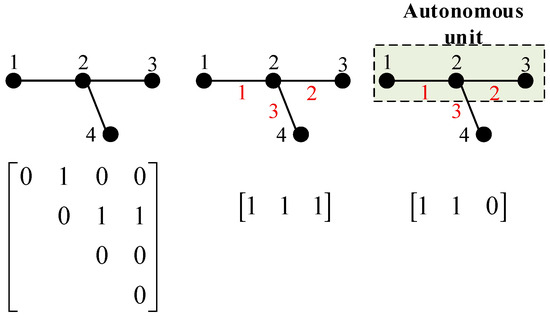
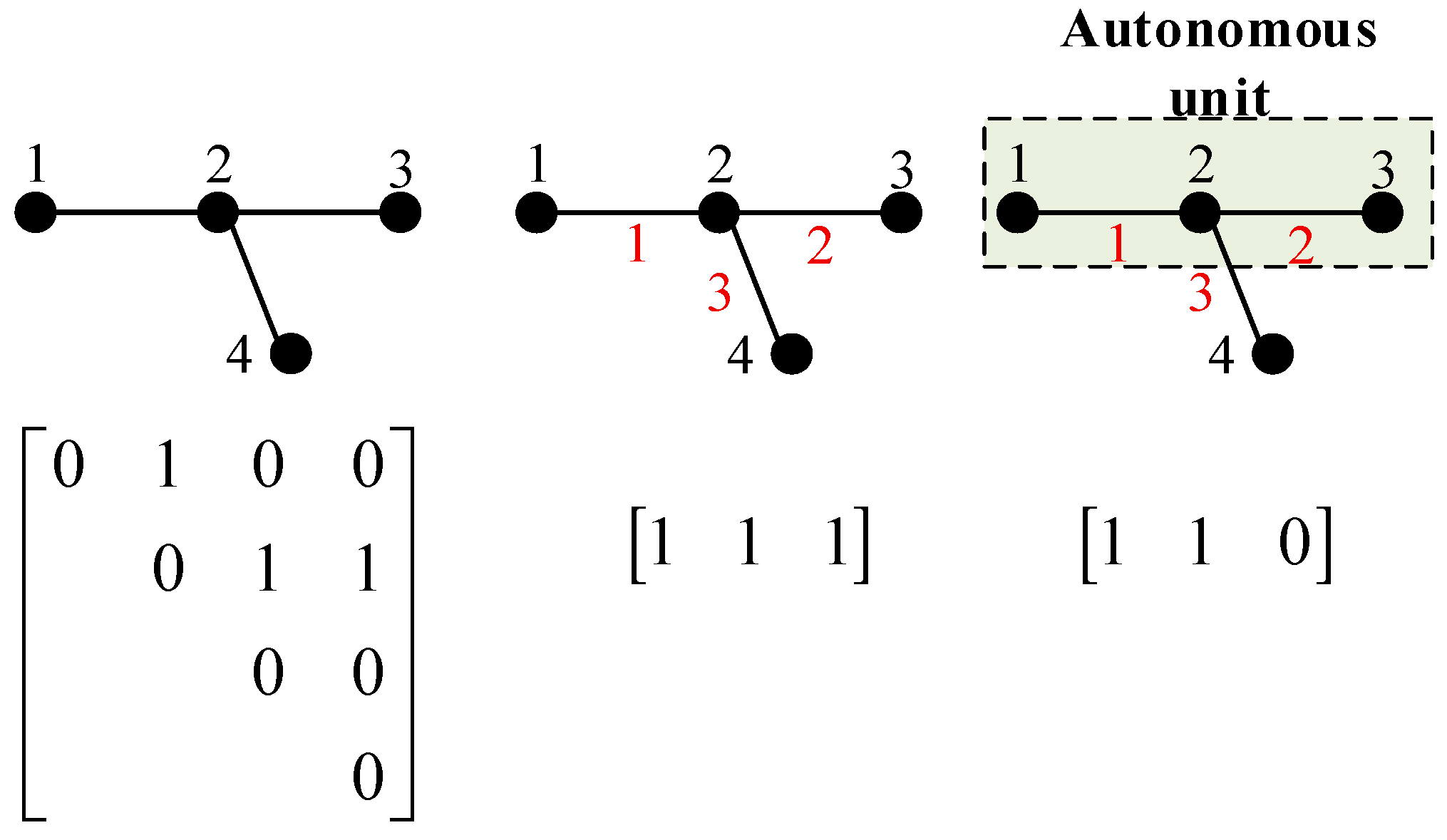
To satisfy the basic requirements of the GA, the optimization objects must first be encoded. According to the principles of discrete mathematics, the topology of a distribution network can be represented by an n-dimensional adjacency matrix. Since the distribution system typically exhibits a radial structure without loops, the adjacency matrix is a sparse, symmetric binary (0–1) matrix. The connections between nodes in the matrix correspond to the presence of distribution lines; therefore, the adjacency matrix can be reduced to a one-dimensional row vector to realize chromosome encoding. Specifically, the upper-triangular part of the adjacency matrix is first extracted, and all “1” elements are scanned row by row and column by column to obtain line information. Second, each line is sequentially indexed and stored in a row vector. Finally, the connection or disconnection of corresponding edges is controlled through the binary (0–1) values in the vector. The encoding process is illustrated in Figure 3.
Figure 3.
Chromosome encoding scheme for autonomous unit division.
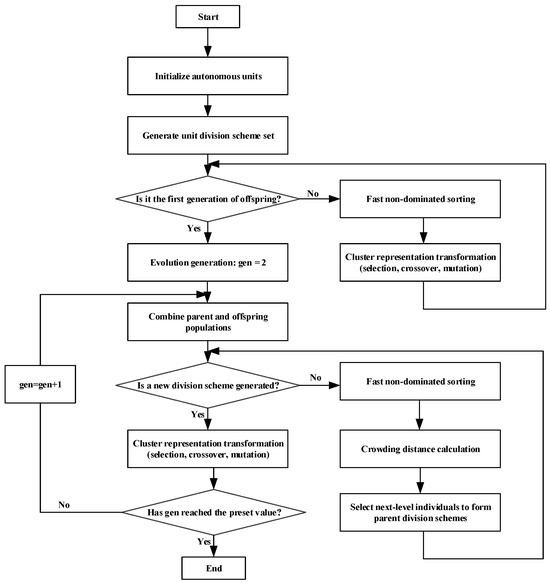
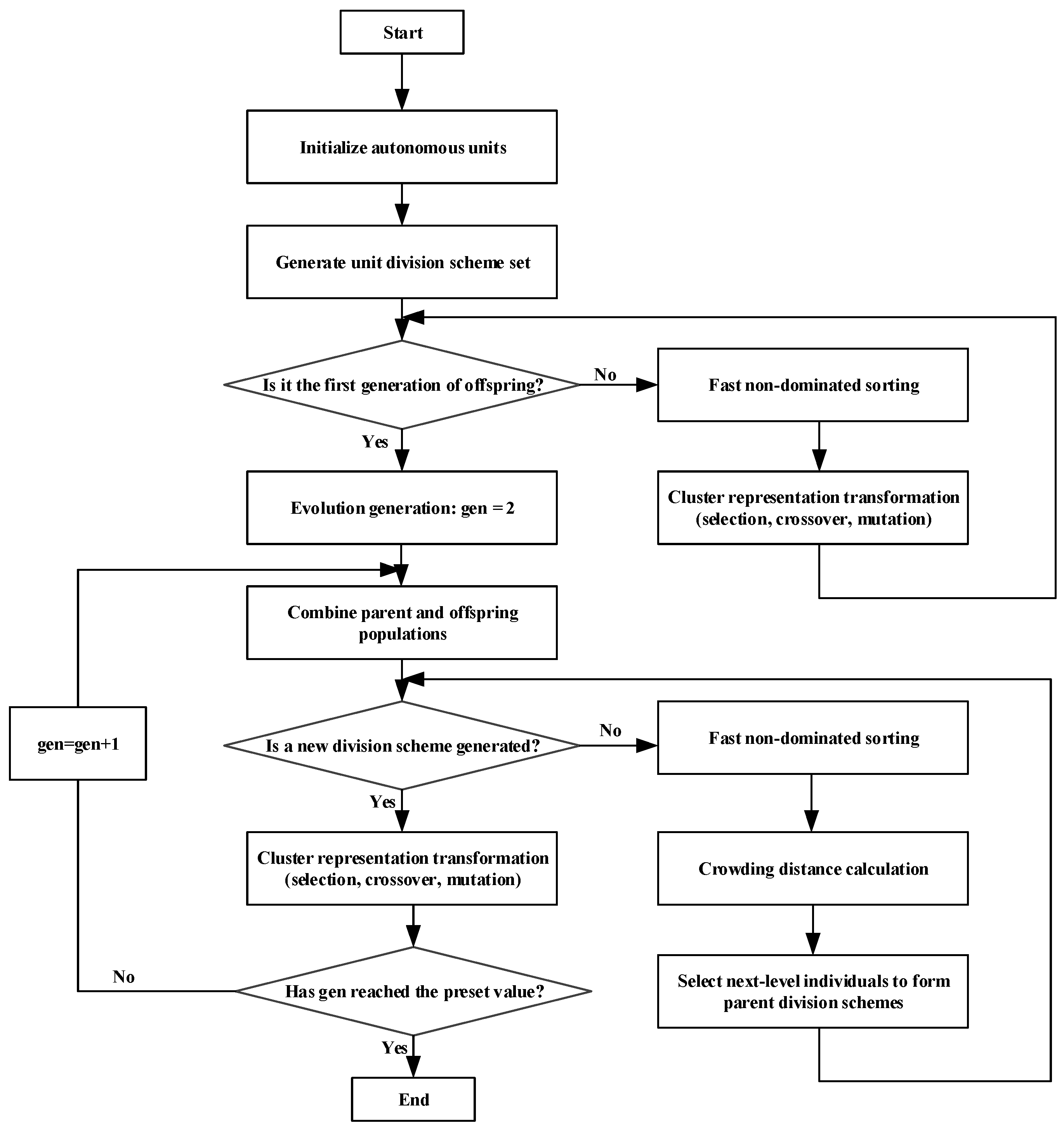
Traditional genetic algorithms are primarily designed for continuous decision variables, in which crossover and mutation operations are typically implemented using simulated binary crossover (SBX) and polynomial mutation. Although these methods improve global convergence and generalization capability, they are not suitable for the Boolean discrete variables involved in this study. Directly rounding continuous results would lead to reduced search space and decreased solution diversity. To address this issue, the GA is discretized and improved by introducing bitwise crossover and bitwise mutation operations on chromosomes, thereby preserving solution diversity and enhancing the ability to obtain global optimal solutions. Based on the above improvements, the overall process of the proposed GA-based autonomous unit division method is illustrated in Figure 4.
Figure 4.
Flowchart of the GA-based autonomous unit division method.
After obtaining all feasible solutions, a non-dominated sorting process is conducted to identify the set of autonomous units that are not inferior to other solutions. Furthermore, to ensure engineering feasibility, autonomous units with excessive inter-node geographical distances are excluded from the candidate set, resulting in the final autonomous unit division scheme.
4. Day-Ahead Optimal Scheduling Model
Energy storage systems can provide bidirectional power support for autonomous units. Given the tight internal connectivity of nodes within each unit and the weak correlation between units, the capacity and power rating of ESSs within a unit are primarily determined by the load and DG output of that unit. Therefore, developing a rational partitioned configuration of ESSs based on autonomous unit division is crucial to enhancing the autonomy of EADNs.
4.1. Objective Function
The objective of the ESS partitioned configuration in EADNs is to minimize the total cost of the network, which includes investment cost, operation and maintenance (O&M) cost, main grid power purchase cost, network loss cost, and PV curtailment cost, as expressed below:
where represents the investment cost of ESSs, n is the number of ESS units, denotes the discount rate, and y is the lifetime of the ESS. represents the unit investment cost per capacity of ESS, is the rated capacity of the i-th ESS, denotes the unit investment cost per power rating, and is the rated power of the i-th ESS. represents the O&M cost of ESSs, T denotes the total annual operation time (8760 h), is the unit O&M cost per charge/discharge energy, and is the charge/discharge power of ESS at time t (positive during discharging and negative during charging). denotes the power purchase cost from the main grid, is the number of tie lines connected to the main grid, represents the real-time electricity price at time t, and denotes the power flow on the tie line at time t. represents the network loss cost, is the unit cost of network loss, denotes the total number of branches, is the current magnitude on branch i at time t, and is the resistance of branch i. represents the PV curtailment cost, denotes the unit cost of curtailed PV energy, is the set of distributed PV units, and represents the curtailed PV power of unit i at time t.
4.2. Constraints
- (1)
- Energy storage constraints
- (2)
- Power balance constraints
- (3)
- Inter-unit interaction power constraint
- (4)
- Main grid tie-line power constraint
The tie-line power exchanged with the upstream grid is constrained to be non-negative, reflecting a conservative planning assumption commonly adopted in distribution networks where reverse power export is restricted due to protection coordination, contractual arrangements, or regulatory requirements. This assumption aims to assess the autonomous units’ capability to locally absorb renewable generation and serve internal loads, rather than to maximize economic benefits through power export.
- (5)
- Voltage deviation constraint
- (6)
- Thermal stability constraint
- (7)
- Power flow constraints
4.3. Solution Method
The proposed model is solved using CPLEX. However, since CPLEX cannot directly handle nonlinear equations, Equation (36) is transformed through conic relaxation to obtain a convex optimization formulation, as described below.
The second-order conic relaxation adopted in this paper is widely used for radial or weakly meshed distribution networks and has been shown to yield exact or near-exact solutions under typical operating conditions, such as moderate loading levels and convex objective functions. In the context of this study, the conic relaxation is introduced to improve computational tractability for the planning-stage ESS configuration problem, rather than to approximate real-time operational control.
5. Case Study
5.1. Case Introduction
To verify the feasibility and effectiveness of the proposed autonomous unit division method and the partitioned configuration model of energy storage systems, simulation studies were conducted in a MATLAB 2022a environment on a computer equipped with an Intel(R) Core(TM) Ultra 7 155H CPU @ 3.80 GHz, 64-bit operating system, and 32 GB RAM. The optimization model was solved by calling the IBM ILOG CPLEX 12.1 solver through the YALMIP toolbox.
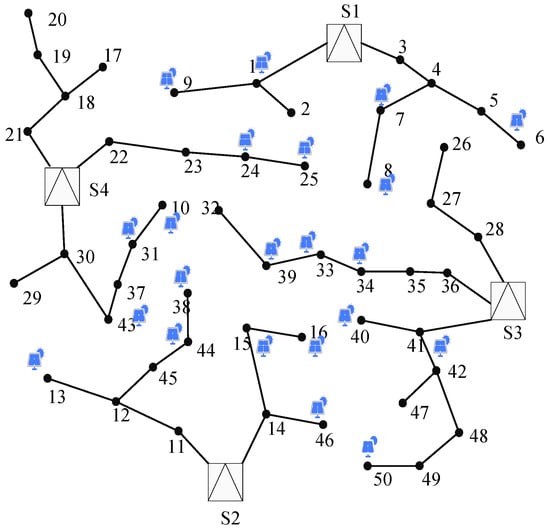
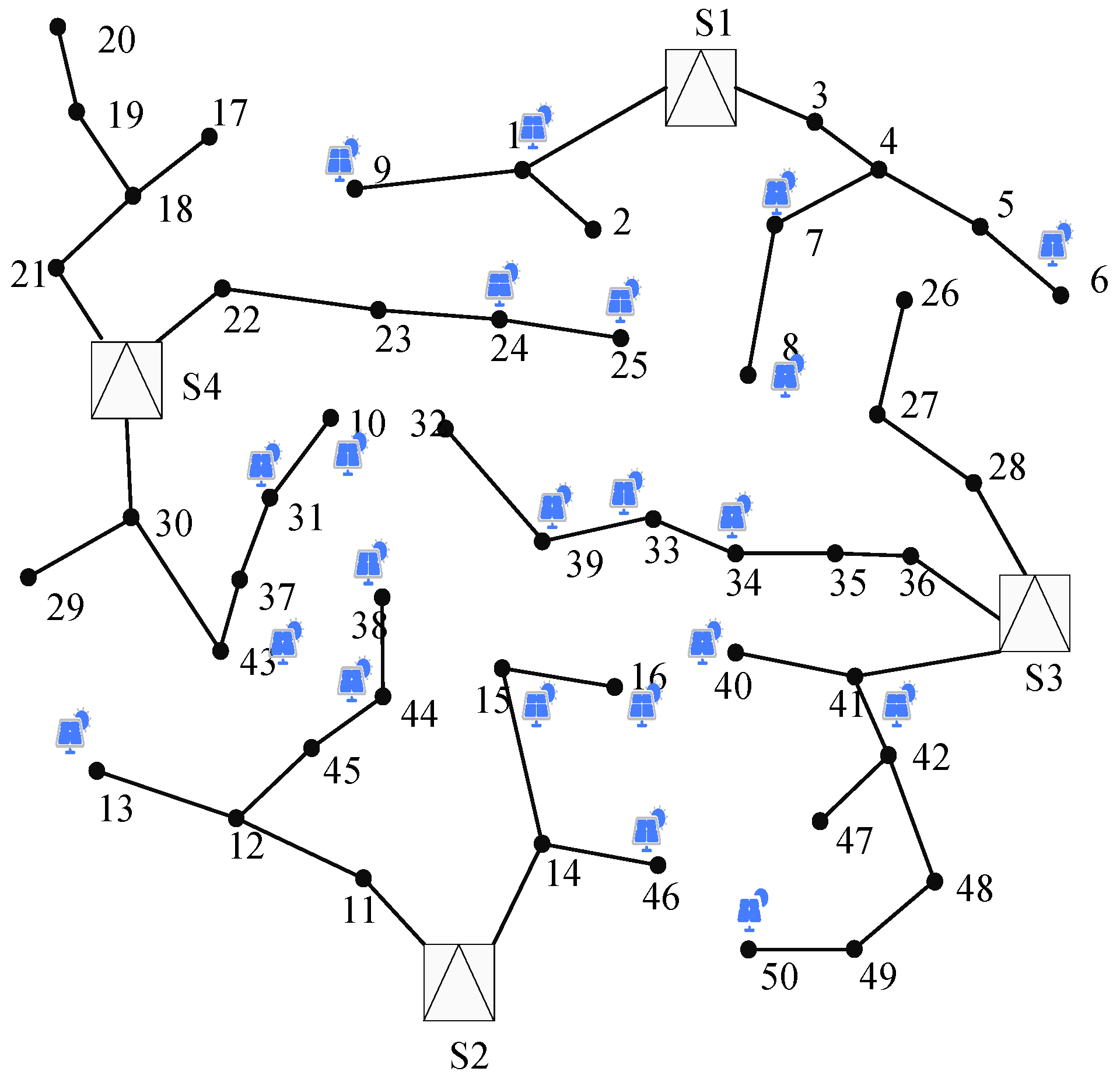
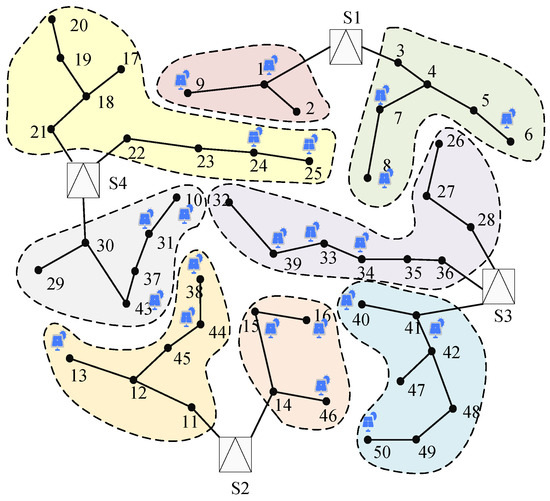
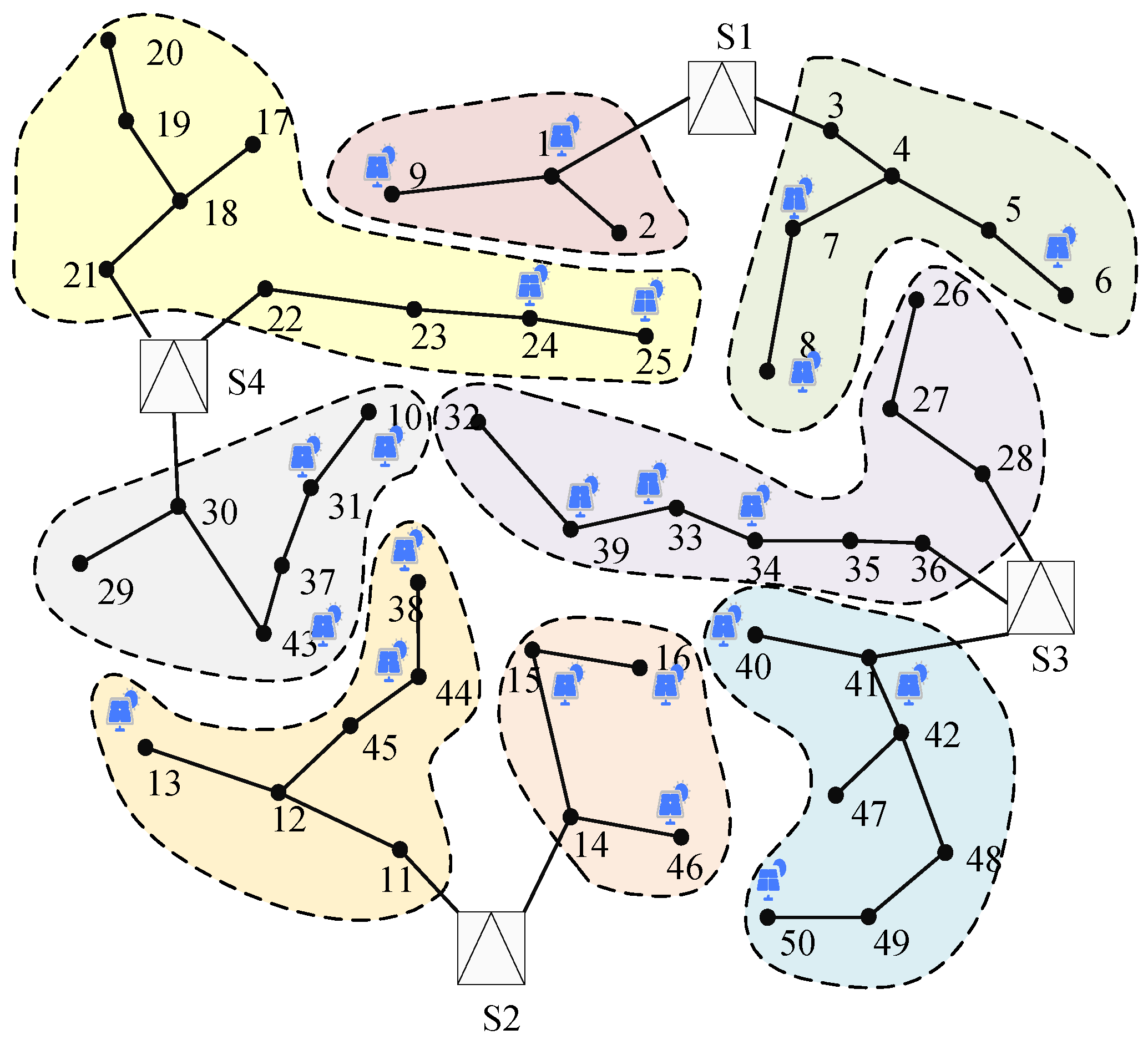
The objective of this case study is to demonstrate the modeling logic, solution process, and comparative advantages of the proposed method under a representative distribution network scenario. As shown in Figure 5, the test system consists of four substations supplying ten medium-voltage feeders and fifty buses in total, forming a typical radial distribution network structure [28]. Load profiles are derived from representative daily demand curves with peak and off-peak variations, while photovoltaic generation profiles follow normalized irradiance-based patterns scaled according to installed capacities at selected buses. The spatial distribution of loads and PV units reflects common urban distribution network characteristics. The load data are derived from a real distribution network in China. The rated voltage of the system is 13.5 kV, and the upper and lower voltage limits of the nodes are set to 1.05 p.u. and 0.95 p.u., respectively.
Figure 5.
Topology of the typical multi-station, multi-feeder energy-autonomous distribution network.
The energy storage systems considered in this study are sodium-sulfur batteries. The corresponding parameters, including unit investment cost, O&M cost per generated energy, lifetime, and charge–discharge efficiency, are listed in Table 1 [29,30]. The electricity price is set to 0.5 CNY/kWh, and the discount rate is 0.08.
Table 1.
Parameters of the NaS battery.
5.2. Analysis of Autonomous Unit Division Results
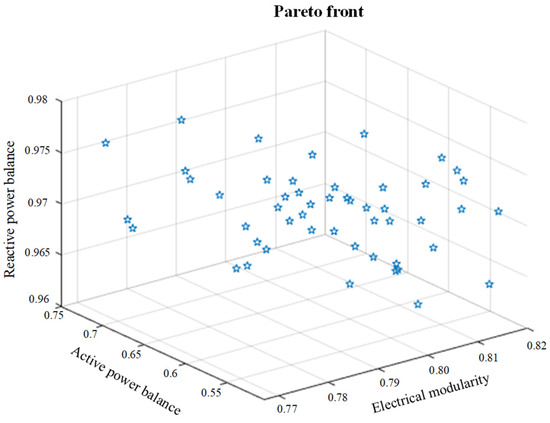
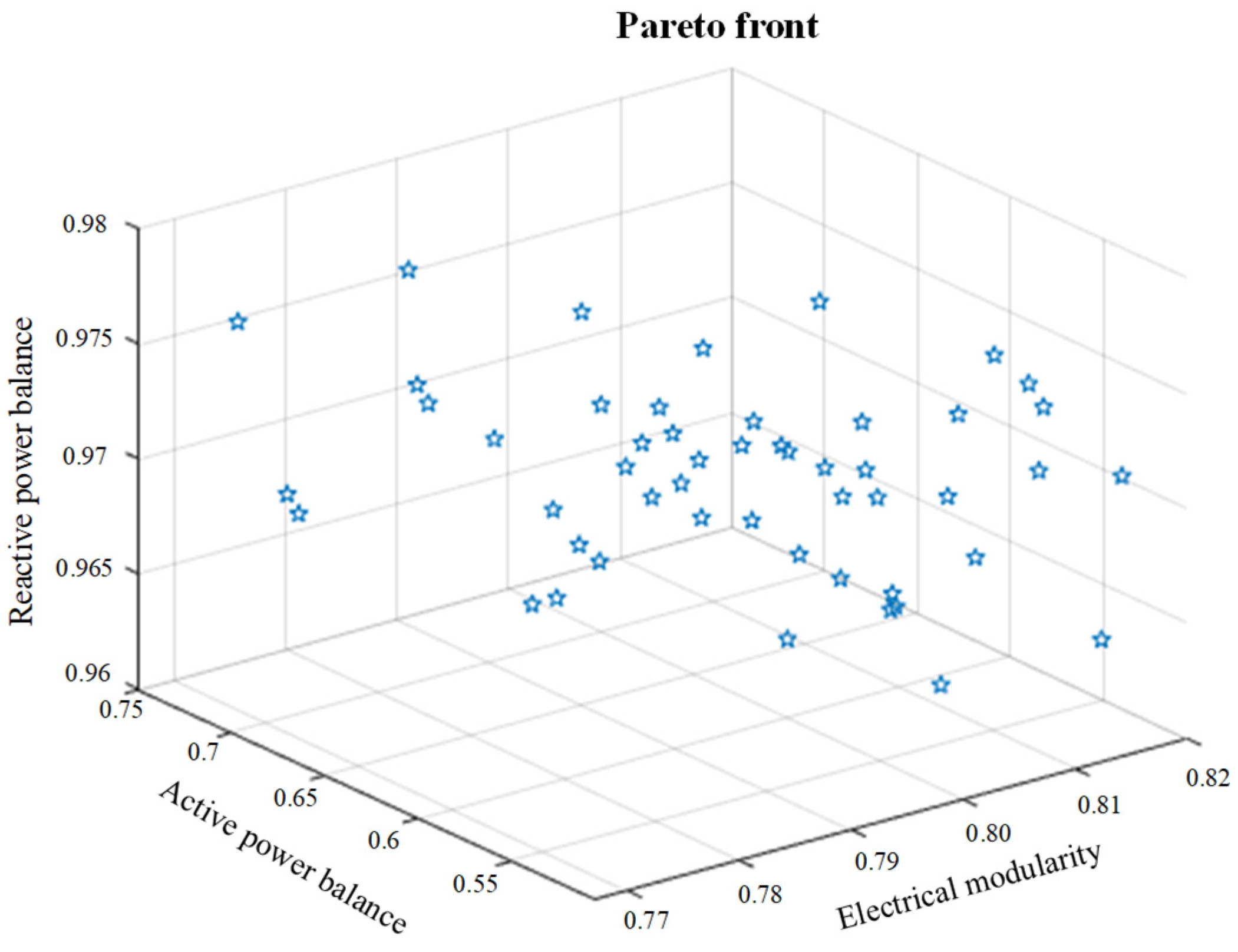
Based on the above test system, the proposed genetic algorithm was used to obtain the Pareto front of the autonomous unit division results, as shown in Figure 6.
Figure 6.
Pareto front of autonomous unit division schemes.
As shown in Figure 6, multiple non-dominated solutions can be obtained through the proposed multi-objective optimization. In practice, the final autonomous unit division scheme should not only exhibit favorable trade-offs among electrical modularity, active power balance, and reactive power balance, but also satisfy engineering feasibility constraints. Therefore, solutions with excessively large geographical spans or impractical feeder separations were first excluded. Among the remaining candidates, the solution with higher electrical modularity while maintaining balanced active and reactive power indices was selected as the final division scheme, as illustrated in Figure 7 and Table 2.
Figure 7.
Division scheme of autonomous units.
Table 2.
Division results of the improved typical multi-feeder distribution network.
It can be observed that the obtained autonomous mesh unit division results are logically consistent, with no isolated nodes. The electrical modularity index reaches 0.8156, indicating strong electrical coupling within each autonomous unit and high intra-unit connectivity. The reactive power balance degree is close to 1, demonstrating sufficient reactive power support within each unit, while the active power balance also shows satisfactory performance.
Moreover, to examine the robustness of the proposed partitioning method, sensitivity tests were conducted by varying the weighting coefficients within ±20% around the nominal values ( = 0.4, = 0.3, = 0.3). The resulting autonomous unit structures remain largely consistent, with only minor variations in boundary nodes, indicating that the partitioning results are not overly sensitive to moderate changes in the weighting parameters.
5.3. Analysis of Partitioned Energy Storage Configuration
To highlight the advantages of the proposed siting and sizing method for ESSs, two comparative cases are established as follows:
- Case 1: ESSs are configured without considering the division of autonomous units. The candidate installation nodes and the number of accessible ESS units are determined directly.
- Case 2: The proposed method in this paper, in which ESSs are configured within each autonomous unit based on the results of autonomous unit division.
Case 1 represents a centralized ESS planning benchmark, in which the total ESS capacity is optimally allocated without autonomous unit partitioning. The same objective function, cost parameters, network constraints, and power flow model are applied as in Case 2, ensuring a fair and consistent comparison. The centralized ESS is located at candidate buses selected to minimize overall system cost under the same planning assumptions.
The siting and sizing results of ESSs under Case 1 and Case 2 are presented in Table 3 and Table 4, respectively. In Case 1, ESSs are installed at nodes 6, 9, 10, 16, 25, 38, 39, and 50 with rated capacities of 1.82, 3.45, 3.98, 2.11, 3.18, 5.67, 7.57, and 4.39 MWh, respectively, resulting in a total capacity of 32.17 MWh. In Case 2, ESSs are installed within the eight divided autonomous units, with rated capacities of 0.28, 1.94, 2.03, 7.58, 3.98, 7.37, 10.79, and 4.33 MWh, respectively, giving a total capacity of 38.3 MWh. Although the total storage capacity in Case 2 is 6.13 MWh greater than that in Case 1, the configuration based on autonomous unit division enables each unit to determine its own ESS capacity according to its local source–load characteristics. This facilitates better coordination with local PV and wind generation, enhances internal resource utilization, and improves the autonomy and flexibility of the active distribution network.
Table 3.
ESS siting and sizing results in Case 1.
Table 4.
ESS siting and sizing results in Case 2.
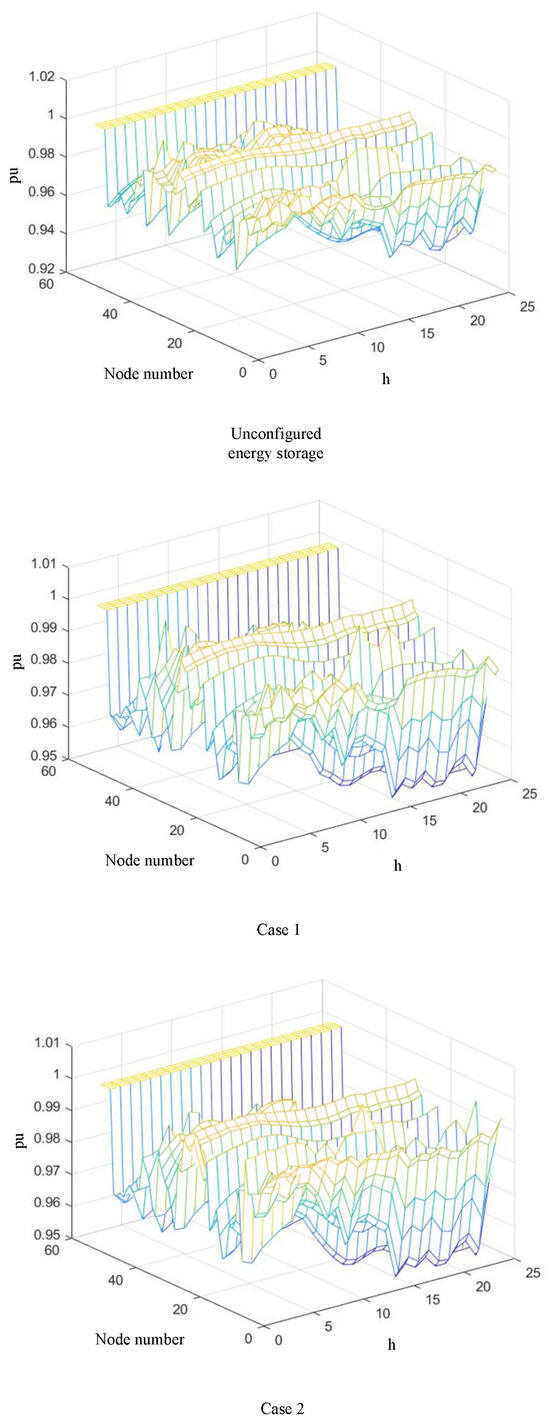
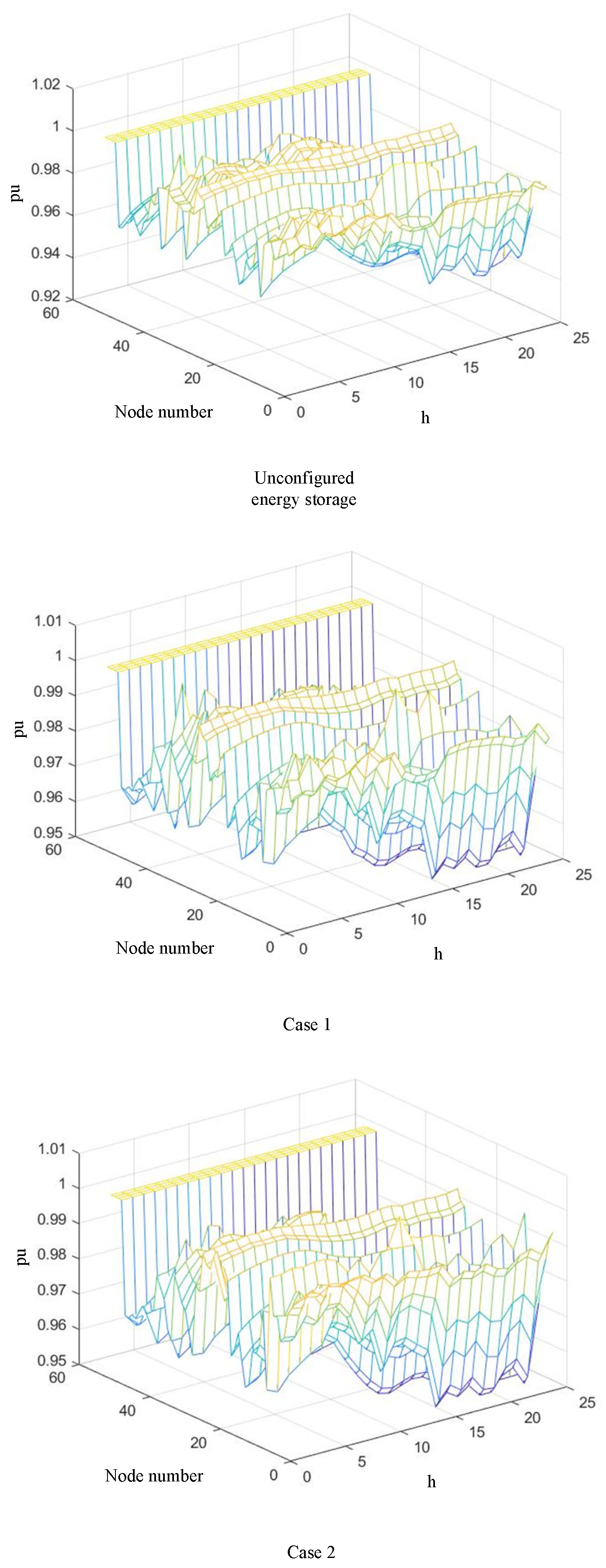
The 24 h voltage profiles of all nodes under the three scenarios—before planning, Case 1, and Case 2—are shown in Figure 8. Before ESS installation, the minimum nodal voltage of the system is 0.931 p.u., which is below the acceptable lower limit. After installing ESSs, the minimum voltage increases to the permitted lower limit of 0.95 p.u. Moreover, the voltage fluctuation index is reduced by 11.49% in Case 1 and 14.85% in Case 2 compared with the pre-planning case. These results indicate that ESS deployment significantly enhances system voltage stability and effectively suppresses voltage fluctuations. The simulation results over the representative operating horizon indicate that each autonomous unit can maintain energy balance through coordinated ESS charging and discharging without persistent power deficit, demonstrating the effectiveness of the proposed configuration under typical source-load scenarios.
Figure 8.
Nodal voltage profiles under different cases.
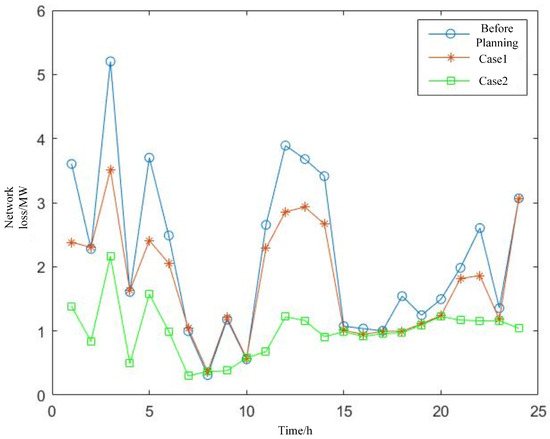
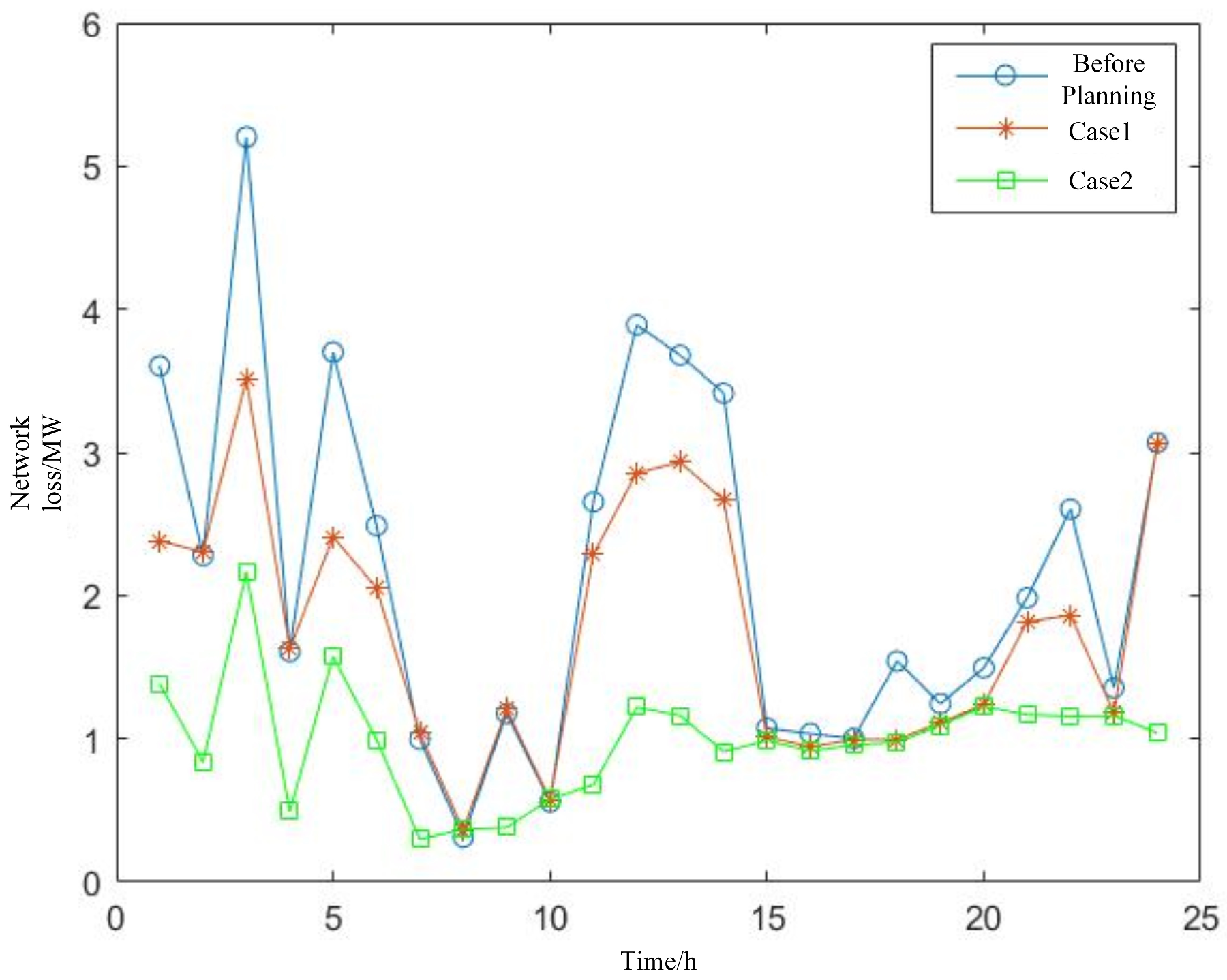
The comparison of network losses under different cases is illustrated in Figure 9. It can be observed that, relative to the pre-planning system, the total network losses decrease by 17.85% in Case 1 and 53.82% in Case 2. This demonstrates that ESS deployment effectively reduces active power losses in the distribution network. Furthermore, the partitioned ESS configuration (Case 2) achieves a 43.99% greater reduction in losses compared with the conventional configuration (Case 1), showing a remarkable improvement in network efficiency.
Figure 9.
Comparison of network losses under different cases.
The economic comparison of different cases is summarized in Table 5.
Table 5.
Economic comparison of different ESS configuration cases.
Although the total ESS capacity in Case 2 is larger, leading to a slightly higher investment cost (an increase of 0.8018 million CNY), the partitioned configuration based on autonomous unit division effectively coordinates inter-unit power exchange and allows ESSs to better complement PV generation within each unit. As a result, the operation and maintenance cost in Case 2 decreases by 0.1237 million CNY compared with Case 1. Moreover, Case 2 achieves a better balance of source–load–storage within autonomous units, reducing the reliance on the main grid. Consequently, the main grid power purchase cost decreases by 8.7375 million CNY, and the PV curtailment cost decreases by 3.537 million CNY, both significantly exceeding the additional ESS investment.
By comparing the total system cost across different cases, it can be observed that Case 2 reduces the total cost by 19.47 million CNY compared with the pre-planning case and by 12.31 million CNY compared with Case 1. Therefore, the proposed partitioned ESS configuration method not only improves the system’s autonomy and coordination capability but also achieves superior economic performance, validating its effectiveness for EADNs.
All in all, from an economic perspective, the proposed partition-based ESS configuration (Case 2) is feasible, as the total planning cost—including ESS investment, operation, network losses, and power purchase—is lower than that of the centralized configuration (Case 1) under the same cost assumptions.
6. Conclusions
This paper addresses the challenges of insufficient autonomy and lack of regional coordination in energy storage configuration under high-penetration distributed energy scenarios. A partitioned configuration method for energy storage systems in EADNs based on autonomous unit division is proposed and validated through typical case studies. The main conclusions are as follows:
- The system architecture and the concept of autonomous units in EADNs are proposed. The hierarchical characteristics and operational mechanisms of EADNs are clarified, and the composition and physical boundaries of autonomous units are defined.
- A framework and division method for autonomous units in EADNs are developed. Following the principle of “tight coupling within units and loose coupling between units,” a comprehensive indicator system for autonomous unit division is established considering electrical modularity, active power balance, and reactive power balance. An improved genetic algorithm is employed for multi-objective optimization to ensure the electrical rationality and autonomy of the partitioning results.
- A partitioned configuration model for energy storage systems considering the autonomous unit structure is proposed. The model aims to minimize the total cost by comprehensively accounting for storage investment and operation costs, main grid power purchase costs, network losses, and PV curtailment losses. Case studies demonstrate that the proposed model effectively improves voltage quality while reducing network losses by 53.82% and 43.99% compared with the pre-storage and traditional centralized storage configurations, respectively. Meanwhile, the total cost is reduced by 20.89% and 14.31%, ensuring optimal economic performance of storage configuration and enhancing the autonomy of EADNs.
Future research will extend this work by incorporating uncertainty modeling of load and renewable generation, multi-scenario analysis, and more detailed operational constraints, such as reliability and post-fault restoration considerations.
Author Contributions
Conceptualization, M.D. and D.W.; methodology, M.D. and D.W.; software, S.Q.; validation, H.W.; formal analysis, R.L.; investigation, S.Q. and Q.P.; resources, X.W., G.L., F.L. and R.M.; data curation, M.D. and D.W.; visualization, X.W. and G.L.; writing—original draft preparation, R.M.; writing—review and editing, F.L. All authors have read and agreed to the published version of the manuscript.
Funding
The authors declare that this study received funding from the Science and Technology Projects of the State Grid Tianjin Electric Power Company. The funder had the following involvement with the study: Provision of study data, computing resources, or other analysis tools.
Data Availability Statement
The original contributions presented in this study are included in the article. Further inquiries can be directed to the corresponding authors.
Acknowledgments
The authors would also like to thank the anonymous reviewers for their valuable comments and suggestions to improve the quality of the paper.
Conflicts of Interest
Authors Minghui Duan, Dacheng Wang, Shengjing Qi, Haichao Wang, Ruohan Li, Qu Pu, Xiaohan Wang and Gaozhong Lyu were employed by the State Grid Tianjin Electric Power Company. The remaining authors declare that the research was conducted in the absence of any commercial or financial relationships that could be construed as a potential conflict of interest.
Nomenclature
| Abbreviations | |||
| EADN | Energy-autonomous distribution network | DERs | Distributed energy resources |
| DG | Distributed generation | ESSs | Energy storage systems |
| ECS | Electrical coupling strength | PV | Photovoltaic |
| GA | Genetic algorithm | SBX | Simulated binary crossover |
| Parameters | |||
| The electrical modularity | The network loss cost | ||
| The adjacency matrix | The unit cost of network loss | ||
| m | The total weight of all edges in the network | The total number of branches | |
| The electrical coupling strength of node i | The current magnitude on branch i at time t | ||
| The electrical coupling strength between nodes i and j | The resistance of branch i | ||
| The per-unit values of the equivalent admittance of line ij | The PV curtailment cost | ||
| The per-unit values of transfer capacity of line ij | The unit cost of curtailed PV energy | ||
| The average values of equivalent admittance | The set of distributed PV units | ||
| The average values of transfer capacity | The curtailed PV power of unit i at time t | ||
| The equivalent impedance of line ij | The total stored energy of the i-th ESS at time t | ||
| The element in the i-th row and j-th column of the impedance matrix | The charge efficiencies | ||
| The power transfer capacity between nodes i and j | The discharge efficiencies | ||
| The maximum transfer capacity of line ij | The charge powers of the i-th ESS at time t | ||
| The power transfer distribution factor of line ij | The discharge powers of the i-th ESS at time t | ||
| The reactive balance of unit i | The rated capacity of the i-th ESS | ||
| The reactive power balance index | The rated charge/discharge power | ||
| c | The number of autonomous meshes | The lower limits of the state of charge | |
| The maximum reactive power supply within the unit | The upper limits of the state of charge | ||
| The total reactive demand within the unit | The power on the tie line between the EADN and the main grid at time t | ||
| The active power balance degree of unit i | The total PV generation of autonomous unit i at time t | ||
| The net power characteristics of unit i under typical time-varying scenarios | The total load | ||
| T | The time horizon of the scenario | The network loss of unit i at time t | |
| The active power balance index | The interaction power between autonomous unit i and its neighboring units | ||
| The comprehensive indicator of autonomous unit division | The upper limits of allowable power transfer on tie line l between autonomous units | ||
| The weighting coefficient of electrical modularity indicator | The lower limits of allowable power transfer on tie line l between autonomous units | ||
| The weighting coefficient of reactive power balance index | The power flow on the tie line between the main grid and the distribution network at time t | ||
| The weighting coefficient of active power balance index | The operating voltage of node i at time t | ||
| The investment cost of ESSs | The rated voltage | ||
| The discount rate. | The allowable voltage deviation range | ||
| The unit investment cost per capacity of ESS | The current of line ij at time t | ||
| The rated capacity of the i-th ESS | The maximum allowable current capacity of line ij | ||
| The unit investment cost per power rating | The set of sending-end nodes for branches terminating at node j | ||
| The rated power of the i-th ESS | The set of receiving-end nodes for branches originating from node j | ||
| The O&M cost of ESSs | The active power flows from node i to node j at time t | ||
| The unit O&M cost per charge/discharge energy | The reactive power flows from node i to node j at time t | ||
| The charge/discharge power of ESS at time t | The net injected active powers at node j at time t | ||
| The power purchase cost from the main grid | The net injected reactive powers at node j at time t | ||
| The number of tie lines connected to the main grid | The voltage magnitude at node j at time t | ||
| The real-time electricity price at time t | The resistance of branch ij | ||
| The power flow on the tie line at time t | The reactance of branch ij | ||
References
- Wang, S.; Luo, F.; Fo, J.; Lv, Y.; Wang, C. Two-Stage Spatiotemporal Decoupling Configuration of SOP and Multi-Level Electric-Hydrogen Hybrid Energy Storage Based on Feature Extraction for Distribution Networks with Ultra-High DG Penetration. Appl. Energy 2025, 398, 126438. [Google Scholar] [CrossRef] [Scilit]
- Luo, F.; Wang, S.; Lv, Y.; Mu, R.; Fo, J.; Zhang, T.; Xu, J.; Wang, C. Domain Knowledge-Enhanced Graph Reinforcement Learning Method for Volt/Var Control in Distribution Networks. Appl. Energy 2025, 398, 126409. [Google Scholar] [CrossRef] [Scilit]
- Cao, Y.; Li, Q.; Tan, Y.; Li, Y.; Chen, Y.; Shao, X.; Zou, Y. A Comprehensive Review of Energy Internet: Basic Concept, Operation and Planning Methods, and Research Prospects. J. Mod. Power Syst. Clean Energy 2018, 6, 399–411. [Google Scholar] [CrossRef] [Scilit]
- Saboori, H.; Hemmati, R. Maximizing DISCO Profit in Active Distribution Networks by Optimal Planning of Energy Storage Systems and Distributed Generators. Renew. Sustain. Energy Rev. 2017, 71, 365–372. [Google Scholar] [CrossRef] [Scilit]
- Liu, Y.; Yu, Y.; Gao, N.; Wu, F. A Grid as Smart as the Internet. Engineering 2020, 6, 778–788. [Google Scholar] [CrossRef] [Scilit]
- Yaghmaee Moghaddam, M.H.; Leon-Garcia, A. A Fog-Based Internet of Energy Architecture for Transactive Energy Management Systems. IEEE Internet Things J. 2018, 5, 1055–1069. [Google Scholar] [CrossRef] [Scilit]
- Wang, R.; Ji, H.; Li, P.; Yu, H.; Zhao, J.; Zhao, L.; Zhou, Y.; Wu, J.; Bai, L.; Yan, J.; et al. Multi-Resource Dynamic Coordinated Planning of Flexible Distribution Network. Nat. Commun. 2024, 15, 4576. [Google Scholar] [CrossRef] [Scilit] [PubMed]
- Wang, X.; Li, F.; Zhang, Q.; Shi, Q.; Wang, J. Profit-Oriented BESS Siting and Sizing in Deregulated Distribution Systems. IEEE Trans. Smart Grid 2023, 14, 1528–1540. [Google Scholar] [CrossRef] [Scilit]
- Wang, W.; Zhang, X.; Fu, L.; Liao, M.; Xu, X. A Data-Driven Chance-Constrained BESS Planning in Distribution Networks by a Decoupling Solution Method. J. Energy Storage 2024, 80, 11015. [Google Scholar] [CrossRef] [Scilit]
- Yang, L.; Li, Y.; Zhang, Y.; Xie, Z.; Chen, J.; Qu, Y. Optimal Allocation Strategy of SOP in Flexible Interconnected Distribution Network Oriented High Proportion Renewable Energy Distribution Generation. Energy Rep. 2024, 11, 6048–6056. [Google Scholar] [CrossRef] [Scilit]
- Zhao, C.; Zhao, J.; Wu, C.; Wang, X.; Xue, F.; Lu, S. Power Grid Partitioning Based on Functional Community Structure. IEEE Access 2019, 7, 152624–152634. [Google Scholar] [CrossRef] [Scilit]
- Oskouei, M.Z.; Mohammadi-Ivatloo, B.; Erdinc, O.; Erdinc, F.G. Optimal Allocation of Renewable Sources and Energy Storage Systems in Partitioned Power Networks to Create Supply-Sufficient Areas. IEEE Trans. Sustain. Energy 2021, 12, 999–1008. [Google Scholar] [CrossRef] [Scilit]
- Chai, Y.; Guo, L.; Wang, C.; Zhao, Z.; Du, X.; Pan, J. Network Partition and Voltage Coordination Control for Distribution Networks with High Penetration of Distributed PV Units. IEEE Trans. Power Syst. 2018, 33, 3396–3407. [Google Scholar] [CrossRef] [Scilit]
- Borges, C.L.T.; Martins, V.F. Multistage Expansion Planning for Active Distribution Networks under Demand and Distributed Generation Uncertainties. Int. J. Electr. Power Energy Syst. 2012, 36, 107–116. [Google Scholar] [CrossRef] [Scilit]
- Chen, H.; Wang, Z.; Yan, H.; Zou, H.; Luo, B. Integrated Planning of Distribution Systems with Distributed Generation and Demand Side Response. Energy Procedia 2015, 75, 981–986. [Google Scholar] [CrossRef] [Scilit]
- Osama, R.A.; Zobaa, A.F.; Abdelaziz, A.Y. A Planning Framework for Optimal Partitioning of Distribution Networks into Microgrids. IEEE Syst. J. 2020, 14, 916–926. [Google Scholar] [CrossRef] [Scilit]
- Elmitwally, A.; Elsaid, M.; Elgamal, M.; Chen, Z. A Fuzzy-Multiagent Self-Healing Scheme for a Distribution System with Distributed Generations. IEEE Trans. Power Syst. 2015, 30, 2612–2622. [Google Scholar] [CrossRef] [Scilit]
- Yuan, M.; Zhang, H.; Ji, K.; Liu, Y.; Tang, X.; Tao, B.; Li, Z.; Mi, Y. Two-Stage Robust Planning Method for Distribution Network Energy Storage Based on Load Forecasting. Front. Energy Res. 2024, 12, 1327857. [Google Scholar] [CrossRef] [Scilit]
- Yan, C.; Geng, X.; Bie, Z.; Xie, L. Two-Stage Robust Energy Storage Planning with Probabilistic Guarantees: A Data-Driven Approach. Appl. Energy 2022, 313, 118623. [Google Scholar] [CrossRef] [Scilit]
- Wang, J.; Zhang, J.; Yang, M.; Wang, Y.; Zhang, N. Nodal Frequency-Constrained Energy Storage Planning via Hybrid Data-Model Driven Methods. iEnergy 2025, 4, 43–53. [Google Scholar] [CrossRef] [Scilit]
- Guo, W.; Zhou, Y.; Zhang, R.; Su, H.; Tian, J.; Hu, X.; Shen, Y.; Xu, J.; Zhao, F.; Ma, Y. Independent Energy Storage Planning Model Considering Comprehensive Benefits Enhancement. AIP Adv. 2025, 15, 015210. [Google Scholar] [CrossRef] [Scilit]
- Oikonomou, K.; Maloney, P.R.; Bhattacharya, S.; Holzer, J.T.; Anderson, O.; Ke, X.; Westman, J.; Burleyson, C.D.; Datta, S.; Twitchell, J.B.; et al. Energy Storage Planning for Enhanced Resilience of Power Systems against Wildfires and Heatwaves. J. Energy Storage 2025, 119, 116074. [Google Scholar] [CrossRef] [Scilit]
- Bai, L.; Jiang, T.; Li, F.; Chen, H.; Li, X. Distributed Energy Storage Planning in Soft Open Point Based Active Distribution Networks Incorporating Network Reconfiguration and DG Reactive Power Capability. Appl. Energy 2018, 210, 1082–1091. [Google Scholar] [CrossRef] [Scilit]
- Meng, X.; Zhang, S.; Liu, H.; Zhou, S. A Method of Energy Storage Capacity Planning to Achieve the Target Consumption of Renewable Energy. J. Energy Storage 2024, 97, 112993. [Google Scholar] [CrossRef] [Scilit]
- Zhang, X.; Zhang, H.; Yao, J. Multi-Objective Optimization of Integrated Process Planning and Scheduling Considering Energy Savings. Energies 2020, 13, 6181. [Google Scholar] [CrossRef] [Scilit]
- Duan, Y.; Gao, C.; Xu, Z.; Ren, S.; Wu, D. Multi-Objective Optimization for the Low-Carbon Operation of Integrated Energy Systems Based on an Improved Genetic Algorithm. Energies 2025, 18, 2283. [Google Scholar] [CrossRef] [Scilit]
- Koutsoukis, N.; Georgilakis, P. A Chance-Constrained Multistage Planning Method for Active Distribution Networks. Energies 2019, 12, 4154. [Google Scholar] [CrossRef] [Scilit]
- Miranda, V.; Ranito, J.V.; Proenca, L.M. Genetic Algorithms in Optimal Multistage Distribution Network Planning. IEEE Trans. Power Syst. 1994, 9, 1927–1933. [Google Scholar] [CrossRef] [Scilit]
- Li, P.; Ji, J.; Chen, S.; Ji, H.; Xu, J.; Song, G.; Zhao, J.; Wu, J.; Wang, C. Multi-Stage Expansion Planning of Energy Storage Integrated Soft Open Points Considering Tie-Line Reconstruction. Prot. Control Mod. Power Syst. 2022, 7, 45. [Google Scholar] [CrossRef] [Scilit]
- Wang, S.; Luo, F.; Wang, C.; Lyu, Y.; Mu, R.; Fo, J.; Ge, L. Collaborative Configuration Optimization of Soft Open Points and Hydrogen-Based Distributed Multi-Energy Stations Considering Spatiotemporal Coordination and Complementarity. J. Mod. Power Syst. Clean Energy 2025, 13, 2086–2097. [Google Scholar]

Disclaimer/Publisher’s Note: The statements, opinions and data contained in all publications are solely those of the individual author(s) and contributor(s) and not of MDPI and/or the editor(s). MDPI and/or the editor(s) disclaim responsibility for any injury to people or property resulting from any ideas, methods, instructions or products referred to in the content. |
© 2025 by the authors. Licensee MDPI, Basel, Switzerland. This article is an open access article distributed under the terms and conditions of the Creative Commons Attribution (CC BY) license.